<?xml version="1.0" encoding="ISO-8859-1"?><article xmlns:mml="http://www.w3.org/1998/Math/MathML" xmlns:xlink="http://www.w3.org/1999/xlink" xmlns:xsi="http://www.w3.org/2001/XMLSchema-instance">
<front>
<journal-meta>
<journal-id>0012-7353</journal-id>
<journal-title><![CDATA[DYNA]]></journal-title>
<abbrev-journal-title><![CDATA[Dyna rev.fac.nac.minas]]></abbrev-journal-title>
<issn>0012-7353</issn>
<publisher>
<publisher-name><![CDATA[Universidad Nacional de Colombia]]></publisher-name>
</publisher>
</journal-meta>
<article-meta>
<article-id>S0012-73532010000100014</article-id>
<title-group>
<article-title xml:lang="en"><![CDATA[EVALUATION OF FLY ASHES FOR THE REMOVAL OF CU, NI AND CD FROM ACIDIC WATERS]]></article-title>
<article-title xml:lang="es"><![CDATA[EVALUACIÓN DE LAS CENIZAS VOLANTES PARA LA ELIMINACIÓN DEL CU, NI Y CD DE AGUAS ÁCIDAS]]></article-title>
</title-group>
<contrib-group>
<contrib contrib-type="author">
<name>
<surname><![CDATA[FERNÁNDEZ PÉREZ]]></surname>
<given-names><![CDATA[BEGOÑA]]></given-names>
</name>
<xref ref-type="aff" rid="A01"/>
</contrib>
<contrib contrib-type="author">
<name>
<surname><![CDATA[AYALA ESPINA]]></surname>
<given-names><![CDATA[JULIA]]></given-names>
</name>
<xref ref-type="aff" rid="A02"/>
</contrib>
</contrib-group>
<aff id="A01">
<institution><![CDATA[,Universidad de Oviedo Escuela de Minas ]]></institution>
<addr-line><![CDATA[ ]]></addr-line>
<country>España</country>
</aff>
<aff id="A02">
<institution><![CDATA[,Universidad de Oviedo Escuela de Minas ]]></institution>
<addr-line><![CDATA[ ]]></addr-line>
<country>España</country>
</aff>
<pub-date pub-type="pub">
<day>00</day>
<month>03</month>
<year>2010</year>
</pub-date>
<pub-date pub-type="epub">
<day>00</day>
<month>03</month>
<year>2010</year>
</pub-date>
<volume>77</volume>
<numero>161</numero>
<fpage>141</fpage>
<lpage>147</lpage>
<copyright-statement/>
<copyright-year/>
<self-uri xlink:href="http://www.scielo.org.co/scielo.php?script=sci_arttext&amp;pid=S0012-73532010000100014&amp;lng=en&amp;nrm=iso"></self-uri><self-uri xlink:href="http://www.scielo.org.co/scielo.php?script=sci_abstract&amp;pid=S0012-73532010000100014&amp;lng=en&amp;nrm=iso"></self-uri><self-uri xlink:href="http://www.scielo.org.co/scielo.php?script=sci_pdf&amp;pid=S0012-73532010000100014&amp;lng=en&amp;nrm=iso"></self-uri><abstract abstract-type="short" xml:lang="en"><p><![CDATA[The presence of sulphides in many mine wastes and the formation of acid mine drainages (AMD) has been widely recognized as one of the great environmental problems nowadays. Waters from many of the abandoned mines, with thousands of cubic meters of residue scattered in dumps and ponds, are affected by this type of pollution characterized by its acidity, high contents of sulphates and heavy metals such as Fe, Mn, Al, Cu, Ni, Cd. This study was designed to study the effect of use flying ash coming from Power Stations as a neutralizer for acidic waters resulting from this type of abandoned facilities. In this study, and due to the heterogeneity of the contaminants present, we have studied the removal of Ni, Cu and Cd. Different parameters were studied: metal concentration and pH of the solution to be treated, time reaction and pulp density. Fly ash can be used as a neutralization/fixation agent. Fly ash will add alkalinity and increase the pH on contacting AMD. This will result in precipitation of metal hydroxides.]]></p></abstract>
<abstract abstract-type="short" xml:lang="es"><p><![CDATA[La presencia de sulfuros en la mayoría de los residuos mineros y la subsiguiente formación de los drenajes ácidos de mina (AMD) ha sido ampliamente reconocida como uno de los grandes problemas medioambientales actuales. Las aguas procedentes de las minas abandonadas, con miles de metros cúbicos de residuos dispersos en escombreras y balsas mineras, se ven afectadas por este tipo de contaminación caracterizada por su acidez alto contenido en sulfatos y metales pesados como el Fe, Mn, Al, Cu, Ni, y Cd. Este estudio fue diseñado para evaluar el efecto del uso de cenizas volantes procedentes de centrales eléctricas como un neutralizador de las aguas ácidas resultantes de este tipo de instalaciones abandonadas. En este trabajo, y debido a la heterogeneidad de los contaminantes presentes en dicho residuo hemos estudiado la eliminación del Ni, Cu y Cd. Para ello se estudiaron diferentes parámetros: la concentración de metal y el pH de la solución a tratar, el tiempo de reacción y la densidad de pulpa. Las cenizas volantes se pueden utilizar como agentes de neutralización o fijación. Su utilización en contacto con AMD permite aumentar la alcalinidad y el pH. Esto dará lugar a la precipitación de los hidróxidos metálicos correspondientes.]]></p></abstract>
<kwd-group>
<kwd lng="en"><![CDATA[AMD]]></kwd>
<kwd lng="en"><![CDATA[Fly Ash]]></kwd>
<kwd lng="en"><![CDATA[Ni]]></kwd>
<kwd lng="en"><![CDATA[Cu]]></kwd>
<kwd lng="en"><![CDATA[Cd]]></kwd>
<kwd lng="es"><![CDATA[AMD]]></kwd>
<kwd lng="es"><![CDATA[Cenizas Volantes]]></kwd>
<kwd lng="es"><![CDATA[Ni]]></kwd>
<kwd lng="es"><![CDATA[Cu]]></kwd>
<kwd lng="es"><![CDATA[Cd]]></kwd>
</kwd-group>
</article-meta>
</front><body><![CDATA[ <p align="center"><font size="4" face="Verdana, Arial, Helvetica, sans-serif"><b>EVALUATION OF FLY ASHES FOR THE REMOVAL OF CU, NI AND CD FROM ACIDIC WATERS</b></font></p>     <p align="center"><i><font size="3" face="Verdana, Arial, Helvetica, sans-serif"><b>EVALUACI&Oacute;N DE LAS CENIZAS VOLANTES PARA LA ELIMINACI&Oacute;N DEL CU, NI Y CD DE AGUAS &Aacute;CIDAS</b></font></i></p>     <p align="center">&nbsp;</p>     <p align="center"><font size="2" face="Verdana, Arial, Helvetica, sans-serif"><b>BEGO&Ntilde;A   FERN&Aacute;NDEZ P&Eacute;REZ</b>    <br>   <i>Escuela  de Minas de la Universidad de Oviedo, Espa&ntilde;a, <a href="mailto:fernandezbegona@uniovi.es">fernandezbegona@uniovi.es</a> </i></font></p>     <p align="center"><font size="2" face="Verdana, Arial, Helvetica, sans-serif"><b>JULIA AYALA ESPINA</b>    <br> <i>Escuela  de Minas de la Universidad de Oviedo, Espa&ntilde;a, <a href="mailto:jayala@uniovi.es">jayala@uniovi.es</a> </i></font></p>     <p align="center">&nbsp;</p>     <p align="center"><font size="2" face="Verdana, Arial, Helvetica, sans-serif"><b>Received for review June 16 <sup>th</sup>, 2009, accepted   December 20<sup>th</sup>, 2009, final version December 23<sup>th</sup>, 2009</b></font></p>     <p>&nbsp;</p> <hr>     ]]></body>
<body><![CDATA[<p><font size="2" face="Verdana, Arial, Helvetica, sans-serif"><b>ABSTRACT</b>: The presence of sulphides in many mine wastes and the  formation of acid mine drainages (AMD) has been widely recognized as one of the  great environmental problems nowadays. Waters from many of the abandoned mines,  with thousands of cubic meters of residue scattered in dumps and ponds, are  affected by this type of pollution characterized by its acidity, high contents of sulphates and heavy metals such as Fe, Mn, Al, Cu, Ni, Cd. </font></p>     <p><font size="2" face="Verdana, Arial, Helvetica, sans-serif">This study was designed to study the effect of use  flying ash coming from Power Stations as a neutralizer for acidic waters  resulting from this type of abandoned facilities. In this study, and due to the  heterogeneity of the contaminants present, we have studied the removal of Ni,  Cu and Cd. Different parameters were studied: metal concentration and pH of the  solution to be treated, time reaction and pulp density. Fly ash can be used as  a neutralization/fixation agent. Fly ash will add alkalinity and increase the pH on contacting AMD. This will result in precipitation of metal hydroxides. </font></p>     <p><font size="2" face="Verdana, Arial, Helvetica, sans-serif"><b>KEY WORDS</b>: AMD, Fly Ash, Ni, Cu, Cd. </font></p>     <p><font size="2" face="Verdana, Arial, Helvetica, sans-serif"><b>RESUMEN: </b>La presencia de sulfuros en la mayor&iacute;a de  los residuos mineros y la subsiguiente formaci&oacute;n de los drenajes &aacute;cidos de mina  (AMD) ha sido ampliamente reconocida como uno de los grandes problemas  medioambientales actuales. Las aguas procedentes de las minas abandonadas, con  miles de metros c&uacute;bicos de residuos dispersos en escombreras y balsas mineras,  se ven afectadas por este tipo de contaminaci&oacute;n caracterizada por su acidez alto contenido en sulfatos y metales pesados como el Fe, Mn, Al, Cu, Ni, y Cd. </font></p>     <p><font size="2" face="Verdana, Arial, Helvetica, sans-serif">Este  estudio fue dise&ntilde;ado para evaluar el efecto del uso de cenizas volantes  procedentes de centrales el&eacute;ctricas como un neutralizador de las aguas &aacute;cidas  resultantes de este tipo de instalaciones abandonadas. En este trabajo, y  debido a la heterogeneidad de los contaminantes presentes en dicho residuo  hemos estudiado la eliminaci&oacute;n del Ni, Cu y Cd. Para ello se estudiaron  diferentes par&aacute;metros: la concentraci&oacute;n de metal y el pH de la soluci&oacute;n a  tratar, el tiempo de reacci&oacute;n y la densidad de pulpa. Las cenizas volantes se  pueden utilizar como agentes de neutralizaci&oacute;n o fijaci&oacute;n. Su utilizaci&oacute;n en  contacto con AMD permite aumentar la alcalinidad y el pH. Esto dar&aacute; lugar a la precipitaci&oacute;n de los hidr&oacute;xidos met&aacute;licos correspondientes. </font></p>     <p><font size="2" face="Verdana, Arial, Helvetica, sans-serif"><b>PA  LABRAS CLAVE</b>: AMD, Cenizas Volantes, Ni, Cu, Cd. </font></p>   <hr>     <p>&nbsp;</p>     <p><font size="3" face="Verdana, Arial, Helvetica, sans-serif"><b>1. INTRODUCTION</b></font></p>     <p><font size="2" face="Verdana, Arial, Helvetica, sans-serif">The acid mine drainage (AMD) is a worldwide major cause of degradation of water resources. </font></p>     <p><font size="2" face="Verdana, Arial, Helvetica, sans-serif">Characterized by low pH and high </font><font size="2" face="Verdana, Arial, Helvetica, sans-serif">concentrations of heavy metals and other toxic  elements, AMD can severely contaminate surface and groundwater, as well as  soils. &#91;1&#93;. In </font><font size="2" face="Verdana, Arial, Helvetica, sans-serif">nature, sulphides remain in the subsurface in absence of oxygen  and only small outcrops of </font><font size="2" face="Verdana, Arial, Helvetica, sans-serif">these deposits came up to the surface. The drainage is  formed when sulphide minerals in rocks, primarily pyrite (FeS<sub>2</sub>), are  exposed to oxidizing conditions, forming sulphuric acid and dissolved iron.  Upon exposure to water and oxygen, pyritic minerals oxidize to form  acidic, iron and sulphate-rich drainage. Contamination associated with AMD  depends on type and amount of sulphide mineral oxidized, as well as type of  gangue minerals present in the rock. The leaching reaction produce the hydrolysis of other minerals that are dissolved Al, Ca, Mg, Mn, Na, Si, etc &#91;2&#93; </font></p>     ]]></body>
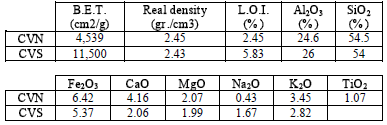
<body><![CDATA[<p><font size="2" face="Verdana, Arial, Helvetica, sans-serif">Also referred to as Acid Rock Drainage (ARD), AMD emanating from mine  waste rock, tailings, and mine structures, such as pits and underground  workings, is primarily a function of the mineralogy of local rock material and  the availability of water and oxygen. The need to prevent their formation has  led to the development of numerous investigations on the mechanisms of  oxidation and its prevention. &#91;3-4&#93; However, despite the many studies that  exist, because mineralogy and other factors affecting AMD formation so they are  highly variable from site-to-site, predicting the potential and treatment for AMD can be exceedingly challenging and costly. </font></p>     <p><font size="2" face="Verdana, Arial, Helvetica, sans-serif">The present work, given the wide variations in  composition with the acid water for the wide range of geochemical and  biogeochemical processes that cause, has focused on studying the removal of Cd,  Cu and Ni. &#91;5&#93;. Synthetic water, obtained in laboratory, have been used for  analysis and have been neutralized through the use of fly ash from two Power Station &#91;6-7&#93; </font></p>     <p>&nbsp;</p>     <p><font size="3" face="Verdana, Arial, Helvetica, sans-serif"><b>2. MATERIALS AND METHODS</b></font></p>     <p><font size="2" face="Verdana, Arial, Helvetica, sans-serif"><b>2.1 Characterization of fly ashes</b></font></p>     <p><font size="2" face="Verdana, Arial, Helvetica, sans-serif">Tests were carried out with  two fly ashes from different Power Starions: CVN y CVS. In both cases the  surface area (by BET method-N2), the chemical composition (by atomic adsorption  spectrophotometry with a Pye Unican analyzer) and the mineralogical composition  (by X-ray diffraction with a Philips PW 1830) was determined. It also  calculated the loss of ignition (LOI), bulk density and average particle size  and morphology by electron microscopy (SEM<i>). (<a href="#tab01">Table 1</a>, <a href="#fig01">Figures 1</a> and <a href="#fig02">2</a>).</i></font></p>     <p align="center"><font size="2" face="Verdana, Arial, Helvetica, sans-serif"><b><a name="tab01"></a>Table 1. </b>Chemical analysis and properties of fly ashes </font>    <br> <img src="/img/revistas/dyna/v77n161/a14tab01.gif"></p>     <p align="center"><font size="2" face="Verdana, Arial, Helvetica, sans-serif"><b><a name="fig01"></a><img src="/img/revistas/dyna/v77n161/a14fig01.gif">    <br>   Figure 1. </b>X-Ray Diffractogram of CVN and CVS fly ash </font></p>     ]]></body>
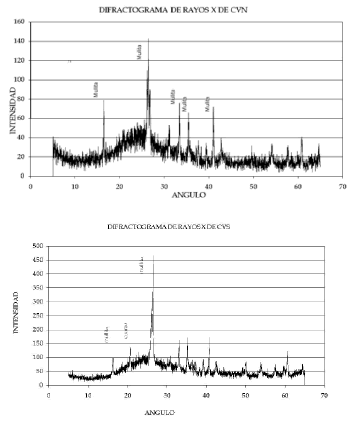
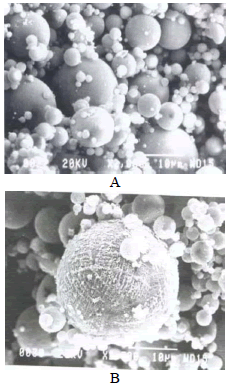
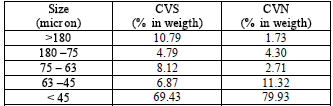
<body><![CDATA[<p align="center"><font size="2" face="Verdana, Arial, Helvetica, sans-serif"><b><a name="fig02"></a><img src="/img/revistas/dyna/v77n161/a14fig02.gif">    <br> Figure 2. A. </b>SEM-without react </font><font size="2" face="Verdana, Arial, Helvetica, sans-serif"><b>B. </b>SEM-treated </font></p>     <p><font size="2" face="Verdana, Arial, Helvetica, sans-serif">The chemical  analysis carried out on the two fly ashes shows that corresponds to an ash  residue rich in Si (more than 50 wt% SiO<sub>2</sub>), iron and aluminium and  low in calcium (less than 5 wt% CaO) <i>(<a href="#tab01">Table  1</a>)</i> and that these therefore may be classified according to ASTM C618, such  as a low calcium fly ashes, (class F), since they contain less than 10% CaO and  more than 70% is composed of SiO<sub>2</sub> , Al<sub>2</sub>O<sub>3</sub> and Fe<sub>2</sub>O<sub>3</sub>. </font></p>     <p><font size="2" face="Verdana, Arial, Helvetica, sans-serif">The mineral composition of the ash presents mostly vitreous phase and   mullite and quartz as crystalline phase <i>Fig.1</i>. <i>Fig. 2 </i>shows that the fly ash particles have a spherical morphology with   a 70% ,by weight, of medium grain size lower to 45&#956;m, <i><a href="#tab02">Table 2</a>.</i></font></p>     <p align="center"><font size="2" face="Verdana, Arial, Helvetica, sans-serif"><b><a name="tab02"></a>Table 2. </b>CVS and CVN fly ash granulometry</font>    <br> <img src="/img/revistas/dyna/v77n161/a14tab02.gif"></p>     <p><font size="2" face="Verdana, Arial, Helvetica, sans-serif"><b>2.2 Acid water characterization    <br> </b></font><font size="2" face="Verdana, Arial, Helvetica, sans-serif">All concentrated solutions  of heavy metals were prepared using analytical grade reagents and distilled and  deionised water. The pH was measured using a pH-meter Crisom 2000 and Sulphuric  acid (Probus,  Badalona, Spain ) was used for adjust. </font></p>     <p><font size="2" face="Verdana, Arial, Helvetica, sans-serif">Tests were carried out with  concentrated solutions of nickel, copper and cadmium. In Ni case three  solutions were prepared: one of 0.001M, a second one of 0.004M and last of  0.01M, since in most cases, industrial discharges do not exceed these  concentrations. In Cu case, the concentrations used were 0.002, 0.004, and   0.005 M and for Cd, 0.001,  0.003 and 0.005 M. The final pH of the solution was measured for all of them.</font></p>     <p><font size="2" face="Verdana, Arial, Helvetica, sans-serif"><b>2.3 Method    ]]></body>
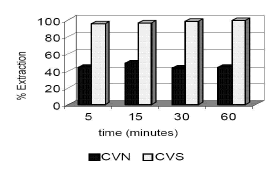
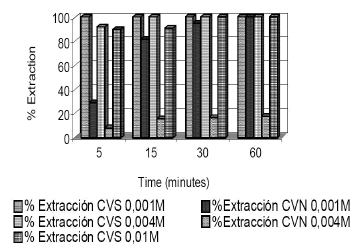
<body><![CDATA[<br> </b></font><font size="2" face="Verdana, Arial, Helvetica, sans-serif">The adsorption  method consisted of mixing, in polyethylene bottles, different quantities of  fly ash with water from concentrated acid solutions of Cu, Ni and Cd. During  the experiments varied both the source of the ash used, the pulp density,  stirring time, pH and initial concentration of metal ions in solutions used. At  the end of the process, fly ash was filtered in a 45 microns filter and the residual liquor was analysed by atomic adsorption. </font></p>     <p>&nbsp;</p>     <p><font size="3" face="Verdana, Arial, Helvetica, sans-serif"><b>3. RESULTS   AND DISCUSSION </b></font></p>     <p><font size="2" face="Verdana, Arial, Helvetica, sans-serif"><b>3.1 Study of Nickel elimination    <br> </b></font><font size="2" face="Verdana, Arial, Helvetica, sans-serif">To study the elimination of  nickel ions in acidic solutions different solutions were prepared from  different concentrates: 0.001, 0.004 and 0.01M, at pH 5. <i><a href="#fig03">Figure 3</a> </i>shows  the results of tests carried out with an agitation time ranged from 5, 15, 30  to 60 minutes, with samples of 25 ml each of acidic solutions 100 above  mentioned and with a pulp density of  40 g / l. </font></p>     <p align="center"><font size="2" face="Verdana, Arial, Helvetica, sans-serif"><b><a name="fig03"></a><img src="/img/revistas/dyna/v77n161/a14fig03.gif">    <br>   Figure 3</b>. % Extraction of Ni vs time for CVS and CVN fly ashes and different initial metal concentration. Pulp density 40 g/l</font></p>     <p><font size="2" face="Verdana, Arial, Helvetica, sans-serif"><i><a href="#fig03">Figure 3</a> </i>shows  eliminations close to 100% in the conditions mentioned for the solution 0.001 M on CVS ash during  the first 5 minutes of stirring. CVN ash needed 30 minutes to achieve 95% removal  and 60 minutes to reach 100%. After 5 minutes the pH is 5, arriving at pH 8 after 60 minutes. Final pH =8.4.</font></p>     <p><font size="2" face="Verdana, Arial, Helvetica, sans-serif">CVS ash presents similar behaviour for the 0.004M  solution, grazing 95% of elimination in 5 minutes of treatment, and 100% at 30  minutes. However, as seen in the previous case, CVN ashes have a worse  behaviour. In this case they do not exceed 20% elimination after 60 minutes of agitation. </font></p>     <p><font size="2" face="Verdana, Arial, Helvetica, sans-serif">For CVS  ashes experiments were performed with more concentrated solutions, 0.1M. The results  returned to be very favourable reaching 100% elimination after 30 minutes of agitation. </font></p>     ]]></body>
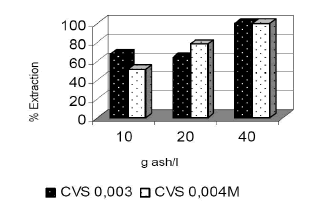
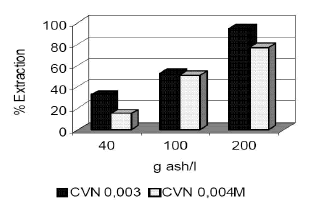
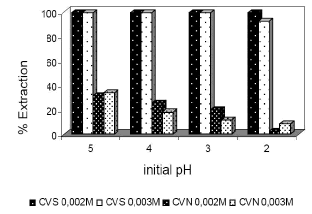
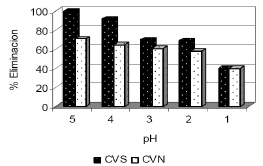
<body><![CDATA[<p><font size="2" face="Verdana, Arial, Helvetica, sans-serif">Subsequently, the  influence of pulp density on the percentage of extraction was studied. For CVS  ash, since  good results were obtained with small times of stirring, experiments were realized with low pulp densities and 15 minutes of stirring time <i><a href="#fig04">Figure 4</a>. </i>Good results were obtained. </font></p>     <p align="center"><font size="2" face="Verdana, Arial, Helvetica, sans-serif"><b><a name="fig04"></a><img src="/img/revistas/dyna/v77n161/a14fig04.gif">    <br>   Figure  4</b>. %  Extraction of Ni vs different pulp density for CVS ash, 15 minutes of stirring  time and initial solutions 0.003 and  0.004 M </font></p>     <p><font size="2" face="Verdana, Arial, Helvetica, sans-serif">For CVN ashes,  taking into account the low percentage of adsorption obtained to high molar  ratio, pulp density in the experiments was increased reaching densities of 250 grams / litre,  achieving under these conditions results of about 90% elimination for 0.003 molar solution. <i><a href="#fig05">Figure 5</a>. </i></font></p>     <p align="center"><font size="2" face="Verdana, Arial, Helvetica, sans-serif"><b><a name="fig05"></a><img src="/img/revistas/dyna/v77n161/a14fig05.gif">    <br>   Figure 5. </b>% Extraction of Ni vs different pulp density for CVN ash, 15 minutes of stirring time and initial solutions of 0.003 and 0.004 M</font></p>     <p><font size="2" face="Verdana, Arial, Helvetica, sans-serif">Finally, tests were carried  out to evaluate the impact on the final adsorption result, of the initial pH of  the solution. Although CVS ashes were not influenced themselves it can be seen  a worse result in the case of CVN ashes, with a higher acidity of the initial solution. <i><a href="#fig06">Figure 6</a>. </i></font></p>     <p align="center"><font size="2" face="Verdana, Arial, Helvetica, sans-serif"><b><a name="fig06"></a><img src="/img/revistas/dyna/v77n161/a14fig06.gif">    <br>   Figure 6. </b>% Extraction of Ni vs different initial pH</font> <font size="2" face="Verdana, Arial, Helvetica, sans-serif">solution: 15 minutes of agitation time,40 g/l of CVS </font><font size="2" face="Verdana, Arial, Helvetica, sans-serif">and CVN ash, and initial solution 0.003 and 0.002 </font><font size="2" face="Verdana, Arial, Helvetica, sans-serif">M</font></p>     <p><font size="2" face="Verdana, Arial, Helvetica, sans-serif"><b>3.2 Copper elimination    ]]></body>
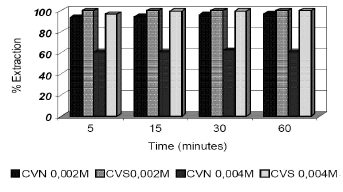
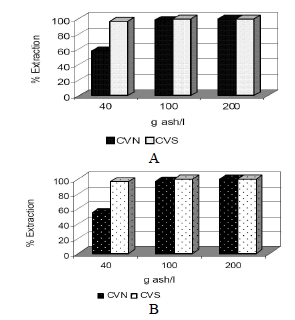
<body><![CDATA[<br> </b></font><font size="2" face="Verdana, Arial, Helvetica, sans-serif">In copper case, dissolutions 0.002M, 0.004M and  0.005M were prepared. <i><a href="#fig07">Figure 7</a> </i>shows the results obtained for tests realized with CVS and CVA ash, with acidic solutions with  a pH of 5, pulp density of   40 g  / l and stirring time from 5 to 60 minutes. As in the case of nickel, the final pH of the samples was measured. </font></p>     <p align="center"><font size="2" face="Verdana, Arial, Helvetica, sans-serif"><b><a name="fig07"></a><img src="/img/revistas/dyna/v77n161/a14fig07.gif">    <br>   Figure 7</b>. %  Extraction of Cu vs time for CVS and CVN fly ash and different initial metal concentration. Pulp density 40 g/l</font></p>     <p><font size="2" face="Verdana, Arial, Helvetica, sans-serif">In the figure is  observed how, as it happened in the case of nickel, CVS ashes allow to obtain  the best results in the first 5 minutes of reaction, whereas for the CVN ashes,  molar concentrations of 0.004 down the percentage of extraction to 60% even after 1 hour of stirring. </font></p>     <p><font size="2" face="Verdana, Arial, Helvetica, sans-serif">In view of the  above mentioned results for tests realized with different pulp densities, the  stirring time was fixed in 15 minutes (<i><a href="#fig08">Figure 8.A</a></i>) and 60 minutes (<i><a href="#fig08">Figure  8.B</a></i>) to assure a total reaction. Figures A and B  show the good results for both ashes, reaching the total elimination of Cu with a high pulp density, both with 15 minutes of agitation and with 60 minutes. </font></p>     <p align="center"><font size="2" face="Verdana, Arial, Helvetica, sans-serif"><b><a name="fig08"></a><img src="/img/revistas/dyna/v77n161/a14fig08.gif">    <br>   Figure 8. A. </b>% Extraction of Cu for different pulp density, 15 minutes of agitation time and 0.004M.</font> <font size="2" face="Verdana, Arial, Helvetica, sans-serif"><b>B. </b>%  Extraction of Cu for different pulp density from CVN, 60 minutes of agitation time and 0.005M</font></p>     <p><font size="2" face="Verdana, Arial, Helvetica, sans-serif">Finally,  the study of the influence of the initial pH of the solution shows that at pH  values of 3 or lower the results are considerably worse. <i><a href="#fig09">Figure 9</a>. In both cases, CVS ash shows  a high metal removal capacity with low pulp density, due to its high specific  surface, while CVN ash needs more density to achieve the complete elimination of the metal even with 60 minutes of reaction </i></font></p>     <p align="center"><font size="2" face="Verdana, Arial, Helvetica, sans-serif"><b><a name="fig09"></a><img src="/img/revistas/dyna/v77n161/a14fig09.gif">    <br>   Figure 9. </b>% Extraction of Cu vs different initial pH</font> <font size="2" face="Verdana, Arial, Helvetica, sans-serif">solution: 30 minutes of agitation time, 40 g/l of</font> <font size="2" face="Verdana, Arial, Helvetica, sans-serif">CVS and CVN ash, and initial solution 0.004 M</font></p>     ]]></body>
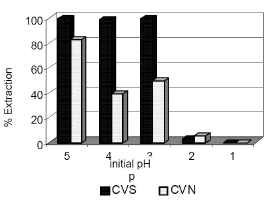
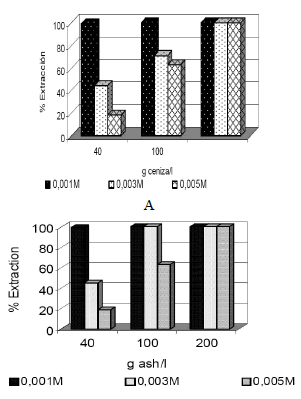
<body><![CDATA[<p><font size="2" face="Verdana, Arial, Helvetica, sans-serif"><b>3.3 Cadmium Elimination    <br> </b></font><font size="2" face="Verdana, Arial, Helvetica, sans-serif">Dissolutions 0.001M, 0.003M  and 0.005M were prepared. <i><a href="#fig10">Figure 10</a> </i>shows the results obtained in the  same conditions as in the previous cases: CVS and CVN  ashes, pH 5, pulp density of   40  g / l and a stirring time from 5 to 60 minutes with a 0.003 M solution of Cd. CVS  ashes got the best results as opposed to the CVN ashes that are kept in percentages of elimination not superior than 50% in all tests.</font></p>     <p align="center"><font size="2" face="Verdana, Arial, Helvetica, sans-serif"><b><a name="fig10"></a><img src="/img/revistas/dyna/v77n161/a14fig10.gif">    <br>   Figure  10. </b>% Extraction of Cd vs time for CVS and CVN fly ash and solution 0.004 M. Pulp density 40 g/l</font></p>     <p><font size="2" face="Verdana, Arial, Helvetica, sans-serif">In <i><a href="#fig11">Figures 11.A</a> and <a href="#fig11">11.B</a> </i>is observed how at low concentrations 100% of elimination is  achieved with low pulp densities. As the molar value of the solution increases,  the results are worse, being kept only for very high pulp densities, as  expected, since the fly ash coming to lose its capacity of adsorption by saturation. </font></p>     <p align="center"><font size="2" face="Verdana, Arial, Helvetica, sans-serif"><b><a name="fig11"></a><img src="/img/revistas/dyna/v77n161/a14fig11.gif">    <br>   Figure 11. A. </b>% Extraction of Cd   for different pulp density with CVN fly ash, 60 minutes of stirring time and   different molarity</font> <font size="2" face="Verdana, Arial, Helvetica, sans-serif"><b>B. </b>% Extraction of Cd     for different pulp density with CVS fly ash, 60 minutes of stirring time and     different molarity</font></p>     <p><font size="2" face="Verdana, Arial, Helvetica, sans-serif">Regarding the  influence of the pH, for the case of Cd, seems have a minor influence on the results obtained.<i> <a href="#fig12">Figure 12</a>.</i></font></p>     <p align="center"><font size="2" face="Verdana, Arial, Helvetica, sans-serif"><b><a name="fig12"></a><img src="/img/revistas/dyna/v77n161/a14fig12.gif">    <br>   Figure 12. </b>% Extraction of Cd  vs different initial pH solution: 30 minutes of stirring time, 40 g/l of CVS and CVN ash and  0.004 M</font></p>     ]]></body>
<body><![CDATA[<p><font size="2" face="Verdana, Arial, Helvetica, sans-serif">The results obtained in the experiments carried out  have become clear the influence that can have on the process of adsorption and  neutralization on fly ash, parameters as the contact time, pH, initial metal  concentration in solution and the physicochemical characteristics of the ashes. &#91;8-9&#93;</font></p>     <p><font size="2" face="Verdana, Arial, Helvetica, sans-serif">The removal of heavy metals is  mainly due to a neutralization of the dissolution by increasing the pH, making  the precipitation of the metal ions in solution as hydroxides. Therefore, the  most important parameter in the captation of metal will be the initial pH of  wastewater. Fly ashes have alkaline and alkaline earth metals on their surfaces  that are dissolved to put in touch with the residual dissolution, increasing  its pH. The metal is deposited in these conditions as a hydroxide on the  surface of the ashes. The smaller the particle size and major its specific  surface, the contact between solid and liquid will be better, thus increasing  the retention of the metal. But for values of pH very acids, the dissolution of  the above mentioned alkaline and alkaline earth metals are not sufficient to achieve the precipitation of metal hydroxides. </font></p>     <p>&nbsp;</p>     <p><font size="3" face="Verdana, Arial, Helvetica, sans-serif"><b>4. CONCLUSIONS</b></font></p>     <p><font size="2" face="Verdana, Arial, Helvetica, sans-serif">The study for the removal of  Cu, Ni and Cd in acid mine waters realized in the laboratory reveals the following conclusions: </font></p>     <p><font size="2" face="Verdana, Arial, Helvetica, sans-serif">Both ashes from the power  plant that burns coal as the one that burns anthracite are suitable for the  removal of heavy metals such as nickel, copper and cadmium from contaminated  waste water. The retention capacity is not the same for both ashes. It depends  on both the physical and chemical properties of the ashes. In this case, the  ash from coal has a higher retention capacity and for a short period of time.  Thus, for the same initial concentration of nickel, it would be necessary a  little more than 5 times the amount of anthracite ash than the coal ash to achieve the same results. </font></p>     <p><font size="2" face="Verdana, Arial, Helvetica, sans-serif">The kinetics of the reaction  is faster for the ash from coal than for the anthracite. For concentrations of  Ni among 0.001 and   0.01 M  a removed between 90 and 100% of the metal is reached during the first five  minutes. In the case of the ashes of anthracite (CVN) shows that more time is  needed to achieve the complete elimination of nickel. The same can be say for  the other two metals. With the increasing of concentrations of heavy metals in  waste solutions a major time of contact between the ash and the dissolution it  is necessary for the total elimination of the metal. This fact is more  pronounced for the ashes from anthracite for having a lower capacity of captation. </font></p>     <p><font size="2" face="Verdana, Arial, Helvetica, sans-serif">Finally we can conclude that  the captation of nickel, copper and cadmium on fly ash is an effective process  that can become an effective alternative for sealing and closure of residual acidic leaching accumulations.</font></p>     <p>&nbsp;</p>     <p><font size="3" face="Verdana, Arial, Helvetica, sans-serif"><b>REFERENCES</b></font></p>     ]]></body>
<body><![CDATA[<!-- ref --><p><font face="Verdana, Arial, Helvetica, sans-serif"><b><font size="2">&#91;1&#93;</font></b><font size="2"> SINGER, P.C. & STUMM, W. Acid Drainage: The Rate Determining Step, Science, 167, 1121-1123, 1970.     &nbsp;&nbsp;&nbsp;&nbsp;&nbsp;&nbsp;&nbsp;&nbsp;[&#160;<a href="javascript:void(0);" onclick="javascript: window.open('/scielo.php?script=sci_nlinks&ref=000093&pid=S0012-7353201000010001400001&lng=','','width=640,height=500,resizable=yes,scrollbars=1,menubar=yes,');">Links</a>&#160;]<!-- end-ref --><!-- ref --><br>     <b>&#91;2&#93;</b>  YOUNGER, P.L. The longevity of mine water pollution: a basis for decision-making. Science of the Total Environment, 194/195, 457-466, 1997.        &nbsp;&nbsp;&nbsp;&nbsp;&nbsp;&nbsp;&nbsp;&nbsp;[&#160;<a href="javascript:void(0);" onclick="javascript: window.open('/scielo.php?script=sci_nlinks&ref=000094&pid=S0012-7353201000010001400002&lng=','','width=640,height=500,resizable=yes,scrollbars=1,menubar=yes,');">Links</a>&#160;]<!-- end-ref --><!-- ref --><br>       <b>&#91;3&#93;</b> LOVERA ET AL. "Tecnolog&iacute;as limpias", Rev. Inst. investig. Fac. minas metal cienc. geogr, N° 03. 1999.     &nbsp;&nbsp;&nbsp;&nbsp;&nbsp;&nbsp;&nbsp;&nbsp;[&#160;<a href="javascript:void(0);" onclick="javascript: window.open('/scielo.php?script=sci_nlinks&ref=000095&pid=S0012-7353201000010001400003&lng=','','width=640,height=500,resizable=yes,scrollbars=1,menubar=yes,');">Links</a>&#160;]<!-- end-ref --><!-- ref --><br>       <b>&#91;4&#93;</b>  KLEINMANN, R.L.P. Biogeochemistry of acid mine drainage and a method to control acid formation, Min. Eng. 33, 300-305, 1981.        &nbsp;&nbsp;&nbsp;&nbsp;&nbsp;&nbsp;&nbsp;&nbsp;[&#160;<a href="javascript:void(0);" onclick="javascript: window.open('/scielo.php?script=sci_nlinks&ref=000096&pid=S0012-7353201000010001400004&lng=','','width=640,height=500,resizable=yes,scrollbars=1,menubar=yes,');">Links</a>&#160;]<!-- end-ref --><!-- ref --><br>       <b>&#91;5&#93;</b> YADAVA K.P., TYAG B.S. I, PANDAY K.K. AND SINGH V.N. Fly ash for the treatment of Cd(II) rich effluents, Environ. Technol. Lett. 8, 225–234, 1987.     &nbsp;&nbsp;&nbsp;&nbsp;&nbsp;&nbsp;&nbsp;&nbsp;[&#160;<a href="javascript:void(0);" onclick="javascript: window.open('/scielo.php?script=sci_nlinks&ref=000097&pid=S0012-7353201000010001400005&lng=','','width=640,height=500,resizable=yes,scrollbars=1,menubar=yes,');">Links</a>&#160;]<!-- end-ref --><!-- ref --><br>       <b>&#91;6&#93;</b> AYALA, J., BLANCO F., GARCIA P., RODRIQUEZ P. AND SANCHO J. Asturian fly ash as a heavy metals removal material, Fuel 77, 1147– 1154, 1988.     &nbsp;&nbsp;&nbsp;&nbsp;&nbsp;&nbsp;&nbsp;&nbsp;[&#160;<a href="javascript:void(0);" onclick="javascript: window.open('/scielo.php?script=sci_nlinks&ref=000098&pid=S0012-7353201000010001400006&lng=','','width=640,height=500,resizable=yes,scrollbars=1,menubar=yes,');">Links</a>&#160;]<!-- end-ref --><!-- ref --><br>       <b>&#91;7&#93;</b> AYALA, J. & FERN&Aacute;NDEZ, B. Adsorption of copper cyanide species from tailings pond on flying ash, IMWA, 649-654, 2005.     &nbsp;&nbsp;&nbsp;&nbsp;&nbsp;&nbsp;&nbsp;&nbsp;[&#160;<a href="javascript:void(0);" onclick="javascript: window.open('/scielo.php?script=sci_nlinks&ref=000099&pid=S0012-7353201000010001400007&lng=','','width=640,height=500,resizable=yes,scrollbars=1,menubar=yes,');">Links</a>&#160;]<!-- end-ref --><!-- ref --><br>       <b>&#91;8&#93;</b> R. P&Eacute;REZ-L&Oacute;PEZ, J. M. NIETO, G. RUIZ DE ALMOD&Oacute;VAR. Utilization of fly ash to improve the quality of the acid mine drainage generated by oxidation of a sulphide-rich mining waste: Column experiments. Chemosphere 67, 1637–1646, 2007.     &nbsp;&nbsp;&nbsp;&nbsp;&nbsp;&nbsp;&nbsp;&nbsp;[&#160;<a href="javascript:void(0);" onclick="javascript: window.open('/scielo.php?script=sci_nlinks&ref=000100&pid=S0012-7353201000010001400008&lng=','','width=640,height=500,resizable=yes,scrollbars=1,menubar=yes,');">Links</a>&#160;]<!-- end-ref --><!-- ref --><br>       <b>&#91;9&#93;</b> RICOU P., LECUYER I AND LE CLOIREC P. Influence of pH on removal of heavy metallic cations by fly ash in aqueous solution, Environmental Technology 19,1005–1016,1998.     &nbsp;&nbsp;&nbsp;&nbsp;&nbsp;&nbsp;&nbsp;&nbsp;[&#160;<a href="javascript:void(0);" onclick="javascript: window.open('/scielo.php?script=sci_nlinks&ref=000101&pid=S0012-7353201000010001400009&lng=','','width=640,height=500,resizable=yes,scrollbars=1,menubar=yes,');">Links</a>&#160;]<!-- end-ref --><!-- ref --><br>       <b>&#91;10&#93;</b>  POTGIETER-VERMAA SS, POTGIETER JH, MONAMA P, VANGRIEKEN R. Comparasion of limestone , dolomite and fly ash as pre-treatment agents for acid mine drainage. Miner Eng.; 19:454-62, 2006       &nbsp;&nbsp;&nbsp;&nbsp;&nbsp;&nbsp;&nbsp;&nbsp;[&#160;<a href="javascript:void(0);" onclick="javascript: window.open('/scielo.php?script=sci_nlinks&ref=000102&pid=S0012-7353201000010001400010&lng=','','width=640,height=500,resizable=yes,scrollbars=1,menubar=yes,');">Links</a>&#160;]<!-- end-ref --><!-- ref --><br>       <b>&#91;11&#93;</b>  GITARI MW, PETRIK LF, ETCHEBERS O,KEY DL IWUOHA E, OKUJENI C. Treatment of acid mine drainage with fly ash : removal of major contaminants and trace elements. J. Environ.Sci Health-Part A; 41 (8): 1729-47, 2006       &nbsp;&nbsp;&nbsp;&nbsp;&nbsp;&nbsp;&nbsp;&nbsp;[&#160;<a href="javascript:void(0);" onclick="javascript: window.open('/scielo.php?script=sci_nlinks&ref=000103&pid=S0012-7353201000010001400011&lng=','','width=640,height=500,resizable=yes,scrollbars=1,menubar=yes,');">Links</a>&#160;]<!-- end-ref --><!-- ref --><br>       <b>&#91;12&#93;</b>  GITARI MW, PETRIK LF, ETCHEBERS O,KEY DL IWUOHA E, OKUJENI C, Passive neutralization of acid mine drainage by fly ash and its derivatives: a colum leaching study.Fuel 87 , 1637-1650, 2008.  </font></font>&nbsp;&nbsp;&nbsp;&nbsp;&nbsp;&nbsp;&nbsp;&nbsp;[&#160;<a href="javascript:void(0);" onclick="javascript: window.open('/scielo.php?script=sci_nlinks&ref=000104&pid=S0012-7353201000010001400012&lng=','','width=640,height=500,resizable=yes,scrollbars=1,menubar=yes,');">Links</a>&#160;]<!-- end-ref --> ]]></body><back>
<ref-list>
<ref id="B1">
<label>1</label><nlm-citation citation-type="journal">
<person-group person-group-type="author">
<name>
<surname><![CDATA[SINGER]]></surname>
<given-names><![CDATA[P.C.]]></given-names>
</name>
<name>
<surname><![CDATA[STUMM]]></surname>
<given-names><![CDATA[W.]]></given-names>
</name>
</person-group>
<article-title xml:lang="en"><![CDATA[Acid Drainage: The Rate Determining Step]]></article-title>
<source><![CDATA[Science]]></source>
<year>1970</year>
<volume>167</volume>
<page-range>1121-1123</page-range></nlm-citation>
</ref>
<ref id="B2">
<label>2</label><nlm-citation citation-type="journal">
<person-group person-group-type="author">
<name>
<surname><![CDATA[YOUNGER]]></surname>
<given-names><![CDATA[P.L.]]></given-names>
</name>
</person-group>
<article-title xml:lang="en"><![CDATA[The longevity of mine water pollution: a basis for decision-making]]></article-title>
<source><![CDATA[Science of the Total Environment]]></source>
<year>1997</year>
<volume>194</volume>
<page-range>457-466</page-range></nlm-citation>
</ref>
<ref id="B3">
<label>3</label><nlm-citation citation-type="journal">
<person-group person-group-type="author">
<name>
<surname><![CDATA[LOVERA]]></surname>
</name>
</person-group>
<article-title xml:lang="es"><![CDATA[Tecnologías limpias]]></article-title>
<source><![CDATA[Rev. Inst. investig. Fac. minas metal cienc. geogr]]></source>
<year>1999</year>
<numero>03</numero>
<issue>03</issue>
</nlm-citation>
</ref>
<ref id="B4">
<label>4</label><nlm-citation citation-type="journal">
<person-group person-group-type="author">
<name>
<surname><![CDATA[KLEINMANN]]></surname>
<given-names><![CDATA[R.L.P.]]></given-names>
</name>
</person-group>
<article-title xml:lang="en"><![CDATA[Biogeochemistry of acid mine drainage and a method to control acid formation]]></article-title>
<source><![CDATA[Min. Eng.]]></source>
<year>1981</year>
<volume>33</volume>
<page-range>300-305</page-range></nlm-citation>
</ref>
<ref id="B5">
<label>5</label><nlm-citation citation-type="journal">
<person-group person-group-type="author">
<name>
<surname><![CDATA[YADAVA]]></surname>
<given-names><![CDATA[K.P.]]></given-names>
</name>
<name>
<surname><![CDATA[TYAG]]></surname>
<given-names><![CDATA[B.S. I]]></given-names>
</name>
<name>
<surname><![CDATA[PANDAY]]></surname>
<given-names><![CDATA[K.K.]]></given-names>
</name>
<name>
<surname><![CDATA[SINGH]]></surname>
<given-names><![CDATA[V.N.]]></given-names>
</name>
</person-group>
<article-title xml:lang="en"><![CDATA[Fly ash for the treatment of Cd(II) rich effluents]]></article-title>
<source><![CDATA[Environ. Technol]]></source>
<year>1987</year>
<numero>8</numero>
<issue>8</issue>
<page-range>225-234</page-range></nlm-citation>
</ref>
<ref id="B6">
<label>6</label><nlm-citation citation-type="journal">
<person-group person-group-type="author">
<name>
<surname><![CDATA[AYALA]]></surname>
<given-names><![CDATA[J.]]></given-names>
</name>
<name>
<surname><![CDATA[BLANCO]]></surname>
<given-names><![CDATA[F.]]></given-names>
</name>
<name>
<surname><![CDATA[GARCIA]]></surname>
<given-names><![CDATA[P.]]></given-names>
</name>
<name>
<surname><![CDATA[RODRIQUEZ]]></surname>
<given-names><![CDATA[P.]]></given-names>
</name>
<name>
<surname><![CDATA[SANCHO]]></surname>
<given-names><![CDATA[J.]]></given-names>
</name>
</person-group>
<article-title xml:lang="en"><![CDATA[Asturian fly ash as a heavy metals removal material]]></article-title>
<source><![CDATA[Fuel]]></source>
<year>1988</year>
<numero>77</numero>
<issue>77</issue>
<page-range>1147- 1154</page-range></nlm-citation>
</ref>
<ref id="B7">
<label>7</label><nlm-citation citation-type="journal">
<person-group person-group-type="author">
<name>
<surname><![CDATA[AYALA]]></surname>
<given-names><![CDATA[J.]]></given-names>
</name>
<name>
<surname><![CDATA[FERNÁNDEZ]]></surname>
<given-names><![CDATA[B.]]></given-names>
</name>
</person-group>
<article-title xml:lang="en"><![CDATA[Adsorption of copper cyanide species from tailings pond on flying ash]]></article-title>
<source><![CDATA[IMWA]]></source>
<year>2005</year>
<page-range>649-654</page-range></nlm-citation>
</ref>
<ref id="B8">
<label>8</label><nlm-citation citation-type="journal">
<person-group person-group-type="author">
<name>
<surname><![CDATA[PÉREZ-LÓPEZ]]></surname>
<given-names><![CDATA[R.]]></given-names>
</name>
<name>
<surname><![CDATA[NIETO]]></surname>
<given-names><![CDATA[J. M.]]></given-names>
</name>
<name>
<surname><![CDATA[RUIZ DE ALMODÓVAR]]></surname>
<given-names><![CDATA[G.]]></given-names>
</name>
</person-group>
<article-title xml:lang="en"><![CDATA[Utilization of fly ash to improve the quality of the acid mine drainage generated by oxidation of a sulphide-rich mining waste: Column experiments]]></article-title>
<source><![CDATA[Chemosphere]]></source>
<year>2007</year>
<volume>67</volume>
<page-range>1637-1646</page-range></nlm-citation>
</ref>
<ref id="B9">
<label>9</label><nlm-citation citation-type="journal">
<person-group person-group-type="author">
<name>
<surname><![CDATA[RICOU]]></surname>
<given-names><![CDATA[P.]]></given-names>
</name>
<name>
<surname><![CDATA[LECUYER]]></surname>
<given-names><![CDATA[I]]></given-names>
</name>
<name>
<surname><![CDATA[LE CLOIREC]]></surname>
<given-names><![CDATA[P.]]></given-names>
</name>
</person-group>
<article-title xml:lang="en"><![CDATA[Influence of pH on removal of heavy metallic cations by fly ash in aqueous solution]]></article-title>
<source><![CDATA[Environmental Technology]]></source>
<year>1998</year>
<volume>19</volume>
<page-range>1005-1016</page-range></nlm-citation>
</ref>
<ref id="B10">
<label>10</label><nlm-citation citation-type="journal">
<person-group person-group-type="author">
<name>
<surname><![CDATA[POTGIETER-VERMAA]]></surname>
<given-names><![CDATA[SS]]></given-names>
</name>
<name>
<surname><![CDATA[POTGIETER]]></surname>
<given-names><![CDATA[JH]]></given-names>
</name>
<name>
<surname><![CDATA[MONAMA]]></surname>
<given-names><![CDATA[P]]></given-names>
</name>
<name>
<surname><![CDATA[VANGRIEKEN]]></surname>
<given-names><![CDATA[R.]]></given-names>
</name>
</person-group>
<article-title xml:lang="en"><![CDATA[Comparasion of limestone , dolomite and fly ash as pre-treatment agents for acid mine drainage]]></article-title>
<source><![CDATA[Miner Eng.]]></source>
<year>2006</year>
<volume>19</volume>
<page-range>454-62</page-range></nlm-citation>
</ref>
<ref id="B11">
<label>11</label><nlm-citation citation-type="journal">
<person-group person-group-type="author">
<name>
<surname><![CDATA[GITARI]]></surname>
<given-names><![CDATA[MW]]></given-names>
</name>
<name>
<surname><![CDATA[PETRIK]]></surname>
<given-names><![CDATA[LF]]></given-names>
</name>
<name>
<surname><![CDATA[ETCHEBERS]]></surname>
<given-names><![CDATA[O]]></given-names>
</name>
<name>
<surname><![CDATA[KEY]]></surname>
<given-names><![CDATA[DL]]></given-names>
</name>
<name>
<surname><![CDATA[IWUOHA]]></surname>
<given-names><![CDATA[E]]></given-names>
</name>
<name>
<surname><![CDATA[OKUJENI]]></surname>
<given-names><![CDATA[C.]]></given-names>
</name>
</person-group>
<article-title xml:lang="en"><![CDATA[Treatment of acid mine drainage with fly ash: removal of major contaminants and trace elements]]></article-title>
<source><![CDATA[J. Environ.Sci Health]]></source>
<year>2006</year>
<volume>41</volume>
<numero>8</numero>
<issue>8</issue>
<page-range>1729-47</page-range></nlm-citation>
</ref>
<ref id="B12">
<label>12</label><nlm-citation citation-type="journal">
<person-group person-group-type="author">
<name>
<surname><![CDATA[GITARI]]></surname>
<given-names><![CDATA[MW]]></given-names>
</name>
<name>
<surname><![CDATA[PETRIK]]></surname>
<given-names><![CDATA[LF]]></given-names>
</name>
<name>
<surname><![CDATA[ETCHEBERS]]></surname>
<given-names><![CDATA[O]]></given-names>
</name>
<name>
<surname><![CDATA[KEY DL IWUOHA]]></surname>
<given-names><![CDATA[E]]></given-names>
</name>
<name>
<surname><![CDATA[OKUJENI]]></surname>
<given-names><![CDATA[C]]></given-names>
</name>
</person-group>
<article-title xml:lang="en"><![CDATA[Passive neutralization of acid mine drainage by fly ash and its derivatives: a colum leaching study]]></article-title>
<source><![CDATA[Fuel]]></source>
<year>2008</year>
<volume>87</volume>
<page-range>1637-1650</page-range></nlm-citation>
</ref>
</ref-list>
</back>
</article>