<?xml version="1.0" encoding="ISO-8859-1"?><article xmlns:mml="http://www.w3.org/1998/Math/MathML" xmlns:xlink="http://www.w3.org/1999/xlink" xmlns:xsi="http://www.w3.org/2001/XMLSchema-instance">
<front>
<journal-meta>
<journal-id>0012-7353</journal-id>
<journal-title><![CDATA[DYNA]]></journal-title>
<abbrev-journal-title><![CDATA[Dyna rev.fac.nac.minas]]></abbrev-journal-title>
<issn>0012-7353</issn>
<publisher>
<publisher-name><![CDATA[Universidad Nacional de Colombia]]></publisher-name>
</publisher>
</journal-meta>
<article-meta>
<article-id>S0012-73532010000300003</article-id>
<title-group>
<article-title xml:lang="en"><![CDATA[CERAMICS FOR DENTAL RESTORATIONS - AN INTRODUCTION]]></article-title>
<article-title xml:lang="es"><![CDATA[UNA PERSPECTIVA DE LAS CERÁMICAS PARA RESTAURACIONES DENTALES]]></article-title>
</title-group>
<contrib-group>
<contrib contrib-type="author">
<name>
<surname><![CDATA[ARANGO SANTANDER]]></surname>
<given-names><![CDATA[SANTIAGO]]></given-names>
</name>
<xref ref-type="aff" rid="A01"/>
</contrib>
<contrib contrib-type="author">
<name>
<surname><![CDATA[PELÁEZ VARGAS]]></surname>
<given-names><![CDATA[ALEJANDRO]]></given-names>
</name>
<xref ref-type="aff" rid="A02"/>
</contrib>
<contrib contrib-type="author">
<name>
<surname><![CDATA[SALDARRIAGA ESCOBAR]]></surname>
<given-names><![CDATA[JORGE]]></given-names>
</name>
<xref ref-type="aff" rid="A03"/>
</contrib>
<contrib contrib-type="author">
<name>
<surname><![CDATA[MONTEIRO]]></surname>
<given-names><![CDATA[FERNANDO JORGE]]></given-names>
</name>
<xref ref-type="aff" rid="A04"/>
</contrib>
<contrib contrib-type="author">
<name>
<surname><![CDATA[RESTREPO TAMAYO]]></surname>
<given-names><![CDATA[LUIS FELIPE]]></given-names>
</name>
<xref ref-type="aff" rid="A05"/>
</contrib>
</contrib-group>
<aff id="A01">
<institution><![CDATA[,Universidad Pontificia Bolivariana  ]]></institution>
<addr-line><![CDATA[Medellín ]]></addr-line>
<country>Colombia</country>
</aff>
<aff id="A02">
<institution><![CDATA[,Universidade do Porto  ]]></institution>
<addr-line><![CDATA[Porto ]]></addr-line>
<country>Portugal</country>
</aff>
<aff id="A03">
<institution><![CDATA[,Universidad Pontificia Bolivariana  ]]></institution>
<addr-line><![CDATA[Medellín ]]></addr-line>
<country>Colombia</country>
</aff>
<aff id="A04">
<institution><![CDATA[,Universidade do Porto  ]]></institution>
<addr-line><![CDATA[Porto ]]></addr-line>
<country>Portugal</country>
</aff>
<aff id="A05">
<institution><![CDATA[,Universidad CES Facultad de Odontología ]]></institution>
<addr-line><![CDATA[Medellín ]]></addr-line>
<country>Colombia</country>
</aff>
<pub-date pub-type="pub">
<day>00</day>
<month>09</month>
<year>2010</year>
</pub-date>
<pub-date pub-type="epub">
<day>00</day>
<month>09</month>
<year>2010</year>
</pub-date>
<volume>77</volume>
<numero>163</numero>
<fpage>26</fpage>
<lpage>36</lpage>
<copyright-statement/>
<copyright-year/>
<self-uri xlink:href="http://www.scielo.org.co/scielo.php?script=sci_arttext&amp;pid=S0012-73532010000300003&amp;lng=en&amp;nrm=iso"></self-uri><self-uri xlink:href="http://www.scielo.org.co/scielo.php?script=sci_abstract&amp;pid=S0012-73532010000300003&amp;lng=en&amp;nrm=iso"></self-uri><self-uri xlink:href="http://www.scielo.org.co/scielo.php?script=sci_pdf&amp;pid=S0012-73532010000300003&amp;lng=en&amp;nrm=iso"></self-uri><abstract abstract-type="short" xml:lang="en"><p><![CDATA[Dental ceramics are the preferred materials for oral restoration due to some characteristics, such as adequate esthetics, high fracture strength and chemical stability. Currently, dental professionals have a large amount of ceramic systems to choose from, all of them having small differences regarding their chemistry, processing temperatures, mechanical strength and clinical applications. These differences lead to classification systems that are difficult to understand by professionals outside the dental field. The aim of this work is to review the current dental ceramic systems and present them from a compositional perspective to assure the comprehension of these materials by professionals who belong to the Biomedical Engineering field. A great effort was made to avoid classification methods imposed by manufacturers and to obtain a quick compilation of available information from the literature allowing the reader to have a general view of the state-of-the-art on dental ceramics.]]></p></abstract>
<abstract abstract-type="short" xml:lang="es"><p><![CDATA[Las cerámicas dentales son el material de elección para restauración oral debido a características como adecuada estética, elevada resistencia a la fractura y gran estabilidad química.En la actualidad, los profesionales de la Odontología tienen a su disposición una gran cantidad de sistemas cerámicos de restauración que presentan pequeñas o grandes diferencias en términos químicos, temperatura de procesamiento, resistencia mecánica y aplicación clínica, lo que lleva a sistemas de clasificación de las cerámicas que son poco útiles para profesionales ajenos a la odontología. El presente trabajo tuvo como objetivo hacer una revisión de los sistemas cerámicos de uso dental y presentarlos desde una perspectiva composicional para favorecer el entendimiento de profesionales ajenos a la Odontología. Se hizo un importante esfuerzo para evadir la clasificación que han impuesto las casas comerciales y tener así una rápida compilación de información disponible en la literatura que permita tener una visión general completa, pero no intensiva, del estado del arte de las cerámicas dentales.]]></p></abstract>
<kwd-group>
<kwd lng="en"><![CDATA[Ceramic systems]]></kwd>
<kwd lng="en"><![CDATA[feldspathic porcelain]]></kwd>
<kwd lng="en"><![CDATA[leucite]]></kwd>
<kwd lng="en"><![CDATA[zirconium oxide]]></kwd>
<kwd lng="en"><![CDATA[glass-ceramics]]></kwd>
<kwd lng="en"><![CDATA[mechanical and physical properties]]></kwd>
<kwd lng="es"><![CDATA[Sistemas cerámicos]]></kwd>
<kwd lng="es"><![CDATA[porcelana feldespática]]></kwd>
<kwd lng="es"><![CDATA[leucita]]></kwd>
<kwd lng="es"><![CDATA[alúmina]]></kwd>
<kwd lng="es"><![CDATA[oxido de zirconio]]></kwd>
<kwd lng="es"><![CDATA[vitrocerámica]]></kwd>
<kwd lng="es"><![CDATA[propiedades físicas y mecánicas]]></kwd>
</kwd-group>
</article-meta>
</front><body><![CDATA[ <p align="center"><font size="4" face="Verdana, Arial, Helvetica, sans-serif"><b>CERAMICS FOR DENTAL RESTORATIONS - AN INTRODUCTION </b></font></p>     <p align="center"><i><b><font size="3" face="Verdana, Arial, Helvetica, sans-serif">UNA PERSPECTIVA DE LAS CER&Aacute;MICAS PARA RESTAURACIONES DENTALES </font></b></i></p>     <p align="center">&nbsp;</p>     <p align="center"><font size="2" face="Verdana, Arial, Helvetica, sans-serif"><b>SANTIAGO ARANGO SANTANDER </b>    <br>   <i>Universidad Pontificia Bolivariana and Universidad   Cooperativa de Colombia. Medell&iacute;n, Colombia. <a href="mailto:santiago.arango75@gmail.com">santiago.arango75@gmail.com</a> </i></font></p>     <p align="center"><font size="2" face="Verdana, Arial, Helvetica, sans-serif"><b>ALEJANDRO PEL&Aacute;EZ VARGAS</b>    <br>   <i>INEB - Instituto Nacional de   Engenharia Biom&eacute;dica and Universidade do Porto, FEUP, DEMM, Porto, Portugal. <a href="mailto:alejopv@ineb.up.pt">alejopv@ineb.up.pt</a> </i></font></p>     <p align="center"><font size="2" face="Verdana, Arial, Helvetica, sans-serif"><b>JORGE SALDARRIAGA ESCOBAR</b>    <br>   <i>Universidad   Pontificia Bolivariana, Medell&iacute;n, Colombia. <a href="mailto:jorge.saldarriaga@upb.edu.co">jorge.saldarriaga@upb.edu.co</a> </i></font></p>     <p align="center"><font size="2" face="Verdana, Arial, Helvetica, sans-serif"><b>FERNANDO JORGE MONTEIRO</b>    ]]></body>
<body><![CDATA[<br>   <i>INEB - Instituto Nacional   de Engenharia Biom&eacute;dica and Universidade do Porto, FEUP, DEMM, Porto, Portugal. <a href="mailto:fjmont@ineb.up.pt">fjmont@ineb.up.pt</a> </i></font></p>     <p align="center"><font size="2" face="Verdana, Arial, Helvetica, sans-serif"><b>LUIS FELIPE RESTREPO TAMAYO</b>    <br>   <i>Universidad CES, Facultad de Odontolog&iacute;a, Medell&iacute;n. Colombia. <a href="mailto:luisfelipe@une.net.co">luisfelipe@une.net.co</a> </i></font></p>     <p align="center">&nbsp;</p>     <p align="center"><font size="2" face="Verdana, Arial, Helvetica, sans-serif"><b>Received for review July 29<sup>th</sup>, 2009, accepted June 25<sup>th</sup>, 2010, final   version July, 8<sup>th</sup>, 2010</b></font></p>     <p>&nbsp;</p> <hr>     <p><font size="2" face="Verdana, Arial, Helvetica, sans-serif"><b>ABSTRACT: </b>Dental ceramics are   the preferred materials for oral restoration due to some characteristics, such   as adequate esthetics, high fracture strength and chemical stability. Currently,   dental professionals have a large amount of ceramic systems to choose from, all   of them having small differences regarding their chemistry, processing   temperatures, mechanical strength and clinical applications. These differences lead to classification   systems that are difficult to understand by professionals outside the dental   field. The aim of this work is to review   the current dental ceramic systems and present them from a compositional   perspective to assure the comprehension of these materials by professionals who   belong to the Biomedical Engineering field. A great effort was made to avoid classification methods imposed by   manufacturers and to obtain a quick compilation of available information from   the literature allowing the reader to have a general view of the   state-of-the-art on dental ceramics. </font></p>     <p><font size="2" face="Verdana, Arial, Helvetica, sans-serif"><b>KEYWORDS:</b> Ceramic systems,   feldspathic porcelain, leucite, zirconium oxide, glass-ceramics, mechanical and   physical properties.</font></p>     <p><font size="2" face="Verdana, Arial, Helvetica, sans-serif"><b>RESUMEN: </b>Las cer&aacute;micas dentales son el material de   elecci&oacute;n para restauraci&oacute;n oral debido a caracter&iacute;sticas como adecuada   est&eacute;tica, elevada resistencia a la fractura y gran estabilidad qu&iacute;mica.En la   actualidad, los profesionales de la Odontolog&iacute;a tienen a su disposici&oacute;n una gran   cantidad de sistemas cer&aacute;micos de restauraci&oacute;n que presentan pequeñas o grandes   diferencias en t&eacute;rminos qu&iacute;micos, temperatura de procesamiento, resistencia   mec&aacute;nica y aplicaci&oacute;n cl&iacute;nica, lo que lleva a sistemas de clasificaci&oacute;n de las   cer&aacute;micas que son poco &uacute;tiles para profesionales ajenos a la odontolog&iacute;a. El presente trabajo tuvo como objetivo hacer   una revisi&oacute;n de los sistemas cer&aacute;micos de uso dental y presentarlos desde una   perspectiva composicional para favorecer el entendimiento de profesionales   ajenos a la Odontolog&iacute;a. Se hizo un importante   esfuerzo para evadir la clasificaci&oacute;n que han impuesto las casas comerciales y   tener as&iacute; una r&aacute;pida compilaci&oacute;n de informaci&oacute;n disponible en la literatura que   permita tener una visi&oacute;n general completa, pero no intensiva, del estado del   arte de las cer&aacute;micas dentales. </font></p>     <p><font size="2" face="Verdana, Arial, Helvetica, sans-serif"><b>PALABRAS CLAVE</b>: Sistemas   cer&aacute;micos, porcelana feldesp&aacute;tica, leucita, al&uacute;mina, oxido de zirconio,   vitrocer&aacute;mica, propiedades f&iacute;sicas y mec&aacute;nicas.</font></p> <hr>     ]]></body>
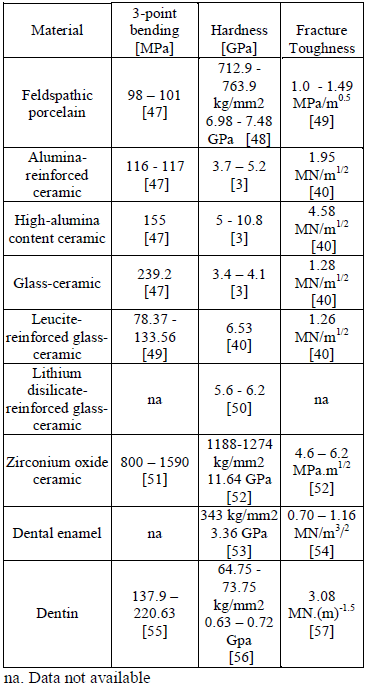
<body><![CDATA[<p>&nbsp;</p>     <p><b><font size="3" face="Verdana, Arial, Helvetica, sans-serif">1. INTRODUCTION</font></b></p>     <p><font size="2" face="Verdana, Arial, Helvetica, sans-serif">Dental ceramics are materials that are part of systems   designed with the purpose of producing dental prostheses that in turn, are used   to replace missing or damaged dental structures. The literature on this topic defines ceramics   as inorganic, non-metallic materials made by man through the heating of raw   minerals at high temperatures &#91;1&#93;.</font></p>     <p><font size="2" face="Verdana, Arial, Helvetica, sans-serif">Ceramics and glasses are brittle, which means that   they display high compressive strength but low tensile strength and may be   fractured under very low strain (0.1% - 0.2%). As restorative materials, dental   ceramics have disadvantages, mostly due to their inability to withstand   functional forces that are present in the oral cavity, hence initially they found   limited application in premolar and molar areas, although further development   in these materials has enabled their use as posterior long-span fixed partial   prosthetic restorations and structures over dental   implants.&#91;2&#93; All dental ceramics display   low fracture toughness when compared to other   dental materials, such as metals. &#91;3&#93;.</font></p>     <p><font size="2" face="Verdana, Arial, Helvetica, sans-serif">The main   objective of this work is to review ceramic dental materials, including their   most relevant physical and mechanical properties. A brief historical review, including the   evolution of these materials over time, a summary of different dental ceramic   classifications, and the composition of dental ceramics will be presented. </font></p>     <p>&nbsp;</p>     <p><font size="3" face="Verdana, Arial, Helvetica, sans-serif"><b>2. HISTORICAL EVOLUTION OF DENTAL CERAMICS</b></font></p>     <p><font size="2" face="Verdana, Arial, Helvetica, sans-serif">Current   dental ceramics are far from the early ceramics that started being used over   200 years ago. Early records of the first ceramics used as </font><font size="2" face="Verdana, Arial, Helvetica, sans-serif">dental materials   date back to 1774, when French apothecary Alexis Duchateau and Parisian dentist   Nicholas Dubois de Chemant manufactured the first complete ceramic denture. </font></p>     <p><font size="2" face="Verdana, Arial, Helvetica, sans-serif">There are   reports of complete dentures being manufactured earlier by French dentist Pierre   Fauchard, although these dentures were fabricated in a different class of   ceramic, namely enamel &#91;4&#93;.</font></p>     <p><font size="2" face="Verdana, Arial, Helvetica, sans-serif">The initial   use of ceramic materials in dentistry was in the obtention of complete   dentures. Early in the 19<sup>th</sup> century, Italian dentist Giuseppangelo Fonzi was capable of   manufacturing individual ceramic teeth attached to a metallic substructure which,   in turn, was attached to complete   dentures. The restoration of individual   ceramic teeth in the oral cavity was delayed until the late 1800s, when Logan constructed ceramic   teeth fused to metallic posts so that these posts could function as an   intra-radicular retention for the restoration &#91;4, 5&#93;.</font></p>     ]]></body>
<body><![CDATA[<p><font size="2" face="Verdana, Arial, Helvetica, sans-serif">The method   to manufacture dental prostheses during the second half of the 20<sup>th</sup> century was through the fusion of ceramics and metallic structures that could   function as a core. Metal-ceramic   systems combine both the exceptional esthetic properties of ceramics and the   extraordinary mechanical properties of metals &#91;1&#93;. Some metals used as restorative materials in   dentistry may constitute a problem for some patients. These problems may reveal themselves as   allergies &#91;6&#93;, gum staining &#91;7, 8&#93;, and release of metallic ions into the   gingival tissue &#91;9&#93; and the gingival fluid &#91;10&#93;. These drawbacks, as well as the search for   more esthetic materials by patients and dentists, have stimulated research and   development of metal-free ceramic systems.</font></p>     <p><font size="2" face="Verdana, Arial, Helvetica, sans-serif">During the   last 40 years, research has focused on improving metal-free systems and   developing superior materials regarding esthetics and clinical performance to   offer patients several alternatives to restore missing or damaged teeth.</font></p>     <p>&nbsp;</p>     <p><font size="3" face="Verdana, Arial, Helvetica, sans-serif"><b>3. CLASSIFICATION OF DENTAL CERAMICS</b></font></p>     <p><font size="2" face="Verdana, Arial, Helvetica, sans-serif">Dental   ceramics may be classified according to several parameters, such as their use,   manufacturing temperature, ceramic system, composition, microstructure, and   translucency. The classification used in   this article will be based on composition. Due to the fact that this review will discuss some mechanical properties   exhibited by dental ceramic materials, <a href="#tab01">table 1</a> summarizes the results of some   mechanical tests published in the literature. </font></p>     <p align="center"><font size="2" face="Verdana, Arial, Helvetica, sans-serif"><b><a name="tab01"></a>Table 1.</b> Reported values   for ceramic systems, enamel and dentin subjected to several mechanical tests</font>    <br>   <img src="/img/revistas/dyna/v77n163/a03tab01.gif"></p>     <p><font size="2" face="Verdana, Arial, Helvetica, sans-serif"><b>3.1 Feldspathic porcelains    <br>   </b></font><font size="2" face="Verdana, Arial, Helvetica, sans-serif">Before   discussing this division of ceramics, it is important to keep in mind that most   ceramics have two different phases: the glassy phase and the crystalline phase. The glassy phase is often responsible for   the esthetic behavior, while the crystalline phase is associated with   mechanical strength. However, the   crystalline phase (leucite in feldspathic porcelains) has a similar diffraction index as the glassy matrix;   hence it also contributes towards the translucency of the whole structure.   Therefore, both mechanical and esthetic properties are dependent on the ceramic   composition &#91;11&#93;.</font></p>     <p><font size="2" face="Verdana, Arial, Helvetica, sans-serif">Feldspathic   porcelain is produced from the mixture of potassium feldspar, quartz, and   kaolin. The latter improves plasticity   and manipulation before the heating process. Other essential components are oxides of sodium, potassium, calcium,   aluminum, and magnesium (employed to control ceramic's expansion coefficient   and to try and match it with that of metals) &#91;12&#93;, zinc, iron, copper,   titanium, nickel, manganese, and cobalt (as pigments) and tin, zirconium, and   titanium (as opacifiers) &#91;13&#93;. Feldspathic porcelain is highly brittle,   hence it must be used as a veneering material in metal-ceramic and metal-free   ceramic systems. &#91;11&#93;.</font></p>     ]]></body>
<body><![CDATA[<p><font size="2" face="Verdana, Arial, Helvetica, sans-serif">This type   of ceramic is made of extremely fine powders to which de-ionized water or a   special modeling liquid is added. A   paste is thus formed to be tooth-shaped by a technician. Then, this paste must be taken to an oven set   at a pre-established temperature and time depending on the ceramic being used. Currently, microprocessor-controlled ovens control   all the thermal cycle steps and have optimized programs designed by manufacturers   to process different types of ceramics&#91;14&#93;. The heating process may be carried out   either under vacuum or in air, however the process under vacuum reduces   ceramic's porosity. &#91;15, 16&#93;.</font></p>     <p><font size="2" face="Verdana, Arial, Helvetica, sans-serif">The   objective is to bring the raw paste's particles together to form a paste   that will have solidified upon cooling.&#91;17&#93; During sintering, ceramics density will increase and this is associated   to a volumetric contraction of 30 % to 40%,&#91;17, 18&#93; although other researchers   claim that this contraction is between 20 % and 25% &#91;19&#93;. During the paste   formation process, it is essential to avoid bubbles or pores formation, since their presence will reduce the ceramic's final   mechanical strength, given that pores act as crack initiators &#91;20&#93;. The sintering process considerably reduces   porosity since this procedure involves the melting/softening of the powder   particle, causing reduction of surface energy, which renders pores to become   spherical and volumetrically contracted, thus increasing densification &#91;21&#93;.</font></p>     <p><font size="2" face="Verdana, Arial, Helvetica, sans-serif">Some   methods to strengthen porcelain and avoid crack initiation and/or propagation   have been reported by different authors. The most common methods are ionic exchange   (chemical exchange of smaller sodium ions for larger potassium ions to create a   compressive stress on the surface) &#91;22-26&#93;, thermal tempering (forced cooling   of ceramic in air) &#91;23, 27, 28&#93; or crack-propagation interruption by means of   induction of residual compressive stresses on the surface (air-injection   tempering) &#91;29&#93;.</font></p>     <p><font size="2" face="Verdana, Arial, Helvetica, sans-serif"><b>3.2 Leucite-reinforced   feldspathic porcelain    <br>   </b></font><font size="2" face="Verdana, Arial, Helvetica, sans-serif">Feldspar   may form leucite, which is a potassium aluminum silicate mineral with a high   thermal expansion coefficient &#91;15&#93;. Leucite   may be present in feldspathic porcelain in two forms: Firstly, the formation of   this mineral through the incongruent melting of potasic feldspar (incongruent melting   is a process by which a material is melted to form a liquid and a different   crystalline material &#91;15&#93;). Secondly, the   aggregate of leucite to ceramics as synthetic powder &#91;30&#93;. Leucite-reinforced ceramics may be used to   manufacture metal-ceramic restorations. The   large difference between thermal expansion coefficient of metals and that of   ceramics is one of the problems encountered when manufacturing metal-ceramic   restorations &#91;31, 32&#93; as well as the difference in thermal expansion   coefficients between layers of ceramic &#91;33&#93; when cooling to room temperature. This imbalance creates residual stress   between both materials that may trigger failure at the interface. &#91;34&#93; Hence, a   layer to layer compatibility involving ceramics and underlying metal is   required &#91;32&#93;.</font></p>     <p><font size="2" face="Verdana, Arial, Helvetica, sans-serif">Also,   leucite content in ceramics is associated to an increase in crack propagation   strength &#91;30&#93;. A mechanism by which this increase is produced is the difference   between leucite's thermal expansion coefficient (22 to 25 X 10<sup>-6</sup>/°C) and that of the glassy matrix (8 x 10<sup>-6</sup>/°C),   resulting in the formation of tangent compressive stresses in the glass around leucite   crystals, that undergo a phase transformation from cubic to tetragonal upon   cooling &#91;17&#93;. Sodium content has an   effect on the tetragonal phase stability at high temperatures and lowers the   thermal expansion coefficient, but it also decreases the ceramic's   overall strength &#91;35&#93;. Another mechanism   of strength increase is explained by microcrack formation within and around   leucite crystals when cooling. Both mechanisms are essential to prevent crack   formation and propagation in the ceramic &#91;36&#93;. Some researchers have suggested that ceramics reinforced with cubic   leucite at room temperature display less flexural strength and less fracture   strength than tetragonal-leucite ceramics &#91;36&#93;. </font></p>     <p><font size="2" face="Verdana, Arial, Helvetica, sans-serif">Pinto <i>et al </i>assessed the effect that pH has on   leucite-reinforced ceramics. These   authors concluded that an acidic pH (3.5) produces a reduction in overall   strength in leucite-reinforced ceramics &#91;37&#93;.</font></p>     <p><font size="2" face="Verdana, Arial, Helvetica, sans-serif"><b>3.3 Aluminous   ceramics    <br>   </b></font><font size="2" face="Verdana, Arial, Helvetica, sans-serif">Aluminous   ceramics were first developed by MacLean and Hughes to manufacture prosthetic   dental crowns &#91;38&#93;. The principle of   this type of ceramics is that a dispersion of high strength and high elastic   modulus crystals exists within the glassy matrix to strengthen and harden the   ceramic &#91;38&#93;.</font></p>     <p><font size="2" face="Verdana, Arial, Helvetica, sans-serif">Alumina has   the property of strengthening feldspathic porcelain, thus making it more   fracture resistant. This fact may be   observed when comparing aluminous ceramics strength to that of feldspathic   porcelain &#91;39&#93; and when comparing hardness and strength values of aluminous   ceramics with those of other ceramic systems &#91;40&#93;. Alumina particle size has been proposed as a   factor that improves particles agglomeration and some mechanical properties, such   as fracture strength, of the partially-sintered alumina matrix &#91;41&#93;.</font></p>     ]]></body>
<body><![CDATA[<p><font size="2" face="Verdana, Arial, Helvetica, sans-serif">The   presence of alumina decreases glasses' inherent brittleness and the risk of   de-vitrification, which is a process whereby ceramics become opaque and brittle   as a result of their crystallization, due to loss of the glassy structure &#91;42&#93;.</font></p>     <p><font size="2" face="Verdana, Arial, Helvetica, sans-serif"><b>3.4 Glass-infiltrated composites    <br>   </b></font><font size="2" face="Verdana, Arial, Helvetica, sans-serif">Currently, there is a ceramic system marketed as In-Ceram   (Vita-Zahnfabrik, H Rauter GMBH &amp; Co.KG, Bad Säckingen, Germany )   that includes glass-infiltrated porous sintered alumina. &#91;43&#93; This system, developed by Tyszblat, is   comprised of an aluminous core that is further infiltrated with molten glass to   fill-in the voids left by aluminous particles in order to obtain a restoration that   exhibits better physical properties when compared to traditional ceramics (see <a href="#tab01">table 1</a>) and very similar to those of natural teeth &#91;44&#93;. </font></p>     <p><font size="2" face="Verdana, Arial, Helvetica, sans-serif"><b>3.5 Alumina   Polycrystals    <br>   </b></font><font size="2" face="Verdana, Arial, Helvetica, sans-serif">High-alumina   ceramics contain a minimum of 95% pure alumina (aluminum oxide, Al<sub>2</sub>0<sub>3</sub>)   &#91;38&#93;. Andersson and Oden &#91;45&#93; described   the use of a high-purity (99.9%), densely-sintered alumina ceramic for the   manufacturing of dental restorations &#91;45&#93;. Alumina displays a 15% to 20% contraction that must be compensated to   manufacture such restorations. These   investigators compensated its high contraction by using enlarged models of   teeth and restoration manufacturing using a technique known as copy-milling to   obtain a properly-sized finished restoration. The amount of expansion necessary to be applied to the models may be   calculated from the sintering of compacted powder &#91;45&#93;. Copy-milling is better described by Andersson   elsewhere &#91;46&#93;.</font></p>     <p><font size="2" face="Verdana, Arial, Helvetica, sans-serif"><b>3.6 Glass-ceramics    <br>   </b></font><font size="2" face="Verdana, Arial, Helvetica, sans-serif">According   to McLean &#91;38&#93;, the first works on   glass-ceramics were performed by MacCulloch, but his work did not receive much   attention. Further investigations by   Grossman and Adair &#91;58, 59&#93; concluded with the development of a tetrasilicic   fluormica-containing ceramic system. According to both investigators, its composition is as follows: 45-70% SiO<sub>2</sub>, 8-20% MgO, 8-15% MgF<sub>2</sub>,   5-35% R<sub>2</sub>O+RO, where R<sub>2</sub>O has a range between 5-25% and is   composed of at least one of the following oxides: 0-20% K<sub>2</sub>O, 0-23%   Rb<sub>2</sub>O, and 0-25% Cs<sub>2</sub>O to improve translucency and RO,   which has a range between 0-20%, and is composed of at least one of the   following oxides: SrO, BaO, and CdO. Additional   components may account for up to 10% of Sb<sub>2</sub>O<sub>5</sub> and/or up   to 5% of traditional glassy colorants &#91;58, 59&#93;.</font></p>     <p><font size="2" face="Verdana, Arial, Helvetica, sans-serif">The thermal   treatment known as ceramming &#91;15&#93; is composed of two processes: glass is heated   up to a temperature where nuclei form   <st2:citation w:st="on">(750° - 850°C)</st2:citation>   and this temperature is kept for a period of time ranging from one to six hours   so that crystalline nuclei form in the glass (process known as nucleation). Then, the temperature is risen to the   crystallization point (1000°- 1150°C) and this temperature is maintained for   a period ranging from one to six hours until the desired level of glazing is   obtained (process known as crystallization) &#91;58-60&#93;. Developers of this type of ceramic system   claim that fracture strength and hardness are better than those of traditional   ceramic systems &#91;58, 59&#93;, although other authors have shown that after the ceramming   process a surface layer that decreases its strength and esthetic   characteristics forms on this ceramic &#91;61&#93;. However, some researchers claim that fractures in this type of ceramic   have an internal origin, but no explanations are provided as to what particular   factor causes fractures to appear in restorations manufactured with this   material &#91;62&#93;. However, there is an   investigation that suggests that this ceramic's strength and hardness may   be improved by performing a chemical shift on the surface layer (addition of   lithium fluoride) &#91;61&#93;.</font></p>     <p><font size="2" face="Verdana, Arial, Helvetica, sans-serif"><b>3.7 Leucite-reinforced   glass-ceramics    <br>   </b></font><font size="2" face="Verdana, Arial, Helvetica, sans-serif">Pressed   glass-ceramics are materials containing high amounts of leucite crystals (35% by   volume) &#91;15&#93;. The basic component of   this ceramic is feldspathic porcelain consisting of 63% SiO<sub>2</sub>, 19% Al<sub>2</sub>O<sub>3</sub>,   11% K<sub>2</sub>O, 4% Na<sub>2</sub>O, and traces of other oxides. Leucite crystals are added to the aluminum   oxide &#91;63, 64&#93;. This material is   manufactured using a process known as heat-pressing, which is performed in an   investment mold. This mold is filled   with the plasticized ceramic, thus avoiding the sintering process and the   subsequent pore formation &#91;65&#93;. This   ceramic undergoes dispersion strengthening through the guided crystallization   of leucite. Dispersion strengthening is   a process by which the dispersed phase of a different material (such as   alumina, leucite, zirconia, etc.) is used to stop crack propagation, since   these crystalline phases are more difficult to penetrate by cracks &#91;15, 66&#93;. Leucite crystals are incorporated during ceramming, hence performing this process again is   unnecessary when inducing crystal growth &#91;64&#93;.</font></p>     ]]></body>
<body><![CDATA[<p><font size="2" face="Verdana, Arial, Helvetica, sans-serif">The method   of dual ionic exchange has been proposed in the literature to increase the   resistance of this ceramic to separation, as long as potassium and sodium ions   are available in the ceramic for the exchange. Long-term chemical effects on the ceramic should   be further studied &#91;67&#93;.</font></p>     <p><font size="2" face="Verdana, Arial, Helvetica, sans-serif"><b>3.8 Lithium   disilicate-reinforced glass-ceramics    <br>   </b></font><font size="2" face="Verdana, Arial, Helvetica, sans-serif">This   material is also a heat-pressed glass-ceramic with a 60% content of lithium   disilicate crystals, which form an intertwined structure after being pressed,   hence fracture strength is increased &#91;65, 68&#93;. Li<sub>2</sub>O and SiO<sub>2</sub> aid in the crystallization of the   required phase of lithium disilicate, BaO and Cs<sub>2</sub>O stabilize   residual glass and Al<sub>2</sub>O<sub>3</sub> and B<sub>2</sub>O<sub>3</sub> render   this ceramic chemically durable &#91;69&#93;. The crystallization process is comprised of two steps: nucleation (one   hour at 645°C)   and crystal growth (four hours at 850°C) &#91;69&#93;.</font></p>     <p><font size="2" face="Verdana, Arial, Helvetica, sans-serif"><b>3.9 Zirconium   oxide ceramics    <br>   </b></font><font size="2" face="Verdana, Arial, Helvetica, sans-serif">Since   Garvin <i>et al</i> &#91;70&#93; published their   work titled "Ceramic steel?";, zirconia has   been considered a tough ceramic. Zirconia occurs as a natural mineral called baddeleyite. This mineral contains 80% to 90% zirconium oxide. </font></p>     <p><font size="2" face="Verdana, Arial, Helvetica, sans-serif">The major   impurities are usually TiO<sub>2</sub>, SiO<sub>2</sub>, and Fe<sub>2</sub>O<sub>3</sub>. This oxide exists in three different   crystal structures: monoclinic at room temperature, tetragonal at ~1200°C, and   cubic at 2370°C. A phase transformation from tetragonal to   monoclinic occurs during cooling. This change produces a volumetric expansion   ranging from 3% to 4%, which in turn causes crack formation within the   material. Oxides such as CaO, MgO, Y<sub>2</sub>O<sub>3</sub>,   and CeO<sub>2</sub> are added to pure zirconia to stabilize it in multiphase   materials known as Partially-Stabilized Zirconia (PSZ). These materials basically   consist of cubic zirconia as the major phase and precipitates of   monoclinic and tetragonal as the minor phase at room temperature &#91;71&#93;. At room temperature, the tetragonal phase is   in metastable state, since transformation from tetragonal to monoclinic may be   induced by external factors, such as pressure or temperature &#91;72, 73&#93;. The resulting compressive stress from the   volumetric expansion developed at the vicinity of a crack and the energy needed   to carry out such phase transformation, provide this ceramic with high fracture   strength &#91;72, 74&#93;. This process is known   as transformation toughening &#91;71-73, 75&#93;. It may generate a process known as ceramic aging, which is the   spontaneous transformation from metastable tetragonal zirconia to monoclinic   zirconia &#91;71&#93;, therefore a decrease in mechanical   properties may occur in the ceramic over time &#91;74&#93;. An investigation carried out by Ardlin   demonstrated that strength was not affected by aging, although the ceramic's crystalline structure and surface were, indeed,   affected &#91;51&#93;. </font></p>     <p><font size="2" face="Verdana, Arial, Helvetica, sans-serif">As   mentioned above, pure zirconia may be stabilized with Y<sub>2</sub>O<sub>3</sub>. Yttrium oxide is used to retain the   tetragonal phase at room temperature as much as possible after sintering and   avoid the monoclinic phase, since the accumulation of the latter is associated   with a decrease in strength, toughness and density &#91;76&#93;. </font></p>     <p><font size="2" face="Verdana, Arial, Helvetica, sans-serif">The   resulting stabilized ceramic is known as Tetragonal Zirconia Polycrystals (TZP)   and when it is doped with 2-3% mol of yttrium oxide, this material is known as   Yttrium Tetragonal Zirconia Polycrystals (3Y-TZP) &#91;71&#93;. The amount of yttrium oxide in the ceramic   has an essential role in the capacity of transformation of the tetragonal phase   and, therefore, in the ceramic's toughness &#91;52&#93;. This material consists of tetragonal grains,   whose size is in the submicron scale, without a glassy phase at the edge of the   crystals. The amount of tetragonal phase   that remains at room temperature depends on many factors, such as grain size,   yttrium oxide content, and the degree of constriction exerted upon them by the   matrix &#91;71&#93;. Most commercial Y-TZP   powders are manufactured using a process known as co-precipitation &#91;77&#93;. The objective of this procedure is to   manufacture multicomponent ceramic oxides through the formation of intermediate   precipitates with the final goal of achieving an intimate mixture of the   components during precipitation and keeping chemical homogeneity during calcination   &#91;77&#93;.</font></p>     <p>&nbsp;</p>     <p><font size="3" face="Verdana, Arial, Helvetica, sans-serif"><b>4. CONCLUSIONS</b></font></p>     ]]></body>
<body><![CDATA[<p><font size="2" face="Verdana, Arial, Helvetica, sans-serif">Today's   ceramic materials used in the dental field comprise a large and diverse group of   materials that offers patients a number of alternatives when dealing with   prosthetic treatments. </font></p>     <p><font size="2" face="Verdana, Arial, Helvetica, sans-serif">These   ceramic systems have been developed over time seeking highly-esthetic but also   functional materials. Current dental   ceramic systems (leucite or lithium disilicate-reinforced glass-ceramics,   high-alumina or zirconia ceramics) offer better physical and mechanical   properties than those of older, more traditional systems. </font></p>     <p><font size="2" face="Verdana, Arial, Helvetica, sans-serif">Mechanical   values summarized in <a href="#tab01">table 1</a> show that zirconium oxide ceramics display the   highest values of flexural strength under 3-point bending tests. When it comes to hardness, enamel and dentin   display the lowest results when compared to all ceramic systems, and zirconium   oxide ceramics exhibit the highest hardness value. The highest value for fracture toughness is   showed by zirconium oxide ceramics, although dentin shows higher values than   most ceramic systems and enamel displays lower values than dentin and ceramics. </font></p>     <p><font size="2" face="Verdana, Arial, Helvetica, sans-serif">Dental   ceramics is an interesting area of research, since countless possibilities are   open for research, such as esthetics, processing of new ceramics with   biological properties (increasing its interaction with cells or reducing   bacterial adherence) and surface modification processing. </font></p>     <p>&nbsp;</p>     <p><font size="3" face="Verdana, Arial, Helvetica, sans-serif"><b>5. ACKNOWLEDGMENTS</b></font> </p>     <p><font size="2" face="Verdana, Arial, Helvetica, sans-serif">The authors   wish to thank the partial support given by: Universidad Pontificia Bolivariana   (CIDI Project-700-04/05-01), the European Community Progam Alban   (E05D050652CO), Portuguese Science and Technology Foundation (Scholarship   FCT/ SFRH/ BD/ 36220/ 2007 and Grant FCT/ PTDC/ CTM/ 100120/ 2008 "<i>Bonamidi</i>";), CRUP-<i>Acções Integradas   Luso-Espanholas   <st2:citation w:st="on">(46/09)</st2:citation>   , </i> Portugal   .</font></p>     <p>&nbsp;</p>     <p><font size="3" face="Verdana, Arial, Helvetica, sans-serif"><b>6. REFERENCES</b></font></p>     <!-- ref --><p><font size="2" face="Verdana, Arial, Helvetica, sans-serif"><b>&#91;1&#93;</b> ROSENBLUM, M.A. and SCHULMAN, A. A review of all-ceramic restorations, J Am Dent Assoc. 128(3), 297-307, 1997.     &nbsp;&nbsp;&nbsp;&nbsp;&nbsp;&nbsp;&nbsp;&nbsp;[&#160;<a href="javascript:void(0);" onclick="javascript: window.open('/scielo.php?script=sci_nlinks&ref=000082&pid=S0012-7353201000030000300001&lng=','','width=640,height=500,resizable=yes,scrollbars=1,menubar=yes,');">Links</a>&#160;]<!-- end-ref --><!-- ref --><br>   <b>&#91;2&#93;</b> RIZKALLA, A.S. and JONES, D.W. Mechanical properties of commercial high strength ceramic core materials, Dent Mater. 20(2), 207-12, 2004.     &nbsp;&nbsp;&nbsp;&nbsp;&nbsp;&nbsp;&nbsp;&nbsp;[&#160;<a href="javascript:void(0);" onclick="javascript: window.open('/scielo.php?script=sci_nlinks&ref=000083&pid=S0012-7353201000030000300002&lng=','','width=640,height=500,resizable=yes,scrollbars=1,menubar=yes,');">Links</a>&#160;]<!-- end-ref --><!-- ref --><br>   <b>&#91;3&#93;</b> RIZKALLA, A.S. and JONES, D.W. Indentation fracture toughness and dynamic elastic moduli for commercial feldspathic dental porcelain materials, Dent Mater. 20(2), 198-206, 2004.     &nbsp;&nbsp;&nbsp;&nbsp;&nbsp;&nbsp;&nbsp;&nbsp;[&#160;<a href="javascript:void(0);" onclick="javascript: window.open('/scielo.php?script=sci_nlinks&ref=000084&pid=S0012-7353201000030000300003&lng=','','width=640,height=500,resizable=yes,scrollbars=1,menubar=yes,');">Links</a>&#160;]<!-- end-ref --><!-- ref --><br>   <b>&#91;4&#93;</b> JONES, D.W. Development of dental ceramics. An historical perspective, Dent Clin North Am. 29(4), 621-44, 1985.     &nbsp;&nbsp;&nbsp;&nbsp;&nbsp;&nbsp;&nbsp;&nbsp;[&#160;<a href="javascript:void(0);" onclick="javascript: window.open('/scielo.php?script=sci_nlinks&ref=000085&pid=S0012-7353201000030000300004&lng=','','width=640,height=500,resizable=yes,scrollbars=1,menubar=yes,');">Links</a>&#160;]<!-- end-ref --><!-- ref --><br>   <b>&#91;5&#93;</b> KELLY, J.R., NISHIMURA, I., and CAMPBELL, S.D. Ceramics in dentistry: historical roots and current perspectives, J Prosthet Dent. 75(1), 18-32, 1996.     &nbsp;&nbsp;&nbsp;&nbsp;&nbsp;&nbsp;&nbsp;&nbsp;[&#160;<a href="javascript:void(0);" onclick="javascript: window.open('/scielo.php?script=sci_nlinks&ref=000086&pid=S0012-7353201000030000300005&lng=','','width=640,height=500,resizable=yes,scrollbars=1,menubar=yes,');">Links</a>&#160;]<!-- end-ref --><!-- ref --><br>   <b>&#91;6&#93;</b> STEJSKAL, V.D., et al. Metal-specific lymphocytes: biomarkers of sensitivity in man, Neuro Endocrinol Lett. 20(5), 289-298, 1999.     &nbsp;&nbsp;&nbsp;&nbsp;&nbsp;&nbsp;&nbsp;&nbsp;[&#160;<a href="javascript:void(0);" onclick="javascript: window.open('/scielo.php?script=sci_nlinks&ref=000087&pid=S0012-7353201000030000300006&lng=','','width=640,height=500,resizable=yes,scrollbars=1,menubar=yes,');">Links</a>&#160;]<!-- end-ref --><!-- ref --><br>   <b>&#91;7&#93;</b> ARVIDSON, K. and WROBLEWSKI, R. Migration of metallic ions from screwposts into dentin and surrounding tissues, Scand J Dent Res. 86(3), 200-5, 1978.     &nbsp;&nbsp;&nbsp;&nbsp;&nbsp;&nbsp;&nbsp;&nbsp;[&#160;<a href="javascript:void(0);" onclick="javascript: window.open('/scielo.php?script=sci_nlinks&ref=000088&pid=S0012-7353201000030000300007&lng=','','width=640,height=500,resizable=yes,scrollbars=1,menubar=yes,');">Links</a>&#160;]<!-- end-ref --><!-- ref --><br>   <b>&#91;8&#93;</b> VENCLIKOVA, Z., et al. Metallic pigmentation of human teeth and gingiva: morphological and immunological aspects, Dent Mater J. 26(1), 96-104, 2007.     &nbsp;&nbsp;&nbsp;&nbsp;&nbsp;&nbsp;&nbsp;&nbsp;[&#160;<a href="javascript:void(0);" onclick="javascript: window.open('/scielo.php?script=sci_nlinks&ref=000089&pid=S0012-7353201000030000300008&lng=','','width=640,height=500,resizable=yes,scrollbars=1,menubar=yes,');">Links</a>&#160;]<!-- end-ref --><!-- ref --><br>   <b>&#91;9&#93;</b> BUMGARDNER, J.D. and LUCAS, L.C. Cellular response to metallic ions released from nickel-chromium dental alloys, J Dent Res. 74(8), 1521-7, 1995.     &nbsp;&nbsp;&nbsp;&nbsp;&nbsp;&nbsp;&nbsp;&nbsp;[&#160;<a href="javascript:void(0);" onclick="javascript: window.open('/scielo.php?script=sci_nlinks&ref=000090&pid=S0012-7353201000030000300009&lng=','','width=640,height=500,resizable=yes,scrollbars=1,menubar=yes,');">Links</a>&#160;]<!-- end-ref --><!-- ref --><br>   <b>&#91;10&#93;</b> MEHULIC, K., et al. The release of metal ions in the gingival fluid of prosthodontic patients, Acta Stomatol Croat. 39(1), 47-51, 2005.     &nbsp;&nbsp;&nbsp;&nbsp;&nbsp;&nbsp;&nbsp;&nbsp;[&#160;<a href="javascript:void(0);" onclick="javascript: window.open('/scielo.php?script=sci_nlinks&ref=000091&pid=S0012-7353201000030000300010&lng=','','width=640,height=500,resizable=yes,scrollbars=1,menubar=yes,');">Links</a>&#160;]<!-- end-ref --><!-- ref --><br>   <b>&#91;11&#93;</b> MART&Iacute;NEZ, F., et al. Cer&aacute;micas dentales: clasificaci&oacute;n y criterios de selecci&oacute;n, RCOE. 12(4), 253-263, 2007.     &nbsp;&nbsp;&nbsp;&nbsp;&nbsp;&nbsp;&nbsp;&nbsp;[&#160;<a href="javascript:void(0);" onclick="javascript: window.open('/scielo.php?script=sci_nlinks&ref=000092&pid=S0012-7353201000030000300011&lng=','','width=640,height=500,resizable=yes,scrollbars=1,menubar=yes,');">Links</a>&#160;]<!-- end-ref --><!-- ref --><br>   <b>&#91;12&#93;</b> WEINSTEIN, M., WEINSTEIN, L., and WEINSTEIN, A., Porcelain covered-metal reinforced teeth, 1962.     &nbsp;&nbsp;&nbsp;&nbsp;&nbsp;&nbsp;&nbsp;&nbsp;[&#160;<a href="javascript:void(0);" onclick="javascript: window.open('/scielo.php?script=sci_nlinks&ref=000093&pid=S0012-7353201000030000300012&lng=','','width=640,height=500,resizable=yes,scrollbars=1,menubar=yes,');">Links</a>&#160;]<!-- end-ref --><!-- ref --><br>   <b>&#91;13&#93;</b> ANUSAVICE, K.J. Degradability of dental ceramics, Adv Dent Res. 6, 82-9, 1992.     &nbsp;&nbsp;&nbsp;&nbsp;&nbsp;&nbsp;&nbsp;&nbsp;[&#160;<a href="javascript:void(0);" onclick="javascript: window.open('/scielo.php?script=sci_nlinks&ref=000094&pid=S0012-7353201000030000300013&lng=','','width=640,height=500,resizable=yes,scrollbars=1,menubar=yes,');">Links</a>&#160;]<!-- end-ref --><!-- ref --><br>   <b>&#91;14&#93;</b> KNORPP, E.A., Control arrangement for dental furnaces, especially microprocessor-controlled preheating furnaces, 1991.     &nbsp;&nbsp;&nbsp;&nbsp;&nbsp;&nbsp;&nbsp;&nbsp;[&#160;<a href="javascript:void(0);" onclick="javascript: window.open('/scielo.php?script=sci_nlinks&ref=000095&pid=S0012-7353201000030000300014&lng=','','width=640,height=500,resizable=yes,scrollbars=1,menubar=yes,');">Links</a>&#160;]<!-- end-ref --><!-- ref --><br>   <b>&#91;15&#93;</b> ANUSAVICE, K.J., Phillips Ciencia de los materiales dentales. Und&eacute;cima ed: Elsevier España, 2004.     &nbsp;&nbsp;&nbsp;&nbsp;&nbsp;&nbsp;&nbsp;&nbsp;[&#160;<a href="javascript:void(0);" onclick="javascript: window.open('/scielo.php?script=sci_nlinks&ref=000096&pid=S0012-7353201000030000300015&lng=','','width=640,height=500,resizable=yes,scrollbars=1,menubar=yes,');">Links</a>&#160;]<!-- end-ref --><!-- ref --><br>   <b>&#91;16&#93;</b> MEYER, J.M., O'BRIEN, W.J., and YU, C.U. Sintering of dental porcelain enamels, J Dent Res. 55(4), 696-9, 1976.     &nbsp;&nbsp;&nbsp;&nbsp;&nbsp;&nbsp;&nbsp;&nbsp;[&#160;<a href="javascript:void(0);" onclick="javascript: window.open('/scielo.php?script=sci_nlinks&ref=000097&pid=S0012-7353201000030000300016&lng=','','width=640,height=500,resizable=yes,scrollbars=1,menubar=yes,');">Links</a>&#160;]<!-- end-ref --><!-- ref --><br>   <b>&#91;17&#93;</b> DENRY, I.L. Recent advances in ceramics for dentistry, Crit Rev Oral Biol Med. 7(2), 134-43, 1996.     &nbsp;&nbsp;&nbsp;&nbsp;&nbsp;&nbsp;&nbsp;&nbsp;[&#160;<a href="javascript:void(0);" onclick="javascript: window.open('/scielo.php?script=sci_nlinks&ref=000098&pid=S0012-7353201000030000300017&lng=','','width=640,height=500,resizable=yes,scrollbars=1,menubar=yes,');">Links</a>&#160;]<!-- end-ref --><!-- ref --><br>   <b>&#91;18&#93;</b> CAMPBELL, S.D., et al. Dimensional and formation analysis of a restorative ceramic and how it works, J Prosthet Dent. 74(4), 332-40, 1995.     &nbsp;&nbsp;&nbsp;&nbsp;&nbsp;&nbsp;&nbsp;&nbsp;[&#160;<a href="javascript:void(0);" onclick="javascript: window.open('/scielo.php?script=sci_nlinks&ref=000099&pid=S0012-7353201000030000300018&lng=','','width=640,height=500,resizable=yes,scrollbars=1,menubar=yes,');">Links</a>&#160;]<!-- end-ref --><!-- ref --><br>   <b>&#91;19&#93;</b> CONRAD, H.J., SEONG, W.J., and PESUN, I.J. Current ceramic materials and systems with clinical recommendations: a systematic review, J Prosthet Dent. 98(5), 389-404, 2007.     &nbsp;&nbsp;&nbsp;&nbsp;&nbsp;&nbsp;&nbsp;&nbsp;[&#160;<a href="javascript:void(0);" onclick="javascript: window.open('/scielo.php?script=sci_nlinks&ref=000100&pid=S0012-7353201000030000300019&lng=','','width=640,height=500,resizable=yes,scrollbars=1,menubar=yes,');">Links</a>&#160;]<!-- end-ref --><!-- ref --><br>   <b>&#91;20&#93;</b> TINSCHERT, J., et al. Structural reliability of alumina-, feldspar-, leucite-, mica- and zirconia-based ceramics, J Dent. 28(7), 529-35, 2000.     &nbsp;&nbsp;&nbsp;&nbsp;&nbsp;&nbsp;&nbsp;&nbsp;[&#160;<a href="javascript:void(0);" onclick="javascript: window.open('/scielo.php?script=sci_nlinks&ref=000101&pid=S0012-7353201000030000300020&lng=','','width=640,height=500,resizable=yes,scrollbars=1,menubar=yes,');">Links</a>&#160;]<!-- end-ref --><!-- ref --><br>   <b>&#91;21&#93;</b> RAHAMAN, M.N., Ceramic processing and sintering (materials engineering). Second ed: CRC Press, 2003.     &nbsp;&nbsp;&nbsp;&nbsp;&nbsp;&nbsp;&nbsp;&nbsp;[&#160;<a href="javascript:void(0);" onclick="javascript: window.open('/scielo.php?script=sci_nlinks&ref=000102&pid=S0012-7353201000030000300021&lng=','','width=640,height=500,resizable=yes,scrollbars=1,menubar=yes,');">Links</a>&#160;]<!-- end-ref --><!-- ref --><br>   <b>&#91;22&#93;</b> ANUSAVICE, K.J. and HOJJATIE, B. Effect of thermal tempering on strength and crack propagation behavior of feldspathic porcelains, J Dent Res. 70(6), 1009-13, 1991.     &nbsp;&nbsp;&nbsp;&nbsp;&nbsp;&nbsp;&nbsp;&nbsp;[&#160;<a href="javascript:void(0);" onclick="javascript: window.open('/scielo.php?script=sci_nlinks&ref=000103&pid=S0012-7353201000030000300022&lng=','','width=640,height=500,resizable=yes,scrollbars=1,menubar=yes,');">Links</a>&#160;]<!-- end-ref --><!-- ref --><br>   <b>&#91;23&#93;</b> ANUSAVICE, K.J., SHEN, C., and LEE, R.B. Strengthening of feldspathic porcelain by ion exchange and tempering, J Dent Res. 71(5), 1134-8, 1992.     &nbsp;&nbsp;&nbsp;&nbsp;&nbsp;&nbsp;&nbsp;&nbsp;[&#160;<a href="javascript:void(0);" onclick="javascript: window.open('/scielo.php?script=sci_nlinks&ref=000104&pid=S0012-7353201000030000300023&lng=','','width=640,height=500,resizable=yes,scrollbars=1,menubar=yes,');">Links</a>&#160;]<!-- end-ref --><!-- ref --><br>   <b>&#91;24&#93;</b> DUNN, B., LEVY, M.N., and REISBICK, M.H. Improving the fracture resistance of dental ceramic, J Dent Res. 56(10), 1209-13, 1977.     &nbsp;&nbsp;&nbsp;&nbsp;&nbsp;&nbsp;&nbsp;&nbsp;[&#160;<a href="javascript:void(0);" onclick="javascript: window.open('/scielo.php?script=sci_nlinks&ref=000105&pid=S0012-7353201000030000300024&lng=','','width=640,height=500,resizable=yes,scrollbars=1,menubar=yes,');">Links</a>&#160;]<!-- end-ref --><!-- ref --><br>   <b>&#91;25&#93;</b> ROSA, V., et al. Effect of ion exchange on strength and slow crack growth of a dental porcelain, Dent Mater. 25(6), 736-43, 2009.     &nbsp;&nbsp;&nbsp;&nbsp;&nbsp;&nbsp;&nbsp;&nbsp;[&#160;<a href="javascript:void(0);" onclick="javascript: window.open('/scielo.php?script=sci_nlinks&ref=000106&pid=S0012-7353201000030000300025&lng=','','width=640,height=500,resizable=yes,scrollbars=1,menubar=yes,');">Links</a>&#160;]<!-- end-ref --><!-- ref --><br>   <b>&#91;26&#93;</b> SEHA MIRKELAM, M., et al. Effect of Tuf-Coat on Feldspathic porcelain materials, J Oral Rehabil. 32(1), 39-45, 2005.     &nbsp;&nbsp;&nbsp;&nbsp;&nbsp;&nbsp;&nbsp;&nbsp;[&#160;<a href="javascript:void(0);" onclick="javascript: window.open('/scielo.php?script=sci_nlinks&ref=000107&pid=S0012-7353201000030000300026&lng=','','width=640,height=500,resizable=yes,scrollbars=1,menubar=yes,');">Links</a>&#160;]<!-- end-ref --><!-- ref --><br>   <b>&#91;27&#93;</b> ANUSAVICE, K.J., GRAY, A., and SHEN, C. Influence of initial flaw size on crack growth in air-tempered porcelain, J Dent Res. 70(2), 131-6, 1991.     &nbsp;&nbsp;&nbsp;&nbsp;&nbsp;&nbsp;&nbsp;&nbsp;[&#160;<a href="javascript:void(0);" onclick="javascript: window.open('/scielo.php?script=sci_nlinks&ref=000108&pid=S0012-7353201000030000300027&lng=','','width=640,height=500,resizable=yes,scrollbars=1,menubar=yes,');">Links</a>&#160;]<!-- end-ref --><!-- ref --><br>   <b>&#91;28&#93;</b> ASAOKA, K., KUWAYAMA, N., and TESK, J.A. Influence of tempering method on residual stress in dental porcelain, J Dent Res. 71(9), 1623-7, 1992.     &nbsp;&nbsp;&nbsp;&nbsp;&nbsp;&nbsp;&nbsp;&nbsp;[&#160;<a href="javascript:void(0);" onclick="javascript: window.open('/scielo.php?script=sci_nlinks&ref=000109&pid=S0012-7353201000030000300028&lng=','','width=640,height=500,resizable=yes,scrollbars=1,menubar=yes,');">Links</a>&#160;]<!-- end-ref --><!-- ref --><br>   <b>&#91;29&#93;</b> DEHOFF, P.H., ANUSAVICE, K.J., and VONTIVILLU, S.B. Analysis of tempering stresses in metal-ceramic disks, J Dent Res. 75(2), 743-51, 1996.     &nbsp;&nbsp;&nbsp;&nbsp;&nbsp;&nbsp;&nbsp;&nbsp;[&#160;<a href="javascript:void(0);" onclick="javascript: window.open('/scielo.php?script=sci_nlinks&ref=000110&pid=S0012-7353201000030000300029&lng=','','width=640,height=500,resizable=yes,scrollbars=1,menubar=yes,');">Links</a>&#160;]<!-- end-ref --><!-- ref --><br>   <b>&#91;30&#93;</b> CESAR, P.F., et al. Correlation between fracture toughness and leucite content in dental porcelains, J Dent. 33, 721-729, 2005.     &nbsp;&nbsp;&nbsp;&nbsp;&nbsp;&nbsp;&nbsp;&nbsp;[&#160;<a href="javascript:void(0);" onclick="javascript: window.open('/scielo.php?script=sci_nlinks&ref=000111&pid=S0012-7353201000030000300030&lng=','','width=640,height=500,resizable=yes,scrollbars=1,menubar=yes,');">Links</a>&#160;]<!-- end-ref --><!-- ref --><br>   <b>&#91;31&#93;</b> BERTOLOTTI, R.L. Calculation of interfacial stress in porcelain-fused-to-metal systems, J Dent Res. 59(11), 1972-7, 1980.     &nbsp;&nbsp;&nbsp;&nbsp;&nbsp;&nbsp;&nbsp;&nbsp;[&#160;<a href="javascript:void(0);" onclick="javascript: window.open('/scielo.php?script=sci_nlinks&ref=000112&pid=S0012-7353201000030000300031&lng=','','width=640,height=500,resizable=yes,scrollbars=1,menubar=yes,');">Links</a>&#160;]<!-- end-ref --><!-- ref --><br>   <b>&#91;32&#93;</b> NIELSEN, J.P. and TUCCILLO, J.J. Calculation of interfacial stress in dental porcelain bonded to gold alloy substrate, J Dent Res. 51(4), 1043-7, 1972.     &nbsp;&nbsp;&nbsp;&nbsp;&nbsp;&nbsp;&nbsp;&nbsp;[&#160;<a href="javascript:void(0);" onclick="javascript: window.open('/scielo.php?script=sci_nlinks&ref=000113&pid=S0012-7353201000030000300032&lng=','','width=640,height=500,resizable=yes,scrollbars=1,menubar=yes,');">Links</a>&#160;]<!-- end-ref --><!-- ref --><br>   <b>&#91;33&#93;</b> FAIRHURST, C.W., et al. Porcelain-metal thermal compatibility, J Dent Res. 60(4), 815-9, 1981.     &nbsp;&nbsp;&nbsp;&nbsp;&nbsp;&nbsp;&nbsp;&nbsp;[&#160;<a href="javascript:void(0);" onclick="javascript: window.open('/scielo.php?script=sci_nlinks&ref=000114&pid=S0012-7353201000030000300033&lng=','','width=640,height=500,resizable=yes,scrollbars=1,menubar=yes,');">Links</a>&#160;]<!-- end-ref --><!-- ref --><br>   <b>&#91;34&#93;</b> VASQUEZ, V., et al. Mechanical and thermal cycling effects on the flexural strength of glass ceramics fused to titanium, Dent Mater J. 27(1), 7-15, 2008.     &nbsp;&nbsp;&nbsp;&nbsp;&nbsp;&nbsp;&nbsp;&nbsp;[&#160;<a href="javascript:void(0);" onclick="javascript: window.open('/scielo.php?script=sci_nlinks&ref=000115&pid=S0012-7353201000030000300034&lng=','','width=640,height=500,resizable=yes,scrollbars=1,menubar=yes,');">Links</a>&#160;]<!-- end-ref --><!-- ref --><br>   <b>&#91;35&#93;</b> SHEU, T., et al. Mechanical properties and thermal expansion behaviour in leucite containing materials, J Mater Sci. 29, 125-128, 1994.     &nbsp;&nbsp;&nbsp;&nbsp;&nbsp;&nbsp;&nbsp;&nbsp;[&#160;<a href="javascript:void(0);" onclick="javascript: window.open('/scielo.php?script=sci_nlinks&ref=000116&pid=S0012-7353201000030000300035&lng=','','width=640,height=500,resizable=yes,scrollbars=1,menubar=yes,');">Links</a>&#160;]<!-- end-ref --><!-- ref --><br>   <b>&#91;36&#93;</b> DENRY, I.L., et al. Effect of cubic leucite stabilization on the flexural strength of feldspathic dental porcelain, J Dent Res. 75(12), 1928-35, 1996.     &nbsp;&nbsp;&nbsp;&nbsp;&nbsp;&nbsp;&nbsp;&nbsp;[&#160;<a href="javascript:void(0);" onclick="javascript: window.open('/scielo.php?script=sci_nlinks&ref=000117&pid=S0012-7353201000030000300036&lng=','','width=640,height=500,resizable=yes,scrollbars=1,menubar=yes,');">Links</a>&#160;]<!-- end-ref --><!-- ref --><br>   <b>&#91;37&#93;</b> PINTO, M.M., et al. Influence of pH on slow crack growth of dental porcelains, Dent Mater. 24(6), 814-23, 2008.     &nbsp;&nbsp;&nbsp;&nbsp;&nbsp;&nbsp;&nbsp;&nbsp;[&#160;<a href="javascript:void(0);" onclick="javascript: window.open('/scielo.php?script=sci_nlinks&ref=000118&pid=S0012-7353201000030000300037&lng=','','width=640,height=500,resizable=yes,scrollbars=1,menubar=yes,');">Links</a>&#160;]<!-- end-ref --><!-- ref --><br>   <b>&#91;38&#93;</b> MCLEAN, J.W. Evolution of dental ceramics in the twentieth century, J Prosthet Dent. 85(1), 61-6, 2001.     &nbsp;&nbsp;&nbsp;&nbsp;&nbsp;&nbsp;&nbsp;&nbsp;[&#160;<a href="javascript:void(0);" onclick="javascript: window.open('/scielo.php?script=sci_nlinks&ref=000119&pid=S0012-7353201000030000300038&lng=','','width=640,height=500,resizable=yes,scrollbars=1,menubar=yes,');">Links</a>&#160;]<!-- end-ref --><!-- ref --><br>   <b>&#91;39&#93;</b> SHERRILL, C.A. and O'BRIEN, W.J. Transverse strength of aluminous and feldspathic porcelain, J Dent Res. 53, 683-690, 1974.     &nbsp;&nbsp;&nbsp;&nbsp;&nbsp;&nbsp;&nbsp;&nbsp;[&#160;<a href="javascript:void(0);" onclick="javascript: window.open('/scielo.php?script=sci_nlinks&ref=000120&pid=S0012-7353201000030000300039&lng=','','width=640,height=500,resizable=yes,scrollbars=1,menubar=yes,');">Links</a>&#160;]<!-- end-ref --><!-- ref --><br>   <b>&#91;40&#93;</b> AL-SHEHRI, S. Relative fracture toughness and hardness of dental ceramics, Saudi Dent J. 14(2), 67-72, 2002.     &nbsp;&nbsp;&nbsp;&nbsp;&nbsp;&nbsp;&nbsp;&nbsp;[&#160;<a href="javascript:void(0);" onclick="javascript: window.open('/scielo.php?script=sci_nlinks&ref=000121&pid=S0012-7353201000030000300040&lng=','','width=640,height=500,resizable=yes,scrollbars=1,menubar=yes,');">Links</a>&#160;]<!-- end-ref --><!-- ref --><br>   <b>&#91;41&#93;</b> CHAIYABUTR, Y., GIORDANO, R., and POBER, R. The effect of different powder particle size on mechanical properties of sintered alumina, resin- and glass-infused alumina, J Biomed Mater Res B Appl Biomater. 88(2), 502-8, 2009.     &nbsp;&nbsp;&nbsp;&nbsp;&nbsp;&nbsp;&nbsp;&nbsp;[&#160;<a href="javascript:void(0);" onclick="javascript: window.open('/scielo.php?script=sci_nlinks&ref=000122&pid=S0012-7353201000030000300041&lng=','','width=640,height=500,resizable=yes,scrollbars=1,menubar=yes,');">Links</a>&#160;]<!-- end-ref --><!-- ref --><br>   <b>&#91;42&#93;</b> ALVAREZ-FERN&Aacute;NDEZ, M.A., et al. Caracter&iacute;sticas generales y propiedades de las cer&aacute;micas sin metal, RCOE. 8(5), 525-546, 2003.     &nbsp;&nbsp;&nbsp;&nbsp;&nbsp;&nbsp;&nbsp;&nbsp;[&#160;<a href="javascript:void(0);" onclick="javascript: window.open('/scielo.php?script=sci_nlinks&ref=000123&pid=S0012-7353201000030000300042&lng=','','width=640,height=500,resizable=yes,scrollbars=1,menubar=yes,');">Links</a>&#160;]<!-- end-ref --><!-- ref --><br>   <b>&#91;43&#93;</b> SORENSEN, J.A., et al. In-Ceram fixed partial dentures: three-year clinical trial results, J Calif Dent Assoc. 26(3), 207-14, 1998.     &nbsp;&nbsp;&nbsp;&nbsp;&nbsp;&nbsp;&nbsp;&nbsp;[&#160;<a href="javascript:void(0);" onclick="javascript: window.open('/scielo.php?script=sci_nlinks&ref=000124&pid=S0012-7353201000030000300043&lng=','','width=640,height=500,resizable=yes,scrollbars=1,menubar=yes,');">Links</a>&#160;]<!-- end-ref --><!-- ref --><br>   <b>&#91;44&#93;</b> TYSZBLAT, M., Process for the preparation of a dental prosthesis by slight solid phase fritting of a metal oxide based infrastructure, 1988.     &nbsp;&nbsp;&nbsp;&nbsp;&nbsp;&nbsp;&nbsp;&nbsp;[&#160;<a href="javascript:void(0);" onclick="javascript: window.open('/scielo.php?script=sci_nlinks&ref=000125&pid=S0012-7353201000030000300044&lng=','','width=640,height=500,resizable=yes,scrollbars=1,menubar=yes,');">Links</a>&#160;]<!-- end-ref --><!-- ref --><br>   <b>&#91;45&#93;</b> ANDERSSON, M. and ODEN, A. A new all-ceramic crown. A dense-sintered, high-purity alumina coping with porcelain, Acta Odontol Scand. 51(1), 59-64, 1993.     &nbsp;&nbsp;&nbsp;&nbsp;&nbsp;&nbsp;&nbsp;&nbsp;[&#160;<a href="javascript:void(0);" onclick="javascript: window.open('/scielo.php?script=sci_nlinks&ref=000126&pid=S0012-7353201000030000300045&lng=','','width=640,height=500,resizable=yes,scrollbars=1,menubar=yes,');">Links</a>&#160;]<!-- end-ref --><!-- ref --><br>   <b>&#91;46&#93;</b> ANDERSSON, M., et al. Clinical results with titanium crowns fabricated with machine duplication and spark erosion, Acta Odontol Scand. 47(5), 279-86, 1989.     &nbsp;&nbsp;&nbsp;&nbsp;&nbsp;&nbsp;&nbsp;&nbsp;[&#160;<a href="javascript:void(0);" onclick="javascript: window.open('/scielo.php?script=sci_nlinks&ref=000127&pid=S0012-7353201000030000300046&lng=','','width=640,height=500,resizable=yes,scrollbars=1,menubar=yes,');">Links</a>&#160;]<!-- end-ref --><!-- ref --><br>   <b>&#91;47&#93;</b> OILO, G. Flexural strength and internal defects of some dental porcelains, Acta Odontol Scand. 46(5), 313-22, 1988.     &nbsp;&nbsp;&nbsp;&nbsp;&nbsp;&nbsp;&nbsp;&nbsp;[&#160;<a href="javascript:void(0);" onclick="javascript: window.open('/scielo.php?script=sci_nlinks&ref=000128&pid=S0012-7353201000030000300047&lng=','','width=640,height=500,resizable=yes,scrollbars=1,menubar=yes,');">Links</a>&#160;]<!-- end-ref --><!-- ref --><br>   <b>&#91;48&#93;</b> PEL&Aacute;EZ-VARGAS, A., et al. Microhardness obtained with two ceramic paste preparation methods, J Dent Res. 87(Spec Iss B), 0294, 2007.     &nbsp;&nbsp;&nbsp;&nbsp;&nbsp;&nbsp;&nbsp;&nbsp;[&#160;<a href="javascript:void(0);" onclick="javascript: window.open('/scielo.php?script=sci_nlinks&ref=000129&pid=S0012-7353201000030000300048&lng=','','width=640,height=500,resizable=yes,scrollbars=1,menubar=yes,');">Links</a>&#160;]<!-- end-ref --><!-- ref --><br>   <b>&#91;49&#93;</b> DRUMMOND, J.L., et al. Mechanical property evaluation of pressable restorative ceramics, Dent Mater. 16(3), 226-33, 2000.     &nbsp;&nbsp;&nbsp;&nbsp;&nbsp;&nbsp;&nbsp;&nbsp;[&#160;<a href="javascript:void(0);" onclick="javascript: window.open('/scielo.php?script=sci_nlinks&ref=000130&pid=S0012-7353201000030000300049&lng=','','width=640,height=500,resizable=yes,scrollbars=1,menubar=yes,');">Links</a>&#160;]<!-- end-ref --><!-- ref --><br>   <b>&#91;50&#93;</b> GONZAGA, C.C., et al. Mechanical properties and porosity of dental glass-ceramics hot-pressed at different temperatures, Mat Res. 11(3), 301-306, 2008.     &nbsp;&nbsp;&nbsp;&nbsp;&nbsp;&nbsp;&nbsp;&nbsp;[&#160;<a href="javascript:void(0);" onclick="javascript: window.open('/scielo.php?script=sci_nlinks&ref=000131&pid=S0012-7353201000030000300050&lng=','','width=640,height=500,resizable=yes,scrollbars=1,menubar=yes,');">Links</a>&#160;]<!-- end-ref --><!-- ref --><br>   <b>&#91;51&#93;</b> ARDLIN, B.I. Transformation-toughened zirconia for dental inlays, crowns and bridges: chemical stability and effect of low-temperature aging on flexural strength and surface structure, Dent Mater. 18(8), 590-5, 2002.     &nbsp;&nbsp;&nbsp;&nbsp;&nbsp;&nbsp;&nbsp;&nbsp;[&#160;<a href="javascript:void(0);" onclick="javascript: window.open('/scielo.php?script=sci_nlinks&ref=000132&pid=S0012-7353201000030000300051&lng=','','width=640,height=500,resizable=yes,scrollbars=1,menubar=yes,');">Links</a>&#160;]<!-- end-ref --><!-- ref --><br>   <b>&#91;52&#93;</b> VLEUGELS, J., YUAN, Z.X., and VAN DER BIEST, O. Mechanical properties of Y2O3/Al2O3-coated Y-TZP ceramics, J Eur Ceram Soc. 22, 873-881, 2002.     &nbsp;&nbsp;&nbsp;&nbsp;&nbsp;&nbsp;&nbsp;&nbsp;[&#160;<a href="javascript:void(0);" onclick="javascript: window.open('/scielo.php?script=sci_nlinks&ref=000133&pid=S0012-7353201000030000300052&lng=','','width=640,height=500,resizable=yes,scrollbars=1,menubar=yes,');">Links</a>&#160;]<!-- end-ref --><!-- ref --><br>   <b>&#91;53&#93;</b> CRAIG, R.G. and PEYTON, F.A. The microharness of enamel and dentin, J Dent Res. 37, 661-668, 1958.     &nbsp;&nbsp;&nbsp;&nbsp;&nbsp;&nbsp;&nbsp;&nbsp;[&#160;<a href="javascript:void(0);" onclick="javascript: window.open('/scielo.php?script=sci_nlinks&ref=000134&pid=S0012-7353201000030000300053&lng=','','width=640,height=500,resizable=yes,scrollbars=1,menubar=yes,');">Links</a>&#160;]<!-- end-ref --><!-- ref --><br>   <b>&#91;54&#93;</b> HASSAN, R., CAPUTO, A.A., and BUNSHAH, R.F. Fracture toughness of human enamel, J Dent Res. 60(4), 820-7, 1981.     &nbsp;&nbsp;&nbsp;&nbsp;&nbsp;&nbsp;&nbsp;&nbsp;[&#160;<a href="javascript:void(0);" onclick="javascript: window.open('/scielo.php?script=sci_nlinks&ref=000135&pid=S0012-7353201000030000300054&lng=','','width=640,height=500,resizable=yes,scrollbars=1,menubar=yes,');">Links</a>&#160;]<!-- end-ref --><!-- ref --><br>   <b>&#91;55&#93;</b> RASMUSSEN, S.T. and PATCHIN, R.E. Fracture properties of human enamel and dentin in an aqueous environment, J Dent Res. 63(12), 1362-8, 1984.     &nbsp;&nbsp;&nbsp;&nbsp;&nbsp;&nbsp;&nbsp;&nbsp;[&#160;<a href="javascript:void(0);" onclick="javascript: window.open('/scielo.php?script=sci_nlinks&ref=000136&pid=S0012-7353201000030000300055&lng=','','width=640,height=500,resizable=yes,scrollbars=1,menubar=yes,');">Links</a>&#160;]<!-- end-ref --><!-- ref --><br>   <b>&#91;56&#93;</b> FUENTES, V., et al. Microhardness of superficial and deep sound human dentin, J Biomed Mater Res A. 66(4), 850-3, 2003.     &nbsp;&nbsp;&nbsp;&nbsp;&nbsp;&nbsp;&nbsp;&nbsp;[&#160;<a href="javascript:void(0);" onclick="javascript: window.open('/scielo.php?script=sci_nlinks&ref=000137&pid=S0012-7353201000030000300056&lng=','','width=640,height=500,resizable=yes,scrollbars=1,menubar=yes,');">Links</a>&#160;]<!-- end-ref --><!-- ref --><br>   <b>&#91;57&#93;</b> EL MOWAFY, O.M. and WATTS, D.C. Fracture toughness of human dentin, J Dent Res. 65(5), 677-81, 1986.     &nbsp;&nbsp;&nbsp;&nbsp;&nbsp;&nbsp;&nbsp;&nbsp;[&#160;<a href="javascript:void(0);" onclick="javascript: window.open('/scielo.php?script=sci_nlinks&ref=000138&pid=S0012-7353201000030000300057&lng=','','width=640,height=500,resizable=yes,scrollbars=1,menubar=yes,');">Links</a>&#160;]<!-- end-ref --><!-- ref --><br>   <b>&#91;58&#93;</b> ADAIR, P.J., Glass-ceramic dental products, 1982.     &nbsp;&nbsp;&nbsp;&nbsp;&nbsp;&nbsp;&nbsp;&nbsp;[&#160;<a href="javascript:void(0);" onclick="javascript: window.open('/scielo.php?script=sci_nlinks&ref=000139&pid=S0012-7353201000030000300058&lng=','','width=640,height=500,resizable=yes,scrollbars=1,menubar=yes,');">Links</a>&#160;]<!-- end-ref --><!-- ref --><br>   <b>&#91;59&#93;</b> GROSSMAN, D., Tetrasilicic mica glass-ceramic method, 1973.     &nbsp;&nbsp;&nbsp;&nbsp;&nbsp;&nbsp;&nbsp;&nbsp;[&#160;<a href="javascript:void(0);" onclick="javascript: window.open('/scielo.php?script=sci_nlinks&ref=000140&pid=S0012-7353201000030000300059&lng=','','width=640,height=500,resizable=yes,scrollbars=1,menubar=yes,');">Links</a>&#160;]<!-- end-ref --><!-- ref --><br>   <b>&#91;60&#93;</b> STOOKEY, S.D., Method of making ceramics and products thereof, 1956.     &nbsp;&nbsp;&nbsp;&nbsp;&nbsp;&nbsp;&nbsp;&nbsp;[&#160;<a href="javascript:void(0);" onclick="javascript: window.open('/scielo.php?script=sci_nlinks&ref=000141&pid=S0012-7353201000030000300060&lng=','','width=640,height=500,resizable=yes,scrollbars=1,menubar=yes,');">Links</a>&#160;]<!-- end-ref --><!-- ref --><br>   <b>&#91;61&#93;</b> DENRY, I.L. and ROSENSTIEL, S.F. Flexural strength and fracture toughness of Dicor glass-ceramic after embedment modification, J Dent Res. 72(3), 572-6, 1993.     &nbsp;&nbsp;&nbsp;&nbsp;&nbsp;&nbsp;&nbsp;&nbsp;[&#160;<a href="javascript:void(0);" onclick="javascript: window.open('/scielo.php?script=sci_nlinks&ref=000142&pid=S0012-7353201000030000300061&lng=','','width=640,height=500,resizable=yes,scrollbars=1,menubar=yes,');">Links</a>&#160;]<!-- end-ref --><!-- ref --><br>   <b>&#91;62&#93;</b> THOMPSON, J.Y., et al. Fracture surface characterization of clinically failed all-ceramic crowns, J Dent Res. 73(12), 1824-32, 1994.     &nbsp;&nbsp;&nbsp;&nbsp;&nbsp;&nbsp;&nbsp;&nbsp;[&#160;<a href="javascript:void(0);" onclick="javascript: window.open('/scielo.php?script=sci_nlinks&ref=000143&pid=S0012-7353201000030000300062&lng=','','width=640,height=500,resizable=yes,scrollbars=1,menubar=yes,');">Links</a>&#160;]<!-- end-ref --><!-- ref --><br>   <b>&#91;63&#93;</b> EL-MOWAFY, O. and BROCHU, J.F. Longevity and clinical performance of IPS-Empress ceramic restorations--a literature review, J Can Dent Assoc. 68(4), 233-7, 2002.     &nbsp;&nbsp;&nbsp;&nbsp;&nbsp;&nbsp;&nbsp;&nbsp;[&#160;<a href="javascript:void(0);" onclick="javascript: window.open('/scielo.php?script=sci_nlinks&ref=000144&pid=S0012-7353201000030000300063&lng=','','width=640,height=500,resizable=yes,scrollbars=1,menubar=yes,');">Links</a>&#160;]<!-- end-ref --><!-- ref --><br>   <b>&#91;64&#93;</b> PROBSTER, L., et al. In vitro evaluation of a glass-ceramic restorative material, J Oral Rehabil. 24(9), 636-45, 1997.     &nbsp;&nbsp;&nbsp;&nbsp;&nbsp;&nbsp;&nbsp;&nbsp;[&#160;<a href="javascript:void(0);" onclick="javascript: window.open('/scielo.php?script=sci_nlinks&ref=000145&pid=S0012-7353201000030000300064&lng=','','width=640,height=500,resizable=yes,scrollbars=1,menubar=yes,');">Links</a>&#160;]<!-- end-ref --><!-- ref --><br>   <b>&#91;65&#93;</b> SORENSEN, J.A., et al. IPS Empress crown system: three-year clinical trial results, J Calif Dent Assoc. 26(2), 130-6, 1998.     &nbsp;&nbsp;&nbsp;&nbsp;&nbsp;&nbsp;&nbsp;&nbsp;[&#160;<a href="javascript:void(0);" onclick="javascript: window.open('/scielo.php?script=sci_nlinks&ref=000146&pid=S0012-7353201000030000300065&lng=','','width=640,height=500,resizable=yes,scrollbars=1,menubar=yes,');">Links</a>&#160;]<!-- end-ref --><!-- ref --><br>   <b>&#91;66&#93;</b> KELLY, J.R., Dispersion strengthened composite, 1990.     &nbsp;&nbsp;&nbsp;&nbsp;&nbsp;&nbsp;&nbsp;&nbsp;[&#160;<a href="javascript:void(0);" onclick="javascript: window.open('/scielo.php?script=sci_nlinks&ref=000147&pid=S0012-7353201000030000300066&lng=','','width=640,height=500,resizable=yes,scrollbars=1,menubar=yes,');">Links</a>&#160;]<!-- end-ref --><!-- ref --><br>   <b>&#91;67&#93;</b> FISCHER, H. and MARX, R. Improvement of strength parameters of a leucite-reinforced glass ceramic by dual-ion exchange, J Dent Res. 80(1), 336-9, 2001.     &nbsp;&nbsp;&nbsp;&nbsp;&nbsp;&nbsp;&nbsp;&nbsp;[&#160;<a href="javascript:void(0);" onclick="javascript: window.open('/scielo.php?script=sci_nlinks&ref=000148&pid=S0012-7353201000030000300067&lng=','','width=640,height=500,resizable=yes,scrollbars=1,menubar=yes,');">Links</a>&#160;]<!-- end-ref --><!-- ref --><br>   <b>&#91;68&#93;</b> MANSOUR, Y.F., et al. Clinical performance of IPS-Empress 2 ceramic crowns inserted by general dental practitioners, J Contemp Dent Pract. 9(4), 9-16, 2008.     &nbsp;&nbsp;&nbsp;&nbsp;&nbsp;&nbsp;&nbsp;&nbsp;[&#160;<a href="javascript:void(0);" onclick="javascript: window.open('/scielo.php?script=sci_nlinks&ref=000149&pid=S0012-7353201000030000300068&lng=','','width=640,height=500,resizable=yes,scrollbars=1,menubar=yes,');">Links</a>&#160;]<!-- end-ref --><!-- ref --><br>   <b>&#91;69&#93;</b> BRODKIN, D., PANZERA, C., and PANZERA, P., Pressable lithium disilicate glass ceramics, 2002.     &nbsp;&nbsp;&nbsp;&nbsp;&nbsp;&nbsp;&nbsp;&nbsp;[&#160;<a href="javascript:void(0);" onclick="javascript: window.open('/scielo.php?script=sci_nlinks&ref=000150&pid=S0012-7353201000030000300069&lng=','','width=640,height=500,resizable=yes,scrollbars=1,menubar=yes,');">Links</a>&#160;]<!-- end-ref --><!-- ref --><br>   <b>&#91;70&#93;</b> GARVIE, R.C., HANNINK, R.H., and PASCOE, R.T. Ceramic steel?, Nature. 258(5537), 703-704, 1975.     &nbsp;&nbsp;&nbsp;&nbsp;&nbsp;&nbsp;&nbsp;&nbsp;[&#160;<a href="javascript:void(0);" onclick="javascript: window.open('/scielo.php?script=sci_nlinks&ref=000151&pid=S0012-7353201000030000300070&lng=','','width=640,height=500,resizable=yes,scrollbars=1,menubar=yes,');">Links</a>&#160;]<!-- end-ref --><!-- ref --><br>   <b>&#91;71&#93;</b> PICONI, C. and MACCAURO, G. Zirconia as a ceramic biomaterial, Biomaterials. 20(1), 1-25, 1999.     &nbsp;&nbsp;&nbsp;&nbsp;&nbsp;&nbsp;&nbsp;&nbsp;[&#160;<a href="javascript:void(0);" onclick="javascript: window.open('/scielo.php?script=sci_nlinks&ref=000152&pid=S0012-7353201000030000300071&lng=','','width=640,height=500,resizable=yes,scrollbars=1,menubar=yes,');">Links</a>&#160;]<!-- end-ref --><!-- ref --><br>   <b>&#91;72&#93;</b> GUAZZATO, M., et al. Strength, fracture toughness and microstructure of a selection of all-ceramic materials. Part II. Zirconia-based dental ceramics, Dent Mater. 20(5), 449-56, 2004.     &nbsp;&nbsp;&nbsp;&nbsp;&nbsp;&nbsp;&nbsp;&nbsp;[&#160;<a href="javascript:void(0);" onclick="javascript: window.open('/scielo.php?script=sci_nlinks&ref=000153&pid=S0012-7353201000030000300072&lng=','','width=640,height=500,resizable=yes,scrollbars=1,menubar=yes,');">Links</a>&#160;]<!-- end-ref --><!-- ref --><br>   <b>&#91;73&#93;</b> PILATHADKA, S., VAHALOVA, D., and VOSAHLO, T. The Zirconia: a new dental ceramic material. An overview, Prague Med Rep. 108(1), 5-12, 2007.     &nbsp;&nbsp;&nbsp;&nbsp;&nbsp;&nbsp;&nbsp;&nbsp;[&#160;<a href="javascript:void(0);" onclick="javascript: window.open('/scielo.php?script=sci_nlinks&ref=000154&pid=S0012-7353201000030000300073&lng=','','width=640,height=500,resizable=yes,scrollbars=1,menubar=yes,');">Links</a>&#160;]<!-- end-ref --><!-- ref --><br>   <b>&#91;74&#93;</b> DEVILLE, S., et al. Low-temperature ageing of zirconia-toughened alumina ceramics and its implication in biomedical implants, J Eur Ceram Soc. 23, 2975-2982, 2003.     &nbsp;&nbsp;&nbsp;&nbsp;&nbsp;&nbsp;&nbsp;&nbsp;[&#160;<a href="javascript:void(0);" onclick="javascript: window.open('/scielo.php?script=sci_nlinks&ref=000155&pid=S0012-7353201000030000300074&lng=','','width=640,height=500,resizable=yes,scrollbars=1,menubar=yes,');">Links</a>&#160;]<!-- end-ref --><!-- ref --><br>   <b>&#91;75&#93;</b> ZIVKO-BABIC, J., CAREK, A., and JAKOVAC, M. Zirconium oxide ceramics in prosthodontics, Acta Stomatol Croat. 38(1), 25-28, 2005.     &nbsp;&nbsp;&nbsp;&nbsp;&nbsp;&nbsp;&nbsp;&nbsp;[&#160;<a href="javascript:void(0);" onclick="javascript: window.open('/scielo.php?script=sci_nlinks&ref=000156&pid=S0012-7353201000030000300075&lng=','','width=640,height=500,resizable=yes,scrollbars=1,menubar=yes,');">Links</a>&#160;]<!-- end-ref --><!-- ref --><br>   <b>&#91;76&#93;</b> PICONI, C., et al. Y-TZP ceramics for artificial joint replacements, Biomaterials. 19(16), 1489-94, 1998.     &nbsp;&nbsp;&nbsp;&nbsp;&nbsp;&nbsp;&nbsp;&nbsp;[&#160;<a href="javascript:void(0);" onclick="javascript: window.open('/scielo.php?script=sci_nlinks&ref=000157&pid=S0012-7353201000030000300076&lng=','','width=640,height=500,resizable=yes,scrollbars=1,menubar=yes,');">Links</a>&#160;]<!-- end-ref --><!-- ref --><br>   <b>&#91;77&#93;</b> SEGAL, D. Chemical synthesis of ceramic materials, J Mater Chem. 7(8), 1297-1305, 1997. </font>&nbsp;&nbsp;&nbsp;&nbsp;&nbsp;&nbsp;&nbsp;&nbsp;[&#160;<a href="javascript:void(0);" onclick="javascript: window.open('/scielo.php?script=sci_nlinks&ref=000158&pid=S0012-7353201000030000300077&lng=','','width=640,height=500,resizable=yes,scrollbars=1,menubar=yes,');">Links</a>&#160;]<!-- end-ref --> ]]></body><back>
<ref-list>
<ref id="B1">
<label>1</label><nlm-citation citation-type="journal">
<person-group person-group-type="author">
<name>
<surname><![CDATA[ROSENBLUM]]></surname>
<given-names><![CDATA[M.A.]]></given-names>
</name>
<name>
<surname><![CDATA[SCHULMAN]]></surname>
<given-names><![CDATA[A.]]></given-names>
</name>
</person-group>
<article-title xml:lang="en"><![CDATA[A review of all-ceramic restorations]]></article-title>
<source><![CDATA[J Am Dent Assoc.]]></source>
<year>1997</year>
<volume>128</volume>
<numero>3</numero>
<issue>3</issue>
<page-range>297-307</page-range></nlm-citation>
</ref>
<ref id="B2">
<label>2</label><nlm-citation citation-type="journal">
<person-group person-group-type="author">
<name>
<surname><![CDATA[RIZKALLA]]></surname>
<given-names><![CDATA[A.S.]]></given-names>
</name>
<name>
<surname><![CDATA[JONES]]></surname>
<given-names><![CDATA[D.W.]]></given-names>
</name>
</person-group>
<article-title xml:lang="en"><![CDATA[Mechanical properties of commercial high strength ceramic core materials]]></article-title>
<source><![CDATA[Dent Mater.]]></source>
<year>2004</year>
<volume>20</volume>
<numero>2</numero>
<issue>2</issue>
<page-range>207-12</page-range></nlm-citation>
</ref>
<ref id="B3">
<label>3</label><nlm-citation citation-type="journal">
<person-group person-group-type="author">
<name>
<surname><![CDATA[RIZKALLA]]></surname>
<given-names><![CDATA[A.S.]]></given-names>
</name>
<name>
<surname><![CDATA[JONES]]></surname>
<given-names><![CDATA[D.W.]]></given-names>
</name>
</person-group>
<article-title xml:lang="en"><![CDATA[Indentation fracture toughness and dynamic elastic moduli for commercial feldspathic dental porcelain materials]]></article-title>
<source><![CDATA[Dent Mater.]]></source>
<year>2004</year>
<volume>20</volume>
<numero>2</numero>
<issue>2</issue>
<page-range>198-206</page-range></nlm-citation>
</ref>
<ref id="B4">
<label>4</label><nlm-citation citation-type="journal">
<person-group person-group-type="author">
<name>
<surname><![CDATA[JONES]]></surname>
<given-names><![CDATA[D.W.]]></given-names>
</name>
</person-group>
<article-title xml:lang="en"><![CDATA[Development of dental ceramics: An historical perspective]]></article-title>
<source><![CDATA[Dent Clin North Am.]]></source>
<year>1985</year>
<volume>29</volume>
<numero>4</numero>
<issue>4</issue>
<page-range>621-44</page-range></nlm-citation>
</ref>
<ref id="B5">
<label>5</label><nlm-citation citation-type="journal">
<person-group person-group-type="author">
<name>
<surname><![CDATA[KELLY]]></surname>
<given-names><![CDATA[J.R.]]></given-names>
</name>
<name>
<surname><![CDATA[NISHIMURA]]></surname>
<given-names><![CDATA[I.]]></given-names>
</name>
<name>
<surname><![CDATA[CAMPBELL]]></surname>
<given-names><![CDATA[S.D.]]></given-names>
</name>
</person-group>
<article-title xml:lang="en"><![CDATA[Ceramics in dentistry: historical roots and current perspectives]]></article-title>
<source><![CDATA[J Prosthet Dent.]]></source>
<year>1996</year>
<volume>75</volume>
<numero>1</numero>
<issue>1</issue>
<page-range>18-32</page-range></nlm-citation>
</ref>
<ref id="B6">
<label>6</label><nlm-citation citation-type="journal">
<person-group person-group-type="author">
<name>
<surname><![CDATA[STEJSKAL]]></surname>
<given-names><![CDATA[V.D.]]></given-names>
</name>
</person-group>
<article-title xml:lang="en"><![CDATA[Metal-specific lymphocytes: biomarkers of sensitivity in man]]></article-title>
<source><![CDATA[Neuro Endocrinol Lett.]]></source>
<year>1999</year>
<volume>20</volume>
<numero>5</numero>
<issue>5</issue>
<page-range>289-298</page-range></nlm-citation>
</ref>
<ref id="B7">
<label>7</label><nlm-citation citation-type="journal">
<person-group person-group-type="author">
<name>
<surname><![CDATA[ARVIDSON]]></surname>
<given-names><![CDATA[K.]]></given-names>
</name>
<name>
<surname><![CDATA[WROBLEWSKI]]></surname>
<given-names><![CDATA[R.]]></given-names>
</name>
</person-group>
<article-title xml:lang="en"><![CDATA[Migration of metallic ions from screwposts into dentin and surrounding tissues]]></article-title>
<source><![CDATA[Scand J Dent Res.]]></source>
<year>1978</year>
<volume>86</volume>
<numero>3</numero>
<issue>3</issue>
<page-range>200-5</page-range></nlm-citation>
</ref>
<ref id="B8">
<label>8</label><nlm-citation citation-type="journal">
<person-group person-group-type="author">
<name>
<surname><![CDATA[VENCLIKOVA]]></surname>
<given-names><![CDATA[Z.]]></given-names>
</name>
</person-group>
<article-title xml:lang="en"><![CDATA[Metallic pigmentation of human teeth and gingiva: morphological and immunological aspects]]></article-title>
<source><![CDATA[Dent Mater J.]]></source>
<year>2007</year>
<volume>26</volume>
<numero>1</numero>
<issue>1</issue>
<page-range>96-104</page-range></nlm-citation>
</ref>
<ref id="B9">
<label>9</label><nlm-citation citation-type="journal">
<person-group person-group-type="author">
<name>
<surname><![CDATA[BUMGARDNER]]></surname>
<given-names><![CDATA[J.D.]]></given-names>
</name>
<name>
<surname><![CDATA[LUCAS]]></surname>
<given-names><![CDATA[L.C.]]></given-names>
</name>
</person-group>
<article-title xml:lang="en"><![CDATA[Cellular response to metallic ions released from nickel-chromium dental alloys]]></article-title>
<source><![CDATA[J Dent Res.]]></source>
<year>1995</year>
<volume>74</volume>
<numero>8</numero>
<issue>8</issue>
<page-range>1521-7</page-range></nlm-citation>
</ref>
<ref id="B10">
<label>10</label><nlm-citation citation-type="journal">
<person-group person-group-type="author">
<name>
<surname><![CDATA[MEHULIC]]></surname>
<given-names><![CDATA[K.]]></given-names>
</name>
</person-group>
<article-title xml:lang="en"><![CDATA[The release of metal ions in the gingival fluid of prosthodontic patients]]></article-title>
<source><![CDATA[Acta Stomatol Croat.]]></source>
<year>2005</year>
<volume>39</volume>
<numero>1</numero>
<issue>1</issue>
<page-range>47-51</page-range></nlm-citation>
</ref>
<ref id="B11">
<label>11</label><nlm-citation citation-type="journal">
<person-group person-group-type="author">
<name>
<surname><![CDATA[MARTÍNEZ]]></surname>
<given-names><![CDATA[F.]]></given-names>
</name>
</person-group>
<article-title xml:lang="es"><![CDATA[Cerámicas dentales: clasificación y criterios de selección]]></article-title>
<source><![CDATA[RCOE]]></source>
<year>2007</year>
<volume>12</volume>
<numero>4</numero>
<issue>4</issue>
<page-range>253-263</page-range></nlm-citation>
</ref>
<ref id="B12">
<label>12</label><nlm-citation citation-type="">
<person-group person-group-type="author">
<name>
<surname><![CDATA[WEINSTEIN]]></surname>
<given-names><![CDATA[M.]]></given-names>
</name>
<name>
<surname><![CDATA[WEINSTEIN]]></surname>
<given-names><![CDATA[L.]]></given-names>
</name>
<name>
<surname><![CDATA[WEINSTEIN]]></surname>
<given-names><![CDATA[A.]]></given-names>
</name>
</person-group>
<source><![CDATA[Porcelain covered-metal reinforced teeth]]></source>
<year>1962</year>
</nlm-citation>
</ref>
<ref id="B13">
<label>13</label><nlm-citation citation-type="journal">
<person-group person-group-type="author">
<name>
<surname><![CDATA[ANUSAVICE]]></surname>
<given-names><![CDATA[K.J.]]></given-names>
</name>
</person-group>
<article-title xml:lang="en"><![CDATA[Degradability of dental ceramics]]></article-title>
<source><![CDATA[Adv Dent Res.]]></source>
<year>1992</year>
<volume>6</volume>
<page-range>82-9</page-range></nlm-citation>
</ref>
<ref id="B14">
<label>14</label><nlm-citation citation-type="">
<person-group person-group-type="author">
<name>
<surname><![CDATA[KNORPP]]></surname>
<given-names><![CDATA[E.A.]]></given-names>
</name>
</person-group>
<source><![CDATA[Control arrangement for dental furnaces, especially microprocessor-controlled preheating furnaces]]></source>
<year>1991</year>
</nlm-citation>
</ref>
<ref id="B15">
<label>15</label><nlm-citation citation-type="book">
<person-group person-group-type="author">
<name>
<surname><![CDATA[ANUSAVICE]]></surname>
<given-names><![CDATA[K.J.]]></given-names>
</name>
</person-group>
<source><![CDATA[Phillips Ciencia de los materiales dentales]]></source>
<year>2004</year>
<edition>Undécima</edition>
<publisher-name><![CDATA[Elsevier]]></publisher-name>
</nlm-citation>
</ref>
<ref id="B16">
<label>16</label><nlm-citation citation-type="journal">
<person-group person-group-type="author">
<name>
<surname><![CDATA[MEYER]]></surname>
<given-names><![CDATA[J.M.]]></given-names>
</name>
<name>
<surname><![CDATA[O'BRIEN]]></surname>
<given-names><![CDATA[W.J.]]></given-names>
</name>
<name>
<surname><![CDATA[YU]]></surname>
<given-names><![CDATA[C.U.]]></given-names>
</name>
</person-group>
<article-title xml:lang="en"><![CDATA[Sintering of dental porcelain enamels]]></article-title>
<source><![CDATA[J Dent Res.]]></source>
<year>1976</year>
<volume>55</volume>
<numero>4</numero>
<issue>4</issue>
<page-range>696-9</page-range></nlm-citation>
</ref>
<ref id="B17">
<label>17</label><nlm-citation citation-type="journal">
<person-group person-group-type="author">
<name>
<surname><![CDATA[DENRY]]></surname>
<given-names><![CDATA[I.L.]]></given-names>
</name>
</person-group>
<article-title xml:lang="en"><![CDATA[Recent advances in ceramics for dentistry]]></article-title>
<source><![CDATA[Crit Rev Oral Biol Med.]]></source>
<year>1996</year>
<volume>7</volume>
<numero>2</numero>
<issue>2</issue>
<page-range>134-43</page-range></nlm-citation>
</ref>
<ref id="B18">
<label>18</label><nlm-citation citation-type="journal">
<person-group person-group-type="author">
<name>
<surname><![CDATA[CAMPBELL]]></surname>
<given-names><![CDATA[S.D.]]></given-names>
</name>
</person-group>
<article-title xml:lang="en"><![CDATA[Dimensional and formation analysis of a restorative ceramic and how it works]]></article-title>
<source><![CDATA[J Prosthet Dent.]]></source>
<year>1995</year>
<volume>74</volume>
<numero>4</numero>
<issue>4</issue>
<page-range>332-40</page-range></nlm-citation>
</ref>
<ref id="B19">
<label>19</label><nlm-citation citation-type="journal">
<person-group person-group-type="author">
<name>
<surname><![CDATA[CONRAD]]></surname>
<given-names><![CDATA[H.J.]]></given-names>
</name>
<name>
<surname><![CDATA[SEONG]]></surname>
<given-names><![CDATA[W.J.]]></given-names>
</name>
<name>
<surname><![CDATA[PESUN]]></surname>
<given-names><![CDATA[I.J.]]></given-names>
</name>
</person-group>
<article-title xml:lang="en"><![CDATA[Current ceramic materials and systems with clinical recommendations: a systematic review]]></article-title>
<source><![CDATA[J Prosthet Dent.]]></source>
<year>2007</year>
<volume>98</volume>
<numero>5</numero>
<issue>5</issue>
<page-range>389-404</page-range></nlm-citation>
</ref>
<ref id="B20">
<label>20</label><nlm-citation citation-type="journal">
<person-group person-group-type="author">
<name>
<surname><![CDATA[TINSCHERT]]></surname>
<given-names><![CDATA[J.]]></given-names>
</name>
</person-group>
<article-title xml:lang="en"><![CDATA[Structural reliability of alumina-, feldspar-, leucite-, mica- and zirconia-based ceramics]]></article-title>
<source><![CDATA[J Dent.]]></source>
<year>2000</year>
<volume>28</volume>
<numero>7</numero>
<issue>7</issue>
<page-range>529-35</page-range></nlm-citation>
</ref>
<ref id="B21">
<label>21</label><nlm-citation citation-type="book">
<person-group person-group-type="author">
<name>
<surname><![CDATA[RAHAMAN]]></surname>
<given-names><![CDATA[M.N.]]></given-names>
</name>
</person-group>
<source><![CDATA[Ceramic processing and sintering: materials engineering]]></source>
<year>2003</year>
<edition>Second</edition>
<publisher-name><![CDATA[CRC Press]]></publisher-name>
</nlm-citation>
</ref>
<ref id="B22">
<label>22</label><nlm-citation citation-type="journal">
<person-group person-group-type="author">
<name>
<surname><![CDATA[ANUSAVICE]]></surname>
<given-names><![CDATA[K.J.]]></given-names>
</name>
<name>
<surname><![CDATA[HOJJATIE]]></surname>
<given-names><![CDATA[B.]]></given-names>
</name>
</person-group>
<article-title xml:lang="en"><![CDATA[Effect of thermal tempering on strength and crack propagation behavior of feldspathic porcelains]]></article-title>
<source><![CDATA[J Dent Res.]]></source>
<year>1991</year>
<volume>70</volume>
<numero>6</numero>
<issue>6</issue>
<page-range>1009-13</page-range></nlm-citation>
</ref>
<ref id="B23">
<label>23</label><nlm-citation citation-type="journal">
<person-group person-group-type="author">
<name>
<surname><![CDATA[ANUSAVICE]]></surname>
<given-names><![CDATA[K.J.]]></given-names>
</name>
<name>
<surname><![CDATA[SHEN]]></surname>
<given-names><![CDATA[C.]]></given-names>
</name>
<name>
<surname><![CDATA[LEE]]></surname>
<given-names><![CDATA[R.B.]]></given-names>
</name>
</person-group>
<article-title xml:lang="en"><![CDATA[Strengthening of feldspathic porcelain by ion exchange and tempering]]></article-title>
<source><![CDATA[J Dent Res.]]></source>
<year>1992</year>
<volume>71</volume>
<numero>5</numero>
<issue>5</issue>
<page-range>1134-8</page-range></nlm-citation>
</ref>
<ref id="B24">
<label>24</label><nlm-citation citation-type="journal">
<person-group person-group-type="author">
<name>
<surname><![CDATA[DUNN]]></surname>
<given-names><![CDATA[B.]]></given-names>
</name>
<name>
<surname><![CDATA[LEVY]]></surname>
<given-names><![CDATA[M.N.]]></given-names>
</name>
<name>
<surname><![CDATA[REISBICK]]></surname>
<given-names><![CDATA[M.H.]]></given-names>
</name>
</person-group>
<article-title xml:lang="en"><![CDATA[Improving the fracture resistance of dental ceramic]]></article-title>
<source><![CDATA[J Dent Res.]]></source>
<year>1977</year>
<volume>56</volume>
<numero>10</numero>
<issue>10</issue>
<page-range>1209-13</page-range></nlm-citation>
</ref>
<ref id="B25">
<label>25</label><nlm-citation citation-type="journal">
<person-group person-group-type="author">
<name>
<surname><![CDATA[ROSA]]></surname>
<given-names><![CDATA[V.]]></given-names>
</name>
</person-group>
<article-title xml:lang="en"><![CDATA[Effect of ion exchange on strength and slow crack growth of a dental porcelain]]></article-title>
<source><![CDATA[Dent Mater.]]></source>
<year>2009</year>
<volume>25</volume>
<numero>6</numero>
<issue>6</issue>
<page-range>736-43</page-range></nlm-citation>
</ref>
<ref id="B26">
<label>26</label><nlm-citation citation-type="journal">
<person-group person-group-type="author">
<name>
<surname><![CDATA[SEHA MIRKELAM]]></surname>
<given-names><![CDATA[M.]]></given-names>
</name>
</person-group>
<article-title xml:lang="en"><![CDATA[Effect of Tuf-Coat on Feldspathic porcelain materials]]></article-title>
<source><![CDATA[J Oral Rehabil.]]></source>
<year>2005</year>
<volume>32</volume>
<numero>1</numero>
<issue>1</issue>
<page-range>39-45</page-range></nlm-citation>
</ref>
<ref id="B27">
<label>27</label><nlm-citation citation-type="journal">
<person-group person-group-type="author">
<name>
<surname><![CDATA[ANUSAVICE]]></surname>
<given-names><![CDATA[K.J.]]></given-names>
</name>
<name>
<surname><![CDATA[GRAY]]></surname>
<given-names><![CDATA[A.]]></given-names>
</name>
<name>
<surname><![CDATA[SHEN]]></surname>
<given-names><![CDATA[C.]]></given-names>
</name>
</person-group>
<article-title xml:lang="en"><![CDATA[Influence of initial flaw size on crack growth in air-tempered porcelain]]></article-title>
<source><![CDATA[J Dent Res.]]></source>
<year>1991</year>
<volume>70</volume>
<numero>2</numero>
<issue>2</issue>
<page-range>131-6</page-range></nlm-citation>
</ref>
<ref id="B28">
<label>28</label><nlm-citation citation-type="journal">
<person-group person-group-type="author">
<name>
<surname><![CDATA[ASAOKA]]></surname>
<given-names><![CDATA[K.]]></given-names>
</name>
</person-group>
<source><![CDATA[J Dent Res.]]></source>
<year>1992</year>
<volume>71</volume>
<numero>9</numero>
<issue>9</issue>
<page-range>1623-7</page-range></nlm-citation>
</ref>
<ref id="B29">
<label>29</label><nlm-citation citation-type="journal">
<person-group person-group-type="author">
<name>
<surname><![CDATA[DEHOFF]]></surname>
<given-names><![CDATA[P.H.]]></given-names>
</name>
<name>
<surname><![CDATA[ANUSAVICE]]></surname>
<given-names><![CDATA[K.J.]]></given-names>
</name>
<name>
<surname><![CDATA[VONTIVILLU]]></surname>
<given-names><![CDATA[S.B.]]></given-names>
</name>
</person-group>
<article-title xml:lang="en"><![CDATA[Analysis of tempering stresses in metal-ceramic disks]]></article-title>
<source><![CDATA[J Dent Res.]]></source>
<year>1996</year>
<volume>75</volume>
<numero>2</numero>
<issue>2</issue>
<page-range>743-51</page-range></nlm-citation>
</ref>
<ref id="B30">
<label>30</label><nlm-citation citation-type="journal">
<person-group person-group-type="author">
<name>
<surname><![CDATA[CESAR]]></surname>
<given-names><![CDATA[P.F.]]></given-names>
</name>
</person-group>
<article-title xml:lang="en"><![CDATA[rrelation between fracture toughness and leucite content in dental porcelains]]></article-title>
<source><![CDATA[J Dent.]]></source>
<year>2005</year>
<volume>33</volume>
<page-range>721-729</page-range></nlm-citation>
</ref>
<ref id="B31">
<label>31</label><nlm-citation citation-type="journal">
<person-group person-group-type="author">
<name>
<surname><![CDATA[BERTOLOTTI]]></surname>
<given-names><![CDATA[R.L.]]></given-names>
</name>
</person-group>
<article-title xml:lang="en"><![CDATA[Calculation of interfacial stress in porcelain-fused-to-metal systems]]></article-title>
<source><![CDATA[J Dent Res.]]></source>
<year>1980</year>
<volume>59</volume>
<numero>11</numero>
<issue>11</issue>
<page-range>1972-7</page-range></nlm-citation>
</ref>
<ref id="B32">
<label>32</label><nlm-citation citation-type="journal">
<person-group person-group-type="author">
<name>
<surname><![CDATA[NIELSEN]]></surname>
<given-names><![CDATA[J.P.]]></given-names>
</name>
<name>
<surname><![CDATA[TUCCILLO]]></surname>
<given-names><![CDATA[J.J.]]></given-names>
</name>
</person-group>
<article-title xml:lang="en"><![CDATA[Calculation of interfacial stress in dental porcelain bonded to gold alloy substrate]]></article-title>
<source><![CDATA[J Dent Res.]]></source>
<year>1972</year>
<volume>51</volume>
<numero>4</numero>
<issue>4</issue>
<page-range>1043-7</page-range></nlm-citation>
</ref>
<ref id="B33">
<label>33</label><nlm-citation citation-type="journal">
<person-group person-group-type="author">
<name>
<surname><![CDATA[FAIRHURST]]></surname>
<given-names><![CDATA[C.W.]]></given-names>
</name>
</person-group>
<article-title xml:lang="en"><![CDATA[Porcelain-metal thermal compatibility]]></article-title>
<source><![CDATA[J Dent Res.]]></source>
<year>1981</year>
<volume>60</volume>
<numero>4</numero>
<issue>4</issue>
<page-range>815-9</page-range></nlm-citation>
</ref>
<ref id="B34">
<label>34</label><nlm-citation citation-type="journal">
<person-group person-group-type="author">
<name>
<surname><![CDATA[VASQUEZ]]></surname>
<given-names><![CDATA[V.]]></given-names>
</name>
</person-group>
<article-title xml:lang="en"><![CDATA[Mechanical and thermal cycling effects on the flexural strength of glass ceramics fused to titanium]]></article-title>
<source><![CDATA[Dent Mater J.]]></source>
<year>2008</year>
<volume>27</volume>
<numero>1</numero>
<issue>1</issue>
<page-range>7-15</page-range></nlm-citation>
</ref>
<ref id="B35">
<label>35</label><nlm-citation citation-type="journal">
<person-group person-group-type="author">
<name>
<surname><![CDATA[SHEU]]></surname>
<given-names><![CDATA[T.]]></given-names>
</name>
</person-group>
<article-title xml:lang="en"><![CDATA[Mechanical properties and thermal expansion behaviour in leucite containing materials]]></article-title>
<source><![CDATA[J Mater Sci.]]></source>
<year>1994</year>
<volume>29</volume>
<page-range>125-128</page-range></nlm-citation>
</ref>
<ref id="B36">
<label>36</label><nlm-citation citation-type="journal">
<person-group person-group-type="author">
<name>
<surname><![CDATA[DENRY]]></surname>
<given-names><![CDATA[I.L.]]></given-names>
</name>
</person-group>
<article-title xml:lang="en"><![CDATA[Effect of cubic leucite stabilization on the flexural strength of feldspathic dental porcelain]]></article-title>
<source><![CDATA[J Dent Res.]]></source>
<year>1996</year>
<volume>75</volume>
<numero>12</numero>
<issue>12</issue>
<page-range>1928-35</page-range></nlm-citation>
</ref>
<ref id="B37">
<label>37</label><nlm-citation citation-type="journal">
<person-group person-group-type="author">
<name>
<surname><![CDATA[PINTO]]></surname>
<given-names><![CDATA[M.M.]]></given-names>
</name>
</person-group>
<article-title xml:lang="en"><![CDATA[Influence of pH on slow crack growth of dental porcelains]]></article-title>
<source><![CDATA[Dent Mater.]]></source>
<year>2008</year>
<volume>24</volume>
<numero>6</numero>
<issue>6</issue>
<page-range>814-23</page-range></nlm-citation>
</ref>
<ref id="B38">
<label>38</label><nlm-citation citation-type="">
<person-group person-group-type="author">
<name>
<surname><![CDATA[MCLEAN]]></surname>
<given-names><![CDATA[J.W.]]></given-names>
</name>
</person-group>
<source><![CDATA[]]></source>
<year></year>
</nlm-citation>
</ref>
<ref id="B39">
<label>39</label><nlm-citation citation-type="journal">
<person-group person-group-type="author">
<name>
<surname><![CDATA[SHERRILL]]></surname>
<given-names><![CDATA[C.A.]]></given-names>
</name>
<name>
<surname><![CDATA[O'BRIEN]]></surname>
<given-names><![CDATA[W.J.]]></given-names>
</name>
</person-group>
<article-title xml:lang="en"><![CDATA[Transverse strength of aluminous and feldspathic porcelain]]></article-title>
<source><![CDATA[J Dent Res.]]></source>
<year>1974</year>
<volume>53</volume>
<page-range>683-690</page-range></nlm-citation>
</ref>
<ref id="B40">
<label>40</label><nlm-citation citation-type="journal">
<person-group person-group-type="author">
<name>
<surname><![CDATA[AL-SHEHRI]]></surname>
<given-names><![CDATA[S.]]></given-names>
</name>
</person-group>
<article-title xml:lang="en"><![CDATA[Relative fracture toughness and hardness of dental ceramics]]></article-title>
<source><![CDATA[Saudi Dent J.]]></source>
<year>2002</year>
<volume>14</volume>
<numero>2</numero>
<issue>2</issue>
<page-range>67-72</page-range></nlm-citation>
</ref>
<ref id="B41">
<label>41</label><nlm-citation citation-type="journal">
<person-group person-group-type="author">
<name>
<surname><![CDATA[CHAIYABUTR]]></surname>
<given-names><![CDATA[Y.]]></given-names>
</name>
<name>
<surname><![CDATA[GIORDANO]]></surname>
<given-names><![CDATA[R.]]></given-names>
</name>
<name>
<surname><![CDATA[POBER]]></surname>
<given-names><![CDATA[R.]]></given-names>
</name>
</person-group>
<article-title xml:lang="en"><![CDATA[The effect of different powder particle size on mechanical properties of sintered alumina, resin- and glass-infused alumina]]></article-title>
<source><![CDATA[J Biomed Mater Res B Appl Biomater.]]></source>
<year>2009</year>
<volume>88</volume>
<numero>2</numero>
<issue>2</issue>
<page-range>502-8</page-range></nlm-citation>
</ref>
<ref id="B42">
<label>42</label><nlm-citation citation-type="journal">
<person-group person-group-type="author">
<name>
<surname><![CDATA[ALVAREZ-FERNÁNDEZ]]></surname>
<given-names><![CDATA[M.A.]]></given-names>
</name>
</person-group>
<article-title xml:lang="es"><![CDATA[Características generales y propiedades de las cerámicas sin metal]]></article-title>
<source><![CDATA[RCOE]]></source>
<year>2003</year>
<volume>8</volume>
<numero>5</numero>
<issue>5</issue>
<page-range>525-546</page-range></nlm-citation>
</ref>
<ref id="B43">
<label>43</label><nlm-citation citation-type="journal">
<person-group person-group-type="author">
<name>
<surname><![CDATA[SORENSEN]]></surname>
<given-names><![CDATA[J.A.]]></given-names>
</name>
</person-group>
<article-title xml:lang="en"><![CDATA[In-Ceram fixed partial dentures: three-year clinical trial results]]></article-title>
<source><![CDATA[J Calif Dent Assoc.]]></source>
<year>1998</year>
<volume>26</volume>
<numero>3</numero>
<issue>3</issue>
<page-range>207-14</page-range></nlm-citation>
</ref>
<ref id="B44">
<label>44</label><nlm-citation citation-type="">
<person-group person-group-type="author">
<name>
<surname><![CDATA[TYSZBLAT]]></surname>
<given-names><![CDATA[M.]]></given-names>
</name>
</person-group>
<source><![CDATA[Process for the preparation of a dental prosthesis by slight solid phase fritting of a metal oxide based infrastructure]]></source>
<year>1988</year>
</nlm-citation>
</ref>
<ref id="B45">
<label>45</label><nlm-citation citation-type="journal">
<person-group person-group-type="author">
<name>
<surname><![CDATA[ANDERSSON]]></surname>
<given-names><![CDATA[M.]]></given-names>
</name>
<name>
<surname><![CDATA[ODEN]]></surname>
<given-names><![CDATA[A.]]></given-names>
</name>
</person-group>
<article-title xml:lang="en"><![CDATA[A new all-ceramic crown: A dense-sintered, high-purity alumina coping with porcelain]]></article-title>
<source><![CDATA[Acta Odontol Scand]]></source>
<year>1993</year>
<volume>51</volume>
<numero>1</numero>
<issue>1</issue>
<page-range>59-64</page-range></nlm-citation>
</ref>
<ref id="B46">
<label>46</label><nlm-citation citation-type="journal">
<person-group person-group-type="author">
<name>
<surname><![CDATA[ANDERSSON]]></surname>
<given-names><![CDATA[M.]]></given-names>
</name>
</person-group>
<article-title xml:lang="en"><![CDATA[Clinical results with titanium crowns fabricated with machine duplication and spark erosion]]></article-title>
<source><![CDATA[Acta Odontol Scand]]></source>
<year>1989</year>
<volume>47</volume>
<numero>5</numero>
<issue>5</issue>
<page-range>279-86</page-range></nlm-citation>
</ref>
<ref id="B47">
<label>47</label><nlm-citation citation-type="journal">
<person-group person-group-type="author">
<name>
<surname><![CDATA[OILO]]></surname>
<given-names><![CDATA[G.]]></given-names>
</name>
</person-group>
<article-title xml:lang="en"><![CDATA[Flexural strength and internal defects of some dental porcelains]]></article-title>
<source><![CDATA[Acta Odontol Scand]]></source>
<year>1988</year>
<volume>46</volume>
<numero>5</numero>
<issue>5</issue>
<page-range>313-22</page-range></nlm-citation>
</ref>
<ref id="B48">
<label>48</label><nlm-citation citation-type="journal">
<person-group person-group-type="author">
<name>
<surname><![CDATA[PELÁEZ-VARGAS]]></surname>
<given-names><![CDATA[A.]]></given-names>
</name>
</person-group>
<article-title xml:lang="en"><![CDATA[Microhardness obtained with two ceramic paste preparation methods]]></article-title>
<source><![CDATA[J Dent Res.]]></source>
<year>2007</year>
<volume>87</volume>
</nlm-citation>
</ref>
<ref id="B49">
<label>49</label><nlm-citation citation-type="journal">
<person-group person-group-type="author">
<name>
<surname><![CDATA[DRUMMOND]]></surname>
<given-names><![CDATA[J.L.]]></given-names>
</name>
</person-group>
<article-title xml:lang="en"><![CDATA[echanical property evaluation of pressable restorative ceramics]]></article-title>
<source><![CDATA[Dent Mater]]></source>
<year>2000</year>
<volume>16</volume>
<numero>3</numero>
<issue>3</issue>
<page-range>226-33</page-range></nlm-citation>
</ref>
<ref id="B50">
<label>50</label><nlm-citation citation-type="journal">
<person-group person-group-type="author">
<name>
<surname><![CDATA[GONZAGA]]></surname>
<given-names><![CDATA[C.C.]]></given-names>
</name>
</person-group>
<article-title xml:lang="en"><![CDATA[chanical properties and porosity of dental glass-ceramics hot-pressed at different temperatures]]></article-title>
<source><![CDATA[Mat Res.]]></source>
<year>2008</year>
<volume>11</volume>
<numero>3</numero>
<issue>3</issue>
<page-range>301-306</page-range></nlm-citation>
</ref>
<ref id="B51">
<label>51</label><nlm-citation citation-type="journal">
<person-group person-group-type="author">
<name>
<surname><![CDATA[ARDLIN]]></surname>
<given-names><![CDATA[B.I.]]></given-names>
</name>
</person-group>
<article-title xml:lang="en"><![CDATA[Transformation-toughened zirconia for dental inlays, crowns and bridges: chemical stability and effect of low-temperature aging on flexural strength and surface structure]]></article-title>
<source><![CDATA[Dent Mater.]]></source>
<year>2002</year>
<volume>18</volume><volume>590</volume>
<numero>5</numero>
<issue>5</issue>
</nlm-citation>
</ref>
<ref id="B52">
<label>52</label><nlm-citation citation-type="journal">
<person-group person-group-type="author">
<name>
<surname><![CDATA[VLEUGELS]]></surname>
<given-names><![CDATA[J.]]></given-names>
</name>
<name>
<surname><![CDATA[YUAN]]></surname>
</name>
<name>
<surname><![CDATA[VAN DER BIEST]]></surname>
<given-names><![CDATA[O.]]></given-names>
</name>
</person-group>
<article-title xml:lang="en"><![CDATA[Mechanical properties of Y2O3/Al2O3-coated Y-TZP ceramics]]></article-title>
<source><![CDATA[J Eur Ceram Soc.]]></source>
<year>2002</year>
<volume>22</volume>
<page-range>873-881</page-range></nlm-citation>
</ref>
<ref id="B53">
<label>53</label><nlm-citation citation-type="journal">
<person-group person-group-type="author">
<name>
<surname><![CDATA[CRAIG]]></surname>
<given-names><![CDATA[R.G.]]></given-names>
</name>
<name>
<surname><![CDATA[PEYTON]]></surname>
<given-names><![CDATA[F.A.]]></given-names>
</name>
</person-group>
<source><![CDATA[J Dent Res.]]></source>
<year>1958</year>
<volume>37</volume>
<page-range>661-668</page-range></nlm-citation>
</ref>
<ref id="B54">
<label>54</label><nlm-citation citation-type="journal">
<person-group person-group-type="author">
<name>
<surname><![CDATA[HASSAN]]></surname>
<given-names><![CDATA[R.]]></given-names>
</name>
<name>
<surname><![CDATA[CAPUTO]]></surname>
<given-names><![CDATA[A.A.]]></given-names>
</name>
<name>
<surname><![CDATA[BUNSHAH]]></surname>
<given-names><![CDATA[R.F.]]></given-names>
</name>
</person-group>
<article-title xml:lang="en"><![CDATA[Fracture toughness of human enamel]]></article-title>
<source><![CDATA[J Dent Res.]]></source>
<year>1981</year>
<volume>60</volume>
<numero>4</numero>
<issue>4</issue>
<page-range>820-7</page-range></nlm-citation>
</ref>
<ref id="B55">
<label>55</label><nlm-citation citation-type="journal">
<person-group person-group-type="author">
<name>
<surname><![CDATA[RASMUSSEN]]></surname>
<given-names><![CDATA[S.T.]]></given-names>
</name>
<name>
<surname><![CDATA[PATCHIN]]></surname>
<given-names><![CDATA[R.E.]]></given-names>
</name>
</person-group>
<article-title xml:lang="en"><![CDATA[Fracture properties of human enamel and dentin in an aqueous environment]]></article-title>
<source><![CDATA[J Dent Res.]]></source>
<year>1984</year>
<volume>63</volume>
<numero>12</numero>
<issue>12</issue>
<page-range>1362-8</page-range></nlm-citation>
</ref>
<ref id="B56">
<label>56</label><nlm-citation citation-type="journal">
<person-group person-group-type="author">
<name>
<surname><![CDATA[FUENTES]]></surname>
<given-names><![CDATA[V.]]></given-names>
</name>
</person-group>
<article-title xml:lang="en"><![CDATA[Microhardness of superficial and deep sound human dentin]]></article-title>
<source><![CDATA[J Biomed Mater Res A.]]></source>
<year>2003</year>
<volume>66</volume>
<numero>4</numero>
<issue>4</issue>
<page-range>850-3</page-range></nlm-citation>
</ref>
<ref id="B57">
<label>57</label><nlm-citation citation-type="journal">
<person-group person-group-type="author">
<name>
<surname><![CDATA[EL MOWAFY]]></surname>
<given-names><![CDATA[O.M.]]></given-names>
</name>
<name>
<surname><![CDATA[WATTS]]></surname>
<given-names><![CDATA[D.C.]]></given-names>
</name>
</person-group>
<article-title xml:lang="en"><![CDATA[Fracture toughness of human dentin]]></article-title>
<source><![CDATA[J Dent Res.]]></source>
<year>1986</year>
<volume>65</volume>
<numero>5</numero>
<issue>5</issue>
<page-range>677-81</page-range></nlm-citation>
</ref>
<ref id="B58">
<label>58</label><nlm-citation citation-type="">
<person-group person-group-type="author">
<name>
<surname><![CDATA[ADAIR]]></surname>
<given-names><![CDATA[P.J.]]></given-names>
</name>
</person-group>
<source><![CDATA[Glass-ceramic dental products]]></source>
<year>1982</year>
</nlm-citation>
</ref>
<ref id="B59">
<label>59</label><nlm-citation citation-type="">
<person-group person-group-type="author">
<name>
<surname><![CDATA[GROSSMAN]]></surname>
<given-names><![CDATA[D.]]></given-names>
</name>
</person-group>
<article-title xml:lang="en"><![CDATA[Tetrasilicic mica glass-ceramic method]]></article-title>
<source><![CDATA[]]></source>
<year>1973</year>
</nlm-citation>
</ref>
<ref id="B60">
<label>60</label><nlm-citation citation-type="">
<person-group person-group-type="author">
<name>
<surname><![CDATA[STOOKEY]]></surname>
<given-names><![CDATA[S.D.]]></given-names>
</name>
</person-group>
<article-title xml:lang="en"><![CDATA[Method of making ceramics and products thereof]]></article-title>
<source><![CDATA[]]></source>
<year>1956</year>
</nlm-citation>
</ref>
<ref id="B61">
<label>61</label><nlm-citation citation-type="journal">
<person-group person-group-type="author">
<name>
<surname><![CDATA[DENRY]]></surname>
<given-names><![CDATA[I.L.]]></given-names>
</name>
<name>
<surname><![CDATA[ROSENSTIEL]]></surname>
<given-names><![CDATA[S.F.]]></given-names>
</name>
</person-group>
<article-title xml:lang="en"><![CDATA[Flexural strength and fracture toughness of Dicor glass-ceramic after embedment modification]]></article-title>
<source><![CDATA[J Dent Res.]]></source>
<year>1993</year>
<volume>72</volume>
<numero>3</numero>
<issue>3</issue>
<page-range>572-6</page-range></nlm-citation>
</ref>
<ref id="B62">
<label>62</label><nlm-citation citation-type="journal">
<person-group person-group-type="author">
<name>
<surname><![CDATA[THOMPSON]]></surname>
<given-names><![CDATA[J.Y.]]></given-names>
</name>
</person-group>
<article-title xml:lang="en"><![CDATA[Fracture surface characterization of clinically failed all-ceramic crowns]]></article-title>
<source><![CDATA[J Dent Res.]]></source>
<year>1994</year>
<volume>73</volume>
<numero>12</numero>
<issue>12</issue>
<page-range>1824-32</page-range></nlm-citation>
</ref>
<ref id="B63">
<label>63</label><nlm-citation citation-type="journal">
<person-group person-group-type="author">
<name>
<surname><![CDATA[EL-MOWAFY]]></surname>
<given-names><![CDATA[O.]]></given-names>
</name>
<name>
<surname><![CDATA[BROCHU]]></surname>
<given-names><![CDATA[J.F.]]></given-names>
</name>
</person-group>
<article-title xml:lang="en"><![CDATA[Longevity and clinical performance of IPS-Empress ceramic restorations: a literature review]]></article-title>
<source><![CDATA[J Can Dent Assoc.]]></source>
<year>2002</year>
<volume>68</volume>
<numero>4</numero>
<issue>4</issue>
<page-range>233-7</page-range></nlm-citation>
</ref>
<ref id="B64">
<label>64</label><nlm-citation citation-type="journal">
<person-group person-group-type="author">
<name>
<surname><![CDATA[PROBSTER]]></surname>
<given-names><![CDATA[L.]]></given-names>
</name>
</person-group>
<article-title xml:lang="en"><![CDATA[In vitro evaluation of a glass-ceramic restorative material]]></article-title>
<source><![CDATA[J Oral Rehabil.]]></source>
<year>1997</year>
<volume>24</volume>
<numero>9</numero>
<issue>9</issue>
<page-range>636-45</page-range></nlm-citation>
</ref>
<ref id="B65">
<label>65</label><nlm-citation citation-type="journal">
<person-group person-group-type="author">
<name>
<surname><![CDATA[SORENSEN]]></surname>
<given-names><![CDATA[J.A.]]></given-names>
</name>
</person-group>
<article-title xml:lang="en"><![CDATA[IPS Empress crown system: three-year clinical trial results]]></article-title>
<source><![CDATA[J Calif Dent Assoc.]]></source>
<year>1998</year>
<volume>26</volume>
<numero>2</numero>
<issue>2</issue>
<page-range>130-6</page-range></nlm-citation>
</ref>
<ref id="B66">
<label>66</label><nlm-citation citation-type="">
<person-group person-group-type="author">
<name>
<surname><![CDATA[KELLY]]></surname>
<given-names><![CDATA[J.R.]]></given-names>
</name>
</person-group>
<article-title xml:lang="en"><![CDATA[Dispersion strengthened composite]]></article-title>
<source><![CDATA[]]></source>
<year>1990</year>
</nlm-citation>
</ref>
<ref id="B67">
<label>67</label><nlm-citation citation-type="journal">
<person-group person-group-type="author">
<name>
<surname><![CDATA[FISCHER]]></surname>
<given-names><![CDATA[H.]]></given-names>
</name>
<name>
<surname><![CDATA[MARX]]></surname>
<given-names><![CDATA[R.]]></given-names>
</name>
</person-group>
<article-title xml:lang="en"><![CDATA[Improvement of strength parameters of a leucite-reinforced glass ceramic by dual-ion exchange]]></article-title>
<source><![CDATA[J Dent Res.]]></source>
<year>2001</year>
<volume>80</volume>
<numero>1</numero>
<issue>1</issue>
<page-range>336-9</page-range></nlm-citation>
</ref>
<ref id="B68">
<label>68</label><nlm-citation citation-type="journal">
<person-group person-group-type="author">
<name>
<surname><![CDATA[MANSOUR]]></surname>
<given-names><![CDATA[Y.F.]]></given-names>
</name>
</person-group>
<article-title xml:lang="en"><![CDATA[Clinical performance of IPS-Empress 2 ceramic crowns inserted by general dental practitioners]]></article-title>
<source><![CDATA[J Contemp Dent Pract.]]></source>
<year>2008</year>
<volume>9</volume>
<numero>4</numero>
<issue>4</issue>
<page-range>9-16</page-range></nlm-citation>
</ref>
<ref id="B69">
<label>69</label><nlm-citation citation-type="">
<person-group person-group-type="author">
<name>
<surname><![CDATA[BRODKIN]]></surname>
<given-names><![CDATA[D.]]></given-names>
</name>
<name>
<surname><![CDATA[PANZERA]]></surname>
<given-names><![CDATA[C.]]></given-names>
</name>
<name>
<surname><![CDATA[PANZERA]]></surname>
<given-names><![CDATA[P.]]></given-names>
</name>
</person-group>
<article-title xml:lang="en"><![CDATA[Pressable lithium disilicate glass ceramics]]></article-title>
<source><![CDATA[]]></source>
<year>2002</year>
</nlm-citation>
</ref>
<ref id="B70">
<label>70</label><nlm-citation citation-type="journal">
<person-group person-group-type="author">
<name>
<surname><![CDATA[GARVIE]]></surname>
<given-names><![CDATA[R.C.]]></given-names>
</name>
<name>
<surname><![CDATA[HANNINK]]></surname>
<given-names><![CDATA[R.H.]]></given-names>
</name>
<name>
<surname><![CDATA[PASCOE]]></surname>
<given-names><![CDATA[R.T.]]></given-names>
</name>
</person-group>
<article-title xml:lang="en"><![CDATA[Ceramic steel?]]></article-title>
<source><![CDATA[Nature]]></source>
<year>1975</year>
<volume>258</volume>
<numero>5537</numero>
<issue>5537</issue>
<page-range>703-704</page-range></nlm-citation>
</ref>
<ref id="B71">
<label>71</label><nlm-citation citation-type="journal">
<person-group person-group-type="author">
<name>
<surname><![CDATA[PICONI]]></surname>
<given-names><![CDATA[C.]]></given-names>
</name>
<name>
<surname><![CDATA[MACCAURO]]></surname>
<given-names><![CDATA[G.]]></given-names>
</name>
</person-group>
<article-title xml:lang="en"><![CDATA[Zirconia as a ceramic biomaterial]]></article-title>
<source><![CDATA[Biomaterials]]></source>
<year>1999</year>
<volume>20</volume>
<numero>1</numero>
<issue>1</issue>
<page-range>1-25</page-range></nlm-citation>
</ref>
<ref id="B72">
<label>72</label><nlm-citation citation-type="journal">
<person-group person-group-type="author">
<name>
<surname><![CDATA[GUAZZATO]]></surname>
<given-names><![CDATA[M.]]></given-names>
</name>
</person-group>
<article-title xml:lang="en"><![CDATA[rength, fracture toughness and microstructure of a selection of all-ceramic materials: Part II. Zirconia-based dental ceramics]]></article-title>
<source><![CDATA[Dent Mater.]]></source>
<year>2004</year>
<volume>20</volume>
<numero>5</numero>
<issue>5</issue>
<page-range>449-56</page-range></nlm-citation>
</ref>
<ref id="B73">
<label>73</label><nlm-citation citation-type="journal">
<person-group person-group-type="author">
<name>
<surname><![CDATA[PILATHADKA]]></surname>
<given-names><![CDATA[S.]]></given-names>
</name>
<name>
<surname><![CDATA[VAHALOVA]]></surname>
<given-names><![CDATA[D.]]></given-names>
</name>
<name>
<surname><![CDATA[VOSAHLO]]></surname>
<given-names><![CDATA[T.]]></given-names>
</name>
</person-group>
<article-title xml:lang="en"><![CDATA[The Zirconia: a new dental ceramic material: An overview]]></article-title>
<source><![CDATA[Prague Med Rep.]]></source>
<year>2007</year>
<volume>108</volume>
<numero>1</numero>
<issue>1</issue>
<page-range>5-12</page-range></nlm-citation>
</ref>
<ref id="B74">
<label>74</label><nlm-citation citation-type="journal">
<person-group person-group-type="author">
<name>
<surname><![CDATA[DEVILLE]]></surname>
<given-names><![CDATA[S.]]></given-names>
</name>
</person-group>
<article-title xml:lang="en"><![CDATA[ow-temperature ageing of zirconia-toughened alumina ceramics and its implication in biomedical implants]]></article-title>
<source><![CDATA[J Eur Ceram Soc.]]></source>
<year>2003</year>
<volume>23</volume>
<page-range>2975-2982</page-range></nlm-citation>
</ref>
<ref id="B75">
<label>75</label><nlm-citation citation-type="journal">
<person-group person-group-type="author">
<name>
<surname><![CDATA[ZIVKO-BABIC]]></surname>
<given-names><![CDATA[J.]]></given-names>
</name>
<name>
<surname><![CDATA[CAREK]]></surname>
<given-names><![CDATA[A.]]></given-names>
</name>
<name>
<surname><![CDATA[JAKOVAC]]></surname>
<given-names><![CDATA[M.]]></given-names>
</name>
</person-group>
<article-title xml:lang="en"><![CDATA[Zirconium oxide ceramics in prosthodontics]]></article-title>
<source><![CDATA[Acta Stomatol Croat.]]></source>
<year>2005</year>
<volume>38</volume>
<numero>1</numero>
<issue>1</issue>
<page-range>25-28</page-range></nlm-citation>
</ref>
<ref id="B76">
<label>76</label><nlm-citation citation-type="journal">
<person-group person-group-type="author">
<name>
<surname><![CDATA[PICONI]]></surname>
<given-names><![CDATA[C.]]></given-names>
</name>
</person-group>
<article-title xml:lang="en"><![CDATA[Y-TZP ceramics for artificial joint replacements]]></article-title>
<source><![CDATA[Biomaterials]]></source>
<year>1998</year>
<volume>19</volume>
<numero>16</numero>
<issue>16</issue>
<page-range>1489-94</page-range></nlm-citation>
</ref>
<ref id="B77">
<label>77</label><nlm-citation citation-type="journal">
<person-group person-group-type="author">
<name>
<surname><![CDATA[SEGAL]]></surname>
<given-names><![CDATA[D.]]></given-names>
</name>
</person-group>
<article-title xml:lang="en"><![CDATA[Chemical synthesis of ceramic materials]]></article-title>
<source><![CDATA[J Mater Chem.]]></source>
<year>1997</year>
<volume>7</volume>
<numero>8</numero>
<issue>8</issue>
<page-range>1297-1305</page-range></nlm-citation>
</ref>
</ref-list>
</back>
</article>
