<?xml version="1.0" encoding="ISO-8859-1"?><article xmlns:mml="http://www.w3.org/1998/Math/MathML" xmlns:xlink="http://www.w3.org/1999/xlink" xmlns:xsi="http://www.w3.org/2001/XMLSchema-instance">
<front>
<journal-meta>
<journal-id>0012-7353</journal-id>
<journal-title><![CDATA[DYNA]]></journal-title>
<abbrev-journal-title><![CDATA[Dyna rev.fac.nac.minas]]></abbrev-journal-title>
<issn>0012-7353</issn>
<publisher>
<publisher-name><![CDATA[Universidad Nacional de Colombia]]></publisher-name>
</publisher>
</journal-meta>
<article-meta>
<article-id>S0012-73532010000300004</article-id>
<title-group>
<article-title xml:lang="en"><![CDATA[COMPARATIVE ANALYSIS OF PERFORMANCE OF PORTLAND CEMENT BLENDED WITH NANOSILICA AND SILICA FUME]]></article-title>
<article-title xml:lang="es"><![CDATA[ANÁLISIS COMPARATIVO DEL DESEMPEÑO DEL CEMENTO PORTLAND ADICIONADO CON NANOSÍLICE Y HUMO DE SÍLICE]]></article-title>
</title-group>
<contrib-group>
<contrib contrib-type="author">
<name>
<surname><![CDATA[TOBÓN]]></surname>
<given-names><![CDATA[J. I]]></given-names>
</name>
<xref ref-type="aff" rid="A01"/>
</contrib>
<contrib contrib-type="author">
<name>
<surname><![CDATA[RESTREPO]]></surname>
<given-names><![CDATA[O. J]]></given-names>
</name>
<xref ref-type="aff" rid="A02"/>
</contrib>
<contrib contrib-type="author">
<name>
<surname><![CDATA[PAYÁ]]></surname>
<given-names><![CDATA[J]]></given-names>
</name>
<xref ref-type="aff" rid="A03"/>
</contrib>
</contrib-group>
<aff id="A01">
<institution><![CDATA[,Universidad Nacional de Colombia Grupo del Cemento y Materiales de Construcción ]]></institution>
<addr-line><![CDATA[Medellín ]]></addr-line>
</aff>
<aff id="A02">
<institution><![CDATA[,Universidad Nacional de Colombia Grupo del Cemento y Materiales de Construcción ]]></institution>
<addr-line><![CDATA[Medellín ]]></addr-line>
</aff>
<aff id="A03">
<institution><![CDATA[,Universidad Politécnica de Valencia Instituto de Ciencia y Tecnología del Hormigón ]]></institution>
<addr-line><![CDATA[ ]]></addr-line>
<country>España</country>
</aff>
<pub-date pub-type="pub">
<day>00</day>
<month>09</month>
<year>2010</year>
</pub-date>
<pub-date pub-type="epub">
<day>00</day>
<month>09</month>
<year>2010</year>
</pub-date>
<volume>77</volume>
<numero>163</numero>
<fpage>37</fpage>
<lpage>46</lpage>
<copyright-statement/>
<copyright-year/>
<self-uri xlink:href="http://www.scielo.org.co/scielo.php?script=sci_arttext&amp;pid=S0012-73532010000300004&amp;lng=en&amp;nrm=iso"></self-uri><self-uri xlink:href="http://www.scielo.org.co/scielo.php?script=sci_abstract&amp;pid=S0012-73532010000300004&amp;lng=en&amp;nrm=iso"></self-uri><self-uri xlink:href="http://www.scielo.org.co/scielo.php?script=sci_pdf&amp;pid=S0012-73532010000300004&amp;lng=en&amp;nrm=iso"></self-uri><abstract abstract-type="short" xml:lang="en"><p><![CDATA[In this paper some physical properties of Colombian Portland cement type III replaced with nanosilica in percentages of 1, 3, 5 and 10% were evaluated. Main determined properties were fluidity, normal consistency, setting times, heat of hydration and compressive strength on pastes and mortars. It was made also a comparative analysis with samples substituted with commercial silica fume in percentages of 5, 10 and 15%. Results showed that the nanosilica from 5% beginning to have a major positive influence on the mechanical strength of mortars and with a 10% of substitution improvements in compressive strength up to 120% with respect to the control sample for one day of curing can be achieved. For longer curing time the improvement is decreased slightly, with near 80%, remaining this improvement in strength after 28 days of curing.]]></p></abstract>
<abstract abstract-type="short" xml:lang="es"><p><![CDATA[En este artículo se evalúan propiedades físicas como fluidez, consistencia normal, tiempos de fraguado, calor de hidratación y resistencia a la compresión de pastas y morteros de cemento portland tipo III colombiano reemplazado con nanosílice en porcentajes de 1, 3, 5 y 10%. Se hace también un análisis comparativo con muestras sustituidas con humo de sílice comercial en porcentajes de 5, 10 y 15%. Los resultados mostraron que la nanosílice empieza a tener una significativa influencia sobre las propiedades mecánicas de los morteros a partir del 5% de sustitución y que con un 10% de sustitución se alcanzan mejorías en la resistencia a la compresión hasta del 120% con respecto a la muestra control para un día de curado. Para tiempos mayores de curado las mejorías decrecen ligeramente llegando hasta un 80%, este porcentaje de mejoría permanece en la resistencia a compresión aún después de los 28 días de curado.]]></p></abstract>
<kwd-group>
<kwd lng="en"><![CDATA[Nanoparticles]]></kwd>
<kwd lng="en"><![CDATA[nanosilica]]></kwd>
<kwd lng="en"><![CDATA[blended cement]]></kwd>
<kwd lng="en"><![CDATA[physical properties of cement]]></kwd>
<kwd lng="es"><![CDATA[Nanopartículas]]></kwd>
<kwd lng="es"><![CDATA[nanosílice]]></kwd>
<kwd lng="es"><![CDATA[cemento adicionado]]></kwd>
<kwd lng="es"><![CDATA[propiedades físicas del cemento]]></kwd>
</kwd-group>
</article-meta>
</front><body><![CDATA[ <p align="center"><font size="4" face="Verdana, Arial, Helvetica, sans-serif"><b>COMPARATIVE ANALYSIS OF   PERFORMANCE OF PORTLAND CEMENT BLENDED WITH NANOSILICA AND SILICA FUME</b></font></p>     <p align="center"><font size="3" face="Verdana, Arial, Helvetica, sans-serif"><b><i>AN&Aacute;LISIS COMPARATIVO DEL DESEMPEÑO DEL CEMENTO PORTLAND   ADICIONADO CON NANOS&Iacute;LICE Y HUMO DE S&Iacute;LICE</i></b></font></p>     <p align="center">&nbsp;</p>     <p align="center"><font size="2" face="Verdana, Arial, Helvetica, sans-serif"><b>TOB&Oacute;N,   J. I</b>    <br>   <i>Grupo del   Cemento y Materiales de Construcci&oacute;n, Universidad Nacional de Colombia -   Medell&iacute;n. <a href="mailto:jitobon@unal.edu.co">jitobon@unal.edu.co</a></i></font></p>     <p align="center"><font size="2" face="Verdana, Arial, Helvetica, sans-serif"><b>RESTREPO,   O. J</b>    <br>   <i>Grupo del Cemento   y Materiales de Construcci&oacute;n, Universidad Nacional de Colombia -   Medell&iacute;n</i></font></p>     <p align="center"><font size="2" face="Verdana, Arial, Helvetica, sans-serif"> <b>PAY&Aacute;, J</b>    <br>   <i>Instituto de Ciencia y Tecnolog&iacute;a   del Hormig&oacute;n (ICITECH) - Universidad Polit&eacute;cnica de Valencia -   España</i></font></p>     <p align="center">&nbsp;</p>     ]]></body>
<body><![CDATA[<p align="center"><font size="2" face="Verdana, Arial, Helvetica, sans-serif"><b>Received for review February   18<sup>th</sup>, 2010, accepted April 22 <sup>th</sup>, 2010, final version May   12<sup>th</sup>, 2010</b></font></p>     <p>&nbsp;</p> <hr>     <p><font size="2" face="Verdana, Arial, Helvetica, sans-serif"><b>ABSTRACT:</b> In this paper some physical properties of Colombian Portland cement type III   replaced with nanosilica in percentages of 1, 3, 5 and 10% were evaluated. Main determined properties were fluidity,   normal consistency, setting times, heat of hydration and compressive strength on   pastes and mortars. It was made also a   comparative analysis with samples substituted with commercial silica fume in   percentages of 5, 10 and 15%. Results showed that the nanosilica from 5%   beginning to have a major positive influence on the mechanical strength of   mortars and with a 10% of substitution improvements in compressive strength up   to 120% with respect to the control sample for one day of curing can be   achieved. For longer curing time the improvement is decreased slightly, with   near 80%, remaining this improvement in strength after 28 days of curing.</font></p>     <p><font size="2" face="Verdana, Arial, Helvetica, sans-serif"><b>KEYWORDS: </b>Nanoparticles, nanosilica, blended cement, physical properties of cement.</font></p>     <p><font size="2" face="Verdana, Arial, Helvetica, sans-serif"><b>RESUMEN:</b> En este art&iacute;culo se eval&uacute;an propiedades f&iacute;sicas como   fluidez, consistencia normal, tiempos de fraguado, calor de hidrataci&oacute;n y   resistencia a la compresi&oacute;n de pastas y morteros de cemento portland tipo III   colombiano reemplazado con nanos&iacute;lice en porcentajes de 1, 3, 5 y 10%. Se hace tambi&eacute;n un an&aacute;lisis comparativo con   muestras sustituidas con humo de s&iacute;lice comercial en porcentajes de 5, 10 y   15%. Los resultados mostraron que la nanos&iacute;lice empieza a tener una   significativa influencia sobre las propiedades mec&aacute;nicas de los morteros a   partir del 5% de sustituci&oacute;n y que con un 10% de sustituci&oacute;n se alcanzan   mejor&iacute;as en la resistencia a la compresi&oacute;n hasta del 120% con respecto a la   muestra control para un d&iacute;a de curado. Para tiempos mayores de curado las   mejor&iacute;as decrecen ligeramente llegando hasta un 80%, este porcentaje de mejor&iacute;a   permanece en la resistencia a compresi&oacute;n a&uacute;n despu&eacute;s de los 28 d&iacute;as de curado.</font></p>     <p><font size="2" face="Verdana, Arial, Helvetica, sans-serif"><b>PALABRAS CLAVE:</b> Nanopart&iacute;culas, nanos&iacute;lice, cemento adicionado,   propiedades f&iacute;sicas del cemento</font></p> <hr>     <p>&nbsp;</p>     <p><font size="3" face="Verdana, Arial, Helvetica, sans-serif"><b>1. INTRODUCTION</b></font></p>     <p><font size="2" face="Verdana, Arial, Helvetica, sans-serif">Mostafa and Brown &#91;1&#93; said that the predominant role   of Portland cement is becoming less and has gradually given way to blended cement and composite cements; this is   mainly for environmental, economic and technological reasons.</font></p>     <p><font size="2" face="Verdana, Arial, Helvetica, sans-serif">Many researches &#91;1, 2, 3 4, 5, 6, 7, 8, 9, 10,   11, 12, 13, 14 among others&#93; have studied   the most commonly used active additions such as silica fume (SF), fly ash (FA),   blast furnace slag, metakaolin, zeolite and rice husks ashes. Among these   deserve a special place the SF by to be perhaps the most reactive of the   commonly used active mineral admixtures and the good results obtained with it (&#91;2&#93;,   Fidjestol &amp; Lewis, 1998 at &#91;15&#93;; &#91;16&#93;). SF is perhaps only surpassed by the </font><font size="2" face="Verdana, Arial, Helvetica, sans-serif">addition of silica nanoparticles in some investigations in the quest to   develop high performance concretes.</font></p>     ]]></body>
<body><![CDATA[<p><font size="2" face="Verdana, Arial, Helvetica, sans-serif">In the case of nanosilica, several authors have   studied the physical effects of its incorporation on the cement, but the   results of these investigations suggest some inconsistencies that require studying this issue in more   detail.</font></p>     <p><font size="2" face="Verdana, Arial, Helvetica, sans-serif">The first difficulty is related to the positive effect   of nanosilica, because while than most researchers were able to increase the   compressive strength with replacement percentage, authors such as Ji &#91;17&#93; found   that to 28 days the compressive strength of normal concrete (NC) was greater   than found for concrete blended with NS.</font></p>     <p><font size="2" face="Verdana, Arial, Helvetica, sans-serif">The second topic under discussion is related to the   optimum level of substitution. Shih, Chang &amp; Hsiao &#91;18&#93; found that compressive   strength increases with the percentage of NS up to 0.6% in gaining maximum   value. Authors such as Li, Zhang &amp; Ou &#91;19&#93; concluded in their work that   when the nanoparticles are added in small quantities (£ 3%) compressive strength and   bending of concrete are enhanced. While Byung-Wan Jo et al &#91;20&#93;, Li et al &#91;21&#93;   and Li, Xiao &amp; Ou &#91;22&#93; proposed that the best replacement ratios should be   around 10% by weight.</font></p>     <p><font size="2" face="Verdana, Arial, Helvetica, sans-serif">The third important aspect is the reaction rate and   curing time. While Qing et al &#91;23&#93; suggested that the use of NS is only   important to achieve high strength in the first 3 days of curing and that in long-term   compressive strength is matched to the silica fume blended cement, Li et al &#91;21&#93; and Li, Xiao &amp; Ou &#91;22&#93; proposed that strength is still increasing even at   28 days of curing. Others, like Shih, Chang &amp; Hsiao &#91;18&#93; argue that even   for the 56 days of cured the NS particles are contributing to the development   of strength.</font></p>     <p><font size="2" face="Verdana, Arial, Helvetica, sans-serif">In the case of silica fume (SF), its use by ASTM 1240   is governed, and it suggests use between 5 and 12% but authors as G Appa Rao &#91;13&#93;   obtained the best results with substitutions between 15% and 22 %. SF provides   high strength (high strength 80 MPa, Very high strength &gt; 120 MPa) and low   permeability for the densification of the matrix in the concrete because the pores   are filled by chemical-physical effects (Fidjestol &amp; Lewis at &#91;15&#93;). It has a very high pozzolanic reactivity,   especially at early ages, however increases the water requirement for a given   workability or requires the use of superplasticizers &#91;16, 24&#93;. However, other   authors suggest that the activity of SF at early ages is low (Mitchell et al. cited   by 23). Researchers like Heikal et al &#91;25&#93; found that the SF extends initial   and final setting time at 20° C, while authors such as Mattesen et al &#91;26&#93;   attributed to its high pozzolanic activity the diminution of setting times when   mineral addition is increased.</font></p>     <p><font size="2" face="Verdana, Arial, Helvetica, sans-serif">Technical literature allows to conclude that both the   silica fume as nanosilica are two very good additions to Portland cement by their   chemical, physical and mineralogical characteristics but there are still many   questions about their performance and method of use.</font></p>     <p>&nbsp;</p>     <p><font size="3" face="Verdana, Arial, Helvetica, sans-serif"><b>2. MATERIALS   AND METHODS</b></font></p>     <p><font size="2" face="Verdana, Arial, Helvetica, sans-serif">In this work pastes and mortars of Colombian Ordinary   Portland cement type III, produced by Cementos Argos S. A. of   Colombia were prepared, replaced in   weight percentage, dry basis with 1, 3, 5 and 10% of commercial nanosilica and 5,   10 and 15% of commercial silica fume. The nanosilica is presented as aqueous suspension   and silica fume as densified powder.</font></p>     <p><font size="2" face="Verdana, Arial, Helvetica, sans-serif"><b>2.1 Characterizations of materials    ]]></body>
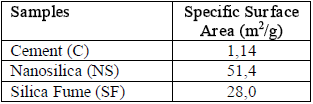
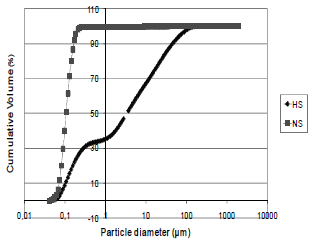
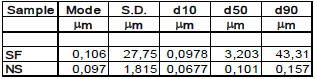
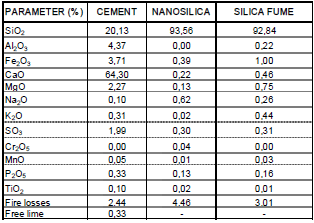
<body><![CDATA[<br>   </b>The chemical composition of used materials, cement -   nanosilica - silica fume are presented in <a href="#tab01">Table 1</a>. These tests were carried out   in an equipment of X-ray Fluorescence ARL 8680s Total Cement Analyzer by the   method of wave dispersion under standard ASTM C114-03 &#91;27&#93;.</font></p>     <p align="center"><font size="2" face="Verdana, Arial, Helvetica, sans-serif"><b><a name="tab01"></a>Table 1.</b> Chemical composition of materials</font>    <br>   <img src="/img/revistas/dyna/v77n163/a04tab01.gif"></p>     <p><font size="2" face="Verdana, Arial, Helvetica, sans-serif">When the SiO<sub>2</sub> content is corrected by the   losses on ignition, SiO<sub>2 </sub>in NS goes of 93.56% to 98% and in SF goes   of 92.84% to 95.6%. This allows conclude that the two   materials are very pure.</font></p>     <p><font size="2" face="Verdana, Arial, Helvetica, sans-serif">Specific Surface Area values of raw materials in a   Micromeritics Gemini 2380 were determined (<a href="#tab02">Table 2</a>).</font></p>     <p align="center"> <font size="2" face="Verdana, Arial, Helvetica, sans-serif"><b><a name="tab02"></a>Table   2</b>. Characteristics of raw materials</font>    <br>   <img src="/img/revistas/dyna/v77n163/a04tab02.gif"></p>     <p><font size="2" face="Verdana, Arial, Helvetica, sans-serif">The specific surface area of nanosilica is almost   double that of the silica fume used.</font></p>     <p><font size="2" face="Verdana, Arial, Helvetica, sans-serif">Coulter LS 230 was used for determining the size   distribution of mineral additions (<a href="#fig01">Figure 1</a> and <a href="#tab03">Table 3</a>).</font></p>     <p align="center"><font size="2" face="Verdana, Arial, Helvetica, sans-serif"><b><a name="fig01"></a><img src="/img/revistas/dyna/v77n163/a04fig01.gif">    ]]></body>
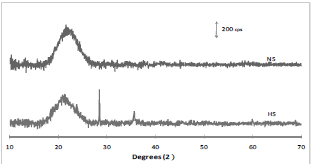
<body><![CDATA[<br>   Figure 1.</b> Particle size distributions for silica additions</font></p>     <p align="center"><font size="2" face="Verdana, Arial, Helvetica, sans-serif"><b><a name="tab03"></a>Table 3.</b> Parameters of particle size distribution for silica   additions</font>    <br>   <img src="/img/revistas/dyna/v77n163/a04tab03.gif"></p>     <p><font size="2" face="Verdana, Arial, Helvetica, sans-serif">The NS is much finer and it has more uniform particle size   distribution than the SF. The D<sub>90</sub> values (<a href="#tab03">Table 3</a>) are 0.16 <font face="Symbol">m</font>m and 43.3 microns for the two silica materials respectively.</font></p>     <p><font size="2" face="Verdana, Arial, Helvetica, sans-serif">The X-ray diffraction (XRD) of the mineral additions   (<a href="#fig02">Figure 2</a>) were performed in a PANalytical X'Pert PRO MPD, a 2<font face="Symbol">q</font> range of 2° to 70° with a step of 0.02° and an   accumulation time of 30s.</font></p>     <p align="center"><font size="2" face="Verdana, Arial, Helvetica, sans-serif"><b><a name="fig02"></a><img src="/img/revistas/dyna/v77n163/a04fig02.gif">    <br>   Figure 2</b>. X-ray diffractograms   of mineral additions</font></p>     <p><font size="2" face="Verdana, Arial, Helvetica, sans-serif">From the diffractograms it can be established that the   two materials have very low mineral crystallinity and high purity. The vitreous   silica in SF is accompanied by small amounts of silicon carbide (SiC) and   silicon metal (Si) by the method of production.</font></p>     <p><font size="2" face="Verdana, Arial, Helvetica, sans-serif">In a calorimeter TA Instruments at 25 ° C the calorimetric   studies on hydration of pastes were performed.</font></p>     <p><font size="2" face="Verdana, Arial, Helvetica, sans-serif"><b>2.2 Water demand for mortars   and cement pastes</b></font></p>     ]]></body>
<body><![CDATA[<p><font size="2" face="Verdana, Arial, Helvetica, sans-serif"><i>2.2.1 Mortars    <br>   </i></font><font size="2" face="Verdana, Arial, Helvetica, sans-serif">They were prepared in accordance with the procedure   laid down in ASTM C 305 &#91;28&#93;. The control mortar with a cement/Ottawa-sand ratio:   1:2.75 and a water/cement ratio of 0.485, according to ASTM C109 &#91;29&#93;   was made.</font></p>     <p><font size="2" face="Verdana, Arial, Helvetica, sans-serif">In the case of mortars with replacement were prepared   with a cement + addition (NS or SF) / sand ratio: 1:2.75, but the water-cement   ratio was enough to get a flow between 105 and 115% agree with ASTM C 109 &#91;29&#93;. </font></p>     <p><font size="2" face="Verdana, Arial, Helvetica, sans-serif">Mortars were prepared for testing of compressive strength   with a constant water/cementitious-material (w/cm, being cm the sum of cement   plus mineral addition) ratio of 0.55 and the corresponding amount of   superplasticizer required to achieve a fluidity of 105 - 115%, according to ASTM   C109 &#91;29&#93;. Fluidity according with ASTM C 1437 &#91;30&#93; was determined. The   superplasticizer (460 Pozzolith BASF Chemical) was homogenized with the mixing   water in order to achieve the optimum dispersion into the mixes.</font></p>     <p><font size="2" face="Verdana, Arial, Helvetica, sans-serif">In the replaced mortars with nanosilica, firstly the concentration of   suspended solids is determined and the amount of suspension required for each   replacement rate was calculated. The homogenization   was done previously with the mixing water corrected for the amount of water   incorporated by the suspension. For silica fume tests, cementitious mix   homogenization was performed by ball milling in dry state during 25 minutes for   each 1 kg   of sample. The balls have    2 cm in diameter.</font></p>     <p><font size="2" face="Verdana, Arial, Helvetica, sans-serif"><i>2.2.2 Pastes    <br>   </i></font><font size="2" face="Verdana, Arial, Helvetica, sans-serif">In pastes, normal consistency (ASTM C 187 &#91;31&#93;) and   setting time (ASTM C 191&#91;32&#93;) were determined.</font></p>     <p><font size="2" face="Verdana, Arial, Helvetica, sans-serif"><b>2.3 Compressive and flexural strength   measurements    <br>   </b></font><font size="2" face="Verdana, Arial, Helvetica, sans-serif">The specimens were prepared and failed in accordance with ASTM C 348-02   &#91;33&#93; and ASTM C 349-02 &#91;34&#93;, to 1, 3, 7 and 28 days of normal curing. </font></p>     <p>&nbsp;</p>     ]]></body>
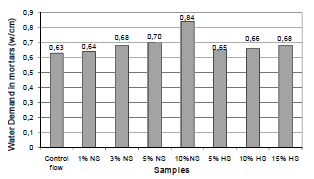
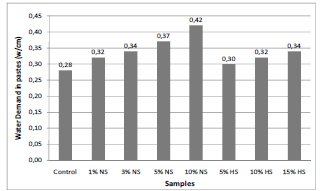
<body><![CDATA[<p><font size="3" face="Verdana, Arial, Helvetica, sans-serif"><b>3. RESULTS   AND DISCUSSION</b></font></p>     <p><font size="2" face="Verdana, Arial, Helvetica, sans-serif"><b>3.1 Water demand    <br>   </b><a href="#fig03">Figure 3</a> shows the results of water demand in mortars recommended for   fluency between 105% and 115%, <a href="#fig04">Figure 4</a> shows the water demand (w/cm ratio) on pastes   to achieve normal consistency, in both cases without the use of   superplasticizers.</font></p>     <p align="center"><font size="2" face="Verdana, Arial, Helvetica, sans-serif"><b><a name="fig03"></a><img src="/img/revistas/dyna/v77n163/a04fig03.gif">    <br>   Figure 3</b>. Water demand in mortars</font></p>     <p align="center"><font size="2" face="Verdana, Arial, Helvetica, sans-serif"><b><a name="fig04"></a><img src="/img/revistas/dyna/v77n163/a04fig04.gif">    <br>   Figure 4</b>. Water demand   in pastes</font></p>     <p><font size="2" face="Verdana, Arial, Helvetica, sans-serif">It can be seen as the two mineral additions increase water   demand. This behavior is more emphasized in the case of nanosilica which with 10%   of replacement its demand can reach up to 33% more water than the control   sample, while the silica fume with 15% substitution causes an increase in the   water demand of just 7%. This increase in water demand is in agreement with   those found by authors such as Qing et al &#91;23&#93;, Bjornstrom &#91;35&#93; and Li &#91;36&#93; who   explained it as a consequence of the acceleration of hydration process under fineness and surface energy of the additions. According to the observation made by these authors   should expect a significantly higher pozzolanic activity for the nanosilica. </font></p>     <p><font size="2" face="Verdana, Arial, Helvetica, sans-serif">In the case of the two additions would require a   relationship w/cm above 0.6 for the manufacture of mortars and it is well known   in the technical literature that this value is set as the top where the fall of mechanical strength is very important. The excess mixing water becomes in   porosity after evaporation &#91;37&#93;. This is why it was decided to make mortars   with w/cm = 0.55 constant and adding superplasticizers to achieve appropriate   workability performance in the samples. In the case of the mortars the water is   high for the evaluation of mechanical strength, but it was to avoid having to   add excessive amounts of superplasticizers that as is well known that has a   positive effect (increase) on the mechanical properties &#91;38&#93;.</font></p>     <p><font size="2" face="Verdana, Arial, Helvetica, sans-serif"><a href="#fig04">Figure 4</a> shows similarly that nanosilica has increased   water demand more than silica fume. Cement replaced with 3% of NS demand the   same amount of water that cement replaced with 15% of SF.</font></p>     ]]></body>
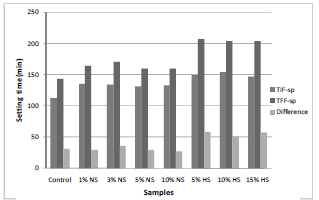
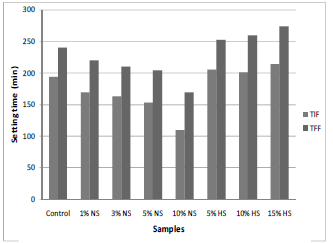
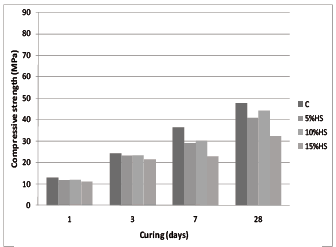
<body><![CDATA[<p><font size="2" face="Verdana, Arial, Helvetica, sans-serif">The nanosilica has a minimal effect on setting times   compared to the control sample; it is retarded despite the high water demand. In   the case of silica fume the retardant effect is much greater even increasing   the difference between the final set and the initial set (<a href="#fig05">Figure 5</a>).</font></p>     <p align="center"><font size="2" face="Verdana, Arial, Helvetica, sans-serif"><b><a name="fig05"></a><img src="/img/revistas/dyna/v77n163/a04fig05.gif">    <br>   Figure 5</b>. Setting times for pastes with normal consistency   without superplasticizer</font></p>     <p><font size="2" face="Verdana, Arial, Helvetica, sans-serif">The cement setting time depends on factors such as   fineness of cement, mineral composition of cement, amount of mixing water,   mineral admixtures and additives used, curing temperature, relative humidity,   etc. In this research, most of these parameters are maintained constant. For   understanding the setting times obtained it is necessary to do a balance   between the activities of the additions and the w/cm ratio used in the   preparation of the pastes.</font></p>     <p><font size="2" face="Verdana, Arial, Helvetica, sans-serif">According to several authors, the NS has a higher   pozzolanic activity than the SF &#91;23, 20, 18, 21, 22 and 36&#93;, thereby it forms much C-S-H and Portlandite, whereby with the addition of NS the setting   time and workability should decrease &#91;26&#93;. In this work it did not happen,   indeed, the opposite occurs and it is because the activity of the additions is   partly compensated by the greater amount of mixing water incorporated into the   mixture, i.e., although the NS may have higher pozzolanic activity it delay   slightly setting time because it demands up to 50% more water than the control   sample.</font></p>     <p><font size="2" face="Verdana, Arial, Helvetica, sans-serif">To verify these results, the setting times in samples   with a constant ratio w/cm = 0.32 were measured; for all samples   superplasticizer was blended with water in the appropriate amount for reaching normal consistency (<a href="#fig06">Figure   6</a>).</font></p>     <p align="center"><font size="2" face="Verdana, Arial, Helvetica, sans-serif"><b><a name="fig06"></a><img src="/img/revistas/dyna/v77n163/a04fig06.gif">    <br>   Figure 6</b>. Setting times for pastes with constant   water/cementitious-material ratio (0.32)</font></p>     <p><font size="2" face="Verdana, Arial, Helvetica, sans-serif">With the w/cm ratio constant (0.32), the initial and   final setting times decreased with the increase in the percentage of replacement   of cement by nanosilica (<a href="#fig06">Figure 6</a>). For the 10% NS replaced sample (which had 50% more water demand relative to the control   sample), when the test was conducted with constant w/cm ratio, the setting time   was diminished over 40%. In the case of SF, it is still producing a delay in   the setting times, but not so significant, which would suggest that this   material has low pozzolanic activity in the setting period.</font></p>     <p><font size="2" face="Verdana, Arial, Helvetica, sans-serif"><b>3.2 Mechanical strength development    ]]></body>
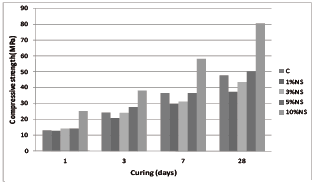
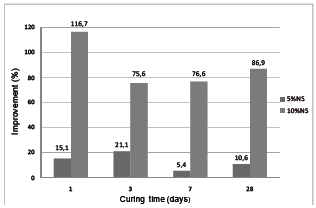
<body><![CDATA[<br>   </b>In the case of silica fume (<a href="#fig07">Figure 7</a>), when the samples in which   portland cement were replaced with different percentages of this product, it   was found that the mechanical strength was always lower than values found for   control sample at different test ages. This   behavior found for this silica fume is attributed to that it was used as a densified   product and requires a disintegration process that allows separate the   particles to perform a good role as pozzolan; in its current state SF is   working as a filler, confirming the results obtained with tests of fluency,   normal consistence and setting times which showed the SF as a material with   very little or no pozzolanic activity. This   problem with the densified state of silica fume had been reported by authors   such as Martinez-Velandia et al &#91;39, 40, 41&#93;.</font></p>     <p align="center"><font size="2" face="Verdana, Arial, Helvetica, sans-serif"><b><a name="fig07"></a><img src="/img/revistas/dyna/v77n163/a04fig07.gif">    <br>   Figure 7.</b> Compressive strength values for control and silica   fume blended mortars</font></p>     <p><font size="2" face="Verdana, Arial, Helvetica, sans-serif">In the case of nanosilica blended mortars (<a href="#fig08">Figures 8</a> and <a href="#fig09">9</a>) only with replacement percentages equal or greater than 5% significant   improvements were reached. It is noteworthy the results obtained for mortars   with 10% substitution for which a noticeable improvement in the development of   mechanical strength at all curing ages, reaching after 28 days of curing a   compressive strength of 80 MPa.</font></p>     <p align="center"><font size="2" face="Verdana, Arial, Helvetica, sans-serif"><b><a name="fig08"></a><img src="/img/revistas/dyna/v77n163/a04fig08.gif">    <br>   Figure 8.</b> Compressive strength values for nanosilica blended   mortars</font></p>     <p align="center"><font size="2" face="Verdana, Arial, Helvetica, sans-serif"><b><a name="fig09"></a><img src="/img/revistas/dyna/v77n163/a04fig09.gif">    <br>   Figure 9</b>. Percentage of improvement in compressive strength   with the addition of the nanosilica</font></p>     <p><font size="2" face="Verdana, Arial, Helvetica, sans-serif">With 10% substitution of cement by NS and to 7 days of   curing time, the sample already has more than 10 MPa of compressive strength   compared with the strength of the control sample at 28 days, this is showing the great   activity that this material has at an early age.</font></p>     <p><font size="2" face="Verdana, Arial, Helvetica, sans-serif">With 5% NS the improvements are always below 25%   compared with the control sample (<a href="#fig09">Figure 9</a>). With 10% is achieved for a day of   curing an improvement close to 120% and the rest of the ages of curing the   improvement was around 80% (<a href="#fig09">Figure 9</a>).</font></p>     ]]></body>
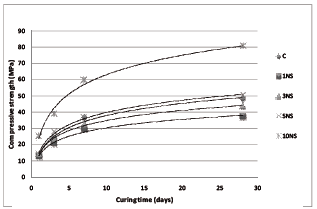
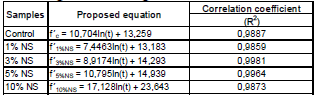
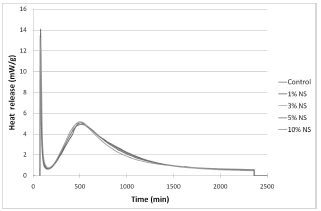
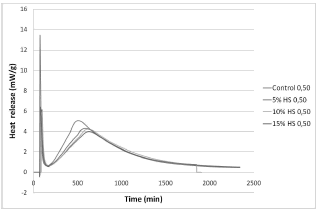
<body><![CDATA[<p><font size="2" face="Verdana, Arial, Helvetica, sans-serif">From these results trends in mechanical development   for the samples blended with nanosilica were calculated by regression analysis   (<a href="#fig10">Figure 10</a>).</font></p>     <p align="center"><font size="2" face="Verdana, Arial, Helvetica, sans-serif"><b><a name="fig10"></a><img src="/img/revistas/dyna/v77n163/a04fig10.gif">    <br>   Figure 10</b>. Trends for the compressive strength development in   NS blended mortars</font></p>     <p><font size="2" face="Verdana, Arial, Helvetica, sans-serif">For all the samples, adjustment factors (R<sup>2</sup>)   greater than 0.98 are obtained with logarithmic fit (<a href="#tab04">Table 4</a>).</font></p>     <p align="center"><font size="2" face="Verdana, Arial, Helvetica, sans-serif"><b><a name="tab04"></a></b></font><font size="2" face="Verdana, Arial, Helvetica, sans-serif"><b> Table 4</b>. Adjustment equations for the development of strength   with curing time for NS blended mortars</font>    <br>   <img src="/img/revistas/dyna/v77n163/a04tab04.gif"></p>     <p><font size="2" face="Verdana, Arial, Helvetica, sans-serif"><b>3.3 Calorimetry    <br>   </b>According to technical references, four peaks are   identified &#91;37&#93; in the calorimetric curves for hydration of Portland cement.   For pastes prepared in this work (<a href="#fig11">Figures 11</a> and <a href="#fig12">12</a>) only the first two peaks   were identified, which are also the largest since the other two usually appear as shoulders on the second   peak.</font></p>     <p align="center"><font size="2" face="Verdana, Arial, Helvetica, sans-serif"><b><a name="fig11"></a><img src="/img/revistas/dyna/v77n163/a04fig11.gif">    <br>   Figure 11</b>. Heat hydration curves for blended pastes with NS</font></p>     ]]></body>
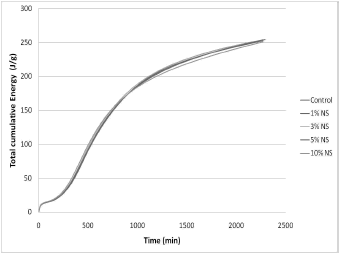
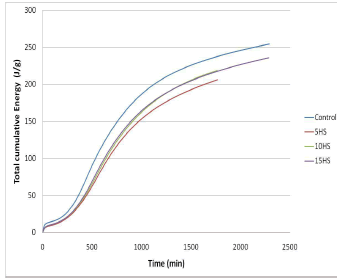
<body><![CDATA[<p align="center"><font size="2" face="Verdana, Arial, Helvetica, sans-serif"><b><a name="fig12"></a><img src="/img/revistas/dyna/v77n163/a04fig12.gif">    <br>   Figure 12</b>. Heat hydration curves for blended pastes with SF</font></p>     <p><font size="2" face="Verdana, Arial, Helvetica, sans-serif">The first peak, from left to right in the graph, is a high   energy release and it has been associated with early-stage reaction and the formation   of the phases AFt from the hydration of C3A and rehydration of calcium sulphate   hemihydrate &#91;37, 42&#93;. The second peak is really the   principal for the middle-stage reaction which form the tobermorite and   portlandite from calcium silicates &#91;37&#93;.</font></p>     <p><font size="2" face="Verdana, Arial, Helvetica, sans-serif">Nanosilica additions released about the same amount of   heat that the control sample in the two peaks identified (<a href="#fig11">Figure 11</a>). </font></p>     <p><font size="2" face="Verdana, Arial, Helvetica, sans-serif">The samples substituted with SF have a lower heat   release during hydration and even on the second peak a delayed shift rightward   of approximately 100 minutes is evidenced, this is showing a slower rate of   hydration and a smaller amount in the formation of C-S-H. This confirms again   the low pozzolanic activity of SF as used in this investigation.</font></p>     <p><font size="2" face="Verdana, Arial, Helvetica, sans-serif">Pozzolanic activity of these two mineral admixtures is   evident in the cumulative total energy graph against time (<a href="#fig13">Figures 13</a> y <a href="#fig14">14</a>),   where it can see that the samples with NS accumulate energy per gram very   similar to the control sample even for a 10% replacement. While that, samples   with SF show cumulative energy curves below the corresponding to control sample.</font></p>     <p align="center"><font size="2" face="Verdana, Arial, Helvetica, sans-serif"><b><a name="fig13"></a><img src="/img/revistas/dyna/v77n163/a04fig13.gif">    <br>   Figure 13</b>. Cumulative total energy for blended pastes with NS</font></p>     <p align="center"><font size="2" face="Verdana, Arial, Helvetica, sans-serif"><b><a name="fig14"></a><img src="/img/revistas/dyna/v77n163/a04fig14.gif">    <br>   Figure 14</b>. Cumulative total energy for blended pastes with SF</font></p>     ]]></body>
<body><![CDATA[<p>&nbsp;</p>     <p><font size="3" face="Verdana, Arial, Helvetica, sans-serif"><b>4. CONCLUSIONS </b></font></p>     <p><font size="2" face="Verdana, Arial, Helvetica, sans-serif">The nanosilica proved to be an effective mineral   addition for blending with Portland cement to improve their mechanical   performance without affecting the release of heat of hydration.</font></p>     <p><font size="2" face="Verdana, Arial, Helvetica, sans-serif">Nanosilica significantly increases the water demand in   mortars and pastes depending to percentage of substitution. This seems to be   controlled by the particle size distribution and the high specific surface area of the material.</font></p>     <p><font size="2" face="Verdana, Arial, Helvetica, sans-serif">Still very active pozzolanic additions can retard   setting times because of the excess of mixing water they need, but when these   blended samples are working with constant w/cm, significantly decrease setting   times compared to the control sample.</font></p>     <p><font size="2" face="Verdana, Arial, Helvetica, sans-serif">Only from 5% substitution of cement by nanosilica is   beginning to have significant improvements in compressive   strength of the mortars, the highest improvements in compressive strength are   obtained with 10% nanosilica and three days of curing. </font></p>     <p><font size="2" face="Verdana, Arial, Helvetica, sans-serif">The blended cement with 5 and 10% nanosilica show   higher compressive strength than the control sample even after 28 days of   curing, with improvements of over 10% and 80% respectively.</font></p>     <p><font size="2" face="Verdana, Arial, Helvetica, sans-serif">The silica fume, in a densified state, acts mainly as   filler in the mix, which is evidenced by its low demand for mixing water,   delayed setting times; drop in mechanical strength and a decrease in the amount   of heat of hydration generated.</font></p>     <p>&nbsp;</p>     <p><font size="3" face="Verdana, Arial, Helvetica, sans-serif"><b>ACKNOWLEDGMENTS</b></font></p>     ]]></body>
<body><![CDATA[<p><font size="2" face="Verdana, Arial, Helvetica, sans-serif">The authors express their sincere thanks to Cementos   Argos S. A. of   Colombia and COLCIENCIAS (Project 20201007768) for their logistical and financial   support for this project. In addition, to engineer Carolina Giraldo for her unvaluable collaboration in laboratory tests.</font></p>     <p>&nbsp;</p>     <p><font size="3" face="Verdana, Arial, Helvetica, sans-serif"><b>REFERENCES</b></font></p>     <!-- ref --><p><font size="2" face="Verdana, Arial, Helvetica, sans-serif"><b>&#91;1&#93;</b> MOSTAFA, N.Y. AND. BROWN, P.W. Heat of hydration of high reactive pozzolans in blended cements: Isothermal conduction calorimetry. Thermochimica Acta 435. 2005. P. 162-167.     &nbsp;&nbsp;&nbsp;&nbsp;&nbsp;&nbsp;&nbsp;&nbsp;[&#160;<a href="javascript:void(0);" onclick="javascript: window.open('/scielo.php?script=sci_nlinks&ref=000126&pid=S0012-7353201000030000400001&lng=','','width=640,height=500,resizable=yes,scrollbars=1,menubar=yes,');">Links</a>&#160;]<!-- end-ref --><!-- ref --><br>   <b>&#91;2&#93;</b> El-Hadj Kadri, Roger Duval. Hydration heat kinetics of concrete with silica fume. Construction and Building Materials 23 (2009) 3388-3392.     &nbsp;&nbsp;&nbsp;&nbsp;&nbsp;&nbsp;&nbsp;&nbsp;[&#160;<a href="javascript:void(0);" onclick="javascript: window.open('/scielo.php?script=sci_nlinks&ref=000127&pid=S0012-7353201000030000400002&lng=','','width=640,height=500,resizable=yes,scrollbars=1,menubar=yes,');">Links</a>&#160;]<!-- end-ref --><!-- ref --><br>   <b>&#91;3&#93;</b> RAZAK, H. and WONG H.S. Strength estimation model for high-strength concrete incorporating metakaolin and silica fume. Cement and Concrete Research 35. 2005. P. 688- 695.     &nbsp;&nbsp;&nbsp;&nbsp;&nbsp;&nbsp;&nbsp;&nbsp;[&#160;<a href="javascript:void(0);" onclick="javascript: window.open('/scielo.php?script=sci_nlinks&ref=000128&pid=S0012-7353201000030000400003&lng=','','width=640,height=500,resizable=yes,scrollbars=1,menubar=yes,');">Links</a>&#160;]<!-- end-ref --><!-- ref --><br>   <b>&#91;4&#93;</b> RICHARDSON, I. G. Tobermorite/jennite - and tobermorite/calcium hydroxide-based models for the structure of C-S-H: applicability to hardened pastes of tricalcium silicate, dicalcium silicate, Portland cement, and blends of Portland cement with blast-furnace slag, metakaolin or silica fume. Cement and Concrete Research 34. 2004. P. 1733-1777.     &nbsp;&nbsp;&nbsp;&nbsp;&nbsp;&nbsp;&nbsp;&nbsp;[&#160;<a href="javascript:void(0);" onclick="javascript: window.open('/scielo.php?script=sci_nlinks&ref=000129&pid=S0012-7353201000030000400004&lng=','','width=640,height=500,resizable=yes,scrollbars=1,menubar=yes,');">Links</a>&#160;]<!-- end-ref --><!-- ref --><br>   <b>&#91;5&#93;</b> CHINDAPRASIRT, P.; JATURAPITAKKU L, CH. and SINSIRI, TH. Effect of fly ash fineness on compressive strength and pore size of blended cement paste. Cement & Concrete Composites 27. 2005. P. 425-428.     &nbsp;&nbsp;&nbsp;&nbsp;&nbsp;&nbsp;&nbsp;&nbsp;[&#160;<a href="javascript:void(0);" onclick="javascript: window.open('/scielo.php?script=sci_nlinks&ref=000130&pid=S0012-7353201000030000400005&lng=','','width=640,height=500,resizable=yes,scrollbars=1,menubar=yes,');">Links</a>&#160;]<!-- end-ref --><!-- ref --><br>   <b>&#91;6&#93;</b> McCARTHY, M.J. AND DHIR, R.K. Development of high volume fly ash cements for use in concrete construction. Fuel 84. 2005. P. 1423-1432.     &nbsp;&nbsp;&nbsp;&nbsp;&nbsp;&nbsp;&nbsp;&nbsp;[&#160;<a href="javascript:void(0);" onclick="javascript: window.open('/scielo.php?script=sci_nlinks&ref=000131&pid=S0012-7353201000030000400006&lng=','','width=640,height=500,resizable=yes,scrollbars=1,menubar=yes,');">Links</a>&#160;]<!-- end-ref --><!-- ref --><br>   <b>&#91;7&#93;</b> ETSUO SAKAI, SHIGEYOSHI MIYAHARA, SHIGENARI OHSAWA, SEUNG-HEUN LEE, MASAKI DAIMON. Hydration of fly ash cement. Cement and Concrete Research 35. 2005. P. 1135- 1140.     &nbsp;&nbsp;&nbsp;&nbsp;&nbsp;&nbsp;&nbsp;&nbsp;[&#160;<a href="javascript:void(0);" onclick="javascript: window.open('/scielo.php?script=sci_nlinks&ref=000132&pid=S0012-7353201000030000400007&lng=','','width=640,height=500,resizable=yes,scrollbars=1,menubar=yes,');">Links</a>&#160;]<!-- end-ref --><!-- ref --><br>   <b>&#91;8&#93;</b> TANGPAGASITA, J., CHEERAROT, R., JATURAPITAKKUL, CH. AND KIATTIKOMOL K. Packing effect and pozzolanic reaction of fly ash in mortar. Cement and Concrete Research 35. 2005. P. 1145- 1151.     &nbsp;&nbsp;&nbsp;&nbsp;&nbsp;&nbsp;&nbsp;&nbsp;[&#160;<a href="javascript:void(0);" onclick="javascript: window.open('/scielo.php?script=sci_nlinks&ref=000133&pid=S0012-7353201000030000400008&lng=','','width=640,height=500,resizable=yes,scrollbars=1,menubar=yes,');">Links</a>&#160;]<!-- end-ref --><!-- ref --><br>   <b>&#91;9&#93;</b> ATIS, C. D. Strength properties of high-volume fly ash roller compacted and workable concrete and influence of curing condition. Cement and Concrete Research 35. 2005. P. 1112- 1121.     &nbsp;&nbsp;&nbsp;&nbsp;&nbsp;&nbsp;&nbsp;&nbsp;[&#160;<a href="javascript:void(0);" onclick="javascript: window.open('/scielo.php?script=sci_nlinks&ref=000134&pid=S0012-7353201000030000400009&lng=','','width=640,height=500,resizable=yes,scrollbars=1,menubar=yes,');">Links</a>&#160;]<!-- end-ref --><!-- ref --><br>   <b>&#91;10&#93;</b> POON, C. S.; LAMA, L.; KOU, S.C.; WONG, Y. L. AND WONG, R. Rate of pozzolanic reaction of metakaolin in high-performance cement pastes. Cement and Concrete Research 31. 2001. P. 1301-1306.     &nbsp;&nbsp;&nbsp;&nbsp;&nbsp;&nbsp;&nbsp;&nbsp;[&#160;<a href="javascript:void(0);" onclick="javascript: window.open('/scielo.php?script=sci_nlinks&ref=000135&pid=S0012-7353201000030000400010&lng=','','width=640,height=500,resizable=yes,scrollbars=1,menubar=yes,');">Links</a>&#160;]<!-- end-ref --><!-- ref --><br>   <b>&#91;11&#93;</b> JAUBERTHIE, R.; RENDELL, F.; TAMBA, S. AND CISSE, I. K. Properties of cement-rice husk mixture. Construction and Building Materials 17. 2003. P. 239-243.     &nbsp;&nbsp;&nbsp;&nbsp;&nbsp;&nbsp;&nbsp;&nbsp;[&#160;<a href="javascript:void(0);" onclick="javascript: window.open('/scielo.php?script=sci_nlinks&ref=000136&pid=S0012-7353201000030000400011&lng=','','width=640,height=500,resizable=yes,scrollbars=1,menubar=yes,');">Links</a>&#160;]<!-- end-ref --><!-- ref --><br>   <b>&#91;12&#93;</b> FENG, Q.; YAMAMICHI H.; SHOYA M. AND SUGITA S. Study on the pozzolanic properties of rice husk ash by hydrochloric acid pretreatment. Cement and Concrete Research 34. 2004. P. 521-526.     &nbsp;&nbsp;&nbsp;&nbsp;&nbsp;&nbsp;&nbsp;&nbsp;[&#160;<a href="javascript:void(0);" onclick="javascript: window.open('/scielo.php?script=sci_nlinks&ref=000137&pid=S0012-7353201000030000400012&lng=','','width=640,height=500,resizable=yes,scrollbars=1,menubar=yes,');">Links</a>&#160;]<!-- end-ref --><!-- ref --><br>   <b>&#91;13&#93;</b> SIDDIQUE, R. & KLAUS, J. Influence of metakaolin on the properties of mortar and concrete: A review. Applied Clay Science 43 (2009) 392-400.     &nbsp;&nbsp;&nbsp;&nbsp;&nbsp;&nbsp;&nbsp;&nbsp;[&#160;<a href="javascript:void(0);" onclick="javascript: window.open('/scielo.php?script=sci_nlinks&ref=000138&pid=S0012-7353201000030000400013&lng=','','width=640,height=500,resizable=yes,scrollbars=1,menubar=yes,');">Links</a>&#160;]<!-- end-ref --><!-- ref --><br>   <b>&#91;14&#93;</b> PERRAKI, T.; KONTORI, E.; TSIVILIS, S. & KAKALI, G. The effect of zeolite on the properties and hydration of blended cements. Cement & Concrete Composites 32 (2010) 128-133.     &nbsp;&nbsp;&nbsp;&nbsp;&nbsp;&nbsp;&nbsp;&nbsp;[&#160;<a href="javascript:void(0);" onclick="javascript: window.open('/scielo.php?script=sci_nlinks&ref=000139&pid=S0012-7353201000030000400014&lng=','','width=640,height=500,resizable=yes,scrollbars=1,menubar=yes,');">Links</a>&#160;]<!-- end-ref --><!-- ref --><br>   <b>&#91;15&#93;</b> HEWLETT, P. C. Lea´s chemistry of cement and concrete. 4th ed. Oxford, 1998. 1057 pp.     &nbsp;&nbsp;&nbsp;&nbsp;&nbsp;&nbsp;&nbsp;&nbsp;[&#160;<a href="javascript:void(0);" onclick="javascript: window.open('/scielo.php?script=sci_nlinks&ref=000140&pid=S0012-7353201000030000400015&lng=','','width=640,height=500,resizable=yes,scrollbars=1,menubar=yes,');">Links</a>&#160;]<!-- end-ref --><!-- ref --><br>   <b>&#91;16&#93;</b> G. APPA RAO. Investigations on the performance of silica fume-incorporated cement pastes and mortars. Cement and Concrete Research 33 (2003) 1765-1770.     &nbsp;&nbsp;&nbsp;&nbsp;&nbsp;&nbsp;&nbsp;&nbsp;[&#160;<a href="javascript:void(0);" onclick="javascript: window.open('/scielo.php?script=sci_nlinks&ref=000141&pid=S0012-7353201000030000400016&lng=','','width=640,height=500,resizable=yes,scrollbars=1,menubar=yes,');">Links</a>&#160;]<!-- end-ref --><!-- ref --><br>   <b>&#91;17&#93;</b> JI, TAO. Preliminary study on the water permeability and microstructure of concrete incorporating nano-SiO2. Cement and Concrete Research 35. 2005. P. 1943 - 1947.     &nbsp;&nbsp;&nbsp;&nbsp;&nbsp;&nbsp;&nbsp;&nbsp;[&#160;<a href="javascript:void(0);" onclick="javascript: window.open('/scielo.php?script=sci_nlinks&ref=000142&pid=S0012-7353201000030000400017&lng=','','width=640,height=500,resizable=yes,scrollbars=1,menubar=yes,');">Links</a>&#160;]<!-- end-ref --><!-- ref --><br>   <b>&#91;18&#93;</b> SHIH, J. Y., CHANG, T. P. & HSIAO, T. Ch. Effect of nanosilica on characterization of Portland cement composite. Materials Science and Engineering A 424. 2006. P266 - 274.     &nbsp;&nbsp;&nbsp;&nbsp;&nbsp;&nbsp;&nbsp;&nbsp;[&#160;<a href="javascript:void(0);" onclick="javascript: window.open('/scielo.php?script=sci_nlinks&ref=000143&pid=S0012-7353201000030000400018&lng=','','width=640,height=500,resizable=yes,scrollbars=1,menubar=yes,');">Links</a>&#160;]<!-- end-ref --><!-- ref --><br>   <b>&#91;19&#93;</b> LI, H.; ZHANG, M. & OU J. Abrasion resistance of concrete containing nano-particles for pavement. Wear 260. 2006. P 1262 - 1266.     &nbsp;&nbsp;&nbsp;&nbsp;&nbsp;&nbsp;&nbsp;&nbsp;[&#160;<a href="javascript:void(0);" onclick="javascript: window.open('/scielo.php?script=sci_nlinks&ref=000144&pid=S0012-7353201000030000400019&lng=','','width=640,height=500,resizable=yes,scrollbars=1,menubar=yes,');">Links</a>&#160;]<!-- end-ref --><!-- ref --><br>   <b>&#91;20&#93;</b> BYUNG-WAN JO, CHANG-HYUN KIM, GHI-HO TAE & JONG-BIN PARK. Characteristics of cement mortar with nano-SiO2 particles. Construction and Building Materials 21 (2007) 1351-1355.     &nbsp;&nbsp;&nbsp;&nbsp;&nbsp;&nbsp;&nbsp;&nbsp;[&#160;<a href="javascript:void(0);" onclick="javascript: window.open('/scielo.php?script=sci_nlinks&ref=000145&pid=S0012-7353201000030000400020&lng=','','width=640,height=500,resizable=yes,scrollbars=1,menubar=yes,');">Links</a>&#160;]<!-- end-ref --><!-- ref --><br>   <b>&#91;21&#93;</b> LI, H.; XIAO, H.; YUAN, J & OU, J. Microestructure of cement mortar with nanoparticles. Composite Part B: engineering 35. 2004. P 185 - 189.     &nbsp;&nbsp;&nbsp;&nbsp;&nbsp;&nbsp;&nbsp;&nbsp;[&#160;<a href="javascript:void(0);" onclick="javascript: window.open('/scielo.php?script=sci_nlinks&ref=000146&pid=S0012-7353201000030000400021&lng=','','width=640,height=500,resizable=yes,scrollbars=1,menubar=yes,');">Links</a>&#160;]<!-- end-ref --><!-- ref --><br>   <b>&#91;22&#93;</b> LI, H.; XIAO, H. & OU, J. A study on mechanical and pressure-sensitive properties of cement mortar with nanophase materials. Cement and Concrete Research 34. 2004. P. 435-438.     &nbsp;&nbsp;&nbsp;&nbsp;&nbsp;&nbsp;&nbsp;&nbsp;[&#160;<a href="javascript:void(0);" onclick="javascript: window.open('/scielo.php?script=sci_nlinks&ref=000147&pid=S0012-7353201000030000400022&lng=','','width=640,height=500,resizable=yes,scrollbars=1,menubar=yes,');">Links</a>&#160;]<!-- end-ref --><!-- ref --><br>   <b>&#91;23&#93;</b> QING, Y.; ZENAN, ZH.; DEYU, K. & RONGSHEN, CH. Influence of nano-SiO2 addition on properties of hardened cement paste as compared with silica fume. Construction and Building Materials 21 (2007) 539-545.     &nbsp;&nbsp;&nbsp;&nbsp;&nbsp;&nbsp;&nbsp;&nbsp;[&#160;<a href="javascript:void(0);" onclick="javascript: window.open('/scielo.php?script=sci_nlinks&ref=000148&pid=S0012-7353201000030000400023&lng=','','width=640,height=500,resizable=yes,scrollbars=1,menubar=yes,');">Links</a>&#160;]<!-- end-ref --><!-- ref --><br>   <b>&#91;24&#93;</b> ALMEIDA and SICHIERI. Mineralogical study of polymer modified mortar with silica fume. Construction and Building Materials, Volume 20, Issue 10, December 2006, Pages 882-887.     &nbsp;&nbsp;&nbsp;&nbsp;&nbsp;&nbsp;&nbsp;&nbsp;[&#160;<a href="javascript:void(0);" onclick="javascript: window.open('/scielo.php?script=sci_nlinks&ref=000149&pid=S0012-7353201000030000400024&lng=','','width=640,height=500,resizable=yes,scrollbars=1,menubar=yes,');">Links</a>&#160;]<!-- end-ref --><!-- ref --><br>   <b>&#91;25&#93;</b> HEIKAL, M.; MORSY, M. & AIAD I. Effect of treatment temperature on the early hydration characteristics of superplasticized silica fume blended cement pastes. Cement and Concrete Research 35. 2005. P 680- 687.     &nbsp;&nbsp;&nbsp;&nbsp;&nbsp;&nbsp;&nbsp;&nbsp;[&#160;<a href="javascript:void(0);" onclick="javascript: window.open('/scielo.php?script=sci_nlinks&ref=000150&pid=S0012-7353201000030000400025&lng=','','width=640,height=500,resizable=yes,scrollbars=1,menubar=yes,');">Links</a>&#160;]<!-- end-ref --><!-- ref --><br>   <b>&#91;26&#93;</b> MALTESE, C. PISTOLESI, C. BRAVO, A. CELLA, F. CERULLI, T. SALVIONI. D. A case history: Effect of moisture on the setting behaviour of a Portland cement reacting with an alkali-free accelerator. Cement and Concrete Research 37 (2007) 856-865     &nbsp;&nbsp;&nbsp;&nbsp;&nbsp;&nbsp;&nbsp;&nbsp;[&#160;<a href="javascript:void(0);" onclick="javascript: window.open('/scielo.php?script=sci_nlinks&ref=000151&pid=S0012-7353201000030000400026&lng=','','width=640,height=500,resizable=yes,scrollbars=1,menubar=yes,');">Links</a>&#160;]<!-- end-ref --><!-- ref --><br>   <b>&#91;27&#93;</b> ASTM C 114. Standard Test Methods for Chemical Analysis of Hydraulic Cement. 2003. 3P. ASTM International, United States.     &nbsp;&nbsp;&nbsp;&nbsp;&nbsp;&nbsp;&nbsp;&nbsp;[&#160;<a href="javascript:void(0);" onclick="javascript: window.open('/scielo.php?script=sci_nlinks&ref=000152&pid=S0012-7353201000030000400027&lng=','','width=640,height=500,resizable=yes,scrollbars=1,menubar=yes,');">Links</a>&#160;]<!-- end-ref --><!-- ref --><br>   <b>&#91;28&#93;</b> ASTM C 305. Standard Practice for Mechanical Mixing of Hydraulic Cement Pastes and Mortars of Plastic Consistency. 1999. 3P. ASTM International, United States.     &nbsp;&nbsp;&nbsp;&nbsp;&nbsp;&nbsp;&nbsp;&nbsp;[&#160;<a href="javascript:void(0);" onclick="javascript: window.open('/scielo.php?script=sci_nlinks&ref=000153&pid=S0012-7353201000030000400028&lng=','','width=640,height=500,resizable=yes,scrollbars=1,menubar=yes,');">Links</a>&#160;]<!-- end-ref --><!-- ref --><br>   <b>&#91;29&#93;</b> ASTM C109/C109M. Standard Test Method for Compressive Strength of Hydraulic Cement Mortars (Using 2-in. or &#91;50-mm&#93;</b> Cube Specimens). 2002. 6P. Copyright © ASTM International, United States     &nbsp;&nbsp;&nbsp;&nbsp;&nbsp;&nbsp;&nbsp;&nbsp;[&#160;<a href="javascript:void(0);" onclick="javascript: window.open('/scielo.php?script=sci_nlinks&ref=000154&pid=S0012-7353201000030000400029&lng=','','width=640,height=500,resizable=yes,scrollbars=1,menubar=yes,');">Links</a>&#160;]<!-- end-ref --><!-- ref --><br>   <b>&#91;30&#93;</b> ASTM C 1437. Standard Test Method for Flow of Hydraulic Cement Mortar. 2001. 2P. ASTM International, United States.     &nbsp;&nbsp;&nbsp;&nbsp;&nbsp;&nbsp;&nbsp;&nbsp;[&#160;<a href="javascript:void(0);" onclick="javascript: window.open('/scielo.php?script=sci_nlinks&ref=000155&pid=S0012-7353201000030000400030&lng=','','width=640,height=500,resizable=yes,scrollbars=1,menubar=yes,');">Links</a>&#160;]<!-- end-ref --><!-- ref --><br>   <b>&#91;31&#93;</b> ASTM C187. Standard Test Method for Normal Consistency of Hydraulic Cement. 1998. 2P. ASTM International, United States.     &nbsp;&nbsp;&nbsp;&nbsp;&nbsp;&nbsp;&nbsp;&nbsp;[&#160;<a href="javascript:void(0);" onclick="javascript: window.open('/scielo.php?script=sci_nlinks&ref=000156&pid=S0012-7353201000030000400031&lng=','','width=640,height=500,resizable=yes,scrollbars=1,menubar=yes,');">Links</a>&#160;]<!-- end-ref --><!-- ref --><br>   <b>&#91;32&#93;</b> ASTM C187. Standard Test Method for Normal Consistency of Hydraulic Cement. 1998. 2P. ASTM International, United States.     &nbsp;&nbsp;&nbsp;&nbsp;&nbsp;&nbsp;&nbsp;&nbsp;[&#160;<a href="javascript:void(0);" onclick="javascript: window.open('/scielo.php?script=sci_nlinks&ref=000157&pid=S0012-7353201000030000400032&lng=','','width=640,height=500,resizable=yes,scrollbars=1,menubar=yes,');">Links</a>&#160;]<!-- end-ref --><!-- ref --><br>   <b>&#91;33&#93;</b> ASTM C 348 - 02. Standard Test Method for Flexural Strength of Hydraulic-Cement Mortars. 2002. 6P. ASTM International, United States.     &nbsp;&nbsp;&nbsp;&nbsp;&nbsp;&nbsp;&nbsp;&nbsp;[&#160;<a href="javascript:void(0);" onclick="javascript: window.open('/scielo.php?script=sci_nlinks&ref=000158&pid=S0012-7353201000030000400033&lng=','','width=640,height=500,resizable=yes,scrollbars=1,menubar=yes,');">Links</a>&#160;]<!-- end-ref --><!-- ref --><br>   <b>&#91;34&#93;</b> ASTM C 349 - 02. Standard Test Method for Compressive Strength of Hydraulic-Cement Mortars (Using Portions of Prisms Broken in Flexure). 2002. 4P. ASTM International, United States.     &nbsp;&nbsp;&nbsp;&nbsp;&nbsp;&nbsp;&nbsp;&nbsp;[&#160;<a href="javascript:void(0);" onclick="javascript: window.open('/scielo.php?script=sci_nlinks&ref=000159&pid=S0012-7353201000030000400034&lng=','','width=640,height=500,resizable=yes,scrollbars=1,menubar=yes,');">Links</a>&#160;]<!-- end-ref --><!-- ref --><br>   <b>&#91;35&#93;</b> BJÖRNSTRÖM J., MARTINELLI A., MATIC A., BÖRJESSON L. and PANAS I. Accelerating effects of colloidal nano-silica for beneficial calcium-silicate-hydrate formation in cement. Chemical Physic Letter, 392. 2004. P. 242 - 248.     &nbsp;&nbsp;&nbsp;&nbsp;&nbsp;&nbsp;&nbsp;&nbsp;[&#160;<a href="javascript:void(0);" onclick="javascript: window.open('/scielo.php?script=sci_nlinks&ref=000160&pid=S0012-7353201000030000400035&lng=','','width=640,height=500,resizable=yes,scrollbars=1,menubar=yes,');">Links</a>&#160;]<!-- end-ref --><!-- ref --><br>   <b>&#91;36&#93;</b> LI, G. Properties of high-volume fly ash concrete incorporating nano-SiO2. Cement and Concrete Research. 34. 2004. P. 1043 - 1049.     &nbsp;&nbsp;&nbsp;&nbsp;&nbsp;&nbsp;&nbsp;&nbsp;[&#160;<a href="javascript:void(0);" onclick="javascript: window.open('/scielo.php?script=sci_nlinks&ref=000161&pid=S0012-7353201000030000400036&lng=','','width=640,height=500,resizable=yes,scrollbars=1,menubar=yes,');">Links</a>&#160;]<!-- end-ref --><!-- ref --><br>   <b>&#91;37&#93;</b> TAYLOR, H. F. W. Cement Chemistry. 2nd ed. Thomas Telford, London. 1990. 459p.     &nbsp;&nbsp;&nbsp;&nbsp;&nbsp;&nbsp;&nbsp;&nbsp;[&#160;<a href="javascript:void(0);" onclick="javascript: window.open('/scielo.php?script=sci_nlinks&ref=000162&pid=S0012-7353201000030000400037&lng=','','width=640,height=500,resizable=yes,scrollbars=1,menubar=yes,');">Links</a>&#160;]<!-- end-ref --><!-- ref --><br>   <b>&#91;38&#93;</b> SPIRATOS, N.; PAG&Eacute;, M. MAILVAGANAM, N.; MALHOTRA, V. & JOLICOEUR, C. Superplastizers for concrete: Fundamentals, technology and Practice. Marquis, Canada. 2006.     &nbsp;&nbsp;&nbsp;&nbsp;&nbsp;&nbsp;&nbsp;&nbsp;[&#160;<a href="javascript:void(0);" onclick="javascript: window.open('/scielo.php?script=sci_nlinks&ref=000163&pid=S0012-7353201000030000400038&lng=','','width=640,height=500,resizable=yes,scrollbars=1,menubar=yes,');">Links</a>&#160;]<!-- end-ref --><!-- ref --><br>   <b>&#91;39&#93;</b> MART&Iacute;NEZ-VELANDIA, D. Caracterizaci&oacute;n y reactividad de materiales puzol&aacute;nicos: El humo de s&iacute;lice y su estado de densificaci&oacute;n. Tesis de Doctorado. Universidad Polit&eacute;cnica de Valencia (UPV). 2006.     &nbsp;&nbsp;&nbsp;&nbsp;&nbsp;&nbsp;&nbsp;&nbsp;[&#160;<a href="javascript:void(0);" onclick="javascript: window.open('/scielo.php?script=sci_nlinks&ref=000164&pid=S0012-7353201000030000400039&lng=','','width=640,height=500,resizable=yes,scrollbars=1,menubar=yes,');">Links</a>&#160;]<!-- end-ref --><!-- ref --><br>   <b>&#91;40&#93;</b> MARTINEZ-VELANDIA, D.; PAYA, J.; MONZO, J.; BORRACHERO, M.V. Granulometric activation of densified silica fume (CSF) by sonication. Advances in Cement Research, 20. 2008. P129-135.     &nbsp;&nbsp;&nbsp;&nbsp;&nbsp;&nbsp;&nbsp;&nbsp;[&#160;<a href="javascript:void(0);" onclick="javascript: window.open('/scielo.php?script=sci_nlinks&ref=000165&pid=S0012-7353201000030000400040&lng=','','width=640,height=500,resizable=yes,scrollbars=1,menubar=yes,');">Links</a>&#160;]<!-- end-ref --><!-- ref --><br>   <b>&#91;41&#93;</b> MARTINEZ-VELANDIA, D.; PAYA, J.; MONZO, J.;, BORRACHERO, M.V. Effect of sonication on the reactivity of silica fume in Portland cement mortars. Advances in Cement Research, in press.     &nbsp;&nbsp;&nbsp;&nbsp;&nbsp;&nbsp;&nbsp;&nbsp;[&#160;<a href="javascript:void(0);" onclick="javascript: window.open('/scielo.php?script=sci_nlinks&ref=000166&pid=S0012-7353201000030000400041&lng=','','width=640,height=500,resizable=yes,scrollbars=1,menubar=yes,');">Links</a>&#160;]<!-- end-ref --><!-- ref --><br>   <b>&#91;42&#93;</b> RAHHAL, V. & TALERO, R. Calorimetry of Portland cement with silica fume, diatomite and quartz additions. Construction and Building Materials 23 (2009) 3367-3374. </font>&nbsp;&nbsp;&nbsp;&nbsp;&nbsp;&nbsp;&nbsp;&nbsp;[&#160;<a href="javascript:void(0);" onclick="javascript: window.open('/scielo.php?script=sci_nlinks&ref=000167&pid=S0012-7353201000030000400042&lng=','','width=640,height=500,resizable=yes,scrollbars=1,menubar=yes,');">Links</a>&#160;]<!-- end-ref --> ]]></body><back>
<ref-list>
<ref id="B1">
<label>1</label><nlm-citation citation-type="journal">
<person-group person-group-type="author">
<name>
<surname><![CDATA[MOSTAFA]]></surname>
<given-names><![CDATA[N.Y.]]></given-names>
</name>
<name>
<surname><![CDATA[BROWN]]></surname>
<given-names><![CDATA[P.W.]]></given-names>
</name>
</person-group>
<article-title xml:lang="en"><![CDATA[Heat of hydration of high reactive pozzolans in blended cements: Isothermal conduction calorimetry]]></article-title>
<source><![CDATA[Thermochimica Acta]]></source>
<year>2005</year>
<numero>435</numero>
<issue>435</issue>
<page-range>162-167</page-range></nlm-citation>
</ref>
<ref id="B2">
<label>2</label><nlm-citation citation-type="journal">
<person-group person-group-type="author">
<name>
<surname><![CDATA[El-Hadj]]></surname>
<given-names><![CDATA[Kadri]]></given-names>
</name>
<name>
<surname><![CDATA[Roger]]></surname>
<given-names><![CDATA[Duval]]></given-names>
</name>
</person-group>
<article-title xml:lang="en"><![CDATA[Hydration heat kinetics of concrete with silica fume]]></article-title>
<source><![CDATA[Construction and Building Materials]]></source>
<year>2009</year>
<volume>23</volume>
<page-range>3388-3392</page-range></nlm-citation>
</ref>
<ref id="B3">
<label>3</label><nlm-citation citation-type="journal">
<person-group person-group-type="author">
<name>
<surname><![CDATA[RAZAK]]></surname>
<given-names><![CDATA[H.]]></given-names>
</name>
<name>
<surname><![CDATA[WONG]]></surname>
<given-names><![CDATA[H.S.]]></given-names>
</name>
</person-group>
<article-title xml:lang="en"><![CDATA[Strength estimation model for high-strength concrete incorporating metakaolin and silica fume]]></article-title>
<source><![CDATA[Cement and Concrete Research]]></source>
<year>2005</year>
<volume>35</volume>
<page-range>688-695</page-range></nlm-citation>
</ref>
<ref id="B4">
<label>4</label><nlm-citation citation-type="journal">
<person-group person-group-type="author">
<name>
<surname><![CDATA[RICHARDSON]]></surname>
<given-names><![CDATA[I. G.]]></given-names>
</name>
</person-group>
<article-title xml:lang="en"><![CDATA[Tobermorite/jennite - and tobermorite/calcium hydroxide-based models for the structure of C-S-H: applicability to hardened pastes of tricalcium silicate, dicalcium silicate, Portland cement, and blends of Portland cement with blast-furnace slag, metakaolin or silica fume]]></article-title>
<source><![CDATA[Cement and Concrete Research]]></source>
<year>2004</year>
<volume>34</volume>
<page-range>1733-1777</page-range></nlm-citation>
</ref>
<ref id="B5">
<label>5</label><nlm-citation citation-type="journal">
<person-group person-group-type="author">
<name>
<surname><![CDATA[CHINDAPRASIRT]]></surname>
<given-names><![CDATA[P.]]></given-names>
</name>
<name>
<surname><![CDATA[JATURAPITAKKU L]]></surname>
<given-names><![CDATA[CH]]></given-names>
</name>
<name>
<surname><![CDATA[SINSIRI]]></surname>
<given-names><![CDATA[TH]]></given-names>
</name>
</person-group>
<article-title xml:lang="en"><![CDATA[Effect of fly ash fineness on compressive strength and pore size of blended cement paste]]></article-title>
<source><![CDATA[Cement & Concrete Composites]]></source>
<year>2005</year>
<volume>27</volume>
<page-range>425-428</page-range></nlm-citation>
</ref>
<ref id="B6">
<label>6</label><nlm-citation citation-type="journal">
<person-group person-group-type="author">
<name>
<surname><![CDATA[McCARTHY]]></surname>
<given-names><![CDATA[M.J.]]></given-names>
</name>
<name>
<surname><![CDATA[DHIR]]></surname>
<given-names><![CDATA[R.K.]]></given-names>
</name>
</person-group>
<article-title xml:lang="en"><![CDATA[Development of high volume fly ash cements for use in concrete construction]]></article-title>
<source><![CDATA[Fuel]]></source>
<year>2005</year>
<numero>84</numero>
<issue>84</issue>
<page-range>1423-1432</page-range></nlm-citation>
</ref>
<ref id="B7">
<label>7</label><nlm-citation citation-type="journal">
<person-group person-group-type="author">
<name>
<surname><![CDATA[ETSUO]]></surname>
<given-names><![CDATA[SAKAI]]></given-names>
</name>
<name>
<surname><![CDATA[SHIGEYOSHI]]></surname>
<given-names><![CDATA[MIYAHARA]]></given-names>
</name>
<name>
<surname><![CDATA[SHIGENARI]]></surname>
<given-names><![CDATA[OHSAWA]]></given-names>
</name>
<name>
<surname><![CDATA[SEUNG-HEUN]]></surname>
<given-names><![CDATA[LEE]]></given-names>
</name>
<name>
<surname><![CDATA[MASAKI]]></surname>
<given-names><![CDATA[DAIMON]]></given-names>
</name>
</person-group>
<article-title xml:lang="en"><![CDATA[Hydration of fly ash cement]]></article-title>
<source><![CDATA[Cement and Concrete Research]]></source>
<year>2005</year>
<volume>35</volume>
<page-range>1135-1140</page-range></nlm-citation>
</ref>
<ref id="B8">
<label>8</label><nlm-citation citation-type="journal">
<person-group person-group-type="author">
<name>
<surname><![CDATA[TANGPAGASITA]]></surname>
<given-names><![CDATA[J.]]></given-names>
</name>
<name>
<surname><![CDATA[CHEERAROT]]></surname>
<given-names><![CDATA[R.]]></given-names>
</name>
<name>
<surname><![CDATA[JATURAPITAKKUL]]></surname>
<given-names><![CDATA[CH.]]></given-names>
</name>
<name>
<surname><![CDATA[KIATTIKOMOL]]></surname>
<given-names><![CDATA[K.]]></given-names>
</name>
</person-group>
<article-title xml:lang="en"><![CDATA[Packing effect and pozzolanic reaction of fly ash in mortar]]></article-title>
<source><![CDATA[Cement and Concrete Research]]></source>
<year>2005</year>
<volume>35</volume>
<page-range>1145-1151</page-range></nlm-citation>
</ref>
<ref id="B9">
<label>9</label><nlm-citation citation-type="journal">
<person-group person-group-type="author">
<name>
<surname><![CDATA[ATIS]]></surname>
<given-names><![CDATA[C. D.]]></given-names>
</name>
</person-group>
<article-title xml:lang="en"><![CDATA[Strength properties of high-volume fly ash roller compacted and workable concrete and influence of curing condition]]></article-title>
<source><![CDATA[Cement and Concrete Research]]></source>
<year>2005</year>
<volume>35</volume>
<page-range>1112-1121</page-range></nlm-citation>
</ref>
<ref id="B10">
<label>10</label><nlm-citation citation-type="journal">
<person-group person-group-type="author">
<name>
<surname><![CDATA[POON]]></surname>
<given-names><![CDATA[C. S.]]></given-names>
</name>
<name>
<surname><![CDATA[LAMA]]></surname>
<given-names><![CDATA[L.]]></given-names>
</name>
<name>
<surname><![CDATA[KOU]]></surname>
<given-names><![CDATA[S.C.]]></given-names>
</name>
<name>
<surname><![CDATA[WONG]]></surname>
<given-names><![CDATA[Y. L.]]></given-names>
</name>
<name>
<surname><![CDATA[WONG]]></surname>
<given-names><![CDATA[R.]]></given-names>
</name>
</person-group>
<article-title xml:lang="en"><![CDATA[Rate of pozzolanic reaction of metakaolin in high-performance cement pastes]]></article-title>
<source><![CDATA[Cement and Concrete Research]]></source>
<year>2001</year>
<volume>31</volume>
<page-range>1301-1306</page-range></nlm-citation>
</ref>
<ref id="B11">
<label>11</label><nlm-citation citation-type="journal">
<person-group person-group-type="author">
<name>
<surname><![CDATA[JAUBERTHIE]]></surname>
<given-names><![CDATA[R.]]></given-names>
</name>
<name>
<surname><![CDATA[RENDELL]]></surname>
<given-names><![CDATA[F.]]></given-names>
</name>
<name>
<surname><![CDATA[TAMBA]]></surname>
<given-names><![CDATA[S.]]></given-names>
</name>
<name>
<surname><![CDATA[CISSE]]></surname>
<given-names><![CDATA[I. K.]]></given-names>
</name>
</person-group>
<article-title xml:lang="en"><![CDATA[Properties of cement&#151;rice husk mixture]]></article-title>
<source><![CDATA[Construction and Building Materials]]></source>
<year>2003</year>
<volume>17</volume>
<page-range>239-243</page-range></nlm-citation>
</ref>
<ref id="B12">
<label>12</label><nlm-citation citation-type="journal">
<person-group person-group-type="author">
<name>
<surname><![CDATA[FENG]]></surname>
<given-names><![CDATA[Q.]]></given-names>
</name>
<name>
<surname><![CDATA[YAMAMICHI]]></surname>
<given-names><![CDATA[H.]]></given-names>
</name>
<name>
<surname><![CDATA[SHOYA]]></surname>
<given-names><![CDATA[M.]]></given-names>
</name>
<name>
<surname><![CDATA[SUGITA]]></surname>
<given-names><![CDATA[S.]]></given-names>
</name>
</person-group>
<article-title xml:lang="en"><![CDATA[Study on the pozzolanic properties of rice husk ash by hydrochloric acid pretreatment]]></article-title>
<source><![CDATA[Cement and Concrete Research]]></source>
<year>2004</year>
<volume>34</volume>
<page-range>521-526</page-range></nlm-citation>
</ref>
<ref id="B13">
<label>13</label><nlm-citation citation-type="journal">
<person-group person-group-type="author">
<name>
<surname><![CDATA[SIDDIQUE]]></surname>
<given-names><![CDATA[R.]]></given-names>
</name>
<name>
<surname><![CDATA[KLAUS]]></surname>
<given-names><![CDATA[J.]]></given-names>
</name>
</person-group>
<article-title xml:lang="en"><![CDATA[Influence of metakaolin on the properties of mortar and concrete: A review]]></article-title>
<source><![CDATA[Applied Clay Science]]></source>
<year>2009</year>
<volume>43</volume>
<page-range>392-400</page-range></nlm-citation>
</ref>
<ref id="B14">
<label>14</label><nlm-citation citation-type="journal">
<person-group person-group-type="author">
<name>
<surname><![CDATA[PERRAKI]]></surname>
<given-names><![CDATA[T.]]></given-names>
</name>
<name>
<surname><![CDATA[KONTORI]]></surname>
<given-names><![CDATA[E.]]></given-names>
</name>
<name>
<surname><![CDATA[TSIVILIS]]></surname>
<given-names><![CDATA[S.]]></given-names>
</name>
<name>
<surname><![CDATA[KAKALI]]></surname>
<given-names><![CDATA[G.]]></given-names>
</name>
</person-group>
<article-title xml:lang="en"><![CDATA[The effect of zeolite on the properties and hydration of blended cements]]></article-title>
<source><![CDATA[Cement & Concrete Composites]]></source>
<year>2010</year>
<volume>32</volume>
<page-range>128-133</page-range></nlm-citation>
</ref>
<ref id="B15">
<label>15</label><nlm-citation citation-type="">
<person-group person-group-type="author">
<name>
<surname><![CDATA[HEWLETT]]></surname>
<given-names><![CDATA[P. C.]]></given-names>
</name>
</person-group>
<source><![CDATA[Lea´s chemistry of cement and concrete]]></source>
<year>1998</year>
<edition>4th</edition>
<publisher-loc><![CDATA[Oxford ]]></publisher-loc>
</nlm-citation>
</ref>
<ref id="B16">
<label>16</label><nlm-citation citation-type="journal">
<person-group person-group-type="author">
<name>
<surname><![CDATA[G.]]></surname>
<given-names><![CDATA[APPA RAO.]]></given-names>
</name>
</person-group>
<article-title xml:lang="en"><![CDATA[Investigations on the performance of silica fume-incorporated cement pastes and mortars]]></article-title>
<source><![CDATA[Cement and Concrete Research]]></source>
<year>2003</year>
<volume>33</volume>
<page-range>1765-1770</page-range></nlm-citation>
</ref>
<ref id="B17">
<label>17</label><nlm-citation citation-type="journal">
<person-group person-group-type="author">
<name>
<surname><![CDATA[JI]]></surname>
<given-names><![CDATA[TAO]]></given-names>
</name>
</person-group>
<article-title xml:lang="en"><![CDATA[Preliminary study on the water permeability and microstructure of concrete incorporating nano-SiO2]]></article-title>
<source><![CDATA[Cement and Concrete Research]]></source>
<year>2005</year>
<volume>35</volume>
<page-range>1943-1947</page-range></nlm-citation>
</ref>
<ref id="B18">
<label>18</label><nlm-citation citation-type="journal">
<person-group person-group-type="author">
<name>
<surname><![CDATA[SHIH]]></surname>
<given-names><![CDATA[J. Y.]]></given-names>
</name>
<name>
<surname><![CDATA[CHANG]]></surname>
<given-names><![CDATA[T. P.]]></given-names>
</name>
<name>
<surname><![CDATA[HSIAO]]></surname>
<given-names><![CDATA[T. Ch.]]></given-names>
</name>
</person-group>
<article-title xml:lang="en"><![CDATA[Effect of nanosilica on characterization of Portland cement composite]]></article-title>
<source><![CDATA[Materials Science and Engineering]]></source>
<year>2006</year>
<volume>424</volume>
<page-range>P266-274</page-range></nlm-citation>
</ref>
<ref id="B19">
<label>19</label><nlm-citation citation-type="journal">
<person-group person-group-type="author">
<name>
<surname><![CDATA[LI]]></surname>
<given-names><![CDATA[H.]]></given-names>
</name>
<name>
<surname><![CDATA[ZHANG]]></surname>
<given-names><![CDATA[M.]]></given-names>
</name>
<name>
<surname><![CDATA[OU]]></surname>
<given-names><![CDATA[J.]]></given-names>
</name>
</person-group>
<article-title xml:lang="en"><![CDATA[Abrasion resistance of concrete containing nano-particles for pavement]]></article-title>
<source><![CDATA[Wear]]></source>
<year>2006</year>
<numero>260</numero>
<issue>260</issue>
<page-range>1262- 1266</page-range></nlm-citation>
</ref>
<ref id="B20">
<label>20</label><nlm-citation citation-type="journal">
<person-group person-group-type="author">
<name>
<surname><![CDATA[BYUNG-WAN]]></surname>
<given-names><![CDATA[JO]]></given-names>
</name>
<name>
<surname><![CDATA[CHANG-HYUN]]></surname>
<given-names><![CDATA[KIM]]></given-names>
</name>
<name>
<surname><![CDATA[GHI-HO]]></surname>
<given-names><![CDATA[TAE]]></given-names>
</name>
<name>
<surname><![CDATA[JONG-BIN]]></surname>
<given-names><![CDATA[PARK]]></given-names>
</name>
</person-group>
<article-title xml:lang="en"><![CDATA[Characteristics of cement mortar with nano-SiO2 particles]]></article-title>
<source><![CDATA[Construction and Building Materials]]></source>
<year>2007</year>
<volume>21</volume>
<page-range>1351-1355</page-range></nlm-citation>
</ref>
<ref id="B21">
<label>21</label><nlm-citation citation-type="journal">
<person-group person-group-type="author">
<name>
<surname><![CDATA[LI]]></surname>
<given-names><![CDATA[H.]]></given-names>
</name>
<name>
<surname><![CDATA[XIAO]]></surname>
<given-names><![CDATA[H.]]></given-names>
</name>
<name>
<surname><![CDATA[YUAN]]></surname>
<given-names><![CDATA[J]]></given-names>
</name>
<name>
<surname><![CDATA[OU]]></surname>
<given-names><![CDATA[J.]]></given-names>
</name>
</person-group>
<article-title xml:lang="en"><![CDATA[Microestructure of cement mortar with nanoparticles]]></article-title>
<source><![CDATA[Composite Part B: engineering]]></source>
<year>2004</year>
<volume>35</volume>
<page-range>185- 189</page-range></nlm-citation>
</ref>
<ref id="B22">
<label>22</label><nlm-citation citation-type="journal">
<person-group person-group-type="author">
<name>
<surname><![CDATA[LI]]></surname>
<given-names><![CDATA[H.]]></given-names>
</name>
<name>
<surname><![CDATA[XIAO]]></surname>
<given-names><![CDATA[H.]]></given-names>
</name>
<name>
<surname><![CDATA[OU]]></surname>
<given-names><![CDATA[J.]]></given-names>
</name>
</person-group>
<article-title xml:lang="en"><![CDATA[A study on mechanical and pressure-sensitive properties of cement mortar with nanophase materials]]></article-title>
<source><![CDATA[Cement and Concrete Research]]></source>
<year>2004</year>
<volume>34</volume>
<page-range>435-438</page-range></nlm-citation>
</ref>
<ref id="B23">
<label>23</label><nlm-citation citation-type="journal">
<person-group person-group-type="author">
<name>
<surname><![CDATA[QING]]></surname>
<given-names><![CDATA[Y.]]></given-names>
</name>
<name>
<surname><![CDATA[ZENAN]]></surname>
<given-names><![CDATA[ZH.]]></given-names>
</name>
<name>
<surname><![CDATA[DEYU]]></surname>
<given-names><![CDATA[K.]]></given-names>
</name>
<name>
<surname><![CDATA[RONGSHEN]]></surname>
<given-names><![CDATA[CH.]]></given-names>
</name>
</person-group>
<article-title xml:lang="en"><![CDATA[Influence of nano-SiO2 addition on properties of hardened cement paste as compared with silica fume]]></article-title>
<source><![CDATA[Construction and Building Materials]]></source>
<year>2007</year>
<volume>21</volume>
<page-range>539-545</page-range></nlm-citation>
</ref>
<ref id="B24">
<label>24</label><nlm-citation citation-type="journal">
<person-group person-group-type="author">
<name>
<surname><![CDATA[ALMEIDA]]></surname>
</name>
<name>
<surname><![CDATA[SICHIERI]]></surname>
</name>
</person-group>
<article-title xml:lang="en"><![CDATA[Mineralogical study of polymer modified mortar with silica fume]]></article-title>
<source><![CDATA[Construction and Building Materials]]></source>
<year>Dece</year>
<month>mb</month>
<day>er</day>
<volume>20</volume>
<numero>10</numero>
<issue>10</issue>
<page-range>882-887</page-range></nlm-citation>
</ref>
<ref id="B25">
<label>25</label><nlm-citation citation-type="journal">
<person-group person-group-type="author">
<name>
<surname><![CDATA[HEIKAL]]></surname>
<given-names><![CDATA[M.]]></given-names>
</name>
<name>
<surname><![CDATA[MORSY]]></surname>
<given-names><![CDATA[M.]]></given-names>
</name>
<name>
<surname><![CDATA[AIAD]]></surname>
<given-names><![CDATA[I.]]></given-names>
</name>
</person-group>
<article-title xml:lang="en"><![CDATA[Effect of treatment temperature on the early hydration characteristics of superplasticized silica fume blended cement pastes]]></article-title>
<source><![CDATA[Cement and Concrete Research]]></source>
<year>2005</year>
<volume>35</volume>
<page-range>680-687</page-range></nlm-citation>
</ref>
<ref id="B26">
<label>26</label><nlm-citation citation-type="journal">
<person-group person-group-type="author">
<name>
<surname><![CDATA[MALTESE]]></surname>
<given-names><![CDATA[C.]]></given-names>
</name>
<name>
<surname><![CDATA[PISTOLESI]]></surname>
<given-names><![CDATA[C.]]></given-names>
</name>
<name>
<surname><![CDATA[BRAVO]]></surname>
<given-names><![CDATA[A.]]></given-names>
</name>
<name>
<surname><![CDATA[CELLA]]></surname>
<given-names><![CDATA[F.]]></given-names>
</name>
<name>
<surname><![CDATA[CERULLI]]></surname>
<given-names><![CDATA[T.]]></given-names>
</name>
<name>
<surname><![CDATA[SALVIONI]]></surname>
<given-names><![CDATA[D.]]></given-names>
</name>
</person-group>
<article-title xml:lang="en"><![CDATA[A case history: Effect of moisture on the setting behaviour of a Portland cement reacting with an alkali-free accelerator]]></article-title>
<source><![CDATA[Cement and Concrete Research]]></source>
<year>2007</year>
<volume>37</volume>
<page-range>856-865</page-range></nlm-citation>
</ref>
<ref id="B27">
<label>27</label><nlm-citation citation-type="book">
<source><![CDATA[ASTM C 114: Standard Test Methods for Chemical Analysis of Hydraulic Cement]]></source>
<year>2003</year>
<publisher-name><![CDATA[ASTM International]]></publisher-name>
</nlm-citation>
</ref>
<ref id="B28">
<label>28</label><nlm-citation citation-type="book">
<source><![CDATA[ASTM C 305: Standard Practice for Mechanical Mixing of Hydraulic Cement Pastes and Mortars of Plastic Consistency]]></source>
<year>1999</year>
<publisher-name><![CDATA[ASTM International]]></publisher-name>
</nlm-citation>
</ref>
<ref id="B29">
<label>29</label><nlm-citation citation-type="book">
<source><![CDATA[ASTM C109/C109M: Standard Test Method for Compressive Strength of Hydraulic Cement Mortars (Using 2-in. or [50-mm] Cube Specimens)]]></source>
<year>2002</year>
<publisher-name><![CDATA[ASTM International]]></publisher-name>
</nlm-citation>
</ref>
<ref id="B30">
<label>30</label><nlm-citation citation-type="book">
<source><![CDATA[ASTM C 1437: Standard Test Method for Flow of Hydraulic Cement Mortar]]></source>
<year>2001</year>
<publisher-name><![CDATA[ASTM International]]></publisher-name>
</nlm-citation>
</ref>
<ref id="B31">
<label>31</label><nlm-citation citation-type="book">
<source><![CDATA[ASTM C187: Standard Test Method for Normal Consistency of Hydraulic Cement]]></source>
<year>1998</year>
<publisher-name><![CDATA[ASTM International]]></publisher-name>
</nlm-citation>
</ref>
<ref id="B32">
<label>32</label><nlm-citation citation-type="book">
<source><![CDATA[ASTM C187: Standard Test Method for Normal Consistency of Hydraulic Cement]]></source>
<year>1998</year>
<publisher-name><![CDATA[ASTM International]]></publisher-name>
</nlm-citation>
</ref>
<ref id="B33">
<label>33</label><nlm-citation citation-type="book">
<source><![CDATA[ASTM C 348 02: Standard Test Method for Flexural Strength of Hydraulic-Cement Mortars]]></source>
<year>2002</year>
<publisher-name><![CDATA[ASTM International]]></publisher-name>
</nlm-citation>
</ref>
<ref id="B34">
<label>34</label><nlm-citation citation-type="book">
<source><![CDATA[ASTM C 349 02: Standard Test Method for Compressive Strength of Hydraulic-Cement Mortars (Using Portions of Prisms Broken in Flexure)]]></source>
<year>2002</year>
<publisher-name><![CDATA[ASTM International]]></publisher-name>
</nlm-citation>
</ref>
<ref id="B35">
<label>35</label><nlm-citation citation-type="journal">
<person-group person-group-type="author">
<name>
<surname><![CDATA[BJÖRNSTRÖM]]></surname>
<given-names><![CDATA[J.]]></given-names>
</name>
<name>
<surname><![CDATA[MARTINELLI]]></surname>
</name>
<name>
<surname><![CDATA[MATIC]]></surname>
<given-names><![CDATA[A.]]></given-names>
</name>
<name>
<surname><![CDATA[BÖRJESSON]]></surname>
<given-names><![CDATA[L.]]></given-names>
</name>
<name>
<surname><![CDATA[PANAS]]></surname>
<given-names><![CDATA[I.]]></given-names>
</name>
</person-group>
<article-title xml:lang="en"><![CDATA[Accelerating effects of colloidal nano-silica for beneficial calcium silicate hydrate formation in cement]]></article-title>
<source><![CDATA[Chemical Physic Letter]]></source>
<year>2004</year>
<numero>392</numero>
<issue>392</issue>
<page-range>242- 248</page-range></nlm-citation>
</ref>
<ref id="B36">
<label>36</label><nlm-citation citation-type="journal">
<person-group person-group-type="author">
<name>
<surname><![CDATA[LI]]></surname>
<given-names><![CDATA[G.]]></given-names>
</name>
</person-group>
<article-title xml:lang="en"><![CDATA[Properties of high-volume fly ash concrete incorporating nano-SiO2]]></article-title>
<source><![CDATA[Cement and Concrete Research]]></source>
<year>2004</year>
<volume>34</volume>
<page-range>1043- 1049</page-range></nlm-citation>
</ref>
<ref id="B37">
<label>37</label><nlm-citation citation-type="book">
<person-group person-group-type="author">
<name>
<surname><![CDATA[TAYLOR]]></surname>
<given-names><![CDATA[H. F. W.]]></given-names>
</name>
</person-group>
<source><![CDATA[Cement Chemistry]]></source>
<year>1990</year>
<edition>2nd</edition>
<publisher-loc><![CDATA[London ]]></publisher-loc>
<publisher-name><![CDATA[Thomas Telford]]></publisher-name>
</nlm-citation>
</ref>
<ref id="B38">
<label>38</label><nlm-citation citation-type="">
<person-group person-group-type="author">
<name>
<surname><![CDATA[SPIRATOS]]></surname>
<given-names><![CDATA[N.]]></given-names>
</name>
<name>
<surname><![CDATA[PAGÉ]]></surname>
<given-names><![CDATA[M.]]></given-names>
</name>
<name>
<surname><![CDATA[MAILVAGANAM]]></surname>
<given-names><![CDATA[N.]]></given-names>
</name>
<name>
<surname><![CDATA[MALHOTRA]]></surname>
<given-names><![CDATA[V.]]></given-names>
</name>
<name>
<surname><![CDATA[JOLICOEUR]]></surname>
<given-names><![CDATA[C.]]></given-names>
</name>
</person-group>
<source><![CDATA[Superplastizers for concrete: Fundamentals, technology and Practice]]></source>
<year>2006</year>
<publisher-loc><![CDATA[Marquis ]]></publisher-loc>
</nlm-citation>
</ref>
<ref id="B39">
<label>39</label><nlm-citation citation-type="">
<person-group person-group-type="author">
<name>
<surname><![CDATA[MARTÍNEZ-VELANDIA]]></surname>
<given-names><![CDATA[D.]]></given-names>
</name>
</person-group>
<source><![CDATA[Caracterización y reactividad de materiales puzolánicos: El humo de sílice y su estado de densificación]]></source>
<year></year>
</nlm-citation>
</ref>
<ref id="B40">
<label>40</label><nlm-citation citation-type="journal">
<person-group person-group-type="author">
<name>
<surname><![CDATA[MARTINEZ-VELANDIA]]></surname>
<given-names><![CDATA[D.]]></given-names>
</name>
<name>
<surname><![CDATA[PAYA]]></surname>
<given-names><![CDATA[J.]]></given-names>
</name>
<name>
<surname><![CDATA[MONZO]]></surname>
<given-names><![CDATA[J.]]></given-names>
</name>
<name>
<surname><![CDATA[BORRACHERO]]></surname>
<given-names><![CDATA[M.V.]]></given-names>
</name>
</person-group>
<article-title xml:lang="en"><![CDATA[Granulometric activation of densified silica fume (CSF) by sonication]]></article-title>
<source><![CDATA[Advances in Cement Research]]></source>
<year>2008</year>
<volume>20</volume>
<page-range>129-135</page-range></nlm-citation>
</ref>
<ref id="B41">
<label>41</label><nlm-citation citation-type="journal">
<person-group person-group-type="author">
<name>
<surname><![CDATA[MARTINEZ-VELANDIA]]></surname>
<given-names><![CDATA[D.]]></given-names>
</name>
<name>
<surname><![CDATA[PAYA]]></surname>
<given-names><![CDATA[J.]]></given-names>
</name>
<name>
<surname><![CDATA[MONZO]]></surname>
<given-names><![CDATA[J.]]></given-names>
</name>
<name>
<surname><![CDATA[BORRACHERO]]></surname>
<given-names><![CDATA[M.V.]]></given-names>
</name>
</person-group>
<article-title xml:lang="en"><![CDATA[Effect of sonication on the reactivity of silica fume in Portland cement mortars]]></article-title>
<source><![CDATA[Advances in Cement Research]]></source>
<year></year>
</nlm-citation>
</ref>
<ref id="B42">
<label>42</label><nlm-citation citation-type="journal">
<person-group person-group-type="author">
<name>
<surname><![CDATA[RAHHAL]]></surname>
<given-names><![CDATA[V.]]></given-names>
</name>
<name>
<surname><![CDATA[TALERO]]></surname>
<given-names><![CDATA[R.]]></given-names>
</name>
</person-group>
<article-title xml:lang="en"><![CDATA[Calorimetry of Portland cement with silica fume, diatomite and quartz additions]]></article-title>
<source><![CDATA[Construction and Building Materials]]></source>
<year>2009</year>
<volume>23</volume>
<page-range>3367-3374</page-range></nlm-citation>
</ref>
</ref-list>
</back>
</article>