<?xml version="1.0" encoding="ISO-8859-1"?><article xmlns:mml="http://www.w3.org/1998/Math/MathML" xmlns:xlink="http://www.w3.org/1999/xlink" xmlns:xsi="http://www.w3.org/2001/XMLSchema-instance">
<front>
<journal-meta>
<journal-id>0012-7353</journal-id>
<journal-title><![CDATA[DYNA]]></journal-title>
<abbrev-journal-title><![CDATA[Dyna rev.fac.nac.minas]]></abbrev-journal-title>
<issn>0012-7353</issn>
<publisher>
<publisher-name><![CDATA[Universidad Nacional de Colombia]]></publisher-name>
</publisher>
</journal-meta>
<article-meta>
<article-id>S0012-73532010000300005</article-id>
<title-group>
<article-title xml:lang="en"><![CDATA[SUGARCANE BAGASSE ASH AS A PARTIAL-PORTLAND-CEMENT-REPLACEMENT MATERIAL]]></article-title>
<article-title xml:lang="es"><![CDATA[CENIZA DE BAGAZO DE CAÑA DE AZÚCAR COMO MATERIAL DE SUSTITUCIÓN PARCIAL DEL CEMENTO PORTLAND]]></article-title>
</title-group>
<contrib-group>
<contrib contrib-type="author">
<name>
<surname><![CDATA[OLIVEIRA DE PAULA]]></surname>
<given-names><![CDATA[MARCOS]]></given-names>
</name>
<xref ref-type="aff" rid="A01"/>
</contrib>
<contrib contrib-type="author">
<name>
<surname><![CDATA[FERREIRA TINÔCO]]></surname>
<given-names><![CDATA[ILDA DE FÁTIMA]]></given-names>
</name>
<xref ref-type="aff" rid="A02"/>
</contrib>
<contrib contrib-type="author">
<name>
<surname><![CDATA[DE SOUZA RODRIGUES]]></surname>
<given-names><![CDATA[CONRADO]]></given-names>
</name>
<xref ref-type="aff" rid="A03"/>
</contrib>
<contrib contrib-type="author">
<name>
<surname><![CDATA[OSORIO SARAZ]]></surname>
<given-names><![CDATA[JAIRO ALEXANDER]]></given-names>
</name>
<xref ref-type="aff" rid="A04"/>
</contrib>
</contrib-group>
<aff id="A01">
<institution><![CDATA[,University Federal of Viçosa Dept. of Agricultural Engineering ]]></institution>
<addr-line><![CDATA[ ]]></addr-line>
</aff>
<aff id="A02">
<institution><![CDATA[,University Federal of Viçosa Dept. of Agricultural Engineering ]]></institution>
<addr-line><![CDATA[ ]]></addr-line>
</aff>
<aff id="A03">
<institution><![CDATA[,CEFET-MG,Belo Horizonte-MG  ]]></institution>
<addr-line><![CDATA[ ]]></addr-line>
</aff>
<aff id="A04">
<institution><![CDATA[,University National Professor Dept. of Agricultural Engineering ]]></institution>
<addr-line><![CDATA[ ]]></addr-line>
</aff>
<pub-date pub-type="pub">
<day>00</day>
<month>09</month>
<year>2010</year>
</pub-date>
<pub-date pub-type="epub">
<day>00</day>
<month>09</month>
<year>2010</year>
</pub-date>
<volume>77</volume>
<numero>163</numero>
<fpage>47</fpage>
<lpage>54</lpage>
<copyright-statement/>
<copyright-year/>
<self-uri xlink:href="http://www.scielo.org.co/scielo.php?script=sci_arttext&amp;pid=S0012-73532010000300005&amp;lng=en&amp;nrm=iso"></self-uri><self-uri xlink:href="http://www.scielo.org.co/scielo.php?script=sci_abstract&amp;pid=S0012-73532010000300005&amp;lng=en&amp;nrm=iso"></self-uri><self-uri xlink:href="http://www.scielo.org.co/scielo.php?script=sci_pdf&amp;pid=S0012-73532010000300005&amp;lng=en&amp;nrm=iso"></self-uri><abstract abstract-type="short" xml:lang="en"><p><![CDATA[This investigation is focused on the evaluation of the effects of the partial replacement of Portland cement by sugar cane bagasse ash (CBC) in mortars. The main objective wasto find a suitable destination for an agricultural residue generated in an increasing amount in Brazil, as the use of CBC as a mineral admixture in mortars and concretes, contributes to decrease the environmental impact of these materials related to cement production. Experimental techniques were applied both for the CBC characterization and for the evaluation of its use as a mineral admixture in mortars, based on mechanical and physical tests. The results from tests with mortars indicated the viability of the partial substitution of cement by up to 20% of the CBC considered.]]></p></abstract>
<abstract abstract-type="short" xml:lang="es"><p><![CDATA[Esta investigación se centra en la evaluación de los efectos de la sustitución parcial del cemento Portland por cenizas de bagazo de caña de azúcar (CBC) en morteros. El objetivo principal fue encontrar un uso adecuado para este residuo agrícola que es generado en una cantidad cada vez mayor en Brasil, ya que el uso de CBC como un mineral mezclado en morteros y concretos, contribuye a disminuir el impacto ambiental de estos materiales relacionados con la producción de cemento. Técnicas experimentales fueron aplicadas tanto para la caracterización del CBC, como para la evaluación de su uso como una mezcla de minerales en los morteros, basados en pruebas físicas y mecánicas. Los resultados de las pruebas con morteros indicaron la viabilidad de la sustitución parcial del cemento por CBC, hasta en un 20%.]]></p></abstract>
<kwd-group>
<kwd lng="en"><![CDATA[solid waste management]]></kwd>
<kwd lng="en"><![CDATA[building materials]]></kwd>
<kwd lng="en"><![CDATA[sugar cane bagasse]]></kwd>
<kwd lng="en"><![CDATA[Portland cement]]></kwd>
<kwd lng="en"><![CDATA[sustainable development]]></kwd>
<kwd lng="es"><![CDATA[Manejo de residuos sólidos]]></kwd>
<kwd lng="es"><![CDATA[materiales de construcción]]></kwd>
<kwd lng="es"><![CDATA[bagazo de caña de azúcar]]></kwd>
<kwd lng="es"><![CDATA[cemento Pórtland]]></kwd>
<kwd lng="es"><![CDATA[desarrollo sostenible]]></kwd>
</kwd-group>
</article-meta>
</front><body><![CDATA[ <p align="center"><font size="4" face="Verdana, Arial, Helvetica, sans-serif"><b>SUGARCANE BAGASSE ASH AS A PARTIAL-PORTLAND-CEMENT-REPLACEMENT MATERIAL</b></font></p>     <p align="center"><i><font size="3" face="Verdana, Arial, Helvetica, sans-serif"><b>CENIZA DE BAGAZO DE CAÑA DE AZ&Uacute;CAR COMO MATERIAL DE SUSTITUCI&Oacute;N PARCIAL DEL CEMENTO PORTLAND</b></font></i></p>     <p align="center">&nbsp;</p>     <p align="center"><font size="2" face="Verdana, Arial, Helvetica, sans-serif"><b>MARCOS   OLIVEIRA DE PAULA</b>    <br>   </font><font size="2" face="Verdana, Arial, Helvetica, sans-serif"><i>Civil Engineer, M.Sc., Dept. of Agricultural   Engineering,University Federal of Viçosa,<a href="mailto:modep@vicosa.ufv.br"> modep@vicosa.ufv.br</a></i></font></p>     <p align="center"><font size="2" face="Verdana, Arial, Helvetica, sans-serif"><b>ILDA DE F&Aacute;TIMA FERREIRA TINÔCO</b>    <br>   </font><font size="2" face="Verdana, Arial, Helvetica, sans-serif"><i>Agricultural   Engineer, Adjunct Professor, Dept. of Agricultural   Engineering,University Federal of Viçosa, <a href="mailto:iftinoco@ufv.br">iftinoco@ufv.br</a></i></font></p>     <p align="center"><font size="2" face="Verdana, Arial, Helvetica, sans-serif"><b>CONRADO DE SOUZA RODRIGUES</b>    <br>   <i>Civil Engineer, Professor CEFET-MG,Belo   Horizonte-MG,<a href="mailto:crodrigues@civil.cefetmg.br"> crodrigues@civil.cefetmg.br</a></i></font></p>     <p align="center"><font size="2" face="Verdana, Arial, Helvetica, sans-serif"><b>JAIRO ALEXANDER OSORIO SARAZ</b>    ]]></body>
<body><![CDATA[<br>   </font><font size="2" face="Verdana, Arial, Helvetica, sans-serif"><i>Agricultural   Engineer, Professor Dept. of Agricultural EngineeringUniversity National- Medell&iacute;n, <a href="mailto:aosorio@unal.edu.co">aosorio@unal.edu.co</a></i></font></p>     <p align="center">&nbsp;</p>     <p align="center"><font size="2" face="Verdana, Arial, Helvetica, sans-serif"><b>Received for review August 6<sup>th</sup>, 2008, accepted March 19<sup>th</sup>, 2009, final   version March, 20<sup>th</sup>, 2009</b></font></p>     <p>&nbsp;</p> <hr>     <p><font size="2" face="Verdana, Arial, Helvetica, sans-serif"><b>ABSTRACT</b>: This investigation is focused on the evaluation of the effects of   the partial replacement of Portland cement by sugar cane bagasse ash (CBC) in   mortars. The main objective wasto find a suitable destination for an   agricultural residue generated in an increasing amount in Brazil, as the   use of CBC as a mineral admixture in mortars and concretes, contributes to   decrease the environmental impact of these materials related to cement   production. Experimental techniques were applied both for the CBC   characterization and for the evaluation of its use as a mineral admixture in   mortars, based on mechanical and physical tests. The results from tests with   mortars indicated the viability of the partial substitution of cement by up to   20% of the CBC considered.</font></p>     <p><font size="2" face="Verdana, Arial, Helvetica, sans-serif"><b>KEYWORDS: </b>solid waste management, building   materials, sugar cane bagasse, Portland cement, sustainable development</font></p>     <p><font size="2" face="Verdana, Arial, Helvetica, sans-serif"><b>RESUMEN: </b>Esta investigaci&oacute;n se   centra en la evaluaci&oacute;n de los efectos de la sustituci&oacute;n parcial del cemento   Portland por cenizas de bagazo de caña   de az&uacute;car (CBC) en morteros. El objetivo principal fue encontrar un uso   adecuado para este residuo agr&iacute;cola que es generado en una cantidad cada vez   mayor en Brasil, ya que el uso de CBC   como un mineral mezclado en morteros y concretos,   contribuye a disminuir el impacto ambiental de estos materiales relacionados   con la producci&oacute;n de cemento. T&eacute;cnicas experimentales fueron aplicadas tanto   para la caracterizaci&oacute;n del CBC, como para la evaluaci&oacute;n de su uso como una   mezcla de minerales en los morteros, basados en pruebas f&iacute;sicas y mec&aacute;nicas. Los   resultados de las pruebas con morteros indicaron la viabilidad de la sustituci&oacute;n parcial del   cemento por CBC, hasta en un 20%.</font></p>     <p><font size="2" face="Verdana, Arial, Helvetica, sans-serif"><b>PALABRAS CLAVE</b>: Manejo de residuos s&oacute;lidos, materiales de construcci&oacute;n,   bagazo de caña de az&uacute;car, cemento P&oacute;rtland, desarrollo sostenible.</font></p> <hr>     <p>&nbsp;</p>     <p><font size="3" face="Verdana, Arial, Helvetica, sans-serif"><b>1. INTRODUCTION</b></font></p>     ]]></body>
<body><![CDATA[<p><font size="2" face="Verdana, Arial, Helvetica, sans-serif">Initiatives   are emerging   worldwide to control and regulate the management of subproducts, residuals, and   industrial waste in order to preserve the environment from the point of view of   environmental contamination as well as the preservation and care of natural areas &#91;11&#93;.</font></p>     <p><font size="2" face="Verdana, Arial, Helvetica, sans-serif">A good solution for the   problem of recycling agroindustrial residues would be to burn them in a   controlled environment, and use the ashes for more noble means &#91;6&#93;. The use of   residues such as biomass in the co-generation of electric energy is an   interesting point, since when it is burned, the CO2 that is let out into the   atmosphere returns to the carbon cycle of the biosphere, able to be absorbed by   plants in the process of photosynthesis &#91;12&#93;.</font></p>     <p><font size="2" face="Verdana, Arial, Helvetica, sans-serif">It is observed that a wide   variety of residues are being used in the construction industry as mineral   additives such as sugarcane bagasse ash &#91;7&#93;, sugarcane chaff ash, swine waste   ash and ash from swine bedding with a base of rice shells &#91;5&#93;.</font></p>     <p><font size="2" face="Verdana, Arial, Helvetica, sans-serif">Beyond the economic and   environmental aspects, one cannot overlook the technical advantages that come   from the incorporation of mineral additives to cement. Various researches   indicate benefits of reology, on the mechanical properties, and on the durability   commensurated by the employment of mineral additives in mortar and concrete &#91;9&#93;.</font></p>     <p><font size="2" face="Verdana, Arial, Helvetica, sans-serif">However, in the construction   sector the incorrect characterization of these industrial residues can bring   about the fault or loss of performance. For   this reason, rigorous studies of the aspects related to the characterization,   evaluation, and use of the residues is so important &#91;10&#93;. Thus variations in   temperature and duration of burn, size of the particles, composition (chemical,   morphological and mineralogical, and cristalinity among others); result in ash   of completely different chemical constituents, which influences the way in which   the material behaves like pozzolan when mixed with the cement &#91;8&#93;. </font></p>     <p><font size="2" face="Verdana, Arial, Helvetica, sans-serif">In view of this, the aim of   this research was to evaluate the potential of sugarcane bagasse ash as a   partial substitution material of Portland cement. </font></p>     <p>&nbsp;</p>     <p><font size="3" face="Verdana, Arial, Helvetica, sans-serif"><b>2. METHODOLOGY</b></font></p>     <p><font size="2" face="Verdana, Arial, Helvetica, sans-serif">The experiment was conducted   in the Department of Agricultural Engineering at the Federal University of   Viçosa, in Viçosa State of Minas Gerais Brazil. The work was divided into two phases: </font></p>     <p><font size="2" face="Verdana, Arial, Helvetica, sans-serif"><b>Phase 1</b>    ]]></body>
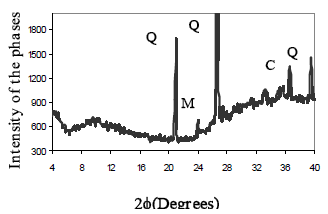
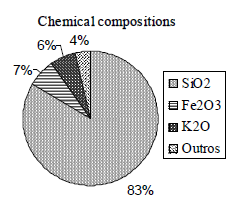
<body><![CDATA[<br>   </font><font size="2" face="Verdana, Arial, Helvetica, sans-serif">The CBC was obtained from   sugarcane bagasse (BC), from the Usina Jatiboca (Urucânia, City State of Minas   Gerais). The BC was collected   and burned for 6 hours at 600ºC using a stove. After   the burn, a layer of light colored ash was observed on the surface and then an   ash of black color and heterogeneous composition was   observed, consisting of leftovers of the sugarcane bagasse that was not burned   as well as charcoal particles, making another burn necessary for the   homogenization of the sample. The second burn of CBC lasted for 3 hours at 700ºC. After this reburn, the CBC was cooled   naturally determining the C level of the ash using a ball   mill for the grinding. Six samples of ash were collected and dried in the oven   for 24 hours at 70ºC. The chemical characterization of the CBC was made using   tests from an X-ray fluorescence spectroscopy and X-ray diffraction. The   physical characterization was made using tests of granulometric distribution   and specific surface area using 9 samples at different   grind times (0; 30; 60; 120; 180; 300; 420; 540 and 660 min).</font></p>     <p><font size="2" face="Verdana, Arial, Helvetica, sans-serif"><b>Phase 2    <br>   </b></font><font size="2" face="Verdana, Arial, Helvetica, sans-serif">The following combinations of   Portland cement (type CVC ARI PLUS made by Barroso) and sugarcane bagasse ash   were used: 100-0(C1), 90-10(C2), 80-20(C3), 70-30(C4) (% of cement - % of ash),   in mortar proportion 1:3, using normal Brazilian sand. To evaluate the   influence of the addition of CBC on the mortar, tests were done to figure out   initial and final set time, compressive strength, pozzolanic activity, specific   mass, water absorption by immersion, and index of porous. The experiment was   developed experimental an experimental design entirely randomized, being: 3   levels of CBC addition and a control (100% cement)   with 3 repetitions. The best levels of CBC addition were evaluated using   Tukey´s test for all the combinations at 7 and 28 days.</font></p>     <p>&nbsp;</p>     <p><font size="3" face="Verdana, Arial, Helvetica, sans-serif"><b>3. </b> <b>RESULTS AND DISCUSSION </b></font></p>     <p><font size="2" face="Verdana, Arial, Helvetica, sans-serif">The results show that the sugarcane   bagasse presents an output of 10% CBC. The chemical compositions are given in <a href="#fig01">Figure 1</a>. The CBC consisted 5% carbon and was light gray in color. </font></p>     <p align="center"><font size="2" face="Verdana, Arial, Helvetica, sans-serif"><b><a name="fig01"></a><img src="/img/revistas/dyna/v77n163/a05fig01.gif">    <br>   Figure   1. </b>Chemical   composition of the CBC, conducted by fluorescence spectrometry X-ray</font></p>     <p><font size="2" face="Verdana, Arial, Helvetica, sans-serif">According to reference &#91;5&#93;,   the presence of up to 20% carbon in the ash does not significantly affect the   compressive strength. The diffraction spectrum of CBC is shown in <a href="#fig02">Figure 2</a>, where the intensity of the   phases, in countings a second (CPS) is given in function of the angle of   diffraction, 2q.</font></p>     <p align="center"><font size="2" face="Verdana, Arial, Helvetica, sans-serif"><b><a name="fig02"></a><img src="/img/revistas/dyna/v77n163/a05fig02.gif">    ]]></body>
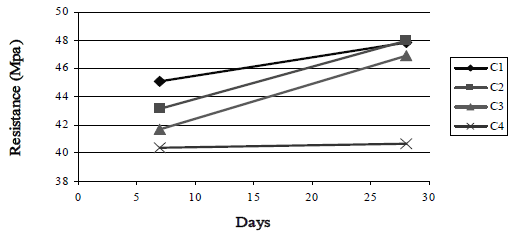
<body><![CDATA[<br>   Figure 2.</b> Analysis   of X-Ray diffraction of CBC</font></p>     <p><font size="2" face="Verdana, Arial, Helvetica, sans-serif">Analyzing to <a href="#fig02">Figure 2</a>, a halo can be observed   between 2q = 06 and 18º and   another one between 24 and 40º, which characterizes the amorphous phase. The   peaks (2q = 21º and 2q = 27º) indicate   that the structure of CBS presents the crystalline phases of silica,   cristobalite (C) and quartz (Q), as well as muscovite crystals (M). The   presence of SiO<sub>2</sub> in the quartz   phase could have occured because of the following factors &#91;8&#93;: </font></p>     <blockquote>       <p><font size="2" face="Verdana, Arial, Helvetica, sans-serif">a) Contamination of the     bagasse by sand once it was cleared off the patio of the industry. In this     case, the presence of quartz can be avoided </font><font size="2" face="Verdana, Arial, Helvetica, sans-serif">by washing the     bagasse <u>or with a layout in an appropriate place;</u> or with.    <br>     </font><font size="2" face="Verdana, Arial, Helvetica, sans-serif">b) inadequate     burn time; The parameters can be adequate (from an empirical standpoint) when a     predominantly amorphous ash is obtained.</font></p> </blockquote>     <p><font size="2" face="Verdana, Arial, Helvetica, sans-serif">The results found for the granulometric   composition and surface area show that the ash being studied is   composed by particles with size between 1 and 14mm and with surface area of the   order of 24m<sup>2</sup>/g.</font></p>     <p><font size="2" face="Verdana, Arial, Helvetica, sans-serif">The additions of 10%, 20%, and   30% of CBC did not either speed up or slow down the initial set time, which was   expected, being that the pozzolanic reaction occurs in a more advanced   stage of the hydration of cement (between 7 and 15 days after the mixture).   Thus, the set time would not detect an influence in the pozzolanic activity. It   was observed that the material does not interfere with the setting (which could   occur in materials with high level of carbon). The additions of 10%, 20%, and 30% of CBC   had delays of 10 minutes in the time period between the set times. This delay   is due to the reduction of the proportion of cement in the combinations. The   tests of the compressive strength of the mortar were conducted according to reference   &#91;2&#93; of the ABNT NBR 7215 (1991). </font></p>     <p><font size="2" face="Verdana, Arial, Helvetica, sans-serif">The resistance of the mortar   was determined at 7 and 28 days, with 3 test specimens of each of the different   combinations of cement-ash being broken, in order to find out: C1 (100-0), C2   (90-10), C3 (80-20), C4 (70-30) &#91;% of cement - % of ash, in weight&#93;. It was   noticed that the addition of CBC in the test specimens resulted in a gradual   darkening of color. The <a href="#fig03">Figure 3</a> illustrates the results of compressive   strength conducted in the test specimens, in function of the interaction   between the proportion of the substitution of cement for CBC ash at 7 and 28   days.</font></p>     <p align="center"><font size="2" face="Verdana, Arial, Helvetica, sans-serif"><b><a name="fig03"></a><img src="/img/revistas/dyna/v77n163/a05fig03.gif">    <br>   Figure 3.</b> Resistance to   compression at 7 and 28 days in mortar with different concentrations of cement   and sugarcane bagasse ash: 100-0(C1), 90-10(C2), 80-20(C3), 70-30(C4) (% of   cement - % of ash)</font></p>     ]]></body>
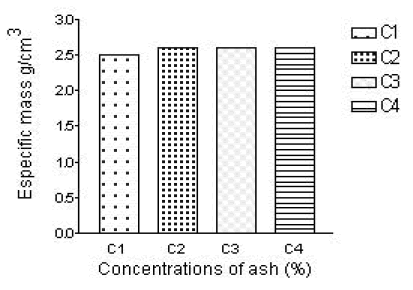
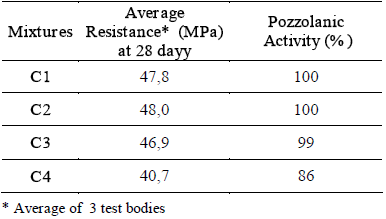
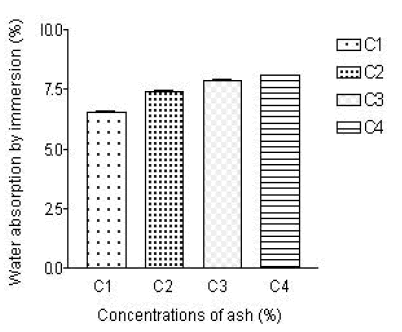
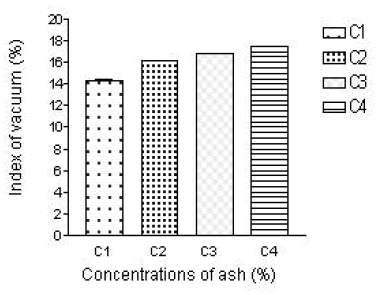
<body><![CDATA[<p><font size="2" face="Verdana, Arial, Helvetica, sans-serif">The analysis of the variance   applied to the compressive strength data showed, at a level of 5% of   probability by Tukey´s test, a high degree of significance for combinations at   7 and 28 days. Applied to the data of compressive strength at 7 and 28 days in   the cement mortar with an addition of CBC, Tukey´s test showed that at 7 days, independent of   the addition of the considered CBC, treatment C1 presented itself statistically   different with respect to the other ones. Combinations C2 and C3 showed no   differences between themselves, and neither did combinations C3 and C4. It was   observed that the compressive strength of the mortar at 7 days is inversely   proportional to the proportion of ash added.   Considered at 28 days, the statistical analysis showed that the greatest values   of resistance were reached by combinations C2, C1, and C3, which were all   statistically equal, show in the <a href="#tab01">Table 1</a>. This similarity of resistance at 28   days proves that the pozzolanic reaction has its start between 7 and 15 days   after the mixture, when the hydration of the cement is at an advanced state,   also observed by reference &#91;8&#93;. Such results indicate the possibility of   substituting up to 20% of Portland cement with sugarcane bagasse ash, without   hurting the compressive strength. </font></p>     <p align="center"><font size="2" face="Verdana, Arial, Helvetica, sans-serif"><b><a name="tab01"></a>Table 1.</b> Average compression   resistance in Mpa of mortar at 28 days and respective indices of pozzolanic   activity (IAP) for the different mixtures of cement and sugarcane bagasse ash</font>    <br>   <img src="/img/revistas/dyna/v77n163/a05tab01.gif"></p>     <p><font size="2" face="Verdana, Arial, Helvetica, sans-serif">The results found for the   indices of pozzolanic activity (IAP) ( <a href="#tab01">Table 1</a>). </font></p>     <p><font size="2" face="Verdana, Arial, Helvetica, sans-serif">The activity of CBC, since all   the combinations resulted with IAP values greater than the minimum value of 75%   established by NBR 5752 (1992) &#91;1&#93;. From the exposure to CBC it can be   classified as pozzolanic. </font></p>     <p><font size="2" face="Verdana, Arial, Helvetica, sans-serif">The absorption tests by   immersion, index of emptiness, and specific mass of the mortar test were   conducted using reference &#91;3&#93; of the ABNT (1987) as a base. The results are   presented in <a href="#fig04">Figures 4</a>, <a href="#fig05">5</a>, and <a href="#fig06">6</a>, as function of the substitution level at 28   days of age, in function of the proportion of substitution of cement for CBC ash at 28 days.</font></p>     <p align="center"><font size="2" face="Verdana, Arial, Helvetica, sans-serif"><b><a name="fig04"></a><img src="/img/revistas/dyna/v77n163/a05fig04.gif">    <br>   Figure   4</b>. Water absorption by immersion at 28   days in the mortar made with different concentrations of cement and sugarcane   bagasse ash</font></p>     <p align="center"><font size="2" face="Verdana, Arial, Helvetica, sans-serif"><b><a name="fig05"></a><img src="/img/revistas/dyna/v77n163/a05fig05.gif">    <br>   Figure   5</b>. Index of Flow in the mortar at 28 days made with   different concentrations of cement and sugarcane bagasse</font></p>     ]]></body>
<body><![CDATA[<p align="center"><font size="2" face="Verdana, Arial, Helvetica, sans-serif"><b><a name="fig06"></a><img src="/img/revistas/dyna/v77n163/a05fig06.gif">    <br>   Figure   6</b>. Specific mass in mortar at 28 days   made with different concentrations of cement and sugarcane bagasse ash</font></p>     <p><font size="2" face="Verdana, Arial, Helvetica, sans-serif">It was observed that for both   the absorption of water by immersion and the index of emptiness, the graphs   resulted in a growing function, where it was concluded that the mortar with the   greatest proportions of ash tended to be more porous, which justifies the greater values   of absorption. </font></p>     <p><font size="2" face="Verdana, Arial, Helvetica, sans-serif">According to reference &#91;4&#93;,   this fact can be settled controlling the water/cement factor of each of the   studied combinations. With respect to specific mass, it was observed that there   was </font><font size="2" face="Verdana, Arial, Helvetica, sans-serif">a small increase   with the addition of CBC (0.5%). The partial substitution of Portlant cement   for up to 30% of ash in the mixture does.</font> <font size="2" face="Verdana, Arial, Helvetica, sans-serif">not bring about any   significant modification to the values of specific mass.</font></p>     <p>&nbsp;</p>     <p><font size="3" face="Verdana, Arial, Helvetica, sans-serif"><b>4. CONCLUSION</b></font></p>     <p><font size="2" face="Verdana, Arial, Helvetica, sans-serif">Based on the conducted   experiment and according to the results obtained, it can be concluded that: The   sugarcane bagasse used presented a yield of sugarcane bagasse ash (CBC) of 10%   with a proportion of 84% SiO2 and 5% carbon; the silica in CBC is present both   in the amorphous phase as well as the crystalline phases of Cristobalite and   Quartz; the ash that was studied is composed of particles with sizes between 1   and 14mm and with a   surface area of the order of 24m<sup>2</sup>/g; the additions of 10%, 20%, and   30% of CBC resulted in a delay of 10 minutes in the time period between the set   times; the indexes of pozzolanic activity prove the pozzolanicity of CBC; the   mortar with the greatest proportions of ash tended to be more porous, which   justifies the greater values of absorption found; the partial substitution of   Portland cement by up to 30% of ash in the mixture did not bring about any   significant modification in the specific mass of the mortar; the mortar with   proportions of CBC in substitution with cement between 0 and 30%, at 7 and 28   days, indicate the possibility to substitute up to 20% of cement by CBC without   hurting its resistance; the addition of 30% of cement by CBC is viable, as long   as a resistance of the material equal to that found in the test specimens of   100% cement is not demanded; and it is important to highlight that the obtained   results are specific for the sugarcane bagasse ash obtained. Different burn   procedures can be employed to obtain ash without crystalline phases. That being   said, a pre-treatment of the sugarcane bagasse would prevent possible   contamination by quartz.</font></p>     <p>&nbsp;</p>     <p><font size="3" face="Verdana, Arial, Helvetica, sans-serif"><b>5. ACKNOWLEDGEMENTS: </b></font></p>     <p><font size="2" face="Verdana, Arial, Helvetica, sans-serif">To the Federal   University of Viçosa, especially to the Department of Agricultural and   Environmental Engineering. To FAPEMIG for financing the project and to    CAPES for awarding the Master´s studies scholarship.</font></p>     ]]></body>
<body><![CDATA[<p>&nbsp;</p>     <p><font size="3" face="Verdana, Arial, Helvetica, sans-serif"><b>REFERENCES </b></font></p>     <!-- ref --><p><font size="2" face="Verdana, Arial, Helvetica, sans-serif"><b>&#91;1&#93;</b> ASSOCIAÇÃO BRASILEIRA DE NORMAS T&Eacute;CNICAS. NBR 5752: Materiais pozolânicos - Determinação de atividade pozolânica com cimento Portland - &Iacute;ndice de atividade pozolânica com cimento. Rio de Janeiro, 1992. 3p.     &nbsp;&nbsp;&nbsp;&nbsp;&nbsp;&nbsp;&nbsp;&nbsp;[&#160;<a href="javascript:void(0);" onclick="javascript: window.open('/scielo.php?script=sci_nlinks&ref=000075&pid=S0012-7353201000030000500001&lng=','','width=640,height=500,resizable=yes,scrollbars=1,menubar=yes,');">Links</a>&#160;]<!-- end-ref --><!-- ref --><br>   <b>&#91;2&#93;</b> ASSOCIAÇÃO BRASILEIRA DE NORMAS T&Eacute;CNICAS. NBR 7215: Cimento Portland - Determinação da resistência a compressão. Rio de Janeiro, 1991. 7p.     &nbsp;&nbsp;&nbsp;&nbsp;&nbsp;&nbsp;&nbsp;&nbsp;[&#160;<a href="javascript:void(0);" onclick="javascript: window.open('/scielo.php?script=sci_nlinks&ref=000076&pid=S0012-7353201000030000500002&lng=','','width=640,height=500,resizable=yes,scrollbars=1,menubar=yes,');">Links</a>&#160;]<!-- end-ref --><!-- ref --><br>   ASSOCIAÇÃO BRASILEIRA DE NORMAS T&Eacute;CNICAS. NBR 9778: Determinação da absorção de &aacute;gua por imersão, &Iacute;ndice de vazios e massa espec&iacute;fica. Rio de Janeiro, 1987. 5p.     &nbsp;&nbsp;&nbsp;&nbsp;&nbsp;&nbsp;&nbsp;&nbsp;[&#160;<a href="javascript:void(0);" onclick="javascript: window.open('/scielo.php?script=sci_nlinks&ref=000077&pid=S0012-7353201000030000500003&lng=','','width=640,height=500,resizable=yes,scrollbars=1,menubar=yes,');">Links</a>&#160;]<!-- end-ref --><!-- ref --><br>   <b>&#91;3&#93;</b> BARBOSA, M.F., LIMA, E., PIRES SOBRINHO, C. W. A. Estudo de argamassas com adições de cinza de casca de arroz e cinza de cana-de-aç&uacute;car. VII Encontro Nacional de Tecnologia do Ambiente Constru&iacute;do Qualidade no Processo Construtivo.27 A 30 de Abril de 1998 - Florian&oacute;polis - SC.     &nbsp;&nbsp;&nbsp;&nbsp;&nbsp;&nbsp;&nbsp;&nbsp;[&#160;<a href="javascript:void(0);" onclick="javascript: window.open('/scielo.php?script=sci_nlinks&ref=000078&pid=S0012-7353201000030000500004&lng=','','width=640,height=500,resizable=yes,scrollbars=1,menubar=yes,');">Links</a>&#160;]<!-- end-ref --><!-- ref --><br>   <b>&#91;4&#93;</b> COOK, D.J. Rice husk ash. In: Swamy, R.N. (ed). Concrete techonology and design - v.3: Cement replacement materials. Blackie & Son Ltd, London, 1986.     &nbsp;&nbsp;&nbsp;&nbsp;&nbsp;&nbsp;&nbsp;&nbsp;[&#160;<a href="javascript:void(0);" onclick="javascript: window.open('/scielo.php?script=sci_nlinks&ref=000079&pid=S0012-7353201000030000500005&lng=','','width=640,height=500,resizable=yes,scrollbars=1,menubar=yes,');">Links</a>&#160;]<!-- end-ref --><!-- ref --><br>   <b>&#91;5&#93;</b> DI CAMPOS, Melissa Selaysim. Aproveitamento das cinzas da queima da cama sobreposta de su&iacute;nos para substituição parcial do cimento Portland. 121 p. Dissertação (Mestrado em Zootecnia)- Faculdade de Zootecnia e Engenharia de Alimentos, Universidadede São Paulo, São Paulo. 2005.     &nbsp;&nbsp;&nbsp;&nbsp;&nbsp;&nbsp;&nbsp;&nbsp;[&#160;<a href="javascript:void(0);" onclick="javascript: window.open('/scielo.php?script=sci_nlinks&ref=000080&pid=S0012-7353201000030000500006&lng=','','width=640,height=500,resizable=yes,scrollbars=1,menubar=yes,');">Links</a>&#160;]<!-- end-ref --><!-- ref --><br>   <b>&#91;6&#93;</b> GHAVAMI, K., TOLEDO FILHO, R.D., BARBOSA, N.P. Behaviour of composite soil reinforced with natural fibres. Cement and Concrete Composites, v.21, n.1, p.39-48, 1999.     &nbsp;&nbsp;&nbsp;&nbsp;&nbsp;&nbsp;&nbsp;&nbsp;[&#160;<a href="javascript:void(0);" onclick="javascript: window.open('/scielo.php?script=sci_nlinks&ref=000081&pid=S0012-7353201000030000500007&lng=','','width=640,height=500,resizable=yes,scrollbars=1,menubar=yes,');">Links</a>&#160;]<!-- end-ref --><!-- ref --><br>   <b>&#91;7&#93;</b> MORALES, E.V.; VILLAR-COCIÑA, E.; FR&Iacute;AS, M.; SANTOS, S.F.; SAVASTANO JR, H. Actividad puzol&aacute;nica y aspectos microestruturales de las cenizas de bagazo y paja de caña de az&uacute;car a trav&eacute;s de la microscopia electr&oacute;nica de transmisi&oacute;n. In: Conferência Brasileira sobre materiais e tecnologias não convencionais na construção ecol&oacute;gica e sustent&aacute;vel. BRASIL NOCMAT 2007, Macei&oacute;, Anais... Macei&oacute;: NOCMAT, 2007.     &nbsp;&nbsp;&nbsp;&nbsp;&nbsp;&nbsp;&nbsp;&nbsp;[&#160;<a href="javascript:void(0);" onclick="javascript: window.open('/scielo.php?script=sci_nlinks&ref=000082&pid=S0012-7353201000030000500008&lng=','','width=640,height=500,resizable=yes,scrollbars=1,menubar=yes,');">Links</a>&#160;]<!-- end-ref --><!-- ref --><br>   <b>&#91;8&#93;</b> RODRIGUES, C. S. Efeito da adição da cinza da casca de arroz no comportamento de comp&oacute;sitos ciment&iacute;cios reforçados por polpa de bambu. Tese de Doutorado. Engenharia Civil PUC - Rio de Janeiro, 2004.     &nbsp;&nbsp;&nbsp;&nbsp;&nbsp;&nbsp;&nbsp;&nbsp;[&#160;<a href="javascript:void(0);" onclick="javascript: window.open('/scielo.php?script=sci_nlinks&ref=000083&pid=S0012-7353201000030000500009&lng=','','width=640,height=500,resizable=yes,scrollbars=1,menubar=yes,');">Links</a>&#160;]<!-- end-ref --><!-- ref --><br>   <b>&#91;9&#93;</b> SABIR, B. B., WILD, S., BAI, J., 2001, "Metakaolin and calcined clays as pozzolans for concrete: a review", Cement and Concrete Research, v. 23, n. 2, pp. 441-454.     &nbsp;&nbsp;&nbsp;&nbsp;&nbsp;&nbsp;&nbsp;&nbsp;[&#160;<a href="javascript:void(0);" onclick="javascript: window.open('/scielo.php?script=sci_nlinks&ref=000084&pid=S0012-7353201000030000500010&lng=','','width=640,height=500,resizable=yes,scrollbars=1,menubar=yes,');">Links</a>&#160;]<!-- end-ref --><!-- ref --><br>   <b>&#91;10&#93;</b> SAVASTANO JR., H., WARDEN, P.G., COUTTS, R.S.P. Potential of alternative fibre cement as building materials for developing areas. Cement & Concrete Composites, v.25, n.6, p.585-592, 2002.     &nbsp;&nbsp;&nbsp;&nbsp;&nbsp;&nbsp;&nbsp;&nbsp;[&#160;<a href="javascript:void(0);" onclick="javascript: window.open('/scielo.php?script=sci_nlinks&ref=000085&pid=S0012-7353201000030000500011&lng=','','width=640,height=500,resizable=yes,scrollbars=1,menubar=yes,');">Links</a>&#160;]<!-- end-ref --><!-- ref --><br>   <b>&#91;11&#93;</b> SAVASTANO JR., WARDEN, P.G. Special theme issue: Natural fibre reinforced cement composites. Cement & Concrete Composites, v.25, n.5, p.517-624, 2003.     &nbsp;&nbsp;&nbsp;&nbsp;&nbsp;&nbsp;&nbsp;&nbsp;[&#160;<a href="javascript:void(0);" onclick="javascript: window.open('/scielo.php?script=sci_nlinks&ref=000086&pid=S0012-7353201000030000500012&lng=','','width=640,height=500,resizable=yes,scrollbars=1,menubar=yes,');">Links</a>&#160;]<!-- end-ref --><!-- ref --><br>   <b>&#91;12&#93;</b> ZUCCO, L&oacute;ris Lodir. Estudo da viabilidade de fabricação de placas de comp&oacute;sitos à base de cimento e casca de arroz. 118 p. Dissertação (Mestrado em Engenharia Agr&iacute;cola) - Faculdade de Engenharia Agr&iacute;cola, Universidade Estadual de Campinas, São Paulo, 1999. </font>&nbsp;&nbsp;&nbsp;&nbsp;&nbsp;&nbsp;&nbsp;&nbsp;[&#160;<a href="javascript:void(0);" onclick="javascript: window.open('/scielo.php?script=sci_nlinks&ref=000087&pid=S0012-7353201000030000500013&lng=','','width=640,height=500,resizable=yes,scrollbars=1,menubar=yes,');">Links</a>&#160;]<!-- end-ref --> ]]></body><back>
<ref-list>
<ref id="B1">
<label>1</label><nlm-citation citation-type="">
<collab>ASSOCIAÇÃO BRASILEIRA DE NORMAS TÉCNICAS</collab>
<article-title xml:lang="pt"><![CDATA[NBR 5752: Materiais pozolânicos - Determinação de atividade pozolânica com cimento Portland - Índice de atividade pozolânica com cimento]]></article-title>
<source><![CDATA[]]></source>
<year>1992</year>
<page-range>3p</page-range></nlm-citation>
</ref>
<ref id="B2">
<label>2</label><nlm-citation citation-type="">
<collab>ASSOCIAÇÃO BRASILEIRA DE NORMAS TÉCNICAS</collab>
<article-title xml:lang="pt"><![CDATA[NBR 7215: Cimento Portland - Determinação da resistência a compressão]]></article-title>
<source><![CDATA[]]></source>
<year>1991</year>
<page-range>7p</page-range></nlm-citation>
</ref>
<ref id="B3">
<nlm-citation citation-type="">
<collab>ASSOCIAÇÃO BRASILEIRA DE NORMAS TÉCNICAS</collab>
<source><![CDATA[NBR 9778: Determinação da absorção de água por imersão, Índice de vazios e massa específica]]></source>
<year>1987</year>
<page-range>5</page-range><publisher-loc><![CDATA[Rio de Janeiro ]]></publisher-loc>
</nlm-citation>
</ref>
<ref id="B4">
<label>3</label><nlm-citation citation-type="confpro">
<person-group person-group-type="author">
<name>
<surname><![CDATA[BARBOSA]]></surname>
<given-names><![CDATA[M.F.]]></given-names>
</name>
<name>
<surname><![CDATA[LIMA]]></surname>
<given-names><![CDATA[E.]]></given-names>
</name>
<name>
<surname><![CDATA[PIRES SOBRINHO]]></surname>
<given-names><![CDATA[C. W. A.]]></given-names>
</name>
</person-group>
<article-title xml:lang="pt"><![CDATA[Estudo de argamassas com adições de cinza de casca de arroz e cinza de cana-de-açúcar]]></article-title>
<source><![CDATA[]]></source>
<year></year>
<conf-name><![CDATA[VII Encontro Nacional de Tecnologia do Ambiente Construído Qualidade no Processo Construtivo]]></conf-name>
<conf-date>27 A 30 de Abril de 1998</conf-date>
<conf-loc>Florianópolis SC</conf-loc>
</nlm-citation>
</ref>
<ref id="B5">
<label>4</label><nlm-citation citation-type="book">
<person-group person-group-type="author">
<name>
<surname><![CDATA[COOK]]></surname>
<given-names><![CDATA[D.J.]]></given-names>
</name>
</person-group>
<article-title xml:lang="en"><![CDATA[Rice husk ash]]></article-title>
<person-group person-group-type="editor">
<name>
<surname><![CDATA[Swamy]]></surname>
<given-names><![CDATA[R.N.]]></given-names>
</name>
</person-group>
<source><![CDATA[Concrete techonology and design]]></source>
<year>1986</year>
<volume>3</volume>
<publisher-loc><![CDATA[London ]]></publisher-loc>
<publisher-name><![CDATA[Blackie & Son Ltd]]></publisher-name>
</nlm-citation>
</ref>
<ref id="B6">
<label>5</label><nlm-citation citation-type="">
<person-group person-group-type="author">
<name>
<surname><![CDATA[DI CAMPOS]]></surname>
<given-names><![CDATA[Melissa Selaysim]]></given-names>
</name>
</person-group>
<source><![CDATA[Aproveitamento das cinzas da queima da cama sobreposta de suínos para substituição parcial do cimento Portland]]></source>
<year>2005</year>
<page-range>121</page-range><publisher-loc><![CDATA[São Paulo ]]></publisher-loc>
</nlm-citation>
</ref>
<ref id="B7">
<label>6</label><nlm-citation citation-type="journal">
<person-group person-group-type="author">
<name>
<surname><![CDATA[GHAVAMI]]></surname>
<given-names><![CDATA[K.]]></given-names>
</name>
<name>
<surname><![CDATA[TOLEDO FILHO]]></surname>
<given-names><![CDATA[R.D.]]></given-names>
</name>
<name>
<surname><![CDATA[BARBOSA]]></surname>
<given-names><![CDATA[N.P.]]></given-names>
</name>
</person-group>
<article-title xml:lang="en"><![CDATA[Behaviour of composite soil reinforced with natural fibres]]></article-title>
<source><![CDATA[Cement and Concrete Composites]]></source>
<year>1999</year>
<volume>21</volume>
<numero>1</numero>
<issue>1</issue>
<page-range>39-48</page-range></nlm-citation>
</ref>
<ref id="B8">
<label>7</label><nlm-citation citation-type="confpro">
<person-group person-group-type="author">
<name>
<surname><![CDATA[MORALES]]></surname>
<given-names><![CDATA[E.V.]]></given-names>
</name>
<name>
<surname><![CDATA[VILLAR-COCIÑA]]></surname>
<given-names><![CDATA[E.]]></given-names>
</name>
<name>
<surname><![CDATA[FRÍAS, M.]]></surname>
<given-names><![CDATA[SANTOS]]></given-names>
</name>
</person-group>
<article-title xml:lang="es"><![CDATA[Actividad puzolánica y aspectos microestruturales de las cenizas de bagazo y paja de caña de azúcar a través de la microscopia electrónica de transmisión]]></article-title>
<source><![CDATA[]]></source>
<year></year>
<conf-name><![CDATA[ Conferência Brasileira sobre materiais e tecnologias não convencionais na construção ecológica e sustentável.]]></conf-name>
<conf-date>2007</conf-date>
<conf-loc> </conf-loc>
</nlm-citation>
</ref>
<ref id="B9">
<label>8</label><nlm-citation citation-type="">
<person-group person-group-type="author">
<name>
<surname><![CDATA[RODRIGUES]]></surname>
<given-names><![CDATA[C. S.]]></given-names>
</name>
</person-group>
<source><![CDATA[Efeito da adição da cinza da casca de arroz no comportamento de compósitos cimentícios reforçados por polpa de bambu]]></source>
<year>2004</year>
</nlm-citation>
</ref>
<ref id="B10">
<label>9</label><nlm-citation citation-type="journal">
<person-group person-group-type="author">
<name>
<surname><![CDATA[SABIR]]></surname>
<given-names><![CDATA[B. B.]]></given-names>
</name>
<name>
<surname><![CDATA[WILD]]></surname>
<given-names><![CDATA[S.]]></given-names>
</name>
<name>
<surname><![CDATA[BAI]]></surname>
<given-names><![CDATA[J.]]></given-names>
</name>
</person-group>
<article-title xml:lang="en"><![CDATA[Metakaolin and calcined clays as pozzolans for concrete: a review]]></article-title>
<source><![CDATA[Cement and Concrete Research]]></source>
<year>2001</year>
<volume>23</volume>
<numero>2</numero>
<issue>2</issue>
<page-range>441-454</page-range></nlm-citation>
</ref>
<ref id="B11">
<label>10</label><nlm-citation citation-type="journal">
<person-group person-group-type="author">
<name>
<surname><![CDATA[SAVASTANO JR.]]></surname>
<given-names><![CDATA[H.]]></given-names>
</name>
<name>
<surname><![CDATA[WARDEN]]></surname>
<given-names><![CDATA[P.G.]]></given-names>
</name>
<name>
<surname><![CDATA[COUTTS]]></surname>
<given-names><![CDATA[R.S.P.]]></given-names>
</name>
</person-group>
<article-title xml:lang="en"><![CDATA[Potential of alternative fibre cement as building materials for developing areas]]></article-title>
<source><![CDATA[Cement & Concrete Composites]]></source>
<year>2002</year>
<volume>25</volume>
<numero>6</numero>
<issue>6</issue>
<page-range>585-592</page-range></nlm-citation>
</ref>
<ref id="B12">
<label>11</label><nlm-citation citation-type="journal">
<person-group person-group-type="author">
<name>
<surname><![CDATA[SAVASTANO JR.]]></surname>
</name>
<name>
<surname><![CDATA[WARDEN]]></surname>
<given-names><![CDATA[P.G.]]></given-names>
</name>
</person-group>
<article-title xml:lang="en"><![CDATA[Natural fibre reinforced cement composites]]></article-title>
<source><![CDATA[Cement & Concrete Composites]]></source>
<year>2003</year>
<volume>25</volume>
<numero>5</numero>
<issue>5</issue>
<page-range>517-624</page-range></nlm-citation>
</ref>
<ref id="B13">
<label>12</label><nlm-citation citation-type="">
<person-group person-group-type="author">
<name>
<surname><![CDATA[ZUCCO]]></surname>
<given-names><![CDATA[Lóris Lodir]]></given-names>
</name>
</person-group>
<source><![CDATA[Estudo da viabilidade de fabricação de placas de compósitos à base de cimento e casca de arroz]]></source>
<year>1999</year>
</nlm-citation>
</ref>
</ref-list>
</back>
</article>