<?xml version="1.0" encoding="ISO-8859-1"?><article xmlns:mml="http://www.w3.org/1998/Math/MathML" xmlns:xlink="http://www.w3.org/1999/xlink" xmlns:xsi="http://www.w3.org/2001/XMLSchema-instance">
<front>
<journal-meta>
<journal-id>0012-7353</journal-id>
<journal-title><![CDATA[DYNA]]></journal-title>
<abbrev-journal-title><![CDATA[Dyna rev.fac.nac.minas]]></abbrev-journal-title>
<issn>0012-7353</issn>
<publisher>
<publisher-name><![CDATA[Universidad Nacional de Colombia]]></publisher-name>
</publisher>
</journal-meta>
<article-meta>
<article-id>S0012-73532010000300006</article-id>
<title-group>
<article-title xml:lang="en"><![CDATA[HYDROTHERMAL TRANSFORMATION OF KAOLINITE IN THE SYSTEM K2O-SiO2-Al2O3-H2O]]></article-title>
<article-title xml:lang="es"><![CDATA[TRANSFORMACIÓN HIDROTERMICA DE CAOLINITA EN EL SISTEMA K2O-SiO2-Al2O3-H2O]]></article-title>
</title-group>
<contrib-group>
<contrib contrib-type="author">
<name>
<surname><![CDATA[RIOS REYES]]></surname>
<given-names><![CDATA[CARLOS ALBERTO]]></given-names>
</name>
<xref ref-type="aff" rid="A01"/>
</contrib>
<contrib contrib-type="author">
<name>
<surname><![CDATA[DENVER WILLIAMS]]></surname>
<given-names><![CDATA[CRAIG]]></given-names>
</name>
<xref ref-type="aff" rid="A02"/>
</contrib>
</contrib-group>
<aff id="A01">
<institution><![CDATA[,Universidad Industrial de Santander  ]]></institution>
<addr-line><![CDATA[Bucaramanga ]]></addr-line>
<country>Colombia</country>
</aff>
<aff id="A02">
<institution><![CDATA[,University of Wolverhampton  ]]></institution>
<addr-line><![CDATA[Wolverhampton ]]></addr-line>
<country>England</country>
</aff>
<pub-date pub-type="pub">
<day>00</day>
<month>09</month>
<year>2010</year>
</pub-date>
<pub-date pub-type="epub">
<day>00</day>
<month>09</month>
<year>2010</year>
</pub-date>
<volume>77</volume>
<numero>163</numero>
<fpage>55</fpage>
<lpage>63</lpage>
<copyright-statement/>
<copyright-year/>
<self-uri xlink:href="http://www.scielo.org.co/scielo.php?script=sci_arttext&amp;pid=S0012-73532010000300006&amp;lng=en&amp;nrm=iso"></self-uri><self-uri xlink:href="http://www.scielo.org.co/scielo.php?script=sci_abstract&amp;pid=S0012-73532010000300006&amp;lng=en&amp;nrm=iso"></self-uri><self-uri xlink:href="http://www.scielo.org.co/scielo.php?script=sci_pdf&amp;pid=S0012-73532010000300006&amp;lng=en&amp;nrm=iso"></self-uri><abstract abstract-type="short" xml:lang="en"><p><![CDATA[A kaolinite-rich raw material was treated hydrothermally with 1.33 and 3.99M KOH solutions at 100 and 175 °C during different reaction times ranging from 24 to 528 h. The synthesis products were characterized by X-ray diffraction, scanning electron microscopy, Fourier transform infrared spectroscopy, magic angle spinning nuclear magnetic resonance and thermogravimetric analysis in order to elucidate their physicochemical and mineralogical characteristics. The transformation of the starting material in KOH solutions can be explained by two different processes: (1) dissolution and (2) precipitation. A series of crystalline phases summarized by the reaction sequence kaolinite ® chabazite ® edingtonite ® unidentified potassium aluminosilicate phase ® kalsilite + leucite was identified in the system K2O-SiO2-Al2O3-H2O. The solid products show, on the other hand, remarkable textural and structural differences with the starting material.]]></p></abstract>
<abstract abstract-type="short" xml:lang="es"><p><![CDATA[Una materia prima rica en caolinita fue tratada hidrotérmicamente con soluciones de KOH 1.33 y 3.99M a 100 y 175 °C durante diferentes tiempos de reacción variando de 24 a 528 h. Los productos sintéticos fueron caracterizados por difracción de rayos X, microscopia electrónica de barrido, espectroscopia infrarrojo por transformada de Fourier, resonancia magnética nuclear con rotación en ángulo mágico y análisis termogravimétrico con el fin de establecer sus características fisicoquímicas y mineralógicas. La transformación del material de partida en soluciones de KOH pueden explicarse a partir de dos procesos diferentes: (1) disolución y (2) precipitación. Una serie de fases cristalinas resumidas por la secuencia de reacción caolinita ® chabazita ® edingtonita ® fase de aluminosilicato potásico no identificada ® kalsilita + leucita fue identificada en el sistema K2O-SiO2-Al2O3-H2O. Los productos sólidos, muestran, por otra parte, notables diferencias texturales y estructurales con el material de partida.]]></p></abstract>
<kwd-group>
<kwd lng="en"><![CDATA[Kaolinite]]></kwd>
<kwd lng="en"><![CDATA[potassium hydroxide]]></kwd>
<kwd lng="en"><![CDATA[zeolites]]></kwd>
<kwd lng="en"><![CDATA[dissolution]]></kwd>
<kwd lng="en"><![CDATA[precipitation]]></kwd>
<kwd lng="es"><![CDATA[Caolinita]]></kwd>
<kwd lng="es"><![CDATA[hidróxido de potasio]]></kwd>
<kwd lng="es"><![CDATA[zeolitas]]></kwd>
<kwd lng="es"><![CDATA[disolución]]></kwd>
<kwd lng="es"><![CDATA[precipitación]]></kwd>
</kwd-group>
</article-meta>
</front><body><![CDATA[ <p align="center"><font size="4" face="Verdana, Arial, Helvetica, sans-serif"><b>HYDROTHERMAL TRANSFORMATION OF KAOLINITE IN THE SYSTEM K<sub>2</sub>O-SiO<sub>2</sub>-Al<sub>2</sub>O<sub>3</sub>-H<sub>2</sub>O</b></font></p>     <p align="center"><i><font size="3" face="Verdana, Arial, Helvetica, sans-serif"><b>TRANSFORMACI&Oacute;N HIDROTERMICA DE CAOLINITA EN EL SISTEMA K<sub>2</sub>O-SiO<sub>2</sub>-Al<sub>2</sub>O<sub>3</sub>-H<sub>2</sub>O</b></font></i></p>     <p align="center">&nbsp;</p>     <p align="center"><font size="2" face="Verdana, Arial, Helvetica, sans-serif"><b>CARLOS   ALBERTO RIOS REYES</b>    <br>   <i>Universidad Industrial   de Santander, Bucaramanga, Colombia, <a href="mailto:carios@uis.edu.co">carios@uis.edu.co</a></i></font></p>     <p align="center"><font size="2" face="Verdana, Arial, Helvetica, sans-serif"><b>CRAIG   DENVER WILLIAMS </b>    <br>   </font><font size="2" face="Verdana, Arial, Helvetica, sans-serif"><i>University of Wolverhampton, Wulfruna Street, Wolverhampton   <st1:PostalCode w:st="on">   WV1 1SB, England , <a href="mailto:c.williams@wlv.ac.uk">c.williams@wlv.ac.uk</a></i></font></p>     <p align="center">&nbsp;</p>     <p align="center"><font size="2" face="Verdana, Arial, Helvetica, sans-serif"><b>Received for review July 24<sup>th</sup>, 2009, accepted   March 3<sup>th</sup>, 2010, final   version March, 18<sup>th</sup>, 2010</b></font></p>     <p>&nbsp;</p> <hr>     ]]></body>
<body><![CDATA[<p><font size="2" face="Verdana, Arial, Helvetica, sans-serif"><b>ABSTRACT:</b> A kaolinite-rich raw material was treated hydrothermally with 1.33 and   3.99M KOH solutions at 100 and 175 °C during different reaction times ranging from 24 to 528 h. The synthesis products were characterized by X-ray   diffraction, scanning electron microscopy, Fourier transform infrared spectroscopy, magic angle spinning nuclear magnetic   resonance and thermogravimetric analysis in order to elucidate their   physicochemical and mineralogical characteristics. The transformation of the starting material in KOH   solutions can be explained by two different processes: (1) dissolution and (2)   precipitation. A series of crystalline phases summarized by the reaction   sequence kaolinite ® chabazite ® edingtonite ® unidentified potassium aluminosilicate phase ® kalsilite + leucite was identified in the system K<sub>2</sub>O-SiO<sub>2</sub>-Al<sub>2</sub>O<sub>3</sub>-H<sub>2</sub>O. The solid products show, on the other hand,   remarkable textural and structural differences with the starting material.</font></p>     <p><font size="2" face="Verdana, Arial, Helvetica, sans-serif"><b>KEYWORDS:</b> Kaolinite, potassium   hydroxide, zeolites, dissolution, precipitation</font></p>     <p><font size="2" face="Verdana, Arial, Helvetica, sans-serif"><b>RESUMEN: </b>Una materia prima rica en caolinita fue tratada hidrot&eacute;rmicamente   con soluciones de KOH 1.33 y 3.99M a 100 y   175 °C durante   diferentes tiempos de reacci&oacute;n variando de 24 a 528 h. Los productos sint&eacute;ticos fueron   caracterizados por difracci&oacute;n de rayos X,   microscopia electr&oacute;nica de barrido, espectroscopia infrarrojo por transformada   de Fourier, resonancia magn&eacute;tica nuclear con rotaci&oacute;n en &aacute;ngulo m&aacute;gico y an&aacute;lisis   termogravim&eacute;trico con el fin de establecer sus caracter&iacute;sticas fisicoqu&iacute;micas y   mineral&oacute;gicas. La transformaci&oacute;n del   material de partida en soluciones de KOH pueden explicarse a partir de dos   procesos diferentes: (1) disoluci&oacute;n y (2) precipitaci&oacute;n. Una serie de fases cristalinas   resumidas por la secuencia de reacci&oacute;n caolinita ® chabazita ® edingtonita ® fase de aluminosilicato pot&aacute;sico no identificada ® kalsilita + leucita fue identificada en el sistema K<sub>2</sub>O-SiO<sub>2</sub>-Al<sub>2</sub>O<sub>3</sub>-H<sub>2</sub>O. Los productos s&oacute;lidos,   muestran, por otra parte, notables diferencias texturales y estructurales con   el material de partida.</font></p>     <p><font size="2" face="Verdana, Arial, Helvetica, sans-serif"><b>PALABRAS CLAVE:</b> Caolinita, hidr&oacute;xido de potasio,   zeolitas, disoluci&oacute;n, precipitaci&oacute;n</font></p> <hr>     <p>&nbsp;</p>     <p><font size="3" face="Verdana, Arial, Helvetica, sans-serif"><b>1. INTRODUCTION</b></font></p>     <p><font size="2" face="Verdana, Arial, Helvetica, sans-serif">Kaolinite is not   stable under highly alkaline conditions and different zeolitic materials can   form. According to Zhao <i>et al</i>. &#91;1&#93;, there   are two major chemical processes involved in the reaction between kaolinite and   alkaline solutions: dissolution of kaolinite, releasing Si and Al, followed formation of zeolitic </font><font size="2" face="Verdana, Arial, Helvetica, sans-serif">materials. The kaolinite-rich   raw material used in this study has been used by R&iacute;os and co-workers </font><font size="2" face="Verdana, Arial, Helvetica, sans-serif">&#91;2-5&#93; as the Al and Si sources for the synthesis of several types of zeolites   in alkaline media. Experimental data from the syntheses in potassium   aluminosilicate systems are contradictory and confusing &#91;4&#93;. In addition, the nomenclature for potassium zeolites has   evolved over a period of decades since the early </font><font size="2" face="Verdana, Arial, Helvetica, sans-serif">discovery of hydrothermal synthesis   routes by Barrer &#91;6&#93;. A   crystallization sequence illite ® zeolite K-F ® K-phillipsite ® K-feldspar, reported by Bauer <i>et al</i>. &#91;7&#93; was   monitored during the hydrothermal treatment of kaolinite-rich raw material in KOH solutions. In this work, we investigate the   hydrothermal transformation of kaolinite into zeolites by the conventional   hydrothermal synthesis. However, a different reaction sequence was documented,   due to the probable absence of illite and the presence of three metastable   phases (chabazite, edingtonite and   unidentified potassium aluminosilicate) and two stable final crystalline   phases (kalsilite and leucite). On the other hand, activation of kaolinite was   carried out at shorter reaction times compared with those used by Bauer <i>et al</i>. &#91;7&#93;. </font></p>     <p>&nbsp;</p>     <p><font size="3" face="Verdana, Arial, Helvetica, sans-serif"><b>2. EXPERIMENTAL</b></font> </p>     <p><font size="2" face="Verdana, Arial, Helvetica, sans-serif"><b>2.1 Materials    ]]></body>
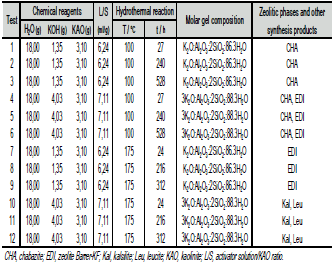
<body><![CDATA[<br>   </b></font><font size="2" face="Verdana, Arial, Helvetica, sans-serif">Kaolinite (£ 2 <font face="Symbol">m</font>m), Al<sub>2</sub>SiO<sub>5</sub>(OH)<sub>4</sub>, was used as starting material for zeolite synthesis. It is   distributed under the name Supreme Powder supplied by ECC International. Other   reagents used in the activation of kaolinite were: potassium hydroxide, KOH, as   pellets (&gt; 85%, Aldrich Chemical Company, Inc.) and distilled water using   standard purification methods.</font></p>     <p><font size="2" face="Verdana, Arial, Helvetica, sans-serif"><b>2.2 Synthesis   of zeolite-types    <br>   </b></font><font size="2" face="Verdana, Arial, Helvetica, sans-serif">The conversion of kaolinite   into zeolitic materials was conducted by the conventional hydrothermal   synthesis as follows: in reaction plastic beakers (150-250 ml), a calculated amount of KOH in pellets (1.35   or   4.03 g)   was added to distilled water (18 ml) to prepare KOH solutions 1.33 or 3.99M,   and then 3.10 g   of kaolinite was added to the alkaline solutions. The progressive addition of   reagents was carried out under stirring conditions until they dissolved to   homogenize the reaction gels. Crystallization was carried out by hydrothermal   synthesis under static conditions in PTFE vessels of 65 ml at 100°C and in teflon lined stainless steel autoclaves of 20 ml at   175°C for several   reaction times. <a href="#tab01">Table 1</a> summarizes the starting reaction conditions for the   conversion of kaolinite into zeolites in KOH solutions. Once the   activation time was reached, the reactors were removed from the oven and   quenched in cold water to stop the reaction. After hydrothermal treatment, the   reaction mixtures were filtered and washed with distilled water to remove   excess alkali until the pH of the filtrate became neutral. Then, the samples   were oven dried at   80°C   overnight. Ph of the reaction gels was measured before and after hydrothermal   treatment. The dried samples were weighed and kept in plastic bags for   characterization.</font></p>     <p align="center"><font size="2" face="Verdana, Arial, Helvetica, sans-serif"><b><a name="tab01"></a>Table 1.</b> Experimental conditions of kaolinite activation into   zeolitic materials</font>    <br>   <img src="/img/revistas/dyna/v77n163/a06tab01.gif"></p>     <p><font size="2" face="Verdana, Arial, Helvetica, sans-serif"><b>2.3 Characterization    <br>   </b></font><font size="2" face="Verdana, Arial, Helvetica, sans-serif">X-ray diffraction   patterns of the untreated kaolinite and synthesis products were recorded using   a Philips PW1710 diffractometer operating in Bragg-Brentano geometry with Cu-K<font face="Symbol">a</font> radiation (40 kV   and 40 mA) and secondary monochromation. Data collection was carried out in the   2<font face="Symbol">q</font> range   3-50°, with a step size of 0.02°. Phase identification was performed by   searching the ICDD powder diffraction file database, with the help of JCPDS (Joint   Committee on Powder Diffraction Standards) files for inorganic compounds. The   relative intensity yields were obtained from normalized XRD intensities of the   major reflection for each material. The morphology of the solid phases were examined by scanning   electron microscopy (ZEISS EVO50) and the chemical composition of mineral   phases was studied using the EDXS mode, under the following analytical   conditions: I probe 1 nA, EHT = 20.00 kV, beam current 100 <font face="Symbol">m</font>A, Signal A = SE1,   WD =   8.0 mm.   Fourier transform infrared (FTIR) spectroscopy was carried out using a Mattson   Genesis II FTIR spectrometer in the 4000-400 cm<sup>-1</sup> region. However,   we discuss only the 1200-400 cm<sup>-1</sup> region, because there spectra   showed remarkable changes. Magic Angle Spinning Nuclear Magnetic Resonance (MAS   NMR) spectra for <sup>29</sup>Si and <sup>27</sup>Al, respectively, were   recorded at room temperature on a Varian Unity INOVA spectrometer under the   following analytical conditions: MAS probe 7.5 and 4.0 mm; frequency 59.6 and   78.1 MHz; spectral width 29996.3 and 100000.0 Hz; acquisition time 30 and 10   µs; recycle time 120 and 0.5 s; number of repetitions 15 and 2200; spinning   rate 5040 and 14000 Hz; pulse angle (DP) 90.0 and 18.9°. The chemical shifts   were referenced to tetramethylsilane (TMS) for <sup>29</sup>Si and 1 M AlCl<sub>3</sub> aqueous   solution for <sup>27</sup>Al. Thermogravimetry was performed on a Mettler Toledo   TG50 thermobalance in the temperature range of 25-700 °C, with a heating   rate of 10 °C   min<sup>-1</sup> under fowing air. Mass losses were determined by   employing both TGA and DTG curves. The second derivative differential thermal   curve was used for peak temperature determinations.</font></p>     <p>&nbsp;</p>     <p><font size="3" face="Verdana, Arial, Helvetica, sans-serif"><b>3. RESULTS   AND DISCUSSIONS</b></font></p>     <p><font size="2" face="Verdana, Arial, Helvetica, sans-serif"><b>3.1 Chemical   and mineralogical analyses of the starting material    ]]></body>
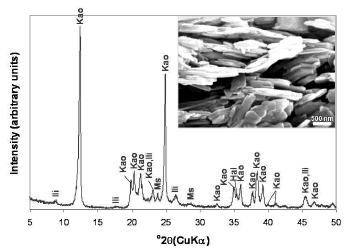
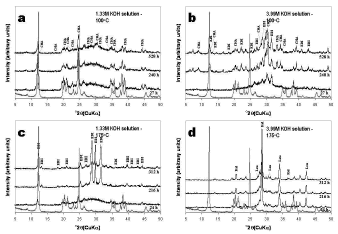
<body><![CDATA[<br>   </b></font><font size="2" face="Verdana, Arial, Helvetica, sans-serif">As shown in the   XRD pattern (<a href="#fig01">Figure 1</a>), kaolinite is the predominant mineral phase, which can   be identified by its characteristic XRD peaks at 12.34° and 24.64° 2<font face="Symbol">q</font> as reported by   Zhao <i>et al</i>. &#91;1&#93;.   However, minor impurities, such as illite, muscovite and halloysite, also   occur. Kaolinite can be recognized by its platy morphology and hexagonal   outlines (<a href="#fig01">Figure 1</a>), with small well-formed hexagonal plates loosely packed, defining an orientation. </font></p>     <p align="center"><font size="2" face="Verdana, Arial, Helvetica, sans-serif"><b><a name="fig01"></a><img src="/img/revistas/dyna/v77n163/a06fig01.gif">    <br>   Figure 1.</b> X-ray diffraction pattern and SEM image of the starting material. Kao, Kaolinite;   Ili,   illite; Ms, muscovite; Hal, halloysite</font></p>     <p><font size="2" face="Verdana, Arial, Helvetica, sans-serif"><b>3.2 Zeolite characterization</b></font></p>     <p><font size="2" face="Verdana, Arial, Helvetica, sans-serif"><i>3.2.1 X-ray diffraction analysis    <br>   </i>The XRD patterns   in <a href="#fig02">Figure 2</a> reveals that the hydrothermal treatment of kaolinite in KOH   solutions is characterized by the dissolution of the starting material and the   formation of amorphous and crystalline aluminosilicate phases (three metastable   phases, chabazite, edingtonite and an unidentified potassium aluminosilicate,   and two stable phases, kalsilite and leucite). The unidentified peaks in the   XRD patterns should represent the still remaining kaolinite or some potassium   aluminosilicate phases. </font></p>     <p align="center"><font size="2" face="Verdana, Arial, Helvetica, sans-serif"><b><a name="fig02"></a><img src="/img/revistas/dyna/v77n163/a06fig02.gif">    <br>   Figure 2.</b> X-ray   diffraction patterns of the starting material (in red) and representative   as-synthesized products obtained after hydrothermal reaction of the starting   material in KOH solutions. KAO,   kaolinite; CHA, chabazite; EDI, edingtonite; Kal, kalsilite; Leu, leuc</font></p>     <p><font size="2" face="Verdana, Arial, Helvetica, sans-serif">As can be seen   from the XRD patterns in <a href="#fig02">Figure 2a</a>, very weak peaks indicate that chabazite was   the only crystalline phase formed when a low KOH concentration and temperature   were used. There was no change in peak intensity over 240-528 h period. At high   KOH concentration (<a href="#fig02">Figure 2b</a>), an intense dissolution of the raw material was   accompanied by the precipitation of three different zeolitic phases (chabazite   and edingtonite, which increased with reaction time. </font></p>     <p><font size="2" face="Verdana, Arial, Helvetica, sans-serif">However, it could   be said that KOH concentration increase promoted the edingtonite formation. <a href="#fig02">Figure 2c</a> shows that this zeolite crystallized at low KOH concentration and   high temperature, although its peak intensity tended to be constant over   216-312 h period, with a large amount of amorphous aluminosilicate material at   shorter reaction times (24 h), as evident by a hump between 25 and 35<sup>o</sup> 2<font face="Symbol">q</font>. The   increase in temperature had a negative effect in chabazite formation. The XRD   patterns in <a href="#fig02">Figure 2d</a> show that a mixture of kalsilite (KAlSiO<sub>4</sub>) and   leucite (KAlSi<sub>2</sub>O<sub>6</sub>) formed at high KOH concentration and   temperature, without a change in peak intensity during the monitoring time.</font></p>     ]]></body>
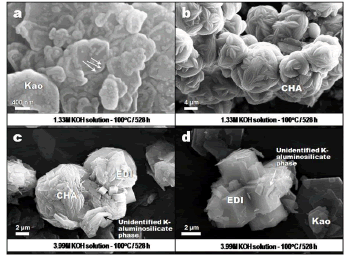
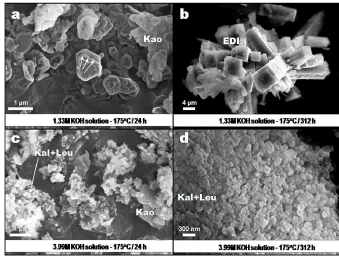
<body><![CDATA[<p><font size="2" face="Verdana, Arial, Helvetica, sans-serif"><i>3.2.2 Scanning electron microscopy    <br>   </i>SEM images   (<a href="#fig03">Figures 3</a> and <a href="#fig04">4</a>) shows interesting morphologies that provide new evidence on   the phase reaction history after the hydrothermal transformation of kaolinite in KOH   solutions. </font></p>     <p align="center"><font size="2" face="Verdana, Arial, Helvetica, sans-serif"><b><a name="fig03"></a><img src="/img/revistas/dyna/v77n163/a06fig03.gif">    <br>   Figure 3.</b> SEM images showing the occurrence of representative synthesis products   obtained via hydrothermal treatment of kaolinite in KOH solutions at 100 <sup>o</sup>C.   Kao, kaolinita; CHA, chabazite; EDI, edingtonite</font></p>     <p align="center"><font size="2" face="Verdana, Arial, Helvetica, sans-serif"><b><a name="fig04"></a><img src="/img/revistas/dyna/v77n163/a06fig04.gif">    <br>   Figure 4.</b> SEM images showing the occurrence of representative synthesis products   obtained via hydrothermal treatment of kaolinite in KOH solutions at 175 <sup>o</sup>C.   Kao, kaolinita; Kal, kalsilite; Leu, leucite</font></p>     <p><font size="2" face="Verdana, Arial, Helvetica, sans-serif"><a href="#fig03">Figure 3a</a> illustrates an example of the dissolution of kaolinite, revealed by its   different morphology in the boundary region, which may indicate the formation   of illite. The arrows indicate the position of developed illite. However, the Initial precipitation of the metastable chabazite could affect the   activity of K and inhibits precipitation of illite. On the other hand, some Fe   should be released by dissolution of impurities in kaolinite to promote the   formation of illite. <a href="#fig03">Figure 3b</a> illustrates aggregates of   cauliflower-shape morphology of bladed crystals of chabazite.In <a href="#fig03">Figure 3c</a> is   revealed the presence of neoformed crystals of edingtonite and an unidentified   potassium aluminosilicate, which have grown at the expense of spheroidal aggregates of chabazite. An intergrowth between   prismatic crystals of edingtonite developing cruciform penetrating twinning and   a potassium aluminosilicate phase with   hexagonal plate-like morphology is illustrated in <a href="#fig03">Figure 3d</a>. Observe also the   occurrence of stacks of face-to-face relict kaolinite flakes with euhedral   pseudohexagonal crystals with regular edges. The hexagonal morphology of the   unidentified potassium aluminosilicate is similar to that observed in the   hexagonal polymorph of faujasite (EMT) or in the zeolite MCM-61 (MSO), which   have been synthesized only in the presence of 1,4,7,10,13,16-hexaoxacyclooctadecane   (18-Crown-6) &#91;8-10&#93; or using 18-Crown- 6 in the presence of potassium   cations &#91;11&#93;, respectively. In spite of XRD and SEM data providing   some evidences on the presence of a potassium aluminosilicate phase associated   to chabazite and edingtonite, it is difficult to speculate that this phase   could correspond to the EMT or MSO-type structure. </font></p>     <p><font size="2" face="Verdana, Arial, Helvetica, sans-serif"><a href="#fig04">Figure 4a</a> shows an   additional evidence of the dissolution of kaolinite (as indicated by   the arrows) at low KOH concentration and reaction time and high   temperature, comparable with what is observed in <a href="#fig03">Figure 3a</a>. In <a href="#fig04">Figure 4b</a> is illustrated a radial array of tetragonal prismatic crystals of   edingtonite, which grew from the centre of a spherule, showing a typical growth   mechanism from a nucleating point in an essentially amorphous   material. A similar morphology for edingtonite has been achieved by Juan <i>et al</i>. &#91;12&#93; after   activation of fly ash in KOH solutions at 150 <sup>o</sup>C. As shown in <a href="#fig04">Figure   4c</a>, flaky and blocky morphologies reveal the presence of the starting material   along with a very fine grain-sized aggregate of kalsilite and leucite. The   occurrence of these potassium aluminosilicates is illustrated in <a href="#fig04">Figure 4d</a>. It   is proposed that after kaolinite dissolution in KOH solutions, chabazite   represents the first zeolitic phase that crystallized, followed by a crystallization   of edingtonite, which is progressively accompanied by   the presence of an additional potassium aluminosilicate phase, developing   intergrowths with edingtonite, and finally the formation of the stable   mixture composed by kalsilite and leucite. </font></p>     <p><font size="2" face="Verdana, Arial, Helvetica, sans-serif">Under experimental   conditions similar to those used in this study, Barrer &#91;6&#93; demonstrated the formation of zeolite K-F (edingtonite-type structure)   predominantly at temperatures between 80-170 <sup>o</sup>C over a range of KOH   concentrations. Chabazite stability is controlled by KOH concentration and   temperature, whereas edingtonite formation is promoted increasing KOH molarity   and temperature. According to Mackinnon <i>et   al</i>. &#91;13&#93;, at high temperatures (200-350 <sup>o</sup>C), the   dominant potassium aluminosilicate phase is either kalsilite or kaliophyllite   depending on the starting composition. Syntheses at higher temperatures favour   the crystallization of leucite and analcime &#91;14&#93;.   However, the synthesis of stable phases, such as kalsilite   and leucite, at lower temperature (175 <sup>o</sup>C) have been   demonstrated in this study, different to what is reported by these authors.</font></p>     <p><font size="2" face="Verdana, Arial, Helvetica, sans-serif"><i>3.2.3 Fourier transform infrared spectroscopy    ]]></body>
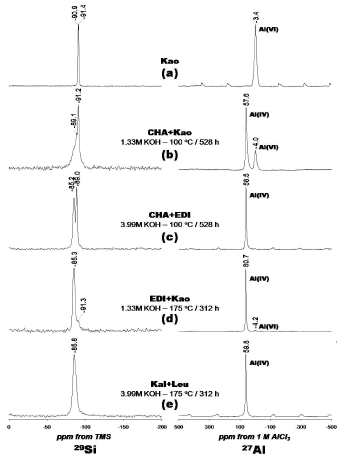
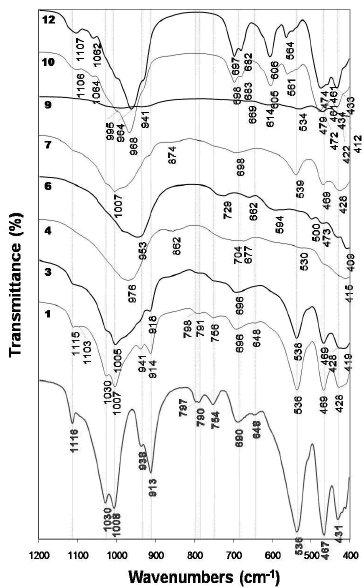
<body><![CDATA[<br>   </i></font><font size="2" face="Verdana, Arial, Helvetica, sans-serif"><a href="#fig05">Figure 5</a> illustrates the FTIR spectra of the raw material and as-synthesized products   obtained after its hydrothermal treatment in KOH solutions. The characteristic   peaks of the kaolinite spectrum weakened, just showing a small decrease with   reaction time, although did not disappear after activation of kaolinite in   1.33M KOH solutions at 100 <sup>o</sup>C (1 and 3 spectra). On the other hand, when   the reaction was carried out in 3.99M KOH solutions at 100 <sup>o</sup>C (4 and   6 spectra), they disappeared accompanied by the appearance of new vibration   bands as follows. In the region of 1200-850 cm<sup>- 1</sup>, a peak centred at 976 cm<sup>- 1</sup> (spectrum 4) moved to a lower frequency (953 cm<sup>- 1</sup>, spectrum   6) with reaction time. An additional peak at 862 cm<sup>-1</sup> was seen at   shorter reaction time. In the region of 850-550 cm<sup>-1</sup>, two different   peaks appeared, 704 and 677 cm<sup>-1</sup>(spectrum 4), which shifted to   higher (729 cm<sup>-1</sup>) and lower (662 cm<sup>-1</sup>) frequencies,   respectively, with reaction time, accompanied by an additional peak at 594 cm<sup>-1</sup> (spectrum 6). In the region of 550-400 cm<sup>-1</sup>, the vibration bands tended to disappear. </font></p>     <p align="center"><font size="2" face="Verdana, Arial, Helvetica, sans-serif"><b><a name="fig05"></a><img src="/img/revistas/dyna/v77n163/a06fig05.gif">    <br>   Figure 5.</b> FTIR   spectra of the unreacted (in red) kaolinite and representative as-synthesized   products obtained after hydrothermal reaction of kaolinite in KOH solutions</font></p>     <p><font size="2" face="Verdana, Arial, Helvetica, sans-serif">At 175 <sup>o</sup>C   and low KOH concentration, peaks centred at 1007 and 874 cm<sup>-1</sup> (spectrum 7) disappeared and new very weak peaks appeared with reaction time   (spectrum 9). At 175 <sup>o</sup>C and high KOH concentration, the synthesis   products are characterized by much better absortion bands (10 and 12 spectra),   with sharp peaks revealing a material of high grade of crystallinity, which has   a very constant behaviour during the monitoring time. Several vibration bands   particularly in the 850-550 cm<sup>-1</sup> (T-O-T symmetrical stretching mode)   and 550-400 cm<sup>-1</sup> (T-O bending mode). The vibrations bands at 474,   564, 606, 682 and 964 cm<sup>-1</sup> and at 461, 564 and 606 cm<sup>-1</sup> can be assigned to the presence of kalsilite and leucite, respectively. These   assignments correspond to the spectra reported by Dimitrijevic and Dondur &#91;15&#93;. </font></p>     <p align="center">&nbsp;</p>     <p><font size="2" face="Verdana, Arial, Helvetica, sans-serif"><i>3.2.4 <sup>29</sup>Si and <sup>27</sup>Al magic angle spinning nuclear magnetic resonance    <br>   </i></font><font size="2" face="Verdana, Arial, Helvetica, sans-serif"><a href="#fig06">Figure 6</a> shows the <sup>29</sup>Si and <sup>27</sup>Al MAS NMR spectra of the starting material   and representative synthesis products obtained using KOH as an activator agent.   Many important properties of zeolites are strongly dependent of the location of   Si and Al in the tetrahedral framework and <sup>29</sup>Si and <sup>27</sup>Al   NMR have a great potential in the direct determination of local   Si and Al orderings &#91;16&#93;.</font></p>     <p align="center"><font size="2" face="Verdana, Arial, Helvetica, sans-serif"><b><a name="fig06"></a><img src="/img/revistas/dyna/v77n163/a06fig06.gif">    <br>   Figure 6.</b> <sup>29</sup>Si and <sup>27</sup>Al NMR spectra of the (a)   kaolinite and (b-e) representative synthesis products obtained by alkaline activation   of kaolinite with KOH solutions. Kao, kaolinite; CHA, chabazite; EDI,   edingtonite; Kal, kalsilite; Leu, leucite</font></p>     <p><font size="2" face="Verdana, Arial, Helvetica, sans-serif">The <sup>29</sup>Si   MAS NMR spectrum of kaolinite is given on <a href="#fig06">Figure 6a</a> shows two signals at -90.9 and -91.4 ppm corresponding to different but equally populated silicon   sites in kaolinite. <a href="#fig06">Figure 6b</a> shows a spectrum with a sharp peak centred at   -91.2 ppm attributed to residual kaolinite that is superimposed on a broader   resonance at -89.1 ppm, which can be presumably attributed to Q<sup>4</sup>(4Al)   sites of chabazite and is characteristic of amorphous or poorly crystallized   materials. Two well resolved resonances at -85.2 and -89.0 ppm are   distinguished in <a href="#fig06">Figure 6c</a>, indicating the presence of edingtonite and   chabazite, respectively. These peaks can be attributed to Q<sup>4</sup>(4Al)   sites in the zeolite phases. <a href="#fig06">Figure 6d</a> shows a resonance at -85.3 ppm that can   be attributed to Q<sup>4</sup>(4Al) sites in   edingtonite (Si/Al ratio = 1.0). A weak signal - 91.3 ppm, revealing the   presence of Q<sup>4</sup>(4Al) sites, corresponding   with the presence of unreacted kaolinite. </font></p>     ]]></body>
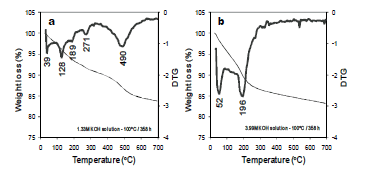
<body><![CDATA[<p><font size="2" face="Verdana, Arial, Helvetica, sans-serif">A single resonance   at -85.8 ppm (<a href="#fig06">Figure 6e</a>) can be attributed to the presence of Q<sup>4</sup>(4Al) sites of kalsilite and leucite. Barbosa   and MacKenzie &#91;17&#93; have reported a similar signal for these   potassium aluminosilicates in geopolymers. The <sup>27</sup>Al MAS NMR spectrum   of the unreacted kaolinite (<a href="#fig06">Figure 6a</a>) consists of a single resonance at -3.4   ppm and is largely octahedral aluminium. Strong resonances at 57.6, 58.5, 60.7   and 59.8 ppm, respectively, can be assigned to tetrahedral Al in the framework   of the zeolitic products (<a href="#fig06">Figures 6b</a>, <a href="#fig06">6c</a>, <a href="#fig06">6d</a> and <a href="#fig06">6e</a>). However, in <a href="#fig06">Figures 6b</a> and <a href="#fig06">6d</a>, weak signals at -4.0 and -4.2 ppm, respectively, correspond to residual   kaolinite as revealed by the small amount of Al in octahedral sites. The amount   of Al(6) was greatest in kaolinite (<a href="#fig06">Figure 6a</a>) where   the initial Al concentration was larger compared with that in the synthesis   products (<a href="#fig06">Figures 6b</a>-<a href="#fig06">6e</a>). <sup>29</sup>Si and <sup>27</sup>Al MAS NMR results   indicates that kaolinite was or total or partially dissolved (as revealed by   the signals corresponding to residual kaolinite in some of the synthesis   products), in agreement with XRD and FTIR results.</font></p>     <p><font size="2" face="Verdana, Arial, Helvetica, sans-serif"><i>3.2.5 Thermogravimetric analysis    <br>   </i></font><font size="2" face="Verdana, Arial, Helvetica, sans-serif"><a href="#fig07">Figure 7</a> shows   TG/DTG curves obtained for representative as-synthesized products obtained   after hydrothermal reaction of kaolinite in KOH solutions. The as-synthesized   zeolitic materials show up to four dehydration steps, which could be explained   as a consequence of water molecules dehydrated at lower temperatures that could   re-enter the zeolite with or without affecting its framework linkages. The   position of these DTG peaks and the number of dehydration steps has been   attributed to the different compensating cation-water binding energies, as well   as to the different energy associated with the diffusion of the desorbed water through   the porous structure of the zeolitic materials &#91;18&#93;. The   first group of peaks are in the range of 25-   90 °C and correspond   to water desorption; the second group of peaks are in the range of 150- 300 °C and are   attributed to occluded water. The occurrence of a peak at 490<sup> o</sup>C   (<a href="#fig07">Figure 7a</a>) can be attributed to framework dehydroxylation of kaolinite still   remaining in the synthesis product obtained after hydrothermal reaction of   kaolinte in low concentration KOH solutions, which is not observed in <a href="#fig07">Figure   7b</a>. This can be explained due to the complete reaction of the starting kaolinite in high concentration KOH solutions.</font></p>     <p align="center"><font size="2" face="Verdana, Arial, Helvetica, sans-serif"><b><a name="fig07"></a><img src="/img/revistas/dyna/v77n163/a06fig07.gif">    <br>   Figure 7.</b> TG/DTG curves in the temperature range 25-700 <sup>o</sup>C of representative   synthesis products obtained after alkaline   activation of kaolinite using KOH as activator agent</font></p>     <p>&nbsp;</p>     <p><font size="3" face="Verdana, Arial, Helvetica, sans-serif"><b>4. CONCLUSIONS</b></font></p>     <p><font size="2" face="Verdana, Arial, Helvetica, sans-serif">Several   zeolite-types were successfully synthesized from kaolinite by hydrothermal   treatment under the selected experimental conditions in the system K<sub>2</sub>O-SiO<sub>2</sub>-Al<sub>2</sub>O<sub>3</sub>-H<sub>2</sub>O.   The synthesis products synthesized were chabazite and edingtonite, which can be accompanied by unidentified   potassium aluminosilicate phases and feldspathoids (kalsilite and leucite). In general, the synthesis products are   characterized by the occurrence of a large amount of an amorphous   aluminosilicate phase from which several crystalline phases formed. A total   dissolution of kaolinite was achieved with high KOH concentration and   temperature, with an amorphous potassium aluminosilicate phase at shorter   reaction times. Longer reaction times were required to obtain crystalline   phases (zeolites). Therefore, to achieve a similar level of attack on kaolinite   with KOH compared to that using NaOH, it would be necessary to use higher KOH   concentrations, alkaline solution/KAO ratios and longer reaction times, under   controlled experimental conditions, to obtain the desired zeolitic phases. </font></p>     <p>&nbsp;</p>     <p><font size="3" face="Verdana, Arial, Helvetica, sans-serif"><b>ACKNOWLEDGMENTS</b></font></p>     ]]></body>
<body><![CDATA[<p><font size="2" face="Verdana, Arial, Helvetica, sans-serif">We   gratefully acknowledge the Programme Alban, the European Union   Programme of High Level Scholarships for   Latin America,   scholarship No. E05D060429CO, and the Universidad   Industrial de Santander (a remunerated commission) for funding C.A. R&iacute;os.   Special thanks to   School of Applied Sciences at University of Wolverhampton   for allowing us the use of the research facilities. We thank to Dr David   Townrow and Mrs Barbara Hodson for assistance in   collecting XRD and SEM data, respectively, and to Dr David   Apperley and the EPSRC solid state NMR Service,   University of Durham, for MAS NMR spectra. </font></p>     <p>&nbsp;</p>     <p><font size="3" face="Verdana, Arial, Helvetica, sans-serif"><b>REFERENCES</b></font></p>     <!-- ref --><p><font size="2" face="Verdana, Arial, Helvetica, sans-serif"><b>&#91;1&#93;</b> Zhao, H., Deng, Y., Harsh, J. B., Flury, M. and Boyle, J. S. Alteration of Kaolinite to Cancrinite and Sodalite by Simulated Hanford Tank Waste and its impact on Cesium retention. Clays Clay Miner. 52, 1-13, 2004.     &nbsp;&nbsp;&nbsp;&nbsp;&nbsp;&nbsp;&nbsp;&nbsp;[&#160;<a href="javascript:void(0);" onclick="javascript: window.open('/scielo.php?script=sci_nlinks&ref=000076&pid=S0012-7353201000030000600001&lng=','','width=640,height=500,resizable=yes,scrollbars=1,menubar=yes,');">Links</a>&#160;]<!-- end-ref --><!-- ref --><br>   <b>&#91;2&#93;</b> R&iacute;os, C. A., Williams, C. D. and Castellanos, O. M. Synthesis and characterization of zeolites by activation of kaolinite and industrial by-products (fly ash and natural clinker) in alkaline solutions, Bistua 4, 60-71, 2006.     &nbsp;&nbsp;&nbsp;&nbsp;&nbsp;&nbsp;&nbsp;&nbsp;[&#160;<a href="javascript:void(0);" onclick="javascript: window.open('/scielo.php?script=sci_nlinks&ref=000077&pid=S0012-7353201000030000600002&lng=','','width=640,height=500,resizable=yes,scrollbars=1,menubar=yes,');">Links</a>&#160;]<!-- end-ref --><!-- ref --><br>   <b>&#91;3&#93;</b> R&iacute;os C. A., Williams, C. D. and Maple, M. J. Synthesis of zeolites and zeotypes by hydrothermal transformation of kaolinite and metakaolinite, Bistua 5, 15-26, 2007.     &nbsp;&nbsp;&nbsp;&nbsp;&nbsp;&nbsp;&nbsp;&nbsp;[&#160;<a href="javascript:void(0);" onclick="javascript: window.open('/scielo.php?script=sci_nlinks&ref=000078&pid=S0012-7353201000030000600003&lng=','','width=640,height=500,resizable=yes,scrollbars=1,menubar=yes,');">Links</a>&#160;]<!-- end-ref --><!-- ref --><br>   <b>&#91;4&#93;</b> R&iacute;os, C. A. Synthesis of zeolites from geological materials and industrial wastes for potential application in environmental problems &#91;PhD Thesis&#93;. Wolverhampton, West Midlands: University of Wolverhampton, 2008.     &nbsp;&nbsp;&nbsp;&nbsp;&nbsp;&nbsp;&nbsp;&nbsp;[&#160;<a href="javascript:void(0);" onclick="javascript: window.open('/scielo.php?script=sci_nlinks&ref=000079&pid=S0012-7353201000030000600004&lng=','','width=640,height=500,resizable=yes,scrollbars=1,menubar=yes,');">Links</a>&#160;]<!-- end-ref --><!-- ref --><br>   <b>&#91;5&#93;</b> R&iacute;os, C. A., Williams, C. D. and Fullen, M. A. Nucleation and growth history of zeolite LTA synthesized from kaolinite by two different methods, Appl. Clay Sci. 42, 446-454, 2009.     &nbsp;&nbsp;&nbsp;&nbsp;&nbsp;&nbsp;&nbsp;&nbsp;[&#160;<a href="javascript:void(0);" onclick="javascript: window.open('/scielo.php?script=sci_nlinks&ref=000080&pid=S0012-7353201000030000600005&lng=','','width=640,height=500,resizable=yes,scrollbars=1,menubar=yes,');">Links</a>&#160;]<!-- end-ref --><!-- ref --><br>   <b>&#91;6&#93;</b> Barrer, R. M. Zeolites and Clay Minerals as Sorbents and Molecular Sieves. Academic Press, London, 1978.     &nbsp;&nbsp;&nbsp;&nbsp;&nbsp;&nbsp;&nbsp;&nbsp;[&#160;<a href="javascript:void(0);" onclick="javascript: window.open('/scielo.php?script=sci_nlinks&ref=000081&pid=S0012-7353201000030000600006&lng=','','width=640,height=500,resizable=yes,scrollbars=1,menubar=yes,');">Links</a>&#160;]<!-- end-ref --><!-- ref --><br>   <b>&#91;7&#93;</b> Bauer, A., Velde, B. and Berger, G. Kaolinite transformation in high molar KOH solutions, Appl. Geochem. 13, 619-629, 1998.     &nbsp;&nbsp;&nbsp;&nbsp;&nbsp;&nbsp;&nbsp;&nbsp;[&#160;<a href="javascript:void(0);" onclick="javascript: window.open('/scielo.php?script=sci_nlinks&ref=000082&pid=S0012-7353201000030000600007&lng=','','width=640,height=500,resizable=yes,scrollbars=1,menubar=yes,');">Links</a>&#160;]<!-- end-ref --><!-- ref --><br>   <b>&#91;8&#93;</b> Annen, M. J., Young, D., Arhancet, J. P., Davis, M. E. and Schramm, S. Investigations into the nature of the hexagonal polytype of faujasite, Zeolites 11, 98-102, 1991.     &nbsp;&nbsp;&nbsp;&nbsp;&nbsp;&nbsp;&nbsp;&nbsp;[&#160;<a href="javascript:void(0);" onclick="javascript: window.open('/scielo.php?script=sci_nlinks&ref=000083&pid=S0012-7353201000030000600008&lng=','','width=640,height=500,resizable=yes,scrollbars=1,menubar=yes,');">Links</a>&#160;]<!-- end-ref --><!-- ref --><br>   <b>&#91;9&#93;</b> Dougnier, F., Patarin, J., Guth, J. L. and Anglerot, D. Synthesis, characterization, and catalytic properties of silica-rich faujasite-type zeolite (FAU) and its hexagonal analog (EMT) prepared by using crown-ethers as templates, Zeolites 12, 160-166, 1992.     &nbsp;&nbsp;&nbsp;&nbsp;&nbsp;&nbsp;&nbsp;&nbsp;[&#160;<a href="javascript:void(0);" onclick="javascript: window.open('/scielo.php?script=sci_nlinks&ref=000084&pid=S0012-7353201000030000600009&lng=','','width=640,height=500,resizable=yes,scrollbars=1,menubar=yes,');">Links</a>&#160;]<!-- end-ref --><!-- ref --><br>   <b>&#91;10&#93;</b> Burkett, S. L. and Davis, M. E. Structure-directing effects in the crown ether-mediated syntheses of FAU and EMT zeolites, Micropor. Mater. 1, 265-282, 1993.     &nbsp;&nbsp;&nbsp;&nbsp;&nbsp;&nbsp;&nbsp;&nbsp;[&#160;<a href="javascript:void(0);" onclick="javascript: window.open('/scielo.php?script=sci_nlinks&ref=000085&pid=S0012-7353201000030000600010&lng=','','width=640,height=500,resizable=yes,scrollbars=1,menubar=yes,');">Links</a>&#160;]<!-- end-ref --><!-- ref --><br>   <b>&#91;11&#93;</b> Shantz, D. F., Burton, A. and Lobo, R. F. Synthesis, structure solution, and characterization of the aluminosilicate MCM-61: the first aluminosilicate clathrate with 18-membered rings, Micropor. Mesopor. Mater. 31, 61-73, 1999.     &nbsp;&nbsp;&nbsp;&nbsp;&nbsp;&nbsp;&nbsp;&nbsp;[&#160;<a href="javascript:void(0);" onclick="javascript: window.open('/scielo.php?script=sci_nlinks&ref=000086&pid=S0012-7353201000030000600011&lng=','','width=640,height=500,resizable=yes,scrollbars=1,menubar=yes,');">Links</a>&#160;]<!-- end-ref --><!-- ref --><br>   <b>&#91;12&#93;</b> Juan, R., Hern&aacute;ndez, S., Andr&eacute;s, J. M. and Ruiz, C. Synthesis of granular zeolitic materials with high cation exchange capacity from agglomerated fly ash, Fuel 86, 1811-1821, 2007.     &nbsp;&nbsp;&nbsp;&nbsp;&nbsp;&nbsp;&nbsp;&nbsp;[&#160;<a href="javascript:void(0);" onclick="javascript: window.open('/scielo.php?script=sci_nlinks&ref=000087&pid=S0012-7353201000030000600012&lng=','','width=640,height=500,resizable=yes,scrollbars=1,menubar=yes,');">Links</a>&#160;]<!-- end-ref --><!-- ref --><br>   <b>&#91;13&#93;</b> Mackinnon, I., Millar, G. and Stolz, W. U.S. Patent No. 0 269 472, 2006.     &nbsp;&nbsp;&nbsp;&nbsp;&nbsp;&nbsp;&nbsp;&nbsp;[&#160;<a href="javascript:void(0);" onclick="javascript: window.open('/scielo.php?script=sci_nlinks&ref=000088&pid=S0012-7353201000030000600013&lng=','','width=640,height=500,resizable=yes,scrollbars=1,menubar=yes,');">Links</a>&#160;]<!-- end-ref --><!-- ref --><br>   <b>&#91;14&#93;</b> Barrer, R. M. and Marcilly, C. Hydrothermal chemistry of silicates. Part XV. Synthesis and nature of some salt-bearing aluminosilicates, J. Chem. Soc. (A), 2735-2745, 1970.     &nbsp;&nbsp;&nbsp;&nbsp;&nbsp;&nbsp;&nbsp;&nbsp;[&#160;<a href="javascript:void(0);" onclick="javascript: window.open('/scielo.php?script=sci_nlinks&ref=000089&pid=S0012-7353201000030000600014&lng=','','width=640,height=500,resizable=yes,scrollbars=1,menubar=yes,');">Links</a>&#160;]<!-- end-ref --><!-- ref --><br>   <b>&#91;15&#93;</b> Dimitrijevic, R. and Dondur, V. Synthesis and characterization of KAlSiO4 polymorphs on the SiO2-KAlO2 join, J. Solid State Chem. 115, 214-224, 1995.     &nbsp;&nbsp;&nbsp;&nbsp;&nbsp;&nbsp;&nbsp;&nbsp;[&#160;<a href="javascript:void(0);" onclick="javascript: window.open('/scielo.php?script=sci_nlinks&ref=000090&pid=S0012-7353201000030000600015&lng=','','width=640,height=500,resizable=yes,scrollbars=1,menubar=yes,');">Links</a>&#160;]<!-- end-ref --><!-- ref --><br>   <b>&#91;16&#93;</b> Meftah, M., Oueslati, W. AND Ben Haj Amara, A. Synthesis process of zeolite P using a poorly crystallized kaolinite, Physics Procedia 2, 1081-1086, 2009.     &nbsp;&nbsp;&nbsp;&nbsp;&nbsp;&nbsp;&nbsp;&nbsp;[&#160;<a href="javascript:void(0);" onclick="javascript: window.open('/scielo.php?script=sci_nlinks&ref=000091&pid=S0012-7353201000030000600016&lng=','','width=640,height=500,resizable=yes,scrollbars=1,menubar=yes,');">Links</a>&#160;]<!-- end-ref --><!-- ref --><br>   <b>&#91;17&#93;</b> Barbosa, V. F. F. and MacKenzie, K. J. D. Synthesis and thermal behaviour of potassium sialate geopolymers, Materials Lett. 57, 1477-1482, 2003.     &nbsp;&nbsp;&nbsp;&nbsp;&nbsp;&nbsp;&nbsp;&nbsp;[&#160;<a href="javascript:void(0);" onclick="javascript: window.open('/scielo.php?script=sci_nlinks&ref=000092&pid=S0012-7353201000030000600017&lng=','','width=640,height=500,resizable=yes,scrollbars=1,menubar=yes,');">Links</a>&#160;]<!-- end-ref --><!-- ref --><br>   <b>&#91;18&#93;</b> Covarrubias, C., Garcia, R., Arriagada, R., Yanez, J. and Garland, T. Cr(III) exchange on zeolites obtained from kaolin and natural mordenite, Micropor. Mesopor. Mater. 88, 220-231, 2006.</font>&nbsp;&nbsp;&nbsp;&nbsp;&nbsp;&nbsp;&nbsp;&nbsp;[&#160;<a href="javascript:void(0);" onclick="javascript: window.open('/scielo.php?script=sci_nlinks&ref=000093&pid=S0012-7353201000030000600018&lng=','','width=640,height=500,resizable=yes,scrollbars=1,menubar=yes,');">Links</a>&#160;]<!-- end-ref --> ]]></body><back>
<ref-list>
<ref id="B1">
<label>1</label><nlm-citation citation-type="journal">
<person-group person-group-type="author">
<name>
<surname><![CDATA[Zhao]]></surname>
<given-names><![CDATA[H.]]></given-names>
</name>
<name>
<surname><![CDATA[Deng]]></surname>
<given-names><![CDATA[Y.]]></given-names>
</name>
<name>
<surname><![CDATA[Harsh]]></surname>
<given-names><![CDATA[J. B.]]></given-names>
</name>
<name>
<surname><![CDATA[Flury]]></surname>
<given-names><![CDATA[M.]]></given-names>
</name>
<name>
<surname><![CDATA[Boyle]]></surname>
<given-names><![CDATA[J. S.]]></given-names>
</name>
</person-group>
<article-title xml:lang="en"><![CDATA[Alteration of Kaolinite to Cancrinite and Sodalite by Simulated Hanford Tank Waste and its impact on Cesium retention.]]></article-title>
<source><![CDATA[Clays Clay Miner]]></source>
<year>2004</year>
<numero>52</numero>
<issue>52</issue>
<page-range>1-13</page-range></nlm-citation>
</ref>
<ref id="B2">
<label>2</label><nlm-citation citation-type="journal">
<person-group person-group-type="author">
<name>
<surname><![CDATA[C. A.]]></surname>
<given-names><![CDATA[Ríos]]></given-names>
</name>
<name>
<surname><![CDATA[Williams]]></surname>
<given-names><![CDATA[C. D.]]></given-names>
</name>
<name>
<surname><![CDATA[Castellanos]]></surname>
<given-names><![CDATA[O. M.]]></given-names>
</name>
</person-group>
<article-title xml:lang="en"><![CDATA[Synthesis and characterization of zeolites by activation of kaolinite and industrial by-products (fly ash and natural clinker) in alkaline solutions]]></article-title>
<source><![CDATA[Bistua]]></source>
<year>2006</year>
<numero>4</numero>
<issue>4</issue>
<page-range>60-71</page-range></nlm-citation>
</ref>
<ref id="B3">
<label>3</label><nlm-citation citation-type="journal">
<person-group person-group-type="author">
<name>
<surname><![CDATA[Ríos]]></surname>
<given-names><![CDATA[C. A.]]></given-names>
</name>
<name>
<surname><![CDATA[Williams]]></surname>
<given-names><![CDATA[C. D.]]></given-names>
</name>
<name>
<surname><![CDATA[Maple]]></surname>
<given-names><![CDATA[M. J.]]></given-names>
</name>
</person-group>
<article-title xml:lang="en"><![CDATA[Synthesis of zeolites and zeotypes by hydrothermal transformation of kaolinite and metakaolinite]]></article-title>
<source><![CDATA[Bistua]]></source>
<year>2007</year>
<numero>5</numero>
<issue>5</issue>
<page-range>15-26</page-range></nlm-citation>
</ref>
<ref id="B4">
<label>4</label><nlm-citation citation-type="">
<person-group person-group-type="author">
<name>
<surname><![CDATA[Ríos]]></surname>
<given-names><![CDATA[C. A.]]></given-names>
</name>
</person-group>
<source><![CDATA[Synthesis of zeolites from geological materials and industrial wastes for potential application in environmental problems]]></source>
<year></year>
</nlm-citation>
</ref>
<ref id="B5">
<label>5</label><nlm-citation citation-type="journal">
<person-group person-group-type="author">
<name>
<surname><![CDATA[Ríos]]></surname>
<given-names><![CDATA[C. A.]]></given-names>
</name>
<name>
<surname><![CDATA[Williams]]></surname>
<given-names><![CDATA[C. D.]]></given-names>
</name>
<name>
<surname><![CDATA[Fullen]]></surname>
<given-names><![CDATA[M. A.]]></given-names>
</name>
</person-group>
<article-title xml:lang="en"><![CDATA[Nucleation and growth history of zeolite LTA synthesized from kaolinite by two different methods]]></article-title>
<source><![CDATA[Appl. Clay Sci.]]></source>
<year>2009</year>
<numero>42</numero>
<issue>42</issue>
<page-range>446-454</page-range></nlm-citation>
</ref>
<ref id="B6">
<label>6</label><nlm-citation citation-type="book">
<person-group person-group-type="author">
<name>
<surname><![CDATA[Barrer]]></surname>
<given-names><![CDATA[R. M.]]></given-names>
</name>
</person-group>
<source><![CDATA[Zeolites and Clay Minerals as Sorbents and Molecular Sieves]]></source>
<year>1978</year>
<publisher-loc><![CDATA[London ]]></publisher-loc>
<publisher-name><![CDATA[Academic Press]]></publisher-name>
</nlm-citation>
</ref>
<ref id="B7">
<label>7</label><nlm-citation citation-type="journal">
<person-group person-group-type="author">
<name>
<surname><![CDATA[Bauer]]></surname>
<given-names><![CDATA[A.]]></given-names>
</name>
<name>
<surname><![CDATA[Velde]]></surname>
<given-names><![CDATA[B.]]></given-names>
</name>
<name>
<surname><![CDATA[Berger]]></surname>
<given-names><![CDATA[G.]]></given-names>
</name>
</person-group>
<article-title xml:lang="en"><![CDATA[Kaolinite transformation in high molar KOH solutions]]></article-title>
<source><![CDATA[Appl. Geochem]]></source>
<year>1998</year>
<numero>13</numero>
<issue>13</issue>
<page-range>619-629</page-range></nlm-citation>
</ref>
<ref id="B8">
<label>8</label><nlm-citation citation-type="journal">
<person-group person-group-type="author">
<name>
<surname><![CDATA[Annen]]></surname>
<given-names><![CDATA[M. J.]]></given-names>
</name>
<name>
<surname><![CDATA[Young]]></surname>
<given-names><![CDATA[D.]]></given-names>
</name>
<name>
<surname><![CDATA[Arhancet]]></surname>
<given-names><![CDATA[J. P.]]></given-names>
</name>
<name>
<surname><![CDATA[Davis]]></surname>
<given-names><![CDATA[M. E.]]></given-names>
</name>
<name>
<surname><![CDATA[Schramm]]></surname>
<given-names><![CDATA[S.]]></given-names>
</name>
</person-group>
<article-title xml:lang="en"><![CDATA[Investigations into the nature of the hexagonal polytype of faujasite]]></article-title>
<source><![CDATA[Zeolites]]></source>
<year>1991</year>
<numero>11</numero>
<issue>11</issue>
<page-range>98-102</page-range></nlm-citation>
</ref>
<ref id="B9">
<label>9</label><nlm-citation citation-type="journal">
<person-group person-group-type="author">
<name>
<surname><![CDATA[Dougnier]]></surname>
<given-names><![CDATA[F.]]></given-names>
</name>
<name>
<surname><![CDATA[Patarin]]></surname>
<given-names><![CDATA[J.]]></given-names>
</name>
<name>
<surname><![CDATA[Guth]]></surname>
<given-names><![CDATA[J. L.]]></given-names>
</name>
<name>
<surname><![CDATA[Anglerot]]></surname>
<given-names><![CDATA[D.]]></given-names>
</name>
</person-group>
<article-title xml:lang="en"><![CDATA[Synthesis, characterization, and catalytic properties of silica-rich faujasite-type zeolite (FAU) and its hexagonal analog (EMT) prepared by using crown-ethers as templates]]></article-title>
<source><![CDATA[Zeolites]]></source>
<year>1992</year>
<numero>12</numero>
<issue>12</issue>
<page-range>160-166</page-range></nlm-citation>
</ref>
<ref id="B10">
<label>10</label><nlm-citation citation-type="journal">
<person-group person-group-type="author">
<name>
<surname><![CDATA[Burkett]]></surname>
<given-names><![CDATA[S. L.]]></given-names>
</name>
<name>
<surname><![CDATA[Davis]]></surname>
<given-names><![CDATA[M. E.]]></given-names>
</name>
</person-group>
<article-title xml:lang="en"><![CDATA[Structure-directing effects in the crown ether-mediated syntheses of FAU and EMT zeolites]]></article-title>
<source><![CDATA[Micropor. Mater.]]></source>
<year>1993</year>
<numero>1</numero>
<issue>1</issue>
<page-range>265-282</page-range></nlm-citation>
</ref>
<ref id="B11">
<label>11</label><nlm-citation citation-type="journal">
<person-group person-group-type="author">
<name>
<surname><![CDATA[Shantz]]></surname>
<given-names><![CDATA[D. F.]]></given-names>
</name>
<name>
<surname><![CDATA[Burton]]></surname>
<given-names><![CDATA[A.]]></given-names>
</name>
<name>
<surname><![CDATA[Lobo]]></surname>
<given-names><![CDATA[R. F.]]></given-names>
</name>
</person-group>
<article-title xml:lang="en"><![CDATA[Synthesis, structure solution, and characterization of the aluminosilicate MCM-61: the first aluminosilicate clathrate with 18-membered rings]]></article-title>
<source><![CDATA[Micropor. Mesopor. Mater.]]></source>
<year>1999</year>
<numero>31</numero>
<issue>31</issue>
<page-range>61-73</page-range></nlm-citation>
</ref>
<ref id="B12">
<label>12</label><nlm-citation citation-type="journal">
<person-group person-group-type="author">
<name>
<surname><![CDATA[Juan]]></surname>
<given-names><![CDATA[R.]]></given-names>
</name>
<name>
<surname><![CDATA[Hernández]]></surname>
<given-names><![CDATA[S.]]></given-names>
</name>
<name>
<surname><![CDATA[J. M.]]></surname>
<given-names><![CDATA[Andrés]]></given-names>
</name>
<name>
<surname><![CDATA[Ruiz]]></surname>
<given-names><![CDATA[C.]]></given-names>
</name>
</person-group>
<article-title xml:lang="en"><![CDATA[Synthesis of granular zeolitic materials with high cation exchange capacity from agglomerated fly ash]]></article-title>
<source><![CDATA[Fuel]]></source>
<year>2007</year>
<numero>86</numero>
<issue>86</issue>
<page-range>1811-1821</page-range></nlm-citation>
</ref>
<ref id="B13">
<label>13</label><nlm-citation citation-type="">
<person-group person-group-type="author">
<name>
<surname><![CDATA[Mackinnon]]></surname>
<given-names><![CDATA[I.]]></given-names>
</name>
<name>
<surname><![CDATA[Millar]]></surname>
<given-names><![CDATA[G.]]></given-names>
</name>
<name>
<surname><![CDATA[Stolz]]></surname>
<given-names><![CDATA[W.]]></given-names>
</name>
</person-group>
<source><![CDATA[]]></source>
<year></year>
</nlm-citation>
</ref>
<ref id="B14">
<label>14</label><nlm-citation citation-type="journal">
<person-group person-group-type="author">
<name>
<surname><![CDATA[Barrer]]></surname>
<given-names><![CDATA[R. M.]]></given-names>
</name>
<name>
<surname><![CDATA[Marcilly]]></surname>
<given-names><![CDATA[C.]]></given-names>
</name>
</person-group>
<article-title xml:lang="en"><![CDATA[Hydrothermal chemistry of silicates: Part XV. Synthesis and nature of some salt-bearing aluminosilicates]]></article-title>
<source><![CDATA[J. Chem. Soc.]]></source>
<year>1970</year>
<page-range>2735-2745</page-range></nlm-citation>
</ref>
<ref id="B15">
<label>15</label><nlm-citation citation-type="journal">
<person-group person-group-type="author">
<name>
<surname><![CDATA[Dimitrijevic]]></surname>
<given-names><![CDATA[R.]]></given-names>
</name>
<name>
<surname><![CDATA[Dondur]]></surname>
<given-names><![CDATA[V.]]></given-names>
</name>
</person-group>
<article-title xml:lang="en"><![CDATA[Synthesis and characterization of KAlSiO4 polymorphs on the SiO2-KAlO2 join]]></article-title>
<source><![CDATA[J. Solid State Chem.]]></source>
<year>1995</year>
<numero>115</numero>
<issue>115</issue>
<page-range>214-224</page-range></nlm-citation>
</ref>
<ref id="B16">
<label>16</label><nlm-citation citation-type="journal">
<person-group person-group-type="author">
<name>
<surname><![CDATA[Meftah]]></surname>
<given-names><![CDATA[M.]]></given-names>
</name>
<name>
<surname><![CDATA[Oueslati]]></surname>
<given-names><![CDATA[W.]]></given-names>
</name>
<name>
<surname><![CDATA[Ben Haj Amara]]></surname>
<given-names><![CDATA[A.]]></given-names>
</name>
</person-group>
<article-title xml:lang="en"><![CDATA[Synthesis process of zeolite P using a poorly crystallized kaolinite]]></article-title>
<source><![CDATA[Physics Procedia]]></source>
<year>2009</year>
<numero>2</numero>
<issue>2</issue>
<page-range>1081-1086</page-range></nlm-citation>
</ref>
<ref id="B17">
<label>17</label><nlm-citation citation-type="journal">
<person-group person-group-type="author">
<name>
<surname><![CDATA[Barbosa]]></surname>
<given-names><![CDATA[V. F. F.]]></given-names>
</name>
<name>
<surname><![CDATA[MacKenzie]]></surname>
<given-names><![CDATA[K. J. D.]]></given-names>
</name>
</person-group>
<article-title xml:lang="en"><![CDATA[Synthesis and thermal behaviour of potassium sialate geopolymers]]></article-title>
<source><![CDATA[Materials Lett.]]></source>
<year>2003</year>
<numero>57</numero>
<issue>57</issue>
<page-range>1477-1482</page-range></nlm-citation>
</ref>
<ref id="B18">
<label>18</label><nlm-citation citation-type="journal">
<person-group person-group-type="author">
<name>
<surname><![CDATA[Covarrubias]]></surname>
<given-names><![CDATA[C.]]></given-names>
</name>
<name>
<surname><![CDATA[Garcia]]></surname>
<given-names><![CDATA[R.]]></given-names>
</name>
<name>
<surname><![CDATA[Arriagada]]></surname>
<given-names><![CDATA[R.]]></given-names>
</name>
<name>
<surname><![CDATA[Yanez]]></surname>
<given-names><![CDATA[J.]]></given-names>
</name>
<name>
<surname><![CDATA[Garland]]></surname>
<given-names><![CDATA[T.]]></given-names>
</name>
</person-group>
<article-title xml:lang="en"><![CDATA[Cr(III) exchange on zeolites obtained from kaolin and natural mordenite]]></article-title>
<source><![CDATA[Micropor. Mesopor. Mater]]></source>
<year>2006</year>
<numero>88</numero>
<issue>88</issue>
<page-range>220-231</page-range></nlm-citation>
</ref>
</ref-list>
</back>
</article>