<?xml version="1.0" encoding="ISO-8859-1"?><article xmlns:mml="http://www.w3.org/1998/Math/MathML" xmlns:xlink="http://www.w3.org/1999/xlink" xmlns:xsi="http://www.w3.org/2001/XMLSchema-instance">
<front>
<journal-meta>
<journal-id>0012-7353</journal-id>
<journal-title><![CDATA[DYNA]]></journal-title>
<abbrev-journal-title><![CDATA[Dyna rev.fac.nac.minas]]></abbrev-journal-title>
<issn>0012-7353</issn>
<publisher>
<publisher-name><![CDATA[Universidad Nacional de Colombia]]></publisher-name>
</publisher>
</journal-meta>
<article-meta>
<article-id>S0012-73532010000300007</article-id>
<title-group>
<article-title xml:lang="en"><![CDATA[XPS STRUCTURE ANALYSIS OF TiN/TiC BILAYERS PRODUCED BY PULSED VACUUM ARC DISCHARGE]]></article-title>
<article-title xml:lang="es"><![CDATA[ANÁLISIS ESTRUCTURAL DE BICAPAS DE TiN/TiC PRODUCIDAS POR DESCARGAS PULSADAS POR ARCO EN VACÍO]]></article-title>
</title-group>
<contrib-group>
<contrib contrib-type="author">
<name>
<surname><![CDATA[RESTREPO PARRA]]></surname>
<given-names><![CDATA[ELISABETH]]></given-names>
</name>
<xref ref-type="aff" rid="A01"/>
</contrib>
<contrib contrib-type="author">
<name>
<surname><![CDATA[ARANGO ARANGO]]></surname>
<given-names><![CDATA[PEDRO JOSE]]></given-names>
</name>
<xref ref-type="aff" rid="A02"/>
</contrib>
<contrib contrib-type="author">
<name>
<surname><![CDATA[BENAVIDES PALACIO]]></surname>
<given-names><![CDATA[VICENTE JAVIER]]></given-names>
</name>
<xref ref-type="aff" rid="A03"/>
</contrib>
</contrib-group>
<aff id="A01">
<institution><![CDATA[,Universidad Nacional de Colombia - Sede Manizales Departamento de Física y Química Grupo de Desarrollo de Nuevos Materiales]]></institution>
<addr-line><![CDATA[ ]]></addr-line>
</aff>
<aff id="A02">
<institution><![CDATA[,Universidad Nacional de Colombia - Sede Manizales Departamento de Física y Química ]]></institution>
<addr-line><![CDATA[ ]]></addr-line>
</aff>
<aff id="A03">
<institution><![CDATA[,Universidad Nacional de Colombia - Sede Manizales Departamento de Matemáticas y estadística ]]></institution>
<addr-line><![CDATA[ ]]></addr-line>
</aff>
<pub-date pub-type="pub">
<day>00</day>
<month>09</month>
<year>2010</year>
</pub-date>
<pub-date pub-type="epub">
<day>00</day>
<month>09</month>
<year>2010</year>
</pub-date>
<volume>77</volume>
<numero>163</numero>
<fpage>64</fpage>
<lpage>74</lpage>
<copyright-statement/>
<copyright-year/>
<self-uri xlink:href="http://www.scielo.org.co/scielo.php?script=sci_arttext&amp;pid=S0012-73532010000300007&amp;lng=en&amp;nrm=iso"></self-uri><self-uri xlink:href="http://www.scielo.org.co/scielo.php?script=sci_abstract&amp;pid=S0012-73532010000300007&amp;lng=en&amp;nrm=iso"></self-uri><self-uri xlink:href="http://www.scielo.org.co/scielo.php?script=sci_pdf&amp;pid=S0012-73532010000300007&amp;lng=en&amp;nrm=iso"></self-uri><abstract abstract-type="short" xml:lang="en"><p><![CDATA[TiN/TiC Bilayers were grown on 304 stainless steel substrates using physical vapour deposition assisted by pulsed arc plasma system (PAPVD) at two substrate temperatures (50º C and 150º C). X ray photoelectron spectroscopy (XPS) was used to analyze the chemical composition by observing the behaviour of the Ti2p, N1s and C1s lines. Binding energy analysis confirmed TiN and TiC formation. The C1s and Ti2p peaks shifted with increasing XPS sputtering time, thus revealing hydrocarbides contamination. Furthermore, depth profiles of the TiN/TiC bilayers showed that the films grown at a substrate temperature of 150º C had a thicker TiN layer than the samples grown at 50º C. Nitrogen had diffused into the TiC layer and carbon into the TiN layer in both films.]]></p></abstract>
<abstract abstract-type="short" xml:lang="es"><p><![CDATA[se crecieron bicapas de TiN/TiC sobre sustratos de acero inoxidable 304 usando un sistema de deposición física de vapor asistida por plasma en forma de arco pulsado a dos diferentes temperaturas del sustrato (50º C y150º C). Para el análisis de la composición química se empleó la técnica de la espectroscopía de fotoelectrones de rayos X (XPS). Se observó el comportamiento de las líneas Ti2p, N1s y C1s. Los análisis de energía de enlace confirmaron la conformación de TiN y TiC. Los picos C1s y Ti2p sufrieron un corrimiento a medida que se incrementó el tiempo de esputtering, revelando contaminación debido a la presencia de hidrocarburos. Además, los perfiles de profundidad de las bicapas de TiN/TiC mostraron que las películas crecidas a una temperatura de 150 ° C tienen una capa de TiN más gruesa que las muestras crecidas a 50º C. El nitrógeno se difundió en la capa de TiC y el carbón en la capa de TiN para ambas temperaturas.]]></p></abstract>
<kwd-group>
<kwd lng="en"><![CDATA[PAPVD]]></kwd>
<kwd lng="en"><![CDATA[XPS]]></kwd>
<kwd lng="en"><![CDATA[chemical composition]]></kwd>
<kwd lng="en"><![CDATA[stoichiometry]]></kwd>
<kwd lng="en"><![CDATA[depth profiles]]></kwd>
<kwd lng="es"><![CDATA[PAPVD]]></kwd>
<kwd lng="es"><![CDATA[XPS]]></kwd>
<kwd lng="es"><![CDATA[composición química]]></kwd>
<kwd lng="es"><![CDATA[estequiometria]]></kwd>
<kwd lng="es"><![CDATA[perfiles de profundidad]]></kwd>
</kwd-group>
</article-meta>
</front><body><![CDATA[ <p align="center"><font size="4" face="Verdana, Arial, Helvetica, sans-serif"><b>XPS STRUCTURE   ANALYSIS OF TiN/TiC BILAYERS PRODUCED BY PULSED VACUUM ARC DISCHARGE</b> </font></p>     <p align="center"><i><font size="3" face="Verdana, Arial, Helvetica, sans-serif"><b>AN&Aacute;LISIS ESTRUCTURAL DE   BICAPAS DE TiN/TiC PRODUCIDAS POR DESCARGAS PULSADAS POR ARCO EN VAC&Iacute;O</b></font></i></p>     <p align="center">&nbsp; </p>     <p align="center"><font size="2" face="Verdana, Arial, Helvetica, sans-serif"><b>ELISABETH RESTREPO PARRA </b><i>    <br>   M.Sc. F&iacute;sica, Grupo de Desarrollo   de Nuevos Materiales, Departamento de F&iacute;sica y Qu&iacute;mica, Universidad Nacional de   Colombia - Sede Manizales, <a href="mailto:erestrepop@unal.edu.co">erestrepop@unal.edu.co</a> </i> </font></p>     <p align="center"><font size="2" face="Verdana, Arial, Helvetica, sans-serif"><b>PEDRO JOSE ARANGO ARANGO </b><i>    <br>   M.Sc. F&iacute;sica, Departamento de   F&iacute;sica y Qu&iacute;mica, Universidad Nacional de Colombia - Sede Manizales </i> </font></p>     <p align="center"><font size="2" face="Verdana, Arial, Helvetica, sans-serif"><b>VICENTE JAVIER BENAVIDES PALACIO</b><i>    <br>   M.Sc. Matem&aacute;ticas, Departamento de   Matem&aacute;ticas y estad&iacute;stica, Universidad Nacional de Colombia - Sede   Manizales, <a href="mailto:vjbenavidesp@unal.edu.co">vjbenavidesp@unal.edu.co</a></i></font></p>     <p align="center">&nbsp; </p>     ]]></body>
<body><![CDATA[<p align=center><font size="2" face="Verdana, Arial, Helvetica, sans-serif"><b>Received for review October 30<sup>th</sup>, 2009,   accepted March 3<sup>th</sup>, 2010, final   version April, 6<sup>th</sup>, 2010</b></font></p>     <p align=center>&nbsp; </p> <hr>     <p><font size="2" face="Verdana, Arial, Helvetica, sans-serif"><b>ABSTRACT:</b> TiN/TiC Bilayers were grown on 304   stainless steel substrates using physical vapour deposition assisted by pulsed   arc plasma system (PAPVD) at two substrate temperatures (50º C and 150º C). X   ray photoelectron spectroscopy (XPS) was used to analyze the chemical   composition by observing the behaviour of the Ti2p, N1s and C1s lines. Binding   energy analysis confirmed TiN and TiC formation. The C1s and Ti2p peaks shifted   with increasing XPS sputtering time, thus revealing hydrocarbides   contamination. Furthermore, depth profiles of the TiN/TiC bilayers showed that   the films grown at a substrate temperature of 150º C had a thicker TiN layer   than the samples grown at 50º C. Nitrogen had diffused into the TiC layer and carbon into the TiN   layer in both films. </font></p>     <p><font size="2" face="Verdana, Arial, Helvetica, sans-serif"><b>KEYWORDS</b>: PAPVD, XPS,   chemical composition, stoichiometry, depth profiles.</font></p>     <p><font size="2" face="Verdana, Arial, Helvetica, sans-serif"><b>RESUMEN: </b>se crecieron bicapas de TiN/TiC sobre sustratos de acero inoxidable 304   usando un sistema de deposici&oacute;n f&iacute;sica de vapor asistida por plasma en forma de   arco pulsado a dos diferentes temperaturas del sustrato (50º C y150º C). Para el   an&aacute;lisis de la composici&oacute;n qu&iacute;mica se emple&oacute; la t&eacute;cnica de la espectroscop&iacute;a de   fotoelectrones de rayos X (XPS). Se observ&oacute; el comportamiento de las l&iacute;neas Ti2p,   N1s y C1s. Los an&aacute;lisis de energ&iacute;a de enlace confirmaron la conformaci&oacute;n de TiN   y TiC. Los picos C1s y Ti2p sufrieron un corrimiento a medida que se increment&oacute;   el tiempo de esputtering, revelando contaminaci&oacute;n debido a la presencia de   hidrocarburos. Adem&aacute;s, los perfiles de profundidad de las bicapas de TiN/TiC   mostraron que las pel&iacute;culas crecidas a una temperatura de 150 ° C tienen una   capa de TiN m&aacute;s gruesa que las muestras crecidas a 50º C. El nitr&oacute;geno se   difundi&oacute; en la capa de TiC y el carb&oacute;n en la capa de TiN para ambas   temperaturas. </font></p>     <p><font size="2" face="Verdana, Arial, Helvetica, sans-serif"><b>PALABRAS CLAVES</b>: PAPVD, XPS, composici&oacute;n qu&iacute;mica, estequiometria,   perfiles de profundidad. </font></p> <hr>     <p>&nbsp;</p>     <p><font size="3" face="Verdana, Arial, Helvetica, sans-serif"><b>1. INTRODUCTION</b></font></p>     <p><font size="2" face="Verdana, Arial, Helvetica, sans-serif">Recently   research on the characteristics of coatings and the technologies used to   produce them has been increased. Moreover, new and refined materials and technologies have been produced better </font></p>     <p><font size="2" face="Verdana, Arial, Helvetica, sans-serif">combinations   of film materials with more advanced   designs &#91;1&#93;. Some of the most widely used commercial coatings are Al<sub>2</sub>O<sub>3</sub>,   TiC, TiN, Ti(C,N), Ti(Al,N), DLC deposited by chemical vapor deposition   (CVD), and physical vapor deposition   (PVD) &#91;2&#93;. Multilayer hard coatings have improved mechanical, chemical and   tribological behavior. Furthermore, combining layers with different mechanical   properties can improve coatings performance &#91;3&#93;. The greatest possibility   offered by multilayer coatings lies in controlling the properties of the   individual constituent layers through their chemical composition, and the   properties of the whole multi-layer coating through the number of the layers   and their thickness &#91;4&#93;. </font></p>     ]]></body>
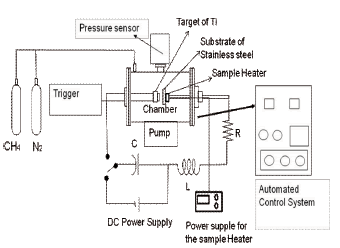
<body><![CDATA[<p><font size="2" face="Verdana, Arial, Helvetica, sans-serif">Titanium,   one of the most used elements in coatings, has been deposited in monolayer and   multilayer coatings. When used as a monolayer, nitrides and carbides such as   TiN, TiC, TiAlN, TiCN have been widely used as hard protective coatings due to   their excellent tribological properties -wear resistance, friction   coefficient-, erosion and oxidation resistance and stability at high temperature,   among others &#91;3, 4, 5&#93;. For instance, titanium nitride coatings have been   widely employed to harden and protect cutting surfaces in order to improve   their lifetime and for decoration because of its metallic gold color &#91;4, 5&#93;.   Furthermore, TiN is one the materials most frequently investigated in multilayers   (CN/TiN, TiCN/TiN, TiN/TiC, Ti/TiN), where the TiN layer is usually deposited first because   it adheres very firmly to different substrates (e.g. HSS, silicon) &#91;6, 7&#93;.   Due to brittleness and its poor adherence of TiC layer, most studies concern   about TiN/Ti(C,N)/TiC &#91;8-10&#93;, but only a few of studies concern about TiN/TiC   multilayer system, in spite of TiC has high hardness as protective coating, excellent wear resistance   and good stability, its applications are reduced when it is directly grown on   steel as substrate &#91;11, 12&#93;, making it necessary to apply an intermediate layer   TiN as an intermediate layer and has demonstrated good adhesion on steel   substrate &#91;13&#93;. The TiN/TiC multilayer coatings can be deposited by plasma-assisted   chemical vapor deposition &#91;14&#93;, arc ion plating &#91;15&#93;, magnetron sputtering &#91;16&#93; and laser ablation &#91;17&#93;. Their wear-resistant properties were improved in comparison to TiN or TiC   single layers. However, their insufficient adhesion that is caused by the low   process temperature   of PVD and by the diffusion of coating metal into the substrate and the grain   grown problem that are caused by the thermal process of CVD, restricting their further   application &#91;18&#93;. </font></p>     <p><font size="2" face="Verdana, Arial, Helvetica, sans-serif">Vacuum   arc discharge is a widely used industrial hard coating technique; large   droplet-particles are always present in the coatings so that this technique has   not been considered suitable for fine coatings such as multilayer films &#91;18&#93;.   Never the less in previous research, authors of this work introduced heating of   the substrate into the arc technique, reporting that the substrate temperature   could also diminish the condensation of micro-droplets   on the substrate, helping their destruction &#91;19&#93;. </font></p>     <p><font size="2" face="Verdana, Arial, Helvetica, sans-serif">In vacuum   arc techniques, a high current electrical discharge is generated by conducting   electrodes immersed in a vacuum or in a low pressure chamber. The cathode   generates an intense metallic plasma jet with ion kinetic energies ranging from   20-100 eV when a reactive gas such as nitrogen or oxygen is present in the   chamber. Oxides, nitrides and carbides can be produced &#91;20-22&#93;. On the other   hand it is well known that the deposition parameters produce high influence on   mechanical, tribological, chemical and other physical properties of coatings &#91;23-25&#93;. For example, it is well known that   the composition, structure, and properties of deposited films are greatly   affected by deposition temperature &#91;26&#93;. K. Chu et al &#91;27&#93; reported nitrogen-saturated solid solution titanium-aluminium-nitride   (Ti,Al)N thin films grown on Si(100)   (for concentration and mechanical analyses), and grown on AISI M42 tool steels (for tribological measurement)   deposited onto wafers at room temperature by reactive close-field unbalanced magnetron sputtering in an Ar-N<sub>2</sub> gas mixture. The effects of substrate negative bias voltages (<i>U</i><sub>b</sub>)   on the mechanical and tribological properties of these films have been studied. Recently, Cerio et al &#91;28&#93; reported      that the increase of deposition temperature results in the linear decrease of   internal stress in TiN films deposited by ionized physical vapor deposition. I.   Zergioti et al &#91;29&#93; presented results of TiN and TiB<sub>2</sub> coatings grown   by pulsed laser deposition and the substrate temperature ranging from   40 °C to 650 °C , in which   their influence in the preferential crystallographic orientation and morphology   was observed. Nevertheless, strong rise in substrates temperature can   generate large residual stresses &#91;18, 30&#93;, and based on our previous work, we   decided to heat the substrates at not very high temperatures. We are encouraged   to study the influence of low substrate temperature in TiN/TiC bilayers   produced by pulsed vacuum arc discharge. </font></p>     <p><font size="2" face="Verdana, Arial, Helvetica, sans-serif">On the   other hand, XRD is the most common technique used to study the properties of   the materials and the influence of external parameters. It allows the determination of the   crystallographic phases and structure present in the films. However, in the   case of dual, multiphase coatings or multilayers containing materials with very   similar structure such as TiN and TiC, which have close lattice parameters &#91;31&#93;,   exact determination of the individual phases by XRD can be ambiguous because of   overlapping peaks or peak broadening. In addition, minor phases of atomic   molecular dimensions constituting the interface between the grains might not be   observed in XRD. Consequently, this technique cannot give a complete   characterization of the nitride and   carbide coatings. </font></p>     <p><font size="2" face="Verdana, Arial, Helvetica, sans-serif">X ray   photoelectron spectroscopy (XPS) has been widely used to determine the chemical   composition and stoichiometry, because it offers excellent elements   selectivity, quantitative character and high surface sensitivity &#91;32&#93;. XPS   technique can accurately determine stoichiometry and allows studying the band   structure of the transition metal nitrides and carbides that have the ability   to exist over a wide range of stoichiometries and have many vacancies in their   fcc sublattice &#91;33&#93;. The band-structure calculations for transition metal   carbides and nitrides show that non-metal 2<i>s</i> states (at about 11 eV below the Fermi energy level for the carbides and 15 eV   below the Fermi energy level for the nitrides) are well separated from the   valence-band structure at 5 or 6 eV below the Fermi energy level that results   from nonmetal 2<i>p</i> states which are   strongly hybridized with metal <i>d</i> states. The density of states (DOS) falls to a minimum corresponding to the   competition of the hybridized p-d states having mainly metal <i>d</i> character &#91;34&#93;. </font></p>     <p><font size="2" face="Verdana, Arial, Helvetica, sans-serif">Even though   there are several reports that present depth profiles of Ti(C, N), TiN, TiC   grown by different techniques &#91;35-37&#93;, no reports of depth profiles for TiN/TiC   bilayers, when they have been grown by the pulsed arc technique, have been   submitted. For this reason, we intended to observe diffusion of nitrogen in TiC   layer and carbon in TiN layer and compare our results with the existing   reports. </font></p>     <p><font size="2" face="Verdana, Arial, Helvetica, sans-serif">The purpose of this paper is to show   the capability of X-ray photoelectron spectroscopy for analyzing TiN/TiC   bilayers produced by physical vapor deposition pulsed arc discharge (PVD-PAD)   technique. The bilayers were grown at substrate temperature of 50 ºC and 150 ºC , identifying   the influence of this parameter in the chemical composition and the   stoichiometry. Additionally, depth profiles were carried out to study the   chemical behavior of the materials as a function of thickness (sputter time). </font></p>     <p>&nbsp;</p>     <p><b><font size="3" face="Verdana, Arial, Helvetica, sans-serif">2. EXPERIMENTAL DETAILS </font></b></p>     <p><font size="2" face="Verdana, Arial, Helvetica, sans-serif">A PAPVD-PAD (plasma assisted physical vapor deposition   pulsed arc discharge) was employed to produce the bilayers. The mayor   components of the deposition system included a stainless steel reaction chamber   with two electrodes (the anode with the samples and a Ti cathode). The vacuum   pressure reached by the system in the process was 10<sup>-4</sup> Pa. After that the   chamber is filled with nitrogen or methane for producing the TiN or TiC layers,   according to the experiment. The discharge was generated by an RLC   (R=0.46m<font face="Symbol">W</font>, L=2.3 mH, C=0.54 mF) electric circuit. The capacitor bank was   charged to an initial voltage by means of a DC power supply. Then it was   connected to the coating production system, being discharged between the   electrodes as a critically damped waveform. Because of the system was at low   pressure, an initial pulse of high voltage (20 kV) was necessary. It was   provided by the trigger. The discharge had a time of 30 ms approximately. <a href="#fig01">Fig.   1</a> presents a scheme of the equipment. The system was previously described by   the authors &#91;19, 38&#93;. </font></p>     ]]></body>
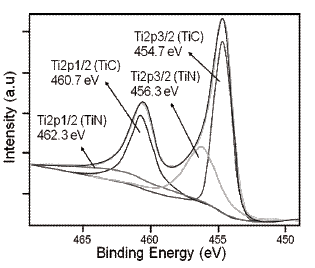
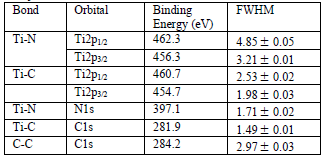
<body><![CDATA[<p align="center"><font size="2" face="Verdana, Arial, Helvetica, sans-serif"><b><a name="fig01"></a><img src="/img/revistas/dyna/v77n163/a07fig01.gif">    <br>   Figure   1</b>. Scheme of the experimental setup employed in the   TiN/TiC bilayers production </font></p>     <p><font size="2" face="Verdana, Arial, Helvetica, sans-serif">As substrate, 304 stainless steel was chosen, because   some authors report good adherence of TiN and TiC on these materials, due to   the formation of metallurgical bonding between coatings and substrate &#91;39&#93;.   Samples of 304 stainless steel with 1.3 cm diameter and 2 mm in thickness were   employed and the deposition rate was 40 µm/s. They were polished and cleaned using   acetone and an ultrasonic method. The layers were produced by using a   cylindrical Ti cathode with   5   cm diameter and a purity of 99.9999%. The electrodes   were placed face to face with a distance between them of 5 mm. To produce TiN coatings   the working gas was nitrogen at a pressure of 250 Pa and a 310 V charge voltage   was used. Methane at a pressure of 300 Pa and charge voltage discharge of 270 V   was used to grow TiC layers. Two values of substrate temperature were used: 50º C and 150º C. </font></p>     <p><font size="2" face="Verdana, Arial, Helvetica, sans-serif">An XPS ESCALAB 250 Thermo VG Scientific XPS/ISS, with   hemispherical analyzer argon ion beam and electron beam with a source of   aluminum K<font face="Symbol">a</font> was used   for the chemical analysis. The wide scanning spectral range was between -10 and   1200 eV, with steps of 0.5eV and the step for   narrow spectra was 0.1. To produce depth profiles, the samples were bombarded   using argon ions with energies between 0.5 to 5 keV. Depth profiles were   carried out w during 43200 s (12 h) and narrow spectra were taken each hour. A   low-energy electron beam (neutralizer) was used to compensate for charging   effects when studying the polymer surface. The binding energy   scales were adjusted using the C1s line at 284.6 eV. </font></p>     <p><font size="2" face="Verdana, Arial, Helvetica, sans-serif">For the STM characterization, an Autoprobe CP Park   Scientific Instruments with probes of silicon and Software ProScan Image   Processing was used. To obtain topographic images of the films, it was used the   AFM (Atomic Force Microscopy) mode, employing an ultralever probe of silicon   nitride (Si<sub>3</sub>N<sub>4</sub>), with a spring constant of 0.16N/m, a   scanning speed of 1 HZ, and image resolution of 256 x 256 pixels, in   environmental conditions. Using a spring constant of 2.8 N/m it was realized   simultaneously AFM. </font></p>     <p>&nbsp;</p>     <p><font size="3" face="Verdana, Arial, Helvetica, sans-serif"><b>3. RESULTS AND DISCUSION</b></font></p>     <p><font size="2" face="Verdana, Arial, Helvetica, sans-serif">Different elements like Ti, C, N and O were observed   in the XPS survey spectra. The oxygen was probably associated with   contamination produced during the deposition process. Also this contamination   could be caused by the environmental contact. Once the spectrum was obtained,   Argon ions with an energy of 3 keV and an ion current of 0.5 mA were used to etch   the surface for one hour to remove surface contamination. In order to verify   the presence of Ti-C and Ti-N bonds, high resolution narrow spectra of Ti, C   and N were obtained. The spectral lines   were deconvoluted with a combination of Gaussian (70%) and Lorentzian (30%)   fits. The peak created by the spin-orbital interaction for Ti2p producing the   doublet Ti 2p<sub>3/2</sub> and Ti2p<sub>1/2</sub> can be observed in <a href="#fig02">fig. 2</a>.   The literature reports an energy difference of 6 eV between both peaks of Ti2p   &#91;40&#93;. The peaks at 454.7 eV and 460.7 eV correspond to Ti-C &#91;41&#93; and the peaks   at 456.3 eV and 462.3 eV correspond to Ti-N &#91;42&#93;. Normally metal   macro-particles are presented in arc discharges and they could influence the   XPS analysis. Nevertheless, no evidence of metallic Ti2p, which are reported at   453,7 eV and 459,7 eV &#91;43&#93; was found, meaning that possibly these micro-particles   are not present in the XPS analysis. </font></p>     <p align="center"><font size="2" face="Verdana, Arial, Helvetica, sans-serif"><b><a name="fig02" id="fig02"></a><img src="/img/revistas/dyna/v77n163/a07fig02.gif">    <br>   Figure   2</b>. Ti2p XPS spectrum with the peak fitting of the TiN/TiC   bilayer grown at    150 &ordm;C on 304   stainless steel substrate </font></p>     ]]></body>
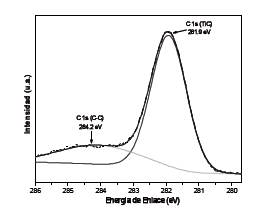
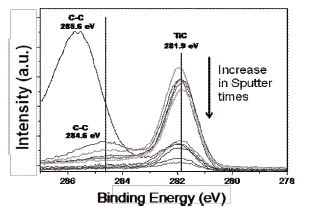
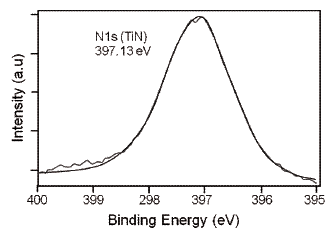
<body><![CDATA[<p><font size="2" face="Verdana, Arial, Helvetica, sans-serif">In the case of nitrogen, the narrow spectrum of N1s   had a peak in 397.13 eV that corresponds to the Ti-N binding energy, as shown in <a href="#fig03">fig.   3</a> &#91;44&#93;. </font></p>     <p align="center"><font size="2" face="Verdana, Arial, Helvetica, sans-serif"><b><a name="fig03"></a><img src="/img/revistas/dyna/v77n163/a07fig03.gif">    <br>   Figure 3</b>. N1s XPS spectrum with the peak fitting of the TiN/TiC bilayer grown at    150 &ordm;C on 304 stainless steel substrate </font></p>     <p><font size="2" face="Verdana, Arial, Helvetica, sans-serif">No other contributions were observed which means that   there were no C-N bonds into the material. Similarly, the narrow spectrum of   C1s, presented in <a href="#fig04">fig. 4</a>, had two peaks, one at 281.9 eV that corresponds to   Ti-C bonds &#91;45&#93; and another at 284.2 eV, corresponding to C-C bonds &#91;46&#93;. There   are some reports in the literature about the last peak. Soto &#91;37&#93;, X. Ding &#91;47&#93;   and Liuhe &#91;48&#93; linked the C-C bonds with the presence of hydrocarbide particles   on the film surface. </font></p>     <p align="center"><font size="2" face="Verdana, Arial, Helvetica, sans-serif"><b><a name="fig04"></a><img src="/img/revistas/dyna/v77n163/a07fig04.gif">    <br>   Figure   4</b>. C1s XPS spectrum with   the peak fitting of the TiN/TiC bilayer grown at    150 ºC on 304 stainless steel substrate </font></p>     <p><font size="2" face="Verdana, Arial, Helvetica, sans-serif">Possibly they were deposited during the deposition   process, because the gas used for growing the TiC films was methane (CH<sub>4</sub>).   This might have occurred because gas was not fully ionized and dissociated,   when the plasma was generated. In addition, some carbon at the film surface   could come from contamination when the sample was exposed to the environment. </font></p>     <p><font size="2" face="Verdana, Arial, Helvetica, sans-serif"><a href="#fig05">Fig. 5</a> presents the evolution of the XPS spectrum of   C1s after various etching times. The peak at 285.6 eV (C-C) was shifted toward   low energies with increasing etching time, 284.6 eV., possibly because the   etching removed the surface contamination, which has different   hydrocarbide bonds than those in   hydrocarbides produced during the coating growth process, and that are present   deeper in the film. This has been reported in the literature where surface contamination   is frequently presented as thin oxide layers and hydrocarbide type deposits &#91;49&#93;. </font></p>     <p align="center"><font size="2" face="Verdana, Arial, Helvetica, sans-serif"><b><a name="fig05"></a><img src="/img/revistas/dyna/v77n163/a07fig05.gif">    <br>   Figure 5</b>. Evolution of the C 1s core level XPS spectra as a function of sputtering   times for sample grown at    150 &ordm;C. </font></p>     ]]></body>
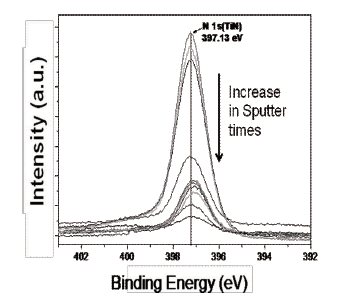
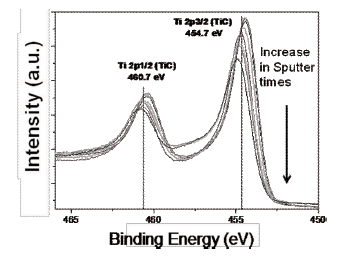
<body><![CDATA[<p><font size="2" face="Verdana, Arial, Helvetica, sans-serif">For these films, the intensity of the C-C peak   decreases much more quickly than it does for the peak at 281.9 eV (Ti-C),   supporting the interpretation that a high percent of these bonds are due to   contamination. <a href="#tab01">Table 1</a> shows a summary of the XPS results including the FHWM of each peak. </font></p>     <p align="center"><font size="2" face="Verdana, Arial, Helvetica, sans-serif"><b><a name="tab01"></a>Table   1 </b>summary of the XPS results for the TiN/TiC   bilayers </font>    <br>   <img src="/img/revistas/dyna/v77n163/a07tab01.gif"></p>     <p><font size="2" face="Verdana, Arial, Helvetica, sans-serif">For the N1s peak presented in <a href="#fig06">fig. 6</a>, it was observed   that when the etching time increased, the intensity decreased but did not   disappear totally which means that nitrogen diffused into the substrate C-N   bonds were not found which was favorable since, in this way, the variational   structure of the bilayer was not destroyed &#91;48&#93;. </font></p>     <p align="center"><font size="2" face="Verdana, Arial, Helvetica, sans-serif"><b><a name="fig06"></a><img src="/img/revistas/dyna/v77n163/a07fig06.gif">    <br>   Figure   6</b>. Evolution of the N 1s   core level XPS spectra as a function of sputtering times for sample grown at    150 ºC </font></p>     <p><font size="2" face="Verdana, Arial, Helvetica, sans-serif">Several   authors have observed no of C-N bond in TiN films.   For example Liuhe et al. studied arc deposited Ti(C, N) films using a C<sub>2</sub>H<sub>2</sub>/N<sub>2</sub> mixture but they   observed no C-N bonds &#91;48&#93;. Similarly,   Lu and Chen observed no C-N bonds after annealing TiN samples in CO<sub>2</sub>/H<sub>2</sub>/N<sub>2</sub> mixture &#91;50&#93;. Soto used pulsed laser deposition to prepare titanium-based films in N<sub>2</sub> + CH<sub>4</sub> and CO + N<sub>2</sub> atmospheres &#91;40&#93;. Also he didn´t observe any C-N bonds. He found out that nitrogen   saturation passivated Ti, and that CH<sub>4</sub> molecules were trapped in the   film. Some authors have also observed a peak   at a binding energy higher than 402 eV. This   peak has been assigned to chemically adsorbed nitrogen   and has been interpreted as a fraction of N<sub>2</sub> released from the oxidation of TiN &#91;51-52&#93;. On the   other hand, no shifting has been observed in N1s peak because the TiN coating   is not directly exposed to the environment and the process gas is pure nitrogen.   Consequently, contamination is less probably than in the TiC coating. </font></p>     <p><font size="2" face="Verdana, Arial, Helvetica, sans-serif">The Ti2p peak shown in <a href="#fig07">fig. 7</a> did not significantly   decrease when the material was etched. During the etching process the   difference of energy between Ti 2p3/2 and Ti2p1/2 was maintained at 6 eV.   Nevertheless, both peaks were shifted toward higher energies. This happened   because the TiC film, which is the layer in contact with the surface, has lower   binding energy than the TiN film which is closer to the substrate. </font></p>     <p align="center"><font size="2" face="Verdana, Arial, Helvetica, sans-serif"><b><a name="fig07"></a><img src="/img/revistas/dyna/v77n163/a07fig07.gif">    <br>   Figure 7</b>. Evolution of   the Ti2p core level XPS spectra as a function of sputtering times for sample   grown at    150 &ordm;C </font></p>     ]]></body>
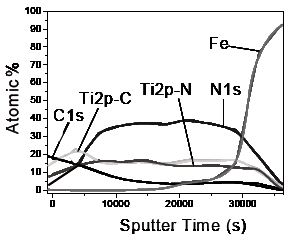
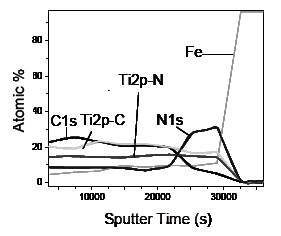
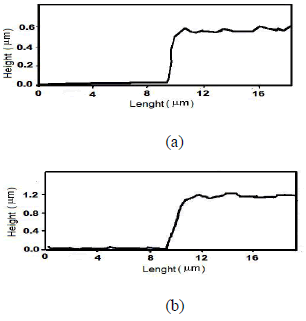
<body><![CDATA[<p><font size="2" face="Verdana, Arial, Helvetica, sans-serif">One of the most important advantages of the XPS   technique is to carry out depth profiles. Depth profiles are presented in <a href="#fig08">fig.   8</a> and <a href="#fig09">fig. 9</a> for samples grown at 50 ºC , and 150 ºC. To   convert sputtering times into depth, the sputter rate was determined from the   known thickness of the layers and from the time needed to reach the interface.   The position of the interface is taken as the depth where the overlayer signal   has reached 50% of its maximum value. &#91;53&#93;. <a href="#fig10">Fig. 10</a> shows the thickness of   films measured by using SPM technique in AFM mode for coatings produced at   50 C. <a href="#fig10">Fig 10 (a)</a> presents a scan carried out to   the TiN film grown after the sample was masked. The thickness obtained was 0.6 <u>+</u> 0.03   µm. <a href="#fig10">Fig 10 (b)</a> shows the AFM scan for the TiN/TiC bilayer, presenting a   thickness of 1.2 <u>+</u> 0.07   µm. Results reveal that both TiN and TiC were grown approximately at the same   deposition rate. Depth profiles carried out to samples grown at 50 and   150 C have almost the same   sputtering time, meaning that the thicknesses are almost similar. Sputtering   rate of the XPS analysis is approximately 4 10<sup>-5</sup> µm/s. Roughness   obtained by AFM images was in the order of 0.055 <u>+</u> 0.03   µm and 0.045 <u>+</u> 0.02   µm for bilayers grown at 50 and   150   C respectively. The profiles carried out by AFM scans   presented in <a href="#fig07">fig 7</a> shows that the coatings do not have high roughness compared   with other films grown by similar techniques but without heating the substrate   &#91;54, 55&#93;. These profiles are not present high uniformities, as those produced   by micro-particles. </font></p>     <p align="center"><font size="2" face="Verdana, Arial, Helvetica, sans-serif"><b><a name="fig08"></a><img src="/img/revistas/dyna/v77n163/a07fig08.gif">    <br>   Figure 8. </b>Atomic   concentration of Ti, N, C and Fe as a function of sputtering time, for TiN/TiC bilayers   grown at    50 &ordm;C </font></p>     <p align="center"><font size="2" face="Verdana, Arial, Helvetica, sans-serif"><b><a name="fig09"></a><img src="/img/revistas/dyna/v77n163/a07fig09.gif">    <br>   Figure 9.</b> Atomic concentration of Ti, N, C and Fe as a function of sputtering   time, for TiN/TiC bilayers grown at 150 &ordm;C </font></p>     <p align="center"><font size="2" face="Verdana, Arial, Helvetica, sans-serif"><b><a name="fig10"></a><img src="/img/revistas/dyna/v77n163/a07fig10.gif">    <br>   Figure 10.</b> Height profiles produced by using AFM for   samples grown at (a)   50   &ordm;C. (b) 150 &ordm;C </font></p>     <p><font size="2" face="Verdana, Arial, Helvetica, sans-serif">Strong diffusion between TiN and TiC was observed,   especially for the sample grown at 150º C in <a href="#fig09">fig. 9</a>. This indicate that an   increase </font></p>     <p><font size="2" face="Verdana, Arial, Helvetica, sans-serif">in the substrate temperature favors the mobility of C   in the TiN structure and N in the TiC structure. Possibly this is because of   the film porosity, as reported previously &#91;29&#93;. </font></p>     <p><font size="2" face="Verdana, Arial, Helvetica, sans-serif">Y. Lee, showed that it was impossible to identify the   interface in dielectric bilayers having high diffusion &#91;51&#93;. Depth profiles   with similar characteristics have been reported by Kessler et al in coatings of   TiN, TiC and TiCN by CVD. In these works, carbon diffusion formed TiC on TiN at   moderate and high temperatures &#91;53&#93;. There is a possibility that the coatings   also have defects such as porosity, making diffusion easier. According to the   binding energy analysis of the bilayer components, TiCN was   no formed. </font></p>     ]]></body>
<body><![CDATA[<p><font size="2" face="Verdana, Arial, Helvetica, sans-serif"><a href="#tab02">Table 2</a> shows the stoichiometry of TiN/TiC grown at   substrate temperature of 50   °C and 150 °C. The depth profile was averaged to   obtain the atomic percent of each element. The TiC coating produced in this   experiment at lower temperature is rich in carbon and TiN coating produced at   higher temperature is rich in nitrogen. </font></p>     <p align="center"><font size="2" face="Verdana, Arial, Helvetica, sans-serif"><b><a name="tab02"></a>Table   2 </b>Stoichiometry of TiN and TiC Coatings </font>    <br>   <img src="/img/revistas/dyna/v77n163/a07tab02.gif"></p>     <p>&nbsp;</p>     <p><font size="3" face="Verdana, Arial, Helvetica, sans-serif"><b>CONCLUSIONS </b> </font></p>     <p><font size="2" face="Verdana, Arial, Helvetica, sans-serif">Ti, C and N were found in TiN/TiC bilayer samples   grown at substrate temperatures of 50 ºC and 150 ºC. After one   hour of sputtering, XPS peaks corresponding from oxygen and C-C bonds   diminished. </font></p>     <p><font size="2" face="Verdana, Arial, Helvetica, sans-serif">XPS peaks corresponding to Ti-N and Ti-C were   observed. Also, C-C bonds were found, possibly due to the formation of   hydrocarbides attributed to contamination and because the methane gas employed   to grow TiC. </font></p>     <p><font size="2" face="Verdana, Arial, Helvetica, sans-serif">Considerable inter-layer diffusion was observed,   making it difficult to pinpoint the interface between both TiN and TiC   coatings. Increasing substrate temperature favors the mobility of C in the TiN structure and N in the TiC   structure. TiC was rich in carbon TiC at   50 °C and TiN rich in nitrogen at 150 °C. </font></p>     <p>&nbsp;</p>     <p><font size="3" face="Verdana, Arial, Helvetica, sans-serif"><b>AKNOWLEDGMENTS </b></font></p>     ]]></body>
<body><![CDATA[<p><font size="2" face="Verdana, Arial, Helvetica, sans-serif">The authors gratefully acknowledge the   financial support of the Divisi&oacute;n para la Investigaci&oacute;n de la Universidad   Nacional de Manizales (DIMA). Also, we would like to specially thank   professor Alfonso Devia Cubillos (1953-2008) for his technical support. </font></p>     <p>&nbsp;</p>     <p><font size="3" face="Verdana, Arial, Helvetica, sans-serif"><b>REFERENCES</b></font></p>     <p><font size="2" face="Verdana, Arial, Helvetica, sans-serif"><b>&#91;1&#93;</b> VEPREK, S., J. Vac. Sci. Technol. A. The search for novel, superhard materials, Vol. 17 No. 5, 2401-2421, 1999.     <!-- ref --><br>   <b>&#91;2&#93;</b> PODGORNIK, B., Coated machine elements - fiction or reality? Surf. Coat. Technol Vol. 146-147, 318-323, 2001.     &nbsp;&nbsp;&nbsp;&nbsp;&nbsp;&nbsp;&nbsp;&nbsp;[&#160;<a href="javascript:void(0);" onclick="javascript: window.open('/scielo.php?script=sci_nlinks&ref=000087&pid=S0012-7353201000030000700002&lng=','','width=640,height=500,resizable=yes,scrollbars=1,menubar=yes,');">Links</a>&#160;]<!-- end-ref --><!-- ref --><br>   <b>&#91;3&#93;</b> DONOHUE, L. A., CAWLEY, J., LEWIS, D. B., BROOKS, J. S., MUNZ W. D., Investigation of superlattice coatings deposited by a combined steered are evaporation and unbalanced magnetron sputtering technique Surf. Coat. Technol., Vol. 76-77, 149-158, 1995.     &nbsp;&nbsp;&nbsp;&nbsp;&nbsp;&nbsp;&nbsp;&nbsp;[&#160;<a href="javascript:void(0);" onclick="javascript: window.open('/scielo.php?script=sci_nlinks&ref=000088&pid=S0012-7353201000030000700003&lng=','','width=640,height=500,resizable=yes,scrollbars=1,menubar=yes,');">Links</a>&#160;]<!-- end-ref --><!-- ref --><br>   <b>&#91;4&#93;</b> TAVARES, C., REBOUTA L., ALMEIDA, B., BESSA J., DA SILVA, M., SOARES, J., Deposition and characterization of multilayered TiN/ZrN coatings Thin Solid Films Vol. 317, 124-128, 1998.     &nbsp;&nbsp;&nbsp;&nbsp;&nbsp;&nbsp;&nbsp;&nbsp;[&#160;<a href="javascript:void(0);" onclick="javascript: window.open('/scielo.php?script=sci_nlinks&ref=000089&pid=S0012-7353201000030000700004&lng=','','width=640,height=500,resizable=yes,scrollbars=1,menubar=yes,');">Links</a>&#160;]<!-- end-ref --><!-- ref --><br>   <b>&#91;5&#93;</b> MORI, T., FUKUDA, S., TAKEMURA, Y., Improvement of mechanical properties of Ti/TiN multilayer film deposited by sputtering, Surf. Coat. Technol Vol. 140, 122-127, 2001.     &nbsp;&nbsp;&nbsp;&nbsp;&nbsp;&nbsp;&nbsp;&nbsp;[&#160;<a href="javascript:void(0);" onclick="javascript: window.open('/scielo.php?script=sci_nlinks&ref=000090&pid=S0012-7353201000030000700005&lng=','','width=640,height=500,resizable=yes,scrollbars=1,menubar=yes,');">Links</a>&#160;]<!-- end-ref --><!-- ref --><br>   <b>&#91;6&#93;</b> BEMPORAD, E., PECCHIO, C., ROSSI, S. D., CARASSITI, F., Characterization and hardness modeling of alternate TIN/TICN multilayer cathodic arc PVD coating on tool steel Surf Coat Technol Vol. 146-147 363-370, 2001.     &nbsp;&nbsp;&nbsp;&nbsp;&nbsp;&nbsp;&nbsp;&nbsp;[&#160;<a href="javascript:void(0);" onclick="javascript: window.open('/scielo.php?script=sci_nlinks&ref=000091&pid=S0012-7353201000030000700006&lng=','','width=640,height=500,resizable=yes,scrollbars=1,menubar=yes,');">Links</a>&#160;]<!-- end-ref --><!-- ref --><br>   <b>&#91;7&#93;</b> MA, K. J., CHAO, C. L., LIU, D. S., CHEN, Y. T., SHIEH, M. B., Friction and wear behaviour of TiN/Au, TiN/MoS2 and TiN/TiCN/a-C:H coatings J. Mater. Process. Technol. Vol. 127 182-186, 2002.     &nbsp;&nbsp;&nbsp;&nbsp;&nbsp;&nbsp;&nbsp;&nbsp;[&#160;<a href="javascript:void(0);" onclick="javascript: window.open('/scielo.php?script=sci_nlinks&ref=000092&pid=S0012-7353201000030000700007&lng=','','width=640,height=500,resizable=yes,scrollbars=1,menubar=yes,');">Links</a>&#160;]<!-- end-ref --><!-- ref --><br>   <b>&#91;8&#93;</b> SMOLIK, J., ZDUNEK, K., LARISCH, B., Investigation of adhesion between component layers of a multi-layer coating TiC/Ti(Cx, N1-x)/TiN by the scratch-test method Vacuum Vol. 55, 45-50, 1999.     &nbsp;&nbsp;&nbsp;&nbsp;&nbsp;&nbsp;&nbsp;&nbsp;[&#160;<a href="javascript:void(0);" onclick="javascript: window.open('/scielo.php?script=sci_nlinks&ref=000093&pid=S0012-7353201000030000700008&lng=','','width=640,height=500,resizable=yes,scrollbars=1,menubar=yes,');">Links</a>&#160;]<!-- end-ref --><!-- ref --><br>   <b>&#91;9&#93;</b> DING, J., MENG, Y., WEN, S., Mechanical properties and fracture toughness of multilayer hard coatings using nanoindentation ,Thin Solid Films Vol. 371, 178-182, 2000.     &nbsp;&nbsp;&nbsp;&nbsp;&nbsp;&nbsp;&nbsp;&nbsp;[&#160;<a href="javascript:void(0);" onclick="javascript: window.open('/scielo.php?script=sci_nlinks&ref=000094&pid=S0012-7353201000030000700009&lng=','','width=640,height=500,resizable=yes,scrollbars=1,menubar=yes,');">Links</a>&#160;]<!-- end-ref --><!-- ref --><br>   <b>&#91;10&#93;</b> JEHN, H. A., Multicomponent and multiphase hard coatings for tribological applications, Surf. Coat. Technol. Vol. 131, 433-440, 2000.     &nbsp;&nbsp;&nbsp;&nbsp;&nbsp;&nbsp;&nbsp;&nbsp;[&#160;<a href="javascript:void(0);" onclick="javascript: window.open('/scielo.php?script=sci_nlinks&ref=000095&pid=S0012-7353201000030000700010&lng=','','width=640,height=500,resizable=yes,scrollbars=1,menubar=yes,');">Links</a>&#160;]<!-- end-ref --><!-- ref --><br>   <b>&#91;11&#93;</b> LEVI, G., KAPLAN, W., BAMBERGER, M., Structure refinement of titanium carbonitride (TiCN) Mat. Letters Vol. 35, 344-350, 1998.     &nbsp;&nbsp;&nbsp;&nbsp;&nbsp;&nbsp;&nbsp;&nbsp;[&#160;<a href="javascript:void(0);" onclick="javascript: window.open('/scielo.php?script=sci_nlinks&ref=000096&pid=S0012-7353201000030000700011&lng=','','width=640,height=500,resizable=yes,scrollbars=1,menubar=yes,');">Links</a>&#160;]<!-- end-ref --><!-- ref --><br>   <b>&#91;12&#93;</b> MU, H., YU, T., LUO, E., SUNDARAVEL, B, WONG, S., WILSON, I., Ti, TiN, and Ti-TiN thin films prepared by ion beam assisted deposition as diffusion barriers between Cu and Si, Vol 18 No. 5 J. Vac. Sci. Technol A Vol. 18, 2312-2318, 2000.     &nbsp;&nbsp;&nbsp;&nbsp;&nbsp;&nbsp;&nbsp;&nbsp;[&#160;<a href="javascript:void(0);" onclick="javascript: window.open('/scielo.php?script=sci_nlinks&ref=000097&pid=S0012-7353201000030000700012&lng=','','width=640,height=500,resizable=yes,scrollbars=1,menubar=yes,');">Links</a>&#160;]<!-- end-ref --><!-- ref --><br>   <b>&#91;13&#93;</b> SMOLIK, J. ZDUNEK, , K., Effect of interlayer composition on the tribological properties of TiC/Ti(Cx,N1-x)/TiN anti-abrasive multi-layer coatings Vacuum Vol. 55, 147-151, 1999.     &nbsp;&nbsp;&nbsp;&nbsp;&nbsp;&nbsp;&nbsp;&nbsp;[&#160;<a href="javascript:void(0);" onclick="javascript: window.open('/scielo.php?script=sci_nlinks&ref=000098&pid=S0012-7353201000030000700013&lng=','','width=640,height=500,resizable=yes,scrollbars=1,menubar=yes,');">Links</a>&#160;]<!-- end-ref --><!-- ref --><br>   <b>&#91;14&#93;</b> KIM, D. J., CHO, Y. R., LEE, M. J., HONG, J. M., KIM, Y. K., LEE, K. H., Properties of TiN-TiC multilayer coatings using plasma-assisted chemical vapor deposition Surf Coat Technol Vol. 116-119, 906-910, 1999.     &nbsp;&nbsp;&nbsp;&nbsp;&nbsp;&nbsp;&nbsp;&nbsp;[&#160;<a href="javascript:void(0);" onclick="javascript: window.open('/scielo.php?script=sci_nlinks&ref=000099&pid=S0012-7353201000030000700014&lng=','','width=640,height=500,resizable=yes,scrollbars=1,menubar=yes,');">Links</a>&#160;]<!-- end-ref --><!-- ref --><br>   <b>&#91;15&#93;</b> SALAS, O., KEARNS, K., CARRERA, K, S. MOORE, J. J., Tribological behavior of candidate coatings for Al die casting dies ,Surf Coat Technol. Vol. 172, 117-127, 2003.     &nbsp;&nbsp;&nbsp;&nbsp;&nbsp;&nbsp;&nbsp;&nbsp;[&#160;<a href="javascript:void(0);" onclick="javascript: window.open('/scielo.php?script=sci_nlinks&ref=000100&pid=S0012-7353201000030000700015&lng=','','width=640,height=500,resizable=yes,scrollbars=1,menubar=yes,');">Links</a>&#160;]<!-- end-ref --><!-- ref --><br>   <b>&#91;16&#93;</b> RADHAKRISHNAN, G., ADAMS, P. M., SPECKMAN, D. M., Low temperature pulsed laser deposition of titanium carbide on bearing steels Thin Solid Films Vol. 358, 131-138, 2000.     &nbsp;&nbsp;&nbsp;&nbsp;&nbsp;&nbsp;&nbsp;&nbsp;[&#160;<a href="javascript:void(0);" onclick="javascript: window.open('/scielo.php?script=sci_nlinks&ref=000101&pid=S0012-7353201000030000700016&lng=','','width=640,height=500,resizable=yes,scrollbars=1,menubar=yes,');">Links</a>&#160;]<!-- end-ref --><!-- ref --><br>   <b>&#91;17&#93;</b> WANG, J., LI, W. Z., LI, H. D., Mechanical properties of nanoscaled TiC/Fe multilayers deposited by ion beam sputtering technique Thin Solid Films Vol. 382, 190-194, 2001.     &nbsp;&nbsp;&nbsp;&nbsp;&nbsp;&nbsp;&nbsp;&nbsp;[&#160;<a href="javascript:void(0);" onclick="javascript: window.open('/scielo.php?script=sci_nlinks&ref=000102&pid=S0012-7353201000030000700017&lng=','','width=640,height=500,resizable=yes,scrollbars=1,menubar=yes,');">Links</a>&#160;]<!-- end-ref --><!-- ref --><br>   <b>&#91;18&#93;</b> ZHAO, Y., LIN, G., XIAO, J., DONG, Ch., WEN, L., TiN/TiC multilayer films deposited by pulse biased arc ion plating Vacuum, 10.1016/j.vacuum.2009.04.043, In press     &nbsp;&nbsp;&nbsp;&nbsp;&nbsp;&nbsp;&nbsp;&nbsp;[&#160;<a href="javascript:void(0);" onclick="javascript: window.open('/scielo.php?script=sci_nlinks&ref=000103&pid=S0012-7353201000030000700018&lng=','','width=640,height=500,resizable=yes,scrollbars=1,menubar=yes,');">Links</a>&#160;]<!-- end-ref --><!-- ref --><br>   <b>&#91;19&#93;</b> DEVIA, A., BENAVIDES, V., RESTREPO, E., ARIAS, D. F., OSPINA, R., Influence substrate temperature on structural properties of TiN/TiC bilayers produced by pulsed arc techniques Vacuum Vol. 81, 378-384, 2006.     &nbsp;&nbsp;&nbsp;&nbsp;&nbsp;&nbsp;&nbsp;&nbsp;[&#160;<a href="javascript:void(0);" onclick="javascript: window.open('/scielo.php?script=sci_nlinks&ref=000104&pid=S0012-7353201000030000700019&lng=','','width=640,height=500,resizable=yes,scrollbars=1,menubar=yes,');">Links</a>&#160;]<!-- end-ref --><!-- ref --><br>   <b>&#91;20&#93;</b> SHIAO, M. H., SHIEU, F. S., A formation mechanism for the macroparticles in arc ion-plated TiN films Thin Solid Films Vol. 386, 27-31, 2001.     &nbsp;&nbsp;&nbsp;&nbsp;&nbsp;&nbsp;&nbsp;&nbsp;[&#160;<a href="javascript:void(0);" onclick="javascript: window.open('/scielo.php?script=sci_nlinks&ref=000105&pid=S0012-7353201000030000700020&lng=','','width=640,height=500,resizable=yes,scrollbars=1,menubar=yes,');">Links</a>&#160;]<!-- end-ref --><!-- ref --><br>   <b>&#91;21&#93;</b> SANDERS, D. M., BOERCKER, D. B., FALABELLA, S., Coating technology based on the vacuum arc-a review, IEEE Trans. Plasma Sci. Vol. 18 No. 6, 883-894, 1990.     &nbsp;&nbsp;&nbsp;&nbsp;&nbsp;&nbsp;&nbsp;&nbsp;[&#160;<a href="javascript:void(0);" onclick="javascript: window.open('/scielo.php?script=sci_nlinks&ref=000106&pid=S0012-7353201000030000700021&lng=','','width=640,height=500,resizable=yes,scrollbars=1,menubar=yes,');">Links</a>&#160;]<!-- end-ref --><!-- ref --><br>   <b>&#91;22&#93;</b> BRUZZONE, H., KELLY, H., MARQUEZ, A., LAMAS, ANSALDI, A., OVIEDO, C., TiN coatings generated with a pulsed plasma arc, Plasma Source Sci. Technol., Vol. 5 No. 3, 582-587, 1996.     &nbsp;&nbsp;&nbsp;&nbsp;&nbsp;&nbsp;&nbsp;&nbsp;[&#160;<a href="javascript:void(0);" onclick="javascript: window.open('/scielo.php?script=sci_nlinks&ref=000107&pid=S0012-7353201000030000700022&lng=','','width=640,height=500,resizable=yes,scrollbars=1,menubar=yes,');">Links</a>&#160;]<!-- end-ref --><!-- ref --><br>   <b>&#91;23&#93;</b> S. Moni Borah, A. Ratan Pal, H. Bailung, J. Chutia, Optimization of plasma parameters for high rate deposition of titanium nitride films as protective coating on bell-metal by reactive sputtering in cylindrical magnetron device Appl. Surf. Sci. Vol. 254, 5760-5765, 2008.     &nbsp;&nbsp;&nbsp;&nbsp;&nbsp;&nbsp;&nbsp;&nbsp;[&#160;<a href="javascript:void(0);" onclick="javascript: window.open('/scielo.php?script=sci_nlinks&ref=000108&pid=S0012-7353201000030000700023&lng=','','width=640,height=500,resizable=yes,scrollbars=1,menubar=yes,');">Links</a>&#160;]<!-- end-ref --><!-- ref --><br>   <b>&#91;24&#93;</b> NUNES, Y., NWEMANS, A., Wemans, MARQUES, H. P., MARQUES, C., FERREIRA, Q., TEODORO, O. M. N. D., ALVES, E. Alves, MANEIRA, M. J. P., Dual DC magnetron cathode co-deposition of (Al,Ti) and (Al,Ti,N) thin films with controlled depth composition Vacuum 81 1503-1506, 2007     &nbsp;&nbsp;&nbsp;&nbsp;&nbsp;&nbsp;&nbsp;&nbsp;[&#160;<a href="javascript:void(0);" onclick="javascript: window.open('/scielo.php?script=sci_nlinks&ref=000109&pid=S0012-7353201000030000700024&lng=','','width=640,height=500,resizable=yes,scrollbars=1,menubar=yes,');">Links</a>&#160;]<!-- end-ref --><!-- ref --><br>   <b>&#91;25&#93;</b> SANCHEZ-LOPEZ, J. C., MARTINEZ-MARTINEZ, D., LOPEZ-CORTES, C., FERNANDEZ, A., Tribological behaviour of titanium carbide/amorphous carbon nanocomposite coatings: From macro to the micro-scale Surf. Coat. Technol. Vol. 202, 4011-4018, 2008.     &nbsp;&nbsp;&nbsp;&nbsp;&nbsp;&nbsp;&nbsp;&nbsp;[&#160;<a href="javascript:void(0);" onclick="javascript: window.open('/scielo.php?script=sci_nlinks&ref=000110&pid=S0012-7353201000030000700025&lng=','','width=640,height=500,resizable=yes,scrollbars=1,menubar=yes,');">Links</a>&#160;]<!-- end-ref --><!-- ref --><br>   <b>&#91;26&#93;</b> CHENG, Y. H., TAY , B. K., LAU, S. P., Influence of deposition temperature on the structure and internal stress of TiN films deposited by filtered cathodic vacuum arc, J. Vac. Sci. Technol. A Vol. 20, No. 4, 1270-1274, 2002.     &nbsp;&nbsp;&nbsp;&nbsp;&nbsp;&nbsp;&nbsp;&nbsp;[&#160;<a href="javascript:void(0);" onclick="javascript: window.open('/scielo.php?script=sci_nlinks&ref=000111&pid=S0012-7353201000030000700026&lng=','','width=640,height=500,resizable=yes,scrollbars=1,menubar=yes,');">Links</a>&#160;]<!-- end-ref --><!-- ref --><br>   <b>&#91;27&#93;</b> CHU, K. SHUM, P. W., SHEN, Y. G., Substrate bias effects on mechanical and tribological properties of substitutional solid solution (Ti, Al)N films prepared by reactive magnetron sputtering Mater. Sci. Eng: B Vol. 131, 62-71, 2006.     &nbsp;&nbsp;&nbsp;&nbsp;&nbsp;&nbsp;&nbsp;&nbsp;[&#160;<a href="javascript:void(0);" onclick="javascript: window.open('/scielo.php?script=sci_nlinks&ref=000112&pid=S0012-7353201000030000700027&lng=','','width=640,height=500,resizable=yes,scrollbars=1,menubar=yes,');">Links</a>&#160;]<!-- end-ref --><!-- ref --><br>   <b>&#91;28&#93;</b> CERIO, F., DREWERY, J., HUNG, E., REYNOLDS, G., Film properties of Ti/TiN bilayers deposited sequentially by ionized physical vapor deposition, J. Vac. Sci. Technol. A Vol. 16, No. 3, 1863-1865, 1998.     &nbsp;&nbsp;&nbsp;&nbsp;&nbsp;&nbsp;&nbsp;&nbsp;[&#160;<a href="javascript:void(0);" onclick="javascript: window.open('/scielo.php?script=sci_nlinks&ref=000113&pid=S0012-7353201000030000700028&lng=','','width=640,height=500,resizable=yes,scrollbars=1,menubar=yes,');">Links</a>&#160;]<!-- end-ref --><!-- ref --><br>   <b>&#91;29&#93;</b> ZERGIOTI, I., HAIDEMENOPOULOS, G. N., FOTAKIS, C., Nanocrystalline growth and diagnostics of TiC and TiB2 hard coatings by pulsed laser deposition, Appl. Phys. A. Matter. Sci. Proc. 69, S427-S431, 1999.     &nbsp;&nbsp;&nbsp;&nbsp;&nbsp;&nbsp;&nbsp;&nbsp;[&#160;<a href="javascript:void(0);" onclick="javascript: window.open('/scielo.php?script=sci_nlinks&ref=000114&pid=S0012-7353201000030000700029&lng=','','width=640,height=500,resizable=yes,scrollbars=1,menubar=yes,');">Links</a>&#160;]<!-- end-ref --><!-- ref --><br>   <b>&#91;30&#93;</b> OLBRICH, W., FESSMANN, J., KAMPSCHULTE, G., EBBERINK, J., Improved control of TiN coating properties using cathodic arc evaporation with a pulsed bias Surf. Coat. Technol. Vol. 49, 258-262, 1991.     &nbsp;&nbsp;&nbsp;&nbsp;&nbsp;&nbsp;&nbsp;&nbsp;[&#160;<a href="javascript:void(0);" onclick="javascript: window.open('/scielo.php?script=sci_nlinks&ref=000115&pid=S0012-7353201000030000700030&lng=','','width=640,height=500,resizable=yes,scrollbars=1,menubar=yes,');">Links</a>&#160;]<!-- end-ref --><!-- ref --><br>   <b>&#91;31&#93;</b> RESTREPO, E., BENAVIDES, V., DEVIA, A., OLARTE, S., ARROYAVE, M., ARANGO, Y. C., Study of Multilayer Coatings of Ti/TiN/TiC Produced by Pulsed Arc Discharge, Brazilian J. Phys. Vol. 34, 1748-1751, 2004.     &nbsp;&nbsp;&nbsp;&nbsp;&nbsp;&nbsp;&nbsp;&nbsp;[&#160;<a href="javascript:void(0);" onclick="javascript: window.open('/scielo.php?script=sci_nlinks&ref=000116&pid=S0012-7353201000030000700031&lng=','','width=640,height=500,resizable=yes,scrollbars=1,menubar=yes,');">Links</a>&#160;]<!-- end-ref --><!-- ref --><br>   <b>&#91;32&#93;</b> BERTOTI, I. , Characterization of nitride coatings by XPS Surf. Coat. Technol. Vol. 151-152, 194-203, 2002.     &nbsp;&nbsp;&nbsp;&nbsp;&nbsp;&nbsp;&nbsp;&nbsp;[&#160;<a href="javascript:void(0);" onclick="javascript: window.open('/scielo.php?script=sci_nlinks&ref=000117&pid=S0012-7353201000030000700032&lng=','','width=640,height=500,resizable=yes,scrollbars=1,menubar=yes,');">Links</a>&#160;]<!-- end-ref --><!-- ref --><br>   <b>&#91;33&#93;</b> PORTE, L., ROUX, L., HANUS, J., Vacancy effects in the x-ray photoelectron spectra of TiNx Phys. Rev. B Vol. 28, 3214-3224, 1983.     &nbsp;&nbsp;&nbsp;&nbsp;&nbsp;&nbsp;&nbsp;&nbsp;[&#160;<a href="javascript:void(0);" onclick="javascript: window.open('/scielo.php?script=sci_nlinks&ref=000118&pid=S0012-7353201000030000700033&lng=','','width=640,height=500,resizable=yes,scrollbars=1,menubar=yes,');">Links</a>&#160;]<!-- end-ref --><!-- ref --><br>   <b>&#91;34&#93;</b> KLEIN, B., M. PAPACONSTANTOPOULUS, D. A., BOYER, L. L., Mechanisms for energetic-vacancy stabilization: TiO and TiC, Phys. Rev. B. Vol. 22, 991-1006, 1980.     &nbsp;&nbsp;&nbsp;&nbsp;&nbsp;&nbsp;&nbsp;&nbsp;[&#160;<a href="javascript:void(0);" onclick="javascript: window.open('/scielo.php?script=sci_nlinks&ref=000119&pid=S0012-7353201000030000700034&lng=','','width=640,height=500,resizable=yes,scrollbars=1,menubar=yes,');">Links</a>&#160;]<!-- end-ref --><!-- ref --><br>   <b>&#91;35&#93;</b> CHENG, Y., ZHENG, Y. F., Characterization of TiN, TiC and TiCN coatings on Ti-50.6 at.% Ni alloy deposited by PIII and deposition technique Surf. Coat. Technol. Vol. 201, 4909-4913, 2007.     &nbsp;&nbsp;&nbsp;&nbsp;&nbsp;&nbsp;&nbsp;&nbsp;[&#160;<a href="javascript:void(0);" onclick="javascript: window.open('/scielo.php?script=sci_nlinks&ref=000120&pid=S0012-7353201000030000700035&lng=','','width=640,height=500,resizable=yes,scrollbars=1,menubar=yes,');">Links</a>&#160;]<!-- end-ref --><!-- ref --><br>   <b>&#91;36&#93;</b> TAKAHASHI, M., SHIMADA, S., Preparation of composite and compositionally graded TiC-TiN films by liquid injection plasma-enhanced CVD Solid State Ionics Vol. 172, 249-252, 2004.     &nbsp;&nbsp;&nbsp;&nbsp;&nbsp;&nbsp;&nbsp;&nbsp;[&#160;<a href="javascript:void(0);" onclick="javascript: window.open('/scielo.php?script=sci_nlinks&ref=000121&pid=S0012-7353201000030000700036&lng=','','width=640,height=500,resizable=yes,scrollbars=1,menubar=yes,');">Links</a>&#160;]<!-- end-ref --><!-- ref --><br>   <b>&#91;37&#93;</b> VESEL, A., MOZETIC, M., KOVAC, J., ZALAR, A., XPS study of the deposited Ti layer in a magnetron-type sputter ion pump Appl. Surf. Sci. Vol. 253, 2941-2945, 2006.     &nbsp;&nbsp;&nbsp;&nbsp;&nbsp;&nbsp;&nbsp;&nbsp;[&#160;<a href="javascript:void(0);" onclick="javascript: window.open('/scielo.php?script=sci_nlinks&ref=000122&pid=S0012-7353201000030000700037&lng=','','width=640,height=500,resizable=yes,scrollbars=1,menubar=yes,');">Links</a>&#160;]<!-- end-ref --><!-- ref --><br>   <b>&#91;38&#93;</b> DEVIA, A., RESTREPO, E., SEGURA, B., ARANGO, Y. C., ARIAS, D., Study of TiN and Ti/TiN coatings produced by pulsed-arc discharge Surf. Coat. Technol. Vol. 190 No. 1, 83-87, 2004.     &nbsp;&nbsp;&nbsp;&nbsp;&nbsp;&nbsp;&nbsp;&nbsp;[&#160;<a href="javascript:void(0);" onclick="javascript: window.open('/scielo.php?script=sci_nlinks&ref=000123&pid=S0012-7353201000030000700038&lng=','','width=640,height=500,resizable=yes,scrollbars=1,menubar=yes,');">Links</a>&#160;]<!-- end-ref --><!-- ref --><br>   <b>&#91;39&#93;</b> REN, Y. J., ZENG, C. L., Corrosion protection of 304 stainless steel bipolar plates using TiC films produced by high-energy micro-arc alloying process J. Power Sources Vol. 171, 778782, 2007.     &nbsp;&nbsp;&nbsp;&nbsp;&nbsp;&nbsp;&nbsp;&nbsp;[&#160;<a href="javascript:void(0);" onclick="javascript: window.open('/scielo.php?script=sci_nlinks&ref=000124&pid=S0012-7353201000030000700039&lng=','','width=640,height=500,resizable=yes,scrollbars=1,menubar=yes,');">Links</a>&#160;]<!-- end-ref --><!-- ref --><br>   <b>&#91;40&#93;</b> SOTO, G., AES, EELS and XPS characterization of Ti(C, N, O) films prepared by PLD using a Ti target in N2, CH4, O2 and CO as reactive gases Appl. Surf. Sci. Vol. 233, 115-122, 2004.     &nbsp;&nbsp;&nbsp;&nbsp;&nbsp;&nbsp;&nbsp;&nbsp;[&#160;<a href="javascript:void(0);" onclick="javascript: window.open('/scielo.php?script=sci_nlinks&ref=000125&pid=S0012-7353201000030000700040&lng=','','width=640,height=500,resizable=yes,scrollbars=1,menubar=yes,');">Links</a>&#160;]<!-- end-ref --><!-- ref --><br>   <b>&#91;41&#93;</b> BENKO, E., BARR, T. L., HARDCASTLE, S., HOPPE, E., BERNASIK, A., MORGIEL, J., XPS study of the cBN-TiC system, Ceramics International, Vol. 27, No. 6, 637-643, 2001.     &nbsp;&nbsp;&nbsp;&nbsp;&nbsp;&nbsp;&nbsp;&nbsp;[&#160;<a href="javascript:void(0);" onclick="javascript: window.open('/scielo.php?script=sci_nlinks&ref=000126&pid=S0012-7353201000030000700041&lng=','','width=640,height=500,resizable=yes,scrollbars=1,menubar=yes,');">Links</a>&#160;]<!-- end-ref --><!-- ref --><br>   <b>&#91;42&#93;</b> STRYDOM, I., HOFMANN, S., The contribution of characteristic energy losses in the core-level X-ray photoelectron spectroscopy peaks of TiN and (Ti, Al)N studied by electron energy loss spectroscopy and X-ray photoelectron spectroscopy J. electron spect. Related phenom., Vol. 56, 85-103, 1991.     &nbsp;&nbsp;&nbsp;&nbsp;&nbsp;&nbsp;&nbsp;&nbsp;[&#160;<a href="javascript:void(0);" onclick="javascript: window.open('/scielo.php?script=sci_nlinks&ref=000127&pid=S0012-7353201000030000700042&lng=','','width=640,height=500,resizable=yes,scrollbars=1,menubar=yes,');">Links</a>&#160;]<!-- end-ref --><!-- ref --><br>   <b>&#91;43&#93;</b> TREGLIO, J. R., ELKIND, A., STINNER, R. J., PERRY, A. J., Advanced vacuum arc metal ion implantation systems Surf. Coat. Technol. Vol. 96, l-8, 1997.     &nbsp;&nbsp;&nbsp;&nbsp;&nbsp;&nbsp;&nbsp;&nbsp;[&#160;<a href="javascript:void(0);" onclick="javascript: window.open('/scielo.php?script=sci_nlinks&ref=000128&pid=S0012-7353201000030000700043&lng=','','width=640,height=500,resizable=yes,scrollbars=1,menubar=yes,');">Links</a>&#160;]<!-- end-ref --><!-- ref --><br>   <b>&#91;44&#93;</b> GEORGIEV, D. G., BAIRD, R. J., NEWAZ, G., AUNER,, G., WITTE, R., HERFURTH, H., An XPS study of laser-fabricated polyimide/titanium interfaces Appl. Surf. Sci. Vol. 236, 71-76, 2004.     &nbsp;&nbsp;&nbsp;&nbsp;&nbsp;&nbsp;&nbsp;&nbsp;[&#160;<a href="javascript:void(0);" onclick="javascript: window.open('/scielo.php?script=sci_nlinks&ref=000129&pid=S0012-7353201000030000700044&lng=','','width=640,height=500,resizable=yes,scrollbars=1,menubar=yes,');">Links</a>&#160;]<!-- end-ref --><!-- ref --><br>   <b>&#91;45&#93;</b> JOUAN, P. Y., PEIGNON, M.-C., CARDIAUD, CH. LEMPERIERE, G., Characterisation of TiN coatings and of the TiN/Si interface by X-ray photoelectron spectroscopy and Auger electron spectroscopy Appl. Surf. Sci., Vol. 68, 595-600, 1993.     &nbsp;&nbsp;&nbsp;&nbsp;&nbsp;&nbsp;&nbsp;&nbsp;[&#160;<a href="javascript:void(0);" onclick="javascript: window.open('/scielo.php?script=sci_nlinks&ref=000130&pid=S0012-7353201000030000700045&lng=','','width=640,height=500,resizable=yes,scrollbars=1,menubar=yes,');">Links</a>&#160;]<!-- end-ref --><!-- ref --><br>   <b>&#91;46&#93;</b> HAMRIN, K., JOHANSSON, G., FAHLMAN, A., NORDILING, C., Charge transfer in transition metal carbides and related compounds studied by ESCA J. phys. Chem. Solids, Vol. 30, 1835-1847, 1969.     &nbsp;&nbsp;&nbsp;&nbsp;&nbsp;&nbsp;&nbsp;&nbsp;[&#160;<a href="javascript:void(0);" onclick="javascript: window.open('/scielo.php?script=sci_nlinks&ref=000131&pid=S0012-7353201000030000700046&lng=','','width=640,height=500,resizable=yes,scrollbars=1,menubar=yes,');">Links</a>&#160;]<!-- end-ref --><!-- ref --><br>   <b>&#91;47&#93;</b> DING, X., TAY, B. K., TAN, H. S., LAU, S. P., CHEUNG, W. Y., WONG, S. P., Preferential orientation of titanium carbide films deposited by a filtered cathodic vacuum arc technique Surf. Coat. Technol. Vol. 138, 301-306, 2001.     &nbsp;&nbsp;&nbsp;&nbsp;&nbsp;&nbsp;&nbsp;&nbsp;[&#160;<a href="javascript:void(0);" onclick="javascript: window.open('/scielo.php?script=sci_nlinks&ref=000132&pid=S0012-7353201000030000700047&lng=','','width=640,height=500,resizable=yes,scrollbars=1,menubar=yes,');">Links</a>&#160;]<!-- end-ref --><!-- ref --><br>   <b>&#91;48&#93;</b> LIUHE, L., LIFANG, X., XINXIN, M., XPS of Ti+TiN+(N,C) multilayer films deposited by filtered cathodic arc deposition with controlled feed gas flow rate Surf. Coat. Technol. Vol. 120-121, 618-621, 1999.     &nbsp;&nbsp;&nbsp;&nbsp;&nbsp;&nbsp;&nbsp;&nbsp;[&#160;<a href="javascript:void(0);" onclick="javascript: window.open('/scielo.php?script=sci_nlinks&ref=000133&pid=S0012-7353201000030000700048&lng=','','width=640,height=500,resizable=yes,scrollbars=1,menubar=yes,');">Links</a>&#160;]<!-- end-ref --><!-- ref --><br>   <b>&#91;49&#93;</b> BERTOTI, I. , MOHAI, M., RENEVIER, N. M., SZILAGYI, E., XPS investigation of ion beam treated MoS2-Ti composite coatings Surf. Coat. Technol. Vol. 125, 173-178, 2002.     &nbsp;&nbsp;&nbsp;&nbsp;&nbsp;&nbsp;&nbsp;&nbsp;[&#160;<a href="javascript:void(0);" onclick="javascript: window.open('/scielo.php?script=sci_nlinks&ref=000134&pid=S0012-7353201000030000700049&lng=','','width=640,height=500,resizable=yes,scrollbars=1,menubar=yes,');">Links</a>&#160;]<!-- end-ref --><!-- ref --><br>   <b>&#91;50&#93;</b> OVIEDO, C., T&eacute;cnicas de An&aacute;lisis de Superficies. CNEA. Buenos Aires.1998.     &nbsp;&nbsp;&nbsp;&nbsp;&nbsp;&nbsp;&nbsp;&nbsp;[&#160;<a href="javascript:void(0);" onclick="javascript: window.open('/scielo.php?script=sci_nlinks&ref=000135&pid=S0012-7353201000030000700050&lng=','','width=640,height=500,resizable=yes,scrollbars=1,menubar=yes,');">Links</a>&#160;]<!-- end-ref --><!-- ref --><br>   <b>&#91;51&#93;</b> LEE, Y. J., LEE, J. H., LEE, Y. Y., KANG, Y. H., KIM, Y. S., KWON, S. N. JEONG, K., Interdiffusion in vacuum-deposited dielectric thin films, Optics Comunications Vol. 190, 211-220, 2001.     &nbsp;&nbsp;&nbsp;&nbsp;&nbsp;&nbsp;&nbsp;&nbsp;[&#160;<a href="javascript:void(0);" onclick="javascript: window.open('/scielo.php?script=sci_nlinks&ref=000136&pid=S0012-7353201000030000700051&lng=','','width=640,height=500,resizable=yes,scrollbars=1,menubar=yes,');">Links</a>&#160;]<!-- end-ref --><!-- ref --><br>   <b>&#91;52&#93;</b> KESSLER, O. H., HOFFMANN, F. T. MAYR, P., Microstructure and property changes caused by diffusion during CVD coating of steels Surf. Coat. Technol. Vol. 120-121, 366-372, 1999.     &nbsp;&nbsp;&nbsp;&nbsp;&nbsp;&nbsp;&nbsp;&nbsp;[&#160;<a href="javascript:void(0);" onclick="javascript: window.open('/scielo.php?script=sci_nlinks&ref=000137&pid=S0012-7353201000030000700052&lng=','','width=640,height=500,resizable=yes,scrollbars=1,menubar=yes,');">Links</a>&#160;]<!-- end-ref --><!-- ref --><br>   <b>&#91;53&#93;</b> DUMONTA, J., MONROY, E., MUÑOZ, E., CAUDANO, R., SPORKEN, R., Investigation of metal-GaN and metal-AlGaN contacts by XPS depth profiles and by electrical measurements J. Crystal Growth Vol. 230, 558-563, 2001.     &nbsp;&nbsp;&nbsp;&nbsp;&nbsp;&nbsp;&nbsp;&nbsp;[&#160;<a href="javascript:void(0);" onclick="javascript: window.open('/scielo.php?script=sci_nlinks&ref=000138&pid=S0012-7353201000030000700053&lng=','','width=640,height=500,resizable=yes,scrollbars=1,menubar=yes,');">Links</a>&#160;]<!-- end-ref --><!-- ref --><br>   <b>&#91;54&#93;</b> FANG T. -H., JIAN S.-R., CHUU D. -S. Nanomechanical properties of TiC, TiN and TiCN thin films using scanning probe microscopy and nanoindentation, Appl. Surf. Sci. Vol. 228, 365-372, 2004.     &nbsp;&nbsp;&nbsp;&nbsp;&nbsp;&nbsp;&nbsp;&nbsp;[&#160;<a href="javascript:void(0);" onclick="javascript: window.open('/scielo.php?script=sci_nlinks&ref=000139&pid=S0012-7353201000030000700054&lng=','','width=640,height=500,resizable=yes,scrollbars=1,menubar=yes,');">Links</a>&#160;]<!-- end-ref --><!-- ref --><br>   <b>&#91;55&#93;</b> MARTIN P. J., NETTLERFIELD R. P., KINDER T.J., DESCOTES L., Deposition of TiN, TiC and TiO2 films by filtered arc evaporation, Surf. Coat. Technol. Vol. 49, 239-243. 1991.</font>&nbsp;&nbsp;&nbsp;&nbsp;&nbsp;&nbsp;&nbsp;&nbsp;[&#160;<a href="javascript:void(0);" onclick="javascript: window.open('/scielo.php?script=sci_nlinks&ref=000140&pid=S0012-7353201000030000700055&lng=','','width=640,height=500,resizable=yes,scrollbars=1,menubar=yes,');">Links</a>&#160;]<!-- end-ref --> ]]></body><back>
<ref-list>
<ref id="B1">
<label>1</label><nlm-citation citation-type="journal">
<person-group person-group-type="author">
<name>
<surname><![CDATA[VEPREK]]></surname>
<given-names><![CDATA[S.]]></given-names>
</name>
</person-group>
<article-title xml:lang="en"><![CDATA[The search for novel, superhard materials]]></article-title>
<source><![CDATA[J. Vac. Sci. Technol. A.]]></source>
<year>1999</year>
<volume>17</volume>
<numero>5</numero>
<issue>5</issue>
<page-range>2401-2421</page-range></nlm-citation>
</ref>
<ref id="B2">
<label>2</label><nlm-citation citation-type="journal">
<person-group person-group-type="author">
<name>
<surname><![CDATA[PODGORNIK]]></surname>
<given-names><![CDATA[B.]]></given-names>
</name>
</person-group>
<article-title xml:lang="en"><![CDATA[Coated machine elements: fiction or reality?]]></article-title>
<source><![CDATA[Surf. Coat. Technol]]></source>
<year>2001</year>
<volume>146-147</volume>
<page-range>318-323</page-range></nlm-citation>
</ref>
<ref id="B3">
<label>3</label><nlm-citation citation-type="journal">
<person-group person-group-type="author">
<name>
<surname><![CDATA[DONOHUE]]></surname>
<given-names><![CDATA[L. A.]]></given-names>
</name>
<name>
<surname><![CDATA[CAWLEY]]></surname>
<given-names><![CDATA[J.]]></given-names>
</name>
<name>
<surname><![CDATA[LEWIS]]></surname>
<given-names><![CDATA[D. B.]]></given-names>
</name>
<name>
<surname><![CDATA[BROOKS]]></surname>
<given-names><![CDATA[J. S.]]></given-names>
</name>
<name>
<surname><![CDATA[MUNZ]]></surname>
<given-names><![CDATA[W. D.]]></given-names>
</name>
</person-group>
<article-title xml:lang="en"><![CDATA[Investigation of superlattice coatings deposited by a combined steered are evaporation and unbalanced magnetron sputtering technique]]></article-title>
<source><![CDATA[Surf. Coat. Technol.]]></source>
<year>1995</year>
<volume>76-77</volume>
<page-range>149-158</page-range></nlm-citation>
</ref>
<ref id="B4">
<label>4</label><nlm-citation citation-type="journal">
<person-group person-group-type="author">
<name>
<surname><![CDATA[TAVARES]]></surname>
<given-names><![CDATA[C.]]></given-names>
</name>
<name>
<surname><![CDATA[REBOUTA]]></surname>
<given-names><![CDATA[L.]]></given-names>
</name>
<name>
<surname><![CDATA[ALMEIDA]]></surname>
<given-names><![CDATA[B.]]></given-names>
</name>
<name>
<surname><![CDATA[BESSA]]></surname>
<given-names><![CDATA[J.]]></given-names>
</name>
<name>
<surname><![CDATA[DA SILVA]]></surname>
<given-names><![CDATA[M.]]></given-names>
</name>
<name>
<surname><![CDATA[SOARES]]></surname>
<given-names><![CDATA[J.]]></given-names>
</name>
</person-group>
<article-title xml:lang="en"><![CDATA[Deposition and characterization of multilayered TiN/ZrN coatings]]></article-title>
<source><![CDATA[Thin Solid Films]]></source>
<year>1998</year>
<volume>317</volume>
<page-range>124-128</page-range></nlm-citation>
</ref>
<ref id="B5">
<label>5</label><nlm-citation citation-type="journal">
<person-group person-group-type="author">
<name>
<surname><![CDATA[MORI]]></surname>
<given-names><![CDATA[T.]]></given-names>
</name>
<name>
<surname><![CDATA[FUKUDA]]></surname>
<given-names><![CDATA[S.]]></given-names>
</name>
<name>
<surname><![CDATA[TAKEMURA]]></surname>
<given-names><![CDATA[Y.]]></given-names>
</name>
</person-group>
<article-title xml:lang="en"><![CDATA[Improvement of mechanical properties of Ti/TiN multilayer film deposited by sputtering]]></article-title>
<source><![CDATA[Surf. Coat. Technol]]></source>
<year>2001</year>
<volume>140</volume>
<page-range>122-127</page-range></nlm-citation>
</ref>
<ref id="B6">
<label>6</label><nlm-citation citation-type="journal">
<person-group person-group-type="author">
<name>
<surname><![CDATA[BEMPORAD]]></surname>
<given-names><![CDATA[E.]]></given-names>
</name>
<name>
<surname><![CDATA[PECCHIO]]></surname>
<given-names><![CDATA[C.]]></given-names>
</name>
<name>
<surname><![CDATA[ROSSI]]></surname>
<given-names><![CDATA[S. D.]]></given-names>
</name>
<name>
<surname><![CDATA[CARASSITI]]></surname>
<given-names><![CDATA[F.]]></given-names>
</name>
</person-group>
<article-title xml:lang="en"><![CDATA[Characterization and hardness modeling of alternate TIN/TICN multilayer cathodic arc PVD coating on tool steel]]></article-title>
<source><![CDATA[Surf Coat Technol]]></source>
<year>2001</year>
<volume>146-147</volume>
<page-range>363-370</page-range></nlm-citation>
</ref>
<ref id="B7">
<label>7</label><nlm-citation citation-type="journal">
<person-group person-group-type="author">
<name>
<surname><![CDATA[MA]]></surname>
<given-names><![CDATA[K. J.]]></given-names>
</name>
<name>
<surname><![CDATA[CHAO]]></surname>
<given-names><![CDATA[C. L.]]></given-names>
</name>
<name>
<surname><![CDATA[LIU]]></surname>
<given-names><![CDATA[D. S.]]></given-names>
</name>
<name>
<surname><![CDATA[CHEN]]></surname>
<given-names><![CDATA[Y. T.]]></given-names>
</name>
<name>
<surname><![CDATA[SHIEH]]></surname>
<given-names><![CDATA[M. B.]]></given-names>
</name>
</person-group>
<article-title xml:lang="en"><![CDATA[Friction and wear behaviour of TiN/Au, TiN/MoS2 and TiN/TiCN/a-C:H coatings]]></article-title>
<source><![CDATA[J. Mater. Process. Technol.]]></source>
<year>2002</year>
<volume>127</volume>
<page-range>182-186</page-range></nlm-citation>
</ref>
<ref id="B8">
<label>8</label><nlm-citation citation-type="journal">
<person-group person-group-type="author">
<name>
<surname><![CDATA[SMOLIK]]></surname>
<given-names><![CDATA[J.]]></given-names>
</name>
<name>
<surname><![CDATA[ZDUNEK]]></surname>
<given-names><![CDATA[K.]]></given-names>
</name>
<name>
<surname><![CDATA[LARISCH]]></surname>
<given-names><![CDATA[B.]]></given-names>
</name>
</person-group>
<article-title xml:lang="en"><![CDATA[Investigation of adhesion between component layers of a multi-layer coating TiC/Ti(Cx, N1-x)/TiN by the scratch-test method]]></article-title>
<source><![CDATA[Vacuum]]></source>
<year>1999</year>
<volume>55</volume>
<page-range>45-50</page-range></nlm-citation>
</ref>
<ref id="B9">
<label>9</label><nlm-citation citation-type="journal">
<person-group person-group-type="author">
<name>
<surname><![CDATA[DING]]></surname>
<given-names><![CDATA[J.]]></given-names>
</name>
<name>
<surname><![CDATA[MENG]]></surname>
<given-names><![CDATA[Y.]]></given-names>
</name>
<name>
<surname><![CDATA[WEN]]></surname>
<given-names><![CDATA[S.]]></given-names>
</name>
</person-group>
<article-title xml:lang="en"><![CDATA[Mechanical properties and fracture toughness of multilayer hard coatings using nanoindentation]]></article-title>
<source><![CDATA[Thin Solid Films]]></source>
<year>2000</year>
<volume>371</volume>
<page-range>178-182</page-range></nlm-citation>
</ref>
<ref id="B10">
<label>10</label><nlm-citation citation-type="journal">
<person-group person-group-type="author">
<name>
<surname><![CDATA[JEHN]]></surname>
<given-names><![CDATA[H. A.]]></given-names>
</name>
</person-group>
<article-title xml:lang="en"><![CDATA[Multicomponent and multiphase hard coatings for tribological applications]]></article-title>
<source><![CDATA[Surf. Coat. Technol.]]></source>
<year>2000</year>
<volume>131</volume>
<page-range>433-440</page-range></nlm-citation>
</ref>
<ref id="B11">
<label>11</label><nlm-citation citation-type="journal">
<person-group person-group-type="author">
<name>
<surname><![CDATA[LEVI]]></surname>
<given-names><![CDATA[G.]]></given-names>
</name>
<name>
<surname><![CDATA[KAPLAN]]></surname>
<given-names><![CDATA[W.]]></given-names>
</name>
<name>
<surname><![CDATA[BAMBERGER]]></surname>
<given-names><![CDATA[M.]]></given-names>
</name>
</person-group>
<article-title xml:lang="en"><![CDATA[Structure refinement of titanium carbonitride (TiCN)]]></article-title>
<source><![CDATA[Mat. Letters]]></source>
<year>1998</year>
<volume>35</volume>
<page-range>344-350</page-range></nlm-citation>
</ref>
<ref id="B12">
<label>12</label><nlm-citation citation-type="journal">
<person-group person-group-type="author">
<name>
<surname><![CDATA[MU]]></surname>
<given-names><![CDATA[H.]]></given-names>
</name>
<name>
<surname><![CDATA[YU]]></surname>
<given-names><![CDATA[T.]]></given-names>
</name>
<name>
<surname><![CDATA[LUO]]></surname>
<given-names><![CDATA[E.]]></given-names>
</name>
<name>
<surname><![CDATA[SUNDARAVEL]]></surname>
<given-names><![CDATA[B]]></given-names>
</name>
<name>
<surname><![CDATA[WONG]]></surname>
<given-names><![CDATA[S.]]></given-names>
</name>
<name>
<surname><![CDATA[WILSON]]></surname>
<given-names><![CDATA[I.]]></given-names>
</name>
</person-group>
<article-title xml:lang="en"><![CDATA[Ti, TiN, and Ti-TiN thin films prepared by ion beam assisted deposition as diffusion barriers between Cu and Si]]></article-title>
<source><![CDATA[J. Vac. Sci. Technol A]]></source>
<year>2000</year>
<volume>18</volume>
<page-range>2312-2318</page-range></nlm-citation>
</ref>
<ref id="B13">
<label>13</label><nlm-citation citation-type="journal">
<person-group person-group-type="author">
<name>
<surname><![CDATA[SMOLIK]]></surname>
<given-names><![CDATA[J.]]></given-names>
</name>
<name>
<surname><![CDATA[ZDUNEK]]></surname>
<given-names><![CDATA[K.]]></given-names>
</name>
</person-group>
<article-title xml:lang="en"><![CDATA[Effect of interlayer composition on the tribological properties of TiC/Ti(Cx,N1-x)/TiN anti-abrasive multi-layer coatings]]></article-title>
<source><![CDATA[Vacuum]]></source>
<year>1999</year>
<volume>55</volume>
<page-range>147-151</page-range></nlm-citation>
</ref>
<ref id="B14">
<label>14</label><nlm-citation citation-type="journal">
<person-group person-group-type="author">
<name>
<surname><![CDATA[KIM]]></surname>
<given-names><![CDATA[D. J.]]></given-names>
</name>
<name>
<surname><![CDATA[CHO]]></surname>
<given-names><![CDATA[Y. R.]]></given-names>
</name>
<name>
<surname><![CDATA[LEE]]></surname>
<given-names><![CDATA[M. J.]]></given-names>
</name>
<name>
<surname><![CDATA[HONG]]></surname>
<given-names><![CDATA[J. M.]]></given-names>
</name>
<name>
<surname><![CDATA[KIM]]></surname>
<given-names><![CDATA[Y. K.]]></given-names>
</name>
<name>
<surname><![CDATA[LEE]]></surname>
<given-names><![CDATA[K. H.]]></given-names>
</name>
</person-group>
<article-title xml:lang="en"><![CDATA[Properties of TiN-TiC multilayer coatings using plasma-assisted chemical vapor deposition]]></article-title>
<source><![CDATA[Surf Coat Technol]]></source>
<year>1999</year>
<volume>116-119</volume>
<page-range>906-910</page-range></nlm-citation>
</ref>
<ref id="B15">
<label>15</label><nlm-citation citation-type="journal">
<person-group person-group-type="author">
<name>
<surname><![CDATA[SALAS]]></surname>
<given-names><![CDATA[O.]]></given-names>
</name>
<name>
<surname><![CDATA[KEARNS]]></surname>
<given-names><![CDATA[K.]]></given-names>
</name>
<name>
<surname><![CDATA[CARRERA]]></surname>
<given-names><![CDATA[K]]></given-names>
</name>
<name>
<surname><![CDATA[S. MOORE]]></surname>
<given-names><![CDATA[J. J.]]></given-names>
</name>
</person-group>
<article-title xml:lang="en"><![CDATA[Tribological behavior of candidate coatings for Al die casting dies]]></article-title>
<source><![CDATA[Surf Coat Technol]]></source>
<year>2003</year>
<volume>172</volume>
<page-range>117-127</page-range></nlm-citation>
</ref>
<ref id="B16">
<label>16</label><nlm-citation citation-type="journal">
<person-group person-group-type="author">
<name>
<surname><![CDATA[RADHAKRISHNAN]]></surname>
<given-names><![CDATA[G.]]></given-names>
</name>
<name>
<surname><![CDATA[ADAMS]]></surname>
<given-names><![CDATA[P. M.]]></given-names>
</name>
<name>
<surname><![CDATA[SPECKMAN]]></surname>
<given-names><![CDATA[D. M.]]></given-names>
</name>
</person-group>
<article-title xml:lang="en"><![CDATA[Low temperature pulsed laser deposition of titanium carbide on bearing steels]]></article-title>
<source><![CDATA[Thin Solid Films]]></source>
<year>2000</year>
<volume>358</volume>
<page-range>131-138</page-range></nlm-citation>
</ref>
<ref id="B17">
<label>17</label><nlm-citation citation-type="journal">
<person-group person-group-type="author">
<name>
<surname><![CDATA[WANG]]></surname>
<given-names><![CDATA[J.]]></given-names>
</name>
<name>
<surname><![CDATA[LI]]></surname>
<given-names><![CDATA[W. Z.]]></given-names>
</name>
<name>
<surname><![CDATA[LI]]></surname>
<given-names><![CDATA[H. D.]]></given-names>
</name>
</person-group>
<article-title xml:lang="en"><![CDATA[Mechanical properties of nanoscaled TiC/Fe multilayers deposited by ion beam sputtering technique]]></article-title>
<source><![CDATA[Thin Solid Films]]></source>
<year>2001</year>
<volume>382</volume>
<page-range>190-194</page-range></nlm-citation>
</ref>
<ref id="B18">
<label>18</label><nlm-citation citation-type="">
<person-group person-group-type="author">
<name>
<surname><![CDATA[ZHAO]]></surname>
<given-names><![CDATA[Y.]]></given-names>
</name>
<name>
<surname><![CDATA[LIN]]></surname>
<given-names><![CDATA[G.]]></given-names>
</name>
<name>
<surname><![CDATA[XIAO]]></surname>
<given-names><![CDATA[J.]]></given-names>
</name>
<name>
<surname><![CDATA[DONG]]></surname>
<given-names><![CDATA[Ch.]]></given-names>
</name>
<name>
<surname><![CDATA[WEN]]></surname>
<given-names><![CDATA[L.]]></given-names>
</name>
</person-group>
<article-title xml:lang="en"><![CDATA[TiN/TiC multilayer films deposited by pulse biased arc ion plating Vacuum]]></article-title>
<source><![CDATA[]]></source>
<year></year>
</nlm-citation>
</ref>
<ref id="B19">
<label>19</label><nlm-citation citation-type="journal">
<person-group person-group-type="author">
<name>
<surname><![CDATA[DEVIA]]></surname>
<given-names><![CDATA[A.]]></given-names>
</name>
<name>
<surname><![CDATA[BENAVIDES]]></surname>
<given-names><![CDATA[V.]]></given-names>
</name>
<name>
<surname><![CDATA[RESTREPO]]></surname>
<given-names><![CDATA[E.]]></given-names>
</name>
<name>
<surname><![CDATA[ARIAS]]></surname>
<given-names><![CDATA[D. F.]]></given-names>
</name>
<name>
<surname><![CDATA[OSPINA]]></surname>
<given-names><![CDATA[R.]]></given-names>
</name>
</person-group>
<article-title xml:lang="en"><![CDATA[Influence substrate temperature on structural properties of TiN/TiC bilayers produced by pulsed arc techniques]]></article-title>
<source><![CDATA[Vacuum]]></source>
<year>2006</year>
<volume>81</volume>
<page-range>378-384</page-range></nlm-citation>
</ref>
<ref id="B20">
<label>20</label><nlm-citation citation-type="journal">
<person-group person-group-type="author">
<name>
<surname><![CDATA[SHIAO]]></surname>
<given-names><![CDATA[M. H.]]></given-names>
</name>
<name>
<surname><![CDATA[SHIEU]]></surname>
<given-names><![CDATA[F. S.]]></given-names>
</name>
</person-group>
<article-title xml:lang="en"><![CDATA[A formation mechanism for the macroparticles in arc ion-plated TiN films]]></article-title>
<source><![CDATA[Thin Solid Films]]></source>
<year>2001</year>
<volume>386</volume>
<page-range>27-31</page-range></nlm-citation>
</ref>
<ref id="B21">
<label>21</label><nlm-citation citation-type="journal">
<person-group person-group-type="author">
<name>
<surname><![CDATA[SANDERS]]></surname>
<given-names><![CDATA[D. M.]]></given-names>
</name>
<name>
<surname><![CDATA[BOERCKER]]></surname>
<given-names><![CDATA[D. B.]]></given-names>
</name>
<name>
<surname><![CDATA[FALABELLA]]></surname>
<given-names><![CDATA[S.]]></given-names>
</name>
</person-group>
<article-title xml:lang="en"><![CDATA[Coating technology based on the vacuum arc-a review]]></article-title>
<source><![CDATA[IEEE Trans. Plasma Sci.]]></source>
<year>1990</year>
<volume>18</volume>
<numero>6</numero>
<issue>6</issue>
<page-range>883-894</page-range></nlm-citation>
</ref>
<ref id="B22">
<label>22</label><nlm-citation citation-type="journal">
<person-group person-group-type="author">
<name>
<surname><![CDATA[BRUZZONE]]></surname>
<given-names><![CDATA[H.]]></given-names>
</name>
<name>
<surname><![CDATA[KELLY]]></surname>
<given-names><![CDATA[H.]]></given-names>
</name>
<name>
<surname><![CDATA[MARQUEZ]]></surname>
<given-names><![CDATA[A.]]></given-names>
</name>
<name>
<surname><![CDATA[LAMAS]]></surname>
</name>
<name>
<surname><![CDATA[ANSALDI]]></surname>
<given-names><![CDATA[A.]]></given-names>
</name>
<name>
<surname><![CDATA[OVIEDO]]></surname>
<given-names><![CDATA[C.]]></given-names>
</name>
</person-group>
<article-title xml:lang="en"><![CDATA[TiN coatings generated with a pulsed plasma arc]]></article-title>
<source><![CDATA[Plasma Source Sci. Technol.]]></source>
<year>1996</year>
<volume>5</volume>
<numero>3</numero>
<issue>3</issue>
<page-range>582-587</page-range></nlm-citation>
</ref>
<ref id="B23">
<label>23</label><nlm-citation citation-type="journal">
<person-group person-group-type="author">
<name>
<surname><![CDATA[Moni Borah]]></surname>
<given-names><![CDATA[S.]]></given-names>
</name>
<name>
<surname><![CDATA[Ratan Pal]]></surname>
<given-names><![CDATA[A.]]></given-names>
</name>
<name>
<surname><![CDATA[Bailung]]></surname>
<given-names><![CDATA[H.]]></given-names>
</name>
<name>
<surname><![CDATA[Chutia]]></surname>
<given-names><![CDATA[J.]]></given-names>
</name>
</person-group>
<article-title xml:lang="en"><![CDATA[Optimization of plasma parameters for high rate deposition of titanium nitride films as protective coating on bell-metal by reactive sputtering in cylindrical magnetron device]]></article-title>
<source><![CDATA[Appl. Surf. Sci.]]></source>
<year>2008</year>
<volume>254</volume>
<page-range>5760-5765</page-range></nlm-citation>
</ref>
<ref id="B24">
<label>24</label><nlm-citation citation-type="journal">
<person-group person-group-type="author">
<name>
<surname><![CDATA[NUNES]]></surname>
<given-names><![CDATA[Y.]]></given-names>
</name>
<name>
<surname><![CDATA[NWEMANS]]></surname>
<given-names><![CDATA[A.]]></given-names>
</name>
<name>
<surname><![CDATA[Wemans]]></surname>
</name>
<name>
<surname><![CDATA[MARQUES]]></surname>
<given-names><![CDATA[H. P.]]></given-names>
</name>
<name>
<surname><![CDATA[MARQUES]]></surname>
<given-names><![CDATA[C.]]></given-names>
</name>
<name>
<surname><![CDATA[FERREIRA]]></surname>
<given-names><![CDATA[Q.]]></given-names>
</name>
<name>
<surname><![CDATA[TEODORO]]></surname>
<given-names><![CDATA[O. M. N. D.]]></given-names>
</name>
<name>
<surname><![CDATA[ALVES]]></surname>
<given-names><![CDATA[E. Alves]]></given-names>
</name>
<name>
<surname><![CDATA[MANEIRA]]></surname>
<given-names><![CDATA[M. J. P.]]></given-names>
</name>
</person-group>
<article-title xml:lang="en"><![CDATA[Dual DC magnetron cathode co-deposition of (Al,Ti) and (Al,Ti,N) thin films with controlled depth composition]]></article-title>
<source><![CDATA[Vacuum]]></source>
<year>2007</year>
<volume>81</volume>
<numero>1503-1506</numero>
<issue>1503-1506</issue>
</nlm-citation>
</ref>
<ref id="B25">
<label>25</label><nlm-citation citation-type="journal">
<person-group person-group-type="author">
<name>
<surname><![CDATA[SANCHEZ-LOPEZ]]></surname>
<given-names><![CDATA[J. C.]]></given-names>
</name>
<name>
<surname><![CDATA[MARTINEZ-MARTINEZ]]></surname>
<given-names><![CDATA[D.]]></given-names>
</name>
<name>
<surname><![CDATA[LOPEZ-CORTES]]></surname>
<given-names><![CDATA[C.]]></given-names>
</name>
<name>
<surname><![CDATA[FERNANDEZ]]></surname>
<given-names><![CDATA[A.]]></given-names>
</name>
</person-group>
<article-title xml:lang="en"><![CDATA[Tribological behaviour of titanium carbide/amorphous carbon nanocomposite coatings: From macro to the micro-scale]]></article-title>
<source><![CDATA[Surf. Coat. Technol.]]></source>
<year>2008</year>
<volume>202</volume>
<page-range>4011-4018</page-range></nlm-citation>
</ref>
<ref id="B26">
<label>26</label><nlm-citation citation-type="journal">
<person-group person-group-type="author">
<name>
<surname><![CDATA[CHENG]]></surname>
<given-names><![CDATA[Y. H.]]></given-names>
</name>
<name>
<surname><![CDATA[TAY]]></surname>
<given-names><![CDATA[B. K.]]></given-names>
</name>
<name>
<surname><![CDATA[LAU]]></surname>
<given-names><![CDATA[S. P.]]></given-names>
</name>
</person-group>
<article-title xml:lang="en"><![CDATA[Influence of deposition temperature on the structure and internal stress of TiN films deposited by filtered cathodic vacuum arc]]></article-title>
<source><![CDATA[J. Vac. Sci. Technol.]]></source>
<year>2002</year>
<volume>20</volume>
<numero>4</numero>
<issue>4</issue>
<page-range>1270-1274</page-range></nlm-citation>
</ref>
<ref id="B27">
<label>27</label><nlm-citation citation-type="journal">
<person-group person-group-type="author">
<name>
<surname><![CDATA[CHU]]></surname>
<given-names><![CDATA[K.]]></given-names>
</name>
<name>
<surname><![CDATA[SHUM]]></surname>
<given-names><![CDATA[P. W.]]></given-names>
</name>
<name>
<surname><![CDATA[SHEN]]></surname>
<given-names><![CDATA[Y. G.]]></given-names>
</name>
</person-group>
<article-title xml:lang="en"><![CDATA[Substrate bias effects on mechanical and tribological properties of substitutional solid solution (Ti, Al)N films prepared by reactive magnetron sputtering]]></article-title>
<source><![CDATA[Mater. Sci. Eng]]></source>
<year>2006</year>
<volume>131</volume>
<page-range>62-71</page-range></nlm-citation>
</ref>
<ref id="B28">
<label>28</label><nlm-citation citation-type="journal">
<person-group person-group-type="author">
<name>
<surname><![CDATA[CERIO]]></surname>
<given-names><![CDATA[F.]]></given-names>
</name>
<name>
<surname><![CDATA[DREWERY]]></surname>
<given-names><![CDATA[J.]]></given-names>
</name>
<name>
<surname><![CDATA[HUNG]]></surname>
<given-names><![CDATA[E.]]></given-names>
</name>
<name>
<surname><![CDATA[REYNOLDS]]></surname>
<given-names><![CDATA[G.]]></given-names>
</name>
</person-group>
<article-title xml:lang="en"><![CDATA[Film properties of Ti/TiN bilayers deposited sequentially by ionized physical vapor deposition]]></article-title>
<source><![CDATA[J. Vac. Sci. Technol.]]></source>
<year>1998</year>
<volume>16</volume>
<numero>3</numero>
<issue>3</issue>
<page-range>1863-1865</page-range></nlm-citation>
</ref>
<ref id="B29">
<label>29</label><nlm-citation citation-type="journal">
<person-group person-group-type="author">
<name>
<surname><![CDATA[ZERGIOTI]]></surname>
<given-names><![CDATA[I.]]></given-names>
</name>
<name>
<surname><![CDATA[HAIDEMENOPOULOS]]></surname>
<given-names><![CDATA[G. N.]]></given-names>
</name>
<name>
<surname><![CDATA[FOTAKIS]]></surname>
<given-names><![CDATA[C.]]></given-names>
</name>
</person-group>
<article-title xml:lang="en"><![CDATA[Nanocrystalline growth and diagnostics of TiC and TiB2 hard coatings by pulsed laser deposition]]></article-title>
<source><![CDATA[Appl. Phys. A. Matter. Sci. Proc.]]></source>
<year>1999</year>
<volume>69</volume>
<page-range>S427-S431</page-range></nlm-citation>
</ref>
<ref id="B30">
<label>30</label><nlm-citation citation-type="journal">
<person-group person-group-type="author">
<name>
<surname><![CDATA[OLBRICH]]></surname>
<given-names><![CDATA[W.]]></given-names>
</name>
<name>
<surname><![CDATA[FESSMANN]]></surname>
<given-names><![CDATA[J.]]></given-names>
</name>
<name>
<surname><![CDATA[KAMPSCHULTE]]></surname>
<given-names><![CDATA[G.]]></given-names>
</name>
<name>
<surname><![CDATA[EBBERINK]]></surname>
<given-names><![CDATA[J.]]></given-names>
</name>
</person-group>
<article-title xml:lang="en"><![CDATA[Improved control of TiN coating properties using cathodic arc evaporation with a pulsed bias]]></article-title>
<source><![CDATA[Surf. Coat. Technol.]]></source>
<year>1991</year>
<volume>49</volume>
<page-range>258-262</page-range></nlm-citation>
</ref>
<ref id="B31">
<label>31</label><nlm-citation citation-type="journal">
<person-group person-group-type="author">
<name>
<surname><![CDATA[RESTREPO]]></surname>
<given-names><![CDATA[E.]]></given-names>
</name>
<name>
<surname><![CDATA[BENAVIDES]]></surname>
<given-names><![CDATA[V.]]></given-names>
</name>
<name>
<surname><![CDATA[DEVIA]]></surname>
<given-names><![CDATA[A.]]></given-names>
</name>
<name>
<surname><![CDATA[OLARTE]]></surname>
<given-names><![CDATA[S.]]></given-names>
</name>
<name>
<surname><![CDATA[ARROYAVE]]></surname>
<given-names><![CDATA[M.]]></given-names>
</name>
<name>
<surname><![CDATA[ARANGO]]></surname>
<given-names><![CDATA[Y. C.]]></given-names>
</name>
</person-group>
<article-title xml:lang="en"><![CDATA[Study of Multilayer Coatings of Ti/TiN/TiC Produced by Pulsed Arc Discharge]]></article-title>
<source><![CDATA[Brazilian J. Phys.]]></source>
<year>2004</year>
<volume>34</volume>
<page-range>1748-1751</page-range></nlm-citation>
</ref>
<ref id="B32">
<label>32</label><nlm-citation citation-type="journal">
<person-group person-group-type="author">
<name>
<surname><![CDATA[BERTOTI]]></surname>
<given-names><![CDATA[I.]]></given-names>
</name>
</person-group>
<article-title xml:lang="en"><![CDATA[Characterization of nitride coatings by XPS]]></article-title>
<source><![CDATA[Surf. Coat. Technol]]></source>
<year>2002</year>
<volume>151-152</volume>
<page-range>194-203</page-range></nlm-citation>
</ref>
<ref id="B33">
<label>33</label><nlm-citation citation-type="journal">
<person-group person-group-type="author">
<name>
<surname><![CDATA[PORTE]]></surname>
<given-names><![CDATA[L.]]></given-names>
</name>
<name>
<surname><![CDATA[ROUX]]></surname>
<given-names><![CDATA[L.]]></given-names>
</name>
<name>
<surname><![CDATA[HANUS]]></surname>
<given-names><![CDATA[J.]]></given-names>
</name>
</person-group>
<article-title xml:lang="en"><![CDATA[Vacancy effects in the x-ray photoelectron spectra of TiNx]]></article-title>
<source><![CDATA[Phys. Rev.]]></source>
<year>1983</year>
<volume>28</volume>
<page-range>3214-3224</page-range></nlm-citation>
</ref>
<ref id="B34">
<label>34</label><nlm-citation citation-type="journal">
<person-group person-group-type="author">
<name>
<surname><![CDATA[KLEIN]]></surname>
<given-names><![CDATA[B.]]></given-names>
</name>
<name>
<surname><![CDATA[M. PAPACONSTANTOPOULUS]]></surname>
<given-names><![CDATA[D. A.]]></given-names>
</name>
<name>
<surname><![CDATA[BOYER]]></surname>
<given-names><![CDATA[L. L.]]></given-names>
</name>
</person-group>
<article-title xml:lang="en"><![CDATA[Mechanisms for energetic-vacancy stabilization: TiO and TiC]]></article-title>
<source><![CDATA[Phys. Rev. B.]]></source>
<year>1980</year>
<volume>22</volume>
<page-range>991-1006</page-range></nlm-citation>
</ref>
<ref id="B35">
<label>35</label><nlm-citation citation-type="journal">
<person-group person-group-type="author">
<name>
<surname><![CDATA[CHENG]]></surname>
<given-names><![CDATA[Y.]]></given-names>
</name>
<name>
<surname><![CDATA[ZHENG]]></surname>
<given-names><![CDATA[Y. F.]]></given-names>
</name>
</person-group>
<article-title xml:lang="en"><![CDATA[Characterization of TiN, TiC and TiCN coatings on Ti-50.6 at.% Ni alloy deposited by PIII and deposition technique]]></article-title>
<source><![CDATA[Surf. Coat. Technol.]]></source>
<year>2007</year>
<volume>201</volume>
<page-range>4909-4913</page-range></nlm-citation>
</ref>
<ref id="B36">
<label>36</label><nlm-citation citation-type="journal">
<person-group person-group-type="author">
<name>
<surname><![CDATA[TAKAHASHI]]></surname>
<given-names><![CDATA[M.]]></given-names>
</name>
<name>
<surname><![CDATA[SHIMADA]]></surname>
<given-names><![CDATA[S.]]></given-names>
</name>
</person-group>
<article-title xml:lang="en"><![CDATA[Preparation of composite and compositionally graded TiC-TiN films by liquid injection plasma-enhanced CVD]]></article-title>
<source><![CDATA[Solid State Ionics]]></source>
<year>2004</year>
<volume>172</volume>
<page-range>249-252</page-range></nlm-citation>
</ref>
<ref id="B37">
<label>37</label><nlm-citation citation-type="journal">
<person-group person-group-type="author">
<name>
<surname><![CDATA[VESEL]]></surname>
<given-names><![CDATA[A.]]></given-names>
</name>
<name>
<surname><![CDATA[MOZETIC]]></surname>
<given-names><![CDATA[M.]]></given-names>
</name>
<name>
<surname><![CDATA[KOVAC]]></surname>
<given-names><![CDATA[J.]]></given-names>
</name>
<name>
<surname><![CDATA[ZALAR]]></surname>
<given-names><![CDATA[A.]]></given-names>
</name>
</person-group>
<article-title xml:lang="en"><![CDATA[XPS study of the deposited Ti layer in a magnetron-type sputter ion pump]]></article-title>
<source><![CDATA[Appl. Surf. Sci.]]></source>
<year>2006</year>
<volume>253</volume>
<page-range>2941-2945</page-range></nlm-citation>
</ref>
<ref id="B38">
<label>38</label><nlm-citation citation-type="journal">
<person-group person-group-type="author">
<name>
<surname><![CDATA[DEVIA]]></surname>
<given-names><![CDATA[A.]]></given-names>
</name>
<name>
<surname><![CDATA[RESTREPO]]></surname>
<given-names><![CDATA[E.]]></given-names>
</name>
<name>
<surname><![CDATA[SEGURA]]></surname>
<given-names><![CDATA[B.]]></given-names>
</name>
<name>
<surname><![CDATA[ARANGO]]></surname>
<given-names><![CDATA[Y. C.]]></given-names>
</name>
<name>
<surname><![CDATA[ARIAS]]></surname>
<given-names><![CDATA[D.]]></given-names>
</name>
</person-group>
<article-title xml:lang="en"><![CDATA[Study of TiN and Ti/TiN coatings produced by pulsed-arc discharge]]></article-title>
<source><![CDATA[Surf. Coat. Technol.]]></source>
<year>2004</year>
<volume>190</volume>
<numero>1</numero>
<issue>1</issue>
<page-range>83-87</page-range></nlm-citation>
</ref>
<ref id="B39">
<label>39</label><nlm-citation citation-type="journal">
<person-group person-group-type="author">
<name>
<surname><![CDATA[REN]]></surname>
<given-names><![CDATA[Y. J.]]></given-names>
</name>
<name>
<surname><![CDATA[ZENG]]></surname>
<given-names><![CDATA[C. L.]]></given-names>
</name>
</person-group>
<article-title xml:lang="en"><![CDATA[Corrosion protection of 304 stainless steel bipolar plates using TiC films produced by high-energy micro-arc alloying process]]></article-title>
<source><![CDATA[J. Power Sources]]></source>
<year>2007</year>
<volume>171</volume>
<page-range>778-782</page-range></nlm-citation>
</ref>
<ref id="B40">
<label>40</label><nlm-citation citation-type="journal">
<person-group person-group-type="author">
<name>
<surname><![CDATA[SOTO]]></surname>
<given-names><![CDATA[G.]]></given-names>
</name>
</person-group>
<article-title xml:lang="en"><![CDATA[AES, EELS and XPS characterization of Ti(C, N, O) films prepared by PLD using a Ti target in N2, CH4, O2 and CO as reactive gases]]></article-title>
<source><![CDATA[Appl. Surf. Sci.]]></source>
<year>2004</year>
<volume>233</volume>
<page-range>115-122</page-range></nlm-citation>
</ref>
<ref id="B41">
<label>41</label><nlm-citation citation-type="journal">
<person-group person-group-type="author">
<name>
<surname><![CDATA[BENKO]]></surname>
<given-names><![CDATA[E.]]></given-names>
</name>
<name>
<surname><![CDATA[BARR]]></surname>
<given-names><![CDATA[T. L.]]></given-names>
</name>
<name>
<surname><![CDATA[HARDCASTLE]]></surname>
<given-names><![CDATA[S.]]></given-names>
</name>
<name>
<surname><![CDATA[HOPPE]]></surname>
<given-names><![CDATA[E.]]></given-names>
</name>
<name>
<surname><![CDATA[BERNASIK]]></surname>
<given-names><![CDATA[A.]]></given-names>
</name>
<name>
<surname><![CDATA[MORGIEL]]></surname>
<given-names><![CDATA[J.]]></given-names>
</name>
</person-group>
<article-title xml:lang="en"><![CDATA[XPS study of the cBN-TiC system]]></article-title>
<source><![CDATA[Ceramics International]]></source>
<year>2001</year>
<volume>27</volume>
<numero>6</numero>
<issue>6</issue>
<page-range>637-643</page-range></nlm-citation>
</ref>
<ref id="B42">
<label>42</label><nlm-citation citation-type="journal">
<person-group person-group-type="author">
<name>
<surname><![CDATA[STRYDOM]]></surname>
<given-names><![CDATA[I.]]></given-names>
</name>
<name>
<surname><![CDATA[HOFMANN]]></surname>
<given-names><![CDATA[S.]]></given-names>
</name>
</person-group>
<article-title xml:lang="en"><![CDATA[The contribution of characteristic energy losses in the core-level X-ray photoelectron spectroscopy peaks of TiN and (Ti, Al)N studied by electron energy loss spectroscopy and X-ray photoelectron spectroscopy]]></article-title>
<source><![CDATA[J. electron spect. Related phenom.]]></source>
<year>1991</year>
<volume>56</volume>
<page-range>85-103</page-range></nlm-citation>
</ref>
<ref id="B43">
<label>43</label><nlm-citation citation-type="journal">
<person-group person-group-type="author">
<name>
<surname><![CDATA[TREGLIO]]></surname>
<given-names><![CDATA[J. R.]]></given-names>
</name>
<name>
<surname><![CDATA[ELKIND]]></surname>
<given-names><![CDATA[A.]]></given-names>
</name>
<name>
<surname><![CDATA[STINNER]]></surname>
<given-names><![CDATA[R. J.]]></given-names>
</name>
<name>
<surname><![CDATA[PERRY]]></surname>
<given-names><![CDATA[A. J.]]></given-names>
</name>
</person-group>
<article-title xml:lang="en"><![CDATA[Advanced vacuum arc metal ion implantation systems]]></article-title>
<source><![CDATA[Surf. Coat. Technol.]]></source>
<year>1997</year>
<volume>96</volume>
<page-range>l-8</page-range></nlm-citation>
</ref>
<ref id="B44">
<label>44</label><nlm-citation citation-type="journal">
<person-group person-group-type="author">
<name>
<surname><![CDATA[GEORGIEV]]></surname>
<given-names><![CDATA[D. G.]]></given-names>
</name>
<name>
<surname><![CDATA[BAIRD]]></surname>
<given-names><![CDATA[R. J.]]></given-names>
</name>
<name>
<surname><![CDATA[NEWAZ]]></surname>
<given-names><![CDATA[G.]]></given-names>
</name>
<name>
<surname><![CDATA[AUNER]]></surname>
<given-names><![CDATA[G.]]></given-names>
</name>
<name>
<surname><![CDATA[WITTE]]></surname>
<given-names><![CDATA[R.]]></given-names>
</name>
<name>
<surname><![CDATA[HERFURTH]]></surname>
<given-names><![CDATA[H.]]></given-names>
</name>
</person-group>
<article-title xml:lang="en"><![CDATA[An XPS study of laser-fabricated polyimide/titanium interfaces]]></article-title>
<source><![CDATA[Appl. Surf. Sci.]]></source>
<year>2004</year>
<volume>236</volume>
<page-range>71-76</page-range></nlm-citation>
</ref>
<ref id="B45">
<label>45</label><nlm-citation citation-type="journal">
<person-group person-group-type="author">
<name>
<surname><![CDATA[JOUAN]]></surname>
<given-names><![CDATA[P. Y.]]></given-names>
</name>
<name>
<surname><![CDATA[PEIGNON]]></surname>
<given-names><![CDATA[M.-C.]]></given-names>
</name>
<name>
<surname><![CDATA[CARDIAUD]]></surname>
<given-names><![CDATA[CH.]]></given-names>
</name>
<name>
<surname><![CDATA[LEMPERIERE]]></surname>
<given-names><![CDATA[G.]]></given-names>
</name>
</person-group>
<article-title xml:lang="en"><![CDATA[Characterisation of TiN coatings and of the TiN/Si interface by X-ray photoelectron spectroscopy and Auger electron spectroscopy]]></article-title>
<source><![CDATA[Appl. Surf. Sci.]]></source>
<year>1993</year>
<volume>68</volume>
<page-range>595-600</page-range></nlm-citation>
</ref>
<ref id="B46">
<label>46</label><nlm-citation citation-type="journal">
<person-group person-group-type="author">
<name>
<surname><![CDATA[HAMRIN]]></surname>
<given-names><![CDATA[K.]]></given-names>
</name>
<name>
<surname><![CDATA[JOHANSSON]]></surname>
<given-names><![CDATA[G.]]></given-names>
</name>
<name>
<surname><![CDATA[FAHLMAN]]></surname>
<given-names><![CDATA[A.]]></given-names>
</name>
<name>
<surname><![CDATA[NORDILING]]></surname>
<given-names><![CDATA[C.]]></given-names>
</name>
</person-group>
<article-title xml:lang="en"><![CDATA[Charge transfer in transition metal carbides and related compounds studied by ESCA]]></article-title>
<source><![CDATA[J. phys. Chem. Solids]]></source>
<year>1969</year>
<volume>30</volume>
<page-range>1835-1847</page-range></nlm-citation>
</ref>
<ref id="B47">
<label>47</label><nlm-citation citation-type="journal">
<person-group person-group-type="author">
<name>
<surname><![CDATA[DING]]></surname>
<given-names><![CDATA[X.]]></given-names>
</name>
<name>
<surname><![CDATA[TAY]]></surname>
<given-names><![CDATA[B. K.]]></given-names>
</name>
<name>
<surname><![CDATA[TAN]]></surname>
<given-names><![CDATA[H. S.]]></given-names>
</name>
<name>
<surname><![CDATA[LAU]]></surname>
<given-names><![CDATA[S. P.]]></given-names>
</name>
<name>
<surname><![CDATA[CHEUNG]]></surname>
<given-names><![CDATA[W. Y.]]></given-names>
</name>
<name>
<surname><![CDATA[WONG]]></surname>
<given-names><![CDATA[S. P.]]></given-names>
</name>
</person-group>
<article-title xml:lang="en"><![CDATA[Preferential orientation of titanium carbide films deposited by a filtered cathodic vacuum arc technique]]></article-title>
<source><![CDATA[Surf. Coat. Technol.]]></source>
<year>2001</year>
<volume>138</volume>
<page-range>301-306</page-range></nlm-citation>
</ref>
<ref id="B48">
<label>48</label><nlm-citation citation-type="journal">
<person-group person-group-type="author">
<name>
<surname><![CDATA[LIUHE]]></surname>
<given-names><![CDATA[L.]]></given-names>
</name>
<name>
<surname><![CDATA[LIFANG]]></surname>
<given-names><![CDATA[X.]]></given-names>
</name>
<name>
<surname><![CDATA[XINXIN]]></surname>
<given-names><![CDATA[M.]]></given-names>
</name>
</person-group>
<article-title xml:lang="en"><![CDATA[XPS of Ti+TiN+(N,C) multilayer films deposited by filtered cathodic arc deposition with controlled feed gas flow rate]]></article-title>
<source><![CDATA[Surf. Coat. Technol.]]></source>
<year>1999</year>
<volume>120-121</volume>
<page-range>618-621</page-range></nlm-citation>
</ref>
<ref id="B49">
<label>49</label><nlm-citation citation-type="journal">
<person-group person-group-type="author">
<name>
<surname><![CDATA[BERTOTI]]></surname>
<given-names><![CDATA[I.]]></given-names>
</name>
<name>
<surname><![CDATA[MOHAI]]></surname>
<given-names><![CDATA[M.]]></given-names>
</name>
<name>
<surname><![CDATA[RENEVIER]]></surname>
<given-names><![CDATA[N. M.]]></given-names>
</name>
<name>
<surname><![CDATA[SZILAGYI]]></surname>
<given-names><![CDATA[E.]]></given-names>
</name>
</person-group>
<article-title xml:lang="en"><![CDATA[XPS investigation of ion beam treated MoS2-Ti composite coatings]]></article-title>
<source><![CDATA[Surf. Coat. Technol.]]></source>
<year>2002</year>
<volume>125</volume>
<page-range>173-178</page-range></nlm-citation>
</ref>
<ref id="B50">
<label>50</label><nlm-citation citation-type="book">
<person-group person-group-type="author">
<name>
<surname><![CDATA[OVIEDO]]></surname>
<given-names><![CDATA[C.]]></given-names>
</name>
</person-group>
<source><![CDATA[Técnicas de Análisis de Superficies]]></source>
<year>1998</year>
<publisher-loc><![CDATA[Buenos Aires ]]></publisher-loc>
<publisher-name><![CDATA[CNEA]]></publisher-name>
</nlm-citation>
</ref>
<ref id="B51">
<label>51</label><nlm-citation citation-type="journal">
<person-group person-group-type="author">
<name>
<surname><![CDATA[LEE]]></surname>
<given-names><![CDATA[Y. J.]]></given-names>
</name>
<name>
<surname><![CDATA[LEE]]></surname>
<given-names><![CDATA[J. H.]]></given-names>
</name>
<name>
<surname><![CDATA[LEE]]></surname>
<given-names><![CDATA[Y. Y.]]></given-names>
</name>
<name>
<surname><![CDATA[KANG]]></surname>
<given-names><![CDATA[Y. H.]]></given-names>
</name>
<name>
<surname><![CDATA[KIM]]></surname>
<given-names><![CDATA[Y. S.]]></given-names>
</name>
<name>
<surname><![CDATA[KWON]]></surname>
<given-names><![CDATA[S. N.]]></given-names>
</name>
<name>
<surname><![CDATA[JEONG]]></surname>
<given-names><![CDATA[K.]]></given-names>
</name>
</person-group>
<article-title xml:lang="en"><![CDATA[Interdiffusion in vacuum-deposited dielectric thin films]]></article-title>
<source><![CDATA[Optics Comunications]]></source>
<year>2001</year>
<volume>190</volume>
<page-range>211-220</page-range></nlm-citation>
</ref>
<ref id="B52">
<label>52</label><nlm-citation citation-type="journal">
<person-group person-group-type="author">
<name>
<surname><![CDATA[KESSLER]]></surname>
<given-names><![CDATA[O. H.]]></given-names>
</name>
<name>
<surname><![CDATA[HOFFMANN]]></surname>
<given-names><![CDATA[F. T.]]></given-names>
</name>
<name>
<surname><![CDATA[MAYR]]></surname>
<given-names><![CDATA[P.]]></given-names>
</name>
</person-group>
<article-title xml:lang="en"><![CDATA[Microstructure and property changes caused by diffusion during CVD coating of steels]]></article-title>
<source><![CDATA[Surf. Coat. Technol.]]></source>
<year>1999</year>
<volume>120-121</volume>
<page-range>366-372</page-range></nlm-citation>
</ref>
<ref id="B53">
<label>53</label><nlm-citation citation-type="journal">
<person-group person-group-type="author">
<name>
<surname><![CDATA[DUMONTA]]></surname>
<given-names><![CDATA[J.]]></given-names>
</name>
<name>
<surname><![CDATA[MONROY]]></surname>
<given-names><![CDATA[E.]]></given-names>
</name>
<name>
<surname><![CDATA[MUÑOZ]]></surname>
<given-names><![CDATA[E.]]></given-names>
</name>
<name>
<surname><![CDATA[CAUDANO]]></surname>
<given-names><![CDATA[R.]]></given-names>
</name>
<name>
<surname><![CDATA[SPORKEN]]></surname>
<given-names><![CDATA[R.]]></given-names>
</name>
</person-group>
<article-title xml:lang="en"><![CDATA[Investigation of metal-GaN and metal-AlGaN contacts by XPS depth profiles and by electrical measurements]]></article-title>
<source><![CDATA[J. Crystal Growth]]></source>
<year>2001</year>
<volume>230</volume>
<page-range>558-563</page-range></nlm-citation>
</ref>
<ref id="B54">
<label>54</label><nlm-citation citation-type="journal">
<person-group person-group-type="author">
<name>
<surname><![CDATA[FANG T.]]></surname>
<given-names><![CDATA[H.]]></given-names>
</name>
<name>
<surname><![CDATA[JIAN S.]]></surname>
<given-names><![CDATA[R.]]></given-names>
</name>
<name>
<surname><![CDATA[CHUU D.]]></surname>
<given-names><![CDATA[S.]]></given-names>
</name>
</person-group>
<article-title xml:lang="en"><![CDATA[Nanomechanical properties of TiC, TiN and TiCN thin films using scanning probe microscopy and nanoindentation]]></article-title>
<source><![CDATA[Appl. Surf. Sci.]]></source>
<year>2004</year>
<volume>228</volume>
<page-range>365-372</page-range></nlm-citation>
</ref>
<ref id="B55">
<label>55</label><nlm-citation citation-type="journal">
<person-group person-group-type="author">
<name>
<surname><![CDATA[MARTIN]]></surname>
<given-names><![CDATA[P. J.]]></given-names>
</name>
<name>
<surname><![CDATA[NETTLERFIELD]]></surname>
<given-names><![CDATA[R. P.]]></given-names>
</name>
<name>
<surname><![CDATA[KINDER]]></surname>
<given-names><![CDATA[T.J.]]></given-names>
</name>
<name>
<surname><![CDATA[DESCOTES]]></surname>
<given-names><![CDATA[L.]]></given-names>
</name>
</person-group>
<article-title xml:lang="en"><![CDATA[Deposition of TiN, TiC and TiO2 films by filtered arc evaporation]]></article-title>
<source><![CDATA[Surf. Coat. Technol.]]></source>
<year>1991</year>
<volume>49</volume>
<page-range>239-243</page-range></nlm-citation>
</ref>
</ref-list>
</back>
</article>