<?xml version="1.0" encoding="ISO-8859-1"?><article xmlns:mml="http://www.w3.org/1998/Math/MathML" xmlns:xlink="http://www.w3.org/1999/xlink" xmlns:xsi="http://www.w3.org/2001/XMLSchema-instance">
<front>
<journal-meta>
<journal-id>0012-7353</journal-id>
<journal-title><![CDATA[DYNA]]></journal-title>
<abbrev-journal-title><![CDATA[Dyna rev.fac.nac.minas]]></abbrev-journal-title>
<issn>0012-7353</issn>
<publisher>
<publisher-name><![CDATA[Universidad Nacional de Colombia]]></publisher-name>
</publisher>
</journal-meta>
<article-meta>
<article-id>S0012-73532010000300011</article-id>
<title-group>
<article-title xml:lang="en"><![CDATA[PRESSURE AND PRESSURE DERIVATIVE ANALYSIS FOR LONG NATURALLY FRACTURED RESERVOIRS USING THE TDS TECHNIQUE]]></article-title>
<article-title xml:lang="es"><![CDATA[ANÁLISIS DE PRESIÓN Y DERIVADA DE PRESIÓN EN YACIMIENTOS NATURALMENTE FRACTURADOS ALARGADOS USANDO LA TECNICA TDS]]></article-title>
</title-group>
<contrib-group>
<contrib contrib-type="author">
<name>
<surname><![CDATA[ESCOBAR]]></surname>
<given-names><![CDATA[FREDDY H.]]></given-names>
</name>
<xref ref-type="aff" rid="A01"/>
</contrib>
<contrib contrib-type="author">
<name>
<surname><![CDATA[HERNÁNDEZ]]></surname>
<given-names><![CDATA[DIANA P.]]></given-names>
</name>
<xref ref-type="aff" rid="A02"/>
</contrib>
<contrib contrib-type="author">
<name>
<surname><![CDATA[SAAVEDRA]]></surname>
<given-names><![CDATA[JULY A.]]></given-names>
</name>
<xref ref-type="aff" rid="A03"/>
</contrib>
</contrib-group>
<aff id="A01">
<institution><![CDATA[,Universidad Surcolombiana  ]]></institution>
<addr-line><![CDATA[ ]]></addr-line>
</aff>
<aff id="A02">
<institution><![CDATA[,The University of Oklahoma Petroleum Engineering Department ]]></institution>
<addr-line><![CDATA[ ]]></addr-line>
</aff>
<aff id="A03">
<institution><![CDATA[,Universidad Surcolombiana  ]]></institution>
<addr-line><![CDATA[ ]]></addr-line>
</aff>
<pub-date pub-type="pub">
<day>00</day>
<month>09</month>
<year>2010</year>
</pub-date>
<pub-date pub-type="epub">
<day>00</day>
<month>09</month>
<year>2010</year>
</pub-date>
<volume>77</volume>
<numero>163</numero>
<fpage>102</fpage>
<lpage>114</lpage>
<copyright-statement/>
<copyright-year/>
<self-uri xlink:href="http://www.scielo.org.co/scielo.php?script=sci_arttext&amp;pid=S0012-73532010000300011&amp;lng=en&amp;nrm=iso"></self-uri><self-uri xlink:href="http://www.scielo.org.co/scielo.php?script=sci_abstract&amp;pid=S0012-73532010000300011&amp;lng=en&amp;nrm=iso"></self-uri><self-uri xlink:href="http://www.scielo.org.co/scielo.php?script=sci_pdf&amp;pid=S0012-73532010000300011&amp;lng=en&amp;nrm=iso"></self-uri><abstract abstract-type="short" xml:lang="en"><p><![CDATA[Normally, in a heterogeneous formation, the transition period of flow from fissures to matrix takes place during the radial flow regime. However, depending upon the value of the interporosity flow parameter, this transition period can show up before or after the radial flow regime. An accurate understanding of how the reservoir produces and the magnitude of producible reserves can lead to competent decisions and adequate reservoir management. So far, no methodology for interpretation of pressure tests under the above mentioned conditions has been presented. Currently, an interpretation study can only be achieved by non-linear regression analysis (simulation) which is obviously related to nonunique solutions. Therefore, in this paper, a detailed analysis of pressure and pressure derivative behavior for a vertical well in an elongated closed heterogeneous formation is presented. We studied independently each flow regime, especially the dual-linear flow regime since it is the most characteristic "fingerprint" of these systems; new equations to characterize such reservoirs is introduced and were successfully verified by interpreting both field and synthetic pressure tests for oil reservoirs.]]></p></abstract>
<abstract abstract-type="short" xml:lang="es"><p><![CDATA[Normalmente, en una formación heterogénea, el periodo de transición del flujo fracturas-matriz toma lugar durante el flujo radial. Sin embargo, dependiendo del valor del parámetro de flujo interporoso, dicha transición puede ocurrir antes o después del flujo radial. Un entendimiento preciso de la forma como el yacimiento produce y la magnitud de las reservas producibles puede conducir a una toma de decisión competente y una adecuada administración del yacimiento. Hasta ahora, no existe metodología para interpretar pruebas de presión bajo las condiciones mencionadas anteriormente, por lo que el único estudio de interpretación debía conducirse usando análisis de regresión no lineal (simulación) que está relacionado con más de una solución. Por ende, en este artículo se presenta un análisis detallado de la presión y la derivada de presión para un pozo vertical que produce de una formación alargada y heterogénea. Se estudiaron independientemente los regimenes de flujo especialmente el flujo dual lineal puesto que reviste la "huella dactilar" más importante para estos sistemas. Se desarrollaron nuevas ecuaciones para caracterizar tales yacimientos, las cuales fueron satisfactoriamente verificadas con datos simulados y de campo.]]></p></abstract>
<kwd-group>
<kwd lng="en"><![CDATA[Dual-linear flow regime]]></kwd>
<kwd lng="en"><![CDATA[radial flow regime]]></kwd>
<kwd lng="en"><![CDATA[interporosity flow parameter]]></kwd>
<kwd lng="en"><![CDATA[dimensionless storativity coefficient]]></kwd>
<kwd lng="es"><![CDATA[Régimen de flujo dual lineal]]></kwd>
<kwd lng="es"><![CDATA[régimen flujo radial]]></kwd>
<kwd lng="es"><![CDATA[parámetro de flujo interporoso]]></kwd>
<kwd lng="es"><![CDATA[coeficiente de almacenaje]]></kwd>
</kwd-group>
</article-meta>
</front><body><![CDATA[ <p align="center"><b><font size="4" face="Verdana, Arial, Helvetica, sans-serif">PRESSURE AND PRESSURE DERIVATIVE   ANALYSIS FOR LONG NATURALLY FRACTURED RESERVOIRS USING THE TDS TECHNIQUE </font></b></p>     <p align="center"><b><font size="3" face="Verdana, Arial, Helvetica, sans-serif"><i>AN&Aacute;LISIS DE   PRESI&Oacute;N Y DERIVADA DE PRESI&Oacute;N EN YACIMIENTOS NATURALMENTE FRACTURADOS ALARGADOS   USANDO LA TECNICA TDS</i></font></b></p>     <p align="center">&nbsp;</p>     <p align="center"><font size="2" face="Verdana, Arial, Helvetica, sans-serif"><b>FREDDY H. ESCOBAR </b>    <br>   <i>Programa de Ingenier&iacute;a de Petr&oacute;leos, Universidad Surcolombiana,   Professor, <a href="mailto:fescobar@usco.edu.co">fescobar@usco.edu.co</a></i></font></p>     <p align="center"><font size="2" face="Verdana, Arial, Helvetica, sans-serif"><b>DIANA P. HERN&Aacute;NDEZ</b>    <br>   <i>Petroleum   Engineering Department, The   University   of Oklahoma, M.Sc. Student, <a href="mailto:dianapaola2889@ou.edu">dianapaola2889@ou.edu</a></i></font></p>     <p align="center"><font size="2" face="Verdana, Arial, Helvetica, sans-serif"><b>JULY A. SAAVEDRA</b>    <br>   <i>Universidad   Surcolombiana, Researcher, <a href="mailto:torrejanosaavedra@hotmail.com">torrejanosaavedra@hotmail.com</a> </i></font></p>     <p align="center">&nbsp;</p>     ]]></body>
<body><![CDATA[<p align="center"><font size="2" face="Verdana, Arial, Helvetica, sans-serif"><b>Received   for review February 11<sup>th</sup>,   2009, accepted September 4<sup>th</sup>, 2009, final version   September, 6<sup>th</sup>,   2009</b></font></p>     <p align="center">&nbsp;</p> <hr> <font size="2" face="Verdana, Arial, Helvetica, sans-serif"><b>ABSTRACT:</b> Normally, in a heterogeneous formation, the transition period  of flow from fissures to matrix takes place during the radial flow regime.  However, depending upon the value of the interporosity flow parameter, this  transition period can show up before or after the radial flow regime. An accurate understanding of how the reservoir  produces and the magnitude of producible reserves can lead to competent  decisions and adequate reservoir management. </font>     <p><font size="2" face="Verdana, Arial, Helvetica, sans-serif">So far, no   methodology for interpretation of pressure tests under the above mentioned   conditions has been presented. Currently, an interpretation study can only be   achieved by non-linear regression analysis (simulation) which is obviously   related to nonunique solutions. Therefore, in this paper, a detailed analysis   of pressure and pressure derivative behavior for a vertical well in an elongated   closed heterogeneous formation is presented. We studied independently each flow   regime, especially the dual-linear flow regime since it is the most   characteristic "fingerprint"; of these systems; new equations to   characterize such reservoirs is introduced and were successfully verified by   interpreting both field and synthetic pressure tests for oil reservoirs.</font></p>     <p><font size="2" face="Verdana, Arial, Helvetica, sans-serif"><b>KEY WORDS:</b> Dual-linear   flow regime, radial flow regime, interporosity flow parameter, dimensionless   storativity coefficient </font></p>     <p><font size="2" face="Verdana, Arial, Helvetica, sans-serif"><b>RESUMEN:</b> Normalmente, en una formaci&oacute;n   heterog&eacute;nea, el periodo de transici&oacute;n del flujo fracturas-matriz toma lugar   durante el flujo radial. Sin embargo, dependiendo del valor del par&aacute;metro de flujo interporoso, dicha transici&oacute;n puede ocurrir antes o despu&eacute;s del   flujo radial. Un entendimiento preciso de la forma como el yacimiento produce y   la magnitud de las reservas producibles puede conducir a una toma de decisi&oacute;n   competente y una adecuada administraci&oacute;n del yacimiento. </font></p>     <p><font size="2" face="Verdana, Arial, Helvetica, sans-serif">Hasta   ahora, no existe metodolog&iacute;a para interpretar pruebas de presi&oacute;n bajo las   condiciones mencionadas anteriormente, por lo que el &uacute;nico estudio de   interpretaci&oacute;n deb&iacute;a conducirse usando an&aacute;lisis de regresi&oacute;n no lineal   (simulaci&oacute;n) que est&aacute; relacionado con m&aacute;s de una soluci&oacute;n. Por ende, en este   art&iacute;culo se presenta un an&aacute;lisis   detallado de la presi&oacute;n y la derivada de presi&oacute;n para un pozo vertical que   produce de una formaci&oacute;n alargada y heterog&eacute;nea. Se estudiaron   independientemente los regimenes de flujo especialmente el flujo dual lineal   puesto que reviste la "huella dactilar"; m&aacute;s importante para estos   sistemas. Se desarrollaron nuevas ecuaciones para caracterizar tales   yacimientos, las cuales fueron satisfactoriamente verificadas con datos   simulados y de campo. </font></p> <font size="2" face="Verdana, Arial, Helvetica, sans-serif"><b>PALABRAS CLAVE: </b>R&eacute;gimen de flujo dual lineal, r&eacute;gimen  flujo radial, par&aacute;metro de flujo interporoso, coeficiente de almacenaje  adimensional </font> <hr>     <p>&nbsp;</p>     <p><font size="3" face="Verdana, Arial, Helvetica, sans-serif"><b>1. INTRODUCTION</b></font></p>     <p><font size="2" face="Verdana, Arial, Helvetica, sans-serif">An   important number of pressure tests are conducted in long and narrow reservoirs.   This type of geometry, caused by fluvial deposition, faulting or deep sea fans   deposition requires its proper identification and characterization.</font></p>     <p><font size="2" face="Verdana, Arial, Helvetica, sans-serif">Among   the investigations on pressure tests for elongated systems during this decade, &#91;1&#93;   introduced the application of the <i>TDS</i> technique for characterization of   long and homogeneous reservoirs presenting new equations for estimation of   reservoir area, reservoir width and geometric skin factors. In reference &#91;2&#93; introduced   a new flow regime exhibiting a negative half slope on the pressure derivative   curve once dual-linear flow has ended. They called this as parabolic flow. Reference   &#91;3&#93; has also found this same behavior. However, they called it "dipolar   flow";. Later, &#91;4&#93; studied the   impact of the geometric skin factors on elongated systems. Characterization of   pressure tests in elongated systems using the conventional method was presented   by &#91;5&#93;. Also, reference &#91;7&#93; provided a way to estimate reservoir anisotropy   when reservoir width is known in the mentioned systems from the combination of   information obtained from the linear and radial flow regimes. </font></p>     ]]></body>
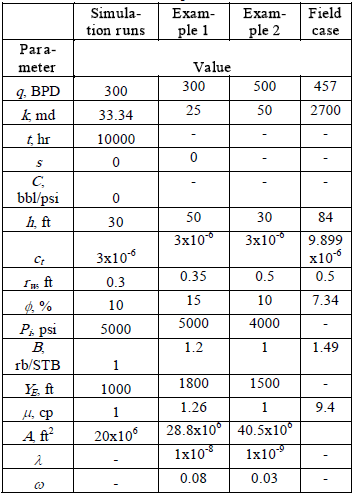
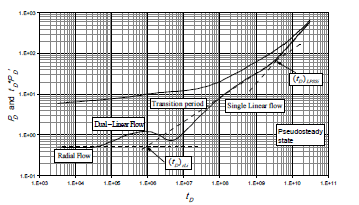
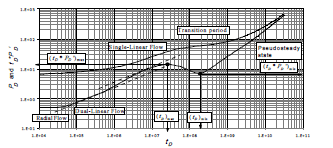
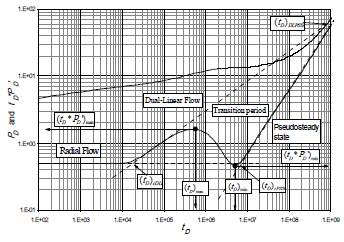
<body><![CDATA[<p><font size="2" face="Verdana, Arial, Helvetica, sans-serif">In the normal case for a heterogeneous formation, as   consider by the double porosity model, the fluid flows from the fracture   network to the well. Upon depletion, the fissures are fed by fluid from the   matrix. This transition period is identified by a deflection of the pressure   derivative curve and possesses a characteristic "V"; shape. In many   cases the transition period occurs during radial flow. In other words, the   radial flow is interrupted by the transition period. </font></p>     <p><font size="2" face="Verdana, Arial, Helvetica, sans-serif">However, there are cases where the transition period   occurs before or after the radial flow regime. For instance, &#91;8&#93; pointed out the   occurrence of the transition period during</font> <font size="2" face="Verdana, Arial, Helvetica, sans-serif">bilinear   and linear flow regime periods in naturally fracture formations intercepted by   a hydraulically fractured well. For these cases, the interporosity flow   parameter, <i>l</i>, is higher than 1x10<sup>-   3</sup>. In other cases, like the one dealt in this paper for   elongated systems, the transition period occurs during the dual-linear flow   regime, of course, later than the radial-flow regime. A modern technique known   as the Tiab's Direct Synthesis technique (<i>TDS</i> technique), &#91;9&#93;   employs the log-log plot of pressure and pressure derivative curves to interpret   pressure buildup and drawdown tests without using type-curve matching by using   analytical equations derived for specific "fingerprints"; found on   the mentioned plot. Because of its simplicity and practicality, this technique is   becoming more popular, and therefore, has been extended here to analyze   pressure behavior in channelized heterogeneous oil formations.</font></p>     <p>&nbsp;</p>     <p><font size="3" face="Verdana, Arial, Helvetica, sans-serif"><b>2. SIMULATION RUNS</b></font></p>     <p><font size="2" face="Verdana, Arial, Helvetica, sans-serif"><a href="#fig01">Fig. 1</a> illustrates the   unique features for a long heterogeneous reservoir drained by a centered well   in the reservoir. <a href="#tab01">Table 1</a> contains the input data used for the simulations. It   is first observed in this plot the occurrence of the radial flow regime. Then,   the dual-linear flow shows up but it is interrupted by the transition period   when fissures are fed by flux from the matrix. Finally, the late pseudosteady   state flow regime is developed. </font></p>     <p align="center"><font size="2" face="Verdana, Arial, Helvetica, sans-serif"><b><a name="fig01"></a><img src="/img/revistas/dyna/v77n163/a11fig01.gif">    <br>   Figure 1.</b> Dimensionless pressure and pressure derivative behavior for an elongated   naturally fractured reservoir for <i>w</i> =   0.05 and <i>l</i> =   2x10<sup>-8</sup> - Well centered in the reservoir</font></p>     <p align="center"><font size="2" face="Verdana, Arial, Helvetica, sans-serif"><b><a name="tab01"></a>Table 1.</b> Data used for   the simulation runs and examples</font>    <br>   <img src="/img/revistas/dyna/v77n163/a11tab01.gif"></p>     <p><font size="2" face="Verdana, Arial, Helvetica, sans-serif">The other scenario considers   the well off-centered inside the reservoir. Two possibilities can be presented,   though. For the first one, the transition occurs before the single-linear flow,   see <a href="#fig04">Fig. 4.</a> It implies that the chronological appearance of flow regimes is:   radial, dual linear, transition period, single linear and pseudosteady state.   The second one involves the interruption of the single-linear period by the   transition period as depicted in <a href="#fig06">Fig. 6</a>. The chronological occurrence of the   flow regimes are: radial, dual-linear, single-linear, transition period and   pseudosteady state. No modeling for the occurrence of the transition period   during pseudosteady state was considered in this study. In real life, it may be   presented in rate-transient analysis. </font></p>     ]]></body>
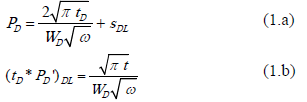
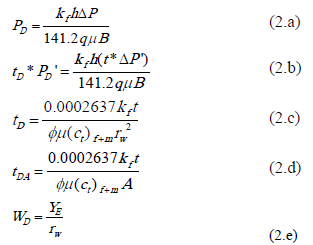
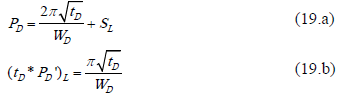
<body><![CDATA[<p align="center"><font size="2" face="Verdana, Arial, Helvetica, sans-serif"><b><a name="fig04"></a><img src="/img/revistas/dyna/v77n163/a11fig04.gif">    <br>   Figure 4.</b> Dimensionless   pressure and pressure derivative behavior for an elongated naturally fractured   reservoir for <i>w</i> = 0.05, <i>l</i> = 1x10<sup>-8</sup> and <i>X<sub>E</sub></i> = 29000   ft - Well   off-centered in the reservoir - Dual-linear flow is interrupted by the   transition</font></p>     <p align="center"><font size="2" face="Verdana, Arial, Helvetica, sans-serif"><b><a name="fig06"></a><img src="/img/revistas/dyna/v77n163/a11fig06.gif">    <br>   Figure 6</b>. Dimensionless pressure and pressure   derivative behavior for an elongated naturally fractured reservoir for <i>w</i> = 0.05, <i>l</i> =   1x10<sup>-9</sup> and <i>X<sub>E</sub></i> = 29000 ft - Well off-centered in the reservoir   - Single-linear flow is interrupted by the transition</font></p>     <p align="center">&nbsp;</p>     <p><font size="3" face="Verdana, Arial, Helvetica, sans-serif"><b>3. MATHEMATICAL MODELING</b></font></p>     <p><font size="2" face="Verdana, Arial, Helvetica, sans-serif">It is assumed that a   constant viscosity and slightly compressible fluid flows in a naturally   fractured formation which matrix and fissures have constant porosity,   permeability and compressibility. The formation is fully penetrated by a   vertical well. The governing equation of pressure and pressure derivative for   dual-linear flow regime in a naturally fractured formation is proposed here as:</font></p>     <p><img src="/img/revistas/dyna/v77n163/a11eq01.gif"></p>     <p><font size="2" face="Verdana, Arial, Helvetica, sans-serif">The dimensionless quantities are defined as:</font></p>     <p><img src="/img/revistas/dyna/v77n163/a11eq02.gif"></p>     ]]></body>
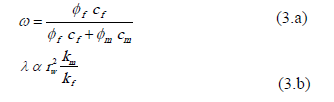
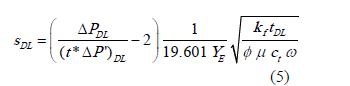
<body><![CDATA[<p><font size="2" face="Verdana, Arial, Helvetica, sans-serif">The naturally   fractured reservoir parameters introduced by &#91;10&#93; were defined by:</font></p>     <p><img src="/img/revistas/dyna/v77n163/a11eq03.gif"></p>     <p><font size="2" face="Verdana, Arial, Helvetica, sans-serif"><b>3.1 Dual-linear flow regimes    <br>   </b>All   the characteristic points and lines are shown in <a href="#fig01">Fig. 1</a> when the well is   centered in the reservoir. For this case single-linear flow does not exist.   After replacing Eqs. 2.b, 2.c and 2.e into   Eq. 1.b, an expression to estimate reservoir width is obtained: </font></p>     <p><font size="2" face="Verdana, Arial, Helvetica, sans-serif"><img src="/img/revistas/dyna/v77n163/a11eq041.gif"></font></p>     <p><font size="2" face="Verdana, Arial, Helvetica, sans-serif">If   the pressure derivative, (<i>t</i>*D<i>P</i>')<i><sub>DL</sub></i> is read at the time, <i>t<sub>DL</sub></i> = 1 hr, Eq. 4.a becomes:</font></p>     <p><img src="/img/revistas/dyna/v77n163/a11eq042.gif"></p>     <p><font size="2" face="Verdana, Arial, Helvetica, sans-serif">The   geometric skin factor caused by the convergence from radial to dual-linear flow   regime is obtained by dividing Eq. 1.a by Eq. 1.b, and then, replacing the   dimensionless parameters, Eqs. 2.a, 2.b, 2.c and 2.6, </font></p>     <p><img src="/img/revistas/dyna/v77n163/a11eq05.gif"></p>     <p><font size="2" face="Verdana, Arial, Helvetica, sans-serif">where D<i>P<sub>DL</sub></i> and (<i>t</i>*D<i>P</i>')<i><sub>DL</sub></i> are   the pressure and pressure derivative points read at any arbitrary time during   dual-linear flow regime, <i>t<sub>DL</sub></i>. <i><font face="Symbol">w</font></i> can be obtained from   any arbitrary point from the dual-linear flow regime on the pressure derivative   curve. After plugging Eqs. 2.b, 2.c and 2. e into Eq. 1.b and solving for <i>w</i>, it yields:</font></p>     ]]></body>

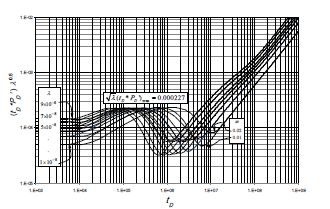
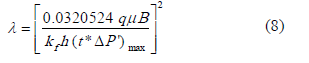
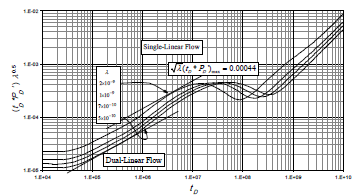
<body><![CDATA[<p><img src="/img/revistas/dyna/v77n163/a11eq06.gif"></p>     <p><font size="2" face="Verdana, Arial, Helvetica, sans-serif"><b>3.2 Maximum point    <br>   </b>The maximum point observed once the dual-linear flow   vanishes is used for estimation of the interporosity flow parameter. It is   observed in <a href="#fig02">Fig. 2</a> that the pressure derivative always displays a unique   maximum pressure derivative value. Then, the following relationship is   obtained:</font></p>     <p><img src="/img/revistas/dyna/v77n163/a11eq07.gif"></p>     <p align="center"><font size="2" face="Verdana, Arial, Helvetica, sans-serif"><b><a name="fig02"></a><img src="/img/revistas/dyna/v77n163/a11fig02.gif">    <br>   Figure 2.</b> Dimensionless   pressure derivative-<i>l</i><sup>0.5</sup> vs.   dimensionless time for a long naturally fractured reservoir with different   interporosity flow parameter values - Well centered in the reservoir</font></p>     <p><font size="2" face="Verdana, Arial, Helvetica, sans-serif">Replacing Eq. 2.b into Eq. 7, an approximation to   estimate <i>l</i> is given below:</font></p>     <p><img src="/img/revistas/dyna/v77n163/a11eq08.gif"></p>     <p><font size="2" face="Verdana, Arial, Helvetica, sans-serif"><b>3.3 Minimum point    <br>   </b></font><font size="2" face="Verdana, Arial, Helvetica, sans-serif"><a href="#fig03">Fig. 3</a> presents the   pressure and pressure derivative behavior for different values of <i>w</i> and <i>l</i> = 2x10<sup>-8</sup>.   We observe that <i>w</i> is function of the minimum   pressure derivative, the time at which this point takes place and the <i>l</i> value. Then, we   correlated these variables to obtain:</font></p>     ]]></body>
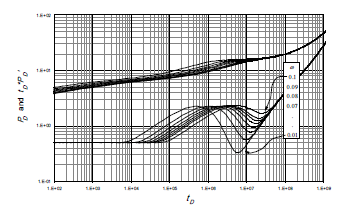
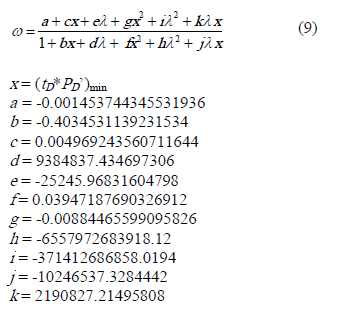
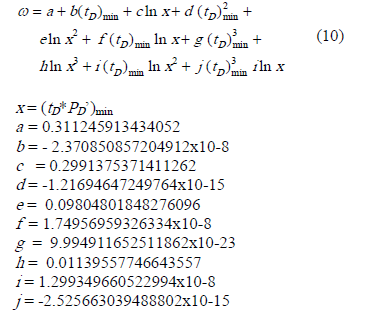
<body><![CDATA[<p align="center"><font size="2" face="Verdana, Arial, Helvetica, sans-serif"><b><a name="fig03"></a><img src="/img/revistas/dyna/v77n163/a11fig03.gif">    <br>   Figure 3.</b> Effect of the dimensionless storativity coefficient, <i>w</i>, on the pressure and pressure derivative for <i>l</i> = 2x10<sup>-8</sup> - Well centered in the reservoir</font></p>     <p><font size="2" face="Verdana, Arial, Helvetica, sans-serif">Correlation 1:</font></p>     <p><img src="/img/revistas/dyna/v77n163/a11eq09.gif"></p>     <p><font size="2" face="Verdana, Arial, Helvetica, sans-serif">This correlation is   recommended since has an error of 0.12 %.</font></p>     <p><font size="2" face="Verdana, Arial, Helvetica, sans-serif">Correlation 2: </font></p>     <p><img src="/img/revistas/dyna/v77n163/a11eq10.gif"></p>     <p><font size="2" face="Verdana, Arial, Helvetica, sans-serif">This correlation has   an error of 0.396 %.</font></p>     <p><font size="2" face="Verdana, Arial, Helvetica, sans-serif"><b>3.4. Intersection points    <br>   </b></font><font size="2" face="Verdana, Arial, Helvetica, sans-serif">The pressure   derivative during late pseudosteady state flow regime is governed by:</font></p>     ]]></body>
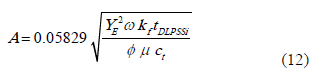
<body><![CDATA[<p><img src="/img/revistas/dyna/v77n163/a11eq11.gif"></p>     <p><font size="2" face="Verdana, Arial, Helvetica, sans-serif">The intersection of   this line with the dual-linear flow regime pressure derivative line, Eq. 1.b,   allows us to obtain an expression to estimate reservoir area once the   dimensionless quantities are replaced:</font></p>     <p><img src="/img/revistas/dyna/v77n163/a11eq12.gif"></p>     <p><font size="2" face="Verdana, Arial, Helvetica, sans-serif">The intercept of the   radial flow line with the dual-linear flow line leads to confirm:</font></p>     <p><img src="/img/revistas/dyna/v77n163/a11eq13.gif"></p>     <p><font size="2" face="Verdana, Arial, Helvetica, sans-serif">Replacing Eqs. 2.b,   2.c and 2.e in the above equations and solving for reservoir with, we obtain:</font></p>     <p><img src="/img/revistas/dyna/v77n163/a11eq14.gif"></p>     <p><font size="2" face="Verdana, Arial, Helvetica, sans-serif"><b>3.5. Early   Pseudosteady State and Radial Flow Regime</b>    <br>   </font><font size="2" face="Verdana, Arial, Helvetica, sans-serif">Reference &#91;9&#93; presented the following relationship   for the estimation of the wellbore storage coefficient,</font></p>     <p><img src="/img/revistas/dyna/v77n163/a11eq15.gif"></p>     ]]></body>
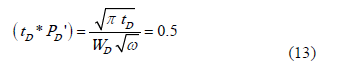
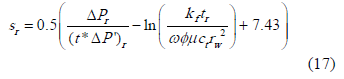
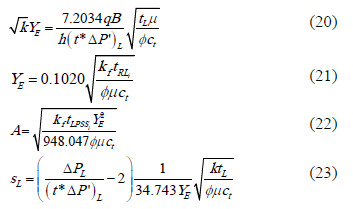
<body><![CDATA[<p><font size="2" face="Verdana, Arial, Helvetica, sans-serif">Engler and Tiab (1996) presented the relationships for estimation of   the permeability and mechanical skin factor as:</font></p>     <p><img src="/img/revistas/dyna/v77n163/a11eq16.gif"></p>     <p><font size="2" face="Verdana, Arial, Helvetica, sans-serif">The mechanical skin   factor is estimated from:</font></p>     <p><img src="/img/revistas/dyna/v77n163/a11eq17.gif"></p>     <p><font size="2" face="Verdana, Arial, Helvetica, sans-serif">Reference &#91;1&#93; also shown that the intercept between the radial flow and   the pseudosteady state lines leads to an equation to estimate reservoir area:</font></p>     <p><img src="/img/revistas/dyna/v77n163/a11eq18.gif"></p>     <p><font size="2" face="Verdana, Arial, Helvetica, sans-serif"><b>3.6 Linear-flow regime occurs   after the transition period    <br>   </b></font><font size="2" face="Verdana, Arial, Helvetica, sans-serif">Before   the transition period the reservoir behaves as homogeneous; then, it appears   the single-linear flow regime which governing equations for pressure and   pressure derivative presented by reference &#91;1&#93;:</font></p>     <p><img src="/img/revistas/dyna/v77n163/a11eq19.gif"></p>     <p><font size="2" face="Verdana, Arial, Helvetica, sans-serif">The intersection points of the   different flow regime lines are shown in <a href="#fig05">Fig. 5</a>. The equations for reservoir   width, reservoir area and linear flow skin factors are obtained in a similar   way as for the dual-linear case:</font></p>     ]]></body>
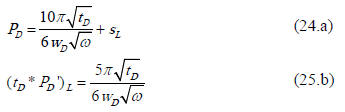
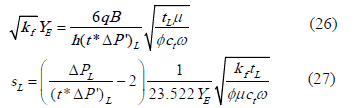
<body><![CDATA[<p><img src="/img/revistas/dyna/v77n163/a11eq2023.gif"></p>     <p align="center"><font size="2" face="Verdana, Arial, Helvetica, sans-serif"><b><a name="fig05"></a><img src="/img/revistas/dyna/v77n163/a11fig05.gif">    <br>   Figure 5.</b> Dimensionless pressure derivative-<i>l</i><sup>0.5</sup> vs.   dimensionless time for a naturally fractured reservoir with different   interporosity flow parameter values and <i>w</i> = 0.05 - - Well off-centered in the reservoir</font></p>     <p><font size="2" face="Verdana, Arial, Helvetica, sans-serif"><b>3.7 Linear-flow regime occurs before   the transition period    <br>   </b>This case, sketched in <a href="#fig06">Fig. 6</a>, has the following governing equations:</font></p>     <p><img src="/img/revistas/dyna/v77n163/a11eq24.gif"></p>     <p><font size="2" face="Verdana, Arial, Helvetica, sans-serif">Following a procedure similar to   that in section </font><font size="2" face="Verdana, Arial, Helvetica, sans-serif">3.1 the following equations are   obtained:</font></p>     <p><img src="/img/revistas/dyna/v77n163/a11eq2627.gif"></p>     <p align="center">&nbsp;</p>     <p><img src="/img/revistas/dyna/v77n163/a11eq2830.gif"></p>     ]]></body>
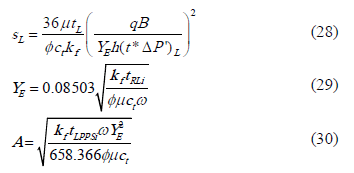
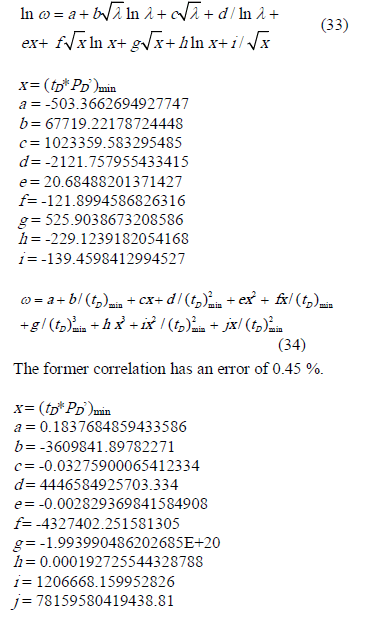
<body><![CDATA[<p><font size="2" face="Verdana, Arial, Helvetica, sans-serif">As   shown in <a href="#fig06">Fig. 6</a>, the maximum point   presented once the single-linear flow has been interrupted by the transition   period results to be useful for the estimation the interporosity flow   parameter. It is observed in <a href="#fig02">Fig. 2</a> that the pressure derivative always   displays a unique maximum pressure derivative value. Then, the following   relationship is obtained:</font></p>     <p><img src="/img/revistas/dyna/v77n163/a11eq31.gif"></p>     <p><font size="2" face="Verdana, Arial, Helvetica, sans-serif">Replacing Eq. 2.b into Eq. 31, an approximation to estimate l is given below:</font></p>     <p><img src="/img/revistas/dyna/v77n163/a11eq32.gif"></p>     <p><font size="2" face="Verdana, Arial, Helvetica, sans-serif">For this case, there is a need of estimating <i>w</i> from correlations. The following correlation has   an error of 0.085 %.</font></p>     <p><img src="/img/revistas/dyna/v77n163/a11eq3334.gif"></p>     <p><font size="2" face="Verdana, Arial, Helvetica, sans-serif">Needless to say that the total skin factor is estimated as the   summation of the mechanical and geometric skin factors, such as:</font></p>     <p><img src="/img/revistas/dyna/v77n163/a11eq35.gif"></p>     <p><font size="2" face="Verdana, Arial, Helvetica, sans-serif"><b>3.8. Unit-Slope Lines During the Transition   Period    <br>   </b></font><font size="2" face="Verdana, Arial, Helvetica, sans-serif">When the transition period takes place during   the dual-linear flow regime, the fissures are fed by the matrix under   pseudosteady state flow regime according to the model proposed in reference   &#91;10&#93;. The expression governing this is given by:</font></p>     ]]></body>
<body><![CDATA[<p><img src="/img/revistas/dyna/v77n163/a11eq36.gif"></p>     <p><font size="2" face="Verdana, Arial, Helvetica, sans-serif">The former expression has a standard error of   0.707 % and a correlation coefficient of 0.99997 and should be used for   dimensionless time values between 300000 and 3.69x10<sup>7</sup>. The   coefficients are:</font></p>     <p><img src="/img/revistas/dyna/v77n163/a11eq361.gif"></p>     <p><font size="2" face="Verdana, Arial, Helvetica, sans-serif">As expressed by &#91;11&#93;, during radial flow   regime, the pressure derivative is governed by:</font></p>     <p><img src="/img/revistas/dyna/v77n163/a11eq37.gif"></p>     <p><font size="2" face="Verdana, Arial, Helvetica, sans-serif">At the intersection point between   the radial flow regime and the unit-slope line formed during the transition   period an expression to estimate <i>l</i> is obtained:</font></p>     <p><img src="/img/revistas/dyna/v77n163/a11eq38.gif"></p>     <p><font size="2" face="Verdana, Arial, Helvetica, sans-serif">When the transition occurs place after the   single-linear flow regime is perfectly seen, the governing expression for the   unit-slope transition line is also given by Eq. 36, which possesses a correlation   coefficient of 0.99956 and should be used for dimensionless time values less   than 4x10<sup>7</sup>. The coefficients are now:</font></p>     <p><img src="/img/revistas/dyna/v77n163/a11eq381.gif"></p>     <p>&nbsp;</p>     ]]></body>
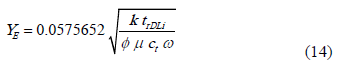
<body><![CDATA[<p><font size="3" face="Verdana, Arial, Helvetica, sans-serif"><b>4. STEP-BY-STEP PROCEDURES</b></font></p>     <p><font size="2" face="Verdana, Arial, Helvetica, sans-serif"><b>4.1 Case 1 - transition occurs during the dual-linear   flow period </b></font></p>     <p><font size="2" face="Verdana, Arial, Helvetica, sans-serif">Step 1<b> - </b>Build a log-log plot of pressure   and pressure derivative, identify and draw the early pseudosteady-state (if   present), radial, dual-linear, single-linear (if exists) and late   pseudosteady-state lines.</font></p>     <p><font size="2" face="Verdana, Arial, Helvetica, sans-serif">Step 2<b> - </b>If the early-unit slope line exists, indicating wellbore   storage, read any convenient point, <i>t<sub>i</sub> </i>and either D<i>P<sub>i</sub></i> or (<i>t*</i>D<i>P</i>')<i><sub>i</sub></i>, and find the wellbore   storage coefficient with Eq. 15. Read the value of the pressure derivative   during radial flow, (<i>t*</i>D<i>P</i>')<i><sub>r</sub></i><sub>,</sub> and calculate the bulk permeability using Eq. 16. </font></p>     <p><font size="2" face="Verdana, Arial, Helvetica, sans-serif">Step 3 - Find <i>l</i> with Eq. 8 using the   maximum point derivative during the transition period.</font></p>     <p><font size="2" face="Verdana, Arial, Helvetica, sans-serif">Step 4 - If the linear or single-linear flow   regime is observed, read the pressure and pressure derivative values, D<i>P<sub>L</sub></i> and (<i>t*</i>D<i>P</i>')<i><sub>L</sub></i>, at any convenient point on   the linear flow regime, <i>t<sub>L</sub></i>, and find reservoir width, <i>Y<sub>E</sub></i>,   using Eq. 20 and 21, and single-linear skin factor with Eq. 23. Otherwise   estimate <i>w</i> with correlations 9 and/or 10 using the coordinates of minimum point,</font></p>     <p><font size="2" face="Verdana, Arial, Helvetica, sans-serif">Step 5 - If the   single-linear flow regime is observed, read the intercepts of this line with   the radial flow, <i>t<sub>rLi</sub></i> and the pseudosteady state, <i>t<sub>LPPSi</sub></i>,   lines. Find reservoir area with Eq. 22 and reservoir width with Eq. 21.</font></p>     <p><font size="2" face="Verdana, Arial, Helvetica, sans-serif">Step 6 - Read the pressure and pressure derivative   values, D<i>P<sub>DL</sub></i> and (<i>t*</i>D<i>P</i>')<i><sub>DL</sub></i>, at any convenient point   on the dual-linear flow regime, <i>t<sub>DL</sub></i>, and find <i>w</i> using Eq. 6. Alternatively,   either <i>Y<sub>E</sub></i> or <i>w</i> can be estimated with Eqs. 4.a or   14. Other values of <i>w</i> may be estimated from the correlations   given by Eqs. 9 and 10. For this purpose the coordinates of the minimum point, <i>t<sub>min</sub></i> and (<i>t*</i>D<i>P</i>')<sub>min</sub>, during the transition period have to be used. An average value   of <i>w</i> may be obtained.</font></p>     <p><font size="2" face="Verdana, Arial, Helvetica, sans-serif">Step 7 - Find the geometric skin factor, <i>s<sub>DL</sub></i> using Eq. 5 and compute reservoir width using Eq. 14. Read the point of   intersection of the radial and dual-linear flow lines, <i>t<sub>rDLi</sub></i>,   and re-estimate reservoir width with Eqs. 4.a and 14.</font></p>     <p><font size="2" face="Verdana, Arial, Helvetica, sans-serif">Step 8 - Read the intersection point   between the late pseudosteady state line with the dual-linear, <i>t<sub>DLPPSi</sub></i>,   and radial, <i>t<sub>rPSSi</sub></i>, lines. Calculate reservoir area with Eqs.   12 and 18.</font></p>     ]]></body>
<body><![CDATA[<p><font size="2" face="Verdana, Arial, Helvetica, sans-serif">Step 9 - Read the intersection point   between the pseudosteady state transition line with the radial line, <i>t<sub>US,i</sub></i>,   and estimate the interporosity flow parameter with Eq. 38.</font></p>     <p><font size="2" face="Verdana, Arial, Helvetica, sans-serif">Step 10 - Estimate the total skin factor   with Eq. 35.</font></p>     <p><font size="2" face="Verdana, Arial, Helvetica, sans-serif"><b>4.2 Case 2 - linear-flow regime occurs   before the transition period</b></font></p>     <p><font size="2" face="Verdana, Arial, Helvetica, sans-serif">Step 1 - 2 - Same as case 1.</font></p>     <p><font size="2" face="Verdana, Arial, Helvetica, sans-serif">Step 3 - Find <i>l</i> with Eq. 8 using the   maximum point derivative during the transition period.</font></p>     <p><font size="2" face="Verdana, Arial, Helvetica, sans-serif">Step 4 - Estimate <i>w</i> with correlations 33   and 34. Read the pressure and pressure derivative values, D<i>P<sub>L</sub></i> and (<i>t*</i>D<i>P</i>')<i><sub>L</sub></i>, at any convenient point on   the linear flow regime, <i>t<sub>L</sub></i>, and find <i>w</i> from Eq. 28. This new   value may be averaged with the value obtained from the dual-linear flow. Then,   find reservoir width, <i>Y<sub>E</sub></i>, using Eq. 26, and single-linear   skin factor with Eq. 27.</font></p>     <p><font size="2" face="Verdana, Arial, Helvetica, sans-serif">Step 5 - Read the intercepts of this line with   the radial flow, <i>t<sub>rLi</sub></i> and the pseudosteady state, <i>t<sub>LPPSi</sub></i>,   lines. Find reservoir area with Eq. 29 and reservoir width with Eq. 30.</font></p>     <p><font size="2" face="Verdana, Arial, Helvetica, sans-serif">Step 6 - Read the pressure and pressure derivative   values, D<i>P<sub>DL</sub></i> and (<i>t*</i>D<i>P</i>')<i><sub>DL</sub></i>, at any convenient point   on the dual-linear flow regime, <i>t<sub>DL</sub></i>, and find <i>w</i> using Eq. 6.   Alternatively, either <i>Y<sub>E</sub></i> or <i>w</i> can be estimated with   Eqs. 4.a or 14. </font></p>     <p><font size="2" face="Verdana, Arial, Helvetica, sans-serif">Step 7 - Find the geometric skin factor, <i>s<sub>DL</sub></i> using Eq. 5 and compute reservoir width using Eq. 14. Read the point of   intersection of the radial and dual-linear flow lines, <i>t<sub>rDLi</sub></i>,   and re-estimate reservoir width with Eqs. 4.a and 14.</font></p>     <p><font size="2" face="Verdana, Arial, Helvetica, sans-serif">Step 8 - Read the points of intersection of   the single-linear flow line with the radial flow, <i>t<sub>rLi</sub></i> and   the pseudosteady state, <i>t<sub>LPPSi</sub></i>, lines. Find reservoir width   using Eq. 29 and reservoir area with Eq. 30.</font></p>     ]]></body>
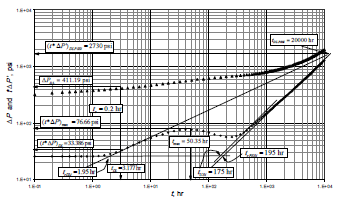
<body><![CDATA[<p><font size="2" face="Verdana, Arial, Helvetica, sans-serif">Step 9 - 10<b> - </b>Same as steps 9 and 10 of case 1.</font></p>     <p>&nbsp;</p>     <p><font size="3" face="Verdana, Arial, Helvetica, sans-serif"><b>5. EXAMPLES </b></font></p>     <p><font size="2" face="Verdana, Arial, Helvetica, sans-serif"><b>5.1 Synthetic example 1    <br>   </b>The   log-log plot of pressure and pressure derivative for an example generated with   information from <a href="#tab01">table 1</a> is given in <a href="#fig07">Fig. 7</a>. Characterize this hypothetic   reservoir using the methodology presented here.</font></p>     <p align="center"><font size="2" face="Verdana, Arial, Helvetica, sans-serif"><b><a name="fig07"></a><img src="/img/revistas/dyna/v77n163/a11fig07.gif">    <br>   Figure   7.</b> Pressure and pressure derivative plot for synthetic example 1 </font></p>     <p><font size="2" face="Verdana, Arial, Helvetica, sans-serif"><b>Solution    <br>   </b>From <a href="#fig07">Fig. 7</a>, the following data were read:</font></p>     <p><font size="2" face="Verdana, Arial, Helvetica, sans-serif">(<i>t</i>*<font face="Symbol">D</font><i>P</i>')<i><sub>r</sub></i> = 25.556 psi <font face="Symbol">D</font><i>P<sub>r</sub></i> =   337.556 psi    ]]></body>
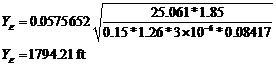
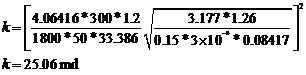
<body><![CDATA[<br>   <i>t<sub>r</sub></i> =   0.2 hr <i>t<sub>rDLi </sub></i>=   1.85 hr    <br>   (<i>t</i>*<font face="Symbol">D</font><i>P</i>')<i><sub>DL</sub></i> = 33.386 psi <font face="Symbol">D</font><i>P<sub>DL</sub></i> =   411.1960 psi    <br>   <i>t<sub>DL</sub></i> = 3.177 hr <i>t<sub>DLPSSi</sub></i> = 20000   hr    <br>   (<i>t</i>*<font face="Symbol">D</font><i>P</i>')<i><sub>max</sub></i> = 76.66 psi <i>t<sub>rPSSi </sub></i>=   195 hr    <br>   <i>t<sub>US,i</sub></i> =175 hr</font></p>     <p><font size="2" face="Verdana, Arial, Helvetica, sans-serif">Permeability   is estimated from Eq. 16:</font></p>     <p> <font size="2" face="Verdana, Arial, Helvetica, sans-serif"><img src="/img/revistas/dyna/v77n163/a11eq002.gif"> </font></p>     <p><font size="2" face="Verdana, Arial, Helvetica, sans-serif">The   dimensionless storativity coefficient is estimated with Eq. 6, </font></p>     <p> <font size="2" face="Verdana, Arial, Helvetica, sans-serif"><img src="/img/revistas/dyna/v77n163/a11eq004.gif"> </font></p>     <p><font size="2" face="Verdana, Arial, Helvetica, sans-serif">Reservoir   width is estimated from the intersection of the radial line with the   dual-linear line, using Eq. 14,</font></p>     ]]></body>
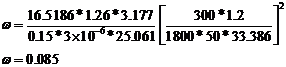
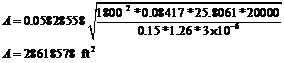
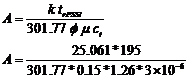
<body><![CDATA[<p> <font size="2" face="Verdana, Arial, Helvetica, sans-serif"><img src="/img/revistas/dyna/v77n163/a11eq006.gif"> </font></p>     <p><font size="2" face="Verdana, Arial, Helvetica, sans-serif">Reservoir   drainage area is estimated with Eqs. 12 and 18,</font></p>     <p> <font size="2" face="Verdana, Arial, Helvetica, sans-serif"><img src="/img/revistas/dyna/v77n163/a11eq008.gif"> </font></p>     <p> <font size="2" face="Verdana, Arial, Helvetica, sans-serif"><img src="/img/revistas/dyna/v77n163/a11eq010.gif"> </font></p>     <p> <font size="2" face="Verdana, Arial, Helvetica, sans-serif"><img src="/img/revistas/dyna/v77n163/a11eq012.gif"> </font></p>     <p><font size="2" face="Verdana, Arial, Helvetica, sans-serif">The   interporosity flow parameter, <font face="Symbol">l</font>, is approximated with Eq. 8, so that:</font></p>     <p> <font size="2" face="Verdana, Arial, Helvetica, sans-serif"><img src="/img/revistas/dyna/v77n163/a11eq014.gif"> </font></p>     <p><font size="2" face="Verdana, Arial, Helvetica, sans-serif">Permeability   is verified from Eq. 4.b (Note: Reservoir width may be verified instead):</font></p>     <p> <font size="2" face="Verdana, Arial, Helvetica, sans-serif"><img src="/img/revistas/dyna/v77n163/a11eq016.gif"> </font></p>     <p><font size="2" face="Verdana, Arial, Helvetica, sans-serif">The   dimensionless time at the point of intercept between the radial-flow line and   unit-slope transition line is determined with Eq. 2.c as:</font></p>     ]]></body>
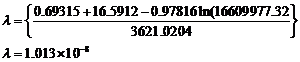
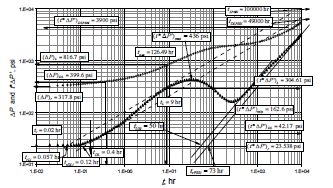
<body><![CDATA[<p> <font size="2" face="Verdana, Arial, Helvetica, sans-serif"><img src="/img/revistas/dyna/v77n163/a11eq018.gif"> </font></p>     <p><font size="2" face="Verdana, Arial, Helvetica, sans-serif">The   interporosity flow parameter can be estimated from Eq. 38,</font></p>     <p> <font size="2" face="Verdana, Arial, Helvetica, sans-serif"><img src="/img/revistas/dyna/v77n163/a11eq022.gif"> </font></p>     <p><font size="2" face="Verdana, Arial, Helvetica, sans-serif">The   mechanical, geometric and total skin factors are calculated with Eqs. 17, 5 and   35, respectively,</font></p>     <p> <font size="2" face="Verdana, Arial, Helvetica, sans-serif"><img src="/img/revistas/dyna/v77n163/a11eq024.gif"> <img src="/img/revistas/dyna/v77n163/a11eq026.gif"> <img src="/img/revistas/dyna/v77n163/a11eq028.gif"> </font></p>     <p><font size="2" face="Verdana, Arial, Helvetica, sans-serif">From this example we can affirm that the proposed   equations are correct since the simulated data agree quite well with the   results of this exercise.</font></p>     <p><font size="2" face="Verdana, Arial, Helvetica, sans-serif"><b>4.2 Synthetic example 2    <br>   </b>A synthetic pressure   test for a well off-centered in a reservoir was also generated with information   from <a href="#tab01">table 1</a>. The pressure and pressure derivative plot is provided in <a href="#fig08">Fig. 8</a>.   It is required to estimate permeability, skin factors, reservoir width and area   and the naturally fractured reservoir parameters.</font></p>     <p align="center"><font size="2" face="Verdana, Arial, Helvetica, sans-serif"><b><a name="fig08"></a><img src="/img/revistas/dyna/v77n163/a11fig08.gif">    <br>   Figure   8.</b> Pressure and pressure derivative plot for synthetic example 2 </font></p>     ]]></body>
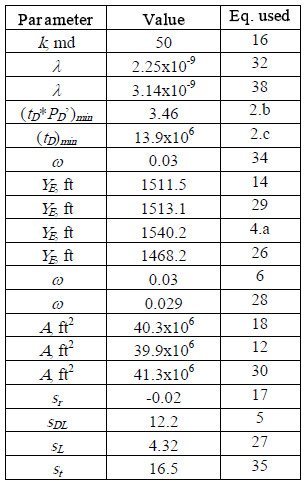
<body><![CDATA[<p><font size="2" face="Verdana, Arial, Helvetica, sans-serif"><b>Solution    <br>   </b>From <a href="#fig08">Fig. 8</a>, the following data were read:</font></p>     <p><font size="2" face="Verdana, Arial, Helvetica, sans-serif">(<i>t</i>*<font face="Symbol">D</font><i>P</i>')<i><sub>r</sub></i> = 23.538 psi <font face="Symbol">D</font><i>P<sub>r</sub></i> = 317.8   psi    <br>   </font><font size="2" face="Verdana, Arial, Helvetica, sans-serif"><i>t<sub>r</sub></i> = 0.1   hr <i>t<sub>rDLi </sub></i>=   0.12 hr    <br>   </font><font size="2" face="Verdana, Arial, Helvetica, sans-serif">(<i>t</i>*<font face="Symbol">D</font><i>P</i>')<i><sub>DL</sub></i> = 42.17 psi <font face="Symbol">D</font><i>P<sub>DL</sub></i> = 399.6   psi    <br>   </font><font size="2" face="Verdana, Arial, Helvetica, sans-serif"><i>t<sub>DL</sub></i> = 0.4 hr <i>t<sub>DLPSSi</sub></i> = 43000   hr    <br>   </font><font size="2" face="Verdana, Arial, Helvetica, sans-serif">(<i>t</i>*<font face="Symbol">D</font><i>P</i>')<i><sub>max</sub></i> = 436 psi <i>t<sub>L</sub></i> = 9   hr    <br>   </font><font size="2" face="Verdana, Arial, Helvetica, sans-serif">(<i>t</i>*<font face="Symbol">D</font><i>P</i>')<i><sub>L</sub></i> = 304.61 psi <font face="Symbol">D</font><i>P<sub>L</sub></i> =   816.7 psi    <br>   </font><font size="2" face="Verdana, Arial, Helvetica, sans-serif"><i>t<sub>rPSSi </sub></i>= 73 hr (<i>t</i>*<font face="Symbol">D</font><i>P</i>')<i><sub>min</sub></i> = 162.7 psi    <br>   </font><font size="2" face="Verdana, Arial, Helvetica, sans-serif"><i>t<sub>rLi </sub></i>= 0.057 hr <i>t<sub>LPSSi</sub></i> = 100000 hr    ]]></body>
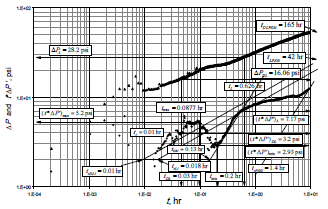
<body><![CDATA[<br>   </font><font size="2" face="Verdana, Arial, Helvetica, sans-serif"><i>t<sub>US,i</sub></i> =50 hr</font></p>     <p><font size="2" face="Verdana, Arial, Helvetica, sans-serif">All the computations are summarized as follows:</font></p>     <p align="center"><img src="/img/revistas/dyna/v77n163/a11tab011.gif"></p>     <p><font size="2" face="Verdana, Arial, Helvetica, sans-serif"><b>4.3 Field example    <br>   </b>This example was taken   from a pressure test run in a South American well. Reservoir, fluid and well   parameters are provided in <a href="#tab01">table 1</a> and the pressure and pressure derivative   plot is provided in <a href="#fig09">Fig.   9</a>. A   reservoir permeability of 2700 md was obtained from a previous test. Find   reservoir width, reservoir area, skin factor, interporosity flow parameter and   the dimensionless storativity coefficient.</font></p>     <p align="center"><font size="2" face="Verdana, Arial, Helvetica, sans-serif"><b><a name="fig09"></a><img src="/img/revistas/dyna/v77n163/a11fig09.gif">    <br>   Figure   9.</b> Pressure and pressure derivative plot for field case example</font></p>     <p><font size="2" face="Verdana, Arial, Helvetica, sans-serif"><b>Solution    <br>   </b>The   dual-linear flow is very noisy. The following data were read from <a href="#fig09">Fig. 9</a>, </font></p>     <p><font size="2" face="Verdana, Arial, Helvetica, sans-serif">(<i>t</i>*<font face="Symbol">D</font><i>P</i>')<i><sub>r</sub></i> = 1.99   psi <font face="Symbol">D</font><i>P</i>'<i><sub>r</sub></i> = 11.98 psi     ]]></body>
<body><![CDATA[<br>   </font><font size="2" face="Verdana, Arial, Helvetica, sans-serif"><i>t<sub>r</sub></i> = 0.01 hr <i>t<sub>rDLi </sub></i>= 0.01   hr    <br>   </font><font size="2" face="Verdana, Arial, Helvetica, sans-serif">(<i>t</i>*<font face="Symbol">D</font><i>P</i>')<i><sub>DL</sub></i> = 3.2 psi <font face="Symbol">D</font><i>P<sub>DL</sub></i> = 16.06 psi    <br>   </font><font size="2" face="Verdana, Arial, Helvetica, sans-serif"><i>t<sub>DL</sub></i> = 0.03 hr (<i>t</i>*<font face="Symbol">D</font><i>P</i>')<i><sub>max</sub></i> = 5.2 psi    <br>   </font><font size="2" face="Verdana, Arial, Helvetica, sans-serif"><font face="Symbol">D</font><i>P<sub>L</sub></i> = 28.2 psi <i>t<sub>L</sub></i> = 0.626 hr    <br>   </font><font size="2" face="Verdana, Arial, Helvetica, sans-serif">(<i>t</i>*<font face="Symbol">D</font><i>P</i>')<i><sub>L</sub></i> = 7.17 psi <i>t<sub>rDLi </sub></i>=   0.018 hr    <br>   </font><font size="2" face="Verdana, Arial, Helvetica, sans-serif">(<i>t</i>*<font face="Symbol">D</font><i>P</i>')<i><sub>min</sub></i> = 2.93 psi <i>t<sub>min</sub></i> = 0.2   psi    <br>   </font><font size="2" face="Verdana, Arial, Helvetica, sans-serif"><i>t<sub>DLPSSi</sub></i> = 165 hr <i>t<sub>LPSSi</sub></i> = 42 hr    <br>   </font><font size="2" face="Verdana, Arial, Helvetica, sans-serif"><i>t<sub>rPSSi</sub></i> = 1.4 hr <i>t<sub>USi</sub></i> = 0.13 hr    <br>   </font><font size="2" face="Verdana, Arial, Helvetica, sans-serif"><i>t<sub>max</sub></i> = 0.0877 psi</font></p>     <p><font size="2" face="Verdana, Arial, Helvetica, sans-serif">The   minimum dimensionless parameters are estimated from Eq. 2.b and 2.c:</font></p>     ]]></body>
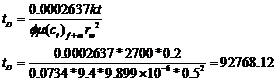
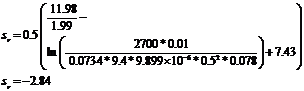
<body><![CDATA[<p> <font size="2" face="Verdana, Arial, Helvetica, sans-serif"><img src="/img/revistas/dyna/v77n163/a11eq030.gif"> </font></p>     <p> <font size="2" face="Verdana, Arial, Helvetica, sans-serif"><img src="/img/revistas/dyna/v77n163/a11eq032.gif"> </font></p>     <p><font size="2" face="Verdana, Arial, Helvetica, sans-serif">Using   these dimensionless values in correlation 9, w = 0.056. The reservoir   width is estimated with Eq. 20, </font></p>     <p> <font size="2" face="Verdana, Arial, Helvetica, sans-serif"><img src="/img/revistas/dyna/v77n163/a11eq034.gif"> </font></p>     <p><font size="2" face="Verdana, Arial, Helvetica, sans-serif"><i>w</i> is   estimated with Eq. 4.a, 6 and 14, </font></p>     <p> <font size="2" face="Verdana, Arial, Helvetica, sans-serif"><img src="/img/revistas/dyna/v77n163/a11eq036.gif"> </font></p>     <p> <font size="2" face="Verdana, Arial, Helvetica, sans-serif"><img src="/img/revistas/dyna/v77n163/a11eq038.gif"> </font></p>     <p> <font size="2" face="Verdana, Arial, Helvetica, sans-serif"><img src="/img/revistas/dyna/v77n163/a11eq040.gif"> </font></p>     <p><font size="2" face="Verdana, Arial, Helvetica, sans-serif">The value of <i>w</i> from correlation 9 is close   to the ones found from the analytical equations. The interporosity flow   parameter, <font face="Symbol">l</font>, is approximated with Eq. 8, so that: </font></p>     <p> <font size="2" face="Verdana, Arial, Helvetica, sans-serif"><img src="/img/revistas/dyna/v77n163/a11eq0421.gif"> </font></p>     ]]></body>



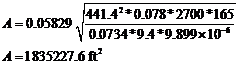
<body><![CDATA[<p><font size="2" face="Verdana, Arial, Helvetica, sans-serif">The   dimensionless time at the point of intercept between the radial-flow line and   unit-slope transition line is determined with Eq. 2.c as:</font></p>     <p> <font size="2" face="Verdana, Arial, Helvetica, sans-serif"><img src="/img/revistas/dyna/v77n163/a11eq044.gif"> </font></p>     <p><font size="2" face="Verdana, Arial, Helvetica, sans-serif">Eq.   38 should not be used since the dimensionless time is less than 500000.   Reservoir area is estimated by Eqs. 12, 18 and 22, as follows:</font></p>     <p> <font size="2" face="Verdana, Arial, Helvetica, sans-serif"><img src="/img/revistas/dyna/v77n163/a11eq046.gif"> </font></p>     <p> <font size="2" face="Verdana, Arial, Helvetica, sans-serif"><img src="/img/revistas/dyna/v77n163/a11eq050.gif"> </font></p>     <p> <font size="2" face="Verdana, Arial, Helvetica, sans-serif"><img src="/img/revistas/dyna/v77n163/a11eq052.gif"> </font></p>     <p> <font size="2" face="Verdana, Arial, Helvetica, sans-serif"><img src="/img/revistas/dyna/v77n163/a11eq054.gif"> </font></p>     <p> <font size="2" face="Verdana, Arial, Helvetica, sans-serif"><img src="/img/revistas/dyna/v77n163/a11eq056.gif"> </font></p>     <p><font size="2" face="Verdana, Arial, Helvetica, sans-serif">The   skin factors are estimated with Eqs. 17, 5, 23 and 35, respectively,</font></p>     <p> <font size="2" face="Verdana, Arial, Helvetica, sans-serif"><img src="/img/revistas/dyna/v77n163/a11eq058.gif"> </font></p>     ]]></body>
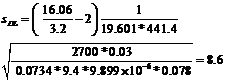
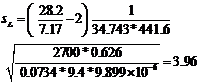
<body><![CDATA[<p> <font size="2" face="Verdana, Arial, Helvetica, sans-serif"><img src="/img/revistas/dyna/v77n163/a11eq060.gif"> </font></p>     <p> <font size="2" face="Verdana, Arial, Helvetica, sans-serif"><img src="/img/revistas/dyna/v77n163/a11eq062.gif"> </font></p>     <p> <font size="2" face="Verdana, Arial, Helvetica, sans-serif"><img src="/img/revistas/dyna/v77n163/a11eq064.gif"></font> </p>     <p>&nbsp;</p>     <p><font size="3" face="Verdana, Arial, Helvetica, sans-serif"><b>5. COMMENTS ON THE RESULTS</b></font></p>     <p><font size="2" face="Verdana, Arial, Helvetica, sans-serif">The   synthetic examples are shown to verify the proposed equations. A good agreement   is observed between the input data with the resulted values. Needless to say   the several of the parameters are obtained from more than one source giving   more strength to the results. The naturally fractured parameters, <i>l</i> and <i>w</i>, are very sensitive.   It is customary accepted to have one order of magnitude in error for the   interporosity flow parameter when comparing to other methods, and even with the   same <i>TDS</i> technique. However, for this case the results are very close.</font></p>     <p>&nbsp;</p>     <p><font size="3" face="Verdana, Arial, Helvetica, sans-serif"><b>6. CONCLUSION </b></font> </p>     <p><font size="2" face="Verdana, Arial, Helvetica, sans-serif">New   equations for interpretation of pressure and pressure derivative data are   introduced for naturally fractured formations when the transition period due to   the depletion in the fissures occurs during either dual-linear or single-linear   flow regimes. Also, correlations for estimation the interporosity flow   parameter was introduced when the dual-linear flow is interrupted by the   mentioned transition. The validity of the equations was carried out by   successfully comparing with simulated results.</font></p>     <p>&nbsp;</p>     ]]></body>
<body><![CDATA[<p><font size="3" face="Verdana, Arial, Helvetica, sans-serif"><b>7. RECOMMENDATIONS</b></font></p>     <p><font size="2" face="Verdana, Arial, Helvetica, sans-serif">This   work can be extended for the case when the transition period occurs during the   late pseudosteady state flow regime which may be present when dealing with rate   transient analysis. We also recommend correlating the minimum to obtain   expressions similar to Eqs. 9 and 10. Also, the governing equation for the   pseudosteady state flow during the transition may be generated so more   equations to determine the naturally fracture reservoir parameters can be   introduced.</font></p>     <p>&nbsp;</p> <font size="3" face="Verdana, Arial, Helvetica, sans-serif"><b>ACKNOWLEDGMENTS </b></font>     <p><font size="2" face="Verdana, Arial, Helvetica, sans-serif">The authors gratefully thank Universidad   Surcolombiana and Ecopetrol - ICP for providing support to the completion   of this work. The authors are also grateful to God and Mary the Virgin, the   holy mother of God.</font></p>     <p>&nbsp;</p>     <p><font size="2" face="Verdana, Arial, Helvetica, sans-serif"><b></b></font><font size="3" face="Verdana, Arial, Helvetica, sans-serif"><b>NOMENCLATURE</b> </font></p>     <p><font size="2" face="Verdana, Arial, Helvetica, sans-serif"><i>A </i>Area,   ft<sup>2    <br>   </sup><i>B</i> Oil   formation factor, rb/STB    <br>   <i>c<sub>t </sub></i>Compressibility,   1/psi    <br>   <i>F<sub>M </sub></i>Correction factor to account for the variation of the   intercept of the single-linear flow line    ]]></body>
<body><![CDATA[<br>   <i>h </i>Formation thickness, ft    <br>   <i>K </i>Permeability, md    <br>   <i>P </i>Pressure,   psi    <br>   <i>P<sub>D</sub></i>' Dimensionless   pressure derivative    <br>   <i>P<sub>D </sub></i>Dimensionless   pressure    <br>   <i>P<sub>i </sub></i>Initial   reservoir pressure, psi    <br>   <i>P<sub>wf </sub></i>Well   flowing pressure, psi    <br>   <i>q </i>Flow rate,   bbl/D. For gas reservoirs the units are Mscf/D    <br>   <i>r<sub>D </sub></i>Dimensionless radius    <br>   <i>r<sub>e­ </sub></i>Drainage   radius, ft    ]]></body>
<body><![CDATA[<br>   <i>r<sub>w </sub></i>Well radius, ft    <br>   <i>s </i>Skin factor    <br>   <i>s<sub>t </sub></i>Total skin factor    <br>   <i>t </i>Time, hr    <br>   <i>t*</i><font face="Symbol">D</font><i>m</i>(<i>P</i>)' Pseudopressure   derivative function, psi<sup>2</sup>/cp    <br>   <i>t<sub>D </sub></i>Dimensionless   time </font></p>     <p><font size="2" face="Verdana, Arial, Helvetica, sans-serif"><b>Greek    <br>   </b><font face="Symbol">D</font> Change,   drop    <br>   <font face="Symbol">D</font><i>t</i> Flow   time, hr    <br>   <i><font face="Symbol">f</font></i> Porosity,   fraction    ]]></body>
<body><![CDATA[<br>   <i><font face="Symbol">m</font></i> Viscosity,   cp    <br>   <i><font face="Symbol">l</font></i> Interporosity   flow parameter    <br>   <i><font face="Symbol">w</font> </i>Dimensionless   storativity ratio</font></p>     <p><font size="2" face="Verdana, Arial, Helvetica, sans-serif"><b>Suffices    <br>   </b><i>D</i> Dimensionless    <br>   <i>DA</i> Dimensionless referred to reservoir area    <br>   <i>DL</i> Dual-linear    <br>   <i>DL</i> Dual-linear at 1 hr    <br>   <i>DLPSS<sub>i</sub></i> Intersection   of dual-linear line with radial line    <br>   <i>f</i> Fracture network, fissures    ]]></body>
<body><![CDATA[<br>   <i>f+m</i> Total system (fracture network + matrix)    <br>   <i>i</i> Intersection or initial conditions    <br>   <i>L</i> Single-linear    <br>   <i>LPSS<sub>i</sub></i> Intersection   of single-linear line with radial line    <br>   <i>m</i> Matrix    <br>   <i>PSS</i> Pseudosteady    <br>   <i>r</i> radial flow    <br>   <i>rPSS<sub>i</sub></i> Intersection   of pseudosteady-state line with radial line    <br>   <i>rDL<sub>i</sub></i> Intersection   of radial line with dual-linear line    <br>   <i>rL<sub>i</sub></i> Intersection   of radial line with single-linear line</font></p>     ]]></body>
<body><![CDATA[<p>&nbsp;</p>     <p><font size="3" face="Verdana, Arial, Helvetica, sans-serif"><strong>REFERENCES</strong></font></p>     <!-- ref --><p><font size="2"><b><font face="Verdana, Arial, Helvetica, sans-serif">&#91;1&#93;</font></b><font face="Verdana, Arial, Helvetica, sans-serif"> ESCOBAR, F.H., HERN&Aacute;NDEZ, Y.A. AND HERN&Aacute;NDEZ, C.M., 2007a. "Pressure Transient Analysis for Long Homogeneous Reservoirs using TDS Technique". Journal of Petroleum Science and Engineering. Vol. 58, Issue 1-2, pages 68-82.     &nbsp;&nbsp;&nbsp;&nbsp;&nbsp;&nbsp;&nbsp;&nbsp;[&#160;<a href="javascript:void(0);" onclick="javascript: window.open('/scielo.php?script=sci_nlinks&ref=000295&pid=S0012-7353201000030001100001&lng=','','width=640,height=500,resizable=yes,scrollbars=1,menubar=yes,');">Links</a>&#160;]<!-- end-ref --><!-- ref --><br>   <b>&#91;2&#93;</b> ESCOBAR, F.H., MUNOZ, O.F., SEPULVEDA, J.A. AND MONTEALEGRE, M., 2005. New Finding on Pressure Response In Long, Narrow Reservoirs. CT&F - Ciencia, Tecnolog&iacute;a y Futuro. Vol. 2, No. 6.     &nbsp;&nbsp;&nbsp;&nbsp;&nbsp;&nbsp;&nbsp;&nbsp;[&#160;<a href="javascript:void(0);" onclick="javascript: window.open('/scielo.php?script=sci_nlinks&ref=000296&pid=S0012-7353201000030001100002&lng=','','width=640,height=500,resizable=yes,scrollbars=1,menubar=yes,');">Links</a>&#160;]<!-- end-ref --><!-- ref --><br>   <b>&#91;3&#93;</b> SUI, W., MOU, J. BI, L., DEN, J., AND EHLIG-ECONOMIDES, C., 2007. New Flow Regimes for Well Near-Constant-Pressure Boundary. Paper SPE 106922, proceedings, SPE Latin American and Caribbean Petroleum Engineering Conference, Buenos Aires, Argentina, April 15-18.     &nbsp;&nbsp;&nbsp;&nbsp;&nbsp;&nbsp;&nbsp;&nbsp;[&#160;<a href="javascript:void(0);" onclick="javascript: window.open('/scielo.php?script=sci_nlinks&ref=000297&pid=S0012-7353201000030001100003&lng=','','width=640,height=500,resizable=yes,scrollbars=1,menubar=yes,');">Links</a>&#160;]<!-- end-ref --><br>   <b>&#91;4&#93;</b> ESCOBAR, F.H. AND MONTEALEGRE-M., M., 2006. Effect of Well Stimulation on the Skin Factor in Elongated Reservoirs. CT&F - Ciencia, Tecnolog&iacute;a y Futuro. Vol. 3, No. 2. p. 109-119. Dec. 2006.     <br>   <b> &#91;5&#93;</b></b> ESCOBAR, F.H. AND MONTEALEGRE, M., 2007. A Complementary Conventional Analysis For Channelized Reservoirs. CT&F - Ciencia, Tecnolog&iacute;a y Futuro. Vol. 3, No. 3. p. 137-146. Dec.     <!-- ref --><br>   <b>&#91;7&#93;</b> ESCOBAR, F.H., TIAB, D., AND TOVAR, L.V., 2007b. Determination of Areal Anisotropy from a single vertical Pressure Test and Geological Data in Elongated Reservoirs. Journal of Engineering and Applied Sciences, 2(11). p. 1627-1639.     &nbsp;&nbsp;&nbsp;&nbsp;&nbsp;&nbsp;&nbsp;&nbsp;[&#160;<a href="javascript:void(0);" onclick="javascript: window.open('/scielo.php?script=sci_nlinks&ref=000300&pid=S0012-7353201000030001100005&lng=','','width=640,height=500,resizable=yes,scrollbars=1,menubar=yes,');">Links</a>&#160;]<!-- end-ref --><!-- ref --><br>   <b> &#91;8&#93;</b></b> Tiab, D., and Bettam, Y., 2007. Practical Interpretation of Pressure Tests of Hydraulically Fractured Wells in a Naturally Fractured Reservoir. Paper SPE 107013 presented at the SPE Latin American and Caribbean Petroleum Engineering Conference held Buenos Aires Argentina , 15-18 April.     &nbsp;&nbsp;&nbsp;&nbsp;&nbsp;&nbsp;&nbsp;&nbsp;[&#160;<a href="javascript:void(0);" onclick="javascript: window.open('/scielo.php?script=sci_nlinks&ref=000301&pid=S0012-7353201000030001100006&lng=','','width=640,height=500,resizable=yes,scrollbars=1,menubar=yes,');">Links</a>&#160;]<!-- end-ref --><!-- ref --><br>   <b>&#91;9&#93;</b> TIAB, D., 1993. Analysis of Pressure and Pressure Derivatives without Type-Curve Matching-III. Vertically Fractured Wells in Closed Systems. Paper SPE 26138, SPE Western Regional Meeting, Anchorage, Alaska.     &nbsp;&nbsp;&nbsp;&nbsp;&nbsp;&nbsp;&nbsp;&nbsp;[&#160;<a href="javascript:void(0);" onclick="javascript: window.open('/scielo.php?script=sci_nlinks&ref=000302&pid=S0012-7353201000030001100007&lng=','','width=640,height=500,resizable=yes,scrollbars=1,menubar=yes,');">Links</a>&#160;]<!-- end-ref --><!-- ref --><br>   <b>&#91;10&#93;</b> Warren, J.E. and Root, P.J., 1963. The Behavior of Naturally Fractured Reservoirs. Soc. Pet. Eng. Journal. Sept. p. 245-255.     &nbsp;&nbsp;&nbsp;&nbsp;&nbsp;&nbsp;&nbsp;&nbsp;[&#160;<a href="javascript:void(0);" onclick="javascript: window.open('/scielo.php?script=sci_nlinks&ref=000303&pid=S0012-7353201000030001100008&lng=','','width=640,height=500,resizable=yes,scrollbars=1,menubar=yes,');">Links</a>&#160;]<!-- end-ref --><!-- ref --><br>   <b>&#91;11&#93;</b> ENGLER, T.W. AND TIAB, D., 1996. Analysis of Pressure and Pressure Derivatives without Type-Curve Matching. 4-Naturally Fractured Reservoirs. Journal of Petroleum Science and Engineering, 15, p.127-138. </font></font>&nbsp;&nbsp;&nbsp;&nbsp;&nbsp;&nbsp;&nbsp;&nbsp;[&#160;<a href="javascript:void(0);" onclick="javascript: window.open('/scielo.php?script=sci_nlinks&ref=000304&pid=S0012-7353201000030001100009&lng=','','width=640,height=500,resizable=yes,scrollbars=1,menubar=yes,');">Links</a>&#160;]<!-- end-ref --> ]]></body><back>
<ref-list>
<ref id="B1">
<label>1</label><nlm-citation citation-type="journal">
<person-group person-group-type="author">
<name>
<surname><![CDATA[ESCOBAR]]></surname>
<given-names><![CDATA[F.H]]></given-names>
</name>
<name>
<surname><![CDATA[HERNÁNDEZ]]></surname>
<given-names><![CDATA[Y.A.]]></given-names>
</name>
<name>
<surname><![CDATA[HERNÁNDEZ]]></surname>
<given-names><![CDATA[C.M.]]></given-names>
</name>
</person-group>
<article-title xml:lang="en"><![CDATA[Pressure Transient Analysis for Long Homogeneous Reservoirs using TDS Technique]]></article-title>
<source><![CDATA[Journal of Petroleum Science and Engineering]]></source>
<year>2007</year>
<volume>58</volume>
<numero>1-2</numero>
<issue>1-2</issue>
<page-range>68-82.</page-range></nlm-citation>
</ref>
<ref id="B2">
<label>2</label><nlm-citation citation-type="journal">
<person-group person-group-type="author">
<name>
<surname><![CDATA[ESCOBAR]]></surname>
<given-names><![CDATA[F.H.]]></given-names>
</name>
<name>
<surname><![CDATA[MUNOZ]]></surname>
<given-names><![CDATA[O.F.]]></given-names>
</name>
<name>
<surname><![CDATA[SEPULVEDA]]></surname>
<given-names><![CDATA[J.A.]]></given-names>
</name>
<name>
<surname><![CDATA[MONTEALEGRE]]></surname>
<given-names><![CDATA[M]]></given-names>
</name>
</person-group>
<article-title xml:lang="en"><![CDATA[New Finding on Pressure Response In Long, Narrow Reservoirs]]></article-title>
<source><![CDATA[Ciencia, Tecnología y Futuro]]></source>
<year>2005</year>
<volume>2</volume>
<numero>6</numero>
<issue>6</issue>
</nlm-citation>
</ref>
<ref id="B3">
<label>3</label><nlm-citation citation-type="confpro">
<person-group person-group-type="author">
<name>
<surname><![CDATA[SUI]]></surname>
<given-names><![CDATA[W]]></given-names>
</name>
<name>
<surname><![CDATA[MOU]]></surname>
<given-names><![CDATA[J]]></given-names>
</name>
<name>
<surname><![CDATA[BI]]></surname>
<given-names><![CDATA[L]]></given-names>
</name>
<name>
<surname><![CDATA[DEN]]></surname>
<given-names><![CDATA[J]]></given-names>
</name>
<name>
<surname><![CDATA[ECONOMIDES]]></surname>
<given-names><![CDATA[EHLIG]]></given-names>
</name>
</person-group>
<article-title xml:lang="en"><![CDATA[New Flow Regimes for Well Near-Constant-Pressure Boundary. Paper SPE 106922, proceedings]]></article-title>
<source><![CDATA[]]></source>
<year>2007</year>
<conf-name><![CDATA[ SPE Latin American and Caribbean Petroleum Engineering Conference]]></conf-name>
<conf-date>April 15-18</conf-date>
<conf-loc>Buenos Aires </conf-loc>
</nlm-citation>
</ref>
<ref id="B4">
<label>4</label><nlm-citation citation-type="journal">
<person-group person-group-type="author">
<name>
<surname><![CDATA[ESCOBAR]]></surname>
<given-names><![CDATA[F.H]]></given-names>
</name>
<name>
<surname><![CDATA[MONTEALEGRE-M]]></surname>
<given-names><![CDATA[M]]></given-names>
</name>
</person-group>
<article-title xml:lang="en"><![CDATA[Effect of Well Stimulation on the Skin Factor in Elongated Reservoirs.]]></article-title>
<source><![CDATA[Ciencia, Tecnología y Futuro]]></source>
<year></year>
<volume>3</volume>
<numero>3</numero>
<issue>3</issue>
<page-range>137-146.</page-range></nlm-citation>
</ref>
<ref id="B5">
<label>7</label><nlm-citation citation-type="journal">
<person-group person-group-type="author">
<name>
<surname><![CDATA[ESCOBAR]]></surname>
<given-names><![CDATA[F.H.]]></given-names>
</name>
<name>
<surname><![CDATA[TIAB]]></surname>
<given-names><![CDATA[D]]></given-names>
</name>
<name>
<surname><![CDATA[TOVAR]]></surname>
<given-names><![CDATA[L.V.]]></given-names>
</name>
</person-group>
<article-title xml:lang="en"><![CDATA[Determination of Areal Anisotropy from a single vertical Pressure Test and Geological Data in Elongated Reservoirs.]]></article-title>
<source><![CDATA[Journal of Engineering and Applied Sciences]]></source>
<year>2007</year>
<month>b</month>
<volume>2</volume>
<numero>11</numero>
<issue>11</issue>
<page-range>1627-1639.</page-range></nlm-citation>
</ref>
<ref id="B6">
<label>8</label><nlm-citation citation-type="confpro">
<person-group person-group-type="author">
<name>
<surname><![CDATA[Tiab]]></surname>
<given-names><![CDATA[D]]></given-names>
</name>
<name>
<surname><![CDATA[Bettam]]></surname>
<given-names><![CDATA[Y]]></given-names>
</name>
</person-group>
<article-title xml:lang="en"><![CDATA[Practical Interpretation of Pressure Tests of Hydraulically Fractured Wells in a Naturally Fractured Reservoir]]></article-title>
<source><![CDATA[]]></source>
<year>2007</year>
<conf-name><![CDATA[ SPE Latin American and Caribbean Petroleum Engineering Conference held]]></conf-name>
<conf-date>15-18 April</conf-date>
<conf-loc>Buenos Aires </conf-loc>
</nlm-citation>
</ref>
<ref id="B7">
<label>9</label><nlm-citation citation-type="confpro">
<person-group person-group-type="author">
<name>
<surname><![CDATA[TIAB]]></surname>
<given-names><![CDATA[D]]></given-names>
</name>
</person-group>
<article-title xml:lang="en"><![CDATA[Analysis of Pressure and Pressure Derivatives without Type-Curve Matching-III. Vertically Fractured Wells in Closed Systems.]]></article-title>
<source><![CDATA[]]></source>
<year>1993</year>
<conf-name><![CDATA[ SPE Western Regional Meeting]]></conf-name>
<conf-loc>Anchorage Alaska</conf-loc>
</nlm-citation>
</ref>
<ref id="B8">
<label>10</label><nlm-citation citation-type="journal">
<person-group person-group-type="author">
<name>
<surname><![CDATA[Warren]]></surname>
<given-names><![CDATA[J.E.]]></given-names>
</name>
<name>
<surname><![CDATA[Root]]></surname>
<given-names><![CDATA[P.J.]]></given-names>
</name>
</person-group>
<article-title xml:lang="en"><![CDATA[The Behavior of Naturally Fractured Reservoirs.]]></article-title>
<source><![CDATA[Soc. Pet. Eng. Journal]]></source>
<year>1963</year>
<page-range>245-255.</page-range></nlm-citation>
</ref>
<ref id="B9">
<label>11</label><nlm-citation citation-type="journal">
<person-group person-group-type="author">
<name>
<surname><![CDATA[ENGLER]]></surname>
<given-names><![CDATA[T.W]]></given-names>
</name>
<name>
<surname><![CDATA[TIAB]]></surname>
<given-names><![CDATA[D]]></given-names>
</name>
</person-group>
<article-title xml:lang="en"><![CDATA[Analysis of Pressure and Pressure Derivatives without Type-Curve Matching: 4-Naturally Fractured Reservoirs.]]></article-title>
<source><![CDATA[Journal of Petroleum Science and Engineering,]]></source>
<year>1996</year>
<numero>15</numero>
<issue>15</issue>
<page-range>127-138</page-range></nlm-citation>
</ref>
</ref-list>
</back>
</article>