<?xml version="1.0" encoding="ISO-8859-1"?><article xmlns:mml="http://www.w3.org/1998/Math/MathML" xmlns:xlink="http://www.w3.org/1999/xlink" xmlns:xsi="http://www.w3.org/2001/XMLSchema-instance">
<front>
<journal-meta>
<journal-id>0012-7353</journal-id>
<journal-title><![CDATA[DYNA]]></journal-title>
<abbrev-journal-title><![CDATA[Dyna rev.fac.nac.minas]]></abbrev-journal-title>
<issn>0012-7353</issn>
<publisher>
<publisher-name><![CDATA[Universidad Nacional de Colombia]]></publisher-name>
</publisher>
</journal-meta>
<article-meta>
<article-id>S0012-73532010000300012</article-id>
<title-group>
<article-title xml:lang="en"><![CDATA[BIODEGRADATION PATHWAY PREDICTION OF POPS (PERSISTENT ORGANIC POLLUTANTS) AND BIOBARRIER TREATMENT]]></article-title>
<article-title xml:lang="es"><![CDATA[PREDICCIÓN DE LA RUTA DE BIODEGRADACIÓN DE COPS (CONTAMINANTES ORGÁNICOS PERSISTENTES) Y TRATAMIENTO POR BIOBARRERA]]></article-title>
</title-group>
<contrib-group>
<contrib contrib-type="author">
<name>
<surname><![CDATA[CARDONA]]></surname>
<given-names><![CDATA[SANTIAGO]]></given-names>
</name>
<xref ref-type="aff" rid="A01"/>
</contrib>
<contrib contrib-type="author">
<name>
<surname><![CDATA[SUÁREZ]]></surname>
<given-names><![CDATA[EDGAR]]></given-names>
</name>
<xref ref-type="aff" rid="A02"/>
</contrib>
</contrib-group>
<aff id="A01">
<institution><![CDATA[,Universidad Nacional de Colombia Sede Medellín Facultad de Minas Escuela de Geociencias y Medio Ambiente]]></institution>
<addr-line><![CDATA[ ]]></addr-line>
</aff>
<aff id="A02">
<institution><![CDATA[,Universidad Nacional de Colombia Sede Medellín Facultad de Ciencias Escuela de Biociencias]]></institution>
<addr-line><![CDATA[ ]]></addr-line>
</aff>
<pub-date pub-type="pub">
<day>00</day>
<month>09</month>
<year>2010</year>
</pub-date>
<pub-date pub-type="epub">
<day>00</day>
<month>09</month>
<year>2010</year>
</pub-date>
<volume>77</volume>
<numero>163</numero>
<fpage>115</fpage>
<lpage>123</lpage>
<copyright-statement/>
<copyright-year/>
<self-uri xlink:href="http://www.scielo.org.co/scielo.php?script=sci_arttext&amp;pid=S0012-73532010000300012&amp;lng=en&amp;nrm=iso"></self-uri><self-uri xlink:href="http://www.scielo.org.co/scielo.php?script=sci_abstract&amp;pid=S0012-73532010000300012&amp;lng=en&amp;nrm=iso"></self-uri><self-uri xlink:href="http://www.scielo.org.co/scielo.php?script=sci_pdf&amp;pid=S0012-73532010000300012&amp;lng=en&amp;nrm=iso"></self-uri><abstract abstract-type="short" xml:lang="en"><p><![CDATA[In this paper, the biodegradation pathway of Dieldrin is simulated using an expert system. This insecticide is included in the Stockholm Convention, signed and ratified by Colombian government in 2008, and it is considered one of the most harmful human-made compounds. For this model contaminant a complete metabolic biodegradation sequence was built and a simulation-based strategy was formulated for its biodegradation in a practical case. According to the simulated metabolic pathway, a sequential aerobic-anaerobic-aerobic reactor would be the best choice to achieve complete biodegradation. Using these results, the authors propose an innovative system for the biological treatment of POPs; this system was called Bio-Reactive Permeable Barrier (BioBarrier). In this work a description of the main and fundamentals aspects of BioBarrier system is also included, showing a new and potential possibility for the bio-treatment of hazardous pollutants.]]></p></abstract>
<abstract abstract-type="short" xml:lang="es"><p><![CDATA[En este trabajo la ruta de biodegradación de Dieldrin es simulada usando un sistema experto. Este insecticida es incluido en el Convenio de Estocolmo, firmado y ratificado por el gobierno Colombiano en 2008, y es considerado uno de los compuestos sintéticos más tóxicos. Para este compuesto modelo, una secuencia metabólica completa de biodegradación es construida y una estrategia basada en simulación es formulada para su biodegradación en un eventual proceso aplicado. De acuerdo con la simulación realizada, un proceso secuencial aerobio-anaerobio-aerobio sería la mejor opción para asegurar una completa biodegradación. A partir de estos resultados los autores proponen un sistema innovador para el tratamiento biológico de los Compuestos Orgánicos Persistentes COPs denominado Bio-Barrera Reactiva Permeable COPs (BioBarrera). En este trabajo, una descripción de los conceptos fundamentales del diseño y características de las BioBarreras es presentado adicionalmente, mostrando una nueva posibilidad para el tratamiento biológico de contaminantes peligrosos.]]></p></abstract>
<kwd-group>
<kwd lng="en"><![CDATA[Metabolic pathway,]]></kwd>
<kwd lng="en"><![CDATA[Heuristic, Persistent Organic Pollutant]]></kwd>
<kwd lng="en"><![CDATA[BioBarrier]]></kwd>
<kwd lng="es"><![CDATA[Ruta Metabólica]]></kwd>
<kwd lng="es"><![CDATA[Heuristica]]></kwd>
<kwd lng="es"><![CDATA[Compuesto Orgánico Persistente]]></kwd>
<kwd lng="es"><![CDATA[BioBarrera]]></kwd>
</kwd-group>
</article-meta>
</front><body><![CDATA[ <p align="center"><font size="4" face="Verdana, Arial, Helvetica, sans-serif"><b>BIODEGRADATION PATHWAY PREDICTION OF POPS (PERSISTENT ORGANIC POLLUTANTS) AND BIOBARRIER TREATMENT </b></font></p>     <p align="center"><font size="3" face="Verdana, Arial, Helvetica, sans-serif"><i><b>PREDICCI&Oacute;N DE LA RUTA DE BIODEGRADACI&Oacute;N DE COPS (CONTAMINANTES ORG&Aacute;NICOS PERSISTENTES) Y TRATAMIENTO POR BIOBARRERA</b></i></font></p>     <p align="center">&nbsp; </p>     <p align="center"><font size="2" face="Verdana, Arial, Helvetica, sans-serif"><b>SANTIAGO CARDONA</b> <i>    <br>   Escuela de Geociencias</i> y <i>Medio Ambiente, Facultad de Minas,   Universidad Nacional de Colombia Sede Medell&iacute;n. Profesor Asociado. <a href="mailto:sacardona@unal.edu.co">sacardona@unal.edu.co</a></i></font></p>     <p align=center><font size="2" face="Verdana, Arial, Helvetica, sans-serif"><b>EDGAR SU&Aacute;REZ</b>    <br>   <i>Escuela de Biociencias, Facultad   de Ciencias, Universidad Nacional de Colombia Sede Medell&iacute;n. <a href="mailto:esuarez@unal.edo.co">esuarez@unal.edo.co</a></i></font></p>     <p align=center>&nbsp; </p>     <p align=center><font size="2" face="Verdana, Arial, Helvetica, sans-serif"><b>Received for review July 27<sup>th</sup>, 2009, accepted   March 4<sup>th</sup>, 2009, final version May, 14<sup>th</sup>, 2009</b></font></p>     <p>&nbsp; </p> <hr>     ]]></body>
<body><![CDATA[<p><font size="2" face="Verdana, Arial, Helvetica, sans-serif"><b>ABSTRACT</b>: In this paper, the biodegradation   pathway of Dieldrin is simulated using an expert system. This insecticide is   included in the <i>Stockholm Convention, </i>signed   and ratified by<i> Colombian </i>government   in 2008, and it is considered one of the most harmful human-made compounds. For   this model contaminant a complete metabolic biodegradation sequence was built   and a simulation-based strategy was formulated for its biodegradation in a   practical case.</font></p>     <p><font size="2" face="Verdana, Arial, Helvetica, sans-serif">According to the simulated metabolic pathway, a sequential   aerobic-anaerobic-aerobic reactor would be the best choice to achieve complete   biodegradation. Using these results, the authors propose an innovative system   for the biological treatment of POPs; this system was called Bio-Reactive   Permeable Barrier (BioBarrier). In this work a description of the main and   fundamentals aspects of BioBarrier system is also included, showing a new and   potential possibility for the bio-treatment of hazardous pollutants.</font></p>     <p><font size="2" face="Verdana, Arial, Helvetica, sans-serif"><b>KEYWORDS</b>: Metabolic pathway, Heuristic,   Persistent Organic Pollutant, BioBarrier.</font></p>     <p><font size="2" face="Verdana, Arial, Helvetica, sans-serif"><b>RESUMEN: </b>En este trabajo la ruta de   biodegradaci&oacute;n de <i>Dieldrin</i> es   simulada usando un sistema experto. Este insecticida es incluido en el Convenio   de <i>Estocolmo</i>, firmado y ratificado   por el gobierno Colombiano en 2008, y es considerado uno de los compuestos   sint&eacute;ticos m&aacute;s t&oacute;xicos. Para este compuesto modelo, una secuencia metab&oacute;lica   completa de biodegradaci&oacute;n es construida y una estrategia basada en simulaci&oacute;n es formulada para su   biodegradaci&oacute;n en un eventual proceso aplicado.</font></p>     <p><font size="2" face="Verdana, Arial, Helvetica, sans-serif">De acuerdo con la simulaci&oacute;n realizada, un proceso   secuencial aerobio-anaerobio-aerobio ser&iacute;a la mejor opci&oacute;n para asegurar una   completa biodegradaci&oacute;n. A partir de estos resultados los autores proponen un   sistema innovador para el tratamiento biol&oacute;gico de los Compuestos Org&aacute;nicos   Persistentes COPs denominado Bio-Barrera Reactiva Permeable COPs (<i>BioBarrera</i>). En este trabajo, una descripci&oacute;n de los conceptos fundamentales del   diseño y caracter&iacute;sticas de las <i>BioBarreras</i> es presentado adicionalmente,   mostrando una nueva posibilidad para el tratamiento biol&oacute;gico de contaminantes peligrosos.</font></p>     <p><font size="2" face="Verdana, Arial, Helvetica, sans-serif"><b>PALABRAS CLAVE</b>: Ruta Metab&oacute;lica, Heuristica,   Compuesto Org&aacute;nico Persistente, BioBarrera<b>.</b></font></p> <hr>     <p>&nbsp;</p>     <p><font size="3" face="Verdana, Arial, Helvetica, sans-serif"><b>1. INTRUDUCTION</b></font></p>     <p><font size="2" face="Verdana, Arial, Helvetica, sans-serif">Persistent Organic Pollutants (POPs) are organic   (carbon based) compounds synthesized artificially (like pesticides and   Poly-Chlorinate Biphenyls PCBs) or generated as by-products </font></p>     <p><font size="2" face="Verdana, Arial, Helvetica, sans-serif">mainly by human activities (like Dioxins and Furans)   and are considered as the most dangerous pollutants if released into the   environment. POPs have four characteristics in common &#91;1&#93;: are toxic,   environmentally persistent, soluble in fatty tissues and easily transported   through the environment. </font></p>     ]]></body>
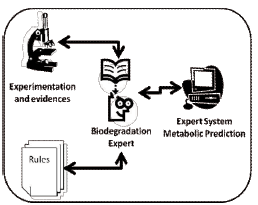
<body><![CDATA[<p><font size="2" face="Verdana, Arial, Helvetica, sans-serif">The Stockholm Convention on   Persistent Organic Pollutants, signed by Colombian government in 2001 and   ratified in 2008, focuses on the   reduction and safe elimination of 12 POPs (Dirty Dozen), including eight   pesticides (aldrin, chlordane, DDT, dieldrin, endrin, heptachlor, mirex, and   toxaphene), two industrial chemicals (polychlorinated biphenyls and   hexachlorobenzene) and two combustion by-products (dioxins and furans) &#91;1&#93;.</font></p>     <p><font size="2" face="Verdana, Arial, Helvetica, sans-serif">Being hydrophobic, POPs are adsorbed   strongly in soil texture, making them very difficult to treat. In water bodies,   these compounds resist natural breakdown and impact aquatic life. They are   present at low concentration in water (making them refractory to conventional   treatments), usually varying between nanogram and picogram per liter to almost   micrograms per liter. New technologies for POPs removal include adsorption onto   novel lipophilic materials &#91;2&#93; and the use of electro-kinetic and ultrasound   for the improvement of contaminant mobility in low permeable soils &#91;3&#93;.</font></p>     <p><font size="2" face="Verdana, Arial, Helvetica, sans-serif">In this   paper, the metabolic biodegradation pathway for Dieldrin was predicted using   the UMBBD expert system. The main reactions, enzymes and microorganisms taking   part in the biodegradation were identified and finally the concept of   BioBarrier is introduced and suggested for future applications for the   bio-treatment of POPs.</font></p>     <p>&nbsp;</p>     <p><font size="3" face="Verdana, Arial, Helvetica, sans-serif"><b>2. METODOLOGY </b></font></p> <font size="2" face="Verdana, Arial, Helvetica, sans-serif"><b>2.1 Simulation  of metabolic pathways </b>    <br> The need for a tool capable of predicting  metabolic routes has a core explanation since most of the 10 million of  synthetic chemicals are not being subjected to biodegradation studies in order  to determine their environmental fate and impact; in addition, industries  continue synthesizing new materials faster than regulatory agencies and  academic researchers are able to study their environmental facts. Companies  should invest on prediction of biodegradation pathways in order to avoid  releasing a new component that is later found to be dangerous and should be  withdraw from commerce. Regulatory agencies could also do a better job if they  would get access to more rapid and reliable information regarding to the  biodegradation mechanism and health-environmental impacts of dozen of new  chemicals every year &#91;4&#93;. The Simulation of the metabolic pathway for  the biodegradation of Dieldrin was performed using the  University of Minnesota's  Biocatalysis/Biodegradation Database (UMBBD) and the rule-based Pathway  Prediction System (UM-PPS) &#91;5&#93;. This expert system is  built up from rules which experts have proved over time according with  experimentation and scientific evidence (<a href="#fig01">figure 1</a>). This database contains 194  pathways, 1324 reactions, 1229 compounds, 50 organic functional groups, 855  enzymes and 506 microorganisms; the expert system is based on 267  biotransformation rules. Developments and improvements of the UM-PPS were  published recently &#91;6&#93;. </font>     <p align=center><font size="2" face="Verdana, Arial, Helvetica, sans-serif"><b><a name="fig01" id="fig01"></a><img src="/img/revistas/dyna/v77n163/a12fig01.gif">    <br>   Figure   1. </b>Development of an expert system based on experience   and Heuristic</font></p>     <p><font size="2" face="Verdana, Arial, Helvetica, sans-serif">Each new   single transformation is prioritized depending on their aerobic   biotransformation likelihood. Priority score is as follow: very likely reaction   (strong gray), likely reaction (gray), possible reaction (neutral clear),   unlikely reaction (stronger gray), very unlikely reaction (black) and unknown.   All biodegradation are considered to occur in environments like soil and water   at neutral pH,   25°C   and with no competing or other toxic compounds &#91;4&#93;.</font></p>     <p><font size="2" face="Verdana, Arial, Helvetica, sans-serif"><b>2.2 Model compound    ]]></body>
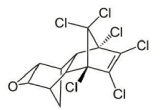
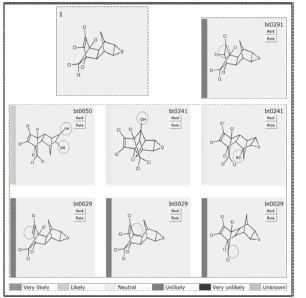
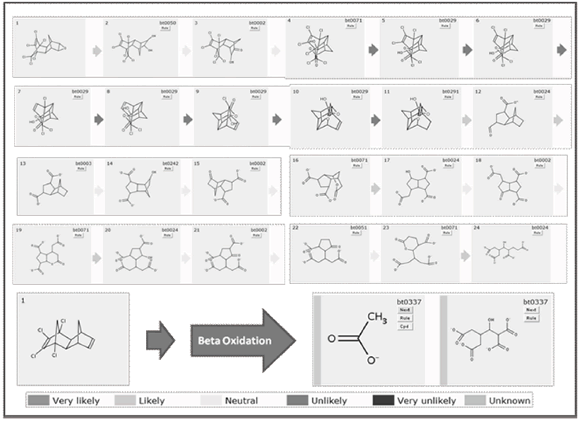
<body><![CDATA[<br>   </b><i>Dieldrin</i> is an insecticide used against insects and   pest infesting mainly corn, cotton and potato. It has a low toxicity in plants,   but high in insects, fish, birds and mammals. In humans it affects principally   immune response, but has been linked with Parkinson's, breast cancer, and   reproductive, and nervous system damage. The molecular structure of <i>Dieldrin</i> is presented in <a href="#fig02">figure 2</a>;   chloride groups are responsible for its persistence and bioaccumulation   capacity, besides, they constitute the major hindrance for microbial attack &#91;1&#93;.</font></p>     <p align=center><font size="2" face="Verdana, Arial, Helvetica, sans-serif"><b><a name="fig02"></a><img src="/img/revistas/dyna/v77n163/a12fig02.gif">    <br>   Figure   2 </b>Chemical   structure of Dieldrin</font></p> <font size="3" face="Verdana, Arial, Helvetica, sans-serif"><b>3. RESULTS AND DISCUSSION </b></font>     <p><font size="2" face="Verdana, Arial, Helvetica, sans-serif">Microbial   breakdown of <i>Dieldrin</i> has been   conducted both under aerobic and anaerobic conditions; the efficiency of   bacterial dechlorination in presence of oxygen has reached a maximum value of   40.4% with no registered presence of intermediaries and byproducts &#91;7&#93;. </font></p>     <p><font size="2" face="Verdana, Arial, Helvetica, sans-serif">But not   only bacterial strains can degrade <i>Dieldrin</i>.   Evidence suggest than certain fungal species can hydrolyze this compound until <i>CO<sub>2</sub></i> plus some intermediaries,   being the chlorinated segment the bottleneck for enzymatic attack &#91;8&#93;. Under   anaerobic conditions, few works have been reported; the main transformation   step involves just the reductive dechlorination of the   Methylene Bridge   and not complete mineralization &#91;9&#93;. As can be seen, the implementation of a sequential   process for the effective and complete biodegradation of <i>Dieldrin</i> has not been probed.</font></p>     <p><font size="2" face="Verdana, Arial, Helvetica, sans-serif"><b>3.1 The Predicted pathway</b></font></p>     <p><font size="2" face="Verdana, Arial, Helvetica, sans-serif">In <a href="#fig03">figure 3</a> is shown the first predicted biodegradation step for Dieldrin both under   aerobic and anaerobic conditions (conventions indicate probability of   occurrence under aerobic conditions). Circles in each molecule indicate where   the transformation is expected to occur. As several alternatives are available   for each degradation step, just the ones taken place under aerobic conditions   are selected, unless just anaerobic transformations are offered.</font></p>     <p align="center"><font size="2" face="Verdana, Arial, Helvetica, sans-serif"><b><a name="fig03"></a><img src="/img/revistas/dyna/v77n163/a12fig03.gif">    <br>   Figure   3.</b> Predicted first   biodegradation step for Dieldrin breakdown</font></p>     <p><font size="2" face="Verdana, Arial, Helvetica, sans-serif">From <a href="#fig03">figure   3</a> it is observed that under aerobic conditions the first transformation implies   the introduction of hydroxyl groups in different regions of the molecule away   from the chlorine groups. On the other hand, when aerobic conditions are not   present, dechlorination is expected to happen. This gives several insights   regarding the whole degradation sequence. Firstly, as the dechlorination of the   molecule is likely to occur under anaerobic conditions, the aerobic treatment   must be complemented with one or several anaerobic steps. Secondly, as the   chlorine groups are toxic, the anaerobic step should be carried out at earlier   stages of the degradation process.</font></p>     ]]></body>
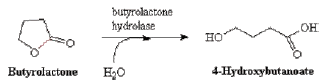
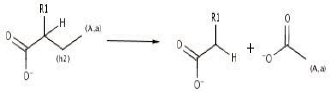
<body><![CDATA[<p><font size="2" face="Verdana, Arial, Helvetica, sans-serif">The   complete simulation of the biodegradation of <i>Dieldrin</i> is presented in appendix 1. Several attempts were   necessary before getting complete mineralization of the former molecule.   Another routes were built in which the final transformations led to a complex   molecules for which no biodegradation rule is known yet (results not presented). After releasing a contaminant in water bodies or soils, the first   transformation is expected to occur under aerobic conditions, before the depletion   of the available oxygen. In the first transformation note how microbial strains   attack epoxy group and not chloride segment (toxic segment) and converts it   into glycol likely groups (<a href="#rea01">reaction 1</a>), a transformation mediated by <i>epoxide hydrolases</i> and organisms like <i>Mycobacterium   bovis, Streptomyces sviceus</i>, <i>Sphingomonas wittichii and Rhodococcus   erythropolis. </i></font></p>     <p align=center><font size="2" face="Verdana, Arial, Helvetica, sans-serif"><b><a name="rea01"></a><img src="/img/revistas/dyna/v77n163/a12rea01.gif">    <br>   Reaction 1.</b> Epoxide biotrasformation</font></p>     <p><font size="2" face="Verdana, Arial, Helvetica, sans-serif">Efficient   attack of the ring system should continue in presence of oxygen or at least low   pressure O<sub>2</sub>. Steps 3 and 4 (appendix 1) are probably major   transformations for ring cleavage, for which it is necessary to introduce a   ketone group into the structure before the <i>Baeyer-Villiger</i> oxidation (<a href="#rea02">reactions 2</a> and <a href="#rea03">3</a>). The former step is mediated by <i>dehydrogenases</i>, some depending of NADP<sup>+</sup>.   Second transformation is also dependent on NADPH and is done mainly by <i>monoxygenases</i>.</font></p>     <p align=center><font size="2" face="Verdana, Arial, Helvetica, sans-serif"><b><a name="rea02"></a><img src="/img/revistas/dyna/v77n163/a12rea02.gif">    <br>   Reaction   2.</b> Biotransformation of secondary alcohol to   ketone (or ester group)</font></p>     <p align=center><font size="2" face="Verdana, Arial, Helvetica, sans-serif"><b><a name="rea03"></a><img src="/img/revistas/dyna/v77n163/a12rea03.gif">    <br>   Reaction   3.</b> Baeyer-Villiger oxidation of saturated rings (from cyclic ketone to cyclic ester)</font></p>     <p><font size="2" face="Verdana, Arial, Helvetica, sans-serif">Afterwards,   anaerobic conditions are expected to occur. In this environment, two important   tasks must be done with the scope of reducing toxicity: dechlorination and   elimination of saturated bonds. Referring to steps 5 to 10, almost complete   chloride removal could be reached in concordance with reductive dehalogenation   reaction presented in <a href="#rea04">reaction 4</a>, performed by <i>reductive dehalogenases</i> and <i>reductases</i> present in organisms like <i>Sphingomonas sp</i>. </font></p>     <p align=center><font size="2" face="Verdana, Arial, Helvetica, sans-serif"><b><a name="rea04"></a><img src="/img/revistas/dyna/v77n163/a12rea04.gif">    ]]></body>

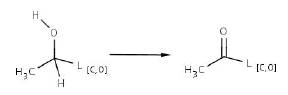
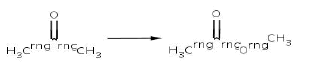
<body><![CDATA[<br>   Reaction   4. </b>Conversion   of organohalide group into aliphatic one</font></p>     <p><font size="2" face="Verdana, Arial, Helvetica, sans-serif">Microbial   strains commonly active in sediments (<i>Shewanella piezotolerans, Clostridium   botulinum</i>), and families of   enzymes like <i>reductases</i> and <i>dehydrogenases</i>, which require at least   that the alkene group contains one free hydrogen, can perform the <a href="#rea05">reaction 5</a> (step 11).</font></p>     <p align=center><font size="2" face="Verdana, Arial, Helvetica, sans-serif"><b><a name="rea05"></a><img src="/img/revistas/dyna/v77n163/a12rea05.gif">    <br>   Reaction   5</b>.   Alkene to alkane transformation</font></p>     <p><font size="2" face="Verdana, Arial, Helvetica, sans-serif">Even though   anaerobic conditions are present, it is necessary to provide enough oxygen to   the system for the next transformations (step 12). Here, the process engineer   should decide between pump technologies, natural aeration systems or oxygen   releasing compounds (among other technologies). After the insertion of an   oxygen molecule and in the presence of a ketone group inside the ring (ester   group), it is possible to break it down, leading to an aliphatic chain (refer   to <a href="#rea06">reaction 6</a>).</font></p>     <p align=center><font size="2" face="Verdana, Arial, Helvetica, sans-serif"><b><a name="rea06"></a><img src="/img/revistas/dyna/v77n163/a12rea06.gif">    <br>   Reaction   6.</b> Transformation of an ester group into alcohol plus carboxylate (alterntively   lactone to hydroxycarboxylate)</font></p>     <p><font size="2" face="Verdana, Arial, Helvetica, sans-serif">The above   reaction will produce cis products in rings with double bonds. A clearer   example is presented in <a href="#rea07">reaction 7</a>. Enzymes involved in this reaction are   hydrolases and carboxylic ester hydrolases, which are present in organisms such   as <i>Pseudomonas sp, Mesorhizobium loti and   Acinetobacter calcoaceticus.</i></font></p>     <p align=center><font size="2" face="Verdana, Arial, Helvetica, sans-serif"><b><a name="rea07"></a><img src="/img/revistas/dyna/v77n163/a12rea07.gif">    <br>   Reaction   7.</b> Breakdown of the ring system under neutral conditions</font></p>     ]]></body>
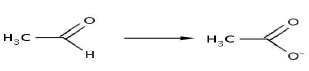
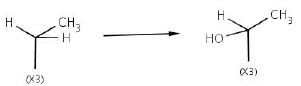
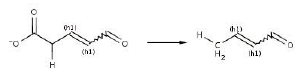
<body><![CDATA[<p><font size="2" face="Verdana, Arial, Helvetica, sans-serif">Neutral   conditions should be maintained to allow the system to introduce hydroxyl   groups (alcohol) and ketones (ester group) for further ring cleavage. In step   13, carboxylation (<a href="#rea08">reaction 8</a>) is performed by <i>dehydrogenases</i> dependent on NADH present in species like <i>Aromatoleum   aromaticum, Nitrobacter   sp., Pseudomonas   mendocina and Aspergillus niger. </i></font></p>     <p align=center><font size="2" face="Verdana, Arial, Helvetica, sans-serif"><b><a name="rea08"></a><img src="/img/revistas/dyna/v77n163/a12rea08.gif">    <br>   Reaction   8.</b> Transformation from aldehyde to carboxylate group</font></p>     <p><font size="2" face="Verdana, Arial, Helvetica, sans-serif">In step 14,   introduction of OH seems to be probable due to the high charge density in the   opposite segment of the molecule. This transformation is described in <a href="#rea09">reaction   9</a>. Hydroxylation of secondary aliphatic carbon atoms in a ring system, adjacent   to a <i>sp2</i> carbon or bound to <i>N</i> or <i>O</i>,   may be mediated by <i>monooxyganases</i>, <i>dioxygenases </i>and <i>dehydrogenases</i> present in several microorganisms like <i>Brachymonas petroleovorans, Desulfococcus oleovorans,   Aromatoleum aromaticum, Persephonella marina </i>and <i>Pseudomonas   putida.</i></font></p>     <p align=center><font size="2" face="Verdana, Arial, Helvetica, sans-serif"><b><a name="rea09"></a><img src="/img/revistas/dyna/v77n163/a12rea09.gif">    <br>   Reaction   9.</b> Transformation from secondary aliphatic to secondary alcohol.</font></p>     <p><font size="2" face="Verdana, Arial, Helvetica, sans-serif">From the   last intermediary compound, it is necessary to preserve aerobic conditions.   Some patterns are identified as responsible for ring cleavage, as was mentioned   above: first of all an hydroxyl group is inserted into the ring, next it is   oxidized to ketone and lastly an oxygen atom is putted into the ring structure   to conform an ester group (follow steps 14 to 16). Here it is most probable for   the ring to be broken to aliphatic chains (step 17). This efficient sequence is   completed again by the same microbial strains in steps 18 to 21. However,   metabolite in step 21 exhibits so dense electrical charge that is too difficult   to access inside the ring; others strains, moreover, are able to slash   carboxylates and release space for further enzymatic attack (like <i>Piruvate decarboxylase</i> or <i>decarboxylases</i>). That kind of conversion   (<a href="#rea10">reaction 10</a>) is commonly performed by fungal organisms such as <i>Aspergillus   niger </i>and <i>Aspergillus fumigates</i>, and should   correspond to evidences of partial mineralization reported by &#91;8&#93;. </font></p>     <p align=center><font size="2" face="Verdana, Arial, Helvetica, sans-serif"><b><a name="rea10"></a><img src="/img/revistas/dyna/v77n163/a12rea10.gif">    <br>   Reaction   10.</b> Conversion from 2-or 3-substituted carboxylates to RH plus CO<sub>2.</sub></font></p>     <p><font size="2" face="Verdana, Arial, Helvetica, sans-serif">The main   scope of any bioremediation project is to take the former contaminant and   direct it to a low size, non toxic and easily assimilable end products. In steps   23 and 24, rings structures are finally converted into aliphatic ones. Last   compound (similar to fatty acids) are susceptible for further <font face="Symbol">b</font>-oxidation   (<a href="#rea11">reaction 11</a>). </font></p>     ]]></body>
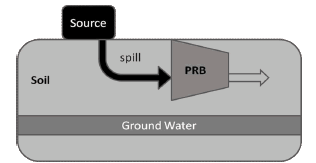
<body><![CDATA[<p align="center"><font size="2" face="Verdana, Arial, Helvetica, sans-serif"><b><a name="rea11" id="rea11"></a><img src="/img/revistas/dyna/v77n163/a12rea11.gif">    <br>   Reaction 11.</b> <font face="Symbol">b</font>-oxidation   (central metabolism).</font></p>     <p><font size="2" face="Verdana, Arial, Helvetica, sans-serif"><i>Acetate</i> and <i>Malonate</i> are the final compounds obtained after <i><font face="Symbol">b</font>-oxidation</i> transformations. <i>Acetate</i> easily   reaches <i>Glycolysis/Gluconeogenesis</i> pathway and <i>Malonate</i> gets into core   metabolism through <i><font face="Symbol">b</font>-Alanine</i> metabolism (figures not shown). </font></p>     <p><font size="2" face="Verdana, Arial, Helvetica, sans-serif"><b>3.1 Treatment by BioBarriers    <br>   </b>BioBarrier   concept is founded on Permeable Reactive Barriers (PRB) technology, a passive   packed bed-like system implemented for groundwater remediation &#91;10&#93;. Among   other reactive media, PRB have used Zero Valent Metals (ZVM) as a catalyst for   chemical modification (e.g. declhorination) and then detoxification of spills   in soils &#91;11&#93;. A typical PRB is outlined in <a href="#fig04">figure 4</a>. Several contaminants,   including chlorinated compounds, have been treated using ground Barriers and   many design variations appeared since first application &#91;12&#93;. </font></p>     <p align="center"><font size="2" face="Verdana, Arial, Helvetica, sans-serif"><b><a name="fig04"></a><img src="/img/revistas/dyna/v77n163/a12fig04.gif">    <br>   Figure   4.</b> Basic Permeable Reactive Barriers</font></p>     <p><font size="2" face="Verdana, Arial, Helvetica, sans-serif">BioBarriers,   a difference from traditional PBR, uses native microorganisms growing over   solid particles as a catalyst instead of ZVM, making them a real cheap   technology. For accurate designing of BioBarrier, we propose to start from   metabolic prediction in order to have an idea of the process strategy which   will make mineralization possible. </font></p>     <p><font size="2" face="Verdana, Arial, Helvetica, sans-serif">Since   metabolic information indicates each of the transformations suffered by an   initial compound, every single transformation step gives insights than can   improve both design and operation of the treatment process. Some reports, in   which BioBarrier concept is applied, the packed column (barrier) is operated as   a single unit, providing same conditions along the barrier length &#91;13&#93;; this   approach does not consider the fact that target compounds are not the same   through it. Spending money having a longer column, or providing nutrients in   regions where microorganisms don't need them, or having a system which doesn't guaranty complete </font><font size="2" face="Verdana, Arial, Helvetica, sans-serif">toxicity,   removal and/or mineralization could be avoided with appropriate designs.</font></p>     <p><font size="2" face="Verdana, Arial, Helvetica, sans-serif">We believe   this can be overcome by having prior metabolic and microbial knowledge about   the target compound. </font></p>     ]]></body>
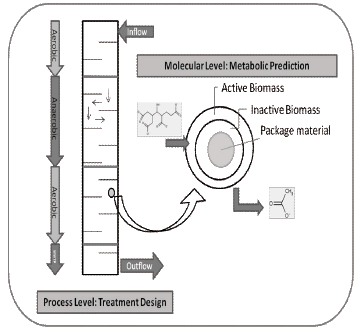
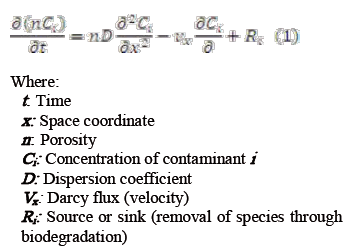
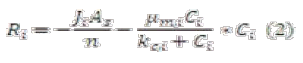
<body><![CDATA[<p><font size="2" face="Verdana, Arial, Helvetica, sans-serif">The design   of BioBarriers must be thought as a building, made of several bricks, one after   another. Each brick corresponds to a single metabolic transformation and   therefore should be treated as a particular reactor, which means, to provide   particular inducers, nutrients, conditions and microbial strains. The length of   each brick therefore must agree with the kinetic of biotransformation,   transport properties and BioBarrier characteristics (e.g. porosity and   permeability). In <a href="#fig05">figures 5</a> and 6 the concept of BioBarrier design is   presented. </font></p>     <p align="center"><font size="2" face="Verdana, Arial, Helvetica, sans-serif"><b><a name="fig05"></a><img src="/img/revistas/dyna/v77n163/a12fig05.gif">    <br>   Figure   5.</b> BioBarrier metabolic simulation-based approach design</font></p>     <p><font size="2" face="Verdana, Arial, Helvetica, sans-serif">According to the simulated pathway, the biodegradation   of Dieldrin would occur efficiently under an Aerobic-Anaerobic-Aerobic   sequential bioreactor. The length of the BioBarrier (and each process step)   depends on how many biochemical transformations must occur and the kinetics of   each reaction. Last metabolites (Acetate and Malonate) can be treated either in   a final compartment inside the column or within a domestic Waste Water   Treatment Plant (WWTP) (<a href="#fig07">figure 6</a>). </font></p>     <p align="center"><font size="2" face="Verdana, Arial, Helvetica, sans-serif"><b><a name="fig07"></a><img src="/img/revistas/dyna/v77n163/a12fig07.gif">    <br>   Figure   7.</b> Molecular and process level approximation for BioBarrier Design</font></p>     <p><font size="2" face="Verdana, Arial, Helvetica, sans-serif">An   optimal design for a BioBarrier (process level) can be achieved by a complete   examination of the site, including reaction rates of the contaminants and   properties of package material. Reaction rates or half-lives of contaminants in   contact with the bio-reactive medium are necessary to determine the reactive   length path that will provide adequate residence time for the degradation of   each compound (according to the simulation). </font></p>     <p><font size="2" face="Verdana, Arial, Helvetica, sans-serif">Both   batch and continuous column systems have been used in the past to determine   reaction rates. Because continuous tests better simulate the dynamic flow of   contaminants, testing in columns is by far the most common method. The use of   databases and expert systems can, however, save money and time, as less   experimentation and column experiments are required.</font></p>     <p><font size="2" face="Verdana, Arial, Helvetica, sans-serif">Traditional   design equations have considered mostly a pseudo first-order rate kinetic approach   without taking into account other degradation kinetics or transport process   &#91;10&#93;. We propose the implementation of a basic phenomenological design equation   (equation 1). This relationship can accurately predict transport through porous   media (diffusion and also dispersion) and relate biodegradation, giving exact   concentration of each species over a space coordinate. The application of this   phenomenological equation will vary according with every metabolic step   predicted before, so we can obtain all the information of species over time and   space through BioBarrier.</font></p>     <p><img src="/img/revistas/dyna/v77n163/a12eq01.gif"></p>     ]]></body>
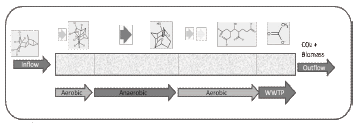
<body><![CDATA[<p><font size="2" face="Verdana, Arial, Helvetica, sans-serif">As an   example of <i>R<sub>i</sub></i> term, we   will consider typical Monod kinetics; making a mass balance through biofilm   layer (attached into package material), we obtain:</font></p>     <p><img src="/img/revistas/dyna/v77n163/a12eq02.gif"></p>     <p><font size="2" face="Verdana, Arial, Helvetica, sans-serif">Where:</font></p>     <blockquote>       <p><font size="2" face="Verdana, Arial, Helvetica, sans-serif"><b><i>J<sub>i</sub></i>:</b> flux of     substrate into a biofilm    <br>     </font><font size="2" face="Verdana, Arial, Helvetica, sans-serif"><b><i>A</i><sub>s</sub>:</b> Superficial area of biofilm    <br>     </font><font size="2" face="Verdana, Arial, Helvetica, sans-serif"><b><i>µ</i><sub>mi</sub>, <i>k</i><sub>ci</sub>:</b> Constant for Monod kinetics</font></p> </blockquote>     <p><font size="2" face="Verdana, Arial, Helvetica, sans-serif">The value   of <b><i>J<sub>i</sub> </i></b>can be calculated applying <i>Fick</i>'s   law inside the layer:</font></p>     <p><img src="/img/revistas/dyna/v77n163/a12eq03.gif"></p>     <p><font size="2" face="Verdana, Arial, Helvetica, sans-serif">Where:</font></p>     ]]></body>
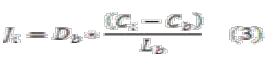
<body><![CDATA[<blockquote>       <p><font size="2" face="Verdana, Arial, Helvetica, sans-serif"><b><i>D</i><sub>b</sub>:</b> Diffusivity in the biofilm    <br>     </font><font size="2" face="Verdana, Arial, Helvetica, sans-serif"><b><i>L</i><sub>b</sub>:</b> Thickness     of biofilm</font></p> </blockquote>     <p><font size="2" face="Verdana, Arial, Helvetica, sans-serif">The   solution of above equations could be done using finite differences method and   considerations like unidirectional transport, constant dispersion and porosity   or zero concentration of each compound inside deep biofilm. </font></p>     <p><font size="2" face="Verdana, Arial, Helvetica, sans-serif">The   Combination of metabolic prediction (molecular level) and design equations   (process level) should constitute and accurate approximation for an efficient   design of hazardous wastes treatment process using BioBarriers (<a href="#fig07">figure 6</a>). </font></p> <b><font size="3" face="Verdana, Arial, Helvetica, sans-serif">4. CONCLUSION</font></b>     <p><font size="2" face="Verdana, Arial, Helvetica, sans-serif">A complete   biodegradation pathway for Dieldrin as a representative compound of Persistent   Organic Pollutants was done using the UMBBD expert system. The simulated   catabolism shows that it is possible to obtain a complete mineralization of   former contaminant and that Aerobic-Anaerobic-Aerobic process strategy seems to   be most successful for designing of a treatment plant. Basic relation between   metabolic simulation and BioBarrier concept were also presented and insights   regarding to advantages of this new approach and main phenomenological design   equations, were finally outlined as a promissory approach for the design of   hazardous waste treatment process. </font></p>     <p>&nbsp;</p>     <p><font size="3" face="Verdana, Arial, Helvetica, sans-serif"><b>5.   RECOMMENDATIONS</b></font> </p>     <p><font size="2" face="Verdana, Arial, Helvetica, sans-serif">The ideas   presented in this report belong to a project under development in   School of Environment and Geosciences, Faculty of   Mines at Universidad Nacional de Colombia Sede Medell&iacute;n. In order to complete   foundations of BioBarriers design, it is important to collect more information   regarding to kinetic parameters (reaction rates or half-lives) of each   enzymatic transformation and consider others environmental and process   parameters that can influence barrier performance. Numerical simulation should   be performed and optimized further on, so unnecessary parameters will be   removed or other important variables will be added. Further work is necessary   in order to collect experimental data that allows verification of simulated   results.</font></p>     <p><font size="2" face="Verdana, Arial, Helvetica, sans-serif"><b>Appendix 1. </b> Complete   simulated pathway for the biodegradation of Dieldrin </font></p>     ]]></body>
<body><![CDATA[<p align="center"><img src="/img/revistas/dyna/v77n163/a12apx01.gif"></p> <font size="3" face="Verdana, Arial, Helvetica, sans-serif"><b>REFERENCES </b></font>     <!-- ref --><p><font size="2" face="Verdana, Arial, Helvetica, sans-serif"><b>&#91;1&#93;</b> Resource futures international. Persistent Organic Pollutants and the Stokholm Convention: A resource Guide. World bank and CIDA, 2001.     &nbsp;&nbsp;&nbsp;&nbsp;&nbsp;&nbsp;&nbsp;&nbsp;[&#160;<a href="javascript:void(0);" onclick="javascript: window.open('/scielo.php?script=sci_nlinks&ref=000114&pid=S0012-7353201000030001200001&lng=','','width=640,height=500,resizable=yes,scrollbars=1,menubar=yes,');">Links</a>&#160;]<!-- end-ref --><!-- ref --><br>   <b>&#91;2&#93;</b> Liu, H., Ru, J., Qu, J., Dai, R., W, Z. and Hu, C. Removal of persistent organic pollutants from micro-polluted drinking water by triolein embedded absorbent. Bioresource Technology. Vol. 100, 2995-3002, 2009.     &nbsp;&nbsp;&nbsp;&nbsp;&nbsp;&nbsp;&nbsp;&nbsp;[&#160;<a href="javascript:void(0);" onclick="javascript: window.open('/scielo.php?script=sci_nlinks&ref=000115&pid=S0012-7353201000030001200002&lng=','','width=640,height=500,resizable=yes,scrollbars=1,menubar=yes,');">Links</a>&#160;]<!-- end-ref --><!-- ref --><br>   <b>&#91;3&#93;</b> Pham, T.D., Shrestha, R.A., Virkutyte, J. and Sillanpää, M. Combined ultrasonication and electrokinetic remediation for persistent organic removal from contaminated kaolin. Electrochimica Acta. Vol. 54, 1403-1407, 2009.     &nbsp;&nbsp;&nbsp;&nbsp;&nbsp;&nbsp;&nbsp;&nbsp;[&#160;<a href="javascript:void(0);" onclick="javascript: window.open('/scielo.php?script=sci_nlinks&ref=000116&pid=S0012-7353201000030001200003&lng=','','width=640,height=500,resizable=yes,scrollbars=1,menubar=yes,');">Links</a>&#160;]<!-- end-ref --><!-- ref --><br>   <b>&#91;4&#93;</b> Wacked, L.P. and Hershberger, C.D. Biocatalysis and Biodegradation. ASM press. 2001.     &nbsp;&nbsp;&nbsp;&nbsp;&nbsp;&nbsp;&nbsp;&nbsp;[&#160;<a href="javascript:void(0);" onclick="javascript: window.open('/scielo.php?script=sci_nlinks&ref=000117&pid=S0012-7353201000030001200004&lng=','','width=640,height=500,resizable=yes,scrollbars=1,menubar=yes,');">Links</a>&#160;]<!-- end-ref --><!-- ref --><br>   <b>&#91;5&#93;</b> University of Minnesota Biocatalysis and Biodegradation Database (UM-BBD) at <a href="http://www.umbbd.ahc.umn.edu" target="referencia">www.umbbd.ahc.umn.edu</a>. Last accessed may 5 2010.     &nbsp;&nbsp;&nbsp;&nbsp;&nbsp;&nbsp;&nbsp;&nbsp;[&#160;<a href="javascript:void(0);" onclick="javascript: window.open('/scielo.php?script=sci_nlinks&ref=000118&pid=S0012-7353201000030001200005&lng=','','width=640,height=500,resizable=yes,scrollbars=1,menubar=yes,');">Links</a>&#160;]<!-- end-ref --><!-- ref --><br>   <b>&#91;6&#93;</b> Gao, J., Ellis, L.B.M. and Wackett, L.P. The University of Minnesota Biocatalysis/ Biodegradation Database: improving public access. D488-D491 Nucleic Acids Research, Vol. 38, Database issue, 2010.     &nbsp;&nbsp;&nbsp;&nbsp;&nbsp;&nbsp;&nbsp;&nbsp;[&#160;<a href="javascript:void(0);" onclick="javascript: window.open('/scielo.php?script=sci_nlinks&ref=000119&pid=S0012-7353201000030001200006&lng=','','width=640,height=500,resizable=yes,scrollbars=1,menubar=yes,');">Links</a>&#160;]<!-- end-ref --><!-- ref --><br>   <b>&#91;7&#93;</b> Gao, B., Jia, L. and Xie, J. Aerobic degradation of dieldrin by Enterobacter sp. LY402. Journal of Biotechnology. Vol. 136S, S678-S707, 2008.     &nbsp;&nbsp;&nbsp;&nbsp;&nbsp;&nbsp;&nbsp;&nbsp;[&#160;<a href="javascript:void(0);" onclick="javascript: window.open('/scielo.php?script=sci_nlinks&ref=000120&pid=S0012-7353201000030001200007&lng=','','width=640,height=500,resizable=yes,scrollbars=1,menubar=yes,');">Links</a>&#160;]<!-- end-ref --><!-- ref --><br>   <b>&#91;8&#93;</b> Bixby, M.W., Boush, G.M. and Matsumura, F. Degradation of Dieldrin to Carbon Dioxide by a Soil Fungus Trichoderma Koningi. Bulletin of Environmental Contamination & Toxicology. Vol. 6, N° 6, 491-494, 1971.     &nbsp;&nbsp;&nbsp;&nbsp;&nbsp;&nbsp;&nbsp;&nbsp;[&#160;<a href="javascript:void(0);" onclick="javascript: window.open('/scielo.php?script=sci_nlinks&ref=000121&pid=S0012-7353201000030001200008&lng=','','width=640,height=500,resizable=yes,scrollbars=1,menubar=yes,');">Links</a>&#160;]<!-- end-ref --><!-- ref --><br>   <b>&#91;9&#93;</b> Chiu, T.C., Yen, J.H., Hsieh, Y.N. and Wang, Y.S. Reductive transformation of dieldrin under anaerobic sediment culture. Chemosphere. Vol. 60, 1182-1189, 2005.     &nbsp;&nbsp;&nbsp;&nbsp;&nbsp;&nbsp;&nbsp;&nbsp;[&#160;<a href="javascript:void(0);" onclick="javascript: window.open('/scielo.php?script=sci_nlinks&ref=000122&pid=S0012-7353201000030001200009&lng=','','width=640,height=500,resizable=yes,scrollbars=1,menubar=yes,');">Links</a>&#160;]<!-- end-ref --><!-- ref --><br>   <b>&#91;10&#93;</b> Gavaskar, A.R. Design and construction techniques for permeable reactive barriers. Journal of Hazardous Materials. Vol. 68, 41-71, 1999.     &nbsp;&nbsp;&nbsp;&nbsp;&nbsp;&nbsp;&nbsp;&nbsp;[&#160;<a href="javascript:void(0);" onclick="javascript: window.open('/scielo.php?script=sci_nlinks&ref=000123&pid=S0012-7353201000030001200010&lng=','','width=640,height=500,resizable=yes,scrollbars=1,menubar=yes,');">Links</a>&#160;]<!-- end-ref --><!-- ref --><br>   <b>&#91;11&#93;</b> Liu, S.J., Jiang, B., Huang, G.Q. and LI, X.G. Laboratory column study for remediation of MTBE-contaminated groundwater using a biological two-layer permeable barrier. Water Research. Vol. 40, 3401 - 3408, 2006.     &nbsp;&nbsp;&nbsp;&nbsp;&nbsp;&nbsp;&nbsp;&nbsp;[&#160;<a href="javascript:void(0);" onclick="javascript: window.open('/scielo.php?script=sci_nlinks&ref=000124&pid=S0012-7353201000030001200011&lng=','','width=640,height=500,resizable=yes,scrollbars=1,menubar=yes,');">Links</a>&#160;]<!-- end-ref --><!-- ref --><br>   <b>&#91;12&#93;</b> Blowes, D.W., Ptacek, C.J., Benner, S.G., Mcrae, C.W.T., Bennett, T.A. and Puls, R.W. Treatment of inorganic contaminants using permeable reactive barriers. Journal of Contaminant Hydrology. Vol. 45, 123-137, 2000.     &nbsp;&nbsp;&nbsp;&nbsp;&nbsp;&nbsp;&nbsp;&nbsp;[&#160;<a href="javascript:void(0);" onclick="javascript: window.open('/scielo.php?script=sci_nlinks&ref=000125&pid=S0012-7353201000030001200012&lng=','','width=640,height=500,resizable=yes,scrollbars=1,menubar=yes,');">Links</a>&#160;]<!-- end-ref --><!-- ref --><br>   <b>&#91;13&#93;</b> Hunter, W.J., Shaner, D.L. Nitrogen limited biobarriers remove atrazine from contaminated water: Laboratory studies. Journal of Contaminant Hydrology. Vol. 103, 29-37, 2009 </font>&nbsp;&nbsp;&nbsp;&nbsp;&nbsp;&nbsp;&nbsp;&nbsp;[&#160;<a href="javascript:void(0);" onclick="javascript: window.open('/scielo.php?script=sci_nlinks&ref=000126&pid=S0012-7353201000030001200013&lng=','','width=640,height=500,resizable=yes,scrollbars=1,menubar=yes,');">Links</a>&#160;]<!-- end-ref --> ]]></body><back>
<ref-list>
<ref id="B1">
<label>1</label><nlm-citation citation-type="book">
<collab>Resource futures international</collab>
<source><![CDATA[Persistent Organic Pollutants and the Stokholm Convention: A resource Guide]]></source>
<year>2001</year>
<publisher-name><![CDATA[World bank and CIDA]]></publisher-name>
</nlm-citation>
</ref>
<ref id="B2">
<label>2</label><nlm-citation citation-type="journal">
<person-group person-group-type="author">
<name>
<surname><![CDATA[Liu]]></surname>
<given-names><![CDATA[H]]></given-names>
</name>
<name>
<surname><![CDATA[Ru]]></surname>
<given-names><![CDATA[J]]></given-names>
</name>
<name>
<surname><![CDATA[Qu]]></surname>
<given-names><![CDATA[J]]></given-names>
</name>
<name>
<surname><![CDATA[Dai]]></surname>
<given-names><![CDATA[R]]></given-names>
</name>
<name>
<surname><![CDATA[W]]></surname>
<given-names><![CDATA[Z]]></given-names>
</name>
<name>
<surname><![CDATA[Hu]]></surname>
<given-names><![CDATA[C]]></given-names>
</name>
</person-group>
<article-title xml:lang="en"><![CDATA[Removal of persistent organic pollutants from micro-polluted drinking water by triolein embedded absorbent.]]></article-title>
<source><![CDATA[Bioresource Technology]]></source>
<year>2009</year>
<volume>100</volume>
<page-range>2995-3002</page-range></nlm-citation>
</ref>
<ref id="B3">
<label>3</label><nlm-citation citation-type="journal">
<person-group person-group-type="author">
<name>
<surname><![CDATA[Pham]]></surname>
<given-names><![CDATA[T.D.]]></given-names>
</name>
<name>
<surname><![CDATA[Shrestha]]></surname>
<given-names><![CDATA[R.A.]]></given-names>
</name>
<name>
<surname><![CDATA[Virkutyte]]></surname>
<given-names><![CDATA[J]]></given-names>
</name>
<name>
<surname><![CDATA[Sillanpää]]></surname>
<given-names><![CDATA[M]]></given-names>
</name>
</person-group>
<article-title xml:lang="en"><![CDATA[Combined ultrasonication and electrokinetic remediation for persistent organic removal from contaminated kaolin]]></article-title>
<source><![CDATA[Electrochimica Acta.]]></source>
<year>2009</year>
<volume>54</volume>
<page-range>1403-1407</page-range></nlm-citation>
</ref>
<ref id="B4">
<label>4</label><nlm-citation citation-type="book">
<person-group person-group-type="author">
<name>
<surname><![CDATA[Wacked]]></surname>
<given-names><![CDATA[L.P.]]></given-names>
</name>
<name>
<surname><![CDATA[Hershberger]]></surname>
<given-names><![CDATA[C.D.]]></given-names>
</name>
</person-group>
<source><![CDATA[Biocatalysis and Biodegradation]]></source>
<year>2001</year>
<publisher-name><![CDATA[ASM press]]></publisher-name>
</nlm-citation>
</ref>
<ref id="B5">
<label>5</label><nlm-citation citation-type="">
<collab>University of Minnesota</collab>
<source><![CDATA[Biocatalysis and Biodegradation Database (UM-BBD)]]></source>
<year></year>
</nlm-citation>
</ref>
<ref id="B6">
<label>6</label><nlm-citation citation-type="">
<person-group person-group-type="author">
<name>
<surname><![CDATA[Gao]]></surname>
<given-names><![CDATA[J]]></given-names>
</name>
<name>
<surname><![CDATA[Ellis]]></surname>
<given-names><![CDATA[L.B.M]]></given-names>
</name>
<name>
<surname><![CDATA[Wackett]]></surname>
<given-names><![CDATA[L.P]]></given-names>
</name>
</person-group>
<source><![CDATA[The University of Minnesota Biocatalysis/ Biodegradation Database: improving public access]]></source>
<year>2010</year>
<volume>38</volume>
</nlm-citation>
</ref>
<ref id="B7">
<label>7</label><nlm-citation citation-type="journal">
<person-group person-group-type="author">
<name>
<surname><![CDATA[Gao]]></surname>
<given-names><![CDATA[B]]></given-names>
</name>
<name>
<surname><![CDATA[Jia]]></surname>
<given-names><![CDATA[L]]></given-names>
</name>
<name>
<surname><![CDATA[Xie]]></surname>
<given-names><![CDATA[J]]></given-names>
</name>
</person-group>
<article-title xml:lang="en"><![CDATA[Aerobic degradation of dieldrin by Enterobacter sp. LY402]]></article-title>
<source><![CDATA[Journal of Biotechnology]]></source>
<year>2008</year>
<volume>136S</volume>
<page-range>S678-S707</page-range></nlm-citation>
</ref>
<ref id="B8">
<label>8</label><nlm-citation citation-type="journal">
<person-group person-group-type="author">
<name>
<surname><![CDATA[Bixby]]></surname>
<given-names><![CDATA[M.W.]]></given-names>
</name>
<name>
<surname><![CDATA[Boush]]></surname>
<given-names><![CDATA[G.M]]></given-names>
</name>
<name>
<surname><![CDATA[Matsumura]]></surname>
<given-names><![CDATA[F]]></given-names>
</name>
</person-group>
<article-title xml:lang="en"><![CDATA[Degradation of Dieldrin to Carbon Dioxide by a Soil Fungus Trichoderma Koningi]]></article-title>
<source><![CDATA[Bulletin of Environmental Contamination & Toxicology]]></source>
<year>1971</year>
<volume>6</volume>
<numero>6</numero>
<issue>6</issue>
<page-range>491-494</page-range></nlm-citation>
</ref>
<ref id="B9">
<label>9</label><nlm-citation citation-type="journal">
<person-group person-group-type="author">
<name>
<surname><![CDATA[Chiu]]></surname>
<given-names><![CDATA[T.C]]></given-names>
</name>
<name>
<surname><![CDATA[Yen]]></surname>
<given-names><![CDATA[J.H]]></given-names>
</name>
<name>
<surname><![CDATA[Hsieh]]></surname>
<given-names><![CDATA[Y.N]]></given-names>
</name>
<name>
<surname><![CDATA[Wang]]></surname>
<given-names><![CDATA[Y.S]]></given-names>
</name>
</person-group>
<article-title xml:lang="en"><![CDATA[Reductive transformation of dieldrin under anaerobic sediment culture]]></article-title>
<source><![CDATA[Chemosphere]]></source>
<year>2005</year>
<volume>60</volume>
<page-range>1182-1189</page-range></nlm-citation>
</ref>
<ref id="B10">
<label>10</label><nlm-citation citation-type="journal">
<person-group person-group-type="author">
<name>
<surname><![CDATA[Gavaskar]]></surname>
<given-names><![CDATA[A.R.]]></given-names>
</name>
</person-group>
<article-title xml:lang="en"><![CDATA[Design and construction techniques for permeable reactive barriers.]]></article-title>
<source><![CDATA[Journal of Hazardous Materials]]></source>
<year>1999</year>
<volume>68</volume>
<page-range>41-71</page-range></nlm-citation>
</ref>
<ref id="B11">
<label>11</label><nlm-citation citation-type="journal">
<person-group person-group-type="author">
<name>
<surname><![CDATA[Liu]]></surname>
<given-names><![CDATA[S.J]]></given-names>
</name>
<name>
<surname><![CDATA[Jiang]]></surname>
<given-names><![CDATA[B]]></given-names>
</name>
<name>
<surname><![CDATA[Huang]]></surname>
<given-names><![CDATA[G.Q]]></given-names>
</name>
<name>
<surname><![CDATA[LI]]></surname>
<given-names><![CDATA[X.G]]></given-names>
</name>
</person-group>
<article-title xml:lang="en"><![CDATA[Laboratory column study for remediation of MTBE-contaminated groundwater using a biological two-layer permeable barrier.]]></article-title>
<source><![CDATA[Water Research]]></source>
<year>2006</year>
<volume>40</volume>
<page-range>3401 - 3408</page-range></nlm-citation>
</ref>
<ref id="B12">
<label>12</label><nlm-citation citation-type="journal">
<person-group person-group-type="author">
<name>
<surname><![CDATA[Blowes]]></surname>
<given-names><![CDATA[D.W]]></given-names>
</name>
<name>
<surname><![CDATA[Ptacek]]></surname>
<given-names><![CDATA[C.J.]]></given-names>
</name>
<name>
<surname><![CDATA[Benner]]></surname>
<given-names><![CDATA[S.G]]></given-names>
</name>
<name>
<surname><![CDATA[Mcrae]]></surname>
<given-names><![CDATA[C.W.T.]]></given-names>
</name>
<name>
<surname><![CDATA[Bennett]]></surname>
<given-names><![CDATA[T.A.]]></given-names>
</name>
<name>
<surname><![CDATA[Puls]]></surname>
<given-names><![CDATA[R.W.]]></given-names>
</name>
</person-group>
<article-title xml:lang="en"><![CDATA[Treatment of inorganic contaminants using permeable reactive barriers.]]></article-title>
<source><![CDATA[Journal of Contaminant Hydrology]]></source>
<year>2000</year>
<volume>45</volume>
<page-range>123-137</page-range></nlm-citation>
</ref>
<ref id="B13">
<label>13</label><nlm-citation citation-type="journal">
<person-group person-group-type="author">
<name>
<surname><![CDATA[Hunter]]></surname>
<given-names><![CDATA[W.J]]></given-names>
</name>
<name>
<surname><![CDATA[Shaner]]></surname>
<given-names><![CDATA[D.L]]></given-names>
</name>
</person-group>
<article-title xml:lang="en"><![CDATA[Nitrogen limited biobarriers remove atrazine from contaminated water: Laboratory studies]]></article-title>
<source><![CDATA[Journal of Contaminant Hydrology.]]></source>
<year>2009</year>
<volume>103</volume>
<page-range>29-37</page-range></nlm-citation>
</ref>
</ref-list>
</back>
</article>