<?xml version="1.0" encoding="ISO-8859-1"?><article xmlns:mml="http://www.w3.org/1998/Math/MathML" xmlns:xlink="http://www.w3.org/1999/xlink" xmlns:xsi="http://www.w3.org/2001/XMLSchema-instance">
<front>
<journal-meta>
<journal-id>0012-7353</journal-id>
<journal-title><![CDATA[DYNA]]></journal-title>
<abbrev-journal-title><![CDATA[Dyna rev.fac.nac.minas]]></abbrev-journal-title>
<issn>0012-7353</issn>
<publisher>
<publisher-name><![CDATA[Universidad Nacional de Colombia]]></publisher-name>
</publisher>
</journal-meta>
<article-meta>
<article-id>S0012-73532010000300016</article-id>
<title-group>
<article-title xml:lang="en"><![CDATA[KINETIC BEHAVIOR IN THE HYDROGENATION OF FURFURAL OVER IR CATALYSTS SUPPORTED ON TIO2]]></article-title>
<article-title xml:lang="es"><![CDATA[COMPORTAMIENTO CINÉTICO DE LA HIDROGENACIÓN DE FURFURAL SOBRE CATALIZADORES DE IR SOPORTADOS EN TIO2]]></article-title>
</title-group>
<contrib-group>
<contrib contrib-type="author">
<name>
<surname><![CDATA[ROJAS]]></surname>
<given-names><![CDATA[HUGO]]></given-names>
</name>
<xref ref-type="aff" rid="A01"/>
</contrib>
<contrib contrib-type="author">
<name>
<surname><![CDATA[MARTÍNEZ]]></surname>
<given-names><![CDATA[JOSÉ J.]]></given-names>
</name>
<xref ref-type="aff" rid="A02"/>
</contrib>
<contrib contrib-type="author">
<name>
<surname><![CDATA[REYES]]></surname>
<given-names><![CDATA[PATRICIO]]></given-names>
</name>
<xref ref-type="aff" rid="A03"/>
</contrib>
</contrib-group>
<aff id="A01">
<institution><![CDATA[,Universidad Pedagógica y Tecnológica de Colombia Escuela de Ciencias Químicas Facultad de Ciencias]]></institution>
<addr-line><![CDATA[Tunja ]]></addr-line>
<country>Colombia</country>
</aff>
<aff id="A02">
<institution><![CDATA[,Universidad Pedagógica y Tecnológica de Colombia Escuela de Ciencias Químicas Facultad de Ciencias]]></institution>
<addr-line><![CDATA[Tunja ]]></addr-line>
<country>Colombia</country>
</aff>
<aff id="A03">
<institution><![CDATA[,Universidad de Concepción Facultad de Ciencias Químicas ]]></institution>
<addr-line><![CDATA[ ]]></addr-line>
<country>Chile</country>
</aff>
<pub-date pub-type="pub">
<day>00</day>
<month>09</month>
<year>2010</year>
</pub-date>
<pub-date pub-type="epub">
<day>00</day>
<month>09</month>
<year>2010</year>
</pub-date>
<volume>77</volume>
<numero>163</numero>
<fpage>151</fpage>
<lpage>159</lpage>
<copyright-statement/>
<copyright-year/>
<self-uri xlink:href="http://www.scielo.org.co/scielo.php?script=sci_arttext&amp;pid=S0012-73532010000300016&amp;lng=en&amp;nrm=iso"></self-uri><self-uri xlink:href="http://www.scielo.org.co/scielo.php?script=sci_abstract&amp;pid=S0012-73532010000300016&amp;lng=en&amp;nrm=iso"></self-uri><self-uri xlink:href="http://www.scielo.org.co/scielo.php?script=sci_pdf&amp;pid=S0012-73532010000300016&amp;lng=en&amp;nrm=iso"></self-uri><abstract abstract-type="short" xml:lang="en"><p><![CDATA[The kinetics of the liquid-phase hydrogenation of furfuraldehyde to furfuryl alcohol over Ir catalysts supported over TiO2 was studied in the temperature range of 323 to 373 K. The effect of furfural concentration, hydrogen pressure and the solvent effect were also studied. A high selectivity towards furfuryl alcohol was demonstrated. Initial rates describes the order global of the reaction. The experimental data could also be explained using the Langmuir-Hinshelwood model with of a single-site with dissociative adsorption of hydrogen and the surface reaction as the rate-controlling step provided the best fit of the experimental data.]]></p></abstract>
<abstract abstract-type="short" xml:lang="es"><p><![CDATA[La cinética de la hidrogenación en fase líquida de furfural a alcohol furfurilico sobre catalizadores de Ir/TiO2 se estudio en el rango de temperaturas de 323 a 373 K, también se estudio el efecto de la concentración de furfural, presión de hidrogeno y del solvente empleado. Se obtuvo una alta selectividad hacía el alcohol furfurilico. Con las velocidades iníciales de reacción se determino el orden de reacción global. Los datos experimentales pueden también explicarse usando un modelo Langmuir-Hinshelwood considerando un solo tipo de sitio activo con adsorción disociativa de hidrogeno, siendo la reacción superficial la etapa limitante de la reacción, este modelo se ajusta a los datos experimentales.]]></p></abstract>
<kwd-group>
<kwd lng="en"><![CDATA[Furfural]]></kwd>
<kwd lng="en"><![CDATA[hydrogenation]]></kwd>
<kwd lng="en"><![CDATA[SMSI effect]]></kwd>
<kwd lng="en"><![CDATA[kinetic study]]></kwd>
<kwd lng="es"><![CDATA[Furfural]]></kwd>
<kwd lng="es"><![CDATA[hidrogenación]]></kwd>
<kwd lng="es"><![CDATA[efecto SMSI]]></kwd>
<kwd lng="es"><![CDATA[estudio cinético]]></kwd>
</kwd-group>
</article-meta>
</front><body><![CDATA[ <p align="center"><b><font size="4" face="Verdana, Arial, Helvetica, sans-serif">KINETIC BEHAVIOR IN THE HYDROGENATION OF FURFURAL OVER IR CATALYSTS SUPPORTED ON TIO<sub>2</sub></font></b></p>     <p align="center"><b><font size="3" face="Verdana, Arial, Helvetica, sans-serif"><i>COMPORTAMIENTO CIN&Eacute;TICO DE LA HIDROGENACI&Oacute;N DE FURFURAL SOBRE CATALIZADORES DE IR SOPORTADOS EN TIO<sub>2</sub></i></font></b></p>     <p align="center">&nbsp;</p>     <p align="center"><font size="2" face="Verdana, Arial, Helvetica, sans-serif"><b>HUGO ROJAS</b>    <br>   <i>Escuela de Ciencias   Qu&iacute;micas, Facultad de Ciencias, Grupo de Cat&aacute;lisis (GC-UPTC), Universidad   Pedag&oacute;gica y Tecnol&oacute;gica de Colombia, Tunja, Colombia,</i> <i><a href="mailto:hurojas@udec.cl">hurojas@udec.cl</a></i></font></p>     <p align="center"><font size="2" face="Verdana, Arial, Helvetica, sans-serif"><b>JOS&Eacute; J. MART&Iacute;NEZ</b>    <br>   <i>Escuela de Ciencias   Qu&iacute;micas, Facultad de Ciencias, Grupo de Cat&aacute;lisis (GC-UPTC), Universidad   Pedag&oacute;gica y Tecnol&oacute;gica de Colombia, Tunja, Colombia</i></font></p>     <p align="center"><font size="2" face="Verdana, Arial, Helvetica, sans-serif"> <b>PATRICIO REYES</b>    <br>   <i>Facultad de Ciencias Qu&iacute;micas, Universidad de Concepci&oacute;n, Chile</i></font></p>     <p align="center">&nbsp;</p>     ]]></body>
<body><![CDATA[<p align="center"><font size="2" face="Verdana, Arial, Helvetica, sans-serif"><b>Received for review November 4<sup>th</sup>, 2009, accepted December 15<sup>th</sup>, 2009, final version January,   18<sup>th</sup>, 2010</b></font></p>     <p>&nbsp;</p> <hr>     <p><font size="2" face="Verdana, Arial, Helvetica, sans-serif"><b>ABSTRACT: </b>The   kinetics of the liquid-phase hydrogenation of furfuraldehyde to furfuryl   alcohol over Ir catalysts supported over TiO<sub>2</sub> was studied in the   temperature range of 323 to 373 K. The effect of furfural concentration, hydrogen pressure and the solvent effect were also studied.   A high selectivity towards furfuryl alcohol was demonstrated. Initial rates describes the order global of the reaction.   The experimental data could also be explained using the Langmuir-Hinshelwood   model with of a single-site with dissociative adsorption of hydrogen and the   surface reaction as the rate-controlling step provided the best fit of the   experimental data.</font></p>     <p><font size="2" face="Verdana, Arial, Helvetica, sans-serif"><b>KEYWORDS:</b> Furfural,   hydrogenation, SMSI effect, kinetic study.</font></p>     <p><font size="2" face="Verdana, Arial, Helvetica, sans-serif"><b>RESUMEN: </b>La cin&eacute;tica de la hidrogenaci&oacute;n en fase l&iacute;quida   de furfural a alcohol furfurilico sobre catalizadores   de Ir/TiO<sub>2</sub> se estudio en el   rango de temperaturas de 323 a 373 K, tambi&eacute;n   se estudio el efecto de la concentraci&oacute;n de furfural, presi&oacute;n de hidrogeno y   del solvente empleado. Se obtuvo una alta selectividad hac&iacute;a el alcohol furfurilico. Con las velocidades in&iacute;ciales de reacci&oacute;n se   determino el orden de reacci&oacute;n global. Los datos experimentales pueden tambi&eacute;n   explicarse usando un modelo Langmuir-Hinshelwood considerando un solo tipo de sitio activo con adsorci&oacute;n disociativa de hidrogeno, siendo la reacci&oacute;n superficial la etapa limitante de la reacci&oacute;n,   este modelo se ajusta a los datos experimentales.</font></p>     <p><font size="2" face="Verdana, Arial, Helvetica, sans-serif"><b>PALABRAS CLAVE: </b>Furfural, hidrogenaci&oacute;n, efecto SMSI, estudio cin&eacute;tico.</font></p> <hr>     <p>&nbsp;</p>     <p><font size="3" face="Verdana, Arial, Helvetica, sans-serif"><b>1. INTRODUCTION</b></font></p>     <p><font size="2" face="Verdana, Arial, Helvetica, sans-serif">Hydrogenation   reactions of <font face="Symbol">a</font>, <font face="Symbol">b</font>-unsaturated aldehydes to their corresponding   unsaturated alcohol are an interesting type of reaction in fine chemistry. They   posses a C=O bond conjugated with a C=C bond. The aim is to hydrogenate the   carbonyl group, keeping intact the olefinic function, in spite of the C=C   double bond is easily hydrogenated over most conventional catalysts to give   saturated aldehydes as the primary products &#91;1-2&#93;. </font></p>     <p><font size="2" face="Verdana, Arial, Helvetica, sans-serif">One type of   these reactions is the hydrogenation of furfural to obtain furfuryl alcohol which find a variety of applications in chemical   industry, as starting material for the manufacture of resins,   tetrahydrofurfuryl alcohol (THFA) and as intermediate to obtain lysine, vitamin   C, lubricant, dispersing agent and plastisizer &#91;3-4&#93;. Furfuryl alcohol is   industrially prepared by the catalytic reduction of furfuraldehyde using Ni and   Cu/CrO catalysts. The disadvantage of this type of catalysts is their high   toxicity, which causes severe environmental pollution. To design catalysts   without chromium for the hydrogenation of furfural with high activity and   selectivity is a hard but important task &#91;4&#93;. </font></p>     ]]></body>
<body><![CDATA[<p><font size="2" face="Verdana, Arial, Helvetica, sans-serif">Liquid phase   selective hydrogenation of furfural to produce furfuryl alcohol over gas phase   Raney nickel catalysts modified by the impregnation of salts of heteropolyacids   have been reported by Liu <i>et al</i>. &#91;5&#93;.   Amorphous Ni alloys as Cu/C catalysts have also been used &#91;6&#93; as well as Cu/MgO   catalysts &#91;4,7&#93; and mixed Cu-Zn oxides doped   with Al, Mn and Fe &#91;4&#93;. Ag/SiO<sub>2</sub> catalysts prepared by sol-gel method and Rh-Sn/SiO<sub>2</sub> showed   selectivities to furfuryl alcohol close to 79% and 93%, respectively &#91;8&#93;.</font></p>     <p><font size="2" face="Verdana, Arial, Helvetica, sans-serif">Langmuir-Hinshelwood   models involving a bimolecular surface reaction as the rate-determining step   have been used to describe the kinetics of furfural hydrogenation over Cu   supported on different carbon supports and the results indicated that the   catalytic activity are not significantly affected by the nature of the support.   However, in those copper catalysts, the metallic component exist as a mixture of   Cu<sup>0</sup> and Cu<sup>(I)</sup>, and both type of sites may be involved in   the catalytic cycle. Reaction order respect to furfural was close to zero on   these catalysts whereas the dependence respect to hydrogen was in the range 0.6 to 0.8 &#91;6&#93;.</font></p>     <p><font size="2" face="Verdana, Arial, Helvetica, sans-serif">Liquid phase   furfural hydrogenation has been studied by Merat<i> et al</i>., &#91;9&#93; over Pt supported catalysts under mild operating   condition and they reported that no reaction takes place at 50 °C. Only a few studies on Pt-based catalysts have   been published &#91;9-10&#93;, and especially Ru and Pd, also seem to be promising &#91;6&#93;.   However, fewer results on iridium catalysts has been   reported, even though this metal displays interesting hydrogenation ability.   Thus, Reyes, <i>et al </i>&#91;11-12&#93; has showed   that Ir catalysts displayed a high activity and selectivity in the   hydrogenation of C=O group of <font face="Symbol">a</font>, <font face="Symbol">b</font>-unsaturated aldehydes. Recently our group reported the kinetic of   the furfural over Ir/Nb<sub>2</sub>O<sub>5</sub> catalysts &#91;12&#93;. In the present   work is studied the kinetics of the liquid hydrogenation of furfural over Ir   supported on TiO<sub>2</sub> catalysts. Additionally, a possible reaction   mechanism is proposed. </font></p>     <p>&nbsp;</p>     <p><b><font size="3" face="Verdana, Arial, Helvetica, sans-serif">2. EXPERIMENTAL </font></b></p> <font size="2" face="Verdana, Arial, Helvetica, sans-serif">     <p>TiO<sub>2</sub> (Degussa P-25 S<sub>BET</sub>=   50 m<sup>2</sup>g<sup>-1</sup>) was impregnated with H<sub>2</sub>IrCl<sub>6</sub> to obtain Ir/TiO<sub>2</sub> catalysts with Ir loading of 1 wt %. The   impregnated solid was dried at 343 K for 6 h, calcined in air at 673 K for 4 h   and reduced at 773 K (HTR: High temperature reduction) for 2 h. </p>     <p>The BET-surface area was evaluated from   nitrogen adsorption isotherms at 77 K and the number of   active sites of each catalyst were obtained by hydrogen chemisorption at   298 K, both performed in a Micromeritic ASAP 2010. The surface acidity was   determined by temperature programmed desorption, TPD, of NH<sub>3</sub>. Transmission   electronic microscopy (TEM) studies were carried out in a JEOL Model JEM-1200   EXII microscope.</p>     <p>Furfuraldehyde and furfuryl alcohol used in   all experiments, both of analytical reagent grade were supplied by Aldrich.   Catalytic reactions were carried out in a stainless steel batch reactor at a   constant stirring rate (1000 rpm). To carry out the kinetic study over the   catalysts only one variable was modified in each experiment, keeping constant   all the others. The effect of furfural concentration was studied in the   concentration range 0.025 to 0.1 M. The hydrogen partial pressure was studied   in the range 0.48 MPa to 0.84 MPa. The temperature was varied in the range 323 to 363 K   and the catalyst weight, ranged from 0.1 to 0.3 g. </p>     <p>Prior the experiment, all catalysts were   treated <i>in situ</i> under hydrogen flow   of 20 cm<sup>3</sup>min<sup>-1</sup> at atmospheric pressure and temperature of   363 K to remove possible surface oxide species generated during handing. The avoid the presence of oxygen, once the reactor was   loaded with the reactant mixture and catalyst, the system was flushed with He   at atmospheric pressure during 30 min. </p>     <p>Analysis of the reaction mixture and products   was carried out using a gas chromatograph Varian 3400 furnished with a HP Wax   column of 30 m length and 0.53 mm ID. The GC analysis was performed using a   flame ionization detector, using He as carrier. The   products of reaction were analyzed in a Varian 3800-Saturn 2000 GC-MS provided   with a ionic trap and using the same separation   conditions. </p>     ]]></body>
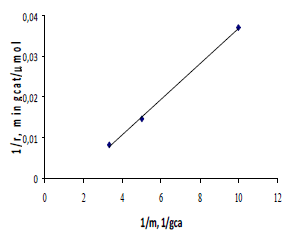
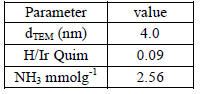
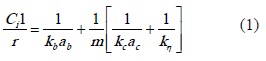
<body><![CDATA[<p>Starting with   the fresh catalyst, the same catalyst was reused to study possible catalyst   deactivation during catalytic test. In all experiments, reactant and product   concentrations were measured at different time intervals. From these data, initial rates were   calculated allowing obtaining the reaction orders with respect to furfural concentration   and H<sub>2 </sub>pressure.</p> </font>     <p>&nbsp;</p>     <p><font size="3" face="Verdana, Arial, Helvetica, sans-serif"><b>3. RESULTS AND DISCUSSION</b> </font> </p> <font face="Verdana, Arial, Helvetica, sans-serif">     <p><font size="2"><b>3.1 Catalyst characterization    <br>   </b></font><font size="2">The results of catalysts characterization have been provided previously   &#91;11&#93;, however some relevant aspects are considered here. These solids when they   are reduced at high temperature in H<sub>2</sub>, lead to a partial reduction   of the support, TiO<sub>2-x</sub> which covers the metal surface, by the so   called SMSI effect (strong metal support interaction). This behavior is   associated with a decrease of H/Ir ratio in chemisorption measurements (<a href="#tab01">table   1</a>) but without any effect in the metal particle size because there are no   changes in the metal particle size in catalysts of Ir/TiO<sub>2</sub> reduced   at different temperatures of reduction. This phenomenon has been widely studied   by TEM &#91;1,11&#93;. Surface acidity measurements were   carried out by DTP of ammonia, previously adsorbed at 393 K. Ir/TiO<sub>2</sub> exhibits a very low acidity compared with others supports &#91;12&#93;. </font></p>     <p align="center"><font size="2"><b><a name="tab01"></a>Table 1.</b> Characterization results of Ir/TiO<sub>2</sub> catalyst</font>    <br>   <img src="/img/revistas/dyna/v77n163/a16tab01.gif"></p>     <p><font size="2"><b>3.2 Mass transfer    <br>   </b></font><font size="2">In the liquid phase hydrogenation of furfuraldehyde, mass-transfer   processes (gas-liquid, liquid-solid, and intraparticle diffusion) can influence   the rates of reaction &#91;13&#93;. For the kinetic study these diffusional resistances   should be absent. The liquid-side mass-transfer coefficient and liquid-solid   mass-transfer coefficient depend on the intensity of turbulence in the liquid   phase. For this reason highest stirring speed were used (1000 rpm). For prevent intraparticle mass-transfer resistance, it was   used smallest catalyst particles sizes (100 <font face="Symbol">m</font>m). An experimental approach following the   guidelines of Satterfield and Sherwood (eq. 1) &#91;14&#93; for corroborate the absence   of gas-liquid or liquid-solid mass transfer resistance was applied.   The equation 1 describes that the reciprocal of the conversion rate as a   function of the reciprocal of catalyst mass should give a straight line   indicating absence of external mass-transfer limitation.</font></p>     <p><img src="/img/revistas/dyna/v77n163/a16eq01.gif"></p>     ]]></body>
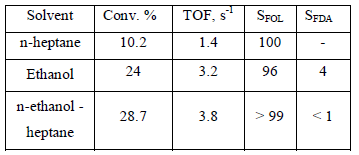
<body><![CDATA[<p><font size="2">Where the intercept 1/k<sub>b</sub>a<sub>b</sub> represents a resistance to gas absorption. The term 1/k<sub>&#951;</sub> represents a   resistance associated with the surface reaction, while the term 1/k<sub>c</sub>a<sub>c</sub> is associated with the transport of hydrogen through the bulk liquid. </font></p>     <p><font size="2">The <a href="#fig01">figure 1</a> displays the results obtained applying this equation. It   can be observed the absence of external mass-transfer limitation. Therefore,   the mass-transfer rates thus obtained were considerably higher than the maximum   reaction rates observed in the kinetic experiments, consequently, it was   concluded that external mass transfer did not have an effect on the observed   rates in the hydrogenation experiments.</font></p>     <p align="center"><font size="2"><b><a name="fig01"></a><img src="/img/revistas/dyna/v77n163/a16fig01.gif">    <br>   Figure 1.</b> Effect of catalysts weight on the initial rates in the furfural   hydrogenation at 363 K,   0.1 M   and 0.62 Mpa</font></p>     <p><font size="2"><b>3.3 Effect of solvent    <br>   </b></font><font size="2">Some solvents were used for furfural hydrogenation, such as, ethanol,   heptane, ethanol-heptane (1:1). <a href="#tab02">Table 2</a> summarizes the   solvents used, the conversion level at 60 min of reaction time as well as the   initial activity expressed as TOF (turnover frequency) for Ir/TiO<sub>2</sub> catalysts. </font></p>     <p align="center"><font size="2"><b><a name="tab02"></a>Table 2.</b> Catalytic activity in furfural hydrogenation at 363 K and 0.62 MPa,   expressed as conversion, TOF and selectivity at 60 min, S<sub>FOL</sub>=Selectivity   to furfuryl alcohol, S<sub>FDA</sub> to 2-furaldehyde-diethylacetal</font>    <br>   <img src="/img/revistas/dyna/v77n163/a16tab02.gif"></p>     <p><font size="2">As polarity increases also conversion as well as in the TOF is observed   at higher solvent, but the selectivity to the unsaturated alcohol decreases at   higher polarity. Similar trends have been reported for other hydrogenation   reactions &#91;15&#93;. It is interesting note the synergestic effect of mixed solvents   which increases both activity and selectivity. </font></p>     <p><font size="2">The results in <a href="#tab02">table 2</a> indicate clearly that the main product is   furfuryl alcohol produced by hydrogenation of C=O bond in the furfural. </font></p>     ]]></body>
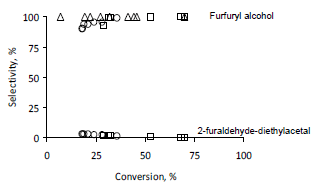
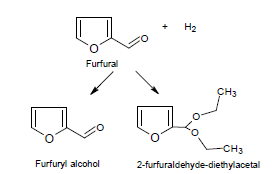
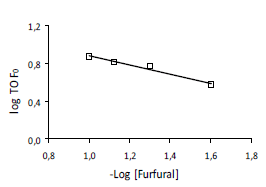
<body><![CDATA[<p><font size="2">The production of furfuryl alcohol is associated with new actives sites   in which the metallic component exhibits a partial decoration, with the   creation of Ir<sup>d+</sup> species, which are more active in   the polarization of the C=O bond &#91;11,12&#93;. With <i>n</i>-heptane as solvent the selectivity to furfuryl alcohol is 100 %,   but acetals are produced with alcoholic solvents, in this case,   2-furaldehyde-diethylacetal (m/z= 39, 97, 125 m/z). </font></p>     <p><font size="2">The acetalization takes place over acid sites, specially Brönsted acid sites on the catalyst surface, these sites are placed   near to iridium crystals. However, it has been suggested that the acid sites in   the catalysts did not modify the active metal properties &#91;16&#93; and   favors the electron transfer from acid sites in the support to the active metal   sites, by suppressing the hydrogenation of C=C bond. The rate of formation of   acetals is faster during the initial period of reaction but the selectivity of   acetal decreased with the consumption of reactant and became lower than 1 % at high conversion (<a href="#fig02">figure 2</a>).</font></p>     <p align="center"><font size="2"><b><a name="fig02"></a><img src="/img/revistas/dyna/v77n163/a16fig02.gif">    <br>   Figure   2.</b> Conversion vs selectivity, effect of solvent in furfural hydrogenation   for Ir/TiO<sub>2 </sub>at 363 K and 0.62 MPa with different solvents used; (&#916;) heptane, (&#9675;)   ethanol, (&#9633;) ethanol-heptane 1:1</font></p>     <p><font size="2">The <a href="#fig03">Figure 3</a> shows the hydrogenation products of furfural over Ir/TiO<sub>2</sub>, arising   from the reduction of the C=O group and the formation of 2-furaldehyde-diethylacetal.   In this catalyst was not observed the hydrogenation of the furan ring, or other   compounds derived from secondary reactions, such as hydrogenolysis of the   C-O bond, decarbonylation, hydrogenation and furan ring opening that may   appear &#91;17&#93;. </font></p>     <p align="center"><font size="2"><b><a name="fig03"></a><img src="/img/revistas/dyna/v77n163/a16fig03.gif">    <br>   Figure 3.</b> Reaction pathway for furfural   hydrogenation over Ir/TiO2</font></p>     <p><font size="2"><b>3.4 Analysis of initial rate data    <br>   </b></font><font size="2">The effect of initial concentration of   furfural and H<sub>2</sub> pressure on the initial rate data of furfural   hydrogenation was studied. Experiments were conducted at various initial   concentrations of furfural in the range of   0.025 M to 0.1 M, at 363 K and 0.62 MPa hydrogen partial pressure. The initial rates were   expressed as TOF. The order calculated taking out the plot of -log initial   concentration vs. -log TOF for Ir/TiO<sub>2</sub> was of 0.5 (<a href="#fig04">figure 4</a>). </font></p>     <p align="center"><font size="2"><b><a name="fig04"></a><img src="/img/revistas/dyna/v77n163/a16fig04.gif">    ]]></body>
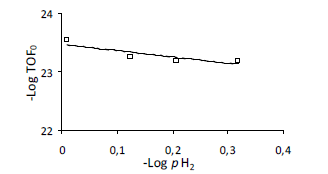
<body><![CDATA[<br>   Figure 4</b>. Effect of initial concentration on   hydrogenation of furfural over Ir/TiO<sub>2</sub> as a plot of -log C<sub>0</sub> furfural vs -log TOF.</font></p>     <p><font size="2">An explanation for this result can be the   adsorption mode of furfural on the catalysts surface. Furfural possibly adsorbs   preferentially towards C=C with plane geometry competitive with atop geometry   similar in cinnamaldehyde &#91;18&#93;. This could be attributed to the fact that C=C   on the ring of furfural are conjugated. At first time reactions the coverage of   surface of molecules of furfural with atop geometry is larger, but whiles the   reaction progress the surface is totally coverage of furfural in plane   geometry. </font></p>     <p><font size="2">The effect of the hydrogen partial pressure   on the initial rates was studied in the range of 0.48 MPa to 0.84 MPa at constant   initial concentration (0.1 M) and temperature (363 K). The results are   displayed in <a href="#fig05">figure 5</a>. The order calculated for initial rate was -1,0 using the initial rates expressed as TOF. </font></p>     <p align="center"><font size="2"><b><a name="fig05"></a><img src="/img/revistas/dyna/v77n163/a16fig05.gif">    <br>   Figure 5.</b> Effect of hydrogen partial pressure in furfural hydrogenation over   Ir/TiO<sub>2</sub> catalysts as a plot of -log PH<sub>2</sub> vs   -log TOF</font></p>     <p><font size="2"><b>3.5 Kinetic model    <br>   </b></font><font size="2">Two types of kinetic equations were employed in   the quantitative description of the experimental results: first, empirical   power-law equations based on initial rates and a second, equations based on the   Langmuir-Hinshelwood mechanism. Power-law equations for the hydrogenation of   furfural were written as </font></p>     <p><img src="/img/revistas/dyna/v77n163/a16eq02.gif"></p>     <p><font size="2">where i can be Ir/TiO<sub>2</sub>, <i>p</i> and <i>q</i> are the order obtained at initial rate   with respect to furfural concentration and partial pressure of H<sub>2</sub>.   Thus for Ir/TiO<sub>2</sub> the global order is -0,5. Because the order with respect to   concentration of furfural is fractional, it is desirable to obtain insight into   the kinetics via Langmuir-Hinshelwood models.</font></p>     <p><font size="2">Considering that the hydrogenation of   aldehydes <font face="Symbol">a</font>,<font face="Symbol">b</font>-unsaturated is potentially a complex combination of   series and parallel reactions, can be expected a parallel reactions that   involve the hydrogenation of both functional groups of the furfural (C=C, C=O),   however the results showed for Ir/TiO<sub>2</sub> in furfural hydrogenation   produces a highly selectivity towards furfuryl alcohol, being the result of the presence of SMSI effect on this   type of support. For this catalyst studied the selectivity towards unsaturated   alcohol is greater of 98% which can be interpreted as the presence of a single   site present (i.e. Ir<sup><font face="Symbol">d</font>+</sup> species are   preferential). </font></p>     ]]></body>

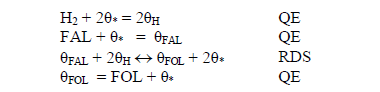
<body><![CDATA[<p><font size="2">A typical Langmuir-Hinshelwood model   (LH) of a single site can be developed to describe the hydrogenation of   furfural towards furfuryl alcohol based on the following assumptions:</font></p> </font> <ol>       <li><font face="Verdana, Arial, Helvetica, sans-serif"><font size="2">The adsorption of     hydrogen occurs in form dissociative and competitive with the organic     molecules, due to high H<sub>2</sub> partial pressure employed and the     hydrogenation surface reaction is irreversible. </font></font></li>       <li><font face="Verdana, Arial, Helvetica, sans-serif"><font size="2">Surface reaction between dissociatively adsorbed hydrogen and     adsorbed liquid phase components on the same site is considered as the rate     determining step (RDS) while that the adsorption     and desorption are in quasi-equilibrium (QE).</font></font></li>       <li><font face="Verdana, Arial, Helvetica, sans-serif"><font size="2">The diffusionals steps     not are taken in account. </font></font></li>     </ol> <font face="Verdana, Arial, Helvetica, sans-serif">     <p><font size="2">Considering these observations and assuming on   basis of the experimental observation the sequence of reaction is expressed as:</font></p>     <p><img src="/img/revistas/dyna/v77n163/a16eq021.gif"></p>     <p><font size="2">Where <font face="Symbol">q</font> is the active site, FAL is furfural, <font face="Symbol">q</font><sub>H</sub>, <font face="Symbol">q</font><sub>FAL</sub>, <font face="Symbol">q</font><sub>FOL</sub>, <font face="Symbol">q</font><sub>* </sub>are   respectively the adsorbed hydrogen, furfural adsorbed, furfuryl alcohol   adsorbed and vacant sites. Based on the basis asumptions mentioned above, the reaction rate can be written as:</font></p>     <p><img src="/img/revistas/dyna/v77n163/a16eq03.gif"></p>     <p><font size="2">Where V/W<sub>c </sub>is the ratio of he reaction   volume to the mass of catalyst; C<sub>FAL</sub> is the concentration of   furfural, k<sub>r1 </sub> is the rate   constant for the reaction. </font></p>     ]]></body>
<body><![CDATA[<p><font size="2">The quasi-equilibrium adsorption /desorption   process (steps 1, 2 and 4) provide:</font></p>     <p><img src="/img/revistas/dyna/v77n163/a16eq0406.gif"></p>     <p><font size="2">K<sub>FAL</sub>, K<sub>FOL </sub>and K<sub>H2</sub> are equilibrium adsorption constants. These expressions can be substituted into   the RDS step.</font></p>     <p><img src="/img/revistas/dyna/v77n163/a16eq07.gif"></p>     <p><font size="2">Considering that the expression for the fractional   surface coverage of sites is:</font></p>     <p><img src="/img/revistas/dyna/v77n163/a16eq08.gif"></p>     <p><font size="2">In   agreement of the results of hydrogenation reactions at 363 K with addition of   the unsaturated alcohol (furfuryl alcohol) to the reaction mixture in the   beginning had no effect on the rate of reaction the product term <font face="Symbol">q</font><sub>FOL</sub> was omitted. </font></p>     <p><img src="/img/revistas/dyna/v77n163/a16eq09.gif"></p>     <p><font size="2">Finally the reaction rate for model 1 is expressed   as: </font></p>     <p><img src="/img/revistas/dyna/v77n163/a16eq10.gif"></p>     ]]></body>
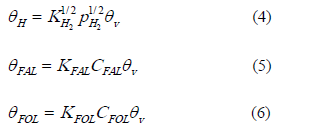

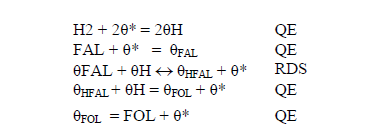
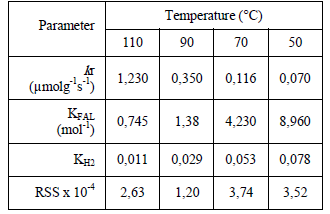
<body><![CDATA[<p><font size="2">A second LH model was proposed using the assumptions presented for model I, except   for assumption 2, which assumes that addition of hydrogen takes place in two   steps and is considered that the addition of first hydrogen is the RDS. Thus   the sequence LH can be expressed as:</font></p>     <p><img src="/img/revistas/dyna/v77n163/a16eq101.gif"></p>     <p><font size="2">The reaction rate can be written as:</font></p>     <p><img src="/img/revistas/dyna/v77n163/a16eq11.gif"></p>     <p><font size="2">With   the same procedure describe above, the rate expression for model II can be   expressed as: </font></p>     <p><img src="/img/revistas/dyna/v77n163/a16eq12.gif"></p>     <p><font size="2"><b>3.6 Confirmation of reaction mechanism    <br>   </b></font><font size="2">In order to select a suitable rate equation, a   nonlinear least-squares regression analysis was used for each rate equation to   obtain the best values of the parameters using the values of the rate constants   were fitted of the experimental concentration versus time profiles of the   chemical species involved in the reaction, using a non-linear regression   program with an iterative Gauss-Newton method. The objective function to   be minimized is residual sum of squares, RSS=&#8721;(r*-r<sup>calc</sup>)<sup>2</sup> where   r* is the experimental relative rate, r<sup>calc</sup> is the relative   concentration calculated with the model. A comparison of the RSS between the   models described above, indicates that model II gives   the best fit to the experimental data (<a href="#tab03">table 3</a>). </font></p>     <p align="center"><font size="2"><b><a name="tab03"></a>Table   3</b>. Optimized rate parameters   for the hydrogenation of furfural at different temperatures, RSS between   experimental data and results simulated by mechanism II</font>    <br>   <img src="/img/revistas/dyna/v77n163/a16tab03.gif"></p>     ]]></body>

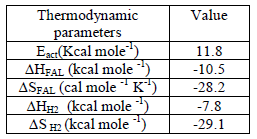
<body><![CDATA[<p><font size="2">The comparison of the experimental   concentrations and calculated concentration shows good agreement   between the model predictions and the model observed values (<a href="#fig06">figure 6</a>).</font></p>     <p align="center"><font size="2"><b><a name="fig06" id="fig06"></a><img src="/img/revistas/dyna/v77n163/a16fig05.gif">    <br>   Figure   5.</b> Parity plot of calculated concentrations (Eq.   12) with experimental concentrations at various temperatures</font></p>     <p><font size="2">The reactions were carried out at different temperatures   in the range of 323 to 363 K. <a href="#tab03">Table 3</a> displays the optimized rate parameters at different temperatures for model II. From the temperature dependence of rate   parameters the activation energy was calculated. The surface activation energy   near of 12 kcal mol<sup>-1</sup> is similar that the reported for Vaidya et al,   for furfural hydrogenation over Pt/C &#91;13&#93;. The enthalpy of adsorption and the   entropy of adsorption of furfural and hydrogen were calculated from K<sub>FAL</sub> and K<sub>H2</sub> using the van't Hoff equation, these values are listed   in <a href="#tab04">Table 4</a>. Both enthalpies and   entropies of adsorption are negative, as they should be, and quantitatively satisfies   guidelines established, according to their thermodynamic consistency &#91;19&#93;.</font></p>     <p align="center"><font size="2"><b><a name="tab04"></a>Table   4.</b> Thermodynamic parameters for adsorption K<sub>R </sub>from expressions encountered for furfural hydrogenation over Ir/TiO<sub>2</sub></font>    <br>   <img src="/img/revistas/dyna/v77n163/a16tab04.gif"></p> </font>     <p>&nbsp;</p>     <p><b><font face="Verdana, Arial, Helvetica, sans-serif"><font size="3">4. CONCLUSIONS </font></font></b></p>     <p><font face="Verdana, Arial, Helvetica, sans-serif"><font size="2"> Furfural   hydrogenation over Ir/TiO<sub>2</sub> catalysts reduced to 773 K does not   present limitations of mass transfer to describe a kinetic inadequate behavior.   The solvent affects the selectivity of the reaction due to reactions of   acetalization producing 2-furaldehyde-diethylacetal. Initial rates describes   that Ir/TiO<sub>2</sub> posses a -0,5 order global. A   kinetic model Langmuir-Hinshelwood of a single-site that involves dissociative   adsorption of first hydrogen on the organic molecule as the rate-controlling   step provided the best fit of the experimental data. Thus thermodynamic   parameters obtained for this model demonstrates that the mechanism proposed is   consistent physically and it describes the high selectivity towards the   unsaturated alcohol due principally to SMSI effect. </font></font></p> <font face="Verdana, Arial, Helvetica, sans-serif"><font size="2">     <p>&nbsp;</p> </font></font>     ]]></body>
<body><![CDATA[<p><font size="3" face="Verdana, Arial, Helvetica, sans-serif"><b>NOTATION</b></font></p>     <p><font size="2" face="Verdana, Arial, Helvetica, sans-serif">a<sub>b</sub> interfacial area at gas-liquid interface    <br>   a<sub>c</sub> specific surface area of catalyst    <br>   k<sub>b </sub>mass transfer coefficient for gas absorption across   gas-liquid interface    <br>   kc mass transfer coefficient for hydrogen transport   through the bulk liquid    <br>   q active site.    <br>   q<i><sub>v</sub></i> vacant active site.    <br>   h catalyst effectiveness factor    <br>   C<sub>FAL</sub> bulk liquid phase concentration of furfural    <br>   C<sub>FAL-H</sub> half-hydrogenated intermediate    ]]></body>
<body><![CDATA[<br>   k apparent rate constant    <br>   K<sub>FAL</sub> adsorption equilibrium constant for single site   adsorption of furfural    <br>   K<sub>H2</sub> adsorption equilibrium constant for hydrogen    <br>   K<sub>FOL</sub> adsorption equilibrium constant for furfuryl alcohol    <br>   m catalyst loading (density), g cat/L solution    <br>   p, q Orders reaction    <br>   r rate of furfural hydrogenation, mol/L min    <br>   <i>p</i><sub>H2</sub> gas phase partial pressure of hydrogen    <br>   <i>r<sub>FAL</sub> </i>specific rate of furfural hydrogenation, µmol g<sup>-1</sup>s<sup>-1    <br>   </sup>w<sub>c</sub> catalyst mass    ]]></body>
<body><![CDATA[<br>   RSS Residual sum of squares</font></p> <font face="Verdana, Arial, Helvetica, sans-serif"><font size="2">     <p>&nbsp;</p> </font></font>     <p><font size="3" face="Verdana, Arial, Helvetica, sans-serif"><b>ACKNOWLEDGEMENTS</b></font></p> <font face="Verdana, Arial, Helvetica, sans-serif"><font size="2">     <p>We thank to COLCIENCIAS-SENA and DIN-UPTC for the financial support   under the project Nº 110948925094.</p>     <p>&nbsp;</p> </font></font>     <p><font size="3" face="Verdana, Arial, Helvetica, sans-serif"><b>REFERENCES</b></font></p> <font face="Verdana, Arial, Helvetica, sans-serif"><font size="2">     <!-- ref --><p><b>&#91;1&#93;</b> GALLEZOT, P., RICHARD, R. Selective hydrogenation of a,ß-unsaturated aldehydes. Catal. Rev. Sci. Eng, 40, 81-126, 1998.     &nbsp;&nbsp;&nbsp;&nbsp;&nbsp;&nbsp;&nbsp;&nbsp;[&#160;<a href="javascript:void(0);" onclick="javascript: window.open('/scielo.php?script=sci_nlinks&ref=000139&pid=S0012-7353201000030001600001&lng=','','width=640,height=500,resizable=yes,scrollbars=1,menubar=yes,');">Links</a>&#160;]<!-- end-ref --><!-- ref --><br>   <b>&#91;2&#93;</b> ARVELA, M., H&Aacute;JEK, J., SALMI, T., MURZIN, D.Y. Chemoselective hydrogenation of carbonyl compounds over heterogeneous catalysts, Appl. Catal. A., 292, 1-59, 2005.     &nbsp;&nbsp;&nbsp;&nbsp;&nbsp;&nbsp;&nbsp;&nbsp;[&#160;<a href="javascript:void(0);" onclick="javascript: window.open('/scielo.php?script=sci_nlinks&ref=000140&pid=S0012-7353201000030001600002&lng=','','width=640,height=500,resizable=yes,scrollbars=1,menubar=yes,');">Links</a>&#160;]<!-- end-ref --><!-- ref --><br>   <b>&#91;3&#93;</b> McKETTA, J.J., CUNNINGHAM, W.A. Encyclopedia of Chemical Processing and Design; Marcel Dekker: New York, Vol. 24, pp. 63, 1986.     &nbsp;&nbsp;&nbsp;&nbsp;&nbsp;&nbsp;&nbsp;&nbsp;[&#160;<a href="javascript:void(0);" onclick="javascript: window.open('/scielo.php?script=sci_nlinks&ref=000141&pid=S0012-7353201000030001600003&lng=','','width=640,height=500,resizable=yes,scrollbars=1,menubar=yes,');">Links</a>&#160;]<!-- end-ref --><!-- ref --><br>   <b>&#91;4&#93;</b> NAGARAJA, B.M., SIVA KUMAR, V., SHASIKALA, V., PADMASRI. A.H., SREEDHAR. B. A highly efficient Cu/MgO catalyst for vapour phase hydrogenation of furfural to furfuryl alcohol, Catal. Comm., 4, 287- 293, 2003.     &nbsp;&nbsp;&nbsp;&nbsp;&nbsp;&nbsp;&nbsp;&nbsp;[&#160;<a href="javascript:void(0);" onclick="javascript: window.open('/scielo.php?script=sci_nlinks&ref=000142&pid=S0012-7353201000030001600004&lng=','','width=640,height=500,resizable=yes,scrollbars=1,menubar=yes,');">Links</a>&#160;]<!-- end-ref --><!-- ref --><br>   <b>&#91;5&#93;</b> LIU, B.J., LU, L.H., WANG, B.C., CAI T.X., KATSUYOSHI, I. Liquid phase selective hydrogenation of furfural on raney nickel modified by impregnation of salts of heteropolyacids. Appl. Catal. A. 171, 117, 1997.     &nbsp;&nbsp;&nbsp;&nbsp;&nbsp;&nbsp;&nbsp;&nbsp;[&#160;<a href="javascript:void(0);" onclick="javascript: window.open('/scielo.php?script=sci_nlinks&ref=000143&pid=S0012-7353201000030001600005&lng=','','width=640,height=500,resizable=yes,scrollbars=1,menubar=yes,');">Links</a>&#160;]<!-- end-ref --><!-- ref --><br>   <b>&#91;6&#93;</b> RAO, R., BAKER, R.T., VANNICE, M. Furfural hydrogenation over carbon supported copper. Catal. Lett. 60, 51-57, 1999.     &nbsp;&nbsp;&nbsp;&nbsp;&nbsp;&nbsp;&nbsp;&nbsp;[&#160;<a href="javascript:void(0);" onclick="javascript: window.open('/scielo.php?script=sci_nlinks&ref=000144&pid=S0012-7353201000030001600006&lng=','','width=640,height=500,resizable=yes,scrollbars=1,menubar=yes,');">Links</a>&#160;]<!-- end-ref --><!-- ref --><br>   <b>&#91;7&#93;</b> NAGARAJA, B.M., PADMASRI A.H., Raju, B.D., Rao, K.S. Vapor phase selective hydrogenation of furfural to furfuryl alcohol over Cu-MgO coprecipitated catalysts. J. Mol. Catal. A: Chem. 265, 90-97, 2007.     &nbsp;&nbsp;&nbsp;&nbsp;&nbsp;&nbsp;&nbsp;&nbsp;[&#160;<a href="javascript:void(0);" onclick="javascript: window.open('/scielo.php?script=sci_nlinks&ref=000145&pid=S0012-7353201000030001600007&lng=','','width=640,height=500,resizable=yes,scrollbars=1,menubar=yes,');">Links</a>&#160;]<!-- end-ref --><!-- ref --><br>   <b>&#91;8&#93;</b> CLAUSS, P. Selective hydrogenation of a,ß-unsaturated aldehydes and other C=O and C=C bonds containing compounds. Topics Catal., 5, 51, 1998.     &nbsp;&nbsp;&nbsp;&nbsp;&nbsp;&nbsp;&nbsp;&nbsp;[&#160;<a href="javascript:void(0);" onclick="javascript: window.open('/scielo.php?script=sci_nlinks&ref=000146&pid=S0012-7353201000030001600008&lng=','','width=640,height=500,resizable=yes,scrollbars=1,menubar=yes,');">Links</a>&#160;]<!-- end-ref --><!-- ref --><br>   <b>&#91;9&#93;</b> MERAT, N., GODAWA, C., GASET, A.J. High selective production of tetrahydrofurfuryl alcohol: Catalytic hydrogenation of furfural and furfuryl alcohol. Chem. Technol. Biotechnol. 48, 145-159, 1990.     &nbsp;&nbsp;&nbsp;&nbsp;&nbsp;&nbsp;&nbsp;&nbsp;[&#160;<a href="javascript:void(0);" onclick="javascript: window.open('/scielo.php?script=sci_nlinks&ref=000147&pid=S0012-7353201000030001600009&lng=','','width=640,height=500,resizable=yes,scrollbars=1,menubar=yes,');">Links</a>&#160;]<!-- end-ref --><!-- ref --><br>   <b>&#91;10&#93;</b> KIJENSKI, J., WINIAREK, P., PARYJCZAK, T., LEWICKI, A., MIKOLAJSKA A. Platinum deposited on monolayer supports in selective hydrogenation of furfural to furfuryl alcohol. Appl. Catal. A. 233, 171-182, 2002.     &nbsp;&nbsp;&nbsp;&nbsp;&nbsp;&nbsp;&nbsp;&nbsp;[&#160;<a href="javascript:void(0);" onclick="javascript: window.open('/scielo.php?script=sci_nlinks&ref=000148&pid=S0012-7353201000030001600010&lng=','','width=640,height=500,resizable=yes,scrollbars=1,menubar=yes,');">Links</a>&#160;]<!-- end-ref --><!-- ref --><br>   <b>&#91;11&#93;</b> REYES, P., ROJAS, H., PECCHI, G., FIERRO, J.L.G. Liquid-phase hydrogenation of citral over Ir supported catalysts. J. Mol. Catal. A: Chem. 179, 293-299, 2002.     &nbsp;&nbsp;&nbsp;&nbsp;&nbsp;&nbsp;&nbsp;&nbsp;[&#160;<a href="javascript:void(0);" onclick="javascript: window.open('/scielo.php?script=sci_nlinks&ref=000149&pid=S0012-7353201000030001600011&lng=','','width=640,height=500,resizable=yes,scrollbars=1,menubar=yes,');">Links</a>&#160;]<!-- end-ref --><!-- ref --><br>   <b>&#91;12&#93;</b> ROJAS, H., BORDA, G., MART&Iacute;NEZ J.J, ROSAS, D., REYES P. Hidrogenaci&oacute;n de furfural sobre catalizadores Ir/Nb2O5. Estudio Cin&eacute;tico. Dyna 155, 115-122, 2008.     &nbsp;&nbsp;&nbsp;&nbsp;&nbsp;&nbsp;&nbsp;&nbsp;[&#160;<a href="javascript:void(0);" onclick="javascript: window.open('/scielo.php?script=sci_nlinks&ref=000150&pid=S0012-7353201000030001600012&lng=','','width=640,height=500,resizable=yes,scrollbars=1,menubar=yes,');">Links</a>&#160;]<!-- end-ref --><!-- ref --><br>   <b>&#91;13&#93;</b> VAIDYA. P., MAHAJANI. V.V. Kinetics of liquid phase hydrogenation of furfuraldehyde to furfuryl alcohol over a Pt/C catalyst. Ind. Eng. Chem. Res., 42, 3881-3885, 2003.     &nbsp;&nbsp;&nbsp;&nbsp;&nbsp;&nbsp;&nbsp;&nbsp;[&#160;<a href="javascript:void(0);" onclick="javascript: window.open('/scielo.php?script=sci_nlinks&ref=000151&pid=S0012-7353201000030001600013&lng=','','width=640,height=500,resizable=yes,scrollbars=1,menubar=yes,');">Links</a>&#160;]<!-- end-ref --><!-- ref --><br>   <b>&#91;14&#93;</b> SATERFIELD, C.N., SHERWOOD T.K. The role of diffusion in catalysis. Addison'wesley, Reading M.A. pp 43-55. 1963.     &nbsp;&nbsp;&nbsp;&nbsp;&nbsp;&nbsp;&nbsp;&nbsp;[&#160;<a href="javascript:void(0);" onclick="javascript: window.open('/scielo.php?script=sci_nlinks&ref=000152&pid=S0012-7353201000030001600014&lng=','','width=640,height=500,resizable=yes,scrollbars=1,menubar=yes,');">Links</a>&#160;]<!-- end-ref --><!-- ref --><br>   <b>&#91;15&#93;</b> REYES, P., ROJAS, H. The solvent effect in the hydrogenation of citral over Ir and Ir-Fe/TiO2 catalysts. J. Chil. Chem. Soc, 52, 1155-1159, 2007.     &nbsp;&nbsp;&nbsp;&nbsp;&nbsp;&nbsp;&nbsp;&nbsp;[&#160;<a href="javascript:void(0);" onclick="javascript: window.open('/scielo.php?script=sci_nlinks&ref=000153&pid=S0012-7353201000030001600015&lng=','','width=640,height=500,resizable=yes,scrollbars=1,menubar=yes,');">Links</a>&#160;]<!-- end-ref --><!-- ref --><br>   <b>&#91;16&#93;</b> YILMAZ, S., UCAR, S., ARTOK, L., GULEC, H. The kinetics of citral hydrogenation over Pd supported on clinoplite rich natural zeolite. Appl. Catal. A 287, 261-266, 2005.     &nbsp;&nbsp;&nbsp;&nbsp;&nbsp;&nbsp;&nbsp;&nbsp;[&#160;<a href="javascript:void(0);" onclick="javascript: window.open('/scielo.php?script=sci_nlinks&ref=000154&pid=S0012-7353201000030001600016&lng=','','width=640,height=500,resizable=yes,scrollbars=1,menubar=yes,');">Links</a>&#160;]<!-- end-ref --><!-- ref --><br>   <b>&#91;17&#93;</b> MERLO, A.B., VETERE, V., RUGGERA, J.F., CASELLA, M.L. Bimetallic PtSn catalyst for the selective hydrogenation of furfural to furfuryl alcohol in liquid-phase. Catal. Comm., 10, 1665-1669, 2009.     &nbsp;&nbsp;&nbsp;&nbsp;&nbsp;&nbsp;&nbsp;&nbsp;[&#160;<a href="javascript:void(0);" onclick="javascript: window.open('/scielo.php?script=sci_nlinks&ref=000155&pid=S0012-7353201000030001600017&lng=','','width=640,height=500,resizable=yes,scrollbars=1,menubar=yes,');">Links</a>&#160;]<!-- end-ref --><!-- ref --><br>   <b>&#91;18&#93;</b> BREEN. J.P., BURCH. R., G&Oacute;MEZ-L&Oacute;PEZ J., GRIFFIN. K., HAYES. M. Steric effects in the selective hydrogenation of cinnamaldehyde to cinnmayl alcohol using an Ir/C catalyst. Appl. Catal A., 268, 267-273, 2004.     &nbsp;&nbsp;&nbsp;&nbsp;&nbsp;&nbsp;&nbsp;&nbsp;[&#160;<a href="javascript:void(0);" onclick="javascript: window.open('/scielo.php?script=sci_nlinks&ref=000156&pid=S0012-7353201000030001600018&lng=','','width=640,height=500,resizable=yes,scrollbars=1,menubar=yes,');">Links</a>&#160;]<!-- end-ref --><!-- ref --><br>   <b>&#91;19&#93;</b> VANNICE. M.A., HYUN. S.H., KALPAKCI. B. LIAUH. W.C. Entropies of adsorption in heterogeneous catalytic reactions. J. Catal., 56, 358-364, 1979. &nbsp;&nbsp;&nbsp;&nbsp;&nbsp;&nbsp;&nbsp;&nbsp;[&#160;<a href="javascript:void(0);" onclick="javascript: window.open('/scielo.php?script=sci_nlinks&ref=000157&pid=S0012-7353201000030001600019&lng=','','width=640,height=500,resizable=yes,scrollbars=1,menubar=yes,');">Links</a>&#160;]<!-- end-ref --> ]]></body><back>
<ref-list>
<ref id="B1">
<label>1</label><nlm-citation citation-type="journal">
<person-group person-group-type="author">
<name>
<surname><![CDATA[GALLEZOT]]></surname>
<given-names><![CDATA[P.]]></given-names>
</name>
<name>
<surname><![CDATA[RICHARD]]></surname>
<given-names><![CDATA[R.]]></given-names>
</name>
</person-group>
<article-title xml:lang="en"><![CDATA[Selective hydrogenation of a,ß-unsaturated aldehydes.]]></article-title>
<source><![CDATA[Catal. Rev. Sci. Eng,]]></source>
<year>1998</year>
<numero>40</numero>
<issue>40</issue>
<page-range>81-126</page-range></nlm-citation>
</ref>
<ref id="B2">
<label>2</label><nlm-citation citation-type="journal">
<person-group person-group-type="author">
<name>
<surname><![CDATA[ARVELA]]></surname>
<given-names><![CDATA[M.]]></given-names>
</name>
<name>
<surname><![CDATA[HÁJEK]]></surname>
<given-names><![CDATA[J.]]></given-names>
</name>
<name>
<surname><![CDATA[SALMI]]></surname>
<given-names><![CDATA[T.]]></given-names>
</name>
<name>
<surname><![CDATA[MURZIN]]></surname>
<given-names><![CDATA[D.Y.]]></given-names>
</name>
</person-group>
<article-title xml:lang="en"><![CDATA[Chemoselective hydrogenation of carbonyl compounds over heterogeneous catalysts]]></article-title>
<source><![CDATA[Appl. Catal. A.]]></source>
<year>2005</year>
<numero>292</numero>
<issue>292</issue>
<page-range>1-59</page-range></nlm-citation>
</ref>
<ref id="B3">
<label>3</label><nlm-citation citation-type="book">
<person-group person-group-type="author">
<name>
<surname><![CDATA[McKETTA]]></surname>
<given-names><![CDATA[J.J.]]></given-names>
</name>
<name>
<surname><![CDATA[CUNNINGHAM]]></surname>
<given-names><![CDATA[W.A.]]></given-names>
</name>
</person-group>
<source><![CDATA[Encyclopedia of Chemical Processing and Design]]></source>
<year>1986</year>
<volume>24</volume>
<publisher-loc><![CDATA[New York ]]></publisher-loc>
<publisher-name><![CDATA[Marcel Dekker]]></publisher-name>
</nlm-citation>
</ref>
<ref id="B4">
<label>4</label><nlm-citation citation-type="">
<person-group person-group-type="author">
<name>
<surname><![CDATA[NAGARAJA]]></surname>
<given-names><![CDATA[B.M.]]></given-names>
</name>
<name>
<surname><![CDATA[SIVA KUMAR]]></surname>
<given-names><![CDATA[V.]]></given-names>
</name>
<name>
<surname><![CDATA[SHASIKALA]]></surname>
<given-names><![CDATA[V.]]></given-names>
</name>
<name>
<surname><![CDATA[PADMASRI]]></surname>
<given-names><![CDATA[A.H.]]></given-names>
</name>
<name>
<surname><![CDATA[SREEDHAR]]></surname>
<given-names><![CDATA[B.]]></given-names>
</name>
</person-group>
<article-title xml:lang="en"><![CDATA[A highly efficient Cu/MgO catalyst for vapour phase hydrogenation of furfural to furfuryl alcohol]]></article-title>
<source><![CDATA[]]></source>
<year>2003</year>
<numero>4</numero>
<issue>4</issue>
<page-range>287- 293</page-range></nlm-citation>
</ref>
<ref id="B5">
<label>5</label><nlm-citation citation-type="journal">
<person-group person-group-type="author">
<name>
<surname><![CDATA[LIU]]></surname>
<given-names><![CDATA[B.J.]]></given-names>
</name>
<name>
<surname><![CDATA[LU]]></surname>
<given-names><![CDATA[L.H.]]></given-names>
</name>
<name>
<surname><![CDATA[WANG]]></surname>
<given-names><![CDATA[B.C.]]></given-names>
</name>
<name>
<surname><![CDATA[CAI]]></surname>
<given-names><![CDATA[T.X.]]></given-names>
</name>
<name>
<surname><![CDATA[KATSUYOSHI]]></surname>
<given-names><![CDATA[I.]]></given-names>
</name>
</person-group>
<article-title xml:lang="en"><![CDATA[Liquid phase selective hydrogenation of furfural on raney nickel modified by impregnation of salts of heteropolyacids.]]></article-title>
<source><![CDATA[Appl. Catal. A.]]></source>
<year>1997</year>
<numero>171</numero>
<issue>171</issue>
<page-range>117</page-range></nlm-citation>
</ref>
<ref id="B6">
<label>6</label><nlm-citation citation-type="journal">
<person-group person-group-type="author">
<name>
<surname><![CDATA[RAO]]></surname>
<given-names><![CDATA[R.]]></given-names>
</name>
<name>
<surname><![CDATA[BAKER]]></surname>
<given-names><![CDATA[R.T.]]></given-names>
</name>
<name>
<surname><![CDATA[VANNICE]]></surname>
<given-names><![CDATA[M.]]></given-names>
</name>
</person-group>
<article-title xml:lang="en"><![CDATA[Furfural hydrogenation over carbon supported copper.]]></article-title>
<source><![CDATA[Catal. Lett.]]></source>
<year>1999</year>
<numero>60</numero>
<issue>60</issue>
<page-range>51-57</page-range></nlm-citation>
</ref>
<ref id="B7">
<label>7</label><nlm-citation citation-type="journal">
<person-group person-group-type="author">
<name>
<surname><![CDATA[NAGARAJA]]></surname>
<given-names><![CDATA[B.M.]]></given-names>
</name>
<name>
<surname><![CDATA[PADMASRI]]></surname>
<given-names><![CDATA[A.H.]]></given-names>
</name>
<name>
<surname><![CDATA[Raju]]></surname>
<given-names><![CDATA[B.D.]]></given-names>
</name>
<name>
<surname><![CDATA[Rao]]></surname>
<given-names><![CDATA[K.S.]]></given-names>
</name>
</person-group>
<article-title xml:lang="en"><![CDATA[Vapor phase selective hydrogenation of furfural to furfuryl alcohol over Cu-MgO coprecipitated catalysts.]]></article-title>
<source><![CDATA[J. Mol. Catal. A: Chem.]]></source>
<year>2007</year>
<numero>265</numero>
<issue>265</issue>
<page-range>90-97</page-range></nlm-citation>
</ref>
<ref id="B8">
<label>8</label><nlm-citation citation-type="journal">
<person-group person-group-type="author">
<name>
<surname><![CDATA[CLAUSS]]></surname>
<given-names><![CDATA[P.]]></given-names>
</name>
</person-group>
<article-title xml:lang="en"><![CDATA[Selective hydrogenation of a,ß-unsaturated aldehydes and other C=O and C=C bonds containing compounds.]]></article-title>
<source><![CDATA[Topics Catal.]]></source>
<year>1998</year>
<numero>5</numero>
<issue>5</issue>
<page-range>51</page-range></nlm-citation>
</ref>
<ref id="B9">
<label>9</label><nlm-citation citation-type="journal">
<person-group person-group-type="author">
<name>
<surname><![CDATA[MERAT]]></surname>
<given-names><![CDATA[N.]]></given-names>
</name>
<name>
<surname><![CDATA[GODAWA]]></surname>
<given-names><![CDATA[C.]]></given-names>
</name>
<name>
<surname><![CDATA[GASET]]></surname>
<given-names><![CDATA[A.J.]]></given-names>
</name>
</person-group>
<article-title xml:lang="en"><![CDATA[High selective production of tetrahydrofurfuryl alcohol: Catalytic hydrogenation of furfural and furfuryl alcohol.]]></article-title>
<source><![CDATA[Chem. Technol. Biotechnol.]]></source>
<year>1990</year>
<numero>48</numero>
<issue>48</issue>
<page-range>145-159</page-range></nlm-citation>
</ref>
<ref id="B10">
<label>10</label><nlm-citation citation-type="journal">
<person-group person-group-type="author">
<name>
<surname><![CDATA[KIJENSKI]]></surname>
<given-names><![CDATA[J.]]></given-names>
</name>
<name>
<surname><![CDATA[WINIAREK]]></surname>
<given-names><![CDATA[P.]]></given-names>
</name>
<name>
<surname><![CDATA[PARYJCZAK]]></surname>
<given-names><![CDATA[T.]]></given-names>
</name>
<name>
<surname><![CDATA[LEWICKI]]></surname>
<given-names><![CDATA[A.]]></given-names>
</name>
<name>
<surname><![CDATA[MIKOLAJSKA]]></surname>
<given-names><![CDATA[A.]]></given-names>
</name>
</person-group>
<article-title xml:lang="en"><![CDATA[Platinum deposited on monolayer supports in selective hydrogenation of furfural to furfuryl alcohol.]]></article-title>
<source><![CDATA[Appl. Catal. A.]]></source>
<year>2002</year>
<numero>233</numero>
<issue>233</issue>
<page-range>171-182</page-range></nlm-citation>
</ref>
<ref id="B11">
<label>11</label><nlm-citation citation-type="journal">
<person-group person-group-type="author">
<name>
<surname><![CDATA[REYES]]></surname>
<given-names><![CDATA[P]]></given-names>
</name>
<name>
<surname><![CDATA[ROJAS]]></surname>
<given-names><![CDATA[H.]]></given-names>
</name>
<name>
<surname><![CDATA[PECCHI]]></surname>
<given-names><![CDATA[G.]]></given-names>
</name>
<name>
<surname><![CDATA[FIERRO]]></surname>
<given-names><![CDATA[J.L.G.]]></given-names>
</name>
</person-group>
<article-title xml:lang="en"><![CDATA[Liquid-phase hydrogenation of citral over Ir supported catalysts.]]></article-title>
<source><![CDATA[J. Mol. Catal. A: Chem.]]></source>
<year>2002</year>
<numero>179</numero>
<issue>179</issue>
<page-range>293-299</page-range></nlm-citation>
</ref>
<ref id="B12">
<label>12</label><nlm-citation citation-type="journal">
<person-group person-group-type="author">
<name>
<surname><![CDATA[ROJAS]]></surname>
<given-names><![CDATA[H.]]></given-names>
</name>
<name>
<surname><![CDATA[BORDA]]></surname>
<given-names><![CDATA[G.]]></given-names>
</name>
<name>
<surname><![CDATA[MARTÍNEZ]]></surname>
<given-names><![CDATA[J.J]]></given-names>
</name>
<name>
<surname><![CDATA[ROSAS]]></surname>
<given-names><![CDATA[D.]]></given-names>
</name>
<name>
<surname><![CDATA[REYES]]></surname>
<given-names><![CDATA[P.]]></given-names>
</name>
</person-group>
<article-title xml:lang="es"><![CDATA[Hidrogenación de furfural sobre catalizadores Ir/Nb2O5: Estudio Cinético]]></article-title>
<source><![CDATA[Dyna]]></source>
<year></year>
<numero>155</numero>
<issue>155</issue>
<page-range>115-122</page-range></nlm-citation>
</ref>
<ref id="B13">
<label>13</label><nlm-citation citation-type="journal">
<person-group person-group-type="author">
<name>
<surname><![CDATA[VAIDYA]]></surname>
<given-names><![CDATA[P.]]></given-names>
</name>
<name>
<surname><![CDATA[MAHAJANI]]></surname>
<given-names><![CDATA[V.V.]]></given-names>
</name>
</person-group>
<article-title xml:lang="en"><![CDATA[Kinetics of liquid phase hydrogenation of furfuraldehyde to furfuryl alcohol over a Pt/C catalyst.]]></article-title>
<source><![CDATA[Ind. Eng. Chem. Res.]]></source>
<year>2003</year>
<numero>42</numero>
<issue>42</issue>
<page-range>3881-3885</page-range></nlm-citation>
</ref>
<ref id="B14">
<label>14</label><nlm-citation citation-type="book">
<person-group person-group-type="author">
<name>
<surname><![CDATA[SATERFIELD]]></surname>
<given-names><![CDATA[C.N.]]></given-names>
</name>
<name>
<surname><![CDATA[SHERWOOD]]></surname>
<given-names><![CDATA[T.K.]]></given-names>
</name>
</person-group>
<source><![CDATA[The role of diffusion in catalysis]]></source>
<year>1963</year>
<page-range>43-55</page-range><publisher-name><![CDATA[Addison'wesley, Reading M.A.]]></publisher-name>
</nlm-citation>
</ref>
<ref id="B15">
<label>15</label><nlm-citation citation-type="journal">
<person-group person-group-type="author">
<name>
<surname><![CDATA[REYES]]></surname>
<given-names><![CDATA[P.]]></given-names>
</name>
<name>
<surname><![CDATA[ROJAS]]></surname>
<given-names><![CDATA[H.]]></given-names>
</name>
</person-group>
<article-title xml:lang="en"><![CDATA[The solvent effect in the hydrogenation of citral over Ir and Ir-Fe/TiO2 catalysts.]]></article-title>
<source><![CDATA[J. Chil. Chem. Soc]]></source>
<year>2007</year>
<numero>52</numero>
<issue>52</issue>
<page-range>1155-1159</page-range></nlm-citation>
</ref>
<ref id="B16">
<label>16</label><nlm-citation citation-type="journal">
<person-group person-group-type="author">
<name>
<surname><![CDATA[YILMAZ]]></surname>
<given-names><![CDATA[S.]]></given-names>
</name>
<name>
<surname><![CDATA[UCAR]]></surname>
<given-names><![CDATA[S.]]></given-names>
</name>
<name>
<surname><![CDATA[ARTOK]]></surname>
<given-names><![CDATA[L.]]></given-names>
</name>
<name>
<surname><![CDATA[GULEC]]></surname>
<given-names><![CDATA[H.]]></given-names>
</name>
</person-group>
<article-title xml:lang="en"><![CDATA[The kinetics of citral hydrogenation over Pd supported on clinoplite rich natural zeolite.]]></article-title>
<source><![CDATA[Appl. Catal. A]]></source>
<year>2005</year>
<numero>287</numero>
<issue>287</issue>
<page-range>261-266</page-range></nlm-citation>
</ref>
<ref id="B17">
<label>17</label><nlm-citation citation-type="journal">
<person-group person-group-type="author">
<name>
<surname><![CDATA[MERLO]]></surname>
</name>
</person-group>
<source><![CDATA[Catal. Comm.]]></source>
<year>2009</year>
<month>.</month>
<numero>10</numero>
<issue>10</issue>
<page-range>1665-1669</page-range></nlm-citation>
</ref>
<ref id="B18">
<label>18</label><nlm-citation citation-type="journal">
<person-group person-group-type="author">
<name>
<surname><![CDATA[BREEN]]></surname>
<given-names><![CDATA[J.P.]]></given-names>
</name>
<name>
<surname><![CDATA[BURCH]]></surname>
<given-names><![CDATA[R.]]></given-names>
</name>
<name>
<surname><![CDATA[GÓMEZ-LÓPEZ]]></surname>
<given-names><![CDATA[J.]]></given-names>
</name>
<name>
<surname><![CDATA[GRIFFIN]]></surname>
<given-names><![CDATA[K.]]></given-names>
</name>
<name>
<surname><![CDATA[HAYES]]></surname>
<given-names><![CDATA[M.]]></given-names>
</name>
</person-group>
<article-title xml:lang="en"><![CDATA[Steric effects in the selective hydrogenation of cinnamaldehyde to cinnmayl alcohol using an Ir/C catalyst.]]></article-title>
<source><![CDATA[Appl. Catal A.]]></source>
<year>2004</year>
<numero>268</numero>
<issue>268</issue>
<page-range>267-273</page-range></nlm-citation>
</ref>
<ref id="B19">
<label>19</label><nlm-citation citation-type="journal">
<person-group person-group-type="author">
<name>
<surname><![CDATA[VANNICE.]]></surname>
<given-names><![CDATA[M.A.]]></given-names>
</name>
<name>
<surname><![CDATA[HYUN]]></surname>
<given-names><![CDATA[S.H.]]></given-names>
</name>
<name>
<surname><![CDATA[KALPAKCI.]]></surname>
<given-names><![CDATA[B.]]></given-names>
</name>
<name>
<surname><![CDATA[LIAUH]]></surname>
<given-names><![CDATA[W.C.]]></given-names>
</name>
</person-group>
<article-title xml:lang="en"><![CDATA[Entropies of adsorption in heterogeneous catalytic reactions.]]></article-title>
<source><![CDATA[J. Catal.]]></source>
<year>1979</year>
<numero>56</numero>
<issue>56</issue>
<page-range>358-364</page-range></nlm-citation>
</ref>
</ref-list>
</back>
</article>