<?xml version="1.0" encoding="ISO-8859-1"?><article xmlns:mml="http://www.w3.org/1998/Math/MathML" xmlns:xlink="http://www.w3.org/1999/xlink" xmlns:xsi="http://www.w3.org/2001/XMLSchema-instance">
<front>
<journal-meta>
<journal-id>0012-7353</journal-id>
<journal-title><![CDATA[DYNA]]></journal-title>
<abbrev-journal-title><![CDATA[Dyna rev.fac.nac.minas]]></abbrev-journal-title>
<issn>0012-7353</issn>
<publisher>
<publisher-name><![CDATA[Universidad Nacional de Colombia]]></publisher-name>
</publisher>
</journal-meta>
<article-meta>
<article-id>S0012-73532010000300017</article-id>
<title-group>
<article-title xml:lang="en"><![CDATA[UNCOUPLING LAMINAR CONJUGATE HEAT TRANSFER THROUGH CHEBYSHEV POLYNOMIAL]]></article-title>
<article-title xml:lang="es"><![CDATA[DESACOPLAMIENTO DE LA TRANSFERENCIA DE CALOR CONJUGADA LAMINAR USANDO EL POLINOMIO DE CHEBYSHEV]]></article-title>
</title-group>
<contrib-group>
<contrib contrib-type="author">
<name>
<surname><![CDATA[BULA]]></surname>
<given-names><![CDATA[ANTONIO J.]]></given-names>
</name>
<xref ref-type="aff" rid="A01"/>
</contrib>
<contrib contrib-type="author">
<name>
<surname><![CDATA[VÁSQUEZ]]></surname>
<given-names><![CDATA[RICARDO S.]]></given-names>
</name>
<xref ref-type="aff" rid="A02"/>
</contrib>
</contrib-group>
<aff id="A01">
<institution><![CDATA[,Universidad del Norte Departamento de Ing. Mecánica ]]></institution>
<addr-line><![CDATA[Barranquilla ]]></addr-line>
<country>Colombia</country>
</aff>
<aff id="A02">
<institution><![CDATA[,Universidad del Norte  ]]></institution>
<addr-line><![CDATA[Barranquilla ]]></addr-line>
</aff>
<pub-date pub-type="pub">
<day>00</day>
<month>09</month>
<year>2010</year>
</pub-date>
<pub-date pub-type="epub">
<day>00</day>
<month>09</month>
<year>2010</year>
</pub-date>
<volume>77</volume>
<numero>163</numero>
<fpage>160</fpage>
<lpage>171</lpage>
<copyright-statement/>
<copyright-year/>
<self-uri xlink:href="http://www.scielo.org.co/scielo.php?script=sci_arttext&amp;pid=S0012-73532010000300017&amp;lng=en&amp;nrm=iso"></self-uri><self-uri xlink:href="http://www.scielo.org.co/scielo.php?script=sci_abstract&amp;pid=S0012-73532010000300017&amp;lng=en&amp;nrm=iso"></self-uri><self-uri xlink:href="http://www.scielo.org.co/scielo.php?script=sci_pdf&amp;pid=S0012-73532010000300017&amp;lng=en&amp;nrm=iso"></self-uri><abstract abstract-type="short" xml:lang="en"><p><![CDATA[The conjugate heat transfer process of cooling a horizontal plate at the leading edge, in steady state condition, was solved considering the fluid flowing in laminar condition and hydro dynamically developed before interacting with a heated plate. The fluid was considered deep enough to allow the growth of a thermal boundary layer with no restrictions. The conservation of mass, momentum and energy equations at the solid and fluid were converted into a non dimensional form. The heated body presents a constant heat flux at the bottom side, and convective heat transfer at the top side. The interface temperature was obtained using the Chebyshev polynomial approximation. In order to verify the results obtained using the Chebyshev polynomial approximation, the results obtained from the analytical solution for the solid, were compared with the results attained with commercial CFD software, FIDAP®. The solution considered the calculation of the local and average heat transfer coefficient, the local and average Nusselt number, the local and average Biot number, and different temperature distributions at the interface.]]></p></abstract>
<abstract abstract-type="short" xml:lang="es"><p><![CDATA[El proceso de transferencia de calor conjugada para enfriamiento de una placa en estado estable ha sido resuelto considerando el fluido laminar e hidrodinámicamente desarrollado antes de entrar en contacto con la placa. El fluido es lo suficientemente profundo y permite el crecimiento de la capa límite térmica sin restricciones. Las ecuaciones de continuidad, cantidad de movimiento y energía, en el sólido y en fluido fueron adimensionalizadas. La temperatura en la interface se obtiene por medio del polinomio de Chebishev, y los resultados obtenidos fueron verificados con la solución obtenida por medio de software CFD comercial, FIDAP ®. La solución ncluyo el cálculo del coeficiente de transferencia de calor, el número de Nusselt, el número de Biot, todos tanto local como promedio. La distribución de temperatura en la interface también fue obtenida.]]></p></abstract>
<kwd-group>
<kwd lng="en"><![CDATA[Chebyshev's polynomial]]></kwd>
<kwd lng="en"><![CDATA[conjugate heat transfer]]></kwd>
<kwd lng="es"><![CDATA[Polinomio de Chebyshev]]></kwd>
<kwd lng="es"><![CDATA[transferencia de calor conjugada]]></kwd>
</kwd-group>
</article-meta>
</front><body><![CDATA[ <p align="center"><font size="4" face="Verdana, Arial, Helvetica, sans-serif"><b>UNCOUPLING LAMINAR   CONJUGATE HEAT TRANSFER THROUGH CHEBYSHEV POLYNOMIAL </b></font></p>     <p align="center"><font size="3"><i><font face="Verdana, Arial, Helvetica, sans-serif"><b>DESACOPLAMIENTO DE LA   TRANSFERENCIA DE   CALOR CONJUGADA LAMINAR USANDO EL POLINOMIO   DE CHEBYSHEV </b></font></i></font></p>     <p align="center">&nbsp;</p>     <p align="center"><font size="2" face="Verdana, Arial, Helvetica, sans-serif"><b>ANTONIO J. BULA </b>    <br>   </font><font size="2" face="Verdana, Arial, Helvetica, sans-serif"><i>Departamento de Ing. Mec&aacute;nica,   Universidad del Norte, Barranquilla, Colombia, <a href="mailto:abula@uninorte.edu.co">abula@uninorte.edu.co</a> </i></font></p>     <p align="center"><font size="2" face="Verdana, Arial, Helvetica, sans-serif"> <b>RICARDO   S. V&Aacute;SQUEZ</b>    <br>   <i>Universidad del   Norte,Barranquilla, <a href="mailto:rsvasque@mail.usf.edu">rsvasque@mail.usf.edu</a></i></font></p>     <p align="center">&nbsp;</p>     <p align="center"><font size="2" face="Verdana, Arial, Helvetica, sans-serif"><b>Received for review January 23<sup>th</sup>, 2009, accepted September 9<sup>th</sup>, 2009, final version October, 6<sup>th</sup>, 2009 </b></font></p>     <p>&nbsp;</p> <hr>     ]]></body>
<body><![CDATA[<p><font size="2" face="Verdana, Arial, Helvetica, sans-serif"><b>ABSTRACT: </b>The   conjugate heat transfer process of cooling a horizontal plate at the leading   edge, in steady state condition, was solved considering the fluid flowing in   laminar condition and hydro dynamically developed before interacting with a heated   plate. The fluid was considered deep enough to allow the growth of a thermal   boundary layer with no restrictions. The conservation of mass, momentum and   energy equations at the solid and fluid were converted into a non dimensional   form. The heated body presents a constant heat flux at the bottom side, and   convective heat transfer at the top side. The interface temperature was   obtained using the Chebyshev polynomial approximation. In order to verify the   results obtained using the Chebyshev polynomial approximation, the results   obtained from the analytical solution for the solid, were compared with the   results attained with commercial CFD software, FIDAP®.   The solution considered the calculation of the local and average heat transfer   coefficient, the local and average Nusselt number, the local and average Biot   number, and different temperature distributions at the interface. </font><font size="2"> </font></p> <font size="2">     <p><font face="Verdana, Arial, Helvetica, sans-serif"><b>KEYWORDS:</b> Chebyshev's polynomial, conjugate   heat transfer. </font></p>     <p><font face="Verdana, Arial, Helvetica, sans-serif"><b>RESUMEN:</b> El   proceso de transferencia de calor conjugada para enfriamiento de una placa en   estado estable ha sido resuelto considerando el fluido laminar e   hidrodin&aacute;micamente desarrollado antes de entrar en contacto con la placa. El   fluido es lo suficientemente profundo y permite el crecimiento de la capa   l&iacute;mite t&eacute;rmica sin restricciones. Las ecuaciones de   continuidad, cantidad de movimiento y energ&iacute;a, en el s&oacute;lido y en fluido fueron adimensionalizadas. La temperatura en la interface se   obtiene por medio del polinomio de Chebishev, y los   resultados obtenidos fueron verificados con la soluci&oacute;n obtenida por medio de software CFD comercial, FIDAP ®.   La soluci&oacute;n ncluyo el c&aacute;lculo del coeficiente de   transferencia de calor, el n&uacute;mero de Nusselt, el n&uacute;mero de Biot, todos tanto   local como promedio. La distribuci&oacute;n de temperatura en la interface tambi&eacute;n fue   obtenida. </font></p>     <p><font face="Verdana, Arial, Helvetica, sans-serif"><b>PALABRAS CLAVES: </b>Polinomio   de Chebyshev, transferencia de calor conjugada. </font></p> </font> <hr> <font size="2">     <p>&nbsp;</p> </font>     <p><font size="3" face="Verdana, Arial, Helvetica, sans-serif"><b>1. INTRODUCTION </b></font></p> <font size="2">     <p><font face="Verdana, Arial, Helvetica, sans-serif">The conjugate heat transfer problem is present when heat   is exchanged between a solid and a fluid. The common approximation considers a   boundary condition between the solid and the fluid that uncouples the phenomena,   to solve the conduction heat transfer situation for the solid, </font></p>     <p><font face="Verdana, Arial, Helvetica, sans-serif">and the convection heat transfer situation for the fluid.   This can be accomplished by a linear combination of orthogonal Chebyshev polynomials   that guarantees the solution of the partial differential equation at the solid,   and helps to find the non dimensional parameters that control the convection heat transfer problem. Analytical and numerical solutions for   cooling electronic components have allowed proposing some geometrical   configurations that enhance the heat transfer process, in order to obtain the   temperature distribution inside electronics boards &#91;1, 2, 3&#93;.   The analytical part helped to optimize the selection of materials,   configuration and location to the components in order to reduce the maximum   temperature in the substrate, and allowed estimation of heat released by the   source and its effect on the temperature distribution. In 1998 &#91;4&#93; presented   experimental results correlated through empirical expressions for flat plates   with constant heat sources. The conjugate heat transfer process has been   studied numerically &#91;5, 6&#93; presenting numerical solutions for jets impinging   over flat surfaces under laminar flow. Numerical results were compared to   experimental data gathered by &#91;7&#93;. A work by &#91;8&#93; used a Chebyshev approximation   in order to solve a two dimensional, incompressible, viscous flow of a biomagnetic fluid over a heated plate. The numerical   solution obtained for the coupled non linear boundary value problem achieved   high accuracy, and it was compared to a finite difference method solution   showing the efficiency of the Chebyshev approximation. Complex problems &#91;9&#93;,   such as the modeling of magneto hydrodynamic flow of micro polar, viscous, incompressible   and electric conducting fluid from an isothermal stretching with suction and   blowing in a porous media has also used the Chebyshev approximation. &#91;10&#93; developed a hybrid finite difference code for the simulation   of unsteady incompressible pipe flow, using the Chebyshev approximation for the   radial coordinate. The effectiveness of the Chebyshev approximation was studied   by &#91;11&#93;, he presented a new approximation in order to achieve better results   when using this technique, especially in the modeling of hydrodynamic problems   that include B&eacute;nard convection problem, and Orr-Sommerfeld for parallel flow. The heat transfer process between a flat   plate and a fluid is a thermal model with many applications, and in order to   have a solution for the leading edge area, the Chebyshev approximation will be   used to introduce an interface boundary condition depending on the fluid and   flow characteristics. </font></p> </font>     <p>&nbsp; </p>     <p><font size="3" face="Verdana, Arial, Helvetica, sans-serif"><b>2. MATHEMATICAL MODEL </b></font></p>     ]]></body>
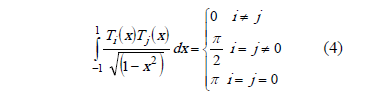
<body><![CDATA[<p><font size="2" face="Verdana, Arial, Helvetica, sans-serif">The orthogonal Chebyshev   polynomials result from the solution of the following equation </font></p>     <p><font size="2" face="Verdana, Arial, Helvetica, sans-serif"><img src="/img/revistas/dyna/v77n163/a17eq01.gif"></font></p>     <p><font size="2" face="Verdana, Arial, Helvetica, sans-serif">The nth grade polynomial is represented by: </font></p>     <p><font size="2" face="Verdana, Arial, Helvetica, sans-serif"><img src="/img/revistas/dyna/v77n163/a17eq02.gif"></font></p>     <p><font size="2" face="Verdana, Arial, Helvetica, sans-serif">And the trigonometric expressions from (3) are used for solving the   polynomial, </font></p>     <p><font size="2" face="Verdana, Arial, Helvetica, sans-serif"><img src="/img/revistas/dyna/v77n163/a17eq03.gif"></font></p>     <p><font size="2" face="Verdana, Arial, Helvetica, sans-serif">The Chebyshev polynomials are orthogonals in   the interval &#91;-1, 1&#93;, and the weight function is <sub> <img src="/img/revistas/dyna/v77n163/a17eq002.gif"> </sub>. For this case, </font></p>     <p><font size="2" face="Verdana, Arial, Helvetica, sans-serif"><img src="/img/revistas/dyna/v77n163/a17eq04.gif"></font></p>     <p><font size="2" face="Verdana, Arial, Helvetica, sans-serif">The polynomial <sub> <img src="/img/revistas/dyna/v77n163/a17eq004.gif"> </sub> has <i>n</i> ceros, a   maximum and a minimum, located according to the following equations, </font></p>     <p><font size="2" face="Verdana, Arial, Helvetica, sans-serif"><img src="/img/revistas/dyna/v77n163/a17eq0506.gif"></font></p>     ]]></body>

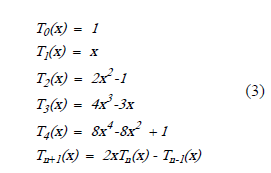
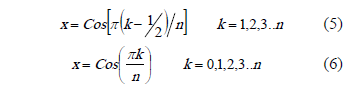
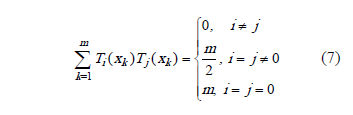
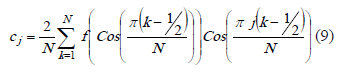
<body><![CDATA[<p><font size="2" face="Verdana, Arial, Helvetica, sans-serif">Because of this property, the Chebyshev polynomials are used for   polynomial approximations, and they also satisfy a discrete orthogonal   condition, if <sub> <img src="/img/revistas/dyna/v77n163/a17eq006.gif"> </sub> are the <i>m</i> ceros for <sub> <img src="/img/revistas/dyna/v77n163/a17eq008.gif"> </sub>. Then, </font></p>     <p><font size="2" face="Verdana, Arial, Helvetica, sans-serif"><img src="/img/revistas/dyna/v77n163/a17eq07.gif"></font></p>     <p><font size="2" face="Verdana, Arial, Helvetica, sans-serif">The combination of (1 - 7) helps to obtain an   approximation function under the following conditions, <sub> <img src="/img/revistas/dyna/v77n163/a17eq010.gif"> </sub> is an arbitrary function in an interval &#91;-1,1&#93;,   there are N coefficients <sub> <img src="/img/revistas/dyna/v77n163/a17eq012.gif"> </sub> , <sub> <img src="/img/revistas/dyna/v77n163/a17eq014.gif"> </sub> , defined by: </font></p>     <p><font size="2" face="Verdana, Arial, Helvetica, sans-serif"><img src="/img/revistas/dyna/v77n163/a17eq08.gif"></font></p>     <p><font size="2" face="Verdana, Arial, Helvetica, sans-serif">Replacing (6) into (8), </font></p>     <p><font size="2" face="Verdana, Arial, Helvetica, sans-serif"><img src="/img/revistas/dyna/v77n163/a17eq09.gif"></font></p>     <p><font size="2" face="Verdana, Arial, Helvetica, sans-serif">With this, the approximation becomes: </font></p>     <p><font size="2" face="Verdana, Arial, Helvetica, sans-serif"><img src="/img/revistas/dyna/v77n163/a17eq10.gif"></font></p>     <p><font size="2" face="Verdana, Arial, Helvetica, sans-serif">For any limits, &#91;a, b&#93;, and changing variables, </font></p>     <p><font size="2" face="Verdana, Arial, Helvetica, sans-serif"><img src="/img/revistas/dyna/v77n163/a17eq11.gif"></font></p>     ]]></body>
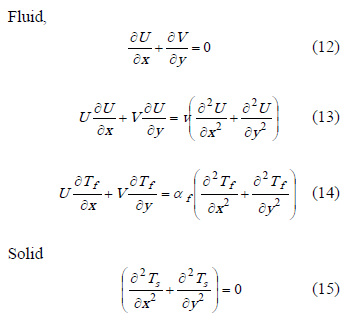
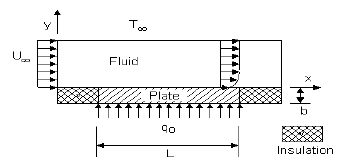
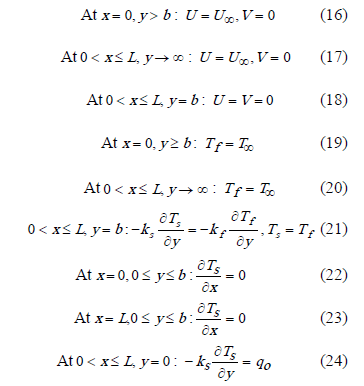
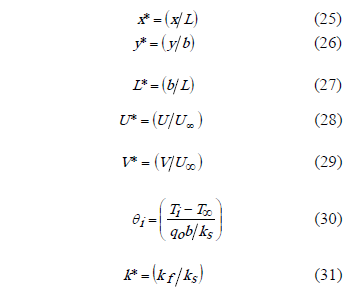
<body><![CDATA[<p><font size="2" face="Verdana, Arial, Helvetica, sans-serif"><b>2.1 Governing equations and boundary conditions    <br>   </b>Assuming an incompressible fluid, with constant properties, moving   according to <a href="#fig01">Fig. 1</a>, the equations that describe the conjugate heat transfer   are: </font></p>     <p><font size="2" face="Verdana, Arial, Helvetica, sans-serif"><img src="/img/revistas/dyna/v77n163/a17eq1215.gif"></font></p>     <p align="center"><font size="2" face="Verdana, Arial, Helvetica, sans-serif"><b><a name="fig01"></a><img src="/img/revistas/dyna/v77n163/a17fig01.gif">    <br>   Figure 1. </b>Schematic of a rectangular plate under   the influence of a laminar flow </font></p>     <p><font size="2" face="Verdana, Arial, Helvetica, sans-serif">Equations (12 - 15) are subjected to the following boundary   conditions, </font></p>     <p><font size="2" face="Verdana, Arial, Helvetica, sans-serif"><img src="/img/revistas/dyna/v77n163/a17eq1624.gif"></font></p>     <p><font size="2" face="Verdana, Arial, Helvetica, sans-serif">Equations (12 - 15) and the boundary conditions (16 - 24)   were converted in a dimensionless form, using the following non dimensional   terms, </font></p>     <p><font size="2" face="Verdana, Arial, Helvetica, sans-serif"><img src="/img/revistas/dyna/v77n163/a17eq2531.gif"></font></p>     <p><font size="2" face="Verdana, Arial, Helvetica, sans-serif">Using the dimensionless variables presented in (25 - 31), the equations   turned into the following dimensionless form: </font></p>     ]]></body>
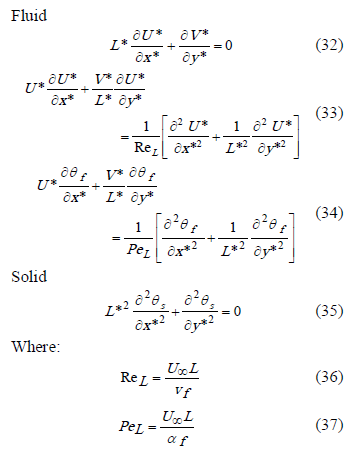
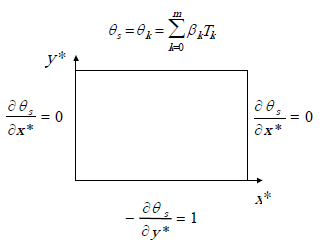
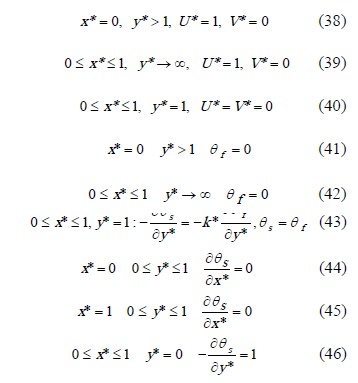
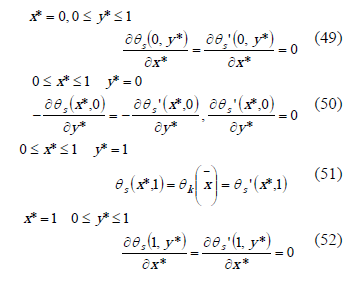
<body><![CDATA[<p><font size="2" face="Verdana, Arial, Helvetica, sans-serif"><img src="/img/revistas/dyna/v77n163/a17eq3237.gif"></font></p>     <p><font size="2" face="Verdana, Arial, Helvetica, sans-serif">The boundary conditions for (32 - 35) are, </font></p>     <p><font size="2" face="Verdana, Arial, Helvetica, sans-serif"><img src="/img/revistas/dyna/v77n163/a17eq3846.gif"></font></p> <font size="2" face="Verdana, Arial, Helvetica, sans-serif"><b>2.2 Two dimensional heat conduction at the solid in  Chebyshev form    <br> </b>In order to obtain an analytic solution to the heat    conduction problem in the solid, the temperature at the interface must be   known. This temperature can be represented as a linear combination of Chebyshev polynomials according to (47)</font><font size="2">     <p><img src="/img/revistas/dyna/v77n163/a17eq47.gif"></p>     <p><font face="Verdana, Arial, Helvetica, sans-serif">Where: </font></p>     <p><font face="Verdana, Arial, Helvetica, sans-serif"><sub> <img src="/img/revistas/dyna/v77n163/a17eq016.gif"> </sub> : Temperature at the solid - fluid interface.    <br>   </font><font face="Verdana, Arial, Helvetica, sans-serif"><sub> <img src="/img/revistas/dyna/v77n163/a17eq018.gif"> </sub> : Coefficients of the linear combination.    <br>   </font><font face="Verdana, Arial, Helvetica, sans-serif"><sub> <img src="/img/revistas/dyna/v77n163/a17eq020.gif"> </sub> : order k, Chebyshev polynomial. </font></p>     <p><font face="Verdana, Arial, Helvetica, sans-serif">This equation represents the solution for the problem   presented in <a href="#fig02">Fig. (2)</a> </font></p>     ]]></body>
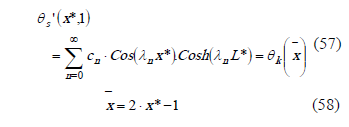
<body><![CDATA[<p align="center"><font face="Verdana, Arial, Helvetica, sans-serif"><b><a name="fig02"></a><img src="/img/revistas/dyna/v77n163/a17fig02.gif">    <br>   Figure 2.</b> Two dimensional heat conduction problem   at the plate </font></p>     <p><font face="Verdana, Arial, Helvetica, sans-serif">Due to non homogeneous boundary conditions at the <i>y</i>*coordinate, a substitution is used to take care of one the non homogeneity.   The substitution is as follows: </font></p> </font>     <p><img src="/img/revistas/dyna/v77n163/a17eq48.gif"></p>     <p><font size="2" face="Verdana, Arial, Helvetica, sans-serif">The boundary conditions for the substitution variables   are: </font></p>     <p><img src="/img/revistas/dyna/v77n163/a17eq4952.gif"></p>     <p><font size="2" face="Verdana, Arial, Helvetica, sans-serif">The Sturm-Liouville problem is present in the <sub> <img src="/img/revistas/dyna/v77n163/a17eq022.gif"> </sub> axis, due to the   homogeneous conditions. The solution is as follows: </font></p>     <p><img src="/img/revistas/dyna/v77n163/a17eq53.gif"></p>     <p><font size="2" face="Verdana, Arial, Helvetica, sans-serif">The solution for the differential equation <sub> <img src="/img/revistas/dyna/v77n163/a17eq024.gif"> </sub> is the following, </font></p>     <p><img src="/img/revistas/dyna/v77n163/a17eq54.gif"></p>     ]]></body>


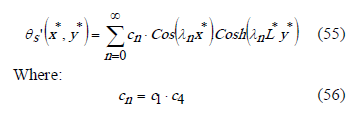
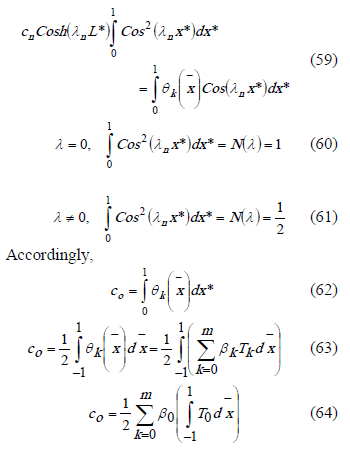
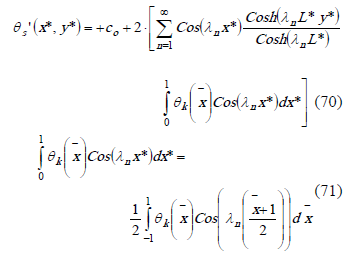
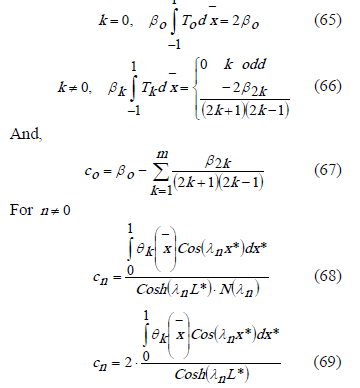
<body><![CDATA[<p><font size="2" face="Verdana, Arial, Helvetica, sans-serif">The general solution is, </font></p>     <p><img src="/img/revistas/dyna/v77n163/a17eq5556.gif"></p>     <p><font size="2" face="Verdana, Arial, Helvetica, sans-serif">To obtain <sub> <img src="/img/revistas/dyna/v77n163/a17eq026.gif"> </sub> , the boundary condition at the solid fluid interface is   evaluated. </font></p>     <p><img src="/img/revistas/dyna/v77n163/a17eq5758.gif"></p>     <p><font size="2" face="Verdana, Arial, Helvetica, sans-serif">This is due to the orthogonal properties of the Chebyshev polynomials at   the &#91;-1, 1&#93; interval. Using this condition: </font></p>     <p><img src="/img/revistas/dyna/v77n163/a17eq5964.gif"></p>     <p><font size="2" face="Verdana, Arial, Helvetica, sans-serif">From the orthogonal condition of the Chebyshev polynomials, </font></p>     <p><img src="/img/revistas/dyna/v77n163/a17eq6569.gif"></p>     <p><font size="2" face="Verdana, Arial, Helvetica, sans-serif">The solution of (48) is as follows </font></p>     <p><img src="/img/revistas/dyna/v77n163/a17eq7071.gif"></p>     ]]></body>
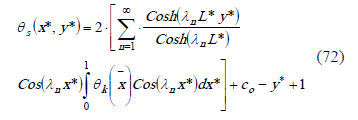
<body><![CDATA[<p><font size="2" face="Verdana, Arial, Helvetica, sans-serif">The non dimensional temperature solution for the solid, </font></p>     <p><img src="/img/revistas/dyna/v77n163/a17eq72.gif"></p>     <p><font size="2" face="Verdana, Arial, Helvetica, sans-serif"><b>2.3 Local convective heat transfer coefficient and   local Nusselt number    <br>   </b></font><font size="2" face="Verdana, Arial, Helvetica, sans-serif">From an energy balance at the interface, </font></p>     <p><img src="/img/revistas/dyna/v77n163/a17eq73.gif"></p>     <p><font size="2" face="Verdana, Arial, Helvetica, sans-serif">From the boundary conditions: </font></p>     <p><img src="/img/revistas/dyna/v77n163/a17eq74.gif"></p>     <p><font size="2" face="Verdana, Arial, Helvetica, sans-serif">Introducing the non dimensional variables, </font></p>     <p><img src="/img/revistas/dyna/v77n163/a17eq75.gif"></p>     <p><img src="/img/revistas/dyna/v77n163/a17eq76.gif"></p>     ]]></body>

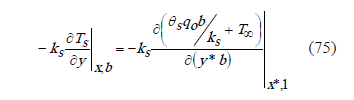
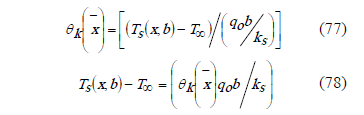
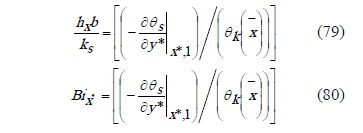
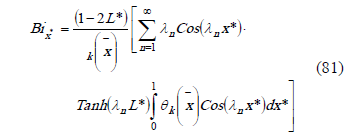
<body><![CDATA[<p><font size="2" face="Verdana, Arial, Helvetica, sans-serif">From the Chebyshev polynomial solution: </font></p>     <p><img src="/img/revistas/dyna/v77n163/a17eq7778.gif"></p>     <p><font size="2" face="Verdana, Arial, Helvetica, sans-serif">Replacing in (76), </font></p>     <p><img src="/img/revistas/dyna/v77n163/a17eq7980.gif"></p>     <p><font size="2" face="Verdana, Arial, Helvetica, sans-serif">Derivation of <sub> <img src="/img/revistas/dyna/v77n163/a17eq030.gif"> </sub> , and evaluating at<sub> <img src="/img/revistas/dyna/v77n163/a17eq032.gif"> </sub> , and replacing in (80), </font></p>     <p><img src="/img/revistas/dyna/v77n163/a17eq81.gif"></p>     <p><font size="2" face="Verdana, Arial, Helvetica, sans-serif">The local Nusselt number can be obtained from: </font></p>     <p><img src="/img/revistas/dyna/v77n163/a17eq82.gif"></p>     <p><font size="2" face="Verdana, Arial, Helvetica, sans-serif">Manipulating the equation, </font></p>     <p><img src="/img/revistas/dyna/v77n163/a17eq83.gif"></p>     ]]></body>

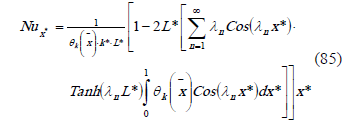
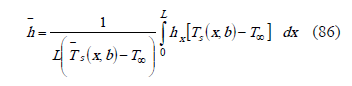
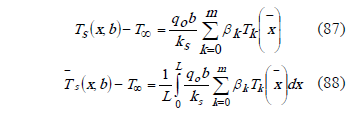
<body><![CDATA[<p><font size="2" face="Verdana, Arial, Helvetica, sans-serif">Using the non dimensional variables, </font></p>     <p><img src="/img/revistas/dyna/v77n163/a17eq84.gif"></p>     <p><font size="2" face="Verdana, Arial, Helvetica, sans-serif">Replacing (85) in (88), </font></p>     <p><img src="/img/revistas/dyna/v77n163/a17eq85.gif"></p>     <p><font size="2" face="Verdana, Arial, Helvetica, sans-serif"><b>2.4 Average   convective heat transfer coefficient and average Nusselt number    <br>   </b></font><font size="2" face="Verdana, Arial, Helvetica, sans-serif">The average convective heat transfer coefficient can   be obtained according to Bula 1999, &#91;7&#93;, </font></p>     <p><img src="/img/revistas/dyna/v77n163/a17eq86.gif"></p>     <p><font size="2" face="Verdana, Arial, Helvetica, sans-serif">Evaluating each term of (85), from (47) and (77), </font></p>     <p><img src="/img/revistas/dyna/v77n163/a17eq8788.gif"></p>     <p><font size="2" face="Verdana, Arial, Helvetica, sans-serif">Derivation of (25), </font></p>     ]]></body>
<body><![CDATA[<p><img src="/img/revistas/dyna/v77n163/a17eq89.gif"></p>     <p><font size="2" face="Verdana, Arial, Helvetica, sans-serif">Replacing (88) in (72), </font></p>     <p><img src="/img/revistas/dyna/v77n163/a17eq90.gif"></p>     <p><font size="2" face="Verdana, Arial, Helvetica, sans-serif">Derivation of (58), </font></p>     <p><img src="/img/revistas/dyna/v77n163/a17eq91.gif"></p>     <p><font size="2" face="Verdana, Arial, Helvetica, sans-serif">Replacing (91) in (90), </font></p>     <p><img src="/img/revistas/dyna/v77n163/a17eq92.gif"></p>     <p><font size="2" face="Verdana, Arial, Helvetica, sans-serif">From (65), </font></p>     <p><img src="/img/revistas/dyna/v77n163/a17eq93.gif"></p>     <p><font size="2" face="Verdana, Arial, Helvetica, sans-serif">From the local Biot number definition, </font></p>     ]]></body>
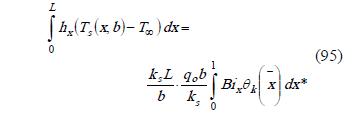
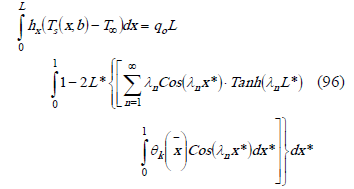
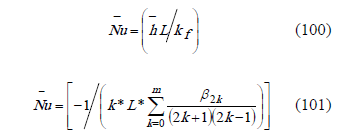
<body><![CDATA[<p><img src="/img/revistas/dyna/v77n163/a17eq94.gif"></p>     <p><font size="2" face="Verdana, Arial, Helvetica, sans-serif">From (86), </font></p>     <p><img src="/img/revistas/dyna/v77n163/a17eq95.gif"></p>     <p><font size="2" face="Verdana, Arial, Helvetica, sans-serif">Replacing Biot number from (81)   into (95), </font></p>     <p><img src="/img/revistas/dyna/v77n163/a17eq96.gif"></p>     <p><font size="2" face="Verdana, Arial, Helvetica, sans-serif">From the Chebyshev polynomials properties, </font></p>     <p><img src="/img/revistas/dyna/v77n163/a17eq97.gif"></p>     <p><font size="2" face="Verdana, Arial, Helvetica, sans-serif">Replacing (88) and (97) in (86), </font></p>     <p><img src="/img/revistas/dyna/v77n163/a17eq98.gif"></p>     <p><font size="2" face="Verdana, Arial, Helvetica, sans-serif">The average Biot number can be calculated   according to the following equation, </font></p>     ]]></body>

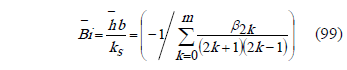
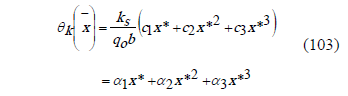
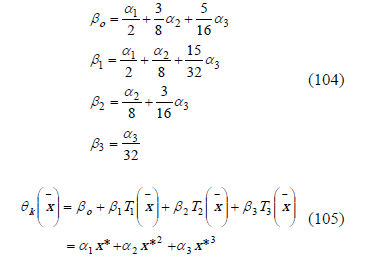
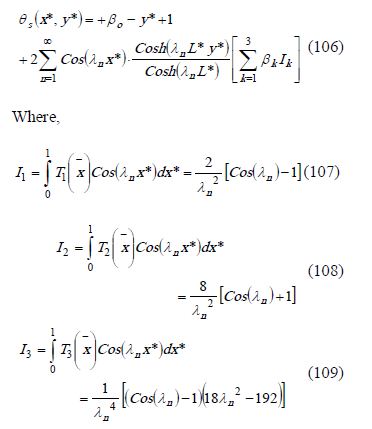
<body><![CDATA[<p><img src="/img/revistas/dyna/v77n163/a17eq99.gif"></p>     <p><font size="2" face="Verdana, Arial, Helvetica, sans-serif">The average Nusselt number can be calculated according to the following equation, </font></p>     <p><img src="/img/revistas/dyna/v77n163/a17eq100101.gif"></p>     <p><font size="2" face="Verdana, Arial, Helvetica, sans-serif">Different temperature distributions can be considered, and for each one   of them, Biot and Nusselt number, as well as expressions for the average values   of the heat transfer coefficient, can be developed. In this case, only cubic   temperature profile will be considered. </font></p>     <p><font size="2" face="Verdana, Arial, Helvetica, sans-serif"><b>2.5 Cubic temperature profile    <br>   </b></font><font size="2" face="Verdana, Arial, Helvetica, sans-serif">The temperature at the interface is represented by the following   expression, </font></p>     <p><img src="/img/revistas/dyna/v77n163/a17eq102.gif"></p>     <p><font size="2" face="Verdana, Arial, Helvetica, sans-serif">In a non dimensional form, </font></p>     <p><img src="/img/revistas/dyna/v77n163/a17eq103.gif"></p>     <p><font size="2" face="Verdana, Arial, Helvetica, sans-serif">The Chebyshev polynomials parameters and the equation are: for this case   are, </font></p>     ]]></body>

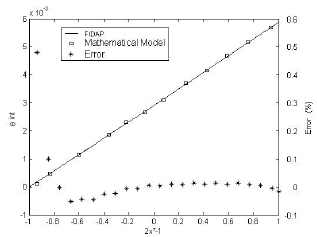
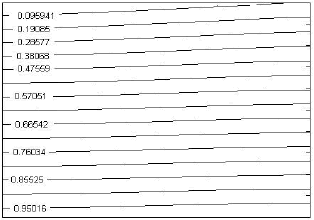
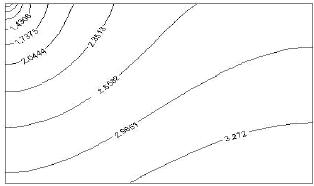
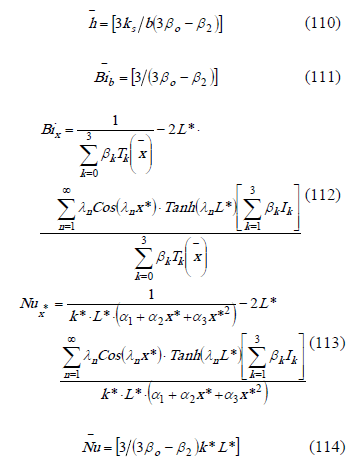
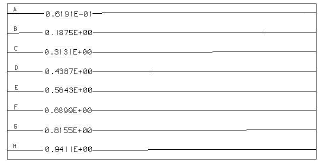
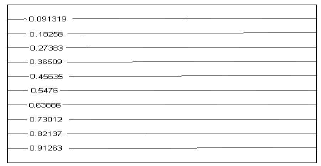
<body><![CDATA[<p><img src="/img/revistas/dyna/v77n163/a17eq104105.gif"></p>     <p><font size="2" face="Verdana, Arial, Helvetica, sans-serif">The temperature in the plate, </font></p>     <p><img src="/img/revistas/dyna/v77n163/a17eq106109.gif"></p>     <p><font size="2" face="Verdana, Arial, Helvetica, sans-serif">The local Biot number, Biot number, average heat transfer coefficient, local Nusselt number, and average   Nusselt number, are presented in the following equations, </font></p>     <p><img src="/img/revistas/dyna/v77n163/a17eq110114.gif"></p>     <p>&nbsp;</p>     <p><font size="3" face="Verdana, Arial, Helvetica, sans-serif"><b>3. RESULTS AND DISCUSSION </b></font></p>     <p><font size="2" face="Verdana, Arial, Helvetica, sans-serif">A computational program was developed to solve the general heat   conduction equation in the solid, taking   into consideration the boundary condition at the interface represented by the a   Chebyshev polynomial. In order to validate the model, the non dimensional   conjugate heat transfer problem was solved using commercial CFD software, FIDAP®.   The domain design considered the growth of the hydrodynamic and thermal   boundary layer, and the height was calculated considering the maximum Reynolds   number, Prandtl number, and the thickness to plate   length ratio to be used. In order to determine the number of elements for   accurate numerical solution, computation was performed for several combinations   of grid distribution in the radial and vertical directions covering the solid   and fluid regions. It was noticed that the solution became grid independent   when the number of divisions in the horizontal direction was increased to 20 and   at least   36 in   the vertical direction. The comparison considered three different Reynolds   numbers, with different order of magnitude, 5x10<sup>5</sup>, 5x10<sup>4</sup>,   and 1x10<sup>3</sup>, representing constant temperature, linear temperature, and   cubic temperature profiles respectively. <a href="#fig03">Figures 3</a> and <a href="#fig04">4</a>, present the non   dimensional isothermal lines inside the solid, using FIDAP and the solution of   the semi analytical model, for a Reynolds number of 5x10<sup>5</sup>. It can be   observed that there is an excellent agreement between the two solutions   presented, and the assumption of a constant temperature at the interface is   valid due to the one dimensional temperature distribution. </font></p>     <p align="center"><font size="2" face="Verdana, Arial, Helvetica, sans-serif"><a name="fig03"></a><img src="/img/revistas/dyna/v77n163/a17fig03.gif">    <br>   <b>Figure 3.</b> Solid temperature   distribution. </font><font size="2" face="Verdana, Arial, Helvetica, sans-serif">Numerical simulation in FIDAP </font> <font size="2" face="Verdana, Arial, Helvetica, sans-serif">(Oil MIL 7808 -   Constantan, Re = 5x10⁵, L*=0.5) </font></p>     ]]></body>
<body><![CDATA[<p align="center"><font size="2" face="Verdana, Arial, Helvetica, sans-serif"><b><a name="fig04"></a><img src="/img/revistas/dyna/v77n163/a17fig04.gif">    <br>   Figure 4.</b> Solid temperature distribution. Solution of the semi analytical model (Oil   MIL 7808 - Constantan, Re = 5x10⁵, L*=0.5) </font></p>     <p><font size="2" face="Verdana, Arial, Helvetica, sans-serif"><a href="#fig05">Figure 5</a> presents the temperature at the interface, calculated using   FIDAP and the semi analytical model, as well as the error between the   solutions. It can be seen that the error ranges between cero and 0.5%,   presenting the maximum deviation in the right hand side, where the fluid gets   in contact with the solid. The temperature at the interface is quite constant,   ranging from cero to 6x10<sup>-3</sup>. </font></p>     <p align="center"><font size="2" face="Verdana, Arial, Helvetica, sans-serif"><b><a name="fig05"></a><img src="/img/revistas/dyna/v77n163/a17fig05.gif">    <br>   Figure 5.</b> Temperature at the interface and error from   the mathematical model and FIDAP solution (Oil   MIL 7808 - Constantan, Re = 5x10⁵, L*=0.5) </font></p>     <p><font size="2" face="Verdana, Arial, Helvetica, sans-serif"><a href="#fig06">Figures 6</a> and <a href="#fig07">7</a> present the temperature distribution inside the solid   for the numerical solution and the semi analytical model for a Reynolds number   in the fluid of 5x10<sup>4</sup>. It is noticed a good agreement between the   two solutions. In this case, there is almost a one dimensional distribution   with a tendency of the isothermal lines to concentrate around the point where the fluid gets in contact with the solid.</font></p>     <p align="center"><font size="2" face="Verdana, Arial, Helvetica, sans-serif"><b><a name="fig06"></a><img src="/img/revistas/dyna/v77n163/a17fig06.gif">    <br>   Figure 6.</b> Solid temperature distribution. </font><font size="2"> <font face="Verdana, Arial, Helvetica, sans-serif">Numerical simulation in FIDAP (Oil   MIL 7808 - Constantan, Re = 5x10<sup>4</sup>, L*=0.5) </font></font></p>     <p align="center"><font size="2"><font face="Verdana, Arial, Helvetica, sans-serif"><b><a name="fig07"></a><img src="/img/revistas/dyna/v77n163/a17fig07.gif">    <br>   Figure 7.</b> Solid temperature distribution. </font></font> <font size="2" face="Verdana, Arial, Helvetica, sans-serif">Solution of the semi analytical model </font> <font size="2" face="Verdana, Arial, Helvetica, sans-serif">(Oil   MIL 7808 - Constantan, Re = 5x10<sup>4</sup>, L*=0.5) </font></p>     ]]></body>
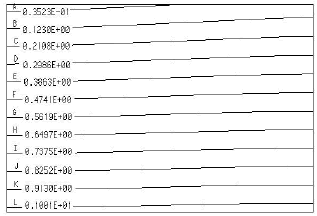
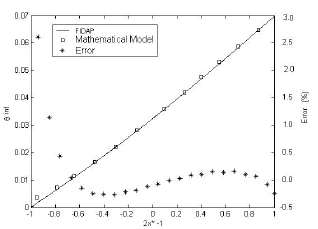
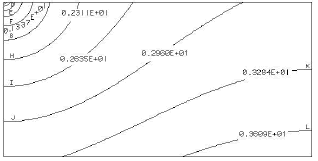
<body><![CDATA[<p><font size="2" face="Verdana, Arial, Helvetica, sans-serif"><a href="#fig08">Figure 8</a> presents the temperature at the interface, calculated using   FIDAP and the semi analytical model, as well as the error between the   solutions. It can be seen that the error goes up to 3%, presenting the maximum   deviation in the right hand side, where the fluid gets in contact with the   solid. The non dimensional temperature at the interface presents an almost   linear behavior, going from zero to 0.07. </font></p>     <p align="center"><font size="2" face="Verdana, Arial, Helvetica, sans-serif"><b><a name="fig08"></a><img src="/img/revistas/dyna/v77n163/a17fig08.gif">    <br>   Figure 8.</b> Temperature at the interface and error from the mathematical model and   FIDAP solution </font><font size="2" face="Verdana, Arial, Helvetica, sans-serif">(Oil MIL 7808 - Constantan, Re =   5x10<sup>4</sup>, L*=0.5) </font></p> <font size="2" face="Verdana, Arial, Helvetica, sans-serif">     <p><a href="#fig09">Figures 9</a> and <a href="#fig10">10</a> present the temperature distribution inside the solid   for the numerical solution and the semi analytical model for a Reynolds number   in the fluid of 1x10<sup>3</sup>. It is observed there is a good agreement   between the two solutions. In this case, it is noticed that the effect of the   slow motion of the fluid turns the temperature distribution in the solid   completely two dimensional, and the isothermal lines become concentric around   the point where the fluid gets in contact with the solid. </p> </font>     <p align="center"><font size="2" face="Verdana, Arial, Helvetica, sans-serif"><b><a name="fig09"></a><img src="/img/revistas/dyna/v77n163/a17fig09.gif">    <br>   Figure 9.</b> Solid temperature distribution. </font> <font size="2" face="Verdana, Arial, Helvetica, sans-serif">Numerical simulation in FIDAP </font> <font size="2" face="Verdana, Arial, Helvetica, sans-serif">(Oil MIL 7808 - Constantan, Re = 1x10<sup>3</sup>, L*=0.5) </font></p>     <p align="center"><font size="2" face="Verdana, Arial, Helvetica, sans-serif"><b><a name="fig10"></a><img src="/img/revistas/dyna/v77n163/a17fig10.gif">    <br>   Figure 10.</b> Solid temperature distribution.    Solution of the semi analytical model (Oil   MIL 7808 - Constantan, Re = 1x10<sup>3</sup>, L*=0.5) </font></p> <font size="2" face="Verdana, Arial, Helvetica, sans-serif">     <p><a href="#fig11">Figure 11</a> presents the temperature at the interface, calculated using   FIDAP and the semi analytical model, as well as the error between the   solutions. It can be seen that the error goes up to 0.3%, presenting the   maximum deviation in the right hand side, where the fluid gets in contact with   the solid. The behavior of the non dimensional temperature at the interface   could be approximated by a second order polynomial, and it ranges from zero to   3. </p> </font>     <p align="center"><font size="2" face="Verdana, Arial, Helvetica, sans-serif"><b><a name="fig11"></a><img src="/img/revistas/dyna/v77n163/a17fig11.gif">    ]]></body>
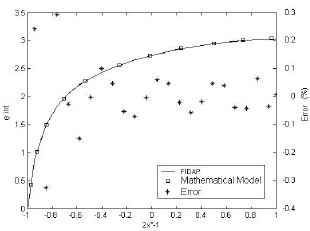
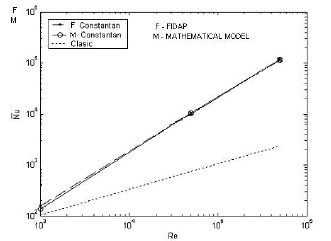
<body><![CDATA[<br>   Figure 11.</b> Temperature at the interface and error from the   mathematical model and FIDAP solution. (Oil MIL 7808 - Constantan, Re = 1x10<sup>3</sup>, L*=0.5) </font></p>     <p><font size="2" face="Verdana, Arial, Helvetica, sans-serif"><a href="#fig12">Figure 12</a> shows the variation of average Nusselt number with Reynolds   number. In this figure is compared the classic average Nusselt number and the   average Nusselt number obtained from simulation in FIDAP and the semi analytical model. The variation of   average Nusselt number is similar to FIDAP and the semi analytical mathematical   model, but in both cases, the classic average Nusselt number is lower than the   one obtained by numerical methods. This shows that the classic average Nusselt   number is conservative </font></p>     <p align="center"><font size="2" face="Verdana, Arial, Helvetica, sans-serif"><b><a name="fig12"></a><img src="/img/revistas/dyna/v77n163/a17fig12.gif">    <br>   Figure 12.</b> Comparison between the classic average Nusselt number and average   Nusselt number obtained from FIDAP solution and the semi analytical model (Oil MIL 7808 - Constantan, Re = 1x10<sup>3</sup>, L*=0.5) </font></p>     <p>&nbsp; </p>     <p><b><font size="3" face="Verdana, Arial, Helvetica, sans-serif">4. CONCLUSIONS </font></b></p>     <p><font size="2" face="Verdana, Arial, Helvetica, sans-serif">According to   these results, it can be concluded that the Chebyshev polynomial approximation   can be used to uncouple the conjugate heat transfer problem, accommodating the   temperature distribution at the interface depending on the Reynolds number.   Also, the constant temperature and linear temperature approximation for the   interface temperature could be discarded, considering a third order polynomial,   which accommodate for the different temperature distributions. </font></p>     <p>&nbsp;</p>     <p><font size="3" face="Verdana, Arial, Helvetica, sans-serif"><b>NOMENCLATURE </b></font></p>     <p><font size="2" face="Verdana, Arial, Helvetica, sans-serif">B Plate thickness </font></p>     ]]></body>
<body><![CDATA[<p><font size="2" face="Verdana, Arial, Helvetica, sans-serif"><sub> <img src="/img/revistas/dyna/v77n163/a17eq034.gif"> </sub> Local Biot number, <sub> <img src="/img/revistas/dyna/v77n163/a17eq036.gif">    <br>   </sub></font><font size="2" face="Verdana, Arial, Helvetica, sans-serif"><sub><img src="/img/revistas/dyna/v77n163/a17eq038.gif"> </sub> Average Biot number, <sub> <img src="/img/revistas/dyna/v77n163/a17eq040.gif">    <br>   </sub></font><font size="2" face="Verdana, Arial, Helvetica, sans-serif"><sub><img src="/img/revistas/dyna/v77n163/a17eq042.gif"> </sub> Local convective heat transfer coefficient.    <br>   </font><font size="2" face="Verdana, Arial, Helvetica, sans-serif"><sub> <img src="/img/revistas/dyna/v77n163/a17eq044.gif"> </sub> Convective heat   transfer coefficient    <br>   </font><font size="2" face="Verdana, Arial, Helvetica, sans-serif"><i><sub> <img src="/img/revistas/dyna/v77n163/a17eq046.gif"> </sub> </i>Thermal conductivity,    <br>   </font><font size="2" face="Verdana, Arial, Helvetica, sans-serif"><i><sub> <img src="/img/revistas/dyna/v77n163/a17eq048.gif"> </sub> </i>Thermal conductivity ratio,<sub> <img src="/img/revistas/dyna/v77n163/a17eq050.gif">    <br>   </sub></font><font size="2" face="Verdana, Arial, Helvetica, sans-serif"><sub><img src="/img/revistas/dyna/v77n163/a17eq052.gif"> </sub> Length of the   plate    <br>   </font><font size="2" face="Verdana, Arial, Helvetica, sans-serif"><i><sub> <img src="/img/revistas/dyna/v77n163/a17eq054.gif"> </sub> </i>Dimensionless length, <sub> <img src="/img/revistas/dyna/v77n163/a17eq056.gif">    <br>   </sub></font><font size="2" face="Verdana, Arial, Helvetica, sans-serif"><sub><img src="/img/revistas/dyna/v77n163/a17eq058.gif"> </sub> Local Nusselt number, <sub> <img src="/img/revistas/dyna/v77n163/a17eq060.gif">    <br>   </sub></font><font size="2" face="Verdana, Arial, Helvetica, sans-serif"><sub><img src="/img/revistas/dyna/v77n163/a17eq062.gif"> </sub> Average Nusselt number, <sub> <img src="/img/revistas/dyna/v77n163/a17eq064.gif">    ]]></body>
<body><![CDATA[<br>   </sub></font><font size="2" face="Verdana, Arial, Helvetica, sans-serif"><sub><img src="/img/revistas/dyna/v77n163/a17eq066.gif"> </sub> Local Peclet number <i>x</i>, <sub> <img src="/img/revistas/dyna/v77n163/a17eq068.gif">    <br>   </sub></font><font size="2" face="Verdana, Arial, Helvetica, sans-serif"><sub><img src="/img/revistas/dyna/v77n163/a17eq070.gif"> </sub> Prandtl number    <br>   </font><font size="2" face="Verdana, Arial, Helvetica, sans-serif"><i><sub> <img src="/img/revistas/dyna/v77n163/a17eq072.gif"> </sub> </i> Heat flow   per unit area    <br>   </font><font size="2" face="Verdana, Arial, Helvetica, sans-serif"><sub> <img src="/img/revistas/dyna/v77n163/a17eq074.gif"> </sub> Heat flow at the   solid-fluid interface    <br>   </font><font size="2" face="Verdana, Arial, Helvetica, sans-serif"><i><sub> <img src="/img/revistas/dyna/v77n163/a17eq076.gif"> </sub> </i>Reynolds number in L, <sub> <img src="/img/revistas/dyna/v77n163/a17eq078.gif">    <br>   </sub></font><font size="2" face="Verdana, Arial, Helvetica, sans-serif"><i><sub><img src="/img/revistas/dyna/v77n163/a17eq080.gif"> </sub> </i> Temperature    <br>   </font><font size="2" face="Verdana, Arial, Helvetica, sans-serif"><sub> <img src="/img/revistas/dyna/v77n163/a17eq082.gif"> </sub> Fluid free   stream temperature    <br>   </font><font size="2" face="Verdana, Arial, Helvetica, sans-serif"><sub> <img src="/img/revistas/dyna/v77n163/a17eq084.gif"> </sub> Chebyshev polynomial, i order.    <br>   </font><font size="2" face="Verdana, Arial, Helvetica, sans-serif"><sub> <img src="/img/revistas/dyna/v77n163/a17eq086.gif"> </sub> Horizontal   Velocity    <br>   </font><font size="2" face="Verdana, Arial, Helvetica, sans-serif"><sub> <img src="/img/revistas/dyna/v77n163/a17eq088.gif"> </sub> Dimensionless   Horizontal Velocity    ]]></body>
<body><![CDATA[<br>   </font><font size="2" face="Verdana, Arial, Helvetica, sans-serif"><sub> <img src="/img/revistas/dyna/v77n163/a17eq090.gif"> </sub> Vertical Velocity    <br>   </font><font size="2" face="Verdana, Arial, Helvetica, sans-serif"><sub> <img src="/img/revistas/dyna/v77n163/a17eq092.gif"> </sub> Dimensionless   Vertical Velocity    <br>   </font><font size="2" face="Verdana, Arial, Helvetica, sans-serif"><sub> <img src="/img/revistas/dyna/v77n163/a17eq094.gif"> </sub> Position in the   horizontal axis     <br>   </font><font size="2" face="Verdana, Arial, Helvetica, sans-serif"><sub><img src="/img/revistas/dyna/v77n163/a17eq096.gif"> </sub> Dimensionless   position, horizontal axis    <br>   </font><font size="2" face="Verdana, Arial, Helvetica, sans-serif"><sub> <img src="/img/revistas/dyna/v77n163/a17eq098.gif"> </sub> Chebyshev variable    <br>   </font><font size="2" face="Verdana, Arial, Helvetica, sans-serif"><sub> <img src="/img/revistas/dyna/v77n163/a17eq100.gif"> </sub> Position in the   vertical axis    <br>   </font><font size="2" face="Verdana, Arial, Helvetica, sans-serif"><sub> <img src="/img/revistas/dyna/v77n163/a17eq1021.gif"> </sub> Dimensionless   position, vertical axis </font></p>     <p><font size="2" face="Verdana, Arial, Helvetica, sans-serif"><b>Greek symbols</b> </font></p>     <p><font size="2" face="Verdana, Arial, Helvetica, sans-serif"><sub> <img src="/img/revistas/dyna/v77n163/a17eq104.gif"> </sub> Kinematic   viscosity     <br>   </font><font size="2" face="Verdana, Arial, Helvetica, sans-serif"><sub><img src="/img/revistas/dyna/v77n163/a17eq106.gif"> </sub> Dimensionless   temperature    ]]></body>
<body><![CDATA[<br>   </font><font size="2" face="Verdana, Arial, Helvetica, sans-serif"><sub> <img src="/img/revistas/dyna/v77n163/a17eq108.gif"> </sub> Density </font></p> <font size="2" face="Verdana, Arial, Helvetica, sans-serif"><i><b>Subscripts </b></i> </font>     <p><font size="2" face="Verdana, Arial, Helvetica, sans-serif"><sub> <img src="/img/revistas/dyna/v77n163/a17eq110.gif"> </sub> Infinite     <br>   </font><font size="2" face="Verdana, Arial, Helvetica, sans-serif"><sub><img src="/img/revistas/dyna/v77n163/a17eq112.gif"> </sub> Plate thickness     <br>   </font><font size="2" face="Verdana, Arial, Helvetica, sans-serif"><sub><img src="/img/revistas/dyna/v77n163/a17eq114.gif"> </sub> Fluid    <br>   </font><font size="2" face="Verdana, Arial, Helvetica, sans-serif"><sub> <img src="/img/revistas/dyna/v77n163/a17eq116.gif"> </sub> Interface    <br>   </font><font size="2" face="Verdana, Arial, Helvetica, sans-serif"><sub> <img src="/img/revistas/dyna/v77n163/a17eq052.gif"> </sub> Length of the   plate    <br>   </font><font size="2" face="Verdana, Arial, Helvetica, sans-serif"><sub> <img src="/img/revistas/dyna/v77n163/a17eq119.gif"> </sub> Solid    <br>   </font><font size="2" face="Verdana, Arial, Helvetica, sans-serif"><sub> <img src="/img/revistas/dyna/v77n163/a17eq094.gif"> </sub> Along the x axis </font></p>     <p>&nbsp;</p>     <p><font size="3" face="Verdana, Arial, Helvetica, sans-serif"><b>REFERENCES </b></font></p>     ]]></body>
<body><![CDATA[<!-- ref --><p><font size="2" face="Verdana, Arial, Helvetica, sans-serif"><b>&#91;1&#93;</b> Negus, K., Yovanovich, M. Thermal Analysis and Optimization of Convectively-Cooled Microelectronic Circuit Boards. Proceedings of the AIAA/ASME 4th Thermophysics and Heat Transfer Conference, Boston , USA , 57, 67-175, 1986.     &nbsp;&nbsp;&nbsp;&nbsp;&nbsp;&nbsp;&nbsp;&nbsp;[&#160;<a href="javascript:void(0);" onclick="javascript: window.open('/scielo.php?script=sci_nlinks&ref=000223&pid=S0012-7353201000030001700001&lng=','','width=640,height=500,resizable=yes,scrollbars=1,menubar=yes,');">Links</a>&#160;]<!-- end-ref --><!-- ref --><br>   <b>&#91;2&#93;</b> Culham, J., Lee S., Yovanovich M. Non-Iterative Technique for Computing Temperature Distributions in Flat Plates with Distributed Heat Sources and Convective Cooling. Proceedings of the ASME/JSME Thermal Engineering Joint Conference, Honolulu , USA , 3, 403-409, March, 1987.     &nbsp;&nbsp;&nbsp;&nbsp;&nbsp;&nbsp;&nbsp;&nbsp;[&#160;<a href="javascript:void(0);" onclick="javascript: window.open('/scielo.php?script=sci_nlinks&ref=000224&pid=S0012-7353201000030001700002&lng=','','width=640,height=500,resizable=yes,scrollbars=1,menubar=yes,');">Links</a>&#160;]<!-- end-ref --><!-- ref --><br>   <b>&#91;3&#93;</b> Culham J., Lee S., Yovanovich M. The effect of Common Design Parameters on the Thermal Performance of Microelectronic Equipment; Part II - Forced Convection. Proceedings of the ASME National Heat Transfer Conference, Minneapolis , USA , 171, 55-60, July 1991.     &nbsp;&nbsp;&nbsp;&nbsp;&nbsp;&nbsp;&nbsp;&nbsp;[&#160;<a href="javascript:void(0);" onclick="javascript: window.open('/scielo.php?script=sci_nlinks&ref=000225&pid=S0012-7353201000030001700003&lng=','','width=640,height=500,resizable=yes,scrollbars=1,menubar=yes,');">Links</a>&#160;]<!-- end-ref --><!-- ref --><br>   <b>&#91;4&#93;</b> Hwang, J. Conjugate heat transfer for developing flow over multiple discrete thermal sources flush-Mounted on the wall. Journal of Heat Transfer.120, 510-514, 1998.     &nbsp;&nbsp;&nbsp;&nbsp;&nbsp;&nbsp;&nbsp;&nbsp;[&#160;<a href="javascript:void(0);" onclick="javascript: window.open('/scielo.php?script=sci_nlinks&ref=000226&pid=S0012-7353201000030001700004&lng=','','width=640,height=500,resizable=yes,scrollbars=1,menubar=yes,');">Links</a>&#160;]<!-- end-ref --><!-- ref --><br>   <b>&#91;5&#93;</b> Rahman, M., Bula, A. Conjugate Heat Transfer during Free Jet Impingement of A High Prandtl Number Fluid. Numerical Heat Transfer Journal, Part B. 36, 139-162, 1999.     &nbsp;&nbsp;&nbsp;&nbsp;&nbsp;&nbsp;&nbsp;&nbsp;[&#160;<a href="javascript:void(0);" onclick="javascript: window.open('/scielo.php?script=sci_nlinks&ref=000227&pid=S0012-7353201000030001700005&lng=','','width=640,height=500,resizable=yes,scrollbars=1,menubar=yes,');">Links</a>&#160;]<!-- end-ref --><!-- ref --><br>   <b>&#91;6&#93;</b> Bula, A., Rahman, M. Solids Thermal Response to Jet Impingement. Proceedings of the International Conference of the Association of Science and Technology for Development, Marbella , Spain , 370-375, September 2001.     &nbsp;&nbsp;&nbsp;&nbsp;&nbsp;&nbsp;&nbsp;&nbsp;[&#160;<a href="javascript:void(0);" onclick="javascript: window.open('/scielo.php?script=sci_nlinks&ref=000228&pid=S0012-7353201000030001700006&lng=','','width=640,height=500,resizable=yes,scrollbars=1,menubar=yes,');">Links</a>&#160;]<!-- end-ref --><!-- ref --><br>   <b>&#91;7&#93;</b> Leland, J., Pais, M. Free Jet Impingement heat Transfer of a High Prandtl number Fluid under Conditions of Highly Varying Properties. Journal of Heat Transfer. 121, 592-597, 1999.     &nbsp;&nbsp;&nbsp;&nbsp;&nbsp;&nbsp;&nbsp;&nbsp;[&#160;<a href="javascript:void(0);" onclick="javascript: window.open('/scielo.php?script=sci_nlinks&ref=000229&pid=S0012-7353201000030001700007&lng=','','width=640,height=500,resizable=yes,scrollbars=1,menubar=yes,');">Links</a>&#160;]<!-- end-ref --><!-- ref --><br>   <b>&#91;8&#93;</b> Tzirtzilakis, E., Tanoudis, G. Numerical Study of Biomagnetic Fluid over a Stretching Sheet with Heat Transfer. International Journal of Numerical Methods for Heat and Fluid Flow. 13-7, 830-848, 2003.     &nbsp;&nbsp;&nbsp;&nbsp;&nbsp;&nbsp;&nbsp;&nbsp;[&#160;<a href="javascript:void(0);" onclick="javascript: window.open('/scielo.php?script=sci_nlinks&ref=000230&pid=S0012-7353201000030001700008&lng=','','width=640,height=500,resizable=yes,scrollbars=1,menubar=yes,');">Links</a>&#160;]<!-- end-ref --><!-- ref --><br>   <b>&#91;9&#93;</b> Elshehawey, E., Eldabe, N., Elbarbary, E. and Elgazery, N. Chebyshev Finite Difference Method for the Effect of Hall and Ion-Slip Currents on Magneto Hydrodynamic Flow with Variable Thermal Conductivity, Canadian Journal of Physics. 82-9, 701-715, 2004.     &nbsp;&nbsp;&nbsp;&nbsp;&nbsp;&nbsp;&nbsp;&nbsp;[&#160;<a href="javascript:void(0);" onclick="javascript: window.open('/scielo.php?script=sci_nlinks&ref=000231&pid=S0012-7353201000030001700009&lng=','','width=640,height=500,resizable=yes,scrollbars=1,menubar=yes,');">Links</a>&#160;]<!-- end-ref --><!-- ref --><br>   <b>&#91;10&#93;</b> Reuter J, Rempfer D. "Analysis of Pipe Flow Transition. Part I. Direct Numerical Simulation". Theoretical and Computational Fluid Dynamics. 7, 273-292, 2004.     &nbsp;&nbsp;&nbsp;&nbsp;&nbsp;&nbsp;&nbsp;&nbsp;[&#160;<a href="javascript:void(0);" onclick="javascript: window.open('/scielo.php?script=sci_nlinks&ref=000232&pid=S0012-7353201000030001700010&lng=','','width=640,height=500,resizable=yes,scrollbars=1,menubar=yes,');">Links</a>&#160;]<!-- end-ref --><!-- ref --><br>   <b>&#91;11&#93;</b> Bourne, D. Hydrodynamic stability, the Chebyshev Tau Method and Spurious Eigen Values, Continuum Mechanics and Thermodynamics, 15, 571- 579, 2003. </font>&nbsp;&nbsp;&nbsp;&nbsp;&nbsp;&nbsp;&nbsp;&nbsp;[&#160;<a href="javascript:void(0);" onclick="javascript: window.open('/scielo.php?script=sci_nlinks&ref=000233&pid=S0012-7353201000030001700011&lng=','','width=640,height=500,resizable=yes,scrollbars=1,menubar=yes,');">Links</a>&#160;]<!-- end-ref --> ]]></body><back>
<ref-list>
<ref id="B1">
<label>1</label><nlm-citation citation-type="confpro">
<person-group person-group-type="author">
<name>
<surname><![CDATA[Negus]]></surname>
<given-names><![CDATA[K.]]></given-names>
</name>
<name>
<surname><![CDATA[Yovanovich]]></surname>
<given-names><![CDATA[M.]]></given-names>
</name>
</person-group>
<article-title xml:lang="en"><![CDATA[Thermal Analysis and Optimization of Convectively-Cooled Microelectronic Circuit Boards]]></article-title>
<source><![CDATA[]]></source>
<year>1986</year>
<conf-name><![CDATA[ Proceedings of the AIAA/ASME 4th Thermophysics and Heat Transfer Conference]]></conf-name>
<conf-loc>Boston </conf-loc>
<page-range>57, 67-175</page-range></nlm-citation>
</ref>
<ref id="B2">
<label>2</label><nlm-citation citation-type="confpro">
<person-group person-group-type="author">
<name>
<surname><![CDATA[Culham]]></surname>
<given-names><![CDATA[J.]]></given-names>
</name>
<name>
<surname><![CDATA[Lee]]></surname>
<given-names><![CDATA[S.]]></given-names>
</name>
<name>
<surname><![CDATA[Yovanovich]]></surname>
<given-names><![CDATA[M.]]></given-names>
</name>
</person-group>
<article-title xml:lang="en"><![CDATA[Non-Iterative Technique for Computing Temperature Distributions in Flat Plates with Distributed Heat Sources and Convective Cooling]]></article-title>
<source><![CDATA[]]></source>
<year>Marc</year>
<month>h,</month>
<day> 1</day>
<conf-name><![CDATA[ Proceedings of the ASME/JSME Thermal Engineering Joint Conference]]></conf-name>
<conf-loc>Honolulu USA</conf-loc>
<page-range>3, 403-409</page-range></nlm-citation>
</ref>
<ref id="B3">
<label>3</label><nlm-citation citation-type="confpro">
<person-group person-group-type="author">
<name>
<surname><![CDATA[Culham]]></surname>
<given-names><![CDATA[J.]]></given-names>
</name>
<name>
<surname><![CDATA[Lee]]></surname>
<given-names><![CDATA[S.]]></given-names>
</name>
<name>
<surname><![CDATA[Yovanovich]]></surname>
<given-names><![CDATA[M.]]></given-names>
</name>
</person-group>
<article-title xml:lang="en"><![CDATA[The effect of Common Design Parameters on the Thermal Performance of Microelectronic Equipment; Part II - Forced Convection]]></article-title>
<source><![CDATA[]]></source>
<year>July</year>
<month> 1</month>
<day>99</day>
<conf-name><![CDATA[ Proceedings of the ASME National Heat Transfer Conference]]></conf-name>
<conf-loc> </conf-loc>
<page-range>171, 55-60</page-range><publisher-loc><![CDATA[Minneapolis^eUSA USA]]></publisher-loc>
</nlm-citation>
</ref>
<ref id="B4">
<label>4</label><nlm-citation citation-type="journal">
<person-group person-group-type="author">
<name>
<surname><![CDATA[Hwang]]></surname>
<given-names><![CDATA[J.]]></given-names>
</name>
</person-group>
<article-title xml:lang="en"><![CDATA[Conjugate heat transfer for developing flow over multiple discrete thermal sources flush-Mounted on the wall.]]></article-title>
<source><![CDATA[Journal of Heat Transfer]]></source>
<year>1998</year>
<numero>120</numero>
<issue>120</issue>
<page-range>510-514</page-range></nlm-citation>
</ref>
<ref id="B5">
<label>5</label><nlm-citation citation-type="journal">
<person-group person-group-type="author">
<name>
<surname><![CDATA[Rahman]]></surname>
<given-names><![CDATA[M.]]></given-names>
</name>
<name>
<surname><![CDATA[Bula]]></surname>
<given-names><![CDATA[A.]]></given-names>
</name>
</person-group>
<article-title xml:lang="en"><![CDATA[Conjugate Heat Transfer during Free Jet Impingement of A High Prandtl Number Fluid.]]></article-title>
<source><![CDATA[Numerical Heat Transfer Journal]]></source>
<year>1999</year>
<numero>36</numero>
<issue>36</issue>
<page-range>139-162</page-range></nlm-citation>
</ref>
<ref id="B6">
<label>6</label><nlm-citation citation-type="confpro">
<person-group person-group-type="author">
<name>
<surname><![CDATA[Bula]]></surname>
<given-names><![CDATA[A.]]></given-names>
</name>
<name>
<surname><![CDATA[Rahman]]></surname>
<given-names><![CDATA[M.]]></given-names>
</name>
</person-group>
<article-title xml:lang="en"><![CDATA[Solids Thermal Response to Jet Impingement]]></article-title>
<source><![CDATA[]]></source>
<year>Sept</year>
<month>em</month>
<day>be</day>
<conf-name><![CDATA[ Proceedings of the International Conference of the Association of Science and Technology for Development]]></conf-name>
<conf-loc> </conf-loc>
<page-range>370-375</page-range><publisher-loc><![CDATA[Marbella ]]></publisher-loc>
</nlm-citation>
</ref>
<ref id="B7">
<label>7</label><nlm-citation citation-type="journal">
<person-group person-group-type="author">
<name>
<surname><![CDATA[Leland]]></surname>
<given-names><![CDATA[J.]]></given-names>
</name>
<name>
<surname><![CDATA[Pais]]></surname>
<given-names><![CDATA[M.]]></given-names>
</name>
</person-group>
<article-title xml:lang="en"><![CDATA[Free Jet Impingement heat Transfer of a High Prandtl number Fluid under Conditions of Highly Varying Properties.]]></article-title>
<source><![CDATA[Journal of Heat Transfer.]]></source>
<year>1999</year>
<numero>121</numero>
<issue>121</issue>
<page-range>592-597</page-range></nlm-citation>
</ref>
<ref id="B8">
<label>8</label><nlm-citation citation-type="journal">
<person-group person-group-type="author">
<name>
<surname><![CDATA[Tzirtzilakis]]></surname>
<given-names><![CDATA[E.]]></given-names>
</name>
<name>
<surname><![CDATA[Tanoudis]]></surname>
<given-names><![CDATA[G.]]></given-names>
</name>
</person-group>
<article-title xml:lang="en"><![CDATA[Numerical Study of Biomagnetic Fluid over a Stretching Sheet with Heat Transfer.]]></article-title>
<source><![CDATA[International Journal of Numerical Methods for Heat and Fluid Flow.]]></source>
<year>2003</year>
<volume>13</volume>
<numero>7</numero>
<issue>7</issue>
<page-range>830-848</page-range></nlm-citation>
</ref>
<ref id="B9">
<label>9</label><nlm-citation citation-type="journal">
<person-group person-group-type="author">
<name>
<surname><![CDATA[Elshehawey]]></surname>
<given-names><![CDATA[E.]]></given-names>
</name>
<name>
<surname><![CDATA[Eldabe]]></surname>
<given-names><![CDATA[N.]]></given-names>
</name>
<name>
<surname><![CDATA[Elbarbary]]></surname>
<given-names><![CDATA[E.]]></given-names>
</name>
<name>
<surname><![CDATA[Elgazery]]></surname>
<given-names><![CDATA[N.]]></given-names>
</name>
</person-group>
<article-title xml:lang="en"><![CDATA[Chebyshev Finite Difference Method for the Effect of Hall and Ion-Slip Currents on Magneto Hydrodynamic Flow with Variable Thermal Conductivity,]]></article-title>
<source><![CDATA[Canadian Journal of Physics.]]></source>
<year>2004</year>
<volume>82</volume>
<numero>9</numero>
<issue>9</issue>
<page-range>701-715</page-range></nlm-citation>
</ref>
<ref id="B10">
<label>10</label><nlm-citation citation-type="journal">
<person-group person-group-type="author">
<name>
<surname><![CDATA[Reuter]]></surname>
<given-names><![CDATA[J]]></given-names>
</name>
<name>
<surname><![CDATA[Rempfer]]></surname>
<given-names><![CDATA[D.]]></given-names>
</name>
</person-group>
<article-title xml:lang="en"><![CDATA[Analysis of Pipe Flow Transition: Part I. Direct Numerical Simulation]]></article-title>
<source><![CDATA[Theoretical and Computational Fluid Dynamics.]]></source>
<year>2004</year>
<numero>7</numero>
<issue>7</issue>
<page-range>273-292</page-range></nlm-citation>
</ref>
<ref id="B11">
<label>11</label><nlm-citation citation-type="journal">
<person-group person-group-type="author">
<name>
<surname><![CDATA[Bourne]]></surname>
<given-names><![CDATA[D.]]></given-names>
</name>
</person-group>
<article-title xml:lang="en"><![CDATA[Hydrodynamic stability: the Chebyshev Tau Method and Spurious Eigen Values]]></article-title>
<source><![CDATA[Continuum Mechanics and Thermodynamics]]></source>
<year>2003</year>
<numero>15</numero>
<issue>15</issue>
<page-range>571- 579</page-range></nlm-citation>
</ref>
</ref-list>
</back>
</article>