<?xml version="1.0" encoding="ISO-8859-1"?><article xmlns:mml="http://www.w3.org/1998/Math/MathML" xmlns:xlink="http://www.w3.org/1999/xlink" xmlns:xsi="http://www.w3.org/2001/XMLSchema-instance">
<front>
<journal-meta>
<journal-id>0012-7353</journal-id>
<journal-title><![CDATA[DYNA]]></journal-title>
<abbrev-journal-title><![CDATA[Dyna rev.fac.nac.minas]]></abbrev-journal-title>
<issn>0012-7353</issn>
<publisher>
<publisher-name><![CDATA[Universidad Nacional de Colombia]]></publisher-name>
</publisher>
</journal-meta>
<article-meta>
<article-id>S0012-73532010000300018</article-id>
<title-group>
<article-title xml:lang="en"><![CDATA[THE CORE SKILLS OF THE CIO WE NEED]]></article-title>
<article-title xml:lang="es"><![CDATA[LAS HABILIDADES CLAVE DEL CIO QUE NECESITAMOS]]></article-title>
</title-group>
<contrib-group>
<contrib contrib-type="author">
<name>
<surname><![CDATA[LA PAZ]]></surname>
<given-names><![CDATA[ARIEL I.]]></given-names>
</name>
<xref ref-type="aff" rid="A01"/>
</contrib>
<contrib contrib-type="author">
<name>
<surname><![CDATA[LAENGLE]]></surname>
<given-names><![CDATA[SIGIFREDO]]></given-names>
</name>
<xref ref-type="aff" rid="A02"/>
</contrib>
<contrib contrib-type="author">
<name>
<surname><![CDATA[CANCINO]]></surname>
<given-names><![CDATA[CHRISTIAN A.]]></given-names>
</name>
<xref ref-type="aff" rid="A03"/>
</contrib>
</contrib-group>
<aff id="A01">
<institution><![CDATA[,Universidad de Chile Facultad de Economía y Negocios ]]></institution>
<addr-line><![CDATA[ ]]></addr-line>
</aff>
<aff id="A02">
<institution><![CDATA[,Universidad de Chile Facultad de Economía y Negocios ]]></institution>
<addr-line><![CDATA[ ]]></addr-line>
</aff>
<aff id="A03">
<institution><![CDATA[,Universidad de Chile Facultad de Economía y Negocios ]]></institution>
<addr-line><![CDATA[ ]]></addr-line>
</aff>
<pub-date pub-type="pub">
<day>00</day>
<month>09</month>
<year>2010</year>
</pub-date>
<pub-date pub-type="epub">
<day>00</day>
<month>09</month>
<year>2010</year>
</pub-date>
<volume>77</volume>
<numero>163</numero>
<fpage>172</fpage>
<lpage>180</lpage>
<copyright-statement/>
<copyright-year/>
<self-uri xlink:href="http://www.scielo.org.co/scielo.php?script=sci_arttext&amp;pid=S0012-73532010000300018&amp;lng=en&amp;nrm=iso"></self-uri><self-uri xlink:href="http://www.scielo.org.co/scielo.php?script=sci_abstract&amp;pid=S0012-73532010000300018&amp;lng=en&amp;nrm=iso"></self-uri><self-uri xlink:href="http://www.scielo.org.co/scielo.php?script=sci_pdf&amp;pid=S0012-73532010000300018&amp;lng=en&amp;nrm=iso"></self-uri><abstract abstract-type="short" xml:lang="en"><p><![CDATA[Currently, organizations depend on their Information Systems and Technology Systems (IS/IT) functioning normally, as well as the innovative processes that can arise from them. However, the current performance of the CIO (Chief Information Officer) can be questioned when one contrasts his role as the one responsible for the administration of opportunities given by IS/IT, and the business value added by those technologies. In such a scenario, we pose the question of how the IS/IT professionals acquire articulated competencies and skills that prepare them for the CIO position. In order to elucidate an answer to our question, we interviewed professionals in the CIO position, and surveyed an array of prestigious graduate programs from the USA, European Union and Asia. The most relevant findings of our study report an operational view towards the CIO in the academic formation as well as in the roles that organizations assign to the professional.]]></p></abstract>
<abstract abstract-type="short" xml:lang="es"><p><![CDATA[Actualmente, las organizaciones son dependientes del funcionamiento normal de sus Sistemas de Información y Tecnologías de Información (IS/IT), como asimismo de los procesos de innovación que se pueden desprender de estos. No obstante, el actual desempeño de los Gerentes de Información y Sistemas (CIO) puede ser cuestionado cuando uno contrasta su rol como responsable por la administración de oportunidades dadas por IS/IT, y el valor agregado al negocio por las tecnologías. En tal escenario, nos preguntamos: ¿cómo los profesionales en IS/IT adquieren competencias y habilidades de manera articulada que los prepare para la posición de CIO? Para elaborar una respuesta a esta pregunta, entrevistamos profesionales en la posición de CIO y revisamos un amplio espectro de prestigiosos programas de postgrado en EE.UU., Unión Europea y Asia. Los hallazgos más relevantes del estudio revelan una visión operacional hacia el CIO, tanto en su formación académica como en las funciones que las organizaciones le asignan.]]></p></abstract>
<kwd-group>
<kwd lng="en"><![CDATA[Chief Information Officer]]></kwd>
<kwd lng="en"><![CDATA[IT Performance]]></kwd>
<kwd lng="en"><![CDATA[Value Adding.]]></kwd>
<kwd lng="es"><![CDATA[Gerente de Información y Sistemas, Desempeño de TI]]></kwd>
<kwd lng="es"><![CDATA[Valor Agregado]]></kwd>
</kwd-group>
</article-meta>
</front><body><![CDATA[ <p align="center"><font size="4" face="Verdana, Arial, Helvetica, sans-serif"><b>THE CORE  SKILLS OF THE CIO WE NEED</b></font></p>     <p align="center"><i><font size="3"><b><font face="Verdana, Arial, Helvetica, sans-serif">LAS HABILIDADES CLAVE DEL CIO QUE NECESITAMOS</font></b></font></i></p>     <p align="center">&nbsp;</p>     <p align="center"><font size="2" face="Verdana, Arial, Helvetica, sans-serif"><b>ARIEL I.    LA PAZ </b><i>    <br>   Facultad de Econom&iacute;a y Negocios, Universidad de Chile, <a href="mailto:lapaz@fen.uchile.cl">lapaz@fen.uchile.cl</a></i></font></p>     <p align="center"><font size="2" face="Verdana, Arial, Helvetica, sans-serif"><b>SIGIFREDO LAENGLE</b>    <br>   <i>Facultad de Econom&iacute;a y Negocios, Universidad de Chile, <a href="mailto:slaengle@fen.uchile.cl">slaengle@fen.uchile.cl</a></i></font></p>     <p align="center"><font size="2" face="Verdana, Arial, Helvetica, sans-serif"><b>CHRISTIAN A. CANCINO</b>    <br>   <i>Facultad de Econom&iacute;a y Negocios, Universidad de Chile, <a href="mailto:cancino@fen.uchile.cl">cancino@fen.uchile.cl</a></i></font></p>     <p align="center">&nbsp;</p>     ]]></body>
<body><![CDATA[<p align="center"><font size="2" face="Verdana, Arial, Helvetica, sans-serif"><b>Received for review December 10<sup>th</sup>, 2009, accepted May 28<sup>th</sup>, 2010, final   version June, 28<sup>th</sup>, 2010</b></font></p>     <p>&nbsp;</p> <hr>     <p><font size="2" face="Verdana, Arial, Helvetica, sans-serif"><b>ABSTRACT</b>: Currently, organizations depend on   their Information Systems and Technology Systems (IS/IT) functioning normally,   as well as the innovative processes that can arise from them. However, the   current performance of the CIO (Chief Information Officer) can be questioned   when one contrasts his role as the one responsible for the administration of   opportunities given by IS/IT, and the business value added by those   technologies. In such a scenario, we pose the question of how the IS/IT   professionals acquire articulated competencies and skills that prepare them for   the CIO position. In order to elucidate an answer to our question, we   interviewed professionals in the CIO position, and surveyed an array of   prestigious graduate programs from the    USA,   European Union and    Asia. The most relevant findings   of our study report an operational view towards the CIO in the academic   formation as well as in the roles that organizations assign to the   professional.</font></p>     <p><font size="2" face="Verdana, Arial, Helvetica, sans-serif"><b>KEYWORDS</b>: Chief Information Officer, IT Performance, Value Adding.</font></p>     <p><font size="2" face="Verdana, Arial, Helvetica, sans-serif"><b>RESUMEN: </b>Actualmente, las organizaciones son   dependientes del funcionamiento normal de sus Sistemas de Informaci&oacute;n y   Tecnolog&iacute;as de Informaci&oacute;n (IS/IT), como asimismo de los procesos de innovaci&oacute;n   que se pueden desprender de estos. No obstante, el actual desempeño de los   Gerentes de Informaci&oacute;n y Sistemas (CIO) puede ser cuestionado cuando uno   contrasta su rol como responsable por la administraci&oacute;n de oportunidades dadas   por IS/IT, y el valor agregado al negocio por las tecnolog&iacute;as. En tal   escenario, nos preguntamos: ¿c&oacute;mo los profesionales en IS/IT adquieren   competencias y habilidades de manera articulada que los prepare para la   posici&oacute;n de CIO? Para elaborar una respuesta a esta pregunta, entrevistamos   profesionales en la posici&oacute;n de CIO y revisamos un amplio espectro de prestigiosos   programas de postgrado en EE.UU., Uni&oacute;n Europea y Asia. Los hallazgos m&aacute;s   relevantes del estudio revelan una visi&oacute;n operacional hacia el CIO, tanto en su   formaci&oacute;n acad&eacute;mica como en las funciones que las organizaciones le asignan.</font></p>     <p><font size="2" face="Verdana, Arial, Helvetica, sans-serif"><b>PALABRAS CLAVE</b>: Gerente de Informaci&oacute;n y Sistemas, Desempeño de TI, Valor Agregado.</font></p> <hr>     <p>&nbsp;</p>     <p><font size="3" face="Verdana, Arial, Helvetica, sans-serif"><b>1. INTRODUCTION</b></font></p>     <p><font size="2" face="Verdana, Arial, Helvetica, sans-serif">Organizations today can   develop capabilities and competitive advantages using Information Systems and   Information Technologies (IS/IT); however, the current performance of the Chief   Information Officer (CIO) as the responsible one for the administration of   opportunities to add value through the use of IS/IT demands a new strategic   vision that expands his role from the operational continuity to the development   of capabilities and competitive advantages.</font></p>     <p><font size="2" face="Verdana, Arial, Helvetica, sans-serif">The opportunities to   implement Information and Communication Technology (ICT) and improve business   processes are spread all over organizations &#91;1&#93;. Such peculiarity makes it difficult to clearly   define the roles and responsibilities of a CIO. Therefore, since the impact of   information systems (IS) works out currently in all the areas of an   organization, it is required that any CIO has not only technical knowledge on   ICT but also managerial capabilities and communication skills. All these skills   must be acquired and developed by the CIO, during his/her university education,   in professional careers and graduates, as well as in the practical development   of his/her own profession. </font></p>     ]]></body>
<body><![CDATA[<p><font size="2" face="Verdana, Arial, Helvetica, sans-serif">When looking at the   professional formation of the CIO, we can find a wide array of backgrounds &#91;2&#93;. Currently in Chile, a big number of IS executive   roles are performed mostly by civil engineers, computer scientists, and   business managers, professions in which we recognize strengths and weaknesses   in the academic formation for the CIO role. Civil engineers and computer   scientists tend to be highly skilled in productive processes and technical   aspects of technology, respectively, whereas business managers are savvy in   defining business strategies. While the technically experienced professionals   often lack the strategic vision, managers tend to fall short in the skills to   understand and use technical capabilities. For all the reasons above mentioned,   we believe there is room for improvements in the formation and training of   professionals by endowing them with business, technical, and managerial   capabilities.</font></p>     <p><font size="2" face="Verdana, Arial, Helvetica, sans-serif">In the debate of what would   be an optimal formation of CIOs, academic entities face the challenge of   defining and articulating robust, coherent, rich, and attractive programs that   integrate and balance the set of skills for a successful professional   positioning in the CIO career. Similarly, IS/IT professionals struggle with the   election of the career path and complementary education that will make them   succeed in their jobs. On the one hand, individuals need to acquire the ability   to integrate strategic and operational aspects, and on the other hand, to   combine aspects of business and technology in a single whole. </font></p>     <p><font size="2" face="Verdana, Arial, Helvetica, sans-serif">In this sense, it is   necessary to understand that this is not about people being trained in the   technology area require an MBA to obtain business skills or a determined   perspective; or professionals in the business area require a Master in Information   Systems to be able to know about ICT in depth. It is highly demanded that   universities are able to offer programs that integrate the current relation   between business and ICT, being able to generate professionals that show an   operational view of technology as well as a strategic view that generates   business value.</font></p>     <p>&nbsp;</p>     <p><font size="3" face="Verdana, Arial, Helvetica, sans-serif"><b>2. STATE OF THE ART</b></font></p>     <p><font size="2" face="Verdana, Arial, Helvetica, sans-serif">Although the desirable   characteristics to be a CIO can be many, a great CIO can be described as the   highest ranked IS professional capable of aligning the business and IT worlds   and, like a communicator, skilled to lead and motivate staff &#91;3&#93; with broad corporate perspective and influential in organizational strategy &#91;4&#93;.</font></p>     <p><font size="2" face="Verdana, Arial, Helvetica, sans-serif">Despite the common vision   of several authors regarding the strategic function of the CIO, issues   concerning the effectiveness of IS and its contribution to business value are   widely reported. From technical causes like difficulties to maintain costly   applications &#91;5&#93; to problems originated in the IS lifecycle   administration, such as failure to meet budget, time, and functionality &#91;6&#93; or the unmet performance in assisting decision   making &#91;7&#93;, the symptoms evidence a lack of vision and   understanding of business requirements and the operational dependency of   processes on information systems &#91;6-8&#93;. These types of problems could be partially   explained by a poorly integrated academic formation and career track,   undermining the credibility and support for the CIO at the C-level &#91;9&#93;.</font></p>     <p><font size="2" face="Verdana, Arial, Helvetica, sans-serif">Different CIO styles have   been identified in the literature to represent the hiring available options of   a company according to corporate needs, objectives or maturity &#91;4, 10&#93;. McCue &#91;11&#93; identified four types of CIOs; two company insiders   and two outsiders. In his work the insiders are called <i>professional </i>and<i> executive   CIOs </i>who are the two most traditional types that people have in mind. The   first is a professional who gained the position after years by their own merit,   while the second is usually transferred from some other executive position in   the company. </font></p>     <p><font size="2" face="Verdana, Arial, Helvetica, sans-serif">Regarding the outsiders,   the <i>paratrooper CIO</i> is a strong and   independent outsider who is hired when major changes are necessary and stays   until the mission is accomplished; finally, the <i>consultant CIO</i> refers to an outsider with vast experience and   customer orientation that comes to build relationships and trust in the IS/IT   group. All these types of CIOs should develop their work in the same direction,   which is to support the fulfillment of strategic targets to ensure the   efficient completion of business operations.</font></p>     <p><font size="2" face="Verdana, Arial, Helvetica, sans-serif">No matter what the CIO   style is, many researchers and practitioners agree on the factors that can make   a top IS executive a great CIO. It has   been recommended that the CIOs should be business people first, and IT people   second &#91;6&#93;, who understand the business like a CEO &#91;12&#93;, think strategically to support decision making &#91;9, 13, 14&#93;, leverage IS/IT investment and earn trust in the   organization &#91;5, 13, 15&#93; by demonstrating and communicating contributions to   business value not only through operational availability of information   systems, but also through alignment and leadership of the IT strategy to the   core business processes &#91;2, 13-16&#93;. </font></p>     ]]></body>
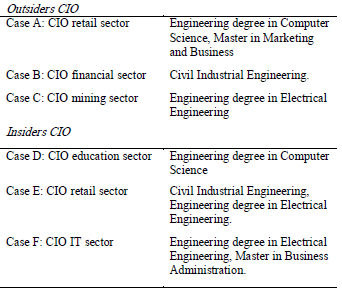
<body><![CDATA[<p><font size="2" face="Verdana, Arial, Helvetica, sans-serif">Successful CIOs have   followed different paths ranging from academic formation in business and   technology, to learning related with backgrounds in programming, accounting,   psychology, engineering or sales &#91;2&#93;. Again, the question we pose is: How can the IS/IT   professionals choose integrated academic programs that prepare professionals   with strategic vision, who are comfortable developing   and implementing IS/IT solutions as well as demonstrating and communicating the   business value of such projects?</font></p>     <p>&nbsp;</p>     <p><font size="3" face="Verdana, Arial, Helvetica, sans-serif"><b>3. METHODS AND RESULTS</b></font></p>     <p><font size="2" face="Verdana, Arial, Helvetica, sans-serif">In order to discover the core skills of the ideal CIO, we collected and   analyzed data through semi-structured interviews, and public information of graduate academic programs. </font></p>     <p><font size="2" face="Verdana, Arial, Helvetica, sans-serif"><b>3.1 Semi-structured interviews</b>     <br>   The primary data collected with semi-structured interviews provides a   rich picture of what the roles are and issues concerning the performance of the   CIO. The interviews conducted were analyzed as empirical evidence to validate   the relevance of the issues reported in the literature, and to serve as a basis   for building a new theoretical explanation of the phenomenon under study &#91;17&#93;. A predefined list of responsibilities was adapted from "The   State of the CIO 2009 survey";, which is periodically conducted by the CIO   Magazine with a large sample of IT senior executives in    North   America. </font></p> <font size="2" face="Verdana, Arial, Helvetica, sans-serif">     <p>Six   interviews were conducted face-to-face with Chilean key informants representing   different industries and companies of different sizes. Approximately 2 hours   and 50 minutes of conversations were digitally recorded and analyzed with the   consent of the interviewees. Additionally, six other respondents answered the   same set of questions on a paper-based format. <a href="#tab01">Table 1</a> shows the academic formation   of respondents (three of them classified as CIO outsiders and three as   insiders).</p>     <p align="center"><b><a name="tab01"></a>Table 1.</b> Academic Formation   of the sample    <br>   <img src="/img/revistas/dyna/v77n163/a18tab01.gif"></p>     <p>The   average working experience of the interviewees is 19.3 years, and 7.7 years in   the CIO position. In the course of the conversations, the interviewees were   surveyed about the functions and roles performed by CIOs in Chile, types of   performance assessment in organizations, different capabilities necessary for a   good performance, ways to acquire those capabilities, and the roles assigned to   the CIO by the organizations.</p>     ]]></body>
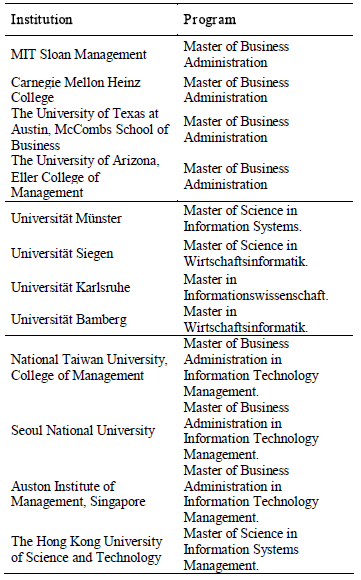
<body><![CDATA[<p>Respondents   recognized responsibilities in most of the areas shown in the survey: The State   of the CIO 2009. In   addition to the areas of responsibility, respondents were asked to select and   rank, from a pre-defined list, (at least) five activities with priority in   their agendas. The activities ranked by our six respondents (one being the most   important) are grouped by the frequency of appearance and the importance given   by them (<a href="#tab02">Table 2</a>).</p>     <p align="center"><b><a name="tab02"></a>Table 2.</b> Ranking of activities in the CIOs' agendas    <br>   <img src="/img/revistas/dyna/v77n163/a18tab02.gif"></p>     <p>In the   rankings we observe bias in the Chilean case, both CIO, insiders and outsiders,   favoring operational activities more than strategic ones, and was the most   mentioned and ranked first: reduce operating costs, implement best practices,   drive innovation in business processes, set technology investment priorities.   Other activities affecting the business strategy were either mentioned as   relevant for technology-based industries (improve quality of products and   services, improve security/risk management, manage customer relationships)   mentioned by half or less of the sample (select vendor-offered solutions,   reengineer core business processes, configure information systems, improve   end-user workforce productivity, enable regulatory compliance), or simply not   mentioned (acquire and retain customers and support globalization). It was   pointed out that the importance given to the activities selected can vary   according with the global circumstances, in particular, it was mentioned that   to reduce operating costs is a priority defined by the 2008-2009 financial   crisis. To the list, our respondents added responsibilities in processes   design, and auditing. </p>     <p>Regarding   the performance assessment of the CIO and the IT department, we discovered that   organizations do not usually evaluate IS/IT projects with an established   business criterion. They rather assess development and implementation of IT   projects using measurements like budget, development timeframe, and up-time,   but the IT projects are seen like expenditures, and it is rare to find   organizations that measure IT projects by the contribution to fundamental   business needs in terms of performance, efficiency or revenue. Rather, it is   more common that the CIO manages a budget to accomplish the IT strategy in   capacity planning, operations and support.</p>     <p>Facing   the question "what kinds of abilities have been more valuable for your   performance as a CIO?"; our interviewees strongly agreed that both,   technical and managerial skills are necessary. Even more, they weighted the   importance of both types of skills for a successful performance equally. One   CIO interviewed acknowledged a weakness in his own development of managerial   capabilities, and a change of vision after some failures. He expressed having a   strong background in technical knowledge about IT, but mentioned a case where   after very hard work a successfully developed and installed project was barely   used, just because the communication and relationship with the end user failed.   Other interviewees stated that a successful leader at the C-level must be a   good motivator, see the business through the CEO's eyes, develop   decision-making skills, and cultivate abilities to manage human   resources.</p>     <p>When   asked about the ways to acquire the two sets of skills necessary for optimal   performance of the CIO, two visions emerged. One, and the most frequent answer   was to obtain the skills through formal education in both areas, for example,   with an engineering degree or studies in computer science courses in technical aspects   of IT, plus an MBA to complement it with managerial capabilities. The formal   education approach presupposes an immature student who will not be able to   integrate all the pieces to formulate a systemic vision, and therefore, will   need to complement and receive such vision in a graduate program. A very   different perspective is to develop both sets of skills as early as possible,   hopefully in high school, but definitely in undergraduate studies. Such   perspective acknowledges a not fully formed student, but is based on the   premise that the skills taught will be further developed with practice.</p>     <p>In the   last part of the interview respondents told us what they understand as the   expectation of organizations for their performance. In their own words, they   see themselves as <i>"individuals that   keep transactional systems healthy";</i>, and described the perception of   other members of the organization: <i>"IT   departments are seen like support areas that don't generate revenues,   just support other revenue-generating areas";.</i></p>     <p>From   the data, we clearly recognize a view towards the CIO as a technology operator.   Such a perspective can be explained in many different ways, but the problems   reported in the literature coincide with what we have observed. Admitting   exceptions, we believe that the main cause of underperformance is the poor   business vision, deficiencies in communication skills with users at all levels,   and lack of initiatives that could leverage the performance of today's   CIOs, aggregating business value from IT.</p> <b>3.2 Trends in education</b>    <br> . With the purpose of exploring how prestigious universities build the CIO vision among their students around the world, we chose a dozen graduate level programs. The programs were selected from local rankings in North America, Europe, and Asia. We acknowledge that the rankings may not be comparable to each other, but in spite of the differences, we considered the twelve world-class programs as homogeneous for our task. </font><font face="Verdana, Arial, Helvetica, sans-serif">     ]]></body>
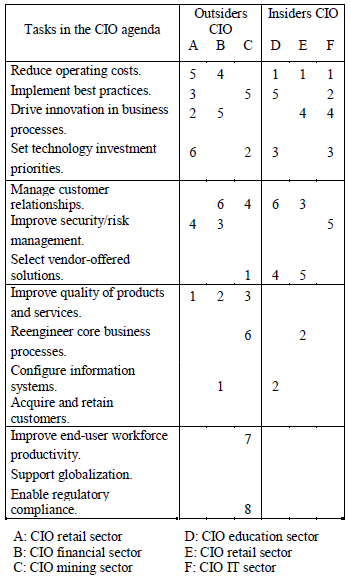
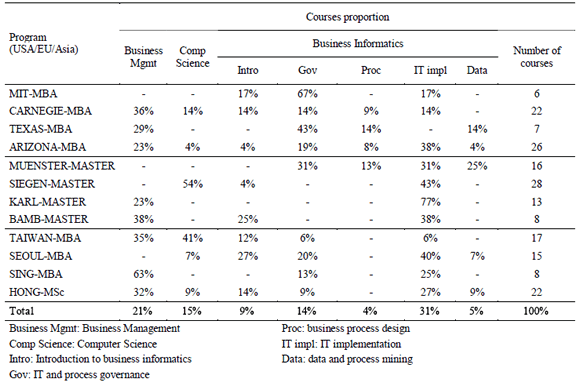
<body><![CDATA[<p align="center"><font size="2"><b><a name="tab03"></a>Table 3.</b> Academic programs in IS (USA/EU/Asia)</font>    <br>   <img src="/img/revistas/dyna/v77n163/a18tab03.gif"></p>     <p><font size="2">The courses   of the programs selected were classified in three dimensions describing   managerial, technical, and hybrid fields related to IS. All the programs   visited offer courses in the dimension business informatics, which are   considered as integrating courses, and deserve deeper analysis in the context   of this research. The business informatics courses were further separated in:   (a) introduction to business informatics, (b) IT and process governance, (c)   business processes design, (d) IT implementation, and (e) data and process   mining.</font></p>     <p><font size="2">The   programs were analyzed in the proportion of courses offered in each dimension,   while, at the same time, the objectives of each program were contrasted to   recognize if there is an explicit statement of integration and alignment of   business and technology. A relatively low proportion of courses in business   informatics can be interpreted as having a low integration level; notwithstanding,   a high weight in business informatics does not guarantee the strategic,   integral, and balanced set of skills to exploit opportunities through the use of IS/IT. </font></p>     <p><font size="2"><a href="#tab04">Table 4</a> summarizes the proportion of courses   offered in each dimension. As the courses descriptions explain the contents   found on web sites from corporate universities, it was straightforward to   determine the dimension to which they belong.</font></p>     <p align="center"><font size="2"><b><a name="tab04"></a>Table 4.</b> Proportion of courses offered by area</font>    <br>   <img src="/img/revistas/dyna/v77n163/a18tab04.gif"></p>     <p><font size="2">On   average, 63% of the courses surveyed belong to business information systems,   21% to business management and 15% to computer science. Such a relatively high   proportion in business informatics implies an emphasis on articulating contents   for business and technology. </font></p>     <p><font size="2">Approximately   31% of the total courses classify as IT implementation, evidencing a focus on IT implementation for business problems as the nexus between business and technology,   followed by Introduction to business informatics (9%), IT and process   governance (14%), data (5%) and business process design (4%).</font></p>     <p><font size="2">Unlike most American programs, the   European and Asian programs do not pay attention, in general, to topics such as   business process design or IT and process governance.</font></p>     ]]></body>
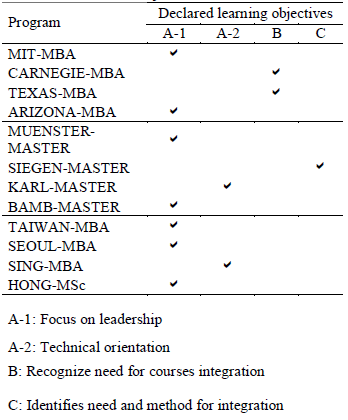
<body><![CDATA[<p><font size="2">To some extent, it seems to be that the   American programs cover a greater number of courses on business informatics.   Despite this, it is not possible to establish that due to this they achieve a   better joining of contents in the business and technology area. </font></p>     <p><font size="2">In   addition to the composition of programs, we analyzed and compared the learning   objectives of each program. In this manner, four types of objectives were   clearly recognized, depending on the explicit statement of a need for a method   to integrate as follows: </font></p> </font>     <p><font face="Verdana, Arial, Helvetica, sans-serif"><font size="2"><b>A-1:</b> Capabilities to face complex problems with a significant leadership attitude. </font></font></p>     <p><font face="Verdana, Arial, Helvetica, sans-serif"><font size="2"><b>A-2:</b> Capabilities to face complex   problems with a significant technical approach. </font></font></p>     <p><font face="Verdana, Arial, Helvetica, sans-serif"><font size="2"><b>B:</b> State the need to integrate   business and technology without declaring what are the important aspects.</font></font></p>     <p><font face="Verdana, Arial, Helvetica, sans-serif"><font size="2"><b>C:</b> State the need to integrate   business and technology and indicate what the important aspects are, stating   that business processes are the main axis.</font></font></p> <font face="Verdana, Arial, Helvetica, sans-serif">     <p><font size="2">According   to the objectives declared by the universities and the categorization   presented, we classified the twelve programs in the corresponding categories   (<a href="#tab05">Table 5</a>).</font></p> </font>     <p align="center"><font size="2" face="Verdana, Arial, Helvetica, sans-serif"><b><a name="tab05"></a>Table 5.</b> Programs classification by   learning objectives</font>    <br>   <img src="/img/revistas/dyna/v77n163/a18tab05.gif"></p> <font face="Verdana, Arial, Helvetica, sans-serif">     <p><font size="2">Only   one of twelve of these leading programs declare the integration of business and   technology one main objective (Type C) and indicate the concrete aspects they   believe necessary to accomplish the alignment. One key aspect of this program   is the study of business processes. </font></p>     ]]></body>
<body><![CDATA[<p><font size="2">Seven   other programs (Type A-1) declare strong formation in leadership capabilities   for identifying and solving problems; however, Type A-1 does not emphasize   technical capabilities to develop and establish leadership, a fact confirmed in   the high proportion of courses offered in IT and process governance and   business management with a small percentages found in IT implementation courses.</font></p>     <p><font size="2">The other   four programs are divided equally between the programs classified as A-2 and B,   the first highlighting the development of technical skills mainly for their   graduates. In the case of programs classified as B, both recognize the need for   a greater joining between business and technology without responding to how to   develop such integration.</font></p>     <p><font size="2">Undoubtedly,   the characteristics of the programs proposed for the analysis in this study are   diverse, although they have common characteristics in terms of the courses   developed in the business and technology areas, few achieve the joining   necessary to provide the market with professionals with a vision of management   of IS/IT that supports the integration of business value along with the   operational maintenance of the systems. </font></p>     <p>&nbsp;</p> </font>     <p><font size="3" face="Verdana, Arial, Helvetica, sans-serif"><b>4. CONCLUSIONS </b></font></p> <font face="Verdana, Arial, Helvetica, sans-serif">     <p><font size="2">As one   key role in today's globalized and technologized world, the CIO position   in a company must be performed in such a way that value is added through the   strategic use of IS/IT. </font></p>     <p><font size="2">The   empirical data collected in the present study confirms the current nearsighted   focus on operational continuity that companies command of the top IS/IT   executives. The data also reveals that the CIOs are assessed mainly by the   operational continuity of IS, and the implementation of technological   solutions, but not necessarily by the business value contribution of IS/IT, and   therefore the incentives for a proactive participation in the business strategy at the C-level are low. </font></p>     <p><font size="2">Related   to how CIOs' performance and contribution are measured, the question   remains whether CIOs are not prepared for greater involvement in the corporate   strategy design, or is the organization   which neither allows nor expects assistance beyond the operational continuity.</font></p>     <p><font size="2">Our   perspective is that <i>the core skills of   the CIO we need</i> must respond not only to technical and operational   responsibilities, but also to strategic alignment and value adding from IS/IT   for the business model. One major shortfall of the current practitioner CIO is   that he/she does not respond to the new economy challenge of managing the   information resources with a strategic business vision. The former can be   partly explained by an almost exclusively technical formation, which does not   integrate nor balance the ICT skills with the business reality. </font></p>     <p><font size="2">Individuals   seeking an integral formation for the CIO position should acquire and develop   technical and business skills, and integrate them in a coherent and harmonized   fashion. In this sense, the election of academic programs and career tracks   should follow the logic of integrating technical skills with business and   managerial abilities.</font></p>     ]]></body>
<body><![CDATA[<p><font size="2">Organizations   hiring or training IS/IT professionals for the CIO role will find it useful to check   on the individual´s profiles and verify that potential applicants to the   position posses the optimal combination of core skills that assure a good   performance and add value to the business. </font></p>     <p>&nbsp;</p> </font>     <p><font size="3" face="Verdana, Arial, Helvetica, sans-serif"><b>REFERENCES</b></font></p> <font face="Verdana, Arial, Helvetica, sans-serif">     <!-- ref --><p><font size="2"><b>&#91;1&#93;</b> WEIL N. The demanding state of the CIO. CIO.22. 2009.     &nbsp;&nbsp;&nbsp;&nbsp;&nbsp;&nbsp;&nbsp;&nbsp;[&#160;<a href="javascript:void(0);" onclick="javascript: window.open('/scielo.php?script=sci_nlinks&ref=000086&pid=S0012-7353201000030001800001&lng=','','width=640,height=500,resizable=yes,scrollbars=1,menubar=yes,');">Links</a>&#160;]<!-- end-ref --><!-- ref --><br>   <b>&#91;2&#93;</b> MCGEE MK. What it Takes to be a CIO. InformationWeek.44. 1998.     &nbsp;&nbsp;&nbsp;&nbsp;&nbsp;&nbsp;&nbsp;&nbsp;[&#160;<a href="javascript:void(0);" onclick="javascript: window.open('/scielo.php?script=sci_nlinks&ref=000087&pid=S0012-7353201000030001800002&lng=','','width=640,height=500,resizable=yes,scrollbars=1,menubar=yes,');">Links</a>&#160;]<!-- end-ref --><!-- ref --><br>   <b>&#91;3&#93;</b> FEENY DF, EDWARDS BR, SIMPSON KM. Understanding the CEO/CIO relationship. MIS Quarterly.16:435-48. 1992.     &nbsp;&nbsp;&nbsp;&nbsp;&nbsp;&nbsp;&nbsp;&nbsp;[&#160;<a href="javascript:void(0);" onclick="javascript: window.open('/scielo.php?script=sci_nlinks&ref=000088&pid=S0012-7353201000030001800003&lng=','','width=640,height=500,resizable=yes,scrollbars=1,menubar=yes,');">Links</a>&#160;]<!-- end-ref --><!-- ref --><br>   <b>&#91;4&#93;</b> GROVER V, SEUNG-RYUL J, KETTINGER WJ, LEE CC. The Chief Information Officer: A study of managerial roles. Journal of Management Information Systems.10:107-30. 1993.     &nbsp;&nbsp;&nbsp;&nbsp;&nbsp;&nbsp;&nbsp;&nbsp;[&#160;<a href="javascript:void(0);" onclick="javascript: window.open('/scielo.php?script=sci_nlinks&ref=000089&pid=S0012-7353201000030001800004&lng=','','width=640,height=500,resizable=yes,scrollbars=1,menubar=yes,');">Links</a>&#160;]<!-- end-ref --><!-- ref --><br>   <b>&#91;5&#93;</b> WELSH R. Leveraging the Information Systems Investment. Chief Information Officer Journal.3:61. 1991.     &nbsp;&nbsp;&nbsp;&nbsp;&nbsp;&nbsp;&nbsp;&nbsp;[&#160;<a href="javascript:void(0);" onclick="javascript: window.open('/scielo.php?script=sci_nlinks&ref=000090&pid=S0012-7353201000030001800005&lng=','','width=640,height=500,resizable=yes,scrollbars=1,menubar=yes,');">Links</a>&#160;]<!-- end-ref --><!-- ref --><br>   <b>&#91;6&#93;</b> INGEVALDSON P. Don't blame 'em - Train 'em. Computerworld.43:18-18. 2009.     &nbsp;&nbsp;&nbsp;&nbsp;&nbsp;&nbsp;&nbsp;&nbsp;[&#160;<a href="javascript:void(0);" onclick="javascript: window.open('/scielo.php?script=sci_nlinks&ref=000091&pid=S0012-7353201000030001800006&lng=','','width=640,height=500,resizable=yes,scrollbars=1,menubar=yes,');">Links</a>&#160;]<!-- end-ref --><!-- ref --><br>   <b>&#91;7&#93;</b> MONNOYER E. What CEOs really think about IT. McKinsey Quarterly.80-81. 2003.     &nbsp;&nbsp;&nbsp;&nbsp;&nbsp;&nbsp;&nbsp;&nbsp;[&#160;<a href="javascript:void(0);" onclick="javascript: window.open('/scielo.php?script=sci_nlinks&ref=000092&pid=S0012-7353201000030001800007&lng=','','width=640,height=500,resizable=yes,scrollbars=1,menubar=yes,');">Links</a>&#160;]<!-- end-ref --><!-- ref --><br>   <b>&#91;8&#93;</b> NOLAN R, MCFARLAN FW. Information technology and the board of directors. Harvard Business Review.83:96-106. 2005.     &nbsp;&nbsp;&nbsp;&nbsp;&nbsp;&nbsp;&nbsp;&nbsp;[&#160;<a href="javascript:void(0);" onclick="javascript: window.open('/scielo.php?script=sci_nlinks&ref=000093&pid=S0012-7353201000030001800008&lng=','','width=640,height=500,resizable=yes,scrollbars=1,menubar=yes,');">Links</a>&#160;]<!-- end-ref --><!-- ref --><br>   <b>&#91;9&#93;</b> WATSON BP. The disappearing CIO. eWeek.26:39-39. 2009.     &nbsp;&nbsp;&nbsp;&nbsp;&nbsp;&nbsp;&nbsp;&nbsp;[&#160;<a href="javascript:void(0);" onclick="javascript: window.open('/scielo.php?script=sci_nlinks&ref=000094&pid=S0012-7353201000030001800009&lng=','','width=640,height=500,resizable=yes,scrollbars=1,menubar=yes,');">Links</a>&#160;]<!-- end-ref --><!-- ref --><br>   <b>&#91;10&#93;</b> INGEVALDSON P. CEOs: Think through your CIO choice. Computerworld.39:41-41. 2005.     &nbsp;&nbsp;&nbsp;&nbsp;&nbsp;&nbsp;&nbsp;&nbsp;[&#160;<a href="javascript:void(0);" onclick="javascript: window.open('/scielo.php?script=sci_nlinks&ref=000095&pid=S0012-7353201000030001800010&lng=','','width=640,height=500,resizable=yes,scrollbars=1,menubar=yes,');">Links</a>&#160;]<!-- end-ref --><!-- ref --><br>   <b>&#91;11&#93;</b> MCCUE A. What kind of CIO are you? CIO Jury Articles. <a href="http://silicon.com" target="referencia">silicon.com</a>, 2006.     &nbsp;&nbsp;&nbsp;&nbsp;&nbsp;&nbsp;&nbsp;&nbsp;[&#160;<a href="javascript:void(0);" onclick="javascript: window.open('/scielo.php?script=sci_nlinks&ref=000096&pid=S0012-7353201000030001800011&lng=','','width=640,height=500,resizable=yes,scrollbars=1,menubar=yes,');">Links</a>&#160;]<!-- end-ref --><!-- ref --><br>   <b>&#91;12&#93;</b> RICH K. What makes a great CIO? Forbes.172:043. 2003.     &nbsp;&nbsp;&nbsp;&nbsp;&nbsp;&nbsp;&nbsp;&nbsp;[&#160;<a href="javascript:void(0);" onclick="javascript: window.open('/scielo.php?script=sci_nlinks&ref=000097&pid=S0012-7353201000030001800012&lng=','','width=640,height=500,resizable=yes,scrollbars=1,menubar=yes,');">Links</a>&#160;]<!-- end-ref --><!-- ref --><br>   <b>&#91;13&#93;</b> MONNOYER E, WILMOTT P. What IT leaders do. McKinsey on IT.5:7. 2005.     &nbsp;&nbsp;&nbsp;&nbsp;&nbsp;&nbsp;&nbsp;&nbsp;[&#160;<a href="javascript:void(0);" onclick="javascript: window.open('/scielo.php?script=sci_nlinks&ref=000098&pid=S0012-7353201000030001800013&lng=','','width=640,height=500,resizable=yes,scrollbars=1,menubar=yes,');">Links</a>&#160;]<!-- end-ref --><!-- ref --><br>   <b>&#91;14&#93;</b> NASH KS. What it takes to succeed now as a CIO. CIO Magazine. CXO Media Inc., 2008.     &nbsp;&nbsp;&nbsp;&nbsp;&nbsp;&nbsp;&nbsp;&nbsp;[&#160;<a href="javascript:void(0);" onclick="javascript: window.open('/scielo.php?script=sci_nlinks&ref=000099&pid=S0012-7353201000030001800014&lng=','','width=640,height=500,resizable=yes,scrollbars=1,menubar=yes,');">Links</a>&#160;]<!-- end-ref --><!-- ref --><br>   <b>&#91;15&#93;</b> MECHLING J. What does your CIO really need to know? Government Finance Review.25:79(2). 2009.     &nbsp;&nbsp;&nbsp;&nbsp;&nbsp;&nbsp;&nbsp;&nbsp;[&#160;<a href="javascript:void(0);" onclick="javascript: window.open('/scielo.php?script=sci_nlinks&ref=000100&pid=S0012-7353201000030001800015&lng=','','width=640,height=500,resizable=yes,scrollbars=1,menubar=yes,');">Links</a>&#160;]<!-- end-ref --><!-- ref --><br>   <b>&#91;16&#93;</b> KARLGAARD R. What makes a great CIO? Forbes.172:043-43. 2003.     &nbsp;&nbsp;&nbsp;&nbsp;&nbsp;&nbsp;&nbsp;&nbsp;[&#160;<a href="javascript:void(0);" onclick="javascript: window.open('/scielo.php?script=sci_nlinks&ref=000101&pid=S0012-7353201000030001800016&lng=','','width=640,height=500,resizable=yes,scrollbars=1,menubar=yes,');">Links</a>&#160;]<!-- end-ref --><!-- ref --><br>   <b>&#91;17&#93;</b> YIN R. Case Study Research Design and Methods. Thousand Oaks: SAGE Publications, 1994.</font>&nbsp;&nbsp;&nbsp;&nbsp;&nbsp;&nbsp;&nbsp;&nbsp;[&#160;<a href="javascript:void(0);" onclick="javascript: window.open('/scielo.php?script=sci_nlinks&ref=000102&pid=S0012-7353201000030001800017&lng=','','width=640,height=500,resizable=yes,scrollbars=1,menubar=yes,');">Links</a>&#160;]<!-- end-ref --> ]]></body><back>
<ref-list>
<ref id="B1">
<label>1</label><nlm-citation citation-type="journal">
<person-group person-group-type="author">
<name>
<surname><![CDATA[WEIL]]></surname>
<given-names><![CDATA[N.]]></given-names>
</name>
</person-group>
<article-title xml:lang="en"><![CDATA[The demanding state of the CIO.]]></article-title>
<source><![CDATA[CIO]]></source>
<year>2009</year>
<numero>22</numero>
<issue>22</issue>
</nlm-citation>
</ref>
<ref id="B2">
<label>2</label><nlm-citation citation-type="journal">
<person-group person-group-type="author">
<name>
<surname><![CDATA[MCGEE]]></surname>
<given-names><![CDATA[MK.]]></given-names>
</name>
</person-group>
<article-title xml:lang="en"><![CDATA[What it Takes to be a CIO.]]></article-title>
<source><![CDATA[InformationWeek]]></source>
<year>1998</year>
<numero>44</numero>
<issue>44</issue>
</nlm-citation>
</ref>
<ref id="B3">
<label>3</label><nlm-citation citation-type="journal">
<person-group person-group-type="author">
<name>
<surname><![CDATA[FEENY]]></surname>
<given-names><![CDATA[DF]]></given-names>
</name>
<name>
<surname><![CDATA[EDWARDS]]></surname>
<given-names><![CDATA[BR]]></given-names>
</name>
<name>
<surname><![CDATA[SIMPSON]]></surname>
<given-names><![CDATA[KM.]]></given-names>
</name>
</person-group>
<article-title xml:lang="en"><![CDATA[Understanding the CEO/CIO relationship.]]></article-title>
<source><![CDATA[MIS Quarterly]]></source>
<year>1992</year>
<numero>16</numero>
<issue>16</issue>
<page-range>435-48</page-range></nlm-citation>
</ref>
<ref id="B4">
<label>4</label><nlm-citation citation-type="journal">
<person-group person-group-type="author">
<name>
<surname><![CDATA[GROVER]]></surname>
<given-names><![CDATA[V]]></given-names>
</name>
<name>
<surname><![CDATA[SEUNG-RYUL]]></surname>
<given-names><![CDATA[J]]></given-names>
</name>
<name>
<surname><![CDATA[KETTINGER]]></surname>
<given-names><![CDATA[WJ]]></given-names>
</name>
<name>
<surname><![CDATA[LEE]]></surname>
<given-names><![CDATA[CC.]]></given-names>
</name>
</person-group>
<article-title xml:lang="en"><![CDATA[The Chief Information Officer: A study of managerial roles.]]></article-title>
<source><![CDATA[Journal of Management Information Systems.]]></source>
<year>1993</year>
<numero>10</numero>
<issue>10</issue>
<page-range>107-30</page-range></nlm-citation>
</ref>
<ref id="B5">
<label>5</label><nlm-citation citation-type="journal">
<person-group person-group-type="author">
<name>
<surname><![CDATA[WELSH]]></surname>
<given-names><![CDATA[R.]]></given-names>
</name>
</person-group>
<article-title xml:lang="en"><![CDATA[Leveraging the Information Systems Investment.]]></article-title>
<source><![CDATA[Chief Information Officer Journal.]]></source>
<year>1991</year>
<numero>3</numero>
<issue>3</issue>
<page-range>61</page-range></nlm-citation>
</ref>
<ref id="B6">
<label>6</label><nlm-citation citation-type="journal">
<person-group person-group-type="author">
<name>
<surname><![CDATA[INGEVALDSON]]></surname>
<given-names><![CDATA[P.]]></given-names>
</name>
</person-group>
<article-title xml:lang="en"><![CDATA[Don't blame 'em - Train 'em.]]></article-title>
<source><![CDATA[Computerworld]]></source>
<year>2009</year>
<numero>43</numero>
<issue>43</issue>
<page-range>18-18</page-range></nlm-citation>
</ref>
<ref id="B7">
<label>7</label><nlm-citation citation-type="book">
<person-group person-group-type="author">
<name>
<surname><![CDATA[MONNOYER]]></surname>
<given-names><![CDATA[E.]]></given-names>
</name>
</person-group>
<source><![CDATA[What CEOs really think about IT]]></source>
<year>2003</year>
<page-range>80-81</page-range><publisher-name><![CDATA[McKinsey Quarterly]]></publisher-name>
</nlm-citation>
</ref>
<ref id="B8">
<label>8</label><nlm-citation citation-type="journal">
<person-group person-group-type="author">
<name>
<surname><![CDATA[NOLAN]]></surname>
<given-names><![CDATA[R]]></given-names>
</name>
<name>
<surname><![CDATA[MCFARLAN]]></surname>
<given-names><![CDATA[FW]]></given-names>
</name>
</person-group>
<article-title xml:lang="en"><![CDATA[Information technology and the board of directors]]></article-title>
<source><![CDATA[Harvard Business Review]]></source>
<year>2005</year>
<numero>83</numero>
<issue>83</issue>
<page-range>96-106</page-range></nlm-citation>
</ref>
<ref id="B9">
<label>9</label><nlm-citation citation-type="journal">
<person-group person-group-type="author">
<name>
<surname><![CDATA[WATSON]]></surname>
<given-names><![CDATA[BP.]]></given-names>
</name>
</person-group>
<article-title xml:lang="en"><![CDATA[The disappearing CIO.]]></article-title>
<source><![CDATA[eWeek.]]></source>
<year>2009</year>
<numero>26</numero>
<issue>26</issue>
<page-range>39-39</page-range></nlm-citation>
</ref>
<ref id="B10">
<label>10</label><nlm-citation citation-type="journal">
<person-group person-group-type="author">
<name>
<surname><![CDATA[INGEVALDSON]]></surname>
<given-names><![CDATA[P.]]></given-names>
</name>
</person-group>
<article-title xml:lang="en"><![CDATA[CEOs:: Think through your CIO choice.]]></article-title>
<source><![CDATA[Computerworld]]></source>
<year>2005</year>
<numero>39</numero>
<issue>39</issue>
<page-range>41-41</page-range></nlm-citation>
</ref>
<ref id="B11">
<label>11</label><nlm-citation citation-type="">
<person-group person-group-type="author">
<name>
<surname><![CDATA[MCCUE]]></surname>
<given-names><![CDATA[A.]]></given-names>
</name>
</person-group>
<source><![CDATA[What kind of CIO are you? CIO Jury Articles.]]></source>
<year>2006</year>
</nlm-citation>
</ref>
<ref id="B12">
<label>12</label><nlm-citation citation-type="journal">
<person-group person-group-type="author">
<name>
<surname><![CDATA[RICH]]></surname>
<given-names><![CDATA[K.]]></given-names>
</name>
</person-group>
<article-title xml:lang="en"><![CDATA[What makes a great CIO?]]></article-title>
<source><![CDATA[Forbes]]></source>
<year>2003</year>
<volume>172</volume>
<numero>043</numero>
<issue>043</issue>
</nlm-citation>
</ref>
<ref id="B13">
<label>13</label><nlm-citation citation-type="journal">
<person-group person-group-type="author">
<name>
<surname><![CDATA[MONNOYER]]></surname>
<given-names><![CDATA[E]]></given-names>
</name>
<name>
<surname><![CDATA[WILMOTT]]></surname>
<given-names><![CDATA[P.]]></given-names>
</name>
</person-group>
<article-title xml:lang="en"><![CDATA[What IT leaders do.]]></article-title>
<source><![CDATA[McKinsey on IT]]></source>
<year>2005</year>
<volume>5</volume>
<numero>7</numero>
<issue>7</issue>
</nlm-citation>
</ref>
<ref id="B14">
<label>14</label><nlm-citation citation-type="journal">
<person-group person-group-type="author">
<name>
<surname><![CDATA[NASH]]></surname>
<given-names><![CDATA[KS]]></given-names>
</name>
</person-group>
<source><![CDATA[CIO Magazine.]]></source>
<year>2008</year>
<month>.</month>
<publisher-name><![CDATA[CXO Media Inc]]></publisher-name>
</nlm-citation>
</ref>
<ref id="B15">
<label>15</label><nlm-citation citation-type="journal">
<person-group person-group-type="author">
<name>
<surname><![CDATA[MECHLING]]></surname>
<given-names><![CDATA[J.]]></given-names>
</name>
</person-group>
<article-title xml:lang="en"><![CDATA[What does your CIO really need to know?]]></article-title>
<source><![CDATA[Government Finance Review]]></source>
<year>2009</year>
<volume>25</volume>
<numero>79</numero>
<issue>79</issue>
</nlm-citation>
</ref>
<ref id="B16">
<label>16</label><nlm-citation citation-type="journal">
<person-group person-group-type="author">
<name>
<surname><![CDATA[KARLGAARD]]></surname>
<given-names><![CDATA[R.]]></given-names>
</name>
</person-group>
<article-title xml:lang="en"><![CDATA[What makes a great CIO?]]></article-title>
<source><![CDATA[Forbes]]></source>
<year>2003</year>
<volume>172</volume>
<numero>043</numero>
<issue>043</issue>
<page-range>43</page-range></nlm-citation>
</ref>
<ref id="B17">
<label>17</label><nlm-citation citation-type="book">
<person-group person-group-type="author">
<name>
<surname><![CDATA[YIN]]></surname>
<given-names><![CDATA[R.]]></given-names>
</name>
</person-group>
<article-title xml:lang="en"><![CDATA[Case Study Research Design and Methods.]]></article-title>
<source><![CDATA[]]></source>
<year>1994</year>
<publisher-loc><![CDATA[Thousand Oaks ]]></publisher-loc>
<publisher-name><![CDATA[SAGE Publications]]></publisher-name>
</nlm-citation>
</ref>
</ref-list>
</back>
</article>