<?xml version="1.0" encoding="ISO-8859-1"?><article xmlns:mml="http://www.w3.org/1998/Math/MathML" xmlns:xlink="http://www.w3.org/1999/xlink" xmlns:xsi="http://www.w3.org/2001/XMLSchema-instance">
<front>
<journal-meta>
<journal-id>0012-7353</journal-id>
<journal-title><![CDATA[DYNA]]></journal-title>
<abbrev-journal-title><![CDATA[Dyna rev.fac.nac.minas]]></abbrev-journal-title>
<issn>0012-7353</issn>
<publisher>
<publisher-name><![CDATA[Universidad Nacional de Colombia]]></publisher-name>
</publisher>
</journal-meta>
<article-meta>
<article-id>S0012-73532010000300019</article-id>
<title-group>
<article-title xml:lang="en"><![CDATA[EVOLUTION AND TRENDS OF INFORMATION SYSTEMS FOR BUSINESS MANAGEMENT: THE M-BUSINESS. A REVIEW]]></article-title>
<article-title xml:lang="es"><![CDATA[EVOLUCIÓN Y TENDENCIAS DE LOS SISTEMAS DE INFORMACIÓN PARA LA GESTIÓN EN LA EMPRESA: EL M-BUSINESS]]></article-title>
</title-group>
<contrib-group>
<contrib contrib-type="author">
<name>
<surname><![CDATA[GIL GÓMEZ]]></surname>
<given-names><![CDATA[HERMENEGILDO]]></given-names>
</name>
<xref ref-type="aff" rid="A01"/>
</contrib>
<contrib contrib-type="author">
<name>
<surname><![CDATA[ARANGO SERNA]]></surname>
<given-names><![CDATA[MARTIN DARIO]]></given-names>
</name>
<xref ref-type="aff" rid="A02"/>
</contrib>
<contrib contrib-type="author">
<name>
<surname><![CDATA[OLTRA BADENES]]></surname>
<given-names><![CDATA[RAÚL FRANCISCO]]></given-names>
</name>
<xref ref-type="aff" rid="A03"/>
</contrib>
</contrib-group>
<aff id="A01">
<institution><![CDATA[,Polytechnic of Valencia University  ]]></institution>
<addr-line><![CDATA[ ]]></addr-line>
</aff>
<aff id="A02">
<institution><![CDATA[,Universidad Nacional de Colombia  ]]></institution>
<addr-line><![CDATA[ ]]></addr-line>
</aff>
<aff id="A03">
<institution><![CDATA[,Polytechnic of Valencia University  ]]></institution>
<addr-line><![CDATA[ ]]></addr-line>
</aff>
<pub-date pub-type="pub">
<day>00</day>
<month>09</month>
<year>2010</year>
</pub-date>
<pub-date pub-type="epub">
<day>00</day>
<month>09</month>
<year>2010</year>
</pub-date>
<volume>77</volume>
<numero>163</numero>
<fpage>181</fpage>
<lpage>193</lpage>
<copyright-statement/>
<copyright-year/>
<self-uri xlink:href="http://www.scielo.org.co/scielo.php?script=sci_arttext&amp;pid=S0012-73532010000300019&amp;lng=en&amp;nrm=iso"></self-uri><self-uri xlink:href="http://www.scielo.org.co/scielo.php?script=sci_abstract&amp;pid=S0012-73532010000300019&amp;lng=en&amp;nrm=iso"></self-uri><self-uri xlink:href="http://www.scielo.org.co/scielo.php?script=sci_pdf&amp;pid=S0012-73532010000300019&amp;lng=en&amp;nrm=iso"></self-uri><abstract abstract-type="short" xml:lang="en"><p><![CDATA[This article makes a review from the origin to currently of information systems for business management. It is specially emphasized about the changes that have occurred in recent years in such kind of systems and in what are the trends for the coming future. Between this trends it is possible identify several technical advances and new functionalities that are being joined or that will be soon. For example, a new functionality or advance that is incorporating is the m-commerce, which not only can influence the information system in a high degree but also in the strategies and management activities of currently companies.]]></p></abstract>
<abstract abstract-type="short" xml:lang="es"><p><![CDATA[En este artículo se revisa la evolución de los sistemas de información para la gestión de empresas, desde su aparición hasta la época actual. Se hace especial hincapié en los cambios que se han producido en los últimos tiempos en este tipo de sistemas, y las tendencias que se prevé que seguirán en un futuro cercano. Entre estas tendencias de futuro, se pueden identificar diferentes avances técnicos, así como nuevas funcionalidades que se están incorporando, o lo harán en breve. Una de estas nuevas funcionalidades o avances a incorporar es el m-commerce, que puede influir en gran medida, no solo en los sistemas de información para la gestión, sino también en las estrategias y técnicas de gestión de empresas actuales.]]></p></abstract>
<kwd-group>
<kwd lng="en"><![CDATA[Information systems for management]]></kwd>
<kwd lng="en"><![CDATA[m-commerce]]></kwd>
<kwd lng="en"><![CDATA[m-business]]></kwd>
<kwd lng="en"><![CDATA[ERP]]></kwd>
<kwd lng="en"><![CDATA[Trends]]></kwd>
<kwd lng="es"><![CDATA[Sistemas de información para la gestión]]></kwd>
<kwd lng="es"><![CDATA[m-commerce]]></kwd>
<kwd lng="es"><![CDATA[m-business]]></kwd>
<kwd lng="es"><![CDATA[ERP]]></kwd>
<kwd lng="es"><![CDATA[tendencias]]></kwd>
</kwd-group>
</article-meta>
</front><body><![CDATA[ <p align="center"><font size="4" face="Verdana, Arial, Helvetica, sans-serif"><b>EVOLUTION   AND TRENDS OF INFORMATION SYSTEMS FOR BUSINESS MANAGEMENT: THE M-BUSINESS. A   REVIEW </b></font></p>     <p align="center"><i><font size="3" face="Verdana, Arial, Helvetica, sans-serif"><b>EVOLUCI&Oacute;N Y TENDENCIAS DE LOS   SISTEMAS DE INFORMACI&Oacute;N PARA LA GESTI&Oacute;N EN LA EMPRESA: EL M-BUSINESS </b></font></i></p>     <p align="center">&nbsp;</p>     <p align="center"><font size="2" face="Verdana, Arial, Helvetica, sans-serif"><b>HERMENEGILDO GIL G&Oacute;MEZ    <br>   </b><i>Polytechnic   of Valencia University, <a href="mailto:hgilgom@om p.upv.es">hgilgom@om p.upv.es</a> </i></font></p>     <p align="center"><font size="2" face="Verdana, Arial, Helvetica, sans-serif"><b>MARTIN DARIO ARANGO SERNA    <br>   </b><i>Associated   professor of Universidad Nacional de Colombia, <a href="mailto:mdarango@unalmed.edu.co">mdarango@unalmed.edu.co</a></i></font></p>     <p align="center"><font size="2" face="Verdana, Arial, Helvetica, sans-serif"><b>RA&Uacute;L FRANCISCO OLTRA BADENES</b>     <br>   <i>Industrial engineering, student PhD, Polytechnic   of Valencia University, <a href="mailto:rauloltra@gmail.com">rauloltra@gmail.com</a> </i></font></p>     <p align="center">&nbsp;</p>     ]]></body>
<body><![CDATA[<p align="center"><font size="2" face="Verdana, Arial, Helvetica, sans-serif"><b>Received for review August 28<sup>th</sup>, 2009, accepted October 17<sup>th</sup>, 2009, final   version October, 26<sup>th</sup>, 2009 </b></font></p>     <p align="center">&nbsp;</p> <hr>     <p><font size="2" face="Verdana, Arial, Helvetica, sans-serif"><b>ABSTRACT</b>: This article   makes a review from the origin to currently of information systems for business   management. It is specially emphasized about the changes that have occurred in   recent years in such kind of systems and in what are   the trends for the coming future. Between this trends it is possible identify   several technical advances and new functionalities that are being joined or   that will be soon. For example, a new functionality or advance that is   incorporating is the m-commerce, which not only can influence the information   system in a high degree but also in the strategies and management activities of   currently companies. </font></p>     <p><font size="2" face="Verdana, Arial, Helvetica, sans-serif"><b>KEYWORDS</b>: Information   systems for management, m-commerce, m-business, ERP, Trends. </font></p>     <p><font size="2" face="Verdana, Arial, Helvetica, sans-serif"><b>RESUMEN: </b>En este art&iacute;culo se revisa la evoluci&oacute;n de los   sistemas de informaci&oacute;n para la gesti&oacute;n de empresas, desde su aparici&oacute;n hasta   la &eacute;poca actual. Se hace especial hincapi&eacute; en los cambios que se han producido   en los &uacute;ltimos tiempos en este tipo de sistemas, y las tendencias que se prev&eacute;   que seguir&aacute;n en un futuro cercano. Entre estas tendencias de futuro, se pueden   identificar diferentes avances t&eacute;cnicos, as&iacute; como nuevas funcionalidades que se   est&aacute;n incorporando, o lo har&aacute;n en breve. Una de estas nuevas funcionalidades o   avances a incorporar es el m-commerce, que puede influir en gran medida, no   solo en los sistemas de informaci&oacute;n para la gesti&oacute;n, sino tambi&eacute;n en las   estrategias y t&eacute;cnicas de gesti&oacute;n de empresas actuales. </font></p>     <p><font size="2" face="Verdana, Arial, Helvetica, sans-serif"><b>PALABRAS CLAVE:</b> Sistemas de informaci&oacute;n para la gesti&oacute;n,   m-commerce, m-business, ERP, tendencias. </font></p> <hr>     <p>&nbsp;</p>     <p><font size="3" face="Verdana, Arial, Helvetica, sans-serif"><b>1.   INTRODUCTION </b></font></p>     <p><font size="2" face="Verdana, Arial, Helvetica, sans-serif">Information systems for company   management (ISFM) have been, and are a key factor in enterprise development. In its continue evolution it has gone from just a work   tool to a competitiveand strategy element, even </font><font size="2" face="Verdana, Arial, Helvetica, sans-serif">generating new business models based on its development. </font></p>     <p><font size="2" face="Verdana, Arial, Helvetica, sans-serif">This is why information   systems for company management have been studied from several points of view,   including its implementation and key factor that can affect it, , as well as </font><font size="2" face="Verdana, Arial, Helvetica, sans-serif">the effects that ISFM   can produce in companies&#91;1,2,3,4&#93;, comparison between different systems brands   &#91;5&#93;, or its evolution throughout time ,   &#91;6, 7,8&#93;, among others. </font></p>     ]]></body>
<body><![CDATA[<p><font size="2" face="Verdana, Arial, Helvetica, sans-serif">On   the other hand, it is possible to highlight that recently has occurred   different, fast and important advances, both in technological and in policies   and philosophies of management in companies. It has caused that ISFM must have   to be adapted quickly to these advances, and recently it must be in a   continuous of improvement process. For that reason the companies that develop   this kind of systems have had to spend a big amount of resources in research and development and innovation </font></p>     <p><font size="2" face="Verdana, Arial, Helvetica, sans-serif">The   current paper describes the actual moment of ISFM, technical and functional   innovations, the implementation of such innovation and   trends that could be followed for the coming years about these systems. Also,   it is studied how m-commerce (A recent technological development without   commercial exploitation) can affect the ISFM. </font></p>     <p>&nbsp;</p>     <p><font size="3" face="Verdana, Arial, Helvetica, sans-serif"><b>2. HISTORICAL EVOLUTION OF   ISFM </b></font></p>     <p><font size="2" face="Verdana, Arial, Helvetica, sans-serif"><b>2.1 From accountant management   software to ERP (Enterprise Resource Planning)    <br>   </b></font><font size="2" face="Verdana, Arial, Helvetica, sans-serif">Information   systems have been incorporated in companies since the appeared of the first   computer, as an important and strong tool to optimize and improve management   activities. Their introduction has been progressively due to the systems   evolution in each specific area and of course due to the technology   availability over time. The first application of information systems in   companies were made on 1960's in the accountant management area &#91;9&#93;. Accounting is   clearly defined by laws and a rule that every company must follow, regardless   their nature and sector it belongs to. That's why that the design and   implementation of a software for accounting management is easier compared with   others areas in companies since that the "requirements analysis"; is   made for the administration entities of every country and it is exactly the   same for every company in such company. This is the way of how the first   information systems for company management appeared, which they were basically   accounting software. </font></p>     <p><font size="2" face="Verdana, Arial, Helvetica, sans-serif">As soon as the accounting software appeared, there was the necessity of   manage the administration area using formation systems too. So there were   developed several information systems for that purpose, which could manage   invoices, paying, collecting, etc. This way, such operations kept stored in the information system, what allow the later search or study,   etc. even if the administrative area information system were integrated with   the accounting and financial system it guarantied a safe of working time, a   productivity increasing and a reductions in costs and mistakes. </font></p>     <p><font size="2" face="Verdana, Arial, Helvetica, sans-serif">After that, the developing of software for companies concentrated   efforts toward the research and development of stock management area, appearing   systems as the ICS (inventory Control system). These systems allow the existing   stock of every product at the warehouse, what are the   consumption in different periods, and off course, their value, something really   important for recent companies. One more time, the integration of these systems   with the information application in the company (accounting and administration   systems) was revealed as a very important factor in the process optimization. </font></p>     <p><font size="2" face="Verdana, Arial, Helvetica, sans-serif">As show in the works from the last decade &#91;9,10,   11,12,13&#93;; at the end of the 60's   and at the beginning of 70's appeared the first MRP systems (Material   Requirements planning). These systems emerge as the evolution of the ICS   through the Hill of Material (BOM) utilization. The principal characteristic of   the MRP systems is that they use a hierarchical approach for the inventory   management, allowing basically the creation of the material plant from the   following three fundamental elements: </font></p> <ul>       <li> <font size="2" face="Verdana, Arial, Helvetica, sans-serif">Productivity Master Plant (PMP) </font></li>       ]]></body>
<body><![CDATA[<li><font size="2" face="Verdana, Arial, Helvetica, sans-serif"> Bill of Materials (BOM) </font></li>       <li> <font size="2" face="Verdana, Arial, Helvetica, sans-serif">Inventory Data Base (IDB) </font></li>     </ul>     <p><font size="2" face="Verdana, Arial, Helvetica, sans-serif">The MRP allows achieving outstanding advances, which could be   highlighted the inventory and process time reduction and the increasing of the   supply efficiency. However in order to achieve those benefits is really   necessary a very high accuracy in the PMP. The main problem with the MRP is   that it overlooks the capacity constrains and the practices in the repair shop   management. </font></p>     <p><font size="2" face="Verdana, Arial, Helvetica, sans-serif">The MRP II systems are the natural evolution of the MRP systems which   come up during the 80´s &#91;9,10, 11,12,13&#93;. In this new   information system it is taken into account the management necessities, the   material planning and the needed resources and the capacities for   manufacturing. Although the letter for both the MRP and MRP II are the same,   the meaning is totally different. MRP II means "Manufacturing Resources planning";   and it is added the Romanian number II for clearly differentiate from the MRP,   which are focused exclusively on the materials management. This kind of   systems, as is indicated in its name, are focused on the production area, but   it is really true that these try to integrate itself with the information   applications that manage others areas in the company. </font></p>     <p><font size="2" face="Verdana, Arial, Helvetica, sans-serif">Continuing with the evolutions, it is integrated several new   functionalities to the MRP II systems, therefore it   could cover other management areas inside the company, as could be engineering,   human resources, project management, logistics, etc. This previous behavior   created the new concept ERP (Enterprise Resources Planning), which defines more   clearly the concept of integrated information systems for companies. </font></p>     <p><font size="2" face="Verdana, Arial, Helvetica, sans-serif">It is important to highlight that there are two ERP concepts and in many   times there is confusion between these. In one hand there is the   "traditional"; ERP, What is the one that emerges from the MRP II, on   the other hand there is the ERP II, what is the evolution of the   "traditional"; ERP toward the new technological and business trends   produced by the arising of the internet, as it is the e-business and the   collaborative environments. </font></p>     <p><font size="2" face="Verdana, Arial, Helvetica, sans-serif"><b>2.2 The   "traditional"; ERP    <br>   </b></font><font size="2" face="Verdana, Arial, Helvetica, sans-serif">It is consider the ERP systems as the consequence of the evolution and   sophistication of the inventory management systems during the last 50 years. &#91;9,10,11,12,13,14&#93;. </font></p>     <p><font size="2" face="Verdana, Arial, Helvetica, sans-serif">As Muñoz <i>et all</i> (2004) &#91;15&#93; indicates, <i>"The enterprise resources planning -   ERP are information systems that use business engineering and the information   technology for the integrated design of the business process in an   organization. These systems are build in a method for planning and controlling   all the needed resources for the all the operations related with buying,   producing, delivering, and accounting the order accomplishing of a customer in   a factory, distribution center or in a service enterprise";.</i> </font></p>     ]]></body>
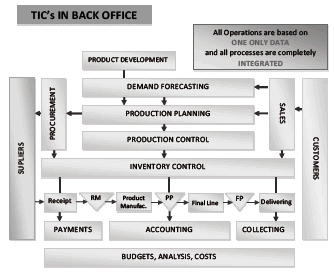
<body><![CDATA[<p><font size="2" face="Verdana, Arial, Helvetica, sans-serif">On the other hand, according to Aberdeen Consulting Group an <i>"ERP is referred to the software   infrastructure that by one side brings support to all the internal processes in the company and by other, is the   base for the external business processes of the company";.</i> In this   case, it is given to the ERP a functionality of "support"; to the   connection with other systems, it is an opening to the   external environment, a first step to the transformation of what is firstly   known as the ERP II. </font></p>     <p><font size="2" face="Verdana, Arial, Helvetica, sans-serif">This way, after studying this and other works &#91;8,9,11,13,15;16&#93;   among others, it is possible to conclude that a "traditional"; ERP   is an application for the integral management of the several basic modules that   set up a company, in other words, from the more basic modules, as are   accounting, procurement, selling, production, until secondary modules as human   resources, cost management, quality, etc. It is a communication platform   between the departments of the company that allows making the work faster. </font></p>     <p><font size="2" face="Verdana, Arial, Helvetica, sans-serif">In the <a href="#fig01">picture 1</a> it is shown a sketch of the process that support the   "traditional"; ERP in a company. This is known as Back Office. </font></p>     <p align="center"><font size="2" face="Verdana, Arial, Helvetica, sans-serif"><b><a name="fig01"></a><img src="/img/revistas/dyna/v77n163/a19fig01.gif">    <br>   Figure 1: </b>The ERP in the Back Office. Source:   AMR Research, 2009 </font></p>     <p><font size="2" face="Verdana, Arial, Helvetica, sans-serif"><i>2.2.1. Business processes in a   traditional ERP    <br>   </i></font><font size="2" face="Verdana, Arial, Helvetica, sans-serif">In general, a "traditional"; ERP   software must cover all the internal business areas of the company. Generally   the main ERP software packages exhibit utilities (in higher or a lower degree)   for the following activities. &#91;2&#93; </font></p> <ul>       <li> <font size="2" face="Verdana, Arial, Helvetica, sans-serif">Accounting an finance </font></li>       <li> <font size="2" face="Verdana, Arial, Helvetica, sans-serif">Logistics </font></li>       <li> <font size="2" face="Verdana, Arial, Helvetica, sans-serif">Operations </font></li>       ]]></body>
<body><![CDATA[<li> <font size="2" face="Verdana, Arial, Helvetica, sans-serif">Human resources </font></li>       <li> <font size="2" face="Verdana, Arial, Helvetica, sans-serif">Sales and marketing </font></li>       <li> <font size="2" face="Verdana, Arial, Helvetica, sans-serif">Collecting and paying </font></li>       <li> <font size="2" face="Verdana, Arial, Helvetica, sans-serif">Customers and suppliers </font></li>       <li> <font size="2" face="Verdana, Arial, Helvetica, sans-serif">Warehouse management </font></li>       <li> <font size="2" face="Verdana, Arial, Helvetica, sans-serif">Planning </font></li>       <li> <font size="2" face="Verdana, Arial, Helvetica, sans-serif">Cost </font></li>       <li> <font size="2" face="Verdana, Arial, Helvetica, sans-serif">Project management </font></li>       <li> <font size="2" face="Verdana, Arial, Helvetica, sans-serif">Etc. </font></li>     </ul>     ]]></body>
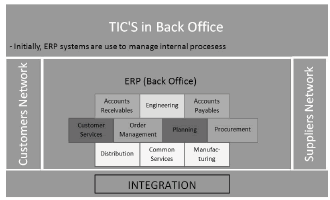
<body><![CDATA[<p><font size="2" face="Verdana, Arial, Helvetica, sans-serif">The ERP Integrates all these process of a company, and others, in unique   single system, through it is known as "Unique Data"; which is shared   for all the processes that require it, as it is shown in the <a href="#fig02">picture number 2</a>. </font></p>     <p align="center"><font size="2" face="Verdana, Arial, Helvetica, sans-serif"><b><a name="fig02"></a><img src="/img/revistas/dyna/v77n163/a19fig02.gif">    <br>   Figure 2:</b> Integration of a company through a integrated information systems for company   management. Source:   own sourced </font></p>     <p><font size="2" face="Verdana, Arial, Helvetica, sans-serif">The integration of all processes generates several benefits for a   company, which can be summarized as follow: </font></p> <ul>       <li> <font size="2" face="Verdana, Arial, Helvetica, sans-serif">Unique Data. There is necessary to introduce the data     only one time. This information will be available immediately, and at the same     time for all the company. </font></li>       <li> <font size="2" face="Verdana, Arial, Helvetica, sans-serif">Setting hierarchical parameters of masters (fixed     tables). </font></li>       <li> <font size="2" face="Verdana, Arial, Helvetica, sans-serif">Minimization of data entering in dynamic tables. </font></li>       <li> <font size="2" face="Verdana, Arial, Helvetica, sans-serif">Information flows through processes. </font></li>       <li> <font size="2" face="Verdana, Arial, Helvetica, sans-serif">Navigability among related tables. </font></li>       <li> <font size="2" face="Verdana, Arial, Helvetica, sans-serif">Traceability </font></li>       ]]></body>
<body><![CDATA[<li> <font size="2" face="Verdana, Arial, Helvetica, sans-serif">Analytical tools </font></li>     </ul>     <p><font size="2" face="Verdana, Arial, Helvetica, sans-serif">However it is important take into account a set of important   considerations in order to use an ERP and in this way can achieve such   integration. Some of these considerations are the following integration rules: </font></p> <ul>       <li> <font size="2" face="Verdana, Arial, Helvetica, sans-serif">Not all the process are reversible </font></li>       <li> <font size="2" face="Verdana, Arial, Helvetica, sans-serif">Inventory continuity principle </font></li>       <li> <font size="2" face="Verdana, Arial, Helvetica, sans-serif">An ERP processes only previously created records and     uses deterministic computational algorithms </font></li>     </ul>     <p><font size="2" face="Verdana, Arial, Helvetica, sans-serif"><i>2.2.2. Implementation of an   ERP    <br>   </i></font><font size="2" face="Verdana, Arial, Helvetica, sans-serif">As could be noted in &#91;1,2,3,4,5,9,13&#93; the   implementation of an ERP is a complex   process that affects in a higher or a lower degree the whole company in which   it is implemented. As Muñoz et al. (2004) &#91;15&#93; established, there is   possible to find that the concept of the implementation of ERP systems is quite   different to the concept on installing a traditional computational system. The   system requires an organization in which the processes are integrates, what   means increasing the level of interdepartmental interaction with the aim of   unifying the common information flow among the different areas of the company,   what is different of the traditional "isolated"; systems. </font></p>     <p><font size="2" face="Verdana, Arial, Helvetica, sans-serif">According to Muñoz et al. (2004) &#91;15&#93; a successful   implementation of an ERP solution is crucial for achievement the desired   results. Some factors that lead to a successfully implementation of an ERP are   good project management, a change in the business processes, Good   communication, transforming leadership and commitment that keeps the action to   convert what is desired into reality &#91;5&#93; and the change management. </font></p>     ]]></body>
<body><![CDATA[<p><font size="2" face="Verdana, Arial, Helvetica, sans-serif"><b>2.3 THE   ERP II    <br>   </b></font><font size="2" face="Verdana, Arial, Helvetica, sans-serif">According to Bond   et al., 2000 &#91;16&#93; the ERP evolved into ERP II. The main characteristics of   the ERP II regarding to the traditional ERP is the difference of the process   that both involves and their nature. In the ERP there are considered the   internal processes inside the organization, while in the ERP II the company   interacts with its environment (e-business) and in this is generated   "virtual integration"; models of value chains of all the players in   the business environment. </font></p>     <p><font size="2" face="Verdana, Arial, Helvetica, sans-serif">Recently, companies are not only needing manage internal processes (back   Office) but they need covering the necessities of been connected with   customers, suppliers, workers, etc. these necessities must be covered even by   big and small companies (PYMES). It has caused that recently is talked about   the next generation for the integrated information system for management. This   new concept, generally called as Extend-ERP, or some times called e-RP, which   cover several concepts related with the interconnectivity between companies. </font></p>     <p><font size="2" face="Verdana, Arial, Helvetica, sans-serif">Companies have underwent a transformation from vertical integrated   organization, oriented to optimized internal processes into organizations with   horizontal structures, in which communication and a good relationship among the   different players in the supply (SC) and the value chain. An important fact for   this positioning is the covering of aspects not only related wit electronic   commerce (B2B and B2C), but also related with the collaborative commerce   (c-commerce). c-commerce is understood as all the   interactions that occur electronically between the internal personal of a   company, the personal who helps the company for the development of their   business activity and between the customers of a specific community of   commerce. This community of commerce could be another company, and industrial   segment, a supply chain or a segment of a supply chain too. All this is what   causes that the ERP must be adapted to the "e-business"; model. </font></p>     <p><font size="2" face="Verdana, Arial, Helvetica, sans-serif">This evolution caused the development of the next special tools for   certain applications </font></p> <ul>       <li> <font size="2" face="Verdana, Arial, Helvetica, sans-serif">Electronic commerce (B2B and B2C) </font></li>       <li> <font size="2" face="Verdana, Arial, Helvetica, sans-serif">Customers Relationship Management (CRM) </font></li>       <li> <font size="2" face="Verdana, Arial, Helvetica, sans-serif">Supply Chain Optimization (SCM) </font></li>       <li> <font size="2" face="Verdana, Arial, Helvetica, sans-serif">Supply Relationship Management (SRM) </font></li>       <li> <font size="2" face="Verdana, Arial, Helvetica, sans-serif">Business Intelligence Tools (BI) </font></li>       ]]></body>
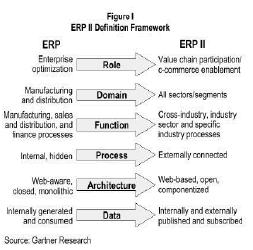
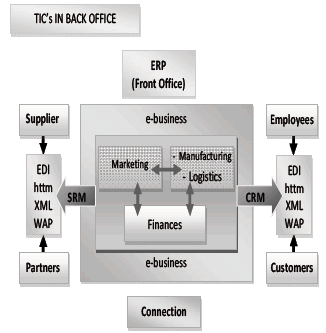
<body><![CDATA[<li> <font size="2" face="Verdana, Arial, Helvetica, sans-serif">Product Life Management (PLM) </font></li>     </ul>     <p><font size="2" face="Verdana, Arial, Helvetica, sans-serif">All these functions were not taken into account in the   "Traditional"; ERP, but they are in the ERP II &#91;17&#93;. The evolution   from the ERP into the ERP II could be centered in 6 fundamentals aspects,   related with the business, the application and the strategy of technology. In the <a href="#fig03">picture 3</a> it is depicted such evolution. </font></p>     <p align="center"><font size="2" face="Verdana, Arial, Helvetica, sans-serif"><b><a name="fig03"></a><img src="/img/revistas/dyna/v77n163/a19fig03.gif">    <br>   Figure 3: </b>The 6 basic differences between ERP y ERP II. Source: Gartner Group </font></p>     <p><font size="2" face="Verdana, Arial, Helvetica, sans-serif">This supposes a big opportunity and a big challenge for manufacturers,   since the ERP II is a new version that requires new technology and functional   expansion of the software. </font></p>     <p><font size="2" face="Verdana, Arial, Helvetica, sans-serif"><a href="#fig04">Picture 4</a> show how the ERP II systems allows   connecting the internal system (Back Office) with other external systems from   customers, suppliers, partners, workers, etc. </font></p>     <p align="center"><font size="2" face="Verdana, Arial, Helvetica, sans-serif"><b><a name="fig04"></a><img src="/img/revistas/dyna/v77n163/a19fig04.gif">    <br>   Figure 4:</b> Back Office Connectivity with external systems. Source: Own Elaboration </font></p>     <p><font size="2" face="Verdana, Arial, Helvetica, sans-serif">This way, the part that should correspond to the "traditional   ERP"; continue being the center of the company management, but over it   there are some areas that interact, what aren't internal and achieving a ideal situation, "the connectivity between several   ERP II from different companies";. So, the ERP II will be capable to   automatically connect and transfer information among others ERP II, by   achieving a cost and time saving, a mistakes reduction and offering online   information every time. </font></p>     ]]></body>
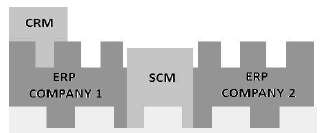
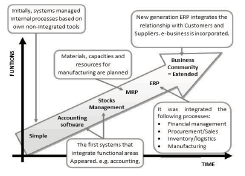
<body><![CDATA[<p><font size="2" face="Verdana, Arial, Helvetica, sans-serif">Therefore, as it is depicted in the <a href="#fig05">picture 5</a>, two companies could have   installed an integrated management system carrying and generating purchases,   sales (e-commerce) supply, invoices, marketing actions, and others necessary actions   with customers (CRM) an every kind of transactions needed through the   integrated information system for management in a automatically way. </font></p>     <p align="center"><font size="2" face="Verdana, Arial, Helvetica, sans-serif"><b><a name="fig05"></a><img src="/img/revistas/dyna/v77n163/a19fig05.gif">    <br>   Figure 5:</b> Connection of several companies through information. Source:   own source </font></p>     <p><font size="2" face="Verdana, Arial, Helvetica, sans-serif">It is important to clarify that nowadays it is assume that an integrated   information system for company management must cover all this features.   Therefore, the ERP II name is becoming unused every day, since the just the ERP   name is assume to take into account all this features &#91;14&#93;. </font></p>     <p><font size="2" face="Verdana, Arial, Helvetica, sans-serif">The overall evolution process is depicted in the <a href="#fig06">picture 6</a>. Such   evolution has occurred parallel to the evolution of the technologies for the   information and data treatment. It is also possible to say that the evolution   of the information technologies prompted this integration trend in the   management of companies. </font></p>     <p align="center"><font size="2" face="Verdana, Arial, Helvetica, sans-serif"><b><a name="fig06"></a><img src="/img/revistas/dyna/v77n163/a19fig06.gif">    <br>   Figure 6:</b> Integrated management systems evolution. Source: own source </font></p>     <p>&nbsp;</p>     <p><font size="3" face="Verdana, Arial, Helvetica, sans-serif"><b>3. RECENT ADVANCES IN INFORMATION SYSTEMS FOR COMPANY   MANAGEMENT </b></font></p>     <p><font size="2" face="Verdana, Arial, Helvetica, sans-serif">In this session is going to be presented the more recent advances about   the information systems for company management. These advances could be divided   into 2 different ways. The first one is related to the functional line, in   which is developed new functions inside the system with the aim of the company   areas uncover until the moment. The second one is the technical line, which   incorporates new technological advances to such information systems. </font></p>     ]]></body>
<body><![CDATA[<p><font size="2" face="Verdana, Arial, Helvetica, sans-serif"><b>3.1 Functional Advances    <br>   </b></font><font size="2" face="Verdana, Arial, Helvetica, sans-serif">Related to functional advances it is possible to mention several      functionalities that have been added in the last five years to the integrated   information systems for company' management. These are: </font></p> <ul>       <li> <font size="2" face="Verdana, Arial, Helvetica, sans-serif">CRM: Customer relationship management </font></li>       <li> <font size="2" face="Verdana, Arial, Helvetica, sans-serif">HRM: Human resource Management </font></li>       <li> <font size="2" face="Verdana, Arial, Helvetica, sans-serif">BSC: Balance Scorecard </font></li>       <li> <font size="2" face="Verdana, Arial, Helvetica, sans-serif">BI: Business Intelligence </font></li>       <li> <font size="2" face="Verdana, Arial, Helvetica, sans-serif">e-commerce: Electronic commerce </font></li>     </ul>     <p><font size="2" face="Verdana, Arial, Helvetica, sans-serif"><b>3.2 Technical Advances    <br>   </b></font><font size="2" face="Verdana, Arial, Helvetica, sans-serif">In the other hand, into the technical side it is possible to highlight   the following advances: </font></p> <ul>       ]]></body>
<body><![CDATA[<li> <font size="2" face="Verdana, Arial, Helvetica, sans-serif">Open programming </font></li>       <li> <font size="2" face="Verdana, Arial, Helvetica, sans-serif">Objected-oriented information </font></li>       <li> <font size="2" face="Verdana, Arial, Helvetica, sans-serif">Layers programming structure </font></li>       <li> <font size="2" face="Verdana, Arial, Helvetica, sans-serif">System architecture </font></li>     </ul>     <p><font size="2" face="Verdana, Arial, Helvetica, sans-serif">One of the more important technical advances in the evolution of the   information systems for company management is the system architecture.   Therefore is going to be presented a brief explanation about it </font></p>     <p><font size="2" face="Verdana, Arial, Helvetica, sans-serif">The information systems for company management are generally scattered distributed   in the whole company. Whereas the servers are usually centralized, customers   usually are dispersed in several locations in the company. In information   systems can be considered the existence of following three basic elements,   which are distributed among customers and servers: </font></p> <ul>       <li> <font size="2" face="Verdana, Arial, Helvetica, sans-serif">At first place, the Data Base, what can be defined as     the central data warehouse of the information that is transferred from and     towards customers (users) </font></li>       <li> <font size="2" face="Verdana, Arial, Helvetica, sans-serif">In the second place is the customer, in which the data     is introduced and are the one who request for information. </font></li>       <li> <font size="2" face="Verdana, Arial, Helvetica, sans-serif">lastly, there is the     application, that is what runs the processes, and acts as intermediate between     customers and the data base. </font></li>     ]]></body>
<body><![CDATA[</ul>     <p><font size="2" face="Verdana, Arial, Helvetica, sans-serif">There   are several architectures for integrated information systems depending on how   these elements are distributed and where these elements are in. </font></p>     <p>&nbsp; </p>     <p><font size="3" face="Verdana, Arial, Helvetica, sans-serif"><b>4. </b> <b>FUTURE TRENDS </b></font></p>     <p><font size="2" face="Verdana, Arial, Helvetica, sans-serif">ERP   have been generally oriented towards big companies, however, recently ERP   designers are looking for extending the market. Therefore they are taking into   consideration the PYMES sector and they are using successful strategies to   catch that market, as for example the developing of systems with some of the   following characteristics: </font></p> <ul>       <li> <font size="2" face="Verdana, Arial, Helvetica, sans-serif">Lower license cost </font></li>       <li> <font size="2" face="Verdana, Arial, Helvetica, sans-serif">Lower implementation cost </font></li>       <li> <font size="2" face="Verdana, Arial, Helvetica, sans-serif">Compatibility between systems </font></li>       <li> <font size="2" face="Verdana, Arial, Helvetica, sans-serif">Less consulting requirements in the implementation     phase </font></li>       <li> <font size="2" face="Verdana, Arial, Helvetica, sans-serif">Software with open code </font></li>       ]]></body>
<body><![CDATA[<li> <font size="2" face="Verdana, Arial, Helvetica, sans-serif">Vertical growing </font></li>     </ul>     <p><font size="2" face="Verdana, Arial, Helvetica, sans-serif">Next   the foreseeable trends of the information systems for the management of   companies and what the advisor forecasts to launch to the market. What is the   direction in the evolution of the ERP systems, what new functionalities will   contemplate, what challenges must surpass to achieve a correct evolution of the   companies in the recently changing environments. These trends can be classified   in two types, the functional tendencies and the technical trends. </font></p>     <p> <font size="2" face="Verdana, Arial, Helvetica, sans-serif"><b>4.1.</b> <b> Functional trends    <br>   </b></font><font size="2" face="Verdana, Arial, Helvetica, sans-serif">The   functional tendencies indicate the new functionalities or areas that are going   to cover the information systems for the management of companies. It is also   necessary to emphasize the development of some functionalities, some of these   already are included in some ERP, that are foreseeable to be developed in order   to strengthen and to optimize their use, and what they entail. </font></p>     <p><font size="2" face="Verdana, Arial, Helvetica, sans-serif">It   is possible to say that within the functional tendencies, as well, there are   two trends to incorporate new functionalities of the systems (although the   majority of the information systems for the management follow the two lines in   parallel). On the one hand, there is the opening of the information systems for   company management, to integration with other specific systems, that cover   specific needs, or of specific areas within the company. On the other, it is   the tendency to try to include all the possible functionality, integrating the   functionality that until the moment is offered by other systems, inside the own   information system for company management. </font></p>     <p><font size="2" face="Verdana, Arial, Helvetica, sans-serif">Some   of the functionalities that the new ERP can absorbed or that at least can integrate with others information systems are: </font></p> <ul>       <li> <font size="2" face="Verdana, Arial, Helvetica, sans-serif">SCM: Supply Chain Management </font></li>       <li> <font size="2" face="Verdana, Arial, Helvetica, sans-serif">CRM: Customer Relationship Management </font></li>       <li> <font size="2" face="Verdana, Arial, Helvetica, sans-serif">PLM: Product Lifecycle Management </font></li>       ]]></body>
<body><![CDATA[<li> <font size="2" face="Verdana, Arial, Helvetica, sans-serif">DW: Data Warehouse </font></li>       <li> <font size="2" face="Verdana, Arial, Helvetica, sans-serif">SRM: Supplier Relationship Management </font></li>       <li> <font size="2" face="Verdana, Arial, Helvetica, sans-serif">BSC: Balance scorecard </font></li>       <li> <font size="2" face="Verdana, Arial, Helvetica, sans-serif">KMS: Knowledge Management System </font></li>       <li> <font size="2" face="Verdana, Arial, Helvetica, sans-serif">BI Business Intelligence </font></li>       <li> <font size="2" face="Verdana, Arial, Helvetica, sans-serif">POS: Point of Sales </font></li>     </ul>     <p><font size="2" face="Verdana, Arial, Helvetica, sans-serif">Some   of these functionalities appear in previous point of this paper as functional   advances that already have been added to the ERP, however, although the   majority of the ERP have already incorporated such funtionalities, the trend is   to continue with their development, to assure that companies, (both big and   PYMES) could explode it as maximum. </font></p>     <p> <font size="2" face="Verdana, Arial, Helvetica, sans-serif"><b>4.2. </b> <b> Technical   Trends    <br>   </b></font><font size="2" face="Verdana, Arial, Helvetica, sans-serif">Related   with the actual technical trends, it is possible to highlight the followings: </font></p> <ul>       ]]></body>
<body><![CDATA[<li> <font size="2" face="Verdana, Arial, Helvetica, sans-serif">Open software </font></li>       <li> <font size="2" face="Verdana, Arial, Helvetica, sans-serif">Hosting of Applications Service Providers </font></li>       <li> <font size="2" face="Verdana, Arial, Helvetica, sans-serif">m-Commerce </font></li>     </ul>     <p><font size="2" face="Verdana, Arial, Helvetica, sans-serif">Recently   there is a trend to the use of free software, in other words, open and   gratuitous code in different scopes. This trend is starting to take part in the   information systems for company management &#91;9&#93;. These days it is possible to   find in Spain a software called Openbravo, which has these characteristics and   it is starting to get an important portion of the market. However, this trend   is still very weak and it seems not to be strong enough. Nevertheless, this   tendency must be carefully considered. It is important not to forget the recent   closing of "Encarta";, the digital encyclopedia of Microsoft, due to   the appearance of a free software encyclopedia, "Wikipedia";, which   won the battle. </font></p>     <p><font size="2" face="Verdana, Arial, Helvetica, sans-serif">The   second technical trend, the Hosting of Applications Service Providers, is a   common activity these days, since there are several companies that are   dedicated "to lodge"; management systems, which can be used by   companies through high speed internet or some network connections &#91;12&#93;. These   supplier companies cover both the software and the hardware maintenance, and   the updates, security, etc. of the applications. All this, allows companies to   reduce the work load and some costs from different natures, and it also allows   them to focus in their Core Business. </font></p>     <p><font size="2" face="Verdana, Arial, Helvetica, sans-serif">The   m-commerce is one of the technical tendencies, that as well as modifying the   conception of the information systems, it can modify the form to make   businesses as the way of those are known at present. The mobile technology is a   new communication channel that allows companies and people to be connected and   access to Internet whenever, regardless the place, date and hour. </font></p>     <p>&nbsp;</p>     <p><font size="3" face="Verdana, Arial, Helvetica, sans-serif"><b>5 M-COMMERCE AND INFORMATION SYSTEMS FOR MANAGEMENT</b></font></p>     <p><font size="2" face="Verdana, Arial, Helvetica, sans-serif"><b>5.1 m-commerce    ]]></body>
<body><![CDATA[<br>   </b></font><font size="2" face="Verdana, Arial, Helvetica, sans-serif">As   it has been introduced previously, m-commerce is one of the technological   advances that, most probably, will be soon integrated in integrated information   systems for management. This technological advance and its integration could   modify the present way of making businesses. Therefore, this new tool can   produce a new revolution in the world of the companies. </font></p>     <p><font size="2" face="Verdana, Arial, Helvetica, sans-serif">In   the last twenty years, e-commerce has been one of the most important advances   in the world of the businesses, and recently m-commerce is ready to position   itself within that development of e-commerce. &#91;2,13&#93;. </font></p>     <p><font size="2" face="Verdana, Arial, Helvetica, sans-serif">The   mobile technology is a new communication channel, that allows companies and   people to always be connected and accessed to Internet, regardless the place,   date and hour. </font></p>     <p><font size="2" face="Verdana, Arial, Helvetica, sans-serif">Recently,   the company management is still learning and adapting to the new ways of making   businesses created by e-commerce. The necessity of being adapted and learning   about this new adaptation is going to be increased by the new changes that are   going to generate the m-commerce. These changes will affect both the internal and the external part of companies. </font></p>     <p><font size="2" face="Verdana, Arial, Helvetica, sans-serif">It   is possible to say that "m-commerce"; or "mobile   commerce"; is all the commercial activities that use or are supported on a   mobile telephone. Although there is not the effective "purchase"; of   a product or service in the m-business, the search, look, comparison of prices   and the delivery of such products, are commercial activities that are part of   the mobile commerce. </font></p>     <p><font size="2" face="Verdana, Arial, Helvetica, sans-serif">Nowadays   m-commerce is more a reality than a future trend. Thus, Polo Ralph Lauren in   August of 2008, launched an electronic commerce   service that allows customers to buy products through its mobile devices &#91;18&#93;.   It is possible by using QR Codes, a new technology that is already incorporated   in some mobile devices sold in the market. This QR code can store a lot of   information, for example URL´s, and when this information is read for a device   designed for that, the mobile is immediately connected to a Web port, in order   to execute the m-commerce transactions &#91;19&#93;. Also, customer can be alerted on   their mobile devices with information about the opening of new stores, events   and some advertisement from producers. </font></p>     <p><font size="2" face="Verdana, Arial, Helvetica, sans-serif">According to David Lauren, advertising, marketing and communication VP   of PRL "Consumers look for the right and for flexible services, which   will be easy to obtain. m-commerce is very attractive   since anybody can purchase many things and services regardless the place and   the moment";. </font></p>     <p><font size="2" face="Verdana, Arial, Helvetica, sans-serif">Continuing   with same line there is a new initiative to create a retail sales   multi-channel. This initiative was announced during the 98ª Convention and   Annual Exposition of National Retail Federation (NRF), celebrated in the Jacob   K. Javits Convention Center in New York &#91;20&#93;. </font></p>     <p><font size="2" face="Verdana, Arial, Helvetica, sans-serif"><b>5.2 The mobility in the   company management: from m-commerce to m-business    <br>   </b></font><font size="2" face="Verdana, Arial, Helvetica, sans-serif">The   mobile technology is currently centered in the sales area however its   application should cover others areas, in other words, it must allow customers   to carry out and manage their orders through mobile devices. There are many   applications for mobile technologies in the processes of the industrial sector.   The key tool is the integration degree of such processes with the internal management of the company. </font></p>     ]]></body>
<body><![CDATA[<p><font size="2" face="Verdana, Arial, Helvetica, sans-serif">Sales   through m-commerce could be treated as an entry to the information system, what   is later managed as has made traditionally with faxes or e-mails, but with the   advantages that the mobility offers to customers. Nevertheless, from the mobile   devices it is possible to execute other internal processes in the company, as   it can be the launching of a production master plan, the report of working   hours, or a stock movement. Also some data and results could be looked up, as   for example watching the balanced scorecard, a project situation and the   financial situation of the company. All this can be watched from a mobile   device, anywhere and at any time. This functionality is not wide used for   companies beyond the sales area, and that can facilitates a total mobility,   what could be a key feature for some companies in the future. This way, the   mobility that represents the m-commerce, could be extended to others areas in   the company, what could generate the logical evolution towards the m-business,   such as it happened with the e-commerce and the e-business. </font></p>     <p><font size="2" face="Verdana, Arial, Helvetica, sans-serif"><b>5.3 Adapting the information system to the   m-business    <br>   </b></font><font size="2" face="Verdana, Arial, Helvetica, sans-serif">Considering this new trend, it is important to ask what factors must be   taken into account in an information system for the "opening"; of   this towards the m-commerce or the m-business? </font></p>     <p><font size="2" face="Verdana, Arial, Helvetica, sans-serif">From this point of view, there is important to consider how people   interact with mobile devices. Nowadays, inside the AIS (Association for Information   Systems) they have created a focal group AIS SIGHCI (Special Interest Group on   Human Computer Interaction) with the aim of studying the interaction between   people and computers. </font></p>     <p><font size="2" face="Verdana, Arial, Helvetica, sans-serif"> G. M. Olson &amp;   J. S. Olson (2003) &#91;21&#93; defined HCI   (Human Computer Integration) as "<i>the   study of how people interact with the computer technology</i>"; according   to these authors, the HCI researches was made in six categories. <i>One of the main researching lines is about   developing user interfaces, considering mobile devices, among others</i>. </font></p>     <p><font size="2" face="Verdana, Arial, Helvetica, sans-serif">Inside this group, there is a researching area what is dedicated to the   interaction with Management Information Systems (MIS), what is centered in studying   the human interaction with information, technology and tasks, especially in   business environments, management, organization and culture. This point is   centered whit the ERP, that is, at the end a MIS. </font></p>     <p><font size="2" face="Verdana, Arial, Helvetica, sans-serif"> Zhang et al. (2004) &#91;22&#93; mention 3 important   aspects related with the interaction of people with mobile devices. </font></p> <ul>       <li> <font size="2" face="Verdana, Arial, Helvetica, sans-serif">The size and the structure of the screen and the     information. &#91; 23&#93;. </font></li>       <li> <font size="2" face="Verdana, Arial, Helvetica, sans-serif">Color text and wallpaper combinations. &#91;24&#93; </font></li>       <li> <font size="2" face="Verdana, Arial, Helvetica, sans-serif">Acceptable responsible time. </font></li>     ]]></body>
<body><![CDATA[</ul>     <p><font size="2" face="Verdana, Arial, Helvetica, sans-serif"> Chittaro 2006 &#91;25&#93; pays attention to these   aspects too. In this work it is also mentioned the constrains existing in the development of electronic tools for mobile devices compared   with the developments for computers. Among this constrains and considered   factors, It could be highlighted the system or the data introduction techniques or the executable commands. </font></p>     <p><font size="2" face="Verdana, Arial, Helvetica, sans-serif">As is   clear, it is not the same using a typical computer keyboard or mouse, than   using a mobile device, which is smaller and with less options. This is a very   important factor, since the applications must be "user-friendly";,   and must be redesigned, for a easy access and use   through the mobile keyboards. </font></p>     <p><font size="2" face="Verdana, Arial, Helvetica, sans-serif">At   this moment it is import to recall that the applications are being designed for   m-business, where the user not only could look up for data, make purchases or   reserves through the screen, but also he could use all the functionalities   (usually in a cell phone) that implies working in a information system   for a company management. </font></p>     <p><font size="2" face="Verdana, Arial, Helvetica, sans-serif">On   the other hand, it is also necessary to consider the possible trends commented   previously, as far as extending functionalities, of the manufacturers of the   information systems for company management. </font></p>     <p><font size="2" face="Verdana, Arial, Helvetica, sans-serif">One   option is to facilitate and strengthen the integration of the systems with   another software, from others m-business specialized manufacturers, for which   the information systems must be suitably prepared. </font></p>     <p><font size="2" face="Verdana, Arial, Helvetica, sans-serif">Another   option is "to absorb"; such functionality within the same   information system. This option is more complex; since that it must be   developed in the same information system, the communication system and the   "interface"; with the user, considering the different aspects   previously related in order to optimize the interaction between the mobile   devices and the people. </font></p>     <p><font size="2" face="Verdana, Arial, Helvetica, sans-serif">At   present, the majority of the great manufacturers of integrated information   systems are following both trends in a parallel way. However, it is important   to emphasize that nowadays these information systems have been more tended   "to absorb"; functionalities, within a single system. Until the   moment, this has not been possible with the management of m-commerce, because   it is still an emergent technology, and is not developed enough. </font></p>     <p><font size="2" face="Verdana, Arial, Helvetica, sans-serif">It   is possible to emphasize that the technologically most advanced systems, as   Drnamics Ax &#91;26&#93;, previously called MBS Axapta, of Microsoft, already   contemplates this alternative since several years ago. In the 3.0 version,   there are some examples of interfaces for PDA´s, even for those with vertical   or horizontal screens. </font></p>     <p><font size="2" face="Verdana, Arial, Helvetica, sans-serif">Nowadays,   the development and improvement of the communication &#91;27&#93; have achieve a level in   which it is possible to occur an inflexion point that definitely will launch   this new communication channel to the massive use of the market. </font></p>     ]]></body>
<body><![CDATA[<p>&nbsp; </p>     <p><font size="3" face="Verdana, Arial, Helvetica, sans-serif"><b>6. </b> <b>CONCLUSIONS </b></font></p>     <p><font size="2" face="Verdana, Arial, Helvetica, sans-serif">The information   systems and his application company management have evolved constantly, and   these have been continuously adapted to the market requirement and to the new   emerging technologies. These software applications have become, from small   programs into big one just in few years. Initially these programs were designed   for running accounting applications but recently the ERP are able to manage all   the information that the company needs, even internally as externally. </font></p>     <p><font size="2" face="Verdana, Arial, Helvetica, sans-serif">In the last years,   there have been incorporated new advances to these systems. In one had there   are the functional advances, which cover new areas of the company, as for example the balance   scorecard, knowledge management, CRM, e-commerce, etc. In the other hand, there   is also incorporated new techniques and technologies as the object oriented   programming, new architectural systems and new languages and programming   structures. </font></p>     <p><font size="2" face="Verdana, Arial, Helvetica, sans-serif">Recently, the   information systems for company management are continuing evolving, and the   foresee trends includes both technical and functional improvements. In the   functional trend it will be incorporate new features, and also it will improve   and optimize current features as the SCM, PLM (Product Lifecycle Management),   CRM (Customer Relationship Management) , DW (Data   Warehouse), BSC (Balance Scorecard), KMS   (Knowledge Management System), BI   (Business Intelligence), POS (Point of Sale), etc. Related with the technical trend   it will be important the emerging of the ASP, open software and the e-commerce.The   m commerce is one of the more incipient trend and these tendencies could   greatly modify some processes from companies. Through this communication way,   the company management could be available for users regardless the day, hour   and place. </font></p>     <p><font size="2" face="Verdana, Arial, Helvetica, sans-serif">But in order to   this to be possible, it is necessary that information systems will be adapted   to the needs of mobile devices, and for that it is important to consider several   factors, as for example the interaction between these devices with people.   However, already solved this and other small existing problems, it is possible   to say that nowadays the current technology has reached a level, in which it is   possible starting this new communication channel, making it finally possible,   and with everything what it can suppose. Therefore, companies could start   preparing themselves to operate this new tools, and to   optimize their resources and processes through it. </font></p>     <p>&nbsp;</p>     <p><font size="3" face="Verdana, Arial, Helvetica, sans-serif"><b>REFERENCIAS </b></font></p>     <!-- ref --><p><font size="2" face="Verdana, Arial, Helvetica, sans-serif"><b>&#91;1&#93;</b> QUIESCENTI, M., BRUCCOLERI, M., La Commare, U., Noto La Diega, S.,&Perrone, G.., 2006. Business process-oriented design of Enterprise Resource Planning (ERP) systems for small and medium enterprises. International Journal of Production Research, 44, 3797 - 3811.     &nbsp;&nbsp;&nbsp;&nbsp;&nbsp;&nbsp;&nbsp;&nbsp;[&#160;<a href="javascript:void(0);" onclick="javascript: window.open('/scielo.php?script=sci_nlinks&ref=000211&pid=S0012-7353201000030001900001&lng=','','width=640,height=500,resizable=yes,scrollbars=1,menubar=yes,');">Links</a>&#160;]<!-- end-ref --><!-- ref --><br>   <b>&#91;2&#93;</b> UMBLE, E.J., HAFT, R.R. & UMBLE, M.M., 2003. Enterprise resource planning: Implementation procedures and critical success factors. European Journal of Operational Research, 146(2), 241-257.     &nbsp;&nbsp;&nbsp;&nbsp;&nbsp;&nbsp;&nbsp;&nbsp;[&#160;<a href="javascript:void(0);" onclick="javascript: window.open('/scielo.php?script=sci_nlinks&ref=000212&pid=S0012-7353201000030001900002&lng=','','width=640,height=500,resizable=yes,scrollbars=1,menubar=yes,');">Links</a>&#160;]<!-- end-ref --><!-- ref --><br>   <b>&#91;3&#93;</b> BEATTY, R.C. & WILLIAMS, C.D., 2006. ERP II: Best Practices for succesfully implementing an ERP Upgrade. Communications of the ACM, 49(3), 105 - 109.     &nbsp;&nbsp;&nbsp;&nbsp;&nbsp;&nbsp;&nbsp;&nbsp;[&#160;<a href="javascript:void(0);" onclick="javascript: window.open('/scielo.php?script=sci_nlinks&ref=000213&pid=S0012-7353201000030001900003&lng=','','width=640,height=500,resizable=yes,scrollbars=1,menubar=yes,');">Links</a>&#160;]<!-- end-ref --><!-- ref --><br>   <b>&#91;4&#93;</b> HELO, P., ANUSSORNNITISARN, P. & PHUSAVAT, K., 2008. Expectation and reality in ERP implementation: Consultant and solution provider perspective. Industrial Management and Data Systems, 108(8), 1045-1059.     &nbsp;&nbsp;&nbsp;&nbsp;&nbsp;&nbsp;&nbsp;&nbsp;[&#160;<a href="javascript:void(0);" onclick="javascript: window.open('/scielo.php?script=sci_nlinks&ref=000214&pid=S0012-7353201000030001900004&lng=','','width=640,height=500,resizable=yes,scrollbars=1,menubar=yes,');">Links</a>&#160;]<!-- end-ref --><!-- ref --><br>   <b>&#91;5&#93;</b> ARANGO SERNA, MART&Iacute;N D., PASTOR FERN&Aacute;NDEZ, Andres,. El control del coste en proyectos complejos-Utilizaci&oacute;n de herramientas ERPs. Editorial: Publicaciones-Escuela Superior Ingenier&iacute;a, Universidad de M&aacute;laga. IX Congreso Internacional de Ingenier&iacute;a de Proyectos. Actas ISBN 84-89791-08-2. P&Aacute;GINAS: 195 - 205. AÑO: 2005.     &nbsp;&nbsp;&nbsp;&nbsp;&nbsp;&nbsp;&nbsp;&nbsp;[&#160;<a href="javascript:void(0);" onclick="javascript: window.open('/scielo.php?script=sci_nlinks&ref=000215&pid=S0012-7353201000030001900005&lng=','','width=640,height=500,resizable=yes,scrollbars=1,menubar=yes,');">Links</a>&#160;]<!-- end-ref --><!-- ref --><br>   <b>&#91;6&#93;</b> ABERDEEN GROUP, Inc., 2004. The ABCs of ERP An Executive Primer. Aberdeen Group,Inc.Availableat: <a href="http://download.microsoft.com/download/6/e/e/6ee823c4-00a4-4ca2-8836-7f3fd5c78c1e/erp_primer_aberdeen.pdf" target="referencia">download.microsoft.com/download/6/e/e/6ee823c4-00a4-4ca2-8836-7f3fd5c78c1e/erp_primer_aberdeen.pdf</a>.     &nbsp;&nbsp;&nbsp;&nbsp;&nbsp;&nbsp;&nbsp;&nbsp;[&#160;<a href="javascript:void(0);" onclick="javascript: window.open('/scielo.php?script=sci_nlinks&ref=000216&pid=S0012-7353201000030001900006&lng=','','width=640,height=500,resizable=yes,scrollbars=1,menubar=yes,');">Links</a>&#160;]<!-- end-ref --><!-- ref --><br>   <b>&#91;7&#93;</b> GIL G&Oacute;MEZ, HERMENEGILDO AND ARANGO SERNA, MART&Iacute;N DAR&Iacute;O. Hacia un Nuevo Marketing en el marco de la Sociedad de la Informaci&oacute;n. y. Revista Mercatura. Vol 2 Fasc. 1. P 11-23. 2007. ISSN: 1909-8375.     &nbsp;&nbsp;&nbsp;&nbsp;&nbsp;&nbsp;&nbsp;&nbsp;[&#160;<a href="javascript:void(0);" onclick="javascript: window.open('/scielo.php?script=sci_nlinks&ref=000217&pid=S0012-7353201000030001900007&lng=','','width=640,height=500,resizable=yes,scrollbars=1,menubar=yes,');">Links</a>&#160;]<!-- end-ref --><!-- ref --><br>   <b>&#91;8&#93;</b> LEE, J., SIAU, K. & HONG, S., 2003. Enterprise Integration with ERP and EAI. Communications of the ACM, 46(2), 54 - 60.     &nbsp;&nbsp;&nbsp;&nbsp;&nbsp;&nbsp;&nbsp;&nbsp;[&#160;<a href="javascript:void(0);" onclick="javascript: window.open('/scielo.php?script=sci_nlinks&ref=000218&pid=S0012-7353201000030001900008&lng=','','width=640,height=500,resizable=yes,scrollbars=1,menubar=yes,');">Links</a>&#160;]<!-- end-ref --><!-- ref --><br>   <b>&#91;9&#93;</b> FERRAN, C. & SALIM, R., 2008. Enterprise Resource Planning for Global Economies, dea Group Inc (IGI).     &nbsp;&nbsp;&nbsp;&nbsp;&nbsp;&nbsp;&nbsp;&nbsp;[&#160;<a href="javascript:void(0);" onclick="javascript: window.open('/scielo.php?script=sci_nlinks&ref=000219&pid=S0012-7353201000030001900009&lng=','','width=640,height=500,resizable=yes,scrollbars=1,menubar=yes,');">Links</a>&#160;]<!-- end-ref --><!-- ref --><br>   <b>&#91;10&#93;</b> DELGADO, J. & MARIN, F., 2000. Evoluci&oacute;n en los sistemas de gesti&oacute;n empresarial.Del MRP al ERP. Econom&iacute;a Industrial, 331(I), 51 - 58.     &nbsp;&nbsp;&nbsp;&nbsp;&nbsp;&nbsp;&nbsp;&nbsp;[&#160;<a href="javascript:void(0);" onclick="javascript: window.open('/scielo.php?script=sci_nlinks&ref=000220&pid=S0012-7353201000030001900010&lng=','','width=640,height=500,resizable=yes,scrollbars=1,menubar=yes,');">Links</a>&#160;]<!-- end-ref --><!-- ref --><br>   <b>&#91;11&#93;</b> ANDONEGI, J.M., CASADES&Uacute;S FA, M. & ZAMANILLO, I., 2005. Evoluci&oacute;n Hist&oacute;rica de los Sistemas ERP: de la gesti&oacute;n de materiales a la empresa digital. Revista de Direcci&oacute;n y Administraci&oacute;n de Empresas, 12, 61-72.     &nbsp;&nbsp;&nbsp;&nbsp;&nbsp;&nbsp;&nbsp;&nbsp;[&#160;<a href="javascript:void(0);" onclick="javascript: window.open('/scielo.php?script=sci_nlinks&ref=000221&pid=S0012-7353201000030001900011&lng=','','width=640,height=500,resizable=yes,scrollbars=1,menubar=yes,');">Links</a>&#160;]<!-- end-ref --><!-- ref --><br>   <b>&#91;12&#93;</b> MCGAUGHEY, R.E. & GUNASEKARAN, A., 2009. Selected Readings on Strategic Information Systems. Chapter XXIII Enterprise Resource Planning (ERP): Past, Present and Future, Information Science Reference (an imprint of IGI Global).     &nbsp;&nbsp;&nbsp;&nbsp;&nbsp;&nbsp;&nbsp;&nbsp;[&#160;<a href="javascript:void(0);" onclick="javascript: window.open('/scielo.php?script=sci_nlinks&ref=000222&pid=S0012-7353201000030001900012&lng=','','width=640,height=500,resizable=yes,scrollbars=1,menubar=yes,');">Links</a>&#160;]<!-- end-ref --><!-- ref --><br>   <b>&#91;13&#93;</b> GUNASEKARAN, A., 2009. Global Implications of Modern Enterprise Information Systems Technologies and Applications, Information Science Reference (an imprint of IGI Global).     &nbsp;&nbsp;&nbsp;&nbsp;&nbsp;&nbsp;&nbsp;&nbsp;[&#160;<a href="javascript:void(0);" onclick="javascript: window.open('/scielo.php?script=sci_nlinks&ref=000223&pid=S0012-7353201000030001900013&lng=','','width=640,height=500,resizable=yes,scrollbars=1,menubar=yes,');">Links</a>&#160;]<!-- end-ref --><!-- ref --><br>   <b>&#91;14&#93;</b> MØLLER, C., 2005. ERP II: a conceptual framework for next-generation enterprise systems? Journal of Enterprise Information Management, 18(4), 483-497.     &nbsp;&nbsp;&nbsp;&nbsp;&nbsp;&nbsp;&nbsp;&nbsp;[&#160;<a href="javascript:void(0);" onclick="javascript: window.open('/scielo.php?script=sci_nlinks&ref=000224&pid=S0012-7353201000030001900014&lng=','','width=640,height=500,resizable=yes,scrollbars=1,menubar=yes,');">Links</a>&#160;]<!-- end-ref --><!-- ref --><br>   <b>&#91;15&#93;</b> MUÑOZ , J. et al., 2004. Implantaci&oacute;n de los Sistemas ERP (Planeamiento De Los Recursos Empresariales) el las PYMES textiles españolas. La fase cr&iacute;tica del proyecto. En Santander, p&aacute;gs. 151 - 173.     &nbsp;&nbsp;&nbsp;&nbsp;&nbsp;&nbsp;&nbsp;&nbsp;[&#160;<a href="javascript:void(0);" onclick="javascript: window.open('/scielo.php?script=sci_nlinks&ref=000225&pid=S0012-7353201000030001900015&lng=','','width=640,height=500,resizable=yes,scrollbars=1,menubar=yes,');">Links</a>&#160;]<!-- end-ref --><!-- ref --><br>   <b>&#91;16&#93;</b> B. BOND, Y. GENOVESE, D. MIKLOVIC N. WOOD, B. ZRIMSEK, N. RAYNER, 2000. ERP_is_Dead--Long_Live_ERP_II. New York: Gartner Group. Available at: <a href="http://www.uncg.edu/bae/people/holderness/readings/ERP_is_Dead--Long_Live_ERP_II.pdf" target="referencia">http://www.uncg.edu/bae/people/holderness/readings/ERP_is_Dead--Long_Live_ERP_II.pdf</a>.     &nbsp;&nbsp;&nbsp;&nbsp;&nbsp;&nbsp;&nbsp;&nbsp;[&#160;<a href="javascript:void(0);" onclick="javascript: window.open('/scielo.php?script=sci_nlinks&ref=000226&pid=S0012-7353201000030001900016&lng=','','width=640,height=500,resizable=yes,scrollbars=1,menubar=yes,');">Links</a>&#160;]<!-- end-ref --><!-- ref --><br>   <b>&#91;17&#93;</b> WESTON JR., F.C., 2003. ERP II: The extended enterprise system. Business Horizons, 46(6), 49-55.     &nbsp;&nbsp;&nbsp;&nbsp;&nbsp;&nbsp;&nbsp;&nbsp;[&#160;<a href="javascript:void(0);" onclick="javascript: window.open('/scielo.php?script=sci_nlinks&ref=000227&pid=S0012-7353201000030001900017&lng=','','width=640,height=500,resizable=yes,scrollbars=1,menubar=yes,');">Links</a>&#160;]<!-- end-ref --><!-- ref --><br>   <b>&#91;18&#93;</b> ABRAMOVICH , G., 2008. Polo Ralph Lauren goes mobile - Mobile Marketer - Commerce. <a href="http://www.mobilemarketer.com/cms/news/commerce/1545.html" target="referencia">http://www.mobilemarketer.com/cms/news/commerce/1545.html</a>.     &nbsp;&nbsp;&nbsp;&nbsp;&nbsp;&nbsp;&nbsp;&nbsp;[&#160;<a href="javascript:void(0);" onclick="javascript: window.open('/scielo.php?script=sci_nlinks&ref=000228&pid=S0012-7353201000030001900018&lng=','','width=640,height=500,resizable=yes,scrollbars=1,menubar=yes,');">Links</a>&#160;]<!-- end-ref --><!-- ref --><br>   <b>&#91;19&#93;</b> MOYA, H., 2009. C&oacute;digo QR. Bit, 172, 47 - 49.     &nbsp;&nbsp;&nbsp;&nbsp;&nbsp;&nbsp;&nbsp;&nbsp;[&#160;<a href="javascript:void(0);" onclick="javascript: window.open('/scielo.php?script=sci_nlinks&ref=000229&pid=S0012-7353201000030001900019&lng=','','width=640,height=500,resizable=yes,scrollbars=1,menubar=yes,');">Links</a>&#160;]<!-- end-ref --><!-- ref --><br>   <b>&#91;20&#93;</b> BUTCHER , D., 2009a. Microsoft, Accenture, Avanade launch multi-channel retail initiative - Mobile Marketer - Software and technology. <a href="http://www.mobilemarketer.com/cms/news/software-technology/2453.html" target="referencia">http://www.mobilemarketer.com/cms/news/software-technology/2453.html</a>.     &nbsp;&nbsp;&nbsp;&nbsp;&nbsp;&nbsp;&nbsp;&nbsp;[&#160;<a href="javascript:void(0);" onclick="javascript: window.open('/scielo.php?script=sci_nlinks&ref=000230&pid=S0012-7353201000030001900020&lng=','','width=640,height=500,resizable=yes,scrollbars=1,menubar=yes,');">Links</a>&#160;]<!-- end-ref --><!-- ref --><br>   <b>&#91;21&#93;</b> OLSON, G.M. & OLSON, J.S., 2003. Human-Computer Interaction: Psychological Aspects of the Human Use of Computing. Annual Review of Psychology, 54, 491 - 516.     &nbsp;&nbsp;&nbsp;&nbsp;&nbsp;&nbsp;&nbsp;&nbsp;[&#160;<a href="javascript:void(0);" onclick="javascript: window.open('/scielo.php?script=sci_nlinks&ref=000231&pid=S0012-7353201000030001900021&lng=','','width=640,height=500,resizable=yes,scrollbars=1,menubar=yes,');">Links</a>&#160;]<!-- end-ref --><!-- ref --><br>   <b>&#91;22&#93;</b> ZHANG, P., NAH, F.F. & PREECE, J., 2004. HCI studies in management information systems. Behaviour & Information Technology, 23(3), 147 - 151.     &nbsp;&nbsp;&nbsp;&nbsp;&nbsp;&nbsp;&nbsp;&nbsp;[&#160;<a href="javascript:void(0);" onclick="javascript: window.open('/scielo.php?script=sci_nlinks&ref=000232&pid=S0012-7353201000030001900022&lng=','','width=640,height=500,resizable=yes,scrollbars=1,menubar=yes,');">Links</a>&#160;]<!-- end-ref --><!-- ref --><br>   <b>&#91;23&#93;</b> CHAE, M. & KIM, J., 2004. Size and Structure Matter to Mobile Users: An Empirical Study of the Effects of Screen Size, Information Structure, and Task Complexity on UserActivities with Standard Web Phones. Behaviour & Information Technology.     &nbsp;&nbsp;&nbsp;&nbsp;&nbsp;&nbsp;&nbsp;&nbsp;[&#160;<a href="javascript:void(0);" onclick="javascript: window.open('/scielo.php?script=sci_nlinks&ref=000233&pid=S0012-7353201000030001900023&lng=','','width=640,height=500,resizable=yes,scrollbars=1,menubar=yes,');">Links</a>&#160;]<!-- end-ref --><!-- ref --><br>   <b>&#91;24&#93;</b> HALL, R. & HANNA, P., 2004. The impact of web page text-background colour combinations on readability, retention, aesthetics and behavioural intention. Behaviour & Information Technology, 23(3), 183 - 195.     &nbsp;&nbsp;&nbsp;&nbsp;&nbsp;&nbsp;&nbsp;&nbsp;[&#160;<a href="javascript:void(0);" onclick="javascript: window.open('/scielo.php?script=sci_nlinks&ref=000234&pid=S0012-7353201000030001900024&lng=','','width=640,height=500,resizable=yes,scrollbars=1,menubar=yes,');">Links</a>&#160;]<!-- end-ref --><!-- ref --><br>   <b>&#91;25&#93;</b> CHITTARO, L., 2006. Visualizing information on mobile devices. Computer, 39(3), 40-45.     &nbsp;&nbsp;&nbsp;&nbsp;&nbsp;&nbsp;&nbsp;&nbsp;[&#160;<a href="javascript:void(0);" onclick="javascript: window.open('/scielo.php?script=sci_nlinks&ref=000235&pid=S0012-7353201000030001900025&lng=','','width=640,height=500,resizable=yes,scrollbars=1,menubar=yes,');">Links</a>&#160;]<!-- end-ref --><!-- ref --><br>   <b>&#91;26&#93;</b> Microsoft Corporation, Microsoft Dynamics: soluciones de software para contabilidad y finanzas, administraci&oacute;n de empresas (ERP, administraci&oacute;n de recursos empresariales). <a href="http://www.microsoft.com/spain/dynamics/default.mspx" target="referencia">http://www.microsoft.com/spain/dynamics/default.mspx</a>.     &nbsp;&nbsp;&nbsp;&nbsp;&nbsp;&nbsp;&nbsp;&nbsp;[&#160;<a href="javascript:void(0);" onclick="javascript: window.open('/scielo.php?script=sci_nlinks&ref=000236&pid=S0012-7353201000030001900026&lng=','','width=640,height=500,resizable=yes,scrollbars=1,menubar=yes,');">Links</a>&#160;]<!-- end-ref --><!-- ref --><br>   <b>&#91;27&#93;</b> AGUADO, A., 2008. La banda ancha m&oacute;vil, un mercado masivo. Bit, 168, 82 - 83.     &nbsp;&nbsp;&nbsp;&nbsp;&nbsp;&nbsp;&nbsp;&nbsp;[&#160;<a href="javascript:void(0);" onclick="javascript: window.open('/scielo.php?script=sci_nlinks&ref=000237&pid=S0012-7353201000030001900027&lng=','','width=640,height=500,resizable=yes,scrollbars=1,menubar=yes,');">Links</a>&#160;]<!-- end-ref --><!-- ref --><br>   <b>&#91;28&#93;</b> BENNIS, W.G. & NANUS, B., 2001. L&iacute;deres: estrategias para un liderazgo eficaz, Paid&oacute;s Ib&eacute;rica, 2001.     &nbsp;&nbsp;&nbsp;&nbsp;&nbsp;&nbsp;&nbsp;&nbsp;[&#160;<a href="javascript:void(0);" onclick="javascript: window.open('/scielo.php?script=sci_nlinks&ref=000238&pid=S0012-7353201000030001900028&lng=','','width=640,height=500,resizable=yes,scrollbars=1,menubar=yes,');">Links</a>&#160;]<!-- end-ref --><!-- ref --><br>   <b>&#91;29&#93;</b> BUTCHER , D., 2009b. Retail giants use TradeStone mobile app to communicate with suppliers - Mobile Marketer - Software and technology. <a href="http://www.mobilemarketer.com/cms/news/software-technology/2441.html" target="referencia">http://www.mobilemarketer.com/cms/news/software-technology/2441.html</a>.     &nbsp;&nbsp;&nbsp;&nbsp;&nbsp;&nbsp;&nbsp;&nbsp;[&#160;<a href="javascript:void(0);" onclick="javascript: window.open('/scielo.php?script=sci_nlinks&ref=000239&pid=S0012-7353201000030001900029&lng=','','width=640,height=500,resizable=yes,scrollbars=1,menubar=yes,');">Links</a>&#160;]<!-- end-ref --><!-- ref --><br>   <b>&#91;30&#93;</b> HONG, K. & KIM, Y., 2002. The critical success factors for ERP implementation: an organizational fit perspective. Information & Management, 40(1), 25-40.     &nbsp;&nbsp;&nbsp;&nbsp;&nbsp;&nbsp;&nbsp;&nbsp;[&#160;<a href="javascript:void(0);" onclick="javascript: window.open('/scielo.php?script=sci_nlinks&ref=000240&pid=S0012-7353201000030001900030&lng=','','width=640,height=500,resizable=yes,scrollbars=1,menubar=yes,');">Links</a>&#160;]<!-- end-ref --><!-- ref --><br>   <b>&#91;31&#93;</b> CUENCA, L. & BOZA, A., 2006. Estudio comparativo de paquetes ERP. En Valencia.     &nbsp;&nbsp;&nbsp;&nbsp;&nbsp;&nbsp;&nbsp;&nbsp;[&#160;<a href="javascript:void(0);" onclick="javascript: window.open('/scielo.php?script=sci_nlinks&ref=000241&pid=S0012-7353201000030001900031&lng=','','width=640,height=500,resizable=yes,scrollbars=1,menubar=yes,');">Links</a>&#160;]<!-- end-ref --><!-- ref --><br>   <b>&#91; 32&#93;</b> MARTIN, J. & Del OLMO, R., 2004. Adaptaci&oacute;n de los sistemas ERP al modelo E-Business. En Leganes.     &nbsp;&nbsp;&nbsp;&nbsp;&nbsp;&nbsp;&nbsp;&nbsp;[&#160;<a href="javascript:void(0);" onclick="javascript: window.open('/scielo.php?script=sci_nlinks&ref=000242&pid=S0012-7353201000030001900032&lng=','','width=640,height=500,resizable=yes,scrollbars=1,menubar=yes,');">Links</a>&#160;]<!-- end-ref --><!-- ref --><br>   <b>&#91;33&#93;</b> FUI-HOON NAH, F., 2004. A study on tolerable waiting time: how long are Web users willing to wait? : HCI studies in management information systems. Behaviour & Information Technology, 23(3), 153 - 163.     &nbsp;&nbsp;&nbsp;&nbsp;&nbsp;&nbsp;&nbsp;&nbsp;[&#160;<a href="javascript:void(0);" onclick="javascript: window.open('/scielo.php?script=sci_nlinks&ref=000243&pid=S0012-7353201000030001900033&lng=','','width=640,height=500,resizable=yes,scrollbars=1,menubar=yes,');">Links</a>&#160;]<!-- end-ref --><!-- ref --><br>   <b>&#91;34&#93;</b> Expandit Spain, Expandit Spain. <a href="http://www.expandit.es/" target="referencia">http://www.expandit.es/</a>. </font>&nbsp;&nbsp;&nbsp;&nbsp;&nbsp;&nbsp;&nbsp;&nbsp;[&#160;<a href="javascript:void(0);" onclick="javascript: window.open('/scielo.php?script=sci_nlinks&ref=000244&pid=S0012-7353201000030001900034&lng=','','width=640,height=500,resizable=yes,scrollbars=1,menubar=yes,');">Links</a>&#160;]<!-- end-ref --> ]]></body><back>
<ref-list>
<ref id="B1">
<label>1</label><nlm-citation citation-type="journal">
<person-group person-group-type="author">
<name>
<surname><![CDATA[QUIESCENTI]]></surname>
<given-names><![CDATA[M.]]></given-names>
</name>
<name>
<surname><![CDATA[BRUCCOLERI]]></surname>
<given-names><![CDATA[M.]]></given-names>
</name>
<name>
<surname><![CDATA[La Commare]]></surname>
<given-names><![CDATA[U.]]></given-names>
</name>
<name>
<surname><![CDATA[Noto La Diega]]></surname>
<given-names><![CDATA[S.]]></given-names>
</name>
<name>
<surname><![CDATA[Perrone]]></surname>
<given-names><![CDATA[G.]]></given-names>
</name>
</person-group>
<article-title xml:lang="en"><![CDATA[Business process-oriented design of Enterprise Resource Planning (ERP) systems for small and medium enterprises]]></article-title>
<source><![CDATA[International Journal of Production Research]]></source>
<year>2006</year>
<volume>44</volume>
<page-range>3797 - 3811</page-range></nlm-citation>
</ref>
<ref id="B2">
<label>2</label><nlm-citation citation-type="journal">
<person-group person-group-type="author">
<name>
<surname><![CDATA[UMBLE]]></surname>
<given-names><![CDATA[E.J.]]></given-names>
</name>
<name>
<surname><![CDATA[HAFT]]></surname>
<given-names><![CDATA[R.R.]]></given-names>
</name>
<name>
<surname><![CDATA[UMBLE]]></surname>
<given-names><![CDATA[M.M.]]></given-names>
</name>
</person-group>
<article-title xml:lang="en"><![CDATA[Enterprise resource planning: Implementation procedures and critical success factors]]></article-title>
<source><![CDATA[European Journal of Operational Research]]></source>
<year>2003</year>
<volume>146</volume>
<numero>2</numero>
<issue>2</issue>
<page-range>241-257</page-range></nlm-citation>
</ref>
<ref id="B3">
<label>3</label><nlm-citation citation-type="journal">
<person-group person-group-type="author">
<name>
<surname><![CDATA[BEATTY]]></surname>
<given-names><![CDATA[R.C.]]></given-names>
</name>
<name>
<surname><![CDATA[WILLIAMS]]></surname>
<given-names><![CDATA[C.D.]]></given-names>
</name>
</person-group>
<article-title xml:lang="en"><![CDATA[ERP II: Best Practices for succesfully implementing an ERP Upgrade]]></article-title>
<source><![CDATA[Communications of the ACM]]></source>
<year>2006</year>
<volume>49</volume>
<numero>3</numero>
<issue>3</issue>
<page-range>105 - 109</page-range></nlm-citation>
</ref>
<ref id="B4">
<label>4</label><nlm-citation citation-type="journal">
<person-group person-group-type="author">
<name>
<surname><![CDATA[HELO]]></surname>
<given-names><![CDATA[P.]]></given-names>
</name>
<name>
<surname><![CDATA[ANUSSORNNITISARN]]></surname>
<given-names><![CDATA[P.]]></given-names>
</name>
<name>
<surname><![CDATA[PHUSAVAT]]></surname>
<given-names><![CDATA[K.]]></given-names>
</name>
</person-group>
<article-title xml:lang="en"><![CDATA[Expectation and reality in ERP implementation: Consultant and solution provider perspective]]></article-title>
<source><![CDATA[Industrial Management and Data Systems]]></source>
<year>2008</year>
<volume>108</volume>
<numero>8</numero>
<issue>8</issue>
<page-range>1045-1059</page-range></nlm-citation>
</ref>
<ref id="B5">
<label>5</label><nlm-citation citation-type="confpro">
<person-group person-group-type="author">
<name>
<surname><![CDATA[ARANGO SERNA]]></surname>
<given-names><![CDATA[MARTÍN D.]]></given-names>
</name>
<name>
<surname><![CDATA[PASTOR FERNÁNDEZ]]></surname>
<given-names><![CDATA[Andres]]></given-names>
</name>
</person-group>
<source><![CDATA[El control del coste en proyectos complejos-Utilización de herramientas ERPs: Editorial]]></source>
<year>2005</year>
<conf-name><![CDATA[IX Congreso Internacional de Ingeniería de Proyectos]]></conf-name>
<conf-loc> </conf-loc>
<page-range>195 - 205</page-range><publisher-name><![CDATA[ublicaciones-Escuela Superior Ingeniería, Universidad de Málaga]]></publisher-name>
</nlm-citation>
</ref>
<ref id="B6">
<label>6</label><nlm-citation citation-type="book">
<collab>ABERDEEN GROUP</collab>
<source><![CDATA[The ABCs of ERP An Executive Primer]]></source>
<year>2004</year>
<publisher-name><![CDATA[Aberdeen Group,Inc.]]></publisher-name>
</nlm-citation>
</ref>
<ref id="B7">
<label>7</label><nlm-citation citation-type="journal">
<person-group person-group-type="author">
<name>
<surname><![CDATA[GIL GÓMEZ]]></surname>
<given-names><![CDATA[HERMENEGILDO]]></given-names>
</name>
<name>
<surname><![CDATA[ARANGO SERNA]]></surname>
<given-names><![CDATA[MARTÍN DARÍO]]></given-names>
</name>
</person-group>
<article-title xml:lang="es"><![CDATA[Hacia un Nuevo Marketing en el marco de la Sociedad de la Información]]></article-title>
<source><![CDATA[Revista Mercatura]]></source>
<year>2007</year>
<volume>2</volume>
<numero>1</numero>
<issue>1</issue>
<page-range>11-23</page-range><page-range>1909-8375</page-range></nlm-citation>
</ref>
<ref id="B8">
<label>8</label><nlm-citation citation-type="journal">
<person-group person-group-type="author">
<name>
<surname><![CDATA[LEE]]></surname>
<given-names><![CDATA[J.]]></given-names>
</name>
<name>
<surname><![CDATA[SIAU]]></surname>
<given-names><![CDATA[K.]]></given-names>
</name>
<name>
<surname><![CDATA[HONG]]></surname>
<given-names><![CDATA[S.]]></given-names>
</name>
</person-group>
<article-title xml:lang="en"><![CDATA[Enterprise Integration with ERP and EAI]]></article-title>
<source><![CDATA[Communications of the ACM]]></source>
<year>2003</year>
<volume>46</volume>
<numero>2</numero>
<issue>2</issue>
<page-range>54 - 60</page-range></nlm-citation>
</ref>
<ref id="B9">
<label>9</label><nlm-citation citation-type="book">
<person-group person-group-type="author">
<name>
<surname><![CDATA[FERRAN]]></surname>
<given-names><![CDATA[C.]]></given-names>
</name>
<name>
<surname><![CDATA[SALIM]]></surname>
<given-names><![CDATA[R.]]></given-names>
</name>
</person-group>
<source><![CDATA[Enterprise Resource Planning for Global Economies]]></source>
<year>2008</year>
<publisher-name><![CDATA[dea Group Inc]]></publisher-name>
</nlm-citation>
</ref>
<ref id="B10">
<label>10</label><nlm-citation citation-type="journal">
<person-group person-group-type="author">
<name>
<surname><![CDATA[DELGADO]]></surname>
<given-names><![CDATA[J.]]></given-names>
</name>
<name>
<surname><![CDATA[MARIN]]></surname>
<given-names><![CDATA[F.]]></given-names>
</name>
</person-group>
<article-title xml:lang="es"><![CDATA[Evolución en los sistemas de gestión empresarial.Del MRP al ERP]]></article-title>
<source><![CDATA[Economía Industrial]]></source>
<year>2000</year>
<volume>331</volume>
<numero>I</numero>
<issue>I</issue>
<page-range>51 - 58</page-range></nlm-citation>
</ref>
<ref id="B11">
<label>11</label><nlm-citation citation-type="journal">
<person-group person-group-type="author">
<name>
<surname><![CDATA[ANDONEGI]]></surname>
<given-names><![CDATA[J.M.]]></given-names>
</name>
<name>
<surname><![CDATA[CASADESÚS FA]]></surname>
<given-names><![CDATA[M.]]></given-names>
</name>
<name>
<surname><![CDATA[ZAMANILLO]]></surname>
<given-names><![CDATA[I.]]></given-names>
</name>
</person-group>
<article-title xml:lang="es"><![CDATA[Evolución Histórica de los Sistemas ERP: de la gestión de materiales a la empresa digital]]></article-title>
<source><![CDATA[Revista de Dirección y Administración de Empresas]]></source>
<year>2005</year>
<volume>12</volume>
<page-range>61-72</page-range></nlm-citation>
</ref>
<ref id="B12">
<label>12</label><nlm-citation citation-type="">
<person-group person-group-type="author">
<name>
<surname><![CDATA[MCGAUGHEY]]></surname>
<given-names><![CDATA[R.E.]]></given-names>
</name>
<name>
<surname><![CDATA[GUNASEKARAN]]></surname>
<given-names><![CDATA[A.]]></given-names>
</name>
</person-group>
<source><![CDATA[Selected Readings on Strategic Information Systems: Chapter XXIII Enterprise Resource Planning (ERP): Past, Present and Future]]></source>
<year>2009</year>
</nlm-citation>
</ref>
<ref id="B13">
<label>13</label><nlm-citation citation-type="">
<person-group person-group-type="author">
<name>
<surname><![CDATA[GUNASEKARAN]]></surname>
<given-names><![CDATA[A.]]></given-names>
</name>
</person-group>
<source><![CDATA[Global Implications of Modern Enterprise: Information Systems Technologies and Applications]]></source>
<year>2009</year>
</nlm-citation>
</ref>
<ref id="B14">
<label>14</label><nlm-citation citation-type="journal">
<person-group person-group-type="author">
<name>
<surname><![CDATA[MØLLER]]></surname>
<given-names><![CDATA[C.]]></given-names>
</name>
</person-group>
<article-title xml:lang="en"><![CDATA[ERP II: a conceptual framework for next-generation enterprise systems?]]></article-title>
<source><![CDATA[Journal of Enterprise Information Management]]></source>
<year>2005</year>
<volume>18</volume>
<numero>4</numero>
<issue>4</issue>
<page-range>483-497</page-range></nlm-citation>
</ref>
<ref id="B15">
<label>15</label><nlm-citation citation-type="">
<person-group person-group-type="author">
<name>
<surname><![CDATA[MUÑOZ]]></surname>
<given-names><![CDATA[J.]]></given-names>
</name>
</person-group>
<article-title xml:lang="es"><![CDATA[Implantación de los Sistemas ERP (Planeamiento De Los Recursos Empresariales) el las PYMES textiles españolas: La fase crítica del proyecto]]></article-title>
<source><![CDATA[]]></source>
<year>2004</year>
</nlm-citation>
</ref>
<ref id="B16">
<label>16</label><nlm-citation citation-type="book">
<person-group person-group-type="author">
<name>
<surname><![CDATA[BOND]]></surname>
<given-names><![CDATA[B.]]></given-names>
</name>
<name>
<surname><![CDATA[GENOVESE]]></surname>
<given-names><![CDATA[Y.]]></given-names>
</name>
<name>
<surname><![CDATA[MIKLOVIC]]></surname>
<given-names><![CDATA[D.]]></given-names>
</name>
<name>
<surname><![CDATA[WOOD]]></surname>
<given-names><![CDATA[N.]]></given-names>
</name>
<name>
<surname><![CDATA[ZRIMSEK]]></surname>
<given-names><![CDATA[B.]]></given-names>
</name>
<name>
<surname><![CDATA[RAYNER]]></surname>
<given-names><![CDATA[N.]]></given-names>
</name>
</person-group>
<source><![CDATA[ERP_is_Dead--Long_Live_ERP_II]]></source>
<year>2000</year>
<publisher-loc><![CDATA[New York ]]></publisher-loc>
<publisher-name><![CDATA[Gartner Group]]></publisher-name>
</nlm-citation>
</ref>
<ref id="B17">
<label>17</label><nlm-citation citation-type="journal">
<person-group person-group-type="author">
<name>
<surname><![CDATA[WESTON JR.]]></surname>
<given-names><![CDATA[F.C.]]></given-names>
</name>
</person-group>
<article-title xml:lang="en"><![CDATA[ERP II: The extended enterprise system]]></article-title>
<source><![CDATA[Business Horizons]]></source>
<year>2003</year>
<volume>46</volume>
<numero>6</numero>
<issue>6</issue>
<page-range>49-55</page-range></nlm-citation>
</ref>
<ref id="B18">
<label>18</label><nlm-citation citation-type="book">
<person-group person-group-type="author">
<name>
<surname><![CDATA[ABRAMOVICH]]></surname>
<given-names><![CDATA[G.]]></given-names>
</name>
</person-group>
<source><![CDATA[Polo Ralph Lauren goes mobile]]></source>
<year>2008</year>
<publisher-name><![CDATA[Mobile Marketer]]></publisher-name>
</nlm-citation>
</ref>
<ref id="B19">
<label>19</label><nlm-citation citation-type="journal">
<person-group person-group-type="author">
<name>
<surname><![CDATA[MOYA]]></surname>
<given-names><![CDATA[H.]]></given-names>
</name>
</person-group>
<article-title xml:lang="en"><![CDATA[Código QR]]></article-title>
<source><![CDATA[Bit]]></source>
<year>2009</year>
<volume>172</volume>
<page-range>47 - 49</page-range></nlm-citation>
</ref>
<ref id="B20">
<label>20</label><nlm-citation citation-type="book">
<person-group person-group-type="author">
<name>
<surname><![CDATA[BUTCHER]]></surname>
<given-names><![CDATA[D.]]></given-names>
</name>
</person-group>
<source><![CDATA[Microsoft, Accenture, Avanade launch multi-channel retail initiative]]></source>
<year>2009</year>
<month>a</month>
<publisher-name><![CDATA[Mobile Marketer]]></publisher-name>
</nlm-citation>
</ref>
<ref id="B21">
<label>21</label><nlm-citation citation-type="journal">
<person-group person-group-type="author">
<name>
<surname><![CDATA[OLSON]]></surname>
<given-names><![CDATA[G.M.]]></given-names>
</name>
<name>
<surname><![CDATA[OLSON]]></surname>
<given-names><![CDATA[J.S.]]></given-names>
</name>
</person-group>
<article-title xml:lang="en"><![CDATA[Human-Computer Interaction: Psychological Aspects of the Human Use of Computing]]></article-title>
<source><![CDATA[Annual Review of Psychology]]></source>
<year>2003</year>
<volume>54</volume>
<page-range>491 - 516</page-range></nlm-citation>
</ref>
<ref id="B22">
<label>22</label><nlm-citation citation-type="journal">
<person-group person-group-type="author">
<name>
<surname><![CDATA[ZHANG]]></surname>
<given-names><![CDATA[P.]]></given-names>
</name>
<name>
<surname><![CDATA[NAH]]></surname>
<given-names><![CDATA[F.F.]]></given-names>
</name>
<name>
<surname><![CDATA[PREECE]]></surname>
<given-names><![CDATA[J.]]></given-names>
</name>
</person-group>
<article-title xml:lang="en"><![CDATA[HCI studies in management information systems]]></article-title>
<source><![CDATA[Behaviour & Information Technology]]></source>
<year>2004</year>
<volume>23</volume>
<numero>3</numero>
<issue>3</issue>
<page-range>147 - 151</page-range></nlm-citation>
</ref>
<ref id="B23">
<label>23</label><nlm-citation citation-type="journal">
<person-group person-group-type="author">
<name>
<surname><![CDATA[CHAE]]></surname>
<given-names><![CDATA[M.]]></given-names>
</name>
<name>
<surname><![CDATA[KIM]]></surname>
<given-names><![CDATA[J.]]></given-names>
</name>
</person-group>
<article-title xml:lang="en"><![CDATA[Size and Structure Matter to Mobile Users: An Empirical Study of the Effects of Screen Size, Information Structure, and Task Complexity on UserActivities with Standard Web Phones]]></article-title>
<source><![CDATA[Behaviour & Information Technology]]></source>
<year>2004</year>
</nlm-citation>
</ref>
<ref id="B24">
<label>24</label><nlm-citation citation-type="journal">
<person-group person-group-type="author">
<name>
<surname><![CDATA[HALL]]></surname>
<given-names><![CDATA[R.]]></given-names>
</name>
<name>
<surname><![CDATA[HANNA]]></surname>
<given-names><![CDATA[P.]]></given-names>
</name>
</person-group>
<article-title xml:lang="en"><![CDATA[The impact of web page text-background colour combinations on readability, retention, aesthetics and behavioural intention]]></article-title>
<source><![CDATA[Behaviour & Information Technology]]></source>
<year>2004</year>
<volume>23</volume>
<numero>3</numero>
<issue>3</issue>
<page-range>183 - 195</page-range></nlm-citation>
</ref>
<ref id="B25">
<label>25</label><nlm-citation citation-type="journal">
<person-group person-group-type="author">
<name>
<surname><![CDATA[CHITTARO]]></surname>
<given-names><![CDATA[L.]]></given-names>
</name>
</person-group>
<article-title xml:lang="en"><![CDATA[Visualizing information on mobile devices]]></article-title>
<source><![CDATA[Computer]]></source>
<year>2006</year>
<volume>39</volume>
<numero>3</numero>
<issue>3</issue>
<page-range>40-45</page-range></nlm-citation>
</ref>
<ref id="B26">
<label>26</label><nlm-citation citation-type="">
<collab>Microsoft Corporation</collab>
<source><![CDATA[Microsoft Dynamics: soluciones de software para contabilidad y finanzas, administración de empresas (ERP, administración de recursos empresariales)]]></source>
<year></year>
</nlm-citation>
</ref>
<ref id="B27">
<label>27</label><nlm-citation citation-type="journal">
<person-group person-group-type="author">
<name>
<surname><![CDATA[AGUADO]]></surname>
<given-names><![CDATA[A.]]></given-names>
</name>
</person-group>
<article-title xml:lang="es"><![CDATA[La banda ancha móvil, un mercado masivo]]></article-title>
<source><![CDATA[Bit]]></source>
<year>2008</year>
<volume>168</volume>
<page-range>82 - 83</page-range></nlm-citation>
</ref>
<ref id="B28">
<label>28</label><nlm-citation citation-type="book">
<person-group person-group-type="author">
<name>
<surname><![CDATA[BENNIS]]></surname>
<given-names><![CDATA[W.G.]]></given-names>
</name>
<name>
<surname><![CDATA[NANUS]]></surname>
<given-names><![CDATA[B.]]></given-names>
</name>
</person-group>
<source><![CDATA[Líderes: estrategias para un liderazgo eficaz]]></source>
<year>2001</year>
<publisher-name><![CDATA[Paidós Ibérica]]></publisher-name>
</nlm-citation>
</ref>
<ref id="B29">
<label>29</label><nlm-citation citation-type="book">
<person-group person-group-type="author">
<name>
<surname><![CDATA[BUTCHER]]></surname>
<given-names><![CDATA[D.]]></given-names>
</name>
</person-group>
<source><![CDATA[Retail giants use TradeStone mobile app to communicate with suppliers]]></source>
<year>2009</year>
<month>b</month>
<publisher-name><![CDATA[Mobile Marketer]]></publisher-name>
</nlm-citation>
</ref>
<ref id="B30">
<label>30</label><nlm-citation citation-type="journal">
<person-group person-group-type="author">
<name>
<surname><![CDATA[HONG]]></surname>
<given-names><![CDATA[K.]]></given-names>
</name>
<name>
<surname><![CDATA[KIM]]></surname>
<given-names><![CDATA[Y.]]></given-names>
</name>
</person-group>
<article-title xml:lang="en"><![CDATA[The critical success factors for ERP implementation: an organizational fit perspective]]></article-title>
<source><![CDATA[Information & Management]]></source>
<year>2002</year>
<volume>40</volume>
<numero>1</numero>
<issue>1</issue>
<page-range>25-40</page-range></nlm-citation>
</ref>
<ref id="B31">
<label>31</label><nlm-citation citation-type="">
<person-group person-group-type="author">
<name>
<surname><![CDATA[CUENCA]]></surname>
<given-names><![CDATA[L.]]></given-names>
</name>
<name>
<surname><![CDATA[BOZA]]></surname>
<given-names><![CDATA[A.]]></given-names>
</name>
</person-group>
<article-title xml:lang="es"><![CDATA[Estudio comparativo de paquetes ERP. En Valencia]]></article-title>
<source><![CDATA[]]></source>
<year>2006</year>
</nlm-citation>
</ref>
<ref id="B32">
<label>32</label><nlm-citation citation-type="">
<person-group person-group-type="author">
<name>
<surname><![CDATA[MARTIN]]></surname>
<given-names><![CDATA[J.]]></given-names>
</name>
<name>
<surname><![CDATA[Del OLMO]]></surname>
<given-names><![CDATA[R.]]></given-names>
</name>
</person-group>
<article-title xml:lang="es"><![CDATA[Adaptación de los sistemas ERP al modelo E-Business. En Leganes]]></article-title>
<source><![CDATA[]]></source>
<year>2004</year>
</nlm-citation>
</ref>
<ref id="B33">
<label>33</label><nlm-citation citation-type="journal">
<person-group person-group-type="author">
<name>
<surname><![CDATA[FUI-HOON NAH]]></surname>
<given-names><![CDATA[F.]]></given-names>
</name>
</person-group>
<article-title xml:lang="en"><![CDATA[A study on tolerable waiting time: how long are Web users willing to wait : HCI studies in management information systems?]]></article-title>
<source><![CDATA[Behaviour & Information Technology]]></source>
<year>2004</year>
<volume>23</volume>
<numero>3</numero>
<issue>3</issue>
<page-range>153 - 163</page-range></nlm-citation>
</ref>
<ref id="B34">
<label>34</label><nlm-citation citation-type="">
<source><![CDATA[Expandit Spain]]></source>
<year></year>
</nlm-citation>
</ref>
</ref-list>
</back>
</article>