<?xml version="1.0" encoding="ISO-8859-1"?><article xmlns:mml="http://www.w3.org/1998/Math/MathML" xmlns:xlink="http://www.w3.org/1999/xlink" xmlns:xsi="http://www.w3.org/2001/XMLSchema-instance">
<front>
<journal-meta>
<journal-id>0012-7353</journal-id>
<journal-title><![CDATA[DYNA]]></journal-title>
<abbrev-journal-title><![CDATA[Dyna rev.fac.nac.minas]]></abbrev-journal-title>
<issn>0012-7353</issn>
<publisher>
<publisher-name><![CDATA[Universidad Nacional de Colombia]]></publisher-name>
</publisher>
</journal-meta>
<article-meta>
<article-id>S0012-73532010000300022</article-id>
<title-group>
<article-title xml:lang="en"><![CDATA[MODELING OF INVESTMENT STRATEGIES IN STOCKS MARKETS: AN APPROACH FROM MULTI AGENT BASED SIMULATION AND FUZZY LOGIC]]></article-title>
<article-title xml:lang="es"><![CDATA[MODELACIÓN DE ESTRATEGIAS DE INVERSIÓN EN MERCADOS BURSÁTILES: UN ENFOQUE DESDE LA SIMULACIÓN BASADA EN SISTEMAS MULTI AGENTE Y LA LÓGICA DIFUSA]]></article-title>
</title-group>
<contrib-group>
<contrib contrib-type="author">
<name>
<surname><![CDATA[ESCOBAR]]></surname>
<given-names><![CDATA[ALEJANDRO]]></given-names>
</name>
<xref ref-type="aff" rid="A01"/>
</contrib>
<contrib contrib-type="author">
<name>
<surname><![CDATA[MORENO]]></surname>
<given-names><![CDATA[JULIÁN]]></given-names>
</name>
<xref ref-type="aff" rid="A02"/>
</contrib>
<contrib contrib-type="author">
<name>
<surname><![CDATA[MÚNERA]]></surname>
<given-names><![CDATA[SEBASTIÁN]]></given-names>
</name>
<xref ref-type="aff" rid="A03"/>
</contrib>
</contrib-group>
<aff id="A01">
<institution><![CDATA[,National University of Colombia School of Mines Department of Systems Engineering]]></institution>
<addr-line><![CDATA[ ]]></addr-line>
</aff>
<aff id="A02">
<institution><![CDATA[,National University of Colombia School of Mines Department of Systems Engineering]]></institution>
<addr-line><![CDATA[ ]]></addr-line>
</aff>
<aff id="A03">
<institution><![CDATA[,National University of Colombia School of Mines Department of Systems Engineering]]></institution>
<addr-line><![CDATA[ ]]></addr-line>
</aff>
<pub-date pub-type="pub">
<day>00</day>
<month>09</month>
<year>2010</year>
</pub-date>
<pub-date pub-type="epub">
<day>00</day>
<month>09</month>
<year>2010</year>
</pub-date>
<volume>77</volume>
<numero>163</numero>
<fpage>211</fpage>
<lpage>221</lpage>
<copyright-statement/>
<copyright-year/>
<self-uri xlink:href="http://www.scielo.org.co/scielo.php?script=sci_arttext&amp;pid=S0012-73532010000300022&amp;lng=en&amp;nrm=iso"></self-uri><self-uri xlink:href="http://www.scielo.org.co/scielo.php?script=sci_abstract&amp;pid=S0012-73532010000300022&amp;lng=en&amp;nrm=iso"></self-uri><self-uri xlink:href="http://www.scielo.org.co/scielo.php?script=sci_pdf&amp;pid=S0012-73532010000300022&amp;lng=en&amp;nrm=iso"></self-uri><abstract abstract-type="short" xml:lang="es"><p><![CDATA[Este artículo presenta un modelo de simulación de un sistema complejo, en este caso un mercado financiero, usando el enfoque de la Simulación Basada en Sistemas Multi-Agente. Este modelo toma en cuenta aspectos a nivel micro como el mecanismo de Subasta de Doble Punta Continua, el cual es ampliamente utilizado en mercados bursátiles, así como el razonamiento de los agentes inversores quienes participan en ellos en búsqueda de ganancias. Para el modelamiento de este razonamiento se consideraron muchas variables, incluyendo información general de las acciones como rentabilidad y volatilidad, pero también aspectos propios de los agentes como su propensión al riesgo. Todas estas variables son incorporadas mediante el enfoque de Lógica Difusa para así intentar representar de cierta manera el tipo de razonamiento que tienen los inversores inexpertos, incluyendo un componente estocástico para modelar factores humanos.]]></p></abstract>
<abstract abstract-type="short" xml:lang="en"><p><![CDATA[This paper presents a simulation model of a complex system, in this case a financial market, using a Multi-Agent Based Simulation approach. Such model takes into account micro-level aspects like the Continuous Double Auction mechanism, which is widely used within stock markets, as well as investor agents reasoning who participate looking for profits. To model such reasoning several variables were considered including general stocks information like profitability and volatility, but also some agent's aspects like their risk tendency. All these variables are incorporated throughout a fuzzy logic approach trying to represent in a faithful manner the kind of reasoning that non-expert investors have, including a stochastic component in order to model human factors.]]></p></abstract>
<kwd-group>
<kwd lng="es"><![CDATA[MABS]]></kwd>
<kwd lng="es"><![CDATA[Mercado Bursátil]]></kwd>
<kwd lng="es"><![CDATA[Subasta de Doble Punta Continua]]></kwd>
<kwd lng="es"><![CDATA[Lógica Difusa.]]></kwd>
<kwd lng="en"><![CDATA[MABS]]></kwd>
<kwd lng="en"><![CDATA[Stock Market]]></kwd>
<kwd lng="en"><![CDATA[Continuous Double Auction]]></kwd>
<kwd lng="en"><![CDATA[Fuzzy Logic]]></kwd>
</kwd-group>
</article-meta>
</front><body><![CDATA[ <p align="center"><b><font size="4" face="Verdana, Arial, Helvetica, sans-serif">MODELING OF  INVESTMENT STRATEGIES IN STOCKS MARKETS: AN APPROACH FROM MULTI AGENT BASED  SIMULATION AND FUZZY LOGIC </font></b></p>     <p align="center"><i><b><font size="3" face="Verdana, Arial, Helvetica, sans-serif">MODELACI&Oacute;N DE ESTRATEGIAS DE INVERSI&Oacute;N EN MERCADOS  BURS&Aacute;TILES: UN ENFOQUE DESDE LA SIMULACI&Oacute;N BASADA EN SISTEMAS MULTI AGENTE Y LA  L&Oacute;GICA DIFUSA</font></b></i></p>     <p align="center">&nbsp;</p>     <p align="center"><font size="2" face="Verdana, Arial, Helvetica, sans-serif"><b>ALEJANDRO ESCOBAR </b><i>     <br>   Department of Systems Engineering, School of Mines, National University   of   Colombia , <a href="mailto:aescobag@unal.edu.co">aescobag@unal.edu.co</a></i> </font></p>     <p align="center"><font size="2" face="Verdana, Arial, Helvetica, sans-serif"><b>JULI&Aacute;N MORENO </b>    <br>   <i>Department of Systems   Engineering, School of Mines, National University of Colombia , <a href="mailto:jmoreno1@unal.edu.co">jmoreno1@unal.edu.co</a></i> </font></p>     <p align="center"><font size="2" face="Verdana, Arial, Helvetica, sans-serif"><b>SEBASTI&Aacute;N M&Uacute;NERA </b><i>    <br>   Department of Systems Engineering, School of Mines, National University   of   Colombia , <a href="mailto:sfmunera@unal.edu.co">sfmunera@unal.edu.co</a></i></font></p>     <p align="center">&nbsp;</p>     ]]></body>
<body><![CDATA[<p align="center"><font size="2" face="Verdana, Arial, Helvetica, sans-serif"><b>Received for review August 21<sup>th</sup>, 2009, accepted June 16<sup>th</sup>, 2010, final version July, 16<sup>th</sup>, 2010</b></font></p>     <p>&nbsp;</p> <hr>     <p><font size="2" face="Verdana, Arial, Helvetica, sans-serif"><b>RESUMEN: </b>Este   art&iacute;culo presenta un modelo de simulaci&oacute;n de un sistema complejo, en este caso   un mercado financiero, usando el enfoque de la Simulaci&oacute;n Basada   en Sistemas Multi-Agente. Este modelo toma en cuenta   aspectos a nivel micro como el mecanismo de Subasta de Doble Punta Continua, el   cual es ampliamente utilizado en mercados burs&aacute;tiles, as&iacute; como el razonamiento   de los agentes inversores quienes participan en ellos en b&uacute;squeda de ganancias.   Para el modelamiento de este razonamiento se consideraron   muchas variables, incluyendo informaci&oacute;n general de las acciones como   rentabilidad y volatilidad, pero tambi&eacute;n aspectos propios de los agentes como   su propensi&oacute;n al riesgo. Todas estas variables son incorporadas mediante el   enfoque de L&oacute;gica Difusa para as&iacute; intentar representar de cierta manera el tipo   de razonamiento que tienen los inversores inexpertos, incluyendo un componente   estoc&aacute;stico para modelar factores humanos.</font></p>     <p><font size="2" face="Verdana, Arial, Helvetica, sans-serif"><b>PALABRAS CLAVE:</b> MABS, Mercado   Burs&aacute;til, Subasta de Doble Punta Continua, L&oacute;gica Difusa.</font></p>     <p><font size="2" face="Verdana, Arial, Helvetica, sans-serif"><b>ABSTRACT: </b>This paper presents   a simulation model of a complex system, in this case a financial market, using   a Multi-Agent Based Simulation approach. Such model takes into account   micro-level aspects like the Continuous Double Auction mechanism, which is widely   used within stock markets, as well as investor agents reasoning who participate   looking for profits. To model such reasoning several variables were considered   including general stocks information like profitability and volatility, but   also some agent's aspects like their risk tendency. All these variables are   incorporated throughout a fuzzy logic approach trying to represent in a   faithful manner the kind of reasoning that non-expert investors have, including   a stochastic component in order to model human factors.</font></p>     <p><font size="2" face="Verdana, Arial, Helvetica, sans-serif"><b>KEYWORDS:</b> MABS, Stock Market, Continuous Double Auction, Fuzzy Logic.</font></p> <hr>     <p>&nbsp;</p>     <p><b><font size="3" face="Verdana, Arial, Helvetica, sans-serif">1. INTRODUCTION </font></b></p>     <p><font size="2" face="Verdana, Arial, Helvetica, sans-serif">During the past decades a new research field, which   consists in representing complex interactions among some entities called   agents, has emerged and may be seen as a convergence of two apparently   different approaches: Agent-Based Social Simulation (ABSS) &#91;1&#93; and Multi-</font></p>     <p><font size="2" face="Verdana, Arial, Helvetica, sans-serif">Agent Systems (MAS) &#91;2&#93;. The   former belongs to the intersection of social, mathematical and computer   sciences, and is defined as the simulation of social phenomena using   computational resources. On the other hand, MAS is categorized within   Artificial Intelligence and may be described as the design of software agents   whose objective is to reach a goal taking into account certain rules, and that   can be provided with elaborated behaviors and rationality. Both fields have   been forged together to form what is called Multi-Agent Based Simulation (MABS)   &#91;3, 4&#93;, which aims to simulate complex systems from the micro-level view point,   focused on the interactions among agents as representations of human or social   actors, and takes into account the methodology for modeling the agents   architecture and behaviors.</font></p>     ]]></body>
<body><![CDATA[<p><font size="2" face="Verdana, Arial, Helvetica, sans-serif">One clear example of what a complex system is, and   thus good candidate to be modeled with MABS, are the stock markets that usually   operate using a Double Auction mechanism. Such markets are made up of heterogeneous   participants that interact among themselves in a very dynamic manner.   Participants may differ in their strategies and individual features, and the   interaction among them is affected by and affects the environment (due to offer   and demand forces). These characteristics are not usually considered in   traditional approaches or have been analyzed in a very constrained way generalizing   some aspects. In particular, it was usually assumed that involved agents are   homogeneous and have very simple behaviors. These assumptions only work on   ideal systems where all the participants have similar thoughts and have no real   individual desires and conditions, which is certainly not true in real life. </font></p>     <p><font size="2" face="Verdana, Arial, Helvetica, sans-serif">Considering this, a Multi-Agent Based Simulation of a   stock market is presented in this paper taking into account two micro level   aspects. First, the Continuous Double Auction was modeled as the transaction   mechanism which allows simulating individual orders matching and, as   consequence of the sum of them, the offer and demand forces. Second, each   market participant was modeled as an agent having its own behavior. This work focuses on investor agents with no financial knowledge   whose reasoning is based on general stocks information but that is altered by   their risk profile as well as by external factors. To model how all these   factors affects agents' decisions we propose a Fuzzy Logic approach trying to   represent as faithfully as possible their real human counterpart.</font></p>     <p><font size="2" face="Verdana, Arial, Helvetica, sans-serif">The remainder of this paper is organized as follows: Section   2 presents a brief description of some related works; Section 3 presents an   overview of the Double Auction process followed by the description of the   proposed model in Section 4. The results of a validation case are analyzed in   Section 5 and, in the end, some concluding remarks are   presented in Section 6.</font></p>     <p>&nbsp;</p>     <p><font size="2" face="Verdana, Arial, Helvetica, sans-serif"><b>2. RELATED WORKS</b></font></p>     <p><font size="2" face="Verdana, Arial, Helvetica, sans-serif">MABS along with inference mechanisms to model trader decisions, have been used in several works in order to   analyze financial market evolution as well as agents behaviors. In &#91;5&#93; for   instance, a model with heterogeneous interacting traders modeled with agents which   can explain some of the stylized facts of stock market returns is proposed.</font></p>     <p><font size="2" face="Verdana, Arial, Helvetica, sans-serif">In &#91;6&#93; authors propose a double auction artificial market populated by   heterogeneous agents who trade one risky asset in exchange for cash. Those agents   issue random orders subject to budget constraints and the limit prices of   orders depend on past market volatility.</font></p>     <p><font size="2" face="Verdana, Arial, Helvetica, sans-serif">An agent-based   stock market simulation in which traders utilize a hybrid mixture of common   information criteria based inference procedures, is presented in &#91;7&#93;. Traders   in this work compete with each other using a range of different inference   techniques to infer the parameters and appropriate order of simple   autoregressive models of stock price evolution. </font></p>     <p><font size="2" face="Verdana, Arial, Helvetica, sans-serif">In &#91;8&#93; a MABS approach is used to analyze how asset prices are   affected by investors and investment systems that are based on behavioral finance.   In order to do that, they build a virtual financial market that contains two   types of investors: fundamentalists and non-fundamentalists, analyzing how each   one affect traded prices.</font></p>     <p><font size="2" face="Verdana, Arial, Helvetica, sans-serif">A lot of   other works could be included in this section, some of   them are presented in &#91;9 - 11&#93;. They all share the micro level approach to   model markets but differentiate in the way they model participants. Precisely   this issue is the main contribution of the work presented in this paper because   uses a novel approach, fuzzy logic, with the aim of analyze the performance of   non expert traders influenced by subjective factors.</font></p>     ]]></body>
<body><![CDATA[<p>&nbsp;</p>     <p><font size="3" face="Verdana, Arial, Helvetica, sans-serif"><b>3. DOUBLE AUCTION</b></font></p>     <p><font size="2" face="Verdana, Arial, Helvetica, sans-serif">In recent years, electronic commerce has become an   important way to negotiate goods in many business fields including financial   markets where participants may be distributed in many locations around the   world so having them together in a single physical place is not feasible. The   usual way to perform transactions on these markets is through auctions which   define protocols that buyers and sellers must follow in order to complete a   transaction. In general, there are two kinds of auctions: One sided auctions   and two sided auctions or double auctions. In the former case there is a good   that somebody wants to sell and an auctioneer who is in charge of receiving   offers of potential buyers and determining the winner. There are several   variations of this kind of auction, e.g., Dutch auction, English auction, among   others. In the two sided auctions both, buyers and sellers, are active part of   the protocol because they send their respective sell and buy orders or offers   to a common board where anyone can see anyone else's orders and the auctioneer   just matches them. </font></p>     <p><font size="2" face="Verdana, Arial, Helvetica, sans-serif">There are two kinds of double auction: In a Discrete   Double Auction there is an established time to receive all buy and sell orders,   every certain time inside this period, the auctioneer proceeds to make the   matching process according to the orders prices. On the other hand, in the   Continuous Double Auction (CDA) there is also a fixed time to receive orders,   but the matching process is verified each time a new offer arrives. In other   words, the auctioneer compares every incoming order with the queue of orders   that have previously arrived and have not been matched. In both cases, when an   order matches with any of the open orders in terms of price and quantity of a   good, a trade is executed and seller and buyer are notified about the   transaction &#91;12&#93;. </font></p>     <p><font size="2" face="Verdana, Arial, Helvetica, sans-serif">The work presented in this paper uses the Continuous   Double Auction for specifying the transaction process of buyers and sellers   inside a stock market, and it is not formally defined and presented here   because it is beyond the scope of this paper. An explanation of the detailed process   of a Double Auction operation can be found at &#91;13, 14&#93;, where the protocol is   mathematically defined by specifying equations and steps of the protocol   algorithm.</font></p>     <p>&nbsp;</p>     <p><font size="3" face="Verdana, Arial, Helvetica, sans-serif"><b>4. PROPOSED MODEL</b></font></p>     <p><font size="2" face="Verdana, Arial, Helvetica, sans-serif">In order to   describe the proposed simulation model, three main issues are considered in   this section. First, the general Multi-Agent structure;   second, the modeling of the agents reasoning; and finally, the implementation details.</font></p> <font size="2" face="Verdana, Arial, Helvetica, sans-serif"><b>4.1 Multi Agent System    <br> </b></font><font size="2" face="Verdana, Arial, Helvetica, sans-serif">The Multi-Agent    System - MAS that supports this proposal was modeled using the Sigma methodology    &#91;15&#93; which is particular for MABS models and considers the generic phases of    conceptualization, analysis and design, and proposes some models for the later    phases of implementation and verification, validation, results study and    replication. The use of this methodology is explained in &#91;16&#93; and is not    described in detail here because it is beyond the scope of this paper. Instead    the main features of the modeled agents and their interaction are described in  this section.</font>     <p><font size="2" face="Verdana, Arial, Helvetica, sans-serif">Basically, there are   three kinds of agents that were modeled, namely <i>investor, auctioneer</i> and <i>market</i>.   The <i>investor</i> agent represents the   participants who want to trade a given good in the market that is being modeled   in order to obtain profits. Such market is managed by the <i>auctioneer</i> agent who is in charge of the Double Auction mechanism   and informing transactions. <i>Market</i> is   an additional agent that represents a conglomerate (the rest of the market   besides the <i>investor</i> agents) and it   is used to simulate part of offer and demand forces of the modeled market, as   well as prices evolution. The reason of the existence of this agent is that, as   in the proposed model there are a limited number of <i>investor</i> agents (not necessarily as much as in a real market), the   system would not be very realistic because in real markets there are external   factors that affect the behavior of the agents as well as the market itself.   These external </font></p>     ]]></body>
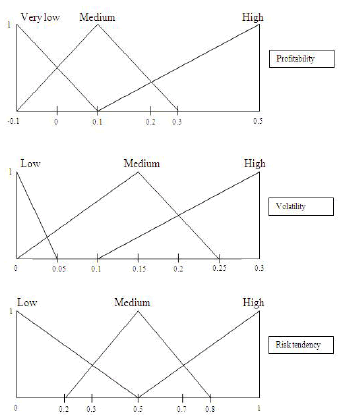
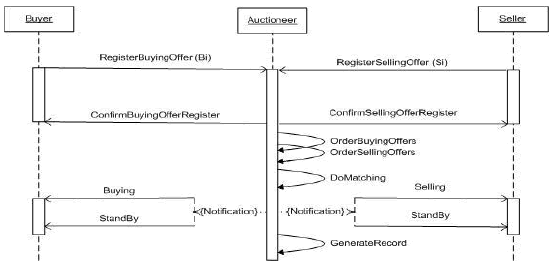
<body><![CDATA[<p><font size="2" face="Verdana, Arial, Helvetica, sans-serif">factors are   represented within the <i>market</i> agent   using the standard   geometric Brownian motion model that basically generates synthetic time series   for the stock prices according to the historic values that are used to feed the   simulation. In each simulation period, a price is generated for each stock, and   buying and selling orders are sent in a random ±5% range of such a price. </font></p>     <p><font size="2" face="Verdana, Arial, Helvetica, sans-serif">For a specific simulation there would be only one   instance of the <i>auctioneer</i> agent, one   of the <i>market</i> agent and as many as   wanted <i>investor</i> agents. The latter   two may take the role of buyer and/or seller whereas the former leads the   protocol. An auction process begins when the participants (<i>investors</i> and <i>market</i>)   register themselves to the <i>auctioneer</i>,   when registration time is finished the <i>auctioneer</i> sends to all the registered participants an advertisement of <i>auction start</i>,   after this, all participants may make buy and sell orders. There is a time   limit to send offers, during this time as the <i>auctioneer</i> receives orders immediately applies the CDA algorithm   and sends confirmation of the order reception followed by a notification: when   he finds a match between a couple of orders, he notifies the involved traders   and updates the orders queue, if no order is matched he sends a <i>stand by</i> notification. When the auction   time is finished the auctioneer sends to all the participants an advertisement   of <i>auction end</i> and no trader can send further orders. If there are more   scheduled periods in the simulation the auctioneer sends a new <i>auction start</i> and the process is repeated. This process is represented through a message   sequence diagram, as shown on <a href="#fig01">Figure 1</a>.</font></p>     <p align="center"><font size="2" face="Verdana, Arial, Helvetica, sans-serif"><b><a name="fig01"></a><img src="/img/revistas/dyna/v77n163/a22fig01.gif">    <br>   Figure 1.</b> Sequence diagram</font></p> <font size="2" face="Verdana, Arial, Helvetica, sans-serif"><b>4.2 Agents reasoning    <br> </b></font><font size="2" face="Verdana, Arial, Helvetica, sans-serif">From the three kinds   of agents that were considered in the simulation model, this section focuses on <i>investor</i> agents because they must </font><font size="2" face="Verdana, Arial, Helvetica, sans-serif">take complex  decisions in order to increase their profits, whereas the other two agents, <i>market</i> and </font><font size="2" face="Verdana, Arial, Helvetica, sans-serif"><i>auctioneer,</i> have more reactive behaviors as it was  explained earlier. On real financial markets </font><font size="2" face="Verdana, Arial, Helvetica, sans-serif">there are many    profiles of investors. Some of them are big companies as banks, pension funds,    etc., that put big amounts of money, usually taking conservative positions, in    order to earn profits and pay interests to their clients; others are expert    investors who use financial knowledge in order to earn profits for their own or    for thirds; and there are also "non-expert investors" who are regular people    that use these markets as an investment option directly or using stockbrokers.  Some regular features of this </font><font size="2" face="Verdana, Arial, Helvetica, sans-serif">last profile is that they do not invest big amounts of    money, are short term investors (usually they do not perform intra day    operations, neither wait many months or years to get their money back), and    more important, they are rational in the sense that use some information of the    market to make their decisions, but they also have some irrationality because    are moved by human emotions and external factors. Precisely, this kind of    investor is the one that is modeled in this proposal and, in order to do that,    it was assumed that they incorporate in their decision making process market variables    as well as personal factors. Among the market variables we shortened all    possible options to two that we consider are easy to obtain and interpret: one    related to the stocks profitability <i>R<sub>i</sub></i> (arithmetic    mean of the logarithmic returns) and the other to their volatility <i>V<sub>i</sub></i> (their variance). The    number of days used to calculate them is randomly different for each agent with  the aim of giving them some sort of "subjectivity".</font>     <p><font size="2" face="Verdana, Arial, Helvetica, sans-serif">About the personal   factors we considered one, the <i>risk   tendency</i>, which somehow measures in a quantitative way how prone to risk   these agents are. This variable was modeled as a continuous number between zero   and one, where the least degree means that such agent is not prone to the risk   at all, whereas one means that he is totally prone to the risk.</font></p>     <p><font size="2" face="Verdana, Arial, Helvetica, sans-serif">To incorporate these   three variables into a model that represents agents reasoning a Fuzzy Logic -   FL approach &#91;17, 18&#93; was chosen. This is an Artificial Intelligence technique   which aims to represent knowledge in a similar way as humans do, using   linguistic variables instead of mathematical ones. In contrast to classic sets   logic, FL does not consider that the value of one variable belongs to just one   set (certainty values are boolean),   but to several with different membership degrees that go from zero (no   membership at all) to one (complete membership). It means that sets boundaries   in FL are not exclusive and that is why they are called fuzzy sets. For   instance, in an industrial context, a boiler temperature may be modeled   (covering the whole possible range) as: low, medium and high, all of them   represented with fuzzy sets, and for instance a temperate value of 80°F may be low with a   0.2 membership value, medium with 0.7 and high with 0.3. Considering this, a   Fuzzy Inference System - FIS may be expressed as a set of rules in the form IF   (antecedents) THEN (consequents) where both, antecedents and consequents are   defined as fuzzy sets.</font></p>     <p><font size="2" face="Verdana, Arial, Helvetica, sans-serif">In this work, two reasoning processes are modeled for <i>investor</i> agents using FIS, one for   taking buying decisions and other one for selling decisions, both for the short   term and using as inputs the three variables previously described. The fuzzy   sets of the input variables for buying decision are presented on <a href="#fig03">Figure 2</a>,   their numbers and shapes were determined using expert knowledge.</font></p>     <p align="center"><font size="2" face="Verdana, Arial, Helvetica, sans-serif"><b><a name="fig03"></a><img src="/img/revistas/dyna/v77n163/a22fig02.gif">    <br>   Figure 2.</b> Fuzzy sets for buy   reasoning</font></p>     ]]></body>
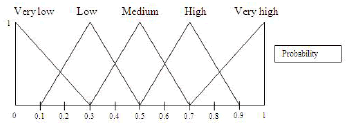
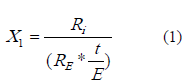
<body><![CDATA[<p><font size="2" face="Verdana, Arial, Helvetica, sans-serif">In order to   incorporate human emotions and external factors into this decision, the output   variable, rather than being a boolean value (buying or not buying), is a probability factor, in this case, for   buying. This way if for instance the output is 0.9 for an agent in a   determinate period and a determinate stock, that would mean that such agent   would buy such stock in that period with a probability of 0.9. Fuzzy sets for   this output variable are presented in <a href="#fig03">Figure 3</a>; in this case five homogeneous   sets were defined in order to discriminate this value for different situations.</font></p>     <p align="center"><font size="2" face="Verdana, Arial, Helvetica, sans-serif"><b><a name="fig03"></a><img src="/img/revistas/dyna/v77n163/a22fig03.gif">    <br>   Figure 3.</b> Fuzzy set for probability</font></p>     <p><font size="2" face="Verdana, Arial, Helvetica, sans-serif">Rules set for this inference system is presented on <a href="#tab01">Table 1</a> where all the combinations of input variables and their corresponding   output can be seen in a matrix structure, where each cell represent a IF . THEN   . rule. For instance <i>&#91;R4&#93;</i> represents   the rule "IF in determinate period, the <i>profitability</i> of a stock is l<i>ow</i>, its <i>volatility</i> is <i>medium</i> and the <i>risk tendency</i> of an agent is <i>low</i>, THEN the <i>probability</i> for such agent of buying   that stock in that period is <i>very low</i>".   In contrast for instance <i>&#91;R21&#93;</i> represents the rule "IF in determinate period, the <i>profitability</i> of a stock is high, its <i>volatility</i> is <i>low</i> and the <i>risk tendency</i> of an agent is <i>high</i>, THEN the <i>probability</i> for such agent of buying that stock in that period is <i>very high</i>".</font></p>     <p align="center"><font size="2" face="Verdana, Arial, Helvetica, sans-serif"><b><a name="tab01"></a>Table 1.</b> Inference rules for buying   reasoning</font>    <br>   <img src="/img/revistas/dyna/v77n163/a22tab01.gif"></p>     <p><font size="2" face="Verdana, Arial, Helvetica, sans-serif">One way to see graphically the whole inference system   is through fuzzy surfaces that are a 3D representation of the inputs-output   relation. <a href="#fig04">Figure 4</a> shows for instance how <i>probability   factor</i> behaves with regard to stock <i>profitability </i>and<i> volatility</i> (for this figure <i>risk tendency</i> was fixed in 0.5). Here it   can be seen that such output is directly proportional to stock <i>profitability</i> and inversely to its <i>volatility</i> as it would be expected. For   this inference system, the <i>risk tendency</i> acts as some kind of multiplier in the sense that decreases output value for   conservative investors and increases it for the ones who are more prone to   risk.</font></p>     <p align="center"><font size="2" face="Verdana, Arial, Helvetica, sans-serif"><b><a name="fig04"></a><img src="/img/revistas/dyna/v77n163/a22fig04.gif">    <br>   Figure 4.</b> Fuzzy surface in buying   reasoning</font></p>     <p><font size="2" face="Verdana, Arial, Helvetica, sans-serif">Now, for selling   decision, even if stock <i>profitability</i> and <i>volatility</i> are also considered,   the difference with regard to buying decision lies in that they are not measured   in absolute values, but they are in function of their expected value (according   to each agent). In this case, the input variable <i>X<sub>1</sub></i> is the relationship between <i>profitability</i> <i>R<sub>i</sub></i> obtained by   an agent until the last period and the expected profitability<i> R<sub>E</sub></i> in the short term as   shown in (1). The former factor may vary as time passes, whereas the latter is   calculated for each agent at the beginning of the simulation, when "enters" to   the market, as the mean of the last <i>k</i> periods of this variable. </font></p>     ]]></body>
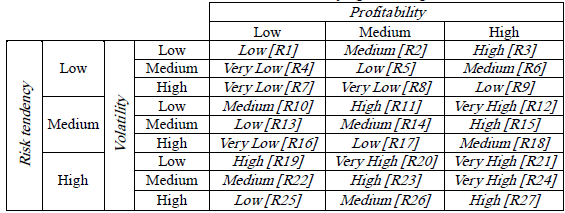
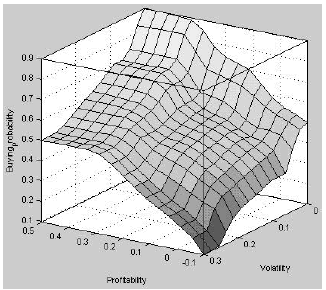
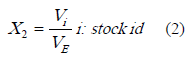
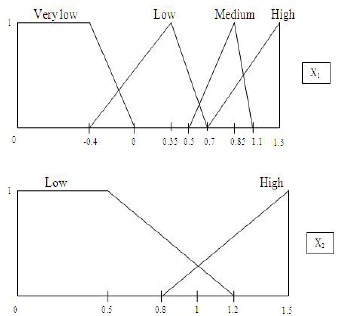
<body><![CDATA[<p><font size="2" face="Verdana, Arial, Helvetica, sans-serif">Values <i>k</i> and <i>E</i> are different for each agent to differentiate them.</font></p>     <p><img src="/img/revistas/dyna/v77n163/a22eq01.gif"></p>     <p><font size="2" face="Verdana, Arial, Helvetica, sans-serif">The second input   variable <i>X<sub>2</sub></i> is similar to <i>X<sub>1</sub></i>, but it relates current<i> volatility V<sub>i</sub></i> and the expected <i>volatility V<sub>E</sub></i> as shown in (2). In this case both factors are calculated in the same way than   the ones in <i>X<sub>1</sub></i>.</font></p>     <p><img src="/img/revistas/dyna/v77n163/a22eq02.gif"></p>     <p><font size="2" face="Verdana, Arial, Helvetica, sans-serif">The fuzzy sets for   these two input variables are presented on <a href="#fig05">Figure 5</a>, whereas for the <i>risk tendency</i>, due to its interpretation   is equal than in buying decision, the same sets are used.</font></p>     <p align="center"><font size="2" face="Verdana, Arial, Helvetica, sans-serif"><b><a name="fig05"></a><img src="/img/revistas/dyna/v77n163/a22fig05.gif">    <br>   Figure 5.</b> Fuzzy sets for sell   reasoning</font></p>     <p><font size="2" face="Verdana, Arial, Helvetica, sans-serif">In this reasoning, the output variable is the <i>probability </i>of selling a determinate stock,   and it was also modeled using the same fuzzy sets that were used in   buying decision.</font></p>     <p><font size="2" face="Verdana, Arial, Helvetica, sans-serif">Rules set for this   inference system is presented on <a href="#tab02">Table 2</a> and the corresponding fuzzy surface is   presented on <a href="#fig06">Figure 6</a>. However, as it can be seen in both, this time the   decision is more complex and not necessarily proportional to all inputs. This   is due to the fact that a selling decision may be caused by two different   situations. The first one, and the one that any investor wants, is that the   stock that he previously bought has increased its price reaching a certain   expected value (which <i>X<sub>1</sub></i> models), in this case the investor may feel satisfied with the profit he earned   so far, and decides to sell the stock. </font></p>     <p align="center"><font size="2" face="Verdana, Arial, Helvetica, sans-serif"><b><a name="tab02"></a>Table 2.</b> Inference rules for selling   reasoning</font>    ]]></body>
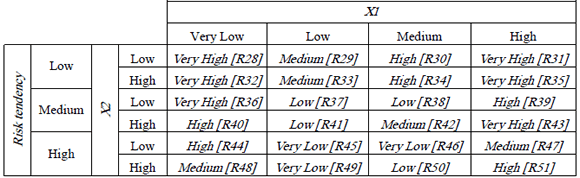
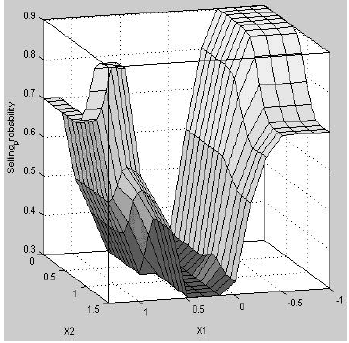
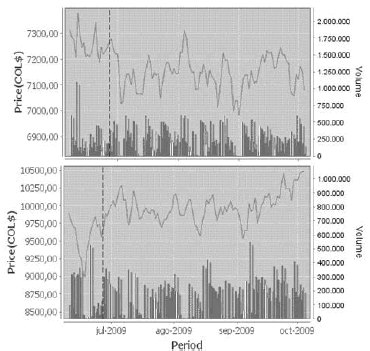
<body><![CDATA[<br>   <img src="/img/revistas/dyna/v77n163/a22tab02.gif"></p>     <p align="center"><font size="2" face="Verdana, Arial, Helvetica, sans-serif"><b><a name="fig06" id="fig06"></a><img src="/img/revistas/dyna/v77n163/a22fig06.gif">    <br>   Figure 6.</b> Fuzzy surface in selling   reasoning</font></p>     <p><font size="2" face="Verdana, Arial, Helvetica, sans-serif">The second situation,   the undesired one, is that the stock decreases its price or has not reached the   expected value so investor prefers selling it before something worse happens.   Until here, only stock <i>profitability</i> has been considered, but how <i>volatility</i> and <i>risk tendency</i> affect this   decision? Well, in the case of <i>volatility</i> when it is low with regard to its historic values, an investor may hold on in   his position a little longer in both situations (ups and downs). However when   it is high, this could intimidate the investor in the first situation and calms   him down in the second one. In the case of the <i>risk tendency,</i> it acts in a similar way than in buying decision but   backwards, because increases output value for conservative investors and   decreases it for the ones who are more prone to risk.</font></p>     <p>&nbsp;</p>     <p><b><font size="3" face="Verdana, Arial, Helvetica, sans-serif">5. RESULTS </font></b></p>     <p><font size="2" face="Verdana, Arial, Helvetica, sans-serif">In order to validate   the model presented in this paper a computational prototype was implemented   according to the structure that was described in the previous section.   Configuration data for such prototype includes: number of periods (days) to be   simulated, number of <i>investor</i> agents   and number of stocks. For each stock a unique name must be defined as well as   the minimum amount that must be traded on each transaction, <i>1</i> is the default value, but a bigger   number may be defined if such stock is traded by packages. Additionally, a   historic record of volumes and prices must be entered for each stock as the   initial information that agents consider. Such records may be loaded from a XML   file with actual data, or may be simulated randomly according to some range   that user defines. For each <i>investor</i> agent a unique name must be defined as well as the initial balance (available   money) and the amount of each stock that he posses, <i>0</i> is the default value but a bigger number may be defined if user   assumes that such agent is not new in the market. The <i>risk   tendency</i> for each <i>investor </i>agent   must also be defined, remembering that zero means that the agent is extremely   adverse to risk, and one means that is extremely prone to risk.</font></p>     <p><font size="2" face="Verdana, Arial, Helvetica, sans-serif">Such prototype was   validated by making several test cases (runs with different configurations), one of them is presented here. Such test case was defined   for 100 periods, included two significant stocks of the Colombian stock market   &#91;19&#93;, ISA and EXITO and, for both, a historic 30 days record of volumes and   prices was loaded. Five investor agents were defined and, for the sake of </font><font size="2" face="Verdana, Arial, Helvetica, sans-serif">simplicity and   comparative purposes, their initial balance and stocks amounts were defined   equals. </font></p>     <p><font size="2" face="Verdana, Arial, Helvetica, sans-serif">Each of these agents   differentiate from each other in their <i>risk   tendency</i> in order to compare their behaviors and their corresponding   results (values of <i>0.1</i>, <i>0.3</i>, <i>0.5</i>, <i>0.7</i> and <i>0.9</i> were defined for <i>investor </i>agent <i>a1</i>, ., <i>a5</i>). Besides this variable, it is   important to remember that particularities of each of these agents are also   modeled with the values of <i>k</i> and <i>E</i>, which were described in the agents   reasoning section. These variables were set randomly for each agent within the   range &#91;8, 24&#93;.</font></p>     <p><font size="2" face="Verdana, Arial, Helvetica, sans-serif">Once a simulation is run, the results may be observed   graphically using the prototype interface that connects to the system database   where results are saved. <a href="#fig07">Figure 7</a> shows for example the stocks charts, where   the mean price and volume for each period after performing all transactions   with the CDA mechanism are presented, and a dotted line represents the border   between historic data and simulation's results. Here it is important to note   that decisions made by each agent every period do affect the stocks prices and   volumes (in some proportion, whereas the rest is modeled through <i>market</i> agent), so system (the stock   market) is self fed in the sense that <i>investor </i>agents incorporate this information for their decisions making processes.   This figure also shows that simulation results seem to conserve mean and   variance of prices and volumes with regard to historic values, so it may be   concluded that stochastic models that are used within <i>market</i> agent, or at least its contribution to these variables formation, are adequate.</font></p>     ]]></body>
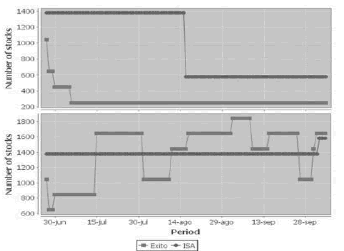
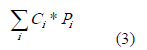
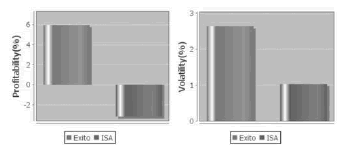
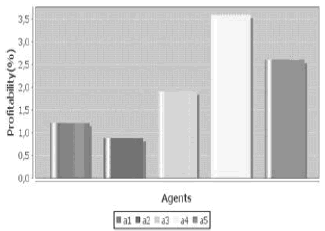
<body><![CDATA[<p align="center"><font size="2" face="Verdana, Arial, Helvetica, sans-serif"><b><a name="fig07"></a><img src="/img/revistas/dyna/v77n163/a22fig07.gif">    <br>   Figure 7.</b> Price-Volume graphic for   stocks ISA (top) and Exito (bottom)</font></p>     <p><font size="2" face="Verdana, Arial, Helvetica, sans-serif"><a href="#fig08">Figure 8</a> shows the number of stocks that two of the   defined agents had during each simulation period. These agents are <i>a1</i> and <i>a5</i>, and were chosen for analysis purposes because they correspond   to the ones with the smallest and greatest risk tendency, respectively. As it   can be seen in this figure, the risk tendency affects the behavior of the   agents and the way they reason when they make their buying and selling offers.   In this case, this figure shows that <i>a1</i> is very conservative, whereas <i>a5</i> is   more daring and takes more risks in both cases. For example, the <i>a1</i>'s ISA stocks amount demonstrates that   as this agent realizes that the price is going down he begins to sell it   immediately in some proportion. Seeing the same situation <i>a5</i> maintains steady, waiting for the price to go up. In both cases   it is important to note that agents' behavior is not completely deterministic   but has a probabilistic component that allows them to be more realistic.</font></p>     <p align="center"><font size="2" face="Verdana, Arial, Helvetica, sans-serif"><b><a name="fig08"></a><img src="/img/revistas/dyna/v77n163/a22fig08.gif">    <br>   Figure 8.</b> Stocks of the agents a1   (top) and a5 (bottom)</font></p>     <p><font size="2" face="Verdana, Arial, Helvetica, sans-serif">Considering this buying and selling decisions, <a href="#fig09">Figure   9</a> shows the value of these two agents portfolios on each period calculated as (3).</font></p>     <p><img src="/img/revistas/dyna/v77n163/a22eq03.gif"></p>     <p><font size="2" face="Verdana, Arial, Helvetica, sans-serif">Where <i>i</i> is each stock, <i>C</i> is the amount that each agent has of such stock and <i>P</i> is the corresponding average price.</font></p>     <p align="center"><font size="2" face="Verdana, Arial, Helvetica, sans-serif"><b><a name="fig09"></a><img src="/img/revistas/dyna/v77n163/a22fig09.gif">    <br>   Figure 9.</b> Portfolios values in COL$ of agents <i>a1</i> (top) and <i>a5</i> (bottom)</font></p>     ]]></body>
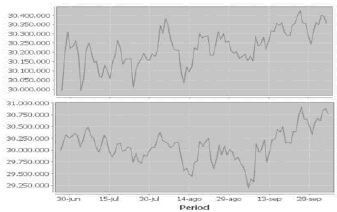
<body><![CDATA[<p><font size="2" face="Verdana, Arial, Helvetica, sans-serif">Here it can be seen that there were a lot of movement   on such value of each agent. This is due to the fact that despite there was not   too much movement in the actions of <i>a1</i> for example, the market price of the stocks did had changes along the entire simulation.</font></p>     <p><font size="2" face="Verdana, Arial, Helvetica, sans-serif">Besides individual evolution of agents and stocks, the   implemented prototype also allows visualizing comparative results. <a href="#fig10">Figure 10</a> shows for instance, the stocks profitability and volatility, whereas <a href="#fig11">Figure 11</a> shows <i>investor </i>agents profits.</font></p>     <p align="center"><font size="2" face="Verdana, Arial, Helvetica, sans-serif"><b><a name="fig10"></a><img src="/img/revistas/dyna/v77n163/a22fig10.gif">    <br>   Figure 10.</b> Stocks profitability and   volatility</font></p>     <p align="center"><font size="2" face="Verdana, Arial, Helvetica, sans-serif"><b><a name="fig11"></a><img src="/img/revistas/dyna/v77n163/a22fig11.gif">    <br>   Figure 11.</b> Investor agents profits</font></p>     <p><font size="2" face="Verdana, Arial, Helvetica, sans-serif">About <a href="#fig11">Figure 11</a> it is   important to stress that even though in this simulation run there seems to be a   direct relation among agents risk tendency and the obtained profitability, this   is not always the rule because it depends on market evolution.</font></p>     <p>&nbsp;</p>     <p><font size="3"><b><font face="Verdana, Arial, Helvetica, sans-serif">6. CONCLUDING REMARKS AND FUTURE WORK</font></b></font></p>     <p><font size="2" face="Verdana, Arial, Helvetica, sans-serif">Traditionally,   financial markets have been simulated and analyzed using methods that represent   them at a very high abstraction level excluding some details about their   constitutive parts. In contrast, and based on the experience and findings of   other authors, a Multi-Agent Based Simulation - MABS model is proposed in this   paper. Such approach considers the heterogeneity of each system component and   sees overall system behavior as the emergent result of all the interactions   among them, allowing the study of these markets complexity from another point   of view.</font></p>     ]]></body>
<body><![CDATA[<p><font size="2" face="Verdana, Arial, Helvetica, sans-serif">In this proposal   three kinds of agents were considered. <i>Auctioneer </i>agent who is in charge of   managing the Continuous Double Auction mechanism, <i>market</i> agent who simulates external factors that affects price   formation and supplies certain amount of orders with the aim at providing   market liquidity, and finally <i>investor</i> agents who represent small, medium term, non-expert participants. We focused in   the last one and particularly in how their reasoning mechanisms may affect   their performances. In order to do that a fuzzy inference system was proposed   which considers two agents' exogenous variables: stocks profitability and   volatility, and one endogenous: their risk tendency. Such approach allows modeling   buying and selling decisions in a human like manner considering general market   conditions as well as individual factors which give to agents certain   "personality". In addition to this, we also incorporated external human factors   that may affect such decisions using probability values instead of booleans.</font></p>     <p><font size="2" face="Verdana, Arial, Helvetica, sans-serif">As validation of the   proposed model, several simulations were made for the Colombian stocks market.   Such simulations, one of them is summarized on this paper, lead us to some   conclusions. The first one is that simulated market evolution   seemed to be consistent (at least throughout a visual analysis) to real values used   as input data for the prototype in terms of preserving basic statistical   variables like mean and variance of the considered stocks. The   second one is that, rather than concluding that there is a direct relation   between profits and risk profile, it could be said that agents performance   considering the proposed model (even when it could be said also for real life)   depends utterly on market evolution.</font></p>     <p><font size="2" face="Verdana, Arial, Helvetica, sans-serif">There are some   aspects that are planned as future work. One of these aspects is to incorporate   agents with different kinds of reasoning, for example, one that uses technical   indicators, one that uses forecasting methods, etc. Another aspect that we   would like to analyze is the dynamic existence of agents according to global   market evolution. For instance it could be simulated the incorporation of new   investor agents when the existing ones are obtaining attractive profits. </font></p>     <p>&nbsp;</p>     <p><b><font size="3" face="Verdana, Arial, Helvetica, sans-serif">REFERENCES</font></b></p>     <!-- ref --><p><font size="2" face="Verdana, Arial, Helvetica, sans-serif"><b>&#91;1&#93;</b> DAVIDSSON, P. Agent based social simulation: a computer science view. Journal of artificial societies and social simulation, 5(1), 2002.     &nbsp;&nbsp;&nbsp;&nbsp;&nbsp;&nbsp;&nbsp;&nbsp;[&#160;<a href="javascript:void(0);" onclick="javascript: window.open('/scielo.php?script=sci_nlinks&ref=000108&pid=S0012-7353201000030002200001&lng=','','width=640,height=500,resizable=yes,scrollbars=1,menubar=yes,');">Links</a>&#160;]<!-- end-ref --><!-- ref --><br>   <b>&#91;2&#93;</b> WOOLDRIDGE, M. An Introduction to MultiAgent Systems. Chichester: John Wiley and Sons, 2002.     &nbsp;&nbsp;&nbsp;&nbsp;&nbsp;&nbsp;&nbsp;&nbsp;[&#160;<a href="javascript:void(0);" onclick="javascript: window.open('/scielo.php?script=sci_nlinks&ref=000109&pid=S0012-7353201000030002200002&lng=','','width=640,height=500,resizable=yes,scrollbars=1,menubar=yes,');">Links</a>&#160;]<!-- end-ref --><!-- ref --><br>   <b>&#91;3&#93;</b> VAN DER HOOG, S. On multi-agent based simulation. Working Paper, Center for Non-Linear Dynamics in Economics and Finance, University of Amsterdam, 2004.     &nbsp;&nbsp;&nbsp;&nbsp;&nbsp;&nbsp;&nbsp;&nbsp;[&#160;<a href="javascript:void(0);" onclick="javascript: window.open('/scielo.php?script=sci_nlinks&ref=000110&pid=S0012-7353201000030002200003&lng=','','width=640,height=500,resizable=yes,scrollbars=1,menubar=yes,');">Links</a>&#160;]<!-- end-ref --><!-- ref --><br>   <b>&#91;4&#93;</b> TESFATSION, L. Agent-based computational economics: growing economies from the bottom up. Artificial Life, 8(1), 55-82, 2002.     &nbsp;&nbsp;&nbsp;&nbsp;&nbsp;&nbsp;&nbsp;&nbsp;[&#160;<a href="javascript:void(0);" onclick="javascript: window.open('/scielo.php?script=sci_nlinks&ref=000111&pid=S0012-7353201000030002200004&lng=','','width=640,height=500,resizable=yes,scrollbars=1,menubar=yes,');">Links</a>&#160;]<!-- end-ref --><!-- ref --><br>   <b>&#91;5&#93;</b> IORI, G. A Microsimulation of Traders Activity in the Stock Market: The Role of Heterogeneity, Agents' Interaction and Trade Frictions. Journal of Economic Behavior and Organization, Vol. 49(2). 269-285, 2002.     &nbsp;&nbsp;&nbsp;&nbsp;&nbsp;&nbsp;&nbsp;&nbsp;[&#160;<a href="javascript:void(0);" onclick="javascript: window.open('/scielo.php?script=sci_nlinks&ref=000112&pid=S0012-7353201000030002200005&lng=','','width=640,height=500,resizable=yes,scrollbars=1,menubar=yes,');">Links</a>&#160;]<!-- end-ref --><!-- ref --><br>   <b>&#91;6&#93;</b> RABERTO, M. and CINCOTTI, C. Modeling and simulation of a double auction artificial financial market. Physica A, Vol 355. 34-45, 2005.     &nbsp;&nbsp;&nbsp;&nbsp;&nbsp;&nbsp;&nbsp;&nbsp;[&#160;<a href="javascript:void(0);" onclick="javascript: window.open('/scielo.php?script=sci_nlinks&ref=000113&pid=S0012-7353201000030002200006&lng=','','width=640,height=500,resizable=yes,scrollbars=1,menubar=yes,');">Links</a>&#160;]<!-- end-ref --><!-- ref --><br>   <b>&#91;7&#93;</b> COLLIE, M. J., DOWE, D. L. & FITZGIBBON, L. J. Stock Market Simulation and Inference Technique. In Proceedings of the Fifth International Conference on Hybrid Intelligent Systems, pp. 534-538, 2005.     &nbsp;&nbsp;&nbsp;&nbsp;&nbsp;&nbsp;&nbsp;&nbsp;[&#160;<a href="javascript:void(0);" onclick="javascript: window.open('/scielo.php?script=sci_nlinks&ref=000114&pid=S0012-7353201000030002200007&lng=','','width=640,height=500,resizable=yes,scrollbars=1,menubar=yes,');">Links</a>&#160;]<!-- end-ref --><!-- ref --><br>   <b>&#91;8&#93;</b> TAKAHASHI, H. and TERANO, T. Agent-Based Approach to Investors' Behavior and Asset Price Fluctuation in Financial Markets. Journal of Artificial Societies and Social Simulation, Vol. 6(3), 2007.     &nbsp;&nbsp;&nbsp;&nbsp;&nbsp;&nbsp;&nbsp;&nbsp;[&#160;<a href="javascript:void(0);" onclick="javascript: window.open('/scielo.php?script=sci_nlinks&ref=000115&pid=S0012-7353201000030002200008&lng=','','width=640,height=500,resizable=yes,scrollbars=1,menubar=yes,');">Links</a>&#160;]<!-- end-ref --><!-- ref --><br>   <b>&#91;9&#93;</b> LEBARON, B. Agent-based computational finance: suggested readings and early research. Journal of Economic Dynamics and Control, Vol. 24. 679-702, 2000.     &nbsp;&nbsp;&nbsp;&nbsp;&nbsp;&nbsp;&nbsp;&nbsp;[&#160;<a href="javascript:void(0);" onclick="javascript: window.open('/scielo.php?script=sci_nlinks&ref=000116&pid=S0012-7353201000030002200009&lng=','','width=640,height=500,resizable=yes,scrollbars=1,menubar=yes,');">Links</a>&#160;]<!-- end-ref --><!-- ref --><br>   <b>&#91;10&#93;</b> GROSSKLAGS, J & SCHMIDT C. Artificial Software Agents on Thin Double Auction Markets - A Human Trader Experiment. In Proceedings of the IEEE/WIC International Conference on Intelligent Agent Technology, 2003.     &nbsp;&nbsp;&nbsp;&nbsp;&nbsp;&nbsp;&nbsp;&nbsp;[&#160;<a href="javascript:void(0);" onclick="javascript: window.open('/scielo.php?script=sci_nlinks&ref=000117&pid=S0012-7353201000030002200010&lng=','','width=640,height=500,resizable=yes,scrollbars=1,menubar=yes,');">Links</a>&#160;]<!-- end-ref --><!-- ref --><br>   <b>&#91;11&#93;</b> HOFFMANN, A. O. I., DELRE, S. A., EIJE, H. J., and JAGER, W. Stock Price Dynamics in Artificial Multi-Agent Stock Markets. In Artificial Economics: Agent-Based Methods in Finance, Game Theory and Their Applications. 191-201. Heidelberg: Springer Verlag, 2005.     &nbsp;&nbsp;&nbsp;&nbsp;&nbsp;&nbsp;&nbsp;&nbsp;[&#160;<a href="javascript:void(0);" onclick="javascript: window.open('/scielo.php?script=sci_nlinks&ref=000118&pid=S0012-7353201000030002200011&lng=','','width=640,height=500,resizable=yes,scrollbars=1,menubar=yes,');">Links</a>&#160;]<!-- end-ref --><!-- ref --><br>   <b>&#91;12&#93;</b> DAS, R., HANSON, J. E., KEPHART, J. O. and TESAURO, G. Agent-human interactions in the continuous double auction. In Proceedings of the 17th International Joint Conference on Artificial Intelligence (IJCAI), San Francisco, CA, USA , 2001.     &nbsp;&nbsp;&nbsp;&nbsp;&nbsp;&nbsp;&nbsp;&nbsp;[&#160;<a href="javascript:void(0);" onclick="javascript: window.open('/scielo.php?script=sci_nlinks&ref=000119&pid=S0012-7353201000030002200012&lng=','','width=640,height=500,resizable=yes,scrollbars=1,menubar=yes,');">Links</a>&#160;]<!-- end-ref --><!-- ref --><br>   <b>&#91;13&#93;</b> YOKOO, M., SAKURAI, Y. and MATSUBARA S. Robust Double Auction Protocol against False-name bids. In Proceedings of the 21st IEEE International Conference on Distributed Computing Systems (ICDCS-2001), Phoenix, AZ, USA , 2001.     &nbsp;&nbsp;&nbsp;&nbsp;&nbsp;&nbsp;&nbsp;&nbsp;[&#160;<a href="javascript:void(0);" onclick="javascript: window.open('/scielo.php?script=sci_nlinks&ref=000120&pid=S0012-7353201000030002200013&lng=','','width=640,height=500,resizable=yes,scrollbars=1,menubar=yes,');">Links</a>&#160;]<!-- end-ref --><!-- ref --><br>   <b>&#91;14&#93;</b> WURMAN, P., WALSH, W., WELLMAN, M. Flexible double auctions for electronic commerce: Theory and implementation. Decision Support Systems, 24, 17-27, 1998.     &nbsp;&nbsp;&nbsp;&nbsp;&nbsp;&nbsp;&nbsp;&nbsp;[&#160;<a href="javascript:void(0);" onclick="javascript: window.open('/scielo.php?script=sci_nlinks&ref=000121&pid=S0012-7353201000030002200014&lng=','','width=640,height=500,resizable=yes,scrollbars=1,menubar=yes,');">Links</a>&#160;]<!-- end-ref --><!-- ref --><br>   <b>&#91;15&#93;</b> MORENO, J., VEL&Aacute;SQUEZ, J. and OVALLE, D. Una aproximaci&oacute;n metodol&oacute;gica para la construcci&oacute;n de modelos de simulaci&oacute;n en el paradigma multi-agente. Avances en Sistemas e Inform&aacute;tica, 4(2), 145-154, 2007.     &nbsp;&nbsp;&nbsp;&nbsp;&nbsp;&nbsp;&nbsp;&nbsp;[&#160;<a href="javascript:void(0);" onclick="javascript: window.open('/scielo.php?script=sci_nlinks&ref=000122&pid=S0012-7353201000030002200015&lng=','','width=640,height=500,resizable=yes,scrollbars=1,menubar=yes,');">Links</a>&#160;]<!-- end-ref --><!-- ref --><br>   <b>&#91;16&#93;</b> ESCOBAR, A., MORENO, J., M&Uacute;NERA, S. F. Modelo de simulaci&oacute;n de una subasta de doble punta mediante el paradigma multi-agente. In Proceedings of the Fourth Colombian Computing Conference, (4CCC), Colombia , 2009.     &nbsp;&nbsp;&nbsp;&nbsp;&nbsp;&nbsp;&nbsp;&nbsp;[&#160;<a href="javascript:void(0);" onclick="javascript: window.open('/scielo.php?script=sci_nlinks&ref=000123&pid=S0012-7353201000030002200016&lng=','','width=640,height=500,resizable=yes,scrollbars=1,menubar=yes,');">Links</a>&#160;]<!-- end-ref --><!-- ref --><br>   <b>&#91;17&#93;</b> ZADEH, L.A. Fuzzy logic = Computing with words. IEEE Transactions on Fuzzy Systems, Vol. 4, pp. 103-111, 1996.     &nbsp;&nbsp;&nbsp;&nbsp;&nbsp;&nbsp;&nbsp;&nbsp;[&#160;<a href="javascript:void(0);" onclick="javascript: window.open('/scielo.php?script=sci_nlinks&ref=000124&pid=S0012-7353201000030002200017&lng=','','width=640,height=500,resizable=yes,scrollbars=1,menubar=yes,');">Links</a>&#160;]<!-- end-ref --><!-- ref --><br>   <b>&#91;18&#93;</b> ZADEH, L.A. Fuzzy Algorithms. Information and Control, Vol. 12, 94- 102, 1968.     &nbsp;&nbsp;&nbsp;&nbsp;&nbsp;&nbsp;&nbsp;&nbsp;[&#160;<a href="javascript:void(0);" onclick="javascript: window.open('/scielo.php?script=sci_nlinks&ref=000125&pid=S0012-7353201000030002200018&lng=','','width=640,height=500,resizable=yes,scrollbars=1,menubar=yes,');">Links</a>&#160;]<!-- end-ref --><!-- ref --><br>   <b>&#91;19&#93;</b> BVC. Colombian Stock Market. <a href="http://www.bvc.com.co" target="referencia">http://www.bvc.com.co</a>. Accessed 1 June 2009. </font>&nbsp;&nbsp;&nbsp;&nbsp;&nbsp;&nbsp;&nbsp;&nbsp;[&#160;<a href="javascript:void(0);" onclick="javascript: window.open('/scielo.php?script=sci_nlinks&ref=000126&pid=S0012-7353201000030002200019&lng=','','width=640,height=500,resizable=yes,scrollbars=1,menubar=yes,');">Links</a>&#160;]<!-- end-ref --> ]]></body><back>
<ref-list>
<ref id="B1">
<label>1</label><nlm-citation citation-type="journal">
<person-group person-group-type="author">
<name>
<surname><![CDATA[DAVIDSSON]]></surname>
<given-names><![CDATA[P]]></given-names>
</name>
</person-group>
<article-title xml:lang="en"><![CDATA[Agent based social simulation: a computer science view]]></article-title>
<source><![CDATA[Journal of artificial societies and social simulation]]></source>
<year>2002</year>
<volume>1</volume>
<numero>5</numero>
<issue>5</issue>
</nlm-citation>
</ref>
<ref id="B2">
<label>2</label><nlm-citation citation-type="book">
<person-group person-group-type="author">
<name>
<surname><![CDATA[WOOLDRIDGE]]></surname>
<given-names><![CDATA[M]]></given-names>
</name>
</person-group>
<source><![CDATA[An Introduction to MultiAgent Systems. Chichester:]]></source>
<year>2002</year>
<publisher-name><![CDATA[John Wiley and Sons]]></publisher-name>
</nlm-citation>
</ref>
<ref id="B3">
<label>3</label><nlm-citation citation-type="">
<person-group person-group-type="author">
<name>
<surname><![CDATA[VAN DER HOOG]]></surname>
<given-names><![CDATA[S]]></given-names>
</name>
</person-group>
<collab>University of Amsterdam</collab>
<source><![CDATA[On multi-agent based simulation. Working Paper]]></source>
<year>2004</year>
</nlm-citation>
</ref>
<ref id="B4">
<label>4</label><nlm-citation citation-type="journal">
<person-group person-group-type="author">
<name>
<surname><![CDATA[TESFATSION]]></surname>
<given-names><![CDATA[L]]></given-names>
</name>
</person-group>
<article-title xml:lang="en"><![CDATA[Agent-based computational economics: growing economies from the bottom up]]></article-title>
<source><![CDATA[Artificial Life]]></source>
<year>2002</year>
<volume>8</volume>
<numero>1</numero>
<issue>1</issue>
<page-range>55-82</page-range></nlm-citation>
</ref>
<ref id="B5">
<label>5</label><nlm-citation citation-type="journal">
<person-group person-group-type="author">
<name>
<surname><![CDATA[IORI]]></surname>
<given-names><![CDATA[G. A]]></given-names>
</name>
</person-group>
<article-title xml:lang="en"><![CDATA[Microsimulation of Traders Activity in the Stock Market: The Role of Heterogeneity, Agents' Interaction and Trade Frictions.]]></article-title>
<source><![CDATA[Journal of Economic Behavior and Organization]]></source>
<year>2002</year>
<volume>49</volume>
<numero>2</numero>
<issue>2</issue>
<page-range>269-285</page-range></nlm-citation>
</ref>
<ref id="B6">
<label>6</label><nlm-citation citation-type="journal">
<person-group person-group-type="author">
<name>
<surname><![CDATA[RABERTO]]></surname>
<given-names><![CDATA[M]]></given-names>
</name>
<name>
<surname><![CDATA[CINCOTTI]]></surname>
<given-names><![CDATA[C]]></given-names>
</name>
</person-group>
<article-title xml:lang="en"><![CDATA[Modeling and simulation of a double auction artificial financial market.]]></article-title>
<source><![CDATA[Physica A]]></source>
<year>2005</year>
<volume>355</volume>
<page-range>34-45</page-range></nlm-citation>
</ref>
<ref id="B7">
<label>7</label><nlm-citation citation-type="confpro">
<person-group person-group-type="author">
<name>
<surname><![CDATA[COLLIE]]></surname>
<given-names><![CDATA[M. J.]]></given-names>
</name>
<name>
<surname><![CDATA[DOWE]]></surname>
<given-names><![CDATA[D. L.]]></given-names>
</name>
<name>
<surname><![CDATA[FITZGIBBON]]></surname>
<given-names><![CDATA[L. J.]]></given-names>
</name>
</person-group>
<article-title xml:lang="en"><![CDATA[Stock Market Simulation and Inference Technique]]></article-title>
<source><![CDATA[]]></source>
<year>2005</year>
<conf-name><![CDATA[Fifth International Conference on Hybrid Intelligent]]></conf-name>
<conf-loc> </conf-loc>
<page-range>534-538</page-range></nlm-citation>
</ref>
<ref id="B8">
<label>8</label><nlm-citation citation-type="journal">
<person-group person-group-type="author">
<name>
<surname><![CDATA[TAKAHASHI]]></surname>
<given-names><![CDATA[H]]></given-names>
</name>
<name>
<surname><![CDATA[TERANO]]></surname>
<given-names><![CDATA[T]]></given-names>
</name>
</person-group>
<article-title xml:lang="en"><![CDATA[Agent-Based Approach to Investors' Behavior and Asset Price Fluctuation in Financial Markets]]></article-title>
<source><![CDATA[Journal of Artificial Societies and Social Simulation]]></source>
<year>2007</year>
<volume>6</volume>
<numero>3</numero>
<issue>3</issue>
</nlm-citation>
</ref>
<ref id="B9">
<label>9</label><nlm-citation citation-type="journal">
<person-group person-group-type="author">
<name>
<surname><![CDATA[LEBARON]]></surname>
<given-names><![CDATA[B]]></given-names>
</name>
</person-group>
<article-title xml:lang="en"><![CDATA[Agent-based computational finance: suggested readings and early research]]></article-title>
<source><![CDATA[Journal of Economic Dynamics and Control]]></source>
<year>2000</year>
<volume>24</volume>
<page-range>679-702</page-range></nlm-citation>
</ref>
<ref id="B10">
<label>10</label><nlm-citation citation-type="confpro">
<person-group person-group-type="author">
<name>
<surname><![CDATA[GROSSKLAGS]]></surname>
<given-names><![CDATA[J]]></given-names>
</name>
<name>
<surname><![CDATA[SCHMIDT]]></surname>
<given-names><![CDATA[C.]]></given-names>
</name>
</person-group>
<article-title xml:lang="en"><![CDATA[Artificial Software Agents on Thin Double Auction Markets: A Human Trader Experiment]]></article-title>
<source><![CDATA[]]></source>
<year></year>
<conf-name><![CDATA[ IEEE/WIC International Conference on Intelligent Agent Technology]]></conf-name>
<conf-date>2003</conf-date>
<conf-loc> </conf-loc>
</nlm-citation>
</ref>
<ref id="B11">
<label>11</label><nlm-citation citation-type="book">
<person-group person-group-type="author">
<name>
<surname><![CDATA[HOFFMANN]]></surname>
<given-names><![CDATA[A. O. I.]]></given-names>
</name>
<name>
<surname><![CDATA[DELRE]]></surname>
<given-names><![CDATA[S. A.]]></given-names>
</name>
<name>
<surname><![CDATA[EIJE]]></surname>
<given-names><![CDATA[H. J.]]></given-names>
</name>
<name>
<surname><![CDATA[JAGER]]></surname>
<given-names><![CDATA[W.]]></given-names>
</name>
</person-group>
<article-title xml:lang="en"><![CDATA[Stock Price Dynamics in Artificial Multi-Agent Stock Markets]]></article-title>
<source><![CDATA[Artificial Economics: Agent-Based Methods in Finance, Game Theory and Their Applications]]></source>
<year>2005</year>
<page-range>191-201</page-range><publisher-loc><![CDATA[Heidelberg ]]></publisher-loc>
<publisher-name><![CDATA[Springer Verlag]]></publisher-name>
</nlm-citation>
</ref>
<ref id="B12">
<label>12</label><nlm-citation citation-type="confpro">
<person-group person-group-type="author">
<name>
<surname><![CDATA[DAS]]></surname>
<given-names><![CDATA[R]]></given-names>
</name>
<name>
<surname><![CDATA[HANSON]]></surname>
<given-names><![CDATA[J. E]]></given-names>
</name>
<name>
<surname><![CDATA[KEPHART]]></surname>
<given-names><![CDATA[J. O]]></given-names>
</name>
<name>
<surname><![CDATA[TESAURO]]></surname>
<given-names><![CDATA[G]]></given-names>
</name>
</person-group>
<article-title xml:lang="en"><![CDATA[Agent-human interactions in the continuous double auction]]></article-title>
<source><![CDATA[]]></source>
<year></year>
<conf-name><![CDATA[17th International Joint Conference on Artificial Intelligence (IJCAI)]]></conf-name>
<conf-date>2001</conf-date>
<conf-loc>San Francisco CA</conf-loc>
</nlm-citation>
</ref>
<ref id="B13">
<label>13</label><nlm-citation citation-type="confpro">
<person-group person-group-type="author">
<name>
<surname><![CDATA[YOKOO]]></surname>
<given-names><![CDATA[M]]></given-names>
</name>
<name>
<surname><![CDATA[SAKURAI]]></surname>
<given-names><![CDATA[Y]]></given-names>
</name>
<name>
<surname><![CDATA[MATSUBARA]]></surname>
<given-names><![CDATA[S]]></given-names>
</name>
</person-group>
<article-title xml:lang="en"><![CDATA[Robust Double Auction Protocol against False-name bids]]></article-title>
<source><![CDATA[]]></source>
<year></year>
<conf-name><![CDATA[21st IEEE International Conference on Distributed Computing Systems (ICDCS-2001)]]></conf-name>
<conf-date>2001</conf-date>
<conf-loc>Phoenix AZ</conf-loc>
</nlm-citation>
</ref>
<ref id="B14">
<label>14</label><nlm-citation citation-type="journal">
<person-group person-group-type="author">
<name>
<surname><![CDATA[WURMAN]]></surname>
<given-names><![CDATA[P]]></given-names>
</name>
<name>
<surname><![CDATA[WALSH]]></surname>
<given-names><![CDATA[W]]></given-names>
</name>
<name>
<surname><![CDATA[WELLMAN]]></surname>
<given-names><![CDATA[M]]></given-names>
</name>
</person-group>
<article-title xml:lang="en"><![CDATA[Flexible double auctions for electronic commerce: Theory and implementation]]></article-title>
<source><![CDATA[Decision Support Systems]]></source>
<year>1998</year>
<numero>24</numero>
<issue>24</issue>
<page-range>17-27</page-range></nlm-citation>
</ref>
<ref id="B15">
<label>15</label><nlm-citation citation-type="journal">
<person-group person-group-type="author">
<name>
<surname><![CDATA[MORENO]]></surname>
<given-names><![CDATA[J]]></given-names>
</name>
<name>
<surname><![CDATA[VELÁSQUEZ]]></surname>
<given-names><![CDATA[J]]></given-names>
</name>
<name>
<surname><![CDATA[OVALLE]]></surname>
<given-names><![CDATA[D]]></given-names>
</name>
</person-group>
<article-title xml:lang="es"><![CDATA[Una aproximación metodológica para la construcción de modelos de simulación en el paradigma multi-agente]]></article-title>
<source><![CDATA[Avances en Sistemas e Informática]]></source>
<year>2007</year>
<volume>4</volume>
<numero>2</numero>
<issue>2</issue>
<page-range>145-154</page-range></nlm-citation>
</ref>
<ref id="B16">
<label>16</label><nlm-citation citation-type="confpro">
<person-group person-group-type="author">
<name>
<surname><![CDATA[ESCOBAR]]></surname>
<given-names><![CDATA[A]]></given-names>
</name>
<name>
<surname><![CDATA[MORENO]]></surname>
<given-names><![CDATA[J]]></given-names>
</name>
<name>
<surname><![CDATA[MÚNERA]]></surname>
<given-names><![CDATA[S. F]]></given-names>
</name>
</person-group>
<source><![CDATA[]]></source>
<year></year>
<conf-name><![CDATA[Fourth Colombian Computing Conference]]></conf-name>
<conf-date>2009</conf-date>
<conf-loc> </conf-loc>
</nlm-citation>
</ref>
<ref id="B17">
<label>17</label><nlm-citation citation-type="journal">
<person-group person-group-type="author">
<name>
<surname><![CDATA[ZADEH]]></surname>
<given-names><![CDATA[L.A]]></given-names>
</name>
</person-group>
<article-title xml:lang="en"><![CDATA[Fuzzy logic = Computing with words.]]></article-title>
<source><![CDATA[IEEE Transactions on Fuzzy Systems]]></source>
<year>1996</year>
<volume>4</volume>
<page-range>103-111</page-range></nlm-citation>
</ref>
<ref id="B18">
<label>18</label><nlm-citation citation-type="journal">
<person-group person-group-type="author">
<name>
<surname><![CDATA[ZADEH]]></surname>
<given-names><![CDATA[L.A]]></given-names>
</name>
</person-group>
<article-title xml:lang="en"><![CDATA[Fuzzy Algorithms.]]></article-title>
<source><![CDATA[Information and Control]]></source>
<year>1968</year>
<volume>12</volume>
<page-range>94- 102</page-range></nlm-citation>
</ref>
<ref id="B19">
<label>19</label><nlm-citation citation-type="">
<collab>BVC</collab>
<source><![CDATA[Colombian Stock Market]]></source>
<year></year>
</nlm-citation>
</ref>
</ref-list>
</back>
</article>