<?xml version="1.0" encoding="ISO-8859-1"?><article xmlns:mml="http://www.w3.org/1998/Math/MathML" xmlns:xlink="http://www.w3.org/1999/xlink" xmlns:xsi="http://www.w3.org/2001/XMLSchema-instance">
<front>
<journal-meta>
<journal-id>0012-7353</journal-id>
<journal-title><![CDATA[DYNA]]></journal-title>
<abbrev-journal-title><![CDATA[Dyna rev.fac.nac.minas]]></abbrev-journal-title>
<issn>0012-7353</issn>
<publisher>
<publisher-name><![CDATA[Universidad Nacional de Colombia]]></publisher-name>
</publisher>
</journal-meta>
<article-meta>
<article-id>S0012-73532010000300023</article-id>
<title-group>
<article-title xml:lang="en"><![CDATA[COMMODITIES DISTRIBUTION USING ALTERNATIVE TYPES OF TRANSPORT. A STUDY IN THE COLOMBIAN BREAD SME`S]]></article-title>
<article-title xml:lang="es"><![CDATA[DISTRIBUCIÓN DE COMMODITIES, USANDO MEDIOS ALTERNATIVOS DE TRANSPORTE. CASO COLOMBIA PYMES PANIFICADORAS]]></article-title>
</title-group>
<contrib-group>
<contrib contrib-type="author">
<name>
<surname><![CDATA[ARANGO SERNA]]></surname>
<given-names><![CDATA[MARTÍN DARIO]]></given-names>
</name>
<xref ref-type="aff" rid="A01"/>
</contrib>
<contrib contrib-type="author">
<name>
<surname><![CDATA[ADARME JAIMES]]></surname>
<given-names><![CDATA[WILSON]]></given-names>
</name>
<xref ref-type="aff" rid="A02"/>
</contrib>
<contrib contrib-type="author">
<name>
<surname><![CDATA[ZAPATA CORTES]]></surname>
<given-names><![CDATA[JULIAN ANDRES]]></given-names>
</name>
<xref ref-type="aff" rid="A03"/>
</contrib>
</contrib-group>
<aff id="A01">
<institution><![CDATA[,Universidad Nacional Facultad de Minas Escuela de Ingeniería de la Organización]]></institution>
<addr-line><![CDATA[ ]]></addr-line>
</aff>
<aff id="A02">
<institution><![CDATA[,Universidad Nacional de Colombia, Sede Bogotá Facultad de Ingeniería ]]></institution>
<addr-line><![CDATA[ ]]></addr-line>
</aff>
<aff id="A03">
<institution><![CDATA[,Universidad Nacional de Colombia, Sede Bogotá Facultad de Ingeniería ]]></institution>
<addr-line><![CDATA[ ]]></addr-line>
</aff>
<pub-date pub-type="pub">
<day>00</day>
<month>09</month>
<year>2010</year>
</pub-date>
<pub-date pub-type="epub">
<day>00</day>
<month>09</month>
<year>2010</year>
</pub-date>
<volume>77</volume>
<numero>163</numero>
<fpage>222</fpage>
<lpage>233</lpage>
<copyright-statement/>
<copyright-year/>
<self-uri xlink:href="http://www.scielo.org.co/scielo.php?script=sci_arttext&amp;pid=S0012-73532010000300023&amp;lng=en&amp;nrm=iso"></self-uri><self-uri xlink:href="http://www.scielo.org.co/scielo.php?script=sci_abstract&amp;pid=S0012-73532010000300023&amp;lng=en&amp;nrm=iso"></self-uri><self-uri xlink:href="http://www.scielo.org.co/scielo.php?script=sci_pdf&amp;pid=S0012-73532010000300023&amp;lng=en&amp;nrm=iso"></self-uri><abstract abstract-type="short" xml:lang="en"><p><![CDATA[This paper describes an algorithm for solving the micro-routing problem when it is used modes like bicycle and motorcycle with different capacities and serving different routes which are associated to a set of customers and also considering time windows restrictions. From the research in the Palmira bread industry, in which the bakeries were geo-referenced and in which the warehouse and the transport of goods management systems were characterized, was possible to establish the set of parameters needed for the numerical routing algorithm that seeks serving the daily customer requirements. The numerical results show the importance and how incident can be this methodology for SME´s which do not have a formal structure, resources neither appropriated information systems to compete in the actual market.]]></p></abstract>
<abstract abstract-type="short" xml:lang="es"><p><![CDATA[Este artículo describe un algoritmo para resolver el problema de micro ruteo cuando se dispone de medios como la Bicicleta y la motocicleta, con diferentes capacidades que cubren distintas rutas asociadas al conjunto de clientes con restricciones de tiempo. A partir de la investigación en el sector panificador de Palmira, donde se geo-referenciaron las panaderías y se caracterizaron los sistemas de gestión de inventarios y transporte de insumos, se establecieron los parámetros necesarios para los ejemplos numéricos del algoritmo de ruteo que busca atender las necesidades diarias de los demandantes. Los resultados numéricos muestran la importancia e incidencia que tendría esta metodología en microempresas que no disponen de organización, recursos ni de sistemas de información apropiados para competir en los escenarios actuales.]]></p></abstract>
<kwd-group>
<kwd lng="en"><![CDATA[Vehicle routing]]></kwd>
<kwd lng="en"><![CDATA[bicycle]]></kwd>
<kwd lng="en"><![CDATA[time windows restriction]]></kwd>
<kwd lng="en"><![CDATA[perishable goods]]></kwd>
<kwd lng="es"><![CDATA[Ruteo de vehículos]]></kwd>
<kwd lng="es"><![CDATA[bicicletas]]></kwd>
<kwd lng="es"><![CDATA[ventanas de tiempo]]></kwd>
<kwd lng="es"><![CDATA[producto perecedero]]></kwd>
</kwd-group>
</article-meta>
</front><body><![CDATA[ <p align="center"><font size="4" face="Verdana, Arial, Helvetica, sans-serif"><b>COMMODITIES DISTRIBUTION USING ALTERNATIVE TYPES   OF TRANSPORT. A STUDY IN THE COLOMBIAN BREAD SME`S </b></font></p>     <p align="center"><i><font size="3" face="Verdana, Arial, Helvetica, sans-serif"><b>DISTRIBUCI&Oacute;N DE COMMODITIES, USANDO MEDIOS ALTERNATIVOS DE TRANSPORTE. CASO   COLOMBIA PYMES PANIFICADORAS</b></font></i></p> <font size="2">     <p align="center">&nbsp;</p>     <p align="center"><font face="Verdana, Arial, Helvetica, sans-serif"><b>MART&Iacute;N DARIO ARANGO SERNA</b>    <br>   </font><font face="Verdana, Arial, Helvetica, sans-serif"><i>Escuela de   Ingenier&iacute;a de la Organizaci&oacute;n. Facultad de Minas. Universidad Nacional, <a href="mailto:mdarango@unalmed.edu.co">mdarango@unalmed.edu.co</a></i></font></p>     <p align="center"><font face="Verdana, Arial, Helvetica, sans-serif"><b>WILSON ADARME JAIMES</b>    <br>   </font><font face="Verdana, Arial, Helvetica, sans-serif"><i>Facultad de   Ingenier&iacute;a, Universidad Nacional de Colombia, Sede Bogot&aacute;. <a href="mailto:wiadarme@unal.edu.co">wiadarme@unal.edu.co</a></i></font></p>     <p align="center"><font face="Verdana, Arial, Helvetica, sans-serif"><b>JULIAN ANDRES ZAPATA CORTES</b>    <br>   </font><font face="Verdana, Arial, Helvetica, sans-serif"><i>Facultad de   Ingenier&iacute;a, Universidad Nacional de Colombia, Sede Bogot&aacute;. <a href="mailto:wiadarme@unal.edu.co">wiadarme@unal.edu.co</a></i></font></p>     <p align="center">&nbsp;</p>     ]]></body>
<body><![CDATA[<p align="center"><font face="Verdana, Arial, Helvetica, sans-serif"><b>Received   for review February 1<sup>th</sup>,   2010, accepted May 13<sup>th</sup>,   2010, final version June, 12<sup>th</sup>,   2010</b></font></p>     <p align="center">&nbsp;</p> </font> <hr> <font size="2" face="Verdana, Arial, Helvetica, sans-serif">     <p><b>ABSTRACT: </b>This paper   describes an algorithm for solving the micro-routing problem when it is used   modes like bicycle and motorcycle with different capacities and serving   different routes which are associated to a set of customers and also   considering time windows restrictions. From the research in the Palmira bread   industry, in which the bakeries were geo-referenced and in which the warehouse   and the transport of goods management systems were characterized, was possible   to establish the set of parameters needed for the numerical routing algorithm   that seeks serving the daily customer requirements. The numerical results show   the importance and how incident can be this methodology for SME´s which do not   have a formal structure, resources neither appropriated information systems to   compete in the actual market.</p>     <p><b>KEYWORDS: </b>Vehicle routing, bicycle, time windows restriction,   perishable goods.</p>     <p><b>RESUMEN: </b>Este art&iacute;culo describe un algoritmo para resolver el problema de micro   ruteo cuando se dispone de medios como la Bicicleta y la motocicleta, con   diferentes capacidades que cubren distintas rutas asociadas al conjunto de   clientes con restricciones de tiempo. A partir de la investigaci&oacute;n en el sector   panificador de Palmira, donde se geo-referenciaron las panader&iacute;as y se   caracterizaron los sistemas de gesti&oacute;n de inventarios y transporte de insumos,   se establecieron los par&aacute;metros necesarios para los ejemplos num&eacute;ricos del   algoritmo de ruteo que busca atender las necesidades diarias de los   demandantes. Los resultados num&eacute;ricos muestran la importancia e incidencia que   tendr&iacute;a esta metodolog&iacute;a en microempresas que no disponen de organizaci&oacute;n,   recursos ni de sistemas de informaci&oacute;n apropiados para competir en los   escenarios actuales. </p>     <p><b>PALABRAS CLAVE: </b>Ruteo de veh&iacute;culos, bicicletas, ventanas de tiempo,   producto perecedero. </p> </font> <hr>     <p>&nbsp;</p>     <p><font size="3" face="Verdana, Arial, Helvetica, sans-serif"><b>1. INTRODUCTION</b></font> </p> <font face="Verdana, Arial, Helvetica, sans-serif">     <p><font size="2">The vehicle routing problem (VRP) has gained high   attention both in academic research as in practice. VRP has been studied from   several scopes and in this paper it is focused in the bicycles and motorcycles   routing problem (BMRP) using daily planning for the bread industry in Palmira,   Valle del Cauca, Colombia; integrated by costumers with higher demands than   their stock capabilities as can be study in &#91;1&#93;. The results reported have   considered a variation of the vehicle routing problem with time windows   (VRPTM), where the same vehicle can serve several routs in an working day.&#91;2&#93; Besides, types of transportation as bicycle and   motorcycle have not been deeply studied in applied works to delivered express   of perishable goods. This problem will be really important in the near future   due to the technology advance and the change in the customer customs.</font></p>     <p><font size="2">There are different studies about VRP without time windows &#91;3&#93; using   heuristics in their solution, as well as several with time windows using exact   models as the solving tool &#91;2&#93;, what illustrates the advance in this subject.   Studies as the one presented in &#91;4&#93; show heuristics of insertion that can   handle different types of restrictions, including time windows and multiple   vehicles. In &#91;5&#93; the authors present delivered Express problem, which is really   similar to the one faced in this work.. Others studies &#91;6&#93; consider logistics   and socio-economical issues about several types of the delivery express problem.</font></p>     ]]></body>
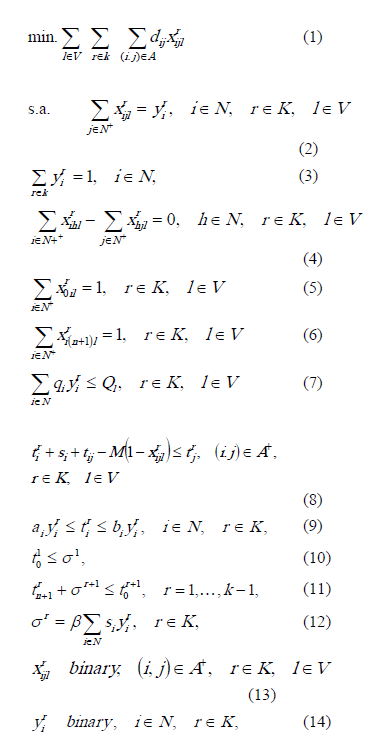
<body><![CDATA[<p><font size="2">The present article rooted by the studies made in &#91;2&#93;, shows an exact   algorithm for solving the VRP with different vehicle capacities, time windows   and multiple routes. In the second part of the article it is presented the   mathematical model formulation. In the third part it is shown the   characterization and the parameterization of the bread sub-industry. Later it   is presented the results of a numerical example using the Clarke and Wright   heuristic dealing with the number of nodes that is included in the evaluation   and finally it is presented the conclusions and further works in this field.</font></p> </font>     <p>&nbsp;</p>     <p><font size="3" face="Verdana, Arial, Helvetica, sans-serif"><b>2. PROBLEM FORMULATION </b> </font></p> <font size="2" face="Verdana, Arial, Helvetica, sans-serif">     <p>Due to the difficulties presented on the bread   industry, related to the quality level and to the asepsis of the raw material   and finish goods, it have been detected through several studies, that the   central main causes are related to the way of care, handle, storage and   transport those elements. One of the biggest concerning about those problems is   how to fulfill all the customers' requirements but following a continue   supply politic, without affecting the quality and service, and taking into   account ways of transport as bicycle, motorcycle and moto-trailer.</p>     <p>The problem description is:</p> </font>     <p><font size="2" face="Verdana, Arial, Helvetica, sans-serif">There are a number of V vehicles V = {1, 2, &#8230;.l}, each of those have a   deliver capacity from the depot to a set of customer equal to Q<sub>l, </sub>and   the set of customers are N = {1, 2,   &#8230;.n}. There have been geo-referenced all the n customers through GPS,   which allows to determined the distance d<sub>ij</sub>, for a set of arcs of   motion called A. the mobility study allowed determining the speed and travel   times t<sub>ij</sub> associated to each arc (i,j) &#1028; A. Every customer i   &#1028; N, has a daily demand q<sub>i</sub>, a service time s<sub>i</sub> and a time windows &#91;a<sub>i,</sub> b<sub>i</sub>&#93;, where the time to start operation in the   customer location is denoted as a<sub>i </sub>and the ending time is b<sub>i. </sub>It   is assumed that a vehicle is able to wait if this arrives to a customer   facility i in a time earlier than a<sub>i. </sub>Every vehicle can make K daily   routes, K= {1,   2, &#8230;.k}, where each route starts and ends on the depot. The depot is   denoted as 0 or n +1 depending if this is the initial node or the ending ode of   a arc with s<sub>o</sub> = s <sub>n+ 1 </sub> = 0. q<sub>o</sub> = q <sub>n+ 1 </sub> = 0. a<sub>o</sub> = a <sub>n+ 1 </sub> = 0. b<sub>o</sub> = b <sub>n+ 1 </sub> =<font face="Symbol"> </font>&infin;.</font></p> <font size="2" face="Verdana, Arial, Helvetica, sans-serif">     <p>The symbol N<sup>+ </sup>is used to N &#7908; {0, n+1}   and A<sup>+</sup> &#7908; {0, n+1}, where {0, n+1} is a fictitious arc with a   distance d<sub>0,n+1</sub> = 0 and a   travel time of t<sub>0,n+1</sub> =0. The starting time &#963;<sup>r </sup>for   load a vehicle is associated which each route r &#1028; K. The goal of the model is to minimize the   total distance to serve all the customers, while satisfying the capacity, time   windows and limited deliver constrains. The problem is formulated as following, using M as a big arbitrary constant.</p>     <p><img src="/img/revistas/dyna/v77n163/a23eq0114.gif"></p> </font>     <p><font size="2" face="Verdana, Arial, Helvetica, sans-serif">Where: </font></p> <ul>       <li><font size="2" face="Verdana, Arial, Helvetica, sans-serif">x<sup>r</sup><sub>ijl</sub> will be 1 if the arc (i, j) &#1028; A<sup>+</sup> i is on the route r with the vehicle l. Otherwise x<sup>r</sup><sub>ijl</sub> will be 0; Note that x<sup>r</sup><sub>0,n+1</sub> equals 1 if the route r is     empty.</font></li>       ]]></body>
<body><![CDATA[<li><font size="2" face="Verdana, Arial, Helvetica, sans-serif">y<sup>r</sup><sub>i </sub> will be 1 if the customer i is on     the route r, otherwise it will be 0;</font></li>       <li><font size="2" face="Verdana, Arial, Helvetica, sans-serif">t<sup>r</sup><sub>i</sub> is the service starting time related to     the customer i in the route r;</font></li>       <li><font size="2" face="Verdana, Arial, Helvetica, sans-serif">t<sup>r</sup><sub>0</sub> is the routing starting time for the     route r;</font></li>       <li><font size="2" face="Verdana, Arial, Helvetica, sans-serif">t<sup>r</sup><i><sub> n+ 1 </sub></i> is the routing     ending time for the route r.</font></li>     </ul>     <p><font size="2" face="Verdana, Arial, Helvetica, sans-serif">In the same way, the model formulation can be   explained as following:</font></p> <ul>       <li><font size="2" face="Verdana, Arial, Helvetica, sans-serif">Equation (2)     seeks that all customers are part of an arc.</font></li>       <li><font size="2" face="Verdana, Arial, Helvetica, sans-serif">Equation (3) makes possible that each i can be visited only     one time.</font></li>       <li><font size="2" face="Verdana, Arial, Helvetica, sans-serif">Equations (4)     - (6) are for the flow conservation.</font></li>       <li><font size="2" face="Verdana, Arial, Helvetica, sans-serif">Equation (7)     guaranties that demand in a route r will no exceed the capacity of vehicle I.</font></li>       ]]></body>
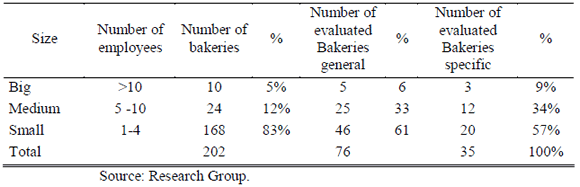
<body><![CDATA[<li><font size="2" face="Verdana, Arial, Helvetica, sans-serif">Equations (8) -(11) assure the time programming feasibility.</font></li>       <li><font size="2" face="Verdana, Arial, Helvetica, sans-serif">Equation (12) defines     the load starting point of the vehicle I, as the sum of the service times to     all the customers in the same route multiplied by a parameter <font face="Symbol">b</font></font></li>       <li><font size="2" face="Verdana, Arial, Helvetica, sans-serif"> Equation (9)     assures that t<sup>r</sup><sub>i</sub> equals 0 when the customer i is not in the route r.</font></li>     </ul>     <p>&nbsp;</p>     <p><font size="3" face="Verdana, Arial, Helvetica, sans-serif"><b>3.CHARACTERIZATION PARAMETERIZATION OF THE BREAD   SUB-INDUSTRY 3.1 Metodology </b></font></p>     <p><font size="2" face="Verdana, Arial, Helvetica, sans-serif">This research rooted in 2002 with a exploration of the SME's of the bread sub-industry in the urban area of   the city of Palmira, which is city with more or les 294.000 citizens. Accordint   to the 2006 report of the Camara de Comercio, in this city are 202 bakeries   (but only 76 accepted cooperating with the research Taking into account the   resources availability, logistics and convenience, there were characterized 35   bakeries as: 3 are considered big size companies, 12 medium and 20 are small   size companies. See <a href="#tab01">table 1</a>.</font></p>     <p align="center"><font size="2" face="Verdana, Arial, Helvetica, sans-serif"><b><a name="tab01"></a>Table 1.</b> Palmira Bread   sub-industry characterization, 2007</font>    <br>   <img src="/img/revistas/dyna/v77n163/a23tab01.gif"></p>     <p><font size="2" face="Verdana, Arial, Helvetica, sans-serif">The study was developed through the cooperation of   company businessman, workers and researches, using tools as meetings, surveys,   semi-structured interviews and observations of the system participants.   Characterization variables were order frequency, order size, working time,   available slots and mode of transport used. The information was analyzed by the   tool SPSS V. </font><font size="2" face="Verdana, Arial, Helvetica, sans-serif">10.0 and Excel<sup>TM</sup>;   the routing programming was made using Logware.</font></p> <font size="2" face="Verdana, Arial, Helvetica, sans-serif"><b>3.2 Characterization and parameters </b>     ]]></body>
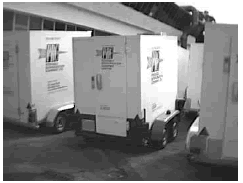
<body><![CDATA[<p><i>Operative/Productive   Sub-system.    <br>   </i>In small bakeries (SB) the most common area is 60-80 m<sup>2</sup> (40%), in medium bakeries (MB) the most common area is 120-160 m2 (60%) and in   the big bakeries the most common area is 150-200 m<sup>2</sup> (60%). 40% of SB   have areas until 120 m<sup>2</sup>, but still present problems related to the   space for production, due to this space is common used for both living and   operate the bakery.</p>     <p>Around the 80% of Palmira Bakeries are open from 5:00 a.m.to 12:00 pm. Salespeople work   from 6:00 am to 10:00 pm divided in two shifts, the first one from 6:00 a.m. to   2:00 p.m and the second one from 2:00 p.m. to 10:00 p.m. Administrative people   work from 8:00 a.m. to 12:00 pm and from 2:00 p.m. to 6:00. Those working times   apply to big bakeries; in medium and small bakeries there is not a strong   distinction between those roles and it is common that the manager is in charge   of production, sales, cleaning, and this person works from the opening and the   closing of the store, e.g. from 6:00 am to 10:00 pm.</p>     <p>Small Bakeries have between 11 to 15 machines, 80% of   medium bakeries have between 16 to 20 machines and all the big bakeries have   between 16 to 20 machines, which are flexible regarding to the volume and   variability of products. Preventive Maintenance is used in big bakeries and   reactive maintenance is used in Medium and small bakeries; the more common   equipments are ovens, rotative oven, wetting machines, cylinders and mixers.</p>     <p><strong><i>Supply goods demand    <br>   </i></strong>A research made for the 76 evaluated bakeries valued   that in 2007 the consumption of flour is 1.490 tons, sugar 352 tons, cheese 293   tons salt 63 tons, yeast 196 tons and butter 401 tons. Annual aggregate   consumption of the main goods (flour, sugar, cheese, salt, yeast and butter)   differentiated by size of the bakery is: 102 tons/year for big bakeries, 40   tons/year for medium bakeries, 20 tons/year for small   bakeries. The average labor resource occupancy for big, medium and small   bakeries are 21, 6 and 3; the studied bakeries   generated 496 directed jobs in 2007. </p>     <p><i>Routing design and tecnical   characteristics of the transportations modes    <br>   </i>Moto-trailer Model Enduro   TS 124; cubic Capacity: 125 C.C.; weight in empty: 85 Kg; performance: 85   km/gallon; fuel: normal gasoline. Cargo Capacity: 350 Kg. <a href="#fig01">Figure i</a> shows a view   of this moto-trailer. This type of transport is accepted by law for the colombian goverment in the law number 769 of 2002 in the C&oacute;digo Nacional de Tr&aacute;nsito Terrestre, Chapter V,   articles 94 y 96. This type of transportations is a good option when there are too much traffic, the investmen is low, technical   specifications, easy of drive, fast, performance, capacity, industrial safety,   road safety and also conservation and asepsis in transport of supply goods. In   a technical evaluation of the volumetric capacity of the trailer (1.24m x 0.80m   x 0.72m = 0,714m<sup>3</sup>); there was found that the constrains are related   only to the weight and not to the volume due to the density of the goods (<strong><i>goods (flour, sugar, cheese, salt, yeast and butter)</i></strong></p>     <p align="center"><b><a name="fig01"></a><img src="/img/revistas/dyna/v77n163/a23fig01.gif">    <br>   Figure 1:</b> Moto-Trailer</p>     ]]></body>
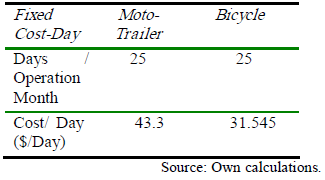
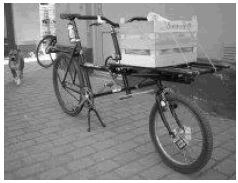
<body><![CDATA[<p>An <i>in situ</i> evaluation was made in order to evaluate the traffic, vehicular and pedestrian   flux, roads characterization and normal   distances in routing and also there was found the average speed for this type   of transport, which was determined in 7,336 km./hr (2,037 m/s) in downtown area   and 27.692 km./hr. (7.692 m/s) in residential neighborhoods.</p>     <p><i>Non-motorized types of   transportation    <br>   </i><i>This tipe of transportation   is allowed by the law number 769 of 2002 </i>"C&oacute;digo Nacional de Tr&aacute;nsito Terrestre, Chapter V, article   94";. Distribution centers consider double-rack   bicycle as the favorite type of trasport due to its low cost, capacity, fast   operation (considering traffic jams), easy-driving, cheap mantenience and   operation. <a href="#fig02">Figure 2</a> shows this type of transport. </p> </font>     <p align="center"><font size="2" face="Verdana, Arial, Helvetica, sans-serif"><b><a name="fig02"></a><img src="/img/revistas/dyna/v77n163/a23fig02.gif">    <br>   Figure 2: </b>double rack Bicycle</font></p> <font size="2" face="Verdana, Arial, Helvetica, sans-serif">     <p>For the cheese   industry moto-trailers are the preferred type of transportation since this   devices allow moving up to 300 Kg. The research presents for reference,   discussions and analysis the possibility of implementing the double-rack   bicycle in this business but taking into account that the maximum load for this   device is 100 Kg, which is 200 kg less than the original one in some cases. The   limit time is 5 hour in every labor shift, and considering the flat topographic   of Palmira, where a GPS study showed that the lower point in the city is at 993   meters above sea level (MASL) and the highest point is at 1047 MASL.</p>     <p>For those conditions it was made a field evaluation   and was determine an average speed for bicycles of 6,746 km/hr. (1,874 m/s) in   downtown and 8,235 km/hr (2,287 m/s) in residence areas.</p>     <p><i>Costs    <br>   </i>The transportation cost structure for the evaluated   types of transport was determined as fixed costs and variable costs for both   moto-trailer and bicycle. Daily Fixed cost are shown in <a href="#tab02">Table 2</a>, assuming 25 working days every month.</p>     <p align="center"><b><a name="tab02"></a>Table 2</b>: Daily   fixed costs    ]]></body>
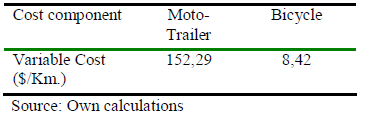
<body><![CDATA[<br>   <img src="/img/revistas/dyna/v77n163/a23tab02.gif"></p>     <p>Unit variable cost (UVC) are those costs that vary depending on the   operation conditions and are established in pesos/Kilometer (Pesos is the   Colombian currency, COP).</p>     <p>This cost considers the   fuel, tires, lubricants, filters, maintenance, repair, unforeseen events and   others. <a href="#tab02">Table 2</a> shows the variable cost per km of every type of transportation.</p>     <p align="center"><b><a name="tab03"></a>Table 3.</b> Variable cost per kilometer    <br>   <img src="/img/revistas/dyna/v77n163/a23tab03.gif"></p>     <p>&nbsp;</p> </font>     <p><font size="3" face="Verdana, Arial, Helvetica, sans-serif"><b>4. ROUTING ASSIGNMENT NUMERICAL ROUTING EXAMPLE</b></font></p>     <p><font size="2" face="Verdana, Arial, Helvetica, sans-serif"><b>4.1 Routing design characterization     <br>   </b>The reference point is the cheese company (supplier)   and the customers are 35 bakeries (sellers) which were geo-reference through   GPS. There were considered the consumption levels, frequency, aggregated   demands for main goods( flour, salt, sugar, yeast,   butter, cheese) which are consigned In <a href="#tab04">table 4</a></font></p> <font face="Verdana, Arial, Helvetica, sans-serif">     <p align="center"><font size="2"><b><a name="tab04"></a>Table 4.</b> Aggregated   Consumption</font>    ]]></body>
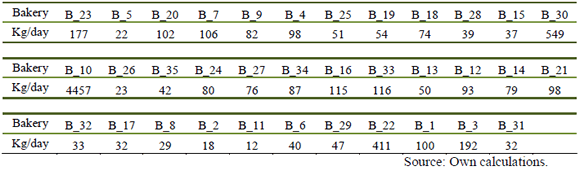
<body><![CDATA[<br>   <img src="/img/revistas/dyna/v77n163/a23tab04.gif"></p>     <p><font size="2">Based on this information was developed the   programming and the vehicle routing design using moto-trailer and bicycle for a   load capacity of lower than 100 kg/bicycle. </font></p>     <p><font size="2">The programming and route design consider the   following considerations:</font></p> </font> <ul>       <li><font size="2" face="Verdana, Arial, Helvetica, sans-serif">Each stop or     bakery has a assigned load that must be delivered     every day. This quantity is expressed in Kg. (Study results)</font></li>       <li><font size="2" face="Verdana, Arial, Helvetica, sans-serif">It is possible     to use several vehicles with different capacity limits. In this case the limit     is the weight that can be carry in each vehicle.</font></li>       <li><font size="2" face="Verdana, Arial, Helvetica, sans-serif">Bakeries accept     deliveries at any time between 8:00 a.m. and 6:00 p.m. </font></li>       <li><font size="2" face="Verdana, Arial, Helvetica, sans-serif">Although     collects are not allowed, in some cases it is possible but only after of the     deliveries.</font></li>       <li><font size="2" face="Verdana, Arial, Helvetica, sans-serif">It is allow a     rest time equivalent of an hour after 240 minutes of work.</font></li>     </ul> <font face="Verdana, Arial, Helvetica, sans-serif">     <p><font size="2">The model have been run using the Clarke and Wright   method with the aim of minimizing the total travel distance fot all the   vehicles needed to serve all the stops. Recently this routing programming is   made with a frequency of two times per week, what is really different to the   six times proposed before this study which were using a FIFO systems (first in,   First out) without product consolidation. This method was made using   Excel&#8482; for the data analysis and Logware 5.0, ROUTER module for the routing design.</font></p>     ]]></body>
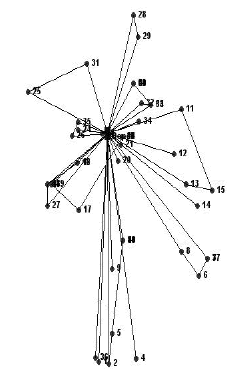
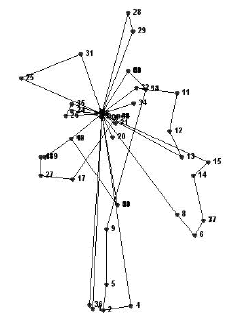
<body><![CDATA[<p><font size="2"><b>4.2. Results of the Clarke and Wright method application    <br>   </b></font><font size="2">With the aim of fully apply the Clarke and Wright   method, the bakeries and the distribution centers were Geo-reference through   GPS seeking to find the geographical and Cartesian (IGAC) coordinates. This   information is an input for the software Logware. There were taken 142 points   (Cheese company and bakeries), </font><font size="2">finally in the de-codification and processing activity there   were selected 124 points including the cheese company and the 35 bakeries.</font></p>     <p><font size="2">The demand level of the time windows in each bakery   was determined. This demand levels were acquired by analyzing 76 small   Family-companies, 35 of those were selected due that those are cheese company suppliers.</font></p>     <p><font size="2">The evaluation has been made by using the types of   transport totally independent and through the combinations of these. Results   are expressed in the standard software units (Miles as a length measure, to   meters). The correction factor used in Logware for the distances was obtained   through a field evaluation of the real distances, and it is equal to 1.26,   1.27, 1.29 and 1.3 for some routes, due to the short distances evaluated in   this work, and because that the going and returning trip is made through   different roads and streets. In the evaluation the correction factor was 1.3.   The speed used for the moto-Trailer was established in 8859 meters/hour   (weighted average between jammed urban zone 78% and non-jammed area 22%) and   for the bicycle it was used a speed of 6745 meters/hour (speed achieved in the   jammed urban zone)</font></p>     <p>&nbsp;</p> </font>     <p><font size="3" face="Verdana, Arial, Helvetica, sans-serif"><b>5. ROUTING WITH   DOUBLE-RACK BICYCLE</b></font></p> <font face="Verdana, Arial, Helvetica, sans-serif">     <p><font size="2">Results indicates that there must be 39 routes for all   the bakeries that have a daily demand higher that the vehicle (bicycle) capacity which is 100kg, the amount should be   divided considering an utilization of 100% of the vehicle capacity and the   remaining amount should be used for a new route. For example, the bakery number   30 has a daily demand of 549, so it is equal to 4 demands of 100 kg plus one of   49 Kg, seeking optimizing the vehicle use. This was made with all the bakeries   that have a daily demand higher than 100 kg, which causes that of the 35   bakeries the model has 54 stops with a lower demand than 100Kg/day.</font></p>     <p><font size="2"><a href="#fig03">Figure 3</a> shows how the bicycle routing should be to   serve all the stops. It is important to notice that some points could not   appear due to some points superimpose others as happens in bakeries 22 and 30   in which it is necessary make several trips to the same point. <a href="#tab07">Table 7</a> is a   summary of the main indicators of the process.</font></p>     <p align="center"><font size="2"><b><a name="fig03"></a><img src="/img/revistas/dyna/v77n163/a23fig03.gif">    <br>   Figure 3</b>: Clarke   and Wright method - double-rack Bicycle</font></p>     ]]></body>
<body><![CDATA[<p><font size="2">The total time of 26.6 hour allows programming the   routing with 4 bicycles (8 hours daily) but considering that this is not a   motorized transportation type it was made a programming using an average   working time of 5 hours daily and with the constrain that each bicycle should   not travel more than 10 km (1000m). It means that it is necessary programming 6 double-rack Bicycle, with a initial investment of 4.5   millions of pesos. (6 x 750.000).</font></p>     <p><font size="2">With those six bicycles it is necessary 39 routes   (Logware Results) which have an average time of 23 minutes an occupancy level   of 93.7% of the vehicle capacity.</font></p> </font>     <p>&nbsp;</p>     <p><font size="3" face="Verdana, Arial, Helvetica, sans-serif"><b>6. ROUTING WITH   MOTO-TRAILER</b></font></p>     <p><font size="2" face="Verdana, Arial, Helvetica, sans-serif">The result given for the   software shows that it should be used 13 routes, this is because it was divided   the delivered quantity for bakeries in which the demand is higher tan 300 km,   (Bakery 30, 549 kg/day, Bakery 10, 457 kg/day, Bakery 22, 411   kg/day). It was made a run dividing into two equal parts and the results   regarding to cost was higher if it is compared to the next method: A big   portion of the cargo is shipped in a trailer with a capacity of 300 kg and the   remaining quantity is sent in another trailer. This method was use for the design and programming of the route.</font></p>     <p><font size="2" face="Verdana, Arial, Helvetica, sans-serif"><a href="#fig04">Figure 4</a> shows the Moto-trailer routing for serving   the total 35 points. As happened above some points could not appear in the   figure due to some points superimpose others as for example bakery 30 and 10   both of them needs two travels to the same point.</font></p>     <p align="center"><font size="2" face="Verdana, Arial, Helvetica, sans-serif"><b><a name="fig04"></a><img src="/img/revistas/dyna/v77n163/a23fig04.gif">    <br>   Figure 4 : </b>Clarke and Wright method - Moto trailer</font></p>     <p><font size="2" face="Verdana, Arial, Helvetica, sans-serif"><a href="#tab06">Table 6</a> presents a summary of the main indicators for   the moto-trailer routing system.</font></p>     <p align="center"><font size="2" face="Verdana, Arial, Helvetica, sans-serif"><b><a name="tab06"></a>Table 6</b>. Moto-trailer routing indicators</font>    ]]></body>
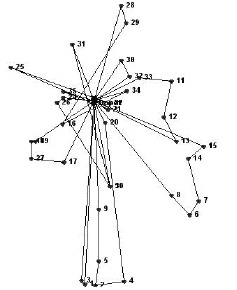
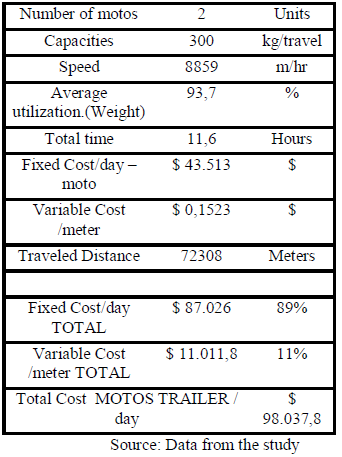
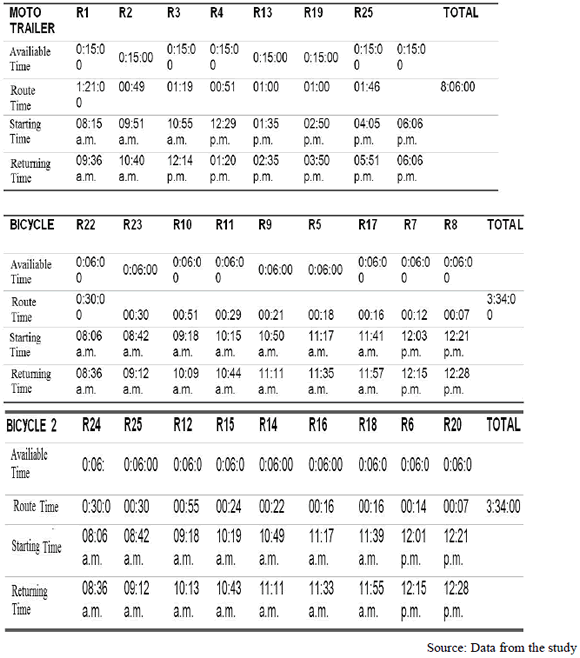
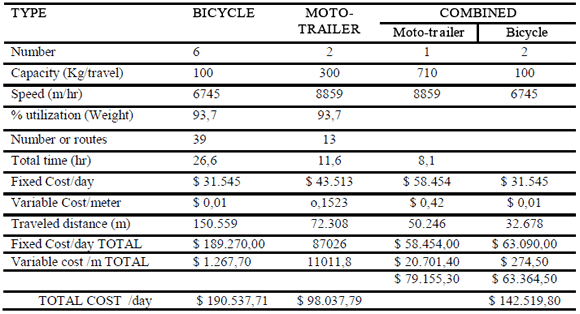
<body><![CDATA[<br>   <img src="/img/revistas/dyna/v77n163/a23tab06.gif"></p>     <p><font size="2" face="Verdana, Arial, Helvetica, sans-serif">The total time is 11.6 hour, what allows programming   the routing with two moto-trailer. each one has a daily operation time of $98.037. Using these two mototrailer can be   serve 13 routes (Logware) with an average time of 5 hour and 46 minutes and the   average occupation level of the moto-trailers is 93%. The cost structure is compose for a 89% of fixed costs, what makes necessary   having a right use of this machines. A daily occupancy in   time around 72%. The cost of both moto-trailer is 17.5 million pesos   (2*8.250.000).</font></p>     <p>&nbsp;</p>     <p><font size="3" face="Verdana, Arial, Helvetica, sans-serif"><b>7. ROUTING   USING A COMBINATION WITHIN MOTO-TRAILER AND BICYCLE</b></font></p>     <p><font size="2" face="Verdana, Arial, Helvetica, sans-serif">Logware results show that because the capacity of the   moto-tr&aacute;iler (300kg) and the bicycle (100kg) and for the cost associated a both   alternatives, it was analyzed the option of using both types but limiting the   number of moto-trailers to one (due that the lattest analysis showed that the   system only needs two moto-trailers). This process was run in Logware.</font></p>     <p><font size="2" face="Verdana, Arial, Helvetica, sans-serif"><a href="#fig05">Figure 5</a> shows the routing using both moto-trailer and   bicycles. </font></p>     <p align="center"><font size="2" face="Verdana, Arial, Helvetica, sans-serif"><b><a name="fig05"></a><img src="/img/revistas/dyna/v77n163/a23fig05.gif">    <br>   Figure 5.</b> Clarke and Wright method. Combined Moto-trailer and Bicycle</font></p>     <p><font size="2" face="Verdana, Arial, Helvetica, sans-serif"><a href="#tab07">Tables 7</a> and <a href="#tab08">8</a> show the most important about the combination of both types of transportation and   show that is possible to achieve a lower cost compared with the cost associated   to operate only with bicycles, but compared with the cost of working only with   motorcycles is more expensive. The   average occupancy level using the combined system is 95.3% to motorcycles and   91.6% to bicycles.</font></p>     <p align="center"><font size="2" face="Verdana, Arial, Helvetica, sans-serif"><b><a name="tab07"></a>Table 7</b>. Combined   moto-trailer and bicycle routing indicators</font>    ]]></body>
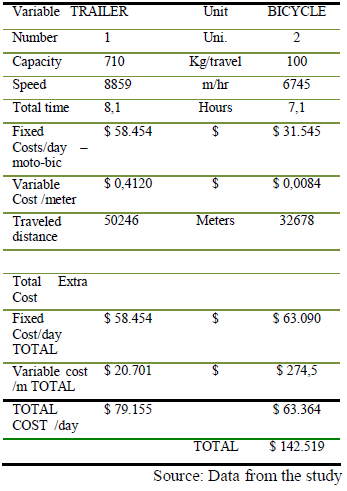
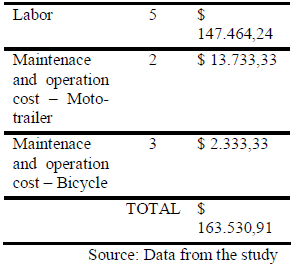
<body><![CDATA[<br>   <img src="/img/revistas/dyna/v77n163/a23tab07.gif"></p>     <p align="center"><font size="2" face="Verdana, Arial, Helvetica, sans-serif"><b><a name="tab08"></a>Table 8 :</b> Routes   programing for the combined system</font>    <br>   <img src="/img/revistas/dyna/v77n163/a23tab08.gif"></p>     <p><font size="2" face="Verdana, Arial, Helvetica, sans-serif">The consolidated result for the different systems   (scenario) is posted in <a href="#tab09">table 9</a>. In this table it is possible to observe that   the more economical system is the one using only moto-tr&aacute;iler. Considering that with   this of transportation the occupancy level is 93% and the utilization is 72%   this method should be used if the demand increases. The previous analysis indicates   that the moto-traier has a high potentiality due to the lower operation   costs. In the other hand, this type of transpot has a social impact since that   this system requires two people what means generating a new job in the region.   Also, through this it is possible to achieve the requirements of the Instituto   Nacional de Vigilancia de Medicamentos y Alimentos (INVIMA) for the handling and transportation of edible goods).</font></p>     <p align="center"><font size="2" face="Verdana, Arial, Helvetica, sans-serif"><b><a name="tab09"></a>Table 9.</b> Comparison between the three systems</font>    <br>   <img src="/img/revistas/dyna/v77n163/a23tab09.gif"></p>     <p><font size="2" face="Verdana, Arial, Helvetica, sans-serif">In order to compare the actual situation and because   cheese companies do not use information system, so the information about   transportation cost is uncompleted and no precise, the transport cost were   stimated using data from the CDA under the assumption that there are two people   working in every moto-trailer and three people in every bicycle. Those person are dedicated exclusively to the supply goods   transport. <a href="#tab10">Table 10</a> show such costs.</font></p>     <p align="center"><font size="2" face="Verdana, Arial, Helvetica, sans-serif"><b><a name="tab10"></a>Table 10 :</b> Estimated   transport cost. Cheese company</font>    <br>   <img src="/img/revistas/dyna/v77n163/a23tab10.gif"></p>     <p><font size="2" face="Verdana, Arial, Helvetica, sans-serif">Just for comparing effects, it is assumed a   conservative scenario about the labor force, assuming that they only dedicate   75% of the time in the goods distribution what means a daily cost of   $122.648/day, what is a significant saving. </font></p>     ]]></body>
<body><![CDATA[<p><font size="2" face="Verdana, Arial, Helvetica, sans-serif">Comparing this result with the more economical   situation using the saving method integrated to VMI practices or continue supply and with a daily deliver, the cost for the   distribution is $24.610/day. For 330 days of annual labor, the saving is around   8 million pesos.</font></p>     <p>&nbsp;</p>     <p><font size="3" face="Verdana, Arial, Helvetica, sans-serif"><b>8. CONCLUSIONS </b></font></p>     <p><font size="2" face="Verdana, Arial, Helvetica, sans-serif">The most important aspect of this work have been to determine the basic information that will   be useful for the future works that these companies should implement in order   to increase their competitiveness and sustainability in the market. This way it   is shown the advantages of applying accepted tools for the supply chain   management and start eliminating the empirical methods that these companies still   use, which are really insufficient in the recent competence environment</font></p>     <p><font size="2" face="Verdana, Arial, Helvetica, sans-serif">There was applied a technological tool to evaluate the   use of an heuristics as the Clarke and Wright method   to determine how the routes should be in this city. Results show that comparing   the results with this new tool comparing with the empirical one used in this   sub-sector the savings are great. This new system allows bakeries to have a   continuous supply which helps to eliminate high inventory levels and in this   way, reducing the problems associated to not to have the right facilities to   stoking such goods, what is a common aspect in this sub-industry as noted in   the characterization study.</font></p>     <p>&nbsp;</p>     <p><font size="3" face="Verdana, Arial, Helvetica, sans-serif"><b>REFERENCES</b></font></p>     <!-- ref --><p><font size="2" face="Verdana, Arial, Helvetica, sans-serif"><b>&#91;1&#93;</b> HEMMELMAYR, V.; DOERNER, K., RICHARD F. HARTL. A variable neighborhood search heuristic for periodic routing problems. European Journal of Operational Research 195 (2009) 791-802.     &nbsp;&nbsp;&nbsp;&nbsp;&nbsp;&nbsp;&nbsp;&nbsp;[&#160;<a href="javascript:void(0);" onclick="javascript: window.open('/scielo.php?script=sci_nlinks&ref=000140&pid=S0012-7353201000030002300001&lng=','','width=640,height=500,resizable=yes,scrollbars=1,menubar=yes,');">Links</a>&#160;]<!-- end-ref --><!-- ref --><br>   <b>&#91;2&#93;</b> NABILA AZI, MICHEL GENDREAU, JEAN-YVES POTVIN. An exact algorithm for a single-vehicle routing problem with time windows and multiple routes. European Journal of Operational Research 178 (2007) 755-766.     &nbsp;&nbsp;&nbsp;&nbsp;&nbsp;&nbsp;&nbsp;&nbsp;[&#160;<a href="javascript:void(0);" onclick="javascript: window.open('/scielo.php?script=sci_nlinks&ref=000141&pid=S0012-7353201000030002300002&lng=','','width=640,height=500,resizable=yes,scrollbars=1,menubar=yes,');">Links</a>&#160;]<!-- end-ref --><!-- ref --><br>   <b>&#91;3&#93;</b> TAILLARD, G. LAPORTE, M. GENDREAU. Vehicle routing with multiple use of vehicles, Journal of the Operational Research Society 47 (1996) 1065-1070.     &nbsp;&nbsp;&nbsp;&nbsp;&nbsp;&nbsp;&nbsp;&nbsp;[&#160;<a href="javascript:void(0);" onclick="javascript: window.open('/scielo.php?script=sci_nlinks&ref=000142&pid=S0012-7353201000030002300003&lng=','','width=640,height=500,resizable=yes,scrollbars=1,menubar=yes,');">Links</a>&#160;]<!-- end-ref --><!-- ref --><br>   <b>&#91;4&#93;</b> CAMPBELL, M. SAVELSBERGH. Efficient insertion heuristics for vehicle routing and scheduling problems, Transportation Science 38 (2004) 369-378.     &nbsp;&nbsp;&nbsp;&nbsp;&nbsp;&nbsp;&nbsp;&nbsp;[&#160;<a href="javascript:void(0);" onclick="javascript: window.open('/scielo.php?script=sci_nlinks&ref=000143&pid=S0012-7353201000030002300004&lng=','','width=640,height=500,resizable=yes,scrollbars=1,menubar=yes,');">Links</a>&#160;]<!-- end-ref --><!-- ref --><br>   <b>&#91;5&#93;</b> CAMPBELL, M. SAVELSBERGH. Decision support for consumer direct grocery initiatives, Transportation Science 39 (2005) 313-327.     &nbsp;&nbsp;&nbsp;&nbsp;&nbsp;&nbsp;&nbsp;&nbsp;[&#160;<a href="javascript:void(0);" onclick="javascript: window.open('/scielo.php?script=sci_nlinks&ref=000144&pid=S0012-7353201000030002300005&lng=','','width=640,height=500,resizable=yes,scrollbars=1,menubar=yes,');">Links</a>&#160;]<!-- end-ref --><!-- ref --><br>   <b>&#91;6&#93;</b> SOLOMON, M. Algorithms for the vehicle routing and scheduling problem with time window constraints, Operations Research 35 (1987) 254-265. </font>&nbsp;&nbsp;&nbsp;&nbsp;&nbsp;&nbsp;&nbsp;&nbsp;[&#160;<a href="javascript:void(0);" onclick="javascript: window.open('/scielo.php?script=sci_nlinks&ref=000145&pid=S0012-7353201000030002300006&lng=','','width=640,height=500,resizable=yes,scrollbars=1,menubar=yes,');">Links</a>&#160;]<!-- end-ref --> ]]></body><back>
<ref-list>
<ref id="B1">
<label>1</label><nlm-citation citation-type="journal">
<person-group person-group-type="author">
<name>
<surname><![CDATA[HEMMELMAYR]]></surname>
<given-names><![CDATA[V.]]></given-names>
</name>
<name>
<surname><![CDATA[DOERNER]]></surname>
<given-names><![CDATA[K.]]></given-names>
</name>
<name>
<surname><![CDATA[RICHARD]]></surname>
<given-names><![CDATA[F. HARTL]]></given-names>
</name>
</person-group>
<article-title xml:lang="en"><![CDATA[A variable neighborhood search heuristic for periodic routing problems]]></article-title>
<source><![CDATA[European Journal of Operational Research]]></source>
<year>2009</year>
<numero>195</numero>
<issue>195</issue>
<page-range>791-802</page-range></nlm-citation>
</ref>
<ref id="B2">
<label>2</label><nlm-citation citation-type="journal">
<person-group person-group-type="author">
<name>
<surname><![CDATA[AZI]]></surname>
<given-names><![CDATA[NABILA]]></given-names>
</name>
<name>
<surname><![CDATA[GENDREAU]]></surname>
<given-names><![CDATA[MICHEL]]></given-names>
</name>
<name>
<surname><![CDATA[POTVIN]]></surname>
<given-names><![CDATA[JEAN-YVES]]></given-names>
</name>
</person-group>
<article-title xml:lang="en"><![CDATA[An exact algorithm for a single-vehicle routing problem with time windows and multiple routes]]></article-title>
<source><![CDATA[European Journal of Operational Research]]></source>
<year>2007</year>
<numero>178</numero>
<issue>178</issue>
<page-range>755-766</page-range></nlm-citation>
</ref>
<ref id="B3">
<label>3</label><nlm-citation citation-type="journal">
<person-group person-group-type="author">
<name>
<surname><![CDATA[TAILLARD]]></surname>
<given-names><![CDATA[G.]]></given-names>
</name>
<name>
<surname><![CDATA[LAPORTE]]></surname>
<given-names><![CDATA[M. GENDREAU]]></given-names>
</name>
</person-group>
<article-title xml:lang="en"><![CDATA[Vehicle routing with multiple use of vehicles]]></article-title>
<source><![CDATA[Journal of the Operational Research Society]]></source>
<year>1996</year>
<volume>47</volume>
<page-range>1065-1070</page-range></nlm-citation>
</ref>
<ref id="B4">
<label>4</label><nlm-citation citation-type="journal">
<person-group person-group-type="author">
<name>
<surname><![CDATA[CAMPBELL]]></surname>
<given-names><![CDATA[M. SAVELSBERGH]]></given-names>
</name>
</person-group>
<article-title xml:lang="en"><![CDATA[Efficient insertion heuristics for vehicle routing and scheduling problems]]></article-title>
<source><![CDATA[Transportation Science]]></source>
<year>2004</year>
<volume>38</volume>
<page-range>369-378</page-range></nlm-citation>
</ref>
<ref id="B5">
<label>5</label><nlm-citation citation-type="journal">
<person-group person-group-type="author">
<name>
<surname><![CDATA[CAMPBELL]]></surname>
<given-names><![CDATA[M. SAVELSBERGH]]></given-names>
</name>
</person-group>
<article-title xml:lang="en"><![CDATA[Decision support for consumer direct grocery initiatives]]></article-title>
<source><![CDATA[Transportation Science]]></source>
<year>2005</year>
<numero>39</numero>
<issue>39</issue>
<page-range>313-327</page-range></nlm-citation>
</ref>
<ref id="B6">
<label>6</label><nlm-citation citation-type="journal">
<person-group person-group-type="author">
<name>
<surname><![CDATA[SOLOMON]]></surname>
<given-names><![CDATA[M.]]></given-names>
</name>
</person-group>
<article-title xml:lang="en"><![CDATA[Algorithms for the vehicle routing and scheduling problem with time window constraints]]></article-title>
<source><![CDATA[Operations Research]]></source>
<year>1987</year>
<numero>35</numero>
<issue>35</issue>
<page-range>254-265</page-range></nlm-citation>
</ref>
</ref-list>
</back>
</article>