<?xml version="1.0" encoding="ISO-8859-1"?><article xmlns:mml="http://www.w3.org/1998/Math/MathML" xmlns:xlink="http://www.w3.org/1999/xlink" xmlns:xsi="http://www.w3.org/2001/XMLSchema-instance">
<front>
<journal-meta>
<journal-id>0012-7353</journal-id>
<journal-title><![CDATA[DYNA]]></journal-title>
<abbrev-journal-title><![CDATA[Dyna rev.fac.nac.minas]]></abbrev-journal-title>
<issn>0012-7353</issn>
<publisher>
<publisher-name><![CDATA[Universidad Nacional de Colombia]]></publisher-name>
</publisher>
</journal-meta>
<article-meta>
<article-id>S0012-73532010000300024</article-id>
<title-group>
<article-title xml:lang="en"><![CDATA[EFFECT OF PLANAR WEIGHT DISPARITY ON THE CONDUCTIVITY FLUCTUATIONS AND CRITICAL PARAMETERS IN THE RE 0.5Y0.5Ba2Cu3O7-d (RE=Sm, Gd, Dy, Ho, Eu, Yb)]]></article-title>
<article-title xml:lang="es"><![CDATA[EFECTO DE LA DISPARIDAD DE PESO PLANAR SOBRE LAS FLUCTUACIONES DE LA CONDUCTIVIDAD Y LOS PARÁMETROS CRÍTICOS EN EL SUPERCONDUCTOR RE0.5Y0.5Ba2Cu3O7-d (RE=Sm, Gd, Dy, Ho, Eu, Yb)]]></article-title>
</title-group>
<contrib-group>
<contrib contrib-type="author">
<name>
<surname><![CDATA[LANDÍNEZ-TÉLLEZ]]></surname>
<given-names><![CDATA[D. A.]]></given-names>
</name>
<xref ref-type="aff" rid="A01"/>
</contrib>
<contrib contrib-type="author">
<name>
<surname><![CDATA[PEÑA-RODRÍGUEZ]]></surname>
<given-names><![CDATA[G.]]></given-names>
</name>
<xref ref-type="aff" rid="A02"/>
</contrib>
<contrib contrib-type="author">
<name>
<surname><![CDATA[ROA-ROJAS]]></surname>
<given-names><![CDATA[J.]]></given-names>
</name>
<xref ref-type="aff" rid="A03"/>
</contrib>
</contrib-group>
<aff id="A01">
<institution><![CDATA[,Universidad Nacional de Colombia Departamento de Física Grupo de Física de Nuevos Materiales]]></institution>
<addr-line><![CDATA[ ]]></addr-line>
</aff>
<aff id="A02">
<institution><![CDATA[,Universidad Francisco de Paula Santander Grupo de Investigación en Tecnología Cerámica ]]></institution>
<addr-line><![CDATA[ ]]></addr-line>
</aff>
<aff id="A03">
<institution><![CDATA[,Universidad Nacional de Colombia Departamento de Física Grupo de Física de Nuevos Materiales]]></institution>
<addr-line><![CDATA[ ]]></addr-line>
</aff>
<pub-date pub-type="pub">
<day>00</day>
<month>09</month>
<year>2010</year>
</pub-date>
<pub-date pub-type="epub">
<day>00</day>
<month>09</month>
<year>2010</year>
</pub-date>
<volume>77</volume>
<numero>163</numero>
<fpage>234</fpage>
<lpage>238</lpage>
<copyright-statement/>
<copyright-year/>
<self-uri xlink:href="http://www.scielo.org.co/scielo.php?script=sci_arttext&amp;pid=S0012-73532010000300024&amp;lng=en&amp;nrm=iso"></self-uri><self-uri xlink:href="http://www.scielo.org.co/scielo.php?script=sci_abstract&amp;pid=S0012-73532010000300024&amp;lng=en&amp;nrm=iso"></self-uri><self-uri xlink:href="http://www.scielo.org.co/scielo.php?script=sci_pdf&amp;pid=S0012-73532010000300024&amp;lng=en&amp;nrm=iso"></self-uri><abstract abstract-type="short" xml:lang="en"><p><![CDATA[Synthesis and conductivity characterization of the RE0.5Y0.5Ba2Cu3O7-d (RE=Sm, Gd, Dy, Ho, Eu, Yb) superconducting materials are reported. Samples were produced by the standard solid state reaction method. Rietveld-like refinement of x-ray diffraction data permit to establish the crystalline appropriated distribution of rare earth and yttrium to create substantial planar weight disparity (PWD) in alternating layers. DC resistivity measurements reveal the improvement of the critical temperature (Tc) when substitution of exact 50-50 mix of rare earth (Sm, Gd, Dy, Ho, Eu, Yb) and Yttrium is performed. A bulk Tc &#8776; 94.3 K was determined by the criterion of the maximum in the temperature derivative of electrical resistivity for the analyzed samples. The correlations of the critical exponents with the dimensionality of the fluctuation system for each Gaussian regime were performed by using the Aslamazov-Larkin theory. The genuinely critical exponent is interpreted by the 3D-XY model as corresponding with the dynamical universality class of the E-model.]]></p></abstract>
<abstract abstract-type="short" xml:lang="es"><p><![CDATA[En el presente artículo se reporta la síntesis y caracterización de la conductividad del material superconductor RE0.5Y0.5Ba2Cu3O7-d (RE=Sm, Gd, Dy, Ho, Eu, Yb). Las muestras fueron producidas mediante la técnica estándar de reacción de estado sólido. El refinamiento Rietveld de los datos de difracción de rayos x permitió establecer la apropiada distribución cristalina de las tierras raras y del Ytrio para crear el efecto de disparidad de peso planar (PWD) en forma de capas alternadas. Mediciones de resistividad DC mostraron que la temperatura crítica (Tc) aumenta sustancialmente cuando se sustituye en proporciones exactas 50-50 de tierra rara (Sm, Gd, Dy, Ho, Eu, Yb) e Ytrio. Se determine una temperatura crítica volumétrica Tc &#8776; 94.3 K mediante el criterio del máximo en la derivada numérica de la resistividad eléctrica con respecto a la temperatura para las muestras en estudio. La correlación de los exponents críticos con la dimensionalidad de los sistemas de fluctuaciones para cada régimen Gaussiano se establecieron por medio de la teoría de Aslamazov-Larkin. Los exponentes genuinamente críticos se interpretaron mediante el modelo 3D-XY de modo que corresponden a la clase de universalidad dinámica predicha por el modelo E.]]></p></abstract>
<kwd-group>
<kwd lng="en"><![CDATA[Superconductivity]]></kwd>
<kwd lng="en"><![CDATA[planar weight disparity]]></kwd>
<kwd lng="en"><![CDATA[rare earth substitution]]></kwd>
<kwd lng="en"><![CDATA[conductivity fluctuations]]></kwd>
<kwd lng="es"><![CDATA[Superconductividad]]></kwd>
<kwd lng="es"><![CDATA[disparidad de peso planar]]></kwd>
<kwd lng="es"><![CDATA[sustitución de tierras raras]]></kwd>
<kwd lng="es"><![CDATA[fluctuaciones en la conductividad]]></kwd>
</kwd-group>
</article-meta>
</front><body><![CDATA[ <p align="center"><font size="4" face="Verdana, Arial, Helvetica, sans-serif"><b>EFFECT OF PLANAR WEIGHT DISPARITY ON THE CONDUCTIVITY FLUCTUATIONS AND   CRITICAL PARAMETERS IN THE RE <sub>0.5</sub>Y<sub>0.5</sub>Ba<sub>2</sub>Cu<sub>3</sub>O<sub>7-<font face="Symbol">d</font></sub> (RE=Sm, Gd, Dy, Ho, Eu, Yb) </b></font></p>     <p align="center"><i><font size="3"><b><font face="Verdana, Arial, Helvetica, sans-serif">EFECTO DE LA DISPARIDAD DE PESO   PLANAR SOBRE LAS FLUCTUACIONES DE LA CONDUCTIVIDAD Y LOS PAR&Aacute;METROS CR&Iacute;TICOS EN EL   SUPERCONDUCTOR RE<sub>0.5</sub>Y<sub>0.5</sub>Ba<sub>2</sub>Cu<sub>3</sub>O<sub>7-<font face="Symbol">d</font></sub> (RE=Sm, Gd, Dy, Ho, Eu, Yb) </font></b></font></i></p>     <p align="center">&nbsp;</p>     <p align="center"><font size="2" face="Verdana, Arial, Helvetica, sans-serif"><b>D. A.   LAND&Iacute;NEZ-T&Eacute;LLEZ</b>    <br>   </font><font size="2" face="Verdana, Arial, Helvetica, sans-serif"><i>Grupo de F&iacute;sica de Nuevos Materiales, Departamento de   F&iacute;sica, Universidad Nacional de Colombia, <a href="mailto:dalandinezt@unal.edu.co">dalandinezt@unal.edu.co</a></i></font></p>     <p align="center"><font size="2" face="Verdana, Arial, Helvetica, sans-serif"><b>G. PEÑA-RODR&Iacute;GUEZ</b>    <br>   </font><font size="2" face="Verdana, Arial, Helvetica, sans-serif"><i>Grupo de Investigaci&oacute;n en   Tecnolog&iacute;a Cer&aacute;mica, Universidad Francisco de Paula Santander, <a href="mailto:ggabrielp@yahoo.com">ggabrielp</a></i><a href="mailto:ggabrielp@yahoo.com">@<i>yahoo.com</i></a></font></p>     <p align="center"><font size="2" face="Verdana, Arial, Helvetica, sans-serif"> <b>J. ROA-ROJAS</b>    <br>   </font><font size="2" face="Verdana, Arial, Helvetica, sans-serif"><i>Grupo de F&iacute;sica   de Nuevos Materiales, Departamento de F&iacute;sica, Universidad Nacional de Colombia, <a href="mailto:jroar@unal.edu.co">jroar@unal.edu.co</a></i></font></p>     <p align="center">&nbsp;</p>     ]]></body>
<body><![CDATA[<p align="center"><font size="2" face="Verdana, Arial, Helvetica, sans-serif"><b>Received for review August 28<sup>th</sup>, 2009, accepted December 18<sup>th</sup>, 2009, final version January,   27<sup>th</sup>, 2010</b></font></p>     <p>&nbsp;</p> <hr>     <p><font size="2" face="Verdana, Arial, Helvetica, sans-serif"><b>ABSTRACT: </b>Synthesis and conductivity characterization of the RE<sub>0.5</sub>Y<sub>0.5</sub>Ba<sub>2</sub>Cu<sub>3</sub>O<sub>7-<font face="Symbol">d</font></sub> (RE=Sm, Gd, Dy,   Ho, Eu, Yb) superconducting   materials are reported. Samples were   produced by the standard solid state reaction method. Rietveld-like   refinement of x-ray diffraction data permit to establish the crystalline   appropriated distribution of rare earth and yttrium to create substantial   planar weight disparity (PWD) in alternating layers. DC resistivity measurements reveal the   improvement of the critical temperature (T<sub>c</sub>)   when substitution of exact 50-50 mix of rare earth (Sm,   Gd, Dy, Ho, Eu, Yb) and Yttrium is   performed. A bulk <i>T<sub>c</sub></i> &asymp; 94.3 K was determined by the criterion of the maximum in the   temperature derivative of electrical resistivity for the analyzed samples. The correlations of the critical exponents   with the dimensionality of the fluctuation system for each Gaussian regime were   performed by using the Aslamazov-Larkin theory. The genuinely critical exponent is   interpreted by the 3D-XY model as corresponding with the dynamical universality   class of the E-model.</font></p>     <p><font size="2" face="Verdana, Arial, Helvetica, sans-serif"><b>KEYWORDS: </b>Superconductivity;   planar weight disparity; rare earth substitution; conductivity fluctuations </font></p>     <p><font size="2" face="Verdana, Arial, Helvetica, sans-serif"><b>RESUMEN: </b>En   el presente art&iacute;culo se reporta la s&iacute;ntesis y caracterizaci&oacute;n de la   conductividad del material superconductor RE<sub>0.5</sub>Y<sub>0.5</sub>Ba<sub>2</sub>Cu<sub>3</sub>O<sub>7-<font face="Symbol">d</font></sub> (RE=Sm, Gd, Dy, Ho,   Eu, Yb). Las muestras fueron producidas   mediante la t&eacute;cnica est&aacute;ndar de reacci&oacute;n de estado s&oacute;lido. El refinamiento Rietveld de los datos de difracci&oacute;n de rayos x permiti&oacute; establecer la apropiada   distribuci&oacute;n cristalina de las tierras raras y del Ytrio para crear el efecto   de disparidad de peso planar (PWD) en forma de capas   alternadas. Mediciones de resistividad   DC mostraron que la temperatura cr&iacute;tica (T<sub>c</sub>) aumenta sustancialmente   cuando se sustituye en proporciones exactas 50-50 de tierra rara (Sm, Gd, Dy,   Ho, Eu, Yb) e Ytrio. Se determine una temperatura   cr&iacute;tica volum&eacute;trica <i>T<sub>c</sub></i> &asymp; 94.3 K mediante el criterio   del m&aacute;ximo en la derivada num&eacute;rica de la resistividad el&eacute;ctrica con respecto a   la temperatura para las muestras en estudio. La correlaci&oacute;n de los exponents cr&iacute;ticos con   la dimensionalidad de los sistemas de fluctuaciones para cada r&eacute;gimen Gaussiano se establecieron por medio de la teor&iacute;a de Aslamazov-Larkin. Los   exponentes genuinamente cr&iacute;ticos se interpretaron mediante el modelo 3D-XY de   modo que corresponden a la clase de universalidad din&aacute;mica predicha por el modelo   E.</font></p>     <p><font size="2" face="Verdana, Arial, Helvetica, sans-serif"><b>PALABRAS CLAVE:</b> Superconductividad; disparidad de peso planar; sustituci&oacute;n   de tierras raras; fluctuaciones en la conductividad</font></p> <hr>     <p>&nbsp;</p>     <p><font size="3" face="Verdana, Arial, Helvetica, sans-serif"><b>1. INTRODUCTION </b></font></p>     <p><font size="2" face="Verdana, Arial, Helvetica, sans-serif">Since the discovery of YBCO in 1987 &#91;1&#93;, several substitutions in   different sites on the YBa<sub>2</sub>Cu<sub>3</sub>O<sub>7-<font face="Symbol">d</font></sub> compound have been made. Specially the substitution of Yttrium by trivalent   rare-earth elements yields a <i>T<sub>c</sub></i> similar to the YBa<sub>2</sub>Cu<sub>3</sub>O<sub>7-<font face="Symbol">d</font></sub> &#91;2,3&#93; An exact 50-50 mix of Yttrium and a heavy rare earth has   been found to significantly improve <i>T<sub>c</sub></i> in the Lu<sub>0.5</sub>Y<sub>0.5</sub>Ba<sub>2</sub>Cu<sub>3</sub>O<sub>7-<font face="Symbol">d</font></sub> by creating substantial planar weight disparity in alternating layers, which   has previously been found to increase <i>T<sub>c</sub></i>.   in copper-oxide superconductors &#91;3&#93;.</font></p>     <p><font size="2" face="Verdana, Arial, Helvetica, sans-serif">The paraconductivity of the Aslamazov-Larkin (AL) type in the normal state, close to <i>T<sub>c</sub></i>. &#91;4&#93;, follows a quasi-universal   behavior, which is strongly related with Gaussian and genuinely critical   fluctuations. Below <i>T<sub>c</sub></i>, close to   zero resistance state, the fluctuation effects are enhanced by the   granular-like disorder. The aim of this   work is to study the fluctuation effects above <i>T<sub>c</sub></i> in the perovskite-like RE<sub>0.5</sub>Y<sub>0.5</sub>Ba<sub>2</sub>Cu<sub>3</sub>O<sub>7-<font face="Symbol">d</font></sub> (RE=Sm, Gd, Dy, Ho, Eu, Yb)   superconducting system with planar weight disparity. In order to analyze the paraconductivity, we use the concept of logarithmic   derivative of the conductivity excess. From analysis of experimental data, we identify the critical regimes   near <i>T<sub>c</sub></i> in the normal state.</font></p>     ]]></body>
<body><![CDATA[<p>&nbsp;</p>     <p><font size="3" face="Verdana, Arial, Helvetica, sans-serif"><b>2. EXPERIMENTAL</b></font></p>     <p><font size="2" face="Verdana, Arial, Helvetica, sans-serif">Polycrystalline samples of RE<sub>0.5</sub>Y<sub>0.5</sub>Ba<sub>2</sub>Cu<sub>3</sub>O<sub>7-<font face="Symbol">d</font></sub> (RE=Sm, Gd, Dy, Ho, Eu, Yb)   were synthesized by means the standard solid state reaction technique. The   precursor powders were RE<sub>2</sub>O<sub>3</sub>, barium carbonate, yttrium   and copper oxides. The mixed powders pressed in disk-shaped pellets were   annealed at    910 °C   for 24 hours. The samples were then grinded and pelletized for sintering at 910 °C during 12   hours. Finally, these pellets were heated at 450 °C in flowing   oxygen for 24 hours.</font></p>     <p><font size="2" face="Verdana, Arial, Helvetica, sans-serif">Resistivity measurements   were carried out by the four-probe method, using the Keithley   2182A nanovoltmeter and 6221 current source in delta   mode, and electric contacts by spring-loaded contact gold pins, allowing   reaching a lecture about 10 n<font face="Symbol">W</font> I n the superconductor state.</font></p>     <p><font size="2" face="Verdana, Arial, Helvetica, sans-serif">X-Ray diffraction analyses   were made by means Phillips PW1710 diffractometer   with copper radiation wavelengths l=1.54064 Å. X-Ray diffraction results indicated the formation of the orthorhombic structure   when Yttrium is partially substituted with trivalent rare-earths. For the Yb<sub>0.5</sub>Y<sub>0.5</sub>Ba<sub>2</sub>Cu<sub>3</sub>O<sub>7-<font face="Symbol">d</font></sub> a little fraction of BaCuO<sub>2</sub> was formed. This content phase cannot be   reduced by solid-state reaction &#91;5&#93;.</font></p>     <p>&nbsp;</p>     <p><font size="3" face="Verdana, Arial, Helvetica, sans-serif"><b>3. ANALYSIS METHOD</b></font></p>     <p><font size="2" face="Verdana, Arial, Helvetica, sans-serif">The analysis of results for   the fluctuation contribution on electrical conductivity is performed by   assuming that the conductivity excess is given by &#91;6&#93;:</font></p>     <p><img src="/img/revistas/dyna/v77n163/a24eq01.gif"></p>     <p><font size="2" face="Verdana, Arial, Helvetica, sans-serif">where <i>s</i> (<i>T</i>) = 1/<i>r</i> (<i>T</i>) is the measured conductivity and <i>s<sub>R</sub></i> (<i>T</i>)   = 1/<i>r<sub>R</sub></i> (<i>T</i>)   is the regular </font><font size="2" face="Verdana, Arial, Helvetica, sans-serif">term extrapolated from the resistivity curve in   the normal region. According to the Aslamazov-Larkin   proposal &#91;4&#93;, the fluctuation conductivity diverges as a power law of the type</font></p>     ]]></body>
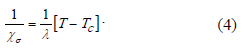
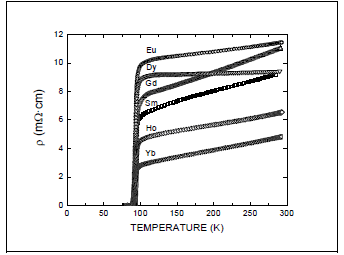
<body><![CDATA[<p><img src="/img/revistas/dyna/v77n163/a24eq02.gif"></p>     <p><font size="2" face="Verdana, Arial, Helvetica, sans-serif">where <i>A</i> is a constant, <i>e</i> = (<i>T-T<sub>c</sub></i>)/<i>T<sub>c</sub></i> represent the reduced temperature and <font face="Symbol">l</font> is the critical exponent. Analogously to the Kouvel-Fisher   method of analysis of critical phenomena &#91;7&#93;, the logarithmic temperature   derivative of <font face="Symbol">D</font>s is given by <font face="Symbol">d</font>Ln(<font face="Symbol">Ds</font>). Then, the inverse of logarithmic temperature   derivative is defined as</font></p>     <p><img src="/img/revistas/dyna/v77n163/a24eq03.gif"></p>     <p><font size="2" face="Verdana, Arial, Helvetica, sans-serif">By substituting equation (2) in (3) it is   obtained that</font></p>     <p><img src="/img/revistas/dyna/v77n163/a24eq04.gif"></p>     <p><font size="2" face="Verdana, Arial, Helvetica, sans-serif">Thus, simple identification of linear   temperature behavior in plots of &#967;<sub>&#963;</sub><sup>-1</sup> as a   function of temperature allow   simultaneous determination of critical temperature <i>T<sub>c</sub></i> of fluctuation regime and the corresponding critical exponent <font face="Symbol">l</font>. We notice   that the bulk T<sub>c</sub> values obtained from   derivative method approximately correspond to the extrapolation of the linear c<sub>s</sub>(<i>T</i>) <sup>-1</sup> for the genuine critical regime.</font></p>     <p>&nbsp;</p>     <p><font size="3" face="Verdana, Arial, Helvetica, sans-serif"><b>4. RESULTS AND DISCUSSION</b></font></p>     <p><font size="2" face="Verdana, Arial, Helvetica, sans-serif">In <a href="#fig01">figure 1</a>, we show the characteristic   electrical resistivity <font face="Symbol">r</font>(T) for the RE<sub>0.5</sub>Y<sub>0.5</sub>Ba<sub>2</sub>Cu<sub>3</sub>O<sub>7-<font face="Symbol">d</font></sub> (RE=Sm, Gd, Dy, Ho, Eu, Yb)   material. In the normal state, all samples have a metallic-like behavior,   except for the Dy<sub>0.5</sub>Y<sub>0.5</sub>Ba<sub>2</sub>Cu<sub>3</sub>O<sub>7-<font face="Symbol">d</font></sub>.   This feature indicates that the synthesis process could be generates   granularity differences, which enhance some substitutions more than others.</font></p>     <p align="center"><font size="2" face="Verdana, Arial, Helvetica, sans-serif"><b><a name="fig01"></a><img src="/img/revistas/dyna/v77n163/a24fig01.gif">    ]]></body>
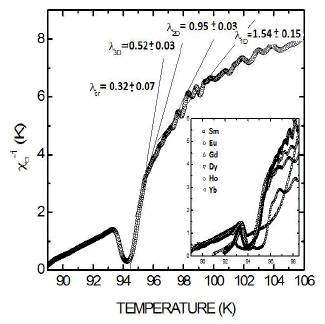
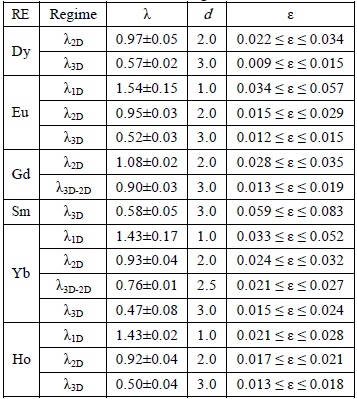
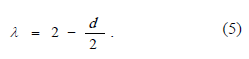
<body><![CDATA[<br>   Figure   1.</b> Electrical   resistivity <font face="Symbol">r</font>(T) for the series of RE<sub>0.5</sub>Y<sub>0.5</sub>Ba<sub>2</sub>Cu<sub>3</sub>O<sub>7-<font face="Symbol">d</font></sub> (RE=Sm, Gd, Dy, Ho, Eu, Yb)   samples as a function of temperature</font></p>     <p><font size="2" face="Verdana, Arial, Helvetica, sans-serif">From the temperature derivative of <font face="Symbol">r</font>(T) in the transition region we calculated the bulk <i>T<sub>c</sub></i> values. The critical temperatures are   distributed around a mean value of <i>T<sub>c</sub></i>.=94.28±0.46 K. </font></p>     <p><font size="2" face="Verdana, Arial, Helvetica, sans-serif"><a href="#fig02">Figure 2</a>, shows the fluctuation regimes   above <i>T<sub>c</sub>. </i>The &#967;<sub>&#963;</sub><sup>-1</sup> curves overlapping around <i>T<sub>c</sub></i>,   except for Sm<sub>0.5</sub>Y<sub>0.5</sub>Ba<sub>2</sub>Cu<sub>3</sub>O<sub>7-<font face="Symbol">d</font></sub> and Gd<sub>0.5</sub>Y<sub>0.5</sub>Ba<sub>2</sub>Cu<sub>3</sub>O<sub>7-<font face="Symbol">d</font></sub> above <i>T<sub>c</sub></i>.</font></p>     <p align="center"><font size="2" face="Verdana, Arial, Helvetica, sans-serif"><b><a name="fig02" id="fig02"></a><img src="/img/revistas/dyna/v77n163/a24fig02.gif">    <br>   Figure   2.</b> Fluctuation   regimes identified in &#967;<sub>&#963;</sub><sup>-1</sup> as a function of   temperature for the Eu<sub>0.5</sub>Y<sub>0.5</sub>Ba<sub>2</sub>Cu<sub>3</sub>O<sub>7-<font face="Symbol">d</font></sub> sample. The inset show &#967;<sub>&#963;</sub><sup>-1</sup> as a function of <i>T </i>for others rare earths substitutions</font></p>     <p><font size="2" face="Verdana, Arial, Helvetica, sans-serif">Three Gaussian fluctuations regions were   identified in Ho, Yb, Eu   substitutions, which were labeled <font face="Symbol">l</font><i><sub>3D</sub></i>, <font face="Symbol">l</font><i><sub>2D</sub></i> and <font face="Symbol">l</font><i><sub>3D-2D</sub></i>.   For Dy and Gd substitutions   only two Gaussian regimes could be found and only 3D regime for the Sm substitution. We interpreted the characteristic regimes   on the basis of the Aslamazov-Larkin theory &#91;4&#93;,   which proposes that the critical exponents are related with the dimensionality <i>d</i> of the fluctuation system, through the expression: </font></p>     <p><img src="/img/revistas/dyna/v77n163/a24eq05.gif"></p>     <p><font size="2" face="Verdana, Arial, Helvetica, sans-serif">The <font face="Symbol">l</font><i><sub>2D</sub> </i>and <font face="Symbol">l</font><i><sub>3D</sub> </i>exponents correspond to homogeneous 2D and 3D regimes. As showed in <a href="#tab01">table   I</a>, the exponent <font face="Symbol">l</font><i><sub>3D-2D</sub> </i>do not correspond to an integer   dimensionality. It was demonstrated by Char and Kapitulnik   &#91;8&#93;, using an expression similar to Eq. (5) in the framework of a topological   fractal space. A region with <font face="Symbol">l</font><i><sub>1D</sub></i> exponent was observed for RE=Eu, Sm, Yb and Ho. This regime is related with   fluctuations develop in the 1D space.</font></p>     <p align="center"><font size="2" face="Verdana, Arial, Helvetica, sans-serif"><b><a name="tab01"></a>Table 1.</b> Gaussian <font face="Symbol">l</font><i><sub>1D</sub></i>, <font face="Symbol">l</font><i><sub>2D</sub></i> and <font face="Symbol">l</font><i><sub>3D</sub></i> exponents,   dimensionalities <i>d</i> and reduced   temperature e for fluctuation regimes</font>    <br>   <img src="/img/revistas/dyna/v77n163/a24tab01.gif"></p>     ]]></body>
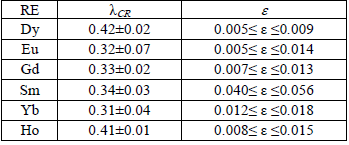
<body><![CDATA[<p><font size="2" face="Verdana, Arial, Helvetica, sans-serif">Closer to <i>T<sub>c</sub>,</i> a fourth power law region is observed in <a href="#fig02">figure 2</a>, identifies by the exponent <font face="Symbol">l</font><i><sub>CR</sub></i>. This regime corresponds to   genuine critical fluctuations, which were predicted to occur by Lobb &#91;9&#93;. The values of <font face="Symbol">l</font><i><sub>CR</sub></i> are presented in <a href="#tab02">Table II</a>. The genuine critical regime is expected to be   described by the 3D-XY model &#91;10&#93;, which predicts a critical exponent l<sub>cr</sub> = 0,33. According to the experimental precision of   the critical exponents values listed in the <a href="#tab02">table II</a>, the exponents 0,42 ± 0,02 (Dy sample)   and 0,41 ± 0,01 (Ho sample) cannot be considered as critical   exponent values.</font></p>     <p align="center"><font size="2" face="Verdana, Arial, Helvetica, sans-serif"><b><a name="tab02"></a>Tabla 2. </b>Exponentes cr&iacute;ticos y temperatura reducida para el   r&eacute;gimen de fluctuaciones genuinamente cr&iacute;tico</font>    <br>   <img src="/img/revistas/dyna/v77n163/a24tab02.gif"></p>     <p>&nbsp;</p>     <p><font size="3" face="Verdana, Arial, Helvetica, sans-serif"><b>5. CONCLUSION</b></font></p>     <p><font size="2" face="Verdana, Arial, Helvetica, sans-serif">We performed conductivity fluctuation   analysis in the RE<sub>0.5</sub>Y<sub>0.5</sub>Ba<sub>2</sub>Cu<sub>3</sub>O<sub>7-<font face="Symbol">d</font></sub> (Sm, Eu, Gd, Dy, Ho, Yb)   high temperature superconducting materials. Close and above <i>T<sub>c</sub></i> the analysis reveals the occurrence of critical and Gaussian fluctuation   regimes. We interpret Gaussian regions as corresponding to fluctuations which   occurs in 3D, 2D and 1D. Another   intermediated regime was identified for the cases when rare earth is Gd and Yb. This is related with   fluctuations which develop in spaces with fractal topology between three and   two dimensionalities. The genuinely critical exponent is interpreted by the   3D-XY model. The critical temperatures   has a mean value of <i>T<sub>c</sub></i>.=94.28±0.46 K. For   some doping rare earths like Sm and Gd, the &#967;<sub>&#963;</sub><sup>-1</sup> curve diverges   from the potential behavior. We attribute this characteristic to the   requirement that every used rare-earth for doping the YBCO needs their own   thermal synthesis process to reach the   single phase and optimal granularity.</font></p>     <p>&nbsp;</p>     <p><font size="3" face="Verdana, Arial, Helvetica, sans-serif"><b>6.   ACKNOWLEDGMENTS</b></font></p>     <p><font size="2" face="Verdana, Arial, Helvetica, sans-serif">This work was   partially supported by the Divisi&oacute;n de Investigaciones Sede Bogot&aacute;   (DIB).</font></p>     <p>&nbsp;</p>     ]]></body>
<body><![CDATA[<p><font size="3" face="Verdana, Arial, Helvetica, sans-serif"><b>REFERENCIAS</b></font></p>     <!-- ref --><p><font size="2" face="Verdana, Arial, Helvetica, sans-serif"><b>&#91;1&#93;</b>. M. K. Wu, J. R. Ashburn, C. J. Torng, P. H. Hor, R. L. Meng, L. Gao, Z. J. Huang, Y. Q. Wang and C. W. Chu, Phys. Rev. Lett. 58, 908, (1987).     &nbsp;&nbsp;&nbsp;&nbsp;&nbsp;&nbsp;&nbsp;&nbsp;[&#160;<a href="javascript:void(0);" onclick="javascript: window.open('/scielo.php?script=sci_nlinks&ref=000064&pid=S0012-7353201000030002400001&lng=','','width=640,height=500,resizable=yes,scrollbars=1,menubar=yes,');">Links</a>&#160;]<!-- end-ref --><!-- ref --><br>   <b>&#91;2&#93;</b> P. H. Hor, R. L. Meng, Y. Q. Wang, L. Gao, Z. J. Huang, J. Bechtold, K. Forster, and C. W. Chu, Phys. Rev. Lett. 58, 1891 (1987).     &nbsp;&nbsp;&nbsp;&nbsp;&nbsp;&nbsp;&nbsp;&nbsp;[&#160;<a href="javascript:void(0);" onclick="javascript: window.open('/scielo.php?script=sci_nlinks&ref=000065&pid=S0012-7353201000030002400002&lng=','','width=640,height=500,resizable=yes,scrollbars=1,menubar=yes,');">Links</a>&#160;]<!-- end-ref --><!-- ref --><br>   <b>&#91;3&#93;</b> D. W. Murphy, S. Sunshine, R. B. Van Dover, R. J. Cava, B. Batlogg, S. M. Zahurak, and L. F. Schneemeyer, Phys. Rev. Lett. 58, 1888 (1987).     &nbsp;&nbsp;&nbsp;&nbsp;&nbsp;&nbsp;&nbsp;&nbsp;[&#160;<a href="javascript:void(0);" onclick="javascript: window.open('/scielo.php?script=sci_nlinks&ref=000066&pid=S0012-7353201000030002400003&lng=','','width=640,height=500,resizable=yes,scrollbars=1,menubar=yes,');">Links</a>&#160;]<!-- end-ref --><!-- ref --><br>   <b>&#91;4&#93;</b> L.G. Aslamazov, A.I. Larkin, Sov. Phys. Solid State 10, 875 (1968).     &nbsp;&nbsp;&nbsp;&nbsp;&nbsp;&nbsp;&nbsp;&nbsp;[&#160;<a href="javascript:void(0);" onclick="javascript: window.open('/scielo.php?script=sci_nlinks&ref=000067&pid=S0012-7353201000030002400004&lng=','','width=640,height=500,resizable=yes,scrollbars=1,menubar=yes,');">Links</a>&#160;]<!-- end-ref --><!-- ref --><br>   <b>&#91;5&#93;</b> D. Soh, Z. Fan, Physica C, 337, 292 (2000).     &nbsp;&nbsp;&nbsp;&nbsp;&nbsp;&nbsp;&nbsp;&nbsp;[&#160;<a href="javascript:void(0);" onclick="javascript: window.open('/scielo.php?script=sci_nlinks&ref=000068&pid=S0012-7353201000030002400005&lng=','','width=640,height=500,resizable=yes,scrollbars=1,menubar=yes,');">Links</a>&#160;]<!-- end-ref --><!-- ref --><br>   <b>&#91;6&#93;</b> J. Roa-Rojas, R. Menegotto Costa, P. Pureur, P. Prieto, Phys. Rev. B 61, 12457 (2000).     &nbsp;&nbsp;&nbsp;&nbsp;&nbsp;&nbsp;&nbsp;&nbsp;[&#160;<a href="javascript:void(0);" onclick="javascript: window.open('/scielo.php?script=sci_nlinks&ref=000069&pid=S0012-7353201000030002400006&lng=','','width=640,height=500,resizable=yes,scrollbars=1,menubar=yes,');">Links</a>&#160;]<!-- end-ref --><!-- ref --><br>   <b>&#91;7&#93;</b> J.S. Kouvel, S.E. Fisher, Phys. Rev. A 163, 1626 (1964).     &nbsp;&nbsp;&nbsp;&nbsp;&nbsp;&nbsp;&nbsp;&nbsp;[&#160;<a href="javascript:void(0);" onclick="javascript: window.open('/scielo.php?script=sci_nlinks&ref=000070&pid=S0012-7353201000030002400007&lng=','','width=640,height=500,resizable=yes,scrollbars=1,menubar=yes,');">Links</a>&#160;]<!-- end-ref --><!-- ref --><br>   <b>&#91;8&#93;</b> K. Char, A. Kapitulnik. Z. Phys. B. 72, 253 (1988).     &nbsp;&nbsp;&nbsp;&nbsp;&nbsp;&nbsp;&nbsp;&nbsp;[&#160;<a href="javascript:void(0);" onclick="javascript: window.open('/scielo.php?script=sci_nlinks&ref=000071&pid=S0012-7353201000030002400008&lng=','','width=640,height=500,resizable=yes,scrollbars=1,menubar=yes,');">Links</a>&#160;]<!-- end-ref --><!-- ref --><br>   <b>&#91;9&#93;</b> C. J. Lobb, Phys. Rev. B. 36, 3930 (1987).     &nbsp;&nbsp;&nbsp;&nbsp;&nbsp;&nbsp;&nbsp;&nbsp;[&#160;<a href="javascript:void(0);" onclick="javascript: window.open('/scielo.php?script=sci_nlinks&ref=000072&pid=S0012-7353201000030002400009&lng=','','width=640,height=500,resizable=yes,scrollbars=1,menubar=yes,');">Links</a>&#160;]<!-- end-ref --><!-- ref --><br>   <b>&#91;10&#93;</b> S. K. Ma, Modern Theory of Critical Phenomena (W. A. Benjamin, Reading, Ma, 1976). </font>&nbsp;&nbsp;&nbsp;&nbsp;&nbsp;&nbsp;&nbsp;&nbsp;[&#160;<a href="javascript:void(0);" onclick="javascript: window.open('/scielo.php?script=sci_nlinks&ref=000073&pid=S0012-7353201000030002400010&lng=','','width=640,height=500,resizable=yes,scrollbars=1,menubar=yes,');">Links</a>&#160;]<!-- end-ref --> ]]></body><back>
<ref-list>
<ref id="B1">
<label>1</label><nlm-citation citation-type="journal">
<person-group person-group-type="author">
<name>
<surname><![CDATA[Wu]]></surname>
<given-names><![CDATA[M. K.]]></given-names>
</name>
<name>
<surname><![CDATA[Ashburn]]></surname>
<given-names><![CDATA[J. R.]]></given-names>
</name>
<name>
<surname><![CDATA[Torng]]></surname>
<given-names><![CDATA[C. J.]]></given-names>
</name>
<name>
<surname><![CDATA[Hor]]></surname>
<given-names><![CDATA[P. H.]]></given-names>
</name>
<name>
<surname><![CDATA[Meng]]></surname>
<given-names><![CDATA[R. L.]]></given-names>
</name>
<name>
<surname><![CDATA[Gao]]></surname>
<given-names><![CDATA[L.]]></given-names>
</name>
<name>
<surname><![CDATA[Huang]]></surname>
<given-names><![CDATA[Z. J.]]></given-names>
</name>
<name>
<surname><![CDATA[Wang]]></surname>
<given-names><![CDATA[Y. Q.]]></given-names>
</name>
<name>
<surname><![CDATA[Chu]]></surname>
<given-names><![CDATA[C. W.]]></given-names>
</name>
</person-group>
<source><![CDATA[Phys. Rev. Lett.]]></source>
<year>1987</year>
<numero>58</numero>
<issue>58</issue>
<page-range>908</page-range></nlm-citation>
</ref>
<ref id="B2">
<label>2</label><nlm-citation citation-type="journal">
<person-group person-group-type="author">
<name>
<surname><![CDATA[Hor]]></surname>
<given-names><![CDATA[P. H.]]></given-names>
</name>
<name>
<surname><![CDATA[Meng]]></surname>
<given-names><![CDATA[R. L.]]></given-names>
</name>
<name>
<surname><![CDATA[Wang]]></surname>
<given-names><![CDATA[Y. Q.]]></given-names>
</name>
<name>
<surname><![CDATA[Gao]]></surname>
<given-names><![CDATA[L.]]></given-names>
</name>
<name>
<surname><![CDATA[Huang]]></surname>
<given-names><![CDATA[Z. J.]]></given-names>
</name>
<name>
<surname><![CDATA[Bechtold]]></surname>
<given-names><![CDATA[J.]]></given-names>
</name>
<name>
<surname><![CDATA[Forster]]></surname>
<given-names><![CDATA[K.]]></given-names>
</name>
<name>
<surname><![CDATA[Chu]]></surname>
<given-names><![CDATA[C. W.]]></given-names>
</name>
</person-group>
<source><![CDATA[Phys. Rev. Lett.]]></source>
<year>1987</year>
<numero>58</numero>
<issue>58</issue>
<page-range>1891</page-range></nlm-citation>
</ref>
<ref id="B3">
<label>3</label><nlm-citation citation-type="journal">
<person-group person-group-type="author">
<name>
<surname><![CDATA[Murphy]]></surname>
<given-names><![CDATA[D. W.]]></given-names>
</name>
<name>
<surname><![CDATA[Sunshine]]></surname>
<given-names><![CDATA[S.]]></given-names>
</name>
<name>
<surname><![CDATA[Van Dover]]></surname>
<given-names><![CDATA[R. B.]]></given-names>
</name>
<name>
<surname><![CDATA[Cava]]></surname>
<given-names><![CDATA[R. J.]]></given-names>
</name>
<name>
<surname><![CDATA[Batlogg]]></surname>
<given-names><![CDATA[B.]]></given-names>
</name>
<name>
<surname><![CDATA[Zahurak]]></surname>
<given-names><![CDATA[S. M.]]></given-names>
</name>
<name>
<surname><![CDATA[Schneemeyer]]></surname>
<given-names><![CDATA[L. F.]]></given-names>
</name>
</person-group>
<source><![CDATA[Phys. Rev. Lett.]]></source>
<year>1987</year>
<numero>58</numero>
<issue>58</issue>
<page-range>1888</page-range></nlm-citation>
</ref>
<ref id="B4">
<label>4</label><nlm-citation citation-type="journal">
<person-group person-group-type="author">
<name>
<surname><![CDATA[Aslamazov]]></surname>
<given-names><![CDATA[L.G.]]></given-names>
</name>
<name>
<surname><![CDATA[Larkin]]></surname>
<given-names><![CDATA[A.I.]]></given-names>
</name>
</person-group>
<source><![CDATA[Sov. Phys. Solid State]]></source>
<year>1968</year>
<numero>10</numero>
<issue>10</issue>
<page-range>875</page-range></nlm-citation>
</ref>
<ref id="B5">
<label>5</label><nlm-citation citation-type="journal">
<person-group person-group-type="author">
<name>
<surname><![CDATA[Soh]]></surname>
<given-names><![CDATA[D.]]></given-names>
</name>
<name>
<surname><![CDATA[Fan]]></surname>
<given-names><![CDATA[Z.]]></given-names>
</name>
</person-group>
<source><![CDATA[Physica C]]></source>
<year>2000</year>
<numero>337</numero>
<issue>337</issue>
<page-range>292</page-range></nlm-citation>
</ref>
<ref id="B6">
<label>6</label><nlm-citation citation-type="journal">
<person-group person-group-type="author">
<name>
<surname><![CDATA[Roa-Rojas]]></surname>
<given-names><![CDATA[J.]]></given-names>
</name>
<name>
<surname><![CDATA[Menegotto Costa]]></surname>
<given-names><![CDATA[R.]]></given-names>
</name>
<name>
<surname><![CDATA[Pureur]]></surname>
<given-names><![CDATA[P.]]></given-names>
</name>
<name>
<surname><![CDATA[Prieto]]></surname>
<given-names><![CDATA[P.]]></given-names>
</name>
</person-group>
<source><![CDATA[Phys. Rev. B]]></source>
<year>2000</year>
<numero>61</numero>
<issue>61</issue>
<page-range>12457</page-range></nlm-citation>
</ref>
<ref id="B7">
<label>7</label><nlm-citation citation-type="journal">
<person-group person-group-type="author">
<name>
<surname><![CDATA[Kouvel]]></surname>
<given-names><![CDATA[J.S.]]></given-names>
</name>
<name>
<surname><![CDATA[Fisher]]></surname>
<given-names><![CDATA[S.E.]]></given-names>
</name>
</person-group>
<source><![CDATA[Phys. Rev. A]]></source>
<year>1964</year>
<numero>163</numero>
<issue>163</issue>
<page-range>1626</page-range></nlm-citation>
</ref>
<ref id="B8">
<label>8</label><nlm-citation citation-type="journal">
<person-group person-group-type="author">
<name>
<surname><![CDATA[Char]]></surname>
<given-names><![CDATA[K.]]></given-names>
</name>
<name>
<surname><![CDATA[Kapitulnik]]></surname>
<given-names><![CDATA[A.]]></given-names>
</name>
</person-group>
<source><![CDATA[Phys. B.]]></source>
<year>1988</year>
<numero>72</numero>
<issue>72</issue>
<page-range>253</page-range></nlm-citation>
</ref>
<ref id="B9">
<label>9</label><nlm-citation citation-type="journal">
<person-group person-group-type="author">
<name>
<surname><![CDATA[Lobb]]></surname>
<given-names><![CDATA[C. J.]]></given-names>
</name>
</person-group>
<source><![CDATA[Phys. Rev. B.]]></source>
<year>1987</year>
<numero>36</numero>
<issue>36</issue>
<page-range>3930</page-range></nlm-citation>
</ref>
<ref id="B10">
<label>10</label><nlm-citation citation-type="">
<person-group person-group-type="author">
<name>
<surname><![CDATA[Ma]]></surname>
<given-names><![CDATA[S. K.]]></given-names>
</name>
</person-group>
<source><![CDATA[Modern Theory of Critical Phenomena]]></source>
<year>1976</year>
</nlm-citation>
</ref>
</ref-list>
</back>
</article>