<?xml version="1.0" encoding="ISO-8859-1"?><article xmlns:mml="http://www.w3.org/1998/Math/MathML" xmlns:xlink="http://www.w3.org/1999/xlink" xmlns:xsi="http://www.w3.org/2001/XMLSchema-instance">
<front>
<journal-meta>
<journal-id>0012-7353</journal-id>
<journal-title><![CDATA[DYNA]]></journal-title>
<abbrev-journal-title><![CDATA[Dyna rev.fac.nac.minas]]></abbrev-journal-title>
<issn>0012-7353</issn>
<publisher>
<publisher-name><![CDATA[Universidad Nacional de Colombia]]></publisher-name>
</publisher>
</journal-meta>
<article-meta>
<article-id>S0012-73532010000300027</article-id>
<title-group>
<article-title xml:lang="en"><![CDATA[PRODUCTION SCHEDULING WITH SEQUENCE-DEPENDENT SETUPS AND JOB RELEASE TIMES]]></article-title>
<article-title xml:lang="es"><![CDATA[PROGRAMACIÓN DE LA PRODUCCIÓN CON TIEMPOS DE PREPARACIÓN DEPENDIENTES DE LA SECUENCIA Y FECHAS DE LLEGADA DE TRABAJOS]]></article-title>
</title-group>
<contrib-group>
<contrib contrib-type="author">
<name>
<surname><![CDATA[MONTOYA-TORRES]]></surname>
<given-names><![CDATA[JAIRO R.]]></given-names>
</name>
<xref ref-type="aff" rid="A01"/>
</contrib>
<contrib contrib-type="author">
<name>
<surname><![CDATA[SOTO-FERRARI]]></surname>
<given-names><![CDATA[MILTON]]></given-names>
</name>
<xref ref-type="aff" rid="A02"/>
</contrib>
<contrib contrib-type="author">
<name>
<surname><![CDATA[GONZÁLEZ-SOLANO]]></surname>
<given-names><![CDATA[FERNANDO]]></given-names>
</name>
<xref ref-type="aff" rid="A03"/>
</contrib>
</contrib-group>
<aff id="A01">
<institution><![CDATA[,Universidad de La Sabana  ]]></institution>
<addr-line><![CDATA[Chía ]]></addr-line>
<country>Colombia</country>
</aff>
<aff id="A02">
<institution><![CDATA[,Universidad del Norte  ]]></institution>
<addr-line><![CDATA[Barranquilla ]]></addr-line>
<country>Colombia</country>
</aff>
<aff id="A03">
<institution><![CDATA[,Universidad del Norte  ]]></institution>
<addr-line><![CDATA[Barranquilla ]]></addr-line>
<country>Colombia</country>
</aff>
<pub-date pub-type="pub">
<day>00</day>
<month>09</month>
<year>2010</year>
</pub-date>
<pub-date pub-type="epub">
<day>00</day>
<month>09</month>
<year>2010</year>
</pub-date>
<volume>77</volume>
<numero>163</numero>
<fpage>260</fpage>
<lpage>269</lpage>
<copyright-statement/>
<copyright-year/>
<self-uri xlink:href="http://www.scielo.org.co/scielo.php?script=sci_arttext&amp;pid=S0012-73532010000300027&amp;lng=en&amp;nrm=iso"></self-uri><self-uri xlink:href="http://www.scielo.org.co/scielo.php?script=sci_abstract&amp;pid=S0012-73532010000300027&amp;lng=en&amp;nrm=iso"></self-uri><self-uri xlink:href="http://www.scielo.org.co/scielo.php?script=sci_pdf&amp;pid=S0012-73532010000300027&amp;lng=en&amp;nrm=iso"></self-uri><abstract abstract-type="short" xml:lang="en"><p><![CDATA[This paper studies a short-term production scheduling problem inspired from real-life manufacturing systems consisting on the scheduling a set of jobs (production orders) on both a single machine and identical parallel machines with the objective of minimizing the makespan or maximum completion time of all jobs. Jobs are subject to release dates and there are sequence-dependent machine setup times. Since this problem is known to be strongly NP-hard even for the single machine case, this paper proposes a heuristic algorithm to solve it. The algorithm uses a strategy of random generation of various execution sequences, and then selects the best of such schedules. Experiments are performed using random-generated data and show that the heuristic performs very well compared against the optimal solution and lower bounds, and requiring short computational time.]]></p></abstract>
<abstract abstract-type="short" xml:lang="es"><p><![CDATA[Este artículo estudia un problema de programación de la producción en el corto plazo inspirado de sistemas de fabricación reales en los cuales se tiene un conjunto de tareas (órdenes de producción) tanto en una configuración de una máquina como en máquinas paralelas idénticas con el objetivo de minimizar el lapso de fabricación o tiempo máximo de terminación de todos los trabajos. Las tareas están sujetas a fechas de disponibilidad diferentes y existen tiempos de preparación de las máquinas dependientes de la secuencia de procesamiento. Puesto que este problema es conocido como fuertemente NP-completo, incluso para el caso de una máquina simple, este artículo propone un algoritmo heurístico para resolverlo. El algoritmo emplea una estrategia de generación aleatoria de varias secuencias de procesamiento de los trabajos y luego selecciona el mejor de estos programas. Se desarrollaron experimentos computacionales empleando datos generados aleatoriamente. Los resultados muestran que el procedimiento propuesto se desempeña muy bien comparado con la solución óptima o con cotas inferiores, requiriendo un menor tiempo de cálculo.]]></p></abstract>
<kwd-group>
<kwd lng="en"><![CDATA[Scheduling]]></kwd>
<kwd lng="en"><![CDATA[sequence-dependent setup times]]></kwd>
<kwd lng="en"><![CDATA[release dates]]></kwd>
<kwd lng="en"><![CDATA[randomness]]></kwd>
<kwd lng="en"><![CDATA[heuristic]]></kwd>
<kwd lng="es"><![CDATA[Programación de la producción]]></kwd>
<kwd lng="es"><![CDATA[tiempos de preparación dependientes de la secuencia]]></kwd>
<kwd lng="es"><![CDATA[fechas de disponibilidad]]></kwd>
<kwd lng="es"><![CDATA[aleatoriedad]]></kwd>
<kwd lng="es"><![CDATA[heurística]]></kwd>
</kwd-group>
</article-meta>
</front><body><![CDATA[ <p align="center"><font size="4" face="Verdana, Arial, Helvetica, sans-serif"><b>PRODUCTION  SCHEDULING WITH SEQUENCE-DEPENDENT SETUPS AND JOB RELEASE TIMES </b></font></p>     <p align="center"><i><font size="3" face="Verdana, Arial, Helvetica, sans-serif"><b>PROGRAMACI&Oacute;N DE LA PRODUCCI&Oacute;N CON TIEMPOS DE PREPARACI&Oacute;N  DEPENDIENTES DE LA SECUENCIA Y FECHAS DE LLEGADA DE TRABAJOS</b></font></i></p>     <p align="center">&nbsp;</p>     <p align="center"><font size="2" face="Verdana, Arial, Helvetica, sans-serif"><b>JAIRO R. MONTOYA-TORRES </b><i>    <br>   Universidad de   La Sabana,   Ch&iacute;a, Colombia, <a href="mailto:jairo.montoya@unisabana.edu.co">jairo.montoya@unisabana.edu.co</a></i> </font></p>     <p align="center"><font size="2" face="Verdana, Arial, Helvetica, sans-serif"><b>MILTON SOTO-FERRARI </b><i>    <br>   Universidad del Norte, Barranquilla, Colombia</i> </font></p>     <p align="center"><font size="2" face="Verdana, Arial, Helvetica, sans-serif"><b>FERNANDO GONZ&Aacute;LEZ-SOLANO </b><i>    <br>   Universidad del Norte, Barranquilla, Colombia</i> </font></p>     <p align="center">&nbsp;</p>     ]]></body>
<body><![CDATA[<p align="center"><font size="2" face="Verdana, Arial, Helvetica, sans-serif"><b>Received for review July 3<sup>th</sup>, 2009, accepted March 4<sup>th</sup>, 2010, final version April, 4<sup>th</sup>, 2010</b></font></p>     <p>&nbsp;</p> <hr>     <p><font size="2" face="Verdana, Arial, Helvetica, sans-serif"><b>ABSTRACT: </b>This paper studies   a short-term production scheduling problem inspired from real-life   manufacturing systems consisting on the scheduling a set of jobs (production   orders) on both a single machine and identical parallel machines with the   objective of minimizing the makespan or maximum   completion time of all jobs. Jobs are subject to release dates and there are   sequence-dependent machine setup times. Since this problem is known to be   strongly NP-hard even for the single machine case, this paper proposes a   heuristic algorithm to solve it. The algorithm uses a strategy of random generation of various execution sequences, and then selects the best   of such schedules. Experiments are performed using random-generated data and show   that the heuristic performs very well compared against the optimal solution and   lower bounds, and requiring short computational time.</font></p>     <p><font size="2" face="Verdana, Arial, Helvetica, sans-serif"><b>KEYWORDS:</b> Scheduling, sequence-dependent setup times, release dates, randomness,   heuristic.</font></p>     <p><font size="2" face="Verdana, Arial, Helvetica, sans-serif"><b>RESUMEN: </b>Este art&iacute;culo estudia un problema de   programaci&oacute;n de la producci&oacute;n en el corto plazo inspirado de sistemas de fabricaci&oacute;n   reales en los cuales se tiene un conjunto de tareas (&oacute;rdenes de producci&oacute;n) tanto   en una configuraci&oacute;n de una m&aacute;quina como en m&aacute;quinas paralelas id&eacute;nticas con el   objetivo de minimizar el lapso de fabricaci&oacute;n o tiempo m&aacute;ximo de terminaci&oacute;n de   todos los trabajos. Las tareas est&aacute;n sujetas a fechas de disponibilidad   diferentes y existen tiempos de preparaci&oacute;n de las m&aacute;quinas dependientes de la   secuencia de procesamiento. Puesto que este problema es conocido como   fuertemente NP-completo, incluso para el caso de una m&aacute;quina simple, este   art&iacute;culo propone un algoritmo heur&iacute;stico para resolverlo. El algoritmo emplea   una estrategia de generaci&oacute;n aleatoria de varias secuencias de procesamiento de   los trabajos y luego selecciona el mejor de estos programas. Se desarrollaron   experimentos computacionales empleando datos generados aleatoriamente. Los   resultados muestran que el procedimiento propuesto se desempeña muy bien comparado   con la soluci&oacute;n &oacute;ptima o con cotas inferiores, requiriendo un menor tiempo de   c&aacute;lculo.</font></p>     <p><font size="2" face="Verdana, Arial, Helvetica, sans-serif"><b>PALABRAS CLAVE:</b> Programaci&oacute;n de la producci&oacute;n, tiempos de preparaci&oacute;n   dependientes de la secuencia, fechas de disponibilidad, aleatoriedad,   heur&iacute;stica.</font></p> <hr>     <p>&nbsp;</p>     <p><font size="3" face="Verdana, Arial, Helvetica, sans-serif"><b>1. INTRODUCTION</b></font></p>     <p><font size="2" face="Verdana, Arial, Helvetica, sans-serif">Scheduling   is a decision-making process that is used on a regular basis in many manufacturing and services industries. It deals with the allocation of resources (often simply called   machines) to tasks (jobs) over given time periods and its goal is to optimize   one or more objectives &#91;1&#93;.</font></p>     <p><font size="2" face="Verdana, Arial, Helvetica, sans-serif">Efficient   production schedules can result in substantial improvements in productivity and   cost reductions. Generating a feasible schedule that best meets management's   objectives is a difficult task that manufacturing firms face every day &#91;2&#93;.</font></p>     ]]></body>
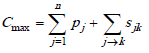
<body><![CDATA[<p><font size="2" face="Verdana, Arial, Helvetica, sans-serif">In many   industries, the decision to manufacture multiple products on common resources   results in the need for changeover and setup activities, representing costly   disruptions to production processes. Therefore, setup reduction is an important feature of the continuous improvement   program of any manufacturing, and even service, organization. It is even more   critical if an organization expects to respond to changes like shortened lead times,   smaller lot sizes, and higher quality standards. Every scheduler should   understand the principles of setup reduction and be able to recognize the potential improvements.</font></p>     <p><font size="2" face="Verdana, Arial, Helvetica, sans-serif">Setup time,   in general, can be defined as the time required to prepare the necessary   resource (e.g., machines, people) to perform a task (e.g., job, operation).   Setup times can be of two types: sequence-independent and sequence-dependent.   If setup time depends solely on the task to be processed, regardless of its   preceding task, it is called sequence-independent. On the other hand, in the   sequence-dependent type, setup time depends on both the task and its preceding task &#91;3&#93;.</font></p>     <p><font size="2" face="Verdana, Arial, Helvetica, sans-serif">Scheduling   problems with sequence-dependent setup times can be found in various production,   service, and information processing environments &#91;3&#93;. For example, in a   computer system application, a job requires a setup time to load a different   compiler if the current compiler is not suitable. In a printing industry, a   setup time is required to prepare the machine (e.g., cleaning) which depends on   the color of the current and immediately following jobs. In a textile industry,   setup time for weaving and dying operations depends on the jobs sequence. In a   container/bottle industry, setup time relies on the sizes and shapes of the   container/bottle, while in a plastic industry different types and colors of   products require setup times. Similar situations arise in chemical,   pharmaceutical, food processing, metal processing, paper industries, and many other industries/areas.</font></p>     <p><font size="2" face="Verdana, Arial, Helvetica, sans-serif">As stated   by Allahverdi and Soroush &#91;3&#93;,   in today's manufacturing scheduling problems it is of significance to   efficiently utilize various resources. Treating setup times separately from   processing times allows operations to be performed simultaneously and hence   improves resource utilization. This is particularly important in modern   production management systems such as Just-in-Time (JIT), Optimized Production   Technology (OPT), Group Technology (GT), cellular manufacturing, and time-based   competition. The benefits of reducing setup times include &#91;3&#93;: reduced   expenses, increased production speed, increased output, reduced lead times,   faster changeovers, increased competitiveness, increased profitability and   satisfaction, enabling lean manufacturing, smoother flows, broader range of lot   sizes, lower total cost curve, fewer stock-outs, lower inventory, lower minimum   order sizes, higher margins on orders above minimum, faster deliveries, and   increased customer satisfaction. The importance and benefits of incorporating   setup times in scheduling research has been investigated by many researchers   (see for instance &#91;4,5,6,7,8&#93;.</font></p>     <p><font size="2" face="Verdana, Arial, Helvetica, sans-serif">This paper   studies the problem of job scheduling on both a single machine and identical   parallel machines with sequence-dependent setup times and release dates. The   single-machine environment does represent a building block for more complex   configurations. Many researchers have dealt with job scheduling problems on a   single-machine under different constraints. A fundamental issue is the inherent   difficulty of one machine scheduling problems that involve sequence-dependent   setup times. Pinedo &#91;1&#93; showed that the makespan minimization on a single machine with   sequence-dependent setup times is strongly NP-hard, which means that is not   possible to find optimal solutions in reasonable computational time for   large-sized instances. For the parallel machine case, computational results are   not encouraging. In this paper, we are interested in studying such scheduling   problems adding the constraint of jobs having unequal release times.</font></p>     <p><font size="2" face="Verdana, Arial, Helvetica, sans-serif">This paper   is organized as follows. Section 2 is devoted to analyze the problem under a   single resource (single-machine) environment. Section 3 extends the study for   the multiple parallel machines context. Related relevant literature and   computational experiments are presented respectively within both sections. The   paper ends in section 4 by presenting the conclusions.</font></p>     <p>&nbsp;</p>     <p><font size="3" face="Verdana, Arial, Helvetica, sans-serif"><b>2. ANALYSIS  OF THE SINGLE-MACHINE CASE</b></font></p>     <p><font size="2" face="Verdana, Arial, Helvetica, sans-serif">Formally,   we first consider the problem of scheduling a set of <i>n</i> jobs on one machine. Job <i>j</i>,   with <i>j</i>=1,...,<i>n</i>, is characterized by its   integer processing time <sub><img src="/img/revistas/dyna/v77n163/a27eq0022.gif"></sub> and an non-negative integer release date <sub><img src="/img/revistas/dyna/v77n163/a27eq0042.gif"></sub>.   Sequence-dependent machine setup times are also considered. That is, if job <i>k</i> is executed on the machine immediately   after job <i>j</i>, a setup time <sub><img src="/img/revistas/dyna/v77n163/a27eq006.gif"></sub> is needed during which the machine cannot   process any job. We consider the objective of minimizing the makespan of the schedule or total completion time of all   jobs. Using the classical notation in Scheduling Theory, this problem is noted as <sub><img src="/img/revistas/dyna/v77n163/a27eq008.gif"></sub>.   When all jobs have equal release dates (<sub><img src="/img/revistas/dyna/v77n163/a27eq010.gif"></sub>, <sub><img src="/img/revistas/dyna/v77n163/a27eq012.gif"></sub>),   the one machine scheduling problem, noted as <sub><img src="/img/revistas/dyna/v77n163/a27eq014.gif"></sub>, is   equivalent to the Traveling Salesman Problem (TSP), which is known to be NP-hard   &#91;1&#93;. This means that no efficient (polynomial-time) algorithm can be found to   solve large-sized instances. Hence, the problem considered in this paper is at   least that difficult.</font></p>     <p><font size="2" face="Verdana, Arial, Helvetica, sans-serif">The problem   of job scheduling with sequence-dependent machine setup times have been largely   studied in the literature. State of the art surveys are presented in &#91;9,10,11&#93;. For the one machine case, even though complexity   analysis is not encouraging, researchers have developed exact approaches based   on branch and bound, dynamic programming or integer linear programming. The   objective function under study in this paper is the makespan and can be expressed as:</font></p>     ]]></body>
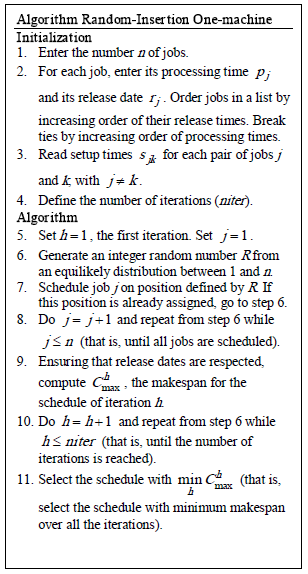
<body><![CDATA[<p><font size="2" face="Verdana, Arial, Helvetica, sans-serif"><img src="/img/revistas/dyna/v77n163/a27eq001.gif"></font></p>     <p><font size="2" face="Verdana, Arial, Helvetica, sans-serif">When setup   times are dependent on the sequence, minimizing makespan becomes equivalent to minimizing the total setup time. That is because the sum   of processing times remains a constant through the whole scheduling when all   information about jobs is deterministic and known at the initial time of   scheduling. This problem corresponds to what is usually called the Traveling   Salesman Problem (TSP). In a TSP, each city corresponds to a job and the   distance between cities corresponds to the time required to change from one job   to another. If the setup times for all pairs of jobs are indifferent to their   sequencing order when scheduled consecutively, the scheduling problem is   equivalent to a symmetrical TSP, otherwise, it is   equivalent to an asymmetrical TSP &#91;9&#93;.</font></p>     <p><font size="2" face="Verdana, Arial, Helvetica, sans-serif">One of the   pioneering works on the sequence-dependent setup time problem was presented by   Gilmore and Gomory &#91;12&#93; who modeled and solved the   problem as a TSP. Presby and Wolfson &#91;13&#93; provided an optimization algorithm that is suitable only for small   problems. Bianco et al. &#91;14&#93; formulated the problem <sub><img src="/img/revistas/dyna/v77n163/a27eq008.gif"></sub> as a mixed integer linear program and   developed a heuristic algorithm using lower bounds and dominance criteria. For   the problem <sub><img src="/img/revistas/dyna/v77n163/a27eq017.gif"></sub>, He   and Kusiak &#91;15&#93; proposed a simpler mixed-integer   formulation and a fast heuristic algorithm of low computational time   complexity. Ozgur and Brown &#91;2&#93; developed a two-stage   traveling salesman heuristic procedure for the problem where similar products   produced on the machine can be partitioned into families.</font></p>     <p><font size="2" face="Verdana, Arial, Helvetica, sans-serif">There are   several works presented in the literature that consider other objective   functions. Barnes and Vanston &#91;16&#93; combined branch   and bound with dynamic programming to solve the problem noted as <sub><img src="/img/revistas/dyna/v77n163/a27eq019.gif"></sub>. For   the case of precedence constraints with a special structure (chains), Uzsoy et al. &#91;8&#93; developed branch and bound algorithm for <sub><img src="/img/revistas/dyna/v77n163/a27eq021.gif"></sub> and Uzsoy et al. &#91;17&#93;   developed dynamic programming algorithms for <sub><img src="/img/revistas/dyna/v77n163/a27eq021.gif"></sub> and <sub><img src="/img/revistas/dyna/v77n163/a27eq024.gif"></sub>, where the objective function corresponds to the minimization of the number   of tardy jobs. Tan and Narasimhan &#91;18&#93; proposed a   simulated annealing algorithm to minimize total tardiness (<sub><img src="/img/revistas/dyna/v77n163/a27eq026.gif"></sub>).   Tan et al. &#91;19&#93; later compared the performance of branch and bound, genetic   search, simulated annealing and random-start pairwise interchange heuristics   for the same problem. Different versions of genetic algorithms have also been   proposed (e.g. &#91;19,20&#93;. França et al. &#91;21&#93; proposed a memetic algorithm while Gagne   et al. &#91;22&#93; proposed an Ant Colony Optimization (ACO) algorithm for the same   problem. Chang et al. &#91;23&#93; proposed a mathematical programming model with   logical constraints for the problem <sub><img src="/img/revistas/dyna/v77n163/a27eq028.gif"></sub>.   They also proposed heuristics and conducted computational experiments which   revealed that the heuristics can efficiently solve the problem. Wang &#91;24&#93; studied   the single-machine scheduling problem with time-dependent learning effect and   considerations of setup times with various objective functions based on   completion times of jobs.</font></p> <font size="2" face="Verdana, Arial, Helvetica, sans-serif"><b>2.1 The proposed algorithm</b>    <br> This paper first analyzes the problem on a single machine noted as <sub><img src="/img/revistas/dyna/v77n163/a27eq008.gif"></sub>. The  proposed randomized heuristic algorithm is presented in this section. The  basics of the procedure are presented next. To schedule a set of <i>n</i> on a single machine, we can observe  that, from a total of <i>n</i> positions in  the schedule, we have to select one position for each job. </font><font size="2">     <p><font face="Verdana, Arial, Helvetica, sans-serif">The   heuristic proposed here is based on a random insertion strategy, in which   random numbers are generated from an equilikely distribution between 1 and <i>n</i>, in   order to define the position of a job in the schedule. A certain number of   iterations are required so as to improve the initial solution (schedule). The   algorithm is described in detail in <a href="#fig01">figure 1</a>.</font></p>     <p align="center"><font face="Verdana, Arial, Helvetica, sans-serif"><b><a name="fig01"></a><img src="/img/revistas/dyna/v77n163/a27fig01.gif">    <br>   Figure 1.</b> Random-insertion algorithm   for the single-machine problem</font></p> <font face="Verdana, Arial, Helvetica, sans-serif"><b>2.2 Experiments</b>    <br>  In order to  analyze computational performance of proposed algorithm, experimental studies  were conducted on a PC Pentium bi-processor Dual-Core 1.73 GHz. Exact solution  methods were programmed using X-press IVE while the proposed heuristic was  programmed using Visual Basic for Applications (VBA) in MS Excel® spreadsheets.  Data was generated using a similar structure as proposed by  Chu  &#91;25&#93; and later extended by Nessah et al. &#91;26&#93; to  consider setup times. </font></font>     <p><font size="2" face="Verdana, Arial, Helvetica, sans-serif">Integer   processing times were generated from a uniform distribution &#91;1, 100&#93;. Integer   release dates were generated using a uniform distribution <sub><img src="/img/revistas/dyna/v77n163/a27eq032.gif"></sub>,   where <i>n</i> is the number of jobs to be   scheduled and <sub><img src="/img/revistas/dyna/v77n163/a27eq034.gif"></sub> is a real with values 0.6, 1.5 and 3.0.   Integer setup times were generated from a uniform distribution <sub><img src="/img/revistas/dyna/v77n163/a27eq036.gif"></sub>.   Five instances for each of value of <sub><img src="/img/revistas/dyna/v77n163/a27eq034.gif"></sub> were generated. Problems with 10, 20, 50 or   100 jobs were considered.</font></p>     ]]></body>



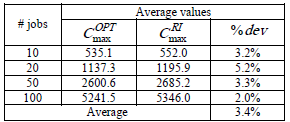
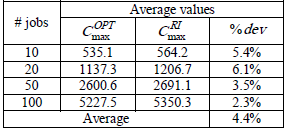
<body><![CDATA[<p><font size="2" face="Verdana, Arial, Helvetica, sans-serif">Experiments   were run with equal and unequal release dates. A full factorial experimental   design gave a total of 120 testing scenarios. Because of the random behavior of   the proposed algorithm, 10 replications for each instance scenario were run and   the best sequence (i.e., the sequence with minimum value of the makespan) was registered and compared against the optimum makespan. The first sets of experiments were performed   assuming that all jobs are released to the machine at the same time. That is, we are supposing that <sub><img src="/img/revistas/dyna/v77n163/a27eq039.gif"></sub> for all jobs. </font></p>     <p><font size="2" face="Verdana, Arial, Helvetica, sans-serif">The second   set of experiments, the same values of both processing and setup times were   taken but in addition considering unequal integer non-negative release dates   for jobs, that is with <sub><img src="/img/revistas/dyna/v77n163/a27eq041.gif"></sub>. </font></p>     <p><font size="2" face="Verdana, Arial, Helvetica, sans-serif">For the   performance analysis, let <sub><img src="/img/revistas/dyna/v77n163/a27eq043.gif"></sub> and <sub><img src="/img/revistas/dyna/v77n163/a27eq045.gif"></sub> be respectively the makespan obtained using   the proposed Random-Insertion heuristic and the optimum makespan.   The performance of proposed heuristic was computed using the deviation from the   optimal solution as:</font></p>     <p><font size="2" face="Verdana, Arial, Helvetica, sans-serif"><img src="/img/revistas/dyna/v77n163/a27eq002.gif"></font></p>     <p><font size="2" face="Verdana, Arial, Helvetica, sans-serif"><a href="#tab01">Tables 1</a> and <a href="#tab02">2</a> summarize the results obtained from the experiments for the   single-machine environment when all jobs have equal release dates (i.e. respectively when <sub><img src="/img/revistas/dyna/v77n163/a27eq039.gif"></sub>, <sub><img src="/img/revistas/dyna/v77n163/a27eq048.gif"></sub>) and <sub><img src="/img/revistas/dyna/v77n163/a27eq041.gif"></sub>, <sub><img src="/img/revistas/dyna/v77n163/a27eq048.gif"></sub>. In   both tables, <sub><img src="/img/revistas/dyna/v77n163/a27eq045.gif"></sub> represents the average values of the optimal makespan and <sub><img src="/img/revistas/dyna/v77n163/a27eq043.gif"></sub> represents the average value of the makespan applying the proposed heuristic. The last column of both tables corresponds to   the average value of the deviation from the optimal solution for each set   of jobs.</font></p>     <p align="center"><font size="2" face="Verdana, Arial, Helvetica, sans-serif"><b><a name="tab01"></a>Table 1.</b> Average makespan for experiments with <sub><img src="/img/revistas/dyna/v77n163/a27eq054.gif"></sub> and <sub><img src="/img/revistas/dyna/v77n163/a27eq056.gif"></sub></font>    <br>   <img src="/img/revistas/dyna/v77n163/a27tab01.gif"></p>     <p align="center"><font size="2" face="Verdana, Arial, Helvetica, sans-serif"><b><a name="tab02"></a>Table 2.</b> Average makespan for experiments with <sub><img src="/img/revistas/dyna/v77n163/a27eq041.gif"></sub> and <sub><img src="/img/revistas/dyna/v77n163/a27eq056.gif"></sub></font>    <br>   <img src="/img/revistas/dyna/v77n163/a27tab02.gif"></p>     <p><font size="2" face="Verdana, Arial, Helvetica, sans-serif">For the   case of equal release dates, our algorithm the average deviation from the   optimal solution is 3.4%. When unequal release date are present (<sub><img src="/img/revistas/dyna/v77n163/a27eq041.gif"></sub>),   the average deviation is 4.4% of the optimal solution. Analyzing the individual   instances, in 4% of the cases the heuristic obtained the optimal makespan, while in 29% of the cases the value of the makespan was within a 2% of the optimal value.</font></p>     ]]></body>
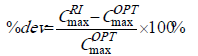
<body><![CDATA[<p><font size="2" face="Verdana, Arial, Helvetica, sans-serif">Finally, it   is important to note that the running time of the algorithm for small instances   (10-job and 20-job instances) was less than 3 seconds, while the time required   to run the experiments for large instances was between 20 and 30 seconds for   50-job instances and about 55 seconds for instances with 100 jobs. In   comparison with the optimal solution approach, the mathematical model required   about 30 minutes and 1 hour to solve small and large instances, respectively.</font></p>     <p>&nbsp;</p>     <p><font size="3" face="Verdana, Arial, Helvetica, sans-serif"><b>3. ANALYSIS  OF THE CASE OF M IDENTICAL MACHINES IN PARALLEL</b></font></p>     <p><font size="2" face="Verdana, Arial, Helvetica, sans-serif">In real life, usually discrete manufacturing processes have several <i>m</i> machines in parallel. In this section   we extend the algorithm previously proposed to solve the problem. Using the   classical notation in Scheduling Theory, the problem under study in noted as <sub><img src="/img/revistas/dyna/v77n163/a27eq061.gif"></sub>.</font></p>     <p><font size="2" face="Verdana, Arial, Helvetica, sans-serif">In the   literature the problem under study has been very little studied in the   literature. Some related works are cited next. Guinet &#91;27&#93; proposed a mathematical formulation to minimize the makespan and the total completion time of jobs with identical release times (i.e., <sub><img src="/img/revistas/dyna/v77n163/a27eq039.gif"></sub>) for   all jobs. Heuristics and meta-heuristics procedures have been proposed for   several objective functions, such as due-date related objectives (e.g. &#91;28,29,30&#93; or flowtime related   objectives (e.g. &#91;31,32,33&#93;. Guinet &#91;27&#93; also   suggested that makespan minimization problem when all   jobs have equal release dates (<sub><img src="/img/revistas/dyna/v77n163/a27eq039.gif"></sub>, <sub><img src="/img/revistas/dyna/v77n163/a27eq048.gif"></sub>),   the problem is equivalent to the Vehicle Routing Problem (VRP) with service   time requirements.</font></p>     <p><font size="2" face="Verdana, Arial, Helvetica, sans-serif">The problem   with jobs arriving at different release dates has been very little studied in   the literature, to the best of our knowledge. Nessah et al. &#91;26&#93; considered the objective of minimizing total completion time of   jobs (problem <sub><img src="/img/revistas/dyna/v77n163/a27eq066.gif"></sub>. </font></p>     <p><font size="2" face="Verdana, Arial, Helvetica, sans-serif">The problem under study in this   paper, <sub><img src="/img/revistas/dyna/v77n163/a27eq068.gif"></sub>, has only been studied by Kurz and Askin &#91;34&#93; who proposed   several heuristics algorithms, including multiple insertion and a genetic   algorithm. These authors also derived a data-dependent lower bound for the makespan criterion. Their compared their heuristics between   them, but they neither computed the optimal makespan nor compare the performance of their heuristics against the optimum nor the   lower bound.</font></p>     <p><font size="2" face="Verdana, Arial, Helvetica, sans-serif"><b>3.1. Proposed algorithm modified</b>    <br>   Our   algorithm described in section 2 for the single-machine case can be easily   modified for application in the parallel machine environment. The first   modification consists on computing the number of jobs that can scheduled on   each machine. Then, jobs are randomly selected and assigned to machines   respecting the workload balance defined. The modified algorithm is described in   detail in <a href="#fig02">figure 2</a>.</font></p>     <p align="center"><font size="2" face="Verdana, Arial, Helvetica, sans-serif"><b><a name="fig02"></a><img src="/img/revistas/dyna/v77n163/a27fig02.gif">    ]]></body>
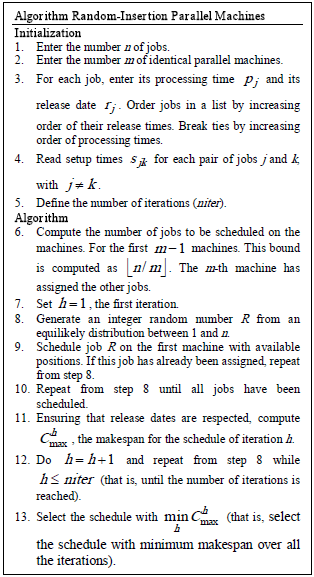
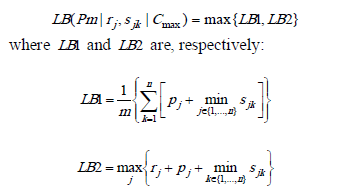
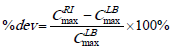
<body><![CDATA[<br>   Figure 2.</b> Random-insertion algorithm   for the identical parallel machines problem</font></p>     <p><font size="2" face="Verdana, Arial, Helvetica, sans-serif"><b>3.2. Experiments   and results</b>    <br>   A computational study was also performed using   the same random-generated data as described in section 2.2. We considered here   configurations with <sub><img src="/img/revistas/dyna/v77n163/a27eq070.gif"></sub> and <sub><img src="/img/revistas/dyna/v77n163/a27eq072.gif"></sub> identical machines in parallel. As for the   single-machine case, because of the random behavior of the proposed algorithm,   10 replications for each instance scenario were run and the best sequence   (i.e., the sequence with minimum value of the makespan)   was registered and compared against the optimum makespan. </font><font size="2"> </font></p> <font size="2">     <p><font face="Verdana, Arial, Helvetica, sans-serif">As   explained previously, the NP-completeness of this problem unable us to obtain   optimal solutions without excessive computational costs even for small   instances &#91;34&#93;. A lower bound on the makespan can be   found by looking at the minimum preemptive schedule makespan &#91;35&#93;. This lower bound, however, can be very poor, especially in cases with a   high range of processing times &#91;34&#93;.</font></p>     <p><font face="Verdana, Arial, Helvetica, sans-serif">As explained   previously, Kurz and Askin &#91;34&#93;   derived a preemptive-type lower bound on the makespan for each of the individual data sets using the actual data. These authors   showed that their lower bound performs well. This lower bound is thus computed   as:</font></p>     <p><font face="Verdana, Arial, Helvetica, sans-serif"><img src="/img/revistas/dyna/v77n163/a27eq003.gif"></font></p>     <p><font face="Verdana, Arial, Helvetica, sans-serif">Results of   our experimental study are hence compared against this lower bound. Let <sub><img src="/img/revistas/dyna/v77n163/a27eq043.gif"></sub> be the makespan obtained using the proposed   heuristic and let <sub><img src="/img/revistas/dyna/v77n163/a27eq075.gif"></sub> be the value of the lower bound. Hence, the   performance of the proposed heuristic was computed as the deviation from such   lower bound as:</font></p>     <p><font face="Verdana, Arial, Helvetica, sans-serif"><img src="/img/revistas/dyna/v77n163/a27eq004.gif"></font></p>     <p><font face="Verdana, Arial, Helvetica, sans-serif"><a href="#tab03">Tables 3</a> and <a href="#tab04">4</a> present the summary of results, respectively, with equal and unequal jobs   release dates. From these results, we can observe that the algorithm performs   well, with reference to the percentage deviation from the lower bound of the makespan: the average deviation, regardless of the number   of jobs, is 9.9% with equal release dates and 12.2% for the case with unequal   release dates. These results are the first results in literature that show the   performance of a heuristic in comparison against a known lower bound.</font></p> </font>     <p align="center"><font size="2" face="Verdana, Arial, Helvetica, sans-serif"><b><a name="tab03"></a>Table 3.</b> Results   for parallel machines experiments with <sub><img src="/img/revistas/dyna/v77n163/a27eq054.gif"></sub></font>    ]]></body>
<body><![CDATA[<br>   <img src="/img/revistas/dyna/v77n163/a27tab03.gif"></p>     <p align="center"><font size="2" face="Verdana, Arial, Helvetica, sans-serif"><b><a name="tab04"></a>Table 4.</b> Results for parallel machine experiments with <sub><img src="/img/revistas/dyna/v77n163/a27eq041.gif"></sub></font>    <br>   <img src="/img/revistas/dyna/v77n163/a27tab04.gif"></p> <font size="2">     <p><font face="Verdana, Arial, Helvetica, sans-serif">In terms of   the computational costs, the higher the number of jobs, the higher the time to   find a solution. For the large instance in our tests (100 jobs), the   computational time was never higher than 12 seconds. For 10-jobs and 20-jobs   instances, the CPU time was less than 1 second.</font></p> </font><font size="2">     <p>&nbsp;</p> </font>     <p><b><font size="3" face="Verdana, Arial, Helvetica, sans-serif">4. CONCLUSIONS</font></b></p> <font size="2">     <p><font face="Verdana, Arial, Helvetica, sans-serif">This paper   considered the problem of scheduling jobs on both a single-machine and   identical parallel machines environments subject to release dates and   setup times. Setup times , de fined in general as the time required to prepare the necessary   resource to perform a job, add complexity for the analysis of scheduling   problems. Since the problem is NP-hard, a heuristic algorithm was proposed. </font></p>     <p><font face="Verdana, Arial, Helvetica, sans-serif">The   strategy for scheduling is based on a random insertion of jobs in the schedule.</font></p>     <p><font face="Verdana, Arial, Helvetica, sans-serif">Computational   experiments were performed using random-generated data following similar   procedures as in literature. Two main cases were considered. The first test was   carried out with jobs having equal release dates. The second set of tests   considered non negative release dates (<sub><img src="/img/revistas/dyna/v77n163/a27eq041.gif"></sub>).   Compared against the optimal solution, the proposed heuristic performed very   well giving schedules with a makespan value no   greater than the 10% of the optimum. In average, the proposed procedure was   between about 2% and 6% of the optimal solution.</font></p>     <p><font face="Verdana, Arial, Helvetica, sans-serif">The   computational time was less than 2 seconds for small instances, and never   higher than 1 minute for large instances (100 jobs). An extension to the   identical parallel machine environment was also considered. Results of the   computational experiments showed that our algorithm performs well in comparison   with the lower bound of the makespan value. The   average deviation from this bound was 9.9% with <sub><img src="/img/revistas/dyna/v77n163/a27eq039.gif"></sub> and 12.2% for the case with <sub><img src="/img/revistas/dyna/v77n163/a27eq041.gif"></sub>,   regardless of the number of jobs.</font></p>     ]]></body>
<body><![CDATA[<p>&nbsp;</p> </font>     <p><font size="3" face="Verdana, Arial, Helvetica, sans-serif"><b>ACKNOWLEDGEMENTS</b></font></p> <font size="2">     <p><font face="Verdana, Arial, Helvetica, sans-serif">This work   was performed under research project CEA-24-2008 supported by Research Funds   from Universidad de   La Sabana,   Ch&iacute;a,   Colombia. Authors wish to   acknowledge the anonymous reviewers for their comments that allow improving the   presentation of the paper.</font></p>     <p>&nbsp;</p> </font>     <p><font size="3" face="Verdana, Arial, Helvetica, sans-serif"><b>REFERENCES</b></font></p> <font size="2">     <!-- ref --><p><font face="Verdana, Arial, Helvetica, sans-serif"><b>&#91;1&#93;</b> PINEDO, M. 2008. Scheduling: Theory, Algorithms, and Systems. Springer.     &nbsp;&nbsp;&nbsp;&nbsp;&nbsp;&nbsp;&nbsp;&nbsp;[&#160;<a href="javascript:void(0);" onclick="javascript: window.open('/scielo.php?script=sci_nlinks&ref=000088&pid=S0012-7353201000030002700001&lng=','','width=640,height=500,resizable=yes,scrollbars=1,menubar=yes,');">Links</a>&#160;]<!-- end-ref --><!-- ref --><br>   <b>&#91;2&#93;</b> OZGUR, C.O., BROWN, J.R. 1995. A two-stage traveling salesman procedure for the single machine sequence-dependent scheduling problem. Omega, 23, 205-219.     &nbsp;&nbsp;&nbsp;&nbsp;&nbsp;&nbsp;&nbsp;&nbsp;[&#160;<a href="javascript:void(0);" onclick="javascript: window.open('/scielo.php?script=sci_nlinks&ref=000089&pid=S0012-7353201000030002700002&lng=','','width=640,height=500,resizable=yes,scrollbars=1,menubar=yes,');">Links</a>&#160;]<!-- end-ref --><!-- ref --><br>   <b>&#91;3&#93;</b> ALLAHVERDI, A., SOROUSH, H.M. 2008. The significance of reducing setup times/setup costs. European Journal of Operational Research, 187, 978-984.     &nbsp;&nbsp;&nbsp;&nbsp;&nbsp;&nbsp;&nbsp;&nbsp;[&#160;<a href="javascript:void(0);" onclick="javascript: window.open('/scielo.php?script=sci_nlinks&ref=000090&pid=S0012-7353201000030002700003&lng=','','width=640,height=500,resizable=yes,scrollbars=1,menubar=yes,');">Links</a>&#160;]<!-- end-ref --><!-- ref --><br>   <b>&#91;4&#93;</b> FLYNN, B.B. 1987. The effects of setup time on output capacity in cellular manufacturing. International Journal of Production Research, 25, 1761-1772.     &nbsp;&nbsp;&nbsp;&nbsp;&nbsp;&nbsp;&nbsp;&nbsp;[&#160;<a href="javascript:void(0);" onclick="javascript: window.open('/scielo.php?script=sci_nlinks&ref=000091&pid=S0012-7353201000030002700004&lng=','','width=640,height=500,resizable=yes,scrollbars=1,menubar=yes,');">Links</a>&#160;]<!-- end-ref --><!-- ref --><br>   <b>&#91;5&#93;</b> KOGAN, K., LEVNER, E. 1998. A polynomial algorithm for scheduling small-scale manufacturing cells served by multiple robots. Computers & Operations Research, 25, 53-62.     &nbsp;&nbsp;&nbsp;&nbsp;&nbsp;&nbsp;&nbsp;&nbsp;[&#160;<a href="javascript:void(0);" onclick="javascript: window.open('/scielo.php?script=sci_nlinks&ref=000092&pid=S0012-7353201000030002700005&lng=','','width=640,height=500,resizable=yes,scrollbars=1,menubar=yes,');">Links</a>&#160;]<!-- end-ref --><!-- ref --><br>   <b>&#91;6&#93;</b> KRAJEWSKI, L.J., KING, B.E., RITZMAN, L.P., WONG, D.S. 1987. Kanban, MRP and shaping the manufacturing environment. Management Science, 33, 39-57.     &nbsp;&nbsp;&nbsp;&nbsp;&nbsp;&nbsp;&nbsp;&nbsp;[&#160;<a href="javascript:void(0);" onclick="javascript: window.open('/scielo.php?script=sci_nlinks&ref=000093&pid=S0012-7353201000030002700006&lng=','','width=640,height=500,resizable=yes,scrollbars=1,menubar=yes,');">Links</a>&#160;]<!-- end-ref --><!-- ref --><br>   <b>&#91;7&#93;</b> LIU, C.Y., CHANG, S.C. 2000. Scheduling flexible flow shops with sequence-dependent setup effects. IEEE Transactions on Robotics and Automation, 16, 408-419.     &nbsp;&nbsp;&nbsp;&nbsp;&nbsp;&nbsp;&nbsp;&nbsp;[&#160;<a href="javascript:void(0);" onclick="javascript: window.open('/scielo.php?script=sci_nlinks&ref=000094&pid=S0012-7353201000030002700007&lng=','','width=640,height=500,resizable=yes,scrollbars=1,menubar=yes,');">Links</a>&#160;]<!-- end-ref --><!-- ref --><br>   <b>&#91;8&#93;</b> TROVINGER, S.C., BOHN, R.E. 2005. Setup time reduction for electronics assembly: Combining simple (SMED) and IT-based methods. Production and Operations Management, 14, 205-217.     &nbsp;&nbsp;&nbsp;&nbsp;&nbsp;&nbsp;&nbsp;&nbsp;[&#160;<a href="javascript:void(0);" onclick="javascript: window.open('/scielo.php?script=sci_nlinks&ref=000095&pid=S0012-7353201000030002700008&lng=','','width=640,height=500,resizable=yes,scrollbars=1,menubar=yes,');">Links</a>&#160;]<!-- end-ref --><!-- ref --><br>   <b>&#91;9&#93;</b> ALLAHVERDI, A., GUPTA, J.N.D., ALDOWAISAN, T. 1999. A review of scheduling research involving setup considerations. Omega, 27, 219-239.     &nbsp;&nbsp;&nbsp;&nbsp;&nbsp;&nbsp;&nbsp;&nbsp;[&#160;<a href="javascript:void(0);" onclick="javascript: window.open('/scielo.php?script=sci_nlinks&ref=000096&pid=S0012-7353201000030002700009&lng=','','width=640,height=500,resizable=yes,scrollbars=1,menubar=yes,');">Links</a>&#160;]<!-- end-ref --><!-- ref --><br>   <b>&#91;10&#93;</b> ALLAHVERDI, A., NG, C.T., CHENG, T.C.E., KOVALYOV, M.Y. 2008. A survey of scheduling problems with setup times or costs. European Journal of Operational Research, 187, 985-1032.     &nbsp;&nbsp;&nbsp;&nbsp;&nbsp;&nbsp;&nbsp;&nbsp;[&#160;<a href="javascript:void(0);" onclick="javascript: window.open('/scielo.php?script=sci_nlinks&ref=000097&pid=S0012-7353201000030002700010&lng=','','width=640,height=500,resizable=yes,scrollbars=1,menubar=yes,');">Links</a>&#160;]<!-- end-ref --><!-- ref --><br>   <b>&#91;11&#93;</b> ZHU, X., WILHELM, W.E. 2006. Scheduling and lot sizing with sequence-dependent setup: A literature review. IIE Transactions, 38, 987-1007.     &nbsp;&nbsp;&nbsp;&nbsp;&nbsp;&nbsp;&nbsp;&nbsp;[&#160;<a href="javascript:void(0);" onclick="javascript: window.open('/scielo.php?script=sci_nlinks&ref=000098&pid=S0012-7353201000030002700011&lng=','','width=640,height=500,resizable=yes,scrollbars=1,menubar=yes,');">Links</a>&#160;]<!-- end-ref --><!-- ref --><br>   <b>&#91;12&#93;</b> GILMORE, P.C., GOMORY, R.E. 1964. Sequencing a one-state variable machine: a solvable case of the traveling salesman problem. Operations Research, 12, 655-679.     &nbsp;&nbsp;&nbsp;&nbsp;&nbsp;&nbsp;&nbsp;&nbsp;[&#160;<a href="javascript:void(0);" onclick="javascript: window.open('/scielo.php?script=sci_nlinks&ref=000099&pid=S0012-7353201000030002700012&lng=','','width=640,height=500,resizable=yes,scrollbars=1,menubar=yes,');">Links</a>&#160;]<!-- end-ref --><!-- ref --><br>   <b>&#91;13&#93;</b> PRESBY, J.T., WOLFSON, M.L. 1967. An algorithm for solving job sequencing problems. Management Science, 13, B454-B464.     &nbsp;&nbsp;&nbsp;&nbsp;&nbsp;&nbsp;&nbsp;&nbsp;[&#160;<a href="javascript:void(0);" onclick="javascript: window.open('/scielo.php?script=sci_nlinks&ref=000100&pid=S0012-7353201000030002700013&lng=','','width=640,height=500,resizable=yes,scrollbars=1,menubar=yes,');">Links</a>&#160;]<!-- end-ref --><!-- ref --><br>   <b>&#91;14&#93;</b> BIANCO, L., RICCIARDELLI, S., RINALDI, G., SASSANO, A. 1988. Scheduling tasks with sequence-dependent processing times. Naval Research Logistics, 35, 177-184.     &nbsp;&nbsp;&nbsp;&nbsp;&nbsp;&nbsp;&nbsp;&nbsp;[&#160;<a href="javascript:void(0);" onclick="javascript: window.open('/scielo.php?script=sci_nlinks&ref=000101&pid=S0012-7353201000030002700014&lng=','','width=640,height=500,resizable=yes,scrollbars=1,menubar=yes,');">Links</a>&#160;]<!-- end-ref --><!-- ref --><br>   <b>&#91;15&#93;</b> HE, W., KUSIAK, A. 1992. Scheduling manufacturing systems. Computers in Industry, 20, 163-175.     &nbsp;&nbsp;&nbsp;&nbsp;&nbsp;&nbsp;&nbsp;&nbsp;[&#160;<a href="javascript:void(0);" onclick="javascript: window.open('/scielo.php?script=sci_nlinks&ref=000102&pid=S0012-7353201000030002700015&lng=','','width=640,height=500,resizable=yes,scrollbars=1,menubar=yes,');">Links</a>&#160;]<!-- end-ref --><!-- ref --><br>   <b>&#91;16&#93;</b> BARNES, J.W., VANSTON, L.K. 1981. Scheduling jobs with linear delay penalties and sequence dependent setup times and release dates. Operations Research, 29, 146-154.     &nbsp;&nbsp;&nbsp;&nbsp;&nbsp;&nbsp;&nbsp;&nbsp;[&#160;<a href="javascript:void(0);" onclick="javascript: window.open('/scielo.php?script=sci_nlinks&ref=000103&pid=S0012-7353201000030002700016&lng=','','width=640,height=500,resizable=yes,scrollbars=1,menubar=yes,');">Links</a>&#160;]<!-- end-ref --><!-- ref --><br>   <b>&#91;17&#93;</b> UZSOY, R., LEE, C.Y., MARTIN-VEGA, L.A. 1992. Scheduling semiconductor test operations: Minimizing maximum lateness and number of tardy jobs on a single machine. Naval Research Logistics, 39, 369-388.     &nbsp;&nbsp;&nbsp;&nbsp;&nbsp;&nbsp;&nbsp;&nbsp;[&#160;<a href="javascript:void(0);" onclick="javascript: window.open('/scielo.php?script=sci_nlinks&ref=000104&pid=S0012-7353201000030002700017&lng=','','width=640,height=500,resizable=yes,scrollbars=1,menubar=yes,');">Links</a>&#160;]<!-- end-ref --><!-- ref --><br>   <b>&#91;18&#93;</b> TAN, K.C., NARASIMHAN, R. 1997. Minimizing tardiness on a single processor with sequence-dependent setup times. Omega, 25, 619-634.     &nbsp;&nbsp;&nbsp;&nbsp;&nbsp;&nbsp;&nbsp;&nbsp;[&#160;<a href="javascript:void(0);" onclick="javascript: window.open('/scielo.php?script=sci_nlinks&ref=000105&pid=S0012-7353201000030002700018&lng=','','width=640,height=500,resizable=yes,scrollbars=1,menubar=yes,');">Links</a>&#160;]<!-- end-ref --><!-- ref --><br>   <b>&#91;19&#93;</b> TAN, K.C., NARASIMHAN, R., RUBIN, P.A., RAGATZ, G.L. 2000. A comparison of four methods for minimizing total tardiness on a single processor with sequence dependent setup times. Omega, 28, 313-326.     &nbsp;&nbsp;&nbsp;&nbsp;&nbsp;&nbsp;&nbsp;&nbsp;[&#160;<a href="javascript:void(0);" onclick="javascript: window.open('/scielo.php?script=sci_nlinks&ref=000106&pid=S0012-7353201000030002700019&lng=','','width=640,height=500,resizable=yes,scrollbars=1,menubar=yes,');">Links</a>&#160;]<!-- end-ref --><!-- ref --><br>   <b>&#91;20&#93;</b> ARMENTANO, V.A., MAZZINI, R. 2000. A genetic algorithm for scheduling on a single machine with with set-up and due dates. Production Planning and Control, 11, 713-720.     &nbsp;&nbsp;&nbsp;&nbsp;&nbsp;&nbsp;&nbsp;&nbsp;[&#160;<a href="javascript:void(0);" onclick="javascript: window.open('/scielo.php?script=sci_nlinks&ref=000107&pid=S0012-7353201000030002700020&lng=','','width=640,height=500,resizable=yes,scrollbars=1,menubar=yes,');">Links</a>&#160;]<!-- end-ref --><!-- ref --><br>   <b>&#91;21&#93;</b> FRANÇA, P.M., MENDES, A., MOSCATO, P. 2001. A memetic algorithm for the total tardiness single machine scheduling problem. European Journal of Operational Research, 132, 224-242.     &nbsp;&nbsp;&nbsp;&nbsp;&nbsp;&nbsp;&nbsp;&nbsp;[&#160;<a href="javascript:void(0);" onclick="javascript: window.open('/scielo.php?script=sci_nlinks&ref=000108&pid=S0012-7353201000030002700021&lng=','','width=640,height=500,resizable=yes,scrollbars=1,menubar=yes,');">Links</a>&#160;]<!-- end-ref --><!-- ref --><br>   <b>&#91;22&#93;</b> GAGNE, C., PRICE, W.L., GRAVEL, M. 2002. Comparing an ACO algorithm with other heuristics for the single machine scheduling problem with sequence-dependent setup times. Journal of the Operational Research Society, 53, 895-906.     &nbsp;&nbsp;&nbsp;&nbsp;&nbsp;&nbsp;&nbsp;&nbsp;[&#160;<a href="javascript:void(0);" onclick="javascript: window.open('/scielo.php?script=sci_nlinks&ref=000109&pid=S0012-7353201000030002700022&lng=','','width=640,height=500,resizable=yes,scrollbars=1,menubar=yes,');">Links</a>&#160;]<!-- end-ref --><!-- ref --><br>   <b>&#91;23&#93;</b> CHANG, T.Y., CHOU, F.D., LEE, C.E. 2004. A heuristic algorithm to minimize total weighted tardiness on a single machine with release dates and sequence-dependent setup times. Journal of the Chinese Institute of Industrial Engineering, 21, 289-300.     &nbsp;&nbsp;&nbsp;&nbsp;&nbsp;&nbsp;&nbsp;&nbsp;[&#160;<a href="javascript:void(0);" onclick="javascript: window.open('/scielo.php?script=sci_nlinks&ref=000110&pid=S0012-7353201000030002700023&lng=','','width=640,height=500,resizable=yes,scrollbars=1,menubar=yes,');">Links</a>&#160;]<!-- end-ref --><!-- ref --><br>   <b>&#91;24&#93;</b> WANG, J.B. 2008. Single-machine scheduling with past-sequence-dependent setup times and time-dependent learning effect. Computers & Industrial Engineering, 55, 584-591.     &nbsp;&nbsp;&nbsp;&nbsp;&nbsp;&nbsp;&nbsp;&nbsp;[&#160;<a href="javascript:void(0);" onclick="javascript: window.open('/scielo.php?script=sci_nlinks&ref=000111&pid=S0012-7353201000030002700024&lng=','','width=640,height=500,resizable=yes,scrollbars=1,menubar=yes,');">Links</a>&#160;]<!-- end-ref --><!-- ref --><br>   <b>&#91;25&#93;</b> CHU, C. 1992. Efficient heuristics to minimize total flow time with release dates. Operations Research Letters, 12, pp. 321-330.     &nbsp;&nbsp;&nbsp;&nbsp;&nbsp;&nbsp;&nbsp;&nbsp;[&#160;<a href="javascript:void(0);" onclick="javascript: window.open('/scielo.php?script=sci_nlinks&ref=000112&pid=S0012-7353201000030002700025&lng=','','width=640,height=500,resizable=yes,scrollbars=1,menubar=yes,');">Links</a>&#160;]<!-- end-ref --><!-- ref --><br>   <b>&#91;26&#93;</b> NESSAH, R., CHU, C., YALAOUI, F. 2007. An exact method for problem. Computers & Operations Research, 34, 2840-2848.     &nbsp;&nbsp;&nbsp;&nbsp;&nbsp;&nbsp;&nbsp;&nbsp;[&#160;<a href="javascript:void(0);" onclick="javascript: window.open('/scielo.php?script=sci_nlinks&ref=000113&pid=S0012-7353201000030002700026&lng=','','width=640,height=500,resizable=yes,scrollbars=1,menubar=yes,');">Links</a>&#160;]<!-- end-ref --><!-- ref --><br>   <b>&#91;27&#93;</b> GUINET, A. 1993. Scheduling sequence-dependent jobs on identical parallel machines to minimize completion time criteria. International Journal of Production Research, 31, 1579-1594.     &nbsp;&nbsp;&nbsp;&nbsp;&nbsp;&nbsp;&nbsp;&nbsp;[&#160;<a href="javascript:void(0);" onclick="javascript: window.open('/scielo.php?script=sci_nlinks&ref=000114&pid=S0012-7353201000030002700027&lng=','','width=640,height=500,resizable=yes,scrollbars=1,menubar=yes,');">Links</a>&#160;]<!-- end-ref --><!-- ref --><br>   <b>&#91;28&#93;</b> BILGE, U., KIRAC, F., KURTULAN, M., PEKGUN, P. 2004. A tabu search algorithm for parallel machine total tardiness problem. Computers & Operations Research, 31, 397-414.     &nbsp;&nbsp;&nbsp;&nbsp;&nbsp;&nbsp;&nbsp;&nbsp;[&#160;<a href="javascript:void(0);" onclick="javascript: window.open('/scielo.php?script=sci_nlinks&ref=000115&pid=S0012-7353201000030002700028&lng=','','width=640,height=500,resizable=yes,scrollbars=1,menubar=yes,');">Links</a>&#160;]<!-- end-ref --><!-- ref --><br>   <b>&#91;29&#93;</b> PFUND, M., FOWLER, J.W., GADKARI, A., CHEN, Y. 2008. Scheduling jobs on parallel machines with setup times and ready times. Computers & Industrial Engineering, 54, 764-782.     &nbsp;&nbsp;&nbsp;&nbsp;&nbsp;&nbsp;&nbsp;&nbsp;[&#160;<a href="javascript:void(0);" onclick="javascript: window.open('/scielo.php?script=sci_nlinks&ref=000116&pid=S0012-7353201000030002700029&lng=','','width=640,height=500,resizable=yes,scrollbars=1,menubar=yes,');">Links</a>&#160;]<!-- end-ref --><!-- ref --><br>   <b>&#91;30&#93;</b> SIVRIKAYA-SERIFOGLU, F., ULUSOY, G. 1999. Parallel machine scheduling with earliness and tardiness penalties. Computers & Operations Research, 26, 773-787.     &nbsp;&nbsp;&nbsp;&nbsp;&nbsp;&nbsp;&nbsp;&nbsp;[&#160;<a href="javascript:void(0);" onclick="javascript: window.open('/scielo.php?script=sci_nlinks&ref=000117&pid=S0012-7353201000030002700030&lng=','','width=640,height=500,resizable=yes,scrollbars=1,menubar=yes,');">Links</a>&#160;]<!-- end-ref --><!-- ref --><br>   <b>&#91;31&#93;</b> ABDEKHODAEE, A.H., WIRTH, A. 2002. Scheduling parallel machines with a single server: some solvable cases and heuristics, Computers & Operations Research, 29, 295-315.     &nbsp;&nbsp;&nbsp;&nbsp;&nbsp;&nbsp;&nbsp;&nbsp;[&#160;<a href="javascript:void(0);" onclick="javascript: window.open('/scielo.php?script=sci_nlinks&ref=000118&pid=S0012-7353201000030002700031&lng=','','width=640,height=500,resizable=yes,scrollbars=1,menubar=yes,');">Links</a>&#160;]<!-- end-ref --><!-- ref --><br>   <b>&#91;32&#93;</b> ABDEKHODAEE, A.H., WIRTH, A., GAN, H.S. 2004. Equal processing and equal setup time cases of scheduling parallel machines with a single server. Computers & Operations Research, 31, 1867-1889.     &nbsp;&nbsp;&nbsp;&nbsp;&nbsp;&nbsp;&nbsp;&nbsp;[&#160;<a href="javascript:void(0);" onclick="javascript: window.open('/scielo.php?script=sci_nlinks&ref=000119&pid=S0012-7353201000030002700032&lng=','','width=640,height=500,resizable=yes,scrollbars=1,menubar=yes,');">Links</a>&#160;]<!-- end-ref --><!-- ref --><br>   <b>&#91;33&#93;</b> WEBSTER, S., AZIZOGLU, M. 2001. Dynamic programming algorithms for scheduling parallel machines with family setup times. Computers & Operations Research, 28, 127-137.     &nbsp;&nbsp;&nbsp;&nbsp;&nbsp;&nbsp;&nbsp;&nbsp;[&#160;<a href="javascript:void(0);" onclick="javascript: window.open('/scielo.php?script=sci_nlinks&ref=000120&pid=S0012-7353201000030002700033&lng=','','width=640,height=500,resizable=yes,scrollbars=1,menubar=yes,');">Links</a>&#160;]<!-- end-ref --><!-- ref --><br>   <b>&#91;34&#93;</b> KURZ, M.E., ASKIN, R.G. 2001. Heuristic scheduling of parallel machines with sequence-dependent set-up times. International Journal of Production Research, 39, 3747-3769.     &nbsp;&nbsp;&nbsp;&nbsp;&nbsp;&nbsp;&nbsp;&nbsp;[&#160;<a href="javascript:void(0);" onclick="javascript: window.open('/scielo.php?script=sci_nlinks&ref=000121&pid=S0012-7353201000030002700034&lng=','','width=640,height=500,resizable=yes,scrollbars=1,menubar=yes,');">Links</a>&#160;]<!-- end-ref --><!-- ref --><br>   <b>&#91;35&#93;</b> McNAUGHTON, R. 1959. Scheduling with deadlines and loss functions. Management Science, 6, 1-12.</font>&nbsp;&nbsp;&nbsp;&nbsp;&nbsp;&nbsp;&nbsp;&nbsp;[&#160;<a href="javascript:void(0);" onclick="javascript: window.open('/scielo.php?script=sci_nlinks&ref=000122&pid=S0012-7353201000030002700035&lng=','','width=640,height=500,resizable=yes,scrollbars=1,menubar=yes,');">Links</a>&#160;]<!-- end-ref --> ]]></body><back>
<ref-list>
<ref id="B1">
<label>1</label><nlm-citation citation-type="book">
<person-group person-group-type="author">
<name>
<surname><![CDATA[PINEDO]]></surname>
<given-names><![CDATA[M.]]></given-names>
</name>
</person-group>
<source><![CDATA[Scheduling: Theory, Algorithms, and Systems]]></source>
<year>2008</year>
<publisher-name><![CDATA[Springer]]></publisher-name>
</nlm-citation>
</ref>
<ref id="B2">
<label>2</label><nlm-citation citation-type="journal">
<person-group person-group-type="author">
<name>
<surname><![CDATA[OZGUR]]></surname>
<given-names><![CDATA[C.O.]]></given-names>
</name>
<name>
<surname><![CDATA[BROWN]]></surname>
<given-names><![CDATA[J.R.]]></given-names>
</name>
</person-group>
<article-title xml:lang="en"><![CDATA[A two-stage traveling salesman procedure for the single machine sequence-dependent scheduling problem]]></article-title>
<source><![CDATA[Omega]]></source>
<year>1995</year>
<volume>23</volume>
<page-range>205-219</page-range></nlm-citation>
</ref>
<ref id="B3">
<label>3</label><nlm-citation citation-type="journal">
<person-group person-group-type="author">
<name>
<surname><![CDATA[ALLAHVERDI]]></surname>
<given-names><![CDATA[A.]]></given-names>
</name>
<name>
<surname><![CDATA[SOROUSH]]></surname>
<given-names><![CDATA[H.M.]]></given-names>
</name>
</person-group>
<article-title xml:lang="en"><![CDATA[The significance of reducing setup times/setup costs]]></article-title>
<source><![CDATA[European Journal of Operational Research]]></source>
<year>2008</year>
<volume>187</volume>
<page-range>978-984</page-range></nlm-citation>
</ref>
<ref id="B4">
<label>4</label><nlm-citation citation-type="journal">
<person-group person-group-type="author">
<name>
<surname><![CDATA[FLYNN]]></surname>
<given-names><![CDATA[B.B.]]></given-names>
</name>
</person-group>
<article-title xml:lang="en"><![CDATA[The effects of setup time on output capacity in cellular manufacturing]]></article-title>
<source><![CDATA[International Journal of Production Research]]></source>
<year>1987</year>
<volume>25</volume>
<page-range>1761-1772</page-range></nlm-citation>
</ref>
<ref id="B5">
<label>5</label><nlm-citation citation-type="journal">
<person-group person-group-type="author">
<name>
<surname><![CDATA[KOGAN]]></surname>
<given-names><![CDATA[K.]]></given-names>
</name>
<name>
<surname><![CDATA[LEVNER]]></surname>
<given-names><![CDATA[E.]]></given-names>
</name>
</person-group>
<article-title xml:lang="en"><![CDATA[A polynomial algorithm for scheduling small-scale manufacturing cells served by multiple robots]]></article-title>
<source><![CDATA[Computers & Operations Research]]></source>
<year>1998</year>
<volume>25</volume>
<page-range>53-62</page-range></nlm-citation>
</ref>
<ref id="B6">
<label>6</label><nlm-citation citation-type="journal">
<person-group person-group-type="author">
<name>
<surname><![CDATA[KRAJEWSKI]]></surname>
<given-names><![CDATA[L.J.]]></given-names>
</name>
<name>
<surname><![CDATA[KING]]></surname>
<given-names><![CDATA[B.E.]]></given-names>
</name>
<name>
<surname><![CDATA[RITZMAN]]></surname>
<given-names><![CDATA[L.P.]]></given-names>
</name>
<name>
<surname><![CDATA[WONG]]></surname>
<given-names><![CDATA[D.S.]]></given-names>
</name>
</person-group>
<article-title xml:lang="en"><![CDATA[Kanban, MRP and shaping the manufacturing environment]]></article-title>
<source><![CDATA[Management Science]]></source>
<year>1987</year>
<numero>33</numero>
<issue>33</issue>
<page-range>39-57</page-range></nlm-citation>
</ref>
<ref id="B7">
<label>7</label><nlm-citation citation-type="journal">
<person-group person-group-type="author">
<name>
<surname><![CDATA[LIU]]></surname>
<given-names><![CDATA[C.Y.]]></given-names>
</name>
<name>
<surname><![CDATA[CHANG]]></surname>
<given-names><![CDATA[S.C.]]></given-names>
</name>
</person-group>
<article-title xml:lang="en"><![CDATA[Scheduling flexible flow shops with sequence-dependent setup effects]]></article-title>
<source><![CDATA[IEEE Transactions on Robotics and Automation]]></source>
<year>2000</year>
<numero>16</numero>
<issue>16</issue>
<page-range>408-419</page-range></nlm-citation>
</ref>
<ref id="B8">
<label>8</label><nlm-citation citation-type="journal">
<person-group person-group-type="author">
<name>
<surname><![CDATA[TROVINGER]]></surname>
<given-names><![CDATA[S.C.]]></given-names>
</name>
<name>
<surname><![CDATA[BOHN]]></surname>
<given-names><![CDATA[R.E.]]></given-names>
</name>
</person-group>
<article-title xml:lang="en"><![CDATA[Setup time reduction for electronics assembly: Combining simple (SMED) and IT-based methods]]></article-title>
<source><![CDATA[Production and Operations Management]]></source>
<year>2005</year>
<numero>14</numero>
<issue>14</issue>
<page-range>205-217</page-range></nlm-citation>
</ref>
<ref id="B9">
<label>9</label><nlm-citation citation-type="journal">
<person-group person-group-type="author">
<name>
<surname><![CDATA[ALLAHVERDI]]></surname>
<given-names><![CDATA[A.]]></given-names>
</name>
<name>
<surname><![CDATA[GUPTA]]></surname>
<given-names><![CDATA[J.N.D.]]></given-names>
</name>
<name>
<surname><![CDATA[ALDOWAISAN]]></surname>
<given-names><![CDATA[T.]]></given-names>
</name>
</person-group>
<article-title xml:lang="en"><![CDATA[A review of scheduling research involving setup considerations]]></article-title>
<source><![CDATA[Omega]]></source>
<year>1999</year>
<volume>27</volume>
<page-range>219-239</page-range></nlm-citation>
</ref>
<ref id="B10">
<label>10</label><nlm-citation citation-type="journal">
<person-group person-group-type="author">
<name>
<surname><![CDATA[ALLAHVERDI]]></surname>
<given-names><![CDATA[A.]]></given-names>
</name>
<name>
<surname><![CDATA[NG]]></surname>
<given-names><![CDATA[C.T.]]></given-names>
</name>
<name>
<surname><![CDATA[CHENG]]></surname>
<given-names><![CDATA[T.C.E.]]></given-names>
</name>
<name>
<surname><![CDATA[KOVALYOV]]></surname>
<given-names><![CDATA[M.Y.]]></given-names>
</name>
</person-group>
<article-title xml:lang="en"><![CDATA[A survey of scheduling problems with setup times or costs]]></article-title>
<source><![CDATA[European Journal of Operational Research]]></source>
<year>2008</year>
<volume>187</volume>
<page-range>985-1032</page-range></nlm-citation>
</ref>
<ref id="B11">
<label>11</label><nlm-citation citation-type="journal">
<person-group person-group-type="author">
<name>
<surname><![CDATA[ZHU]]></surname>
<given-names><![CDATA[X.]]></given-names>
</name>
<name>
<surname><![CDATA[WILHELM]]></surname>
<given-names><![CDATA[W.E.]]></given-names>
</name>
</person-group>
<article-title xml:lang="en"><![CDATA[Scheduling and lot sizing with sequence-dependent setup: A literature review]]></article-title>
<source><![CDATA[IIE Transactions]]></source>
<year>2006</year>
<numero>38</numero>
<issue>38</issue>
<page-range>987-1007</page-range></nlm-citation>
</ref>
<ref id="B12">
<label>12</label><nlm-citation citation-type="journal">
<person-group person-group-type="author">
<name>
<surname><![CDATA[GILMORE]]></surname>
<given-names><![CDATA[P.C.]]></given-names>
</name>
<name>
<surname><![CDATA[GOMORY]]></surname>
<given-names><![CDATA[R.E.]]></given-names>
</name>
</person-group>
<article-title xml:lang="en"><![CDATA[Sequencing a one-state variable machine: a solvable case of the traveling salesman problem]]></article-title>
<source><![CDATA[Operations Research]]></source>
<year>1964</year>
<volume>12</volume>
<page-range>655-679</page-range></nlm-citation>
</ref>
<ref id="B13">
<label>13</label><nlm-citation citation-type="journal">
<person-group person-group-type="author">
<name>
<surname><![CDATA[PRESBY]]></surname>
<given-names><![CDATA[J.T.]]></given-names>
</name>
<name>
<surname><![CDATA[WOLFSON]]></surname>
<given-names><![CDATA[M.L.]]></given-names>
</name>
</person-group>
<article-title xml:lang="en"><![CDATA[An algorithm for solving job sequencing problems]]></article-title>
<source><![CDATA[Management Science]]></source>
<year>1967</year>
<numero>13</numero>
<issue>13</issue>
<page-range>B454-B464</page-range></nlm-citation>
</ref>
<ref id="B14">
<label>14</label><nlm-citation citation-type="journal">
<person-group person-group-type="author">
<name>
<surname><![CDATA[BIANCO]]></surname>
<given-names><![CDATA[L.]]></given-names>
</name>
<name>
<surname><![CDATA[RICCIARDELLI]]></surname>
<given-names><![CDATA[S.]]></given-names>
</name>
<name>
<surname><![CDATA[RINALDI]]></surname>
<given-names><![CDATA[G.]]></given-names>
</name>
<name>
<surname><![CDATA[SASSANO]]></surname>
<given-names><![CDATA[A.]]></given-names>
</name>
</person-group>
<article-title xml:lang="en"><![CDATA[Scheduling tasks with sequence-dependent processing times]]></article-title>
<source><![CDATA[Naval Research Logistics]]></source>
<year>1988</year>
<volume>35</volume>
<page-range>177-184</page-range></nlm-citation>
</ref>
<ref id="B15">
<label>15</label><nlm-citation citation-type="journal">
<person-group person-group-type="author">
<name>
<surname><![CDATA[HE]]></surname>
<given-names><![CDATA[W.]]></given-names>
</name>
<name>
<surname><![CDATA[KUSIAK]]></surname>
<given-names><![CDATA[A.]]></given-names>
</name>
</person-group>
<article-title xml:lang="en"><![CDATA[Scheduling manufacturing systems]]></article-title>
<source><![CDATA[Computers in Industry]]></source>
<year>1992</year>
<numero>20</numero>
<issue>20</issue>
<page-range>163-175</page-range></nlm-citation>
</ref>
<ref id="B16">
<label>16</label><nlm-citation citation-type="journal">
<person-group person-group-type="author">
<name>
<surname><![CDATA[BARNES]]></surname>
<given-names><![CDATA[J.W.]]></given-names>
</name>
<name>
<surname><![CDATA[VANSTON]]></surname>
<given-names><![CDATA[L.K.]]></given-names>
</name>
</person-group>
<article-title xml:lang="en"><![CDATA[Scheduling jobs with linear delay penalties and sequence dependent setup times and release dates]]></article-title>
<source><![CDATA[Operations Research]]></source>
<year>1981</year>
<numero>29</numero>
<issue>29</issue>
<page-range>146-154</page-range></nlm-citation>
</ref>
<ref id="B17">
<label>17</label><nlm-citation citation-type="journal">
<person-group person-group-type="author">
<name>
<surname><![CDATA[UZSOY]]></surname>
<given-names><![CDATA[R.]]></given-names>
</name>
<name>
<surname><![CDATA[LEE]]></surname>
<given-names><![CDATA[C.Y.]]></given-names>
</name>
<name>
<surname><![CDATA[MARTIN-VEGA]]></surname>
<given-names><![CDATA[L.A.]]></given-names>
</name>
</person-group>
<article-title xml:lang="en"><![CDATA[Scheduling semiconductor test operations: Minimizing maximum lateness and number of tardy jobs on a single machine]]></article-title>
<source><![CDATA[Naval Research Logistics]]></source>
<year>1992</year>
<numero>39</numero>
<issue>39</issue>
<page-range>369-388</page-range></nlm-citation>
</ref>
<ref id="B18">
<label>18</label><nlm-citation citation-type="journal">
<person-group person-group-type="author">
<name>
<surname><![CDATA[TAN]]></surname>
<given-names><![CDATA[K.C.]]></given-names>
</name>
<name>
<surname><![CDATA[NARASIMHAN]]></surname>
<given-names><![CDATA[R.]]></given-names>
</name>
</person-group>
<article-title xml:lang="en"><![CDATA[Minimizing tardiness on a single processor with sequence-dependent setup times]]></article-title>
<source><![CDATA[Omega]]></source>
<year>1997</year>
<volume>25</volume>
<page-range>619-634</page-range></nlm-citation>
</ref>
<ref id="B19">
<label>19</label><nlm-citation citation-type="journal">
<person-group person-group-type="author">
<name>
<surname><![CDATA[TAN]]></surname>
<given-names><![CDATA[K.C.]]></given-names>
</name>
<name>
<surname><![CDATA[NARASIMHAN]]></surname>
<given-names><![CDATA[R.]]></given-names>
</name>
<name>
<surname><![CDATA[RUBIN]]></surname>
<given-names><![CDATA[P.A.]]></given-names>
</name>
<name>
<surname><![CDATA[RAGATZ]]></surname>
<given-names><![CDATA[G.L.]]></given-names>
</name>
</person-group>
<article-title xml:lang="en"><![CDATA[A comparison of four methods for minimizing total tardiness on a single processor with sequence dependent setup times]]></article-title>
<source><![CDATA[Omega]]></source>
<year>2000</year>
<volume>28</volume>
<page-range>313-326</page-range></nlm-citation>
</ref>
<ref id="B20">
<label>20</label><nlm-citation citation-type="journal">
<person-group person-group-type="author">
<name>
<surname><![CDATA[ARMENTANO]]></surname>
<given-names><![CDATA[V.A.]]></given-names>
</name>
<name>
<surname><![CDATA[MAZZINI]]></surname>
<given-names><![CDATA[R.]]></given-names>
</name>
</person-group>
<article-title xml:lang="en"><![CDATA[A genetic algorithm for scheduling on a single machine with with set-up and due dates]]></article-title>
<source><![CDATA[Production Planning and Control]]></source>
<year>2000</year>
<volume>11</volume>
<page-range>713-720</page-range></nlm-citation>
</ref>
<ref id="B21">
<label>21</label><nlm-citation citation-type="journal">
<person-group person-group-type="author">
<name>
<surname><![CDATA[FRANÇA]]></surname>
<given-names><![CDATA[P.M.]]></given-names>
</name>
<name>
<surname><![CDATA[MENDES]]></surname>
<given-names><![CDATA[A.]]></given-names>
</name>
<name>
<surname><![CDATA[MOSCATO]]></surname>
<given-names><![CDATA[P.]]></given-names>
</name>
</person-group>
<article-title xml:lang="en"><![CDATA[A memetic algorithm for the total tardiness single machine scheduling problem]]></article-title>
<source><![CDATA[European Journal of Operational Research]]></source>
<year>2001</year>
<numero>132</numero>
<issue>132</issue>
<page-range>224-242</page-range></nlm-citation>
</ref>
<ref id="B22">
<label>22</label><nlm-citation citation-type="journal">
<person-group person-group-type="author">
<name>
<surname><![CDATA[GAGNE]]></surname>
<given-names><![CDATA[C.]]></given-names>
</name>
<name>
<surname><![CDATA[PRICE]]></surname>
<given-names><![CDATA[W.L.]]></given-names>
</name>
<name>
<surname><![CDATA[GRAVEL]]></surname>
<given-names><![CDATA[M.]]></given-names>
</name>
</person-group>
<article-title xml:lang="en"><![CDATA[Comparing an ACO algorithm with other heuristics for the single machine scheduling problem with sequence-dependent setup times]]></article-title>
<source><![CDATA[Journal of the Operational Research Society]]></source>
<year>2002</year>
<volume>53</volume>
<page-range>895-906</page-range></nlm-citation>
</ref>
<ref id="B23">
<label>23</label><nlm-citation citation-type="journal">
<person-group person-group-type="author">
<name>
<surname><![CDATA[CHANG]]></surname>
<given-names><![CDATA[T.Y.]]></given-names>
</name>
<name>
<surname><![CDATA[CHOU]]></surname>
<given-names><![CDATA[F.D.]]></given-names>
</name>
<name>
<surname><![CDATA[LEE]]></surname>
<given-names><![CDATA[C.E.]]></given-names>
</name>
</person-group>
<article-title xml:lang="en"><![CDATA[A heuristic algorithm to minimize total weighted tardiness on a single machine with release dates and sequence-dependent setup times]]></article-title>
<source><![CDATA[Journal of the Chinese Institute of Industrial Engineering]]></source>
<year>2004</year>
<volume>21</volume>
<page-range>289-300</page-range></nlm-citation>
</ref>
<ref id="B24">
<label>24</label><nlm-citation citation-type="journal">
<person-group person-group-type="author">
<name>
<surname><![CDATA[WANG]]></surname>
<given-names><![CDATA[J.B.]]></given-names>
</name>
</person-group>
<article-title xml:lang="en"><![CDATA[Single-machine scheduling with past-sequence-dependent setup times and time-dependent learning effect.]]></article-title>
<source><![CDATA[Computers & Industrial Engineering]]></source>
<year>2008</year>
<volume>55</volume>
<page-range>584-591</page-range></nlm-citation>
</ref>
<ref id="B25">
<label>25</label><nlm-citation citation-type="journal">
<person-group person-group-type="author">
<name>
<surname><![CDATA[CHU]]></surname>
<given-names><![CDATA[C.]]></given-names>
</name>
</person-group>
<article-title xml:lang="en"><![CDATA[Efficient heuristics to minimize total flow time with release dates]]></article-title>
<source><![CDATA[Operations Research Letters]]></source>
<year>1992</year>
<volume>12</volume>
<page-range>321-330</page-range></nlm-citation>
</ref>
<ref id="B26">
<label>26</label><nlm-citation citation-type="journal">
<person-group person-group-type="author">
<name>
<surname><![CDATA[NESSAH]]></surname>
<given-names><![CDATA[R.]]></given-names>
</name>
<name>
<surname><![CDATA[CHU]]></surname>
<given-names><![CDATA[C.]]></given-names>
</name>
<name>
<surname><![CDATA[YALAOUI]]></surname>
<given-names><![CDATA[F.]]></given-names>
</name>
</person-group>
<article-title xml:lang="en"><![CDATA[An exact method for problem]]></article-title>
<source><![CDATA[Computers & Operations Research]]></source>
<year>2007</year>
<volume>34</volume>
<page-range>2840-2848</page-range></nlm-citation>
</ref>
<ref id="B27">
<label>27</label><nlm-citation citation-type="journal">
<person-group person-group-type="author">
<name>
<surname><![CDATA[GUINET]]></surname>
<given-names><![CDATA[A.]]></given-names>
</name>
</person-group>
<article-title xml:lang="en"><![CDATA[Scheduling sequence-dependent jobs on identical parallel machines to minimize completion time criteria]]></article-title>
<source><![CDATA[International Journal of Production Research]]></source>
<year>1993</year>
<volume>31</volume>
<page-range>1579-1594</page-range></nlm-citation>
</ref>
<ref id="B28">
<label>28</label><nlm-citation citation-type="journal">
<person-group person-group-type="author">
<name>
<surname><![CDATA[BILGE]]></surname>
<given-names><![CDATA[U.]]></given-names>
</name>
<name>
<surname><![CDATA[KIRAC]]></surname>
<given-names><![CDATA[F.]]></given-names>
</name>
<name>
<surname><![CDATA[KURTULAN]]></surname>
<given-names><![CDATA[M.]]></given-names>
</name>
<name>
<surname><![CDATA[PEKGUN]]></surname>
<given-names><![CDATA[P.]]></given-names>
</name>
</person-group>
<article-title xml:lang="en"><![CDATA[A tabu search algorithm for parallel machine total tardiness problem]]></article-title>
<source><![CDATA[Computers & Operations Research]]></source>
<year>2004</year>
<numero>31</numero>
<issue>31</issue>
<page-range>397-414</page-range></nlm-citation>
</ref>
<ref id="B29">
<label>29</label><nlm-citation citation-type="journal">
<person-group person-group-type="author">
<name>
<surname><![CDATA[PFUND]]></surname>
<given-names><![CDATA[M.]]></given-names>
</name>
<name>
<surname><![CDATA[FOWLER]]></surname>
<given-names><![CDATA[J.W.]]></given-names>
</name>
<name>
<surname><![CDATA[GADKARI]]></surname>
<given-names><![CDATA[A.]]></given-names>
</name>
<name>
<surname><![CDATA[CHEN]]></surname>
<given-names><![CDATA[Y.]]></given-names>
</name>
</person-group>
<article-title xml:lang="en"><![CDATA[Scheduling jobs on parallel machines with setup times and ready times]]></article-title>
<source><![CDATA[Computers & Industrial Engineering]]></source>
<year>2008</year>
<volume>54</volume>
<page-range>764-782</page-range></nlm-citation>
</ref>
<ref id="B30">
<label>30</label><nlm-citation citation-type="journal">
<person-group person-group-type="author">
<name>
<surname><![CDATA[SIVRIKAYA-SERIFOGLU]]></surname>
<given-names><![CDATA[F.]]></given-names>
</name>
<name>
<surname><![CDATA[ULUSOY]]></surname>
<given-names><![CDATA[G.]]></given-names>
</name>
</person-group>
<article-title xml:lang="en"><![CDATA[Parallel machine scheduling with earliness and tardiness penalties]]></article-title>
<source><![CDATA[Computers & Operations Research]]></source>
<year>1999</year>
<volume>26</volume>
<page-range>773-787</page-range></nlm-citation>
</ref>
<ref id="B31">
<label>31</label><nlm-citation citation-type="journal">
<person-group person-group-type="author">
<name>
<surname><![CDATA[ABDEKHODAEE]]></surname>
<given-names><![CDATA[A.H.]]></given-names>
</name>
<name>
<surname><![CDATA[WIRTH]]></surname>
<given-names><![CDATA[A.]]></given-names>
</name>
</person-group>
<article-title xml:lang="en"><![CDATA[Scheduling parallel machines with a single server: some solvable cases and heuristics]]></article-title>
<source><![CDATA[Computers & Operations Research]]></source>
<year>2002</year>
<volume>29</volume>
<page-range>295-315</page-range></nlm-citation>
</ref>
<ref id="B32">
<label>32</label><nlm-citation citation-type="journal">
<person-group person-group-type="author">
<name>
<surname><![CDATA[ABDEKHODAEE]]></surname>
<given-names><![CDATA[A.H.]]></given-names>
</name>
<name>
<surname><![CDATA[WIRTH]]></surname>
<given-names><![CDATA[A.]]></given-names>
</name>
<name>
<surname><![CDATA[GAN]]></surname>
<given-names><![CDATA[H.S.]]></given-names>
</name>
</person-group>
<article-title xml:lang="en"><![CDATA[qual processing and equal setup time cases of scheduling parallel machines with a single server]]></article-title>
<source><![CDATA[Computers & Operations Research]]></source>
<year>2004</year>
<volume>31</volume>
<page-range>1867-1889</page-range></nlm-citation>
</ref>
<ref id="B33">
<label>33</label><nlm-citation citation-type="journal">
<person-group person-group-type="author">
<name>
<surname><![CDATA[WEBSTER]]></surname>
<given-names><![CDATA[S.]]></given-names>
</name>
<name>
<surname><![CDATA[AZIZOGLU]]></surname>
<given-names><![CDATA[M.]]></given-names>
</name>
</person-group>
<article-title xml:lang="en"><![CDATA[Dynamic programming algorithms for scheduling parallel machines with family setup times]]></article-title>
<source><![CDATA[Computers & Operations Research]]></source>
<year>2001</year>
<volume>28</volume>
<page-range>127-137</page-range></nlm-citation>
</ref>
<ref id="B34">
<label>34</label><nlm-citation citation-type="journal">
<person-group person-group-type="author">
<name>
<surname><![CDATA[KURZ]]></surname>
<given-names><![CDATA[M.E.]]></given-names>
</name>
<name>
<surname><![CDATA[ASKIN]]></surname>
<given-names><![CDATA[R.G.]]></given-names>
</name>
</person-group>
<article-title xml:lang="en"><![CDATA[Heuristic scheduling of parallel machines with sequence-dependent set-up times]]></article-title>
<source><![CDATA[International Journal of Production Research]]></source>
<year>2001</year>
<volume>39</volume>
<page-range>3747-3769</page-range></nlm-citation>
</ref>
<ref id="B35">
<label>35</label><nlm-citation citation-type="journal">
<person-group person-group-type="author">
<name>
<surname><![CDATA[McNAUGHTON]]></surname>
<given-names><![CDATA[R.]]></given-names>
</name>
</person-group>
<article-title xml:lang="en"><![CDATA[Scheduling with deadlines and loss functions]]></article-title>
<source><![CDATA[Management Science]]></source>
<year>1959</year>
<volume>6</volume>
<page-range>1-12</page-range></nlm-citation>
</ref>
</ref-list>
</back>
</article>