<?xml version="1.0" encoding="ISO-8859-1"?><article xmlns:mml="http://www.w3.org/1998/Math/MathML" xmlns:xlink="http://www.w3.org/1999/xlink" xmlns:xsi="http://www.w3.org/2001/XMLSchema-instance">
<front>
<journal-meta>
<journal-id>0012-7353</journal-id>
<journal-title><![CDATA[DYNA]]></journal-title>
<abbrev-journal-title><![CDATA[Dyna rev.fac.nac.minas]]></abbrev-journal-title>
<issn>0012-7353</issn>
<publisher>
<publisher-name><![CDATA[Universidad Nacional de Colombia]]></publisher-name>
</publisher>
</journal-meta>
<article-meta>
<article-id>S0012-73532011000200013</article-id>
<title-group>
<article-title xml:lang="en"><![CDATA[GENERALIZATION OF ZAD STRATEGY: AN APPLICATION TO A DC-DC BUCK CONVERTER]]></article-title>
<article-title xml:lang="es"><![CDATA[GENERALIZACIÓN DE LA ESTRATEGIA ZAD: APLICACIÓN A UN CONVERTIDOR REDUCTOR DC-DC]]></article-title>
</title-group>
<contrib-group>
<contrib contrib-type="author">
<name>
<surname><![CDATA[ANGULO GARCIA]]></surname>
<given-names><![CDATA[FABIOLA]]></given-names>
</name>
<xref ref-type="aff" rid="A01"/>
</contrib>
<contrib contrib-type="author">
<name>
<surname><![CDATA[OLIVAR TOST]]></surname>
<given-names><![CDATA[GERARD]]></given-names>
</name>
<xref ref-type="aff" rid="A02"/>
</contrib>
<contrib contrib-type="author">
<name>
<surname><![CDATA[OSORIO LONDOÑO]]></surname>
<given-names><![CDATA[GUSTAVO ADOLFO]]></given-names>
</name>
<xref ref-type="aff" rid="A03"/>
</contrib>
</contrib-group>
<aff id="A01">
<institution><![CDATA[,Universidad Nacional de Colombia Sede Manizales Departamento de Ingeniería Eléctrica, Electrónica y Computación ]]></institution>
<addr-line><![CDATA[ ]]></addr-line>
</aff>
<aff id="A02">
<institution><![CDATA[,Universidad Nacional de Colombia Sede Manizales Departamento de Ingeniería Eléctrica, Electrónica y Computación ]]></institution>
<addr-line><![CDATA[ ]]></addr-line>
</aff>
<aff id="A03">
<institution><![CDATA[,Universidad Nacional de Colombia Sede Manizales Departamento de Ingeniería Eléctrica, Electrónica y Computación ]]></institution>
<addr-line><![CDATA[ ]]></addr-line>
</aff>
<pub-date pub-type="pub">
<day>00</day>
<month>04</month>
<year>2011</year>
</pub-date>
<pub-date pub-type="epub">
<day>00</day>
<month>04</month>
<year>2011</year>
</pub-date>
<volume>78</volume>
<numero>166</numero>
<fpage>98</fpage>
<lpage>107</lpage>
<copyright-statement/>
<copyright-year/>
<self-uri xlink:href="http://www.scielo.org.co/scielo.php?script=sci_arttext&amp;pid=S0012-73532011000200013&amp;lng=en&amp;nrm=iso"></self-uri><self-uri xlink:href="http://www.scielo.org.co/scielo.php?script=sci_abstract&amp;pid=S0012-73532011000200013&amp;lng=en&amp;nrm=iso"></self-uri><self-uri xlink:href="http://www.scielo.org.co/scielo.php?script=sci_pdf&amp;pid=S0012-73532011000200013&amp;lng=en&amp;nrm=iso"></self-uri><abstract abstract-type="short" xml:lang="en"><p><![CDATA[The Zero Average Dynamics (ZAD) strategy has been reported in the last decade as an alternative for controlling power converters. This technique has the advantage of guaranteeing fixed frequency switching. However, the stability of the controller is highly dependent on the load value, and when the stability is lost, the fixed frequency switching is lost too. In this paper we generalize ZAD strategy using the probabilities framework through the expectation operator. Thus, we recover classical sliding mode control classical ZAD strategy, and new control methods can be defined, which are more stable than the others previously used. For this reason, this technique is entitled Generalized Zero Average Dynamics (GZAD). We will show several simulations regarding an application to a DC-DC Buck converter within the generalized ZAD strategy, which cannot be deduced from the classical ZAD. Numerical simulations show good regulation features and a wide range of stability.]]></p></abstract>
<abstract abstract-type="short" xml:lang="es"><p><![CDATA[En la última década se ha reportado la estrategia de control Zero Average Dynamics (ZAD) como una alternativa al control de los convertidores de potencia, garantizando frecuencia fija de conmutación y bajo error. Sin embargo la estabilidad del sistema depende fuertemente de la carga, por lo cual no es robusto. Cuando se pierde la estabilidad la frecuencia fija de conmutación se pierde también. En este artículo se presenta la generalización de la técnica ZAD dentro del marco de la teoría de probabilidades. Usando este marco es posible recuperar el ZAD tal como ha sido analizado hasta ahora y se pueden generar nuevas estrategias de control, las cuales son más estables que las usadas en el ZAD. Por este motivo a esta técnica se le ha llamado Generalized Zero Average Dynamics (GZAD). Presentamos algunas simulaciones del GZAD aplicado a un convertidor de potencia reductor. Esta nueva estrategia no puede ser obtenida con el ZAD clásico. Las simulaciones numéricas muestran buen desempeño del controlador con bajo error de regulación y robustez ante cambio en la carga.]]></p></abstract>
<kwd-group>
<kwd lng="en"><![CDATA[ZAD control]]></kwd>
<kwd lng="en"><![CDATA[GZAD control]]></kwd>
<kwd lng="en"><![CDATA[bifurcation analysis]]></kwd>
<kwd lng="en"><![CDATA[power electronic circuits]]></kwd>
<kwd lng="en"><![CDATA[power converters]]></kwd>
<kwd lng="en"><![CDATA[control of power converters]]></kwd>
<kwd lng="es"><![CDATA[Control ZAD]]></kwd>
<kwd lng="es"><![CDATA[Control GZAD]]></kwd>
<kwd lng="es"><![CDATA[Análisis de bifurcaciones]]></kwd>
<kwd lng="es"><![CDATA[convertidores de potencia]]></kwd>
<kwd lng="es"><![CDATA[control de convertidores]]></kwd>
</kwd-group>
</article-meta>
</front><body><![CDATA[ <p align="center"><font size="4" face="Verdana, Arial, Helvetica, sans-serif"><b>GENERALIZATION OF ZAD STRATEGY: AN APPLICATION TO A DC-DC BUCK CONVERTER</b></font></p>     <p align="center"><i><font size="3"><b><font face="Verdana, Arial, Helvetica, sans-serif">GENERALIZACI&Oacute;N DE LA ESTRATEGIA ZAD: APLICACI&Oacute;N A UN CONVERTIDOR REDUCTOR DC-DC</font></b></font></i></p>     <p align="center">&nbsp;</p>     <p align="center"><b><font size="2" face="Verdana, Arial, Helvetica, sans-serif">FABIOLA ANGULO GARCIA</font></b><font size="2" face="Verdana, Arial, Helvetica, sans-serif"><br />   <i>Departamento de Ingenier&iacute;a El&eacute;ctrica, Electr&oacute;nica y Computaci&oacute;n, Universidad Nacional de Colombia Sede Manizales <a href="mailto:fangulog@unal.edu.co">fangulog@unal.edu.co</a></i></font></p>     <p align="center"><font size="2" face="Verdana, Arial, Helvetica, sans-serif"><b>GERARD OLIVAR TOST</b><br />   <i>Departamento de Ingenier&iacute;a El&eacute;ctrica, Electr&oacute;nica y Computaci&oacute;n, Universidad Nacional de Colombia Sede Manizales <a href="mailto:golivart@unal.edu.co">golivart@unal.edu.co</a></i></font></p>     <p align="center"><font size="2" face="Verdana, Arial, Helvetica, sans-serif"><b>GUSTAVO ADOLFO OSORIO LONDO&Ntilde;O</b><br />   <i>Departamento de Ingenier&iacute;a El&eacute;ctrica, Electr&oacute;nica y Computaci&oacute;n, Universidad Nacional de Colombia Sede Manizales <a href="mailto:gaosoriol@unal.edu.co">gaosoriol@unal.edu.co</a></i></font></p>     <p align="center">&nbsp;</p>     <p align="center"><font size="2" face="Verdana, Arial, Helvetica, sans-serif"><b>Received for review January 29<sup>th</sup>, 2010, accepted October 13<sup>th</sup>, 2010, final version October, 23<sup>th</sup>, 2010</b></font></p>     <p align="center">&nbsp;</p> <hr />     <p><font size="2" face="Verdana, Arial, Helvetica, sans-serif"><b>ABSTRACT:</b> The Zero Average Dynamics (ZAD) strategy has been reported in the last decade as an alternative for controlling power converters. This technique has the advantage of guaranteeing fixed frequency switching. However, the stability of the controller is highly dependent on the load value, and when the stability is lost, the fixed frequency switching is lost too. In this paper we generalize ZAD strategy using the probabilities framework through the expectation operator. Thus, we recover classical sliding mode control classical ZAD strategy, and new control methods can be defined, which are more stable than the others previously used. For this reason, this technique is entitled Generalized Zero Average Dynamics (GZAD). We will show several simulations regarding an application to a DC-DC Buck converter within the generalized ZAD strategy, which cannot be deduced from the classical ZAD. Numerical simulations show good regulation features and a wide range of stability.</font></p>     ]]></body>
<body><![CDATA[<p><font size="2" face="Verdana, Arial, Helvetica, sans-serif"><b>KEY WORDS:</b> ZAD control, GZAD control, bifurcation analysis, power electronic circuits, power converters, control of power converters.</font></p>     <p><font size="2" face="Verdana, Arial, Helvetica, sans-serif"><b>RESUMEN:</b> En la &uacute;ltima d&eacute;cada se ha reportado la estrategia de control Zero Average Dynamics (ZAD) como una alternativa al control de los convertidores de potencia, garantizando frecuencia fija de conmutaci&oacute;n y bajo error. Sin embargo la estabilidad del sistema depende fuertemente de la carga, por lo cual no es robusto. Cuando se pierde la estabilidad la frecuencia fija de conmutaci&oacute;n se pierde tambi&eacute;n. En este art&iacute;culo se presenta la generalizaci&oacute;n de la t&eacute;cnica ZAD dentro del marco de la teor&iacute;a de probabilidades. Usando este marco es posible recuperar el ZAD tal como ha sido analizado hasta ahora y se pueden generar nuevas estrategias de control, las cuales son m&aacute;s estables que las usadas en el ZAD. Por este motivo a esta t&eacute;cnica se le ha llamado Generalized Zero Average Dynamics (GZAD). Presentamos algunas simulaciones del GZAD aplicado a un convertidor de potencia reductor. Esta nueva estrategia no puede ser obtenida con el ZAD cl&aacute;sico. Las simulaciones num&eacute;ricas muestran buen desempe&ntilde;o del controlador con bajo error de regulaci&oacute;n y robustez ante cambio en la carga.</font></p>     <p><font size="2" face="Verdana, Arial, Helvetica, sans-serif"><b>PALABRAS CLAVE:</b> Control ZAD, Control GZAD, An&aacute;lisis de bifurcaciones, convertidores de potencia, control de convertidores.</font></p> <hr />     <p>&nbsp;</p>     <p><font size="3" face="Verdana, Arial, Helvetica, sans-serif"><b>1. INTRODUCTION</b></font></p>     <p><font size="2" face="Verdana, Arial, Helvetica, sans-serif">This paper is devoted to the analysis of the regulation problem in ZAD controlled buck power converters. Power converters have a lot of applications in industrial and commercial environments, and in electrical household appliances (see, for example [1]). There are several basic configurations such as buck (or step down), boost (or step up), buck-boost, and so on. Besides, these configurations can be used for tracking or regulations task<sub>s</sub>. A complete introduction to power converters can be found in [2] and a more concise overview including control, in [3]. Nonlinear phenomena in power electronics, bifurcations, chaos, and control of chaos are widely reported in [4], and more recently in [5-6]. Two-parameter bifurcation diagrams of DC/DC converter topologies have been recently reported in [7-10]. </font></p>     <p><font size="2" face="Verdana, Arial, Helvetica, sans-serif">In the last decade, a new control strategy, the so-called ZAD control, has been widely applied and analyzed for regulation problems in a step down power converter, that is, to keep the output voltage of a converter close to a desired reference voltage in buck converters. This control scheme (called classical ZAD strategy in this paper) proposed in [11], conjugates the advantages of fixed frequency implementations and the inherent robustness of sliding control modes. It is based on an appropriate design of the duty cycle in such a way that, in each sampling period, the sliding surface average is zero, and at the same time the output of the system track<sub>s</sub> the reference value with a very low voltage error. Numerical [12,13], analytical [12-14], and experimental results [15-17] have shown the effectiveness of this technique. However, due to the switching control, the converter displays a plethora of nonlinear behavior after the system loses stability and fixed frequency. In [13-14,18-21] a wide study of nonlinear phenomena has been reported. Other strategies with PWM and Sliding Mode can be found in [22].</font></p>     <p><font size="2" face="Verdana, Arial, Helvetica, sans-serif">The continuous version of the classical ZAD strategy is based on sliding modes, and it forces a dynamical error to be zero in each sampling time. With this technique there are two problems: the first problem is manifested due to a kind of rigidity of the method. At each sampling interval, and when the control variable takes one of its values (+1), the strategy proposed in [11] gives the same weight all along the period. This will become clearer in the corresponding section. The second problem occurs from a practical point of view: the computation of the duty cycle may be slow. The simplified version in [11-12] considers the dynamical expression in the error as a piece-wise linear function with the aim of simplifying the computations [12]. However, this simplified new version (or discrete version) of the classical ZAD strategy gives also the same weight to the measured values for computing the duty cycle. Thus, we propose a generalization of this technique using the probabilities framework through the expectation operator. Our main aim is to show that a simple idea like introducing the appropriate mathematical framework can lead to a generalization of the ZAD control strategy that can produce better results than classical ZAD. Through this method we can recover the known classical continuous and discrete ZAD techniques, and furthermore, we can state new ones which enhance some methods in the literature. Thus we will first state the mathematical framework and, later, we will apply this set of techniques to a case of study: the regulation problem for a DC-DC Buck converter.</font></p>     <p><font size="2" face="Verdana, Arial, Helvetica, sans-serif">In this paper we consider different weights for the variables in the dynamical expression, which take discrete values, and we generalize the ZAD technique in such a way that we can recover the classical sliding mode control, the classical continuous ZAD and, the classical discrete ZAD strategies. Even though the probabilities mathematical framework look<sub>s</sub> a bit unusual in the analysis of DC-DC converters, we propose to use the expression of the duty cycle given by our methods instead of the already classical ZAD reported procedures. The new proposed controller is more stable than the classical ZAD controller and with it the fixed frequency switching is not lost. On the other hand, the practical implementation requires the same technological development as the reported classical ZAD strategy.</font></p>     <p><font size="2" face="Verdana, Arial, Helvetica, sans-serif">This paper is organized as follows: In Section 2, we develop the generalization of ZAD strategy for continuous and discrete cases. In Section 3 we analyze the design of the control strategy for the continuous case. Section 4 is devoted to showing the design of the control strategy for the discrete case. Both sections 3 and 4 are illustrated with a DC-DC Buck power converter. Section 5 includes a detailed design for controller based on GZAD technique, and finally, in Section 6 we state some conclusions and future work. </font></p>     ]]></body>
<body><![CDATA[<p>&nbsp;</p>     <p><font size="3" face="Verdana, Arial, Helvetica, sans-serif"><b>2. GENERALIZED ZERO AVERAGE DYNAMICS (GZAD)</b></font></p>     <p><font size="2" face="Verdana, Arial, Helvetica, sans-serif">Zero Average Dynamics (ZAD) has been recently proposed in the literature [11-12,15-16,23], and it has been applied to several DC-DC converters [15,17,24]. In this section, we generalize this technique and several different control strategies are obtained as particular cases.</font></p>     <p><font size="2" face="Verdana, Arial, Helvetica, sans-serif"><b>2.1 Probabilities mathematical framework<br />   </b></font><font size="2" face="Verdana, Arial, Helvetica, sans-serif">PWM methods are very much related to sliding mode control [25] and, concretely, the ZAD strategy is related to it as well, as follows. Given a control system </font></p>     <p><font size="2" face="Verdana, Arial, Helvetica, sans-serif"><img src="/img/revistas/dyna/v78n166/a13eq31.jpeg" /> (1)</font></p>     <p><font size="2" face="Verdana, Arial, Helvetica, sans-serif">where x is the vector of state variables, and u is the control signal, a sliding surface is defined as</font></p>     <p><font size="2" face="Verdana, Arial, Helvetica, sans-serif"><img src="/img/revistas/dyna/v78n166/a13eq47599.jpeg" /> (2)</font></p>     <p><font size="2" face="Verdana, Arial, Helvetica, sans-serif">and a general control strategy is to find u in such a way that the system evolves on the surface. This is basically the so-called sliding-mode control. Generally speaking, the ZAD technique is a control strategy which is softer than the sliding mode control, in the sense that only </font></p>     <p><font size="2" face="Verdana, Arial, Helvetica, sans-serif"><img src="/img/revistas/dyna/v78n166/a13eq32.jpeg" /> (3)</font></p>     <p><font size="2" face="Verdana, Arial, Helvetica, sans-serif">is imposed for every interval of fixed length T.</font></p>     ]]></body>

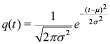
<body><![CDATA[<p><font size="2" face="Verdana, Arial, Helvetica, sans-serif">The main idea of the new GZAD is to assume that there is a density function defined on [0,T] (which is equivalent of saying that x(t) is a random variable with a certain distribution, or {x(t)}<sub>t&ge;0</sub> a stochastic process), and forcing the expectation of s(x(t)) to be zero.</font></p>     <p><font size="2" face="Verdana, Arial, Helvetica, sans-serif">Let q(t) be a density on the real line. Then one can easily define a density on [0,T] by </font></p>     <p><font size="2" face="Verdana, Arial, Helvetica, sans-serif"><img src="/img/revistas/dyna/v78n166/a13eq33.jpeg" /> (4)</font></p>     <p><font size="2" face="Verdana, Arial, Helvetica, sans-serif"> where I is the indicator function (<img src="/img/revistas/dyna/v78n166/a13eq47622.jpeg" /> if <img src="/img/revistas/dyna/v78n166/a13eq47631.jpeg" />, and <img src="/img/revistas/dyna/v78n166/a13eq47642.jpeg" /> otherwise) and </font></p>     <p><font size="2" face="Verdana, Arial, Helvetica, sans-serif"><img src="/img/revistas/dyna/v78n166/a13eq34.jpeg" /> (5)</font></p>     <p><font size="2" face="Verdana, Arial, Helvetica, sans-serif">Then, the expectation of s(x(t)) is computed as </font></p>     <p><font size="2" face="Verdana, Arial, Helvetica, sans-serif"><img src="/img/revistas/dyna/v78n166/a13eq35.jpeg" /> (6)</font></p>     <p><font size="2" face="Verdana, Arial, Helvetica, sans-serif">and <img src="/img/revistas/dyna/v78n166/a13eq47666.jpeg" /> (7)</font></p>     <p><font size="2" face="Verdana, Arial, Helvetica, sans-serif">is imposed in the GZAD strategy. One can recover the classical ZAD strategy with a <img src="/img/revistas/dyna/v78n166/a13eq47675.jpeg" /> distribution. Considering different distributions, like a <img src="/img/revistas/dyna/v78n166/a13eq47684.jpeg" />or <img src="/img/revistas/dyna/v78n166/a13eq47692.jpeg" />, one obtains different control strategies, depending on the importance given to some sets in the interval [0,T]. In the following section, we explain the continuous and discrete cases.</font></p>     <p><font size="2" face="Verdana, Arial, Helvetica, sans-serif"><b>2.2 Continuous case: normal and exponential strategies<br />   </b></font><font size="2" face="Verdana, Arial, Helvetica, sans-serif">The density of a Normal distribution with &micro; mean and <img src="/img/revistas/dyna/v78n166/a13eq47699.jpeg" /> variance is given by </font></p>     ]]></body>
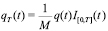

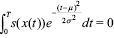
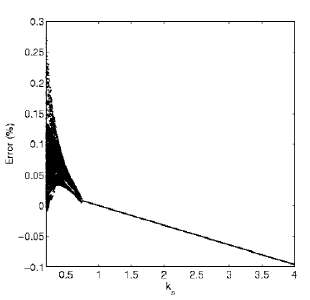
<body><![CDATA[<p><font size="2" face="Verdana, Arial, Helvetica, sans-serif"><img src="/img/revistas/dyna/v78n166/a13eq36.jpeg" /> (8)</font></p>     <p><font size="2" face="Verdana, Arial, Helvetica, sans-serif">In this case we should force </font></p>     <p><font size="2" face="Verdana, Arial, Helvetica, sans-serif"><img src="/img/revistas/dyna/v78n166/a13eq37.jpeg" /> (9)</font></p>     <p><font size="2" face="Verdana, Arial, Helvetica, sans-serif">In practical cases, where x(t) contains exponential and trigonometric functions, it is clear that (9) can only be solved numerically and the computations can be heavy for experimental prototypes. Thus although this distribution can be thought of as an academic example, from a practical point of view this distribution function may not be good.</font></p>     <p><font size="2" face="Verdana, Arial, Helvetica, sans-serif">Instead, if we consider the Exponential distribution with parameter b, whose density is </font></p>     <p><font size="2" face="Verdana, Arial, Helvetica, sans-serif"><img src="/img/revistas/dyna/v78n166/a13eq38.jpeg" /> (10)</font></p>     <p><font size="2" face="Verdana, Arial, Helvetica, sans-serif">then we have to force</font></p>     <p><font size="2" face="Verdana, Arial, Helvetica, sans-serif"><img src="/img/revistas/dyna/v78n166/a13eq39.jpeg" /> (11)</font></p>     <p><font size="2" face="Verdana, Arial, Helvetica, sans-serif">For several applications, this integral will not be solved analytically, but with a good selection of parameter b it is possible to reduce the complexity of the expression for the solution. In such a case, better stability results are obtained, as is shown in the bifurcation diagrams (<a href="#fig01">Figs. 1</a> and <a href="#fig02">2</a>). As the ZAD technique can be used in practical applications such as those reported in [15, 17], the main idea is to find a simple form to compute the duty cycle, which guarantees stability and does not require much computational effort. In this section, we relax the condition of zero value of the integral on the interval [0,T] through a selection of some points, and we force the sum (instead of the integral) to be zero. </font></p>     <p align="center"><font size="2" face="Verdana, Arial, Helvetica, sans-serif"><b><a name="fig01" id="fig01"></a><img src="/img/revistas/dyna/v78n166/a13fig01.gif" /><br />   Figure 1.</b> Bifurcation diagram of the voltage error using k<sub>s</sub> as bifurcation parameter. Classical ZAD strategy: continuous uniform density</font></p>     ]]></body>
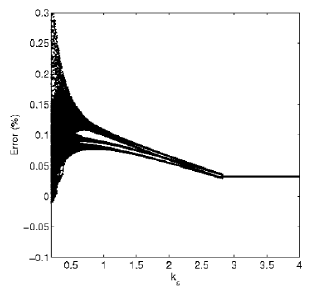
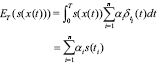
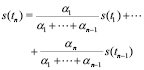
<body><![CDATA[<p align="center"><font size="2" face="Verdana, Arial, Helvetica, sans-serif"><b><a name="fig02" id="fig02"></a><img src="/img/revistas/dyna/v78n166/a13fig02.gif" /><br />   Figure 2.</b> Bifurcation diagram of the voltage error using k<sub>s</sub> as bifurcation parameter. GZAD strategy: exponential density</font></p>     <p><font size="2" face="Verdana, Arial, Helvetica, sans-serif"><b>2.3 The case of discrete random variables<br />   </b></font><font size="2" face="Verdana, Arial, Helvetica, sans-serif">When we have a discrete random variable, some interesting new strategies appear. Let us write the density as a finite combination of Delta functions, </font></p>     <p><font size="2" face="Verdana, Arial, Helvetica, sans-serif"><img src="/img/revistas/dyna/v78n166/a13eq40.jpeg" /> (12)</font></p>     <p><font size="2" face="Verdana, Arial, Helvetica, sans-serif">where all <img src="/img/revistas/dyna/v78n166/a13eq47749.jpeg" />, <img src="/img/revistas/dyna/v78n166/a13eq47758.jpeg" />, for <img src="/img/revistas/dyna/v78n166/a13eq47768.jpeg" />, and </font></p>     <p><font size="2" face="Verdana, Arial, Helvetica, sans-serif"><img src="/img/revistas/dyna/v78n166/a13eq41.jpeg" /> (13)</font></p>     <p><font size="2" face="Verdana, Arial, Helvetica, sans-serif">Then the expectation is </font></p>     <p><font size="2" face="Verdana, Arial, Helvetica, sans-serif"><img src="/img/revistas/dyna/v78n166/a13eq42.jpeg" /> (14)</font></p>     <p><font size="2" face="Verdana, Arial, Helvetica, sans-serif">and it is zero when </font></p>     <p><font size="2" face="Verdana, Arial, Helvetica, sans-serif"><img src="/img/revistas/dyna/v78n166/a13eq43.jpeg" /> (15)</font></p>     <p><font size="2" face="Verdana, Arial, Helvetica, sans-serif">When n = 1, this is reduced to s(t1) = 0 for a chosen <img src="/img/revistas/dyna/v78n166/a13eq47799.jpeg" />. This law is simpler than ZAD and, moreover, <img src="/img/revistas/dyna/v78n166/a13eq47807.jpeg" /> can be chosen in such a way that it minimizes some additional error function, improving the control design. In the case n = 2, we have for some <img src="/img/revistas/dyna/v78n166/a13eq47816.jpeg" />, </font></p>     ]]></body>
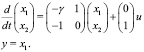
<body><![CDATA[<p><font size="2" face="Verdana, Arial, Helvetica, sans-serif"><img src="/img/revistas/dyna/v78n166/a13eq47826.jpeg" /> (16)</font></p>     <p><font size="2" face="Verdana, Arial, Helvetica, sans-serif">and thus </font></p>     <p><font size="2" face="Verdana, Arial, Helvetica, sans-serif"><img src="/img/revistas/dyna/v78n166/a13eq47833.jpeg" /> (17)</font></p>     <p><font size="2" face="Verdana, Arial, Helvetica, sans-serif">and, in general, for <img src="/img/revistas/dyna/v78n166/a13eq47840.jpeg" /> we have </font></p>     <p><font size="2" face="Verdana, Arial, Helvetica, sans-serif"><img src="/img/revistas/dyna/v78n166/a13eq44.jpeg" /> (18)</font></p>     <p><font size="2" face="Verdana, Arial, Helvetica, sans-serif">for <img src="/img/revistas/dyna/v78n166/a13eq47860.jpeg" />, such that <img src="/img/revistas/dyna/v78n166/a13eq45.jpeg" /> If we choose <img src="/img/revistas/dyna/v78n166/a13eq47877.jpeg" /> (a discrete uniform distribution), we recover the discrete version of the classical ZAD technique. Also, in some cases, it can be useful to apply GZAD to several surfaces <img src="/img/revistas/dyna/v78n166/a13eq47884.jpeg" /> if we need the system, for design purposes, to evolve close to the intersection of the surfaces. This will be studied in a further paper. In Sections 3, 4, and 5, we will use our knowledge of the classical ZAD strategy and we will improve its performance.</font></p>     <p>&nbsp;</p>     <p><b><font size="3" face="Verdana, Arial, Helvetica, sans-serif">3. THE DESIGN OF THE CONTROL STRATEGY: UNIFORM (ZAD) AND EXPONENTIAL (GZAD) DISTRIBUTIONS.</font></b></p>     <p><font size="2" face="Verdana, Arial, Helvetica, sans-serif">With the aim of generalizing the ZAD technique, we consider a system defined by (19), with &gamma; &gt; 0, which corresponds to any two-order stable linear system with relative degree two and unitary gain (a complete procedure for this transformation can be found in [26]).</font></p>     <p><font size="2" face="Verdana, Arial, Helvetica, sans-serif"><img src="/img/revistas/dyna/v78n166/a13eq46.jpeg" /> (19)</font></p>     ]]></body>
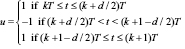
<body><![CDATA[<p><font size="2" face="Verdana, Arial, Helvetica, sans-serif">The control variable is <img src="/img/revistas/dyna/v78n166/a13eq47899.jpeg" />. A centered PWM u is given by </font></p>     <p><font size="2" face="Verdana, Arial, Helvetica, sans-serif"><img src="/img/revistas/dyna/v78n166/a13eq47.jpeg" /> (20)</font></p>     <p><font size="2" face="Verdana, Arial, Helvetica, sans-serif">Where d is the normalized duty cycle. The objective is to find a control law in such a way that the output variable (y) remains close to a fixed desired value with low voltage error (regulation task) and the system is robust. To satisfy these requirements, and using the main ideas of sliding control, the following function is defined [27]: </font></p>     <p><font size="2" face="Verdana, Arial, Helvetica, sans-serif"><img src="/img/revistas/dyna/v78n166/a13eq47918.jpeg" /> (21)</font></p>     <p><font size="2" face="Verdana, Arial, Helvetica, sans-serif">where x1 is the variable to be controlled and k<sub>s</sub> is the time-constant associated with the error dynamics. Because of the similarity with sliding modes, s(x) is also called sliding surface.</font></p>     <p><font size="2" face="Verdana, Arial, Helvetica, sans-serif">The proposed ZAD strategy is based on computing a time instant d, such that in each period T, the following equation is satisfied </font></p>     <p><font size="2" face="Verdana, Arial, Helvetica, sans-serif"><img src="/img/revistas/dyna/v78n166/a13eq48.jpeg" /> (22)</font></p>     <p><font size="2" face="Verdana, Arial, Helvetica, sans-serif">Thus s(x(t)) is forced to have zero average in each period. As we stated previously, the reported ZAD strategy is based on a continuous uniform distribution, in such a way that (22) is satisfied in each period. Using an exponential distribution, we force the system to satisfy </font></p>     <p><font size="2" face="Verdana, Arial, Helvetica, sans-serif"><img src="/img/revistas/dyna/v78n166/a13eq49.jpeg" /> (23)</font></p>     <p><font size="2" face="Verdana, Arial, Helvetica, sans-serif">With the aim of testing our generalization of the ZAD strategy, we compute the duty cycle with continuous uniform (classical ZAD strategy) and exponential densities (GZAD) using b = 1. <a href="#fig01">Figures 1</a> and <a href="#fig02">2</a> show the bifurcation diagram of both strategies for &gamma; = 0.35. The fixed point loses stability for k<sub>s</sub> » 2.8 with the classical ZAD strategy, while the point loses stability for k<sub>s</sub> » 0.743 with GZAD. Thus the generalized method shows that the stability range has been enlarged. The voltage error, shown at the sampling times <img src="/img/revistas/dyna/v78n166/a13eq47942.jpeg" /> is very low in both methods.</font></p>     ]]></body>

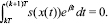
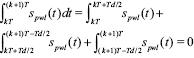
<body><![CDATA[<p><font size="2" face="Verdana, Arial, Helvetica, sans-serif">It is worth noting that quantitative agreement with the voltage error is hard to obtain in practical applications mainly due to problems related to the sensitivity of sensors, delays, and so on. Therefore, the advantage of GZAD strategy is the widening of the stability range. However, the main problem of this technique, as it is also in the case of the classical continuous ZAD strategy, is that it is still necessary to solve a transcendental equation for finding the duty cycle in each period. For solving this situation, we proceeded to define the generalized ZAD discrete version.</font></p>     <p>&nbsp;</p>     <p><b><font size="3" face="Verdana, Arial, Helvetica, sans-serif">4. THE DESIGN OF THE CONTROL STRATEGY FOR DISCRETE RANDOM VARIABLES: DISCRETE ZAD AND DISCRETE GZAD</font></b></p>     <p><font size="2" face="Verdana, Arial, Helvetica, sans-serif">For the classical ZAD strategy a practical handicap for experimental validation is the heavy computation of the duty cycle at each sampling interval. This is due to the fact that, at each sampling time <img src="/img/revistas/dyna/v78n166/a13eq254.jpeg" /> , a transcendental equation must be solved. In order to avoid this problem, in [11, 12] a piece-wise linear function <img src="/img/revistas/dyna/v78n166/a13eq47962.jpeg" /> was introduced (which approximates quite well the original <img src="/img/revistas/dyna/v78n166/a13eq47969.jpeg" />), and instead of solving <img src="/img/revistas/dyna/v78n166/a13eq50.jpeg" /> it was forced that <img src="/img/revistas/dyna/v78n166/a13eq51.jpeg" /> </font></p>     <p><font size="2" face="Verdana, Arial, Helvetica, sans-serif">Function <img src="/img/revistas/dyna/v78n166/a13eq47991.jpeg" /> was defined by three linear pieces and the slopes of these pieces where <img src="/img/revistas/dyna/v78n166/a13eq48000.jpeg" /> was in the first piece, <img src="/img/revistas/dyna/v78n166/a13eq48010.jpeg" /> in the second one, and <img src="/img/revistas/dyna/v78n166/a13eq48017.jpeg" /> again in the third one. So, <img src="/img/revistas/dyna/v78n166/a13eq48024.jpeg" /> is computed as the slope of the function <img src="/img/revistas/dyna/v78n166/a13eq48033.jpeg" /> at the beginning of the sampling interval assuming that u = +1, while <img src="/img/revistas/dyna/v78n166/a13eq48044.jpeg" /> is computed as the slope of the function <img src="/img/revistas/dyna/v78n166/a13eq48054.jpeg" /> at the beginning of the sampling interval, assuming that <img src="/img/revistas/dyna/v78n166/a13eq48061.jpeg" />. Concretely,</font></p>     <p><font size="2" face="Verdana, Arial, Helvetica, sans-serif"><img src="/img/revistas/dyna/v78n166/a13eq52.jpeg" /></font></p>     <p><font size="2" face="Verdana, Arial, Helvetica, sans-serif">Then, we assume that the first piece is defined in <img src="/img/revistas/dyna/v78n166/a13eq53.jpeg" />the second piece in <img src="/img/revistas/dyna/v78n166/a13eq54.jpeg" /> and the third one in <img src="/img/revistas/dyna/v78n166/a13eq55.jpeg" /> Thus we compute the normalized duty cycle <img src="/img/revistas/dyna/v78n166/a13eq48102.jpeg" /> in such a way that the following equation is satisfied: </font></p>     <p><font size="2" face="Verdana, Arial, Helvetica, sans-serif"><img src="/img/revistas/dyna/v78n166/a13eq56.jpeg" /> (24)</font></p>     <p><font size="2" face="Verdana, Arial, Helvetica, sans-serif">Then the duty cycle obtained is [12]: </font></p>     <p><font size="2" face="Verdana, Arial, Helvetica, sans-serif"><img src="/img/revistas/dyna/v78n166/a13eq57.jpeg" /> (25)</font></p>     ]]></body>
<body><![CDATA[<p><font size="2" face="Verdana, Arial, Helvetica, sans-serif">where <img src="/img/revistas/dyna/v78n166/a13eq48125.jpeg" /> is the value of <img src="/img/revistas/dyna/v78n166/a13eq48135.jpeg" /> in <img src="/img/revistas/dyna/v78n166/a13eq58.jpeg" />.</font></p>     <p><font size="2" face="Verdana, Arial, Helvetica, sans-serif">Since d must be in the interval <img src="/img/revistas/dyna/v78n166/a13eq48152.jpeg" />, we saturate the expression in (25) by 1 if it exceeds 1, or we saturate it to 0 if it is below 0. This is the simplest case, and it is called classical discrete ZAD.</font></p>     <p><font size="2" face="Verdana, Arial, Helvetica, sans-serif">In [12, 13] it was proven that considering <img src="/img/revistas/dyna/v78n166/a13eq48159.jpeg" /> as a piece-wise linear function, for &gamma; = 0.35 and <img src="/img/revistas/dyna/v78n166/a13eq48166.jpeg" />, the system defined by (19), (20) and (25) has a stable T-periodic orbit for k<sub>s</sub> » &gt; 3.25. For this value the system has a period-doubling bifurcation followed by a corner collision bifurcation (at k<sub>s</sub> » 3.24), followed by a second period-doubling bifurcation (for k<sub>s</sub> » 3) and a second corner collision (for k<sub>s</sub> » 2.999). After these bifurcations, chaotic bands appear and the process continues until the system enters in 1-band chaos (for k<sub>s</sub> » 0.5). Details of this bifurcation process can be found in [13, 18].</font></p>     <p><font size="2" face="Verdana, Arial, Helvetica, sans-serif">As far as we know, the system losses stability since it is unable to hold zero average, and many saturated duty cycles appear. This is basically because the control pulse u(t) is symmetric, and <img src="/img/revistas/dyna/v78n166/a13eq48174.jpeg" /> is not. We assume that the first and the third slopes of the piece-wise linear function <img src="/img/revistas/dyna/v78n166/a13eq48183.jpeg" /> have the same value (<img src="/img/revistas/dyna/v78n166/a13eq48194.jpeg" />) and they should be assumed to be different.</font></p>     <p><font size="2" face="Verdana, Arial, Helvetica, sans-serif">Now, we propose a new general version of discrete ZAD (called discrete GZAD) given by </font></p>     <p><font size="2" face="Verdana, Arial, Helvetica, sans-serif"><img src="/img/revistas/dyna/v78n166/a13eq59.jpeg" /> (26)</font></p>     <p><font size="2" face="Verdana, Arial, Helvetica, sans-serif">where <img src="/img/revistas/dyna/v78n166/a13eq48208.jpeg" /> corresponds to a density of a discrete distribution, and thus it involves Delta functions. Then, as the previous continuous case, we force the expectation of <img src="/img/revistas/dyna/v78n166/a13eq48217.jpeg" /> to be zero in each sampling period <img src="/img/revistas/dyna/v78n166/a13eq48227.jpeg" />. Thus the integral in (26) can be computed as </font></p>     <p><font size="2" face="Verdana, Arial, Helvetica, sans-serif"><img src="/img/revistas/dyna/v78n166/a13eq60.jpeg" /> (27)</font></p>     <p><font size="2" face="Verdana, Arial, Helvetica, sans-serif"> with <img src="/img/revistas/dyna/v78n166/a13eq61.jpeg" />Depending on the number n of points, we have different expressions for the normalized duty cycle d. Also, as in classical discrete ZAD, we will assume that the function <img src="/img/revistas/dyna/v78n166/a13eq48251.jpeg" /> is close to a piece-wise linear function <img src="/img/revistas/dyna/v78n166/a13eq48258.jpeg" /> with 3 linear pieces in the sampling interval <img src="/img/revistas/dyna/v78n166/a13eq48266.jpeg" /> (1 piece if we have saturation in the duty cycle). We will show with detail the case for n = 2, being a good compromise between simplicity in control and good bounds for the voltage error, and also, because it completely exemplifies our method.</font></p>     <p><font size="2" face="Verdana, Arial, Helvetica, sans-serif">We have <img src="/img/revistas/dyna/v78n166/a13eq62.jpeg" /> After some algebra, it is easy to obtain the following equivalent expression </font></p>     ]]></body>
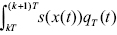
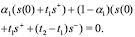
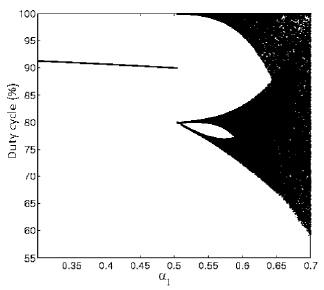
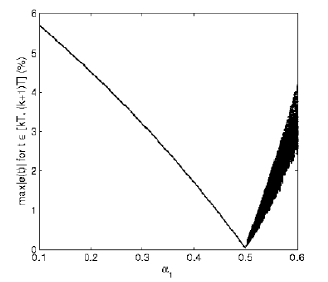
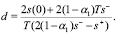
<body><![CDATA[<p><font size="2" face="Verdana, Arial, Helvetica, sans-serif"><img src="/img/revistas/dyna/v78n166/a13eq63.jpeg" /> (28)</font></p>     <p><font size="2" face="Verdana, Arial, Helvetica, sans-serif">We still have many choices for <img src="/img/revistas/dyna/v78n166/a13eq48411.jpeg" /> and <img src="/img/revistas/dyna/v78n166/a13eq48418.jpeg" />, and for &alpha;1; but there are several natural ways to choose them, according to the symmetry of the control variable u. One of the possible natural choices is t1 = d/2 and t2 = 1-d/2. Then the normalized duty cycle is found as </font></p>     <p><font size="2" face="Verdana, Arial, Helvetica, sans-serif"><img src="/img/revistas/dyna/v78n166/a13eq64.jpeg" /> (29)</font></p>     <p><font size="2" face="Verdana, Arial, Helvetica, sans-serif">Of course, we also saturate d to <img src="/img/revistas/dyna/v78n166/a13eq48437.jpeg" /> or <img src="/img/revistas/dyna/v78n166/a13eq48448.jpeg" /> to obtain a value in the admissible interval <img src="/img/revistas/dyna/v78n166/a13eq48455.jpeg" />. In particular, taking into account our knowledge of the ZAD strategy, we apply this new version for improving the performance of the controller and for widening the stability range. It is worth noting that for &alpha;1 = 1/2, we reproduce the classical discrete ZAD strategy. However the duty cycle expression for the generalized ZAD (GZAD) is more powerful than the one for the classical ZAD strategy. This is because the system losses the stability mainly at the end of the sampling period. The system tries to preserve simultaneously zero average and the symmetry of the pulse, and both things together are hard to satisfy.</font></p>     <p><font size="2" face="Verdana, Arial, Helvetica, sans-serif">With the new expression for the duty cycle in (29) we can give more weight to the last part of the sampling interval and force the system to evolve better. In particular, we want to emphasize that even very small differences between duty cycles, produce completely different behaviors [14,19,20]. <a href="#fig03">Figure 3</a> show the bifurcation diagram of the duty cycle using &alpha;1 as bifurcation parameter and fixing k<sub>s</sub> = 4.5. Taking into account that &alpha;1 is the weight of the value of <img src="/img/revistas/dyna/v78n166/a13eq48462.jpeg" />, at the sampling time, the minimum regulation error was obtained when &alpha;1 = 0.4967, which agrees with <img src="/img/revistas/dyna/v78n166/a13eq65.jpeg" />. This balances the difference between the real and expected values of <img src="/img/revistas/dyna/v78n166/a13eq48477.jpeg" /> at <img src="/img/revistas/dyna/v78n166/a13eq66.jpeg" /> and at <img src="/img/revistas/dyna/v78n166/a13eq67.jpeg" /> and now the system has almost the same behavior as the classical ZAD strategy without approximation (but with less computation effort) (see <a href="#fig01">Fig. 1</a>).</font></p>     <p align="center"><font size="2" face="Verdana, Arial, Helvetica, sans-serif"><b><a name="fig03" id="fig03"></a><img src="/img/revistas/dyna/v78n166/a13fig03.gif" /><br />   Figure 3.</b> Bifurcation diagram of the duty cycle using &alpha;1 as bifurcation parameter. k<sub>s</sub> = 4.5</font></p>     <p><font size="2" face="Verdana, Arial, Helvetica, sans-serif"><a href="#fig04">Figure 4</a> shows the bifurcation diagram for the maximum of the absolute value of the voltage error in each interval <img src="/img/revistas/dyna/v78n166/a13eq68.jpeg" />when &alpha;1 is varied (this is <img src="/img/revistas/dyna/v78n166/a13eq69.jpeg" /> versus &alpha;1).</font></p>     <p align="center"><font size="2" face="Verdana, Arial, Helvetica, sans-serif"><b><a name="fig04" id="fig04"></a><img src="/img/revistas/dyna/v78n166/a13fig04.gif" /><br />   Figure 4.</b> Bifurcation diagram of the maximum absolute voltage error in each period, using &alpha;1 as bifurcation parameter and fixing k<sub>s</sub> = 4.5Then, from the previous results we conclude that: </font></p> <ul>       <li><font size="2" face="Verdana, Arial, Helvetica, sans-serif">The value of &alpha;1 for which the minimum voltage error in steady state is obtained is &alpha;1 = 0.4989. </font></li>       <li><font size="2" face="Verdana, Arial, Helvetica, sans-serif">Higher values of &alpha;1 imply higher values of k<sub>s</sub>. However, previous analysis have shown that k<sub>s</sub> cannot be very high since although the system is still stable, it losses the regulation capability [12]. </font></li>       ]]></body>
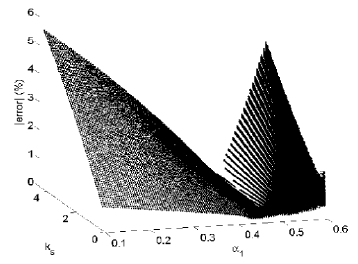
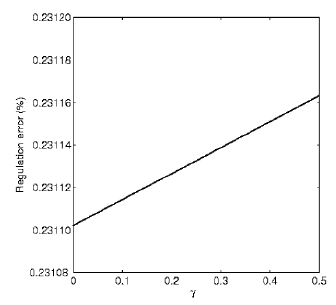
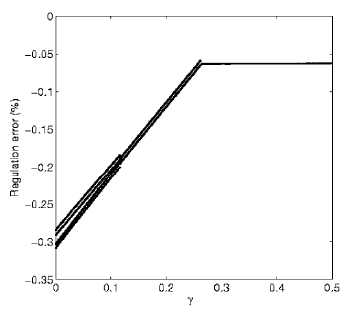
<body><![CDATA[<li><font size="2" face="Verdana, Arial, Helvetica, sans-serif">From <a href="#fig04">Fig. 4</a> we can choose &alpha;1 so that the stability is improved and the maximum voltage error is lower with a certain threshold (say, for example, with regulation error lower than 1<img src="/img/revistas/dyna/v78n166/a13eq48519.jpeg" />).</font></li>     </ul>     <p><font size="2" face="Verdana, Arial, Helvetica, sans-serif">Thus, this new technique can be used to design a PWM control technique in such a way that the compromise among accuracy, steady state voltage error, and the stability of the 1-periodic orbit can be properly handled. Taking this idea into account, we present the following section.</font></p>     <p>&nbsp;</p>     <p><b><font size="3" face="Verdana, Arial, Helvetica, sans-serif">5. DESIGN OF AN IMPROVED CONTROLLER</font></b></p>     <p><font size="2" face="Verdana, Arial, Helvetica, sans-serif">Taking into account that now the main parameters are k<sub>s</sub> and &alpha;1, we need to state an optimal link between them. Since analytical results are very difficult to obtain, we proceed to relate k<sub>s</sub> and &alpha;1 through a two-dimensional numerical plot. <a href="#fig05">Figure 5</a> shows the absolute value of the voltage error at the sampling time using &alpha;1 and k<sub>s</sub> as variables.</font></p>     <p align="center"><font size="2" face="Verdana, Arial, Helvetica, sans-serif"><b><a name="fig05" id="fig05"></a><img src="/img/revistas/dyna/v78n166/a13fig05.gif" /><br />   Figure 5.</b> Plot of the absolute voltage error at the sampling time using &alpha;1 and k<sub>s</sub> as variables (the right part of the surface is unstable, while the left part is stable).</font></p>     <p><font size="2" face="Verdana, Arial, Helvetica, sans-serif">It is worth noting that even though the bifurcation diagrams shown in <a href="#fig04">Figs. 4</a> and <a href="#fig05">5</a> can induce one to think that the best strategy is to select values close to classical discrete ZAD, these values give too much weight to the derivative part of <img src="/img/revistas/dyna/v78n166/a13eq48529.jpeg" /> (<img src="/img/revistas/dyna/v78n166/a13eq48539.jpeg" />) and the system hardly follows the ZAD strategy (that is, it has many saturated cycles which do not fit the ZAD strategy). Using the diagram shown in <a href="#fig05">Fig. 5</a>, we can observe that as we decrease the value of &alpha;1 it is possible to reduce the value of k<sub>s</sub> for obtaining a regulated 1-periodic orbit. Analyzing the same figure, we conclude that the weight (1- &alpha;1) applied to the second point of the discrete ZAD strategy has a significant effect on the stability. Even more, for &alpha;1 &gt; 0.52, the system is unstable for k<sub>s</sub> &lt; 5, and the technique cannot be applied. In fact, k<sub>s</sub> &lt; 5 is required for regulation purposes. Specifically for our case, previous work<sub>s</sub> have reported that the classical ZAD strategy is not robust enough to load changes. In [12] it was proven that for k<sub>s</sub> = 4.5 and varying &gamma;, the system lost the stability of the one-periodic orbit close to &gamma; = 0.26.</font></p>     <p><font size="2" face="Verdana, Arial, Helvetica, sans-serif">On the other hand, using the proposed GZAD technique in this work and, taking k<sub>s</sub> = 0.3 and &alpha;1 = 0.3, the system preserves the stability of the 1-periodic orbit even if &gamma; is very low <img src="/img/revistas/dyna/v78n166/a13eq70.jpeg" />. The comparison between both strategies is presented in <a href="#fig06">Figs. 6</a>-<a href="#fig07">7</a>. The figures are devoted to showing the behavior of the regulation error. Although both have very similar values for the regulation error, the ZAD strategy has a lower voltage error than the GZAD strategy for &gamma; &gt; 0.1. However, very low voltage error is difficult to obtain in practical implementations due to problems related to the sensitivity of the sensors, noise, delays, etc. So, from a practical point of view, the global performance of the GZAD strategy is better than the classical ZAD strategy due to the fact that GZAD is more robust and shows no bifurcations (see <a href="#fig06">Figs. 6</a> and <a href="#fig07">7</a>).</font></p>     <p align="center"><font size="2" face="Verdana, Arial, Helvetica, sans-serif"><b><a name="fig06" id="fig06"></a><img src="/img/revistas/dyna/v78n166/a13fig06.gif" /><br />   Figure 6.</b> GZAD: bifurcation diagram of the voltage error, using &gamma; as bifurcation parameter (k<sub>s</sub> = 0.3, &alpha;1 =0.3)</font></p>     ]]></body>
<body><![CDATA[<p align="center"><font size="2" face="Verdana, Arial, Helvetica, sans-serif"><b><a name="fig07" id="fig07"></a><img src="/img/revistas/dyna/v78n166/a13fig07.gif" /><br />   Figure 7.</b> ZAD: Bifurcation diagram of the voltage error, using &gamma; as bifurcation parameter (k<sub>s</sub> = 4.5)</font></p>     <p><font size="2" face="Verdana, Arial, Helvetica, sans-serif">Therefore we conclude that, for practical purposes, this new GZAD strategy with the improved method can have more applications than the classical ZAD strategy previously reported in the literature.</font></p>     <p>&nbsp;</p>     <p><b><font size="3" face="Verdana, Arial, Helvetica, sans-serif">6. CONCLUSIONS AND FUTURE WORK</font></b></p>     <p><font size="2" face="Verdana, Arial, Helvetica, sans-serif">We can summarize our main results about the GZAD strategy as follows: </font></p>     <p><font size="2" face="Verdana, Arial, Helvetica, sans-serif">The main advantage of the GZAD strategy is related to the stability of the 1-periodic orbit. Taking into account the idea behind the ZAD strategy (fixed frequency switching), this new and generalized technique solves a lot of problems related to chaos, period doubling and, of course, the loss of fixed frequency switching.</font></p>     <p><font size="2" face="Verdana, Arial, Helvetica, sans-serif">GZAD strategy can be used in a wide range of situations and purposes. One of them is fixing k<sub>s</sub> and finding the best value of &alpha;1 assuming steady state conditions. Conversely, another purpose is fixing &alpha;1 and finding the best value for k<sub>s</sub>. However, results have shown that probably the best use is to keep k<sub>s</sub> and &alpha;1 in low values, as we did in Section 5 (k<sub>s</sub> = 0.3 and &alpha;1 = 0.3), using <a href="#fig05">Fig. 5</a>. The k<sub>s</sub> value must be low because, as the parameter k<sub>s</sub> increases, the regulation ability of the system is lost and the voltage error increases (see <a href="#fig05">Fig. 5</a>). </font></p>     <p><font size="2" face="Verdana, Arial, Helvetica, sans-serif">Despite the fact that the probabilities framework may look a bit unusual when dealing with DC-DC converters, we propose using the expression of the duty cycle given by (29), replacing &alpha;1 with 0.3 with k<sub>s</sub> = 0.3, instead of the duty cycle given by (25) which has two main disadvantages: on the one hand, it is more unstable than our proposed technique and, on the other hand, it exhibits a lot of nonlinear behavior, which makes that allows for the fixed frequency switching to be easily lost.</font></p>     <p><font size="2" face="Verdana, Arial, Helvetica, sans-serif">With our proposed procedure we are able to reproduce continuous and discrete classical ZAD strategies.</font></p>     <p><font size="2" face="Verdana, Arial, Helvetica, sans-serif">Our future work will be devoted to testing this technique on a prototype developed in our laboratory. Finally, we want to emphasize that the system with classical ZAD is highly sensitive to the duty cycle computation, as it has been previously observed and reported [14, 19]. This is why the experimental results for the classical ZAD strategy alone do not totally fit with the obtained numerical results. However, using the ideas of this GZAD strategy and, adding other control techniques such as the FPIC, we have obtained very good performance [28] and very good agreement between experimental and numerical results [29].</font></p>     ]]></body>
<body><![CDATA[<p>&nbsp;</p>     <p><b><font size="3" face="Verdana, Arial, Helvetica, sans-serif">REFERENCES</font></b></p>     <!-- ref --><p><font size="2" face="Verdana, Arial, Helvetica, sans-serif"><b>[1]</b> MOHAN N., UNDELAND T.M. AND ROBBINS W.P. Power electronics: converters, applications and design. New York, Wiley, second edition, 1995.     &nbsp;&nbsp;&nbsp;&nbsp;&nbsp;&nbsp;&nbsp;&nbsp;[&#160;<a href="javascript:void(0);" onclick="javascript: window.open('/scielo.php?script=sci_nlinks&ref=000135&pid=S0012-7353201100020001300001&lng=','','width=640,height=500,resizable=yes,scrollbars=1,menubar=yes,');">Links</a>&#160;]<!-- end-ref --><!-- ref --><br>   <b>[2]</b> SEVERNS R.P. AND BLOOM G. Modern DC to DC Switch-mode Power Converter Circuits. Van Nostrand - Reinhold, New York. 1985.     &nbsp;&nbsp;&nbsp;&nbsp;&nbsp;&nbsp;&nbsp;&nbsp;[&#160;<a href="javascript:void(0);" onclick="javascript: window.open('/scielo.php?script=sci_nlinks&ref=000136&pid=S0012-7353201100020001300002&lng=','','width=640,height=500,resizable=yes,scrollbars=1,menubar=yes,');">Links</a>&#160;]<!-- end-ref --><!-- ref --><br>   <b>[3]</b> SIRA-RAMREZ H. Sliding Motions in Bilinear Switched Network<sub>s</sub> IEEE Transactions on Circuits and Systems I, Vol. 34, No. 8, pp. 919-933, August 1987.     &nbsp;&nbsp;&nbsp;&nbsp;&nbsp;&nbsp;&nbsp;&nbsp;[&#160;<a href="javascript:void(0);" onclick="javascript: window.open('/scielo.php?script=sci_nlinks&ref=000137&pid=S0012-7353201100020001300003&lng=','','width=640,height=500,resizable=yes,scrollbars=1,menubar=yes,');">Links</a>&#160;]<!-- end-ref --><!-- ref --><br>   <b>[4]</b> BANERJEE S. AND VERGHESE G.C. Nonlinear phenomena in power electronics, IEEE Press, Piscataway. 2001.     &nbsp;&nbsp;&nbsp;&nbsp;&nbsp;&nbsp;&nbsp;&nbsp;[&#160;<a href="javascript:void(0);" onclick="javascript: window.open('/scielo.php?script=sci_nlinks&ref=000138&pid=S0012-7353201100020001300004&lng=','','width=640,height=500,resizable=yes,scrollbars=1,menubar=yes,');">Links</a>&#160;]<!-- end-ref --><!-- ref --><br>   <b>[5]</b> MAITY S., TRIPATHY D., BHATTACHARYA T. K. AND BANERJEE S. Bifurcation Analysis of PWM-1 Voltage-Mode-Controlled Buck Converter Using the Exact Discrete Model IEEE Transactions on Circuits and Systems I: Regular Papers, Vol. 54, No. 5, pp. 1120-1130, May 2007.     &nbsp;&nbsp;&nbsp;&nbsp;&nbsp;&nbsp;&nbsp;&nbsp;[&#160;<a href="javascript:void(0);" onclick="javascript: window.open('/scielo.php?script=sci_nlinks&ref=000139&pid=S0012-7353201100020001300005&lng=','','width=640,height=500,resizable=yes,scrollbars=1,menubar=yes,');">Links</a>&#160;]<!-- end-ref --><!-- ref --><br>   <b>[6]</b> YUE MA, KAWAKAMI H. AND TSE C.K. Bifurcation analysis of switched dynamical systems with periodically moving borders IEEE Transactions on Circuits and Systems I: Regular Papers, Vol. 51, No. 6, pp. 1184-1193, June 2004.     &nbsp;&nbsp;&nbsp;&nbsp;&nbsp;&nbsp;&nbsp;&nbsp;[&#160;<a href="javascript:void(0);" onclick="javascript: window.open('/scielo.php?script=sci_nlinks&ref=000140&pid=S0012-7353201100020001300006&lng=','','width=640,height=500,resizable=yes,scrollbars=1,menubar=yes,');">Links</a>&#160;]<!-- end-ref --><!-- ref --><br>   <b>[7]</b> TSE C.K., Complex Behavior of Switching Power Converters, Boca Raton, CRC Press, 2004.     &nbsp;&nbsp;&nbsp;&nbsp;&nbsp;&nbsp;&nbsp;&nbsp;[&#160;<a href="javascript:void(0);" onclick="javascript: window.open('/scielo.php?script=sci_nlinks&ref=000141&pid=S0012-7353201100020001300007&lng=','','width=640,height=500,resizable=yes,scrollbars=1,menubar=yes,');">Links</a>&#160;]<!-- end-ref --><!-- ref --><br>   <b>[8]</b> DI BERNARDO M., CHAMPNEYS A.R., HOGAN S.J., HOMER M.E., KOWALCZYK P., KUZNETSOV YU.A. AND NORDMARK A.B. Two-parameter non-smooth bifurcations of limit cycles: Challenges and open problems, International Journal of Bifurcation and Chaos, Vol. 16, No. 3, pp. 601 - 629, 2006.     &nbsp;&nbsp;&nbsp;&nbsp;&nbsp;&nbsp;&nbsp;&nbsp;[&#160;<a href="javascript:void(0);" onclick="javascript: window.open('/scielo.php?script=sci_nlinks&ref=000142&pid=S0012-7353201100020001300008&lng=','','width=640,height=500,resizable=yes,scrollbars=1,menubar=yes,');">Links</a>&#160;]<!-- end-ref --><!-- ref --><br>   <b>[9]</b> EL AROUDI A. AND ROBERT B., Modeling and Dynamics of a High Voltage DC-DC Converter: A Nonlinear Approach, NOLTA 04, pp. 311 - 316, Fukuoka, Japan, 2004.     &nbsp;&nbsp;&nbsp;&nbsp;&nbsp;&nbsp;&nbsp;&nbsp;[&#160;<a href="javascript:void(0);" onclick="javascript: window.open('/scielo.php?script=sci_nlinks&ref=000143&pid=S0012-7353201100020001300009&lng=','','width=640,height=500,resizable=yes,scrollbars=1,menubar=yes,');">Links</a>&#160;]<!-- end-ref --><!-- ref --><br>   <b>[10]</b> EL AROUDI A., BENADERO L., TORIBIO E. AND MACHICHE S. Quasiperiodicity and Chaos in the DC-DC Buck-Boost Converter, International Journal of Bifurcation and Chaos, Vol. 10, No. 2, pp. 359 - 371, October 2000.     &nbsp;&nbsp;&nbsp;&nbsp;&nbsp;&nbsp;&nbsp;&nbsp;[&#160;<a href="javascript:void(0);" onclick="javascript: window.open('/scielo.php?script=sci_nlinks&ref=000144&pid=S0012-7353201100020001300010&lng=','','width=640,height=500,resizable=yes,scrollbars=1,menubar=yes,');">Links</a>&#160;]<!-- end-ref --><!-- ref --><br>   <b>[11]</b> FOSSAS E., GRI&Ntilde;&Oacute; R. AND BIEL D. Quasi-sliding control based on pulse width modulation, zero average and the norm, in Advances in Variable Structure System, Analysis, Integration and Applications. Edited by Xinghuo Yu and Jian-Xin Xu. Ed. World Scientific, pp. 335-344, 2001.     &nbsp;&nbsp;&nbsp;&nbsp;&nbsp;&nbsp;&nbsp;&nbsp;[&#160;<a href="javascript:void(0);" onclick="javascript: window.open('/scielo.php?script=sci_nlinks&ref=000145&pid=S0012-7353201100020001300011&lng=','','width=640,height=500,resizable=yes,scrollbars=1,menubar=yes,');">Links</a>&#160;]<!-- end-ref --><!-- ref --><br>   <b>[12]</b> ANGULO F. An&aacute;lisis de la din&aacute;mica de convertidores electr&oacute;nicos de potencia usando PWM basado en promediado cero de la din&aacute;mica del error (ZAD). [Ph.D. Thesis], Universitat Polit&eacute;cnica de Catalunya, July 2004 (in Spanish). Available at <a href="http://www.tdx.cesca.es/TDX-0727104-095928/" target="referencia">http://www.tdx.cesca.es/TDX-0727104-095928/</a>.     &nbsp;&nbsp;&nbsp;&nbsp;&nbsp;&nbsp;&nbsp;&nbsp;[&#160;<a href="javascript:void(0);" onclick="javascript: window.open('/scielo.php?script=sci_nlinks&ref=000146&pid=S0012-7353201100020001300012&lng=','','width=640,height=500,resizable=yes,scrollbars=1,menubar=yes,');">Links</a>&#160;]<!-- end-ref --><br>   <b>[13]</b> ANGULO F., FOSSAS E. AND OLIVAR G. Transition From Periodicity to Chaos in a PWM-Controlled Buck Converter with ZAD strategy. International Journal of Bifurcations and Chaos, Vol. 15, No. 10, pp. 3245&ndash;3264, 2005.     <br>   <b>[14]</b> ANGULO F., OLIVAR G. AND DI BERNARDO M. Two-Parameter Discontinuity-Induced Bifurcation Curves in a ZAD-Strategy-Controlled DC&ndash;DC Buck Converter. IEEE Transactions on Circuits and Systems I, Vol. 55, No. 8, pp. 2392-2401, 2008.     <!-- ref --><br>   <b>[15]</b> RAMOS R., BIEL D., FOSSAS E. AND GUINJOAN F. A fixed-frequency quasi-sliding control algorithm: Application to power inverters design by means of FPGA implementation IEEE Transactions on Power Electronics, Vol. 18, No. 1, January 2003.     &nbsp;&nbsp;&nbsp;&nbsp;&nbsp;&nbsp;&nbsp;&nbsp;[&#160;<a href="javascript:void(0);" onclick="javascript: window.open('/scielo.php?script=sci_nlinks&ref=000149&pid=S0012-7353201100020001300015&lng=','','width=640,height=500,resizable=yes,scrollbars=1,menubar=yes,');">Links</a>&#160;]<!-- end-ref --><!-- ref --><br>   <b>[16]</b> BIEL D. AND FOSSAS E. SMC applications in Power Electronics, in Variable Structure Systems: from principles to implementation, L. Fridman, A. Sabanovi and S. Spurgeon Ed., IEE, 2004.     &nbsp;&nbsp;&nbsp;&nbsp;&nbsp;&nbsp;&nbsp;&nbsp;[&#160;<a href="javascript:void(0);" onclick="javascript: window.open('/scielo.php?script=sci_nlinks&ref=000150&pid=S0012-7353201100020001300016&lng=','','width=640,height=500,resizable=yes,scrollbars=1,menubar=yes,');">Links</a>&#160;]<!-- end-ref --><!-- ref --><br>   <b>[17]</b> ANGULO F., OCAMPO C., OLIVAR G AND RAMOS R. Nonlinear and nonsmooth dynamics in a DC-DC Buck converter: two experimental set-ups. Nonlinear Dynamics, Vol. 46, pp. 239-257, 2006.     &nbsp;&nbsp;&nbsp;&nbsp;&nbsp;&nbsp;&nbsp;&nbsp;[&#160;<a href="javascript:void(0);" onclick="javascript: window.open('/scielo.php?script=sci_nlinks&ref=000151&pid=S0012-7353201100020001300017&lng=','','width=640,height=500,resizable=yes,scrollbars=1,menubar=yes,');">Links</a>&#160;]<!-- end-ref --><!-- ref --><br>   <b>[18]</b> ANGULO F., OLIVAR G. AND TABORDA A. Continuation of periodic orbits in a ZAD-strategy controlled buck converter. Chaos, Solitons and Fractals, Vol. 38, pp. 348-363, 2008.     &nbsp;&nbsp;&nbsp;&nbsp;&nbsp;&nbsp;&nbsp;&nbsp;[&#160;<a href="javascript:void(0);" onclick="javascript: window.open('/scielo.php?script=sci_nlinks&ref=000152&pid=S0012-7353201100020001300018&lng=','','width=640,height=500,resizable=yes,scrollbars=1,menubar=yes,');">Links</a>&#160;]<!-- end-ref --><!-- ref --><br>   <b>[19]</b> FOSSAS E., HOGAN S.J. AND M-SEARA, T. Two-parameter bifurcation curves in power electronic converters. International Journal of Bifurcation and Chaos, Vol. 19, No. 1, pp. 349-357, 2009.     &nbsp;&nbsp;&nbsp;&nbsp;&nbsp;&nbsp;&nbsp;&nbsp;[&#160;<a href="javascript:void(0);" onclick="javascript: window.open('/scielo.php?script=sci_nlinks&ref=000153&pid=S0012-7353201100020001300019&lng=','','width=640,height=500,resizable=yes,scrollbars=1,menubar=yes,');">Links</a>&#160;]<!-- end-ref --><!-- ref --><br>   <b>[20]</b> GRANADOS A. Virtual orbits and two-parameter bifurcation analysis in power electronic converters M.Sc. Thesis, Universitat Polit&eacute;cnica de Catalunya, 2009.     &nbsp;&nbsp;&nbsp;&nbsp;&nbsp;&nbsp;&nbsp;&nbsp;[&#160;<a href="javascript:void(0);" onclick="javascript: window.open('/scielo.php?script=sci_nlinks&ref=000154&pid=S0012-7353201100020001300020&lng=','','width=640,height=500,resizable=yes,scrollbars=1,menubar=yes,');">Links</a>&#160;]<!-- end-ref --><br>   <b>[21]</b> TABORDA A., ANGULO F. AND OLIVAR G. Bifurcation Analysis on Nonsmooth Torus Destruction Scenario of Delayed-PWM Switched Buck Converter International Journal of Bifurcations and Chaos, Vol. 19, No. 7, pp. 2193&ndash;2212, July 2009.     <!-- ref --><br>   <b>[22]</b> TAN S-C., LAI Y.M., TSE C.K., MARTINEZ-SALAMERO L. AND WU C.K., A Fast-Response Sliding-Mode Controller for Boost-Type Converters with a Wide Range of Operating Conditions, IEEE Transactions on Industrial Electronics, Vol. 54, No. 6, pp. 3276 - 3286, December 2007.     &nbsp;&nbsp;&nbsp;&nbsp;&nbsp;&nbsp;&nbsp;&nbsp;[&#160;<a href="javascript:void(0);" onclick="javascript: window.open('/scielo.php?script=sci_nlinks&ref=000156&pid=S0012-7353201100020001300022&lng=','','width=640,height=500,resizable=yes,scrollbars=1,menubar=yes,');">Links</a>&#160;]<!-- end-ref --><!-- ref --><br>   <b>[23]</b> ANGULO F., BURGOS E. AND OLIVAR G. Study of nonlinear dynamics in a buck converter controlled by lateral PWM and ZAD, in Modeling, simulation and control of nonlinear engineering dynamical systems, state-of-the-art, perspectives and applications, pp. 313-324. Jan Awrejcewicz Ed., Springer, 2009.     &nbsp;&nbsp;&nbsp;&nbsp;&nbsp;&nbsp;&nbsp;&nbsp;[&#160;<a href="javascript:void(0);" onclick="javascript: window.open('/scielo.php?script=sci_nlinks&ref=000157&pid=S0012-7353201100020001300023&lng=','','width=640,height=500,resizable=yes,scrollbars=1,menubar=yes,');">Links</a>&#160;]<!-- end-ref --><!-- ref --><br>   <b>[24]</b> TABORDA J.A., ANGULO F., OLIVAR G. AND HOYOS F. Non-smooth dynamics and FPIC chaos control in a DC/DC ZAD strategy power converter Proceedings of EUROMECH Nonlinear Dynamics Conference ENOC, Saint Petersburg, Russia, 2008.     &nbsp;&nbsp;&nbsp;&nbsp;&nbsp;&nbsp;&nbsp;&nbsp;[&#160;<a href="javascript:void(0);" onclick="javascript: window.open('/scielo.php?script=sci_nlinks&ref=000158&pid=S0012-7353201100020001300024&lng=','','width=640,height=500,resizable=yes,scrollbars=1,menubar=yes,');">Links</a>&#160;]<!-- end-ref --><!-- ref --><br>   <b>[25]</b> SIRA-RAM&Iacute;REZ H. A geometric approach to pulse-width modulated control in nonlinear dynamical systems IEEE Transactions on Automatic Control, Vol. 34, No. 2, pp. 184-187, February 1989.     &nbsp;&nbsp;&nbsp;&nbsp;&nbsp;&nbsp;&nbsp;&nbsp;[&#160;<a href="javascript:void(0);" onclick="javascript: window.open('/scielo.php?script=sci_nlinks&ref=000159&pid=S0012-7353201100020001300025&lng=','','width=640,height=500,resizable=yes,scrollbars=1,menubar=yes,');">Links</a>&#160;]<!-- end-ref --><!-- ref --><br>   <b>[26]</b> ANGULO F., FOSSAS E. M-SEARA T. AND OLIVAR G. Bounding the Output Error in a Buck Power Converter Using Perturbation Theory Hindawi Publishing Corporation, Mathematical Problems in Engineering,Vol.2008, Article ID 732039. doi:10.1155/2008/732039.     &nbsp;&nbsp;&nbsp;&nbsp;&nbsp;&nbsp;&nbsp;&nbsp;[&#160;<a href="javascript:void(0);" onclick="javascript: window.open('/scielo.php?script=sci_nlinks&ref=000160&pid=S0012-7353201100020001300026&lng=','','width=640,height=500,resizable=yes,scrollbars=1,menubar=yes,');">Links</a>&#160;]<!-- end-ref --><!-- ref --><br>   <b>[27]</b> CARPITA M., MARCHESONI M., OBERTI M., AND PUGUISI L. Power Conditioning System Using Slide Mode Control Proceedings of the IEEE Power Electronic Specialists Conference, Kyoto, Japan, pp. 623-633, 1988.     &nbsp;&nbsp;&nbsp;&nbsp;&nbsp;&nbsp;&nbsp;&nbsp;[&#160;<a href="javascript:void(0);" onclick="javascript: window.open('/scielo.php?script=sci_nlinks&ref=000161&pid=S0012-7353201100020001300027&lng=','','width=640,height=500,resizable=yes,scrollbars=1,menubar=yes,');">Links</a>&#160;]<!-- end-ref --><br>   <b>[28]</b> EL AROUDI A., ANGULO F., OLIVAR G., ROBERT B.G.M., AND FEIKI M. Stabilizing a Two-Cell DC-DC Buck Converter by Fixed Point Induced Control International Journal of Bifurcations and Chaos, Vol. 19, No. 6, pp. 2043&ndash;2057, June 2009.     ]]></body>
<body><![CDATA[<!-- ref --><br>   <b>[29]</b> HOYOS F.E., ANGULO F., TABORDA J.A AND OLIVAR G. Implementation of a new digital control technique for dc-dc and dc-ac power converters. To be published, DYNA (in Spanish). 2009. </font>&nbsp;&nbsp;&nbsp;&nbsp;&nbsp;&nbsp;&nbsp;&nbsp;[&#160;<a href="javascript:void(0);" onclick="javascript: window.open('/scielo.php?script=sci_nlinks&ref=000163&pid=S0012-7353201100020001300029&lng=','','width=640,height=500,resizable=yes,scrollbars=1,menubar=yes,');">Links</a>&#160;]<!-- end-ref --> ]]></body><back>
<ref-list>
<ref id="B1">
<label>1</label><nlm-citation citation-type="book">
<person-group person-group-type="author">
<name>
<surname><![CDATA[MOHAN]]></surname>
<given-names><![CDATA[N]]></given-names>
</name>
<name>
<surname><![CDATA[UNDELAND]]></surname>
<given-names><![CDATA[T.M.]]></given-names>
</name>
<name>
<surname><![CDATA[ROBBINS]]></surname>
<given-names><![CDATA[W.P.]]></given-names>
</name>
</person-group>
<source><![CDATA[Power electronics: converters, applications and design]]></source>
<year>1995</year>
<edition>second</edition>
<publisher-loc><![CDATA[New York ]]></publisher-loc>
<publisher-name><![CDATA[Wiley]]></publisher-name>
</nlm-citation>
</ref>
<ref id="B2">
<label>2</label><nlm-citation citation-type="">
<person-group person-group-type="author">
<name>
<surname><![CDATA[SEVERNS]]></surname>
<given-names><![CDATA[R.P.]]></given-names>
</name>
<name>
<surname><![CDATA[BLOOM]]></surname>
<given-names><![CDATA[G.]]></given-names>
</name>
</person-group>
<source><![CDATA[Modern DC to DC Switch-mode Power Converter Circuits]]></source>
<year>1985</year>
<publisher-loc><![CDATA[New York ]]></publisher-loc>
</nlm-citation>
</ref>
<ref id="B3">
<label>3</label><nlm-citation citation-type="journal">
<person-group person-group-type="author">
<name>
<surname><![CDATA[SIRA-RAMREZ]]></surname>
<given-names><![CDATA[H.]]></given-names>
</name>
</person-group>
<article-title xml:lang="en"><![CDATA[Sliding Motions in Bilinear Switched Network s]]></article-title>
<source><![CDATA[IEEE Transactions on Circuits and Systems I]]></source>
<year>Augu</year>
<month>st</month>
<day> 1</day>
<volume>34</volume>
<numero>8</numero>
<issue>8</issue>
<page-range>919-933</page-range></nlm-citation>
</ref>
<ref id="B4">
<label>4</label><nlm-citation citation-type="book">
<person-group person-group-type="author">
<name>
<surname><![CDATA[BANERJEE]]></surname>
<given-names><![CDATA[S.]]></given-names>
</name>
<name>
<surname><![CDATA[VERGHESE]]></surname>
<given-names><![CDATA[G.C.]]></given-names>
</name>
</person-group>
<source><![CDATA[Nonlinear phenomena in power electronics]]></source>
<year>2001</year>
<publisher-loc><![CDATA[Piscataway ]]></publisher-loc>
<publisher-name><![CDATA[IEEE Press]]></publisher-name>
</nlm-citation>
</ref>
<ref id="B5">
<label>5</label><nlm-citation citation-type="journal">
<person-group person-group-type="author">
<name>
<surname><![CDATA[MAITY]]></surname>
<given-names><![CDATA[S.]]></given-names>
</name>
<name>
<surname><![CDATA[TRIPATHY]]></surname>
<given-names><![CDATA[D.]]></given-names>
</name>
<name>
<surname><![CDATA[BHATTACHARYA]]></surname>
<given-names><![CDATA[T. K.]]></given-names>
</name>
<name>
<surname><![CDATA[BANERJEE]]></surname>
<given-names><![CDATA[S.]]></given-names>
</name>
</person-group>
<article-title xml:lang="en"><![CDATA[Bifurcation Analysis of PWM-1 Voltage-Mode-Controlled Buck Converter Using the Exact Discrete Model]]></article-title>
<source><![CDATA[IEEE Transactions on Circuits and Systems I]]></source>
<year>May </year>
<month>20</month>
<day>07</day>
<volume>54</volume>
<numero>5^sRegular Papers</numero>
<issue>5^sRegular Papers</issue>
<supplement>Regular Papers</supplement>
<page-range>1120-1130</page-range></nlm-citation>
</ref>
<ref id="B6">
<label>6</label><nlm-citation citation-type="journal">
<person-group person-group-type="author">
<name>
<surname><![CDATA[YUE]]></surname>
<given-names><![CDATA[MA]]></given-names>
</name>
<name>
<surname><![CDATA[KAWAKAMI]]></surname>
<given-names><![CDATA[H.]]></given-names>
</name>
<name>
<surname><![CDATA[TSE]]></surname>
<given-names><![CDATA[C.K.]]></given-names>
</name>
</person-group>
<article-title xml:lang="en"><![CDATA[Bifurcation analysis of switched dynamical systems with periodically moving borders]]></article-title>
<source><![CDATA[IEEE Transactions on Circuits and Systems I:]]></source>
<year>June</year>
<month> 2</month>
<day>00</day>
<volume>51</volume>
<numero>6^sRegular Papers</numero>
<issue>6^sRegular Papers</issue>
<supplement>Regular Papers</supplement>
<page-range>1184-1193</page-range></nlm-citation>
</ref>
<ref id="B7">
<label>7</label><nlm-citation citation-type="book">
<person-group person-group-type="author">
<name>
<surname><![CDATA[TSE]]></surname>
<given-names><![CDATA[C.K.]]></given-names>
</name>
</person-group>
<source><![CDATA[Complex Behavior of Switching Power Converters]]></source>
<year>2004</year>
<publisher-loc><![CDATA[Boca Raton ]]></publisher-loc>
<publisher-name><![CDATA[CRC Press]]></publisher-name>
</nlm-citation>
</ref>
<ref id="B8">
<label>8</label><nlm-citation citation-type="journal">
<person-group person-group-type="author">
<name>
<surname><![CDATA[DI BERNARDO]]></surname>
<given-names><![CDATA[M]]></given-names>
</name>
<name>
<surname><![CDATA[CHAMPNEYS]]></surname>
<given-names><![CDATA[A.R.]]></given-names>
</name>
<name>
<surname><![CDATA[HOGAN]]></surname>
<given-names><![CDATA[S.J.]]></given-names>
</name>
<name>
<surname><![CDATA[HOMER]]></surname>
<given-names><![CDATA[M.E.]]></given-names>
</name>
<name>
<surname><![CDATA[KOWALCZYK]]></surname>
<given-names><![CDATA[P.]]></given-names>
</name>
<name>
<surname><![CDATA[KUZNETSOV]]></surname>
<given-names><![CDATA[YU.A.]]></given-names>
</name>
<name>
<surname><![CDATA[NORDMARK]]></surname>
<given-names><![CDATA[A.B.]]></given-names>
</name>
</person-group>
<article-title xml:lang="en"><![CDATA[Two-parameter non-smooth bifurcations of limit cycles: Challenges and open problems]]></article-title>
<source><![CDATA[International Journal of Bifurcation and Chaos]]></source>
<year>2006</year>
<volume>16</volume>
<numero>3</numero>
<issue>3</issue>
<page-range>601 - 629</page-range></nlm-citation>
</ref>
<ref id="B9">
<label>9</label><nlm-citation citation-type="journal">
<person-group person-group-type="author">
<name>
<surname><![CDATA[EL AROUDI]]></surname>
<given-names><![CDATA[A.]]></given-names>
</name>
<name>
<surname><![CDATA[ROBERT]]></surname>
<given-names><![CDATA[B.]]></given-names>
</name>
</person-group>
<article-title xml:lang="en"><![CDATA[Modeling and Dynamics of a High Voltage DC-DC Converter: A Nonlinear Approach]]></article-title>
<source><![CDATA[NOLTA]]></source>
<year>2004</year>
<numero>04</numero>
<issue>04</issue>
<page-range>311 - 316</page-range><publisher-loc><![CDATA[Fukuoka ]]></publisher-loc>
</nlm-citation>
</ref>
<ref id="B10">
<label>10</label><nlm-citation citation-type="journal">
<person-group person-group-type="author">
<name>
<surname><![CDATA[EL AROUDI]]></surname>
<given-names><![CDATA[A.]]></given-names>
</name>
<name>
<surname><![CDATA[BENADERO]]></surname>
<given-names><![CDATA[L.]]></given-names>
</name>
<name>
<surname><![CDATA[TORIBIO]]></surname>
<given-names><![CDATA[E.]]></given-names>
</name>
<name>
<surname><![CDATA[MACHICHE]]></surname>
<given-names><![CDATA[S.]]></given-names>
</name>
</person-group>
<article-title xml:lang="en"><![CDATA[Quasiperiodicity and Chaos in the DC-DC Buck-Boost Converter]]></article-title>
<source><![CDATA[nternational Journal of Bifurcation and Chaos]]></source>
<year>Octo</year>
<month>be</month>
<day>r </day>
<volume>10</volume>
<numero>2</numero>
<issue>2</issue>
<page-range>359 - 371</page-range></nlm-citation>
</ref>
<ref id="B11">
<label>11</label><nlm-citation citation-type="book">
<person-group person-group-type="author">
<name>
<surname><![CDATA[FOSSAS]]></surname>
<given-names><![CDATA[E.]]></given-names>
</name>
<name>
<surname><![CDATA[GRIÑÓ]]></surname>
<given-names><![CDATA[R.]]></given-names>
</name>
<name>
<surname><![CDATA[BIEL]]></surname>
<given-names><![CDATA[D.]]></given-names>
</name>
</person-group>
<article-title xml:lang="en"><![CDATA[Quasi-sliding control based on pulse width modulation, zero average and the norm]]></article-title>
<person-group person-group-type="editor">
<name>
<surname><![CDATA[Xinghuo]]></surname>
<given-names><![CDATA[Yu]]></given-names>
</name>
<name>
<surname><![CDATA[Jian-Xin]]></surname>
<given-names><![CDATA[Xu]]></given-names>
</name>
</person-group>
<source><![CDATA[Advances in Variable Structure System, Analysis, Integration and Applications]]></source>
<year>2001</year>
<page-range>335-344</page-range><publisher-name><![CDATA[World Scientific]]></publisher-name>
</nlm-citation>
</ref>
<ref id="B12">
<label>12</label><nlm-citation citation-type="">
<person-group person-group-type="author">
<name>
<surname><![CDATA[ANGULO]]></surname>
<given-names><![CDATA[F.]]></given-names>
</name>
</person-group>
<source><![CDATA[Análisis de la dinámica de convertidores electrónicos de potencia usando PWM basado en promediado cero de la dinámica del error]]></source>
<year>July</year>
<month> 2</month>
<day>00</day>
</nlm-citation>
</ref>
<ref id="B13">
<label>13</label><nlm-citation citation-type="journal">
<person-group person-group-type="author">
<name>
<surname><![CDATA[ANGULO]]></surname>
<given-names><![CDATA[F.]]></given-names>
</name>
<name>
<surname><![CDATA[FOSSAS]]></surname>
<given-names><![CDATA[E.]]></given-names>
</name>
<name>
<surname><![CDATA[OLIVAR]]></surname>
<given-names><![CDATA[G.]]></given-names>
</name>
</person-group>
<article-title xml:lang="en"><![CDATA[Transition From Periodicity to Chaos in a PWM-Controlled Buck Converter with ZAD strategy]]></article-title>
<source><![CDATA[International Journal of Bifurcations and Chaos]]></source>
<year>2005</year>
<volume>15</volume>
<numero>10</numero>
<issue>10</issue>
<page-range>3245-3264</page-range></nlm-citation>
</ref>
<ref id="B14">
<label>14</label><nlm-citation citation-type="journal">
<person-group person-group-type="author">
<name>
<surname><![CDATA[ANGULO]]></surname>
<given-names><![CDATA[F.]]></given-names>
</name>
<name>
<surname><![CDATA[OLIVAR]]></surname>
<given-names><![CDATA[G.]]></given-names>
</name>
<name>
<surname><![CDATA[DI BERNARDO]]></surname>
<given-names><![CDATA[M.]]></given-names>
</name>
</person-group>
<article-title xml:lang="en"><![CDATA[Two-Parameter Discontinuity-Induced Bifurcation Curves in a ZAD-Strategy-Controlled DC-DC Buck Converter.]]></article-title>
<source><![CDATA[IEEE Transactions on Circuits and Systems I]]></source>
<year>2008</year>
<volume>55</volume>
<numero>8</numero>
<issue>8</issue>
<page-range>2392-2401</page-range></nlm-citation>
</ref>
<ref id="B15">
<label>15</label><nlm-citation citation-type="journal">
<person-group person-group-type="author">
<name>
<surname><![CDATA[RAMOS]]></surname>
<given-names><![CDATA[R.]]></given-names>
</name>
<name>
<surname><![CDATA[BIEL]]></surname>
<given-names><![CDATA[D.]]></given-names>
</name>
<name>
<surname><![CDATA[FOSSAS]]></surname>
<given-names><![CDATA[E.]]></given-names>
</name>
<name>
<surname><![CDATA[GUINJOAN]]></surname>
<given-names><![CDATA[F.]]></given-names>
</name>
</person-group>
<article-title xml:lang="en"><![CDATA[A fixed-frequency quasi-sliding control algorithm: Application to power inverters design by means of FPGA implementation]]></article-title>
<source><![CDATA[IEEE Transactions on Power Electronics]]></source>
<year>Janu</year>
<month>ar</month>
<day>y </day>
<volume>18</volume>
<numero>1</numero>
<issue>1</issue>
</nlm-citation>
</ref>
<ref id="B16">
<label>16</label><nlm-citation citation-type="">
<person-group person-group-type="author">
<name>
<surname><![CDATA[BIEL]]></surname>
<given-names><![CDATA[D.]]></given-names>
</name>
<name>
<surname><![CDATA[FOSSAS]]></surname>
<given-names><![CDATA[E.]]></given-names>
</name>
<name>
<surname><![CDATA[Fridman]]></surname>
<given-names><![CDATA[L.]]></given-names>
</name>
<name>
<surname><![CDATA[Sabanovi]]></surname>
<given-names><![CDATA[A.]]></given-names>
</name>
<name>
<surname><![CDATA[Spurgeon]]></surname>
<given-names><![CDATA[S.]]></given-names>
</name>
</person-group>
<source><![CDATA[SMC applications in Power Electronics, in Variable Structure Systems: from principles to implementation]]></source>
<year>2004</year>
</nlm-citation>
</ref>
<ref id="B17">
<label>17</label><nlm-citation citation-type="journal">
<person-group person-group-type="author">
<name>
<surname><![CDATA[ANGULO]]></surname>
<given-names><![CDATA[F.]]></given-names>
</name>
<name>
<surname><![CDATA[OCAMPO]]></surname>
<given-names><![CDATA[C.]]></given-names>
</name>
<name>
<surname><![CDATA[OLIVAR]]></surname>
<given-names><![CDATA[G]]></given-names>
</name>
<name>
<surname><![CDATA[RAMOS]]></surname>
<given-names><![CDATA[R.]]></given-names>
</name>
</person-group>
<article-title xml:lang="en"><![CDATA[Nonlinear and nonsmooth dynamics in a DC-DC Buck converter: two experimental set-ups]]></article-title>
<source><![CDATA[Nonlinear Dynamics]]></source>
<year>2006</year>
<volume>46</volume>
<page-range>239-257</page-range></nlm-citation>
</ref>
<ref id="B18">
<label>18</label><nlm-citation citation-type="journal">
<person-group person-group-type="author">
<name>
<surname><![CDATA[ANGULO]]></surname>
<given-names><![CDATA[F.]]></given-names>
</name>
<name>
<surname><![CDATA[OLIVAR]]></surname>
<given-names><![CDATA[G.]]></given-names>
</name>
<name>
<surname><![CDATA[TABORDA]]></surname>
<given-names><![CDATA[A.]]></given-names>
</name>
</person-group>
<article-title xml:lang="en"><![CDATA[Continuation of periodic orbits in a ZAD-strategy controlled buck converter]]></article-title>
<source><![CDATA[Chaos, Solitons and Fractals]]></source>
<year>2008</year>
<volume>38</volume>
<page-range>348-363</page-range></nlm-citation>
</ref>
<ref id="B19">
<label>19</label><nlm-citation citation-type="journal">
<person-group person-group-type="author">
<name>
<surname><![CDATA[FOSSAS]]></surname>
<given-names><![CDATA[E.]]></given-names>
</name>
<name>
<surname><![CDATA[HOGAN]]></surname>
<given-names><![CDATA[S.J.]]></given-names>
</name>
<name>
<surname><![CDATA[M-SEARA]]></surname>
<given-names><![CDATA[T.]]></given-names>
</name>
</person-group>
<article-title xml:lang="en"><![CDATA[Two-parameter bifurcation curves in power electronic converters]]></article-title>
<source><![CDATA[International Journal of Bifurcation and Chaos]]></source>
<year>2009</year>
<volume>19</volume>
<numero>1</numero>
<issue>1</issue>
<page-range>349-357</page-range></nlm-citation>
</ref>
<ref id="B20">
<label>20</label><nlm-citation citation-type="">
<person-group person-group-type="author">
<name>
<surname><![CDATA[GRANADOS]]></surname>
<given-names><![CDATA[A]]></given-names>
</name>
</person-group>
<source><![CDATA[Virtual orbits and two-parameter bifurcation analysis in power electronic converters]]></source>
<year>2009</year>
</nlm-citation>
</ref>
<ref id="B21">
<label>21</label><nlm-citation citation-type="journal">
<person-group person-group-type="author">
<name>
<surname><![CDATA[TABORDA]]></surname>
<given-names><![CDATA[A.]]></given-names>
</name>
<name>
<surname><![CDATA[ANGULO]]></surname>
<given-names><![CDATA[F.]]></given-names>
</name>
<name>
<surname><![CDATA[OLIVAR]]></surname>
<given-names><![CDATA[G.]]></given-names>
</name>
</person-group>
<article-title xml:lang="en"><![CDATA[Bifurcation Analysis on Nonsmooth Torus Destruction Scenario of Delayed-PWM Switched Buck Converter]]></article-title>
<source><![CDATA[International Journal of Bifurcations and Chaos]]></source>
<year>July</year>
<month> 2</month>
<day>00</day>
<volume>19</volume>
<numero>7</numero>
<issue>7</issue>
<page-range>2193-2212</page-range></nlm-citation>
</ref>
<ref id="B22">
<label>22</label><nlm-citation citation-type="journal">
<person-group person-group-type="author">
<name>
<surname><![CDATA[TAN]]></surname>
<given-names><![CDATA[S-C.]]></given-names>
</name>
<name>
<surname><![CDATA[LAI]]></surname>
<given-names><![CDATA[Y.M.]]></given-names>
</name>
<name>
<surname><![CDATA[TSE]]></surname>
<given-names><![CDATA[C.K.]]></given-names>
</name>
<name>
<surname><![CDATA[MARTINEZ-SALAMERO]]></surname>
<given-names><![CDATA[L.]]></given-names>
</name>
<name>
<surname><![CDATA[WU]]></surname>
<given-names><![CDATA[C.K.]]></given-names>
</name>
</person-group>
<article-title xml:lang="en"><![CDATA[A Fast-Response Sliding-Mode Controller for Boost-Type Converters with a Wide Range of Operating Conditions]]></article-title>
<source><![CDATA[IEEE Transactions on Industrial Electronics]]></source>
<year>Dece</year>
<month>mb</month>
<day>er</day>
<volume>54</volume>
<numero>6</numero>
<issue>6</issue>
<page-range>3276 - 3286</page-range></nlm-citation>
</ref>
<ref id="B23">
<label>23</label><nlm-citation citation-type="book">
<person-group person-group-type="author">
<name>
<surname><![CDATA[ANGULO]]></surname>
<given-names><![CDATA[F.]]></given-names>
</name>
<name>
<surname><![CDATA[BURGOS]]></surname>
<given-names><![CDATA[E.]]></given-names>
</name>
<name>
<surname><![CDATA[OLIVAR]]></surname>
<given-names><![CDATA[G.]]></given-names>
</name>
<name>
<surname><![CDATA[Awrejcewicz]]></surname>
<given-names><![CDATA[Jan]]></given-names>
</name>
</person-group>
<source><![CDATA[Study of nonlinear dynamics in a buck converter controlled by lateral PWM and ZAD in Modeling: simulation and control of nonlinear engineering dynamical systems, state-of-the-art, perspectives and applications]]></source>
<year>2009</year>
<page-range>313-324</page-range><publisher-name><![CDATA[Springer]]></publisher-name>
</nlm-citation>
</ref>
<ref id="B24">
<label>24</label><nlm-citation citation-type="confpro">
<person-group person-group-type="author">
<name>
<surname><![CDATA[TABORDA]]></surname>
<given-names><![CDATA[J.A.]]></given-names>
</name>
<name>
<surname><![CDATA[ANGULO]]></surname>
<given-names><![CDATA[F.]]></given-names>
</name>
<name>
<surname><![CDATA[OLIVAR]]></surname>
<given-names><![CDATA[G.]]></given-names>
</name>
<name>
<surname><![CDATA[HOYOS]]></surname>
<given-names><![CDATA[F.]]></given-names>
</name>
</person-group>
<article-title xml:lang="en"><![CDATA[Non-smooth dynamics and FPIC chaos control in a DC/DC ZAD strategy power converter]]></article-title>
<source><![CDATA[]]></source>
<year></year>
<conf-name><![CDATA[ EUROMECH Nonlinear Dynamics Conference ENOC]]></conf-name>
<conf-date>2008</conf-date>
<conf-loc>Saint Petersburg </conf-loc>
</nlm-citation>
</ref>
<ref id="B25">
<label>25</label><nlm-citation citation-type="journal">
<person-group person-group-type="author">
<name>
<surname><![CDATA[SIRA-RAMÍREZ]]></surname>
<given-names><![CDATA[H.]]></given-names>
</name>
</person-group>
<article-title xml:lang="en"><![CDATA[A geometric approach to pulse-width modulated control in nonlinear dynamical systems]]></article-title>
<source><![CDATA[IEEE Transactions on Automatic Control]]></source>
<year>Febr</year>
<month>ua</month>
<day>ry</day>
<volume>34</volume>
<numero>2</numero>
<issue>2</issue>
<page-range>184-187</page-range></nlm-citation>
</ref>
<ref id="B26">
<label>26</label><nlm-citation citation-type="journal">
<person-group person-group-type="author">
<name>
<surname><![CDATA[ANGULO]]></surname>
<given-names><![CDATA[F.]]></given-names>
</name>
<name>
<surname><![CDATA[FOSSAS]]></surname>
<given-names><![CDATA[E.]]></given-names>
</name>
<name>
<surname><![CDATA[M-SEARA]]></surname>
<given-names><![CDATA[T.]]></given-names>
</name>
<name>
<surname><![CDATA[OLIVAR]]></surname>
<given-names><![CDATA[G.]]></given-names>
</name>
</person-group>
<article-title xml:lang="en"><![CDATA[Bounding the Output Error in a Buck Power Converter Using Perturbation Theory Hindawi Publishing Corporation]]></article-title>
<source><![CDATA[Mathematical Problems in Engineering]]></source>
<year>2008</year>
<volume>2008</volume>
</nlm-citation>
</ref>
<ref id="B27">
<label>27</label><nlm-citation citation-type="confpro">
<person-group person-group-type="author">
<name>
<surname><![CDATA[CARPITA]]></surname>
<given-names><![CDATA[M.]]></given-names>
</name>
<name>
<surname><![CDATA[MARCHESONI]]></surname>
<given-names><![CDATA[M.]]></given-names>
</name>
<name>
<surname><![CDATA[OBERTI]]></surname>
<given-names><![CDATA[M.]]></given-names>
</name>
<name>
<surname><![CDATA[PUGUISI]]></surname>
<given-names><![CDATA[L.]]></given-names>
</name>
</person-group>
<source><![CDATA[Power Conditioning System Using Slide Mode Control Proceedings]]></source>
<year>1988</year>
<conf-name><![CDATA[ IEEE Power Electronic Specialists Conference]]></conf-name>
<conf-loc>Kyoto </conf-loc>
<page-range>623-633</page-range></nlm-citation>
</ref>
<ref id="B28">
<label>28</label><nlm-citation citation-type="journal">
<person-group person-group-type="author">
<name>
<surname><![CDATA[EL AROUDI]]></surname>
<given-names><![CDATA[A.]]></given-names>
</name>
<name>
<surname><![CDATA[ANGULO]]></surname>
<given-names><![CDATA[F.]]></given-names>
</name>
<name>
<surname><![CDATA[OLIVAR]]></surname>
<given-names><![CDATA[G.]]></given-names>
</name>
<name>
<surname><![CDATA[ROBERT]]></surname>
<given-names><![CDATA[B.G.M.]]></given-names>
</name>
<name>
<surname><![CDATA[FEIKI]]></surname>
<given-names><![CDATA[M.]]></given-names>
</name>
</person-group>
<article-title xml:lang="en"><![CDATA[Stabilizing a Two-Cell DC-DC Buck Converter by Fixed Point Induced Control]]></article-title>
<source><![CDATA[International Journal of Bifurcations and Chaos]]></source>
<year>2009</year>
<volume>19</volume>
<numero>6</numero>
<issue>6</issue>
<page-range>2043-2057</page-range></nlm-citation>
</ref>
<ref id="B29">
<label>29</label><nlm-citation citation-type="journal">
<person-group person-group-type="author">
<name>
<surname><![CDATA[HOYOS]]></surname>
<given-names><![CDATA[F.E.]]></given-names>
</name>
<name>
<surname><![CDATA[ANGULO]]></surname>
<given-names><![CDATA[F.]]></given-names>
</name>
<name>
<surname><![CDATA[TABORDA]]></surname>
<given-names><![CDATA[J.A]]></given-names>
</name>
<name>
<surname><![CDATA[OLIVAR]]></surname>
<given-names><![CDATA[G.]]></given-names>
</name>
</person-group>
<article-title xml:lang="en"><![CDATA[Implementation of a new digital control technique for dc-dc and dc-ac power converters]]></article-title>
<source><![CDATA[DYNA]]></source>
<year>2009</year>
</nlm-citation>
</ref>
</ref-list>
</back>
</article>