<?xml version="1.0" encoding="ISO-8859-1"?><article xmlns:mml="http://www.w3.org/1998/Math/MathML" xmlns:xlink="http://www.w3.org/1999/xlink" xmlns:xsi="http://www.w3.org/2001/XMLSchema-instance">
<front>
<journal-meta>
<journal-id>0012-7353</journal-id>
<journal-title><![CDATA[DYNA]]></journal-title>
<abbrev-journal-title><![CDATA[Dyna rev.fac.nac.minas]]></abbrev-journal-title>
<issn>0012-7353</issn>
<publisher>
<publisher-name><![CDATA[Universidad Nacional de Colombia]]></publisher-name>
</publisher>
</journal-meta>
<article-meta>
<article-id>S0012-73532011000200019</article-id>
<title-group>
<article-title xml:lang="en"><![CDATA[NUMERICAL STUDY OF APPLE COOLING IN TANDEM ARRANGEMENT]]></article-title>
<article-title xml:lang="es"><![CDATA[ESTUDIO NÚMERICO DE ENFRIAMENTO DE MANZANAS DISPUESTAS EN TANDEM]]></article-title>
</title-group>
<contrib-group>
<contrib contrib-type="author">
<name>
<surname><![CDATA[ARÊDES MARTINS]]></surname>
<given-names><![CDATA[MARCIO]]></given-names>
</name>
<xref ref-type="aff" rid="A01"/>
</contrib>
<contrib contrib-type="author">
<name>
<surname><![CDATA[SOARES DE OLIVEIRA]]></surname>
<given-names><![CDATA[LEANDRO]]></given-names>
</name>
<xref ref-type="aff" rid="A02"/>
</contrib>
<contrib contrib-type="author">
<name>
<surname><![CDATA[OSORIO SARAZ]]></surname>
<given-names><![CDATA[JAIRO ALEXANDER]]></given-names>
</name>
<xref ref-type="aff" rid="A03"/>
</contrib>
</contrib-group>
<aff id="A01">
<institution><![CDATA[,Universidad Federal de Viçosa  ]]></institution>
<addr-line><![CDATA[ ]]></addr-line>
<country>Brazil</country>
</aff>
<aff id="A02">
<institution><![CDATA[,Universidad Federal de Minas Gerais  ]]></institution>
<addr-line><![CDATA[ ]]></addr-line>
<country>Brazil</country>
</aff>
<aff id="A03">
<institution><![CDATA[,Universidad Nacional de Colombia - Medellín  ]]></institution>
<addr-line><![CDATA[ ]]></addr-line>
</aff>
<pub-date pub-type="pub">
<day>00</day>
<month>04</month>
<year>2011</year>
</pub-date>
<pub-date pub-type="epub">
<day>00</day>
<month>04</month>
<year>2011</year>
</pub-date>
<volume>78</volume>
<numero>166</numero>
<fpage>158</fpage>
<lpage>165</lpage>
<copyright-statement/>
<copyright-year/>
<self-uri xlink:href="http://www.scielo.org.co/scielo.php?script=sci_arttext&amp;pid=S0012-73532011000200019&amp;lng=en&amp;nrm=iso"></self-uri><self-uri xlink:href="http://www.scielo.org.co/scielo.php?script=sci_abstract&amp;pid=S0012-73532011000200019&amp;lng=en&amp;nrm=iso"></self-uri><self-uri xlink:href="http://www.scielo.org.co/scielo.php?script=sci_pdf&amp;pid=S0012-73532011000200019&amp;lng=en&amp;nrm=iso"></self-uri><abstract abstract-type="short" xml:lang="en"><p><![CDATA[The conjugated cooling of apples in tandem arrangements on trays was studied in this work by numerical simulation using a CFD code. The governing equations were discretized and solved using the finite volume method on unstructured triangular meshes; and a coupling scheme for the fluid and solid heat transfer problems was proposed. The computational model was validated using two test cases in which local and average Nusselt numbers are reported in the literature. The local Nusselt number for each apple was obtained during one hour of air cooling as a function of the Reynolds number. Nusselt number and temperature distribution were found to vary in the apples due to the conjugate behavior of the problem. The conjugate approach showed itself to be a powerful tool for optimizing the convective heat transfer correlations reported in the literature.]]></p></abstract>
<abstract abstract-type="short" xml:lang="es"><p><![CDATA[El enfriamiento conjugado de manzanas dispuestas en tándem en bandejas fue estudiado en este trabajo usando una simulación numérica en CFD. Las ecuaciones gobernantes fueron discretizadas y resueltas usando el método de volúmenes finitos sobre mallas no estructuradas triangulares, y fue propuesto un esquema de acoplamiento de transferencia de calor entre la parte sólida y fluida. El modelo computacional fue validado usando el número de Nusselt local y Nusselt promedio que son reportados en la literatura. La variación del numero de Nusselt y de la distribución de temperatura en las manzanas, fueron encontrados debido al comportamiento conjugado del problema. La aproximación conjugada demostró ser una gran herramienta para optimizar correlaciones convectivas de transferencia de calor reportadas en la literatura.]]></p></abstract>
<kwd-group>
<kwd lng="en"><![CDATA[Cooling of fruits]]></kwd>
<kwd lng="en"><![CDATA[conjugate problem]]></kwd>
<kwd lng="en"><![CDATA[unstructured finite-volume]]></kwd>
<kwd lng="en"><![CDATA[triangular mesh]]></kwd>
<kwd lng="en"><![CDATA[numerical simulation]]></kwd>
<kwd lng="es"><![CDATA[Enfriamiento de frutas]]></kwd>
<kwd lng="es"><![CDATA[problemas conjugados]]></kwd>
<kwd lng="es"><![CDATA[volumen finito no estructurado]]></kwd>
<kwd lng="es"><![CDATA[malla triangular]]></kwd>
<kwd lng="es"><![CDATA[simulación numérica]]></kwd>
</kwd-group>
</article-meta>
</front><body><![CDATA[ <p align="center"><font size="4" face="Verdana, Arial, Helvetica, sans-serif"><b>NUMERICAL STUDY OF APPLE COOLING IN TANDEM ARRANGEMENT</b></font></p>     <p align="center"><font size="3"><b><font face="Verdana, Arial, Helvetica, sans-serif"><i>ESTUDIO N&Uacute;MERICO DE ENFRIAMENTO DE MANZANAS DISPUESTAS EN TANDEM</i></font></b></font></p>     <p align="center">&nbsp;</p>     <p align="center"><font size="2" face="Verdana, Arial, Helvetica, sans-serif"><b>MARCIO AR&Ecirc;DES MARTINS</b>    <br>   <i>Associate ProfessorUniversidad Federal de Vi&ccedil;osa, MG, Brazil, <a href="mailto:aredes@ufv.br">aredes@ufv.br</a></i></font></p>     <p align="center"><font size="2" face="Verdana, Arial, Helvetica, sans-serif"><b>LEANDRO SOARES DE OLIVEIRA</b>    <br>   <i>Associate Professor, Universidad Federal de Minas Gerais MG, Brazil, <a href="mailto:leandro@deeq.ufmg.br">leandro@deeq.ufmg.br</a></i></font></p>     <p align="center"><font size="2" face="Verdana, Arial, Helvetica, sans-serif"><b>JAIRO ALEXANDER OSORIO SARAZ</b>    <br>   <i>Assistant Professor,Universidad Nacional de Colombia &ndash; Medell&iacute;n, <a href="mailto:aosorio@unal.edu.co">aosorio@unal.edu.co</a></i></font></p>     <p align="center">&nbsp;</p>     ]]></body>
<body><![CDATA[<p align="center"><font size="2" face="Verdana, Arial, Helvetica, sans-serif"><b>Received for review December 12<sup>th</sup>, 2009, accepted September 16<sup>th</sup>, 2010, final version October 6<sup>th</sup>, 2010</b></font></p>     <p>&nbsp;</p> <hr>     <p><font size="2" face="Verdana, Arial, Helvetica, sans-serif"><b>ABSTRACT:</b> The conjugated cooling of apples in tandem arrangements on trays was studied in this work by numerical simulation using a CFD code. The governing equations were discretized and solved using the finite volume method on unstructured triangular meshes; and a coupling scheme for the fluid and solid heat transfer problems was proposed. The computational model was validated using two test cases in which local and average Nusselt numbers are reported in the literature. The local Nusselt number for each apple was obtained during one hour of air cooling as a function of the Reynolds number. Nusselt number and temperature distribution were found to vary in the apples due to the conjugate behavior of the problem. The conjugate approach showed itself to be a powerful tool for optimizing the convective heat transfer correlations reported in the literature. </font></p>     <p><font size="2" face="Verdana, Arial, Helvetica, sans-serif"><b>KEYWORDS:</b> Cooling of fruits; conjugate problem; unstructured finite-volume; triangular mesh; numerical simulation.</font></p>     <p><font size="2" face="Verdana, Arial, Helvetica, sans-serif"><b>RESUMEN:</b> El enfriamiento conjugado de manzanas dispuestas en t&aacute;ndem en bandejas fue estudiado en este trabajo usando una simulaci&oacute;n num&eacute;rica en CFD. Las ecuaciones gobernantes fueron discretizadas y resueltas usando el m&eacute;todo de vol&uacute;menes finitos sobre mallas no estructuradas triangulares, y fue propuesto un esquema de acoplamiento de transferencia de calor entre la parte s&oacute;lida y fluida. El modelo computacional fue validado usando el n&uacute;mero de Nusselt local y Nusselt promedio que son reportados en la literatura. La variaci&oacute;n del numero de Nusselt y de la distribuci&oacute;n de temperatura en las manzanas, fueron encontrados debido al comportamiento conjugado del problema. La aproximaci&oacute;n conjugada demostr&oacute; ser una gran herramienta para optimizar correlaciones convectivas de transferencia de calor reportadas en la literatura.</font></p>     <p><font size="2" face="Verdana, Arial, Helvetica, sans-serif"><b>PALABRAS CLAVE:</b> Enfriamiento de frutas, problemas conjugados, volumen finito no estructurado, malla triangular, simulaci&oacute;n num&eacute;rica.</font></p> <hr>     <p>&nbsp;</p>     <p><b><font size="3" face="Verdana, Arial, Helvetica, sans-serif">1. INTRODUCTION</font></b></p>     <p><font size="2" face="Verdana, Arial, Helvetica, sans-serif">Agricultural products should be cooled from ambient temperature conditions to their optimal storage temperature in order to minimize post-harvest deterioration &#61531;1&#61533;. Significant loss of fresh fruits is observed due to decay and shriveling as a result of improper storage and handling conditions employed after harvest &#61531;2&#61533;. In practice, storage facility managers often establish and apply storage conditions based on experience thus allowing for some product losses due to the application of non-optimal conditions. Global heat and mass transfer rates through product layers are assumed and local transfer intensities are frequently neglected. Thus, the complex interactions between products in the same layer and between layers are not taken into account.</font></p>     <p><font size="2" face="Verdana, Arial, Helvetica, sans-serif">Computational fluid dynamics and computer modeling have been used to study problems in the agricultural and food industries &#61531;1, 3, 4, 5&#61533;. Conjugate heat transfer and fluid flow in a channel containing heated elements has been studied for several decades, using both numerical and experimental methods &#61531;6, 7, 8, 9&#61533;. Although such problems were mainly focused on the cooling of electronic components, some post-harvest processing techniques utilize the same problem configuration. The conjugate heat transfer problem for laminar flow over an array of three heated obstacles was solved using a control volume formulation by &#61531;10&#61533;. The reference &#61531;11&#61533; used a similar correlation to study the same problem, but with experimental data instead of numerical simulations. Young and Vafai [12] also studied the cooling process of heated blocks, mainly discussing the conjugate behavior of the heat transfer process.</font></p>     ]]></body>
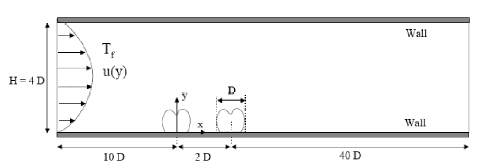
<body><![CDATA[<p><font size="2" face="Verdana, Arial, Helvetica, sans-serif">The cooling of fruits is a conjugate heat transfer phenomena and an understanding of such a problem should rely on modeling and simulation where the local air velocity fields are assessed together with the mutual heat transfer between each fruit and the surrounding cooling agent. Apples of the Fuji variety are usually stored and refrigerated in rectangular crates with lateral holes for the entrance of cool air. </font></p>     <p><font size="2" face="Verdana, Arial, Helvetica, sans-serif">The temperature is usually kept below 15&ordm;C. The distance between two consecutive apples will be about one diameter. Thus, during the cooling process, the heat dissipated by the leading apple will certainly delay the cooling of the following inline apples. The overall cooling performance of two apples can be researched by considering the influence of the leading apple on the following one as a function of the coolant air flow. </font></p>     <p><font size="2" face="Verdana, Arial, Helvetica, sans-serif">The aim of the present study was to employ a numerical conjugate approach for analyzing the cooling of Fuji apples placed in a tandem arrangement in a cooling channel and to verify its applicability as a tool for understanding conjugate heat transfer. The proposed numerical conjugate approach was also used to design a new correlation for the heat transfer rate, expressed by the global Nusselt number. This dimensionless number is the major parameter used to propose suitable control strategies for refrigerated storage facilities. The study was carried out by computer simulation in two dimensions considering apples confined to a channel.</font></p>     <p>&nbsp;</p>     <p><b><font size="3" face="Verdana, Arial, Helvetica, sans-serif">2. MATERIALS AND METHODS</font></b></p>     <p><font size="2" face="Verdana, Arial, Helvetica, sans-serif">In the study of the conjugate cooling of Fuji apples, air flow was assumed to be incompressible, and the buoyancy effect was neglected. The channel dimension was defined as a function of the apple diameter (D = 0.065 m) and the origin of the coordinate system was at the first apple, as shown in <a href="#fig01">Figure 1</a>. </font></p>     <p align="center"><font size="2" face="Verdana, Arial, Helvetica, sans-serif"><b><a name="fig01"></a><img src="/img/revistas/dyna/v78n166/a19fig01.gif">    <br>   Figure 1.</b> Schematic diagram of the cooling channel and location of the apples</font></p>     <p><font size="2" face="Verdana, Arial, Helvetica, sans-serif">The non-dimensional governing mass, moment, and energy conservation equations for the air domain are:</font></p>     <p><font size="2" face="Verdana, Arial, Helvetica, sans-serif"><img src="/img/revistas/dyna/v78n166/a19eq1.jpeg" /> (1a)</font></p>     ]]></body>
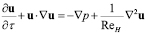
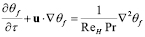
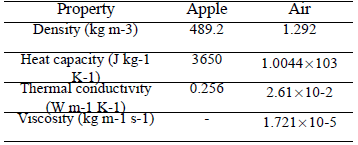
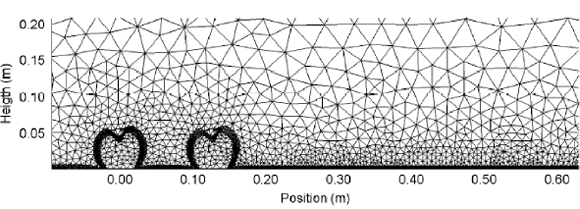
<body><![CDATA[<p><font size="2" face="Verdana, Arial, Helvetica, sans-serif"><img src="/img/revistas/dyna/v78n166/a19eq2.jpeg" /> (1b)</font></p>     <p><font size="2" face="Verdana, Arial, Helvetica, sans-serif"><img src="/img/revistas/dyna/v78n166/a19eq3.jpeg" /> (1c)</font></p>     <p><font size="2" face="Verdana, Arial, Helvetica, sans-serif">For the apple domain, the governing non-dimensional equation for energy conservation is</font></p>     <p><font size="2" face="Verdana, Arial, Helvetica, sans-serif"><img src="/img/revistas/dyna/v78n166/a19eq62506.jpeg" /> (2)</font></p>     <p><font size="2" face="Verdana, Arial, Helvetica, sans-serif">The dimensionless variables were defined as</font></p>     <p><font size="2" face="Verdana, Arial, Helvetica, sans-serif"><img src="/img/revistas/dyna/v78n166/a19eq62514.jpeg" />, <img src="/img/revistas/dyna/v78n166/a19eq62521.jpeg" />, <img src="/img/revistas/dyna/v78n166/a19eq62528.jpeg" />, <img src="/img/revistas/dyna/v78n166/a19eq62539.jpeg" /> (3)</font></p>     <p><font size="2" face="Verdana, Arial, Helvetica, sans-serif">Initial temperatures of the air flow and the apples were set as Tf = 0 &ordm;C and Ti = 25 &ordm;C, respectively. At the inlet, the air flow is considered to be fully developed, as depicted in <a href="#fig01">Figure 1</a>, with a parabolic profile u(y) = 6y(1 - y)<img src="/img/revistas/dyna/v78n166/a19eq62547.jpeg" /> and c onstant temperature Tf = 0 &ordm;C. Adiabatic and no-slip boundary conditions are set at the channel walls (y = 0, y = 1). At the outlet, all gradients are assumed to be zero. The no-slip boundary condition is also set at the apple surfaces. At the apple-air interface, the continuity of both temperature and heat fluxes is assumed. Fluid and thermal properties are presented in <a href="#tab01">Table 1</a>.</font></p>     <p align="center"><font size="2" face="Verdana, Arial, Helvetica, sans-serif"><b><a name="tab01"></a>Table 1.</b> Apple and air physical properties &#61531;13&#61533;</font>    <br>   <img src="/img/revistas/dyna/v78n166/a19tab01.gif"></p>     <p><font size="2" face="Verdana, Arial, Helvetica, sans-serif">The numerical solution consists of two major steps: discretization of the solution domains and of the equations. The first step was carried out by means of a multi-purpose unstructured triangular mesh generator in two-dimensions. This mesh generator was implemented using the Delaunay triangulation technique &#61531;13&#61533;; and an unstructured triangular mesh was generated for the calculation domain, as shown in <a href="#fig02">Figure 2</a>.</font></p>     ]]></body>
<body><![CDATA[<p align="center"><font size="2" face="Verdana, Arial, Helvetica, sans-serif"><b><a name="fig02"></a><img src="/img/revistas/dyna/v78n166/a19fig02.gif">    <br>   Figure 2.</b> Unstructured triangular mesh for the cooling process of two apples</font></p>     <p><font size="2" face="Verdana, Arial, Helvetica, sans-serif">Since stepper temperature and velocity gradients are expected at the apple surface, mesh refinement is employed in order to reduce errors associated with numerical discretization of the conservation equations. </font></p>     <p><font size="2" face="Verdana, Arial, Helvetica, sans-serif">The conservation equations (Eqs. 1 and 2) can be rewritten in a general form as</font></p>     <p><font size="2" face="Verdana, Arial, Helvetica, sans-serif"><img src="/img/revistas/dyna/v78n166/a19eq62582.jpeg" /> (4)</font></p>     <p><font size="2" face="Verdana, Arial, Helvetica, sans-serif">The finite volume method uses an integral over a control volume or cell (triangle) with the volume V and an interior point P:</font></p>     <p><font size="2" face="Verdana, Arial, Helvetica, sans-serif"><img src="/img/revistas/dyna/v78n166/a19eq4.jpeg" /> (5)</font></p>     <p><font size="2" face="Verdana, Arial, Helvetica, sans-serif">The second and the third terms in equation 5 represent the convective and diffusive flux, respectively, across the cell boundary &#61622;V with the normal surface vector s. Point P is defined as the mass center inside a triangular cell and each non-boundary cell has three neighbors N. </font></p>     <p><font size="2" face="Verdana, Arial, Helvetica, sans-serif">The time discretization scheme is implicit with first order accuracy. For the spatial discretization, the central second-order differencing scheme was used for the diffusive flux, applying a linear variation of &#61542;&#61472;around P with iterative non-orthogonal correction &#61531;13&#61533;. The weighted upwind differencing scheme (WUDS) was used to discretize the convective flux. The resulting algebraic system of equations was solved by the bi-conjugated gradient method and the energy and momentum equations are coupled using the SIMPLE algorithm &#61531;14&#61533;.</font></p>     <p><font size="2" face="Verdana, Arial, Helvetica, sans-serif">Regarding the conjugate approach, the flow and solid domains are modeled individually, and each is treated as an independent problem: the fluid problem, and two individual apple problems. Mass, energy and momentum equations are used solely in the fluid domain. For the solids domains, only the energy equation is used, neglecting the convective term. The individual problems are mathematically coupled by the following boundary conditions &#61531;15&#61533;:</font></p>     ]]></body>
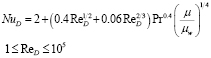
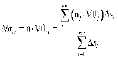
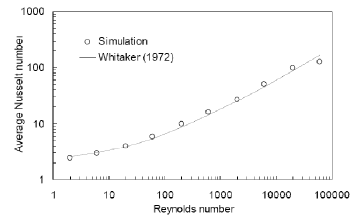
<body><![CDATA[<p><font size="2" face="Verdana, Arial, Helvetica, sans-serif"><img src="/img/revistas/dyna/v78n166/a19eq62603.jpeg" /> (6a)</font></p>     <p><font size="2" face="Verdana, Arial, Helvetica, sans-serif"><img src="/img/revistas/dyna/v78n166/a19eq62611.jpeg" /> (6b)</font></p>     <p>&nbsp;</p>     <p><b><font size="3" face="Verdana, Arial, Helvetica, sans-serif">3. RESULTS AND DISCUSSION</font></b></p>     <p><font size="2" face="Verdana, Arial, Helvetica, sans-serif">Represented by reference &#61531;16&#61533; is widely regarded as being the most accurate. The algebraic representation of this correlation is:</font></p>     <p><font size="2" face="Verdana, Arial, Helvetica, sans-serif">The computational model was initially validated for fluid flow over an isothermal sphere for the average nusselt number, the correlation.</font></p>     <p><font size="2" face="Verdana, Arial, Helvetica, sans-serif"><img src="/img/revistas/dyna/v78n166/a19eq62620.jpeg" /> (7) </font></p>     <p><font size="2" face="Verdana, Arial, Helvetica, sans-serif">Computational simulations were performed and the Nusselt numbers were compared to those predicted using the Whitaker correlation. The Nusselt number was calculated according to its definition (i.e. the normal dimensionless temperature gradient at the wall) as:</font></p>     <p><font size="2" face="Verdana, Arial, Helvetica, sans-serif"><img src="/img/revistas/dyna/v78n166/a19eq08.jpeg" /> (8)</font></p>     <p><font size="2" face="Verdana, Arial, Helvetica, sans-serif">From <a href="#fig03">Figure 3</a>, good agreement with the Whitaker correlation could be verified. The relative root mean square error was 2.88% so the implemented computational code was able to predict the Nusselt number for non-conjugated problems.</font></p>     ]]></body>
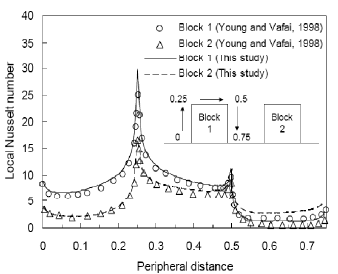
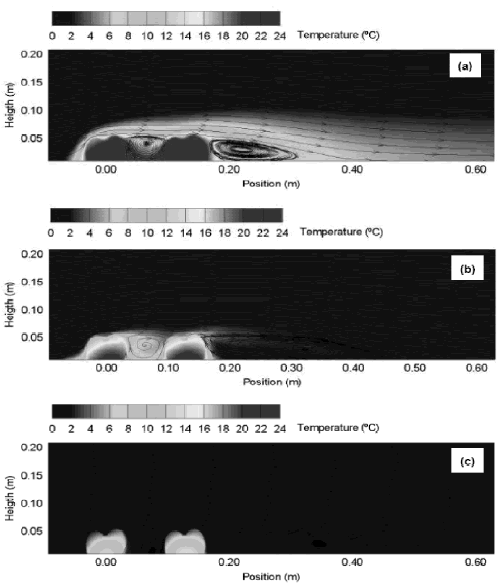
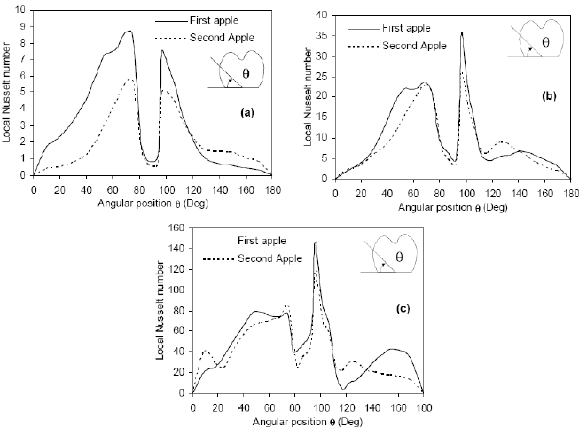
<body><![CDATA[<p align="center"><font size="2" face="Verdana, Arial, Helvetica, sans-serif"><b><a name="fig03"></a><img src="/img/revistas/dyna/v78n166/a19fig03.gif">    <br>   Figure 3.</b> Average Nusselt numbers for a fluid flow over an isothermal sphere</font></p>     <p><font size="2" face="Verdana, Arial, Helvetica, sans-serif">In order to evaluate the performance of a conjugate problem, a second validation study was performed for fluid flow in a rectangular channel with two mounted heated blocks. These blocks are heated by a constant heat flux at their lower surfaces. A comparison of the local Nusselt number obtained in this study with those reported by reference &#61531;12&#61533; is presented in <a href="#fig04">Figure 4</a>.</font></p>     <p align="center"><font size="2" face="Verdana, Arial, Helvetica, sans-serif"><b><a name="fig04"></a><img src="/img/revistas/dyna/v78n166/a19fig04.gif">    <br>   Figure 4.</b> Local Nusselt number profile for the cooling process of two heated blocks</font></p>     <p><font size="2" face="Verdana, Arial, Helvetica, sans-serif"><a href="#fig04">Figure 4</a> shows good correlation between the Nusselt numbers calculated in the present work and the results of &#61531;12&#61533;. The relative root mean square error was 4.53%.</font></p>     <p><font size="2" face="Verdana, Arial, Helvetica, sans-serif">In order to propose a new correlation for conjugate heat transfer, a simulation study was carried out using a time step of 0.05 s and a final time of one hour. The Reynolds number was varied from 200 to 30000, which correspond to the flow velocity of interest for industrial cooling processes. Streamlines and temperature contours at the final time for Re = 300, Re = 3000 and Re = 30000 are presented in <a href="#fig05">Figure 5</a>.</font></p>     <p align="center"><font size="2" face="Verdana, Arial, Helvetica, sans-serif"><b><a name="fig05"></a><img src="/img/revistas/dyna/v78n166/a19fig05.gif">    <br>   Figure 5.</b> Streamlines contour for (a) Re = 300, (b) Re = 3000 and (c) Re = 30000</font></p>     <p><font size="2" face="Verdana, Arial, Helvetica, sans-serif"><a href="#fig05">Figure 5(a-c)</a> shows two clockwise flow recirculation zones. The first recirculation is observed between the apples and an even larger one is verified downstream from the second apple. The structures of all vortices are affected by the Reynolds number. As the Reynolds number increases, downstream recirculation zones expand axially and gain strength. It can be verified in <a href="#fig05">Figure 5(a)</a> that a large thermal boundary layer occurs due to the low Reynolds number. Because significant heat transfer is verified between the apples, a lower temperature gradient is observed at the surface of the second apple. For higher Reynolds numbers, the velocity of the first recirculation zone increases, so smaller differences in the Nusselt number between apples is expected.</font></p>     ]]></body>
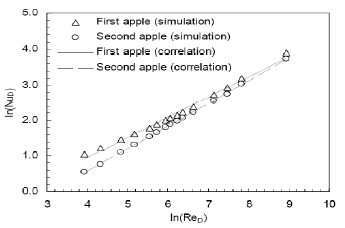
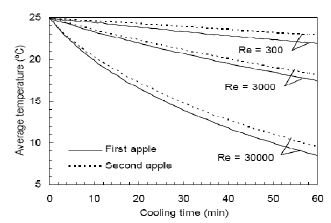
<body><![CDATA[<p><font size="2" face="Verdana, Arial, Helvetica, sans-serif">The average temperatures for the apples are presented in <a href="#fig06">Figure 6</a> and the fact that the differences in average temperature for the individual apples increased with time and with the Reynolds number can be verified.</font></p>     <p align="center"><font size="2" face="Verdana, Arial, Helvetica, sans-serif"><b><a name="fig06"></a><img src="/img/revistas/dyna/v78n166/a19fig06.gif">    <br>   Figure 6.</b> Average temperature of the apples as a function of time and Reynolds number</font></p>     <p><font size="2" face="Verdana, Arial, Helvetica, sans-serif">The local Nusselt numbers are presented in <a href="#fig07">Figure 7</a> for Re = 300, Re = 3000 and Re = 30000 as a function of angular position. Near-stagnant flow at the top surface of each apple (90&ordm;) is observed for all Reynolds numbers. A cavity exists at this position and the low air velocity leads to a stagnant flow, so the Nusselt number decreases significantly for both apples. The convective heat transfer (i.e. Nusselt number) is more intensive in the upper left portion of the apples (70&ordm; and 100&ordm;) where both thermal and velocity boundary layers are thinnest. At the lower front and rear portions of each apple, the Nusselt was minimal. It can also be observed that the difference in the local Nusselt number for the apples decreases as the Reynolds number increases due to the growing velocity of the recirculation zone. </font></p>     <p align="center"><font size="2" face="Verdana, Arial, Helvetica, sans-serif"><b><a name="fig07"></a><img src="/img/revistas/dyna/v78n166/a19fig07.gif">    <br>   Figure 7.</b> Local Nusselt number over the apples at (a) Re = 300, (b) Re = 3000 and (c) Re = 30000</font></p>     <p><font size="2" face="Verdana, Arial, Helvetica, sans-serif">For engineering applications, global Nusselt number correlations are used to calculate heat transfer rates as well as cooling times. Although experimental data is often used to design empirical correlations, numerical simulations can also be used to propose new global Nusselt number correlations. These correlations are usually written as:</font></p>     <p><font size="2" face="Verdana, Arial, Helvetica, sans-serif"><img src="/img/revistas/dyna/v78n166/a19eq5.jpeg" /> (9)</font></p>     <p><font size="2" face="Verdana, Arial, Helvetica, sans-serif">The Reynolds number is based on the apple diameter. Simulation simulations were performed for <img src="/img/revistas/dyna/v78n166/a19eq6.jpeg" /> and the global Nusselt number was calculated for each apple. The global Nusselt number as a function of the Reynolds number is presented in <a href="#fig08">Figure 8</a>. The global Nusselt number correlations for the first and the second apple were respectively evaluated as:</font></p>     <p><font size="2" face="Verdana, Arial, Helvetica, sans-serif"><img src="/img/revistas/dyna/v78n166/a19eq62650.jpeg" /> (10a)</font></p>     ]]></body>
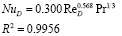
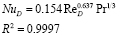
<body><![CDATA[<p><font size="2" face="Verdana, Arial, Helvetica, sans-serif"><img src="/img/revistas/dyna/v78n166/a19eq62658.jpeg" /> (10b)</font></p>     <p align="center"><font size="2" face="Verdana, Arial, Helvetica, sans-serif"><b><a name="fig08"></a><img src="/img/revistas/dyna/v78n166/a19fig08.gif">    <br>   Figure 8.</b> Conjugated Nusselt number as a function of Reynolds number</font></p>     <p><font size="2" face="Verdana, Arial, Helvetica, sans-serif">A good fit was verified with the numerical results, as verified by R2 values in Equation 10. <a href="#fig08">Figure 8</a> shows that the global Nusselt numbers for both apples converged to a similar value as the Reynolds number increases. The proposed correlation considers the conjugate behavior of the problem, so the Nusselt number depends not only on the fluid flow but also on the ratio of fluid and solid thermal conductivities. </font></p>     <p>&nbsp;</p>     <p><b><font size="3" face="Verdana, Arial, Helvetica, sans-serif">4. CONCLUSION</font></b></p>     <p><font size="2" face="Verdana, Arial, Helvetica, sans-serif">A finite volume formulation for the discretization of transport equations was presented together with a multi-problem approach for the solution of a conjugate problem for tandem arranged apple cooling. Streamlines and temperature distributions were presented and compared using the numerical simulation for three Reynolds numbers. It was verified that the local Nusselt number varies drastically over the apple surface and they tend to be closed as the Reynolds number increases. Simulation studies were carried out in order to propose new correlations for the global conjugated Nusselt number. The proposed conjugated approach has shown itself to be a powerful tool for the understanding of the heat transfer phenomena and can assist in the design of refrigerated storage units.</font></p>     <p>&nbsp;</p>     <p><font size="3" face="Verdana, Arial, Helvetica, sans-serif"><b>5. ACKNOWLEDGEMENTS</b></font></p>     <p><font size="2" face="Verdana, Arial, Helvetica, sans-serif">The authors would like to thank the Brazilian Government Agency FAPEMIG for their financial suppor.</font></p>     ]]></body>
<body><![CDATA[<p>&nbsp;</p>     <p><font size="3" face="Verdana, Arial, Helvetica, sans-serif"><b>REFERENCES</b></font></p>     <!-- ref --><p><font size="2" face="Verdana, Arial, Helvetica, sans-serif"><b>[1]</b> LOPES, D.C., MARTINS, J.H., LACERDA FILHO, A.F., MELO, E.C., MONTEIRO, P.M.B., & QUEIROZ, D.M. Aeration strategy for controlling grain storage based on simulation and on real data acquisition. Computers and Electronics in Agriculture, 63, 140-146. 2008.     &nbsp;&nbsp;&nbsp;&nbsp;&nbsp;&nbsp;&nbsp;&nbsp;[&#160;<a href="javascript:void(0);" onclick="javascript: window.open('/scielo.php?script=sci_nlinks&ref=000095&pid=S0012-7353201100020001900001&lng=','','width=640,height=500,resizable=yes,scrollbars=1,menubar=yes,');">Links</a>&#160;]<!-- end-ref --><!-- ref --><br>   <b>[2]</b> MOHSENIN, N.N. Thermal properties of foods and agricultural materials. CRC Press, New York, US. 1980.     &nbsp;&nbsp;&nbsp;&nbsp;&nbsp;&nbsp;&nbsp;&nbsp;[&#160;<a href="javascript:void(0);" onclick="javascript: window.open('/scielo.php?script=sci_nlinks&ref=000096&pid=S0012-7353201100020001900002&lng=','','width=640,height=500,resizable=yes,scrollbars=1,menubar=yes,');">Links</a>&#160;]<!-- end-ref --><!-- ref --><br>   <b>[3]</b> SUN, D.S., Computational fluid dynamics (CFD) - A design and analysis tool for the agri-food industry. Computers and Electronics in Agriculture, 34, 1-3. 2002.     &nbsp;&nbsp;&nbsp;&nbsp;&nbsp;&nbsp;&nbsp;&nbsp;[&#160;<a href="javascript:void(0);" onclick="javascript: window.open('/scielo.php?script=sci_nlinks&ref=000097&pid=S0012-7353201100020001900003&lng=','','width=640,height=500,resizable=yes,scrollbars=1,menubar=yes,');">Links</a>&#160;]<!-- end-ref --><!-- ref --><br>   <b>[4]</b> JUN, S., SASTRY, S. Modeling and optimization of ohmic heating of foods inside a flexible package, Journal of Food Process Engineering, 28, 417-436.2005     &nbsp;&nbsp;&nbsp;&nbsp;&nbsp;&nbsp;&nbsp;&nbsp;[&#160;<a href="javascript:void(0);" onclick="javascript: window.open('/scielo.php?script=sci_nlinks&ref=000098&pid=S0012-7353201100020001900004&lng=','','width=640,height=500,resizable=yes,scrollbars=1,menubar=yes,');">Links</a>&#160;]<!-- end-ref --><!-- ref --><br>   <b>[5]</b> ROY, J.C., VIDAL, C., FARGUES, J., & BOULARD, T., CFD based determination of temperature and humidity at leaf surface. Computers and Electronics in Agriculture, 61, 201-212. 2008.     &nbsp;&nbsp;&nbsp;&nbsp;&nbsp;&nbsp;&nbsp;&nbsp;[&#160;<a href="javascript:void(0);" onclick="javascript: window.open('/scielo.php?script=sci_nlinks&ref=000099&pid=S0012-7353201100020001900005&lng=','','width=640,height=500,resizable=yes,scrollbars=1,menubar=yes,');">Links</a>&#160;]<!-- end-ref --><!-- ref --><br>   <b>[6]</b> ORTEGA, A., WRITH, U.S. & KIM, S.J, Conjugate forced convection from discrete heat source on a plane conducting surface: a benchmark experiment. Heat Transfer in Electronic Systems, 292, 25-36. 1994.     &nbsp;&nbsp;&nbsp;&nbsp;&nbsp;&nbsp;&nbsp;&nbsp;[&#160;<a href="javascript:void(0);" onclick="javascript: window.open('/scielo.php?script=sci_nlinks&ref=000100&pid=S0012-7353201100020001900006&lng=','','width=640,height=500,resizable=yes,scrollbars=1,menubar=yes,');">Links</a>&#160;]<!-- end-ref --><!-- ref --><br>   <b>[7]</b> SABLANI, S.S., RAMASWAMY, H.S. & MUJUMDAR, A.S. Dimensionless correlations for convective heat transfer to liquid and particles in cans subjected to end-over-end rotation, Journal of Food Engineering, 34, 453-472. 1997.     &nbsp;&nbsp;&nbsp;&nbsp;&nbsp;&nbsp;&nbsp;&nbsp;[&#160;<a href="javascript:void(0);" onclick="javascript: window.open('/scielo.php?script=sci_nlinks&ref=000101&pid=S0012-7353201100020001900007&lng=','','width=640,height=500,resizable=yes,scrollbars=1,menubar=yes,');">Links</a>&#160;]<!-- end-ref --><!-- ref --><br>   <b>[8]</b> JENSEN, B.B.B., FRIIS, A., Prediction of flow in mix-proof valve by use of CFD - validation by LDA, Journal of Food Process Engineering, 27, 65-85. 2004,     &nbsp;&nbsp;&nbsp;&nbsp;&nbsp;&nbsp;&nbsp;&nbsp;[&#160;<a href="javascript:void(0);" onclick="javascript: window.open('/scielo.php?script=sci_nlinks&ref=000102&pid=S0012-7353201100020001900008&lng=','','width=640,height=500,resizable=yes,scrollbars=1,menubar=yes,');">Links</a>&#160;]<!-- end-ref --><!-- ref --><br>   <b>[9]</b> DE-BONIS, M.V., & RUOCCO, G. A generalized conjugate model for forced convection drying based on an evaporative kinetics, Journal of Food Engineering, 89, 232-240. 2008.     &nbsp;&nbsp;&nbsp;&nbsp;&nbsp;&nbsp;&nbsp;&nbsp;[&#160;<a href="javascript:void(0);" onclick="javascript: window.open('/scielo.php?script=sci_nlinks&ref=000103&pid=S0012-7353201100020001900009&lng=','','width=640,height=500,resizable=yes,scrollbars=1,menubar=yes,');">Links</a>&#160;]<!-- end-ref --><!-- ref --><br>   <b>[10]</b> DAVALATH, J., & BAYAZITOGLU, Y. Forced convection cooling across rectangular blocks. 1987.     &nbsp;&nbsp;&nbsp;&nbsp;&nbsp;&nbsp;&nbsp;&nbsp;[&#160;<a href="javascript:void(0);" onclick="javascript: window.open('/scielo.php?script=sci_nlinks&ref=000104&pid=S0012-7353201100020001900010&lng=','','width=640,height=500,resizable=yes,scrollbars=1,menubar=yes,');">Links</a>&#160;]<!-- end-ref --><!-- ref --><br>   <b>[11]</b> GARRON, K., & GARIMELLA, S.V. Composite correlations for convective heat transfer from arrays of three-dimensional obstacles. International Journal of Heat and Mass Transfer, 40, 493-498. 1997.     &nbsp;&nbsp;&nbsp;&nbsp;&nbsp;&nbsp;&nbsp;&nbsp;[&#160;<a href="javascript:void(0);" onclick="javascript: window.open('/scielo.php?script=sci_nlinks&ref=000105&pid=S0012-7353201100020001900011&lng=','','width=640,height=500,resizable=yes,scrollbars=1,menubar=yes,');">Links</a>&#160;]<!-- end-ref --><!-- ref --><br>   <b>[12]</b> YOUNG, T.J., & VAFAI, K.Convective flow and heat transfer in channel containing multiple heated obstacles. International Journal of Heat and Mass Transfer, 41, 3279-3298. 1998.     &nbsp;&nbsp;&nbsp;&nbsp;&nbsp;&nbsp;&nbsp;&nbsp;[&#160;<a href="javascript:void(0);" onclick="javascript: window.open('/scielo.php?script=sci_nlinks&ref=000106&pid=S0012-7353201100020001900012&lng=','','width=640,height=500,resizable=yes,scrollbars=1,menubar=yes,');">Links</a>&#160;]<!-- end-ref --><!-- ref --><br>   <b>[13]</b> MARTINS, M.A., OLIVEIRA, L.S. & VALLE, R.M. Adaptivity for finite volume on unstructured triangular meshes: a study of thermal injury in teeth. International Journal for Numerical Methods in Engineering. 61, 1625-1643. 2004.     &nbsp;&nbsp;&nbsp;&nbsp;&nbsp;&nbsp;&nbsp;&nbsp;[&#160;<a href="javascript:void(0);" onclick="javascript: window.open('/scielo.php?script=sci_nlinks&ref=000107&pid=S0012-7353201100020001900013&lng=','','width=640,height=500,resizable=yes,scrollbars=1,menubar=yes,');">Links</a>&#160;]<!-- end-ref --><!-- ref --><br>   <b>[14]</b> VERSTEEG, H. K., &W. MALALASEKERA An Introduction to Computational Fluid Dynamics - The Finite Volume Method, Longman Group Ltd., London, UK. 1995.     &nbsp;&nbsp;&nbsp;&nbsp;&nbsp;&nbsp;&nbsp;&nbsp;[&#160;<a href="javascript:void(0);" onclick="javascript: window.open('/scielo.php?script=sci_nlinks&ref=000108&pid=S0012-7353201100020001900014&lng=','','width=640,height=500,resizable=yes,scrollbars=1,menubar=yes,');">Links</a>&#160;]<!-- end-ref --><!-- ref --><br>   <b>[15]</b> LUIKOV, A. V. Conjugate convective heat transfer problems. International Journal of Heat and Mass Transfer, 17, 257-265. 1974.     &nbsp;&nbsp;&nbsp;&nbsp;&nbsp;&nbsp;&nbsp;&nbsp;[&#160;<a href="javascript:void(0);" onclick="javascript: window.open('/scielo.php?script=sci_nlinks&ref=000109&pid=S0012-7353201100020001900015&lng=','','width=640,height=500,resizable=yes,scrollbars=1,menubar=yes,');">Links</a>&#160;]<!-- end-ref --><!-- ref --><br>   <b>[16]</b> FERZIGER J.H., & PERIC, M. Computational methods for fluid dynamics. (3rd. ed.). Springer, Berlin. 2002. </font>&nbsp;&nbsp;&nbsp;&nbsp;&nbsp;&nbsp;&nbsp;&nbsp;[&#160;<a href="javascript:void(0);" onclick="javascript: window.open('/scielo.php?script=sci_nlinks&ref=000110&pid=S0012-7353201100020001900016&lng=','','width=640,height=500,resizable=yes,scrollbars=1,menubar=yes,');">Links</a>&#160;]<!-- end-ref --> ]]></body><back>
<ref-list>
<ref id="B1">
<label>1</label><nlm-citation citation-type="journal">
<person-group person-group-type="author">
<name>
<surname><![CDATA[LOPES]]></surname>
<given-names><![CDATA[D.C]]></given-names>
</name>
<name>
<surname><![CDATA[MARTINS]]></surname>
<given-names><![CDATA[J.H]]></given-names>
</name>
<name>
<surname><![CDATA[LACERDA FILHO]]></surname>
<given-names><![CDATA[A.F]]></given-names>
</name>
<name>
<surname><![CDATA[MELO]]></surname>
<given-names><![CDATA[E.C]]></given-names>
</name>
<name>
<surname><![CDATA[MONTEIRO]]></surname>
<given-names><![CDATA[P.M.B]]></given-names>
</name>
<name>
<surname><![CDATA[QUEIROZ]]></surname>
<given-names><![CDATA[D.M]]></given-names>
</name>
</person-group>
<article-title xml:lang="en"><![CDATA[Aeration strategy for controlling grain storage based on simulation and on real data acquisition.]]></article-title>
<source><![CDATA[Computers and Electronics in Agriculture]]></source>
<year>2008</year>
<volume>63</volume>
<page-range>140-146</page-range></nlm-citation>
</ref>
<ref id="B2">
<label>2</label><nlm-citation citation-type="book">
<person-group person-group-type="author">
<name>
<surname><![CDATA[MOHSENIN]]></surname>
<given-names><![CDATA[N.N]]></given-names>
</name>
</person-group>
<source><![CDATA[Thermal properties of foods and agricultural materials]]></source>
<year>1980</year>
<publisher-loc><![CDATA[New York ]]></publisher-loc>
<publisher-name><![CDATA[CRC Press]]></publisher-name>
</nlm-citation>
</ref>
<ref id="B3">
<label>3</label><nlm-citation citation-type="journal">
<person-group person-group-type="author">
<name>
<surname><![CDATA[SUN]]></surname>
<given-names><![CDATA[D.S]]></given-names>
</name>
</person-group>
<article-title xml:lang="en"><![CDATA[Computational fluid dynamics (CFD): A design and analysis tool for the agri-food industry]]></article-title>
<source><![CDATA[Computers and Electronics in Agriculture]]></source>
<year>2002</year>
<volume>34</volume>
<page-range>1-3</page-range></nlm-citation>
</ref>
<ref id="B4">
<label>4</label><nlm-citation citation-type="journal">
<person-group person-group-type="author">
<name>
<surname><![CDATA[JUN]]></surname>
<given-names><![CDATA[S]]></given-names>
</name>
<name>
<surname><![CDATA[SASTRY]]></surname>
<given-names><![CDATA[S]]></given-names>
</name>
</person-group>
<article-title xml:lang="en"><![CDATA[Modeling and optimization of ohmic heating of foods inside a flexible package]]></article-title>
<source><![CDATA[Journal of Food Process Engineering]]></source>
<year>2005</year>
<volume>28</volume>
<page-range>417-436</page-range></nlm-citation>
</ref>
<ref id="B5">
<label>5</label><nlm-citation citation-type="journal">
<person-group person-group-type="author">
<name>
<surname><![CDATA[ROY]]></surname>
<given-names><![CDATA[J.C]]></given-names>
</name>
<name>
<surname><![CDATA[VIDAL]]></surname>
<given-names><![CDATA[C]]></given-names>
</name>
<name>
<surname><![CDATA[FARGUES]]></surname>
<given-names><![CDATA[J]]></given-names>
</name>
<name>
<surname><![CDATA[BOULARD]]></surname>
<given-names><![CDATA[T]]></given-names>
</name>
</person-group>
<article-title xml:lang="en"><![CDATA[CFD based determination of temperature and humidity at leaf surface]]></article-title>
<source><![CDATA[Computers and Electronics in Agriculture]]></source>
<year>2008</year>
<volume>61</volume>
<page-range>201-212</page-range></nlm-citation>
</ref>
<ref id="B6">
<label>6</label><nlm-citation citation-type="journal">
<person-group person-group-type="author">
<name>
<surname><![CDATA[ORTEGA]]></surname>
<given-names><![CDATA[A]]></given-names>
</name>
<name>
<surname><![CDATA[WRITH]]></surname>
<given-names><![CDATA[U.S]]></given-names>
</name>
<name>
<surname><![CDATA[KIM]]></surname>
<given-names><![CDATA[S.J]]></given-names>
</name>
</person-group>
<article-title xml:lang="en"><![CDATA[Conjugate forced convection from discrete heat source on a plane conducting surface: a benchmark experiment]]></article-title>
<source><![CDATA[Heat Transfer in Electronic Systems]]></source>
<year>1994</year>
<volume>292</volume>
<page-range>25-36</page-range></nlm-citation>
</ref>
<ref id="B7">
<label>7</label><nlm-citation citation-type="journal">
<person-group person-group-type="author">
<name>
<surname><![CDATA[SABLANI]]></surname>
<given-names><![CDATA[S.S]]></given-names>
</name>
<name>
<surname><![CDATA[RAMASWAMY]]></surname>
<given-names><![CDATA[H.S]]></given-names>
</name>
<name>
<surname><![CDATA[MUJUMDAR]]></surname>
<given-names><![CDATA[A.S]]></given-names>
</name>
</person-group>
<article-title xml:lang="en"><![CDATA[Dimensionless correlations for convective heat transfer to liquid and particles in cans subjected to end-over-end rotation]]></article-title>
<source><![CDATA[Journal of Food Engineering]]></source>
<year>1997</year>
<volume>34</volume>
<page-range>453-472</page-range></nlm-citation>
</ref>
<ref id="B8">
<label>8</label><nlm-citation citation-type="journal">
<person-group person-group-type="author">
<name>
<surname><![CDATA[JENSEN]]></surname>
<given-names><![CDATA[B.B.B]]></given-names>
</name>
<name>
<surname><![CDATA[FRIIS]]></surname>
<given-names><![CDATA[A]]></given-names>
</name>
</person-group>
<article-title xml:lang="en"><![CDATA[Prediction of flow in mix-proof valve by use of CFD: validation by LDA]]></article-title>
<source><![CDATA[Journal of Food Process Engineering]]></source>
<year>2004</year>
<volume>27</volume>
<page-range>65-85.</page-range></nlm-citation>
</ref>
<ref id="B9">
<label>9</label><nlm-citation citation-type="journal">
<person-group person-group-type="author">
<name>
<surname><![CDATA[DE-BONIS]]></surname>
<given-names><![CDATA[M.V]]></given-names>
</name>
<name>
<surname><![CDATA[RUOCCO]]></surname>
<given-names><![CDATA[G]]></given-names>
</name>
</person-group>
<article-title xml:lang="en"><![CDATA[A generalized conjugate model for forced convection drying based on an evaporative kinetics]]></article-title>
<source><![CDATA[Journal of Food Engineering]]></source>
<year>2008</year>
<volume>89</volume>
<page-range>232-240</page-range></nlm-citation>
</ref>
<ref id="B10">
<label>10</label><nlm-citation citation-type="">
<person-group person-group-type="author">
<name>
<surname><![CDATA[DAVALATH]]></surname>
<given-names><![CDATA[J]]></given-names>
</name>
<name>
<surname><![CDATA[BAYAZITOGLU]]></surname>
<given-names><![CDATA[Y]]></given-names>
</name>
</person-group>
<source><![CDATA[Forced convection cooling across rectangular blocks]]></source>
<year>1987</year>
</nlm-citation>
</ref>
<ref id="B11">
<label>11</label><nlm-citation citation-type="journal">
<person-group person-group-type="author">
<name>
<surname><![CDATA[GARRON]]></surname>
<given-names><![CDATA[K]]></given-names>
</name>
<name>
<surname><![CDATA[GARIMELLA]]></surname>
<given-names><![CDATA[S.V]]></given-names>
</name>
</person-group>
<article-title xml:lang="en"><![CDATA[Composite correlations for convective heat transfer from arrays of three-dimensional obstacles]]></article-title>
<source><![CDATA[International Journal of Heat and Mass Transfer]]></source>
<year>1997</year>
<volume>40</volume>
<page-range>493-498</page-range></nlm-citation>
</ref>
<ref id="B12">
<label>12</label><nlm-citation citation-type="journal">
<person-group person-group-type="author">
<name>
<surname><![CDATA[YOUNG]]></surname>
<given-names><![CDATA[T.J]]></given-names>
</name>
<name>
<surname><![CDATA[VAFAI]]></surname>
<given-names><![CDATA[K]]></given-names>
</name>
</person-group>
<article-title xml:lang="en"><![CDATA[Convective flow and heat transfer in channel containing multiple heated obstacles]]></article-title>
<source><![CDATA[International Journal of Heat and Mass Transfer]]></source>
<year>1998</year>
<volume>41</volume>
<page-range>3279-3298</page-range></nlm-citation>
</ref>
<ref id="B13">
<label>13</label><nlm-citation citation-type="journal">
<person-group person-group-type="author">
<name>
<surname><![CDATA[MARTINS]]></surname>
<given-names><![CDATA[M.A]]></given-names>
</name>
<name>
<surname><![CDATA[OLIVEIRA]]></surname>
<given-names><![CDATA[L.S]]></given-names>
</name>
<name>
<surname><![CDATA[VALLE]]></surname>
<given-names><![CDATA[R.M]]></given-names>
</name>
</person-group>
<article-title xml:lang="en"><![CDATA[Adaptivity for finite volume on unstructured triangular meshes: a study of thermal injury in teeth]]></article-title>
<source><![CDATA[International Journal for Numerical Methods in Engineering]]></source>
<year>2004</year>
<volume>61</volume>
<page-range>1625-1643</page-range></nlm-citation>
</ref>
<ref id="B14">
<label>14</label><nlm-citation citation-type="book">
<person-group person-group-type="author">
<name>
<surname><![CDATA[VERSTEEG]]></surname>
<given-names><![CDATA[H. K.]]></given-names>
</name>
<name>
<surname><![CDATA[MALALASEKERA]]></surname>
<given-names><![CDATA[W.]]></given-names>
</name>
</person-group>
<source><![CDATA[An Introduction to Computational Fluid Dynamics: The Finite Volume Method]]></source>
<year>1995</year>
<publisher-loc><![CDATA[London ]]></publisher-loc>
<publisher-name><![CDATA[Longman Group Ltd]]></publisher-name>
</nlm-citation>
</ref>
<ref id="B15">
<label>15</label><nlm-citation citation-type="">
<person-group person-group-type="author">
<name>
<surname><![CDATA[LUIKOV]]></surname>
<given-names><![CDATA[A. V]]></given-names>
</name>
</person-group>
<article-title xml:lang="en"><![CDATA[Conjugate convective heat transfer problems]]></article-title>
<source><![CDATA[]]></source>
<year>1974</year>
<volume>17</volume>
<page-range>257-265</page-range></nlm-citation>
</ref>
<ref id="B16">
<label>16</label><nlm-citation citation-type="book">
<person-group person-group-type="author">
<name>
<surname><![CDATA[FERZIGER]]></surname>
<given-names><![CDATA[J.H.]]></given-names>
</name>
<name>
<surname><![CDATA[PERIC]]></surname>
<given-names><![CDATA[M]]></given-names>
</name>
</person-group>
<source><![CDATA[Computational methods for fluid dynamics]]></source>
<year>2002</year>
<edition>3rd</edition>
<publisher-loc><![CDATA[Berlin ]]></publisher-loc>
<publisher-name><![CDATA[Springer]]></publisher-name>
</nlm-citation>
</ref>
</ref-list>
</back>
</article>