<?xml version="1.0" encoding="ISO-8859-1"?><article xmlns:mml="http://www.w3.org/1998/Math/MathML" xmlns:xlink="http://www.w3.org/1999/xlink" xmlns:xsi="http://www.w3.org/2001/XMLSchema-instance">
<front>
<journal-meta>
<journal-id>0012-7353</journal-id>
<journal-title><![CDATA[DYNA]]></journal-title>
<abbrev-journal-title><![CDATA[Dyna rev.fac.nac.minas]]></abbrev-journal-title>
<issn>0012-7353</issn>
<publisher>
<publisher-name><![CDATA[Universidad Nacional de Colombia]]></publisher-name>
</publisher>
</journal-meta>
<article-meta>
<article-id>S0012-73532011000400009</article-id>
<title-group>
<article-title xml:lang="en"><![CDATA[CHARACTERIZATION OF NATURAL MICROCOSMS OF ESTUARINE MAGNETOTACTIC BACTERIA]]></article-title>
<article-title xml:lang="es"><![CDATA[CARACTERIZACIÓN DE MICROCOSMOS NATURALES DE BACTERIAS MAGNETOTÁCTICAS ESTUARINAS]]></article-title>
</title-group>
<contrib-group>
<contrib contrib-type="author">
<name>
<surname><![CDATA[SALAZAR]]></surname>
<given-names><![CDATA[ALEJANDRO]]></given-names>
</name>
<xref ref-type="aff" rid="A01"/>
</contrib>
<contrib contrib-type="author">
<name>
<surname><![CDATA[MORALES]]></surname>
<given-names><![CDATA[ALVARO]]></given-names>
</name>
<xref ref-type="aff" rid="A02"/>
</contrib>
<contrib contrib-type="author">
<name>
<surname><![CDATA[MÁRQUEZ]]></surname>
<given-names><![CDATA[MARCO]]></given-names>
</name>
<xref ref-type="aff" rid="A03"/>
</contrib>
</contrib-group>
<aff id="A01">
<institution><![CDATA[,Universidad Nacional de Colombia Escuela de Biociencias ]]></institution>
<addr-line><![CDATA[Medellín ]]></addr-line>
</aff>
<aff id="A02">
<institution><![CDATA[,Universidad de Antioquia Instituto de Física ]]></institution>
<addr-line><![CDATA[Medellín ]]></addr-line>
<country>Colombia</country>
</aff>
<aff id="A03">
<institution><![CDATA[,Universidad Nacional de Colombia Facultad de Minas ]]></institution>
<addr-line><![CDATA[Medellín ]]></addr-line>
</aff>
<pub-date pub-type="pub">
<day>00</day>
<month>08</month>
<year>2011</year>
</pub-date>
<pub-date pub-type="epub">
<day>00</day>
<month>08</month>
<year>2011</year>
</pub-date>
<volume>78</volume>
<numero>168</numero>
<fpage>72</fpage>
<lpage>80</lpage>
<copyright-statement/>
<copyright-year/>
<self-uri xlink:href="http://www.scielo.org.co/scielo.php?script=sci_arttext&amp;pid=S0012-73532011000400009&amp;lng=en&amp;nrm=iso"></self-uri><self-uri xlink:href="http://www.scielo.org.co/scielo.php?script=sci_abstract&amp;pid=S0012-73532011000400009&amp;lng=en&amp;nrm=iso"></self-uri><self-uri xlink:href="http://www.scielo.org.co/scielo.php?script=sci_pdf&amp;pid=S0012-73532011000400009&amp;lng=en&amp;nrm=iso"></self-uri><abstract abstract-type="short" xml:lang="en"><p><![CDATA[To date, no complete study of magnetotactic bacteria's (MTB) natural microcosms in estuarine or tropical environments has been reported. Besides, almost all the studies around magnetotactic bacteria have been based on fresh waters away from the Equator. In this work, we focused the experimental region at the Equator and present a comprehensive mineralogical and physicochemical characterization of two estuarine bacterial microcosms. The results show that mineral lixiviation in the sediments may be an important factor in the solubilization of elements required by magnetotactic bacteria. Specifically, we show that clinochlore, phlogopite, nontronite, and halloysite could be among the main minerals that lixiviate iron to the estuarine microcosms. We conclude that nitrate concentration in the water should not be as low as those that have been reported for other authors to achieve optimal bacteria growth. It is confirmed that magnetotactic bacteria do not need large amounts of dissolved iron to grow or to synthesize magnetosomes.]]></p></abstract>
<abstract abstract-type="short" xml:lang="es"><p><![CDATA[No se ha reportado ningún estudio completo sobre microcosmos naturales de bacterias magnetotácticas (MTB) en estuarios o ambientes tropicales. Además, casi todos los estudios sobre las bacterias magnetotácticas se han desarrollado en aguas dulces alejadas del ecuador. Este trabajo se desarrolla sobre el ecuador y reporta una caracterización mineralógica y fisicoquímica detallada de dos microcosmos bacterianos estuarinos. Los resultados muestran que la lixiviación de minerales en los sedimentos puede ser un factor importante en la solubilización de elementos requeridos por las bacterias magnetotácticas. Específicamente, que el clinocloro, flogopita, nontronita y haloisita pueden estar entre los minerales más importantes en la lixiviación de hierro a los microcosmos estuarinos. Se concluye que la concentración de nitrato en el agua no debe ser tan baja como se ha reportado para lograr un crecimiento bacteriano óptimo. Las bacterias magnetotácticas no necesitan grandes cantidades de hierro disuelto para su crecimiento ni para la síntesis de magnetosomas.]]></p></abstract>
<kwd-group>
<kwd lng="en"><![CDATA[Magnetotactic bacteria (MTB)]]></kwd>
<kwd lng="en"><![CDATA[magnetosome]]></kwd>
<kwd lng="en"><![CDATA[microcosm]]></kwd>
<kwd lng="es"><![CDATA[Bacterias magnetotácticas (MTB)]]></kwd>
<kwd lng="es"><![CDATA[magnetosomas]]></kwd>
<kwd lng="es"><![CDATA[microcosmos]]></kwd>
<kwd lng="es"><![CDATA[estuario]]></kwd>
</kwd-group>
</article-meta>
</front><body><![CDATA[  		    <p align="center"><font size="4" face="Verdana, Arial, Helvetica, sans-serif"><b>CHARACTERIZATION OF NATURAL MICROCOSMS OF ESTUARINE MAGNETOTACTIC BACTERIA</b></font></p> 		    <p align="center"><i><font size="3"><b><font face="Verdana, Arial, Helvetica, sans-serif">CARACTERIZACI&Oacute;N DE MICROCOSMOS NATURALES DE BACTERIAS MAGNETOT&Aacute;CTICAS ESTUARINAS</font></b></font></i></p> 		    <p align="center">&nbsp;</p> 		    <p align="center"><font size="2" face="Verdana, Arial, Helvetica, sans-serif"><b>ALEJANDRO SALAZAR</b>    <br>             <i>Escuela de Biociencias, Universidad Nacional de Colombia, Medell&iacute;n. <a href="mailto:asalazar1370@gmail.com">asalazar1370@gmail.com</a>.</i></font></p> 		    <p align="center"><font size="2" face="Verdana, Arial, Helvetica, sans-serif"><b>ALVARO MORALES</b>    <br>             <i>Grupo de Estado S&oacute;lido, Instituto de F&iacute;sica, Universidad de Antioquia, A.A. 1226, Medell&iacute;n, Colombia. <a href="mailto:amoral@fisica.udea.edu.co">amoral@fisica.udea.edu.co</a></i></font></p> 		    <p align="center"><font size="2" face="Verdana, Arial, Helvetica, sans-serif"><b>MARCO M&Aacute;RQUEZ</b>    <br>             <i>Facultad de Minas, Universidad Nacional de Colombia, Medell&iacute;n. <a href="mailto:mmarquez@unalmed.edu.co">mmarquez@unalmed.edu.co</a></i></font></p> 		    ]]></body>
<body><![CDATA[<p align="center">&nbsp;</p> 		    <p align="center"><font size="2" face="Verdana, Arial, Helvetica, sans-serif"><b>Received for review May 24<sup>th</sup>, 2010; accepted December 3<sup>rd</sup>, 2010; final version October 27<sup>rd</sup>, 2010</b></font></p> 		    <p align="center">&nbsp;</p> 		<hr> 		    <p><font size="2" face="Verdana, Arial, Helvetica, sans-serif"><b>ABSTRACT:</b> To date, no complete study of magnetotactic bacteria's (MTB) natural microcosms in estuarine or tropical environments has been reported. Besides, almost all the studies around magnetotactic bacteria have been based on fresh waters away from the Equator. In this work, we focused the experimental region at the Equator and present a comprehensive mineralogical and physicochemical characterization of two estuarine bacterial microcosms. The results show that mineral lixiviation in the sediments may be an important factor in the solubilization of elements required by magnetotactic bacteria. Specifically, we show that clinochlore, phlogopite, nontronite, and halloysite could be among the main minerals that lixiviate iron to the estuarine microcosms. We conclude that nitrate concentration in the water should not be as low as those that have been reported for other authors to achieve optimal bacteria growth. It is confirmed that magnetotactic bacteria do not need large amounts of dissolved iron to grow or to synthesize magnetosomes. </font></p> 		    <p><font size="2" face="Verdana, Arial, Helvetica, sans-serif"><b>KEY WORDS:</b> Magnetotactic bacteria (MTB), magnetosome, microcosm, estuary</font></p> 		    <p><font size="2" face="Verdana, Arial, Helvetica, sans-serif"><b>RESUMEN:</b> No se ha reportado ning&uacute;n estudio completo sobre microcosmos naturales de bacterias magnetot&aacute;cticas (MTB) en estuarios o ambientes tropicales. Adem&aacute;s, casi todos los estudios sobre las bacterias magnetot&aacute;cticas se han desarrollado en aguas dulces alejadas del ecuador. Este trabajo se desarrolla sobre el ecuador y reporta una caracterizaci&oacute;n mineral&oacute;gica y fisicoqu&iacute;mica detallada de dos microcosmos bacterianos estuarinos. Los resultados muestran que la lixiviaci&oacute;n de minerales en los sedimentos puede ser un factor importante en la solubilizaci&oacute;n de elementos requeridos por las bacterias magnetot&aacute;cticas. Espec&iacute;ficamente, que el clinocloro, flogopita, nontronita y haloisita pueden estar entre los minerales m&aacute;s importantes en la lixiviaci&oacute;n de hierro a los microcosmos estuarinos. Se concluye que la concentraci&oacute;n de nitrato en el agua no debe ser tan baja como se ha reportado para lograr un crecimiento bacteriano &oacute;ptimo. Las bacterias magnetot&aacute;cticas no necesitan grandes cantidades de hierro disuelto para su crecimiento ni para la s&iacute;ntesis de magnetosomas.</font></p> 		    <p><font size="2" face="Verdana, Arial, Helvetica, sans-serif"><b>PALABRAS CLAVE: </b>Bacterias magnetot&aacute;cticas (MTB), magnetosomas, microcosmos, estuario.</font></p> 		<hr> 		    <p>&nbsp;</p> 		    <p><b><font size="3" face="Verdana, Arial, Helvetica, sans-serif">1. INTRODUCTION</font></b></p> 		    <p><font size="2" face="Verdana, Arial, Helvetica, sans-serif">Magnetotactic bacteria are microorganisms of the bacteria domain, whose directional swimming behavior is affected by the Earth's geomagnetic and external magnetic fields [1-2]. This property is known as magnetotaxis [3-4]) and occurs mainly due to the presence of magnetic nanocrystals (generally of magnetite [Fe<sub>3</sub>O<sub>4</sub>], or gregite [Fe<sub>3</sub>S<sub>4</sub>]) that shape an intracellular, single-magnetic-domain and membrane-bounded structure known as magnetosome [2, 4]. This property is generally assumed to facilitate the bacteria in its finding and maintaining a favorable position in vertical chemical gradients in stratified environments [5, 6]. Currently, a wide morphology variety of MTB has been reported, such as coccus, bacillus, vibrio, spirillum, and multicellular aggregates [2, 7, 8]. </font></p> 		    ]]></body>
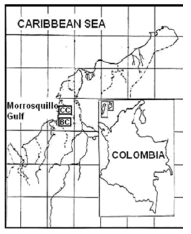
<body><![CDATA[<p><font size="2" face="Verdana, Arial, Helvetica, sans-serif">Many authors have studied the natural environment of different species of MTB, searching for a strategy to obtain large amounts of magnetic nanocrystals [4, 9, 10]. The objective of those studies was to identify the most important physico-chemical factors that are involved in the growth of MTB populations and the synthesis of magnetosomes [1, 4, 10]. Some of these chemically dissolved factors, are the iron (total Fe, Fe<sup>2+</sup>, and Fe<sup>3+</sup>), sulfates, nitrates in the solution, and dissolved oxygen (DO) [1, 4, 11, 12]. Furthermore, all the reported MTB are anaerobic or strict-microaerophilic [7, 12], and mesophilic [1, 10]. Another factor that could be important in those processes is the microbial ecology of the natural environments of MTB, but it has not yet been studied thoroughly [1].</font></p> 		    <p><font size="2" face="Verdana, Arial, Helvetica, sans-serif">In this research, different spectroscopic techniques and chemical analyses were used to characterize two estuarine MTB microcosms, situated in the tropical waters of the Caribbean Sea. We report the variations in soil mineralogy, water composition, and some physico-chemical parameters of the MTB-environments. This information may serve as a guide to elucidate potential mineral donors that contribute to the formation of magnetosomes and other intracellular bodies.</font></p> 		    <p>&nbsp;</p> 		    <p><b><font size="3" face="Verdana, Arial, Helvetica, sans-serif">2. MATERIALS AND METHODS</font></b></p> 		    <p><font size="2" face="Verdana, Arial, Helvetica, sans-serif"><b>2.1 Sampling zone    <br> 		</b></font><font size="2" face="Verdana, Arial, Helvetica, sans-serif">The samples were taken in two different estuaries. Cispat&aacute; Bay (BC) (9&deg;21' - 9&deg;25' North latitude, 75&deg;45' - 75&deg;50' West Longitude) and the Caimanera Bog (CC) (9&deg;25' north latitude, 75&deg;41' east longitude) (<a href="#fig01">Fig. 1</a>). Both estuarine systems are located in the Morrosquillo Gulf in the Colombian Caribbean Sea and are conformed by a great variety of mangrove swamps that shelter an abundant population of marine and estuary species. </font></p> 		    <p align="center"><font size="2" face="Verdana, Arial, Helvetica, sans-serif"><b><a name="fig01"></a><img src="/img/revistas/dyna/v78n168/a09fig01.gif">    <br> 	    Figure 1.</b> Location of sampling zone: Cispat&aacute; Bay (BC) and Caimanera Bog (CC) in the Morrosquillo Gulf, Colombia.</font></p> 		    <p><font size="2" face="Verdana, Arial, Helvetica, sans-serif">The water-sediment samples were taken in the Oxic-Anoxic Transition Zone (OATZ), in northern regions of both estuaries. A HANNA oxymeter was used to locate the OATZ in the water column. The depth of sampling in BC and CC was around 2 m and 1.5 m, respectively. </font></p> 		    <p><font size="2" face="Verdana, Arial, Helvetica, sans-serif"><b>2.2 Spectroscopy    ]]></body>
<body><![CDATA[<br> 		</b></font><font size="2" face="Verdana, Arial, Helvetica, sans-serif">The spectroscopy techniques used to study the composition of the sediments were: X-ray diffraction (XRD), Fourier transform infrared spectroscopy (FTIR), and M&ouml;ssbauer spectroscopy (MS). Before the analyses, the sediments were dried at room temperature and milled to pass through a 200 Tyler mesh. </font></p> 		    <p><font size="2" face="Verdana, Arial, Helvetica, sans-serif"><i>2.2.1 X-ray Diffraction    <br> 		</i></font><font size="2" face="Verdana, Arial, Helvetica, sans-serif">The XRD analyses were carried out in Panalytical X'pert Pro MDP equipment, in a 2&theta; range of 10&deg; to 70&deg;, at a speed of 0.02&deg;/s, using Cu k&alpha; radiation with a current of 40 mA and 45 kV. The results were analyzed with the diffraction software DIFFRACplus 2000 and the data base PDF2.MDI.</font></p> 		    <p><font size="2" face="Verdana, Arial, Helvetica, sans-serif">Relative abundance of the minerals in the sediments was qualitatively estimated based on the height of the peaks in the spectra.</font></p> 		    <p><font size="2" face="Verdana, Arial, Helvetica, sans-serif"><i>2.2.2 Fourier transform infrared spectroscopy</i>    <br> 		</font><font size="2" face="Verdana, Arial, Helvetica, sans-serif">The FTIR analyses were carried out in a Spectrum One Perkin Elmer Spectrophotometer, operating by transmittance between 4000 and 450 cm<sup>-1</sup>. The pellets were made with milled sediments and KBr. </font></p> 		    <p><font size="2" face="Verdana, Arial, Helvetica, sans-serif"><i>2.2.3 M&ouml;ssbauer spectroscopy    <br> 		</i></font><font size="2" face="Verdana, Arial, Helvetica, sans-serif">Wissel M&ouml;ssbauer equipment was used in transmission and constant acceleration mode for M&ouml;ssbauer spectra (MS) acquisition. The equipment was operated with 57Co in a rhodium matrix. </font></p> 		    <p><font size="2" face="Verdana, Arial, Helvetica, sans-serif"><b>2.3 Water analysis and physico-chemical parameters</b></font></p> 		    <p><font size="2" face="Verdana, Arial, Helvetica, sans-serif"><i>2.3.1 Water analysis    ]]></body>
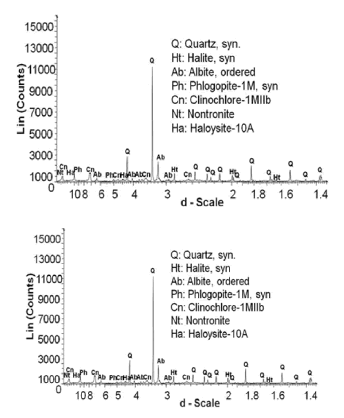
<body><![CDATA[<br> 		</i></font><font size="2" face="Verdana, Arial, Helvetica, sans-serif">The codes of the methods used for the water analyses refer to the STANDARD METHODS FOR EXAMINATION OF WATER AND WASTEWATER [13]. Total alkalinity (mg/L CaCO<sub>3</sub>) (2320B); alkalinity to phenolphthalein (mg/L CaCO<sub>3</sub>) (2320B); chlorides (mg/L Cl-) (4500-CI B); phosphates (mg/L PO<sub>4</sub><sup>3-</sup>-P) (4500-P D); total phosphorus (mg/L P) (4500-P D); nitrates (mg/L N-NO<sub>3</sub><sup>-</sup>) (4500- NO<sub>3</sub><sup>-</sup> A); nitrites (mg/L N-NO<sub>2</sub><sup>-</sup>) (4500- NO<sub>2</sub><sup>-</sup>B); ammoniacal nitrogen (mg/L NH<sub>3</sub><sup>-</sup>N) (4500- NH<sub>3</sub> C.D); total nitrogen (mg/L N) (4500 - NORG); organic nitrogen (mg/L N) (4500 - NORG); total, ferrous and ferric iron (3500 Fe); sulfates (4500 SO<sub>4</sub><sup>2-</sup>).</font></p> 		    <p><font size="2" face="Verdana, Arial, Helvetica, sans-serif"><i>2.3.2 Physico-chemical parameters    <br> 		</i>We used a digital thermometer, HACH HQ40d pH-meter, SCHOOTT Eh-meter and HI 9143 HANNA oxymeter, to measure temperature, pH, Eh, and dissolved oxygen (DO), respectively. All the measurements were <i>in situ</i>. Average salinity was calculated in the laboratory by the evaporation of a fixed volume of estuary water. Salinity was calculated as an average.</font></p> 		    <p><font size="2" face="Verdana, Arial, Helvetica, sans-serif"><b>2.4 MTB and magnetite nanocrystals presence    <br> 		</b></font><font size="2" face="Verdana, Arial, Helvetica, sans-serif">MTB from BC and CC were magnetically isolated using the glass recipient described by Ulysses Lins et al. (2003) [14]. Magnetotaxis were confirmed by optical microscopy (Olympus CX31). Magnetite nanocrystals were detected by electronic microscopy (Phillips, Tecnai G2), operating at 200kV, and identified by Energy-dispersive X-ray spectroscopy (EDX). Additionally, MTB population was counted in natural BC and CC samples using a BOECO Neubauer chamber.</font></p> 		    <p>&nbsp;</p> 		    <p><b><font size="3" face="Verdana, Arial, Helvetica, sans-serif">3. RESULTS</font></b></p> 		    <p><font size="2" face="Verdana, Arial, Helvetica, sans-serif"><b>3.1 X-ray Diffraction    <br> 		</b><a href="#fig02">Figure 2</a> shows the XRD spectra for BC and CC sediments. Quartz appears as the most abundant mineral in both sediments. No magnetite or gregite were detected by XRD in BC or in CC. However, MTB (and its magnetite magnetosomes) presence in the systems was confirmed by optical and electronic microscopy.</font></p> 		    <p align="center"><font size="2" face="Verdana, Arial, Helvetica, sans-serif"><b><a name="fig02"></a><img src="/img/revistas/dyna/v78n168/a09fig02.gif">    ]]></body>
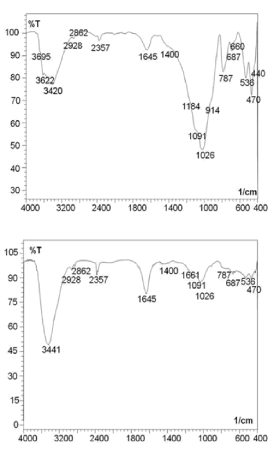
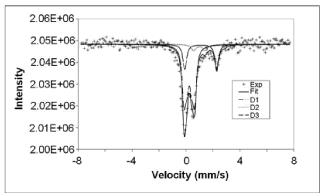
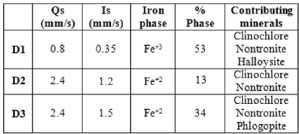
<body><![CDATA[<br> 	    Figure 2.</b> XRD spectrum of a sediment sample from BC (up) and CC (down). The graphics are on d-scale.</font></p> 		    <p><font size="2" face="Verdana, Arial, Helvetica, sans-serif"><b>3.2 Fourier transform infrared spectroscopy    <br> 		</b><a href="#fig03">Figure 3</a> shows the FTIR spectra of BC and CC. </font></p> 		    <p align="center"><font size="2" face="Verdana, Arial, Helvetica, sans-serif"><b><a name="fig03"></a><img src="/img/revistas/dyna/v78n168/a09fig03.gif">    <br> 	    Figure 3.</b> FTIR spectrum of a sediment sample from BC (up) and CC (down).</font></p> 		    <p><font size="2" face="Verdana, Arial, Helvetica, sans-serif">Bands in 3420 cm<sup>-1</sup> and 1645 cm<sup>-1</sup> (<a href="#fig03">Fig. 3</a>, left), and in 3441 cm<sup>-1</sup> and 1645 cm<sup>-1</sup> (<a href="#fig03">Fig. 3</a>, right), are commonly associated with vibrations of the H-O bonds in water molecules [15, 16]. Bands in 2928 cm<sup>-1</sup> and 2862 cm<sup>-1</sup> are reported as vibrations of C-H bonds in organic compounds [16]. The little band in 2357 cm<sup>-1</sup> is associated with vibrations in the CO2 molecule [15, 17]. Bands on the right hand side of both spectrums are commonly associated to silicates. Specifically, bands in 1091 cm<sup>-1</sup>, 787 cm<sup>-1</sup> and 687 cm<sup>-1</sup>, are reported as vibrations of Si-O bonds in quartz structure [15, 18] and in 3695 cm<sup>-1</sup>, 3622 cm<sup>-1</sup>, and 914 cm<sup>-1</sup> such as Si-O vibrations in the structure of halloysite [16]. Bands in 1400 cm<sup>-1</sup>, 1184 cm<sup>-1</sup>, 1026 cm<sup>-1</sup>, 660 cm<sup>-1</sup>, 536 cm<sup>-1</sup>, 470 cm<sup>-1</sup>, and 440 cm<sup>-1</sup> are reported as vibrations of Si-O bonds in many silicates [15, 19]. Based on DRX analyses, those bands which are in the spectrum of BC sediments (<a href="#fig03">Fig. 3</a>, left) can be associated with quartz, albite, phlogopite, clinochlore, nontronite, and halloysite; and in CC sediments (<a href="#fig03">Fig. 3</a>, right) to quartz, albite, phlogopite, clinochlore, nontronite, and gypsum [15, 20]. It is possible that a lower band, near to 580 cm<sup>-1</sup>, indicates the presence of a small amount of magnetite [21, 22] in both estuaries. In this case, those bands would be overshadowed by the highest bands. </font></p> 		    <p><font size="2" face="Verdana, Arial, Helvetica, sans-serif"><b>3.3. M&ouml;ssbauer spectroscopy    <br> 		</b></font><font size="2" face="Verdana, Arial, Helvetica, sans-serif"><a href="#fig04">Figures 4</a> and <a href="#fig05">5</a> show the M&ouml;ssbauer spectra, of sediment samples from BC and CC, respectively. Additionally, <a href="#tab01">Tables 1</a> and <a href="#tab02">2</a> show the quadrupole splitting (Qs), isomeric shift (Is) and contribution percentage of the minerals in the sediments [23]. </font></p> 		    <p align="center"><font size="2" face="Verdana, Arial, Helvetica, sans-serif"><b><a name="fig04"></a><img src="/img/revistas/dyna/v78n168/a09fig04.gif">    <br> 	    Figure 4.</b> M&ouml;ssbauer spectrum of a sediment sample from BC. It shows the experimental data (Exp), three doublets (D1, D2 and D3) and the fit.</font></p> 		    ]]></body>
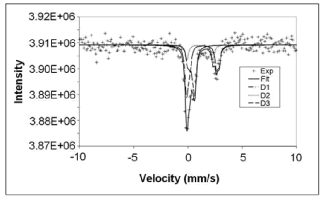
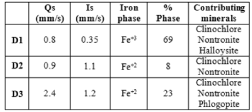
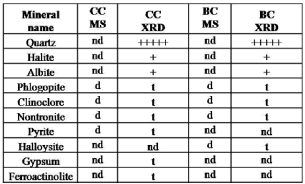
<body><![CDATA[<p align="center"><font size="2" face="Verdana, Arial, Helvetica, sans-serif"><b><a name="fig05"></a><img src="/img/revistas/dyna/v78n168/a09fig05.gif">    <br> 	    Figure 5.</b> M&ouml;ssbauer spectrum of a sediment sample from CC. It shows the experimental data (Exp), three doublets (D1, D2 and D3) and the fit.</font></p> 		    <p align="center"><font size="2" face="Verdana, Arial, Helvetica, sans-serif"><b><a name="tab01"></a>Table 1.</b> Mineral M&ouml;ssbauer parameters that contribute to the iron phases in BC sediments.</font>    <br> 	    <img src="/img/revistas/dyna/v78n168/a09tab01.gif"></p> 		    <p align="center"><font size="2" face="Verdana, Arial, Helvetica, sans-serif"><b><a name="tab02"></a>Table 2.</b> Mineral M&ouml;ssbauer parameters that contribute to the iron phases in CC sediments.</font>    <br> 	    <img src="/img/revistas/dyna/v78n168/a09tab02.gif"></p> 		    <p><font size="2" face="Verdana, Arial, Helvetica, sans-serif">It was not possible to determine the relative percentage of each phase, since the hyperfine parameters of the minerals present are very similar and a superposition of the subspectra appears, making its discrimination impossible. This overlap is reflected by the presence of very wide doublets in the spectra. Because of this problem, an analysis based on distributions of hyperfine parameters, using the DISTRI program was chosen [24]. Therefore, the values presented are average values for the isomeric shift and quadrupole splitting. </font></p> 		    <p><font size="2" face="Verdana, Arial, Helvetica, sans-serif"><a href="#tab03">Table 3</a> lists the minerals detected by XRD and MS spectroscopy in BC and CC estuaries and their relative abundance in the sediments. Quartz is the most abundant mineral in both estuaries. Halite and albite are also present in both estuaries, but they are much less abundant than quartz. The other minerals are present in the sediments as traces. </font></p> 		    <p align="center"><font size="2" face="Verdana, Arial, Helvetica, sans-serif"><b><a name="tab03"></a>Table 3.</b> Relative abundance of minerals in BC and CC estuary sediments. Very high abundance (+++++), high (++++), moderately high (+++), moderate (++), low (+), trace (t), detected (d), not detected (nd).</font>    <br> 	    <img src="/img/revistas/dyna/v78n168/a09tab03.gif"></p> 		    ]]></body>
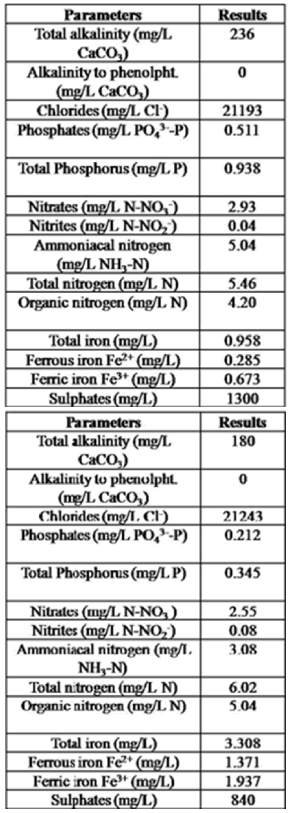
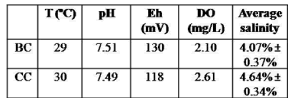
<body><![CDATA[<p><font size="2" face="Verdana, Arial, Helvetica, sans-serif"><b>3.4 Water analysis and physico-chemical parameters</b></font></p> 		    <p><font size="2" face="Verdana, Arial, Helvetica, sans-serif"><i>3.4.1 Water analysis    <br> 		</i><a href="#tab04">Table 4</a> shows the results of water analyses for BC and CC samples, respectively. </font></p> 		    <p align="center"><font size="2" face="Verdana, Arial, Helvetica, sans-serif"><b><a name="tab04"></a>Table 4. </b>Water analysis of BC (up) and CC (down).</font>    <br> 	    <img src="/img/revistas/dyna/v78n168/a09tab04.gif"></p> 		    <p><font size="2" face="Verdana, Arial, Helvetica, sans-serif">Both sites are very similar in this feature. Nevertheless, there are some differences to point out. The BC microcosm has a higher alkalinity than that of CC. The BC waters have more than twice the amount of phosphates and a slightly higher amount of ammonical nitrogen than CC. And finally, total iron (in Fe<sup>2+</sup> and Fe<sup>3+</sup> phases) are significantly higher in the BC microcosm than in CC. </font></p> 		    <p><font size="2" face="Verdana, Arial, Helvetica, sans-serif"><i>3.4.2 Physico-chemical parameters    <br> 		</i>Temperature, pH, Eh, DO, and the average salinity from BC and CC estuaries are shown in <a href="#tab05">Table 5</a>.</font></p> 		    <p align="center"><font size="2" face="Verdana, Arial, Helvetica, sans-serif"><b><a name="tab05"></a>Table 5. </b>Physico-chemical parameters in BC and CC estuaries.</font>    <br> 	    <img src="/img/revistas/dyna/v78n168/a09tab05.gif"></p> 		    ]]></body>
<body><![CDATA[<p><font size="2" face="Verdana, Arial, Helvetica, sans-serif">Both estuaries have a neutral pH and a low redox potential, with very low amounts of dissolved oxygen (microaerophilic MTB). Those conditions are common for MTB [6, 9].As well as all the MTB reported in the literature, the bacteria of this study are mesophilic. </font></p> 		    <p><font size="2" face="Verdana, Arial, Helvetica, sans-serif"><b>3.5 MTB and magnetite nanocrystals presence    <br> 		</b><a href="#fig06">Figure 6</a> shows two characteristic cocci MTB from BC and CC estuaries. Each bacterium has four magnetosome chains/cell. Each magnetosome have around seven magnetite nanocrystals. </font></p> 		    <p align="center"><font size="2" face="Verdana, Arial, Helvetica, sans-serif"><b><a name="fig06"></a><img src="/img/revistas/dyna/v78n168/a09fig06.gif">    <br> 	    Figure 6. </b>(Top) Cocci MTB abundant in BC and CC estuaries. Four magnetosomas can be seen in each cell. (Bottom) EDX of a magnetite nanocrystal in a magnetosome of MTB shown in the left image (star).</font></p> 		    <p><font size="2" face="Verdana, Arial, Helvetica, sans-serif"><a href="#fig06">Figure 6</a> also presents the EDX spectrum taken from the star-point showed in the left image. The iron and oxygen percentages in the EDX spectrum are very similar to those reported for magnetite (72.36% Fe; 24.64% O) [15]. The Cu detected is from the mesh. </font></p> 		    <p><font size="2" face="Verdana, Arial, Helvetica, sans-serif">On the sampling day, BC microcosms sheltered a MTB population of (7.1&plusmn;0.1)*105 MTB/ml; and CC microcosms sheltered a MTB population of (7.6&plusmn;0.1)*105 MTB/ml. The number of non-magnetic microorganisms was much greater than the MTB. </font></p> 		    <p>&nbsp;</p> 		    <p><font size="3" face="Verdana, Arial, Helvetica, sans-serif"><b>4. DISCUSSION</b></font></p> 		    <p><font size="2" face="Verdana, Arial, Helvetica, sans-serif">Quartz and halite, the most abundant minerals in BC and CC sediments, are reported as the most common minerals in estuarine and coastal sediments [24, 25]. Although it is usually considered that the concentration of quartz does not have a significant effect on the population dynamics of estuarine microorganisms, the halite concentration does play a major role in estuarine's microbial dynamics. Low-salinity (&lt;10%) estuarine areas have been identified as regions of severe physiological stress for both freshwater and marine organisms [26].</font></p> 		    ]]></body>
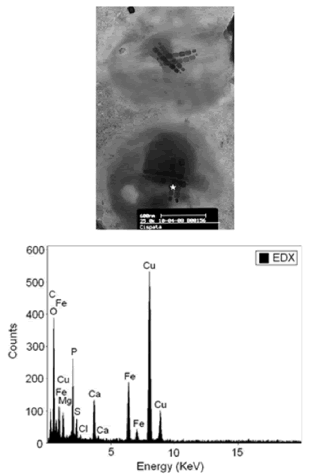
<body><![CDATA[<p><font size="2" face="Verdana, Arial, Helvetica, sans-serif">Clinochlore, nontronite, and halloysite were detected in BC sediments by X-ray diffraction. Furthermore, FTIR bands at 3695, 3622 and 914cm<sup>-1</sup>, seem to confirm the presence of halloysite [15, 16]. FTIR bands at 1400, 1184, 1026, 660, 536, 470, and 440cm<sup>-1</sup> (Si-O vibrations) support the idea that those clay minerals are present in BC and CC sediments. This is also supported by the XRD and M&ouml;ssbauer analysis. The M&ouml;ssbauer spectrum of BC sediments is interpreted as the contribution of those silicates to form two doublets of ferrous iron (47%) and one of ferric iron (53%). Surely these minerals play an important role in the microcosm's iron cycle, mainly as a source of lixiviated ferric iron. That is why the mineralogical composition of the microcosm's soils is thought to be an important issue in the study of the natural microcosms of MTB. </font></p> 		    <p><font size="2" face="Verdana, Arial, Helvetica, sans-serif">The sediments of the CC estuary can be analyzed in the same way. In this case, clinochlore, nontronite, and phlogopite are the contributing minerals in the M&ouml;ssbauer spectrum. Pyrite was also detected by XRD, but it is unlikely that this is lixiviated under the reported physicochemical conditions for CC. The reductive environment and neutral pH induce the pyrite nucleation rather than its lixiviation. As in the BC case, all minerals were detected by XRD and supported by FTIR spectroscopy. There were also three doublets in the M&ouml;ssbauer spectrum. The average values of isomeric shift and quadrupole splitting suggest that Fe<sup>3+</sup> doublet in CC sediments is due to nontronite and clinochlore contributions (69%); and Fe<sup>2+</sup> doublets are due to clinochlore, nontronite (23%), and phlogopite (8%). Nevertheless, phlogopite is much less abundant in the sediments than clinochlore and nontronite. Ferroactinolite is also in CC sediments, and could be a source of lixiviated iron, but the M&ouml;ssbauer analysis indicates that this is much less abundant that the other contributing minerals. We conclude than the iron lixiviated from clinochlore and nontronite, appears as the main source of the iron used by the MTB from CC microcosms, for cell growth and magnetosomes synthesis.</font></p> 		    <p><font size="2" face="Verdana, Arial, Helvetica, sans-serif">Several previous reports have implied that MTB are involved in the reduction of iron and it has been suggested that they could derive energy from this process [2, 7]. Flies et al. (2005) [9] found MTB in a zone where abundant solid phase Fe<sup>3+</sup> was present, and thus it was considered that it might serve as an electron acceptor. Nevertheless, authors like Kim et al. (2005) [10], did not find overwhelming evidence of whether or not an increase on the iron concentration is necessary for MTB growth. In the present research, we have found that the CC estuary has a greater iron concentration than BC estuary, but there appears to be no significant difference between the MTB populations in these microcosms. </font></p> 		    <p><font size="2" face="Verdana, Arial, Helvetica, sans-serif">Biogenic magnetite nanocrystals were detected in both MTB microcosms. Nevertheless, magnetite was not detected in any of the estuary sediments. It is possible that a weak and overshadowed signal of magnetite appears in both FTIR spectra, but it was not detected by XRD spectroscopy, and the characteristic sextet of magnetite [23] in M&ouml;ssbauer spectra did not appear either. However, it must be considered that these spectroscopy techniques require an amount of magnetite that is unlikely to be found in natural sediments in its biogenic form [27]. Also, magnetite is found in sediments in the form of nanocrystals of superparamagnetic nature, making it difficult to be detected either by MS or XRD. More appropriate techniques such as magnetic measurements should be used. Cummings et al. (2000) [27] noted that even if the population density of MTB was relatively high, the magnetite contribution by magnetotactic bacteria could not by itself explain the dominant magnetic character of the sediments. </font></p> 		    <p><font size="2" face="Verdana, Arial, Helvetica, sans-serif">The EDX spectrum indicated not only the presence of iron and oxygen (for the magnetite), but also phosphorus (P), sulphur (S), calcium (Ca), chlorine (Cl), magnesium (Mg), and carbon (C). Certainly those elements appear in the spectrum due to the cell membrane and the cytosol interference. The dark bodies inside the MTB in <a href="#fig06">Fig. 6</a> (left) have been reported as intracellular vesicles of sulphur, phosphate, and/or chlorine [4, 28]. Those intracellular bodies can also contribute to the EDX spectrum shown above. It is considered that a generic cell has an average composition of: 50% C, 20% O, 14% N, 8% H, 3% P, 1% S, 1% K, 1% Na, 0.5% Ca, 0.5% Cl, 0.5% Mg, 0.2% Fe, and 0.3% of other trace elements [29]. This explains the presence of these elements in the EDX spectrum in <a href="#fig06">Fig. 6</a> (right). Also, the fact that Fe, P, Ca, and Mg, appear in larger amounts in MTB than in a generic cell, is further evidence of the existence of the intracellular MTB-vesicles. It is important to point out that all these elements are available in BC and CC microcosms. </font></p> 		    <p><font size="2" face="Verdana, Arial, Helvetica, sans-serif">Oxygen is one of the elements that is thought to be restrictive to MTB population growth [7, 9, 12], especially to microaerophilic MTB. However, MTB have also proven to be very sensitive to other chemical gradients, such as sulfide [9, 10], dissolved iron [2, 7], nitrites, and nitrates [9]. MTB, likes many mesophilic organisms, seems to be very tolerant to changes in temperature. According to this study, the MTB of the BC and CC estuaries are capable of being in a reductive environment (low Eh values) of neutral pH and a relatively high concentration of DO. Flies et al (2005) [9] reported the absence of nitrates and nitrites as optimal to MTB growth. But, <a href="#tab04">Tables 4</a> and <a href="#tab05">5</a> show values of nitrates near to 3mg/L in both estuaries, and yet the MTB population of BC and CC microcosms (around 7.4*10<sup>5</sup> MTB/ml) reaches similar values to those they reported (around 1.5*10<sup>6</sup> MTB/ml) [9]. On the other hand, the average concentration of dissolved iron in BC and CC waters is similar to that reported as optimal by Kim et al. (2005) [10] (near to 0 mg/L) and close to the minimal values reported by Simmons et al. (2004) [1] (between 0.558 mg/L - 12.566 mg/L). Although several researchers have published that magnetotactic bacteria needs a very stable and specific chemical gradient to growth [5], the findings of the present study show that MTB can adapt to variable environments like the constantly changing estuaries.</font></p> 		    <p>&nbsp;</p> 		    <p><b><font size="3" face="Verdana, Arial, Helvetica, sans-serif">5. CONCLUSIONS</font></b></p> 		    <p><font size="2" face="Verdana, Arial, Helvetica, sans-serif">In spite of the intrinsic variability of estuary systems BC and CC, as ecosystems subjected to marine and continental influences, it is possible to characterize them by implementing the spectroscopy techniques and physico-chemical analyses used in this work. In fact, these results may serve as a guide for elucidating the possible origin of some intracellular elements in MTB, like Fe and S. </font></p> 		    <p><font size="2" face="Verdana, Arial, Helvetica, sans-serif">The natural population of MTB cannot by itself contribute to the sediments the necessary amount of biogenic magnetite to be detectable by XRD, FTIR, and M&ouml;ssbauer spectroscopy. Accumulation techniques of MTB, like that proposed by Lins et al. (2003) [14], must be carried out to achieve that objective. The presence of magnetite in the sediments cannot be ruled out, and other more sensitive methods should be used.</font></p> 		    ]]></body>
<body><![CDATA[<p><font size="2" face="Verdana, Arial, Helvetica, sans-serif">It is very likely that the structural iron of biogenic magnetite is derived from the lixiviation of the minerals in the sediments. Clinochlore, nontronite, and halloysite could be among the main minerals that contribute iron to the magnetosomes synthesis in MTB. Phlogopite and ferroactinolite could also be among the contributive minerals, but they are much less abundant in BC and CC estuaries than those mentioned above. It is unlikely that pyrite lixiviation occurs under the physicochemical conditions reported in the BC and CC microcosms. Although quartz appears as the most abundant mineral in the sediments, it does not seem to influence the MTB population dynamics. </font></p> 		    <p><font size="2" face="Verdana, Arial, Helvetica, sans-serif">If clinochlore, nontronite, halloysite, phlogopite, and ferroactinolite are actually among the main iron donors for magnetite biosynthesis, it would be necessary to assess the participation of MTB in the iron cycle of these aquatic environments. Indeed, some researchers are already taking advantage of the bioaccumulation capacities of MTB for the remotion of different contaminant compounds in wastewaters [30].</font></p> 		    <p><font size="2" face="Verdana, Arial, Helvetica, sans-serif">The development and maintenance of specific chemical gradients could be one of the major factors in the MTB population growth. Apparently, nitrate concentrations should not be as low as those that have been reported [9] in order to achieve an optimal MTB growth. The iron concentration in waters of BC and CC support the idea that MTB does not need large amounts of dissolved iron to survive or to synthesize magnetosomes. Further studies are needed to completely understand the relationships between MTB populations and their natural microcosms. </font></p> 		    <p>&nbsp;</p> 		    <p><b><font size="3" face="Verdana, Arial, Helvetica, sans-serif">ACKNOWLEDGMENTS</font></b></p> 		    <p><font size="2" face="Verdana, Arial, Helvetica, sans-serif">The authors are grateful to the Colciencias National Biotechnology Program for funding this project, to the Biomineralogy Laboratory of the National University of Colombia, Medell&iacute;n, and to Professor Ulysses Lins for his valuable contributions to this project. AS acknowledges MSc. Viviana Morillo and MSc. Sandra Grisales for their valuable assistance. ALM acknowledges partial support from CODI, Programa de Sostenibilidad 2009-2010, Universidad de Antioquia.</font></p> 		    <p>&nbsp;</p> 		    <p><font size="3" face="Verdana, Arial, Helvetica, sans-serif"><b>REFERENCES</b></font></p> 		    <!-- ref --><p><font size="2" face="Verdana, Arial, Helvetica, sans-serif"><b>[1]</b> Simmons, S., Sievert, S., Frankel, R., Bazylinski, D. and Edwards, K. Spatiotemporal distribution of marine magnetotactic bacteria in a seasonally stratified coastal salt pond, Applied and Environmental Microbiology, 70, 6230-6239, 2004.     &nbsp;&nbsp;&nbsp;&nbsp;&nbsp;&nbsp;&nbsp;&nbsp;[&#160;<a href="javascript:void(0);" onclick="javascript: window.open('/scielo.php?script=sci_nlinks&ref=000111&pid=S0012-7353201100040000900001&lng=','','width=640,height=500,resizable=yes,scrollbars=1,menubar=yes,');">Links</a>&#160;]<!-- end-ref --><!-- ref --><br>         <b>[2]</b> JINHUA, L., YONGXIN, P., QINGSONG, L., HUAFENG, Q., CHENGLONG, D., RENCHAO, C. AND XINAN, Y. A comparative study of magnetic properties between whole cells and isolated magnetosomes of Magnetospirillum magneticum AMB-1, Chinese Science Bulletin, 55, 1, 38-44, 2009.             &nbsp;&nbsp;&nbsp;&nbsp;&nbsp;&nbsp;&nbsp;&nbsp;[&#160;<a href="javascript:void(0);" onclick="javascript: window.open('/scielo.php?script=sci_nlinks&ref=000112&pid=S0012-7353201100040000900002&lng=','','width=640,height=500,resizable=yes,scrollbars=1,menubar=yes,');">Links</a>&#160;]<!-- end-ref --><!-- ref --><br>         <b>[3]</b> Esquivel, D. and Lins de Barros, H. Motion of magnetotactic microorganisms, The Journal of Experimental Biology, 121, 153-163, 1986.             &nbsp;&nbsp;&nbsp;&nbsp;&nbsp;&nbsp;&nbsp;&nbsp;[&#160;<a href="javascript:void(0);" onclick="javascript: window.open('/scielo.php?script=sci_nlinks&ref=000113&pid=S0012-7353201100040000900003&lng=','','width=640,height=500,resizable=yes,scrollbars=1,menubar=yes,');">Links</a>&#160;]<!-- end-ref --><!-- ref --><br>         <b>[4]</b> ZHU, K., PAN, H., LI, J., YU-ZHANG, K., ZHANG, S., ZHANG, W., ZHOU, K., YUE, H., PAN, Y., XIAO, T. AND WU, L., Isolation and characterization of magnetotactic spirillum axenic culture QH-2 from an intertidal zone of the China Sea. Research in Microbiology, February 3, 1-8, 2010.              &nbsp;&nbsp;&nbsp;&nbsp;&nbsp;&nbsp;&nbsp;&nbsp;[&#160;<a href="javascript:void(0);" onclick="javascript: window.open('/scielo.php?script=sci_nlinks&ref=000114&pid=S0012-7353201100040000900004&lng=','','width=640,height=500,resizable=yes,scrollbars=1,menubar=yes,');">Links</a>&#160;]<!-- end-ref --><!-- ref --><br>         <b>[5]</b> Frankel, R., Bazylinski, D., Johnson, M. and Taylor, B. Magneto-aerotaxis in marine coccoid bacteria, Biophysical Journal, 73, 994-1000, 1997.     &nbsp;&nbsp;&nbsp;&nbsp;&nbsp;&nbsp;&nbsp;&nbsp;[&#160;<a href="javascript:void(0);" onclick="javascript: window.open('/scielo.php?script=sci_nlinks&ref=000115&pid=S0012-7353201100040000900005&lng=','','width=640,height=500,resizable=yes,scrollbars=1,menubar=yes,');">Links</a>&#160;]<!-- end-ref --><!-- ref --><br>         <b>[6]</b> LIN, W., LI, J., SCHÜLER, D., JOGLER, C. AND PAN, Y. Diversity analysis of magnetotactic bacteria in Lake Miyun, northern China, by restriction fragment length polymorphism, Systematic and Applied Microbiology, 32, 342-350, 2009.     &nbsp;&nbsp;&nbsp;&nbsp;&nbsp;&nbsp;&nbsp;&nbsp;[&#160;<a href="javascript:void(0);" onclick="javascript: window.open('/scielo.php?script=sci_nlinks&ref=000116&pid=S0012-7353201100040000900006&lng=','','width=640,height=500,resizable=yes,scrollbars=1,menubar=yes,');">Links</a>&#160;]<!-- end-ref --><!-- ref --><br>         <b>[7]</b> PEREZ-GONZALEZ, T., JIMENEZ-LOPEZ, C., NEAL A., RULL-PEREZ, F., RODRIGUEZ-NAVARRO, A., FERNANDEZ-VIVAS, A. AND IA&Ntilde;EZ-PAREJA, E. Magnetite biomineralization induced by Shewanella oneidensis, Geochimica et Cosmochimica, 74, 967-979, 2010.     &nbsp;&nbsp;&nbsp;&nbsp;&nbsp;&nbsp;&nbsp;&nbsp;[&#160;<a href="javascript:void(0);" onclick="javascript: window.open('/scielo.php?script=sci_nlinks&ref=000117&pid=S0012-7353201100040000900007&lng=','','width=640,height=500,resizable=yes,scrollbars=1,menubar=yes,');">Links</a>&#160;]<!-- end-ref --><!-- ref --><br>         <b>[8]</b> LI, J., PAN, Y., LIU, Q., YU-ZHANG, K., MENGUY, N., CHE, R., QIN, H., LIN, W., WU, W., PETERSEN, N. AND YANG, X., Biomineralization, crystallography and magnetic properties of bulled shaped magnetite magnetosomes in giant rod magnetotactic bacteria, Earth and Planetary Science Letters, 293, 368-376, 2010.              &nbsp;&nbsp;&nbsp;&nbsp;&nbsp;&nbsp;&nbsp;&nbsp;[&#160;<a href="javascript:void(0);" onclick="javascript: window.open('/scielo.php?script=sci_nlinks&ref=000118&pid=S0012-7353201100040000900008&lng=','','width=640,height=500,resizable=yes,scrollbars=1,menubar=yes,');">Links</a>&#160;]<!-- end-ref --><!-- ref --><br>         <b>[9]</b> Flies, C., Jonkers, H., Dirk de Beer, Bosselmann, K., Böttcher, M. and Shüler, D. Diversity and vertical distribution of magnetotactic bacteria along chemical gradients in fresh water microcosms, FEMS Microbiology Ecology, 52, 185-195, 2005.     &nbsp;&nbsp;&nbsp;&nbsp;&nbsp;&nbsp;&nbsp;&nbsp;[&#160;<a href="javascript:void(0);" onclick="javascript: window.open('/scielo.php?script=sci_nlinks&ref=000119&pid=S0012-7353201100040000900009&lng=','','width=640,height=500,resizable=yes,scrollbars=1,menubar=yes,');">Links</a>&#160;]<!-- end-ref --><!-- ref --><br>         <b>[10]</b> Kim, B., Kodama, K. and Moeller, R. Bacterial magnetite produced in water column dominates lake sediment mineral magnetism: Lake Ely, USA, Geophysical Journal International, 163, 26-37, 2005.     &nbsp;&nbsp;&nbsp;&nbsp;&nbsp;&nbsp;&nbsp;&nbsp;[&#160;<a href="javascript:void(0);" onclick="javascript: window.open('/scielo.php?script=sci_nlinks&ref=000120&pid=S0012-7353201100040000900010&lng=','','width=640,height=500,resizable=yes,scrollbars=1,menubar=yes,');">Links</a>&#160;]<!-- end-ref --><!-- ref --><br>         <b>[11]</b> Cox, L., Popa, R., Bazylinsky, D., Lanoil, B., Douglas, S., Belz, A., Engler, D. and Nealson, K. Organization and elemental analysis of P-, S-, and Fe-rich inclusions in a population of freshwater magnetococci.,Geomicrobiology Journal, 19, 387-406, 2002.     &nbsp;&nbsp;&nbsp;&nbsp;&nbsp;&nbsp;&nbsp;&nbsp;[&#160;<a href="javascript:void(0);" onclick="javascript: window.open('/scielo.php?script=sci_nlinks&ref=000121&pid=S0012-7353201100040000900011&lng=','','width=640,height=500,resizable=yes,scrollbars=1,menubar=yes,');">Links</a>&#160;]<!-- end-ref --><!-- ref --><br>         <b>[12]</b> Abreu, F., Martinas, F., Silveira, T., Keim, C., Henrique, G., Lins de Barros, Gueirios Filho, F. and Lins, U. 'Candidatus Magnetoglobus multicellularis', a multicellular, magnetotactic prokaryote from a hypersaline environment, International Journal of Systematic and Evolutionary Microbiology, 57,1318-1322, 2007.     &nbsp;&nbsp;&nbsp;&nbsp;&nbsp;&nbsp;&nbsp;&nbsp;[&#160;<a href="javascript:void(0);" onclick="javascript: window.open('/scielo.php?script=sci_nlinks&ref=000122&pid=S0012-7353201100040000900012&lng=','','width=640,height=500,resizable=yes,scrollbars=1,menubar=yes,');">Links</a>&#160;]<!-- end-ref --><!-- ref --><br>         <b>[13]</b> CIESCERI, L., GREENBERG A. AND EATON A., Standard Methods for Examination of Water and Wastewater, American Public Health Association, Washington DC. 1999.             &nbsp;&nbsp;&nbsp;&nbsp;&nbsp;&nbsp;&nbsp;&nbsp;[&#160;<a href="javascript:void(0);" onclick="javascript: window.open('/scielo.php?script=sci_nlinks&ref=000123&pid=S0012-7353201100040000900013&lng=','','width=640,height=500,resizable=yes,scrollbars=1,menubar=yes,');">Links</a>&#160;]<!-- end-ref --><!-- ref --><br>         <b>[14]</b> Lins, U., Freitas, F., Keim, C., Lins de Barros, H., Esquivel, D. and Farina, M. Simple homemade apparatus for harvesting uncultured magnetotactic microorganisms, Brazilian Journal of Microbiology, 34, 111-116, 2003.              &nbsp;&nbsp;&nbsp;&nbsp;&nbsp;&nbsp;&nbsp;&nbsp;[&#160;<a href="javascript:void(0);" onclick="javascript: window.open('/scielo.php?script=sci_nlinks&ref=000124&pid=S0012-7353201100040000900014&lng=','','width=640,height=500,resizable=yes,scrollbars=1,menubar=yes,');">Links</a>&#160;]<!-- end-ref --><!-- ref --><br>         <b>[15]</b> Marel, H. and Beutelspacher, H. Atlas of infrared spectroscopy of clay minerals and their admixtures, Elsevier Scientific Publishing Company, Amsterdam, 1976.             &nbsp;&nbsp;&nbsp;&nbsp;&nbsp;&nbsp;&nbsp;&nbsp;[&#160;<a href="javascript:void(0);" onclick="javascript: window.open('/scielo.php?script=sci_nlinks&ref=000125&pid=S0012-7353201100040000900015&lng=','','width=640,height=500,resizable=yes,scrollbars=1,menubar=yes,');">Links</a>&#160;]<!-- end-ref --><!-- ref --><br>         <b>[16]</b> PASBAKHSH, P., ISMAIL, H., FAUZI, M. AND BAKAR, A. EPDM/modified halloysite nanocomposites, Applied Clay Science, 48, 405-413, 2010.              &nbsp;&nbsp;&nbsp;&nbsp;&nbsp;&nbsp;&nbsp;&nbsp;[&#160;<a href="javascript:void(0);" onclick="javascript: window.open('/scielo.php?script=sci_nlinks&ref=000126&pid=S0012-7353201100040000900016&lng=','','width=640,height=500,resizable=yes,scrollbars=1,menubar=yes,');">Links</a>&#160;]<!-- end-ref --><!-- ref --><br>         <b>[17]</b> Innocent, B., Pasquier, D., Ropital, F., Hahn, F., L&eacute;ger, J. M. and Kokoh K. B. FTIR spectroscopy study of the reduction of carbon dioxide on lead electrode in aqueus medium, Applied Catalysis B: Environmental, 94, 219-224, 2010.     &nbsp;&nbsp;&nbsp;&nbsp;&nbsp;&nbsp;&nbsp;&nbsp;[&#160;<a href="javascript:void(0);" onclick="javascript: window.open('/scielo.php?script=sci_nlinks&ref=000127&pid=S0012-7353201100040000900017&lng=','','width=640,height=500,resizable=yes,scrollbars=1,menubar=yes,');">Links</a>&#160;]<!-- end-ref --><!-- ref --><br>         <b>[18]</b> Bandopadhyay, A. K. Determination of quartz content for Indian coals using an FTIR technique, International Journal of Coal Geology, 81, 73-78, 2010.     &nbsp;&nbsp;&nbsp;&nbsp;&nbsp;&nbsp;&nbsp;&nbsp;[&#160;<a href="javascript:void(0);" onclick="javascript: window.open('/scielo.php?script=sci_nlinks&ref=000128&pid=S0012-7353201100040000900018&lng=','','width=640,height=500,resizable=yes,scrollbars=1,menubar=yes,');">Links</a>&#160;]<!-- end-ref --><!-- ref --><br>         <b>[19]</b> Ibarguren, C., Audicio, M. A., Farf&aacute;n-Torres, E. M. and Apella, M. C. Silicates characterization as potential bacteriocin-carriers, Innovative Food Science and Emerging Technologies, 11, 197-202, 2010.     &nbsp;&nbsp;&nbsp;&nbsp;&nbsp;&nbsp;&nbsp;&nbsp;[&#160;<a href="javascript:void(0);" onclick="javascript: window.open('/scielo.php?script=sci_nlinks&ref=000129&pid=S0012-7353201100040000900019&lng=','','width=640,height=500,resizable=yes,scrollbars=1,menubar=yes,');">Links</a>&#160;]<!-- end-ref --><!-- ref --><br>         <b>[20]</b> Xu, Z., Cornilsen, B., Popko, D., Wei, B., Pennington, W. and Wood, J. Quantitative Mineral Analysis by FTIR Spectroscopy, Internet Journal of Vibrational Spectroscopy, 5, 1-4, 2001.             &nbsp;&nbsp;&nbsp;&nbsp;&nbsp;&nbsp;&nbsp;&nbsp;[&#160;<a href="javascript:void(0);" onclick="javascript: window.open('/scielo.php?script=sci_nlinks&ref=000130&pid=S0012-7353201100040000900020&lng=','','width=640,height=500,resizable=yes,scrollbars=1,menubar=yes,');">Links</a>&#160;]<!-- end-ref --><!-- ref --><br>         <b>[21]</b> Kim, M. J., Lim, B., Jeong, Y. K. Cho, Y. W. and Choa Y. W. Surface modification of magnetite nanoparticles for immobilization with lyzozyme, Journal of Ceramic Processing Research, 8, 4, 293-295. 2007.             &nbsp;&nbsp;&nbsp;&nbsp;&nbsp;&nbsp;&nbsp;&nbsp;[&#160;<a href="javascript:void(0);" onclick="javascript: window.open('/scielo.php?script=sci_nlinks&ref=000131&pid=S0012-7353201100040000900021&lng=','','width=640,height=500,resizable=yes,scrollbars=1,menubar=yes,');">Links</a>&#160;]<!-- end-ref --><!-- ref --><br>         <b>[22]</b> Konerack&aacute;, M., Z&aacute;visov&aacute;, V., Timko, M., Kopcanský, P., Tomasovicov&aacute;, N. and Csach, K. Magnetic properties of encapsulated magnetite in PLGA nanospheres, Acta Physica Polonica A, 113,1, 9-12, 2007.     &nbsp;&nbsp;&nbsp;&nbsp;&nbsp;&nbsp;&nbsp;&nbsp;[&#160;<a href="javascript:void(0);" onclick="javascript: window.open('/scielo.php?script=sci_nlinks&ref=000132&pid=S0012-7353201100040000900022&lng=','','width=640,height=500,resizable=yes,scrollbars=1,menubar=yes,');">Links</a>&#160;]<!-- end-ref --><!-- ref --><br>         <b>[23]</b> Stevens, J., Airat, M., Miller, J., Pollak, H. and Li, Z. Mössbauer handbook, Mössbauer Effect Data Center, China, 1998.     &nbsp;&nbsp;&nbsp;&nbsp;&nbsp;&nbsp;&nbsp;&nbsp;[&#160;<a href="javascript:void(0);" onclick="javascript: window.open('/scielo.php?script=sci_nlinks&ref=000133&pid=S0012-7353201100040000900023&lng=','','width=640,height=500,resizable=yes,scrollbars=1,menubar=yes,');">Links</a>&#160;]<!-- end-ref --><!-- ref --><br>         <b>[24]</b> Pan, Y., Petersen, N., Davila, A., Zhang, L., Winklhofer, M., Liu, Q., Hanzlik, M. and Zhu, R. The detection of magnetite bacteria in recent sediments of lake Chimesse _southern Germany, Earth and Planetary Science Letters, 232, 109-123, 2005.     &nbsp;&nbsp;&nbsp;&nbsp;&nbsp;&nbsp;&nbsp;&nbsp;[&#160;<a href="javascript:void(0);" onclick="javascript: window.open('/scielo.php?script=sci_nlinks&ref=000134&pid=S0012-7353201100040000900024&lng=','','width=640,height=500,resizable=yes,scrollbars=1,menubar=yes,');">Links</a>&#160;]<!-- end-ref --><!-- ref --><br>         <b>[25]</b> Morillo, V. Caracterizaci&oacute;n de biominerales magn&eacute;ticos de bacterias magnetot&aacute;cticas aisladas de ambientes acu&aacute;ticos dulces de los departamentos de Antioquia y Valle del Cauca (Colombia) [MSc Thesis]. Facultad de Ciencias. Universidad Nacional de Colombia, Medell&iacute;n, 2008.     &nbsp;&nbsp;&nbsp;&nbsp;&nbsp;&nbsp;&nbsp;&nbsp;[&#160;<a href="javascript:void(0);" onclick="javascript: window.open('/scielo.php?script=sci_nlinks&ref=000135&pid=S0012-7353201100040000900025&lng=','','width=640,height=500,resizable=yes,scrollbars=1,menubar=yes,');">Links</a>&#160;]<!-- end-ref --><!-- ref --><br>         <b>[26]</b> Painchaud, J., Therriault, J. and Legendre, L. Assessment of salinity-related mortality of freshwater bacteria in the Saint Lawrence Estuary, Applied and Environmental Microbiology, 61, 205-208, 1995.             &nbsp;&nbsp;&nbsp;&nbsp;&nbsp;&nbsp;&nbsp;&nbsp;[&#160;<a href="javascript:void(0);" onclick="javascript: window.open('/scielo.php?script=sci_nlinks&ref=000136&pid=S0012-7353201100040000900026&lng=','','width=640,height=500,resizable=yes,scrollbars=1,menubar=yes,');">Links</a>&#160;]<!-- end-ref --><!-- ref --><br>         <b>[27]</b> Cummings, D., March, A., Bostick, B., Spring, S., Caccavo, F., Fendorf, J. and Rosenzweig R. Evidence for Microbial Fe(III) Reduction in Anoxic, Mining-Impacted Lake Sediments (Lake Coeur d'Alene, Idaho), Applied and Environmental Microbiology, 66, 154-162, 2000.     &nbsp;&nbsp;&nbsp;&nbsp;&nbsp;&nbsp;&nbsp;&nbsp;[&#160;<a href="javascript:void(0);" onclick="javascript: window.open('/scielo.php?script=sci_nlinks&ref=000137&pid=S0012-7353201100040000900027&lng=','','width=640,height=500,resizable=yes,scrollbars=1,menubar=yes,');">Links</a>&#160;]<!-- end-ref --><!-- ref --><br>         <b>[28]</b> Keim, C., Abreu, F., Lins, U., Lins de Barros, H. and Farina, M. Cell organization and ultrastructure of a magnetotactic multicellular organism, Journal of Structural Biology, 145, 254-262, 2004.     &nbsp;&nbsp;&nbsp;&nbsp;&nbsp;&nbsp;&nbsp;&nbsp;[&#160;<a href="javascript:void(0);" onclick="javascript: window.open('/scielo.php?script=sci_nlinks&ref=000138&pid=S0012-7353201100040000900028&lng=','','width=640,height=500,resizable=yes,scrollbars=1,menubar=yes,');">Links</a>&#160;]<!-- end-ref --><!-- ref --><br>         <b>[29]</b> Stanier, R., Ingraham, J., Wheelis, M. and Painter, P. Microbiolog&iacute;a, Editorial Revert&eacute; S.A., Espa&ntilde;a, 1992.     &nbsp;&nbsp;&nbsp;&nbsp;&nbsp;&nbsp;&nbsp;&nbsp;[&#160;<a href="javascript:void(0);" onclick="javascript: window.open('/scielo.php?script=sci_nlinks&ref=000139&pid=S0012-7353201100040000900029&lng=','','width=640,height=500,resizable=yes,scrollbars=1,menubar=yes,');">Links</a>&#160;]<!-- end-ref --><!-- ref --><br>         <b>[30]</b> Song, H., Li, X., Sun, J., Xu, S. and Han, X. Application of magnetotactic bacterium Stenotrophomonas sp. to the removal of Au(III) from contaminate wastewater with a magnetic separator, Chemosphere, 72, 616-621, 2008.     </font>&nbsp;&nbsp;&nbsp;&nbsp;&nbsp;&nbsp;&nbsp;&nbsp;[&#160;<a href="javascript:void(0);" onclick="javascript: window.open('/scielo.php?script=sci_nlinks&ref=000140&pid=S0012-7353201100040000900030&lng=','','width=640,height=500,resizable=yes,scrollbars=1,menubar=yes,');">Links</a>&#160;]<!-- end-ref --> ]]></body><back>
<ref-list>
<ref id="B1">
<label>1</label><nlm-citation citation-type="journal">
<person-group person-group-type="author">
<name>
<surname><![CDATA[Simmons]]></surname>
<given-names><![CDATA[S]]></given-names>
</name>
<name>
<surname><![CDATA[Sievert]]></surname>
<given-names><![CDATA[S]]></given-names>
</name>
<name>
<surname><![CDATA[Frankel]]></surname>
<given-names><![CDATA[R]]></given-names>
</name>
<name>
<surname><![CDATA[Bazylinski]]></surname>
<given-names><![CDATA[D]]></given-names>
</name>
<name>
<surname><![CDATA[Edwards]]></surname>
<given-names><![CDATA[K]]></given-names>
</name>
</person-group>
<article-title xml:lang="en"><![CDATA[Spatiotemporal distribution of marine magnetotactic bacteria in a seasonally stratified coastal salt pond]]></article-title>
<source><![CDATA[Applied and Environmental Microbiology]]></source>
<year>2004</year>
<numero>70</numero>
<issue>70</issue>
<page-range>6230-6239</page-range></nlm-citation>
</ref>
<ref id="B2">
<label>2</label><nlm-citation citation-type="journal">
<person-group person-group-type="author">
<name>
<surname><![CDATA[JINHUA]]></surname>
<given-names><![CDATA[L]]></given-names>
</name>
<name>
<surname><![CDATA[YONGXIN]]></surname>
<given-names><![CDATA[P]]></given-names>
</name>
<name>
<surname><![CDATA[QINGSONG]]></surname>
<given-names><![CDATA[L]]></given-names>
</name>
<name>
<surname><![CDATA[HUAFENG]]></surname>
<given-names><![CDATA[Q]]></given-names>
</name>
<name>
<surname><![CDATA[CHENGLONG]]></surname>
<given-names><![CDATA[D]]></given-names>
</name>
<name>
<surname><![CDATA[RENCHAO]]></surname>
<given-names><![CDATA[C]]></given-names>
</name>
<name>
<surname><![CDATA[XINAN]]></surname>
<given-names><![CDATA[Y.]]></given-names>
</name>
</person-group>
<article-title xml:lang="en"><![CDATA[A comparative study of magnetic properties between whole cells and isolated magnetosomes of Magnetospirillum magneticum AMB-1]]></article-title>
<source><![CDATA[Chinese Science Bulletin]]></source>
<year>2009</year>
<volume>55</volume>
<numero>1</numero>
<issue>1</issue>
<page-range>38-44</page-range></nlm-citation>
</ref>
<ref id="B3">
<label>3</label><nlm-citation citation-type="journal">
<person-group person-group-type="author">
<name>
<surname><![CDATA[Esquivel]]></surname>
<given-names><![CDATA[D]]></given-names>
</name>
<name>
<surname><![CDATA[de Barros, H.]]></surname>
<given-names><![CDATA[Lins]]></given-names>
</name>
</person-group>
<article-title xml:lang="en"><![CDATA[Motion of magnetotactic microorganisms]]></article-title>
<source><![CDATA[The Journal of Experimental Biology]]></source>
<year>1986</year>
<numero>121</numero>
<issue>121</issue>
<page-range>153-163</page-range></nlm-citation>
</ref>
<ref id="B4">
<label>4</label><nlm-citation citation-type="journal">
<person-group person-group-type="author">
<name>
<surname><![CDATA[ZHU]]></surname>
<given-names><![CDATA[K]]></given-names>
</name>
<name>
<surname><![CDATA[PAN]]></surname>
<given-names><![CDATA[H]]></given-names>
</name>
<name>
<surname><![CDATA[LI]]></surname>
<given-names><![CDATA[J]]></given-names>
</name>
<name>
<surname><![CDATA[YU-ZHANG]]></surname>
<given-names><![CDATA[K]]></given-names>
</name>
<name>
<surname><![CDATA[ZHANG]]></surname>
<given-names><![CDATA[S]]></given-names>
</name>
<name>
<surname><![CDATA[ZHANG]]></surname>
<given-names><![CDATA[W]]></given-names>
</name>
<name>
<surname><![CDATA[ZHOU]]></surname>
<given-names><![CDATA[K]]></given-names>
</name>
<name>
<surname><![CDATA[YUE]]></surname>
<given-names><![CDATA[H]]></given-names>
</name>
<name>
<surname><![CDATA[PAN]]></surname>
<given-names><![CDATA[Y]]></given-names>
</name>
<name>
<surname><![CDATA[XIAO]]></surname>
<given-names><![CDATA[T]]></given-names>
</name>
<name>
<surname><![CDATA[WU]]></surname>
<given-names><![CDATA[L]]></given-names>
</name>
</person-group>
<article-title xml:lang="en"><![CDATA[Isolation and characterization of magnetotactic spirillum axenic culture QH-2 from an intertidal zone of the China Sea]]></article-title>
<source><![CDATA[Research in Microbiology]]></source>
<year>2010</year>
<page-range>1-8</page-range></nlm-citation>
</ref>
<ref id="B5">
<label>5</label><nlm-citation citation-type="journal">
<person-group person-group-type="author">
<name>
<surname><![CDATA[Frankel]]></surname>
<given-names><![CDATA[R]]></given-names>
</name>
<name>
<surname><![CDATA[Bazylinski]]></surname>
<given-names><![CDATA[D]]></given-names>
</name>
<name>
<surname><![CDATA[Johnson]]></surname>
<given-names><![CDATA[M]]></given-names>
</name>
<name>
<surname><![CDATA[Taylor]]></surname>
<given-names><![CDATA[B]]></given-names>
</name>
</person-group>
<article-title xml:lang="en"><![CDATA[Magneto-aerotaxis in marine coccoid bacteria]]></article-title>
<source><![CDATA[Biophysical Journal]]></source>
<year>1997</year>
<numero>73</numero>
<issue>73</issue>
<page-range>994-1000</page-range></nlm-citation>
</ref>
<ref id="B6">
<label>6</label><nlm-citation citation-type="journal">
<person-group person-group-type="author">
<name>
<surname><![CDATA[LIN]]></surname>
<given-names><![CDATA[W]]></given-names>
</name>
<name>
<surname><![CDATA[LI]]></surname>
<given-names><![CDATA[J]]></given-names>
</name>
<name>
<surname><![CDATA[SCHÜLER]]></surname>
<given-names><![CDATA[D]]></given-names>
</name>
<name>
<surname><![CDATA[JOGLER]]></surname>
<given-names><![CDATA[C]]></given-names>
</name>
<name>
<surname><![CDATA[PAN]]></surname>
<given-names><![CDATA[Y]]></given-names>
</name>
</person-group>
<article-title xml:lang="en"><![CDATA[Diversity analysis of magnetotactic bacteria in Lake Miyun: northern China, by restriction fragment length polymorphism]]></article-title>
<source><![CDATA[Systematic and Applied Microbiology]]></source>
<year>2009</year>
<numero>32</numero>
<issue>32</issue>
<page-range>342-350</page-range></nlm-citation>
</ref>
<ref id="B7">
<label>7</label><nlm-citation citation-type="journal">
<person-group person-group-type="author">
<name>
<surname><![CDATA[PEREZ-GONZALEZ]]></surname>
<given-names><![CDATA[T]]></given-names>
</name>
<name>
<surname><![CDATA[JIMENEZ-LOPEZ]]></surname>
<given-names><![CDATA[C]]></given-names>
</name>
<name>
<surname><![CDATA[NEAL]]></surname>
<given-names><![CDATA[A]]></given-names>
</name>
<name>
<surname><![CDATA[RULL-PEREZ]]></surname>
<given-names><![CDATA[F]]></given-names>
</name>
<name>
<surname><![CDATA[RODRIGUEZ-NAVARRO]]></surname>
<given-names><![CDATA[A]]></given-names>
</name>
<name>
<surname><![CDATA[FERNANDEZ-VIVAS]]></surname>
<given-names><![CDATA[A]]></given-names>
</name>
<name>
<surname><![CDATA[IAÑEZ-PAREJA]]></surname>
<given-names><![CDATA[E]]></given-names>
</name>
</person-group>
<article-title xml:lang="en"><![CDATA[Magnetite biomineralization induced by Shewanella oneidensis]]></article-title>
<source><![CDATA[Geochimica et Cosmochimica]]></source>
<year>2010</year>
<numero>74</numero>
<issue>74</issue>
<page-range>967-979</page-range></nlm-citation>
</ref>
<ref id="B8">
<label>8</label><nlm-citation citation-type="journal">
<person-group person-group-type="author">
<name>
<surname><![CDATA[LI]]></surname>
<given-names><![CDATA[J]]></given-names>
</name>
<name>
<surname><![CDATA[PAN]]></surname>
<given-names><![CDATA[Y]]></given-names>
</name>
<name>
<surname><![CDATA[LIU]]></surname>
<given-names><![CDATA[Q]]></given-names>
</name>
<name>
<surname><![CDATA[YU-ZHANG]]></surname>
<given-names><![CDATA[K]]></given-names>
</name>
<name>
<surname><![CDATA[MENGUY]]></surname>
<given-names><![CDATA[N]]></given-names>
</name>
<name>
<surname><![CDATA[CHE]]></surname>
<given-names><![CDATA[R]]></given-names>
</name>
<name>
<surname><![CDATA[QIN]]></surname>
<given-names><![CDATA[H]]></given-names>
</name>
<name>
<surname><![CDATA[LIN]]></surname>
<given-names><![CDATA[W]]></given-names>
</name>
<name>
<surname><![CDATA[WU]]></surname>
<given-names><![CDATA[W]]></given-names>
</name>
<name>
<surname><![CDATA[PETERSEN]]></surname>
<given-names><![CDATA[N]]></given-names>
</name>
<name>
<surname><![CDATA[YANG]]></surname>
<given-names><![CDATA[X]]></given-names>
</name>
</person-group>
<article-title xml:lang="en"><![CDATA[Biomineralization: crystallography and magnetic properties of bulled shaped magnetite magnetosomes in giant rod magnetotactic bacteria]]></article-title>
<source><![CDATA[Earth and Planetary Science Letters]]></source>
<year>2010</year>
<numero>293</numero>
<issue>293</issue>
<page-range>368-376</page-range></nlm-citation>
</ref>
<ref id="B9">
<label>9</label><nlm-citation citation-type="journal">
<person-group person-group-type="author">
<name>
<surname><![CDATA[Flies]]></surname>
<given-names><![CDATA[C]]></given-names>
</name>
<name>
<surname><![CDATA[Jonkers]]></surname>
<given-names><![CDATA[H]]></given-names>
</name>
<name>
<surname><![CDATA[Dirk de Beer, Bosselmann,]]></surname>
<given-names><![CDATA[K]]></given-names>
</name>
<name>
<surname><![CDATA[Böttcher]]></surname>
<given-names><![CDATA[M]]></given-names>
</name>
<name>
<surname><![CDATA[Shüler]]></surname>
<given-names><![CDATA[D]]></given-names>
</name>
</person-group>
<article-title xml:lang="en"><![CDATA[Diversity and vertical distribution of magnetotactic bacteria along chemical gradients in fresh water microcosms]]></article-title>
<source><![CDATA[FEMS Microbiology Ecology]]></source>
<year>2005</year>
<numero>52</numero>
<issue>52</issue>
<page-range>185-195</page-range></nlm-citation>
</ref>
<ref id="B10">
<label>10</label><nlm-citation citation-type="journal">
<person-group person-group-type="author">
<name>
<surname><![CDATA[Kim]]></surname>
<given-names><![CDATA[B]]></given-names>
</name>
<name>
<surname><![CDATA[Kodama]]></surname>
<given-names><![CDATA[K]]></given-names>
</name>
<name>
<surname><![CDATA[Moeller]]></surname>
<given-names><![CDATA[R]]></given-names>
</name>
</person-group>
<article-title xml:lang="en"><![CDATA[Bacterial magnetite produced in water column dominates lake sediment mineral magnetism: Lake Ely, USA]]></article-title>
<source><![CDATA[Geophysical Journal International]]></source>
<year>2005</year>
<numero>163</numero>
<issue>163</issue>
<page-range>26-37</page-range></nlm-citation>
</ref>
<ref id="B11">
<label>11</label><nlm-citation citation-type="journal">
<person-group person-group-type="author">
<name>
<surname><![CDATA[Cox]]></surname>
<given-names><![CDATA[L]]></given-names>
</name>
<name>
<surname><![CDATA[Popa]]></surname>
<given-names><![CDATA[R]]></given-names>
</name>
<name>
<surname><![CDATA[Bazylinsky]]></surname>
<given-names><![CDATA[D]]></given-names>
</name>
<name>
<surname><![CDATA[Lanoil]]></surname>
<given-names><![CDATA[B]]></given-names>
</name>
<name>
<surname><![CDATA[Douglas]]></surname>
<given-names><![CDATA[S]]></given-names>
</name>
<name>
<surname><![CDATA[Belz]]></surname>
<given-names><![CDATA[A]]></given-names>
</name>
<name>
<surname><![CDATA[Engler]]></surname>
<given-names><![CDATA[D]]></given-names>
</name>
<name>
<surname><![CDATA[Nealson]]></surname>
<given-names><![CDATA[K]]></given-names>
</name>
</person-group>
<article-title xml:lang="en"><![CDATA[Organization and elemental analysis of P-, S-: and Fe-rich inclusions in a population of freshwater magnetococci]]></article-title>
<source><![CDATA[Geomicrobiology Journal]]></source>
<year>2002</year>
<numero>19</numero>
<issue>19</issue>
<page-range>387-406</page-range></nlm-citation>
</ref>
<ref id="B12">
<label>12</label><nlm-citation citation-type="journal">
<person-group person-group-type="author">
<name>
<surname><![CDATA[Abreu]]></surname>
<given-names><![CDATA[F]]></given-names>
</name>
<name>
<surname><![CDATA[Martinas]]></surname>
<given-names><![CDATA[F]]></given-names>
</name>
<name>
<surname><![CDATA[Silveira]]></surname>
<given-names><![CDATA[T]]></given-names>
</name>
<name>
<surname><![CDATA[Keim]]></surname>
<given-names><![CDATA[C]]></given-names>
</name>
<name>
<surname><![CDATA[Henrique]]></surname>
<given-names><![CDATA[G]]></given-names>
</name>
<name>
<surname><![CDATA[Lins de Barros,]]></surname>
</name>
<name>
<surname><![CDATA[Gueirios Filho]]></surname>
<given-names><![CDATA[F]]></given-names>
</name>
<name>
<surname><![CDATA[Lins]]></surname>
<given-names><![CDATA[U]]></given-names>
</name>
</person-group>
<article-title xml:lang="en"><![CDATA[Candidatus Magnetoglobus multicellularis: a multicellular, magnetotactic prokaryote from a hypersaline environment]]></article-title>
<source><![CDATA[International Journal of Systematic and Evolutionary Microbiology]]></source>
<year>2007</year>
<numero>57</numero>
<issue>57</issue>
<page-range>1318-1322</page-range></nlm-citation>
</ref>
<ref id="B13">
<label>13</label><nlm-citation citation-type="book">
<person-group person-group-type="author">
<name>
<surname><![CDATA[CIESCERI]]></surname>
<given-names><![CDATA[L]]></given-names>
</name>
<name>
<surname><![CDATA[GREENBERG]]></surname>
<given-names><![CDATA[A]]></given-names>
</name>
<name>
<surname><![CDATA[EATON]]></surname>
<given-names><![CDATA[A]]></given-names>
</name>
</person-group>
<source><![CDATA[Standard Methods for Examination of Water and Wastewater]]></source>
<year>1999</year>
<publisher-loc><![CDATA[Washington DC ]]></publisher-loc>
<publisher-name><![CDATA[American Public Health Association]]></publisher-name>
</nlm-citation>
</ref>
<ref id="B14">
<label>14</label><nlm-citation citation-type="journal">
<person-group person-group-type="author">
<name>
<surname><![CDATA[Lins]]></surname>
<given-names><![CDATA[U]]></given-names>
</name>
<name>
<surname><![CDATA[Freitas]]></surname>
<given-names><![CDATA[F]]></given-names>
</name>
<name>
<surname><![CDATA[Keim]]></surname>
<given-names><![CDATA[C]]></given-names>
</name>
<name>
<surname><![CDATA[Lins de Barros]]></surname>
<given-names><![CDATA[H]]></given-names>
</name>
<name>
<surname><![CDATA[Esquivel]]></surname>
<given-names><![CDATA[D]]></given-names>
</name>
<name>
<surname><![CDATA[Farina]]></surname>
<given-names><![CDATA[M]]></given-names>
</name>
</person-group>
<article-title xml:lang="en"><![CDATA[Simple homemade apparatus for harvesting uncultured magnetotactic microorganisms]]></article-title>
<source><![CDATA[Brazilian Journal of Microbiology]]></source>
<year>2003</year>
<numero>34</numero>
<issue>34</issue>
<page-range>111-116</page-range></nlm-citation>
</ref>
<ref id="B15">
<label>15</label><nlm-citation citation-type="book">
<person-group person-group-type="author">
<name>
<surname><![CDATA[Marel]]></surname>
<given-names><![CDATA[H]]></given-names>
</name>
<name>
<surname><![CDATA[Beutelspacher]]></surname>
<given-names><![CDATA[H]]></given-names>
</name>
</person-group>
<source><![CDATA[Atlas of infrared spectroscopy of clay minerals and their admixtures]]></source>
<year>1976</year>
<publisher-loc><![CDATA[Amsterdam ]]></publisher-loc>
<publisher-name><![CDATA[Elsevier Scientific Publishing Company]]></publisher-name>
</nlm-citation>
</ref>
<ref id="B16">
<label>16</label><nlm-citation citation-type="journal">
<person-group person-group-type="author">
<name>
<surname><![CDATA[PASBAKHSH]]></surname>
<given-names><![CDATA[P]]></given-names>
</name>
<name>
<surname><![CDATA[ISMAIL]]></surname>
<given-names><![CDATA[H]]></given-names>
</name>
<name>
<surname><![CDATA[FAUZI]]></surname>
<given-names><![CDATA[M]]></given-names>
</name>
<name>
<surname><![CDATA[BAKAR]]></surname>
<given-names><![CDATA[A]]></given-names>
</name>
</person-group>
<article-title xml:lang="en"><![CDATA[EPDM/modified halloysite nanocomposites]]></article-title>
<source><![CDATA[Applied Clay Science]]></source>
<year>2010</year>
<numero>48</numero>
<issue>48</issue>
<page-range>405-413</page-range></nlm-citation>
</ref>
<ref id="B17">
<label>17</label><nlm-citation citation-type="journal">
<person-group person-group-type="author">
<name>
<surname><![CDATA[Innocent]]></surname>
<given-names><![CDATA[B]]></given-names>
</name>
<name>
<surname><![CDATA[Pasquier]]></surname>
<given-names><![CDATA[D]]></given-names>
</name>
<name>
<surname><![CDATA[Ropital]]></surname>
<given-names><![CDATA[F]]></given-names>
</name>
<name>
<surname><![CDATA[Hahn]]></surname>
<given-names><![CDATA[F]]></given-names>
</name>
<name>
<surname><![CDATA[Léger]]></surname>
<given-names><![CDATA[J. M.]]></given-names>
</name>
<name>
<surname><![CDATA[Kokoh]]></surname>
<given-names><![CDATA[K. B.]]></given-names>
</name>
</person-group>
<article-title xml:lang="en"><![CDATA[FTIR spectroscopy study of the reduction of carbon dioxide on lead electrode in aqueus medium]]></article-title>
<source><![CDATA[Applied Catalysis B: Environmental]]></source>
<year>2010</year>
<numero>94</numero>
<issue>94</issue>
<page-range>219-224</page-range></nlm-citation>
</ref>
<ref id="B18">
<label>18</label><nlm-citation citation-type="journal">
<person-group person-group-type="author">
<name>
<surname><![CDATA[Bandopadhyay]]></surname>
<given-names><![CDATA[A. K.]]></given-names>
</name>
</person-group>
<article-title xml:lang="en"><![CDATA[Determination of quartz content for Indian coals using an FTIR technique]]></article-title>
<source><![CDATA[International Journal of Coal Geology]]></source>
<year>2010</year>
<numero>81</numero>
<issue>81</issue>
<page-range>73-78</page-range></nlm-citation>
</ref>
<ref id="B19">
<label>19</label><nlm-citation citation-type="journal">
<person-group person-group-type="author">
<name>
<surname><![CDATA[Ibarguren]]></surname>
<given-names><![CDATA[C]]></given-names>
</name>
<name>
<surname><![CDATA[Audicio]]></surname>
<given-names><![CDATA[M. A.]]></given-names>
</name>
<name>
<surname><![CDATA[Farfán-Torres]]></surname>
<given-names><![CDATA[E. M.]]></given-names>
</name>
<name>
<surname><![CDATA[Apella]]></surname>
<given-names><![CDATA[M. C.]]></given-names>
</name>
</person-group>
<article-title xml:lang="en"><![CDATA[Silicates characterization as potential bacteriocin-carriers]]></article-title>
<source><![CDATA[Innovative Food Science and Emerging Technologies]]></source>
<year>2010</year>
<numero>11</numero>
<issue>11</issue>
<page-range>197-202</page-range></nlm-citation>
</ref>
<ref id="B20">
<label>20</label><nlm-citation citation-type="journal">
<person-group person-group-type="author">
<name>
<surname><![CDATA[Xu]]></surname>
<given-names><![CDATA[Z]]></given-names>
</name>
<name>
<surname><![CDATA[Cornilsen]]></surname>
<given-names><![CDATA[B]]></given-names>
</name>
<name>
<surname><![CDATA[Popko]]></surname>
<given-names><![CDATA[D]]></given-names>
</name>
<name>
<surname><![CDATA[Wei]]></surname>
<given-names><![CDATA[B]]></given-names>
</name>
<name>
<surname><![CDATA[Pennington]]></surname>
<given-names><![CDATA[W]]></given-names>
</name>
<name>
<surname><![CDATA[Wood]]></surname>
<given-names><![CDATA[J]]></given-names>
</name>
</person-group>
<article-title xml:lang="en"><![CDATA[Quantitative Mineral Analysis by FTIR Spectroscopy]]></article-title>
<source><![CDATA[Internet Journal of Vibrational Spectroscopy]]></source>
<year>2001</year>
<numero>5</numero>
<issue>5</issue>
<page-range>1-4</page-range></nlm-citation>
</ref>
<ref id="B21">
<label>21</label><nlm-citation citation-type="journal">
<person-group person-group-type="author">
<name>
<surname><![CDATA[Kim]]></surname>
<given-names><![CDATA[M. J.]]></given-names>
</name>
<name>
<surname><![CDATA[Lim]]></surname>
<given-names><![CDATA[B]]></given-names>
</name>
<name>
<surname><![CDATA[Jeong]]></surname>
<given-names><![CDATA[Y. K.]]></given-names>
</name>
<name>
<surname><![CDATA[Cho]]></surname>
<given-names><![CDATA[Y. W.]]></given-names>
</name>
<name>
<surname><![CDATA[Choa]]></surname>
<given-names><![CDATA[Y. W.]]></given-names>
</name>
</person-group>
<article-title xml:lang="en"><![CDATA[Surface modification of magnetite nanoparticles for immobilization with lyzozyme]]></article-title>
<source><![CDATA[Journal of Ceramic Processing Research]]></source>
<year>2007</year>
<volume>8</volume>
<numero>4</numero>
<issue>4</issue>
<page-range>293-295</page-range></nlm-citation>
</ref>
<ref id="B22">
<label>22</label><nlm-citation citation-type="journal">
<person-group person-group-type="author">
<name>
<surname><![CDATA[Koneracká]]></surname>
<given-names><![CDATA[M]]></given-names>
</name>
<name>
<surname><![CDATA[Závisová]]></surname>
<given-names><![CDATA[V]]></given-names>
</name>
<name>
<surname><![CDATA[Timko]]></surname>
<given-names><![CDATA[M]]></given-names>
</name>
<name>
<surname><![CDATA[Kopcanský]]></surname>
<given-names><![CDATA[P]]></given-names>
</name>
<name>
<surname><![CDATA[Tomasovicová]]></surname>
<given-names><![CDATA[N]]></given-names>
</name>
<name>
<surname><![CDATA[Csach]]></surname>
<given-names><![CDATA[K]]></given-names>
</name>
</person-group>
<article-title xml:lang="en"><![CDATA[Magnetic properties of encapsulated magnetite in PLGA nanospheres]]></article-title>
<source><![CDATA[Acta Physica Polonica A]]></source>
<year>2007</year>
<volume>113</volume>
<numero>1</numero>
<issue>1</issue>
<page-range>9-12</page-range></nlm-citation>
</ref>
<ref id="B23">
<label>23</label><nlm-citation citation-type="">
<person-group person-group-type="author">
<name>
<surname><![CDATA[Stevens]]></surname>
<given-names><![CDATA[J]]></given-names>
</name>
<name>
<surname><![CDATA[Airat]]></surname>
<given-names><![CDATA[M]]></given-names>
</name>
<name>
<surname><![CDATA[Miller]]></surname>
<given-names><![CDATA[J]]></given-names>
</name>
<name>
<surname><![CDATA[Pollak]]></surname>
<given-names><![CDATA[H]]></given-names>
</name>
<name>
<surname><![CDATA[Li]]></surname>
<given-names><![CDATA[Z]]></given-names>
</name>
</person-group>
<source><![CDATA[Mössbauer handbook: Mössbauer Effect Data Center]]></source>
<year>1998</year>
</nlm-citation>
</ref>
<ref id="B24">
<label>24</label><nlm-citation citation-type="journal">
<person-group person-group-type="author">
<name>
<surname><![CDATA[Pan]]></surname>
<given-names><![CDATA[Y]]></given-names>
</name>
<name>
<surname><![CDATA[Petersen]]></surname>
<given-names><![CDATA[N]]></given-names>
</name>
<name>
<surname><![CDATA[Davila]]></surname>
<given-names><![CDATA[A]]></given-names>
</name>
<name>
<surname><![CDATA[Zhang]]></surname>
<given-names><![CDATA[L]]></given-names>
</name>
<name>
<surname><![CDATA[Winklhofer]]></surname>
<given-names><![CDATA[M]]></given-names>
</name>
<name>
<surname><![CDATA[Liu]]></surname>
<given-names><![CDATA[Q]]></given-names>
</name>
<name>
<surname><![CDATA[Hanzlik]]></surname>
<given-names><![CDATA[M]]></given-names>
</name>
<name>
<surname><![CDATA[Zhu]]></surname>
<given-names><![CDATA[R]]></given-names>
</name>
</person-group>
<article-title xml:lang="en"><![CDATA[The detection of magnetite bacteria in recent sediments of lake Chimesse: southern Germany]]></article-title>
<source><![CDATA[Earth and Planetary Science Letters]]></source>
<year>2005</year>
<numero>232</numero>
<issue>232</issue>
<page-range>109-123</page-range></nlm-citation>
</ref>
<ref id="B25">
<label>25</label><nlm-citation citation-type="">
<person-group person-group-type="author">
<name>
<surname><![CDATA[Morillo]]></surname>
<given-names><![CDATA[V]]></given-names>
</name>
</person-group>
<source><![CDATA[Caracterización de biominerales magnéticos de bacterias magnetotácticas aisladas de ambientes acuáticos dulces de los departamentos de Antioquia y Valle del Cauca (Colombia)]]></source>
<year></year>
</nlm-citation>
</ref>
<ref id="B26">
<label>26</label><nlm-citation citation-type="journal">
<person-group person-group-type="author">
<name>
<surname><![CDATA[Painchaud]]></surname>
<given-names><![CDATA[J]]></given-names>
</name>
<name>
<surname><![CDATA[Therriault]]></surname>
<given-names><![CDATA[J]]></given-names>
</name>
<name>
<surname><![CDATA[Legendre]]></surname>
<given-names><![CDATA[L]]></given-names>
</name>
</person-group>
<article-title xml:lang="en"><![CDATA[Assessment of salinity-related mortality of freshwater bacteria in the Saint Lawrence Estuary]]></article-title>
<source><![CDATA[Applied and Environmental Microbiology]]></source>
<year>1995</year>
<numero>61</numero>
<issue>61</issue>
<page-range>205-208</page-range></nlm-citation>
</ref>
<ref id="B27">
<label>27</label><nlm-citation citation-type="journal">
<person-group person-group-type="author">
<name>
<surname><![CDATA[Cummings]]></surname>
<given-names><![CDATA[D]]></given-names>
</name>
<name>
<surname><![CDATA[March]]></surname>
<given-names><![CDATA[A]]></given-names>
</name>
<name>
<surname><![CDATA[Bostick]]></surname>
<given-names><![CDATA[B]]></given-names>
</name>
<name>
<surname><![CDATA[Spring]]></surname>
<given-names><![CDATA[S]]></given-names>
</name>
<name>
<surname><![CDATA[Caccavo]]></surname>
<given-names><![CDATA[F]]></given-names>
</name>
<name>
<surname><![CDATA[Fendorf]]></surname>
<given-names><![CDATA[J]]></given-names>
</name>
<name>
<surname><![CDATA[Rosenzweig]]></surname>
<given-names><![CDATA[R]]></given-names>
</name>
</person-group>
<article-title xml:lang="en"><![CDATA[Evidence for Microbial Fe(III) Reduction in Anoxic: Mining-Impacted Lake Sediments (Lake Coeur d'Alene, Idaho)]]></article-title>
<source><![CDATA[Applied and Environmental Microbiology]]></source>
<year>2000</year>
<numero>66</numero>
<issue>66</issue>
<page-range>154-162</page-range></nlm-citation>
</ref>
<ref id="B28">
<label>28</label><nlm-citation citation-type="journal">
<person-group person-group-type="author">
<name>
<surname><![CDATA[Keim]]></surname>
<given-names><![CDATA[C]]></given-names>
</name>
<name>
<surname><![CDATA[Abreu]]></surname>
<given-names><![CDATA[F]]></given-names>
</name>
<name>
<surname><![CDATA[Lins]]></surname>
<given-names><![CDATA[U]]></given-names>
</name>
<name>
<surname><![CDATA[Lins de Barros]]></surname>
<given-names><![CDATA[H]]></given-names>
</name>
<name>
<surname><![CDATA[Farina]]></surname>
<given-names><![CDATA[M]]></given-names>
</name>
</person-group>
<article-title xml:lang="en"><![CDATA[Cell organization and ultrastructure of a magnetotactic multicellular organism]]></article-title>
<source><![CDATA[Journal of Structural Biology]]></source>
<year>2004</year>
<numero>145</numero>
<issue>145</issue>
<page-range>254-262</page-range></nlm-citation>
</ref>
<ref id="B29">
<label>29</label><nlm-citation citation-type="book">
<person-group person-group-type="author">
<name>
<surname><![CDATA[Stanier]]></surname>
<given-names><![CDATA[R]]></given-names>
</name>
<name>
<surname><![CDATA[Ingraham]]></surname>
<given-names><![CDATA[J]]></given-names>
</name>
<name>
<surname><![CDATA[Wheelis]]></surname>
<given-names><![CDATA[M]]></given-names>
</name>
<name>
<surname><![CDATA[Painter]]></surname>
<given-names><![CDATA[P]]></given-names>
</name>
</person-group>
<source><![CDATA[Microbiología]]></source>
<year>1992</year>
<publisher-name><![CDATA[Editorial Reverté S.A.]]></publisher-name>
</nlm-citation>
</ref>
<ref id="B30">
<label>30</label><nlm-citation citation-type="journal">
<person-group person-group-type="author">
<name>
<surname><![CDATA[Song]]></surname>
<given-names><![CDATA[H]]></given-names>
</name>
<name>
<surname><![CDATA[Li]]></surname>
<given-names><![CDATA[X]]></given-names>
</name>
<name>
<surname><![CDATA[Sun]]></surname>
<given-names><![CDATA[J]]></given-names>
</name>
<name>
<surname><![CDATA[Xu]]></surname>
<given-names><![CDATA[S]]></given-names>
</name>
<name>
<surname><![CDATA[Han]]></surname>
<given-names><![CDATA[X]]></given-names>
</name>
</person-group>
<article-title xml:lang="en"><![CDATA[Application of magnetotactic bacterium Stenotrophomonas sp: to the removal of Au(III) from contaminate wastewater with a magnetic separator]]></article-title>
<source><![CDATA[Chemosphere]]></source>
<year>2008</year>
<numero>72</numero>
<issue>72</issue>
<page-range>616-621</page-range></nlm-citation>
</ref>
</ref-list>
</back>
</article>