<?xml version="1.0" encoding="ISO-8859-1"?><article xmlns:mml="http://www.w3.org/1998/Math/MathML" xmlns:xlink="http://www.w3.org/1999/xlink" xmlns:xsi="http://www.w3.org/2001/XMLSchema-instance">
<front>
<journal-meta>
<journal-id>0012-7353</journal-id>
<journal-title><![CDATA[DYNA]]></journal-title>
<abbrev-journal-title><![CDATA[Dyna rev.fac.nac.minas]]></abbrev-journal-title>
<issn>0012-7353</issn>
<publisher>
<publisher-name><![CDATA[Universidad Nacional de Colombia]]></publisher-name>
</publisher>
</journal-meta>
<article-meta>
<article-id>S0012-73532011000400012</article-id>
<title-group>
<article-title xml:lang="en"><![CDATA[PERFORMANCE OF A CONTACT STABILIZATION PROCESS FOR DOMESTIC WASTEWATER TREATMENT OF CALI, COLOMBIA]]></article-title>
<article-title xml:lang="es"><![CDATA[DESEMPEÑO DEL PROCESO DE ESTABILIZACIÓN POR CONTACTO PARA EL TRATAMIENTO DEL AGUA RESIDUAL DOMÉSTICA DE CALI, COLOMBIA]]></article-title>
</title-group>
<contrib-group>
<contrib contrib-type="author">
<name>
<surname><![CDATA[VÁSQUEZ SARRIA]]></surname>
<given-names><![CDATA[NANCY]]></given-names>
</name>
<xref ref-type="aff" rid="A01"/>
</contrib>
<contrib contrib-type="author">
<name>
<surname><![CDATA[RODRÍGUEZ VICTORIA]]></surname>
<given-names><![CDATA[JENNY]]></given-names>
</name>
<xref ref-type="aff" rid="A02"/>
</contrib>
<contrib contrib-type="author">
<name>
<surname><![CDATA[TORRES LOZADA]]></surname>
<given-names><![CDATA[PATRICIA]]></given-names>
</name>
<xref ref-type="aff" rid="A03"/>
</contrib>
<contrib contrib-type="author">
<name>
<surname><![CDATA[MADERA PARRA]]></surname>
<given-names><![CDATA[CARLOS]]></given-names>
</name>
<xref ref-type="aff" rid="A04"/>
</contrib>
</contrib-group>
<aff id="A01">
<institution><![CDATA[,Universidad del Valle Faculty of Engineering ]]></institution>
<addr-line><![CDATA[ ]]></addr-line>
<country>Colombia</country>
</aff>
<aff id="A02">
<institution><![CDATA[,Universidad del Valle Faculty of Engineering ]]></institution>
<addr-line><![CDATA[ ]]></addr-line>
<country>Colombia</country>
</aff>
<aff id="A03">
<institution><![CDATA[,Universidad del Valle Faculty of Engineering ]]></institution>
<addr-line><![CDATA[ ]]></addr-line>
<country>Colombia</country>
</aff>
<aff id="A04">
<institution><![CDATA[,Universidad del Valle Faculty of Engineering ]]></institution>
<addr-line><![CDATA[ ]]></addr-line>
<country>Colombia</country>
</aff>
<pub-date pub-type="pub">
<day>00</day>
<month>08</month>
<year>2011</year>
</pub-date>
<pub-date pub-type="epub">
<day>00</day>
<month>08</month>
<year>2011</year>
</pub-date>
<volume>78</volume>
<numero>168</numero>
<fpage>98</fpage>
<lpage>107</lpage>
<copyright-statement/>
<copyright-year/>
<self-uri xlink:href="http://www.scielo.org.co/scielo.php?script=sci_arttext&amp;pid=S0012-73532011000400012&amp;lng=en&amp;nrm=iso"></self-uri><self-uri xlink:href="http://www.scielo.org.co/scielo.php?script=sci_abstract&amp;pid=S0012-73532011000400012&amp;lng=en&amp;nrm=iso"></self-uri><self-uri xlink:href="http://www.scielo.org.co/scielo.php?script=sci_pdf&amp;pid=S0012-73532011000400012&amp;lng=en&amp;nrm=iso"></self-uri><abstract abstract-type="short" xml:lang="en"><p><![CDATA[The contact stabilization process has been applied in full-scale plants which treat domestic wastewater. The main advantage of this process is the short hydraulic retention time (HRT) in the contact reactor (CR), allowing treatment volumes significantly lower than in conventional activated sludge processes. This paper presents an analysis of the influence of the HRT and sludge recycle rate (r), on the performance of a contact stabilization process to remove organic matter and solids from the domestic wastewater of the city of Cali (Colombia). The research was carried out at Cañaveralejo Wastewater Treatment Plant (C-WWTP) facilities. The contact stabilization process was assessed at a pilot-scale unit treating raw wastewater influent to the C-WWTP. The HRT varied between 0.84 to 1.66 h in the contact reactor and 2.56 to 4.65 h in the stabilization reactor (SR). The evaluation of HRT was carried out with different r varying between 40 and 100%. The operational conditions that allowed for us to obtain the best performance in terms of organic load removal (14.05 kgCOD.d-1), with removal efficiencies of chemical oxygen demand (COD), biological oxygen demand (BOD5), and total suspended solids (TSS) of 86, 87, and 82 %, respectively, were an HRT of 0.84 h in CR, and 4.11 h in SR, with a sludge recycle rate of 40%. In order to guarantee this performance, average values of sludge retention time (SRT) of 6 d; a volumetric organic load (VOL) of 2.13 kgBOD5.(m3.d) -1; a food microorganism relation (F/M) of 0.89 kgBOD5.(kgVSS.d)-1; and a mixed liquor volatile suspended solids (MLVSS) of 1125 mg.L-1 in CR, and 3173 mg.L-1 in SR, must be maintained.]]></p></abstract>
<abstract abstract-type="short" xml:lang="es"><p><![CDATA[El proceso de estabilización de contacto ha sido aplicado en plantas de tratamiento de aguas residuales domésticas a gran escala. La principal ventaja de este proceso está representada en los bajos tiempos de retención hidráulicos (TRH) de operación del reactor de contacto (RC), lo que permite que los volúmenes de tratamiento sean considerablemente más bajos que en los procesos convencionales de lodos activados. Este trabajo presenta un análisis de la influencia del TRH y la tasa de recirculación (r) en el desempeño del proceso de estabilización por contacto para la reducción de materia orgánica y sólidos de las aguas residuales domésticas de Cali. La investigación fue llevada a cabo en las instalaciones de la Planta de tratamiento de aguas residuales de Cañaveralejo (PTAR-C) de Cali. El proceso de estabilización por contacto fue evaluado a escala piloto tratando el agua residual afluente a la PTAR-C. Se estudiaron rangos de TRH entre 0.84 y 1.66 h en RC y entre 2.56 y 4.65 h para el reactor de estabilización (RE). La evaluación del TRH fue realizada con diferentes valores de r Tasas de recirculación de lodos ( r) que variaron entre el 40 y 100 %. La condición operacional que garantizó el mejor desempeño en términos de carga orgánica eliminada (14.05 kgDQO.d-1) y eficiencias de reducción de DQO, DBO5 y SST (86, 87 y 82 % respectivamente) fue para un TRH de 0.84 h en RC, y 4.11 h en el RE, con una tasa de recirculación del 40%. Adicionalmente, se encontró que para garantizar este desempeño se deben mantener valores promedio de tiempo de retención celular (TRC) de 6 d, Carga orgánica volumétrica (COV) de 2.13 kgDBO5.(m3.d)-1, relación alimento microorganismos (A/M) de 0.89 kgDBO5.(kgSSV.d)-1 y Concentración de Sólidos Suspendidos Volátiles en el Licor Mixto (SSVLM) de 1125 mg.L-1 y 3173 mg.L-1 en RC y RE, respectivamente.]]></p></abstract>
<kwd-group>
<kwd lng="en"><![CDATA[Activated sludge]]></kwd>
<kwd lng="en"><![CDATA[contact stabilization]]></kwd>
<kwd lng="en"><![CDATA[organic matter removal]]></kwd>
<kwd lng="en"><![CDATA[secondary wastewater treatment]]></kwd>
<kwd lng="es"><![CDATA[Lodos activados]]></kwd>
<kwd lng="es"><![CDATA[Estabilización por contacto]]></kwd>
<kwd lng="es"><![CDATA[reducción de materia orgánica]]></kwd>
<kwd lng="es"><![CDATA[tratamiento secundario de aguas residuales]]></kwd>
</kwd-group>
</article-meta>
</front><body><![CDATA[  		    <p align="center"><font size="4" face="Verdana, Arial, Helvetica, sans-serif"><b>PERFORMANCE OF A CONTACT STABILIZATION PROCESS FOR DOMESTIC WASTEWATER TREATMENT OF CALI, COLOMBIA </b></font></p> 		    <p align="center"><i><font size="3" face="Verdana, Arial, Helvetica, sans-serif"><b>DESEMPEÃ‘O DEL PROCESO DE ESTABILIZACIÃ“N POR CONTACTO PARA EL TRATAMIENTO DEL AGUA RESIDUAL DOMÃ‰STICA DE CALI, COLOMBIA</b></font></i></p> 		    <p align="center">&nbsp;</p> 		    <p align="center"><font size="2" face="Verdana, Arial, Helvetica, sans-serif"><b>NANCY VÃSQUEZ SARRIA</b><br /> 	        <i>Faculty of Engineering, Universidad del Valle, Colombia. navasari1@gmail.com / <a href="mailto:nancy.vasquez@correounivalle.edu.co">nancy.vasquez@correounivalle.edu.co</a></i></font></p> 		    <p align="center"><font size="2" face="Verdana, Arial, Helvetica, sans-serif"><b>JENNY RODRÃGUEZ VICTORIA</b><br /> 	        <i>Faculty of Engineering, Universidad del Valle, Colombia. <a href="mailto:jenny.rodriguez@correounivalle.edu.co">jenny.rodriguez@correounivalle.edu.co</a></i></font></p> 		    <p align="center"><font size="2" face="Verdana, Arial, Helvetica, sans-serif"><b>PATRICIA TORRES LOZADA</b><br /> 	        <i>Faculty of Engineering, Universidad del Valle, Colombia. <a href="mailto:patricia.torres@correounivalle.edu.co">patricia.torres@correounivalle.edu.co</a></i></font></p> 		    <p align="center"><font size="2" face="Verdana, Arial, Helvetica, sans-serif"><b>CARLOS MADERA PARRA</b><br /> 	        <i>Faculty of Engineering, Universidad del Valle, Colombia. <a href="mailto:carlos.a.madera@correounivalle.edu.co">carlos.a.madera@correounivalle.edu.co</a></i></font></p> 		    <p align="center">&nbsp;</p> 		    <p align="center"><font size="2" face="Verdana, Arial, Helvetica, sans-serif"><b>Received for review April 14<sup>th</sup>, 2010; accepted November 4<sup>th</sup>, 2010; final version November 25<sup>th</sup>, 2010</b></font></p> 	    ]]></body>
<body><![CDATA[<p>&nbsp;</p> 		<hr /> 		    <p><font size="2" face="Verdana, Arial, Helvetica, sans-serif"><b>ABSTRACT:</b> The contact stabilization process has been applied in full-scale plants which treat domestic wastewater. The main advantage of this process is the short hydraulic retention time (HRT) in the contact reactor (CR), allowing treatment volumes significantly lower than in conventional activated sludge processes. This paper presents an analysis of the influence of the HRT and sludge recycle rate (r), on the performance of a contact stabilization process to remove organic matter and solids from the domestic wastewater of the city of Cali (Colombia). The research was carried out at CaÃ±averalejo Wastewater Treatment Plant (C-WWTP) facilities. The contact stabilization process was assessed at a pilot-scale unit treating raw wastewater influent to the C-WWTP. The HRT varied between 0.84 to 1.66 h in the contact reactor and 2.56 to 4.65 h in the stabilization reactor (SR). The evaluation of HRT was carried out with different r varying between 40 and 100%. </font></p> 	    <p><font size="2" face="Verdana, Arial, Helvetica, sans-serif">The operational conditions that allowed for us to obtain the best performance in terms of organic load removal (14.05 kgCOD.d-1), with removal efficiencies of chemical oxygen demand (COD), biological oxygen demand (BOD<sub>5</sub>), and total suspended solids (TSS) of 86, 87, and 82 %, respectively, were an HRT of 0.84 h in CR, and 4.11 h in SR, with a sludge recycle rate of 40%. In order to guarantee this performance, average values of sludge retention time (SRT) of 6 d; a volumetric organic load (VOL) of 2.13 kgBOD<sub>5</sub>.(m<sup>3</sup>.d) -1; a food microorganism relation (F/M) of 0.89 kgBOD<sub>5</sub>.(kgVSS.d)-1; and a mixed liquor volatile suspended solids (MLVSS) of 1125 mg.L<sup>-1</sup> in CR, and 3173 mg.L<sup>-1</sup> in SR, must be maintained.</font></p> 		    <p><font size="2" face="Verdana, Arial, Helvetica, sans-serif"><b>KEYWORDS:</b> Activated sludge, contact stabilization, organic matter removal, secondary wastewater treatment</font></p> 		    <p><font size="2" face="Verdana, Arial, Helvetica, sans-serif"><b>RESUMEN: </b>El proceso de estabilizaciÃ³n de contacto ha sido aplicado en plantas de tratamiento de aguas residuales domÃ©sticas a gran escala. La principal ventaja de este proceso estÃ¡ representada en los bajos tiempos de retenciÃ³n hidrÃ¡ulicos (TRH) de operaciÃ³n del reactor de contacto (RC), lo que permite que los volÃºmenes de tratamiento sean considerablemente mÃ¡s bajos que en los procesos convencionales de lodos activados. Este trabajo presenta un anÃ¡lisis de la influencia del TRH y la tasa de recirculaciÃ³n (r) en el desempeÃ±o del proceso de estabilizaciÃ³n por contacto para la reducciÃ³n de materia orgÃ¡nica y sÃ³lidos de las aguas residuales domÃ©sticas de Cali. La investigaciÃ³n fue llevada a cabo en las instalaciones de la Planta de tratamiento de aguas residuales de CaÃ±averalejo (PTAR-C) de Cali. El proceso de estabilizaciÃ³n por contacto fue evaluado a escala piloto tratando el agua residual afluente a la PTAR-C. Se estudiaron rangos de TRH entre 0.84 y 1.66 h en RC y entre 2.56 y 4.65 h para el reactor de estabilizaciÃ³n (RE). La evaluaciÃ³n del TRH fue realizada con diferentes valores de r Tasas de recirculaciÃ³n de lodos ( r) que variaron entre el 40 y 100 %.</font></p> 	    <p><font size="2" face="Verdana, Arial, Helvetica, sans-serif">La condiciÃ³n operacional que garantizÃ³ el mejor desempeÃ±o en tÃ©rminos de carga orgÃ¡nica eliminada (14.05 kgDQO.d-1) y eficiencias de reducciÃ³n de DQO, DBO5 y SST (86, 87 y 82 % respectivamente) fue para un TRH de 0.84 h en RC, y 4.11 h en el RE, con una tasa de recirculaciÃ³n del 40%. Adicionalmente, se encontrÃ³ que para garantizar este desempeÃ±o se deben mantener valores promedio de tiempo de retenciÃ³n celular (TRC) de 6 d, Carga orgÃ¡nica volumÃ©trica (COV) de 2.13 kgDBO5.(m<sup>3</sup>.d)-1, relaciÃ³n alimento microorganismos (A/M) de 0.89 kgDBO5.(kgSSV.d)-1 y ConcentraciÃ³n de SÃ³lidos Suspendidos VolÃ¡tiles en el Licor Mixto (SSVLM) de 1125 mg.L<sup>-1</sup> y 3173 mg.L<sup>-1</sup> en RC y RE, respectivamente.</font></p> 		    <p><font size="2" face="Verdana, Arial, Helvetica, sans-serif"><b>PALABRAS CLAVE: </b>Lodos activados, EstabilizaciÃ³n por contacto, reducciÃ³n de materia orgÃ¡nica, tratamiento secundario de aguas residuales</font></p> 		<hr /> 		    <p>&nbsp;</p> 		    <p><font size="3" face="Verdana, Arial, Helvetica, sans-serif"><b>1. INTRODUCTION</b></font></p> 	    <p><font size="2" face="Verdana, Arial, Helvetica, sans-serif">The activated sludge system is a suspended-growth aerobic process which uses the metabolic reactions of microorganisms to convert biodegradable organic wastewater constituents and certain inorganic fractions into new cell mass and byproducts. This process has been widely applied for the treatment of domestic and industrial wastewater, due to the high efficiency obtained, operational flexibility, and possibility of nutrient removal [1-3]. </font></p> 		    ]]></body>
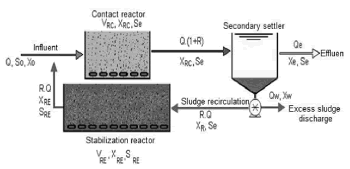
<body><![CDATA[<p><font size="2" face="Verdana, Arial, Helvetica, sans-serif">Contact stabilization, as an activated sludge process modification, comprises two aerated reactors (the contact reactor [CR], and the stabilization reactor [SR]) separated by a sedimentation tank [3-7]. The CR receives the influent flow and the biomass in a starved condition so that soluble material is readily adsorbed and absorbed by the starved biomass. </font></p> 		    <p><font size="2" face="Verdana, Arial, Helvetica, sans-serif">The mixed liquor leaving the CR is settled and the biomass is concentrated. Then, the biomass is sent to SR, where colloidal material removed from the wastewater in the CR is stabilized. Stabilized biomass is returned to the CR by a biomass recycle flow [8]. <a href="#fig01">Figure 1</a> shows a schematic representation of the contact stabilization process. </font></p> 		    <p align="center"><font size="2" face="Verdana, Arial, Helvetica, sans-serif"><b><a name="fig01" id="fig01"></a><img src="/img/revistas/dyna/v78n168/a12fig01.gif" /><br /> 	    Figure 1. </b>Contact stabilization process</font></p> 		    <p><font size="2" face="Verdana, Arial, Helvetica, sans-serif">The main design and operating parameters of activated sludge systems include the hydraulic retention time (HRT), the sludge recycle rate (r), the sludge retention time (SRT), mixed liquor volatile suspended solids (MLVSS), the volumetric organic load (VOL), the food microorganism relation (F/M), the sludge settling properties (sludge volumetric index [SVI]), the characteristics of floc, and the concentration of dissolved oxygen (DO) [6, 9, 10]. </font></p> 	    <p><font size="2" face="Verdana, Arial, Helvetica, sans-serif">The HRT is one of the main parameters in the activated sludge system as it is implicitly associated with the organic load applied and the reactor volume. The HRT affects the costs of implementation, operation, and maintenance [11]. For CR, the HRT varies between 0.5 and 1.5 h. For SR, the HRT is determined by the recycle rate (flow recirculation) and can vary between 2 and 6 h [9].</font></p> 		    <p><font size="2" face="Verdana, Arial, Helvetica, sans-serif">The VOL and F/M represent the organic load applied to the system in terms of the reactor volume and the active biomass, respectively [9, 10]. The F/M can create conditions that favor the predominance of filamentous organisms that affect the settling properties of the sludge, causing brown foam in the aeration tank and deterioration in effluent quality [12, 13].</font></p> 		    <p><font size="2" face="Verdana, Arial, Helvetica, sans-serif">The SRT, used for the design and operation of the system, is the most important parameter in maintaining the MLVSS concentration, as it influences the evolution of the biochemical transformation processes and is related to the rate of growth of microorganisms, because only the microorganisms capable of breeding in this time can survive and enrich the system [6, 14]. According to Liao et al. [15, 16], Liss et al. [17], and Wilen et al. [18], the SRT can affect the floc structure and the settling properties of the sludge. </font></p> 		    <p><font size="2" face="Verdana, Arial, Helvetica, sans-serif">The MLVSS represents the amount of biomass in the system. The typical values for activated sludge systems vary between 500 and 5000 mg.L<sup>-1</sup> and the recommended concentrations for the contact stabilization process are between 1000 and 3000 mg.L<sup>-1</sup> for CR, and between 4000 and 10000 mg.L<sup>-1</sup> for SR [6, 9, 19].</font></p> 		    <p><font size="2" face="Verdana, Arial, Helvetica, sans-serif">The fraction of biomass in CR is called the sludge distribution fraction (</font><font face="Symbol">a</font><font size="2" face="Verdana, Arial, Helvetica, sans-serif"> factor), and values recommended are between 0.1 and 0.3 [4, 8]. The SVI indicates the separation efficiency of the biomass of the mixed liquor. According to Withey et al. [20], the settling properties of sludge formed during the activated sludge process are essential for the clarification of the effluent. Jenkins et al. [12] indicated that high values of SVI are associated with sludge bulking and foam problems that affect the effluent quality.</font></p> 	    <p><font size="2" face="Verdana, Arial, Helvetica, sans-serif">The solids concentration in the secondary settler affect the solids concentration in the recirculation sludge, although if the sludge is concentrated, the recycle rate requirements will be lower in order to guaranteed the MLSSV in the SR, which is also affected by the SRT [6, 9]. </font></p> 		    ]]></body>
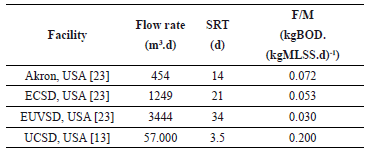
<body><![CDATA[<p><font size="2" face="Verdana, Arial, Helvetica, sans-serif">The DO concentration is important in the development of processes that occur in the activated sludge systems. The main oxygen requirements are determined by oxidation of organic matter and ammonium through heterotrophic and autotrophic microorganisms respectively [21]. Low levels of DO can affect the sludge settling properties and the metabolic activity of microorganisms, generating an incomplete removal of substrate, which is reflected in the poor effluent quality [22].</font></p> 		    <p><font size="2" face="Verdana, Arial, Helvetica, sans-serif">Since 1972, studies have been conducted on this process. Between 1975 and 1980 Gujer and Jenkins [5, 7] and Alexander et al. [8] proposed the kinetic models for carbon removal and nitrification, and found that this system can be highly efficient in organic matter removal with efficiencies around 80%. They established that the most relevant operating parameters for this process are the HRT, SRT, r, and ï¡ factor. SarioÄŸlu et al. [4] applied the contact stabilization process to the domestic wastewater of Istanbul.</font></p> 		    <p><font size="2" face="Verdana, Arial, Helvetica, sans-serif">The experimental results showed that the treatment efficiency increases when the particulate COD fraction of an influent domestic wastewater increases. Efficiencies observed during the study were around 82%. </font></p> 		    <p><font size="2" face="Verdana, Arial, Helvetica, sans-serif"><a href="#tab01">Table 1</a> presents experimental data of WWTP with contact stabilization processes. </font></p> 		    <p align="center"><font size="2" face="Verdana, Arial, Helvetica, sans-serif"><b><a name="tab01" id="tab01"></a>Table 1.</b> WWTP with contact stabilization processes</font><br /> 	    <img src="/img/revistas/dyna/v78n168/a12tab01.gif" /></p> 	    <p><font size="2" face="Verdana, Arial, Helvetica, sans-serif">More recently, laboratory-scale biological systems studies were carried out by Universidad del Valle and Water Company of Cali (EMCALI EICE ESP) [24, 25], to treat domestic wastewater from Cali. Four activated sludge processes were evaluated: extended aeration, adsorption/bioxidation (A/B System), conventional, and contact stabilization. The results showed that the application of the activated sludge systems studied is feasible, since COD, BOD<sub>5</sub>, and TSS removal efficiencies were above 80%. In addition, the contact stabilization process allows the highest organic load removal with the smallest area requirements. </font></p> 		    <p><font size="2" face="Verdana, Arial, Helvetica, sans-serif">This paper presents an analysis of the influence of the HRT and r in the performance of a contact stabilization process to remove organic matter and solids (COD, BOD<sub>5</sub>, and TSS, respectively) from the domestic wastewater of Cali. </font></p> 		    <p>&nbsp;</p> 	    <p><font size="3" face="Verdana, Arial, Helvetica, sans-serif"><b>2. METHODOLOGY </b></font></p> 	    <p><font size="2" face="Verdana, Arial, Helvetica, sans-serif">The study was carried out at a pilot-scale wastewater treatment plant in the C-WWTP facilities of Cali. </font></p> 		    ]]></body>
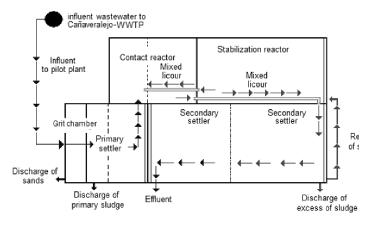
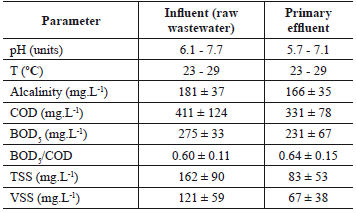
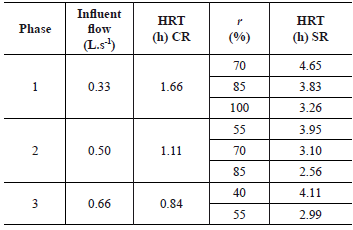
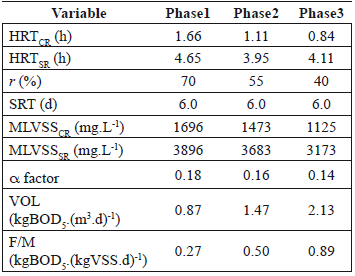
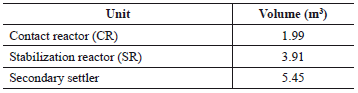
<body><![CDATA[<p><font size="2" face="Verdana, Arial, Helvetica, sans-serif"><b>2.1. Pilot plant</b><br /> 	    The pilot plant consisted of four sequentially disposed units for preliminary treatment (fine screen and two grit chambers), primary clarification, aeration (for CR and SR), and secondary sedimentation. The wastewater was collected with a submersible pump (BarnesÂ®) located at the entrance of the grit chamber of the C-WWTP. The oxygen was supplied through membrane diffusers and a fine bubble blower system. The recirculation sludge sample was collected by means of a centrifugal pump (BarnesÂ®). <a href="#fig02">Figure 2</a> shows the pilot plant flowsheet, and <a href="#tab02">Table 2</a> shows the description of units. </font></p> 	    <p align="center"><font size="2" face="Verdana, Arial, Helvetica, sans-serif"><a name="fig02" id="fig02"></a><b><img src="/img/revistas/dyna/v78n168/a12fig02.gif" /><br />     Figure 2.</b> Pilot plant flowsheet</font></p> 	    <p align="center"><font size="2" face="Verdana, Arial, Helvetica, sans-serif"><a name="tab02" id="tab02"></a><b>Table 2.</b> Description of units </font><br />     <img src="/img/revistas/dyna/v78n168/a12tab02.gif" /></p> 	    <p><font size="2" face="Verdana, Arial, Helvetica, sans-serif"><b>2.2. Wastewater<br /> 	</b>The pilot plant was fed with the raw wastewater which arrived to the C-WWTP that corresponds to Cali domestic wastewater. <a href="#tab03">Table 3</a> summarizes the plant wastewater influent and primary effluent average quality parameters.</font></p> 	    <p align="center"><font size="2" face="Verdana, Arial, Helvetica, sans-serif"><b><a name="tab03" id="tab03"></a>Table 3. </b>Treatment plant wastewater influent and primary effluent average quality parameters</font><br />     <img src="/img/revistas/dyna/v78n168/a12tab03.gif" /></p> 	    <p><font size="2" face="Verdana, Arial, Helvetica, sans-serif"><b>2.3 Operational conditions<br /> 	</b>The pilot plant was operated for a period of 183 days. The operation was conducted at different HRT and r values. Every HRT variation was called a <i>phase of operation</i>, for a total of three phases. In each phase of operation, r was varied to provide different operational conditions to assess the performance of the system. <a href="#tab04">Table 4</a> shows the evaluated conditions in each phase. </font></p> 	    <p align="center"><font size="2" face="Verdana, Arial, Helvetica, sans-serif"><b><a name="tab04" id="tab04"></a>Table 4. </b>Evaluated conditions in each phase</font><br />     <img src="/img/revistas/dyna/v78n168/a12tab04.gif" /></p> 	    <p><font size="2" face="Verdana, Arial, Helvetica, sans-serif">Samples were collected three times a week in the influent and effluent of the system and in the CR, SR, recirculation sludge, and discharge of excess of sludge. The analyzed parameters were: pH, temperature, alkalinity, COD, BOD<sub>5</sub>, TSS, and VSS. All analytical determinations were according to the Standard Methods for the Examination of Water and Wastewater [26] and the structure of activated sludge floc was observed with optical microscopy, according to VazollÃ©r et al. [27] and JimÃ©nez et al. [28].</font></p> 		    <p><font size="2" face="Verdana, Arial, Helvetica, sans-serif">For the selection of the operational conditions that showed the best performance in terms of COD removal efficiency, a statistical model for a completely randomized design was used. The tests for the data validation were Bartlet for homogeneity of variances and Kolmogorov-Smirnov for normality. In order to correct non-normality and stabilize subgroup variance, a Box-Cox transformation was used [24, 29].</font></p> 		    <p>&nbsp;</p> 		    ]]></body>
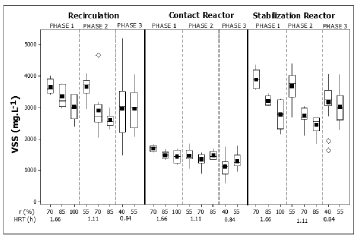
<body><![CDATA[<p><font size="3" face="Verdana, Arial, Helvetica, sans-serif"><b>3. RESULTS AND DISCUSSION </b></font></p> 	    <p><font size="2" face="Verdana, Arial, Helvetica, sans-serif"><b>3.1. Analysis of operational conditions </b></font></p> 	    <p><font size="2" face="Verdana, Arial, Helvetica, sans-serif"><i>3.1.1. Behavior of operation variables<br /> 	</i>SRT. Taking into account the results obtained by UNIVALLE-EMCALI [25], the initial value of SRT used in this study was around 10 d. With this condition, the effluent COD concentration was less than 60 mg.L<sup>-1</sup>; nevertheless, the system showed a high incidence of sludge flotation in the settler, probably caused by the accumulation of the sludge in the secondary settler, whose decomposition processes produced gases that dragged the bottom sludge. </font></p> 	    <p><font size="2" face="Verdana, Arial, Helvetica, sans-serif">Van Haandel and Marais [1] indicated that for tropical climate conditions, SRT values between 3 and 5 d are enough to ensure the development of predators of bacteria and an effluent with low concentration of organic matter. Considering these aspects, the operation of the system (Phase 2 and 3) was carried out with values of SRT around 6 d. The mean SRT varied between 9 and 12 d, 5 and 8 d, and 5 and 6 d for all three phases, respectively. </font></p> 		    <p><font size="2" face="Verdana, Arial, Helvetica, sans-serif">The change of SRT to 6 d resulted in a significant reduction of the sludge flotation in the settler unit, without affecting the effluent quality. In all phases the effluent remained with a low COD concentration range (between 20 and 60 mg.L<sup>-1</sup>), reflecting that the SRT values maintained during the operation of the system allowed for the proper development of biological processes for the removal of organic matter. </font></p> 		    <p><font size="2" face="Verdana, Arial, Helvetica, sans-serif">Solids in the system. The concentration of solids obtained in the different units showed an effect of increasing r, which was attributed to the increased speed of the settled sludge suction and which generated a less concentrated sludge recirculation. Another variable that could affect the stability of the solids concentration was the secondary settler performance, which did not allow a compaction and distribution of sludge proper, generating accumulation and decomposition of this material in this unit. <a href="#fig03">Figure 3</a> shows the concentration of solids in the system.</font></p> 		    <p align="center"><font size="2" face="Verdana, Arial, Helvetica, sans-serif"><b><a name="fig03" id="fig03"></a><img src="/img/revistas/dyna/v78n168/a12fig03.gif" /><br /> 	    Figure 3.</b> Concentration of solids in the system</font></p> 	    <p><font size="2" face="Verdana, Arial, Helvetica, sans-serif">An important aspect was that in all operating conditions, the solids concentrations were maintained at values inferior than those typically recommended in the literature, which vary between 1000 and 3000 mg.L<sup>-1</sup> for CR, and between 4000 and 10000 mg. L<sup>-1</sup> for SR [9]; however, the system performance in terms of removal of COD and TSS showed that the system can be operated with concentrations of VSS around 1500 mg.L<sup>-1</sup> for CR, and 3500 mg.L<sup>-1</sup> for SR. </font></p> 		    <p><font size="2" face="Verdana, Arial, Helvetica, sans-serif">In activated sludge systems, the biosorption process, the assimilation of organic matter, and a proper operation of aerated reactors depends on an adequate concentration of biomass in the reactor. This condition is improved in the contact stabilization process; because the sludge is separated into two reactors, where the distribution of the sludge is controlled by factor ï¡.</font></p> 		    <p><font size="2" face="Verdana, Arial, Helvetica, sans-serif">According to Alexander et al. [8], an </font><font face="Symbol">a</font><font size="2" face="Verdana, Arial, Helvetica, sans-serif"> factor value of 0.1 can be sufficient for ensuring the biosorption of organic matter; however, SarioÄŸlu et al. [4] recommended an optimal value of 0.30. During the three phases, </font><font face="Symbol">a</font><font size="2" face="Verdana, Arial, Helvetica, sans-serif"> factor values were between 0.1 and 0.2, which according to the quality of the effluent of the system, were sufficient to ensure good performance.</font></p> 	    ]]></body>
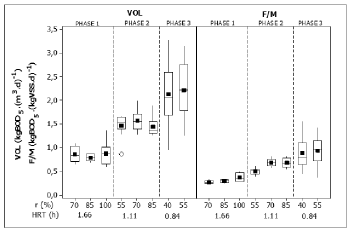
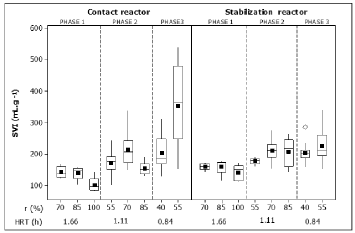
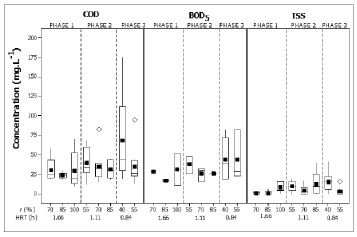
<body><![CDATA[<p><font size="2" face="Verdana, Arial, Helvetica, sans-serif">Organic load. Influent BOD concentration constant values around 231 Â± 67 mg.L<sup>-1</sup> allowed similar average values of VOL in each phase. <a href="#fig04">Figure 4</a> presents the behavior of VOL and F/M. </font></p> 		    <p align="center"><font size="2" face="Verdana, Arial, Helvetica, sans-serif"><a name="fig04" id="fig04"></a><b><img src="/img/revistas/dyna/v78n168/a12fig04.gif" /><br /> 	    Figure 4.</b> Behavior of the organic load applied</font></p> 		    <p><font size="2" face="Verdana, Arial, Helvetica, sans-serif">Decreased HRT caused an increase in the VOL and F/M. As a result, values achieved in Phases 2 and 3 exceeded the recommended maximum for this process between 0.2 and 0.6 kgDBO5.(kgSSV.d)<sup>-1</sup>. Although authors such us Ramalho et al. [30] argue that high values of F/M are related to filamentous organisms, and that this affect the sludge settling properties and quality of the effluent, our results showed that the contact stabilization process can be operated with high VOL without the occurrence of the growth of filamentous microorganisms. </font></p> 	    <p><font size="2" face="Verdana, Arial, Helvetica, sans-serif"><i>3.1.2. Sludge quality<br /> 	</i><a href="#fig05">Figure 5</a> shows the behavior of SVI. There is a clear trend of the sludge low settling properties (SVI &gt; 100 mL.g-1) associated mainly with the floc structure, which presented a small size, lower floc strength (open structure), and shear sensitivity, due to the low concentration of filaments. The mean floc size varied between 12 to 13 Âµm for the CR, and 9 to 16 Âµm for the SR. </font></p> 	    <p align="center"><font size="2" face="Verdana, Arial, Helvetica, sans-serif"><a name="fig05" id="fig05"></a><b><img src="/img/revistas/dyna/v78n168/a12fig05.gif" /><br />     Figure 5.</b> Behavior of sludge volumetric index</font></p> 	    <p><font size="2" face="Verdana, Arial, Helvetica, sans-serif">According to Li and Ganczarczyk, cited by Wilen et al. [18] this floc size is very small, because typical sizes of flocs usually vary between 20 and 200 Âµm. Jenkins et al. [12] affirm that the presence of surfactants and toxic substances in wastewater can affect the formation of floc and the bioflocculation process reflected in the predominance of small sizes and dispersed floc.</font></p> 		    <p><font size="2" face="Verdana, Arial, Helvetica, sans-serif">Another variable that could affect the size of the floc was the turbulence caused by the aeration system. Although DO concentrations were maintained mainly between 1 and 4 mg.L<sup>-1</sup> during the three phases, is possible that air bubbles could have caused the breakdown of the floc.</font></p> 		    <p><font size="2" face="Verdana, Arial, Helvetica, sans-serif">The Phase 3 operation was perturbed by electrical supply interruptions every 3 hours during a week. As a result, the system was operated intermittently, affecting the sludge settling properties, which was reflected in the increase in SVI.</font></p> 		    <p><font size="2" face="Verdana, Arial, Helvetica, sans-serif"><b>3.2. System performance </b></font></p> 	    <p><font size="2" face="Verdana, Arial, Helvetica, sans-serif"><i>3.2.1. Effluent concentration and COD, BOD<sub>5</sub>, and TSS removal<br /> 	</i><a href="#fig06">Figure 6</a> shows effluent quality. Although in all operational conditions the effluent organic matter and solids concentrations were less than 60 mg.L<sup>-1</sup>; the overall behavior of effluent quality showed that the average concentration of COD, BOD<sub>5</sub>, and TSS have been affected by changes in r, and showed a slight increase with decreasing HRT in the CR.</font></p> 	    ]]></body>
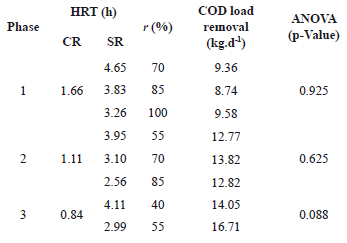
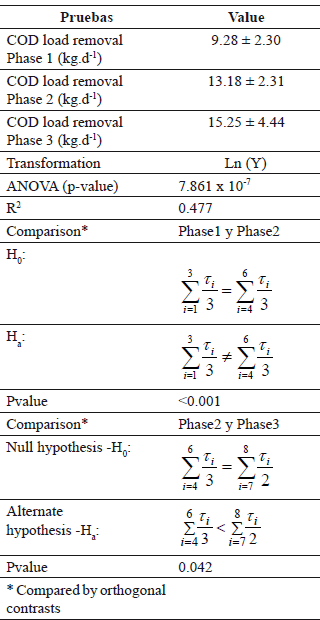
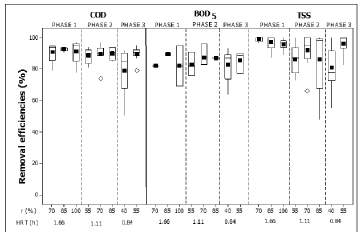
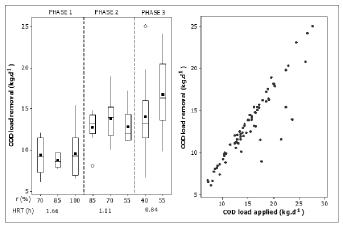
<body><![CDATA[<p align="center"><font size="2" face="Verdana, Arial, Helvetica, sans-serif"><b><a name="fig06" id="fig06"></a><img src="/img/revistas/dyna/v78n168/a12fig06.gif" /><br />     Figure 6.</b> Effluent quality</font></p> 	    <p><font size="2" face="Verdana, Arial, Helvetica, sans-serif">This condition described was related to the discharge of small flocs in the effluent as a result of the decrease in the sludge settling. However, we considered that this impact was not significant since removal efficiencies during all phases, COD, BOD<sub>5</sub>, and TSS, were above 80% (See <a href="#fig07">Figure 7</a>), indicating a good affinity of the biomass with the influent wastewater. For the range of HRT evaluated, the concentrations obtained from MLVSS in CR and SR were appropriate for ensuring an effluent with low COD concentration. </font></p> 		    <p align="center"><font size="2" face="Verdana, Arial, Helvetica, sans-serif"><a name="fig07" id="fig07"></a><b><img src="/img/revistas/dyna/v78n168/a12fig07.gif" /><br /> 	    Figure 7.</b> Removal efficiencies of COD, BOD<sub>5</sub>, and TSS</font></p> 	    <p><font size="2" face="Verdana, Arial, Helvetica, sans-serif">During the evaluation of Phase 3 with 40% r there was an increase in the average influent COD, BOD<sub>5</sub>, and TSS concentration. These increases were attributed to disruptions in the aeration system due to electricity supply interruptions in the C-WWTP, which caused instability in the process and reduced COD, BOD<sub>5</sub>, and TSS removal efficiencies up to values around 50%; although most of the data were between 70 and 90%, with average values of 79, 82, and 81% for COD, BOD<sub>5</sub>, and TSS, respectively, showing that despite operational drawbacks, the system continued to present good performance in terms of the removal of COD, BOD<sub>5</sub>, and TSS, and that the system can tolerate some external variations without significantly affecting performance.</font></p> 		    <p><font size="2" face="Verdana, Arial, Helvetica, sans-serif"><i>3.2.2. Organic load removal<br /> 		</i>Reduction of the HRT and the increase of VOL and F/M caused an increase in organic load removal (see <a href="#fig08">Figure 8</a>). These conditions can be associated with the fact that increasing organic loads in the system allow for better use of the adsorption capacity of the floc, because there is a greater availability of organic matter for the adsorption processes in the CR. </font></p> 	    <p align="center"><font size="2" face="Verdana, Arial, Helvetica, sans-serif"><b><a name="fig08" id="fig08"></a><img src="/img/revistas/dyna/v78n168/a12fig08.gif" /><br />     Figure 8.</b> Organic load removal and the relationship between organic load applied and removal</font></p> 	    <p><font size="2" face="Verdana, Arial, Helvetica, sans-serif">HRT values assessed for Phases 1, 2, and 3, corresponding to 100, 67, and 50 min, respectively (1.66 h, 1.11 h, and 0.84 h) were sufficient to allow for the biosorption and assimilation processes. These results are consistent with studies carried out by Eliosov and Argaman [31] and Guellil et al. [32] who showed that particulate matter is quickly adsorbed by the floc (between 20 and 40 min), although the degradation and absorption is relatively slow. </font></p> 		    <p><font size="2" face="Verdana, Arial, Helvetica, sans-serif">During the operation of the system with different values of r, HRT in SR varied between 2.56 and 4.65 h, which ensured sludge with a high biosorption capacity reflected in an effluent with low COD, BOD<sub>5</sub>, and TSS concentration, and a high organic load removal. This aspect indicated that HRT ranges provided in SR with the different sludge recycle rate applied, were sufficient for allowing for the assimilation of organic matter and renewal of the active surface of the floc, since the hydrolysis, degradation, and assimilation of particulate organic material mainly occur in the SR, which completes the assimilation of soluble material that was not assimilated in the CR. </font></p> 		    <p><font size="2" face="Verdana, Arial, Helvetica, sans-serif"><i>3.2.3. Selection of the optimal operation conditions</i><br />     Sludge recycle rate. The overall results showed that in the three evaluated phases it is possible to obtain removal efficiencies of COD, BOD<sub>5</sub>, and TSS above 80%. In order to choose a specific operational condition in the system, the average values of COD load removal were compared using analysis of variance (ANOVA) and orthogonal contrast. <a href="#tab05">Table 5</a> shows the results obtained from the analysis of COD load removed in each r evaluated.</font></p> 	    <p align="center"><font size="2" face="Verdana, Arial, Helvetica, sans-serif"><b><a name="tab05" id="tab05"></a>Table 5.</b> Average values of COD load removal</font><br />     <img src="/img/revistas/dyna/v78n168/a12tab05.gif" /></p> 	    ]]></body>
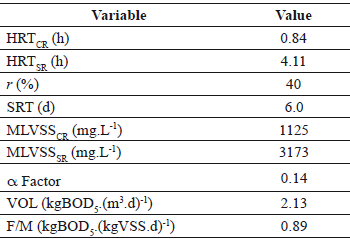
<body><![CDATA[<p><font size="2" face="Verdana, Arial, Helvetica, sans-serif">The ANOVA did not show any significant differences between the evaluated r values (p-value &gt; 0.05), indicating that in terms of COD load removal for each phase, it is possible to use any of the r values and obtain similar results for COD load removal. These findings suggest that the variation in the sludge recycle rate do not affect the performance of the system in terms of the COD removal; however these results must be interpreted with caution because the effluent COD and the solids concentration in the system may vary. </font></p> 		    <p><font size="2" face="Verdana, Arial, Helvetica, sans-serif">For this reason it is important to consider that the sludge recycle rate affects the solids concentration in the SR and the solids are very important for the biosorption processes in the CR [29]; accordingly, the lowest values of r were selected, because for each phase they guaranteed the higher solids concentration in the SR. </font></p> 		    <p><font size="2" face="Verdana, Arial, Helvetica, sans-serif"><a href="#tab06">Table 6</a> presents a summary of the best operational condition found for each phase, and average values that must be guaranteed for the main operational variables.</font></p> 		    <p align="center"><font size="2" face="Verdana, Arial, Helvetica, sans-serif"><b><a name="tab06" id="tab06"></a>Table 6.</b> Summary of the operational condition found for each phase</font><br /> 	    <img src="/img/revistas/dyna/v78n168/a12tab06.gif" /></p> 	    <p><font size="2" face="Verdana, Arial, Helvetica, sans-serif">Hydraulic retention time. The overall analysis of system performance showed that decreasing the HRT in CR and increasing the organic load applied to the system improves the biosorption process, due to the increased amount of organic matter per unit volume. <a href="#tab07">Table 7</a> shows the COD load removed in each phase and the results obtained for ANOVA and comparisons to select the HRT that presents de highest removal of COD load. </font></p> 		    <p align="center"><font size="2" face="Verdana, Arial, Helvetica, sans-serif"><b><a name="tab07" id="tab07"></a>Table 7.</b> Statistical analysis for the selection of the phase</font><br /> 	    <img src="/img/revistas/dyna/v78n168/a12tab07.gif" /></p> 		    <p><font size="2" face="Verdana, Arial, Helvetica, sans-serif">The ANOVA (p-value &lt; 0.05) showed that there was a significant difference in the removal of COD load in the phases; therefore, partial comparisons were made between phases. The level of p-value for the comparison of the COD load removed between phases 1 and 2 was &lt; 0.001 which shows there was a significant difference in Phases 1 and 2, and Phase 2 presented the major COD load removal.</font></p> 	    <p><font size="2" face="Verdana, Arial, Helvetica, sans-serif">Likewise, the comparison between Phases 2 and 3 (p-value &lt; 0.05) showed that Phase 3 presented the higher COD load removal, and this confirmed the previous analysis in which we mentioned that an increase in VOL applied to the system caused by the reduction of HRT in CR (increased inflow) favored the removal of the COD load, due to better utilization of the biosorption capacity of the floc.</font></p> 		    <p><font size="2" face="Verdana, Arial, Helvetica, sans-serif">From these results, the evaluated conditions in phase 3 can be recommended as an operational condition for the contact stabilization process in the secondary treatment of Cali domestic wastewater, for a r of 40%. <a href="#tab07">Table 7</a> summarizes the operational conditions that must be maintained for such performance.</font></p> 		    <p align="center"><font size="2" face="Verdana, Arial, Helvetica, sans-serif"><b><a name="tab08" id="tab08"></a>Table 8.</b> Selected operational conditions for the process</font><br /> 	    <img src="/img/revistas/dyna/v78n168/a12tab08.gif" /></p> 	    ]]></body>
<body><![CDATA[<p>&nbsp;</p> 	    <p><font size="3" face="Verdana, Arial, Helvetica, sans-serif"><b>4. CONCLUSION</b></font></p> 	    <p><font size="2" face="Verdana, Arial, Helvetica, sans-serif">Organic load removal by contact stabilization process has a potential application for the secondary treatment of the domestic wastewater of Cali. </font></p> 		    <p><font size="2" face="Verdana, Arial, Helvetica, sans-serif">For the domestic wastewater of Cali, the operational conditions in the contact stabilization process that allowed us to obtain the best performance in terms of removal efficiencies of COD, BOD<sub>5</sub>, and TSS were an HRT of 0.84 h in CR, and 4.11 h in SR, with an r of 40%. In order to guarantee this performance, average values of SRT of 6 d, VOL of 2.13 kgBOD<sub>5</sub>.(m<sup>3</sup>.d)<sup>-1</sup>, F/M of 0.89 kgBOD<sub>5</sub>.(kgVSS.d)<sup>-1</sup>, and an MLVSS of 1125 mg.L<sup>-1</sup> in CR, and 3173 mg.L<sup>-1</sup> in SR must be maintained </font></p> 	    <p><font size="2" face="Verdana, Arial, Helvetica, sans-serif">The increase of organic load in the system allows for better use of the biosorption capacity of the floc because there is a greater availability of organic matter for the development of microorganisms in the system.</font></p> 		    <p><font size="2" face="Verdana, Arial, Helvetica, sans-serif">The hydraulic retention time and the sludge recycle rate have a significant influence on the concentration of VSS in the system, since the increase of the inflow and the sludge recycle rate generate higher suction of sludge, affecting compression, thickening and sludge recirculation concentration, which promotes the recirculation of a diluted sludge and less compacted solids concentration. </font></p> 		    <p>&nbsp;</p> 		    <p><font size="3" face="Verdana, Arial, Helvetica, sans-serif"><b>5. ACKNOWLEDGMENTS</b></font></p> 	    <p><font size="2" face="Verdana, Arial, Helvetica, sans-serif">The authors wish to acknowledge the institutions that supported this work: EMCALI EICE ESP (Water Company of Cali) and Universidad del Valle. </font></p> 		    <p>&nbsp;</p> 		    ]]></body>
<body><![CDATA[<p><font size="3" face="Verdana, Arial, Helvetica, sans-serif"><b>REFERENCES</b></font></p> 		    <!-- ref --><p><font size="2" face="Verdana, Arial, Helvetica, sans-serif"><b>[1]</b> VAN HAANDEL, A. AND MARAIS, G. O comportamento do sistema de lodo ativado: teoria e aplicaÃ§Ãµes para projetos e operaÃ§Ã£o. Campina Grande, Epgraf, Brasil, 1999.             &nbsp;&nbsp;&nbsp;&nbsp;&nbsp;&nbsp;&nbsp;&nbsp;[&#160;<a href="javascript:void(0);" onclick="javascript: window.open('/scielo.php?script=sci_nlinks&ref=000104&pid=S0012-7353201100040001200001&lng=','','width=640,height=500,resizable=yes,scrollbars=1,menubar=yes,');">Links</a>&#160;]<!-- end-ref --><!-- ref --><br>             <b>[2]</b> Gernaey, K. V.; van Loosdrecht, M. C. M.; Henze, M.; Lind, M. and JÃ¸rgensen, S. B. Activated sludge wastewater treatment plant modelling and simulation: state of the art. Environmental Modelling & Software, 19(9), 763-783, 2004.     &nbsp;&nbsp;&nbsp;&nbsp;&nbsp;&nbsp;&nbsp;&nbsp;[&#160;<a href="javascript:void(0);" onclick="javascript: window.open('/scielo.php?script=sci_nlinks&ref=000105&pid=S0012-7353201100040001200002&lng=','','width=640,height=500,resizable=yes,scrollbars=1,menubar=yes,');">Links</a>&#160;]<!-- end-ref --><!-- ref --><br>             <b>[3]</b> Al-Mutairi, N. Z.; Hamoda, M. F. and Al-Ghusain, I. A. Performance-based characterization of a contact stabilization process for slaughterhouse wastewater. Journal of environmental science and health. Part A - Toxic/Hazardous substances & Environmental engineering, A38(10), 2287-2300, 2003.     &nbsp;&nbsp;&nbsp;&nbsp;&nbsp;&nbsp;&nbsp;&nbsp;[&#160;<a href="javascript:void(0);" onclick="javascript: window.open('/scielo.php?script=sci_nlinks&ref=000106&pid=S0012-7353201100040001200003&lng=','','width=640,height=500,resizable=yes,scrollbars=1,menubar=yes,');">Links</a>&#160;]<!-- end-ref --><br>             <b>[4]</b> SarioÄŸlu, M.; Orhon, D.; GÃ¶rgÃ¼n, E. and Artan, N. Design procedure for carbon removal in contact stabilization activated sludge process. Water Science and Technology, 48(11 - 12), 285 - 292 2003.             <!-- ref --><br>             <b>[5]</b> Gujer, W. and Jenkins, D. The contact stabilization activated sludge process--oxygen utilization, sludge production and efficiency. Water Research, 9(5-6), 553-560, 1975.             &nbsp;&nbsp;&nbsp;&nbsp;&nbsp;&nbsp;&nbsp;&nbsp;[&#160;<a href="javascript:void(0);" onclick="javascript: window.open('/scielo.php?script=sci_nlinks&ref=000108&pid=S0012-7353201100040001200005&lng=','','width=640,height=500,resizable=yes,scrollbars=1,menubar=yes,');">Links</a>&#160;]<!-- end-ref --><!-- ref --><br>             <b>[6]</b> Grady, C. P. L.; Daigger, G. T. and Lim, H. C. Biological wastewater treatment, Marcel Dekker, 2nd. Edition. USA, 1999.             &nbsp;&nbsp;&nbsp;&nbsp;&nbsp;&nbsp;&nbsp;&nbsp;[&#160;<a href="javascript:void(0);" onclick="javascript: window.open('/scielo.php?script=sci_nlinks&ref=000109&pid=S0012-7353201100040001200006&lng=','','width=640,height=500,resizable=yes,scrollbars=1,menubar=yes,');">Links</a>&#160;]<!-- end-ref --><!-- ref --><br>             <b>[7]</b> Gujer, W. and Jenkins, D. A nitrification model for the contact stabilization activated sludge process. Water Research, 9(5-6), 561-566, 1975.             &nbsp;&nbsp;&nbsp;&nbsp;&nbsp;&nbsp;&nbsp;&nbsp;[&#160;<a href="javascript:void(0);" onclick="javascript: window.open('/scielo.php?script=sci_nlinks&ref=000110&pid=S0012-7353201100040001200007&lng=','','width=640,height=500,resizable=yes,scrollbars=1,menubar=yes,');">Links</a>&#160;]<!-- end-ref --><!-- ref --><br>             <b>[8]</b> Alexander, W. V.; Ekama, G. A. and Marais, G. R. The activated sludge process part 2. Application of the general kinetic model to the contact stabilization process. Water Research, 14(12), 1737-1747, 1980.             &nbsp;&nbsp;&nbsp;&nbsp;&nbsp;&nbsp;&nbsp;&nbsp;[&#160;<a href="javascript:void(0);" onclick="javascript: window.open('/scielo.php?script=sci_nlinks&ref=000111&pid=S0012-7353201100040001200008&lng=','','width=640,height=500,resizable=yes,scrollbars=1,menubar=yes,');">Links</a>&#160;]<!-- end-ref --><!-- ref --><br>             <b>[9]</b> Orozco, A. BioingenierÃ­a de aguas residuales. TeorÃ­a y diseÃ±o. AsociaciÃ³n Colombiana de IngenierÃ­a-ACODAL, 2005.             &nbsp;&nbsp;&nbsp;&nbsp;&nbsp;&nbsp;&nbsp;&nbsp;[&#160;<a href="javascript:void(0);" onclick="javascript: window.open('/scielo.php?script=sci_nlinks&ref=000112&pid=S0012-7353201100040001200009&lng=','','width=640,height=500,resizable=yes,scrollbars=1,menubar=yes,');">Links</a>&#160;]<!-- end-ref --><!-- ref --><br>             <b>[10]</b> von Sperling, M. Lodos ativados. Departamento de engenharia sanitÃ¡ria e ambiental da Universidade Federal de Minas Gerais, Belo Horizonte - Brasil, 1997.             &nbsp;&nbsp;&nbsp;&nbsp;&nbsp;&nbsp;&nbsp;&nbsp;[&#160;<a href="javascript:void(0);" onclick="javascript: window.open('/scielo.php?script=sci_nlinks&ref=000113&pid=S0012-7353201100040001200010&lng=','','width=640,height=500,resizable=yes,scrollbars=1,menubar=yes,');">Links</a>&#160;]<!-- end-ref --><!-- ref --><br>             <b>[11]</b> Viero, A. F. and Sant'Anna, G. L. Is hydraulic retention time an essential parameter for MBR performance? Journal of Hazardous Materials, 150(1), 185-186, 2008.             &nbsp;&nbsp;&nbsp;&nbsp;&nbsp;&nbsp;&nbsp;&nbsp;[&#160;<a href="javascript:void(0);" onclick="javascript: window.open('/scielo.php?script=sci_nlinks&ref=000114&pid=S0012-7353201100040001200011&lng=','','width=640,height=500,resizable=yes,scrollbars=1,menubar=yes,');">Links</a>&#160;]<!-- end-ref --><!-- ref --><br>             <b>[12]</b> Jenkins, D.; Richard, M. G. and Daigger, G. T. Manual on the causes and control of activated sludge bulking, foaming, and other solids separation problems. Lewis Publishers, Michigan, 2003.             &nbsp;&nbsp;&nbsp;&nbsp;&nbsp;&nbsp;&nbsp;&nbsp;[&#160;<a href="javascript:void(0);" onclick="javascript: window.open('/scielo.php?script=sci_nlinks&ref=000115&pid=S0012-7353201100040001200012&lng=','','width=640,height=500,resizable=yes,scrollbars=1,menubar=yes,');">Links</a>&#160;]<!-- end-ref --><!-- ref --><br>             <b>[13]</b> Oerther, D.; De Los Reyes, F.; De Los Reyes, M. and Raskin, L. Quantifying filamentous microorganisms in activated sludge before, during, and after an incident of foaming by oligonucleotide probe hybridizations and antibody staining. Water Research, 35(14), 3325-3336, 2001.             &nbsp;&nbsp;&nbsp;&nbsp;&nbsp;&nbsp;&nbsp;&nbsp;[&#160;<a href="javascript:void(0);" onclick="javascript: window.open('/scielo.php?script=sci_nlinks&ref=000116&pid=S0012-7353201100040001200013&lng=','','width=640,height=500,resizable=yes,scrollbars=1,menubar=yes,');">Links</a>&#160;]<!-- end-ref --><!-- ref --><br>             <b>[14]</b> Clara, M.; Kreuzinger, N.; Strenn, B.; Gans, O. and Kroiss, H. The solids retention timeâ€”a suitable design parameter to evaluate the capacity of wastewater treatment plants to remove micropollutants. Water Research, 39(1), 97-106, 2005.             &nbsp;&nbsp;&nbsp;&nbsp;&nbsp;&nbsp;&nbsp;&nbsp;[&#160;<a href="javascript:void(0);" onclick="javascript: window.open('/scielo.php?script=sci_nlinks&ref=000117&pid=S0012-7353201100040001200014&lng=','','width=640,height=500,resizable=yes,scrollbars=1,menubar=yes,');">Links</a>&#160;]<!-- end-ref --><!-- ref --><br>             <b>[15]</b> Liao, B. Q.; Allen, D. G.; Droppo, I. G.; Leppard, G. G. and Liss, S. N. Surface properties of sludge and their role in bioflocculation and settleability. Water Research, 35(2), 339-350, 2001.             &nbsp;&nbsp;&nbsp;&nbsp;&nbsp;&nbsp;&nbsp;&nbsp;[&#160;<a href="javascript:void(0);" onclick="javascript: window.open('/scielo.php?script=sci_nlinks&ref=000118&pid=S0012-7353201100040001200015&lng=','','width=640,height=500,resizable=yes,scrollbars=1,menubar=yes,');">Links</a>&#160;]<!-- end-ref --><!-- ref --><br>             <b>[16]</b> Liao, B. Q.; Droppo, I. G.; Leppard, G. G. and Liss, S. N. Effect of solids retention time on structure and characteristics of sludge flocs in sequencing batch reactors. Water Research, 40(13), 2583-2591, 2006.             &nbsp;&nbsp;&nbsp;&nbsp;&nbsp;&nbsp;&nbsp;&nbsp;[&#160;<a href="javascript:void(0);" onclick="javascript: window.open('/scielo.php?script=sci_nlinks&ref=000119&pid=S0012-7353201100040001200016&lng=','','width=640,height=500,resizable=yes,scrollbars=1,menubar=yes,');">Links</a>&#160;]<!-- end-ref --><!-- ref --><br>             <b>[17]</b> Liss, S.; Liao, B.; Droppo, I.; Allen, D. and Leppard, G. Effect of solids retention time on floc structure. Water Science & Technology, 46(1), 431-438, 2002.     &nbsp;&nbsp;&nbsp;&nbsp;&nbsp;&nbsp;&nbsp;&nbsp;[&#160;<a href="javascript:void(0);" onclick="javascript: window.open('/scielo.php?script=sci_nlinks&ref=000120&pid=S0012-7353201100040001200017&lng=','','width=640,height=500,resizable=yes,scrollbars=1,menubar=yes,');">Links</a>&#160;]<!-- end-ref --><!-- ref --><br>             <b>[18]</b> WilÃ©n, B. M.; Jin, B. and Lant, P. Impacts of structural characteristics on activated sludge floc stability. Water Research, 37(15), 3632-3645, 2003.             &nbsp;&nbsp;&nbsp;&nbsp;&nbsp;&nbsp;&nbsp;&nbsp;[&#160;<a href="javascript:void(0);" onclick="javascript: window.open('/scielo.php?script=sci_nlinks&ref=000121&pid=S0012-7353201100040001200018&lng=','','width=640,height=500,resizable=yes,scrollbars=1,menubar=yes,');">Links</a>&#160;]<!-- end-ref --><!-- ref --><br>             <b>[19]</b> Metcalf and Eddy. Wastewater engineering: treatment and reuse. Metcalf & Eddy. Inc.-McGraw-Hill, New York, 2003.     &nbsp;&nbsp;&nbsp;&nbsp;&nbsp;&nbsp;&nbsp;&nbsp;[&#160;<a href="javascript:void(0);" onclick="javascript: window.open('/scielo.php?script=sci_nlinks&ref=000122&pid=S0012-7353201100040001200019&lng=','','width=640,height=500,resizable=yes,scrollbars=1,menubar=yes,');">Links</a>&#160;]<!-- end-ref --><!-- ref --><br>             <b>[20]</b> Withey, S.; Cartmell, E.; Avery, L. M. and Stephenson, T. Bacteriophages - potential for application in wastewater treatment processes. Science of the Total Environment, 339(1-3), 1-18, 2005.             &nbsp;&nbsp;&nbsp;&nbsp;&nbsp;&nbsp;&nbsp;&nbsp;[&#160;<a href="javascript:void(0);" onclick="javascript: window.open('/scielo.php?script=sci_nlinks&ref=000123&pid=S0012-7353201100040001200020&lng=','','width=640,height=500,resizable=yes,scrollbars=1,menubar=yes,');">Links</a>&#160;]<!-- end-ref --><!-- ref --><br>             <b>[21]</b> Rosso, D. and Stenstrom, M. Comparative economic analysis of the impacts of mean cell retention time and denitrification on aeration systems. Water Research, 39(16), 3773-3780, 2005.             &nbsp;&nbsp;&nbsp;&nbsp;&nbsp;&nbsp;&nbsp;&nbsp;[&#160;<a href="javascript:void(0);" onclick="javascript: window.open('/scielo.php?script=sci_nlinks&ref=000124&pid=S0012-7353201100040001200021&lng=','','width=640,height=500,resizable=yes,scrollbars=1,menubar=yes,');">Links</a>&#160;]<!-- end-ref --><!-- ref --><br>             <b>[22]</b> Madeiros, U.; Cavalcanti, P. and van Haandel, A. InfluÃªncia da concentraÃ§Ã£o de oxigÃªnio dissolvido sobre o desempenho de sistemas de lodo ativado. Brasil, 2005.             &nbsp;&nbsp;&nbsp;&nbsp;&nbsp;&nbsp;&nbsp;&nbsp;[&#160;<a href="javascript:void(0);" onclick="javascript: window.open('/scielo.php?script=sci_nlinks&ref=000125&pid=S0012-7353201100040001200022&lng=','','width=640,height=500,resizable=yes,scrollbars=1,menubar=yes,');">Links</a>&#160;]<!-- end-ref --><!-- ref --><br>             <b>[23]</b> Schultz, J. R.; Hegg, B. A. and Rakness, K. L. Realistic sludge production for activated sludge plants without primary clarifiers. Journal Water Pollution Control Federation, 54(10), 1355-1360, 1982.             &nbsp;&nbsp;&nbsp;&nbsp;&nbsp;&nbsp;&nbsp;&nbsp;[&#160;<a href="javascript:void(0);" onclick="javascript: window.open('/scielo.php?script=sci_nlinks&ref=000126&pid=S0012-7353201100040001200023&lng=','','width=640,height=500,resizable=yes,scrollbars=1,menubar=yes,');">Links</a>&#160;]<!-- end-ref --><!-- ref --><br>             <b>[24]</b> UNIVALLE-EMCALI. Estudio de evaluaciÃ³n para el tratamiento del efluente de la PTAR CaÃ±averalejo a travÃ©s de dos opciones secundarias convencionales. Informe final Fase II. . Universidad del Valle; EMCALI EICE ESP, Santiago de Cali, Colombia, 2007.             &nbsp;&nbsp;&nbsp;&nbsp;&nbsp;&nbsp;&nbsp;&nbsp;[&#160;<a href="javascript:void(0);" onclick="javascript: window.open('/scielo.php?script=sci_nlinks&ref=000127&pid=S0012-7353201100040001200024&lng=','','width=640,height=500,resizable=yes,scrollbars=1,menubar=yes,');">Links</a>&#160;]<!-- end-ref --><!-- ref --><br>             <b>[25]</b> UNIVALLE-EMCALI. Estudio de evaluaciÃ³n para el tratamiento del efluente de la PTAR CaÃ±averalejo a travÃ©s de dos opciones secundarias convencionales. Informe final Fase I. Universidad del Valle; EMCALI EICE ESP, Santiago de Cali, Colombia, 2006.             &nbsp;&nbsp;&nbsp;&nbsp;&nbsp;&nbsp;&nbsp;&nbsp;[&#160;<a href="javascript:void(0);" onclick="javascript: window.open('/scielo.php?script=sci_nlinks&ref=000128&pid=S0012-7353201100040001200025&lng=','','width=640,height=500,resizable=yes,scrollbars=1,menubar=yes,');">Links</a>&#160;]<!-- end-ref --><!-- ref --><br>             <b>[26]</b> American Public Health Association, American Water Works Association, and Water Environment Federation. Standard methods for the examination of water and wastewater. Washington DC, USA., 2005.             &nbsp;&nbsp;&nbsp;&nbsp;&nbsp;&nbsp;&nbsp;&nbsp;[&#160;<a href="javascript:void(0);" onclick="javascript: window.open('/scielo.php?script=sci_nlinks&ref=000129&pid=S0012-7353201100040001200026&lng=','','width=640,height=500,resizable=yes,scrollbars=1,menubar=yes,');">Links</a>&#160;]<!-- end-ref --><!-- ref --><br>             <b>[27]</b> VzazollÃ©r, R.; GarcÃ­a, M.; Garcia, A. and ConciÃ§ao, J. Microbiologia de lodos ativados. CETESB, Sao Paulo, Brasil, 1989.             &nbsp;&nbsp;&nbsp;&nbsp;&nbsp;&nbsp;&nbsp;&nbsp;[&#160;<a href="javascript:void(0);" onclick="javascript: window.open('/scielo.php?script=sci_nlinks&ref=000130&pid=S0012-7353201100040001200027&lng=','','width=640,height=500,resizable=yes,scrollbars=1,menubar=yes,');">Links</a>&#160;]<!-- end-ref --><!-- ref --><br>             <b>[28]</b> JimÃ©nez, C.; FernÃ¡ndez, N.; de la Horra, J.; RodrÃ­guez, E.; Isac, L.; Salas, D. and GÃ³mez, E. Sistema rÃ¡pido de estimaciÃ³n de los rendimientos de depuraciÃ³n de una EDAR en funciÃ³n de las caracterÃ­sticas macroscÃ³picas del fango activado. TecnologÃ­a del Agua, AÃ±o 21(216), 40-44, 2001.             &nbsp;&nbsp;&nbsp;&nbsp;&nbsp;&nbsp;&nbsp;&nbsp;[&#160;<a href="javascript:void(0);" onclick="javascript: window.open('/scielo.php?script=sci_nlinks&ref=000131&pid=S0012-7353201100040001200028&lng=','','width=640,height=500,resizable=yes,scrollbars=1,menubar=yes,');">Links</a>&#160;]<!-- end-ref --><!-- ref --><br>             <b>[29]</b> VÃ¡squez, S. N. EvaluaciÃ³n a escala piloto del sistema de lodos activados en las modalidades de estabilizaciÃ³n por contacto y convencional como alternativa de tratamiento secundario para el agua residual domÃ©stica de la ciudad de Cali. [M.Eng. Thesis]. Santiago de Cali, Colombia: Universidad del Valle, 2009.             &nbsp;&nbsp;&nbsp;&nbsp;&nbsp;&nbsp;&nbsp;&nbsp;[&#160;<a href="javascript:void(0);" onclick="javascript: window.open('/scielo.php?script=sci_nlinks&ref=000132&pid=S0012-7353201100040001200029&lng=','','width=640,height=500,resizable=yes,scrollbars=1,menubar=yes,');">Links</a>&#160;]<!-- end-ref --><!-- ref --><br>             <b>[30]</b> Ramalho, R. S.; Beltran, D. J. and de Lora, F. Tratamiento de Aguas residuales. RevertÃ©, 2da. EdiciÃ³n, Barcelona, 1991.             &nbsp;&nbsp;&nbsp;&nbsp;&nbsp;&nbsp;&nbsp;&nbsp;[&#160;<a href="javascript:void(0);" onclick="javascript: window.open('/scielo.php?script=sci_nlinks&ref=000133&pid=S0012-7353201100040001200030&lng=','','width=640,height=500,resizable=yes,scrollbars=1,menubar=yes,');">Links</a>&#160;]<!-- end-ref --><!-- ref --><br>             <b>[31]</b> Eliosov, B. and Argaman, Y. Hydrolysis of particulate organics in activated sludge systems. Water Research, 29(1), 155-163, 1995.             &nbsp;&nbsp;&nbsp;&nbsp;&nbsp;&nbsp;&nbsp;&nbsp;[&#160;<a href="javascript:void(0);" onclick="javascript: window.open('/scielo.php?script=sci_nlinks&ref=000134&pid=S0012-7353201100040001200031&lng=','','width=640,height=500,resizable=yes,scrollbars=1,menubar=yes,');">Links</a>&#160;]<!-- end-ref --><!-- ref --><br>             <b>[32]</b> Guellil, A.; Thomas, F.; Block, J. C.; Bersillon, J. L. and Ginestet, P. Transfer of organic matter between wastewater and activated sludge flocs. Water Research, 35(1), 143-150, 2001.      </font>&nbsp;&nbsp;&nbsp;&nbsp;&nbsp;&nbsp;&nbsp;&nbsp;[&#160;<a href="javascript:void(0);" onclick="javascript: window.open('/scielo.php?script=sci_nlinks&ref=000135&pid=S0012-7353201100040001200032&lng=','','width=640,height=500,resizable=yes,scrollbars=1,menubar=yes,');">Links</a>&#160;]<!-- end-ref --> ]]></body><back>
<ref-list>
<ref id="B1">
<label>1</label><nlm-citation citation-type="">
<person-group person-group-type="author">
<name>
<surname><![CDATA[VAN HAANDEL]]></surname>
<given-names><![CDATA[A.]]></given-names>
</name>
<name>
<surname><![CDATA[MARAIS]]></surname>
<given-names><![CDATA[G.]]></given-names>
</name>
</person-group>
<source><![CDATA[O comportamento do sistema de lodo ativado: teoria e aplicações para projetos e operação]]></source>
<year>1999</year>
<publisher-loc><![CDATA[Campina Grande ]]></publisher-loc>
</nlm-citation>
</ref>
<ref id="B2">
<label>2</label><nlm-citation citation-type="journal">
<person-group person-group-type="author">
<name>
<surname><![CDATA[Gernaey]]></surname>
<given-names><![CDATA[K. V.]]></given-names>
</name>
<name>
<surname><![CDATA[van Loosdrecht]]></surname>
<given-names><![CDATA[M. C. M.]]></given-names>
</name>
<name>
<surname><![CDATA[Henze]]></surname>
<given-names><![CDATA[M.]]></given-names>
</name>
<name>
<surname><![CDATA[Lind]]></surname>
<given-names><![CDATA[M.]]></given-names>
</name>
<name>
<surname><![CDATA[Jørgensen]]></surname>
<given-names><![CDATA[S. B.]]></given-names>
</name>
</person-group>
<article-title xml:lang="en"><![CDATA[Activated sludge wastewater treatment plant modelling and simulation: state of the art]]></article-title>
<source><![CDATA[Environmental Modelling & Software]]></source>
<year>2004</year>
<volume>19</volume>
<numero>9</numero>
<issue>9</issue>
<page-range>763-783</page-range></nlm-citation>
</ref>
<ref id="B3">
<label>3</label><nlm-citation citation-type="journal">
<person-group person-group-type="author">
<name>
<surname><![CDATA[Al-Mutairi]]></surname>
<given-names><![CDATA[N. Z.]]></given-names>
</name>
<name>
<surname><![CDATA[Hamoda]]></surname>
<given-names><![CDATA[M. F.]]></given-names>
</name>
<name>
<surname><![CDATA[Al-Ghusain]]></surname>
<given-names><![CDATA[I. A.]]></given-names>
</name>
</person-group>
<article-title xml:lang="en"><![CDATA[Performance-based characterization of a contact stabilization process for slaughterhouse wastewater]]></article-title>
<source><![CDATA[Journal of environmental science and health. Part A - Toxic/Hazardous substances & Environmental engineering]]></source>
<year>2003</year>
<volume>A38</volume>
<numero>10</numero>
<issue>10</issue>
<page-range>2287-2300</page-range></nlm-citation>
</ref>
<ref id="B4">
<label>4</label><nlm-citation citation-type="journal">
<person-group person-group-type="author">
<name>
<surname><![CDATA[Sarioglu]]></surname>
<given-names><![CDATA[M.]]></given-names>
</name>
<name>
<surname><![CDATA[Orhon]]></surname>
<given-names><![CDATA[D.]]></given-names>
</name>
<name>
<surname><![CDATA[Görgün]]></surname>
<given-names><![CDATA[E.]]></given-names>
</name>
<name>
<surname><![CDATA[Artan]]></surname>
<given-names><![CDATA[N.]]></given-names>
</name>
</person-group>
<article-title xml:lang="en"><![CDATA[Design procedure for carbon removal in contact stabilization activated sludge process]]></article-title>
<source><![CDATA[Water Science and Technology]]></source>
<year>2003</year>
<volume>48</volume>
<numero>11 - 12</numero>
<issue>11 - 12</issue>
<page-range>285 - 292</page-range></nlm-citation>
</ref>
<ref id="B5">
<label>5</label><nlm-citation citation-type="journal">
<person-group person-group-type="author">
<name>
<surname><![CDATA[Gujer]]></surname>
<given-names><![CDATA[W.]]></given-names>
</name>
<name>
<surname><![CDATA[Jenkins]]></surname>
<given-names><![CDATA[D.]]></given-names>
</name>
</person-group>
<article-title xml:lang="en"><![CDATA[The contact stabilization activated sludge process--oxygen utilization, sludge production and efficiency]]></article-title>
<source><![CDATA[Water Research]]></source>
<year>1975</year>
<volume>9</volume>
<numero>5-6</numero>
<issue>5-6</issue>
<page-range>553-560</page-range></nlm-citation>
</ref>
<ref id="B6">
<label>6</label><nlm-citation citation-type="book">
<person-group person-group-type="author">
<name>
<surname><![CDATA[Grady]]></surname>
<given-names><![CDATA[C. P. L.]]></given-names>
</name>
<name>
<surname><![CDATA[Daigger]]></surname>
<given-names><![CDATA[G. T.]]></given-names>
</name>
<name>
<surname><![CDATA[Lim]]></surname>
<given-names><![CDATA[H. C.]]></given-names>
</name>
</person-group>
<source><![CDATA[Biological wastewater treatment]]></source>
<year>1999</year>
<edition>2nd</edition>
<publisher-name><![CDATA[Marcel Dekker]]></publisher-name>
</nlm-citation>
</ref>
<ref id="B7">
<label>7</label><nlm-citation citation-type="journal">
<person-group person-group-type="author">
<name>
<surname><![CDATA[Gujer]]></surname>
<given-names><![CDATA[W.]]></given-names>
</name>
<name>
<surname><![CDATA[Jenkins]]></surname>
<given-names><![CDATA[D.]]></given-names>
</name>
</person-group>
<article-title xml:lang="en"><![CDATA[A nitrification model for the contact stabilization activated sludge process]]></article-title>
<source><![CDATA[Water Research]]></source>
<year>1975</year>
<volume>9</volume>
<numero>5-6</numero>
<issue>5-6</issue>
<page-range>561-566</page-range></nlm-citation>
</ref>
<ref id="B8">
<label>8</label><nlm-citation citation-type="journal">
<person-group person-group-type="author">
<name>
<surname><![CDATA[Alexander]]></surname>
<given-names><![CDATA[W. V.]]></given-names>
</name>
<name>
<surname><![CDATA[Ekama]]></surname>
<given-names><![CDATA[G. A.]]></given-names>
</name>
<name>
<surname><![CDATA[Marais]]></surname>
<given-names><![CDATA[G. R.]]></given-names>
</name>
</person-group>
<article-title xml:lang="en"><![CDATA[The activated sludge process part 2: Application of the general kinetic model to the contact stabilization process]]></article-title>
<source><![CDATA[Water Research]]></source>
<year>1980</year>
<volume>14</volume>
<numero>12</numero>
<issue>12</issue>
<page-range>1737-1747</page-range></nlm-citation>
</ref>
<ref id="B9">
<label>9</label><nlm-citation citation-type="book">
<person-group person-group-type="author">
<name>
<surname><![CDATA[Orozco]]></surname>
<given-names><![CDATA[A.]]></given-names>
</name>
</person-group>
<source><![CDATA[Bioingeniería de aguas residuales: Teoría y diseño]]></source>
<year>2005</year>
<publisher-name><![CDATA[Asociación Colombiana de Ingeniería]]></publisher-name>
</nlm-citation>
</ref>
<ref id="B10">
<label>10</label><nlm-citation citation-type="">
<person-group person-group-type="author">
<name>
<surname><![CDATA[von Sperling]]></surname>
<given-names><![CDATA[M.]]></given-names>
</name>
</person-group>
<collab>Universidade Federal de Minas Gerais^dDepartamento de engenharia sanitária e ambiental</collab>
<source><![CDATA[Lodos ativados]]></source>
<year>1997</year>
<publisher-loc><![CDATA[Belo Horizonte ]]></publisher-loc>
</nlm-citation>
</ref>
<ref id="B11">
<label>11</label><nlm-citation citation-type="journal">
<person-group person-group-type="author">
<name>
<surname><![CDATA[Viero]]></surname>
<given-names><![CDATA[A. F.]]></given-names>
</name>
<name>
<surname><![CDATA[Sant'Anna]]></surname>
<given-names><![CDATA[G. L.]]></given-names>
</name>
</person-group>
<article-title xml:lang="en"><![CDATA[Is hydraulic retention time an essential parameter for MBR performance?]]></article-title>
<source><![CDATA[Journal of Hazardous Materials]]></source>
<year>2008</year>
<volume>150</volume>
<numero>1</numero>
<issue>1</issue>
<page-range>185-186</page-range></nlm-citation>
</ref>
<ref id="B12">
<label>12</label><nlm-citation citation-type="book">
<person-group person-group-type="author">
<name>
<surname><![CDATA[Jenkins]]></surname>
<given-names><![CDATA[D.]]></given-names>
</name>
<name>
<surname><![CDATA[Richard]]></surname>
<given-names><![CDATA[M. G.]]></given-names>
</name>
<name>
<surname><![CDATA[Daigger]]></surname>
<given-names><![CDATA[G. T.]]></given-names>
</name>
</person-group>
<source><![CDATA[Manual on the causes and control of activated sludge bulking, foaming, and other solids separation problems]]></source>
<year>2003</year>
<publisher-loc><![CDATA[^eMichigan Michigan]]></publisher-loc>
<publisher-name><![CDATA[Lewis Publishers]]></publisher-name>
</nlm-citation>
</ref>
<ref id="B13">
<label>13</label><nlm-citation citation-type="journal">
<person-group person-group-type="author">
<name>
<surname><![CDATA[Oerther]]></surname>
<given-names><![CDATA[D.]]></given-names>
</name>
<name>
<surname><![CDATA[De Los Reyes]]></surname>
<given-names><![CDATA[F.]]></given-names>
</name>
<name>
<surname><![CDATA[De Los Reyes]]></surname>
<given-names><![CDATA[M.]]></given-names>
</name>
<name>
<surname><![CDATA[Raskin]]></surname>
<given-names><![CDATA[L.]]></given-names>
</name>
</person-group>
<article-title xml:lang="en"><![CDATA[Quantifying filamentous microorganisms in activated sludge before, during, and after an incident of foaming by oligonucleotide probe hybridizations and antibody staining]]></article-title>
<source><![CDATA[Water Research]]></source>
<year>2001</year>
<volume>35</volume>
<numero>14</numero>
<issue>14</issue>
<page-range>3325-3336</page-range></nlm-citation>
</ref>
<ref id="B14">
<label>14</label><nlm-citation citation-type="journal">
<person-group person-group-type="author">
<name>
<surname><![CDATA[Clara]]></surname>
<given-names><![CDATA[M.]]></given-names>
</name>
<name>
<surname><![CDATA[Kreuzinger]]></surname>
<given-names><![CDATA[N.]]></given-names>
</name>
<name>
<surname><![CDATA[Strenn]]></surname>
<given-names><![CDATA[B.]]></given-names>
</name>
<name>
<surname><![CDATA[Gans]]></surname>
<given-names><![CDATA[O]]></given-names>
</name>
<name>
<surname><![CDATA[Kroiss]]></surname>
<given-names><![CDATA[H.]]></given-names>
</name>
</person-group>
<article-title xml:lang="en"><![CDATA[The solids retention time-a suitable design parameter to evaluate the capacity of wastewater treatment plants to remove micropollutants]]></article-title>
<source><![CDATA[Water Research]]></source>
<year>2005</year>
<volume>39</volume>
<numero>1</numero>
<issue>1</issue>
<page-range>97-106</page-range></nlm-citation>
</ref>
<ref id="B15">
<label>15</label><nlm-citation citation-type="journal">
<person-group person-group-type="author">
<name>
<surname><![CDATA[Liao]]></surname>
<given-names><![CDATA[B. Q.]]></given-names>
</name>
<name>
<surname><![CDATA[Allen]]></surname>
<given-names><![CDATA[D. G.]]></given-names>
</name>
<name>
<surname><![CDATA[Droppo]]></surname>
<given-names><![CDATA[I. G.]]></given-names>
</name>
<name>
<surname><![CDATA[Leppard]]></surname>
<given-names><![CDATA[G. G.]]></given-names>
</name>
<name>
<surname><![CDATA[Liss]]></surname>
<given-names><![CDATA[S. N.]]></given-names>
</name>
</person-group>
<article-title xml:lang="en"><![CDATA[Surface properties of sludge and their role in bioflocculation and settleability]]></article-title>
<source><![CDATA[Water Research]]></source>
<year>2001</year>
<volume>35</volume>
<numero>2</numero>
<issue>2</issue>
<page-range>339-350</page-range></nlm-citation>
</ref>
<ref id="B16">
<label>16</label><nlm-citation citation-type="journal">
<person-group person-group-type="author">
<name>
<surname><![CDATA[Liao]]></surname>
<given-names><![CDATA[B. Q.]]></given-names>
</name>
<name>
<surname><![CDATA[Droppo]]></surname>
<given-names><![CDATA[I. G.]]></given-names>
</name>
<name>
<surname><![CDATA[Leppard]]></surname>
<given-names><![CDATA[G. G.]]></given-names>
</name>
<name>
<surname><![CDATA[Liss]]></surname>
<given-names><![CDATA[S. N.]]></given-names>
</name>
</person-group>
<article-title xml:lang="en"><![CDATA[Effect of solids retention time on structure and characteristics of sludge flocs in sequencing batch reactors]]></article-title>
<source><![CDATA[Water Research]]></source>
<year>2006</year>
<volume>40</volume>
<numero>13</numero>
<issue>13</issue>
<page-range>2583-2591</page-range></nlm-citation>
</ref>
<ref id="B17">
<label>17</label><nlm-citation citation-type="journal">
<person-group person-group-type="author">
<name>
<surname><![CDATA[Liss]]></surname>
<given-names><![CDATA[S.]]></given-names>
</name>
<name>
<surname><![CDATA[Liao]]></surname>
<given-names><![CDATA[B.]]></given-names>
</name>
<name>
<surname><![CDATA[Droppo]]></surname>
<given-names><![CDATA[I.]]></given-names>
</name>
<name>
<surname><![CDATA[Allen]]></surname>
<given-names><![CDATA[D.]]></given-names>
</name>
<name>
<surname><![CDATA[Leppard]]></surname>
<given-names><![CDATA[G.]]></given-names>
</name>
</person-group>
<article-title xml:lang="en"><![CDATA[Effect of solids retention time on floc structure]]></article-title>
<source><![CDATA[Water Science & Technology]]></source>
<year>2002</year>
<volume>46</volume>
<numero>1</numero>
<issue>1</issue>
<page-range>431-438</page-range></nlm-citation>
</ref>
<ref id="B18">
<label>18</label><nlm-citation citation-type="journal">
<person-group person-group-type="author">
<name>
<surname><![CDATA[Wilén]]></surname>
<given-names><![CDATA[B. M.]]></given-names>
</name>
<name>
<surname><![CDATA[Jin]]></surname>
<given-names><![CDATA[B.]]></given-names>
</name>
<name>
<surname><![CDATA[Lant]]></surname>
<given-names><![CDATA[P.]]></given-names>
</name>
</person-group>
<article-title xml:lang="en"><![CDATA[Impacts of structural characteristics on activated sludge floc stability]]></article-title>
<source><![CDATA[Water Research]]></source>
<year>2003</year>
<volume>37</volume>
<numero>15</numero>
<issue>15</issue>
<page-range>3632-3645</page-range></nlm-citation>
</ref>
<ref id="B19">
<label>19</label><nlm-citation citation-type="book">
<person-group person-group-type="author">
<name>
<surname><![CDATA[Metcalf]]></surname>
</name>
<name>
<surname><![CDATA[Eddy]]></surname>
</name>
</person-group>
<source><![CDATA[Wastewater engineering: treatment and reuse]]></source>
<year>2003</year>
<publisher-loc><![CDATA[New York ]]></publisher-loc>
<publisher-name><![CDATA[Metcalf & Eddy. Inc.-McGraw-Hill]]></publisher-name>
</nlm-citation>
</ref>
<ref id="B20">
<label>20</label><nlm-citation citation-type="journal">
<person-group person-group-type="author">
<name>
<surname><![CDATA[Withey]]></surname>
<given-names><![CDATA[S.]]></given-names>
</name>
<name>
<surname><![CDATA[Cartmell]]></surname>
<given-names><![CDATA[E.]]></given-names>
</name>
<name>
<surname><![CDATA[Avery]]></surname>
<given-names><![CDATA[L. M.]]></given-names>
</name>
<name>
<surname><![CDATA[Stephenson]]></surname>
<given-names><![CDATA[T.]]></given-names>
</name>
</person-group>
<article-title xml:lang="en"><![CDATA[Bacteriophages: potential for application in wastewater treatment processes]]></article-title>
<source><![CDATA[Science of the Total Environment]]></source>
<year>2005</year>
<volume>339</volume>
<numero>1-3</numero>
<issue>1-3</issue>
<page-range>1-18</page-range></nlm-citation>
</ref>
<ref id="B21">
<label>21</label><nlm-citation citation-type="journal">
<person-group person-group-type="author">
<name>
<surname><![CDATA[Rosso]]></surname>
<given-names><![CDATA[D.]]></given-names>
</name>
<name>
<surname><![CDATA[Stenstrom]]></surname>
<given-names><![CDATA[M.]]></given-names>
</name>
</person-group>
<article-title xml:lang="en"><![CDATA[Comparative economic analysis of the impacts of mean cell retention time and denitrification on aeration systems]]></article-title>
<source><![CDATA[Water Research]]></source>
<year>2005</year>
<volume>39</volume>
<numero>16</numero>
<issue>16</issue>
<page-range>3773-3780</page-range></nlm-citation>
</ref>
<ref id="B22">
<label>22</label><nlm-citation citation-type="">
<person-group person-group-type="author">
<name>
<surname><![CDATA[Madeiros]]></surname>
<given-names><![CDATA[U.]]></given-names>
</name>
<name>
<surname><![CDATA[Cavalcanti]]></surname>
<given-names><![CDATA[P.]]></given-names>
</name>
<name>
<surname><![CDATA[van Haandel]]></surname>
<given-names><![CDATA[A.]]></given-names>
</name>
</person-group>
<source><![CDATA[Influência da concentração de oxigênio dissolvido sobre o desempenho de sistemas de lodo ativado]]></source>
<year>2005</year>
</nlm-citation>
</ref>
<ref id="B23">
<label>23</label><nlm-citation citation-type="journal">
<person-group person-group-type="author">
<name>
<surname><![CDATA[Schultz]]></surname>
<given-names><![CDATA[J. R.]]></given-names>
</name>
<name>
<surname><![CDATA[Hegg]]></surname>
<given-names><![CDATA[B. A.]]></given-names>
</name>
<name>
<surname><![CDATA[Rakness]]></surname>
<given-names><![CDATA[K. L.]]></given-names>
</name>
</person-group>
<article-title xml:lang="en"><![CDATA[Realistic sludge production for activated sludge plants without primary clarifiers]]></article-title>
<source><![CDATA[Journal Water Pollution Control Federation]]></source>
<year>1982</year>
<volume>54</volume>
<numero>10</numero>
<issue>10</issue>
<page-range>1355-1360</page-range></nlm-citation>
</ref>
<ref id="B24">
<label>24</label><nlm-citation citation-type="book">
<collab>UNIVALLE-EMCALI</collab>
<source><![CDATA[Estudio de evaluación para el tratamiento del efluente de la PTAR Cañaveralejo a través de dos opciones secundarias convencionales: Informe final Fase II]]></source>
<year>2007</year>
<publisher-loc><![CDATA[Santiago de Cali ]]></publisher-loc>
<publisher-name><![CDATA[Universidad del Valle]]></publisher-name>
</nlm-citation>
</ref>
<ref id="B25">
<label>25</label><nlm-citation citation-type="book">
<collab>UNIVALLE-EMCALI</collab>
<source><![CDATA[Estudio de evaluación para el tratamiento del efluente de la PTAR Cañaveralejo a través de dos opciones secundarias convencionales: Informe final Fase I]]></source>
<year>2006</year>
<publisher-loc><![CDATA[Santiago de Cali ]]></publisher-loc>
<publisher-name><![CDATA[Universidad del Valle]]></publisher-name>
</nlm-citation>
</ref>
<ref id="B26">
<label>26</label><nlm-citation citation-type="">
<collab>American Public Health Association, American Water Works Association, and Water Environment Federation</collab>
<source><![CDATA[Standard methods for the examination of water and wastewater]]></source>
<year>2005</year>
<publisher-loc><![CDATA[Washington DC ]]></publisher-loc>
</nlm-citation>
</ref>
<ref id="B27">
<label>27</label><nlm-citation citation-type="book">
<person-group person-group-type="author">
<name>
<surname><![CDATA[Vzazollér]]></surname>
<given-names><![CDATA[R.]]></given-names>
</name>
<name>
<surname><![CDATA[García]]></surname>
<given-names><![CDATA[M.]]></given-names>
</name>
<name>
<surname><![CDATA[Garcia]]></surname>
<given-names><![CDATA[A.]]></given-names>
</name>
<name>
<surname><![CDATA[Conciçao]]></surname>
<given-names><![CDATA[J.]]></given-names>
</name>
</person-group>
<source><![CDATA[Microbiologia de lodos ativados]]></source>
<year>1989</year>
<publisher-loc><![CDATA[Sao Paulo ]]></publisher-loc>
<publisher-name><![CDATA[CETESB]]></publisher-name>
</nlm-citation>
</ref>
<ref id="B28">
<label>28</label><nlm-citation citation-type="journal">
<person-group person-group-type="author">
<name>
<surname><![CDATA[Jiménez]]></surname>
<given-names><![CDATA[C.]]></given-names>
</name>
<name>
<surname><![CDATA[Fernández]]></surname>
<given-names><![CDATA[N.]]></given-names>
</name>
<name>
<surname><![CDATA[de la Horra]]></surname>
<given-names><![CDATA[J.]]></given-names>
</name>
<name>
<surname><![CDATA[Rodríguez]]></surname>
<given-names><![CDATA[E.]]></given-names>
</name>
<name>
<surname><![CDATA[Isac]]></surname>
<given-names><![CDATA[L.]]></given-names>
</name>
<name>
<surname><![CDATA[Salas]]></surname>
<given-names><![CDATA[D.]]></given-names>
</name>
<name>
<surname><![CDATA[Gómez]]></surname>
<given-names><![CDATA[E.]]></given-names>
</name>
</person-group>
<article-title xml:lang="es"><![CDATA[Sistema rápido de estimación de los rendimientos de depuración de una EDAR en función de las características macroscópicas del fango activado]]></article-title>
<source><![CDATA[Tecnología del Agua]]></source>
<year>2001</year>
<volume>21</volume>
<numero>216</numero>
<issue>216</issue>
<page-range>40-44</page-range></nlm-citation>
</ref>
<ref id="B29">
<label>29</label><nlm-citation citation-type="">
<person-group person-group-type="author">
<name>
<surname><![CDATA[Vásquez]]></surname>
<given-names><![CDATA[S. N.]]></given-names>
</name>
</person-group>
<source><![CDATA[Evaluación a escala piloto del sistema de lodos activados en las modalidades de estabilización por contacto y convencional como alternativa de tratamiento secundario para el agua residual doméstica de la ciudad de Cali]]></source>
<year></year>
</nlm-citation>
</ref>
<ref id="B30">
<label>30</label><nlm-citation citation-type="book">
<person-group person-group-type="author">
<name>
<surname><![CDATA[Ramalho]]></surname>
<given-names><![CDATA[R. S.]]></given-names>
</name>
<name>
<surname><![CDATA[Beltran]]></surname>
<given-names><![CDATA[D. J.]]></given-names>
</name>
<name>
<surname><![CDATA[de Lora]]></surname>
<given-names><![CDATA[F.]]></given-names>
</name>
</person-group>
<source><![CDATA[Tratamiento de Aguas residuales]]></source>
<year>1991</year>
<edition>2da</edition>
<publisher-loc><![CDATA[Barcelona ]]></publisher-loc>
<publisher-name><![CDATA[Reverté]]></publisher-name>
</nlm-citation>
</ref>
<ref id="B31">
<label>31</label><nlm-citation citation-type="journal">
<person-group person-group-type="author">
<name>
<surname><![CDATA[Eliosov]]></surname>
<given-names><![CDATA[B.]]></given-names>
</name>
<name>
<surname><![CDATA[Argaman]]></surname>
<given-names><![CDATA[Y.]]></given-names>
</name>
</person-group>
<article-title xml:lang="en"><![CDATA[Hydrolysis of particulate organics in activated sludge systems]]></article-title>
<source><![CDATA[Water Research]]></source>
<year>1995</year>
<volume>29</volume>
<numero>1</numero>
<issue>1</issue>
<page-range>155-163</page-range></nlm-citation>
</ref>
<ref id="B32">
<label>32</label><nlm-citation citation-type="journal">
<person-group person-group-type="author">
<name>
<surname><![CDATA[Guellil]]></surname>
<given-names><![CDATA[A.]]></given-names>
</name>
<name>
<surname><![CDATA[Thomas]]></surname>
<given-names><![CDATA[F.]]></given-names>
</name>
<name>
<surname><![CDATA[Block]]></surname>
<given-names><![CDATA[J. C.]]></given-names>
</name>
<name>
<surname><![CDATA[Bersillon]]></surname>
<given-names><![CDATA[J. L.]]></given-names>
</name>
<name>
<surname><![CDATA[Ginestet]]></surname>
<given-names><![CDATA[P.]]></given-names>
</name>
</person-group>
<article-title xml:lang="en"><![CDATA[Transfer of organic matter between wastewater and activated sludge flocs]]></article-title>
<source><![CDATA[Water Research]]></source>
<year>2001</year>
<volume>35</volume>
<numero>1</numero>
<issue>1</issue>
<page-range>143-150</page-range></nlm-citation>
</ref>
</ref-list>
</back>
</article>