<?xml version="1.0" encoding="ISO-8859-1"?><article xmlns:mml="http://www.w3.org/1998/Math/MathML" xmlns:xlink="http://www.w3.org/1999/xlink" xmlns:xsi="http://www.w3.org/2001/XMLSchema-instance">
<front>
<journal-meta>
<journal-id>0012-7353</journal-id>
<journal-title><![CDATA[DYNA]]></journal-title>
<abbrev-journal-title><![CDATA[Dyna rev.fac.nac.minas]]></abbrev-journal-title>
<issn>0012-7353</issn>
<publisher>
<publisher-name><![CDATA[Universidad Nacional de Colombia]]></publisher-name>
</publisher>
</journal-meta>
<article-meta>
<article-id>S0012-73532011000600001</article-id>
<title-group>
<article-title xml:lang="en"><![CDATA[MOISTURE ADSORPTION ISOTHERMS IN YELLOW PITAHAYA (Selenicereusmegalanthus)]]></article-title>
<article-title xml:lang="es"><![CDATA[ISOTERMAS DE ADSORCIÓN DE HUMEDAD EN PITAHAYA AMARILLA (Selenicereusmegalanthus)]]></article-title>
</title-group>
<contrib-group>
<contrib contrib-type="author">
<name>
<surname><![CDATA[AYALA APONTE]]></surname>
<given-names><![CDATA[ALFREDO]]></given-names>
</name>
<xref ref-type="aff" rid="A01"/>
</contrib>
<contrib contrib-type="author">
<name>
<surname><![CDATA[SERNA COCK]]></surname>
<given-names><![CDATA[LILIANA]]></given-names>
</name>
<xref ref-type="aff" rid="A02"/>
</contrib>
<contrib contrib-type="author">
<name>
<surname><![CDATA[RODRIGUEZ DE LA PAVA]]></surname>
<given-names><![CDATA[GLORIA]]></given-names>
</name>
<xref ref-type="aff" rid="A03"/>
</contrib>
</contrib-group>
<aff id="A01">
<institution><![CDATA[,Universidad del Valle Escuela de Ingeniería de Alimentos ]]></institution>
<addr-line><![CDATA[Cali ]]></addr-line>
</aff>
<aff id="A02">
<institution><![CDATA[,Universidad Nacional de Colombia, Sede Palmira Facultad de Ingeniería y Administración ]]></institution>
<addr-line><![CDATA[ ]]></addr-line>
</aff>
<aff id="A03">
<institution><![CDATA[,Universidad de San Buenaventura  ]]></institution>
<addr-line><![CDATA[Cali ]]></addr-line>
</aff>
<pub-date pub-type="pub">
<day>00</day>
<month>12</month>
<year>2011</year>
</pub-date>
<pub-date pub-type="epub">
<day>00</day>
<month>12</month>
<year>2011</year>
</pub-date>
<volume>78</volume>
<numero>170</numero>
<fpage>7</fpage>
<lpage>14</lpage>
<copyright-statement/>
<copyright-year/>
<self-uri xlink:href="http://www.scielo.org.co/scielo.php?script=sci_arttext&amp;pid=S0012-73532011000600001&amp;lng=en&amp;nrm=iso"></self-uri><self-uri xlink:href="http://www.scielo.org.co/scielo.php?script=sci_abstract&amp;pid=S0012-73532011000600001&amp;lng=en&amp;nrm=iso"></self-uri><self-uri xlink:href="http://www.scielo.org.co/scielo.php?script=sci_pdf&amp;pid=S0012-73532011000600001&amp;lng=en&amp;nrm=iso"></self-uri><abstract abstract-type="short" xml:lang="en"><p><![CDATA[Moisture adsorption isotherms for yellow pitahaya fruits were studied at 15, 25, and 35 °C using the gravimetric method for a 0.111-0.901 water activity range. Experimental values were adjusted by using the GAB, BET, Henderson, Smith, Caurie, and Peleg models. The isosteric heat of adsorption (Qst) was determined using the Clausius-Clapeyron equation. The results showed that yellow pitahaya fruits exhibit type III adsorption isotherms and that the equilibrium moisture content (EMC) is temperature-dependent. For the same water activity value, the EMC decreased when temperature increased. The GAB model presented the best fitto the experimental values. The Qst dropped from 57.154 to 45.79 kJ/mol when the EMC increased from 0.05 to 0.40 g water/g dry matter, respectively. These results are important for establishing the best storage conditions for dehydrated pitahaya fruits as well as for shelf-life prediction and the design of packaging materials.]]></p></abstract>
<abstract abstract-type="short" xml:lang="es"><p><![CDATA[Se determinaron las isotermas de adsorción de humedad en pitahaya amarrilla a 15, 25, y 35ºC mediante el método gravímetro en el intervalo de actividad de agua (aw) entre 0.111 y 0.901. Los valores experimentales de adsorción se ajustaron mediante los modelos de GAB, BET, Henderson, Smith, Caurie, y Peleg. El calor isostérico de adsorción (Qst) se determinó mediante la ecuación de Clausius-Clapeyron. Los resultados mostraron que las isotermas fueron de tipo III. El contenido de humedad de equilibrio (CHE) presentó dependencia con la temperatura, disminuyendo con el aumento de esta para un valor constante de aw. El modelo GAB fue el que presentó mejor ajuste de los valores experimentales. El Qst disminuyó con el aumento del CHE, variando de 57.154 a 45.79 kJ/mol para humedades de 0.05 y 0.4 (g agua/g ms), respectivamente. Estos resultados son de interés para establecer las mejores condiciones de almacenamiento de la pitahaya deshidratada, así como la predicción de la vida útil, y el diseño de empaque.]]></p></abstract>
<kwd-group>
<kwd lng="en"><![CDATA[Yellow pitahaya]]></kwd>
<kwd lng="en"><![CDATA[adsorption isotherms]]></kwd>
<kwd lng="en"><![CDATA[isosteric heat of adsorption]]></kwd>
<kwd lng="es"><![CDATA[Pitahaya amarilla]]></kwd>
<kwd lng="es"><![CDATA[isotermas de adsorción]]></kwd>
<kwd lng="es"><![CDATA[calor isostérico]]></kwd>
</kwd-group>
</article-meta>
</front><body><![CDATA[ <p align="center"><font size="4" face="Verdana, Arial, Helvetica, sans-serif"><b>MOISTURE ADSORPTION ISOTHERMS IN YELLOW PITAHAYA (<i>Selenicereusmegalanthus</i>)</b></font></p>     <p align="center"><i><font size="3"><b><font face="Verdana, Arial, Helvetica, sans-serif">ISOTERMAS DE ADSORCI&Oacute;N DE HUMEDAD EN PITAHAYA AMARILLA (Selenicereusmegalanthus)</font></b></font></i></p>     <p align="center">&nbsp;</p>     <p align="center"><font size="2" face="Verdana, Arial, Helvetica, sans-serif"><b>ALFREDO AYALA APONTE</b>    <br>   <i>Doctor en Ciencia y Tecnolog&iacute;a de alimentos, Profesor, Escuela de Ingenier&iacute;a de Alimentos, Universidad del Valle, Cali, <a href="mailto:alfayala04@gmail.com">alfayala04@gmail.com</a></i></font></p>     <p align="center"><font size="2" face="Verdana, Arial, Helvetica, sans-serif"><b>LILIANA SERNA COCK</b>    <br>   <i>Doctora en Ingenier&iacute;a de alimentos, Profesora, Facultad de Ingenier&iacute;a y Administraci&oacute;n, Universidad Nacional de Colombia, Sede Palmira, <a href="mailto:lsernac@palmira.unal.edu.co">lsernac@palmira.unal.edu.co</a></i></font></p>     <p align="center"><font size="2" face="Verdana, Arial, Helvetica, sans-serif"><b>GLORIA RODRIGUEZ DE LA PAVA</b>    <br>   <i>Magister en Ingenier&iacute;a de alimentos. Profesora, Universidad de San Buenaventura, Cali, <a href="mailto:gcrodrig@usbcali.edu.co">gcrodrig@usbcali.edu.co</a></i></font></p>     <p align="center">&nbsp;</p>     ]]></body>
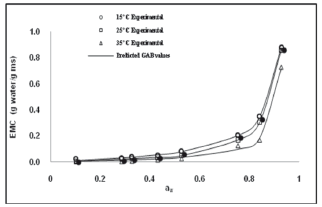
<body><![CDATA[<p align="center"><font size="2" face="Verdana, Arial, Helvetica, sans-serif"><b>Received for review April 11<sup>th</sup>, 2011, accepted July 7<sup>th</sup>, 2011, final version August, 3<sup>th</sup>, 2011</b></font></p>     <p>&nbsp;</p> <hr>     <p><font size="2" face="Verdana, Arial, Helvetica, sans-serif"><b>ABSTRACT:</b> Moisture adsorption isotherms for yellow pitahaya fruits were studied at 15, 25, and 35 &deg;C using the gravimetric method for a 0.111-0.901 water activity range. Experimental values were adjusted by using the GAB, BET, Henderson, Smith, Caurie, and Peleg models. The isosteric heat of adsorption (Qst) was determined using the Clausius-Clapeyron equation. The results showed that yellow pitahaya fruits exhibit type III adsorption isotherms and that the equilibrium moisture content (EMC) is temperature-dependent. For the same water activity value, the EMC decreased when temperature increased. The GAB model presented the best fitto the experimental values. The Qst dropped from 57.154 to 45.79 kJ/mol when the EMC increased from 0.05 to 0.40 g water/g dry matter, respectively. These results are important for establishing the best storage conditions for dehydrated pitahaya fruits as well as for shelf-life prediction and the design of packaging materials.</font></p>     <p><font size="2" face="Verdana, Arial, Helvetica, sans-serif"><b>KEYWORDS:</b> Yellow pitahaya, adsorption isotherms, isosteric heat of adsorption</font></p>     <p><font size="2" face="Verdana, Arial, Helvetica, sans-serif"><b>RESUMEN:</b> Se determinaron las isotermas de adsorci&oacute;n de humedad en pitahaya amarrilla a 15, 25, y 35&ordm;C mediante el m&eacute;todo grav&iacute;metro en el intervalo de actividad de agua (aw) entre 0.111 y 0.901. Los valores experimentales de adsorci&oacute;n se ajustaron mediante los modelos de GAB, BET, Henderson, Smith, Caurie, y Peleg. El calor isost&eacute;rico de adsorci&oacute;n (Qst) se determin&oacute; mediante la ecuaci&oacute;n de Clausius-Clapeyron. Los resultados mostraron que las isotermas fueron de tipo III. El contenido de humedad de equilibrio (CHE) present&oacute; dependencia con la temperatura, disminuyendo con el aumento de esta para un valor constante de aw. El modelo GAB fue el que present&oacute; mejor ajuste de los valores experimentales. El Qst disminuy&oacute; con el aumento del CHE, variando de 57.154 a 45.79 kJ/mol para humedades de 0.05 y 0.4 (g agua/g ms), respectivamente. Estos resultados son de inter&eacute;s para establecer las mejores condiciones de almacenamiento de la pitahaya deshidratada, as&iacute; como la predicci&oacute;n de la vida &uacute;til, y el dise&ntilde;o de empaque.</font></p>     <p><font size="2" face="Verdana, Arial, Helvetica, sans-serif"><b>PALABRAS CLAVE: </b>Pitahaya amarilla, isotermas de adsorci&oacute;n, calor isost&eacute;rico</font></p> <hr>     <p>&nbsp;</p>     <p><font size="3" face="Verdana, Arial, Helvetica, sans-serif"><b>1. INTRODUCTION</b></font></p>     <p><font size="2" face="Verdana, Arial, Helvetica, sans-serif">Yellow pitahaya (Selenicereusmegalanthus), a tropical plant native to Central and South America, belongs to the Cactaceaefamily. Its fruit has yellow skin and a sweet and aromatic white flesh with small black seeds. Ayala et al. (2009) [1] describe the pitahaya as an oval-shapedexotic fruit with exquisite taste and exuberant color. Growing exports in Colombia are driven by higher demand in Europe and the Middle East and by the recognizednutraceuticalfruit properties [2]. Pitahaya is a source of glucose, fructose, dietary fiber, vitamins, and minerals [3,4].The preservation and stabilization of a food's main propertiesduring storage (e.g., its texture and microbiological stability), often require control of moisture content or water activity. Moisture content is an important criterion for judging food quality [5], and water activity (aw) is an essential additional parameter for describing water availability and mobility in foods [6]. Establishing the relationship between equilibrium moisture content (EMC) and aw, also known as sorption isotherm (adsorption or desorption), is important for understanding the stability of foodstuffs [7].</font></p>     <p><font size="2" face="Verdana, Arial, Helvetica, sans-serif">The adsorption isotherm of a food describes the thermodynamic equilibrium state of water. It can be used to predict the shelf life of packaged moisture-sensitive products by modeling moisture uptake during food storage and distribution [8]. It can also be used to determine the best storage methods, packaging materials, and ingredient selection [9].</font></p>     ]]></body>
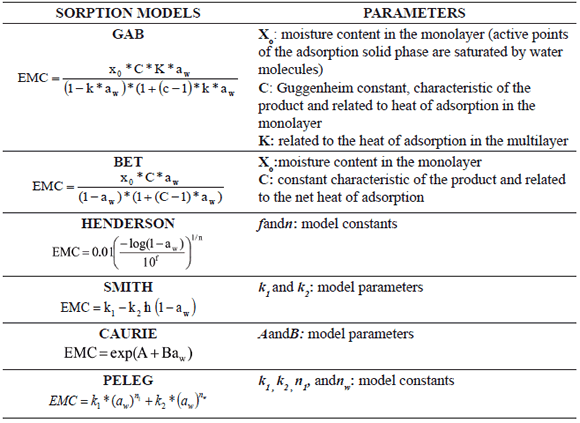
<body><![CDATA[<p><font size="2" face="Verdana, Arial, Helvetica, sans-serif">Adsorption isotherms have been mathematically described through various models, including the theoretical GAB and BET models [10,11] and the empirical or semi-empirical Smith and Oswine models[6]. The GAB and BETequations predict the moisture content of the monolayer(xo) and are considered to be the most useful ones for determining the optimal moisture conditions for food stability during storage [5]. The term xo is the amount of water (g water/g dry matter) that is strongly associated withall active sites of the adsorbent solid phase and its value is correlated to the stability of foods during storage.</font></p>     <p><font size="2" face="Verdana, Arial, Helvetica, sans-serif">The determination of adsorption isotherms at different temperatures also provides information on the thermodynamic properties of the food-water vapor system.Isostericheat of sorption (Qst, kJ/mol), also called differential enthalpy of sorption, is a thermodynamic property that describes the binding strengthbetween water molecules and the food surface. The isosteric heat of sorption is greater than the latent heat of the vaporization of pure water at a given temperature [12]. According to Rizvi (1995) [13],the Qst is a useful parameter in food processes where water desorption or adsorption occurs, because it measures the energy required to break or promote the association between water vapor molecules and adsorbent surfaces, respectively.</font></p>     <p><font size="2" face="Verdana, Arial, Helvetica, sans-serif">No prior sorption isotherms have been reported for yellow pitahaya fruits;therefore, the purpose of this study was to experimentally determine moisture adsorption isotherms in dry samples of yellow pitahaya fruits at 15, 25, and 35 &ordm;C; to adjust known fundamental and empirical models; and to determine the isosteric heat of adsorption at different equilibrium moisture contents. </font></p>     <p>&nbsp;</p>     <p><font size="3" face="Verdana, Arial, Helvetica, sans-serif"><b>2. MATERIALS AND METHODS</b></font></p>     <p><font size="2" face="Verdana, Arial, Helvetica, sans-serif"><b>Plant material    <br>   </b></font><font size="2" face="Verdana, Arial, Helvetica, sans-serif">Yellow pitahaya fruits with a maturity stage of three (16-18 &deg;Brix) were selected according to the NTC 3554 standard classification [14]. Fruits were obtained from orchards located in the northern department of Cauca Valley (Colombia), belonging to the Association of PitahayaProducers (ASOPPITAYA).</font></p>     <p><font size="2" face="Verdana, Arial, Helvetica, sans-serif"><b>Experimental procedure    <br>   </b></font><font size="2" face="Verdana, Arial, Helvetica, sans-serif">In order to determine the adsorption isotherms of yellow pitahaya fruits at 15, 25, and 35 &ordm;C, the gravimetric static method with saturated saline solutions was used [15]. Eight saturated saline solutions (LiCl, CH3COOK, MgCl2, K2CO3, Mg(NO3)2, NaCl, KCl, and KNO3) with water activity varying from 0.123 to 0.928 at different temperatures were used, as reported by Greespan (1977)[16]. Each saturated solution (35 mL) was placed in a hermetically closed glass container (6 cm height and 5 cm diameter). Rectangular pieces of lyophilized yellow pitahaya (15 mm long x 5 mm wide x 5 mm high, 1.201&plusmn;00.1 g) were placed in the containers and hermetically closed.The samples were&nbsp;dried in a&nbsp;tray&nbsp;freeze dryer (Labconco, USA)&nbsp;from -35 to&nbsp;35 &deg;C at 8 Pa vacuum pressure. To avoid microbial contamination, pure Tymol was added to the containers with saline solutions havingan aw greater than 0.65. Each hermetically closed container holding the pitahaya samples was then placed in an environmental controlled chamber (Hotpack, USA) set at 15, 25, or 35 &ordm;C. The samples were weighed every 3 days using a fourth-digit precision analytical balance (Model Mettler-Toledo, Switzerland) until a constant weight (&plusmn;0.001) was observed, indicating an equilibrium between the samples and the saline solutions. Once the equilibrium was reached (after around 17 to 25 days), the moisture content of the pitahaya fruit slices was determined following the AOAC method 934.06 [17]. The adsorption experiments for each temperature were conducted in triplicate. Analysis of variance for the effect </font><font size="2" face="Verdana, Arial, Helvetica, sans-serif">of temperature and water activity on EMC was done as a completely randomized design using Matlab software (V 7.0, Mathworks, Inc., Natick, USA).</font></p>     <p><font size="2" face="Verdana, Arial, Helvetica, sans-serif"><b>Modeling experimental values by sorption models    ]]></body>
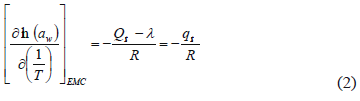
<body><![CDATA[<br>   </b>Six models were used to adjust the EMC experimental values: Guggenheim, Anderson and de Boer (GAB);Brunauer, Emmett, and Teller (BET);and Henderson, Smith, Caurie, and Peleg (<a href="#tab01">Table 1</a>). These models are widely used in the scientific literature in food products [18,19,20]. Model parameters were calculated by using non-linear regression in Matlab software. </font></p>     <p align="center"><font size="2" face="Verdana, Arial, Helvetica, sans-serif"><b><a name="tab01"></a>Table 1. </b>Models used to predict moisture sorption isotherms in yellow pitahaya</font>    <br>   <img src="/img/revistas/dyna/v78n170/a01tab01.gif"></p>     <p><font size="2" face="Verdana, Arial, Helvetica, sans-serif">To select the model that best fitted the experimental values, the mean relative error [MRE, %; (1)] and the coefficient of determination(r2) were calculated. A sorption model was considered acceptable when MRE&lt;10% [21] and r2˜1.</font></p>     <p><img src="/img/revistas/dyna/v78n170/a01eq01.gif"></p>     <p><font size="2" face="Verdana, Arial, Helvetica, sans-serif">where EMCc=experimental equilibrium moisture content, EMCp=predicted equilibrium moisture content, and N= number of samples.</font></p>     <p><font size="2" face="Verdana, Arial, Helvetica, sans-serif">Isosteric Heat of Adsorption </font></p>     <p><font size="2" face="Verdana, Arial, Helvetica, sans-serif">The isosteric heat of adsorption (Qst), also known as differential enthalpy related to the adsorption process, was determined by adjusting the experimental values to the Clausius-Clayperon equation [22] (2):</font></p>     <p><img src="/img/revistas/dyna/v78n170/a01eq02.gif"></p>     <p><font size="2" face="Verdana, Arial, Helvetica, sans-serif">whereqst = net isosteric heat of adsorption, R = universal gas constant, <font face="Symbol">l</font> =latent heat of vaporization of pure water (determined at a fixed temperature of 25 &deg;C, corresponding to an average of 15, 25, and 35&deg;C), aw = water activity, T = temperature, andQst = isosteric heat of adsorption. Plots of ln (aw) vs 1/T at different moisture values resulted in simple linear regression with slope equal to -(Qst-<font face="Symbol">l</font>) /R, from which Qst was determined. Plots of ln (aw) vs 1/T were obtained by using the GAB models to predict aw values at equilibrium moisture contents ranging from 0.05 and 0.40 g water/g dry matter.</font></p>     ]]></body>
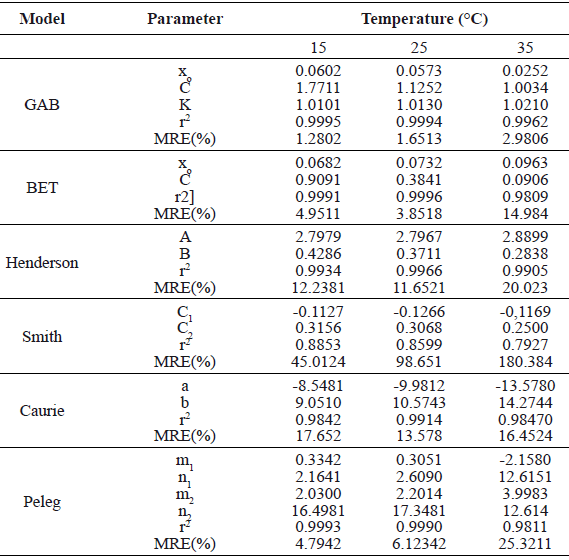
<body><![CDATA[<p>&nbsp;</p>     <p><font size="3" face="Verdana, Arial, Helvetica, sans-serif"><b>3. RESULTS AND DISCUSSION</b></font></p>     <p><font size="2" face="Verdana, Arial, Helvetica, sans-serif"><b>Moisture adsorption isotherms    <br>   </b></font><font size="2" face="Verdana, Arial, Helvetica, sans-serif"><a href="#fig01">Figure 1</a> shows the experimental moisture adsorption isotherms of pitahaya fruit samples kept at 15, 25, and 35 &deg;C, respectively. The moisture content of the lyophilized pitahaya samples was 1.620&plusmn; 0.002 g water/g dry matter and the standard deviation of the experimental EMC ranged from 0.0015 to 0.0026. The observed isotherm patterns were classified as type III according to Brunauer et al. (1940) cited by Iguedjtal et al. (2008) [6]. Type III isotherms are characteristic of foods rich in soluble components such as sugars [13]. Other fruits, such as grapes and apricots [23], strawberries [24], kiwis [25], bananas [8], and figs [26] were also reported as exhibiting type III isotherms. The adsorption isotherms showed that with aw up to 0.55, fruits gained relatively low moisture. However, with aw values higher than 0.55, solids solubilization and adsorption promoted a significant increase in moisture content [27,28]. </font></p>     <p align="center"><font size="2" face="Verdana, Arial, Helvetica, sans-serif"><a name="fig01"></a><b><img src="/img/revistas/dyna/v78n170/a01fig01.gif">    <br>   Figure 1.</b> Experimental and GAB predicted adsorption isotherms at 15, 25, and 35 &ordm;C</font></p>     <p><font size="2" face="Verdana, Arial, Helvetica, sans-serif">Analysis of variance (ANOVA) showed a significant effect of aw on EMC (p&lt;0.001). For all isotherms, EMC increased as the aw value increased, being more evident when aw values were higher than 0.55, as mentioned. This is a common pattern in food adsorption processes. A significant effect of temperature on EMC was also observed (p&lt;0.018). When the temperature increased, the EMC decreased for a given aw value. These results indicate that dry pitahaya fruits were less hygroscopic at higher temperature. The same effect has been observed in other fruits such as lychee [29] and grape products (i.e., pestil grape) [19]. Mazza (1980) [30], concluded that an increase in sorption temperature causes physical and chemical changes in the product leading to a reduction in the number of active sites where water molecules bind to the surface of the food. Al-Muhtaseb et al. (2004) [31], showed the dependence between EMC and sorption temperature, resulting in chemical and microbiological reactions associated with food deterioration. An increase of temperature for a given EMC in the food material results in a higher aw, and consequently, in an increase of deterioration rates [10].</font></p>     <p><font size="2" face="Verdana, Arial, Helvetica, sans-serif"><b>Modeling experimental values of sorption    <br>   </b></font><font size="2" face="Verdana, Arial, Helvetica, sans-serif">Adjusted parameters and goodness of fit criteria for the various models are shown in <a href="#tab02">Table 2</a> for the three temperature conditions (15, 25, and 35 &deg;C). Following the criteria ofLomauro et al. (1985) [21] for the goodness of fit of sorption models (i.e., MRE less than 10% and r2 close to 1), the GAB model showed the best fit to the experimental data, with MRE ranging from 1.28 to 2.98% and r2 from 0.9994 to 0.9996 for the three temperature conditions (<a href="#fig01">Figure 1</a>). The Smith model showed the least fit to </font><font size="2" face="Verdana, Arial, Helvetica, sans-serif">the experimental values with MRE ranging </font> <font size="2" face="Verdana, Arial, Helvetica, sans-serif">from 45.01 to 180.38% and r2 from 0.7927 to 0.8853. The GAB model was also reported to fit experimental sorption isotherms in fruit foods such as lemon peel [32],murici and inga[33], grapes [23], and orange leaves [34]. </font></p>     <p align="center"><font size="2" face="Verdana, Arial, Helvetica, sans-serif"><b><a name="tab02"></a>Table 2.</b> Parameter adjustment and statistical criteria of each adsorption model describing equilibrium moisture content vs water activity in lyophilized pitahaya at 3temperatures</font>    ]]></body>
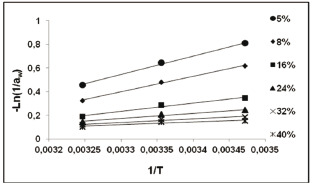
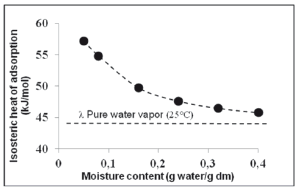
<body><![CDATA[<br>   <img src="/img/revistas/dyna/v78n170/a01tab02.gif"></p>     <p><font size="2" face="Verdana, Arial, Helvetica, sans-serif">The GAB model also offers valuable information on the moisture content of the monomolecular layer (xo), a parameter essential to define storage food conditions (<a href="#tab02">Table 2</a>). The xo indicates the amount of water that is strongly adsorbed in the active sites of the solid phase surface of foods and it is considered to be the moisture content where a given food exhibits its best stability during storage. The xo calculated with the GAB model dropped from 0.0602 to 0.0252 g water/g dry matter, with increasing temperatures. Similar results were found in the adsorption isotherms of fruits such as loquat and quince [35], and pine seeds [36]. The negative relationship between xo and temperature is probably a consequence of damage of the active union points between water molecules and the solid phase surface of the food material, resulting in the detachment of water molecules and therefore in water loss as temperature increases. Moreira (2008) [35], and AviaraandAjibola (2002) [37] stated that when temperature increases, the active points on the food surface are reduced as a result of chemical and physical changes.</font></p>     <p><font size="2" face="Verdana, Arial, Helvetica, sans-serif">The GAB model also contains parameters C (Guggenheim constant) and K, related to the heat of sorption of monolayer and multilayer molecules, respectively (<a href="#tab02">Table 2</a>). Parameter C was reduced from 1.771 to 1.003 with increasing temperature, indicating that the bonding energy for water molecules in the monolayer exhibited an inverse relationship with temperature. Parameter K showed little variation with temperature, and values slightly higher than one, contrary to most reports which showedK values lower than one. In cases where K is larger than one, the isotherm tends to infinity withtheaw value closer to 1.0[38], which was observed in pitahaya fruits when aw values were closer to 0.9 (<a href="#fig01">Fig. 1</a>).</font></p>     <p><font size="2" face="Verdana, Arial, Helvetica, sans-serif"><b>Isosteric heat of sorption    <br>   </b></font><font size="2" face="Verdana, Arial, Helvetica, sans-serif">The GAB model was used to predict aw values at various equilibrium moisture content levels. <a href="#fig02">Figure 2</a> shows the linear representation of -ln(1/aw) against 1/T of the Clausius-Clayperon equation (Eq. 2) for the calculation of Qst during moisture adsorption in pitahaya fruits. The coefficient of determination (r2) was larger than 0.983.</font></p>     <p align="center"><font size="2" face="Verdana, Arial, Helvetica, sans-serif"><b><a name="fig02"></a><img src="/img/revistas/dyna/v78n170/a01fig02.gif">    <br>   Figure 2.</b> -Ln(aw) vs 1/T for the isosteric heat of adsorption determination in pitahaya fruit</font></p>     <p><font size="2" face="Verdana, Arial, Helvetica, sans-serif"><a href="#fig03">Figure 3</a> shows the change of Qst as affected by EMC in pitahaya fruits. A close dependency between Qst and EMC was observed. The value Qst dropped from 57.154 to 45.790 kJ/mol when EMC increased from 0.05 to 0.40 g water/g dry matter, respectively. At low EMC levels, more solid-water interactions occur in the active sites of the product surface. However, at a high EMC, the Qst decreases because water occupies less active sites, causing a reduction in the bond energy between water molecules and food components (union forces are reduced). Similar behavior was found in adsorption isotherms for tropical fruits from Asia [29], plantain pulp [39], and other foods such as cakes [12], and milk powder [40].</font></p>     <p align="center"><font size="2" face="Verdana, Arial, Helvetica, sans-serif"><b><a name="fig03"></a><img src="/img/revistas/dyna/v78n170/a01fig03.gif">    <br>   Figure 3.</b> Variation of theisosteric heat of adsorption with the equilibrium moisture content of pitahaya fruit</font></p>     ]]></body>
<body><![CDATA[<p><font size="2" face="Verdana, Arial, Helvetica, sans-serif">Cenkowski et al. (1992) [41] suggested that an increase in heat of sorption at low EMC is possibly due to a strong water movement resistance from the interior surface of foods. Other authors argued that highly active polar sites that bind a monomolecular layer of water possibly exist on the solid phase of foods, and that a high amount of energy is required to eliminate this water from foods [35]. The Qst values for all EMC were higher than the heat of vaporization of water (<font face="Symbol">l</font>(25 &ordm;C)=43.961 kJ/Kmol), indicating that the interaction energy for the water molecules on the adsorption sites (active points) of solid foods was larger than the energy necessary to evaporate pure water molecules. Equation 3 shows the relationship between Qst and the equilibrium moisture content during water adsorption in dried pitahaya fruit:</font></p>     <p><img src="/img/revistas/dyna/v78n170/a01eq03.gif"></p>     <p>&nbsp;</p>     <p><font size="3" face="Verdana, Arial, Helvetica, sans-serif"><b>4. CONCLUSIONS </b></font></p>     <p><font size="3"><font size="2" face="Verdana, Arial, Helvetica, sans-serif">The adsorption isotherms of pitahaya fruits at 15, 25, and 35 &ordm;C exhibited type III behavior, characteristic of foods rich in soluble compounds (e.g., sugars). </font></font><font size="2" face="Verdana, Arial, Helvetica, sans-serif">Our results demonstrate that there is a strong inverse relationship between equilibrium moisture content and temperature, at constant aw values. Pitahaya fruits are less hygroscopic at higher storage temperatures. The GAB model showed the best fit to the experimental adsorption data and was the most appropriate for predicting the equilibrium moisture content of pitahaya fruits between 15 and 35 &deg;C. The Qst decreased from 57.154 to 45.790 kJ/mol when equilibrium moisture content exponentially increased from 0.05 to 0.40 g water/g dry matter, respectively. Adsorption isotherms for pitahaya fruits can be used in the design of optimal storage conditions, shelf-life prediction, packaging materials, and better food mixing operations. </font></p>     <p>&nbsp;</p>     <p><font size="3" face="Verdana, Arial, Helvetica, sans-serif"><b>REFERENCES</b></font></p>     <!-- ref --><p><font size="2" face="Verdana, Arial, Helvetica, sans-serif"><b>[1]</b> Ayala, A. A., Serna-Cock, L. and Giraldo, C. J. G., Efecto de la agitaci&oacute;n sobre la deshidrataci&oacute;n osm&oacute;tica de pitahaya amarilla (SelenicereusMegalanthus S.) empleando soluciones de sacarosa. Interciencia, 34(7), pp. 492-496, 2009.     &nbsp;&nbsp;&nbsp;&nbsp;&nbsp;&nbsp;&nbsp;&nbsp;[&#160;<a href="javascript:void(0);" onclick="javascript: window.open('/scielo.php?script=sci_nlinks&ref=000070&pid=S0012-7353201100060000100001&lng=','','width=640,height=500,resizable=yes,scrollbars=1,menubar=yes,');">Links</a>&#160;]<!-- end-ref --><!-- ref --><br>   <b>[2]</b> Rodriguez, J. P., Narv&aacute;ez, C. E. and Restrepo, L. P., Polygalacturonaseactivity in yellowpitahayapeel (Acanthocereus pitajaya). Acta Biol&oacute;gica Colombiana, 11 (l), pp. 65-74, 2006.     &nbsp;&nbsp;&nbsp;&nbsp;&nbsp;&nbsp;&nbsp;&nbsp;[&#160;<a href="javascript:void(0);" onclick="javascript: window.open('/scielo.php?script=sci_nlinks&ref=000071&pid=S0012-7353201100060000100002&lng=','','width=640,height=500,resizable=yes,scrollbars=1,menubar=yes,');">Links</a>&#160;]<!-- end-ref --><!-- ref --><br>   <b>[3]</b> Barbeu, G., The strawberry pear, a new tropical fruit. Fruits, 45, pp. 141-147, 1990.     &nbsp;&nbsp;&nbsp;&nbsp;&nbsp;&nbsp;&nbsp;&nbsp;[&#160;<a href="javascript:void(0);" onclick="javascript: window.open('/scielo.php?script=sci_nlinks&ref=000072&pid=S0012-7353201100060000100003&lng=','','width=640,height=500,resizable=yes,scrollbars=1,menubar=yes,');">Links</a>&#160;]<!-- end-ref --><!-- ref --><br>   <b>[4]</b> Wu, M. C. and Chen,C. S., Variation of sugar content in various parts of pitahaya fruit. Proc. Fla. State Hort. Soc., 110, pp. 225-227, 1997.     &nbsp;&nbsp;&nbsp;&nbsp;&nbsp;&nbsp;&nbsp;&nbsp;[&#160;<a href="javascript:void(0);" onclick="javascript: window.open('/scielo.php?script=sci_nlinks&ref=000073&pid=S0012-7353201100060000100004&lng=','','width=640,height=500,resizable=yes,scrollbars=1,menubar=yes,');">Links</a>&#160;]<!-- end-ref --><!-- ref --><br>   <b>[5]</b> Arslan, N. and Togrul, H., The fitting of various models to water sorption isotherms of tea stored in a chamber under controlled temperature and humidity, Journal of Stored Products Research, 42(2), pp. 112-135, 2006.     &nbsp;&nbsp;&nbsp;&nbsp;&nbsp;&nbsp;&nbsp;&nbsp;[&#160;<a href="javascript:void(0);" onclick="javascript: window.open('/scielo.php?script=sci_nlinks&ref=000074&pid=S0012-7353201100060000100005&lng=','','width=640,height=500,resizable=yes,scrollbars=1,menubar=yes,');">Links</a>&#160;]<!-- end-ref --><!-- ref --><br>   <b>[6]</b> Iguedjtal, T., Louka, N. and Allaf, K., Sorption isotherms of potato slices dried and texturized by controlled sudden decompression. Journal of Food Engineering, 85(2), pp. 180-190, 2008.     &nbsp;&nbsp;&nbsp;&nbsp;&nbsp;&nbsp;&nbsp;&nbsp;[&#160;<a href="javascript:void(0);" onclick="javascript: window.open('/scielo.php?script=sci_nlinks&ref=000075&pid=S0012-7353201100060000100006&lng=','','width=640,height=500,resizable=yes,scrollbars=1,menubar=yes,');">Links</a>&#160;]<!-- end-ref --><!-- ref --><br>   <b>[7]</b> Labuza, T. P. and Hymann, C. R., Moisture migration and control in multi-domain foods. Food Science and Technology, 9, pp. 47-55,1998.     &nbsp;&nbsp;&nbsp;&nbsp;&nbsp;&nbsp;&nbsp;&nbsp;[&#160;<a href="javascript:void(0);" onclick="javascript: window.open('/scielo.php?script=sci_nlinks&ref=000076&pid=S0012-7353201100060000100007&lng=','','width=640,height=500,resizable=yes,scrollbars=1,menubar=yes,');">Links</a>&#160;]<!-- end-ref --><!-- ref --><br>   <b>[8]</b> Yan, Z., Sousa, M. J. and Oliveira, A. R.,. Sorption isotherms and moisture sorption hysteresis of intermediate moisture content banana. Journal of Food Engineering, 86(3), pp. 342-348, 2008.     &nbsp;&nbsp;&nbsp;&nbsp;&nbsp;&nbsp;&nbsp;&nbsp;[&#160;<a href="javascript:void(0);" onclick="javascript: window.open('/scielo.php?script=sci_nlinks&ref=000077&pid=S0012-7353201100060000100008&lng=','','width=640,height=500,resizable=yes,scrollbars=1,menubar=yes,');">Links</a>&#160;]<!-- end-ref --><!-- ref --><br>   <b>[9]</b> Lahsasni, S., Kouhila, M.and Mahrouz, M., Adsorption-desorption isotherms and heat of sorption of prickly pear fruit (Opuntiaficusindica). Energy Conversion and Management, 45, pp. 249-261, 2004.     &nbsp;&nbsp;&nbsp;&nbsp;&nbsp;&nbsp;&nbsp;&nbsp;[&#160;<a href="javascript:void(0);" onclick="javascript: window.open('/scielo.php?script=sci_nlinks&ref=000078&pid=S0012-7353201100060000100009&lng=','','width=640,height=500,resizable=yes,scrollbars=1,menubar=yes,');">Links</a>&#160;]<!-- end-ref --><!-- ref --><br>   <b>[10]</b> Van Den Berg, C. and Bruin, S., Water activity and its estimation in food systems. In: Water Activity: Influence on Food Quality (L.B. Rockland, &F. Stewart, eds.) Academic Press, New York, pp.147-177, 1981.     &nbsp;&nbsp;&nbsp;&nbsp;&nbsp;&nbsp;&nbsp;&nbsp;[&#160;<a href="javascript:void(0);" onclick="javascript: window.open('/scielo.php?script=sci_nlinks&ref=000079&pid=S0012-7353201100060000100010&lng=','','width=640,height=500,resizable=yes,scrollbars=1,menubar=yes,');">Links</a>&#160;]<!-- end-ref --><!-- ref --><br>   <b>[11]</b> Brunauer, S., Emmett, P.H. and Teller, E., Adsorption of gases in multimolecular layers.Journal of the American Chemical Society.60(2), pp. 309-319, 1938.     &nbsp;&nbsp;&nbsp;&nbsp;&nbsp;&nbsp;&nbsp;&nbsp;[&#160;<a href="javascript:void(0);" onclick="javascript: window.open('/scielo.php?script=sci_nlinks&ref=000080&pid=S0012-7353201100060000100011&lng=','','width=640,height=500,resizable=yes,scrollbars=1,menubar=yes,');">Links</a>&#160;]<!-- end-ref --><!-- ref --><br>   <b>[12]</b> Al-Muhtaseb, A.H., Muhanned, A.H., Megahey, E.K., Mcminn, W.A.M. and Magee, T.R.A., Moisture adsorption isotherms of microwave-baked Madeira cake.LWT - Food Science and Technology, 43(7), pp. 1042-1049, 2010.     &nbsp;&nbsp;&nbsp;&nbsp;&nbsp;&nbsp;&nbsp;&nbsp;[&#160;<a href="javascript:void(0);" onclick="javascript: window.open('/scielo.php?script=sci_nlinks&ref=000081&pid=S0012-7353201100060000100012&lng=','','width=640,height=500,resizable=yes,scrollbars=1,menubar=yes,');">Links</a>&#160;]<!-- end-ref --><!-- ref --><br>   <b>[13]</b> Rizvi, S. S. H., Thermodynamics properties of food in dehydration. In Engineering Properties of Foods, 2nd Ed., (M.A. Rao& S. S. H. Rizvi, eds) Marcel Dekker Inc, New York, pp. 223-309. 1995.     &nbsp;&nbsp;&nbsp;&nbsp;&nbsp;&nbsp;&nbsp;&nbsp;[&#160;<a href="javascript:void(0);" onclick="javascript: window.open('/scielo.php?script=sci_nlinks&ref=000082&pid=S0012-7353201100060000100013&lng=','','width=640,height=500,resizable=yes,scrollbars=1,menubar=yes,');">Links</a>&#160;]<!-- end-ref --><!-- ref --><br>   <b>[14]</b> ICONTEC, Instituto Colombiano de Normas T&eacute;cnicas y Certificaci&oacute;n. Norma T&eacute;cnica Colombiana. NTC 3554. Frutas frescas. Pitahaya amarilla. Bogot&aacute;, pp.1-14, 1996.     &nbsp;&nbsp;&nbsp;&nbsp;&nbsp;&nbsp;&nbsp;&nbsp;[&#160;<a href="javascript:void(0);" onclick="javascript: window.open('/scielo.php?script=sci_nlinks&ref=000083&pid=S0012-7353201100060000100014&lng=','','width=640,height=500,resizable=yes,scrollbars=1,menubar=yes,');">Links</a>&#160;]<!-- end-ref --><!-- ref --><br>   <b>[15]</b> Wolf, W., Spiess, E. C. and Jung, G., Standardization of Isotherm Measurements. In: Properties of Water in Foods (D. Simatos& J. L. Multon, eds) MartnusNijhott Publishers: Dordrecht. Netherlands, pp. 661-677, 1985.     &nbsp;&nbsp;&nbsp;&nbsp;&nbsp;&nbsp;&nbsp;&nbsp;[&#160;<a href="javascript:void(0);" onclick="javascript: window.open('/scielo.php?script=sci_nlinks&ref=000084&pid=S0012-7353201100060000100015&lng=','','width=640,height=500,resizable=yes,scrollbars=1,menubar=yes,');">Links</a>&#160;]<!-- end-ref --><!-- ref --><br>   <b>[16]</b> Greespan, L., Humidity Fixed Points of Binary Saturated Aqueous Solutions. Journal of Research of the National Bureau of Standards-Physics and Chemistry, 81(1), pp. 89-96, 1977.     &nbsp;&nbsp;&nbsp;&nbsp;&nbsp;&nbsp;&nbsp;&nbsp;[&#160;<a href="javascript:void(0);" onclick="javascript: window.open('/scielo.php?script=sci_nlinks&ref=000085&pid=S0012-7353201100060000100016&lng=','','width=640,height=500,resizable=yes,scrollbars=1,menubar=yes,');">Links</a>&#160;]<!-- end-ref --><!-- ref --><br>   <b>[17]</b> AOAC., Official methods of analysis of the Association of Oficial Analytical Chemists International. Moisture in dried fruits.Method 934.06. Arlington, USA, pp. 911-912. 1990.     &nbsp;&nbsp;&nbsp;&nbsp;&nbsp;&nbsp;&nbsp;&nbsp;[&#160;<a href="javascript:void(0);" onclick="javascript: window.open('/scielo.php?script=sci_nlinks&ref=000086&pid=S0012-7353201100060000100017&lng=','','width=640,height=500,resizable=yes,scrollbars=1,menubar=yes,');">Links</a>&#160;]<!-- end-ref --><!-- ref --><br>   <b>[18]</b> Jain, S. K., Verma, R. C., Sharma, G. P. and Jain, H. K., Studies on moisture sorption isotherms for osmotically dehydrated papaya cubes and verification of selected models. Journal of Food Science and Technology,47(3), pp.343-346, 2010.     &nbsp;&nbsp;&nbsp;&nbsp;&nbsp;&nbsp;&nbsp;&nbsp;[&#160;<a href="javascript:void(0);" onclick="javascript: window.open('/scielo.php?script=sci_nlinks&ref=000087&pid=S0012-7353201100060000100018&lng=','','width=640,height=500,resizable=yes,scrollbars=1,menubar=yes,');">Links</a>&#160;]<!-- end-ref --><!-- ref --><br>   <b>[19]</b> Kaya, S., andKahyaoglu, T., Thermodynamic properties and sorption equilibrium of pestil (grape leather). Journal of Food Engineering, 71(2), pp. 200-207, 2005.     &nbsp;&nbsp;&nbsp;&nbsp;&nbsp;&nbsp;&nbsp;&nbsp;[&#160;<a href="javascript:void(0);" onclick="javascript: window.open('/scielo.php?script=sci_nlinks&ref=000088&pid=S0012-7353201100060000100019&lng=','','width=640,height=500,resizable=yes,scrollbars=1,menubar=yes,');">Links</a>&#160;]<!-- end-ref --><!-- ref --><br>   <b>[20]</b> Vega-Galvez, A., Aravena, E. L. and Lemus-Mondaca, R., Isotermas de adsorci&oacute;n en harina de ma&iacute;z (Zea mays L). Ciencia eTecnologiadeAlimentos, 26(4), pp. 821-827, 2006.     &nbsp;&nbsp;&nbsp;&nbsp;&nbsp;&nbsp;&nbsp;&nbsp;[&#160;<a href="javascript:void(0);" onclick="javascript: window.open('/scielo.php?script=sci_nlinks&ref=000089&pid=S0012-7353201100060000100020&lng=','','width=640,height=500,resizable=yes,scrollbars=1,menubar=yes,');">Links</a>&#160;]<!-- end-ref --><!-- ref --><br>   <b>[21]</b> Lomauro, C. J., Bakshi, A. S. and LabuzaT. P., Evaluation of food moisture sorption isotherm equations. Part 1: Fruit, vegetable and meat products. Lebensmittel-Wissenschaftund-echnologie, 18(2), pp. 111-117, 1985.     &nbsp;&nbsp;&nbsp;&nbsp;&nbsp;&nbsp;&nbsp;&nbsp;[&#160;<a href="javascript:void(0);" onclick="javascript: window.open('/scielo.php?script=sci_nlinks&ref=000090&pid=S0012-7353201100060000100021&lng=','','width=640,height=500,resizable=yes,scrollbars=1,menubar=yes,');">Links</a>&#160;]<!-- end-ref --><!-- ref --><br>   <b>[22]</b> Tsami, E., Net isosteric heat of sorption in dried fruits. Journal of Food Engineering, 14(4), pp. 327-335, 1991.     &nbsp;&nbsp;&nbsp;&nbsp;&nbsp;&nbsp;&nbsp;&nbsp;[&#160;<a href="javascript:void(0);" onclick="javascript: window.open('/scielo.php?script=sci_nlinks&ref=000091&pid=S0012-7353201100060000100022&lng=','','width=640,height=500,resizable=yes,scrollbars=1,menubar=yes,');">Links</a>&#160;]<!-- end-ref --><!-- ref --><br>   <b>[23]</b> Kaymak-Ertekin, F. and Gedik A., Sorption isotherms and isosteric heat of sorption for grapes, apricots, apples and potatoes.Lebensmittel-Wissenschaft und-Technologie, 37(4), pp. 429-438, 2004.     &nbsp;&nbsp;&nbsp;&nbsp;&nbsp;&nbsp;&nbsp;&nbsp;[&#160;<a href="javascript:void(0);" onclick="javascript: window.open('/scielo.php?script=sci_nlinks&ref=000092&pid=S0012-7353201100060000100023&lng=','','width=640,height=500,resizable=yes,scrollbars=1,menubar=yes,');">Links</a>&#160;]<!-- end-ref --><!-- ref --><br>   <b>[24]</b> Moraga, G., Mart&iacute;nez, N.,andChiralt, A., Water sorption isotherms and glass transition in strawberries: influence of pretreatment. Journal of Food Engineering, 62(4), pp. 315-321, 2004.     &nbsp;&nbsp;&nbsp;&nbsp;&nbsp;&nbsp;&nbsp;&nbsp;[&#160;<a href="javascript:void(0);" onclick="javascript: window.open('/scielo.php?script=sci_nlinks&ref=000093&pid=S0012-7353201100060000100024&lng=','','width=640,height=500,resizable=yes,scrollbars=1,menubar=yes,');">Links</a>&#160;]<!-- end-ref --><!-- ref --><br>   <b>[25]</b> Moraga, G., Mart&iacute;nez, N. and Chiralt, A., Water sorption isotherms and phase transitions in kiwifruit. Journal of Food Engineering, 72(2), pp. 147-156, 2006.     &nbsp;&nbsp;&nbsp;&nbsp;&nbsp;&nbsp;&nbsp;&nbsp;[&#160;<a href="javascript:void(0);" onclick="javascript: window.open('/scielo.php?script=sci_nlinks&ref=000094&pid=S0012-7353201100060000100025&lng=','','width=640,height=500,resizable=yes,scrollbars=1,menubar=yes,');">Links</a>&#160;]<!-- end-ref --><!-- ref --><br>   <b>[26]</b> Farahnaky, A., Ansari, S. and Majzoobi, M., Effect of glycerol on the moisture sorption isotherms of figs.Journal of Food Engineering, 93(4), pp. 468-473. 2009.     &nbsp;&nbsp;&nbsp;&nbsp;&nbsp;&nbsp;&nbsp;&nbsp;[&#160;<a href="javascript:void(0);" onclick="javascript: window.open('/scielo.php?script=sci_nlinks&ref=000095&pid=S0012-7353201100060000100026&lng=','','width=640,height=500,resizable=yes,scrollbars=1,menubar=yes,');">Links</a>&#160;]<!-- end-ref --><!-- ref --><br>   <b>[27]</b> Saravacos, G. D., TsiourvasD. A. and Tsami, E., Effect of temperature on the water adsorption isotherms of sultana raisins. Journal of Food Science, 51(2), pp. 381-383, 1986.     &nbsp;&nbsp;&nbsp;&nbsp;&nbsp;&nbsp;&nbsp;&nbsp;[&#160;<a href="javascript:void(0);" onclick="javascript: window.open('/scielo.php?script=sci_nlinks&ref=000096&pid=S0012-7353201100060000100027&lng=','','width=640,height=500,resizable=yes,scrollbars=1,menubar=yes,');">Links</a>&#160;]<!-- end-ref --><!-- ref --><br>   <b>[28]</b> Hubinger, M., Menegalli, F. C., Aguerre, R. J. and Suarez, C., Water vapor adsorption isotherms of guava, mango and pineapple. Journal of Food Science, 57 (6), pp. 1405-1407, 1992.     &nbsp;&nbsp;&nbsp;&nbsp;&nbsp;&nbsp;&nbsp;&nbsp;[&#160;<a href="javascript:void(0);" onclick="javascript: window.open('/scielo.php?script=sci_nlinks&ref=000097&pid=S0012-7353201100060000100028&lng=','','width=640,height=500,resizable=yes,scrollbars=1,menubar=yes,');">Links</a>&#160;]<!-- end-ref --><!-- ref --><br>   <b>[29]</b> Janjai, S., Lamlert, N., Tohsing, K., Mahayothee, B., Bala, B. K.,and Müller, J., Measurement and modeling of moisture sorption isotherm of litchi (Litchi ChinensisSonn). International Journal of Food Properties, 13(2), pp. 251-260, 2010.     &nbsp;&nbsp;&nbsp;&nbsp;&nbsp;&nbsp;&nbsp;&nbsp;[&#160;<a href="javascript:void(0);" onclick="javascript: window.open('/scielo.php?script=sci_nlinks&ref=000098&pid=S0012-7353201100060000100029&lng=','','width=640,height=500,resizable=yes,scrollbars=1,menubar=yes,');">Links</a>&#160;]<!-- end-ref --><!-- ref --><br>   <b>[30]</b> Mazza, G., Thermodynamic considerations of water vapour sorption by horseradish roots. Lebensmittel-Wissenschaft und-Technologie, 13, pp. 13-17, 1980.     &nbsp;&nbsp;&nbsp;&nbsp;&nbsp;&nbsp;&nbsp;&nbsp;[&#160;<a href="javascript:void(0);" onclick="javascript: window.open('/scielo.php?script=sci_nlinks&ref=000099&pid=S0012-7353201100060000100030&lng=','','width=640,height=500,resizable=yes,scrollbars=1,menubar=yes,');">Links</a>&#160;]<!-- end-ref --><!-- ref --><br>   <b>[31]</b> Al-Muhtaseb, A.H., Mcminn, W. A. M., and Magee, T.R.A., Water sorption isotherms of starch powders: Part 1: Mathematical description of experimental data.Journal of Food Engineering, 61(3), pp. 297-307, 2004.     &nbsp;&nbsp;&nbsp;&nbsp;&nbsp;&nbsp;&nbsp;&nbsp;[&#160;<a href="javascript:void(0);" onclick="javascript: window.open('/scielo.php?script=sci_nlinks&ref=000100&pid=S0012-7353201100060000100031&lng=','','width=640,height=500,resizable=yes,scrollbars=1,menubar=yes,');">Links</a>&#160;]<!-- end-ref --><!-- ref --><br>   <b>[32]</b> Garc&iacute;a, J. V., C&aacute;rcel J. A., Clemente G. and Mulet, A., Water sorption isotherms for lemon peel at different temperatures and isosteric heats. LWT-Food Science and Technology, 41(1), pp.18-25, 2008.     &nbsp;&nbsp;&nbsp;&nbsp;&nbsp;&nbsp;&nbsp;&nbsp;[&#160;<a href="javascript:void(0);" onclick="javascript: window.open('/scielo.php?script=sci_nlinks&ref=000101&pid=S0012-7353201100060000100032&lng=','','width=640,height=500,resizable=yes,scrollbars=1,menubar=yes,');">Links</a>&#160;]<!-- end-ref --><!-- ref --><br>   <b>[33]</b> Ar&eacute;valo-Pinedo , A., Dos Santos, F. L., Salles, Z. D., Zuniga, A. D. G. and Ar&eacute;valo-Pinedo R., Desorption isotherms for murici (Byrsonimasericea) and inga (Ing&aacute;edulis) pulps. Journal of Food Engineering, 76(4), pp.611-615, 2006.     &nbsp;&nbsp;&nbsp;&nbsp;&nbsp;&nbsp;&nbsp;&nbsp;[&#160;<a href="javascript:void(0);" onclick="javascript: window.open('/scielo.php?script=sci_nlinks&ref=000102&pid=S0012-7353201100060000100033&lng=','','width=640,height=500,resizable=yes,scrollbars=1,menubar=yes,');">Links</a>&#160;]<!-- end-ref --><!-- ref --><br>   <b>[34]</b> Mohamed, A., Kouhila, M., Jamali, A., Lahsasni, S. and Mahrouz, M., Moisture sorption isotherms and heat of sorption of bitter orange leaves (Citrus aurantium). Journal of Food Engineering, 67(4), pp. 491-498, 2005.     &nbsp;&nbsp;&nbsp;&nbsp;&nbsp;&nbsp;&nbsp;&nbsp;[&#160;<a href="javascript:void(0);" onclick="javascript: window.open('/scielo.php?script=sci_nlinks&ref=000103&pid=S0012-7353201100060000100034&lng=','','width=640,height=500,resizable=yes,scrollbars=1,menubar=yes,');">Links</a>&#160;]<!-- end-ref --><!-- ref --><br>   <b>[35]</b> Moreira, R., Chenlo, F., Torres, M. D. and Vallejo, N., Thermodynamic analysis of experimental sorption isotherms of loquat and quince fruits. Journal of Food Engineering, 88(4), pp. 514-521, 2008.     &nbsp;&nbsp;&nbsp;&nbsp;&nbsp;&nbsp;&nbsp;&nbsp;[&#160;<a href="javascript:void(0);" onclick="javascript: window.open('/scielo.php?script=sci_nlinks&ref=000104&pid=S0012-7353201100060000100035&lng=','','width=640,height=500,resizable=yes,scrollbars=1,menubar=yes,');">Links</a>&#160;]<!-- end-ref --><!-- ref --><br>   <b>[36]</b> Thys, R. C. S., Nore&ntilde;a, C. P. Z., Marczak, L. D. F., Aires, A. G. and Cladera-Olivera, F., Adsorption isotherms of pinhão (Araucaria angustifolia seeds) starch and thermodynamic analysis. Journal of Food Engineering, 100(3), pp. 468-473, 2010.     &nbsp;&nbsp;&nbsp;&nbsp;&nbsp;&nbsp;&nbsp;&nbsp;[&#160;<a href="javascript:void(0);" onclick="javascript: window.open('/scielo.php?script=sci_nlinks&ref=000105&pid=S0012-7353201100060000100036&lng=','','width=640,height=500,resizable=yes,scrollbars=1,menubar=yes,');">Links</a>&#160;]<!-- end-ref --><!-- ref --><br>   <b>[37]</b> Aviara, N. A. and Ajibola, O. O.,Thermodynamics of moisture sorption in melon seed and cassava, Journal of Food Engineering, 55(2), pp. 107-113, 2002.     &nbsp;&nbsp;&nbsp;&nbsp;&nbsp;&nbsp;&nbsp;&nbsp;[&#160;<a href="javascript:void(0);" onclick="javascript: window.open('/scielo.php?script=sci_nlinks&ref=000106&pid=S0012-7353201100060000100037&lng=','','width=640,height=500,resizable=yes,scrollbars=1,menubar=yes,');">Links</a>&#160;]<!-- end-ref --><!-- ref --><br>   <b>[38]</b> Chirife, J., Timmermann, E. O., Iglesias, H. A. and Boquet, R., Some features of the parameter K of the GAB equation as applied to sorption isotherms of selected food materials.Journal of Food Engineering, 15, pp. 75-82. 1992.     &nbsp;&nbsp;&nbsp;&nbsp;&nbsp;&nbsp;&nbsp;&nbsp;[&#160;<a href="javascript:void(0);" onclick="javascript: window.open('/scielo.php?script=sci_nlinks&ref=000107&pid=S0012-7353201100060000100038&lng=','','width=640,height=500,resizable=yes,scrollbars=1,menubar=yes,');">Links</a>&#160;]<!-- end-ref --><!-- ref --><br>   <b>[39]</b> Ciro, H., Osorio, J. A. and Cort&eacute;s E. A., Determination of the isosteric heat to plantain pulp (musaparadisiaca) by sorption isotherms. Dyna, 76, pp. 127-134, 2008.     &nbsp;&nbsp;&nbsp;&nbsp;&nbsp;&nbsp;&nbsp;&nbsp;[&#160;<a href="javascript:void(0);" onclick="javascript: window.open('/scielo.php?script=sci_nlinks&ref=000108&pid=S0012-7353201100060000100039&lng=','','width=640,height=500,resizable=yes,scrollbars=1,menubar=yes,');">Links</a>&#160;]<!-- end-ref --><!-- ref --><br>   <b>[40]</b> Abdenouri, N., Idlimam, A. and Kouhila, M., Sorption isotherms and thermodynamic properties of powdered milk. Chemical Engineering Communications, 197(8): pp. 1109-1125, 2010.     &nbsp;&nbsp;&nbsp;&nbsp;&nbsp;&nbsp;&nbsp;&nbsp;[&#160;<a href="javascript:void(0);" onclick="javascript: window.open('/scielo.php?script=sci_nlinks&ref=000109&pid=S0012-7353201100060000100040&lng=','','width=640,height=500,resizable=yes,scrollbars=1,menubar=yes,');">Links</a>&#160;]<!-- end-ref --><!-- ref --><br>   <b>[41]</b> Cenkowski, S., Jayas, D. S. and Hao, D., Latent heat of vaporization of selected foods and crops.CanadianAgricultural Engineering, 34(3), pp. 281-286, 1992. </font>&nbsp;&nbsp;&nbsp;&nbsp;&nbsp;&nbsp;&nbsp;&nbsp;[&#160;<a href="javascript:void(0);" onclick="javascript: window.open('/scielo.php?script=sci_nlinks&ref=000110&pid=S0012-7353201100060000100041&lng=','','width=640,height=500,resizable=yes,scrollbars=1,menubar=yes,');">Links</a>&#160;]<!-- end-ref --> ]]></body><back>
<ref-list>
<ref id="B1">
<label>1</label><nlm-citation citation-type="journal">
<person-group person-group-type="author">
<name>
<surname><![CDATA[Ayala]]></surname>
<given-names><![CDATA[A. A.]]></given-names>
</name>
<name>
<surname><![CDATA[Serna-Cock]]></surname>
<given-names><![CDATA[L.]]></given-names>
</name>
<name>
<surname><![CDATA[Giraldo]]></surname>
<given-names><![CDATA[C. J. G.]]></given-names>
</name>
</person-group>
<article-title xml:lang="es"><![CDATA[Efecto de la agitación sobre la deshidratación osmótica de pitahaya amarilla (SelenicereusMegalanthus S.) empleando soluciones de sacarosa]]></article-title>
<source><![CDATA[Interciencia]]></source>
<year>2009</year>
<volume>34</volume>
<numero>7</numero>
<issue>7</issue>
<page-range>492-496</page-range></nlm-citation>
</ref>
<ref id="B2">
<label>2</label><nlm-citation citation-type="journal">
<person-group person-group-type="author">
<name>
<surname><![CDATA[Rodriguez]]></surname>
<given-names><![CDATA[J. P.]]></given-names>
</name>
<name>
<surname><![CDATA[Narváez]]></surname>
<given-names><![CDATA[C. E.]]></given-names>
</name>
<name>
<surname><![CDATA[Restrepo]]></surname>
<given-names><![CDATA[L. P.]]></given-names>
</name>
</person-group>
<article-title xml:lang="en"><![CDATA[Polygalacturonaseactivity in yellowpitahayapeel (Acanthocereus pitajaya)]]></article-title>
<source><![CDATA[Acta Biológica Colombiana]]></source>
<year>2006</year>
<volume>11</volume>
<numero>l</numero>
<issue>l</issue>
<page-range>65-74</page-range></nlm-citation>
</ref>
<ref id="B3">
<label>3</label><nlm-citation citation-type="journal">
<person-group person-group-type="author">
<name>
<surname><![CDATA[Barbeu]]></surname>
<given-names><![CDATA[G.]]></given-names>
</name>
</person-group>
<article-title xml:lang="en"><![CDATA[The strawberry pear: a new tropical fruit]]></article-title>
<source><![CDATA[Fruits]]></source>
<year>1990</year>
<numero>45</numero>
<issue>45</issue>
<page-range>141-147</page-range></nlm-citation>
</ref>
<ref id="B4">
<label>4</label><nlm-citation citation-type="journal">
<person-group person-group-type="author">
<name>
<surname><![CDATA[Wu]]></surname>
<given-names><![CDATA[M. C.]]></given-names>
</name>
<name>
<surname><![CDATA[Chen]]></surname>
<given-names><![CDATA[C. S.]]></given-names>
</name>
</person-group>
<article-title xml:lang="en"><![CDATA[Variation of sugar content in various parts of pitahaya fruit]]></article-title>
<source><![CDATA[Proc. Fla. State Hort. Soc.]]></source>
<year>1997</year>
<numero>110</numero>
<issue>110</issue>
<page-range>225-227</page-range></nlm-citation>
</ref>
<ref id="B5">
<label>5</label><nlm-citation citation-type="journal">
<person-group person-group-type="author">
<name>
<surname><![CDATA[Arslan]]></surname>
<given-names><![CDATA[N.]]></given-names>
</name>
<name>
<surname><![CDATA[Togrul]]></surname>
<given-names><![CDATA[H.]]></given-names>
</name>
</person-group>
<article-title xml:lang="en"><![CDATA[The fitting of various models to water sorption isotherms of tea stored in a chamber under controlled temperature and humidity]]></article-title>
<source><![CDATA[Journal of Stored Products Research]]></source>
<year>2006</year>
<volume>42</volume>
<numero>2</numero>
<issue>2</issue>
<page-range>112-135</page-range></nlm-citation>
</ref>
<ref id="B6">
<label>6</label><nlm-citation citation-type="journal">
<person-group person-group-type="author">
<name>
<surname><![CDATA[Iguedjtal]]></surname>
<given-names><![CDATA[T.]]></given-names>
</name>
<name>
<surname><![CDATA[Louka]]></surname>
<given-names><![CDATA[N.]]></given-names>
</name>
<name>
<surname><![CDATA[Allaf]]></surname>
<given-names><![CDATA[K.]]></given-names>
</name>
</person-group>
<article-title xml:lang="en"><![CDATA[Sorption isotherms of potato slices dried and texturized by controlled sudden decompression]]></article-title>
<source><![CDATA[Journal of Food Engineering]]></source>
<year>2008</year>
<volume>85</volume>
<numero>2</numero>
<issue>2</issue>
<page-range>180-190</page-range></nlm-citation>
</ref>
<ref id="B7">
<label>7</label><nlm-citation citation-type="journal">
<person-group person-group-type="author">
<name>
<surname><![CDATA[Labuza]]></surname>
<given-names><![CDATA[T. P.]]></given-names>
</name>
<name>
<surname><![CDATA[Hymann]]></surname>
<given-names><![CDATA[C. R.]]></given-names>
</name>
</person-group>
<article-title xml:lang="en"><![CDATA[Moisture migration and control in multi-domain foods]]></article-title>
<source><![CDATA[Food Science and Technology]]></source>
<year>1998</year>
<numero>9</numero>
<issue>9</issue>
<page-range>47-55</page-range></nlm-citation>
</ref>
<ref id="B8">
<label>8</label><nlm-citation citation-type="journal">
<person-group person-group-type="author">
<name>
<surname><![CDATA[Yan]]></surname>
<given-names><![CDATA[Z.]]></given-names>
</name>
<name>
<surname><![CDATA[Sousa]]></surname>
<given-names><![CDATA[M. J.]]></given-names>
</name>
<name>
<surname><![CDATA[Oliveira]]></surname>
<given-names><![CDATA[A. R.]]></given-names>
</name>
</person-group>
<article-title xml:lang="en"><![CDATA[Sorption isotherms and moisture sorption hysteresis of intermediate moisture content banana]]></article-title>
<source><![CDATA[Journal of Food Engineering]]></source>
<year>2008</year>
<volume>86</volume>
<numero>3</numero>
<issue>3</issue>
<page-range>342-348</page-range></nlm-citation>
</ref>
<ref id="B9">
<label>9</label><nlm-citation citation-type="journal">
<person-group person-group-type="author">
<name>
<surname><![CDATA[Lahsasni]]></surname>
<given-names><![CDATA[S.]]></given-names>
</name>
<name>
<surname><![CDATA[Kouhila]]></surname>
<given-names><![CDATA[M.]]></given-names>
</name>
<name>
<surname><![CDATA[Mahrouz]]></surname>
<given-names><![CDATA[M.]]></given-names>
</name>
</person-group>
<article-title xml:lang="en"><![CDATA[Adsorption-desorption isotherms and heat of sorption of prickly pear fruit (Opuntiaficusindica)]]></article-title>
<source><![CDATA[Energy Conversion and Management]]></source>
<year>2004</year>
<numero>45</numero>
<issue>45</issue>
<page-range>249-261</page-range></nlm-citation>
</ref>
<ref id="B10">
<label>10</label><nlm-citation citation-type="book">
<person-group person-group-type="author">
<name>
<surname><![CDATA[Van Den Berg]]></surname>
<given-names><![CDATA[C.]]></given-names>
</name>
<name>
<surname><![CDATA[Bruin]]></surname>
<given-names><![CDATA[S.]]></given-names>
</name>
</person-group>
<article-title xml:lang="en"><![CDATA[Water activity and its estimation in food systems]]></article-title>
<person-group person-group-type="editor">
<name>
<surname><![CDATA[Rockland]]></surname>
<given-names><![CDATA[L.B.]]></given-names>
</name>
<name>
<surname><![CDATA[Stewart]]></surname>
<given-names><![CDATA[F.]]></given-names>
</name>
</person-group>
<source><![CDATA[Water Activity: Influence on Food Quality]]></source>
<year>1981</year>
<page-range>147-177</page-range><publisher-loc><![CDATA[New York ]]></publisher-loc>
<publisher-name><![CDATA[Academic Press]]></publisher-name>
</nlm-citation>
</ref>
<ref id="B11">
<label>11</label><nlm-citation citation-type="journal">
<person-group person-group-type="author">
<name>
<surname><![CDATA[Brunauer]]></surname>
<given-names><![CDATA[S.]]></given-names>
</name>
<name>
<surname><![CDATA[Emmett]]></surname>
<given-names><![CDATA[P.H.]]></given-names>
</name>
<name>
<surname><![CDATA[Teller]]></surname>
<given-names><![CDATA[E.]]></given-names>
</name>
</person-group>
<article-title xml:lang="en"><![CDATA[Adsorption of gases in multimolecular layers]]></article-title>
<source><![CDATA[Journal of the American Chemical Society]]></source>
<year>1938</year>
<volume>60</volume>
<numero>2</numero>
<issue>2</issue>
<page-range>309-319</page-range></nlm-citation>
</ref>
<ref id="B12">
<label>12</label><nlm-citation citation-type="journal">
<person-group person-group-type="author">
<name>
<surname><![CDATA[Al-Muhtaseb]]></surname>
<given-names><![CDATA[A.H.]]></given-names>
</name>
<name>
<surname><![CDATA[Muhanned]]></surname>
<given-names><![CDATA[A.H.]]></given-names>
</name>
<name>
<surname><![CDATA[Megahey]]></surname>
<given-names><![CDATA[E.K.]]></given-names>
</name>
<name>
<surname><![CDATA[Mcminn]]></surname>
<given-names><![CDATA[W.A.M.]]></given-names>
</name>
<name>
<surname><![CDATA[Magee]]></surname>
<given-names><![CDATA[T.R.A.]]></given-names>
</name>
</person-group>
<article-title xml:lang="en"><![CDATA[Moisture adsorption isotherms of microwave-baked Madeira cake]]></article-title>
<source><![CDATA[LWT - Food Science and Technology]]></source>
<year>2010</year>
<volume>43</volume>
<numero>7</numero>
<issue>7</issue>
<page-range>1042-1049</page-range></nlm-citation>
</ref>
<ref id="B13">
<label>13</label><nlm-citation citation-type="book">
<person-group person-group-type="author">
<name>
<surname><![CDATA[Rizvi]]></surname>
<given-names><![CDATA[S. S. H.]]></given-names>
</name>
</person-group>
<article-title xml:lang="en"><![CDATA[Thermodynamics properties of food in dehydration]]></article-title>
<person-group person-group-type="editor">
<name>
<surname><![CDATA[Rao]]></surname>
<given-names><![CDATA[M.A.]]></given-names>
</name>
<name>
<surname><![CDATA[Rizvi]]></surname>
<given-names><![CDATA[S. S. H.]]></given-names>
</name>
</person-group>
<source><![CDATA[Engineering Properties of Foods]]></source>
<year>1995</year>
<edition>2nd</edition>
<page-range>223-309</page-range><publisher-loc><![CDATA[New York ]]></publisher-loc>
<publisher-name><![CDATA[Marcel Dekker Inc]]></publisher-name>
</nlm-citation>
</ref>
<ref id="B14">
<label>14</label><nlm-citation citation-type="">
<collab>Instituto Colombiano de Normas Técnicas y Certificación. Norma Técnica Colombiana</collab>
<source><![CDATA[NTC 3554: Frutas frescas. Pitahaya amarilla]]></source>
<year>1996</year>
<page-range>1-14</page-range><publisher-loc><![CDATA[Bogotá ]]></publisher-loc>
</nlm-citation>
</ref>
<ref id="B15">
<label>15</label><nlm-citation citation-type="book">
<person-group person-group-type="author">
<name>
<surname><![CDATA[Wolf]]></surname>
<given-names><![CDATA[W.]]></given-names>
</name>
<name>
<surname><![CDATA[Spiess]]></surname>
<given-names><![CDATA[E. C.]]></given-names>
</name>
<name>
<surname><![CDATA[Jung]]></surname>
<given-names><![CDATA[G.]]></given-names>
</name>
</person-group>
<article-title xml:lang="en"><![CDATA[Standardization of Isotherm Measurements]]></article-title>
<person-group person-group-type="editor">
<name>
<surname><![CDATA[Simatos]]></surname>
<given-names><![CDATA[D.]]></given-names>
</name>
<name>
<surname><![CDATA[Multon]]></surname>
<given-names><![CDATA[J. L.]]></given-names>
</name>
</person-group>
<source><![CDATA[Properties of Water in Foods]]></source>
<year>1985</year>
<page-range>661-677</page-range><publisher-loc><![CDATA[Dordrecht ]]></publisher-loc>
<publisher-name><![CDATA[MartnusNijhott Publishers]]></publisher-name>
</nlm-citation>
</ref>
<ref id="B16">
<label>16</label><nlm-citation citation-type="journal">
<person-group person-group-type="author">
<name>
<surname><![CDATA[Greespan]]></surname>
<given-names><![CDATA[L.]]></given-names>
</name>
</person-group>
<article-title xml:lang="en"><![CDATA[Humidity Fixed Points of Binary Saturated Aqueous Solutions]]></article-title>
<source><![CDATA[Journal of Research of the National Bureau of Standards-Physics and Chemistry]]></source>
<year>1977</year>
<volume>81</volume>
<numero>1</numero>
<issue>1</issue>
<page-range>89-96</page-range></nlm-citation>
</ref>
<ref id="B17">
<label>17</label><nlm-citation citation-type="">
<collab>Official methods of analysis of the Association of Oficial Analytical Chemists International</collab>
<source><![CDATA[Moisture in dried fruits: Method 934.06]]></source>
<year>1990</year>
<page-range>911-912</page-range><publisher-loc><![CDATA[Arlington ]]></publisher-loc>
</nlm-citation>
</ref>
<ref id="B18">
<label>18</label><nlm-citation citation-type="journal">
<person-group person-group-type="author">
<name>
<surname><![CDATA[Jain]]></surname>
<given-names><![CDATA[S. K.]]></given-names>
</name>
<name>
<surname><![CDATA[Verma]]></surname>
<given-names><![CDATA[R. C.]]></given-names>
</name>
<name>
<surname><![CDATA[Sharma]]></surname>
<given-names><![CDATA[G. P.]]></given-names>
</name>
<name>
<surname><![CDATA[Jain]]></surname>
<given-names><![CDATA[H. K.]]></given-names>
</name>
</person-group>
<article-title xml:lang="en"><![CDATA[Studies on moisture sorption isotherms for osmotically dehydrated papaya cubes and verification of selected models]]></article-title>
<source><![CDATA[Journal of Food Science and Technology]]></source>
<year>2010</year>
<volume>47</volume>
<numero>3</numero>
<issue>3</issue>
<page-range>343-346</page-range></nlm-citation>
</ref>
<ref id="B19">
<label>19</label><nlm-citation citation-type="journal">
<person-group person-group-type="author">
<name>
<surname><![CDATA[Kaya]]></surname>
<given-names><![CDATA[S.]]></given-names>
</name>
<name>
<surname><![CDATA[Kahyaoglu]]></surname>
<given-names><![CDATA[T.]]></given-names>
</name>
</person-group>
<article-title xml:lang="en"><![CDATA[Thermodynamic properties and sorption equilibrium of pestil (grape leather)]]></article-title>
<source><![CDATA[Journal of Food Engineering]]></source>
<year>2005</year>
<volume>71</volume>
<numero>2</numero>
<issue>2</issue>
<page-range>200-207</page-range></nlm-citation>
</ref>
<ref id="B20">
<label>20</label><nlm-citation citation-type="journal">
<person-group person-group-type="author">
<name>
<surname><![CDATA[Vega-Galvez]]></surname>
<given-names><![CDATA[A.]]></given-names>
</name>
<name>
<surname><![CDATA[Aravena]]></surname>
<given-names><![CDATA[E. L.]]></given-names>
</name>
<name>
<surname><![CDATA[Lemus-Mondaca]]></surname>
<given-names><![CDATA[R.]]></given-names>
</name>
</person-group>
<article-title xml:lang="es"><![CDATA[Isotermas de adsorción en harina de maíz (Zea mays L)]]></article-title>
<source><![CDATA[Ciencia e Tecnologia de Alimentos]]></source>
<year>2006</year>
<volume>26</volume>
<numero>4</numero>
<issue>4</issue>
<page-range>821-827</page-range></nlm-citation>
</ref>
<ref id="B21">
<label>21</label><nlm-citation citation-type="journal">
<person-group person-group-type="author">
<name>
<surname><![CDATA[Lomauro]]></surname>
<given-names><![CDATA[C. J.]]></given-names>
</name>
<name>
<surname><![CDATA[Bakshi]]></surname>
<given-names><![CDATA[A. S.]]></given-names>
</name>
<name>
<surname><![CDATA[Labuza]]></surname>
<given-names><![CDATA[T. P.]]></given-names>
</name>
</person-group>
<article-title xml:lang="en"><![CDATA[Evaluation of food moisture sorption isotherm equations: Part 1: Fruit, vegetable and meat products]]></article-title>
<source><![CDATA[Lebensmittel-Wissenschaftund-echnologie]]></source>
<year>1985</year>
<volume>18</volume>
<numero>2</numero>
<issue>2</issue>
<page-range>111-117</page-range></nlm-citation>
</ref>
<ref id="B22">
<label>22</label><nlm-citation citation-type="journal">
<person-group person-group-type="author">
<name>
<surname><![CDATA[Tsami]]></surname>
<given-names><![CDATA[E.]]></given-names>
</name>
</person-group>
<article-title xml:lang="en"><![CDATA[Net isosteric heat of sorption in dried fruits]]></article-title>
<source><![CDATA[Journal of Food Engineering]]></source>
<year>1991</year>
<volume>14</volume>
<numero>4</numero>
<issue>4</issue>
<page-range>327-335</page-range></nlm-citation>
</ref>
<ref id="B23">
<label>23</label><nlm-citation citation-type="journal">
<person-group person-group-type="author">
<name>
<surname><![CDATA[Kaymak-Ertekin]]></surname>
<given-names><![CDATA[F.]]></given-names>
</name>
<name>
<surname><![CDATA[Gedik]]></surname>
<given-names><![CDATA[A.]]></given-names>
</name>
</person-group>
<article-title xml:lang="en"><![CDATA[Sorption isotherms and isosteric heat of sorption for grapes, apricots, apples and potatoes]]></article-title>
<source><![CDATA[Lebensmittel-Wissenschaft und-Technologie]]></source>
<year>2004</year>
<volume>37</volume>
<numero>4</numero>
<issue>4</issue>
<page-range>429-438</page-range></nlm-citation>
</ref>
<ref id="B24">
<label>24</label><nlm-citation citation-type="journal">
<person-group person-group-type="author">
<name>
<surname><![CDATA[Moraga]]></surname>
<given-names><![CDATA[G.]]></given-names>
</name>
<name>
<surname><![CDATA[Martínez]]></surname>
<given-names><![CDATA[N.]]></given-names>
</name>
<name>
<surname><![CDATA[Chiralt]]></surname>
<given-names><![CDATA[A.]]></given-names>
</name>
</person-group>
<article-title xml:lang="en"><![CDATA[Water sorption isotherms and glass transition in strawberries: influence of pretreatment]]></article-title>
<source><![CDATA[Journal of Food Engineering]]></source>
<year>2004</year>
<volume>62</volume>
<numero>4</numero>
<issue>4</issue>
<page-range>315-321</page-range></nlm-citation>
</ref>
<ref id="B25">
<label>25</label><nlm-citation citation-type="journal">
<person-group person-group-type="author">
<name>
<surname><![CDATA[Moraga]]></surname>
<given-names><![CDATA[G.]]></given-names>
</name>
<name>
<surname><![CDATA[Martínez]]></surname>
<given-names><![CDATA[N.]]></given-names>
</name>
<name>
<surname><![CDATA[Chiralt]]></surname>
<given-names><![CDATA[A.]]></given-names>
</name>
</person-group>
<article-title xml:lang="en"><![CDATA[Water sorption isotherms and phase transitions in kiwifruit.]]></article-title>
<source><![CDATA[Journal of Food Engineering]]></source>
<year>2006</year>
<volume>72</volume>
<numero>2</numero>
<issue>2</issue>
<page-range>147-156</page-range></nlm-citation>
</ref>
<ref id="B26">
<label>26</label><nlm-citation citation-type="journal">
<person-group person-group-type="author">
<name>
<surname><![CDATA[Farahnaky]]></surname>
<given-names><![CDATA[A.]]></given-names>
</name>
<name>
<surname><![CDATA[Ansari]]></surname>
<given-names><![CDATA[S.]]></given-names>
</name>
<name>
<surname><![CDATA[Majzoobi]]></surname>
<given-names><![CDATA[M.]]></given-names>
</name>
</person-group>
<article-title xml:lang="en"><![CDATA[Effect of glycerol on the moisture sorption isotherms of figs]]></article-title>
<source><![CDATA[Journal of Food Engineering]]></source>
<year>2009</year>
<volume>93</volume>
<numero>4</numero>
<issue>4</issue>
<page-range>468-473</page-range></nlm-citation>
</ref>
<ref id="B27">
<label>27</label><nlm-citation citation-type="journal">
<person-group person-group-type="author">
<name>
<surname><![CDATA[Saravacos]]></surname>
<given-names><![CDATA[G. D.]]></given-names>
</name>
<name>
<surname><![CDATA[Tsiourvas]]></surname>
<given-names><![CDATA[D. A.]]></given-names>
</name>
<name>
<surname><![CDATA[Tsami]]></surname>
<given-names><![CDATA[E.]]></given-names>
</name>
</person-group>
<article-title xml:lang="en"><![CDATA[Effect of temperature on the water adsorption isotherms of sultana raisins]]></article-title>
<source><![CDATA[Journal of Food Science]]></source>
<year>1986</year>
<volume>51</volume>
<numero>2</numero>
<issue>2</issue>
<page-range>381-383</page-range></nlm-citation>
</ref>
<ref id="B28">
<label>28</label><nlm-citation citation-type="journal">
<person-group person-group-type="author">
<name>
<surname><![CDATA[Hubinger]]></surname>
<given-names><![CDATA[M.]]></given-names>
</name>
<name>
<surname><![CDATA[Menegalli]]></surname>
<given-names><![CDATA[F. C.]]></given-names>
</name>
<name>
<surname><![CDATA[Aguerre]]></surname>
<given-names><![CDATA[R. J.]]></given-names>
</name>
<name>
<surname><![CDATA[Suarez]]></surname>
<given-names><![CDATA[C.]]></given-names>
</name>
</person-group>
<article-title xml:lang="en"><![CDATA[Water vapor adsorption isotherms of guava, mango and pineapple]]></article-title>
<source><![CDATA[Journal of Food Science]]></source>
<year>1992</year>
<volume>57</volume>
<numero>6</numero>
<issue>6</issue>
<page-range>1405-1407</page-range></nlm-citation>
</ref>
<ref id="B29">
<label>29</label><nlm-citation citation-type="journal">
<person-group person-group-type="author">
<name>
<surname><![CDATA[Janjai]]></surname>
<given-names><![CDATA[S.]]></given-names>
</name>
<name>
<surname><![CDATA[Lamlert]]></surname>
<given-names><![CDATA[N.]]></given-names>
</name>
<name>
<surname><![CDATA[Tohsing]]></surname>
<given-names><![CDATA[K.]]></given-names>
</name>
<name>
<surname><![CDATA[Mahayothee]]></surname>
<given-names><![CDATA[B.]]></given-names>
</name>
<name>
<surname><![CDATA[Bala]]></surname>
<given-names><![CDATA[B. K.]]></given-names>
</name>
<name>
<surname><![CDATA[Müller]]></surname>
<given-names><![CDATA[J.]]></given-names>
</name>
</person-group>
<article-title xml:lang="en"><![CDATA[Measurement and modeling of moisture sorption isotherm of litchi (Litchi ChinensisSonn)]]></article-title>
<source><![CDATA[International Journal of Food Properties]]></source>
<year>2010</year>
<volume>13</volume>
<numero>2</numero>
<issue>2</issue>
<page-range>251-260</page-range></nlm-citation>
</ref>
<ref id="B30">
<label>30</label><nlm-citation citation-type="journal">
<person-group person-group-type="author">
<name>
<surname><![CDATA[Mazza]]></surname>
<given-names><![CDATA[G.]]></given-names>
</name>
</person-group>
<article-title xml:lang="en"><![CDATA[Thermodynamic considerations of water vapour sorption by horseradish roots]]></article-title>
<source><![CDATA[Lebensmittel-Wissenschaft und-Technologie]]></source>
<year>1980</year>
<numero>13</numero>
<issue>13</issue>
<page-range>13-17</page-range></nlm-citation>
</ref>
<ref id="B31">
<label>31</label><nlm-citation citation-type="journal">
<person-group person-group-type="author">
<name>
<surname><![CDATA[Al-Muhtaseb]]></surname>
<given-names><![CDATA[A.H.]]></given-names>
</name>
<name>
<surname><![CDATA[Mcminn]]></surname>
<given-names><![CDATA[W. A. M.]]></given-names>
</name>
<name>
<surname><![CDATA[Magee]]></surname>
<given-names><![CDATA[T.R.A.]]></given-names>
</name>
</person-group>
<article-title xml:lang="en"><![CDATA[Water sorption isotherms of starch powders: Part 1: Mathematical description of experimental data]]></article-title>
<source><![CDATA[Journal of Food Engineering]]></source>
<year>2004</year>
<volume>61</volume>
<numero>3</numero>
<issue>3</issue>
<page-range>297-307</page-range></nlm-citation>
</ref>
<ref id="B32">
<label>32</label><nlm-citation citation-type="journal">
<person-group person-group-type="author">
<name>
<surname><![CDATA[García]]></surname>
<given-names><![CDATA[J. V.]]></given-names>
</name>
<name>
<surname><![CDATA[Cárcel]]></surname>
<given-names><![CDATA[J. A.]]></given-names>
</name>
<name>
<surname><![CDATA[Clemente]]></surname>
<given-names><![CDATA[G.]]></given-names>
</name>
<name>
<surname><![CDATA[Mulet]]></surname>
<given-names><![CDATA[A.]]></given-names>
</name>
</person-group>
<article-title xml:lang="en"><![CDATA[Water sorption isotherms for lemon peel at different temperatures and isosteric heats]]></article-title>
<source><![CDATA[LWT-Food Science and Technology]]></source>
<year>2008</year>
<volume>41</volume>
<numero>1</numero>
<issue>1</issue>
<page-range>18-25</page-range></nlm-citation>
</ref>
<ref id="B33">
<label>33</label><nlm-citation citation-type="journal">
<person-group person-group-type="author">
<name>
<surname><![CDATA[Arévalo-Pinedo]]></surname>
<given-names><![CDATA[A.]]></given-names>
</name>
<name>
<surname><![CDATA[Dos Santos]]></surname>
<given-names><![CDATA[F. L.]]></given-names>
</name>
<name>
<surname><![CDATA[Salles]]></surname>
<given-names><![CDATA[Z. D.]]></given-names>
</name>
<name>
<surname><![CDATA[Zuniga]]></surname>
<given-names><![CDATA[A. D. G.]]></given-names>
</name>
<name>
<surname><![CDATA[Arévalo-Pinedo]]></surname>
<given-names><![CDATA[R.]]></given-names>
</name>
</person-group>
<article-title xml:lang="en"><![CDATA[Desorption isotherms for murici (Byrsonimasericea) and inga (Ingáedulis) pulps]]></article-title>
<source><![CDATA[Journal of Food Engineering]]></source>
<year>2006</year>
<volume>76</volume>
<numero>4</numero>
<issue>4</issue>
<page-range>611-615</page-range></nlm-citation>
</ref>
<ref id="B34">
<label>34</label><nlm-citation citation-type="journal">
<person-group person-group-type="author">
<name>
<surname><![CDATA[Mohamed]]></surname>
<given-names><![CDATA[A.]]></given-names>
</name>
<name>
<surname><![CDATA[Kouhila]]></surname>
<given-names><![CDATA[M.]]></given-names>
</name>
<name>
<surname><![CDATA[Jamali]]></surname>
<given-names><![CDATA[A.]]></given-names>
</name>
<name>
<surname><![CDATA[Lahsasni]]></surname>
<given-names><![CDATA[S.]]></given-names>
</name>
<name>
<surname><![CDATA[Mahrouz]]></surname>
<given-names><![CDATA[M.]]></given-names>
</name>
</person-group>
<article-title xml:lang="en"><![CDATA[Moisture sorption isotherms and heat of sorption of bitter orange leaves (Citrus aurantium)]]></article-title>
<source><![CDATA[Journal of Food Engineering]]></source>
<year>2005</year>
<volume>67</volume>
<numero>4</numero>
<issue>4</issue>
<page-range>491-498</page-range></nlm-citation>
</ref>
<ref id="B35">
<label>35</label><nlm-citation citation-type="journal">
<person-group person-group-type="author">
<name>
<surname><![CDATA[Moreira]]></surname>
<given-names><![CDATA[R.]]></given-names>
</name>
<name>
<surname><![CDATA[Chenlo]]></surname>
<given-names><![CDATA[F.]]></given-names>
</name>
<name>
<surname><![CDATA[Torres]]></surname>
<given-names><![CDATA[M. D.]]></given-names>
</name>
<name>
<surname><![CDATA[Vallejo]]></surname>
<given-names><![CDATA[N.]]></given-names>
</name>
</person-group>
<article-title xml:lang="en"><![CDATA[Thermodynamic analysis of experimental sorption isotherms of loquat and quince fruits]]></article-title>
<source><![CDATA[Journal of Food Engineering]]></source>
<year>2008</year>
<volume>88</volume>
<numero>4</numero>
<issue>4</issue>
<page-range>514-521</page-range></nlm-citation>
</ref>
<ref id="B36">
<label>36</label><nlm-citation citation-type="journal">
<person-group person-group-type="author">
<name>
<surname><![CDATA[Thys]]></surname>
<given-names><![CDATA[R. C. S.]]></given-names>
</name>
<name>
<surname><![CDATA[Noreña]]></surname>
<given-names><![CDATA[C. P. Z.]]></given-names>
</name>
<name>
<surname><![CDATA[Marczak]]></surname>
<given-names><![CDATA[L. D. F.]]></given-names>
</name>
<name>
<surname><![CDATA[Aires]]></surname>
<given-names><![CDATA[A. G.]]></given-names>
</name>
<name>
<surname><![CDATA[Cladera-Olivera]]></surname>
<given-names><![CDATA[F.]]></given-names>
</name>
</person-group>
<article-title xml:lang="en"><![CDATA[Adsorption isotherms of pinhão (Araucaria angustifolia seeds) starch and thermodynamic analysis]]></article-title>
<source><![CDATA[Journal of Food Engineering]]></source>
<year>2010</year>
<volume>100</volume>
<numero>3</numero>
<issue>3</issue>
<page-range>468-473</page-range></nlm-citation>
</ref>
<ref id="B37">
<label>37</label><nlm-citation citation-type="journal">
<person-group person-group-type="author">
<name>
<surname><![CDATA[Aviara]]></surname>
<given-names><![CDATA[N. A.]]></given-names>
</name>
<name>
<surname><![CDATA[Ajibola]]></surname>
<given-names><![CDATA[O. O.]]></given-names>
</name>
</person-group>
<article-title xml:lang="en"><![CDATA[Thermodynamics of moisture sorption in melon seed and cassava]]></article-title>
<source><![CDATA[Journal of Food Engineering]]></source>
<year>2002</year>
<volume>55</volume>
<numero>2</numero>
<issue>2</issue>
<page-range>107-113</page-range></nlm-citation>
</ref>
<ref id="B38">
<label>38</label><nlm-citation citation-type="journal">
<person-group person-group-type="author">
<name>
<surname><![CDATA[Chirife]]></surname>
<given-names><![CDATA[J.]]></given-names>
</name>
<name>
<surname><![CDATA[Timmermann]]></surname>
<given-names><![CDATA[E. O.]]></given-names>
</name>
<name>
<surname><![CDATA[Iglesias]]></surname>
<given-names><![CDATA[H. A.]]></given-names>
</name>
<name>
<surname><![CDATA[Boquet]]></surname>
<given-names><![CDATA[R.]]></given-names>
</name>
</person-group>
<article-title xml:lang="en"><![CDATA[Some features of the parameter K of the GAB equation as applied to sorption isotherms of selected food materials]]></article-title>
<source><![CDATA[Journal of Food Engineering]]></source>
<year>1992</year>
<numero>15</numero>
<issue>15</issue>
<page-range>75-82</page-range></nlm-citation>
</ref>
<ref id="B39">
<label>39</label><nlm-citation citation-type="journal">
<person-group person-group-type="author">
<name>
<surname><![CDATA[Ciro]]></surname>
<given-names><![CDATA[H.]]></given-names>
</name>
<name>
<surname><![CDATA[Osorio]]></surname>
<given-names><![CDATA[J. A.]]></given-names>
</name>
<name>
<surname><![CDATA[Cortés]]></surname>
<given-names><![CDATA[E. A.]]></given-names>
</name>
</person-group>
<article-title xml:lang="en"><![CDATA[Determination of the isosteric heat to plantain pulp (musaparadisiaca) by sorption isotherms]]></article-title>
<source><![CDATA[Dyna]]></source>
<year>2008</year>
<volume>76</volume>
<page-range>127-134</page-range></nlm-citation>
</ref>
<ref id="B40">
<label>40</label><nlm-citation citation-type="journal">
<person-group person-group-type="author">
<name>
<surname><![CDATA[Abdenouri]]></surname>
<given-names><![CDATA[N.]]></given-names>
</name>
<name>
<surname><![CDATA[Idlimam]]></surname>
<given-names><![CDATA[A.]]></given-names>
</name>
<name>
<surname><![CDATA[Kouhila]]></surname>
<given-names><![CDATA[M.]]></given-names>
</name>
</person-group>
<article-title xml:lang="en"><![CDATA[Sorption isotherms and thermodynamic properties of powdered milk]]></article-title>
<source><![CDATA[Chemical Engineering Communications]]></source>
<year>2010</year>
<volume>197</volume>
<numero>8</numero>
<issue>8</issue>
<page-range>1109-1125</page-range></nlm-citation>
</ref>
<ref id="B41">
<label>41</label><nlm-citation citation-type="journal">
<person-group person-group-type="author">
<name>
<surname><![CDATA[Cenkowski]]></surname>
<given-names><![CDATA[S.]]></given-names>
</name>
<name>
<surname><![CDATA[Jayas]]></surname>
<given-names><![CDATA[D. S.]]></given-names>
</name>
<name>
<surname><![CDATA[Hao]]></surname>
<given-names><![CDATA[D.]]></given-names>
</name>
</person-group>
<article-title xml:lang="en"><![CDATA[Latent heat of vaporization of selected foods and crops]]></article-title>
<source><![CDATA[Canadian Agricultural Engineering]]></source>
<year>1992</year>
<volume>34</volume>
<numero>3</numero>
<issue>3</issue>
<page-range>281-286</page-range></nlm-citation>
</ref>
</ref-list>
</back>
</article>