<?xml version="1.0" encoding="ISO-8859-1"?><article xmlns:mml="http://www.w3.org/1998/Math/MathML" xmlns:xlink="http://www.w3.org/1999/xlink" xmlns:xsi="http://www.w3.org/2001/XMLSchema-instance">
<front>
<journal-meta>
<journal-id>0012-7353</journal-id>
<journal-title><![CDATA[DYNA]]></journal-title>
<abbrev-journal-title><![CDATA[Dyna rev.fac.nac.minas]]></abbrev-journal-title>
<issn>0012-7353</issn>
<publisher>
<publisher-name><![CDATA[Universidad Nacional de Colombia]]></publisher-name>
</publisher>
</journal-meta>
<article-meta>
<article-id>S0012-73532011000600002</article-id>
<title-group>
<article-title xml:lang="en"><![CDATA[REAL ROOTS OF NONLINEAR SYSTEMS OF EQUATIONS THROUGH A METAHEURISTIC ALGORITHM]]></article-title>
<article-title xml:lang="es"><![CDATA[RAÍCES REALES DE SISTEMAS DE ECUACIONES NO LINEALES MEDIANTE UN ALGORITMO METAHEURÍSTICO]]></article-title>
</title-group>
<contrib-group>
<contrib contrib-type="author">
<name>
<surname><![CDATA[AMAYA]]></surname>
<given-names><![CDATA[IVÁN]]></given-names>
</name>
<xref ref-type="aff" rid="A01"/>
</contrib>
<contrib contrib-type="author">
<name>
<surname><![CDATA[CRUZ]]></surname>
<given-names><![CDATA[JORGE]]></given-names>
</name>
<xref ref-type="aff" rid="A02"/>
</contrib>
<contrib contrib-type="author">
<name>
<surname><![CDATA[CORREA]]></surname>
<given-names><![CDATA[RODRIGO]]></given-names>
</name>
<xref ref-type="aff" rid="A03"/>
</contrib>
</contrib-group>
<aff id="A01">
<institution><![CDATA[,Universidad Industrial de Santander  ]]></institution>
<addr-line><![CDATA[ ]]></addr-line>
</aff>
<aff id="A02">
<institution><![CDATA[,Universidad Industrial de Santander  ]]></institution>
<addr-line><![CDATA[ ]]></addr-line>
</aff>
<aff id="A03">
<institution><![CDATA[,Universidad Industrial de Santander Escuela de Ingenierías Eléctrica, Electrónica y de Telecomunicaciones ]]></institution>
<addr-line><![CDATA[ ]]></addr-line>
</aff>
<pub-date pub-type="pub">
<day>00</day>
<month>12</month>
<year>2011</year>
</pub-date>
<pub-date pub-type="epub">
<day>00</day>
<month>12</month>
<year>2011</year>
</pub-date>
<volume>78</volume>
<numero>170</numero>
<fpage>15</fpage>
<lpage>23</lpage>
<copyright-statement/>
<copyright-year/>
<self-uri xlink:href="http://www.scielo.org.co/scielo.php?script=sci_arttext&amp;pid=S0012-73532011000600002&amp;lng=en&amp;nrm=iso"></self-uri><self-uri xlink:href="http://www.scielo.org.co/scielo.php?script=sci_abstract&amp;pid=S0012-73532011000600002&amp;lng=en&amp;nrm=iso"></self-uri><self-uri xlink:href="http://www.scielo.org.co/scielo.php?script=sci_pdf&amp;pid=S0012-73532011000600002&amp;lng=en&amp;nrm=iso"></self-uri><abstract abstract-type="short" xml:lang="en"><p><![CDATA[This article describes the use of a numeric strategy to perform a metaheuristic optimization for finding the real roots of a nonlinear equation system. A theorem that shows why it can be treated as an optimization problem is shown. Some two-, three-, and five-equation systems are used as examples of the strategy.]]></p></abstract>
<abstract abstract-type="short" xml:lang="es"><p><![CDATA[Este artículo describe una estrategia numérica de optimización metaheurística, utilizada para determinar las soluciones en el conjunto de los números reales de un sistema de ecuaciones no lineales. Se utiliza un teorema que demuestra la validez de conversión de un problema de solución de ecuaciones no lineales en otro de optimización. A título de demostración, se presentan algunos resultados para sistemas de dos, tres y cinco ecuaciones.]]></p></abstract>
<kwd-group>
<kwd lng="en"><![CDATA[nonlinear equations]]></kwd>
<kwd lng="en"><![CDATA[optimization methods]]></kwd>
<kwd lng="en"><![CDATA[particle swarm optimization]]></kwd>
<kwd lng="es"><![CDATA[ecuaciones no lineales]]></kwd>
<kwd lng="es"><![CDATA[métodos de optimización]]></kwd>
<kwd lng="es"><![CDATA[optimización por enjambre de partículas]]></kwd>
</kwd-group>
</article-meta>
</front><body><![CDATA[ <p align="center"><font size="4" face="Verdana, Arial, Helvetica, sans-serif"><b>REAL ROOTS OF NONLINEAR SYSTEMS OF EQUATIONS THROUGH A  METAHEURISTIC ALGORITHM</b></font></p>     <p align="center"><i><font size="3"><b><font face="Verdana, Arial, Helvetica, sans-serif">RA&Iacute;CES REALES DE SISTEMAS DE ECUACIONES NO LINEALES MEDIANTE  UN ALGORITMO METAHEUR&Iacute;STICO</font></b></font></i></p>     <p align="center">&nbsp;</p>     <p align="center"><font size="2" face="Verdana, Arial, Helvetica, sans-serif"><b>IV&Aacute;N AMAYA</b>    <br>   <i>B.Sc. Mechatronics Engineering, Ph.D. Engineering student, Universidad Industrial de Santander, <a href="mailto:iamaya2@gmail.com">iamaya2@gmail.com</a></i></font></p>     <p align="center"><font size="2" face="Verdana, Arial, Helvetica, sans-serif"><b>JORGE CRUZ</b>    <br>   <i>Electronics Engineering student, Universidad Industrial de Santander, <a href="mailto:mrcrois@hotmail.com">mrcrois@hotmail.com</a></i></font></p>     <p align="center"><font size="2" face="Verdana, Arial, Helvetica, sans-serif"><b>RODRIGO CORREA</b>    <br>   <i>Ph.D. on Polymer Science and Engineering, Professor, Escuela de Ingenier&iacute;as El&eacute;ctrica, Electr&oacute;nica y de Telecomunicaciones, Universidad Industrial de Santander, <a href="mailto:crcorrea@uis.edu.co">crcorrea@uis.edu.co</a></i></font></p>     <p align="center">&nbsp;</p>     ]]></body>
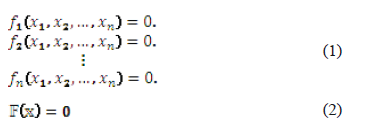
<body><![CDATA[<p align="center"><font size="2" face="Verdana, Arial, Helvetica, sans-serif"><b>Received for review March 22<sup>th</sup>, 2011, accepted May 17<sup>th</sup>, 2011, final version May, 23<sup>th</sup>, 2011</b></font></p>     <p>&nbsp;</p> <hr>     <p><font size="2" face="Verdana, Arial, Helvetica, sans-serif"><b>ABSTRACT:</b> This article describes the use of a numeric strategy to perform a metaheuristic optimization for finding the real roots of a nonlinear equation system. A theorem that shows why it can be treated as an optimization problem is shown. Some two-, three-, and five-equation systems are used as examples of the strategy.</font></p>     <p><font size="2" face="Verdana, Arial, Helvetica, sans-serif"><b>KEYWORDS:</b> nonlinear equations, optimization methods, particle swarm optimization</font></p>     <p><font size="2" face="Verdana, Arial, Helvetica, sans-serif"><b>RESUMEN:</b> Este art&iacute;culo describe una estrategia num&eacute;rica de optimizaci&oacute;n metaheur&iacute;stica, utilizada para determinar las soluciones en el conjunto de los n&uacute;meros reales de un sistema de ecuaciones no lineales. Se utiliza un teorema que demuestra la validez de conversi&oacute;n de un problema de soluci&oacute;n de ecuaciones no lineales en otro de optimizaci&oacute;n. A t&iacute;tulo de demostraci&oacute;n, se presentan algunos resultados para sistemas de dos, tres y cinco ecuaciones.</font></p>     <p><font size="2" face="Verdana, Arial, Helvetica, sans-serif"><b>PALABRAS CLAVE:</b> ecuaciones no lineales, m&eacute;todos de optimizaci&oacute;n, optimizaci&oacute;n por enjambre de part&iacute;culas</font></p> <hr>     <p>&nbsp;</p>     <p><font size="3" face="Verdana, Arial, Helvetica, sans-serif"><b>1. INTRODUCTION </b></font></p>     <p><font size="2" face="Verdana, Arial, Helvetica, sans-serif">A nonlinear equations system is defined, explicitly, by (1). It can also be defined in vectorial (or compact) notation by (2). Traditional numerical methods for the solution of these systems are based in algorithms that make use of matricial operations, whose elements belong to the derivatives of its functions. These direct methods pose several variations and approaches, but one of the most used, in engineering, is Newton-Raphson and its variations. Nevertheless, they take a long time to converge, and they only deliver one root (in its traditional form). Therefore, a tendency to migrate to more efficient methods is currently underway. One approach is to transform the solution of the nonlinear system into an optimization problem [1] whose mathematical foundation is included in this article. Most optimization methods, such as Newton's direct root method and its variants, also have an elevated computational cost, which is mainly due to the calculation and storage of the Jacobian (first order derivatives) and Hessian (second order derivatives) matrices that need to be evaluated at each candidate point for every iteration. A first approach proposed to reduce the memory requirements changed the matrices by an approximated one. Methods based on this change are known as quasi-Newton, and the Broyden-Fletcher-Goldfarb-Shanno (BFGS) algorithm is an example of them. It replaces the matrix with an expression that contains several matricial operations (additions, subtractions, products, divisions, and transposes), so the amount of memory required to obtain a new search direction is not vastly reduced [2]. Even so, all of these methods are easily trapped in local minima, or in saddle points, so a starting point near the solution is required, thus limiting its application in real life situations. </font></p>     <p><font size="2" face="Verdana, Arial, Helvetica, sans-serif">A new optimization strategy has appeared, known as metaheuristic algorithms. These make use of stochastic processes, and therefore they are not trapped by the presence of local minima. A method, whose popularity has been on the rise, is particle swarm optimization (PSO), developed in 1995 by Eberhart and Kennedy. It is based on imitating the behavior of animal flocks when looking for new food sources [3], and it is also a cooperative method, where all of its members (or particles) communicate better spots (or optimums) to the swarm [4]. During this research, PSO was used to find the real roots of nonlinear systems, due to its inherent complexity. </font></p>     ]]></body>
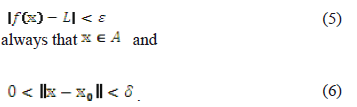
<body><![CDATA[<p><font size="2" face="Verdana, Arial, Helvetica, sans-serif">This article begins by presenting a mandatory justification, which allows for the transformation of a nonlinear system into an optimization problem. The validation process is performed by using, as an example, systems of two, three, and five equations.</font></p>     <p><font size="2" face="Verdana, Arial, Helvetica, sans-serif"><img src="/img/revistas/dyna/v78n170/a02eq0102.gif"></font></p>     <p><font size="3" face="Verdana, Arial, Helvetica, sans-serif"><b>2. FOUNDATIONS</b></font></p>     <p><font size="2" face="Verdana, Arial, Helvetica, sans-serif">Let equation (1) describe a system of <img src="/img/revistas/dyna/v78n170/a02eq20402.jpeg" /> nonlinear equations with <img src="/img/revistas/dyna/v78n170/a02eq20420.jpeg" /> unknowns, where fi is a mapping of the n-dimensional <img src="/img/revistas/dyna/v78n170/a02eq20435.jpeg" /> vector <img src="/img/revistas/dyna/v78n170/a02eq20450.jpeg" /> into the real axis <img src="/img/revistas/dyna/v78n170/a02eq20465.jpeg" />. This is equivalent to considering a function <img src="/img/revistas/dyna/v78n170/a02eq20483.jpeg" /> and mapping <img src="/img/revistas/dyna/v78n170/a02eq20505.jpeg" /> into <img src="/img/revistas/dyna/v78n170/a02eq20519.jpeg" /> by (3), where each function is a coordinate function of <img src="/img/revistas/dyna/v78n170/a02eq20534.jpeg" />.</font></p>     <p><font size="2" face="Verdana, Arial, Helvetica, sans-serif"><img src="/img/revistas/dyna/v78n170/a02eq03.gif"></font></p>     <p><font size="2" face="Verdana, Arial, Helvetica, sans-serif">Some required definitions are shown below. They are related to the continuity and differentiability of the functions of <img src="/img/revistas/dyna/v78n170/a02eq20594.jpeg" /> in<img src="/img/revistas/dyna/v78n170/a02eq20614.jpeg" />.</font></p>     <p><font size="2" face="Verdana, Arial, Helvetica, sans-serif">Definition 1: Let <img src="/img/revistas/dyna/v78n170/a02eq20632.jpeg" />be a function of <img src="/img/revistas/dyna/v78n170/a02eq20646.jpeg" /> in<img src="/img/revistas/dyna/v78n170/a02eq20661.jpeg" />. It is said that <img src="/img/revistas/dyna/v78n170/a02eq20676.jpeg" /> has a limit L in<img src="/img/revistas/dyna/v78n170/a02eq20697.jpeg" />,</font></p>     <p><font size="2" face="Verdana, Arial, Helvetica, sans-serif"><img src="/img/revistas/dyna/v78n170/a02eq04.gif"></font></p>     <p><font size="2" face="Verdana, Arial, Helvetica, sans-serif">if, given any number <img src="/img/revistas/dyna/v78n170/a02eq20752.jpeg" /> there exists a number <img src="/img/revistas/dyna/v78n170/a02eq20766.jpeg" /> with the property of</font></p>     <p><font size="2" face="Verdana, Arial, Helvetica, sans-serif"><img src="/img/revistas/dyna/v78n170/a02eq0506.gif"></font></p>     ]]></body>
<body><![CDATA[<p><font size="2" face="Verdana, Arial, Helvetica, sans-serif">Definition 2: Let <img src="/img/revistas/dyna/v78n170/a02eq20845.jpeg" />be a function of <img src="/img/revistas/dyna/v78n170/a02eq20862.jpeg" /> in<img src="/img/revistas/dyna/v78n170/a02eq20880.jpeg" />; <img src="/img/revistas/dyna/v78n170/a02eq20895.jpeg" /> is continuous in <img src="/img/revistas/dyna/v78n170/a02eq20909.jpeg" /> if <img src="/img/revistas/dyna/v78n170/a02eq20926.jpeg" /> exists and</font></p>     <p><font size="2" face="Verdana, Arial, Helvetica, sans-serif"><img src="/img/revistas/dyna/v78n170/a02eq07.gif"></font></p>     <p><font size="2" face="Verdana, Arial, Helvetica, sans-serif">Moreover, <img src="/img/revistas/dyna/v78n170/a02eq20979.jpeg" /> is continuous in <img src="/img/revistas/dyna/v78n170/a02eq20996.jpeg" /> if <img src="/img/revistas/dyna/v78n170/a02eq21011.jpeg" /> is continuous for every point of <img src="/img/revistas/dyna/v78n170/a02eq21025.jpeg" />. </font></p>     <p><font size="2" face="Verdana, Arial, Helvetica, sans-serif">Definition 3: Let <img src="/img/revistas/dyna/v78n170/a02eq21042.jpeg" /> be a function of <img src="/img/revistas/dyna/v78n170/a02eq21063.jpeg" /> in <img src="/img/revistas/dyna/v78n170/a02eq21081.jpeg" /> as follows: </font></p>     <p><font size="2" face="Verdana, Arial, Helvetica, sans-serif"><img src="/img/revistas/dyna/v78n170/a02eq08.gif"></font></p>     <p><font size="2" face="Verdana, Arial, Helvetica, sans-serif">where, fi is mapped from <img src="/img/revistas/dyna/v78n170/a02eq21131.jpeg" /> into<img src="/img/revistas/dyna/v78n170/a02eq21145.jpeg" /> for every i. It is then defined that </font></p>     <p><font size="2" face="Verdana, Arial, Helvetica, sans-serif"><img src="/img/revistas/dyna/v78n170/a02eq09.gif"></font></p>     <p><font size="2" face="Verdana, Arial, Helvetica, sans-serif">if and only if <img src="/img/revistas/dyna/v78n170/a02eq21187.jpeg" /> for every <img src="/img/revistas/dyna/v78n170/a02eq21204.jpeg" /></font></p>     <p><font size="2" face="Verdana, Arial, Helvetica, sans-serif">There exist several numerical strategies that strive to solve this type of system, such as the fixed point and multidimensional Newton-Raphson approaches [5]. The first one rarely succeeds, while the other one (more famous in engineering) converges quickly only if the starting point is near the solution, thus reducing its application in real life situations and for bigger problems. Besides, it requires a lot of computer resources and normally finds real roots. However, if initialized with a complex point, it will return a complex solution. The elevated computer requirements are related to the need for calculating, evaluating, and storing the Jacobian matrix and the <img src="/img/revistas/dyna/v78n170/a02eq21221.jpeg" /> system in all iterations. An improvement to such a disadvantage lies in the quasi-Newton algorithms, such as BFGS, where an approximation matrix is calculated instead of the Jacobian. Even if it lowers the computing requirements, its convergence speed is also reduced to the so called superlinear convergence. Further improvements include a redefinition of the inverse matrix, proposed by Sherman and Morrison [6]. There are also some other options, such as homotopy [7]. Recent literature describes some of the most important methods for solving nonlinear systems [1], [8-11]</font></p>     <p><font size="2" face="Verdana, Arial, Helvetica, sans-serif"><b>2.1 An optimization problem</b>    ]]></body>
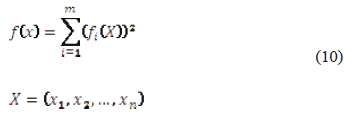
<body><![CDATA[<br>   A good approach, whose author cannot be tracked in time, is to transform a problem of solving a system of nonlinear equations into an optimization one [1,5,12-14]. Perhaps one of the most famous examples is the steepest descent method (including its variations), that has been vastly used (even though it only has linear convergence) to obtain the starting points for multidimensional Newton-Raphson [5]. Its main weakness, is the need to calculate the gradient, which can become a very time consuming task and, in some cases, an almost impossible one by analytic means. If done through commercial software, the computational requirements escalate because of the use of symbolic math. The theorem that allows the change into an optimization problem is presented below. It is mentioned for real roots, but its generalization into the complex realm is evident [15].</font></p>     <p><font size="2" face="Verdana, Arial, Helvetica, sans-serif"><b><i>Theorem 1: Real roots </i></b></font></p>     <p><font size="2" face="Verdana, Arial, Helvetica, sans-serif">Let X be a subset of <img src="/img/revistas/dyna/v78n170/a02eq21236.jpeg" /> and consider the system (1), where, for each i, fi is a function whose domain contains X, and whose range is within real numbers. Let <img src="/img/revistas/dyna/v78n170/a02eq21250.jpeg" /> be defined by (10). Note that f needs to be properly defined.</font></p>     <p><font size="2" face="Verdana, Arial, Helvetica, sans-serif"><img src="/img/revistas/dyna/v78n170/a02eq10.gif"></font></p>     <p><font size="2" face="Verdana, Arial, Helvetica, sans-serif">besides: </font></p>     <p><font size="2" face="Verdana, Arial, Helvetica, sans-serif">Proposition 1. Suppose that (1) has solution in <img src="/img/revistas/dyna/v78n170/a02eq21318.jpeg" /> and let <img src="/img/revistas/dyna/v78n170/a02eq21336.jpeg" />. Therefore, <img src="/img/revistas/dyna/v78n170/a02eq21350.jpeg" /> satisfies (1) if, and only if, <img src="/img/revistas/dyna/v78n170/a02eq21365.jpeg" /> minimizes f.</font></p>     <p><font size="2" face="Verdana, Arial, Helvetica, sans-serif">Proof. If <img src="/img/revistas/dyna/v78n170/a02eq21380.jpeg" /> satisfies (1), then <img src="/img/revistas/dyna/v78n170/a02eq21401.jpeg" /> for each <img src="/img/revistas/dyna/v78n170/a02eq21418.jpeg" /> Therefore, <img src="/img/revistas/dyna/v78n170/a02eq21435.jpeg" /> and since <img src="/img/revistas/dyna/v78n170/a02eq21450.jpeg" /> for every <img src="/img/revistas/dyna/v78n170/a02eq21464.jpeg" />, then <img src="/img/revistas/dyna/v78n170/a02eq21481.jpeg" /> is a minimum for <img src="/img/revistas/dyna/v78n170/a02eq21502.jpeg" />.</font></p>     <p><font size="2" face="Verdana, Arial, Helvetica, sans-serif">Now, if <img src="/img/revistas/dyna/v78n170/a02eq21520.jpeg" /> minimizes <img src="/img/revistas/dyna/v78n170/a02eq21534.jpeg" /> but does not satisfy (1), then <img src="/img/revistas/dyna/v78n170/a02eq21549.jpeg" /> must be a positive number since <img src="/img/revistas/dyna/v78n170/a02eq21564.jpeg" /> for every <img src="/img/revistas/dyna/v78n170/a02eq21584.jpeg" />. Given that the system has a solution in <img src="/img/revistas/dyna/v78n170/a02eq21601.jpeg" />, there exists an <img src="/img/revistas/dyna/v78n170/a02eq21618.jpeg" />that makes <img src="/img/revistas/dyna/v78n170/a02eq21633.jpeg" /><img src="/img/revistas/dyna/v78n170/a02eq21640.jpeg" /> and <img src="/img/revistas/dyna/v78n170/a02eq21647.jpeg" />. Therefore, <img src="/img/revistas/dyna/v78n170/a02eq21664.jpeg" /> which violates <img src="/img/revistas/dyna/v78n170/a02eq21684.jpeg" /> being the minimum for <img src="/img/revistas/dyna/v78n170/a02eq21702.jpeg" />. Note that the general condition on the consistency of the system is vital, since it is always possible to construct <img src="/img/revistas/dyna/v78n170/a02eq21716.jpeg" /> for a given system and, if <img src="/img/revistas/dyna/v78n170/a02eq21731.jpeg" /> minimizes it, it does not imply that a solution exists. Therefore, finding the roots for a system of nonlinear equations over a given set <img src="/img/revistas/dyna/v78n170/a02eq21746.jpeg" /> can be transformed into an optimization problem (minimization for this case) of the function <img src="/img/revistas/dyna/v78n170/a02eq21767.jpeg" /> over the set <img src="/img/revistas/dyna/v78n170/a02eq21786.jpeg" />. An algorithm containing this is as follows:</font></p>     <p><font size="2" face="Verdana, Arial, Helvetica, sans-serif"><b>Algorithm 1</b></font></p>     <p><font size="2" face="Verdana, Arial, Helvetica, sans-serif"><i>Input:</i> The nonlinear equations system (1) and the set <img src="/img/revistas/dyna/v78n170/a02eq21803.jpeg" />    ]]></body>
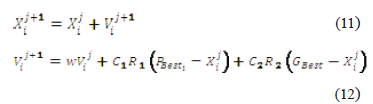
<body><![CDATA[<br>   <i>Step 1:</i> Build <img src="/img/revistas/dyna/v78n170/a02eq21818.jpeg" />    <br>   <i>Step 2:</i> Minimize <img src="/img/revistas/dyna/v78n170/a02eq21832.jpeg" /> over <img src="/img/revistas/dyna/v78n170/a02eq21849.jpeg" />.    <br>   <i>Step 3:</i> Let <img src="/img/revistas/dyna/v78n170/a02eq21870.jpeg" /> be a minimum for <img src="/img/revistas/dyna/v78n170/a02eq21888.jpeg" />. If <img src="/img/revistas/dyna/v78n170/a02eq21902.jpeg" /> then <img src="/img/revistas/dyna/v78n170/a02eq21917.jpeg" /> satisfies (1). Otherwise, it does not have solution in <img src="/img/revistas/dyna/v78n170/a02eq21932.jpeg" />.</font></p>     <p><font size="2" face="Verdana, Arial, Helvetica, sans-serif">Based on this theorem, a PSO algorithm was used to generate a real root of the system with a given precision of<img src="/img/revistas/dyna/v78n170/a02eq21952.jpeg" />, instead of using it to generate the starting point for Newton's direct root method. Some simulations with systems of two, three, and five nonlinear equations are presented in Section 3. It is important to remark that there is also evidence of other methods for solving nonlinear systems, but due to space restrictions, comparative results are not shown [16].</font></p>     <p><font size="2" face="Verdana, Arial, Helvetica, sans-serif"><b>2.2 PSO</b>    <br>   As mentioned, PSO appeared in 1995, thanks to Eberhart and Kennedy, who studied the social behavior of some animal groups which were looking for new sources of food. Unlike other evolutionary approaches (e.g., genetic algorithms), PSO is cooperative, sharing information with neighboring particles. Neighborhoods may have different topologies, so this is a key point for branches and variations. In its traditional form, the neighborhood is composed of all the particles in the swarm, so every better point found will be communicated to them. Another key point is related to the way its basic equations (position and speed) are updated, traditionally given by (11) and (12), where <img src="/img/revistas/dyna/v78n170/a02eq21980.jpeg" />, <img src="/img/revistas/dyna/v78n170/a02eq21987.jpeg" /> represent pointers for each position and time step, respectively; <img src="/img/revistas/dyna/v78n170/a02eq22002.jpeg" /> is a particle's position, <img src="/img/revistas/dyna/v78n170/a02eq22016.jpeg" /> its speed, <img src="/img/revistas/dyna/v78n170/a02eq22033.jpeg" /> an inertia factor to limit the effect of its previous speed, <img src="/img/revistas/dyna/v78n170/a02eq22053.jpeg" /> are the self and swarm trust factors, <img src="/img/revistas/dyna/v78n170/a02eq22071.jpeg" /> are random numbers (uniformly distributed) between zero and one, <img src="/img/revistas/dyna/v78n170/a02eq22085.jpeg" /> is the best position each particle has found and <img src="/img/revistas/dyna/v78n170/a02eq22100.jpeg" /> is the best position of all the swarm. </font></p>     <p><font size="2" face="Verdana, Arial, Helvetica, sans-serif"><img src="/img/revistas/dyna/v78n170/a02eq1112.gif"></font></p>     <p><font size="2" face="Verdana, Arial, Helvetica, sans-serif">One way to implement this algorithm is:</font></p> <ol>       <li><font size="2" face="Verdana, Arial, Helvetica, sans-serif">Assign a random initial position and zero speed for each particle. </font></li>       <li><font size="2" face="Verdana, Arial, Helvetica, sans-serif">Evaluate <img src="/img/revistas/dyna/v78n170/a02eq22284.jpeg" /> and find <img src="/img/revistas/dyna/v78n170/a02eq22301.jpeg" />.</font></li>       ]]></body>
<body><![CDATA[<li><font size="2" face="Verdana, Arial, Helvetica, sans-serif">Update the position and speed for each particle with (11) and (12).</font></li>       <li><font size="2" face="Verdana, Arial, Helvetica, sans-serif">Evaluate the objective function.</font></li>       <li><font size="2" face="Verdana, Arial, Helvetica, sans-serif">Compare, for each particle, the evaluated value and <img src="/img/revistas/dyna/v78n170/a02eq22318.jpeg" />. If it is lower, then update <img src="/img/revistas/dyna/v78n170/a02eq22334.jpeg" />.</font></li>       <li><font size="2" face="Verdana, Arial, Helvetica, sans-serif">Select the best particle and compare it to <img src="/img/revistas/dyna/v78n170/a02eq22348.jpeg" />. If lower, then update <img src="/img/revistas/dyna/v78n170/a02eq22365.jpeg" />.</font></li>       <li><font size="2" face="Verdana, Arial, Helvetica, sans-serif">Compare <img src="/img/revistas/dyna/v78n170/a02eq22385.jpeg" /> with convergence criteria. If it does not comply, return to 3.</font></li>     </ol>     <p>&nbsp;</p>     <p><font size="3" face="Verdana, Arial, Helvetica, sans-serif"><b>3. EXPERIMENTS AND RESULTS</b></font></p>     <p><b><font size="2" face="Verdana, Arial, Helvetica, sans-serif">3.1 Two-equation systems</font></b></p>     <p><font size="2" face="Verdana, Arial, Helvetica, sans-serif"><i>3.1.1 System (13)</i>    ]]></body>
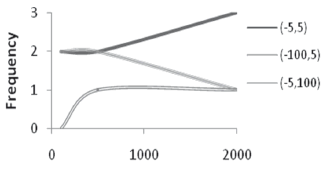
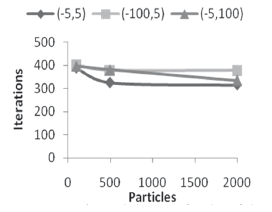
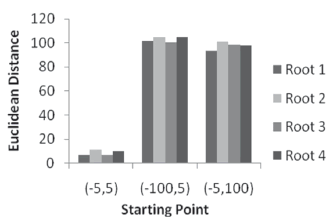
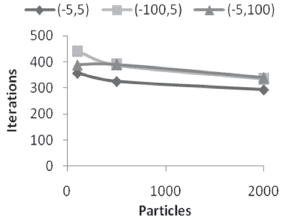
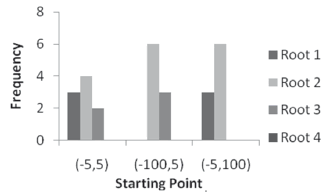
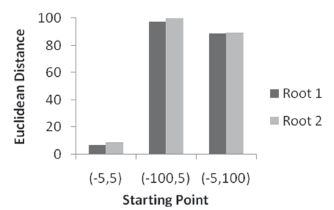
<body><![CDATA[<br>   <a href="#fig01">Figure 1</a> shows the results obtained after executing the PSO algorithm multiple times, starting at (<img src="/img/revistas/dyna/v78n170/a02eq22403.jpeg" />, <img src="/img/revistas/dyna/v78n170/a02eq22417.jpeg" />), (<img src="/img/revistas/dyna/v78n170/a02eq22432.jpeg" />, <img src="/img/revistas/dyna/v78n170/a02eq22447.jpeg" />5) and (<img src="/img/revistas/dyna/v78n170/a02eq22469.jpeg" />, <img src="/img/revistas/dyna/v78n170/a02eq22486.jpeg" />), respectively. It can be seen that, by increasing the number of particles, the real root found is not critically affected, so, from now on, only total values will be shown for each starting point. This system has two real roots, located at (<img src="/img/revistas/dyna/v78n170/a02eq22503.jpeg" />, <img src="/img/revistas/dyna/v78n170/a02eq22518.jpeg" />) and (<img src="/img/revistas/dyna/v78n170/a02eq22532.jpeg" />, <img src="/img/revistas/dyna/v78n170/a02eq22549.jpeg" />), that are obtained even if starting at the same point. This behavior is due to the heuristic characteristic of PSO and allows it to avoid getting stuck at a solution. </font></p>     <p><font size="2" face="Verdana, Arial, Helvetica, sans-serif"><img src="/img/revistas/dyna/v78n170/a02eq13.gif"></font></p>     <p align="center"><font size="2" face="Verdana, Arial, Helvetica, sans-serif"><b><a name="fig01"></a><img src="/img/revistas/dyna/v78n170/a02fig01.gif">    <br>   Figure 1.</b> Roots distribution for each swarm size and starting point, system (13)</font></p>     <p><font size="2" face="Verdana, Arial, Helvetica, sans-serif">It is interesting to show that there seems to be a predilection for finding the closest roots, as can be deduced from checking against <a href="#fig02">Figure 2</a>, where in 2/3 of the cases, the solution given by PSO was the closest one. <a href="#fig03">Figure 3</a> shows how the number of iterations varies with the size of the swarm. As the number of particles rises, it requires fewer cycles to converge. However, this reduction is lower for each increase, so there must be a minimum number of iterations, under which convergence is impossible to achieve (for a given margin of error). </font></p>     <p align="center"><font size="2" face="Verdana, Arial, Helvetica, sans-serif"><b><a name="fig02"></a><img src="/img/revistas/dyna/v78n170/a02fig02.gif">    <br>   Figure 2.</b> Euclidean distance from each starting point to real roots, system (13)</font></p>     <p align="center"><font size="2" face="Verdana, Arial, Helvetica, sans-serif"><b><a name="fig03"></a><img src="/img/revistas/dyna/v78n170/a02fig03.gif">    <br>   Figure 3.</b> Iteration variation as a function of the swarm size, system (13)</font></p>     <p><font size="2" face="Verdana, Arial, Helvetica, sans-serif"><b>3.1.2 System (14)</b>    ]]></body>

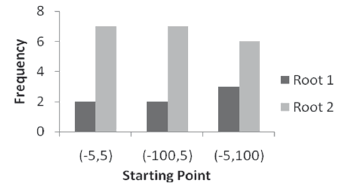
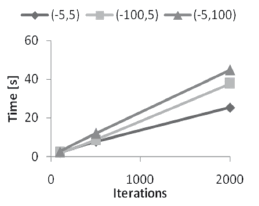
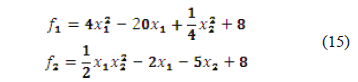
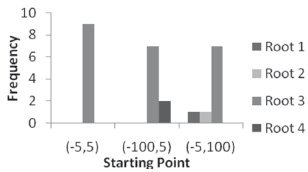
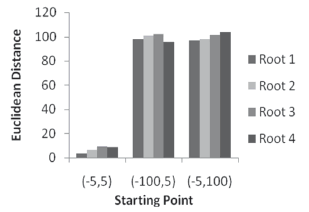
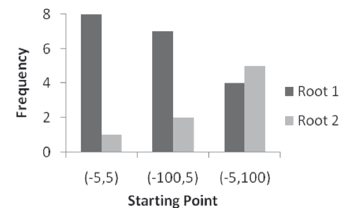
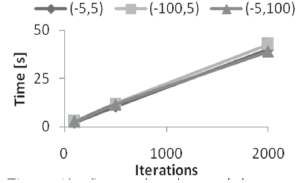
<body><![CDATA[<br>   <a href="#fig04">Figure 4</a> shows the results obtained after implementing PSO for system (14), whose roots are located at (<img src="/img/revistas/dyna/v78n170/a02eq22670.jpeg" />, <img src="/img/revistas/dyna/v78n170/a02eq22684.jpeg" />) and (<img src="/img/revistas/dyna/v78n170/a02eq22702.jpeg" />, <img src="/img/revistas/dyna/v78n170/a02eq22730.jpeg" />). Once again, beginning at the same point leads to a different solution. Nevertheless, it is also good to remark that beginning at different points can lead to the same real root. </font></p>     <p><font size="2" face="Verdana, Arial, Helvetica, sans-serif"><img src="/img/revistas/dyna/v78n170/a02eq14.gif"></font></p>     <p align="center"><font size="2" face="Verdana, Arial, Helvetica, sans-serif"><a name="fig04"></a><b><img src="/img/revistas/dyna/v78n170/a02fig04.gif">    <br>   Figure 4.</b> Real roots distribution for system (14)</font></p>     <p><font size="2" face="Verdana, Arial, Helvetica, sans-serif"><a href="#fig05">Figure 5</a> shows the way computation time behaves as the swarm size increases. Unlike iterations, this variable directly increases with population. This is noteworthy, since one would expect that by having a lower number of iterations (<a href="#fig03">Figure 3</a>), convergence will be achieved faster. However, this could be explained as follows: by having more particles, the computational cost is increased, thus making it so that each iteration takes longer to complete. <a href="#fig05">Figure 5</a> also shows that only for big swarm sizes (2000 particles), the starting point considerably affects the time required to converge.</font></p>     <p align="center"><font size="2" face="Verdana, Arial, Helvetica, sans-serif"><b><a name="fig05"></a><img src="/img/revistas/dyna/v78n170/a02fig05.gif">    <br>   Figure 5.</b> Computation time as a function of the swarm size and the starting point, system (14)</font></p>     <p><font size="2" face="Verdana, Arial, Helvetica, sans-serif"><b>3.1.3 System (15)</b>    <br>   <a href="#fig06">Figure 6</a> shows the results after computing system (15), whose roots are located at (<img src="/img/revistas/dyna/v78n170/a02eq22821.jpeg" />, <img src="/img/revistas/dyna/v78n170/a02eq22836.jpeg" />), (<img src="/img/revistas/dyna/v78n170/a02eq22856.jpeg" />, <img src="/img/revistas/dyna/v78n170/a02eq22873.jpeg" />), (<img src="/img/revistas/dyna/v78n170/a02eq22897.jpeg" />, <img src="/img/revistas/dyna/v78n170/a02eq22912.jpeg" />), and (<img src="/img/revistas/dyna/v78n170/a02eq22919.jpeg" />, <img src="/img/revistas/dyna/v78n170/a02eq22936.jpeg" />). When compared to <a href="#fig07">Figure 7</a>, it can be seen that there seems to be a predilection to converge to closer roots. However, this does not mean that it only finds that root, but that it will appear more frequently. <a href="#fig08">Figure 8</a> once again shows the variation in the number of iterations as the swarm gets bigger. In the same manner as shown previously, the bigger the swarm gets, the less iterations will be required to converge (up to a limit point for a given precision). Moreover, computation time will increase due to the excess of operations.</font></p>     <p><font size="2" face="Verdana, Arial, Helvetica, sans-serif"><img src="/img/revistas/dyna/v78n170/a02eq15.gif"></font></p>     ]]></body>

<body><![CDATA[<p align="center"><font size="2" face="Verdana, Arial, Helvetica, sans-serif"><b><a name="fig06"></a><img src="/img/revistas/dyna/v78n170/a02fig06.gif">    <br>   Figure 6.</b> Real roots distribution for system (15)</font></p>     <p align="center"><font size="2" face="Verdana, Arial, Helvetica, sans-serif"><b><a name="fig07"></a><img src="/img/revistas/dyna/v78n170/a02fig07.gif">    <br>   Figure 7.</b> Euclidean distance from each starting point to real roots, system (15)</font></p>     <p align="center"><font size="2" face="Verdana, Arial, Helvetica, sans-serif"><b><a name="fig08"></a><img src="/img/revistas/dyna/v78n170/a02fig08.gif">    <br>   Figure 8.</b> Iteration variation as a function of the swarm size, system (15)</font></p>     <p><font size="2" face="Verdana, Arial, Helvetica, sans-serif"><b>3.1.4 System (16)</b>    <br>   <a href="#fig09">Figure 9</a> presents the results achieved for system (16), whose roots are located at (<img src="/img/revistas/dyna/v78n170/a02eq23056.jpeg" />, <img src="/img/revistas/dyna/v78n170/a02eq23070.jpeg" />), (<img src="/img/revistas/dyna/v78n170/a02eq23087.jpeg" />, <img src="/img/revistas/dyna/v78n170/a02eq23121.jpeg" />), (<img src="/img/revistas/dyna/v78n170/a02eq23138.jpeg" />, <img src="/img/revistas/dyna/v78n170/a02eq23153.jpeg" />), and (<img src="/img/revistas/dyna/v78n170/a02eq23167.jpeg" /> <img src="/img/revistas/dyna/v78n170/a02eq23185.jpeg" />). It is shown that the starting point does not affect the algorithm's convergence, even though <a href="#fig10">Figure 10</a> confirms the predilection for closer real roots. <a href="#fig11">Figure 11</a> shows the behavior of the approximation error as a function of the swarm size. It is easily seen that dependence exists on the number of particles and on the starting point. However, in average terms, an excess of particles will lead to a higher error. Therefore, it is of the utmost importance to choose an appropriate swarm size. </font></p>     <p><font size="2" face="Verdana, Arial, Helvetica, sans-serif"><img src="/img/revistas/dyna/v78n170/a02eq16.gif"></font></p>     <p align="center"><font size="2" face="Verdana, Arial, Helvetica, sans-serif"><a name="fig09"></a><b><img src="/img/revistas/dyna/v78n170/a02fig09.gif">    ]]></body>

<body><![CDATA[<br>   Figure 9.</b> Real roots distribution for system (16)</font></p>     <p align="center"><font size="2" face="Verdana, Arial, Helvetica, sans-serif"><a name="fig10"></a><img src="/img/revistas/dyna/v78n170/a02fig10.gif"><b>    <br>   Figure 10.</b> Euclidean distance from each starting point to real roots, system (16)</font></p>     <p align="center"><font size="2" face="Verdana, Arial, Helvetica, sans-serif"><a name="fig11"></a><b><img src="/img/revistas/dyna/v78n170/a02fig11.gif">    <br>   Figure 11.</b> Square error variation as a function of the swarm size, system (16)</font></p>     <p><font size="2" face="Verdana, Arial, Helvetica, sans-serif"><b>3.1.5 System (17)</b>    <br>   <a href="#fig12">Figure 12</a> plots the results after implementing system (17), whose roots are located at (<img src="/img/revistas/dyna/v78n170/a02eq23301.jpeg" />,<img src="/img/revistas/dyna/v78n170/a02eq23323.jpeg" />) and (<img src="/img/revistas/dyna/v78n170/a02eq23331.jpeg" />, <img src="/img/revistas/dyna/v78n170/a02eq23351.jpeg" />). Once again, unlike direct search methods, the starting point is not a restriction for the real root found as a solution. Even so, the predilection for closer roots is maintained. </font></p>     <p><font size="2" face="Verdana, Arial, Helvetica, sans-serif"><img src="/img/revistas/dyna/v78n170/a02eq17.gif"></font></p>     <p align="center"><font size="2" face="Verdana, Arial, Helvetica, sans-serif"><a name="fig12"></a><b><img src="/img/revistas/dyna/v78n170/a02fig12.gif">    <br>   Figure 12.</b> Real roots distribution for system (17)</font></p>     ]]></body>

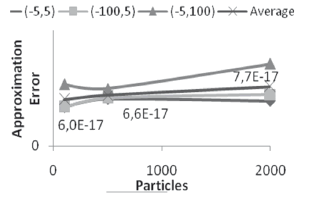
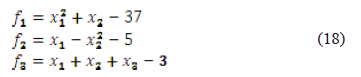
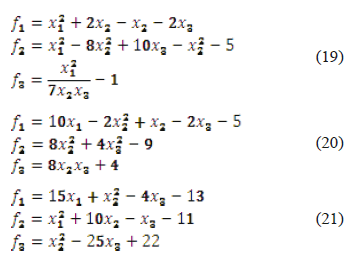
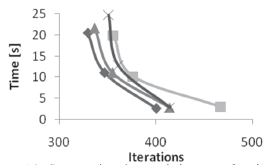
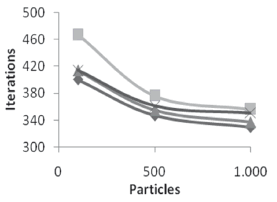
<body><![CDATA[<p><font size="2" face="Verdana, Arial, Helvetica, sans-serif"><a href="#fig13">Figure 13</a> allows corroboration of the behavior from <a href="#fig05">Figure 5</a>: the bigger the swarm, the lower the number of required iterations. However, computation time will be increased. </font></p>     <p align="center"><font size="2" face="Verdana, Arial, Helvetica, sans-serif"><a name="fig13"></a><b><img src="/img/revistas/dyna/v78n170/a02fig13.gif">    <br>   Figure 13.</b> Computation time variation as a function of the swarm size, system (17)</font></p>     <p><font size="2" face="Verdana, Arial, Helvetica, sans-serif"><b>3.2 Three-equation systems</b>    <br>   Striving to analyze the combined behavior of systems (18)-(21), some plots are presented with relevant data. <a href="#fig14">Figure 14</a> shows the variation on the computation time as a function of the number of iterations. It can be seen that it is normal to expect that a smaller system (i.e., one that performs more iterations) takes less time to converge. The relation between swarm size and number of iterations can be checked in <a href="#fig15">Figure 15</a>.</font></p>     <p><font size="2" face="Verdana, Arial, Helvetica, sans-serif"><img src="/img/revistas/dyna/v78n170/a02eq18.gif"></font></p>     <p><font size="2" face="Verdana, Arial, Helvetica, sans-serif"><img src="/img/revistas/dyna/v78n170/a02eq1921.gif"></font></p>     <p align="center"> <font size="2" face="Verdana, Arial, Helvetica, sans-serif"><a name="fig14"></a><b><img src="/img/revistas/dyna/v78n170/a02fig14.gif">    <br>   Figure 14.</b> Computation time variation as a function of the swarm size, systems: (18): diamond),  (19): square), (20): triangle), and (21): cross)</font></p>     <p align="center"> <font size="2" face="Verdana, Arial, Helvetica, sans-serif"><a name="fig15"></a><b><img src="/img/revistas/dyna/v78n170/a02fig15.gif">    ]]></body>
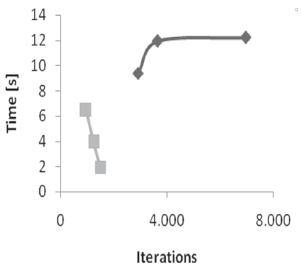
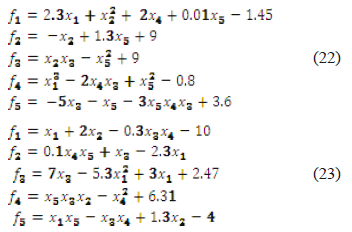
<body><![CDATA[<br>   Figure 15.</b> Iteration variation as a function of the swarm size, systems: (18): diamond), (19): square), (20): triangle), and (21): cross)</font></p>     <p><font size="2" face="Verdana, Arial, Helvetica, sans-serif"><b>3.3 Five-equation systems</b>    <br>   In an effort to check the behavior of PSO for more complex scenarios, systems (22) and (23) were implemented. Once again, <a href="#fgi16">Figure 16</a> shows that as the number of iterations goes up, the system is simplified and converges in less time. </font></p>     <p><font size="2" face="Verdana, Arial, Helvetica, sans-serif"><img src="/img/revistas/dyna/v78n170/a02eq2223.gif"></font></p>     <p align="center"> <font size="2" face="Verdana, Arial, Helvetica, sans-serif"><b><a name="fgi16"></a><img src="/img/revistas/dyna/v78n170/a02fig16.gif">    <br>   Figure 16.</b> Computation time variation as a function of the swarm size. Systems: (22): diamond) and (23): square). </font></p>     <p><font size="2" face="Verdana, Arial, Helvetica, sans-serif"><a href="#fig17">Figure 17</a> confirms the fact that smaller systems take more iterations to converge, but they are also simpler and therefore require less time to deliver a solution. </font></p>     <p align="center"><font size="2" face="Verdana, Arial, Helvetica, sans-serif"><a name="fig17"></a><b><img src="/img/revistas/dyna/v78n170/a02fig17.gif">    <br>   Figure 17.</b> Iteration variation as a function of the swarm size. Systems: (22): diamond) and (23): square).</font></p>     <p><font size="2" face="Verdana, Arial, Helvetica, sans-serif"><b>3.4 Performance Comparison</b>    ]]></body>
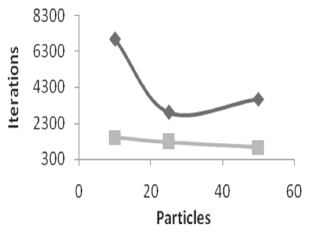
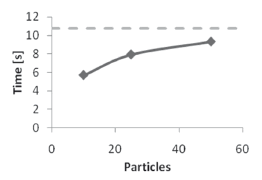
<body><![CDATA[<br>   In an effort to compare the performance (in terms of speed) of PSO against commercial software, plots of average computation time for each type of system were performed. For problems of two and three equations, the average computation time of PSO was well above the one achieved with the commercial software. However, this changes for bigger systems, as can be seen in <a href="#fig18">Figure 18</a>, where it is easily deducted that for 10 particles, the required time is about half of that required by commercial solutions. Therefore, it appears that PSO is a good choice for bigger, more complex systems.</font></p>     <p align="center"><font size="2" face="Verdana, Arial, Helvetica, sans-serif"><a name="fig18"></a><b><img src="/img/revistas/dyna/v78n170/a02fig18.gif">    <br>   Figure 18. </b>Average computation time for 5 x 5 systems. Diamond: PSO evolution. Dotted line: commercial software time</font></p>     <p>&nbsp;</p>     <p><font size="3" face="Verdana, Arial, Helvetica, sans-serif"><b>4. OBSERVATIONS AND CONCLUSIONS</b></font></p>     <p><font size="2" face="Verdana, Arial, Helvetica, sans-serif">After a careful review of the experimental data, it is natural to conclude that as the swarm gets bigger, the number of required iterations go down (see <a href="#fig03">Figure 3</a>,<a href="#fig08">8</a>,<a href="#fig15">15</a>). Interesting, though, is the fact that it has an adverse effect in the computation time (see <a href="#fig05">Figure 5</a>,<a href="#fig13">13</a>,<a href="#fig14">14</a>). This appears to be contradictory, since if there are less iterations it is expected that it will be quicker. Even though this is true, there is also the fact that by having a bigger swarm, the communication will be performed between more members, so it will adversely affect iteration time. Moreover, there will be more particles that require the calculation of P<sub><i>Best</i></sub> and G<sub><i>Best</i></sub>, so this will also increase the iteration time. In the end, convergence time will be higher than for a smaller swarm. Another interesting effect is the one that the swarm size has on the approximation error, which is directly proportional (see <a href="#fig11">Figure 11</a>). However, at the current time, it remains unknown whether it is due to some type of collision between particles or if it is due to the inertia weight (<i>w</i>), which could be stopping particles before they are able to migrate to a better point. In spite of that, it is of the utmost importance to define a proper swarm size, so that a balance between iterations, computation time and approximation error, is found. If chosen properly, a solution faster than by commercial means can be achieved (<a href="#fig18">Figure 18</a>). It is remarkable that PSO appears to have a preference for finding roots which are closer to the starting point, but still finding the furthest ones. </font></p>     <p><font size="2" face="Verdana, Arial, Helvetica, sans-serif">Finally, and as future research, it would be interesting to study PSO with complex roots and interval mathematics. A first step towards this goal has been taken [17], and we hope to report more conclusive information in the near future.</font></p>     <p>&nbsp;</p>     <p><font size="3" face="Verdana, Arial, Helvetica, sans-serif"><b>ACKNOWLEDGMENTS</b></font></p>     <p><font size="2" face="Verdana, Arial, Helvetica, sans-serif">This work was supported by Vicerrector&iacute;a de Investigaci&oacute;n y Extensi&oacute;n (Universidad Industrial de Santander), in the framework of project code 5551.</font></p>     ]]></body>
<body><![CDATA[<p>&nbsp;</p>     <p><font size="3" face="Verdana, Arial, Helvetica, sans-serif"><b>REFERENCES</b></font></p>     <!-- ref --><p><font size="2" face="Verdana, Arial, Helvetica, sans-serif"><b>[1]</b> Grosan, C. and Abraham, A., A New Approach for Solving Nonlinear Equations Systems, IEEE Transactions on Systems, Man, and Cybernetics - Part A: Systems and Humans, Vol. 38, (3), pp. 698-714, May. 2008.     &nbsp;&nbsp;&nbsp;&nbsp;&nbsp;&nbsp;&nbsp;&nbsp;[&#160;<a href="javascript:void(0);" onclick="javascript: window.open('/scielo.php?script=sci_nlinks&ref=000145&pid=S0012-7353201100060000200001&lng=','','width=640,height=500,resizable=yes,scrollbars=1,menubar=yes,');">Links</a>&#160;]<!-- end-ref --><!-- ref --><br>   <b>[2]</b> Rao, S. S., Engineering Optimization: Theory and Practice, Fourth Ed. John Wiley & Sons, Inc., pp. 1-829, 2009     &nbsp;&nbsp;&nbsp;&nbsp;&nbsp;&nbsp;&nbsp;&nbsp;[&#160;<a href="javascript:void(0);" onclick="javascript: window.open('/scielo.php?script=sci_nlinks&ref=000146&pid=S0012-7353201100060000200002&lng=','','width=640,height=500,resizable=yes,scrollbars=1,menubar=yes,');">Links</a>&#160;]<!-- end-ref --><!-- ref --><br>   <b>[3]</b> Parsopoulos, K. E. and Vrahatis, M. N., Particle Swarm Optimization and Intelligence: Advances and Applications, First Ed. Information Science Reference, pp. 1-329, 2010.     &nbsp;&nbsp;&nbsp;&nbsp;&nbsp;&nbsp;&nbsp;&nbsp;[&#160;<a href="javascript:void(0);" onclick="javascript: window.open('/scielo.php?script=sci_nlinks&ref=000147&pid=S0012-7353201100060000200003&lng=','','width=640,height=500,resizable=yes,scrollbars=1,menubar=yes,');">Links</a>&#160;]<!-- end-ref --><!-- ref --><br>   <b>[4]</b> Clerc, M., Particle swarm optimization, First Ed. ISTE, ,. 243, P. 2006     &nbsp;&nbsp;&nbsp;&nbsp;&nbsp;&nbsp;&nbsp;&nbsp;[&#160;<a href="javascript:void(0);" onclick="javascript: window.open('/scielo.php?script=sci_nlinks&ref=000148&pid=S0012-7353201100060000200004&lng=','','width=640,height=500,resizable=yes,scrollbars=1,menubar=yes,');">Links</a>&#160;]<!-- end-ref --><!-- ref --><br>   <b>[5]</b> Burden, R. L. and Faires, J. D., An&aacute;lisis Num&eacute;rico, Sexta Ed. International Thomson Publishing, , pp. 1-802. 1998     &nbsp;&nbsp;&nbsp;&nbsp;&nbsp;&nbsp;&nbsp;&nbsp;[&#160;<a href="javascript:void(0);" onclick="javascript: window.open('/scielo.php?script=sci_nlinks&ref=000149&pid=S0012-7353201100060000200005&lng=','','width=640,height=500,resizable=yes,scrollbars=1,menubar=yes,');">Links</a>&#160;]<!-- end-ref --><!-- ref --><br>   <b>[6]</b> Dennis, J. E. J. and Mor&eacute;, J. J., Quasi-Newton Methods, Motivation and Theory, SIAM Review, Vol. 19, (1), pp. 46-89, 1997.     &nbsp;&nbsp;&nbsp;&nbsp;&nbsp;&nbsp;&nbsp;&nbsp;[&#160;<a href="javascript:void(0);" onclick="javascript: window.open('/scielo.php?script=sci_nlinks&ref=000150&pid=S0012-7353201100060000200006&lng=','','width=640,height=500,resizable=yes,scrollbars=1,menubar=yes,');">Links</a>&#160;]<!-- end-ref --><!-- ref --><br>   <b>[7]</b> Allgower, E. L. and Georg, K., Numerical continuation methods: an introduction, Third Ed. Springer-Verlag New York, Inc., , pp. 1-388. 1990     &nbsp;&nbsp;&nbsp;&nbsp;&nbsp;&nbsp;&nbsp;&nbsp;[&#160;<a href="javascript:void(0);" onclick="javascript: window.open('/scielo.php?script=sci_nlinks&ref=000151&pid=S0012-7353201100060000200007&lng=','','width=640,height=500,resizable=yes,scrollbars=1,menubar=yes,');">Links</a>&#160;]<!-- end-ref --><!-- ref --><br>   <b>[8]</b> Effati, S. and Nazemi, A., A new method for solving a system of the nonlinear equations," Applied Mathematics and Computation, Vol. 168, no. 2, pp. 877-894, Sep. 2005.     &nbsp;&nbsp;&nbsp;&nbsp;&nbsp;&nbsp;&nbsp;&nbsp;[&#160;<a href="javascript:void(0);" onclick="javascript: window.open('/scielo.php?script=sci_nlinks&ref=000152&pid=S0012-7353201100060000200008&lng=','','width=640,height=500,resizable=yes,scrollbars=1,menubar=yes,');">Links</a>&#160;]<!-- end-ref --><!-- ref --><br>   <b>[9]</b> Bader, B. W., Tensor-Krylov Methods for Solving Large-Scale Systems of Nonlinear Equations, SIAM Journal on Numerical Analysis, Vol. 43, (3) , 1321 P. 2005.     &nbsp;&nbsp;&nbsp;&nbsp;&nbsp;&nbsp;&nbsp;&nbsp;[&#160;<a href="javascript:void(0);" onclick="javascript: window.open('/scielo.php?script=sci_nlinks&ref=000153&pid=S0012-7353201100060000200009&lng=','','width=640,height=500,resizable=yes,scrollbars=1,menubar=yes,');">Links</a>&#160;]<!-- end-ref --><!-- ref --><br>   <b>[10]</b> Salimbahrami, B. and Lohmann, B., Order reduction of large scale second-order systems using Krylov subspace methods, Linear Algebra and its Applications, Vol. 415, (2-3), pp. 385-405, Jun. 2006.     &nbsp;&nbsp;&nbsp;&nbsp;&nbsp;&nbsp;&nbsp;&nbsp;[&#160;<a href="javascript:void(0);" onclick="javascript: window.open('/scielo.php?script=sci_nlinks&ref=000154&pid=S0012-7353201100060000200010&lng=','','width=640,height=500,resizable=yes,scrollbars=1,menubar=yes,');">Links</a>&#160;]<!-- end-ref --><!-- ref --><br>   <b>[11]</b> Halton, J. H., Sequential Monte Carlo Techniques for Solving Non-Linear Systems, Monte Carlo Methods and Applications, Vol. 12, (2), pp. 113-141, Apr. 2006.     &nbsp;&nbsp;&nbsp;&nbsp;&nbsp;&nbsp;&nbsp;&nbsp;[&#160;<a href="javascript:void(0);" onclick="javascript: window.open('/scielo.php?script=sci_nlinks&ref=000155&pid=S0012-7353201100060000200011&lng=','','width=640,height=500,resizable=yes,scrollbars=1,menubar=yes,');">Links</a>&#160;]<!-- end-ref --><!-- ref --><br>   <b>[12]</b> Ortega, J. M. and Rheinboldt, W. C., Iterative Solution of Nonlinear Equations in Several Variables, First Ed. Academic Press, New York, , pp. 1-599, 1970.     &nbsp;&nbsp;&nbsp;&nbsp;&nbsp;&nbsp;&nbsp;&nbsp;[&#160;<a href="javascript:void(0);" onclick="javascript: window.open('/scielo.php?script=sci_nlinks&ref=000156&pid=S0012-7353201100060000200012&lng=','','width=640,height=500,resizable=yes,scrollbars=1,menubar=yes,');">Links</a>&#160;]<!-- end-ref --><!-- ref --><br>   <b>[13]</b> Nie, P., A null space method for solving system of equations, Applied Mathematics and Computation, Vol. 149, no. 1, pp. 215-226, Feb. 2004.     &nbsp;&nbsp;&nbsp;&nbsp;&nbsp;&nbsp;&nbsp;&nbsp;[&#160;<a href="javascript:void(0);" onclick="javascript: window.open('/scielo.php?script=sci_nlinks&ref=000157&pid=S0012-7353201100060000200013&lng=','','width=640,height=500,resizable=yes,scrollbars=1,menubar=yes,');">Links</a>&#160;]<!-- end-ref --><!-- ref --><br>   <b>[14]</b> Nie, P., An SQP approach with line search for a system of nonlinear equations, Mathematical and Computer Modelling, Vol. 43, (3-4), pp. 368-373, Feb. 2006.     &nbsp;&nbsp;&nbsp;&nbsp;&nbsp;&nbsp;&nbsp;&nbsp;[&#160;<a href="javascript:void(0);" onclick="javascript: window.open('/scielo.php?script=sci_nlinks&ref=000158&pid=S0012-7353201100060000200014&lng=','','width=640,height=500,resizable=yes,scrollbars=1,menubar=yes,');">Links</a>&#160;]<!-- end-ref --><!-- ref --><br>   <b>[15]</b> G&oacute;mez, L., Propuesta de demostraci&oacute;n del teorema sobre la relaci&oacute;n entre sistemas de ecuaciones y el problema de optimizaci&oacute;n (comunicaci&oacute;n interna). pp. 1-2, 2010.     &nbsp;&nbsp;&nbsp;&nbsp;&nbsp;&nbsp;&nbsp;&nbsp;[&#160;<a href="javascript:void(0);" onclick="javascript: window.open('/scielo.php?script=sci_nlinks&ref=000159&pid=S0012-7353201100060000200015&lng=','','width=640,height=500,resizable=yes,scrollbars=1,menubar=yes,');">Links</a>&#160;]<!-- end-ref --><!-- ref --><br>   <b>[16]</b> Areiza, M., Un M&eacute;todo Num&eacute;rico Cerrado para la Soluci&oacute;n de Sistemas de Ecuaciones No Lineales en Dos Variables, Dyna, Vol. 69, (137), pp. 45-50, 2002.     &nbsp;&nbsp;&nbsp;&nbsp;&nbsp;&nbsp;&nbsp;&nbsp;[&#160;<a href="javascript:void(0);" onclick="javascript: window.open('/scielo.php?script=sci_nlinks&ref=000160&pid=S0012-7353201100060000200016&lng=','','width=640,height=500,resizable=yes,scrollbars=1,menubar=yes,');">Links</a>&#160;]<!-- end-ref --><!-- ref --><br>   <b>[17]</b> Vanegas, D., Barrag&aacute;n, K. S., and Correa, R., Comparaci&oacute;n de las t&eacute;cnicas de optimizaci&oacute;n por an&aacute;lisis de intervalos y la de enjambre de part&iacute;culas para funciones con restricciones," Ingenier&iacute;a y Universidad (Universidad Javeriana - Accepted), 2011. </font>&nbsp;&nbsp;&nbsp;&nbsp;&nbsp;&nbsp;&nbsp;&nbsp;[&#160;<a href="javascript:void(0);" onclick="javascript: window.open('/scielo.php?script=sci_nlinks&ref=000161&pid=S0012-7353201100060000200017&lng=','','width=640,height=500,resizable=yes,scrollbars=1,menubar=yes,');">Links</a>&#160;]<!-- end-ref --> ]]></body><back>
<ref-list>
<ref id="B1">
<label>1</label><nlm-citation citation-type="journal">
<person-group person-group-type="author">
<name>
<surname><![CDATA[Grosan]]></surname>
<given-names><![CDATA[C.]]></given-names>
</name>
<name>
<surname><![CDATA[Abraham]]></surname>
<given-names><![CDATA[A.]]></given-names>
</name>
</person-group>
<article-title xml:lang="en"><![CDATA[A New Approach for Solving Nonlinear Equations Systems]]></article-title>
<source><![CDATA[IEEE Transactions on Systems, Man, and Cybernetics - Part A: Systems and Humans]]></source>
<year>May.</year>
<month> 2</month>
<day>00</day>
<volume>38</volume>
<numero>3</numero>
<issue>3</issue>
<page-range>698-714</page-range></nlm-citation>
</ref>
<ref id="B2">
<label>2</label><nlm-citation citation-type="book">
<person-group person-group-type="author">
<name>
<surname><![CDATA[Rao]]></surname>
<given-names><![CDATA[S. S.]]></given-names>
</name>
</person-group>
<source><![CDATA[Engineering Optimization: Theory and Practice]]></source>
<year>2009</year>
<edition>Fourth</edition>
<page-range>1-829</page-range><publisher-name><![CDATA[John Wiley & Sons, Inc.]]></publisher-name>
</nlm-citation>
</ref>
<ref id="B3">
<label>3</label><nlm-citation citation-type="book">
<person-group person-group-type="author">
<name>
<surname><![CDATA[Parsopoulos]]></surname>
<given-names><![CDATA[K. E.]]></given-names>
</name>
<name>
<surname><![CDATA[Vrahatis]]></surname>
<given-names><![CDATA[M. N.]]></given-names>
</name>
</person-group>
<source><![CDATA[Particle Swarm Optimization and Intelligence: Advances and Applications]]></source>
<year>2010</year>
<edition>First</edition>
<page-range>1-329</page-range><publisher-name><![CDATA[Information Science Reference]]></publisher-name>
</nlm-citation>
</ref>
<ref id="B4">
<label>4</label><nlm-citation citation-type="book">
<person-group person-group-type="author">
<name>
<surname><![CDATA[Clerc]]></surname>
<given-names><![CDATA[M.]]></given-names>
</name>
</person-group>
<source><![CDATA[Particle swarm optimization]]></source>
<year>2006</year>
<edition>First</edition>
<publisher-name><![CDATA[ISTE]]></publisher-name>
</nlm-citation>
</ref>
<ref id="B5">
<label>5</label><nlm-citation citation-type="book">
<person-group person-group-type="author">
<name>
<surname><![CDATA[Burden]]></surname>
<given-names><![CDATA[R. L.]]></given-names>
</name>
<name>
<surname><![CDATA[Faires]]></surname>
<given-names><![CDATA[J. D.]]></given-names>
</name>
</person-group>
<source><![CDATA[Análisis Numérico]]></source>
<year>1998</year>
<edition>Sexta</edition>
<page-range>1-802</page-range><publisher-name><![CDATA[International Thomson Publishing]]></publisher-name>
</nlm-citation>
</ref>
<ref id="B6">
<label>6</label><nlm-citation citation-type="journal">
<person-group person-group-type="author">
<name>
<surname><![CDATA[Dennis]]></surname>
<given-names><![CDATA[J. E. J.]]></given-names>
</name>
<name>
<surname><![CDATA[Moré]]></surname>
<given-names><![CDATA[J. J.]]></given-names>
</name>
</person-group>
<article-title xml:lang="en"><![CDATA[Quasi-Newton Methods, Motivation and Theory]]></article-title>
<source><![CDATA[SIAM Review]]></source>
<year>1997</year>
<volume>19</volume>
<numero>1</numero>
<issue>1</issue>
<page-range>46-89</page-range></nlm-citation>
</ref>
<ref id="B7">
<label>7</label><nlm-citation citation-type="book">
<person-group person-group-type="author">
<name>
<surname><![CDATA[Allgower]]></surname>
<given-names><![CDATA[E. L.]]></given-names>
</name>
<name>
<surname><![CDATA[Georg]]></surname>
<given-names><![CDATA[K.]]></given-names>
</name>
</person-group>
<source><![CDATA[Numerical continuation methods: an introduction]]></source>
<year>1990</year>
<edition>Third</edition>
<page-range>1-388</page-range><publisher-name><![CDATA[Springer-Verlag New York, Inc.]]></publisher-name>
</nlm-citation>
</ref>
<ref id="B8">
<label>8</label><nlm-citation citation-type="journal">
<person-group person-group-type="author">
<name>
<surname><![CDATA[Effati]]></surname>
<given-names><![CDATA[S.]]></given-names>
</name>
<name>
<surname><![CDATA[Nazemi]]></surname>
<given-names><![CDATA[A.]]></given-names>
</name>
</person-group>
<article-title xml:lang="en"><![CDATA[A new method for solving a system of the nonlinear equations]]></article-title>
<source><![CDATA[Applied Mathematics and Computation]]></source>
<year>Sep.</year>
<month> 2</month>
<day>00</day>
<volume>168</volume>
<numero>2</numero>
<issue>2</issue>
<page-range>877-894</page-range></nlm-citation>
</ref>
<ref id="B9">
<label>9</label><nlm-citation citation-type="journal">
<person-group person-group-type="author">
<name>
<surname><![CDATA[Bader]]></surname>
<given-names><![CDATA[B. W.]]></given-names>
</name>
</person-group>
<article-title xml:lang="en"><![CDATA[Tensor-Krylov Methods for Solving Large-Scale Systems of Nonlinear Equations]]></article-title>
<source><![CDATA[SIAM Journal on Numerical Analysis]]></source>
<year>2005</year>
<volume>43</volume>
<numero>3</numero>
<issue>3</issue>
<page-range>1321</page-range></nlm-citation>
</ref>
<ref id="B10">
<label>10</label><nlm-citation citation-type="journal">
<person-group person-group-type="author">
<name>
<surname><![CDATA[Salimbahrami]]></surname>
<given-names><![CDATA[B.]]></given-names>
</name>
<name>
<surname><![CDATA[Lohmann]]></surname>
<given-names><![CDATA[B.]]></given-names>
</name>
</person-group>
<article-title xml:lang="en"><![CDATA[Order reduction of large scale second-order systems using Krylov subspace methods]]></article-title>
<source><![CDATA[Linear Algebra and its Applications]]></source>
<year>Jun.</year>
<month> 2</month>
<day>00</day>
<volume>415</volume>
<numero>2-3</numero>
<issue>2-3</issue>
<page-range>385-405</page-range></nlm-citation>
</ref>
<ref id="B11">
<label>11</label><nlm-citation citation-type="journal">
<person-group person-group-type="author">
<name>
<surname><![CDATA[Halton]]></surname>
<given-names><![CDATA[J. H.]]></given-names>
</name>
</person-group>
<article-title xml:lang="en"><![CDATA[Sequential Monte Carlo Techniques for Solving Non-Linear Systems]]></article-title>
<source><![CDATA[Monte Carlo Methods and Applications]]></source>
<year>Apr.</year>
<month> 2</month>
<day>00</day>
<volume>12</volume>
<numero>2</numero>
<issue>2</issue>
<page-range>113-141</page-range></nlm-citation>
</ref>
<ref id="B12">
<label>12</label><nlm-citation citation-type="book">
<person-group person-group-type="author">
<name>
<surname><![CDATA[Ortega]]></surname>
<given-names><![CDATA[J. M.]]></given-names>
</name>
<name>
<surname><![CDATA[Rheinboldt]]></surname>
<given-names><![CDATA[W. C.]]></given-names>
</name>
</person-group>
<source><![CDATA[Iterative Solution of Nonlinear Equations in Several Variables]]></source>
<year>1970</year>
<edition>First</edition>
<page-range>1-599</page-range><publisher-loc><![CDATA[New York ]]></publisher-loc>
<publisher-name><![CDATA[Academic Press]]></publisher-name>
</nlm-citation>
</ref>
<ref id="B13">
<label>13</label><nlm-citation citation-type="journal">
<person-group person-group-type="author">
<name>
<surname><![CDATA[Nie]]></surname>
<given-names><![CDATA[P.]]></given-names>
</name>
</person-group>
<article-title xml:lang="en"><![CDATA[A null space method for solving system of equations]]></article-title>
<source><![CDATA[Applied Mathematics and Computation]]></source>
<year>Feb.</year>
<month> 2</month>
<day>00</day>
<volume>149</volume>
<numero>1</numero>
<issue>1</issue>
<page-range>215-226</page-range></nlm-citation>
</ref>
<ref id="B14">
<label>14</label><nlm-citation citation-type="journal">
<person-group person-group-type="author">
<name>
<surname><![CDATA[Nie]]></surname>
<given-names><![CDATA[P.]]></given-names>
</name>
</person-group>
<article-title xml:lang="en"><![CDATA[An SQP approach with line search for a system of nonlinear equations]]></article-title>
<source><![CDATA[Mathematical and Computer Modelling]]></source>
<year>Feb.</year>
<month> 2</month>
<day>00</day>
<volume>43</volume>
<numero>3-4</numero>
<issue>3-4</issue>
<page-range>368-373</page-range></nlm-citation>
</ref>
<ref id="B15">
<label>15</label><nlm-citation citation-type="">
<person-group person-group-type="author">
<name>
<surname><![CDATA[Gómez]]></surname>
<given-names><![CDATA[L.]]></given-names>
</name>
</person-group>
<article-title xml:lang="es"><![CDATA[Propuesta de demostración del teorema sobre la relación entre sistemas de ecuaciones y el problema de optimización]]></article-title>
<source><![CDATA[]]></source>
<year>2010</year>
<page-range>1-2</page-range></nlm-citation>
</ref>
<ref id="B16">
<label>16</label><nlm-citation citation-type="journal">
<person-group person-group-type="author">
<name>
<surname><![CDATA[Areiza]]></surname>
<given-names><![CDATA[M.]]></given-names>
</name>
</person-group>
<article-title xml:lang="es"><![CDATA[Un Método Numérico Cerrado para la Solución de Sistemas de Ecuaciones No Lineales en Dos Variables]]></article-title>
<source><![CDATA[Dyna]]></source>
<year>2002</year>
<volume>69</volume>
<numero>137</numero>
<issue>137</issue>
<page-range>45-50</page-range></nlm-citation>
</ref>
<ref id="B17">
<label>17</label><nlm-citation citation-type="journal">
<person-group person-group-type="author">
<name>
<surname><![CDATA[Vanegas]]></surname>
<given-names><![CDATA[D.]]></given-names>
</name>
<name>
<surname><![CDATA[Barragán]]></surname>
<given-names><![CDATA[K. S.]]></given-names>
</name>
<name>
<surname><![CDATA[Correa]]></surname>
<given-names><![CDATA[R.]]></given-names>
</name>
</person-group>
<article-title xml:lang="es"><![CDATA[Comparación de las técnicas de optimización por análisis de intervalos y la de enjambre de partículas para funciones con restricciones]]></article-title>
<source><![CDATA[Ingeniería y Universidad]]></source>
<year>2011</year>
</nlm-citation>
</ref>
</ref-list>
</back>
</article>