<?xml version="1.0" encoding="ISO-8859-1"?><article xmlns:mml="http://www.w3.org/1998/Math/MathML" xmlns:xlink="http://www.w3.org/1999/xlink" xmlns:xsi="http://www.w3.org/2001/XMLSchema-instance">
<front>
<journal-meta>
<journal-id>0012-7353</journal-id>
<journal-title><![CDATA[DYNA]]></journal-title>
<abbrev-journal-title><![CDATA[Dyna rev.fac.nac.minas]]></abbrev-journal-title>
<issn>0012-7353</issn>
<publisher>
<publisher-name><![CDATA[Universidad Nacional de Colombia]]></publisher-name>
</publisher>
</journal-meta>
<article-meta>
<article-id>S0012-73532011000600026</article-id>
<title-group>
<article-title xml:lang="en"><![CDATA[A METHODOLOGICAL MODEL TO ASSIST IN THE OPTIMIZATION AND RISK MANAGEMENT OF MINING INVESTMENT DECISIONS]]></article-title>
<article-title xml:lang="es"><![CDATA[UN MODELO METODOLOGICO DE APOYO A LA OPTIMIZACIÓN Y LA GESTION DEL RIESGO EN LAS DECISIONES DE INVERSIÓN EN MINERIA]]></article-title>
</title-group>
<contrib-group>
<contrib contrib-type="author">
<name>
<surname><![CDATA[BOTÍN]]></surname>
<given-names><![CDATA[JOSÉ A.]]></given-names>
</name>
<xref ref-type="aff" rid="A01"/>
</contrib>
<contrib contrib-type="author">
<name>
<surname><![CDATA[GUZMÁN]]></surname>
<given-names><![CDATA[RONALD R.]]></given-names>
</name>
<xref ref-type="aff" rid="A02"/>
</contrib>
<contrib contrib-type="author">
<name>
<surname><![CDATA[SMITH]]></surname>
<given-names><![CDATA[MARTIN L.]]></given-names>
</name>
<xref ref-type="aff" rid="A03"/>
</contrib>
</contrib-group>
<aff id="A01">
<institution><![CDATA[,Pontificia Universidad Católica de Chile Centro de Minería ]]></institution>
<addr-line><![CDATA[ ]]></addr-line>
</aff>
<aff id="A02">
<institution><![CDATA[,Pontificia Universidad Católica de Chile Centro de Minería ]]></institution>
<addr-line><![CDATA[ ]]></addr-line>
</aff>
<aff id="A03">
<institution><![CDATA[,Pontificia Universidad Católica de Chile Centro de Minería ]]></institution>
<addr-line><![CDATA[ ]]></addr-line>
</aff>
<pub-date pub-type="pub">
<day>00</day>
<month>12</month>
<year>2011</year>
</pub-date>
<pub-date pub-type="epub">
<day>00</day>
<month>12</month>
<year>2011</year>
</pub-date>
<volume>78</volume>
<numero>170</numero>
<fpage>221</fpage>
<lpage>226</lpage>
<copyright-statement/>
<copyright-year/>
<self-uri xlink:href="http://www.scielo.org.co/scielo.php?script=sci_arttext&amp;pid=S0012-73532011000600026&amp;lng=en&amp;nrm=iso"></self-uri><self-uri xlink:href="http://www.scielo.org.co/scielo.php?script=sci_abstract&amp;pid=S0012-73532011000600026&amp;lng=en&amp;nrm=iso"></self-uri><self-uri xlink:href="http://www.scielo.org.co/scielo.php?script=sci_pdf&amp;pid=S0012-73532011000600026&amp;lng=en&amp;nrm=iso"></self-uri><abstract abstract-type="short" xml:lang="en"><p><![CDATA[Identifying, quantifying, and minimizing technical risks associated with investment decisions is a key challenge for mineral industry decision makers and investors. However, risk analysis in most bankable mine feasibility studies are based on the stochastic modelling of project “Net Present Value” (NPV)which, in most cases, fails to provide decision makers with a truly comprehensive analysis of risks associated with technical and management uncertainty and, as a result, are of little use for risk management and project optimization. This paper presents a value-chain risk management approach where project risk is evaluated for each step of the project lifecycle, from exploration to mine closure, and risk management is performed as a part of a stepwise value-added optimization process.]]></p></abstract>
<abstract abstract-type="short" xml:lang="es"><p><![CDATA[Identificar, cuantificar y minimizar el riesgo técnico asociado a las decisiones de inversión es un desafío clave para los directivos de la industria minera y los inversores. Sin embargo, en la mayor parte de los estudios de factibilidad bancables, el análisis de riesgo se basa en la modelización estocástica del “Valor actual neto” del proyecto (VAN) que, en la mayoría de los casos, no aporta a los tomadores de decisión una análisis completo de los riesgos derivados de la incertidumbre técnica y de gestión y por ello, resulta de escasa utilidad en el análisis de riesgo y la optimización del proyecto. Este articulo presenta un planteamiento de la gestión de riesgo basado en la cadena de valor, en el que el riesgo del proyecto se evalúa en cada etapa del ciclo de vida del proyecto, desde la exploración al cierre de la mina, y la gestión del riesgo forma parte de un proceso en etapas de valor agregado y optimización.]]></p></abstract>
<kwd-group>
<kwd lng="en"><![CDATA[mining]]></kwd>
<kwd lng="en"><![CDATA[project]]></kwd>
<kwd lng="en"><![CDATA[risk management]]></kwd>
<kwd lng="es"><![CDATA[Minería]]></kwd>
<kwd lng="es"><![CDATA[proyecto]]></kwd>
<kwd lng="es"><![CDATA[gestión de riesgo]]></kwd>
</kwd-group>
</article-meta>
</front><body><![CDATA[ <p align="center"><font size="4" face="Verdana, Arial, Helvetica, sans-serif"><b>A  METHODOLOGICAL MODEL TO ASSIST IN THE OPTIMIZATION AND RISK MANAGEMENT OF  MINING INVESTMENT DECISIONS</b></font></p>     <p align="center"><i><font size="3"><b><font face="Verdana, Arial, Helvetica, sans-serif">UN MODELO METODOLOGICO DE APOYO A LA OPTIMIZACI&Oacute;N Y LA  GESTION DEL RIESGO EN LAS DECISIONES DE INVERSI&Oacute;N EN MINERIA</font></b></font></i></p>     <p align="center">&nbsp;</p>     <p align="center"><font size="2" face="Verdana, Arial, Helvetica, sans-serif"><b>JOS&Eacute; A. BOT&Iacute;N    <br>   </b></font><font size="2" face="Verdana, Arial, Helvetica, sans-serif">Dr. Ing. Minas, Professor and Director Centro de Miner&iacute;a,  Pontificia Universidad Cat&oacute;lica de Chile, <a href="mailto:jbotin@ing.puc.cl">jbotin@ing.puc.cl</a></font></p>     <p align="center"><font size="2" face="Verdana, Arial, Helvetica, sans-serif"><b>RONALD R. GUZM&Aacute;N    <br>   </b></font><font size="2" face="Verdana, Arial, Helvetica, sans-serif">Ing.Civil de Minas, Professor, Centro de Miner&iacute;a, Pontificia  Universidad Cat&oacute;lica de Chile, <a href="mailto:rguzman@ing.puc.cl">rguzman@ing.puc.cl</a></font></p>     <p align="center"><font size="2" face="Verdana, Arial, Helvetica, sans-serif"><b>MARTIN L. SMITH    <br>   </b></font><font size="2" face="Verdana, Arial, Helvetica, sans-serif">Dr. of Philosophy, Profesor, Centro de Miner&iacute;a,  Pontificia Universidad Cat&oacute;lica de Chile, <a href="mailto:msmith@ing.puc.cl">msmith@ing.puc.cl</a> </font></p>     <p align="center">&nbsp;</p>     ]]></body>
<body><![CDATA[<p align="center"><font size="2" face="Verdana, Arial, Helvetica, sans-serif"><b>Received for review January 16<sup>th</sup>, 2011, accepted April 8<sup>th</sup>, 2011, final version April 29<sup>th</sup>, 2011</b></font></p>     <p align="center">&nbsp;</p> <hr>     <p><font size="2" face="Verdana, Arial, Helvetica, sans-serif"><b>ABSTRACT:</b> Identifying, quantifying, and minimizing technical risks associated with investment decisions is a key challenge for mineral industry decision makers and investors. However, risk analysis in most bankable mine feasibility studies are based on the stochastic modelling of project &quot;Net Present Value&quot; (NPV)which, in most cases, fails to provide decision makers with a truly comprehensive analysis of risks associated with technical and management uncertainty and, as a result, are of little use for risk management and project optimization. This paper presents a value-chain risk management approach where project risk is evaluated for each step of the project lifecycle, from exploration to mine closure, and risk management is performed as a part of a stepwise value-added optimization process.</font></p>     <p><font size="2" face="Verdana, Arial, Helvetica, sans-serif"><b>KEYWORDS:</b> mining, project, risk management </font></p>     <p><font size="2" face="Verdana, Arial, Helvetica, sans-serif"><b>RESUMEN:</b> Identificar, cuantificar y minimizar el riesgo t&eacute;cnico asociado a las decisiones de inversi&oacute;n es un desaf&iacute;o clave para los directivos de la industria minera y los inversores. Sin embargo, en la mayor parte de los estudios de factibilidad bancables, el an&aacute;lisis de riesgo se basa en la modelizaci&oacute;n estoc&aacute;stica del &quot;Valor actual neto&quot; del proyecto (VAN) que, en la mayor&iacute;a de los casos, no aporta a los tomadores de decisi&oacute;n una an&aacute;lisis completo de los riesgos derivados de la incertidumbre t&eacute;cnica y de gesti&oacute;n y por ello, resulta de escasa utilidad en el an&aacute;lisis de riesgo y la optimizaci&oacute;n del proyecto. Este articulo presenta un planteamiento de la gesti&oacute;n de riesgo basado en la cadena de valor, en el que el riesgo del proyecto se eval&uacute;a en cada etapa del ciclo de vida del proyecto, desde la exploraci&oacute;n al cierre de la mina, y la gesti&oacute;n del riesgo forma parte de un proceso en etapas de valor agregado y optimizaci&oacute;n..</font></p>     <p><font size="2" face="Verdana, Arial, Helvetica, sans-serif"><b>PALABRAS CLAVE:</b> Miner&iacute;a, proyecto, gesti&oacute;n de riesgo</font></p> <hr>     <p>&nbsp;</p>     <p><font size="3" face="Verdana, Arial, Helvetica, sans-serif"><b>1. INTRODUCTION</b></font></p>     <p><font size="2" face="Verdana, Arial, Helvetica, sans-serif">The management of a mining project can be seen as a &quot;stepwise risk reduction process&quot; in which increasingly larger amounts of capital are invested through time to reduce uncertainty and financial risk. At the end of each stage, a drop/continue decision is taken on the basis of existing information and, if the decision is to continue, the project enters the next stage of evaluation at a higher capital intensity. At the last stage, the project may reach a level of financial risk which is acceptable to investors and proceed to development. </font></p>     <p><font size="2" face="Verdana, Arial, Helvetica, sans-serif">Mining project risk management (MPRM) is a methodological framework focused on identifying and managing decision risk along the project value chain; uncertainty and technical risks can be evaluated for each step of the project lifecycle, from exploration to mine closure, and are managed as part of a stepwise value-added optimization process.</font></p>     ]]></body>
<body><![CDATA[<p><font size="2" face="Verdana, Arial, Helvetica, sans-serif">The MPRM concept is the result of collaborative research effort between the Universidad Politecnica de Madrid (School of Mines) and Pontificia Universidad Cat&oacute;lica de Chile (Mining Center), with the long term objective of developing a general value-chain risk management and project optimization toolkit to assist mining investment decision. </font></p>     <p>&nbsp;</p>     <p><b><font size="3" face="Verdana, Arial, Helvetica, sans-serif">2. STATE OF THE ART IN MINING INVESTMENT RISK MANAGEMENT</font></b></p>     <p><font size="2" face="Verdana, Arial, Helvetica, sans-serif">The literature on mining investment risk is abundant [1,2], but a global decision risk methodology is lacking. Existing publications focus on a specific source of risk (e.g., resources, mine planning) or the evaluation of the sensitivity of project profitability to the variation of key project parameters but, in most cases, fail to identify the origin of risk and its impact on the different stages of a project's value chain [3,4,5]. Methodologies and technologies for managing risk have focused on several areas of application which are discussed below.</font></p>     <p><font size="2" face="Verdana, Arial, Helvetica, sans-serif">The estimation of ore reserves is a primary concern for bankers who view mineral &quot;project finance as being higher risk-demanding deeper research and higher fees&quot; [6]. Conditional simulation has received increased attention as a means of quantifying risk in mineralization. Whereas Kriging provides the expected value of mineralization, the simulation of the orebody estimates the distribution of mineralization while honoring both the data distribution and spatial covariance. Conditional simulation provides a means for quantifying variability in both the resource and in production. Li [7] describes the calculation of the relative absolute error using the simulation of multiple coal resource models as a means of quantifying resource risk. Also, there have been recent advances in developing stochastic alternatives to the deterministic Lerchs-Grossman algorithm used by most pit optimisation packages [8].</font></p>     <p><font size="2" face="Verdana, Arial, Helvetica, sans-serif">Sampling is a recognized source of project risk. Dominy [9] notes the relationship between sampling error and increased nugget effect, and the resulting impact on increased resource risk, recommending rigorous quality assurance and quality control (QA/QC) protocols throughout the sampling and assay program. </font></p>     <p><font size="2" face="Verdana, Arial, Helvetica, sans-serif">Geometallurgical characterization of the orebody is receiving greater attention as a source of risk, since grade alone is an insufficient measure of metal production and the resulting cash flow. David [10] describes the geometallurgical characterization process and notes the high risk associated with currently inadequate sampling practices, noting the need to include geometallurgical domaining as a component of project evaluation.</font></p>     <p><font size="2" face="Verdana, Arial, Helvetica, sans-serif">There is increased criticism of DCF analysis as a single measure of project value, namely: Why use a single risk adjusted discount rate when there are aspects of a project associated with different levels of risk? The consequence of using the same discount rate for projects having difference risk profiles is that riskier projects may be overvalued. Guj and Garzon [11] discuss modern asset pricing as a means of applying risk to project evaluation.</font></p>     <p><font size="2" face="Verdana, Arial, Helvetica, sans-serif">The apparent ease of the application of Monte Carlo simulation in order to evaluate risk relating to operational performance, production costs, prices, and exchange rates has attracted analysts seeking a coherent framework for risk assessment [4]. Unfortunately, Monte Carlo simulation has the same fundamental weaknesses as deterministic sensitivity analysis: the disconnection between changes in stochastic parameters, prices, and the underlying mine plan. Classical financial models treat the production schedule as invariant while flexing key parameters upon which the derivation of the mine plan was based. The introduction of probability does not in any way alter this limitation. Clearly, an integrated methodology is needed which will allow for changes in key parameters to alter underlying, correlated decisions. For instance, if the expected value for operating costs increase or prices fall, then the reserve must be allowed to decline, reflecting a corresponding increase in cutoffs. </font></p>     <p><font size="2" face="Verdana, Arial, Helvetica, sans-serif">Whittle et al. [12] describe an optimization-based approach to integrated risk quantification that combines @Risk, Lerchs-Grossman pit optimization, and a &quot;Global&quot; optimizer. @Risk was used to sample key project inputs from a database in which these inputs are described as probability distributions. The sample is then used an optimal mine plan which is entered into the Global Optimizer to &quot;optimize the whole of business NPV over LOM.&quot; By sampling and then optimizing the underlying distributions some hundreds of times, an approximation of the NPV distribution is obtained that relates alternative combinations of project parameters to corresponding changes in pit reserves and production schedules. </font></p>     ]]></body>
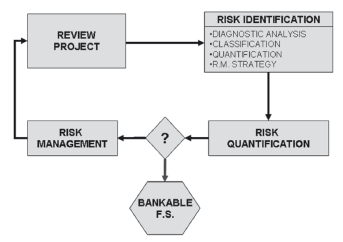
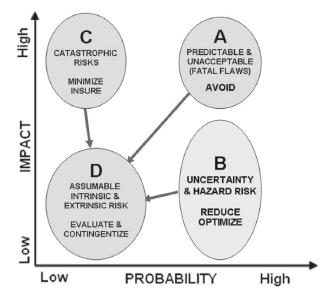
<body><![CDATA[<p><font size="2" face="Verdana, Arial, Helvetica, sans-serif">Smith and Hall [13] and Smith and Sheppard [14] describe the application of the global optimizer Life of Business Optimization System (LOBOS). The technology used in LOBOS is similar to the Global Optimizer described by Whittle [12]. All the relationships commonly found in a financial model can be implemented in order to represent the full value and cost chain from ore and waste production to final cash flow, royalty and tax payments, and a final measure of project value. A change in any operational or a financial parameter such as the number of units in a production fleet or the exchange rate, will be included in the optimization of the production schedule; thus, the reference to LOBOS as a global optimizer.</font></p>     <p>&nbsp;</p>     <p><b><font size="3" face="Verdana, Arial, Helvetica, sans-serif">3. MINING INVESTMENT DECISION: BANKABILITY VS. RISK</font></b></p>     <p><font size="2" face="Verdana, Arial, Helvetica, sans-serif">Risk management (RM) may be defined as the quantification of the economic impact of uncertainty on investment decisions. Risk management refers to the process in which risks are identified, their potential variability assessed, and a strategy to limit their impact established. Note that RM also considers the upside benefits associated with uncertainty, and hence risk management and optimization should be considered to be one single management process.</font></p>     <p><font size="2" face="Verdana, Arial, Helvetica, sans-serif">Risk may be classified by its economic impact and probability of occurrence (<a href="#fig01">Fig. 1</a>). High-probability/high-impact risks (Class A) are those that, if undetected at the prefeasibility stages, may render a certain project unfeasible. In most cases, Class A risks are associated with the upstream processes of mining projects (e.g., resource evaluation and conceptual definition) and therefore will impact all subsequent (downstream) processes in the value chain. An example of a Class A risk would be selecting the block caving mining method without having tested the caveability of the hanging wall rocks; the consequence being massive losses in development capital and production. </font></p>     <p align="center"><font size="2" face="Verdana, Arial, Helvetica, sans-serif"><a name="fig01" id="fig01"></a><b><img src="/img/revistas/dyna/v78n170/a26fig01.gif">    <br>   Figure 1.</b> A general model for project risk management</font></p>     <p><font size="2" face="Verdana, Arial, Helvetica, sans-serif">Low-impact/high-probability risks (Class B) are derived from uncertainty and potential hazards in the basic engineering of the project. In this case, the risk management process should focus on identifying and reducing risk by means of further data acquisition and by applying optimization during the design process. An example of a Class B risk would be the design of a mill without having tested the grindability of an ore. The consequence may be poor mill performance, but the error is correctable at an unforeseen cost and with a temporary loss of production. </font></p>     <p><font size="2" face="Verdana, Arial, Helvetica, sans-serif">Low-probability/high-impact risks (Class C) are generally associated with poor site selection or plant layouts. In the unlikely event of a catastrophic event (e.g., earthquakes, floods, tailings dam failure, etc.) the project may shut down. Class C risks are normally managed at the early stages of engineering through adequate site selection and layout, emergency planning, and proper risk insurance coverage. </font></p>     <p><font size="2" face="Verdana, Arial, Helvetica, sans-serif">Low-impact/low-probability risks (Class D) are risks which must be assumed by investors since the costs of reducing or eliminating them is higher than the benefit achieved. These should be managed by establishing adequate contingency funds to cover fluctuations in capital and operating costs.</font></p>     ]]></body>
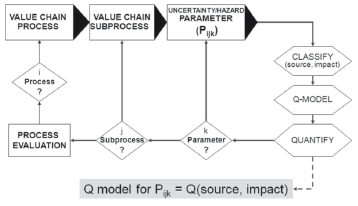
<body><![CDATA[<p><font size="2" face="Verdana, Arial, Helvetica, sans-serif">Laird [15] states that the main objective of a feasibility study is to demonstrate that a project is economically feasible when designed, constructed, and operated in accordance with the concepts defined in the study. Furthermore, the final feasibility study must demonstrate profitability at a level of financial risk acceptable to potential investors. Consequently, to reach bankability [16, 17], the final feasibility stages of a mining project must undergo a methodological process (<a href="#fig02">Fig. 2</a>), where the risk elements associated with the project value chain are identified, quantified and managed to be acceptable by investors (i.e., be classified as class D in the model in <a href="#fig01">Fig. 1</a>).</font></p>     <p align="center"><font size="2" face="Verdana, Arial, Helvetica, sans-serif"><a name="fig02"></a><b><img src="/img/revistas/dyna/v78n170/a26fig02.gif">    <br>   Figure 2.</b> The bankable feasibility study process </font></p>     <p><font size="2" face="Verdana, Arial, Helvetica, sans-serif">The methodological process of <a href="#fig02">Fig. 2</a> is applicable to any capital investment decision requiring debt financing at any stage of the mining life cycle, from grass root exploration to closure. </font></p>     <p>&nbsp;</p>     <p><font size="3" face="Verdana, Arial, Helvetica, sans-serif"><b>4. THE MPRM VALUE-CHAIN RISK MANAGEMENT METHODOLOGY</b></font></p>     <p><font size="2" face="Verdana, Arial, Helvetica, sans-serif">Based on this conceptual approach to risk and project optimization, the mining departments of the Pontificia Universidad Cat&oacute;lica de Chile and the Universidad Politecnica de Madrid are developing a general value-chain risk management framework and tools designed to assist mining investment decision. This methodological framework, referred to as MPRM is described below. </font></p>     <p><font size="2" face="Verdana, Arial, Helvetica, sans-serif">Mining project risk management is a risk management framework where project risk is evaluated for each process of the value chain. In this approach, risk management and optimization become part of a single stepwise value added process (<a href="#fig03">Fig. 3</a>). </font></p>     <p align="center"><font size="2" face="Verdana, Arial, Helvetica, sans-serif"><b><a name="fig03"></a><img src="/img/revistas/dyna/v78n170/a26fig03.gif">    <br>   Figure 3. </b>The MPRM project risk model</font></p>     ]]></body>
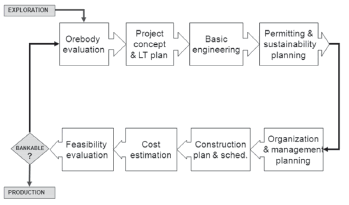
<body><![CDATA[<p><font size="2" face="Verdana, Arial, Helvetica, sans-serif">A key feature of MPRM is that the project risk is characterized by a value-chain risk model (The P model) as shown in <a href="#fig03">Fig. 3</a>. In this model, a 3-D risk-bearing matrix is developed where each risk-bearing parameter matrix (Pijk) is associated to a process (i), an activity or subprocess (j), and a risk origin (k). <a href="#fig03">Figure 4</a> presents a typical value-chain model for a mining project at the final feasibility decision. In MPRM, risk and value-added potential are quantified for each risk-bearing parameter (Pijk) and therefore, the proposed methodology may be used in order to efficiently allocate financial resources to project processes and activities showing maximum potential for adding value to the project.</font></p>     <p align="center"><font size="2" face="Verdana, Arial, Helvetica, sans-serif"><b><a name="fig04"></a><img src="/img/revistas/dyna/v78n170/a26fig04.gif">    <br>   Figure 4.</b> Project value chain for final feasibility decision </font></p>     <p><font size="2" face="Verdana, Arial, Helvetica, sans-serif"><a href="#fig04">Figure 4</a> provides an example of a project value chain. As an example, the first process in the value chain (i.e., orebody evaluation) consists of 8 subprocesses:</font></p> <ul>       <li><font size="2" face="Verdana, Arial, Helvetica, sans-serif">exploration drilling </font></li>       <li><font size="2" face="Verdana, Arial, Helvetica, sans-serif">hole logging and testing</font></li>       <li><font size="2" face="Verdana, Arial, Helvetica, sans-serif">sample preparation and assaying</font></li>       <li><font size="2" face="Verdana, Arial, Helvetica, sans-serif">chemical assays</font></li>       <li><font size="2" face="Verdana, Arial, Helvetica, sans-serif">data processing</font></li>       <li><font size="2" face="Verdana, Arial, Helvetica, sans-serif">geological interpretation</font></li>       ]]></body>
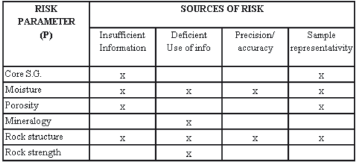
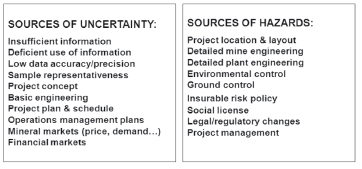
<body><![CDATA[<li><font size="2" face="Verdana, Arial, Helvetica, sans-serif">block modelling</font></li>       <li><font size="2" face="Verdana, Arial, Helvetica, sans-serif">resource evaluation </font></li>     </ul>     <p>&nbsp;</p>     <p><font size="3" face="Verdana, Arial, Helvetica, sans-serif"><b>5. RISK CLASSIFICATION METHODOLOGY</b></font></p>     <p><font size="2" face="Verdana, Arial, Helvetica, sans-serif">As stated above, in the P model, project risk is characterized as a 3D matrix, where each risk bearing parameters Pijk represents the risk associated to a subprocess (i,j) derived from k possible sources of risk (uncertainty and hazards). Table 1 presents some typical sources of uncertainty and hazards in mining projects.</font></p>     <p align="center"><font size="2" face="Verdana, Arial, Helvetica, sans-serif"><b><a name="tab01"></a>Table 1.</b> Sources of risk for a typical mining project </font>    <br>   <img src="/img/revistas/dyna/v78n170/a26tab01.gif"></p>     <p><font size="2" face="Verdana, Arial, Helvetica, sans-serif">For the sub process &quot;Hole logging and testing&quot; in the above example, the 6 risk bearing parameters P were identified and linked to several sources as in Table 2 below.</font></p>     <p align="center"><font size="2" face="Verdana, Arial, Helvetica, sans-serif"><b><a name="tab02"></a>Table 2.</b> A risk parameter vs. risk origin table</font>    ]]></body>
<body><![CDATA[<br>   <img src="/img/revistas/dyna/v78n170/a26tab02.gif"></p>     <p>&nbsp;</p>     <p><font size="3" face="Verdana, Arial, Helvetica, sans-serif"><b>6. QUANTIFICATION METHODOLOGY</b></font></p>     <p><font size="2" face="Verdana, Arial, Helvetica, sans-serif">The next stage in MPRM methodology is quantifying risk. The risk quantification method used for each risk bearing parameters P will mainly depend on two factors: the source of risk (e.g., as in Table 1); and the relative economic impact. For this purpose, the 2-D risk model presented in <a href="#fig01">Fig. 1</a> is used. </font></p>     <p><font size="2" face="Verdana, Arial, Helvetica, sans-serif">The evaluation of Class A Risks (e.g., those which are derived from resource evaluation and the conceptual definition processes), is based on the difference in NPV between the &quot;base case&quot; scenario and a &quot;risk free&quot; scenario based on probability statistics (e.g., 95 % confidence limit) or an expert judgment of a conservative value for the parameter P. The optimization potential (i.e., added value) may be represented by the difference between its economic impact and the cost of eliminating the risk. Statistical tools, QA/QC systems, and conditional simulation in combination with global optimizers such as Whittle and LOBOS are useful at this stage.</font></p>     <p><font size="2" face="Verdana, Arial, Helvetica, sans-serif">Class B risks are related to basic engineering, and subsequent (downstream) processes are quantified by comparing with a &quot;risk free&quot; design scenario.. Also in this case, the optimization potential (i.e., added value) may be quantified by evaluating the difference between economic impact and the extra cost of a conservative or &quot;risk free&quot; basic engineering design. Class B also comprises the risks related to the uncertainty of market, finance, social, and political scenarios and other parameters which are extrinsic to the project. These risks are managed by estimating the NPV outcome and the probability of occurrence of different scenarios (e.g., most likely, pessimistic, optimistic, etc.). Decision tree models and Monte Carlo simulation are the most commonly used tools. Although seldom used, linear programming, integer programming, and other OR tools are well suited for the evaluation of this type of risks. </font></p>     <p><font size="2" face="Verdana, Arial, Helvetica, sans-serif">Class C risks (e.g., the impact of earthquakes, floods, tailings dam failure, etc.) are quantified by the extra cost minimizing them through an improved site selection and layout, emergency planning, and proper risk insurance coverage. </font></p>     <p><font size="2" face="Verdana, Arial, Helvetica, sans-serif">Class D risks (e.g., risks which are remnant in the bankable project), are quantified by contingency funds which are adequate for covering fluctuations in capital and operating costs.</font></p>     <p>&nbsp;</p>     <p><b><font size="3" face="Verdana, Arial, Helvetica, sans-serif">7. APPLICATIONS OF THE MPRM METHODOLOGY</font></b></p>     ]]></body>
<body><![CDATA[<p><font size="2" face="Verdana, Arial, Helvetica, sans-serif">Mining project risk management methodology may be used to assist management in the evaluation of both risk and upside potential of a mining investment decision. Some examples of capital investment decisions where MPRM can be applied include: </font></p> <ul>       <li><font size="2" face="Verdana, Arial, Helvetica, sans-serif">the valuation of mineral exploration rights</font></li>       <li><font size="2" face="Verdana, Arial, Helvetica, sans-serif">assisting management in the efficient allocation of financial resources to a multi-target exploration budget of a mining company</font></li>       <li><font size="2" face="Verdana, Arial, Helvetica, sans-serif">assisting management in investment decisions for scoping studies and prefeasibility evaluation stages</font></li>       <li><font size="2" face="Verdana, Arial, Helvetica, sans-serif">risk evaluation during the final feasibility stage of a mining project</font></li>       <li><font size="2" face="Verdana, Arial, Helvetica, sans-serif">due diligence for the acquisition of mineral assets</font></li>       <li><font size="2" face="Verdana, Arial, Helvetica, sans-serif">risk management in the operations stage</font></li>     </ul>     <p>&nbsp;</p>     <p><b><font size="3" face="Verdana, Arial, Helvetica, sans-serif">8. CONCLUSIONS</font></b></p>     ]]></body>
<body><![CDATA[<p><font size="2" face="Verdana, Arial, Helvetica, sans-serif">Mining project risk management is an innovative value-chain oriented methodology for risk management and project optimization in the evaluation of mining assets at the exploration, prefeasibility and final feasibility stages, mineral exploration budgeting, due diligence analysis, and risk management of operational mines.</font></p>     <p><font size="2" face="Verdana, Arial, Helvetica, sans-serif">A key feature of MPRM is that project risk is modelled by a 3-D risk bearing matrix, where each cell Pijk represents the risk associated to a process (i), an activity or sub process (j), and a risk origin (k).</font></p>     <p><font size="2" face="Verdana, Arial, Helvetica, sans-serif">In MPRM, the risk management and optimization process is performed through the efficient allocation of financial resources to those project areas which show maximum value-adding potential.</font></p>     <p>&nbsp;</p>     <p><font size="3" face="Verdana, Arial, Helvetica, sans-serif"><b>REFERENCES</b></font></p>     <!-- ref --><p><font size="2" face="Verdana, Arial, Helvetica, sans-serif"><b>[1]</b> Snowden, D., Glacken, I. and Noppe, M., Dealing With Demands of Technical Variability and Uncertainty Along the Mine Value Chain, Value Tracking Symposium, Brisbane, Australia, 2002.     &nbsp;&nbsp;&nbsp;&nbsp;&nbsp;&nbsp;&nbsp;&nbsp;[&#160;<a href="javascript:void(0);" onclick="javascript: window.open('/scielo.php?script=sci_nlinks&ref=000098&pid=S0012-7353201100060002600001&lng=','','width=640,height=500,resizable=yes,scrollbars=1,menubar=yes,');">Links</a>&#160;]<!-- end-ref --><!-- ref --><br>   <b>[2]</b> Lane, G., Davis, M., Mclean, E. and Fleay, J., Performance Testing - When, What and How? Project Evaluation Conference, Melbourne. Australia, 2007.     &nbsp;&nbsp;&nbsp;&nbsp;&nbsp;&nbsp;&nbsp;&nbsp;[&#160;<a href="javascript:void(0);" onclick="javascript: window.open('/scielo.php?script=sci_nlinks&ref=000099&pid=S0012-7353201100060002600002&lng=','','width=640,height=500,resizable=yes,scrollbars=1,menubar=yes,');">Links</a>&#160;]<!-- end-ref --><!-- ref --><br>   <b>[3]</b> Hebblewhite B.K., Management of geotechnical risks in mining projects, School of Mining Engineering, The University of New South Wales, Sydney NSW, Australia, 2007.     &nbsp;&nbsp;&nbsp;&nbsp;&nbsp;&nbsp;&nbsp;&nbsp;[&#160;<a href="javascript:void(0);" onclick="javascript: window.open('/scielo.php?script=sci_nlinks&ref=000100&pid=S0012-7353201100060002600003&lng=','','width=640,height=500,resizable=yes,scrollbars=1,menubar=yes,');">Links</a>&#160;]<!-- end-ref --><!-- ref --><br>   <b>[4]</b> Morley, A., Evaluation of Exploration Projects, Project Evaluation Conference, Melbourne, Australia, 2007.     &nbsp;&nbsp;&nbsp;&nbsp;&nbsp;&nbsp;&nbsp;&nbsp;[&#160;<a href="javascript:void(0);" onclick="javascript: window.open('/scielo.php?script=sci_nlinks&ref=000101&pid=S0012-7353201100060002600004&lng=','','width=640,height=500,resizable=yes,scrollbars=1,menubar=yes,');">Links</a>&#160;]<!-- end-ref --><!-- ref --><br>   <b>[5]</b> Danihelka, P., Tailing Dams Risk Analysis and Management, Unece Workshop on TDS. Yerevan, Armenia, 2007.     &nbsp;&nbsp;&nbsp;&nbsp;&nbsp;&nbsp;&nbsp;&nbsp;[&#160;<a href="javascript:void(0);" onclick="javascript: window.open('/scielo.php?script=sci_nlinks&ref=000102&pid=S0012-7353201100060002600005&lng=','','width=640,height=500,resizable=yes,scrollbars=1,menubar=yes,');">Links</a>&#160;]<!-- end-ref --><!-- ref --><br>   <b>[6]</b> Amos, Q., Feasibility studies & Ore Reserves-A Banker's Perspective, Optimising with Whittle Conference. Perth, Australia, 2001.     &nbsp;&nbsp;&nbsp;&nbsp;&nbsp;&nbsp;&nbsp;&nbsp;[&#160;<a href="javascript:void(0);" onclick="javascript: window.open('/scielo.php?script=sci_nlinks&ref=000103&pid=S0012-7353201100060002600006&lng=','','width=640,height=500,resizable=yes,scrollbars=1,menubar=yes,');">Links</a>&#160;]<!-- end-ref --><!-- ref --><br>   <b>[7]</b> Li, S., Dimitrakopoulos, R., Scott, J. and Dunn, D., Quantification of Geologic Uncertainty and Risk Using Stochastic Simulation and Applications in the Coal Mining Industry, Orebody Modelling and Strategic Mine Planning Congress, Perth, WA, Australia, 2004.     &nbsp;&nbsp;&nbsp;&nbsp;&nbsp;&nbsp;&nbsp;&nbsp;[&#160;<a href="javascript:void(0);" onclick="javascript: window.open('/scielo.php?script=sci_nlinks&ref=000104&pid=S0012-7353201100060002600007&lng=','','width=640,height=500,resizable=yes,scrollbars=1,menubar=yes,');">Links</a>&#160;]<!-- end-ref --><!-- ref --><br>   <b>[8]</b> Vielma, J.P., Espinoza, D and Moreno, E., Risk control in ultimate pits using conditional simulations, Proceedings of the APCOM 2009, pp. pp. 107-114, Vancouver, Canada, 2009.     &nbsp;&nbsp;&nbsp;&nbsp;&nbsp;&nbsp;&nbsp;&nbsp;[&#160;<a href="javascript:void(0);" onclick="javascript: window.open('/scielo.php?script=sci_nlinks&ref=000105&pid=S0012-7353201100060002600008&lng=','','width=640,height=500,resizable=yes,scrollbars=1,menubar=yes,');">Links</a>&#160;]<!-- end-ref --><!-- ref --><br>   <b>[9]</b> Dominy, S.C., Sampling: A Critical Component to Gold Mining Project Evaluation, Project Evaluation Conference, Melbourne, Australia, 2007.     &nbsp;&nbsp;&nbsp;&nbsp;&nbsp;&nbsp;&nbsp;&nbsp;[&#160;<a href="javascript:void(0);" onclick="javascript: window.open('/scielo.php?script=sci_nlinks&ref=000106&pid=S0012-7353201100060002600009&lng=','','width=640,height=500,resizable=yes,scrollbars=1,menubar=yes,');">Links</a>&#160;]<!-- end-ref --><!-- ref --><br>   <b>[10]</b> David, D., The Importance of Geometallurgical Analysis in Plant Study, Design and Operational Phases, Ninth Mill Operators' Conference, Fremantle, Australia, 2007.     &nbsp;&nbsp;&nbsp;&nbsp;&nbsp;&nbsp;&nbsp;&nbsp;[&#160;<a href="javascript:void(0);" onclick="javascript: window.open('/scielo.php?script=sci_nlinks&ref=000107&pid=S0012-7353201100060002600010&lng=','','width=640,height=500,resizable=yes,scrollbars=1,menubar=yes,');">Links</a>&#160;]<!-- end-ref --><!-- ref --><br>   <b>[11]</b> Guj, P. and Garzon, R., Modern Asset Pricing - A Valuable Real Option Complement to Discounted Cash Flow Modelling of Mining Projects, Project Evaluation Conference, Melbourne, Australia, 2007.     &nbsp;&nbsp;&nbsp;&nbsp;&nbsp;&nbsp;&nbsp;&nbsp;[&#160;<a href="javascript:void(0);" onclick="javascript: window.open('/scielo.php?script=sci_nlinks&ref=000108&pid=S0012-7353201100060002600011&lng=','','width=640,height=500,resizable=yes,scrollbars=1,menubar=yes,');">Links</a>&#160;]<!-- end-ref --><!-- ref --><br>   <b>[12]</b> Whittle, G., Strange, W., and Hanson, N., Optimising Project Value and Robustness, Project Evaluation Conference, Melbourne, Australia, 2007.     &nbsp;&nbsp;&nbsp;&nbsp;&nbsp;&nbsp;&nbsp;&nbsp;[&#160;<a href="javascript:void(0);" onclick="javascript: window.open('/scielo.php?script=sci_nlinks&ref=000109&pid=S0012-7353201100060002600012&lng=','','width=640,height=500,resizable=yes,scrollbars=1,menubar=yes,');">Links</a>&#160;]<!-- end-ref --><!-- ref --><br>   <b>[13]</b> Smith, M.L and Hall, B.E., Strategy Optimisation in the PRIMO Tool Chain, Orebody Modelling and Strategic Mine Planning, pp. 271-278, AusIMM, Perth, March, 2009.     &nbsp;&nbsp;&nbsp;&nbsp;&nbsp;&nbsp;&nbsp;&nbsp;[&#160;<a href="javascript:void(0);" onclick="javascript: window.open('/scielo.php?script=sci_nlinks&ref=000110&pid=S0012-7353201100060002600013&lng=','','width=640,height=500,resizable=yes,scrollbars=1,menubar=yes,');">Links</a>&#160;]<!-- end-ref --><!-- ref --><br>   <b>[14]</b> Smith, M.L. and Sheppard, I.K., Life of Mine Scheduling at Ok Tedi, AusIMM Bull., (2), pp.18-32, March/April, 2008, AusIMM.     &nbsp;&nbsp;&nbsp;&nbsp;&nbsp;&nbsp;&nbsp;&nbsp;[&#160;<a href="javascript:void(0);" onclick="javascript: window.open('/scielo.php?script=sci_nlinks&ref=000111&pid=S0012-7353201100060002600014&lng=','','width=640,height=500,resizable=yes,scrollbars=1,menubar=yes,');">Links</a>&#160;]<!-- end-ref --><!-- ref --><br>   <b>[15]</b> Laird, A. M., How to develop a project in Mineral Resource and Ore Reserve Estimation, The AusIMM Guide to Good Practice, Melbourne, Australia, 21, P. 2001.     &nbsp;&nbsp;&nbsp;&nbsp;&nbsp;&nbsp;&nbsp;&nbsp;[&#160;<a href="javascript:void(0);" onclick="javascript: window.open('/scielo.php?script=sci_nlinks&ref=000112&pid=S0012-7353201100060002600015&lng=','','width=640,height=500,resizable=yes,scrollbars=1,menubar=yes,');">Links</a>&#160;]<!-- end-ref --><!-- ref --><br>   <b>[16]</b> Guarnera, B. J., Technical flaws in bankable documents, Assaying and Reporting Standards Conference, Singapore, 1997.     &nbsp;&nbsp;&nbsp;&nbsp;&nbsp;&nbsp;&nbsp;&nbsp;[&#160;<a href="javascript:void(0);" onclick="javascript: window.open('/scielo.php?script=sci_nlinks&ref=000113&pid=S0012-7353201100060002600016&lng=','','width=640,height=500,resizable=yes,scrollbars=1,menubar=yes,');">Links</a>&#160;]<!-- end-ref --><!-- ref --><br>   <b>[17]</b> Arango, M.D., Vergara, C., Gaviria, H., Modelizaci&oacute;n Difusa para la Planificaci&oacute;n Agregada de la Producci&oacute;n en Ambientes de Incertidumbre. Dyna. Journal of Mines Faculty. National University of Colombia. Edici&oacute;n 162; pp. 397-409. 2010. </font>&nbsp;&nbsp;&nbsp;&nbsp;&nbsp;&nbsp;&nbsp;&nbsp;[&#160;<a href="javascript:void(0);" onclick="javascript: window.open('/scielo.php?script=sci_nlinks&ref=000114&pid=S0012-7353201100060002600017&lng=','','width=640,height=500,resizable=yes,scrollbars=1,menubar=yes,');">Links</a>&#160;]<!-- end-ref --> ]]></body><back>
<ref-list>
<ref id="B1">
<label>1</label><nlm-citation citation-type="confpro">
<person-group person-group-type="author">
<name>
<surname><![CDATA[Snowden]]></surname>
<given-names><![CDATA[D.]]></given-names>
</name>
<name>
<surname><![CDATA[Glacken]]></surname>
<given-names><![CDATA[I.]]></given-names>
</name>
<name>
<surname><![CDATA[Noppe]]></surname>
<given-names><![CDATA[M.]]></given-names>
</name>
</person-group>
<source><![CDATA[Dealing With Demands of Technical Variability and Uncertainty Along the Mine Value Chain]]></source>
<year>2002</year>
<conf-name><![CDATA[ Value Tracking Symposium]]></conf-name>
<conf-loc> </conf-loc>
<publisher-loc><![CDATA[Brisbane ]]></publisher-loc>
</nlm-citation>
</ref>
<ref id="B2">
<label>2</label><nlm-citation citation-type="confpro">
<person-group person-group-type="author">
<name>
<surname><![CDATA[Lane]]></surname>
<given-names><![CDATA[G.]]></given-names>
</name>
<name>
<surname><![CDATA[Davis]]></surname>
<given-names><![CDATA[M.]]></given-names>
</name>
<name>
<surname><![CDATA[Mclean]]></surname>
<given-names><![CDATA[E.]]></given-names>
</name>
<name>
<surname><![CDATA[Fleay]]></surname>
<given-names><![CDATA[J.]]></given-names>
</name>
</person-group>
<article-title xml:lang="en"><![CDATA[Performance Testing: When, What and How?]]></article-title>
<source><![CDATA[]]></source>
<year></year>
<conf-name><![CDATA[ Project Evaluation Conference]]></conf-name>
<conf-date>2007</conf-date>
<conf-loc>Melbourne </conf-loc>
</nlm-citation>
</ref>
<ref id="B3">
<label>3</label><nlm-citation citation-type="book">
<person-group person-group-type="author">
<name>
<surname><![CDATA[Hebblewhite]]></surname>
<given-names><![CDATA[B.K.]]></given-names>
</name>
</person-group>
<source><![CDATA[Management of geotechnical risks in mining projects: School of Mining Engineering]]></source>
<year>2007</year>
<publisher-loc><![CDATA[^eNSW NSW]]></publisher-loc>
<publisher-name><![CDATA[The University of New South Wales]]></publisher-name>
</nlm-citation>
</ref>
<ref id="B4">
<label>4</label><nlm-citation citation-type="confpro">
<person-group person-group-type="author">
<name>
<surname><![CDATA[Morley]]></surname>
<given-names><![CDATA[A.]]></given-names>
</name>
</person-group>
<article-title xml:lang="en"><![CDATA[Evaluation of Exploration Projects]]></article-title>
<source><![CDATA[]]></source>
<year></year>
<conf-name><![CDATA[ Project Evaluation Conference]]></conf-name>
<conf-date>2007</conf-date>
<conf-loc>Melbourne </conf-loc>
</nlm-citation>
</ref>
<ref id="B5">
<label>5</label><nlm-citation citation-type="confpro">
<person-group person-group-type="author">
<name>
<surname><![CDATA[Danihelka]]></surname>
<given-names><![CDATA[P.]]></given-names>
</name>
</person-group>
<article-title xml:lang="en"><![CDATA[Tailing Dams Risk Analysis and Management]]></article-title>
<source><![CDATA[]]></source>
<year></year>
<conf-name><![CDATA[ Unece Workshop on TDS]]></conf-name>
<conf-date>2007</conf-date>
<conf-loc>Yerevan </conf-loc>
</nlm-citation>
</ref>
<ref id="B6">
<label>6</label><nlm-citation citation-type="confpro">
<person-group person-group-type="author">
<name>
<surname><![CDATA[Amos]]></surname>
<given-names><![CDATA[Q.]]></given-names>
</name>
</person-group>
<article-title xml:lang="en"><![CDATA[Feasibility studies & Ore Reserves-A Banker's Perspective]]></article-title>
<source><![CDATA[]]></source>
<year></year>
<conf-name><![CDATA[ Optimising with Whittle Conference]]></conf-name>
<conf-date>2001</conf-date>
<conf-loc>Perth </conf-loc>
</nlm-citation>
</ref>
<ref id="B7">
<label>7</label><nlm-citation citation-type="confpro">
<person-group person-group-type="author">
<name>
<surname><![CDATA[Li]]></surname>
<given-names><![CDATA[S.]]></given-names>
</name>
<name>
<surname><![CDATA[Dimitrakopoulos]]></surname>
<given-names><![CDATA[R.]]></given-names>
</name>
<name>
<surname><![CDATA[Scott]]></surname>
<given-names><![CDATA[J.]]></given-names>
</name>
<name>
<surname><![CDATA[Dunn]]></surname>
<given-names><![CDATA[D.]]></given-names>
</name>
</person-group>
<article-title xml:lang="en"><![CDATA[Quantification of Geologic Uncertainty and Risk Using Stochastic Simulation and Applications in the Coal Mining Industry]]></article-title>
<source><![CDATA[]]></source>
<year></year>
<conf-name><![CDATA[ Orebody Modelling and Strategic Mine Planning Congress]]></conf-name>
<conf-date>2004</conf-date>
<conf-loc>Perth WA</conf-loc>
</nlm-citation>
</ref>
<ref id="B8">
<label>8</label><nlm-citation citation-type="confpro">
<person-group person-group-type="author">
<name>
<surname><![CDATA[Vielma]]></surname>
<given-names><![CDATA[J.P.]]></given-names>
</name>
<name>
<surname><![CDATA[Espinoza]]></surname>
<given-names><![CDATA[D]]></given-names>
</name>
<name>
<surname><![CDATA[Moreno]]></surname>
<given-names><![CDATA[E.]]></given-names>
</name>
</person-group>
<article-title xml:lang="en"><![CDATA[Risk control in ultimate pits using conditional simulations]]></article-title>
<source><![CDATA[]]></source>
<year>2009</year>
<conf-name><![CDATA[ Proceedings of the APCOM 2009]]></conf-name>
<conf-loc> </conf-loc>
<page-range>107-114</page-range><publisher-loc><![CDATA[Vancouver ]]></publisher-loc>
</nlm-citation>
</ref>
<ref id="B9">
<label>9</label><nlm-citation citation-type="confpro">
<person-group person-group-type="author">
<name>
<surname><![CDATA[Dominy]]></surname>
<given-names><![CDATA[S.C.]]></given-names>
</name>
</person-group>
<article-title xml:lang="en"><![CDATA[Sampling: A Critical Component to Gold Mining Project Evaluation]]></article-title>
<source><![CDATA[]]></source>
<year></year>
<conf-name><![CDATA[ Project Evaluation Conference]]></conf-name>
<conf-date>2007</conf-date>
<conf-loc>Melbourne </conf-loc>
</nlm-citation>
</ref>
<ref id="B10">
<label>10</label><nlm-citation citation-type="confpro">
<person-group person-group-type="author">
<name>
<surname><![CDATA[David]]></surname>
<given-names><![CDATA[D.]]></given-names>
</name>
</person-group>
<article-title xml:lang="en"><![CDATA[The Importance of Geometallurgical Analysis in Plant Study]]></article-title>
<source><![CDATA[]]></source>
<year></year>
<conf-name><![CDATA[ Design and Operational Phases, Ninth Mill Operators' Conference]]></conf-name>
<conf-date>2007</conf-date>
<conf-loc>Fremantle </conf-loc>
</nlm-citation>
</ref>
<ref id="B11">
<label>11</label><nlm-citation citation-type="confpro">
<person-group person-group-type="author">
<name>
<surname><![CDATA[Guj]]></surname>
<given-names><![CDATA[P.]]></given-names>
</name>
<name>
<surname><![CDATA[Garzon]]></surname>
<given-names><![CDATA[R.]]></given-names>
</name>
</person-group>
<article-title xml:lang="en"><![CDATA[Modern Asset Pricing: A Valuable Real Option Complement to Discounted Cash Flow Modelling of Mining Projects]]></article-title>
<source><![CDATA[]]></source>
<year></year>
<conf-name><![CDATA[ Project Evaluation Conference]]></conf-name>
<conf-date>2007</conf-date>
<conf-loc>Melbourne </conf-loc>
</nlm-citation>
</ref>
<ref id="B12">
<label>12</label><nlm-citation citation-type="confpro">
<person-group person-group-type="author">
<name>
<surname><![CDATA[Whittle]]></surname>
<given-names><![CDATA[G.]]></given-names>
</name>
<name>
<surname><![CDATA[Strange]]></surname>
<given-names><![CDATA[W.]]></given-names>
</name>
<name>
<surname><![CDATA[Hanson]]></surname>
<given-names><![CDATA[N.]]></given-names>
</name>
</person-group>
<article-title xml:lang="en"><![CDATA[Optimising Project Value and Robustness]]></article-title>
<source><![CDATA[]]></source>
<year></year>
<conf-name><![CDATA[ Project Evaluation Conference]]></conf-name>
<conf-date>2007</conf-date>
<conf-loc>Melbourne </conf-loc>
</nlm-citation>
</ref>
<ref id="B13">
<label>13</label><nlm-citation citation-type="">
<person-group person-group-type="author">
<name>
<surname><![CDATA[Smith]]></surname>
<given-names><![CDATA[M.L]]></given-names>
</name>
<name>
<surname><![CDATA[Hall]]></surname>
<given-names><![CDATA[B.E.]]></given-names>
</name>
</person-group>
<source><![CDATA[Strategy Optimisation in the PRIMO Tool Chain: Orebody Modelling and Strategic Mine Planning]]></source>
<year>Marc</year>
<month>h,</month>
<day> 2</day>
<page-range>271-278</page-range></nlm-citation>
</ref>
<ref id="B14">
<label>14</label><nlm-citation citation-type="">
<person-group person-group-type="author">
<name>
<surname><![CDATA[Smith]]></surname>
<given-names><![CDATA[M.L.]]></given-names>
</name>
<name>
<surname><![CDATA[Sheppard]]></surname>
<given-names><![CDATA[I.K.]]></given-names>
</name>
</person-group>
<source><![CDATA[Life of Mine Scheduling at Ok Tedi]]></source>
<year>Marc</year>
<month>h/</month>
<day>Ap</day>
<volume>2</volume>
<page-range>18-32</page-range></nlm-citation>
</ref>
<ref id="B15">
<label>15</label><nlm-citation citation-type="">
<person-group person-group-type="author">
<name>
<surname><![CDATA[Laird]]></surname>
<given-names><![CDATA[A. M.]]></given-names>
</name>
</person-group>
<source><![CDATA[How to develop a project in Mineral Resource and Ore Reserve Estimation: The AusIMM Guide to Good Practice]]></source>
<year>2001</year>
<page-range>21</page-range><publisher-loc><![CDATA[Melbourne ]]></publisher-loc>
</nlm-citation>
</ref>
<ref id="B16">
<label>16</label><nlm-citation citation-type="">
<person-group person-group-type="author">
<name>
<surname><![CDATA[Guarnera]]></surname>
<given-names><![CDATA[B. J.]]></given-names>
</name>
</person-group>
<source><![CDATA[Technical flaws in bankable documents: Assaying and Reporting Standards Conference]]></source>
<year>1997</year>
</nlm-citation>
</ref>
<ref id="B17">
<label>17</label><nlm-citation citation-type="journal">
<person-group person-group-type="author">
<name>
<surname><![CDATA[Arango]]></surname>
<given-names><![CDATA[M.D.]]></given-names>
</name>
<name>
<surname><![CDATA[Vergara]]></surname>
<given-names><![CDATA[C.]]></given-names>
</name>
<name>
<surname><![CDATA[Gaviria]]></surname>
<given-names><![CDATA[H.]]></given-names>
</name>
</person-group>
<article-title xml:lang="en"><![CDATA[Modelización Difusa para la Planificación Agregada de la Producción en Ambientes de Incertidumbre]]></article-title>
<source><![CDATA[Dyna. Journal of Mines Faculty. National University of Colombia]]></source>
<year>2010</year>
<numero>162</numero>
<issue>162</issue>
<page-range>397-409</page-range></nlm-citation>
</ref>
</ref-list>
</back>
</article>