<?xml version="1.0" encoding="ISO-8859-1"?><article xmlns:mml="http://www.w3.org/1998/Math/MathML" xmlns:xlink="http://www.w3.org/1999/xlink" xmlns:xsi="http://www.w3.org/2001/XMLSchema-instance">
<front>
<journal-meta>
<journal-id>0012-7353</journal-id>
<journal-title><![CDATA[DYNA]]></journal-title>
<abbrev-journal-title><![CDATA[Dyna rev.fac.nac.minas]]></abbrev-journal-title>
<issn>0012-7353</issn>
<publisher>
<publisher-name><![CDATA[Universidad Nacional de Colombia]]></publisher-name>
</publisher>
</journal-meta>
<article-meta>
<article-id>S0012-73532012000100001</article-id>
<title-group>
<article-title xml:lang="en"><![CDATA[SOFTWARE TOOL FOR LEARNING THE GENERATION OF THE CARDIOID CURVE IN AN AUTOCAD ENVIRONMENT]]></article-title>
<article-title xml:lang="es"><![CDATA[HERRAMIENTA SOFTWARE PARA EL APRENDIZAJE DE LA GENERACIÓN DE LA CARDIODE EN UN ENTORNO AUTOCAD]]></article-title>
</title-group>
<contrib-group>
<contrib contrib-type="author">
<name>
<surname><![CDATA[GÓMEZ-ELVIRA-GONZÁLEZ]]></surname>
<given-names><![CDATA[MIGUEL ÁNGEL]]></given-names>
</name>
<xref ref-type="aff" rid="A01"/>
</contrib>
<contrib contrib-type="author">
<name>
<surname><![CDATA[ROJAS-SOLA]]></surname>
<given-names><![CDATA[JOSÉ IGNACIO]]></given-names>
</name>
<xref ref-type="aff" rid="A02"/>
</contrib>
<contrib contrib-type="author">
<name>
<surname><![CDATA[CARRANZA-CAÑADAS]]></surname>
<given-names><![CDATA[MARÍA DEL PILAR]]></given-names>
</name>
<xref ref-type="aff" rid="A03"/>
</contrib>
</contrib-group>
<aff id="A01">
<institution><![CDATA[,Polytechnic University of Madrid  ]]></institution>
<addr-line><![CDATA[ ]]></addr-line>
</aff>
<aff id="A02">
<institution><![CDATA[,University of Jaen  ]]></institution>
<addr-line><![CDATA[ ]]></addr-line>
</aff>
<aff id="A03">
<institution><![CDATA[,University of Cordoba  ]]></institution>
<addr-line><![CDATA[ ]]></addr-line>
</aff>
<pub-date pub-type="pub">
<day>00</day>
<month>02</month>
<year>2012</year>
</pub-date>
<pub-date pub-type="epub">
<day>00</day>
<month>02</month>
<year>2012</year>
</pub-date>
<volume>79</volume>
<numero>171</numero>
<fpage>7</fpage>
<lpage>15</lpage>
<copyright-statement/>
<copyright-year/>
<self-uri xlink:href="http://www.scielo.org.co/scielo.php?script=sci_arttext&amp;pid=S0012-73532012000100001&amp;lng=en&amp;nrm=iso"></self-uri><self-uri xlink:href="http://www.scielo.org.co/scielo.php?script=sci_abstract&amp;pid=S0012-73532012000100001&amp;lng=en&amp;nrm=iso"></self-uri><self-uri xlink:href="http://www.scielo.org.co/scielo.php?script=sci_pdf&amp;pid=S0012-73532012000100001&amp;lng=en&amp;nrm=iso"></self-uri><abstract abstract-type="short" xml:lang="en"><p><![CDATA[This article presents a novel application which has been developed in Visual LISP for an AutoCAD environment, and which shows the generation of the cardioid curve intuitively and quickly in five different ways (using the conchoid of a circumference, pedal curve of a circumference, inverse of a parabola, orthoptic curve of a circumference, and epicycloid of a circumference). This cyclic curve has a large number of artistic and technical applications, among them the profile of some cams.]]></p></abstract>
<abstract abstract-type="short" xml:lang="es"><p><![CDATA[Este artículo presenta una novedosa aplicación desarrollada en Visual LISP para el entorno AutoCAD, que presenta de forma rápida e intuitiva la generación de la cardiode de cinco formas diferentes, siendo dicha curva cíclica, la que presenta una amplia gama de aplicaciones artísticas y técnicas, entre ellas, el perfil de algunas levas.]]></p></abstract>
<kwd-group>
<kwd lng="en"><![CDATA[educational software]]></kwd>
<kwd lng="en"><![CDATA[engineering graphics]]></kwd>
<kwd lng="en"><![CDATA[technical drawing]]></kwd>
<kwd lng="en"><![CDATA[cardioid]]></kwd>
<kwd lng="en"><![CDATA[AutoCAD]]></kwd>
<kwd lng="es"><![CDATA[software educacional]]></kwd>
<kwd lng="es"><![CDATA[dibujo en ingeniería]]></kwd>
<kwd lng="es"><![CDATA[dibujo técnico]]></kwd>
<kwd lng="es"><![CDATA[cardioide]]></kwd>
<kwd lng="es"><![CDATA[AutoCAD]]></kwd>
</kwd-group>
</article-meta>
</front><body><![CDATA[ <p align="center"><font size="4" face="Verdana, Arial, Helvetica, sans-serif"><b>SOFTWARE TOOL FOR LEARNING THE GENERATION OF THE CARDIOID CURVE IN AN AUTOCAD ENVIRONMENT</b></font></p>     <p align="center"><i><font size="3"><b><font face="Verdana, Arial, Helvetica, sans-serif">HERRAMIENTA SOFTWARE PARA EL APRENDIZAJE DE LA GENERACI&Oacute;N DE LA CARDIODE EN UN ENTORNO AUTOCAD</font></b></font></i></p>     <p align="center">&nbsp;</p>     <p align="center"><b><font size="2" face="Verdana, Arial, Helvetica, sans-serif">MIGUEL &Aacute;NGEL G&Oacute;MEZ-ELVIRA-GONZ&Aacute;LEZ    <br> </font></b><font size="2" face="Verdana, Arial, Helvetica, sans-serif"><i>Ph.D., Polytechnic University of Madrid, <a href="mailto:miguelangel.gomezelvira@upm.es">miguelangel.gomezelvira@upm.es</a></i> </font></p>     <p align="center"><font size="2" face="Verdana, Arial, Helvetica, sans-serif"><b>JOS&Eacute; IGNACIO ROJAS-SOLA    <br> </b><i>Ph.D., University of Jaen, <a href="mailto:jirojas@ujaen.es">jirojas@ujaen.es </a></i></font></p>     <p align="center"><font size="2" face="Verdana, Arial, Helvetica, sans-serif"><b>MAR&Iacute;A DEL PILAR CARRANZA-CA&Ntilde;ADAS    <br> </b><i>Ph.D.,University of Cordoba, <a href="mailto:carranza@uco.es">carranza@uco.es</a> </i></font></p>     <p align="center">&nbsp;</p>     ]]></body>
<body><![CDATA[<p align="center"><font size="2" face="Verdana, Arial, Helvetica, sans-serif"><b>Received for review: July 25<sup>th</sup>, 2011; accepted: August 3<sup>rd</sup>, 2011; final version: August, 5<sup>th</sup>, 2011</b></font></p>     <p>&nbsp;</p> <hr>     <p><font size="2" face="Verdana, Arial, Helvetica, sans-serif"><b>ABSTRACT:</b> This article presents a novel application which has been developed in Visual LISP for an AutoCAD environment, and which shows the generation of the cardioid curve intuitively and quickly in five different ways (using the conchoid of a circumference, pedal curve of a circumference, inverse of a parabola, orthoptic curve of a circumference, and epicycloid of a circumference). This cyclic curve has a large number of artistic and technical applications, among them the profile of some cams.</font></p>     <p><font size="2" face="Verdana, Arial, Helvetica, sans-serif"><b>KEYWORDS: </b>educational software, engineering graphics, technical drawing, cardioid, AutoCAD</font></p>     <p><font size="2" face="Verdana, Arial, Helvetica, sans-serif"><b>RESUMEN:</b> Este art&iacute;culo presenta una novedosa aplicaci&oacute;n desarrollada en Visual LISP para el entorno AutoCAD, que presenta de forma r&aacute;pida e intuitiva la generaci&oacute;n de la cardiode de cinco formas diferentes, siendo dicha curva c&iacute;clica, la que presenta una amplia gama de aplicaciones art&iacute;sticas y t&eacute;cnicas, entre ellas, el perfil de algunas levas.</font></p>     <p><font size="2" face="Verdana, Arial, Helvetica, sans-serif"><b>PALABRAS CLAVE:</b> software educacional, dibujo en ingenier&iacute;a, dibujo t&eacute;cnico, cardioide, AutoCAD</font></p> <hr>     <p>&nbsp;</p>     <p><font size="3" face="Verdana, Arial, Helvetica, sans-serif"><b>1. INTRODUCTION</b></font></p>     <p><font size="2" face="Verdana, Arial, Helvetica, sans-serif">In recent years, many articles have highlighted the importance of engineering graphics and the use of educational software in the teaching of drawing in engineerFing &#91;1-3&#93;, but also virtual learning environments (i.e., Moodle) and e-learning have played a very important role in other subjects &#91;4&#93;. </font></p>     <p><font size="2" face="Verdana, Arial, Helvetica, sans-serif">A study was carried out the result of which is a tool in the AutoCAD environment which fulfils the proposed objectives and improves the quality of the teaching-learning process. These teaching objectives attempt to bring reality closer to the students, to stimulate their interest in engineering, to facilitate learning, and to improve the understanding of concepts and explanations, as well as academic performance. In addition, the software also allows the teacher to repeat concepts and complement presentations. The software chosen is AutoCAD, as it a program which is widely used in educational establishments worldwide.</font></p>     ]]></body>
<body><![CDATA[<p><font size="2" face="Verdana, Arial, Helvetica, sans-serif">In this article, the authors attempt to examine one of the most important technical curves in engineering which is a key element in engineering design. The objective is to link classical knowledge related to geometry and algebra with CAD systems which are available to all students today.</font></p>     <p><font size="2" face="Verdana, Arial, Helvetica, sans-serif">The cardioid is a curve which is traced by a point P on a circumference which rolls around another circumference of the same radius &#91;5&#93;, that is, it is the simplest epicycloid, and has a wide range of applications, both artistic &#91;6&#93; and technical, including the profile of some cams. It is therefore a cyclic curve similar to others such as the cycloid, trochoid, involut of the circle, spirals, or helices, among others, which have been studied from various perspectives.</font></p>     <p><font size="2" face="Verdana, Arial, Helvetica, sans-serif">Cams and eccentrics are mechanisms designed to transform rotational movement into alternating or recurrent linear or curvilinear movement following a given law. It is possible to make a distinction between eccentrics and cams, defining cams as small-dimension eccentrics. The profiles or contact surfaces of these elements are cut from generally cylindrical surfaces, and it is their form which defines their movement, as the set of cams is formed by linked circumference arcs and straight lines. This allows for different types of movements to be produced.</font></p>     <p>&nbsp;</p>     <p><font size="3" face="Verdana, Arial, Helvetica, sans-serif"><b>2. MATERIALS AND METHODS</b></font></p>     <p><b><font size="2" face="Verdana, Arial, Helvetica, sans-serif">2.1 Software Revision    <br> </font></b><font size="2" face="Verdana, Arial, Helvetica, sans-serif">To perform the state of the art, we have searched for applications related to this topic developed in a CAD environment. We found applications for the design of holes or dies using programming in Visual LISP &#91;7,8&#93; and only one &#91;9&#93; more closely related to cams, where the authors use AutoCAD software to generate a conical cam expansion contour that meets the requirement of the law of motion.</font></p>     <p><font size="2" face="Verdana, Arial, Helvetica, sans-serif">However, we found no application developed in a CAD environment which included all the possible cases of cardioid generation. Thus this application presented here is unique and innovative in the area of engineering graphics, because of the breadth of the data presented.</font></p>     <p><font size="2" face="Verdana, Arial, Helvetica, sans-serif"><b>2.2 Theoretical Basis    <br> </b></font><font size="2" face="Verdana, Arial, Helvetica, sans-serif">In order to develop the application in an AutoCAD environment, and before doing programming in Visual LISP, a knowledge of geometry and algebra is necessary in order to define the elemental curves which produce the cardioids. The generation of the cardioids is shown by five elemental curves.</font></p>     ]]></body>
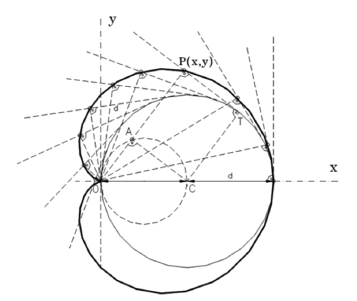
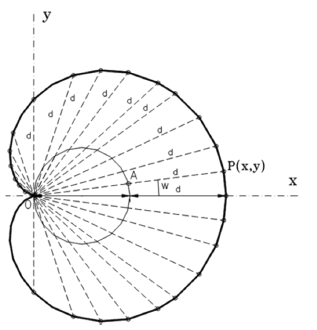
<body><![CDATA[<p><font size="2" face="Verdana, Arial, Helvetica, sans-serif"><b>Case 1. Conchoid of a circumference</b></font></p>     <p><font size="2" face="Verdana, Arial, Helvetica, sans-serif">The cardioid is obtained by considering a circumference of diameter d and defining one of the ends of the diameter such as the pole of the cardioids. That is, it is the locus of the points on the plane (P) which is found by adding the diameter d to all the segments formed by the points A on the circumference and pole O (<a href="#fig01">Fig. 1</a>).</font></p>     <p align="center"><font size="2" face="Verdana, Arial, Helvetica, sans-serif"><b><a name="fig01"></a><img src="/img/revistas/dyna/v79n171/a01fig01.gif">    <br> Figure 1.</b> Cardioid obtained from the conchoid of a circumference</font></p>     <p><font size="2" face="Verdana, Arial, Helvetica, sans-serif">From the variable point A on the circumference of diameter d, d is added to obtain point P on the line OA.</font></p>     <p><font size="2" face="Verdana, Arial, Helvetica, sans-serif">Its polar equation is:</font></p>     <p><img src="/img/revistas/dyna/v79n171/a01eq01.gif"></p>     <p><font size="2" face="Verdana, Arial, Helvetica, sans-serif">Without losing its general nature, we can suppose that d = 1, that is, that the diameter of the circumference is the unit of measurement on the axes, and therefore the equation can be expressed:</font></p>     <p><img src="/img/revistas/dyna/v79n171/a01eq02.gif"></p>     <p><font size="2" face="Verdana, Arial, Helvetica, sans-serif">In Cartesian coordinates, this is:</font></p>     ]]></body>
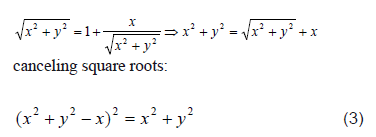
<body><![CDATA[<p><img src="/img/revistas/dyna/v79n171/a01eq03.gif"></p>     <p><font size="2" face="Verdana, Arial, Helvetica, sans-serif"><b>Case 2. Pedal curve of a circumference</b></font></p>     <p><font size="2" face="Verdana, Arial, Helvetica, sans-serif">From the end O of the diameter of a circumference, lines are traced which are perpendicular to the tangents of the circumference, the pedal curve obtained; that is, the locus of the angles P of these perpendicular lines is a cardioid (<a href="#fig02">Fig. 2</a>).</font></p>     <p align="center"><font size="2" face="Verdana, Arial, Helvetica, sans-serif"><b><a name="fig02"></a><img src="/img/revistas/dyna/v79n171/a01fig02.gif">    <br> Figure 2.</b> Cardioid obtained from the pedal curve of a circumference</font></p>     <p><font size="2" face="Verdana, Arial, Helvetica, sans-serif">Considering the circumference <font face="Symbol">a</font> with a radius half of that of the given circumference, we can see that APTC is a rectangle, and so <img src="/img/revistas/dyna/v79n171/a01eq16631.jpeg" />, which reduces the problem to the first case. </font></p>     <p><font size="2" face="Verdana, Arial, Helvetica, sans-serif"><b>Case 3. Inverse of a parabola</b></font></p>     <p><font size="2" face="Verdana, Arial, Helvetica, sans-serif">If <img src="/img/revistas/dyna/v79n171/a01eq16649.jpeg" /> is the equation expressed in polar coordinates of a curve, for any point on its inverse with regard to O, we have:</font></p>     <p><img src="/img/revistas/dyna/v79n171/a01eq04.gif"></p>     <p><font size="2" face="Verdana, Arial, Helvetica, sans-serif">which is the polar equation of the inverse.</font></p>     ]]></body>
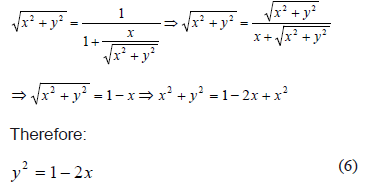
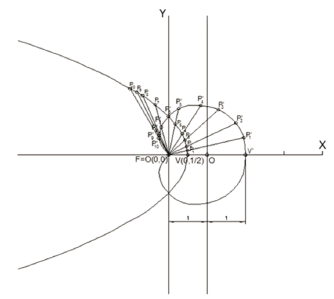
<body><![CDATA[<p><font size="2" face="Verdana, Arial, Helvetica, sans-serif">Defining the cardioid using Eq. (2), its inverse is defined by:</font></p>     <p><img src="/img/revistas/dyna/v79n171/a01eq05.gif"></p>     <p><font size="2" face="Verdana, Arial, Helvetica, sans-serif">Transforming this into Cartesian coordinates:</font></p>     <p><img src="/img/revistas/dyna/v79n171/a01eq06.gif"></p>     <p><font size="2" face="Verdana, Arial, Helvetica, sans-serif">This is a parabola with vertex at coordinates (y = 0, x = 1/2) and therefore with a focus at coordinates (y = 0, x = 0), which is the cusp of the cardioid (<a href="#fig03">Fig. 3</a>).</font></p>     <p align="center"><font size="2" face="Verdana, Arial, Helvetica, sans-serif"><b><a name="fig03"></a><img src="/img/revistas/dyna/v79n171/a01fig03.gif">    <br> Figure 3.</b> Cardioid obtained from the inverse of a parabola</font></p>     <p><font size="2" face="Verdana, Arial, Helvetica, sans-serif">In other words, the inverse of the parabola with Vertex V (1/2,0) and focus F at (0,0), of which the inversion centre is the focus of the parabola and the ratio of inversion is the square of the focal distance, is a cardioid whose cusp is the focus of the given parabola. </font></p>     <p><font size="2" face="Verdana, Arial, Helvetica, sans-serif"><b>Case 4. Orthoptic curve of a circumference</b></font></p>     <p><font size="2" face="Verdana, Arial, Helvetica, sans-serif">If two orthogonal circumferences of the same radius (although they may be different) which pass through the origin O are considered, their equations are:</font></p>     ]]></body>

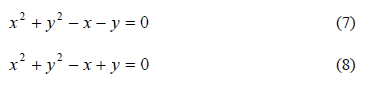
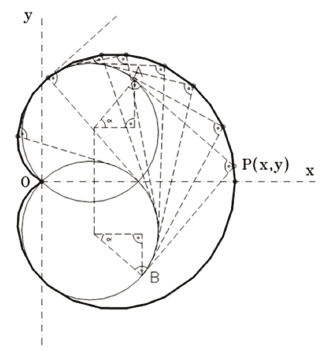
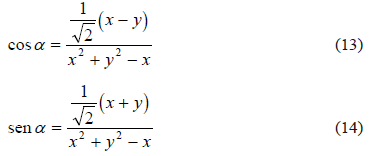
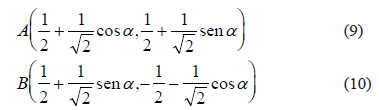
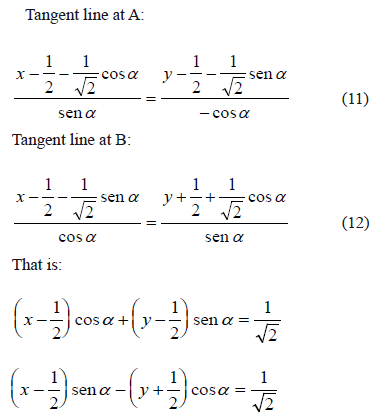
<body><![CDATA[<p><img src="/img/revistas/dyna/v79n171/a01eq0708.gif"></p>     <p><font size="2" face="Verdana, Arial, Helvetica, sans-serif">Let point P be the intersection of the two tangents of the perpendicular circumferences (<a href="#fig04">Fig. 4</a>). </font></p>     <p align="center"><font size="2" face="Verdana, Arial, Helvetica, sans-serif"><b><a name="fig04"></a><img src="/img/revistas/dyna/v79n171/a01fig04.gif">    <br> Figure 4.</b> Cardioid obtained from the orthoptic curve of a circumference</font></p>     <p><font size="2" face="Verdana, Arial, Helvetica, sans-serif">In parametric coordinates, points A and B can be shown: </font></p>     <p><img src="/img/revistas/dyna/v79n171/a01eq0910.gif"></p>     <p><font size="2" face="Verdana, Arial, Helvetica, sans-serif">Therefore, the equations of the tangent lines at these points are: </font></p>     <p><img src="/img/revistas/dyna/v79n171/a01eq1112.gif"></p>     <p><font size="2" face="Verdana, Arial, Helvetica, sans-serif">Solving the trigonometric values:</font></p>     <p><img src="/img/revistas/dyna/v79n171/a01eq1314.gif"></p>     ]]></body>
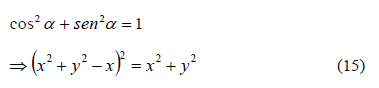
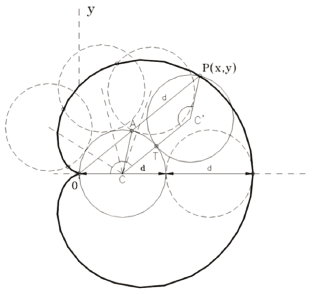
<body><![CDATA[<p><font size="2" face="Verdana, Arial, Helvetica, sans-serif">Given that:</font></p>     <p><img src="/img/revistas/dyna/v79n171/a01eq15.gif"></p>     <p><font size="2" face="Verdana, Arial, Helvetica, sans-serif">In general, the orthoptic curve of any two circumferences is a limaçon (<a href="#fig05">Fig. 5</a>). As the two centres approach, the loop is reduced and in orthogonal position the result is a cardioid. If the centres are closer together, the result is a conchoid of a the circumference, where there are no double points (d &gt; a).</font></p>     <p align="center"><font size="2" face="Verdana, Arial, Helvetica, sans-serif"><b><a name="fig05"></a><img src="/img/revistas/dyna/v79n171/a01fig05.gif">    <br> Figure 5.</b> Limaçon of Pascal</font></p>     <p><font size="2" face="Verdana, Arial, Helvetica, sans-serif">Therefore, it can be concluded that the cardioid is the orthoptic curve of two orthogonal circumferences. </font></p>     <p><font size="2" face="Verdana, Arial, Helvetica, sans-serif"><b>Case 5. Epicycloid of a circumference</b></font></p>     <p><font size="2" face="Verdana, Arial, Helvetica, sans-serif">When a circumference rolls around the exterior of another with the same radius, a point on the moving circumference describes the cardioide (<a href="#fig06">Fig. 6</a>).</font></p>     <p align="center"><font size="2" face="Verdana, Arial, Helvetica, sans-serif"><b><a name="fig06"></a><img src="/img/revistas/dyna/v79n171/a01fig06.gif">    <br> Figure 6.</b> Cardioid obtained from the epicycloid of a circumference</font></p>     ]]></body>
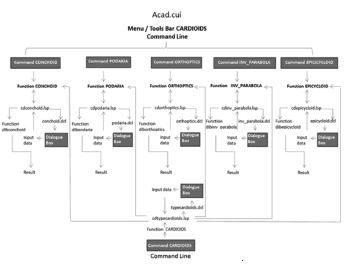
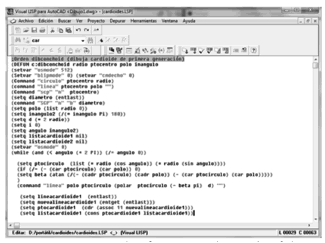
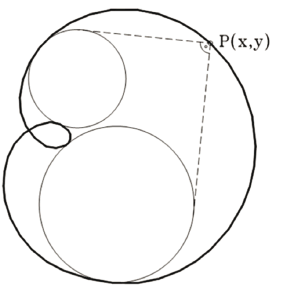
<body><![CDATA[<p><font size="2" face="Verdana, Arial, Helvetica, sans-serif">As the angles marked C and C' are equal, given that <img src="/img/revistas/dyna/v79n171/a01eq16831.jpeg" />, <img src="/img/revistas/dyna/v79n171/a01eq16839.jpeg" /> is parallel to <img src="/img/revistas/dyna/v79n171/a01eq16846.jpeg" /> and <img src="/img/revistas/dyna/v79n171/a01eq16857.jpeg" /> is a parallelogram. Therefore, <img src="/img/revistas/dyna/v79n171/a01eq16866.jpeg" /> and <i>P</i> generate the cardioid equal to the conchoid of the base circle.</font></p>     <p><font size="2" face="Verdana, Arial, Helvetica, sans-serif">In other words, the cardioid is epicycloid traced by a circumference which rolls without slipping around the exterior of the base circumference, when this has the same radius as the rolling circumference. </font></p>     <p>&nbsp;</p>     <p><font size="3" face="Verdana, Arial, Helvetica, sans-serif"><b>3. RESULTS</b></font></p>     <p><font size="2" face="Verdana, Arial, Helvetica, sans-serif">The general structure of the developed application is shown in a simplified form in <a href="#fig07">Fig. 7</a>.</font></p>     <p align="center"><font size="2" face="Verdana, Arial, Helvetica, sans-serif"><b><a name="fig07"></a><img src="/img/revistas/dyna/v79n171/a01fig07.gif">    <br> Figure 7.</b> Flow diagram of the application</font></p>     <p><font size="2" face="Verdana, Arial, Helvetica, sans-serif">The diagram shows how the application has 6 .lsp files (CDTYPECARDIOIDS, CDCONCHOID, CDPODARIA, CDINV_PARABOLA, CDORTHOPTICS, CDEPICYCLOID), which in turn lead to 6 dialogue box files with extension .dcl (TYPECARDIOIDS, CONCHOID, PODARIA, INV_PARABOLA, ORTHOPTICS, EPICYCLOID), taking the data introduced by the user, and running the drawing commands (DIBCONCHOID, DIBPODARIA, DIBINV_PARABOLA, DIBORTHOPTICS, DIBEPICYCLOID), defined in the seventh .lsp file (CARDIOIDS). </font></p>     <p><font size="2" face="Verdana, Arial, Helvetica, sans-serif">The source code programming of the routines is carried out with Visual LISP, which is the editor provided by AutoCAD. As an example, <a href="#fig08">Fig. 8</a> shows a fragment of the programming developed for the first generation of the cardioid, the CONCHOID (<a href="#fig08">Fig. 8</a>).</font></p>     <p align="center"><font size="2" face="Verdana, Arial, Helvetica, sans-serif"><b><a name="fig08"></a><img src="/img/revistas/dyna/v79n171/a01fig08.gif">    ]]></body>
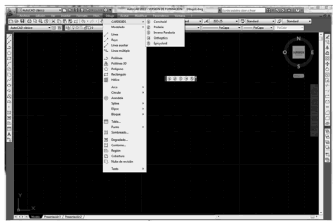
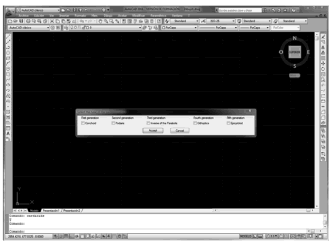
<body><![CDATA[<br> Figure 8.</b> Example of programming code of the conchoid in Visual LISP</font></p>     <p><font size="2" face="Verdana, Arial, Helvetica, sans-serif">Therefore, before running the different options, the .lsp files must be loaded with the command _APPLOAD in the command line or through the Tools bar in the menu bar. In addition, the file ACAD.cui has been modified by the IUP command to create the CARDIOIDS menu and its submenus, as it is the file which automatically loads when AutoCAD is started. In this situation, it is possible to run the application. </font></p>     <p><font size="2" face="Verdana, Arial, Helvetica, sans-serif">The navigation of the application is a multiple system, and it can be accessed in three ways: 1) through the CARDIOIDS menu and its submenus included in the DIBUJO menu on the menu bar, thereby accessing each of the different generations of the cardioids; 2) using the command CARDIOIDS written at the AutoCAD command line, in which there is a dialogue box to select the type of generation desired; or 3) writing at the command line the name of each of the functions (CONCHOID, PODARIA, ORTHOPTICS, INV_PARABOLA y EPICYCLOID).</font></p>     <p><font size="2" face="Verdana, Arial, Helvetica, sans-serif"><b>3.1 Program Operation    <br> </b>As stated previously, in order to run the application, it is possible to Access through the CARDIOIDS menu in the DIBUJO menu on the menu bar, and thus access each of the 5 generations of the Cardioid, along with a tool bar for direct access (<a href="#fig09">Fig. 9</a>).</font></p>     <p align="center"><font size="2" face="Verdana, Arial, Helvetica, sans-serif"><b><a name="fig09"></a><img src="/img/revistas/dyna/v79n171/a01fig09.gif">    <br> Figure 9.</b> Main window showing the CARDIOIDS menus and the submenus</font></p>     <p><font size="2" face="Verdana, Arial, Helvetica, sans-serif">Each of the generations can also be accessed using the command line CARDIOIDS, with the dialogue box shown in <a href="#fig10">Fig. 10</a>. </font></p>     <p align="center"><font size="2" face="Verdana, Arial, Helvetica, sans-serif"><b><a name="fig10"></a><img src="/img/revistas/dyna/v79n171/a01fig10.gif">    <br> Figure 10.</b> CARDIOIDS command line dialogue box</font></p>     ]]></body>
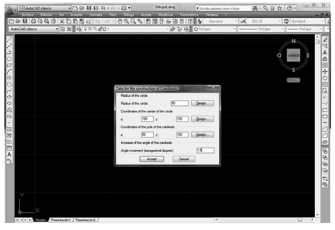
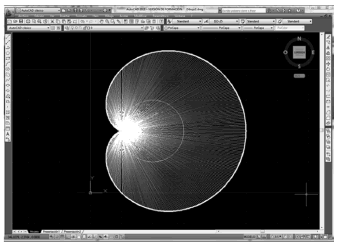
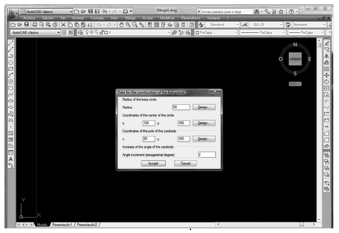
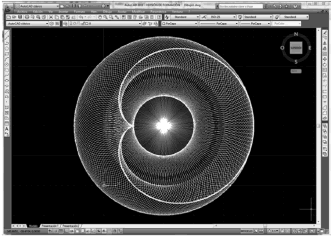
<body><![CDATA[<p><font size="2" face="Verdana, Arial, Helvetica, sans-serif"><b>3.1.1 Conchoid    <br> </b>The conchoid generation of the cardioid can be accessed from the CARDIOIDS menu, or directly by typing the command CONCHOID at the command line. A dialogue box is then shown for initial data to be inputted (<a href="#fig11">Fig. 11</a>).</font></p>     <p align="center"><font size="2" face="Verdana, Arial, Helvetica, sans-serif"><b><a name="fig11"></a><img src="/img/revistas/dyna/v79n171/a01fig11.gif">    <br> Figure 11.</b> Dialogue box for the input of data for the construction of the conchoid</font></p>     <p><font size="2" face="Verdana, Arial, Helvetica, sans-serif">In this option, the program asks for the Cartesian coordinates of the centre of the circumference and its radius, as well as the coordinates of the pole of the cardioid and the increase in the angle in sexagesimal degrees. These data can also be inputted graphically.</font></p>     <p><font size="2" face="Verdana, Arial, Helvetica, sans-serif">The result of this generation can be seen in <a href="#fig12">Fig. 12</a>, which clearly shows the route traced by the routine developed in Visual LISP.</font></p>     <p align="center"><font size="2" face="Verdana, Arial, Helvetica, sans-serif"><b><a name="fig12"></a><img src="/img/revistas/dyna/v79n171/a01fig12.gif">    <br> Figure 12. </b>Generation of the cardioid obtained from the conchoid</font></p>     <p><font size="2" face="Verdana, Arial, Helvetica, sans-serif"><b>3.1.2 Pedal curve    <br> </b>This generation of the cardioid can be accessed from the CARDIOIDS menu, or directly by typing the command PODARIA at the command line. A dialogue box is then shown for initial data to be inputted (<a href="#fig13">Fig. 13</a>). In this option, the program asks for the Cartesian coordinates of the centre of the circumference and its radius, as well as the coordinates of the pole of the cardioid and the increase in the angle in sexagesimal degrees. These data can also be inputted graphically.</font></p>     ]]></body>
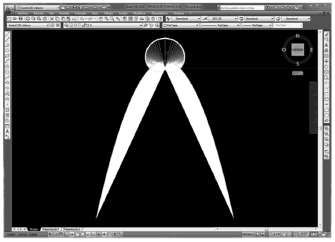
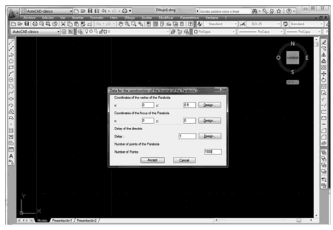
<body><![CDATA[<p align="center"><font size="2" face="Verdana, Arial, Helvetica, sans-serif"><b><a name="fig13"></a><img src="/img/revistas/dyna/v79n171/a01fig13.gif">    <br> Figure 13.</b> Dialogue box for the input of data for the construction of the pedal curve</font></p>     <p><font size="2" face="Verdana, Arial, Helvetica, sans-serif">The result of this generation can be seen in <a href="#fig14">Fig. 14</a>, which clearly shows the route traced by the routine developed in Visual LISP.</font></p>     <p align="center"><font size="2" face="Verdana, Arial, Helvetica, sans-serif"><a name="fig14"></a><b><img src="/img/revistas/dyna/v79n171/a01fig14.gif">    <br> Figure 14.</b> Generation of the cardioid obtained from the pedal curve</font></p>     <p><font size="2" face="Verdana, Arial, Helvetica, sans-serif"><b>3.1.3 Inverse of the parabola    <br> </b>This generation of the cardioid can be accessed from the CARDIOIDS menu, or directly by typing the command INV_PARABOLA at the command line. A dialogue box is then shown for initial data to be inputted (<a href="#fig15">Fig. 15</a>). </font></p>     <p align="center"><font size="2" face="Verdana, Arial, Helvetica, sans-serif"><b><a name="fig15"></a><img src="/img/revistas/dyna/v79n171/a01fig15.gif">    <br> Figure 15.</b> Dialogue box for the input of data for the construction of the inverse of the parabola</font></p>     <p><font size="2" face="Verdana, Arial, Helvetica, sans-serif">In this option, the program asks for the Cartesian coordinates of the vertex and the focus of the parabola, as well as the phase angle of the directrix and the number of points of the parabola. These data can also be inputted graphically.</font></p>     ]]></body>
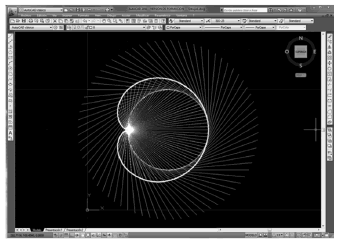
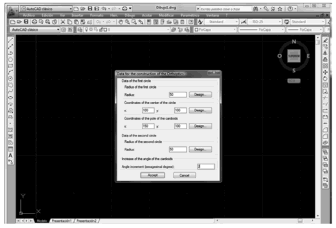
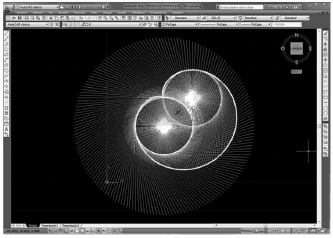
<body><![CDATA[<p><font size="2" face="Verdana, Arial, Helvetica, sans-serif">The result of this generation can be seen in <a href="#fig16">Fig. 16</a>, which clearly shows the route traced by the routine developed in Visual LISP.</font></p>     <p align="center"><font size="2" face="Verdana, Arial, Helvetica, sans-serif"><b><a name="fig16"></a><img src="/img/revistas/dyna/v79n171/a01fig16.gif">    <br> Figure 16.</b> Generation of the cardioid obtained from the inverse of the parabola</font></p>     <p><font size="2" face="Verdana, Arial, Helvetica, sans-serif"><b>3.1.4 Orthoptic curve    <br> </b>This generation of the cardioid can be accessed from the CARDIOIDS menu, or directly by typing the command ORTHOPTICS at the command line. A dialogue box is then shown for initial data to be inputted (<a href="#fig17">Fig. 17</a>). </font></p>     <p align="center"><font size="2" face="Verdana, Arial, Helvetica, sans-serif"><b><a name="fig17"></a><img src="/img/revistas/dyna/v79n171/a01fig17.gif">    <br> Figure 17.</b> Dialogue box for the input of data for the construction of the orthoptic curve</font></p>     <p><font size="2" face="Verdana, Arial, Helvetica, sans-serif">In this option, the program asks for the Cartesian coordinates of the centre of the circumference and of the pole of the cardioid, the radii of the first and second circumferences, and the increase in the angle in sexagesimal degrees. These data can also be inputted graphically.</font></p>     <p><font size="2" face="Verdana, Arial, Helvetica, sans-serif">The result of this generation can be seen in <a href="#fig18">Fig. 18</a>, which clearly shows the route traced by the routine developed in Visual LISP.</font></p>     <p align="center"><font size="2" face="Verdana, Arial, Helvetica, sans-serif"><b><a name="fig18"></a><img src="/img/revistas/dyna/v79n171/a01fig18.gif">    ]]></body>
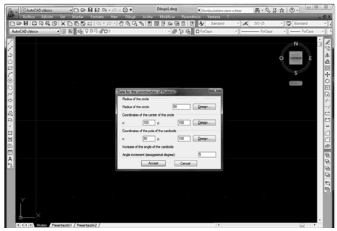
<body><![CDATA[<br> Figure 18.</b> Generation of the cardioid obtained from the orthoptic curve</font></p>     <p><font size="2" face="Verdana, Arial, Helvetica, sans-serif"><b>3.1.5 Epicycloid</b>    <br> This generation of the cardioid can be accessed from the CARDIOIDS menu, or directly by typing the command EPICYCLOID at the command line. A dialogue box is then shown for the initial data to be inputted (<a href="#fig19">Fig. 19</a>). </font></p>     <p align="center"><font size="2" face="Verdana, Arial, Helvetica, sans-serif"><b><a name="fig19"></a><img src="/img/revistas/dyna/v79n171/a01fig19.gif">    <br> Figure 19.</b> Dialogue box for the input of data for the construction of the epicycloid</font></p>     <p><font size="2" face="Verdana, Arial, Helvetica, sans-serif">In this option, the program asks for the Cartesian coordinates of the centre of the circumference and of the pole of the cardioid, the radius of the base circumference, and the increase in the angle in sexagesimal degrees. These data can also be inputted graphically.</font></p>     <p><font size="2" face="Verdana, Arial, Helvetica, sans-serif">The result of this generation can be seen in <a href="#fig20">Fig. 20</a>, which clearly shows the route traced by the routine developed in Visual LISP.</font></p>     <p align="center"><font size="2" face="Verdana, Arial, Helvetica, sans-serif"><b><a name="fig20"></a><img src="/img/revistas/dyna/v79n171/a01fig20.gif">    <br> Figure 20.</b> Generation of the cardioid obtained from the epicycloid</font></p>     <p><font size="2" face="Verdana, Arial, Helvetica, sans-serif"><b>3.2 Usability and limitations</b>    ]]></body>
<body><![CDATA[<br> </font><font size="2" face="Verdana, Arial, Helvetica, sans-serif">This application is an exceptional tool in the hands of teachers, professionals, and experts in design. As in any research process, first the problem arises and then a researcher carries out a deep analysis of the topic, which requires an exhaustive search for information online, detailed analysis, and the evaluation of its effectiveness and impact. </font></p>     <p><font size="2" face="Verdana, Arial, Helvetica, sans-serif">Among current limitations are those related to this software application, as it works only in the AutoCAD environment, although the programming will be revised in order to adapt it to other commercial CAD systems, such as MicroStation, SolidEdge or SolidWorks.</font></p>     <p><font size="2" face="Verdana, Arial, Helvetica, sans-serif">Another limitation is the application's remote use, as the speed with which the application loads means that it is more convenient to use it locally, by running the application on a laptop computer on which AutoCAD is installed and which students can bring to class.</font></p>     <p><font size="2" face="Verdana, Arial, Helvetica, sans-serif">A further limitation is that the software used works only on the Window operating system, although it will be adapted for use in a Mac environment. However, despite these limitations, we are considering using the application in an installation on a dedicated server, accessible from a local network.</font></p>     <p>&nbsp;</p>     <p><font size="3" face="Verdana, Arial, Helvetica, sans-serif"><b>4. CONCLUSIONS</b></font></p> <ul>   <li class="dyna-normal"><font size="2" face="Verdana, Arial, Helvetica, sans-serif">Five different generations of the Cardioid have been presented: from the conchoid of a circumference; from the pedal curve of a circumference; from the inverse of a parabola; from the orthoptic curve of a circumference; and from the epicycloid, using an application installed in an AutoCAD environment for autonomous learning.</font></li>   <li class="dyna-normal"><font size="2" face="Verdana, Arial, Helvetica, sans-serif">The use of CAD and information and communication technology have favoured the new concept of teaching and learning encouraged by institutional, social, and technological changes.</font></li>   <li class="dyna-normal"><font size="2" face="Verdana, Arial, Helvetica, sans-serif">The search for new teaching methodologies which facilitate learning is crucial in increasing the effectiveness of teaching, by optimizing the use of class time and improving study possibilities. Computer-aided teaching is incorporated into this methodology, in line with the importance given to pedagogical innovation to improve teaching quality. </font></li>   <li class="dyna-normal"><font size="2" face="Verdana, Arial, Helvetica, sans-serif">The principal advantages of the application, as the assessment has shown, are its ease of navigation, intuitive use, and swift response in the AutoCAD environment.</font></li>   <li class="dyna-normal"><font size="2" face="Verdana, Arial, Helvetica, sans-serif">Another advantage of the application is that the computing requirements are minimal. An operating system such as Windows XP, Windows 2000, or Windows Vista, with resolutions of 1024 x 768 or higher, which are found nowadays in the vast majority of computers, will suffice.</font></li>   <li class="dyna-normal"><font size="2" face="Verdana, Arial, Helvetica, sans-serif">In addition, the speed with which the Cardioid is obtained allows for its use as a two-dimensional profile, serving as the basis for the movement of a cam which has the curve as its law of motion. This 2D form can be exported to other CAD programs using conversion to a neutral file with .dxf extension. </font></li>     </ul>     <p>&nbsp;</p>     <p><font size="3" face="Verdana, Arial, Helvetica, sans-serif"><b>REFERENCES</b></font></p>     <!-- ref --><p><font size="2" face="Verdana, Arial, Helvetica, sans-serif"><b>&#91;1&#93;</b> Ou, S.C., Sung, W.T., Hsiao, S.J. and Fan, K.C., Interactive web-based training tool for CAD in a virtual environment. Comput. Appl. Eng. Educ. Vol. 10, pp. 182-193, 2003.       &nbsp;&nbsp;&nbsp;&nbsp;&nbsp;&nbsp;&nbsp;&nbsp;[&#160;<a href="javascript:void(0);" onclick="javascript: window.open('/scielo.php?script=sci_nlinks&ref=000152&pid=S0012-7353201200010000100001&lng=','','width=640,height=500,resizable=yes,scrollbars=1,menubar=yes,');">Links</a>&#160;]<!-- end-ref --><!-- ref --><br>   <b>&#91;2&#93;</b> Rubio, L., Mu&ntilde;oz-Abella, B., Castej&oacute;n, C. and Mu&ntilde;oz-S&aacute;nchez, A., Web-based application for descriptive geometry learning. Comput. Appl. Eng. Educ. Vol. 18, pp. 574-581, 2010.     &nbsp;&nbsp;&nbsp;&nbsp;&nbsp;&nbsp;&nbsp;&nbsp;[&#160;<a href="javascript:void(0);" onclick="javascript: window.open('/scielo.php?script=sci_nlinks&ref=000153&pid=S0012-7353201200010000100002&lng=','','width=640,height=500,resizable=yes,scrollbars=1,menubar=yes,');">Links</a>&#160;]<!-- end-ref --><!-- ref --><br>   <b>&#91;3&#93;</b> Hern&aacute;ndez-Abad, F., Rojas-Sola, J.I., Hern&aacute;ndez-Abad, V., Ochoa-Vives, M., Font-Andreu, J., Hern&aacute;ndez-Diaz, D. and Villar-Ribera, R., Educational software to learn the essentials of engineering graphics. Comput. Appl. Eng. Educ., 2012. (DOI: 10.1002/cae.20344).     &nbsp;&nbsp;&nbsp;&nbsp;&nbsp;&nbsp;&nbsp;&nbsp;[&#160;<a href="javascript:void(0);" onclick="javascript: window.open('/scielo.php?script=sci_nlinks&ref=000154&pid=S0012-7353201200010000100003&lng=','','width=640,height=500,resizable=yes,scrollbars=1,menubar=yes,');">Links</a>&#160;]<!-- end-ref --><!-- ref --><br>   <b>&#91;4&#93;</b> G&oacute;mez Echeverri, M.A., Uribe Restrepo, G.H. and Jim&eacute;nez Builes, J.A., New perspective of virtual learning and teaching environments on engineering. Case study: Operations wityh solids. Dyna-Colombia Vol. 160, pp. 283-292, 2009.     &nbsp;&nbsp;&nbsp;&nbsp;&nbsp;&nbsp;&nbsp;&nbsp;[&#160;<a href="javascript:void(0);" onclick="javascript: window.open('/scielo.php?script=sci_nlinks&ref=000155&pid=S0012-7353201200010000100004&lng=','','width=640,height=500,resizable=yes,scrollbars=1,menubar=yes,');">Links</a>&#160;]<!-- end-ref --><!-- ref --><br>   <b>&#91;5&#93;</b> Villoria San Miguel, V., Fundamentos Geom&eacute;tricos, Dossat, Madrid, 1992.     &nbsp;&nbsp;&nbsp;&nbsp;&nbsp;&nbsp;&nbsp;&nbsp;[&#160;<a href="javascript:void(0);" onclick="javascript: window.open('/scielo.php?script=sci_nlinks&ref=000156&pid=S0012-7353201200010000100005&lng=','','width=640,height=500,resizable=yes,scrollbars=1,menubar=yes,');">Links</a>&#160;]<!-- end-ref --><!-- ref --><br>   <b>&#91;6&#93;</b> Pedoe, D., La Geometr&iacute;a en el Arte, Gustavo Gili, Barcelona, 1982.     &nbsp;&nbsp;&nbsp;&nbsp;&nbsp;&nbsp;&nbsp;&nbsp;[&#160;<a href="javascript:void(0);" onclick="javascript: window.open('/scielo.php?script=sci_nlinks&ref=000157&pid=S0012-7353201200010000100006&lng=','','width=640,height=500,resizable=yes,scrollbars=1,menubar=yes,');">Links</a>&#160;]<!-- end-ref --><!-- ref --><br>   <b>&#91;7&#93;</b> Badan, I. and Oancea, G., Software Tool Used for Holes Modeling in AutoCAD Environment. In: Proceedings of the Latest Trends on Engineering Mechanics, Structures, Engineering Geology, pp. 152-156, 2010.       &nbsp;&nbsp;&nbsp;&nbsp;&nbsp;&nbsp;&nbsp;&nbsp;[&#160;<a href="javascript:void(0);" onclick="javascript: window.open('/scielo.php?script=sci_nlinks&ref=000158&pid=S0012-7353201200010000100007&lng=','','width=640,height=500,resizable=yes,scrollbars=1,menubar=yes,');">Links</a>&#160;]<!-- end-ref --><!-- ref --><br>   <b>&#91;8&#93;</b> Kumar, S. and Singh, R., An Expert System for Design of Progressive Die for Use in Sheet Metal Industries. J. Sci. Ind. Res. Vol. 69, pp. 510-514, 2010.       &nbsp;&nbsp;&nbsp;&nbsp;&nbsp;&nbsp;&nbsp;&nbsp;[&#160;<a href="javascript:void(0);" onclick="javascript: window.open('/scielo.php?script=sci_nlinks&ref=000159&pid=S0012-7353201200010000100008&lng=','','width=640,height=500,resizable=yes,scrollbars=1,menubar=yes,');">Links</a>&#160;]<!-- end-ref --><!-- ref --><br>   <b>&#91;9&#93;</b> Chen, J.H. and Xing, Y., Practical Method of Conical Cam Outline Expansion. Chin. J. Mech. Eng. Vol. 24, pp. 127-132, 2011.  </font>&nbsp;&nbsp;&nbsp;&nbsp;&nbsp;&nbsp;&nbsp;&nbsp;[&#160;<a href="javascript:void(0);" onclick="javascript: window.open('/scielo.php?script=sci_nlinks&ref=000160&pid=S0012-7353201200010000100009&lng=','','width=640,height=500,resizable=yes,scrollbars=1,menubar=yes,');">Links</a>&#160;]<!-- end-ref --> ]]></body><back>
<ref-list>
<ref id="B1">
<label>1</label><nlm-citation citation-type="journal">
<person-group person-group-type="author">
<name>
<surname><![CDATA[Ou]]></surname>
<given-names><![CDATA[S.C.]]></given-names>
</name>
<name>
<surname><![CDATA[Sung]]></surname>
<given-names><![CDATA[W.T.]]></given-names>
</name>
<name>
<surname><![CDATA[Hsiao]]></surname>
<given-names><![CDATA[S.J]]></given-names>
</name>
<name>
<surname><![CDATA[Fan]]></surname>
<given-names><![CDATA[K.C.]]></given-names>
</name>
</person-group>
<article-title xml:lang="en"><![CDATA[Interactive web-based training tool for CAD in a virtual environment.]]></article-title>
<source><![CDATA[Comput. Appl. Eng. Educ.]]></source>
<year>2003</year>
<volume>10</volume>
<page-range>182-193</page-range></nlm-citation>
</ref>
<ref id="B2">
<label>2</label><nlm-citation citation-type="journal">
<person-group person-group-type="author">
<name>
<surname><![CDATA[Rubio]]></surname>
<given-names><![CDATA[L.]]></given-names>
</name>
<name>
<surname><![CDATA[Muñoz-Abella]]></surname>
<given-names><![CDATA[B]]></given-names>
</name>
<name>
<surname><![CDATA[Castejón]]></surname>
<given-names><![CDATA[C.]]></given-names>
</name>
<name>
<surname><![CDATA[Muñoz-Sánchez]]></surname>
<given-names><![CDATA[A.]]></given-names>
</name>
</person-group>
<article-title xml:lang="en"><![CDATA[Web-based application for descriptive geometry learning.]]></article-title>
<source><![CDATA[Comput. Appl. Eng. Educ.]]></source>
<year>2010</year>
<volume>18</volume>
<page-range>574-581</page-range></nlm-citation>
</ref>
<ref id="B3">
<label>3</label><nlm-citation citation-type="journal">
<person-group person-group-type="author">
<name>
<surname><![CDATA[Hernández-Abad]]></surname>
<given-names><![CDATA[F.]]></given-names>
</name>
<name>
<surname><![CDATA[Rojas-Sola]]></surname>
<given-names><![CDATA[J.I.]]></given-names>
</name>
<name>
<surname><![CDATA[Hernández-Abad]]></surname>
<given-names><![CDATA[V.]]></given-names>
</name>
<name>
<surname><![CDATA[Ochoa-Vives]]></surname>
<given-names><![CDATA[M.]]></given-names>
</name>
<name>
<surname><![CDATA[Font-Andreu]]></surname>
<given-names><![CDATA[J.]]></given-names>
</name>
<name>
<surname><![CDATA[Hernández-Diaz]]></surname>
<given-names><![CDATA[D.]]></given-names>
</name>
<name>
<surname><![CDATA[Villar-Ribera]]></surname>
<given-names><![CDATA[R.]]></given-names>
</name>
</person-group>
<article-title xml:lang="en"><![CDATA[Educational software to learn the essentials of engineering graphics.]]></article-title>
<source><![CDATA[Comput. Appl. Eng. Educ.]]></source>
<year>2012</year>
</nlm-citation>
</ref>
<ref id="B4">
<label>4</label><nlm-citation citation-type="journal">
<person-group person-group-type="author">
<name>
<surname><![CDATA[Gómez Echeverri]]></surname>
<given-names><![CDATA[M.A.]]></given-names>
</name>
<name>
<surname><![CDATA[Uribe Restrepo]]></surname>
<given-names><![CDATA[G.H.]]></given-names>
</name>
<name>
<surname><![CDATA[Jiménez Builes]]></surname>
<given-names><![CDATA[J.A.]]></given-names>
</name>
</person-group>
<article-title xml:lang="en"><![CDATA[New perspective of virtual learning and teaching environments on engineering: Case study: Operations wityh solids.]]></article-title>
<source><![CDATA[Dyna]]></source>
<year>2009</year>
<volume>160</volume>
<page-range>283-292</page-range></nlm-citation>
</ref>
<ref id="B5">
<label>5</label><nlm-citation citation-type="book">
<person-group person-group-type="author">
<name>
<surname><![CDATA[Villoria San Miguel]]></surname>
<given-names><![CDATA[V.]]></given-names>
</name>
</person-group>
<source><![CDATA[Fundamentos Geométricos]]></source>
<year>1992</year>
<publisher-loc><![CDATA[Madrid ]]></publisher-loc>
<publisher-name><![CDATA[Dossat]]></publisher-name>
</nlm-citation>
</ref>
<ref id="B6">
<label>6</label><nlm-citation citation-type="book">
<person-group person-group-type="author">
<name>
<surname><![CDATA[Pedoe]]></surname>
<given-names><![CDATA[D.]]></given-names>
</name>
</person-group>
<source><![CDATA[La Geometría en el Arte]]></source>
<year>1982</year>
<publisher-loc><![CDATA[Barcelona ]]></publisher-loc>
<publisher-name><![CDATA[Gustavo Gili,]]></publisher-name>
</nlm-citation>
</ref>
<ref id="B7">
<label>7</label><nlm-citation citation-type="">
<person-group person-group-type="author">
<name>
<surname><![CDATA[Badan]]></surname>
<given-names><![CDATA[I.]]></given-names>
</name>
<name>
<surname><![CDATA[Oancea]]></surname>
<given-names><![CDATA[G.]]></given-names>
</name>
</person-group>
<article-title xml:lang="en"><![CDATA[Software Tool Used for Holes Modeling in AutoCAD Environment.]]></article-title>
<source><![CDATA[Proceedings of the Latest Trends on Engineering Mechanics, Structures, Engineering Geology]]></source>
<year>2010</year>
<page-range>152-156</page-range></nlm-citation>
</ref>
<ref id="B8">
<label>8</label><nlm-citation citation-type="journal">
<person-group person-group-type="author">
<name>
<surname><![CDATA[Kumar]]></surname>
<given-names><![CDATA[S.]]></given-names>
</name>
<name>
<surname><![CDATA[Singh]]></surname>
<given-names><![CDATA[R.]]></given-names>
</name>
</person-group>
<article-title xml:lang="en"><![CDATA[An Expert System for Design of Progressive Die for Use in Sheet Metal Industries.]]></article-title>
<source><![CDATA[J. Sci. Ind. Res.]]></source>
<year>2010</year>
<volume>69</volume>
<page-range>510-514</page-range></nlm-citation>
</ref>
<ref id="B9">
<label>9</label><nlm-citation citation-type="journal">
<person-group person-group-type="author">
<name>
<surname><![CDATA[Chen]]></surname>
<given-names><![CDATA[J.H.]]></given-names>
</name>
<name>
<surname><![CDATA[Xing]]></surname>
<given-names><![CDATA[Y.]]></given-names>
</name>
</person-group>
<article-title xml:lang="en"><![CDATA[Practical Method of Conical Cam Outline Expansion.]]></article-title>
<source><![CDATA[Chin. J. Mech. Eng.]]></source>
<year>2011</year>
<volume>24</volume>
<page-range>127-132</page-range></nlm-citation>
</ref>
</ref-list>
</back>
</article>