<?xml version="1.0" encoding="ISO-8859-1"?><article xmlns:mml="http://www.w3.org/1998/Math/MathML" xmlns:xlink="http://www.w3.org/1999/xlink" xmlns:xsi="http://www.w3.org/2001/XMLSchema-instance">
<front>
<journal-meta>
<journal-id>0012-7353</journal-id>
<journal-title><![CDATA[DYNA]]></journal-title>
<abbrev-journal-title><![CDATA[Dyna rev.fac.nac.minas]]></abbrev-journal-title>
<issn>0012-7353</issn>
<publisher>
<publisher-name><![CDATA[Universidad Nacional de Colombia]]></publisher-name>
</publisher>
</journal-meta>
<article-meta>
<article-id>S0012-73532012000100005</article-id>
<title-group>
<article-title xml:lang="en"><![CDATA[EMG-BASED SYSTEM FOR BASIC HAND MOVEMENT RECOGNITION]]></article-title>
<article-title xml:lang="es"><![CDATA[SISTEMA DE RECONOCIMIENTO DE MOVIMIENTOS BÁSICOS DE LA MANO CON BASE EN SEÑALES EMG]]></article-title>
</title-group>
<contrib-group>
<contrib contrib-type="author">
<name>
<surname><![CDATA[CAMACHO NAVARRO]]></surname>
<given-names><![CDATA[JHONATAN]]></given-names>
</name>
<xref ref-type="aff" rid="A01"/>
</contrib>
<contrib contrib-type="author">
<name>
<surname><![CDATA[LEÓN-VARGAS]]></surname>
<given-names><![CDATA[FABIAN]]></given-names>
</name>
<xref ref-type="aff" rid="A02"/>
</contrib>
<contrib contrib-type="author">
<name>
<surname><![CDATA[BARRERO PÉREZ]]></surname>
<given-names><![CDATA[JAIME]]></given-names>
</name>
<xref ref-type="aff" rid="A03"/>
</contrib>
</contrib-group>
<aff id="A01">
<institution><![CDATA[,Universidad Industrial de Santander  ]]></institution>
<addr-line><![CDATA[ ]]></addr-line>
</aff>
<aff id="A02">
<institution><![CDATA[,Universidad Industrial de Santander  ]]></institution>
<addr-line><![CDATA[ ]]></addr-line>
</aff>
<aff id="A03">
<institution><![CDATA[,Universidad Industrial de Santander  ]]></institution>
<addr-line><![CDATA[ ]]></addr-line>
</aff>
<pub-date pub-type="pub">
<day>00</day>
<month>02</month>
<year>2012</year>
</pub-date>
<pub-date pub-type="epub">
<day>00</day>
<month>02</month>
<year>2012</year>
</pub-date>
<volume>79</volume>
<numero>171</numero>
<fpage>41</fpage>
<lpage>49</lpage>
<copyright-statement/>
<copyright-year/>
<self-uri xlink:href="http://www.scielo.org.co/scielo.php?script=sci_arttext&amp;pid=S0012-73532012000100005&amp;lng=en&amp;nrm=iso"></self-uri><self-uri xlink:href="http://www.scielo.org.co/scielo.php?script=sci_abstract&amp;pid=S0012-73532012000100005&amp;lng=en&amp;nrm=iso"></self-uri><self-uri xlink:href="http://www.scielo.org.co/scielo.php?script=sci_pdf&amp;pid=S0012-73532012000100005&amp;lng=en&amp;nrm=iso"></self-uri><abstract abstract-type="short" xml:lang="en"><p><![CDATA[This paper presents a system for the automatic identification of six basic hand movements in healthy subjects based on a steady-state of electromyographic signals. The following basic hand motions were detected: opening, closing, flexion, extension, pronation, and supination, as well as the rest condition. A modular approach of pattern recognition with discrete wavelet transform, principal component analysis, and support vector machines was used to discriminate each movement. Identification was completed off-line every 256 ms with a hardware-software interface composed of a signal acquisition system with two electromyographic differential channels using Matlab® and LabVIEW® software. The system was trained and tested using five subjects of different gender, age, and physical complexion, with identification rates of up to 99.25 %.]]></p></abstract>
<abstract abstract-type="short" xml:lang="es"><p><![CDATA[Este artículo presenta un sistema que permite identificar de forma automática, en sujetos sanos, y haciendo uso de señales electromiográficas superficiales en estado estable, los siguientes movimientos básicos de la mano: apertura, cierre, flexión, extensión, pronación y supinación, incluyendo la condición de reposo. La discriminación de los diferentes movimientos se realiza a partir de una metodología modular de reconocimiento de patrones que incluye el uso de la transformada wavelet discreta, análisis de componentes principales y máquinas de soporte vectorial. La identificación fue realizada off-line cada 256 ms mediante una interfaz hardware-software conformada por un sistema de adquisición de señales de dos canales diferenciales y algoritmos programados en Matlab® y LabVIEW®. El sistema fue entrenado y evaluado para cinco sujetos de diferente género, edad y complexión física, obteniendo tasas de acierto de hasta el 99.25 %.]]></p></abstract>
<kwd-group>
<kwd lng="en"><![CDATA[Electromyography]]></kwd>
<kwd lng="en"><![CDATA[hand-prosthesis]]></kwd>
<kwd lng="en"><![CDATA[pattern recognition]]></kwd>
<kwd lng="en"><![CDATA[principal component analysis]]></kwd>
<kwd lng="en"><![CDATA[discrete wavelet transform]]></kwd>
<kwd lng="en"><![CDATA[support vector machines]]></kwd>
<kwd lng="es"><![CDATA[Electromiógrafo]]></kwd>
<kwd lng="es"><![CDATA[prótesis de mano]]></kwd>
<kwd lng="es"><![CDATA[reconocimiento de patrones]]></kwd>
<kwd lng="es"><![CDATA[análisis de componentes principales]]></kwd>
<kwd lng="es"><![CDATA[transformada wavelet discreta]]></kwd>
<kwd lng="es"><![CDATA[máquinas de soporte vectorial]]></kwd>
</kwd-group>
</article-meta>
</front><body><![CDATA[  		    <p align="center"><font size="4" face="Verdana, Arial, Helvetica, sans-serif"><b>EMG-BASED SYSTEM FOR BASIC HAND MOVEMENT RECOGNITION </b></font></p> 		    <p align="center"><i><font size="3"><b><font face="Verdana, Arial, Helvetica, sans-serif">SISTEMA DE RECONOCIMIENTO DE MOVIMIENTOS B&Aacute;SICOS DE LA MANO CON BASE EN SE&Ntilde;ALES EMG</font></b></font></i></p> 		    <p align="center">&nbsp;</p> 		    <p align="center"><font size="2" face="Verdana, Arial, Helvetica, sans-serif"><b>JHONATAN CAMACHO NAVARRO</b>    <br> 		    <i>M.Sc. Ing. Electr&oacute;nico, Universidad Industrial de Santander, <a href="mailto:Jhonatan_UIS@hotmail.com">Jhonatan_UIS@hotmail.com</a></i></font></p> 		    <p align="center"><font size="2" face="Verdana, Arial, Helvetica, sans-serif"><b>FABIAN LE&Oacute;N-VARGAS</b>    <br> 		  <i>M.Sc. Ing. Electr&oacute;nico, Universidad Industrial de Santander, <a href="mailto:fabian.mauricio.leon@gmail.com">fabian.mauricio.leon@gmail.com</a></i></font></p> 		    <p align="center"><font size="2" face="Verdana, Arial, Helvetica, sans-serif"><b>JAIME BARRERO P&Eacute;REZ.</b>    <br> 		  <i>Profesor titular, Universidad Industrial de Santander Sede principal, <a href="mailto:jbarrero@uis.edu.co">jbarrero@uis.edu.co</a></i></font></p> 		    ]]></body>
<body><![CDATA[<p align="center">&nbsp;</p> 		    <p align="center"><font size="2" face="Verdana, Arial, Helvetica, sans-serif"><b>Received for review September 18<sup>th</sup>, 2009; accepted October 8<sup>th</sup>, 2010; final version November 8<sup>th</sup>, 2010</b></font></p> 	    <p>&nbsp;</p> 		<hr> 		    <p><font size="2" face="Verdana, Arial, Helvetica, sans-serif"><b>ABSTRACT: </b>This paper presents a system for the automatic identification of six basic hand movements in healthy subjects based on a steady-state of electromyographic signals. The following basic hand motions were detected: opening, closing, flexion, extension, pronation, and supination, as well as the rest condition. A modular approach of pattern recognition with discrete wavelet transform, principal component analysis, and support vector machines was used to discriminate each movement. Identification was completed off-line every 256 ms with a hardware-software interface composed of a signal acquisition system with two electromyographic differential channels using Matlab&reg; and LabVIEW&reg; software. The system was trained and tested using five subjects of different gender, age, and physical complexion, with identification rates of up to 99.25 %.</font></p> 		    <p><font size="2" face="Verdana, Arial, Helvetica, sans-serif"><b>KEY WORDS:</b> Electromyography, hand-prosthesis, pattern recognition, principal component analysis, discrete wavelet transform, support vector machines</font></p> 		    <p><font size="2" face="Verdana, Arial, Helvetica, sans-serif"><b>RESUMEN: </b>Este art&iacute;culo presenta un sistema que permite identificar de forma autom&aacute;tica, en sujetos sanos, y haciendo uso de se&ntilde;ales electromiogr&aacute;ficas superficiales en estado estable, los siguientes movimientos b&aacute;sicos de la mano: apertura, cierre, flexi&oacute;n, extensi&oacute;n, pronaci&oacute;n y supinaci&oacute;n, incluyendo la condici&oacute;n de reposo. La discriminaci&oacute;n de los diferentes movimientos se realiza a partir de una metodolog&iacute;a modular de reconocimiento de patrones que incluye el uso de la transformada wavelet discreta, an&aacute;lisis de componentes principales y m&aacute;quinas de soporte vectorial. La identificaci&oacute;n fue realizada off-line cada 256 ms mediante una interfaz hardware-software conformada por un sistema de adquisici&oacute;n de se&ntilde;ales de dos canales diferenciales y algoritmos programados en Matlab&reg; y LabVIEW&reg;. El sistema fue entrenado y evaluado para cinco sujetos de diferente g&eacute;nero, edad y complexi&oacute;n f&iacute;sica, obteniendo tasas de acierto de hasta el 99.25 %. </font></p> 		    <p><font size="2" face="Verdana, Arial, Helvetica, sans-serif"><b>PALABRAS CLAVE:</b> Electromi&oacute;grafo, pr&oacute;tesis de mano, reconocimiento de patrones, an&aacute;lisis de componentes principales, transformada wavelet discreta, m&aacute;quinas de soporte vectorial</font></p> 		<hr> 		    <p>&nbsp;</p> 		    <p><font size="3" face="Verdana, Arial, Helvetica, sans-serif"><b>1. INTRODUCTION</b></font></p> 		    <p><font size="2" face="Verdana, Arial, Helvetica, sans-serif">Upper limb prosthesis has evolved from simple mechanical devices with aesthetical purposes to complex devices using surface electromyographic (sEMG) signals [1]. The sEMG signals enable practical and natural movements for handicapped persons using less effort and a quick learning rate, which promotes an easy and painless transmission [1-9].</font></p> 		    ]]></body>
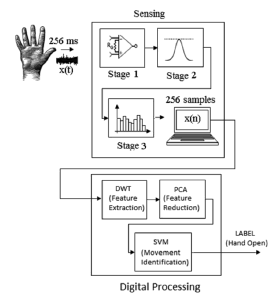
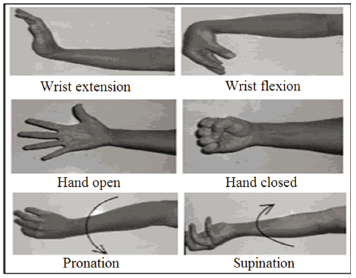
<body><![CDATA[<p><font size="2" face="Verdana, Arial, Helvetica, sans-serif">Englehart et al. provided the first approach using sEMG signals as a method of control in 2001 [3]. The approach utilized a system of six types of movement identification (hand closed, hand open, wrist flexion, wrist extension, ulnar deviation, and radial deviation) with four sensing channels. Englehart also used the wavelet packet transform (WPT), principal components analysis (PCA), and neural networks as the main processing components. Recently, Oskoei and Hu [4] demonstrated the use of support vector machines (SVMs) as a classifier for obtaining optimal results compared with other commonly used techniques. To reduce computational time, G&uuml;le and Koçer [5] applied the discrete wavelet transform (DWT) in contrast to previous work [6-8] where the WPT was implemented. Integrating a methodology on the basis of pattern recognition without PCA, Lucas et al. [9] obtained good results; however, they used eight sensing channels to recognize six movements which imply an associated complex instrumentation.</font></p> 		    <p><font size="2" face="Verdana, Arial, Helvetica, sans-serif">The aim of this work was to recognize seven basic hand movements (<a href="#fig01">Fig. 1</a>, including the rest condition), using sEMG signals generated by forearm muscle activity with only two sensing channels. </font></p> 	    <p align="center"><font size="2" face="Verdana, Arial, Helvetica, sans-serif"><b><a name="fig01"></a><img src="/img/revistas/dyna/v79n171/a05fig01.gif">    <br>     Figure 1.</b> Movements for classification</font></p> 	    <p>&nbsp;</p> 		    <p><font size="3" face="Verdana, Arial, Helvetica, sans-serif"><b>2. SYSTEM DESIGN</b></font></p> 		    <p><font size="2" face="Verdana, Arial, Helvetica, sans-serif">The identification process was completed by using the four sequential modules that are commonly used in pattern recognition [2-3]:</font></p> 		<ul>           <li class="dyna-normal"><font size="2" face="Verdana, Arial, Helvetica, sans-serif">sEMG signal acquisition and conditioning</font></li> 		  <li class="dyna-normal"><font size="2" face="Verdana, Arial, Helvetica, sans-serif">feature extraction</font></li> 		  <li class="dyna-normal"><font size="2" face="Verdana, Arial, Helvetica, sans-serif">dimensionality reduction</font></li> 		  <li class="dyna-normal"><font size="2" face="Verdana, Arial, Helvetica, sans-serif">movement identification</font></li>         </ul> 	    <p><font size="2" face="Verdana, Arial, Helvetica, sans-serif">The entire movement identification system based on sEMG signaling is summarized in <a href="#fig02">Fig. 2</a> and consists of two principal modules. The first module is related to signal acquisition and conditioning, and the second is related to computerized digital processing. Each block is described in the following sections.</font></p>         <p align="center"><font size="2" face="Verdana, Arial, Helvetica, sans-serif"><b><a name="fig02" id="fig02"></a><img src="/img/revistas/dyna/v79n171/a05fig02.gif">    ]]></body>
<body><![CDATA[<br>     Figure 2.</b> Movement identification system</font></p>         <p><font size="2" face="Verdana, Arial, Helvetica, sans-serif"><b>2.1 semg signal acquisition and conditioning    <br> 		</b></font><font size="2" face="Verdana, Arial, Helvetica, sans-serif">This module is designed to process the analog sEMG signals to reduce electromagnetic noise, filter the desired frequency components, amplify its magnitude, and finally, to digitalize the signals. Afterwards, the signal is processed on a PC to determine which movement was made.</font></p>     <p><font size="2" face="Verdana, Arial, Helvetica, sans-serif"><b>2.1.1 Electrode type    <br> 		</b></font><font size="2" face="Verdana, Arial, Helvetica, sans-serif">The silver/silver chloride (Ag/AgCl) electrode is a transducer that is commonly used to convert ionic currents on the skin produced by muscular activity [10-12]. </font></p> 		    <p><font size="2" face="Verdana, Arial, Helvetica, sans-serif">The surface electromyography for the non-invasive assessment of muscles (SENIAM) group [11] recommends an electrolytic gel application to optimize conductivity and skin adherence with the electrodes and to take advantage of their characteristics. Following the SENIAM guidelines, several characteristics were selected for the sEMG signal acquisition:</font></p> 		    <p><font size="2" face="Verdana, Arial, Helvetica, sans-serif"><b>Electrode form:</b> circular    <br> 		</font><font size="2" face="Verdana, Arial, Helvetica, sans-serif"><b>Electrode size:</b> 10 mm diameter    <br> 		</font><font size="2" face="Verdana, Arial, Helvetica, sans-serif"><b>Electrode material:</b> Ag/AgCl    <br>           <b>Skin preparation:</b> cleaned with alcohol, free from hair    ]]></body>
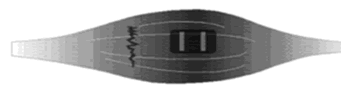
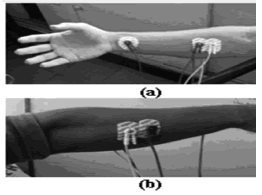
<body><![CDATA[<br>         <b>Sensor location:</b> longitudinal, parallel to the muscular fibers; see <a href="#fig03">Figs. 3</a> and <a href="#fig04">4</a>    <br>         <b>Distance between electrodes:</b> approximately 20 mm </font></p> 		    <p align="center"><font size="2" face="Verdana, Arial, Helvetica, sans-serif"><b><a name="fig03"></a><img src="/img/revistas/dyna/v79n171/a05fig03.gif">    <br> 	    Figure 3.</b> Muscle longitudinal axis</font></p> 		    <p align="center"><font size="2" face="Verdana, Arial, Helvetica, sans-serif"><b><a name="fig04"></a><img src="/img/revistas/dyna/v79n171/a05fig04.gif">    <br> 	    Figure 4.</b> (a) Anterior forearm region and (b) posterior forearm region</font></p> 		    <p><font size="2" face="Verdana, Arial, Helvetica, sans-serif"><b>2.1.2 Electrode location    <br> 	    </b></font><font size="2" face="Verdana, Arial, Helvetica, sans-serif">Electrodes were placed between two motion points and through the longitudinal midline. The longitudinal axis corresponds to the muscle fiber direction (<a href="#fig03">Fig. 3</a>) [11-13].</font></p> 	    <p><font size="2" face="Verdana, Arial, Helvetica, sans-serif">Two bipolar channels were used (see <a href="#fig04">Fig. 4</a>), to reduce computing time, storage requirements, and the needed instrumentation.</font></p> 	    <p><font size="2" face="Verdana, Arial, Helvetica, sans-serif">For sEMG signal acquisition, two phases notably influenced the processing: the transient state and the stationary state [2-3]. </font></p> 		    ]]></body>
<body><![CDATA[<p><font size="2" face="Verdana, Arial, Helvetica, sans-serif">The transient state is related to the initial phase of movement that is observed during instantaneous sudden myoelectric activity. The stationary state is related to the myoelectric activity during a sustained movement.</font></p> 		    <p><font size="2" face="Verdana, Arial, Helvetica, sans-serif">In this study, the sEMG signal was addressed in the stationary state. This method does not require threshold identification to capture the signal when the movement occurs.</font></p> 		    <p><font size="2" face="Verdana, Arial, Helvetica, sans-serif"><b>2.1.3 Acquisition board    <br> 		</b></font><font size="2" face="Verdana, Arial, Helvetica, sans-serif">For data registration and sEMG signal storage, a hardware-software interface was implemented. This layout for signal conditioning was based on an electrocardiograph schematic [10], with adaptations of amplification characteristics and bandwidth for obtaining the desired signals. </font></p> 		    <p><font size="2" face="Verdana, Arial, Helvetica, sans-serif">The nature of a sEMG signal is defined by the following characteristics:</font></p> 		<ul>           <li class="dyna-normal"><font size="2" face="Verdana, Arial, Helvetica, sans-serif">The typical sEMG signal amplitude is 0-6 mV.</font></li> 		  <li class="dyna-normal"><font size="2" face="Verdana, Arial, Helvetica, sans-serif">A useful signal energy is found in the 0-500 Hz range, with the main components located in the 50-150 Hz range.</font></li>         </ul> 	    <p><font size="2" face="Verdana, Arial, Helvetica, sans-serif">Given these characteristics, the acquisition module has three stages:</font></p> 		    <p><font size="2" face="Verdana, Arial, Helvetica, sans-serif"><b>Stage 1</b></font></p> 		    <p><font size="2" face="Verdana, Arial, Helvetica, sans-serif">The input stage is composed of op-amps AD620 and OP97. It is designed for signal acquisition in a differential mode by eliminating electromagnetic noise interference and common mode signals, thus improving the signal-to-noise ratio (SNR) [10,13]. Total gain is 2000 V/V [8] and is distributed in two circuits to avoid output saturation in the initial stage. Small differences in the measured signal amplitude are often produced due to skin conditions or static biopotential. Therefore, a variable gain amplifier is needed for amplitude adjustment.</font></p> 		    <p><font size="2" face="Verdana, Arial, Helvetica, sans-serif"><b>Stage 2</b></font></p> 		    ]]></body>
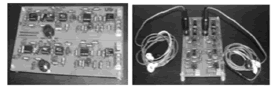
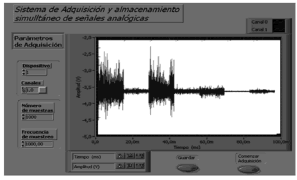
<body><![CDATA[<p><font size="2" face="Verdana, Arial, Helvetica, sans-serif">The second stage is the filtering stage, which is necessary in order to reject signals that have undesired frequency ranges. Three filters were designed with the Sallen-key architecture [10].</font></p> 		    <p><font size="2" face="Verdana, Arial, Helvetica, sans-serif">The first filter is a second order high-pass filter with a unitary gain, and a cut frequency of 20 Hz. This filter eliminates the offset produced by the movement of the electrode contact with the skin and by the cable movement [13].</font></p> 		    <p><font size="2" face="Verdana, Arial, Helvetica, sans-serif">The second filter is a second order low-pass filter with 40 dB/dec attenuation, unitary gain, and a 500 Hz cut frequency. This filter is proposed to accommodate for weakened high frequency amplitudes where the sEMG signal energy is low [10]. </font></p> 		    <p><font size="2" face="Verdana, Arial, Helvetica, sans-serif">A 60 Hz noise cancellation was made with a first order notch filter. This filter has a quality factor of 10, unitary gain, and 23 dB of rejecting [13].</font></p> 		    <p><font size="2" face="Verdana, Arial, Helvetica, sans-serif">For SEMG signal amplification, a non-inverter circuit with a 100 V/V gain was implemented at the notch filter output; <a href="#fig05">Fig. 5</a> shows a prototype.</font></p> 	    <p align="center"><font size="2" face="Verdana, Arial, Helvetica, sans-serif"><b><a name="fig05"></a><img src="/img/revistas/dyna/v79n171/a05fig05.gif">    <br>     Figure 5.</b> Signal conditioning hardware</font></p> 	    <p><font size="2" face="Verdana, Arial, Helvetica, sans-serif"><b>Stage 3</b></font></p> 		    <p><font size="2" face="Verdana, Arial, Helvetica, sans-serif">In this stage, the sEMG signal was digitalized, as it was previously filtered and amplified. An acquisition board LAB PCI 1200 was used with &plusmn;5 V, 12-bit differential resolution, and a sampling frequency of 1000 Hz [10-12]. </font></p> 		    <p><font size="2" face="Verdana, Arial, Helvetica, sans-serif">The visualization and storage stage was completed using LabVIEW&reg;. The front panel, where acquisition and register parameters are configured, is shown in <a href="#fig06">Fig. 6</a>. These parameters include storage time, sampling frequency, number of acquisition channels, storage files, and devices used [14].</font></p> 	    ]]></body>
<body><![CDATA[<p align="center"><font size="2" face="Verdana, Arial, Helvetica, sans-serif"><a name="fig06"></a><b><img src="/img/revistas/dyna/v79n171/a05fig06.gif">    <br>     Figure 6.</b> Electromyograph front panel</font></p> 	    <p><font size="2" face="Verdana, Arial, Helvetica, sans-serif">The sEMG signal sensing is executed during 256 ms per channel.</font></p> 		    <p><font size="2" face="Verdana, Arial, Helvetica, sans-serif"><b>2.2 Feature extraction    <br> 		</b></font><font size="2" face="Verdana, Arial, Helvetica, sans-serif">This module processes the sEMG signal features in the time-frequency domain producing an &ldquo;initial features set&rdquo;.</font></p> 		    <p><font size="2" face="Verdana, Arial, Helvetica, sans-serif">Most approaches based on feature sets obtained from frequency analysis show better results than approaches based on time domain analysis [3]. </font></p> 		    <p><font size="2" face="Verdana, Arial, Helvetica, sans-serif"><b>2.2.1 Discrete Wavelet Transform    <br> 		</b></font><font size="2" face="Verdana, Arial, Helvetica, sans-serif">The discrete wavelet transform (DWT) is the representation of a function by wavelets. The wavelets are scaled, and the translated copies of a finite-length or fast-decaying oscillating waveform are known as the mother wavelet. Wavelets can be combined using a shift, multiply, and sum technique called convolution. Portions of sEMG signals are used to extract information [15].</font></p> 		    <p><font size="2" face="Verdana, Arial, Helvetica, sans-serif">The DWT has advantages over traditional techniques for representing functions with discontinuities and sharp peaks. In addition, accurate deconstruction and reconstruction of finite, non-periodic, and non-stationary signals can be obtained by applying a multiresolution analysis.</font></p> 		    <p><font size="2" face="Verdana, Arial, Helvetica, sans-serif">The results obtained from a DWT provide the scale and detail coefficients, which represent time and frequency data packs [15].</font></p> 		    ]]></body>
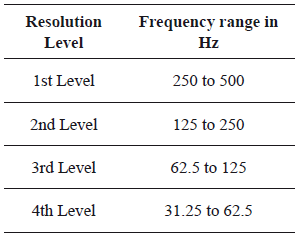
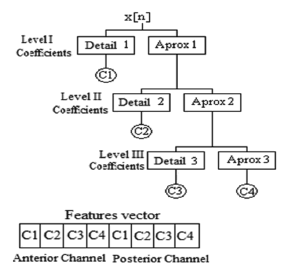
<body><![CDATA[<p><font size="2" face="Verdana, Arial, Helvetica, sans-serif">The feature vector is formed by statistics calculated on the detail coefficient packets and approximation coefficients obtained on each resolution level of the wavelet analysis (descriptors). In this stage, the corresponding pattern of each movement is formed by the feature vector of the anterior channel signal followed by the feature vector of the posterior channel [14].</font></p> 		    <p><font size="2" face="Verdana, Arial, Helvetica, sans-serif">The statistics calculated for this stage are: root mean square (RMS), variance, standard deviation, correlation, covariance, median, mean, maximum value, minimal value, and wavelet energy. The statistics calculated over the wavelet coefficients provide information regarding the tendencies, abnormalities, and energy of the sEMG signal.</font></p> 		    <p><font size="2" face="Verdana, Arial, Helvetica, sans-serif"><b>2.2.2 Wavelet parameters    <br> 		</b>In this study, parameters such as minimum computing time, similarity to the sEMG signal based on correlation coefficient, and better representation of frequency content of the sEMG signal (see <a href="#tab01">Table 1</a>), were used to decide which wavelet signal will be tested. Hence, a preliminary test was carried out over several mother wavelets to discriminate which wavelets were best suited [14].</font></p> 	        <p align="center"><font size="2" face="Verdana, Arial, Helvetica, sans-serif"><b><a name="tab01"></a>Table 1.</b> Resolution level and corresponding frequency range of sEMG signal</font>    <br>         <img src="/img/revistas/dyna/v79n171/a05tab01.gif"></p>         <p><font size="2" face="Verdana, Arial, Helvetica, sans-serif">In this work, mother wavelets used in previous pattern recognition studies [16-17] were used to evaluate previous criteria. </font></p> 	    <p><font size="2" face="Verdana, Arial, Helvetica, sans-serif">The preselected mother wavelets were: daubechies3, daubechies4, daubechies5, daubechies6, coiflet3, coiflet4, coiflet5, coiflet6, symlet4, symlet5, and symlet6.</font></p> 		    <p><font size="2" face="Verdana, Arial, Helvetica, sans-serif">To define the decomposition level, each level was related to their analyzed frequency range (see <a href="#tab01">Table 1</a>). According to [12], the dominant energy is located at 50-150 Hz, matching mainly to the third level of decomposition.</font></p> 	    <p><font size="2" face="Verdana, Arial, Helvetica, sans-serif">On the other hand, according to previous research [3], identification degrades quickly along the segment of longitudinal decrement. However, 256 samples had a good performance without affecting the real time restrictions that are imposed by a hand prosthesis, where the control system must take action within 300 ms (300 samples with a sampling frequency Fs = 1 KHz) according to international standards [2-3].</font></p> 		    ]]></body>
<body><![CDATA[<p><font size="2" face="Verdana, Arial, Helvetica, sans-serif">Based on previous studies, the original signal was analyzed with the wavelet transform process by sectioning it with disjointed and adjacent windows formed by 256 samples.</font></p> 		    <p><font size="2" face="Verdana, Arial, Helvetica, sans-serif">Several tests were performed on healthy subjects. The order of the movements was as follows: hand closed, hand open, wrist flexion, wrist extension, pronation, resting and supination. The execution time of each movement was ten seconds. </font></p> 		    <p><font size="2" face="Verdana, Arial, Helvetica, sans-serif">The process performed in this feature extraction module is summarized in <a href="#fig07">Fig. 7</a>.</font></p> 	    <p align="center"><font size="2" face="Verdana, Arial, Helvetica, sans-serif"><b><a name="fig07"></a><img src="/img/revistas/dyna/v79n171/a05fig07.gif">    <br>     Figure 7.</b> Scheme of feature extraction</font></p> 	    <p><font size="2" face="Verdana, Arial, Helvetica, sans-serif">The digital sEMG signal x[n] is decomposed in three resolution levels. The coefficients represent the degree of correlation between the original signal x[n] and the displaced and scaled versions of the mother wavelet. Descriptors C1, C2, C3, and C4 correspond to the statistics that are calculated with these coefficients.</font></p> 		    <p><font size="2" face="Verdana, Arial, Helvetica, sans-serif"><b>2.3 Feature reduction    <br> 		</b></font><font size="2" face="Verdana, Arial, Helvetica, sans-serif">There is a drawback when the feature vector is used as a direct input for the artificial intelligence algorithms. Feature vectors are, mostly, high dimensionality vectors with no information order. For this reason, it is necessary to reduce the vector size with techniques that preserve and organize the most relevant information. These techniques reduce the processing time and improve the results of the artificial intelligence algorithm [18-19].</font></p> 		    <p><font size="2" face="Verdana, Arial, Helvetica, sans-serif">Dimensionality reduction can be executed using characteristic projection methods, such as principal component analysis (PCA) [20]. The objective of PCA is to detect redundant information and to reorganize it for an easier interpretation.</font></p> 		    <p><font size="2" face="Verdana, Arial, Helvetica, sans-serif">The PCA analysis preserves a new set of features, with minimum square error, which are ordered from maximum to minimum variance.</font></p> 		    ]]></body>
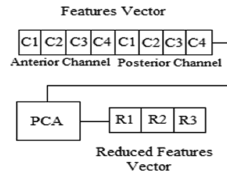
<body><![CDATA[<p><font size="2" face="Verdana, Arial, Helvetica, sans-serif">New features are obtained using the Eigen-vectors of the covariance matrix or the correlation matrix. When the correlation matrix is used, the analysis is not affected by amplitude variations in the feature vector. This phenomenon is known as normalized analysis [20].</font></p> 		    <p><font size="2" face="Verdana, Arial, Helvetica, sans-serif">According to the Kaiser Criterion [21], only the new features with a variance higher than the mean are required. When this criterion is evaluated using the correlation matrix, it is called the normalized Kaiser.</font></p> 		    <p><font size="2" face="Verdana, Arial, Helvetica, sans-serif">For this work, another criterion based on sEMG signal was adapted to exclude the new features with small variance values [20]. Hence, preliminary tests were executed using data from the sEMG signals, and only the new features with variance greater than 2 % of the maximum value were included. This criterion was called percentage.</font></p> 		    <p><font size="2" face="Verdana, Arial, Helvetica, sans-serif">The dimensionality reduction module was then applied as shown in <a href="#fig08">Fig. 8</a>. The feature vector was reduced by PCA.</font></p> 	    <p align="center"><font size="2" face="Verdana, Arial, Helvetica, sans-serif"><b><a name="fig08"></a><img src="/img/revistas/dyna/v79n171/a05fig08.gif">    <br>     Figure 8.</b> Dimensionality reduction</font></p> 	    <p><font size="2" face="Verdana, Arial, Helvetica, sans-serif">The new features (R1, R2, and R3) were linear combinations of the initial ones (C1&hellip; C4).</font></p> 		    <p><font size="2" face="Verdana, Arial, Helvetica, sans-serif"><b>2.4 Movement identification    <br> 		</b></font><font size="2" face="Verdana, Arial, Helvetica, sans-serif">Support vector machines (SVMs) were used for movement identification. Contrasting with the Bayesian method, these machines do not require any hypothesis regarding the probability density function of the data. In comparison with neural networks, they can reduce the number of parameters that must be introduced by the user [22-23].</font></p> 		    <p><font size="2" face="Verdana, Arial, Helvetica, sans-serif">Intuitively, given a group of samples distributed into two classes, a linear SVM searches for a hyper plane to locate the maximum number of samples on the same side, while the distance from the classes to the hyper plane is maximized. If the hyper plane exists, the data are linearly detachable [22-23].</font></p> 		    ]]></body>
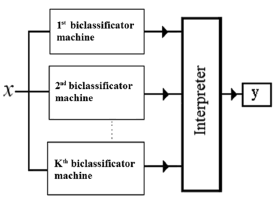
<body><![CDATA[<p><font size="2" face="Verdana, Arial, Helvetica, sans-serif">If data are not linearly detachable, the hyper plane search lacks relevance. Nonlinear SVMs trough kernel functions are then used as an alternative. If there are more than two classes, a parallel arrangement of biclassificator SVMs is implemented along with an interpreter element [14,24].</font></p> 		    <p><font size="2" face="Verdana, Arial, Helvetica, sans-serif">In this stage, the software tool MSVToolBox10 [25], developed at Universidad Industrial de Santander, was used to find the optimal defining parameters through cross-validation and a grid search [14,25]. The main parameters defined are: kernel, penalty constant, slack variables, the optimization method, and the decomposition method [26].</font></p> 		    <p><font size="2" face="Verdana, Arial, Helvetica, sans-serif">The implementation of this movement identification module is shown in <a href="#fig09">Figure 9</a>. </font></p> 	    <p align="center"><font size="2" face="Verdana, Arial, Helvetica, sans-serif"><b><a name="fig09"></a><img src="/img/revistas/dyna/v79n171/a05fig09.gif">    <br>     Figure 9.</b> Movement identification</font></p> 	    <p><font size="2" face="Verdana, Arial, Helvetica, sans-serif">The reduced feature vector is labeled according to the executed movement by the interpreter element based on partial decisions of biclassificator machines (multiclass SVMs). These machines can discriminate between two specific movements (ovo) or between one movement and the rest (ovr).</font></p> 		    <p>&nbsp;</p> 		    <p><font size="3" face="Verdana, Arial, Helvetica, sans-serif"><b>3. TESTS EXECUTED</b></font></p> 		    <p><font size="2" face="Verdana, Arial, Helvetica, sans-serif">Data from each subject was divided into two sets with 50 % designated for training and 50 % for validation. The identification system was implemented using a five-fold cross-validation over the training data. Two preliminary tests were performed on the data from one subject to determine the optimal parameters of DWT, PCA, and SVMs, and these parameters were then applied to all five subjects.</font></p> 		    <p><font size="2" face="Verdana, Arial, Helvetica, sans-serif"><b>3.1 First preliminary tests    ]]></body>
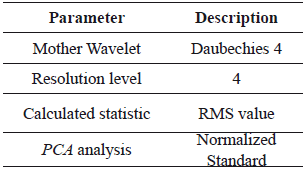
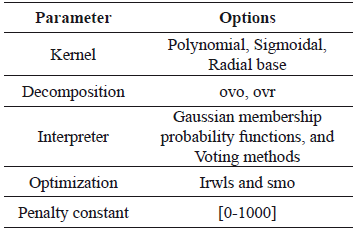
<body><![CDATA[<br> 		</b></font><font size="2" face="Verdana, Arial, Helvetica, sans-serif">Two initial pilot tests were performed to observe the effects and changes produced by the mother wavelet, resolution level, and variations in descriptors. </font></p> 		    <p><font size="2" face="Verdana, Arial, Helvetica, sans-serif">During both pilot tests, PCA parameters (normalized Kaiser), and SVMs parameters (polynomial kernel, ovo decomposition, penalty constant with value 100, optimization method smo, interpreter element based on voting schemes, and Gaussian membership probability functions) were fixed.</font></p> 		    <p><font size="2" face="Verdana, Arial, Helvetica, sans-serif">These SVMs parameters were used following a preliminary test with a classification ratio of 70 %. The SVMs variations in <a href="#tab02">Table 2</a> were evaluated by cross-validation and a grid search. Using criteria presented in Section 2, the RMS value as statistic in the feature extraction stage (descriptor), mother wavelet daubechies4, third resolution level, and normalized Kaiser Criterion were used.</font></p> 	    <p align="center"><font size="2" face="Verdana, Arial, Helvetica, sans-serif"><b><a name="tab02"></a>Table 2.</b> SVMs parameters</font>    <br>     <img src="/img/revistas/dyna/v79n171/a05tab02.gif"></p> 	    <p><font size="2" face="Verdana, Arial, Helvetica, sans-serif">The first pilot test was executed using the mother wavelets preselected in Section 2.2.2. This pilot test was completed under fixed resolution level and descriptors. The mother wavelets that presented a classification ratio over 80 % were: coiflet3, coiflet4, symlet4, symlet6, daubechies4, and daubechies5.</font></p> 		    <p><font size="2" face="Verdana, Arial, Helvetica, sans-serif">In the second pilot test, the objective was to determine which of the statistics proposed in Section 2.2.1 provide relevant information for the classifier. The descriptors were varied while the resolution level and mother wavelet daubechies4 were kept fixed (the best wavelet in first pilot test).</font></p> 		    <p><font size="2" face="Verdana, Arial, Helvetica, sans-serif">The statistics that presented a classification ratio over 80 % were: RMS value, variance, mean value, and standard deviation. </font></p> 		    <p><font size="2" face="Verdana, Arial, Helvetica, sans-serif">To find the adequate alternative to calculate the PCA with &lsquo;percentage' criteria associated, a final pilot test was performed using fixed parameters from the previous pilot tests.</font></p> 		    <p><font size="2" face="Verdana, Arial, Helvetica, sans-serif"><b>3.2 Second preliminary tests    ]]></body>
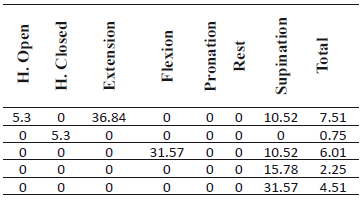
<body><![CDATA[<br> 		</b>Two resolutions levels (third and fourth) were taken into account because these coefficients concentrate the dominant frequency ranges into sEMG signals, as can be seen in <a href="#tab01">Table 1</a>.</font></p> 	    <p><font size="2" face="Verdana, Arial, Helvetica, sans-serif">Two groups were formed for the statistical tests, one that took into account only the RMS value and another that took into account all the values obtained from first preliminary tests.</font></p> 		    <p><font size="2" face="Verdana, Arial, Helvetica, sans-serif">As result, 16 test combinations (variations) were obtained to evaluate each particular mother wavelet. Each combination was performed with all possible variations from <a href="#tab02">Table 2.</a></font></p> 		    <p>&nbsp;</p> 	    <p><font size="3" face="Verdana, Arial, Helvetica, sans-serif"><b>4. RESULTS </b></font></p> 		    <p><font size="2" face="Verdana, Arial, Helvetica, sans-serif">The best combination, (see <a href="#tab03">Table 3</a>), obtained an error of 0.75 % for the classification.</font></p> 	    <p align="center"><font size="2" face="Verdana, Arial, Helvetica, sans-serif"><b><a name="tab03"></a>Table 3.</b> Optimal performance combination</font>    <br>     <img src="/img/revistas/dyna/v79n171/a05tab03.gif"></p> 	    <p><font size="2" face="Verdana, Arial, Helvetica, sans-serif">With respect to the classification of feature vectors using SVMs, the parameters with the best performance were: polynomial kernel, decomposition method ovo, interpreter element based on voting functions, Gaussian membership probability functions, and the optimization method smo. The decomposition method ovr did not guarantee good results, and the optimization method irwls did not converge in most tests. </font></p> 		    <p><font size="2" face="Verdana, Arial, Helvetica, sans-serif">Finally, an extrapolation test was performed to check the validity of this result in other subjects. During this test, the parameters shown in <a href="#tab03">Table 3</a> were used, and sEMG signals from five subjects with different characteristics were analyzed. The results of each classification of error of movements per subject are shown in <a href="#tab04">Table 4</a>.</font></p> 	    ]]></body>
<body><![CDATA[<p align="center"><font size="2" face="Verdana, Arial, Helvetica, sans-serif"><b><a name="tab04"></a>Table 4.</b> Error rate (%) per movement in tests for 5 subjects using the best performance combination of preliminary tests</font>    <br>     <img src="/img/revistas/dyna/v79n171/a05tab04.gif"></p> 		    <p><font size="2" face="Verdana, Arial, Helvetica, sans-serif"><a href="#tab04">Table 4</a> shows the identification error in different movements using data related to men/women, between 18 and 38 years old. The results demonstrate some error for most of the data related to forearm supination. It is also noted that the smallest amount of recognition error corresponds to remaining movements with some exceptions.</font></p> 	    <p>&nbsp;</p> 		    <p><b><font size="3" face="Verdana, Arial, Helvetica, sans-serif">5. DISCUSSION</font></b></p> 		    <p><font size="2" face="Verdana, Arial, Helvetica, sans-serif">The convergence ratio in training was very fast because cross-validation and SVMs do not have local minimums and require few parameters. The use of fewer sensing channels also reduces computational costs. </font></p> 		    <p><font size="2" face="Verdana, Arial, Helvetica, sans-serif">The proposed hand movement identification system in this work can be used to build practical upper limb prosthesis similar to the work of Huang et al. [27]. Because of the few instrumentation requirements of this system (only two sensing channels) and the relative easy implementation of this signal processing into embedded systems, it is expected that the economic costs can be reduced as compared with previous systems.</font></p> 		    <p><font size="2" face="Verdana, Arial, Helvetica, sans-serif">Off-line processing is sufficient for 256 ms of sEMG signal applying DWT, PCA, and SVMs to obtain good results, but testing with other window widths is required to verify on-line systems.</font></p> 		    <p><font size="2" face="Verdana, Arial, Helvetica, sans-serif">The RMS value is the only statistic required to generate the proper feature vector by applying DWT with the mother wavelet daubechies4 and the fourth resolution level.</font></p> 		    <p><font size="2" face="Verdana, Arial, Helvetica, sans-serif">The PCA analysis allows better classification results under the normalized &lsquo;percentage' criterion, reducing the feature vector roughly 50 %.</font></p> 		    ]]></body>
<body><![CDATA[<p>&nbsp;</p> 		    <p><font size="3" face="Verdana, Arial, Helvetica, sans-serif"><b>6. CONCLUSION</b></font></p> 		    <p><font size="2" face="Verdana, Arial, Helvetica, sans-serif">The most influential parameters on the success rate of movement identification are related to the correct acquisition of the sEMG signals. Therefore, the implementation of a notch filter is mandatory to filter the 60 Hz signal. All wires should be shielded, and the gain must be adapted by taking into account the static biopotential variations of each subject. Without these considerations, it is not possible to recognize sEMG patterns of hand movements, because signal quality is not guaranteed.</font></p> 		    <p><font size="2" face="Verdana, Arial, Helvetica, sans-serif">Using only two acquisition channels, each one with a sampling frequency of 1 KHz, it is possible to obtain success rates over 90 % in six basic hand movement identifications in healthy subjects with different ages, genders, and physiques. </font></p> 		    <p><font size="2" face="Verdana, Arial, Helvetica, sans-serif">To control a hand prosthesis or robotic arm, the next step is to implement the proposed approach on an embedded system. It is also necessary to assess the movement identification system using sEMG signals obtained from handicapped persons to verify the performance of the system.</font></p> 		    <p>&nbsp;</p> 		    <p><font size="3" face="Verdana, Arial, Helvetica, sans-serif"><b>REFERENCES</b></font></p> 		    <!-- ref --><p><font size="2" face="Verdana, Arial, Helvetica, sans-serif"><b>[1]</b> Loaiza, J. y Arzola, N., Evoluci&oacute;n y tendencias en el desarrollo de pr&oacute;tesis de mano. Revista Dyna, No. 169, pp. 191-200, 2011.     &nbsp;&nbsp;&nbsp;&nbsp;&nbsp;&nbsp;&nbsp;&nbsp;[&#160;<a href="javascript:void(0);" onclick="javascript: window.open('/scielo.php?script=sci_nlinks&ref=000160&pid=S0012-7353201200010000500001&lng=','','width=640,height=500,resizable=yes,scrollbars=1,menubar=yes,');">Links</a>&#160;]<!-- end-ref --><!-- ref --><br>         <b>[2]</b> Zecca, M., Micera, S., Carrozza, MC. and Dario, P., Control of Multifunctional Prosthetic Hands by Processing the Electromyographic Signal. ARTS Lab, Scuola Superiore Sant'Anna, Pontedera, Italy, 2002.     &nbsp;&nbsp;&nbsp;&nbsp;&nbsp;&nbsp;&nbsp;&nbsp;[&#160;<a href="javascript:void(0);" onclick="javascript: window.open('/scielo.php?script=sci_nlinks&ref=000161&pid=S0012-7353201200010000500002&lng=','','width=640,height=500,resizable=yes,scrollbars=1,menubar=yes,');">Links</a>&#160;]<!-- end-ref --><!-- ref --><br>         <b>[3]</b> Englehart, K., Hudgins, B., Parker, P., A Wavelet-Based Continuous Classification Scheme for Multifunction Myoelectric Control. IEEE Transactions on Biomedical Engineering, 48(3), pp. 302-311, 2001.             &nbsp;&nbsp;&nbsp;&nbsp;&nbsp;&nbsp;&nbsp;&nbsp;[&#160;<a href="javascript:void(0);" onclick="javascript: window.open('/scielo.php?script=sci_nlinks&ref=000162&pid=S0012-7353201200010000500003&lng=','','width=640,height=500,resizable=yes,scrollbars=1,menubar=yes,');">Links</a>&#160;]<!-- end-ref --><!-- ref --><br>         <b>[4]</b> Oskoei M.A., and Hu, H., Support Vector Machine-Based Classification Scheme for Myoelectric Control Applied to Upper Limb. IEEE Transactions on Biomedical Engineering, 55(8), pp. 1956-1965, 2008.              &nbsp;&nbsp;&nbsp;&nbsp;&nbsp;&nbsp;&nbsp;&nbsp;[&#160;<a href="javascript:void(0);" onclick="javascript: window.open('/scielo.php?script=sci_nlinks&ref=000163&pid=S0012-7353201200010000500004&lng=','','width=640,height=500,resizable=yes,scrollbars=1,menubar=yes,');">Links</a>&#160;]<!-- end-ref --><!-- ref --><br>         <b>[5]</b> Güler, N.F. and Koçer, S., Classification of EMG Signals Using PCA and FFT. Journal of Medical Systems, 29(3), pp. 241-250, 2005.     &nbsp;&nbsp;&nbsp;&nbsp;&nbsp;&nbsp;&nbsp;&nbsp;[&#160;<a href="javascript:void(0);" onclick="javascript: window.open('/scielo.php?script=sci_nlinks&ref=000164&pid=S0012-7353201200010000500005&lng=','','width=640,height=500,resizable=yes,scrollbars=1,menubar=yes,');">Links</a>&#160;]<!-- end-ref --><!-- ref --><br>         <b>[6]</b> Hu, X., Wang, Z., Ren, X., Classification of surface EMG signal using relative wavelet packet energy. Computer Methods and Programs in Biomedicine, 79, pp. 189-195, 2005.             &nbsp;&nbsp;&nbsp;&nbsp;&nbsp;&nbsp;&nbsp;&nbsp;[&#160;<a href="javascript:void(0);" onclick="javascript: window.open('/scielo.php?script=sci_nlinks&ref=000165&pid=S0012-7353201200010000500006&lng=','','width=640,height=500,resizable=yes,scrollbars=1,menubar=yes,');">Links</a>&#160;]<!-- end-ref --><!-- ref --><br>         <b>[7]</b> Kiatpanichagij, K., Afzulpurkar, N., Use of supervised discretization with PCA in wavelet packet transformation-based surface electromyogram classification. Biomedical Signal Processing and Control, 4, pp. 127-138, 2009.             &nbsp;&nbsp;&nbsp;&nbsp;&nbsp;&nbsp;&nbsp;&nbsp;[&#160;<a href="javascript:void(0);" onclick="javascript: window.open('/scielo.php?script=sci_nlinks&ref=000166&pid=S0012-7353201200010000500007&lng=','','width=640,height=500,resizable=yes,scrollbars=1,menubar=yes,');">Links</a>&#160;]<!-- end-ref --><!-- ref --><br>         <b>[8]</b> Yan, Z., Wang, Z., Xie, H., The application of mutual information-based feature selection and fuzzy LS-SVM-based classifier in motion classification. Computer Methods and Programs in Biomedicine, 90, pp. 275-284, 2008.             &nbsp;&nbsp;&nbsp;&nbsp;&nbsp;&nbsp;&nbsp;&nbsp;[&#160;<a href="javascript:void(0);" onclick="javascript: window.open('/scielo.php?script=sci_nlinks&ref=000167&pid=S0012-7353201200010000500008&lng=','','width=640,height=500,resizable=yes,scrollbars=1,menubar=yes,');">Links</a>&#160;]<!-- end-ref --><!-- ref --><br>         <b>[9]</b> Lucas, M.F., Gaufriau, A., Pascual, S., Doncarli, C., Farina, D., Multi-channel surface EMG classification using support vector machines and signal-based wavelet optimization. Biomedical Signal Processing and Control, 3, pp. 169-174, 2008.             &nbsp;&nbsp;&nbsp;&nbsp;&nbsp;&nbsp;&nbsp;&nbsp;[&#160;<a href="javascript:void(0);" onclick="javascript: window.open('/scielo.php?script=sci_nlinks&ref=000168&pid=S0012-7353201200010000500009&lng=','','width=640,height=500,resizable=yes,scrollbars=1,menubar=yes,');">Links</a>&#160;]<!-- end-ref --><!-- ref --><br>         <b>[10]</b> Cromwell, L., Biomedical Instrumentation and measurements. Prentice-Hall Inc., Englewood Clifffs New Jersey, 1980.             &nbsp;&nbsp;&nbsp;&nbsp;&nbsp;&nbsp;&nbsp;&nbsp;[&#160;<a href="javascript:void(0);" onclick="javascript: window.open('/scielo.php?script=sci_nlinks&ref=000169&pid=S0012-7353201200010000500010&lng=','','width=640,height=500,resizable=yes,scrollbars=1,menubar=yes,');">Links</a>&#160;]<!-- end-ref --><!-- ref --><br>         <b>[11]</b> Freriks, B., Hermens, H., European Recommendations for Surface Electromyography, Results of the SENIAM project. 2002. Avaible: <a href="http://www.seniam.org" target="referencia">www.seniam.org</a>            &nbsp;&nbsp;&nbsp;&nbsp;&nbsp;&nbsp;&nbsp;&nbsp;[&#160;<a href="javascript:void(0);" onclick="javascript: window.open('/scielo.php?script=sci_nlinks&ref=000170&pid=S0012-7353201200010000500011&lng=','','width=640,height=500,resizable=yes,scrollbars=1,menubar=yes,');">Links</a>&#160;]<!-- end-ref --><!-- ref --><br>         <b>[12]</b> De Luca, C. J., Surface electromyography: Detection and Recording, Delsys Inc, 2002.              &nbsp;&nbsp;&nbsp;&nbsp;&nbsp;&nbsp;&nbsp;&nbsp;[&#160;<a href="javascript:void(0);" onclick="javascript: window.open('/scielo.php?script=sci_nlinks&ref=000171&pid=S0012-7353201200010000500012&lng=','','width=640,height=500,resizable=yes,scrollbars=1,menubar=yes,');">Links</a>&#160;]<!-- end-ref --><!-- ref --><br>         <b>[13]</b> Barreda, L. E., Electromi&oacute;grafo. Universidad Nacional del Mar del Plata, 2005.     &nbsp;&nbsp;&nbsp;&nbsp;&nbsp;&nbsp;&nbsp;&nbsp;[&#160;<a href="javascript:void(0);" onclick="javascript: window.open('/scielo.php?script=sci_nlinks&ref=000172&pid=S0012-7353201200010000500013&lng=','','width=640,height=500,resizable=yes,scrollbars=1,menubar=yes,');">Links</a>&#160;]<!-- end-ref --><!-- ref --><br>         <b>[14]</b> Camacho, J., Le&oacute;n, F., Dise&ntilde;o de una interfaz electr&oacute;nica para el reconocimiento de patrones EMG. Bsc. Project. Universidad Industrial de Santander, 2008.     &nbsp;&nbsp;&nbsp;&nbsp;&nbsp;&nbsp;&nbsp;&nbsp;[&#160;<a href="javascript:void(0);" onclick="javascript: window.open('/scielo.php?script=sci_nlinks&ref=000173&pid=S0012-7353201200010000500014&lng=','','width=640,height=500,resizable=yes,scrollbars=1,menubar=yes,');">Links</a>&#160;]<!-- end-ref --><!-- ref --><br>         <b>[15]</b> Daubechies, I., Ten Lectures on Wavelets. The Society for Industrial and Applied Mathematics, 1992.             &nbsp;&nbsp;&nbsp;&nbsp;&nbsp;&nbsp;&nbsp;&nbsp;[&#160;<a href="javascript:void(0);" onclick="javascript: window.open('/scielo.php?script=sci_nlinks&ref=000174&pid=S0012-7353201200010000500015&lng=','','width=640,height=500,resizable=yes,scrollbars=1,menubar=yes,');">Links</a>&#160;]<!-- end-ref --><!-- ref --><br>         <b>[16]</b> Sheng, Y., The Transforms and Applications Handbook. CRC Press, 1996.             &nbsp;&nbsp;&nbsp;&nbsp;&nbsp;&nbsp;&nbsp;&nbsp;[&#160;<a href="javascript:void(0);" onclick="javascript: window.open('/scielo.php?script=sci_nlinks&ref=000175&pid=S0012-7353201200010000500016&lng=','','width=640,height=500,resizable=yes,scrollbars=1,menubar=yes,');">Links</a>&#160;]<!-- end-ref --><!-- ref --><br>         <b>[17]</b> Gamba, P., Lange, R., Saccomano, C., Trabajo Final Estudio de la Aplicaci&oacute;n Wavelet al Diagn&oacute;stico Asistido por Computadora de Mamograf&iacute;as. UNICEN, 1999.     &nbsp;&nbsp;&nbsp;&nbsp;&nbsp;&nbsp;&nbsp;&nbsp;[&#160;<a href="javascript:void(0);" onclick="javascript: window.open('/scielo.php?script=sci_nlinks&ref=000176&pid=S0012-7353201200010000500017&lng=','','width=640,height=500,resizable=yes,scrollbars=1,menubar=yes,');">Links</a>&#160;]<!-- end-ref --><!-- ref --><br>         <b>[18]</b> Crawford, B., Miller, K., Shenoy, P., Rao, R., Real-Time Classification of Electromyographic Signals for Robotic Control, University of Washington, 2005.             &nbsp;&nbsp;&nbsp;&nbsp;&nbsp;&nbsp;&nbsp;&nbsp;[&#160;<a href="javascript:void(0);" onclick="javascript: window.open('/scielo.php?script=sci_nlinks&ref=000177&pid=S0012-7353201200010000500018&lng=','','width=640,height=500,resizable=yes,scrollbars=1,menubar=yes,');">Links</a>&#160;]<!-- end-ref --><!-- ref --><br>         <b>[19]</b> Del Boca, A., Park, D.C., Myoelectric signal recognition using fuzzy clustering and artificial neuronal networks in real time. IEEE Transactions on Biomedical Engineer, 5, pp. 3098-3103, 1990.             &nbsp;&nbsp;&nbsp;&nbsp;&nbsp;&nbsp;&nbsp;&nbsp;[&#160;<a href="javascript:void(0);" onclick="javascript: window.open('/scielo.php?script=sci_nlinks&ref=000178&pid=S0012-7353201200010000500019&lng=','','width=640,height=500,resizable=yes,scrollbars=1,menubar=yes,');">Links</a>&#160;]<!-- end-ref --><!-- ref --><br>         <b>[20]</b> Smith, L., A tutorial on Principal Components Analysis. 2002.              &nbsp;&nbsp;&nbsp;&nbsp;&nbsp;&nbsp;&nbsp;&nbsp;[&#160;<a href="javascript:void(0);" onclick="javascript: window.open('/scielo.php?script=sci_nlinks&ref=000179&pid=S0012-7353201200010000500020&lng=','','width=640,height=500,resizable=yes,scrollbars=1,menubar=yes,');">Links</a>&#160;]<!-- end-ref --><!-- ref --><br>         <b>[21]</b> Kaiser, H. F., The application of electronic computers to factor analysis, Educational and Psychological Measurement, 20, pp. 141-151, 1960.             &nbsp;&nbsp;&nbsp;&nbsp;&nbsp;&nbsp;&nbsp;&nbsp;[&#160;<a href="javascript:void(0);" onclick="javascript: window.open('/scielo.php?script=sci_nlinks&ref=000180&pid=S0012-7353201200010000500021&lng=','','width=640,height=500,resizable=yes,scrollbars=1,menubar=yes,');">Links</a>&#160;]<!-- end-ref --><!-- ref --><br>         <b>[22]</b> Vapnik, V., The Nature of Statistical Learning Theory. Springer, NY, 1995             &nbsp;&nbsp;&nbsp;&nbsp;&nbsp;&nbsp;&nbsp;&nbsp;[&#160;<a href="javascript:void(0);" onclick="javascript: window.open('/scielo.php?script=sci_nlinks&ref=000181&pid=S0012-7353201200010000500022&lng=','','width=640,height=500,resizable=yes,scrollbars=1,menubar=yes,');">Links</a>&#160;]<!-- end-ref --><!-- ref --><br>         <b>[23]</b> Burges, C. A., Tutorial on Support Vector Machines for Pattern Recognition. Data Mining and Knowledge Discovery 2, pp. 121-167, 1998.             &nbsp;&nbsp;&nbsp;&nbsp;&nbsp;&nbsp;&nbsp;&nbsp;[&#160;<a href="javascript:void(0);" onclick="javascript: window.open('/scielo.php?script=sci_nlinks&ref=000182&pid=S0012-7353201200010000500023&lng=','','width=640,height=500,resizable=yes,scrollbars=1,menubar=yes,');">Links</a>&#160;]<!-- end-ref --><!-- ref --><br>         <b>[24]</b> Angulo, B.C., Aprendizaje con maquinas n&uacute;cleo en entornos de multiclasificaci&oacute;n, Universitat Politècnica de Catalunya (UPC), Tesis doctoral, Vilanova i la Geltr&uacute;, 2001.     &nbsp;&nbsp;&nbsp;&nbsp;&nbsp;&nbsp;&nbsp;&nbsp;[&#160;<a href="javascript:void(0);" onclick="javascript: window.open('/scielo.php?script=sci_nlinks&ref=000183&pid=S0012-7353201200010000500024&lng=','','width=640,height=500,resizable=yes,scrollbars=1,menubar=yes,');">Links</a>&#160;]<!-- end-ref --><!-- ref --><br>         <b>[25]</b> Campos, E., Su&aacute;rez, A., Clasificaci&oacute;n autom&aacute;tica de perturbaciones de se&ntilde;ales de tensi&oacute;n o corriente utilizando m&aacute;quinas de soporte vectorial. Universidad Industrial de Santander, 2007.     &nbsp;&nbsp;&nbsp;&nbsp;&nbsp;&nbsp;&nbsp;&nbsp;[&#160;<a href="javascript:void(0);" onclick="javascript: window.open('/scielo.php?script=sci_nlinks&ref=000184&pid=S0012-7353201200010000500025&lng=','','width=640,height=500,resizable=yes,scrollbars=1,menubar=yes,');">Links</a>&#160;]<!-- end-ref --><!-- ref --><br>         <b>[26]</b> Henao, R., Selecci&oacute;n de Hiperpar&aacute;metros en Maquinas de Soporte Vectorial, Universidad Nacional de Colombia, 2004.     &nbsp;&nbsp;&nbsp;&nbsp;&nbsp;&nbsp;&nbsp;&nbsp;[&#160;<a href="javascript:void(0);" onclick="javascript: window.open('/scielo.php?script=sci_nlinks&ref=000185&pid=S0012-7353201200010000500026&lng=','','width=640,height=500,resizable=yes,scrollbars=1,menubar=yes,');">Links</a>&#160;]<!-- end-ref --><!-- ref --><br>         <b>[27]</b> Huang, Y., Englehart, K.B., Hudgins, B., Chan, A., A Gaussian Mixture Model Based Classification Scheme for Myoelectric Control of Powered Upper. IEEE Transactions on Biomedical Engineering, 52(11), pp. 1801-1811, 2005.      </font>&nbsp;&nbsp;&nbsp;&nbsp;&nbsp;&nbsp;&nbsp;&nbsp;[&#160;<a href="javascript:void(0);" onclick="javascript: window.open('/scielo.php?script=sci_nlinks&ref=000186&pid=S0012-7353201200010000500027&lng=','','width=640,height=500,resizable=yes,scrollbars=1,menubar=yes,');">Links</a>&#160;]<!-- end-ref --> ]]></body><back>
<ref-list>
<ref id="B1">
<label>1</label><nlm-citation citation-type="journal">
<person-group person-group-type="author">
<name>
<surname><![CDATA[Loaiza]]></surname>
<given-names><![CDATA[J.]]></given-names>
</name>
<name>
<surname><![CDATA[Arzola]]></surname>
<given-names><![CDATA[N.]]></given-names>
</name>
</person-group>
<article-title xml:lang="es"><![CDATA[Evolución y tendencias en el desarrollo de prótesis de mano.]]></article-title>
<source><![CDATA[Revista Dyna]]></source>
<year>2011</year>
<volume>169</volume>
<page-range>191-200</page-range></nlm-citation>
</ref>
<ref id="B2">
<label>2</label><nlm-citation citation-type="book">
<person-group person-group-type="author">
<name>
<surname><![CDATA[Zecca]]></surname>
<given-names><![CDATA[M.]]></given-names>
</name>
<name>
<surname><![CDATA[Micera]]></surname>
<given-names><![CDATA[S.]]></given-names>
</name>
<name>
<surname><![CDATA[Carrozza]]></surname>
<given-names><![CDATA[MC]]></given-names>
</name>
<name>
<surname><![CDATA[Dario]]></surname>
<given-names><![CDATA[P.]]></given-names>
</name>
</person-group>
<source><![CDATA[Control of Multifunctional Prosthetic Hands by Processing the Electromyographic Signal.]]></source>
<year>2002</year>
<publisher-loc><![CDATA[Pontedera ]]></publisher-loc>
<publisher-name><![CDATA[ARTS LabScuola Superiore Sant'Anna]]></publisher-name>
</nlm-citation>
</ref>
<ref id="B3">
<label>3</label><nlm-citation citation-type="journal">
<person-group person-group-type="author">
<name>
<surname><![CDATA[Englehart]]></surname>
<given-names><![CDATA[K.]]></given-names>
</name>
<name>
<surname><![CDATA[Hudgins]]></surname>
<given-names><![CDATA[B.]]></given-names>
</name>
<name>
<surname><![CDATA[Parker]]></surname>
<given-names><![CDATA[P.]]></given-names>
</name>
</person-group>
<article-title xml:lang="en"><![CDATA[A Wavelet-Based Continuous Classification Scheme for Multifunction Myoelectric Control.]]></article-title>
<source><![CDATA[IEEE Transactions on Biomedical Engineering]]></source>
<year>2001</year>
<volume>48</volume>
<numero>3</numero>
<issue>3</issue>
<page-range>302-311</page-range></nlm-citation>
</ref>
<ref id="B4">
<label>4</label><nlm-citation citation-type="journal">
<person-group person-group-type="author">
<name>
<surname><![CDATA[Oskoei]]></surname>
<given-names><![CDATA[M.A.]]></given-names>
</name>
<name>
<surname><![CDATA[Hu]]></surname>
<given-names><![CDATA[H.]]></given-names>
</name>
</person-group>
<article-title xml:lang="en"><![CDATA[Support Vector Machine-Based Classification Scheme for Myoelectric Control Applied to Upper Limb.]]></article-title>
<source><![CDATA[IEEE Transactions on Biomedical Engineering]]></source>
<year>2008</year>
<volume>55</volume>
<numero>8</numero>
<issue>8</issue>
<page-range>1956-1965</page-range></nlm-citation>
</ref>
<ref id="B5">
<label>5</label><nlm-citation citation-type="journal">
<person-group person-group-type="author">
<name>
<surname><![CDATA[Güler]]></surname>
<given-names><![CDATA[N.F.]]></given-names>
</name>
<name>
<surname><![CDATA[Koçer]]></surname>
<given-names><![CDATA[S]]></given-names>
</name>
</person-group>
<article-title xml:lang="en"><![CDATA[Classification of EMG Signals Using PCA and FFT.]]></article-title>
<source><![CDATA[Journal of Medical Systems,]]></source>
<year>2005</year>
<volume>29</volume>
<numero>3</numero>
<issue>3</issue>
<page-range>241-250</page-range></nlm-citation>
</ref>
<ref id="B6">
<label>6</label><nlm-citation citation-type="journal">
<person-group person-group-type="author">
<name>
<surname><![CDATA[Hu]]></surname>
<given-names><![CDATA[X]]></given-names>
</name>
<name>
<surname><![CDATA[Wang]]></surname>
<given-names><![CDATA[Z.]]></given-names>
</name>
<name>
<surname><![CDATA[Ren]]></surname>
<given-names><![CDATA[X.]]></given-names>
</name>
</person-group>
<article-title xml:lang="en"><![CDATA[Classification of surface EMG signal using relative wavelet packet energy.]]></article-title>
<source><![CDATA[Computer Methods and Programs in Biomedicine]]></source>
<year>2005</year>
<volume>79</volume>
<page-range>189-195</page-range></nlm-citation>
</ref>
<ref id="B7">
<label>7</label><nlm-citation citation-type="journal">
<person-group person-group-type="author">
<name>
<surname><![CDATA[Kiatpanichagij]]></surname>
<given-names><![CDATA[K.]]></given-names>
</name>
<name>
<surname><![CDATA[Afzulpurkar]]></surname>
<given-names><![CDATA[N.]]></given-names>
</name>
</person-group>
<article-title xml:lang="en"><![CDATA[Use of supervised discretization with PCA in wavelet packet transformation-based surface electromyogram classification.]]></article-title>
<source><![CDATA[Biomedical Signal Processing and Control]]></source>
<year>2009</year>
<volume>4</volume>
<page-range>127-138</page-range></nlm-citation>
</ref>
<ref id="B8">
<label>8</label><nlm-citation citation-type="journal">
<person-group person-group-type="author">
<name>
<surname><![CDATA[Yan]]></surname>
<given-names><![CDATA[Z.]]></given-names>
</name>
<name>
<surname><![CDATA[Wang]]></surname>
<given-names><![CDATA[Z.]]></given-names>
</name>
<name>
<surname><![CDATA[Xie]]></surname>
<given-names><![CDATA[H]]></given-names>
</name>
</person-group>
<article-title xml:lang="en"><![CDATA[The application of mutual information-based feature selection and fuzzy LS-SVM-based classifier in motion classification.]]></article-title>
<source><![CDATA[Computer Methods and Programs in Biomedicine]]></source>
<year>2008</year>
<volume>90</volume>
<page-range>275-284</page-range></nlm-citation>
</ref>
<ref id="B9">
<label>9</label><nlm-citation citation-type="journal">
<person-group person-group-type="author">
<name>
<surname><![CDATA[Lucas]]></surname>
<given-names><![CDATA[M.F]]></given-names>
</name>
<name>
<surname><![CDATA[Gaufriau]]></surname>
<given-names><![CDATA[A.]]></given-names>
</name>
<name>
<surname><![CDATA[Pascual]]></surname>
<given-names><![CDATA[S.]]></given-names>
</name>
<name>
<surname><![CDATA[Doncarli]]></surname>
<given-names><![CDATA[C.]]></given-names>
</name>
<name>
<surname><![CDATA[Farina]]></surname>
<given-names><![CDATA[D.]]></given-names>
</name>
</person-group>
<article-title xml:lang="en"><![CDATA[Multi-channel surface EMG classification using support vector machines and signal-based wavelet optimization.]]></article-title>
<source><![CDATA[Biomedical Signal Processing and Control]]></source>
<year>2008</year>
<volume>3</volume>
<page-range>169-174</page-range></nlm-citation>
</ref>
<ref id="B10">
<label>10</label><nlm-citation citation-type="book">
<person-group person-group-type="author">
<name>
<surname><![CDATA[Cromwell]]></surname>
<given-names><![CDATA[L.]]></given-names>
</name>
</person-group>
<source><![CDATA[Biomedical Instrumentation and measurements]]></source>
<year>1980</year>
<publisher-loc><![CDATA[Englewood Clifffs^eNew Jersey New Jersey]]></publisher-loc>
<publisher-name><![CDATA[Prentice-Hall Inc.,]]></publisher-name>
</nlm-citation>
</ref>
<ref id="B11">
<label>11</label><nlm-citation citation-type="">
<person-group person-group-type="author">
<name>
<surname><![CDATA[Freriks]]></surname>
<given-names><![CDATA[B.]]></given-names>
</name>
<name>
<surname><![CDATA[Hermens]]></surname>
<given-names><![CDATA[H.]]></given-names>
</name>
</person-group>
<source><![CDATA[European Recommendations for Surface Electromyography: Results of the SENIAM project.]]></source>
<year>2002</year>
</nlm-citation>
</ref>
<ref id="B12">
<label>12</label><nlm-citation citation-type="book">
<person-group person-group-type="author">
<name>
<surname><![CDATA[De Luca]]></surname>
<given-names><![CDATA[C. J.]]></given-names>
</name>
</person-group>
<source><![CDATA[Surface electromyography: Detection and Recording]]></source>
<year>2002</year>
<publisher-name><![CDATA[Delsys Inc]]></publisher-name>
</nlm-citation>
</ref>
<ref id="B13">
<label>13</label><nlm-citation citation-type="book">
<person-group person-group-type="author">
<name>
<surname><![CDATA[Barreda]]></surname>
<given-names><![CDATA[L. E.]]></given-names>
</name>
</person-group>
<source><![CDATA[Electromiógrafo.]]></source>
<year>2005</year>
<publisher-name><![CDATA[Universidad Nacional del Mar del Plata]]></publisher-name>
</nlm-citation>
</ref>
<ref id="B14">
<label>14</label><nlm-citation citation-type="book">
<person-group person-group-type="author">
<name>
<surname><![CDATA[Camacho]]></surname>
<given-names><![CDATA[J.]]></given-names>
</name>
<name>
<surname><![CDATA[León]]></surname>
<given-names><![CDATA[F.]]></given-names>
</name>
</person-group>
<source><![CDATA[Diseño de una interfaz electrónica para el reconocimiento de patrones EMG. Bsc. Project.]]></source>
<year>2008</year>
<publisher-name><![CDATA[Universidad Industrial de Santander]]></publisher-name>
</nlm-citation>
</ref>
<ref id="B15">
<label>15</label><nlm-citation citation-type="book">
<person-group person-group-type="author">
<name>
<surname><![CDATA[Daubechies]]></surname>
<given-names><![CDATA[I.]]></given-names>
</name>
</person-group>
<source><![CDATA[Ten Lectures on Wavelets]]></source>
<year>1992</year>
<publisher-name><![CDATA[The Society for Industrial and Applied Mathematics]]></publisher-name>
</nlm-citation>
</ref>
<ref id="B16">
<label>16</label><nlm-citation citation-type="book">
<person-group person-group-type="author">
<name>
<surname><![CDATA[Sheng]]></surname>
<given-names><![CDATA[Y.]]></given-names>
</name>
</person-group>
<source><![CDATA[The Transforms and Applications Handbook]]></source>
<year>1996</year>
<publisher-name><![CDATA[CRC Press]]></publisher-name>
</nlm-citation>
</ref>
<ref id="B17">
<label>17</label><nlm-citation citation-type="book">
<person-group person-group-type="author">
<name>
<surname><![CDATA[Gamba]]></surname>
<given-names><![CDATA[P.]]></given-names>
</name>
<name>
<surname><![CDATA[Lange]]></surname>
<given-names><![CDATA[R.]]></given-names>
</name>
<name>
<surname><![CDATA[Saccomano]]></surname>
<given-names><![CDATA[C.]]></given-names>
</name>
</person-group>
<source><![CDATA[Trabajo Final Estudio de la Aplicación Wavelet al Diagnóstico Asistido por Computadora de Mamografías.]]></source>
<year>1999</year>
<publisher-name><![CDATA[UNICEN]]></publisher-name>
</nlm-citation>
</ref>
<ref id="B18">
<label>18</label><nlm-citation citation-type="book">
<person-group person-group-type="author">
<name>
<surname><![CDATA[Crawford]]></surname>
<given-names><![CDATA[B.]]></given-names>
</name>
<name>
<surname><![CDATA[Miller]]></surname>
<given-names><![CDATA[K.]]></given-names>
</name>
<name>
<surname><![CDATA[Shenoy]]></surname>
<given-names><![CDATA[P.]]></given-names>
</name>
<name>
<surname><![CDATA[Rao]]></surname>
<given-names><![CDATA[R.]]></given-names>
</name>
</person-group>
<source><![CDATA[Real-Time Classification of Electromyographic Signals for Robotic Control]]></source>
<year>2005</year>
<publisher-name><![CDATA[University of Washington]]></publisher-name>
</nlm-citation>
</ref>
<ref id="B19">
<label>19</label><nlm-citation citation-type="journal">
<person-group person-group-type="author">
<name>
<surname><![CDATA[Del Boca]]></surname>
<given-names><![CDATA[A.]]></given-names>
</name>
<name>
<surname><![CDATA[Park]]></surname>
<given-names><![CDATA[D.C.]]></given-names>
</name>
</person-group>
<article-title xml:lang="en"><![CDATA[Myoelectric signal recognition using fuzzy clustering and artificial neuronal networks in real time]]></article-title>
<source><![CDATA[IEEE Transactions on Biomedical Engineer]]></source>
<year>1990</year>
<volume>5</volume>
<page-range>3098-3103</page-range></nlm-citation>
</ref>
<ref id="B20">
<label>20</label><nlm-citation citation-type="">
<person-group person-group-type="author">
<name>
<surname><![CDATA[Smith]]></surname>
<given-names><![CDATA[L.]]></given-names>
</name>
</person-group>
<source><![CDATA[A tutorial on Principal Components Analysis.]]></source>
<year>2002</year>
</nlm-citation>
</ref>
<ref id="B21">
<label>21</label><nlm-citation citation-type="journal">
<person-group person-group-type="author">
<name>
<surname><![CDATA[Kaiser]]></surname>
<given-names><![CDATA[H. F.]]></given-names>
</name>
</person-group>
<article-title xml:lang="en"><![CDATA[The application of electronic computers to factor analysis]]></article-title>
<source><![CDATA[Educational and Psychological Measurement]]></source>
<year>1960</year>
<volume>20</volume>
<page-range>141-151</page-range></nlm-citation>
</ref>
<ref id="B22">
<label>22</label><nlm-citation citation-type="book">
<person-group person-group-type="author">
<name>
<surname><![CDATA[Vapnik]]></surname>
<given-names><![CDATA[V.]]></given-names>
</name>
</person-group>
<source><![CDATA[The Nature of Statistical Learning Theory]]></source>
<year>1995</year>
<publisher-loc><![CDATA[NY ]]></publisher-loc>
<publisher-name><![CDATA[Springer]]></publisher-name>
</nlm-citation>
</ref>
<ref id="B23">
<label>23</label><nlm-citation citation-type="journal">
<person-group person-group-type="author">
<name>
<surname><![CDATA[Burges]]></surname>
<given-names><![CDATA[C. A.]]></given-names>
</name>
</person-group>
<article-title xml:lang="en"><![CDATA[Tutorial on Support Vector Machines for Pattern Recognition.]]></article-title>
<source><![CDATA[Data Mining and Knowledge Discovery]]></source>
<year>1998</year>
<volume>2</volume>
<page-range>121-167</page-range></nlm-citation>
</ref>
<ref id="B24">
<label>24</label><nlm-citation citation-type="">
<person-group person-group-type="author">
<name>
<surname><![CDATA[Angulo]]></surname>
<given-names><![CDATA[B.C.]]></given-names>
</name>
</person-group>
<source><![CDATA[Aprendizaje con maquinas núcleo en entornos de multiclasificación]]></source>
<year></year>
</nlm-citation>
</ref>
<ref id="B25">
<label>25</label><nlm-citation citation-type="book">
<person-group person-group-type="author">
<name>
<surname><![CDATA[Campos]]></surname>
<given-names><![CDATA[E.]]></given-names>
</name>
<name>
<surname><![CDATA[Suárez]]></surname>
<given-names><![CDATA[A.]]></given-names>
</name>
</person-group>
<source><![CDATA[Clasificación automática de perturbaciones de señales de tensión o corriente utilizando máquinas de soporte vectorial.]]></source>
<year>2007</year>
<publisher-name><![CDATA[Universidad Industrial de Santander]]></publisher-name>
</nlm-citation>
</ref>
<ref id="B26">
<label>26</label><nlm-citation citation-type="book">
<person-group person-group-type="author">
<name>
<surname><![CDATA[Henao]]></surname>
<given-names><![CDATA[R.]]></given-names>
</name>
</person-group>
<source><![CDATA[Selección de Hiperparámetros en Maquinas de Soporte Vectorial]]></source>
<year>2004</year>
<publisher-name><![CDATA[Universidad Nacional de Colombia]]></publisher-name>
</nlm-citation>
</ref>
<ref id="B27">
<label>27</label><nlm-citation citation-type="journal">
<person-group person-group-type="author">
<name>
<surname><![CDATA[Huang]]></surname>
<given-names><![CDATA[Y.]]></given-names>
</name>
<name>
<surname><![CDATA[Englehart]]></surname>
<given-names><![CDATA[K.B.]]></given-names>
</name>
<name>
<surname><![CDATA[Hudgins]]></surname>
<given-names><![CDATA[B.]]></given-names>
</name>
<name>
<surname><![CDATA[Chan]]></surname>
<given-names><![CDATA[A.]]></given-names>
</name>
</person-group>
<article-title xml:lang="en"><![CDATA[A Gaussian Mixture Model Based Classification Scheme for Myoelectric Control of Powered Upper.]]></article-title>
<source><![CDATA[IEEE Transactions on Biomedical Engineering]]></source>
<year>2005</year>
<volume>52</volume>
<numero>11</numero>
<issue>11</issue>
<page-range>1801-1811</page-range></nlm-citation>
</ref>
</ref-list>
</back>
</article>