<?xml version="1.0" encoding="ISO-8859-1"?><article xmlns:mml="http://www.w3.org/1998/Math/MathML" xmlns:xlink="http://www.w3.org/1999/xlink" xmlns:xsi="http://www.w3.org/2001/XMLSchema-instance">
<front>
<journal-meta>
<journal-id>0012-7353</journal-id>
<journal-title><![CDATA[DYNA]]></journal-title>
<abbrev-journal-title><![CDATA[Dyna rev.fac.nac.minas]]></abbrev-journal-title>
<issn>0012-7353</issn>
<publisher>
<publisher-name><![CDATA[Universidad Nacional de Colombia]]></publisher-name>
</publisher>
</journal-meta>
<article-meta>
<article-id>S0012-73532012000100007</article-id>
<title-group>
<article-title xml:lang="en"><![CDATA[KAOLIN QUALITY DETERMINATION THROUGH AN ALGORITHM BASED ON NON-PARAMETRIC FUZZY LOGIC]]></article-title>
<article-title xml:lang="es"><![CDATA[DETERMINACIÓN DE CALIDAD DE CAOLÍN MEDIANTE UN ALGORITMO BASADO EN LÓGICA DIFUSA NO PARAMÉTRICA]]></article-title>
</title-group>
<contrib-group>
<contrib contrib-type="author">
<name>
<surname><![CDATA[ORDÓÑEZ]]></surname>
<given-names><![CDATA[CELESTINO]]></given-names>
</name>
<xref ref-type="aff" rid="A01"/>
</contrib>
<contrib contrib-type="author">
<name>
<surname><![CDATA[SAAVEDRA]]></surname>
<given-names><![CDATA[ÁNGELES]]></given-names>
</name>
<xref ref-type="aff" rid="A02"/>
</contrib>
<contrib contrib-type="author">
<name>
<surname><![CDATA[ARAÚJO]]></surname>
<given-names><![CDATA[MARÍA]]></given-names>
</name>
<xref ref-type="aff" rid="A03"/>
</contrib>
<contrib contrib-type="author">
<name>
<surname><![CDATA[GIRÁLDEZ]]></surname>
<given-names><![CDATA[EDUARDO]]></given-names>
</name>
<xref ref-type="aff" rid="A04"/>
</contrib>
</contrib-group>
<aff id="A01">
<institution><![CDATA[,Universidad de Vigo Campus Lagoas-Marcosende ]]></institution>
<addr-line><![CDATA[Vigo ]]></addr-line>
<country>Spain</country>
</aff>
<aff id="A02">
<institution><![CDATA[,Universidad de Vigo Campus Lagoas-Marcosende ]]></institution>
<addr-line><![CDATA[Vigo ]]></addr-line>
<country>Spain</country>
</aff>
<aff id="A03">
<institution><![CDATA[,Universidad de Vigo Campus Lagoas-Marcosende ]]></institution>
<addr-line><![CDATA[Vigo ]]></addr-line>
<country>Spain</country>
</aff>
<aff id="A04">
<institution><![CDATA[,Universidad de Vigo Campus Lagoas-Marcosende ]]></institution>
<addr-line><![CDATA[Vigo ]]></addr-line>
<country>Spain</country>
</aff>
<pub-date pub-type="pub">
<day>00</day>
<month>02</month>
<year>2012</year>
</pub-date>
<pub-date pub-type="epub">
<day>00</day>
<month>02</month>
<year>2012</year>
</pub-date>
<volume>79</volume>
<numero>171</numero>
<fpage>59</fpage>
<lpage>64</lpage>
<copyright-statement/>
<copyright-year/>
<self-uri xlink:href="http://www.scielo.org.co/scielo.php?script=sci_arttext&amp;pid=S0012-73532012000100007&amp;lng=en&amp;nrm=iso"></self-uri><self-uri xlink:href="http://www.scielo.org.co/scielo.php?script=sci_abstract&amp;pid=S0012-73532012000100007&amp;lng=en&amp;nrm=iso"></self-uri><self-uri xlink:href="http://www.scielo.org.co/scielo.php?script=sci_pdf&amp;pid=S0012-73532012000100007&amp;lng=en&amp;nrm=iso"></self-uri><abstract abstract-type="short" xml:lang="en"><p><![CDATA[In this article we describe a new fuzzy supervised classification method that is a modification of the fuzzy pattern-matching multidensity classifier. The latter has been demonstrated to be one of the most effective classifiers for non-convex classes. Implementing a non-parametric density estimator in one stage of the parametric method, we developed a fuzzy non-parametric classifier that manages to avoid some of the problems associated with the parametric method. The method was applied to a mineralogy problem consistingof classifying kaolin samples according to different ceramic quality levels. Our results produced error percentages that were lower than those for the parametric method.]]></p></abstract>
<abstract abstract-type="short" xml:lang="es"><p><![CDATA[En este artículo se describe un método de clasificación supervisado que es una modificación del clasificador multidensidad de ajuste de patrones difuso. Se ha demostrado que este último es uno de los clasificadores más efectivos para clases no convexas. Implementando un estimador de densidad no paramétrico en una etapa del método paramétrico hemos desarrollado un clasificador no paramétrico difuso que evita algunos de los problemas asociados al método paramétrico. El método se ha aplicado a un problema de mineralurgía consistente en clasificar muestras de caolín de acuerdo con diferentes niveles de calidad cerámica. Nuestros resultados producen porcentajes de error que son inferiores a los obtenidos mediante el método paramétrico.]]></p></abstract>
<kwd-group>
<kwd lng="en"><![CDATA[classification]]></kwd>
<kwd lng="en"><![CDATA[fuzzy set]]></kwd>
<kwd lng="en"><![CDATA[non-parametric fuzzy logic]]></kwd>
<kwd lng="en"><![CDATA[kaolin quality]]></kwd>
<kwd lng="es"><![CDATA[clasificación]]></kwd>
<kwd lng="es"><![CDATA[conjunto difuso]]></kwd>
<kwd lng="es"><![CDATA[lógica difusa no paramétrica]]></kwd>
<kwd lng="es"><![CDATA[calidad de caolín]]></kwd>
</kwd-group>
</article-meta>
</front><body><![CDATA[  		    <p align="center"><font size="4" face="Verdana, Arial, Helvetica, sans-serif"><b>KAOLIN  QUALITY DETERMINATION THROUGH AN ALGORITHM BASED ON NON-PARAMETRIC FUZZY LOGIC</b></font></p> 		    <p align="center"><i><font size="3"><b><font face="Verdana, Arial, Helvetica, sans-serif">DETERMINACI&Oacute;N DE CALIDAD DE CAOL&Iacute;N MEDIANTE UN ALGORITMO  BASADO EN L&Oacute;GICA DIFUSA NO PARAM&Eacute;TRICA</font></b></font></i></p> 	    <p align="center">&nbsp;</p> 	    <p align="center"><font size="2" face="Verdana, Arial, Helvetica, sans-serif"><b>CELESTINO ORD&Oacute;&Ntilde;EZ</b>    <br> 	    <i>Doctor en Ingenier&iacute;a de minas, Universidad de Vigo, Campus Lagoas-Marcosende, Vigo, Spain, <a href="mailto:cgalan@uvigo.es">cgalan@uvigo.es</a></i></font></p> 	    <p align="center"><font size="2" face="Verdana, Arial, Helvetica, sans-serif"><b>&Aacute;NGELES SAAVEDRA</b>    <br> 		  <i>Doctora en Matem&aacute;ticas, Universidad de Vigo, Campus Lagoas-Marcosende, Vigo, Spain, <a href="mailto:saavedra@uvigo.es">saavedra@uvigo.es</a></i></font></p> 		    <p align="center"><font size="2" face="Verdana, Arial, Helvetica, sans-serif"><b>MAR&Iacute;A ARA&Uacute;JO</b>    <br> 		  <i>Doctor en Ingenier&iacute;a de minas, Universidad de Vigo, Campus Lagoas-Marcosende, Vigo, Spain, <a href="mailto:maraujo@uvigo.es">maraujo@uvigo.es</a></i></font></p> 		    ]]></body>
<body><![CDATA[<p align="center"><font size="2" face="Verdana, Arial, Helvetica, sans-serif"><b>EDUARDO GIR&Aacute;LDEZ</b>    <br> 		  <i>Doctor en Ingenier&iacute;a de minas, Universidad de Vigo, Campus Lagoas-Marcosende, Vigo, Spain, <a href="mailto:edugiraldez@gmail.com">edugiraldez@gmail.com</a></i></font></p> 		    <p align="center">&nbsp;</p> 		    <p align="center"><font size="2" face="Verdana, Arial, Helvetica, sans-serif"><b>Received for review June 11<sup>th</sup>, 2010, accepted March 10<sup>th</sup>, 2011, final version March, 14<sup>th</sup>, 2011</b></font></p> 	    <p>&nbsp;</p> 		<hr> 		    <p><font size="2" face="Verdana, Arial, Helvetica, sans-serif"><b>ABSTRACT:</b> In this article we describe a new fuzzy supervised classification method that is a modification of the fuzzy pattern-matching multidensity classifier. The latter has been demonstrated to be one of the most effective classifiers for non-convex classes. Implementing a non-parametric density estimator in one stage of the parametric method, we developed a fuzzy non-parametric classifier that manages to avoid some of the problems associated with the parametric method. The method was applied to a mineralogy problem consistingof classifying kaolin samples according to different ceramic quality levels. Our results produced error percentages that were lower than those for the parametric method.</font></p> 		    <p><font size="2" face="Verdana, Arial, Helvetica, sans-serif"><b>KEYWORDS:</b> classification, fuzzy set, non-parametric fuzzy logic, kaolin quality</font></p> 		    <p><font size="2" face="Verdana, Arial, Helvetica, sans-serif"><b>RESUMEN:</b> En este art&iacute;culo se describe un m&eacute;todo de clasificaci&oacute;n supervisado que es una modificaci&oacute;n del clasificador multidensidad de ajuste de patrones difuso. Se ha demostrado que este &uacute;ltimo es uno de los clasificadores m&aacute;s efectivos para clases no convexas. Implementando un estimador de densidad no param&eacute;trico en una etapa del m&eacute;todo param&eacute;trico hemos desarrollado un clasificador no param&eacute;trico difuso que evita algunos de los problemas asociados al m&eacute;todo param&eacute;trico. El m&eacute;todo se ha aplicado a un problema de mineralurg&iacute;a consistente en clasificar muestras de caol&iacute;n de acuerdo con diferentes niveles de calidad cer&aacute;mica. Nuestros resultados producen porcentajes de error que son inferiores a los obtenidos mediante el m&eacute;todo param&eacute;trico.</font></p> 		    <p><font size="2" face="Verdana, Arial, Helvetica, sans-serif"><b>PALABRAS CLAVE:</b> clasificaci&oacute;n, conjunto difuso, l&oacute;gica difusa no param&eacute;trica, calidad de caol&iacute;n</font></p> 		<hr> 		    <p>&nbsp;</p> 		    ]]></body>
<body><![CDATA[<p><font size="3" face="Verdana, Arial, Helvetica, sans-serif"><b>1. INTRODUCTION</b></font></p> 		    <p><font size="2" face="Verdana, Arial, Helvetica, sans-serif">In general terms, the discrimination or classification problem can be described in terms of a set of statistical techniques that enable us to study differences between populations or classes, established a priori and not necessarily exclusive. These techniques classify and assign elements to classes for which specific characteristics are known. Classification is said to be supervised when learning is implemented using a set of pre-classified elements. The aim is to predict the class to which a new element not included in the initial training set belongs. A popular procedure aimed at achieving this goal consists of adjusting the classification functions by using a training set and then testing the percentage of correct classifications using a test set. Both the training and test sets are composed of pre-classified elements from an initial sample.</font></p> 		    <p><font size="2" face="Verdana, Arial, Helvetica, sans-serif">The fact that many classification methods have been developed in recent years complicates the selection of a method suitable for a given classification problem (see [1,2] for a description of traditional methods and how these are implemented). A supervised classification method that uses the fuzzy set theory during training and/or a subsequent operation is called a fuzzy classification method [3]. These classification methods typically apply fuzzy set theory as described by Zadeh [4] (see [5,6] for an introduction and description of different fuzzy classification methods). It is important to point out that some of the fuzzy methods mentioned in the references given above refer to non-fuzzy methods as particular cases. </font></p> 		    <p><font size="2" face="Verdana, Arial, Helvetica, sans-serif">In this article we describe a non-parametric variant of the fuzzy pattern-matching multidensity classifier developed by Devillez [7] that we used to classify kaolin samples into 3 ceramic quality grades on the basis of 10 variables reflecting chemical composition. Our aim was to determine kaolin quality on the basis of values for explanatory variables obtained from a chemical analysis.</font></p> 		    <p>&nbsp;</p> 		    <p><b><font size="3" face="Verdana, Arial, Helvetica, sans-serif">2. METHODS</font></b></p> 		    <p><b><font size="2" face="Verdana, Arial, Helvetica, sans-serif">2.1.1 Fuzzy supervised classfication    <br> 		</font></b><font size="2" face="Verdana, Arial, Helvetica, sans-serif">Take a sample<img src="/img/revistas/dyna/v79n171/a07eq23746.jpeg" />composed of <img src="/img/revistas/dyna/v79n171/a07eq23754.jpeg" /> elements, for which a random <img src="/img/revistas/dyna/v79n171/a07eq23762.jpeg" />-dimensional variable <img src="/img/revistas/dyna/v79n171/a07eq23769.jpeg" /> is observed. Each sample element <img src="/img/revistas/dyna/v79n171/a07eq23778.jpeg" /> is a vector of the form: </font></p> 		    <p><img src="/img/revistas/dyna/v79n171/a07eq01.gif"></p> 		    <p><font size="2" face="Verdana, Arial, Helvetica, sans-serif">Let us assume, furthermore, that each of the elements is classified into one of the <img src="/img/revistas/dyna/v79n171/a07eq23793.jpeg" /> predetermined classes <img src="/img/revistas/dyna/v79n171/a07eq23803.jpeg" /> making up the classification space. Allocation of a new element <img src="/img/revistas/dyna/v79n171/a07eq23810.jpeg" /> from the classification space to one of the <img src="/img/revistas/dyna/v79n171/a07eq23817.jpeg" /> classes <img src="/img/revistas/dyna/v79n171/a07eq23824.jpeg" /> is the main goal of a classification problem that has been handled differently in recent years. A typical procedure in many of the statistical methods used to resolve this kind of problem is to determine <img src="/img/revistas/dyna/v79n171/a07eq23832.jpeg" /> membership functions <img src="/img/revistas/dyna/v79n171/a07eq23842.jpeg" /> that quantify degree of membership to different classes. A new element from the classification space,<img src="/img/revistas/dyna/v79n171/a07eq23849.jpeg" />, is allocated to the class <img src="/img/revistas/dyna/v79n171/a07eq23859.jpeg" /> for which it obtains the greatest score; in other words: <img src="/img/revistas/dyna/v79n171/a07eq23866.jpeg" />.</font></p> 		    ]]></body>

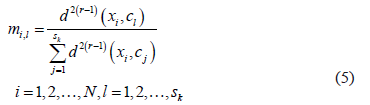
<body><![CDATA[<p><font size="2" face="Verdana, Arial, Helvetica, sans-serif">Supervised fuzzy classification methods have as their goal the calculation of the membership functions for each class. The sample is divided into two sub-samples, one for training<img src="/img/revistas/dyna/v79n171/a07eq23873.jpeg" /> and another for testing <img src="/img/revistas/dyna/v79n171/a07eq23883.jpeg" /> with the training set used in the learning phase. The learning phase consists of selecting a set of membership functions <img src="/img/revistas/dyna/v79n171/a07eq23892.jpeg" /> that are optimal from the point of view of classification. Finally, the test sample is used to validate the accuracy of the procedure.</font></p> 		    <p><font size="2" face="Verdana, Arial, Helvetica, sans-serif">The classical fuzzy pattern-matching algorithm first described by Dubois et al. [8] was adapted by Devillez [7] as a fuzzy pattern matching multidensity classifier. This classifier, which has been demonstrated to be one of the most effective classifiers for classes with non-convex shapes, is implemented as described below.</font></p> 		    <p><font size="2" face="Verdana, Arial, Helvetica, sans-serif"><b>2.1.1 Training    <br> 		</b></font><font size="2" face="Verdana, Arial, Helvetica, sans-serif">Each of the classes <img src="/img/revistas/dyna/v79n171/a07eq23899.jpeg" /> that make up the classification space are divided into a number <img src="/img/revistas/dyna/v79n171/a07eq23907.jpeg" /> of sub-classes using the fuzzy <img src="/img/revistas/dyna/v79n171/a07eq23915.jpeg" />-means algorithm [9,10] which minimizes the within-class sum of squared errors in the following conditions:</font></p> 		    <p><img src="/img/revistas/dyna/v79n171/a07eq02.gif"></p> 		    <p><font size="2" face="Verdana, Arial, Helvetica, sans-serif">where <img src="/img/revistas/dyna/v79n171/a07eq23935.jpeg" /> are the membership functions to be determined. The objective function to be minimized is given by the following expression:</font></p> 		    <p><img src="/img/revistas/dyna/v79n171/a07eq03.gif"></p> 		    <p><font size="2" face="Verdana, Arial, Helvetica, sans-serif">where <img src="/img/revistas/dyna/v79n171/a07eq23952.jpeg" /> is the number of data items in the training subset, <img src="/img/revistas/dyna/v79n171/a07eq23959.jpeg" /> is the vector representing the centroid of the <img src="/img/revistas/dyna/v79n171/a07eq23966.jpeg" />th sub-class, <img src="/img/revistas/dyna/v79n171/a07eq23974.jpeg" /> of the class <img src="/img/revistas/dyna/v79n171/a07eq23983.jpeg" />, <img src="/img/revistas/dyna/v79n171/a07eq23990.jpeg" /> is the fuzzy exponent, which should, strictly speaking, be greater than 1, and where <img src="/img/revistas/dyna/v79n171/a07eq23998.jpeg" /> is a measure of the distance between two points calculated as: </font></p> 		    <p><img src="/img/revistas/dyna/v79n171/a07eq04.gif"></p> 		    <p><font size="2" face="Verdana, Arial, Helvetica, sans-serif">where <img src="/img/revistas/dyna/v79n171/a07eq24018.jpeg" /> is the distance norm matrix, identity matrix for the Euclidean distance or the inverse of the variance-covariance matrix for the Mahalanobis distance.</font></p> 		    ]]></body>


<body><![CDATA[<p><font size="2" face="Verdana, Arial, Helvetica, sans-serif">Minimizing the objective function <img src="/img/revistas/dyna/v79n171/a07eq24027.jpeg" /> offers the membership functions for each sub-class as a solution: </font></p> 		    <p><img src="/img/revistas/dyna/v79n171/a07eq05.gif"></p> 		    <p><font size="2" face="Verdana, Arial, Helvetica, sans-serif">This procedure can be implemented, for example, using the FuzME program [11]. </font></p> 		    <p><font size="2" face="Verdana, Arial, Helvetica, sans-serif">Following the application of the algorithm, a set <img src="/img/revistas/dyna/v79n171/a07eq24044.jpeg" /> of sub-classes is obtained for each class <img src="/img/revistas/dyna/v79n171/a07eq24051.jpeg" />. The elements in the training set <img src="/img/revistas/dyna/v79n171/a07eq24058.jpeg" /> are allocated to the sub-class with the maximum membership function as calculated by the fuzzy algorithm.</font></p> 		    <p><font size="2" face="Verdana, Arial, Helvetica, sans-serif">Learning continues with the calculation of a membership function for each sub-class and each variable <img src="/img/revistas/dyna/v79n171/a07eq24066.jpeg" />. These functions can be calculated on the basis of the probability estimated from the histograms for the data. In other words, given a sub-class <img src="/img/revistas/dyna/v79n171/a07eq24075.jpeg" /> and a variable <img src="/img/revistas/dyna/v79n171/a07eq24082.jpeg" />, the histogram is calculated using the values <img src="/img/revistas/dyna/v79n171/a07eq24090.jpeg" /> of the elements <img src="/img/revistas/dyna/v79n171/a07eq24098.jpeg" /> from the training set that have been allocated to the sub-class <img src="/img/revistas/dyna/v79n171/a07eq24109.jpeg" />.</font></p> 		    <p><font size="2" face="Verdana, Arial, Helvetica, sans-serif">Determined during the training process are <img src="/img/revistas/dyna/v79n171/a07eq24118.jpeg" /> histograms that have to be transformed into fuzzy membership functions. The membership functions can be deduced from the probability distributions associated with the calculation of the histograms using any of the transformations proposed by Dubois et al. [12]. Following Devillez [7], we implemented one of the first probability-possibility transformations, introduced by Dubois and Prade [13], who define the probability distribution associated with a histogram as the discrete distribution given by <img src="/img/revistas/dyna/v79n171/a07eq24125.jpeg" />-which are central values in the histogram bins-and by the probabilities <img src="/img/revistas/dyna/v79n171/a07eq24136.jpeg" />-calculated as the ratio between bin height and the sum of all the heights. The probability values are next arranged in descending order: <img src="/img/revistas/dyna/v79n171/a07eq24143.jpeg" />. The values for the membership function associated with the values <img src="/img/revistas/dyna/v79n171/a07eq24150.jpeg" /> are then calculated:</font></p> 		    <p><img src="/img/revistas/dyna/v79n171/a07eq06.gif"></p> 		    <p><font size="2" face="Verdana, Arial, Helvetica, sans-serif">The membership function is completed by means of a linear interpolation of the above values.</font></p> 		    <p><font size="2" face="Verdana, Arial, Helvetica, sans-serif">The learning phase concludes with <img src="/img/revistas/dyna/v79n171/a07eq24167.jpeg" /> membership functions, which we can denote as:</font></p> 		    <p><img src="/img/revistas/dyna/v79n171/a07eq07.gif"></p> 		    ]]></body>
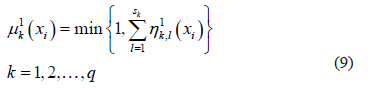
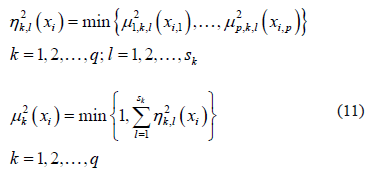
<body><![CDATA[<p><font size="2" face="Verdana, Arial, Helvetica, sans-serif"><b>2.1.2 The nonlinear classification rule    <br> 		</b></font><font size="2" face="Verdana, Arial, Helvetica, sans-serif">For an element <img src="/img/revistas/dyna/v79n171/a07eq24182.jpeg" />from the test sample <img src="/img/revistas/dyna/v79n171/a07eq24190.jpeg" /> the degree of membership to each sub-class <img src="/img/revistas/dyna/v79n171/a07eq24202.jpeg" /> is evaluated by applying the minimum operator to the membership functions calculated in the training phase:</font></p> 		    <p><img src="/img/revistas/dyna/v79n171/a07eq08.gif"></p> 		    <p><font size="2" face="Verdana, Arial, Helvetica, sans-serif">Next, the degrees of membership to each sub-class are combined, resulting in a degree of membership to each class <img src="/img/revistas/dyna/v79n171/a07eq24218.jpeg" /> as follows:</font></p> 		    <p><img src="/img/revistas/dyna/v79n171/a07eq09.gif"></p> 		    <p><font size="2" face="Verdana, Arial, Helvetica, sans-serif">The element <img src="/img/revistas/dyna/v79n171/a07eq24235.jpeg" /> is allocated to the class for which its degree of membership is highest.</font></p> 		    <p><font size="2" face="Verdana, Arial, Helvetica, sans-serif"><b>2.2 The non-parametric fuzzy supervised classification method    <br> 		</b></font><font size="2" face="Verdana, Arial, Helvetica, sans-serif">The fuzzy pattern-recognition multidensity method described above estimates, in the learning stage, probability functions from the histograms calculated with the values <img src="/img/revistas/dyna/v79n171/a07eq24242.jpeg" /> of the training set elements <img src="/img/revistas/dyna/v79n171/a07eq24250.jpeg" /> allocated to the sub-classes <img src="/img/revistas/dyna/v79n171/a07eq24259.jpeg" />. Although the use of the histogram is very convenient for graphically representing the empirical distribution of frequencies, it has some drawbacks as a method for estimating the theoretical distribution of frequencies. For continuous variables, kernel density estimation methods are often preferable. </font></p> 		    <p><font size="2" face="Verdana, Arial, Helvetica, sans-serif">The kernel density estimators belong to a class of estimators called non-parametric density estimators. Unlike the parametric estimators, which require a fixed functional form, the non-parametric estimators do not have a fixed structure but depend exclusively on the set of observations for the density being estimated. (See H&auml;rdle et al. [14] for a detailed explanation of these methods.) </font></p> 		    <p><font size="2" face="Verdana, Arial, Helvetica, sans-serif">The rationale behind the use of the non-parametric statistical techniques can be found in the fact that the width and the initial points of each histogram bar needs to be determined when calculating a histogram; however, this leads to a problem in that the histograms depend on parameters that are often selected arbitrarily. These drawbacks inspired the development of the first kernel estimators [14]. </font></p> 		    ]]></body>
<body><![CDATA[<p><font size="2" face="Verdana, Arial, Helvetica, sans-serif">Therefore, applying a kernel density estimator, the elements in the training sample can be used in order to non-parametrically estimate the density function of the variable <img src="/img/revistas/dyna/v79n171/a07eq24266.jpeg" /> for a sub-class <img src="/img/revistas/dyna/v79n171/a07eq24274.jpeg" />:</font></p> 		    <p><img src="/img/revistas/dyna/v79n171/a07eq10.gif"></p> 		    <p><font size="2" face="Verdana, Arial, Helvetica, sans-serif">where <img src="/img/revistas/dyna/v79n171/a07eq24293.jpeg" /> represents the number of elements in the training sample allocated to sub-class <img src="/img/revistas/dyna/v79n171/a07eq24302.jpeg" />, <img src="/img/revistas/dyna/v79n171/a07eq24309.jpeg" /> is the smoothing parameter, and<img src="/img/revistas/dyna/v79n171/a07eq24319.jpeg" /> is the kernel function. This function should confirm that <img src="/img/revistas/dyna/v79n171/a07eq24326.jpeg" /> in order to ensure that the density function <img src="/img/revistas/dyna/v79n171/a07eq24333.jpeg" /> integrates to 1 and where the kernel function K is usually chosen to be a smooth unimodal function with a peak at 0.</font></p> 		    <p><font size="2" face="Verdana, Arial, Helvetica, sans-serif">Note that, in order to eliminate dependence on the initial points of the bins, kernel estimators centre a kernel function at each data point and smooth out the contribution of each observed data point over a local neighbourhood for that data point. The extent of this contribution is dependent upon the shape of the kernel function adopted and the smoothing parameter.</font></p> 		    <p><font size="2" face="Verdana, Arial, Helvetica, sans-serif">Implementation of this variant in the training process gives rise to <img src="/img/revistas/dyna/v79n171/a07eq24342.jpeg" /> density functions from which the fuzzy membership functions are deduced, using either of two alternatives: discretize the estimated density function <img src="/img/revistas/dyna/v79n171/a07eq24351.jpeg" /> and apply a probability-possibility transformation similar to that referred to above, or implement a continuous probability-possibility transformation using one of the procedures described in Dubois et al. [11]. Obtained in both cases are <img src="/img/revistas/dyna/v79n171/a07eq24358.jpeg" /> membership functions, which we can now denote as:</font></p> 		    <p><img src="/img/revistas/dyna/v79n171/a07eq101.gif"></p> 		    <p><font size="2" face="Verdana, Arial, Helvetica, sans-serif">In the nonlinear classification rule, the membership functions <img src="/img/revistas/dyna/v79n171/a07eq24374.jpeg" /> are evaluated in the coordinates of the elements of the test set, resulting in the classification functions <img src="/img/revistas/dyna/v79n171/a07eq24385.jpeg" /> and <img src="/img/revistas/dyna/v79n171/a07eq24394.jpeg" />, and in a procedure that is identical to that described in the previous section. </font></p> 		    <p><img src="/img/revistas/dyna/v79n171/a07eq11.gif"></p> 		    <p><font size="2" face="Verdana, Arial, Helvetica, sans-serif"><b>2.3 The data    <br> 		</b></font><font size="2" face="Verdana, Arial, Helvetica, sans-serif">With a view to conducting a comparative study, the two classification methods were applied to a set of real data. The data used for the application of these techniques were obtained from analyses of samples taken from a primary kaolin deposit in one of the most important kaolin mining areas of Galicia (NW Spain), namely, Vimianzo (A Coru&ntilde;a). The samples were wet-sieved and mineralogical and chemical analyses were performed for 50<font face="Symbol">m</font>-grained fractions following standard procedures. The following information was obtained from the analyses: mineralogical data (percentages of quartz, mica, feldspar, and kaolinite), chemical data (SiO<sub>2</sub>/Al<sub>2</sub>O<sub>3</sub> ratio, percentages of Fe<sub>2</sub>O<sub>3</sub>, TiO<sub>2</sub>, K<sub>2</sub>O, MgO, and loss on ignition [LOI]. These parameters are those typically used to identify the suitability of a sample for use in ceramics manufacturing.</font></p> 		    ]]></body>
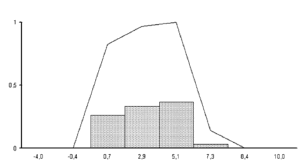
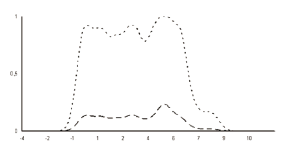
<body><![CDATA[<p><font size="2" face="Verdana, Arial, Helvetica, sans-serif">All the parameters (p = 10) were selected as variables to which the techniques apply. For each variable, three quality classes were defined&mdash;top quality, medium quality, and poor quality [16]&mdash;, according to quality rankings as determined in the literature for the ceramic industry [17,18]. In addition to these numerical variables, a ceramic quality variable was included, also defined in terms of three classes reflecting the saleability of the sample&mdash;top quality, medium quality and poor quality.</font></p> 		    <p><font size="2" face="Verdana, Arial, Helvetica, sans-serif">Ceramic quality was evaluated for 1410 samples on the basis of these mineralogical, chemical, and physical parameters. The sample was divided into a training set (<img src="/img/revistas/dyna/v79n171/a07eq24418.jpeg" /> 558) and a test set. The number of classes considered for the classification of the sample elements was <img src="/img/revistas/dyna/v79n171/a07eq24425.jpeg" /> 3, in accordance with the ceramic quality grades (top, medium, and poor) defined above.</font></p> 		    <p><font size="2" face="Verdana, Arial, Helvetica, sans-serif"><b>2.4 Results    <br> 		</b><a href="#fig01">Figure 1</a> shows the histogram of the kaolin percentage values corresponding to one of the sub-classes in which the medium quality class was divided. Superimposed on the histogram is the membership function obtained by the supervised fuzzy classification method.</font></p> 	    <p align="center"><font size="2" face="Verdana, Arial, Helvetica, sans-serif"><a name="fig01"></a><b><img src="/img/revistas/dyna/v79n171/a07fig01.gif">    <br>     Figure 1.</b> Histogram and membership function were the supervised fuzzy classification method applied to the kaolin percentage variable (x-axis) and one of the medium quality sub-classes for ceramics</font></p> 	    <p><font size="2" face="Verdana, Arial, Helvetica, sans-serif">The fuzzy classification method implemented in this research used the density of a Gaussian distribution as the function <img src="/img/revistas/dyna/v79n171/a07eq24442.jpeg" />. The smoothing parameter <img src="/img/revistas/dyna/v79n171/a07eq24449.jpeg" /> was chosen using the smoothed bootstrap method proposed by Cao [19]. This method for selecting the parameter is particularly suitable when working with independent samples. It was found that greater percentages of correct classifications were obtained using half of the smoothing parameter.</font></p> 		    <p><font size="2" face="Verdana, Arial, Helvetica, sans-serif"><a href="#fig02">Figure 2</a> shows the density function when estimated non-parametrically and, for the same variable and sub-class, the membership function obtained by means of the non-parametric fuzzy classification supervised methods.</font></p> 		    <p align="center"><font size="2" face="Verdana, Arial, Helvetica, sans-serif"><b><a name="fig02" id="fig02"></a><img src="/img/revistas/dyna/v79n171/a07fig02.gif">    <br> 	    Figure 2.</b> The non-parametric density estimation (broken line) and the membership function obtained by the non-parametric fuzzy supervised classification method (dotted line) for the kaolin percentage variable (x-axis) and one of the medium quality sub-classes</font></p> 	    ]]></body>
<body><![CDATA[<p><font size="2" face="Verdana, Arial, Helvetica, sans-serif">The percentage of correctly classified elements in the training set was 99.64 % for the fuzzy supervised method and 99.82 % for the non-parametric method, whereas the same percentages of the validation test set were 98.01 % and 99.10% , respectively.</font></p> 		    <p>&nbsp;</p> 		    <p><font size="3" face="Verdana, Arial, Helvetica, sans-serif"><b>3. CONCLUSIONS</b></font></p> 	    <p><font size="2" face="Verdana, Arial, Helvetica, sans-serif">This article describes a non-parametric fuzzy classification method that is a variant on the fuzzy pattern matching multidensity method. The difference between the two approaches lies in the method for determining the density function; our method uses the histogram of the data, whereas the multidensity method uses a kernel function. The main advantage of the non-parametric method is that it does away with some of the drawbacks associated with the construction of the histogram, such as the problem of defining the width and initial point for each interval in the histogram. </font></p> 		    <p><font size="2" face="Verdana, Arial, Helvetica, sans-serif">Our method was tested in determining the quality of kaolin samples obtained from a kaolin deposit for ceramic manufacturing purposes. The level of correct classification was quite similar for both methods, although there was a slight improvement in the fuzzy classification methods. </font></p> 		    <p><font size="2" face="Verdana, Arial, Helvetica, sans-serif">As future research, we will explore the possibility of automatically selecting the smoothing parameter so that the non-parametric fuzzy supervised classification method becomes genuinely competitive with that proposed by Devillez [7].</font></p> 		    <p>&nbsp;</p> 		    <p><font size="3" face="Verdana, Arial, Helvetica, sans-serif"><b>ACKNOWLEDGMENTS</b></font></p> 	    <p><font size="2" face="Verdana, Arial, Helvetica, sans-serif">This research has been partially supported by grant PGIDIT06PXIC300117PN of the Xunta de Galicia and also by grant PGIDIT07PXIB300191PR of the Xunta de Galicia for the first author.</font></p> 		    <p>&nbsp;</p> 		    ]]></body>
<body><![CDATA[<p><font size="3" face="Verdana, Arial, Helvetica, sans-serif"><b>REFERENCES </b></font></p> 		    <!-- ref --><p><font size="2" face="Verdana, Arial, Helvetica, sans-serif"><b>[1]</b> Härdle, W., Multivariate Statistical Analysis, Springer, Berlin, 2003.     &nbsp;&nbsp;&nbsp;&nbsp;&nbsp;&nbsp;&nbsp;&nbsp;[&#160;<a href="javascript:void(0);" onclick="javascript: window.open('/scielo.php?script=sci_nlinks&ref=000094&pid=S0012-7353201200010000700001&lng=','','width=640,height=500,resizable=yes,scrollbars=1,menubar=yes,');">Links</a>&#160;]<!-- end-ref --><!-- ref --><br>         <b>[2]</b> Izenman, A.J., Modern multivariate statistical techniques regression, classification and manifold learning, Springer, New York, 2008.             &nbsp;&nbsp;&nbsp;&nbsp;&nbsp;&nbsp;&nbsp;&nbsp;[&#160;<a href="javascript:void(0);" onclick="javascript: window.open('/scielo.php?script=sci_nlinks&ref=000095&pid=S0012-7353201200010000700002&lng=','','width=640,height=500,resizable=yes,scrollbars=1,menubar=yes,');">Links</a>&#160;]<!-- end-ref --><!-- ref --><br>         <b>[3]</b> Jim&eacute;nez, C., Soto, C. Aprendizaje supervisado para la discriminaci&oacute;n y clasificaci&oacute;n difusa, Dyna 169, pp. 26-33, 2011.     &nbsp;&nbsp;&nbsp;&nbsp;&nbsp;&nbsp;&nbsp;&nbsp;[&#160;<a href="javascript:void(0);" onclick="javascript: window.open('/scielo.php?script=sci_nlinks&ref=000096&pid=S0012-7353201200010000700003&lng=','','width=640,height=500,resizable=yes,scrollbars=1,menubar=yes,');">Links</a>&#160;]<!-- end-ref --><!-- ref --><br>         <b>[4]</b> Zadeh, L.A., Fuzzy sets, Information and Control, 8, pp. 338-353, 1965.             &nbsp;&nbsp;&nbsp;&nbsp;&nbsp;&nbsp;&nbsp;&nbsp;[&#160;<a href="javascript:void(0);" onclick="javascript: window.open('/scielo.php?script=sci_nlinks&ref=000097&pid=S0012-7353201200010000700004&lng=','','width=640,height=500,resizable=yes,scrollbars=1,menubar=yes,');">Links</a>&#160;]<!-- end-ref --><!-- ref --><br>         <b>[5]</b> Kuncheva, L.I., Fuzzy classifier design, Physica Verlag, 2000.             &nbsp;&nbsp;&nbsp;&nbsp;&nbsp;&nbsp;&nbsp;&nbsp;[&#160;<a href="javascript:void(0);" onclick="javascript: window.open('/scielo.php?script=sci_nlinks&ref=000098&pid=S0012-7353201200010000700005&lng=','','width=640,height=500,resizable=yes,scrollbars=1,menubar=yes,');">Links</a>&#160;]<!-- end-ref --><!-- ref --><br>         <b>[6]</b> Dumitrescu, D., Lazzerini, B. and Jain, L.C., Fuzzy sets and their application to clustering and training, CRC Press, Boca Raton, 2000.             &nbsp;&nbsp;&nbsp;&nbsp;&nbsp;&nbsp;&nbsp;&nbsp;[&#160;<a href="javascript:void(0);" onclick="javascript: window.open('/scielo.php?script=sci_nlinks&ref=000099&pid=S0012-7353201200010000700006&lng=','','width=640,height=500,resizable=yes,scrollbars=1,menubar=yes,');">Links</a>&#160;]<!-- end-ref --><!-- ref --><br>         <b>[7]</b> Devillez, A., Four fuzzy supervised classification methods for discriminating classes of non-convex shape, Fuzzy sets and systems, 141(2), pp. 219-240, 2004.             &nbsp;&nbsp;&nbsp;&nbsp;&nbsp;&nbsp;&nbsp;&nbsp;[&#160;<a href="javascript:void(0);" onclick="javascript: window.open('/scielo.php?script=sci_nlinks&ref=000100&pid=S0012-7353201200010000700007&lng=','','width=640,height=500,resizable=yes,scrollbars=1,menubar=yes,');">Links</a>&#160;]<!-- end-ref --><!-- ref --><br>         <b>[8]</b> Dubois, D., Prade, H. and Testemale, C., Weighted fuzzy pattern matching, Fuzzy sets and systems, 28(3), pp. 313-331, 1988.             &nbsp;&nbsp;&nbsp;&nbsp;&nbsp;&nbsp;&nbsp;&nbsp;[&#160;<a href="javascript:void(0);" onclick="javascript: window.open('/scielo.php?script=sci_nlinks&ref=000101&pid=S0012-7353201200010000700008&lng=','','width=640,height=500,resizable=yes,scrollbars=1,menubar=yes,');">Links</a>&#160;]<!-- end-ref --><!-- ref --><br>         <b>[9]</b> Pedrycz, W. and Vulkovich, G., Fuzzy clustering with supervision, Pattern Recognition, 37(7), pp. 1339-1349, 2004.             &nbsp;&nbsp;&nbsp;&nbsp;&nbsp;&nbsp;&nbsp;&nbsp;[&#160;<a href="javascript:void(0);" onclick="javascript: window.open('/scielo.php?script=sci_nlinks&ref=000102&pid=S0012-7353201200010000700009&lng=','','width=640,height=500,resizable=yes,scrollbars=1,menubar=yes,');">Links</a>&#160;]<!-- end-ref --><!-- ref --><br>         <b>[10]</b> Bezdek, J.C., Erlich, R. and Full, W., FCM: The fuzzy c-means clustering algortihm, Computers and Geosciences 10(2), pp. 191-203, 1984.             &nbsp;&nbsp;&nbsp;&nbsp;&nbsp;&nbsp;&nbsp;&nbsp;[&#160;<a href="javascript:void(0);" onclick="javascript: window.open('/scielo.php?script=sci_nlinks&ref=000103&pid=S0012-7353201200010000700010&lng=','','width=640,height=500,resizable=yes,scrollbars=1,menubar=yes,');">Links</a>&#160;]<!-- end-ref --><!-- ref --><br>         <b>[11]</b> Minasny, B. and Mc Bratney, A.B., FuzME version 3.0, Australian Centre for Precision Agriculture, The University of Sydney, Australia, 2002.             &nbsp;&nbsp;&nbsp;&nbsp;&nbsp;&nbsp;&nbsp;&nbsp;[&#160;<a href="javascript:void(0);" onclick="javascript: window.open('/scielo.php?script=sci_nlinks&ref=000104&pid=S0012-7353201200010000700011&lng=','','width=640,height=500,resizable=yes,scrollbars=1,menubar=yes,');">Links</a>&#160;]<!-- end-ref --><!-- ref --><br>         <b>[12]</b> Dubois, D., Fulloy, G., Mauris, H. and Prade, H., Probability-possibility transformations, triangular fuzzy sets and probabilistic inequalities, Reliable Computing 10, pp. 273-297, 2004.             &nbsp;&nbsp;&nbsp;&nbsp;&nbsp;&nbsp;&nbsp;&nbsp;[&#160;<a href="javascript:void(0);" onclick="javascript: window.open('/scielo.php?script=sci_nlinks&ref=000105&pid=S0012-7353201200010000700012&lng=','','width=640,height=500,resizable=yes,scrollbars=1,menubar=yes,');">Links</a>&#160;]<!-- end-ref --><!-- ref --><br>         <b>[13]</b> Dubois, D. and Prade, H., Th&eacute;orie des possibilities, Application à la repr&eacute;sentation des connaissances en informatique, Masson, Paris, 1987.     &nbsp;&nbsp;&nbsp;&nbsp;&nbsp;&nbsp;&nbsp;&nbsp;[&#160;<a href="javascript:void(0);" onclick="javascript: window.open('/scielo.php?script=sci_nlinks&ref=000106&pid=S0012-7353201200010000700013&lng=','','width=640,height=500,resizable=yes,scrollbars=1,menubar=yes,');">Links</a>&#160;]<!-- end-ref --><!-- ref --><br>         <b>[14]</b> Härdle, W., Müller, M., Sperlich, S. and Werwatz, A., Nonparametric and semiparametric models, Springer, New York, 2004.     &nbsp;&nbsp;&nbsp;&nbsp;&nbsp;&nbsp;&nbsp;&nbsp;[&#160;<a href="javascript:void(0);" onclick="javascript: window.open('/scielo.php?script=sci_nlinks&ref=000107&pid=S0012-7353201200010000700014&lng=','','width=640,height=500,resizable=yes,scrollbars=1,menubar=yes,');">Links</a>&#160;]<!-- end-ref --><!-- ref --><br>         <b>[15]</b> Parzen, E., On estimation of a probability density function and mode, Annals of Mathematical Statistics 33(3), pp. 1065-1076, 1962.             &nbsp;&nbsp;&nbsp;&nbsp;&nbsp;&nbsp;&nbsp;&nbsp;[&#160;<a href="javascript:void(0);" onclick="javascript: window.open('/scielo.php?script=sci_nlinks&ref=000108&pid=S0012-7353201200010000700015&lng=','','width=640,height=500,resizable=yes,scrollbars=1,menubar=yes,');">Links</a>&#160;]<!-- end-ref --><!-- ref --><br>         <b>[16]</b> Taboada, J., Rivas, T., Araujo, M. and Argüelles, A., A fuzzy expert system application to the evaluation of ceramic- and paper-quality kaolin. Applied Clay Science, 33, pp. 287-297, 2006.     &nbsp;&nbsp;&nbsp;&nbsp;&nbsp;&nbsp;&nbsp;&nbsp;[&#160;<a href="javascript:void(0);" onclick="javascript: window.open('/scielo.php?script=sci_nlinks&ref=000109&pid=S0012-7353201200010000700016&lng=','','width=640,height=500,resizable=yes,scrollbars=1,menubar=yes,');">Links</a>&#160;]<!-- end-ref --><!-- ref --><br>         <b>[17]</b> Prasad, M.S., Reid, K.J. and Murria, H.H. Kaolin: processing, properties and applications. Applied Clay Science, 6-3,4, pp. 87-119, 1991.             &nbsp;&nbsp;&nbsp;&nbsp;&nbsp;&nbsp;&nbsp;&nbsp;[&#160;<a href="javascript:void(0);" onclick="javascript: window.open('/scielo.php?script=sci_nlinks&ref=000110&pid=S0012-7353201200010000700017&lng=','','width=640,height=500,resizable=yes,scrollbars=1,menubar=yes,');">Links</a>&#160;]<!-- end-ref --><!-- ref --><br>         <b>[18]</b> Konta, J., Clay and man: clay raw materials in the service of man, Applied Clay Science, 10(4), pp. 275-353, 1995.             &nbsp;&nbsp;&nbsp;&nbsp;&nbsp;&nbsp;&nbsp;&nbsp;[&#160;<a href="javascript:void(0);" onclick="javascript: window.open('/scielo.php?script=sci_nlinks&ref=000111&pid=S0012-7353201200010000700018&lng=','','width=640,height=500,resizable=yes,scrollbars=1,menubar=yes,');">Links</a>&#160;]<!-- end-ref --><!-- ref --><br>         <b>[19]</b> Cao, R., Bootstrapping the Mean Integrated Squared Error, Journal of Multivariate Analysis 45(1), pp. 137-160, 1993.      </font>&nbsp;&nbsp;&nbsp;&nbsp;&nbsp;&nbsp;&nbsp;&nbsp;[&#160;<a href="javascript:void(0);" onclick="javascript: window.open('/scielo.php?script=sci_nlinks&ref=000112&pid=S0012-7353201200010000700019&lng=','','width=640,height=500,resizable=yes,scrollbars=1,menubar=yes,');">Links</a>&#160;]<!-- end-ref --> ]]></body><back>
<ref-list>
<ref id="B1">
<label>1</label><nlm-citation citation-type="book">
<person-group person-group-type="author">
<name>
<surname><![CDATA[Härdle]]></surname>
<given-names><![CDATA[W.]]></given-names>
</name>
</person-group>
<source><![CDATA[Multivariate Statistical Analysis]]></source>
<year>2003</year>
<publisher-loc><![CDATA[Berlin ]]></publisher-loc>
<publisher-name><![CDATA[Springer]]></publisher-name>
</nlm-citation>
</ref>
<ref id="B2">
<label>2</label><nlm-citation citation-type="book">
<person-group person-group-type="author">
<name>
<surname><![CDATA[Izenman]]></surname>
<given-names><![CDATA[A.J.]]></given-names>
</name>
</person-group>
<source><![CDATA[Modern multivariate statistical techniques regression, classification and manifold learning]]></source>
<year>2008</year>
<publisher-loc><![CDATA[New York ]]></publisher-loc>
<publisher-name><![CDATA[Springer]]></publisher-name>
</nlm-citation>
</ref>
<ref id="B3">
<label>3</label><nlm-citation citation-type="journal">
<person-group person-group-type="author">
<name>
<surname><![CDATA[Jiménez]]></surname>
<given-names><![CDATA[C.]]></given-names>
</name>
<name>
<surname><![CDATA[Soto]]></surname>
<given-names><![CDATA[C.]]></given-names>
</name>
</person-group>
<article-title xml:lang="es"><![CDATA[Aprendizaje supervisado para la discriminación y clasificación difusa,]]></article-title>
<source><![CDATA[Dyna]]></source>
<year>2011</year>
<numero>169</numero>
<issue>169</issue>
<page-range>26-33</page-range></nlm-citation>
</ref>
<ref id="B4">
<label>4</label><nlm-citation citation-type="journal">
<person-group person-group-type="author">
<name>
<surname><![CDATA[Zadeh]]></surname>
<given-names><![CDATA[L.A.]]></given-names>
</name>
</person-group>
<article-title xml:lang="es"><![CDATA[Fuzzy sets]]></article-title>
<source><![CDATA[Information and Control]]></source>
<year>1965</year>
<volume>8</volume>
<page-range>338-353</page-range></nlm-citation>
</ref>
<ref id="B5">
<label>5</label><nlm-citation citation-type="book">
<person-group person-group-type="author">
<name>
<surname><![CDATA[Kuncheva]]></surname>
<given-names><![CDATA[L.I.]]></given-names>
</name>
</person-group>
<source><![CDATA[Fuzzy classifier design]]></source>
<year>2000</year>
<publisher-name><![CDATA[Physica Verlag]]></publisher-name>
</nlm-citation>
</ref>
<ref id="B6">
<label>6</label><nlm-citation citation-type="book">
<person-group person-group-type="author">
<name>
<surname><![CDATA[Dumitrescu]]></surname>
<given-names><![CDATA[D.]]></given-names>
</name>
<name>
<surname><![CDATA[Lazzerini]]></surname>
<given-names><![CDATA[B.]]></given-names>
</name>
<name>
<surname><![CDATA[Jain]]></surname>
<given-names><![CDATA[L.C.]]></given-names>
</name>
</person-group>
<source><![CDATA[Fuzzy sets and their application to clustering and training]]></source>
<year>2000</year>
<publisher-loc><![CDATA[Boca Raton ]]></publisher-loc>
<publisher-name><![CDATA[CRC Press]]></publisher-name>
</nlm-citation>
</ref>
<ref id="B7">
<label>7</label><nlm-citation citation-type="journal">
<person-group person-group-type="author">
<name>
<surname><![CDATA[Devillez]]></surname>
<given-names><![CDATA[A.]]></given-names>
</name>
</person-group>
<article-title xml:lang="en"><![CDATA[Four fuzzy supervised classification methods for discriminating classes of non-convex shape]]></article-title>
<source><![CDATA[Fuzzy sets and systems]]></source>
<year>2004</year>
<volume>141</volume>
<numero>2</numero>
<issue>2</issue>
<page-range>219-240</page-range></nlm-citation>
</ref>
<ref id="B8">
<label>8</label><nlm-citation citation-type="journal">
<person-group person-group-type="author">
<name>
<surname><![CDATA[Dubois]]></surname>
<given-names><![CDATA[D.]]></given-names>
</name>
<name>
<surname><![CDATA[Prade]]></surname>
<given-names><![CDATA[H.]]></given-names>
</name>
<name>
<surname><![CDATA[Testemale]]></surname>
<given-names><![CDATA[C.]]></given-names>
</name>
</person-group>
<article-title xml:lang="en"><![CDATA[Weighted fuzzy pattern matching]]></article-title>
<source><![CDATA[Fuzzy sets and systems]]></source>
<year>1988</year>
<volume>28</volume>
<numero>3</numero>
<issue>3</issue>
<page-range>313-331</page-range></nlm-citation>
</ref>
<ref id="B9">
<label>9</label><nlm-citation citation-type="journal">
<person-group person-group-type="author">
<name>
<surname><![CDATA[Pedrycz]]></surname>
<given-names><![CDATA[W.]]></given-names>
</name>
<name>
<surname><![CDATA[Vulkovich]]></surname>
<given-names><![CDATA[G.]]></given-names>
</name>
</person-group>
<article-title xml:lang="en"><![CDATA[Fuzzy clustering with supervision]]></article-title>
<source><![CDATA[Pattern Recognition]]></source>
<year>2004</year>
<volume>37</volume>
<numero>7</numero>
<issue>7</issue>
<page-range>1339-1349</page-range></nlm-citation>
</ref>
<ref id="B10">
<label>10</label><nlm-citation citation-type="journal">
<person-group person-group-type="author">
<name>
<surname><![CDATA[Bezdek]]></surname>
<given-names><![CDATA[J.C.]]></given-names>
</name>
<name>
<surname><![CDATA[Erlich]]></surname>
<given-names><![CDATA[R.]]></given-names>
</name>
<name>
<surname><![CDATA[Full]]></surname>
<given-names><![CDATA[W.]]></given-names>
</name>
</person-group>
<article-title xml:lang="en"><![CDATA[FCM: The fuzzy c-means clustering algortihm]]></article-title>
<source><![CDATA[Computers and Geosciences]]></source>
<year>1984</year>
<volume>10</volume>
<numero>2</numero>
<issue>2</issue>
<page-range>191-203</page-range></nlm-citation>
</ref>
<ref id="B11">
<label>11</label><nlm-citation citation-type="book">
<person-group person-group-type="author">
<name>
<surname><![CDATA[Minasny]]></surname>
<given-names><![CDATA[B.]]></given-names>
</name>
<name>
<surname><![CDATA[Mc Bratney]]></surname>
<given-names><![CDATA[A.B.]]></given-names>
</name>
</person-group>
<source><![CDATA[FuzME version 3.0]]></source>
<year>2002</year>
<publisher-name><![CDATA[Australian Centre for Precision Agriculture, The University of Sydney]]></publisher-name>
</nlm-citation>
</ref>
<ref id="B12">
<label>12</label><nlm-citation citation-type="journal">
<person-group person-group-type="author">
<name>
<surname><![CDATA[Dubois]]></surname>
<given-names><![CDATA[D.]]></given-names>
</name>
<name>
<surname><![CDATA[Fulloy]]></surname>
<given-names><![CDATA[G.]]></given-names>
</name>
<name>
<surname><![CDATA[Mauris]]></surname>
<given-names><![CDATA[H.]]></given-names>
</name>
<name>
<surname><![CDATA[Prade]]></surname>
<given-names><![CDATA[H.]]></given-names>
</name>
</person-group>
<article-title xml:lang="en"><![CDATA[Probability-possibility transformations, triangular fuzzy sets and probabilistic inequalities]]></article-title>
<source><![CDATA[Reliable Computing]]></source>
<year>2004</year>
<volume>10</volume>
<page-range>273-297</page-range></nlm-citation>
</ref>
<ref id="B13">
<label>13</label><nlm-citation citation-type="book">
<person-group person-group-type="author">
<name>
<surname><![CDATA[Dubois]]></surname>
<given-names><![CDATA[D.]]></given-names>
</name>
<name>
<surname><![CDATA[Prade]]></surname>
<given-names><![CDATA[H.]]></given-names>
</name>
</person-group>
<source><![CDATA[Théorie des possibilities, Application à la représentation des connaissances en informatique]]></source>
<year>1987</year>
<publisher-loc><![CDATA[Paris ]]></publisher-loc>
<publisher-name><![CDATA[Masson]]></publisher-name>
</nlm-citation>
</ref>
<ref id="B14">
<label>14</label><nlm-citation citation-type="book">
<person-group person-group-type="author">
<name>
<surname><![CDATA[Härdle]]></surname>
<given-names><![CDATA[W.]]></given-names>
</name>
<name>
<surname><![CDATA[Müller]]></surname>
<given-names><![CDATA[M.]]></given-names>
</name>
<name>
<surname><![CDATA[Sperlich]]></surname>
<given-names><![CDATA[S.]]></given-names>
</name>
<name>
<surname><![CDATA[Werwatz]]></surname>
<given-names><![CDATA[A.]]></given-names>
</name>
</person-group>
<source><![CDATA[Nonparametric and semiparametric models]]></source>
<year>2004</year>
<publisher-loc><![CDATA[New York ]]></publisher-loc>
<publisher-name><![CDATA[Springer]]></publisher-name>
</nlm-citation>
</ref>
<ref id="B15">
<label>15</label><nlm-citation citation-type="journal">
<person-group person-group-type="author">
<name>
<surname><![CDATA[Parzen]]></surname>
<given-names><![CDATA[E.]]></given-names>
</name>
</person-group>
<article-title xml:lang="en"><![CDATA[On estimation of a probability density function and mode]]></article-title>
<source><![CDATA[Annals of Mathematical Statistics]]></source>
<year>1962</year>
<volume>33</volume>
<numero>3</numero>
<issue>3</issue>
<page-range>1065-1076</page-range></nlm-citation>
</ref>
<ref id="B16">
<label>16</label><nlm-citation citation-type="journal">
<person-group person-group-type="author">
<name>
<surname><![CDATA[Taboada]]></surname>
<given-names><![CDATA[J.]]></given-names>
</name>
<name>
<surname><![CDATA[Rivas]]></surname>
<given-names><![CDATA[T.]]></given-names>
</name>
<name>
<surname><![CDATA[Araujo]]></surname>
<given-names><![CDATA[M.]]></given-names>
</name>
<name>
<surname><![CDATA[Argüelles]]></surname>
<given-names><![CDATA[A.]]></given-names>
</name>
</person-group>
<article-title xml:lang="en"><![CDATA[A fuzzy expert system application to the evaluation of ceramic- and paper-quality]]></article-title>
<source><![CDATA[kaolin. Applied Clay Science]]></source>
<year>2006</year>
<volume>33</volume>
<page-range>287-297</page-range></nlm-citation>
</ref>
<ref id="B17">
<label>17</label><nlm-citation citation-type="journal">
<person-group person-group-type="author">
<name>
<surname><![CDATA[Prasad]]></surname>
<given-names><![CDATA[M.S.]]></given-names>
</name>
<name>
<surname><![CDATA[Reid]]></surname>
<given-names><![CDATA[K.J.]]></given-names>
</name>
<name>
<surname><![CDATA[Murria]]></surname>
<given-names><![CDATA[H.H.]]></given-names>
</name>
</person-group>
<article-title xml:lang="en"><![CDATA[Kaolin:: processing, properties and applications.]]></article-title>
<source><![CDATA[Applied Clay Science]]></source>
<year>1991</year>
<volume>6</volume>
<numero>3,4</numero>
<issue>3,4</issue>
<page-range>. 87-119</page-range></nlm-citation>
</ref>
<ref id="B18">
<label>18</label><nlm-citation citation-type="journal">
<person-group person-group-type="author">
<name>
<surname><![CDATA[Konta]]></surname>
<given-names><![CDATA[J.]]></given-names>
</name>
</person-group>
<article-title xml:lang="en"><![CDATA[Clay and man:: clay raw materials in the service of man]]></article-title>
<source><![CDATA[Applied Clay Science]]></source>
<year>1995</year>
<volume>10</volume>
<numero>4</numero>
<issue>4</issue>
<page-range>275-353</page-range></nlm-citation>
</ref>
<ref id="B19">
<label>19</label><nlm-citation citation-type="journal">
<person-group person-group-type="author">
<name>
<surname><![CDATA[Cao]]></surname>
<given-names><![CDATA[R.]]></given-names>
</name>
</person-group>
<article-title xml:lang="en"><![CDATA[Bootstrapping the Mean Integrated Squared Error]]></article-title>
<source><![CDATA[Journal of Multivariate Analysis]]></source>
<year>1993</year>
<volume>45</volume>
<numero>1</numero>
<issue>1</issue>
<page-range>137-160</page-range></nlm-citation>
</ref>
</ref-list>
</back>
</article>