<?xml version="1.0" encoding="ISO-8859-1"?><article xmlns:mml="http://www.w3.org/1998/Math/MathML" xmlns:xlink="http://www.w3.org/1999/xlink" xmlns:xsi="http://www.w3.org/2001/XMLSchema-instance">
<front>
<journal-meta>
<journal-id>0012-7353</journal-id>
<journal-title><![CDATA[DYNA]]></journal-title>
<abbrev-journal-title><![CDATA[Dyna rev.fac.nac.minas]]></abbrev-journal-title>
<issn>0012-7353</issn>
<publisher>
<publisher-name><![CDATA[Universidad Nacional de Colombia]]></publisher-name>
</publisher>
</journal-meta>
<article-meta>
<article-id>S0012-73532012000100015</article-id>
<title-group>
<article-title xml:lang="en"><![CDATA[ELECTRICITY GENERATION AND WIND POTENTIAL ASSESSMENT IN REGIONS OF COLOMBIA]]></article-title>
<article-title xml:lang="es"><![CDATA[GENERACIÓN ELÉCTRICA Y EVALUACIÓN DEL POTENCIAL DE ENERGÍA EÓLICA EN REGIONES DE COLOMBIA]]></article-title>
</title-group>
<contrib-group>
<contrib contrib-type="author">
<name>
<surname><![CDATA[REALPE JIMÉNEZ]]></surname>
<given-names><![CDATA[ALVARO]]></given-names>
</name>
<xref ref-type="aff" rid="A01"/>
</contrib>
<contrib contrib-type="author">
<name>
<surname><![CDATA[DIAZGRANADOS]]></surname>
<given-names><![CDATA[JORGE A.]]></given-names>
</name>
<xref ref-type="aff" rid="A02"/>
</contrib>
<contrib contrib-type="author">
<name>
<surname><![CDATA[ACEVEDO MORANTES]]></surname>
<given-names><![CDATA[MARÍA TERESA]]></given-names>
</name>
<xref ref-type="aff" rid="A03"/>
</contrib>
</contrib-group>
<aff id="A01">
<institution><![CDATA[,Universidad de Cartagena  ]]></institution>
<addr-line><![CDATA[ ]]></addr-line>
</aff>
<aff id="A02">
<institution><![CDATA[,Universidad InterAmericana de Puerto Rico  ]]></institution>
<addr-line><![CDATA[ ]]></addr-line>
<country>Puerto Rico</country>
</aff>
<aff id="A03">
<institution><![CDATA[,Universidad de Cartagena  ]]></institution>
<addr-line><![CDATA[ ]]></addr-line>
</aff>
<pub-date pub-type="pub">
<day>00</day>
<month>02</month>
<year>2012</year>
</pub-date>
<pub-date pub-type="epub">
<day>00</day>
<month>02</month>
<year>2012</year>
</pub-date>
<volume>79</volume>
<numero>171</numero>
<fpage>116</fpage>
<lpage>122</lpage>
<copyright-statement/>
<copyright-year/>
<self-uri xlink:href="http://www.scielo.org.co/scielo.php?script=sci_arttext&amp;pid=S0012-73532012000100015&amp;lng=en&amp;nrm=iso"></self-uri><self-uri xlink:href="http://www.scielo.org.co/scielo.php?script=sci_abstract&amp;pid=S0012-73532012000100015&amp;lng=en&amp;nrm=iso"></self-uri><self-uri xlink:href="http://www.scielo.org.co/scielo.php?script=sci_pdf&amp;pid=S0012-73532012000100015&amp;lng=en&amp;nrm=iso"></self-uri><abstract abstract-type="short" xml:lang="en"><p><![CDATA[In this work, mathematical modeling and simulation of electricity generation from wind was carried out in regions which are not connected to the national electrical system grid, and have an annual mean wind velocity higher than 4 m/s at an altitude of 10 m. Seven different types of power turbines between 6 and 2,750 kW were studied in order to analyze their technical and economic feasibility. The Gachaneca (Boyaca) and the Sesquicentenario (San Andres Island) stations have an energy potential of 5,106 and 3,823 MWh/year, respectively, using a 2,750 kW turbine at an altitude of 70 m. The production cost of kWh for the two regions was found to be less than US$0.10 for turbines with a capacity higher than 1.0 MW. The energy produced can satisfy the electricity needs of Colombian islands such as San Andres or Providencia.]]></p></abstract>
<abstract abstract-type="short" xml:lang="es"><p><![CDATA[En este trabajo, modelación y simulación matemática de la generación de electricidad a partir del viento fue realizado en regiones que no están conectadas al sistema eléctrico nacional, y tienen velocidad promedio anual mayor que 4 m/s a una altitud de 10 m. Siete diferente tipo de turbinas de potencia entre 6 y 2,750 kW fueron estudiadas para analizar su factibilidad técnica y económica. Las estaciones de Gachaneca (Boyacá) y Sesquicentenario (Isla de San Andrés) tienen un potencial de energía de 5,106 y 3,823 MWh/año, respectivamente, usando turbina de 2,750 kW a una altitud de 70 m. El costo de producción de kWh para dos regiones fue encontrado ser menor que US$0.10 para turbinas con capacidad mayor a 1.0 MW. La energía producida puede satisfacer las necesidades eléctricas de islas Colombianas, como la de San Andrés o Providencia.]]></p></abstract>
<kwd-group>
<kwd lng="en"><![CDATA[wind energy]]></kwd>
<kwd lng="en"><![CDATA[renewable energy]]></kwd>
<kwd lng="en"><![CDATA[wind potential]]></kwd>
<kwd lng="es"><![CDATA[energía eólica]]></kwd>
<kwd lng="es"><![CDATA[energía renovable]]></kwd>
<kwd lng="es"><![CDATA[potencial eólico]]></kwd>
</kwd-group>
</article-meta>
</front><body><![CDATA[  		    <p align="center"><font size="4" face="Verdana, Arial, Helvetica, sans-serif"><b>ELECTRICITY  GENERATION AND WIND POTENTIAL ASSESSMENT IN REGIONS OF COLOMBIA</b></font></p> 		    <p align="center"><i><font size="3"><b><font face="Verdana, Arial, Helvetica, sans-serif">GENERACI&Oacute;N EL&Eacute;CTRICA Y EVALUACI&Oacute;N DEL POTENCIAL DE ENERG&Iacute;A  E&Oacute;LICA EN REGIONES DE COLOMBIA</font></b></font></i></p> 	    <p align="center">&nbsp;</p> 	    <p align="center"><font size="2" face="Verdana, Arial, Helvetica, sans-serif"><b>ALVARO REALPE JIM&Eacute;NEZ</b>    <br>         <i>PhD., Chemical Engineering Universidad de Cartagena, Professor, <a href="mailto:arealpe@unicartagena.edu.co">arealpe@unicartagena.edu.co</a></i></font></p> 	    <p align="center"><font size="2" face="Verdana, Arial, Helvetica, sans-serif"><b>JORGE A. DIAZGRANADOS</b>    <br>         <i>MSc., Mechanical Engineering Universidad InterAmericana de Puerto Rico, Professor, <a href="mailto:jdiazgranados@bc.inter.edu">jdiazgranados@bc.inter.edu</a></i></font></p> 	    <p align="center"><font size="2" face="Verdana, Arial, Helvetica, sans-serif"><b>MAR&Iacute;A TERESA ACEVEDO MORANTES</b>    <br>         <i>MSc., Chemical Engineering Universidad de Cartagena, Professor, <a href="mailto:macevedom@unicartagena.edu.co">macevedom@unicartagena.edu.co</a></i></font></p> 	    ]]></body>
<body><![CDATA[<p align="center">&nbsp;</p> 	    <p align="center"><font size="2" face="Verdana, Arial, Helvetica, sans-serif"><b>Received for review April 26<sup>th</sup>, 2011, accepted July 1<sup>th</sup>, 2011, final version July, 27<sup>th</sup>, 2011</b></font></p> 	    <p>&nbsp;</p> 	<hr> 	    <p><font size="2" face="Verdana, Arial, Helvetica, sans-serif"><b>ABSTRACT:</b> In this work, mathematical modeling and simulation of electricity generation from wind was carried out in regions which are not connected to the national electrical system grid, and have an annual mean wind velocity higher than 4 m/s at an altitude of 10 m. Seven different types of power turbines between 6 and 2,750 kW were studied in order to analyze their technical and economic feasibility. The Gachaneca (Boyaca) and the Sesquicentenario (San Andres Island) stations have an energy potential of 5,106 and 3,823 MWh/year, respectively, using a 2,750 kW turbine at an altitude of 70 m. The production cost of kWh for the two regions was found to be less than US$0.10 for turbines with a capacity higher than 1.0 MW. The energy produced can satisfy the electricity needs of Colombian islands such as San Andres or Providencia. </font></p> 		    <p><font size="2" face="Verdana, Arial, Helvetica, sans-serif"><b>KEYWORDS:</b> wind energy, renewable energy, wind potential</font></p> 		    <p><font size="2" face="Verdana, Arial, Helvetica, sans-serif"><b>RESUMEN:</b> En este trabajo, modelaci&oacute;n y simulaci&oacute;n matem&aacute;tica de la generaci&oacute;n de electricidad a partir del viento fue realizado en regiones que no est&aacute;n conectadas al sistema el&eacute;ctrico nacional, y tienen velocidad promedio anual mayor que 4 m/s a una altitud de 10 m. Siete diferente tipo de turbinas de potencia entre 6 y 2,750 kW fueron estudiadas para analizar su factibilidad t&eacute;cnica y econ&oacute;mica. Las estaciones de Gachaneca (Boyac&aacute;) y Sesquicentenario (Isla de San Andr&eacute;s) tienen un potencial de energ&iacute;a de 5,106 y 3,823 MWh/a&ntilde;o, respectivamente, usando turbina de 2,750 kW a una altitud de 70 m. El costo de producci&oacute;n de kWh para dos regiones fue encontrado ser menor que US$0.10 para turbinas con capacidad mayor a 1.0 MW. La energ&iacute;a producida puede satisfacer las necesidades el&eacute;ctricas de islas Colombianas, como la de San Andr&eacute;s o Providencia.</font></p> 		    <p><font size="2" face="Verdana, Arial, Helvetica, sans-serif"><b>PALABRAS CLAVE: </b>energ&iacute;a e&oacute;lica, energ&iacute;a renovable, potencial e&oacute;lico </font></p> 		<hr> 		    <p>&nbsp;</p> 		    <p><font size="3" face="Verdana, Arial, Helvetica, sans-serif"><b>1. INTRODUCTION </b></font></p> 		    <p><font size="2" face="Verdana, Arial, Helvetica, sans-serif">The use of fossil fuels (e.g., oil and coal) as an energy source has many negative environmental impacts, such as the release of pollutants and resource depletion. A high consumption rate of fossil-fuels will result in an increase in environmental pollution during the next century, due to the emission of CO<sub>2</sub> and other gases that cause global warming through what is known as the greenhouse effect [1,2]. In order to reduce CO<sub>2</sub> emissions and oil dependency, each country in the world is responsible for improving the quality of its energy sources. If possible, each country could start to replace a percentage of consumption of fossil fuels (coal and oil) with renewable alternatives such as wind and solar energy.&nbsp;Colombia has to make meaningful decisions in relation to its energy sector for remote regions and islands where the national electrical grid fails to cover. This is due, among other reasons, to geographical factors, the lack of infrastructure for electricity distribution, and social problems [3]. Colombia has abundant coal and hydroelectric potential, limited gas reserves, and crude oil, along with important solar and wind energy resources [4,5]. How to make efficient use of these resources is a strategic question that needs to be answered within the context of climate change, reduction in CO<sub>2</sub> emissions, and sustainable development.</font></p> 		    ]]></body>
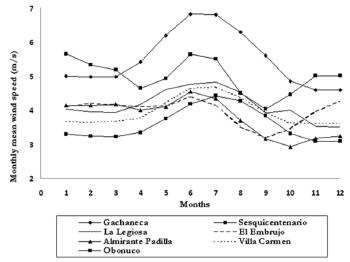
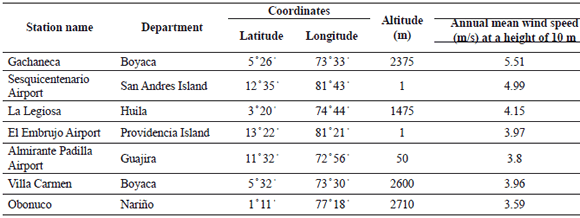
<body><![CDATA[<p><font size="2" face="Verdana, Arial, Helvetica, sans-serif">Before proceeding with the installation of a renewable wind energy system, and in order to analyze the competitiveness and environmental impact of the wind power in terms of fossil fuels, it is necessary to conduct research based on the mathematical modeling, simulation, economic study, and potential reduction of CO<sub>2</sub> emissions [6]. Countries with high growth in solar and wind power, like Algeria and Australia, have conducted mathematical modeling studies before proceeding to construct and install renewable energy systems. Algeria proposes exporting 6,000 megawatts of solar electricity to Europe by the year 2020 [7]. </font></p> 		    <p><font size="2" face="Verdana, Arial, Helvetica, sans-serif">In Latin America, research and development programs on renewable sources of energy are limited. Brazil and Venezuela have carried out simulations of hydrogen production from renewable sources: including hydroelectric and solar [8-11]. Meanwhile, in Colombia, the development of wind and solar energy is minimal and is represented respectively by the wind farm Jepirachi [12] and small systems of photovoltaic cells [13,14] with a capacity of 2 MW. Pinilla et al. [12] present some technical details and lessons learned on the effect of high temperature, in small electronic control circuitry, that caused the uncontrolled and frequent stoppage of turbines.</font></p> 		    <p><font size="2" face="Verdana, Arial, Helvetica, sans-serif">The main objective of this work is to model and simulate the wind energy potential in remote regions and islands of Colombia. This mathematical model permits us to analyze the effect of the type and height of a turbine on electricity generated by wind.</font></p> 		    <p>&nbsp;</p> 		    <p><font size="3" face="Verdana, Arial, Helvetica, sans-serif"><b>2. INFORMATION AND ANALYSIS OF WIND DATA </b></font></p> 		    <p><font size="2" face="Verdana, Arial, Helvetica, sans-serif">Colombia is located in South America. It has a land surface of 1.141.748 km2 and a population of 45 million inhabitants, according to the last population census recorded [15]. The regions selected have different topographies and are located in different points in Colombia. San Andres and Providencia are islands on the Caribbean sea of Colombia, at an altitude of 1 m, that are not connected to the national electrical system grid and have had a high increment in population in the last decade. The Guajira peninsula is located in the north zone of Colombia, on the Caribbean Sea. Huila and Boyaca are situated in the center of the country at an altitude of 1,475 m and 2,600 m, respectively. Nari&ntilde;o is located in the south-west at an altitude of 2,710 m.</font></p> 		    <p><font size="2" face="Verdana, Arial, Helvetica, sans-serif">The wind speed and direction were measured using an anemometer. The data was obtained each hour at 10 m of altitude during the 1987/2001 period by the Institute of Hydrology, Meteorology, and Environmental Studies in Colombia (IDEAM). <a href="#tab01">Table 1</a> shows the geographical coordinates and an annual mean wind speed of the meteorological stations [16].</font></p> 		    <p align="center"><font size="2" face="Verdana, Arial, Helvetica, sans-serif"><b><a name="tab01"></a>Table 1.</b> Geographical coordinates of the meteorological stations.</font>    <br> 	    <img src="/img/revistas/dyna/v79n171/a15tab01.gif"></p> 		    <p><font size="2" face="Verdana, Arial, Helvetica, sans-serif"><a href="#fig01">Figure 1</a> demonstrates that the wind speeds in all the stations presented the same behavior, with maximum values in June/July and minimum values in October. For example, the Gacheneca station has a maximum value of 6.7 m/s in June and July, and the Almirante Padilla station has a minimum value of 2.93 m/s in October. This behavior in Colombia is due to variations of climatology and relief [17]. Also, it is due to the circulation of the Alisios wind, caused mainly by the unequal heating between the equatorial zone and the rest of the planet. This type of wind is intensified during the period of June to August because of a high incidence of solar radiation that increases the heating of the earth. </font></p> 		    ]]></body>
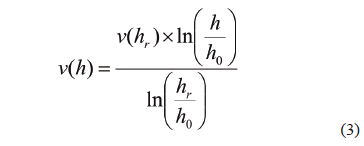
<body><![CDATA[<p align="center"><font size="2" face="Verdana, Arial, Helvetica, sans-serif"><b><a name="fig01"></a><img src="/img/revistas/dyna/v79n171/a15fig01.gif">    <br> 	    Figure 1.</b> Monthly variation of wind speed for each Colombia region at 10 m altitude</font></p> 		    <p><font size="2" face="Verdana, Arial, Helvetica, sans-serif"><b>2.1 Weibull Distribution and Annual Energy Output from a Wind Turbine    <br> 		</b></font><font size="2" face="Verdana, Arial, Helvetica, sans-serif">The Weibull function describes the general pattern of wind speed variations [18-19]. It is very important to the wind industry for designing wind turbines. This distribution is characterized by two parameters: the shape parameter (<img src="/img/revistas/dyna/v79n171/a15eq30556.jpeg" />) (dimensionless) and scale parameter (<img src="/img/revistas/dyna/v79n171/a15eq30565.jpeg" />, m/s), deduced from the experimental wind data. </font></p> 		    <p><font size="2" face="Verdana, Arial, Helvetica, sans-serif">The cumulative distribution function for the Weibull distribution is:</font></p> 		    <p><img src="/img/revistas/dyna/v79n171/a15eq01.gif"></p> 		    <p><font size="2" face="Verdana, Arial, Helvetica, sans-serif">The parameters are calculated by mean linearization of Eq. 1 using natural logarithms as described below:</font></p> 		    <p><img src="/img/revistas/dyna/v79n171/a15eq02.gif"></p> 		    <p><font size="2" face="Verdana, Arial, Helvetica, sans-serif">The wind speed is extrapolated to a different height with the Lysen profile [20], Eq. 3; after the parameters of Weibull function are calculated again for each height chosen.</font></p> 		    <p><img src="/img/revistas/dyna/v79n171/a15eq03.gif"></p> 		    ]]></body>
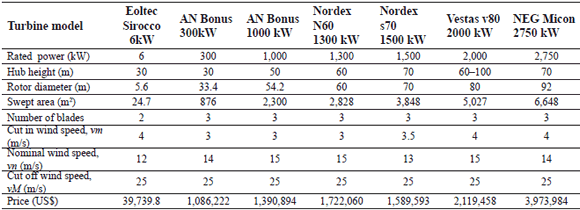
<body><![CDATA[<p><font size="2" face="Verdana, Arial, Helvetica, sans-serif">where <img src="/img/revistas/dyna/v79n171/a15eq30598.jpeg" /> is the wind speed at reference altitude (<img src="/img/revistas/dyna/v79n171/a15eq30609.jpeg" />) and parameter <img src="/img/revistas/dyna/v79n171/a15eq30616.jpeg" /> is the ruggedness longitude. The parameter <img src="/img/revistas/dyna/v79n171/a15eq30623.jpeg" /> depends principally on the elevations of the earth's surface as described by Lysen (1983). The elevation type on the earth surface of each zone where the station was localized was given by the Geographical Institute of Colombia Agustin Codazzi. </font></p> 		    <p><font size="2" face="Verdana, Arial, Helvetica, sans-serif">The Weibull probability density function [21], <img src="/img/revistas/dyna/v79n171/a15eq30631.jpeg" />, is used to calculate the electric energy (E) produced by the turbine over the period of a year; using Eq. 4.</font></p> 		    <p><img src="/img/revistas/dyna/v79n171/a15eq04.gif"></p> 		    <p><font size="2" face="Verdana, Arial, Helvetica, sans-serif">where <img src="/img/revistas/dyna/v79n171/a15eq30649.jpeg" /> is the wind potential and <img src="/img/revistas/dyna/v79n171/a15eq30657.jpeg" /> is the efficiency curve of the turbine given by the manufacturer, Nh is the number of hours over the year, and vm (cut in wind speed) and vM (cut off wind speed) are the minimum and maximum mean air speeds at which the turbines generate electricity. The wind potential per area unit perpendicular to the wind stream is calculated using the following relationship:</font></p> 		    <p><img src="/img/revistas/dyna/v79n171/a15eq05.gif"></p> 		    <p><font size="2" face="Verdana, Arial, Helvetica, sans-serif">where the standard of air density is <img src="/img/revistas/dyna/v79n171/a15eq30672.jpeg" />and <img src="/img/revistas/dyna/v79n171/a15eq30679.jpeg" /> is the mean wind speed. </font></p> 		    <p><font size="2" face="Verdana, Arial, Helvetica, sans-serif"><b>2.2 Turbine Characteristics</b>    <br> 		The wind turbine converts mechanical energy into electrical energy. Generally, these generators provide electric power of between 6 and 2,750 kW. <a href="#tab02">Table 2</a> shows the characteristic properties of wind turbines used in this work. The efficiency curve indicates that turbines generate electricity from low values of wind speed (vm). The converted wind electricity quickly increases, then it takes its maximum value at the nominal wind speed (vn) and this slowly decreases for higher wind speeds until reaching the value of vM at which the turbines can continue to work without any risk of destruction.</font></p> 		    <p align="center"><font size="2" face="Verdana, Arial, Helvetica, sans-serif"><b><a name="tab02"></a>Table 2.</b> Characteristics of the selected wind turbines</font>    <br> 	    <img src="/img/revistas/dyna/v79n171/a15tab02.gif"></p> 		    ]]></body>
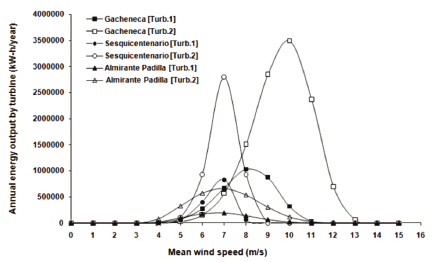
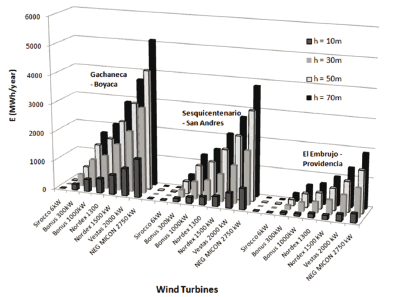
<body><![CDATA[<p>&nbsp;</p> 		    <p><font size="3" face="Verdana, Arial, Helvetica, sans-serif"><b>3. RESULTS AND DISCUSSIONS </b></font></p> 		    <p><font size="2" face="Verdana, Arial, Helvetica, sans-serif"><b>3.1 Annual Energy Output from a Wind Turbine    <br> 		</b>The annual energy output is estimated by using Eq. 4 for the turbines given for each of the regions selected. The results are shown in <a href="#fig02">Fig. 2</a> for Gacheneca (Boyaca), the Sesquicentenario (San Andres Island), and El Embrujo (Providencia Island) stations. The annual mean energy increases with the increasing of the height and the turbine capacity for all regions. The yearly energy production for a small turbine (6 kWh) is low since it lies between 400 and 6,400 kWh/year while the bigger turbines (2,750 kWh) produce approximately 350 times more. </font></p> 		    <p align="center"><font size="2" face="Verdana, Arial, Helvetica, sans-serif"><b><a name="fig02"></a><img src="/img/revistas/dyna/v79n171/a15fig02.gif">    <br> 	    Figure 2.</b> Annual mean energy at Gachaneca, Sesquicentenario, and El Embrujo stations using seven different turbines</font></p> 		    <p><font size="2" face="Verdana, Arial, Helvetica, sans-serif"><a href="#fig02">Figure 2</a> indicates that energy production is according to the wind profile of each region. For example, the Gacheneca (Boyaca) and the Sesquicentenario (Island of San Andres) stations present the highest mean annual energy output with 5,106.02 and 3,828.07 MWh/year at an altitude of 70 m, respectively; while El Embrujo station (Island of Providencia) has the lowest mean annual energy output with 1,899.92 MWh/year. The previous results were obtained for the turbine NEG Micon 2,750 kW. </font></p> 		    <p><font size="2" face="Verdana, Arial, Helvetica, sans-serif">Annual energy production in different regions of Colombia is similar to those obtained in other countries with a turbine of the same type and of a similar height and with a similar wind profile. For example, the Sirocco turbine produces 14,550 and 11,020 kWh/year in the Boyaca and San Andres regions respectively, while regions of Algeria such as Tindouf and Tamanrasset produce approximately 10,000 kWh/year [22].</font></p> 		    <p><font size="2" face="Verdana, Arial, Helvetica, sans-serif"><a href="#fig03">Figure 3</a> indicates the energy produced by each mean wind speed considering its annual frequency for two turbines (Turbine 1: 300 kW and Turbine 2: 2750 kW) and three stations. All stations present low wind energy for a wind speed below 3 m/s (a typical cut in wind speed for the turbines). Stations like Sesquicentenario and Almirante Padilla of intermediate and low wind speeds, present the energy bulk in wind speeds between 4 and 9 m/s, and a maximum annual energy at wind speed of 7 m/s for both turbines; in these stations, the wind speed profile matches the characteristics of the two turbines. The Gachaneca station presents the energy bulk between 5 and 12 m/s, and it has maximum of annual energy at wind speeds of 8 and 10 m/s for turbines of low and high power, respectively; in this station, the wind speed profile matches the characteristics of the high-power turbine.</font></p> 		    <p align="center"><font size="2" face="Verdana, Arial, Helvetica, sans-serif"><b><a name="fig03"></a><img src="/img/revistas/dyna/v79n171/a15fig03.gif">    ]]></body>
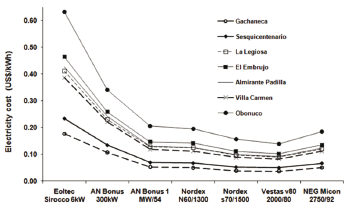
<body><![CDATA[<br> 	    Figure 3.</b> Energy output by turbine as function of mean wind speed at 70 m</font></p> 	    <p><font size="2" face="Verdana, Arial, Helvetica, sans-serif"><b>3.2 Cost Analysis    <br> 	</b></font><font size="2" face="Verdana, Arial, Helvetica, sans-serif">Over the last 10 years, wind systems have resulted in a drop in the cost of electricity. These costs continue diminishing as more plants, larger plants, are built and advanced technology is introduced. Also, selection of a suitable site with high wind velocity is a key for the economics of wind energy. In general, a wind speed exceeding 5 m/s is required for cost-effective application. </font></p> 		    <p><font size="2" face="Verdana, Arial, Helvetica, sans-serif">The economic factor is important for determining the viability of wind energy. The cost of electricity by kWh produced for each turbine in all regions is shown in <a href="#fig04">Fig. 4</a>, and it was calculated from the present value of costs (PVC). The assumptions for calculating the PVC of electricity are similar to those used by Alnaser [23], Habali et al. [24], and Ahmed and Hanitsch [25-27]. Investment (I) includes the turbine price plus its 20 %. The operation maintenance and repair costs (Com) were considered to be 25% of the annual cost of the turbine (machine price/lifetime). The interest rate (r) and inflation rate (i) were taken to be 10 % and 7 %, respectively. Scrap value (S) was taken to be 10 % of the turbine price, and the lifetime of the machine (t) was assumed to be 20 years. The PVC is calculated by using Eq. 6, and the electricity cost per kWh is obtained by dividing the PVC by the total kWh produced for each wind turbine over its lifetime, see <a href="#fig04">Fig. 4</a>.</font></p> 		    <p align="center"><font size="2" face="Verdana, Arial, Helvetica, sans-serif"><b><a name="fig04"></a><img src="/img/revistas/dyna/v79n171/a15fig04.gif">    <br> 	    Figure 4.</b> Cost of wind energy for all stations using seven types of turbines at a height of 70 m </font></p> 		    <p><font size="2" face="Verdana, Arial, Helvetica, sans-serif"><a href="#fig04">Figure 4</a> shows that the cost of each kWh for all stations decreases by increasing the turbine rated power until the 2,000 kW turbine (Vestas v80); this result indicates that the 2,000 kW turbine is more appropriate for the zones studied. Also, the maximum costs of kWh were obtained at Obonuco station for all turbines due to the low wind speeds. </font></p> 		    <p><img src="/img/revistas/dyna/v79n171/a15eq06.gif"></p> 		    <p><font size="2" face="Verdana, Arial, Helvetica, sans-serif">The minimum cost of producing each kWh of electricity using a 2000 kW wind turbine was US $0.037 at Gacheneca while the maximum was US$0.134 at Obonuco. The minimum cost of electricity produced using a 1,300 kW wind turbine was US$0.050 /kWh at Gachaneca while the corresponding maximum cost was US$0.196 kWh at Obonuco. It is recommended to make a cost analysis with several turbines of capacity higher than 2750 kW for finding the optimal minimum cost. The cost results are similar to those [28] obtained in other countries with similar wind profiles and using turbines of the same power capacity ratings.</font></p> 		    <p><font size="2" face="Verdana, Arial, Helvetica, sans-serif"><a href="#fig05">Figure 5</a> indicates that the payback periods for Gachaneca and Sesquicentenario stations were found to be less than the lifetime of the machine. On the other hand, the payback periods for the other regions were higher than 20 years.</font></p> 		    ]]></body>

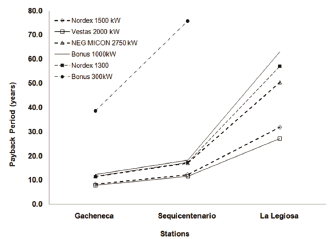
<body><![CDATA[<p align="center"><font size="2" face="Verdana, Arial, Helvetica, sans-serif"><b><a name="fig05"></a><img src="/img/revistas/dyna/v79n171/a15fig05.gif">    <br> 	    Figure 5.</b> The payback period for turbines located in Gachaneca, Sesquicentenario, and La Legiosa stations</font></p> 		    <p>&nbsp;</p> 		    <p><font size="3" face="Verdana, Arial, Helvetica, sans-serif"><b>4. CONCLUSIONS </b></font></p> 		    <p><font size="2" face="Verdana, Arial, Helvetica, sans-serif">This work is an analysis of the electrical energy produced from wind on islands and in remote regions of Colombia, with the purpose of discovering their potential. The annual mean wind speeds at a height of 10 m were calculated as 5.51 m/s, 4.99 m/s, and 4.15 m/s for Gachaneca, Sesquicentenario, and El Embrujo stations, respectively.</font></p> 		    <p><font size="2" face="Verdana, Arial, Helvetica, sans-serif">The data observed shows that the maximum wind speeds for all sites are during June/July. The highest potentials in terms of wind energy were estimated at Gachaneca (Boyaca) and Sesquicentenario (San Andres Island), with 5,106 and 3,828.07 MWh/year at 70 m altitude. </font></p> 		    <p><font size="2" face="Verdana, Arial, Helvetica, sans-serif">The production cost of kWh of electricity in the station with higher annual wind speed, Gachaneca station,&mdash;using wind turbines with rated power of 1,000, 1,300, 1,500, 2,000, and 2,750 kW&mdash;were 0.053, 0.050, 0.039, 0.037, and 0.050 US$, respectively. Meanwhile, in regions of intermediate annual wind speeds, such as San Andres Island, the cost of each kWh,&mdash;using wind turbines with nominal potencies of 1000, 1300, 1500, 2000, and 2750 kW&mdash;were 0.070, 0.068, 0.053, 0.050, and 0.067 US$. </font></p> 		    <p><font size="2" face="Verdana, Arial, Helvetica, sans-serif">The payback periods indicated that the Gachaneca and Sesquicentenario stations are economically viable for the construction of wind parks with turbines of rated power higher than 1000 kW. The payback periods for these stations were found to be less than the lifetime of the machine (20 years) for turbines of power rated higher than 1000 kW. This is compared to the payback periods for other regions, which were higher than 20 years; thus indicating that electricity production from wind is not yet an economical option for various regions of Colombia. It is necessary an appropriate political framework around tax incentives and research to decrease the generation cost and payback period of wind energy, and therefore to make a wind park an economically viable option.</font></p> 		    <p>&nbsp;</p> 		    <p><font size="3" face="Verdana, Arial, Helvetica, sans-serif"><b>ACKNOWLEDGMENTS</b></font></p> 		    ]]></body>
<body><![CDATA[<p><font size="2" face="Verdana, Arial, Helvetica, sans-serif">The authors would like to acknowledge the commitment of the personal of Energy Laboratory and to give special thanks to Yeison Venecia and Luis G. Ricardo. The authors also acknowledge the financial support provided by the University of Cartagena to carry out this work (resolution #3555, 2008). Thanks also to the IDEAM institute, which submitted the wind data.</font></p> 		    <p>&nbsp;</p> 		    <p><font size="3" face="Verdana, Arial, Helvetica, sans-serif"><b>REFERENCES</b></font></p> 		    <!-- ref --><p><font size="2" face="Verdana, Arial, Helvetica, sans-serif"><b>[1]</b> Veziroglu TN. Hydrogen technology for energy needs of human settlements. International Journal of Hydrogen Energy. 12:99. 1987             &nbsp;&nbsp;&nbsp;&nbsp;&nbsp;&nbsp;&nbsp;&nbsp;[&#160;<a href="javascript:void(0);" onclick="javascript: window.open('/scielo.php?script=sci_nlinks&ref=000086&pid=S0012-7353201200010001500001&lng=','','width=640,height=500,resizable=yes,scrollbars=1,menubar=yes,');">Links</a>&#160;]<!-- end-ref --><!-- ref --><br>         <b>[2]</b> Ryde´n Magnus, Lyngfelt Anders. Using steam reforming to produce hydrogen with carbon dioxide capture by chemical-looping combustion. International Journal of Hydrogen Energy. 31:1271-83. 2006     &nbsp;&nbsp;&nbsp;&nbsp;&nbsp;&nbsp;&nbsp;&nbsp;[&#160;<a href="javascript:void(0);" onclick="javascript: window.open('/scielo.php?script=sci_nlinks&ref=000087&pid=S0012-7353201200010001500002&lng=','','width=640,height=500,resizable=yes,scrollbars=1,menubar=yes,');">Links</a>&#160;]<!-- end-ref --><!-- ref --><br>         <b>[3]</b> Mantilla, J. M., Duque, C. A., C. H. Galeano., An&aacute;lisis del esquema de generaci&oacute;n distribuida como una opci&oacute;n para el sistema el&eacute;ctrico colombiano. Rev. Fac. Ing. Univ. Antioquia. 44, pp. 97-110, 2008.     &nbsp;&nbsp;&nbsp;&nbsp;&nbsp;&nbsp;&nbsp;&nbsp;[&#160;<a href="javascript:void(0);" onclick="javascript: window.open('/scielo.php?script=sci_nlinks&ref=000088&pid=S0012-7353201200010001500003&lng=','','width=640,height=500,resizable=yes,scrollbars=1,menubar=yes,');">Links</a>&#160;]<!-- end-ref --><!-- ref --><br>         <b>[4]</b> Rodr&iacute;guez, J., Energ&iacute;a, Sus Perspectivas, Su Conversi&oacute;n y Utilizaciones en Colombia, First ed., Bogot&aacute;, 2000.     &nbsp;&nbsp;&nbsp;&nbsp;&nbsp;&nbsp;&nbsp;&nbsp;[&#160;<a href="javascript:void(0);" onclick="javascript: window.open('/scielo.php?script=sci_nlinks&ref=000089&pid=S0012-7353201200010001500004&lng=','','width=640,height=500,resizable=yes,scrollbars=1,menubar=yes,');">Links</a>&#160;]<!-- end-ref --><!-- ref --><br>         <b>[5]</b> Ministerio de Minas y Energ&iacute;a. Unidad de Planeaci&oacute;n Minero Energ&eacute;tica - UPME, 200. Plan Energ&eacute;tico Nacional, Contexto y Estrategias 2006-2025. Bogot&aacute; D.C. Abril 2007.     &nbsp;&nbsp;&nbsp;&nbsp;&nbsp;&nbsp;&nbsp;&nbsp;[&#160;<a href="javascript:void(0);" onclick="javascript: window.open('/scielo.php?script=sci_nlinks&ref=000090&pid=S0012-7353201200010001500005&lng=','','width=640,height=500,resizable=yes,scrollbars=1,menubar=yes,');">Links</a>&#160;]<!-- end-ref --><!-- ref --><br>         <b>[6]</b> Turkenburg, W., Beurskens, J., Faaij, A. P., Fraenkel, I., Fridleifsson, E., Lysen, D., Mills, J., Moreira, L., Nilsson, A., Schaap, W., Sinke, World Energy Assessment. Capitulo 7: Renewable energy technologies. World Energy Assessment. Goldemberg, J. Washington, DC, UNDP pp. 220-272, 2000.     &nbsp;&nbsp;&nbsp;&nbsp;&nbsp;&nbsp;&nbsp;&nbsp;[&#160;<a href="javascript:void(0);" onclick="javascript: window.open('/scielo.php?script=sci_nlinks&ref=000091&pid=S0012-7353201200010001500006&lng=','','width=640,height=500,resizable=yes,scrollbars=1,menubar=yes,');">Links</a>&#160;]<!-- end-ref --><!-- ref --><br>         <b>[7]</b> Argelia Exportar&aacute; energ&iacute;a solar en dos a&ntilde;os, ABC.es. Available at: <a href="http://www.abc.es/20080728/nacional-sociedad/argelia-exportara-energia-solar-20080728.html" target="referencia">http://www.abc.es/20080728/nacional-sociedad/argelia-exportara-energia-solar-20080728.html</a>, 2008.     &nbsp;&nbsp;&nbsp;&nbsp;&nbsp;&nbsp;&nbsp;&nbsp;[&#160;<a href="javascript:void(0);" onclick="javascript: window.open('/scielo.php?script=sci_nlinks&ref=000092&pid=S0012-7353201200010001500007&lng=','','width=640,height=500,resizable=yes,scrollbars=1,menubar=yes,');">Links</a>&#160;]<!-- end-ref --><!-- ref --><br>         <b>[8]</b> Contreras, A., Posso, F., Nejat Veziroglu, T., Modeling and simulation of the production of hydrogen using hydroelectricity in Venezuela. International Journal of Hydrogen Energy. 32, pp. 219-1224, 2007.     &nbsp;&nbsp;&nbsp;&nbsp;&nbsp;&nbsp;&nbsp;&nbsp;[&#160;<a href="javascript:void(0);" onclick="javascript: window.open('/scielo.php?script=sci_nlinks&ref=000093&pid=S0012-7353201200010001500008&lng=','','width=640,height=500,resizable=yes,scrollbars=1,menubar=yes,');">Links</a>&#160;]<!-- end-ref --><!-- ref --><br>         <b>[9]</b> De Souza, Hydrogen energy as a possibility of utilization of the secondary energy of brazilian hydropower plant of Itaipu. Proceedings of the 13th world hydrogen energy conference. Beijing, China, pp. 116-21, 2000.     &nbsp;&nbsp;&nbsp;&nbsp;&nbsp;&nbsp;&nbsp;&nbsp;[&#160;<a href="javascript:void(0);" onclick="javascript: window.open('/scielo.php?script=sci_nlinks&ref=000094&pid=S0012-7353201200010001500009&lng=','','width=640,height=500,resizable=yes,scrollbars=1,menubar=yes,');">Links</a>&#160;]<!-- end-ref --><!-- ref --><br>         <b>[10]</b> De Lima L, T. Veziroglu, Long-term environmental and socio-economic impact of a hydrogen energy program in Brazil. International Journal of Hydrogen Energy. 26, pp. 39-45, 2001.     &nbsp;&nbsp;&nbsp;&nbsp;&nbsp;&nbsp;&nbsp;&nbsp;[&#160;<a href="javascript:void(0);" onclick="javascript: window.open('/scielo.php?script=sci_nlinks&ref=000095&pid=S0012-7353201200010001500010&lng=','','width=640,height=500,resizable=yes,scrollbars=1,menubar=yes,');">Links</a>&#160;]<!-- end-ref --><!-- ref --><br>         <b>[11]</b> Da Silva, E., Marin, A., Ferreira, P., Camargo, J., Apolinario, F., Pinto, C. Analysis of hydrogen production from combined photovoltaics, wind energy and secondary hydroelectricity supply in Brazil. Solar Energy 78, 670-7, 2005.     &nbsp;&nbsp;&nbsp;&nbsp;&nbsp;&nbsp;&nbsp;&nbsp;[&#160;<a href="javascript:void(0);" onclick="javascript: window.open('/scielo.php?script=sci_nlinks&ref=000096&pid=S0012-7353201200010001500011&lng=','','width=640,height=500,resizable=yes,scrollbars=1,menubar=yes,');">Links</a>&#160;]<!-- end-ref --><!-- ref --><br>         <b>[12]</b> Alvaro Pinilla, Luis Rodr&iacute;guez, Rodrigo Trujillo, Performance evaluation of Jepirachi Wind Park. Renewable Energy 34, 48-52, 2009.     &nbsp;&nbsp;&nbsp;&nbsp;&nbsp;&nbsp;&nbsp;&nbsp;[&#160;<a href="javascript:void(0);" onclick="javascript: window.open('/scielo.php?script=sci_nlinks&ref=000097&pid=S0012-7353201200010001500012&lng=','','width=640,height=500,resizable=yes,scrollbars=1,menubar=yes,');">Links</a>&#160;]<!-- end-ref --><!-- ref --><br>         <b>[13]</b> Unidad de Planeaci&oacute;n Minero Energ&eacute;tica (UPME). Plan Energ&eacute;tico Nacional 2003-2020, Bogot&aacute;, 2003.     &nbsp;&nbsp;&nbsp;&nbsp;&nbsp;&nbsp;&nbsp;&nbsp;[&#160;<a href="javascript:void(0);" onclick="javascript: window.open('/scielo.php?script=sci_nlinks&ref=000098&pid=S0012-7353201200010001500013&lng=','','width=640,height=500,resizable=yes,scrollbars=1,menubar=yes,');">Links</a>&#160;]<!-- end-ref --><!-- ref --><br>         <b>[14]</b> P&eacute;rez Bedoya, E., Osorio Osorio, J., Energ&iacute;a, Pobreza y Deterioro Ecol&oacute;gico en Colombia: Introducci&oacute;n a las Energ&iacute;as Alternativas. Todogr&aacute;ficas. Medell&iacute;n, Colombia, 2002.     &nbsp;&nbsp;&nbsp;&nbsp;&nbsp;&nbsp;&nbsp;&nbsp;[&#160;<a href="javascript:void(0);" onclick="javascript: window.open('/scielo.php?script=sci_nlinks&ref=000099&pid=S0012-7353201200010001500014&lng=','','width=640,height=500,resizable=yes,scrollbars=1,menubar=yes,');">Links</a>&#160;]<!-- end-ref --><!-- ref --><br>         <b>[15]</b> DANE Colombia, Censo General 2005, Resultados Poblaci&oacute;n Conciliada. Available at: <a href="http://www.dane.gov.co/daneweb_V09/index.php?option=com_content&view=article&id=307&Itemid=124" target="referencia">http://www.dane.gov.co/daneweb_V09/index.php?option=com_content&view=article&id=307&Itemid=124</a>, 2005.     &nbsp;&nbsp;&nbsp;&nbsp;&nbsp;&nbsp;&nbsp;&nbsp;[&#160;<a href="javascript:void(0);" onclick="javascript: window.open('/scielo.php?script=sci_nlinks&ref=000100&pid=S0012-7353201200010001500015&lng=','','width=640,height=500,resizable=yes,scrollbars=1,menubar=yes,');">Links</a>&#160;]<!-- end-ref --><!-- ref --><br>         <b>[16]</b> IDEAM, Databases of wind, solar and hydrological. Available at: <a href="http://institucional.ideam.gov.co/jsp/loader.jsf?lServicio=Publicaciones&lTipo=publicaciones&lFuncion=loadContenidoPublicacion&id=993" target="referencia">http://institucional.ideam.gov.co/jsp/loader.jsf?lServicio=Publicaciones&lTipo=publicaciones&lFuncion=loadContenidoPublicacion&id=993</a>, 2011.     &nbsp;&nbsp;&nbsp;&nbsp;&nbsp;&nbsp;&nbsp;&nbsp;[&#160;<a href="javascript:void(0);" onclick="javascript: window.open('/scielo.php?script=sci_nlinks&ref=000101&pid=S0012-7353201200010001500016&lng=','','width=640,height=500,resizable=yes,scrollbars=1,menubar=yes,');">Links</a>&#160;]<!-- end-ref --><!-- ref --><br>         <b>[17]</b> Mesa, O., Poveda, G., Carvajal, L. F.,Introducci&oacute;n al clima de Colombia, First ed., Imprenta Universidad Nacional, Medell&iacute;n, 1997.     &nbsp;&nbsp;&nbsp;&nbsp;&nbsp;&nbsp;&nbsp;&nbsp;[&#160;<a href="javascript:void(0);" onclick="javascript: window.open('/scielo.php?script=sci_nlinks&ref=000102&pid=S0012-7353201200010001500017&lng=','','width=640,height=500,resizable=yes,scrollbars=1,menubar=yes,');">Links</a>&#160;]<!-- end-ref --><!-- ref --><br>         <b>[18]</b> Vogiatzis N, Kotti K, Spanomitsios S, Stoukides M. Analysis of wind potential and characteristics in North Aegean, Greece. Renewable Energy. 29, pp. 1193-208, 2004.     &nbsp;&nbsp;&nbsp;&nbsp;&nbsp;&nbsp;&nbsp;&nbsp;[&#160;<a href="javascript:void(0);" onclick="javascript: window.open('/scielo.php?script=sci_nlinks&ref=000103&pid=S0012-7353201200010001500018&lng=','','width=640,height=500,resizable=yes,scrollbars=1,menubar=yes,');">Links</a>&#160;]<!-- end-ref --><!-- ref --><br>         <b>[19]</b> Justus, C., Mikhail Amir. Height variation of wind speed and wind distributions statistics. Geophysical Research Letters. 3 (5), pp. 261-4, 1976.     &nbsp;&nbsp;&nbsp;&nbsp;&nbsp;&nbsp;&nbsp;&nbsp;[&#160;<a href="javascript:void(0);" onclick="javascript: window.open('/scielo.php?script=sci_nlinks&ref=000104&pid=S0012-7353201200010001500019&lng=','','width=640,height=500,resizable=yes,scrollbars=1,menubar=yes,');">Links</a>&#160;]<!-- end-ref --><!-- ref --><br>         <b>[20]</b> Lysen H., Introduction to wind energy. Consultancy Services, Wind Energy, Developing Countries (CWD), 82-1, May, 2nd Edition, The Netherlands, pp. 36-47, 1983.     &nbsp;&nbsp;&nbsp;&nbsp;&nbsp;&nbsp;&nbsp;&nbsp;[&#160;<a href="javascript:void(0);" onclick="javascript: window.open('/scielo.php?script=sci_nlinks&ref=000105&pid=S0012-7353201200010001500020&lng=','','width=640,height=500,resizable=yes,scrollbars=1,menubar=yes,');">Links</a>&#160;]<!-- end-ref --><!-- ref --><br>         <b>[21]</b> Weibull, W., (1951). A statistical distribution function of wide applicability. J. Appl. Mech.-Trans. ASME 18 (3), pp. 293-297, 1951.     &nbsp;&nbsp;&nbsp;&nbsp;&nbsp;&nbsp;&nbsp;&nbsp;[&#160;<a href="javascript:void(0);" onclick="javascript: window.open('/scielo.php?script=sci_nlinks&ref=000106&pid=S0012-7353201200010001500021&lng=','','width=640,height=500,resizable=yes,scrollbars=1,menubar=yes,');">Links</a>&#160;]<!-- end-ref --><!-- ref --><br>         <b>[22]</b> Youcef F., Abd El Hamid, Mohamed Lassaad, Nabila Bouzergui. Comparative simulation of wind park design and siting in Algeria. Renewable Energy. 33, pp. 2333-2338, 2008.     &nbsp;&nbsp;&nbsp;&nbsp;&nbsp;&nbsp;&nbsp;&nbsp;[&#160;<a href="javascript:void(0);" onclick="javascript: window.open('/scielo.php?script=sci_nlinks&ref=000107&pid=S0012-7353201200010001500022&lng=','','width=640,height=500,resizable=yes,scrollbars=1,menubar=yes,');">Links</a>&#160;]<!-- end-ref --><!-- ref --><br>         <b>[23]</b> Alnaser W., Assessment of the possibility of using three types of wind turbine in Bahrain. Renewable Energy. 3 (2-3), pp. 179-84, 1993.     &nbsp;&nbsp;&nbsp;&nbsp;&nbsp;&nbsp;&nbsp;&nbsp;[&#160;<a href="javascript:void(0);" onclick="javascript: window.open('/scielo.php?script=sci_nlinks&ref=000108&pid=S0012-7353201200010001500023&lng=','','width=640,height=500,resizable=yes,scrollbars=1,menubar=yes,');">Links</a>&#160;]<!-- end-ref --><!-- ref --><br>         <b>[24]</b> Habali S, Hamdan MAS, Jubran BA, Zaid AIO. Wind speed and wind energy potential of Jordan. Solar Energy. 38 (1), pp. 59-70, 1987.     &nbsp;&nbsp;&nbsp;&nbsp;&nbsp;&nbsp;&nbsp;&nbsp;[&#160;<a href="javascript:void(0);" onclick="javascript: window.open('/scielo.php?script=sci_nlinks&ref=000109&pid=S0012-7353201200010001500024&lng=','','width=640,height=500,resizable=yes,scrollbars=1,menubar=yes,');">Links</a>&#160;]<!-- end-ref --><!-- ref --><br>         <b>[25]</b> Ahmed, A., Shata, R. Hanitsch., Evaluation of wind energy potential and electricity generation on the coast of Mediterranean Sea in Egypt. Renewable Energy. 31, pp. 1183-1202, 2006.     &nbsp;&nbsp;&nbsp;&nbsp;&nbsp;&nbsp;&nbsp;&nbsp;[&#160;<a href="javascript:void(0);" onclick="javascript: window.open('/scielo.php?script=sci_nlinks&ref=000110&pid=S0012-7353201200010001500025&lng=','','width=640,height=500,resizable=yes,scrollbars=1,menubar=yes,');">Links</a>&#160;]<!-- end-ref --><!-- ref --><br>         <b>[26]</b> Ahmed A., Shata, R. Hanitsch., The potential of electricity generation on the east coast of Red Sea in Egypt. Renewable Energy. 31, pp. 11597-1615, 2006.     &nbsp;&nbsp;&nbsp;&nbsp;&nbsp;&nbsp;&nbsp;&nbsp;[&#160;<a href="javascript:void(0);" onclick="javascript: window.open('/scielo.php?script=sci_nlinks&ref=000111&pid=S0012-7353201200010001500026&lng=','','width=640,height=500,resizable=yes,scrollbars=1,menubar=yes,');">Links</a>&#160;]<!-- end-ref --><!-- ref --><br>         <b>[27]</b> Ahmed A., Shata, R. Hanitsch., Electricity generation and wind potential assessment at Hurghada, Egypt. Renewable Energy. 33, pp. 141-148, 2008.     &nbsp;&nbsp;&nbsp;&nbsp;&nbsp;&nbsp;&nbsp;&nbsp;[&#160;<a href="javascript:void(0);" onclick="javascript: window.open('/scielo.php?script=sci_nlinks&ref=000112&pid=S0012-7353201200010001500027&lng=','','width=640,height=500,resizable=yes,scrollbars=1,menubar=yes,');">Links</a>&#160;]<!-- end-ref --><!-- ref --><br>     <b>[28]</b> Rehman S., Halawani, T., Mohandes, M., Wind power cost assessment at twenty locations in the kingdom of Saudi Arabia. Renewable Energy. 28, pp. 573-583, 2003. </font>&nbsp;&nbsp;&nbsp;&nbsp;&nbsp;&nbsp;&nbsp;&nbsp;[&#160;<a href="javascript:void(0);" onclick="javascript: window.open('/scielo.php?script=sci_nlinks&ref=000113&pid=S0012-7353201200010001500028&lng=','','width=640,height=500,resizable=yes,scrollbars=1,menubar=yes,');">Links</a>&#160;]<!-- end-ref --> ]]></body><back>
<ref-list>
<ref id="B1">
<label>1</label><nlm-citation citation-type="journal">
<person-group person-group-type="author">
<name>
<surname><![CDATA[Veziroglu]]></surname>
<given-names><![CDATA[TN.]]></given-names>
</name>
</person-group>
<article-title xml:lang="en"><![CDATA[Hydrogen technology for energy needs of human settlements.]]></article-title>
<source><![CDATA[International Journal of Hydrogen Energy]]></source>
<year>1987</year>
<volume>12</volume>
<page-range>99</page-range></nlm-citation>
</ref>
<ref id="B2">
<label>2</label><nlm-citation citation-type="journal">
<person-group person-group-type="author">
<name>
<surname><![CDATA[Ryde´n]]></surname>
<given-names><![CDATA[Magnus]]></given-names>
</name>
<name>
<surname><![CDATA[Lyngfelt]]></surname>
<given-names><![CDATA[Anders]]></given-names>
</name>
</person-group>
<article-title xml:lang="en"><![CDATA[Using steam reforming to produce hydrogen with carbon dioxide capture by chemical-looping combustion.]]></article-title>
<source><![CDATA[International Journal of Hydrogen Energy]]></source>
<year>2006</year>
<volume>31</volume>
<page-range>1271-83</page-range></nlm-citation>
</ref>
<ref id="B3">
<label>3</label><nlm-citation citation-type="journal">
<person-group person-group-type="author">
<name>
<surname><![CDATA[Mantilla]]></surname>
<given-names><![CDATA[J. M.]]></given-names>
</name>
<name>
<surname><![CDATA[Duque]]></surname>
<given-names><![CDATA[C. A.]]></given-names>
</name>
<name>
<surname><![CDATA[Galeano]]></surname>
<given-names><![CDATA[C. H.]]></given-names>
</name>
</person-group>
<article-title xml:lang="es"><![CDATA[Análisis del esquema de generación distribuida como una opción para el sistema eléctrico colombiano.]]></article-title>
<source><![CDATA[Rev. Fac. Ing.]]></source>
<year>2008</year>
<volume>44</volume>
<page-range>97-110</page-range><publisher-name><![CDATA[Univ. Antioquia.]]></publisher-name>
</nlm-citation>
</ref>
<ref id="B4">
<label>4</label><nlm-citation citation-type="book">
<person-group person-group-type="author">
<name>
<surname><![CDATA[Rodríguez]]></surname>
<given-names><![CDATA[J.]]></given-names>
</name>
</person-group>
<source><![CDATA[Energía, Sus Perspectivas, Su Conversión y Utilizaciones en Colombia]]></source>
<year>2000</year>
<publisher-loc><![CDATA[Bogotá ]]></publisher-loc>
<publisher-name><![CDATA[First ed.]]></publisher-name>
</nlm-citation>
</ref>
<ref id="B5">
<label>5</label><nlm-citation citation-type="">
<collab>Ministerio de Minas y Energía.</collab>
<collab>Unidad de Planeación Minero Energética - UPME</collab>
<source><![CDATA[]]></source>
<year>Abri</year>
<month>l </month>
<day>20</day>
<volume>200</volume>
<page-range>2006-2025</page-range><publisher-loc><![CDATA[Bogotá D.C. ]]></publisher-loc>
</nlm-citation>
</ref>
<ref id="B6">
<label>6</label><nlm-citation citation-type="book">
<person-group person-group-type="author">
<name>
<surname><![CDATA[Turkenburg]]></surname>
<given-names><![CDATA[W.]]></given-names>
</name>
<name>
<surname><![CDATA[Beurskens]]></surname>
<given-names><![CDATA[J.]]></given-names>
</name>
<name>
<surname><![CDATA[Faaij]]></surname>
<given-names><![CDATA[A. P.]]></given-names>
</name>
<name>
<surname><![CDATA[Fraenkel]]></surname>
<given-names><![CDATA[I.]]></given-names>
</name>
<name>
<surname><![CDATA[Fridleifsson]]></surname>
<given-names><![CDATA[E.]]></given-names>
</name>
<name>
<surname><![CDATA[Lysen]]></surname>
<given-names><![CDATA[D.]]></given-names>
</name>
<name>
<surname><![CDATA[Mills]]></surname>
<given-names><![CDATA[J.]]></given-names>
</name>
<name>
<surname><![CDATA[Moreira]]></surname>
<given-names><![CDATA[L.]]></given-names>
</name>
<name>
<surname><![CDATA[Nilsson]]></surname>
<given-names><![CDATA[A.]]></given-names>
</name>
<name>
<surname><![CDATA[Schaap]]></surname>
<given-names><![CDATA[W.]]></given-names>
</name>
<name>
<surname><![CDATA[Sinke]]></surname>
</name>
</person-group>
<source><![CDATA[World Energy Assessment: Capitulo 7: Renewable energy technologies.]]></source>
<year>2000</year>
<page-range>220-272</page-range><publisher-loc><![CDATA[J. Washington^eDC DC]]></publisher-loc>
<publisher-name><![CDATA[World Energy Assessment. GoldembergUNDP]]></publisher-name>
</nlm-citation>
</ref>
<ref id="B7">
<label>7</label><nlm-citation citation-type="book">
<source><![CDATA[Argelia Exportará energía solar en dos años]]></source>
<year>2008</year>
<publisher-name><![CDATA[ABC.es]]></publisher-name>
</nlm-citation>
</ref>
<ref id="B8">
<label>8</label><nlm-citation citation-type="journal">
<person-group person-group-type="author">
<name>
<surname><![CDATA[Contreras]]></surname>
<given-names><![CDATA[A.]]></given-names>
</name>
<name>
<surname><![CDATA[Posso]]></surname>
<given-names><![CDATA[F.]]></given-names>
</name>
<name>
<surname><![CDATA[Nejat Veziroglu]]></surname>
<given-names><![CDATA[T.]]></given-names>
</name>
</person-group>
<article-title xml:lang="en"><![CDATA[Modeling and simulation of the production of hydrogen using hydroelectricity in Venezuela]]></article-title>
<source><![CDATA[International Journal of Hydrogen Energy.]]></source>
<year>2007</year>
<volume>32</volume>
<page-range>219-1224</page-range></nlm-citation>
</ref>
<ref id="B9">
<label>9</label><nlm-citation citation-type="">
<person-group person-group-type="author">
<name>
<surname><![CDATA[De Souza]]></surname>
</name>
</person-group>
<source><![CDATA[Hydrogen energy as a possibility of utilization of the secondary energy of brazilian hydropower plant of Itaipu.: Proceedings of the 13th world hydrogen energy conference.]]></source>
<year>2000</year>
<page-range>116-21</page-range><publisher-loc><![CDATA[Beijing ]]></publisher-loc>
</nlm-citation>
</ref>
<ref id="B10">
<label>10</label><nlm-citation citation-type="journal">
<person-group person-group-type="author">
<name>
<surname><![CDATA[De Lima]]></surname>
<given-names><![CDATA[L]]></given-names>
</name>
<name>
<surname><![CDATA[Veziroglu]]></surname>
<given-names><![CDATA[T.]]></given-names>
</name>
</person-group>
<article-title xml:lang="en"><![CDATA[Long-term environmental and socio-economic impact of a hydrogen energy program in Brazil.]]></article-title>
<source><![CDATA[International Journal of Hydrogen Energy.]]></source>
<year>2001</year>
<volume>26</volume>
<page-range>39-45</page-range></nlm-citation>
</ref>
<ref id="B11">
<label>11</label><nlm-citation citation-type="journal">
<person-group person-group-type="author">
<name>
<surname><![CDATA[Da Silva]]></surname>
<given-names><![CDATA[E.]]></given-names>
</name>
<name>
<surname><![CDATA[Marin]]></surname>
<given-names><![CDATA[A.]]></given-names>
</name>
<name>
<surname><![CDATA[Ferreira]]></surname>
<given-names><![CDATA[P.]]></given-names>
</name>
<name>
<surname><![CDATA[Camargo]]></surname>
<given-names><![CDATA[J.]]></given-names>
</name>
<name>
<surname><![CDATA[Apolinario]]></surname>
<given-names><![CDATA[F.]]></given-names>
</name>
<name>
<surname><![CDATA[Pinto]]></surname>
<given-names><![CDATA[C.]]></given-names>
</name>
</person-group>
<article-title xml:lang="en"><![CDATA[Analysis of hydrogen production from combined photovoltaics, wind energy and secondary hydroelectricity supply in Brazil.]]></article-title>
<source><![CDATA[Solar Energy]]></source>
<year>2005</year>
<volume>78</volume>
<page-range>670-7</page-range></nlm-citation>
</ref>
<ref id="B12">
<label>12</label><nlm-citation citation-type="journal">
<person-group person-group-type="author">
<name>
<surname><![CDATA[Pinilla]]></surname>
<given-names><![CDATA[Alvaro]]></given-names>
</name>
<name>
<surname><![CDATA[Rodríguez]]></surname>
<given-names><![CDATA[Luis]]></given-names>
</name>
<name>
<surname><![CDATA[Trujillo]]></surname>
<given-names><![CDATA[Rodrigo]]></given-names>
</name>
</person-group>
<article-title xml:lang="en"><![CDATA[Performance evaluation of Jepirachi Wind Park.]]></article-title>
<source><![CDATA[Renewable Energy]]></source>
<year>2009</year>
<volume>34</volume>
<page-range>48-52</page-range></nlm-citation>
</ref>
<ref id="B13">
<label>13</label><nlm-citation citation-type="">
<collab>Unidad de Planeación Minero Energética</collab>
<source><![CDATA[Plan Energético Nacional 2003-2020]]></source>
<year>2003</year>
<publisher-loc><![CDATA[Bogotá ]]></publisher-loc>
</nlm-citation>
</ref>
<ref id="B14">
<label>14</label><nlm-citation citation-type="book">
<person-group person-group-type="author">
<name>
<surname><![CDATA[Pérez Bedoya]]></surname>
<given-names><![CDATA[E.]]></given-names>
</name>
<name>
<surname><![CDATA[Osorio Osorio]]></surname>
<given-names><![CDATA[J.]]></given-names>
</name>
</person-group>
<source><![CDATA[Energía, Pobreza y Deterioro Ecológico en Colombia: Introducción a las Energías Alternativas]]></source>
<year>2002</year>
<publisher-loc><![CDATA[Medellín ]]></publisher-loc>
<publisher-name><![CDATA[Todográficas]]></publisher-name>
</nlm-citation>
</ref>
<ref id="B15">
<label>15</label><nlm-citation citation-type="">
<collab>DANE Colombia</collab>
<source><![CDATA[Censo General 2005: Resultados Población Conciliada]]></source>
<year>2005</year>
</nlm-citation>
</ref>
<ref id="B16">
<label>16</label><nlm-citation citation-type="">
<collab>IDEAM</collab>
<source><![CDATA[Databases of wind, solar and hydrological.]]></source>
<year>2011</year>
</nlm-citation>
</ref>
<ref id="B17">
<label>17</label><nlm-citation citation-type="book">
<person-group person-group-type="author">
<name>
<surname><![CDATA[Mesa]]></surname>
<given-names><![CDATA[O.]]></given-names>
</name>
<name>
<surname><![CDATA[Poveda]]></surname>
<given-names><![CDATA[G.]]></given-names>
</name>
<name>
<surname><![CDATA[Carvajal]]></surname>
<given-names><![CDATA[L. F.]]></given-names>
</name>
</person-group>
<source><![CDATA[Introducción al clima de Colombia]]></source>
<year>1997</year>
<edition>First ed</edition>
<publisher-loc><![CDATA[Medellín ]]></publisher-loc>
<publisher-name><![CDATA[Imprenta Universidad Nacional]]></publisher-name>
</nlm-citation>
</ref>
<ref id="B18">
<label>18</label><nlm-citation citation-type="journal">
<person-group person-group-type="author">
<name>
<surname><![CDATA[Vogiatzis]]></surname>
<given-names><![CDATA[N]]></given-names>
</name>
<name>
<surname><![CDATA[Kotti]]></surname>
<given-names><![CDATA[K]]></given-names>
</name>
<name>
<surname><![CDATA[Spanomitsios]]></surname>
<given-names><![CDATA[S]]></given-names>
</name>
<name>
<surname><![CDATA[Stoukides]]></surname>
<given-names><![CDATA[M.]]></given-names>
</name>
</person-group>
<article-title xml:lang="en"><![CDATA[Analysis of wind potential and characteristics in North Aegean]]></article-title>
<source><![CDATA[Greece. Renewable Energy.]]></source>
<year>2004</year>
<volume>29</volume>
<page-range>1193-208</page-range></nlm-citation>
</ref>
<ref id="B19">
<label>19</label><nlm-citation citation-type="journal">
<person-group person-group-type="author">
<name>
<surname><![CDATA[Justus]]></surname>
<given-names><![CDATA[C.]]></given-names>
</name>
<name>
<surname><![CDATA[Mikhail]]></surname>
<given-names><![CDATA[Amir]]></given-names>
</name>
</person-group>
<article-title xml:lang="en"><![CDATA[Height variation of wind speed and wind distributions statistics.]]></article-title>
<source><![CDATA[Geophysical Research Letters.]]></source>
<year>1976</year>
<volume>3</volume>
<numero>5</numero>
<issue>5</issue>
<page-range>261-4</page-range></nlm-citation>
</ref>
<ref id="B20">
<label>20</label><nlm-citation citation-type="">
<person-group person-group-type="author">
<name>
<surname><![CDATA[Lysen]]></surname>
<given-names><![CDATA[H.]]></given-names>
</name>
</person-group>
<source><![CDATA[Introduction to wind energy: Consultancy Services, Wind Energy, Developing Countries (CWD)]]></source>
<year>1983</year>
<volume>82-1</volume>
<edition>May, 2nd Edition</edition>
<page-range>36-47</page-range><publisher-loc><![CDATA[The Netherlands ]]></publisher-loc>
</nlm-citation>
</ref>
<ref id="B21">
<label>21</label><nlm-citation citation-type="journal">
<person-group person-group-type="author">
<name>
<surname><![CDATA[Weibull]]></surname>
<given-names><![CDATA[W.]]></given-names>
</name>
</person-group>
<article-title xml:lang="en"><![CDATA[(1951). A statistical distribution function of wide applicability.]]></article-title>
<source><![CDATA[J. Appl. Mech.-Trans.]]></source>
<year>1951</year>
<volume>18</volume>
<numero>3</numero>
<issue>3</issue>
<page-range>293-297</page-range><publisher-name><![CDATA[ASME]]></publisher-name>
</nlm-citation>
</ref>
<ref id="B22">
<label>22</label><nlm-citation citation-type="journal">
<person-group person-group-type="author">
<name>
<surname><![CDATA[Youcef]]></surname>
<given-names><![CDATA[F.]]></given-names>
</name>
<name>
<surname><![CDATA[Abd]]></surname>
<given-names><![CDATA[El Hamid]]></given-names>
</name>
<name>
<surname><![CDATA[Mohamed]]></surname>
<given-names><![CDATA[Lassaad]]></given-names>
</name>
<name>
<surname><![CDATA[Nabila]]></surname>
<given-names><![CDATA[Bouzergui]]></given-names>
</name>
</person-group>
<article-title xml:lang="en"><![CDATA[Comparative simulation of wind park design and siting in Algeria.]]></article-title>
<source><![CDATA[Renewable Energy.]]></source>
<year>2008</year>
<volume>33</volume>
<page-range>2333-2338</page-range></nlm-citation>
</ref>
<ref id="B23">
<label>23</label><nlm-citation citation-type="journal">
<person-group person-group-type="author">
<name>
<surname><![CDATA[Alnaser]]></surname>
<given-names><![CDATA[W.]]></given-names>
</name>
</person-group>
<article-title xml:lang="en"><![CDATA[Assessment of the possibility of using three types of wind turbine in Bahrain.]]></article-title>
<source><![CDATA[Renewable Energy.]]></source>
<year>1993</year>
<volume>3</volume>
<numero>2-3</numero>
<issue>2-3</issue>
<page-range>179-84</page-range></nlm-citation>
</ref>
<ref id="B24">
<label>24</label><nlm-citation citation-type="journal">
<person-group person-group-type="author">
<name>
<surname><![CDATA[Habali]]></surname>
<given-names><![CDATA[S]]></given-names>
</name>
<name>
<surname><![CDATA[Hamdan]]></surname>
<given-names><![CDATA[MAS]]></given-names>
</name>
<name>
<surname><![CDATA[Jubran]]></surname>
<given-names><![CDATA[BA]]></given-names>
</name>
<name>
<surname><![CDATA[Zaid]]></surname>
<given-names><![CDATA[AIO]]></given-names>
</name>
</person-group>
<article-title xml:lang="en"><![CDATA[Wind speed and wind energy potential of Jordan.]]></article-title>
<source><![CDATA[Solar Energy.]]></source>
<year>1987</year>
<volume>38</volume>
<numero>1</numero>
<issue>1</issue>
<page-range>59-70</page-range></nlm-citation>
</ref>
<ref id="B25">
<label>25</label><nlm-citation citation-type="journal">
<person-group person-group-type="author">
<name>
<surname><![CDATA[Shata]]></surname>
<given-names><![CDATA[Ahmed, A.]]></given-names>
</name>
<name>
<surname><![CDATA[Hanitsch]]></surname>
<given-names><![CDATA[R.]]></given-names>
</name>
</person-group>
<article-title xml:lang="en"><![CDATA[Evaluation of wind energy potential and electricity generation on the coast of Mediterranean Sea in Egypt.]]></article-title>
<source><![CDATA[Renewable Energy.]]></source>
<year>2006</year>
<volume>31</volume>
<page-range>1183-1202</page-range></nlm-citation>
</ref>
<ref id="B26">
<label>26</label><nlm-citation citation-type="journal">
<person-group person-group-type="author">
<name>
<surname><![CDATA[Shata]]></surname>
<given-names><![CDATA[Ahmed A.]]></given-names>
</name>
<name>
<surname><![CDATA[Hanitsch]]></surname>
<given-names><![CDATA[R.]]></given-names>
</name>
</person-group>
<source><![CDATA[Renewable Energy]]></source>
<year>2006</year>
<volume>31</volume>
<page-range>11597-1615</page-range></nlm-citation>
</ref>
<ref id="B27">
<label>27</label><nlm-citation citation-type="journal">
<person-group person-group-type="author">
<name>
<surname><![CDATA[Shata]]></surname>
<given-names><![CDATA[Ahmed A.]]></given-names>
</name>
<name>
<surname><![CDATA[Hanitsch]]></surname>
<given-names><![CDATA[R.]]></given-names>
</name>
</person-group>
<article-title xml:lang="en"><![CDATA[Electricity generation and wind potential assessment at Hurghada, Egypt.]]></article-title>
<source><![CDATA[Renewable Energy.]]></source>
<year>2008</year>
<volume>33</volume>
<page-range>141-148</page-range></nlm-citation>
</ref>
<ref id="B28">
<label>28</label><nlm-citation citation-type="journal">
<person-group person-group-type="author">
<name>
<surname><![CDATA[Rehman]]></surname>
<given-names><![CDATA[S.]]></given-names>
</name>
<name>
<surname><![CDATA[Halawani]]></surname>
<given-names><![CDATA[T.]]></given-names>
</name>
<name>
<surname><![CDATA[Mohandes]]></surname>
<given-names><![CDATA[M.]]></given-names>
</name>
</person-group>
<article-title xml:lang="en"><![CDATA[Wind power cost assessment at twenty locations in the kingdom of Saudi Arabia.]]></article-title>
<source><![CDATA[Renewable Energy.]]></source>
<year>2003</year>
<volume>28</volume>
<page-range>573-583</page-range></nlm-citation>
</ref>
</ref-list>
</back>
</article>