<?xml version="1.0" encoding="ISO-8859-1"?><article xmlns:mml="http://www.w3.org/1998/Math/MathML" xmlns:xlink="http://www.w3.org/1999/xlink" xmlns:xsi="http://www.w3.org/2001/XMLSchema-instance">
<front>
<journal-meta>
<journal-id>0012-7353</journal-id>
<journal-title><![CDATA[DYNA]]></journal-title>
<abbrev-journal-title><![CDATA[Dyna rev.fac.nac.minas]]></abbrev-journal-title>
<issn>0012-7353</issn>
<publisher>
<publisher-name><![CDATA[Universidad Nacional de Colombia]]></publisher-name>
</publisher>
</journal-meta>
<article-meta>
<article-id>S0012-73532012000100020</article-id>
<title-group>
<article-title xml:lang="en"><![CDATA[SOCIAL GEOLOGY: A NEW PERSPECTIVE ON GEOLOGY]]></article-title>
<article-title xml:lang="es"><![CDATA[GEOLOGIA SOCIAL: UNA NUEVA PERSPECTIVA DE LA GEOLOGIA]]></article-title>
</title-group>
<contrib-group>
<contrib contrib-type="author">
<name>
<surname><![CDATA[MATA-PERELLÓ]]></surname>
<given-names><![CDATA[JOSEP M.]]></given-names>
</name>
<xref ref-type="aff" rid="A01"/>
</contrib>
<contrib contrib-type="author">
<name>
<surname><![CDATA[MATA-LLEONART]]></surname>
<given-names><![CDATA[ROGER]]></given-names>
</name>
<xref ref-type="aff" rid="A02"/>
</contrib>
<contrib contrib-type="author">
<name>
<surname><![CDATA[VINTRÓ-SÁNCHEZ]]></surname>
<given-names><![CDATA[CARLA]]></given-names>
</name>
<xref ref-type="aff" rid="A03"/>
</contrib>
<contrib contrib-type="author">
<name>
<surname><![CDATA[RESTREPO-MARTÍNEZ]]></surname>
<given-names><![CDATA[CATALINA]]></given-names>
</name>
</contrib>
</contrib-group>
<aff id="A01">
<institution><![CDATA[,University of Catalonia Dept. of Mining and Natural Resources, Polytechnic ]]></institution>
<addr-line><![CDATA[ ]]></addr-line>
</aff>
<aff id="A02">
<institution><![CDATA[,University of Girona Dept. of Environmental Sciences, Geodynamics Area ]]></institution>
<addr-line><![CDATA[ ]]></addr-line>
</aff>
<aff id="A03">
<institution><![CDATA[,Polytechnic University of Catalonia Dept. of Business Management ]]></institution>
<addr-line><![CDATA[ ]]></addr-line>
</aff>
<aff id="A04">
<institution><![CDATA[,University of Catalonia Dept. of Mining and Natural Resources ]]></institution>
<addr-line><![CDATA[ ]]></addr-line>
</aff>
<pub-date pub-type="pub">
<day>00</day>
<month>02</month>
<year>2012</year>
</pub-date>
<pub-date pub-type="epub">
<day>00</day>
<month>02</month>
<year>2012</year>
</pub-date>
<volume>79</volume>
<numero>171</numero>
<fpage>158</fpage>
<lpage>166</lpage>
<copyright-statement/>
<copyright-year/>
<self-uri xlink:href="http://www.scielo.org.co/scielo.php?script=sci_arttext&amp;pid=S0012-73532012000100020&amp;lng=en&amp;nrm=iso"></self-uri><self-uri xlink:href="http://www.scielo.org.co/scielo.php?script=sci_abstract&amp;pid=S0012-73532012000100020&amp;lng=en&amp;nrm=iso"></self-uri><self-uri xlink:href="http://www.scielo.org.co/scielo.php?script=sci_pdf&amp;pid=S0012-73532012000100020&amp;lng=en&amp;nrm=iso"></self-uri><abstract abstract-type="short" xml:lang="en"><p><![CDATA[This paper proposes a new methodology aimed at characterizing and studying two key geological elements for the sustainable and ethical development of society: geological resources and geological risks. The main objective is to broaden concepts and therefore, to facilitate the development of geological studies and the establishment of guidelines that fit better with the social situation of our environment, as well as with territorial management and risk prevention.]]></p></abstract>
<abstract abstract-type="short" xml:lang="es"><p><![CDATA[Se propone una nueva metodología para caracterizar y estudiar los dos elementos geológicos claves en el desarrollo sostenible y ético de la sociedad: los recursos y los riesgos geológicos. El objetivo principal es ampliar conceptos que permitan realizar estudios geológicos y establecer directrices de gestión más adaptadas a la situación social de nuestro entorno, así como a la ordenación del territorio y a la prevención de riesgos.]]></p></abstract>
<kwd-group>
<kwd lng="en"><![CDATA[sustainable development]]></kwd>
<kwd lng="en"><![CDATA[geological resources]]></kwd>
<kwd lng="en"><![CDATA[geological hazards]]></kwd>
<kwd lng="es"><![CDATA[desarrollo sostenible]]></kwd>
<kwd lng="es"><![CDATA[recursos geológicos]]></kwd>
<kwd lng="es"><![CDATA[peligrosidad geológica]]></kwd>
</kwd-group>
</article-meta>
</front><body><![CDATA[  		    <p align="center"><font size="4" face="Verdana, Arial, Helvetica, sans-serif"><b>SOCIAL GEOLOGY: A NEW PERSPECTIVE ON GEOLOGY</b></font></p> 		    <p align="center"><i><font size="3"><b><font face="Verdana, Arial, Helvetica, sans-serif"> GEOLOGIA SOCIAL: UNA NUEVA PERSPECTIVA DE LA GEOLOGIA</font></b></font></i></p> 		    <p align="center">&nbsp;</p> 		    <p align="center"><font size="2" face="Verdana, Arial, Helvetica, sans-serif"><b>JOSEP M. MATA-PERELL&Oacute;</b>    <br> 		    <i>Ph.D., Dept. of Mining and Natural Resources, Polytechnic University of Catalonia, <a href="mailto:mata@emrn.upc.edu">mata@emrn.upc.edu</a></i></font></p> 		    <p align="center"><font size="2" face="Verdana, Arial, Helvetica, sans-serif"><b>ROGER MATA-LLEONART</b>    <br> 		  <i>M.Sc., Dept. of Environmental Sciences, Geodynamics Area, University of Girona, Axial Geology and Environment, <a href="mailto:rmata@colgeocat.org">rmata@colgeocat.org</a></i></font></p> 		    <p align="center"><font size="2" face="Verdana, Arial, Helvetica, sans-serif"><b>CARLA VINTR&Oacute;-S&Aacute;NCHEZ</b>    <br> 		  <i>Ph.D., Dept. of Business Management, Polytechnic University of Catalonia, <a href="mailto:carla.vintro@upc.edu">carla.vintro@upc.edu</a></i></font></p> 		    ]]></body>
<body><![CDATA[<p align="center"><font size="2" face="Verdana, Arial, Helvetica, sans-serif"><b>CATALINA RESTREPO-MART&Iacute;NEZ</b>    <br> 		  <i>M.Sc., Dept. of Mining and Natural Resources, Polytechnic University of Catalonia, <a href="mailto:katares2@hotmail.com">katares2@hotmail.com</a></i></font></p> 		    <p align="center">&nbsp;</p> 		    <p align="center"><font size="2" face="Verdana, Arial, Helvetica, sans-serif"><b>Received for review July 31<sup>th</sup>, 2010, accepted March 24<sup>th</sup>, 2011, final version May, 4<sup>th</sup>, 2011</b></font></p> 	    <p>&nbsp;</p> 		<hr> 		    <p><font size="2" face="Verdana, Arial, Helvetica, sans-serif"><b>ABSTRACT:</b> This paper proposes a new methodology aimed at characterizing and studying two key geological elements for the sustainable and ethical development of society: geological resources and geological risks. The main objective is to broaden concepts and therefore, to facilitate the development of geological studies and the establishment of guidelines that fit better with the social situation of our environment, as well as with territorial management and risk prevention.</font></p> 		    <p><font size="2" face="Verdana, Arial, Helvetica, sans-serif"><b>KEYWORDS:</b> sustainable development, geological resources, geological hazards</font></p> 		    <p><font size="2" face="Verdana, Arial, Helvetica, sans-serif"><b>RESUMEN:</b> Se propone una nueva metodolog&iacute;a para caracterizar y estudiar los dos elementos geol&oacute;gicos claves en el desarrollo sostenible y &eacute;tico de la sociedad: los recursos y los riesgos geol&oacute;gicos. El objetivo principal es ampliar conceptos que permitan realizar estudios geol&oacute;gicos y establecer directrices de gesti&oacute;n m&aacute;s adaptadas a la situaci&oacute;n social de nuestro entorno, as&iacute; como a la ordenaci&oacute;n del territorio y a la prevenci&oacute;n de riesgos. </font></p> 		    <p><font size="2" face="Verdana, Arial, Helvetica, sans-serif"><b>PALABRAS CLAVE:</b> desarrollo sostenible, recursos geol&oacute;gicos, peligrosidad geol&oacute;gica</font></p> 		<hr> 		    <p>&nbsp;</p> 		    ]]></body>
<body><![CDATA[<p><font size="3" face="Verdana, Arial, Helvetica, sans-serif"><b>1. INTRODUCTION</b></font></p> 		    <p><font size="2" face="Verdana, Arial, Helvetica, sans-serif">A detailed global-scale analysis, taking as its main references the Report of Human Development (published annually by the PNUD [1]) and the Report of the State of the World (published annually by the Worldwatch Institute [2]), shows that the major worldwide problems are directly associated with the geological environment. These problems can be summarized into three main blocks: (a) a lack of water or a lack of access to safe drinking water; (b) the economic and human losses generated by geological risks; and, (c) conflicts over the control of geological resources. </font></p> 		    <p><font size="2" face="Verdana, Arial, Helvetica, sans-serif">In the same way, environmental problems are intimately linked with increasing industrialization and the urbanization experimented, and this latter reality appears to be closely related to human population growth. For example, in Catalonia (an Autonomous Community of Spain from which the authors come) the population has increased from 5,956,000 in 1981, to 6,813,000 in 2004; while, in Spain the number of inhabitants has increased from 37,617,000 to 43,198,000 during the same period, according to the Catalan Institute of Statistics. In fact, it is expected that world population will reach 8.5 million inhabitants [3] and this will cause troublesome situations in some cities like Mexico City, Tokyo, London, and Sao Paulo.</font></p> 		    <p><font size="2" face="Verdana, Arial, Helvetica, sans-serif">Geology is currently considered to be one of the most influential factors in human development. More precisely, it determines the evolution of society. Geology should direct efforts towards giving answers to the challenges which have emerged as a result of the growth of urban zones and as a result of the increase in the number of developing countries, since the territorial management of these areas should have a direct influence on the well-being of society.</font></p> 		    <p><font size="2" face="Verdana, Arial, Helvetica, sans-serif">Hence, it is necessary to put into practice all the concepts and methods of environmental and urban geology, specifically when referring to those aspects that have an influence on society: the geological resources and the geological risks. It is also necessary to link sociology and geology in order to foresee and reduce the most negative and limiting effects of the geological environment with respect to society (i.e., the lack of geological resources in developing countries, and the low geological risk perception that increase their vulnerability and limit their socio-economic development).</font></p> 		    <p><font size="2" face="Verdana, Arial, Helvetica, sans-serif">In this sense, the data presented in this paper show the vast influence that both the exploitation of geological resources and disasters of geological origin have on society. Thus, this paper aims to develop tools and methodologies for territorial management under social geological criteria.</font></p> 		    <p><font size="2" face="Verdana, Arial, Helvetica, sans-serif">We understand social geology to be the discipline of geology that studies the interaction among the geological environment and the social development, especially the influence of geological resources and risks on the territorial and social management of urban zones.</font></p> 		    <p><font size="2" face="Verdana, Arial, Helvetica, sans-serif">Currently, the profits and impacts of geological resources exploitation and the effects of geological risks do not depend on their geological nature, but they are controlled by socioeconomic and territorial factors. Hence, the integration of other disciplines beyond a mere geological classification and beyond new tools and methodologies is essential.</font></p> 		    <p><font size="2" face="Verdana, Arial, Helvetica, sans-serif">In 1998, UNESCO already referred in the bulletin entitled Geology for Sustainable Development [3] to the birth of sociogeosciences as an unavoidable milestone in human development. The agency of the United Nations also stated that the sustainable development of society is strongly related to geosciences and sociology. According to the report published by UNESCO, sociogeosciences are a new hybrid of sociology and Earth science (or geosciences) that aims to give answers to the problems of sustainable development while it gives special attention to the resources, the population, and the environment.</font></p> 		    <p>&nbsp;</p> 		    ]]></body>
<body><![CDATA[<p><font size="3" face="Verdana, Arial, Helvetica, sans-serif"><b>2. A NEW SOCIAL APPROACH OF GEOLOGICAL RESOURCES AND RISKS </b></font></p> 		    <p><font size="2" face="Verdana, Arial, Helvetica, sans-serif">To enhance social development, new methodologies and proposals, as well as easy-to-use systems, should be used in the study of geological resources and risks. In this paper, two new approaches are introduced. </font></p> 		    <p><font size="2" face="Verdana, Arial, Helvetica, sans-serif"><b>2.1 Conflicts over control of resources    <br> 		</b></font><font size="2" face="Verdana, Arial, Helvetica, sans-serif">The world-wide demand for geological resources is growing in an untenable rhythm as the population increases. Society is requiring more resources for its development, but this demand is characterized by several inequalities among different countries. Each inhabitant from a developed country consumes or is responsible for the consumption of 20 tons of geological material per year [3]. For example, the United States accounts for 20-30 % of all raw materials consumed by humanity [4].</font></p> 		    <p><font size="2" face="Verdana, Arial, Helvetica, sans-serif">Developed countries exploit the resources in the areas which have better mineral concentration for profitable mining. In general, the higher the concentration of the mineral, the more economical it is to mine. Extraction costs, labor costs, energy costs, and environmental controls are influential factors as well.</font></p> 		    <p><font size="2" face="Verdana, Arial, Helvetica, sans-serif">This fact leads to strong economic, political, social, and environmental pressures, especially for developing countries. These pressures for the control of geological resources are commonly the main background of severe conflicts and wars.</font></p> 		    <p><font size="2" face="Verdana, Arial, Helvetica, sans-serif">As stated above, geological resources are basic elements for human subsistence, but, at the same time they are limited and therefore not renewable on a human scale. Indeed, the consumption-based lifestyle does have its effects, and if the geological resources continue to be exploited at such an unsustainable rate, there will be nothing left to exploit. </font></p> 		    <p><font size="2" face="Verdana, Arial, Helvetica, sans-serif">According to the USGS [4] almost 10 billion tons of primary geological material were consumed on a worldwide scale in 1995, and that represented an increase of 6 billion tons (from 4 to 10 billion tons) in just 25 years.</font></p> 		    <p><font size="2" face="Verdana, Arial, Helvetica, sans-serif">To avoid the depletion of many resources, several aspects should be considered:</font></p> 		<ul>           <li class="dyna-normal"><font size="2" face="Verdana, Arial, Helvetica, sans-serif">Environmental and mining laws that enhance the correct extraction of resources and that facilitate the decrease of environmental impacts.</font></li> 		  <li class="dyna-normal"><font size="2" face="Verdana, Arial, Helvetica, sans-serif">Primary materials recycling, especially metals recycling. </font></li> 		  <li class="dyna-normal"><font size="2" face="Verdana, Arial, Helvetica, sans-serif">Improvement of technology and replacement of resources with minor reserves by others with senior reserves or renewable reserves on a human scale.</font></li>         </ul> 	    ]]></body>
<body><![CDATA[<p><font size="2" face="Verdana, Arial, Helvetica, sans-serif">In fact, as long as the worldwide consumption of geological resources increases, the global supply of several key materials will be reduced triggering a rise in resource prices. This fact will lead (and it already does) to the exploitation of new mining beds, but only by those countries that are able to pay for it or whose political and/or military positions are strong enough.</font></p> 		    <p><font size="2" face="Verdana, Arial, Helvetica, sans-serif">Probably, poorer countries will not be able to afford the high cost of primary materials or the cost of essential resources like water. Under those circumstances, different conflicts motivated by vital sources supply will probably occur among nations and within states. It is also foreseeable that the richest countries will originate conflicts for the control and exploitation of resources.</font></p> 		    <p><font size="2" face="Verdana, Arial, Helvetica, sans-serif">Currently, at least 20 areas of the planet are immersed in a war motivated by the control of oil and gas resources. The Report of the Worldwatch Institute entitled Anatomy of the Wars of Resources [2] states that the conflicts for the exploitation of resources during the 90s decade caused more than 5 million deaths, 6 million refugees, and 11 to 15 million people displaced. The origins of the wars were the control of resources, and the financial support received helped prolong those conflicts.</font></p> 		    <p><font size="2" face="Verdana, Arial, Helvetica, sans-serif">A study conducted in Hampshire College establishes that as the demand of basic resources increases, the disputes for the property of these resources multiply as well as the likelihood of world industrial powers intervening to assure the supply.</font></p> 		    <p><font size="2" face="Verdana, Arial, Helvetica, sans-serif">On the other hand, it should be considered that the exploitation of resources does not only generate wars but also severe social and human conflicts. For example in the Great Lakes Area (Africa), the exploitation of metals destined to mobile telephones, electric wires, bulbs, etc., implies the exploitation of people at work, from children to adults. Furthermore, the mineral wealth of this area is one of the biggest and most important around the world (where coltan, gold minerals, silver, copper, zinc, germanium, cerium, lanthanum, tin, nickel, wolfram, diamonds, cobalt, uranium, manganese, etc. can be found) and precisely the economic interests in the exploitation of these minerals are the main motive of the war that started in 1990 and that is still active.</font></p> 		    <p><font size="2" face="Verdana, Arial, Helvetica, sans-serif"><b>2.2 A new classification of geological resources</b>    <br> 		</font><font size="2" face="Verdana, Arial, Helvetica, sans-serif">To favor the social geology and the sustainable development, we believe it would be interesting to consider the geological resources as something more than goods extracted from the earth's crust that have an economic profit and that assure the subsistence of human beings under the current model. Thus, all those geological elements that have value should be catalogued as an economic, social, scientific, landscaping, patrimonial and/or didactic resource. </font></p> 		    <p><font size="2" face="Verdana, Arial, Helvetica, sans-serif">The classical classifications do not consider being a resource those outcrops, materials, structures or geological processes that present a didactic value (and do not have an economic interest), and neither they contemplate the guidelines stated in the Conference of Rio of 1992 [5]. In this sense, they are quite far from the current conception of the resource term and they do not entirely fit in with the current trends aimed at protecting, preserving and spreading the knowledge of geological elements of scientific and didactic interest.</font></p> 		    <p><font size="2" face="Verdana, Arial, Helvetica, sans-serif">Although the geological resources of cultural, scientific and didactic type have been included within the classifications of geological resources, they have not been correctly placed on a hierarchical and semantic scale. Thus, these resources have only been referred to as cultural resources, cultural geo-resources or patrimonial resources. That is main drawback unsolved up to now.</font></p> 		    <p><font size="2" face="Verdana, Arial, Helvetica, sans-serif">Elizaga [6] introduced one of the first approaches to the inclusion of geological resources of cultural type into the same level as the rest of the resources. This approach has been widely accepted up to the present time and it constitutes an important milestone. Nevertheless, it does not achieve placing patrimonial type of resources at the same level as the rest of the resources, but rather, establishes them as a mere addition.</font></p> 		    ]]></body>
<body><![CDATA[<p><font size="2" face="Verdana, Arial, Helvetica, sans-serif">On the other hand, the so-called cultural or patrimonial geo-resources have been mainly classified according to its physical or genetic characteristics into different groups: tectonic; volcanic; stratigraphic; geomorphologic; and mineralogical [7]. This classification is very suitable for cataloging patrimony, and it has been employed in the majority of inventories and catalogues carried out. But, as it focuses on purely geological aspects, it is little effective for entities not devoted to geology.</font></p> 		    <p><font size="2" face="Verdana, Arial, Helvetica, sans-serif">Based on a wide geological perspective, we propose a new classification of geological resources (<a href="#tab01">Table 1</a>) that considers their potential and usage and that integrates the cultural geo-resources into the same level than the rest of the economic resources [23]. It is compiled into two main groups, the extractable and the non-extractable geological resources:</font></p> 		<ul>           <li class="dyna-normal"><font size="2" face="Verdana, Arial, Helvetica, sans-serif">The Non-extractable group includes any solid, gas or liquid element, or any geological process that is found in or on the earth's crust and that has some optimum characteristics that make it suitable to be used in educational and/or cultural activities, or that favors the sustainable development of society and therefore increases human quality of life. All those outcrops, elements, or geological processes that present a cultural, scientific, didactic, patrimonial or recreational value are included therein. Conservation and advising protection are needed to assure sustainable extraction.</font></li> 		  <li class="dyna-normal"><font size="2" face="Verdana, Arial, Helvetica, sans-serif">The extractable resources group includes any solid, gas or liquid element that is in or on the earth's crust in optimum concentration for its exploitation, and that its extraction is a basic element for the subsistence of society and therefore does not generate natural, social, or educational irreversible impacts.</font></li>         </ul> 	    <p align="center"><font size="2" face="Verdana, Arial, Helvetica, sans-serif"><b><a name="tab01"></a>Table 1.</b> Reclassification of geological resources</font>    <br>     <img src="/img/revistas/dyna/v79n171/a20tab01.gif"></p> 		    <p><font size="2" face="Verdana, Arial, Helvetica, sans-serif">In accordance with this new classification, all known and identified resources that can be exploited with an economic, social, cultural, touristic, scientific and/or educational profit, and that benefit social needs, will be considered as reserves.</font></p> 		    <p><font size="2" face="Verdana, Arial, Helvetica, sans-serif">The non-extractable resources category holds different subgroups that sustain both the hierarchical and the semantic level with respect to the other ones. Each subgroup is denominated with the beginning words &ldquo;destined for...&rdquo; or &ldquo;used as...&rdquo;</font></p> 		    <p><font size="2" face="Verdana, Arial, Helvetica, sans-serif">The classification introduced in this paper achieves the main goals of any systematic classification:</font></p> 		<ul>           <li class="dyna-normal"><font size="2" face="Verdana, Arial, Helvetica, sans-serif">Resources that have a non-limited scientific, cultural, patrimonial or didactic value are included within the classification of resources of economic value.</font></li> 		  <li class="dyna-normal"><font size="2" face="Verdana, Arial, Helvetica, sans-serif">The new types of resources, which are in the same hierarchical and semantic rank sustaining the levels of classification together with the typical resources, are integrated in the classification and therefore they are not included as an addition or appendix.</font></li> 		  <li class="dyna-normal"><font size="2" face="Verdana, Arial, Helvetica, sans-serif">The resources are classified according to their characteristics, properties, and utilities, and not only considering the characteristics themselves as it was done up to a few years ago.</font></li> 		  <li class="dyna-normal"><font size="2" face="Verdana, Arial, Helvetica, sans-serif">A single resource is not limited to a one field alone, since that resource can present multiple benefits.</font></li>         </ul> 	    <p><font size="2" face="Verdana, Arial, Helvetica, sans-serif">The described classification should be complemented with the classification of Mata-Perell&oacute; [8] for the group of extractable resources.</font></p> 		    ]]></body>
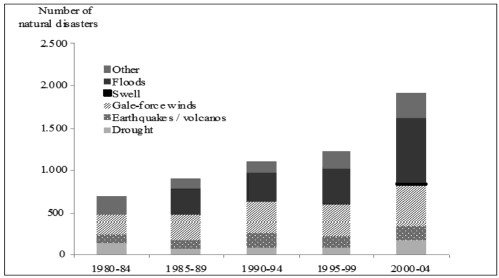
<body><![CDATA[<p><font size="2" face="Verdana, Arial, Helvetica, sans-serif">The classification in <a href="#tab01">Table 1</a> holds important advantages and could enhance a global perception of the environment. In the field of education, it helps students understand that one resource belongs to one group or another depending on its use, the type of resource an outcrop is, or that a bed of chalks has portrayed a formation to itself (e.g., a bed of iron). The application of this classification also simplifies the development of environmental studies (i.e., evaluations of impacts) and the management of protected zones.</font></p> 		    <p><font size="2" face="Verdana, Arial, Helvetica, sans-serif">Mackeley [9] evaluates the importance of geological resources in society considering the level or quality of life. He formulates (1) that the standard of living (L) depends on natural resources (R), energy (E), capacity of inventiveness (I), and population (P).</font></p> 		    <p><img src="/img/revistas/dyna/v79n171/a20eq01.gif"></p> 		    <p><font size="2" face="Verdana, Arial, Helvetica, sans-serif">Until not too long ago, the USGS only considered and introduced in the calculation the resources of economic type, in part due to the difficulty of including geo-cultural resources at the same level. With the classification described herein, this drawback can be solved by placing the extractable and the non-extractable resources at the same rank, and therefore, the quality of life would also depend on geological resources that do not offer a direct economic benefit but offer a patrimonial interest.</font></p> 		    <p><font size="2" face="Verdana, Arial, Helvetica, sans-serif"><b>2.3 Poverty, development, and disasters    <br> 		</b>In recent decades there has been huge increase in natural catastrophes (<a href="#fig01">Figures 1</a> and <a href="#fig02">2</a>), caused or increased in frequency and/or severity by human intervention into nature and environment.</font></p> 		    <p align="center"><font size="2" face="Verdana, Arial, Helvetica, sans-serif"><b><a name="fig01"></a><img src="/img/revistas/dyna/v79n171/a20fig01.gif">    <br> 	    Figure 1.</b> Number of natural disasters for period 1975-2004 [11]</font></p> 		    <p align="center"><font size="2" face="Verdana, Arial, Helvetica, sans-serif"><b><a name="fig02"></a><img src="/img/revistas/dyna/v79n171/a20fig02.gif">    <br> 	    Figure 2.</b> Frequency of natural catastrophes by type of disaster for period1980-2004 [13]</font></p> 		    ]]></body>
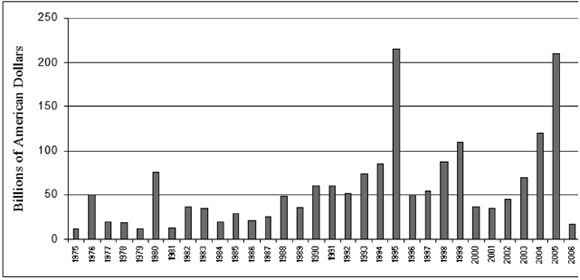
<body><![CDATA[<p><font size="2" face="Verdana, Arial, Helvetica, sans-serif">A year which was especially catastrophic was 1998 with around 50,000 victims and more than 84 million Euros of losses. Another example is Hurricane Mitch, the most devastating of the Atlantic Ocean since 1780, that razed Honduras, Nicaragua, El Salvador, and Guatemala and depicted 2,000 victims considering deaths and missing people and losses of around 6,300 million dollars [10]; the effects of the hurricane were enhanced by the environmental degradation experimented throughout the area. </font></p> 		    <p><font size="2" face="Verdana, Arial, Helvetica, sans-serif">The study conducted by the Worldwatch Institute [2] concluded that humanity is increasingly being threatened by natural disasters, and over 1,000 million people are concentrated in big cities with very poor suburbs.</font></p> 		    <p><font size="2" face="Verdana, Arial, Helvetica, sans-serif">This problematic situation brought about the United Nations General Assembly (ONU) to designate the 1990s as the International Decade for Natural Disaster Reduction (IDNDR). Its basic objective was to decrease the environmental, social, and economic disruption caused by natural disasters. According to reports published by insurance entities, the number of natural disasters occurred in the 90s tripled the amount recorded in the 60s, and the economic losses registered were multiplied by eight.</font></p> 		    <p><font size="2" face="Verdana, Arial, Helvetica, sans-serif">During period 1965-1999, a total of 1,995,000 deaths were attributed to the effects of natural disasters, and 400,000 of those were recorded within 1999 [12]. These values are significantly increased when referring to economic losses. For example in Spain they accounted for 1.5 % of gross domestic product (GDP).</font></p> 		    <p><font size="2" face="Verdana, Arial, Helvetica, sans-serif">On the other hand, an analysis of the distribution of deaths and losses among regions shows that they are mainly recorded in developing countries. Precisely these countries account for more than 75 % of the total damages due to geological risks [2].</font></p> 		    <p><font size="2" face="Verdana, Arial, Helvetica, sans-serif">The most alarming factor of natural disasters is not the number of deaths recorded but the high number of deaths occurred within a short period of time and the huge economic losses generated (<a href="#fig03">Fig. 3</a>), which implies an important socioeconomic recession.</font></p> 		    <p align="center"><font size="2" face="Verdana, Arial, Helvetica, sans-serif"><b><a name="fig03"></a><img src="/img/revistas/dyna/v79n171/a20fig03.gif">    <br> 	    Figure 3.</b> Economic costs brought about by natural disasters for period 1975-2006 [13]</font></p> 		    <p><font size="2" face="Verdana, Arial, Helvetica, sans-serif">A comparative analysis between the number of deaths associated with natural catastrophes and the number of deaths resulting from workplace fatalities or road traffic accidents [12] shows that, fatality rates of natural disasters are significantly lower than the ones recorded in car accidents. When considering traffic accidents nearly ever more than 10 deaths occur simultaneously around the world, and massive destruction of infrastructures and economic recession are not usual consequences. Just the contrary, in natural catastrophes these consequences (more than 10 deaths and major destruction of infrastructures) are quite usual. Precisely, the true impact and relevance of geological risks relays on these facts.</font></p> 		    <p><font size="2" face="Verdana, Arial, Helvetica, sans-serif">Another worrying aspect that should be highlighted is that even when geological processes that derivate into risks have remained quite constant, the human and economic losses generated have increased, and therefore there has been an increase in natural disasters. This fact can be attributed to the world population growth and its distribution. Thus, if population density gets higher its vulnerability increases, and consequently disasters increase too.</font></p> 		    ]]></body>
<body><![CDATA[<p><font size="2" face="Verdana, Arial, Helvetica, sans-serif">Although the scientific knowledge of geological risks and the technologic capacity to reduce and mitigate those risks have been enhanced, we may wonder why this amelioration has not lead to a reduction or stabilization in the number of damages produced by natural disasters. Probably the answer relays on inadequate political intervention and territorial management.</font></p> 		    <p><font size="2" face="Verdana, Arial, Helvetica, sans-serif">A more detailed analysis of the situation reveals that there has been an increase in the number of small disasters (those with less than 100 deaths) during recent years [14]. This implies that local actions for prevention and mitigation of geological risks are not completely effective but they are nearly non-existent in certain areas of the planet, especially in developing countries.</font></p> 		    <p><font size="2" face="Verdana, Arial, Helvetica, sans-serif"><b>2.4 Broadening the concept of geological risk    <br> 		</b></font><font size="2" face="Verdana, Arial, Helvetica, sans-serif">The concept of natural risk is defined by a formula that relates all the elements involved within a hazard: dangerousness, threat, vulnerability, exposure, and damage.</font></p> 		    <p><font size="2" face="Verdana, Arial, Helvetica, sans-serif">Several authors have examined in depth the meaning of risk. Rowe [15] describes a risk as the product of the probability of occurrence of a hazardous event and the damage value, expressed in monetary units. Varnes [16] states that a risk depends on three parameters: dangerousness, vulnerability, and elements under risk. The author defines two types of risk: the specific risk, that indicates the estimated losses generated by a natural phenomenon; and the total risk, that indicates the number of deaths, victims, damaged infrastructures, etc. generated by a specific natural phenomenon. Bell [17,18] argues that the occurrence of a hazard within a specific period of time could be expressed in terms of likelihood. </font></p> 		    <p><font size="2" face="Verdana, Arial, Helvetica, sans-serif">The risk includes natural as well as social elements. Hence, insurance entities have been increasingly more concerned about the need for establishing more precise evaluations of the risk concept by introducing other factors such as the perception of the phenomenon [19,20].</font></p> 		    <p><font size="2" face="Verdana, Arial, Helvetica, sans-serif">According to the current trends and formulas (described in this paper), it is possible to quantify the risk considering three basic concepts: dangerousness, damage, and risk. In this sense, we describe the aforementioned concepts and define dangerousness as the condition, process, or geological success that implies a threat to humanity or to the environment, and therefore it is a threat to the health, security, or wellness of a group of citizens and a threat to the economic situation of a local community [4]. The dangerousness can be expressed by the probability of occurrence of a destructive or harmful natural phenomenon and its energy (threat extent). Cyclicity, or the calculation of the return period, is included therein. </font></p> 		    <p><font size="2" face="Verdana, Arial, Helvetica, sans-serif">The dangerousness (D) can be computed (2) as the product of the probability of occurrence (p) and the threat (T). </font></p> 		    <p><img src="/img/revistas/dyna/v79n171/a20eq02.gif"></p> 		    <p><font size="2" face="Verdana, Arial, Helvetica, sans-serif">The probability represents the relative frequency of occurrence of a specific event. Its study is based on data records obtained from various sources and analyzed with different statistical methods (not specified in this paper). The estimation of the probability is based on the return period also known as recurrence interval. The return period is a statistical measurement denoting the average recurrence interval of time between events. Different methods can be used to calculate the return period, depending on the geological process considered.</font></p> 		    ]]></body>

<body><![CDATA[<p><font size="2" face="Verdana, Arial, Helvetica, sans-serif">The threat is the effect or action of threatening. To threaten is to be a menacing indication of something. Threat and risk are different terms, as the latter is the closest possibility of incurring loss or misfortune, thus risk necessarily implies probability. Under geological terms we can define a threat as a geological process that has some specific characteristics (origin, typology, and energy), like for example a landslide or a volcanic eruption with clear-cut space and energetic characteristics. </font></p> 		    <p><font size="2" face="Verdana, Arial, Helvetica, sans-serif">With respect to social and economic risks we can state that:</font></p> 		    <p><font size="2" face="Verdana, Arial, Helvetica, sans-serif">The damage refers to harmful effects on a set of exposed elements and non-physical aspects related to development. The damage (d) is (3) the product of the exposure (E) and the vulnerability (V).</font></p> 		    <p><img src="/img/revistas/dyna/v79n171/a20eq03.gif"></p> 		    <p><font size="2" face="Verdana, Arial, Helvetica, sans-serif">The exposure is related to the set of exposed elements within the temporal and spatial influence area of a harmful natural phenomenon. It is computed in number of inhabitants or infrastructures, area, and volume.</font></p> 		    <p><font size="2" face="Verdana, Arial, Helvetica, sans-serif">The vulnerability is the loss degree provoked by a destructive phenomenon of a given magnitude, originated by an exposed element (proportion of people and lambs affected with respect to the total exposed). It can take values from 0 (no damages) to 1 (complete loss). Vulnerability is estimated through the decisive aspects of an element such as physical, ideological, social, economic, environmental, political, or educational aspects.</font></p> 		    <p><font size="2" face="Verdana, Arial, Helvetica, sans-serif">The risk perceived by society should also be taken into account. The major the risk perception it is, the minor the vulnerability will be. The risk is the geological condition, process or success that may damage an exposed and vulnerable element at a point in time. The risk (R) is computed (4) as the product of the dangerousness (D) and the damage (d).</font></p> 		    <p><img src="/img/revistas/dyna/v79n171/a20eq04.gif"></p> 		    <p><font size="2" face="Verdana, Arial, Helvetica, sans-serif">Considering the previous formulas specified in this section, (4) can be transformed into (5): </font></p> 		    <p><img src="/img/revistas/dyna/v79n171/a20eq05.gif"></p> 		    ]]></body>
<body><![CDATA[<p><font size="2" face="Verdana, Arial, Helvetica, sans-serif">The application of (5) in the study of disasters prevention would enhance the social conception and help developing political plans that go further than a mere technical conception of risks.</font></p> 		    <p>&nbsp;</p> 		    <p><b><font size="3" face="Verdana, Arial, Helvetica, sans-serif">3. CONCLUSIONS</font></b></p> 		    <p><font size="2" face="Verdana, Arial, Helvetica, sans-serif">This paper aims to develop tools and methodologies for territorial management under social geological criteria. It proposes a new methodology aimed at characterizing and studying geological resources and risks, which are considered herein as two cornerstones of sustainable and ethical development of society.</font></p> 		    <p><font size="2" face="Verdana, Arial, Helvetica, sans-serif">We define social geology as the discipline of geology that studies the interaction among the geological environment and the social development, especially the influence of geological resources and risks on the territorial and social management of urban zones.</font></p> 		    <p><font size="2" face="Verdana, Arial, Helvetica, sans-serif">We believe it is necessary to incorporate new methodologies and proposals, as well as easy-to-use systems, in the study of geological resources and risks to favor the social development. Thus, the main objective of this paper is to broaden concepts and therefore, to facilitate the development of geological studies and the establishment of guidelines that fit better with the social situation of our environment.</font></p> 		    <p><font size="2" face="Verdana, Arial, Helvetica, sans-serif">We have introduced some new approaches for the study of resources and risks to fulfill this aim: an analysis of the conflicts over the control of resources and a new classification of geological resources that considers their potential and usage and that integrates the cultural geo-resources into the same level as the rest of the economic resources; an analysis of poverty, resources, and disasters, and the quantification of the geological risk considering three basic concepts (dangerousness, damage, and risk).</font></p> 		    <p><font size="2" face="Verdana, Arial, Helvetica, sans-serif">Indeed, there is general belief that never before so many disasters had taken place due to geological risks than in recent decades, and that seems to be true as around 50,000 victims and more than 84 million Euros of losses were recorded during 1998, which was especially catastrophic. In this sense, the data presented in this paper show the vast influence that both the exploitation of geological resources and the disasters of geological origin have on society.</font></p> 		    <p>&nbsp;</p> 		    <p><b><font size="3" face="Verdana, Arial, Helvetica, sans-serif">REFERENCES</font></b></p> 		    ]]></body>
<body><![CDATA[<!-- ref --><p><font size="2" face="Verdana, Arial, Helvetica, sans-serif"><b>[1]</b> PNUD, Human Development Report 2009, 2008, 2007.             &nbsp;&nbsp;&nbsp;&nbsp;&nbsp;&nbsp;&nbsp;&nbsp;[&#160;<a href="javascript:void(0);" onclick="javascript: window.open('/scielo.php?script=sci_nlinks&ref=000113&pid=S0012-7353201200010002000001&lng=','','width=640,height=500,resizable=yes,scrollbars=1,menubar=yes,');">Links</a>&#160;]<!-- end-ref --><!-- ref --><br>         <b>[2]</b> WORLDWATCH INSTITUTE, State of the World 2009: Into a Warming World, P.262, 2009.             &nbsp;&nbsp;&nbsp;&nbsp;&nbsp;&nbsp;&nbsp;&nbsp;[&#160;<a href="javascript:void(0);" onclick="javascript: window.open('/scielo.php?script=sci_nlinks&ref=000114&pid=S0012-7353201200010002000002&lng=','','width=640,height=500,resizable=yes,scrollbars=1,menubar=yes,');">Links</a>&#160;]<!-- end-ref --><!-- ref --><br>         <b>[3]</b> UNESCO, Environmental and Engineering Geology for Sustainable Development, Moscow University of Engineering Ecology, Moscow, P.201, 1998.             &nbsp;&nbsp;&nbsp;&nbsp;&nbsp;&nbsp;&nbsp;&nbsp;[&#160;<a href="javascript:void(0);" onclick="javascript: window.open('/scielo.php?script=sci_nlinks&ref=000115&pid=S0012-7353201200010002000003&lng=','','width=640,height=500,resizable=yes,scrollbars=1,menubar=yes,');">Links</a>&#160;]<!-- end-ref --><!-- ref --><br>         <b>[4]</b> Wagner, L., Materials in the Economy-Material Flows, Scarcity, and the Environment, U.S. Geological Survey Circular 1221, U.S. Geological Survey, Denver, 2002.     &nbsp;&nbsp;&nbsp;&nbsp;&nbsp;&nbsp;&nbsp;&nbsp;[&#160;<a href="javascript:void(0);" onclick="javascript: window.open('/scielo.php?script=sci_nlinks&ref=000116&pid=S0012-7353201200010002000004&lng=','','width=640,height=500,resizable=yes,scrollbars=1,menubar=yes,');">Links</a>&#160;]<!-- end-ref --><!-- ref --><br>         <b>[5]</b> UNITED NATIONS CONFERENCE ON ENVIRONMENT AND DEVELOPMENT (UNCED), Rio de Janeiro, pp. 3-14, 1992.             &nbsp;&nbsp;&nbsp;&nbsp;&nbsp;&nbsp;&nbsp;&nbsp;[&#160;<a href="javascript:void(0);" onclick="javascript: window.open('/scielo.php?script=sci_nlinks&ref=000117&pid=S0012-7353201200010002000005&lng=','','width=640,height=500,resizable=yes,scrollbars=1,menubar=yes,');">Links</a>&#160;]<!-- end-ref --><!-- ref --><br>         <b>[6]</b> Elizaga, E., Georrecursos culturales, In: Geolog&iacute;a Ambiental (Eds. Ayala-Carcedo and Jord&aacute; Pardo), IGME, pp. 85-100, 1988.     &nbsp;&nbsp;&nbsp;&nbsp;&nbsp;&nbsp;&nbsp;&nbsp;[&#160;<a href="javascript:void(0);" onclick="javascript: window.open('/scielo.php?script=sci_nlinks&ref=000118&pid=S0012-7353201200010002000006&lng=','','width=640,height=500,resizable=yes,scrollbars=1,menubar=yes,');">Links</a>&#160;]<!-- end-ref --><!-- ref --><br>         <b>[7]</b> Ord&oacute;&ntilde;ez, S., Calvo, J.P., Lunar, R. and Lopez V.F., Concepto y tipos de recursos naturales, Geolog&iacute;a y Medio Ambiente. CEOTMA, Madrid, 1981.     &nbsp;&nbsp;&nbsp;&nbsp;&nbsp;&nbsp;&nbsp;&nbsp;[&#160;<a href="javascript:void(0);" onclick="javascript: window.open('/scielo.php?script=sci_nlinks&ref=000119&pid=S0012-7353201200010002000007&lng=','','width=640,height=500,resizable=yes,scrollbars=1,menubar=yes,');">Links</a>&#160;]<!-- end-ref --><!-- ref --><br>         <b>[8]</b> Mata-Perell&oacute;, J.M., Unpublished: Los materiales geol&oacute;gicos y su aprovechamiento por la sociedad, UPC, 1996.     &nbsp;&nbsp;&nbsp;&nbsp;&nbsp;&nbsp;&nbsp;&nbsp;[&#160;<a href="javascript:void(0);" onclick="javascript: window.open('/scielo.php?script=sci_nlinks&ref=000120&pid=S0012-7353201200010002000008&lng=','','width=640,height=500,resizable=yes,scrollbars=1,menubar=yes,');">Links</a>&#160;]<!-- end-ref --><!-- ref --><br>         <b>[9]</b> Mckelvey, V., Mineral resource estimates and public policy, In: Mineral Resources (Eds. Brobst and Pratt), U.S. Geological Survey Professional Paper 820, pp. 9-19, 1973.             &nbsp;&nbsp;&nbsp;&nbsp;&nbsp;&nbsp;&nbsp;&nbsp;[&#160;<a href="javascript:void(0);" onclick="javascript: window.open('/scielo.php?script=sci_nlinks&ref=000121&pid=S0012-7353201200010002000009&lng=','','width=640,height=500,resizable=yes,scrollbars=1,menubar=yes,');">Links</a>&#160;]<!-- end-ref --><!-- ref --><br>         <b>[10]</b> CEPREDENAC, Despu&eacute;s del Mitch., Panam&aacute;, Balboa, Anc&oacute;n, Rep&uacute;blica de Panam&aacute;, 2000.     &nbsp;&nbsp;&nbsp;&nbsp;&nbsp;&nbsp;&nbsp;&nbsp;[&#160;<a href="javascript:void(0);" onclick="javascript: window.open('/scielo.php?script=sci_nlinks&ref=000122&pid=S0012-7353201200010002000010&lng=','','width=640,height=500,resizable=yes,scrollbars=1,menubar=yes,');">Links</a>&#160;]<!-- end-ref --><!-- ref --><br>         <b>[11]</b> INDEPENDENT EVALUATION GROUP KNOWLEDGE PROGRAMS AND EVALUATION CAPACITY DEVELOPMENT (IEGKE), Hazards of Nature, Risk tone Development. IEG, World Bank, Washington DC, p.181, 2006.             &nbsp;&nbsp;&nbsp;&nbsp;&nbsp;&nbsp;&nbsp;&nbsp;[&#160;<a href="javascript:void(0);" onclick="javascript: window.open('/scielo.php?script=sci_nlinks&ref=000123&pid=S0012-7353201200010002000011&lng=','','width=640,height=500,resizable=yes,scrollbars=1,menubar=yes,');">Links</a>&#160;]<!-- end-ref --><!-- ref --><br>         <b>[12]</b> I.G.M.E., Impacto Econ&oacute;mico y Social de los Riesgos Geol&oacute;gicos en Espa&ntilde;a. Serie: Geolog&iacute;a Ambiental, 91 (22), 1987.     &nbsp;&nbsp;&nbsp;&nbsp;&nbsp;&nbsp;&nbsp;&nbsp;[&#160;<a href="javascript:void(0);" onclick="javascript: window.open('/scielo.php?script=sci_nlinks&ref=000124&pid=S0012-7353201200010002000012&lng=','','width=640,height=500,resizable=yes,scrollbars=1,menubar=yes,');">Links</a>&#160;]<!-- end-ref --><!-- ref --><br>         <b>[13]</b> OFDA/CRE, International Disaster Database, Switzerland, 2007.             &nbsp;&nbsp;&nbsp;&nbsp;&nbsp;&nbsp;&nbsp;&nbsp;[&#160;<a href="javascript:void(0);" onclick="javascript: window.open('/scielo.php?script=sci_nlinks&ref=000125&pid=S0012-7353201200010002000013&lng=','','width=640,height=500,resizable=yes,scrollbars=1,menubar=yes,');">Links</a>&#160;]<!-- end-ref --><!-- ref --><br>         <b>[14]</b> Puiguriguer, M., Pobres x Desastres, Ge&oacute;logos del Mundo, 2007.     &nbsp;&nbsp;&nbsp;&nbsp;&nbsp;&nbsp;&nbsp;&nbsp;[&#160;<a href="javascript:void(0);" onclick="javascript: window.open('/scielo.php?script=sci_nlinks&ref=000126&pid=S0012-7353201200010002000014&lng=','','width=640,height=500,resizable=yes,scrollbars=1,menubar=yes,');">Links</a>&#160;]<!-- end-ref --><!-- ref --><br>         <b>[15]</b> Rowe, R.K., Geotechnical and geoenvironmental engineering handbook. Ed. Rowe, R. K. Kluwer editors, USA, 2001.             &nbsp;&nbsp;&nbsp;&nbsp;&nbsp;&nbsp;&nbsp;&nbsp;[&#160;<a href="javascript:void(0);" onclick="javascript: window.open('/scielo.php?script=sci_nlinks&ref=000127&pid=S0012-7353201200010002000015&lng=','','width=640,height=500,resizable=yes,scrollbars=1,menubar=yes,');">Links</a>&#160;]<!-- end-ref --><!-- ref --><br>         <b>[16]</b> Varnes, D.J., Landslide hazard zonation: A review of principles and practice, Unesco, Paris, 1984.             &nbsp;&nbsp;&nbsp;&nbsp;&nbsp;&nbsp;&nbsp;&nbsp;[&#160;<a href="javascript:void(0);" onclick="javascript: window.open('/scielo.php?script=sci_nlinks&ref=000128&pid=S0012-7353201200010002000016&lng=','','width=640,height=500,resizable=yes,scrollbars=1,menubar=yes,');">Links</a>&#160;]<!-- end-ref --><!-- ref --><br>         <b>[17]</b> Bell, F.G., Environmental Geology. Principles and Practice, Blackwell Science, Oxford, P. 594, 1998.             &nbsp;&nbsp;&nbsp;&nbsp;&nbsp;&nbsp;&nbsp;&nbsp;[&#160;<a href="javascript:void(0);" onclick="javascript: window.open('/scielo.php?script=sci_nlinks&ref=000129&pid=S0012-7353201200010002000017&lng=','','width=640,height=500,resizable=yes,scrollbars=1,menubar=yes,');">Links</a>&#160;]<!-- end-ref --><!-- ref --><br>         <b>[18]</b> Bell, F.G., Geological Hazards. Their Assestment, avoidance and mitigation, vol. 1. Spon Press ed., pp. 147-152, 1999.             &nbsp;&nbsp;&nbsp;&nbsp;&nbsp;&nbsp;&nbsp;&nbsp;[&#160;<a href="javascript:void(0);" onclick="javascript: window.open('/scielo.php?script=sci_nlinks&ref=000130&pid=S0012-7353201200010002000018&lng=','','width=640,height=500,resizable=yes,scrollbars=1,menubar=yes,');">Links</a>&#160;]<!-- end-ref --><!-- ref --><br>         <b>[19]</b> MUNICH RE ART SOLUTIONS, Risk Transfer to Capital Markets: Using the Capital Markets in Insurance Risk Management, Münchener Rückversicherungs-Gesellschaft, München, 2001.     &nbsp;&nbsp;&nbsp;&nbsp;&nbsp;&nbsp;&nbsp;&nbsp;[&#160;<a href="javascript:void(0);" onclick="javascript: window.open('/scielo.php?script=sci_nlinks&ref=000131&pid=S0012-7353201200010002000019&lng=','','width=640,height=500,resizable=yes,scrollbars=1,menubar=yes,');">Links</a>&#160;]<!-- end-ref --><!-- ref --><br>         <b>[20]</b> MUNICH RE GROUP, Paying the way for opportunities. Annual Report 2005, Munich, 2006.             &nbsp;&nbsp;&nbsp;&nbsp;&nbsp;&nbsp;&nbsp;&nbsp;[&#160;<a href="javascript:void(0);" onclick="javascript: window.open('/scielo.php?script=sci_nlinks&ref=000132&pid=S0012-7353201200010002000020&lng=','','width=640,height=500,resizable=yes,scrollbars=1,menubar=yes,');">Links</a>&#160;]<!-- end-ref --><!-- ref --><br>         <b>[21]</b> Espi, J.A and Moreno, S.A., The scarcity abundance relationship of mineral resources introducing some sustainable aspects, Revista Dyna, 161, pp. 21-29, 2010.             &nbsp;&nbsp;&nbsp;&nbsp;&nbsp;&nbsp;&nbsp;&nbsp;[&#160;<a href="javascript:void(0);" onclick="javascript: window.open('/scielo.php?script=sci_nlinks&ref=000133&pid=S0012-7353201200010002000021&lng=','','width=640,height=500,resizable=yes,scrollbars=1,menubar=yes,');">Links</a>&#160;]<!-- end-ref --><!-- ref --><br>         <b>[22]</b> Vintr&oacute;, C. and Comajuncosa, J., Corporate social responsibility in the mining industry: criteria and indicators, Revista Dyna, 161, pp. 31-41, 2010.     &nbsp;&nbsp;&nbsp;&nbsp;&nbsp;&nbsp;&nbsp;&nbsp;[&#160;<a href="javascript:void(0);" onclick="javascript: window.open('/scielo.php?script=sci_nlinks&ref=000134&pid=S0012-7353201200010002000022&lng=','','width=640,height=500,resizable=yes,scrollbars=1,menubar=yes,');">Links</a>&#160;]<!-- end-ref --><!-- ref --><br>     <b>[23]</b> Mata-Perell&oacute;, J.M., Mata Lleonart, R. and Vintr&oacute;, C., A new classification of geological resources, Revista Dyna, [accepted for publication]. </font>&nbsp;&nbsp;&nbsp;&nbsp;&nbsp;&nbsp;&nbsp;&nbsp;[&#160;<a href="javascript:void(0);" onclick="javascript: window.open('/scielo.php?script=sci_nlinks&ref=000135&pid=S0012-7353201200010002000023&lng=','','width=640,height=500,resizable=yes,scrollbars=1,menubar=yes,');">Links</a>&#160;]<!-- end-ref --> ]]></body><back>
<ref-list>
<ref id="B1">
<label>1</label><nlm-citation citation-type="">
<collab>PNUD</collab>
<article-title xml:lang="en"><![CDATA[Human Development Report 2009, 2008, 2007.]]></article-title>
<source><![CDATA[]]></source>
<year></year>
</nlm-citation>
</ref>
<ref id="B2">
<label>2</label><nlm-citation citation-type="">
<collab>WORLDWATCH INSTITUTE</collab>
<source><![CDATA[State of the World 2009:: Into a Warming World]]></source>
<year>2009</year>
</nlm-citation>
</ref>
<ref id="B3">
<label>3</label><nlm-citation citation-type="book">
<collab>UNESCO</collab>
<source><![CDATA[Environmental and Engineering Geology for Sustainable Development]]></source>
<year>1998</year>
<publisher-loc><![CDATA[Moscow ]]></publisher-loc>
<publisher-name><![CDATA[Moscow University of Engineering Ecology]]></publisher-name>
</nlm-citation>
</ref>
<ref id="B4">
<label>4</label><nlm-citation citation-type="book">
<person-group person-group-type="author">
<name>
<surname><![CDATA[Wagner]]></surname>
<given-names><![CDATA[L.]]></given-names>
</name>
</person-group>
<source><![CDATA[Materials in the Economy-Material Flows, Scarcity, and the Environment]]></source>
<year>2002</year>
<publisher-loc><![CDATA[Denver ]]></publisher-loc>
<publisher-name><![CDATA[U.S. Geological Survey]]></publisher-name>
</nlm-citation>
</ref>
<ref id="B5">
<label>5</label><nlm-citation citation-type="confpro">
<source><![CDATA[]]></source>
<year>1992</year>
<conf-name><![CDATA[ UNITED NATIONS CONFERENCE ON ENVIRONMENT AND DEVELOPMENT (UNCED)]]></conf-name>
<conf-loc> </conf-loc>
<page-range>3-14</page-range><publisher-loc><![CDATA[Rio de Janeiro ]]></publisher-loc>
</nlm-citation>
</ref>
<ref id="B6">
<label>6</label><nlm-citation citation-type="book">
<person-group person-group-type="author">
<name>
<surname><![CDATA[Elizaga]]></surname>
<given-names><![CDATA[E.]]></given-names>
</name>
</person-group>
<article-title xml:lang="en"><![CDATA[Georrecursos culturales]]></article-title>
<person-group person-group-type="editor">
<name>
<surname><![CDATA[Ayala]]></surname>
<given-names><![CDATA[Carcedo]]></given-names>
</name>
<name>
<surname><![CDATA[Pardo]]></surname>
<given-names><![CDATA[Jordá]]></given-names>
</name>
</person-group>
<source><![CDATA[Geología Ambiental]]></source>
<year>1988</year>
<page-range>85-100</page-range><publisher-name><![CDATA[IGME]]></publisher-name>
</nlm-citation>
</ref>
<ref id="B7">
<label>7</label><nlm-citation citation-type="book">
<person-group person-group-type="author">
<name>
<surname><![CDATA[Ordóñez]]></surname>
<given-names><![CDATA[S.]]></given-names>
</name>
<name>
<surname><![CDATA[Calvo]]></surname>
<given-names><![CDATA[J.P.]]></given-names>
</name>
<name>
<surname><![CDATA[Lunar]]></surname>
<given-names><![CDATA[R.]]></given-names>
</name>
<name>
<surname><![CDATA[Lopez]]></surname>
<given-names><![CDATA[V.F.]]></given-names>
</name>
</person-group>
<source><![CDATA[Concepto y tipos de recursos naturales, Geología y Medio Ambiente]]></source>
<year>1981</year>
<publisher-loc><![CDATA[Madrid ]]></publisher-loc>
<publisher-name><![CDATA[CEOTMA]]></publisher-name>
</nlm-citation>
</ref>
<ref id="B8">
<label>8</label><nlm-citation citation-type="book">
<person-group person-group-type="author">
<name>
<surname><![CDATA[Mata-Perelló]]></surname>
<given-names><![CDATA[J.M.]]></given-names>
</name>
</person-group>
<source><![CDATA[Los materiales geológicos y su aprovechamiento por la sociedad]]></source>
<year>1996</year>
<publisher-name><![CDATA[UPC]]></publisher-name>
</nlm-citation>
</ref>
<ref id="B9">
<label>9</label><nlm-citation citation-type="">
<person-group person-group-type="author">
<name>
<surname><![CDATA[Mckelvey]]></surname>
<given-names><![CDATA[V]]></given-names>
</name>
</person-group>
<article-title xml:lang="en"><![CDATA[Mineral resource estimates and public policy,]]></article-title>
<collab>Brobst and Pratt</collab>
<source><![CDATA[Mineral Resources]]></source>
<year>1973</year>
<page-range>9-19</page-range></nlm-citation>
</ref>
<ref id="B10">
<label>10</label><nlm-citation citation-type="">
<collab>CEPREDENAC</collab>
<article-title xml:lang="es"><![CDATA[Después del Mitch., Panamá, Balboa, Ancón, República de Panamá]]></article-title>
<source><![CDATA[]]></source>
<year>2000</year>
</nlm-citation>
</ref>
<ref id="B11">
<label>11</label><nlm-citation citation-type="book">
<source><![CDATA[INDEPENDENT EVALUATION GROUP KNOWLEDGE PROGRAMS AND EVALUATION CAPACITY DEVELOPMENT (IEGKE): Hazards of Nature, Risk tone Development]]></source>
<year>2006</year>
<publisher-loc><![CDATA[Washington DC ]]></publisher-loc>
<publisher-name><![CDATA[IEGWorld Bank]]></publisher-name>
</nlm-citation>
</ref>
<ref id="B12">
<label>12</label><nlm-citation citation-type="journal">
<collab>I.G.M.E.</collab>
<article-title xml:lang="es"><![CDATA[Impacto Económico y Social de los Riesgos Geológicos en España.]]></article-title>
<source><![CDATA[Serie: Geología Ambiental]]></source>
<year>1987</year>
<volume>91</volume>
<numero>22</numero>
<issue>22</issue>
</nlm-citation>
</ref>
<ref id="B13">
<label>13</label><nlm-citation citation-type="">
<collab>OFDA/CRE</collab>
<source><![CDATA[International Disaster Database]]></source>
<year>2007</year>
<publisher-loc><![CDATA[Switzerland ]]></publisher-loc>
</nlm-citation>
</ref>
<ref id="B14">
<label>14</label><nlm-citation citation-type="book">
<person-group person-group-type="author">
<name>
<surname><![CDATA[Puiguriguer]]></surname>
<given-names><![CDATA[M.]]></given-names>
</name>
</person-group>
<source><![CDATA[Pobres x Desastres]]></source>
<year>2007</year>
<publisher-name><![CDATA[Geólogos del Mundo]]></publisher-name>
</nlm-citation>
</ref>
<ref id="B15">
<label>15</label><nlm-citation citation-type="book">
<person-group person-group-type="author">
<name>
<surname><![CDATA[Rowe]]></surname>
<given-names><![CDATA[R.K.]]></given-names>
</name>
<name>
<surname><![CDATA[Rowe]]></surname>
<given-names><![CDATA[R. K.]]></given-names>
</name>
</person-group>
<source><![CDATA[Geotechnical and geoenvironmental engineering handbook]]></source>
<year>2001</year>
<publisher-name><![CDATA[Kluwer editors]]></publisher-name>
</nlm-citation>
</ref>
<ref id="B16">
<label>16</label><nlm-citation citation-type="book">
<person-group person-group-type="author">
<name>
<surname><![CDATA[Varnes]]></surname>
<given-names><![CDATA[D.J.]]></given-names>
</name>
</person-group>
<source><![CDATA[Landslide hazard zonation: A review of principles and practice]]></source>
<year>1984</year>
<publisher-loc><![CDATA[Paris ]]></publisher-loc>
<publisher-name><![CDATA[Unesco]]></publisher-name>
</nlm-citation>
</ref>
<ref id="B17">
<label>17</label><nlm-citation citation-type="book">
<person-group person-group-type="author">
<name>
<surname><![CDATA[Bell]]></surname>
<given-names><![CDATA[F.G.]]></given-names>
</name>
</person-group>
<source><![CDATA[Environmental Geology: Principles and Practice]]></source>
<year>1998</year>
<publisher-loc><![CDATA[Oxford ]]></publisher-loc>
<publisher-name><![CDATA[Blackwell Science]]></publisher-name>
</nlm-citation>
</ref>
<ref id="B18">
<label>18</label><nlm-citation citation-type="journal">
<person-group person-group-type="author">
<name>
<surname><![CDATA[Bell]]></surname>
<given-names><![CDATA[F.G.]]></given-names>
</name>
</person-group>
<article-title xml:lang="en"><![CDATA[Geological Hazards. Their Assestment]]></article-title>
<source><![CDATA[avoidance and mitigation]]></source>
<year>1999</year>
<volume>1</volume>
<page-range>147-152</page-range><publisher-name><![CDATA[Spon Press]]></publisher-name>
</nlm-citation>
</ref>
<ref id="B19">
<label>19</label><nlm-citation citation-type="book">
<collab>MUNICH RE ART SOLUTIONS</collab>
<source><![CDATA[Risk Transfer to Capital Markets: Using the Capital Markets in Insurance Risk Management]]></source>
<year>2001</year>
<publisher-loc><![CDATA[München ]]></publisher-loc>
<publisher-name><![CDATA[Münchener Rückversicherungs-Gesellschaft]]></publisher-name>
</nlm-citation>
</ref>
<ref id="B20">
<label>20</label><nlm-citation citation-type="">
<collab>MUNICH RE GROUP</collab>
<source><![CDATA[Paying the way for opportunities]]></source>
<year>2006</year>
<publisher-loc><![CDATA[Munich ]]></publisher-loc>
</nlm-citation>
</ref>
<ref id="B21">
<label>21</label><nlm-citation citation-type="journal">
<person-group person-group-type="author">
<name>
<surname><![CDATA[Espi]]></surname>
<given-names><![CDATA[J.A]]></given-names>
</name>
<name>
<surname><![CDATA[Moreno]]></surname>
<given-names><![CDATA[S.A.]]></given-names>
</name>
</person-group>
<article-title xml:lang="en"><![CDATA[The scarcity abundance relationship of mineral resources introducing some sustainable aspects]]></article-title>
<source><![CDATA[Revista Dyna]]></source>
<year>2010</year>
<numero>161</numero>
<issue>161</issue>
<page-range>21-29</page-range></nlm-citation>
</ref>
<ref id="B22">
<label>22</label><nlm-citation citation-type="journal">
<person-group person-group-type="author">
<name>
<surname><![CDATA[Vintró]]></surname>
<given-names><![CDATA[C.]]></given-names>
</name>
<name>
<surname><![CDATA[Comajuncosa]]></surname>
<given-names><![CDATA[J.]]></given-names>
</name>
</person-group>
<article-title xml:lang="en"><![CDATA[Corporate social responsibility in the mining industry: criteria and indicators]]></article-title>
<source><![CDATA[Revista Dyna]]></source>
<year>2010</year>
<numero>161</numero>
<issue>161</issue>
<page-range>31-41</page-range></nlm-citation>
</ref>
<ref id="B23">
<label>23</label><nlm-citation citation-type="">
<person-group person-group-type="author">
<name>
<surname><![CDATA[Mata-Perelló]]></surname>
<given-names><![CDATA[J.M.]]></given-names>
</name>
<name>
<surname><![CDATA[Mata Lleonart]]></surname>
<given-names><![CDATA[R.]]></given-names>
</name>
<name>
<surname><![CDATA[Vintró]]></surname>
<given-names><![CDATA[C.]]></given-names>
</name>
</person-group>
<source><![CDATA[A new classification of geological resources]]></source>
<year></year>
</nlm-citation>
</ref>
</ref-list>
</back>
</article>