<?xml version="1.0" encoding="ISO-8859-1"?><article xmlns:mml="http://www.w3.org/1998/Math/MathML" xmlns:xlink="http://www.w3.org/1999/xlink" xmlns:xsi="http://www.w3.org/2001/XMLSchema-instance">
<front>
<journal-meta>
<journal-id>0012-7353</journal-id>
<journal-title><![CDATA[DYNA]]></journal-title>
<abbrev-journal-title><![CDATA[Dyna rev.fac.nac.minas]]></abbrev-journal-title>
<issn>0012-7353</issn>
<publisher>
<publisher-name><![CDATA[Universidad Nacional de Colombia]]></publisher-name>
</publisher>
</journal-meta>
<article-meta>
<article-id>S0012-73532012000200006</article-id>
<title-group>
<article-title xml:lang="en"><![CDATA[NUMERICAL TESTS ON PATTERN FORMATION IN 2D HETEROGENEOUS MEDIUMS: AN APPROACH USING THE SCHNAKENBERG MODEL]]></article-title>
<article-title xml:lang="es"><![CDATA[PRUEBAS NUMERICAS SOBRE LA FORMACION DE PATRONES EN MEDIOS HETEROGENEOS 2D: UNA APROXIMACION A TRAVES DEL MODELO SCHNAKENBERG]]></article-title>
</title-group>
<contrib-group>
<contrib contrib-type="author">
<name>
<surname><![CDATA[GARZÓN-ALVARADO]]></surname>
<given-names><![CDATA[DIEGO A.]]></given-names>
</name>
<xref ref-type="aff" rid="A01"/>
</contrib>
<contrib contrib-type="author">
<name>
<surname><![CDATA[GALEANO]]></surname>
<given-names><![CDATA[CARLOS]]></given-names>
</name>
<xref ref-type="aff" rid="A02"/>
</contrib>
<contrib contrib-type="author">
<name>
<surname><![CDATA[MANTILLA]]></surname>
<given-names><![CDATA[JUAN]]></given-names>
</name>
<xref ref-type="aff" rid="A03"/>
</contrib>
</contrib-group>
<aff id="A01">
<institution><![CDATA[,National University of Colombia  ]]></institution>
<addr-line><![CDATA[ ]]></addr-line>
</aff>
<aff id="A02">
<institution><![CDATA[,National University of Colombia  ]]></institution>
<addr-line><![CDATA[ ]]></addr-line>
</aff>
<aff id="A03">
<institution><![CDATA[,National University of Colombia  ]]></institution>
<addr-line><![CDATA[ ]]></addr-line>
</aff>
<pub-date pub-type="pub">
<day>00</day>
<month>04</month>
<year>2012</year>
</pub-date>
<pub-date pub-type="epub">
<day>00</day>
<month>04</month>
<year>2012</year>
</pub-date>
<volume>79</volume>
<numero>172</numero>
<fpage>56</fpage>
<lpage>66</lpage>
<copyright-statement/>
<copyright-year/>
<self-uri xlink:href="http://www.scielo.org.co/scielo.php?script=sci_arttext&amp;pid=S0012-73532012000200006&amp;lng=en&amp;nrm=iso"></self-uri><self-uri xlink:href="http://www.scielo.org.co/scielo.php?script=sci_abstract&amp;pid=S0012-73532012000200006&amp;lng=en&amp;nrm=iso"></self-uri><self-uri xlink:href="http://www.scielo.org.co/scielo.php?script=sci_pdf&amp;pid=S0012-73532012000200006&amp;lng=en&amp;nrm=iso"></self-uri><abstract abstract-type="short" xml:lang="en"><p><![CDATA[This paper presents several numerical tests performed on Turing space when spatial parameters in reaction-diffusion equations changes. The tests are performed in 2D on square units in which we perform subdivisions (subdomains). In each subdomain we set parameters that correspond to different wave numbers and therefore presents a heterogeneous medium. Each wave number is predicted by the linear stability theory and correspond to different Turing patterns. The reaction equation chosen is that of Schnakenberg. The results show complex patterns that mix bands and spots, as well as patterns that do not correspond with the original patterns that could be found independently in each subdomain.]]></p></abstract>
<abstract abstract-type="short" xml:lang="es"><p><![CDATA[Este articulo presenta distintas pruebas numéricas en dominios que presenta variación de parámetros, de forma espacial, de la ecuación de reacción- difusión en el espacio de Turing. Las pruebas son desarrolladas en cuadrados de lado unitario 2D en el cual se realizan subdivisiones (subdominios). En cada subdomminio se ingresan parámetros que corresponden a los diferentes números de onda, por lo tanto presentan un medio heterogéneo. Cada número de onda fue predicho mediante la teoría lineal de estabilidad y corresponde a diferentes patrones de Turing. La ecuación de reacción elegida es Schnakenberg. Los resultados muestran patrones complejos de bandas mixtas y puntos, además, los patrones no corresponden a los patrones originales en cada subdominio.]]></p></abstract>
<kwd-group>
<kwd lng="en"><![CDATA[Reaction-diffusion]]></kwd>
<kwd lng="en"><![CDATA[Turing instabilities]]></kwd>
<kwd lng="en"><![CDATA[heterogeneous medium]]></kwd>
<kwd lng="es"><![CDATA[Reacción-difusión]]></kwd>
<kwd lng="es"><![CDATA[inestabilidades de Turing]]></kwd>
<kwd lng="es"><![CDATA[medio heterogéneo]]></kwd>
</kwd-group>
</article-meta>
</front><body><![CDATA[ <p align="center"><font size="4" face="Verdana, Arial, Helvetica, sans-serif"><b>NUMERICAL  TESTS ON PATTERN FORMATION IN 2D HETEROGENEOUS MEDIUMS: AN APPROACH USING THE  SCHNAKENBERG MODEL</b></font></p>     <p align="center"><i><font size="3"><b><font face="Verdana, Arial, Helvetica, sans-serif">PRUEBAS NUMERICAS SOBRE LA FORMACION DE PATRONES EN MEDIOS  HETEROGENEOS 2D: UNA APROXIMACION A TRAVES DEL MODELO SCHNAKENBERG</font></b></font></i></p>     <p align="center">&nbsp;</p>     <p align="center"><font size="2" face="Verdana, Arial, Helvetica, sans-serif"><b>DIEGO A. GARZ&Oacute;N-ALVARADO    <br>   </b><i>Ph.D. National University of Colombia, <a href="mailto:dagarzona@bt.unal.edu.co">dagarzona@bt.unal.edu.co</a></i></font></p>     <p align="center"><font size="2" face="Verdana, Arial, Helvetica, sans-serif"><b>CARLOS GALEANO    <br>   </b><i>M.Sc. National University of Colombia, <a href="mailto:chgaleanou@unal.edu.co">chgaleanou@unal.edu.co</a></i></font></p>     <p align="center"><font size="2" face="Verdana, Arial, Helvetica, sans-serif"><b>JUAN MANTILLA    <br>   </b><i>Ph.D. National University of Colombia, <a href="mailto:jmmantillag@unal.edu.co">jmmantillag@unal.edu.co</a></i></font></p>     <p align="center">&nbsp;</p>     ]]></body>
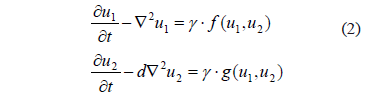
<body><![CDATA[<p align="center"><font size="2" face="Verdana, Arial, Helvetica, sans-serif"><b>Received for review April 2<sup>th</sup>, 2010, accepted February 1<sup>th</sup>, 2011, final version Mach, 2<sup>th</sup>, 2011</b></font></p>     <p align="center">&nbsp;</p> <hr>     <p><font size="2" face="Verdana, Arial, Helvetica, sans-serif"><b>ABSTRACT:</b> This paper presents several numerical tests performed on Turing space when spatial parameters in reaction-diffusion equations changes. The tests are performed in 2D on square units in which we perform subdivisions (subdomains). In each subdomain we set parameters that correspond to different wave numbers and therefore presents a heterogeneous medium. Each wave number is predicted by the linear stability theory and correspond to different Turing patterns. The reaction equation chosen is that of Schnakenberg. The results show complex patterns that mix bands and spots, as well as patterns that do not correspond with the original patterns that could be found independently in each subdomain. </font></p>     <p><font size="2" face="Verdana, Arial, Helvetica, sans-serif"><b>KEYWORDS:</b> Reaction-diffusion, Turing instabilities, heterogeneous medium</font></p>     <p><font size="2" face="Verdana, Arial, Helvetica, sans-serif"><b>RESUMEN:</b> Este articulo presenta distintas pruebas num&eacute;ricas en dominios que presenta variaci&oacute;n de par&aacute;metros, de forma espacial, de la ecuaci&oacute;n de reacci&oacute;n- difusi&oacute;n en el espacio de Turing. Las pruebas son desarrolladas en cuadrados de lado unitario 2D en el cual se realizan subdivisiones (subdominios). En cada subdomminio se ingresan par&aacute;metros que corresponden a los diferentes n&uacute;meros de onda, por lo tanto presentan un medio heterog&eacute;neo. Cada n&uacute;mero de onda fue predicho mediante la teor&iacute;a lineal de estabilidad y corresponde a diferentes patrones de Turing. La ecuaci&oacute;n de reacci&oacute;n elegida es Schnakenberg. Los resultados muestran patrones complejos de bandas mixtas y puntos, adem&aacute;s, los patrones no corresponden a los patrones originales en cada subdominio.</font></p>     <p><font size="2" face="Verdana, Arial, Helvetica, sans-serif"><b>PALABRAS CLAVE: </b>Reacci&oacute;n-difusi&oacute;n, inestabilidades de Turing, medio heterog&eacute;neo</font></p> <hr>     <p>&nbsp;</p>     <p><font size="3" face="Verdana, Arial, Helvetica, sans-serif"><b>1. INTRODUCTION</b></font></p>     <p><font size="2" face="Verdana, Arial, Helvetica, sans-serif">Several physical problems can be modeled by balancing two phenomena: diffusion and reaction [1]. The first is defined as the dispersion of a species involved in a process throughout the physical domain of a problem. On the other hand, reaction is the process of interaction through which the species involved are generated or consumed in the phenomenon. The partial differential equation of reaction-diffusion (RD) for a single species can be written as (1):</font></p>     <p><img src="/img/revistas/dyna/v79n172/a06eq01.gif"></p>     ]]></body>
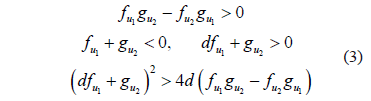
<body><![CDATA[<p><font size="2" face="Verdana, Arial, Helvetica, sans-serif">where <img src="/img/revistas/dyna/v79n172/a06eq24314.jpeg" /> is the concentration of the substance studied, <img src="/img/revistas/dyna/v79n172/a06eq24322.jpeg" /> is the diffusion constant and <img src="/img/revistas/dyna/v79n172/a06eq24330.jpeg" />is the function that defines the reaction process. This equation and other more complex models of RD systems, where more species or reactants are involved, have the ability to create spatial-temporal patterns. A particular case is called Turing instability [1,7] which is characterized by creating stable patterns over time and unstable in space. Due to this, RD systems have been used to study problems in areas such as fluid dynamics [2], heat transfer [3], semiconductor physics [4], materials engineering [5], chemistry [6], biology [7], population dynamics [8], astrophysics [9], biomedical engineering [10] and financial mathematics among others. It should be noted that equation (1) requires appropriate boundary conditions [11].</font></p>     <p><font size="2" face="Verdana, Arial, Helvetica, sans-serif">Thanks to experimental and theoretical studies on RD systems, the knowledge of it has been steadily growing [12-13] and, in turn, new models have been proposed that involve, in their simplest form, two chemical species [14]. Reaction-diffusion systems have been classified into three categories which are: (a) systems based on real reactions [14] (as is the case of the Thomas reaction), (b) Reaction-diffusion systems based on hypothetical reactions (e.g., the Schnakenberg reagent system), and (c) systems that emulate patterns found in nature (eg Gierer Meinhardt's reaction). These types of RD systems have in common that spatial patterns can be stable over time if the parameters of the reactive terms and diffusion constants are in a well-defined space called the Turing space [1].</font></p>     <p><font size="2" face="Verdana, Arial, Helvetica, sans-serif">Therefore, an RD system, of two species, is defined by (2):</font></p>     <p><img src="/img/revistas/dyna/v79n172/a06eq02.gif"></p>     <p><font size="2" face="Verdana, Arial, Helvetica, sans-serif">Spatial instability will be present in the patterns of concentration of species <img src="/img/revistas/dyna/v79n172/a06eq24345.jpeg" /> and <img src="/img/revistas/dyna/v79n172/a06eq24353.jpeg" /> if each of the conditions imposed (which define the Turing space) are fulfilled in (3) [28].</font></p>     <p><img src="/img/revistas/dyna/v79n172/a06eq03.gif"></p>     <p><font size="2" face="Verdana, Arial, Helvetica, sans-serif">where<img src="/img/revistas/dyna/v79n172/a06eq24369.jpeg" /> and <img src="/img/revistas/dyna/v79n172/a06eq24376.jpeg" /> indicate the derivatives of the reaction functions with respect to the concentration variables, for example<img src="/img/revistas/dyna/v79n172/a06eq24385.jpeg" />. In expressions (1) and (2) <img src="/img/revistas/dyna/v79n172/a06eq24394.jpeg" /> is the ratio of diffusion coefficients of the two species <img src="/img/revistas/dyna/v79n172/a06eq24406.jpeg" /> and <img src="/img/revistas/dyna/v79n172/a06eq24413.jpeg" />; furthermore, in (2) <img src="/img/revistas/dyna/v79n172/a06eq24420.jpeg" /> is a undimensional coefficient associated with the reactive processes<img src="/img/revistas/dyna/v79n172/a06eq24427.jpeg" /> and <img src="/img/revistas/dyna/v79n172/a06eq24434.jpeg" /> [1,15].</font></p>     <p><font size="2" face="Verdana, Arial, Helvetica, sans-serif">The analysis of these RD systems, which have Turing instability has been developed from two frameworks: by mathematical analysis [1] and through numerical simulation [1,15]. From the analytical standpoint, efforts to understand the behavior of RD systems have focused on the study of the relationship between branches of the space parameter and pattern formation. In this approach, RD systems have been studied by the comparisons of sub and super solutions, degree theory, the Conley index, the theory of critical dots, and singular perturbations for various types of principal maxima [11]. These methods have been effective for the analysis of stationary solutions and traveling waves [16]. Also, there are studies on complex branching scenarios in RD systems by applying methods of the group theory for problems with symmetries [17]. Efforts in this area of mathematical analysis and specifically, systems dynamics, have allowed for the construction of knowledge that has been tested and extended from the stand point of numerical simulation.</font></p>     <p><font size="2" face="Verdana, Arial, Helvetica, sans-serif">The numerical simulation of RD systems has confirmed the existing knowledge about pattern formation. For example, Madzvamuse et al. [7,15], Painter et al. [17,18] have developed numerical examples of pattern formation in the two-dimensional domain under the growth action of the domain. In Madvamuse [15], numerical simulations are developed using a Lagrangian scheme with a moving mesh. These simulations show a large difference between the steady state for fixed domains and the continuous formation of new patterns for growing domains. In [15] the appearance of different structures that can vary among band systems, dots, and combinations of these domains with decreasing exponential growth is reported. Madzvamuse [19] reported the formation of patterns in the presence of convective fields with null divergence. In turn, from a numerical point of view, we have studied the effects of fields on the formation of convective patterns. Garz&oacute;n-Alvarado et al. [20] show the pattern formation and transition of a Turing patterns to traveling waves in the presence of toroidal velocity fields that change the dynamics of the system. There are also studies on other phenomena in the generation of Turing patterns such as, for example, the heterogeneity of the reagent parameters that cause complex patterns in the solution of the RD systems [14,21]. Voroney et al. [21] show the interaction between oscillatory dynamics and pattern formation when heterogeneous parameters are presented in space, in this case a solution exists using the Sel'kov reagent system.</font></p>     <p><font size="2" face="Verdana, Arial, Helvetica, sans-serif">Following the study of heterogeneities in space and under the numerical approach, the objective of this paper is to computationally solve the 2D RD equations for the Schnakenberg reaction system, in domains with non-homogeneous kinetic parameters, leading to uniform steady states that vary in the spatial domain. This paper gives a solution to the RD equations system using the finite element method with the evaluation of the nonlinear terms in the new time step, thus adopting the Newton-Raphson method. In this paper we developed some numerical examples that allow us to observe how the spatial variation in the parameters of the RD equations generates complex Turing patterns.</font></p>     ]]></body>
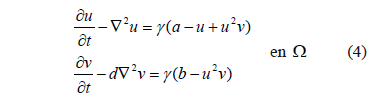
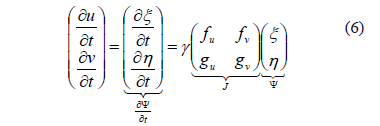
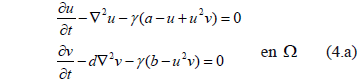
<body><![CDATA[<p><font size="2" face="Verdana, Arial, Helvetica, sans-serif">The paper is organized as follows: first, it shows the mathematical model of reaction-diffusion system, especially in this article we used the Schnakenberg model. In addition, this section illustrates the theory on the prediction of wave numbers in different Turing spaces. Then it shows the finite element formulation for solving the RD system. In the next section we present examples to solve the boundary conditions, the type of domain and computational parameters. Later it shows simulation results and ends with discussion and conclusions from the patterns obtained.</font></p>     <p>&nbsp;</p>     <p><font size="3" face="Verdana, Arial, Helvetica, sans-serif"><b>2. THE REACTION MODEL: SCHNAKENBERG MODEL</b></font></p>     <p><font size="2" face="Verdana, Arial, Helvetica, sans-serif">The RD system in (2) can be written, for the case of the Schnakenberg reagent model [1,15,19], as (4):</font></p>     <p><img src="/img/revistas/dyna/v79n172/a06eq04.gif"></p>     <p><font size="2" face="Verdana, Arial, Helvetica, sans-serif">where u and&nbsp;v are the chemical species, <img src="/img/revistas/dyna/v79n172/a06eq24457.jpeg" /> and <img src="/img/revistas/dyna/v79n172/a06eq24466.jpeg" /> the diffusive terms and <img src="/img/revistas/dyna/v79n172/a06eq24476.jpeg" /> and <img src="/img/revistas/dyna/v79n172/a06eq24488.jpeg" /> the reagent terms. Moreover, <font face="Symbol">g</font> is a dimensionless constant a and b are constant parameters of the model. We have imposed homogeneous Neumann conditions and initial conditions are small perturbations around the homogeneous steady state of each of the reactive terms, this is, <img src="/img/revistas/dyna/v79n172/a06eq24497.jpeg" /> and <img src="/img/revistas/dyna/v79n172/a06eq24504.jpeg" />.</font></p>     <p><font size="2" face="Verdana, Arial, Helvetica, sans-serif"><b>2.1. Conditions for the diffusion instability    <br>   </b></font><font size="2" face="Verdana, Arial, Helvetica, sans-serif">From Murray [22] we can establish that without the presence of the diffusive term, u and v must satisfy (5):</font></p>     <p><img src="/img/revistas/dyna/v79n172/a06eq05.gif"></p>     <p><font size="2" face="Verdana, Arial, Helvetica, sans-serif">For small perturbations around the steady state <img src="/img/revistas/dyna/v79n172/a06eq24518.jpeg" /> (this is <img src="/img/revistas/dyna/v79n172/a06eq24525.jpeg" /> ), equation (5) is linearized as (6):</font></p>     ]]></body>
<body><![CDATA[<p><img src="/img/revistas/dyna/v79n172/a06eq06.gif"></p>     <p><font size="2" face="Verdana, Arial, Helvetica, sans-serif">where , <img src="/img/revistas/dyna/v79n172/a06eq24548.jpeg" />,  and <img src="/img/revistas/dyna/v79n172/a06eq24568.jpeg" />. In (6), we have conducted a expansion in series where we have neglected terms of order greater than 2. It should be noted that <img src="/img/revistas/dyna/v79n172/a06eq24580.jpeg" /> and <img src="/img/revistas/dyna/v79n172/a06eq24589.jpeg" /> are evaluated in the steady state <img src="/img/revistas/dyna/v79n172/a06eq24596.jpeg" />. </font></p>     <p><font size="2" face="Verdana, Arial, Helvetica, sans-serif">A solution to (6) can be written as (7):</font></p>     <p><img src="/img/revistas/dyna/v79n172/a06eq07.gif"></p>     <p><font size="2" face="Verdana, Arial, Helvetica, sans-serif">where <img src="/img/revistas/dyna/v79n172/a06eq24610.jpeg" /> is a vector containing information fo the initial conditions. Replacing (7) in (6) we obtain (8):</font></p>     <p><img src="/img/revistas/dyna/v79n172/a06eq08.gif"></p>     <p><font size="2" face="Verdana, Arial, Helvetica, sans-serif">where <img src="/img/revistas/dyna/v79n172/a06eq24625.jpeg" />is the identity matrix. For there to be a nontrivial solution it requires that <img src="/img/revistas/dyna/v79n172/a06eq24632.jpeg" />, so we get the following characteristic Eq. (9):</font></p>     <p><img src="/img/revistas/dyna/v79n172/a06eq09.gif"></p>     <p><font size="2" face="Verdana, Arial, Helvetica, sans-serif">Then (6) is linearly stable if and only if the conditions are fulfilled (9) for which the real part of the eigenvalues <img src="/img/revistas/dyna/v79n172/a06eq24649.jpeg" /> are negative. Note that these conditions are analogous to Routh-Hurwitz [22]:</font></p>     <p><img src="/img/revistas/dyna/v79n172/a06eq091.gif">    ]]></body>
<body><![CDATA[<br>   <img src="/img/revistas/dyna/v79n172/a06eq092.gif"></p>     <p><font size="2" face="Verdana, Arial, Helvetica, sans-serif">If the diffusive term is introduced we get the linear differential equation (10):</font></p>     <p><img src="/img/revistas/dyna/v79n172/a06eq10.gif"></p>     <p><font size="2" face="Verdana, Arial, Helvetica, sans-serif">with <img src="/img/revistas/dyna/v79n172/a06eq24689.jpeg" />. Using the homogeneous boundary conditions (<img src="/img/revistas/dyna/v79n172/a06eq24696.jpeg" />), equation (10) can be solved by separation of variables, with <img src="/img/revistas/dyna/v79n172/a06eq24310.jpeg" />, so you can get a solution by the form (11): </font></p>     <p><img src="/img/revistas/dyna/v79n172/a06eq11.gif"></p>     <p><font size="2" face="Verdana, Arial, Helvetica, sans-serif">where <img src="/img/revistas/dyna/v79n172/a06eq24718.jpeg" /> is the wave number of the spatial pattern or eigenvalue described in [15], <img src="/img/revistas/dyna/v79n172/a06eq24725.jpeg" /> is the vector of Fourier coefficients and<img src="/img/revistas/dyna/v79n172/a06eq24733.jpeg" /> is the eigenfunction of the Laplacian (with<img src="/img/revistas/dyna/v79n172/a06eq24742.jpeg" />) given by (12):</font></p>     <p><img src="/img/revistas/dyna/v79n172/a06eq12.gif"></p>     <p><font size="2" face="Verdana, Arial, Helvetica, sans-serif">Replacing (11) in (10) yields:</font></p>     <p><img src="/img/revistas/dyna/v79n172/a06eq13.gif"></p>     <p><font size="2" face="Verdana, Arial, Helvetica, sans-serif">where <img src="/img/revistas/dyna/v79n172/a06eq24774.jpeg" />is the vector of zeros and <img src="/img/revistas/dyna/v79n172/a06eq24781.jpeg" /> is the identity matrix. As in the case of the differential equation without diffusion, requires that the vector of Fourier coefficients is not trivial, so we must verify the following condition:</font></p>     ]]></body>

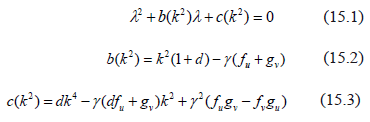
<body><![CDATA[<p><img src="/img/revistas/dyna/v79n172/a06eq14.gif"></p>     <p><font size="2" face="Verdana, Arial, Helvetica, sans-serif">With what we get the dispersion relation (or characteristic equation from (13)) [1,15,22] (15):</font></p>     <p><img src="/img/revistas/dyna/v79n172/a06eq15.gif"></p>     <p><font size="2" face="Verdana, Arial, Helvetica, sans-serif">Therefore, for Turing instability occurs, the roots of (15.1) must satisfy  for some <img src="/img/revistas/dyna/v79n172/a06eq24825.jpeg" />. According to Ruth-Hurwitz conditions [22], so that the real part of the eigenvalues be positive it is required that <img src="/img/revistas/dyna/v79n172/a06eq24834.jpeg" /> and <img src="/img/revistas/dyna/v79n172/a06eq24844.jpeg" /> , or vice versa. From the condition (9.1) we can conclude that <img src="/img/revistas/dyna/v79n172/a06eq24857.jpeg" /> for all <img src="/img/revistas/dyna/v79n172/a06eq24866.jpeg" />.Therefore, it is required that <img src="/img/revistas/dyna/v79n172/a06eq24873.jpeg" />.</font></p>     <p><font size="2" face="Verdana, Arial, Helvetica, sans-serif">In (15.3) we can see that <img src="/img/revistas/dyna/v79n172/a06eq24880.jpeg" /> and by (9.2) we know that<img src="/img/revistas/dyna/v79n172/a06eq24887.jpeg" />, therefore, it must be satisfied that, which it is a necessary condition, but not sufficient. The additional relation is found by minimizing <img src="/img/revistas/dyna/v79n172/a06eq24902.jpeg" /> where it must meet <img src="/img/revistas/dyna/v79n172/a06eq24909.jpeg" />. This is done by , where we get (16):</font></p>     <p><img src="/img/revistas/dyna/v79n172/a06eq16.gif"></p>     <p><font size="2" face="Verdana, Arial, Helvetica, sans-serif">Replacing (16) in (15.3) yields (17):</font></p>     <p><img src="/img/revistas/dyna/v79n172/a06eq17.gif"></p>     <p><font size="2" face="Verdana, Arial, Helvetica, sans-serif">From where we obtain the last condition for Turing instability. Reorganizing the conditions to be met we obtain, in summary, the following inequalities (18):</font></p>     <p><img src="/img/revistas/dyna/v79n172/a06eq18.gif"></p>     ]]></body>
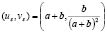
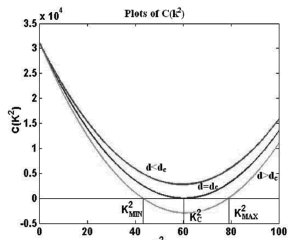
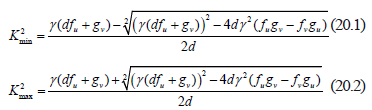
<body><![CDATA[<p><font size="2" face="Verdana, Arial, Helvetica, sans-serif"><b>2.1.1. Definition of the wave number</b>    <br>   </font><font size="2" face="Verdana, Arial, Helvetica, sans-serif">At that point where <img src="/img/revistas/dyna/v79n172/a06eq24978.jpeg" />, we get a bifurcation parameter [1,15]. Therefore, from (18.4) we have that <img src="/img/revistas/dyna/v79n172/a06eq24985.jpeg" /> determines the bifurcation point, for a value<img src="/img/revistas/dyna/v79n172/a06eq24993.jpeg" />, called critical diffusion coefficient, above which Turing instabilities are obtained. Therefore, the critical value of diffusion <img src="/img/revistas/dyna/v79n172/a06eq25000.jpeg" /> is given by (19):</font></p>     <p><img src="/img/revistas/dyna/v79n172/a06eq19.gif"></p>     <p><font size="2" face="Verdana, Arial, Helvetica, sans-serif">On the other hand, having <img src="/img/revistas/dyna/v79n172/a06eq25017.jpeg" />we get the value for <img src="/img/revistas/dyna/v79n172/a06eq25027.jpeg" />for which there is a range of possible wave numbers, only if <img src="/img/revistas/dyna/v79n172/a06eq25039.jpeg" />. This is shown in <a href="#fig01">Fig. 1</a>.</font></p>     <p align="center"><font size="2" face="Verdana, Arial, Helvetica, sans-serif"><a name="fig01"></a><img src="/img/revistas/dyna/v79n172/a06fig01.gif">    <br>   <b>Figure 1.</b> Graphics for<img src="/img/revistas/dyna/v79n172/a06eq25055.jpeg" />. Each of the curves are drawn for the Schnakenberg reaction model with <img src="/img/revistas/dyna/v79n172/a06eq25062.jpeg" />, <img src="/img/revistas/dyna/v79n172/a06eq25069.jpeg" /> and <img src="/img/revistas/dyna/v79n172/a06eq25076.jpeg" />. Previously, using Eq. (19) we had found that <img src="/img/revistas/dyna/v79n172/a06eq25084.jpeg" /> </font></p>     <p><font size="2" face="Verdana, Arial, Helvetica, sans-serif">Using <img src="/img/revistas/dyna/v79n172/a06eq25091.jpeg" /> and replacing its value in <img src="/img/revistas/dyna/v79n172/a06eq25099.jpeg" /> (equation (15.3) we obtain the red curve. The magenta curve is obtained by <img src="/img/revistas/dyna/v79n172/a06eq25108.jpeg" />, and the green curve is obtained for <img src="/img/revistas/dyna/v79n172/a06eq25119.jpeg" />. In the graph<img src="/img/revistas/dyna/v79n172/a06eq25131.jpeg" /> and </font></p>     <p><img src="/img/revistas/dyna/v79n172/a06eq191.gif"></p>     <p><font size="2" face="Verdana, Arial, Helvetica, sans-serif">As shown in <a href="#fig01">Fig. 1</a>, if <img src="/img/revistas/dyna/v79n172/a06eq25148.jpeg" /> is satisfied, at the cutoff point of <img src="/img/revistas/dyna/v79n172/a06eq25155.jpeg" />with the axis<img src="/img/revistas/dyna/v79n172/a06eq25162.jpeg" /> (this is where the dots are <img src="/img/revistas/dyna/v79n172/a06eq25169.jpeg" />) we obtain two important points wich are <img src="/img/revistas/dyna/v79n172/a06eq25177.jpeg" /> and <img src="/img/revistas/dyna/v79n172/a06eq25184.jpeg" />. These points define a range where we find the wave numbers or eigenvalues that will present the solution of the RD system. These values are given by:</font></p>     <p><img src="/img/revistas/dyna/v79n172/a06eq20.gif"></p>     ]]></body>

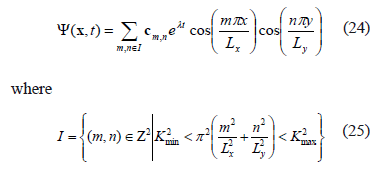
<body><![CDATA[<p><font size="2" face="Verdana, Arial, Helvetica, sans-serif">This interval <img src="/img/revistas/dyna/v79n172/a06eq25212.jpeg" /> defines the wave number of the RD system solution in a Turing space. To define the behavior of the instability we must define the domain over which the solution takes place. In [1,15] is solved on a square, but for generality, we will provide information about a rectangle.</font></p>     <p><font size="2" face="Verdana, Arial, Helvetica, sans-serif"><b>2.1.2. Eigenfunctions of a rectangle    <br>   </b></font><font size="2" face="Verdana, Arial, Helvetica, sans-serif">Consider the rectangle whose length of each side in the direction of <img src="/img/revistas/dyna/v79n172/a06eq25225.jpeg" /> and <img src="/img/revistas/dyna/v79n172/a06eq25234.jpeg" /> is <img src="/img/revistas/dyna/v79n172/a06eq25241.jpeg" /> and <img src="/img/revistas/dyna/v79n172/a06eq25248.jpeg" />, respectively [1,15]:</font></p>     <p><img src="/img/revistas/dyna/v79n172/a06eq21.gif"></p>     <p><font size="2" face="Verdana, Arial, Helvetica, sans-serif">In [15] we can verify that the eigenfunctions for the equation (11) are given by (22):</font></p>     <p><img src="/img/revistas/dyna/v79n172/a06eq22.gif"></p>     <p><font size="2" face="Verdana, Arial, Helvetica, sans-serif">Whose eigenvalues are in the shape of:</font></p>     <p><img src="/img/revistas/dyna/v79n172/a06eq23.gif"></p>     <p><font size="2" face="Verdana, Arial, Helvetica, sans-serif">When <img src="/img/revistas/dyna/v79n172/a06eq25277.jpeg" />, the solution of the linearized system (10) is:</font></p>     <p><img src="/img/revistas/dyna/v79n172/a06eq2425.gif"></p>     ]]></body>
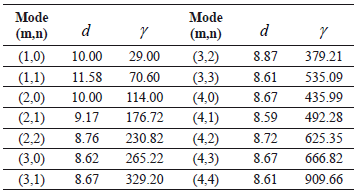
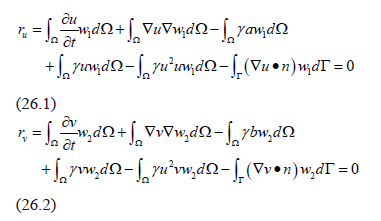
<body><![CDATA[<p><font size="2" face="Verdana, Arial, Helvetica, sans-serif">For example, in the case shown for <a href="#fig01">Fig. 1</a>, with <img src="/img/revistas/dyna/v79n172/a06eq25304.jpeg" />, <img src="/img/revistas/dyna/v79n172/a06eq25316.jpeg" />, <img src="/img/revistas/dyna/v79n172/a06eq25325.jpeg" /> and <img src="/img/revistas/dyna/v79n172/a06eq25332.jpeg" />, have that<img src="/img/revistas/dyna/v79n172/a06eq25339.jpeg" /> and <img src="/img/revistas/dyna/v79n172/a06eq25346.jpeg" />. Then in a unit square (<img src="/img/revistas/dyna/v79n172/a06eq25353.jpeg" />), the interval is given by (<img src="/img/revistas/dyna/v79n172/a06eq25361.jpeg" />). Then we must choose <img src="/img/revistas/dyna/v79n172/a06eq25368.jpeg" /> and <img src="/img/revistas/dyna/v79n172/a06eq25376.jpeg" /> integers that satisfy the whole range proposed. In this case the values are <img src="/img/revistas/dyna/v79n172/a06eq25385.jpeg" /> and<img src="/img/revistas/dyna/v79n172/a06eq25395.jpeg" />, or vice versa. In conclusion, the wave number is <img src="/img/revistas/dyna/v79n172/a06eq25407.jpeg" />. Following a similar analysis yields <a href="#tab01">Table 1</a> [15] where we observe the wave numbers and values for<img src="/img/revistas/dyna/v79n172/a06eq25416.jpeg" /> and <img src="/img/revistas/dyna/v79n172/a06eq25423.jpeg" /> with constant values<img src="/img/revistas/dyna/v79n172/a06eq25430.jpeg" /> and <img src="/img/revistas/dyna/v79n172/a06eq25437.jpeg" />.</font></p>     <p align="center"><font size="2" face="Verdana, Arial, Helvetica, sans-serif"><b><a name="tab01"></a>Table 1. </b>Modes of vibration for<img src="/img/revistas/dyna/v79n172/a06eq25444.jpeg" /> for different values of <img src="/img/revistas/dyna/v79n172/a06eq25452.jpeg" /> and <img src="/img/revistas/dyna/v79n172/a06eq25459.jpeg" /> of the Schnakenberg model [15]</font>    <br>   <img src="/img/revistas/dyna/v79n172/a06tab01.gif"></p>     <p><font size="2" face="Verdana, Arial, Helvetica, sans-serif"><b>2.2. Finite element solution    <br>   </b></font><font size="2" face="Verdana, Arial, Helvetica, sans-serif">To solve the system of equations (4) we have chosen the finite element method. We have also used the Newton-Raphson method to solve the nonlinear problem that evolves over time. The time integration has been made using the trapezoidal rule. Then, u and v must be found by its correct interpolation with the shape functions given in [23]. To carry out the exhibition we start with the weak formulation of the problem and follow a procedure similar to that used in [24].</font></p>     <p><font size="2" face="Verdana, Arial, Helvetica, sans-serif"><b>2.2.1. Weak formulation    <br>   </b></font><font size="2" face="Verdana, Arial, Helvetica, sans-serif">Be (4) rewritten as:</font></p>     <p><img src="/img/revistas/dyna/v79n172/a06eq04a.gif"></p>     <p><font size="2" face="Verdana, Arial, Helvetica, sans-serif">Consider the equation (4.a) is sufficiently smooth and differentiable. Using Gauss's theorem we can prove that (26):</font></p>     <p><img src="/img/revistas/dyna/v79n172/a06eq262.gif"></p>     ]]></body>
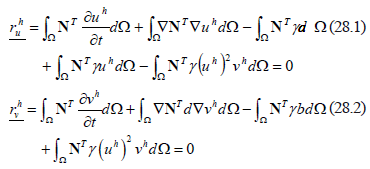
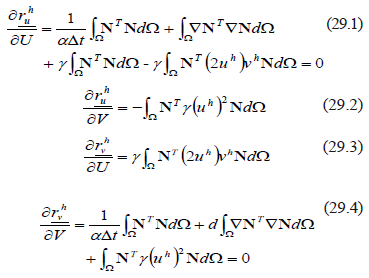
<body><![CDATA[<p><font size="2" face="Verdana, Arial, Helvetica, sans-serif">where <img src="/img/revistas/dyna/v79n172/a06eq25742.jpeg" /> and <img src="/img/revistas/dyna/v79n172/a06eq25750.jpeg" /> are weighting functions and <img src="/img/revistas/dyna/v79n172/a06eq25757.jpeg" /> is the normal vector directed outwards from the dominion <img src="/img/revistas/dyna/v79n172/a06eq25765.jpeg" /> over the frontier<img src="/img/revistas/dyna/v79n172/a06eq25774.jpeg" />. Keep in mind that it must be impose homogeneous Neumann boundary conditions so that the last term of equations (5.1) and (5.2) disappear. </font></p>     <p><font size="2" face="Verdana, Arial, Helvetica, sans-serif">To move to the discrete solution, the variables are written in terms of nodal values using the weighting functions as [23]:</font></p>     <p><img src="/img/revistas/dyna/v79n172/a06eq272.gif"></p>     <p><font size="2" face="Verdana, Arial, Helvetica, sans-serif">where <img src="/img/revistas/dyna/v79n172/a06eq25806.jpeg" /> and <img src="/img/revistas/dyna/v79n172/a06eq25813.jpeg" />are the shape functions that depend only on space, <img src="/img/revistas/dyna/v79n172/a06eq25820.jpeg" /> and <img src="/img/revistas/dyna/v79n172/a06eq25827.jpeg" />are the values of u and v at the nodal points and the superscript h indicates the discretization of the finite element variable. By substitution of (26) in (25) and the choice of weighting functions equal to the shape functions we obtain residue vectors of the Newton-Raphson method given by [22] (28):</font></p>     <p><img src="/img/revistas/dyna/v79n172/a06eq28.gif"></p>     <p><font size="2" face="Verdana, Arial, Helvetica, sans-serif">where <img src="/img/revistas/dyna/v79n172/a06eq25849.jpeg" /> and <img src="/img/revistas/dyna/v79n172/a06eq25858.jpeg" />are the residue vectors that are calculated at the new time.      Meanwhile, each of the positions (inputs) of the Jacobian matrix are given by (29):</font></p>     <p><img src="/img/revistas/dyna/v79n172/a06eq29.gif"></p>     <p><font size="2" face="Verdana, Arial, Helvetica, sans-serif">where <img src="/img/revistas/dyna/v79n172/a06eq25907.jpeg" /> is a feature parameter of the temporal integration method [23] and <img src="/img/revistas/dyna/v79n172/a06eq25914.jpeg" /> is the row vector of the first spatial derivatives of the shape functions. In this case we used bilinear elements of 4 nodes as described in [23].</font></p>     <p><font size="2" face="Verdana, Arial, Helvetica, sans-serif"><b>2.3. Numerical tests    <br>   </b></font><font size="2" face="Verdana, Arial, Helvetica, sans-serif">To solve the system of equations resulting from the finite element method with Newton-Raphson method we created a program in FORTRAN and resolved all the examples illustrated below in a Laptop of 4096 MB RAM and 800 MHz speed processor.</font></p>     ]]></body>

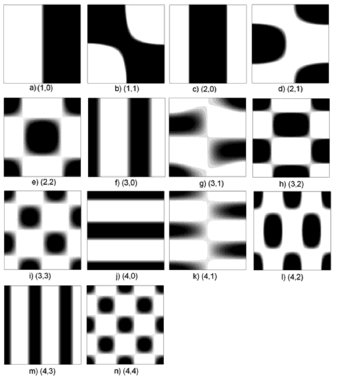
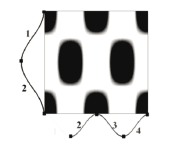
<body><![CDATA[<p><font size="2" face="Verdana, Arial, Helvetica, sans-serif">The mesh used is the same for all examples, which has 2500 bilinear regular elements of 4 nodes each, for a total of 2601 nodes.</font></p>     <p><font size="2" face="Verdana, Arial, Helvetica, sans-serif">Moreover, the initial conditions are the same for all the examples, with small random perturbations of 10% around the steady state [15].</font></p>     <p><font size="2" face="Verdana, Arial, Helvetica, sans-serif"><b>Numerical solutions over homogeneous domains (control)    <br>   </b></font><font size="2" face="Verdana, Arial, Helvetica, sans-serif">Initially we solved the system given in (4) for completely homogeneous domains in order to have a frame of reference and comparison for all subsequent numerical tests.</font></p>     <p><font size="2" face="Verdana, Arial, Helvetica, sans-serif"><a href="#fig02">Figure 2</a> shows the results for the variable u of the Schnakenberg equation. Note the formation of dot patterns (cases b, d, e, g, h, i, k, l, n) and rows (a, c, f, j, m). Special attention deserves the case m) where we have  with two possibilities for Turing pattern formation given by the dynamics of the system, which can choose among forming a wave number <img src="/img/revistas/dyna/v79n172/a06eq25928.jpeg" />, or, a pattern by the type <img src="/img/revistas/dyna/v79n172/a06eq25936.jpeg" />. By the principle of minimum energy, in this case the pattern <img src="/img/revistas/dyna/v79n172/a06eq25943.jpeg" /> was formed.</font></p>     <p align="center"><font size="2" face="Verdana, Arial, Helvetica, sans-serif"><b><a name="fig02"></a><img src="/img/revistas/dyna/v79n172/a06fig02.gif">    <br>   Figure 2.</b> Turing Patterns in steady state for different wave numbers.</font> <font size="2" face="Verdana, Arial, Helvetica, sans-serif">    <br>   a(1,0); (b) (1,1); (c) (2,0); (d) (2,1); (e) (2,2); </font><font size="2" face="Verdana, Arial, Helvetica, sans-serif">(f) (3,0); (g) (3,1); (h) (3,2); (i) (3,3); (j) (4,0); </font><font size="2" face="Verdana, Arial, Helvetica, sans-serif">(k) (4,1); (l) (4,2); (m) (4,3); (n) (4,4). </font>    <br>   <font size="2" face="Verdana, Arial, Helvetica, sans-serif">For further reference see <a href="#tab01">Table 1</a>. The black color has concentration values higher than 1.0. Black color: high concentration, White color: low concentration. The figure has been made for the concentration u in Eq. (4).</font></p>     <p><font size="2" face="Verdana, Arial, Helvetica, sans-serif">The wave number indicates the number of half sine waves in each of the directions x and y. <a href="#fig03">Figure 3</a> provides an explanation for a wave number (4,2), which notes 4 half-waves in x direction and 2 half waves in y direction.</font></p>     ]]></body>
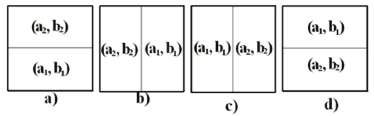
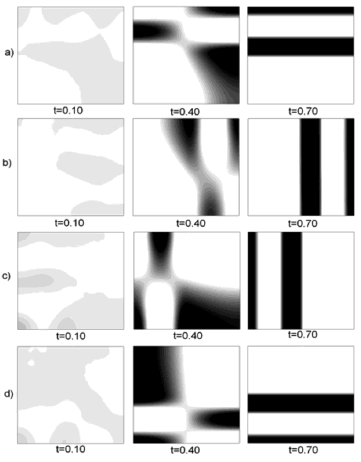
<body><![CDATA[<p align="center"><font size="2" face="Verdana, Arial, Helvetica, sans-serif"><b> <a name="fig03"></a><img src="/img/revistas/dyna/v79n172/a06fig03.gif">    <br>   Figure 3.</b> Explanation of the correspondence of the wave number and Turing pattern for a (4,2) value.</font></p>     <p><font size="2" face="Verdana, Arial, Helvetica, sans-serif"><b>2.3.2. Heterogeneous domains, subdomains location    <br>   </b></font><font size="2" face="Verdana, Arial, Helvetica, sans-serif">To observe the independence of the location of the subdomains in the formation of Turing patterns we carried out several numerical tests as (see <a href="#fig04">Fig. 4</a>): Divide the domain into two subdomains, where in each one of them their respective parameter is taken according to the specific wave number given in <a href="#tab01">Table 1</a>. Example: <a href="#fig04">Figure 4(a)</a> shows two sub-domains (upper and lower). In the lower subdomain we have chosen the parameters <img src="/img/revistas/dyna/v79n172/a06eq25951.jpeg" /> and <img src="/img/revistas/dyna/v79n172/a06eq25960.jpeg" /> corresponding to a wave number<img src="/img/revistas/dyna/v79n172/a06eq25970.jpeg" /> and at the upper level domain we took <img src="/img/revistas/dyna/v79n172/a06eq25982.jpeg" /> and <img src="/img/revistas/dyna/v79n172/a06eq25991.jpeg" /> which generates a mode in the shape of <img src="/img/revistas/dyna/v79n172/a06eq25998.jpeg" />. <a href="#fig04">Figure 4(b)</a>, <a href="#fig04">(c)</a> and <a href="#fig04">(d)</a> show the different subdomains that have been tested.</font></p>     <p align="center"><font size="2" face="Verdana, Arial, Helvetica, sans-serif"><b><a name="fig04"></a><img src="/img/revistas/dyna/v79n172/a06fig04.gif">    <br>   Figure 4.</b> Types of subdomains chosen for the test of independence of the location of the different modes.</font></p>     <p><font size="2" face="Verdana, Arial, Helvetica, sans-serif">We show, only the results of <a href="#fig05">Fig. 5</a>, where the wave modes that have been chosen are <img src="/img/revistas/dyna/v79n172/a06eq26019.jpeg" /> and <img src="/img/revistas/dyna/v79n172/a06eq26027.jpeg" />. It should be noted that the initial conditions do not change between each of the examples, so that each temporary path to the steady state is different. Then we have different spatial patterns in times <img src="/img/revistas/dyna/v79n172/a06eq26034.jpeg" /> and <img src="/img/revistas/dyna/v79n172/a06eq26042.jpeg" />. In <img src="/img/revistas/dyna/v79n172/a06eq26051.jpeg" /> we have the same type of pattern, in each of the examples but with a 90&deg; rotation, as expected if the initial conditions do not affect the steady-state results.</font></p>     <p align="center"><font size="2" face="Verdana, Arial, Helvetica, sans-serif"><b><a name="fig05"></a><img src="/img/revistas/dyna/v79n172/a06fig05.gif">    <br>   Figure 5.</b> Numerical examples for a heterogeneous domain with <img src="/img/revistas/dyna/v79n172/a06eq26111.jpeg" />and <img src="/img/revistas/dyna/v79n172/a06eq26120.jpeg" />. (a), (b), (c) and (d) according to the distribution of subdomains given in <a href="#fig04">Fig. 4(a)</a>, <a href="#fig04">(b)</a>, <a href="#fig04">(c)</a> and <a href="#fig04">(d)</a>, respectively. At the bottom it shows the time during the transient simulation to reach steady state in <img src="/img/revistas/dyna/v79n172/a06eq26127.jpeg" />.</font></p>     <p><font size="2" face="Verdana, Arial, Helvetica, sans-serif"><b>2.3.3. Heterogeneous domains: numerical test for<img src="/img/revistas/dyna/v79n172/a06eq26135.jpeg" /> and <img src="/img/revistas/dyna/v79n172/a06eq26144.jpeg" />given in Table 1 (Fig. 6).    ]]></body>
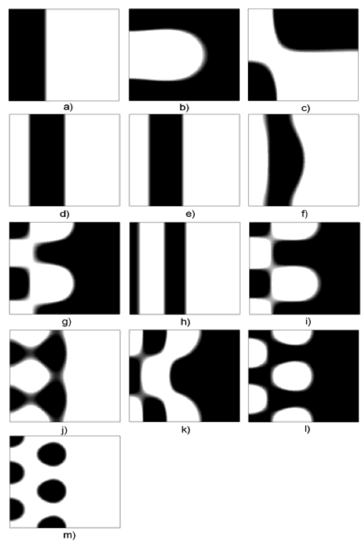
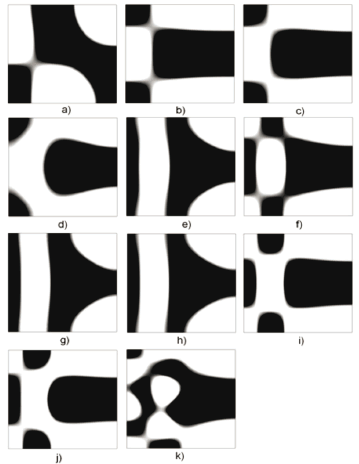
<body><![CDATA[<br>   </b></font><font size="2" face="Verdana, Arial, Helvetica, sans-serif">Using the configuration (b) of <a href="#fig04">Fig. 4</a>, numerical test are made where <img src="/img/revistas/dyna/v79n172/a06eq26154.jpeg" /> and <img src="/img/revistas/dyna/v79n172/a06eq26166.jpeg" /> are different wave numbers given in <a href="#tab01">Table 1</a>. <a href="#fig06">Figure 6</a> shows the results of the numerical experiment.</font></p>     <p align="center"><font size="2" face="Verdana, Arial, Helvetica, sans-serif"><b><a name="fig06"></a><img src="/img/revistas/dyna/v79n172/a06fig06.gif">    <br>   Figure 6.</b> Turing patterns in steady state for two heterogeneous medium with different numbers given by <img src="/img/revistas/dyna/v79n172/a06eq26182.jpeg" />and given by:</font>     <br>   <font size="2" face="Verdana, Arial, Helvetica, sans-serif">(a) (1,1); (b) (2,0); (c) (2,1); (d) (2,2); (e) (3,0); (f) (3,1); (g) (3,2); (h) (3,3); (i) (4,0); (j) (4,1); </font><font size="2" face="Verdana, Arial, Helvetica, sans-serif">k) (4,2); l) (4,3); m) (4,4). </font></p>     <p><font size="2" face="Verdana, Arial, Helvetica, sans-serif">It is noted that the final patterns (steady state) have a certain complexity with respect to those in <a href="#fig02">Fig. 2</a>. In case (a) shows that the wave number (1,0) is in the left subdomain. This wave mode dominates and silences the mode (1,1) so at the end the result is &quot;similar&quot; to a mode (1,0) where low density values are dominant in 75% of the domain. In case (b) gives a result that is not similar to any of the modes of the subdomains. Here we see a &quot;drop&quot; of low concentration found in 70% of the domain. In c) shows the simulation for the wave numbers (2,1) and (1,0). For this case the ending result is similar to a wave number with a value of (1,1) not symmetric. Cases (d), (e) and (f) show similar patterns. The wave numbers of the subdomains are (1,0) with (2,2) (3,0) and (3,1), respectively. In the f) case it shows a pattern with a strip with a horizontal excitation (curve), which can be explained by the high excitation of the wave number (3,1). In cases (g) and (i) shows the numerical results with subdomains with wave numbers (3,2) and (4,0), respectively. It is noted that the results are similar for these two cases. We can see that half of the domain has a high concentration of u. The left half has a vertical &quot;pseudo-mode&quot; of 3. On the left side we can see the formation of dots, while on the right side we notice a block of high density of u with an edge that has saw-tooth shape. In the( h) case, with wave modes (1,0) and (3,3), show the formation of a &quot;pseudo-mode&quot; wave of (3,0) (bands), where the last half wave (right side) is very elongated (see <a href="#fig02">Fig. 2</a>). In (j) shows the simulation with wave numbers (4,1) and (1,0). It is noted that the left side generates a &quot;pseudo-mode&quot; in the vertical direction of 4. In the horizontal direction we can not set one only mode. There is a distorted dot pattern similar to a semicircular sector. Case (k) shows a pattern for wave numbers (1,0) and (4,2). This pattern is similar to that found in (g) and (i), however, the left side is a pseudo mode in the vertical direction of 2. The right side shows a single saw tooth. In (1) the formation of dot patterns (low concentration of&nbsp;u&nbsp;with modes (1,0) and (4,3)) is shown without symmetry, these dots are elongated horizontally. In the vertical direction we have a pseudo-mode of 4 in the left side. In (m) it shows the formation of dots of high concentration.</font></p>     <p><font size="2" face="Verdana, Arial, Helvetica, sans-serif"><b>2.3.4. Heterogeneous Domains: Numerical test for <img src="/img/revistas/dyna/v79n172/a06eq26189.jpeg" /> and <img src="/img/revistas/dyna/v79n172/a06eq26196.jpeg" /> given in Table 1 (Fig. 7).    <br>   </b></font><font size="2" face="Verdana, Arial, Helvetica, sans-serif">Using a configuration similar to the previous case we did numerical tests with <img src="/img/revistas/dyna/v79n172/a06eq26203.jpeg" />and<img src="/img/revistas/dyna/v79n172/a06eq26211.jpeg" />given in <a href="#tab01">Table 1</a>. <a href="#fig07">Fig. 7</a> shows the results of the numerical experiment.</font></p>     <p align="center"><font size="2" face="Verdana, Arial, Helvetica, sans-serif"><a name="fig07"></a><b><img src="/img/revistas/dyna/v79n172/a06fig07.gif">    <br>   Figure 7.</b> Turing patterns in steady state for two heterogeneous medium with different numbers given by <img src="/img/revistas/dyna/v79n172/a06eq26226.jpeg" />and <img src="/img/revistas/dyna/v79n172/a06eq26235.jpeg" />given by:    <br>   (a) (2,1); (b) (2,2); (c) (3,0); (d) (3,1); (e) (3,2); (f) (3,3); (g) (4,0); (h) (4,1); (i) (4,2); (j) (4,3); (k) (4,4). </font></p>     ]]></body>
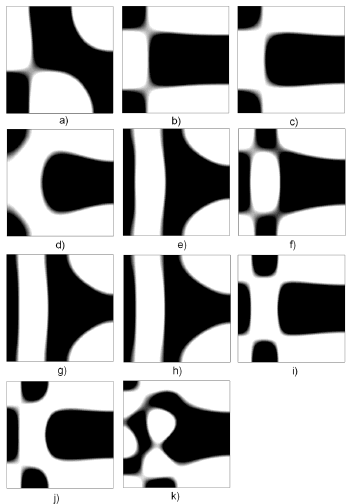
<body><![CDATA[<p><font size="2" face="Verdana, Arial, Helvetica, sans-serif">Again we observe the difference between the original Turing patterns and the new patterns formed by heterogeneous medium (<a href="#fig07">Fig. 7</a>). <a href="#fig07">Figure 7(a)</a> shows the result for modes with each subdomain (2,0) and (2,1). Note the formation of a pattern similar to a vibration mode (2,1) where we have invested the maximum value of the variable u that is shown in <a href="#fig02">Fig. 2(d)</a>. </font></p>     <p><font size="2" face="Verdana, Arial, Helvetica, sans-serif"><a href="#fig07">Figure 7(b)</a> and <a href="#fig07">(c)</a> show similar results. We observe the formation of a band of great length on the right side and two dots on the left. In the vertical direction appears a vibrating pseudo mode of 2, while in the horizontal direction there is a pseudo-mode of 1. Note that the resulting pattern is symmetrical with respect to the axis y=0.5 but does not preserve the original symmetry. The original modes (in each subdomain) are (2,0) and (2,2) and (3,0) for b) and c) respectively. In addition, <a href="#fig08">Fig. 8(d)</a> with modes (2,0) and (3,1) has a similar behavior, where the vast band of the right has an appearance like a water drop shape. <a href="#fig07">Figure 7(e)</a>, <a href="#fig07">(g)</a> and <a href="#fig07">(h)</a> show the formation of a pattern with dots of low concentration of u on the right side and lines in the left side. The original patterns are (2,0) and (3,2), (4,0) and (4,1), respectively. Note that the vibrating pseudo-mode in the horizontal direction in the center is 2 and on the top and bottom 3, while in the vertical direction is 0 in the left region and 2 on the right. </font></p>     <p align="center"><font size="2" face="Verdana, Arial, Helvetica, sans-serif"><b><a name="fig08"></a><img src="/img/revistas/dyna/v79n172/a06fig08.gif">    <br>   Figure 8.</b> Turing patterns in steady state for two heterogeneous medium with different numbers given by <img src="/img/revistas/dyna/v79n172/a06eq26288.jpeg" />and <img src="/img/revistas/dyna/v79n172/a06eq26295.jpeg" />given</font> <font size="2" face="Verdana, Arial, Helvetica, sans-serif">(a) (2,2); (b) (3,0); (c) (3,1); (d) (3,2); (e) (3,3); (f) (4,0); (g) (4,1); (h) (4,2); (i) (4,3); (j) (4,4). </font></p>     <p><font size="2" face="Verdana, Arial, Helvetica, sans-serif"><a href="#fig07">Figure 7(f)</a>, <a href="#fig07">(i)</a> and <a href="#fig07">(j)</a> show the patterns developed for subdomains with wave numbers (2,0) and (3,3), (4,2) and (4,3), respectively. There is a symmetrical pattern with respect to <img src="/img/revistas/dyna/v79n172/a06eq26245.jpeg" />. Again, it presents a band on the right side and three dots on the left side. Note the similarity with <a href="#fig07">Fig. 7(b)</a> and <a href="#fig07">(c)</a>. Unlike the latter, there is a pseudo mode of vibration in x and y of 2. The last <a href="#fig07">Fig. 7(k)</a> shows a complex figure which has a combination of dots and bands without symmetry.</font></p>     <p><font size="2" face="Verdana, Arial, Helvetica, sans-serif"><b>2.3.5. Heterogeneous domains: Numerical test for <img src="/img/revistas/dyna/v79n172/a06eq26258.jpeg" /> and <img src="/img/revistas/dyna/v79n172/a06eq26274.jpeg" /> given in Table 1 (Fig. 8)    <br>   </b>In this case (results in <a href="#fig08">Fig. 8</a>) we used a vibration mode (2,1). The configuration used for the numerical test is similar to that given in previous examples. <a href="#fig08">Figure 8(a)</a> and <a href="#fig08">Fig. 8(b)</a> show the test results for a subdomain (2,1) and (2,2) and (3,0), respectively. Note a similar pattern to <a href="#fig02">Fig. 2(e)</a> being a pseudo-mode (2,2) without symmetry. Note that there is a pattern of dots with the length of these on the right side. </font></p>     <p><font size="2" face="Verdana, Arial, Helvetica, sans-serif">In <a href="#fig08">Fig. 8(c)</a>, a pseudo mode (2,2) where the main dot has been separated and has been directed toward the left side of the domain is shown. Note the similarity with a) and b). <a href="#fig08">Figure 8(d)</a> and <a href="#fig08">(f)</a> show the formation of band patterns from a domain with vibration modes (2,1) and (3,2) and (4,0), respectively. The resulting pseudo-mode is (3,0). <a href="#fig08">Figure 8(e)</a> shows the formation of patterns from modes with each subdomain (2,1) and (3,3). We observe in the left side the formation of a figure similar to a &quot;nut&quot; and in the right side the formation of two dots at the top and bottom of the domain. <a href="#fig08">Figure 8(g)</a> shows the dot formation (&quot;water drops&quot;) of different sizes that are directed toward the center. It is symmetrical to the axis y = 0.5. <a href="#fig08">Figures 8(h)</a> and <a href="#fig08">(i)</a> are taken as the original modes (2,1) and (4,2) and (4.3), respectively. We observe the formation of a pattern of dots with a pseudo-mode of (3,2). In <a href="#fig08">(j)</a> we observe the formation of a pattern of lines with a pseudo-mode (4,0).</font></p>     <p>&nbsp;</p>     <p><font size="3" face="Verdana, Arial, Helvetica, sans-serif"><b>3. CONCLUSIONS</b></font></p>     ]]></body>
<body><![CDATA[<p><font size="2" face="Verdana, Arial, Helvetica, sans-serif">This article has shown many numerical tests where we give evidence that the patterns obtained in a heterogeneous medium present, in general, complex Turing instabilities. In two dimensions there is the possibility of the emergence of mixed patterns of dots and bands. Additionally, they can have complex pseudo-modes wave that can change the length and shape of the bands and dots.</font></p>     <p><font size="2" face="Verdana, Arial, Helvetica, sans-serif">It is also observed, in the case of two subdomains, that the resulting wave mode, in general, is an intermedium mode between the original modes of each subdomain.</font></p>     <p><font size="2" face="Verdana, Arial, Helvetica, sans-serif">Furthermore, the combination of distant wave modes, for example (2,0) and (4,4) presents complex instabilities that do not have a defined wave pseudo-mode, so the symmetry seen in the original patterns is lost.</font></p>     <p>&nbsp;</p>     <p><b><font size="3" face="Verdana, Arial, Helvetica, sans-serif">REFERENCES</font></b></p>     <!-- ref --><p><font size="2" face="Verdana, Arial, Helvetica, sans-serif"><b>[1]</b> Garz&oacute;n, D., Simulaci&oacute;n de procesos de reacci&oacute;n-difusi&oacute;n: Aplicaci&oacute;n a la morfog&eacute;nesis del tejido &oacute;seo, Ph.D. Thesis. Universidad de Zaragoza. 2007.     &nbsp;&nbsp;&nbsp;&nbsp;&nbsp;&nbsp;&nbsp;&nbsp;[&#160;<a href="javascript:void(0);" onclick="javascript: window.open('/scielo.php?script=sci_nlinks&ref=000158&pid=S0012-7353201200020000600001&lng=','','width=640,height=500,resizable=yes,scrollbars=1,menubar=yes,');">Links</a>&#160;]<!-- end-ref --><!-- ref --><br>   <b>[2]</b> D. White. The planforms and onset of convection with a temperature dependent viscosity, J. Fluid Mech, Vol. 191, pp. 247–286, 1988     &nbsp;&nbsp;&nbsp;&nbsp;&nbsp;&nbsp;&nbsp;&nbsp;[&#160;<a href="javascript:void(0);" onclick="javascript: window.open('/scielo.php?script=sci_nlinks&ref=000159&pid=S0012-7353201200020000600002&lng=','','width=640,height=500,resizable=yes,scrollbars=1,menubar=yes,');">Links</a>&#160;]<!-- end-ref --><!-- ref --><br>   <b>[3]</b> Hirayama, O. and Takaki, R., Thermal convection of a fluid with temperature-dependent viscosity. Fluid Dynamics Research, Vol. 12-1, pp. 35-47, 1988.     &nbsp;&nbsp;&nbsp;&nbsp;&nbsp;&nbsp;&nbsp;&nbsp;[&#160;<a href="javascript:void(0);" onclick="javascript: window.open('/scielo.php?script=sci_nlinks&ref=000160&pid=S0012-7353201200020000600003&lng=','','width=640,height=500,resizable=yes,scrollbars=1,menubar=yes,');">Links</a>&#160;]<!-- end-ref --><!-- ref --><br>   <b>[4]</b> Balkarei, Y., GrigorYants, A., Rhzanov, Y. and Elinson, M., Regenerative oscillations, spatial-temporal single pulses and static inhomogeneous structures in optically bistable semiconductors, Opt. Commun. Vol. 66. pp. 161–166, 1988.     &nbsp;&nbsp;&nbsp;&nbsp;&nbsp;&nbsp;&nbsp;&nbsp;[&#160;<a href="javascript:void(0);" onclick="javascript: window.open('/scielo.php?script=sci_nlinks&ref=000161&pid=S0012-7353201200020000600004&lng=','','width=640,height=500,resizable=yes,scrollbars=1,menubar=yes,');">Links</a>&#160;]<!-- end-ref --><!-- ref --><br>   <b>[5]</b> Krinsky, V.I., Self-organisation: Auto-Waves and structures far from equilibrium, Ed. Springer, 1984.     &nbsp;&nbsp;&nbsp;&nbsp;&nbsp;&nbsp;&nbsp;&nbsp;[&#160;<a href="javascript:void(0);" onclick="javascript: window.open('/scielo.php?script=sci_nlinks&ref=000162&pid=S0012-7353201200020000600005&lng=','','width=640,height=500,resizable=yes,scrollbars=1,menubar=yes,');">Links</a>&#160;]<!-- end-ref --><!-- ref --><br>   <b>[6]</b> Zhang, L. and Liu, S., Stability and pattern formation in a coupled arbitrary order of autocatalysis system, Applied Mathematical Modelling. Vol. 33. pp. 884–896, 2009.     &nbsp;&nbsp;&nbsp;&nbsp;&nbsp;&nbsp;&nbsp;&nbsp;[&#160;<a href="javascript:void(0);" onclick="javascript: window.open('/scielo.php?script=sci_nlinks&ref=000163&pid=S0012-7353201200020000600006&lng=','','width=640,height=500,resizable=yes,scrollbars=1,menubar=yes,');">Links</a>&#160;]<!-- end-ref --><!-- ref --><br>   <b>[7]</b> Madzvamuse, A., Wathen, A. and Maini, P., A moving grid finite element method applied to a model biological pattern generator, Journal of Computational Physics. Vol. 190. pp. 478–500, 2003.     &nbsp;&nbsp;&nbsp;&nbsp;&nbsp;&nbsp;&nbsp;&nbsp;[&#160;<a href="javascript:void(0);" onclick="javascript: window.open('/scielo.php?script=sci_nlinks&ref=000164&pid=S0012-7353201200020000600007&lng=','','width=640,height=500,resizable=yes,scrollbars=1,menubar=yes,');">Links</a>&#160;]<!-- end-ref --><!-- ref --><br>   <b>[8]</b> Baurmanna, M., Gross, T. and Feudel, U., Instabilities in spatially extended predator–prey systems: Spatio-temporal patterns in the neighborhood of Turing–Hopf bifurcations, Journal of Theoretical Biology. Vol. 245. pp. 220–229, 2007.     &nbsp;&nbsp;&nbsp;&nbsp;&nbsp;&nbsp;&nbsp;&nbsp;[&#160;<a href="javascript:void(0);" onclick="javascript: window.open('/scielo.php?script=sci_nlinks&ref=000165&pid=S0012-7353201200020000600008&lng=','','width=640,height=500,resizable=yes,scrollbars=1,menubar=yes,');">Links</a>&#160;]<!-- end-ref --><!-- ref --><br>   <b>[9]</b> Nozakura, T. and Ikeuchi, S., Formation of dissipative structures in galaxies, Astrophys. J. Vol. 279. pp. 40–52, 1984.     &nbsp;&nbsp;&nbsp;&nbsp;&nbsp;&nbsp;&nbsp;&nbsp;[&#160;<a href="javascript:void(0);" onclick="javascript: window.open('/scielo.php?script=sci_nlinks&ref=000166&pid=S0012-7353201200020000600009&lng=','','width=640,height=500,resizable=yes,scrollbars=1,menubar=yes,');">Links</a>&#160;]<!-- end-ref --><!-- ref --><br>   <b>[10]</b> Madzvamuse, A., A Numerical Approach to the Study of Spatial Pattern Formation in the Ligaments of Arcoid Bivalves, Bulletin of Mathematical Biology, Vol 64. pp. 501–530, 2002.     &nbsp;&nbsp;&nbsp;&nbsp;&nbsp;&nbsp;&nbsp;&nbsp;[&#160;<a href="javascript:void(0);" onclick="javascript: window.open('/scielo.php?script=sci_nlinks&ref=000167&pid=S0012-7353201200020000600010&lng=','','width=640,height=500,resizable=yes,scrollbars=1,menubar=yes,');">Links</a>&#160;]<!-- end-ref --><!-- ref --><br>   <b>[11]</b> Mei, Z. Numerical Bifurcation Analysis for reaction-diffusion equations. Springer Verlag. Alemania. 2000.     &nbsp;&nbsp;&nbsp;&nbsp;&nbsp;&nbsp;&nbsp;&nbsp;[&#160;<a href="javascript:void(0);" onclick="javascript: window.open('/scielo.php?script=sci_nlinks&ref=000168&pid=S0012-7353201200020000600011&lng=','','width=640,height=500,resizable=yes,scrollbars=1,menubar=yes,');">Links</a>&#160;]<!-- end-ref --><!-- ref --><br>   <b>[12]</b> Castets, V., Dulos, E., Boissonade, J. and De Kepper, P., Experimental evidence of a sustained standing Turing-type nonequilibrium chemical pattern. Phys. Rev. Lett. 64 24, pp. 2953–2956, 1990.     &nbsp;&nbsp;&nbsp;&nbsp;&nbsp;&nbsp;&nbsp;&nbsp;[&#160;<a href="javascript:void(0);" onclick="javascript: window.open('/scielo.php?script=sci_nlinks&ref=000169&pid=S0012-7353201200020000600012&lng=','','width=640,height=500,resizable=yes,scrollbars=1,menubar=yes,');">Links</a>&#160;]<!-- end-ref --><!-- ref --><br>   <b>[13]</b> Maini, P.K., Using mathematical models to help understand biological pattern formation. Comptes Rendus Biologies, Volume 327, Issue 3, March, pp. 225-234, 2004.     &nbsp;&nbsp;&nbsp;&nbsp;&nbsp;&nbsp;&nbsp;&nbsp;[&#160;<a href="javascript:void(0);" onclick="javascript: window.open('/scielo.php?script=sci_nlinks&ref=000170&pid=S0012-7353201200020000600013&lng=','','width=640,height=500,resizable=yes,scrollbars=1,menubar=yes,');">Links</a>&#160;]<!-- end-ref --><!-- ref --><br>   <b>[14]</b> Page, K. M., Maini, P. K., Monk ,N. A.M., Complex pattern formation in reaction–diffusion systems with spatially varying parameters. Physica D: Nonlinear Phenomena, Volume 202, Issues 1-2, 1 March, pp. 95-115, 2005.     &nbsp;&nbsp;&nbsp;&nbsp;&nbsp;&nbsp;&nbsp;&nbsp;[&#160;<a href="javascript:void(0);" onclick="javascript: window.open('/scielo.php?script=sci_nlinks&ref=000171&pid=S0012-7353201200020000600014&lng=','','width=640,height=500,resizable=yes,scrollbars=1,menubar=yes,');">Links</a>&#160;]<!-- end-ref --><!-- ref --><br>   <b>[15]</b> Madvamuse, A., A numerical approach to the study of spatial pattern formation. D.Phil. Thesis. Oxford University. UK. 2000.     &nbsp;&nbsp;&nbsp;&nbsp;&nbsp;&nbsp;&nbsp;&nbsp;[&#160;<a href="javascript:void(0);" onclick="javascript: window.open('/scielo.php?script=sci_nlinks&ref=000172&pid=S0012-7353201200020000600015&lng=','','width=640,height=500,resizable=yes,scrollbars=1,menubar=yes,');">Links</a>&#160;]<!-- end-ref --><!-- ref --><br>   <b>[16]</b> Sagu&eacute;s, F., M&iacute;guez, D. G., Nicola, E. M., Mu&ntilde;uzuri, A. P., Casademunt, J. and Kramer L., Travelling-stripe forcing of Turing patterns. Physica D: Nonlinear Phenomena, Volume 199, Issues 1-2, pp. 235-242. 2004     &nbsp;&nbsp;&nbsp;&nbsp;&nbsp;&nbsp;&nbsp;&nbsp;[&#160;<a href="javascript:void(0);" onclick="javascript: window.open('/scielo.php?script=sci_nlinks&ref=000173&pid=S0012-7353201200020000600016&lng=','','width=640,height=500,resizable=yes,scrollbars=1,menubar=yes,');">Links</a>&#160;]<!-- end-ref --><!-- ref --><br>   <b>[17]</b> Painter, K.J., Othmer, H.G. and Maini, P.K., Stripe formation in juvenile Pomacanthus via chemotactic response to a reaction-diffusion mechanism. Proceedings of National Academy Sciences USA, 96, pp.5549—5554. 1999.     &nbsp;&nbsp;&nbsp;&nbsp;&nbsp;&nbsp;&nbsp;&nbsp;[&#160;<a href="javascript:void(0);" onclick="javascript: window.open('/scielo.php?script=sci_nlinks&ref=000174&pid=S0012-7353201200020000600017&lng=','','width=640,height=500,resizable=yes,scrollbars=1,menubar=yes,');">Links</a>&#160;]<!-- end-ref --><!-- ref --><br>   <b>[18]</b> Painter, K.J., Maini, P.K. and Othmer, H.G., A chemotactic model for the advance and retreat of the primitive streak in avian development. Bulletin of Mathematical Biology, 62, pp. 501-525, 2000.     &nbsp;&nbsp;&nbsp;&nbsp;&nbsp;&nbsp;&nbsp;&nbsp;[&#160;<a href="javascript:void(0);" onclick="javascript: window.open('/scielo.php?script=sci_nlinks&ref=000175&pid=S0012-7353201200020000600018&lng=','','width=640,height=500,resizable=yes,scrollbars=1,menubar=yes,');">Links</a>&#160;]<!-- end-ref --><!-- ref --><br>   <b>[19]</b> Madzvamuse, A., Turing instability conditions for growing domains with divergence free mesh velocity. Nonlinear Analysis: Theory, Methods & Applications, Volume 71, Issue 12, 15 December, Pages e2250-e2257. 2009     &nbsp;&nbsp;&nbsp;&nbsp;&nbsp;&nbsp;&nbsp;&nbsp;[&#160;<a href="javascript:void(0);" onclick="javascript: window.open('/scielo.php?script=sci_nlinks&ref=000176&pid=S0012-7353201200020000600019&lng=','','width=640,height=500,resizable=yes,scrollbars=1,menubar=yes,');">Links</a>&#160;]<!-- end-ref --><!-- ref --><br>   <b>[20]</b> Garz&oacute;n-Alvarado, D.A., Galeano, C. y Mantilla, J.M., Experimentos Num&eacute;ricos sobre ecuaciones de reacci&oacute;n convecci&oacute;n difusi&oacute;n con divergencia nula del campo de velocidad. Revista Internacional de M&eacute;todos Num&eacute;ricos en Ingenier&iacute;a. Aceptado.     &nbsp;&nbsp;&nbsp;&nbsp;&nbsp;&nbsp;&nbsp;&nbsp;[&#160;<a href="javascript:void(0);" onclick="javascript: window.open('/scielo.php?script=sci_nlinks&ref=000177&pid=S0012-7353201200020000600020&lng=','','width=640,height=500,resizable=yes,scrollbars=1,menubar=yes,');">Links</a>&#160;]<!-- end-ref --><!-- ref --><br>   <b>[21]</b> Voroney, J. P., Lawniczak, A. T. and Kapral, R., Turing pattern formation in heterogenous media. Physica D: Nonlinear Phenomena, Volume 99, Issues 2-3, 15 December, pp. 303-317, 1996.     &nbsp;&nbsp;&nbsp;&nbsp;&nbsp;&nbsp;&nbsp;&nbsp;[&#160;<a href="javascript:void(0);" onclick="javascript: window.open('/scielo.php?script=sci_nlinks&ref=000178&pid=S0012-7353201200020000600021&lng=','','width=640,height=500,resizable=yes,scrollbars=1,menubar=yes,');">Links</a>&#160;]<!-- end-ref --><!-- ref --><br>   <b>[22]</b> Murray, J.D., Mathematical Biology: I. An Introduction (Interdisciplinary Applied Mathematics). Springer Verlag. New York. 1993.     &nbsp;&nbsp;&nbsp;&nbsp;&nbsp;&nbsp;&nbsp;&nbsp;[&#160;<a href="javascript:void(0);" onclick="javascript: window.open('/scielo.php?script=sci_nlinks&ref=000179&pid=S0012-7353201200020000600022&lng=','','width=640,height=500,resizable=yes,scrollbars=1,menubar=yes,');">Links</a>&#160;]<!-- end-ref --><!-- ref --><br>   <b>[23]</b> Hughes. T.J.R., The Finite Element Method (linear Static And Dynamic Finite Element Analysis). Dover. U.S.A. 2000.     &nbsp;&nbsp;&nbsp;&nbsp;&nbsp;&nbsp;&nbsp;&nbsp;[&#160;<a href="javascript:void(0);" onclick="javascript: window.open('/scielo.php?script=sci_nlinks&ref=000180&pid=S0012-7353201200020000600023&lng=','','width=640,height=500,resizable=yes,scrollbars=1,menubar=yes,');">Links</a>&#160;]<!-- end-ref --><!-- ref --><br>   <b>[24]</b> Javierre, E., Moreo, P., Doblar&eacute;, M. and Garc&iacute;a-Aznar, J.M., Numerical modeling of a mechano-chemical theory for wound contraction analysis. International journal of solids and structures. vol. 46, No. 20, pp. 3597-3606, 2009. </font>&nbsp;&nbsp;&nbsp;&nbsp;&nbsp;&nbsp;&nbsp;&nbsp;[&#160;<a href="javascript:void(0);" onclick="javascript: window.open('/scielo.php?script=sci_nlinks&ref=000181&pid=S0012-7353201200020000600024&lng=','','width=640,height=500,resizable=yes,scrollbars=1,menubar=yes,');">Links</a>&#160;]<!-- end-ref --> ]]></body><back>
<ref-list>
<ref id="B1">
<label>1</label><nlm-citation citation-type="">
<person-group person-group-type="author">
<name>
<surname><![CDATA[Garzón]]></surname>
<given-names><![CDATA[D.]]></given-names>
</name>
</person-group>
<source><![CDATA[Simulación de procesos de reacción-difusión: Aplicación a la morfogénesis del tejido óseo]]></source>
<year></year>
</nlm-citation>
</ref>
<ref id="B2">
<label>2</label><nlm-citation citation-type="journal">
<person-group person-group-type="author">
<name>
<surname><![CDATA[White]]></surname>
<given-names><![CDATA[D.]]></given-names>
</name>
</person-group>
<article-title xml:lang="en"><![CDATA[The planforms and onset of convection with a temperature dependent viscosity]]></article-title>
<source><![CDATA[J. Fluid Mech]]></source>
<year>1988</year>
<volume>191</volume>
<page-range>247-286</page-range></nlm-citation>
</ref>
<ref id="B3">
<label>3</label><nlm-citation citation-type="journal">
<person-group person-group-type="author">
<name>
<surname><![CDATA[Hirayama]]></surname>
<given-names><![CDATA[O.]]></given-names>
</name>
<name>
<surname><![CDATA[Takaki]]></surname>
<given-names><![CDATA[R.]]></given-names>
</name>
</person-group>
<article-title xml:lang="en"><![CDATA[Thermal convection of a fluid with temperature-dependent viscosity.]]></article-title>
<source><![CDATA[Fluid Dynamics Research]]></source>
<year>1988</year>
<volume>12</volume>
<numero>1</numero>
<issue>1</issue>
<page-range>35-47</page-range></nlm-citation>
</ref>
<ref id="B4">
<label>4</label><nlm-citation citation-type="journal">
<person-group person-group-type="author">
<name>
<surname><![CDATA[Balkarei]]></surname>
<given-names><![CDATA[Y.]]></given-names>
</name>
<name>
<surname><![CDATA[GrigorYants]]></surname>
<given-names><![CDATA[A.]]></given-names>
</name>
<name>
<surname><![CDATA[Rhzanov]]></surname>
<given-names><![CDATA[Y.]]></given-names>
</name>
<name>
<surname><![CDATA[Elinson]]></surname>
<given-names><![CDATA[M.]]></given-names>
</name>
</person-group>
<article-title xml:lang="en"><![CDATA[Regenerative oscillations, spatial-temporal single pulses and static inhomogeneous structures in optically bistable semiconductors]]></article-title>
<source><![CDATA[Opt. Commun]]></source>
<year>1988</year>
<volume>66</volume>
<page-range>161-166</page-range></nlm-citation>
</ref>
<ref id="B5">
<label>5</label><nlm-citation citation-type="book">
<person-group person-group-type="author">
<name>
<surname><![CDATA[Krinsky]]></surname>
<given-names><![CDATA[V.I.]]></given-names>
</name>
</person-group>
<source><![CDATA[Self-organisation: Auto-Waves and structures far from equilibrium]]></source>
<year>1984</year>
<publisher-name><![CDATA[Ed. Springer]]></publisher-name>
</nlm-citation>
</ref>
<ref id="B6">
<label>6</label><nlm-citation citation-type="journal">
<person-group person-group-type="author">
<name>
<surname><![CDATA[Zhang]]></surname>
<given-names><![CDATA[L.]]></given-names>
</name>
<name>
<surname><![CDATA[Liu]]></surname>
<given-names><![CDATA[S.]]></given-names>
</name>
</person-group>
<article-title xml:lang="en"><![CDATA[Stability and pattern formation in a coupled arbitrary order of autocatalysis system]]></article-title>
<source><![CDATA[Applied Mathematical Modelling]]></source>
<year>2009</year>
<volume>33</volume>
<page-range>884-896</page-range></nlm-citation>
</ref>
<ref id="B7">
<label>7</label><nlm-citation citation-type="journal">
<person-group person-group-type="author">
<name>
<surname><![CDATA[Madzvamuse]]></surname>
<given-names><![CDATA[A.]]></given-names>
</name>
<name>
<surname><![CDATA[Wathen]]></surname>
<given-names><![CDATA[A.]]></given-names>
</name>
<name>
<surname><![CDATA[Maini]]></surname>
<given-names><![CDATA[P.]]></given-names>
</name>
</person-group>
<article-title xml:lang="en"><![CDATA[A moving grid finite element method applied to a model biological pattern generator]]></article-title>
<source><![CDATA[Journal of Computational Physics]]></source>
<year>2003</year>
<volume>190</volume>
<page-range>478-500</page-range></nlm-citation>
</ref>
<ref id="B8">
<label>8</label><nlm-citation citation-type="journal">
<person-group person-group-type="author">
<name>
<surname><![CDATA[Baurmanna]]></surname>
<given-names><![CDATA[M.]]></given-names>
</name>
<name>
<surname><![CDATA[Gross]]></surname>
<given-names><![CDATA[T.]]></given-names>
</name>
<name>
<surname><![CDATA[Feudel]]></surname>
<given-names><![CDATA[U.]]></given-names>
</name>
</person-group>
<article-title xml:lang="en"><![CDATA[Instabilities in spatially extended predator-prey systems: Spatio-temporal patterns in the neighborhood of Turing-Hopf bifurcations]]></article-title>
<source><![CDATA[Journal of Theoretical Biology]]></source>
<year>2007</year>
<volume>245</volume>
<page-range>220-229</page-range></nlm-citation>
</ref>
<ref id="B9">
<label>9</label><nlm-citation citation-type="journal">
<person-group person-group-type="author">
<name>
<surname><![CDATA[Nozakura]]></surname>
<given-names><![CDATA[T.]]></given-names>
</name>
<name>
<surname><![CDATA[Ikeuchi]]></surname>
<given-names><![CDATA[S.]]></given-names>
</name>
</person-group>
<article-title xml:lang="en"><![CDATA[Formation of dissipative structures in galaxies]]></article-title>
<source><![CDATA[Astrophys. J.]]></source>
<year>1984</year>
<volume>279</volume>
<page-range>40-52</page-range></nlm-citation>
</ref>
<ref id="B10">
<label>10</label><nlm-citation citation-type="journal">
<person-group person-group-type="author">
<name>
<surname><![CDATA[Madzvamuse]]></surname>
<given-names><![CDATA[A.]]></given-names>
</name>
</person-group>
<article-title xml:lang="en"><![CDATA[A Numerical Approach to the Study of Spatial Pattern Formation in the Ligaments of Arcoid Bivalves]]></article-title>
<source><![CDATA[Bulletin of Mathematical Biology]]></source>
<year>2002</year>
<volume>64</volume>
<page-range>501-530</page-range></nlm-citation>
</ref>
<ref id="B11">
<label>11</label><nlm-citation citation-type="book">
<person-group person-group-type="author">
<name>
<surname><![CDATA[Mei]]></surname>
<given-names><![CDATA[Z.]]></given-names>
</name>
</person-group>
<source><![CDATA[Numerical Bifurcation Analysis for reaction-diffusion equations]]></source>
<year>2000</year>
<publisher-name><![CDATA[Springer Verlag]]></publisher-name>
</nlm-citation>
</ref>
<ref id="B12">
<label>12</label><nlm-citation citation-type="journal">
<person-group person-group-type="author">
<name>
<surname><![CDATA[Castets]]></surname>
<given-names><![CDATA[V.]]></given-names>
</name>
<name>
<surname><![CDATA[Dulos]]></surname>
<given-names><![CDATA[E.]]></given-names>
</name>
<name>
<surname><![CDATA[Boissonade]]></surname>
<given-names><![CDATA[J.]]></given-names>
</name>
<name>
<surname><![CDATA[De Kepper]]></surname>
<given-names><![CDATA[P.]]></given-names>
</name>
</person-group>
<article-title xml:lang="en"><![CDATA[Experimental evidence of a sustained standing Turing-type nonequilibrium chemical pattern.]]></article-title>
<source><![CDATA[Phys. Rev. Lett.]]></source>
<year>1990</year>
<volume>64</volume>
<numero>24</numero>
<issue>24</issue>
<page-range>2953-2956</page-range></nlm-citation>
</ref>
<ref id="B13">
<label>13</label><nlm-citation citation-type="journal">
<person-group person-group-type="author">
<name>
<surname><![CDATA[Maini]]></surname>
<given-names><![CDATA[P.K.]]></given-names>
</name>
</person-group>
<article-title xml:lang="en"><![CDATA[Using mathematical models to help understand biological pattern formation.]]></article-title>
<source><![CDATA[Comptes Rendus Biologies]]></source>
<year>2004</year>
<volume>327</volume>
<numero>3</numero>
<issue>3</issue>
<page-range>225-234</page-range></nlm-citation>
</ref>
<ref id="B14">
<label>14</label><nlm-citation citation-type="journal">
<person-group person-group-type="author">
<name>
<surname><![CDATA[Page]]></surname>
<given-names><![CDATA[K. M.]]></given-names>
</name>
<name>
<surname><![CDATA[Maini]]></surname>
<given-names><![CDATA[P. K.]]></given-names>
</name>
<name>
<surname><![CDATA[Monk]]></surname>
<given-names><![CDATA[N. A.M.]]></given-names>
</name>
</person-group>
<article-title xml:lang="en"><![CDATA[Complex pattern formation in reaction-diffusion systems with spatially varying parameters.]]></article-title>
<source><![CDATA[Physica D: Nonlinear Phenomena]]></source>
<year>2005</year>
<volume>202</volume>
<numero>1-2</numero>
<issue>1-2</issue>
<page-range>95-115</page-range></nlm-citation>
</ref>
<ref id="B15">
<label>15</label><nlm-citation citation-type="">
<person-group person-group-type="author">
<name>
<surname><![CDATA[Madvamuse]]></surname>
<given-names><![CDATA[A.]]></given-names>
</name>
</person-group>
<source><![CDATA[A numerical approach to the study of spatial pattern formation. D.Phil.]]></source>
<year></year>
</nlm-citation>
</ref>
<ref id="B16">
<label>16</label><nlm-citation citation-type="journal">
<person-group person-group-type="author">
<name>
<surname><![CDATA[Sagués]]></surname>
<given-names><![CDATA[F.]]></given-names>
</name>
<name>
<surname><![CDATA[Míguez]]></surname>
<given-names><![CDATA[D. G.]]></given-names>
</name>
<name>
<surname><![CDATA[Nicola]]></surname>
<given-names><![CDATA[E. M.]]></given-names>
</name>
<name>
<surname><![CDATA[Muñuzuri]]></surname>
<given-names><![CDATA[A. P.]]></given-names>
</name>
<name>
<surname><![CDATA[Casademunt]]></surname>
<given-names><![CDATA[J.]]></given-names>
</name>
<name>
<surname><![CDATA[Kramer]]></surname>
<given-names><![CDATA[L.]]></given-names>
</name>
</person-group>
<article-title xml:lang="en"><![CDATA[Travelling-stripe forcing of Turing patterns.]]></article-title>
<source><![CDATA[Physica D: Nonlinear Phenomena]]></source>
<year>2004</year>
<volume>199</volume>
<numero>1-2</numero>
<issue>1-2</issue>
<page-range>235-242</page-range></nlm-citation>
</ref>
<ref id="B17">
<label>17</label><nlm-citation citation-type="journal">
<person-group person-group-type="author">
<name>
<surname><![CDATA[Painter]]></surname>
<given-names><![CDATA[K.J.]]></given-names>
</name>
<name>
<surname><![CDATA[Othmer]]></surname>
<given-names><![CDATA[H.G.]]></given-names>
</name>
<name>
<surname><![CDATA[Maini]]></surname>
<given-names><![CDATA[P.K.]]></given-names>
</name>
</person-group>
<article-title xml:lang="en"><![CDATA[Stripe formation in juvenile Pomacanthus via chemotactic response to a reaction-diffusion mechanism.]]></article-title>
<source><![CDATA[Proceedings of National Academy Sciences USA]]></source>
<year>1999</year>
<numero>96</numero>
<issue>96</issue>
<page-range>5549-5554</page-range></nlm-citation>
</ref>
<ref id="B18">
<label>18</label><nlm-citation citation-type="journal">
<person-group person-group-type="author">
<name>
<surname><![CDATA[Painter]]></surname>
<given-names><![CDATA[K.J.]]></given-names>
</name>
<name>
<surname><![CDATA[Maini]]></surname>
<given-names><![CDATA[P.K.]]></given-names>
</name>
<name>
<surname><![CDATA[Othmer]]></surname>
<given-names><![CDATA[H.G.]]></given-names>
</name>
</person-group>
<article-title xml:lang="en"><![CDATA[A chemotactic model for the advance and retreat of the primitive streak in avian development.]]></article-title>
<source><![CDATA[Bulletin of Mathematical Biology]]></source>
<year>2000</year>
<numero>62</numero>
<issue>62</issue>
<page-range>501-525</page-range></nlm-citation>
</ref>
<ref id="B19">
<label>19</label><nlm-citation citation-type="journal">
<person-group person-group-type="author">
<name>
<surname><![CDATA[Madzvamuse]]></surname>
<given-names><![CDATA[A.]]></given-names>
</name>
</person-group>
<article-title xml:lang="en"><![CDATA[Turing instability conditions for growing domains with divergence free mesh velocity.]]></article-title>
<source><![CDATA[Nonlinear Analysis: Theory, Methods & Applications]]></source>
<year>2009</year>
<volume>71</volume>
<numero>12</numero>
<issue>12</issue>
<page-range>e2250-e2257</page-range></nlm-citation>
</ref>
<ref id="B20">
<label>20</label><nlm-citation citation-type="journal">
<person-group person-group-type="author">
<name>
<surname><![CDATA[Garzón-Alvarado]]></surname>
<given-names><![CDATA[D.A.]]></given-names>
</name>
<name>
<surname><![CDATA[Galeano]]></surname>
<given-names><![CDATA[C.]]></given-names>
</name>
<name>
<surname><![CDATA[Mantilla]]></surname>
<given-names><![CDATA[J.M.]]></given-names>
</name>
</person-group>
<article-title xml:lang="es"><![CDATA[Experimentos Numéricos sobre ecuaciones de reacción convección difusión con divergencia nula del campo de velocidad.]]></article-title>
<source><![CDATA[Revista Internacional de Métodos Numéricos en Ingeniería]]></source>
<year></year>
</nlm-citation>
</ref>
<ref id="B21">
<label>21</label><nlm-citation citation-type="journal">
<person-group person-group-type="author">
<name>
<surname><![CDATA[Voroney]]></surname>
<given-names><![CDATA[J. P.]]></given-names>
</name>
<name>
<surname><![CDATA[Lawniczak]]></surname>
<given-names><![CDATA[A. T.]]></given-names>
</name>
<name>
<surname><![CDATA[Kapral]]></surname>
<given-names><![CDATA[R.]]></given-names>
</name>
</person-group>
<article-title xml:lang="en"><![CDATA[Turing pattern formation in heterogenous media.]]></article-title>
<source><![CDATA[Physica D: Nonlinear Phenomena]]></source>
<year>1996</year>
<volume>99</volume>
<numero>2-3</numero>
<issue>2-3</issue>
<page-range>303-317</page-range></nlm-citation>
</ref>
<ref id="B22">
<label>22</label><nlm-citation citation-type="book">
<person-group person-group-type="author">
<name>
<surname><![CDATA[Murray]]></surname>
<given-names><![CDATA[J.D.]]></given-names>
</name>
</person-group>
<source><![CDATA[Mathematical Biology: I. An Introduction (Interdisciplinary Applied Mathematics)]]></source>
<year>1993</year>
<publisher-loc><![CDATA[New York ]]></publisher-loc>
<publisher-name><![CDATA[Springer Verlag]]></publisher-name>
</nlm-citation>
</ref>
<ref id="B23">
<label>23</label><nlm-citation citation-type="">
<person-group person-group-type="author">
<name>
<surname><![CDATA[Hughes]]></surname>
<given-names><![CDATA[T.J.R.]]></given-names>
</name>
</person-group>
<source><![CDATA[The Finite Element Method: (linear Static And Dynamic Finite Element Analysis)]]></source>
<year>2000</year>
<publisher-loc><![CDATA[Dover ]]></publisher-loc>
</nlm-citation>
</ref>
<ref id="B24">
<label>24</label><nlm-citation citation-type="journal">
<person-group person-group-type="author">
<name>
<surname><![CDATA[Javierre]]></surname>
<given-names><![CDATA[E.]]></given-names>
</name>
<name>
<surname><![CDATA[Moreo]]></surname>
<given-names><![CDATA[P.]]></given-names>
</name>
<name>
<surname><![CDATA[Doblaré]]></surname>
<given-names><![CDATA[M.]]></given-names>
</name>
<name>
<surname><![CDATA[García-Aznar]]></surname>
<given-names><![CDATA[J.M.]]></given-names>
</name>
</person-group>
<article-title xml:lang="en"><![CDATA[Numerical modeling of a mechano-chemical theory for wound contraction analysis.]]></article-title>
<source><![CDATA[International journal of solids and structures.]]></source>
<year>2009</year>
<volume>46</volume>
<numero>20</numero>
<issue>20</issue>
<page-range>3597-3606</page-range></nlm-citation>
</ref>
</ref-list>
</back>
</article>