<?xml version="1.0" encoding="ISO-8859-1"?><article xmlns:mml="http://www.w3.org/1998/Math/MathML" xmlns:xlink="http://www.w3.org/1999/xlink" xmlns:xsi="http://www.w3.org/2001/XMLSchema-instance">
<front>
<journal-meta>
<journal-id>0012-7353</journal-id>
<journal-title><![CDATA[DYNA]]></journal-title>
<abbrev-journal-title><![CDATA[Dyna rev.fac.nac.minas]]></abbrev-journal-title>
<issn>0012-7353</issn>
<publisher>
<publisher-name><![CDATA[Universidad Nacional de Colombia]]></publisher-name>
</publisher>
</journal-meta>
<article-meta>
<article-id>S0012-73532012000300016</article-id>
<title-group>
<article-title xml:lang="en"><![CDATA[ADAPTATION AND DISABILITY ASPECTS IN A VIRTUAL LEARNING ENVIRONMENT]]></article-title>
<article-title xml:lang="es"><![CDATA[CARACTERÍSTICAS DE ADAPTACIÓN Y DISCAPACIDAD A TENER EN CUENTA EN ENTORNOS VIRTUALES DE APRENDIZAJE]]></article-title>
</title-group>
<contrib-group>
<contrib contrib-type="author">
<name>
<surname><![CDATA[LANCHEROS CUESTA]]></surname>
<given-names><![CDATA[DIANA]]></given-names>
</name>
<xref ref-type="aff" rid="A01"/>
</contrib>
<contrib contrib-type="author">
<name>
<surname><![CDATA[CARRILLO RAMOS]]></surname>
<given-names><![CDATA[ANGELA]]></given-names>
</name>
<xref ref-type="aff" rid="A02"/>
</contrib>
<contrib contrib-type="author">
<name>
<surname><![CDATA[PAVLICH-MARISCAL]]></surname>
<given-names><![CDATA[JAIME A.]]></given-names>
</name>
<xref ref-type="aff" rid="A03"/>
</contrib>
</contrib-group>
<aff id="A01">
<institution><![CDATA[,Universidad de la Salle Ingeniería en Automatización ]]></institution>
<addr-line><![CDATA[ ]]></addr-line>
</aff>
<aff id="A02">
<institution><![CDATA[,Pontificia Universidad Javeriana Facultad de Ingeniería ]]></institution>
<addr-line><![CDATA[ ]]></addr-line>
</aff>
<aff id="A03">
<institution><![CDATA[,Pontificia Universidad Javeriana Facultad de Ingeniería ]]></institution>
<addr-line><![CDATA[ ]]></addr-line>
</aff>
<pub-date pub-type="pub">
<day>00</day>
<month>06</month>
<year>2012</year>
</pub-date>
<pub-date pub-type="epub">
<day>00</day>
<month>06</month>
<year>2012</year>
</pub-date>
<volume>79</volume>
<numero>173</numero>
<fpage>6</fpage>
<lpage>14</lpage>
<copyright-statement/>
<copyright-year/>
<self-uri xlink:href="http://www.scielo.org.co/scielo.php?script=sci_arttext&amp;pid=S0012-73532012000300016&amp;lng=en&amp;nrm=iso"></self-uri><self-uri xlink:href="http://www.scielo.org.co/scielo.php?script=sci_abstract&amp;pid=S0012-73532012000300016&amp;lng=en&amp;nrm=iso"></self-uri><self-uri xlink:href="http://www.scielo.org.co/scielo.php?script=sci_pdf&amp;pid=S0012-73532012000300016&amp;lng=en&amp;nrm=iso"></self-uri><abstract abstract-type="short" xml:lang="en"><p><![CDATA[This paper discusses the main aspects that drive the design of intelligent tutoring system based virtual learning environments. Most of these virtual learning systems focus on tutor activity and use artificial intelligence techniques. Information about the interaction with these systems is used to create a model that, given the preferences and learning styles of a student, performs an information retrieval process to adapt content delivery to the student, according to his/her particular characteristics (learning style, behavior, performance, and whether the student has a disability or not).]]></p></abstract>
<abstract abstract-type="short" xml:lang="es"><p><![CDATA[Este artículo presenta los principales aspectos que se deben tener en cuenta en el diseño de ambientes virtuales de aprendizaje como por ejemplo, los tutores inteligentes. La mayoría de estos sistemas virtuales de aprendizaje se concentran en la actividad del tutor y se utilizan técnicas de inteligencia artificial. Los sistemas que se relacionan a continuación permitieron la generación de un modelo que, dadas las preferencias y estilos de aprendizaje de un estudiante, realiza un proceso de recuperación de información con el fin de adaptar el despliegue y la manera en la que se muestra el contenido a un estudiante dadas las características particulares del mismo (estilos de aprendizaje, comportamiento y desempeño en el sistema y si tiene una discapacidad).]]></p></abstract>
<kwd-group>
<kwd lng="en"><![CDATA[Intelligent tutoring systems]]></kwd>
<kwd lng="en"><![CDATA[Adaptation of information]]></kwd>
<kwd lng="en"><![CDATA[Disability]]></kwd>
<kwd lng="en"><![CDATA[Virtual Learning Environments]]></kwd>
<kwd lng="es"><![CDATA[Sistemas tutoriales inteligentes]]></kwd>
<kwd lng="es"><![CDATA[Adaptación de información]]></kwd>
<kwd lng="es"><![CDATA[Discapacidad]]></kwd>
<kwd lng="es"><![CDATA[Ambientes virtuales de aprendizaje]]></kwd>
</kwd-group>
</article-meta>
</front><body><![CDATA[ <p align="center"><font size="4" face="Verdana, Arial, Helvetica, sans-serif"><b>ADAPTATION  AND DISABILITY ASPECTS IN A VIRTUAL LEARNING ENVIRONMENT </b></font></p>     <p align="center"><i><font size="3"><b><font face="Verdana, Arial, Helvetica, sans-serif">CARACTER&Iacute;STICAS DE ADAPTACI&Oacute;N Y DISCAPACIDAD A TENER EN  CUENTA EN ENTORNOS VIRTUALES DE APRENDIZAJE</font></b></font></i></p>     <p align="center">&nbsp;</p>     <p align="center"><font size="2" face="Verdana, Arial, Helvetica, sans-serif"><b>DIANA LANCHEROS CUESTA    <br>   </b><i>M.Sc, Ingenier&iacute;a en Automatizaci&oacute;n, Universidad de la Salle, <a href="mailto:dilancheros@unisalle.edu.co">dilancheros@unisalle.edu.co</a>    <br>   Facultad de Ingenier&iacute;a, Pontificia Universidad Javeriana, <a href="mailto:dlancheros@javeriana.edu.co">dlancheros@javeriana.edu.co</a></i></font></p>     <p align="center"><font size="2" face="Verdana, Arial, Helvetica, sans-serif"><b>ANGELA CARRILLO RAMOS    <br>   </b><i>Ph.D, Facultad de Ingenier&iacute;a, Pontificia Universidad  Javeriana, <a href="mailto:angela.carrillo@javeriana.edu.co">angela.carrillo@javeriana.edu.co</a></i></font></p>     <p align="center"><font size="2" face="Verdana, Arial, Helvetica, sans-serif"><b>JAIME A. PAVLICH-MARISCAL    <br>   </b><i>PhD. Facultad de Ingenier&iacute;a, Pontificia Universidad Javeriana, <a href="mailto:jpavlich@javeriana.edu.co">jpavlich@javeriana.edu.co</a></i></font></p>     ]]></body>
<body><![CDATA[<p align="center">&nbsp;</p>     <p align="center"><font size="2" face="Verdana, Arial, Helvetica, sans-serif"><b>Received for review: July 16<sup>th</sup>, 2011, accepted: February 06<sup>th</sup>, 2012, final version: April 23<sup>th</sup>, 2012</b></font></p>     <p align="center">&nbsp;</p> <hr>     <p><font size="2" face="Verdana, Arial, Helvetica, sans-serif"><b>ABSTRACT:</b> This paper discusses the main aspects that drive the design of intelligent tutoring system based virtual learning environments. Most of these virtual learning systems focus on tutor activity and use artificial intelligence techniques. Information about the interaction with these systems is used to create a model that, given the preferences and learning styles of a student, performs an information retrieval process to adapt content delivery to the student, according to his/her particular characteristics (learning style, behavior, performance, and whether the student has a disability or not).</font></p>     <p><font size="2" face="Verdana, Arial, Helvetica, sans-serif"><b>KEYWORDS: </b>Intelligent tutoring systems, Adaptation of information, Disability, Virtual Learning Environments.</font></p>     <p><font size="2" face="Verdana, Arial, Helvetica, sans-serif"><b>RESUMEN:</b> Este art&iacute;culo presenta los principales aspectos que se deben tener en cuenta en el dise&ntilde;o de ambientes virtuales de aprendizaje como por ejemplo, los tutores inteligentes. La mayor&iacute;a de estos sistemas virtuales de aprendizaje se concentran en la actividad del tutor y se utilizan t&eacute;cnicas de inteligencia artificial. Los sistemas que se relacionan a continuaci&oacute;n permitieron la generaci&oacute;n de un modelo que, dadas las preferencias y estilos de aprendizaje de un estudiante, realiza un proceso de recuperaci&oacute;n de informaci&oacute;n con el fin de adaptar el despliegue y la manera en la que se muestra el contenido a un estudiante dadas las caracter&iacute;sticas particulares del mismo (estilos de aprendizaje, comportamiento y desempe&ntilde;o en el sistema y si tiene una discapacidad). </font></p>     <p><font size="2" face="Verdana, Arial, Helvetica, sans-serif"><b>PALABRAS CLAVE:</b> Sistemas tutoriales inteligentes, Adaptaci&oacute;n de informaci&oacute;n, Discapacidad, Ambientes virtuales de aprendizaje.</font></p> <hr>     <p>&nbsp;</p>     <p><b><font size="3" face="Verdana, Arial, Helvetica, sans-serif">1. INTRODUCTION</font></b></p>     <p><font size="2" face="Verdana, Arial, Helvetica, sans-serif">The Colombian General Education Law grants citizens the right to education [1]. To effectively enforce this right, Colombian law establishes criteria, rules, and procedures to deliver educational services to citizens. </font></p>     ]]></body>
<body><![CDATA[<p><font size="2" face="Verdana, Arial, Helvetica, sans-serif">One particular aspect of this law is the education of people with disabilities, particularly, sensory disabilities, such as visual or hearing impairment, which decrease learning opportunities of students. In this regard, the Law no longer requires special places for these students to be provided. Instead, district schools must provide an integrated environment for all students, to provide equal access to education, regardless of the student's condition [1]. In practice, this change implies that all of the students must be integrated into a regular school regardless of any disability.</font></p>     <p><font size="2" face="Verdana, Arial, Helvetica, sans-serif">People with sensory disabilities introduce new challenges to educational institutions, since they must have the resources and the know-how to integrate these various types of students. Students with sensory disabilities require special pedagogical strategies to insure that they assimilate all of the information provided in the classroom. For instance, hearing impaired students require that teachers learn pedagogical strategies to visually convey all of the information in the classroom, such as sign languages and frequent use of figures and written text. Analogously, blind people need teachers to convey the information by audible means.</font></p>     <p><font size="2" face="Verdana, Arial, Helvetica, sans-serif">The problem is that many teachers lack adequate training in addressing the needs of this population or the time to transform learning materials and strategies to meet the needs of these students. As a result, the classroom environment is often not appropriate for these students and they tend to leave educational institutions with low achievements or even completely drop out from the school system [7]. One possible way to address this problem is through the use of special software and hardware technology. Most of the existing work in this area focuses on motor or sensor disabilities, utilizing electronic devices and human-computer interfaces to improve communication with students and facilitate learning [23]. </font></p>     <p><font size="2" face="Verdana, Arial, Helvetica, sans-serif">Other technologies, such as virtual learning systems [11], hypermedia [14], and intelligent tutor systems [15], also have the potential to reduce the achievement gap between students with disabilities and regular students. Most of the works in this area focus on cognitive disabilities [24] and they do not adapt to learning styles associated with sensory disabilities. Although these systems may convey a lot of information to the student, that information is not adequately filtered to satisfy the specific necessities and learning strategies of sensory-impaired students. To address the above problems, it is necessary to have a system that can adapt to the learning style of people with sensory disabilities. To create such system requires: the identification of characteristics and learning styles of people with sensory disabilities; the definition of an adaptation model; the design of techniques and algorithms to retrieve information to perform adaptation and personalization; the definition of a pedagogical model that supports this system; and its validation through a case study with people that have sensory disabilities.</font></p>     <p><font size="2" face="Verdana, Arial, Helvetica, sans-serif">The contribution of this paper is two-fold. First, this paper surveys related work to identify the key aspects for the design of an intelligent tutor system that can adapt to specific student characteristics (particularly sensory disabilities). Second, this paper uses the above information to propose a model for an Adaptive Learning System (ALS). The ALS model includes adaptation of information as a first-class construct, with a focus on conveying information to students with sensory disabilities.</font></p>     <p><font size="2" face="Verdana, Arial, Helvetica, sans-serif">The remainder of the paper details these contributions. Section 2 explains the main concepts of virtual learning, focusing on virtual learning object standards and intelligent tutors. Section 3 surveys and discusses the main pedagogical aspects associated with virtual learning environments. Section 4 describes the ALS model. Section 5 validates the ALS model through a case study. Section 6 concludes the results of this research.</font></p>     <p>&nbsp;</p>     <p><font size="3" face="Verdana, Arial, Helvetica, sans-serif"><b>2. VIRTUAL LEARNING AND STANDARDS</b></font></p>     <p><font size="2" face="Verdana, Arial, Helvetica, sans-serif">E-learning platforms are software and servers to administer course content and communication between students and teachers in a virtual learning environment. Essential elements of these platforms are: Learning Management Systems (LMS), the components that administer the student learning process; and, virtual learning objects (VLO), the main mechanisms to provide content to students [9].</font></p>     <p><font size="2" face="Verdana, Arial, Helvetica, sans-serif">Course content in these platforms must adhere to certain standards, which provide the following benefits: (a) Normalize and formally describe course content functionality., (b) Standardize content creation in a virtual learning environment, (c) Save development costs, (d) Reuse content, (e) Abstract content developers from technological aspects of the e-learning platform, allowing them to focus on making quality content [2].</font></p>     ]]></body>
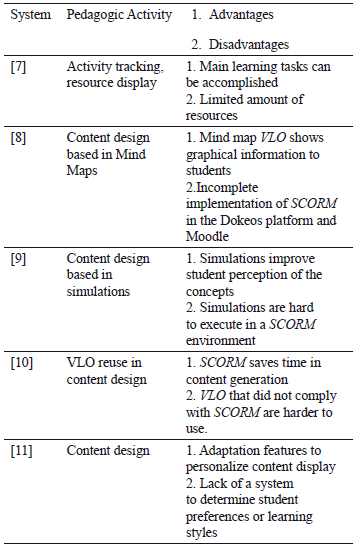
<body><![CDATA[<p><font size="2" face="Verdana, Arial, Helvetica, sans-serif">The Shareable Content Object Reference Model (SCORM) integrates several standards for virtual learning objects to facilitate interoperability among e-learning platforms [21]. To adhere with SCORM, a virtual learning object must comply with the following: be displayable in a browser, use specific meta-data to describe itself, and be organized and packaged according to specific standards [3]. SCORM describes two types of content: assets that reference static content, such as images, static web pages, multimedia, among others; and, Shareable Object Content (SCO), which are VLO that can communicate with the learning management system and have dynamic behavior [4].</font></p>     <p><font size="2" face="Verdana, Arial, Helvetica, sans-serif">SCORM has three main components. The content aggregation model (CAM) specifies how to describe and package VLO. The runtime environment (RTE) describes the communication protocol between SCO and the LMS, and also the data elements used in the communication between the student and the VLO. Sequencing and navigation (SN) specifies the order of navigation events when accessing SCORM content [5].</font></p>     <p><font size="2" face="Verdana, Arial, Helvetica, sans-serif">According to a study of the University of Castilla [6], SCORM use is steadily increasing in e-learning platforms and SIVEDUC (Spanish acronym for virtual education system) implements an important portion of SCORM. <a href="#tab01">Table 1</a> compares different works that utilize SCORM. This table shows that the main use of SCORM is content design in e-learning courses.</font></p>     <p align="center"><font size="2" face="Verdana, Arial, Helvetica, sans-serif"><b><a name="tab01"></a>Table 1.</b> Comparison between works that use SCORM.</font>    <br>   <img src="/img/revistas/dyna/v79n173/a16tab01.gif"></p>     <p>&nbsp;</p>     <p><b><font size="3" face="Verdana, Arial, Helvetica, sans-serif">3. INTELLIGENT TUTORS</font></b></p>     <p><font size="2" face="Verdana, Arial, Helvetica, sans-serif">Intelligent tutors are artificial intelligence systems to support the educational process. The first intelligent tutor system was developed by Jaime Carbonell [12]. This system assisted students to learn South American geography. The main difference with traditional systems was its ability to generate individual responses to students, based on a semantic network that represented domain knowledge. The main aspects of intelligent tutors are a student model and the use of Artificial Intelligence techniques.</font></p>     <p><font size="2" face="Verdana, Arial, Helvetica, sans-serif"><b>3.1 Student Model    <br>   </b></font><font size="2" face="Verdana, Arial, Helvetica, sans-serif">The student model denotes the student behavior and creates a qualitative representation of his/her cognitive and affective knowledge. This model exposes student performance (e.g. time to perform a task), observes errors and reasons that explain why the student developed certain activities or made specific decisions. This model also includes knowledge representation, i.e. data structures to interpret data to predict behavior. A student-model module in an intelligent tutor system is a code component that stores: domain knowledge, knowledge about the student, and the learning process. </font></p>     ]]></body>
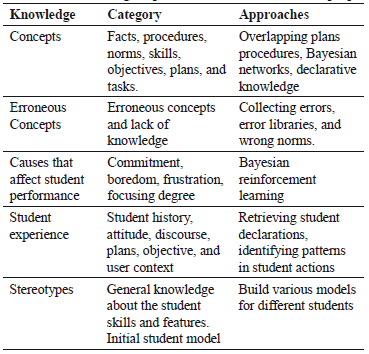
<body><![CDATA[<p><font size="2" face="Verdana, Arial, Helvetica, sans-serif">To develop the student model, two aspects must be considered. The first aspect is the representation of the knowledge the student must acquire. The student model can represent diverse types of knowledge: topics, erroneous concepts, errors, affective characteristics, experience, and stereotypes. This representation can be made using artificial intelligence techniques [12]. Most intelligent tutors focus on a top-down approach to build the knowledge model in order to achieve intelligent behavior. The second aspect is the way to update the knowledge about the student to adequately infer what the student knows and what does not know. There are several techniques to infer student knowledge, such as comparing the student answers and those provided by experts, or comparing between the sequence of actions performed by the student to solve a problem, and the actions performed by experts. <a href="#tab02">Table 2</a> shows an example of the way student knowledge can be symbolically represented, the Category, and the Approaches, how reasoning can be automated to get the required information .</font></p>     <p align="center"><font size="2" face="Verdana, Arial, Helvetica, sans-serif"><b><a name="tab02"></a>Table 2. </b>Knowledge representation- student model [12].</font>    <br>   <img src="/img/revistas/dyna/v79n173/a16tab02.gif"></p>     <p><font size="2" face="Verdana, Arial, Helvetica, sans-serif"><b>3.2. Artificial Intelligence techniques utilized in intelligent tutors    <br>   </b></font><font size="2" face="Verdana, Arial, Helvetica, sans-serif">The main techniques utilized to develop intelligent tutors are: a) cognitive intelligence or artificial science, including tracking methods and constraint-based methods [17]; and, b) AI techniques, including formal logic [16], expert systems [19], plan recognition, and Bayesian networks [15]. These techniques are not exclusive and several of them can be combined to design an intelligent tutor [13].</font></p>     <p><font size="2" face="Verdana, Arial, Helvetica, sans-serif">Cognitive science techniques are mainly utilized to update the student model and to represent knowledge. These techniques are used to develop tracking tutors, which track the learning process using similar methods to those utilized in information processing. Constraint-based methods are used to develop performance-based tutors, which assume the opposite: that learning cannot be completely stored and only student errors can be identified by the information system. Both methods have yielded successful learning results [13].</font></p>     <p><font size="2" face="Verdana, Arial, Helvetica, sans-serif">The above methods are associated with different attention levels. Tracking tutors focus on procedures executed by students and procedures being learned by students. Performance-based tutors ignore the learning path of the student, focusing only on the pedagogical goal that the student must reach. AI techniques can be used to update the student model, to reason about the student knowledge. The main AI techniques used are formal logic, expert systems, planning methods, and Bayesian network prediction. The focus of these techniques is to improve model-reasoning performance. </font></p>     <p><font size="2" face="Verdana, Arial, Helvetica, sans-serif">Formal logic uses the symbolic representation of objects and relations as a set of rules and facts and uses them to deduct new information [14]. Different logical systems offer various ways to represent information. </font></p>     <p><font size="2" face="Verdana, Arial, Helvetica, sans-serif">Expert systems differ from formal logic in that expert systems keep a knowledge base, organized and up-to-date knowledge about the problem that is used to verify the execution of the model. Expert systems can be used to teach students classification and problem-solving skills. Many expert systems are based on condition-action rules and their representational capability is restricted to the student model. In other words, one solution to a set of rules can represent a unique path in the domain, but multiple paths cannot be represented by rules. Rule finding and execution is computationally expensive. Also, student knowledge is hard to evaluate using this technique [14].</font></p>     <p><font size="2" face="Verdana, Arial, Helvetica, sans-serif">Planning and plan recognition models enable tutors to reason about the steps students must follow to perform a certain activity. A student model that is based on plan recognition usually includes a set of trees that represent plans. The root node of a tree is the goal. Intermediate nodes are sub-goals. Leafs correspond either to actions or probabilistic events. The plan recognition process, analyzes the trees bottom-up until reaching the goal [14].</font></p>     ]]></body>
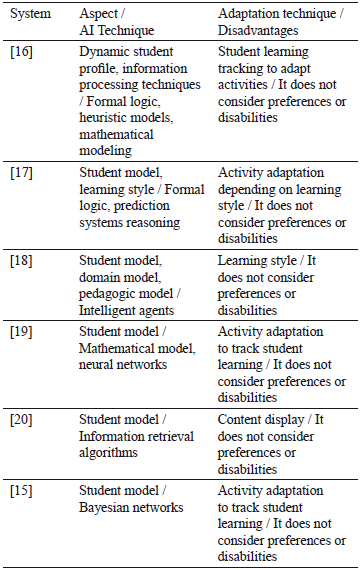
<body><![CDATA[<p><font size="2" face="Verdana, Arial, Helvetica, sans-serif">Bayesian networks or belief networks are directed acyclic graphs that provide a practical and compact way to represent uncertain knowledge. Bayesian networks are useful when there is uncertainty in the student cognitive development, since other methods (formal logic, expert systems, and plan recognition) fail to adequately understand the student [15].</font></p>     <p><font size="2" face="Verdana, Arial, Helvetica, sans-serif"><a href="#tab03">Table 3</a> compares different AI-based intelligent tutor systems. This table shows the system name, the aspect modified by the AI technique, the AI technique utilized, the adaptation features, and the disadvantages of each technique.</font></p>     <p align="center"><font size="2" face="Verdana, Arial, Helvetica, sans-serif"><b><a name="tab03"></a>Table 3.</b> Comparison systems - artificial intelligence in virtual learning.</font>    <br>   <img src="/img/revistas/dyna/v79n173/a16tab03.gif"></p>     <p><font size="2" face="Verdana, Arial, Helvetica, sans-serif">All of the above intelligent tutor systems modify the student model. The most common AI techniques are formal logic and intelligent agents. Adaptation is performed when generating and displaying contents. However, most initiatives do not consider students with disabilities.</font></p>     <p>&nbsp;</p>     <p><font size="3" face="Verdana, Arial, Helvetica, sans-serif"><b>4. PEDAGOGICAL ASPECTS IN VIRTUAL LEARNING ENVIRONMENTS</b></font></p>     <p><font size="2" face="Verdana, Arial, Helvetica, sans-serif">When designing a virtual learning environment, learning theories and pedagogical models should consider the following aspects: problem domain, student learning style, and student proficiency level. </font></p>     <p><font size="2" face="Verdana, Arial, Helvetica, sans-serif">Problem domain influences the choice of educational strategy. For instance, learning algebra has strong theoretical and abstraction requirements. To better learn concepts in this domain, a systemic approach is necessary (e.g., theory, cognitive learning). More pragmatic domains that are focused in problem-solving or heuristic solutions are better addressed educing a constructivist approach (e.g. cognitive learning or social interaction). Some domains can be better addressed controlling the student environment. Other domains that require higher-level processing and integration of multiple tasks (e.g. software engineering) can be better taught using social learning (e.g. localized learning) [12].</font></p>     <p><font size="2" face="Verdana, Arial, Helvetica, sans-serif">Cognitive learning theory has been used by intelligent tutors to efficiently transfer knowledge to students, focusing on mental processes. Cognitive theory treats simple to complex aspects using an internal knowledge structure and three information stages: a) transformation that involves receiving sensorial information; b) short-term memory (STM) that records sensorial information; c) long-term memory (LTM) that stores the information from STM for longer periods [12].</font></p>     ]]></body>
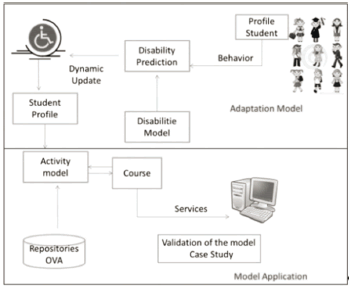
<body><![CDATA[<p><font size="2" face="Verdana, Arial, Helvetica, sans-serif">In a virtual learning environment, some pedagogic material is &quot;imposed&quot; through LTM and manipulated by the system to achieve higher processing levels, linking old information with new. It is important to consider some characteristics, such as: a) Significant events, significant information is easier to learn and remember; b) Serial and positional effects (e.g., elements at the beginning or end of a list are easier to remember); c) Pragmatic effects, practical actions improve information retention; d) Transference effects, applying previous knowledge on a current task improves cognitive processes; e) Interference effects, when previous learning is interfered by current information. In addition, there is the Adaptative Control Thinking (ACT), a cognitive learning theory based in decision-making and uncertainty. This theory simulates the interaction between declarative knowledge, factual information, such as multiplying tables and procedural knowledge, how to use knowledge to solve problems. Both characteristics apply to long-term memory. Declarative knowledge, stored in long-term memory, can be modeled using semantic networks [12].</font></p>     <p>&nbsp;</p>     <p><font size="3" face="Verdana, Arial, Helvetica, sans-serif"><b>5. PROPOSED MODEL </b></font></p>     <p><font size="2" face="Verdana, Arial, Helvetica, sans-serif">Considering all of the above information, this paper proposes the adaptive learning system (ALS), a model that can adapt course contents, considering student disabilities.</font></p>     <p><font size="2" face="Verdana, Arial, Helvetica, sans-serif"><a href="#fig01">Figure 1</a> describes ALS. ALS combines an adaptation model and an application model. The adaptation model includes the student profile that is dynamically updated and includes characteristics such as learning style, student behavior when interacting with the system, and disabilities. In this context, a disability is a student condition that reduces the chances to learn in a learning environment. To determine whether a student has a disability or not, one can utilize medical history, social service assessments and records of the interactions between the student and the system. Artificial intelligence (AI) techniques, such as Bayesian networks or fuzzy logic can be used to interpret the above data and find students with disabilities.</font></p>     <p align="center"><font size="2" face="Verdana, Arial, Helvetica, sans-serif"><b><a name="fig01"></a><img src="/img/revistas/dyna/v79n173/a16fig01.gif">    <br>   Figure 1.</b> The ALS Model</font></p>     <p><font size="2" face="Verdana, Arial, Helvetica, sans-serif">The application model comprises the course structure, including activities and virtual learning objects (VLO) of all of the repositories that are accessible from the learning system. The application utilizes AI techniques, such as intelligent agent or formal logic, to provide services adapted to the student profile.</font></p>     <p><font size="2" face="Verdana, Arial, Helvetica, sans-serif">The following sections describe the main components of the student profile, the disability model, and the validation of this model in a case study.</font></p>     <p><font size="2" face="Verdana, Arial, Helvetica, sans-serif"><b>5.1 The Student Profile</b></font></p>     ]]></body>
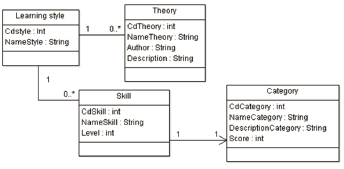
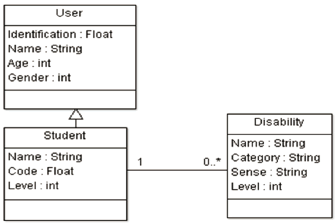
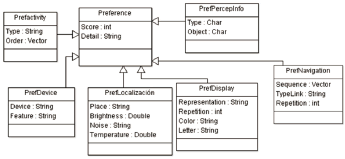
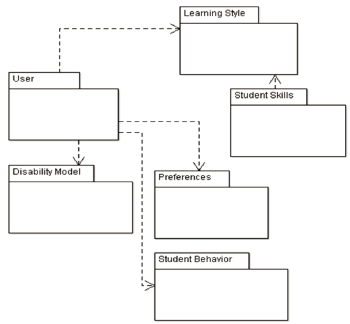
<body><![CDATA[<p><font size="2" face="Verdana, Arial, Helvetica, sans-serif">The student profile, also known as student model, stores the student's personal information, represents his/her behavior, and defines a qualitative representation of the student's cognitive and affective aspects, such as learning style and skills. <a href="#fig02">Figure 2</a> describes the components of the student profile. The learning style stores characteristics that determine types of learning and the way the student perceives information (e.g. visual and verbal). </font></p>     <p align="center"><font size="2" face="Verdana, Arial, Helvetica, sans-serif"><b><a name="fig02"></a><img src="/img/revistas/dyna/v79n173/a16fig02.gif">    <br>   Figure 2.</b> The Student Profile</font></p>     <p><font size="2" face="Verdana, Arial, Helvetica, sans-serif"><a href="#fig03">Figure 3</a> details learning style attributes. Learning style theories have an identification code, name, author, and description.</font></p>     <p align="center"><font size="2" face="Verdana, Arial, Helvetica, sans-serif"><b><a name="fig03"></a><img src="/img/revistas/dyna/v79n173/a16fig03.gif">    <br>   Figure 3. </b>Student Learning Style Attributes</font></p>     <p><font size="2" face="Verdana, Arial, Helvetica, sans-serif">Student skills are associated to a category: cognitive, practical, synthesis, among others. Student disabilities affect student learning chances. <a href="#fig04">Figure 4</a> describes the main attributes associated with disabilities: name (e.g., autism, visual impairment), category (e.g., cognitive, sensorial), sense (e.g., vision, hearing), disability level (e.g., 1, 2, 3).</font></p>     <p align="center"><font size="2" face="Verdana, Arial, Helvetica, sans-serif"><b><a name="fig04"></a><img src="/img/revistas/dyna/v79n173/a16fig04.gif">    <br>   Figure 4.</b> Student Disability Attributes</font></p>     <p><font size="2" face="Verdana, Arial, Helvetica, sans-serif">Preferences store information about the way a student wants to access a particular feature of the system, or which option the student selects among a set. This is the most important part of the adaptation model, since it will determine the way and what kind of information will be presented to the student. <a href="#fig05">Figure 5</a> details preferences. Perception preferences describe the way the student wants to receive the information, e.g. if the student likes visual information, the student can choose whether the information is delivered in the form of simulations or conceptual maps. Navigational preferences describe the path the student follows when performing different activities in the system and when accessing the information. Information display preferences describe the best interface design for a particular student. Device preferences describe the student's preferred devices to interact with the system, e.g., mouse, keyboard or other special devices. Localization preferences are associated to the place from where the student accesses the information. Activity preferences describe the most adequate actions and virtual learning objects to use when teaching a student.</font></p>     ]]></body>
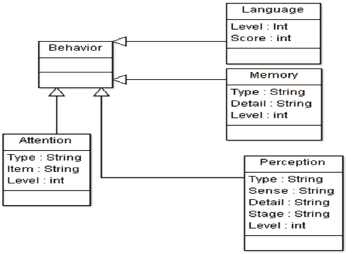
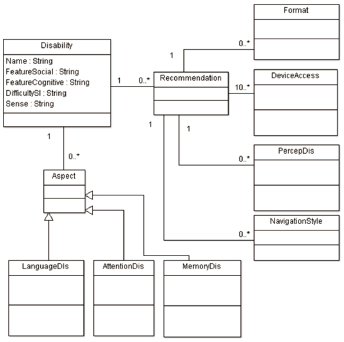
<body><![CDATA[<p align="center"><font size="2" face="Verdana, Arial, Helvetica, sans-serif"><b><a name="fig05"></a><img src="/img/revistas/dyna/v79n173/a16fig05.gif">    <br>   Figure 5.</b> Student Preferences</font></p>     <p><font size="2" face="Verdana, Arial, Helvetica, sans-serif"><a href="#fig06">Figure 6</a> describes the main characteristics of the student behavior. Student behavior is associated to perception, memory, and language and it can be used to determine types and degrees of disability. </font></p>     <p align="center"><font size="2" face="Verdana, Arial, Helvetica, sans-serif"><b><a name="fig06"></a><img src="/img/revistas/dyna/v79n173/a16fig06.gif">    <br>   Figure 6.</b> Student Preferences</font></p>     <p><font size="2" face="Verdana, Arial, Helvetica, sans-serif"><b>5.2. Disability Model    <br>   </b>The Disability model (<a href="#fig07">Fig. 7</a>) describes the most common disabilities of the student. This model is strongly related with the student profile and can be used to infer the main aspects of the interaction between the student and the system.</font></p>     <p align="center"><font size="2" face="Verdana, Arial, Helvetica, sans-serif"><b><a name="fig07"></a><img src="/img/revistas/dyna/v79n173/a16fig07.gif">    <br>   Figure 7.</b> Disability Model</font></p>     <p><font size="2" face="Verdana, Arial, Helvetica, sans-serif">The model comprises several main disability characteristics: access devices (e.g., mouse, keyboard), preferred information visualization method (e.g., charts, diagrams), and the type of link to navigate between pages (e.g., icons, text). Perception, memory, attention, and language are denoted as levels and they indicate the degree of disability of the student if any. Disability profile knowledge representation comprises: a) an identification test, associated with the specific disability; b) information about the student's behavior when interacting with the system, which is used to identify student characteristics that are associated with their disability profile; c) a Bayesian network that uses the student's medical history to determine the student disability.</font></p>     ]]></body>
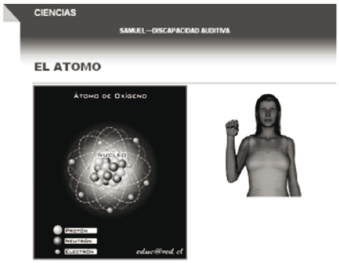
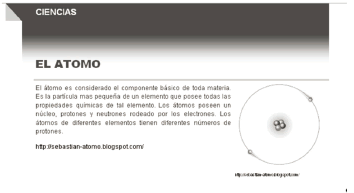
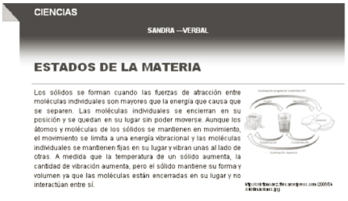
<body><![CDATA[<p>&nbsp;</p>     <p><font size="3" face="Verdana, Arial, Helvetica, sans-serif"><b>5. CASE STUDY</b></font></p>     <p><font size="2" face="Verdana, Arial, Helvetica, sans-serif">To validate the proposed approach, this paper describes a case study: ALSHI (Adaptative Learning System for Hearing Impaired) [22], an application developed to teach people with hearing impairment. </font></p>     <p><font size="2" face="Verdana, Arial, Helvetica, sans-serif"><a href="#fig08">Figure 8</a>, is an example screen of the application. The system displays content of a natural sciences course: the definition and components of an atom. ALSHI utilizes the student profile and his disability profile to adapt information display to students. In the example, the system identified the most adequate virtual learning object for the student, which shows an image of the atom and a video that describes the atom using sign language.</font></p>     <p align="center"><font size="2" face="Verdana, Arial, Helvetica, sans-serif"><b><a name="fig08"></a><img src="/img/revistas/dyna/v79n173/a16fig08.gif">    <br>   Figure 8.</b> Information display presented to a student with hearing impairment</font></p>     <p><font size="2" face="Verdana, Arial, Helvetica, sans-serif">If the system did not have adaptation characteristics, the system would show the information about the atom as described in <a href="#fig09">Figure 9</a>.</font></p>     <p align="center"><font size="2" face="Verdana, Arial, Helvetica, sans-serif"><b><a name="fig09"></a><img src="/img/revistas/dyna/v79n173/a16fig09.gif">    <br>   Figure 9.</b> Information display without adaptation</font></p>     <p><font size="2" face="Verdana, Arial, Helvetica, sans-serif">The lack of an adaptation model would show the same information, either to a hearing-impaired student to any other student, without considering their learning style, preferences, or disabilities. To illustrate the different results obtained for different students, <a href="#fig10">Figure 10</a> shows the same class contents as they are displayed to a student whose learning style is verbal, as was deducted from her profile.</font></p>     ]]></body>
<body><![CDATA[<p align="center"><font size="2" face="Verdana, Arial, Helvetica, sans-serif"><b><a name="fig10"></a><img src="/img/revistas/dyna/v79n173/a16fig10.gif">    <br>   Figure 10.</b> Information display presented to a student with verbal learning style</font></p>     <p>&nbsp;</p>     <p><font size="3" face="Verdana, Arial, Helvetica, sans-serif"><b>7. CONCLUSIONS</b></font></p>     <p><font size="2" face="Verdana, Arial, Helvetica, sans-serif">Educational tools and strategies are essential to assist students' cognitive processes, since they can help to motivate students and improve their performance.</font></p>     <p><font size="2" face="Verdana, Arial, Helvetica, sans-serif">The proposed model in this paper selects virtual learning objects according to the student's preferences, learning styles, and specific characteristics. Content is adapted to the student, which facilitates the adequate selection of VLOs, both for people with and without disabilities.</font></p>     <p><font size="2" face="Verdana, Arial, Helvetica, sans-serif">Artificial intelligence techniques, such as Bayesian networks, can predict and determine student specific characteristics, which facilitates content delivery. Intelligent tutor models tend to focus on the student profile. The model proposed in this paper (ALS), includes also a disability profile, which identifies the student characteristics when interacting with the information system.</font></p>     <p>&nbsp;</p>     <p><font size="3" face="Verdana, Arial, Helvetica, sans-serif"><b>ACKNOWLEDGMENTS</b></font></p>     <p><font size="2" face="Verdana, Arial, Helvetica, sans-serif">We would like to thank Andrea Barraza-Urbina and Nick Hine for their comments on this paper.</font></p>     ]]></body>
<body><![CDATA[<p>&nbsp;</p>     <p><font size="3" face="Verdana, Arial, Helvetica, sans-serif"><b>REFERENCES</b></font></p>     <!-- ref --><p><font size="2" face="Verdana, Arial, Helvetica, sans-serif"><b>[1]</b> Ministerio de Educaci&oacute;n Nacional. La ley general de la Educaci&oacute;n 115 de 1994. Bogot&aacute;. Available: <a href="http://www.mineducacion.gov.co/1621/article-85906.html" target="referncia">http://www.mineducacion.gov.co/1621/article-85906.html</a>. [Citado 15 agosto 2011].     &nbsp;&nbsp;&nbsp;&nbsp;&nbsp;&nbsp;&nbsp;&nbsp;[&#160;<a href="javascript:void(0);" onclick="javascript: window.open('/scielo.php?script=sci_nlinks&ref=000115&pid=S0012-7353201200030001600001&lng=','','width=640,height=500,resizable=yes,scrollbars=1,menubar=yes,');">Links</a>&#160;]<!-- end-ref --><!-- ref --><br>   <b>[2]</b> Manning L., Advanced Distributed Learning, DISAM Journal, pp. 40-45, 2000.     &nbsp;&nbsp;&nbsp;&nbsp;&nbsp;&nbsp;&nbsp;&nbsp;[&#160;<a href="javascript:void(0);" onclick="javascript: window.open('/scielo.php?script=sci_nlinks&ref=000116&pid=S0012-7353201200030001600002&lng=','','width=640,height=500,resizable=yes,scrollbars=1,menubar=yes,');">Links</a>&#160;]<!-- end-ref --><!-- ref --><br>   <b>[3]</b> Advanced Distributed Learning, SCORM Overview Version 4, Available: <a href="http://www.adlnet.org/downloads/120.cfm" target="referencia">http://www.adlnet.org/downloads/120.cfm</a> [Citado 15 agosto 2011].     &nbsp;&nbsp;&nbsp;&nbsp;&nbsp;&nbsp;&nbsp;&nbsp;[&#160;<a href="javascript:void(0);" onclick="javascript: window.open('/scielo.php?script=sci_nlinks&ref=000117&pid=S0012-7353201200030001600003&lng=','','width=640,height=500,resizable=yes,scrollbars=1,menubar=yes,');">Links</a>&#160;]<!-- end-ref --><!-- ref --><br>   <b>[4]</b> Advanced Distributed Learning, SCORM Content Aggregation Model V. 4,Available:<a href="http://www.adlnet.org/downloads/120.cfm" target="referencia">http://www.adlnet.org/downloads/120.cfm</a>.[Citado 15 agosto 2011]     &nbsp;&nbsp;&nbsp;&nbsp;&nbsp;&nbsp;&nbsp;&nbsp;[&#160;<a href="javascript:void(0);" onclick="javascript: window.open('/scielo.php?script=sci_nlinks&ref=000118&pid=S0012-7353201200030001600004&lng=','','width=640,height=500,resizable=yes,scrollbars=1,menubar=yes,');">Links</a>&#160;]<!-- end-ref --><!-- ref --><br>   <b>[5]</b> Advanced Distributed Learning, Productos Validados por la ADL. Available:<a href="http://www.adlnet.org/scorm/adopters/index.cfm" target="referencia">http://www.adlnet.org/scorm/adopters/index.cfm</a>. [Citado 15 agosto 2011]     &nbsp;&nbsp;&nbsp;&nbsp;&nbsp;&nbsp;&nbsp;&nbsp;[&#160;<a href="javascript:void(0);" onclick="javascript: window.open('/scielo.php?script=sci_nlinks&ref=000119&pid=S0012-7353201200030001600005&lng=','','width=640,height=500,resizable=yes,scrollbars=1,menubar=yes,');">Links</a>&#160;]<!-- end-ref --><!-- ref --><br>   <b>[6]</b> &Aacute;lvarez L., Espinoza D., Bucarey S., Empaquetamiento de Objetos de Aprendizaje bajo el Est&aacute;ndar SCORM, Taller Int. de Sw Educativo. 2005.     &nbsp;&nbsp;&nbsp;&nbsp;&nbsp;&nbsp;&nbsp;&nbsp;[&#160;<a href="javascript:void(0);" onclick="javascript: window.open('/scielo.php?script=sci_nlinks&ref=000120&pid=S0012-7353201200030001600006&lng=','','width=640,height=500,resizable=yes,scrollbars=1,menubar=yes,');">Links</a>&#160;]<!-- end-ref --><!-- ref --><br>   <b>[7]</b> Torres A., Naranjo A., Albors G., G&oacute;mez E., Curso de Qu&iacute;mica a distancia como apoyatura de la modalidad presencial, basado en est&aacute;ndares SCORM, U. de San Juan, 2008.     &nbsp;&nbsp;&nbsp;&nbsp;&nbsp;&nbsp;&nbsp;&nbsp;[&#160;<a href="javascript:void(0);" onclick="javascript: window.open('/scielo.php?script=sci_nlinks&ref=000121&pid=S0012-7353201200030001600007&lng=','','width=640,height=500,resizable=yes,scrollbars=1,menubar=yes,');">Links</a>&#160;]<!-- end-ref --><!-- ref --><br>   <b>[8]</b> Vald&eacute;s Y.,Mercado C., Conversi&oacute;n de Mapas Conceptuales en objetos de Aprendizaje bajo el est&aacute;ndar SCORM, Universidad Aut&oacute;noma de Baja California. M&eacute;xico, 2005, Available: <a href="http://docente.ucol.mx/juancont/documentos/cap01/43.pdf" target="referencia">http://docente.ucol.mx/juancont/documentos/cap01/43.pdf</a>.     &nbsp;&nbsp;&nbsp;&nbsp;&nbsp;&nbsp;&nbsp;&nbsp;[&#160;<a href="javascript:void(0);" onclick="javascript: window.open('/scielo.php?script=sci_nlinks&ref=000122&pid=S0012-7353201200030001600008&lng=','','width=640,height=500,resizable=yes,scrollbars=1,menubar=yes,');">Links</a>&#160;]<!-- end-ref --><!-- ref --><br>   <b>[9]</b> Soto J., Garc&iacute;a E., Semantic learning object repositories, Virtual Campus 2006 Post-proceedings, pp. 91-101, 2006.     &nbsp;&nbsp;&nbsp;&nbsp;&nbsp;&nbsp;&nbsp;&nbsp;[&#160;<a href="javascript:void(0);" onclick="javascript: window.open('/scielo.php?script=sci_nlinks&ref=000123&pid=S0012-7353201200030001600009&lng=','','width=640,height=500,resizable=yes,scrollbars=1,menubar=yes,');">Links</a>&#160;]<!-- end-ref --><!-- ref --><br>   <b>[10]</b> L&oacute;pez M., Miguel V., Sistema Generador de Ambientes de Ense&ntilde;anza-Aprendizaje Constructivistas basados en Objetos de Aprendizaje (AMBAR): la Interdisciplinariedad en los ambientes de aprendizaje, Revista de Educaci&oacute;n a Distancia, N&uacute;mero 19, 2008.     &nbsp;&nbsp;&nbsp;&nbsp;&nbsp;&nbsp;&nbsp;&nbsp;[&#160;<a href="javascript:void(0);" onclick="javascript: window.open('/scielo.php?script=sci_nlinks&ref=000124&pid=S0012-7353201200030001600010&lng=','','width=640,height=500,resizable=yes,scrollbars=1,menubar=yes,');">Links</a>&#160;]<!-- end-ref --><!-- ref --><br>   <b>[11]</b> Minguill&oacute;n J.,Mor J., Santanach F., Personalizaci&oacute;n del proceso de aprendizaje usando objetos de aprendizaje reutilizables, Revista de Educaci&oacute;n a Distancia, N&uacute;m. Monogr&aacute;fico IV. 2005     &nbsp;&nbsp;&nbsp;&nbsp;&nbsp;&nbsp;&nbsp;&nbsp;[&#160;<a href="javascript:void(0);" onclick="javascript: window.open('/scielo.php?script=sci_nlinks&ref=000125&pid=S0012-7353201200030001600011&lng=','','width=640,height=500,resizable=yes,scrollbars=1,menubar=yes,');">Links</a>&#160;]<!-- end-ref --><!-- ref --><br>   <b>[12]</b> Kaufmann M., Building intelligent interactive tutors: student-centered strategies for revolutionizing e-learning, Morgan Kaufmann Elsevier, 2009.     &nbsp;&nbsp;&nbsp;&nbsp;&nbsp;&nbsp;&nbsp;&nbsp;[&#160;<a href="javascript:void(0);" onclick="javascript: window.open('/scielo.php?script=sci_nlinks&ref=000126&pid=S0012-7353201200030001600012&lng=','','width=640,height=500,resizable=yes,scrollbars=1,menubar=yes,');">Links</a>&#160;]<!-- end-ref --><!-- ref --><br>   <b>[13]</b> Woolf B., Intelligent tutoring systems: 9th Int. Conf., ITS 2008, Montr&eacute;al, Canada, proceedings, LNCS 5091, 2008.     &nbsp;&nbsp;&nbsp;&nbsp;&nbsp;&nbsp;&nbsp;&nbsp;[&#160;<a href="javascript:void(0);" onclick="javascript: window.open('/scielo.php?script=sci_nlinks&ref=000127&pid=S0012-7353201200030001600013&lng=','','width=640,height=500,resizable=yes,scrollbars=1,menubar=yes,');">Links</a>&#160;]<!-- end-ref --><!-- ref --><br>   <b>[14]</b> Aleven V., Kay J., Mostow J., Intelligent, Tutoring Systems, 10th Int. Conf., ITS 2010, LNCS 6095. 2010.     &nbsp;&nbsp;&nbsp;&nbsp;&nbsp;&nbsp;&nbsp;&nbsp;[&#160;<a href="javascript:void(0);" onclick="javascript: window.open('/scielo.php?script=sci_nlinks&ref=000128&pid=S0012-7353201200030001600014&lng=','','width=640,height=500,resizable=yes,scrollbars=1,menubar=yes,');">Links</a>&#160;]<!-- end-ref --><!-- ref --><br>   <b>[15]</b> Liu Ch., A Simulation-Based Experience in Learning Structures of Bayesian Networks to Represent How Students Learn Composite Concepts, Department of Computer Science, National Chengchi University, Taiwan, 2005.     &nbsp;&nbsp;&nbsp;&nbsp;&nbsp;&nbsp;&nbsp;&nbsp;[&#160;<a href="javascript:void(0);" onclick="javascript: window.open('/scielo.php?script=sci_nlinks&ref=000129&pid=S0012-7353201200030001600015&lng=','','width=640,height=500,resizable=yes,scrollbars=1,menubar=yes,');">Links</a>&#160;]<!-- end-ref --><!-- ref --><br>   <b>[16]</b> Kiat L., Blank T., Integrating Case-Based Reasoning and Meta-Learning for a Self-Improving Intelligent Tutoring System, Journal I. J. Artificial Intelligence in Education, volume 18, pp. 27-58, 2008.     &nbsp;&nbsp;&nbsp;&nbsp;&nbsp;&nbsp;&nbsp;&nbsp;[&#160;<a href="javascript:void(0);" onclick="javascript: window.open('/scielo.php?script=sci_nlinks&ref=000130&pid=S0012-7353201200030001600016&lng=','','width=640,height=500,resizable=yes,scrollbars=1,menubar=yes,');">Links</a>&#160;]<!-- end-ref --><!-- ref --><br>   <b>[17] </b>Siler S., Klahr D., Magaro C, Willows K., Mowery D., Predictors of Transfer of Experimental Design Skills in Elementary and Middle School Children, Intelligent Tutoring Systems (2), pp. 198-208, 2010.     &nbsp;&nbsp;&nbsp;&nbsp;&nbsp;&nbsp;&nbsp;&nbsp;[&#160;<a href="javascript:void(0);" onclick="javascript: window.open('/scielo.php?script=sci_nlinks&ref=000131&pid=S0012-7353201200030001600017&lng=','','width=640,height=500,resizable=yes,scrollbars=1,menubar=yes,');">Links</a>&#160;]<!-- end-ref --><!-- ref --><br>   <b>[18]</b> Buche C., Querrec R., De Loor P., Chevaillier P. MASCARET: A Pedagogical Multi-Agent System for Virtual Environments for Training, Journal IJDET, volume 2, pp. 41-61, 2010.     &nbsp;&nbsp;&nbsp;&nbsp;&nbsp;&nbsp;&nbsp;&nbsp;[&#160;<a href="javascript:void(0);" onclick="javascript: window.open('/scielo.php?script=sci_nlinks&ref=000132&pid=S0012-7353201200030001600018&lng=','','width=640,height=500,resizable=yes,scrollbars=1,menubar=yes,');">Links</a>&#160;]<!-- end-ref --><!-- ref --><br>   <b>[19]</b> Curilem G., Mendes F., Barbosa A., Adaptive Interface Methodology for Intelligent Tutoring Systems, LNCS 3220, pp. 41-750. 2004.     &nbsp;&nbsp;&nbsp;&nbsp;&nbsp;&nbsp;&nbsp;&nbsp;[&#160;<a href="javascript:void(0);" onclick="javascript: window.open('/scielo.php?script=sci_nlinks&ref=000133&pid=S0012-7353201200030001600019&lng=','','width=640,height=500,resizable=yes,scrollbars=1,menubar=yes,');">Links</a>&#160;]<!-- end-ref --><!-- ref --><br>   <b>[20]</b> Naruedomkul K.,Thai Intelligent Tutor with Information Retrieval, KIMAS, IEEE, 2005.     &nbsp;&nbsp;&nbsp;&nbsp;&nbsp;&nbsp;&nbsp;&nbsp;[&#160;<a href="javascript:void(0);" onclick="javascript: window.open('/scielo.php?script=sci_nlinks&ref=000134&pid=S0012-7353201200030001600020&lng=','','width=640,height=500,resizable=yes,scrollbars=1,menubar=yes,');">Links</a>&#160;]<!-- end-ref --><!-- ref --><br>   <b>[21]</b> Real Acad&eacute;mica de la Lengua, Available: en <a href="http://buscon.rae.es/draeI/SrvltConsulta?TIPO_BUS=3&LEMA=discapacidad" target="referencia">http://buscon.rae.es/draeI/SrvltConsulta?TIPO_BUS=3&LEMA=discapacidad</a>. [Citado 15 agosto 2011].     &nbsp;&nbsp;&nbsp;&nbsp;&nbsp;&nbsp;&nbsp;&nbsp;[&#160;<a href="javascript:void(0);" onclick="javascript: window.open('/scielo.php?script=sci_nlinks&ref=000135&pid=S0012-7353201200030001600021&lng=','','width=640,height=500,resizable=yes,scrollbars=1,menubar=yes,');">Links</a>&#160;]<!-- end-ref --><!-- ref --><br>   <b>[22]</b> Lancheros D., Carrillo A., Modelo Adaptativo Aplicado en Ambientes Virtuales de Aprendizaje de Personas con Discapacidad, III Congreso Int. de Ambientes Educativos de Aprendizaje Adaptativos y Accesibles hacia Un Sistema Educativo Comprometido con la Diversidad, 2011.     &nbsp;&nbsp;&nbsp;&nbsp;&nbsp;&nbsp;&nbsp;&nbsp;[&#160;<a href="javascript:void(0);" onclick="javascript: window.open('/scielo.php?script=sci_nlinks&ref=000136&pid=S0012-7353201200030001600022&lng=','','width=640,height=500,resizable=yes,scrollbars=1,menubar=yes,');">Links</a>&#160;]<!-- end-ref --><!-- ref --><br>   <b>[23]</b> Shih Ch. Chang M. y Shih Ch., Assisting people with multiple disabilities and minimal motor behavior to improve computer pointing efficiency through a mouse wheel. In: Research in Developmental Disabilities, Volume 30, Issue 6, 1378-1387. Elsevier, 2009     &nbsp;&nbsp;&nbsp;&nbsp;&nbsp;&nbsp;&nbsp;&nbsp;[&#160;<a href="javascript:void(0);" onclick="javascript: window.open('/scielo.php?script=sci_nlinks&ref=000137&pid=S0012-7353201200030001600023&lng=','','width=640,height=500,resizable=yes,scrollbars=1,menubar=yes,');">Links</a>&#160;]<!-- end-ref --><!-- ref --><br>   <b>[24]</b> Cowany D. Khan Y., Assistive technology for children with complex disabilities, In: Current Paediatrics, Volume 15, Issue 3, pp. 207-212. Elsevier. 2005. </font>&nbsp;&nbsp;&nbsp;&nbsp;&nbsp;&nbsp;&nbsp;&nbsp;[&#160;<a href="javascript:void(0);" onclick="javascript: window.open('/scielo.php?script=sci_nlinks&ref=000138&pid=S0012-7353201200030001600024&lng=','','width=640,height=500,resizable=yes,scrollbars=1,menubar=yes,');">Links</a>&#160;]<!-- end-ref --> ]]></body><back>
<ref-list>
<ref id="B1">
<label>1</label><nlm-citation citation-type="">
<collab>Ministerio de Educación Nacional</collab>
<source><![CDATA[La ley general de la Educación 115 de 1994.]]></source>
<year></year>
<publisher-loc><![CDATA[Bogotá ]]></publisher-loc>
</nlm-citation>
</ref>
<ref id="B2">
<label>2</label><nlm-citation citation-type="">
<person-group person-group-type="author">
<name>
<surname><![CDATA[Manning]]></surname>
<given-names><![CDATA[L.]]></given-names>
</name>
</person-group>
<article-title xml:lang="en"><![CDATA[Advanced Distributed Learning]]></article-title>
<source><![CDATA[]]></source>
<year>2000</year>
<page-range>40-45</page-range></nlm-citation>
</ref>
<ref id="B3">
<label>3</label><nlm-citation citation-type="">
<source><![CDATA[Advanced Distributed Learning: SCORM Overview Version 4]]></source>
<year></year>
</nlm-citation>
</ref>
<ref id="B4">
<label>4</label><nlm-citation citation-type="">
<source><![CDATA[Advanced Distributed Learning: SCORM Content Aggregation Model V. 4]]></source>
<year></year>
</nlm-citation>
</ref>
<ref id="B5">
<label>5</label><nlm-citation citation-type="">
<source><![CDATA[Advanced Distributed Learning: Productos Validados por la ADL.]]></source>
<year></year>
</nlm-citation>
</ref>
<ref id="B6">
<label>6</label><nlm-citation citation-type="confpro">
<person-group person-group-type="author">
<name>
<surname><![CDATA[Álvarez]]></surname>
<given-names><![CDATA[L.]]></given-names>
</name>
<name>
<surname><![CDATA[Espinoza]]></surname>
<given-names><![CDATA[D.]]></given-names>
</name>
<name>
<surname><![CDATA[Bucarey]]></surname>
<given-names><![CDATA[S.]]></given-names>
</name>
</person-group>
<article-title xml:lang="es"><![CDATA[Empaquetamiento de Objetos de Aprendizaje bajo el Estándar SCORM]]></article-title>
<source><![CDATA[]]></source>
<year></year>
<conf-name><![CDATA[ Taller Int. de Sw Educativo]]></conf-name>
<conf-date>2005</conf-date>
<conf-loc> </conf-loc>
</nlm-citation>
</ref>
<ref id="B7">
<label>7</label><nlm-citation citation-type="book">
<person-group person-group-type="author">
<name>
<surname><![CDATA[Torres]]></surname>
<given-names><![CDATA[A.]]></given-names>
</name>
<name>
<surname><![CDATA[Naranjo]]></surname>
<given-names><![CDATA[A.]]></given-names>
</name>
<name>
<surname><![CDATA[Albors]]></surname>
<given-names><![CDATA[G.]]></given-names>
</name>
<name>
<surname><![CDATA[Gómez]]></surname>
<given-names><![CDATA[E.]]></given-names>
</name>
</person-group>
<source><![CDATA[Curso de Química a distancia como apoyatura de la modalidad presencial, basado en estándares SCORM]]></source>
<year>2008</year>
<publisher-name><![CDATA[U. de San Juan]]></publisher-name>
</nlm-citation>
</ref>
<ref id="B8">
<label>8</label><nlm-citation citation-type="book">
<person-group person-group-type="author">
<name>
<surname><![CDATA[Valdés]]></surname>
<given-names><![CDATA[Y.]]></given-names>
</name>
<name>
<surname><![CDATA[Mercado]]></surname>
<given-names><![CDATA[C.]]></given-names>
</name>
</person-group>
<source><![CDATA[Conversión de Mapas Conceptuales en objetos de Aprendizaje bajo el estándar SCORM]]></source>
<year>2005</year>
<publisher-name><![CDATA[Universidad Autónoma de Baja California]]></publisher-name>
</nlm-citation>
</ref>
<ref id="B9">
<label>9</label><nlm-citation citation-type="">
<person-group person-group-type="author">
<name>
<surname><![CDATA[Soto]]></surname>
<given-names><![CDATA[J.]]></given-names>
</name>
<name>
<surname><![CDATA[García]]></surname>
<given-names><![CDATA[E.]]></given-names>
</name>
</person-group>
<source><![CDATA[Semantic learning object repositories: Virtual Campus 2006 Post-proceedings]]></source>
<year>2006</year>
<page-range>91-101</page-range></nlm-citation>
</ref>
<ref id="B10">
<label>10</label><nlm-citation citation-type="journal">
<person-group person-group-type="author">
<name>
<surname><![CDATA[López]]></surname>
<given-names><![CDATA[M.]]></given-names>
</name>
<name>
<surname><![CDATA[Miguel]]></surname>
<given-names><![CDATA[V.]]></given-names>
</name>
</person-group>
<article-title xml:lang="es"><![CDATA[Sistema Generador de Ambientes de Enseñanza-Aprendizaje Constructivistas basados en Objetos de Aprendizaje (AMBAR):: la Interdisciplinariedad en los ambientes de aprendizaje]]></article-title>
<source><![CDATA[Revista de Educación a Distancia]]></source>
<year>2008</year>
<numero>19</numero>
<issue>19</issue>
</nlm-citation>
</ref>
<ref id="B11">
<label>11</label><nlm-citation citation-type="journal">
<person-group person-group-type="author">
<name>
<surname><![CDATA[Minguillón]]></surname>
<given-names><![CDATA[J.]]></given-names>
</name>
<name>
<surname><![CDATA[Mor]]></surname>
<given-names><![CDATA[J.]]></given-names>
</name>
<name>
<surname><![CDATA[Santanach]]></surname>
<given-names><![CDATA[F.]]></given-names>
</name>
</person-group>
<article-title xml:lang="es"><![CDATA[Personalización del proceso de aprendizaje usando objetos de aprendizaje reutilizables]]></article-title>
<source><![CDATA[Revista de Educación a Distancia]]></source>
<year>2005</year>
<numero>IV</numero>
<issue>IV</issue>
</nlm-citation>
</ref>
<ref id="B12">
<label>12</label><nlm-citation citation-type="book">
<person-group person-group-type="author">
<name>
<surname><![CDATA[Kaufmann]]></surname>
<given-names><![CDATA[M.]]></given-names>
</name>
</person-group>
<source><![CDATA[Building intelligent interactive tutors:: student-centered strategies for revolutionizing e-learning]]></source>
<year>2009</year>
<publisher-name><![CDATA[Morgan Kaufmann Elsevier]]></publisher-name>
</nlm-citation>
</ref>
<ref id="B13">
<label>13</label><nlm-citation citation-type="confpro">
<person-group person-group-type="author">
<name>
<surname><![CDATA[Woolf]]></surname>
<given-names><![CDATA[B.]]></given-names>
</name>
</person-group>
<article-title xml:lang="en"><![CDATA[Intelligent tutoring systems:]]></article-title>
<source><![CDATA[]]></source>
<year></year>
<conf-name><![CDATA[9th Int. Conf., ITS 2008]]></conf-name>
<conf-date>2008</conf-date>
<conf-loc>Montréal </conf-loc>
</nlm-citation>
</ref>
<ref id="B14">
<label>14</label><nlm-citation citation-type="confpro">
<person-group person-group-type="author">
<name>
<surname><![CDATA[Aleven]]></surname>
<given-names><![CDATA[V.]]></given-names>
</name>
<name>
<surname><![CDATA[Kay]]></surname>
<given-names><![CDATA[J.]]></given-names>
</name>
<name>
<surname><![CDATA[Mostow]]></surname>
<given-names><![CDATA[J.]]></given-names>
</name>
</person-group>
<article-title xml:lang="en"><![CDATA[Intelligent, Tutoring Systems]]></article-title>
<source><![CDATA[]]></source>
<year></year>
<conf-name><![CDATA[10th Int. Conf., ITS 2010]]></conf-name>
<conf-date>2010</conf-date>
<conf-loc> </conf-loc>
</nlm-citation>
</ref>
<ref id="B15">
<label>15</label><nlm-citation citation-type="book">
<person-group person-group-type="author">
<name>
<surname><![CDATA[Liu]]></surname>
<given-names><![CDATA[Ch.]]></given-names>
</name>
</person-group>
<source><![CDATA[A Simulation-Based Experience in Learning Structures of Bayesian Networks to Represent How Students Learn Composite Concepts]]></source>
<year>2005</year>
<publisher-name><![CDATA[Department of Computer Science, National Chengchi University]]></publisher-name>
</nlm-citation>
</ref>
<ref id="B16">
<label>16</label><nlm-citation citation-type="journal">
<person-group person-group-type="author">
<name>
<surname><![CDATA[Kiat]]></surname>
<given-names><![CDATA[L.]]></given-names>
</name>
<name>
<surname><![CDATA[Blank]]></surname>
<given-names><![CDATA[T.]]></given-names>
</name>
</person-group>
<article-title xml:lang="en"><![CDATA[Integrating Case-Based Reasoning and Meta-Learning for a Self-Improving Intelligent Tutoring System]]></article-title>
<source><![CDATA[Journal I. J. Artificial Intelligence in Education]]></source>
<year>2008</year>
<volume>18</volume>
<page-range>27-58</page-range></nlm-citation>
</ref>
<ref id="B17">
<label>17</label><nlm-citation citation-type="journal">
<person-group person-group-type="author">
<name>
<surname><![CDATA[Siler]]></surname>
<given-names><![CDATA[S.]]></given-names>
</name>
<name>
<surname><![CDATA[Klahr]]></surname>
<given-names><![CDATA[D.]]></given-names>
</name>
<name>
<surname><![CDATA[Magaro]]></surname>
<given-names><![CDATA[C]]></given-names>
</name>
<name>
<surname><![CDATA[Willows]]></surname>
<given-names><![CDATA[K.]]></given-names>
</name>
<name>
<surname><![CDATA[Mowery]]></surname>
<given-names><![CDATA[D.]]></given-names>
</name>
</person-group>
<article-title xml:lang="en"><![CDATA[Predictors of Transfer of Experimental Design Skills in Elementary and Middle School Children]]></article-title>
<source><![CDATA[Intelligent Tutoring Systems]]></source>
<year>2010</year>
<volume>2</volume>
<page-range>198-208</page-range></nlm-citation>
</ref>
<ref id="B18">
<label>18</label><nlm-citation citation-type="journal">
<person-group person-group-type="author">
<name>
<surname><![CDATA[Buche]]></surname>
<given-names><![CDATA[C.]]></given-names>
</name>
<name>
<surname><![CDATA[Querrec]]></surname>
<given-names><![CDATA[R.]]></given-names>
</name>
<name>
<surname><![CDATA[De Loor]]></surname>
<given-names><![CDATA[P.]]></given-names>
</name>
<name>
<surname><![CDATA[Chevaillier]]></surname>
<given-names><![CDATA[P.]]></given-names>
</name>
</person-group>
<article-title xml:lang="en"><![CDATA[MASCARET:: A Pedagogical Multi-Agent System for Virtual Environments for Training]]></article-title>
<source><![CDATA[Journal IJDET]]></source>
<year>2010</year>
<volume>2</volume>
<page-range>41-61</page-range></nlm-citation>
</ref>
<ref id="B19">
<label>19</label><nlm-citation citation-type="">
<person-group person-group-type="author">
<name>
<surname><![CDATA[Curilem]]></surname>
<given-names><![CDATA[G.]]></given-names>
</name>
<name>
<surname><![CDATA[Mendes]]></surname>
<given-names><![CDATA[F.]]></given-names>
</name>
<name>
<surname><![CDATA[Barbosa]]></surname>
<given-names><![CDATA[A.]]></given-names>
</name>
</person-group>
<source><![CDATA[Adaptive Interface Methodology for Intelligent Tutoring Systems]]></source>
<year>2004</year>
<page-range>41-750</page-range></nlm-citation>
</ref>
<ref id="B20">
<label>20</label><nlm-citation citation-type="book">
<person-group person-group-type="author">
<name>
<surname><![CDATA[Naruedomkul]]></surname>
<given-names><![CDATA[K.]]></given-names>
</name>
</person-group>
<source><![CDATA[Thai Intelligent Tutor with Information Retrieval]]></source>
<year>2005</year>
<publisher-name><![CDATA[KIMASIEEE]]></publisher-name>
</nlm-citation>
</ref>
<ref id="B21">
<label>21</label><nlm-citation citation-type="">
<collab>Real Académica de la Lengua</collab>
<source><![CDATA[]]></source>
<year></year>
</nlm-citation>
</ref>
<ref id="B22">
<label>22</label><nlm-citation citation-type="confpro">
<person-group person-group-type="author">
<name>
<surname><![CDATA[Lancheros]]></surname>
<given-names><![CDATA[D.]]></given-names>
</name>
<name>
<surname><![CDATA[Carrillo]]></surname>
<given-names><![CDATA[A.]]></given-names>
</name>
</person-group>
<article-title xml:lang="es"><![CDATA[Modelo Adaptativo Aplicado en Ambientes Virtuales de Aprendizaje de Personas con Discapacidad]]></article-title>
<source><![CDATA[]]></source>
<year></year>
<conf-name><![CDATA[III Congreso Int. de Ambientes Educativos de Aprendizaje Adaptativos y Accesibles hacia Un Sistema Educativo Comprometido con la Diversidad]]></conf-name>
<conf-date>2011</conf-date>
<conf-loc> </conf-loc>
</nlm-citation>
</ref>
<ref id="B23">
<label>23</label><nlm-citation citation-type="journal">
<person-group person-group-type="author">
<name>
<surname><![CDATA[Shih]]></surname>
<given-names><![CDATA[Ch.]]></given-names>
</name>
<name>
<surname><![CDATA[Chang]]></surname>
<given-names><![CDATA[M.]]></given-names>
</name>
<name>
<surname><![CDATA[Shih]]></surname>
<given-names><![CDATA[Ch.]]></given-names>
</name>
</person-group>
<article-title xml:lang="en"><![CDATA[Assisting people with multiple disabilities and minimal motor behavior to improve computer pointing efficiency through a mouse wheel.]]></article-title>
<source><![CDATA[Research in Developmental Disabilities]]></source>
<year>2009</year>
<volume>30</volume>
<numero>6</numero>
<issue>6</issue>
<page-range>1378-1387</page-range><publisher-name><![CDATA[Elsevier]]></publisher-name>
</nlm-citation>
</ref>
<ref id="B24">
<label>24</label><nlm-citation citation-type="journal">
<person-group person-group-type="author">
<name>
<surname><![CDATA[Cowany]]></surname>
<given-names><![CDATA[D.]]></given-names>
</name>
<name>
<surname><![CDATA[Khan]]></surname>
<given-names><![CDATA[Y.]]></given-names>
</name>
</person-group>
<article-title xml:lang="en"><![CDATA[Assistive technology for children with complex disabilities]]></article-title>
<source><![CDATA[Current Paediatrics]]></source>
<year>2005</year>
<volume>15</volume>
<numero>3</numero>
<issue>3</issue>
<page-range>207-212</page-range><publisher-name><![CDATA[Elsevier]]></publisher-name>
</nlm-citation>
</ref>
</ref-list>
</back>
</article>