<?xml version="1.0" encoding="ISO-8859-1"?><article xmlns:mml="http://www.w3.org/1998/Math/MathML" xmlns:xlink="http://www.w3.org/1999/xlink" xmlns:xsi="http://www.w3.org/2001/XMLSchema-instance">
<front>
<journal-meta>
<journal-id>0012-7353</journal-id>
<journal-title><![CDATA[DYNA]]></journal-title>
<abbrev-journal-title><![CDATA[Dyna rev.fac.nac.minas]]></abbrev-journal-title>
<issn>0012-7353</issn>
<publisher>
<publisher-name><![CDATA[Universidad Nacional de Colombia]]></publisher-name>
</publisher>
</journal-meta>
<article-meta>
<article-id>S0012-73532012000300021</article-id>
<title-group>
<article-title xml:lang="en"><![CDATA[EXPERTCHOICE© DECISION SUPPORT SYSTEM IMPLEMENTATION FOR VEHICLE SELECTION IN A COLOMBIAN SHIPYARD]]></article-title>
<article-title xml:lang="es"><![CDATA[IMPLEMENTACIÓN DEL SISTEMA DE SOPORTE DE DESICIONES EXPERTCHOICE© PARA LA SELECCIÓN DE VEHICULOS EN UN ASTILLERO COLOMBIANO]]></article-title>
</title-group>
<contrib-group>
<contrib contrib-type="author">
<name>
<surname><![CDATA[ZAPATA CORTES]]></surname>
<given-names><![CDATA[JULIAN ANDRES]]></given-names>
</name>
<xref ref-type="aff" rid="A01"/>
</contrib>
<contrib contrib-type="author">
<name>
<surname><![CDATA[ARANGO SERNA]]></surname>
<given-names><![CDATA[MARTIN DARÍO]]></given-names>
</name>
<xref ref-type="aff" rid="A02"/>
</contrib>
<contrib contrib-type="author">
<name>
<surname><![CDATA[MORENO MARTÍNEZ]]></surname>
<given-names><![CDATA[SANDRA PATRICIA]]></given-names>
</name>
<xref ref-type="aff" rid="A03"/>
</contrib>
</contrib-group>
<aff id="A01">
<institution><![CDATA[,Institución Universitaria ESUMER  ]]></institution>
<addr-line><![CDATA[ ]]></addr-line>
</aff>
<aff id="A02">
<institution><![CDATA[,Universidad Nacional de Colombia  ]]></institution>
<addr-line><![CDATA[Medellín ]]></addr-line>
</aff>
<aff id="A03">
<institution><![CDATA[,Corporación de Ciencia y Tecnología para la Industria Naval, Marítima y Fluvial  ]]></institution>
<addr-line><![CDATA[ ]]></addr-line>
</aff>
<pub-date pub-type="pub">
<day>00</day>
<month>06</month>
<year>2012</year>
</pub-date>
<pub-date pub-type="epub">
<day>00</day>
<month>06</month>
<year>2012</year>
</pub-date>
<volume>79</volume>
<numero>173</numero>
<fpage>53</fpage>
<lpage>60</lpage>
<copyright-statement/>
<copyright-year/>
<self-uri xlink:href="http://www.scielo.org.co/scielo.php?script=sci_arttext&amp;pid=S0012-73532012000300021&amp;lng=en&amp;nrm=iso"></self-uri><self-uri xlink:href="http://www.scielo.org.co/scielo.php?script=sci_abstract&amp;pid=S0012-73532012000300021&amp;lng=en&amp;nrm=iso"></self-uri><self-uri xlink:href="http://www.scielo.org.co/scielo.php?script=sci_pdf&amp;pid=S0012-73532012000300021&amp;lng=en&amp;nrm=iso"></self-uri><abstract abstract-type="short" xml:lang="en"><p><![CDATA[This article shows the application of the decision support system (DSS) Expertchoice© for pick-up truck selection in a colombian shipyard company. The article begins with a description of such decision support systems, followed by a market availability analysis of such systems, and finally presents the application of the DSS Expertchoice© for pick-up truck selection in the company studied.]]></p></abstract>
<abstract abstract-type="short" xml:lang="es"><p><![CDATA[El presente artículo muestra la aplicación del sistema de soporte de decisiones - DSS (Decision support systems) para la selección de automóviles tipo camionetas en un astillero colombiano. El artículo comienza con una descripción acerca de estos sistemas de soporte de decisión, se analiza la disponibilidad de los mismos en el mercado y finaliza con la aplicación del sistema DSS Expertchoice© para la selección de las camionetas en la empresa de estudio.]]></p></abstract>
<kwd-group>
<kwd lng="en"><![CDATA[decision support systems (DSSs)]]></kwd>
<kwd lng="en"><![CDATA[software]]></kwd>
<kwd lng="en"><![CDATA[Expertchoice©]]></kwd>
<kwd lng="en"><![CDATA[information systems]]></kwd>
<kwd lng="es"><![CDATA[sistemas de soporte de decisión (DSSs)]]></kwd>
<kwd lng="es"><![CDATA[software]]></kwd>
<kwd lng="es"><![CDATA[Expertchoice©]]></kwd>
<kwd lng="es"><![CDATA[sistemas de información]]></kwd>
</kwd-group>
</article-meta>
</front><body><![CDATA[ <p align="center"><font size="4" face="Verdana, Arial, Helvetica, sans-serif"><b>EXPERTCHOICE&copy; DECISION SUPPORT SYSTEM IMPLEMENTATION FOR VEHICLE SELECTION IN A COLOMBIAN SHIPYARD</b></font></p>     <p align="center"><i><font size="3"><b><font face="Verdana, Arial, Helvetica, sans-serif">IMPLEMENTACI&Oacute;N DEL SISTEMA DE SOPORTE DE DESICIONES EXPERTCHOICE&copy; PARA LA SELECCI&Oacute;N DE VEHICULOS EN UN ASTILLERO COLOMBIANO</font></b></font></i></p>     <p align="center">&nbsp;</p>     <p align="center"><font size="2" face="Verdana, Arial, Helvetica, sans-serif"><b>JULIAN ANDRES ZAPATA CORTES</b>    <br>   <i>M.Sc. in Management Engineering, Full-time Professor, Instituci&oacute;n Universitaria ESUMER, <a href="mailto:jzapatac@esumer.edu.co">jzapatac@esumer.edu.co</a></i></font></p>     <p align="center"><font size="2" face="Verdana, Arial, Helvetica, sans-serif"><b>MARTIN DAR&Iacute;O ARANGO SERNA</b>    <br>   <i>Ph.D. in Industrial Engineering; Full Professor, Universidad Nacional de Colombia, Medell&iacute;n campus, <a href="mailto:mdarango@unal.edu.co">mdarango@unal.edu.co</a></i></font></p>     <p align="center"><font size="2" face="Verdana, Arial, Helvetica, sans-serif"><b>SANDRA PATRICIA MORENO MART&Iacute;NEZ</b>    <br>   <i>TNLAM., Corporaci&oacute;n de Ciencia y Tecnolog&iacute;a para la Industria Naval, Mar&iacute;tima y Fluvial, Cotecmar, <a href="mailto:smoreno@cotecmar.com">smoreno@cotecmar.com</a></i></font></p>     <p align="center">&nbsp;</p>     ]]></body>
<body><![CDATA[<p align="center"><font size="2" face="Verdana, Arial, Helvetica, sans-serif"><b>Recieved for revision February 15<sup>th</sup>, 2011, accepted January 27<sup>th</sup>, 2012, final version February 29<sup>th</sup>, 2012.</b></font></p>     <p>&nbsp;</p> <hr>     <p><font size="2" face="Verdana, Arial, Helvetica, sans-serif"><b>ABSTRACT:</b> This article shows the application of the decision support system (DSS) Expertchoice&copy; for pick-up truck selection in a colombian shipyard company. The article begins with a description of such decision support systems, followed by a market availability analysis of such systems, and finally presents the application of the DSS Expertchoice&copy; for pick-up truck selection in the company studied.</font></p>     <p><font size="2" face="Verdana, Arial, Helvetica, sans-serif"><b>KEY WORDS:</b> decision support systems (DSSs), software, Expertchoice&copy;, information systems.</font></p>     <p><font size="2" face="Verdana, Arial, Helvetica, sans-serif"><b>RESUMEN:</b> El presente art&iacute;culo muestra la aplicaci&oacute;n del sistema de soporte de decisiones &ndash; DSS (Decision support systems) para la selecci&oacute;n de autom&oacute;viles tipo camionetas en un astillero colombiano. El art&iacute;culo comienza con una descripci&oacute;n acerca de estos sistemas de soporte de decisi&oacute;n, se analiza la disponibilidad de los mismos en el mercado y finaliza con la aplicaci&oacute;n del sistema DSS Expertchoice&copy; para la selecci&oacute;n de las camionetas en la empresa de estudio.</font></p>     <p><font size="2" face="Verdana, Arial, Helvetica, sans-serif"><b>PALABRAS CLAVE:</b> sistemas de soporte de decisi&oacute;n (DSSs), software, Expertchoice&copy;, sistemas de informaci&oacute;n.</font></p> <hr>     <p>&nbsp;</p>     <p><font size="3" face="Verdana, Arial, Helvetica, sans-serif"><b>1. INTRODUCTION</b></font></p>     <p><font size="2" face="Verdana, Arial, Helvetica, sans-serif">Decision analysis processes are a core business activity of current management, in which managers should use their experience and all of the available information on the company in order to make the decisions that best suit its requeriments [1,2]. Due to the complexity and the short time in daily operations for making this kind of decisions, managers need tools to facilitate these processes, but they also need to be certain about the decisions they are making [3,4].</font></p>     <p><font size="2" face="Verdana, Arial, Helvetica, sans-serif">Decision support systems (DSSs) are computer tools that help managers to make decisions, and are responsible for obtaining, analyzing, reporting, and even making decisions for themselves. This article provides a brief review of DSS and presents the use of one of these systems for the selection of pick-up trucks in a Colombian shipyard.</font></p>     ]]></body>
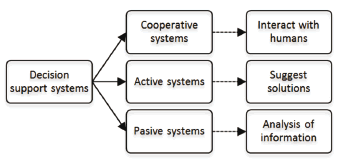
<body><![CDATA[<p>&nbsp;</p>     <p><font size="3" face="Verdana, Arial, Helvetica, sans-serif"><b>2. DECISION SUPPORT SYSTEMS</b></font></p>     <p><font size="2" face="Verdana, Arial, Helvetica, sans-serif">Decision support systems are a specific class of information systems that help business people to make decisions. These systems work under the scheme of modeling information, facilitating the decision making process [5,6]. Decision support systems allow for one to obtain relevant information from an unorganized set of data, which can be found in text documents, spreadsheets, and even in the knowledge of people, which becomes the input to solve decision-making problems, as well as generating strategies in companies.</font></p>     <p><font size="2" face="Verdana, Arial, Helvetica, sans-serif">According to Tech-FAQ.com [7], many companies have integrated these systems into their daily activities, as is the case of companies that constantly analyze their sales data, budgets, spreadsheets, and forecasts to make decisions about the daily planning process. According to Tech-FAQ.com [7], although there is no universally-defined classification for DSSs, they can be separated into three basic categories: passive, active, and cooperative.</font></p>     <p><font size="2" face="Verdana, Arial, Helvetica, sans-serif">The passive decision support systems are responsible only for collecting and organizing information for its use by the people responsible for the decision; therefore, these systems do not suggest any specific response [7]. The active systems are responsible for collecting information, upon which they base an explicit presentation of one or more solutions to the decision problem [7]. A cooperative DSS is responsible for gathering the information, analyzing it, and then delivering it to the people responsible for decision making, and is also tasked to revise or refine the information. The name &quot;cooperative&quot; is derived from the cooperative work between software and people, with the intention of making the best possible decision [7].</font></p>     <p><font size="2" face="Verdana, Arial, Helvetica, sans-serif"><a href="#fig01">Figure 1</a> shows the classification of DSSs in the three families mentioned in the previous paragraph, as well as their scope. </font></p>     <p align="center"><font size="2" face="Verdana, Arial, Helvetica, sans-serif"><b><a name="fig01"></a><img src="/img/revistas/dyna/v79n173/a21fig01.gif">    <br>   Figure 1.</b> DSS classification and scope in decision making</font></p>     <p><font size="2" face="Verdana, Arial, Helvetica, sans-serif">The classification in <a href="#fig01">Fig. 1</a> is based on the interaction of the support system with users. A classification based on the functioning of such tools shows a separation into 5 types of families [7,8]:</font></p> <ul>   <li class="dyna-normal"><font size="2" face="Verdana, Arial, Helvetica, sans-serif">Communication-based DSSs</font></li>   <li class="dyna-normal"><font size="2" face="Verdana, Arial, Helvetica, sans-serif">Data-driven DSSs</font></li>   <li class="dyna-normal"><font size="2" face="Verdana, Arial, Helvetica, sans-serif">Document-based DSSs</font></li>   <li class="dyna-normal"><font size="2" face="Verdana, Arial, Helvetica, sans-serif">Knowledge-based DSSs</font></li>   <li class="dyna-normal"><font size="2" face="Verdana, Arial, Helvetica, sans-serif">Model-based DSSs</font></li>     </ul>     ]]></body>
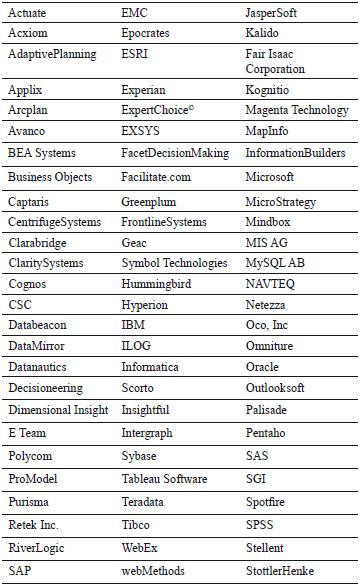
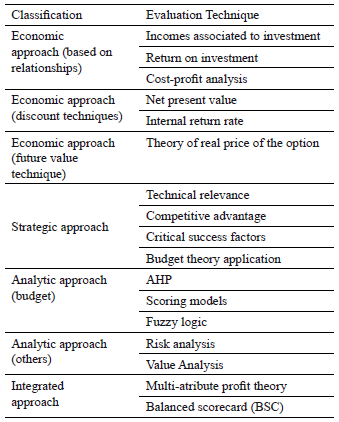
<body><![CDATA[<p><font size="2" face="Verdana, Arial, Helvetica, sans-serif">A communication-based model is based on the communication of several people for making the decisions. The data-driven DSS is responsible for collecting the information, which is then manipulated to meet the need of the person responsible for the decision. The document-based DSS system uses various types of documents (pages of text, spreadsheets, database reports, etc.) to solve decision problems, as well as to manipulate the information in an attempt to refine strategies.</font></p>     <p><font size="2" face="Verdana, Arial, Helvetica, sans-serif">Knowledge-based systems analyze specific rules stored in a computer or rules used by a group of humans, which allows one to establish whether a decision should be made. Finally, systems based on models use statistic simulations and financial models to solve decision problems [7].</font></p>     <p><font size="2" face="Verdana, Arial, Helvetica, sans-serif">It is important to note that although these are very good computer tools for analyzing information, and even though they give options to be selected as the best alternative, the final decision of the decision-making process must belong to people and not to software tools, which are inanimate machines that are incapable of considering many external factors in the analysis and can not contextualize the information they present, information which could modify the final decision.</font></p>     <p>&nbsp;</p>     <p><font size="3" face="Verdana, Arial, Helvetica, sans-serif"><b>3. DECISION SUPPORT SYSTEMS OFFER</b></font></p>     <p><font size="2" face="Verdana, Arial, Helvetica, sans-serif">On the international market, it is easy to find software suppliers who provide DSSs, due to their importance in helping companies. <a href="#tab01">Table 1</a> shows a list of DSS manufacturers reported by DSSResources.com [8], which is comprised of more than 80 manufacturers. This demonstrates the broad offer available for such software tools.</font></p>     <p align="center"><font size="2" face="Verdana, Arial, Helvetica, sans-serif"><b><a name="tab01"></a>Table 1.</b> DSS design companies [8]</font>    <br>   <img src="/img/revistas/dyna/v79n173/a21tab01.gif"></p>     <p><font size="2" face="Verdana, Arial, Helvetica, sans-serif">These systems use analytical models to analyze information and to guide those responsible for decision making. In addition, some of these models can use both quantitative and qualitative variables simultaneously. <a href="#tab02">Table 2</a> presents some of the analytical methods for supporting the DSS processes which are most used.</font></p>     <p align="center"><font size="2" face="Verdana, Arial, Helvetica, sans-serif"><b><a name="tab02"></a>Table 2.</b> Decision making analysis methods classification [9] (adapted from [10])</font>    ]]></body>
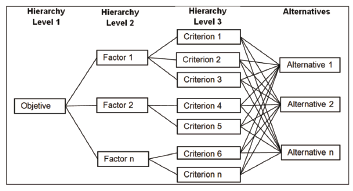
<body><![CDATA[<br>   <img src="/img/revistas/dyna/v79n173/a21tab02.gif"></p>     <p><font size="2" face="Verdana, Arial, Helvetica, sans-serif">One of the most widely used software for decision making in the industry is Expertchoice&copy;, of the U.S. House of Expert Choice software [11]. This software is based on the Analytic Hierarchy Process (AHP) for selecting the best alternative in a process of decision analysis that can be multi-attribute, multi-objective, and that also may involve several people in the analysis process.</font></p>     <p>&nbsp;</p>     <p><font size="3" face="Verdana, Arial, Helvetica, sans-serif"><b>4. THE AHP METHOD AND EXPERTCHOICE&copy;</b></font></p>     <p><font size="2" face="Verdana, Arial, Helvetica, sans-serif">The Analytic Hierarchy Process, is based on structuring a problem in different levels so that the overall objective of the decision analysis process is the first level of hierarchy, followed by the factors, sub-factors, and criteria that need to be considered for the decision process [12,13]. Once the hierarchical structure for the decision problem is set, this objective and factor structure (called the hierarchical structure) is compared with the alternatives that can solve the particular problem, as shown in <a href="#fig02">Fig. 2</a> [14].</font></p>     <p align="center"><font size="2" face="Verdana, Arial, Helvetica, sans-serif"><b><a name="fig02"></a><img src="/img/revistas/dyna/v79n173/a21fig02.gif">    <br>   Figure 2.</b> AHP method structure, adapted from [14]</font></p>     <p><font size="2" face="Verdana, Arial, Helvetica, sans-serif">Once the hierarchical structure is established, the person responsible for decision making should establish a set of preferences regarding the comparison of all of the factors and criteria of the hierarchical structure as well as a comparison of alternatives with respect to each criterion of the last level of hierarchy. The presentation of the preferences for each of the factors, criteria and alternatives in a table is known as the preference matrix, which is the starting point for the mathematical analysis of the AHP method.</font></p>     <p><font size="2" face="Verdana, Arial, Helvetica, sans-serif">The DSS software ExperTchoice&copy;, through a user friendly interface allows for one to:</font></p> <ul>   <li class="dyna-normal"><font size="2" face="Verdana, Arial, Helvetica, sans-serif">Get all the information about the hierarchical structure of the problem and the preferences of the evaluator in a quick and easy way.</font></li>   <li class="dyna-normal"><font size="2" face="Verdana, Arial, Helvetica, sans-serif">Automatically carry out all of the mathematical treatment of AHP for decision making.</font></li>   <li class="dyna-normal"><font size="2" face="Verdana, Arial, Helvetica, sans-serif">Develop a sensitivity analysis of the final answer given, in which the evaluator can modify the decision delivered by the software. (making Expertchoice&copy; a cooperative tool).</font></li>     </ul>     ]]></body>
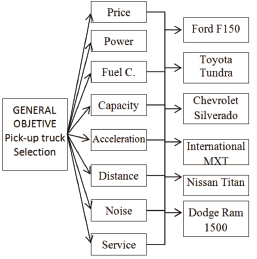
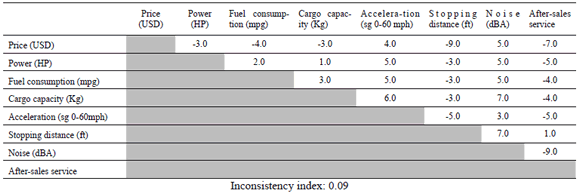
<body><![CDATA[<p><font size="2" face="Verdana, Arial, Helvetica, sans-serif">In the next section, the Expertchoice&copy; software application for the selection of pick-up trucks in a Colombian shipyard is presented.</font></p>     <p>&nbsp;</p>     <p><font size="3" face="Verdana, Arial, Helvetica, sans-serif"><b>5. DSS EXPERTCHOICE&copy;APLICATION</b></font></p>     <p><font size="2" face="Verdana, Arial, Helvetica, sans-serif">The central problem of decision in the company of the study is to select the brand of new pick-up truck to be acquired by the company to renew its fleet. The problem is structured with a central goal (selecting the best pick-up truck according to the needs of the company) and 8 critical factors for the decision. The number of possible alternatives is 6. The relevant factors for the company are:</font></p> <ul>   <li class="dyna-normal"><font size="2" face="Verdana, Arial, Helvetica, sans-serif">Price (in USD)</font></li>   <li class="dyna-normal"><font size="2" face="Verdana, Arial, Helvetica, sans-serif">Power (HP)</font></li>   <li class="dyna-normal"><font size="2" face="Verdana, Arial, Helvetica, sans-serif">Fuel consumption (mpg)</font></li>   <li class="dyna-normal"><font size="2" face="Verdana, Arial, Helvetica, sans-serif">Cargo capacity (Kg)</font></li>   <li class="dyna-normal"><font size="2" face="Verdana, Arial, Helvetica, sans-serif">Acceleration (sg 0&ndash;60 mph)</font></li>   <li class="dyna-normal"><font size="2" face="Verdana, Arial, Helvetica, sans-serif">Stopping distance (ft)</font></li>   <li class="dyna-normal"><font size="2" face="Verdana, Arial, Helvetica, sans-serif">Noise (dBA)</font></li>   <li class="dyna-normal"><font size="2" face="Verdana, Arial, Helvetica, sans-serif">After-sales service</font></li>     </ul>     <p><font size="2" face="Verdana, Arial, Helvetica, sans-serif"><a href="#fig03">Figure 3</a> shows the structure of the decision problem.</font></p>     <p align="center"><font size="2" face="Verdana, Arial, Helvetica, sans-serif"><b><a name="fig03"></a><img src="/img/revistas/dyna/v79n173/a21fig03.gif">    <br>   Figure 3.</b> Decision problem structure</font></p>     <p><font size="2" face="Verdana, Arial, Helvetica, sans-serif">The preferences given by the evaluator of the company with respect to the factors of the perented structure are shown in <a href="#tab03">Table 3</a>. Preferences of the comparison between the alternatives and each of these factors were obtained in the same way.</font></p>     <p align="center"><font size="2" face="Verdana, Arial, Helvetica, sans-serif"><b><a name="tab03"></a>Table 3.</b> Preferences matrix</font>    ]]></body>
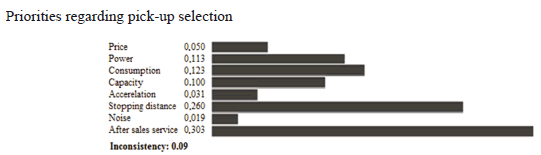
<body><![CDATA[<br>   <img src="/img/revistas/dyna/v79n173/a21tab03.gif"></p>     <p>&nbsp;</p>     <p><font size="3" face="Verdana, Arial, Helvetica, sans-serif"><b>6. RESULTS</b></font></p>     <p><b><font size="2" face="Verdana, Arial, Helvetica, sans-serif">6.1. Choosing the best alternative    <br>   </font></b><font size="2" face="Verdana, Arial, Helvetica, sans-serif">Using the Expertchoice 5.1 trial version, it was possible to select the best alternative for pick-up trucks with the requirements of the company. The results of the preferences and the final score according to the global goal are shown in <a href="#fig04">Figs. 4</a> and <a href="#fig05">5</a>, respectively.</font></p>     <p align="center"><font size="2" face="Verdana, Arial, Helvetica, sans-serif"><b><a name="fig04"></a><img src="/img/revistas/dyna/v79n173/a21fig04.gif">    <br>   Figure 4.</b> Preferences toward the global goal (pick-up selection)</font> <font size="2" face="Verdana, Arial, Helvetica, sans-serif">Summary regarding pick-up selection</font></p>     <p align="center"><font size="2" face="Verdana, Arial, Helvetica, sans-serif"><b><a name="fig05"></a><img src="/img/revistas/dyna/v79n173/a21fig05.gif">    <br>   Figure 5. </b>Final classification of alternatives</font></p>     <p><font size="2" face="Verdana, Arial, Helvetica, sans-serif">According to <a href="#fig04">Fig. 4</a>, it is possible to see that the factor that has the most weight is the after sales-service, followed by the stopping distance and fuel consumption. <a href="#fig05">Figure 5</a> shows that the alternative that has the most weight is the Nissan Titan, which means that this is the pick-up truck that should be selected by the company, after considering goals and factor preference </font></p>     ]]></body>
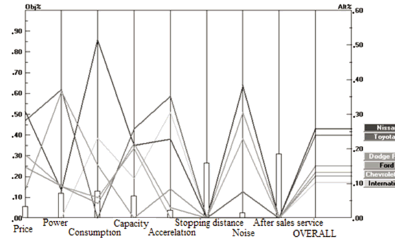
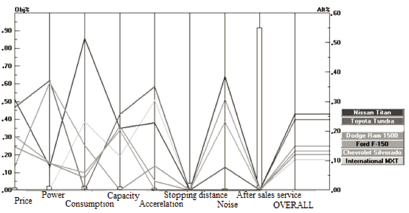
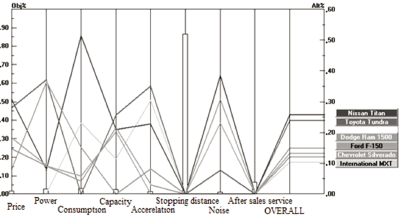
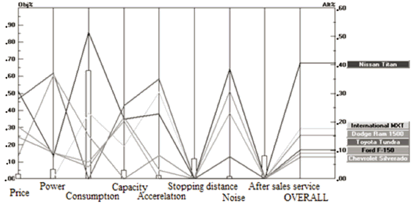
<body><![CDATA[<p><font size="2" face="Verdana, Arial, Helvetica, sans-serif">From <a href="#fig05">Fig. 5</a> it is also possible to observe that the overall inconsistency of the problem is less than 0.1. The consistency index is a measure of the balance that the evaluator has on the judgments that he delivers to the system, through the comparison matrix. A value of this ratio below 0.1, demonstrates an acceptable consistency and allows one to continue with the application of the AHP method.</font></p>     <p><font size="2" face="Verdana, Arial, Helvetica, sans-serif"><b>6.2. Sensitivity analysis    <br>   </b></font><font size="2" face="Verdana, Arial, Helvetica, sans-serif">To perform the sensitivity analysis, the factors of after sales service, stopping distance, fuel consumption, and power were selected, since these have more relevance to the overall goal, as presented in <a href="#fig04">Fig. 4</a>. Using the Expertchoice&copy;5.1 performance tool, it is possible to obtain the performance chart of each of the pick-up trucks with respect to the factors, as shown in <a href="#fig06">Fig. 6</a>. When making changes to the weight of preferences, it is possible to evaluate changes in the final result for the selection of the pick-up truck, which is the sensitivity analysis.</font></p>     <p align="center"><font size="2" face="Verdana, Arial, Helvetica, sans-serif"><b><a name="fig06"></a><img src="/img/revistas/dyna/v79n173/a21fig06.gif">    <br>   Figure 6.</b> Alternative performance chart by goals</font></p>     <p><font size="2" face="Verdana, Arial, Helvetica, sans-serif">In <a href="#fig06">Fig. 6</a>, the shadowed lines correspond to the performance of each alternative for each factor. The white color bar determines the weight of the alternative corresponding to the weights determined by Expertchoice&copy;. Next, the sensitivity analysis is carried out for each of the four factors mentioned by increasing or decreasing the weight of the factors and then analyzing the outcome changes.</font></p>     <p><font size="2" face="Verdana, Arial, Helvetica, sans-serif"><b>6.2.1. Variation in after-sales service and stopping distance    <br>   </b>By changing the weight of the after-sales service factor, as shown in <a href="#fig07">Fig. 7</a>, it can be seen that there is no change in the outcome; the Nissan Titan remains the best alternative. Therefore, the model is not sensitive to changes in this variable. A similar result occurs with changes in the stopping distance factor, as shown in <a href="#fig08">Fig. 8</a>.</font></p>     <p align="center"><font size="2" face="Verdana, Arial, Helvetica, sans-serif"><b><a name="fig07"></a><img src="/img/revistas/dyna/v79n173/a21fig07.gif">    <br>   Figure 7.</b> Sensitivity analysis: after-sales service factor</font></p>     ]]></body>
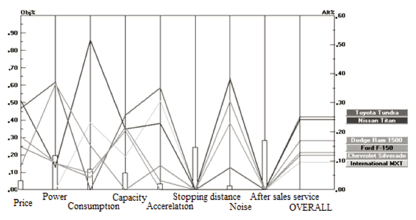
<body><![CDATA[<p align="center"><font size="2" face="Verdana, Arial, Helvetica, sans-serif"><b><a name="fig08"></a><img src="/img/revistas/dyna/v79n173/a21fig08.gif">    <br>   Figure 8.</b> Sensitivity analysis: stopping distance factor</font></p>     <p><font size="2" face="Verdana, Arial, Helvetica, sans-serif"><b>6.2.2. Variation in fuel consumption    <br>   </b></font><font size="2" face="Verdana, Arial, Helvetica, sans-serif">If the fuel consumption variable loses weight, the final decision to choose the Nissan truck is modified, the Toyota Tundra becoming the best alternative. In contrast to this, as the variable's importance increases, the decision is not altered and the selection of the Nissan Titan is strengthened. The graphs of sensitivity that show these movements in the fuel consumption factor are shown in <a href="#fig09">Figs. 9</a> and <a href="#fig10">10</a>, respectively.</font></p>     <p align="center"><font size="2" face="Verdana, Arial, Helvetica, sans-serif"><b><a name="fig09"></a><img src="/img/revistas/dyna/v79n173/a21fig09.gif">    <br>   Figure 9. </b>Sensitivity analysis: fuel consumption, reduction of valuation</font></p>     <p align="center"><font size="2" face="Verdana, Arial, Helvetica, sans-serif"><b><a name="fig10"></a>    <br>   Figure10.</b> Sensitivity analysis: fuel consumption, increase of valuation</font></p>     <p><font size="2" face="Verdana, Arial, Helvetica, sans-serif"><b>6.2.3. Variation of power    <br>   </b></font><font size="2" face="Verdana, Arial, Helvetica, sans-serif">In contrast to what happened with the fuel consumption factor, the sensitivity analysis reveals that in the case of increased preference for the power variable, the final decision to choose the Nissan truck is modified, the Toyota Tundra becoming the best alternative. The sensitivity chart that illustrates this situation is presented in <a href="#fig11">Fig. 11</a>.</font></p>     ]]></body>
<body><![CDATA[<p align="center"><font size="2" face="Verdana, Arial, Helvetica, sans-serif"><b><a name="fig11"></a><img src="/img/revistas/dyna/v79n173/a21fig11.gif">    <br>   Figure 11.</b> Sensitivity analysis: power</font></p>     <p><font size="2" face="Verdana, Arial, Helvetica, sans-serif">In summary, the sensitivity analysis of the variation in the preference of the four most important factors indicates that the model is sensitive to fuel consumption and power. In contrast, variations in the preference of after-sales service and stopping distance factors showed no impact on the final decision, calculated for the DSS Expertchoice&copy;.</font></p>     <p>&nbsp;</p>     <p><font size="3" face="Verdana, Arial, Helvetica, sans-serif"><b>7. CONCLUSIONS</b></font></p>     <p><font size="2" face="Verdana, Arial, Helvetica, sans-serif">Decision support systems help humans in the decision-making processes, both in data acquisition and its processing, but these systems help especially in the use of analytical techniques that reduce subjectivity in decision analysis.</font></p>     <p><font size="2" face="Verdana, Arial, Helvetica, sans-serif">With the help of the decision support system Expertchoise&copy;, it was possible to make a complex decision regarding the best pick-up truck for the Colombian shipyard in which the study was conducted. The complexity is caused by the high number of factors to take into account (8) and the different alternatives (6), which makes it so that a person or group of people who make the decision will not have clarity on the best choice, until they really consider all these elements.</font></p>     <p><font size="2" face="Verdana, Arial, Helvetica, sans-serif">As it was shown in the implementation of the Experchoice&copy; DSS, this is an easy to use system, which is based on the AHP method for solving problems of multi-objective analysis. In addition, this system not only delivers the final solution, but also allows for a sensitivity analysis to visualize the impact of preference on the factors in the final decision, allowing for the evaluation of trends and the modification of the decision based on them.</font></p>     <p><font size="2" face="Verdana, Arial, Helvetica, sans-serif">Finally, the relevance of DSSs is demonstrated by the large amount of software companies that supply these kinds of systems to the market, which is derived from the amount of companies interested in acquiring this type of software to facilitate and/or improve their decision processes.</font></p>     <p>&nbsp;</p>     ]]></body>
<body><![CDATA[<p><font size="3" face="Verdana, Arial, Helvetica, sans-serif"><b>REFERENCES</b></font></p>     <!-- ref --><p><font size="2" face="Verdana, Arial, Helvetica, sans-serif"><b>[1]</b> Hern&aacute;ndez y Rodr&iacute;guez, S. Introducci&oacute;n a la administraci&oacute;n. Cuarta edici&oacute;n. McGraw-Hill Americana. M&eacute;xico. 2006.     &nbsp;&nbsp;&nbsp;&nbsp;&nbsp;&nbsp;&nbsp;&nbsp;[&#160;<a href="javascript:void(0);" onclick="javascript: window.open('/scielo.php?script=sci_nlinks&ref=000104&pid=S0012-7353201200030002100001&lng=','','width=640,height=500,resizable=yes,scrollbars=1,menubar=yes,');">Links</a>&#160;]<!-- end-ref --><!-- ref --><br>   <b>[2]</b> Chiavenato, I. Introducci&oacute;n a la teor&iacute;a general de la administraci&oacute;n. S&eacute;ptima Edici&oacute;n. McGraw-Hill. M&eacute;xico.2006.     &nbsp;&nbsp;&nbsp;&nbsp;&nbsp;&nbsp;&nbsp;&nbsp;[&#160;<a href="javascript:void(0);" onclick="javascript: window.open('/scielo.php?script=sci_nlinks&ref=000105&pid=S0012-7353201200030002100002&lng=','','width=640,height=500,resizable=yes,scrollbars=1,menubar=yes,');">Links</a>&#160;]<!-- end-ref --><!-- ref --><br>   <b>[3]</b> Correa, A. and Gomez, R. Tecnolog&iacute;as de la informaci&oacute;n en la cadena de suministro. DYNA Vol 76, No 157. Pp. 37-48. 2009.     &nbsp;&nbsp;&nbsp;&nbsp;&nbsp;&nbsp;&nbsp;&nbsp;[&#160;<a href="javascript:void(0);" onclick="javascript: window.open('/scielo.php?script=sci_nlinks&ref=000106&pid=S0012-7353201200030002100003&lng=','','width=640,height=500,resizable=yes,scrollbars=1,menubar=yes,');">Links</a>&#160;]<!-- end-ref --><!-- ref --><br>   <b>[4]</b> Arango, M.D.; Zapata, J.A. and Adarme, W. Herramientas tecnol&oacute;gicas al servicio de la gesti&oacute;n empresarial. Avances en Sistemas e Inform&aacute;tica. Vol. 7, No 3. pp. 87-101. 2010.     &nbsp;&nbsp;&nbsp;&nbsp;&nbsp;&nbsp;&nbsp;&nbsp;[&#160;<a href="javascript:void(0);" onclick="javascript: window.open('/scielo.php?script=sci_nlinks&ref=000107&pid=S0012-7353201200030002100004&lng=','','width=640,height=500,resizable=yes,scrollbars=1,menubar=yes,');">Links</a>&#160;]<!-- end-ref --><!-- ref --><br>   <b>[5]</b> Arnott, D. and G. Pervan, &quot;A critical analysis of decision support systems research&quot;, Journal of Information Technology, 20, 2, pp. 67-87. 2005.     &nbsp;&nbsp;&nbsp;&nbsp;&nbsp;&nbsp;&nbsp;&nbsp;[&#160;<a href="javascript:void(0);" onclick="javascript: window.open('/scielo.php?script=sci_nlinks&ref=000108&pid=S0012-7353201200030002100005&lng=','','width=640,height=500,resizable=yes,scrollbars=1,menubar=yes,');">Links</a>&#160;]<!-- end-ref --><!-- ref --><br>   <b>[6]</b> Murty, K; Liu, J; Wan, Y-W; and Linn, R.A decision support system for operations in a container terminal Decision Support SystemsVolume 39, Issue 3, May, Pages 309-332. 2005.     &nbsp;&nbsp;&nbsp;&nbsp;&nbsp;&nbsp;&nbsp;&nbsp;[&#160;<a href="javascript:void(0);" onclick="javascript: window.open('/scielo.php?script=sci_nlinks&ref=000109&pid=S0012-7353201200030002100006&lng=','','width=640,height=500,resizable=yes,scrollbars=1,menubar=yes,');">Links</a>&#160;]<!-- end-ref --><!-- ref --><br>   <b>[7]</b> Tech-Faq.com Decision Support System. Available at: <a href="http://www.tech-faq.com/decision-support-system.html" target="referencia">http://www.tech-faq.com/decision-support-system.html</a>. Cited in January 2010.     &nbsp;&nbsp;&nbsp;&nbsp;&nbsp;&nbsp;&nbsp;&nbsp;[&#160;<a href="javascript:void(0);" onclick="javascript: window.open('/scielo.php?script=sci_nlinks&ref=000110&pid=S0012-7353201200030002100007&lng=','','width=640,height=500,resizable=yes,scrollbars=1,menubar=yes,');">Links</a>&#160;]<!-- end-ref --><!-- ref --><br>   <b>[8]</b> Dssresources.com Decision Support Systems Vendor List. Available at <a href="http://www.dssresources.com" target="referencia">http://www.dssresources.com</a>. Cited in January 2010.     &nbsp;&nbsp;&nbsp;&nbsp;&nbsp;&nbsp;&nbsp;&nbsp;[&#160;<a href="javascript:void(0);" onclick="javascript: window.open('/scielo.php?script=sci_nlinks&ref=000111&pid=S0012-7353201200030002100008&lng=','','width=640,height=500,resizable=yes,scrollbars=1,menubar=yes,');">Links</a>&#160;]<!-- end-ref --><!-- ref --><br>   <b>[9]</b> Khakasa, E. Evaluating Information Technology Investments - A Survey of Kenyan Commercial Banks. Repositioning African Business and Development for the 21st Century. Proceedings of the 10th Annual Conference. 2009 IAABD Ed. Simon Sigu&eacute; Kenya. 2009     &nbsp;&nbsp;&nbsp;&nbsp;&nbsp;&nbsp;&nbsp;&nbsp;[&#160;<a href="javascript:void(0);" onclick="javascript: window.open('/scielo.php?script=sci_nlinks&ref=000112&pid=S0012-7353201200030002100009&lng=','','width=640,height=500,resizable=yes,scrollbars=1,menubar=yes,');">Links</a>&#160;]<!-- end-ref --><!-- ref --><br>   <b>[10]</b> Irani, Z; Ezingeard, J.-N. and Grieve,R.J. Integrating the costs of a manufacturing IT/IS infrastructure into the investment decision-making process, Technovation17 (11/12), pp. 695–706. 1997.     &nbsp;&nbsp;&nbsp;&nbsp;&nbsp;&nbsp;&nbsp;&nbsp;[&#160;<a href="javascript:void(0);" onclick="javascript: window.open('/scielo.php?script=sci_nlinks&ref=000113&pid=S0012-7353201200030002100010&lng=','','width=640,height=500,resizable=yes,scrollbars=1,menubar=yes,');">Links</a>&#160;]<!-- end-ref --><!-- ref --><br>   <b>[11]</b> Expertchoice.com.Expert Choice 11.5&trade; Powerful Performance for Organizational Decision-Making. Available at <a href="http://www.expertchoice.com/" target="referencia">http://www.expertchoice.com/</a>. Cited in January 2011.     &nbsp;&nbsp;&nbsp;&nbsp;&nbsp;&nbsp;&nbsp;&nbsp;[&#160;<a href="javascript:void(0);" onclick="javascript: window.open('/scielo.php?script=sci_nlinks&ref=000114&pid=S0012-7353201200030002100011&lng=','','width=640,height=500,resizable=yes,scrollbars=1,menubar=yes,');">Links</a>&#160;]<!-- end-ref --><!-- ref --><br>   <b>[12]</b> Saaty, T.L &quot;How to make a decision: The analytic hierarchy process&quot;, EuropeanJournal Operation Research, Vol.48 pp9-26. 1990     &nbsp;&nbsp;&nbsp;&nbsp;&nbsp;&nbsp;&nbsp;&nbsp;[&#160;<a href="javascript:void(0);" onclick="javascript: window.open('/scielo.php?script=sci_nlinks&ref=000115&pid=S0012-7353201200030002100012&lng=','','width=640,height=500,resizable=yes,scrollbars=1,menubar=yes,');">Links</a>&#160;]<!-- end-ref --><!-- ref --><br>   <b>[13]</b> Saaty, T. L. The analytic Hierarchy and analytic network processes for the measurement of intangible criteria and for decisi&oacute;n-making. Multicriteria decisi&oacute;n analysis. State of the art surveys. Springer International Series. Springer science + business media. Inc. 2005.     &nbsp;&nbsp;&nbsp;&nbsp;&nbsp;&nbsp;&nbsp;&nbsp;[&#160;<a href="javascript:void(0);" onclick="javascript: window.open('/scielo.php?script=sci_nlinks&ref=000116&pid=S0012-7353201200030002100013&lng=','','width=640,height=500,resizable=yes,scrollbars=1,menubar=yes,');">Links</a>&#160;]<!-- end-ref --><!-- ref --><br>   <b>[14]</b> Berumen, Sergio A. Cambio tecnol&oacute;gico e innovaci&oacute;n en las empresas. Esic editorial. 2007. </font>&nbsp;&nbsp;&nbsp;&nbsp;&nbsp;&nbsp;&nbsp;&nbsp;[&#160;<a href="javascript:void(0);" onclick="javascript: window.open('/scielo.php?script=sci_nlinks&ref=000117&pid=S0012-7353201200030002100014&lng=','','width=640,height=500,resizable=yes,scrollbars=1,menubar=yes,');">Links</a>&#160;]<!-- end-ref --> ]]></body><back>
<ref-list>
<ref id="B1">
<label>1</label><nlm-citation citation-type="book">
<person-group person-group-type="author">
<name>
<surname><![CDATA[Hernández y Rodríguez]]></surname>
<given-names><![CDATA[S.]]></given-names>
</name>
</person-group>
<source><![CDATA[Introducción a la administración]]></source>
<year>2006</year>
<edition>Cuarta edición</edition>
<publisher-name><![CDATA[McGraw-Hill Americana]]></publisher-name>
</nlm-citation>
</ref>
<ref id="B2">
<label>2</label><nlm-citation citation-type="book">
<person-group person-group-type="author">
<name>
<surname><![CDATA[Chiavenato]]></surname>
<given-names><![CDATA[I.]]></given-names>
</name>
</person-group>
<source><![CDATA[Introducción a la teoría general de la administración]]></source>
<year>2006</year>
<edition>Séptima Edición</edition>
<publisher-name><![CDATA[McGraw-Hill]]></publisher-name>
</nlm-citation>
</ref>
<ref id="B3">
<label>3</label><nlm-citation citation-type="journal">
<person-group person-group-type="author">
<name>
<surname><![CDATA[Correa]]></surname>
<given-names><![CDATA[A.]]></given-names>
</name>
<name>
<surname><![CDATA[Gomez]]></surname>
<given-names><![CDATA[R.]]></given-names>
</name>
</person-group>
<article-title xml:lang="es"><![CDATA[Tecnologías de la información en la cadena de suministro.]]></article-title>
<source><![CDATA[DYNA]]></source>
<year>2009</year>
<volume>76</volume>
<numero>157</numero>
<issue>157</issue>
<page-range>37-48</page-range></nlm-citation>
</ref>
<ref id="B4">
<label>4</label><nlm-citation citation-type="journal">
<person-group person-group-type="author">
<name>
<surname><![CDATA[Arango]]></surname>
<given-names><![CDATA[M.D.]]></given-names>
</name>
<name>
<surname><![CDATA[Zapata]]></surname>
<given-names><![CDATA[J.A.]]></given-names>
</name>
<name>
<surname><![CDATA[Adarme]]></surname>
<given-names><![CDATA[W.]]></given-names>
</name>
</person-group>
<article-title xml:lang="es"><![CDATA[Herramientas tecnológicas al servicio de la gestión empresarial.]]></article-title>
<source><![CDATA[Avances en Sistemas e Informática]]></source>
<year>2010</year>
<volume>7</volume>
<numero>3</numero>
<issue>3</issue>
<page-range>87-101</page-range></nlm-citation>
</ref>
<ref id="B5">
<label>5</label><nlm-citation citation-type="journal">
<person-group person-group-type="author">
<name>
<surname><![CDATA[Arnott]]></surname>
<given-names><![CDATA[D.]]></given-names>
</name>
<name>
<surname><![CDATA[Pervan]]></surname>
<given-names><![CDATA[G.]]></given-names>
</name>
</person-group>
<article-title xml:lang="en"><![CDATA[A critical analysis of decision support systems research]]></article-title>
<source><![CDATA[Journal of Information Technology]]></source>
<year>2005</year>
<volume>20</volume>
<numero>2</numero>
<issue>2</issue>
<page-range>67-87</page-range></nlm-citation>
</ref>
<ref id="B6">
<label>6</label><nlm-citation citation-type="journal">
<person-group person-group-type="author">
<name>
<surname><![CDATA[Murty]]></surname>
<given-names><![CDATA[K]]></given-names>
</name>
<name>
<surname><![CDATA[Liu]]></surname>
<given-names><![CDATA[J]]></given-names>
</name>
<name>
<surname><![CDATA[Wan]]></surname>
<given-names><![CDATA[Y-W]]></given-names>
</name>
<name>
<surname><![CDATA[Linn]]></surname>
<given-names><![CDATA[R.A]]></given-names>
</name>
</person-group>
<article-title xml:lang="en"><![CDATA[decision support system for operationsin a container terminal]]></article-title>
<source><![CDATA[Decision Support Systems]]></source>
<year>2005</year>
<volume>39</volume>
<numero>3</numero>
<issue>3</issue>
<page-range>309-332</page-range></nlm-citation>
</ref>
<ref id="B7">
<label>7</label><nlm-citation citation-type="">
<collab>Tech-Faq.com</collab>
<source><![CDATA[Decision Support System.]]></source>
<year></year>
</nlm-citation>
</ref>
<ref id="B8">
<label>8</label><nlm-citation citation-type="">
<collab>Dssresources.com</collab>
<source><![CDATA[Decision Support Systems Vendor List.]]></source>
<year>Janu</year>
<month>ar</month>
<day>y </day>
</nlm-citation>
</ref>
<ref id="B9">
<label>9</label><nlm-citation citation-type="confpro">
<person-group person-group-type="author">
<name>
<surname><![CDATA[Khakasa]]></surname>
<given-names><![CDATA[E.]]></given-names>
</name>
</person-group>
<article-title xml:lang="en"><![CDATA[Evaluating Information Technology Investments - A Survey of Kenyan Commercial Banks.: Repositioning African Business and Development for the 21st Century]]></article-title>
<source><![CDATA[]]></source>
<year></year>
<conf-name><![CDATA[10th Annual Conference]]></conf-name>
<conf-date>2009</conf-date>
<conf-loc>Simon Sigué </conf-loc>
</nlm-citation>
</ref>
<ref id="B10">
<label>10</label><nlm-citation citation-type="journal">
<person-group person-group-type="author">
<name>
<surname><![CDATA[Irani]]></surname>
<given-names><![CDATA[Z]]></given-names>
</name>
<name>
<surname><![CDATA[Ezingeard]]></surname>
<given-names><![CDATA[J.-N.]]></given-names>
</name>
<name>
<surname><![CDATA[Grieve]]></surname>
<given-names><![CDATA[R.J.]]></given-names>
</name>
</person-group>
<article-title xml:lang="en"><![CDATA[Integrating the costs of a manufacturing IT/IS infrastructure into the investment decision-making process]]></article-title>
<source><![CDATA[Technovation]]></source>
<year>1997</year>
<volume>17</volume>
<numero>11/12</numero>
<issue>11/12</issue>
<page-range>695-706</page-range></nlm-citation>
</ref>
<ref id="B11">
<label>11</label><nlm-citation citation-type="">
<collab>Expertchoice.com.</collab>
<source><![CDATA[Expert Choice 11.5™ Powerful Performance for Organizational Decision-Making.]]></source>
<year>Janu</year>
<month>ar</month>
<day>y </day>
</nlm-citation>
</ref>
<ref id="B12">
<label>12</label><nlm-citation citation-type="journal">
<person-group person-group-type="author">
<name>
<surname><![CDATA[Saaty]]></surname>
<given-names><![CDATA[T.L]]></given-names>
</name>
</person-group>
<article-title xml:lang="en"><![CDATA[How to make a decision:: The analytic hierarchy process]]></article-title>
<source><![CDATA[EuropeanJournal Operation Research]]></source>
<year>1990</year>
<volume>48</volume>
<page-range>9-26</page-range></nlm-citation>
</ref>
<ref id="B13">
<label>13</label><nlm-citation citation-type="book">
<person-group person-group-type="author">
<name>
<surname><![CDATA[Saaty]]></surname>
<given-names><![CDATA[T. L.]]></given-names>
</name>
</person-group>
<source><![CDATA[The analytic Hierarchy and analytic network processes for the measurement of intangible criteria and for decisión-making.: Multicriteria decisión analysis.]]></source>
<year>2005</year>
<publisher-name><![CDATA[State of the art surveysSpringer International SeriesSpringer science + business media. Inc.]]></publisher-name>
</nlm-citation>
</ref>
<ref id="B14">
<label>14</label><nlm-citation citation-type="book">
<person-group person-group-type="author">
<name>
<surname><![CDATA[Berumen]]></surname>
<given-names><![CDATA[Sergio A.]]></given-names>
</name>
</person-group>
<source><![CDATA[Cambio tecnológico e innovación en las empresas]]></source>
<year>2007</year>
<publisher-name><![CDATA[Esic editorial.]]></publisher-name>
</nlm-citation>
</ref>
</ref-list>
</back>
</article>