<?xml version="1.0" encoding="ISO-8859-1"?><article xmlns:mml="http://www.w3.org/1998/Math/MathML" xmlns:xlink="http://www.w3.org/1999/xlink" xmlns:xsi="http://www.w3.org/2001/XMLSchema-instance">
<front>
<journal-meta>
<journal-id>0012-7353</journal-id>
<journal-title><![CDATA[DYNA]]></journal-title>
<abbrev-journal-title><![CDATA[Dyna rev.fac.nac.minas]]></abbrev-journal-title>
<issn>0012-7353</issn>
<publisher>
<publisher-name><![CDATA[Universidad Nacional de Colombia]]></publisher-name>
</publisher>
</journal-meta>
<article-meta>
<article-id>S0012-73532012000400006</article-id>
<title-group>
<article-title xml:lang="en"><![CDATA[DE GENNES PARAMETER DEPENDENCE ON SUPERCONDUCTING PROPERTIES OF MESOSCOPIC CIRCULAR SECTOR]]></article-title>
<article-title xml:lang="es"><![CDATA[DEPENDENCIA DEL PARÁMETRO DE DE GENNES SOBRE LAS PROPIEDADES SUPERCONDUCTORAS DE UN SECTOR CIRCULAR MESOSCÓPICO]]></article-title>
</title-group>
<contrib-group>
<contrib contrib-type="author">
<name>
<surname><![CDATA[BARBA ORTEGA]]></surname>
<given-names><![CDATA[JOSÉ JOSÉ]]></given-names>
</name>
<xref ref-type="aff" rid="A01"/>
</contrib>
<contrib contrib-type="author">
<name>
<surname><![CDATA[RINCÓN JOYA]]></surname>
<given-names><![CDATA[MIRYAM]]></given-names>
</name>
<xref ref-type="aff" rid="A02"/>
</contrib>
</contrib-group>
<aff id="A01">
<institution><![CDATA[,Universidad Nacional de Colombia  ]]></institution>
<addr-line><![CDATA[Bogotá ]]></addr-line>
</aff>
<aff id="A02">
<institution><![CDATA[,Universidad Nacional de Colombia  ]]></institution>
<addr-line><![CDATA[Bogotá ]]></addr-line>
</aff>
<pub-date pub-type="pub">
<day>00</day>
<month>08</month>
<year>2012</year>
</pub-date>
<pub-date pub-type="epub">
<day>00</day>
<month>08</month>
<year>2012</year>
</pub-date>
<volume>79</volume>
<numero>174</numero>
<fpage>46</fpage>
<lpage>50</lpage>
<copyright-statement/>
<copyright-year/>
<self-uri xlink:href="http://www.scielo.org.co/scielo.php?script=sci_arttext&amp;pid=S0012-73532012000400006&amp;lng=en&amp;nrm=iso"></self-uri><self-uri xlink:href="http://www.scielo.org.co/scielo.php?script=sci_abstract&amp;pid=S0012-73532012000400006&amp;lng=en&amp;nrm=iso"></self-uri><self-uri xlink:href="http://www.scielo.org.co/scielo.php?script=sci_pdf&amp;pid=S0012-73532012000400006&amp;lng=en&amp;nrm=iso"></self-uri><abstract abstract-type="short" xml:lang="en"><p><![CDATA[We implemented an algorithm using the link variable method to solve the time dependent Ginzburg-Landau equation in a superconductor prism with circular geometry. The sample is surrounded by a thin layer of another superconductor at higher critical temperature and submitted to an external magnetic field applied perpendicular to its plane. The boundary condition is taken into account with the de Gennes extrapolation length <img src="/img/revistas/dyna/v79n174/v79n174a06eq002.gif">. We evaluate the magnetization, vorticity, the first, and the third critical thermodynamical fields as functions of the external magnetic field and <img src="/img/revistas/dyna/v79n174/v79n174a06eq004.gif">parameter. We found that for these interfaces, the third critical field <img src="/img/revistas/dyna/v79n174/v79n174a06eq006.gif">and magnetization are largely increased while the first critical field <img src="/img/revistas/dyna/v79n174/v79n174a06eq008.gif">remains practically constant]]></p></abstract>
<abstract abstract-type="short" xml:lang="es"><p><![CDATA[Implementamos un algoritmo usando el método de variables de enlace para resolver las ecuaciones Ginzburg Landau dependientes del tiempo en un prisma superconductor con geometría circular. La muestra está rodeada por una pequeña capa de otro superconductor a mayor temperatura crítica y sometida a un campo magnético externo aplicado perpendicular a su plano. Las condiciones de contorno son tomadas en cuenta con la longitud de extrapolación de de Gennes <img src="/img/revistas/dyna/v79n174/v79n174a06eq010.gif">Evaluamos la magnetización, la vorticidad, el primero y tercer campos críticos termodinámicos como función del campo magnético externo y el parámetro <img src="/img/revistas/dyna/v79n174/v79n174a06eq004.gif">. Encontramos que para estas interfaces, el tercer campo crítico termodinámico <img src="/img/revistas/dyna/v79n174/v79n174a06eq012.gif">y la magnetización aumentan grandemente mientras el primer campo crítico <img src="/img/revistas/dyna/v79n174/v79n174a06eq014.gif">permanece prácticamente constante.]]></p></abstract>
<kwd-group>
<kwd lng="en"><![CDATA[de Gennes parameter]]></kwd>
<kwd lng="en"><![CDATA[vortex configuration]]></kwd>
<kwd lng="en"><![CDATA[magnetization]]></kwd>
<kwd lng="es"><![CDATA[parámetro de de Gennes]]></kwd>
<kwd lng="es"><![CDATA[configuración de vortices]]></kwd>
<kwd lng="es"><![CDATA[magnetización]]></kwd>
</kwd-group>
</article-meta>
</front><body><![CDATA[ <p align="center"><font size="4" face="Verdana, Arial, Helvetica, sans-serif"><b>DE GENNES PARAMETER DEPENDENCE ON SUPERCONDUCTING PROPERTIES OF MESOSCOPIC CIRCULAR   SECTOR</b></font></p>     <p align="center"><i><font size="3" face="Verdana, Arial, Helvetica, sans-serif"><b>DEPENDENCIA DEL   PAR&Aacute;METRO DE DE GENNES SOBRE LAS PROPIEDADES   SUPERCONDUCTORAS DE UN SECTOR CIRCULAR MESOSC&Oacute;PICO </b></font></i></p>     <p align="center">&nbsp;</p>     <p align="center"><font size="2" face="Verdana, Arial, Helvetica, sans-serif"><b>JOS&Eacute; JOS&Eacute; BARBA ORTEGA</b>    <br>   <i>PhD,   Universidad Nacional de Colombia, Bogot&aacute;, <a href="mailto:jjbarbao@unal.edu.co">jjbarbao@unal.edu.co</a></i></font></p>     <p align="center"><font size="2" face="Verdana, Arial, Helvetica, sans-serif"><b>MIRYAM RINC&Oacute;N JOYA</b>    <br>   <i>PhD, Universidad   Nacional de Colombia, Bogot&aacute;,<a href="mailto:mrinconj@unal.edu.co"> mrinconj@unal.edu.co</a></i> </font></p>     <p align="center">&nbsp;</p>     <p align="center"><font size="2" face="Verdana, Arial, Helvetica, sans-serif"><b>Received for review November 11<sup>th</sup>, 2011, accepted March 9<sup>th</sup>, 2012, final version March, 16<sup>th</sup>, 2012 </b></font></p>     <p>&nbsp;</p> <hr>     ]]></body>
<body><![CDATA[<p><font size="2" face="Verdana, Arial, Helvetica, sans-serif"><b>ABSTRACT:</b> We implemented an algorithm using the link variable   method to solve the time dependent Ginzburg-Landau   equation in a superconductor prism with circular geometry. The sample is   surrounded by a thin layer of another superconductor at higher critical   temperature and submitted to an external magnetic field applied perpendicular   to its plane. The boundary condition is taken into account with the de Gennes extrapolation length <img src="/img/revistas/dyna/v79n174/v79n174a06eq002.gif"> . We evaluate the   magnetization, vorticity, the first, and the third   critical thermodynamical fields as functions of the   external magnetic field and <img src="/img/revistas/dyna/v79n174/v79n174a06eq004.gif"> parameter. We found that for these interfaces,   the third critical field <img src="/img/revistas/dyna/v79n174/v79n174a06eq006.gif"> and magnetization are largely increased while   the first critical field <img src="/img/revistas/dyna/v79n174/v79n174a06eq008.gif"> remains practically   constant. </font></p>     <p><font size="2" face="Verdana, Arial, Helvetica, sans-serif"><b>KEYWORDS</b>: de Gennes parameter, vortex configuration, magnetization </font></p>     <p><font size="2" face="Verdana, Arial, Helvetica, sans-serif"><b>RESUMEN: </b>Implementamos un algoritmo usando el m&eacute;todo de variables de enlace para   resolver las ecuaciones Ginzburg Landau dependientes del tiempo en un prisma superconductor con geometr&iacute;a circular. La   muestra est&aacute; rodeada por una pequeña capa de otro superconductor a mayor   temperatura cr&iacute;tica y sometida a un campo magn&eacute;tico externo aplicado   perpendicular a su plano. Las condiciones de contorno son tomadas en cuenta con   la longitud de extrapolaci&oacute;n de de Gennes <img src="/img/revistas/dyna/v79n174/v79n174a06eq010.gif"> Evaluamos la magnetizaci&oacute;n, la vorticidad, el primero y tercer campos cr&iacute;ticos   termodin&aacute;micos como funci&oacute;n del campo   magn&eacute;tico externo y el par&aacute;metro <img src="/img/revistas/dyna/v79n174/v79n174a06eq004.gif"> . Encontramos que para estas interfaces, el   tercer campo cr&iacute;tico termodin&aacute;mico <img src="/img/revistas/dyna/v79n174/v79n174a06eq012.gif"> y la magnetizaci&oacute;n aumentan grandemente   mientras el primer campo cr&iacute;tico <img src="/img/revistas/dyna/v79n174/v79n174a06eq014.gif"> permanece pr&aacute;cticamente constante.</font></p>     <p><font size="2" face="Verdana, Arial, Helvetica, sans-serif"><b>PALABRAS CLAVE:</b> par&aacute;metro de de Gennes,   configuraci&oacute;n de vortices, magnetizaci&oacute;n </font></p> <hr>     <p>&nbsp;</p>     <p><font size="3" face="Verdana, Arial, Helvetica, sans-serif"><b>1. INTRODUCTION </b></font></p>     <p><font size="2" face="Verdana, Arial, Helvetica, sans-serif">The   properties and applications of superconductors are determined by their critical   parameters. By nanostructuring a superconductor, one   can modify the properties of an existing superconducting structure &#91;1-6&#93;.   A way to modify, enhance, or suppress the properties of superconducting samples   can be realized by controlling the sample boundary conditions. Theoretically,   one can simulate different types of material by varying the de Gennes extrapolation length <img src="/img/revistas/dyna/v79n174/v79n174a06eq016.gif"> in the boundary conditions for the order   parameter. It is well known that the phenomenology of superconductivity can be   described by the time-dependent Ginzburg Landau (TDGL) equations &#91;7-9&#93;. In the present paper we use   the TDGL theory to study the magnetization, vortex   configuration, and the transition fields in a circular sector with arbitrary   shape (see <a href="#fig01">Fig. 1</a> of &#91;10&#93;). We use an algorithm considering the boundary   conditions for the order parameter. Our procedure makes it possible to   generalize the algorithm to any circular geometry and <img src="/img/revistas/dyna/v79n174/v79n174a06eq016.gif"> value. According to the choice of boundary   conditions, we will show that the superconductivity can be considerably   enhanced, and a new classification of type-I and type-II superconductor may   occur. </font></p>     <p align="center"><font size="2" face="Verdana, Arial, Helvetica, sans-serif"><b><a name="fig01"></a></b></font><img src="/img/revistas/dyna/v79n174/v79n174a06fig01.gif"></p>     <p>&nbsp;</p>     <p><font size="3" face="Verdana, Arial, Helvetica, sans-serif"><b>2. THEORETICAL FORMALISM</b></font></p>     ]]></body>
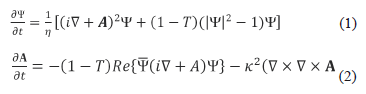
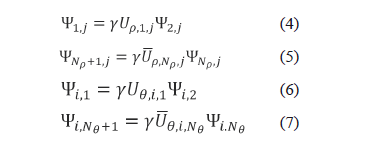
<body><![CDATA[<p><font size="2" face="Verdana, Arial, Helvetica, sans-serif">The   properties of the superconducting state are usually described by the complex   order parameter <img src="/img/revistas/dyna/v79n174/v79n174a06eq018.gif"> for which the absolute square value <img src="/img/revistas/dyna/v79n174/v79n174a06eq020.gif"> represents the superfluid density, and the   vector potential <b><i>A</i></b>, which is related to the local magnetic field, as <img src="/img/revistas/dyna/v79n174/v79n174a06eq022.gif"> . In   dimensionless units, the TDGL equations are given by   &#91;11-14&#93;: </font></p>     <p><img src="/img/revistas/dyna/v79n174/v79n174a06eq0102.gif"></p>     <p><font size="2" face="Verdana, Arial, Helvetica, sans-serif">Equations   (1) and (2) were rescaled as follows: <img src="/img/revistas/dyna/v79n174/v79n174a06eq028.gif"> in units   of <img src="/img/revistas/dyna/v79n174/v79n174a06eq030.gif"> lengths in units of <img src="/img/revistas/dyna/v79n174/v79n174a06eq032.gif"> , <img src="/img/revistas/dyna/v79n174/v79n174a06eq034.gif"> in units of <img src="/img/revistas/dyna/v79n174/v79n174a06eq036.gif"> in units of <img src="/img/revistas/dyna/v79n174/v79n174a06eq038.gif"> ,   temperatures in units of <img src="/img/revistas/dyna/v79n174/v79n174a06eq040.gif"> we use <img src="/img/revistas/dyna/v79n174/v79n174a06eq042.gif"> The   dynamical equations are complemented with the appropriate boundary conditions   for the order parameter: </font></p>     <p><img src="/img/revistas/dyna/v79n174/v79n174a06eq03.gif"></p>     <p><font size="2" face="Verdana, Arial, Helvetica, sans-serif">where <img src="/img/revistas/dyna/v79n174/v79n174a06eq046.gif"> is the unity vector perpendicular to the   surface and directed outward the domain of the superconductor, and <img src="/img/revistas/dyna/v79n174/v79n174a06eq048.gif"> is the mesh size. This domain is defined by   the internal and external radii, <b><i>r</i></b> and <b><i>R</i></b>,   respectively, and spans an angular width, which can vary from <img src="/img/revistas/dyna/v79n174/v79n174a06eq050.gif"> (slit) to <img src="/img/revistas/dyna/v79n174/v79n174a06eq052.gif"> (disc) (see <a href="#fig01">Fig. 1</a> of &#91;10&#93;). (We will assume   that the current density normal to surface does not vanish at the interfaces.   We can show that the discrete implementation of this condition is as follows: </font></p>     <p><img src="/img/revistas/dyna/v79n174/v79n174a06eq0407.gif"></p>     <p><font size="2" face="Verdana, Arial, Helvetica, sans-serif">We unify   the boundary conditions upon introducing <img src="/img/revistas/dyna/v79n174/v79n174a06eq062.gif"> . For   convenience, this notation allows us to obtain a better analysis of the   results. For more details see &#91;8&#93;. </font></p>     <p>&nbsp;</p>     <p><font size="3" face="Verdana, Arial, Helvetica, sans-serif"><b>3. RESULTS</b></font></p>     <p><font size="2" face="Verdana, Arial, Helvetica, sans-serif">The   parameters used in our numerical simulations were <img src="/img/revistas/dyna/v79n174/v79n174a06eq064.gif"> . </font></p>     ]]></body>

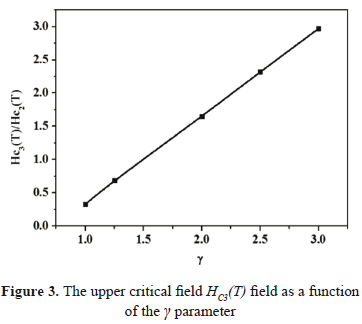
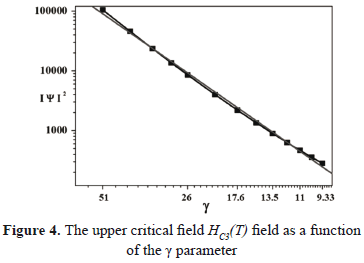
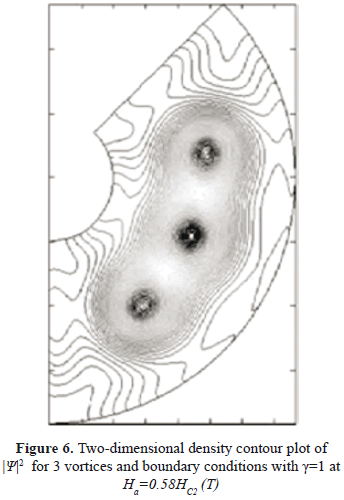
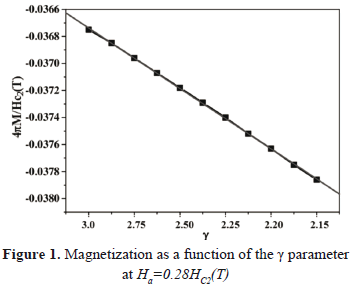
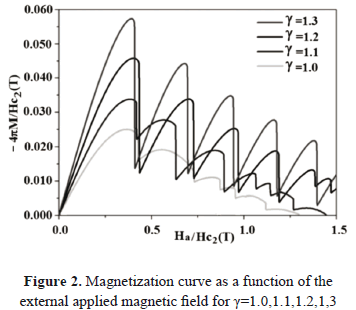
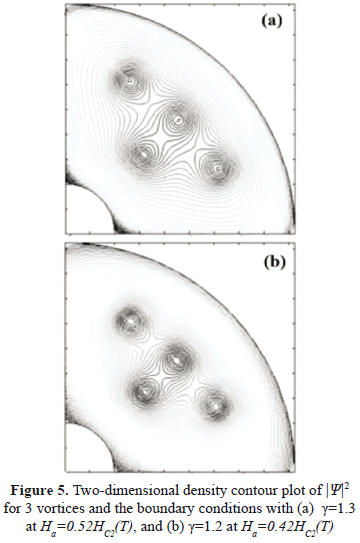
<body><![CDATA[<p><font size="2" face="Verdana, Arial, Helvetica, sans-serif">The area of the circular sector is <img src="/img/revistas/dyna/v79n174/v79n174a06eq066.gif"> for angular width <img src="/img/revistas/dyna/v79n174/v79n174a06eq068.gif"> . The internal radius is <img src="/img/revistas/dyna/v79n174/v79n174a06eq070.gif"> . Such that the external radius is given by <img src="/img/revistas/dyna/v79n174/v79n174a06eq072.gif"> . We have   taken the length of the largest unit cell to be no larger than $ <img src="/img/revistas/dyna/v79n174/v79n174a06eq074.gif"> . Since   the order parameter varied most significantly over a distance <img src="/img/revistas/dyna/v79n174/v79n174a06eq076.gif"> this choice   for the grid space is sufficient to pick the variations of <img src="/img/revistas/dyna/v79n174/v79n174a06eq018.gif"> . We started from the Meissner state,   where <img src="/img/revistas/dyna/v79n174/v79n174a06eq078.gif"> and <img src="/img/revistas/dyna/v79n174/v79n174a06eq080.gif"> everywhere are taken as the initial   conditions. Then we let the time evolve until the system achieves a stationary   state. This is done by keeping the external applied magnetic field <img src="/img/revistas/dyna/v79n174/v79n174a06eq082.gif"> which is   taken constant until the system achieves a stationary state. Next, we ramp up   the applied field by an amount <img src="/img/revistas/dyna/v79n174/v79n174a06eq084.gif"> . The   stationary solution for <img src="/img/revistas/dyna/v79n174/v79n174a06eq082.gif"> is then   used as the initial state to determine the solution for <img src="/img/revistas/dyna/v79n174/v79n174a06eq086.gif"> , and so   on. Usually we started from zero field and increased <img src="/img/revistas/dyna/v79n174/v79n174a06eq088.gif"> until the   superconductivity is entirely destroyed. We ramp up the applied magnetic field   adiabatically, typically in steps of <img src="/img/revistas/dyna/v79n174/v79n174a06eq090.gif"> . </font></p>     <p><font size="2" face="Verdana, Arial, Helvetica, sans-serif">In <a href="#fig01">Fig., 1</a> we determined the values of the magnetization for an external magnetic field <img src="/img/revistas/dyna/v79n174/v79n174a06eq092.gif"> as a function of <img src="/img/revistas/dyna/v79n174/v79n174a06eq094.gif"> . At this   magnetic field, the superconducting sample is still in the Meissner state and will be more pronounced for bigger values of <img src="/img/revistas/dyna/v79n174/v79n174a06eq094.gif"> . As one   can easily notice, the negative magnetization grows with <img src="/img/revistas/dyna/v79n174/v79n174a06eq094.gif"> . We found   a linear behavior of <img src="/img/revistas/dyna/v79n174/v79n174a06eq096.gif"> as a function of <img src="/img/revistas/dyna/v79n174/v79n174a06eq094.gif"> , with <img src="/img/revistas/dyna/v79n174/v79n174a06eq098.gif"> as the slope. </font></p>     <p><font size="2" face="Verdana, Arial, Helvetica, sans-serif">In <a href="#fig02">Fig. 2</a>, We present the magnetization as a function of the   external applied magnetic field <img src="/img/revistas/dyna/v79n174/v79n174a06eq104.gif"> for a circular sector for several values of   the <img src="/img/revistas/dyna/v79n174/v79n174a06eq106.gif"> parameter.   These curves present a typical profile of a magnetization curve of a mesoscopic   superconductor and exhibit a series of discontinuities, in which each jump   signals the entrance of one or more vortices into the sample. Notice that the   number of jumps and the transition fields vary significantly with <img src="/img/revistas/dyna/v79n174/v79n174a06eq094.gif"> . </font></p>     <p align="center"><font size="2" face="Verdana, Arial, Helvetica, sans-serif"><b><a name="fig02"></a></b></font><img src="/img/revistas/dyna/v79n174/v79n174a06fig02.gif"></p>     <p><font size="2" face="Verdana, Arial, Helvetica, sans-serif">Another   interesting feature is shown for the third critical field <img src="/img/revistas/dyna/v79n174/v79n174a06eq112.gif"> , the   critical field which marks the transition from surface superconductivity to the   normal state. In <a href="#fig03">Fig. 3</a>, we present the <img src="/img/revistas/dyna/v79n174/v79n174a06eq114.gif"> phase diagram for 5 samples with <img src="/img/revistas/dyna/v79n174/v79n174a06eq116.gif"> ; we found <img src="/img/revistas/dyna/v79n174/v79n174a06eq118.gif"> for these cases, respectively. The   superconductor/normal transition field <img src="/img/revistas/dyna/v79n174/v79n174a06eq112.gif"> grows quickly with <img src="/img/revistas/dyna/v79n174/v79n174a06eq120.gif"> </font></p>     <p align="center"><font size="2" face="Verdana, Arial, Helvetica, sans-serif"><b><a name="fig03"></a></b></font><img src="/img/revistas/dyna/v79n174/v79n174a06fig03.gif"></p>     <p><font size="2" face="Verdana, Arial, Helvetica, sans-serif">The Cooper   pair density as a function of <img src="/img/revistas/dyna/v79n174/v79n174a06eq106.gif"> is shown   in <a href="#fig04">Fig. 4</a>. For these <img src="/img/revistas/dyna/v79n174/v79n174a06eq094.gif"> values, we observed a power-law behavior, and   obtained slope <img src="/img/revistas/dyna/v79n174/v79n174a06eq126.gif"> . </font></p>     <p align="center"><font size="2" face="Verdana, Arial, Helvetica, sans-serif"><b><a name="fig04"></a></b></font><img src="/img/revistas/dyna/v79n174/v79n174a06fig04.gif"></p>     <p><font size="2" face="Verdana, Arial, Helvetica, sans-serif">In <a href="#fig05">Figs. 5</a> and <a href="#fig06">6</a>, we depict <img src="/img/revistas/dyna/v79n174/v79n174a06eq020.gif"> for the stationary states with a vorticity equal to 3. We choose different values of the <img src="/img/revistas/dyna/v79n174/v79n174a06eq094.gif"> parameter to illustrate the role played by the   boundary conditions on the properties of the interfaces. We use (a) <img src="/img/revistas/dyna/v79n174/v79n174a06eq130.gif"> at <img src="/img/revistas/dyna/v79n174/v79n174a06eq132.gif"> , and (b) <img src="/img/revistas/dyna/v79n174/v79n174a06eq134.gif"> at <img src="/img/revistas/dyna/v79n174/v79n174a06eq136.gif"> . In both cases, we have 4 vortices in the sample. </font></p>     <p align="center"><font size="2" face="Verdana, Arial, Helvetica, sans-serif"><b><a name="fig05"></a></b></font><img src="/img/revistas/dyna/v79n174/v79n174a06fig05.gif"></p>     ]]></body>


<body><![CDATA[<p align="center"><font size="2" face="Verdana, Arial, Helvetica, sans-serif"><b><a name="fig06"></a></b></font><img src="/img/revistas/dyna/v79n174/v79n174a06fig06.gif"></p>     <p><font size="2" face="Verdana, Arial, Helvetica, sans-serif">In the   superconductor/superconductor at higher critical temperature interface we see   that <img src="/img/revistas/dyna/v79n174/v79n174a06eq020.gif"> is strongly enhanced in a region near the   surface due to the shielding currents and the Cooper pairs originating from the   superconductor of a higher <img src="/img/revistas/dyna/v79n174/v79n174a06eq148.gif"> . </font></p>     <p>&nbsp;</p>     <p><b><font size="3" face="Verdana, Arial, Helvetica, sans-serif">4. CONCLUSIONS</font></b></p>     <p><font size="2" face="Verdana, Arial, Helvetica, sans-serif">In   summary, an algorithm has been devised for solving the time-dependent Ginzburg Landau equations for circular geometry and a   superconductor/superconductor at a higher critical temperature boundary   condition. We have presented some evidence that, if we choose the <img src="/img/revistas/dyna/v79n174/v79n174a06eq094.gif"> parameter accordingly, we can strongly enhance   superconductivity. Also, we found an analytical behavior for the magnetization   curve as a function of the <img src="/img/revistas/dyna/v79n174/v79n174a06eq094.gif"> parameters; we obtained <img src="/img/revistas/dyna/v79n174/v79n174a06eq150.gif"> , <img src="/img/revistas/dyna/v79n174/v79n174a06eq152.gif"> and <img src="/img/revistas/dyna/v79n174/v79n174a06eq154.gif"> for this   sample. </font></p>     <p>&nbsp;</p>     <p><font size="2" face="Verdana, Arial, Helvetica, sans-serif"><b>ACKNOWLEDGEMENTS </b></font></p>     <p><font size="2" face="Verdana, Arial, Helvetica, sans-serif">The   authors would like to thank Edson Sardella from UNESP-Brasil and LSMA from UFPE-Brasil for their very useful discussions. </font></p>     <p>&nbsp;</p>     <p><font size="3" face="Verdana, Arial, Helvetica, sans-serif"><b>REFERENCES</b></font></p>     ]]></body>
<body><![CDATA[<!-- ref --><p><font size="2" face="Verdana, Arial, Helvetica, sans-serif"><b>&#91;1&#93;</b> Berdiyorov, G. R., Milosevic, B. J. and Peeters F. M., Stability and transition between vortex configurations in square mesoscopic samples with antidots. Physical Review B, 68, 174521. New York. American Physics Society. 2003.    &nbsp;&nbsp;&nbsp;&nbsp;&nbsp;&nbsp;&nbsp;&nbsp;[&#160;<a href="javascript:void(0);" onclick="javascript: window.open('/scielo.php?script=sci_nlinks&ref=000053&pid=S0012-7353201200040000600001&lng=','','width=640,height=500,resizable=yes,scrollbars=1,menubar=yes,');">Links</a>&#160;]<!-- end-ref --><!-- ref --><br>   <b>&#91;2&#93;</b> Puig, T., Rosseel, E., Baert, M., VanBael, M., Moschalkov, V, V. and Bruynseraede, Y., Stable vortex configurations in superconducting 2×2 antidot clusters. Applied Physics Letters, 70, 119118. New York. American Physics Society. 1998.    &nbsp;&nbsp;&nbsp;&nbsp;&nbsp;&nbsp;&nbsp;&nbsp;[&#160;<a href="javascript:void(0);" onclick="javascript: window.open('/scielo.php?script=sci_nlinks&ref=000054&pid=S0012-7353201200040000600002&lng=','','width=640,height=500,resizable=yes,scrollbars=1,menubar=yes,');">Links</a>&#160;]<!-- end-ref --><!-- ref --><br>   <b>&#91;3&#93;</b> Puig, T., Rosseel, E., Van Look, E., VanBael, M., Moschalkov, V, V. and Bruynseraede, Y., Vortex configurations in a Pb/Cu microdot with a 2×2 antidot cluster. Physical Review B, 58, 5744. New York. American Physics Society. 1998.    &nbsp;&nbsp;&nbsp;&nbsp;&nbsp;&nbsp;&nbsp;&nbsp;[&#160;<a href="javascript:void(0);" onclick="javascript: window.open('/scielo.php?script=sci_nlinks&ref=000055&pid=S0012-7353201200040000600003&lng=','','width=640,height=500,resizable=yes,scrollbars=1,menubar=yes,');">Links</a>&#160;]<!-- end-ref --><!-- ref --><br>   <b>&#91;4&#93;</b> Pogosov, W, V., Vortex phases in mesoscopic cylinders with suppressed surface superconductivity. Physical Review B. 65, 224511. New York. American Physics Society. 2004.    &nbsp;&nbsp;&nbsp;&nbsp;&nbsp;&nbsp;&nbsp;&nbsp;[&#160;<a href="javascript:void(0);" onclick="javascript: window.open('/scielo.php?script=sci_nlinks&ref=000056&pid=S0012-7353201200040000600004&lng=','','width=640,height=500,resizable=yes,scrollbars=1,menubar=yes,');">Links</a>&#160;]<!-- end-ref --><!-- ref --><br>   <b>&#91;5&#93;</b> Geim, A, K., Dubonos, S, V., Grigorieva, I, V., Novoselov, K, S., Peeters, F, M. and Schweigert V, A., Non-quantized penetration of magnetic field in the vortex state of superconductors. Nature. 407, pp. 55-57. London, United Kingdom. 2000.    &nbsp;&nbsp;&nbsp;&nbsp;&nbsp;&nbsp;&nbsp;&nbsp;[&#160;<a href="javascript:void(0);" onclick="javascript: window.open('/scielo.php?script=sci_nlinks&ref=000057&pid=S0012-7353201200040000600005&lng=','','width=640,height=500,resizable=yes,scrollbars=1,menubar=yes,');">Links</a>&#160;]<!-- end-ref --><!-- ref --><br>   <b>&#91;6&#93;</b> Bruyndoncx, V., Rodrigo, J, G., Puig, T., Van Look, L. and Moshchalkov,V. V., Giant vortex state in perforated aluminum microsquares. Physical Review B, 60, 4285. New York. American Physics Society. 1999.    &nbsp;&nbsp;&nbsp;&nbsp;&nbsp;&nbsp;&nbsp;&nbsp;[&#160;<a href="javascript:void(0);" onclick="javascript: window.open('/scielo.php?script=sci_nlinks&ref=000058&pid=S0012-7353201200040000600006&lng=','','width=640,height=500,resizable=yes,scrollbars=1,menubar=yes,');">Links</a>&#160;]<!-- end-ref --><!-- ref --><br>   <b>&#91;7&#93;</b> Barba, J., Sardella, E. and Aguiar, J, A., Superconducting boundary conditions for mesoscopic circular samples. Superconductor. Science and Technology. 24 015001. Washington. 2011. Temperature-dependent vortex matter in a superconducting mesoscopic circular sector. Physica C 470, 1964, Holland. Elsevier, 2010.    &nbsp;&nbsp;&nbsp;&nbsp;&nbsp;&nbsp;&nbsp;&nbsp;[&#160;<a href="javascript:void(0);" onclick="javascript: window.open('/scielo.php?script=sci_nlinks&ref=000059&pid=S0012-7353201200040000600007&lng=','','width=640,height=500,resizable=yes,scrollbars=1,menubar=yes,');">Links</a>&#160;]<!-- end-ref --><!-- ref --><br>   <b>&#91;8&#93;</b> Barba, J., Confinement effects on mixed state in superconducting prisms. Dyna, año 78, Nro. 168, pp. 158-163. Medell&iacute;n, 2011.    &nbsp;&nbsp;&nbsp;&nbsp;&nbsp;&nbsp;&nbsp;&nbsp;[&#160;<a href="javascript:void(0);" onclick="javascript: window.open('/scielo.php?script=sci_nlinks&ref=000060&pid=S0012-7353201200040000600008&lng=','','width=640,height=500,resizable=yes,scrollbars=1,menubar=yes,');">Links</a>&#160;]<!-- end-ref --><!-- ref --><br>   <b>&#91;9&#93;</b> Sardella, E., Malvezzi, A, L., Lisboa-Filho P, N. and Ortiz, W., Temperature-dependent vortex motion in a square mesoscopic superconducting cylinder: Ginzburg-Landau calculations. Physical Review B, 74, 014512. New York. American Physics Society. 2006.    &nbsp;&nbsp;&nbsp;&nbsp;&nbsp;&nbsp;&nbsp;&nbsp;[&#160;<a href="javascript:void(0);" onclick="javascript: window.open('/scielo.php?script=sci_nlinks&ref=000061&pid=S0012-7353201200040000600009&lng=','','width=640,height=500,resizable=yes,scrollbars=1,menubar=yes,');">Links</a>&#160;]<!-- end-ref --><!-- ref --><br>   <b>&#91;10&#93;</b> Sardella, E. and Brandt, E. H., Vortices in a mesoscopic superconducting disk of variable thickness. Superconductor Science and Technology. 23 025015. Washington. 2010.    &nbsp;&nbsp;&nbsp;&nbsp;&nbsp;&nbsp;&nbsp;&nbsp;[&#160;<a href="javascript:void(0);" onclick="javascript: window.open('/scielo.php?script=sci_nlinks&ref=000062&pid=S0012-7353201200040000600010&lng=','','width=640,height=500,resizable=yes,scrollbars=1,menubar=yes,');">Links</a>&#160;]<!-- end-ref --><!-- ref --><br>   <b>&#91;11&#93;</b> Gropp, D., Kaper, H, G., Leaf, G, K., Levine, D, M., Palumbo, M., Vinokur, V. M., Numerical Simulation of Vortex Dynamics in Type-II Superconductors. Journal of Computational Physics 123 (254) Holland. Elsevier. 1996.    &nbsp;&nbsp;&nbsp;&nbsp;&nbsp;&nbsp;&nbsp;&nbsp;[&#160;<a href="javascript:void(0);" onclick="javascript: window.open('/scielo.php?script=sci_nlinks&ref=000063&pid=S0012-7353201200040000600011&lng=','','width=640,height=500,resizable=yes,scrollbars=1,menubar=yes,');">Links</a>&#160;]<!-- end-ref --><!-- ref --><br>   <b>&#91;12&#93;</b> De Gennes, P. G., Superconductivity of Metals and Alloys, Benjamin, New York, 1966.    &nbsp;&nbsp;&nbsp;&nbsp;&nbsp;&nbsp;&nbsp;&nbsp;[&#160;<a href="javascript:void(0);" onclick="javascript: window.open('/scielo.php?script=sci_nlinks&ref=000064&pid=S0012-7353201200040000600012&lng=','','width=640,height=500,resizable=yes,scrollbars=1,menubar=yes,');">Links</a>&#160;]<!-- end-ref --><!-- ref --><br>   <b>&#91;13&#93;</b> Tinkham, M., Introduction to Superconductivity. McGraw-Hill, New York, 1975.    &nbsp;&nbsp;&nbsp;&nbsp;&nbsp;&nbsp;&nbsp;&nbsp;[&#160;<a href="javascript:void(0);" onclick="javascript: window.open('/scielo.php?script=sci_nlinks&ref=000065&pid=S0012-7353201200040000600013&lng=','','width=640,height=500,resizable=yes,scrollbars=1,menubar=yes,');">Links</a>&#160;]<!-- end-ref --><!-- ref --><br>   <b>&#91;14&#93;</b> Buscaglia, G. C., Bolech, C. and L&oacute;pez, A., Connectivity and Superconductivity, in: J. Berger, J. Rubinstein (Eds.), Springer, 2000.    &nbsp;&nbsp;&nbsp;&nbsp;&nbsp;&nbsp;&nbsp;&nbsp;[&#160;<a href="javascript:void(0);" onclick="javascript: window.open('/scielo.php?script=sci_nlinks&ref=000066&pid=S0012-7353201200040000600014&lng=','','width=640,height=500,resizable=yes,scrollbars=1,menubar=yes,');">Links</a>&#160;]<!-- end-ref --> </font></p>      ]]></body><back>
<ref-list>
<ref id="B1">
<label>1</label><nlm-citation citation-type="journal">
<person-group person-group-type="author">
<name>
<surname><![CDATA[Berdiyorov]]></surname>
<given-names><![CDATA[G. R.]]></given-names>
</name>
<name>
<surname><![CDATA[Milosevic]]></surname>
<given-names><![CDATA[B. J.]]></given-names>
</name>
<name>
<surname><![CDATA[Peeters]]></surname>
<given-names><![CDATA[F. M.]]></given-names>
</name>
</person-group>
<article-title xml:lang="en"><![CDATA[Stability and transition between vortex configurations in square mesoscopic samples with antidots.]]></article-title>
<source><![CDATA[Physical Review B]]></source>
<year>2003</year>
<volume>68</volume>
<numero>174521</numero>
<issue>174521</issue>
<publisher-loc><![CDATA[New York ]]></publisher-loc>
<publisher-name><![CDATA[American Physics Society]]></publisher-name>
</nlm-citation>
</ref>
<ref id="B2">
<label>2</label><nlm-citation citation-type="journal">
<person-group person-group-type="author">
<name>
<surname><![CDATA[Puig]]></surname>
<given-names><![CDATA[T.]]></given-names>
</name>
<name>
<surname><![CDATA[Rosseel]]></surname>
<given-names><![CDATA[E.]]></given-names>
</name>
<name>
<surname><![CDATA[Baert]]></surname>
<given-names><![CDATA[M.]]></given-names>
</name>
<name>
<surname><![CDATA[VanBael]]></surname>
<given-names><![CDATA[M.]]></given-names>
</name>
<name>
<surname><![CDATA[Moschalkov]]></surname>
<given-names><![CDATA[V, V.]]></given-names>
</name>
<name>
<surname><![CDATA[Bruynseraede]]></surname>
<given-names><![CDATA[Y.]]></given-names>
</name>
</person-group>
<article-title xml:lang="en"><![CDATA[Stable vortex configurations in superconducting 2×2 antidot clusters.]]></article-title>
<source><![CDATA[Applied Physics Letters]]></source>
<year>1998</year>
<volume>70</volume>
<numero>119118</numero>
<issue>119118</issue>
<publisher-loc><![CDATA[New York ]]></publisher-loc>
<publisher-name><![CDATA[American Physics Society]]></publisher-name>
</nlm-citation>
</ref>
<ref id="B3">
<label>3</label><nlm-citation citation-type="journal">
<person-group person-group-type="author">
<name>
<surname><![CDATA[Puig]]></surname>
<given-names><![CDATA[T.]]></given-names>
</name>
<name>
<surname><![CDATA[Rosseel]]></surname>
<given-names><![CDATA[E.]]></given-names>
</name>
<name>
<surname><![CDATA[Van Look]]></surname>
<given-names><![CDATA[E.]]></given-names>
</name>
<name>
<surname><![CDATA[VanBael]]></surname>
<given-names><![CDATA[M.]]></given-names>
</name>
<name>
<surname><![CDATA[Moschalkov]]></surname>
<given-names><![CDATA[V, V.]]></given-names>
</name>
<name>
<surname><![CDATA[Bruynseraede]]></surname>
<given-names><![CDATA[Y.]]></given-names>
</name>
</person-group>
<article-title xml:lang="en"><![CDATA[Vortex configurations in a Pb/Cu microdot with a 2×2 antidot cluster.]]></article-title>
<source><![CDATA[Physical Review B]]></source>
<year>1998</year>
<volume>58</volume>
<numero>5744</numero>
<issue>5744</issue>
<publisher-loc><![CDATA[New York ]]></publisher-loc>
<publisher-name><![CDATA[American Physics Society]]></publisher-name>
</nlm-citation>
</ref>
<ref id="B4">
<label>4</label><nlm-citation citation-type="journal">
<person-group person-group-type="author">
<name>
<surname><![CDATA[Pogosov]]></surname>
<given-names><![CDATA[W, V.]]></given-names>
</name>
</person-group>
<article-title xml:lang="en"><![CDATA[Vortex phases in mesoscopic cylinders with suppressed surface superconductivity.]]></article-title>
<source><![CDATA[Physical Review B.]]></source>
<year>2004</year>
<volume>65</volume>
<numero>224511</numero>
<issue>224511</issue>
<publisher-loc><![CDATA[New York ]]></publisher-loc>
<publisher-name><![CDATA[American Physics Society]]></publisher-name>
</nlm-citation>
</ref>
<ref id="B5">
<label>5</label><nlm-citation citation-type="journal">
<person-group person-group-type="author">
<name>
<surname><![CDATA[Geim]]></surname>
<given-names><![CDATA[A, K.]]></given-names>
</name>
<name>
<surname><![CDATA[Dubonos]]></surname>
<given-names><![CDATA[S, V.]]></given-names>
</name>
<name>
<surname><![CDATA[Grigorieva]]></surname>
<given-names><![CDATA[I, V.]]></given-names>
</name>
<name>
<surname><![CDATA[Novoselov]]></surname>
<given-names><![CDATA[K, S.]]></given-names>
</name>
<name>
<surname><![CDATA[Peeters]]></surname>
<given-names><![CDATA[F, M.]]></given-names>
</name>
<name>
<surname><![CDATA[Schweigert]]></surname>
<given-names><![CDATA[V, A.]]></given-names>
</name>
</person-group>
<article-title xml:lang="en"><![CDATA[Non-quantized penetration of magnetic field in the vortex state of superconductors.]]></article-title>
<source><![CDATA[Nature]]></source>
<year>2000</year>
<numero>407</numero>
<issue>407</issue>
<page-range>55-57</page-range><publisher-loc><![CDATA[London ]]></publisher-loc>
</nlm-citation>
</ref>
<ref id="B6">
<label>6</label><nlm-citation citation-type="journal">
<person-group person-group-type="author">
<name>
<surname><![CDATA[Bruyndoncx]]></surname>
<given-names><![CDATA[V.]]></given-names>
</name>
<name>
<surname><![CDATA[Rodrigo]]></surname>
<given-names><![CDATA[J, G.]]></given-names>
</name>
<name>
<surname><![CDATA[Puig]]></surname>
<given-names><![CDATA[T.]]></given-names>
</name>
<name>
<surname><![CDATA[Van Look]]></surname>
<given-names><![CDATA[L.]]></given-names>
</name>
<name>
<surname><![CDATA[Moshchalkov]]></surname>
<given-names><![CDATA[V. V.]]></given-names>
</name>
</person-group>
<article-title xml:lang="en"><![CDATA[Giant vortex state in perforated aluminum microsquares.]]></article-title>
<source><![CDATA[Physical Review B]]></source>
<year>1999</year>
<volume>60</volume>
<numero>4285</numero>
<issue>4285</issue>
<publisher-loc><![CDATA[New York ]]></publisher-loc>
<publisher-name><![CDATA[American Physics Society]]></publisher-name>
</nlm-citation>
</ref>
<ref id="B7">
<label>7</label><nlm-citation citation-type="journal">
<person-group person-group-type="author">
<name>
<surname><![CDATA[Barba]]></surname>
<given-names><![CDATA[J.]]></given-names>
</name>
<name>
<surname><![CDATA[Sardella]]></surname>
<given-names><![CDATA[E.]]></given-names>
</name>
<name>
<surname><![CDATA[Aguiar]]></surname>
<given-names><![CDATA[J, A.]]></given-names>
</name>
</person-group>
<article-title xml:lang="en"><![CDATA[Superconducting boundary conditions for mesoscopic circular samples. Superconductor.: Science and Technology. 24 015001. Washington. 2011. Temperature-dependent vortex matter in a superconducting mesoscopic circular sector.]]></article-title>
<source><![CDATA[Physica C]]></source>
<year>2010</year>
<volume>470</volume>
<numero>1964</numero>
<issue>1964</issue>
<publisher-name><![CDATA[Elsevier]]></publisher-name>
</nlm-citation>
</ref>
<ref id="B8">
<label>8</label><nlm-citation citation-type="journal">
<person-group person-group-type="author">
<name>
<surname><![CDATA[Barba]]></surname>
<given-names><![CDATA[J.]]></given-names>
</name>
</person-group>
<article-title xml:lang="en"><![CDATA[Confinement effects on mixed state in superconducting prisms.]]></article-title>
<source><![CDATA[Dyna]]></source>
<year>2011</year>
<volume>78</volume>
<numero>168</numero>
<issue>168</issue>
<page-range>158-163</page-range><publisher-loc><![CDATA[Medellín ]]></publisher-loc>
</nlm-citation>
</ref>
<ref id="B9">
<label>9</label><nlm-citation citation-type="journal">
<person-group person-group-type="author">
<name>
<surname><![CDATA[Sardella]]></surname>
<given-names><![CDATA[E.]]></given-names>
</name>
<name>
<surname><![CDATA[Malvezzi]]></surname>
<given-names><![CDATA[A, L.]]></given-names>
</name>
<name>
<surname><![CDATA[Lisboa-Filho]]></surname>
<given-names><![CDATA[P, N.]]></given-names>
</name>
<name>
<surname><![CDATA[Ortiz]]></surname>
<given-names><![CDATA[W.]]></given-names>
</name>
</person-group>
<article-title xml:lang="en"><![CDATA[Temperature-dependent vortex motion in a square mesoscopic superconducting cylinder:: Ginzburg-Landau calculations.]]></article-title>
<source><![CDATA[Physical Review B]]></source>
<year>2006</year>
<volume>74</volume>
<numero>014512</numero>
<issue>014512</issue>
<publisher-loc><![CDATA[New York ]]></publisher-loc>
<publisher-name><![CDATA[American Physics Society]]></publisher-name>
</nlm-citation>
</ref>
<ref id="B10">
<label>10</label><nlm-citation citation-type="journal">
<person-group person-group-type="author">
<name>
<surname><![CDATA[Sardella]]></surname>
<given-names><![CDATA[E.]]></given-names>
</name>
<name>
<surname><![CDATA[Brandt]]></surname>
<given-names><![CDATA[E. H.]]></given-names>
</name>
</person-group>
<article-title xml:lang="en"><![CDATA[Vortices in a mesoscopic superconducting disk of variable thickness.]]></article-title>
<source><![CDATA[Superconductor Science and Technology]]></source>
<year>2010</year>
<volume>23</volume>
<numero>025015</numero>
<issue>025015</issue>
<publisher-loc><![CDATA[Washington ]]></publisher-loc>
</nlm-citation>
</ref>
<ref id="B11">
<label>11</label><nlm-citation citation-type="journal">
<person-group person-group-type="author">
<name>
<surname><![CDATA[Gropp]]></surname>
<given-names><![CDATA[D.]]></given-names>
</name>
<name>
<surname><![CDATA[Kaper]]></surname>
<given-names><![CDATA[H, G.]]></given-names>
</name>
<name>
<surname><![CDATA[Leaf]]></surname>
<given-names><![CDATA[G, K.]]></given-names>
</name>
<name>
<surname><![CDATA[Levine]]></surname>
<given-names><![CDATA[D, M.]]></given-names>
</name>
<name>
<surname><![CDATA[Palumbo]]></surname>
<given-names><![CDATA[M.]]></given-names>
</name>
<name>
<surname><![CDATA[Vinokur]]></surname>
<given-names><![CDATA[V. M.]]></given-names>
</name>
</person-group>
<article-title xml:lang="en"><![CDATA[Numerical Simulation of Vortex Dynamics in Type-II Superconductors.]]></article-title>
<source><![CDATA[Journal of Computational Physics]]></source>
<year>1996</year>
<volume>123</volume>
<numero>254</numero>
<issue>254</issue>
<publisher-name><![CDATA[Elsevier]]></publisher-name>
</nlm-citation>
</ref>
<ref id="B12">
<label>12</label><nlm-citation citation-type="book">
<person-group person-group-type="author">
<name>
<surname><![CDATA[De Gennes]]></surname>
<given-names><![CDATA[P. G.]]></given-names>
</name>
</person-group>
<source><![CDATA[Superconductivity of Metals and Alloys]]></source>
<year>1966</year>
<publisher-loc><![CDATA[New York ]]></publisher-loc>
<publisher-name><![CDATA[Benjamin]]></publisher-name>
</nlm-citation>
</ref>
<ref id="B13">
<label>13</label><nlm-citation citation-type="book">
<person-group person-group-type="author">
<name>
<surname><![CDATA[Tinkham]]></surname>
<given-names><![CDATA[M.]]></given-names>
</name>
</person-group>
<source><![CDATA[Introduction to Superconductivity]]></source>
<year>1975</year>
<publisher-loc><![CDATA[New York ]]></publisher-loc>
<publisher-name><![CDATA[McGraw-Hill]]></publisher-name>
</nlm-citation>
</ref>
<ref id="B14">
<label>14</label><nlm-citation citation-type="book">
<person-group person-group-type="author">
<name>
<surname><![CDATA[Buscaglia]]></surname>
<given-names><![CDATA[G. C.]]></given-names>
</name>
<name>
<surname><![CDATA[Bolech]]></surname>
<given-names><![CDATA[C.]]></given-names>
</name>
<name>
<surname><![CDATA[López]]></surname>
<given-names><![CDATA[A.]]></given-names>
</name>
</person-group>
<article-title xml:lang="en"><![CDATA[Connectivity and Superconductivity]]></article-title>
<person-group person-group-type="editor">
<name>
<surname><![CDATA[Berger]]></surname>
<given-names><![CDATA[J.]]></given-names>
</name>
<name>
<surname><![CDATA[Rubinstein]]></surname>
<given-names><![CDATA[J.]]></given-names>
</name>
</person-group>
<source><![CDATA[]]></source>
<year>2000</year>
<publisher-name><![CDATA[Springer]]></publisher-name>
</nlm-citation>
</ref>
</ref-list>
</back>
</article>