<?xml version="1.0" encoding="ISO-8859-1"?><article xmlns:mml="http://www.w3.org/1998/Math/MathML" xmlns:xlink="http://www.w3.org/1999/xlink" xmlns:xsi="http://www.w3.org/2001/XMLSchema-instance">
<front>
<journal-meta>
<journal-id>0012-7353</journal-id>
<journal-title><![CDATA[DYNA]]></journal-title>
<abbrev-journal-title><![CDATA[Dyna rev.fac.nac.minas]]></abbrev-journal-title>
<issn>0012-7353</issn>
<publisher>
<publisher-name><![CDATA[Universidad Nacional de Colombia]]></publisher-name>
</publisher>
</journal-meta>
<article-meta>
<article-id>S0012-73532012000400010</article-id>
<title-group>
<article-title xml:lang="en"><![CDATA[CHANGES IN MECHANICAL PROPERTIES OF MINIMALLY-PROCESSED YELLOW PITAHAYA TREATED WITH 1-MCP]]></article-title>
<article-title xml:lang="es"><![CDATA[CAMBIOS EN LAS PROPIEDADES MECANICAS DE PITAHAYA AMARILLA MINIMAMENTE PROCESADA TRATADA CON 1-MCP]]></article-title>
</title-group>
<contrib-group>
<contrib contrib-type="author">
<name>
<surname><![CDATA[SERNA COCK]]></surname>
<given-names><![CDATA[LILIANA]]></given-names>
</name>
<xref ref-type="aff" rid="A01"/>
</contrib>
<contrib contrib-type="author">
<name>
<surname><![CDATA[TORRES VALENZUELA]]></surname>
<given-names><![CDATA[LAURA SOFIA]]></given-names>
</name>
<xref ref-type="aff" rid="A02"/>
</contrib>
<contrib contrib-type="author">
<name>
<surname><![CDATA[AYALA APONTE]]></surname>
<given-names><![CDATA[ALFREDO]]></given-names>
</name>
<xref ref-type="aff" rid="A03"/>
</contrib>
</contrib-group>
<aff id="A01">
<institution><![CDATA[,Universidad Nacional de Colombia Sede Palmira ]]></institution>
<addr-line><![CDATA[ ]]></addr-line>
</aff>
<aff id="A02">
<institution><![CDATA[,Universidad del Valle  ]]></institution>
<addr-line><![CDATA[ ]]></addr-line>
</aff>
<aff id="A03">
<institution><![CDATA[,Universidad del Valle  ]]></institution>
<addr-line><![CDATA[ ]]></addr-line>
<country>Colombia</country>
</aff>
<pub-date pub-type="pub">
<day>00</day>
<month>08</month>
<year>2012</year>
</pub-date>
<pub-date pub-type="epub">
<day>00</day>
<month>08</month>
<year>2012</year>
</pub-date>
<volume>79</volume>
<numero>174</numero>
<fpage>71</fpage>
<lpage>78</lpage>
<copyright-statement/>
<copyright-year/>
<self-uri xlink:href="http://www.scielo.org.co/scielo.php?script=sci_arttext&amp;pid=S0012-73532012000400010&amp;lng=en&amp;nrm=iso"></self-uri><self-uri xlink:href="http://www.scielo.org.co/scielo.php?script=sci_abstract&amp;pid=S0012-73532012000400010&amp;lng=en&amp;nrm=iso"></self-uri><self-uri xlink:href="http://www.scielo.org.co/scielo.php?script=sci_pdf&amp;pid=S0012-73532012000400010&amp;lng=en&amp;nrm=iso"></self-uri><abstract abstract-type="short" xml:lang="en"><p><![CDATA[The mechanical properties stress of yield limit (sL), modulus of deformability (Ed), failure stress (sF), and Hencky strain at failure (eHF), of minimally-processed yellow pitahaya treated with 200 mugL-1 1-MCP during storage (10±1 °C, 85% RH) was evaluated. Mechanical analysis of the fruit was performed using a stress-strain curve. The samples were subjected to uniaxial compression test at break. The results showed that the samples treated with 1-MCP showed the highest values of stress of yield limit, modulus of deformability and failure stress. This indicates that the application of 1-MCP provides greater firmness to the fruit and may represent an alternative to reduce undesirable changes in texture during storage.]]></p></abstract>
<abstract abstract-type="short" xml:lang="es"><p><![CDATA[Se evaluaron las propiedades mecánicas de esfuerzo del límite de fluencia (sL), modulo de deformación (Ed), esfuerzo de ruptura (sF), y deformación de Hencky en la ruptura (eHF) de muestras de pitahaya amarilla mínimamente procesada y tratadas con 200 mygL-1 de 1-MCP durante el almacenamiento a 10±1 °C y 85% de humedad relativa. Las muestras fueron sometidas a pruebas de compresión uniaxial hasta la ruptura. Los resultados mostraron que las muestras tratadas con 1-MCP presentaron los mayores valores del esfuerzo del límite de fluencia, modulo de elasticidad y esfuerzo de ruptura. Esto indica que la aplicación del 1-MCP proporciona mayor firmeza a la fruta y puede representar una alternativa para disminuir cambios indeseables de textura durante el almacenamiento.]]></p></abstract>
<kwd-group>
<kwd lng="en"><![CDATA[Modulus of deformability]]></kwd>
<kwd lng="en"><![CDATA[Failure stress]]></kwd>
<kwd lng="en"><![CDATA[Hencky strain at failure]]></kwd>
<kwd lng="en"><![CDATA[Stress of yield limit]]></kwd>
<kwd lng="en"><![CDATA[Minimally-processed yellow pitahaya]]></kwd>
<kwd lng="es"><![CDATA[Módulo de deformación]]></kwd>
<kwd lng="es"><![CDATA[Esfuerzo de ruptura]]></kwd>
<kwd lng="es"><![CDATA[Deformación de Hencky en la ruptura]]></kwd>
<kwd lng="es"><![CDATA[Esfuerzo del límite de fluencia]]></kwd>
<kwd lng="es"><![CDATA[Pitahaya amarilla mínimamente procesada]]></kwd>
</kwd-group>
</article-meta>
</front><body><![CDATA[ <p align="center"><font size="4" face="Verdana, Arial, Helvetica, sans-serif"><b>CHANGES IN MECHANICAL PROPERTIES OF MINIMALLY-PROCESSED YELLOW PITAHAYA TREATED WITH 1-MCP </b></font></p>     <p align="center"><i><font size="3"><b><font face="Verdana, Arial, Helvetica, sans-serif">CAMBIOS EN LAS PROPIEDADES MECANICAS DE PITAHAYA AMARILLA MINIMAMENTE PROCESADA TRATADA CON 1-MCP</font></b></font></i></p>     <p align="center">&nbsp;</p>     <p align="center"><font size="2" face="Verdana, Arial, Helvetica, sans-serif"><b>LILIANA SERNA COCK</b>    <br>   <i>Dra. Profesora, Universidad Nacional de Colombia, Sede Palmira, <a href="mailto:lserna@unal.edu.co">lserna@unal.edu.co</a></i></font></p>     <p align="center"><font size="2" face="Verdana, Arial, Helvetica, sans-serif"><b>LAURA SOFIA TORRES VALENZUELA</b>    <br>   <i>MSc. Profesora, Universidad del Valle, <a href="mailto:laura.torres@correounivalle.edu.co">laura.torres@correounivalle.edu.co</a></i></font></p>     <p align="center"><font size="2" face="Verdana, Arial, Helvetica, sans-serif"><b>ALFREDO AYALA APONTE</b>    <br>   <i>Dr. Profesor, Universidad del Valle, Colombia, <a href="mailto:alfredo.ayala@correounivalle.edu.co">alfredo.ayala@correounivalle.edu.co</a></i></font></p>     <p align="center">&nbsp;</p>     ]]></body>
<body><![CDATA[<p align="center"><font size="2" face="Verdana, Arial, Helvetica, sans-serif"><b>Received for review January 30<sup>th</sup>, 2012, accepted April 24<sup>th</sup>, 2012, final version April, 25<sup>th</sup>, 2012</b></font></p>     <p>&nbsp;</p> <hr>     <p><font size="2" face="Verdana, Arial, Helvetica, sans-serif"><b>ABSTRACT:</b> The mechanical properties stress of yield limit (<font face="Symbol">s</font><sub>L</sub>), modulus of deformability (E<sub>d</sub>), failure stress (<font face="Symbol">s</font><sub>F</sub>), and Hencky strain at failure (<font face="Symbol">e</font><sub>HF</sub>), of minimally-processed yellow pitahaya treated with 200 <font face="Symbol">m</font>gL<sup>-1</sup> 1-MCP during storage (10&plusmn;1 &deg;C, 85% RH) was evaluated. Mechanical analysis of the fruit was performed using a stress-strain curve. The samples were subjected to uniaxial compression test at break. The results showed that the samples treated with 1-MCP showed the highest values of stress of yield limit, modulus of deformability and failure stress. This indicates that the application of 1-MCP provides greater firmness to the fruit and may represent an alternative to reduce undesirable changes in texture during storage.</font></p>     <p><font size="2" face="Verdana, Arial, Helvetica, sans-serif"><b>KEY WORDS:</b> Modulus of deformability, Failure stress, Hencky strain at failure, Stress of yield limit, Minimally-processed yellow pitahaya</font></p>     <p><font size="2" face="Verdana, Arial, Helvetica, sans-serif"><b>RESUMEN:</b> Se evaluaron las propiedades mec&aacute;nicas de esfuerzo del l&iacute;mite de fluencia (<font face="Symbol">s</font><sub>L</sub>), modulo de deformaci&oacute;n (E<sub>d</sub>), esfuerzo de ruptura (<font face="Symbol">s</font><sub>F</sub>), y deformaci&oacute;n de Hencky en la ruptura (<font face="Symbol">e</font><sub>HF</sub>) de muestras de pitahaya amarilla m&iacute;nimamente procesada y tratadas con 200 <font face="Symbol">m</font>gL<sup>-1</sup> de 1-MCP durante el almacenamiento a 10&plusmn;1 &deg;C y 85% de humedad relativa. Las muestras fueron sometidas a pruebas de compresi&oacute;n uniaxial hasta la ruptura. Los resultados mostraron que las muestras tratadas con 1-MCP presentaron los mayores valores del esfuerzo del l&iacute;mite de fluencia, modulo de elasticidad y esfuerzo de ruptura. Esto indica que la aplicaci&oacute;n del 1-MCP proporciona mayor firmeza a la fruta y puede representar una alternativa para disminuir cambios indeseables de textura durante el almacenamiento.</font></p>     <p><font size="2" face="Verdana, Arial, Helvetica, sans-serif"><b>PALABRAS CLAVE:</b> M&oacute;dulo de deformaci&oacute;n, Esfuerzo de ruptura, Deformaci&oacute;n de Hencky en la ruptura, Esfuerzo del l&iacute;mite de fluencia, Pitahaya amarilla m&iacute;nimamente procesada</font></p> <hr>     <p>&nbsp;</p>     <p><font size="3" face="Verdana, Arial, Helvetica, sans-serif"><b>1. INTRODUCTION</b></font></p>     <p><font size="2" face="Verdana, Arial, Helvetica, sans-serif">Minimally processed (MP) fruits represent one of the most rapidly growing segments of refrigerated foods &#91;1,2&#93;, and this trend has generated the need to develop new processing and storage techniques that set barriers to preserve product quality &#91;3&ndash;5&#93;. Minimal processing consists of washing, cutting, treating, packing, and storing products while they are refrigerated &#91;1&#93;, and these operations alter the quality of products and diminish their commercial life &#91;1,2&#93;. The quality of MP fruit is influenced by ripeness at the moment of slicing and by the fruit's history between harvest and processing &#91;3&#93;.</font></p>     <p><font size="2" face="Verdana, Arial, Helvetica, sans-serif">A decrease in product acceptance has been linked to changes in texture, ripeness index, and turgidity loss in the cell wall &#91;2,6&#93;. A number of changes occur during storage, among which softening loss of firmness is one of the greatest limiting factors &#91;7&#93;. These changes in the mechanical properties of fruits are important because they affect the sensory characteristics and therefore quality and consumer acceptance &#91;8,9&#93;. Changes are analyzed through rheology, the science that studies material flow and deformation by application of a load &#91;10&#93; and that has been used to study the viscoelastic behavior of foods. The study of rheology began as early as the 1950s, when it was used empirically as a quality control parameter. Currently, knowledge of rheology allows for the design and evaluation of processes and products &#91;9&#93;. </font></p>     ]]></body>
<body><![CDATA[<p><font size="2" face="Verdana, Arial, Helvetica, sans-serif">In rheology, texture is a functional and sensorial manifestation of mechanical and structural changes in foods &#91;11&#93;. One of the difficulties of applying mechanical principles to food lies in the sheer complexity of its structure and its complex viscoelastic behavior &#91;12&#93;. Many biological products and solid foods behave like viscoelastic materials when they are subjected to small or intermediate levels of strain. The mechanical response of these materials depends on the load, time, and load history &#91;13&#93;. </font></p>     <p><font size="2" face="Verdana, Arial, Helvetica, sans-serif">To study the mechanical behavior of food, a sensory panel or an instrumental analysis is used; the latter is preferred because of its speed, reproducibility, and low cost. In performing instrumental analysis, however, it is necessary to use mathematical models to analyze the obtained attributes &#91;11&#93;. Keeping in mind that foods are complex matrices that can exhibit a wide range of mechanical behaviors and can be described using simplified models, including an ideal solid (elastic), ideal fluid (viscous), and ideal plastic (elastic and viscous) models, and combinations thereof &#91;14&#93;. </font></p>     <p><font size="2" face="Verdana, Arial, Helvetica, sans-serif">One of the simplest fundamental tests for the characterization of the rheological properties of many foods is the uniaxial compression between two parallel plates. Normally, a constant speed is applied and the force required to cause a given deformation (non-destructive test) or the rupture of the sample (destructive test) is measured. &#91;14&#93;</font></p>     <p><font size="2" face="Verdana, Arial, Helvetica, sans-serif">The alkene compound 1-MCP inhibits the activity of ethylene in whole and sliced fruits and has shown the potential to reduce the softening in minimally-processed products, such as pineapples &#91;15&#93;, &lsquo;Galia' melons &#91;4&#93;, kiwis &#91;16,17&#93;, &lsquo;Kent' and &lsquo;Keitt' mangos and &lsquo;Fuyu' sapotes &#91;16&#93;, bananas &#91;18&#93;,and &lsquo;Blanquilla' pears &#91;19&#93;. However, the response of the fruit to the compound depends on factors such as storage temperature, raw material characteristics, fruit type, cultivation, ripeness, and storage time &#91;20&#93;.</font></p>     <p><font size="2" face="Verdana, Arial, Helvetica, sans-serif">Recent studies in Colombia suggest that minimally-processed yellow pitahaya has high export potential. During storage, however, the fruit loses its sensory characteristics, thereby limiting its commercialization &#91;21&#93;. The application of 1-MCP to the MP fruit can represent an alternative to decrease texture changes during storage &#91;19&#93;. The aim of this work was to evaluate the effect of applying 1-MCP to MP pitahaya on its mechanical behavior (stress of yield limit, modulus of deformability, failure stress, and Hencky strain at failure).</font></p>     <p>&nbsp;</p>     <p><font size="3" face="Verdana, Arial, Helvetica, sans-serif"><b>2. MATERIALS AND METHODS</b></font></p>     <p><font size="2" face="Verdana, Arial, Helvetica, sans-serif"><b>2.1. Raw Material</b>    <br>   </font><font size="2" face="Verdana, Arial, Helvetica, sans-serif">Yellow pitahaya fruits with a maturity stage of 3 were selected according to the NTC 3554 standard classification &#91;22&#93;. The fruit orchard is located in Roldadillo, Valle del Cauca, Colombia (4&deg;24'37'' North latitude and 75&deg;93'72'' West longitude, 1500 m altitude). Harvested fruits were selected, scrubbed using soft-bristle brushes to remove spine residues and organic matter, washed, and sanitized using chlorinated water (200 mg.L<sup>-1</sup>), and then rinsed with distilled water. Finally, the fruits were classified and grouped based on specific treatment, dried using a paper towel, and immersed in the 1-MCP solution.</font></p>     <p><font size="2" face="Verdana, Arial, Helvetica, sans-serif"><b>2.2. Preparation and 1-MCP application</b>    ]]></body>
<body><![CDATA[<br>   </font><font size="2" face="Verdana, Arial, Helvetica, sans-serif">Commercial 1-MCP with 3.8% (p/p) purity was used. It was obtained from the Rohm and Haas Chemistry Company LLC (Philadelphia, Pennsylvania). Forty liters of a 200 <font face="Symbol">m</font>g L<sup>-1</sup> 1-MCP solution were prepared using distilled water. Selected fruits were immersed for 10 min in the solution, rinsed in distilled water for 5 min (to remove excess 1-MCP), and dried in open air. </font></p>     <p><font size="2" face="Verdana, Arial, Helvetica, sans-serif">The concentration of 1-MCP was established according to previous results &#91;23&#93;</font></p>     <p><font size="2" face="Verdana, Arial, Helvetica, sans-serif"><b>2.3. Minimal processing and packing    <br>   </b></font><font size="2" face="Verdana, Arial, Helvetica, sans-serif">Fruits treated previously with 1-MCP were cut in 1.0 &plusmn; 0.1 cm-thick slices using a Javar mechanical slicer (model GE 250, Cali, Colombia).</font></p>     <p><font size="2" face="Verdana, Arial, Helvetica, sans-serif">The fruits were vacuum packed in a 70-micron thick low-density, flexible polyamide and coextruded polyethylene package with a 39 cm3 m<sup>-2</sup> day<sup>-1</sup>Atm<sup>-1</sup> O<sub>2</sub> permeability at 23 &deg;C, 107 cm3 m<sup>-2</sup>day<sup>-1</sup> Atm<sup>-1</sup> CO<sub>2</sub> permeability at 23 &deg;C and 10.2 g m<sup>-2</sup> day<sup>-1</sup> Atm<sup>-1</sup> water vapor permeability at 38 &deg;C. The packages were sealed with a sealing strength of 1.5 kg cm<sup>-1</sup> at a temperature of 160 &deg;C for 3 s.</font></p>     <p><font size="2" face="Verdana, Arial, Helvetica, sans-serif">The yellow pitahaya was stored in environmentally-controlled chamber (1000 L Dies, Colombia) at 10 &plusmn; 1 &deg;C and 85% relative humidity. The weight of the samples was determined using an analytical balance (Mettler, Switzerland).</font></p>     <p><font size="2" face="Verdana, Arial, Helvetica, sans-serif"><b>2.4. Sample preparation    <br>   </b></font><font size="2" face="Verdana, Arial, Helvetica, sans-serif">To carry out the mechanical analysis, the packaged yellow pitahaya was sliced into samples 40 mm in diameter using a stainless steel cylindrical mold. After slicing, the samples were visually inspected, and those samples with surfaces that were not flat were discarded. The diameter and height of the cylinders were measured with a caliper at 3different and equidistant points, and the average value was calculated. These cylinders were used in the compression tests. </font></p>     <p><font size="2" face="Verdana, Arial, Helvetica, sans-serif"><b>2.5. Compression uniaxial analysis    <br>   </b></font><font size="2" face="Verdana, Arial, Helvetica, sans-serif">The samples were subjected to uniaxial compression tests using a texturometer (EZ-Test model, Shimadzu, Somerset, New Jersey) attached to a cylindrical plate of 6.0 cm in diameter. The plate was lubricated to avoid the effects of the plate-sample friction during compression &#91;24&#93;. The measurements were performed at room temperature, at a speed of 10 mm/min, until the sample was compressed to 90% of its initial height.</font></p>     ]]></body>
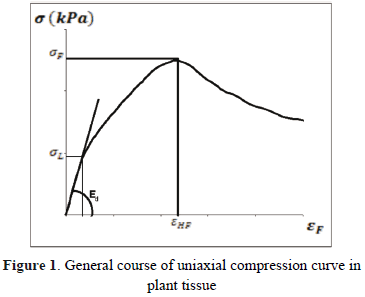
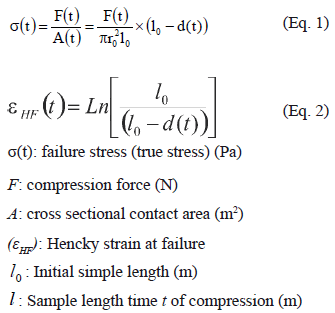
<body><![CDATA[<p><font size="2" face="Verdana, Arial, Helvetica, sans-serif">The force-displacement curves obtained in the compression analysis were used to calculate the true stress (<font face="Symbol">S</font>) Hencky stress (<font face="Symbol">e</font>HF) from Eqs. 1 and 2, respectively &#91;8,25&#93;.</font></p>     <p><img src="/img/revistas/dyna/v79n174/v79n174a10eq0102.gif"></p>     <p><font size="2" face="Verdana, Arial, Helvetica, sans-serif">These equations have been widely used in the study of mechanical properties of foods such as mangos, kiwis, and strawberries &#91;26&#93;; chestnuts &#91;27&#93;, cassavas &#91;28&#93;, and bananas &#91;29&#93;.</font></p>     <p><font size="2" face="Verdana, Arial, Helvetica, sans-serif"><a href="#fig01">Figure 1</a> was analyzed in terms of the following parameters &#91;30&#93;. The stress of yield limit (<font face="Symbol">s</font><sub>L</sub>),was determined as the end point of the linear relationship between stress and strain; the modulus of deformability (E<sub>d</sub>), was obtained from the slope of the linear zone before the yield limit; the failure stress (<font face="Symbol">s</font><sub>F</sub>), which is defined as the ultimate stress before the material fractures &#91;30&#93;, was determined to be the first peak in the stress-strain curve &#91;8&#93;, and the Hencky strain at failure (<font face="Symbol">e</font><sub>HF</sub>) is the level of deformation of the sample and corresponds to the macroscopic failure of the structure. This value is taken from the first peak of the curve.</font></p>     <p align="center"><font size="2" face="Verdana, Arial, Helvetica, sans-serif"><b> <a name="fig01"></a></b></font><img src="/img/revistas/dyna/v79n174/v79n174a10fig01.gif"></p>     <p><font size="2" face="Verdana, Arial, Helvetica, sans-serif"><b>2.6. Design of the experimental setup    <br>   </b></font><font size="2" face="Verdana, Arial, Helvetica, sans-serif">A two-factor, fully random, 2x5 factorial design was used in the following manner:</font></p>     <p><font size="2" face="Verdana, Arial, Helvetica, sans-serif">Two concentrations of 0 and 200 <font face="Symbol">m</font>g L<sup>-1</sup> of 1-MCP solution, where 0 is the untreated samples (without application of 1-MCP or control treatment).</font></p>     <p><font size="2" face="Verdana, Arial, Helvetica, sans-serif">Five storage times of 0, 4, 8, 12, and 16 days. </font></p>     <p><font size="2" face="Verdana, Arial, Helvetica, sans-serif">The response variables were: stress of yield limit, modulus of deformability, rupture stress, and Hencky strain at failure.</font></p>     ]]></body>
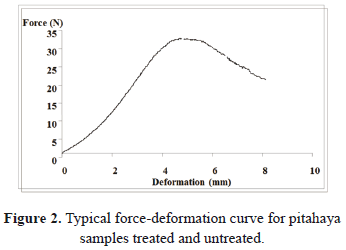
<body><![CDATA[<p><font size="2" face="Verdana, Arial, Helvetica, sans-serif">All of the measurements were performed three times. The results were analyzed using a 95% confidence level variance analysis using the Minitab 15.1 Version software (Minitab Inc., State College, PA, 2007).</font></p>     <p>&nbsp;</p>     <p><font size="3" face="Verdana, Arial, Helvetica, sans-serif"><b>3. RESULTS AND DISCUSSION</b></font></p>     <p><b><font size="2" face="Verdana, Arial, Helvetica, sans-serif">3.1. Compression analysis    <br>   </font></b><font size="2" face="Verdana, Arial, Helvetica, sans-serif">The initial moisture content of yellow pitahaya was 79.03%&plusmn;0.52 (wet basis). On day 12, the fruits treated with 1-MCP showed weight loss of 0.41&plusmn;0.02%, while untreated fruits showed a weight loss of 0.98&plusmn;0.12%. Similar results are reported in yellow pitahaya &#91;21&#93; and red pitahaya &#91;31&#93;. Although these results are not significant, the application of 1-MCP reduced the weight loss, because this compound favorably altered the metabolism of the fruit's epicuticular layer; this layer is a barrier to the movement of water vapor from the fruit into the environment &#91;32&#93;.</font></p>     <p><font size="2" face="Verdana, Arial, Helvetica, sans-serif"><b>3.2. Uniaxial Compression    <br>   </b></font><font size="2" face="Verdana, Arial, Helvetica, sans-serif"><a href="#fig02">Figure 2</a> shows a typical force-deformation curve (obtained from compression tests) for treated and untreated yellow pitahaya samples. A linear relationship between force and deformation was initially obtained, followed by a non-linear region, in which the force is observed to increase until a critical point at which fracture occurs (fracture point). At this point, the force reaches its maximum value and starts to decrease &#91;33&ndash;35&#93;.</font></p>     <p align="center"><font size="2" face="Verdana, Arial, Helvetica, sans-serif"><a name="fig02"></a></font><img src="/img/revistas/dyna/v79n174/v79n174a10fig02.gif"></p>     <p><font size="2" face="Verdana, Arial, Helvetica, sans-serif">In the yield limit, cell rupture begins to take place &#91;36&#93;. Cell-structure changes are considered reversible under the yield limit and irreversible above it &#91;8&#93;. Plant tissues may fail because of cell wall rupture and loss of adhesion between the cells. Loss of adhesion is generated by alterations of the middle lamella, a layer composed of polysaccharides that surrounds the cell-wall pectin and facilitates adhesion among the cells &#91;8&#93;. This behavior is typical in whole- and minimally-processed fruits and has been observed in the uniaxial compression of the different cut and whole products,such as fresh and osmotically-dehydrated pumpkins &#91;8&#93; and 12 varieties of apples &#91;35&#93;, grape variety Cabernet Franc &#91;37&#93;, pear &#91;38&#93;, and tomatoes &#91;36,39&#93;.</font></p>     <p><font size="2" face="Verdana, Arial, Helvetica, sans-serif"><b>3.2.1. Stress of yield limit    ]]></body>
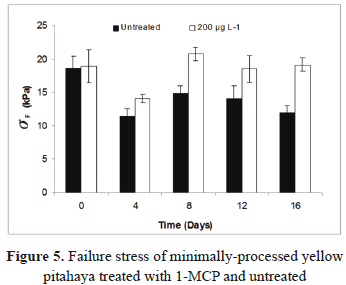
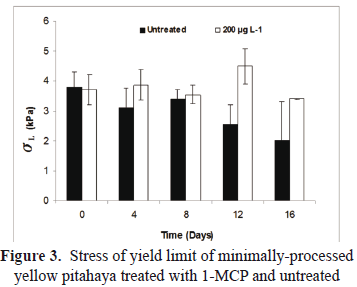
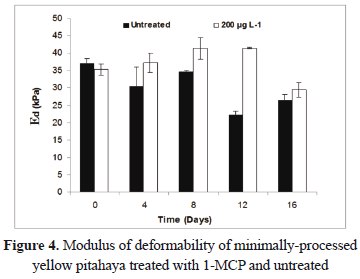
<body><![CDATA[<br>   </b></font><font size="2" face="Verdana, Arial, Helvetica, sans-serif"><a href="#fig03">Figure 3</a> shows the stress of yield limit (<font face="Symbol">S</font><sub>L</sub>) of minimally-processed yellow pitahaya treated with 200 <font face="Symbol">m</font>g L<sup>-1</sup> 1-MCP and untreated (control sample). <font face="Symbol">S</font><sub>L</sub> is associated with a change from a linear elastic behavior (solid) to a non-linear elastic or plastic (liquid) &#91;10&#93;; therefore, high values of <font face="Symbol">S</font><sub>L</sub>, mean that the material behaves more like a solid. The fruit treated with 1-MCP presented higher values of <font face="Symbol">S</font><sub>L</sub> compared to untreated samples. This indicates that the application of 1-MCP in yellow pitahaya induces it to behave more like a solid.</font></p>     <p align="center"><font size="2" face="Verdana, Arial, Helvetica, sans-serif"><a name="fig03"></a></font><img src="/img/revistas/dyna/v79n174/v79n174a10fig03.gif"></p>     <p><font size="2" face="Verdana, Arial, Helvetica, sans-serif">The components of texture that are affected by 1-MCP have not been adequately investigated but tissue toughness is greater in 1-MCP-treated fruit than in the untreated fruit &#91;40&#93;. This can be explained by the fact that the 1-MCP reduced the enzymatic activity of pectinases and cellulases, which produce the degradation of pectins and hemicelluloses &#91;41&#93;. </font></p>     <p><font size="2" face="Verdana, Arial, Helvetica, sans-serif">It can be appreciated that <font face="Symbol">S</font>L decreased in the untreated samples (control) during storage time, which is an indicator of softening. Slicing operations also result in dramatic losses in the firmness of fruit tissues. Pectinolytic and proteolytic enzymes exuding from bruised cells may diffuse into inner tissues. In this regard, the diffusion rates of enzymes through the tissue can be unexpectedly high &#91;42&#93;. Analysis of variance (ANOVA) showed a significant effect (p&lt;0.05) of concentration factors and storage times on <font face="Symbol">S</font>L.</font></p>     <p><font size="2" face="Verdana, Arial, Helvetica, sans-serif"><b>3.2.2. Modulus of deformability    <br>   </b><a href="#fig04">Figure 4</a> shows the modulus of deformability (E<sub>d</sub>) of minimally-processed yellow pitahaya stored with and without 1-MCP treatment. The modulus of deformability is associated with the hardness sensation of food as well as with the first sensation that is perceived when eating that food &#91;43&#93;. </font></p>     <p align="center"><font size="2" face="Verdana, Arial, Helvetica, sans-serif"><a name="fig04"></a></font><img src="/img/revistas/dyna/v79n174/v79n174a10fig04.gif"></p>     <p><font size="2" face="Verdana, Arial, Helvetica, sans-serif">It can be appreciated that the modulus of deformability of treated samples is greater than samples untreated during storage time. These results reveal the existence of a change in the mechanical behavior of the treated pitahaya slices with a greater increase of the hardness. It should be noted that the increase in modulus of deformability is the combined result of an increase in <font face="Symbol">S</font>L and a reduction of the Hencky strain at failure. Analysis of variance (ANOVA) showed a significant effect (p&lt;0.05) of concentrations factor and storage times on E<sub>d</sub>.</font></p>     <p><font size="2" face="Verdana, Arial, Helvetica, sans-serif"><b>3.2.3. Failure stress (true stress)    <br>   </b></font><font size="2" face="Verdana, Arial, Helvetica, sans-serif">One of the most important mechanical properties of a solid food is the fracture behavior, which is associated with the perception of a &quot;crunch&quot; during chewing &#91;33,44&#93;. <a href="#fig05">Figure 5</a> shows the failure stress (<font face="Symbol">s</font><sub>F</sub>) of yellow pitahaya slices during storage. The <font face="Symbol">s</font><sub>F</sub> was higher for the fruit treated with 1-MCP than untreated fruit (or untreated samples show relatively weak rupture stress). This result indicates that the treated fruit was firmer than untreated fruit during storage time. The same behavior has been observed in other fruits treated with 1-MCP such as pineapple slices &#91;15&#93; and bananas &#91;18&#93;. The 1-MCP reduced the enzymatic activity of pectinases and cellulases, and therefore decreases the loss of firmness &#91;41&#93;.</font></p>     ]]></body>
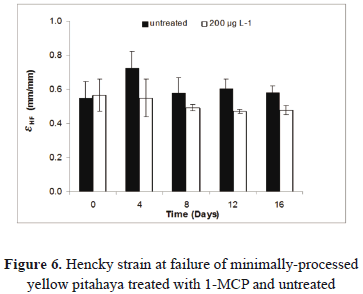
<body><![CDATA[<p align="center"><font size="2" face="Verdana, Arial, Helvetica, sans-serif"><a name="fig05"></a></font><img src="/img/revistas/dyna/v79n174/v79n174a10fig05.gif"></p>     <p><font size="2" face="Verdana, Arial, Helvetica, sans-serif">The control treatment showed a decrease in the values of sF. This indicates the softening of the fruit, which is associated with the cellular wall rupture, adhesion loss among cells (caused by an alteration of the middle lamella) &#91;8&#93;, and other changes in cellular characteristics, such as the the fragility of the cell and the internal turgor pressure &#91;45&#93;. The cell wall is mainly composed of rigid cellulose microfibers linked by networks of hemicellulose matrices and pectins, plus a small amount of structural proteins and aromatic compounds &#91;46,47&#93;. Analysis of variance (ANOVA) showed a significant effect (p&lt;0.05) of concentration factors and storage times on <font face="Symbol">s</font><sub>F</sub>.</font></p>     <p><font size="2" face="Verdana, Arial, Helvetica, sans-serif"><b>3.2.4. Hencky strain at failure    <br>   </b></font><font size="2" face="Verdana, Arial, Helvetica, sans-serif">The behavior of the maximum strain (eHF) of pitahaya samples treated and untreated are shown in <a href="#fig06">Fig. 6</a>. It can be appreciated that for untreated samples the rupture takes place at higher strains and lower stresses (more ductile behaviour or less firm). This behavior will negatively influence the acceptability of the consumer. For treated samples the rupture is produced under lower strains and higher stresses (the behaviour is more brittle).This could be explained by the decrease in the enzymatic activity of pectinases and cellulases, as explained above. Analysis of variance (ANOVA) showed a significant effect (p&lt;0.05) of concentration factors and storage times on <font face="Symbol">e</font><sub>HF</sub>.</font></p>     <p align="center"><font size="2" face="Verdana, Arial, Helvetica, sans-serif"><a name="fig06"></a></font><img src="/img/revistas/dyna/v79n174/v79n174a10fig06.gif"></p>     <p>&nbsp;</p>     <p><font size="3" face="Verdana, Arial, Helvetica, sans-serif"><b>4. CONCLUSIONS</b></font></p>     <p><font size="2" face="Verdana, Arial, Helvetica, sans-serif">The application of 200 <font face="Symbol">m</font>gL<sup>-1</sup> of 1-MCP produced important changes in the mechanical properties of pitahaya tissue during storage time. Experimental data obtained in the study with the application of 1-MCP in pitahaya slices show an increase of the stress of yield limit, modulus of deformability, failure stress, and a decrease of the maximum strain. This fact reveals a greater firmness in their cellular structures compared with untreated fruits. Pitahaya samples treated with 1-MCP appeared to have better-preserved mechanical response and cell structure than nontreated samples.</font></p>     <p><font size="2" face="Verdana, Arial, Helvetica, sans-serif">The authors would like to thank the Ministry of Agriculture and Rural Development in Colombia and the Yellow Pitahaya Producers Association for financing this project. </font></p>     <p>&nbsp;</p>     ]]></body>
<body><![CDATA[<p><font size="3" face="Verdana, Arial, Helvetica, sans-serif"><b>REFERENCES</b></font></p>     <!-- ref --><p><font size="2" face="Verdana, Arial, Helvetica, sans-serif"><b>&#91;1&#93;</b> Del Nobile, M.A., Conte,A., Scrocco,C. and Brescia, I., New strategies for minimally processed cactus pear packaging, Innovative Food Science & Emerging Technologies, 10(3), pp. 356-362, 2009.    &nbsp;&nbsp;&nbsp;&nbsp;&nbsp;&nbsp;&nbsp;&nbsp;[&#160;<a href="javascript:void(0);" onclick="javascript: window.open('/scielo.php?script=sci_nlinks&ref=000084&pid=S0012-7353201200040001000001&lng=','','width=640,height=500,resizable=yes,scrollbars=1,menubar=yes,');">Links</a>&#160;]<!-- end-ref --><!-- ref --><br>   <b>&#91;2&#93;</b> Rico, D., Mart&iacute;n-Diana,A.B., Barat, J.M. and Barry-Ryan, C., Extending and measuring the quality of fresh-cut fruit and vegetables: a review, Trends in Food Science & Technology, 18(7), pp. 373-386, 2007.    &nbsp;&nbsp;&nbsp;&nbsp;&nbsp;&nbsp;&nbsp;&nbsp;[&#160;<a href="javascript:void(0);" onclick="javascript: window.open('/scielo.php?script=sci_nlinks&ref=000085&pid=S0012-7353201200040001000002&lng=','','width=640,height=500,resizable=yes,scrollbars=1,menubar=yes,');">Links</a>&#160;]<!-- end-ref --><!-- ref --><br>   <b>&#91;3&#93;</b> Oms-Oliu, G., Rojas-Graü, M.A., Gonz&aacute;lez, L.A., Varela, P., Soliva-Fortuny, R., Hernando, M.I.H., Munuera, I.P., Fiszman, S. and Mart&iacute;n-Belloso, O., Recent approaches using chemical treatments to preserve quality of fresh-cut fruit: A review, Postharvest Biology and Technology, 57(3), pp. 139-148, 2010.    &nbsp;&nbsp;&nbsp;&nbsp;&nbsp;&nbsp;&nbsp;&nbsp;[&#160;<a href="javascript:void(0);" onclick="javascript: window.open('/scielo.php?script=sci_nlinks&ref=000086&pid=S0012-7353201200040001000003&lng=','','width=640,height=500,resizable=yes,scrollbars=1,menubar=yes,');">Links</a>&#160;]<!-- end-ref --><!-- ref --><br>   <b>&#91;4&#93;</b> Ergun, M., Jeong, J., Huber, D.J. and Cantliffe, D.J., Physiology of fresh-cut ‘Galia' (Cucumis melo var. reticulatus) from ripe fruit treated with 1-methylcyclopropene, Postharvest Biology and Technology, 44(3), pp. 286-292, 2007.    &nbsp;&nbsp;&nbsp;&nbsp;&nbsp;&nbsp;&nbsp;&nbsp;[&#160;<a href="javascript:void(0);" onclick="javascript: window.open('/scielo.php?script=sci_nlinks&ref=000087&pid=S0012-7353201200040001000004&lng=','','width=640,height=500,resizable=yes,scrollbars=1,menubar=yes,');">Links</a>&#160;]<!-- end-ref --><!-- ref --><br>   <b>&#91;5&#93;</b> Soliva-Fortuny, R.C. and Marti´n-Belloso, O., New advances in extending the shelf-life of fresh-cut fruits: a review, Trends in Food Science & Technology, 14(9), pp. 341-353, 2003.    &nbsp;&nbsp;&nbsp;&nbsp;&nbsp;&nbsp;&nbsp;&nbsp;[&#160;<a href="javascript:void(0);" onclick="javascript: window.open('/scielo.php?script=sci_nlinks&ref=000088&pid=S0012-7353201200040001000005&lng=','','width=640,height=500,resizable=yes,scrollbars=1,menubar=yes,');">Links</a>&#160;]<!-- end-ref --><!-- ref --><br>   <b>&#91;6&#93;</b> Salvador, A., Varela, P. and Fiszman, S., Consumer acceptability and shelf life of &quot;Flor de invierno&quot; pears (Pyrus communis L.) under different storage conditions, Journal of Sensory Studies, 22, pp. 243-255, 2007.    &nbsp;&nbsp;&nbsp;&nbsp;&nbsp;&nbsp;&nbsp;&nbsp;[&#160;<a href="javascript:void(0);" onclick="javascript: window.open('/scielo.php?script=sci_nlinks&ref=000089&pid=S0012-7353201200040001000006&lng=','','width=640,height=500,resizable=yes,scrollbars=1,menubar=yes,');">Links</a>&#160;]<!-- end-ref --><!-- ref --><br>   <b>&#91;7&#93;</b> Taherian, A.R. and Ramaswamy, H.S., Kinetic Considerations of Texture Softening in Heat Treated Root Vegetables, International Journal of Food Properties, 12(1), pp. 114-128, 2008.    &nbsp;&nbsp;&nbsp;&nbsp;&nbsp;&nbsp;&nbsp;&nbsp;[&#160;<a href="javascript:void(0);" onclick="javascript: window.open('/scielo.php?script=sci_nlinks&ref=000090&pid=S0012-7353201200040001000007&lng=','','width=640,height=500,resizable=yes,scrollbars=1,menubar=yes,');">Links</a>&#160;]<!-- end-ref --><!-- ref --><br>   <b>&#91;8&#93;</b> Mayor, L., Cunha, R.L., and Sereno, A.M., Relation between mechanical properties and structural changes during osmotic dehydration of pumpkin, Food Research International, 40(4), pp. 448-460, 2007.    &nbsp;&nbsp;&nbsp;&nbsp;&nbsp;&nbsp;&nbsp;&nbsp;[&#160;<a href="javascript:void(0);" onclick="javascript: window.open('/scielo.php?script=sci_nlinks&ref=000091&pid=S0012-7353201200040001000008&lng=','','width=640,height=500,resizable=yes,scrollbars=1,menubar=yes,');">Links</a>&#160;]<!-- end-ref --><!-- ref --><br>   <b>&#91;9&#93;</b> Muliawan, E.B. and Hatzikiriakos, S.G., The effect of refrigerated storage on the rheological properties of three commercial mozzarella cheeses, International Journal of Food Engineering, 4(4), pp. 1-19, 2008.    &nbsp;&nbsp;&nbsp;&nbsp;&nbsp;&nbsp;&nbsp;&nbsp;[&#160;<a href="javascript:void(0);" onclick="javascript: window.open('/scielo.php?script=sci_nlinks&ref=000092&pid=S0012-7353201200040001000009&lng=','','width=640,height=500,resizable=yes,scrollbars=1,menubar=yes,');">Links</a>&#160;]<!-- end-ref --><!-- ref --><br>   <b>&#91;10&#93;</b> Steffe, J.F., Rheological methods in food process engineering. Segunda ed, East Lansing, USA, 1996.    &nbsp;&nbsp;&nbsp;&nbsp;&nbsp;&nbsp;&nbsp;&nbsp;[&#160;<a href="javascript:void(0);" onclick="javascript: window.open('/scielo.php?script=sci_nlinks&ref=000093&pid=S0012-7353201200040001000010&lng=','','width=640,height=500,resizable=yes,scrollbars=1,menubar=yes,');">Links</a>&#160;]<!-- end-ref --><!-- ref --><br>   <b>&#91;11&#93;</b> Di Monaco, R., Cavella,S. and Masi, P., Predicting sensory cohesiveness, hardness and springiness of solid foods from instrumental measurements, Journal of Texture Studies, 39, pp. 129-149, 2008.    &nbsp;&nbsp;&nbsp;&nbsp;&nbsp;&nbsp;&nbsp;&nbsp;[&#160;<a href="javascript:void(0);" onclick="javascript: window.open('/scielo.php?script=sci_nlinks&ref=000094&pid=S0012-7353201200040001000011&lng=','','width=640,height=500,resizable=yes,scrollbars=1,menubar=yes,');">Links</a>&#160;]<!-- end-ref --><!-- ref --><br>   <b>&#91;12&#93;</b> Kilcast, D., Solid Foods, In: Texture in Foods, W. Publishing. Vol. 2, Cambridge, 558, 2004.    &nbsp;&nbsp;&nbsp;&nbsp;&nbsp;&nbsp;&nbsp;&nbsp;[&#160;<a href="javascript:void(0);" onclick="javascript: window.open('/scielo.php?script=sci_nlinks&ref=000095&pid=S0012-7353201200040001000012&lng=','','width=640,height=500,resizable=yes,scrollbars=1,menubar=yes,');">Links</a>&#160;]<!-- end-ref --><!-- ref --><br>   <b>&#91;13&#93;</b> Moghimi, A., Saiedirad, M.H. and E.G. Moghadam. Interpretation of viscoelastic behaviour of sweet cherries using rheological models, International Journal of Food Science & Technology, 46(4), pp. 855-861, 2011.    &nbsp;&nbsp;&nbsp;&nbsp;&nbsp;&nbsp;&nbsp;&nbsp;[&#160;<a href="javascript:void(0);" onclick="javascript: window.open('/scielo.php?script=sci_nlinks&ref=000096&pid=S0012-7353201200040001000013&lng=','','width=640,height=500,resizable=yes,scrollbars=1,menubar=yes,');">Links</a>&#160;]<!-- end-ref --><!-- ref --><br>   <b>&#91;14&#93;</b> Delnobile, M., Chillo,S., Mentana, A. and Baiano, A., Use of the generalized Maxwell model for describing the stress relaxation behavior of solid-like foods, Journal of Food Engineering, 78(3), pp. 978-983, 2007.    &nbsp;&nbsp;&nbsp;&nbsp;&nbsp;&nbsp;&nbsp;&nbsp;[&#160;<a href="javascript:void(0);" onclick="javascript: window.open('/scielo.php?script=sci_nlinks&ref=000097&pid=S0012-7353201200040001000014&lng=','','width=640,height=500,resizable=yes,scrollbars=1,menubar=yes,');">Links</a>&#160;]<!-- end-ref --><!-- ref --><br>   <b>&#91;15&#93;</b> Rocculi, P., Cocci, E., Romani, S., Sacchetti, G. and Rosa, M.D., Effect of 1-MCP treatment and N2O MAP on physiological and quality changes of fresh-cut pineapple, Postharvest Biology and Technology, 51(3), pp. 371-377, 2009.    &nbsp;&nbsp;&nbsp;&nbsp;&nbsp;&nbsp;&nbsp;&nbsp;[&#160;<a href="javascript:void(0);" onclick="javascript: window.open('/scielo.php?script=sci_nlinks&ref=000098&pid=S0012-7353201200040001000015&lng=','','width=640,height=500,resizable=yes,scrollbars=1,menubar=yes,');">Links</a>&#160;]<!-- end-ref --><!-- ref --><br>   <b>&#91;16&#93;</b> Vilas-Boas, E.V.d.B. and Kader, A.A., Effect of 1-methylcyclopropene (1-MCP) on softening of fresh-cut kiwifruit, mango and persimmon slices, Postharvest Biology and Technology, 43(2), pp. 238-244, 2007.    &nbsp;&nbsp;&nbsp;&nbsp;&nbsp;&nbsp;&nbsp;&nbsp;[&#160;<a href="javascript:void(0);" onclick="javascript: window.open('/scielo.php?script=sci_nlinks&ref=000099&pid=S0012-7353201200040001000016&lng=','','width=640,height=500,resizable=yes,scrollbars=1,menubar=yes,');">Links</a>&#160;]<!-- end-ref --><!-- ref --><br>   <b>&#91;17&#93;</b> Mao, L., Wang, G. and Que, F., Application of 1-methylcyclopropene prior to cutting reduces wound responses and maintains quality in cut kiwifruit, Journal of Food Engineering, 78(1), pp. 361-365, 2007.    &nbsp;&nbsp;&nbsp;&nbsp;&nbsp;&nbsp;&nbsp;&nbsp;[&#160;<a href="javascript:void(0);" onclick="javascript: window.open('/scielo.php?script=sci_nlinks&ref=000100&pid=S0012-7353201200040001000017&lng=','','width=640,height=500,resizable=yes,scrollbars=1,menubar=yes,');">Links</a>&#160;]<!-- end-ref --><!-- ref --><br>   <b>&#91;18&#93;</b> Vilas-Boas, E.V.d.B. and Kader, A.A., Effect of atmospheric modification, 1-MCP and chemicals on quality of fresh-cut banana, Postharvest Biology and Technology, 39(2), pp. 155-162, 2006.    &nbsp;&nbsp;&nbsp;&nbsp;&nbsp;&nbsp;&nbsp;&nbsp;[&#160;<a href="javascript:void(0);" onclick="javascript: window.open('/scielo.php?script=sci_nlinks&ref=000101&pid=S0012-7353201200040001000018&lng=','','width=640,height=500,resizable=yes,scrollbars=1,menubar=yes,');">Links</a>&#160;]<!-- end-ref --><!-- ref -->      19&#93;</b> Arias, E., L&oacute;pez-Buesa, P. and Oria, R., Extension of fresh-cut &quot;Blanquilla&quot; pear (Pyrus communis L.) shelf-life by 1-MCP treatment after harvest, Postharvest Biology and Technology, 54(1), pp. 53-58, 2009.    &nbsp;&nbsp;&nbsp;&nbsp;&nbsp;&nbsp;&nbsp;&nbsp;[&#160;<a href="javascript:void(0);" onclick="javascript: window.open('/scielo.php?script=sci_nlinks&ref=000102&pid=S0012-7353201200040001000019&lng=','','width=640,height=500,resizable=yes,scrollbars=1,menubar=yes,');">Links</a>&#160;]<!-- end-ref --><!-- ref --><br>   <b>&#91;20&#93;</b> Toivonen, P.M.A., Application of 1-Methylcyclopropene in Fresh-cut/Minimal Processing Systems, HortScience, 43(1), pp. 102-105, 2008.    &nbsp;&nbsp;&nbsp;&nbsp;&nbsp;&nbsp;&nbsp;&nbsp;[&#160;<a href="javascript:void(0);" onclick="javascript: window.open('/scielo.php?script=sci_nlinks&ref=000103&pid=S0012-7353201200040001000020&lng=','','width=640,height=500,resizable=yes,scrollbars=1,menubar=yes,');">Links</a>&#160;]<!-- end-ref --><!-- ref --><br>   <b>&#91;21&#93;</b> Serna, L., Segura, D.F. and Ayala, A., Effect of the inmersion in 1-MCP on the physicochemical and physiological properties of minimally processed yellow pitahaya fruit (Selenicereus megalanthus How), Acta Agron&oacute;mica, 60(3), pp. 226-236, 2011.    &nbsp;&nbsp;&nbsp;&nbsp;&nbsp;&nbsp;&nbsp;&nbsp;[&#160;<a href="javascript:void(0);" onclick="javascript: window.open('/scielo.php?script=sci_nlinks&ref=000104&pid=S0012-7353201200040001000021&lng=','','width=640,height=500,resizable=yes,scrollbars=1,menubar=yes,');">Links</a>&#160;]<!-- end-ref --><!-- ref --><br>   <b>&#91;22&#93;</b> ICONTEC, NTC 3554, in Frutas frescas: Pitahaya1996, Federaci&oacute;n Nacional de Cafeteros de Colombia.    &nbsp;&nbsp;&nbsp;&nbsp;&nbsp;&nbsp;&nbsp;&nbsp;[&#160;<a href="javascript:void(0);" onclick="javascript: window.open('/scielo.php?script=sci_nlinks&ref=000105&pid=S0012-7353201200040001000022&lng=','','width=640,height=500,resizable=yes,scrollbars=1,menubar=yes,');">Links</a>&#160;]<!-- end-ref --><!-- ref --><br>   <b>&#91;23&#93;</b> Serna, L., Torres, L.S. and Ayala, A., A. Effect of pre- and postharvest application of 1-methylcyclopropene on the maduration of yellow pitaya (Selenicerus megalanthus Haw), Vitae, 19(1), pp. 49-59, 2012.    &nbsp;&nbsp;&nbsp;&nbsp;&nbsp;&nbsp;&nbsp;&nbsp;[&#160;<a href="javascript:void(0);" onclick="javascript: window.open('/scielo.php?script=sci_nlinks&ref=000106&pid=S0012-7353201200040001000023&lng=','','width=640,height=500,resizable=yes,scrollbars=1,menubar=yes,');">Links</a>&#160;]<!-- end-ref --><!-- ref --><br>   <b>&#91;24&#93;</b> Rao, V.N.M., Classification, description and measurement of viscoelastic properties of solid foods, In: Viscoelastic Properties of foods, E.A. ScienceLondon, pp. 3-47, 1992.    &nbsp;&nbsp;&nbsp;&nbsp;&nbsp;&nbsp;&nbsp;&nbsp;[&#160;<a href="javascript:void(0);" onclick="javascript: window.open('/scielo.php?script=sci_nlinks&ref=000107&pid=S0012-7353201200040001000024&lng=','','width=640,height=500,resizable=yes,scrollbars=1,menubar=yes,');">Links</a>&#160;]<!-- end-ref --><!-- ref --><br>   <b>&#91;25&#93;</b> Calzada, J.F. and Peleg, M., Mechanical interpretation of compressive stress-strain relationships of solid foods, Journal of Food Science, 43, pp. 1087-1092, 1978.    &nbsp;&nbsp;&nbsp;&nbsp;&nbsp;&nbsp;&nbsp;&nbsp;[&#160;<a href="javascript:void(0);" onclick="javascript: window.open('/scielo.php?script=sci_nlinks&ref=000108&pid=S0012-7353201200040001000025&lng=','','width=640,height=500,resizable=yes,scrollbars=1,menubar=yes,');">Links</a>&#160;]<!-- end-ref --><!-- ref --><br>   <b>&#91;26&#93;</b> Chiralt, A., Mart&iacute;nez, N., Mart&iacute;nez, J., Talens, P., Moraga, G., Ayala, A. and Fito, P. Changes in mechanical properties throughout osmotic processes Cryoprotectant effect, Journal of Food Engineering, 49, pp. 129-135, 2001.    &nbsp;&nbsp;&nbsp;&nbsp;&nbsp;&nbsp;&nbsp;&nbsp;[&#160;<a href="javascript:void(0);" onclick="javascript: window.open('/scielo.php?script=sci_nlinks&ref=000109&pid=S0012-7353201200040001000026&lng=','','width=640,height=500,resizable=yes,scrollbars=1,menubar=yes,');">Links</a>&#160;]<!-- end-ref --><!-- ref --><br>   <b>&#91;27&#93;</b> Moreira, R., Chenlo, F., Abelenda, N. and V&aacute;zquez, M.J., Rheological behaviour of chestnuts under compression tests, International Journal of Food Science & Technology, 42(10), pp. 1188-1194, 2007.    &nbsp;&nbsp;&nbsp;&nbsp;&nbsp;&nbsp;&nbsp;&nbsp;[&#160;<a href="javascript:void(0);" onclick="javascript: window.open('/scielo.php?script=sci_nlinks&ref=000110&pid=S0012-7353201200040001000027&lng=','','width=640,height=500,resizable=yes,scrollbars=1,menubar=yes,');">Links</a>&#160;]<!-- end-ref --><!-- ref --><br>   <b>&#91;28&#93;</b> Ciro, H.J., Largo, S., and Casaf&uacute;s, H.S., Caracterizaci&oacute;n reol&oacute;gica de la yuca (Manihot esculenta crantz) parte I: Respuesta a la compresi&oacute;n unidireccional, Dyna, 151, pp. 25-36, 2007.    &nbsp;&nbsp;&nbsp;&nbsp;&nbsp;&nbsp;&nbsp;&nbsp;[&#160;<a href="javascript:void(0);" onclick="javascript: window.open('/scielo.php?script=sci_nlinks&ref=000111&pid=S0012-7353201200040001000028&lng=','','width=640,height=500,resizable=yes,scrollbars=1,menubar=yes,');">Links</a>&#160;]<!-- end-ref --><!-- ref --><br>   <b>&#91;29&#93;</b> Ciro, H.J., Monroy, F.A. and Cort&eacute;s, E.A., Estudio preliminar del comportamiento reol&oacute;gico bajo compresi&oacute;n unidireccional de la pulpa de pl&aacute;tano (Musa AAB Simmonds), Dyna, 155, pp. 155-161, 2008.    &nbsp;&nbsp;&nbsp;&nbsp;&nbsp;&nbsp;&nbsp;&nbsp;[&#160;<a href="javascript:void(0);" onclick="javascript: window.open('/scielo.php?script=sci_nlinks&ref=000112&pid=S0012-7353201200040001000029&lng=','','width=640,height=500,resizable=yes,scrollbars=1,menubar=yes,');">Links</a>&#160;]<!-- end-ref --><!-- ref --><br>   <b>&#91;30&#93;</b> Gere, J.M. and Timoshenko, S.P., Mec&aacute;nica de Materiales. 4 ed, 1997.    &nbsp;&nbsp;&nbsp;&nbsp;&nbsp;&nbsp;&nbsp;&nbsp;[&#160;<a href="javascript:void(0);" onclick="javascript: window.open('/scielo.php?script=sci_nlinks&ref=000113&pid=S0012-7353201200040001000030&lng=','','width=640,height=500,resizable=yes,scrollbars=1,menubar=yes,');">Links</a>&#160;]<!-- end-ref --><!-- ref --><br>   <b>&#91;31&#93;</b> Vargas, M.d.L., A. Centuri&oacute;n Yah, E. Sauri Duch, and J. Tamayo Cortez. Industrializaci&oacute;n de la Pitahaya (Hylocereus undatus): Una nueva forma de comercializaci&oacute;n, Revista Mexicana de Agronegocios, 9, pp. 498-509, 2005.    &nbsp;&nbsp;&nbsp;&nbsp;&nbsp;&nbsp;&nbsp;&nbsp;[&#160;<a href="javascript:void(0);" onclick="javascript: window.open('/scielo.php?script=sci_nlinks&ref=000114&pid=S0012-7353201200040001000031&lng=','','width=640,height=500,resizable=yes,scrollbars=1,menubar=yes,');">Links</a>&#160;]<!-- end-ref --><!-- ref --><br>   <b>&#91;32&#93;</b> Manganaris, G., Crisosto,C., Bremer,V. and Holcroft, D., Novel 1-methylcyclopropene immersion formulation extends shelf life of advanced maturity ‘Joanna Red' plums (Prunus salicina Lindell), Postharvest Biology and Technology, 47(3), pp. 429-433, 2008.    &nbsp;&nbsp;&nbsp;&nbsp;&nbsp;&nbsp;&nbsp;&nbsp;[&#160;<a href="javascript:void(0);" onclick="javascript: window.open('/scielo.php?script=sci_nlinks&ref=000115&pid=S0012-7353201200040001000032&lng=','','width=640,height=500,resizable=yes,scrollbars=1,menubar=yes,');">Links</a>&#160;]<!-- end-ref --><!-- ref --><br>   <b>&#91;33&#93;</b> Foegeding, E.A., Daubert, C.R., Drake, M.A., Essick, G., Trulsson, M., Vinyard, C.J. and Van De Velde. F., A Comprehensive Approach to Understanding Textural Properties of Semi- and Soft-Solid Foods, Journal of Texture Studies, 42(2), pp. 103-129, 2011.    &nbsp;&nbsp;&nbsp;&nbsp;&nbsp;&nbsp;&nbsp;&nbsp;[&#160;<a href="javascript:void(0);" onclick="javascript: window.open('/scielo.php?script=sci_nlinks&ref=000116&pid=S0012-7353201200040001000033&lng=','','width=640,height=500,resizable=yes,scrollbars=1,menubar=yes,');">Links</a>&#160;]<!-- end-ref --><!-- ref --><br>   <b>&#91;34&#93;</b> Valdez, A., Soto, M.C., Blanda,G., Welti-Chanes, J. and M&uacute;jica, H., Paz. Firmness changes of impregnated whole peeled prickly pear, Journal of texture studies, 40, pp. 571-583, 2009.    &nbsp;&nbsp;&nbsp;&nbsp;&nbsp;&nbsp;&nbsp;&nbsp;[&#160;<a href="javascript:void(0);" onclick="javascript: window.open('/scielo.php?script=sci_nlinks&ref=000117&pid=S0012-7353201200040001000034&lng=','','width=640,height=500,resizable=yes,scrollbars=1,menubar=yes,');">Links</a>&#160;]<!-- end-ref --><!-- ref --><br>   <b>&#91;35&#93;</b> Rebouillat, S., Selected physical and mechanical properties of commercial apple cultivars, Journal of Texture Studies, 19, pp. 217-230, 1998.    &nbsp;&nbsp;&nbsp;&nbsp;&nbsp;&nbsp;&nbsp;&nbsp;[&#160;<a href="javascript:void(0);" onclick="javascript: window.open('/scielo.php?script=sci_nlinks&ref=000118&pid=S0012-7353201200040001000035&lng=','','width=640,height=500,resizable=yes,scrollbars=1,menubar=yes,');">Links</a>&#160;]<!-- end-ref --><!-- ref --><br>   <b>&#91;36&#93;</b> Kabas, O. and Ozmeri, A., Determining the mechanical properties of cherry tomato varities for handling, Journal of Texture Studies, 39, pp. 199-209, 2008.    &nbsp;&nbsp;&nbsp;&nbsp;&nbsp;&nbsp;&nbsp;&nbsp;[&#160;<a href="javascript:void(0);" onclick="javascript: window.open('/scielo.php?script=sci_nlinks&ref=000119&pid=S0012-7353201200040001000036&lng=','','width=640,height=500,resizable=yes,scrollbars=1,menubar=yes,');">Links</a>&#160;]<!-- end-ref --><!-- ref --><br>   <b>&#91;37&#93;</b> Maury, C., Madieta, Le Moigne, E. M., Mehinagic, E., Siret, R. and Jourjon, F., Development of mechanical texture test to evaluate the ripening process of cabernet franc grapes, Journal of Texture Studies, 40, pp. 511-535, 2009.    &nbsp;&nbsp;&nbsp;&nbsp;&nbsp;&nbsp;&nbsp;&nbsp;[&#160;<a href="javascript:void(0);" onclick="javascript: window.open('/scielo.php?script=sci_nlinks&ref=000120&pid=S0012-7353201200040001000037&lng=','','width=640,height=500,resizable=yes,scrollbars=1,menubar=yes,');">Links</a>&#160;]<!-- end-ref --><!-- ref --><br>   <b>&#91;38&#93;</b> Valdez, A., Soto, M.C., Blanda, G., Welti-Chanes, J. and M&uacute;jica, H., Firmness changes of impregnated whole peeled prickly pear, Journal of Texture Studies, 40, pp. 571-583, 2009.    &nbsp;&nbsp;&nbsp;&nbsp;&nbsp;&nbsp;&nbsp;&nbsp;[&#160;<a href="javascript:void(0);" onclick="javascript: window.open('/scielo.php?script=sci_nlinks&ref=000121&pid=S0012-7353201200040001000038&lng=','','width=640,height=500,resizable=yes,scrollbars=1,menubar=yes,');">Links</a>&#160;]<!-- end-ref --><!-- ref --><br>   <b>&#91;39&#93;</b> Kabas, O. and Ozmerzi, A., Determining the mechanical properties of cherry tomato varities for handling, Journal of texture studies, 39, pp. 199-209, 2007.    &nbsp;&nbsp;&nbsp;&nbsp;&nbsp;&nbsp;&nbsp;&nbsp;[&#160;<a href="javascript:void(0);" onclick="javascript: window.open('/scielo.php?script=sci_nlinks&ref=000122&pid=S0012-7353201200040001000039&lng=','','width=640,height=500,resizable=yes,scrollbars=1,menubar=yes,');">Links</a>&#160;]<!-- end-ref --><!-- ref --><br>   <b>&#91;40&#93;</b> Baritelle, A.L., Hyde, G.M., Fellman, J.K. and Varith, J., Using 1-MCP to inhibit the influence of ripening on impact properties of pear and apple tissue, Postharvest Biology and Technology, 23, pp. 153-160, 2001.    &nbsp;&nbsp;&nbsp;&nbsp;&nbsp;&nbsp;&nbsp;&nbsp;[&#160;<a href="javascript:void(0);" onclick="javascript: window.open('/scielo.php?script=sci_nlinks&ref=000123&pid=S0012-7353201200040001000040&lng=','','width=640,height=500,resizable=yes,scrollbars=1,menubar=yes,');">Links</a>&#160;]<!-- end-ref --><!-- ref --><br>   <b>&#91;41&#93;</b> Blankenship, S.M. and Dole, J.M., 1-Methylcyclopropene: a review, Postharvest Biology and Technology, 28(1), pp. 1-25, 2003.    &nbsp;&nbsp;&nbsp;&nbsp;&nbsp;&nbsp;&nbsp;&nbsp;[&#160;<a href="javascript:void(0);" onclick="javascript: window.open('/scielo.php?script=sci_nlinks&ref=000124&pid=S0012-7353201200040001000041&lng=','','width=640,height=500,resizable=yes,scrollbars=1,menubar=yes,');">Links</a>&#160;]<!-- end-ref --><!-- ref --><br>   <b>&#91;42&#93;</b> Varoquaux, P., Lecendre, I., Varoquaux, F. and Souty, M., Changes in firmness of kiwifruit after slicing, Sciences des aliments, 10(1), pp. 127-139, 1990.    &nbsp;&nbsp;&nbsp;&nbsp;&nbsp;&nbsp;&nbsp;&nbsp;[&#160;<a href="javascript:void(0);" onclick="javascript: window.open('/scielo.php?script=sci_nlinks&ref=000125&pid=S0012-7353201200040001000042&lng=','','width=640,height=500,resizable=yes,scrollbars=1,menubar=yes,');">Links</a>&#160;]<!-- end-ref --><!-- ref --><br>   <b>&#91;43&#93;</b> Kim, E.H.J., Corrigan,V.K., Wilson, A.J., Waters, I.R., Hedderley, D.I. and Morgenstern, M.P., Fundamental Fracture Properties Associated with Sensory Hardness of Brittle Solid Foods, Journal of Texture Studies, no-no, 2011.    &nbsp;&nbsp;&nbsp;&nbsp;&nbsp;&nbsp;&nbsp;&nbsp;[&#160;<a href="javascript:void(0);" onclick="javascript: window.open('/scielo.php?script=sci_nlinks&ref=000126&pid=S0012-7353201200040001000043&lng=','','width=640,height=500,resizable=yes,scrollbars=1,menubar=yes,');">Links</a>&#160;]<!-- end-ref --><!-- ref --><br>   <b>&#91;44&#93;</b> Van Vliet, T.O.N. and Primo, C., Interplay between Product Characteristics, Oral Physiology and Texture Perception of Cellular Brittle Foods, Journal of Texture Studies, 42(2), pp. 82-94, 2011.    &nbsp;&nbsp;&nbsp;&nbsp;&nbsp;&nbsp;&nbsp;&nbsp;[&#160;<a href="javascript:void(0);" onclick="javascript: window.open('/scielo.php?script=sci_nlinks&ref=000127&pid=S0012-7353201200040001000044&lng=','','width=640,height=500,resizable=yes,scrollbars=1,menubar=yes,');">Links</a>&#160;]<!-- end-ref --><!-- ref --><br>   <b>&#91;45&#93;</b> Harker, R., Elgar, J., Watkins, C.B., Jackson, P. and Hallet, I., Physical and mechanical changes in strawberry fruit after high carbon dioxide treatments, Postharvest Biology and Technology, 19, pp. 139-146, 2000.    &nbsp;&nbsp;&nbsp;&nbsp;&nbsp;&nbsp;&nbsp;&nbsp;[&#160;<a href="javascript:void(0);" onclick="javascript: window.open('/scielo.php?script=sci_nlinks&ref=000128&pid=S0012-7353201200040001000045&lng=','','width=640,height=500,resizable=yes,scrollbars=1,menubar=yes,');">Links</a>&#160;]<!-- end-ref --><!-- ref --><br>   <b>&#91;46&#93;</b> McCann, M.C., Bush, M., Milioni, D., Sado, P., Stacey, N., Catchpole, G., Defernez, M., Carpita, N.C., Hofte, H., Ulvskov, P., Wilson, R., and Roberts, K., Approaches to understanding the functional architecture ofe the plant cell wall, Phytochemistry, 57, pp. 811-821, 2001.    &nbsp;&nbsp;&nbsp;&nbsp;&nbsp;&nbsp;&nbsp;&nbsp;[&#160;<a href="javascript:void(0);" onclick="javascript: window.open('/scielo.php?script=sci_nlinks&ref=000129&pid=S0012-7353201200040001000046&lng=','','width=640,height=500,resizable=yes,scrollbars=1,menubar=yes,');">Links</a>&#160;]<!-- end-ref --><!-- ref --><br>   <b>&#91;47&#93;</b> McCann, M.C. and N.C. Carpita. Designing the deconstruction of plant cell walls, Curr Opin Plant Biol, 11(3), 314-20, 2008.    &nbsp;&nbsp;&nbsp;&nbsp;&nbsp;&nbsp;&nbsp;&nbsp;[&#160;<a href="javascript:void(0);" onclick="javascript: window.open('/scielo.php?script=sci_nlinks&ref=000130&pid=S0012-7353201200040001000047&lng=','','width=640,height=500,resizable=yes,scrollbars=1,menubar=yes,');">Links</a>&#160;]<!-- end-ref --> </font></p>      ]]></body><back>
<ref-list>
<ref id="B1">
<label>1</label><nlm-citation citation-type="journal">
<person-group person-group-type="author">
<name>
<surname><![CDATA[Del Nobile]]></surname>
<given-names><![CDATA[M.A.]]></given-names>
</name>
<name>
<surname><![CDATA[Conte]]></surname>
<given-names><![CDATA[A.]]></given-names>
</name>
<name>
<surname><![CDATA[Scrocco]]></surname>
<given-names><![CDATA[C.]]></given-names>
</name>
<name>
<surname><![CDATA[Brescia]]></surname>
<given-names><![CDATA[I.]]></given-names>
</name>
</person-group>
<article-title xml:lang="en"><![CDATA[New strategies for minimally processed cactus pear packaging]]></article-title>
<source><![CDATA[Innovative Food Science & Emerging Technologies]]></source>
<year>2009</year>
<volume>10</volume>
<numero>3</numero>
<issue>3</issue>
<page-range>356-362</page-range></nlm-citation>
</ref>
<ref id="B2">
<label>2</label><nlm-citation citation-type="journal">
<person-group person-group-type="author">
<name>
<surname><![CDATA[Rico]]></surname>
<given-names><![CDATA[D.]]></given-names>
</name>
<name>
<surname><![CDATA[Martín-Diana]]></surname>
<given-names><![CDATA[A.B.]]></given-names>
</name>
<name>
<surname><![CDATA[Barat]]></surname>
<given-names><![CDATA[J.M.]]></given-names>
</name>
<name>
<surname><![CDATA[Barry-Ryan]]></surname>
<given-names><![CDATA[C.]]></given-names>
</name>
</person-group>
<article-title xml:lang="en"><![CDATA[Extending and measuring the quality of fresh-cut fruit and vegetables:: a review]]></article-title>
<source><![CDATA[Trends in Food Science & Technology]]></source>
<year>2007</year>
<volume>18</volume>
<numero>7</numero>
<issue>7</issue>
<page-range>373-386</page-range></nlm-citation>
</ref>
<ref id="B3">
<label>3</label><nlm-citation citation-type="journal">
<person-group person-group-type="author">
<name>
<surname><![CDATA[Oms-Oliu]]></surname>
<given-names><![CDATA[G.]]></given-names>
</name>
<name>
<surname><![CDATA[Rojas-Graü]]></surname>
<given-names><![CDATA[M.A.]]></given-names>
</name>
<name>
<surname><![CDATA[González]]></surname>
<given-names><![CDATA[L.A.]]></given-names>
</name>
<name>
<surname><![CDATA[Varela]]></surname>
<given-names><![CDATA[P.]]></given-names>
</name>
<name>
<surname><![CDATA[Soliva-Fortuny]]></surname>
<given-names><![CDATA[R.]]></given-names>
</name>
<name>
<surname><![CDATA[Hernando]]></surname>
<given-names><![CDATA[M.I.H.]]></given-names>
</name>
<name>
<surname><![CDATA[Munuera]]></surname>
<given-names><![CDATA[I.P.]]></given-names>
</name>
<name>
<surname><![CDATA[Fiszman]]></surname>
<given-names><![CDATA[S.]]></given-names>
</name>
<name>
<surname><![CDATA[Martín-Belloso]]></surname>
<given-names><![CDATA[O.]]></given-names>
</name>
</person-group>
<article-title xml:lang="en"><![CDATA[Recent approaches using chemical treatments to preserve quality of fresh-cut fruit:: A review]]></article-title>
<source><![CDATA[Postharvest Biology and Technology]]></source>
<year>2010</year>
<numero>57</numero><numero>3</numero>
<issue>57</issue><issue>3</issue>
<page-range>139-148</page-range></nlm-citation>
</ref>
<ref id="B4">
<label>4</label><nlm-citation citation-type="journal">
<person-group person-group-type="author">
<name>
<surname><![CDATA[Ergun]]></surname>
<given-names><![CDATA[M.]]></given-names>
</name>
<name>
<surname><![CDATA[Jeong]]></surname>
<given-names><![CDATA[J.]]></given-names>
</name>
<name>
<surname><![CDATA[Huber]]></surname>
<given-names><![CDATA[D.J.]]></given-names>
</name>
<name>
<surname><![CDATA[Cantliffe]]></surname>
<given-names><![CDATA[D.J.]]></given-names>
</name>
</person-group>
<article-title xml:lang="en"><![CDATA[Physiology of fresh-cut ‘Galia’ (Cucumis melo var. reticulatus) from ripe fruit treated with 1-methylcyclopropene]]></article-title>
<source><![CDATA[Postharvest Biology and Technology]]></source>
<year>2007</year>
<volume>44</volume>
<numero>3</numero>
<issue>3</issue>
<page-range>286-292</page-range></nlm-citation>
</ref>
<ref id="B5">
<label>5</label><nlm-citation citation-type="journal">
<person-group person-group-type="author">
<name>
<surname><![CDATA[Soliva-Fortuny]]></surname>
<given-names><![CDATA[R.C.]]></given-names>
</name>
<name>
<surname><![CDATA[Marti´n-Belloso]]></surname>
<given-names><![CDATA[O.]]></given-names>
</name>
</person-group>
<article-title xml:lang="en"><![CDATA[New advances in extending the shelf-life of fresh-cut fruits:: a review]]></article-title>
<source><![CDATA[Trends in Food Science & Technology]]></source>
<year>2003</year>
<volume>14</volume>
<numero>9</numero>
<issue>9</issue>
<page-range>341-353</page-range></nlm-citation>
</ref>
<ref id="B6">
<label>6</label><nlm-citation citation-type="journal">
<person-group person-group-type="author">
<name>
<surname><![CDATA[Salvador]]></surname>
<given-names><![CDATA[A.]]></given-names>
</name>
<name>
<surname><![CDATA[Varela]]></surname>
<given-names><![CDATA[P.]]></given-names>
</name>
<name>
<surname><![CDATA[Fiszman]]></surname>
<given-names><![CDATA[S.]]></given-names>
</name>
</person-group>
<article-title xml:lang="en"><![CDATA[Consumer acceptability and shelf life of “Flor de invierno” pears (Pyrus communis L.) under different storage conditions]]></article-title>
<source><![CDATA[Journal of Sensory Studies]]></source>
<year>2007</year>
<numero>22</numero>
<issue>22</issue>
<page-range>243-255</page-range></nlm-citation>
</ref>
<ref id="B7">
<label>7</label><nlm-citation citation-type="journal">
<person-group person-group-type="author">
<name>
<surname><![CDATA[Taherian]]></surname>
<given-names><![CDATA[A.R.]]></given-names>
</name>
<name>
<surname><![CDATA[Ramaswamy]]></surname>
<given-names><![CDATA[H.S.]]></given-names>
</name>
</person-group>
<article-title xml:lang="en"><![CDATA[Kinetic Considerations of Texture Softening in Heat Treated Root Vegetables]]></article-title>
<source><![CDATA[International Journal of Food Properties]]></source>
<year>2008</year>
<volume>12</volume>
<numero>1</numero>
<issue>1</issue>
<page-range>114-128</page-range></nlm-citation>
</ref>
<ref id="B8">
<label>8</label><nlm-citation citation-type="journal">
<person-group person-group-type="author">
<name>
<surname><![CDATA[Mayor]]></surname>
<given-names><![CDATA[L.]]></given-names>
</name>
<name>
<surname><![CDATA[Cunha]]></surname>
<given-names><![CDATA[R.L.]]></given-names>
</name>
<name>
<surname><![CDATA[Sereno]]></surname>
<given-names><![CDATA[A.M.]]></given-names>
</name>
</person-group>
<article-title xml:lang="en"><![CDATA[Relation between mechanical properties and structural changes during osmotic dehydration of pumpkin]]></article-title>
<source><![CDATA[Food Research International]]></source>
<year>2007</year>
<volume>40</volume>
<numero>4</numero>
<issue>4</issue>
<page-range>448-460</page-range></nlm-citation>
</ref>
<ref id="B9">
<label>9</label><nlm-citation citation-type="journal">
<person-group person-group-type="author">
<name>
<surname><![CDATA[Muliawan]]></surname>
<given-names><![CDATA[E.B.]]></given-names>
</name>
<name>
<surname><![CDATA[Hatzikiriakos]]></surname>
<given-names><![CDATA[S.G.]]></given-names>
</name>
</person-group>
<article-title xml:lang="en"><![CDATA[The effect of refrigerated storage on the rheological properties of three commercial mozzarella cheeses]]></article-title>
<source><![CDATA[International Journal of Food Engineering]]></source>
<year>2008</year>
<volume>4</volume>
<numero>4</numero>
<issue>4</issue>
<page-range>1-19</page-range></nlm-citation>
</ref>
<ref id="B10">
<label>10</label><nlm-citation citation-type="book">
<person-group person-group-type="author">
<name>
<surname><![CDATA[Steffe]]></surname>
<given-names><![CDATA[J.F.]]></given-names>
</name>
</person-group>
<source><![CDATA[Rheological methods in food process engineering]]></source>
<year>1996</year>
<edition>Segunda ed</edition>
<publisher-name><![CDATA[East Lansing]]></publisher-name>
</nlm-citation>
</ref>
<ref id="B11">
<label>11</label><nlm-citation citation-type="journal">
<person-group person-group-type="author">
<name>
<surname><![CDATA[Di Monaco]]></surname>
<given-names><![CDATA[R.]]></given-names>
</name>
<name>
<surname><![CDATA[Cavella]]></surname>
<given-names><![CDATA[S.]]></given-names>
</name>
<name>
<surname><![CDATA[Masi]]></surname>
<given-names><![CDATA[P.]]></given-names>
</name>
</person-group>
<article-title xml:lang="en"><![CDATA[Predicting sensory cohesiveness, hardness and springiness of solid foods from instrumental measurements]]></article-title>
<source><![CDATA[Journal of Texture Studies]]></source>
<year>2008</year>
<numero>39</numero>
<issue>39</issue>
<page-range>129-149</page-range></nlm-citation>
</ref>
<ref id="B12">
<label>12</label><nlm-citation citation-type="book">
<person-group person-group-type="author">
<name>
<surname><![CDATA[Kilcast]]></surname>
<given-names><![CDATA[D.]]></given-names>
</name>
</person-group>
<article-title xml:lang="en"><![CDATA[Solid Foods]]></article-title>
<source><![CDATA[Texture in Foods]]></source>
<year>2004</year>
<volume>2</volume>
<publisher-loc><![CDATA[Cambridge ]]></publisher-loc>
<publisher-name><![CDATA[W. Publishing.]]></publisher-name>
</nlm-citation>
</ref>
<ref id="B13">
<label>13</label><nlm-citation citation-type="journal">
<person-group person-group-type="author">
<name>
<surname><![CDATA[Moghimi]]></surname>
<given-names><![CDATA[A.]]></given-names>
</name>
<name>
<surname><![CDATA[Saiedirad]]></surname>
<given-names><![CDATA[M.H.]]></given-names>
</name>
<name>
<surname><![CDATA[Moghadam]]></surname>
<given-names><![CDATA[E.G.]]></given-names>
</name>
</person-group>
<article-title xml:lang="en"><![CDATA[Interpretation of viscoelastic behaviour of sweet cherries using rheological models]]></article-title>
<source><![CDATA[International Journal of Food Science & Technology]]></source>
<year>2011</year>
<volume>46</volume>
<numero>4</numero>
<issue>4</issue>
<page-range>855-861</page-range></nlm-citation>
</ref>
<ref id="B14">
<label>14</label><nlm-citation citation-type="journal">
<person-group person-group-type="author">
<name>
<surname><![CDATA[Delnobile]]></surname>
<given-names><![CDATA[M.]]></given-names>
</name>
<name>
<surname><![CDATA[Chillo]]></surname>
<given-names><![CDATA[S.]]></given-names>
</name>
<name>
<surname><![CDATA[Mentana]]></surname>
<given-names><![CDATA[A.]]></given-names>
</name>
<name>
<surname><![CDATA[Baiano]]></surname>
<given-names><![CDATA[A.]]></given-names>
</name>
</person-group>
<article-title xml:lang="en"><![CDATA[Use of the generalized Maxwell model for describing the stress relaxation behavior of solid-like foods]]></article-title>
<source><![CDATA[Journal of Food Engineering]]></source>
<year>2007</year>
<volume>78</volume>
<numero>3</numero>
<issue>3</issue>
<page-range>978-983</page-range></nlm-citation>
</ref>
<ref id="B15">
<label>15</label><nlm-citation citation-type="journal">
<person-group person-group-type="author">
<name>
<surname><![CDATA[Rocculi]]></surname>
<given-names><![CDATA[P.]]></given-names>
</name>
<name>
<surname><![CDATA[Cocci]]></surname>
<given-names><![CDATA[E.]]></given-names>
</name>
<name>
<surname><![CDATA[Romani]]></surname>
<given-names><![CDATA[S.]]></given-names>
</name>
<name>
<surname><![CDATA[Sacchetti]]></surname>
<given-names><![CDATA[G.]]></given-names>
</name>
<name>
<surname><![CDATA[Rosa]]></surname>
<given-names><![CDATA[M.D.]]></given-names>
</name>
</person-group>
<article-title xml:lang="en"><![CDATA[Effect of 1-MCP treatment and N2O MAP on physiological and quality changes of fresh-cut pineapple]]></article-title>
<source><![CDATA[Postharvest Biology and Technology]]></source>
<year>2009</year>
<volume>51</volume>
<numero>3</numero>
<issue>3</issue>
<page-range>371-377</page-range></nlm-citation>
</ref>
<ref id="B16">
<label>16</label><nlm-citation citation-type="journal">
<person-group person-group-type="author">
<name>
<surname><![CDATA[Vilas-Boas]]></surname>
<given-names><![CDATA[E.V.d.B.]]></given-names>
</name>
<name>
<surname><![CDATA[Kader]]></surname>
<given-names><![CDATA[A.A.]]></given-names>
</name>
</person-group>
<article-title xml:lang="en"><![CDATA[Effect of 1-methylcyclopropene (1-MCP) on softening of fresh-cut kiwifruit, mango and persimmon slices]]></article-title>
<source><![CDATA[Postharvest Biology and Technology]]></source>
<year>2007</year>
<volume>43</volume>
<numero>2</numero>
<issue>2</issue>
<page-range>238-244</page-range></nlm-citation>
</ref>
<ref id="B17">
<label>17</label><nlm-citation citation-type="journal">
<person-group person-group-type="author">
<name>
<surname><![CDATA[Mao]]></surname>
<given-names><![CDATA[L.]]></given-names>
</name>
<name>
<surname><![CDATA[Wang]]></surname>
<given-names><![CDATA[G.]]></given-names>
</name>
<name>
<surname><![CDATA[Que]]></surname>
<given-names><![CDATA[F.]]></given-names>
</name>
</person-group>
<article-title xml:lang="en"><![CDATA[Application of 1-methylcyclopropene prior to cutting reduces wound responses and maintains quality in cut kiwifruit]]></article-title>
<source><![CDATA[Journal of Food Engineering]]></source>
<year>2007</year>
<volume>78</volume>
<numero>1</numero>
<issue>1</issue>
<page-range>361-365</page-range></nlm-citation>
</ref>
<ref id="B18">
<label>18</label><nlm-citation citation-type="journal">
<person-group person-group-type="author">
<name>
<surname><![CDATA[Vilas-Boas]]></surname>
<given-names><![CDATA[E.V.d.B.]]></given-names>
</name>
<name>
<surname><![CDATA[Kader]]></surname>
<given-names><![CDATA[A.A.]]></given-names>
</name>
</person-group>
<article-title xml:lang="en"><![CDATA[Effect of atmospheric modification, 1-MCP and chemicals on quality of fresh-cut banana]]></article-title>
<source><![CDATA[Postharvest Biology and Technology]]></source>
<year>2006</year>
<volume>39</volume>
<numero>2</numero>
<issue>2</issue>
<page-range>155-162</page-range></nlm-citation>
</ref>
<ref id="B19">
<label>19</label><nlm-citation citation-type="journal">
<person-group person-group-type="author">
<name>
<surname><![CDATA[Arias]]></surname>
<given-names><![CDATA[E.]]></given-names>
</name>
<name>
<surname><![CDATA[López-Buesa]]></surname>
<given-names><![CDATA[P.]]></given-names>
</name>
<name>
<surname><![CDATA[Oria]]></surname>
<given-names><![CDATA[R.]]></given-names>
</name>
</person-group>
<article-title xml:lang="en"><![CDATA[Extension of fresh-cut “Blanquilla” pear (Pyrus communis L.) shelf-life by 1-MCP treatment after harvest]]></article-title>
<source><![CDATA[Postharvest Biology and Technology]]></source>
<year>2009</year>
<volume>54</volume>
<numero>1</numero>
<issue>1</issue>
<page-range>53-58</page-range></nlm-citation>
</ref>
<ref id="B20">
<label>20</label><nlm-citation citation-type="journal">
<person-group person-group-type="author">
<name>
<surname><![CDATA[Toivonen]]></surname>
<given-names><![CDATA[P.M.A.]]></given-names>
</name>
</person-group>
<article-title xml:lang="en"><![CDATA[Application of 1-Methylcyclopropene in Fresh-cut/Minimal Processing Systems]]></article-title>
<source><![CDATA[HortScience]]></source>
<year>2008</year>
<volume>43</volume>
<numero>1</numero>
<issue>1</issue>
<page-range>102-105</page-range></nlm-citation>
</ref>
<ref id="B21">
<label>21</label><nlm-citation citation-type="journal">
<person-group person-group-type="author">
<name>
<surname><![CDATA[Serna]]></surname>
<given-names><![CDATA[L.]]></given-names>
</name>
<name>
<surname><![CDATA[Segura]]></surname>
<given-names><![CDATA[D.F.]]></given-names>
</name>
<name>
<surname><![CDATA[Ayala]]></surname>
<given-names><![CDATA[A.]]></given-names>
</name>
</person-group>
<article-title xml:lang="en"><![CDATA[Effect of the inmersion in 1-MCP on the physicochemical and physiological properties of minimally processed yellow pitahaya fruit (Selenicereus megalanthus How)]]></article-title>
<source><![CDATA[Acta Agronómica]]></source>
<year>2011</year>
<volume>60</volume>
<numero>3</numero>
<issue>3</issue>
<page-range>226-236</page-range></nlm-citation>
</ref>
<ref id="B22">
<label>22</label><nlm-citation citation-type="book">
<collab>ICONTEC</collab>
<source><![CDATA[NTC 3554, in Frutas frescas:: Pitahaya1996]]></source>
<year></year>
<publisher-name><![CDATA[Federación Nacional de Cafeteros de Colombia.]]></publisher-name>
</nlm-citation>
</ref>
<ref id="B23">
<label>23</label><nlm-citation citation-type="journal">
<person-group person-group-type="author">
<name>
<surname><![CDATA[Serna]]></surname>
<given-names><![CDATA[L.]]></given-names>
</name>
<name>
<surname><![CDATA[Torres]]></surname>
<given-names><![CDATA[L.S.]]></given-names>
</name>
<name>
<surname><![CDATA[Ayala]]></surname>
<given-names><![CDATA[A.]]></given-names>
</name>
</person-group>
<article-title xml:lang="en"><![CDATA[A. Effect of pre- and postharvest application of 1-methylcyclopropene on the maduration of yellow pitaya (Selenicerus megalanthus Haw)]]></article-title>
<source><![CDATA[Vitae]]></source>
<year>2012</year>
<volume>19</volume>
<numero>1</numero>
<issue>1</issue>
<page-range>49-59</page-range></nlm-citation>
</ref>
<ref id="B24">
<label>24</label><nlm-citation citation-type="book">
<person-group person-group-type="author">
<name>
<surname><![CDATA[Rao]]></surname>
<given-names><![CDATA[V.N.M.]]></given-names>
</name>
</person-group>
<article-title xml:lang="en"><![CDATA[Classification, description and measurement of viscoelastic properties of solid foods]]></article-title>
<source><![CDATA[Viscoelastic Properties of foods]]></source>
<year>1992</year>
<page-range>3-47</page-range><publisher-name><![CDATA[E.A. ScienceLondon]]></publisher-name>
</nlm-citation>
</ref>
<ref id="B25">
<label>25</label><nlm-citation citation-type="journal">
<person-group person-group-type="author">
<name>
<surname><![CDATA[Calzada]]></surname>
<given-names><![CDATA[J.F.]]></given-names>
</name>
<name>
<surname><![CDATA[Peleg]]></surname>
<given-names><![CDATA[M.]]></given-names>
</name>
</person-group>
<article-title xml:lang="en"><![CDATA[Mechanical interpretation of compressive stress-strain relationships of solid foods]]></article-title>
<source><![CDATA[Journal of Food Science]]></source>
<year>1978</year>
<numero>43</numero>
<issue>43</issue>
<page-range>1087-1092</page-range></nlm-citation>
</ref>
<ref id="B26">
<label>26</label><nlm-citation citation-type="journal">
<person-group person-group-type="author">
<name>
<surname><![CDATA[Chiralt]]></surname>
<given-names><![CDATA[A.]]></given-names>
</name>
<name>
<surname><![CDATA[Martínez]]></surname>
<given-names><![CDATA[N.]]></given-names>
</name>
<name>
<surname><![CDATA[Martínez]]></surname>
<given-names><![CDATA[J.]]></given-names>
</name>
<name>
<surname><![CDATA[Talens]]></surname>
<given-names><![CDATA[P.]]></given-names>
</name>
<name>
<surname><![CDATA[Moraga]]></surname>
<given-names><![CDATA[G.]]></given-names>
</name>
<name>
<surname><![CDATA[Ayala]]></surname>
<given-names><![CDATA[A.]]></given-names>
</name>
<name>
<surname><![CDATA[Fito]]></surname>
<given-names><![CDATA[P.]]></given-names>
</name>
</person-group>
<article-title xml:lang="en"><![CDATA[Changes in mechanical properties throughout osmotic processes Cryoprotectant effect]]></article-title>
<source><![CDATA[Journal of Food Engineering]]></source>
<year>2001</year>
<numero>49</numero>
<issue>49</issue>
<page-range>129-135</page-range></nlm-citation>
</ref>
<ref id="B27">
<label>27</label><nlm-citation citation-type="journal">
<person-group person-group-type="author">
<name>
<surname><![CDATA[Moreira]]></surname>
<given-names><![CDATA[R.]]></given-names>
</name>
<name>
<surname><![CDATA[Chenlo]]></surname>
<given-names><![CDATA[F.]]></given-names>
</name>
<name>
<surname><![CDATA[Abelenda]]></surname>
<given-names><![CDATA[N.]]></given-names>
</name>
<name>
<surname><![CDATA[Vázquez]]></surname>
<given-names><![CDATA[M.J.]]></given-names>
</name>
</person-group>
<article-title xml:lang="en"><![CDATA[Rheological behaviour of chestnuts under compression tests]]></article-title>
<source><![CDATA[International Journal of Food Science & Technology]]></source>
<year>2007</year>
<volume>42</volume>
<numero>10</numero>
<issue>10</issue>
<page-range>1188-1194</page-range></nlm-citation>
</ref>
<ref id="B28">
<label>28</label><nlm-citation citation-type="journal">
<person-group person-group-type="author">
<name>
<surname><![CDATA[Ciro]]></surname>
<given-names><![CDATA[H.J.]]></given-names>
</name>
<name>
<surname><![CDATA[Largo]]></surname>
<given-names><![CDATA[S.]]></given-names>
</name>
<name>
<surname><![CDATA[Casafús]]></surname>
<given-names><![CDATA[H.S.]]></given-names>
</name>
</person-group>
<article-title xml:lang="es"><![CDATA[Caracterización reológica de la yuca (Manihot esculenta crantz): parte I: Respuesta a la compresión unidireccional]]></article-title>
<source><![CDATA[Dyna]]></source>
<year>2007</year>
<numero>151</numero>
<issue>151</issue>
<page-range>25-36</page-range></nlm-citation>
</ref>
<ref id="B29">
<label>29</label><nlm-citation citation-type="journal">
<person-group person-group-type="author">
<name>
<surname><![CDATA[Ciro]]></surname>
<given-names><![CDATA[H.J.]]></given-names>
</name>
<name>
<surname><![CDATA[Monroy]]></surname>
<given-names><![CDATA[F.A.]]></given-names>
</name>
<name>
<surname><![CDATA[Cortés]]></surname>
<given-names><![CDATA[E.A.]]></given-names>
</name>
</person-group>
<article-title xml:lang="es"><![CDATA[Estudio preliminar del comportamiento reológico bajo compresión unidireccional de la pulpa de plátano (Musa AAB Simmonds)]]></article-title>
<source><![CDATA[Dyna]]></source>
<year>2008</year>
<numero>155</numero>
<issue>155</issue>
<page-range>155-161</page-range></nlm-citation>
</ref>
<ref id="B30">
<label>30</label><nlm-citation citation-type="">
<person-group person-group-type="author">
<name>
<surname><![CDATA[Gere]]></surname>
<given-names><![CDATA[J.M.]]></given-names>
</name>
<name>
<surname><![CDATA[Timoshenko]]></surname>
<given-names><![CDATA[S.P.]]></given-names>
</name>
</person-group>
<source><![CDATA[Mecánica de Materiales.]]></source>
<year>1997</year>
<edition>4 ed</edition>
</nlm-citation>
</ref>
<ref id="B31">
<label>31</label><nlm-citation citation-type="journal">
<person-group person-group-type="author">
<name>
<surname><![CDATA[Vargas]]></surname>
<given-names><![CDATA[M.d.L.]]></given-names>
</name>
<name>
<surname><![CDATA[Centurión Yah]]></surname>
<given-names><![CDATA[A.]]></given-names>
</name>
<name>
<surname><![CDATA[Sauri Duch]]></surname>
<given-names><![CDATA[E.]]></given-names>
</name>
<name>
<surname><![CDATA[Tamayo Cortez]]></surname>
<given-names><![CDATA[J.]]></given-names>
</name>
</person-group>
<article-title xml:lang="es"><![CDATA[Industrialización de la Pitahaya (Hylocereus undatus):: Una nueva forma de comercialización]]></article-title>
<source><![CDATA[Revista Mexicana de Agronegocios]]></source>
<year>2005</year>
<numero>9</numero>
<issue>9</issue>
<page-range>498-509</page-range></nlm-citation>
</ref>
<ref id="B32">
<label>32</label><nlm-citation citation-type="journal">
<person-group person-group-type="author">
<name>
<surname><![CDATA[Manganaris]]></surname>
<given-names><![CDATA[G.]]></given-names>
</name>
<name>
<surname><![CDATA[Crisosto]]></surname>
<given-names><![CDATA[C.]]></given-names>
</name>
<name>
<surname><![CDATA[Bremer]]></surname>
<given-names><![CDATA[V.]]></given-names>
</name>
<name>
<surname><![CDATA[Holcroft]]></surname>
<given-names><![CDATA[D.]]></given-names>
</name>
</person-group>
<article-title xml:lang="en"><![CDATA[Novel 1-methylcyclopropene immersion formulation extends shelf life of advanced maturity ‘Joanna Red’ plums (Prunus salicina Lindell)]]></article-title>
<source><![CDATA[Postharvest Biology and Technology]]></source>
<year>2008</year>
<volume>47</volume>
<numero>3</numero>
<issue>3</issue>
<page-range>429-433</page-range></nlm-citation>
</ref>
<ref id="B33">
<label>33</label><nlm-citation citation-type="journal">
<person-group person-group-type="author">
<name>
<surname><![CDATA[Foegeding]]></surname>
<given-names><![CDATA[E.A.]]></given-names>
</name>
<name>
<surname><![CDATA[Daubert]]></surname>
<given-names><![CDATA[C.R.]]></given-names>
</name>
<name>
<surname><![CDATA[Drake]]></surname>
<given-names><![CDATA[M.A.]]></given-names>
</name>
<name>
<surname><![CDATA[Essick]]></surname>
<given-names><![CDATA[G.]]></given-names>
</name>
<name>
<surname><![CDATA[Trulsson]]></surname>
<given-names><![CDATA[M.]]></given-names>
</name>
<name>
<surname><![CDATA[Vinyard]]></surname>
<given-names><![CDATA[C.J.]]></given-names>
</name>
<name>
<surname><![CDATA[Van De Velde]]></surname>
<given-names><![CDATA[F.]]></given-names>
</name>
</person-group>
<article-title xml:lang="en"><![CDATA[A Comprehensive Approach to Understanding Textural Properties of Semi- and Soft-Solid Foods]]></article-title>
<source><![CDATA[Journal of Texture Studies]]></source>
<year>2011</year>
<volume>42</volume>
<numero>2</numero>
<issue>2</issue>
<page-range>103-129</page-range></nlm-citation>
</ref>
<ref id="B34">
<label>34</label><nlm-citation citation-type="journal">
<person-group person-group-type="author">
<name>
<surname><![CDATA[Valdez]]></surname>
<given-names><![CDATA[A.]]></given-names>
</name>
<name>
<surname><![CDATA[Soto]]></surname>
<given-names><![CDATA[M.C.]]></given-names>
</name>
<name>
<surname><![CDATA[Blanda]]></surname>
<given-names><![CDATA[G.]]></given-names>
</name>
<name>
<surname><![CDATA[Welti-Chanes]]></surname>
<given-names><![CDATA[J.]]></given-names>
</name>
<name>
<surname><![CDATA[Mújica, H.]]></surname>
<given-names><![CDATA[Paz.]]></given-names>
</name>
</person-group>
<article-title xml:lang="en"><![CDATA[Firmness changes of impregnated whole peeled prickly pear]]></article-title>
<source><![CDATA[Journal of texture studies]]></source>
<year>2009</year>
<numero>40</numero>
<issue>40</issue>
<page-range>571-583</page-range></nlm-citation>
</ref>
<ref id="B35">
<label>35</label><nlm-citation citation-type="journal">
<person-group person-group-type="author">
<name>
<surname><![CDATA[Rebouillat]]></surname>
<given-names><![CDATA[S.]]></given-names>
</name>
</person-group>
<article-title xml:lang="en"><![CDATA[Selected physical and mechanical properties of commercial apple cultivars]]></article-title>
<source><![CDATA[Journal of Texture Studies]]></source>
<year>1998</year>
<numero>19</numero>
<issue>19</issue>
<page-range>217-230</page-range></nlm-citation>
</ref>
<ref id="B36">
<label>36</label><nlm-citation citation-type="journal">
<person-group person-group-type="author">
<name>
<surname><![CDATA[Kabas]]></surname>
<given-names><![CDATA[O.]]></given-names>
</name>
<name>
<surname><![CDATA[Ozmeri]]></surname>
<given-names><![CDATA[A.]]></given-names>
</name>
</person-group>
<article-title xml:lang="en"><![CDATA[Determining the mechanical properties of cherry tomato varities for handling]]></article-title>
<source><![CDATA[Journal of Texture Studies]]></source>
<year>2008</year>
<numero>39</numero>
<issue>39</issue>
<page-range>199-209</page-range></nlm-citation>
</ref>
<ref id="B37">
<label>37</label><nlm-citation citation-type="journal">
<person-group person-group-type="author">
<name>
<surname><![CDATA[Maury]]></surname>
<given-names><![CDATA[C.]]></given-names>
</name>
<name>
<surname><![CDATA[Madieta, Le Moigne]]></surname>
<given-names><![CDATA[E. M.]]></given-names>
</name>
<name>
<surname><![CDATA[Mehinagic]]></surname>
<given-names><![CDATA[E.]]></given-names>
</name>
<name>
<surname><![CDATA[Siret]]></surname>
<given-names><![CDATA[R.]]></given-names>
</name>
<name>
<surname><![CDATA[Jourjon]]></surname>
<given-names><![CDATA[F.]]></given-names>
</name>
</person-group>
<article-title xml:lang="en"><![CDATA[Development of mechanical texture test to evaluate the ripening process of cabernet franc grapes]]></article-title>
<source><![CDATA[Journal of Texture Studies]]></source>
<year>2009</year>
<numero>40</numero>
<issue>40</issue>
<page-range>511-535</page-range></nlm-citation>
</ref>
<ref id="B38">
<label>38</label><nlm-citation citation-type="journal">
<person-group person-group-type="author">
<name>
<surname><![CDATA[Valdez]]></surname>
<given-names><![CDATA[A.]]></given-names>
</name>
<name>
<surname><![CDATA[Soto]]></surname>
<given-names><![CDATA[M.C.]]></given-names>
</name>
<name>
<surname><![CDATA[Blanda]]></surname>
<given-names><![CDATA[G.]]></given-names>
</name>
<name>
<surname><![CDATA[Welti-Chanes]]></surname>
<given-names><![CDATA[J.]]></given-names>
</name>
<name>
<surname><![CDATA[Mújica]]></surname>
<given-names><![CDATA[H.]]></given-names>
</name>
</person-group>
<article-title xml:lang="en"><![CDATA[Firmness changes of impregnated whole peeled prickly pear]]></article-title>
<source><![CDATA[Journal of Texture Studies]]></source>
<year>2009</year>
<numero>40</numero>
<issue>40</issue>
<page-range>571-583</page-range></nlm-citation>
</ref>
<ref id="B39">
<label>39</label><nlm-citation citation-type="journal">
<person-group person-group-type="author">
<name>
<surname><![CDATA[Kabas]]></surname>
<given-names><![CDATA[O.]]></given-names>
</name>
<name>
<surname><![CDATA[Ozmerzi]]></surname>
<given-names><![CDATA[A.]]></given-names>
</name>
</person-group>
<article-title xml:lang="en"><![CDATA[Determining the mechanical properties of cherry tomato varities for handling]]></article-title>
<source><![CDATA[Journal of texture studies]]></source>
<year>2007</year>
<numero>39</numero>
<issue>39</issue>
<page-range>199-209</page-range></nlm-citation>
</ref>
<ref id="B40">
<label>40</label><nlm-citation citation-type="journal">
<person-group person-group-type="author">
<name>
<surname><![CDATA[Baritelle]]></surname>
<given-names><![CDATA[A.L.]]></given-names>
</name>
<name>
<surname><![CDATA[Hyde]]></surname>
<given-names><![CDATA[G.M.]]></given-names>
</name>
<name>
<surname><![CDATA[Fellman]]></surname>
<given-names><![CDATA[J.K.]]></given-names>
</name>
<name>
<surname><![CDATA[Varith]]></surname>
<given-names><![CDATA[J.]]></given-names>
</name>
</person-group>
<article-title xml:lang="en"><![CDATA[Using 1-MCP to inhibit the influence of ripening on impact properties of pear and apple tissue]]></article-title>
<source><![CDATA[Postharvest Biology and Technology]]></source>
<year>2001</year>
<numero>23</numero>
<issue>23</issue>
<page-range>153-160</page-range></nlm-citation>
</ref>
<ref id="B41">
<label>41</label><nlm-citation citation-type="journal">
<person-group person-group-type="author">
<name>
<surname><![CDATA[Blankenship]]></surname>
<given-names><![CDATA[S.M.]]></given-names>
</name>
<name>
<surname><![CDATA[Dole]]></surname>
<given-names><![CDATA[J.M.]]></given-names>
</name>
</person-group>
<article-title xml:lang="en"><![CDATA[1-Methylcyclopropene:: a review]]></article-title>
<source><![CDATA[Postharvest Biology and Technology]]></source>
<year>2003</year>
<volume>28</volume>
<numero>1</numero>
<issue>1</issue>
<page-range>1-25</page-range></nlm-citation>
</ref>
<ref id="B42">
<label>42</label><nlm-citation citation-type="journal">
<person-group person-group-type="author">
<name>
<surname><![CDATA[Varoquaux]]></surname>
<given-names><![CDATA[P.]]></given-names>
</name>
<name>
<surname><![CDATA[Lecendre]]></surname>
<given-names><![CDATA[I.]]></given-names>
</name>
<name>
<surname><![CDATA[Varoquaux]]></surname>
<given-names><![CDATA[F.]]></given-names>
</name>
<name>
<surname><![CDATA[Souty]]></surname>
<given-names><![CDATA[M.]]></given-names>
</name>
</person-group>
<article-title xml:lang="en"><![CDATA[Changes in firmness of kiwifruit after slicing]]></article-title>
<source><![CDATA[Sciences des aliments]]></source>
<year>1990</year>
<volume>10</volume>
<numero>1</numero>
<issue>1</issue>
<page-range>127-139</page-range></nlm-citation>
</ref>
<ref id="B43">
<label>43</label><nlm-citation citation-type="journal">
<person-group person-group-type="author">
<name>
<surname><![CDATA[Kim]]></surname>
<given-names><![CDATA[E.H.J.]]></given-names>
</name>
<name>
<surname><![CDATA[Corrigan]]></surname>
<given-names><![CDATA[V.K.]]></given-names>
</name>
<name>
<surname><![CDATA[Wilson]]></surname>
<given-names><![CDATA[A.J.]]></given-names>
</name>
<name>
<surname><![CDATA[Waters]]></surname>
<given-names><![CDATA[I.R.]]></given-names>
</name>
<name>
<surname><![CDATA[Hedderley]]></surname>
<given-names><![CDATA[D.I.]]></given-names>
</name>
<name>
<surname><![CDATA[Morgenstern]]></surname>
<given-names><![CDATA[M.P.]]></given-names>
</name>
</person-group>
<article-title xml:lang="en"><![CDATA[Fundamental Fracture Properties Associated with Sensory Hardness of Brittle Solid Foods]]></article-title>
<source><![CDATA[Journal of Texture Studies]]></source>
<year>2011</year>
</nlm-citation>
</ref>
<ref id="B44">
<label>44</label><nlm-citation citation-type="journal">
<person-group person-group-type="author">
<name>
<surname><![CDATA[Van Vliet]]></surname>
<given-names><![CDATA[T.O.N.]]></given-names>
</name>
<name>
<surname><![CDATA[Primo]]></surname>
<given-names><![CDATA[C.]]></given-names>
</name>
</person-group>
<article-title xml:lang="en"><![CDATA[Interplay between Product Characteristics, Oral Physiology and Texture Perception of Cellular Brittle Foods]]></article-title>
<source><![CDATA[Journal of Texture Studies]]></source>
<year>2011</year>
<volume>42</volume>
<numero>2</numero>
<issue>2</issue>
<page-range>82-94</page-range></nlm-citation>
</ref>
<ref id="B45">
<label>45</label><nlm-citation citation-type="journal">
<person-group person-group-type="author">
<name>
<surname><![CDATA[Harker]]></surname>
<given-names><![CDATA[R.]]></given-names>
</name>
<name>
<surname><![CDATA[Elgar]]></surname>
<given-names><![CDATA[J.]]></given-names>
</name>
<name>
<surname><![CDATA[Watkins]]></surname>
<given-names><![CDATA[C.B.]]></given-names>
</name>
<name>
<surname><![CDATA[Jackson]]></surname>
<given-names><![CDATA[P.]]></given-names>
</name>
<name>
<surname><![CDATA[Hallet]]></surname>
<given-names><![CDATA[I.]]></given-names>
</name>
</person-group>
<article-title xml:lang="en"><![CDATA[Physical and mechanical changes in strawberry fruit after high carbon dioxide treatments]]></article-title>
<source><![CDATA[Postharvest Biology and Technology]]></source>
<year>2000</year>
<numero>19</numero>
<issue>19</issue>
<page-range>139-146</page-range></nlm-citation>
</ref>
<ref id="B46">
<label>46</label><nlm-citation citation-type="journal">
<person-group person-group-type="author">
<name>
<surname><![CDATA[McCann]]></surname>
<given-names><![CDATA[M.C.]]></given-names>
</name>
<name>
<surname><![CDATA[Bush]]></surname>
<given-names><![CDATA[M.]]></given-names>
</name>
<name>
<surname><![CDATA[Milioni]]></surname>
<given-names><![CDATA[D.]]></given-names>
</name>
<name>
<surname><![CDATA[Sado]]></surname>
<given-names><![CDATA[P.]]></given-names>
</name>
<name>
<surname><![CDATA[Stacey]]></surname>
<given-names><![CDATA[N.]]></given-names>
</name>
<name>
<surname><![CDATA[Catchpole]]></surname>
<given-names><![CDATA[G.]]></given-names>
</name>
<name>
<surname><![CDATA[Defernez]]></surname>
<given-names><![CDATA[M.]]></given-names>
</name>
<name>
<surname><![CDATA[Carpita]]></surname>
<given-names><![CDATA[N.C.]]></given-names>
</name>
<name>
<surname><![CDATA[Hofte]]></surname>
<given-names><![CDATA[H.]]></given-names>
</name>
<name>
<surname><![CDATA[Ulvskov]]></surname>
<given-names><![CDATA[P.]]></given-names>
</name>
<name>
<surname><![CDATA[Wilson]]></surname>
<given-names><![CDATA[R.]]></given-names>
</name>
<name>
<surname><![CDATA[Roberts]]></surname>
<given-names><![CDATA[K.]]></given-names>
</name>
</person-group>
<article-title xml:lang="en"><![CDATA[Approaches to understanding the functional architecture ofe the plant cell wall]]></article-title>
<source><![CDATA[Phytochemistry]]></source>
<year>2001</year>
<numero>57</numero>
<issue>57</issue>
<page-range>811-821</page-range></nlm-citation>
</ref>
<ref id="B47">
<label>47</label><nlm-citation citation-type="journal">
<person-group person-group-type="author">
<name>
<surname><![CDATA[McCann]]></surname>
<given-names><![CDATA[M.C.]]></given-names>
</name>
<name>
<surname><![CDATA[Carpita]]></surname>
<given-names><![CDATA[N.C.]]></given-names>
</name>
</person-group>
<article-title xml:lang="en"><![CDATA[Designing the deconstruction of plant cell walls]]></article-title>
<source><![CDATA[Curr Opin Plant Biol]]></source>
<year>2008</year>
<volume>11</volume>
<numero>3</numero>
<issue>3</issue>
<page-range>314-20</page-range></nlm-citation>
</ref>
</ref-list>
</back>
</article>