<?xml version="1.0" encoding="ISO-8859-1"?><article xmlns:mml="http://www.w3.org/1998/Math/MathML" xmlns:xlink="http://www.w3.org/1999/xlink" xmlns:xsi="http://www.w3.org/2001/XMLSchema-instance">
<front>
<journal-meta>
<journal-id>0012-7353</journal-id>
<journal-title><![CDATA[DYNA]]></journal-title>
<abbrev-journal-title><![CDATA[Dyna rev.fac.nac.minas]]></abbrev-journal-title>
<issn>0012-7353</issn>
<publisher>
<publisher-name><![CDATA[Universidad Nacional de Colombia]]></publisher-name>
</publisher>
</journal-meta>
<article-meta>
<article-id>S0012-73532012000400018</article-id>
<title-group>
<article-title xml:lang="en"><![CDATA[SINGLE MEG/EEG SOURCE RECONSTRUCTION WITH MULTIPLE SPARSE PRIORS AND VARIABLE PATCHES]]></article-title>
<article-title xml:lang="es"><![CDATA[RECONSTRUCCIÓN DE ACTIVIDAD NEURONAL MEG/EEG CON MÚLTIPLES PARCHES DISPERSOS Y VARIABLES]]></article-title>
</title-group>
<contrib-group>
<contrib contrib-type="author">
<name>
<surname><![CDATA[LÓPEZ]]></surname>
<given-names><![CDATA[JOSÉ D.]]></given-names>
</name>
<xref ref-type="aff" rid="A01"/>
</contrib>
<contrib contrib-type="author">
<name>
<surname><![CDATA[BARNES]]></surname>
<given-names><![CDATA[GARETH R.]]></given-names>
</name>
<xref ref-type="aff" rid="A02"/>
</contrib>
<contrib contrib-type="author">
<name>
<surname><![CDATA[ESPINOSA]]></surname>
<given-names><![CDATA[JAIRO J.]]></given-names>
</name>
<xref ref-type="aff" rid="A03"/>
</contrib>
</contrib-group>
<aff id="A01">
<institution><![CDATA[,Universidad Nacional de Colombia sede Medellín Escuela de Mecatrónica ]]></institution>
<addr-line><![CDATA[Medellín ]]></addr-line>
<country>Colombia</country>
</aff>
<aff id="A02">
<institution><![CDATA[,University College London  ]]></institution>
<addr-line><![CDATA[London ]]></addr-line>
<country>United Kingdom</country>
</aff>
<aff id="A03">
<institution><![CDATA[,Universidad Nacional de Colombia sede Medellín Escuela de Mecatrónica ]]></institution>
<addr-line><![CDATA[Medellín ]]></addr-line>
<country>Colombia</country>
</aff>
<pub-date pub-type="pub">
<day>00</day>
<month>08</month>
<year>2012</year>
</pub-date>
<pub-date pub-type="epub">
<day>00</day>
<month>08</month>
<year>2012</year>
</pub-date>
<volume>79</volume>
<numero>174</numero>
<fpage>136</fpage>
<lpage>144</lpage>
<copyright-statement/>
<copyright-year/>
<self-uri xlink:href="http://www.scielo.org.co/scielo.php?script=sci_arttext&amp;pid=S0012-73532012000400018&amp;lng=en&amp;nrm=iso"></self-uri><self-uri xlink:href="http://www.scielo.org.co/scielo.php?script=sci_abstract&amp;pid=S0012-73532012000400018&amp;lng=en&amp;nrm=iso"></self-uri><self-uri xlink:href="http://www.scielo.org.co/scielo.php?script=sci_pdf&amp;pid=S0012-73532012000400018&amp;lng=en&amp;nrm=iso"></self-uri><abstract abstract-type="short" xml:lang="en"><p><![CDATA[MEG/EEG brain imaging has become an important tool in neuroimaging. The reconstruction of cortical current flow is an ill-posed problem, but its uncertainty can be reduced by including prior information within a Bayesian framework. Typically this involves using knowledge of the cortical manifold to construct a set of possible regions of neural source activity. In this work a second stage is proposed to reduce localisation error without severely increasing the computational load. This stage consists of iteratively updating the set of possible regions based on previous reconstructions, in order to focus on those brain regions with a higher probability of being active. The proposed methodology was tested with synthetic MEG datasets giving as a result zero localisation error for single sources and different noise levels. Real data from a visual attention study was used for validation.]]></p></abstract>
<abstract abstract-type="short" xml:lang="es"><p><![CDATA[La reconstrucción de actividad neuronal a partir de datos MEG/EEG se ha convertido en una importante herramienta en neurología. A pesar de ser un problema mal condicionado, su incertidumbre se puede reducir incluyendo información previa en algoritmos basados en inferencia Bayesiana. Típicamente esto implica el uso de conocimiento acerca de la superficie cortical para generar posibles regiones de actividad neuronal. En este trabajo se propone una segunda etapa con el objetivo de reducir el error de localización sin aumentar fuertemente la carga computacional, esta etapa consiste en actualizar iterativamente el conjunto de posibles regiones de activación basándose en las reconstrucciones previas, enfocándose en aquellas regiones del cerebro que tienen más probabilidad de tener actividad. La metodología propuesta fue probada con datos simulados de MEG dando como resultado error cero de localización para fuentes únicas y diferentes valores de ruido, también se realizaron pruebas de validación con datos reales de actividad en la corteza visual.]]></p></abstract>
<kwd-group>
<kwd lng="en"><![CDATA[MEG/EEG inverse problem]]></kwd>
<kwd lng="en"><![CDATA[Multiple Sparse Priors]]></kwd>
<kwd lng="en"><![CDATA[Brain imaging]]></kwd>
<kwd lng="es"><![CDATA[Problema inverso MEG/EEG]]></kwd>
<kwd lng="es"><![CDATA[Múltiples fuentes previas dispersas]]></kwd>
<kwd lng="es"><![CDATA[Imágenes cerebrales]]></kwd>
</kwd-group>
</article-meta>
</front><body><![CDATA[ <p align="center"><b><font size="4" face="Verdana, Arial, Helvetica, sans-serif">SINGLE MEG/EEG SOURCE RECONSTRUCTION WITH MULTIPLE SPARSE  PRIORS AND VARIABLE PATCHES </font></b></p>     <p align="center"><i><b><font size="3" face="Verdana, Arial, Helvetica, sans-serif">RECONSTRUCCI&Oacute;N DE ACTIVIDAD NEURONAL MEG/EEG CON  M&Uacute;LTIPLES PARCHES DISPERSOS Y VARIABLES</font></b></i></p>     <p>&nbsp;</p>     <p align="center"><font size="2"><font face="Verdana, Arial, Helvetica, sans-serif"><b>JOS&Eacute; D. L&Oacute;PEZ </b></font></font> <font size="2" face="Verdana, Arial, Helvetica, sans-serif"><i>    <br>   PhD(c).Investigador grupoGAUNAL, Escuela de Mecatr&oacute;nica.   Universidad Nacional de Colombia sede Medell&iacute;n. </i> <i>Medell&iacute;n,   Colombia. <a href="mailto:jodlopezhi@unal.edu.co">jodlopezhi@unal.edu.co</a> </i> </font></p>     <p align="center"><font size="2" face="Verdana, Arial, Helvetica, sans-serif"><b>GARETH R. BARNES</b></font>     <br>   <font size="2" face="Verdana, Arial, Helvetica, sans-serif"><i>PhD.Wellcome Trust Centre for Neuroimaging, University College   London, London, United Kingdom. <a href="mailto:g.barnes@ucl.ac.uk">g.barnes@ucl.ac.uk</a> </i> </font></p>     <p align="center"><font size="2" face="Verdana, Arial, Helvetica, sans-serif"><b>JAIRO J. ESPINOSA </b></font> <font size="2" face="Verdana, Arial, Helvetica, sans-serif"><i>    <br>   PhD. Profesor Asociado.Escuela de Mecatr&oacute;nica,   Universidad Nacional de Colombia sede Medell&iacute;n. </i> <i>Medell&iacute;n,   Colombia. <font color=black><a href="mailto:jespinov@unal.edu.co">jespinov@unal.edu.co</a></font></i> </font> </p>     <p align="center">&nbsp;</p>     ]]></body>
<body><![CDATA[<p align="center"><font size=2 face="Verdana, Arial, Helvetica, sans-serif"><b>Received for review March 15<sup>th</sup>, 2012,   accepted May 31<sup>th</sup>, 2012, final   version June, 19<sup>th</sup>, 2012 </b></font></p>     <p>&nbsp;</p> <hr>     <p><font size="2" face="Verdana, Arial, Helvetica, sans-serif"><b>ABSTRACT: </b>MEG/EEG brain imaging has become an important tool in neuroimaging. The reconstruction of cortical current flow   is an ill-posed problem, but its uncertainty can be reduced by including prior   information within a Bayesian framework. Typically this involves using   knowledge of the cortical manifold to construct a set of possible regions of   neural source activity. In this work a second stage is proposed to reduce localisation   error without severely increasing the computational load. This stage consists   of iteratively updating the set of possible regions based on previous   reconstructions, in order to focus on those brain regions with a higher   probability of being active. The proposed methodology was tested with synthetic   MEG datasets giving as a result zero localisation error for single sources and   different noise levels. Real data from a visual attention study was used for   validation. </font></p>     <p><font size="2" face="Verdana, Arial, Helvetica, sans-serif"><b>KEYWORDS:</b> MEG/EEG   inverse problem, Multiple Sparse Priors, Brain imaging </font></p>     <p><font size="2" face="Verdana, Arial, Helvetica, sans-serif"><b>RESUMEN:</b> La   reconstrucci&oacute;n de actividad neuronal a partir de datos MEG/EEG se ha convertido en una importante herramienta en   neurolog&iacute;a. A pesar de ser un problema mal condicionado, su incertidumbre se   puede reducir incluyendo informaci&oacute;n previa en algoritmos basados en inferencia   Bayesiana. T&iacute;picamente esto implica el uso de conocimiento acerca de la   superficie cortical para generar posibles regiones de actividad neuronal. En   este trabajo se propone una segunda etapa con el objetivo de reducir el error   de localizaci&oacute;n sin aumentar fuertemente la carga computacional, esta etapa   consiste en actualizar iterativamente el conjunto de posibles regiones de   activaci&oacute;n bas&aacute;ndose en las reconstrucciones previas, enfoc&aacute;ndose en aquellas   regiones del cerebro que tienen m&aacute;s probabilidad de tener actividad. La   metodolog&iacute;a propuesta fue probada con datos simulados de MEG dando como resultado error cero de localizaci&oacute;n para fuentes &uacute;nicas y   diferentes valores de ruido, tambi&eacute;n se realizaron pruebas de validaci&oacute;n con   datos reales de actividad en la corteza visual. </font></p>     <p><font size="2" face="Verdana, Arial, Helvetica, sans-serif"><b><font color=black>PALABRAS CLAVE: </font></b>Problema inverso MEG/EEG, M&uacute;ltiples fuentes previas dispersas, Im&aacute;genes   cerebrales. </font></p> <hr>     <p>&nbsp; </p>     <p><font size="3" face="Verdana, Arial, Helvetica, sans-serif"><b>1.  INTRODUCCI&Oacute;N</b></font></p>     <p><font size=2 face="Verdana, Arial, Helvetica, sans-serif">MEG/EEG neural activity reconstruction involves the estimation of the   cortical current distribution, which gives rise to the externally measured   electromagnetic field. It is based on the assumption that local groups of   neurons (around 10<sup>4</sup>) can be modelled as equivalent current dipoles.   There are two main ways to reconstruct brain activity based on this dipolar   model: (<i>a</i>) Assume a small number of   activated regions of arbitrary location and orientation, and fit with a non   linear search through the brain &#91;1&#93;. (<i>b</i>) Populate   the source space with a large number of dipoles distributed at fixed locations   and orientations and estimate their amplitude. Recently major effort has been   dedicated to the distributed approach because it is linear, independent of the   number and characteristics of activated regions; and because using strategies   to reduce the noise and search space, it is robust and computationally feasible   &#91;2&#93;. </font></p>     <p><font size=2 face="Verdana, Arial, Helvetica, sans-serif">Since the introduction of the well-known minimum norm estimation (also   known as total least squares observer) to neuroimaging &#91;3&#93;, it has been noted how the inclusion of prior information can reduce the   uncertainty of the solution. The use of a smoother proposed by Pascual-Marqui et al. &#91;4&#93; showed how the same minimum norm   structure could be improved with more informative priors. </font></p>     ]]></body>
<body><![CDATA[<p><font size=2 face="Verdana, Arial, Helvetica, sans-serif">These static approaches have been improved with the inclusion of   temporal information with Kalman filters&#91;5&#93;. The   Kalman filter is a stochastic optimal estimator that updates the first two   moments of random variables (in this case the dipoles) based on the data,   providing a robust solution &#91;6&#93;. This Markovian update is highly dependent on the temporal transition among samples. Initially   authors treated this problem with quadratic parametric equations based on   physiological constraints &#91;5, 7&#93;. An extension to higher order models was   presented in &#91;8, 9&#93;. </font></p>     <p><font size=2 face="Verdana, Arial, Helvetica, sans-serif">The use of Kalman filtering presented two main limitations: the lack of   information to form the temporal model of all the neural activity, and the high   computational burden with large sets of dipoles. Inclusion of temporal models   from the data &#91;10&#93; and good estimation of parameters &#91;9&#93; allowed the reduction   of the temporal model uncertainty, but model reduction techniques &#91;5, 11&#93; were   unable to allow an increase in the number of dipoles, a requisite to reduce the   quantisation error; neural sources between dipoles can only be located in the   nearest dipole. </font></p>     <p><font size=2 face="Verdana, Arial, Helvetica, sans-serif">The main improvement of these Kalman filter approaches has been the   natural inclusion of the Bayesian framework, already used in economy,   engineering and astrophysics. Its implementation in neuroimaging is described within a unifying Bayesian framework compiled in &#91;12&#93;. The   Bayesian approaches are inherently static, but given the off-line analysis of   MEG/EEG data several dimensional reduction techniques such as principal   components and wavelets can be implemented over the time window of interest &#91;13,   14&#93;. This avoids the regularisation based on data commonly used on inverse   problems &#91;15&#93;. </font></p>     <p><font size=2 face="Verdana, Arial, Helvetica, sans-serif">The main idea of the Bayesian framework is that if the MEG/EEG inverse   problem is ill-posed, then it is not possible to perfectly reconstruct the   neural activity, but it is possible to provide a probability distribution of   the states with a given degree of certainty about their characteristics. It is   achieved by using the theory of Empirical Bayes to   construct an informative state covariance matrix, formed by the weighted sum of   a set of possible covariance components. Each covariance component might, for example,   describe the sensor level covariance one would expect due to an active patch of   cortex. These weights are obtained by optimising a given cost function. A good   example of this implementation is the Multiple Sparse Priors (MSP) algorithm &#91;16&#93;, using the negative variational <i>Free energy </i>&#91;17&#93; for that purpose. </font></p>     <p><font size=2 face="Verdana, Arial, Helvetica, sans-serif">The MSP estimation is highly dependent on the   set of selected covariance components (or patches). In absence of knowledge   about the size, shape and location of the neural current flow, the set of   components should ideally be composed of patches of all possible locations and   sizes. But this would incur a prohibitively large computational load,   conversely too few patches will result in an under sampled solution space. </font></p>     <p><font size=2 face="Verdana, Arial, Helvetica, sans-serif">In Harrison et al. &#91;18&#93; a Green's function based on a graph Laplacian was proposed in order to generate the set of   components. This forms a compact set of bell shaped patches of finite cortical   extent. Preliminary tests of this work showed that if the neural source is far   from the patch centres of the Green's function the estimation fails &#91;19&#93;. </font></p>     <p><font size=2 face="Verdana, Arial, Helvetica, sans-serif">In this work we present an improvement for reducing the localisation   error due to a poor initial patch set in the MSP reconstruction. We suggest an iterative patch selection approach in which the   result of a previous MSP reconstruction is used to   generate a new set of patches. This new patch set is seeded close to the   reconstructed sources of the previous iteration. This process can be done   iteratively using the <i>Free energy</i> of   each inversion as a cost function. </font></p>     <p><font size=2 face="Verdana, Arial, Helvetica, sans-serif">This manuscript proceeds as follows. In Section 2 the inverse problem   is presented in the Bayesian framework and then the MSP algorithm is explained in terms of the Restricted Maximum Likelihood   optimisation. The new stage for reducing the localisation error is also explained.   In Section 3 simulation results with noisy synthetic MEG data are presented,   these datasets were generated using realistic head models computed with the   SPM8 software package (<a href="http://www.fil.ion.ucl.ac.uk/spm" target="referencia">http://www.fil.ion.ucl.ac.uk/spm</a>). In Section 4 the   proposed methodology is validated with real MEG data;visual cortex activity is recovered after   intentionally removing patches from the region with neural activity. Finally,   the results are discussed in Section 5. </font></p>     <p>&nbsp; </p>     <p><font size="3" face="Verdana, Arial, Helvetica, sans-serif"><b>2.  THEORY</b></font></p>     ]]></body>
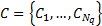
<body><![CDATA[<p><font size=2 face="Verdana, Arial, Helvetica, sans-serif">The MEG/EEG data can be related to the neural activity that generates   it using the general linear model (GLM): </font> </p>     <p><font size=2 face="Verdana, Arial, Helvetica, sans-serif"><img  src="/img/revistas/dyna/v79n174/v79n174a18eq177.gif"> </font> </p>     <p><font size=2 face="Verdana, Arial, Helvetica, sans-serif">The neural activity </font> <font size=2 face="Verdana, Arial, Helvetica, sans-serif"> <img src="/img/revistas/dyna/v79n174/v79n174a18eq178.gif"> propagates the energy of <img src="/img/revistas/dyna/v79n174/v79n174a18eq179.gif"> </font> <font size="2" face="Verdana, Arial, Helvetica, sans-serif"> current dipoles through the head, where a set   of <img src="/img/revistas/dyna/v79n174/v79n174a18eq180.gif"> </font> <font size="2" face="Verdana, Arial, Helvetica, sans-serif"> gradiometers/electrodes is used to acquire <img src="/img/revistas/dyna/v79n174/v79n174a18eq181.gif"> </font> <font size="2" face="Verdana, Arial, Helvetica, sans-serif"> time samples on the dataset <img src="/img/revistas/dyna/v79n174/v79n174a18eq182.gif"> . The fixed location of the dipoles   guarantees a linear propagation model that allows the use of a fixed gain matrix <img src="/img/revistas/dyna/v79n174/v79n174a18eq183.gif"> . Finally, the measurements are   affected by zero mean Gaussian noise <img src="/img/revistas/dyna/v79n174/v79n174a18eq184.gif"> . Empty room noise can be introduced   for more realistic assumptions &#91;20&#93;. </font></p>     <p><font size=2 face="Verdana, Arial, Helvetica, sans-serif">For a reliable reconstruction of the neural activity it is necessary to   define a large number of fixed dipoles inside the search space; these dipoles   usually outnumber the sensors (</font> <font size=2 face="Verdana, Arial, Helvetica, sans-serif"> <img src="/img/revistas/dyna/v79n174/v79n174a18eq185.gif"> ), making it an ill-posed problem.   Under Gaussian assumptions the solution of the GLM can be expressed as the minimisation problem: </font></p>     <p> <font size=2 face="Verdana, Arial, Helvetica, sans-serif"> <img src="/img/revistas/dyna/v79n174/v79n174a18eq186.gif"> (1) </font></p>     <p><font size=2 face="Verdana, Arial, Helvetica, sans-serif">where the likelihood is <img src="/img/revistas/dyna/v79n174/v79n174a18eq187.gif"> , with <img src="/img/revistas/dyna/v79n174/v79n174a18eq188.gif"> , and the prior source probability   distribution is <img src="/img/revistas/dyna/v79n174/v79n174a18eq189.gif"> . Assuming a priori that <img src="/img/revistas/dyna/v79n174/v79n174a18eq190.gif"> </font> <font size="2" face="Verdana, Arial, Helvetica, sans-serif"> and <img src="/img/revistas/dyna/v79n174/v79n174a18eq184.gif"> </font> <font size="2" face="Verdana, Arial, Helvetica, sans-serif"> are zero mean Gaussian processes with   covariances <img src="/img/revistas/dyna/v79n174/v79n174a18eq191.gif"> </font> <font size="2" face="Verdana, Arial, Helvetica, sans-serif"> and <img src="/img/revistas/dyna/v79n174/v79n174a18eq192.gif"> </font> <font size="2" face="Verdana, Arial, Helvetica, sans-serif"> respectively, and <img src="/img/revistas/dyna/v79n174/v79n174a18eq193.gif"> </font> <font size="2" face="Verdana, Arial, Helvetica, sans-serif"> is the multi normal probability density   function. </font></p>     <p><font size=2 face="Verdana, Arial, Helvetica, sans-serif">The estimated source activity </font> <font size=2 face="Verdana, Arial, Helvetica, sans-serif"> <img src="/img/revistas/dyna/v79n174/v79n174a18eq194.gif"> is obtained by minimising Eq. (1) &#91;2&#93;: </font></p>     <p> <font size=2 face="Verdana, Arial, Helvetica, sans-serif"> <img src="/img/revistas/dyna/v79n174/v79n174a18eq195.gif"> </font> </p>     <p><font size=2 face="Verdana, Arial, Helvetica, sans-serif">this solution is static but it can be   extended to dynamic activity by projecting the temporal information as proposed   in&#91;13, 14&#93;. </font></p> <font size="2" face="Verdana, Arial, Helvetica, sans-serif"><b>2.1  Computation of the covariance components    <br> </b></font><font size=2 face="Verdana, Arial, Helvetica, sans-serif">The solution of the GLM is highly dependent  on a good selection of the prior covariance matrices </font> <font size=2 face="Verdana, Arial, Helvetica, sans-serif"> <img src="/img/revistas/dyna/v79n174/v79n174a18eq191.gif"> and <img src="/img/revistas/dyna/v79n174/v79n174a18eq196.gif"> . In absence of sensor noise  information the noise is considered independent and uniformly distributed: <img src="/img/revistas/dyna/v79n174/v79n174a18eq197.gif"> , with <img  src="/img/revistas/dyna/v79n174/v79n174a18eq198.gif"> </font> <font size="2" face="Verdana, Arial, Helvetica, sans-serif"> a <img src="/img/revistas/dyna/v79n174/v79n174a18eq199.gif"> </font> <font size="2" face="Verdana, Arial, Helvetica, sans-serif"> identity matrix. </font>     ]]></body>


<body><![CDATA[<p><font size=2 face="Verdana, Arial, Helvetica, sans-serif">The prior source covariance matrix has been traditionally defined as a   single smoother &#91;2&#93;. But modern algorithms based on Empirical Bayes such as the Multiple Sparse Priors (MSP) algorithm &#91;16&#93; divide the smoother into a set of </font> <font size=2 face="Verdana, Arial, Helvetica, sans-serif"> <img src="/img/revistas/dyna/v79n174/v79n174a18eq200.gif"> </font> <font size="2" face="Verdana, Arial, Helvetica, sans-serif"> diagonal components <img src="/img/revistas/dyna/v79n174/v79n174a18eq201.gif"> , each component typically (but not   always) describing covariance due to a connected patch of cortex. These are   subsequently weighted by the algorithm to make an estimate of the sensor   covariance Q: </font></p>     <p> <font size=2 face="Verdana, Arial, Helvetica, sans-serif"> <img src="/img/revistas/dyna/v79n174/v79n174a18eq202.gif"> </font> </p>     <p><font size=2 face="Verdana, Arial, Helvetica, sans-serif">fMRI data can be highly informative when   considered as components&#91;21&#93;, but in absence of prior information these   components are patches generated with a Green's function. </font></p>     <p><font size=2 face="Verdana, Arial, Helvetica, sans-serif">The sources of neural activity are composed by focal regions of neurons   with synchronous activity; these focal regions are mostly bell shaped with a   maximum in their centre and attenuation in amplitude corresponding to the   square of the distance to it &#91;22&#93;. The Green's function is used to generate   bell shaped (Gaussian) patches for each covariance component following this behaviour&#91;18&#93;. </font></p>     <p><font size=2 face="Verdana, Arial, Helvetica, sans-serif">The Green's function is based on a graph Laplacian</font> <font size=2 face="Verdana, Arial, Helvetica, sans-serif"> <img src="/img/revistas/dyna/v79n174/v79n174a18eq203.gif"> </font> <font size="2" face="Verdana, Arial, Helvetica, sans-serif"> that uses the vertices and faces provided by a structural MRI of the   cortical manifold. The Green's function <img src="/img/revistas/dyna/v79n174/v79n174a18eq204.gif"> is defined as: </font></p>     <p> <font size=2 face="Verdana, Arial, Helvetica, sans-serif"> <img src="/img/revistas/dyna/v79n174/v79n174a18eq205.gif"> </font> <font size="2" face="Verdana, Arial, Helvetica, sans-serif"> (2) </font></p>     <p><font size=2 face="Verdana, Arial, Helvetica, sans-serif">with</font> <font size=2 face="Verdana, Arial, Helvetica, sans-serif"> <img src="/img/revistas/dyna/v79n174/v79n174a18eq206.gif"> </font> <font size="2" face="Verdana, Arial, Helvetica, sans-serif"> a positive constant value that determines the   size of the activated regions. Each patch (covariance component) is generated   with a column of <img src="/img/revistas/dyna/v79n174/v79n174a18eq207.gif"> </font> <font size="2" face="Verdana, Arial, Helvetica, sans-serif"> forming a bell centred on the corresponding   vertex. The size of the regions, the number of patches, and their locations   must be carefully selected in order to avoid empty spaces in the search space.   If the set is too large the computational effort to determine which of them are   active will be prohibitive. </font></p>     <p><font size=2 face="Verdana, Arial, Helvetica, sans-serif">With the set of covariance components </font> <font size=2 face="Verdana, Arial, Helvetica, sans-serif"> <img src="/img/revistas/dyna/v79n174/v79n174a18eq208.gif"> </font> <font size="2" face="Verdana, Arial, Helvetica, sans-serif"> generated, the weights (hyperparameters) <img src="/img/revistas/dyna/v79n174/v79n174a18eq209.gif"> </font> <font size="2" face="Verdana, Arial, Helvetica, sans-serif"> are pruned to those <img src="/img/revistas/dyna/v79n174/v79n174a18eq210.gif"> </font> <font size="2" face="Verdana, Arial, Helvetica, sans-serif"> corresponding to activated regions with a non-linear   search method, using the <i>Free energy</i> as the   cost function. </font></p> <font size="2" face="Verdana, Arial, Helvetica, sans-serif"><b>2.2  Definition of a cost function</b>    <br> </font><font size=2 face="Verdana, Arial, Helvetica, sans-serif">Within the Bayesian Framework the optimal set of hyperparameters is obtained from the expected value of their posterior probability given the  data: </font> <font size=2 face="Verdana, Arial, Helvetica, sans-serif"> <img src="/img/revistas/dyna/v79n174/v79n174a18eq211.gif"> . It can be expressed in terms of  known distributions using the Bayes' theorem: </font>     <p> <font size=2 face="Verdana, Arial, Helvetica, sans-serif"> <img src="/img/revistas/dyna/v79n174/v79n174a18eq212.gif"> </font> </p>     ]]></body>
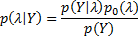
<body><![CDATA[<p><font size=2 face="Verdana, Arial, Helvetica, sans-serif">where the evidence <img src="/img/revistas/dyna/v79n174/v79n174a18eq213.gif"> </font> <font size="2" face="Verdana, Arial, Helvetica, sans-serif"> is fixed for a given dataset. The problem is   that we only have an approximate posterior: q <img src="/img/revistas/dyna/v79n174/v79n174a18eq214.gif"> ,and it is necessary to use a cost   function to find the optimal set of hyperparameters. </font></p>     <p><font size=2 face="Verdana, Arial, Helvetica, sans-serif">Let us define the log evidence as: </font></p>     <p> <font size=2 face="Verdana, Arial, Helvetica, sans-serif"> <img src="/img/revistas/dyna/v79n174/v79n174a18eq215.gif"> </font> </p>     <p><font size=2 face="Verdana, Arial, Helvetica, sans-serif">with</font> <font size=2 face="Verdana, Arial, Helvetica, sans-serif"> <img src="/img/revistas/dyna/v79n174/v79n174a18eq216.gif"> </font> <font size="2" face="Verdana, Arial, Helvetica, sans-serif"> the Kullback-Leibler (KL) divergence. When the   approximate posterior <img src="/img/revistas/dyna/v79n174/v79n174a18eq217.gif"> </font> <font size="2" face="Verdana, Arial, Helvetica, sans-serif"> is equal to the true posterior <img src="/img/revistas/dyna/v79n174/v79n174a18eq218.gif"> , the KL divergence is zero, and the <i>Free energy</i> is maximised: <img src="/img/revistas/dyna/v79n174/v79n174a18eq219.gif"> . </font></p>     <p><font size=2 face="Verdana, Arial, Helvetica, sans-serif">The <i>Free energy</i> gives a measure between the   variance of the data </font> <font size=2 face="Verdana, Arial, Helvetica, sans-serif"> <img src="/img/revistas/dyna/v79n174/v79n174a18eq220.gif"> , and the model based variance <img src="/img/revistas/dyna/v79n174/v79n174a18eq221.gif"> ; while at the same time punishing models   with large numbers of hyperparameters&#91;17&#93;: </font></p>     <p> <font size=2 face="Verdana, Arial, Helvetica, sans-serif"> <img src="/img/revistas/dyna/v79n174/v79n174a18eq222.gif"> </font> </p>     <p> <font size=2 face="Verdana, Arial, Helvetica, sans-serif"> <img src="/img/revistas/dyna/v79n174/v79n174a18eq223.gif"> </font> </p>     <p><font size=2 face="Verdana, Arial, Helvetica, sans-serif">where</font> <font size=2 face="Verdana, Arial, Helvetica, sans-serif"> <img src="/img/revistas/dyna/v79n174/v79n174a18eq224.gif"> </font> <font size="2" face="Verdana, Arial, Helvetica, sans-serif"> is the matrix determinant operator, and the   prior and approximate densities of the hyperparameters are consideredto be Gaussian distributed: <img src="/img/revistas/dyna/v79n174/v79n174a18eq225.gif"> , and <img src="/img/revistas/dyna/v79n174/v79n174a18eq226.gif"> . The optimal combination of hyperparameters is achieved when the maximum <i>Free energy</i> value: <img src="/img/revistas/dyna/v79n174/v79n174a18eq227.gif"> , which is when the <i>Free energy</i> is approximately the log evidence. In absence of   prior information the hyperparameters may be selected   with zero mean and infinite variance in order to guarantee flat hyperpriors. </font></p> <font size="2" face="Verdana, Arial, Helvetica, sans-serif"><b>2.3  Restricted Maximum Likelihood    <br> </b></font><font size=2 face="Verdana, Arial, Helvetica, sans-serif">An optimal way to optimise the <i>Free energyis</i> with the <i>restricted maximum likelihood </i>(ReML)  algorithm, that iteratively calculates the gradient and Hessian of </font> <font size=2 face="Verdana, Arial, Helvetica, sans-serif"> <img src="/img/revistas/dyna/v79n174/v79n174a18eq228.gif"> </font> <font size="2" face="Verdana, Arial, Helvetica, sans-serif"> with respect to the hyperparameters: </font>     <p> <font size=2 face="Verdana, Arial, Helvetica, sans-serif"> <img src="/img/revistas/dyna/v79n174/v79n174a18eq229.gif"> </font> </p>     ]]></body>

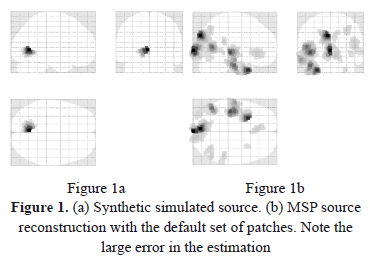
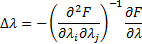
<body><![CDATA[<p> <font size=2 face="Verdana, Arial, Helvetica, sans-serif"> <img src="/img/revistas/dyna/v79n174/v79n174a18eq230.gif"> </font> </p>     <p><font size=2 face="Verdana, Arial, Helvetica, sans-serif">with</font> </p>     <p> <font size=2 face="Verdana, Arial, Helvetica, sans-serif"> <img src="/img/revistas/dyna/v79n174/v79n174a18eq231.gif"> </font> </p>     <p><font size=2 face="Verdana, Arial, Helvetica, sans-serif">The update of the hyperparameters is obtained   for </font> <font size=2 face="Verdana, Arial, Helvetica, sans-serif"> <img src="/img/revistas/dyna/v79n174/v79n174a18eq232.gif"> </font> <font size="2" face="Verdana, Arial, Helvetica, sans-serif"> iterations: </font></p>     <p> <font size=2 face="Verdana, Arial, Helvetica, sans-serif"> <img src="/img/revistas/dyna/v79n174/v79n174a18eq233.gif"> </font> </p>     <p><font size=2 face="Verdana, Arial, Helvetica, sans-serif">using Fisher scoring as the updating rule: </font></p>     <p> <font size=2 face="Verdana, Arial, Helvetica, sans-serif"> <img src="/img/revistas/dyna/v79n174/v79n174a18eq234.gif"> </font> </p>     <p><font size=2 face="Verdana, Arial, Helvetica, sans-serif">Within the ReML updates, those hyperparameters near to zero are pruned for faster   computation. The convergence is achieved for small changes in the <i>Free energy</i></font> <font size=2 face="Verdana, Arial, Helvetica, sans-serif"> <img src="/img/revistas/dyna/v79n174/v79n174a18eq235.gif"> .Note that the total <i>Free energy</i> was not computed with ReML,   it is done just once at the end of the iterative process. </font></p> <font size="2" face="Verdana, Arial, Helvetica, sans-serif"><b>2.4  Iterative update of patches</b>    <br> Pyramidal cells located in the grey matter generate 95 % of the neural  activity acquired with MEG/EEG devices &#91;22&#93;; this reduces the search space  where the patches must be located. The original implementation of the MSP and similar algorithms is basedon a fixed set of patchesdistributed over the entire  cortical surface &#91;12&#93;.However these patches do not cover it entirely leaving  empty spaces, if an active focal source is located in a region for which no  patches existthe reconstruction is severely affected  (See <a href="#fig01">Figure 1</a> for example). </font>     <p align="center"><font size="2" face="Verdana, Arial, Helvetica, sans-serif"><b><a name="fig01"></a></b></font><img src="/img/revistas/dyna/v79n174/v79n174a18fig01.gif"></p>     ]]></body>
<body><![CDATA[<p><font size=2 face="Verdana, Arial, Helvetica, sans-serif">The MSP algorithm provides a <i>Free energy</i> value for the source reconstruction based on a   given set of patches. This <i>Free energy</i> corresponds to the set of hyperparameters that best   fit the data with the givenpatches &#91;16&#93;. In order to   proceed we make two assumptions. Firstly, that those patches nearest to a true   (but missing) source will have higher hyperparameter values.   Secondly that an MSP reconstruction based on a set of   patches that includes the true source location, will have higher <i>Free energy</i> than a reconstruction which does not. Both   assumptions have been experimentally validated by evaluating the solution   obtained with sets of randomly located patches &#91;23&#93;. </font></p>     <p><font size=2 face="Verdana, Arial, Helvetica, sans-serif">This procedure is similar to the field of genetic algorithms, where the   most probable patches are used as &quot;parents&quot; to generate new   &quot;children&quot; in their neighbourhood. The proposed procedure can be   implemented as follows: </font></p> <ol>       <li> <font size=2 face="Verdana, Arial, Helvetica, sans-serif">Define a fixed set of patches covering the entire cortical surface. It     will give an initial maximum localisation error ofthe distance between patch centres.Perform the inversion     with the defined set of patches,and identify the subset of active ones. </font></li>       <li><font size=2 face="Verdana, Arial, Helvetica, sans-serif">Create a reconstruction using a new set of patches by selecting those     vertices in the region surrounding this subset, and add it to the original set     of patches. Perform a new inversion with the updated set of patches and obtain     the next <i>Free energy</i> value; if it increases     compared with the previous inversion redo step 2; if not finish and keep the solution of the previous     reconstruction. </font></li>     </ol>     <p><font size=2 face="Verdana, Arial, Helvetica, sans-serif">Note that each iteration is performed over the   initial set of patches plus a new set based on those active regions identified   in the previous iteration. The new set of patches must cover a region   surrounding those active vertices, for example a circle of twice the diameter   of a single patch centred on the location of the most active vertex. The   initial set of patches is necessary because background activity is expected and   it must be explained; i.e. several brain regions are permanently active but may   not be of interest. </font></p>     <p><font size=2 face="Verdana, Arial, Helvetica, sans-serif">When a patch is correctly located at the neural source location, the <i>Free energy</i> reaches its maximum; it is expected that further   iterations will maintain the maximum<i> Free energy</i>,   but it has been observed that sometimes in following iterations more patches become   active around the true source, increasing the complexity and consequently   reducing the <i>Free energy</i> value. This issue motivates   the use of the variation of <i>Free energy</i> as   stopping criterion of the proposed algorithm. </font></p>     <p><font size=2 face="Verdana, Arial, Helvetica, sans-serif">In the following sections this stage will be tested with noisy <i>synthetic </i>data and validated with data due to visual   cortical activity. </font></p>     <p>&nbsp; </p>     <p><font size="3" face="Verdana, Arial, Helvetica, sans-serif"><b>3.  SIMULATION RESULTS</b></font></p>     ]]></body>
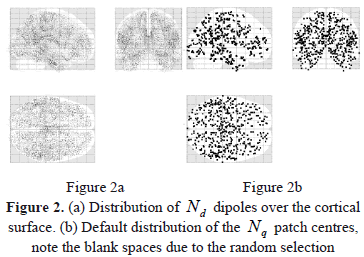
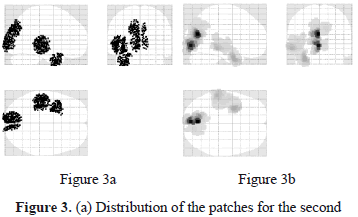
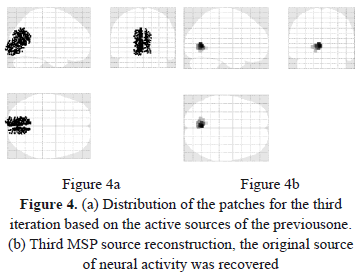
<body><![CDATA[<p><font size=2 face="Verdana, Arial, Helvetica, sans-serif">Single trial datasets of </font> <font size=2 face="Verdana, Arial, Helvetica, sans-serif"> <img src="/img/revistas/dyna/v79n174/v79n174a18eq236.gif"> </font> <font size="2" face="Verdana, Arial, Helvetica, sans-serif"> samples over <img src="/img/revistas/dyna/v79n174/v79n174a18eq237.gif"> </font> <font size="2" face="Verdana, Arial, Helvetica, sans-serif"> MEG sensors were generated, by projecting a   single source in different locations in the cortical surface. A sinusoidal   signal of 20 Hz was used for the temporal waveform of the source of neural   activity. A Signal to Noise Ratio <img src="/img/revistas/dyna/v79n174/v79n174a18eq238.gif"> </font> <font size="2" face="Verdana, Arial, Helvetica, sans-serif"> dB was added to the data using   white random noise. The sources were focal, Gaussian meshes with full width at   half maximum (FWHM) of 10 mm, this size corresponds   to common neural activated regions. <a href="#fig01">Figure 1(a)</a> shows an example of a source   located in occipital cortex. The translucent glass brains of <a href="#fig01">Figure 1</a> show the   frontal, lateral and superior views of the 512 dipoles with highest variance   during the time window of interest (-200 - 500 ms). </font></p>     <p><font size=2 face="Verdana, Arial, Helvetica, sans-serif">The MSP algorithm was implemented over a grid   of </font> <font size=2 face="Verdana, Arial, Helvetica, sans-serif"> <img src="/img/revistas/dyna/v79n174/v79n174a18eq241.gif"> </font> <font size="2" face="Verdana, Arial, Helvetica, sans-serif"> dipoles oriented orthogonal to and distributed   over the entire cortical surface, as shown in <a href="#fig02">Figure 2(a)</a>. The default MSP inversion was performed with <img src="/img/revistas/dyna/v79n174/v79n174a18eq242.gif"> </font> <font size="2" face="Verdana, Arial, Helvetica, sans-serif"> patcheswhose centres were randomly selected   from the <img src="/img/revistas/dyna/v79n174/v79n174a18eq179.gif"> </font> <font size="2" face="Verdana, Arial, Helvetica, sans-serif"> dipoles locations as can be seen in <a href="#fig02">Figure 2(b)</a>.   The size of the patches was approximately 10 mm. The initial values used in   the MSP algorithm optimisation are those of &#91;16&#93;. </font></p>     <p align="center"><font size="2" face="Verdana, Arial, Helvetica, sans-serif"><b><a name="fig02"></a></b></font><img src="/img/revistas/dyna/v79n174/v79n174a18fig02.gif"></p>     <p><font size=2 face="Verdana, Arial, Helvetica, sans-serif">The single source shown in <a href="#fig01">Figure 1(a)</a> was located intentionally far   from the patch centres of <a href="#fig02">Figure 2(b)</a>. The source reconstruction made with the MSP shown in <a href="#fig01">Figure 1(b)</a> is a good example of the algorithm   failure when the patches do not match with the sources. </font></p>     <p><font size="2" face="Verdana, Arial, Helvetica, sans-serif"><b>3.1  Results of iterative updates</b>    <br>   </font><font size="2" face="Verdana, Arial, Helvetica, sans-serif"><a href="#fig01">Figure 1(b)</a> shows that most of the energy is divided in three separated   regions, one near the true source, one superficialin the left hemisphere, and another one deep in the left hemisphere. These   activated regions were used as seeds about which to create a new set of patch   centres. New patch centres were drawn from a Gaussian distribution of FWHM=20 mm around each active peak(Twice   the size of a patch, see <a href="#fig03">Figure 3(a)</a>). For simplicity in this example, the   default set of patches was not used in the new sets; as the synthetic data do   not have extra activity this does not affect the <i>Free energy</i>. </font> </p>     <p align="center"><font size="2" face="Verdana, Arial, Helvetica, sans-serif"><b><a name="fig03"></a></b></font><img src="/img/revistas/dyna/v79n174/v79n174a18fig03.gif"></p>     <p><font size=2 face="Verdana, Arial, Helvetica, sans-serif"><a href="#fig03">Figure 3(b)</a> shows the MSP source   reconstruction obtained with the new set of patches. It is clear that the   estimated active cortex is now bounded by the more focally seeded patches. Also   the solution is beginning to approach the expected results (<a href="#fig01">Figure 1(a)</a>). </font></p>     <p><font size=2 face="Verdana, Arial, Helvetica, sans-serif">A third iteration was performed again updating the set of patches.The third patch set (shown in <a href="#fig04">Figure 4(a)</a>) became   in turn more focal and the reconstruction again approached the (focal)   simulated case(<a href="#fig04">Figure 4(b)</a>). </font></p>     <p align="center"><font size="2" face="Verdana, Arial, Helvetica, sans-serif"><b><a name="fig04"></a></b></font><img src="/img/revistas/dyna/v79n174/v79n174a18fig04.gif"></p>     ]]></body>
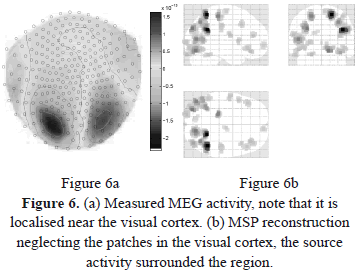
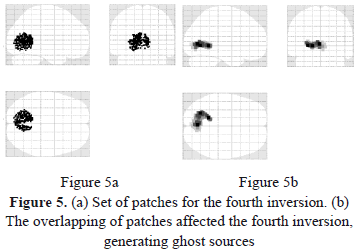
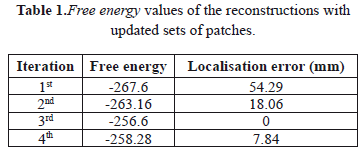
<body><![CDATA[<p><font size=2 face="Verdana, Arial, Helvetica, sans-serif">Given that the <i>Free energy</i> continued increasing, a fourth inversion was performed. <a href="#fig05">Figure 5(a)</a> shows the   new set of patches filling the region of reconstructed activity. <a href="#fig05">Figure 5(b)</a> shows the fourth MSP reconstruction. The overlapping   of patches around the true location meant that several overlapped patches were   used to emulate the activity of the true source. The question now remains at   which iteration should we have stopped, given that   normally we have no knowledge of localisation error. </font></p>     <p align="center"><font size="2" face="Verdana, Arial, Helvetica, sans-serif"><b><a name="fig05"></a></b></font><img src="/img/revistas/dyna/v79n174/v79n174a18fig05.gif"></p> <font size="2" face="Verdana, Arial, Helvetica, sans-serif"><b>3.2  Convergence    <br> </b></font><font size=2 face="Verdana, Arial, Helvetica, sans-serif">Each inversion is associated with a <i>Free energy</i> value. <a href="#tab01">Table 1</a> shows its evolution through the inversions. Itshows how the <i>Free energy</i> increases and the  localisation error decreases over iterations 1 - 3. At iteration 4  however, the <i>Free energy</i> begins to decrease  again; that is, this model (overlapping patches) has become unnecessarily  complex to explain the data. </font>     <p align="center"><font size="2" face="Verdana, Arial, Helvetica, sans-serif"><b><a name="tab01"></a></b></font><img src="/img/revistas/dyna/v79n174/v79n174a18tab01.gif"></p>     <p><font size=2 face="Verdana, Arial, Helvetica, sans-serif">The localisation error of the source of neural activity was defined as   the Euclidean distance between its true location: </font> <font size=2 face="Verdana, Arial, Helvetica, sans-serif"> <img src="/img/revistas/dyna/v79n174/v79n174a18eq251.gif"> , and the location of the dipole   with maximum energy after the estimation, <img src="/img/revistas/dyna/v79n174/v79n174a18eq252.gif"> : <img src="/img/revistas/dyna/v79n174/v79n174a18eq253.gif"> . </font></p>     <p><font size=2 face="Verdana, Arial, Helvetica, sans-serif">Preliminary tests with different noise levels (not shown here) and   several source locations presented also zero localisation error after three or   four iterations. </font></p>     <p>&nbsp; </p>     <p><font size="3" face="Verdana, Arial, Helvetica, sans-serif"><b>4.  VALIDATION WITH REAL DATA</b></font></p>     <p><font size=2 face="Verdana, Arial, Helvetica, sans-serif">We used some MEG data acquired in a visual attention task to validate   the method. A detailed description of the experimental set-up and previous data   analysis were presented in &#91;24&#93;. Averaged single subject data were used. </font></p>     <p><font size=2 face="Verdana, Arial, Helvetica, sans-serif"><a href="#fig06">Figure 6(a)</a> shows the measured activity at the   scalp at 151.6 ms of recording. For this experiment the set of patches   located within the visual cortex was deliberately sparse, affecting the source   reconstruction as shown in <a href="#fig06">Figure 6(b)</a>. This first reconstruction had a <i>Free energy</i> value of </font> <font size=2 face="Verdana, Arial, Helvetica, sans-serif"> <img src="/img/revistas/dyna/v79n174/v79n174a18eq256.gif"> . </font></p>     ]]></body>
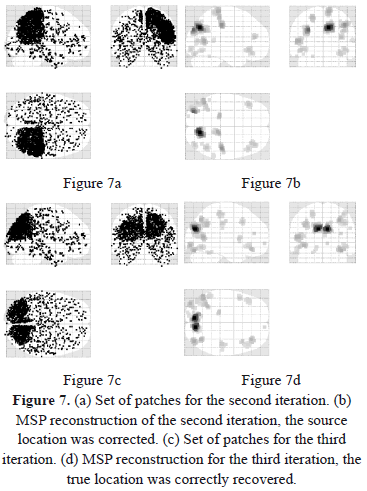
<body><![CDATA[<p align="center"><font size="2" face="Verdana, Arial, Helvetica, sans-serif"><b><a name="fig06"></a></b></font><img src="/img/revistas/dyna/v79n174/v79n174a18fig06.gif"></p>     <p><font size=2 face="Verdana, Arial, Helvetica, sans-serif">The second iteration of patches is shown in <a href="#fig07">Figure 7(a)</a>. The distribution   of these patches was a Gaussian of FWHM=20 mm. <a href="#fig07">Figure 7(b)</a> shows the MSP estimation of the second   iteration, there was an increase in the <i>Free energy</i> to </font> <font size=2 face="Verdana, Arial, Helvetica, sans-serif"> <img src="/img/revistas/dyna/v79n174/v79n174a18eq259.gif"> , and the source activity moved closer   to the visual cortex. This new region was used to generate the new set of   patches, shown in <a href="#fig07">figure 7(c)</a>, for a third iteration where physiologically   plausible sources in visual cortex can be observed. <a href="#fig07">Figure 7(d)</a> shows the final   reconstruction. </font></p>     <p align="center"><font size="2" face="Verdana, Arial, Helvetica, sans-serif"><b><a name="fig07"></a></b></font><img src="/img/revistas/dyna/v79n174/v79n174a18fig07.gif"></p>     <p><font size=2 face="Verdana, Arial, Helvetica, sans-serif">The <i>Free energy</i> for the third inversion was </font> <font size=2 face="Verdana, Arial, Helvetica, sans-serif"> <img src="/img/revistas/dyna/v79n174/v79n174a18eq264.gif"> . Given that it continued increasing   a forth inversion was performed, but the <i>Free energy</i> maintained its value finishing the iterative process and defining the third inversion   as the final one. </font></p>     <p>&nbsp; </p>     <p><font size="3" face="Verdana, Arial, Helvetica, sans-serif"><b>5.  DISCUSSION</b></font></p>     <p><font size=2 face="Verdana, Arial, Helvetica, sans-serif">In this paperwe have presented a principled   and computationally efficient patch update method for the MSP inversion scheme.This patch update is based in two   assumptions &#91;23&#93;: Nearest patches of neural activity are active; and a source   reconstruction with a patch over the true source has higher<i> Free energy</i> than a reconstruction without it. Theoretically both assumptions are explained   by the accuracy of a solution with the right patch distribution, and the   complexity of reconstructing the data without correct patches &#91;17&#93;. </font></p>     <p><font size=2 face="Verdana, Arial, Helvetica, sans-serif">The ill-conditioned nature of the MEG/EEG inverse problem allows   infinite possible solutions for a single dataset, and the noise increases this   uncertainty. It is suggested that a fixed initial distribution covering the   entire source space in order to allow the optimisation process to explain the   non-interesting activity.One possible drawback of   this algorithm is that it relies on an approximately correct initial inversion.   There are however many similar approaches which (although entailing higher   computational load) might in practice prove to be more robust. For example, one   could simply use randomly distributed patch centres from the outset &#91;23&#93;. One could   classify such inversions based either on that which yielded the highest <i>Free energy</i> (as here) or through Bayesian Model Averaging &#91;25&#93;. </font></p>     <p><font size=2 face="Verdana, Arial, Helvetica, sans-serif">Some authors have criticised the convexity assumption on the <i>Free energy</i> &#91;12&#93;, or proposed Markov based solutions &#91;5&#93;. But   as stated in &#91;25&#93; the quadratic assumptions are comparable to the Euclidean   norm estimation, and the source reconstruction used here is the same as Kalman   gain with an improvement on priors, the Bayesian framework uses all the data   for providing informative priors (Empirical Bayes)   avoiding defining dynamics of the neural activity and allowing the reduction of   model dimensionality &#91;16&#93;. </font></p>     <p><font size=2 face="Verdana, Arial, Helvetica, sans-serif">Finally, note that a very similar procedure to that outlined here could   be performed to determine other spatial characteristics such as the true extent   of the patches. In this case, the same patch centres would be used but the   Green's function modified (Eq. (2)) between iterations. </font></p>     ]]></body>
<body><![CDATA[<p>&nbsp;</p>     <p><font size="3" face="Verdana, Arial, Helvetica, sans-serif"><b>ACKNOWLEDGMENTS </b> </font> </p>     <p><font size=2 face="Verdana, Arial, Helvetica, sans-serif">J.D. L&oacute;pez and J.J. Espinosa are supported by ARTICA Research Centre for   Excellence, Universidad Nacional de Colombia, and Colciencias,   in the project &quot;Procesamiento de Señales&quot;. The Wellcome Trust   Centre for Neuroimaging is supported by a strategic   award from the Wellcome Trust. The authors would like   to thank Marcus Bauer for providing the dataset and helpful information for   this work. </font></p>     <p>&nbsp;</p>     <p><font size="3" face="Verdana, Arial, Helvetica, sans-serif"><b>REFERENCES </b> </font></p>     <!-- ref --><p><font size="2" face="Verdana, Arial, Helvetica, sans-serif"><b>&#91;1&#93;</b> Supek, S. and Aine, C.J., Simulation studies of multiple dipole neuromagnetic source localization: model order and limits of source resolution. IEEE transactions on biomedical engineering, Vol 40 (16), pp529 – 540, 1993.    &nbsp;&nbsp;&nbsp;&nbsp;&nbsp;&nbsp;&nbsp;&nbsp;[&#160;<a href="javascript:void(0);" onclick="javascript: window.open('/scielo.php?script=sci_nlinks&ref=000118&pid=S0012-7353201200040001800001&lng=','','width=640,height=500,resizable=yes,scrollbars=1,menubar=yes,');">Links</a>&#160;]<!-- end-ref --><!-- ref --><br>   <b>&#91;2&#93;</b> Grech, R., Cassar, T., Muscat, J., Camilleri, K., Fabri, S., Zervakis, M., Xanthopoulos, P., Sakkalis, V. and Vanrumste, B., Review on solving the inverse problem in EEG source analysis.Journal of NeuroEngineering and Rehabilitation 5, 25, 2008.    &nbsp;&nbsp;&nbsp;&nbsp;&nbsp;&nbsp;&nbsp;&nbsp;[&#160;<a href="javascript:void(0);" onclick="javascript: window.open('/scielo.php?script=sci_nlinks&ref=000119&pid=S0012-7353201200040001800002&lng=','','width=640,height=500,resizable=yes,scrollbars=1,menubar=yes,');">Links</a>&#160;]<!-- end-ref --><!-- ref --><br>   <b>&#91;3&#93;</b> Hamalainen, M. and Sarvas, J., Realistic Conductivity Geometry Model of the Human Head for Interpretation of Neuromagnetic Data. IEEE transactions on biomedical engineering, 36, pp165 – 171, 1989.    &nbsp;&nbsp;&nbsp;&nbsp;&nbsp;&nbsp;&nbsp;&nbsp;[&#160;<a href="javascript:void(0);" onclick="javascript: window.open('/scielo.php?script=sci_nlinks&ref=000120&pid=S0012-7353201200040001800003&lng=','','width=640,height=500,resizable=yes,scrollbars=1,menubar=yes,');">Links</a>&#160;]<!-- end-ref --><!-- ref --><br>   <b>&#91;4&#93;</b> Pascual-Marqui, R., Michel, C.M. and Lehmann, D., Low Resolution Electromagnetic Tomography: A new method for localizing electrical activity in the brain. International Journal of psychophysiology, 18, pp. 49-65 1994.    &nbsp;&nbsp;&nbsp;&nbsp;&nbsp;&nbsp;&nbsp;&nbsp;[&#160;<a href="javascript:void(0);" onclick="javascript: window.open('/scielo.php?script=sci_nlinks&ref=000121&pid=S0012-7353201200040001800004&lng=','','width=640,height=500,resizable=yes,scrollbars=1,menubar=yes,');">Links</a>&#160;]<!-- end-ref --><!-- ref --><br>   <b>&#91;5&#93;</b> Barton, M., Robinson, P., Kumar, S., Galka, A., Durrant-Whyte, H., Guivant, J. and Ozaki, T., Evaluating the Performance of Kalman-Filter-Based EEG Source Localization. IEEE transactions on biomedical engineering, 56, pp. 122 – 136, 2009.    &nbsp;&nbsp;&nbsp;&nbsp;&nbsp;&nbsp;&nbsp;&nbsp;[&#160;<a href="javascript:void(0);" onclick="javascript: window.open('/scielo.php?script=sci_nlinks&ref=000122&pid=S0012-7353201200040001800005&lng=','','width=640,height=500,resizable=yes,scrollbars=1,menubar=yes,');">Links</a>&#160;]<!-- end-ref --><!-- ref --><br>   <b>&#91;6&#93;</b> Kalman, R.A., New Approach to Linear Filtering and Prediction Problems. Transactions of the ASME, Journal of Basic Engineering, 82, pp. 35 – 45, 1960.    &nbsp;&nbsp;&nbsp;&nbsp;&nbsp;&nbsp;&nbsp;&nbsp;[&#160;<a href="javascript:void(0);" onclick="javascript: window.open('/scielo.php?script=sci_nlinks&ref=000123&pid=S0012-7353201200040001800006&lng=','','width=640,height=500,resizable=yes,scrollbars=1,menubar=yes,');">Links</a>&#160;]<!-- end-ref --><!-- ref --><br>   <b>&#91;7&#93;</b> Kim, J.W., Robinson, P.A. Compact dynamical model of brain activity. Phys. Rev. E, American Physical Society, 75, 10 pages, 2007.    &nbsp;&nbsp;&nbsp;&nbsp;&nbsp;&nbsp;&nbsp;&nbsp;[&#160;<a href="javascript:void(0);" onclick="javascript: window.open('/scielo.php?script=sci_nlinks&ref=000124&pid=S0012-7353201200040001800007&lng=','','width=640,height=500,resizable=yes,scrollbars=1,menubar=yes,');">Links</a>&#160;]<!-- end-ref --><!-- ref --><br>   <b>&#91;8&#93;</b> Antelis, J.M. and Minguez, J., Dynamic solution to the EEG source localization problem using Kalman Filters and Particle Filters. Annual International Conference IEEE EMBS, 2009.    &nbsp;&nbsp;&nbsp;&nbsp;&nbsp;&nbsp;&nbsp;&nbsp;[&#160;<a href="javascript:void(0);" onclick="javascript: window.open('/scielo.php?script=sci_nlinks&ref=000125&pid=S0012-7353201200040001800008&lng=','','width=640,height=500,resizable=yes,scrollbars=1,menubar=yes,');">Links</a>&#160;]<!-- end-ref --><!-- ref --><br>   <b>&#91;9&#93;</b> Giraldo, E., den Dekker, A. and Castellanos, G., Estimation of dynamic neural activity using a Kalman filter approach based on physiological models. Annual International Conference IEEE EMBS, pp. 2914 – 2917, 2010.    &nbsp;&nbsp;&nbsp;&nbsp;&nbsp;&nbsp;&nbsp;&nbsp;[&#160;<a href="javascript:void(0);" onclick="javascript: window.open('/scielo.php?script=sci_nlinks&ref=000126&pid=S0012-7353201200040001800009&lng=','','width=640,height=500,resizable=yes,scrollbars=1,menubar=yes,');">Links</a>&#160;]<!-- end-ref --><!-- ref --><br>   <b>&#91;10&#93;</b> L&oacute;pez, J.D., Valencia, F. and Espinosa, J.J., EEG brain imaging based on Kalman filtering and subspace identification. IEEE Second Latin American Symposium on Circuits and Systems (LASCAS), 4 pages, 2011.    &nbsp;&nbsp;&nbsp;&nbsp;&nbsp;&nbsp;&nbsp;&nbsp;[&#160;<a href="javascript:void(0);" onclick="javascript: window.open('/scielo.php?script=sci_nlinks&ref=000127&pid=S0012-7353201200040001800010&lng=','','width=640,height=500,resizable=yes,scrollbars=1,menubar=yes,');">Links</a>&#160;]<!-- end-ref --><!-- ref --><br>   <b>&#91;11&#93;</b> L&oacute;pez, J.D., Espinosa, J.J.Spatio-temporal EEG brain imaging based on reduced Kalman filtering. 5th International Conference IEEE EMBS, pp. 64 – 67. 2011.    &nbsp;&nbsp;&nbsp;&nbsp;&nbsp;&nbsp;&nbsp;&nbsp;[&#160;<a href="javascript:void(0);" onclick="javascript: window.open('/scielo.php?script=sci_nlinks&ref=000128&pid=S0012-7353201200040001800011&lng=','','width=640,height=500,resizable=yes,scrollbars=1,menubar=yes,');">Links</a>&#160;]<!-- end-ref --><!-- ref --><br>   <b>&#91;12&#93;</b> Wipf, D., Nagarajan, S.A unified Bayesian framework for MEG/EEG source imaging. Neuroimage, 44, pp. 947 – 966, 2009.    &nbsp;&nbsp;&nbsp;&nbsp;&nbsp;&nbsp;&nbsp;&nbsp;[&#160;<a href="javascript:void(0);" onclick="javascript: window.open('/scielo.php?script=sci_nlinks&ref=000129&pid=S0012-7353201200040001800012&lng=','','width=640,height=500,resizable=yes,scrollbars=1,menubar=yes,');">Links</a>&#160;]<!-- end-ref --><!-- ref --><br>   <b>&#91;13&#93;</b> Phillips, C., Rugg, M. and Friston, K., Anatomically Informed Basis Functions for EEG Source Localization: Combining Functional and Anatomical Constraints. NeuroImage, pp. 16, pp 678 – 695, 2002.    &nbsp;&nbsp;&nbsp;&nbsp;&nbsp;&nbsp;&nbsp;&nbsp;[&#160;<a href="javascript:void(0);" onclick="javascript: window.open('/scielo.php?script=sci_nlinks&ref=000130&pid=S0012-7353201200040001800013&lng=','','width=640,height=500,resizable=yes,scrollbars=1,menubar=yes,');">Links</a>&#160;]<!-- end-ref --><!-- ref --><br>   <b>&#91;14&#93;</b> Trujillo, N.J., Aubert, E. and Penny, W.D. Bayesian M/EEG source reconstruction with spatio-temporal priors. Neuroimage, 39, pp. 318 – 335, 2008.    &nbsp;&nbsp;&nbsp;&nbsp;&nbsp;&nbsp;&nbsp;&nbsp;[&#160;<a href="javascript:void(0);" onclick="javascript: window.open('/scielo.php?script=sci_nlinks&ref=000131&pid=S0012-7353201200040001800014&lng=','','width=640,height=500,resizable=yes,scrollbars=1,menubar=yes,');">Links</a>&#160;]<!-- end-ref --><!-- ref --><br>   <b>&#91;15&#93;</b> &Aacute;lvarez, A.M., Daza, G., Acosta, C.D. and Castellanos, G., Parameter selection in least squares-support vector machines regression oriented, using generalized cross-validation. Revista DYNA, 171, pp. 23 – 30, 2011.    &nbsp;&nbsp;&nbsp;&nbsp;&nbsp;&nbsp;&nbsp;&nbsp;[&#160;<a href="javascript:void(0);" onclick="javascript: window.open('/scielo.php?script=sci_nlinks&ref=000132&pid=S0012-7353201200040001800015&lng=','','width=640,height=500,resizable=yes,scrollbars=1,menubar=yes,');">Links</a>&#160;]<!-- end-ref --><!-- ref --><br>   <b>&#91;16&#93;</b> Friston, K., Harrison, L., Daunizeau, J., Kiebel, S., Phillips, C., Trujillo, N., Henson, R., Flandin, G. and Mattout, J., Multiple sparse priors for the M/EEG inverse problem. Neuroimage, 39, pp. 1104 – 1120, 2008.    &nbsp;&nbsp;&nbsp;&nbsp;&nbsp;&nbsp;&nbsp;&nbsp;[&#160;<a href="javascript:void(0);" onclick="javascript: window.open('/scielo.php?script=sci_nlinks&ref=000133&pid=S0012-7353201200040001800016&lng=','','width=640,height=500,resizable=yes,scrollbars=1,menubar=yes,');">Links</a>&#160;]<!-- end-ref --><!-- ref --><br>   <b>&#91;17&#93;</b> Friston, K., Mattout, J., Trujillo, N., Ashburner, J. and Penny, W., VariationalFree energy and the Laplace approximation. Neuroimage, 34, pp.220 – 234, 2007.    &nbsp;&nbsp;&nbsp;&nbsp;&nbsp;&nbsp;&nbsp;&nbsp;[&#160;<a href="javascript:void(0);" onclick="javascript: window.open('/scielo.php?script=sci_nlinks&ref=000134&pid=S0012-7353201200040001800017&lng=','','width=640,height=500,resizable=yes,scrollbars=1,menubar=yes,');">Links</a>&#160;]<!-- end-ref --><!-- ref --><br>   <b>&#91;18&#93;</b> Harrison, L., Penny, W., Ashburner, J., Trujillo, N. and Friston, K., Diffusion-based spatial priors for imaging. Neuroimage, 38, pp.677 – 695, 2007.    &nbsp;&nbsp;&nbsp;&nbsp;&nbsp;&nbsp;&nbsp;&nbsp;[&#160;<a href="javascript:void(0);" onclick="javascript: window.open('/scielo.php?script=sci_nlinks&ref=000135&pid=S0012-7353201200040001800018&lng=','','width=640,height=500,resizable=yes,scrollbars=1,menubar=yes,');">Links</a>&#160;]<!-- end-ref --><!-- ref --><br>   <b>&#91;19&#93;</b> L&oacute;pez, J.D. and Espinosa, J.J., Single MEG/EEG source reconstruction with multiple sparse priors and variable patches. International Seminar on Medical Image Processing and Analysis (SIPAIM), 2011.    &nbsp;&nbsp;&nbsp;&nbsp;&nbsp;&nbsp;&nbsp;&nbsp;[&#160;<a href="javascript:void(0);" onclick="javascript: window.open('/scielo.php?script=sci_nlinks&ref=000136&pid=S0012-7353201200040001800019&lng=','','width=640,height=500,resizable=yes,scrollbars=1,menubar=yes,');">Links</a>&#160;]<!-- end-ref --><!-- ref --><br>   <b>&#91;20&#93;</b> Henson, R., Mouchlianitis, E. and Friston, K., MEG and EEG data fusion: simultaneous localisation of face-evoked responses.NeuroImage 47(2), pp.581 – 589, 2009.    &nbsp;&nbsp;&nbsp;&nbsp;&nbsp;&nbsp;&nbsp;&nbsp;[&#160;<a href="javascript:void(0);" onclick="javascript: window.open('/scielo.php?script=sci_nlinks&ref=000137&pid=S0012-7353201200040001800020&lng=','','width=640,height=500,resizable=yes,scrollbars=1,menubar=yes,');">Links</a>&#160;]<!-- end-ref --><!-- ref --><br>   <b>&#91;21&#93;</b> Henson, R.N., Flandin, G., Friston, K.J. and Mattout, J.A., parametric empirical Bayesian framework for fMRI-constrained MEG/EEG source reconstruction. Human Brain Mapping, 31, pp. 1512 – 1531, 2010.    &nbsp;&nbsp;&nbsp;&nbsp;&nbsp;&nbsp;&nbsp;&nbsp;[&#160;<a href="javascript:void(0);" onclick="javascript: window.open('/scielo.php?script=sci_nlinks&ref=000138&pid=S0012-7353201200040001800021&lng=','','width=640,height=500,resizable=yes,scrollbars=1,menubar=yes,');">Links</a>&#160;]<!-- end-ref --><!-- ref --><br>   <b>&#91;22&#93;</b> Hallez, H., Vanrumste, B., Grech, R., Muscat, J., De Clercq, W., Vergult, A., D'Asseler, Y., Camilleri, K.P., Fabri, S.G., Van Huffel, S. and Lemahieu, I., Review on solving the forward problem in EEG source analysis Journal of Neuro Engineering and Rehabilitation, 4:46. 2007.    &nbsp;&nbsp;&nbsp;&nbsp;&nbsp;&nbsp;&nbsp;&nbsp;[&#160;<a href="javascript:void(0);" onclick="javascript: window.open('/scielo.php?script=sci_nlinks&ref=000139&pid=S0012-7353201200040001800022&lng=','','width=640,height=500,resizable=yes,scrollbars=1,menubar=yes,');">Links</a>&#160;]<!-- end-ref --><!-- ref --><br>   <b>&#91;23&#93;</b> L&oacute;pez, J., Espinosa, J. and Barnes, G., Random location of Multiple Sparse Priors for solving the MEG/EEG inverse problem. Anual international conference of the IEEE EMBC, 2012.(Accepted).    &nbsp;&nbsp;&nbsp;&nbsp;&nbsp;&nbsp;&nbsp;&nbsp;[&#160;<a href="javascript:void(0);" onclick="javascript: window.open('/scielo.php?script=sci_nlinks&ref=000140&pid=S0012-7353201200040001800023&lng=','','width=640,height=500,resizable=yes,scrollbars=1,menubar=yes,');">Links</a>&#160;]<!-- end-ref --><!-- ref --><br>   <b>&#91;24&#93;</b> Bauer, M., Kluge, C., Bach, D., Bradbury, D., JochenHeinze, H., Dolan, R.J. and Driver, J., Cholinergic Enhancement of Visual Attention and Neural Oscillations in the Human Brain. Current Biology, pp. 397 – 402, 2012.    &nbsp;&nbsp;&nbsp;&nbsp;&nbsp;&nbsp;&nbsp;&nbsp;[&#160;<a href="javascript:void(0);" onclick="javascript: window.open('/scielo.php?script=sci_nlinks&ref=000141&pid=S0012-7353201200040001800024&lng=','','width=640,height=500,resizable=yes,scrollbars=1,menubar=yes,');">Links</a>&#160;]<!-- end-ref --><!-- ref --><br>   <b>&#91;25&#93;</b> L&oacute;pez, J.D., Penny, W.D., Espinosa, J.J. and Barnes, G.R., A general Bayesian treatment for MEG source reconstruction incorporating lead field uncertainty.Neuroimage, 60, pp.1194 – 1204, 2012.    &nbsp;&nbsp;&nbsp;&nbsp;&nbsp;&nbsp;&nbsp;&nbsp;[&#160;<a href="javascript:void(0);" onclick="javascript: window.open('/scielo.php?script=sci_nlinks&ref=000142&pid=S0012-7353201200040001800025&lng=','','width=640,height=500,resizable=yes,scrollbars=1,menubar=yes,');">Links</a>&#160;]<!-- end-ref --> </font></p>      ]]></body><back>
<ref-list>
<ref id="B1">
<label>1</label><nlm-citation citation-type="journal">
<person-group person-group-type="author">
<name>
<surname><![CDATA[Supek]]></surname>
<given-names><![CDATA[S.]]></given-names>
</name>
<name>
<surname><![CDATA[Aine]]></surname>
<given-names><![CDATA[C.J.]]></given-names>
</name>
</person-group>
<article-title xml:lang="en"><![CDATA[Simulation studies of multiple dipole neuromagnetic source localization:: model order and limits of source resolution.]]></article-title>
<source><![CDATA[IEEE transactions on biomedical engineering]]></source>
<year>1993</year>
<volume>40</volume>
<numero>16</numero>
<issue>16</issue>
<page-range>529 - 540</page-range></nlm-citation>
</ref>
<ref id="B2">
<label>2</label><nlm-citation citation-type="journal">
<person-group person-group-type="author">
<name>
<surname><![CDATA[Grech]]></surname>
<given-names><![CDATA[R.]]></given-names>
</name>
<name>
<surname><![CDATA[Cassar]]></surname>
<given-names><![CDATA[T.]]></given-names>
</name>
<name>
<surname><![CDATA[Muscat]]></surname>
<given-names><![CDATA[J.]]></given-names>
</name>
<name>
<surname><![CDATA[Camilleri]]></surname>
<given-names><![CDATA[K.]]></given-names>
</name>
<name>
<surname><![CDATA[Fabri]]></surname>
<given-names><![CDATA[S.]]></given-names>
</name>
<name>
<surname><![CDATA[Zervakis]]></surname>
<given-names><![CDATA[M.]]></given-names>
</name>
<name>
<surname><![CDATA[Xanthopoulos]]></surname>
<given-names><![CDATA[P.]]></given-names>
</name>
<name>
<surname><![CDATA[Sakkalis]]></surname>
<given-names><![CDATA[V.]]></given-names>
</name>
<name>
<surname><![CDATA[Vanrumste]]></surname>
<given-names><![CDATA[B.]]></given-names>
</name>
</person-group>
<article-title xml:lang="en"><![CDATA[Review on solving the inverse problem in EEG source analysis.]]></article-title>
<source><![CDATA[Journal of NeuroEngineering and Rehabilitation]]></source>
<year>2008</year>
<numero>5</numero><numero>25</numero>
<issue>5</issue><issue>25</issue>
</nlm-citation>
</ref>
<ref id="B3">
<label>3</label><nlm-citation citation-type="journal">
<person-group person-group-type="author">
<name>
<surname><![CDATA[Hamalainen]]></surname>
<given-names><![CDATA[M.]]></given-names>
</name>
<name>
<surname><![CDATA[Sarvas]]></surname>
<given-names><![CDATA[J.]]></given-names>
</name>
</person-group>
<article-title xml:lang="en"><![CDATA[Realistic Conductivity Geometry Model of the Human Head for Interpretation of Neuromagnetic Data]]></article-title>
<source><![CDATA[IEEE transactions on biomedical engineering]]></source>
<year>1989</year>
<numero>36</numero>
<issue>36</issue>
<page-range>165 - 171</page-range></nlm-citation>
</ref>
<ref id="B4">
<label>4</label><nlm-citation citation-type="journal">
<person-group person-group-type="author">
<name>
<surname><![CDATA[Pascual-Marqui]]></surname>
<given-names><![CDATA[R.]]></given-names>
</name>
<name>
<surname><![CDATA[Michel]]></surname>
<given-names><![CDATA[C.M.]]></given-names>
</name>
<name>
<surname><![CDATA[Lehmann]]></surname>
<given-names><![CDATA[D.]]></given-names>
</name>
</person-group>
<article-title xml:lang="en"><![CDATA[Low Resolution Electromagnetic Tomography:: A new method for localizing electrical activity in the brain.]]></article-title>
<source><![CDATA[International Journal of psychophysiology]]></source>
<year>1994</year>
<numero>18</numero>
<issue>18</issue>
<page-range>49-65</page-range></nlm-citation>
</ref>
<ref id="B5">
<label>5</label><nlm-citation citation-type="journal">
<person-group person-group-type="author">
<name>
<surname><![CDATA[Barton]]></surname>
<given-names><![CDATA[M.]]></given-names>
</name>
<name>
<surname><![CDATA[Robinson]]></surname>
<given-names><![CDATA[P.]]></given-names>
</name>
<name>
<surname><![CDATA[Kumar]]></surname>
<given-names><![CDATA[S.]]></given-names>
</name>
<name>
<surname><![CDATA[Galka]]></surname>
<given-names><![CDATA[A.]]></given-names>
</name>
<name>
<surname><![CDATA[Durrant-Whyte]]></surname>
<given-names><![CDATA[H.]]></given-names>
</name>
<name>
<surname><![CDATA[Guivant]]></surname>
<given-names><![CDATA[J.]]></given-names>
</name>
<name>
<surname><![CDATA[Ozaki]]></surname>
<given-names><![CDATA[T.]]></given-names>
</name>
</person-group>
<article-title xml:lang="en"><![CDATA[Evaluating the Performance of Kalman-Filter-Based EEG Source Localization.]]></article-title>
<source><![CDATA[IEEE transactions on biomedical engineering]]></source>
<year>2009</year>
<numero>56</numero>
<issue>56</issue>
<page-range>122 - 136</page-range></nlm-citation>
</ref>
<ref id="B6">
<label>6</label><nlm-citation citation-type="journal">
<person-group person-group-type="author">
<name>
<surname><![CDATA[Kalman]]></surname>
<given-names><![CDATA[R.A.]]></given-names>
</name>
</person-group>
<article-title xml:lang="en"><![CDATA[New Approach to Linear Filtering and Prediction Problems.]]></article-title>
<source><![CDATA[Transactions of the ASME Journal of Basic Engineering]]></source>
<year>1960</year>
<numero>82</numero>
<issue>82</issue>
<page-range>35 - 45</page-range></nlm-citation>
</ref>
<ref id="B7">
<label>7</label><nlm-citation citation-type="journal">
<person-group person-group-type="author">
<name>
<surname><![CDATA[Kim]]></surname>
<given-names><![CDATA[J.W.]]></given-names>
</name>
<name>
<surname><![CDATA[Robinson]]></surname>
<given-names><![CDATA[P.A.]]></given-names>
</name>
</person-group>
<article-title xml:lang="en"><![CDATA[Compact dynamical model of brain activity.]]></article-title>
<source><![CDATA[Phys. Rev. E]]></source>
<year>2007</year>
<numero>75</numero>
<issue>75</issue>
<publisher-name><![CDATA[American Physical Society]]></publisher-name>
</nlm-citation>
</ref>
<ref id="B8">
<label>8</label><nlm-citation citation-type="confpro">
<person-group person-group-type="author">
<name>
<surname><![CDATA[Antelis]]></surname>
<given-names><![CDATA[J.M.]]></given-names>
</name>
<name>
<surname><![CDATA[Minguez]]></surname>
<given-names><![CDATA[J.]]></given-names>
</name>
</person-group>
<article-title xml:lang="en"><![CDATA[Dynamic solution to the EEG source localization problem using Kalman Filters and Particle Filters.]]></article-title>
<source><![CDATA[]]></source>
<year></year>
<conf-name><![CDATA[ Annual International Conference IEEE EMBS]]></conf-name>
<conf-date>2009</conf-date>
<conf-loc> </conf-loc>
</nlm-citation>
</ref>
<ref id="B9">
<label>9</label><nlm-citation citation-type="confpro">
<person-group person-group-type="author">
<name>
<surname><![CDATA[Giraldo]]></surname>
<given-names><![CDATA[E.]]></given-names>
</name>
<name>
<surname><![CDATA[den Dekker]]></surname>
<given-names><![CDATA[A.]]></given-names>
</name>
<name>
<surname><![CDATA[Castellanos]]></surname>
<given-names><![CDATA[G.]]></given-names>
</name>
</person-group>
<article-title xml:lang="en"><![CDATA[Estimation of dynamic neural activity using a Kalman filter approach based on physiological models.]]></article-title>
<source><![CDATA[]]></source>
<year>2010</year>
<conf-name><![CDATA[ Annual International Conference IEEE EMBS]]></conf-name>
<conf-loc> </conf-loc>
<page-range>2914 - 2917</page-range></nlm-citation>
</ref>
<ref id="B10">
<label>10</label><nlm-citation citation-type="confpro">
<person-group person-group-type="author">
<name>
<surname><![CDATA[López]]></surname>
<given-names><![CDATA[J.D.]]></given-names>
</name>
<name>
<surname><![CDATA[Valencia]]></surname>
<given-names><![CDATA[F.]]></given-names>
</name>
<name>
<surname><![CDATA[Espinosa]]></surname>
<given-names><![CDATA[J.J.]]></given-names>
</name>
</person-group>
<article-title xml:lang="en"><![CDATA[EEG brain imaging based on Kalman filtering and subspace identification.]]></article-title>
<source><![CDATA[]]></source>
<year>2011</year>
<conf-name><![CDATA[ IEEE Second Latin American Symposium on Circuits and Systems (LASCAS)]]></conf-name>
<conf-loc> </conf-loc>
<page-range>4</page-range></nlm-citation>
</ref>
<ref id="B11">
<label>11</label><nlm-citation citation-type="confpro">
<person-group person-group-type="author">
<name>
<surname><![CDATA[López]]></surname>
<given-names><![CDATA[J.D.]]></given-names>
</name>
<name>
<surname><![CDATA[Espinosa]]></surname>
<given-names><![CDATA[J.J.]]></given-names>
</name>
</person-group>
<article-title xml:lang="en"><![CDATA[Spatio-temporal EEG brain imaging based on reduced Kalman filtering.]]></article-title>
<source><![CDATA[]]></source>
<year>2011</year>
<conf-name><![CDATA[5th International Conference IEEE EMBS]]></conf-name>
<conf-loc> </conf-loc>
<page-range>64 - 67</page-range></nlm-citation>
</ref>
<ref id="B12">
<label>12</label><nlm-citation citation-type="journal">
<person-group person-group-type="author">
<name>
<surname><![CDATA[Wipf]]></surname>
<given-names><![CDATA[D.]]></given-names>
</name>
<name>
<surname><![CDATA[Nagarajan]]></surname>
<given-names><![CDATA[S.]]></given-names>
</name>
</person-group>
<article-title xml:lang="en"><![CDATA[A unified Bayesian framework for MEG/EEG source imaging.]]></article-title>
<source><![CDATA[Neuroimage]]></source>
<year>2009</year>
<numero>44</numero>
<issue>44</issue>
<page-range>947 - 966</page-range></nlm-citation>
</ref>
<ref id="B13">
<label>13</label><nlm-citation citation-type="journal">
<person-group person-group-type="author">
<name>
<surname><![CDATA[Phillips]]></surname>
<given-names><![CDATA[C.]]></given-names>
</name>
<name>
<surname><![CDATA[Rugg]]></surname>
<given-names><![CDATA[M.]]></given-names>
</name>
<name>
<surname><![CDATA[Friston]]></surname>
<given-names><![CDATA[K.]]></given-names>
</name>
</person-group>
<article-title xml:lang="en"><![CDATA[Anatomically Informed Basis Functions for EEG Source Localization:: Combining Functional and Anatomical Constraints.]]></article-title>
<source><![CDATA[NeuroImage]]></source>
<year>2002</year>
<numero>16</numero>
<issue>16</issue>
<page-range>678 - 695</page-range></nlm-citation>
</ref>
<ref id="B14">
<label>14</label><nlm-citation citation-type="journal">
<person-group person-group-type="author">
<name>
<surname><![CDATA[Trujillo]]></surname>
<given-names><![CDATA[N.J]]></given-names>
</name>
<name>
<surname><![CDATA[Aubert]]></surname>
<given-names><![CDATA[E.]]></given-names>
</name>
<name>
<surname><![CDATA[Penny]]></surname>
<given-names><![CDATA[W.D.]]></given-names>
</name>
</person-group>
<article-title xml:lang="en"><![CDATA[Bayesian M/EEG source reconstruction with spatio-temporal priors.]]></article-title>
<source><![CDATA[Neuroimage]]></source>
<year>2008</year>
<numero>39</numero>
<issue>39</issue>
<page-range>318 - 335</page-range></nlm-citation>
</ref>
<ref id="B15">
<label>15</label><nlm-citation citation-type="journal">
<person-group person-group-type="author">
<name>
<surname><![CDATA[Álvarez]]></surname>
<given-names><![CDATA[A.M.]]></given-names>
</name>
<name>
<surname><![CDATA[Daza]]></surname>
<given-names><![CDATA[G.]]></given-names>
</name>
<name>
<surname><![CDATA[Acosta]]></surname>
<given-names><![CDATA[C.D.]]></given-names>
</name>
<name>
<surname><![CDATA[Castellanos]]></surname>
<given-names><![CDATA[G.]]></given-names>
</name>
</person-group>
<article-title xml:lang="en"><![CDATA[Parameter selection in least squares-support vector machines regression oriented, using generalized cross-validation.]]></article-title>
<source><![CDATA[Revista DYNA]]></source>
<year>2011</year>
<numero>171</numero>
<issue>171</issue>
<page-range>23 - 30</page-range></nlm-citation>
</ref>
<ref id="B16">
<label>16</label><nlm-citation citation-type="journal">
<person-group person-group-type="author">
<name>
<surname><![CDATA[Friston]]></surname>
<given-names><![CDATA[K.]]></given-names>
</name>
<name>
<surname><![CDATA[Harrison]]></surname>
<given-names><![CDATA[L.]]></given-names>
</name>
<name>
<surname><![CDATA[Daunizeau]]></surname>
<given-names><![CDATA[J.]]></given-names>
</name>
<name>
<surname><![CDATA[Kiebel]]></surname>
<given-names><![CDATA[S.]]></given-names>
</name>
<name>
<surname><![CDATA[Phillips]]></surname>
<given-names><![CDATA[C.]]></given-names>
</name>
<name>
<surname><![CDATA[Trujillo]]></surname>
<given-names><![CDATA[N.]]></given-names>
</name>
<name>
<surname><![CDATA[Henson]]></surname>
<given-names><![CDATA[R.]]></given-names>
</name>
<name>
<surname><![CDATA[Flandin]]></surname>
<given-names><![CDATA[G.]]></given-names>
</name>
<name>
<surname><![CDATA[Mattout]]></surname>
<given-names><![CDATA[J.]]></given-names>
</name>
</person-group>
<article-title xml:lang="en"><![CDATA[Multiple sparse priors for the M/EEG inverse problem.]]></article-title>
<source><![CDATA[Neuroimage]]></source>
<year>2008</year>
<numero>39</numero>
<issue>39</issue>
<page-range>1104 - 1120</page-range></nlm-citation>
</ref>
<ref id="B17">
<label>17</label><nlm-citation citation-type="journal">
<person-group person-group-type="author">
<name>
<surname><![CDATA[Friston]]></surname>
<given-names><![CDATA[K.]]></given-names>
</name>
<name>
<surname><![CDATA[Mattout]]></surname>
<given-names><![CDATA[J.]]></given-names>
</name>
<name>
<surname><![CDATA[Trujillo]]></surname>
<given-names><![CDATA[N.]]></given-names>
</name>
<name>
<surname><![CDATA[Ashburner]]></surname>
<given-names><![CDATA[J.]]></given-names>
</name>
<name>
<surname><![CDATA[Penny]]></surname>
<given-names><![CDATA[W.]]></given-names>
</name>
</person-group>
<article-title xml:lang="en"><![CDATA[VariationalFree energy and the Laplace approximation]]></article-title>
<source><![CDATA[Neuroimage]]></source>
<year>2007</year>
<numero>34</numero>
<issue>34</issue>
<page-range>220 - 234</page-range></nlm-citation>
</ref>
<ref id="B18">
<label>18</label><nlm-citation citation-type="journal">
<person-group person-group-type="author">
<name>
<surname><![CDATA[Harrison]]></surname>
<given-names><![CDATA[L.]]></given-names>
</name>
<name>
<surname><![CDATA[Penny]]></surname>
<given-names><![CDATA[W.]]></given-names>
</name>
<name>
<surname><![CDATA[Ashburner]]></surname>
<given-names><![CDATA[J.]]></given-names>
</name>
<name>
<surname><![CDATA[Trujillo]]></surname>
<given-names><![CDATA[N.]]></given-names>
</name>
<name>
<surname><![CDATA[Friston]]></surname>
<given-names><![CDATA[K.]]></given-names>
</name>
</person-group>
<article-title xml:lang="en"><![CDATA[Diffusion-based spatial priors for imaging.]]></article-title>
<source><![CDATA[Neuroimage]]></source>
<year>2007</year>
<numero>38</numero>
<issue>38</issue>
<page-range>677 - 695</page-range></nlm-citation>
</ref>
<ref id="B19">
<label>19</label><nlm-citation citation-type="confpro">
<person-group person-group-type="author">
<name>
<surname><![CDATA[López]]></surname>
<given-names><![CDATA[J.D.]]></given-names>
</name>
<name>
<surname><![CDATA[Espinosa]]></surname>
<given-names><![CDATA[J.J.]]></given-names>
</name>
</person-group>
<article-title xml:lang="en"><![CDATA[Single MEG/EEG source reconstruction with multiple sparse priors and variable patches.]]></article-title>
<source><![CDATA[]]></source>
<year></year>
<conf-name><![CDATA[ International Seminar on Medical Image Processing and Analysis (SIPAIM)]]></conf-name>
<conf-date>2011</conf-date>
<conf-loc> </conf-loc>
</nlm-citation>
</ref>
<ref id="B20">
<label>20</label><nlm-citation citation-type="journal">
<person-group person-group-type="author">
<name>
<surname><![CDATA[Henson]]></surname>
<given-names><![CDATA[R.]]></given-names>
</name>
<name>
<surname><![CDATA[Mouchlianitis]]></surname>
<given-names><![CDATA[E.]]></given-names>
</name>
<name>
<surname><![CDATA[Friston]]></surname>
<given-names><![CDATA[K.]]></given-names>
</name>
</person-group>
<article-title xml:lang="en"><![CDATA[MEG and EEG data fusion:: simultaneous localisation of face-evoked responses.]]></article-title>
<source><![CDATA[NeuroImage]]></source>
<year>2009</year>
<volume>47</volume>
<numero>2</numero>
<issue>2</issue>
<page-range>581 - 589</page-range></nlm-citation>
</ref>
<ref id="B21">
<label>21</label><nlm-citation citation-type="journal">
<person-group person-group-type="author">
<name>
<surname><![CDATA[Henson]]></surname>
<given-names><![CDATA[R.N.]]></given-names>
</name>
<name>
<surname><![CDATA[Flandin]]></surname>
<given-names><![CDATA[G.]]></given-names>
</name>
<name>
<surname><![CDATA[Friston]]></surname>
<given-names><![CDATA[K.J.]]></given-names>
</name>
<name>
<surname><![CDATA[Mattout]]></surname>
<given-names><![CDATA[J.A.]]></given-names>
</name>
</person-group>
<article-title xml:lang="en"><![CDATA[parametric empirical Bayesian framework for fMRI-constrained MEG/EEG source reconstruction.]]></article-title>
<source><![CDATA[Human Brain Mapping]]></source>
<year>2010</year>
<numero>31</numero>
<issue>31</issue>
<page-range>1512 - 1531</page-range></nlm-citation>
</ref>
<ref id="B22">
<label>22</label><nlm-citation citation-type="journal">
<person-group person-group-type="author">
<name>
<surname><![CDATA[Hallez]]></surname>
<given-names><![CDATA[H.]]></given-names>
</name>
<name>
<surname><![CDATA[Vanrumste]]></surname>
<given-names><![CDATA[B.]]></given-names>
</name>
<name>
<surname><![CDATA[Grech]]></surname>
<given-names><![CDATA[R.]]></given-names>
</name>
<name>
<surname><![CDATA[Muscat]]></surname>
<given-names><![CDATA[J.]]></given-names>
</name>
<name>
<surname><![CDATA[De Clercq]]></surname>
<given-names><![CDATA[W.]]></given-names>
</name>
<name>
<surname><![CDATA[Vergult]]></surname>
<given-names><![CDATA[A.]]></given-names>
</name>
<name>
<surname><![CDATA[D'Asseler]]></surname>
<given-names><![CDATA[Y.]]></given-names>
</name>
<name>
<surname><![CDATA[Camilleri]]></surname>
<given-names><![CDATA[K.P.]]></given-names>
</name>
<name>
<surname><![CDATA[Fabri]]></surname>
<given-names><![CDATA[S.G.]]></given-names>
</name>
<name>
<surname><![CDATA[Van Huffel]]></surname>
<given-names><![CDATA[S.]]></given-names>
</name>
<name>
<surname><![CDATA[Lemahieu]]></surname>
<given-names><![CDATA[I.]]></given-names>
</name>
</person-group>
<article-title xml:lang="en"><![CDATA[Review on solving the forward problem in EEG source analysis]]></article-title>
<source><![CDATA[Journal of Neuro Engineering and Rehabilitation]]></source>
<year>2007</year>
<volume>4</volume>
<numero>46</numero>
<issue>46</issue>
</nlm-citation>
</ref>
<ref id="B23">
<label>23</label><nlm-citation citation-type="confpro">
<person-group person-group-type="author">
<name>
<surname><![CDATA[López]]></surname>
<given-names><![CDATA[J.]]></given-names>
</name>
<name>
<surname><![CDATA[Espinosa]]></surname>
<given-names><![CDATA[J.]]></given-names>
</name>
<name>
<surname><![CDATA[Barnes]]></surname>
<given-names><![CDATA[G.]]></given-names>
</name>
</person-group>
<article-title xml:lang="en"><![CDATA[Random location of Multiple Sparse Priors for solving the MEG/EEG inverse problem.]]></article-title>
<source><![CDATA[]]></source>
<year></year>
<conf-name><![CDATA[ Anual international conference of the IEEE EMBC]]></conf-name>
<conf-date>2012</conf-date>
<conf-loc> </conf-loc>
</nlm-citation>
</ref>
<ref id="B24">
<label>24</label><nlm-citation citation-type="journal">
<person-group person-group-type="author">
<name>
<surname><![CDATA[Bauer]]></surname>
<given-names><![CDATA[M.]]></given-names>
</name>
<name>
<surname><![CDATA[Kluge]]></surname>
<given-names><![CDATA[C.]]></given-names>
</name>
<name>
<surname><![CDATA[Bach]]></surname>
<given-names><![CDATA[D.]]></given-names>
</name>
<name>
<surname><![CDATA[Bradbury]]></surname>
<given-names><![CDATA[D.]]></given-names>
</name>
<name>
<surname><![CDATA[JochenHeinze]]></surname>
<given-names><![CDATA[H.]]></given-names>
</name>
<name>
<surname><![CDATA[Dolan]]></surname>
<given-names><![CDATA[R.J.]]></given-names>
</name>
<name>
<surname><![CDATA[Driver]]></surname>
<given-names><![CDATA[J.]]></given-names>
</name>
</person-group>
<article-title xml:lang="en"><![CDATA[Cholinergic Enhancement of Visual Attention and Neural Oscillations in the Human Brain.]]></article-title>
<source><![CDATA[Current Biology]]></source>
<year>2012</year>
<page-range>397 - 402</page-range></nlm-citation>
</ref>
<ref id="B25">
<label>25</label><nlm-citation citation-type="journal">
<person-group person-group-type="author">
<name>
<surname><![CDATA[López]]></surname>
<given-names><![CDATA[J.D.]]></given-names>
</name>
<name>
<surname><![CDATA[Penny]]></surname>
<given-names><![CDATA[W.D.]]></given-names>
</name>
<name>
<surname><![CDATA[Espinosa]]></surname>
<given-names><![CDATA[J.J.]]></given-names>
</name>
<name>
<surname><![CDATA[Barnes]]></surname>
<given-names><![CDATA[G.R.]]></given-names>
</name>
</person-group>
<article-title xml:lang="en"><![CDATA[A general Bayesian treatment for MEG source reconstruction incorporating lead field uncertainty.]]></article-title>
<source><![CDATA[Neuroimage]]></source>
<year>2012</year>
<numero>60</numero>
<issue>60</issue>
<page-range>1194 - 1204</page-range></nlm-citation>
</ref>
</ref-list>
</back>
</article>