<?xml version="1.0" encoding="ISO-8859-1"?><article xmlns:mml="http://www.w3.org/1998/Math/MathML" xmlns:xlink="http://www.w3.org/1999/xlink" xmlns:xsi="http://www.w3.org/2001/XMLSchema-instance">
<front>
<journal-meta>
<journal-id>0012-7353</journal-id>
<journal-title><![CDATA[DYNA]]></journal-title>
<abbrev-journal-title><![CDATA[Dyna rev.fac.nac.minas]]></abbrev-journal-title>
<issn>0012-7353</issn>
<publisher>
<publisher-name><![CDATA[Universidad Nacional de Colombia]]></publisher-name>
</publisher>
</journal-meta>
<article-meta>
<article-id>S0012-73532012000400019</article-id>
<title-group>
<article-title xml:lang="en"><![CDATA[DEFORMATION ANALYSIS OF CONCRETE WALLS UNDER SHAKING TABLE EXCITATIONS]]></article-title>
<article-title xml:lang="es"><![CDATA[ANÁLISIS DE DEFORMACIÓN DE MUROS DE CONCRETO BAJO EXCITACIONES DE MESA VIBRATORIA]]></article-title>
</title-group>
<contrib-group>
<contrib contrib-type="author">
<name>
<surname><![CDATA[CARRILLO]]></surname>
<given-names><![CDATA[JULIAN]]></given-names>
</name>
<xref ref-type="aff" rid="A01"/>
</contrib>
<contrib contrib-type="author">
<name>
<surname><![CDATA[ALCOCER]]></surname>
<given-names><![CDATA[SERGIO M.]]></given-names>
</name>
<xref ref-type="aff" rid="A02"/>
</contrib>
<contrib contrib-type="author">
<name>
<surname><![CDATA[GONZÁLEZ]]></surname>
<given-names><![CDATA[GIOVANNI]]></given-names>
</name>
<xref ref-type="aff" rid="A03"/>
</contrib>
</contrib-group>
<aff id="A01">
<institution><![CDATA[,Universidad Militar Nueva Granada Department of Civil Engineering ]]></institution>
<addr-line><![CDATA[Bogotá ]]></addr-line>
<country>Colombia</country>
</aff>
<aff id="A02">
<institution><![CDATA[,Universidad Nacional Autónoma de México, UNAM Instituto de Ingeniería ]]></institution>
<addr-line><![CDATA[ ]]></addr-line>
<country>México, DF</country>
</aff>
<aff id="A03">
<institution><![CDATA[,Universidad Militar Nueva Granada Department of Civil Engineering ]]></institution>
<addr-line><![CDATA[Bogotá ]]></addr-line>
<country>Colombia</country>
</aff>
<pub-date pub-type="pub">
<day>00</day>
<month>08</month>
<year>2012</year>
</pub-date>
<pub-date pub-type="epub">
<day>00</day>
<month>08</month>
<year>2012</year>
</pub-date>
<volume>79</volume>
<numero>174</numero>
<fpage>145</fpage>
<lpage>155</lpage>
<copyright-statement/>
<copyright-year/>
<self-uri xlink:href="http://www.scielo.org.co/scielo.php?script=sci_arttext&amp;pid=S0012-73532012000400019&amp;lng=en&amp;nrm=iso"></self-uri><self-uri xlink:href="http://www.scielo.org.co/scielo.php?script=sci_abstract&amp;pid=S0012-73532012000400019&amp;lng=en&amp;nrm=iso"></self-uri><self-uri xlink:href="http://www.scielo.org.co/scielo.php?script=sci_pdf&amp;pid=S0012-73532012000400019&amp;lng=en&amp;nrm=iso"></self-uri><abstract abstract-type="short" xml:lang="en"><p><![CDATA[Deformation analysis of structural elements is a valuable tool for researching the relationship of lateral force versus shear, sliding and flexural deformations, to assess the strength mechanism of failure mode, to assign suitable values of lateral stiffness, to estimate the contribution of steel reinforcement to strength and displacement capacities, to calibrate analytical models, and to propose appropriate parameters for performance-based seismic design. An experimental and analytical study was conducted to assess the components of deformation of low-rise reinforced concrete walls. The experimental program included shaking table tests of 6 low-rise concrete walls. The method and the instrumentation schemes to allow accurate assessment of the three components of deformations for squat walls and walls with openings are proposed. It was found that the proposed method produce consistent results for the tests evaluated.]]></p></abstract>
<abstract abstract-type="short" xml:lang="es"><p><![CDATA[El análisis de deformación de elementos estructurales es una herramienta indispensable para investigar la relación fuerza lateral versus deformaciones de cortante, deslizamiento y flexión; evaluar el mecanismo de resistencia del modo de falla, asignar valores adecuados de rigidez lateral, estimar la contribución del acero de refuerzo a las capacidades de resistencia y desplazamiento, calibrar modelos analíticos y, para proponer parámetros apropiados para diseño sísmico basado en desempeño. Para evaluar los componentes de deformación de muros de concreto de baja altura, se llevó a cabo un estudio experimental y analítico. El programa experimental incluyó el ensayo en mesa vibratoria de seis muros de concreto de baja altura. Se recomienda el método y los esquemas de instrumentación que permiten la evaluación adecuada de los tres componentes de deformación de muros cuadrados y con aberturas. Se encontró que el método propuesto produce resultados que son consistentes con los ensayos evaluados.]]></p></abstract>
<kwd-group>
<kwd lng="en"><![CDATA[shear]]></kwd>
<kwd lng="en"><![CDATA[sliding]]></kwd>
<kwd lng="en"><![CDATA[flexure]]></kwd>
<kwd lng="en"><![CDATA[concrete walls]]></kwd>
<kwd lng="en"><![CDATA[performance-based seismic design]]></kwd>
<kwd lng="en"><![CDATA[shaking table tests]]></kwd>
<kwd lng="es"><![CDATA[cortante]]></kwd>
<kwd lng="es"><![CDATA[deslizamiento]]></kwd>
<kwd lng="es"><![CDATA[flexión]]></kwd>
<kwd lng="es"><![CDATA[muro de concreto]]></kwd>
<kwd lng="es"><![CDATA[diseño sísmico basado en desempeño]]></kwd>
<kwd lng="es"><![CDATA[ensayos en mesa vibratoria]]></kwd>
</kwd-group>
</article-meta>
</front><body><![CDATA[ <p align="center"><font size="4" face="Verdana, Arial, Helvetica, sans-serif"><b>DEFORMATION ANALYSIS OF CONCRETE WALLS UNDER SHAKING TABLE EXCITATIONS</b> </font></p>     <p align="center"><i><font size="3" face="Verdana, Arial, Helvetica, sans-serif"><b>AN&Aacute;LISIS DE   DEFORMACI&Oacute;N DE MUROS DE CONCRETO BAJO EXCITACIONES DE MESA VIBRATORIA</b></font></i></p>     <p align="center">&nbsp;</p>     <p align="center"><font size="2" face="Verdana, Arial, Helvetica, sans-serif"><b>JULIAN CARRILLO</b>    <br>   <i>Ph D. Research   Professor, Department of Civil Engineering, Universidad Militar Nueva Granada,   UMNG, Bogot&aacute;, Colombia, </i></font><font size="2" face="Verdana, Arial, Helvetica, sans-serif"><i><a href="mailto:wjcarrillo@gmail.com">wjcarrillo@gmail.com</a></i> </font></p>     <p align="center"><font size="2" face="Verdana, Arial, Helvetica, sans-serif"><b>SERGIO   M. ALCOCER</b>    <br>   <i>Ph D. Research   Professor, Instituto de Ingenier&iacute;a, Universidad Nacional Aut&oacute;noma   de M&eacute;xico, UNAM, M&eacute;xico, DF, <a href="mailto:salcocerm@i.unam.mx">salcocerm@i.unam.mx</a> </i></font></p>     <p align="center"><font size="2" face="Verdana, Arial, Helvetica, sans-serif"> <b>GIOVANNI GONZ&Aacute;LEZ</b>    <br>   <i>Esp. Research   Professor, Department of Civil Engineering, Universidad Militar Nueva Granada,   Bogot&aacute;, Colombia, <a href="mailto:gonzalez.giovanni@gmail.com">gonzalez.giovanni@gmail.com</a></i></font></p>     <p align="center">&nbsp;</p>     ]]></body>
<body><![CDATA[<p align="center"><font size="2" face="Verdana, Arial, Helvetica, sans-serif"><b>Received for review December 22<sup>th</sup>, 2011, accepted   June 21<sup>th</sup>, 2012, final version June, 28<sup>th</sup>, 2012 </b></font></p>     <p>&nbsp;</p> <hr>     <p><font size="2" face="Verdana, Arial, Helvetica, sans-serif"><b>ABSTRACT:</b> Deformation   analysis of structural elements is a valuable tool for   researching the relationship of lateral force versus shear, sliding and   flexural deformations, to assess the strength   mechanism of failure mode, to assign suitable values of lateral   stiffness, to estimate the contribution of steel reinforcement to strength and   displacement capacities, to calibrate analytical models, and to propose appropriate   parameters for performance-based seismic design. An   experimental and analytical study was conducted to assess the components of   deformation of low-rise reinforced concrete walls. The experimental program   included shaking table tests of 6 low-rise concrete walls. The   method and the instrumentation schemes to allow accurate assessment of the   three components of deformations for squat walls and walls with openings are   proposed. It was found that the proposed method produce consistent results for   the tests evaluated. </font></p>     <p><font size="2" face="Verdana, Arial, Helvetica, sans-serif"><b>KEYWORDS: </b>shear, sliding, flexure, concrete walls, performance-based seismic   design, shaking table tests </font></p>     <p><font size="2" face="Verdana, Arial, Helvetica, sans-serif"><b>RESUMEN:</b> El an&aacute;lisis de deformaci&oacute;n de elementos   estructurales es una herramienta indispensable para investigar la relaci&oacute;n   fuerza lateral versus deformaciones de cortante, deslizamiento y flexi&oacute;n;   evaluar el mecanismo de resistencia del modo de falla, asignar valores   adecuados de rigidez lateral, estimar la contribuci&oacute;n del acero de refuerzo a   las capacidades de resistencia y desplazamiento, calibrar modelos anal&iacute;ticos y,   para proponer par&aacute;metros apropiados para diseño s&iacute;smico basado en desempeño.   Para evaluar los componentes de deformaci&oacute;n de muros de concreto de baja   altura, se llev&oacute; a cabo un estudio experimental y anal&iacute;tico. El programa   experimental incluy&oacute; el ensayo en mesa vibratoria de seis muros de concreto de   baja altura. Se recomienda el m&eacute;todo y los esquemas de instrumentaci&oacute;n que   permiten la evaluaci&oacute;n adecuada de los tres componentes de deformaci&oacute;n de muros   cuadrados y con aberturas. Se encontr&oacute; que el m&eacute;todo propuesto produce   resultados que son consistentes con los ensayos evaluados. </font></p>     <p><font size="2" face="Verdana, Arial, Helvetica, sans-serif"><b>PALABRAS   CLAVE: </b>cortante, deslizamiento, flexi&oacute;n, muro de concreto, diseño s&iacute;smico   basado en desempeño, ensayos en mesa vibratoria </font></p> <hr>     <p>&nbsp;</p>     <p><font size="3" face="Verdana, Arial, Helvetica, sans-serif"><b>1. INTRODUCTION</b></font></p>     <p><font size="2" face="Verdana, Arial, Helvetica, sans-serif">Reinforced concrete (RC) walls   are commonly used to provide lateral strength in structures subjected to   earthquake loads. Due to its in-plane lateral stiffness, RC walls are also used   to maintain the lateral displacement within rational limits. Reinforced   concrete walls are employed in several types of buildings and can be divided   into three groups according to aspect ratio (<i>h<sub>w</sub></i>/<i>l<sub>w</sub></i>,   height/length). When <i>h<sub>w</sub></i>/<i>l<sub>w</sub></i> is higher than 2, it is   called a <i>high-rise</i> wall, which is dominated   by flexure. When <i>h<sub>w</sub></i>/<i>l<sub>w</sub></i> is lower than 1, it is   called a <i>low-rise</i> or <i>squat</i> wall, which is dominated by shear.   When <i>h<sub>w</sub></i>/<i>l<sub>w</sub></i> varies between 1 and 2, it   is called a <i>mid-rise</i> wall, which is   governed by both flexure and shear &#91;1&#93;. Performance-based seismic design has basically   been applied to systems failing under flexural mode; thus its implementation on   systems whose behavior and failure are controlled by shear deformations is   still limited. </font></p>     <p><font size="2" face="Verdana, Arial, Helvetica, sans-serif">Although several experimental   studies on low-rise RC walls have been carried out, most of their load-displacement   data have been presented in terms of total displacement. Due to the difficulty in   separating total deformation into web shear, flexural, and sliding   deformations, very few data refer to the three components of deformation. Deformation   analysis of RC walls is a valuable tool to &#91;2,3,4&#93; (a) reproduce the true strength   mechanism for assessing the failure mode, (b) investigate the hysteresis curves   in terms of the three components of deformation, (c) assign appropriate   stiffness values for linear and nonlinear modeling, (d) estimate the   contribution of steel reinforcement to strength and displacement capacities of   walls, (e) evaluate or calibrate analytical models of nonlinear response, (f)   define both the parameters for performance-based seismic design and the   requirements for damage control and, (g) carry out preferential design in favor   of a more ductile mechanism over another. </font></p>     ]]></body>
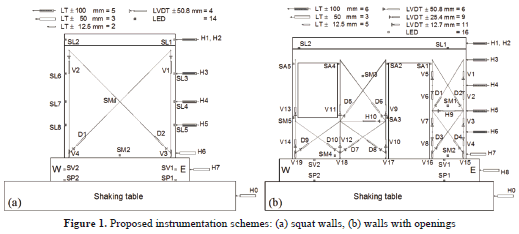
<body><![CDATA[<p><font size="2" face="Verdana, Arial, Helvetica, sans-serif">Aimed at developing a method for   estimating web shear, flexural, and sliding components of the deformation of   low-rise RC walls under shaking table excitations, an experimental and   analytical study was carried out. Instrumentation schemes for estimating the   components of deformation of walls with and without openings are proposed.   Verification of the proposed method is conducted by means of the analysis of   response measured during shaking table tests of 6 RC squat walls and walls with   door and window openings. Verification includes the discussion of failure   modes, the analysis of the contribution of the components of deformation to   total story drift, and the evaluation of the dominant deformation mode of each   wall. </font></p>     <p>&nbsp;</p>     <p><font size="3" face="Verdana, Arial, Helvetica, sans-serif"><b>2. INSTRUMENTATION SCHEMES</b></font></p>     <p><font size="2" face="Verdana, Arial, Helvetica, sans-serif">To measure a specimen's response,   walls should be instrumented internally and externally. Internal   instrumentation is designed to acquire data of the local response of   reinforcement through strain-gages bonded to both the steel reinforcement and the   concrete surfaces. External instrumentation is planned in such a way that we   would be able to learn about the global response through displacement,   acceleration, and load transducers, as well as through optical displacement   measurement system (with light-emitting diodes, LEDs). To estimate the   components of deformation of squat and walls with openings under in-plane   seismic excitations reproduced by a shaking table, external instrumentation   schemes shown in <a href="#fig01">Fig. 1</a> are recommended. Proposed   schemes were planed and calibrated to fulfill two objectives: (a) to obtain key   information on wall behavior and (b) to maximize the data to be recorded and   post-processed. </font></p>     <p align="center"><font size="2" face="Verdana, Arial, Helvetica, sans-serif"><a name="fig01"></a></font><img src="/img/revistas/dyna/v79n174/v79n174a19fig01.gif"></p>     <p><font size="2" face="Verdana, Arial, Helvetica, sans-serif">To measure the lateral wall   displacements and then to estimate the displacement profile and the total story   drift, it is recommended to use linear displacement transducers (LT). These should   be placed along the wall height in one or in the two wall edges and in the   longitudinal direction. Displacements should be recorded at least in 5 or 6 target   points along the height of squat and wall with openings, respectively. To   measure the potential sliding of the foundation beam of the specimen over a shaking   table platform, an LT should be used. These sensors must be attached to a   reference steel frame, which must be located off of the shaking table. The period   of vibration of the steel frame, in the direction of the seismic excitations,   must be equivalent to 50% or lower of the period of vibration of undamaged   walls and of the predominant period of vibrations of earthquake records. To   measure the vertical displacement at wall base and then to calculate base   rotation, an LT attached to a wall surface should be used. Additionally, longitudinal   displacements of the shaking table platform should be measured using LTs. In   summary, it is recommended to use 10 LTs in squat walls and 14 LTs in walls   with openings. </font></p>     <p><font size="2" face="Verdana, Arial, Helvetica, sans-serif">Shear deformations are   conventionally estimated from changes in the length of two diagonals. To   measure the changes in the length, a diagonal displacement device (DDD) should   be used. A DDD is assembled by a linear variable displacement transducer (LVDT)   and 2 aluminum pipes with free in-plane rotations at its ends. The purpose of   the DDD is to record, in a roughly square area, the diagonal deformations   taking place between 2 opposite corners of the wall. In slender wall segments   of the wall with openings, displacements should be measured in both the upper   and lower section of the wall segment. The DDD could be placed vertically to   measure the displacement at wall edges and then to calculate flexural   deformations at different wall sections. In summary, it is recommended to use 4   DDDs in squat walls and 26 DDDs in walls with openings. </font></p>     <p><font size="2" face="Verdana, Arial, Helvetica, sans-serif">To enhance or to replace the   conventional instrumentation, an optical displacement measurement system with   LEDs should be used. LEDs are connected to a camera system and are employed to   record the 3-dimensional position of a target point placed on the specimen. The   redundancy of sensors in some places of specimens is a valuable tool when: (a)   one or various sensors are not able to record the displacement because of the operating   errors of the equipment, (b) some sensors are unplugged or obstructed during the   failure of specimens. </font></p>     <p><font size="2" face="Verdana, Arial, Helvetica, sans-serif">LED sensors offer two valuable   advantages: (a) common problems associated with wiring are avoided because a mechanical   connection between the LED and the target point is not required, (b)   deterioration or damage of equipment during specimen collapse are avoided   because the target points are the unique device on the specimen. The LED's optical ray must be as perpendicular   as possible to the selected plane of movement, in this case, the surface of   wall web. Camera system must be fixed outside the shaking table to prevent any   seismic vibration. Using the optical measurement system, LEDs should be placed   in the following target points: (a) two LEDs at each edge of wall base (one at   the foundation beam and one at the shaking table platform) for calculating any   rotation of the shaking table and for verifying that the walls are properly   bolted to the shaking table platform, (b) one LED at the base of squat walls   and two LEDs at the base of walls with openings for calculating the wall sliding   displacement, (c) one LED at the center of the web of squat walls and two LEDs   for walls with openings for calculating any out-plane displacements of walls,   (d) 2 LEDs on top of the walls (one at each side of the top slab) for   calculating both the average value of the story drift and the rotation of the   top slab, and (e) 3 LEDs at the door and window openings for calculating the   displacement profile of the 2 wall segments. Additionally, 6 LEDs (3 on each   side) should be placed along the height of the squat walls for calculating both   the displacement profile and the rotations at different wall sections. In   summary, it is recommended to use 14 LEDs in squat walls and 16 LEDs in walls   with openings. </font></p>     <p>&nbsp;</p> <font size="3" face="Verdana, Arial, Helvetica, sans-serif"><b>3. CALCULATION OF COMPONENTS OF  DEFORMATION</b></font>     ]]></body>
<body><![CDATA[<p><font size="2" face="Verdana, Arial, Helvetica, sans-serif">Similar to real structures   subjected to seismic excitations, the total displacement of a RC wall under   shaking table excitations, D<i><sub>tot</sub></i>, is defined as: </font></p>     <p><img src="/img/revistas/dyna/v79n174/v79n174a19eq01.gif"></p>     <p><font size="2" face="Verdana, Arial, Helvetica, sans-serif">where D<i><sub>T</sub></i>' is the relative wall displacement and D<i><sub>S</sub></i> is the shaking table   displacement for a given time <i>t</i>. To   simplify, the term <i>t</i> will no be   included in the notation. The displacement D<i><sub>T</sub></i>' should be calculated as: </font></p>     <p><img src="/img/revistas/dyna/v79n174/v79n174a19eq02.gif"></p>     <p><font size="2" face="Verdana, Arial, Helvetica, sans-serif">where D<i><sub>T</sub></i> is the relative   displacement associated to the wall behavior itself and D<i><sub>OE</sub></i> is the relative   displacement caused by the external effects that may be observed during the shaking-table   testing. Based on proposed instrumentation schemes, D<i><sub>T</sub></i> can be calculated   using the following procedures: </font></p>     <p><font size="2" face="Verdana, Arial, Helvetica, sans-serif"> <b>3.1 Using   the equation of total displacement    <br>   </b></font><font size="2" face="Verdana, Arial, Helvetica, sans-serif">Replacing Eq. (2 ) with Eq. (1 ), D<i><sub>T</sub></i> is obtained as: </font></p>     <p><img src="/img/revistas/dyna/v79n174/v79n174a19eq03.gif"></p> <font size="2" face="Verdana, Arial, Helvetica, sans-serif"><b><i>3.1.1 Total displacement, D<sub>tot</sub></i><sub>    <br> </sub></b></font><font size="2" face="Verdana, Arial, Helvetica, sans-serif">This should be obtained from   the displacements recoded by two types of sensors: (a) the average of   displacement records of two LTs placed on top of a wall slab (<i>H1</i> and <i>H2</i>) and, (b) the average of the horizontal displacement records of  two LEDs placed at the same height as that of LT (<i>SL1</i> and <i>SL2</i>). </font>     <p><font size="2" face="Verdana, Arial, Helvetica, sans-serif"><b><i>3.1.2 Shaking table displacement, D<sub>S    ]]></body>
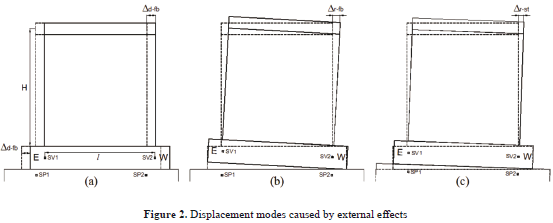
<body><![CDATA[<br>   </sub></i></b></font><font size="2" face="Verdana, Arial, Helvetica, sans-serif">It should also be obtained   from displacements recoded by two types of sensors: (a) the displacement record   of an LT placed on the shake-table platform (<i>H0</i>), and (b) the average of horizontal displacement records of two   LEDs placed on the shaking table platform (<i>SP1</i> and <i>SP2</i>). </font></p>     <p><font size="2" face="Verdana, Arial, Helvetica, sans-serif"><b><i>3.1.3 Displacement caused by external   effects, D<sub>OE    <br>   </sub></i></b></font><font size="2" face="Verdana, Arial, Helvetica, sans-serif">This should be calculated as: </font></p>     <p><img src="/img/revistas/dyna/v79n174/v79n174a19eq04.gif"></p>     <p><font size="2" face="Verdana, Arial, Helvetica, sans-serif">where D<i><sub>d</sub></i><sub>–<i>fb</i></sub> and D<i><sub>r</sub></i><sub>–<i>fb</i></sub> are the relative   displacements caused by the reduction of tensioning force in prestressing bars   used for bolting the foundation beam of specimens to the shaking table   platform. D<i><sub>d</sub></i><sub>–<i>fb</i></sub> is caused by the sliding of the   foundation beam over the shaking table platform &#91;<a href="#fig02">Fig. 2 (a)</a>&#93;, and D<i><sub>r</sub></i><sub>–<i>fb</i></sub> is related to a rotation   caused by the relative vertical displacement of the ends of the foundation beam   &#91;<a href="#fig02">Fig. 2 (b)</a>&#93;. Additionally, any rotation of the foundation beam   can cause horizontal displacement in specimens, labelled as D<i><sub>r</sub></i><sub>–<i>st</i></sub> &#91;<a href="#fig02">Fig. 2 (c)</a>&#93;. Horizontal displacement caused by sliding of the   foundation beam over the shaking table platform, D<i><sub>d</sub></i><sub>–<i>fb</i></sub>, should be calculated as: </font></p>     <p><img src="/img/revistas/dyna/v79n174/v79n174a19eq05.gif"></p>     <p><font size="2" face="Verdana, Arial, Helvetica, sans-serif">where D<i><sub>beam</sub></i> is the average of the horizontal   displacement records of two LEDs placed at the foundation beam (<i>SV1</i> and <i>SV2</i>), and D<i><sub>S</sub></i> is the average of   the horizontal displacement records of two LEDs placed on the shaking table   platform (<i>SP1</i> and <i>SP2</i>). Both displacements D<i><sub>r</sub></i><sub>–<i>fb</i></sub> and D<i><sub>r</sub></i><sub>–<i>st</i></sub> can be calculated directly   using Eq. (6) : </font></p>     <p><img src="/img/revistas/dyna/v79n174/v79n174a19eq06.gif"></p>     <p><font size="2" face="Verdana, Arial, Helvetica, sans-serif">where <i>v<sub>e</sub></i> and <i>v<sub>w</sub></i> are the vertical displacements recorded by LEDs <i>SV1</i> (East) and <i>SV2</i> (West),   respectively, <i>l</i> is the distance   between those LEDs, and <i>H</i> is the   height on top of the wall slab (<a href="#fig02">Fig. 2</a> ). </font></p>     <p align="center"><font size="2" face="Verdana, Arial, Helvetica, sans-serif"><b><a name="fig02"></a></b></font><img src="/img/revistas/dyna/v79n174/v79n174a19fig02.gif"></p>     ]]></body>

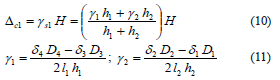
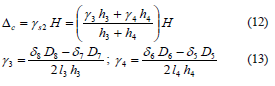
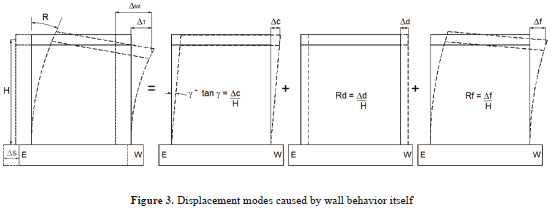
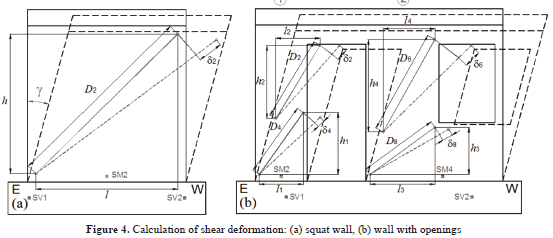
<body><![CDATA[<p><font size="2" face="Verdana, Arial, Helvetica, sans-serif"><b>3.2 Using   the deformation modes    <br>   </b></font><font size="2" face="Verdana, Arial, Helvetica, sans-serif">Relative displacement associated   to RC wall behavior itself is related to web shear, sliding, and flexural   effects (<a href="#fig03">Fig. 3</a> ). Therefore, the relative   displacement D<i><sub>T</sub></i> can be divided   into three components: </font></p>     <p><img src="/img/revistas/dyna/v79n174/v79n174a19eq07.gif"></p>     <p><font size="2" face="Verdana, Arial, Helvetica, sans-serif">where D<i><sub>c</sub></i>, D<i><sub>d</sub></i>, and D<i><sub>f</sub></i> are the lateral displacements related to web   shear, sliding at the wall base and to the flexural behavior of the wall,   respectively. For earthquake-resistant design, non-dimensional parameters are   used to characterize the global behavior of elements or structural systems. One   of these parameters is the drift ratio, which can be measured on a local or a global   level. The drift ratio is commonly expressed as a percentage of the story   height, and consequently it is called the <i>story   drift ratio</i>. For one-story walls tested under shaking table excitations, the   drift ratio is obtained by dividing the relative displacement measured at   mid-thickness of the top slab by the height at which such displacement was   measured (<i>H</i>). When dividing the   displacements by the height <i>H</i>, Eq. (7 ) can be rewritten as: </font></p>     <p><img src="/img/revistas/dyna/v79n174/v79n174a19eq08.gif"></p>     <p><font size="2" face="Verdana, Arial, Helvetica, sans-serif">where <i>R</i> is the total lateral drift and, <i>g</i> , <i>R<sub>d</sub>, </i>and <i>R<sub>f</sub></i> are the contribution of web shear, sliding,   and flexural deformations, respectively, to <i>R</i>. </font></p>     <p align="center"><font size="2" face="Verdana, Arial, Helvetica, sans-serif"><b><a name="fig03" id="fig03"></a></b></font><img src="/img/revistas/dyna/v79n174/v79n174a19fig03.gif"></p> <font size="2" face="Verdana, Arial, Helvetica, sans-serif"><b><i>3.2.1 Contribution of shear deformations, D<sub>c    <br> </sub></i></b></font><font size="2" face="Verdana, Arial, Helvetica, sans-serif">The diagonal deformations of    each panel can be obtained from the principles of materials mechanics, that is,    from changes in the length of two diagonals placed between two opposite corners    of the wall. Equation (9 ) should be used for squat walls (<i>h<sub>w</sub></i>/<i>l<sub>w</sub></i>,  = 1) &#91;<a href="#fig04">Fig. 4 (a)</a>&#93;. </font>     <p><img src="/img/revistas/dyna/v79n174/v79n174a19eq09.gif"></p>     <p><font size="2" face="Verdana, Arial, Helvetica, sans-serif">where <i>g</i> is the web shear deformation, <i>d</i><sub>1</sub> and <i>d</i><sub>2</sub> are the lengthening and contraction recorded by the DDDs   1 and 2, respectively; <i>D</i><sub>1</sub> and <i>D</i><sub>2</sub> are the initial length   of diagonals (undamaged wall) 1 and 2, respectively; and <i>l </i>and<i> h </i>are the length   and height of the undamaged panel, respectively. </font></p>     ]]></body>
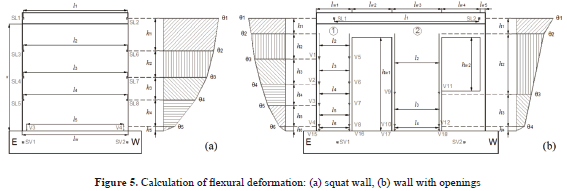
<body><![CDATA[<p><font size="2" face="Verdana, Arial, Helvetica, sans-serif">For the wall segment located   at the east side of the door opening (wall segment 1), Eqs. (10 ) and (11 ) should be used &#91;<a href="#fig04">Fig. 4 (b)</a>&#93;. </font></p>     <p><img src="/img/revistas/dyna/v79n174/v79n174a19eq1011.gif"></p>     <p><font size="2" face="Verdana, Arial, Helvetica, sans-serif">For the wall segment located   between the door and window openings (wall segment 2), Eqs. (12 ) and (13 ) should be used &#91;<a href="#fig04">Fig. 4 (b)</a>&#93;. </font></p>     <p><img src="/img/revistas/dyna/v79n174/v79n174a19eq1213.gif"></p>     <p align="center"><font size="2" face="Verdana, Arial, Helvetica, sans-serif"><a name="fig04"></a></font><img src="/img/revistas/dyna/v79n174/v79n174a19fig04.gif"></p>     <p><font size="2" face="Verdana, Arial, Helvetica, sans-serif">DDD records linear   displacements between two points located directly on the wall web; therefore, shear   deformations are not affected by D<i><sub>OE</sub></i>. </font></p> <font size="2" face="Verdana, Arial, Helvetica, sans-serif"><b><i>3.2.2 Contribution  of the sliding at the wall base, D<sub>d    <br> </sub></i></b></font><font size="2" face="Verdana, Arial, Helvetica, sans-serif">Relative displacement at the  wall base should be calculated as: </font>     <p><img src="/img/revistas/dyna/v79n174/v79n174a19eq14.gif"></p>     <p><font size="2" face="Verdana, Arial, Helvetica, sans-serif">where D<i><sub>base</sub></i> is the displacement recorded   by the LED placed at the wall base (<i>SM2</i> in the squat wall and <i>SM2</i> and <i>SM4</i> in wall segments 1 and 2,   respectively, of walls with openings) and D<i><sub>beam</sub></i> is the average of the   horizontal displacement records of two LEDs placed at the foundation beams (<i>SV1</i> and <i>SV2</i>) (<a href="#fig04">Fig. 4</a> ). To extract the displacements associated to the sliding   of a foundation beam over the shaking table platform (D<i><sub>d</sub></i><sub>–<i>fb</i></sub>) from Eq. (14 ), the records of LEDs placed at the foundation beam should   be used instead of those placed at the shaking table platform. </font></p> <font size="2" face="Verdana, Arial, Helvetica, sans-serif"><b><i>3.2.3 Contribution of flexural deformations, D<sub>f</sub></i><sub>    <br> </sub></b>Flexural deformations on top   of a wall should be calculated from area of the rotation diagram of the cantilever   wall. The accuracy of calculating   flexural deformations depends on the information available on the shape of the   rotation diagram (<a href="#fig05">Fig. 5</a> ). If the area of actual rotation diagram were known,   flexural displacement will be accurately calculated. If only the rotation on top of the wall were available, flexural deformations would be overestimated. </font>     ]]></body>
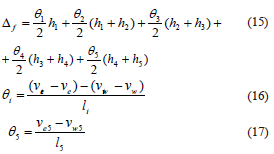
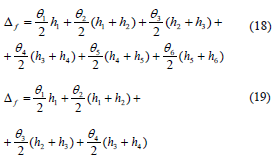
<body><![CDATA[<p align="center"><font size="2" face="Verdana, Arial, Helvetica, sans-serif"><a name="fig05"></a></font><img src="/img/revistas/dyna/v79n174/v79n174a19fig05.gif"></p>     <p><font size="2" face="Verdana, Arial, Helvetica, sans-serif">If rotations are measured at   least at three heights of the wall, flexural deformation is adequately estimated   &#91;2,4&#93;. Based on a response measured during shaking table tests carried out in   this study, it is recommended that one calculate the rotation at three sections   of low-rise concrete walls. For squat walls, the rotation of sections should be   measured using pairs of LEDs along the wall height and one pair of LTs placed   at the wall base. Therefore, the contribution of the flexural deformations to   the total displacement should be calculated using Eqs. (15 ) to (17) &#91;<a href="#fig05">Fig. 5 (a)</a>&#93;. </font></p>     <p><img src="/img/revistas/dyna/v79n174/v79n174a19eq1517.gif"></p>     <p><font size="2" face="Verdana, Arial, Helvetica, sans-serif">where <i>v<sub>ei</sub></i> and <i>v<sub>wi</sub></i> are the vertical displacements recorded by LEDs placed at the east and west   sides, respectively, at wall height <i>h<sub>i</sub></i>, <i>l<sub>i</sub></i> is the distance between   these sensors and <i>v<sub>e</sub></i> and <i>v<sub>w</sub></i> are the vertical   displacements recorded by LEDs placed at east (<i>SV1</i>) and west (<i>SV2</i>) sides, respectively, at the   foundation beam. In this case, rotations of both the foundation beam (D<i><sub>r</sub></i><sub>–<i>fb</i></sub>) and the shaking table platform (D<i><sub>r</sub></i><sub>–<i>st</i></sub>) are extracted from the   calculation of D<i><sub>f</sub></i>. In Eq. (17) , <i>v<sub>e5</sub></i> and <i>v<sub>w5</sub></i> are the   lengthening or contraction recorded by DDD placed vertically at the east (<i>V3</i>) and west (<i>V4</i>) wall sides, respectively., In Eqs. (15 ) and (17) , <i>h<sub>5</sub></i> and <i>l<sub>5</sub></i> are the height and   the horizontal distances between these sensors. Rotations D<i><sub>r</sub></i><sub>–<i>fb</i></sub> and D<i><sub>r</sub></i><sub>–<i>st</i></sub> must not be extracted from   these displacement records because DDD measures the linear displacement between   two points located directly on the wall web. </font></p>     <p><font size="2" face="Verdana, Arial, Helvetica, sans-serif">For walls with openings, the rotations   of wall sections should be measured using both a pair of LEDs placed on top of the   wall and DDDs distributed vertically along the height of the wall segments. Equations (18 ) and (19) should be used for segments 1 and 2, respectively &#91;<a href="#fig05">Fig. 5 (b)</a>&#93;. </font></p>     <p><img src="/img/revistas/dyna/v79n174/v79n174a19eq1819.gif"></p>     <p><font size="2" face="Verdana, Arial, Helvetica, sans-serif">where <i>q</i><sub>1</sub> is calculated   using Eq. (16) and <i>q</i><sub>2</sub> to <i>q</i><sub>6</sub> should be   calculated in a way similar to that expressed in Eq. (17) . </font></p>     <p>&nbsp;</p>     <p><font size="3" face="Verdana, Arial, Helvetica, sans-serif"><b>4. EXPERIMENTAL PROGRAM </b></font> </p>     <p><font size="2" face="Verdana, Arial, Helvetica, sans-serif">The prototype is a two-story   house built with RC walls. Wall thickness and clear height are 100 mm   and 2400 mm   ,   respectively; and nominal concrete compressive strength is 15 MPa. To thoroughly   study the experimental behavior of walls under seismic actions, shaking table   testing was selected. Owing to limitations in the payload capacity of the   shaking table equipment at UNAM, as well as for adequately extrapolating the specimen's   response to the the prototype's response, models with a 1:1.25 geometry scale   factor were designed and built for shaking table testing. Because lightly scaled   models were used (80% of the prototype), the simple law of similitude was chosen   &#91;5&#93;. </font></p>     ]]></body>
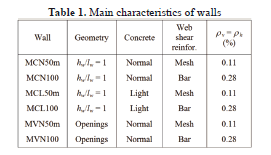
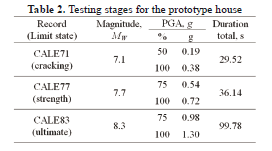
<body><![CDATA[<p><font size="2" face="Verdana, Arial, Helvetica, sans-serif"> <b>4.1 Geometry   and reinforcement layout    <br>   </b></font><font size="2" face="Verdana, Arial, Helvetica, sans-serif">The experimental program   included shaking table testing of 6 thin walls, with low web shear   reinforcement (horizontal, <i>r<sub>h</sub></i>; and vertical, <i>r<sub>v</sub></i>), using deformed   bars and welded-wire mesh, and using normal- and light-weight concrete. Squat   walls (<i>h<sub>w</sub></i>/<i>l<sub>w </sub></i>= 1) and walls with door   and window openings were studied. The main characteristics of the specimens are   shown in <a href="#tab01">Table 1</a> . The thickness (<i>t<sub>w</sub></i>)   and height (<i>h<sub>w</sub></i>) of the wall   models were 80 mm   and 1920 mm   ,   respectively. For squat walls, <i>l<sub>w</sub></i> = 1920   mm. For walls with openings, <i>l<sub>w1</sub></i> = 640 mm   , <i>l<sub>w2</sub></i> = 720 mm   , <i>l<sub>w3</sub></i> = 896 mm, <i>l<sub>w4</sub></i> = 688 mm, <i>l<sub>w5</sub></i> = 96   mm   , <i>h<sub>w1</sub></i> = 1680   mm, and <i>h<sub>w2</sub></i> = 960 mm   (<a href="#fig05">Fig. 5</a> ). The details of the geometry and reinforcement   layout may be found elsewhere &#91;6,7&#93;. </font></p>     <p align="center"><font size="2" face="Verdana, Arial, Helvetica, sans-serif"><b><a name="tab01"></a></b></font><img src="/img/revistas/dyna/v79n174/v79n174a19tab01.gif"></p>     <p><font size="2" face="Verdana, Arial, Helvetica, sans-serif"> <b>4.2 Instrumentation    <br>   </b>To calculate the components of   the deformation of the specimens, instrumentation schemes shown in <a href="#fig01">Fig. 1</a> were   used. Conventional transducers were connected to a data control and recording   system. LEDs of the optical measurement system were connected to a camera system where   data were recorded. </font></p>     <p><font size="2" face="Verdana, Arial, Helvetica, sans-serif"> <b>4.3 Earthquake records and test setup    <br>   </b>Aimed at studying wall   performance under earthquake records associated with different limit states,   from the onset of cracking to collapse, models were subjected to three   earthquake hazard levels. The main earthquake characteristics and testing   stages for the prototype house are shown in <a href="#tab02">Table 2</a> . Specimens were tested under progressively more   severe earthquake actions, scaled up by considering the value of peak ground acceleration   (PGA) as the reference factor until the final damage stage was attained. </font></p>     <p align="center"><font size="2" face="Verdana, Arial, Helvetica, sans-serif"><b><a name="tab02"></a></b></font><img src="/img/revistas/dyna/v79n174/v79n174a19tab02.gif"></p>     <p><font size="2" face="Verdana, Arial, Helvetica, sans-serif">A mass-carrying load system   for supporting the mass and transmitting the inertia forces was used for   testing walls. The device was allowed to slide horizontally on a fixed   supporting structure located off of the the shaking table &#91;8&#93;. </font></p>     <p>&nbsp;</p>     ]]></body>
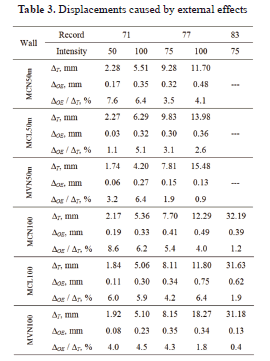
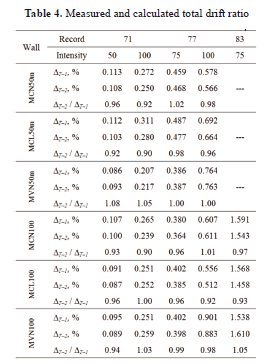
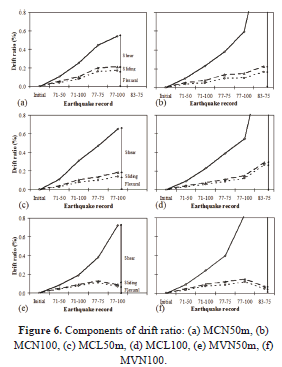
<body><![CDATA[<p><b><font size="3" face="Verdana, Arial, Helvetica, sans-serif">5. RESULTS   AND DISCUSSION </font> </b></p>     <p><font size="2" face="Verdana, Arial, Helvetica, sans-serif">Failure modes and the contribution   of the three deformation modes to total drift ratio are discussed in this   section. Further information on the specimen's response may be found elsewhere &#91;6,7&#93;. </font></p>     <p><font size="2" face="Verdana, Arial, Helvetica, sans-serif"> <b>5.1 Failure   modes    <br>   </b></font><font size="2" face="Verdana, Arial, Helvetica, sans-serif">Shear failure mode was   observed in all walls. Walls reinforced in the web using welded-wire mesh   exhibited diagonal tension failure. Failure was governed by web-inclined   cracking at approximately a 45° angle, by plastic yielding of most of web shear   reinforcement, and by the subsequent sudden fracture of wires. Walls reinforced   using deformed bars exhibited a mixed failure mode, where diagonal tension and   diagonal compression were observed. In these walls, the yielding of most web   steel reinforcement and, simultaneously, noticeable web crushing of concrete   were observed. </font></p>     <p><font size="2" face="Verdana, Arial, Helvetica, sans-serif"> <b>5.2 Displacements   caused by external effects    <br>   </b></font><font size="2" face="Verdana, Arial, Helvetica, sans-serif">Relative displacements caused   by effects that are independent of wall behavior are shown in <a href="#tab03">Table 3</a> &#91;D<i><sub>OE</sub></i>, Eq. (4) &#93;. These displacements are also expressed as a percentage   of the total displacement (D<i><sub>T</sub></i>). Values are associated with the time when the   maximum relative displacement of walls was attained during each earthquake   record. Maximum values of D<i><sub>OE</sub></i> varied between 0.4% and 8.6%. The highest   values were associated with the CALE71 earthquake records where D<i><sub>OE</sub></i> was very low (~0.30 mm). In all cases, D<i><sub>OE</sub></i> was included in the calculation of D<i><sub>T</sub></i> &#91;Eq. (3) &#93;. </font></p>     <p align="center"><font size="2" face="Verdana, Arial, Helvetica, sans-serif"><a name="tab03"></a></font><img src="/img/revistas/dyna/v79n174/v79n174a19tab03.gif"></p>     <p><font size="2" face="Verdana, Arial, Helvetica, sans-serif"> <b>5.3 Error   estimation in displacement measuring    <br>   </b></font><font size="2" face="Verdana, Arial, Helvetica, sans-serif">In most of the experimental   studies done on concrete walls, the contribution of flexural deformations to   total drift ratio is calculated using the measurement of 3 additional terms of Eq. (7) ; that is, using the measurement of the total, the web   shear, and the sliding displacements. However, the instrumentation schemes proposed   in this study allow for the measurement of the 4 terms of Eq. (7) . Since the problem is overdefined (more measured   quantities than required), it was possible to estimate the total error in the   estimation (discrepancy between measured and calculated total displacement). By   means of the difference between results obtained using Eqs. (3) and (7) , the total error involved in the estimation of the   contributions was evaluated, i.e., the total error was calculated as the ratio   between the calculation (the sum of 3 measured contributions) and the measured   total displacement. Measured &#91;D<i><sub>T</sub></i><sub>–<i>1</i></sub>, Eq. (3) &#93; and calculated &#91;D<i><sub>T</sub></i><sub>–<i>2</i></sub>, Eq. (7) &#93; relative displacements in terms of story drift are   shown in <a href="#tab04">Table 4</a> . </font></p>     <p align="center"><font size="2" face="Verdana, Arial, Helvetica, sans-serif"><a name="tab04"></a></font><img src="/img/revistas/dyna/v79n174/v79n174a19tab04.gif"></p>     ]]></body>
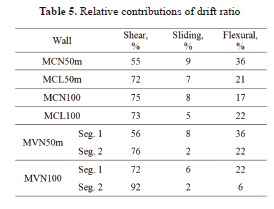
<body><![CDATA[<p><font size="2" face="Verdana, Arial, Helvetica, sans-serif">Values in <a href="#tab04">Table 4</a> are associated to the time when maximum relative   displacement of walls was attained during each earthquake record. The error   never exceeded 10% and was distributed proportionally among the three   deformation components (web shear, sliding and flexure). </font></p>     <p><font size="2" face="Verdana, Arial, Helvetica, sans-serif"> <b>5.4 Components   of displacement    <br>   </b>The contribution of deformation   modes to the total drift ratio of walls is shown in <a href="#fig06">Fig. 6</a> . <a href="#tab05">Table 5</a> shows the relative contributions associated to the   time when the maximum drift ratio of walls was attained during each earthquake   record. Relative contributions are expressed as a percentage of the total drift   ratio. </font></p>     <p align="center"><font size="2" face="Verdana, Arial, Helvetica, sans-serif"><a name="fig06"></a></font><img src="/img/revistas/dyna/v79n174/v79n174a19fig06.gif"></p>     <p align="center"><font size="2" face="Verdana, Arial, Helvetica, sans-serif"><a name="tab05"></a></font><img src="/img/revistas/dyna/v79n174/v79n174a19tab05.gif"></p>     <p><font size="2" face="Verdana, Arial, Helvetica, sans-serif">The behavior of squat walls (<i>h<sub>w</sub></i>/<i>l<sub>w</sub></i>=1) was always controlled by web shear deformations.   For walls with web shear reinforcement made of welded-wire mesh (MCN50m and   MCL50m), the relative contribution of each mode did not vary notably with drift   ratio (<a href="#tab05">Table 5</a> ). In contrast, for walls with web shear reinforcement   made of deformed bars (MCN100 and MCL100), shear deformations increased   significantly with drift ratio, but flexural and sliding contributions   diminished (<a href="#tab05">Table 5</a> ). </font></p>     <p><font size="2" face="Verdana, Arial, Helvetica, sans-serif">Response of walls with   openings (MVN50m and MVN100) was not controlled exclusively by shear   deformations. The wall segment located at the east side of the   door opening (wall segment 1) exhibited a high contribution of flexural   deformations, particularly for story drifts lower than 0.2%. The behavior of   the wall segment located between door and window openings (wall segment 2) was   similar to that of squat walls (<i>h<sub>w</sub></i>/<i>l<sub>w</sub></i> = 1),   that is, shear was the major contributor to the total displacement. For all   cases, relative contributions also revealed that wall sliding was minimal. </font></p>     <p>&nbsp;</p>     <p><font size="3" face="Verdana, Arial, Helvetica, sans-serif"><b>CONCLUSIONS </b></font> </p>     <p><font size="2" face="Verdana, Arial, Helvetica, sans-serif">Aimed at evaluating the   components of deformation of low-rise RC walls, results of an analytical and   experimental study have been presented in this paper. Based on these results,   the following conclusions were reached: </font></p>     ]]></body>
<body><![CDATA[<p><font size="2" face="Verdana, Arial, Helvetica, sans-serif"> - Instrumentation   schemes proposed herein for squat walls and walls with openings were planned   and calibrated to maximize key information to be recorded and post-processed.   The method and the instrumentations schemes are a valuable tool to evaluate   both the effect of each deformation mode on total displacement of the wall and the prevailing inelastic deformation mode in   each specimen. </font></p>     <p><font size="2" face="Verdana, Arial, Helvetica, sans-serif"> - Modern design procedures   give more emphasis to the deformation capacity of a structure. For example,   performance-based seismic design (PBSD) requires the explicit consideration of   lateral displacement as a performance indicator. One of the main obstacles   hindering the implementation of PBSD in low-rise RC walls is the absence of   suitable analytical models for predicting the load-displacement curve.   Negligible measured sliding displacements during the tests demonstrated that a   load-displacement curve can be based on a model in which the total displacement   is calculated as the sum of contributions related to flexure and shear. </font></p>     <p><font size="2" face="Verdana, Arial, Helvetica, sans-serif"> - Shear failure mode   was observed in all walls and thus, the contribution of flexural deformation   was always lower than 36%. This trend allows for one to conclude that a   flexural failure mode may be observed in RC walls where the contribution of   flexural deformation is higher than 40%. When predicting the governing failure   mode, it will be possible to design RC walls in favor of a suitable strength   mechanism. </font></p>     <p>&nbsp;</p>     <p><font size="3" face="Verdana, Arial, Helvetica, sans-serif"><b>REFERENCES </b></font></p>     <!-- ref --><p><font size="2" face="Verdana, Arial, Helvetica, sans-serif"><b>&#91;1&#93;</b> Liao, W., Zhong, J., Mo, Y. and Loh, C., Shake table test of low-rise shear walls. Proceedings of 8th US National Conference of Earthquake Engineering. San Francisco, California, Paper 166, 2006.    &nbsp;&nbsp;&nbsp;&nbsp;&nbsp;&nbsp;&nbsp;&nbsp;[&#160;<a href="javascript:void(0);" onclick="javascript: window.open('/scielo.php?script=sci_nlinks&ref=000118&pid=S0012-7353201200040001900001&lng=','','width=640,height=500,resizable=yes,scrollbars=1,menubar=yes,');">Links</a>&#160;]<!-- end-ref --><!-- ref --><br>   <b>&#91;2&#93;</b> Massone, L. and Wallace, J., Load-deformation responses of slender reinforced concrete walls. ACI Structural Journal, 101(1), pp. 103-113, 2004.    &nbsp;&nbsp;&nbsp;&nbsp;&nbsp;&nbsp;&nbsp;&nbsp;[&#160;<a href="javascript:void(0);" onclick="javascript: window.open('/scielo.php?script=sci_nlinks&ref=000119&pid=S0012-7353201200040001900002&lng=','','width=640,height=500,resizable=yes,scrollbars=1,menubar=yes,');">Links</a>&#160;]<!-- end-ref --><!-- ref --><br>   <b>&#91;3&#93;</b> Salonikios, T., Kappos, A., Tegos, I. and Penelis, G., Cyclic load behavior of low-slenderness reinforced concrete walls: failure modes, strength and deformation analysis, and design implications. ACI Structural Journal, 97 (1), pp. 132-142, 2000.    &nbsp;&nbsp;&nbsp;&nbsp;&nbsp;&nbsp;&nbsp;&nbsp;[&#160;<a href="javascript:void(0);" onclick="javascript: window.open('/scielo.php?script=sci_nlinks&ref=000120&pid=S0012-7353201200040001900003&lng=','','width=640,height=500,resizable=yes,scrollbars=1,menubar=yes,');">Links</a>&#160;]<!-- end-ref --><!-- ref --><br>   <b>&#91;4&#93;</b> Pilakoutas, K. and Elnashai, A., Interpretation of testing results for reinforced concrete panels. ACI Structural Journal, 90 (6), pp. 642-645, 1993.    &nbsp;&nbsp;&nbsp;&nbsp;&nbsp;&nbsp;&nbsp;&nbsp;[&#160;<a href="javascript:void(0);" onclick="javascript: window.open('/scielo.php?script=sci_nlinks&ref=000121&pid=S0012-7353201200040001900004&lng=','','width=640,height=500,resizable=yes,scrollbars=1,menubar=yes,');">Links</a>&#160;]<!-- end-ref --><!-- ref --><br>   <b>&#91;5&#93;</b> Tomazevic, M. and Velechovsky, T., Some aspects of testing small-scale masonry building model on simple earthquake simulator. Journal of Earthquake Engineering and Structural Dynamics, 21 (11), pp. 945-963, 1992.    &nbsp;&nbsp;&nbsp;&nbsp;&nbsp;&nbsp;&nbsp;&nbsp;[&#160;<a href="javascript:void(0);" onclick="javascript: window.open('/scielo.php?script=sci_nlinks&ref=000122&pid=S0012-7353201200040001900005&lng=','','width=640,height=500,resizable=yes,scrollbars=1,menubar=yes,');">Links</a>&#160;]<!-- end-ref --><!-- ref --><br>   <b>&#91;6&#93;</b> Carrillo, J. and Alcocer, S., Degradation properties of reinforced concrete walls with openings. DYNA, 78 (170), pp. 106-115, 2011a.    &nbsp;&nbsp;&nbsp;&nbsp;&nbsp;&nbsp;&nbsp;&nbsp;[&#160;<a href="javascript:void(0);" onclick="javascript: window.open('/scielo.php?script=sci_nlinks&ref=000123&pid=S0012-7353201200040001900006&lng=','','width=640,height=500,resizable=yes,scrollbars=1,menubar=yes,');">Links</a>&#160;]<!-- end-ref --><!-- ref --><br>   <b>&#91;7&#93;</b> Carrillo, J. and Alcocer, S., Experimental evaluation of the strut-and-tie method applied to low-rise concrete walls. Journal of Ingenier&iacute;a e Investigaci&oacute;n, 30(1), pp. 11-16, (in Spanish). 2010.    &nbsp;&nbsp;&nbsp;&nbsp;&nbsp;&nbsp;&nbsp;&nbsp;[&#160;<a href="javascript:void(0);" onclick="javascript: window.open('/scielo.php?script=sci_nlinks&ref=000124&pid=S0012-7353201200040001900007&lng=','','width=640,height=500,resizable=yes,scrollbars=1,menubar=yes,');">Links</a>&#160;]<!-- end-ref --><!-- ref --><br>   <b>&#91;8&#93;</b> Carrillo, J. and Alcocer, S., Improved external device for a mass-carrying sliding system for shaking table testing. Journal of Earthquake Engineering and Structural Dynamics, 40 (4), pp. 393-411, 2011b.    &nbsp;&nbsp;&nbsp;&nbsp;&nbsp;&nbsp;&nbsp;&nbsp;[&#160;<a href="javascript:void(0);" onclick="javascript: window.open('/scielo.php?script=sci_nlinks&ref=000125&pid=S0012-7353201200040001900008&lng=','','width=640,height=500,resizable=yes,scrollbars=1,menubar=yes,');">Links</a>&#160;]<!-- end-ref --> </font></p>      ]]></body><back>
<ref-list>
<ref id="B1">
<label>1</label><nlm-citation citation-type="confpro">
<person-group person-group-type="author">
<name>
<surname><![CDATA[Liao]]></surname>
<given-names><![CDATA[W.]]></given-names>
</name>
<name>
<surname><![CDATA[Zhong]]></surname>
<given-names><![CDATA[J.]]></given-names>
</name>
<name>
<surname><![CDATA[Mo]]></surname>
<given-names><![CDATA[Y.]]></given-names>
</name>
<name>
<surname><![CDATA[Loh]]></surname>
<given-names><![CDATA[C.]]></given-names>
</name>
</person-group>
<source><![CDATA[Shake table test of low-rise shear walls.]]></source>
<year>2006</year>
<conf-name><![CDATA[8th US National Conference of Earthquake Engineering.]]></conf-name>
<conf-loc>San Francisco California</conf-loc>
</nlm-citation>
</ref>
<ref id="B2">
<label>2</label><nlm-citation citation-type="journal">
<person-group person-group-type="author">
<name>
<surname><![CDATA[Massone]]></surname>
<given-names><![CDATA[L.]]></given-names>
</name>
<name>
<surname><![CDATA[Wallace]]></surname>
<given-names><![CDATA[J.]]></given-names>
</name>
</person-group>
<article-title xml:lang="en"><![CDATA[Load-deformation responses of slender reinforced concrete walls.]]></article-title>
<source><![CDATA[ACI Structural Journal]]></source>
<year>2004</year>
<volume>101</volume>
<numero>1</numero>
<issue>1</issue>
<page-range>103-113</page-range></nlm-citation>
</ref>
<ref id="B3">
<label>3</label><nlm-citation citation-type="journal">
<person-group person-group-type="author">
<name>
<surname><![CDATA[Salonikios]]></surname>
<given-names><![CDATA[T.]]></given-names>
</name>
<name>
<surname><![CDATA[Kappos]]></surname>
<given-names><![CDATA[A.]]></given-names>
</name>
<name>
<surname><![CDATA[Tegos]]></surname>
<given-names><![CDATA[I.]]></given-names>
</name>
<name>
<surname><![CDATA[Penelis]]></surname>
<given-names><![CDATA[G.]]></given-names>
</name>
</person-group>
<article-title xml:lang="en"><![CDATA[Cyclic load behavior of low-slenderness reinforced concrete walls:: failure modes, strength and deformation analysis, and design implications.]]></article-title>
<source><![CDATA[ACI Structural Journal]]></source>
<year>2000</year>
<volume>97</volume>
<numero>1</numero>
<issue>1</issue>
<page-range>132-142</page-range></nlm-citation>
</ref>
<ref id="B4">
<label>4</label><nlm-citation citation-type="journal">
<person-group person-group-type="author">
<name>
<surname><![CDATA[Pilakoutas]]></surname>
<given-names><![CDATA[K.]]></given-names>
</name>
<name>
<surname><![CDATA[Elnashai]]></surname>
<given-names><![CDATA[A.]]></given-names>
</name>
</person-group>
<article-title xml:lang="en"><![CDATA[Interpretation of testing results for reinforced concrete panels.]]></article-title>
<source><![CDATA[ACI Structural Journal]]></source>
<year>1993</year>
<numero>90</numero><numero>6</numero>
<issue>90</issue><issue>6</issue>
<page-range>642-645</page-range></nlm-citation>
</ref>
<ref id="B5">
<label>5</label><nlm-citation citation-type="journal">
<person-group person-group-type="author">
<name>
<surname><![CDATA[Tomazevic]]></surname>
<given-names><![CDATA[M.]]></given-names>
</name>
<name>
<surname><![CDATA[Velechovsky]]></surname>
<given-names><![CDATA[T.]]></given-names>
</name>
</person-group>
<article-title xml:lang="en"><![CDATA[Some aspects of testing small-scale masonry building model on simple earthquake simulator.]]></article-title>
<source><![CDATA[Journal of Earthquake Engineering and Structural Dynamics]]></source>
<year>1992</year>
<volume>21</volume>
<numero>11</numero>
<issue>11</issue>
<page-range>945-963</page-range></nlm-citation>
</ref>
<ref id="B6">
<label>6</label><nlm-citation citation-type="journal">
<person-group person-group-type="author">
<name>
<surname><![CDATA[Carrillo]]></surname>
<given-names><![CDATA[J.]]></given-names>
</name>
<name>
<surname><![CDATA[Alcocer]]></surname>
<given-names><![CDATA[S.]]></given-names>
</name>
</person-group>
<article-title xml:lang="en"><![CDATA[Degradation properties of reinforced concrete walls with openings.]]></article-title>
<source><![CDATA[DYNA]]></source>
<year>2011</year>
<volume>78</volume>
<numero>170</numero>
<issue>170</issue>
<page-range>106-115</page-range></nlm-citation>
</ref>
<ref id="B7">
<label>7</label><nlm-citation citation-type="journal">
<person-group person-group-type="author">
<name>
<surname><![CDATA[Carrillo]]></surname>
<given-names><![CDATA[J.]]></given-names>
</name>
<name>
<surname><![CDATA[Alcocer]]></surname>
<given-names><![CDATA[S.]]></given-names>
</name>
</person-group>
<article-title xml:lang="en"><![CDATA[Experimental evaluation of the strut-and-tie method applied to low-rise concrete walls.]]></article-title>
<source><![CDATA[Journal of Ingeniería e Investigación]]></source>
<year>2010</year>
<volume>30</volume>
<numero>1</numero>
<issue>1</issue>
<page-range>11-16</page-range></nlm-citation>
</ref>
<ref id="B8">
<label>8</label><nlm-citation citation-type="journal">
<person-group person-group-type="author">
<name>
<surname><![CDATA[Carrillo]]></surname>
<given-names><![CDATA[J.]]></given-names>
</name>
<name>
<surname><![CDATA[Alcocer]]></surname>
<given-names><![CDATA[S.]]></given-names>
</name>
</person-group>
<article-title xml:lang="en"><![CDATA[Improved external device for a mass-carrying sliding system for shaking table testing.]]></article-title>
<source><![CDATA[Journal of Earthquake Engineering and Structural Dynamics]]></source>
<year>2011</year>
<volume>40</volume>
<numero>4</numero>
<issue>4</issue>
<page-range>393-411</page-range></nlm-citation>
</ref>
</ref-list>
</back>
</article>