<?xml version="1.0" encoding="ISO-8859-1"?><article xmlns:mml="http://www.w3.org/1998/Math/MathML" xmlns:xlink="http://www.w3.org/1999/xlink" xmlns:xsi="http://www.w3.org/2001/XMLSchema-instance">
<front>
<journal-meta>
<journal-id>0012-7353</journal-id>
<journal-title><![CDATA[DYNA]]></journal-title>
<abbrev-journal-title><![CDATA[Dyna rev.fac.nac.minas]]></abbrev-journal-title>
<issn>0012-7353</issn>
<publisher>
<publisher-name><![CDATA[Universidad Nacional de Colombia]]></publisher-name>
</publisher>
</journal-meta>
<article-meta>
<article-id>S0012-73532012000600001</article-id>
<title-group>
<article-title xml:lang="en"><![CDATA[ULTRASONIC SENSOR FOR THE PRESENCE OF OILY CONTAMINANTS IN WATER]]></article-title>
<article-title xml:lang="es"><![CDATA[SENSOR ULTRASONICO PARA LA PRESENCIA DE CONTAMINANTES OLEOSOS EN AGUA]]></article-title>
</title-group>
<contrib-group>
<contrib contrib-type="author">
<name>
<surname><![CDATA[FRANCO]]></surname>
<given-names><![CDATA[EDIGUER E.]]></given-names>
</name>
<xref ref-type="aff" rid="A01"/>
</contrib>
<contrib contrib-type="author">
<name>
<surname><![CDATA[ADAMOWSKI]]></surname>
<given-names><![CDATA[JULIO C.]]></given-names>
</name>
<xref ref-type="aff" rid="A02"/>
</contrib>
<contrib contrib-type="author">
<name>
<surname><![CDATA[BUIOCHI]]></surname>
<given-names><![CDATA[FLAVIO]]></given-names>
</name>
<xref ref-type="aff" rid="A03"/>
</contrib>
</contrib-group>
<aff id="A01">
<institution><![CDATA[,Universidad Autónoma de Occidente Departamento de Energética y Mecánica ]]></institution>
<addr-line><![CDATA[Cali ]]></addr-line>
<country>Colombia</country>
</aff>
<aff id="A02">
<institution><![CDATA[,Escola Politécnica da Universidade de São Paulo Departamento de Engenharia Mecatrônica e de Sistemas Mecânicos ]]></institution>
<addr-line><![CDATA[São Paulo ]]></addr-line>
<country>Brasil</country>
</aff>
<aff id="A03">
<institution><![CDATA[,Escola Politécnica da Universidade de São Paulo Departamento de Engenharia Mecatrônica e de Sistemas Mecânicos ]]></institution>
<addr-line><![CDATA[São Paulo ]]></addr-line>
<country>Brasil</country>
</aff>
<pub-date pub-type="pub">
<day>00</day>
<month>12</month>
<year>2012</year>
</pub-date>
<pub-date pub-type="epub">
<day>00</day>
<month>12</month>
<year>2012</year>
</pub-date>
<volume>79</volume>
<numero>176</numero>
<fpage>4</fpage>
<lpage>9</lpage>
<copyright-statement/>
<copyright-year/>
<self-uri xlink:href="http://www.scielo.org.co/scielo.php?script=sci_arttext&amp;pid=S0012-73532012000600001&amp;lng=en&amp;nrm=iso"></self-uri><self-uri xlink:href="http://www.scielo.org.co/scielo.php?script=sci_abstract&amp;pid=S0012-73532012000600001&amp;lng=en&amp;nrm=iso"></self-uri><self-uri xlink:href="http://www.scielo.org.co/scielo.php?script=sci_pdf&amp;pid=S0012-73532012000600001&amp;lng=en&amp;nrm=iso"></self-uri><abstract abstract-type="short" xml:lang="en"><p><![CDATA[The determination of the complex reflection coefficient of ultrasonic shear-waves at the solid-liquid interface is a technique employed for the measurement of the viscoelastic properties of liquids. An interesting property of the measurement technique is the very small penetration depth of the shear-waves into the liquid sample, which permits measurements with liquid films of some micrometers thick. This property, along with the adhesion of oily substances to surfaces, can be used for the detection of oily contaminants in water. In this work, the employment of the ultrasonic shear-wave reflection technique to the detection of oily contaminants in water is proposed and the theoretical and experimental concepts involved are discussed. Preliminary experimental results show the measurement technique can detect SAE 40 automotive oil in water in volume proportions less than 0.5%.]]></p></abstract>
<abstract abstract-type="short" xml:lang="es"><p><![CDATA[La determinación del coeficiente de reflexión de ondas transversales ultrasónicas en la interfaz sólido-líquido es una técnica que ha sido usada para la medición de las propiedades viscoelásticas de líquidos. Una característica interesante de la técnica es la pequeña distancia recorrida por las ondas transversales dentro del fluido, antes de ser completamente atenuadas, permitiendo la medición con una película muy delgada de líquido, del orden de algunos micrómetros. Esta característica, además de la conocida tendencia de las sustancias oleosas a adherirse a superficies, puede ser usada para la detección de contaminantes oleosos en agua. Este trabajo propone el uso de la técnica de reflexión de ondas transversales en el rango ultrasónico para la detección de contaminantes oleosos en agua y discute las bases teóricas y experimentales relacionadas. Resultados experimentales preliminares muestran que es posible la detección de la presencia de aceite automotriz SAE 40 en agua en proporciones menores a 0,5% en volumen.]]></p></abstract>
<kwd-group>
<kwd lng="en"><![CDATA[Ultrasound]]></kwd>
<kwd lng="en"><![CDATA[shear waves]]></kwd>
<kwd lng="en"><![CDATA[water-oil emulsion]]></kwd>
<kwd lng="en"><![CDATA[oily contaminant]]></kwd>
<kwd lng="es"><![CDATA[Ultrasonido]]></kwd>
<kwd lng="es"><![CDATA[ondas transversales]]></kwd>
<kwd lng="es"><![CDATA[emulsión agua-aceite]]></kwd>
<kwd lng="es"><![CDATA[contaminante oleoso]]></kwd>
</kwd-group>
</article-meta>
</front><body><![CDATA[ <p align="center"><font size="4" face="Verdana, Arial, Helvetica, sans-serif"><b>ULTRASONIC SENSOR FOR THE PRESENCE OF OILY CONTAMINANTS IN WATER </b></font></p>     <p align="center"><i><font size="3"><b><font face="Verdana, Arial, Helvetica, sans-serif"> SENSOR ULTRASONICO PARA LA PRESENCIA DE CONTAMINANTES OLEOSOS EN AGUA </font></b></font></i></p>     <p align="center">&nbsp;</p>     <p align="center"><font size="2" face="Verdana, Arial, Helvetica, sans-serif"><b>EDIGUER E. FRANCO</b>    <br>   <i>Ph.D. Departamento de Energ&eacute;tica y Mec&aacute;nica - Universidad Aut&oacute;noma de Occidente, Cali, Colombia, <a href="mailto:eefranco@uao.edu.co">eefranco@uao.edu.co</a> </i></font></p>     <p align="center"><font size="2" face="Verdana, Arial, Helvetica, sans-serif"><b>JULIO C. ADAMOWSKI</b>    <br>   <i>Ph.D. Departamento de Engenharia Mecatr&ocirc;nica e de Sistemas Mec&acirc;nicos - Escola Polit&eacute;cnica da Universidade de S&atilde;o Paulo, S&atilde;o Paulo - SP, Brasil, <a href="mailto:jcadamow@usp.br">jcadamow@usp.br</a></i> </font></p>     <p align="center"><font size="2" face="Verdana, Arial, Helvetica, sans-serif"><b>FLAVIO BUIOCHI</b>    <br>   <i>Ph.D. Departamento de Engenharia Mecatr&ocirc;nica e de Sistemas Mec&acirc;nicos - Escola Polit&eacute;cnica da Universidade de S&atilde;o Paulo, S&atilde;o Paulo - SP, Brasil, <a href="mailto:fbuiochi@usp.br">fbuiochi@usp.br</a> </i></font></p>     <p align="center">&nbsp;</p>     ]]></body>
<body><![CDATA[<p align="center"><font size="2" face="Verdana, Arial, Helvetica, sans-serif"><b>Received for review July 5<sup>th</sup>, 2011, accepted April 26<sup>th</sup>, 2012, final version May, 15<sup>th</sup>, 2012</b></font></p>     <p align="center">&nbsp;</p> <hr>     <p><font size="2" face="Verdana, Arial, Helvetica, sans-serif"><b>ABSTRACT: </b>The determination of the complex reflection coefficient of ultrasonic shear-waves at the solid-liquid interface is a technique employed for the measurement of the viscoelastic properties of liquids. An interesting property of the measurement technique is the very small penetration depth of the shear-waves into the liquid sample, which permits measurements with liquid films of some micrometers thick. This property, along with the adhesion of oily substances to surfaces, can be used for the detection of oily contaminants in water. In this work, the employment of the ultrasonic shear-wave reflection technique to the detection of oily contaminants in water is proposed and the theoretical and experimental concepts involved are discussed. Preliminary experimental results show the measurement technique can detect SAE 40 automotive oil in water in volume proportions less than 0.5%.</font></p>     <p><font size="2" face="Verdana, Arial, Helvetica, sans-serif"><b>KEYWORDS:</b> Ultrasound, shear waves, water-oil emulsion, oily contaminant.</font></p>     <p><font size="2" face="Verdana, Arial, Helvetica, sans-serif"><b>RESUMEN:</b> La determinaci&oacute;n del coeficiente de reflexi&oacute;n de ondas transversales ultras&oacute;nicas en la interfaz s&oacute;lido-l&iacute;quido es una t&eacute;cnica que ha sido usada para la medici&oacute;n de las propiedades viscoel&aacute;sticas de l&iacute;quidos. Una caracter&iacute;stica interesante de la t&eacute;cnica es la peque&ntilde;a distancia recorrida por las ondas transversales dentro del fluido, antes de ser completamente atenuadas, permitiendo la medici&oacute;n con una pel&iacute;cula muy delgada de l&iacute;quido, del orden de algunos micr&oacute;metros. Esta caracter&iacute;stica, adem&aacute;s de la conocida tendencia de las sustancias oleosas a adherirse a superficies, puede ser usada para la detecci&oacute;n de contaminantes oleosos en agua. Este trabajo propone el uso de la t&eacute;cnica de reflexi&oacute;n de ondas transversales en el rango ultras&oacute;nico para la detecci&oacute;n de contaminantes oleosos en agua y discute las bases te&oacute;ricas y experimentales relacionadas. Resultados experimentales preliminares muestran que es posible la detecci&oacute;n de la presencia de aceite automotriz SAE 40 en agua en proporciones menores a 0,5% en volumen.</font></p>     <p><font size="2" face="Verdana, Arial, Helvetica, sans-serif"><b>PALABRAS CLAVE:</b> Ultrasonido, ondas transversales, emulsi&oacute;n agua-aceite, contaminante oleoso.</font></p> <hr>     <p>&nbsp;</p>     <p><font size="3" face="Verdana, Arial, Helvetica, sans-serif"><b>1. INTRODUCTION</b></font></p>     <p><font size="2" face="Verdana, Arial, Helvetica, sans-serif">A Newtonian liquid is a liquid whose shear stress versus shear strain rate curve is linear (passes through the origin) and the constant of proportionality is the viscosity. Many common liquids exhibit Newtonian behavior at the low frequencies used in the conventional viscometry. However, at ultrasonic frequencies, the liquid can exhibit simultaneously viscous and elastic, or viscoelastic, behavior &#91;1&#93;. The viscoelastic behavior opens the possibility of propagating shear-waves in liquids. These waves are strongly attenuated and can only propagate a very small distance, usually of some micrometers &#91;2&#93;. </font></p>     <p><font size="2" face="Verdana, Arial, Helvetica, sans-serif">When a shear-wave propagating in a solid strikes the interface defined between the solid and a liquid, a small portion of the energy is transmitted and the greatest portion is reflected back. The ratio of the reflected to the incident tensions is the reflection coefficient, which is a complex-valued quantity. The magnitude and phase of the reflection coefficient are related, respectively, to the amplitude change and to the phase shift of the wave in the reflection process &#91;3&#93;.</font></p>     ]]></body>
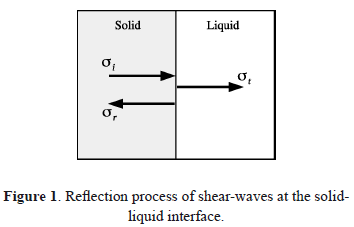
<body><![CDATA[<p><font size="2" face="Verdana, Arial, Helvetica, sans-serif">A change in the viscoelastic properties of the liquid cause variation in both magnitude and phase of the reflection coefficient. This phenomenon can be used for liquid characterization or monitoring. From the literature, it can be established that the technique has been used mainly for viscosity &#91;4-5&#93; and viscoelasticity &#91;6-7&#93; characterization of liquids. Nevertheless, some authors used it for the monitoring of industrial processes, such as the curing of polymeric resins &#91;3&#93;&#91;8&#93; and Portland cement pastes &#91;9&#93;, and measuring the viscosity at high temperatures &#91;10&#93;.</font></p>     <p><font size="2" face="Verdana, Arial, Helvetica, sans-serif">In this work, the shear-wave reflection technique is proposed for the detection of oily contaminants in water. The idea arose from a published work where the potential of shear oscillations in the detection of water content in lubricant oil was analyzed &#91;11&#93;. The authors concluded that shear oscillations cannot be used to detect the presence of water in oil. The reason is that the small water droplets in the water-in-oil emulsion are rarely located in the thin oil layer in touch with the solid &#91;12&#93;. However, the very small penetration depth, besides the property of adhesion of oily substances to surfaces, could be used for the detection of oily contaminants in water or another light liquid.</font></p>     <p><font size="2" face="Verdana, Arial, Helvetica, sans-serif">This monitoring technique could be interesting in industrial applications where the quality of the water must be guaranteed. For example, in environmental science, the technique could have application in the monitoring of the wastewater discharged into rivers by some industries.</font></p>     <p>&nbsp;</p>     <p><font size="3" face="Verdana, Arial, Helvetica, sans-serif"><b>2. THEORETICAL BACKGROUND</b></font></p>     <p><font size="2" face="Verdana, Arial, Helvetica, sans-serif"><a href="#fig01">Figure 1</a> shows a solid medium in contact with a liquid, where a plane interface is defined. An incident shear wave, with mechanical tension <img src="/img/revistas/dyna/v79n176/v79n176a01eq75056.jpeg" />, strikes the interface. A small part of the wave is transmitted to the liquid </font><font size="2" face="Verdana, Arial, Helvetica, sans-serif">(<img src="/img/revistas/dyna/v79n176/v79n176a01eq75064.jpeg" />) and the most part is reflected back (<img src="/img/revistas/dyna/v79n176/v79n176a01eq75071.jpeg" />). The ratio of the reflected to the incident tensions is the complex reflection coefficient:</font></p>     <p><img src="/img/revistas/dyna/v79n176/v79n176a01eq01.gif"></p>     <p><font size="2" face="Verdana, Arial, Helvetica, sans-serif">where r and <font face="Symbol">q</font> are the magnitude and phase, respectively. The magnitude and phase are related with the amplitude change and the phase shift of the shear wave in the reflection process. The measurement of the magnitude is a relatively simple and precise process. In contrast, the phase is difficult to measure due to the strong temperature dependence of the velocity propagation of the acoustic waves.</font></p>     <p align="center"><font size="2" face="Verdana, Arial, Helvetica, sans-serif"><a name="fig01"></a></font><img src="/img/revistas/dyna/v79n176/v79n176a01fig01.gif"></p>     <p><font size="2" face="Verdana, Arial, Helvetica, sans-serif">From the acoustic theory, <img src="/img/revistas/dyna/v79n176/v79n176a01eq75086.jpeg" /> is related to the acoustic impedance of the media by the following equation: </font></p>     ]]></body>

<body><![CDATA[<p><img src="/img/revistas/dyna/v79n176/v79n176a01eq02.gif"></p>     <p><font size="2" face="Verdana, Arial, Helvetica, sans-serif">where <img src="/img/revistas/dyna/v79n176/v79n176a01eq75107.jpeg" /> and <img src="/img/revistas/dyna/v79n176/v79n176a01eq75116.jpeg" /> are the shear impedances of the liquid and solid, respectively. The shear impedance of the liquid is denoted complex-valued due to the high attenuation involved. On the other hand, the shear impedance of the solid is real-valued, because attenuation in the solid is very small compared with the liquid attenuation:</font></p>     <p><img src="/img/revistas/dyna/v79n176/v79n176a01eq03.gif"></p>     <p><font size="2" face="Verdana, Arial, Helvetica, sans-serif">where <img src="/img/revistas/dyna/v79n176/v79n176a01eq75130.jpeg" /> and <img src="/img/revistas/dyna/v79n176/v79n176a01eq75137.jpeg" /> are the density and the shear-wave propagation velocity in the solid, respectively. In the case of a Newtonian liquid, the shear impedance is obtained by the following equation:</font></p>     <p><img src="/img/revistas/dyna/v79n176/v79n176a01eq04.gif"></p>     <p><font size="2" face="Verdana, Arial, Helvetica, sans-serif">where <img src="/img/revistas/dyna/v79n176/v79n176a01eq75155.jpeg" /> is the viscosity, <img src="/img/revistas/dyna/v79n176/v79n176a01eq75162.jpeg" /> is the angular frequency of the wave, <img src="/img/revistas/dyna/v79n176/v79n176a01eq75169.jpeg" /> is the liquid density and <img src="/img/revistas/dyna/v79n176/v79n176a01eq75177.jpeg" /> is the imaginary unit. Equations (2), (3) and (4) can be used to estimate the reflection coefficient value in terms of the physical properties of the solid and liquid &#91;8&#93;.</font></p>     <p><font size="2" face="Verdana, Arial, Helvetica, sans-serif">The characteristic decay length of a shear wave in a liquid can be calculated by &#91;11&#93;:</font></p>     <p><img src="/img/revistas/dyna/v79n176/v79n176a01eq05.gif"></p>     <p><font size="2" face="Verdana, Arial, Helvetica, sans-serif">where <img src="/img/revistas/dyna/v79n176/v79n176a01eq75197.jpeg" /> represents the distance traveled for an amplitude drop of 1/e (0.37) times the initial amplitude. This equation provides an estimation of the penetration depth under Newtonian behavior.</font></p>     <p>&nbsp;</p>     ]]></body>
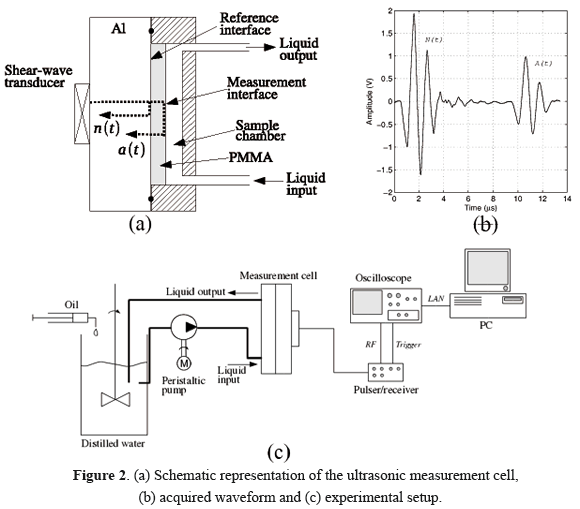
<body><![CDATA[<p><font size="3" face="Verdana, Arial, Helvetica, sans-serif"><b>3. EXPERIMENTAL</b></font></p>     <p><b><font size="2" face="Verdana, Arial, Helvetica, sans-serif">3.1 Experimental setup    <br>   </font></b><font size="2" face="Verdana, Arial, Helvetica, sans-serif">A schematic representation of the ultrasonic measurement cell employed in this work is shown in <a href="#fig02">figure 2(a)</a>. It is composed by a 1-MHz shear-wave transducer (Krautkramer B1-Y, GE Sensing &amp; Inspection Technologies, Fairfield - CT, USA), an aluminum delay line, an acrylic (PMMA) delay line and a sample chamber. The transducer operates in pulse/echo mode and two echoes were received, <img src="/img/revistas/dyna/v79n176/v79n176a01eq75264.jpeg" /> from the aluminum-acrylic interface and <img src="/img/revistas/dyna/v79n176/v79n176a01eq75275.jpeg" /> from the acrylic-sample interface. <a href="#fig02">Figure 2(b)</a> shows the acquired signal as seen on the oscilloscope screen. <img src="/img/revistas/dyna/v79n176/v79n176a01eq75283.jpeg" /> works as a constant reference for the measurement, being important for error reduction and improvement of the measurement stability.</font></p>     <p align="center"><font size="2" face="Verdana, Arial, Helvetica, sans-serif"><a name="fig02"></a></font><img src="/img/revistas/dyna/v79n176/v79n176a01fig02.gif"></p>     <p><font size="2" face="Verdana, Arial, Helvetica, sans-serif">The shear-wave transducer was driven by a commercial pulser/receiver unit (Panametrics 5077PR, Olympus NDT, Kennewick - WA, USA). The acquisitions of the signals were made using the oscilloscope (Agilent DSO6052A, Agilent Technologies, Santa Clara - CA, USA) with sample rate of 500 MSa/s and each saved signal was the average of 32 individual signals. The acquisitions were transferred via LAN network to a personal computer for later processing with specially developed Matlab scripts.</font></p>     <p><font size="2" face="Verdana, Arial, Helvetica, sans-serif"><a href="#fig02">Figure 2(c)</a> shows a schematic representation of the entire experimental setup. It is composed by a beaker where 1000 ml of distilled water was stored, an agitator, a peristaltic pump of the type used in medical equipment that recirculates the water through the measurement cell and back to the beaker, the ultrasonic measurement cell, the pulser/receiver, the oscilloscope and a personal computer.</font></p>     <p><font size="2" face="Verdana, Arial, Helvetica, sans-serif">The temperature was measured at the beginning and at the end of the experiment with a thermometer with precision of 0.1&deg;C. Every 30 minutes, 5 ml of the contaminant was added to the beaker using a syringe.</font></p>     <p><font size="2" face="Verdana, Arial, Helvetica, sans-serif"><b>3.2. Material properties    <br>   </b></font><font size="2" face="Verdana, Arial, Helvetica, sans-serif">The SAE 40 automotive oil and the acrylic used in the measurement cell were carefully characterized for a previous work &#91;4&#93;. The SAE 40 oil density is 857 kg/m3. In the temperature range from 22.6 to 23.5&deg;C, the viscosity varies from 0.30 to 0.28 Pa&middot;s. In the case of the acrylic, the density is 1179 kg/m3 and the shear wave velocity is 1315 m/s.</font></p>     <p><font size="2" face="Verdana, Arial, Helvetica, sans-serif"><b>3.3. Experimental determination of the reflection coefficient    ]]></body>
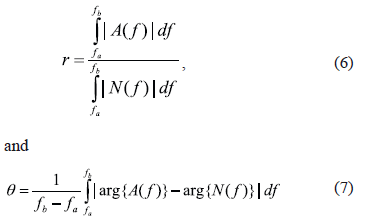
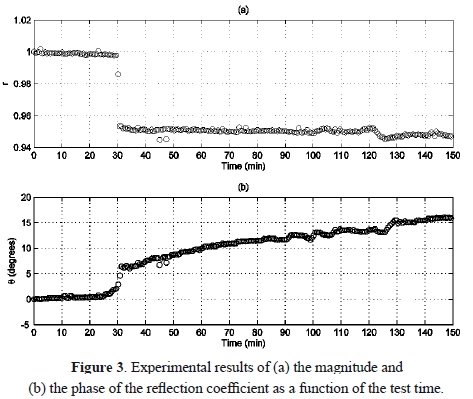
<body><![CDATA[<br>   </b></font><font size="2" face="Verdana, Arial, Helvetica, sans-serif">The magnitude and phase of the reflection coefficient were obtained by comparing, in the frequency domain, each acquired signal with the first signal registered in the beginning of the test. By supposing clean water in contact with the solid and a working frequency of 1 MHz, a complete reflection is obtained because the huge acoustic impedance mismatch. When an oily fluid contaminant is added, small droplets of oil travel in the water and gradually stick to the solid surface. From the theory, a very thin oil film must be sufficient to create a detectable change in magnitude and phase. By using equation (5) with the material properties reported before, the characteristic decay length obtained is <font face="Symbol">d</font> = 10.4 <font face="Symbol">m</font>m. This numerical results show how thin can be the oil layer in order to detect its presence by the shear waves.</font></p>     <p><font size="2" face="Verdana, Arial, Helvetica, sans-serif">If <img src="/img/revistas/dyna/v79n176/v79n176a01eq75290.jpeg" /> and <img src="/img/revistas/dyna/v79n176/v79n176a01eq75297.jpeg" /> are the Fourier transforms of the echoes <img src="/img/revistas/dyna/v79n176/v79n176a01eq75307.jpeg" /> and <img src="/img/revistas/dyna/v79n176/v79n176a01eq75318.jpeg" />, respectively, and using the frequency band method developed by the authors for the ultrasonic measurement of dynamic viscosity &#91;4&#93;, the magnitude and phase of the reflection coefficient can be obtained by the following expressions:</font></p>     <p><img src="/img/revistas/dyna/v79n176/v79n176a01eq0607.gif"></p>     <p><font size="2" face="Verdana, Arial, Helvetica, sans-serif">where <img src="/img/revistas/dyna/v79n176/v79n176a01eq75341.jpeg" /> and <img src="/img/revistas/dyna/v79n176/v79n176a01eq75348.jpeg" />. <img src="/img/revistas/dyna/v79n176/v79n176a01eq75356.jpeg" />and <img src="/img/revistas/dyna/v79n176/v79n176a01eq75367.jpeg" />define a frequency band centered in <img src="/img/revistas/dyna/v79n176/v79n176a01eq75375.jpeg" /> and <img src="/img/revistas/dyna/v79n176/v79n176a01eq75382.jpeg" /> wide, where <font face="Symbol">a</font> = 0.55 in this work. <img src="/img/revistas/dyna/v79n176/v79n176a01eq75389.jpeg" /> is the center frequency of the first <img src="/img/revistas/dyna/v79n176/v79n176a01eq75398.jpeg" /> pulse and parameter <img src="/img/revistas/dyna/v79n176/v79n176a01eq75409.jpeg" /> (<img src="/img/revistas/dyna/v79n176/v79n176a01eq75417.jpeg" />) defines the bandwidth. Additional information about the frequency band method can be found in the work of Franco et al. &#91;4&#93;.</font></p>     <p><font size="2" face="Verdana, Arial, Helvetica, sans-serif">In equation (6), the numerator and denominator are the areas under the curve of the Fourier spectrum magnitude of signals <img src="/img/revistas/dyna/v79n176/v79n176a01eq75426.jpeg" /> and <img src="/img/revistas/dyna/v79n176/v79n176a01eq75433.jpeg" />, respectively, in the frequency range from <img src="/img/revistas/dyna/v79n176/v79n176a01eq75440.jpeg" /> to <img src="/img/revistas/dyna/v79n176/v79n176a01eq75448.jpeg" />, and <img src="/img/revistas/dyna/v79n176/v79n176a01eq75460.jpeg" />is the ratio of these two areas. Equation (7) is the mean value of all angle differences of the Fourier spectrum of signals <img src="/img/revistas/dyna/v79n176/v79n176a01eq75468.jpeg" /> and <img src="/img/revistas/dyna/v79n176/v79n176a01eq75475.jpeg" /> in the frequency range from<img src="/img/revistas/dyna/v79n176/v79n176a01eq75482.jpeg" /> to <img src="/img/revistas/dyna/v79n176/v79n176a01eq75491.jpeg" />.</font></p>     <p><font size="2" face="Verdana, Arial, Helvetica, sans-serif">The signal processing was carried out using Matlab. The echoes <img src="/img/revistas/dyna/v79n176/v79n176a01eq75502.jpeg" /> and <img src="/img/revistas/dyna/v79n176/v79n176a01eq75510.jpeg" /> were isolated in temporal windows, each signal was centered and the Fourier spectrum was calculated using the Goertzel algorithm. The frequency range between fa and fb was represented by 1000 points.</font></p>     <p>&nbsp;</p>     <p><font size="3" face="Verdana, Arial, Helvetica, sans-serif"><b>4. RESULTS AND DISCUSSION</b></font></p>     <p><font size="2" face="Verdana, Arial, Helvetica, sans-serif"><a href="#fig03">Figure 3</a> shows the experimental results for the magnitude 3(a) and phase 3(b) of the reflection coefficient as a function of the acquisition time (t). Results were normalized using the values measured in the first acquisition.</font></p>     <p align="center"><font size="2" face="Verdana, Arial, Helvetica, sans-serif"><a name="fig03"></a></font><img src="/img/revistas/dyna/v79n176/v79n176a01fig03.gif"></p>     ]]></body>
<body><![CDATA[<p><font size="2" face="Verdana, Arial, Helvetica, sans-serif">The magnitude results plotted in <a href="#fig03">figure 3(a)</a> show a sudden reduction at t = 30 min, when the first contaminant oil portion of 5 ml was added to the beaker. This reduction from r = 1.0 to r = 0.95 happens in a very small time, compared to the total acquisition time of 150 min. Thereafter, the magnitude value remains practically constant despite the subsequent contaminant portions added to the beaker (one every 30 minutes until the end of the test). Certainly, the technique can only detect whether there is a contamination or not, at least considering the time scale and contamination amount used in this experiment.</font></p>     <p><font size="2" face="Verdana, Arial, Helvetica, sans-serif">There is a stability of the magnitude over the test time. The magnitude value is practically constant, except for t = 30 min where a sudden change happens. This is an important result because stability is a desirable feature in all measurement processes, particularly when a long term measurement is required. This property is largely a consequence of the normalization process, when the echo returned from the aluminum-acrylic interface is used as a constant reference. The normalization technique was applied successfully in previous works &#91;2&#93;&#91;8&#93;, where additional information can be found.</font></p>     <p><font size="2" face="Verdana, Arial, Helvetica, sans-serif">The phase results plotted in <a href="#fig03">figure 3(b)</a> also show a sudden change at  min. However, the phase is strongly time dependent and its value increases with the acquisition time in an apparently linear way. This results show the phase is not interesting for contamination monitoring, as suspected. Nevertheless, the phase can be useful for the temperature monitoring of the water.</font></p>     <p><font size="2" face="Verdana, Arial, Helvetica, sans-serif">Water temperature monitoring is possible by a simple calibration of the measurement cell. In the experiment, the temperature was measured at the beginning (22.6&deg;C) and at the end (23.5&deg;C). This temperature variation of 0.9&deg;C was responsible for a phase variation of about 15&deg;, suggesting an approximated sensitivity of 17&deg; degrees per Celsius degree. In an interesting work &#91;10&#93;, this approach was used for the simultaneous measurement of viscosity and temperature of melts.</font></p>     <p><font size="2" face="Verdana, Arial, Helvetica, sans-serif">The adherence of oily substances to surfaces is the mechanism that allows the measurement. Oil drops traveling in the water reach the solid surface forming a thin layer that can be detected. Although the level of contamination could not be estimated, the experimental results suggest the technique can at least detect the presence of contamination. The disadvantage of not being able to determine the contamination level could be overcome by using the oil accumulation rate. That is, the level of contamination could be related to the time required to reach a measurable change on the magnitude (r).</font></p>     <p><font size="2" face="Verdana, Arial, Helvetica, sans-serif">By using equations (1) to (4) and the material properties reported in section 3, the magnitude and phase of the reflection coefficient for the SAE 40 oil, assuming Newtonian behavior, can be obtained. For a temperature of 23.0&deg;C and frequency of 1 MHz, the magnitude and phase expected values are <img src="/img/revistas/dyna/v79n176/v79n176a01eq75532.jpeg" /> and respectively. From <a href="#fig03">figure 3</a>, the obtained magnitude is approximately . The phase shift at  min is difficult to be exactly determined, but clearly this value is greater than 5&deg;. In conclusion, the measurement cell finds the fluid to be more viscous than it actually is. This unexpected behavior improves the sensitivity and it is an interesting result that deserves a more detailed study.</font></p>     <p>&nbsp;</p>     <p><b><font size="3" face="Verdana, Arial, Helvetica, sans-serif">5. CONCLUSIONS</font></b></p>     <p><font size="2" face="Verdana, Arial, Helvetica, sans-serif">The methodology proposed has potential for the detection of oily contaminants in water. Both quantities, the magnitude and phase of the reflection coefficient, showed the expected change when 5 ml of SAE 40 oil was incorporated into the water, namely, a contamination of 0.5% in volume of SAE 40 oil in water was detected successfully.</font></p>     <p><font size="2" face="Verdana, Arial, Helvetica, sans-serif">The magnitude showed a stable behavior during the test time (150 minutes). This suggests its suitability for longtime monitoring. Taking into account the variation of 0.9&deg;C during the test, it can be concluded that the magnitude is further independent on temperature. In contrast, the phase exhibits an important variation during the test time due to the temperature variation. This behavior is expected due to the strong temperature dependence on the propagation velocity and, consequently, the phase is not useful for monitoring of contamination. Nonetheless, as the phase shift is proportional to temperature, it can be used for temperature monitoring of the water.</font></p>     ]]></body>
<body><![CDATA[<p><font size="2" face="Verdana, Arial, Helvetica, sans-serif">For a better understanding and for the evaluation of possible practical applications, additional experimental results are required. It is important to determine the minimum amount of oil that could be detected, the influence of the wave frequency and the stability in longer test times. Equally important is the evaluation of temperature monitoring using the phase of the reflection coefficient.</font></p>     <p>&nbsp;</p>     <p><font size="3" face="Verdana, Arial, Helvetica, sans-serif"><b>REFERENCES</b></font></p>     <!-- ref --><p><font size="2" face="Verdana, Arial, Helvetica, sans-serif"><b>&#91;1&#93;</b> Mason, W. P., Baker, W. O., Mcskimin, J. M. and Heiss, J. H., Measurement of shear elasticity and viscosity of liquids at ultrasonic frequencies, Physical Review, 75 (6), pp. 936-946, 1949.    &nbsp;&nbsp;&nbsp;&nbsp;&nbsp;&nbsp;&nbsp;&nbsp;[&#160;<a href="javascript:void(0);" onclick="javascript: window.open('/scielo.php?script=sci_nlinks&ref=000076&pid=S0012-7353201200060000100001&lng=','','width=640,height=500,resizable=yes,scrollbars=1,menubar=yes,');">Links</a>&#160;]<!-- end-ref --><!-- ref --><br>   <b>&#91;2&#93;</b> Franco, E. E., Adamowski, J. C., Higuti, R. T. and Buiochi, F., Viscosity measurement of newtonian liquids using the complex reflection coefficient, IEEE Transaction on Ultrasonics, Ferroelectrics and Frequency Control 55 (10), pp. 2247-2253, 2008.    &nbsp;&nbsp;&nbsp;&nbsp;&nbsp;&nbsp;&nbsp;&nbsp;[&#160;<a href="javascript:void(0);" onclick="javascript: window.open('/scielo.php?script=sci_nlinks&ref=000077&pid=S0012-7353201200060000100002&lng=','','width=640,height=500,resizable=yes,scrollbars=1,menubar=yes,');">Links</a>&#160;]<!-- end-ref --><!-- ref --><br>   <b>&#91;3&#93;</b> Dixon, S. and Lanyon, B., Phase change measurement of ultrasonic shear waves on reflection from a curing epoxy system, Journal of Physics D: Applied Physics, 38 (22), pp. 4115-4125, 2005.    &nbsp;&nbsp;&nbsp;&nbsp;&nbsp;&nbsp;&nbsp;&nbsp;[&#160;<a href="javascript:void(0);" onclick="javascript: window.open('/scielo.php?script=sci_nlinks&ref=000078&pid=S0012-7353201200060000100003&lng=','','width=640,height=500,resizable=yes,scrollbars=1,menubar=yes,');">Links</a>&#160;]<!-- end-ref --><!-- ref --><br>   <b>&#91;4&#93;</b> Franco, E. E., Adamowski, J. C. and Buiochi, F., Ultrasonic viscosity measurement using the shear-wave reflection coefficient with a novel signal processing technique, IEEE Transaction on Ultrasonics, Ferroelectrics and Frequency Control, 57 (5), pp. 1133-1139, 2010.    &nbsp;&nbsp;&nbsp;&nbsp;&nbsp;&nbsp;&nbsp;&nbsp;[&#160;<a href="javascript:void(0);" onclick="javascript: window.open('/scielo.php?script=sci_nlinks&ref=000079&pid=S0012-7353201200060000100004&lng=','','width=640,height=500,resizable=yes,scrollbars=1,menubar=yes,');">Links</a>&#160;]<!-- end-ref --><!-- ref --><br>   <b>&#91;5&#93;</b> Saggin, R. and Coupland, J. N., Oil viscosity measurement by ultrasonic reflectance, Journal of the American Oil Chemists' Society, 78 (5), pp. 509-511, 2001.    &nbsp;&nbsp;&nbsp;&nbsp;&nbsp;&nbsp;&nbsp;&nbsp;[&#160;<a href="javascript:void(0);" onclick="javascript: window.open('/scielo.php?script=sci_nlinks&ref=000080&pid=S0012-7353201200060000100005&lng=','','width=640,height=500,resizable=yes,scrollbars=1,menubar=yes,');">Links</a>&#160;]<!-- end-ref --><!-- ref --><br>   <b>&#91;6&#93;</b> Rommetveit, T., Johansen, T. F. and Jhonsen, R., Using a multi-layered transducer model to estimate the properties of paraffin wax deposited on steel, Ultrasonics, 51 (1), pp. 85-93, 2011.    &nbsp;&nbsp;&nbsp;&nbsp;&nbsp;&nbsp;&nbsp;&nbsp;[&#160;<a href="javascript:void(0);" onclick="javascript: window.open('/scielo.php?script=sci_nlinks&ref=000081&pid=S0012-7353201200060000100006&lng=','','width=640,height=500,resizable=yes,scrollbars=1,menubar=yes,');">Links</a>&#160;]<!-- end-ref --><!-- ref --><br>   <b>&#91;7&#93;</b> Gasparoux, J, Laux, D., Ferrandis, J. Y., Attal, J. and Tordjeman, P., Large frequency bands viscoelastic properties of honey, Journal of Non-Newtonian Fluid Mechanics, 153 (1), pp. 46-52, 2008.    &nbsp;&nbsp;&nbsp;&nbsp;&nbsp;&nbsp;&nbsp;&nbsp;[&#160;<a href="javascript:void(0);" onclick="javascript: window.open('/scielo.php?script=sci_nlinks&ref=000082&pid=S0012-7353201200060000100007&lng=','','width=640,height=500,resizable=yes,scrollbars=1,menubar=yes,');">Links</a>&#160;]<!-- end-ref --><!-- ref --><br>   <b>&#91;8&#93;</b> Cohen-Tenoudji, F., Pardee, W. J., Tittmann, B. R., Ahlberg, L. and Elsley, R. K., A shear wave rheology sensor, IEEE Transaction on Ultrasonics, Ferroelectrics and Frequency Control, UFFC-34 (2), pp. 263-269, 1987.    &nbsp;&nbsp;&nbsp;&nbsp;&nbsp;&nbsp;&nbsp;&nbsp;[&#160;<a href="javascript:void(0);" onclick="javascript: window.open('/scielo.php?script=sci_nlinks&ref=000083&pid=S0012-7353201200060000100008&lng=','','width=640,height=500,resizable=yes,scrollbars=1,menubar=yes,');">Links</a>&#160;]<!-- end-ref --><!-- ref --><br>   <b>&#91;9&#93;</b> Sun, Z., Voigt, T. and Shah, S. P., Rheometric and ultrasonic investigations of viscoelastic properties of fresh portland cement pastes, Cement and Concrete Research, 36 (2), pp. 278-287, 2006.    &nbsp;&nbsp;&nbsp;&nbsp;&nbsp;&nbsp;&nbsp;&nbsp;[&#160;<a href="javascript:void(0);" onclick="javascript: window.open('/scielo.php?script=sci_nlinks&ref=000084&pid=S0012-7353201200060000100009&lng=','','width=640,height=500,resizable=yes,scrollbars=1,menubar=yes,');">Links</a>&#160;]<!-- end-ref --><!-- ref --><br>   <b>&#91;10&#93;</b> Balasubramaniam, K., Shah, V., Costley, R. D., Bourdreaux, G. and Singh, J. P., High temperature ultrasonic sensor for the simultaneous measurement of viscosity and temperature of melts, Review of Scientific Instruments, 70 (12), 4618-4623, 1999.    &nbsp;&nbsp;&nbsp;&nbsp;&nbsp;&nbsp;&nbsp;&nbsp;[&#160;<a href="javascript:void(0);" onclick="javascript: window.open('/scielo.php?script=sci_nlinks&ref=000085&pid=S0012-7353201200060000100010&lng=','','width=640,height=500,resizable=yes,scrollbars=1,menubar=yes,');">Links</a>&#160;]<!-- end-ref --><!-- ref --><br>   <b>&#91;11&#93;</b> Jakoby, B. and Villekoop, M. J., Physical sensor for water-in-oil emulsions, Sensors and Actuators A, 110, pp. 28-32, 2004.    &nbsp;&nbsp;&nbsp;&nbsp;&nbsp;&nbsp;&nbsp;&nbsp;[&#160;<a href="javascript:void(0);" onclick="javascript: window.open('/scielo.php?script=sci_nlinks&ref=000086&pid=S0012-7353201200060000100011&lng=','','width=640,height=500,resizable=yes,scrollbars=1,menubar=yes,');">Links</a>&#160;]<!-- end-ref --><!-- ref --><br>   <b>&#91;12&#93;</b> Jacoby, B., Beigelbeck, R., Keplinger, F., Lucklum, F., Niedermayer, A., Reichel, E. K., Riesch, C., Voglhuber-Brunnmaier, T. and Weiss, B., Miniaturized Sensor for the Viscosity and Density of Liquids - Performance and Issues, IEEE Transaction on Ultrasonics, Ferroelectrics and Frequency Control, 57 (1), pp. 111-119, 2010.    &nbsp;&nbsp;&nbsp;&nbsp;&nbsp;&nbsp;&nbsp;&nbsp;[&#160;<a href="javascript:void(0);" onclick="javascript: window.open('/scielo.php?script=sci_nlinks&ref=000087&pid=S0012-7353201200060000100012&lng=','','width=640,height=500,resizable=yes,scrollbars=1,menubar=yes,');">Links</a>&#160;]<!-- end-ref --> </font></p>      ]]></body><back>
<ref-list>
<ref id="B1">
<label>1</label><nlm-citation citation-type="journal">
<person-group person-group-type="author">
<name>
<surname><![CDATA[Mason]]></surname>
<given-names><![CDATA[W. P.]]></given-names>
</name>
<name>
<surname><![CDATA[Baker]]></surname>
<given-names><![CDATA[W. O.]]></given-names>
</name>
<name>
<surname><![CDATA[Mcskimin]]></surname>
<given-names><![CDATA[J. M.]]></given-names>
</name>
<name>
<surname><![CDATA[Heiss]]></surname>
<given-names><![CDATA[J. H.]]></given-names>
</name>
</person-group>
<article-title xml:lang="en"><![CDATA[Measurement of shear elasticity and viscosity of liquids at ultrasonic frequencies]]></article-title>
<source><![CDATA[Physical Review]]></source>
<year>1949</year>
<volume>75</volume>
<numero>6</numero>
<issue>6</issue>
<page-range>936-946</page-range></nlm-citation>
</ref>
<ref id="B2">
<label>2</label><nlm-citation citation-type="journal">
<person-group person-group-type="author">
<name>
<surname><![CDATA[Franco]]></surname>
<given-names><![CDATA[E. E.]]></given-names>
</name>
<name>
<surname><![CDATA[Adamowski]]></surname>
<given-names><![CDATA[J. C.]]></given-names>
</name>
<name>
<surname><![CDATA[Higuti]]></surname>
<given-names><![CDATA[R. T.]]></given-names>
</name>
<name>
<surname><![CDATA[Buiochi]]></surname>
<given-names><![CDATA[F.]]></given-names>
</name>
</person-group>
<article-title xml:lang="en"><![CDATA[Viscosity measurement of newtonian liquids using the complex reflection coefficient]]></article-title>
<source><![CDATA[IEEE Transaction on Ultrasonics, Ferroelectrics and Frequency Control]]></source>
<year>2008</year>
<volume>55</volume>
<numero>10</numero>
<issue>10</issue>
<page-range>2247-2253</page-range></nlm-citation>
</ref>
<ref id="B3">
<label>3</label><nlm-citation citation-type="journal">
<person-group person-group-type="author">
<name>
<surname><![CDATA[Dixon]]></surname>
<given-names><![CDATA[S.]]></given-names>
</name>
<name>
<surname><![CDATA[Lanyon]]></surname>
<given-names><![CDATA[B.]]></given-names>
</name>
</person-group>
<article-title xml:lang="en"><![CDATA[Phase change measurement of ultrasonic shear waves on reflection from a curing epoxy system]]></article-title>
<source><![CDATA[Journal of Physics D: Applied Physics]]></source>
<year>2005</year>
<volume>38</volume>
<numero>22</numero>
<issue>22</issue>
<page-range>4115-4125</page-range></nlm-citation>
</ref>
<ref id="B4">
<label>4</label><nlm-citation citation-type="journal">
<person-group person-group-type="author">
<name>
<surname><![CDATA[Franco]]></surname>
<given-names><![CDATA[E. E.]]></given-names>
</name>
<name>
<surname><![CDATA[Adamowski]]></surname>
<given-names><![CDATA[J. C.]]></given-names>
</name>
<name>
<surname><![CDATA[Buiochi]]></surname>
<given-names><![CDATA[F.]]></given-names>
</name>
</person-group>
<article-title xml:lang="en"><![CDATA[Ultrasonic viscosity measurement using the shear-wave reflection coefficient with a novel signal processing technique]]></article-title>
<source><![CDATA[IEEE Transaction on Ultrasonics, Ferroelectrics and Frequency Control]]></source>
<year>2010</year>
<volume>57</volume>
<numero>5</numero>
<issue>5</issue>
<page-range>1133-1139</page-range></nlm-citation>
</ref>
<ref id="B5">
<label>5</label><nlm-citation citation-type="journal">
<person-group person-group-type="author">
<name>
<surname><![CDATA[Saggin]]></surname>
<given-names><![CDATA[R.]]></given-names>
</name>
<name>
<surname><![CDATA[Coupland]]></surname>
<given-names><![CDATA[J. N.]]></given-names>
</name>
</person-group>
<article-title xml:lang="en"><![CDATA[Oil viscosity measurement by ultrasonic reflectance]]></article-title>
<source><![CDATA[Journal of the American Oil Chemists' Society]]></source>
<year>2001</year>
<volume>78</volume>
<numero>5</numero>
<issue>5</issue>
<page-range>509-511</page-range></nlm-citation>
</ref>
<ref id="B6">
<label>6</label><nlm-citation citation-type="journal">
<person-group person-group-type="author">
<name>
<surname><![CDATA[Rommetveit]]></surname>
<given-names><![CDATA[T.]]></given-names>
</name>
<name>
<surname><![CDATA[Johansen]]></surname>
<given-names><![CDATA[T. F.]]></given-names>
</name>
<name>
<surname><![CDATA[Jhonsen]]></surname>
<given-names><![CDATA[R.]]></given-names>
</name>
</person-group>
<article-title xml:lang="en"><![CDATA[Using a multi-layered transducer model to estimate the properties of paraffin wax deposited on steel]]></article-title>
<source><![CDATA[Ultrasonics]]></source>
<year>2011</year>
<volume>51</volume>
<numero>1</numero>
<issue>1</issue>
<page-range>85-93</page-range></nlm-citation>
</ref>
<ref id="B7">
<label>7</label><nlm-citation citation-type="journal">
<person-group person-group-type="author">
<name>
<surname><![CDATA[Gasparoux]]></surname>
<given-names><![CDATA[J]]></given-names>
</name>
<name>
<surname><![CDATA[Laux]]></surname>
<given-names><![CDATA[D.]]></given-names>
</name>
<name>
<surname><![CDATA[Ferrandis]]></surname>
<given-names><![CDATA[J. Y.]]></given-names>
</name>
<name>
<surname><![CDATA[Attal]]></surname>
<given-names><![CDATA[J.]]></given-names>
</name>
<name>
<surname><![CDATA[Tordjeman]]></surname>
<given-names><![CDATA[P.]]></given-names>
</name>
</person-group>
<article-title xml:lang="en"><![CDATA[Large frequency bands viscoelastic properties of honey]]></article-title>
<source><![CDATA[Journal of Non-Newtonian Fluid Mechanics]]></source>
<year>2008</year>
<volume>153</volume>
<numero>1</numero>
<issue>1</issue>
<page-range>46-52</page-range></nlm-citation>
</ref>
<ref id="B8">
<label>8</label><nlm-citation citation-type="journal">
<person-group person-group-type="author">
<name>
<surname><![CDATA[Cohen-Tenoudji]]></surname>
<given-names><![CDATA[F.]]></given-names>
</name>
<name>
<surname><![CDATA[Pardee]]></surname>
<given-names><![CDATA[W. J.]]></given-names>
</name>
<name>
<surname><![CDATA[Tittmann]]></surname>
<given-names><![CDATA[B. R.]]></given-names>
</name>
<name>
<surname><![CDATA[Ahlberg]]></surname>
<given-names><![CDATA[L.]]></given-names>
</name>
<name>
<surname><![CDATA[Elsley]]></surname>
<given-names><![CDATA[R. K.]]></given-names>
</name>
</person-group>
<article-title xml:lang="en"><![CDATA[A shear wave rheology sensor]]></article-title>
<source><![CDATA[IEEE Transaction on Ultrasonics, Ferroelectrics and Frequency Control]]></source>
<year>1987</year>
<numero>2</numero>
<issue>2</issue>
<page-range>263-269</page-range></nlm-citation>
</ref>
<ref id="B9">
<label>9</label><nlm-citation citation-type="journal">
<person-group person-group-type="author">
<name>
<surname><![CDATA[Sun]]></surname>
<given-names><![CDATA[Z.]]></given-names>
</name>
<name>
<surname><![CDATA[Voigt]]></surname>
<given-names><![CDATA[T.]]></given-names>
</name>
<name>
<surname><![CDATA[Shah]]></surname>
<given-names><![CDATA[S. P.]]></given-names>
</name>
</person-group>
<article-title xml:lang="en"><![CDATA[Rheometric and ultrasonic investigations of viscoelastic properties of fresh portland cement pastes]]></article-title>
<source><![CDATA[Cement and Concrete Research]]></source>
<year>2006</year>
<volume>36</volume>
<numero>2</numero>
<issue>2</issue>
<page-range>278-287</page-range></nlm-citation>
</ref>
<ref id="B10">
<label>10</label><nlm-citation citation-type="journal">
<person-group person-group-type="author">
<name>
<surname><![CDATA[Balasubramaniam]]></surname>
<given-names><![CDATA[K.]]></given-names>
</name>
<name>
<surname><![CDATA[Shah]]></surname>
<given-names><![CDATA[V.]]></given-names>
</name>
<name>
<surname><![CDATA[Costley]]></surname>
<given-names><![CDATA[R. D.]]></given-names>
</name>
<name>
<surname><![CDATA[Bourdreaux]]></surname>
<given-names><![CDATA[G.]]></given-names>
</name>
<name>
<surname><![CDATA[Singh]]></surname>
<given-names><![CDATA[J. P.]]></given-names>
</name>
</person-group>
<article-title xml:lang="en"><![CDATA[High temperature ultrasonic sensor for the simultaneous measurement of viscosity and temperature of melts]]></article-title>
<source><![CDATA[Review of Scientific Instruments]]></source>
<year>1999</year>
<volume>70</volume>
<numero>12</numero>
<issue>12</issue>
<page-range>4618-4623</page-range></nlm-citation>
</ref>
<ref id="B11">
<label>11</label><nlm-citation citation-type="journal">
<person-group person-group-type="author">
<name>
<surname><![CDATA[Jakoby]]></surname>
<given-names><![CDATA[B.]]></given-names>
</name>
<name>
<surname><![CDATA[Villekoop]]></surname>
<given-names><![CDATA[M. J.]]></given-names>
</name>
</person-group>
<article-title xml:lang="en"><![CDATA[Physical sensor for water-in-oil emulsions]]></article-title>
<source><![CDATA[Sensors and Actuators A]]></source>
<year>2004</year>
<numero>110</numero>
<issue>110</issue>
<page-range>28-32</page-range></nlm-citation>
</ref>
<ref id="B12">
<label>12</label><nlm-citation citation-type="journal">
<person-group person-group-type="author">
<name>
<surname><![CDATA[Jacoby]]></surname>
<given-names><![CDATA[B.]]></given-names>
</name>
<name>
<surname><![CDATA[Beigelbeck]]></surname>
<given-names><![CDATA[R.]]></given-names>
</name>
<name>
<surname><![CDATA[Keplinger]]></surname>
<given-names><![CDATA[F.]]></given-names>
</name>
<name>
<surname><![CDATA[Lucklum]]></surname>
<given-names><![CDATA[F.]]></given-names>
</name>
<name>
<surname><![CDATA[Niedermayer]]></surname>
<given-names><![CDATA[A.]]></given-names>
</name>
<name>
<surname><![CDATA[Reichel]]></surname>
<given-names><![CDATA[E. K.]]></given-names>
</name>
<name>
<surname><![CDATA[Riesch]]></surname>
<given-names><![CDATA[C.]]></given-names>
</name>
<name>
<surname><![CDATA[Voglhuber-Brunnmaier]]></surname>
<given-names><![CDATA[T.]]></given-names>
</name>
<name>
<surname><![CDATA[Weiss]]></surname>
<given-names><![CDATA[B.]]></given-names>
</name>
</person-group>
<article-title xml:lang="en"><![CDATA[Miniaturized Sensor for the Viscosity and Density of Liquids: Performance and Issues]]></article-title>
<source><![CDATA[IEEE Transaction on Ultrasonics, Ferroelectrics and Frequency Control]]></source>
<year>2010</year>
<volume>57</volume>
<numero>1</numero>
<issue>1</issue>
<page-range>111-119</page-range></nlm-citation>
</ref>
</ref-list>
</back>
</article>