<?xml version="1.0" encoding="ISO-8859-1"?><article xmlns:mml="http://www.w3.org/1998/Math/MathML" xmlns:xlink="http://www.w3.org/1999/xlink" xmlns:xsi="http://www.w3.org/2001/XMLSchema-instance">
<front>
<journal-meta>
<journal-id>0012-7353</journal-id>
<journal-title><![CDATA[DYNA]]></journal-title>
<abbrev-journal-title><![CDATA[Dyna rev.fac.nac.minas]]></abbrev-journal-title>
<issn>0012-7353</issn>
<publisher>
<publisher-name><![CDATA[Universidad Nacional de Colombia]]></publisher-name>
</publisher>
</journal-meta>
<article-meta>
<article-id>S0012-73532012000600009</article-id>
<title-group>
<article-title xml:lang="en"><![CDATA[COST ANALYSIS OF THE LOCATION OF COLOMBIAN BIOFUELS PLANTS]]></article-title>
<article-title xml:lang="es"><![CDATA[UN ANÁLISIS DE COSTO DE LA LOCALIZACIÓN DE PLANTAS DE BIOCOMBUSTIBLES COLOMBIANAS]]></article-title>
</title-group>
<contrib-group>
<contrib contrib-type="author">
<name>
<surname><![CDATA[DUARTE]]></surname>
<given-names><![CDATA[ALEXANDRA EUGENIA]]></given-names>
</name>
<xref ref-type="aff" rid="A01"/>
</contrib>
<contrib contrib-type="author">
<name>
<surname><![CDATA[SARACHE]]></surname>
<given-names><![CDATA[WILLIAM ARIEL]]></given-names>
</name>
<xref ref-type="aff" rid="A02"/>
</contrib>
<contrib contrib-type="author">
<name>
<surname><![CDATA[CARDONA]]></surname>
<given-names><![CDATA[CARLOS ARIEL]]></given-names>
</name>
<xref ref-type="aff" rid="A03"/>
</contrib>
</contrib-group>
<aff id="A01">
<institution><![CDATA[,Universidad Nacional de Colombia Sede Manizales  ]]></institution>
<addr-line><![CDATA[ ]]></addr-line>
</aff>
<aff id="A02">
<institution><![CDATA[,Universidad Nacional de Colombia Sede Manizales  ]]></institution>
<addr-line><![CDATA[ ]]></addr-line>
</aff>
<aff id="A03">
<institution><![CDATA[,Universidad Nacional de Colombia Sede Manizales  ]]></institution>
<addr-line><![CDATA[ ]]></addr-line>
</aff>
<pub-date pub-type="pub">
<day>00</day>
<month>12</month>
<year>2012</year>
</pub-date>
<pub-date pub-type="epub">
<day>00</day>
<month>12</month>
<year>2012</year>
</pub-date>
<volume>79</volume>
<numero>176</numero>
<fpage>71</fpage>
<lpage>80</lpage>
<copyright-statement/>
<copyright-year/>
<self-uri xlink:href="http://www.scielo.org.co/scielo.php?script=sci_arttext&amp;pid=S0012-73532012000600009&amp;lng=en&amp;nrm=iso"></self-uri><self-uri xlink:href="http://www.scielo.org.co/scielo.php?script=sci_abstract&amp;pid=S0012-73532012000600009&amp;lng=en&amp;nrm=iso"></self-uri><self-uri xlink:href="http://www.scielo.org.co/scielo.php?script=sci_pdf&amp;pid=S0012-73532012000600009&amp;lng=en&amp;nrm=iso"></self-uri><abstract abstract-type="short" xml:lang="en"><p><![CDATA[Facility location is a strategic decision that affects supply chain competitiveness. In this study, facility location and logistics networks were analyzed in 7 biodiesel and 6 bio-ethanol production plants in Colombia. The proposed methodology provided a decision making model to compare facility location taking into account production costs and the logistics network. Preliminary technical and economic studies were conducted using Aspen Plus for process simulation. The logistics network distribution was analyzed using a linear programming method to compare and analyze the advantages and disadvantages of plants situated in different locations of the country. Factors related to location, raw materials, supply chains and capacity were also analyzed. The findings show that three biodiesel plants in Villavicencio, Bucaramanga and Santa Marta and two bioethanol plants in Valle and Cauca had the lowest production cost.]]></p></abstract>
<abstract abstract-type="short" xml:lang="es"><p><![CDATA[La localización de instalaciones es una decisión estratégica que impacta directamente la competitividad de la cadena de suministro. En este estudio, la localización de instalaciones y la red logística para la producción de biocombustibles en 7 plantas de biodiesel y 6 plantas de bioetanol, fueron analizadas para el caso Colombiano. La metodología propuesta proporciona un modelo de decisión para comparar la localización de instalaciones teniendo en cuenta el costo del producto y la red logística. Estudios técnicos y económicos preliminares fueron realizados utilizando el simulador de procesos Aspen Plus. La red logística se analizó utilizando un método de programación lineal que permitió comparar las ventajas y desventajas entre cada una de las plantas localizadas en diferentes ciudades del país. Factores relacionados con la ubicación, las materias primas, la cadena de suministro y la capacidad fueron determinantes en la decisión. Los resultados muestran que, para el caso del biodiesel, los menores costos se obtienen en Villavicencio, Bucaramanga y Santa Marta y para el caso del bioetanol en el Valle y en el Cauca.]]></p></abstract>
<kwd-group>
<kwd lng="en"><![CDATA[Facility location]]></kwd>
<kwd lng="en"><![CDATA[biofuels]]></kwd>
<kwd lng="en"><![CDATA[Colombia]]></kwd>
<kwd lng="en"><![CDATA[logistics network]]></kwd>
<kwd lng="en"><![CDATA[supply chain]]></kwd>
<kwd lng="en"><![CDATA[simulation]]></kwd>
<kwd lng="es"><![CDATA[Localización de instalaciones]]></kwd>
<kwd lng="es"><![CDATA[Biocombustibles]]></kwd>
<kwd lng="es"><![CDATA[Colombia]]></kwd>
<kwd lng="es"><![CDATA[Red logística]]></kwd>
<kwd lng="es"><![CDATA[Cadenas de Suministro]]></kwd>
<kwd lng="es"><![CDATA[simulación]]></kwd>
</kwd-group>
</article-meta>
</front><body><![CDATA[ <p align="center"><font size="4" face="Verdana, Arial, Helvetica, sans-serif"><b>COST ANALYSIS OF THE LOCATION OF COLOMBIAN BIOFUELS PLANTS</b></font></p>     <p align="center"><i><font size="3"><b><font face="Verdana, Arial, Helvetica, sans-serif">UN AN&Aacute;LISIS DE COSTO DE LA LOCALIZACI&Oacute;N DE PLANTAS DE BIOCOMBUSTIBLES COLOMBIANAS. </font></b></font></i></p>     <p align="center">&nbsp;</p>     <p align="center"><font size="2" face="Verdana, Arial, Helvetica, sans-serif"><b>ALEXANDRA EUGENIA DUARTE</b>    <br>   <i>Chemical Engineer, M.Sc, Ph.D Candiate , Universidad Nacional de Colombia Sede Manizales, <a href="mailto:aeduartec@unal.edu.co">aeduartec@unal.edu.co</a></i></font></p>     <p align="center"><font size="2" face="Verdana, Arial, Helvetica, sans-serif"><b>WILLIAM ARIEL SARACHE</b>    <br>   <i>Industrial Engineer, M.Sc, Ph. D., Associated Professor, Universidad Nacional de Colombia Sede Manizales, <a href="mailto:wasarachec@unal.edu.co">wasarachec@unal.edu.co</a></i></font></p>     <p align="center"><font size="2" face="Verdana, Arial, Helvetica, sans-serif"><b>CARLOS ARIEL CARDONA</b>    <br>   <i>Chemical Engineer, M.Sc, Ph.D., Professor, Universidad Nacional de Colombia Sede Manizales, <a href="mailto:ccardonaal@unal.edu.co">ccardonaal@unal.edu.co</a></i></font></p>     <p align="center">&nbsp;</p>     ]]></body>
<body><![CDATA[<p align="center"><font size="2" face="Verdana, Arial, Helvetica, sans-serif"><b>Received for review March 2<sup>th</sup>, 2012, accepted June 29<sup>th</sup>, 2012, final version July, 24<sup>th</sup>, 2012</b></font></p>     <p>&nbsp;</p> <hr>     <p><font size="2" face="Verdana, Arial, Helvetica, sans-serif"><b>ABSTRACT:</b> Facility location is a strategic decision that affects supply chain competitiveness. In this study, facility location and logistics networks were analyzed in 7 biodiesel and 6 bio-ethanol production plants in Colombia. The proposed methodology provided a decision making model to compare facility location taking into account production costs and the logistics network. Preliminary technical and economic studies were conducted using Aspen Plus for process simulation. The logistics network distribution was analyzed using a linear programming method to compare and analyze the advantages and disadvantages of plants situated in different locations of the country. Factors related to location, raw materials, supply chains and capacity were also analyzed. The findings show that three biodiesel plants in Villavicencio, Bucaramanga and Santa Marta and two bioethanol plants in Valle and Cauca had the lowest production cost. </font></p>     <p><font size="2" face="Verdana, Arial, Helvetica, sans-serif"><b>KEYWORDS:</b> Facility location, biofuels, Colombia, logistics network, supply chain, simulation.</font></p>     <p><font size="2" face="Verdana, Arial, Helvetica, sans-serif"><b>RESUMEN:</b> La localizaci&oacute;n de instalaciones es una decisi&oacute;n estrat&eacute;gica que impacta directamente la competitividad de la cadena de suministro. En este estudio, la localizaci&oacute;n de instalaciones y la red log&iacute;stica para la producci&oacute;n de biocombustibles en 7 plantas de biodiesel y 6 plantas de bioetanol, fueron analizadas para el caso Colombiano. La metodolog&iacute;a propuesta proporciona un modelo de decisi&oacute;n para comparar la localizaci&oacute;n de instalaciones teniendo en cuenta el costo del producto y la red log&iacute;stica. Estudios t&eacute;cnicos y econ&oacute;micos preliminares fueron realizados utilizando el simulador de procesos Aspen Plus. La red log&iacute;stica se analiz&oacute; utilizando un m&eacute;todo de programaci&oacute;n lineal que permiti&oacute; comparar las ventajas y desventajas entre cada una de las plantas localizadas en diferentes ciudades del pa&iacute;s. Factores relacionados con la ubicaci&oacute;n, las materias primas, la cadena de suministro y la capacidad fueron determinantes en la decisi&oacute;n. Los resultados muestran que, para el caso del biodiesel, los menores costos se obtienen en Villavicencio, Bucaramanga y Santa Marta y para el caso del bioetanol en el Valle y en el Cauca.</font></p>     <p><font size="2" face="Verdana, Arial, Helvetica, sans-serif"><b>PALABRAS CLAVE:</b> Localizaci&oacute;n de instalaciones, Biocombustibles, Colombia, Red log&iacute;stica, Cadenas de Suministro, simulaci&oacute;n. </font></p> <hr>     <p>&nbsp;</p>     <p><font size="3" face="Verdana, Arial, Helvetica, sans-serif"><b>1. INTRODUCTION </b></font></p>     <p><font size="2" face="Verdana, Arial, Helvetica, sans-serif">Facility location is a strategic decision that affects the competitive performance of companies. Factors such as productivity, taxes and political context, among others, have motivated companies to consider new location alternatives to gain better results in terms of cost, time, flexibility and service. Therefore, companies locate their facilities in places of high value return &#91;1&#93;.</font></p>     <p><font size="2" face="Verdana, Arial, Helvetica, sans-serif">The decisions regarding facility location are present in three levels of planning: strategic, tactical and operational &#91;2&#93;. These levels must be integrated in an approach that seeks to optimize global logistics costs &#91;3&#93;. In some countries like Colombia, however, facility location and, in particular, the location of agro-industrial plants, is not considered in planning decisions basically for two reasons: first, some companies are not aware of the existence of models for supporting the facility location decisions and hence, they don't apply them. Second, in some regions of the country, private interests or political pressures prevail in the decision. Both situations threaten the profitability of the company in the future. Profitability might be affected in the long term when decisions of facility location don't take into account factors such as transport infrastructure, public services, accessibility of raw materials and skilled labor. </font></p>     ]]></body>
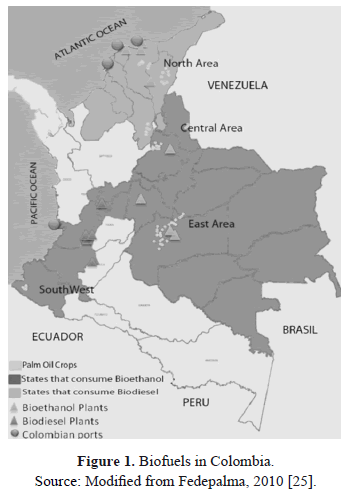
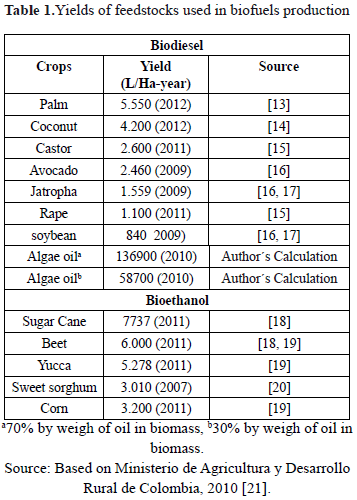
<body><![CDATA[<p><font size="2" face="Verdana, Arial, Helvetica, sans-serif">Therefore, this article shows an analysis of biofuel supply chains, which helps to determine and compare costs of final goods based on the current facility locations in Colombia. A transportation model was considered in the analysis; also, fixed and variable production costs were determined by mean of <i>Aspen Plus Software</i>. </font></p>     <p>&nbsp;</p>     <p><font size="3" face="Verdana, Arial, Helvetica, sans-serif"><b>2. LITERATURE REVIEW</b></font></p>     <p><b><font size="2" face="Verdana, Arial, Helvetica, sans-serif">2.1. Facility location    <br>   </font></b><font size="2" face="Verdana, Arial, Helvetica, sans-serif">Location is a common problem in operations research. Nowadays, there are different methodologies to address this problem. Most methodologies used in facility location problems are based on optimization of a cost function. In different contributions from the literature, the facility location is highlighted as one of the strategic decisions that directly affects the design and performance of the supply chain &#91;2&#93;. Likewise, several location models that incorporate the supply chain configuration have been studied in the last decade &#91;4&#93;. Some models in the literature seek to maximize customer service, responsiveness and profitability &#91;5&#93;.</font></p>     <p><font size="2" face="Verdana, Arial, Helvetica, sans-serif">Other models are used to minimize functions such as total installed cost, longest distance between existing locations, fixed costs, total annual operating cost, average travel time, maximum time and distance and number of facilities located &#91;5&#93;. A lot of methods have been studied to solve location problems &#91;5&#93; &#91;6&#93;. A proposed classification for solution methods in facility location problems is as follows: exact methods, multicriteria technique's, heuristics and meta-heuristics techniques &#91;7&#93;. The main difference between these methods is the kind of solution obtained; in the exact methods is possible to get an optimal solution, while the multicriteria, heuristic and meta-heuristics techniques provide solutions that approach the optimum value. The heuristics techniques have an easy convergence with the so-called &ldquo;local optimal&rdquo;, making it impossible to reach the global optimum without sacrificing computational times. This disadvantage is overcome by meta-heuristics techniques such as: Genetic Algorithms, (GAs) Simulated Annealing (SA), Evolutionary Algorithm, Particle Swarm Optimization (PSO), Dynamic Mesh Optimization (DMO), Ant Algorithms (AAs) and Fuzzy Logic. </font></p>     <p><font size="2" face="Verdana, Arial, Helvetica, sans-serif">An important group of studies which have carried out simulations to determine the viability and energetic costs of biomass plants have been found in the available literature &#91;8, 9&#93;. However, other studies have developed models focused on optimizing a group of location factors for such plants &#91;10&#93;. Some factors that affect facility location and supply chain management decision making, are as follows: procurement sources, markets, transportation and communication, labor, utilities, quality of life of people, weather, legal framework, taxation, community attitudes, topography, and so on. Weaknesses concerning these factors have been identified in the analysis of the lignocelluloses biomass supply chains &#91;11&#93;. Really, logistic focus is the key issue for the future of fuel ethanol production from biomass. The importance of the logistical variables analysis in the economic studies is evidenced in the present work.</font></p>     <p><font size="2" face="Verdana, Arial, Helvetica, sans-serif"><b>2.2. Biodiesel production in Colombia    <br>   </b>In Colombia the activities of production, distribution and use of biofuels have been focused, on the one hand, to assure energy supplies and gradually replace the use of fossil fuels, and on the other hand, to improve the agricultural sector and to increase economic and social development. However, the increase of biofuel production should be regulated and balanced &#91;12&#93;. In the last decade, bioethanol and biodiesel production have had a significant growth in Colombia, and also in the entire world. Biofuels can be liquid, solid or gaseous and they are actually obtained from biomass (animal or vegetable organic material). The term biofuels includes bioethanol (or fuel ethanol), methanol, biodiesel, diesel produced by Fischer-Tropsch chemical process, gaseous fuels such as methane or hydrogen and bioenergy from wood pellets (dendro energy). <a href="#tab01">Table 1</a> describes the feedstocks used in biodiesel and bioethanol production.</font></p>     <p align="center"><font size="2" face="Verdana, Arial, Helvetica, sans-serif"><a name="tab01"></a></font><img src="/img/revistas/dyna/v79n176/v79n176a09tab01.gif"></p>     ]]></body>
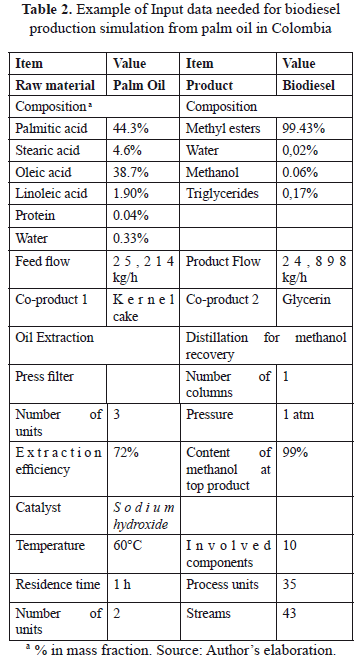
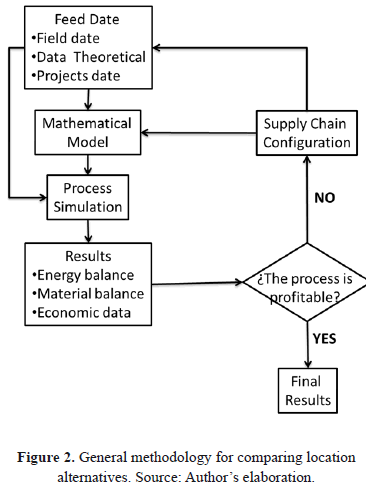
<body><![CDATA[<p><font size="2" face="Verdana, Arial, Helvetica, sans-serif">Colombia is the third American producer of biofuels after Brazil and USA. Colombia produces 1.2 million liters of ethanol from sugarcane. This ethanol volume covers about 70% of the domestic demand. Six fuel ethanol plants and seven biodiesel plants are actually operating in Colombia. Furthermore, several projects are being developed with the aim to search for new feedstocks. <a href="#fig01">Figure 1</a> shows the location of biodiesel and bioethanol plants in Colombia as well as the regions where bioethanol and biodiesel are used as fuel &#91;22&#93;. Methanol is imported as Colombian production is very low and the location of biodiesel plants near to the ports decreases methanol transportation costs. Palm plantations are located throughout the country; which is divided in four areas: northern, central, eastern and western.</font></p>     <p align="center"><font size="2" face="Verdana, Arial, Helvetica, sans-serif"><a name="fig01"></a></font><img src="/img/revistas/dyna/v79n176/v79n176a09fig01.gif"></p>     <p><font size="2" face="Verdana, Arial, Helvetica, sans-serif">The use of biofuel in Colombia is a state policy, which is still in early stages. This situation generates expectations to create new plants and the need to improve the existing supply chain configurations. New logistics analyses are necessary to minimize operating costs and to increase biofuel usage nationwide. It is also important to research new production alternatives. Logistics aspects such as availability, international purchasing operations, transportation costs of raw materials, as well as operating costs, marketing infrastructure and social and economic effects, are some of the factors that strongly influence facility location decisions making &#91;23&#93;. This paper addresses some logistics problems of raw materials and transportation of finished goods, using a linear programming method that combines the analyses of processes and logistics networks. Based on work by Sherali and Adams (1984)&#91;24&#93;, an algorithm was implemented, but with the difference that in this case the production costs were calculated using Aspen Plus Simulator Software. The aim of this study is the comparison of facility locations of biofuel plants existing in Colombia.</font></p>     <p>&nbsp;</p>     <p><font size="4" face="Verdana, Arial, Helvetica, sans-serif"><b>3. METHODOLOGY</b></font></p>     <p><font size="2" face="Verdana, Arial, Helvetica, sans-serif">The methodology used is based on three main steps. The first step addressed theoretical analysis, the collection of field data and estimated data to be used in the model. The second step developed a mathematical model using the information compiled in the first step. The last step consists of the simulation process. The simulation process allows allocating the system capacity, performing the mass and energy balance and also, a preliminary economic assessment of agro-industrial project. These data were used to analyze the appropriate configuration of the supply chain, in order to achieve the desired profitability of the process. (See <a href="#fig02">Figure 2</a>). </font></p>     <p align="center"><font size="2" face="Verdana, Arial, Helvetica, sans-serif"><a name="fig02"></a></font><img src="/img/revistas/dyna/v79n176/v79n176a09fig02.gif"></p>     <p><font size="2" face="Verdana, Arial, Helvetica, sans-serif">In this study, the methodology used has a fixed configuration of the biodiesel supply chain according to all the location alternatives existing in Colombia; therefore, the final results (in terms of finished goods costs) were used to compare them</font></p>     <p><font size="2" face="Verdana, Arial, Helvetica, sans-serif"><b>Simulation </b></font></p>     <p><font size="2" face="Verdana, Arial, Helvetica, sans-serif">The purpose of the simulation process was to generate the mass and energy balance; so it was necessary to establish the requirements for raw materials, consumer goods (catalyst, water and others), service fluids (in this case water and steam) and energy needs. Initial information needed for the simulation includes a comprehensive review and analysis of operating parameters in each step of the simulation process. <a href="#tab02">Table 2</a> shows the main input data required for the simulation of one of the technological flow sheets. The selected flow sheet corresponds to the conventional technology used for biodiesel production from palm oil.</font></p>     ]]></body>
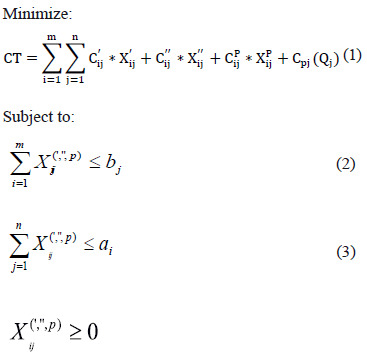
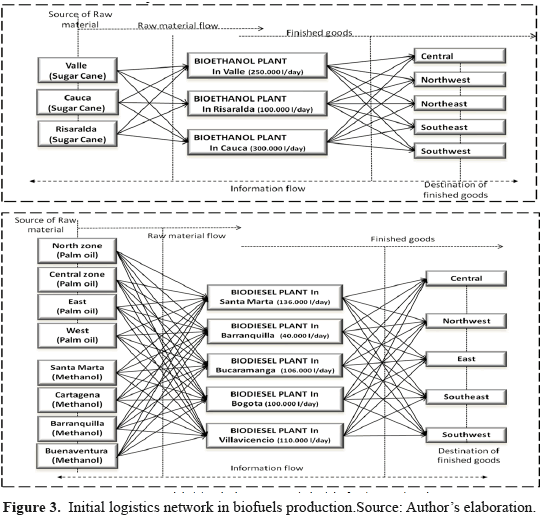
<body><![CDATA[<p align="center"><font size="2" face="Verdana, Arial, Helvetica, sans-serif"><a name="tab02"></a></font><img src="/img/revistas/dyna/v79n176/v79n176a09tab02.gif"></p>     <p><font size="2" face="Verdana, Arial, Helvetica, sans-serif">The simulation process and modelling were performed using specialized software. The simulations of different technological flow sheets, including all stages of the process for conversion of feedstock into biofuels, were performed using the <i>Aspen Plus Software</i> version 7.2 (Aspen Technology, Inc., USA), which has been previously used for a range of design and analysis of processes &#91;8, 9, 26&#93;.</font></p>     <p><font size="2" face="Verdana, Arial, Helvetica, sans-serif">Special software packages for performing mathematical calculations such as Matlab 2009 were also employed. Some specific optimization tasks were accomplished using the package GAMS version 23.4 (GAMS Development Corporation, USA). In addition, software especially designed and developed by our research group like Modell-R was used for performing specific thermodynamic calculations because the determination of thermo-physical properties for certain components involved in the process is not found in available literature. Data of the physical properties of some of the components required during the simulation process were obtained using the Nannoolal methods &#91;27&#93;, which estimates the critical property data, boiling point and vapour pressure by group contributions and group interactions. </font></p>     <p><font size="2" face="Verdana, Arial, Helvetica, sans-serif">The Economic aspects (storage costs, supply costs, inventory costs, and so on) for fuel ethanol and biodiesel production were evaluated using the Aspen Economic Evaluator V7.2 (ICARUS). The Aspen Economic Analyzer was designed to automate the preparation of detailed design and to perform the analysis of investments and programs, from the results of the simulation or the size of the equipment. </font></p>     <p><font size="2" face="Verdana, Arial, Helvetica, sans-serif"><b>Analysis of Supply Chain Configuration:</b></font></p>     <p><font size="2" face="Verdana, Arial, Helvetica, sans-serif">Supply chain management includes the efficient integration of suppliers, manufacturers and retailers so that customers receive the right product, the right quantity, in the right place and at the right time &#91;28&#93;. In this study, for each location alternative of biofuel plants in Colombia, an analysis of the supply chain configuration was made taking into account the logistics of transportation for raw material and finished goods. <a href="#fig03">Figure 3</a> shows the scheme used to address the analysis.</font></p>     <p align="center"><font size="2" face="Verdana, Arial, Helvetica, sans-serif"><a name="fig03"></a></font><img src="/img/revistas/dyna/v79n176/v79n176a09fig03.gif"></p>     <p><font size="2" face="Verdana, Arial, Helvetica, sans-serif"><b>Mathematical model:</b></font></p>     <p><font size="2" face="Verdana, Arial, Helvetica, sans-serif">A function of capital and operation costs includes inventory management, labor and equipment cost; which was obtained with the aid of the Aspen Plus Simulator. Therefore, in the mathematical model a modification of the typical transportation problem is proposed. This modification seeks to minimize the function of total transportation costs of raw material and finished goods, adding the production cost function obtained by mean of the simulation process. Equation 1 describes the mathematical problem &#91;29&#93; as follows:</font></p>     <p><font size="2" face="Verdana, Arial, Helvetica, sans-serif"><img src="/img/revistas/dyna/v79n176/v79n176a09eq0103.gif"></font></p>     ]]></body>
<body><![CDATA[<p><font size="2" face="Verdana, Arial, Helvetica, sans-serif">Where:</font></p>     <blockquote>       <p><font size="2" face="Verdana, Arial, Helvetica, sans-serif">C'<sub>ij</sub>: Transportation costs of raw material (Palm oil for biodiesel and sugar cane for bioethanol) from source i to destination j.    <br>     </font><font size="2" face="Verdana, Arial, Helvetica, sans-serif">X'<sub>ij</sub>: Quantity of raw material (Palm oil for biodiesel and sugar cane for bioethanol) for transportation from source i to destination j.    <br>     </font><font size="2" face="Verdana, Arial, Helvetica, sans-serif">C''<sub>ij</sub>: Transportation costs of other raw material (only used for Methanol in biodiesel case) from source i to destination j.    <br>     </font><font size="2" face="Verdana, Arial, Helvetica, sans-serif">X''<sub>ij</sub>: Quantity of other raw material (only used for Methanol in biodiesel case) for transportation from source i to destination j.    <br>     </font><font size="2" face="Verdana, Arial, Helvetica, sans-serif">C<sup>P</sup><sub>ij</sub>: Transportation cost of finished goods, from source i to final destination j.    <br>     </font><font size="2" face="Verdana, Arial, Helvetica, sans-serif">X<sup>P</sup><sub>ij</sub>: Quantity of finished goods for transportation from source i to destination j.    <br>     </font><font size="2" face="Verdana, Arial, Helvetica, sans-serif">C<sup>P</sup><sub>i</sub>(Q<sub>i</sub>): Cost function according to the installed capacity (Qj) in each destination j. This function was obtained of the simulation process (US$/Ton.).    <br>     </font><font size="2" face="Verdana, Arial, Helvetica, sans-serif">m: Number of storage centers.    ]]></body>
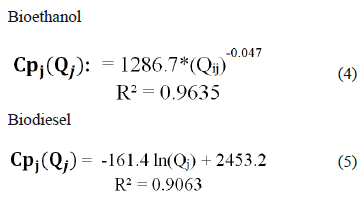
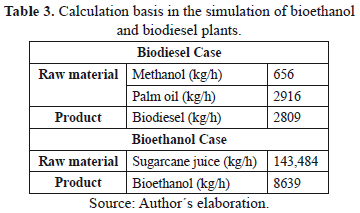
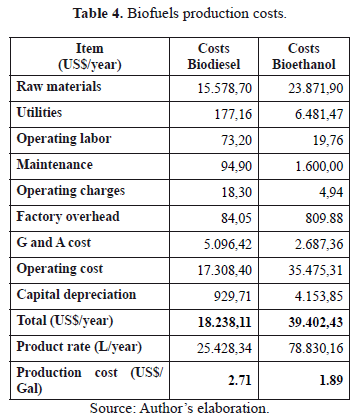
<body><![CDATA[<br>     </font><font size="2" face="Verdana, Arial, Helvetica, sans-serif">n: Number of factories.    <br>     </font><font size="2" face="Verdana, Arial, Helvetica, sans-serif">CT: Total production and transportation cost.    <br>     </font><font size="2" face="Verdana, Arial, Helvetica, sans-serif">b<sub>j</sub>: Maximum demand in location j.    <br>     </font><font size="2" face="Verdana, Arial, Helvetica, sans-serif">a<sub>i</sub>: Maximum supply capacity in source i.</font></p> </blockquote>     <p>&nbsp;</p>     <p><font size="3" face="Verdana, Arial, Helvetica, sans-serif"><b>4. RESULTS AND DISCUSSION</b></font></p>     <p><font size="2" face="Verdana, Arial, Helvetica, sans-serif"><b>Simulation and initial date:</b></font></p>     <p><font size="2" face="Verdana, Arial, Helvetica, sans-serif">The following calculation basis was adopted in the simulation process (See <a href="#tab03">table 3</a>).</font></p>     <p align="center"><font size="2" face="Verdana, Arial, Helvetica, sans-serif"><a name="tab03"></a></font><img src="/img/revistas/dyna/v79n176/v79n176a09tab03.gif"></p>     <p><font size="2" face="Verdana, Arial, Helvetica, sans-serif">The <a href="#tab04">Table 4</a> shows the production costs in each case using ICARUS tools in <i>Aspen Plus Software</i>. Using the <i>Aspen Plus Software</i>, the functions of cost per unit were calculated changing the installed capacity in the bioethanol and biodiesel plants. The results are shown as follows:</font></p>     ]]></body>
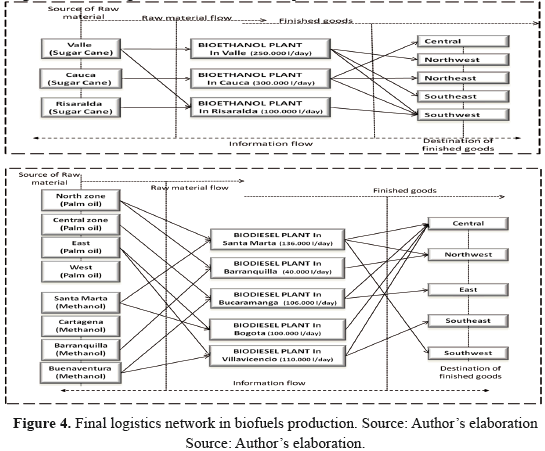
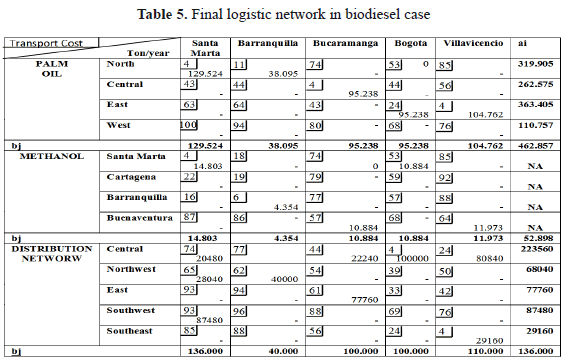
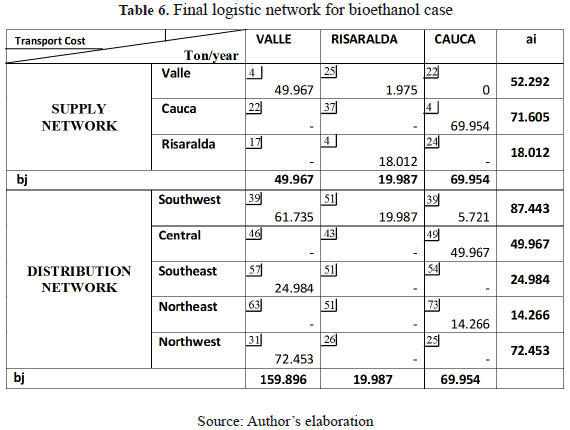
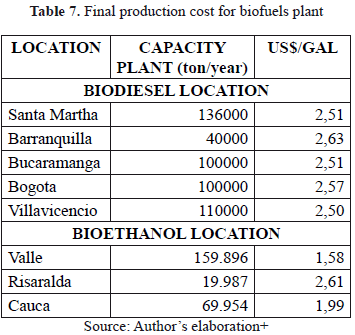
<body><![CDATA[<p><img src="/img/revistas/dyna/v79n176/v79n176a09eq0405.gif"></p>     <p align="center"><font size="2" face="Verdana, Arial, Helvetica, sans-serif"><a name="tab04"></a></font><img src="/img/revistas/dyna/v79n176/v79n176a09tab04.gif"></p>     <p><b><font size="2" face="Verdana, Arial, Helvetica, sans-serif">Analysis of Supply Chain Configuration:</font></b></p>     <p><font size="2" face="Verdana, Arial, Helvetica, sans-serif">According to <a href="#fig01">Figures 1</a> and <a href="#fig02">2</a>, five scenarios were considered in the biodiesel production case. The plants in Santa Marta and Cesar were grouped in one place and other plants were individually analyzed. The central, northwest, east, southeast and southwest of the country were taken into account in the analysis of biodiesel distribution network (see <a href="#fig03">figure 3</a>). </font></p>     <p><font size="2" face="Verdana, Arial, Helvetica, sans-serif">In the same way, according to <a href="#fig01">Figures 1</a> and <a href="#fig02">2</a>, three scenarios were analyzed in bioethanol production. Three plants in El Valle were grouped. Cauca and Valle were considered individually as they both have large acreage planted with sugar cane. In the analysis of the distribution network, the central, northwest, northeast, southeast and southwest of the country were taken into account because these states are the most important bioethanol consumers. Proexport Colombia &#91;30&#93;, the organization in charge of promoting Colombian non-traditional exports, international tourism and foreign investment, provided the road freight transportation rates. The final logistic network is shown in <a href="#fig04">Figure 4</a> for biodiesel and bioethanol. </font></p>     <p align="center"><font size="2" face="Verdana, Arial, Helvetica, sans-serif"><a name="fig04"></a></font><img src="/img/revistas/dyna/v79n176/v79n176a09fig04.gif"></p>     <p><font size="2" face="Verdana, Arial, Helvetica, sans-serif"><a href="#tab05">Tables 5</a> and <a href="#tab06">6</a> show the results obtained from the analysis of raw material transportation for biofuel production plants and also, the results of the transportation cost in the logistics network. <a href="#tab07">Table 7</a> shows that the Villavicencio, Santa Martha and Bucaramanga plants offer lowest supply costs in biodiesel case; likewise, Valle was the best for bioethanol case The total production costs are lowest in the Santa Marta, Bucaramanga and Villavicencio plants, due to their capacity and their geographical location closer to raw material suppliers. This is consistent with the results shown in <a href="#tab05">Table 5</a>, where lowest costs of logistics supply network were obtained in plants located near to the ports. In the same way, this result is consistent with the geographical location of the plants in the distribution network, and emphasizes the importance of transportation costs in decision making regarding facility locations &#91;28&#93;.</font></p>     <p align="center"><font size="2" face="Verdana, Arial, Helvetica, sans-serif"><a name="tab05"></a></font><img src="/img/revistas/dyna/v79n176/v79n176a09tab05.gif"></p>     <p align="center"><font size="2" face="Verdana, Arial, Helvetica, sans-serif"><a name="tab06"></a></font><img src="/img/revistas/dyna/v79n176/v79n176a09tab06.gif"></p>     <p align="center"><font size="2" face="Verdana, Arial, Helvetica, sans-serif"><a name="tab07"></a></font><img src="/img/revistas/dyna/v79n176/v79n176a09tab07.gif"></p>     ]]></body>
<body><![CDATA[<p><font size="2" face="Verdana, Arial, Helvetica, sans-serif"><a href="#tab07">Table 7</a> shows the results of the optimal production cost in different plant location. </font></p>     <p><font size="2" face="Verdana, Arial, Helvetica, sans-serif">the plants located in Risaralda showed the highest total bioethanol production costs; this situation could be caused due to their low installed capacity. The results showed that the lowest supply cost is obtained for bioethanol plants, because these have their own raw material. Valle, Risaralda and Cauca are closer and their plants showed similar costs in the distribution network. However, similar to biodiesel production case,the relationship between production, transportation and inventory cost, directly influence facility location decisions. Therefore, the integration and strategic location among suppliers and distribution networks ensure lowest transportation and production costs.</font></p>     <p>&nbsp;</p>     <p>&nbsp;</p>     <p><font size="3" face="Verdana, Arial, Helvetica, sans-serif"><b>5. CONCLUSIONS</b></font></p>     <p><font size="2" face="Verdana, Arial, Helvetica, sans-serif">Facility location is one of the strategic decisions in the design of supply chains, which under a functional and vertical integration approach, might become a competitive advantage for organizations. This approach allowed the selection of facility locations minimizing transportation and production costs and allowing a better interaction between customers and production systems. </font></p>     <p><font size="2" face="Verdana, Arial, Helvetica, sans-serif">The <i>Aspen Plus Software</i> was used to calculate an estimate production costs and then, these were integrated into the transportation network which allowed the comparison of different location alternatives in the Colombian case study.</font></p>     <p><font size="2" face="Verdana, Arial, Helvetica, sans-serif">Specifically, Plants located in Villavicencio, Bucaramanga and Santa Martha had the lowest production costs in the biodiesel production case. Their capacity was an influential factor in this result; therefore, in the case of plants with high capacity, the cost per unit were optimized. Similarly, as plants located in Cauca and Valle had greater installed capacity in the ethanol production case, they obtained the lowest price per gallon. Lowest costs in the logistics supply network were obtained in plants strategically located near raw material sources, and in biodiesel production plants located close to the ports, which ensured the lowest cost of methanol supply.</font></p>     <p>&nbsp;</p>     <p><font size="3" face="Verdana, Arial, Helvetica, sans-serif"><b>REFERENCES</b></font></p>     ]]></body>
<body><![CDATA[<!-- ref --><p><font size="2" face="Verdana, Arial, Helvetica, sans-serif"><b>&#91;1&#93;</b> Bhuttaa, K., S., Hub, F., Frazierc, G. and Mohamed, Z., An integrated location, production, distribution and investment model for a multinational corporation. International Journal of Production Economics., 86 pp. 201-216, 2003.    &nbsp;&nbsp;&nbsp;&nbsp;&nbsp;&nbsp;&nbsp;&nbsp;[&#160;<a href="javascript:void(0);" onclick="javascript: window.open('/scielo.php?script=sci_nlinks&ref=000093&pid=S0012-7353201200060000900001&lng=','','width=640,height=500,resizable=yes,scrollbars=1,menubar=yes,');">Links</a>&#160;]<!-- end-ref --><!-- ref --><br>   <b>&#91;2&#93;</b> Manzini, R., Gamberi, M., Gebennini, E., and Regattieri, A., An integrated approach to the design and management of a supply chain system. International Journal of Advanced Manufacturing Technology, 37, pp. 625-640, 2008.    &nbsp;&nbsp;&nbsp;&nbsp;&nbsp;&nbsp;&nbsp;&nbsp;[&#160;<a href="javascript:void(0);" onclick="javascript: window.open('/scielo.php?script=sci_nlinks&ref=000094&pid=S0012-7353201200060000900002&lng=','','width=640,height=500,resizable=yes,scrollbars=1,menubar=yes,');">Links</a>&#160;]<!-- end-ref --><!-- ref --><br>   <b>&#91;3&#93;</b> Gebennin, E., Gamberini, R. and Manzin, R., An integrated production - distribution model for the dynamic location and allocation problem with safety stock optimization. International Journal of Production Economics, 122, pp. 286-304, 2009.    &nbsp;&nbsp;&nbsp;&nbsp;&nbsp;&nbsp;&nbsp;&nbsp;[&#160;<a href="javascript:void(0);" onclick="javascript: window.open('/scielo.php?script=sci_nlinks&ref=000095&pid=S0012-7353201200060000900003&lng=','','width=640,height=500,resizable=yes,scrollbars=1,menubar=yes,');">Links</a>&#160;]<!-- end-ref --><!-- ref --><br>   <b>&#91;4&#93;</b> Arango Serna, M. D., Adarme Jaimes, W., and Otorno, M. A., Coordinaci&oacute;n de abastecimiento con informaci&oacute;n compartida en PYMES agroalimentarias Colombianas. Dyna, 78(167), pp. 203-212, 2011.    &nbsp;&nbsp;&nbsp;&nbsp;&nbsp;&nbsp;&nbsp;&nbsp;[&#160;<a href="javascript:void(0);" onclick="javascript: window.open('/scielo.php?script=sci_nlinks&ref=000096&pid=S0012-7353201200060000900004&lng=','','width=640,height=500,resizable=yes,scrollbars=1,menubar=yes,');">Links</a>&#160;]<!-- end-ref --><!-- ref --><br>   <b>&#91;5&#93;</b> Farahani, R. Z., Teadieseifi, M. and Sgari, N., Multiple criteria facility location problems: A survey. Applied Mathematical Modelling, 34, pp.1689-1709, 2010.    &nbsp;&nbsp;&nbsp;&nbsp;&nbsp;&nbsp;&nbsp;&nbsp;[&#160;<a href="javascript:void(0);" onclick="javascript: window.open('/scielo.php?script=sci_nlinks&ref=000097&pid=S0012-7353201200060000900005&lng=','','width=640,height=500,resizable=yes,scrollbars=1,menubar=yes,');">Links</a>&#160;]<!-- end-ref --><!-- ref --><br>   <b>&#91;6&#93;</b> Klose, A. and Drexl, A., Facility location models for distribution system desing. European Journal of Operational Research, 162, pp. 4-29 2004.    &nbsp;&nbsp;&nbsp;&nbsp;&nbsp;&nbsp;&nbsp;&nbsp;[&#160;<a href="javascript:void(0);" onclick="javascript: window.open('/scielo.php?script=sci_nlinks&ref=000098&pid=S0012-7353201200060000900006&lng=','','width=640,height=500,resizable=yes,scrollbars=1,menubar=yes,');">Links</a>&#160;]<!-- end-ref --><!-- ref --><br>   <b>&#91;7&#93;</b> Duarte Castillo, A. E., Sarache Castro, W. A. and Costa Salas, Y., Un aporte conceptual y metodol&oacute;gico para las decisiones de localizaci&oacute;n de instalaciones. Un avance de la tesis doctoral en proceso., No publicado.    &nbsp;&nbsp;&nbsp;&nbsp;&nbsp;&nbsp;&nbsp;&nbsp;[&#160;<a href="javascript:void(0);" onclick="javascript: window.open('/scielo.php?script=sci_nlinks&ref=000099&pid=S0012-7353201200060000900007&lng=','','width=640,height=500,resizable=yes,scrollbars=1,menubar=yes,');">Links</a>&#160;]<!-- end-ref --><!-- ref --><br>   <b>&#91;8&#93;</b> Posada Duque, J. A. and Cardona Ariel, C. A., Design and analysis of fuel ethanol production from raw glycerol. Energy, 35(12), pp. 5286-5293, 2010.    &nbsp;&nbsp;&nbsp;&nbsp;&nbsp;&nbsp;&nbsp;&nbsp;[&#160;<a href="javascript:void(0);" onclick="javascript: window.open('/scielo.php?script=sci_nlinks&ref=000100&pid=S0012-7353201200060000900008&lng=','','width=640,height=500,resizable=yes,scrollbars=1,menubar=yes,');">Links</a>&#160;]<!-- end-ref --><!-- ref --><br>   <b>&#91;9&#93;</b> Quintero Suarez, J. A., Paz Astudillos, I. C., and Cardona Alzate, C. A., Production of bioethanol from sugarcane bagasse: Status and perspectives. Bioresource Technology, 101(13), pp. 4754-4766, 2010.    &nbsp;&nbsp;&nbsp;&nbsp;&nbsp;&nbsp;&nbsp;&nbsp;[&#160;<a href="javascript:void(0);" onclick="javascript: window.open('/scielo.php?script=sci_nlinks&ref=000101&pid=S0012-7353201200060000900009&lng=','','width=640,height=500,resizable=yes,scrollbars=1,menubar=yes,');">Links</a>&#160;]<!-- end-ref --><!-- ref --><br>   <b>&#91;10&#93;</b> Athanasios, A., Rentizelas. and Tatsiopoulos, I. P., Locating a bioenergy facility using a hybrid optimization method. International Journal of Production Economics., 123, pp. 196-209, 2010.    &nbsp;&nbsp;&nbsp;&nbsp;&nbsp;&nbsp;&nbsp;&nbsp;[&#160;<a href="javascript:void(0);" onclick="javascript: window.open('/scielo.php?script=sci_nlinks&ref=000102&pid=S0012-7353201200060000900010&lng=','','width=640,height=500,resizable=yes,scrollbars=1,menubar=yes,');">Links</a>&#160;]<!-- end-ref --><!-- ref --><br>   <b>&#91;11&#93;</b> Batidzirai, B., Faaij, A. P. and Smeets, E., Biomass and bioenergy supply from Mozambique. Energy for Sustainable Development., X(1), pp. 54-81, 2006.    &nbsp;&nbsp;&nbsp;&nbsp;&nbsp;&nbsp;&nbsp;&nbsp;[&#160;<a href="javascript:void(0);" onclick="javascript: window.open('/scielo.php?script=sci_nlinks&ref=000103&pid=S0012-7353201200060000900011&lng=','','width=640,height=500,resizable=yes,scrollbars=1,menubar=yes,');">Links</a>&#160;]<!-- end-ref --><!-- ref --><br>   <b>&#91;12&#93;</b> Cortes Mar&iacute;n, E., Suarez Mahecha, H. and Pardo Carrasco, S., Biocombustibles y autosuficiencia energ&eacute;tica. Dyna 76(158), pp. 101-110, 2008.    &nbsp;&nbsp;&nbsp;&nbsp;&nbsp;&nbsp;&nbsp;&nbsp;[&#160;<a href="javascript:void(0);" onclick="javascript: window.open('/scielo.php?script=sci_nlinks&ref=000104&pid=S0012-7353201200060000900012&lng=','','width=640,height=500,resizable=yes,scrollbars=1,menubar=yes,');">Links</a>&#160;]<!-- end-ref --><!-- ref --><br>   <b>&#91;13&#93;</b> FINAGRO. Ca&ntilde;a de azucar. Fondo para el financiamiento del sector agropecuario. Colombia. Available: <a href="http://www.finagro.com.co/html/i_portals/index.php" target="referencia">http://www.finagro.com.co/html/i_portals/index.php</a> &#91;cited Abril of 2012&#93;    &nbsp;&nbsp;&nbsp;&nbsp;&nbsp;&nbsp;&nbsp;&nbsp;[&#160;<a href="javascript:void(0);" onclick="javascript: window.open('/scielo.php?script=sci_nlinks&ref=000105&pid=S0012-7353201200060000900013&lng=','','width=640,height=500,resizable=yes,scrollbars=1,menubar=yes,');">Links</a>&#160;]<!-- end-ref -->.    <!-- ref --><br>   <b>&#91;14&#93;</b> CORPODIB. Evaluaci&oacute;n de las variedades m&aacute;s promisorias para la producci&oacute;n de aceite vegetal y su potencial implementaci&oacute;n en Colombia. Corporaci&oacute;n para el desarrollo industrial de la Biotecnolog&iacute;a y producci&oacute;n limpia. Bogot&aacute;-Colombia. Available: <a href="http://www.corpodib.com" target="referencia">www.corpodib.com</a> &#91;cited April of 2012&#93;    &nbsp;&nbsp;&nbsp;&nbsp;&nbsp;&nbsp;&nbsp;&nbsp;[&#160;<a href="javascript:void(0);" onclick="javascript: window.open('/scielo.php?script=sci_nlinks&ref=000107&pid=S0012-7353201200060000900014&lng=','','width=640,height=500,resizable=yes,scrollbars=1,menubar=yes,');">Links</a>&#160;]<!-- end-ref -->.    <!-- ref --><br>   <b>&#91;15&#93;</b> Gualteros S&aacute;nchez, J. M., Estudio prospectivo de la cadena productiva del Biodiesel a partir de palma africana en Colombia &#91;Master en Ingenier&iacute;a&#93;. Bogota-Colombia: Universidad Nacional de Colombia Sede Manizales, 2011.    &nbsp;&nbsp;&nbsp;&nbsp;&nbsp;&nbsp;&nbsp;&nbsp;[&#160;<a href="javascript:void(0);" onclick="javascript: window.open('/scielo.php?script=sci_nlinks&ref=000109&pid=S0012-7353201200060000900015&lng=','','width=640,height=500,resizable=yes,scrollbars=1,menubar=yes,');">Links</a>&#160;]<!-- end-ref --><!-- ref --><br>   <b>&#91;16&#93;</b> Cardona Alzate, C. A., Orrego Alzate, C. E. and Gutierrez Mosquera, L. F., Biodiesel, Universidad Nacional de Colombia Sede Manizales-Gob. Caldas, Manizales-Caldas, 2009.    &nbsp;&nbsp;&nbsp;&nbsp;&nbsp;&nbsp;&nbsp;&nbsp;[&#160;<a href="javascript:void(0);" onclick="javascript: window.open('/scielo.php?script=sci_nlinks&ref=000110&pid=S0012-7353201200060000900016&lng=','','width=640,height=500,resizable=yes,scrollbars=1,menubar=yes,');">Links</a>&#160;]<!-- end-ref --><!-- ref --><br>   <b>&#91;17&#93;</b> Razo, C., Lude&ntilde;a, C., Saucedo, A., Astete-Miler, S., Hepp, J. and Vild&oacute;sola, A., Producci&oacute;n de biomasa para biocombustibles l&iacute;quidos: el potencial de America Latina y el Caribe. Serie Desarrollo Productivo 181, Divisi&oacute;n de Desarrollo Productivo y Empresarial CEPAL. Santiago de Chile. Available: <a href="http://www.eclac.org/cgi-bin/getProd.asp?xml=/publicaciones/xml/9/33879/P33879.xml&xsl=/ddpe/tpl/p9f.xsl&base=/tpl/top-bottom.xslt" target="referencia">http://www.eclac.org/cgi-bin/getProd.asp?xml=/publicaciones/xml/9/33879/P33879.xml&xsl=/ddpe/tpl/p9f.xsl&base=/tpl/top-bottom.xslt</a> &#91;cited of 2007&#93;    &nbsp;&nbsp;&nbsp;&nbsp;&nbsp;&nbsp;&nbsp;&nbsp;[&#160;<a href="javascript:void(0);" onclick="javascript: window.open('/scielo.php?script=sci_nlinks&ref=000111&pid=S0012-7353201200060000900017&lng=','','width=640,height=500,resizable=yes,scrollbars=1,menubar=yes,');">Links</a>&#160;]<!-- end-ref -->.    ]]></body>
<body><![CDATA[<!-- ref --><br>   <b>&#91;18&#93;</b> Asoca&ntilde;a. Comunicado mensual para medios, area econ&oacute;mica. Bogota. Available: <a href="file:///C|/Users/Cristian/Desktop/auxiliar/www.asocana.org" target="referencia">www.asocana.org</a> &#91;cited Marzo of 2012&#93;    &nbsp;&nbsp;&nbsp;&nbsp;&nbsp;&nbsp;&nbsp;&nbsp;[&#160;<a href="javascript:void(0);" onclick="javascript: window.open('/scielo.php?script=sci_nlinks&ref=000113&pid=S0012-7353201200060000900018&lng=','','width=640,height=500,resizable=yes,scrollbars=1,menubar=yes,');">Links</a>&#160;]<!-- end-ref -->.    <!-- ref --><br>   <b>&#91;19&#93;</b> Ochoa Martinez, I. and Herazo Miranda, G., Bioetanol. Alcohol Carburante. Colombia <a href="http://www.uninorte.edu.co/extensiones/IDS/Ponencias/biocombustibles/BIOETANOL_Ivan_Ochoa1.pdf" target="referencia">http://www.uninorte.edu.co/extensiones/IDS/Ponencias/biocombustibles/BIOETANOL_Ivan_Ochoa1.pdf</a> &#91;cited June of 2012&#93;    &nbsp;&nbsp;&nbsp;&nbsp;&nbsp;&nbsp;&nbsp;&nbsp;[&#160;<a href="javascript:void(0);" onclick="javascript: window.open('/scielo.php?script=sci_nlinks&ref=000115&pid=S0012-7353201200060000900019&lng=','','width=640,height=500,resizable=yes,scrollbars=1,menubar=yes,');">Links</a>&#160;]<!-- end-ref -->.    <!-- ref --><br>   <b>&#91;20&#93;</b> S&aacute;nchez Toro, O. J. and Cardona Alzate, C. A., Producci&oacute;n de alcohol carburante: Una alternativa para el desarrollo agroindustrial, Artes graficas Tizan, Manizales-Caldas, 2007.    &nbsp;&nbsp;&nbsp;&nbsp;&nbsp;&nbsp;&nbsp;&nbsp;[&#160;<a href="javascript:void(0);" onclick="javascript: window.open('/scielo.php?script=sci_nlinks&ref=000117&pid=S0012-7353201200060000900020&lng=','','width=640,height=500,resizable=yes,scrollbars=1,menubar=yes,');">Links</a>&#160;]<!-- end-ref --><!-- ref --><br>   <b>&#91;21&#93;</b> Ministerio de Agricultura y Desarrollo Rural. Biocombustibles. Colombia, <a href="http://www.minagricultura.gov.co/02componentes/05biocombustible.aspx" target="referencia">http://www.minagricultura.gov.co/02componentes/05biocombustible.aspx</a> &#91;cited May of 2010&#93;    &nbsp;&nbsp;&nbsp;&nbsp;&nbsp;&nbsp;&nbsp;&nbsp;[&#160;<a href="javascript:void(0);" onclick="javascript: window.open('/scielo.php?script=sci_nlinks&ref=000118&pid=S0012-7353201200060000900021&lng=','','width=640,height=500,resizable=yes,scrollbars=1,menubar=yes,');">Links</a>&#160;]<!-- end-ref -->.    <!-- ref --><br>   <b>&#91;22&#93;</b> Fedebiocombustibles. Biocombustibles en Colombia. Federaci&oacute;n Nacional de Biocombustibles en Colombia. Colombia. Available: <a href="http://www.fedebiocombustibles.com/v2/" target="referencia">http://www.fedebiocombustibles.com/v2/</a> &#91;cited July of 2010&#93;    &nbsp;&nbsp;&nbsp;&nbsp;&nbsp;&nbsp;&nbsp;&nbsp;[&#160;<a href="javascript:void(0);" onclick="javascript: window.open('/scielo.php?script=sci_nlinks&ref=000120&pid=S0012-7353201200060000900022&lng=','','width=640,height=500,resizable=yes,scrollbars=1,menubar=yes,');">Links</a>&#160;]<!-- end-ref -->.    <!-- ref --><br>   <b>&#91;23&#93;</b> Monks, J., Administraci&oacute;n de operaciones, Mc. Graw Hill, M&eacute;xico, 1991.    &nbsp;&nbsp;&nbsp;&nbsp;&nbsp;&nbsp;&nbsp;&nbsp;[&#160;<a href="javascript:void(0);" onclick="javascript: window.open('/scielo.php?script=sci_nlinks&ref=000122&pid=S0012-7353201200060000900023&lng=','','width=640,height=500,resizable=yes,scrollbars=1,menubar=yes,');">Links</a>&#160;]<!-- end-ref --><!-- ref --><br>   <b>&#91;24&#93;</b> Sherali, H. D. and Adams, W. P., A decomposition algorithm for a discrete Location-Allocation problem. Operations research, 32(4), pp. 878-900, 1984.    &nbsp;&nbsp;&nbsp;&nbsp;&nbsp;&nbsp;&nbsp;&nbsp;[&#160;<a href="javascript:void(0);" onclick="javascript: window.open('/scielo.php?script=sci_nlinks&ref=000123&pid=S0012-7353201200060000900024&lng=','','width=640,height=500,resizable=yes,scrollbars=1,menubar=yes,');">Links</a>&#160;]<!-- end-ref --><!-- ref --><br>   <b>&#91;25&#93;</b> Fedepalma. Balance econ&oacute;mico del sector palmero Colombiano en el tercer trimestre de 2010. Federaci&oacute;n nacional de Cultivadores de Palma. Bogota. Available: <a href="http://www.fedepalma.org/" target="referencia">www.fedepalma.org/</a> &#91;cited Abril of 2010&#93;    &nbsp;&nbsp;&nbsp;&nbsp;&nbsp;&nbsp;&nbsp;&nbsp;[&#160;<a href="javascript:void(0);" onclick="javascript: window.open('/scielo.php?script=sci_nlinks&ref=000124&pid=S0012-7353201200060000900025&lng=','','width=640,height=500,resizable=yes,scrollbars=1,menubar=yes,');">Links</a>&#160;]<!-- end-ref -->.    <!-- ref --><br>   <b>&#91;26&#93;</b> Cardona Alzate, C. A. and S&aacute;nchez Toro, &Oacute;. J., Trends in biotechnological production of fuel ethanol from different feedstocks. Bioresource Technology, 99(13), pp. 5270-5295, 2008.    &nbsp;&nbsp;&nbsp;&nbsp;&nbsp;&nbsp;&nbsp;&nbsp;[&#160;<a href="javascript:void(0);" onclick="javascript: window.open('/scielo.php?script=sci_nlinks&ref=000126&pid=S0012-7353201200060000900026&lng=','','width=640,height=500,resizable=yes,scrollbars=1,menubar=yes,');">Links</a>&#160;]<!-- end-ref --><!-- ref --><br>   <b>&#91;27&#93;</b> Quintero Suarez, J. A., Montoya Rodriguez, M. I., Giraldo Osorio, O. H. and Cardona Alzate, C. A., Fuel ethanol production from sugarcane and corn: Comparative analysis for a Colombian case. Energy, 33(3), pp. 385-399, 2008.    &nbsp;&nbsp;&nbsp;&nbsp;&nbsp;&nbsp;&nbsp;&nbsp;[&#160;<a href="javascript:void(0);" onclick="javascript: window.open('/scielo.php?script=sci_nlinks&ref=000127&pid=S0012-7353201200060000900027&lng=','','width=640,height=500,resizable=yes,scrollbars=1,menubar=yes,');">Links</a>&#160;]<!-- end-ref --><!-- ref --><br>   <b>&#91;28&#93;</b> Simchi Levi, E. A., Designing and managing the supply chain. Concepts, strategies and case studies, Mc. Graw Hill, New York N.Y, 2003.    &nbsp;&nbsp;&nbsp;&nbsp;&nbsp;&nbsp;&nbsp;&nbsp;[&#160;<a href="javascript:void(0);" onclick="javascript: window.open('/scielo.php?script=sci_nlinks&ref=000128&pid=S0012-7353201200060000900028&lng=','','width=640,height=500,resizable=yes,scrollbars=1,menubar=yes,');">Links</a>&#160;]<!-- end-ref --><!-- ref --><br>   <b>&#91;29&#93;</b> Sarache Castro, W. A., Cardona Ariel, C. A., and Tamayo Arias, J., Localizaci&oacute;n y sistemas de informaci&oacute;n log&iacute;sitico, Artes gr&aacute;ficas Tizan ltda, Colombia-Manizales, 2007.    &nbsp;&nbsp;&nbsp;&nbsp;&nbsp;&nbsp;&nbsp;&nbsp;[&#160;<a href="javascript:void(0);" onclick="javascript: window.open('/scielo.php?script=sci_nlinks&ref=000129&pid=S0012-7353201200060000900029&lng=','','width=640,height=500,resizable=yes,scrollbars=1,menubar=yes,');">Links</a>&#160;]<!-- end-ref --><!-- ref --><br>   <b>&#91;30&#93;</b> Proexport. Fletes de transporte de carga por carretera. Decreto 2663-21 julio 2008 con base en la resoluci&oacute;n 3175 de 2008. Colombia. Available: <a href="http://www.proexport.com.co/vbecontent/home.asp?language=sp&idcompany=16" target="referencia">http://www.proexport.com.co/vbecontent/home.asp?language=sp&idcompany=16</a> &#91;cited June of 2010&#93;    &nbsp;&nbsp;&nbsp;&nbsp;&nbsp;&nbsp;&nbsp;&nbsp;[&#160;<a href="javascript:void(0);" onclick="javascript: window.open('/scielo.php?script=sci_nlinks&ref=000130&pid=S0012-7353201200060000900030&lng=','','width=640,height=500,resizable=yes,scrollbars=1,menubar=yes,');">Links</a>&#160;]<!-- end-ref -->. </font></p>      ]]></body><back>
<ref-list>
<ref id="B1">
<label>1</label><nlm-citation citation-type="journal">
<person-group person-group-type="author">
<name>
<surname><![CDATA[Bhuttaa]]></surname>
<given-names><![CDATA[K., S.]]></given-names>
</name>
<name>
<surname><![CDATA[Hub]]></surname>
<given-names><![CDATA[F.]]></given-names>
</name>
<name>
<surname><![CDATA[Frazierc]]></surname>
<given-names><![CDATA[G.]]></given-names>
</name>
<name>
<surname><![CDATA[Mohamed]]></surname>
<given-names><![CDATA[Z.]]></given-names>
</name>
</person-group>
<article-title xml:lang="en"><![CDATA[An integrated location, production, distribution and investment model for a multinational corporation]]></article-title>
<source><![CDATA[International Journal of Production Economics.]]></source>
<year>2003</year>
<numero>86</numero>
<issue>86</issue>
<page-range>201-216</page-range></nlm-citation>
</ref>
<ref id="B2">
<label>2</label><nlm-citation citation-type="journal">
<person-group person-group-type="author">
<name>
<surname><![CDATA[Manzini]]></surname>
<given-names><![CDATA[R.]]></given-names>
</name>
<name>
<surname><![CDATA[Gamberi]]></surname>
<given-names><![CDATA[M.]]></given-names>
</name>
<name>
<surname><![CDATA[Gebennini]]></surname>
<given-names><![CDATA[E.]]></given-names>
</name>
<name>
<surname><![CDATA[Regattieri]]></surname>
<given-names><![CDATA[A.]]></given-names>
</name>
</person-group>
<article-title xml:lang="en"><![CDATA[An integrated approach to the design and management of a supply chain system]]></article-title>
<source><![CDATA[International Journal of Advanced Manufacturing Technology]]></source>
<year>2008</year>
<numero>37</numero>
<issue>37</issue>
<page-range>625-640</page-range></nlm-citation>
</ref>
<ref id="B3">
<label>3</label><nlm-citation citation-type="journal">
<person-group person-group-type="author">
<name>
<surname><![CDATA[Gebennin]]></surname>
<given-names><![CDATA[E.]]></given-names>
</name>
<name>
<surname><![CDATA[Gamberini]]></surname>
<given-names><![CDATA[R.]]></given-names>
</name>
<name>
<surname><![CDATA[Manzin]]></surname>
<given-names><![CDATA[R.]]></given-names>
</name>
</person-group>
<article-title xml:lang="en"><![CDATA[An integrated production: distribution model for the dynamic location and allocation problem with safety stock optimization]]></article-title>
<source><![CDATA[International Journal of Production Economics]]></source>
<year>2009</year>
<numero>122</numero>
<issue>122</issue>
<page-range>286-304</page-range></nlm-citation>
</ref>
<ref id="B4">
<label>4</label><nlm-citation citation-type="journal">
<person-group person-group-type="author">
<name>
<surname><![CDATA[Arango Serna]]></surname>
<given-names><![CDATA[M. D.]]></given-names>
</name>
<name>
<surname><![CDATA[Adarme Jaimes]]></surname>
<given-names><![CDATA[W.]]></given-names>
</name>
<name>
<surname><![CDATA[Otorno]]></surname>
<given-names><![CDATA[M. A.]]></given-names>
</name>
</person-group>
<article-title xml:lang="es"><![CDATA[Coordinación de abastecimiento con información compartida en PYMES agroalimentarias Colombianas]]></article-title>
<source><![CDATA[Dyna]]></source>
<year>2011</year>
<volume>78</volume>
<numero>167</numero>
<issue>167</issue>
<page-range>203-212</page-range></nlm-citation>
</ref>
<ref id="B5">
<label>5</label><nlm-citation citation-type="journal">
<person-group person-group-type="author">
<name>
<surname><![CDATA[Farahani]]></surname>
<given-names><![CDATA[R. Z.]]></given-names>
</name>
<name>
<surname><![CDATA[Teadieseifi]]></surname>
<given-names><![CDATA[M.]]></given-names>
</name>
<name>
<surname><![CDATA[Sgari]]></surname>
<given-names><![CDATA[N.]]></given-names>
</name>
</person-group>
<article-title xml:lang="en"><![CDATA[Multiple criteria facility location problems: A survey]]></article-title>
<source><![CDATA[Applied Mathematical Modelling]]></source>
<year>2010</year>
<numero>34</numero>
<issue>34</issue>
<page-range>1689-1709</page-range></nlm-citation>
</ref>
<ref id="B6">
<label>6</label><nlm-citation citation-type="journal">
<person-group person-group-type="author">
<name>
<surname><![CDATA[Klose]]></surname>
<given-names><![CDATA[A.]]></given-names>
</name>
<name>
<surname><![CDATA[Drexl]]></surname>
<given-names><![CDATA[A.]]></given-names>
</name>
</person-group>
<article-title xml:lang="en"><![CDATA[Facility location models for distribution system desing]]></article-title>
<source><![CDATA[European Journal of Operational Research]]></source>
<year>2004</year>
<numero>162</numero>
<issue>162</issue>
<page-range>4-29</page-range></nlm-citation>
</ref>
<ref id="B7">
<label>7</label><nlm-citation citation-type="">
<person-group person-group-type="author">
<name>
<surname><![CDATA[Duarte Castillo]]></surname>
<given-names><![CDATA[A. E.]]></given-names>
</name>
<name>
<surname><![CDATA[Sarache Castro]]></surname>
<given-names><![CDATA[W. A.]]></given-names>
</name>
<name>
<surname><![CDATA[Costa Salas]]></surname>
<given-names><![CDATA[Y.]]></given-names>
</name>
</person-group>
<article-title xml:lang="es"><![CDATA[Un aporte conceptual y metodológico para las decisiones de localización de instalaciones]]></article-title>
<source><![CDATA[]]></source>
<year></year>
</nlm-citation>
</ref>
<ref id="B8">
<label>8</label><nlm-citation citation-type="journal">
<person-group person-group-type="author">
<name>
<surname><![CDATA[Posada Duque]]></surname>
<given-names><![CDATA[J. A.]]></given-names>
</name>
<name>
<surname><![CDATA[Cardona Ariel]]></surname>
<given-names><![CDATA[C. A.]]></given-names>
</name>
</person-group>
<article-title xml:lang="en"><![CDATA[Design and analysis of fuel ethanol production from raw glycerol]]></article-title>
<source><![CDATA[Energy]]></source>
<year>2010</year>
<volume>35</volume>
<numero>12</numero>
<issue>12</issue>
<page-range>5286-5293</page-range></nlm-citation>
</ref>
<ref id="B9">
<label>9</label><nlm-citation citation-type="journal">
<person-group person-group-type="author">
<name>
<surname><![CDATA[Quintero Suarez]]></surname>
<given-names><![CDATA[J. A.]]></given-names>
</name>
<name>
<surname><![CDATA[Paz Astudillos]]></surname>
<given-names><![CDATA[I. C.]]></given-names>
</name>
<name>
<surname><![CDATA[Cardona Alzate]]></surname>
<given-names><![CDATA[C. A.]]></given-names>
</name>
</person-group>
<article-title xml:lang="en"><![CDATA[Production of bioethanol from sugarcane bagasse: Status and perspectives]]></article-title>
<source><![CDATA[Bioresource Technology]]></source>
<year>2010</year>
<volume>101</volume>
<numero>13</numero>
<issue>13</issue>
<page-range>4754-4766</page-range></nlm-citation>
</ref>
<ref id="B10">
<label>10</label><nlm-citation citation-type="journal">
<person-group person-group-type="author">
<name>
<surname><![CDATA[Athanasios]]></surname>
<given-names><![CDATA[A.]]></given-names>
</name>
<name>
<surname><![CDATA[Rentizelas]]></surname>
</name>
<name>
<surname><![CDATA[Tatsiopoulos]]></surname>
<given-names><![CDATA[I. P.]]></given-names>
</name>
</person-group>
<article-title xml:lang="en"><![CDATA[Locating a bioenergy facility using a hybrid optimization method]]></article-title>
<source><![CDATA[International Journal of Production Economics.]]></source>
<year>2010</year>
<numero>123</numero>
<issue>123</issue>
<page-range>196-209</page-range></nlm-citation>
</ref>
<ref id="B11">
<label>11</label><nlm-citation citation-type="journal">
<person-group person-group-type="author">
<name>
<surname><![CDATA[Batidzirai]]></surname>
<given-names><![CDATA[B.]]></given-names>
</name>
<name>
<surname><![CDATA[Faaij]]></surname>
<given-names><![CDATA[A. P.]]></given-names>
</name>
<name>
<surname><![CDATA[Smeets]]></surname>
<given-names><![CDATA[E.]]></given-names>
</name>
</person-group>
<article-title xml:lang="en"><![CDATA[Biomass and bioenergy supply from Mozambique]]></article-title>
<source><![CDATA[Energy for Sustainable Development.]]></source>
<year>2006</year>
<volume>X</volume>
<numero>1</numero>
<issue>1</issue>
<page-range>54-81</page-range></nlm-citation>
</ref>
<ref id="B12">
<label>12</label><nlm-citation citation-type="journal">
<person-group person-group-type="author">
<name>
<surname><![CDATA[Cortes Marín]]></surname>
<given-names><![CDATA[E.]]></given-names>
</name>
<name>
<surname><![CDATA[Suarez Mahecha]]></surname>
<given-names><![CDATA[H.]]></given-names>
</name>
<name>
<surname><![CDATA[Pardo Carrasco]]></surname>
<given-names><![CDATA[S.]]></given-names>
</name>
</person-group>
<article-title xml:lang="es"><![CDATA[Biocombustibles y autosuficiencia energética]]></article-title>
<source><![CDATA[Dyna]]></source>
<year>2008</year>
<volume>76</volume>
<numero>158</numero>
<issue>158</issue>
<page-range>101-110</page-range></nlm-citation>
</ref>
<ref id="B13">
<label>13</label><nlm-citation citation-type="book">
<collab>FINAGRO</collab>
<source><![CDATA[Caña de azucar]]></source>
<year></year>
<publisher-name><![CDATA[Fondo para el financiamiento del sector agropecuario]]></publisher-name>
</nlm-citation>
</ref>
<ref id="B14">
<label>14</label><nlm-citation citation-type="book">
<collab>CORPODIB</collab>
<source><![CDATA[Evaluación de las variedades más promisorias para la producción de aceite vegetal y su potencial implementación en Colombia]]></source>
<year></year>
<publisher-loc><![CDATA[Bogotá ]]></publisher-loc>
<publisher-name><![CDATA[Corporación para el desarrollo industrial de la Biotecnología y producción limpia]]></publisher-name>
</nlm-citation>
</ref>
<ref id="B15">
<label>15</label><nlm-citation citation-type="">
<person-group person-group-type="author">
<name>
<surname><![CDATA[Gualteros Sánchez]]></surname>
<given-names><![CDATA[J. M.]]></given-names>
</name>
</person-group>
<source><![CDATA[Estudio prospectivo de la cadena productiva del Biodiesel a partir de palma africana en Colombia]]></source>
<year></year>
</nlm-citation>
</ref>
<ref id="B16">
<label>16</label><nlm-citation citation-type="book">
<person-group person-group-type="author">
<name>
<surname><![CDATA[Cardona Alzate]]></surname>
<given-names><![CDATA[C. A.]]></given-names>
</name>
<name>
<surname><![CDATA[Orrego Alzate]]></surname>
<given-names><![CDATA[C. E.]]></given-names>
</name>
<name>
<surname><![CDATA[Gutierrez Mosquera]]></surname>
<given-names><![CDATA[L. F.]]></given-names>
</name>
</person-group>
<source><![CDATA[Biodiesel]]></source>
<year>2009</year>
<publisher-loc><![CDATA[Manizales^eCaldas Caldas]]></publisher-loc>
<publisher-name><![CDATA[Universidad Nacional de Colombia Sede Manizales-Gob. Caldas]]></publisher-name>
</nlm-citation>
</ref>
<ref id="B17">
<label>17</label><nlm-citation citation-type="book">
<person-group person-group-type="author">
<name>
<surname><![CDATA[Razo]]></surname>
<given-names><![CDATA[C.]]></given-names>
</name>
<name>
<surname><![CDATA[Ludeña]]></surname>
<given-names><![CDATA[C.]]></given-names>
</name>
<name>
<surname><![CDATA[Saucedo]]></surname>
<given-names><![CDATA[A.]]></given-names>
</name>
<name>
<surname><![CDATA[Astete-Miler]]></surname>
<given-names><![CDATA[S.]]></given-names>
</name>
<name>
<surname><![CDATA[Hepp]]></surname>
<given-names><![CDATA[J.]]></given-names>
</name>
<name>
<surname><![CDATA[Vildósola]]></surname>
<given-names><![CDATA[A.]]></given-names>
</name>
</person-group>
<source><![CDATA[Producción de biomasa para biocombustibles líquidos: el potencial de America Latina y el Caribe]]></source>
<year></year>
<publisher-loc><![CDATA[Santiago de Chile ]]></publisher-loc>
<publisher-name><![CDATA[División de Desarrollo Productivo y Empresarial CEPAL]]></publisher-name>
</nlm-citation>
</ref>
<ref id="B18">
<label>18</label><nlm-citation citation-type="">
<collab>Asocaña</collab>
<source><![CDATA[Comunicado mensual para medios, area económica]]></source>
<year></year>
<publisher-loc><![CDATA[Bogota ]]></publisher-loc>
</nlm-citation>
</ref>
<ref id="B19">
<label>19</label><nlm-citation citation-type="">
<person-group person-group-type="author">
<name>
<surname><![CDATA[Ochoa Martinez]]></surname>
<given-names><![CDATA[I.]]></given-names>
</name>
<name>
<surname><![CDATA[Herazo Miranda]]></surname>
<given-names><![CDATA[G.]]></given-names>
</name>
</person-group>
<source><![CDATA[Bioetanol: Alcohol Carburante]]></source>
<year></year>
</nlm-citation>
</ref>
<ref id="B20">
<label>20</label><nlm-citation citation-type="book">
<person-group person-group-type="author">
<name>
<surname><![CDATA[Sánchez Toro]]></surname>
<given-names><![CDATA[O. J.]]></given-names>
</name>
<name>
<surname><![CDATA[Cardona Alzate]]></surname>
<given-names><![CDATA[C. A.]]></given-names>
</name>
</person-group>
<source><![CDATA[Producción de alcohol carburante: Una alternativa para el desarrollo agroindustrial]]></source>
<year>2007</year>
<publisher-loc><![CDATA[Manizales^eCaldas Caldas]]></publisher-loc>
<publisher-name><![CDATA[Artes graficas Tizan]]></publisher-name>
</nlm-citation>
</ref>
<ref id="B21">
<label>21</label><nlm-citation citation-type="">
<collab>Ministerio de Agricultura y Desarrollo Rural</collab>
<source><![CDATA[Biocombustibles]]></source>
<year></year>
</nlm-citation>
</ref>
<ref id="B22">
<label>22</label><nlm-citation citation-type="book">
<collab>Fedebiocombustibles</collab>
<source><![CDATA[Biocombustibles en Colombia]]></source>
<year></year>
<publisher-name><![CDATA[Federación Nacional de Biocombustibles en Colombia]]></publisher-name>
</nlm-citation>
</ref>
<ref id="B23">
<label>23</label><nlm-citation citation-type="book">
<person-group person-group-type="author">
<name>
<surname><![CDATA[Monks]]></surname>
<given-names><![CDATA[J.]]></given-names>
</name>
</person-group>
<source><![CDATA[Administración de operaciones]]></source>
<year>1991</year>
<publisher-name><![CDATA[Mc. Graw Hill]]></publisher-name>
</nlm-citation>
</ref>
<ref id="B24">
<label>24</label><nlm-citation citation-type="journal">
<person-group person-group-type="author">
<name>
<surname><![CDATA[Sherali]]></surname>
<given-names><![CDATA[H. D.]]></given-names>
</name>
<name>
<surname><![CDATA[Adams]]></surname>
<given-names><![CDATA[W. P.]]></given-names>
</name>
</person-group>
<article-title xml:lang="en"><![CDATA[A decomposition algorithm for a discrete Location-Allocation problem]]></article-title>
<source><![CDATA[Operations research]]></source>
<year>1984</year>
<volume>32</volume>
<numero>4</numero>
<issue>4</issue>
<page-range>878-900</page-range></nlm-citation>
</ref>
<ref id="B25">
<label>25</label><nlm-citation citation-type="book">
<collab>Fedepalma</collab>
<source><![CDATA[Balance económico del sector palmero Colombiano en el tercer trimestre de 2010]]></source>
<year></year>
<publisher-loc><![CDATA[Bogota ]]></publisher-loc>
<publisher-name><![CDATA[Federación nacional de Cultivadores de Palma]]></publisher-name>
</nlm-citation>
</ref>
<ref id="B26">
<label>26</label><nlm-citation citation-type="journal">
<person-group person-group-type="author">
<name>
<surname><![CDATA[Cardona Alzate]]></surname>
<given-names><![CDATA[C. A.]]></given-names>
</name>
<name>
<surname><![CDATA[Sánchez Toro]]></surname>
<given-names><![CDATA[Ó. J.]]></given-names>
</name>
</person-group>
<article-title xml:lang="en"><![CDATA[Trends in biotechnological production of fuel ethanol from different feedstocks]]></article-title>
<source><![CDATA[Bioresource Technology]]></source>
<year>2008</year>
<volume>99</volume>
<numero>13</numero>
<issue>13</issue>
<page-range>5270-5295</page-range></nlm-citation>
</ref>
<ref id="B27">
<label>27</label><nlm-citation citation-type="journal">
<person-group person-group-type="author">
<name>
<surname><![CDATA[Quintero Suarez]]></surname>
<given-names><![CDATA[J. A.]]></given-names>
</name>
<name>
<surname><![CDATA[Montoya Rodriguez]]></surname>
<given-names><![CDATA[M. I.]]></given-names>
</name>
<name>
<surname><![CDATA[Giraldo Osorio]]></surname>
<given-names><![CDATA[O. H.]]></given-names>
</name>
<name>
<surname><![CDATA[Cardona Alzate]]></surname>
<given-names><![CDATA[C. A.]]></given-names>
</name>
</person-group>
<article-title xml:lang="en"><![CDATA[Fuel ethanol production from sugarcane and corn: Comparative analysis for a Colombian case]]></article-title>
<source><![CDATA[Energy]]></source>
<year>2008</year>
<volume>33</volume>
<numero>3</numero>
<issue>3</issue>
<page-range>385-399</page-range></nlm-citation>
</ref>
<ref id="B28">
<label>28</label><nlm-citation citation-type="book">
<person-group person-group-type="author">
<name>
<surname><![CDATA[Simchi Levi]]></surname>
<given-names><![CDATA[E. A.]]></given-names>
</name>
</person-group>
<source><![CDATA[Designing and managing the supply chain: Concepts, strategies and case studies]]></source>
<year>2003</year>
<publisher-loc><![CDATA[New York^eN.Y N.Y]]></publisher-loc>
<publisher-name><![CDATA[Mc. Graw Hill]]></publisher-name>
</nlm-citation>
</ref>
<ref id="B29">
<label>29</label><nlm-citation citation-type="book">
<person-group person-group-type="author">
<name>
<surname><![CDATA[Sarache Castro]]></surname>
<given-names><![CDATA[W. A.]]></given-names>
</name>
<name>
<surname><![CDATA[Cardona Ariel]]></surname>
<given-names><![CDATA[C. A.]]></given-names>
</name>
<name>
<surname><![CDATA[Tamayo Arias]]></surname>
<given-names><![CDATA[J.]]></given-names>
</name>
</person-group>
<source><![CDATA[Localización y sistemas de información logísitico]]></source>
<year>2007</year>
<publisher-loc><![CDATA[Manizales ]]></publisher-loc>
<publisher-name><![CDATA[Artes gráficas Tizan ltda]]></publisher-name>
</nlm-citation>
</ref>
<ref id="B30">
<label>30</label><nlm-citation citation-type="">
<collab>Proexport</collab>
<source><![CDATA[Fletes de transporte de carga por carretera: Decreto 2663-21 julio 2008 con base en la resolución 3175 de 2008]]></source>
<year></year>
</nlm-citation>
</ref>
</ref-list>
</back>
</article>