<?xml version="1.0" encoding="ISO-8859-1"?><article xmlns:mml="http://www.w3.org/1998/Math/MathML" xmlns:xlink="http://www.w3.org/1999/xlink" xmlns:xsi="http://www.w3.org/2001/XMLSchema-instance">
<front>
<journal-meta>
<journal-id>0012-7353</journal-id>
<journal-title><![CDATA[DYNA]]></journal-title>
<abbrev-journal-title><![CDATA[Dyna rev.fac.nac.minas]]></abbrev-journal-title>
<issn>0012-7353</issn>
<publisher>
<publisher-name><![CDATA[Universidad Nacional de Colombia]]></publisher-name>
</publisher>
</journal-meta>
<article-meta>
<article-id>S0012-73532012000600017</article-id>
<title-group>
<article-title xml:lang="en"><![CDATA[PHYSICAL-CHEMICAL PROPERTIES OF BISMUTH AND BISMUTH OXIDES: SYNTHESIS, CHARACTERIZATION AND APPLICATIONS]]></article-title>
<article-title xml:lang="es"><![CDATA[PROPIEDADES FÍSICO-QUÍMICAS DEL BISMUTO Y OXIDOS DE BISMUTO: SÍNTESIS, CARACTERIZACIÓN Y APLICACIONES]]></article-title>
</title-group>
<contrib-group>
<contrib contrib-type="author">
<name>
<surname><![CDATA[BEDOYA HINCAPIÉ]]></surname>
<given-names><![CDATA[CLAUDIA MILENA]]></given-names>
</name>
<xref ref-type="aff" rid="A01"/>
</contrib>
<contrib contrib-type="author">
<name>
<surname><![CDATA[PINZÓN CÁRDENAS]]></surname>
<given-names><![CDATA[MANUEL JONATHAN]]></given-names>
</name>
<xref ref-type="aff" rid="A02"/>
</contrib>
<contrib contrib-type="author">
<name>
<surname><![CDATA[ALFONSO ORJUELA]]></surname>
<given-names><![CDATA[JOSE EDGAR]]></given-names>
</name>
<xref ref-type="aff" rid="A03"/>
</contrib>
<contrib contrib-type="author">
<name>
<surname><![CDATA[RESTREPO PARRA]]></surname>
<given-names><![CDATA[ELISABETH]]></given-names>
</name>
<xref ref-type="aff" rid="A04"/>
</contrib>
<contrib contrib-type="author">
<name>
<surname><![CDATA[OLAYA FLOREZ]]></surname>
<given-names><![CDATA[JHON JAIRO]]></given-names>
</name>
<xref ref-type="aff" rid="A05"/>
</contrib>
</contrib-group>
<aff id="A01">
<institution><![CDATA[,Universidad Nacional de Colombia Sede Bogotá ]]></institution>
<addr-line><![CDATA[ ]]></addr-line>
</aff>
<aff id="A02">
<institution><![CDATA[,Universidad Nacional de Colombia Sede Bogotá ]]></institution>
<addr-line><![CDATA[ ]]></addr-line>
</aff>
<aff id="A03">
<institution><![CDATA[,Universidad Nacional de Colombia Sede Bogotá ]]></institution>
<addr-line><![CDATA[ ]]></addr-line>
</aff>
<aff id="A04">
<institution><![CDATA[,Universidad Nacional de Colombia Sede Manizales ]]></institution>
<addr-line><![CDATA[ ]]></addr-line>
</aff>
<aff id="A05">
<institution><![CDATA[,Universidad Nacional de Colombia Sede Bogotá ]]></institution>
<addr-line><![CDATA[ ]]></addr-line>
</aff>
<pub-date pub-type="pub">
<day>00</day>
<month>12</month>
<year>2012</year>
</pub-date>
<pub-date pub-type="epub">
<day>00</day>
<month>12</month>
<year>2012</year>
</pub-date>
<volume>79</volume>
<numero>176</numero>
<fpage>139</fpage>
<lpage>148</lpage>
<copyright-statement/>
<copyright-year/>
<self-uri xlink:href="http://www.scielo.org.co/scielo.php?script=sci_arttext&amp;pid=S0012-73532012000600017&amp;lng=en&amp;nrm=iso"></self-uri><self-uri xlink:href="http://www.scielo.org.co/scielo.php?script=sci_abstract&amp;pid=S0012-73532012000600017&amp;lng=en&amp;nrm=iso"></self-uri><self-uri xlink:href="http://www.scielo.org.co/scielo.php?script=sci_pdf&amp;pid=S0012-73532012000600017&amp;lng=en&amp;nrm=iso"></self-uri><abstract abstract-type="short" xml:lang="en"><p><![CDATA[The physical-chemical properties of bismuth and its oxides have been studied over the last two decades. As a result of this research, the growth of these materials with different crystallographic structures, showing micro and nanometric dimensions has been achieved by using several techniques (cathodic pulverization, laser pulsed deposition and hydrothermal method, among others). The dimensions reached have enabled thin films, nanotubes, nanospheres and nanowires to be obtained, allowing the developing of devices such as heavy metal detectors, optical filters and magnetic field sensors. Due to the progress in these materials in recent years, in this work a bibliographical review was carried out of some techniques employed for processing bismuth based materials with nanometric dimension and some technological applications.]]></p></abstract>
<abstract abstract-type="short" xml:lang="es"><p><![CDATA[Las propiedades físico-químicas del bismuto y sus óxidos han sido objeto de estudio en las dos últimas décadas. Como resultado de estas investigaciones, estos materiales se han logrado crecer en diferentes estructuras cristalográficas y con dimensiones micro y nanométricas, utilizando diferentes técnicas (pulverización catódica, depósito por laser pulsado, método hidrotérmico, etc). Las dimensiones alcanzadas han permitido obtener películas delgadas, nanotubos, nanoesferas y nanohilos, con los cuales se han desarrollado dispositivos entre los que se destacan detectores de metales pesados, filtros ópticos y sensores de campo magnético. Debido al auge que han tomado estos materiales en los últimos años, en este documento se realizó una revisión bibliográfica de algunas técnicas empleadas para procesar materiales basados en bismuto en forma nanométrica, y algunas de sus aplicaciones tecnológicas.]]></p></abstract>
<kwd-group>
<kwd lng="en"><![CDATA[Bismuth]]></kwd>
<kwd lng="es"><![CDATA[Bismuto]]></kwd>
<kwd lng="es"><![CDATA[nanoestructuras]]></kwd>
<kwd lng="es"><![CDATA[óxido de bismuto]]></kwd>
<kwd lng="es"><![CDATA[fases Aurivillius]]></kwd>
</kwd-group>
</article-meta>
</front><body><![CDATA[ <p align="center"><font size="4" face="Verdana, Arial, Helvetica, sans-serif"><b>PHYSICAL-CHEMICAL PROPERTIES OF BISMUTH AND BISMUTH OXIDES: SYNTHESIS, CHARACTERIZATION AND APPLICATIONS</b></font></p>     <p align="center"><i><font size="3" face="Verdana, Arial, Helvetica, sans-serif"><b>PROPIEDADES F&Iacute;SICO-QU&Iacute;MICAS DEL BISMUTO Y OXIDOS DE BISMUTO: S&Iacute;NTESIS, CARACTERIZACI&Oacute;N Y APLICACIONES </b></font></i></p>     <p align="center">&nbsp;</p>     <p align="center"><font size="2" face="Verdana, Arial, Helvetica, sans-serif"><b>CLAUDIA MILENA BEDOYA HINCAPI&Eacute;</b>    <br>   <i>Ing. F&iacute;sica, Universidad Nacional de Colombia - Sede Bogot&aacute;, <a href="mailto:cmbedoyahi@unal.edu.co">cmbedoyahi@unal.edu.co</a></i></font></p>     <p align="center"><font size="2" face="Verdana, Arial, Helvetica, sans-serif"><b>MANUEL JONATHAN PINZ&Oacute;N C&Aacute;RDENAS</b>    <br>   <i>Ing. Mecatr&oacute;nico, Universidad Nacional de Colombia - Sede Bogot&aacute;, <a href="mailto:mjpinzonc@unal.edu.co">mjpinzonc@unal.edu.co</a></i></font></p>     <p align="center"><font size="2" face="Verdana, Arial, Helvetica, sans-serif"><b>JOSE EDGAR ALFONSO ORJUELA</b>    <br>   <i>PhD. F&iacute;sica, Universidad Nacional de Colombia - Sede Bogot&aacute;, <a href="mailto:jealfonsoo@unal.edu.co">jealfonsoo@unal.edu.co</a></i></font></p>     <p align="center"><font size="2" face="Verdana, Arial, Helvetica, sans-serif"><b>ELISABETH RESTREPO PARRA</b>    ]]></body>
<body><![CDATA[<br>   <i>PhD. Ingenier&iacute;a, Universidad Nacional de Colombia - Sede Manizales, <a href="mailto:erestrepopa@unal.edu.co">erestrepopa@unal.edu.co</a></i></font></p>     <p align="center"><font size="2" face="Verdana, Arial, Helvetica, sans-serif"><b>JHON JAIRO OLAYA FLOREZ</b>    <br>   <i>PhD. Materiales, Universidad Nacional de Colombia - Sede Bogot&aacute;, <a href="mailto:jjolayaf@unal.edu.co">jjolayaf@unal.edu.co</a></i></font></p>     <p align="center">&nbsp;</p>     <p align="center"><font size="2" face="Verdana, Arial, Helvetica, sans-serif"><b>Received for review March 10<sup>th</sup>, 2012, accepted June 29<sup>th</sup>, 2012, final version July, 9<sup>th</sup>, 2012</b></font></p>     <p>&nbsp;</p> <hr>     <p><font size="2" face="Verdana, Arial, Helvetica, sans-serif"><b>ABSTRACT: </b>The physical-chemical properties of bismuth and its oxides have been studied over the last two decades. As a result of this research, the growth of these materials with different crystallographic structures, showing micro and nanometric dimensions has been achieved by using several techniques (cathodic pulverization, laser pulsed deposition and hydrothermal method, among others). The dimensions reached have enabled thin films, nanotubes, nanospheres and nanowires to be obtained, allowing the developing of devices such as heavy metal detectors, optical filters and magnetic field sensors. Due to the progress in these materials in recent years, in this work a bibliographical review was carried out of some techniques employed for processing bismuth based materials with nanometric dimension and some technological applications.</font></p>     <p><font size="2" face="Verdana, Arial, Helvetica, sans-serif"><b>KEYWORDS: </b>Bismuth, nanostructures, bismuth oxide, Aurivillius phases.</font></p>     <p><font size="2" face="Verdana, Arial, Helvetica, sans-serif"><b>RESUMEN:</b> Las propiedades f&iacute;sico-qu&iacute;micas del bismuto y sus &oacute;xidos han sido objeto de estudio en las dos &uacute;ltimas d&eacute;cadas. Como resultado de estas investigaciones, estos materiales se han logrado crecer en diferentes estructuras cristalogr&aacute;ficas y con dimensiones micro y nanom&eacute;tricas, utilizando diferentes t&eacute;cnicas (pulverizaci&oacute;n cat&oacute;dica, dep&oacute;sito por laser pulsado, m&eacute;todo hidrot&eacute;rmico, etc). Las dimensiones alcanzadas han permitido obtener pel&iacute;culas delgadas, nanotubos, nanoesferas y nanohilos, con los cuales se han desarrollado dispositivos entre los que se destacan detectores de metales pesados, filtros &oacute;pticos y sensores de campo magn&eacute;tico. Debido al auge que han tomado estos materiales en los &uacute;ltimos a&ntilde;os, en este documento se realiz&oacute; una revisi&oacute;n bibliogr&aacute;fica de algunas t&eacute;cnicas empleadas para procesar materiales basados en bismuto en forma nanom&eacute;trica, y algunas de sus aplicaciones tecnol&oacute;gicas.</font></p>     <p><font size="2" face="Verdana, Arial, Helvetica, sans-serif"><b>PALABRAS CLAVE: </b>Bismuto, nanoestructuras, &oacute;xido de bismuto, fases Aurivillius. </font></p> <hr>     ]]></body>
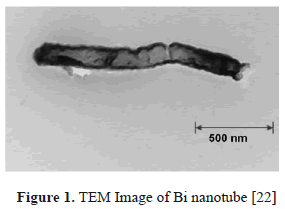
<body><![CDATA[<p>&nbsp;</p>     <p><font size="3" face="Verdana, Arial, Helvetica, sans-serif"><b>1. INTRODUCTION </b></font></p>     <p><font size="2" face="Verdana, Arial, Helvetica, sans-serif">Nanomaterials (thin films, nanoparticles, nano-multilayers) have become important in the current development of material science &#91;1-3&#93;. One of the most used elements for these applications is bismuth. Bismuth is a semimetal with interesting electronic properties such as high carrier mobility, low effective mass, low carrier density, long mean free path; moreover, it is highly anisotropic in its Fermi level, presenting a high magnetoresistance &#91;4&#93;. These properties are due to the spatial arrangement of its atoms &#91;5&#93;. Some reports indicate that a transition from semimetal to semiconductor occurs for thin film thickness of approximately 28 nm &#91;6&#93;. This transition has been observed also in bismuth nanowires oriented in a specific direction (trigonal) for thicknesses close to 55 nm &#91;7&#93;.</font></p>     <p><font size="2" face="Verdana, Arial, Helvetica, sans-serif">Also, nanostructured bismuth materials have generated a great deal of interest because of the quantum behavior produced by their size &#91;8&#93;, making it very useful for applications such as magnetic field sensors, optical devices, thermoelectric coolers and power generators &#91;4,8&#93;. Because of its low toxicity, bismuth films have recently been used as electrodes in the detection of organic nitro compounds &#91;9&#93; and heavy metals &#91;10&#93;, replacing mercury electrodes. Bismuth has also been used in cosmetics and pharmaceuticals in disinfectants, bacteriostatic agents and astringents as well as in the nuclear industry where it is used as a refrigerant &#91;11&#93;.</font></p>     <p>&nbsp;</p>     <p><font size="3" face="Verdana, Arial, Helvetica, sans-serif"><b>2. BISMUTH-BASED SYSTEMS</b></font></p>     <p><font size="2" face="Verdana, Arial, Helvetica, sans-serif">The physicochemical properties of bismuth nanostructures differ from those presented in higher dimensions due to different structures such as wires and wells that show quantized states &#91;12&#93; and surface defects &#91;13&#93;. For instance, Bi in bulk has no thermoelectric properties due to electron and hole contributions canceling each other. However, quantum confinement effects have been demonstrated in nanowires with diameters below 50 nm, presenting thermoelectric properties with high efficiency for diameters close to 10 nm &#91;14&#93;. Some research groups have synthesized bismuth thin films &#91;15&#93;, nanowires &#91;16&#93;, nanotubes &#91;17&#93;, nanoplates &#91;18&#93; and nanospheres &#91;19&#93; using different techniques, which will be presented.</font></p>     <p><font size="2" face="Verdana, Arial, Helvetica, sans-serif"><b>2.1. Nanostructures</b>    <br>   Bismuth nanoparticles have been widely exploited in heterogeneous catalysis, magnetic recording media, microelectronics, thermoelectric devices and lubrication &#91;20,21&#93;.</font></p>     <p><font size="2" face="Verdana, Arial, Helvetica, sans-serif">Also, these hold outstanding tribological properties in presence of large charges &#91;18&#93;. A range of physicochemical methods recently applied to obtain nanoforms of bismuth have been studied, such as: cluster beam, laser ablation, pulsed laser vaporization, flame spraying, electron beam techniques, electron beam lithography, pulse electroplating techniques, including supercritical fluids and solution dispersion methods. The latter is a novel and simple method which has been used to obtain nanoparticles by using a suitable solvent &#91;21&#93;. Moreover, these structures have been synthesized using microwave irradiation for quality, simplicity, speed, low cost and the possibility to be processed at low temperatures &#91;22&#93;. Although this method is simple enough to use a domestic microwave oven and is most often performed in solution, the lack of control and understanding of microwave reaction variables in the process is a drawback to its widespread application &#91;23&#93;. <a href="#fig01">Fig. 1</a> shows the transmission electron microscopy (TEM) image of a nanotube synthesized by this method in a vacuum</font></p>     ]]></body>
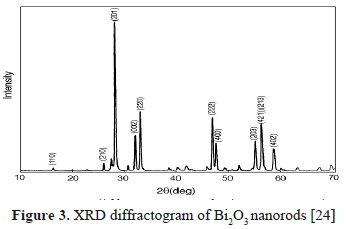
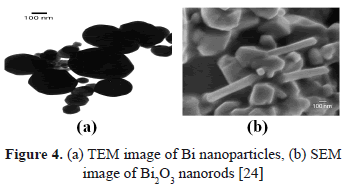
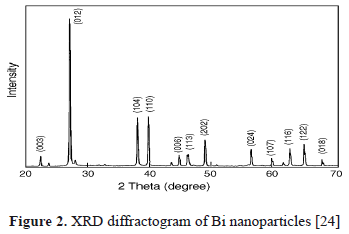
<body><![CDATA[<p align="center"><font size="2" face="Verdana, Arial, Helvetica, sans-serif"><a name="fig01"></a></font><img src="/img/revistas/dyna/v79n176/v79n176a17fig01.gif"></p>     <p><font size="2" face="Verdana, Arial, Helvetica, sans-serif"><a href="#fig02">Figures 2</a> and <a href="#fig03">3</a> present patterns of X-ray Diffraction (XRD) peaks of Bi nanoparticles and Bi<sub>2</sub>O<sub>3</sub> nanorods. Bi nanoparticles obtained by thermal plasma change to nanorods when these are treated thermally at 250&deg; C in atmosphere of oxygen by using different time intervals (2 and 3 hours) &#91;24&#93;. <a href="#fig04">Figure 4</a> shows TEM micrographs of these nanostructures.</font></p>     <p align="center"><font size="2" face="Verdana, Arial, Helvetica, sans-serif"><a name="fig02"></a></font><img src="/img/revistas/dyna/v79n176/v79n176a17fig02.gif"></p>     <p align="center"><font size="2" face="Verdana, Arial, Helvetica, sans-serif"><a name="fig03"></a></font><img src="/img/revistas/dyna/v79n176/v79n176a17fig03.gif"></p>     <p align="center"><font size="2" face="Verdana, Arial, Helvetica, sans-serif"><a name="fig04"></a></font><img src="/img/revistas/dyna/v79n176/v79n176a17fig04.gif"></p>     <p><font size="2" face="Verdana, Arial, Helvetica, sans-serif">The formation of bismuth nanospheres was obtained on silicon wafers by a hydrothermal method &#91;25&#93;. Similarly, by means of an ethanol-thermal method bismuth nanobelts have been obtained from bismuth hydroxide on Si at 180&deg;C for different reaction times (<a href="#fig05">Fig. 5</a>). The electrical properties of these nanobelts were measured from I-V curves, different properties from bulk bismuth materials were found. This study established that Bi nanobelts can be used as sensitive magnetic sensors or electronic nanodevices.</font></p>     <p align="center"><font size="2" face="Verdana, Arial, Helvetica, sans-serif"><a name="fig05"></a></font><img src="/img/revistas/dyna/v79n176/v79n176a17fig05.gif"></p>     <p><font size="2" face="Verdana, Arial, Helvetica, sans-serif">On the other hand, the ultrafast optical response of glassy materials that contain metal nanoparticles has led to the fabrication of these materials doped with Au, Ag, Cu and Bi generally by melt quenching, sol-gel, sputtering, ion exchange, ion implantation and femtosecond laser irradiation Bismuth is very sensitive to preparation conditions. Growing this material on glass substrates is difficult; Geng Lin <i>et al</i>. in 2011 proposed a simple method to precipitate Bi nanoparticles on glass, using heat treatment processes and conventional melting &#91;26&#93;.</font></p>     <p><font size="2" face="Verdana, Arial, Helvetica, sans-serif"><b>2.2 Bismuth oxide (Bi<sub>2</sub>O<sub>3</sub>)</b>    <br>   Bismuth oxide (Bi<sub>2</sub>O<sub>3</sub>), an important metal oxide semiconductor has been receiving considerable attention because it exhibits excellent optical and electrical properties such as wide band-gap, high refractive index, high dielectric permittivity and good photoconductivity &#91;27&#93;. Owing to these unique characteristics, bismuth oxides have been studied for use in various domains such as fuel cells, sensor technology, oxide varistors, ionic conductors &#91;28,29&#93;, photoelectric materials, high temperature superconductors and functional ceramics &#91;30&#93;. Also it is an important component in the manufacturing of transparent ceramic glass, optical coatings &#91;31&#93;, ceramics and catalysts &#91;32&#93;. Similarly, the industrial field of manufacturing technologies based on Bi<sub>2</sub>O<sub>3</sub> optical fiber has advanced significantly as a result of a variety of high quality optical fiber production, such as bismuth oxide fiber doped with erbium (Er) and highly nonlinear bismuth oxide fibers&#91;33&#93;.</font></p>     ]]></body>
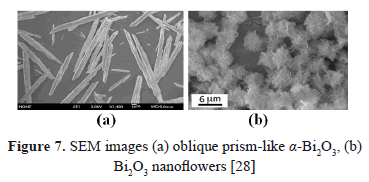
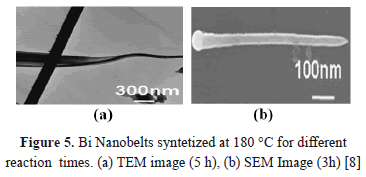
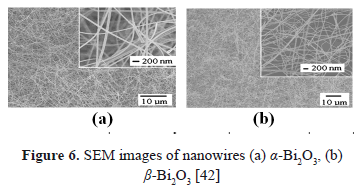
<body><![CDATA[<p><font size="2" face="Verdana, Arial, Helvetica, sans-serif">Bi<sub>2</sub>O<sub>3</sub> fibers are attractive because the material is about 200 times more nonlinear than SiO<sub>2</sub> &#91;34&#93;. These nonlinear phenomena play a key role in ultra-fast optical transmission systems and all -optical transport networks, therefore they can be investigated for use in all-optical processing sub-systems such as regenerators, demultiplexers, logic gates and optical switches. Semiconductors made from Bi<sub>2</sub>O<sub>3</sub> have the benefit of compactness and integrability, even if they generally need temperature and current control and they are dynamically limited by charge carriers (hundreds of picoseconds). In the optical fibers, on the other hand, the nonlinear phenomena originated by Kerr effect are characterized by ultra-fast dynamics (few femtoseconds). The aim in recent studies has been to reduce the required fiber length with benefits in terms of compactness and polarization stability &#91;35&#93;. </font></p>     <p><font size="2" face="Verdana, Arial, Helvetica, sans-serif">In recent years, several successful strategies including precipitation method, microwave-assisted synthesis, electrodeposition, and chemical vapor deposition (CVD), have been reported to prepare Bi<sub>2</sub>O<sub>3</sub> with various morphologies, such as quantum dots, nanoparticles, nanobelts, nanorods, nanotubes nanofibers and thin films &#91;28&#93;.</font></p>     <p><font size="2" face="Verdana, Arial, Helvetica, sans-serif"><b>2.2.1. Bi<sub>2</sub>O<sub>3</sub> phases</b>    <br>   Bi<sub>2</sub>O<sub>3</sub> is a complex system with four main polymorphs: <i><font face="Symbol">a</font></i> (monoclinic), <i><font face="Symbol">b</font></i> (tetragonal), <i><font face="Symbol">g</font></i> (body-centered cubic) and <i><font face="Symbol">d</font></i> (face-centered cubic), each one with unique physical properties &#91;28&#93; (electrical, optical, photoelectrical, etc.). For example at 300 K, the band gap E<sub>g</sub> of <i><font face="Symbol">a</font></i> -Bi<sub>2</sub>O<sub>3</sub> is equal to 2.85 eV, while for <i><font face="Symbol">b</font></i> phase is 2.58 eV &#91;36&#93;. Properties of bismuth oxide, Bi<sub>2</sub>O<sub>3</sub>, have been studied in recent years, since its monoclinic structure is one of the most important materials for synthesizing a number of high-temperature superconductors and Bi-containing ferroelectric compounds &#91;37&#93;. Particularly, the high applicability of <i><font face="Symbol">d</font></i> phase is well known because of its high oxygen ionic conductivity &#91;38&#93;. This property is due to the quarter of the oxygen sites that are vacant in the fluorite-type lattice, according to Mairesse &#91;39&#93;; the electronic structure of Bi<sup>3+</sup> is characterized by the presence of 6s2 pair electrons, leading to high polarisability of the cation lattice, oxide ion mobility and the ability of the Bi<sup>3+</sup> to accommodate highly disordered surroundings.</font></p>     <p><font size="2" face="Verdana, Arial, Helvetica, sans-serif"><b>2.2.2. Bi<sub>2</sub>O<sub>3</sub> nanowires    <br>   </b>Nanostructured materials, especially, semiconductor nanowires have attracted great attention recently becoming one of the most active research projects in the nanoscience area &#91;40&#93;. One of the most interesting structures is the nanowire of Bi<sub>2</sub>O<sub>3</sub>, because of its physical properties, such as, high refractive index (n<sub><i><font face="Symbol">d</font></i>Bi<sub>2</sub>O<sub>3</sub></sub>=2.9) &#91;41&#93;, dielectric permittivity (<font face="Symbol">e</font><sub>r</sub>=190) and oxygen ionic conductivity (1.0 S/cm), as well as a remarkable photoconductivity and photoluminescence response &#91;42&#93;. Although some reports about synthesis and applications of Bi<sub>2</sub>O<sub>3</sub> nanowires can be found, transition phases within polymorphisms is not studied enough. These studies are important for improving their applications in optical elements and storage devices, among others &#91;43&#93;. </font></p>     <p><font size="2" face="Verdana, Arial, Helvetica, sans-serif">The phase transitions of <i><font face="Symbol">a</font></i>- and <i><font face="Symbol">b</font></i>- to <i><font face="Symbol">d</font></i> and <i><font face="Symbol">d</font></i> - to liquid phases for Bi<sub>2</sub>O<sub>3</sub> nanowires were obtained recently by using the oxidative metal vapor transport deposition technique which exploits spatial-temporal separation of Bi evaporation, vapor transport, droplet formation, and oxidative nucleation and growth &#91;44&#93;. Results showed the size effect only for the <i><font face="Symbol">d</font></i> to liquid phase, decreasing its transition temperature. In <a href="#fig06">Fig. 6</a> SEM images of <i><font face="Symbol">a</font></i>- and <i><font face="Symbol">b</font></i> synthesized polymorphisms are presented, showing that the <i><font face="Symbol">a</font></i>- Bi<sub>2</sub>O<sub>3</sub> phase (<a href="#fig06">Fig. 6 (a)</a>) consists of uniform nanowires close to 100 nm in diameter and several hundreds of micrometers in length. On the other hand, as is shown in <a href="#fig05">Fig. 5(b)</a>, <i><font face="Symbol">b</font></i>-Bi<sub>2</sub>O<sub>3</sub> contains exclusively ultrathin nanowires about 10 nm in diameter and several <font face="Symbol">m</font>m in length &#91;43&#93;. </font></p>     <p align="center"><font size="2" face="Verdana, Arial, Helvetica, sans-serif"><a name="fig06"></a></font><img src="/img/revistas/dyna/v79n176/v79n176a17fig06.gif"></p>     <p><font size="2" face="Verdana, Arial, Helvetica, sans-serif">Until now, bismuth oxide nanowires have been successfully synthesized by different techniques including metalorganic chemical vapor deposition-MOCVD, chemical methods, and oxidative metal vapor transport deposition. These techniques employ high temperatures and chemical reaction routes in solid state, which are energetically intensive and their integration into silicon-based microelectronic devices is difficult. Therefore, bismuth nanowires with a high crystalline quality have been prepared using a novel method of induced stress at low temperatures on silicon substrates and subsequently annealed at low temperature in an oxygen environment &#91;28&#93;.</font></p>     <p><font size="2" face="Verdana, Arial, Helvetica, sans-serif">Also, oblique prim-like <i><font face="Symbol">a</font></i>-Bi<sub>2</sub>O<sub>3</sub> phase was prepared by a simple one-step aqueous method at low temperature (50 &deg;C) and ambient pressure. This method is suitable for industrial production because complex systems or conditions are not required &#91;30&#93;. Other geometries as Bi<sub>2</sub>O<sub>3</sub> flower-shape has been successfully synthesized via a citric acid assisted hydrothermal process consisting of several nanosheets and nanoparticles &#91;28&#93;. These structures are illustrated in <a href="#fig07">fig. 7</a>.</font></p>     ]]></body>
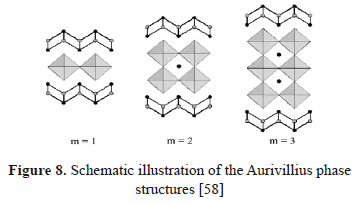
<body><![CDATA[<p align="center"><font size="2" face="Verdana, Arial, Helvetica, sans-serif"><a name="fig07"></a></font><img src="/img/revistas/dyna/v79n176/v79n176a17fig07.gif"></p>     <p><font size="2" face="Verdana, Arial, Helvetica, sans-serif"><b>2.2.3. Bismuth oxide Layers    <br>   </b>Bismuth oxides have been considered as an interesting material because of their dielectric properties and have been used for applications such as optical coatings, metal-insulator-semiconductor capacitors and microwave-integrated circuits. There is also a general motivation to study bismuth oxides deposited as thin films, since bismuth is a common constituent of high-Tc superconductors such as Bi<sub>2</sub>Sr<sub>2</sub>CaCu<sub>2</sub>O<sub>8+x</sub> and ferroelectrics such as SrBi<sub>2</sub>Ta<sub>2</sub>O<sub>9</sub> and Bi<sub>4</sub>Ti<sub>3</sub>O<sub>12</sub> &#91;45&#93;. In addition,&nbsp;Aurivillius&nbsp;phases&nbsp;are known for&nbsp;exhibiting ferroelectric behavior, most of the current ferroelectric materials show bismuth layered structures useful for non volatile random access memories. Other Aurivillius phases also present several properties and applications in photoluminescence devices &#91;46&#93; and oxygen ionic conduction &#91;47&#93;. Recently, it was found that these structures are efficient photo catalysts for separating water and degrading organic compounds. For instance, Kim <i>et al</i>. discovered that PbBi<sub>2</sub>Nb<sub>2</sub>O<sub>9</sub> is a suitable photocatalyst for separating water into O<sub>2</sub> and H<sub>2</sub>. Moreover, it is useful for degrading isotropic alcohol to CO<sub>2</sub> &#91;48&#93; under visible light and recently they have been used in applications like humidity sensors using compounds like Bi<sub>2</sub>MO<sub>6</sub> (M=W, Mo) because of high sensitivity, fast response and good reproducibility properties &#91;49&#93;. These Aurivillius structures are well described by superposition of (B2O<sub>2</sub>)<sup>2+</sup> layers and (A<sub>n+1</sub>BnO<sub>3n+1</sub>)<sup>2-</sup> blocks of perovskites &#91;50&#93;, where A corresponds to mono- di- or trivalent elements with coordination number 12 (Na+, Sr<sup>2+</sup>, Ba<sup>2+</sup>, Pb<sup>2+</sup>, Ca<sup>2+</sup>, Bi<sup>3+</sup>); B is the transition cation suitable for an octahedron with lower size (Ti<sup>4+</sup>, V<sup>5+</sup>, Ta<sup>5+</sup>, Nb<sup>5+</sup>, W6+, etc.) and <i>n</i> is an integer number representing the number of BO<sub>6</sub> octahedron in the perovskite layer along the packing direction. <a href="#fig08">Fig. 8</a> presents representative structures for BiWO<sub>6</sub> (<i>n</i>=1), SrBi<sub>2</sub>Ta<sub>2</sub>O<sub>9</sub> (SBT, <i>n</i>=2) and Bi<sub>4</sub>Ti<sub>3</sub>O<sub>12</sub> (BIT, <i>n</i>=3). The perovskite layer is considered to be responsible for the ferroelectric behavior due to the presence of transition metal cations g&#91;51&#93;. These compounds are also known as BLSF (Bismuth layered-structure ferroelectrics) and they are characterized by having a high Curie temperature &#91;49&#93; and a strong anisotropy in their dielectric and ferroelectric properties as dielectric constant, remanent polarization and coercive field related to the crystalline structure &#91;52&#93;. Their spontaneous polarization (PS) can be determined by n; if <i>n</i> is an even number, the material only exhibits Ps along the a axis by the symmetry and sliding planes perpendicular to the <i>b</i> and <i>c</i> axes. On the other hand, if <i>n</i> is odd, a lower Ps is produced along the <i>c</i> axis and a greater Ps occurs along a axis when the sliding planes are perpendicular &#91;53&#93;. The high transition temperature from a high symmetry phase (paraelectric state) to a low symmetry phase (ferroelectric state) encourages the use of these materials in the fabrication of capacitors, sensors, memory storage devices, optical displays and other electro-optical devices using condensers, transductors &#91;54,55&#93;. </font></p>     <p align="center"><font size="2" face="Verdana, Arial, Helvetica, sans-serif"><a name="fig08"></a></font><img src="/img/revistas/dyna/v79n176/v79n176a17fig08.gif"></p>     <p><font size="2" face="Verdana, Arial, Helvetica, sans-serif">Several Aurivillius ceramic compounds have been synthesized and most of them have been examined for the substitution of Pb by Bi &#91;56&#93;. The study of these structures has been focused on the properties of <i>n</i> (<i>n</i>=2, 3, 4) oxides, with the compounds with n&ge;5 the least studied &#91;52&#93;. For applications in piezoelectricity and information storage, the effect of rare earth isovalent ions substitution as La<sup>3+</sup>, Nd<sup>3+</sup>, Sm<sup>3+</sup>, Pr<sup>3+</sup> in Bi<sup>3+</sup> perovskite block sites improves the remanent polarization Pr and the fatigue resistance. The inclusion of ions like Na+ or K+ produces charge compensation effects: oxygen vacancy formations, valence state modification or interstitial site formations that influence the dielectric constant, polarisability and electric conductivity. These studies have been recently applied to the influence Na in the Bi<sub>4</sub>Ti<sub>3</sub>O<sub>12</sub> structure obtained by MOCVD, presenting a decrease in the lattice parameter in comparison with Bi<sub>4</sub>Ti<sub>3</sub>O<sub>12</sub> and a charge compensation caused by changes in Bi valence state, from Bi<sup>3+</sup> to Bi<sup>5+</sup> around Na &#91;57&#93;.</font></p>     <p><font size="2" face="Verdana, Arial, Helvetica, sans-serif">Only a few BLSF compounds exhibit relaxation ferroelectric properties as BaBi<sub>2</sub>Nb<sub>2</sub>O<sub>9</sub> (BBN), BaBi<sub>2</sub>Ta<sub>2</sub>O<sub>9</sub> (BBT) and K<sub>0.5</sub>La<sub>0.5</sub>Bi<sub>2</sub>Ta<sub>2</sub>O<sub>9</sub>. This behavior is characterized by a wide dielectric peak which shows a strong dependence on the frequency, possibly due to the microscopic distortion in the macroscopic tetragonal lattice and the disorder in the cations position &#91;59&#93;. The growth of these layered compounds has been carried out by several techniques such as metalorganic chemical vapor deposition (MOCVD), solid state synthesis and chemical etching methods &#91;53, 56-66&#93;. New phases of these materials have been successfully explored and produced &#91;67-71&#93;. A simple method for Bi<sub>3.64</sub>Mo<sub>0.36</sub>O<sub>6.55</sub> (BMO) nanoparticles fabrication with microwave irradiation and a hybridization with carbon through the combination of hydrothermal and calcination processes have been proposed by Fang Duan <i>et al</i>. in 2011 &#91;72&#93;.</font></p>     <p><font size="2" face="Verdana, Arial, Helvetica, sans-serif">The flexibility in the cations accommodation or a combination of them is a special characteristic of Aurivillius oxides. In this way, in these research works one or more perovskite blocks have been inserted to obtain highly complex structures synthesizing by means of the solid state reaction route &#91;73&#93;. Such a method has several drawbacks, mainly poor homogeneity and hence required additional heat treatment and repeated grinding to obtain a nearly pure phase. Generally, the solid state reactions are diffusion controlled, and can be speeded up by prior usage of very fine particles and homogenized ingredients &#91;74&#93;.</font></p>     <p><font size="2" face="Verdana, Arial, Helvetica, sans-serif">Future applications in photoluminescence have been investigated in BLSFs compounds such as Bi<sub>4</sub>Ti<sub>3</sub>O<sub>12</sub>, Bi<sub>3</sub>TiNbO<sub>9</sub>, SrBi<sub>2</sub>Nb<sub>2</sub>O<sub>9</sub>, SrBi<sub>2</sub>Ta<sub>2</sub>O<sub>9</sub>, CaBi<sub>4</sub>Ti<sub>4</sub>O<sub>15</sub> and Bi<sub>2</sub>WO<sub>6</sub>, doped with rare earth (Eu, Er, Tm, etc). Deng Peng <i>et al</i>. in 2012 synthesized CaBi<sub>2</sub>Ta<sub>2</sub>O<sub>9</sub> doped with several concentrations of Pr by means of the solid state reaction method. The photoluminescence investigated with a blue light of 450 nm was improved with the substitution of Ca by Sr &#91;75&#93;. On the other hand, the introduction of magnetic transition metallic cations into the perovskite layer in the Aurivillius phases has been received with great interest since a new material named multiferroionics including ferroelectric and ferromagnetic effects &#91;51&#93;, which involve local spin ordering and distorted structures with respect to the charge center &#91;75&#93;. Multiferroionic research has been mainly focused on modeling systems, such as perovskites with chemical formula ABO<sub>3</sub> (ferrites-bismuth, magnetite-bismuth) and in Aurivillius structures &#91;49&#93;. Multiferroionic materials as BiFeO<sub>3</sub>, Bi<sub>5</sub>Ti<sub>3</sub>FeO<sub>15</sub>, Bi<sub>6</sub>Ti<sub>3</sub>Fe<sub>2</sub>O<sub>18</sub>, BiCrO<sub>3</sub> and BiMnO<sub>3</sub> can be employed in a wide range of applications, as in the spintronics for multiple state memories elements &#91;76&#93;, magnetically modulated piezoelectric transductors and resonance devices &#91;77&#93;.</font></p>     <p><font size="2" face="Verdana, Arial, Helvetica, sans-serif">Experimentally, the production of these compounds by the conventional solid state reaction method has been widely used, taking into account important aspects as the possible formation of other phases because of the presence of ions with different valences. The conventional solid state reaction method also presents other disadvantages such as low reactant mixtures of homogeneity and a low ionic diffusion. Moreover, bismuth oxides are volatile and the reactivity between Ti<sup>4+</sup>, or Nb<sup>5+</sup> and Mn<sup>3+</sup> in the solid state is different, producing compositional changes or defects in the Bi<sub>2</sub>O<sub>2</sub> layers. Nevertheless, some Aurivillius phases containing Ti<sup>4+</sup> or Nb<sup>5+</sup> and Mn<sup>3+</sup> produced by this method have been reported &#91;78&#93;. Compounds with highly distorted structures with meta-stable phases as BiMnO<sub>3</sub> have been synthesized by high pressure methods &#91;79&#93;. The <i>n</i>=4 Aurivillius phase, Bi<sub>5</sub>Ti<sub>3</sub>CrO<sub>15</sub>, prepared through solid state reaction by A.T. Giddings <i>et al</i>. (2011) show that the ferroelectricity and paramagnetism with short range antiferromagnetic coupling of the magnetic moments, inhibit it the long range magnetic ordering, therefore, this multiferroic material, is not suitable to be used in new technological applications &#91;80&#93;. </font></p>     <p><font size="2" face="Verdana, Arial, Helvetica, sans-serif">In the last years, non conventional methods such as molten salt flux technique have been successfully reported for producing Aurivillius phases reaching high homogeneity in the precursor mixture. The molten salt can act as an environment for facilitating the reactive dissolution in order to obtain a homogenous mixture due to the incorporation of the salt medium So products generally possess a good crystallinity and crystalline morphology &#91;51&#93;. </font></p>     ]]></body>
<body><![CDATA[<p><font size="2" face="Verdana, Arial, Helvetica, sans-serif"><b>2.4. Other materials</b>    <br>   Other phases known by their potential technological applications are compounds belonging to the A<sub>2</sub>B<sub>2</sub>O<sub>7</sub> family with pyrochlore structures. The Bi<sub>2</sub>Ti<sub>2</sub>O<sub>7</sub> phase with sphere shapes has been obtained by hydrothermal processes with variations in the hydroxide ions concentration &#91;81&#93;. On the other hand, the selenite phases with general formula Bi<sub>12</sub>MO<sub>20</sub> (M=Ge, Ti, Ga, Fe, V, etc) exhibit several characteristics such as photo-refractivity, optical activity, photoconductivity and improved sound wave propagation velocity with applications in electro-optics, acoustic and piezoelectric devices &#91;82&#93;. Spherical nanoparticles of Bi<sub>12</sub>TiO<sub>20</sub> have been obtained by means of hydrothermal treatment using C<sub>6</sub>H<sub>13</sub>BiN<sub>2</sub>O<sub>7</sub> as a source of Bi, and TiCl3 as a source of Ti for solving the agglomeration problems that normally occurs in the conventional hydrothermal method &#91;83&#93;.</font></p>     <p>&nbsp;</p>     <p><font size="3" face="Verdana, Arial, Helvetica, sans-serif"><b>3. CONCLUSIONS </b></font></p>     <p><font size="2" face="Verdana, Arial, Helvetica, sans-serif">In this review work, properties and production techniques of nanostructure materials based on Bi and Bi oxides have been presented and described. This review is carried out in order to give to the readers a wide outlook of these materials, identifying their properties and potential technological applications.</font></p>     <p>&nbsp;</p>     <p><font size="3" face="Verdana, Arial, Helvetica, sans-serif"><b>REFERENCES </b></font></p>     <!-- ref --><p><font size="2" face="Verdana, Arial, Helvetica, sans-serif"><b>&#91;1&#93;</b> Nieto, J., Caicedo, J., Amaya, C., Moreno, H., Aperador, W., Tirado, L. and Bejarano, G., Evaluaci&oacute;n de la Influencia del voltaje Bias sobre la resistencia a la corrosi&oacute;n de pel&iacute;culas delgadas de AlNbN, revista Dyna, 162, pp. 161-168, 2010.    &nbsp;&nbsp;&nbsp;&nbsp;&nbsp;&nbsp;&nbsp;&nbsp;[&#160;<a href="javascript:void(0);" onclick="javascript: window.open('/scielo.php?script=sci_nlinks&ref=000070&pid=S0012-7353201200060001700001&lng=','','width=640,height=500,resizable=yes,scrollbars=1,menubar=yes,');">Links</a>&#160;]<!-- end-ref --><!-- ref --><br>   <b>&#91;2&#93;</b> Olaya Fl&oacute;rez, J. J. and Marulanda, D., Propiedades el&eacute;ctricas de nano-multicapas de Cr/CrN producidas por la T&eacute;cnica de Sputtering con Magn&eacute;tr&oacute;n Desbalanceado, revista Dyna, 168, pp. 53-57, 2011.    &nbsp;&nbsp;&nbsp;&nbsp;&nbsp;&nbsp;&nbsp;&nbsp;[&#160;<a href="javascript:void(0);" onclick="javascript: window.open('/scielo.php?script=sci_nlinks&ref=000071&pid=S0012-7353201200060001700002&lng=','','width=640,height=500,resizable=yes,scrollbars=1,menubar=yes,');">Links</a>&#160;]<!-- end-ref --><!-- ref --><br>   <b>&#91;3&#93;</b> Tob&oacute;n, J. I., Restrepo, O. J. and Pay&aacute; Bernabeu, J.J., Adici&oacute;n de Nanopart&iacute;culas al Cemento Portland, revista Dyna, 152, pp. 277-291, 2007.    &nbsp;&nbsp;&nbsp;&nbsp;&nbsp;&nbsp;&nbsp;&nbsp;[&#160;<a href="javascript:void(0);" onclick="javascript: window.open('/scielo.php?script=sci_nlinks&ref=000072&pid=S0012-7353201200060001700003&lng=','','width=640,height=500,resizable=yes,scrollbars=1,menubar=yes,');">Links</a>&#160;]<!-- end-ref --><!-- ref --><br>   <b>&#91;4&#93;</b> Du, X., Tsai, S., Maslov, D.L. and Hebard, A.F., Metal - Insulator - Like Behavior in Semimetallic Bismuth and Graphite, Phys. Rev. Lett., 94, pp. 166601-166604, 2005.    &nbsp;&nbsp;&nbsp;&nbsp;&nbsp;&nbsp;&nbsp;&nbsp;[&#160;<a href="javascript:void(0);" onclick="javascript: window.open('/scielo.php?script=sci_nlinks&ref=000073&pid=S0012-7353201200060001700004&lng=','','width=640,height=500,resizable=yes,scrollbars=1,menubar=yes,');">Links</a>&#160;]<!-- end-ref --><!-- ref --><br>   <b>&#91;5&#93;</b> Postel, M. and Du&ntilde;ach, E., Bismuth derivatives for the oxidation of organic compounds, Coordin. Chem. Rev., 155, pp. 127-144, 1996.    &nbsp;&nbsp;&nbsp;&nbsp;&nbsp;&nbsp;&nbsp;&nbsp;[&#160;<a href="javascript:void(0);" onclick="javascript: window.open('/scielo.php?script=sci_nlinks&ref=000074&pid=S0012-7353201200060001700005&lng=','','width=640,height=500,resizable=yes,scrollbars=1,menubar=yes,');">Links</a>&#160;]<!-- end-ref --><!-- ref --><br>   <b>&#91;6&#93;</b> Gribanov, E.N., Markov, O.I. and Khripunov, Y.V., When does Bismuth become a semimetal?, Nanotechnologies in Russia, 6, pp. 536-596, 2011.    &nbsp;&nbsp;&nbsp;&nbsp;&nbsp;&nbsp;&nbsp;&nbsp;[&#160;<a href="javascript:void(0);" onclick="javascript: window.open('/scielo.php?script=sci_nlinks&ref=000075&pid=S0012-7353201200060001700006&lng=','','width=640,height=500,resizable=yes,scrollbars=1,menubar=yes,');">Links</a>&#160;]<!-- end-ref --><!-- ref --><br>   <b>&#91;7&#93;</b> Konopko, L., Huber, T. And Nikolaeva, A., Quantum Interference and surface states effects in Bismuth nanowires, J. Low Temp. Phys., 158, pp. 523-529, 2010.    &nbsp;&nbsp;&nbsp;&nbsp;&nbsp;&nbsp;&nbsp;&nbsp;[&#160;<a href="javascript:void(0);" onclick="javascript: window.open('/scielo.php?script=sci_nlinks&ref=000076&pid=S0012-7353201200060001700007&lng=','','width=640,height=500,resizable=yes,scrollbars=1,menubar=yes,');">Links</a>&#160;]<!-- end-ref --><!-- ref --><br>   <b>&#91;8&#93;</b> Gao, Z., Qin, H., Yan, T., Liu, H. and Wang, J., Structure and resistivity of bismuth nanobelts in situ synthesized on silicon wafer through an ethanol-thermal method, J. Solid State Chemistry, 184, pp. 3257-3261, 2011.    &nbsp;&nbsp;&nbsp;&nbsp;&nbsp;&nbsp;&nbsp;&nbsp;[&#160;<a href="javascript:void(0);" onclick="javascript: window.open('/scielo.php?script=sci_nlinks&ref=000077&pid=S0012-7353201200060001700008&lng=','','width=640,height=500,resizable=yes,scrollbars=1,menubar=yes,');">Links</a>&#160;]<!-- end-ref --><!-- ref --><br>   <b>&#91;9&#93;</b> Timur, S. And Anik, Ü., a-Glucosidase based bismuth film electrode for inhibitor detection, Anal. Chim. Acta, 598, pp. 143-146, 2007.    &nbsp;&nbsp;&nbsp;&nbsp;&nbsp;&nbsp;&nbsp;&nbsp;[&#160;<a href="javascript:void(0);" onclick="javascript: window.open('/scielo.php?script=sci_nlinks&ref=000078&pid=S0012-7353201200060001700009&lng=','','width=640,height=500,resizable=yes,scrollbars=1,menubar=yes,');">Links</a>&#160;]<!-- end-ref --><!-- ref --><br>   <b>&#91;10&#93;</b> Lee, G.-J., Kim, C. K., Lee, M. K. and Rhee, C. K., Effect of phase stability degradation of bismuth on sensor characteristics of nano-bismuth fixed electrode. Talanta, 83, pp. 682-685, 2010.    &nbsp;&nbsp;&nbsp;&nbsp;&nbsp;&nbsp;&nbsp;&nbsp;[&#160;<a href="javascript:void(0);" onclick="javascript: window.open('/scielo.php?script=sci_nlinks&ref=000079&pid=S0012-7353201200060001700010&lng=','','width=640,height=500,resizable=yes,scrollbars=1,menubar=yes,');">Links</a>&#160;]<!-- end-ref --><!-- ref --><br>   <b>&#91;11&#93;</b> Chen, H.Y., Wu, L., Ren, C., Luo, Q.Z., Xie, Z.H., Jiang, X., Zhu, S.P., Xia, Y.K. and Luo, Y.R., The effect and mechanism of bismuth doped lead oxide on the performance of lead-acid batteries, J. Power Sour., 95, pp. 108-118, 2001.    &nbsp;&nbsp;&nbsp;&nbsp;&nbsp;&nbsp;&nbsp;&nbsp;[&#160;<a href="javascript:void(0);" onclick="javascript: window.open('/scielo.php?script=sci_nlinks&ref=000080&pid=S0012-7353201200060001700011&lng=','','width=640,height=500,resizable=yes,scrollbars=1,menubar=yes,');">Links</a>&#160;]<!-- end-ref --><!-- ref --><br>   <b>&#91;12&#93;</b> Hofmann, Ph., The surfaces of bismuth: Structural and electronic properties, Prog. Surf. Sci., 81, pp. 191-245, 2006.    &nbsp;&nbsp;&nbsp;&nbsp;&nbsp;&nbsp;&nbsp;&nbsp;[&#160;<a href="javascript:void(0);" onclick="javascript: window.open('/scielo.php?script=sci_nlinks&ref=000081&pid=S0012-7353201200060001700012&lng=','','width=640,height=500,resizable=yes,scrollbars=1,menubar=yes,');">Links</a>&#160;]<!-- end-ref --><!-- ref --><br>   <b>&#91;13&#93;</b> Albella, J.M., L&aacute;minas delgadas y recubrimientos: preparaci&oacute;n, propiedades y aplicaciones, Solana e Hijos A.G., Madrid, 2003.    &nbsp;&nbsp;&nbsp;&nbsp;&nbsp;&nbsp;&nbsp;&nbsp;[&#160;<a href="javascript:void(0);" onclick="javascript: window.open('/scielo.php?script=sci_nlinks&ref=000082&pid=S0012-7353201200060001700013&lng=','','width=640,height=500,resizable=yes,scrollbars=1,menubar=yes,');">Links</a>&#160;]<!-- end-ref --><!-- ref --><br>   <b>&#91;14&#93;</b> Lin, Y.-M., Sun, X. and Dresselhaus, M.S., Theoretical investigation of thermoelectric transport properties of cylindrical Bi nanowires. Phys. Rev. B, 62, pp. 4610-4623, 2000.    &nbsp;&nbsp;&nbsp;&nbsp;&nbsp;&nbsp;&nbsp;&nbsp;[&#160;<a href="javascript:void(0);" onclick="javascript: window.open('/scielo.php?script=sci_nlinks&ref=000083&pid=S0012-7353201200060001700014&lng=','','width=640,height=500,resizable=yes,scrollbars=1,menubar=yes,');">Links</a>&#160;]<!-- end-ref --><!-- ref --><br>   <b>&#91;15&#93;</b> Song, D. W., Shen, W.-N., Dunn, B., Moore, C.D., Goorsky, M.S., Radetic, T., Gronsky, R. and Chen, G., Thermal Conductivity Of Nanoporous Bismuth Thin Films, Appl. Phys. Lett., 84, pp. 1883-1885, 2004.    &nbsp;&nbsp;&nbsp;&nbsp;&nbsp;&nbsp;&nbsp;&nbsp;[&#160;<a href="javascript:void(0);" onclick="javascript: window.open('/scielo.php?script=sci_nlinks&ref=000084&pid=S0012-7353201200060001700015&lng=','','width=640,height=500,resizable=yes,scrollbars=1,menubar=yes,');">Links</a>&#160;]<!-- end-ref --><!-- ref --><br>   <b>&#91;16&#93;</b> Hasegawa, Y., Ishikawa, Y., Komine, T., Huber, T.E., Suzuki, A., Morita, H. And Shirai, H., Magneto-Seebeck Coefficient Of A Bismuth Microwire Array In A Magnetic Field, Appl. Phys, Lett., 85, pp. 917-919, 2004.    &nbsp;&nbsp;&nbsp;&nbsp;&nbsp;&nbsp;&nbsp;&nbsp;[&#160;<a href="javascript:void(0);" onclick="javascript: window.open('/scielo.php?script=sci_nlinks&ref=000085&pid=S0012-7353201200060001700016&lng=','','width=640,height=500,resizable=yes,scrollbars=1,menubar=yes,');">Links</a>&#160;]<!-- end-ref --><!-- ref --><br>   <b>&#91;17&#93;</b> Yang, B., Li, C., Hu, H., Yang, X., Li, Q. and Qian, Y., A room- temperature route to bismuth nanotube arrays, Eur. J. Inorg. Chem., 2003, pp. 3699-3702, 2003.    &nbsp;&nbsp;&nbsp;&nbsp;&nbsp;&nbsp;&nbsp;&nbsp;[&#160;<a href="javascript:void(0);" onclick="javascript: window.open('/scielo.php?script=sci_nlinks&ref=000086&pid=S0012-7353201200060001700017&lng=','','width=640,height=500,resizable=yes,scrollbars=1,menubar=yes,');">Links</a>&#160;]<!-- end-ref --><!-- ref --><br>   <b>&#91;18&#93;</b> Fu, R., Xu, S., Lu, Y-N. and Zhu, J-J., Synthesis and Characterization of Triangular Bismuth Nanoplates, J. Cryst. Growth Des., 5(4), 1379-1385, 2005.    &nbsp;&nbsp;&nbsp;&nbsp;&nbsp;&nbsp;&nbsp;&nbsp;[&#160;<a href="javascript:void(0);" onclick="javascript: window.open('/scielo.php?script=sci_nlinks&ref=000087&pid=S0012-7353201200060001700018&lng=','','width=640,height=500,resizable=yes,scrollbars=1,menubar=yes,');">Links</a>&#160;]<!-- end-ref --><!-- ref --><br>   <b>&#91;19&#93;</b> Wang, J., Wnag, X., Peng, Q. and Li. Y. Synthesis and Characterization of Bismuth Single-Crystalline Nanowires and Nanospheres, Inorg. Chem., 43(23), pp. 7552-7556, 2004.    &nbsp;&nbsp;&nbsp;&nbsp;&nbsp;&nbsp;&nbsp;&nbsp;[&#160;<a href="javascript:void(0);" onclick="javascript: window.open('/scielo.php?script=sci_nlinks&ref=000088&pid=S0012-7353201200060001700019&lng=','','width=640,height=500,resizable=yes,scrollbars=1,menubar=yes,');">Links</a>&#160;]<!-- end-ref --><!-- ref --><br>   <b>&#91;20&#93; </b>Rohr, O., Bismuth - the new ecologically green metal for modern lubricating engineering, Ind. Lubr. Tribol., 54, pp. 153-164, 2002.    &nbsp;&nbsp;&nbsp;&nbsp;&nbsp;&nbsp;&nbsp;&nbsp;[&#160;<a href="javascript:void(0);" onclick="javascript: window.open('/scielo.php?script=sci_nlinks&ref=000089&pid=S0012-7353201200060001700020&lng=','','width=640,height=500,resizable=yes,scrollbars=1,menubar=yes,');">Links</a>&#160;]<!-- end-ref --><!-- ref --><br>   <b>&#91;21&#93;</b> Zhao, Y., Zhang, Z. and Dang, H., A simple way to prepare bismuth nanoparticles, Mater. Lett., 58, pp. 790-793, 2004.    &nbsp;&nbsp;&nbsp;&nbsp;&nbsp;&nbsp;&nbsp;&nbsp;[&#160;<a href="javascript:void(0);" onclick="javascript: window.open('/scielo.php?script=sci_nlinks&ref=000090&pid=S0012-7353201200060001700021&lng=','','width=640,height=500,resizable=yes,scrollbars=1,menubar=yes,');">Links</a>&#160;]<!-- end-ref --><!-- ref --><br>   <b>&#91;22&#93;</b> Kharissova, O. V., Osorio, M., Kharisov, B. I., Yacam&aacute;n, M.J. and Ortiz M&eacute;ndez, U., A comparison of bismuth nanoforms obtained in vacuum and air by microwave heating of bismuth powder, Mater. Chem. Phys., 121, pp. 489-496, 2010.    &nbsp;&nbsp;&nbsp;&nbsp;&nbsp;&nbsp;&nbsp;&nbsp;[&#160;<a href="javascript:void(0);" onclick="javascript: window.open('/scielo.php?script=sci_nlinks&ref=000091&pid=S0012-7353201200060001700022&lng=','','width=640,height=500,resizable=yes,scrollbars=1,menubar=yes,');">Links</a>&#160;]<!-- end-ref --><!-- ref --><br>   <b>&#91;23&#93;</b> Mastrovito, C., Lekse, J.W. and Aitken, J. A., Rapid solid-state synthesis of binary group 15 chalcogenides using microwave irradiation. J. Solid State Chem., 180, pp. 3262-3270, 2007.    &nbsp;&nbsp;&nbsp;&nbsp;&nbsp;&nbsp;&nbsp;&nbsp;[&#160;<a href="javascript:void(0);" onclick="javascript: window.open('/scielo.php?script=sci_nlinks&ref=000092&pid=S0012-7353201200060001700023&lng=','','width=640,height=500,resizable=yes,scrollbars=1,menubar=yes,');">Links</a>&#160;]<!-- end-ref --><!-- ref --><br>   <b>&#91;24&#93;</b> Wang, L., Cui, Z.-L. and Zhang, Z.-K., Bi nanoparticles and Bi<sub>2</sub>O<sub>3</sub> nanorods formed by thermal plasma and heat treatment, Surf. Coat. Tech., 201, pp. 5330-5332, 2007.    &nbsp;&nbsp;&nbsp;&nbsp;&nbsp;&nbsp;&nbsp;&nbsp;[&#160;<a href="javascript:void(0);" onclick="javascript: window.open('/scielo.php?script=sci_nlinks&ref=000093&pid=S0012-7353201200060001700024&lng=','','width=640,height=500,resizable=yes,scrollbars=1,menubar=yes,');">Links</a>&#160;]<!-- end-ref --><!-- ref --><br>   <b>&#91;25&#93;</b> Liu, H. and Wang, Z.L., Bismuth spheres grown in self-nested cavities in a silicon wafer, J. Am. Chem, Soc., 127, pp. 15322-15326, 2005.    &nbsp;&nbsp;&nbsp;&nbsp;&nbsp;&nbsp;&nbsp;&nbsp;[&#160;<a href="javascript:void(0);" onclick="javascript: window.open('/scielo.php?script=sci_nlinks&ref=000094&pid=S0012-7353201200060001700025&lng=','','width=640,height=500,resizable=yes,scrollbars=1,menubar=yes,');">Links</a>&#160;]<!-- end-ref --><!-- ref --><br>   <b>&#91;26&#93;</b> Lin, G., Tan, F., Luo, F., Chen, D., Zhao, Q. and Qiu, J., Linear and nonlinear optical properties of glasses doped with Bi nanoparticles. J. Non-Crystalline Solids, 357, pp. 2312-2315, 2011.    &nbsp;&nbsp;&nbsp;&nbsp;&nbsp;&nbsp;&nbsp;&nbsp;[&#160;<a href="javascript:void(0);" onclick="javascript: window.open('/scielo.php?script=sci_nlinks&ref=000095&pid=S0012-7353201200060001700026&lng=','','width=640,height=500,resizable=yes,scrollbars=1,menubar=yes,');">Links</a>&#160;]<!-- end-ref --><!-- ref --><br>   <b>&#91;27&#93;</b>Leontie, L., Caraman, M., Delibas, M. and Rusu, G.I. Optical properties of bismuth trioxide thin films. Mater. Res. Bull., 36, pp. 1629-1637, 2001.    &nbsp;&nbsp;&nbsp;&nbsp;&nbsp;&nbsp;&nbsp;&nbsp;[&#160;<a href="javascript:void(0);" onclick="javascript: window.open('/scielo.php?script=sci_nlinks&ref=000096&pid=S0012-7353201200060001700027&lng=','','width=640,height=500,resizable=yes,scrollbars=1,menubar=yes,');">Links</a>&#160;]<!-- end-ref --><!-- ref --><br>   <b>&#91;28&#93;</b> Zhang, L., Hashimoto, Y., Taishi, T., Nakamura, I. and Ni, Q.-Q., Fabrication of flower-shaped Bi<sub>2</sub>O<sub>3</sub> superstructure by a facile template-free process, Appl. Surf. Sci., 257, pp. 6577-6582, 2011.    &nbsp;&nbsp;&nbsp;&nbsp;&nbsp;&nbsp;&nbsp;&nbsp;[&#160;<a href="javascript:void(0);" onclick="javascript: window.open('/scielo.php?script=sci_nlinks&ref=000097&pid=S0012-7353201200060001700028&lng=','','width=640,height=500,resizable=yes,scrollbars=1,menubar=yes,');">Links</a>&#160;]<!-- end-ref --><!-- ref --><br>   <b>&#91;29&#93;</b> Nowak-Wozny, D., Janiczek, T., Mielcarek, W. and Gajewski. J.B., Fractional electrical model for modified bismuth oxide. J. Electrostatics, 67, pp. 18-21, 2009.    &nbsp;&nbsp;&nbsp;&nbsp;&nbsp;&nbsp;&nbsp;&nbsp;[&#160;<a href="javascript:void(0);" onclick="javascript: window.open('/scielo.php?script=sci_nlinks&ref=000098&pid=S0012-7353201200060001700029&lng=','','width=640,height=500,resizable=yes,scrollbars=1,menubar=yes,');">Links</a>&#160;]<!-- end-ref --><!-- ref --><br>   <b>&#91;30&#93;</b> Wang, Y., Zhao, J. and Wang. Z., A simple low-temperature fabrication of oblique prism-like bismuth oxide via a one-step aqueous process, Colloid Surface A, 377, pp. 409-413, 2011.    &nbsp;&nbsp;&nbsp;&nbsp;&nbsp;&nbsp;&nbsp;&nbsp;[&#160;<a href="javascript:void(0);" onclick="javascript: window.open('/scielo.php?script=sci_nlinks&ref=000099&pid=S0012-7353201200060001700030&lng=','','width=640,height=500,resizable=yes,scrollbars=1,menubar=yes,');">Links</a>&#160;]<!-- end-ref --><!-- ref --><br>   <b>&#91;31&#93;</b> Schuisky, M. and Härsta, A., Epitaxial growth of Bi<sub>2</sub>O<sub>2.33</sub> by halide Cvd, Chem. Vap. Depos., 2(6), pp. 235-238, 1996.    &nbsp;&nbsp;&nbsp;&nbsp;&nbsp;&nbsp;&nbsp;&nbsp;[&#160;<a href="javascript:void(0);" onclick="javascript: window.open('/scielo.php?script=sci_nlinks&ref=000100&pid=S0012-7353201200060001700031&lng=','','width=640,height=500,resizable=yes,scrollbars=1,menubar=yes,');">Links</a>&#160;]<!-- end-ref --><!-- ref --><br>   <b>&#91;32&#93; </b>Li, L., Yang, Y., Fang, X., Kong, M., Li, G., Zhang., L., Diameter-dependent electrical transport properties of bismuth nanowire arrays. Communications, 141, pp. 492-496, 2007.    &nbsp;&nbsp;&nbsp;&nbsp;&nbsp;&nbsp;&nbsp;&nbsp;[&#160;<a href="javascript:void(0);" onclick="javascript: window.open('/scielo.php?script=sci_nlinks&ref=000101&pid=S0012-7353201200060001700032&lng=','','width=640,height=500,resizable=yes,scrollbars=1,menubar=yes,');">Links</a>&#160;]<!-- end-ref --><!-- ref --><br>   <b>&#91;33&#93;</b> Lee, J.H., Ohara, S., Nagashima, T., Hasegawa, T., Sugimoto, N., Igarashi, K., Katoh, K. and Kikuchi, K., Clock Recovery and Demultiplexing of High-Speed OTDM Signal Through Combined Use of Bismuth Oxide Nonlinear Fiber and Erbium-Doped Bismuth Oxide Fiber, IEEE Photonic Tech L., 17, pp. 2658-2660, 2005.    &nbsp;&nbsp;&nbsp;&nbsp;&nbsp;&nbsp;&nbsp;&nbsp;[&#160;<a href="javascript:void(0);" onclick="javascript: window.open('/scielo.php?script=sci_nlinks&ref=000102&pid=S0012-7353201200060001700033&lng=','','width=640,height=500,resizable=yes,scrollbars=1,menubar=yes,');">Links</a>&#160;]<!-- end-ref --><!-- ref --><br>   <b>&#91;34&#93;</b> Vedadi, A., Jamshidifar, M. and Marhic, M. E., Continuous-Wave Bismuth-Oxide One-Pump Fiber Optical Parametric Amplifier, 34th European Conference On Optical Communication (ECOC 2008), IEEE, Brussels, 2008.    &nbsp;&nbsp;&nbsp;&nbsp;&nbsp;&nbsp;&nbsp;&nbsp;[&#160;<a href="javascript:void(0);" onclick="javascript: window.open('/scielo.php?script=sci_nlinks&ref=000103&pid=S0012-7353201200060001700034&lng=','','width=640,height=500,resizable=yes,scrollbars=1,menubar=yes,');">Links</a>&#160;]<!-- end-ref --><!-- ref --><br>   <b>&#91;35&#93;</b> Scaffardi, M., Fresi, F., Meloni, G., Bogoni, A., Poti, L. and Calabretta, N., 160 Gbit/s OTDM demultiplexer exploiting 1-meter-long bismuth oxidebased fiber, in Proc. IEEE LEOS Annu. Meeting, pp. 918-919, 2005.    &nbsp;&nbsp;&nbsp;&nbsp;&nbsp;&nbsp;&nbsp;&nbsp;[&#160;<a href="javascript:void(0);" onclick="javascript: window.open('/scielo.php?script=sci_nlinks&ref=000104&pid=S0012-7353201200060001700035&lng=','','width=640,height=500,resizable=yes,scrollbars=1,menubar=yes,');">Links</a>&#160;]<!-- end-ref --><!-- ref --><br>   <b>&#91;36&#93;</b> Leontie, L., Caraman, M., Alexe, M. and Harnagea, C., Structural and optical characteristics of bismuth oxide thin films. Surf. Sci., 507-510, pp. 480-85, 2002.    &nbsp;&nbsp;&nbsp;&nbsp;&nbsp;&nbsp;&nbsp;&nbsp;[&#160;<a href="javascript:void(0);" onclick="javascript: window.open('/scielo.php?script=sci_nlinks&ref=000105&pid=S0012-7353201200060001700036&lng=','','width=640,height=500,resizable=yes,scrollbars=1,menubar=yes,');">Links</a>&#160;]<!-- end-ref --><!-- ref --><br>   <b>&#91;37&#93;</b> Orlov, V. G., Bush, A. A., Ivanov, S. A. and Zhurov, V.V., Anomalies in the physical properties of the a form of bismuth oxide. Phys. Solid State, 39(5), pp. 770-774,1997.    &nbsp;&nbsp;&nbsp;&nbsp;&nbsp;&nbsp;&nbsp;&nbsp;[&#160;<a href="javascript:void(0);" onclick="javascript: window.open('/scielo.php?script=sci_nlinks&ref=000106&pid=S0012-7353201200060001700037&lng=','','width=640,height=500,resizable=yes,scrollbars=1,menubar=yes,');">Links</a>&#160;]<!-- end-ref --><!-- ref --><br>   <b>&#91;38&#93;</b> Sammes, N. M., Tompsett, G. A., Naè Fe, H. and Aldingera, F., Bismuth Based Oxide Electrolytes- Structure and Ionic Conductivity. J. Eur. Ceramic Society, 19, pp. 1801-1826, 1999.    &nbsp;&nbsp;&nbsp;&nbsp;&nbsp;&nbsp;&nbsp;&nbsp;[&#160;<a href="javascript:void(0);" onclick="javascript: window.open('/scielo.php?script=sci_nlinks&ref=000107&pid=S0012-7353201200060001700038&lng=','','width=640,height=500,resizable=yes,scrollbars=1,menubar=yes,');">Links</a>&#160;]<!-- end-ref --><!-- ref --><br>   <b>&#91;39&#93; </b>Mairesse, G., In Fast Ion Transport in Solids, ed. B. Scrosati, Kluver, Amsterdam, 271, 1993.    &nbsp;&nbsp;&nbsp;&nbsp;&nbsp;&nbsp;&nbsp;&nbsp;[&#160;<a href="javascript:void(0);" onclick="javascript: window.open('/scielo.php?script=sci_nlinks&ref=000108&pid=S0012-7353201200060001700039&lng=','','width=640,height=500,resizable=yes,scrollbars=1,menubar=yes,');">Links</a>&#160;]<!-- end-ref --><!-- ref --><br>   <b>&#91;40&#93;</b> Mei, Z.W., Liu, Y., Wang, H., Gao, S.J., Wen, X.G., Gu, L., Qiu, Y.F. and Yang, S.H., Facile and Controllable Growth of ZnO 1D Nanostructure Arrays on Zn Substrate by Hydrothermal Process, J. Nanosci. Nanotechnol., 10, 3123-30, 2010.    &nbsp;&nbsp;&nbsp;&nbsp;&nbsp;&nbsp;&nbsp;&nbsp;[&#160;<a href="javascript:void(0);" onclick="javascript: window.open('/scielo.php?script=sci_nlinks&ref=000109&pid=S0012-7353201200060001700040&lng=','','width=640,height=500,resizable=yes,scrollbars=1,menubar=yes,');">Links</a>&#160;]<!-- end-ref --><!-- ref --><br>   <b>&#91;41&#93; </b>Fan, H.T., Teng, X.M., Pan, S.S., Ye, C., Li, G.H. and Zhang, L.D., Optical properties of d-Bi<sub>2</sub>O<sub>3</sub> thin films grown by reactive sputtering, Appl. Phys. Lett., 87, pp. 231916-231918, 2005.    &nbsp;&nbsp;&nbsp;&nbsp;&nbsp;&nbsp;&nbsp;&nbsp;[&#160;<a href="javascript:void(0);" onclick="javascript: window.open('/scielo.php?script=sci_nlinks&ref=000110&pid=S0012-7353201200060001700041&lng=','','width=640,height=500,resizable=yes,scrollbars=1,menubar=yes,');">Links</a>&#160;]<!-- end-ref --><!-- ref --><br>   <b>&#91;42&#93;</b> Greenberg, Y., Yahel, E., Caspi, E.N., Benmore, C., Benuneu, B., Dariel, M.P. and Makov, G. Evidence for a temperature-driven structural transformation in liquid bismuth, Europhysics Lett., 86, 36004, 2009.    &nbsp;&nbsp;&nbsp;&nbsp;&nbsp;&nbsp;&nbsp;&nbsp;[&#160;<a href="javascript:void(0);" onclick="javascript: window.open('/scielo.php?script=sci_nlinks&ref=000111&pid=S0012-7353201200060001700042&lng=','','width=640,height=500,resizable=yes,scrollbars=1,menubar=yes,');">Links</a>&#160;]<!-- end-ref --><!-- ref --><br>   <b>&#91;43&#93;</b> Qiu, Y., Yang, M., Fan, H., Zuo, Y., Shao, Y., Xu, Y., Yang, X. and Yang, S., Phase-transitions of a- and ß-Bi<sub>2</sub>O<sub>3</sub> nanowires. Mater. Lett., 65, pp. 780-782, 2011.    &nbsp;&nbsp;&nbsp;&nbsp;&nbsp;&nbsp;&nbsp;&nbsp;[&#160;<a href="javascript:void(0);" onclick="javascript: window.open('/scielo.php?script=sci_nlinks&ref=000112&pid=S0012-7353201200060001700043&lng=','','width=640,height=500,resizable=yes,scrollbars=1,menubar=yes,');">Links</a>&#160;]<!-- end-ref --><!-- ref --><br>   <b>&#91;44&#93;</b> Qiu, Y., Liu, D., Yang, J. and Yang, S., Controlled Synthesis of Bismuth Oxide Nanowires by an Oxidative Metal Vapor Transport Deposition Technique, Adv. Mater., 18, pp. 2604-2608, 2006.    &nbsp;&nbsp;&nbsp;&nbsp;&nbsp;&nbsp;&nbsp;&nbsp;[&#160;<a href="javascript:void(0);" onclick="javascript: window.open('/scielo.php?script=sci_nlinks&ref=000113&pid=S0012-7353201200060001700044&lng=','','width=640,height=500,resizable=yes,scrollbars=1,menubar=yes,');">Links</a>&#160;]<!-- end-ref --><!-- ref --><br>   <b>&#91;45&#93;</b> Kang, S.W. and Rhee, S.W., Growth of bismuth oxide films by direct liquid injection-metal organic chemical vapor deposition with Bi(tmhd)3 (tmhd: 2,2,6,6-tetramethyl-3,5-heptanedione). Thin Solid Films, 468, pp. 79-83, 2004.    &nbsp;&nbsp;&nbsp;&nbsp;&nbsp;&nbsp;&nbsp;&nbsp;[&#160;<a href="javascript:void(0);" onclick="javascript: window.open('/scielo.php?script=sci_nlinks&ref=000114&pid=S0012-7353201200060001700045&lng=','','width=640,height=500,resizable=yes,scrollbars=1,menubar=yes,');">Links</a>&#160;]<!-- end-ref --><!-- ref --><br>   <b>&#91;46&#93;</b> Ida, S., Ogata, C., Unal, U., Izawa, K., Inoue, T., Altuntasoglu, O. and Matsumoto, Y., Preparation of a Blue Luminescent Nanosheet Derived from Layered Perovskite Bi<sub>2</sub>SrTa<sub>2</sub>O<sub>9</sub>, J. Am. Chem. Soc., 129, pp. 8956-8957, 2007.    &nbsp;&nbsp;&nbsp;&nbsp;&nbsp;&nbsp;&nbsp;&nbsp;[&#160;<a href="javascript:void(0);" onclick="javascript: window.open('/scielo.php?script=sci_nlinks&ref=000115&pid=S0012-7353201200060001700046&lng=','','width=640,height=500,resizable=yes,scrollbars=1,menubar=yes,');">Links</a>&#160;]<!-- end-ref --><!-- ref --><br>   <b>&#91;47&#93;</b> Yasuda, N., Miyayama, M. and Kudo, T., Oxide ion conductivity of bismuth layer-structured Bi<sub>2</sub>K<sub>1-x</sub>Nb<sub>2</sub>O<sub>8.5-<font face="Symbol">d</font></sub>, Solid State Ionics, 133, pp. 273-278, 2000.    &nbsp;&nbsp;&nbsp;&nbsp;&nbsp;&nbsp;&nbsp;&nbsp;[&#160;<a href="javascript:void(0);" onclick="javascript: window.open('/scielo.php?script=sci_nlinks&ref=000116&pid=S0012-7353201200060001700047&lng=','','width=640,height=500,resizable=yes,scrollbars=1,menubar=yes,');">Links</a>&#160;]<!-- end-ref --><!-- ref --><br>   <b>&#91;48&#93;</b> Kim, H.G., Hwang, D.W. and Lee, J.S., An undope, single-phase oxide photocatalyst working under visible light, J. Am. Chem. Soc., 126, pp. 8912-8913, 2004.    &nbsp;&nbsp;&nbsp;&nbsp;&nbsp;&nbsp;&nbsp;&nbsp;[&#160;<a href="javascript:void(0);" onclick="javascript: window.open('/scielo.php?script=sci_nlinks&ref=000117&pid=S0012-7353201200060001700048&lng=','','width=640,height=500,resizable=yes,scrollbars=1,menubar=yes,');">Links</a>&#160;]<!-- end-ref --><!-- ref --><br>   <b>&#91;49&#93;</b> Zheng, K., Zhou, Y., Gu, L., Mo, X., Patzke, G. R. and Chen, G., Humidity sensors based on Aurivillius type Bi<sub>2</sub>MO<sub>6</sub> (M=W, Mo) oxide films. Sensors and Actuators B, 148, pp. 240-246, 2010.    &nbsp;&nbsp;&nbsp;&nbsp;&nbsp;&nbsp;&nbsp;&nbsp;[&#160;<a href="javascript:void(0);" onclick="javascript: window.open('/scielo.php?script=sci_nlinks&ref=000118&pid=S0012-7353201200060001700049&lng=','','width=640,height=500,resizable=yes,scrollbars=1,menubar=yes,');">Links</a>&#160;]<!-- end-ref --><!-- ref --><br>   <b>&#91;50&#93;</b> Suhua, F., Wen, C., Fengqing, Z. and Guangda, H., Effects of Excess Bismuth on Structure and Properties of SrBi<sub>4</sub>Ti<sub>4</sub>O<sub>15</sub> Ceramics. Journal of Rare Earths, 25, pp. 317-321, 2007.    &nbsp;&nbsp;&nbsp;&nbsp;&nbsp;&nbsp;&nbsp;&nbsp;[&#160;<a href="javascript:void(0);" onclick="javascript: window.open('/scielo.php?script=sci_nlinks&ref=000119&pid=S0012-7353201200060001700050&lng=','','width=640,height=500,resizable=yes,scrollbars=1,menubar=yes,');">Links</a>&#160;]<!-- end-ref --><!-- ref --><br>   <b>&#91;51&#93;</b> Zulhadjri, Prijamboedi, B., Nugroho, A.A., Mufti, N., Fajar, A., Palstra, T.T.M. and Ismunandar. Aurivillius phases of PbBi<sub>4</sub>Ti<sub>4</sub>O<sub>15</sub> doped with Mn<sup>3+</sup> synthesized by molten Salt technique: Structure, dielectric, and magnetic properties. J. Solid State Chemistry, 184, pp. 1318-1323, 2011.    &nbsp;&nbsp;&nbsp;&nbsp;&nbsp;&nbsp;&nbsp;&nbsp;[&#160;<a href="javascript:void(0);" onclick="javascript: window.open('/scielo.php?script=sci_nlinks&ref=000120&pid=S0012-7353201200060001700051&lng=','','width=640,height=500,resizable=yes,scrollbars=1,menubar=yes,');">Links</a>&#160;]<!-- end-ref --><!-- ref --><br>   <b>&#91;52&#93;</b> Jin, S., Miranda Salvado, I. M. and Costa, M. E., Structure, dielectric and ferroelectric anisotropy of Sr<sub>2-x</sub>Ca<sub>x</sub>Bi<sub>4</sub>Ti<sub>5</sub>O<sub>18</sub> ceramics. Mater. Res. Bull., 46, pp. 432-437, 2011.    &nbsp;&nbsp;&nbsp;&nbsp;&nbsp;&nbsp;&nbsp;&nbsp;[&#160;<a href="javascript:void(0);" onclick="javascript: window.open('/scielo.php?script=sci_nlinks&ref=000121&pid=S0012-7353201200060001700052&lng=','','width=640,height=500,resizable=yes,scrollbars=1,menubar=yes,');">Links</a>&#160;]<!-- end-ref --><!-- ref --><br>   <b>&#91;53&#93;</b> Watanabe, T. and Funakubo, H., Controlled crystal growth of layered-perovskite thin films as an approach to study their basic properties. J. Appl. Phys., 100, 051602-11, 2006.    &nbsp;&nbsp;&nbsp;&nbsp;&nbsp;&nbsp;&nbsp;&nbsp;[&#160;<a href="javascript:void(0);" onclick="javascript: window.open('/scielo.php?script=sci_nlinks&ref=000122&pid=S0012-7353201200060001700053&lng=','','width=640,height=500,resizable=yes,scrollbars=1,menubar=yes,');">Links</a>&#160;]<!-- end-ref --><!-- ref --><br>   <b>&#91;54&#93; </b>Anlin Golda, R., Marikani, A. and Pathinettam Padiyan, D., Mechanical synthesis and characterization of Bi<sub>4</sub>Ti<sub>3</sub>O<sub>12</sub> nanopowders. Ceram. Int., 37, pp. 3731-3735, 2011.    &nbsp;&nbsp;&nbsp;&nbsp;&nbsp;&nbsp;&nbsp;&nbsp;[&#160;<a href="javascript:void(0);" onclick="javascript: window.open('/scielo.php?script=sci_nlinks&ref=000123&pid=S0012-7353201200060001700054&lng=','','width=640,height=500,resizable=yes,scrollbars=1,menubar=yes,');">Links</a>&#160;]<!-- end-ref --><!-- ref --><br>   <b>&#91;55&#93;</b> Jardiel, T., Caballero, A.C. and Villegas, M., Aurivillius ceramics: Bi<sub>4</sub>Ti<sub>3</sub>O<sub>12</sub>-based piezoelectrics. J. Ceramic Society of Japan, 116(4), pp. 511-518, 2008.    &nbsp;&nbsp;&nbsp;&nbsp;&nbsp;&nbsp;&nbsp;&nbsp;[&#160;<a href="javascript:void(0);" onclick="javascript: window.open('/scielo.php?script=sci_nlinks&ref=000124&pid=S0012-7353201200060001700055&lng=','','width=640,height=500,resizable=yes,scrollbars=1,menubar=yes,');">Links</a>&#160;]<!-- end-ref --><!-- ref --><br>   <b>&#91;56&#93; </b>Henriques, E.I., Kim, H.J., Haluska, M.S., Edwards, D.D. and Misture, S.T., Solid solubility and electrical conduction mechanisms in 3-layer Aurivillius ceramics, Solid State Ionics, 178, pp. 1175-1179, 2007.    &nbsp;&nbsp;&nbsp;&nbsp;&nbsp;&nbsp;&nbsp;&nbsp;[&#160;<a href="javascript:void(0);" onclick="javascript: window.open('/scielo.php?script=sci_nlinks&ref=000125&pid=S0012-7353201200060001700056&lng=','','width=640,height=500,resizable=yes,scrollbars=1,menubar=yes,');">Links</a>&#160;]<!-- end-ref --><!-- ref --><br>   <b>&#91;57&#93;</b> Schwarzkopf, J., Dirsyte, R., Devi, A., Kwasniewski, A., Schmidbauer, M., Wagner, G., Michling, M., Schmeisser, D. and Fornari, R., Influence of Na on the structure of Bi<sub>4</sub>Ti<sub>3</sub>O<sub>12</sub> films by liquid-delivery spin MOCVD, Thin Solid Films, 519, pp. 5754-5759, 2011.    &nbsp;&nbsp;&nbsp;&nbsp;&nbsp;&nbsp;&nbsp;&nbsp;[&#160;<a href="javascript:void(0);" onclick="javascript: window.open('/scielo.php?script=sci_nlinks&ref=000126&pid=S0012-7353201200060001700057&lng=','','width=640,height=500,resizable=yes,scrollbars=1,menubar=yes,');">Links</a>&#160;]<!-- end-ref --><!-- ref --><br>   <b>&#91;58&#93;</b> Pirovano, C., Saiful Islam, M., Vannier, R.-N., Nowogrocki, G. and Mairesse, G., Modelling the crystal structures of Aurivillius phases. Solid State Ionics, 140, pp. 115-123, 2001.    &nbsp;&nbsp;&nbsp;&nbsp;&nbsp;&nbsp;&nbsp;&nbsp;[&#160;<a href="javascript:void(0);" onclick="javascript: window.open('/scielo.php?script=sci_nlinks&ref=000127&pid=S0012-7353201200060001700058&lng=','','width=640,height=500,resizable=yes,scrollbars=1,menubar=yes,');">Links</a>&#160;]<!-- end-ref --><!-- ref --><br>   <b>&#91;59&#93;</b> Du, H., Li, Y., Shi, X. and Liu, C., Relaxor behavior of bismuth layer-structured ferroelectric ceramic with m=2, Solid State Commun., 148, pp. 357-360, 2008.    &nbsp;&nbsp;&nbsp;&nbsp;&nbsp;&nbsp;&nbsp;&nbsp;[&#160;<a href="javascript:void(0);" onclick="javascript: window.open('/scielo.php?script=sci_nlinks&ref=000128&pid=S0012-7353201200060001700059&lng=','','width=640,height=500,resizable=yes,scrollbars=1,menubar=yes,');">Links</a>&#160;]<!-- end-ref --><!-- ref --><br>   <b>&#91;60&#93; </b>Shen, Y., Clarke, D.R. and Fuierer, P.A., Anisotropic thermal conductivity of the Aurivillus phase, bismuth titanate Bi<sub>4</sub>Ti<sub>3</sub>O<sub>12</sub>: A natural nanostructured superlattice. Appl. Phys. Lett., 93, 102907-3, 2008.    &nbsp;&nbsp;&nbsp;&nbsp;&nbsp;&nbsp;&nbsp;&nbsp;[&#160;<a href="javascript:void(0);" onclick="javascript: window.open('/scielo.php?script=sci_nlinks&ref=000129&pid=S0012-7353201200060001700060&lng=','','width=640,height=500,resizable=yes,scrollbars=1,menubar=yes,');">Links</a>&#160;]<!-- end-ref --><!-- ref --><br>   <b>&#91;61&#93;</b> Li, J.-B., Huang, Y. P., Rao, G. H., Liu, G. Y., Luo, J., Chen, J. R. and Liang, J. K., Ferroelectric transition of Aurivillius compounds Bi<sub>5</sub>Ti<sub>3</sub>FeO<sub>15</sub> and Bi<sub>6</sub>Ti<sub>3</sub>Fe<sub>2</sub>O<sub>18</sub>. Appl. Phys. Lett., 96, 222903 - 3, 2010.    &nbsp;&nbsp;&nbsp;&nbsp;&nbsp;&nbsp;&nbsp;&nbsp;[&#160;<a href="javascript:void(0);" onclick="javascript: window.open('/scielo.php?script=sci_nlinks&ref=000130&pid=S0012-7353201200060001700061&lng=','','width=640,height=500,resizable=yes,scrollbars=1,menubar=yes,');">Links</a>&#160;]<!-- end-ref --><!-- ref --><br>   <b>&#91;62&#93;</b> Jovalekic, C., Zdujic, M. and Atanasoska, LJ., Surface analysis of bismuth titanate by Auger and X-ray photoelectron spectroscopy. J. Alloys and Compounds, 469, pp. 441-444, 2009.    &nbsp;&nbsp;&nbsp;&nbsp;&nbsp;&nbsp;&nbsp;&nbsp;[&#160;<a href="javascript:void(0);" onclick="javascript: window.open('/scielo.php?script=sci_nlinks&ref=000131&pid=S0012-7353201200060001700062&lng=','','width=640,height=500,resizable=yes,scrollbars=1,menubar=yes,');">Links</a>&#160;]<!-- end-ref --><!-- ref --><br>   <b>&#91;63&#93;</b> Jardiel, T., Caballero, A. C., Fern&aacute;ndez, J. F. and Villegas, M., Domain structure of Bi<sub>4</sub>Ti<sub>3</sub>O<sub>12</sub> ceramics revealed by chemical etching. J. European Ceramic Society, 26, pp. 2823-2826, 2006.    &nbsp;&nbsp;&nbsp;&nbsp;&nbsp;&nbsp;&nbsp;&nbsp;[&#160;<a href="javascript:void(0);" onclick="javascript: window.open('/scielo.php?script=sci_nlinks&ref=000132&pid=S0012-7353201200060001700063&lng=','','width=640,height=500,resizable=yes,scrollbars=1,menubar=yes,');">Links</a>&#160;]<!-- end-ref --><!-- ref --><br>   <b>&#91;64&#93;</b> Guo, D., Li, M., Wang, J., Liu, J., Yu, B. and Yang, B., Ferroelectric properties of Bi<sub>3.6</sub>Ho<sub>0.4</sub>Ti<sub>3</sub>O<sub>12</sub> thin films prepared by sol-gel method, Appl. Phys. Lett., 91, 232905-3, 2007.    &nbsp;&nbsp;&nbsp;&nbsp;&nbsp;&nbsp;&nbsp;&nbsp;[&#160;<a href="javascript:void(0);" onclick="javascript: window.open('/scielo.php?script=sci_nlinks&ref=000133&pid=S0012-7353201200060001700064&lng=','','width=640,height=500,resizable=yes,scrollbars=1,menubar=yes,');">Links</a>&#160;]<!-- end-ref --><!-- ref --><br>   <b>&#91;65&#93;</b> Boffoue, M. O., Jacquot, A., Duclere, J.-R., Guilloux-Viry, M., Hejtmanek, J., Dauscher, A., and Lenoir, B., Thermal conductivity of SrBi<sub>2</sub>Nb<sub>2</sub>O<sub>9</sub> ferroelectric thin films, Appl. Phys. Lett., 89, 092904-3, 2006.    &nbsp;&nbsp;&nbsp;&nbsp;&nbsp;&nbsp;&nbsp;&nbsp;[&#160;<a href="javascript:void(0);" onclick="javascript: window.open('/scielo.php?script=sci_nlinks&ref=000134&pid=S0012-7353201200060001700065&lng=','','width=640,height=500,resizable=yes,scrollbars=1,menubar=yes,');">Links</a>&#160;]<!-- end-ref --><!-- ref --><br>   <b>&#91;66&#93;</b> Chia, W.-K., Chen, Y.-C., Yang, C.-F., Young, S.-L., Chiang, W.-T. and Tsai, Y.-T., Characteristics of Bi<sub>4</sub>Ti<sub>3</sub>O<sub>12</sub> thin films on ITO/glass and Pt/Si substrates prepared by R.F. sputtering and rapid thermal annealing, J Electroceram, 17, pp. 173-177, 2006.    &nbsp;&nbsp;&nbsp;&nbsp;&nbsp;&nbsp;&nbsp;&nbsp;[&#160;<a href="javascript:void(0);" onclick="javascript: window.open('/scielo.php?script=sci_nlinks&ref=000135&pid=S0012-7353201200060001700066&lng=','','width=640,height=500,resizable=yes,scrollbars=1,menubar=yes,');">Links</a>&#160;]<!-- end-ref --><!-- ref --><br>   <b>&#91;67&#93; </b>Wang, D., Tang, K., Liang, Z. and Zheng, H., Synthesis, crystal structure, and photocatalytic activity of the new three-layer aurivillius phases, Bi<sub>2</sub>ASrTi<sub>2</sub>TaO<sub>12</sub> (A=Bi, La), J. Solid State Chemistry, 183, pp. 361-366, 2010.    &nbsp;&nbsp;&nbsp;&nbsp;&nbsp;&nbsp;&nbsp;&nbsp;[&#160;<a href="javascript:void(0);" onclick="javascript: window.open('/scielo.php?script=sci_nlinks&ref=000136&pid=S0012-7353201200060001700067&lng=','','width=640,height=500,resizable=yes,scrollbars=1,menubar=yes,');">Links</a>&#160;]<!-- end-ref --><!-- ref --><br>   <b>&#91;68&#93;</b> Yu, J. and Kudo, A., Effects of Structural Variation on the Photocatalytic Performance of Hydrothermally Syn-thesized BiVO<sub>4</sub>, Adv. Funct. Mater., 16, pp. 2163-2169, 2006.    &nbsp;&nbsp;&nbsp;&nbsp;&nbsp;&nbsp;&nbsp;&nbsp;[&#160;<a href="javascript:void(0);" onclick="javascript: window.open('/scielo.php?script=sci_nlinks&ref=000137&pid=S0012-7353201200060001700068&lng=','','width=640,height=500,resizable=yes,scrollbars=1,menubar=yes,');">Links</a>&#160;]<!-- end-ref --><!-- ref --><br>   <b>&#91;69&#93; </b>Fu, H., Zhang, S., Xu, T. and Zhu, Y., Photocatalytic Degradation of RhB by Fluorinated Bi<sub>2</sub>WO<sub>6</sub> and Distributions of the Intermediate Products, J. Chen. Environ. Sci. Technol., 42, pp. 2085-2091, 2008.    &nbsp;&nbsp;&nbsp;&nbsp;&nbsp;&nbsp;&nbsp;&nbsp;[&#160;<a href="javascript:void(0);" onclick="javascript: window.open('/scielo.php?script=sci_nlinks&ref=000138&pid=S0012-7353201200060001700069&lng=','','width=640,height=500,resizable=yes,scrollbars=1,menubar=yes,');">Links</a>&#160;]<!-- end-ref --><!-- ref --><br>   <b>&#91;70&#93; </b>Masiukaite, E., Banys, J., Sobiestianskas, R., Ramoska. T., Khomchenko, V.A. and Kiselev, D.A., Conductivity investigations of Aurivillius-type Bi<sub>2.5</sub>Gd<sub>1.5</sub>Ti<sub>3</sub>O<sub>12</sub> ceramics, Solid State Ionics, 188, pp. 50-52, 2011.    &nbsp;&nbsp;&nbsp;&nbsp;&nbsp;&nbsp;&nbsp;&nbsp;[&#160;<a href="javascript:void(0);" onclick="javascript: window.open('/scielo.php?script=sci_nlinks&ref=000139&pid=S0012-7353201200060001700070&lng=','','width=640,height=500,resizable=yes,scrollbars=1,menubar=yes,');">Links</a>&#160;]<!-- end-ref --><!-- ref --><br>   <b>&#91;71&#93; </b>Maczka, M., Ptak, M., Kepinski, L., Tomaszewski, P.E. and Hanuza, J., X-ray, SEM, Raman and IR studies of Bi<sub>2</sub>W<sub>2</sub>O<sub>9</sub> Prepared by Pechini method, Vib. Spectrosc., 53, pp.199-203, 2010.    &nbsp;&nbsp;&nbsp;&nbsp;&nbsp;&nbsp;&nbsp;&nbsp;[&#160;<a href="javascript:void(0);" onclick="javascript: window.open('/scielo.php?script=sci_nlinks&ref=000140&pid=S0012-7353201200060001700071&lng=','','width=640,height=500,resizable=yes,scrollbars=1,menubar=yes,');">Links</a>&#160;]<!-- end-ref --><!-- ref --><br>   <b>&#91;72&#93;</b> Duan, F., Zheng, Y. and Chen, M., Enhanced photocatalytic activity of bismuth molybdate via hybridization with carbon, Mater. Lett., 65, pp. 191-193, 2011.    &nbsp;&nbsp;&nbsp;&nbsp;&nbsp;&nbsp;&nbsp;&nbsp;[&#160;<a href="javascript:void(0);" onclick="javascript: window.open('/scielo.php?script=sci_nlinks&ref=000141&pid=S0012-7353201200060001700072&lng=','','width=640,height=500,resizable=yes,scrollbars=1,menubar=yes,');">Links</a>&#160;]<!-- end-ref --><!-- ref --><br>   <b>&#91;73&#93;</b> Kumar, S. and Varma, K.B.R., Structural, dielectric and ferroelectric properties of four-layer Aurivillius phase Na<sub>0.5</sub>La<sub>0.5</sub>Bi<sub>4</sub>Ti<sub>4</sub>O<sub>15</sub>, Mater. Sci. Eng. B, 172, pp. 177-182, 2010.    &nbsp;&nbsp;&nbsp;&nbsp;&nbsp;&nbsp;&nbsp;&nbsp;[&#160;<a href="javascript:void(0);" onclick="javascript: window.open('/scielo.php?script=sci_nlinks&ref=000142&pid=S0012-7353201200060001700073&lng=','','width=640,height=500,resizable=yes,scrollbars=1,menubar=yes,');">Links</a>&#160;]<!-- end-ref --><!-- ref --><br>   <b>&#91;74&#93;</b> Halim, S.A., Khawaldeh, S.A., Mohamed, S.B. and Azhan, H. Superconducting properties of Bi<sub>2-x</sub>Pb<sub>x</sub>Sr<sub>2</sub>Ca<sub>2</sub>Cu<sub>3</sub>O<sub>y</sub> system derived via sol-gel and solid state routes, Mater. Chem. Phys., 61, pp. 251-259, 1999.    &nbsp;&nbsp;&nbsp;&nbsp;&nbsp;&nbsp;&nbsp;&nbsp;[&#160;<a href="javascript:void(0);" onclick="javascript: window.open('/scielo.php?script=sci_nlinks&ref=000143&pid=S0012-7353201200060001700074&lng=','','width=640,height=500,resizable=yes,scrollbars=1,menubar=yes,');">Links</a>&#160;]<!-- end-ref --><!-- ref --><br>   <b>&#91;75&#93;</b> Peng, D., Sum, H., Wang, X., Zhang, J., Tang, M. and Yao, T., Blue excite photoluminescence of Pr doped CaBi<sub>2</sub>Ta<sub>2</sub>O<sub>9</sub> based ferroelectrics, J. Alloys and Compounds, 511, pp. 159-162, 2012.    &nbsp;&nbsp;&nbsp;&nbsp;&nbsp;&nbsp;&nbsp;&nbsp;[&#160;<a href="javascript:void(0);" onclick="javascript: window.open('/scielo.php?script=sci_nlinks&ref=000144&pid=S0012-7353201200060001700075&lng=','','width=640,height=500,resizable=yes,scrollbars=1,menubar=yes,');">Links</a>&#160;]<!-- end-ref --><!-- ref --><br>   <b>&#91;76&#93; </b>Simoes, A.Z., Cavalcante, L.S., Riccardi, C.S., Varela, J.A. and Longo, E., Improvement of fatigue resistance on La modified BiFeO<sub>3</sub> thin films. Current Applies Physics, 9, pp. 520-523, 2009.    &nbsp;&nbsp;&nbsp;&nbsp;&nbsp;&nbsp;&nbsp;&nbsp;[&#160;<a href="javascript:void(0);" onclick="javascript: window.open('/scielo.php?script=sci_nlinks&ref=000145&pid=S0012-7353201200060001700076&lng=','','width=640,height=500,resizable=yes,scrollbars=1,menubar=yes,');">Links</a>&#160;]<!-- end-ref --><!-- ref --><br>   <b>&#91;77&#93;</b> Missyul, A.B., Zvereva, I.A., Palstra, T.T.M. and Kurbakov, A.I., Double-layered Aurivillius-type ferroelectrics with magnetic moments. Mater. Res. Bull., 45, pp. 546-550, 2010.    &nbsp;&nbsp;&nbsp;&nbsp;&nbsp;&nbsp;&nbsp;&nbsp;[&#160;<a href="javascript:void(0);" onclick="javascript: window.open('/scielo.php?script=sci_nlinks&ref=000146&pid=S0012-7353201200060001700077&lng=','','width=640,height=500,resizable=yes,scrollbars=1,menubar=yes,');">Links</a>&#160;]<!-- end-ref --><!-- ref --><br>   <b>&#91;78&#93; </b>Suresh, M.B., Ramana, E.V., Babu, S.N. and Suryanarayana, S.V., Comparison of electrical and dielectric properties of BLSF materials in Bi-Fe-Ti-O and Bi-Mn-Ti-O systems, Ferroelectrics, 332, pp. 57-63, 2006.    &nbsp;&nbsp;&nbsp;&nbsp;&nbsp;&nbsp;&nbsp;&nbsp;[&#160;<a href="javascript:void(0);" onclick="javascript: window.open('/scielo.php?script=sci_nlinks&ref=000147&pid=S0012-7353201200060001700078&lng=','','width=640,height=500,resizable=yes,scrollbars=1,menubar=yes,');">Links</a>&#160;]<!-- end-ref --><!-- ref --><br>   <b>&#91;79&#93;</b> Chi, Z.H., Xiao, C.J., Feng, S.M., Li, F.Y. and Jin, C.Q., Manifestation of ferroelectro-magnetism in multiferroic BiMnO<sub>3</sub>, J.Appl.Phys., 98, 103519-5, 2005.    &nbsp;&nbsp;&nbsp;&nbsp;&nbsp;&nbsp;&nbsp;&nbsp;[&#160;<a href="javascript:void(0);" onclick="javascript: window.open('/scielo.php?script=sci_nlinks&ref=000148&pid=S0012-7353201200060001700079&lng=','','width=640,height=500,resizable=yes,scrollbars=1,menubar=yes,');">Links</a>&#160;]<!-- end-ref --><!-- ref --><br>   <b>&#91;80&#93;</b> Gidding, A.T., Stennett, M.C., Reid, D.P., Mccabe, E.E., Greaves, C. and Hyatt, N.C., Synthesis, structure and characterization of the <i>n</i>=4 Aurivillius phase Bi<sub>5</sub>Ti<sub>3</sub>CrO<sub>15</sub>, J. Solid State Chemistry, 184, pp. 252-263, 2011.    &nbsp;&nbsp;&nbsp;&nbsp;&nbsp;&nbsp;&nbsp;&nbsp;[&#160;<a href="javascript:void(0);" onclick="javascript: window.open('/scielo.php?script=sci_nlinks&ref=000149&pid=S0012-7353201200060001700080&lng=','','width=640,height=500,resizable=yes,scrollbars=1,menubar=yes,');">Links</a>&#160;]<!-- end-ref --><!-- ref --><br>   <b>&#91;81&#93;</b> Hou, J., Jiao, S., Zhu, H. and Kumar, R.V., Bismuth titanate pyrochlore microspheres: Directed synthesis and their visible light photocatalytic activity, J. Solid State Chemistry, 184, pp. 154-158, 2011.    &nbsp;&nbsp;&nbsp;&nbsp;&nbsp;&nbsp;&nbsp;&nbsp;[&#160;<a href="javascript:void(0);" onclick="javascript: window.open('/scielo.php?script=sci_nlinks&ref=000150&pid=S0012-7353201200060001700081&lng=','','width=640,height=500,resizable=yes,scrollbars=1,menubar=yes,');">Links</a>&#160;]<!-- end-ref --><!-- ref --><br>   <b>&#91;82&#93;</b> Nippolainen, E., Kamshilin, A.A., Prokofiev, V.V. and Jaaskelainen, T., Combined formation of a self-pumped phase-conjugate mirror and spatial subharmonics in photorefractive sillenites, Appl. Phys. Lett., 78, 859-3, 2001.    &nbsp;&nbsp;&nbsp;&nbsp;&nbsp;&nbsp;&nbsp;&nbsp;[&#160;<a href="javascript:void(0);" onclick="javascript: window.open('/scielo.php?script=sci_nlinks&ref=000151&pid=S0012-7353201200060001700082&lng=','','width=640,height=500,resizable=yes,scrollbars=1,menubar=yes,');">Links</a>&#160;]<!-- end-ref --><!-- ref --><br>   <b>&#91;83&#93;</b> Zhu, X., Zhang, J. and Chen, F., Study on visible light photocatalytic activity and mechanism of spherical Bi<sub>12</sub>TiO<sub>20</sub> nanoparticles prepared by low-power hydrothermal method, Appl. Catal. B: Environ., 102, pp. 316-322, 2011.    &nbsp;&nbsp;&nbsp;&nbsp;&nbsp;&nbsp;&nbsp;&nbsp;[&#160;<a href="javascript:void(0);" onclick="javascript: window.open('/scielo.php?script=sci_nlinks&ref=000152&pid=S0012-7353201200060001700083&lng=','','width=640,height=500,resizable=yes,scrollbars=1,menubar=yes,');">Links</a>&#160;]<!-- end-ref --> </font></p>      ]]></body><back>
<ref-list>
<ref id="B1">
<label>1</label><nlm-citation citation-type="journal">
<person-group person-group-type="author">
<name>
<surname><![CDATA[Nieto]]></surname>
<given-names><![CDATA[J.]]></given-names>
</name>
<name>
<surname><![CDATA[Caicedo]]></surname>
<given-names><![CDATA[J.]]></given-names>
</name>
<name>
<surname><![CDATA[Amaya]]></surname>
<given-names><![CDATA[C.]]></given-names>
</name>
<name>
<surname><![CDATA[Moreno]]></surname>
<given-names><![CDATA[H.]]></given-names>
</name>
<name>
<surname><![CDATA[Aperador]]></surname>
<given-names><![CDATA[W.]]></given-names>
</name>
<name>
<surname><![CDATA[Tirado]]></surname>
<given-names><![CDATA[L.]]></given-names>
</name>
<name>
<surname><![CDATA[Bejarano]]></surname>
<given-names><![CDATA[G.]]></given-names>
</name>
</person-group>
<article-title xml:lang="es"><![CDATA[Evaluación de la Influencia del voltaje Bias sobre la resistencia a la corrosión de películas delgadas de AlNbN]]></article-title>
<source><![CDATA[revista Dyna]]></source>
<year>2010</year>
<numero>162</numero>
<issue>162</issue>
<page-range>161-168</page-range></nlm-citation>
</ref>
<ref id="B2">
<label>2</label><nlm-citation citation-type="journal">
<person-group person-group-type="author">
<name>
<surname><![CDATA[Olaya Flórez]]></surname>
<given-names><![CDATA[J. J.]]></given-names>
</name>
<name>
<surname><![CDATA[Marulanda]]></surname>
<given-names><![CDATA[D.]]></given-names>
</name>
</person-group>
<article-title xml:lang="es"><![CDATA[Propiedades eléctricas de nano-multicapas de Cr/CrN producidas por la Técnica de Sputtering con Magnétrón Desbalanceado]]></article-title>
<source><![CDATA[revista Dyna]]></source>
<year>2011</year>
<numero>168</numero>
<issue>168</issue>
<page-range>53-57</page-range></nlm-citation>
</ref>
<ref id="B3">
<label>3</label><nlm-citation citation-type="journal">
<person-group person-group-type="author">
<name>
<surname><![CDATA[Tobón]]></surname>
<given-names><![CDATA[J. I.]]></given-names>
</name>
<name>
<surname><![CDATA[Restrepo]]></surname>
<given-names><![CDATA[O. J.]]></given-names>
</name>
<name>
<surname><![CDATA[Payá Bernabeu]]></surname>
<given-names><![CDATA[J.J.]]></given-names>
</name>
</person-group>
<article-title xml:lang="es"><![CDATA[Adición de Nanopartículas al Cemento Portland]]></article-title>
<source><![CDATA[revista Dyna]]></source>
<year>2007</year>
<numero>152</numero>
<issue>152</issue>
<page-range>277-291</page-range></nlm-citation>
</ref>
<ref id="B4">
<label>4</label><nlm-citation citation-type="journal">
<person-group person-group-type="author">
<name>
<surname><![CDATA[Du]]></surname>
<given-names><![CDATA[X.]]></given-names>
</name>
<name>
<surname><![CDATA[Tsai]]></surname>
<given-names><![CDATA[S.]]></given-names>
</name>
<name>
<surname><![CDATA[Maslov]]></surname>
<given-names><![CDATA[D.L.]]></given-names>
</name>
<name>
<surname><![CDATA[Hebard]]></surname>
<given-names><![CDATA[A.F.]]></given-names>
</name>
</person-group>
<article-title xml:lang="en"><![CDATA[Metal - Insulator - Like Behavior in Semimetallic Bismuth and Graphite]]></article-title>
<source><![CDATA[Phys. Rev. Lett]]></source>
<year>2005</year>
<numero>94</numero>
<issue>94</issue>
<page-range>166601-166604</page-range></nlm-citation>
</ref>
<ref id="B5">
<label>5</label><nlm-citation citation-type="journal">
<person-group person-group-type="author">
<name>
<surname><![CDATA[Postel]]></surname>
<given-names><![CDATA[M.]]></given-names>
</name>
<name>
<surname><![CDATA[Duñach]]></surname>
<given-names><![CDATA[E.]]></given-names>
</name>
</person-group>
<article-title xml:lang="en"><![CDATA[Bismuth derivatives for the oxidation of organic compounds]]></article-title>
<source><![CDATA[Coordin. Chem. Rev.]]></source>
<year>1996</year>
<numero>155</numero>
<issue>155</issue>
<page-range>127-144</page-range></nlm-citation>
</ref>
<ref id="B6">
<label>6</label><nlm-citation citation-type="journal">
<person-group person-group-type="author">
<name>
<surname><![CDATA[Gribanov]]></surname>
<given-names><![CDATA[E.N.]]></given-names>
</name>
<name>
<surname><![CDATA[Markov]]></surname>
<given-names><![CDATA[O.I.]]></given-names>
</name>
<name>
<surname><![CDATA[Khripunov]]></surname>
<given-names><![CDATA[Y.V.]]></given-names>
</name>
</person-group>
<article-title xml:lang="en"><![CDATA[When does Bismuth become a semimetal?]]></article-title>
<source><![CDATA[Nanotechnologies in Russia]]></source>
<year>2011</year>
<numero>6</numero>
<issue>6</issue>
<page-range>536-596</page-range></nlm-citation>
</ref>
<ref id="B7">
<label>7</label><nlm-citation citation-type="journal">
<person-group person-group-type="author">
<name>
<surname><![CDATA[Konopko]]></surname>
<given-names><![CDATA[L.]]></given-names>
</name>
<name>
<surname><![CDATA[Huber]]></surname>
<given-names><![CDATA[T.]]></given-names>
</name>
<name>
<surname><![CDATA[Nikolaeva]]></surname>
<given-names><![CDATA[A.]]></given-names>
</name>
</person-group>
<article-title xml:lang="en"><![CDATA[Quantum Interference and surface states effects in Bismuth nanowires]]></article-title>
<source><![CDATA[J. Low Temp. Phys.]]></source>
<year>2010</year>
<numero>158</numero>
<issue>158</issue>
<page-range>523-529</page-range></nlm-citation>
</ref>
<ref id="B8">
<label>8</label><nlm-citation citation-type="journal">
<person-group person-group-type="author">
<name>
<surname><![CDATA[Gao]]></surname>
<given-names><![CDATA[Z.]]></given-names>
</name>
<name>
<surname><![CDATA[Qin]]></surname>
<given-names><![CDATA[H.]]></given-names>
</name>
<name>
<surname><![CDATA[Yan]]></surname>
<given-names><![CDATA[T.]]></given-names>
</name>
<name>
<surname><![CDATA[Liu]]></surname>
<given-names><![CDATA[H.]]></given-names>
</name>
<name>
<surname><![CDATA[Wang]]></surname>
<given-names><![CDATA[J.]]></given-names>
</name>
</person-group>
<article-title xml:lang="en"><![CDATA[Structure and resistivity of bismuth nanobelts in situ synthesized on silicon wafer through an ethanol-thermal method]]></article-title>
<source><![CDATA[J. Solid State Chemistry]]></source>
<year>2011</year>
<numero>184</numero>
<issue>184</issue>
<page-range>3257-3261</page-range></nlm-citation>
</ref>
<ref id="B9">
<label>9</label><nlm-citation citation-type="journal">
<person-group person-group-type="author">
<name>
<surname><![CDATA[Timur]]></surname>
<given-names><![CDATA[S.]]></given-names>
</name>
<name>
<surname><![CDATA[Anik]]></surname>
<given-names><![CDATA[Ü.]]></given-names>
</name>
</person-group>
<article-title xml:lang="en"><![CDATA[a-Glucosidase based bismuth film electrode for inhibitor detection]]></article-title>
<source><![CDATA[Anal. Chim. Acta]]></source>
<year>2007</year>
<numero>598</numero>
<issue>598</issue>
<page-range>143-146</page-range></nlm-citation>
</ref>
<ref id="B10">
<label>10</label><nlm-citation citation-type="journal">
<person-group person-group-type="author">
<name>
<surname><![CDATA[Lee]]></surname>
<given-names><![CDATA[G.-J.]]></given-names>
</name>
<name>
<surname><![CDATA[Kim]]></surname>
<given-names><![CDATA[C. K.]]></given-names>
</name>
<name>
<surname><![CDATA[Lee]]></surname>
<given-names><![CDATA[M. K.]]></given-names>
</name>
<name>
<surname><![CDATA[Rhee]]></surname>
<given-names><![CDATA[C. K.]]></given-names>
</name>
</person-group>
<article-title xml:lang="en"><![CDATA[Effect of phase stability degradation of bismuth on sensor characteristics of nano-bismuth fixed electrode]]></article-title>
<source><![CDATA[Talanta]]></source>
<year>2010</year>
<numero>83</numero>
<issue>83</issue>
<page-range>682-685</page-range></nlm-citation>
</ref>
<ref id="B11">
<label>11</label><nlm-citation citation-type="journal">
<person-group person-group-type="author">
<name>
<surname><![CDATA[Chen]]></surname>
<given-names><![CDATA[H.Y.]]></given-names>
</name>
<name>
<surname><![CDATA[Wu]]></surname>
<given-names><![CDATA[L.]]></given-names>
</name>
<name>
<surname><![CDATA[Ren]]></surname>
<given-names><![CDATA[C.]]></given-names>
</name>
<name>
<surname><![CDATA[Luo]]></surname>
<given-names><![CDATA[Q.Z.]]></given-names>
</name>
<name>
<surname><![CDATA[Xie]]></surname>
<given-names><![CDATA[Z.H.]]></given-names>
</name>
<name>
<surname><![CDATA[Jiang]]></surname>
<given-names><![CDATA[X.]]></given-names>
</name>
<name>
<surname><![CDATA[Zhu]]></surname>
<given-names><![CDATA[S.P.]]></given-names>
</name>
<name>
<surname><![CDATA[Xia]]></surname>
<given-names><![CDATA[Y.K.]]></given-names>
</name>
<name>
<surname><![CDATA[Luo]]></surname>
<given-names><![CDATA[Y.R.]]></given-names>
</name>
</person-group>
<article-title xml:lang="en"><![CDATA[The effect and mechanism of bismuth doped lead oxide on the performance of lead-acid batteries]]></article-title>
<source><![CDATA[J. Power Sour.]]></source>
<year>2001</year>
<numero>95</numero>
<issue>95</issue>
<page-range>108-118</page-range></nlm-citation>
</ref>
<ref id="B12">
<label>12</label><nlm-citation citation-type="journal">
<person-group person-group-type="author">
<name>
<surname><![CDATA[Hofmann]]></surname>
<given-names><![CDATA[Ph.]]></given-names>
</name>
</person-group>
<article-title xml:lang="en"><![CDATA[The surfaces of bismuth: Structural and electronic properties]]></article-title>
<source><![CDATA[Prog. Surf. Sci.]]></source>
<year>2006</year>
<numero>81</numero>
<issue>81</issue>
<page-range>191-245</page-range></nlm-citation>
</ref>
<ref id="B13">
<label>13</label><nlm-citation citation-type="book">
<person-group person-group-type="author">
<name>
<surname><![CDATA[Albella]]></surname>
<given-names><![CDATA[J.M.]]></given-names>
</name>
</person-group>
<source><![CDATA[Láminas delgadas y recubrimientos: preparación, propiedades y aplicaciones]]></source>
<year>2003</year>
<publisher-loc><![CDATA[Madrid ]]></publisher-loc>
<publisher-name><![CDATA[Solana e Hijos A.G.]]></publisher-name>
</nlm-citation>
</ref>
<ref id="B14">
<label>14</label><nlm-citation citation-type="journal">
<person-group person-group-type="author">
<name>
<surname><![CDATA[Lin]]></surname>
<given-names><![CDATA[Y.-M.]]></given-names>
</name>
<name>
<surname><![CDATA[Sun]]></surname>
<given-names><![CDATA[X.]]></given-names>
</name>
<name>
<surname><![CDATA[Dresselhaus]]></surname>
<given-names><![CDATA[M.S.]]></given-names>
</name>
</person-group>
<article-title xml:lang="en"><![CDATA[Theoretical investigation of thermoelectric transport properties of cylindrical Bi nanowires]]></article-title>
<source><![CDATA[Phys. Rev. B]]></source>
<year>2000</year>
<numero>62</numero>
<issue>62</issue>
<page-range>4610-4623</page-range></nlm-citation>
</ref>
<ref id="B15">
<label>15</label><nlm-citation citation-type="journal">
<person-group person-group-type="author">
<name>
<surname><![CDATA[Song]]></surname>
<given-names><![CDATA[D. W.]]></given-names>
</name>
<name>
<surname><![CDATA[Shen]]></surname>
<given-names><![CDATA[W.-N.]]></given-names>
</name>
<name>
<surname><![CDATA[Dunn]]></surname>
<given-names><![CDATA[B.]]></given-names>
</name>
<name>
<surname><![CDATA[Moore]]></surname>
<given-names><![CDATA[C.D.]]></given-names>
</name>
<name>
<surname><![CDATA[Goorsky]]></surname>
<given-names><![CDATA[M.S.]]></given-names>
</name>
<name>
<surname><![CDATA[Radetic]]></surname>
<given-names><![CDATA[T.]]></given-names>
</name>
<name>
<surname><![CDATA[Gronsky]]></surname>
<given-names><![CDATA[R.]]></given-names>
</name>
<name>
<surname><![CDATA[Chen]]></surname>
<given-names><![CDATA[G.]]></given-names>
</name>
</person-group>
<article-title xml:lang="en"><![CDATA[Thermal Conductivity Of Nanoporous Bismuth Thin Films]]></article-title>
<source><![CDATA[Appl. Phys. Lett.]]></source>
<year>2004</year>
<numero>84</numero>
<issue>84</issue>
<page-range>1883-1885</page-range></nlm-citation>
</ref>
<ref id="B16">
<label>16</label><nlm-citation citation-type="journal">
<person-group person-group-type="author">
<name>
<surname><![CDATA[Hasegawa]]></surname>
<given-names><![CDATA[Y.]]></given-names>
</name>
<name>
<surname><![CDATA[Ishikawa]]></surname>
<given-names><![CDATA[Y.]]></given-names>
</name>
<name>
<surname><![CDATA[Komine]]></surname>
<given-names><![CDATA[T.]]></given-names>
</name>
<name>
<surname><![CDATA[Huber]]></surname>
<given-names><![CDATA[T.E.]]></given-names>
</name>
<name>
<surname><![CDATA[Suzuki]]></surname>
<given-names><![CDATA[A.]]></given-names>
</name>
<name>
<surname><![CDATA[Morita]]></surname>
<given-names><![CDATA[H.]]></given-names>
</name>
<name>
<surname><![CDATA[Shirai]]></surname>
<given-names><![CDATA[H.]]></given-names>
</name>
</person-group>
<article-title xml:lang="en"><![CDATA[Magneto-Seebeck Coefficient Of A Bismuth Microwire Array In A Magnetic Field]]></article-title>
<source><![CDATA[Appl. Phys, Lett.]]></source>
<year>2004</year>
<numero>85</numero>
<issue>85</issue>
<page-range>917-919</page-range></nlm-citation>
</ref>
<ref id="B17">
<label>17</label><nlm-citation citation-type="journal">
<person-group person-group-type="author">
<name>
<surname><![CDATA[Yang]]></surname>
<given-names><![CDATA[B.]]></given-names>
</name>
<name>
<surname><![CDATA[Li]]></surname>
<given-names><![CDATA[C.]]></given-names>
</name>
<name>
<surname><![CDATA[Hu]]></surname>
<given-names><![CDATA[H.]]></given-names>
</name>
<name>
<surname><![CDATA[Yang]]></surname>
<given-names><![CDATA[X.]]></given-names>
</name>
<name>
<surname><![CDATA[Li]]></surname>
<given-names><![CDATA[Q.]]></given-names>
</name>
<name>
<surname><![CDATA[Qian]]></surname>
<given-names><![CDATA[Y.]]></given-names>
</name>
</person-group>
<article-title xml:lang="en"><![CDATA[A room- temperature route to bismuth nanotube arrays]]></article-title>
<source><![CDATA[Eur. J. Inorg. Chem.]]></source>
<year>2003</year>
<numero>2003</numero>
<issue>2003</issue>
<page-range>3699-3702</page-range></nlm-citation>
</ref>
<ref id="B18">
<label>18</label><nlm-citation citation-type="journal">
<person-group person-group-type="author">
<name>
<surname><![CDATA[Fu]]></surname>
<given-names><![CDATA[R.]]></given-names>
</name>
<name>
<surname><![CDATA[Xu]]></surname>
<given-names><![CDATA[S.]]></given-names>
</name>
<name>
<surname><![CDATA[Lu]]></surname>
<given-names><![CDATA[Y-N.]]></given-names>
</name>
<name>
<surname><![CDATA[Zhu]]></surname>
<given-names><![CDATA[J-J.]]></given-names>
</name>
</person-group>
<article-title xml:lang="en"><![CDATA[Synthesis and Characterization of Triangular Bismuth Nanoplates]]></article-title>
<source><![CDATA[J. Cryst. Growth Des.]]></source>
<year>2005</year>
<volume>5</volume>
<numero>4</numero>
<issue>4</issue>
<page-range>1379-1385</page-range></nlm-citation>
</ref>
<ref id="B19">
<label>19</label><nlm-citation citation-type="journal">
<person-group person-group-type="author">
<name>
<surname><![CDATA[Wang]]></surname>
<given-names><![CDATA[J.]]></given-names>
</name>
<name>
<surname><![CDATA[Wnag]]></surname>
<given-names><![CDATA[X.]]></given-names>
</name>
<name>
<surname><![CDATA[Peng]]></surname>
<given-names><![CDATA[Q.]]></given-names>
</name>
<name>
<surname><![CDATA[Li]]></surname>
<given-names><![CDATA[Y.]]></given-names>
</name>
</person-group>
<article-title xml:lang="en"><![CDATA[Synthesis and Characterization of Bismuth Single-Crystalline Nanowires and Nanospheres]]></article-title>
<source><![CDATA[Inorg. Chem.]]></source>
<year>2004</year>
<volume>43</volume>
<numero>23</numero>
<issue>23</issue>
<page-range>7552-7556</page-range></nlm-citation>
</ref>
<ref id="B20">
<label>20</label><nlm-citation citation-type="journal">
<person-group person-group-type="author">
<name>
<surname><![CDATA[Rohr]]></surname>
<given-names><![CDATA[O.]]></given-names>
</name>
</person-group>
<article-title xml:lang="en"><![CDATA[Bismuth: the new ecologically green metal for modern lubricating engineering]]></article-title>
<source><![CDATA[Ind. Lubr. Tribol.]]></source>
<year>2002</year>
<numero>54</numero>
<issue>54</issue>
<page-range>153-164</page-range></nlm-citation>
</ref>
<ref id="B21">
<label>21</label><nlm-citation citation-type="journal">
<person-group person-group-type="author">
<name>
<surname><![CDATA[Zhao]]></surname>
<given-names><![CDATA[Y.]]></given-names>
</name>
<name>
<surname><![CDATA[Zhang]]></surname>
<given-names><![CDATA[Z.]]></given-names>
</name>
<name>
<surname><![CDATA[Dang]]></surname>
<given-names><![CDATA[H.]]></given-names>
</name>
</person-group>
<article-title xml:lang="en"><![CDATA[A simple way to prepare bismuth nanoparticles]]></article-title>
<source><![CDATA[Mater. Lett.]]></source>
<year>2004</year>
<numero>58</numero>
<issue>58</issue>
<page-range>790-793</page-range></nlm-citation>
</ref>
<ref id="B22">
<label>22</label><nlm-citation citation-type="journal">
<person-group person-group-type="author">
<name>
<surname><![CDATA[Kharissova]]></surname>
<given-names><![CDATA[O. V.]]></given-names>
</name>
<name>
<surname><![CDATA[Osorio]]></surname>
<given-names><![CDATA[M.]]></given-names>
</name>
<name>
<surname><![CDATA[Kharisov]]></surname>
<given-names><![CDATA[B. I.]]></given-names>
</name>
<name>
<surname><![CDATA[Yacamán]]></surname>
<given-names><![CDATA[M.J.]]></given-names>
</name>
<name>
<surname><![CDATA[Ortiz Méndez]]></surname>
<given-names><![CDATA[U.]]></given-names>
</name>
</person-group>
<article-title xml:lang="en"><![CDATA[A comparison of bismuth nanoforms obtained in vacuum and air by microwave heating of bismuth powder]]></article-title>
<source><![CDATA[Mater. Chem. Phys.]]></source>
<year>2010</year>
<numero>121</numero>
<issue>121</issue>
<page-range>489-496</page-range></nlm-citation>
</ref>
<ref id="B23">
<label>23</label><nlm-citation citation-type="journal">
<person-group person-group-type="author">
<name>
<surname><![CDATA[Mastrovito]]></surname>
<given-names><![CDATA[C.]]></given-names>
</name>
<name>
<surname><![CDATA[Lekse]]></surname>
<given-names><![CDATA[J.W.]]></given-names>
</name>
<name>
<surname><![CDATA[Aitken]]></surname>
<given-names><![CDATA[J. A.]]></given-names>
</name>
</person-group>
<article-title xml:lang="en"><![CDATA[Rapid solid-state synthesis of binary group 15 chalcogenides using microwave irradiation]]></article-title>
<source><![CDATA[J. Solid State Chem.]]></source>
<year>2007</year>
<numero>180</numero>
<issue>180</issue>
<page-range>3262-3270</page-range></nlm-citation>
</ref>
<ref id="B24">
<label>24</label><nlm-citation citation-type="journal">
<person-group person-group-type="author">
<name>
<surname><![CDATA[Wang]]></surname>
<given-names><![CDATA[L.]]></given-names>
</name>
<name>
<surname><![CDATA[Cui]]></surname>
<given-names><![CDATA[Z.-L.]]></given-names>
</name>
<name>
<surname><![CDATA[Zhang]]></surname>
<given-names><![CDATA[Z.-K.]]></given-names>
</name>
</person-group>
<article-title xml:lang="en"><![CDATA[Bi nanoparticles and Bi2O3 nanorods formed by thermal plasma and heat treatment]]></article-title>
<source><![CDATA[Surf. Coat. Tech.]]></source>
<year>2007</year>
<numero>201</numero>
<issue>201</issue>
<page-range>5330-5332</page-range></nlm-citation>
</ref>
<ref id="B25">
<label>25</label><nlm-citation citation-type="journal">
<person-group person-group-type="author">
<name>
<surname><![CDATA[Liu]]></surname>
<given-names><![CDATA[H.]]></given-names>
</name>
<name>
<surname><![CDATA[Wang]]></surname>
<given-names><![CDATA[Z.L.]]></given-names>
</name>
</person-group>
<article-title xml:lang="en"><![CDATA[Bismuth spheres grown in self-nested cavities in a silicon wafer]]></article-title>
<source><![CDATA[J. Am. Chem, Soc.]]></source>
<year>2005</year>
<numero>127</numero>
<issue>127</issue>
<page-range>15322-15326</page-range></nlm-citation>
</ref>
<ref id="B26">
<label>26</label><nlm-citation citation-type="journal">
<person-group person-group-type="author">
<name>
<surname><![CDATA[Lin]]></surname>
<given-names><![CDATA[G.]]></given-names>
</name>
<name>
<surname><![CDATA[Tan]]></surname>
<given-names><![CDATA[F.]]></given-names>
</name>
<name>
<surname><![CDATA[Luo]]></surname>
<given-names><![CDATA[F.]]></given-names>
</name>
<name>
<surname><![CDATA[Chen]]></surname>
<given-names><![CDATA[D.]]></given-names>
</name>
<name>
<surname><![CDATA[Zhao]]></surname>
<given-names><![CDATA[Q.]]></given-names>
</name>
<name>
<surname><![CDATA[Qiu]]></surname>
<given-names><![CDATA[J.]]></given-names>
</name>
</person-group>
<article-title xml:lang="en"><![CDATA[Linear and nonlinear optical properties of glasses doped with Bi nanoparticles]]></article-title>
<source><![CDATA[J. Non-Crystalline Solids]]></source>
<year>2011</year>
<numero>357</numero>
<issue>357</issue>
<page-range>2312-2315</page-range></nlm-citation>
</ref>
<ref id="B27">
<label>27</label><nlm-citation citation-type="journal">
<person-group person-group-type="author">
<name>
<surname><![CDATA[Leontie]]></surname>
<given-names><![CDATA[L.]]></given-names>
</name>
<name>
<surname><![CDATA[Caraman]]></surname>
<given-names><![CDATA[M.]]></given-names>
</name>
<name>
<surname><![CDATA[Delibas]]></surname>
<given-names><![CDATA[M.]]></given-names>
</name>
<name>
<surname><![CDATA[Rusu]]></surname>
<given-names><![CDATA[G.I.]]></given-names>
</name>
</person-group>
<article-title xml:lang="en"><![CDATA[Optical properties of bismuth trioxide thin films]]></article-title>
<source><![CDATA[Mater. Res. Bull.]]></source>
<year>2001</year>
<numero>36</numero>
<issue>36</issue>
<page-range>1629-1637</page-range></nlm-citation>
</ref>
<ref id="B28">
<label>28</label><nlm-citation citation-type="journal">
<person-group person-group-type="author">
<name>
<surname><![CDATA[Zhang]]></surname>
<given-names><![CDATA[L.]]></given-names>
</name>
<name>
<surname><![CDATA[Hashimoto]]></surname>
<given-names><![CDATA[Y.]]></given-names>
</name>
<name>
<surname><![CDATA[Taishi]]></surname>
<given-names><![CDATA[T.]]></given-names>
</name>
<name>
<surname><![CDATA[Nakamura]]></surname>
<given-names><![CDATA[I.]]></given-names>
</name>
<name>
<surname><![CDATA[Ni]]></surname>
<given-names><![CDATA[Q.-Q.]]></given-names>
</name>
</person-group>
<article-title xml:lang="en"><![CDATA[Fabrication of flower-shaped Bi2O3 superstructure by a facile template-free process]]></article-title>
<source><![CDATA[Appl. Surf. Sci.]]></source>
<year>2011</year>
<numero>257</numero>
<issue>257</issue>
<page-range>6577-6582</page-range></nlm-citation>
</ref>
<ref id="B29">
<label>29</label><nlm-citation citation-type="journal">
<person-group person-group-type="author">
<name>
<surname><![CDATA[Nowak-Wozny]]></surname>
<given-names><![CDATA[D.]]></given-names>
</name>
<name>
<surname><![CDATA[Janiczek]]></surname>
<given-names><![CDATA[T.]]></given-names>
</name>
<name>
<surname><![CDATA[Mielcarek]]></surname>
<given-names><![CDATA[W.]]></given-names>
</name>
<name>
<surname><![CDATA[Gajewski]]></surname>
<given-names><![CDATA[J.B.]]></given-names>
</name>
</person-group>
<article-title xml:lang="en"><![CDATA[Fractional electrical model for modified bismuth oxide]]></article-title>
<source><![CDATA[J. Electrostatics]]></source>
<year>2009</year>
<numero>67</numero>
<issue>67</issue>
<page-range>18-21</page-range></nlm-citation>
</ref>
<ref id="B30">
<label>30</label><nlm-citation citation-type="journal">
<person-group person-group-type="author">
<name>
<surname><![CDATA[Wang]]></surname>
<given-names><![CDATA[Y.]]></given-names>
</name>
<name>
<surname><![CDATA[Zhao]]></surname>
<given-names><![CDATA[J.]]></given-names>
</name>
<name>
<surname><![CDATA[Wang]]></surname>
<given-names><![CDATA[Z.]]></given-names>
</name>
</person-group>
<article-title xml:lang="en"><![CDATA[A simple low-temperature fabrication of oblique prism-like bismuth oxide via a one-step aqueous process]]></article-title>
<source><![CDATA[Colloid Surface A]]></source>
<year>2011</year>
<numero>377</numero>
<issue>377</issue>
<page-range>409-413</page-range></nlm-citation>
</ref>
<ref id="B31">
<label>31</label><nlm-citation citation-type="journal">
<person-group person-group-type="author">
<name>
<surname><![CDATA[Schuisky]]></surname>
<given-names><![CDATA[M.]]></given-names>
</name>
<name>
<surname><![CDATA[Härsta]]></surname>
<given-names><![CDATA[A.]]></given-names>
</name>
</person-group>
<article-title xml:lang="en"><![CDATA[Epitaxial growth of Bi2O2.33 by halide Cvd]]></article-title>
<source><![CDATA[Chem. Vap. Depos.]]></source>
<year>1996</year>
<volume>2</volume>
<numero>6</numero>
<issue>6</issue>
<page-range>235-238</page-range></nlm-citation>
</ref>
<ref id="B32">
<label>32</label><nlm-citation citation-type="journal">
<person-group person-group-type="author">
<name>
<surname><![CDATA[Li]]></surname>
<given-names><![CDATA[L.]]></given-names>
</name>
<name>
<surname><![CDATA[Yang]]></surname>
<given-names><![CDATA[Y.]]></given-names>
</name>
<name>
<surname><![CDATA[Fang]]></surname>
<given-names><![CDATA[X.]]></given-names>
</name>
<name>
<surname><![CDATA[Kong]]></surname>
<given-names><![CDATA[M.]]></given-names>
</name>
<name>
<surname><![CDATA[Li]]></surname>
<given-names><![CDATA[G.]]></given-names>
</name>
<name>
<surname><![CDATA[Zhang]]></surname>
<given-names><![CDATA[L.]]></given-names>
</name>
</person-group>
<article-title xml:lang="en"><![CDATA[Diameter-dependent electrical transport properties of bismuth nanowire arrays]]></article-title>
<source><![CDATA[Communications]]></source>
<year>2007</year>
<numero>141</numero>
<issue>141</issue>
<page-range>492-496</page-range></nlm-citation>
</ref>
<ref id="B33">
<label>33</label><nlm-citation citation-type="journal">
<person-group person-group-type="author">
<name>
<surname><![CDATA[Lee]]></surname>
<given-names><![CDATA[J.H.]]></given-names>
</name>
<name>
<surname><![CDATA[Ohara]]></surname>
<given-names><![CDATA[S.]]></given-names>
</name>
<name>
<surname><![CDATA[Nagashima]]></surname>
<given-names><![CDATA[T.]]></given-names>
</name>
<name>
<surname><![CDATA[Hasegawa]]></surname>
<given-names><![CDATA[T.]]></given-names>
</name>
<name>
<surname><![CDATA[Sugimoto]]></surname>
<given-names><![CDATA[N.]]></given-names>
</name>
<name>
<surname><![CDATA[Igarashi]]></surname>
<given-names><![CDATA[K.]]></given-names>
</name>
<name>
<surname><![CDATA[Katoh]]></surname>
<given-names><![CDATA[K.]]></given-names>
</name>
<name>
<surname><![CDATA[Kikuchi]]></surname>
<given-names><![CDATA[K.]]></given-names>
</name>
</person-group>
<article-title xml:lang="en"><![CDATA[Clock Recovery and Demultiplexing of High-Speed OTDM Signal Through Combined Use of Bismuth Oxide Nonlinear Fiber and Erbium-Doped Bismuth Oxide Fiber]]></article-title>
<source><![CDATA[IEEE Photonic Tech L.]]></source>
<year>2005</year>
<numero>17</numero>
<issue>17</issue>
<page-range>2658-2660</page-range></nlm-citation>
</ref>
<ref id="B34">
<label>34</label><nlm-citation citation-type="confpro">
<person-group person-group-type="author">
<name>
<surname><![CDATA[Vedadi]]></surname>
<given-names><![CDATA[A.]]></given-names>
</name>
<name>
<surname><![CDATA[Jamshidifar]]></surname>
<given-names><![CDATA[M.]]></given-names>
</name>
<name>
<surname><![CDATA[Marhic]]></surname>
<given-names><![CDATA[M. E.]]></given-names>
</name>
</person-group>
<article-title xml:lang="en"><![CDATA[Continuous-Wave Bismuth-Oxide One-Pump Fiber Optical Parametric Amplifier]]></article-title>
<source><![CDATA[]]></source>
<year></year>
<conf-name><![CDATA[34th European Conference On Optical Communication (ECOC 2008)]]></conf-name>
<conf-date>2008</conf-date>
<conf-loc>Brussels </conf-loc>
</nlm-citation>
</ref>
<ref id="B35">
<label>35</label><nlm-citation citation-type="confpro">
<person-group person-group-type="author">
<name>
<surname><![CDATA[Scaffardi]]></surname>
<given-names><![CDATA[M.]]></given-names>
</name>
<name>
<surname><![CDATA[Fresi]]></surname>
<given-names><![CDATA[F.]]></given-names>
</name>
<name>
<surname><![CDATA[Meloni]]></surname>
<given-names><![CDATA[G.]]></given-names>
</name>
<name>
<surname><![CDATA[Bogoni]]></surname>
<given-names><![CDATA[A.]]></given-names>
</name>
<name>
<surname><![CDATA[Poti]]></surname>
<given-names><![CDATA[L.]]></given-names>
</name>
<name>
<surname><![CDATA[Calabretta]]></surname>
<given-names><![CDATA[N.]]></given-names>
</name>
</person-group>
<article-title xml:lang="en"><![CDATA[160 Gbit/s OTDM demultiplexer exploiting 1-meter-long bismuth oxidebased fiber]]></article-title>
<source><![CDATA[]]></source>
<year>2005</year>
<conf-name><![CDATA[ IEEE LEOS Annu. Meeting]]></conf-name>
<conf-loc> </conf-loc>
<page-range>918-919</page-range></nlm-citation>
</ref>
<ref id="B36">
<label>36</label><nlm-citation citation-type="journal">
<person-group person-group-type="author">
<name>
<surname><![CDATA[Leontie]]></surname>
<given-names><![CDATA[L.]]></given-names>
</name>
<name>
<surname><![CDATA[Caraman]]></surname>
<given-names><![CDATA[M.]]></given-names>
</name>
<name>
<surname><![CDATA[Alexe]]></surname>
<given-names><![CDATA[M.]]></given-names>
</name>
<name>
<surname><![CDATA[Harnagea]]></surname>
<given-names><![CDATA[C.]]></given-names>
</name>
</person-group>
<article-title xml:lang="en"><![CDATA[Structural and optical characteristics of bismuth oxide thin films]]></article-title>
<source><![CDATA[Surf. Sci.]]></source>
<year>2002</year>
<page-range>507-510</page-range><page-range>480-85</page-range></nlm-citation>
</ref>
<ref id="B37">
<label>37</label><nlm-citation citation-type="journal">
<person-group person-group-type="author">
<name>
<surname><![CDATA[Orlov]]></surname>
<given-names><![CDATA[V. G.]]></given-names>
</name>
<name>
<surname><![CDATA[Bush]]></surname>
<given-names><![CDATA[A. A.]]></given-names>
</name>
<name>
<surname><![CDATA[Ivanov]]></surname>
<given-names><![CDATA[S. A.]]></given-names>
</name>
<name>
<surname><![CDATA[Zhurov]]></surname>
<given-names><![CDATA[V.V.]]></given-names>
</name>
</person-group>
<article-title xml:lang="en"><![CDATA[Anomalies in the physical properties of the a form of bismuth oxide]]></article-title>
<source><![CDATA[Phys. Solid State]]></source>
<year>1997</year>
<volume>39</volume>
<numero>5</numero>
<issue>5</issue>
<page-range>770-774</page-range></nlm-citation>
</ref>
<ref id="B38">
<label>38</label><nlm-citation citation-type="journal">
<person-group person-group-type="author">
<name>
<surname><![CDATA[Sammes]]></surname>
<given-names><![CDATA[N. M.]]></given-names>
</name>
<name>
<surname><![CDATA[Tompsett]]></surname>
<given-names><![CDATA[G. A.]]></given-names>
</name>
<name>
<surname><![CDATA[Naè Fe]]></surname>
<given-names><![CDATA[H.]]></given-names>
</name>
<name>
<surname><![CDATA[Aldingera]]></surname>
<given-names><![CDATA[F.]]></given-names>
</name>
</person-group>
<article-title xml:lang="en"><![CDATA[Bismuth Based Oxide Electrolytes- Structure and Ionic Conductivity]]></article-title>
<source><![CDATA[J. Eur. Ceramic Society]]></source>
<year>1999</year>
<numero>19</numero>
<issue>19</issue>
<page-range>1801-1826</page-range></nlm-citation>
</ref>
<ref id="B39">
<label>39</label><nlm-citation citation-type="">
<person-group person-group-type="author">
<name>
<surname><![CDATA[Mairesse]]></surname>
<given-names><![CDATA[G.]]></given-names>
</name>
<name>
<surname><![CDATA[Scrosati]]></surname>
<given-names><![CDATA[B.]]></given-names>
</name>
</person-group>
<source><![CDATA[In Fast Ion Transport in Solids]]></source>
<year>1993</year>
<publisher-loc><![CDATA[Amsterdam ]]></publisher-loc>
</nlm-citation>
</ref>
<ref id="B40">
<label>40</label><nlm-citation citation-type="journal">
<person-group person-group-type="author">
<name>
<surname><![CDATA[Mei]]></surname>
<given-names><![CDATA[Z.W.]]></given-names>
</name>
<name>
<surname><![CDATA[Liu]]></surname>
<given-names><![CDATA[Y.]]></given-names>
</name>
<name>
<surname><![CDATA[Wang]]></surname>
<given-names><![CDATA[H.]]></given-names>
</name>
<name>
<surname><![CDATA[Gao]]></surname>
<given-names><![CDATA[S.J.]]></given-names>
</name>
<name>
<surname><![CDATA[Wen]]></surname>
<given-names><![CDATA[X.G.]]></given-names>
</name>
<name>
<surname><![CDATA[Gu]]></surname>
<given-names><![CDATA[L.]]></given-names>
</name>
<name>
<surname><![CDATA[Qiu]]></surname>
<given-names><![CDATA[Y.F.]]></given-names>
</name>
<name>
<surname><![CDATA[Yang]]></surname>
<given-names><![CDATA[S.H.]]></given-names>
</name>
</person-group>
<article-title xml:lang="en"><![CDATA[Facile and Controllable Growth of ZnO 1D Nanostructure Arrays on Zn Substrate by Hydrothermal Process]]></article-title>
<source><![CDATA[J. Nanosci. Nanotechnol.]]></source>
<year>2010</year>
<numero>10</numero>
<issue>10</issue>
<page-range>3123-30</page-range></nlm-citation>
</ref>
<ref id="B41">
<label>41</label><nlm-citation citation-type="journal">
<person-group person-group-type="author">
<name>
<surname><![CDATA[Fan]]></surname>
<given-names><![CDATA[H.T.]]></given-names>
</name>
<name>
<surname><![CDATA[Teng]]></surname>
<given-names><![CDATA[X.M.]]></given-names>
</name>
<name>
<surname><![CDATA[Pan]]></surname>
<given-names><![CDATA[S.S.]]></given-names>
</name>
<name>
<surname><![CDATA[Ye]]></surname>
<given-names><![CDATA[C.]]></given-names>
</name>
<name>
<surname><![CDATA[Li]]></surname>
<given-names><![CDATA[G.H.]]></given-names>
</name>
<name>
<surname><![CDATA[Zhang]]></surname>
<given-names><![CDATA[L.D.]]></given-names>
</name>
</person-group>
<article-title xml:lang="en"><![CDATA[Optical properties of d-Bi2O3 thin films grown by reactive sputtering]]></article-title>
<source><![CDATA[Appl. Phys. Lett.]]></source>
<year>2005</year>
<numero>87</numero>
<issue>87</issue>
<page-range>231916-231918</page-range></nlm-citation>
</ref>
<ref id="B42">
<label>42</label><nlm-citation citation-type="journal">
<person-group person-group-type="author">
<name>
<surname><![CDATA[Greenberg]]></surname>
<given-names><![CDATA[Y.]]></given-names>
</name>
<name>
<surname><![CDATA[Yahel]]></surname>
<given-names><![CDATA[E.]]></given-names>
</name>
<name>
<surname><![CDATA[Caspi]]></surname>
<given-names><![CDATA[E.N.]]></given-names>
</name>
<name>
<surname><![CDATA[Benmore]]></surname>
<given-names><![CDATA[C.]]></given-names>
</name>
<name>
<surname><![CDATA[Benuneu]]></surname>
<given-names><![CDATA[B.]]></given-names>
</name>
<name>
<surname><![CDATA[Dariel]]></surname>
<given-names><![CDATA[M.P.]]></given-names>
</name>
<name>
<surname><![CDATA[Makov]]></surname>
<given-names><![CDATA[G.]]></given-names>
</name>
</person-group>
<source><![CDATA[Europhysics Lett.]]></source>
<year>2009</year>
<numero>86</numero>
<issue>86</issue>
</nlm-citation>
</ref>
<ref id="B43">
<label>43</label><nlm-citation citation-type="journal">
<person-group person-group-type="author">
<name>
<surname><![CDATA[Qiu]]></surname>
<given-names><![CDATA[Y.]]></given-names>
</name>
<name>
<surname><![CDATA[Yang]]></surname>
<given-names><![CDATA[M.]]></given-names>
</name>
<name>
<surname><![CDATA[Fan]]></surname>
<given-names><![CDATA[H.]]></given-names>
</name>
<name>
<surname><![CDATA[Zuo]]></surname>
<given-names><![CDATA[Y.]]></given-names>
</name>
<name>
<surname><![CDATA[Shao]]></surname>
<given-names><![CDATA[Y.]]></given-names>
</name>
<name>
<surname><![CDATA[Xu]]></surname>
<given-names><![CDATA[Y.]]></given-names>
</name>
<name>
<surname><![CDATA[Yang]]></surname>
<given-names><![CDATA[X.]]></given-names>
</name>
<name>
<surname><![CDATA[Yang]]></surname>
<given-names><![CDATA[S.]]></given-names>
</name>
</person-group>
<article-title xml:lang="en"><![CDATA[Phase-transitions of a- and ß-Bi2O3 nanowires]]></article-title>
<source><![CDATA[Mater. Lett.]]></source>
<year>2011</year>
<numero>65</numero>
<issue>65</issue>
<page-range>780-782</page-range></nlm-citation>
</ref>
<ref id="B44">
<label>44</label><nlm-citation citation-type="journal">
<person-group person-group-type="author">
<name>
<surname><![CDATA[Qiu]]></surname>
<given-names><![CDATA[Y.]]></given-names>
</name>
<name>
<surname><![CDATA[Liu]]></surname>
<given-names><![CDATA[D.]]></given-names>
</name>
<name>
<surname><![CDATA[Yang]]></surname>
<given-names><![CDATA[J.]]></given-names>
</name>
<name>
<surname><![CDATA[Yang]]></surname>
<given-names><![CDATA[S.]]></given-names>
</name>
</person-group>
<article-title xml:lang="en"><![CDATA[Controlled Synthesis of Bismuth Oxide Nanowires by an Oxidative Metal Vapor Transport Deposition Technique]]></article-title>
<source><![CDATA[Adv. Mater.]]></source>
<year>2006</year>
<numero>18</numero>
<issue>18</issue>
<page-range>2604-2608</page-range></nlm-citation>
</ref>
<ref id="B45">
<label>45</label><nlm-citation citation-type="journal">
<person-group person-group-type="author">
<name>
<surname><![CDATA[Kang]]></surname>
<given-names><![CDATA[S.W.]]></given-names>
</name>
<name>
<surname><![CDATA[Rhee]]></surname>
<given-names><![CDATA[S.W.]]></given-names>
</name>
</person-group>
<article-title xml:lang="en"><![CDATA[Growth of bismuth oxide films by direct liquid injection-metal organic chemical vapor deposition with Bi(tmhd)3 (tmhd: 2,2,6,6-tetramethyl-3,5-heptanedione)]]></article-title>
<source><![CDATA[Thin Solid Films]]></source>
<year>2004</year>
<numero>468</numero>
<issue>468</issue>
<page-range>79-83</page-range></nlm-citation>
</ref>
<ref id="B46">
<label>46</label><nlm-citation citation-type="journal">
<person-group person-group-type="author">
<name>
<surname><![CDATA[Ida]]></surname>
<given-names><![CDATA[S.]]></given-names>
</name>
<name>
<surname><![CDATA[Ogata]]></surname>
<given-names><![CDATA[C.]]></given-names>
</name>
<name>
<surname><![CDATA[Unal]]></surname>
<given-names><![CDATA[U.]]></given-names>
</name>
<name>
<surname><![CDATA[Izawa]]></surname>
<given-names><![CDATA[K.]]></given-names>
</name>
<name>
<surname><![CDATA[Inoue]]></surname>
<given-names><![CDATA[T.]]></given-names>
</name>
<name>
<surname><![CDATA[Altuntasoglu]]></surname>
<given-names><![CDATA[O.]]></given-names>
</name>
<name>
<surname><![CDATA[Matsumoto]]></surname>
<given-names><![CDATA[Y.]]></given-names>
</name>
</person-group>
<article-title xml:lang="en"><![CDATA[Preparation of a Blue Luminescent Nanosheet Derived from Layered Perovskite Bi2SrTa2O9]]></article-title>
<source><![CDATA[J. Am. Chem. Soc.]]></source>
<year>2007</year>
<numero>129</numero>
<issue>129</issue>
<page-range>8956-8957</page-range></nlm-citation>
</ref>
<ref id="B47">
<label>47</label><nlm-citation citation-type="journal">
<person-group person-group-type="author">
<name>
<surname><![CDATA[Yasuda]]></surname>
<given-names><![CDATA[N.]]></given-names>
</name>
<name>
<surname><![CDATA[Miyayama]]></surname>
<given-names><![CDATA[M.]]></given-names>
</name>
<name>
<surname><![CDATA[Kudo]]></surname>
<given-names><![CDATA[T.]]></given-names>
</name>
</person-group>
<article-title xml:lang="en"><![CDATA[Oxide ion conductivity of bismuth layer-structured Bi2K1-xNb2O8.5-delta]]></article-title>
<source><![CDATA[Solid State Ionics]]></source>
<year>2000</year>
<numero>133</numero>
<issue>133</issue>
<page-range>273-278</page-range></nlm-citation>
</ref>
<ref id="B48">
<label>48</label><nlm-citation citation-type="journal">
<person-group person-group-type="author">
<name>
<surname><![CDATA[Kim]]></surname>
<given-names><![CDATA[H.G.]]></given-names>
</name>
<name>
<surname><![CDATA[Hwang]]></surname>
<given-names><![CDATA[D.W.]]></given-names>
</name>
<name>
<surname><![CDATA[Lee]]></surname>
<given-names><![CDATA[J.S.]]></given-names>
</name>
</person-group>
<article-title xml:lang="en"><![CDATA[An undope, single-phase oxide photocatalyst working under visible light]]></article-title>
<source><![CDATA[J. Am. Chem. Soc.]]></source>
<year>2004</year>
<numero>126</numero>
<issue>126</issue>
<page-range>8912-8913</page-range></nlm-citation>
</ref>
<ref id="B49">
<label>49</label><nlm-citation citation-type="journal">
<person-group person-group-type="author">
<name>
<surname><![CDATA[Zheng]]></surname>
<given-names><![CDATA[K.]]></given-names>
</name>
<name>
<surname><![CDATA[Zhou]]></surname>
<given-names><![CDATA[Y.]]></given-names>
</name>
<name>
<surname><![CDATA[Gu]]></surname>
<given-names><![CDATA[L.]]></given-names>
</name>
<name>
<surname><![CDATA[Mo]]></surname>
<given-names><![CDATA[X.]]></given-names>
</name>
<name>
<surname><![CDATA[Patzke]]></surname>
<given-names><![CDATA[G. R.]]></given-names>
</name>
<name>
<surname><![CDATA[Chen]]></surname>
<given-names><![CDATA[G.]]></given-names>
</name>
</person-group>
<article-title xml:lang="en"><![CDATA[Humidity sensors based on Aurivillius type Bi2MO6 (M=W, Mo) oxide films]]></article-title>
<source><![CDATA[Sensors and Actuators B]]></source>
<year>2010</year>
<numero>148</numero>
<issue>148</issue>
<page-range>240-246</page-range></nlm-citation>
</ref>
<ref id="B50">
<label>50</label><nlm-citation citation-type="journal">
<person-group person-group-type="author">
<name>
<surname><![CDATA[Suhua]]></surname>
<given-names><![CDATA[F.]]></given-names>
</name>
<name>
<surname><![CDATA[Wen]]></surname>
<given-names><![CDATA[C.]]></given-names>
</name>
<name>
<surname><![CDATA[Fengqing]]></surname>
<given-names><![CDATA[Z.]]></given-names>
</name>
<name>
<surname><![CDATA[Guangda]]></surname>
<given-names><![CDATA[H.]]></given-names>
</name>
</person-group>
<article-title xml:lang="en"><![CDATA[Effects of Excess Bismuth on Structure and Properties of SrBi4Ti4O15 Ceramics]]></article-title>
<source><![CDATA[Journal of Rare Earths]]></source>
<year>2007</year>
<numero>25</numero>
<issue>25</issue>
<page-range>317-321</page-range></nlm-citation>
</ref>
<ref id="B51">
<label>51</label><nlm-citation citation-type="journal">
<person-group person-group-type="author">
<name>
<surname><![CDATA[Zulhadjri]]></surname>
</name>
<name>
<surname><![CDATA[Prijamboedi]]></surname>
<given-names><![CDATA[B.]]></given-names>
</name>
<name>
<surname><![CDATA[Nugroho]]></surname>
<given-names><![CDATA[A.A.]]></given-names>
</name>
<name>
<surname><![CDATA[Mufti]]></surname>
<given-names><![CDATA[N.]]></given-names>
</name>
<name>
<surname><![CDATA[Fajar]]></surname>
<given-names><![CDATA[A.]]></given-names>
</name>
<name>
<surname><![CDATA[Palstra]]></surname>
<given-names><![CDATA[T.T.M.]]></given-names>
</name>
<name>
<surname><![CDATA[Ismunandar]]></surname>
</name>
</person-group>
<article-title xml:lang="en"><![CDATA[Aurivillius phases of PbBi4Ti4O15 doped with Mn3+ synthesized by molten Salt technique: Structure, dielectric, and magnetic properties]]></article-title>
<source><![CDATA[J. Solid State Chemistry]]></source>
<year>2011</year>
<numero>184</numero>
<issue>184</issue>
<page-range>1318-1323</page-range></nlm-citation>
</ref>
<ref id="B52">
<label>52</label><nlm-citation citation-type="journal">
<person-group person-group-type="author">
<name>
<surname><![CDATA[Jin]]></surname>
<given-names><![CDATA[S.]]></given-names>
</name>
<name>
<surname><![CDATA[Miranda Salvado]]></surname>
<given-names><![CDATA[I. M.]]></given-names>
</name>
<name>
<surname><![CDATA[Costa]]></surname>
<given-names><![CDATA[M. E.]]></given-names>
</name>
</person-group>
<article-title xml:lang="en"><![CDATA[Structure, dielectric and ferroelectric anisotropy of Sr2-xCa xBi4Ti5O18 ceramics]]></article-title>
<source><![CDATA[Mater. Res. Bull.]]></source>
<year>2011</year>
<numero>46</numero>
<issue>46</issue>
<page-range>432-437</page-range></nlm-citation>
</ref>
<ref id="B53">
<label>53</label><nlm-citation citation-type="journal">
<person-group person-group-type="author">
<name>
<surname><![CDATA[Watanabe]]></surname>
<given-names><![CDATA[T.]]></given-names>
</name>
<name>
<surname><![CDATA[Funakubo]]></surname>
<given-names><![CDATA[H.]]></given-names>
</name>
</person-group>
<article-title xml:lang="en"><![CDATA[Controlled crystal growth of layered-perovskite thin films as an approach to study their basic properties]]></article-title>
<source><![CDATA[J. Appl. Phys.]]></source>
<year>2006</year>
<numero>100</numero>
<issue>100</issue>
<page-range>051602-11</page-range></nlm-citation>
</ref>
<ref id="B54">
<label>54</label><nlm-citation citation-type="journal">
<person-group person-group-type="author">
<name>
<surname><![CDATA[Anlin Golda]]></surname>
<given-names><![CDATA[R.]]></given-names>
</name>
<name>
<surname><![CDATA[Marikani]]></surname>
<given-names><![CDATA[A.]]></given-names>
</name>
<name>
<surname><![CDATA[Pathinettam Padiyan]]></surname>
<given-names><![CDATA[D.]]></given-names>
</name>
</person-group>
<article-title xml:lang="en"><![CDATA[Mechanical synthesis and characterization of Bi4Ti3O12 nanopowders]]></article-title>
<source><![CDATA[Ceram. Int.]]></source>
<year>2011</year>
<numero>37</numero>
<issue>37</issue>
<page-range>3731-3735</page-range></nlm-citation>
</ref>
<ref id="B55">
<label>55</label><nlm-citation citation-type="journal">
<person-group person-group-type="author">
<name>
<surname><![CDATA[Jardiel]]></surname>
<given-names><![CDATA[T.]]></given-names>
</name>
<name>
<surname><![CDATA[Caballero]]></surname>
<given-names><![CDATA[A.C.]]></given-names>
</name>
<name>
<surname><![CDATA[Villegas]]></surname>
<given-names><![CDATA[M.]]></given-names>
</name>
</person-group>
<article-title xml:lang="en"><![CDATA[Aurivillius ceramics: Bi4Ti3O12-based piezoelectrics]]></article-title>
<source><![CDATA[J. Ceramic Society of Japan]]></source>
<year>2008</year>
<volume>116</volume>
<numero>4</numero>
<issue>4</issue>
<page-range>511-518</page-range></nlm-citation>
</ref>
<ref id="B56">
<label>56</label><nlm-citation citation-type="journal">
<person-group person-group-type="author">
<name>
<surname><![CDATA[Henriques]]></surname>
<given-names><![CDATA[E.I.]]></given-names>
</name>
<name>
<surname><![CDATA[Kim]]></surname>
<given-names><![CDATA[H.J.]]></given-names>
</name>
<name>
<surname><![CDATA[Haluska]]></surname>
<given-names><![CDATA[M.S.]]></given-names>
</name>
<name>
<surname><![CDATA[Edwards]]></surname>
<given-names><![CDATA[D.D.]]></given-names>
</name>
<name>
<surname><![CDATA[Misture]]></surname>
<given-names><![CDATA[S.T.]]></given-names>
</name>
</person-group>
<article-title xml:lang="en"><![CDATA[Solid solubility and electrical conduction mechanisms in 3-layer Aurivillius ceramics]]></article-title>
<source><![CDATA[Solid State Ionics]]></source>
<year>2007</year>
<numero>178</numero>
<issue>178</issue>
<page-range>1175-1179</page-range></nlm-citation>
</ref>
<ref id="B57">
<label>57</label><nlm-citation citation-type="journal">
<person-group person-group-type="author">
<name>
<surname><![CDATA[Schwarzkopf]]></surname>
<given-names><![CDATA[J.]]></given-names>
</name>
<name>
<surname><![CDATA[Dirsyte]]></surname>
<given-names><![CDATA[R.]]></given-names>
</name>
<name>
<surname><![CDATA[Devi]]></surname>
<given-names><![CDATA[A.]]></given-names>
</name>
<name>
<surname><![CDATA[Kwasniewski]]></surname>
<given-names><![CDATA[A.]]></given-names>
</name>
<name>
<surname><![CDATA[Schmidbauer]]></surname>
<given-names><![CDATA[M.]]></given-names>
</name>
<name>
<surname><![CDATA[Wagner]]></surname>
<given-names><![CDATA[G.]]></given-names>
</name>
<name>
<surname><![CDATA[Michling]]></surname>
<given-names><![CDATA[M.]]></given-names>
</name>
<name>
<surname><![CDATA[Schmeisser]]></surname>
<given-names><![CDATA[D.]]></given-names>
</name>
<name>
<surname><![CDATA[Fornari]]></surname>
<given-names><![CDATA[R.]]></given-names>
</name>
</person-group>
<article-title xml:lang="en"><![CDATA[Influence of Na on the structure of Bi4Ti3O12 films by liquid-delivery spin MOCVD]]></article-title>
<source><![CDATA[Thin Solid Films]]></source>
<year>2011</year>
<numero>519</numero>
<issue>519</issue>
<page-range>5754-5759</page-range></nlm-citation>
</ref>
<ref id="B58">
<label>58</label><nlm-citation citation-type="journal">
<person-group person-group-type="author">
<name>
<surname><![CDATA[Pirovano]]></surname>
<given-names><![CDATA[C.]]></given-names>
</name>
<name>
<surname><![CDATA[Saiful Islam]]></surname>
<given-names><![CDATA[M.]]></given-names>
</name>
<name>
<surname><![CDATA[Vannier]]></surname>
<given-names><![CDATA[R.-N.]]></given-names>
</name>
<name>
<surname><![CDATA[Nowogrocki]]></surname>
<given-names><![CDATA[G.]]></given-names>
</name>
<name>
<surname><![CDATA[Mairesse]]></surname>
<given-names><![CDATA[G.]]></given-names>
</name>
</person-group>
<article-title xml:lang="en"><![CDATA[Modelling the crystal structures of Aurivillius phases]]></article-title>
<source><![CDATA[Solid State Ionics]]></source>
<year>2001</year>
<numero>140</numero>
<issue>140</issue>
<page-range>115-123</page-range></nlm-citation>
</ref>
<ref id="B59">
<label>59</label><nlm-citation citation-type="journal">
<person-group person-group-type="author">
<name>
<surname><![CDATA[Du]]></surname>
<given-names><![CDATA[H.]]></given-names>
</name>
<name>
<surname><![CDATA[Li]]></surname>
<given-names><![CDATA[Y.]]></given-names>
</name>
<name>
<surname><![CDATA[Shi]]></surname>
<given-names><![CDATA[X.]]></given-names>
</name>
<name>
<surname><![CDATA[Liu]]></surname>
<given-names><![CDATA[C.]]></given-names>
</name>
</person-group>
<article-title xml:lang="en"><![CDATA[Relaxor behavior of bismuth layer-structured ferroelectric ceramic with m=2]]></article-title>
<source><![CDATA[Solid State Commun.]]></source>
<year>2008</year>
<numero>148</numero>
<issue>148</issue>
<page-range>357-360</page-range></nlm-citation>
</ref>
<ref id="B60">
<label>60</label><nlm-citation citation-type="journal">
<person-group person-group-type="author">
<name>
<surname><![CDATA[Shen]]></surname>
<given-names><![CDATA[Y.]]></given-names>
</name>
<name>
<surname><![CDATA[Clarke]]></surname>
<given-names><![CDATA[D.R.]]></given-names>
</name>
<name>
<surname><![CDATA[Fuierer]]></surname>
<given-names><![CDATA[P.A.]]></given-names>
</name>
</person-group>
<article-title xml:lang="en"><![CDATA[Anisotropic thermal conductivity of the Aurivillus phase, bismuth titanate Bi4Ti3O12: A natural nanostructured superlattice]]></article-title>
<source><![CDATA[Appl. Phys. Lett.]]></source>
<year>2008</year>
<numero>93</numero>
<issue>93</issue>
<page-range>102907-3</page-range></nlm-citation>
</ref>
<ref id="B61">
<label>61</label><nlm-citation citation-type="journal">
<person-group person-group-type="author">
<name>
<surname><![CDATA[Li]]></surname>
<given-names><![CDATA[J.-B.]]></given-names>
</name>
<name>
<surname><![CDATA[Huang]]></surname>
<given-names><![CDATA[Y. P.]]></given-names>
</name>
<name>
<surname><![CDATA[Rao]]></surname>
<given-names><![CDATA[G. H.]]></given-names>
</name>
<name>
<surname><![CDATA[Liu]]></surname>
<given-names><![CDATA[G. Y.]]></given-names>
</name>
<name>
<surname><![CDATA[Luo]]></surname>
<given-names><![CDATA[J.]]></given-names>
</name>
<name>
<surname><![CDATA[Chen]]></surname>
<given-names><![CDATA[J. R.]]></given-names>
</name>
<name>
<surname><![CDATA[Liang]]></surname>
<given-names><![CDATA[J. K.]]></given-names>
</name>
</person-group>
<article-title xml:lang="en"><![CDATA[Ferroelectric transition of Aurivillius compounds Bi5Ti3FeO15 and Bi6Ti3Fe2O18]]></article-title>
<source><![CDATA[Appl. Phys. Lett.]]></source>
<year>2010</year>
<numero>96</numero>
<issue>96</issue>
<page-range>222903 - 3</page-range></nlm-citation>
</ref>
<ref id="B62">
<label>62</label><nlm-citation citation-type="journal">
<person-group person-group-type="author">
<name>
<surname><![CDATA[Jovalekic]]></surname>
<given-names><![CDATA[C.]]></given-names>
</name>
<name>
<surname><![CDATA[Zdujic]]></surname>
<given-names><![CDATA[M.]]></given-names>
</name>
<name>
<surname><![CDATA[Atanasoska]]></surname>
<given-names><![CDATA[LJ.]]></given-names>
</name>
</person-group>
<article-title xml:lang="en"><![CDATA[Surface analysis of bismuth titanate by Auger and X-ray photoelectron spectroscopy]]></article-title>
<source><![CDATA[J. Alloys and Compounds]]></source>
<year>2009</year>
<numero>469</numero>
<issue>469</issue>
<page-range>441-444</page-range></nlm-citation>
</ref>
<ref id="B63">
<label>63</label><nlm-citation citation-type="journal">
<person-group person-group-type="author">
<name>
<surname><![CDATA[Jardiel]]></surname>
<given-names><![CDATA[T.]]></given-names>
</name>
<name>
<surname><![CDATA[Caballero]]></surname>
<given-names><![CDATA[A. C.]]></given-names>
</name>
<name>
<surname><![CDATA[Fernández]]></surname>
<given-names><![CDATA[J. F.]]></given-names>
</name>
<name>
<surname><![CDATA[Villegas]]></surname>
<given-names><![CDATA[M.]]></given-names>
</name>
</person-group>
<article-title xml:lang="en"><![CDATA[Domain structure of Bi4Ti3O12 ceramics revealed by chemical etching]]></article-title>
<source><![CDATA[J. European Ceramic Society]]></source>
<year>2006</year>
<numero>26</numero>
<issue>26</issue>
<page-range>2823-2826</page-range></nlm-citation>
</ref>
<ref id="B64">
<label>64</label><nlm-citation citation-type="journal">
<person-group person-group-type="author">
<name>
<surname><![CDATA[Guo]]></surname>
<given-names><![CDATA[D.]]></given-names>
</name>
<name>
<surname><![CDATA[Li]]></surname>
<given-names><![CDATA[M.]]></given-names>
</name>
<name>
<surname><![CDATA[Wang]]></surname>
<given-names><![CDATA[J.]]></given-names>
</name>
<name>
<surname><![CDATA[Liu]]></surname>
<given-names><![CDATA[J.]]></given-names>
</name>
<name>
<surname><![CDATA[Yu]]></surname>
<given-names><![CDATA[B.]]></given-names>
</name>
<name>
<surname><![CDATA[Yang]]></surname>
<given-names><![CDATA[B.]]></given-names>
</name>
</person-group>
<article-title xml:lang="en"><![CDATA[Ferroelectric properties of Bi3.6Ho0.4Ti3O12 thin films prepared by sol-gel method]]></article-title>
<source><![CDATA[Appl. Phys. Lett.]]></source>
<year>2007</year>
<numero>91</numero>
<issue>91</issue>
<page-range>232905-3</page-range></nlm-citation>
</ref>
<ref id="B65">
<label>65</label><nlm-citation citation-type="journal">
<person-group person-group-type="author">
<name>
<surname><![CDATA[Boffoue]]></surname>
<given-names><![CDATA[M. O.]]></given-names>
</name>
<name>
<surname><![CDATA[Jacquot]]></surname>
<given-names><![CDATA[A.]]></given-names>
</name>
<name>
<surname><![CDATA[Duclere]]></surname>
<given-names><![CDATA[J.-R.]]></given-names>
</name>
<name>
<surname><![CDATA[Guilloux-Viry]]></surname>
<given-names><![CDATA[M.]]></given-names>
</name>
<name>
<surname><![CDATA[Hejtmanek]]></surname>
<given-names><![CDATA[J.]]></given-names>
</name>
<name>
<surname><![CDATA[Dauscher]]></surname>
<given-names><![CDATA[A.]]></given-names>
</name>
<name>
<surname><![CDATA[Lenoir]]></surname>
<given-names><![CDATA[B.]]></given-names>
</name>
</person-group>
<article-title xml:lang="en"><![CDATA[Thermal conductivity of SrBi2Nb2O9 ferroelectric thin films]]></article-title>
<source><![CDATA[Appl. Phys. Lett.]]></source>
<year>2006</year>
<numero>89</numero>
<issue>89</issue>
<page-range>092904-3</page-range></nlm-citation>
</ref>
<ref id="B66">
<label>66</label><nlm-citation citation-type="journal">
<person-group person-group-type="author">
<name>
<surname><![CDATA[Chia]]></surname>
<given-names><![CDATA[W.-K.]]></given-names>
</name>
<name>
<surname><![CDATA[Chen]]></surname>
<given-names><![CDATA[Y.-C.]]></given-names>
</name>
<name>
<surname><![CDATA[Yang]]></surname>
<given-names><![CDATA[C.-F.]]></given-names>
</name>
<name>
<surname><![CDATA[Young]]></surname>
<given-names><![CDATA[S.-L.]]></given-names>
</name>
<name>
<surname><![CDATA[Chiang]]></surname>
<given-names><![CDATA[W.-T.]]></given-names>
</name>
<name>
<surname><![CDATA[Tsai]]></surname>
<given-names><![CDATA[Y.-T.]]></given-names>
</name>
</person-group>
<article-title xml:lang="en"><![CDATA[Characteristics of Bi4Ti3O12 thin films on ITO/glass and Pt/Si substrates prepared by R.F. sputtering and rapid thermal annealing]]></article-title>
<source><![CDATA[J Electroceram]]></source>
<year>2006</year>
<numero>17</numero>
<issue>17</issue>
<page-range>173-177</page-range></nlm-citation>
</ref>
<ref id="B67">
<label>67</label><nlm-citation citation-type="journal">
<person-group person-group-type="author">
<name>
<surname><![CDATA[Wang]]></surname>
<given-names><![CDATA[D.]]></given-names>
</name>
<name>
<surname><![CDATA[Tang]]></surname>
<given-names><![CDATA[K.]]></given-names>
</name>
<name>
<surname><![CDATA[Liang]]></surname>
<given-names><![CDATA[Z.]]></given-names>
</name>
<name>
<surname><![CDATA[Zheng]]></surname>
<given-names><![CDATA[H.]]></given-names>
</name>
</person-group>
<article-title xml:lang="en"><![CDATA[Synthesis, crystal structure, and photocatalytic activity of the new three-layer aurivillius phases, Bi2ASrTi2TaO12 (A=Bi, La)]]></article-title>
<source><![CDATA[J. Solid State Chemistry]]></source>
<year>2010</year>
<numero>183</numero>
<issue>183</issue>
<page-range>361-366</page-range></nlm-citation>
</ref>
<ref id="B68">
<label>68</label><nlm-citation citation-type="journal">
<person-group person-group-type="author">
<name>
<surname><![CDATA[Yu]]></surname>
<given-names><![CDATA[J.]]></given-names>
</name>
<name>
<surname><![CDATA[Kudo]]></surname>
<given-names><![CDATA[A.]]></given-names>
</name>
</person-group>
<article-title xml:lang="en"><![CDATA[Effects of Structural Variation on the Photocatalytic Performance of Hydrothermally Syn-thesized BiVO4]]></article-title>
<source><![CDATA[Adv. Funct. Mater.]]></source>
<year>2006</year>
<numero>16</numero>
<issue>16</issue>
<page-range>2163-2169</page-range></nlm-citation>
</ref>
<ref id="B69">
<label>69</label><nlm-citation citation-type="journal">
<person-group person-group-type="author">
<name>
<surname><![CDATA[Fu]]></surname>
<given-names><![CDATA[H.]]></given-names>
</name>
<name>
<surname><![CDATA[Zhang]]></surname>
<given-names><![CDATA[S.]]></given-names>
</name>
<name>
<surname><![CDATA[Xu]]></surname>
<given-names><![CDATA[T.]]></given-names>
</name>
<name>
<surname><![CDATA[Zhu]]></surname>
<given-names><![CDATA[Y.]]></given-names>
</name>
</person-group>
<article-title xml:lang="en"><![CDATA[Photocatalytic Degradation of RhB by Fluorinated Bi2WO6 and Distributions of the Intermediate Products]]></article-title>
<source><![CDATA[J. Chen. Environ. Sci. Technol.]]></source>
<year>2008</year>
<numero>42</numero>
<issue>42</issue>
<page-range>2085-2091</page-range></nlm-citation>
</ref>
<ref id="B70">
<label>70</label><nlm-citation citation-type="journal">
<person-group person-group-type="author">
<name>
<surname><![CDATA[Masiukaite]]></surname>
<given-names><![CDATA[E.]]></given-names>
</name>
<name>
<surname><![CDATA[Banys]]></surname>
<given-names><![CDATA[J.]]></given-names>
</name>
<name>
<surname><![CDATA[Sobiestianskas]]></surname>
<given-names><![CDATA[R.]]></given-names>
</name>
<name>
<surname><![CDATA[Ramoska]]></surname>
<given-names><![CDATA[T.]]></given-names>
</name>
<name>
<surname><![CDATA[Khomchenko]]></surname>
<given-names><![CDATA[V.A.]]></given-names>
</name>
<name>
<surname><![CDATA[Kiselev]]></surname>
<given-names><![CDATA[D.A.]]></given-names>
</name>
</person-group>
<article-title xml:lang="en"><![CDATA[Conductivity investigations of Aurivillius-type Bi2.5Gd1.5Ti3O12 ceramics]]></article-title>
<source><![CDATA[Solid State Ionics]]></source>
<year>2011</year>
<numero>188</numero>
<issue>188</issue>
<page-range>50-52</page-range></nlm-citation>
</ref>
<ref id="B71">
<label>71</label><nlm-citation citation-type="journal">
<person-group person-group-type="author">
<name>
<surname><![CDATA[Maczka]]></surname>
<given-names><![CDATA[M.]]></given-names>
</name>
<name>
<surname><![CDATA[Ptak]]></surname>
<given-names><![CDATA[M.]]></given-names>
</name>
<name>
<surname><![CDATA[Kepinski]]></surname>
<given-names><![CDATA[L.]]></given-names>
</name>
<name>
<surname><![CDATA[Tomaszewski]]></surname>
<given-names><![CDATA[P.E.]]></given-names>
</name>
<name>
<surname><![CDATA[Hanuza]]></surname>
<given-names><![CDATA[J.]]></given-names>
</name>
</person-group>
<article-title xml:lang="en"><![CDATA[X-ray, SEM, Raman and IR studies of Bi2W2O9 Prepared by Pechini method]]></article-title>
<source><![CDATA[Vib. Spectrosc.]]></source>
<year>2010</year>
<numero>53</numero>
<issue>53</issue>
<page-range>199-203</page-range></nlm-citation>
</ref>
<ref id="B72">
<label>72</label><nlm-citation citation-type="journal">
<person-group person-group-type="author">
<name>
<surname><![CDATA[Duan]]></surname>
<given-names><![CDATA[F.]]></given-names>
</name>
<name>
<surname><![CDATA[Zheng]]></surname>
<given-names><![CDATA[Y.]]></given-names>
</name>
<name>
<surname><![CDATA[Chen]]></surname>
<given-names><![CDATA[M.]]></given-names>
</name>
</person-group>
<article-title xml:lang="en"><![CDATA[Enhanced photocatalytic activity of bismuth molybdate via hybridization with carbon]]></article-title>
<source><![CDATA[Mater. Lett.]]></source>
<year>2011</year>
<numero>65</numero>
<issue>65</issue>
<page-range>191-193</page-range></nlm-citation>
</ref>
<ref id="B73">
<label>73</label><nlm-citation citation-type="journal">
<person-group person-group-type="author">
<name>
<surname><![CDATA[Kumar]]></surname>
<given-names><![CDATA[S.]]></given-names>
</name>
<name>
<surname><![CDATA[Varma]]></surname>
<given-names><![CDATA[K.B.R.]]></given-names>
</name>
</person-group>
<article-title xml:lang="en"><![CDATA[Structural, dielectric and ferroelectric properties of four-layer Aurivillius phase Na0.5La0.5Bi4Ti4O15]]></article-title>
<source><![CDATA[Mater. Sci. Eng. B]]></source>
<year>2010</year>
<numero>172</numero><numero>177-182</numero>
<issue>172</issue><issue>177-182</issue>
</nlm-citation>
</ref>
<ref id="B74">
<label>74</label><nlm-citation citation-type="journal">
<person-group person-group-type="author">
<name>
<surname><![CDATA[Halim]]></surname>
<given-names><![CDATA[S.A.]]></given-names>
</name>
<name>
<surname><![CDATA[Khawaldeh]]></surname>
<given-names><![CDATA[S.A.]]></given-names>
</name>
<name>
<surname><![CDATA[Mohamed]]></surname>
<given-names><![CDATA[S.B.]]></given-names>
</name>
<name>
<surname><![CDATA[Azhan]]></surname>
<given-names><![CDATA[H.]]></given-names>
</name>
</person-group>
<article-title xml:lang="en"><![CDATA[Superconducting properties of Bi2-xPb xSr2Ca2Cu3Oy system derived via sol-gel and solid state routes]]></article-title>
<source><![CDATA[Mater. Chem. Phys.]]></source>
<year>1999</year>
<numero>61</numero>
<issue>61</issue>
<page-range>251-259</page-range></nlm-citation>
</ref>
<ref id="B75">
<label>75</label><nlm-citation citation-type="journal">
<person-group person-group-type="author">
<name>
<surname><![CDATA[Peng]]></surname>
<given-names><![CDATA[D.]]></given-names>
</name>
<name>
<surname><![CDATA[Sum]]></surname>
<given-names><![CDATA[H.]]></given-names>
</name>
<name>
<surname><![CDATA[Wang]]></surname>
<given-names><![CDATA[X.]]></given-names>
</name>
<name>
<surname><![CDATA[Zhang]]></surname>
<given-names><![CDATA[J.]]></given-names>
</name>
<name>
<surname><![CDATA[Tang]]></surname>
<given-names><![CDATA[M.]]></given-names>
</name>
<name>
<surname><![CDATA[Yao]]></surname>
<given-names><![CDATA[T.]]></given-names>
</name>
</person-group>
<article-title xml:lang="en"><![CDATA[Blue excite photoluminescence of Pr doped CaBi2Ta2O9 based ferroelectrics]]></article-title>
<source><![CDATA[J. Alloys and Compounds]]></source>
<year>2012</year>
<numero>511</numero>
<issue>511</issue>
<page-range>159-162</page-range></nlm-citation>
</ref>
<ref id="B76">
<label>76</label><nlm-citation citation-type="journal">
<person-group person-group-type="author">
<name>
<surname><![CDATA[Simoes]]></surname>
<given-names><![CDATA[A.Z.]]></given-names>
</name>
<name>
<surname><![CDATA[Cavalcante]]></surname>
<given-names><![CDATA[L.S.]]></given-names>
</name>
<name>
<surname><![CDATA[Riccardi]]></surname>
<given-names><![CDATA[C.S.]]></given-names>
</name>
<name>
<surname><![CDATA[Varela]]></surname>
<given-names><![CDATA[J.A.]]></given-names>
</name>
<name>
<surname><![CDATA[Longo]]></surname>
<given-names><![CDATA[E.]]></given-names>
</name>
</person-group>
<article-title xml:lang="en"><![CDATA[Improvement of fatigue resistance on La modified BiFeO3 thin films]]></article-title>
<source><![CDATA[Current Applies Physics]]></source>
<year>2009</year>
<numero>9</numero>
<issue>9</issue>
<page-range>520-523</page-range></nlm-citation>
</ref>
<ref id="B77">
<label>77</label><nlm-citation citation-type="journal">
<person-group person-group-type="author">
<name>
<surname><![CDATA[Missyul]]></surname>
<given-names><![CDATA[A.B.]]></given-names>
</name>
<name>
<surname><![CDATA[Zvereva]]></surname>
<given-names><![CDATA[I.A.]]></given-names>
</name>
<name>
<surname><![CDATA[Palstra]]></surname>
<given-names><![CDATA[T.T.M.]]></given-names>
</name>
<name>
<surname><![CDATA[Kurbakov]]></surname>
<given-names><![CDATA[A.I.]]></given-names>
</name>
</person-group>
<article-title xml:lang="en"><![CDATA[Double-layered Aurivillius-type ferroelectrics with magnetic moments]]></article-title>
<source><![CDATA[Mater. Res. Bull.]]></source>
<year>2010</year>
<numero>45</numero>
<issue>45</issue>
<page-range>546-550</page-range></nlm-citation>
</ref>
<ref id="B78">
<label>78</label><nlm-citation citation-type="journal">
<person-group person-group-type="author">
<name>
<surname><![CDATA[Suresh]]></surname>
<given-names><![CDATA[M.B.]]></given-names>
</name>
<name>
<surname><![CDATA[Ramana]]></surname>
<given-names><![CDATA[E.V.]]></given-names>
</name>
<name>
<surname><![CDATA[Babu]]></surname>
<given-names><![CDATA[S.N.]]></given-names>
</name>
<name>
<surname><![CDATA[Suryanarayana]]></surname>
<given-names><![CDATA[S.V.]]></given-names>
</name>
</person-group>
<article-title xml:lang="en"><![CDATA[Comparison of electrical and dielectric properties of BLSF materials in Bi-Fe-Ti-O and Bi-Mn-Ti-O systems]]></article-title>
<source><![CDATA[Ferroelectrics]]></source>
<year>2006</year>
<numero>332</numero>
<issue>332</issue>
<page-range>57-63</page-range></nlm-citation>
</ref>
<ref id="B79">
<label>79</label><nlm-citation citation-type="journal">
<person-group person-group-type="author">
<name>
<surname><![CDATA[Chi]]></surname>
<given-names><![CDATA[Z.H.]]></given-names>
</name>
<name>
<surname><![CDATA[Xiao]]></surname>
<given-names><![CDATA[C.J.]]></given-names>
</name>
<name>
<surname><![CDATA[Feng]]></surname>
<given-names><![CDATA[S.M.]]></given-names>
</name>
<name>
<surname><![CDATA[Li]]></surname>
<given-names><![CDATA[F.Y.]]></given-names>
</name>
<name>
<surname><![CDATA[Jin]]></surname>
<given-names><![CDATA[C.Q.]]></given-names>
</name>
</person-group>
<article-title xml:lang="en"><![CDATA[Manifestation of ferroelectro-magnetism in multiferroic BiMnO3]]></article-title>
<source><![CDATA[J.Appl.Phys.]]></source>
<year>2005</year>
<numero>98</numero>
<issue>98</issue>
<page-range>103519-5</page-range></nlm-citation>
</ref>
<ref id="B80">
<label>80</label><nlm-citation citation-type="journal">
<person-group person-group-type="author">
<name>
<surname><![CDATA[Gidding]]></surname>
<given-names><![CDATA[A.T.]]></given-names>
</name>
<name>
<surname><![CDATA[Stennett]]></surname>
<given-names><![CDATA[M.C.]]></given-names>
</name>
<name>
<surname><![CDATA[Reid]]></surname>
<given-names><![CDATA[D.P.]]></given-names>
</name>
<name>
<surname><![CDATA[Mccabe]]></surname>
<given-names><![CDATA[E.E.]]></given-names>
</name>
<name>
<surname><![CDATA[Greaves]]></surname>
<given-names><![CDATA[C.]]></given-names>
</name>
<name>
<surname><![CDATA[Hyatt]]></surname>
<given-names><![CDATA[N.C.]]></given-names>
</name>
</person-group>
<article-title xml:lang="en"><![CDATA[Synthesis, structure and characterization of the n=4 Aurivillius phase Bi5Ti3CrO15]]></article-title>
<source><![CDATA[J. Solid State Chemistry]]></source>
<year>2011</year>
<numero>184</numero>
<issue>184</issue>
<page-range>252-263</page-range></nlm-citation>
</ref>
<ref id="B81">
<label>81</label><nlm-citation citation-type="journal">
<person-group person-group-type="author">
<name>
<surname><![CDATA[Hou]]></surname>
<given-names><![CDATA[J.]]></given-names>
</name>
<name>
<surname><![CDATA[Jiao]]></surname>
<given-names><![CDATA[S.]]></given-names>
</name>
<name>
<surname><![CDATA[Zhu]]></surname>
<given-names><![CDATA[H.]]></given-names>
</name>
<name>
<surname><![CDATA[Kumar]]></surname>
<given-names><![CDATA[R.V.]]></given-names>
</name>
</person-group>
<article-title xml:lang="en"><![CDATA[Bismuth titanate pyrochlore microspheres: Directed synthesis and their visible light photocatalytic activity]]></article-title>
<source><![CDATA[J. Solid State Chemistry]]></source>
<year>2011</year>
<numero>184</numero>
<issue>184</issue>
<page-range>154-158</page-range></nlm-citation>
</ref>
<ref id="B82">
<label>82</label><nlm-citation citation-type="journal">
<person-group person-group-type="author">
<name>
<surname><![CDATA[Nippolainen]]></surname>
<given-names><![CDATA[E.]]></given-names>
</name>
<name>
<surname><![CDATA[Kamshilin]]></surname>
<given-names><![CDATA[A.A.]]></given-names>
</name>
<name>
<surname><![CDATA[Prokofiev]]></surname>
<given-names><![CDATA[V.V.]]></given-names>
</name>
<name>
<surname><![CDATA[Jaaskelainen]]></surname>
<given-names><![CDATA[T.]]></given-names>
</name>
</person-group>
<article-title xml:lang="en"><![CDATA[Combined formation of a self-pumped phase-conjugate mirror and spatial subharmonics in photorefractive sillenites]]></article-title>
<source><![CDATA[Appl. Phys. Lett.]]></source>
<year>2001</year>
<numero>78</numero>
<issue>78</issue>
<page-range>859-3</page-range></nlm-citation>
</ref>
<ref id="B83">
<label>83</label><nlm-citation citation-type="journal">
<person-group person-group-type="author">
<name>
<surname><![CDATA[Zhu]]></surname>
<given-names><![CDATA[X.]]></given-names>
</name>
<name>
<surname><![CDATA[Zhang]]></surname>
<given-names><![CDATA[J.]]></given-names>
</name>
<name>
<surname><![CDATA[Chen]]></surname>
<given-names><![CDATA[F.]]></given-names>
</name>
</person-group>
<article-title xml:lang="en"><![CDATA[Study on visible light photocatalytic activity and mechanism of spherical Bi12TiO20 nanoparticles prepared by low-power hydrothermal method]]></article-title>
<source><![CDATA[Appl. Catal. B: Environ.]]></source>
<year>2011</year>
<numero>102</numero>
<issue>102</issue>
<page-range>316-322</page-range></nlm-citation>
</ref>
</ref-list>
</back>
</article>