<?xml version="1.0" encoding="ISO-8859-1"?><article xmlns:mml="http://www.w3.org/1998/Math/MathML" xmlns:xlink="http://www.w3.org/1999/xlink" xmlns:xsi="http://www.w3.org/2001/XMLSchema-instance">
<front>
<journal-meta>
<journal-id>0012-7353</journal-id>
<journal-title><![CDATA[DYNA]]></journal-title>
<abbrev-journal-title><![CDATA[Dyna rev.fac.nac.minas]]></abbrev-journal-title>
<issn>0012-7353</issn>
<publisher>
<publisher-name><![CDATA[Universidad Nacional de Colombia]]></publisher-name>
</publisher>
</journal-meta>
<article-meta>
<article-id>S0012-73532013000200006</article-id>
<title-group>
<article-title xml:lang="en"><![CDATA[HYDRODYNAMIC EFFECTS ASOCIATED TO METHYL ESTER SULPHONATION IN FALLING FILM REACTORS]]></article-title>
<article-title xml:lang="es"><![CDATA[EFECTOS HIDRODINAMICOS ASOCIADOS A LA SULFONACION DE ESTERES METILICOS EN REACTORES DE PELICULA DESCENDENTE]]></article-title>
</title-group>
<contrib-group>
<contrib contrib-type="author">
<name>
<surname><![CDATA[DIAZ]]></surname>
<given-names><![CDATA[LUIS]]></given-names>
</name>
<xref ref-type="aff" rid="A01"/>
</contrib>
<contrib contrib-type="author">
<name>
<surname><![CDATA[ZEA]]></surname>
<given-names><![CDATA[HUGO]]></given-names>
</name>
<xref ref-type="aff" rid="A02"/>
</contrib>
<contrib contrib-type="author">
<name>
<surname><![CDATA[SANCHEZ]]></surname>
<given-names><![CDATA[FRANCISCO]]></given-names>
</name>
<xref ref-type="aff" rid="A03"/>
</contrib>
</contrib-group>
<aff id="A01">
<institution><![CDATA[,Ohio University Department of Chemical and Biomolecular Engineering ]]></institution>
<addr-line><![CDATA[Athens OH]]></addr-line>
<country>US</country>
</aff>
<aff id="A02">
<institution><![CDATA[,Universidad Nacional de Colombia Departamento de Ingeniería Química y Ambiental ]]></institution>
<addr-line><![CDATA[Bogotá ]]></addr-line>
<country>Colombia</country>
</aff>
<aff id="A03">
<institution><![CDATA[,Universidad Nacional de Colombia Departamento de Ingeniería Química y Ambiental ]]></institution>
<addr-line><![CDATA[Bogotá ]]></addr-line>
<country>Colombia</country>
</aff>
<pub-date pub-type="pub">
<day>00</day>
<month>04</month>
<year>2013</year>
</pub-date>
<pub-date pub-type="epub">
<day>00</day>
<month>04</month>
<year>2013</year>
</pub-date>
<volume>80</volume>
<numero>178</numero>
<fpage>44</fpage>
<lpage>50</lpage>
<copyright-statement/>
<copyright-year/>
<self-uri xlink:href="http://www.scielo.org.co/scielo.php?script=sci_arttext&amp;pid=S0012-73532013000200006&amp;lng=en&amp;nrm=iso"></self-uri><self-uri xlink:href="http://www.scielo.org.co/scielo.php?script=sci_abstract&amp;pid=S0012-73532013000200006&amp;lng=en&amp;nrm=iso"></self-uri><self-uri xlink:href="http://www.scielo.org.co/scielo.php?script=sci_pdf&amp;pid=S0012-73532013000200006&amp;lng=en&amp;nrm=iso"></self-uri><abstract abstract-type="short" xml:lang="en"><p><![CDATA[Falling film reactors (FFR) are widely used in industry, mainly in those processes which require an efficient heat exchange. Although, these devices have been studied for several years, there is not yet a full understanding of their behavior. This is due to the fact that the performance of the FFRs can be easily influenced by hydrodynamic factors which affect transport phenomena in the reactor. In this study, an experimental analysis of hydrodynamic factors influencing a FFR is presented, paying special attention to hydrodynamic phenomena such as the phases' flow regimens and the residence time for the sulphonation of methyl ester (ME) from palm oil with SO3. The results show that along with the SO3/ME ratio the hydrodynamic of both phases (gas and liquid) present in the reactor have a strong influence over the sulphonation efficiency]]></p></abstract>
<abstract abstract-type="short" xml:lang="es"><p><![CDATA[Los reactores de película descendente (FFR por sus siglas en ingles), son dispositivos ampliamente usados en la industria, principalmente en aquellos procesos que requieren una eficiente transferencia de calor. A pesar que los FFR han sido estudiados por varios años, aun no se ha llegado a una comprensión completa de los procesos que suceden en el reactor. Esto se debe principalmente a factores hidrodinámicos, los cuales afectan los fenómenos de transferencia a lo largo del proceso. En este estudio se presenta un análisis experimental de la influencia de factores hidrodinámicos en un reactor de película descendente, analizando principalmente los fenómenos hidrodinámicos tales como los regímenes de flujo en las fases involucradas y tiempos medios de residencia, para la sulfonación de ésteres metílicos derivados de estearina hidrogenada de palma con SO3. Los resultados mostraron que el comportamiento hidrodinámico en el reactor influencia fuertemente la eficiencia del proceso de sulfonación al mismo nivel que la relación molar SO3/ME.]]></p></abstract>
<kwd-group>
<kwd lng="en"><![CDATA[sulphonation]]></kwd>
<kwd lng="en"><![CDATA[falling film reactor (FFR)]]></kwd>
<kwd lng="en"><![CDATA[Hydrodynamic]]></kwd>
<kwd lng="en"><![CDATA[Methyl esters (ME)]]></kwd>
<kwd lng="es"><![CDATA[Sulfonación]]></kwd>
<kwd lng="es"><![CDATA[reactor de película descendente (FFR)]]></kwd>
<kwd lng="es"><![CDATA[hidrodinámica ésteres metílicos (ME)]]></kwd>
</kwd-group>
</article-meta>
</front><body><![CDATA[ <p align="center"><font size="4" face="Verdana, Arial, Helvetica, sans-serif"><b>HYDRODYNAMIC EFFECTS ASOCIATED TO METHYL ESTER SULPHONATION IN FALLING FILM REACTORS</b></font></p>     <p align="center"><i><font size="3"><b><font face="Verdana, Arial, Helvetica, sans-serif">EFECTOS HIDRODINAMICOS ASOCIADOS A LA SULFONACION DE ESTERES METILICOS EN REACTORES DE PELICULA DESCENDENTE </font></b></font></i></p>     <p align="center">&nbsp;</p>     <p align="center"><font size="2" face="Verdana, Arial, Helvetica, sans-serif"><b>LUIS DIAZ</b>    <br>   <i>M.Sc. Department of Chemical and Biomolecular Engineering, Ohio University, Athens (OH), US, <a href="mailto:ld156509@ohio.edu">ld156509@ohio.edu</a></i></font></p>     <p align="center"><font size="2" face="Verdana, Arial, Helvetica, sans-serif"><b>HUGO ZEA</b>    <br>   <i>Ph.D. Departamento de Ingenier&iacute;a Qu&iacute;mica y Ambiental, Universidad Nacional de Colombia,  Bogot&aacute;, Colombia, <a href="mailto:hrzear@unal.edu.co">hrzear@unal.edu.co</a></i></font></p>     <p align="center"><font size="2" face="Verdana, Arial, Helvetica, sans-serif"><b>FRANCISCO SANCHEZ</b>    <br>   <i>Dr.Sc Departamento de Ingenier&iacute;a Qu&iacute;mica y Ambiental, Universidad Nacional de Colombia,  Bogot&aacute;, Colombia, <a href="mailto:fjsanchezc@unal.edu.co">fjsanchezc@unal.edu.co</a></i></font></p>     <p align="center"><font size="2" face="Verdana, Arial, Helvetica, sans-serif">&nbsp;</font></p>     ]]></body>
<body><![CDATA[<p align="center"><font size="2" face="Verdana, Arial, Helvetica, sans-serif"><b>Received for review February 15<sup>th</sup>, 2012, accepted November 30<sup>th</sup>, 2012, final version December, 3<sup>th</sup>, 2012</b></font></p>     <p align="center"><font size="2" face="Verdana, Arial, Helvetica, sans-serif">&nbsp;</font></p> <hr>     <p><font size="2" face="Verdana, Arial, Helvetica, sans-serif"><b>ABSTRACT:</b> Falling film reactors (FFR) are widely used in industry, mainly in those processes which require an efficient heat exchange. Although, these devices have been studied for several years, there is not yet a full understanding of their behavior. This is due to the fact that the performance of the FFRs can be easily influenced by hydrodynamic factors which affect transport phenomena in the reactor. In this study, an experimental analysis of hydrodynamic factors influencing a FFR is presented, paying special attention to hydrodynamic phenomena such as the phases' flow regimens and the residence time for the sulphonation of methyl ester (ME) from palm oil with SO<sub>3</sub>. The results show that along with the SO<sub>3</sub>/ME ratio the hydrodynamic of both phases (gas and liquid) present in the reactor have a strong influence over the sulphonation efficiency</font></p>     <p><font size="2" face="Verdana, Arial, Helvetica, sans-serif"><b>KEYWORDS:</b> sulphonation, falling film reactor (FFR), Hydrodynamic, Methyl esters (ME)</font></p>     <p><font size="2" face="Verdana, Arial, Helvetica, sans-serif"><b>RESUMEN:</b> Los reactores de pel&iacute;cula descendente (FFR por sus siglas en ingles), son dispositivos ampliamente usados en la industria, principalmente en aquellos procesos que requieren una eficiente transferencia de calor. A pesar que los FFR han sido estudiados por varios a&ntilde;os, aun no se ha llegado a una comprensi&oacute;n completa de los procesos que suceden en el reactor. Esto se debe principalmente a factores hidrodin&aacute;micos, los cuales afectan los fen&oacute;menos de transferencia a lo largo del proceso.  En este estudio se presenta un an&aacute;lisis experimental de la influencia de factores hidrodin&aacute;micos en un reactor de pel&iacute;cula descendente, analizando principalmente los fen&oacute;menos hidrodin&aacute;micos tales como los reg&iacute;menes de flujo en las fases involucradas y tiempos medios de residencia, para la sulfonaci&oacute;n de &eacute;steres  met&iacute;licos derivados de estearina hidrogenada de palma con SO<sub>3</sub>. Los resultados mostraron que el comportamiento hidrodin&aacute;mico en el reactor influencia fuertemente la eficiencia del proceso de sulfonaci&oacute;n al mismo nivel que la relaci&oacute;n molar SO<sub>3</sub>/ME.</font></p>     <p><font size="2" face="Verdana, Arial, Helvetica, sans-serif"><b>PALABRAS CLAVE:</b> Sulfonaci&oacute;n, reactor de pel&iacute;cula descendente (FFR), hidrodin&aacute;mica &eacute;steres met&iacute;licos (ME)</font></p> <hr>     <p>&nbsp;</p>     <p><font size="3" face="Verdana, Arial, Helvetica, sans-serif"><b>1.  INTRODUCCI&Oacute;N </b></font></p>     <p><font size="2" face="Verdana, Arial, Helvetica, sans-serif">Falling film devices are widely used in industry, they are designed to allow energy and mass transfer between two non-miscible fluids without dispersion of one in the other. The principal applications of these devices include cooling towers, absorption columns, and reactors which are useful in processes either with high  reaction heat, or where the temperature is a critical control parameter like in sulphonation or chlorination reactions &#91;1&#93;.</font></p>     <p><font size="2" face="Verdana, Arial, Helvetica, sans-serif">Although, these devices have been widely used for a long time, there is not yet a full understanding of their behavior. This is because there are operational characteristics associated with the hydrodynamic behavior, which affect the rates of heat and mass transfer, hence the kinetics of the reactions &#91;2&#93;. To date, there is no consensus on any universally accepted correlation for the transport phenomena taking place in the interface and the hydrodynamic parameters of the thin film, valid over a wide range of  Reynolds numbers &#91;3&#93;; mainly because the interface is affected by waves present in the liquid film that make the hydrodynamics unsteady, influencing the film thickness, velocity distribution, wall shear stress and the mass and heat transport rates &#91;4&#93;.</font></p>     ]]></body>
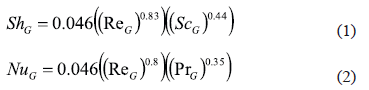
<body><![CDATA[<p><font size="2" face="Verdana, Arial, Helvetica, sans-serif">These waves, which can be formed either by the effects of gravity or by the shear stress caused from the high speed gas flowing in co-current with the liquid phase &#91;5, 6&#93;, complicating significantly  any description of a smooth laminar flow regime for the liquid film and producing a turbulent regime for the gas phase. Waves on a laminar film cause a certain amount of liquid mixing near the surface, and this considerably affects the rate of mass transfer and the interfacial area, since some degree of turbulence  arises from eddy currents &#91;5&#93; (although, the appearance of waves at low flow rates does not mean that the flow is turbulent &#91;7&#93;).</font></p>     <p><font size="2" face="Verdana, Arial, Helvetica, sans-serif">In the case of sulphonation in FFR, different models have been developed; mainly in the case of linear alquil benzene sulphonates (LABS). Johnson and Crynes (1974) &#91;8&#93; were the first ones who proposed a mathematical description of the FFR sulphonation, modifying the Gilliland-Sherwood equation Eq (1) and the Nusselt equation Eq (2) to calculate heat and mass transfer coefficients. This model assumes that the reaction takes place only on the gas liquid interface, therefore, the process rate is controlled by SO<sub>3</sub> diffusion from the gas bulk to the interface, in this way concentration and temperature axial profiles are calculated &#91;9&#93;, Although, this model describes experimental results well, film thickness and the different parameters that affect it were not considered &#91;1&#93;.</font></p> <font size="2" face="Verdana, Arial, Helvetica, sans-serif">     <p><img src="/img/revistas/dyna/v80n178/v80n178a06eq0102.gif"></p> </font><font face="Verdana, Arial, Helvetica, sans-serif">     <p><font size="2">Davis et al. 1979 &#91;10&#93;, tried to describe completely the fluid-dynamic process determining the film thickness velocity profiles in the liquid phase. Based on the same considerations made by Johnson and Crynes (1974), the instantaneous reaction rate and process is controlled by the SO<sub>3</sub> mass transfer in the gas phase rather than in the liquid phase, Davis included the liquid properties dependence with temperature to calculate the falling film thickness and heat transfer in the liquid where a linear temperature profile was assumed in a radial direction. However, the assumptions made by Johnson and Crynes (1974) and adopted by Davis and coworkers can be applied only at the top of the reactor. While the reaction proceeds, the viscosity of the liquid film increases with the presence of sulphonate matter. Therefore, both the mass transfer of SO<sub>3</sub> and reaction rate decreases downstream in the reactor as the conversion increases &#91;5, 9&#93;.</font></p>     <p><font size="2">In 1988, Gutierrez et al. &#91;9&#93;, suggested a mathematical model for the linear alkyl benzenes LAB's sulphonation in a FFR getting a 95% of prediction confidence regarding experimental values. In the development of this model mass transfer in both phases (liquid and gas) were considered. Hence, the reaction is considered to take place not just in the interface but in the bulk of the liquid phase. In the first section of the reactor, the process rate is limited by the SO<sub>3</sub> mass transfer from the gas bulk to the interface and by the reaction rate. At this point the liquid viscosity and temperature are low enhancing the solubility of SO<sub>3</sub> in the liquid. As the conversion in the reactor increases, the transport phenomena in the liquid phase become significant, and an increase in the film thickness take place due to the higher viscosity of the sulphonate matter. While in the gas phase the mass transfer is affected by the lower SO<sub>3</sub> concentration. However, this model has been widely discussed since the numerical solution of the differential equations involved an arbitrarily defined uneven partition of the domain of the liquid phase and because this model is fitted with several parameters, which made this model only useful for the original conditions &#91;1, 11-13&#93;.</font></p>     <p><font size="2">In 1996 Dabir et al. &#91;1&#93; suggested a new model that includes the effects of film waves in the transfer phenomena near the interface including eddy diffusivities to calculate an effective diffusivity in laminar flow. This approach was also considered by Gutierrez et al. &#91;9&#93;, but in their model Dabir et al. included the interfacial drag effects in the mass transfer coefficients. This model was verified with the experimental measures made by Gutierrez et al., and can predict: conversions, interface temperature profiles and the film thickness along the reactor &#91;12&#93;. </font></p>     <p><font size="2">One of the most recent mathematical model for LABs sulphonation was developed by Talens in 1999 &#91;12&#93;, based on the Gutierrez's model. In this model Talens tried to consider all kind of elements which had not been considered in previous models avoiding the Johnson and Crynes modification to the Gilliland- Sherwood equation (Equation 1), in order to obtain an accurate representation of experimental data.</font></p>     <p><font size="2">To date, the sulphonation of methyl esters, which is a renewable alternative for the active ingredient of detergent formulations, has been treated from the kinetic point of view but a full understanding of the process and the different variables involved in the scale up of the process are still to be studied &#91;13, 14, 15, 16&#93;. In this paper, sulphonation of methyl esters from palm stearin have been performed at the sulphonation bench scale plant of the Universidad Nacional de Colombia (Bogota campus). The performance of the sulphonation process was analyzed controlling both kinetic parameters like the SO<sub>3</sub>/ME molar ratio and hydrodynamic parameters such as mean residence time of the liquid phase and flow regimes in both phases.</font></p>     <p>&nbsp;</p> </font>     <p><font size="3" face="Verdana, Arial, Helvetica, sans-serif"><b>2.  MATERIALS AND METHODS.</b></font></p> <font face="Verdana, Arial, Helvetica, sans-serif">     ]]></body>
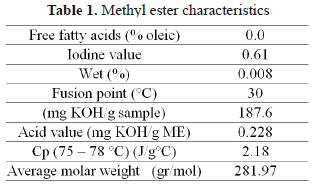
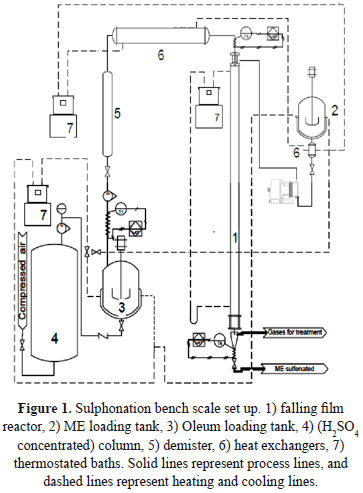
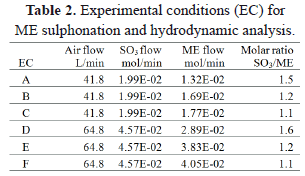
<body><![CDATA[<p><b><font size="2">2.1.  Methyl esters.    <br>   </font></b><font size="2">Methyl esters (ME) were obtained from transesterification of hydrogenated palm stearin with methanol in the way described in &#91;17&#93;, <a href="#tab01">table 1</a> shows the main characteristics of this methyl ester &#91;13&#93;.</font></p>     <p align="center"><font size="2"><a name="tab01"></a></font><img src="/img/revistas/dyna/v80n178/v80n178a06tab01.gif"></p>     <p><font size="2">Transport properties such as density and viscosity for the ME of palm stearin at different temperatures were measured and published in &#91;13&#93;.</font></p>     <p><font size="2"><b>2.2.  Sulphonation agent</b>    <br>   The sulphonation agent used was SO<sub>3</sub>, which was obtained by bubbling dry air in oleum 20 % at 80&deg;C. The air was dried by passing it through a column filled with concentrated H<sub>2</sub>SO<sub>4</sub>, and the flow was measured and controlled before being fed to the oleum tank with a DwyerTM flow meter. The air flow was calibrated measuring the pressure at the flow meter outlet. The air stream with the dragged SO<sub>3</sub> were bubbled in a diluted H<sub>2</sub>SO<sub>4</sub> solution (0.053 M), where the SO<sub>3</sub> was trapped as H<sub>2</sub>SO<sub>4</sub> and measured with a mettler toledo titrator DL53&reg;. A complete description of the system and methods used to quantify the content of SO<sub>3</sub> are presented in &#91;14, 18&#93;. </font></p>     <p><font size="2"><b>2.3. Falling film reactor    <br>   </b>The experiments were carried out in a falling film glass reactor of 1.27 cm diameter and 75 cm of length. A scheme of the sulphonation set up is presented in <a href="#fig01">figure 1</a>. The flow of nitrogen, and methyl esters were selected based on the formation of a homogeneous film wetting the inner wall of the FFR. The two different nitrogen flows with their respective SO<sub>3</sub> compositions, which were used for the tests, are listed in <a href="#tab02">table 2</a>. It was observed that higher gas pressures allow the formation of a homogeneous liquid film for a wider range of ME flows. Whereas, low gas pressures require a minimum amount of ME flow &#91;18&#93;. This leads to operation with SO<sub>3</sub>/ME molar ratios below the minimum required for a proper sulphonation (SO<sub>3</sub>/ME molar ratio &gt; 1) &#91;19&#93;. </font></p>     <p align="center"><font size="2"><a name="fig01"></a></font><img src="/img/revistas/dyna/v80n178/v80n178a06fig01.gif"></p> </font>     <p align="center"><font size="2" face="Verdana, Arial, Helvetica, sans-serif"><a name="tab02"></a></font><img src="/img/revistas/dyna/v80n178/v80n178a06tab02.gif"></p> <font face="Verdana, Arial, Helvetica, sans-serif">     ]]></body>
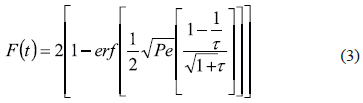
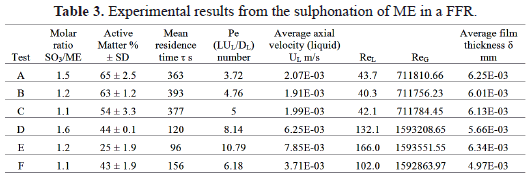
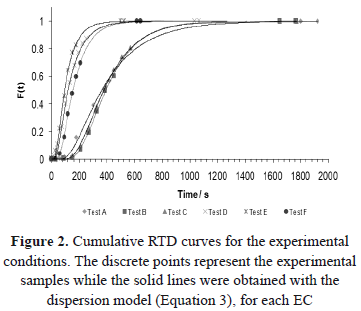
<body><![CDATA[<p><font size="2"><a href="#tab02">Table 2</a> presents the experimental matrix conditions where the operation temperatures for the FFR were set as based on those reported in &#91;13&#93; (40 &deg;C for the ME and FFR wall, and 50 &deg;C for the gas stream). The properties of the gas mixtures at the working pressures and temperatures were calculated using the corresponding states methods &#91;20&#93;. Whereas, the liquid properties were assumed as those of the ME which are presented in &#91;18&#93;. Active matter percentage (% AM) in the sulphonated ME was measured with a volumetric method  titrating with Hyamine 1622 using disulfine blue as an indicator &#91;13, 18&#93;.</font></p>     <p><font size="2"><b>2.4.  Residence time distributions RTD</b>    <br>   Residence time distribution in the liquid phase was measured for the conditions listed in <a href="#tab02">table 2</a> in absence of SO<sub>3</sub>. A step experiment was performed using Prussian red as a tracer. Once both gas and ME flows were stabilized, the ME feed was suddenly changed for a ME solution with the tracer using a three way valve. Ten samples were collected at the FFR outlet for each test condition. The samples were collected at intervals once the feed stream was switched and the collection time for each sample varied depending on the ME flow conditions from 30 to 120 s in order to guarantee enough sample volume for analysis.</font></p>     <p><font size="2">The concentration of tracer in the liquid stream at the FFR exit was measured with a Milton Roy Spectronic20&trade; at 460 nm. </font></p>     <p>&nbsp;</p> </font>     <p><font size="3" face="Verdana, Arial, Helvetica, sans-serif"><b>3.  RESULTS AND DISCUSSIONS.</b></font></p> <font face="Verdana, Arial, Helvetica, sans-serif">     <p><font size="2"><a href="#fig02">Figure 2</a> shows the cumulative RTD functions obtained experimentally for each one of the experimental conditions listed in <a href="#tab02">table 2</a> in absence of SO<sub>3</sub>.  The experimental data was observed to be well described by the dispersion model presented in equation 3 with a correlation coefficient of at least R<sup>2</sup> &ge; 0.8.</font></p> <font size="2">     <p><img src="/img/revistas/dyna/v80n178/v80n178a06eq03.gif"></p>     <p align="center"><a name="fig02"></a><img src="/img/revistas/dyna/v80n178/v80n178a06fig02.gif"></p>     <p><a href="#tab03">Table 3</a> shows the calculated values for the mean residence time <font face="Symbol">t</font> and the Peclet number Pe. Although, the system would be expected to show a behavior closer to a laminar flow reactor, the experimental shape of the cumulative RTDs discard that the behavior of the liquid phase can be described in this way &#91;21&#93;. The values calculated for the Peclet number show that the hydrodynamic behavior of the liquid phase in the reactor cannot be described neither as a stirred tank reactor (Pe&lt;0.005) nor a plug flow reactor (Pe &gt; 40) &#91;22&#93;. The results obtained can be explained from the effect of the  co-current gas and the waves formed in the film, which affect the velocity profiles in the liquid phase. </p> </font></font>     ]]></body>
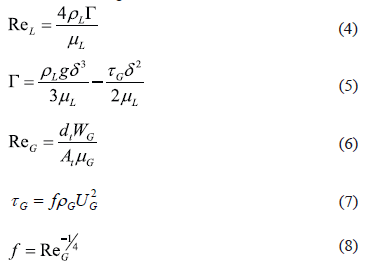
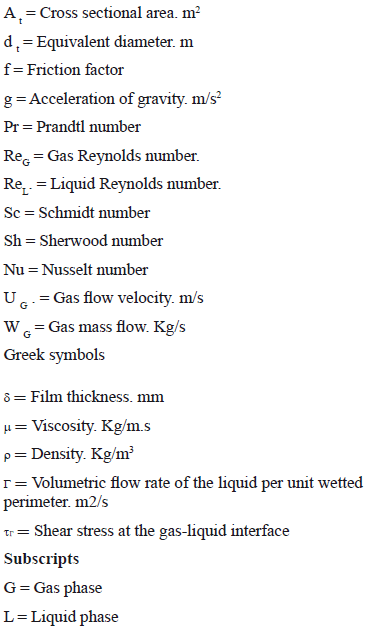
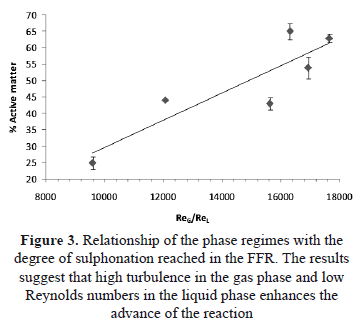
<body><![CDATA[<p align="center"><font size="2" face="Verdana, Arial, Helvetica, sans-serif"><a name="tab03"></a></font><img src="/img/revistas/dyna/v80n178/v80n178a06tab03.gif"></p> <font face="Verdana, Arial, Helvetica, sans-serif"><font size="2">     <p>Average axial velocities and effective diffusivities were calculated from the mean residence time Peclet values. Hence, the Reynolds numbers in the liquid phase ReL were calculated using the properties of the ME at the operating temperatures &#91;13&#93;. These values are listed in <a href="#tab03">table 3</a>. </p> </font></font>     <p><font size="2" face="Verdana, Arial, Helvetica, sans-serif">To calculate the Reynolds numbers of the gas phase an iterative calculation was performed using equations 4 to 8. The conceptual development to calculate the shear stress and the friction factor for a wavy interface is well described in &#91;9-11, 23&#93;. An iterative calculation was required to calculate Re<sub>L</sub> and Re<sub>G</sub>, since the thickness of the liquid film will affect the flow area of the gas in the reactor. In this way an average value of the film thickness <font face="Symbol">d</font>, was also calculated and reported in <a href="#tab03">table 3</a> along with Re<sub>G</sub> for each experiment. </font></p> <font face="Verdana, Arial, Helvetica, sans-serif"><font size="2">     <p><img src="/img/revistas/dyna/v80n178/v80n178a06eq0408.gif"></p>     <p>The results presented in <a href="#tab03">table 3</a> are supplemented with the values of the percentage of the active matter obtained at the studied conditions. The results show that along with the SO<sub>3</sub>/ME molar ratio, the hydrodynamic conditions highly affect the performance of the reactor. This can be observed directly with the amount of active matter obtained in the product at the end of the reactor. The results suggest that higher residence time of the liquid phase enhance the sulphonation reaction even when the SO<sub>3</sub>/ME molar ratio is kept constant. </p>     <p>The effect of the gas phase regime with the reactor performance is plotted in <a href="#fig03">figure 3</a>, as a ratio of the Reynolds numbers of the gas phase to the liquid phase. The results indicate that enhancing turbulence in the gas phase not only favors the formation of a homogeneous film, but together with a low Reynolds number in the liquid phase tend to increase the advance of the reaction in the FFR; a phenomena also seen in highly exothermic reactions in plug flow reactors &#91;24&#93;.</p>     <p align="center"><a name="fig03"></a><img src="/img/revistas/dyna/v80n178/v80n178a06fig03.gif"></p>     <p>&nbsp;</p> </font></font>     <p><font size="3" face="Verdana, Arial, Helvetica, sans-serif"><b>4. CONCLUSIONS.</b></font></p> <font face="Verdana, Arial, Helvetica, sans-serif"><font size="2">     <p>The sulphonation of methyl esters from palm stearin was successfully tested reaching a percentage of active matter (sulphonated matter) above 60 % in a reactor 0.75 m long. </p>     ]]></body>
<body><![CDATA[<p>The sulphonation of methyl ester from palm stearin was found to be highly affected by the hydrodynamics of the process. The fact that the film thickness is a relevant factor in the percentage of active matter indicates that under the working conditions, the controlling step in the reaction is the mass transfer of reactants and products in the liquid phase. Under similar conditions of SO<sub>3</sub>/ME molar ratios, a greater residence time of the liquid phase allows the development of hydrodynamic conditions that enhances the diffusion over the convection in the liquid phase, as reflected in the values of the Pe number. The overall effect of this increase in the diffusional movement is a better mixing of the reactants at the molecular level enhancing the advance of the reaction.</p>     <p>Although, it was not feasible to operate the reactor over a wider range of flows for liquid and gas phase due to operative limitations, it was feasible to get an insight of the importance of the hydrodynamics and its effects in the performance of the sulphonation in a FFR.</p> </font></font>     <p>&nbsp;</p>     <p><font size="3" face="Verdana, Arial, Helvetica, sans-serif"><b>5. ACKNOWLEDGMENTS</b></font></p> <font face="Verdana, Arial, Helvetica, sans-serif"><font size="2">     <p>The authors express their gratitude to Universidad Nacional de Colombia for the financial support through the DIB project number 8830</p>     <p>&nbsp;</p> </font></font>     <p><font size="3" face="Verdana, Arial, Helvetica, sans-serif"><b>6.  NOTATION</b></font></p> <font face="Verdana, Arial, Helvetica, sans-serif"><font size="2">     <p><img src="/img/revistas/dyna/v80n178/v80n178a06not01.gif"></p>     <p>&nbsp;</p> </font></font>     <p><font size="3" face="Verdana, Arial, Helvetica, sans-serif"><b>REFERENCES </b></font></p> <font face="Verdana, Arial, Helvetica, sans-serif"><font size="2">     ]]></body>
<body><![CDATA[<!-- ref --><p><b>&#91;1&#93;</b> Dabir, B., Riazi, M. R. and Davoudirad, H. R., Modelling of falling film reactors, Chem. Eng. Sci., 51, pp. 2553-2558, 1996.    &nbsp;&nbsp;&nbsp;&nbsp;&nbsp;&nbsp;&nbsp;&nbsp;[&#160;<a href="javascript:void(0);" onclick="javascript: window.open('/scielo.php?script=sci_nlinks&ref=000073&pid=S0012-7353201300020000600001&lng=','','width=640,height=500,resizable=yes,scrollbars=1,menubar=yes,');">Links</a>&#160;]<!-- end-ref --><!-- ref --><br>   <b>&#91;2&#93;</b> Roberts, D. W., Optimization of linear alkyl benzene sulfonation process for surfactant manufacture, Org. Process Res. Dev., 7, pp. 172-184, 2003.    &nbsp;&nbsp;&nbsp;&nbsp;&nbsp;&nbsp;&nbsp;&nbsp;[&#160;<a href="javascript:void(0);" onclick="javascript: window.open('/scielo.php?script=sci_nlinks&ref=000074&pid=S0012-7353201300020000600002&lng=','','width=640,height=500,resizable=yes,scrollbars=1,menubar=yes,');">Links</a>&#160;]<!-- end-ref --><!-- ref --><br>   <b>&#91;3&#93;</b> Xu, Z. F., Khoo, B. C. and Wijeysundera, N. E., Mass transfer across the falling film: Simulations and experiments, Chem. Eng. Sci., 63, pp. 2559-2575, 2008.    &nbsp;&nbsp;&nbsp;&nbsp;&nbsp;&nbsp;&nbsp;&nbsp;[&#160;<a href="javascript:void(0);" onclick="javascript: window.open('/scielo.php?script=sci_nlinks&ref=000075&pid=S0012-7353201300020000600003&lng=','','width=640,height=500,resizable=yes,scrollbars=1,menubar=yes,');">Links</a>&#160;]<!-- end-ref --><!-- ref --><br>   <b>&#91;4&#93;</b> Killion, J. D. and Garimella, S., A critical review of models of coupled heat and mass transfer in falling-film absorption, Int J Refrig, 24, pp. 755-797, 2001.    &nbsp;&nbsp;&nbsp;&nbsp;&nbsp;&nbsp;&nbsp;&nbsp;[&#160;<a href="javascript:void(0);" onclick="javascript: window.open('/scielo.php?script=sci_nlinks&ref=000076&pid=S0012-7353201300020000600004&lng=','','width=640,height=500,resizable=yes,scrollbars=1,menubar=yes,');">Links</a>&#160;]<!-- end-ref --><!-- ref --><br>   <b>&#91;5&#93;</b> Roberts, D. W., Manufacture of anionic surfactants, In: Oleochemical Manufacture and Applications (Eds., F. D. Gustone and R. J. Hamilton), Sheffield Academic Press, UK, pp. 55-73, 1996.    &nbsp;&nbsp;&nbsp;&nbsp;&nbsp;&nbsp;&nbsp;&nbsp;[&#160;<a href="javascript:void(0);" onclick="javascript: window.open('/scielo.php?script=sci_nlinks&ref=000077&pid=S0012-7353201300020000600005&lng=','','width=640,height=500,resizable=yes,scrollbars=1,menubar=yes,');">Links</a>&#160;]<!-- end-ref --><!-- ref --><br>   <b>&#91;6&#93;</b> Riazi, M. R. and Faghri, A., Effect of the interfacial drag on gas absorption with chemical reaction in a vertical tube, AIChE J, 32, pp. 696-699, 1986.    &nbsp;&nbsp;&nbsp;&nbsp;&nbsp;&nbsp;&nbsp;&nbsp;[&#160;<a href="javascript:void(0);" onclick="javascript: window.open('/scielo.php?script=sci_nlinks&ref=000078&pid=S0012-7353201300020000600006&lng=','','width=640,height=500,resizable=yes,scrollbars=1,menubar=yes,');">Links</a>&#160;]<!-- end-ref --><!-- ref --><br>   <b>&#91;7&#93;</b> Sherwood, T. K., Pigfor, R. L. and Wilke, C. R., Mass Transfer. Chemical Engineering Series, McGraw-Hill, New York:, 1975.    &nbsp;&nbsp;&nbsp;&nbsp;&nbsp;&nbsp;&nbsp;&nbsp;[&#160;<a href="javascript:void(0);" onclick="javascript: window.open('/scielo.php?script=sci_nlinks&ref=000079&pid=S0012-7353201300020000600007&lng=','','width=640,height=500,resizable=yes,scrollbars=1,menubar=yes,');">Links</a>&#160;]<!-- end-ref --><!-- ref --><br>   <b>&#91;8&#93;</b> Johnson, G. R., and Crynes, B. L., Modelling of a thin-film sulfur trioxide sulfonation reactor, Ind. Eng. Chem., Process Des. Dev, 13, pp. 6-14, 1974.    &nbsp;&nbsp;&nbsp;&nbsp;&nbsp;&nbsp;&nbsp;&nbsp;[&#160;<a href="javascript:void(0);" onclick="javascript: window.open('/scielo.php?script=sci_nlinks&ref=000080&pid=S0012-7353201300020000600008&lng=','','width=640,height=500,resizable=yes,scrollbars=1,menubar=yes,');">Links</a>&#160;]<!-- end-ref --><!-- ref --><br>   <b>&#91;9&#93;</b> Guti&eacute;rrez, G. J., Mans, T. C. and Costa, L. J., Improved mathematical model for a falling sulfonation reactor, Ind. Eng. Chem. Res., 27, pp. 1701-1707, 1988.    &nbsp;&nbsp;&nbsp;&nbsp;&nbsp;&nbsp;&nbsp;&nbsp;[&#160;<a href="javascript:void(0);" onclick="javascript: window.open('/scielo.php?script=sci_nlinks&ref=000081&pid=S0012-7353201300020000600009&lng=','','width=640,height=500,resizable=yes,scrollbars=1,menubar=yes,');">Links</a>&#160;]<!-- end-ref --><!-- ref --><br>   <b>&#91;10&#93;</b> Davis, J. E., Van Ouwerkerk, M. and Venkatesh, S., An analysis of the falling film gas-liquid reactor, Chem. Eng. Sci., 34, pp. 539-550, 1979.    &nbsp;&nbsp;&nbsp;&nbsp;&nbsp;&nbsp;&nbsp;&nbsp;[&#160;<a href="javascript:void(0);" onclick="javascript: window.open('/scielo.php?script=sci_nlinks&ref=000082&pid=S0012-7353201300020000600010&lng=','','width=640,height=500,resizable=yes,scrollbars=1,menubar=yes,');">Links</a>&#160;]<!-- end-ref --><!-- ref --><br>   <b>&#91;11&#93;</b> Akanksha, K., Pant, K. and Srivastava, V. K., Modeling of sulphonation of tridecylbenzene in a falling film reactor, Math. Comput. Model, 46, pp. 1332-1344, 2007.    &nbsp;&nbsp;&nbsp;&nbsp;&nbsp;&nbsp;&nbsp;&nbsp;[&#160;<a href="javascript:void(0);" onclick="javascript: window.open('/scielo.php?script=sci_nlinks&ref=000083&pid=S0012-7353201300020000600011&lng=','','width=640,height=500,resizable=yes,scrollbars=1,menubar=yes,');">Links</a>&#160;]<!-- end-ref --><!-- ref --><br>   <b>&#91;12&#93;</b> Talens, F. I., The modelling of falling film chemical reactor, Chem. Eng. Sci., 54, pp. 1871-1881, 1999.    &nbsp;&nbsp;&nbsp;&nbsp;&nbsp;&nbsp;&nbsp;&nbsp;[&#160;<a href="javascript:void(0);" onclick="javascript: window.open('/scielo.php?script=sci_nlinks&ref=000084&pid=S0012-7353201300020000600012&lng=','','width=640,height=500,resizable=yes,scrollbars=1,menubar=yes,');">Links</a>&#160;]<!-- end-ref --><!-- ref --><br>   <b>&#91;13&#93;</b> Torres, J. A., Producci&oacute;n de alfa sulfo-estearato de metilo en un reactor de pel&iacute;cula descendente, &#91;PhD Thesis&#93;, Universidad Nacional de Colombia, Bogot&aacute;, Colombia, 2009.    &nbsp;&nbsp;&nbsp;&nbsp;&nbsp;&nbsp;&nbsp;&nbsp;[&#160;<a href="javascript:void(0);" onclick="javascript: window.open('/scielo.php?script=sci_nlinks&ref=000085&pid=S0012-7353201300020000600013&lng=','','width=640,height=500,resizable=yes,scrollbars=1,menubar=yes,');">Links</a>&#160;]<!-- end-ref --><!-- ref --><br>   <b>&#91;14&#93;</b> Torres, J. A., Diaz, L. and S&aacute;nchez, F. J., Falling film reactor for methyl ester sulphonation with gaseous sulphur trioxide, Ing. Inv, 29, pp. 48-53, 2009.    &nbsp;&nbsp;&nbsp;&nbsp;&nbsp;&nbsp;&nbsp;&nbsp;[&#160;<a href="javascript:void(0);" onclick="javascript: window.open('/scielo.php?script=sci_nlinks&ref=000086&pid=S0012-7353201300020000600014&lng=','','width=640,height=500,resizable=yes,scrollbars=1,menubar=yes,');">Links</a>&#160;]<!-- end-ref --><!-- ref --><br>   <b>&#91;15&#93;</b> Torres, J. A., Morales, G. M., Suarez, P. O. Y. and Sanchez, F. J., Mathematical model of a falling film reactor for methyl ester sulfonation. CPPM, 4(5), Article 12, 2009.    &nbsp;&nbsp;&nbsp;&nbsp;&nbsp;&nbsp;&nbsp;&nbsp;[&#160;<a href="javascript:void(0);" onclick="javascript: window.open('/scielo.php?script=sci_nlinks&ref=000087&pid=S0012-7353201300020000600015&lng=','','width=640,height=500,resizable=yes,scrollbars=1,menubar=yes,');">Links</a>&#160;]<!-- end-ref --><!-- ref --><br>   <b>&#91;16&#93;</b> Torres, J. A., Sulfonation/Sulfation Processing Technology for Anionic Surfactant Manufacture, In: Advances in Chemical Engineering (Eds., Nawaz and Shahid Naveed. Rijeka), InTech., Croatia, pp 269-294, 2012.    &nbsp;&nbsp;&nbsp;&nbsp;&nbsp;&nbsp;&nbsp;&nbsp;[&#160;<a href="javascript:void(0);" onclick="javascript: window.open('/scielo.php?script=sci_nlinks&ref=000088&pid=S0012-7353201300020000600016&lng=','','width=640,height=500,resizable=yes,scrollbars=1,menubar=yes,');">Links</a>&#160;]<!-- end-ref --><!-- ref --><br>   <b>&#91;17&#93;</b> Narv&aacute;ez, P. C., S&aacute;nchez, F. J., Torres, J. A. and Ponce de Le&oacute;n, L. F., Producci&oacute;n de &eacute;steres met&iacute;licos de &aacute;cidos grasos: variables asociadas al proceso, Ing. Inv., 24, pp. 41-50, 2004.    &nbsp;&nbsp;&nbsp;&nbsp;&nbsp;&nbsp;&nbsp;&nbsp;[&#160;<a href="javascript:void(0);" onclick="javascript: window.open('/scielo.php?script=sci_nlinks&ref=000089&pid=S0012-7353201300020000600017&lng=','','width=640,height=500,resizable=yes,scrollbars=1,menubar=yes,');">Links</a>&#160;]<!-- end-ref --><!-- ref --><br>   <b>&#91;18&#93;</b> Diaz, L., An&aacute;lisis hidrodin&aacute;mico de un reactor de pel&iacute;cula descendente para lasulfonaci&oacute;n de &eacute;steres met&iacute;licos derivados del aceite de palma, &#91;M.Sc Thesis&#93;, Universidad Nacional de Colombia, Bogota, Colombia, 2009.    &nbsp;&nbsp;&nbsp;&nbsp;&nbsp;&nbsp;&nbsp;&nbsp;[&#160;<a href="javascript:void(0);" onclick="javascript: window.open('/scielo.php?script=sci_nlinks&ref=000090&pid=S0012-7353201300020000600018&lng=','','width=640,height=500,resizable=yes,scrollbars=1,menubar=yes,');">Links</a>&#160;]<!-- end-ref --><!-- ref --><br>   <b>&#91;19&#93;</b> Stein, W. and Baumann, H., a-sulfonated fatty acids and esters: manufacturing process, properties, and applications, J Am Oil Chem Soc, 52, pp. 323-329, 1975.    &nbsp;&nbsp;&nbsp;&nbsp;&nbsp;&nbsp;&nbsp;&nbsp;[&#160;<a href="javascript:void(0);" onclick="javascript: window.open('/scielo.php?script=sci_nlinks&ref=000091&pid=S0012-7353201300020000600019&lng=','','width=640,height=500,resizable=yes,scrollbars=1,menubar=yes,');">Links</a>&#160;]<!-- end-ref --><!-- ref --><br>   <b>&#91;20&#93;</b> Reid, R. C., Prausnitz, J. M. and Poling, B. E., The Properties of Gases and Liquids, McGraw-Hill Book Company, NY, USA:, 1987.    &nbsp;&nbsp;&nbsp;&nbsp;&nbsp;&nbsp;&nbsp;&nbsp;[&#160;<a href="javascript:void(0);" onclick="javascript: window.open('/scielo.php?script=sci_nlinks&ref=000092&pid=S0012-7353201300020000600020&lng=','','width=640,height=500,resizable=yes,scrollbars=1,menubar=yes,');">Links</a>&#160;]<!-- end-ref --><!-- ref --><br>   <b>&#91;21&#93;</b> Smith, J. M., Chemical Engineering Kinetics, McGraw-Hill, New York:, 1981.    &nbsp;&nbsp;&nbsp;&nbsp;&nbsp;&nbsp;&nbsp;&nbsp;[&#160;<a href="javascript:void(0);" onclick="javascript: window.open('/scielo.php?script=sci_nlinks&ref=000093&pid=S0012-7353201300020000600021&lng=','','width=640,height=500,resizable=yes,scrollbars=1,menubar=yes,');">Links</a>&#160;]<!-- end-ref --><!-- ref --><br>   <b>&#91;22&#93;</b> Narv&aacute;ez, P. C., S&aacute;nchez, F. J. and Godoy-Silva, R. D., Continuous Methanolysis of Palm Oil Using a Liquid-Liquid Film Reactor, J Am Oil Chem Soc, 83, pp. 343-352, 2009.    &nbsp;&nbsp;&nbsp;&nbsp;&nbsp;&nbsp;&nbsp;&nbsp;[&#160;<a href="javascript:void(0);" onclick="javascript: window.open('/scielo.php?script=sci_nlinks&ref=000094&pid=S0012-7353201300020000600022&lng=','','width=640,height=500,resizable=yes,scrollbars=1,menubar=yes,');">Links</a>&#160;]<!-- end-ref --><!-- ref --><br>   <b>&#91;23&#93;</b> Henstock, W. H. and Hanratty, T. J., The interfacial drag and the height of the wall layer in annular flows, AIChE J, 22, pp. 990-1000, 1976.    &nbsp;&nbsp;&nbsp;&nbsp;&nbsp;&nbsp;&nbsp;&nbsp;[&#160;<a href="javascript:void(0);" onclick="javascript: window.open('/scielo.php?script=sci_nlinks&ref=000095&pid=S0012-7353201300020000600023&lng=','','width=640,height=500,resizable=yes,scrollbars=1,menubar=yes,');">Links</a>&#160;]<!-- end-ref --><!-- ref --><br>   <b>&#91;24&#93;</b> Arroyave, D., Casta&ntilde;o, D. and Aguirre, J., Modelamiento bif&aacute;sico de un gasificador de carb&oacute;n: balance de poblaciones seg&uacute;n el algoritmo de sundaresan-admunson, DYNA, 132, pp. 15-24, 2001.    &nbsp;&nbsp;&nbsp;&nbsp;&nbsp;&nbsp;&nbsp;&nbsp;[&#160;<a href="javascript:void(0);" onclick="javascript: window.open('/scielo.php?script=sci_nlinks&ref=000096&pid=S0012-7353201300020000600024&lng=','','width=640,height=500,resizable=yes,scrollbars=1,menubar=yes,');">Links</a>&#160;]<!-- end-ref --></p> </font></font>      ]]></body><back>
<ref-list>
<ref id="B1">
<label>1</label><nlm-citation citation-type="journal">
<person-group person-group-type="author">
<name>
<surname><![CDATA[Dabir]]></surname>
<given-names><![CDATA[B.]]></given-names>
</name>
<name>
<surname><![CDATA[Riazi]]></surname>
<given-names><![CDATA[M. R.]]></given-names>
</name>
<name>
<surname><![CDATA[Davoudirad]]></surname>
<given-names><![CDATA[H. R.]]></given-names>
</name>
</person-group>
<article-title xml:lang="en"><![CDATA[Modelling of falling film reactors]]></article-title>
<source><![CDATA[Chem. Eng. Sci.]]></source>
<year>1996</year>
<numero>51</numero>
<issue>51</issue>
<page-range>2553-2558</page-range></nlm-citation>
</ref>
<ref id="B2">
<label>2</label><nlm-citation citation-type="journal">
<person-group person-group-type="author">
<name>
<surname><![CDATA[Roberts]]></surname>
<given-names><![CDATA[D. W.]]></given-names>
</name>
</person-group>
<article-title xml:lang="en"><![CDATA[Optimization of linear alkyl benzene sulfonation process for surfactant manufacture]]></article-title>
<source><![CDATA[Org. Process Res. Dev.]]></source>
<year>2003</year>
<numero>7</numero>
<issue>7</issue>
<page-range>172-184</page-range></nlm-citation>
</ref>
<ref id="B3">
<label>3</label><nlm-citation citation-type="journal">
<person-group person-group-type="author">
<name>
<surname><![CDATA[Xu]]></surname>
<given-names><![CDATA[Z. F.]]></given-names>
</name>
<name>
<surname><![CDATA[Khoo]]></surname>
<given-names><![CDATA[B. C.]]></given-names>
</name>
<name>
<surname><![CDATA[Wijeysundera]]></surname>
<given-names><![CDATA[N. E.]]></given-names>
</name>
</person-group>
<article-title xml:lang="en"><![CDATA[Mass transfer across the falling film: Simulations and experiments]]></article-title>
<source><![CDATA[Chem. Eng. Sci.]]></source>
<year>2008</year>
<numero>63</numero>
<issue>63</issue>
<page-range>2559-2575</page-range></nlm-citation>
</ref>
<ref id="B4">
<label>4</label><nlm-citation citation-type="journal">
<person-group person-group-type="author">
<name>
<surname><![CDATA[Killion]]></surname>
<given-names><![CDATA[J. D.]]></given-names>
</name>
<name>
<surname><![CDATA[Garimella]]></surname>
<given-names><![CDATA[S.]]></given-names>
</name>
</person-group>
<article-title xml:lang="en"><![CDATA[A critical review of models of coupled heat and mass transfer in falling-film absorption]]></article-title>
<source><![CDATA[Int J Refrig]]></source>
<year>2001</year>
<numero>24</numero>
<issue>24</issue>
<page-range>755-797</page-range></nlm-citation>
</ref>
<ref id="B5">
<label>5</label><nlm-citation citation-type="book">
<person-group person-group-type="author">
<name>
<surname><![CDATA[Roberts]]></surname>
<given-names><![CDATA[D. W.]]></given-names>
</name>
</person-group>
<article-title xml:lang="en"><![CDATA[Manufacture of anionic surfactants]]></article-title>
<person-group person-group-type="editor">
<name>
<surname><![CDATA[Gustone]]></surname>
<given-names><![CDATA[F. D.]]></given-names>
</name>
<name>
<surname><![CDATA[Hamilton]]></surname>
<given-names><![CDATA[R. J.]]></given-names>
</name>
</person-group>
<source><![CDATA[Oleochemical Manufacture and Applications]]></source>
<year>1996</year>
<page-range>55-73</page-range><publisher-name><![CDATA[Sheffield Academic Press]]></publisher-name>
</nlm-citation>
</ref>
<ref id="B6">
<label>6</label><nlm-citation citation-type="journal">
<person-group person-group-type="author">
<name>
<surname><![CDATA[Riazi]]></surname>
<given-names><![CDATA[M. R.]]></given-names>
</name>
<name>
<surname><![CDATA[Faghri]]></surname>
<given-names><![CDATA[A.]]></given-names>
</name>
</person-group>
<article-title xml:lang="en"><![CDATA[Effect of the interfacial drag on gas absorption with chemical reaction in a vertical tube]]></article-title>
<source><![CDATA[AIChE J]]></source>
<year>1986</year>
<numero>32</numero>
<issue>32</issue>
<page-range>696-699</page-range></nlm-citation>
</ref>
<ref id="B7">
<label>7</label><nlm-citation citation-type="book">
<person-group person-group-type="author">
<name>
<surname><![CDATA[Sherwood]]></surname>
<given-names><![CDATA[T. K.]]></given-names>
</name>
<name>
<surname><![CDATA[Pigfor]]></surname>
<given-names><![CDATA[R. L.]]></given-names>
</name>
<name>
<surname><![CDATA[Wilke]]></surname>
<given-names><![CDATA[C. R.]]></given-names>
</name>
</person-group>
<source><![CDATA[Mass Transfer]]></source>
<year>1975</year>
<publisher-loc><![CDATA[New York ]]></publisher-loc>
<publisher-name><![CDATA[McGraw-Hill]]></publisher-name>
</nlm-citation>
</ref>
<ref id="B8">
<label>8</label><nlm-citation citation-type="journal">
<person-group person-group-type="author">
<name>
<surname><![CDATA[Johnson]]></surname>
<given-names><![CDATA[G. R.]]></given-names>
</name>
<name>
<surname><![CDATA[Crynes]]></surname>
<given-names><![CDATA[B. L.]]></given-names>
</name>
</person-group>
<article-title xml:lang="en"><![CDATA[Modelling of a thin-film sulfur trioxide sulfonation reactor]]></article-title>
<source><![CDATA[Ind. Eng. Chem., Process Des. Dev]]></source>
<year>1974</year>
<numero>13</numero>
<issue>13</issue>
<page-range>6-14</page-range></nlm-citation>
</ref>
<ref id="B9">
<label>9</label><nlm-citation citation-type="journal">
<person-group person-group-type="author">
<name>
<surname><![CDATA[Gutiérrez]]></surname>
<given-names><![CDATA[G. J.]]></given-names>
</name>
<name>
<surname><![CDATA[Mans]]></surname>
<given-names><![CDATA[T. C.]]></given-names>
</name>
<name>
<surname><![CDATA[Costa]]></surname>
<given-names><![CDATA[L. J.]]></given-names>
</name>
</person-group>
<article-title xml:lang="en"><![CDATA[Improved mathematical model for a falling sulfonation reactor]]></article-title>
<source><![CDATA[Ind. Eng. Chem. Res.]]></source>
<year>1988</year>
<numero>27</numero>
<issue>27</issue>
<page-range>1701-1707</page-range></nlm-citation>
</ref>
<ref id="B10">
<label>10</label><nlm-citation citation-type="journal">
<person-group person-group-type="author">
<name>
<surname><![CDATA[Davis]]></surname>
<given-names><![CDATA[J. E.]]></given-names>
</name>
<name>
<surname><![CDATA[Van Ouwerkerk]]></surname>
<given-names><![CDATA[M.]]></given-names>
</name>
<name>
<surname><![CDATA[Venkatesh]]></surname>
<given-names><![CDATA[S.]]></given-names>
</name>
</person-group>
<article-title xml:lang="en"><![CDATA[An analysis of the falling film gas-liquid reactor]]></article-title>
<source><![CDATA[Chem. Eng. Sci.]]></source>
<year>1979</year>
<numero>34</numero>
<issue>34</issue>
<page-range>539-550</page-range></nlm-citation>
</ref>
<ref id="B11">
<label>11</label><nlm-citation citation-type="journal">
<person-group person-group-type="author">
<name>
<surname><![CDATA[Akanksha]]></surname>
<given-names><![CDATA[K.]]></given-names>
</name>
<name>
<surname><![CDATA[Pant]]></surname>
<given-names><![CDATA[K.]]></given-names>
</name>
<name>
<surname><![CDATA[Srivastava]]></surname>
<given-names><![CDATA[V. K.]]></given-names>
</name>
</person-group>
<article-title xml:lang="en"><![CDATA[Modeling of sulphonation of tridecylbenzene in a falling film reactor]]></article-title>
<source><![CDATA[Math. Comput. Model]]></source>
<year>2007</year>
<numero>46</numero>
<issue>46</issue>
<page-range>1332-1344</page-range></nlm-citation>
</ref>
<ref id="B12">
<label>12</label><nlm-citation citation-type="journal">
<person-group person-group-type="author">
<name>
<surname><![CDATA[Talens]]></surname>
<given-names><![CDATA[F. I.]]></given-names>
</name>
</person-group>
<article-title xml:lang="en"><![CDATA[The modelling of falling film chemical reactor]]></article-title>
<source><![CDATA[Chem. Eng. Sci.]]></source>
<year>1999</year>
<numero>54</numero>
<issue>54</issue>
<page-range>1871-1881</page-range></nlm-citation>
</ref>
<ref id="B13">
<label>13</label><nlm-citation citation-type="">
<person-group person-group-type="author">
<name>
<surname><![CDATA[Torres]]></surname>
<given-names><![CDATA[J. A.]]></given-names>
</name>
</person-group>
<source><![CDATA[Producción de alfa sulfo-estearato de metilo en un reactor de película descendente]]></source>
<year></year>
</nlm-citation>
</ref>
<ref id="B14">
<label>14</label><nlm-citation citation-type="journal">
<person-group person-group-type="author">
<name>
<surname><![CDATA[Torres]]></surname>
<given-names><![CDATA[J. A.]]></given-names>
</name>
<name>
<surname><![CDATA[Diaz]]></surname>
<given-names><![CDATA[L.]]></given-names>
</name>
<name>
<surname><![CDATA[Sánchez]]></surname>
<given-names><![CDATA[F. J.]]></given-names>
</name>
</person-group>
<article-title xml:lang="en"><![CDATA[Falling film reactor for methyl ester sulphonation with gaseous sulphur trioxide]]></article-title>
<source><![CDATA[Ing. Inv]]></source>
<year>2009</year>
<numero>29</numero>
<issue>29</issue>
<page-range>48-53</page-range></nlm-citation>
</ref>
<ref id="B15">
<label>15</label><nlm-citation citation-type="journal">
<person-group person-group-type="author">
<name>
<surname><![CDATA[Torres]]></surname>
<given-names><![CDATA[J. A.]]></given-names>
</name>
<name>
<surname><![CDATA[Morales]]></surname>
<given-names><![CDATA[G. M.]]></given-names>
</name>
<name>
<surname><![CDATA[Suarez]]></surname>
<given-names><![CDATA[P. O. Y.]]></given-names>
</name>
<name>
<surname><![CDATA[Sanchez]]></surname>
<given-names><![CDATA[F. J.]]></given-names>
</name>
</person-group>
<article-title xml:lang="en"><![CDATA[Mathematical model of a falling film reactor for methyl ester sulfonation]]></article-title>
<source><![CDATA[CPPM]]></source>
<year>2009</year>
<volume>4</volume>
<numero>5</numero>
<issue>5</issue>
</nlm-citation>
</ref>
<ref id="B16">
<label>16</label><nlm-citation citation-type="">
<person-group person-group-type="author">
<name>
<surname><![CDATA[Torres]]></surname>
<given-names><![CDATA[J. A.]]></given-names>
</name>
</person-group>
<article-title xml:lang="en"><![CDATA[Sulfonation/Sulfation Processing Technology for Anionic Surfactant Manufacture]]></article-title>
<person-group person-group-type="editor">
<name>
<surname><![CDATA[Nawaz]]></surname>
</name>
<name>
<surname><![CDATA[Shahid Naveed]]></surname>
<given-names><![CDATA[Rijeka]]></given-names>
</name>
</person-group>
<source><![CDATA[Advances in Chemical Engineering]]></source>
<year>2012</year>
<page-range>269-294</page-range></nlm-citation>
</ref>
<ref id="B17">
<label>17</label><nlm-citation citation-type="journal">
<person-group person-group-type="author">
<name>
<surname><![CDATA[Narváez]]></surname>
<given-names><![CDATA[P. C.]]></given-names>
</name>
<name>
<surname><![CDATA[Sánchez]]></surname>
<given-names><![CDATA[F. J.]]></given-names>
</name>
<name>
<surname><![CDATA[Torres]]></surname>
<given-names><![CDATA[J. A.]]></given-names>
</name>
<name>
<surname><![CDATA[Ponce de León]]></surname>
<given-names><![CDATA[L. F.]]></given-names>
</name>
</person-group>
<article-title xml:lang="es"><![CDATA[Producción de ésteres metílicos de ácidos grasos: variables asociadas al proceso]]></article-title>
<source><![CDATA[Ing. Inv.]]></source>
<year>2004</year>
<numero>24</numero>
<issue>24</issue>
<page-range>41-50</page-range></nlm-citation>
</ref>
<ref id="B18">
<label>18</label><nlm-citation citation-type="">
<person-group person-group-type="author">
<name>
<surname><![CDATA[Diaz]]></surname>
<given-names><![CDATA[L.]]></given-names>
</name>
</person-group>
<source><![CDATA[Análisis hidrodinámico de un reactor de película descendente para lasulfonación de ésteres metílicos derivados del aceite de palma]]></source>
<year></year>
</nlm-citation>
</ref>
<ref id="B19">
<label>19</label><nlm-citation citation-type="journal">
<person-group person-group-type="author">
<name>
<surname><![CDATA[Stein]]></surname>
<given-names><![CDATA[W.]]></given-names>
</name>
<name>
<surname><![CDATA[Baumann]]></surname>
<given-names><![CDATA[H.]]></given-names>
</name>
</person-group>
<article-title xml:lang="en"><![CDATA[a-sulfonated fatty acids and esters: manufacturing process, properties, and applications]]></article-title>
<source><![CDATA[J Am Oil Chem Soc]]></source>
<year>1975</year>
<numero>52</numero>
<issue>52</issue>
<page-range>323-329</page-range></nlm-citation>
</ref>
<ref id="B20">
<label>20</label><nlm-citation citation-type="book">
<person-group person-group-type="author">
<name>
<surname><![CDATA[Reid]]></surname>
<given-names><![CDATA[R. C.]]></given-names>
</name>
<name>
<surname><![CDATA[Prausnitz]]></surname>
<given-names><![CDATA[J. M.]]></given-names>
</name>
<name>
<surname><![CDATA[Poling]]></surname>
<given-names><![CDATA[B. E.]]></given-names>
</name>
</person-group>
<source><![CDATA[The Properties of Gases and Liquids]]></source>
<year>1987</year>
<publisher-loc><![CDATA[NY ]]></publisher-loc>
<publisher-name><![CDATA[McGraw-Hill Book Company]]></publisher-name>
</nlm-citation>
</ref>
<ref id="B21">
<label>21</label><nlm-citation citation-type="book">
<person-group person-group-type="author">
<name>
<surname><![CDATA[Smith]]></surname>
<given-names><![CDATA[J. M.]]></given-names>
</name>
</person-group>
<source><![CDATA[Chemical Engineering Kinetics]]></source>
<year>1981</year>
<publisher-loc><![CDATA[New York ]]></publisher-loc>
<publisher-name><![CDATA[McGraw-Hill]]></publisher-name>
</nlm-citation>
</ref>
<ref id="B22">
<label>22</label><nlm-citation citation-type="journal">
<person-group person-group-type="author">
<name>
<surname><![CDATA[Narváez]]></surname>
<given-names><![CDATA[P. C.]]></given-names>
</name>
<name>
<surname><![CDATA[Sánchez]]></surname>
<given-names><![CDATA[F. J.]]></given-names>
</name>
<name>
<surname><![CDATA[Godoy-Silva]]></surname>
<given-names><![CDATA[R. D.]]></given-names>
</name>
</person-group>
<article-title xml:lang="en"><![CDATA[Continuous Methanolysis of Palm Oil Using a Liquid-Liquid Film Reactor]]></article-title>
<source><![CDATA[J Am Oil Chem Soc]]></source>
<year>2009</year>
<numero>83</numero>
<issue>83</issue>
<page-range>343-352</page-range></nlm-citation>
</ref>
<ref id="B23">
<label>23</label><nlm-citation citation-type="journal">
<person-group person-group-type="author">
<name>
<surname><![CDATA[Henstock]]></surname>
<given-names><![CDATA[W. H.]]></given-names>
</name>
<name>
<surname><![CDATA[Hanratty]]></surname>
<given-names><![CDATA[T. J.]]></given-names>
</name>
</person-group>
<article-title xml:lang="en"><![CDATA[The interfacial drag and the height of the wall layer in annular flows]]></article-title>
<source><![CDATA[AIChE J]]></source>
<year>1976</year>
<numero>22</numero>
<issue>22</issue>
<page-range>990-1000</page-range></nlm-citation>
</ref>
<ref id="B24">
<label>24</label><nlm-citation citation-type="journal">
<person-group person-group-type="author">
<name>
<surname><![CDATA[Arroyave]]></surname>
<given-names><![CDATA[D.]]></given-names>
</name>
<name>
<surname><![CDATA[Castaño]]></surname>
<given-names><![CDATA[D.]]></given-names>
</name>
<name>
<surname><![CDATA[Aguirre]]></surname>
<given-names><![CDATA[J.]]></given-names>
</name>
</person-group>
<article-title xml:lang="es"><![CDATA[Modelamiento bifásico de un gasificador de carbón: alance de poblaciones según el algoritmo de sundaresan-admunson]]></article-title>
<source><![CDATA[DYNA]]></source>
<year>2001</year>
<numero>132</numero>
<issue>132</issue>
<page-range>15-24</page-range></nlm-citation>
</ref>
</ref-list>
</back>
</article>