<?xml version="1.0" encoding="ISO-8859-1"?><article xmlns:mml="http://www.w3.org/1998/Math/MathML" xmlns:xlink="http://www.w3.org/1999/xlink" xmlns:xsi="http://www.w3.org/2001/XMLSchema-instance">
<front>
<journal-meta>
<journal-id>0012-7353</journal-id>
<journal-title><![CDATA[DYNA]]></journal-title>
<abbrev-journal-title><![CDATA[Dyna rev.fac.nac.minas]]></abbrev-journal-title>
<issn>0012-7353</issn>
<publisher>
<publisher-name><![CDATA[Universidad Nacional de Colombia]]></publisher-name>
</publisher>
</journal-meta>
<article-meta>
<article-id>S0012-73532013000200010</article-id>
<title-group>
<article-title xml:lang="en"><![CDATA[PRODUCTION OF CARBON NANOTUBES AND HYDROGEN BY CATALYTIC ETHANOL DECOMPOSITION]]></article-title>
<article-title xml:lang="es"><![CDATA[PRODUCCIÓN DE NANOTUBOS E HIDRÓGENO MEDIANTE LA DESCOMPOSICIÓN CATALÍTICA DE ETANOL]]></article-title>
</title-group>
<contrib-group>
<contrib contrib-type="author">
<name>
<surname><![CDATA[GALLEGO]]></surname>
<given-names><![CDATA[JAIME]]></given-names>
</name>
<xref ref-type="aff" rid="A01"/>
</contrib>
<contrib contrib-type="author">
<name>
<surname><![CDATA[SIERRA GALLEGO]]></surname>
<given-names><![CDATA[GERMÁN]]></given-names>
</name>
<xref ref-type="aff" rid="A02"/>
</contrib>
<contrib contrib-type="author">
<name>
<surname><![CDATA[DAZA]]></surname>
<given-names><![CDATA[CARLOS]]></given-names>
</name>
<xref ref-type="aff" rid="A03"/>
</contrib>
<contrib contrib-type="author">
<name>
<surname><![CDATA[MOLINA]]></surname>
<given-names><![CDATA[RAFAEL]]></given-names>
</name>
<xref ref-type="aff" rid="A04"/>
</contrib>
<contrib contrib-type="author">
<name>
<surname><![CDATA[BARRAULT]]></surname>
<given-names><![CDATA[JOËL]]></given-names>
</name>
<xref ref-type="aff" rid="A05"/>
</contrib>
<contrib contrib-type="author">
<name>
<surname><![CDATA[BATIOT-DUPEYAT]]></surname>
<given-names><![CDATA[CATHERINE]]></given-names>
</name>
<xref ref-type="aff" rid="A06"/>
</contrib>
<contrib contrib-type="author">
<name>
<surname><![CDATA[MONDRAGÓN]]></surname>
<given-names><![CDATA[FANOR]]></given-names>
</name>
<xref ref-type="aff" rid="A07"/>
</contrib>
</contrib-group>
<aff id="A01">
<institution><![CDATA[,Universidad de Antioquia Instituto de Química ]]></institution>
<addr-line><![CDATA[Medellín ]]></addr-line>
<country>Colombia</country>
</aff>
<aff id="A02">
<institution><![CDATA[,Universidad Nacional de Colombia Facultad de Minas Escuela de Ingeniería de Materiales]]></institution>
<addr-line><![CDATA[Medellín ]]></addr-line>
<country>Colombia</country>
</aff>
<aff id="A03">
<institution><![CDATA[,Pontificia Universidad Javeriana Departamento de Química ]]></institution>
<addr-line><![CDATA[ ]]></addr-line>
<country>Colombia</country>
</aff>
<aff id="A04">
<institution><![CDATA[,Universidad Nacional de Colombia Departamento de Química ]]></institution>
<addr-line><![CDATA[Bogotá ]]></addr-line>
<country>Colombia</country>
</aff>
<aff id="A05">
<institution><![CDATA[,Université de Poitiers  ]]></institution>
<addr-line><![CDATA[Poitiers ]]></addr-line>
<country>France</country>
</aff>
<aff id="A06">
<institution><![CDATA[,Université de Poitiers  ]]></institution>
<addr-line><![CDATA[Poitiers ]]></addr-line>
<country>France</country>
</aff>
<aff id="A07">
<institution><![CDATA[,Universidad de Antioquia Instituto de Química ]]></institution>
<addr-line><![CDATA[Medellín ]]></addr-line>
<country>Colombia</country>
</aff>
<pub-date pub-type="pub">
<day>00</day>
<month>04</month>
<year>2013</year>
</pub-date>
<pub-date pub-type="epub">
<day>00</day>
<month>04</month>
<year>2013</year>
</pub-date>
<volume>80</volume>
<numero>178</numero>
<fpage>78</fpage>
<lpage>85</lpage>
<copyright-statement/>
<copyright-year/>
<self-uri xlink:href="http://www.scielo.org.co/scielo.php?script=sci_arttext&amp;pid=S0012-73532013000200010&amp;lng=en&amp;nrm=iso"></self-uri><self-uri xlink:href="http://www.scielo.org.co/scielo.php?script=sci_abstract&amp;pid=S0012-73532013000200010&amp;lng=en&amp;nrm=iso"></self-uri><self-uri xlink:href="http://www.scielo.org.co/scielo.php?script=sci_pdf&amp;pid=S0012-73532013000200010&amp;lng=en&amp;nrm=iso"></self-uri><abstract abstract-type="short" xml:lang="en"><p><![CDATA[This work reports the synthesis of multiwall carbon nanotubes (MWCNTs) by the catalytic decomposition of ethanol using the perovskite-type oxide LaNiO3 as catalyst precursor. The carbon nanotubes were characterized by transmission electronic microscopy (TEM), scanning electronic microscopy (SEM) and thermogravimetric analysis (TGA). TEM micrographs show that the carbon nanotubes were multi-walled with inner diameters ranging from 3 nm to 12 nm and outer diameters up to 42 nm. The yield of CNT and H2 were 3.5 gCNT·(g cat·h)-1 and 39 L H2·(g·h)-1 respectively at 700 °C. TGA data show that nanotube carbon purity was about 95 % by weight and the oxidation temperature was around 620 °C.]]></p></abstract>
<abstract abstract-type="short" xml:lang="es"><p><![CDATA[En este trabajo se sintetizaron nanotubos de carbono multicapa (MWCNTs) por medio de la reacción de descomposición de etanol usando como precursor del catalizador a la perovskita LaNiO3. Los nanotubos de carbono de pared múltiple (MWCNTs) fueron caracterizados por microscopía electrónica de transmisión (TEM) y de barrido (SEM) y análisis termogravimétrico (TGA). Mediante SEM se observó que los MWCNTs poseen diámetros internos entre 3 nm y 12 nm con diámetros externos de hasta 42 nm, igualmente se observaron algunas partículas metálicas encapsuladas dentro de los nanotubos. La producción de CNT e H2 fue de 3,5 gCNT·(g cat·h)-1 y 39 L H2·(g·h)-1 respectivamente a 700 °C. Por TGA se encontró que la pureza de los nanotubos es alrededor del 95 % en peso y su temperatura de oxidación alrededor de 620 °C.]]></p></abstract>
<kwd-group>
<kwd lng="en"><![CDATA[Carbon nanotubes]]></kwd>
<kwd lng="en"><![CDATA[perovskites]]></kwd>
<kwd lng="en"><![CDATA[nickel]]></kwd>
<kwd lng="en"><![CDATA[hydrogen]]></kwd>
<kwd lng="en"><![CDATA[ethanol decomposition]]></kwd>
<kwd lng="es"><![CDATA[Nanotubos de carbono]]></kwd>
<kwd lng="es"><![CDATA[Perovskitas]]></kwd>
<kwd lng="es"><![CDATA[Níquel]]></kwd>
<kwd lng="es"><![CDATA[Hidrógeno]]></kwd>
<kwd lng="es"><![CDATA[descomposición de etanol]]></kwd>
</kwd-group>
</article-meta>
</front><body><![CDATA[ <p align="center"><b><font size="4" face="Verdana, Arial, Helvetica, sans-serif">PRODUCTION OF CARBON NANOTUBES  AND HYDROGEN BY CATALYTIC ETHANOL DECOMPOSITION</font></b></p>     <p align="center"><i><font size="3"><b><font face="Verdana, Arial, Helvetica, sans-serif">PRODUCCI&Oacute;N DE NANOTUBOS E HIDR&Oacute;GENO MEDIANTE LA  DESCOMPOSICI&Oacute;N CATAL&Iacute;TICA DE ETANOL</font></b></font></i></p>     <p align="center">&nbsp;</p>     <p align="center"><font size="2" face="Verdana, Arial, Helvetica, sans-serif"><b>JAIME GALLEGO</b>    <br>   <i>Ph.D. Instituto de Qu&iacute;mica, Universidad de Antioquia, Medell&iacute;n-Colombia, <a href="mailto:jaimegallegomarin@yahoo.es">jaimegallegomarin@yahoo.es</a></i></font></p>     <p align="center"><font size="2" face="Verdana, Arial, Helvetica, sans-serif"><b>GERM&Aacute;N SIERRA GALLEGO</b>    <br>   <i>Ph.D.  Escuela de Ingenier&iacute;a de Materiales, Facultad de Minas, Universidad Nacional de Colombia, Medell&iacute;n-Colombia, <a href="mailto:geasierraga@unal.edu.co">geasierraga@unal.edu.co</a></i></font></p>     <p align="center"><font size="2" face="Verdana, Arial, Helvetica, sans-serif"><b>CARLOS DAZA</b>    <br>   <i>Ph.D.  Pontificia Universidad Javeriana, Departamento de Qu&iacute;mica, Bogot&aacute;, Colombia, <a href="mailto:carlosenriquedaza@hotmail.com">carlosenriquedaza@hotmail.com</a></i></font></p>     <p align="center"><font size="2" face="Verdana, Arial, Helvetica, sans-serif"><b>RAFAEL MOLINA</b>    ]]></body>
<body><![CDATA[<br>   <i>Ph.D. Departamento de Qu&iacute;mica, Universidad Nacional de Colombia, Bogot&aacute;-Colombia. <a href="mailto:ramolinag@unal.edu.co">ramolinag@unal.edu.co</a></i></font></p>     <p align="center"><font size="2" face="Verdana, Arial, Helvetica, sans-serif"><b>JO&Euml;L BARRAULT</b>    <br>   <i>Ph.D. IC2MP,UMR CNRS 7285, ENSIP, Universit&eacute; de Poitiers, 1 rue Marcel Dor&eacute;, 86022. Poitiers-France. <a href="mailto:joel.barrault@univ-poitiers.fr">joel.barrault@univ-poitiers.fr</a></i></font></p>     <p align="center"><font size="2" face="Verdana, Arial, Helvetica, sans-serif"><b>CATHERINE BATIOT-DUPEYAT</b>    <br>   <i>Ph.D. IC2MP,UMR CNRS 7285, ENSIP, Universit&eacute; de Poitiers, 1 rue Marcel Dor&eacute;, 86022. Poitiers-France <a href="mailto:catherine.batiot.dupeyrat@univ-poitiers.fr">catherine.batiot.dupeyrat@univ-poitiers.fr</a></i></font></p>     <p align="center"><font size="2" face="Verdana, Arial, Helvetica, sans-serif"><b>FANOR MONDRAG&Oacute;N</b>    <br>   <i>Ph.D. Instituto de Qu&iacute;mica, Universidad de Antioquia, Medell&iacute;n-Colombia, <a href="mailto:fmondra@gmail.com">fmondra@gmail.com</a></i></font></p>     <p align="center">&nbsp;</p>     <p align="center"><font size="2" face="Verdana, Arial, Helvetica, sans-serif"><b>Received for review April 17<sup>th</sup>, 2012, accepted September 27<sup>th</sup>, 2012, final version October, 10<sup>th</sup>, 2012</b></font></p>     <p>&nbsp;</p> <hr>     ]]></body>
<body><![CDATA[<p><font size="2" face="Verdana, Arial, Helvetica, sans-serif"><b>ABSTRACT:</b> This work reports the synthesis of multiwall carbon nanotubes (MWCNTs) by the catalytic decomposition of ethanol using the perovskite-type oxide LaNiO<sub>3</sub> as catalyst precursor. The carbon nanotubes were characterized by transmission electronic microscopy (TEM), scanning electronic microscopy (SEM) and thermogravimetric analysis (TGA). TEM micrographs show that the carbon nanotubes were multi-walled with inner diameters ranging from 3 nm to 12 nm and outer diameters up to 42 nm. The yield of CNT and H<sub>2</sub> were 3.5 g<sub>CNT</sub>·(g<sub>cat</sub>·h)<sup>-1</sup> and 39 L<sub>H2</sub>·(g·h)<sup>-1</sup> respectively at 700 &deg;C. TGA data show that nanotube carbon purity was about 95 % by weight and the oxidation temperature was around 620 &deg;C.</font></p>     <p><font size="2" face="Verdana, Arial, Helvetica, sans-serif"><b>KEY WORDS:</b> Carbon nanotubes, perovskites, nickel, hydrogen, ethanol decomposition.</font></p>     <p><font size="2" face="Verdana, Arial, Helvetica, sans-serif"><b>RESUMEN: </b>En este trabajo se sintetizaron nanotubos de carbono multicapa (MWCNTs) por medio de la reacci&oacute;n de descomposici&oacute;n de etanol usando como precursor del catalizador a la perovskita LaNiO<sub>3</sub>. Los nanotubos de carbono de pared m&uacute;ltiple (MWCNTs) fueron caracterizados por microscop&iacute;a electr&oacute;nica de transmisi&oacute;n (TEM) y de barrido (SEM) y an&aacute;lisis termogravim&eacute;trico (TGA). Mediante SEM se observ&oacute; que los MWCNTs poseen di&aacute;metros internos entre 3 nm y 12 nm con di&aacute;metros externos de hasta 42 nm, igualmente se observaron algunas part&iacute;culas met&aacute;licas encapsuladas dentro de los nanotubos. La producci&oacute;n de CNT e H<sub>2</sub> fue de 3,5 g<sub>CNT</sub>·(g<sub>cat</sub>·h)<sup>-1</sup> y 39 L<sub>H2</sub>·(g·h)<sup>-1</sup> respectivamente a 700 &deg;C. Por TGA se encontr&oacute; que la pureza de los nanotubos es  alrededor del 95 % en peso y su temperatura de oxidaci&oacute;n alrededor de 620 &deg;C.</font></p>     <p><font size="2" face="Verdana, Arial, Helvetica, sans-serif"><b>PALABRAS CLAVE:</b> Nanotubos de carbono, Perovskitas, N&iacute;quel, Hidr&oacute;geno, descomposici&oacute;n de etanol.</font></p> <hr>     <p>&nbsp;</p>     <p><font size="3" face="Verdana, Arial, Helvetica, sans-serif"><b>1. INTRODUCTION</b></font></p>     <p><font size="2" face="Verdana, Arial, Helvetica, sans-serif">Carbon nanotubes are an allotropic form of carbon as is graphite, diamond and fullerenes.  These materials present many interesting electrical, mechanical, electro-optical and chemical properties. Carbon nanotubes are the ideal material for many applications &#91;1&#93;.</font></p>     <p><font size="2" face="Verdana, Arial, Helvetica, sans-serif">Carbon nanotubes can be synthetized by different methods like laser ablation, electric-arc, chemical vapor deposition (CVD), among others &#91;2&#93;. CVD synthesis appears to be a promising technique due to its high performance and easy application. There are many types of catalysts that can be used for CVD synthesis. The most common catalysts are based on transition metals such as Fe, CO and Ni,  and the most used carbon sources are methane, carbon monoxide, hydrocarbons and alcohols such as methanol and ethanol&#91;3&#93;.</font></p>     <p><font size="2" face="Verdana, Arial, Helvetica, sans-serif">Carbon nanotubes produced from biogas, bioethanol and biodiesel, can be an alternative option to carbon sequestration with the advantage that recoverable products like carbon nanotubes and hydrogen can be obtained by this methodology.</font></p>     <p><font size="2" face="Verdana, Arial, Helvetica, sans-serif">Production of carbon nanotubes from ethanol decomposition is a carbon capture system because that converts the carbon atoms in the ethanol molecule into a solid form. In this way, carbon is removed from the natural carbon cycle. </font></p>     ]]></body>
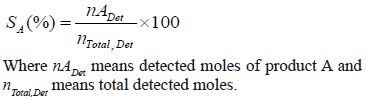
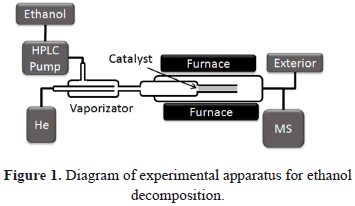
<body><![CDATA[<p><font size="2" face="Verdana, Arial, Helvetica, sans-serif">Carbon nanotube formation by catalytic methods depends on the size of the metallic particles of the catalysts. Govindaraj et al. &#91;3&#93; reported that with metallic particles as small as 5 nm it is possible to obtain single wall carbon nanotubes (SWCNTs), with metallic particles between 10 nm and 50 nm, it is possible to obtain multiwall carbon nanotubes (MWCNTs) and with metallic particles with diameters larger than 50 nm it is not possible to obtain carbon nanotubes. Large size metallic particles produce &quot;onion&quot; structures where the growth of carbonaceous materials around the metallic particles cause the inhibition of these particles as a place for the growth of carbon nanotubes &#91;3&#93;. However, there are other reports where catalysts with metal particles larger than 50 nm are used to obtain CNTs &#91;4&#93;. In all of these reports it is clear that the size of the metal particles is important for the CNTs growth and for their final properties.</font></p>     <p><font size="2" face="Verdana, Arial, Helvetica, sans-serif">The reduction of some mixed solid oxides such as NiO-MgO, spinels and perovskites, allows the production of a good metallic phase dispersion with a very small particle size &#91;5-7&#93;. As indicated before, low particle size is favorable for the production of CNTs.</font></p>     <p><font size="2" face="Verdana, Arial, Helvetica, sans-serif">In this work, the use of the LaNiO<sub>3</sub> perovskite is evaluated as catalyst precursor for ethanol decomposition at atmospheric pressure. The purpose of this reaction is to capture the carbon present in ethanol as carbon nanotubes and at the same time to produce hydrogen. Carbon nanotubes were purified with different methods and characterized with different analytical technics.</font></p>     <p>&nbsp;</p>     <p><font size="3" face="Verdana, Arial, Helvetica, sans-serif"><b>2. EXPERIMENTAL METHOD</b></font></p>     <p><b><font size="2" face="Verdana, Arial, Helvetica, sans-serif">2.1.  Catalyst preparation</font></b><font size="2" face="Verdana, Arial, Helvetica, sans-serif">    <br>   The perovskite type oxide LaNiO<sub>3</sub> was prepared by the self-combustion method &#91;8&#93;. Glycine (H<sub>2</sub>NCH<sub>2</sub>CO<sub>2</sub>H), used as ignition promoter, was added to an aqueous solution of metal nitrates with the appropriate stoichiometry in order to get a NO<sub>3</sub><sup>-</sup>/NH<sub>2</sub> = 1 ratio. The resulting solution was slowly evaporated until a vitreous green gel was obtained. The gel was heated up to around 250&nbsp;&deg;C, temperature at which the ignition reaction occurs producing a powdered precursor which still contains carbon residues. Calcination at 700&nbsp;&deg;C for 8 h eliminates all of the remaining carbon and leads to the formation of the perovskite structure.</font></p>     <p><font size="2" face="Verdana, Arial, Helvetica, sans-serif"><b>2.2.  Ethanol decomposition reaction</b>    <br>   <a href="#fig01">Figure 1</a> shows the schematic diagram of the reaction system used in the decomposition experiments. The reaction was carried out in a horizontal reactor (22 mm internal diameter) in order to avoid pressure variations during the CNT formation. About 50 mg of the catalyst was placed in the reactor and pre-reduced with pure hydrogen (30 mL&middot;min<sup>-1</sup>) at 700 &deg;C for 1 h. The reduced form of the perovskite was Ni/La<sub>2</sub>O<sub>3</sub> which is the catalyst for the ethanol decomposition. After purging the catalyst with He, about 0.04 mL&middot;min<sup>-1</sup> of absolute ethanol was fed to an evaporator using an HPLC pump. Ethanol was evaporated at 120 &deg;C before it came in contact with the catalyst. The ethanol vapor was transported into the reactor using He as a carrier gas at different concentrations (2.6 %, 5 % and 50 % of ethanol in He) and at different total flows (10 mL&times;min<sup>-1</sup>, 25 mL&times;min<sup>-1</sup> and 50 mL&times;min<sup>-1</sup>). The decomposition reactions were performed at 700&nbsp;&deg;C.</font></p>     <p align="center"><font size="2" face="Verdana, Arial, Helvetica, sans-serif"><a name="fig01"></a></font><img src="/img/revistas/dyna/v80n178/v80n178a10fig01.gif"></p>     ]]></body>
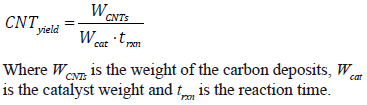
<body><![CDATA[<p><font size="2" face="Verdana, Arial, Helvetica, sans-serif">The gaseous reaction products were analyzed by an on-line mass spectrometer.</font></p>     <p><font size="2" face="Verdana, Arial, Helvetica, sans-serif">Product selectivity SA was defined as follows:</font></p>     <p><font size="2" face="Verdana, Arial, Helvetica, sans-serif"><img src="/img/revistas/dyna/v80n178/v80n178a10eq001.gif"></font></p>     <p><font size="2" face="Verdana, Arial, Helvetica, sans-serif">The carbon yield was calculated according to the following equation:</font></p>     <p><font size="2" face="Verdana, Arial, Helvetica, sans-serif"><img src="/img/revistas/dyna/v80n178/v80n178a10eq002.gif"></font></p>     <p><font size="2" face="Verdana, Arial, Helvetica, sans-serif"><b>2.3.  Purification treatment of carbon nanotubes</b>    <br>   The obtained carbonaceous materials were purified by an oxidative methodology. First, an acid treatment was carried out in order to eliminate inorganic components. CNT were treated with 65 % HNO<sub>3</sub>. A sample of 100 mg of CNT was dispersed in 50 mL of acid. The mixture was magnetically stirred for 1 h at 25 &deg;C. The product was filtered using a 0.45 <font face="Symbol">m</font>m pore diameter cellulose-ester filter, then washed with deionized water until a neutral pH was obtained. The residue was dried at 100 &deg;C for 24 h, and the CNT weight was determined. The CNT sample  obtained as a result was treated with a hydrogen-peroxide solution (10 %) in order to eliminate the amorphous carbon material.</font></p>     <p><font size="2" face="Verdana, Arial, Helvetica, sans-serif"><b>2.4.  Thermogravimetric analysis</b>    <br>   Thermogravimetric analysis (TGA) of CNTs was carried out in a TA Instruments 2950. Samples were placed in a platinum pan in quantities of 5 mg to 8 mg and heated at 15&nbsp;&deg;C&times;min<sup>-1</sup>, using a high resolution method with resolution 6 and sensitivity 4 &#91;9&#93;, from room temperature up to 900 &deg;C under 60 mL&times;min<sup>-1</sup> of air.</font></p>     <p><font size="2" face="Verdana, Arial, Helvetica, sans-serif">Scanning Electron Microscopy was carried out using a JEOL JSM 840. The sample was deposited on a graphite tape and coated with a nano-film of cadmium-gold.</font></p>     ]]></body>
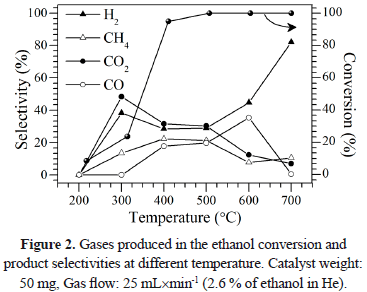
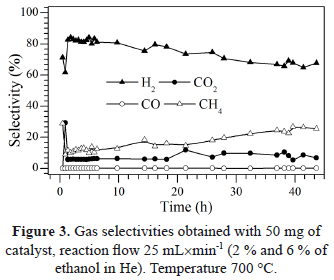
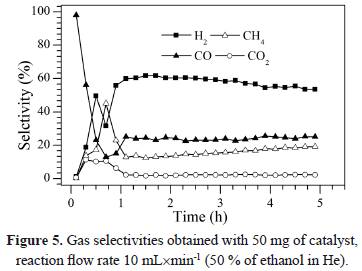
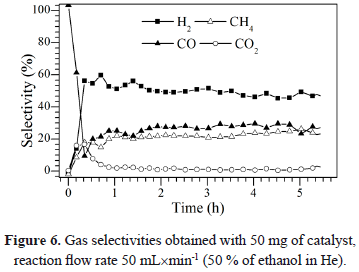
<body><![CDATA[<p><font size="2" face="Verdana, Arial, Helvetica, sans-serif">High-resolution transmission electron microscopy (HR-TEM) was carried out using a JEOL 2100UHR instrument with a LaB<sub>6</sub> filament, at a 200kV accelerating voltage. HR-TEM images of deposited carbon were taken after acid treatment of the sample. The sample was crushed and dispersed in isopropanol. A drop of this solution was deposited on a Cu grid for TEM observations.</font></p>     <p>&nbsp;</p>     <p><font size="3" face="Verdana, Arial, Helvetica, sans-serif"><b>3. RESULTS</b></font></p>     <p><b><font size="2" face="Verdana, Arial, Helvetica, sans-serif">3.1.  Catalyst characterization</font></b><font size="2" face="Verdana, Arial, Helvetica, sans-serif">    <br>   Previous papers have reported that the self-combustion method leads to the formation of LaNiO<sub>3</sub> perovskite structure after calcination at 700 &deg;C in air &#91;6, 10-12&#93;. </font></p>     <p><font size="2" face="Verdana, Arial, Helvetica, sans-serif">In-situ XRD and TPR measurement indicates that after the reduction treatment under hydrogen at 700 &deg;C, LaNiO<sub>3</sub> perovskite structure was completely destroyed, the only phases detected being Ni&deg; and La<sub>2</sub>O<sub>3</sub>. Complete reduction of LaNiO<sub>3</sub> takes place around 600 &deg;C &#91;12, 13&#93;.</font></p>     <p><font size="2" face="Verdana, Arial, Helvetica, sans-serif">Analysis of the TEM micrographs of the reduced LaNiO<sub>3</sub> show that the nickel particles have a size distribution between 2 nm and 50 nm. The average particle size is around 15 nm &#91;10&#93;. This result  suggests that the rare earth oxide La<sub>2</sub>O<sub>3</sub>, can prevent agglomerations of the transition metal and promotes the dispersion of Ni particles at nano-scale, which has been reported as a very advantageous condition for CNT growth &#91;14&#93;.</font></p>     <p><font size="2" face="Verdana, Arial, Helvetica, sans-serif"><b>3.2.  Ethanol decomposition reaction</b>    <br>   The results of ethanol conversion and products selectivity at different temperatures using Ni&deg;/La<sub>2</sub>O<sub>3</sub> catalyst are presented in <a href="#fig02">Figure 2</a>. Ethanol catalytic decomposition at 400 &deg;C is very high, near to 100 % conversion. This temperature is much lower than the one required for thermal ethanol activation (700 &deg;C). In the same figure it is also shown that hydrogen production is a maximum when the reaction was performed between 600 &deg;C and 700 &deg;C, with selectivities of 78 % y 81 % respectively.</font></p>     <p align="center"><font size="2" face="Verdana, Arial, Helvetica, sans-serif"><a name="fig02"></a></font><img src="/img/revistas/dyna/v80n178/v80n178a10fig02.gif"></p>     ]]></body>
<body><![CDATA[<p><font size="2" face="Verdana, Arial, Helvetica, sans-serif">The effect on the conversion, hydrogen selectivity and carbon nanotubes production was studied at different ethanol concentrations and total flow of reactants. </font></p>     <p><font size="2" face="Verdana, Arial, Helvetica, sans-serif"><a href="#fig03">Figures 3</a> and <a href="#fig04">4</a> display the results of product selectivities at different ethanol compositions (2 %, 5 % and 6 %) at constant flow rates. <a href="#fig04">Figures 4</a> and <a href="#fig05">5</a> show the effect of changing flow rates (10 mL&middot;min<sup>-1</sup> and 50 mL&middot;min<sup>-1</sup>) at constant ethanol concentration.</font></p>     <p align="center"><font size="2" face="Verdana, Arial, Helvetica, sans-serif"><a name="fig03"></a></font><img src="/img/revistas/dyna/v80n178/v80n178a10fig03.gif"></p>     <p align="center"><font size="2" face="Verdana, Arial, Helvetica, sans-serif"><a name="fig04"></a></font><img src="/img/revistas/dyna/v80n178/v80n178a10fig04.gif"></p>     <p align="center"><font size="2" face="Verdana, Arial, Helvetica, sans-serif"><a name="fig05"></a></font><img src="/img/revistas/dyna/v80n178/v80n178a10fig05.gif"></p>     <p><font size="2" face="Verdana, Arial, Helvetica, sans-serif"><a href="#fig03">Figures 3</a> and <a href="#fig04">4</a>, show that changes in ethanol concentration modify the selectivities of products. When ethanol concentrations of 2 % and 6 % are used, the production of CO<sub>2</sub> and CO is elevated. This result suggests that catalyst participate in the CO<sub>2</sub> production since the selectivity values are the opposite of those obtained in thermal decomposition. &#91;15&#93;.</font></p>     <p><font size="2" face="Verdana, Arial, Helvetica, sans-serif">The catalyst can promote the disproportion reaction of CO (eq. 1).</font></p>     <p><font size="2" face="Verdana, Arial, Helvetica, sans-serif"><img src="/img/revistas/dyna/v80n178/v80n178a10eq01.gif"></font></p>     <p><font size="2" face="Verdana, Arial, Helvetica, sans-serif">Methane selectivity does not vary with changes in the percentage of ethanol, but the hydrogen selectivity decreases with increasing ethanol concentration. This observation indicates that hydrogen can be used to form other products such as hydrocarbons or oxygenated organic compounds which were evidenced by mass spectrometry but were impossible to be quantified due to the low concentrations. Among the compounds identified were acetaldehyde, formaldehyde, ethane and ethylene.</font></p>     <p><font size="2" face="Verdana, Arial, Helvetica, sans-serif">When a reaction flux of 50 mL&times;min<sup>-1</sup> was used, no important differences of the selectivities were observed.  For the reaction performed at 10 mL&middot;min<sup>-1</sup>, <a href="#fig04">Figure 4</a> shows that the initial selectivity of methane is 10 % but that a deactivation during the reaction was observed, increasing the methane selectivity to 20 %.</font></p>     ]]></body>
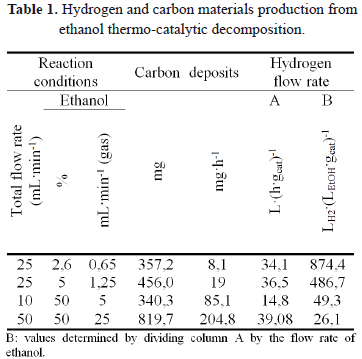
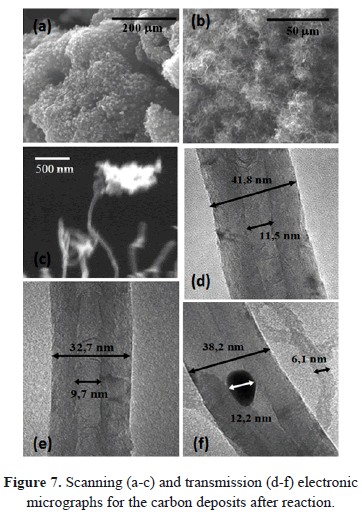
<body><![CDATA[<p><font size="2" face="Verdana, Arial, Helvetica, sans-serif">As shown in <a href="#fig05">Figures 5</a> and <a href="#fig06">6</a> there is a tendency to increase the selectivity to hydrogen when the methane selectivity is lower. This behavior suggests that in the reaction mechanism, much of carbonaceous deposits (CNTs) are produced according to the reaction of cracking of methane (Eq. 2)</font></p>     <p><font size="2" face="Verdana, Arial, Helvetica, sans-serif"><img src="/img/revistas/dyna/v80n178/v80n178a10eq02.gif"></font></p>     <p align="center"><font size="2" face="Verdana, Arial, Helvetica, sans-serif"><a name="fig06"></a></font><img src="/img/revistas/dyna/v80n178/v80n178a10fig06.gif"></p>     <p><font size="2" face="Verdana, Arial, Helvetica, sans-serif"><a href="#tab01">Table 1</a> shows that the production of hydrogen and carbon material for each one of the above conditions is proportional to the amount of ethanol introduced. This behavior suggests that the reaction can be used as a process for carbon sequestration. The results show that the selectivity toward carbon deposition is independent of the flow of ethanol.</font></p>     <p align="center"><font size="2" face="Verdana, Arial, Helvetica, sans-serif"><a name="tab01"></a></font><img src="/img/revistas/dyna/v80n178/v80n178a10tab01.gif"></p>     <p><font size="2" face="Verdana, Arial, Helvetica, sans-serif"><a href="#tab01">Table 1</a> shows that selectivity towards hydrogen decreases with increasing the ethanol flow, while the amount of carbon deposits increases, suggesting that the mechanisms of cracking of hydrogenated species is affected by the amount of ethanol per unit of time and the amount of the catalyst in the reactor. One possible reason is that carbon deposits inhib7/it the catalytic&iquest;reaction that leads to hydrogen production.</font></p>     <p><font size="2" face="Verdana, Arial, Helvetica, sans-serif"><b>3.3.  Characterization of carbon deposits by SEM and TEM.</b>    <br>   <a href="#fig07">Figure 7a-c</a> shows the electron micrographs for carbon deposits obtained after the reaction. These SEM micrographs show clear evidence of the formation of filaments, which may be carbon nanotubes or carbon nanofibers. Additionally, there are some small agglomerates which can be attributed to amorphous carbon (<a href="#fig07">Figure 7c</a>).</font></p>     <p align="center"><font size="2" face="Verdana, Arial, Helvetica, sans-serif"><a name="fig07"></a></font><img src="/img/revistas/dyna/v80n178/v80n178a10fig07.gif"></p>     <p><font size="2" face="Verdana, Arial, Helvetica, sans-serif">The nature of the carbon deposits was verified using transmission electron microscopy. In <a href="#fig07">Figure 7d-f</a> multi-wall carbon nanotubes with outer diameters ranging from 6 nm to 75 nm and inner diameter from 4 nm to 12 nm can be distinguished. Also encapsulated metal particles inside the carbon nanotubes are observed. This has already been reported and it is probably due to the CNT's growing mechanism &#91;1&#93;.</font></p>     ]]></body>

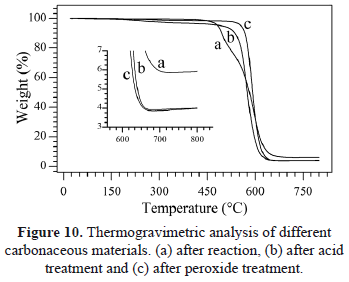
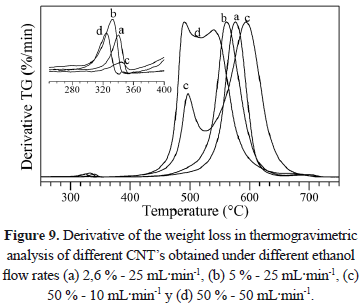
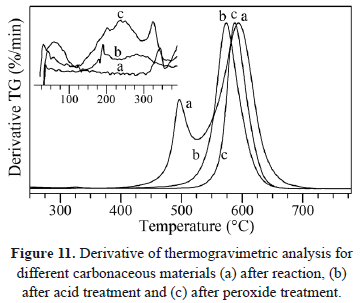
<body><![CDATA[<p><font size="2" face="Verdana, Arial, Helvetica, sans-serif"><a href="#fig08">Figure 8</a> shows the diameter distribution of carbon nanotubes, nickel particle size distribution and the number of walls of carbon nanotubes determined from TEM micrographs.</font></p>     <p align="center"><font size="2" face="Verdana, Arial, Helvetica, sans-serif"><a name="fig08"></a></font><img src="/img/revistas/dyna/v80n178/v80n178a10fig08.gif"></p>     <p><font size="2" face="Verdana, Arial, Helvetica, sans-serif">The internal diameter of carbon nanotubes is about 25 % lower than the size of the metallic particles, which agrees with the proposed growth mechanisms for these materials &#91;15&#93;.</font></p>     <p><font size="2" face="Verdana, Arial, Helvetica, sans-serif">It is also observed that there is no connection between the outer diameter of the carbon nanotubes and the metallic particles size or the inner diameter of the nanotubes. This suggests that the outer diameter is more related to the experimental reaction conditions than to the metallic particle size. In some cases, the catalyst derived from LaNO<sub>3</sub> perovskite can generate CNTs with an outer diameter of 75 nm. The average nickel particle size is close to 12 nm while the outer diameter of the carbon nanotubes is much higher.  The TEM data indicates that CNT can be formed up to about six times the particle size of Ni. This is a very long range induction effect of the Ni particles which does not have a clear explanation at the moment.</font></p>     <p><font size="2" face="Verdana, Arial, Helvetica, sans-serif"><b>3.4.  TGA characterization of carbon nanotubes.</b>    <br>   As reported in the literature, carbon nanotubes have a higher oxidation temperature than amorphous carbon &#91;13&#93;, which can be evidenced by thermogravimetric analysis. <a href="#fig09">Figure 9</a> displays the thermograms which show that the increase of the ethanol flow rate increases the production of amorphous carbon. The above affirmation is supported by the thermal events observed at low temperatures (400 &deg;C - 520 &deg;C). The production of this amorphous carbon may be due to a saturation of active sites where carbon nanotubes are formed.</font></p>     <p align="center"><font size="2" face="Verdana, Arial, Helvetica, sans-serif"><a name="fig09" id="fig09"></a></font><img src="/img/revistas/dyna/v80n178/v80n178a10fig09.gif"></p>     <p><font size="2" face="Verdana, Arial, Helvetica, sans-serif">In a previous investigation &#91;15&#93;, it was shown that the carbon nanotube characteristics vary upon changing the carbon precursor, between ethanol and ethanol thermal decomposition products (CH<sub>4</sub>, CO, H<sub>2</sub>, C2). The amorphous material content also changes, showing that the different precursors generate different adsorbed species over the catalyst surface. This effect can be observed as well with the change in the ethanol concentrations. At high concentrations of ethanol there will be a saturation of the active sites with carbon atoms, generating other adsorbed species. Those species can be precursors of the amorphous materials. Kura et al. have reported that over nickel particles with a higher diameters (around 100 nm) a polymerization of -CH3 -CH<sub>2</sub> and -CH species can take place in order to obtain amorphous materials during the hydrogen assisted methane decomposition &#91;16&#93;.</font></p>     <p><font size="2" face="Verdana, Arial, Helvetica, sans-serif">In addition, the change in the flow rate of ethanol affected the magnitude of the low-temperature events, which have been  attributed  to the oxidation of CH<sub>X</sub> species. These CH<sub>X</sub> species are presented in both carbon nanotubes and the amorphous material &#91;5&#93;.</font></p>     <p><font size="2" face="Verdana, Arial, Helvetica, sans-serif">The purification process of carbon nanotubes was performed on materials with a significant content of amorphous carbon (c). <a href="#fig10">Figures 10</a> and <a href="#fig11">11</a>, display the thermograms for the materials after reaction, after purification with nitric acid and after purification with H<sub>2</sub>O<sub>2</sub>.</font></p>     ]]></body>
<body><![CDATA[<p align="center"><font size="2" face="Verdana, Arial, Helvetica, sans-serif"><a name="fig10"></a></font><img src="/img/revistas/dyna/v80n178/v80n178a10fig10.gif"></p>     <p align="center"><font size="2" face="Verdana, Arial, Helvetica, sans-serif"><a name="fig11"></a></font><img src="/img/revistas/dyna/v80n178/v80n178a10fig11.gif"></p>     <p><font size="2" face="Verdana, Arial, Helvetica, sans-serif">The residue found after complete oxidation of carbon species is about 4.0 % wt of the original sample. This residue after oxidation is just NiO, coming from the Ni particles encapsulated inside the carbon nanotubes. It was also noted that the residue (remaining catalyst) only decreases with acid treatment, which is in agreement with the fact the hydrogen peroxide only oxidizes organic materials.</font></p>     <p><font size="2" face="Verdana, Arial, Helvetica, sans-serif"><a href="#fig11">Figure 11</a> shows how after acid treatment the oxidation signal for the amorphous material decreases significantly. This  result shows that the acid is capable of oxidizing these structures as reported in the literature &#91;9&#93;.</font></p>     <p><font size="2" face="Verdana, Arial, Helvetica, sans-serif">The initial weight loss between 100 &deg;C and 400&nbsp;&deg;C for purified material, is attributed to the elimination of functional groups such as hydroxyl, carboxyl, nitro and others that can be placed on the nanotubes by acid treatments &#91;17&#93;.</font></p>     <p><font size="2" face="Verdana, Arial, Helvetica, sans-serif">The temperature of oxidation of CNTs is around 620 &deg;C and the purity is estimated over 96 %.</font></p>     <p>&nbsp;</p>     <p><font size="3" face="Verdana, Arial, Helvetica, sans-serif"><b>4. CONCLUSIONS</b></font></p>     <p><font size="2" face="Verdana, Arial, Helvetica, sans-serif">This catalyst has a high activity for ethanol decomposition to produce carbon nanotubes and hydrogen. The yields of CNT and H<sub>2</sub> were 3.5 g<sub>CNT</sub>·(g<sub>cat</sub>·h)<sup>-1</sup> and 39 L<sub>H2</sub>·(g<sub>cat</sub>·h)<sup>-1</sup> at 700 &deg;C and 50 mL&middot;min<sup>-1</sup> of ethanol in He (50 % - v/v).</font></p>     <p><font size="2" face="Verdana, Arial, Helvetica, sans-serif">TEM micrographs show that CNTs were multi-walled, with inner diameters ranging from 3 nm to 12 nm and outer diameter up to about 75 nm and several microns in length.</font></p>     ]]></body>
<body><![CDATA[<p><font size="2" face="Verdana, Arial, Helvetica, sans-serif">The inner diameter of carbon nanotubes is proportional to the metallic particle size whereas the outer diameter is related to the experimental reaction conditions.</font></p>     <p><font size="2" face="Verdana, Arial, Helvetica, sans-serif">The CNTs oxidation temperature is around 620 &deg;C which is an indication of the high purity of this material, estimated to be over 96 %.</font></p>     <p>&nbsp;</p>     <p><font size="3" face="Verdana, Arial, Helvetica, sans-serif"><b>5.  ACKNOWLEDGEMENTS</b></font></p>     <p><font size="2" face="Verdana, Arial, Helvetica, sans-serif">The authors are grateful to the ECOS-Nord/Colciencias program for the financial support given. F. Mondragon, J. Gallego and G. Sierra acknowledge the University of Antioquia for the financial support of the &quot;Sostenibilidad&quot; Program 2013-2014. J. Gallego C. Daza and G. Sierra would like to thank Colciencias and the University of Antioquia (JG and GS) for the PhD scholarship.</font></p>     <p>&nbsp;</p>     <p><font size="3" face="Verdana, Arial, Helvetica, sans-serif"><b>REFERENCES</b></font></p>     <!-- ref --><p><font size="2" face="Verdana, Arial, Helvetica, sans-serif"><b>&#91;1&#93;</b> De Jong, K. P. and Geus, J. W., Carbon Nanofibers: Catalytic Synthesis and Applications, Cat. Rev. - Sci. Eng., 42, pp. 481-510, 2000.    &nbsp;&nbsp;&nbsp;&nbsp;&nbsp;&nbsp;&nbsp;&nbsp;[&#160;<a href="javascript:void(0);" onclick="javascript: window.open('/scielo.php?script=sci_nlinks&ref=000110&pid=S0012-7353201300020001000001&lng=','','width=640,height=500,resizable=yes,scrollbars=1,menubar=yes,');">Links</a>&#160;]<!-- end-ref --><!-- ref --><br>   <b>&#91;2&#93;</b> Harris, P. J. F., Solid state growth mechanisms for carbon nanotubes, Carbon, 45, pp. 229-239, 2007.    &nbsp;&nbsp;&nbsp;&nbsp;&nbsp;&nbsp;&nbsp;&nbsp;[&#160;<a href="javascript:void(0);" onclick="javascript: window.open('/scielo.php?script=sci_nlinks&ref=000111&pid=S0012-7353201300020001000002&lng=','','width=640,height=500,resizable=yes,scrollbars=1,menubar=yes,');">Links</a>&#160;]<!-- end-ref --><!-- ref --><br>   <b>&#91;3&#93;</b> Govindaraj, A. and Rao, C. N. R., Synthesis, growth mechanism and processing of carbon nanotubes. En: Carbon Nanotechnology (Eds: Dai L), Elsevier, pp. 15-51, 2006.    &nbsp;&nbsp;&nbsp;&nbsp;&nbsp;&nbsp;&nbsp;&nbsp;[&#160;<a href="javascript:void(0);" onclick="javascript: window.open('/scielo.php?script=sci_nlinks&ref=000112&pid=S0012-7353201300020001000003&lng=','','width=640,height=500,resizable=yes,scrollbars=1,menubar=yes,');">Links</a>&#160;]<!-- end-ref --><!-- ref --><br>   <b>&#91;4&#93;</b> Moshkalev, S. A. and Verissimo, C., Nucleation and growth of carbon nanotubes in catalytic chemical vapor deposition, J. Appl. Phys., 102, pp. 4773-4782, 2007.    &nbsp;&nbsp;&nbsp;&nbsp;&nbsp;&nbsp;&nbsp;&nbsp;[&#160;<a href="javascript:void(0);" onclick="javascript: window.open('/scielo.php?script=sci_nlinks&ref=000113&pid=S0012-7353201300020001000004&lng=','','width=640,height=500,resizable=yes,scrollbars=1,menubar=yes,');">Links</a>&#160;]<!-- end-ref --><!-- ref --><br>   <b>&#91;5&#93;</b> Djaidja, A., Libs, S., Kiennemann, A. and Barama, A., Characterization and activity in dry reforming of methane on NiMg/Al and Ni/MgO catalysts, Catal. Today, 113, pp. 194-200, 2006.    &nbsp;&nbsp;&nbsp;&nbsp;&nbsp;&nbsp;&nbsp;&nbsp;[&#160;<a href="javascript:void(0);" onclick="javascript: window.open('/scielo.php?script=sci_nlinks&ref=000114&pid=S0012-7353201300020001000005&lng=','','width=640,height=500,resizable=yes,scrollbars=1,menubar=yes,');">Links</a>&#160;]<!-- end-ref --><!-- ref --><br>   <b>&#91;6&#93;</b> Sierra, G., Batiot-Dupeyrat, C., Barrault, J., Florez, E. and Mondrag&oacute;n, F., Dry reforming of methane over LaNi1-yByO<sub>3</sub>±d (B = Mg, Co) perovskites used as catalyst precursor, Appl. Catal.,A: General, 334, pp. 251-258, 2008.    &nbsp;&nbsp;&nbsp;&nbsp;&nbsp;&nbsp;&nbsp;&nbsp;[&#160;<a href="javascript:void(0);" onclick="javascript: window.open('/scielo.php?script=sci_nlinks&ref=000115&pid=S0012-7353201300020001000006&lng=','','width=640,height=500,resizable=yes,scrollbars=1,menubar=yes,');">Links</a>&#160;]<!-- end-ref --><!-- ref --><br>   <b>&#91;7&#93;</b> Sierra, G., Batiot-Dupeyrat, C. and Mondrag&oacute;n, F., Methane partial oxidation by the lattice oxygen of the LaNiO<sub>3</sub>-d perovskite. A pulse study, DYNA, 163, pp. 141-150, 2010.    &nbsp;&nbsp;&nbsp;&nbsp;&nbsp;&nbsp;&nbsp;&nbsp;[&#160;<a href="javascript:void(0);" onclick="javascript: window.open('/scielo.php?script=sci_nlinks&ref=000116&pid=S0012-7353201300020001000007&lng=','','width=640,height=500,resizable=yes,scrollbars=1,menubar=yes,');">Links</a>&#160;]<!-- end-ref --><!-- ref --><br>   <b>&#91;8&#93;</b> Chick, L. A., Pederson, L. R., Maupin, G. D., Bates, J. L., Thomas, L. E. AND Exarhos, G. J., Glycine-nitrate combustion synthesis of oxide ceramic powders, Mater. Lett., 10, pp. 6-12, 1990.    &nbsp;&nbsp;&nbsp;&nbsp;&nbsp;&nbsp;&nbsp;&nbsp;[&#160;<a href="javascript:void(0);" onclick="javascript: window.open('/scielo.php?script=sci_nlinks&ref=000117&pid=S0012-7353201300020001000008&lng=','','width=640,height=500,resizable=yes,scrollbars=1,menubar=yes,');">Links</a>&#160;]<!-- end-ref --><!-- ref --><br>   <b>&#91;9&#93;</b> Musumeci, A. W., Silva, G. G., Martens, W. N., Waclawik, E. R. and Frost, R. L., Thermal decomposition and electron microscopy studies of single-walled carbon nanotubes, J. Therm. Anal. Calorim., 88, pp. 885-891, 2007.    &nbsp;&nbsp;&nbsp;&nbsp;&nbsp;&nbsp;&nbsp;&nbsp;[&#160;<a href="javascript:void(0);" onclick="javascript: window.open('/scielo.php?script=sci_nlinks&ref=000118&pid=S0012-7353201300020001000009&lng=','','width=640,height=500,resizable=yes,scrollbars=1,menubar=yes,');">Links</a>&#160;]<!-- end-ref --><!-- ref --><br>   <b>&#91;10&#93;</b> Sierra, G., Batiot-Dupeyrat, C., Barrault, J. and Mondrag&oacute;n, F., Dual Active-Site Mechanism for Dry Methane Reforming over Ni/La<sub>2</sub>O<sub>3</sub> Produced from LaNiO<sub>3</sub> Perovskite, Ind. Eng. Chem. Res., 47, pp. 9272-9278, 2008.    &nbsp;&nbsp;&nbsp;&nbsp;&nbsp;&nbsp;&nbsp;&nbsp;[&#160;<a href="javascript:void(0);" onclick="javascript: window.open('/scielo.php?script=sci_nlinks&ref=000119&pid=S0012-7353201300020001000010&lng=','','width=640,height=500,resizable=yes,scrollbars=1,menubar=yes,');">Links</a>&#160;]<!-- end-ref --><!-- ref --><br>   <b>&#91;11&#93;</b> Sierra, G., Mondrag&oacute;n, F., Barrault, J., Tatibou&euml;t, J.-M. and Batiot-Dupeyrat, C., CO<sub>2</sub> reforming of CH<sub>4</sub> over La-Ni based perovskite precursors, Appl. Catal.,A: General, 311, pp. 164-171, 2006.    &nbsp;&nbsp;&nbsp;&nbsp;&nbsp;&nbsp;&nbsp;&nbsp;[&#160;<a href="javascript:void(0);" onclick="javascript: window.open('/scielo.php?script=sci_nlinks&ref=000120&pid=S0012-7353201300020001000011&lng=','','width=640,height=500,resizable=yes,scrollbars=1,menubar=yes,');">Links</a>&#160;]<!-- end-ref --><!-- ref --><br>   <b>&#91;12&#93;</b> Sierra, G., Mondrag&oacute;n, F., Tatibou&euml;t, J.-M., Barrault, J. and Batiot-Dupeyrat, C., Carbon dioxide reforming of methane over La<sub>2</sub>NiO<sub>4</sub> as catalyst precursor--Characterization of carbon deposition, Catal. Today, 133-135, pp. 200-209, 2008.    &nbsp;&nbsp;&nbsp;&nbsp;&nbsp;&nbsp;&nbsp;&nbsp;[&#160;<a href="javascript:void(0);" onclick="javascript: window.open('/scielo.php?script=sci_nlinks&ref=000121&pid=S0012-7353201300020001000012&lng=','','width=640,height=500,resizable=yes,scrollbars=1,menubar=yes,');">Links</a>&#160;]<!-- end-ref --><!-- ref --><br>   <b>&#91;13&#93;</b> De Lima, S., Pe&ntilde;a, M., Fierro, J. and Assaf, J., La1-xCaxNiO<sub>3</sub> Perovskite Oxides: Characterization and Catalytic Reactivity in Dry Reforming of Methane, Catal. Lett., 124, pp. 195-203, 2008.    &nbsp;&nbsp;&nbsp;&nbsp;&nbsp;&nbsp;&nbsp;&nbsp;[&#160;<a href="javascript:void(0);" onclick="javascript: window.open('/scielo.php?script=sci_nlinks&ref=000122&pid=S0012-7353201300020001000013&lng=','','width=640,height=500,resizable=yes,scrollbars=1,menubar=yes,');">Links</a>&#160;]<!-- end-ref --><!-- ref --><br>   <b>&#91;14&#93;</b> Pan, Z. W., Xie, S. S., Chang, B. H., Sun, L. F., Zhou, W. Y. and Wang, G., Direct growth of aligned open carbon nanotubes by chemical vapor deposition, Chem. Phys. Lett., 299, pp. 97-102, 1999.    &nbsp;&nbsp;&nbsp;&nbsp;&nbsp;&nbsp;&nbsp;&nbsp;[&#160;<a href="javascript:void(0);" onclick="javascript: window.open('/scielo.php?script=sci_nlinks&ref=000123&pid=S0012-7353201300020001000014&lng=','','width=640,height=500,resizable=yes,scrollbars=1,menubar=yes,');">Links</a>&#160;]<!-- end-ref --><!-- ref --><br>   <b>&#91;15&#93;</b> Gallego, J., Sierra, G., Mondragon, F., Barrault, J. and Batiot-Dupeyrat, C., Synthesis of MWCNTs and hydrogen from ethanol catalytic decomposition over a Ni/La<sub>2</sub>O<sub>3</sub> catalyst produced by the reduction of LaNiO<sub>3</sub>, Appl. Catal.,A: General, 397, pp. 73-81, 2011.    &nbsp;&nbsp;&nbsp;&nbsp;&nbsp;&nbsp;&nbsp;&nbsp;[&#160;<a href="javascript:void(0);" onclick="javascript: window.open('/scielo.php?script=sci_nlinks&ref=000124&pid=S0012-7353201300020001000015&lng=','','width=640,height=500,resizable=yes,scrollbars=1,menubar=yes,');">Links</a>&#160;]<!-- end-ref --><!-- ref --><br>   <b>&#91;16&#93;</b> Kuras, M., Petit, P. and Petit, C., Correlation between the characteristics of multi-wall carbon nanotubes and the structure of the metal oxides used as catalytic precursors for their production, Carbon, 49, pp. 1453-1461, 2011.    &nbsp;&nbsp;&nbsp;&nbsp;&nbsp;&nbsp;&nbsp;&nbsp;[&#160;<a href="javascript:void(0);" onclick="javascript: window.open('/scielo.php?script=sci_nlinks&ref=000125&pid=S0012-7353201300020001000016&lng=','','width=640,height=500,resizable=yes,scrollbars=1,menubar=yes,');">Links</a>&#160;]<!-- end-ref --><!-- ref --><br>   <b>&#91;17&#93;</b> Porro, S., Musso, S., Vinante, M., Vanzetti, L., Anderle, M., Trotta, F. and Tagliaferro, A., Purification of carbon nanotubes grown by thermal CVD, Physica E, 37, pp. 58-61, 2007.    &nbsp;&nbsp;&nbsp;&nbsp;&nbsp;&nbsp;&nbsp;&nbsp;[&#160;<a href="javascript:void(0);" onclick="javascript: window.open('/scielo.php?script=sci_nlinks&ref=000126&pid=S0012-7353201300020001000017&lng=','','width=640,height=500,resizable=yes,scrollbars=1,menubar=yes,');">Links</a>&#160;]<!-- end-ref --><br>   </font></p>      ]]></body><back>
<ref-list>
<ref id="B1">
<label>1</label><nlm-citation citation-type="journal">
<person-group person-group-type="author">
<name>
<surname><![CDATA[De Jong]]></surname>
<given-names><![CDATA[K. P.]]></given-names>
</name>
<name>
<surname><![CDATA[Geus]]></surname>
<given-names><![CDATA[J. W.]]></given-names>
</name>
</person-group>
<article-title xml:lang="en"><![CDATA[Carbon Nanofibers: Catalytic Synthesis and Applications]]></article-title>
<source><![CDATA[Cat. Rev. - Sci. Eng.]]></source>
<year>2000</year>
<numero>42</numero>
<issue>42</issue>
<page-range>481-510</page-range></nlm-citation>
</ref>
<ref id="B2">
<label>2</label><nlm-citation citation-type="journal">
<person-group person-group-type="author">
<name>
<surname><![CDATA[Harris]]></surname>
<given-names><![CDATA[P. J. F.]]></given-names>
</name>
</person-group>
<article-title xml:lang="en"><![CDATA[Solid state growth mechanisms for carbon nanotubes]]></article-title>
<source><![CDATA[Carbon]]></source>
<year>2007</year>
<numero>45</numero>
<issue>45</issue>
<page-range>229-239</page-range></nlm-citation>
</ref>
<ref id="B3">
<label>3</label><nlm-citation citation-type="book">
<person-group person-group-type="author">
<name>
<surname><![CDATA[Govindaraj]]></surname>
<given-names><![CDATA[A.]]></given-names>
</name>
<name>
<surname><![CDATA[Rao]]></surname>
<given-names><![CDATA[C. N. R.]]></given-names>
</name>
</person-group>
<article-title xml:lang="en"><![CDATA[Synthesis, growth mechanism and processing of carbon nanotubes]]></article-title>
<person-group person-group-type="editor">
<name>
<surname><![CDATA[Dai]]></surname>
<given-names><![CDATA[L]]></given-names>
</name>
</person-group>
<source><![CDATA[Carbon Nanotechnology]]></source>
<year>2006</year>
<page-range>15-51</page-range><publisher-name><![CDATA[Elsevier]]></publisher-name>
</nlm-citation>
</ref>
<ref id="B4">
<label>4</label><nlm-citation citation-type="journal">
<person-group person-group-type="author">
<name>
<surname><![CDATA[Moshkalev]]></surname>
<given-names><![CDATA[S. A.]]></given-names>
</name>
<name>
<surname><![CDATA[Verissimo]]></surname>
<given-names><![CDATA[C.]]></given-names>
</name>
</person-group>
<article-title xml:lang="en"><![CDATA[Nucleation and growth of carbon nanotubes in catalytic chemical vapor deposition]]></article-title>
<source><![CDATA[J. Appl. Phys.]]></source>
<year>2007</year>
<numero>102</numero>
<issue>102</issue>
<page-range>4773-4782</page-range></nlm-citation>
</ref>
<ref id="B5">
<label>5</label><nlm-citation citation-type="journal">
<person-group person-group-type="author">
<name>
<surname><![CDATA[Djaidja]]></surname>
<given-names><![CDATA[A.]]></given-names>
</name>
<name>
<surname><![CDATA[Libs]]></surname>
<given-names><![CDATA[S.]]></given-names>
</name>
<name>
<surname><![CDATA[Kiennemann]]></surname>
<given-names><![CDATA[A.]]></given-names>
</name>
<name>
<surname><![CDATA[Barama]]></surname>
<given-names><![CDATA[A.]]></given-names>
</name>
</person-group>
<article-title xml:lang="en"><![CDATA[Characterization and activity in dry reforming of methane on NiMg/Al and Ni/MgO catalysts]]></article-title>
<source><![CDATA[Catal. Today]]></source>
<year>2006</year>
<numero>113</numero>
<issue>113</issue>
<page-range>194-200</page-range></nlm-citation>
</ref>
<ref id="B6">
<label>6</label><nlm-citation citation-type="journal">
<person-group person-group-type="author">
<name>
<surname><![CDATA[Sierra]]></surname>
<given-names><![CDATA[G.]]></given-names>
</name>
<name>
<surname><![CDATA[Batiot-Dupeyrat]]></surname>
<given-names><![CDATA[C.]]></given-names>
</name>
<name>
<surname><![CDATA[Barrault]]></surname>
<given-names><![CDATA[J.]]></given-names>
</name>
<name>
<surname><![CDATA[Florez]]></surname>
<given-names><![CDATA[E.]]></given-names>
</name>
<name>
<surname><![CDATA[Mondragón]]></surname>
<given-names><![CDATA[F.]]></given-names>
</name>
</person-group>
<article-title xml:lang="en"><![CDATA[Dry reforming of methane over LaNi1-yByO3±d (B = Mg, Co) perovskites used as catalyst precursor]]></article-title>
<source><![CDATA[Appl. Catal.,A: General]]></source>
<year>2008</year>
<numero>334</numero>
<issue>334</issue>
<page-range>251-258</page-range></nlm-citation>
</ref>
<ref id="B7">
<label>7</label><nlm-citation citation-type="journal">
<person-group person-group-type="author">
<name>
<surname><![CDATA[Sierra]]></surname>
<given-names><![CDATA[G.]]></given-names>
</name>
<name>
<surname><![CDATA[Batiot-Dupeyrat]]></surname>
<given-names><![CDATA[C.]]></given-names>
</name>
<name>
<surname><![CDATA[Mondragón]]></surname>
<given-names><![CDATA[F.]]></given-names>
</name>
</person-group>
<article-title xml:lang="en"><![CDATA[Methane partial oxidation by the lattice oxygen of the LaNiO3-d perovskite: A pulse study]]></article-title>
<source><![CDATA[DYNA]]></source>
<year>2010</year>
<numero>163</numero>
<issue>163</issue>
<page-range>141-150</page-range></nlm-citation>
</ref>
<ref id="B8">
<label>8</label><nlm-citation citation-type="journal">
<person-group person-group-type="author">
<name>
<surname><![CDATA[Chick]]></surname>
<given-names><![CDATA[L. A.]]></given-names>
</name>
<name>
<surname><![CDATA[Pederson]]></surname>
<given-names><![CDATA[L. R.]]></given-names>
</name>
<name>
<surname><![CDATA[Maupin]]></surname>
<given-names><![CDATA[G. D.]]></given-names>
</name>
<name>
<surname><![CDATA[Bates]]></surname>
<given-names><![CDATA[J. L.]]></given-names>
</name>
<name>
<surname><![CDATA[Thomas]]></surname>
<given-names><![CDATA[L. E.]]></given-names>
</name>
<name>
<surname><![CDATA[Exarhos]]></surname>
<given-names><![CDATA[G. J.]]></given-names>
</name>
</person-group>
<article-title xml:lang="en"><![CDATA[Glycine-nitrate combustion synthesis of oxide ceramic powders]]></article-title>
<source><![CDATA[Mater. Lett.]]></source>
<year>1990</year>
<numero>10</numero>
<issue>10</issue>
<page-range>6-12</page-range></nlm-citation>
</ref>
<ref id="B9">
<label>9</label><nlm-citation citation-type="journal">
<person-group person-group-type="author">
<name>
<surname><![CDATA[Musumeci]]></surname>
<given-names><![CDATA[A. W.]]></given-names>
</name>
<name>
<surname><![CDATA[Silva]]></surname>
<given-names><![CDATA[G. G.]]></given-names>
</name>
<name>
<surname><![CDATA[Martens]]></surname>
<given-names><![CDATA[W. N.]]></given-names>
</name>
<name>
<surname><![CDATA[Waclawik]]></surname>
<given-names><![CDATA[E. R.]]></given-names>
</name>
<name>
<surname><![CDATA[Frost]]></surname>
<given-names><![CDATA[R. L.]]></given-names>
</name>
</person-group>
<article-title xml:lang="en"><![CDATA[Thermal decomposition and electron microscopy studies of single-walled carbon nanotubes]]></article-title>
<source><![CDATA[J. Therm. Anal. Calorim.]]></source>
<year>2007</year>
<numero>88</numero>
<issue>88</issue>
<page-range>885-891</page-range></nlm-citation>
</ref>
<ref id="B10">
<label>10</label><nlm-citation citation-type="journal">
<person-group person-group-type="author">
<name>
<surname><![CDATA[Sierra]]></surname>
<given-names><![CDATA[G.]]></given-names>
</name>
<name>
<surname><![CDATA[Batiot-Dupeyrat]]></surname>
<given-names><![CDATA[C.]]></given-names>
</name>
<name>
<surname><![CDATA[Barrault]]></surname>
<given-names><![CDATA[J.]]></given-names>
</name>
<name>
<surname><![CDATA[Mondragón]]></surname>
<given-names><![CDATA[F.]]></given-names>
</name>
</person-group>
<article-title xml:lang="en"><![CDATA[Dual Active-Site Mechanism for Dry Methane Reforming over Ni/La2O3 Produced from LaNiO3 Perovskite]]></article-title>
<source><![CDATA[Ind. Eng. Chem. Res.]]></source>
<year>2008</year>
<numero>47</numero>
<issue>47</issue>
<page-range>9272-9278</page-range></nlm-citation>
</ref>
<ref id="B11">
<label>11</label><nlm-citation citation-type="journal">
<person-group person-group-type="author">
<name>
<surname><![CDATA[Sierra]]></surname>
<given-names><![CDATA[G.]]></given-names>
</name>
<name>
<surname><![CDATA[Mondragón]]></surname>
<given-names><![CDATA[F.]]></given-names>
</name>
<name>
<surname><![CDATA[Barrault]]></surname>
<given-names><![CDATA[J.]]></given-names>
</name>
<name>
<surname><![CDATA[Tatibouët]]></surname>
<given-names><![CDATA[J.-M.]]></given-names>
</name>
<name>
<surname><![CDATA[Batiot-Dupeyrat]]></surname>
<given-names><![CDATA[C.]]></given-names>
</name>
</person-group>
<article-title xml:lang="en"><![CDATA[CO2 reforming of CH4 over La-Ni based perovskite precursors]]></article-title>
<source><![CDATA[Appl. Catal.,A: General]]></source>
<year>2006</year>
<numero>311</numero>
<issue>311</issue>
<page-range>164-171</page-range></nlm-citation>
</ref>
<ref id="B12">
<label>12</label><nlm-citation citation-type="journal">
<person-group person-group-type="author">
<name>
<surname><![CDATA[Sierra]]></surname>
<given-names><![CDATA[G.]]></given-names>
</name>
<name>
<surname><![CDATA[Mondragón]]></surname>
<given-names><![CDATA[F.]]></given-names>
</name>
<name>
<surname><![CDATA[Tatibouët]]></surname>
<given-names><![CDATA[J.-M.]]></given-names>
</name>
<name>
<surname><![CDATA[Barrault]]></surname>
<given-names><![CDATA[J.]]></given-names>
</name>
<name>
<surname><![CDATA[Batiot-Dupeyrat]]></surname>
<given-names><![CDATA[C.]]></given-names>
</name>
</person-group>
<article-title xml:lang="en"><![CDATA[Carbon dioxide reforming of methane over La2NiO4 as catalyst precursor: Characterization of carbon deposition]]></article-title>
<source><![CDATA[Catal. Today]]></source>
<year>2008</year>
<numero>133-135</numero>
<issue>133-135</issue>
<page-range>200-209</page-range></nlm-citation>
</ref>
<ref id="B13">
<label>13</label><nlm-citation citation-type="journal">
<person-group person-group-type="author">
<name>
<surname><![CDATA[De Lima]]></surname>
<given-names><![CDATA[S.]]></given-names>
</name>
<name>
<surname><![CDATA[Peña]]></surname>
<given-names><![CDATA[M.]]></given-names>
</name>
<name>
<surname><![CDATA[Fierro]]></surname>
<given-names><![CDATA[J.]]></given-names>
</name>
<name>
<surname><![CDATA[Assaf]]></surname>
<given-names><![CDATA[J.]]></given-names>
</name>
</person-group>
<article-title xml:lang="en"><![CDATA[La1-xCaxNiO3 Perovskite Oxides: Characterization and Catalytic Reactivity in Dry Reforming of Methane]]></article-title>
<source><![CDATA[Catal. Lett.]]></source>
<year>2008</year>
<numero>124</numero>
<issue>124</issue>
<page-range>195-203</page-range></nlm-citation>
</ref>
<ref id="B14">
<label>14</label><nlm-citation citation-type="journal">
<person-group person-group-type="author">
<name>
<surname><![CDATA[Pan]]></surname>
<given-names><![CDATA[Z. W.]]></given-names>
</name>
<name>
<surname><![CDATA[Xie]]></surname>
<given-names><![CDATA[S. S.]]></given-names>
</name>
<name>
<surname><![CDATA[Chang]]></surname>
<given-names><![CDATA[B. H.]]></given-names>
</name>
<name>
<surname><![CDATA[Sun]]></surname>
<given-names><![CDATA[L. F.]]></given-names>
</name>
<name>
<surname><![CDATA[Zhou]]></surname>
<given-names><![CDATA[W. Y.]]></given-names>
</name>
<name>
<surname><![CDATA[Wang]]></surname>
<given-names><![CDATA[G.]]></given-names>
</name>
</person-group>
<article-title xml:lang="en"><![CDATA[Direct growth of aligned open carbon nanotubes by chemical vapor deposition]]></article-title>
<source><![CDATA[Chem. Phys. Lett.]]></source>
<year>1999</year>
<numero>299</numero>
<issue>299</issue>
<page-range>97-102</page-range></nlm-citation>
</ref>
<ref id="B15">
<label>15</label><nlm-citation citation-type="journal">
<person-group person-group-type="author">
<name>
<surname><![CDATA[Gallego]]></surname>
<given-names><![CDATA[J.]]></given-names>
</name>
<name>
<surname><![CDATA[Sierra]]></surname>
<given-names><![CDATA[G.]]></given-names>
</name>
<name>
<surname><![CDATA[Mondragon]]></surname>
<given-names><![CDATA[F.]]></given-names>
</name>
<name>
<surname><![CDATA[Barrault]]></surname>
<given-names><![CDATA[J.]]></given-names>
</name>
<name>
<surname><![CDATA[Batiot-Dupeyrat]]></surname>
<given-names><![CDATA[C.]]></given-names>
</name>
</person-group>
<article-title xml:lang="en"><![CDATA[Synthesis of MWCNTs and hydrogen from ethanol catalytic decomposition over a Ni/La2O3 catalyst produced by the reduction of LaNiO3]]></article-title>
<source><![CDATA[Appl. Catal.,A: General]]></source>
<year>2011</year>
<numero>397</numero>
<issue>397</issue>
<page-range>73-81</page-range></nlm-citation>
</ref>
<ref id="B16">
<label>16</label><nlm-citation citation-type="journal">
<person-group person-group-type="author">
<name>
<surname><![CDATA[Kuras]]></surname>
<given-names><![CDATA[M.]]></given-names>
</name>
<name>
<surname><![CDATA[Petit]]></surname>
<given-names><![CDATA[P.]]></given-names>
</name>
<name>
<surname><![CDATA[Petit]]></surname>
<given-names><![CDATA[C.]]></given-names>
</name>
</person-group>
<article-title xml:lang="en"><![CDATA[Correlation between the characteristics of multi-wall carbon nanotubes and the structure of the metal oxides used as catalytic precursors for their production]]></article-title>
<source><![CDATA[Carbon]]></source>
<year>2011</year>
<numero>49</numero>
<issue>49</issue>
<page-range>1453-1461</page-range></nlm-citation>
</ref>
<ref id="B17">
<label>17</label><nlm-citation citation-type="journal">
<person-group person-group-type="author">
<name>
<surname><![CDATA[Porro]]></surname>
<given-names><![CDATA[S.]]></given-names>
</name>
<name>
<surname><![CDATA[Musso]]></surname>
<given-names><![CDATA[S.]]></given-names>
</name>
<name>
<surname><![CDATA[Vinante]]></surname>
<given-names><![CDATA[M.]]></given-names>
</name>
<name>
<surname><![CDATA[Vanzetti]]></surname>
<given-names><![CDATA[L.]]></given-names>
</name>
<name>
<surname><![CDATA[Anderle]]></surname>
<given-names><![CDATA[M.]]></given-names>
</name>
<name>
<surname><![CDATA[Trotta]]></surname>
<given-names><![CDATA[F.]]></given-names>
</name>
<name>
<surname><![CDATA[Tagliaferro]]></surname>
<given-names><![CDATA[A.]]></given-names>
</name>
</person-group>
<article-title xml:lang="en"><![CDATA[Purification of carbon nanotubes grown by thermal CVD]]></article-title>
<source><![CDATA[Physica E]]></source>
<year>2007</year>
<numero>37</numero>
<issue>37</issue>
<page-range>58-61</page-range></nlm-citation>
</ref>
</ref-list>
</back>
</article>