<?xml version="1.0" encoding="ISO-8859-1"?><article xmlns:mml="http://www.w3.org/1998/Math/MathML" xmlns:xlink="http://www.w3.org/1999/xlink" xmlns:xsi="http://www.w3.org/2001/XMLSchema-instance">
<front>
<journal-meta>
<journal-id>0012-7353</journal-id>
<journal-title><![CDATA[DYNA]]></journal-title>
<abbrev-journal-title><![CDATA[Dyna rev.fac.nac.minas]]></abbrev-journal-title>
<issn>0012-7353</issn>
<publisher>
<publisher-name><![CDATA[Universidad Nacional de Colombia]]></publisher-name>
</publisher>
</journal-meta>
<article-meta>
<article-id>S0012-73532013000200014</article-id>
<title-group>
<article-title xml:lang="en"><![CDATA[MORPHOLOGICAL AND MECHANICAL RESPONSE CHARACTERIZATION OF NANOFIBER AGGREGATES OF PVA PRODUCED BY ELECTROSPINNING SOL-GEL PROCESS]]></article-title>
<article-title xml:lang="es"><![CDATA[CARACTERIZACION MORFOLOGICA Y MECANICA DE NANOFIBRAS AGREGADAS DE PVA PRODUCIDAS POR EL PROCESO DE SOL-GEL ELECTROHILADO]]></article-title>
</title-group>
<contrib-group>
<contrib contrib-type="author">
<name>
<surname><![CDATA[FRANCO MEDINA]]></surname>
<given-names><![CDATA[EDGAR]]></given-names>
</name>
<xref ref-type="aff" rid="A01"/>
</contrib>
<contrib contrib-type="author">
<name>
<surname><![CDATA[DELVASTO ARJONA]]></surname>
<given-names><![CDATA[SILVIO]]></given-names>
</name>
<xref ref-type="aff" rid="A02"/>
</contrib>
<contrib contrib-type="author">
<name>
<surname><![CDATA[ZULUAGA CORRALES]]></surname>
<given-names><![CDATA[FABIO]]></given-names>
</name>
<xref ref-type="aff" rid="A03"/>
</contrib>
<contrib contrib-type="author">
<name>
<surname><![CDATA[AMIGÓ BORRAS]]></surname>
<given-names><![CDATA[VICENTE]]></given-names>
</name>
<xref ref-type="aff" rid="A04"/>
</contrib>
</contrib-group>
<aff id="A01">
<institution><![CDATA[,Universidad del Valle Escuela de Ingeniería de Materiales ]]></institution>
<addr-line><![CDATA[Cali ]]></addr-line>
<country>Colombia</country>
</aff>
<aff id="A02">
<institution><![CDATA[,Universidad del Valle Escuela de Ingeniería de Materiales ]]></institution>
<addr-line><![CDATA[Cali ]]></addr-line>
<country>Colombia</country>
</aff>
<aff id="A03">
<institution><![CDATA[,Universidad del Valle Escuela de Ingeniería de Materiales ]]></institution>
<addr-line><![CDATA[Cali ]]></addr-line>
<country>Colombia</country>
</aff>
<aff id="A04">
<institution><![CDATA[,Universidad Politécnica de Valencia Departamento de Ingeniería Mecánica y de Materiales ]]></institution>
<addr-line><![CDATA[ ]]></addr-line>
<country>España</country>
</aff>
<pub-date pub-type="pub">
<day>00</day>
<month>04</month>
<year>2013</year>
</pub-date>
<pub-date pub-type="epub">
<day>00</day>
<month>04</month>
<year>2013</year>
</pub-date>
<volume>80</volume>
<numero>178</numero>
<fpage>109</fpage>
<lpage>114</lpage>
<copyright-statement/>
<copyright-year/>
<self-uri xlink:href="http://www.scielo.org.co/scielo.php?script=sci_arttext&amp;pid=S0012-73532013000200014&amp;lng=en&amp;nrm=iso"></self-uri><self-uri xlink:href="http://www.scielo.org.co/scielo.php?script=sci_abstract&amp;pid=S0012-73532013000200014&amp;lng=en&amp;nrm=iso"></self-uri><self-uri xlink:href="http://www.scielo.org.co/scielo.php?script=sci_pdf&amp;pid=S0012-73532013000200014&amp;lng=en&amp;nrm=iso"></self-uri><abstract abstract-type="short" xml:lang="en"><p><![CDATA[This work deals with the preparation of poly (vinyl alcohol) solutions composed of a surface active agent, an acid and water. With this solution firstly electrospun nanofiber mats and then nanofiber aggregates were obtained by electrospinning/sol-gel process. The samples were morphologically characterized using scanning electron microscopy (SEM) and Atomic Force Microscopy (AFM), obtaining superficial roughness values, distribution and average diameter before and after the electrospinning/sol-gel process. The PVA nanofiber aggregate reached a maximum strength and a modulus of 90 MPa and 2.55 GPa, respectively. Experimental results show that these fibers have a potential use as secondary reinforcement materials in cementitious composites.]]></p></abstract>
<abstract abstract-type="short" xml:lang="es"><p><![CDATA[En esta investigación se prepararon soluciones de Polivinil alcohol (PVA) dopadas con un agente surfactante, un ácido y agua. Con estas soluciones se electrohilaron en primer lugar, esteras de nanofibras y luego nanofibras agregadas a través del proceso de sol-gel electrohilado. Las muestras obtenidas fueron caracterizadas por microscopía electrónica de barrido (SEM) y microscopia de fuerza atómica (AFM), calculando valores de rugosidad superficial en las fibras, su distribución y diámetro promedio antes y después del proceso de sol-gel electrohilado. Finalmente, se encontró que las nanofibras agregadas de PVA, alcanzaron una resistencia máxima y módulo de 90 MPa y 2,55 GPa, respectivamente. Los resultados experimentales muestran que estas fibras tienen un uso potencial como refuerzo secundario en materiales compuestos cementicios.]]></p></abstract>
<kwd-group>
<kwd lng="en"><![CDATA[Electrospinning]]></kwd>
<kwd lng="en"><![CDATA[poly (Vinyl Alcohol)]]></kwd>
<kwd lng="en"><![CDATA[nanofiber aggregate]]></kwd>
<kwd lng="en"><![CDATA[electrospinning/sol-gel process]]></kwd>
<kwd lng="es"><![CDATA[Electrohilado]]></kwd>
<kwd lng="es"><![CDATA[Polivinil alcohol]]></kwd>
<kwd lng="es"><![CDATA[nanofibras agregadas]]></kwd>
<kwd lng="es"><![CDATA[proceso de sol-gel electrohilado]]></kwd>
</kwd-group>
</article-meta>
</front><body><![CDATA[ <p align="center"><font size="4" face="Verdana, Arial, Helvetica, sans-serif"><b>MORPHOLOGICAL AND MECHANICAL RESPONSE CHARACTERIZATION OF NANOFIBER AGGREGATES OF PVA PRODUCED BY ELECTROSPINNING SOL-GEL PROCESS</b></font></p>     <p align="center"><i><font size="3" face="Verdana, Arial, Helvetica, sans-serif"><b>CARACTERIZACION MORFOLOGICA Y MECANICA DE NANOFIBRAS AGREGADAS DE PVA PRODUCIDAS POR EL PROCESO DE SOL-GEL ELECTROHILADO</b></font></i></p>     <p align="center">&nbsp;</p>     <p align="center"><font size="2" face="Verdana, Arial, Helvetica, sans-serif"><b>EDGAR FRANCO MEDINA</b>    <br>   <i>Ph.D, Escuela de Ingenier&iacute;a de Materiales-Universidad del Valle, Cali, Colombia, <a href="mailto:edgar.franco@correounivalle.edu.co">edgar.franco@correounivalle.edu.co</a></i></font></p>     <p align="center"><font size="2" face="Verdana, Arial, Helvetica, sans-serif"><b>SILVIO DELVASTO ARJONA</b>    <br>   <i>Ph.D, Escuela de Ingenier&iacute;a de Materiales-Universidad del Valle, Cali, Colombia, <a href="mailto:silviodelvasto@hotmail.com">silviodelvasto@hotmail.com</a></i></font></p>     <p align="center"><font size="2" face="Verdana, Arial, Helvetica, sans-serif"><b>FABIO ZULUAGA CORRALES</b>    <br>   <i>Ph.D, Departamento de Qu&iacute;mica-Universidad del Valle, Cali, Colombia, <a href="mailto:hector.zuluaga@correounivalle.edu.co">hector.zuluaga@correounivalle.edu.co</a></i></font></p>     <p align="center"><font size="2" face="Verdana, Arial, Helvetica, sans-serif"><b>VICENTE AMIG&Oacute; BORRAS</b>    ]]></body>
<body><![CDATA[<br>   <i>Ph.D, Departamento de Ingenier&iacute;a Mec&aacute;nica y de Materiales, Universidad Polit&eacute;cnica de Valencia, Espa&ntilde;a, <a href="mailto:vamigo@mcm.upv.es">vamigo@mcm.upv.es</a></i></font></p>     <p align="center">&nbsp;</p>     <p align="center"><font size="2" face="Verdana, Arial, Helvetica, sans-serif"><b>Received for review May 5<sup>th</sup>, 2012, accepted December 14<sup>th</sup>, 2012, final version January, 18<sup>th</sup>, 2013</b></font></p>     <p>&nbsp;</p> <hr>     <p><font size="2" face="Verdana, Arial, Helvetica, sans-serif"><b>ABSTRACT:</b> This work deals with the preparation of poly (vinyl alcohol) solutions composed of a surface active agent, an acid and water. With this solution firstly electrospun nanofiber mats and then nanofiber aggregates were obtained by electrospinning/sol-gel process. The samples were morphologically characterized using scanning electron microscopy (SEM) and Atomic Force Microscopy (AFM), obtaining superficial roughness values, distribution and average diameter before and after the electrospinning/sol-gel process. The PVA nanofiber aggregate reached a maximum strength and a modulus of 90 MPa and 2.55 GPa, respectively. Experimental results show that these fibers have a potential use as secondary reinforcement materials in cementitious composites.</font></p>     <p><font size="2" face="Verdana, Arial, Helvetica, sans-serif"><b>KEYWORDS:</b> Electrospinning, poly (Vinyl Alcohol), nanofiber aggregate, electrospinning/sol-gel process.</font></p>     <p><font size="2" face="Verdana, Arial, Helvetica, sans-serif"><b>RESUMEN:</b> En esta investigaci&oacute;n se prepararon soluciones de Polivinil alcohol (PVA) dopadas con un agente surfactante, un &aacute;cido y agua. Con estas soluciones se electrohilaron en primer lugar, esteras de nanofibras y luego nanofibras agregadas a trav&eacute;s del proceso de sol-gel electrohilado. Las muestras obtenidas fueron caracterizadas por microscop&iacute;a electr&oacute;nica de barrido (SEM) y  microscopia de fuerza at&oacute;mica (AFM), calculando valores de rugosidad superficial en las fibras, su distribuci&oacute;n y di&aacute;metro promedio antes y despu&eacute;s del proceso de sol-gel electrohilado. Finalmente, se encontr&oacute; que las nanofibras agregadas de PVA, alcanzaron una resistencia m&aacute;xima y m&oacute;dulo de 90 MPa y 2,55 GPa, respectivamente. Los resultados experimentales muestran que estas fibras tienen un uso potencial como refuerzo secundario en materiales compuestos cementicios.</font></p>     <p><font size="2" face="Verdana, Arial, Helvetica, sans-serif"><b>PALABRAS CLAVE: </b>Electrohilado, Polivinil alcohol, nanofibras agregadas, proceso de sol-gel electrohilado.</font></p> <hr>     <p>&nbsp;</p>     <p><font size="3" face="Verdana, Arial, Helvetica, sans-serif"><b>1.  INTRODUCCI&Oacute;N </b></font></p>     ]]></body>
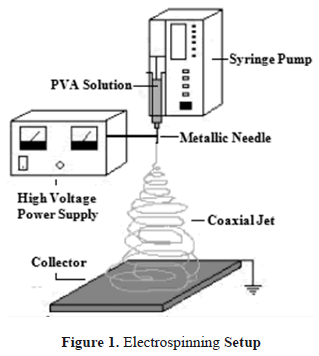
<body><![CDATA[<p><font size="2" face="Verdana, Arial, Helvetica, sans-serif">Polyvinyl Alcohol (PVA) is a water soluble polymer produced industrially by the hydrolysis of polyvinyl acetate and is commercialized according to its degree of hydrolysis &#91;1&#93;. PVA has excellent physical and mechanical properties, allowing its use in various applications such as manufacture of fibers for paper coatings, adhesives, fiber reinforced concrete (FRC) &#91;2&#93;, fiber reinforced plastic (FRP) &#91;3&#93;, nonwovens, yarns and others. In recent years, the use of PVA has been focused on biomedical applications, such as hydrogels, including contact lenses, artificial organs and drug delivery &#91;4&#93;. There has been a considerable amount of research about the manufacturing of PVA microfibers, based on conventional spinning processes such as wet spinning, dry spinning and gel spinning &#91;1&#93;.</font></p>     <p><font size="2" face="Verdana, Arial, Helvetica, sans-serif">Recently, several reports have been published &#91;5&#93; on PVA nanofibers obtained by electrospinning. This process was discovered by Formhals &#91;6&#93; in 1934; it consists of: a high Voltage DC Power Supply, a needle syringe and a grounded collector, as shown in <a href="#fig01">figure 1</a>. The process begins with the introduction of the polymer solution into the syringe, which is electrically charged when connected to the needle with a high voltage between 1 and 30 kV. The distance between the needle and the collector must be between 5 and 30 cm. Fong et al. &#91;7&#93;, explained that electrospinning occurs because the electric force applied to the polymer solution overcomes the surface tension, generating an electrically charged beam that is expelled onto the collector. When the fibers are dried, they are electrically charged and are directed and accelerated by electrical forces on the collector, where they are deposited.</font></p>     <p align="center"><font size="2" face="Verdana, Arial, Helvetica, sans-serif"><a name="fig01"></a></font><img src="/img/revistas/dyna/v80n178/v80n178a14fig01.gif"></p>     <p><font size="2" face="Verdana, Arial, Helvetica, sans-serif">Jia et al. &#91;8&#93; and Wang et al. &#91;9&#93; reported the possibility of obtaining electrospun nanofibers of blends, incorporating nanoparticles, and also mentioned their potential use as reinforcement in composite materials. </font></p>     <p><font size="2" face="Verdana, Arial, Helvetica, sans-serif">According to Ramakrishna et al. &#91;10&#93;, electrospinning is advantageous in comparison with other methods to obtain nanofibers such as drawing, template synthesis, phase separation, because it can be developed both at laboratory and industrial scale, with repeatability and control of fiber size, but it has some disadvantages such as instability and inefficiency of the jet projecting stream. Kim et al. &#91;11&#93; present a method to obtain nanofibers by electrospinning/sol-gel process, using 15 needles in an ethanol bath. </font></p>     <p><font size="2" face="Verdana, Arial, Helvetica, sans-serif">In the present study a PVA solution doped with boric acid as a coagulating agent, widely used in conventional spinning processes, and a surfactant to reduce surface tension was prepared. By adjusting the parameters, the electrospinning/sol-gel process can be carried out with a single needle. The procedure and the assembly were performed in similar ways to the one described in previous publications &#91;12, 13&#93;, but the composition of surfactant additives were changed from 5% to 10%. Under these conditions, samples were characterized by morphology and tensile tests.</font></p>     <p>&nbsp;</p>     <p><font size="3" face="Verdana, Arial, Helvetica, sans-serif"><b>2.  MATERIALS AND METHODS</b></font></p>     <p><font size="2" face="Verdana, Arial, Helvetica, sans-serif"><b>2.1.  Materials    <br>   </b>Polyvinyl Alcohol with a degree of polymerization of 2400 and a degree of  hydrolysis of 98.41% was used as received from Kuraray Poval Inc. Triton X-100 was employed as a nonionic surfactant, boric acid as a coagulant additive, distilled water as the solvent, and industrial grade ethyl alcohol as the coagulation bath.</font></p>     ]]></body>
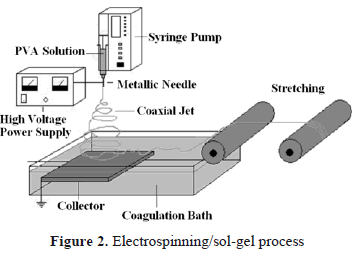
<body><![CDATA[<p><font size="2" face="Verdana, Arial, Helvetica, sans-serif"><b>2.2.  Preparation of PVA Solution</b>    <br>   The solution was prepared by dissolution of 8 wt.% powdered polyvinyl alcohol,  2 wt.% boric acid and 10 wt.% Triton X-100 in distilled water at 80 &deg;C with constant stirring for 30 minutes.</font></p>     <p><font size="2" face="Verdana, Arial, Helvetica, sans-serif"><b>2.3.  Electrospinning Process    <br>   </b>A high-voltage source (Gamma High Voltage Research Inc. Model E30) was connected to the polymer solution by a metal needle, with a distance between the collector and the needle of 18 cm, and applied voltages between 1 and 25 kV &#91;13&#93;.</font></p>     <p><font size="2" face="Verdana, Arial, Helvetica, sans-serif">A syringe pump (Braintree Scientific Syringe Pump Brand Inc.) to control the flow of the solution between 0.2 and 2 ml/h was used. Under these conditions, a PVA nanofiber mats were obtained on a collector of aluminum. </font></p>     <p><font size="2" face="Verdana, Arial, Helvetica, sans-serif"><b>2.4. Electrospinning/Sol-Gel Process</b>    <br>   The electrospinning/sol-gel process was performed with an ethanol coagulation bath and a system of stretching rollers, as shown in <a href="#fig02">figure 2</a>. This system allowed the collection of PVA nanofiber aggregates. </font></p>     <p align="center"><font size="2" face="Verdana, Arial, Helvetica, sans-serif"><a name="fig02"></a></font><img src="/img/revistas/dyna/v80n178/v80n178a14fig02.gif"></p>     <p><font size="2" face="Verdana, Arial, Helvetica, sans-serif"><b>2.5. Characterization Techniques</b>    <br>   Both the mats and aggregates were morphologically characterized by SEM and AFM, the distribution and average diameter were also determined.</font></p>     ]]></body>
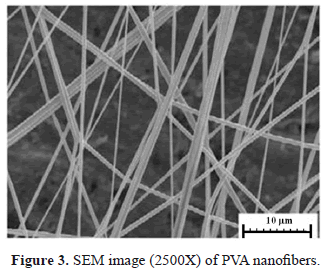
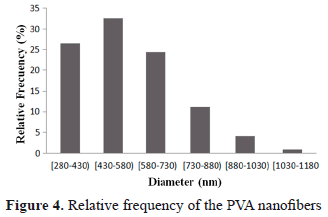
<body><![CDATA[<p><font size="2" face="Verdana, Arial, Helvetica, sans-serif">Morphological characterization was performed using a scanning electron microscope, JEOL JSM-mark 6300, and an atomic force microscope, Integrated Dynamics Engineering Nano Scope IIIa-Digital Instrument, and image analysis was performed using Visilog 6. </font></p>     <p><font size="2" face="Verdana, Arial, Helvetica, sans-serif">The Tensile strength and the elastic modulus of PVA nanofiber aggregates were determined with an Instron 4204 according to the JIS L1013 test; a multifilament yarn specimen previously conditioned under an atmosphere of 20 &deg;C, 65% Relative Humidity  (RH)was tested at constant-rate-of-extension of 10 cm/min with a gauge length of 20 cm.</font></p>     <p>&nbsp;</p>     <p><font size="3" face="Verdana, Arial, Helvetica, sans-serif"><b>3.  RESULTS AND DISCUSSION </b></font></p>     <p><font size="2" face="Verdana, Arial, Helvetica, sans-serif"><b>3.1.  Morphological Characterization of PVA Nanofibers </b></font></p>     <p><font size="2" face="Verdana, Arial, Helvetica, sans-serif"><b>3.1.1.  Scanning Electron Microscopy.    <br>   </b><a href="#fig03">Figure 3</a> show PVA nanofibers at a magnification of 2500X, which&nbsp;were obtained at random on an aluminum plate collector. In addition, there are few bonding points between the nanofibers, which  are practically separated one from another.</font></p>     <p align="center"><font size="2" face="Verdana, Arial, Helvetica, sans-serif"><a name="fig03"></a></font><img src="/img/revistas/dyna/v80n178/v80n178a14fig03.gif"></p>     <p><font size="2" face="Verdana, Arial, Helvetica, sans-serif">Additionally, the distribution of diameters (see <a href="#fig04">figure 4</a>.), from measurements of 98 nanofibers was obtained, showing a range between 280 nm and 1.18 microns. Their average diameter was 548 nm.</font></p>     <p align="center"><font size="2" face="Verdana, Arial, Helvetica, sans-serif"><a name="fig04"></a></font><img src="/img/revistas/dyna/v80n178/v80n178a14fig04.gif"></p>     ]]></body>
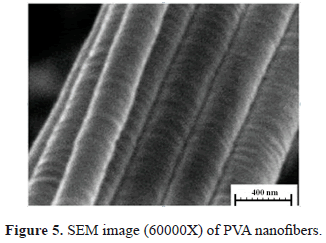
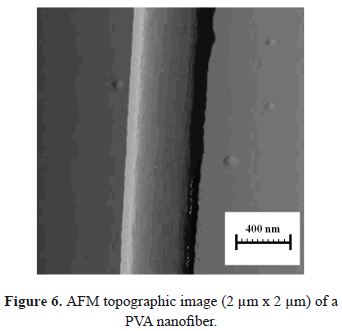
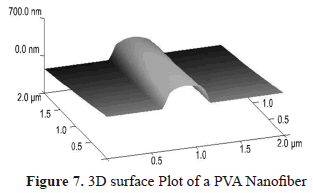
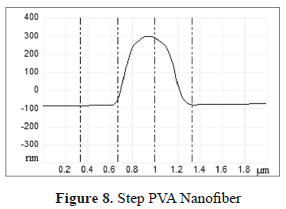
<body><![CDATA[<p><font size="2" face="Verdana, Arial, Helvetica, sans-serif"><a href="#fig05">Figure 5</a> Shows PVA nanofibers to a magnification of 60000X. This longitudinal image of the nanofibers shows dimensional aspects in greater detail and uniformity. Additionally, the smooth surface indicates that there are no characteristic defects on the nanofibers, such as granules or pores on the surface.</font></p>     <p align="center"><font size="2" face="Verdana, Arial, Helvetica, sans-serif"><a name="fig05"></a></font><img src="/img/revistas/dyna/v80n178/v80n178a14fig05.gif"></p>     <p><font size="2" face="Verdana, Arial, Helvetica, sans-serif"><b>3.1.2.  Atomic Force Microscopy.</b>    <br>   <a href="#fig06">Figure 6</a> shows a nanofiber with a diameter of about 500 nm; <a href="#fig07">figure 7</a> shows the fiber surface in 3D, indicating a high longitudinal uniformity.</font></p>     <p align="center"><font size="2" face="Verdana, Arial, Helvetica, sans-serif"><a name="fig06"></a></font><img src="/img/revistas/dyna/v80n178/v80n178a14fig06.gif"></p>     <p align="center"><font size="2" face="Verdana, Arial, Helvetica, sans-serif"><a name="fig07"></a></font><img src="/img/revistas/dyna/v80n178/v80n178a14fig07.gif"></p>     <p><font size="2" face="Verdana, Arial, Helvetica, sans-serif"><a href="#fig08">Figure 8</a> shows a high uniformity in the superficial profile of a nanofiber. The roughness parameters obtained were: Rq=16.7 nm, Ra=14.2 nm and Rmax=65nm.</font></p>     <p align="center"><font size="2" face="Verdana, Arial, Helvetica, sans-serif"><a name="fig08"></a></font><img src="/img/revistas/dyna/v80n178/v80n178a14fig08.gif"></p>     <p><font size="2" face="Verdana, Arial, Helvetica, sans-serif"><b>3.2. Morphological characterization of the PVA Nanofiber aggregate.</b></font></p>     <p><font size="2" face="Verdana, Arial, Helvetica, sans-serif"><b>3.2.1.  Scanning Electron Microscopy.</b>    ]]></body>
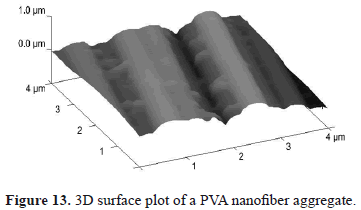
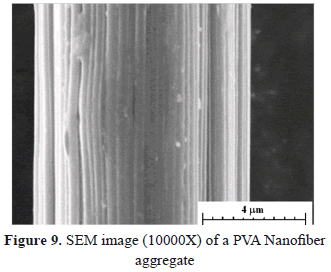
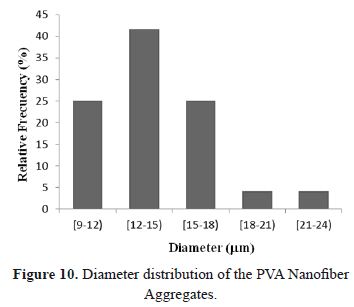
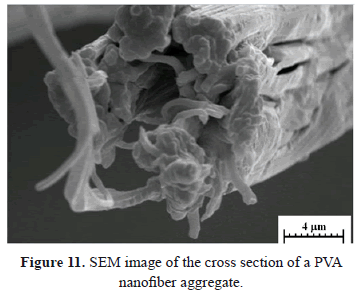
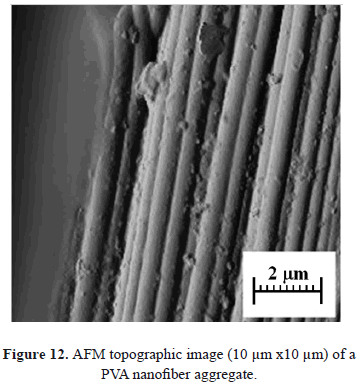
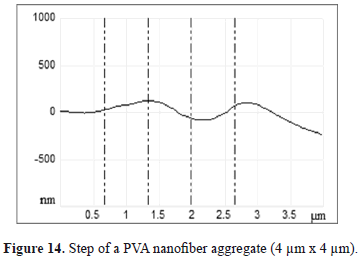
<body><![CDATA[<br>   <a href="#fig09">Figure 9</a> shows a nanofiber aggregate obtained through the electrospinning/sol-gel process, collected with a draw ratio between 10 and 15. </font></p>     <p align="center"><font size="2" face="Verdana, Arial, Helvetica, sans-serif"><a name="fig09"></a></font><img src="/img/revistas/dyna/v80n178/v80n178a14fig09.gif"></p>     <p><font size="2" face="Verdana, Arial, Helvetica, sans-serif"><a href="#fig10">Figure 10</a> shows that the diameters of the aggregates of nanofibers were in a range between 9 and 24 micrometers. The average diameter was 14.97 micrometers.</font></p>     <p align="center"><font size="2" face="Verdana, Arial, Helvetica, sans-serif"><a name="fig10"></a></font><img src="/img/revistas/dyna/v80n178/v80n178a14fig10.gif"></p>     <p><font size="2" face="Verdana, Arial, Helvetica, sans-serif"><a href="#fig11">Figure 11</a> presents the image of the cross section of a nanofiber aggregate group, showing some voids between them, indicating that the actual diameter of the nanofiber aggregate may be less than that measured with the optical analyzer; however the real mechanical strength can be higher than the results presented in this research, if a single filament is tested.</font></p>     <p align="center"><font size="2" face="Verdana, Arial, Helvetica, sans-serif"><a name="fig11"></a></font><img src="/img/revistas/dyna/v80n178/v80n178a14fig11.gif"></p>     <p><font size="2" face="Verdana, Arial, Helvetica, sans-serif"><b>3.2.  Atomic Force Microscopy.</b>    <br>   <a href="#fig12">Figure 12</a> shows the morphology and size of a PVA nanofiber aggregate. Additionally, it identifies some residues on the surface, which are due to impurities in the electrospinning/sol-gel process and particles from the storage environment of the fibers.</font></p>     <p align="center"><font size="2" face="Verdana, Arial, Helvetica, sans-serif"><a name="fig12"></a></font><img src="/img/revistas/dyna/v80n178/v80n178a14fig12.gif"></p>     <p><font size="2" face="Verdana, Arial, Helvetica, sans-serif"><a href="#fig13">Figure 13</a> shows the fiber surface in 3D, indicating an increase in roughness compared with the surface of the PVA nanofiber. This is confirmed by <a href="#fig14">figure 14</a>, which shows the step in the profile of transverse curvature of the fiber. Additionally, calculations of the roughness parameters were much higher than those of single nanofibers (Rq=128 nm, Ra=108 nm and Rmax=562 nm).</font></p>     ]]></body>
<body><![CDATA[<p align="center"><font size="2" face="Verdana, Arial, Helvetica, sans-serif"><a name="fig13"></a></font><img src="/img/revistas/dyna/v80n178/v80n178a14fig13.gif"></p>     <p align="center"><font size="2" face="Verdana, Arial, Helvetica, sans-serif"><a name="fig14"></a></font><img src="/img/revistas/dyna/v80n178/v80n178a14fig14.gif"></p>     <p><font size="2" face="Verdana, Arial, Helvetica, sans-serif"><b>3.3.  Mechanical Properties</b>    <br>   The maximum strength and the modulus of the nanofiber aggregates were 90 MPa and 2.55 GPa, respectively. These results were better than those reported in a previous publication &#91;13&#93;, which reached a maximum strength and a modulus of 19.8 MPa and 0.5 GPa respectively. The results of this research are also higher compared with those reported by Ding et al. &#91;14&#93;, which prepared PVA fibers by electrospinning, crosslinked with Glyoxal and thermally treated, reaching a maximum strength of 11 MPa. </font></p>     <p><font size="2" face="Verdana, Arial, Helvetica, sans-serif">Experimental results show that the PVA fibers obtained have a low modulus compared to commercial fibers. In such cases, Kurtz et al. &#91;15&#93; reports that these fibers have a potential use as secondary reinforcement materials in cement matrix composites which are used in fiber volumes below 1% and is responsible for reducing concrete plastic shrinkage cracking &#91;16&#93;.</font></p>     <p>&nbsp;</p>     <p><font size="3" face="Verdana, Arial, Helvetica, sans-serif"><b>4.  CONCLUSIONS </b></font></p>     <p><font size="2" face="Verdana, Arial, Helvetica, sans-serif">From a doped solution, PVA Nanofibers with an average diameter of 548 nm were prepared by an electrospinning process. Subsequently, they were aggregated longitudinally and drawn through an electrospinning/sol-gel process, reaching an average diameter of 14.97 <font face="Symbol">m</font>m. There was an increase in surface roughness of the nanofiber aggregates, compared with basic nanofibers. The PVA nanofiber aggregate reached a maximum strength and a modulus of 90 MPa and 2.55 GPa, respectively. PVA nanofiber aggregate obtained are of low modulus and therefore have potential use as a secondary reinforcement to reducing plastic shrinkage cracking, which occurs during contraction when the concrete is in the plastic state.</font></p>     <p>&nbsp;</p>     <p><font size="3" face="Verdana, Arial, Helvetica, sans-serif"><b>ACKNOWLEDGMENTS</b></font></p>     ]]></body>
<body><![CDATA[<p><font size="2" face="Verdana, Arial, Helvetica, sans-serif">We appreciate the support of the Center of Excellence for New Materials (CENM) with equipment and supplies as well as the Composite Materials Group, of the School of Materials Engineering at the Universidad del Valle and the Universidad Polit&eacute;cnica de Valencia (Spain). Edgar Franco gratefully acknowledges the economic support of COLCIENCIAS through a doctoral fellowship.</font></p>     <p>&nbsp;</p>     <p><font size="3" face="Verdana, Arial, Helvetica, sans-serif"><b>REFERENCIAS </b></font></p>     <!-- ref --><p><font size="2" face="Verdana, Arial, Helvetica, sans-serif"><b>&#91;1&#93;</b> Sakurada, I., Poly vinyl Alcohol Fibers: An Marcel Dekker, pp. 57-58, 1985.    &nbsp;&nbsp;&nbsp;&nbsp;&nbsp;&nbsp;&nbsp;&nbsp;[&#160;<a href="javascript:void(0);" onclick="javascript: window.open('/scielo.php?script=sci_nlinks&ref=000086&pid=S0012-7353201300020001400001&lng=','','width=640,height=500,resizable=yes,scrollbars=1,menubar=yes,');">Links</a>&#160;]<!-- end-ref --><!-- ref --><br>   <b>&#91;2&#93;</b> Bigin, D., Ningxu, H., Zhu, D., Feng, X. and Hongzhi, C., A preliminary study of synthesized-in situ fiber in cement materials: An Construction and Building Materials., 40, pp. 10-13, 2013.    &nbsp;&nbsp;&nbsp;&nbsp;&nbsp;&nbsp;&nbsp;&nbsp;[&#160;<a href="javascript:void(0);" onclick="javascript: window.open('/scielo.php?script=sci_nlinks&ref=000087&pid=S0012-7353201300020001400002&lng=','','width=640,height=500,resizable=yes,scrollbars=1,menubar=yes,');">Links</a>&#160;]<!-- end-ref --><!-- ref --><br>   <b>&#91;3&#93;</b> Rodriguez, J. A. and Aristizabal, J. D., A general analytical approach for prestressed and non-prestressed concrete beam-columns reinforced with bonded and unbonded composites: (I) Theory: An DYNA., 168, pp. 19-27, 2011.    &nbsp;&nbsp;&nbsp;&nbsp;&nbsp;&nbsp;&nbsp;&nbsp;[&#160;<a href="javascript:void(0);" onclick="javascript: window.open('/scielo.php?script=sci_nlinks&ref=000088&pid=S0012-7353201300020001400003&lng=','','width=640,height=500,resizable=yes,scrollbars=1,menubar=yes,');">Links</a>&#160;]<!-- end-ref --><!-- ref --><br>   <b>&#91;4&#93;</b> Zhang, C., Yuan, X., Wu, L., Han, Y. and Sheng, J., Study on morphology of electrospun poly (vinyl alcohol) mats: An European Polymer Journal., 41, pp. 423-432, 2005.    &nbsp;&nbsp;&nbsp;&nbsp;&nbsp;&nbsp;&nbsp;&nbsp;[&#160;<a href="javascript:void(0);" onclick="javascript: window.open('/scielo.php?script=sci_nlinks&ref=000089&pid=S0012-7353201300020001400004&lng=','','width=640,height=500,resizable=yes,scrollbars=1,menubar=yes,');">Links</a>&#160;]<!-- end-ref --><!-- ref --><br>   <b>&#91;5&#93;</b> Koski, A., Yim, K. and Shivkumar, S., Effect of molecular weight on fibrous PVA produced by electrospinning: An Materials Letters., 58, pp. 493- 497, 2004.    &nbsp;&nbsp;&nbsp;&nbsp;&nbsp;&nbsp;&nbsp;&nbsp;[&#160;<a href="javascript:void(0);" onclick="javascript: window.open('/scielo.php?script=sci_nlinks&ref=000090&pid=S0012-7353201300020001400005&lng=','','width=640,height=500,resizable=yes,scrollbars=1,menubar=yes,');">Links</a>&#160;]<!-- end-ref --><!-- ref --><br>   <b>&#91;6&#93;</b> Formhals, A., US patent, 1,975,504, 1934.    &nbsp;&nbsp;&nbsp;&nbsp;&nbsp;&nbsp;&nbsp;&nbsp;[&#160;<a href="javascript:void(0);" onclick="javascript: window.open('/scielo.php?script=sci_nlinks&ref=000091&pid=S0012-7353201300020001400006&lng=','','width=640,height=500,resizable=yes,scrollbars=1,menubar=yes,');">Links</a>&#160;]<!-- end-ref --><!-- ref --><br>   <b>&#91;7&#93;</b> Fong, H. and Reneker, D. H., Electrospinning and formation of nanofibers: An Salem DR, editor. Structure formation in polymeric fibers. pp. 225-246, 2001.    &nbsp;&nbsp;&nbsp;&nbsp;&nbsp;&nbsp;&nbsp;&nbsp;[&#160;<a href="javascript:void(0);" onclick="javascript: window.open('/scielo.php?script=sci_nlinks&ref=000092&pid=S0012-7353201300020001400007&lng=','','width=640,height=500,resizable=yes,scrollbars=1,menubar=yes,');">Links</a>&#160;]<!-- end-ref --><!-- ref --><br>   <b>&#91;8&#93;</b> Jia, Y., gong, J., Gu, X., Kim, H., Dong, J. and Shen, X., Fabrication and characterization of poly (vinyl alcohol)/chitosan blend nanofibers produced by electrospinning method: An Carbohydrate Polymers, pp. 1-7, 2006.    &nbsp;&nbsp;&nbsp;&nbsp;&nbsp;&nbsp;&nbsp;&nbsp;[&#160;<a href="javascript:void(0);" onclick="javascript: window.open('/scielo.php?script=sci_nlinks&ref=000093&pid=S0012-7353201300020001400008&lng=','','width=640,height=500,resizable=yes,scrollbars=1,menubar=yes,');">Links</a>&#160;]<!-- end-ref --><!-- ref --><br>   <b>&#91;9&#93;</b> Wang, H., Lu, X., Zhao, Y. and Wang, C., Preparation and characterization of ZnS: Cu/PVA composite nanofibers via electrospinning: An Materials Letter.,60, pp. 2480-2484, 2006.    &nbsp;&nbsp;&nbsp;&nbsp;&nbsp;&nbsp;&nbsp;&nbsp;[&#160;<a href="javascript:void(0);" onclick="javascript: window.open('/scielo.php?script=sci_nlinks&ref=000094&pid=S0012-7353201300020001400009&lng=','','width=640,height=500,resizable=yes,scrollbars=1,menubar=yes,');">Links</a>&#160;]<!-- end-ref --><!-- ref --><br>   <b>&#91;10&#93;</b> Ramakrishna, S., Fujihara, K., Teo, W. E., Lim, T. C. and Ma, Z., An Introduction Electrospinning and Nanofibers: A World Scientific. 90, 2005.    &nbsp;&nbsp;&nbsp;&nbsp;&nbsp;&nbsp;&nbsp;&nbsp;[&#160;<a href="javascript:void(0);" onclick="javascript: window.open('/scielo.php?script=sci_nlinks&ref=000095&pid=S0012-7353201300020001400010&lng=','','width=640,height=500,resizable=yes,scrollbars=1,menubar=yes,');">Links</a>&#160;]<!-- end-ref --><!-- ref --><br>   <b>&#91;11&#93;</b> Kim, H. Y., Gil, M. S., Jung, Y. H., Kim, H. J. and Lee, B. S., Process of Preparing Continuous Filament Composed of Nano Fiber: A United States Patent Application Publication. Pub. No.: US 2005/0253305 A1, 2005.    &nbsp;&nbsp;&nbsp;&nbsp;&nbsp;&nbsp;&nbsp;&nbsp;[&#160;<a href="javascript:void(0);" onclick="javascript: window.open('/scielo.php?script=sci_nlinks&ref=000096&pid=S0012-7353201300020001400011&lng=','','width=640,height=500,resizable=yes,scrollbars=1,menubar=yes,');">Links</a>&#160;]<!-- end-ref --><!-- ref --><br>   <b>&#91;12&#93;</b> Franco, E., Delvasto, S., Zuluaga, F., Mart&iacute;, F., Caracterizaci&oacute;n del haz proyectado en el proceso de electrohilado de PVA: En Suplemento de la Revista Latinoamericana de Metalurgia y Materiales., S1 (3): pp. 1097-1103, 2009.    &nbsp;&nbsp;&nbsp;&nbsp;&nbsp;&nbsp;&nbsp;&nbsp;[&#160;<a href="javascript:void(0);" onclick="javascript: window.open('/scielo.php?script=sci_nlinks&ref=000097&pid=S0012-7353201300020001400012&lng=','','width=640,height=500,resizable=yes,scrollbars=1,menubar=yes,');">Links</a>&#160;]<!-- end-ref --><!-- ref --><br>   <b>&#91;13&#93;</b> Franco, E., Delvasto, S., Zuluaga, F. and Mart&iacute;, F., Proceso de Preparaci&oacute;n de Fibras agregadas de PVA por el proceso de gel electrohilado. Memories Tenth International Conference on Non-Conventional Materials and Technologies Nocmat. pp. 1- 13, 2008.    &nbsp;&nbsp;&nbsp;&nbsp;&nbsp;&nbsp;&nbsp;&nbsp;[&#160;<a href="javascript:void(0);" onclick="javascript: window.open('/scielo.php?script=sci_nlinks&ref=000098&pid=S0012-7353201300020001400013&lng=','','width=640,height=500,resizable=yes,scrollbars=1,menubar=yes,');">Links</a>&#160;]<!-- end-ref --><!-- ref --><br>   <b>&#91;14&#93;</b> Ding, B., Kim, H. Y., Lee, S. C., Shao, C. L., Lee, D. R. and Park, S. J., Preparation and Characterization of a nanoscale poly (vinyl alcohol) fiber aggregate produced by an electrospinning method: An Journal of Polymer Science: Part B: Polymer Physics., 40, 1262, 2002.    &nbsp;&nbsp;&nbsp;&nbsp;&nbsp;&nbsp;&nbsp;&nbsp;[&#160;<a href="javascript:void(0);" onclick="javascript: window.open('/scielo.php?script=sci_nlinks&ref=000099&pid=S0012-7353201300020001400014&lng=','','width=640,height=500,resizable=yes,scrollbars=1,menubar=yes,');">Links</a>&#160;]<!-- end-ref --><!-- ref --><br>   <b>&#91;15&#93;</b> Kurtz, S. and Balaguru, P., Postcrack creep of polymeric fiber-reinforced concrete in flexure: An Cement and Concrete Research., 30, pp. 183-190, 2000.    &nbsp;&nbsp;&nbsp;&nbsp;&nbsp;&nbsp;&nbsp;&nbsp;[&#160;<a href="javascript:void(0);" onclick="javascript: window.open('/scielo.php?script=sci_nlinks&ref=000100&pid=S0012-7353201300020001400015&lng=','','width=640,height=500,resizable=yes,scrollbars=1,menubar=yes,');">Links</a>&#160;]<!-- end-ref --><!-- ref --><br>   <b>&#91;16&#93;</b> Wang, Y., Wu, H. C. and Li, V., Concrete reinforcement with Recycled Fibers: An Journal of Materials in Civil Engineering.,November, pp. 314-319, 2000.    &nbsp;&nbsp;&nbsp;&nbsp;&nbsp;&nbsp;&nbsp;&nbsp;[&#160;<a href="javascript:void(0);" onclick="javascript: window.open('/scielo.php?script=sci_nlinks&ref=000101&pid=S0012-7353201300020001400016&lng=','','width=640,height=500,resizable=yes,scrollbars=1,menubar=yes,');">Links</a>&#160;]<!-- end-ref --></font></p>     ]]></body>
<body><![CDATA[ ]]></body><back>
<ref-list>
<ref id="B1">
<label>1</label><nlm-citation citation-type="">
<person-group person-group-type="author">
<name>
<surname><![CDATA[Sakurada]]></surname>
<given-names><![CDATA[I.]]></given-names>
</name>
</person-group>
<source><![CDATA[Poly vinyl Alcohol Fibers: An Marcel Dekker]]></source>
<year>1985</year>
<page-range>57-58</page-range></nlm-citation>
</ref>
<ref id="B2">
<label>2</label><nlm-citation citation-type="journal">
<person-group person-group-type="author">
<name>
<surname><![CDATA[Bigin]]></surname>
<given-names><![CDATA[D.]]></given-names>
</name>
<name>
<surname><![CDATA[Ningxu]]></surname>
<given-names><![CDATA[H.]]></given-names>
</name>
<name>
<surname><![CDATA[Zhu]]></surname>
<given-names><![CDATA[D.]]></given-names>
</name>
<name>
<surname><![CDATA[Feng]]></surname>
<given-names><![CDATA[X.]]></given-names>
</name>
<name>
<surname><![CDATA[Hongzhi]]></surname>
<given-names><![CDATA[C.]]></given-names>
</name>
</person-group>
<article-title xml:lang="en"><![CDATA[A preliminary study of synthesized-in situ fiber in cement materials]]></article-title>
<source><![CDATA[Construction and Building Materials]]></source>
<year>2013</year>
<numero>40</numero>
<issue>40</issue>
<page-range>10-13</page-range></nlm-citation>
</ref>
<ref id="B3">
<label>3</label><nlm-citation citation-type="journal">
<person-group person-group-type="author">
<name>
<surname><![CDATA[Rodriguez]]></surname>
<given-names><![CDATA[J. A.]]></given-names>
</name>
<name>
<surname><![CDATA[Aristizabal]]></surname>
<given-names><![CDATA[J. D.]]></given-names>
</name>
</person-group>
<article-title xml:lang="en"><![CDATA[A general analytical approach for prestressed and non-prestressed concrete beam-columns reinforced with bonded and unbonded composites: (I) Theory]]></article-title>
<source><![CDATA[DYNA]]></source>
<year>2011</year>
<numero>168</numero>
<issue>168</issue>
<page-range>19-27</page-range></nlm-citation>
</ref>
<ref id="B4">
<label>4</label><nlm-citation citation-type="journal">
<person-group person-group-type="author">
<name>
<surname><![CDATA[Zhang]]></surname>
<given-names><![CDATA[C.]]></given-names>
</name>
<name>
<surname><![CDATA[Yuan]]></surname>
<given-names><![CDATA[X.]]></given-names>
</name>
<name>
<surname><![CDATA[Wu]]></surname>
<given-names><![CDATA[L.]]></given-names>
</name>
<name>
<surname><![CDATA[Han]]></surname>
<given-names><![CDATA[Y.]]></given-names>
</name>
<name>
<surname><![CDATA[Sheng]]></surname>
<given-names><![CDATA[J.]]></given-names>
</name>
</person-group>
<article-title xml:lang="en"><![CDATA[Study on morphology of electrospun poly (vinyl alcohol) mats]]></article-title>
<source><![CDATA[European Polymer Journal]]></source>
<year>2005</year>
<numero>41</numero>
<issue>41</issue>
<page-range>423-432</page-range></nlm-citation>
</ref>
<ref id="B5">
<label>5</label><nlm-citation citation-type="journal">
<person-group person-group-type="author">
<name>
<surname><![CDATA[Koski]]></surname>
<given-names><![CDATA[A.]]></given-names>
</name>
<name>
<surname><![CDATA[Yim]]></surname>
<given-names><![CDATA[K.]]></given-names>
</name>
<name>
<surname><![CDATA[Shivkumar]]></surname>
<given-names><![CDATA[S.]]></given-names>
</name>
</person-group>
<article-title xml:lang="en"><![CDATA[Effect of molecular weight on fibrous PVA produced by electrospinning]]></article-title>
<source><![CDATA[Materials Letters]]></source>
<year>2004</year>
<numero>58</numero>
<issue>58</issue>
<page-range>493- 497</page-range></nlm-citation>
</ref>
<ref id="B6">
<label>6</label><nlm-citation citation-type="">
<person-group person-group-type="author">
<name>
<surname><![CDATA[Formhals]]></surname>
<given-names><![CDATA[A.]]></given-names>
</name>
</person-group>
<source><![CDATA[US patent, 1,975,504]]></source>
<year>1934</year>
</nlm-citation>
</ref>
<ref id="B7">
<label>7</label><nlm-citation citation-type="">
<person-group person-group-type="author">
<name>
<surname><![CDATA[Fong]]></surname>
<given-names><![CDATA[H.]]></given-names>
</name>
<name>
<surname><![CDATA[Reneker]]></surname>
<given-names><![CDATA[D. H.]]></given-names>
</name>
</person-group>
<article-title xml:lang="en"><![CDATA[Electrospinning and formation of nanofibers]]></article-title>
<person-group person-group-type="editor">
<name>
<surname><![CDATA[Salem]]></surname>
<given-names><![CDATA[DR]]></given-names>
</name>
</person-group>
<source><![CDATA[Structure formation in polymeric fibers]]></source>
<year>2001</year>
<page-range>225-246</page-range></nlm-citation>
</ref>
<ref id="B8">
<label>8</label><nlm-citation citation-type="">
<person-group person-group-type="author">
<name>
<surname><![CDATA[Jia]]></surname>
<given-names><![CDATA[Y.]]></given-names>
</name>
<name>
<surname><![CDATA[gong]]></surname>
<given-names><![CDATA[J.]]></given-names>
</name>
<name>
<surname><![CDATA[Gu]]></surname>
<given-names><![CDATA[X.]]></given-names>
</name>
<name>
<surname><![CDATA[Kim]]></surname>
<given-names><![CDATA[H.]]></given-names>
</name>
<name>
<surname><![CDATA[Dong]]></surname>
<given-names><![CDATA[J.]]></given-names>
</name>
<name>
<surname><![CDATA[Shen]]></surname>
<given-names><![CDATA[X.]]></given-names>
</name>
</person-group>
<article-title xml:lang="en"><![CDATA[Fabrication and characterization of poly (vinyl alcohol)/chitosan blend nanofibers produced by electrospinning method]]></article-title>
<source><![CDATA[Carbohydrate Polymers]]></source>
<year>2006</year>
<page-range>1-7</page-range></nlm-citation>
</ref>
<ref id="B9">
<label>9</label><nlm-citation citation-type="journal">
<person-group person-group-type="author">
<name>
<surname><![CDATA[Wang]]></surname>
<given-names><![CDATA[H.]]></given-names>
</name>
<name>
<surname><![CDATA[Lu]]></surname>
<given-names><![CDATA[X.]]></given-names>
</name>
<name>
<surname><![CDATA[Zhao]]></surname>
<given-names><![CDATA[Y.]]></given-names>
</name>
<name>
<surname><![CDATA[Wang]]></surname>
<given-names><![CDATA[C.]]></given-names>
</name>
</person-group>
<article-title xml:lang="en"><![CDATA[Preparation and characterization of ZnS: Cu/PVA composite nanofibers via electrospinning]]></article-title>
<source><![CDATA[Materials Letter]]></source>
<year>2006</year>
<numero>60</numero>
<issue>60</issue>
<page-range>2480-2484</page-range></nlm-citation>
</ref>
<ref id="B10">
<label>10</label><nlm-citation citation-type="journal">
<person-group person-group-type="author">
<name>
<surname><![CDATA[Ramakrishna]]></surname>
<given-names><![CDATA[S.]]></given-names>
</name>
<name>
<surname><![CDATA[Fujihara]]></surname>
<given-names><![CDATA[K.]]></given-names>
</name>
<name>
<surname><![CDATA[Teo]]></surname>
<given-names><![CDATA[W. E.]]></given-names>
</name>
<name>
<surname><![CDATA[Lim]]></surname>
<given-names><![CDATA[T. C.]]></given-names>
</name>
<name>
<surname><![CDATA[Ma]]></surname>
<given-names><![CDATA[Z.]]></given-names>
</name>
</person-group>
<article-title xml:lang="en"><![CDATA[An Introduction Electrospinning and Nanofibers]]></article-title>
<source><![CDATA[World Scientific]]></source>
<year>2005</year>
<numero>90</numero>
<issue>90</issue>
</nlm-citation>
</ref>
<ref id="B11">
<label>11</label><nlm-citation citation-type="book">
<person-group person-group-type="author">
<name>
<surname><![CDATA[Kim]]></surname>
<given-names><![CDATA[H. Y.]]></given-names>
</name>
<name>
<surname><![CDATA[Gil]]></surname>
<given-names><![CDATA[M. S.]]></given-names>
</name>
<name>
<surname><![CDATA[Jung]]></surname>
<given-names><![CDATA[Y. H.]]></given-names>
</name>
<name>
<surname><![CDATA[Kim]]></surname>
<given-names><![CDATA[H. J.]]></given-names>
</name>
<name>
<surname><![CDATA[Lee]]></surname>
<given-names><![CDATA[B. S.]]></given-names>
</name>
</person-group>
<source><![CDATA[Process of Preparing Continuous Filament Composed of Nano Fiber]]></source>
<year>2005</year>
<publisher-name><![CDATA[United States Patent Application Publication]]></publisher-name>
</nlm-citation>
</ref>
<ref id="B12">
<label>12</label><nlm-citation citation-type="journal">
<person-group person-group-type="author">
<name>
<surname><![CDATA[Franco]]></surname>
<given-names><![CDATA[E.]]></given-names>
</name>
<name>
<surname><![CDATA[Delvasto]]></surname>
<given-names><![CDATA[S.]]></given-names>
</name>
<name>
<surname><![CDATA[Zuluaga]]></surname>
<given-names><![CDATA[F.]]></given-names>
</name>
<name>
<surname><![CDATA[Martí]]></surname>
<given-names><![CDATA[F.]]></given-names>
</name>
</person-group>
<article-title xml:lang="es"><![CDATA[Caracterización del haz proyectado en el proceso de electrohilado de PVA]]></article-title>
<source><![CDATA[Suplemento de la Revista Latinoamericana de Metalurgia y Materiales]]></source>
<year>2009</year>
<volume>S1</volume>
<numero>3</numero>
<issue>3</issue>
<page-range>1097-1103</page-range></nlm-citation>
</ref>
<ref id="B13">
<label>13</label><nlm-citation citation-type="confpro">
<person-group person-group-type="author">
<name>
<surname><![CDATA[Franco]]></surname>
<given-names><![CDATA[E.]]></given-names>
</name>
<name>
<surname><![CDATA[Delvasto]]></surname>
<given-names><![CDATA[S.]]></given-names>
</name>
<name>
<surname><![CDATA[Zuluaga]]></surname>
<given-names><![CDATA[F.]]></given-names>
</name>
<name>
<surname><![CDATA[Martí]]></surname>
<given-names><![CDATA[F.]]></given-names>
</name>
</person-group>
<article-title xml:lang="es"><![CDATA[Proceso de Preparación de Fibras agregadas de PVA por el proceso de gel electrohilado]]></article-title>
<source><![CDATA[]]></source>
<year>2008</year>
<conf-name><![CDATA[Tenth International Conference on Non-Conventional Materials and Technologies Nocmat]]></conf-name>
<conf-loc> </conf-loc>
<page-range>1- 13</page-range></nlm-citation>
</ref>
<ref id="B14">
<label>14</label><nlm-citation citation-type="journal">
<person-group person-group-type="author">
<name>
<surname><![CDATA[Ding]]></surname>
<given-names><![CDATA[B.]]></given-names>
</name>
<name>
<surname><![CDATA[Kim]]></surname>
<given-names><![CDATA[H. Y.]]></given-names>
</name>
<name>
<surname><![CDATA[Lee]]></surname>
<given-names><![CDATA[S. C.]]></given-names>
</name>
<name>
<surname><![CDATA[Shao]]></surname>
<given-names><![CDATA[C. L.]]></given-names>
</name>
<name>
<surname><![CDATA[Lee]]></surname>
<given-names><![CDATA[D. R.]]></given-names>
</name>
<name>
<surname><![CDATA[Park]]></surname>
<given-names><![CDATA[S. J.]]></given-names>
</name>
</person-group>
<article-title xml:lang="en"><![CDATA[Preparation and Characterization of a nanoscale poly (vinyl alcohol) fiber aggregate produced by an electrospinning method]]></article-title>
<source><![CDATA[Journal of Polymer Science: Part B: Polymer Physics]]></source>
<year>2002</year>
<numero>40</numero>
<issue>40</issue>
<page-range>1262</page-range></nlm-citation>
</ref>
<ref id="B15">
<label>15</label><nlm-citation citation-type="journal">
<person-group person-group-type="author">
<name>
<surname><![CDATA[Kurtz]]></surname>
<given-names><![CDATA[S.]]></given-names>
</name>
<name>
<surname><![CDATA[Balaguru]]></surname>
<given-names><![CDATA[P.]]></given-names>
</name>
</person-group>
<article-title xml:lang="en"><![CDATA[Postcrack creep of polymeric fiber-reinforced concrete in flexure]]></article-title>
<source><![CDATA[Cement and Concrete Research]]></source>
<year>2000</year>
<numero>30</numero>
<issue>30</issue>
<page-range>183-190</page-range></nlm-citation>
</ref>
<ref id="B16">
<label>16</label><nlm-citation citation-type="journal">
<person-group person-group-type="author">
<name>
<surname><![CDATA[Wang]]></surname>
<given-names><![CDATA[Y.]]></given-names>
</name>
<name>
<surname><![CDATA[Wu]]></surname>
<given-names><![CDATA[H. C.]]></given-names>
</name>
<name>
<surname><![CDATA[Li]]></surname>
<given-names><![CDATA[V.]]></given-names>
</name>
</person-group>
<article-title xml:lang="en"><![CDATA[Concrete reinforcement with Recycled Fibers]]></article-title>
<source><![CDATA[Journal of Materials in Civil Engineering]]></source>
<year>2000</year>
<page-range>314-319</page-range></nlm-citation>
</ref>
</ref-list>
</back>
</article>