<?xml version="1.0" encoding="ISO-8859-1"?><article xmlns:mml="http://www.w3.org/1998/Math/MathML" xmlns:xlink="http://www.w3.org/1999/xlink" xmlns:xsi="http://www.w3.org/2001/XMLSchema-instance">
<front>
<journal-meta>
<journal-id>0012-7353</journal-id>
<journal-title><![CDATA[DYNA]]></journal-title>
<abbrev-journal-title><![CDATA[Dyna rev.fac.nac.minas]]></abbrev-journal-title>
<issn>0012-7353</issn>
<publisher>
<publisher-name><![CDATA[Universidad Nacional de Colombia]]></publisher-name>
</publisher>
</journal-meta>
<article-meta>
<article-id>S0012-73532013000400007</article-id>
<title-group>
<article-title xml:lang="en"><![CDATA[ANALYSIS OF MODELS AND METACOGNITIVE ARCHITECTURES IN INTELLIGENT SYSTEMS]]></article-title>
<article-title xml:lang="es"><![CDATA[ANÁLISIS DE MODELOS Y ARQUITECTURAS METACOGNITIVAS EN SISTEMAS INTELIGENTES]]></article-title>
</title-group>
<contrib-group>
<contrib contrib-type="author">
<name>
<surname><![CDATA[CARO PIÑERES]]></surname>
<given-names><![CDATA[MANUEL FERNANDO]]></given-names>
</name>
<xref ref-type="aff" rid="A01"/>
</contrib>
<contrib contrib-type="author">
<name>
<surname><![CDATA[JIMÉNEZ BUILES]]></surname>
<given-names><![CDATA[JOVANI ALBERTO]]></given-names>
</name>
<xref ref-type="aff" rid="A02"/>
</contrib>
</contrib-group>
<aff id="A01">
<institution><![CDATA[,Universidad de Córdoba Grupo de investigación: TIC aplicadas a la Educación ]]></institution>
<addr-line><![CDATA[ ]]></addr-line>
</aff>
<aff id="A02">
<institution><![CDATA[,Universidad Nacional de Colombia Grupo de investigación: Inteligencia Artificial en Educación ]]></institution>
<addr-line><![CDATA[ ]]></addr-line>
</aff>
<pub-date pub-type="pub">
<day>00</day>
<month>08</month>
<year>2013</year>
</pub-date>
<pub-date pub-type="epub">
<day>00</day>
<month>08</month>
<year>2013</year>
</pub-date>
<volume>80</volume>
<numero>180</numero>
<fpage>50</fpage>
<lpage>59</lpage>
<copyright-statement/>
<copyright-year/>
<self-uri xlink:href="http://www.scielo.org.co/scielo.php?script=sci_arttext&amp;pid=S0012-73532013000400007&amp;lng=en&amp;nrm=iso"></self-uri><self-uri xlink:href="http://www.scielo.org.co/scielo.php?script=sci_abstract&amp;pid=S0012-73532013000400007&amp;lng=en&amp;nrm=iso"></self-uri><self-uri xlink:href="http://www.scielo.org.co/scielo.php?script=sci_pdf&amp;pid=S0012-73532013000400007&amp;lng=en&amp;nrm=iso"></self-uri><abstract abstract-type="short" xml:lang="en"><p><![CDATA[Recently Intelligent Systems (IS) have highly increased the autonomy of their decisions, this has been achieved by improving metacognitive skills. The term metacognition in Artificial Intelligence (AI) refers to the capability of IS to monitor and control their own learning processes. This paper describes different models used to address the implementation of metacognition in IS. Then, we present a comparative analysis among the different models of metacognition. As well as, a discussion about the following categories of analysis: types of metacognition architectural support of metacognition components, architectural cores and computational implementations.]]></p></abstract>
<abstract abstract-type="short" xml:lang="es"><p><![CDATA[Los Sistemas Inteligentes (SI) han aumentado en gran medida la autonomía en la toma de decisiones, lo que se han logrado gracias a la mejora de las habilidades metacognitivas. El término metacognición en Inteligencia Artificial (IA) se refiere a la capacidad que tienen los SI para el seguimiento y control de su propio proceso de aprendizaje. Este artículo describe diferentes modelos utilizados para abordar la aplicación de la metacognición en los SI. Luego presenta un análisis comparativo entre los diferentes modelos de metacognición. Así como, una discusión sobre las siguientes categorías de análisis: tipos de arquitecturas de metacognición que soportan los componentes de la metacognición, núcleos de las arquitecturas e implementaciones computacionales.]]></p></abstract>
<kwd-group>
<kwd lng="en"><![CDATA[Artificial Intelligence]]></kwd>
<kwd lng="en"><![CDATA[Metacognition]]></kwd>
<kwd lng="en"><![CDATA[Metamemory]]></kwd>
<kwd lng="en"><![CDATA[MetaComprehension]]></kwd>
<kwd lng="en"><![CDATA[SelfRegulation]]></kwd>
<kwd lng="es"><![CDATA[Inteligencia artificial]]></kwd>
<kwd lng="es"><![CDATA[Metacognición]]></kwd>
<kwd lng="es"><![CDATA[Metamemoria]]></kwd>
<kwd lng="es"><![CDATA[Metacomprensión]]></kwd>
<kwd lng="es"><![CDATA[Autoregulación]]></kwd>
</kwd-group>
</article-meta>
</front><body><![CDATA[ <p align="center"><font size="4" face="Verdana, Arial, Helvetica, sans-serif"><b>ANALYSIS OF MODELS AND METACOGNITIVE ARCHITECTURES IN INTELLIGENT SYSTEMS</b></font></p>     <p align="center"><font size="3"><b><font face="Verdana, Arial, Helvetica, sans-serif">AN&Aacute;LISIS DE MODELOS Y ARQUITECTURAS METACOGNITIVAS EN SISTEMAS INTELIGENTES</font></b></font></p>     <p align="center">&nbsp;</p>     <p align="center"><font size="2" face="Verdana, Arial, Helvetica, sans-serif"><b>MANUEL FERNANDO CARO PI&Ntilde;ERES,</b>    <br>   <i>Ph. D.(c), Grupo de investigaci&oacute;n: TIC aplicadas a la Educaci&oacute;n  EdupMedia, Universidad de C&oacute;rdoba, <a href="mailto:mfcarop@unal.edu.co">mfcarop@unal.edu.co</a></i></font></p>     <p align="center"><font size="2" face="Verdana, Arial, Helvetica, sans-serif"><b>JOVANI ALBERTO JIM&Eacute;NEZ BUILES</b>    <br>   <i>Ph. D., Grupo de investigaci&oacute;n: Inteligencia Artificial en Educaci&oacute;n, Universidad Nacional de Colombia, <a href="mailto:jajimen1@unal.edu.co">jajimen1@unal.edu.co</a> </i></font></p>     <p align="center">&nbsp;</p>     <p align="center"><font size="2" face="Verdana, Arial, Helvetica, sans-serif"><b>Received for review July 17<sup>th</sup>, 2012, Accepted March 26<sup>th</sup>, 2013, final version June, 15<sup>th</sup>, 2013</b></font></p>     <p>&nbsp;</p> <hr>     ]]></body>
<body><![CDATA[<p><font size="2" face="Verdana, Arial, Helvetica, sans-serif"><b>ABSTRACT: </b>Recently Intelligent Systems (IS) have highly increased the autonomy of their decisions, this has been achieved by improving metacognitive skills. The term metacognition in Artificial Intelligence (AI) refers to the capability of IS to monitor and control their own learning processes. This paper describes different models used to address the implementation of metacognition in IS. Then, we present a comparative analysis among the different models of metacognition. As well as, a discussion about the following categories of analysis: types of metacognition architectural support of metacognition components, architectural cores and computational implementations.</font></p>     <p><font size="2" face="Verdana, Arial, Helvetica, sans-serif"><b>KEYWORDS:</b> Artificial Intelligence, Metacognition, Metamemory, MetaComprehension, SelfRegulation.</font></p>     <p><font size="2" face="Verdana, Arial, Helvetica, sans-serif"><b>RESUMEN:</b> Los Sistemas Inteligentes (SI) han aumentado en gran medida la autonom&iacute;a en la toma de decisiones, lo que se han logrado gracias a la mejora de las habilidades metacognitivas. El t&eacute;rmino metacognici&oacute;n en Inteligencia Artificial (IA) se refiere a la capacidad que tienen los SI para el seguimiento y control de su propio proceso de aprendizaje. Este art&iacute;culo describe diferentes modelos utilizados para abordar la aplicaci&oacute;n de la metacognici&oacute;n en los SI. Luego presenta un an&aacute;lisis comparativo entre los diferentes modelos de metacognici&oacute;n. As&iacute; como, una discusi&oacute;n sobre las siguientes categor&iacute;as de an&aacute;lisis: tipos de arquitecturas de metacognici&oacute;n que soportan los componentes de la metacognici&oacute;n, n&uacute;cleos de las arquitecturas e implementaciones computacionales.</font></p>     <p><font size="2" face="Verdana, Arial, Helvetica, sans-serif"><b>PALABRAS CLAVE: </b>Inteligencia artificial, Metacognici&oacute;n, Metamemoria, Metacomprensi&oacute;n, Autoregulaci&oacute;n.</font></p> <hr>     <p>&nbsp;</p>     <p><font size="3" face="Verdana, Arial, Helvetica, sans-serif"><b>1.  INTRODUCTION</b></font></p>     <p><font size="2" face="Verdana, Arial, Helvetica, sans-serif">In recent years in Artificial Intelligence (AI) robust and Intelligent Systems (IS) have been developed. IS have highly increased the autonomy of their decisions, which has been achieved by improving metacognitive capabilities. </font></p>     <p><font size="2" face="Verdana, Arial, Helvetica, sans-serif">The term metacognition in AI refers to the capability of IS to monitor and control their own learning processes &#91;1,2&#93;. The metacognitive capabilities of IS are known in the specialized literature as &quot;metacognitive skills&quot; &#91;3,4&#93;. Metacognition is composed of three elements or components &#91;5&#93;: metamemory, selfregulation and metacomprehension, in which all the metacognitive skills are grouped. </font></p>     <p><font size="2" face="Verdana, Arial, Helvetica, sans-serif">Metamemory is about the capabilities and strategies that systems have to control and monitor their own memory processes. This is called selfawareness of memory &#91;4&#93;. SelfRegulation refers to the system's ability to make adjustments of its own learning processes. These adjustments are done in response to system perception about the feedback obtained from its current status of learning &#91;5&#93;. Metacomprehension is a specific application of metacognition. It refers to the degree of understanding that an IS has about the information that is supplied to it. &#91;6,7,8&#93;. </font></p>     <p><font size="2" face="Verdana, Arial, Helvetica, sans-serif">Due to the importance that metacognition has for improving the performance of IS, this study seeks to answer the following question  What issues of metacognition have been modeled in IS? </font></p>     ]]></body>
<body><![CDATA[<p><font size="2" face="Verdana, Arial, Helvetica, sans-serif">This paper is organized as follows: first a description of the more referenced metacognitive models in the specialized literature is given. Next, a summary table of the features about metacognition in these models is provided. Finally, we discuss categories of analysis and then present the main conclusions.</font></p>     <p>&nbsp;</p>     <p><font size="3" face="Verdana, Arial, Helvetica, sans-serif"><b>2.  MATERIALS AND METHODS </b></font></p>     <p><font size="2" face="Verdana, Arial, Helvetica, sans-serif">The stages followed in the methodology of this research are described below. </font></p>     <p><font size="2" face="Verdana, Arial, Helvetica, sans-serif"><b>2.1.  Categories of analysis    <br>   </b></font><font size="2" face="Verdana, Arial, Helvetica, sans-serif">To answer the research question, categories of analysis have been defined: </font></p>     <p><font size="2" face="Verdana, Arial, Helvetica, sans-serif"><b>2.1.1 Types of metacognitive architectures    <br>   </b></font><font size="2" face="Verdana, Arial, Helvetica, sans-serif">This category makes reference to the description of models, frameworks and architectures of metacognition, which have been proposed by several authors.</font></p>     <p><font size="2" face="Verdana, Arial, Helvetica, sans-serif"><b>2.1.2 Support of metacognition components    <br>   </b></font><font size="2" face="Verdana, Arial, Helvetica, sans-serif">This category is related to the support of metamemory, metacomprehension and selfregulation in metacognitive models.</font></p>     ]]></body>
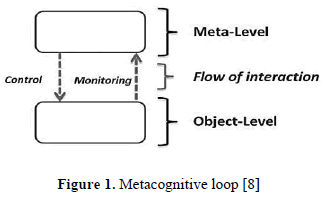
<body><![CDATA[<p><font size="2" face="Verdana, Arial, Helvetica, sans-serif"><b>2.1.3 Fundaments of the architectures    <br>   </b></font><font size="2" face="Verdana, Arial, Helvetica, sans-serif">The category is related to the theoretical bases on which the metacognitive models are designed.</font></p>     <p><font size="2" face="Verdana, Arial, Helvetica, sans-serif"><b>2.1.4 Computational implementations    <br>   </b></font><font size="2" face="Verdana, Arial, Helvetica, sans-serif">This category alludes to the computational techniques used for the implementation of IS based on metacognitive models.</font></p>     <p><font size="2" face="Verdana, Arial, Helvetica, sans-serif"><b>2.1.5 Terminology    <br>   </b></font><font size="2" face="Verdana, Arial, Helvetica, sans-serif">This refers to metacognition terminology that is used in metacognitive models.</font></p>     <p><font size="2" face="Verdana, Arial, Helvetica, sans-serif"><b>2.2.  Identification of models, frameworks and architectures of metacognition in artificial systems</b>    <br>   As a result of the review of this literature, a series of models are described that have been referenced in the development of IS with metacognitive abilities.</font></p>     <p><font size="2" face="Verdana, Arial, Helvetica, sans-serif"><b>2.2.1 Theoretical framework for the operation of human memory &#91;8&#93;    <br>   </b>A first important contribution in this area was the Theoretical Framework for the Operation of Human Memory &#91;8&#93;, see <a href="#fig01">Figure 1</a>, which introduced the three principle keys for metacognition: Cognitive processes can be divided into several levels. The metalevel contains a dynamic model of the objectlevel. There are two dominant relationships called control and monitoring.</font></p>     ]]></body>
<body><![CDATA[<p align="center"><font size="2" face="Verdana, Arial, Helvetica, sans-serif"><a name="fig01"></a></font><img src="/img/revistas/dyna/v80n180/v80n180a07fig01.gif"></p>     <p><font size="2" face="Verdana, Arial, Helvetica, sans-serif">Today, the twotier architecture is the basis for the architectural design of metacognition in IS. See <a href="#fig01">Figure 1</a>.</font></p>     <p><font size="2" face="Verdana, Arial, Helvetica, sans-serif"><b>2.2.2  MetaAQUA &#91;9,10&#93;</b>    <br>   Is a model based on the theory of Introspective Multistrategy Learning (IML) &#91;10&#93; and a cognitive model of introspection. The main functionality of the MetaAQUA system is the &quot;story understanding&quot;, which is considered to be the base level in a MultiAgent System (MAS) &#91;11&#93;. The metalevel is structured by the implementation of IML &#91;10&#93;, which in turn uses Case Based Reasoning (CBR) &#91;12&#93;. The learning strategy in MetaAQUA is implemented using a model of goaldriven learning (GDL) &#91;13&#93; and produces structures called metaexplanations. </font></p>     <p><font size="2" face="Verdana, Arial, Helvetica, sans-serif"><b>2.2.3  CLARION theoretical framework &#91;14&#93;</b>    <br>   Clarion theoretical framework is an overall architecture of the mind &#91;14&#93;. The architecture is used to construct models of specific metacognitive processes such as selfmonitoring and selfregulation (of cognitive processes). Clarion is used to capture experimental data related to metacognition with humans.</font></p>     <p><font size="2" face="Verdana, Arial, Helvetica, sans-serif"><b>2.2.4  The MetaCognitive Loop (MCL) &#91;15,16&#93;</b>    <br>   This is an architecture focused on detection of anomalies in learning processes and how to respond to them. MCL presents a general architecture and has three sets of ontologies &#91;17&#93;, which are: ontology for anomaly types, failure ontology for use in assessment, and response ontology for selecting repair types to guide. </font></p>     <p><font size="2" face="Verdana, Arial, Helvetica, sans-serif"><b>2.2.5  Simple model for metareasoning &#91;18&#93;</b>    <br>   Cox and Raja &#91;18&#93; proposed a simple model for metareasoning. This model presents a double cycle of reasoning. The first cycle, refers to the traditional conception of cognitive science and AI about the reasoning in IS. Where an intelligent agent &#91;11&#93; receives perceptions of the environment, with which it makes decisions (reasoning), and acts, making changes to the environment. On the other hand, the second cycle of the simple model refers to the perception that the metalevel has about the objectlevel. The metalevel receives information from the objectlevel and make decisions (metareasoning). </font></p>     ]]></body>
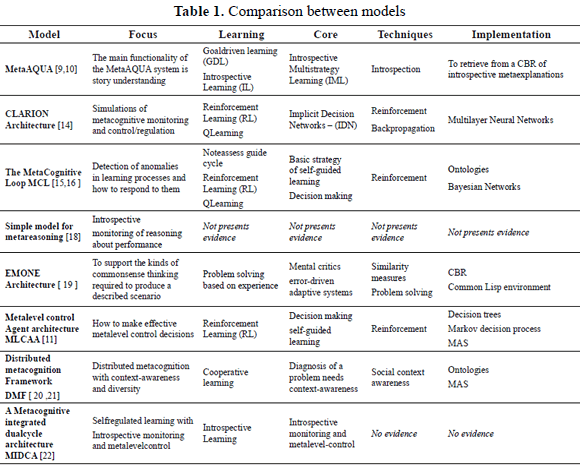
<body><![CDATA[<p><font size="2" face="Verdana, Arial, Helvetica, sans-serif"><b>2.2.6  EMONE Architecture &#91;19&#93;</b>    <br>   EMONE is a cognitive architecture whose purpose is to support the kinds of commonsense thinking that is required to produce a possible scenario in a system. &quot;Mental critics&quot; &#91;19&#93; are used as a mechanism of operation in this architecture, these are procedures that recognize problems in the current situation. The Mental critics use commonsense narratives to suggest courses of action, ways to deliberate about the circumstances and consequences of those actions. Also, they can propose ways to reflect upon their mistakes when things go wrong. In EMONE there are mental critics for answering problems in the world, and other mental critics for answering the problems in the EMONE system itself.</font></p>     <p><font size="2" face="Verdana, Arial, Helvetica, sans-serif"><b>2.2.7  Distributed metacognition Framework &#91;20,21&#93;</b>    <br>   This is a conceptual architecture for distributed metacognition with contextawareness and diversity. A distributed metacognitive architecture is one in which all metalevel reasoning components can be monitored and controlled by other components of metalevel &#91;20,21&#93;. </font></p>     <p><font size="2" face="Verdana, Arial, Helvetica, sans-serif"><b>2.2.8 A metacognitive integrated dualcycle architecture (MIDCA) &#91;22&#93;</b>    <br>   MIDCA is a novel architecture that incorporates both a perceptionaction cognitive cycle and a monitorcontrol metacognitive cycle &#91;22&#93;. In the metalevel the agent recognizes the problem, explains what causes the problem, and generates a new goal to remove the cause &#91;9&#93;. The metalevel reasoner can change the goals, the processes, and the input. MIDCA is based on the previous work by Norman &#91;23&#93;, who designed a cognitive architecture.</font></p>     <p><font size="2" face="Verdana, Arial, Helvetica, sans-serif"><b>2.2.9  Metalevel control agent architecture (Framework) &#91;11&#93;</b>    <br>   The architecture is centered on how to make effective metalevel control decisions and has been implemented in MAS. This architecture is one of the precursors to distributed metacognition. The metalevel control uses an abstract representation of the agent state. The decisionmaking process is supported by decision trees.</font></p>     <p><font size="2" face="Verdana, Arial, Helvetica, sans-serif"><b>2.3  Comparison between models</b>    <br>   A comparison table (<a href="#tab01">Table 1</a>) is shown below as a source of information to supplement the description of the metacognitive models.</font></p>     ]]></body>
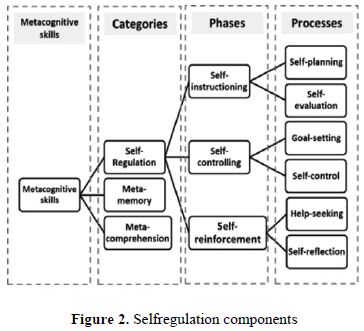
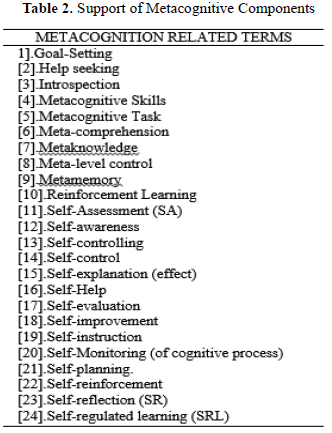
<body><![CDATA[<p align="center"><font size="2" face="Verdana, Arial, Helvetica, sans-serif"><a name="tab01"></a></font><img src="/img/revistas/dyna/v80n180/v80n180a07tab01.gif"></p>     <p><font size="2" face="Verdana, Arial, Helvetica, sans-serif">In <a href="#tab01">Table 1</a> five main issues are presented which are used as the basis for the analysis of metacognition models, these are: The main focus of the model, Learning strategy used, Theory or approach on which the model is based, Strategy on which the model is based, and Computational technology used for the implementation.</font></p>     <p><font size="2" face="Verdana, Arial, Helvetica, sans-serif"><b>2.4.  Organization of terminology</b>    <br>   The terms related to metacognition were organized into an ontology, due to the large number of terms related to metacognition that appear in the metacognitive models, and the semantic ambiguities of these terms among different models. The ontology was developed using Prot&eacute;g&eacute; 3.4 &#91;24&#93;.</font></p>     <p><font size="2" face="Verdana, Arial, Helvetica, sans-serif">The objectives that guide the construction of the ontology are: a) to organize the terms and concepts that allude to metacognitive skills and clarify their characteristics and semantic relationships, b) to develop a generic and reusable semanticmodel based on ontology that includes the necessary features to provide clarity about metacognition concepts.</font></p>     <p><font size="2" face="Verdana, Arial, Helvetica, sans-serif"><b>2.4.1  Methodology for ontology construction. The methodology of Noy and McGuinness &#91;17&#93; was followed to construct the ontology</b>    <br>   The range of the ontology domain is supported by the following questions: What are the terms and concepts related to metacognition? What is the class and subclass hierarchy that makes the organization of terms and concepts related to metacognition possible? What are the main relationships among metacognitive skills? What relationships are necessary in the ontology to generate recommendations of actions, which can be used to design strategies for metacognitive skills scaffolding?</font></p>     <p><font size="2" face="Verdana, Arial, Helvetica, sans-serif">No ontology was reused, because no ontologies related to metacognitive capabilities in IS were found. Beneath, the elements and terms taken from metacognitive models are described. See <a href="#tab02">Table 2</a>.</font></p>     <p align="center"><font size="2" face="Verdana, Arial, Helvetica, sans-serif"><a name="tab02"></a></font><img src="/img/revistas/dyna/v80n180/v80n180a07tab02.gif"></p>     <p><font size="2" face="Verdana, Arial, Helvetica, sans-serif">For each category of metacognitive skill, class hierarchies were identified. For SelfRegulation a class hierarchy composed by SelfReinforcement, SelfInstruction and SelfControlling was built (<a href="#fig02">Figure 2</a>).</font></p>     ]]></body>
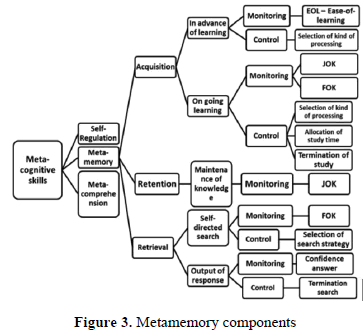
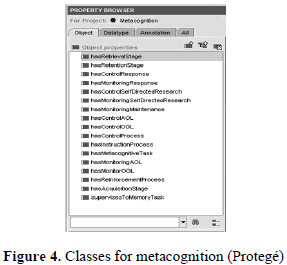
<body><![CDATA[<p align="center"><font size="2" face="Verdana, Arial, Helvetica, sans-serif"><a name="fig02"></a></font><img src="/img/revistas/dyna/v80n180/v80n180a07fig02.gif"></p>     <p><font size="2" face="Verdana, Arial, Helvetica, sans-serif">Regarding metamemory, the taxonomy consists in the classes and subclasses associated with control and metacognitive judgments (<a href="#fig03">Figure 3</a>).</font></p>     <p align="center"><font size="2" face="Verdana, Arial, Helvetica, sans-serif"><a name="fig03"></a></font><img src="/img/revistas/dyna/v80n180/v80n180a07fig03.gif"></p>     <p><font size="2" face="Verdana, Arial, Helvetica, sans-serif">The reasoning core for metacognitive skills, is formed by the relationships between instances of classes and a series of statements, which structure the semantics of the process. The properties that relate instances of different classes in the ontology are exposed in <a href="#fig04">Figure 4</a>.</font></p>     <p align="center"><font size="2" face="Verdana, Arial, Helvetica, sans-serif"><a name="fig04"></a></font><img src="/img/revistas/dyna/v80n180/v80n180a07fig04.gif"></p>     <p>&nbsp;</p>     <p><font size="3" face="Verdana, Arial, Helvetica, sans-serif"><b>3.  RESULTS AND DISCUSSION </b></font></p>     <p><font size="2" face="Verdana, Arial, Helvetica, sans-serif">The results and discussion were organized according to the categories of analysis.</font></p>     <p><font size="2" face="Verdana, Arial, Helvetica, sans-serif"><b>3.1  Types of metacognitive architectures</b>    <br>   In metacognition models, two predominant types of architectures were found, which are: (1) Centralized architectures such as MetaAQUA, CLARION and MCL, which are predominant and are formed by a single metalevel that controls the entire metacognitive activity of the system. (2) The decentralized or distributed architectures such as MLCAA and DMF are composed of many metalevels. These kinds of architectures are managed by agents, using complex policies for communication and negotiation.</font></p>     ]]></body>
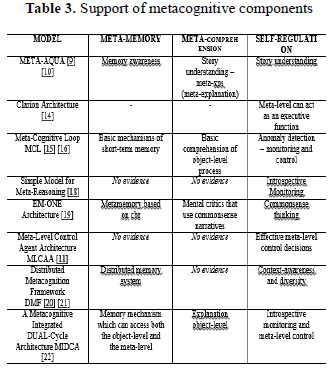
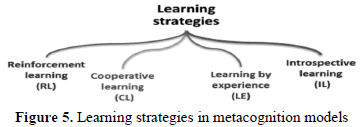
<body><![CDATA[<p><font size="2" face="Verdana, Arial, Helvetica, sans-serif"><b>3.2  Support for metacognitive components</b>    <br>   With reference to the support of the main components of metacognition: metamemory, metacomprehension and selfregulation, the majority of the architectures do not provide support for all three, see <a href="#tab03">Table 3</a>.</font></p>     <p align="center"><font size="2" face="Verdana, Arial, Helvetica, sans-serif"><a name="tab03"></a></font><img src="/img/revistas/dyna/v80n180/v80n180a07tab03.gif"></p>     <p><font size="2" face="Verdana, Arial, Helvetica, sans-serif">In relation to metamemory, it can be seen in <a href="#tab03">Table 3</a>, that MetaAQUA has a complex multifaceted memory &#91;9,18&#93; and reasons about memory events. While, in MCL aspects referring to metamemory strategies that can be used to learn from detected failures are left out &#91;22&#93;. Moreover, MCL has only basic mechanisms of shortterm memory, which in the metalevel are matched with longterm memory. EMONE implements a metamemory strategy based on a CBR system. MIDCA has a memory mechanism that can be accessed from the objectlevel and the metalevel. The rest of the architectures do not present clear support to control and monitor the memory process.</font></p>     <p><font size="2" face="Verdana, Arial, Helvetica, sans-serif">Regarding metacomprehension, MetaAQUA, EMONE and MIDCA are the architectures that offer adequate support. MetaAQUA uses introspection &#91;3,18&#93; to represent reasoning traces with metaexplanation. EMONE has a strategy known as mental critics &#91;19&#93; that use commonsense narratives to suggest courses of action to deliberate about the circumstances and consequences of those actions. </font></p>     <p><font size="2" face="Verdana, Arial, Helvetica, sans-serif">In respect to Selfregulation, it can be clearly appreciated that all architectures provide full support for this component of metacognition. In MIDCA the metalevel can act as an executive function in a similar manner to CLARION. CLARION and MCL have better developed metacognitive processes than the rest of the architectures. Note that MetaAQUA, EMONE and MIDCA, are the most complete metacognitive architectures, because they provide support to three main components of metacognition: metamemory, metacomprehension and selfregulation.</font></p>     <p><font size="2" face="Verdana, Arial, Helvetica, sans-serif"><b>3.3  Core of architectures</b>    <br>   The metacognitive architectures are founded on learning strategies. These are: Introspective Learning (IL) &#91;3,10,12,18&#93;, Reinforcement Learning (RL) &#91;3,11,14,25&#93;, Learning by Experience (LE) &#91;3,12&#93; and Cooperative Learning (CL) &#91;11,12&#93;. See <a href="#fig05">Figure 5</a>.</font></p>     <p align="center"><font size="2" face="Verdana, Arial, Helvetica, sans-serif"><a name="fig05"></a></font><img src="/img/revistas/dyna/v80n180/v80n180a07fig05.gif"></p>     <p><font size="2" face="Verdana, Arial, Helvetica, sans-serif">In computation, IL consists of the selfexamination or rational selfobservation of system reasoning state &#91;3,10,26&#93;. RL refers to the problem faced by an agent that learns some behavior through trialanderror interactions with a dynamic environment &#91;25&#93;. LE is a learning technique used in IS, that is based on the solution to new problems by adapting solutions to known problems &#91;12,18&#93;. CL is a learning technique used in MAS, which is based on communications policies and collaborative work &#91;11&#93;. </font></p>     ]]></body>
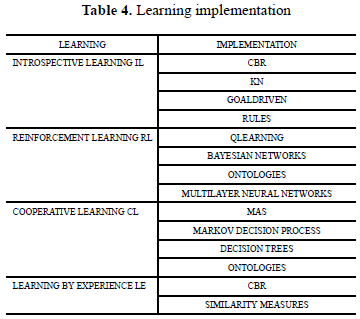
<body><![CDATA[<p><font size="2" face="Verdana, Arial, Helvetica, sans-serif">MetaAQUA, MCL and EMONE are focused on responding to failures, but the first is based on Goaldriven learning (GDL), which is focused on IL. Second is founded on the NoteAssessGuide (NAG) &#91;1&#93; cycle, that is based on RL and the third uses LE because it uses errordriven adaptive systems with the purpose of finding solutions to presented problems.</font></p>     <p><font size="2" face="Verdana, Arial, Helvetica, sans-serif">CLARION, MLCAA, MIDCA and Simple Model for Metareasoning are focused on metacognitive monitoring &#91;11,14,15&#93;, but CLARION and MLCAA implement decision making strategies for metalevel control, however, Simple Model for metaReasoning differs in the last aspect. EMONE and MetaAQUA share commons features, both have very complete support for problem solving and implement LE based on CBR systems. Moreover, CL is the base of MLCAA and DFM, both are architectures based on social context awareness and problem diagnosis in MAS. </font></p>     <p><font size="2" face="Verdana, Arial, Helvetica, sans-serif">CLARION and MetaAQUA are the architectures that implement more aspects related to learning approaches refering to metacognition.</font></p>     <p><font size="2" face="Verdana, Arial, Helvetica, sans-serif"><b>3.4  Computational implementations</b>    <br>   Continuing with the discussion, the computational aspects used for implementing IS &#91;33&#93; based on metacognitive architectures are listed in this paragraph. RL is the preferred strategy used by authors to implement learning capabilities in IS &#91;11,14,15&#93;. Moreover, RL is used in CLARION with Qlearning &#91;27&#93; and is implemented using backpropagation networks &#91;28&#93;, see <a href="#tab04">Table 4</a>. While, in MCL, RL is implemented using Bayesian Networks (BN) &#91;29&#93;.</font></p>     <p align="center"><font size="2" face="Verdana, Arial, Helvetica, sans-serif"><a name="tab04"></a></font><img src="/img/revistas/dyna/v80n180/v80n180a07tab04.gif"></p>     <p><font size="2" face="Verdana, Arial, Helvetica, sans-serif">MLCAA implements SL following a decision making strategy denominated selfguided learning, which uses a Markov decision process (MDP) &#91;11&#93; over decision trees. All implementations of RL described above were developed using QLearning algorithms &#91;11,1416&#93;.</font></p>     <p><font size="2" face="Verdana, Arial, Helvetica, sans-serif">Another computational technique implemented is CBR &#91;3,12, 18&#93;. CBR is a computational strategy for solving problems based on experience &#91;30,12&#93;. In metacognitive architectures, CBR is used to manage system memory and support the metamemory capabilities of IS &#91;12,18&#93;. In MetaAQUA, CBR supports both metamemory and metacomprehension, due to introspective metaexplanations &#91;9&#93;. While, in EMONE &#91;19&#93; CBRbased similarity measure, with an implementation of Common LISP Environment, is used. </font></p>     <p><font size="2" face="Verdana, Arial, Helvetica, sans-serif">MIDCA and Simple Model for Metareasoning do not present details of their implementation, they are in the design phase. </font></p>     <p><font size="2" face="Verdana, Arial, Helvetica, sans-serif">RL implementations based on QLearning is the most common support to selfregulation in metacognitive architectures. While metamemory and metacomprehension are implemented using strategies based on CBR.</font></p>     ]]></body>
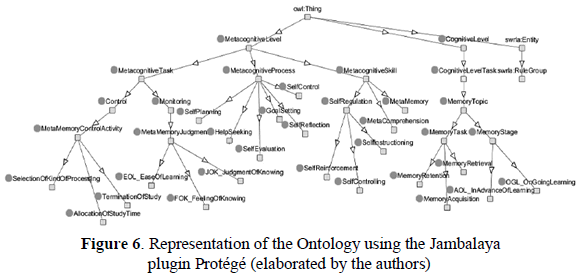
<body><![CDATA[<p><font size="2" face="Verdana, Arial, Helvetica, sans-serif"><b>3.5  Metacognitive ontology</b>    <br>   Semantic description of terms related to metacognition is performed using the ontology created. <a href="#fig06">Figure 6</a> shows the complete ontology.</font></p>     <p align="center"><font size="2" face="Verdana, Arial, Helvetica, sans-serif"><a name="fig06"></a></font><img src="/img/revistas/dyna/v80n180/v80n180a07fig06.gif"></p>     <p><font size="2" face="Verdana, Arial, Helvetica, sans-serif">In this section a list with definitions of the characteristics (facets) of the semantic relationship between the terms referring to metacognition is shown (See <a href="#tab05">Table 5</a>).</font></p>     <p align="center"><font size="2" face="Verdana, Arial, Helvetica, sans-serif"><a name="tab05"></a></font><img src="/img/revistas/dyna/v80n180/v80n180a07tab05.gif"></p>     <p><font size="2" face="Verdana, Arial, Helvetica, sans-serif">The specification of semantic relationships can contribute to provide clarity in relation to metacognitive concepts.</font></p>     <p>&nbsp;</p>     <p><font size="3" face="Verdana, Arial, Helvetica, sans-serif"><b>4.  CONCLUSIONS</b></font></p>     <p><font size="2" face="Verdana, Arial, Helvetica, sans-serif">In this paper we presented a research work based on four categories of study where it was found that there are two predominant types of architectures of metacognition in IS, centralized and decentralized.</font></p>     <p><font size="2" face="Verdana, Arial, Helvetica, sans-serif">The learning strategies present in metacognitive architectures are: Introspective Learning (IL), Reinforcement Learning (RL), Learning by Experience (LE) and Cooperative Learning (CL).</font></p>     ]]></body>
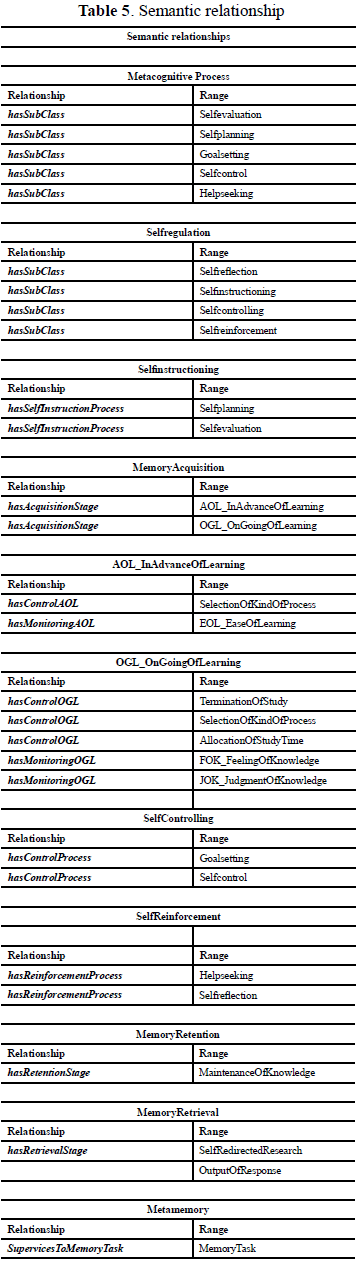
<body><![CDATA[<p><font size="2" face="Verdana, Arial, Helvetica, sans-serif">The most used computational implementation to support selfregulation in metacognitive architectures are RL implementations based on QLearning. While metamemory and metacomprehension are implemented using strategies based on CBR. CLARION and MetaAQUA are the architectures that implement most aspects related to the different learning approaches of metacognition</font></p>     <p><font size="2" face="Verdana, Arial, Helvetica, sans-serif">MetaAQUA, EMONE and MIDCA, are the most complete metacognitive architectures as they provide support for the three main components of metacognition.</font></p>     <p><font size="2" face="Verdana, Arial, Helvetica, sans-serif">An ontologybased semantic model was proposed which is composed of the terms and concepts found in the studied architectures.</font></p>     <p><font size="2" face="Verdana, Arial, Helvetica, sans-serif">Finally, the specification of semantic relationships among terms and concepts can contribute to provide clarity about understanding metacognition.</font></p>     <p>&nbsp;</p>     <p><font size="3" face="Verdana, Arial, Helvetica, sans-serif"><b>REFERENCES</b></font></p>     <!-- ref --><p><font size="2" face="Verdana, Arial, Helvetica, sans-serif"><b>&#91;1&#93;</b> Anderson, M. and Oates, T., Metacognition in Computation: Papers from 2005 AAAI Spring Symposium., in AAAI Technical Report SS0504, Menlo Park, CA, 2005.    &nbsp;&nbsp;&nbsp;&nbsp;&nbsp;&nbsp;&nbsp;&nbsp;[&#160;<a href="javascript:void(0);" onclick="javascript: window.open('/scielo.php?script=sci_nlinks&ref=000119&pid=S0012-7353201300040000700001&lng=','','width=640,height=500,resizable=yes,scrollbars=1,menubar=yes,');">Links</a>&#160;]<!-- end-ref --><!-- ref --><br>   <b>&#91;2&#93;</b> Minsky, M., Singh, P. and Sloman., A., Designing Architectures for HumanLevel Intelligence, in The St. Thomas Common Sense Symposium. AI Magazine, pp. 113124, 2004.    &nbsp;&nbsp;&nbsp;&nbsp;&nbsp;&nbsp;&nbsp;&nbsp;[&#160;<a href="javascript:void(0);" onclick="javascript: window.open('/scielo.php?script=sci_nlinks&ref=000120&pid=S0012-7353201300040000700002&lng=','','width=640,height=500,resizable=yes,scrollbars=1,menubar=yes,');">Links</a>&#160;]<!-- end-ref --><!-- ref --><br>   <b>&#91;3&#93;</b> Cox, M., Metacognition in computation: A selected research review, Artificial Intelligence, vol. 169, no. doi:10.1016/j.artint.2005.10.009, pp. 104141, 2005.    &nbsp;&nbsp;&nbsp;&nbsp;&nbsp;&nbsp;&nbsp;&nbsp;[&#160;<a href="javascript:void(0);" onclick="javascript: window.open('/scielo.php?script=sci_nlinks&ref=000121&pid=S0012-7353201300040000700003&lng=','','width=640,height=500,resizable=yes,scrollbars=1,menubar=yes,');">Links</a>&#160;]<!-- end-ref --><!-- ref --><br>   <b>&#91;4&#93;</b> Anderson, M., Fults, S., Josyula, D. and Oates, T., A SelfHelp Guide for Autonomous Systems. AI Magazine, 29(2), AI Magazine, 29(2), pp. 6776, 2008.    &nbsp;&nbsp;&nbsp;&nbsp;&nbsp;&nbsp;&nbsp;&nbsp;[&#160;<a href="javascript:void(0);" onclick="javascript: window.open('/scielo.php?script=sci_nlinks&ref=000122&pid=S0012-7353201300040000700004&lng=','','width=640,height=500,resizable=yes,scrollbars=1,menubar=yes,');">Links</a>&#160;]<!-- end-ref --><!-- ref --><br>   <b>&#91;5&#93;</b> E Vockell, Metacognitive Skills, Educational Psychology: A Practical Approach.: (Online Ed.) available at <a href="http://educationcalumetpurdueedu/vockell/edPsybook/Edpsy7/edpsy7_meta.htm" target="referencia">http://educationcalumetpurdueedu/vockell/edPsybook/Edpsy7/edpsy7_meta.htm</a>. Viewed 10/11/2011, 2009.    &nbsp;&nbsp;&nbsp;&nbsp;&nbsp;&nbsp;&nbsp;&nbsp;[&#160;<a href="javascript:void(0);" onclick="javascript: window.open('/scielo.php?script=sci_nlinks&ref=000123&pid=S0012-7353201300040000700005&lng=','','width=640,height=500,resizable=yes,scrollbars=1,menubar=yes,');">Links</a>&#160;]<!-- end-ref --><!-- ref --><br>   <b>&#91;6&#93;</b> T Johnson, T Archibald, and G Tenenbaum, Individual and team annotation effects on students' reading comprehension, critical thinking, and metacognitive skills, Journal of Computers in Human Behavior COMPUT HUM BEHAV, vol. 26, no. 6, pp. 14961, 2010.    &nbsp;&nbsp;&nbsp;&nbsp;&nbsp;&nbsp;&nbsp;&nbsp;[&#160;<a href="javascript:void(0);" onclick="javascript: window.open('/scielo.php?script=sci_nlinks&ref=000124&pid=S0012-7353201300040000700006&lng=','','width=640,height=500,resizable=yes,scrollbars=1,menubar=yes,');">Links</a>&#160;]<!-- end-ref --><!-- ref --><br>   <b>&#91;7&#93;</b> R Maki and S Berry, Metacomprehension of text material, Journal of Experimental Psychology:Learning, Memory, and Cognition, vol. 10, pp. 663-679, 1984.    &nbsp;&nbsp;&nbsp;&nbsp;&nbsp;&nbsp;&nbsp;&nbsp;[&#160;<a href="javascript:void(0);" onclick="javascript: window.open('/scielo.php?script=sci_nlinks&ref=000125&pid=S0012-7353201300040000700007&lng=','','width=640,height=500,resizable=yes,scrollbars=1,menubar=yes,');">Links</a>&#160;]<!-- end-ref --><!-- ref --><br>   <b>&#91;8&#93;</b> T Nelson and L Narens, Metamemory: A Theoretical Framework and New Findings, In T. O. Nelson ed. Metacognition: Core Readings, 924. Boston: Allyn and Bacon. (Originally published in 1990), 1992.    &nbsp;&nbsp;&nbsp;&nbsp;&nbsp;&nbsp;&nbsp;&nbsp;[&#160;<a href="javascript:void(0);" onclick="javascript: window.open('/scielo.php?script=sci_nlinks&ref=000126&pid=S0012-7353201300040000700008&lng=','','width=640,height=500,resizable=yes,scrollbars=1,menubar=yes,');">Links</a>&#160;]<!-- end-ref --><!-- ref --><br>   <b>&#91;9&#93;</b> M Cox, Perpetual Selfaware Cognitive Agents, AI Magazine, vol. 28(1), pp. 3245, 2007.    &nbsp;&nbsp;&nbsp;&nbsp;&nbsp;&nbsp;&nbsp;&nbsp;[&#160;<a href="javascript:void(0);" onclick="javascript: window.open('/scielo.php?script=sci_nlinks&ref=000127&pid=S0012-7353201300040000700009&lng=','','width=640,height=500,resizable=yes,scrollbars=1,menubar=yes,');">Links</a>&#160;]<!-- end-ref --><!-- ref --><br>   <b>&#91;10&#93;</b> M Cox and A Ram, Introspective Multistrategy Learning: On the construction of learning strategies, Artificial Intelligence 112: , vol. 112, pp. 155, 1999.    &nbsp;&nbsp;&nbsp;&nbsp;&nbsp;&nbsp;&nbsp;&nbsp;[&#160;<a href="javascript:void(0);" onclick="javascript: window.open('/scielo.php?script=sci_nlinks&ref=000128&pid=S0012-7353201300040000700010&lng=','','width=640,height=500,resizable=yes,scrollbars=1,menubar=yes,');">Links</a>&#160;]<!-- end-ref --><!-- ref --><br>   <b>&#91;11&#93;</b> A Raja and V Lesser, A framework for metalevel control in multiagent systems, Autonomous Agents and MultiAgent Systems, vol. 15(2), pp. 147196. doi:10.1007/s104580069008z, 2007.    &nbsp;&nbsp;&nbsp;&nbsp;&nbsp;&nbsp;&nbsp;&nbsp;[&#160;<a href="javascript:void(0);" onclick="javascript: window.open('/scielo.php?script=sci_nlinks&ref=000129&pid=S0012-7353201300040000700011&lng=','','width=640,height=500,resizable=yes,scrollbars=1,menubar=yes,');">Links</a>&#160;]<!-- end-ref --><!-- ref --><br>   <b>&#91;12&#93;</b> A. Aamodt, KnowledgeIntensive CaseBased Reasoning and Intelligent Tutoring, AI Communications, vol. Vol.7(1), pp. 39-45., 1994.    &nbsp;&nbsp;&nbsp;&nbsp;&nbsp;&nbsp;&nbsp;&nbsp;[&#160;<a href="javascript:void(0);" onclick="javascript: window.open('/scielo.php?script=sci_nlinks&ref=000130&pid=S0012-7353201300040000700012&lng=','','width=640,height=500,resizable=yes,scrollbars=1,menubar=yes,');">Links</a>&#160;]<!-- end-ref --><!-- ref --><br>   <b>&#91;13&#93;</b> I., Demetriadis, S., Karakostas, A. Magnisalis, Adaptive and Intelligent Systems for Collaborative Learning Support: A Review of the Field, IEEE Transactions on Learning Technologies, vol. 4(1). doi:10.1109/TLT.2011.2, pp. 5-20, 2011.    &nbsp;&nbsp;&nbsp;&nbsp;&nbsp;&nbsp;&nbsp;&nbsp;[&#160;<a href="javascript:void(0);" onclick="javascript: window.open('/scielo.php?script=sci_nlinks&ref=000131&pid=S0012-7353201300040000700013&lng=','','width=640,height=500,resizable=yes,scrollbars=1,menubar=yes,');">Links</a>&#160;]<!-- end-ref --><!-- ref --><br>   <b>&#91;14&#93;</b> R Sun and R Mathews, Modeling MetaCognition in a Cognitive Architecture, Cognitive Systems Research, vol. 7(4), pp. 327338, 2006.    &nbsp;&nbsp;&nbsp;&nbsp;&nbsp;&nbsp;&nbsp;&nbsp;[&#160;<a href="javascript:void(0);" onclick="javascript: window.open('/scielo.php?script=sci_nlinks&ref=000132&pid=S0012-7353201300040000700014&lng=','','width=640,height=500,resizable=yes,scrollbars=1,menubar=yes,');">Links</a>&#160;]<!-- end-ref --><!-- ref --><br>   <b>&#91;15&#93;</b> M Anderson and D Perlis, Logic, Selfawareness and Selfimprovement: The Metacognitive Loop and the problem of brittleness, Journal of Logic and Computation 15(1), 2005.    &nbsp;&nbsp;&nbsp;&nbsp;&nbsp;&nbsp;&nbsp;&nbsp;[&#160;<a href="javascript:void(0);" onclick="javascript: window.open('/scielo.php?script=sci_nlinks&ref=000133&pid=S0012-7353201300040000700015&lng=','','width=640,height=500,resizable=yes,scrollbars=1,menubar=yes,');">Links</a>&#160;]<!-- end-ref --><!-- ref --><br>   <b>&#91;16&#93;</b> M Schmill, M Anderson, S Fults, and D Josyula, The Metacognitive Loop and Reasoning about Anomalies, in Metareasoning: Thinking about thinking Cambridge. MA: MIT Press., 2011, pp. 183198.    &nbsp;&nbsp;&nbsp;&nbsp;&nbsp;&nbsp;&nbsp;&nbsp;[&#160;<a href="javascript:void(0);" onclick="javascript: window.open('/scielo.php?script=sci_nlinks&ref=000134&pid=S0012-7353201300040000700016&lng=','','width=640,height=500,resizable=yes,scrollbars=1,menubar=yes,');">Links</a>&#160;]<!-- end-ref --><!-- ref --><br>   <b>&#91;17&#93;</b> N Noy and D McGuinness, Ontology Development 101: A Guide to Creating your First Ontology, Stanford Knowledge System Laboratory Technical Report and Stanford Medical Informatics Technical Reports, 2001.    &nbsp;&nbsp;&nbsp;&nbsp;&nbsp;&nbsp;&nbsp;&nbsp;[&#160;<a href="javascript:void(0);" onclick="javascript: window.open('/scielo.php?script=sci_nlinks&ref=000135&pid=S0012-7353201300040000700017&lng=','','width=640,height=500,resizable=yes,scrollbars=1,menubar=yes,');">Links</a>&#160;]<!-- end-ref --><!-- ref --><br>   <b>&#91;18&#93;</b> M Cox and A Raja, Metareasoning: An introduction, in Metareasoning: Thinking about thinking. Cambridge, MA: MIT Press., 2011, pp. 314.    &nbsp;&nbsp;&nbsp;&nbsp;&nbsp;&nbsp;&nbsp;&nbsp;[&#160;<a href="javascript:void(0);" onclick="javascript: window.open('/scielo.php?script=sci_nlinks&ref=000136&pid=S0012-7353201300040000700018&lng=','','width=640,height=500,resizable=yes,scrollbars=1,menubar=yes,');">Links</a>&#160;]<!-- end-ref --><!-- ref --><br>   <b>&#91;19&#93;</b> P Singh, EMONE: An Architecture for Reflective Commonsense Thinking. Dissertation of Doctor of Philosophy in Computer Science and Engineering. Cambridge, MA: Massachusetts Institute of Technology, 2005.    &nbsp;&nbsp;&nbsp;&nbsp;&nbsp;&nbsp;&nbsp;&nbsp;[&#160;<a href="javascript:void(0);" onclick="javascript: window.open('/scielo.php?script=sci_nlinks&ref=000137&pid=S0012-7353201300040000700019&lng=','','width=640,height=500,resizable=yes,scrollbars=1,menubar=yes,');">Links</a>&#160;]<!-- end-ref --><!-- ref --><br>   <b>&#91;20&#93;</b> C Kennedy and A Sloman, Autonomous Recovery from Hostile Code Insertion using Distributed Reflection, Journal of Cognitive Systems Research, vol. 4(2), pp. 89117., 2003.    &nbsp;&nbsp;&nbsp;&nbsp;&nbsp;&nbsp;&nbsp;&nbsp;[&#160;<a href="javascript:void(0);" onclick="javascript: window.open('/scielo.php?script=sci_nlinks&ref=000138&pid=S0012-7353201300040000700020&lng=','','width=640,height=500,resizable=yes,scrollbars=1,menubar=yes,');">Links</a>&#160;]<!-- end-ref --><!-- ref --><br>   <b>&#91;21&#93;</b> C Kennedy, Decentralised Metacognition in ContextAware Autonomic Systems: some Key Challenges, AI Magazine, 2010.    &nbsp;&nbsp;&nbsp;&nbsp;&nbsp;&nbsp;&nbsp;&nbsp;[&#160;<a href="javascript:void(0);" onclick="javascript: window.open('/scielo.php?script=sci_nlinks&ref=000139&pid=S0012-7353201300040000700021&lng=','','width=640,height=500,resizable=yes,scrollbars=1,menubar=yes,');">Links</a>&#160;]<!-- end-ref --><!-- ref --><br>   <b>&#91;22&#93;</b> M Cox, T Oates, and D Perlis, Toward an Integrated Metacognitive Architecture. Advances in Cognitive Systems, Papers from the 2011 AAAI Fall Symposium, vol. (FS1101), pp. 7481, 2011.    &nbsp;&nbsp;&nbsp;&nbsp;&nbsp;&nbsp;&nbsp;&nbsp;[&#160;<a href="javascript:void(0);" onclick="javascript: window.open('/scielo.php?script=sci_nlinks&ref=000140&pid=S0012-7353201300040000700022&lng=','','width=640,height=500,resizable=yes,scrollbars=1,menubar=yes,');">Links</a>&#160;]<!-- end-ref --><!-- ref --><br>   <b>&#91;23&#93;</b> D Norman and T Shallice, Attention to action: willed and automatic control of behavior, in Consciousness and Self Regulation: Advances in Research and Theory. Plenum, New York.: G. Schwartz and D. Shapiro, (eds.) , 1986, ch. vol.4, pp. 118.    &nbsp;&nbsp;&nbsp;&nbsp;&nbsp;&nbsp;&nbsp;&nbsp;[&#160;<a href="javascript:void(0);" onclick="javascript: window.open('/scielo.php?script=sci_nlinks&ref=000141&pid=S0012-7353201300040000700023&lng=','','width=640,height=500,resizable=yes,scrollbars=1,menubar=yes,');">Links</a>&#160;]<!-- end-ref --><!-- ref --><br>   <b>&#91;24&#93;</b> Stanford. (2012, Julio) Prot&eacute;g&eacute; Home Page. &#91;Online&#93;. <a href="http://protege.stanford.edu/" target="referencia">http://protege.stanford.edu/</a>     &nbsp;&nbsp;&nbsp;&nbsp;&nbsp;&nbsp;&nbsp;&nbsp;[&#160;<a href="javascript:void(0);" onclick="javascript: window.open('/scielo.php?script=sci_nlinks&ref=000142&pid=S0012-7353201300040000700024&lng=','','width=640,height=500,resizable=yes,scrollbars=1,menubar=yes,');">Links</a>&#160;]<!-- end-ref --><!-- ref --><br>   <b>&#91;25&#93;</b> L Kaelbling, M Littman, and A Moore, Reinforcement Learning : A Survey, Journal of Artificial Intelligence Research, vol. 4, pp. 237285, 1996.    &nbsp;&nbsp;&nbsp;&nbsp;&nbsp;&nbsp;&nbsp;&nbsp;[&#160;<a href="javascript:void(0);" onclick="javascript: window.open('/scielo.php?script=sci_nlinks&ref=000143&pid=S0012-7353201300040000700025&lng=','','width=640,height=500,resizable=yes,scrollbars=1,menubar=yes,');">Links</a>&#160;]<!-- end-ref --><!-- ref --><br>   <b>&#91;26&#93;</b> D Schultz and S Schultz, A history of modern psychology , 10th ed. Belmont, CA: Wadsworth, Cengage Learning. pp. 67-77, 88-100. ISBN 13:9781133316244., 2012.    &nbsp;&nbsp;&nbsp;&nbsp;&nbsp;&nbsp;&nbsp;&nbsp;[&#160;<a href="javascript:void(0);" onclick="javascript: window.open('/scielo.php?script=sci_nlinks&ref=000144&pid=S0012-7353201300040000700026&lng=','','width=640,height=500,resizable=yes,scrollbars=1,menubar=yes,');">Links</a>&#160;]<!-- end-ref --><!-- ref --><br>   <b>&#91;27&#93;</b> C Watkins, Learning with delayed rewards, Cambridge University, Cambridge, UK., Ph.D. thesis 1989.    &nbsp;&nbsp;&nbsp;&nbsp;&nbsp;&nbsp;&nbsp;&nbsp;[&#160;<a href="javascript:void(0);" onclick="javascript: window.open('/scielo.php?script=sci_nlinks&ref=000145&pid=S0012-7353201300040000700027&lng=','','width=640,height=500,resizable=yes,scrollbars=1,menubar=yes,');">Links</a>&#160;]<!-- end-ref --><!-- ref --><br>   <b>&#91;28&#93;</b> D Rumelhart and J McClelland, Parallel distributed processing: Explorations in the microstructures of cognition, The PDP Research Group, Cambridge, MA, MIT Press. 1986.    &nbsp;&nbsp;&nbsp;&nbsp;&nbsp;&nbsp;&nbsp;&nbsp;[&#160;<a href="javascript:void(0);" onclick="javascript: window.open('/scielo.php?script=sci_nlinks&ref=000146&pid=S0012-7353201300040000700028&lng=','','width=640,height=500,resizable=yes,scrollbars=1,menubar=yes,');">Links</a>&#160;]<!-- end-ref --><!-- ref --><br>   <b>&#91;29&#93;</b> J., Liu, H., Deng, A. Ding, Application of Bayesian Network Knowledge Reasoning Based on CBR in ITS, Third International Joint Conference on Computational Science and Optimization, 2010.    &nbsp;&nbsp;&nbsp;&nbsp;&nbsp;&nbsp;&nbsp;&nbsp;[&#160;<a href="javascript:void(0);" onclick="javascript: window.open('/scielo.php?script=sci_nlinks&ref=000147&pid=S0012-7353201300040000700029&lng=','','width=640,height=500,resizable=yes,scrollbars=1,menubar=yes,');">Links</a>&#160;]<!-- end-ref --><!-- ref --><br>   <b>&#91;30&#93;</b> J. L., Cox, M. T., & Gonzalezcalero, P. A. Kolodner, Casebased reasoninginspired approaches to education, Engineering, vol., 00, pp. 14. DOI:10.1017/S000000000000000, 2005.    &nbsp;&nbsp;&nbsp;&nbsp;&nbsp;&nbsp;&nbsp;&nbsp;[&#160;<a href="javascript:void(0);" onclick="javascript: window.open('/scielo.php?script=sci_nlinks&ref=000148&pid=S0012-7353201300040000700030&lng=','','width=640,height=500,resizable=yes,scrollbars=1,menubar=yes,');">Links</a>&#160;]<!-- end-ref --><!-- ref --><br>   <b>&#91;31&#93;</b> A Alter, D Oppenheimer, N Epley, and E Eyre, Metacognitive difficulty activates analytic reasoning, Journal of Experimental Psychology: General, vol. Vol 136(4) DOI:10.1037/00963445.136.4.569, pp. 569576, 2007.    &nbsp;&nbsp;&nbsp;&nbsp;&nbsp;&nbsp;&nbsp;&nbsp;[&#160;<a href="javascript:void(0);" onclick="javascript: window.open('/scielo.php?script=sci_nlinks&ref=000149&pid=S0012-7353201300040000700031&lng=','','width=640,height=500,resizable=yes,scrollbars=1,menubar=yes,');">Links</a>&#160;]<!-- end-ref --><!-- ref --><br>   <b>&#91;32&#93;</b> M Minsky, The Emotion Machine. New York: Simon and Schuster, 2006     &nbsp;&nbsp;&nbsp;&nbsp;&nbsp;&nbsp;&nbsp;&nbsp;[&#160;<a href="javascript:void(0);" onclick="javascript: window.open('/scielo.php?script=sci_nlinks&ref=000150&pid=S0012-7353201300040000700032&lng=','','width=640,height=500,resizable=yes,scrollbars=1,menubar=yes,');">Links</a>&#160;]<!-- end-ref --><!-- ref --><br>   <b>&#91;33&#93;</b> Alvarez, J.; Jim&eacute;nez, J.; Ramirez, J. Design Cycle of a Robot for Learning and the Development of Creativity in Engineering. Dyna, vol. 78, n. 170, pp. 5158, 2011 </font>&nbsp;&nbsp;&nbsp;&nbsp;&nbsp;&nbsp;&nbsp;&nbsp;[&#160;<a href="javascript:void(0);" onclick="javascript: window.open('/scielo.php?script=sci_nlinks&ref=000151&pid=S0012-7353201300040000700033&lng=','','width=640,height=500,resizable=yes,scrollbars=1,menubar=yes,');">Links</a>&#160;]<!-- end-ref --> ]]></body><back>
<ref-list>
<ref id="B1">
<label>1</label><nlm-citation citation-type="confpro">
<person-group person-group-type="author">
<name>
<surname><![CDATA[Anderson]]></surname>
<given-names><![CDATA[M.]]></given-names>
</name>
<name>
<surname><![CDATA[Oates]]></surname>
<given-names><![CDATA[T.]]></given-names>
</name>
</person-group>
<source><![CDATA[Metacognition in Computation]]></source>
<year>2005</year>
<conf-name><![CDATA[ AAAI Spring Symposium]]></conf-name>
<conf-date>2005</conf-date>
<conf-loc> </conf-loc>
<publisher-loc><![CDATA[Menlo Park^eCA CA]]></publisher-loc>
</nlm-citation>
</ref>
<ref id="B2">
<label>2</label><nlm-citation citation-type="confpro">
<person-group person-group-type="author">
<name>
<surname><![CDATA[Minsky]]></surname>
<given-names><![CDATA[M.]]></given-names>
</name>
<name>
<surname><![CDATA[Singh]]></surname>
<given-names><![CDATA[P.]]></given-names>
</name>
<name>
<surname><![CDATA[Sloman]]></surname>
<given-names><![CDATA[A.]]></given-names>
</name>
</person-group>
<article-title xml:lang="en"><![CDATA[Designing Architectures for HumanLevel Intelligence]]></article-title>
<source><![CDATA[]]></source>
<year>2004</year>
<conf-name><![CDATA[ The St. Thomas Common Sense Symposium]]></conf-name>
<conf-loc> </conf-loc>
<page-range>113124</page-range><publisher-name><![CDATA[AI Magazine]]></publisher-name>
</nlm-citation>
</ref>
<ref id="B3">
<label>3</label><nlm-citation citation-type="journal">
<person-group person-group-type="author">
<name>
<surname><![CDATA[Cox]]></surname>
<given-names><![CDATA[M.]]></given-names>
</name>
</person-group>
<article-title xml:lang="en"><![CDATA[Metacognition in computation: A selected research review]]></article-title>
<source><![CDATA[Artificial Intelligence]]></source>
<year>2005</year>
<volume>169</volume>
<page-range>104141</page-range></nlm-citation>
</ref>
<ref id="B4">
<label>4</label><nlm-citation citation-type="journal">
<person-group person-group-type="author">
<name>
<surname><![CDATA[Anderson]]></surname>
<given-names><![CDATA[M.]]></given-names>
</name>
<name>
<surname><![CDATA[Fults]]></surname>
<given-names><![CDATA[S.]]></given-names>
</name>
<name>
<surname><![CDATA[Josyula]]></surname>
<given-names><![CDATA[D.]]></given-names>
</name>
<name>
<surname><![CDATA[Oates]]></surname>
<given-names><![CDATA[T.]]></given-names>
</name>
</person-group>
<article-title xml:lang="en"><![CDATA[A SelfHelp Guide for Autonomous Systems]]></article-title>
<source><![CDATA[AI Magazine]]></source>
<year>2008</year>
<volume>29</volume>
<numero>2</numero>
<issue>2</issue>
<page-range>6776</page-range></nlm-citation>
</ref>
<ref id="B5">
<label>5</label><nlm-citation citation-type="">
<person-group person-group-type="author">
<name>
<surname><![CDATA[Vockell]]></surname>
<given-names><![CDATA[E]]></given-names>
</name>
</person-group>
<source><![CDATA[Metacognitive Skills, Educational Psychology: A Practical Approach]]></source>
<year>2009</year>
</nlm-citation>
</ref>
<ref id="B6">
<label>6</label><nlm-citation citation-type="journal">
<person-group person-group-type="author">
<name>
<surname><![CDATA[Johnson]]></surname>
<given-names><![CDATA[T]]></given-names>
</name>
<name>
<surname><![CDATA[Archibald]]></surname>
<given-names><![CDATA[T]]></given-names>
</name>
<name>
<surname><![CDATA[Tenenbaum]]></surname>
<given-names><![CDATA[G]]></given-names>
</name>
</person-group>
<article-title xml:lang="en"><![CDATA[Individual and team annotation effects on students' reading comprehension, critical thinking, and metacognitive skills]]></article-title>
<source><![CDATA[Journal of Computers in Human Behavior COMPUT HUM BEHAV]]></source>
<year>2010</year>
<volume>26</volume>
<numero>6</numero>
<issue>6</issue>
<page-range>14961</page-range></nlm-citation>
</ref>
<ref id="B7">
<label>7</label><nlm-citation citation-type="journal">
<person-group person-group-type="author">
<name>
<surname><![CDATA[Maki]]></surname>
<given-names><![CDATA[R]]></given-names>
</name>
<name>
<surname><![CDATA[Berry]]></surname>
<given-names><![CDATA[S]]></given-names>
</name>
</person-group>
<article-title xml:lang="en"><![CDATA[Metacomprehension of text material]]></article-title>
<source><![CDATA[Journal of Experimental Psychology:Learning, Memory, and Cognition]]></source>
<year>1984</year>
<volume>10</volume>
<page-range>663-679</page-range></nlm-citation>
</ref>
<ref id="B8">
<label>8</label><nlm-citation citation-type="book">
<person-group person-group-type="author">
<name>
<surname><![CDATA[Nelson]]></surname>
<given-names><![CDATA[T]]></given-names>
</name>
<name>
<surname><![CDATA[Narens]]></surname>
<given-names><![CDATA[L]]></given-names>
</name>
</person-group>
<article-title xml:lang="en"><![CDATA[Metamemory: A Theoretical Framework and New Findings]]></article-title>
<person-group person-group-type="editor">
<name>
<surname><![CDATA[Nelson]]></surname>
<given-names><![CDATA[T. O.]]></given-names>
</name>
</person-group>
<source><![CDATA[Metacognition: Core Readings]]></source>
<year>1992</year>
<publisher-loc><![CDATA[Boston ]]></publisher-loc>
<publisher-name><![CDATA[Allyn and Bacon]]></publisher-name>
</nlm-citation>
</ref>
<ref id="B9">
<label>9</label><nlm-citation citation-type="journal">
<person-group person-group-type="author">
<name>
<surname><![CDATA[Cox]]></surname>
<given-names><![CDATA[M]]></given-names>
</name>
</person-group>
<article-title xml:lang="en"><![CDATA[Perpetual Selfaware Cognitive Agents]]></article-title>
<source><![CDATA[AI Magazine]]></source>
<year>2007</year>
<volume>28</volume>
<numero>1</numero>
<issue>1</issue>
<page-range>3245</page-range></nlm-citation>
</ref>
<ref id="B10">
<label>10</label><nlm-citation citation-type="journal">
<person-group person-group-type="author">
<name>
<surname><![CDATA[Cox]]></surname>
<given-names><![CDATA[M]]></given-names>
</name>
<name>
<surname><![CDATA[Ram]]></surname>
<given-names><![CDATA[A]]></given-names>
</name>
</person-group>
<article-title xml:lang="en"><![CDATA[Introspective Multistrategy Learning: On the construction of learning strategies]]></article-title>
<source><![CDATA[Artificial Intelligence]]></source>
<year>1999</year>
<volume>112</volume>
<page-range>155</page-range></nlm-citation>
</ref>
<ref id="B11">
<label>11</label><nlm-citation citation-type="journal">
<person-group person-group-type="author">
<name>
<surname><![CDATA[Raja]]></surname>
<given-names><![CDATA[A]]></given-names>
</name>
<name>
<surname><![CDATA[Lesser]]></surname>
<given-names><![CDATA[V]]></given-names>
</name>
</person-group>
<article-title xml:lang="en"><![CDATA[A framework for metalevel control in multiagent systems]]></article-title>
<source><![CDATA[Autonomous Agents and MultiAgent Systems]]></source>
<year>2007</year>
<volume>15</volume>
<numero>2</numero>
<issue>2</issue>
<page-range>147196</page-range></nlm-citation>
</ref>
<ref id="B12">
<label>12</label><nlm-citation citation-type="journal">
<person-group person-group-type="author">
<name>
<surname><![CDATA[Aamodt]]></surname>
<given-names><![CDATA[A.]]></given-names>
</name>
</person-group>
<article-title xml:lang="en"><![CDATA[KnowledgeIntensive CaseBased Reasoning and Intelligent Tutoring]]></article-title>
<source><![CDATA[AI Communications]]></source>
<year>1994</year>
<volume>7</volume>
<numero>1</numero>
<issue>1</issue>
<page-range>39-45</page-range></nlm-citation>
</ref>
<ref id="B13">
<label>13</label><nlm-citation citation-type="journal">
<person-group person-group-type="author">
<name>
<surname><![CDATA[Demetriadis]]></surname>
<given-names><![CDATA[I.]]></given-names>
</name>
<name>
<surname><![CDATA[Karakostas]]></surname>
<given-names><![CDATA[S.]]></given-names>
</name>
<name>
<surname><![CDATA[Magnisalis]]></surname>
<given-names><![CDATA[A.]]></given-names>
</name>
</person-group>
<article-title xml:lang="en"><![CDATA[Adaptive and Intelligent Systems for Collaborative Learning Support: A Review of the Field]]></article-title>
<source><![CDATA[IEEE Transactions on Learning Technologies]]></source>
<year>2011</year>
<volume>4</volume>
<numero>1</numero>
<issue>1</issue>
<page-range>5-20</page-range></nlm-citation>
</ref>
<ref id="B14">
<label>14</label><nlm-citation citation-type="journal">
<person-group person-group-type="author">
<name>
<surname><![CDATA[Sun]]></surname>
<given-names><![CDATA[R]]></given-names>
</name>
<name>
<surname><![CDATA[Mathews]]></surname>
<given-names><![CDATA[R]]></given-names>
</name>
</person-group>
<article-title xml:lang="en"><![CDATA[Modeling MetaCognition in a Cognitive Architecture]]></article-title>
<source><![CDATA[Cognitive Systems Research]]></source>
<year>2006</year>
<volume>7</volume>
<numero>4</numero>
<issue>4</issue>
<page-range>327338</page-range></nlm-citation>
</ref>
<ref id="B15">
<label>15</label><nlm-citation citation-type="journal">
<person-group person-group-type="author">
<name>
<surname><![CDATA[Anderson]]></surname>
<given-names><![CDATA[M]]></given-names>
</name>
<name>
<surname><![CDATA[Perlis]]></surname>
<given-names><![CDATA[D]]></given-names>
</name>
</person-group>
<article-title xml:lang="en"><![CDATA[Logic, Selfawareness and Selfimprovement: The Metacognitive Loop and the problem of brittleness]]></article-title>
<source><![CDATA[Journal of Logic and Computation]]></source>
<year>2005</year>
<volume>15</volume>
<numero>1</numero>
<issue>1</issue>
</nlm-citation>
</ref>
<ref id="B16">
<label>16</label><nlm-citation citation-type="book">
<person-group person-group-type="author">
<name>
<surname><![CDATA[Schmill]]></surname>
<given-names><![CDATA[M]]></given-names>
</name>
<name>
<surname><![CDATA[Anderson]]></surname>
<given-names><![CDATA[M]]></given-names>
</name>
<name>
<surname><![CDATA[Fults]]></surname>
<given-names><![CDATA[S]]></given-names>
</name>
<name>
<surname><![CDATA[Josyula]]></surname>
<given-names><![CDATA[D]]></given-names>
</name>
</person-group>
<article-title xml:lang="en"><![CDATA[The Metacognitive Loop and Reasoning about Anomalies]]></article-title>
<source><![CDATA[Metareasoning: Thinking about thinking Cambridge]]></source>
<year>2011</year>
<page-range>183198</page-range><publisher-loc><![CDATA[^eMA MA]]></publisher-loc>
<publisher-name><![CDATA[MIT Press]]></publisher-name>
</nlm-citation>
</ref>
<ref id="B17">
<label>17</label><nlm-citation citation-type="">
<person-group person-group-type="author">
<name>
<surname><![CDATA[Noy]]></surname>
<given-names><![CDATA[N]]></given-names>
</name>
<name>
<surname><![CDATA[McGuinness]]></surname>
<given-names><![CDATA[D]]></given-names>
</name>
</person-group>
<source><![CDATA[Ontology Development 101: A Guide to Creating your First Ontology]]></source>
<year>2001</year>
</nlm-citation>
</ref>
<ref id="B18">
<label>18</label><nlm-citation citation-type="book">
<person-group person-group-type="author">
<name>
<surname><![CDATA[Cox]]></surname>
<given-names><![CDATA[M]]></given-names>
</name>
<name>
<surname><![CDATA[Raja]]></surname>
<given-names><![CDATA[A]]></given-names>
</name>
</person-group>
<article-title xml:lang="en"><![CDATA[Metareasoning: An introduction]]></article-title>
<source><![CDATA[Metareasoning: Thinking about thinking]]></source>
<year>2011</year>
<page-range>314</page-range><publisher-loc><![CDATA[Cambridge^eMA MA]]></publisher-loc>
<publisher-name><![CDATA[MIT Press]]></publisher-name>
</nlm-citation>
</ref>
<ref id="B19">
<label>19</label><nlm-citation citation-type="">
<person-group person-group-type="author">
<name>
<surname><![CDATA[Singh]]></surname>
<given-names><![CDATA[P]]></given-names>
</name>
</person-group>
<source><![CDATA[EMONE: An Architecture for Reflective Commonsense Thinking]]></source>
<year></year>
</nlm-citation>
</ref>
<ref id="B20">
<label>20</label><nlm-citation citation-type="journal">
<person-group person-group-type="author">
<name>
<surname><![CDATA[Kennedy]]></surname>
<given-names><![CDATA[C]]></given-names>
</name>
<name>
<surname><![CDATA[Sloman]]></surname>
<given-names><![CDATA[A]]></given-names>
</name>
</person-group>
<article-title xml:lang="en"><![CDATA[Autonomous Recovery from Hostile Code Insertion using Distributed Reflection]]></article-title>
<source><![CDATA[Journal of Cognitive Systems Research]]></source>
<year>2003</year>
<volume>4</volume>
<numero>2</numero>
<issue>2</issue>
<page-range>89117</page-range></nlm-citation>
</ref>
<ref id="B21">
<label>21</label><nlm-citation citation-type="journal">
<person-group person-group-type="author">
<name>
<surname><![CDATA[Kennedy]]></surname>
<given-names><![CDATA[C]]></given-names>
</name>
</person-group>
<article-title xml:lang="en"><![CDATA[Decentralised Metacognition in ContextAware Autonomic Systems: some Key Challenges]]></article-title>
<source><![CDATA[AI Magazine]]></source>
<year>2010</year>
</nlm-citation>
</ref>
<ref id="B22">
<label>22</label><nlm-citation citation-type="confpro">
<person-group person-group-type="author">
<name>
<surname><![CDATA[Cox]]></surname>
<given-names><![CDATA[M]]></given-names>
</name>
<name>
<surname><![CDATA[Oates]]></surname>
<given-names><![CDATA[T]]></given-names>
</name>
<name>
<surname><![CDATA[Perlis]]></surname>
<given-names><![CDATA[D]]></given-names>
</name>
</person-group>
<article-title xml:lang="en"><![CDATA[Toward an Integrated Metacognitive Architecture]]></article-title>
<source><![CDATA[Advances in Cognitive Systems]]></source>
<year>2011</year>
<conf-name><![CDATA[ AAAI Fall Symposium]]></conf-name>
<conf-date>2011</conf-date>
<conf-loc> </conf-loc>
<page-range>7481</page-range></nlm-citation>
</ref>
<ref id="B23">
<label>23</label><nlm-citation citation-type="">
<person-group person-group-type="author">
<name>
<surname><![CDATA[Norman]]></surname>
<given-names><![CDATA[D]]></given-names>
</name>
<name>
<surname><![CDATA[Shallice]]></surname>
<given-names><![CDATA[T]]></given-names>
</name>
</person-group>
<article-title xml:lang="en"><![CDATA[Attention to action: willed and automatic control of behavior]]></article-title>
<person-group person-group-type="editor">
<name>
<surname><![CDATA[Schwartz]]></surname>
<given-names><![CDATA[G.]]></given-names>
</name>
<name>
<surname><![CDATA[Shapiro]]></surname>
<given-names><![CDATA[D.]]></given-names>
</name>
</person-group>
<source><![CDATA[Consciousness and Self Regulation: Advances in Research and Theory]]></source>
<year>1986</year>
<volume>4</volume>
<publisher-loc><![CDATA[New York ]]></publisher-loc>
</nlm-citation>
</ref>
<ref id="B24">
<label>24</label><nlm-citation citation-type="">
<collab>Stanford</collab>
<source><![CDATA[Protégé Home Page]]></source>
<year></year>
</nlm-citation>
</ref>
<ref id="B25">
<label>25</label><nlm-citation citation-type="journal">
<person-group person-group-type="author">
<name>
<surname><![CDATA[Kaelbling]]></surname>
<given-names><![CDATA[L]]></given-names>
</name>
<name>
<surname><![CDATA[Littman]]></surname>
<given-names><![CDATA[M]]></given-names>
</name>
<name>
<surname><![CDATA[Moore]]></surname>
<given-names><![CDATA[A]]></given-names>
</name>
</person-group>
<article-title xml:lang="en"><![CDATA[Reinforcement Learning: A Survey]]></article-title>
<source><![CDATA[Journal of Artificial Intelligence Research]]></source>
<year>1996</year>
<volume>4</volume>
<numero>237285</numero>
<issue>237285</issue>
</nlm-citation>
</ref>
<ref id="B26">
<label>26</label><nlm-citation citation-type="book">
<person-group person-group-type="author">
<name>
<surname><![CDATA[Schultz]]></surname>
<given-names><![CDATA[D]]></given-names>
</name>
<name>
<surname><![CDATA[Schultz]]></surname>
<given-names><![CDATA[S]]></given-names>
</name>
</person-group>
<source><![CDATA[A history of modern psychology]]></source>
<year>2012</year>
<edition>10th</edition>
<page-range>67-77, 88-100</page-range><publisher-loc><![CDATA[Belmont^eCA CA]]></publisher-loc>
<publisher-name><![CDATA[Wadsworth, Cengage Learning]]></publisher-name>
</nlm-citation>
</ref>
<ref id="B27">
<label>27</label><nlm-citation citation-type="book">
<person-group person-group-type="author">
<name>
<surname><![CDATA[Watkins]]></surname>
<given-names><![CDATA[C]]></given-names>
</name>
</person-group>
<source><![CDATA[Learning with delayed rewards]]></source>
<year></year>
<publisher-loc><![CDATA[Cambridge ]]></publisher-loc>
<publisher-name><![CDATA[Cambridge University]]></publisher-name>
</nlm-citation>
</ref>
<ref id="B28">
<label>28</label><nlm-citation citation-type="book">
<person-group person-group-type="author">
<name>
<surname><![CDATA[Rumelhart]]></surname>
<given-names><![CDATA[D]]></given-names>
</name>
<name>
<surname><![CDATA[McClelland]]></surname>
<given-names><![CDATA[J]]></given-names>
</name>
</person-group>
<collab>The PDP Research Group</collab>
<source><![CDATA[Parallel distributed processing: Explorations in the microstructures of cognition]]></source>
<year>1986</year>
<publisher-loc><![CDATA[Cambridge^eMA MA]]></publisher-loc>
<publisher-name><![CDATA[MIT Press]]></publisher-name>
</nlm-citation>
</ref>
<ref id="B29">
<label>29</label><nlm-citation citation-type="confpro">
<person-group person-group-type="author">
<name>
<surname><![CDATA[Liu]]></surname>
<given-names><![CDATA[J.]]></given-names>
</name>
<name>
<surname><![CDATA[Deng]]></surname>
<given-names><![CDATA[H.]]></given-names>
</name>
<name>
<surname><![CDATA[Ding]]></surname>
<given-names><![CDATA[A.]]></given-names>
</name>
</person-group>
<article-title xml:lang="en"><![CDATA[Application of Bayesian Network Knowledge Reasoning Based on CBR in ITS]]></article-title>
<source><![CDATA[]]></source>
<year></year>
<conf-name><![CDATA[Third International Joint Conference on Computational Science and Optimization]]></conf-name>
<conf-date>2010</conf-date>
<conf-loc> </conf-loc>
</nlm-citation>
</ref>
<ref id="B30">
<label>30</label><nlm-citation citation-type="">
<person-group person-group-type="author">
<name>
<surname><![CDATA[Cox]]></surname>
<given-names><![CDATA[J. L.]]></given-names>
</name>
<name>
<surname><![CDATA[Gonzalezcalero]]></surname>
<given-names><![CDATA[M. T.]]></given-names>
</name>
<name>
<surname><![CDATA[Kolodner]]></surname>
<given-names><![CDATA[P. A.]]></given-names>
</name>
</person-group>
<source><![CDATA[Casebased reasoninginspired approaches to education]]></source>
<year>2005</year>
<page-range>14</page-range></nlm-citation>
</ref>
<ref id="B31">
<label>31</label><nlm-citation citation-type="journal">
<person-group person-group-type="author">
<name>
<surname><![CDATA[Alter]]></surname>
<given-names><![CDATA[A]]></given-names>
</name>
<name>
<surname><![CDATA[Oppenheimer]]></surname>
<given-names><![CDATA[D]]></given-names>
</name>
<name>
<surname><![CDATA[Epley]]></surname>
<given-names><![CDATA[N]]></given-names>
</name>
<name>
<surname><![CDATA[Eyre]]></surname>
<given-names><![CDATA[E]]></given-names>
</name>
</person-group>
<article-title xml:lang="en"><![CDATA[Metacognitive difficulty activates analytic reasoning]]></article-title>
<source><![CDATA[Journal of Experimental Psychology]]></source>
<year>2007</year>
<volume>136</volume>
<numero>4</numero>
<issue>4</issue>
<page-range>569576</page-range></nlm-citation>
</ref>
<ref id="B32">
<label>32</label><nlm-citation citation-type="book">
<person-group person-group-type="author">
<name>
<surname><![CDATA[Minsky]]></surname>
<given-names><![CDATA[M]]></given-names>
</name>
</person-group>
<source><![CDATA[The Emotion Machine]]></source>
<year>2006</year>
<publisher-loc><![CDATA[New York ]]></publisher-loc>
<publisher-name><![CDATA[Simon and Schuster]]></publisher-name>
</nlm-citation>
</ref>
<ref id="B33">
<label>33</label><nlm-citation citation-type="journal">
<person-group person-group-type="author">
<name>
<surname><![CDATA[Alvarez]]></surname>
<given-names><![CDATA[J.]]></given-names>
</name>
<name>
<surname><![CDATA[Jiménez]]></surname>
<given-names><![CDATA[J.]]></given-names>
</name>
<name>
<surname><![CDATA[Ramirez]]></surname>
<given-names><![CDATA[J.]]></given-names>
</name>
</person-group>
<article-title xml:lang="en"><![CDATA[Design Cycle of a Robot for Learning and the Development of Creativity in Engineering]]></article-title>
<source><![CDATA[Dyna]]></source>
<year>2011</year>
<volume>78</volume>
<numero>170</numero>
<issue>170</issue>
<page-range>5158</page-range></nlm-citation>
</ref>
</ref-list>
</back>
</article>