<?xml version="1.0" encoding="ISO-8859-1"?><article xmlns:mml="http://www.w3.org/1998/Math/MathML" xmlns:xlink="http://www.w3.org/1999/xlink" xmlns:xsi="http://www.w3.org/2001/XMLSchema-instance">
<front>
<journal-meta>
<journal-id>0012-7353</journal-id>
<journal-title><![CDATA[DYNA]]></journal-title>
<abbrev-journal-title><![CDATA[Dyna rev.fac.nac.minas]]></abbrev-journal-title>
<issn>0012-7353</issn>
<publisher>
<publisher-name><![CDATA[Universidad Nacional de Colombia]]></publisher-name>
</publisher>
</journal-meta>
<article-meta>
<article-id>S0012-73532013000400009</article-id>
<title-group>
<article-title xml:lang="en"><![CDATA[DESIGN AND IMPLEMENTATION OF A WIRELESS SOFTWARE-DEFINED RADIO TESTBED]]></article-title>
<article-title xml:lang="es"><![CDATA[DISEÑO E IMPLEMENTACIÓN DE UN BANCO DE PRUEBAS INALÁMBRICO CON RADIO DEFINIDO POR SOFTWARE]]></article-title>
</title-group>
<contrib-group>
<contrib contrib-type="author">
<name>
<surname><![CDATA[PINO GALLARDO]]></surname>
<given-names><![CDATA[SERGIO]]></given-names>
</name>
<xref ref-type="aff" rid="A01"/>
</contrib>
<contrib contrib-type="author">
<name>
<surname><![CDATA[ARGUELLO FUENTES]]></surname>
<given-names><![CDATA[HENRY]]></given-names>
</name>
<xref ref-type="aff" rid="A02"/>
</contrib>
</contrib-group>
<aff id="A01">
<institution><![CDATA[,Universidad Industrial de Santander Facultad de Ingenierías Físico-Mecánicas ]]></institution>
<addr-line><![CDATA[ ]]></addr-line>
</aff>
<aff id="A02">
<institution><![CDATA[,Universidad Industrial de Santander Facultad de Ingenierías Físico-Mecánicas ]]></institution>
<addr-line><![CDATA[ ]]></addr-line>
</aff>
<pub-date pub-type="pub">
<day>00</day>
<month>08</month>
<year>2013</year>
</pub-date>
<pub-date pub-type="epub">
<day>00</day>
<month>08</month>
<year>2013</year>
</pub-date>
<volume>80</volume>
<numero>180</numero>
<fpage>67</fpage>
<lpage>76</lpage>
<copyright-statement/>
<copyright-year/>
<self-uri xlink:href="http://www.scielo.org.co/scielo.php?script=sci_arttext&amp;pid=S0012-73532013000400009&amp;lng=en&amp;nrm=iso"></self-uri><self-uri xlink:href="http://www.scielo.org.co/scielo.php?script=sci_abstract&amp;pid=S0012-73532013000400009&amp;lng=en&amp;nrm=iso"></self-uri><self-uri xlink:href="http://www.scielo.org.co/scielo.php?script=sci_pdf&amp;pid=S0012-73532013000400009&amp;lng=en&amp;nrm=iso"></self-uri><abstract abstract-type="short" xml:lang="en"><p><![CDATA[Software-defined radio (SDR) provides a convenient framework for the design and implementation of a communication system, by separating the signal processing algorithms from the communication hardware. This separation allows researchers to design testbed systems to validate the gains in performance reported by the theory. Designing and implementing a testbed is a time consuming and challenging process. This work presents the design and implementation of a flexible testbed system, including the solution to some synchronization problems. We also present a distributed software architecture that defines the control flow, the subsystem decomposition, and the mapping to hardware of the testbed. A running example of the testbed for a binary phase-shift keying (BPSK) system is developed to illustrate the results attained by the proposed testbed in terms of the performance comparison between the testbed measurements, and the theoretical and simulated ones with a loss of 2 dB.]]></p></abstract>
<abstract abstract-type="short" xml:lang="es"><p><![CDATA[El radio definido por software (SDR) proporciona un marco de trabajo conveniente para el diseño e implementación de un sistema de comunicación, mediante la separación de los algoritmos de procesamiento de señales y el hardware de comunicación. Esta separación permite a los investigadores diseñar sistemas de banco de pruebas para validar las ganancias en el rendimiento reportados por la teoría. El diseño e implementación de un banco de pruebas es un proceso que consume tiempo y esfuerzo. Este trabajo presenta el diseño e implementación de un sistema de banco de pruebas flexible, incluyendo la solución a algunos problemas de sincronización. Además, una arquitectura distribuida de software que define el flujo de control, la descomposición en subsistemas, y la asignación de hardware de la plataforma de pruebas es presentada. Se desarrolla un ejemplo del funcionamiento del banco de pruebas para un sistema con modulación binaria por desplazamiento de fase (BPSK) y se ilustran los resultados obtenidos por el banco de pruebas propuesto en términos de la comparación de rendimiento entre las medidas obtenidas por del banco de pruebas, y los rendimientos teóricos y simulados con una de perdida 2 dB.]]></p></abstract>
<kwd-group>
<kwd lng="en"><![CDATA[Software-defined radio]]></kwd>
<kwd lng="en"><![CDATA[Digital communications]]></kwd>
<kwd lng="en"><![CDATA[Communication testbed]]></kwd>
<kwd lng="es"><![CDATA[Radio definido por Software]]></kwd>
<kwd lng="es"><![CDATA[Comunicaciones digitales]]></kwd>
<kwd lng="es"><![CDATA[Banco de pruebas de comunicación]]></kwd>
</kwd-group>
</article-meta>
</front><body><![CDATA[ <p align="center"><b><font size="4" face="Verdana, Arial, Helvetica, sans-serif">DESIGN AND IMPLEMENTATION OF A WIRELESS SOFTWARE-DEFINED RADIO TESTBED</font></b></p>     <p align="center"><i><font size="3"><b><font face="Verdana, Arial, Helvetica, sans-serif">DISE&Ntilde;O E IMPLEMENTACI&Oacute;N DE UN BANCO DE PRUEBAS INAL&Aacute;MBRICO CON RADIO DEFINIDO POR SOFTWARE</font></b></font></i></p>     <p align="center">&nbsp;</p>     <p align="center"><font size="2" face="Verdana, Arial, Helvetica, sans-serif"><b>SERGIO PINO GALLARDO</b>    <br>   <i>Facultad de Ingenier&iacute;as F&iacute;sico-Mec&aacute;nicas, Universidad Industrial de Santander, Colombia, <a href="mailto:sergiop@udel.edu.co">sergiop@udel.edu.co</a></i></font></p>     <p align="center"><font size="2" face="Verdana, Arial, Helvetica, sans-serif"><b>HENRY ARGUELLO FUENTES</b>    <br>   <i>Ph.D., Facultad de Ingenier&iacute;as F&iacute;sico-Mec&aacute;nicas, Universidad Industrial de Santander, Colombia, <a href="mailto:henarfu@uis.edu.co">henarfu@uis.edu.co</a> </i></font></p>     <p align="center">&nbsp;</p>     <p align="center"><font size="2" face="Verdana, Arial, Helvetica, sans-serif"><b>Received for review February 15<sup>th</sup>, 2013, Accepted May 27<sup>th</sup>, 2013, final version July, 3<sup>th</sup>, 2013</b></font></p>     <p align="center">&nbsp;</p> <hr>     ]]></body>
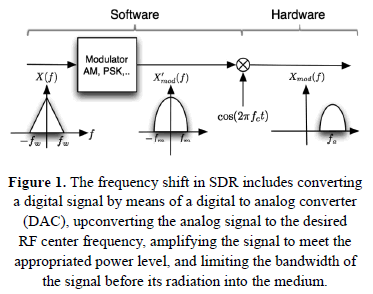
<body><![CDATA[<p><font size="2" face="Verdana, Arial, Helvetica, sans-serif"><b>ABSTRACT:</b> Software-defined radio (SDR) provides a convenient framework for the design and implementation of a communication system, by separating the signal processing algorithms from the communication hardware. This separation allows researchers to design testbed systems to validate the gains in performance reported by the theory. Designing and implementing a testbed is a time consuming and challenging process. This work presents the design and implementation of a flexible testbed system, including the solution to some synchronization problems. We also present a distributed software architecture that defines the control flow, the subsystem decomposition, and the mapping to hardware of the testbed. A running example of the testbed for a binary phase-shift keying (BPSK) system is developed to illustrate the results attained by the proposed testbed in terms of the performance comparison between the testbed measurements, and the theoretical and simulated ones with a loss of 2 dB.</font></p>     <p><font size="2" face="Verdana, Arial, Helvetica, sans-serif"><b>KEYWORDS:</b> Software-defined radio, Digital communications, Communication testbed.</font></p>     <p><font size="2" face="Verdana, Arial, Helvetica, sans-serif"><b>RESUMEN:</b> El radio definido por software (SDR) proporciona un marco de trabajo conveniente para el dise&ntilde;o e implementaci&oacute;n de un sistema de comunicaci&oacute;n, mediante la separaci&oacute;n de los algoritmos de procesamiento de se&ntilde;ales y el hardware de comunicaci&oacute;n. Esta separaci&oacute;n permite a los investigadores dise&ntilde;ar sistemas de banco de pruebas para validar las ganancias en el rendimiento reportados por la teor&iacute;a. El dise&ntilde;o e implementaci&oacute;n de un banco de pruebas es un proceso que consume tiempo y esfuerzo. Este trabajo presenta el dise&ntilde;o e implementaci&oacute;n de un sistema de banco de pruebas flexible, incluyendo la soluci&oacute;n a algunos problemas de sincronizaci&oacute;n. Adem&aacute;s, una arquitectura distribuida de software que define el flujo de control, la descomposici&oacute;n en subsistemas, y la asignaci&oacute;n de hardware de la plataforma de pruebas es presentada. Se desarrolla un ejemplo del funcionamiento del banco de pruebas para un sistema con modulaci&oacute;n binaria por desplazamiento de fase (BPSK) y se ilustran los resultados obtenidos por el banco de pruebas propuesto en t&eacute;rminos de la comparaci&oacute;n de rendimiento entre las medidas obtenidas por del banco de pruebas, y los rendimientos te&oacute;ricos y simulados con una de perdida 2 dB.</font></p>     <p><font size="2" face="Verdana, Arial, Helvetica, sans-serif"><b>PALABRAS CLAVE: </b>Radio definido por Software, Comunicaciones digitales, Banco de pruebas de comunicaci&oacute;n.</font></p> <hr>     <p>&nbsp;</p>     <p><font size="3" face="Verdana, Arial, Helvetica, sans-serif"><b>1.  INTRODUCTION</b></font></p>     <p><font size="2" face="Verdana, Arial, Helvetica, sans-serif">Conventional radio design traditionally implies the use of analog and mixed signal design techniques that enable engineers to work on complex radio frequency (RF) circuitry. An inherent issue of the former approach lies in the high cost of designing, testing, and building a complete communication system. In addition, the impact of a mainly hardware based implementation of the communication system consisting of oscillators, filters, mixers, amplifiers, and hardware for source and channel coding, as well as for modulation; assumes a priori that an upgrade to the resulting hardware clearly is overwhelming &#91;1&#93;. On the other hand, the use of hardware platforms and testbeds in wireless communications takes the role of validating the gains in performance reported by the theory and simulations. Unlike the latter, the testbeds operate in real channels under the presence of implementation constraints &#91;16, 9, 22&#93;. However, in the early 1990s Joe Mitola  introduced the concept of software-defined radio (SDR) &#91;3&#93; to refer to the class of reprogrammable or reconfigurable radios, or as Jeffrey Reed stated, a radio that is substantially defined in software and whose physical layer behavior can be significantly altered through changes to its software &#91;17&#93;.</font></p>     <p><font size="2" face="Verdana, Arial, Helvetica, sans-serif">In SDR, conventional frequency shifting of the signal at the modulation hardware is replaced by a two steps process that converts the baseband digital modulated signal into a radiated passband analog signal as depicted in <a href="#fig01">Fig. 1</a>. The key idea behind the latter process is the concept of equivalent lowpass signal &#91;21&#93; that suggests that, from a mathematical perspective, it is feasible to ignore the center frequency (carrier generation) in which the system has to operate and then just perform all the mathematical treatment of the signal using the associated lowpass signal. Formally, assume that <img src="/img/revistas/dyna/v80n180/v80n180a09eq81738.gif" /> is the bandpass signal to be transmitted, so its spectrum is <img src="/img/revistas/dyna/v80n180/v80n180a09eq81748.gif" /> for <img src="/img/revistas/dyna/v80n180/v80n180a09eq81758.gif" />, where <img src="/img/revistas/dyna/v80n180/v80n180a09eq81767.gif" /> is the low frequency, and <img src="/img/revistas/dyna/v80n180/v80n180a09eq81776.gif" /> is the high frequency, then it is possible to represent <img src="/img/revistas/dyna/v80n180/v80n180a09eq81784.gif" /> as</font></p>     <p><font size="2" face="Verdana, Arial, Helvetica, sans-serif"><img src="/img/revistas/dyna/v80n180/v80n180a09eq01.gif"></font></p>     <p><font size="2" face="Verdana, Arial, Helvetica, sans-serif">where <img src="/img/revistas/dyna/v80n180/v80n180a09eq83963.gif" /> is the equivalent lowpass signal or complex envelope of <img src="/img/revistas/dyna/v80n180/v80n180a09eq81813.gif" />. Thus in SDR, while the software part has the responsibility of creating the digital representation of the signal <img src="/img/revistas/dyna/v80n180/v80n180a09eq81821.gif" />, the hardware is in control of the generation of the carrier <img src="/img/revistas/dyna/v80n180/v80n180a09eq81830.gif" />, and modulate it with <img src="/img/revistas/dyna/v80n180/v80n180a09eq81838.gif" />.</font></p>     ]]></body>
<body><![CDATA[<p align="center"><font size="2" face="Verdana, Arial, Helvetica, sans-serif"><a name="fig01"></a></font><img src="/img/revistas/dyna/v80n180/v80n180a09fig01.gif"></p>     <p><font size="2" face="Verdana, Arial, Helvetica, sans-serif">There are testbed systems reported in the literature that address the design and implementation of such systems for academic purposes. Rao in &#91;16&#93; presents a classification scheme for wireless testbeds, including examples for each case and discussion on the role of such systems in an educational environment. One research focuses on the latency of SDR, and its impact on throughput in modern wireless protocols &#91;18&#93;. A flexible SDR system to quantify the real world performance of advanced overtheair technologies, such as 3GPP LTE type MIMO OFDM systems, has been developed &#91;4&#93;. Also, middleware software that provides user access to testbed systems has been proposed &#91;9&#93;, and used for experimental evaluation of alternative schemes such joint sourcechannel coding &#91;8&#93;.</font></p>     <p><font size="2" face="Verdana, Arial, Helvetica, sans-serif">This work presents a complete design and implementation of a flexible wireless testbed system, including the solution to some synchronization problems. For this end, First we explore a set of algorithms that separately try to reduce the effects on the transmitted signal due to the following synchronization problems: symbol phase synchronization, symbol frequency synchronization, carrier phase synchronization, carrier frequency synchronization, and frame synchronization. Also, we propose a distributed software architecture that defines the control flow, the subsystem decomposition and the mapping to hardware of the testbed. The testbed is based on the Universal Software Radio Peripheral (USRP 2) which is a low cost, high quality softwaredefined radio (SDR) system designed by Ettus Research &#91;23&#93;. Finally, a running example of the testbed for a binary phase-shift keying (BPSK) system is implemented in order to show the results attained by the proposed testbed in terms of the performance comparison between the testbed measurements; and the theoretical and simulated ones.</font></p>     <p>&nbsp;</p>     <p><font size="3" face="Verdana, Arial, Helvetica, sans-serif"><b>2.  COMMUNICATION SYSTEM MODEL</b></font></p>     <p><font size="2" face="Verdana, Arial, Helvetica, sans-serif">The design of the testbed relies on the underlying mathematical model that reflect the most important characteristics of the transmission environment. Such a model of the channel is used in the design of other components of the testbed such as the modulator at the transmitter, the demodulator at the receiver, the channel encoder and decoder. In order to model a wireless channel, it is common to use the additive noise channel,</font></p>     <p><font size="2" face="Verdana, Arial, Helvetica, sans-serif"><img src="/img/revistas/dyna/v80n180/v80n180a09eq02.gif"></font></p>     <p><font size="2" face="Verdana, Arial, Helvetica, sans-serif">where <img src="/img/revistas/dyna/v80n180/v80n180a09eq81857.gif" /> is the channel attenuation, and the signals <img src="/img/revistas/dyna/v80n180/v80n180a09eq81866.gif" />, <img src="/img/revistas/dyna/v80n180/v80n180a09eq81874.gif" /> and <img src="/img/revistas/dyna/v80n180/v80n180a09eq81882.gif" /> are the transmitted signal, the additive random noise of the channel, and the received signal, respectively &#91;21&#93;. A particular case is the additive white gaussian noise channel AWGN in which the noise <img src="/img/revistas/dyna/v80n180/v80n180a09eq81892.gif" /> is normal distributed, <img src="/img/revistas/dyna/v80n180/v80n180a09eq81906.gif" />.</font></p>     <p><font size="2" face="Verdana, Arial, Helvetica, sans-serif">Here, it is assumed that the communication components are already defined, such as the target transmission scheme, and the channel and source encoder/decoder. Next, the system has to compute the expected performance measurement of the communication, or the theoretical performance as a function of the signal to noise ratio (SNR). The SNR is defined as the ratio of the signal power <img src="/img/revistas/dyna/v80n180/v80n180a09eq81916.gif" /> to the noise power <img src="/img/revistas/dyna/v80n180/v80n180a09eq81924.gif" />, given by</font></p>     <p><font size="2" face="Verdana, Arial, Helvetica, sans-serif"><img src="/img/revistas/dyna/v80n180/v80n180a09eq03.gif"></font></p>     ]]></body>
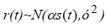
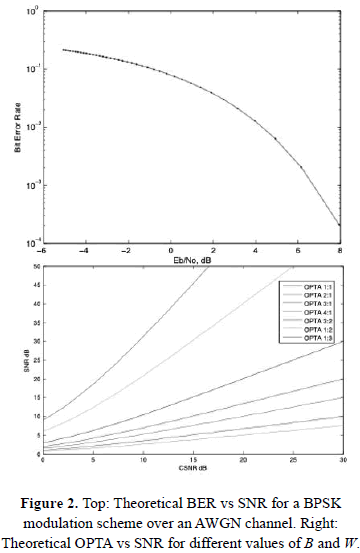
<body><![CDATA[<p><font size="2" face="Verdana, Arial, Helvetica, sans-serif">Subsequently, the performance measurement can be selected based on either its dependency on bit representation, or its nondependency on bit representation &#91;10&#93;. First, when the representation is binary, a common performance measure used is either the bit error rate <img src="/img/revistas/dyna/v80n180/v80n180a09eq81942.gif" />, or the probability of a bit error <img src="/img/revistas/dyna/v80n180/v80n180a09eq81951.gif" />, both of which are theoretically computed using the posterior probabilities <img src="/img/revistas/dyna/v80n180/v80n180a09eq81960.gif" /> Furthermore, <img src="/img/revistas/dyna/v80n180/v80n180a09eq81969.gif" /> is the observation vector produced either by the correlation demodulator or the matched filter demodulator, and <img src="/img/revistas/dyna/v80n180/v80n180a09eq81977.gif" /> is the transmitted signal &#91;21&#93;. More specifically, <img src="/img/revistas/dyna/v80n180/v80n180a09eq81985.gif" /> is given by</font></p>     <p><font size="2" face="Verdana, Arial, Helvetica, sans-serif"><img src="/img/revistas/dyna/v80n180/v80n180a09eq04.gif"></font></p>     <p><font size="2" face="Verdana, Arial, Helvetica, sans-serif">A straightforward case is the performance of a modulation system that uses binary phase-shift keying BPSK as the modulation scheme over an AWGN channel, <a href="#fig02">Fig. 2</a>.</font></p>     <p align="center"><font size="2" face="Verdana, Arial, Helvetica, sans-serif"><a name="fig02"></a></font><img src="/img/revistas/dyna/v80n180/v80n180a09fig02.gif"></p>     <p><font size="2" face="Verdana, Arial, Helvetica, sans-serif">On the other hand, in the case when the process of source and channel coding does not imply an intermediate digital representation, it is required that the performance measure does not depend on a bit representation. For those cases, it is convenient to use the Optimal Performance Theoretically Attainable, (OPTA) which is the expression of the limits for efficient communications. OPTA is computed by equating the expression of channel capacity <img src="/img/revistas/dyna/v80n180/v80n180a09eq82008.gif" /> and the rate distortion function <img src="/img/revistas/dyna/v80n180/v80n180a09eq82018.gif" />, and solving for the signal to noise ratio as</font></p>     <p><font size="2" face="Verdana, Arial, Helvetica, sans-serif"><img src="/img/revistas/dyna/v80n180/v80n180a09eq05.gif"></font></p>     <p><font size="2" face="Verdana, Arial, Helvetica, sans-serif">where <img src="/img/revistas/dyna/v80n180/v80n180a09eq82036.gif" /> is the mutual information function of the transmitted signal <img src="/img/revistas/dyna/v80n180/v80n180a09eq82045.gif" /> and the received signal <img src="/img/revistas/dyna/v80n180/v80n180a09eq82054.gif" />; and <img src="/img/revistas/dyna/v80n180/v80n180a09eq82063.gif" /> is the distortion measure &#91;10&#93;.</font></p>     <p><font size="2" face="Verdana, Arial, Helvetica, sans-serif">An important case that enables the expression of OPTA, in analytic form, is the case of a memoryless Gaussian source and AWGN channel, as depicted in <a href="#fig02">Fig. 2</a>.</font></p>     <p><font size="2" face="Verdana, Arial, Helvetica, sans-serif">Using different values for the source bandwidth <img src="/img/revistas/dyna/v80n180/v80n180a09eq82080.gif" /> and the channel bandwidth <img src="/img/revistas/dyna/v80n180/v80n180a09eq82088.gif" />, OPTA is defined as </font></p>     <p><font size="2" face="Verdana, Arial, Helvetica, sans-serif"><img src="/img/revistas/dyna/v80n180/v80n180a09eq06.gif"></font></p>     ]]></body>
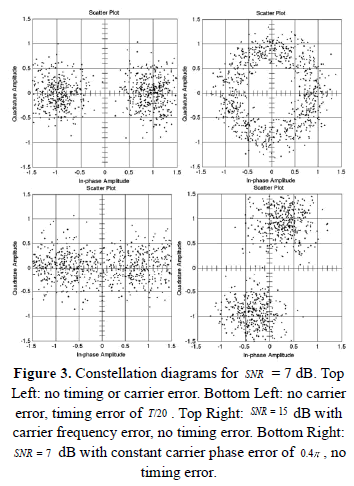
<body><![CDATA[<p><font size="2" face="Verdana, Arial, Helvetica, sans-serif">where <img src="/img/revistas/dyna/v80n180/v80n180a09eq82111.gif" /> is the distortion, <img src="/img/revistas/dyna/v80n180/v80n180a09eq82121.gif" /> is the source variance, <img src="/img/revistas/dyna/v80n180/v80n180a09eq82129.gif" /> is the transmit power, and <img src="/img/revistas/dyna/v80n180/v80n180a09eq82138.gif" /> is the channel noise &#91;15, 8&#93;. Both the rate distortion function and the channel capacity for non Gaussian sources and channels, can be estimated using the Blahut algorithm &#91;2&#93;.</font></p>     <p>&nbsp;</p>     <p><font size="3" face="Verdana, Arial, Helvetica, sans-serif"><b>3.  MATHEMATICAL TOOLS</b></font></p>     <p><font size="2" face="Verdana, Arial, Helvetica, sans-serif">In the context of a real SDR implementation, there are different non considered sources of error besides the thermal noise. Thus, the model given by</font></p>     <p><font size="2" face="Verdana, Arial, Helvetica, sans-serif"><img src="/img/revistas/dyna/v80n180/v80n180a09eq07.gif"></font></p>     <p><font size="2" face="Verdana, Arial, Helvetica, sans-serif">extends (2) by considering at the receiver the time shift or delay <img src="/img/revistas/dyna/v80n180/v80n180a09eq82156.gif" /> of the transmitted signal <img src="/img/revistas/dyna/v80n180/v80n180a09eq82165.gif" />; the fading in the channel <img src="/img/revistas/dyna/v80n180/v80n180a09eq82175.gif" />; the <img src="/img/revistas/dyna/v80n180/v80n180a09eq82183.gif" /> reflected signals <img src="/img/revistas/dyna/v80n180/v80n180a09eq82191.gif" /> due to multipath and their delay <img src="/img/revistas/dyna/v80n180/v80n180a09eq82201.gif" />; the thermal noise <img src="/img/revistas/dyna/v80n180/v80n180a09eq82214.gif" /> in the electronic components of the receiver; and finally <img src="/img/revistas/dyna/v80n180/v80n180a09eq82224.gif" /> possible interfere signals <img src="/img/revistas/dyna/v80n180/v80n180a09eq82232.gif" /> due to other communication systems in other frequency bands. Therefore, from a practical point of view a receiver has to overcome five basic synchronization problems. These problems are expressed next as its solution formulation (<a href="#fig03">Fig. 3</a> shows some of these problems) &#91;19&#93;, &#91;20&#93;, </font></p> <ol>   <li class="DYNA-normal ParaOverride-5">         <p><font size="2" face="Verdana, Arial, Helvetica, sans-serif">Symbol phase synchronization deals with choosing when to sample the signal within each symbol time interval <img src="/img/revistas/dyna/v80n180/v80n180a09eq82241.gif" />. </font></p>   </li>   <li class="DYNA-normal ParaOverride-5">         <p><font size="2" face="Verdana, Arial, Helvetica, sans-serif">Symbol frequency synchronization addresses the problem of different oscillator rates at the transmitter and receiver which is common in real systems.</font></p>   </li>   <li class="DYNA-normal ParaOverride-5">         <p><font size="2" face="Verdana, Arial, Helvetica, sans-serif">Carrier phase synchronization addresses the aligning of the phase of the carrier at the receiver with the phase of the carrier at the transmitter.</font></p>   </li>   <li class="DYNA-normal ParaOverride-5">         <p><font size="2" face="Verdana, Arial, Helvetica, sans-serif">Carrier frequency synchronization deals with aligning the frequency of the carrier at the receiver to the frequency of the carrier generated at the transmitter.</font></p>   </li>   <li class="DYNA-normal ParaOverride-6">         ]]></body>
<body><![CDATA[<p><font size="2" face="Verdana, Arial, Helvetica, sans-serif">Frame synchronization addresses the problem of finding the initial sample of each message. </font></p>   </li>     </ol>     <p align="center"><font size="2" face="Verdana, Arial, Helvetica, sans-serif"><a name="fig03"></a></font><img src="/img/revistas/dyna/v80n180/v80n180a09fig03.gif"></p>     <p><font size="2" face="Verdana, Arial, Helvetica, sans-serif">Therefore, this work explores a set of algorithms that separately try to reduce the effects on the transmitted signal due to the aforementioned issues. However, the aim of the work is to create an initial testbed implementation, not to address an exhaustive discussion about the optimum algorithm for solving each issue of real communications.</font></p>     <p><font size="2" face="Verdana, Arial, Helvetica, sans-serif"><b>3.1.  Frame Synchronization    <br>   </b>Given the time delay <img src="/img/revistas/dyna/v80n180/v80n180a09eq82304.gif" /> of the transmitted signal it is necessary to perform a time alignment of the signal at the receiver, which is denominated frame synchronization, so that it is feasible to find the optimum sampling time for the beginning of the frame. There are several techniques based on optimum frame synchronization &#91;14, 7, 5&#93;. However, the cross correlation operation is a straightforward and a well studied approach &#91;19, 21, 22&#93;. This correlation is the sequence <img src="/img/revistas/dyna/v80n180/v80n180a09eq83979.gif" /> computed by</font></p>     <p><font size="2" face="Verdana, Arial, Helvetica, sans-serif"><img src="/img/revistas/dyna/v80n180/v80n180a09eq08.gif"></font></p>     <p><font size="2" face="Verdana, Arial, Helvetica, sans-serif">between the received discrete sequence <img src="/img/revistas/dyna/v80n180/v80n180a09eq82336.gif" /> and a known pilot sequence <img src="/img/revistas/dyna/v80n180/v80n180a09eq82345.gif" />, at the time shift parameter <img src="/img/revistas/dyna/v80n180/v80n180a09eq82354.gif" />. The signal <img src="/img/revistas/dyna/v80n180/v80n180a09eq82363.gif" /> is supposed to be appended to the transmitted sequence <img src="/img/revistas/dyna/v80n180/v80n180a09eq82372.gif" /> so that the maximum value of <img src="/img/revistas/dyna/v80n180/v80n180a09eq82381.gif" /> for <img src="/img/revistas/dyna/v80n180/v80n180a09eq83995.gif" />,</font></p>     <p><font size="2" face="Verdana, Arial, Helvetica, sans-serif"><img src="/img/revistas/dyna/v80n180/v80n180a09eq09.gif"></font></p>     <p><font size="2" face="Verdana, Arial, Helvetica, sans-serif">at the optimum time shift, <img src="/img/revistas/dyna/v80n180/v80n180a09eq82408.gif" />, could be interpreted as the time shift which minimizes the difference between the signals. Once <img src="/img/revistas/dyna/v80n180/v80n180a09eq82422.gif" /> is computed the optimum sampling time for the beginning of the frame, <img src="/img/revistas/dyna/v80n180/v80n180a09eq82433.gif" />, is computed as</font></p>     ]]></body>
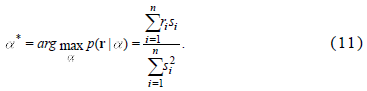
<body><![CDATA[<p><font size="2" face="Verdana, Arial, Helvetica, sans-serif"><img src="/img/revistas/dyna/v80n180/v80n180a09eq10.gif"></font></p>     <p><font size="2" face="Verdana, Arial, Helvetica, sans-serif">where <img src="/img/revistas/dyna/v80n180/v80n180a09eq82450.gif" /> is the number of samples of the signal <img src="/img/revistas/dyna/v80n180/v80n180a09eq82459.gif" />.</font></p>     <p><font size="2" face="Verdana, Arial, Helvetica, sans-serif"><b>3.2.  Channel Attenuation</b>    <br>   The channel attenuation introduces a distortion in the amplitude of the signal <img src="/img/revistas/dyna/v80n180/v80n180a09eq82468.gif" />, by scaling it by a factor <img src="/img/revistas/dyna/v80n180/v80n180a09eq82477.gif" />. Therefore, it is required to estimate the value of the factor <img src="/img/revistas/dyna/v80n180/v80n180a09eq82486.gif" /> at the receiver so that the system can reconstruct a better approximation of the signal <img src="/img/revistas/dyna/v80n180/v80n180a09eq82494.gif" />. For the AWGN channel (2), and assuming that the channel attenuation, <img src="/img/revistas/dyna/v80n180/v80n180a09eq82502.gif" />, is constant during the transmission time; then, it is suitable to use the Maximum Likelihood Estimate (MLE) in order to find the value of the parameter <img src="/img/revistas/dyna/v80n180/v80n180a09eq82512.gif" /> that maximizes the likelihood function denoted by <img src="/img/revistas/dyna/v80n180/v80n180a09eq82525.gif" />. That is, find an <img src="/img/revistas/dyna/v80n180/v80n180a09eq82535.gif" /> that maximizes the correspondence of the selected model with the observation of the received signal <img src="/img/revistas/dyna/v80n180/v80n180a09eq82543.gif" />.</font></p>     <p><font size="2" face="Verdana, Arial, Helvetica, sans-serif">The AWGN channel assumes that the noise in the channel follows a normal distribution <img src="/img/revistas/dyna/v80n180/v80n180a09eq82552.gif" />, and by letting the transmitted signal be set to a deterministic signal, such as <img src="/img/revistas/dyna/v80n180/v80n180a09eq82561.gif" />, the statistics of the received signal are <img src="/img/revistas/dyna/v80n180/v80n180a09eq84022.gif" />, and <img src="/img/revistas/dyna/v80n180/v80n180a09eq84028.gif" />, which means that the signal <img src="/img/revistas/dyna/v80n180/v80n180a09eq82588.gif" /> follows a normal distribution such as <img src="/img/revistas/dyna/v80n180/v80n180a09eq82596.gif" />.</font></p>     <p><font size="2" face="Verdana, Arial, Helvetica, sans-serif">Down converting and then sampling the continuous bandpass signal <img src="/img/revistas/dyna/v80n180/v80n180a09eq82604.gif" />, so that there are <img src="/img/revistas/dyna/v80n180/v80n180a09eq82614.gif" /> i.i.d (independent and identically distributed samples of a random variable) samples of the signal, denoted by <img src="/img/revistas/dyna/v80n180/v80n180a09eq82627.gif" />, available for the estimation procedure. Then, the optimum value of <img src="/img/revistas/dyna/v80n180/v80n180a09eq82637.gif" /> is estimated as</font></p>     <p><font size="2" face="Verdana, Arial, Helvetica, sans-serif"><img src="/img/revistas/dyna/v80n180/v80n180a09eq11.gif"></font></p>     <p><font size="2" face="Verdana, Arial, Helvetica, sans-serif">Now, considering just the samples where the amplitude of the signal <img src="/img/revistas/dyna/v80n180/v80n180a09eq82654.gif" /> is the maximum/minimum, in this case <img src="/img/revistas/dyna/v80n180/v80n180a09eq82663.gif" /> and <img src="/img/revistas/dyna/v80n180/v80n180a09eq82672.gif" />, then the products <img src="/img/revistas/dyna/v80n180/v80n180a09eq82681.gif" />. Thus, the estimation of <img src="/img/revistas/dyna/v80n180/v80n180a09eq82690.gif" /> is reduced to</font></p>     <p><font size="2" face="Verdana, Arial, Helvetica, sans-serif"><img src="/img/revistas/dyna/v80n180/v80n180a09eq12.gif"></font></p>     <p><font size="2" face="Verdana, Arial, Helvetica, sans-serif">where <img src="/img/revistas/dyna/v80n180/v80n180a09eq82706.gif" /> denotes the absolute value of the sample <img src="/img/revistas/dyna/v80n180/v80n180a09eq82716.gif" /></font></p>     ]]></body>
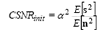
<body><![CDATA[<p><font size="2" face="Verdana, Arial, Helvetica, sans-serif"><b>3.3.  Estimation of the Signal to Noise Ratio (SNR)    <br>   </b>In order to compute the performance of the system at a given SNR or Channel Signal to Noise Ratio (CSNR), it is indispensable to estimate the value of the SNR, given by (3), at the receiver.</font></p>     <p><font size="2" face="Verdana, Arial, Helvetica, sans-serif">First, the system estimates the statistical characteristics of the noise in the channel. Hence, the estimation is performed in the case when the transmitter is not sending any signal, <img src="/img/revistas/dyna/v80n180/v80n180a09eq82729.gif" />. Thus, in theory, the receiver samples are the noise samples, <img src="/img/revistas/dyna/v80n180/v80n180a09eq82739.gif" />. An example of the results of the method applied to samples captured by an USRP 2 SDR hardware, are shown for both the histogram of the noise and the time and frequency signal representation in <a href="#fig04">Fig. 4</a>. Let <img src="/img/revistas/dyna/v80n180/v80n180a09eq82747.gif" /> be a discrete random variable representing the discrete version of the AWGN channel noise. Then, the noise power of the channel,<img src="/img/revistas/dyna/v80n180/v80n180a09eq82756.gif" />, is estimated using the empirical estimator defined as</font></p>     <p><font size="2" face="Verdana, Arial, Helvetica, sans-serif"><img src="/img/revistas/dyna/v80n180/v80n180a09eq13.gif"></font></p>     <p><font size="2" face="Verdana, Arial, Helvetica, sans-serif">where there are <img src="/img/revistas/dyna/v80n180/v80n180a09eq82775.gif" /> samples, of the sampled noise of the channel <img src="/img/revistas/dyna/v80n180/v80n180a09eq82784.gif" />, available for the estimation.</font></p>     <p align="center"><font size="2" face="Verdana, Arial, Helvetica, sans-serif"><a name="fig04"></a></font><img src="/img/revistas/dyna/v80n180/v80n180a09fig04.gif"></p>     <p><font size="2" face="Verdana, Arial, Helvetica, sans-serif">Therefore, given the AWGN channel, (2), and assuming a discrete signal representation of the received signal <img src="/img/revistas/dyna/v80n180/v80n180a09eq82793.gif" /> given by</font></p>     <p><font size="2" face="Verdana, Arial, Helvetica, sans-serif"><img src="/img/revistas/dyna/v80n180/v80n180a09eq14.gif"></font></p>     <p><font size="2" face="Verdana, Arial, Helvetica, sans-serif">The SNR <img src="/img/revistas/dyna/v80n180/v80n180a09eq82809.gif" /> is computed using the following methods:</font></p>     <p><font size="2" face="Verdana, Arial, Helvetica, sans-serif">The first method uses existing data at the transmitter in order to estimate the SNR at the receiver,</font></p>     ]]></body>
<body><![CDATA[<p><font size="2" face="Verdana, Arial, Helvetica, sans-serif"><img src="/img/revistas/dyna/v80n180/v80n180a09eq15.gif"></font></p>     <p><font size="2" face="Verdana, Arial, Helvetica, sans-serif">so that the receiver knows a priori the transmitted signal <img src="/img/revistas/dyna/v80n180/v80n180a09eq82843.gif" /> and the value of <img src="/img/revistas/dyna/v80n180/v80n180a09eq82851.gif" /> is estimated as described before in section 3.5.</font></p>     <p><font size="2" face="Verdana, Arial, Helvetica, sans-serif">On the other hand, the second method just considers the received signal <img src="/img/revistas/dyna/v80n180/v80n180a09eq82860.gif" />, and the SNR is estimated as</font></p>     <p><font size="2" face="Verdana, Arial, Helvetica, sans-serif"><img src="/img/revistas/dyna/v80n180/v80n180a09eq16.gif"></font></p>     <p><font size="2" face="Verdana, Arial, Helvetica, sans-serif">so that the estimation of the SNR depends only on the received signal, which means that the corresponding values for <img src="/img/revistas/dyna/v80n180/v80n180a09eq82879.gif" /> and the signal <img src="/img/revistas/dyna/v80n180/v80n180a09eq82888.gif" /> are implicit in <img src="/img/revistas/dyna/v80n180/v80n180a09eq82897.gif" />&#91;12&#93;.</font></p>     <p><font size="2" face="Verdana, Arial, Helvetica, sans-serif"><b>3.4.  Frequency Mismatch</b>    <br>   The testbed requires to execute measurements of the performance of the communication system at different ranges of SNR, including low values. Thus, in all cases the system needs to align the frequency of the oscillator at the transmitter with the frequency of the oscillator at the receiver. Thus, the testbed uses a global GPS (Global Positioning System) Disciplined Oscillator that is shared between the transmitter and the receiver. The main goal of this sharing is to align the frequency of the carrier at the receiver with the frequency of the carrier at the transmitter, this procedure solves the carrier frequency synchronization error. The result is a coarse grained frequency synchronization that avoids the continuous rotation of the constellation of the received symbols at the receiver.</font></p>     <p><font size="2" face="Verdana, Arial, Helvetica, sans-serif">Although the former synchronization procedure solves most problems of frequency mismatch, there is a remaining impairment related to a constant carrier phase error. The testbed addresses this impairment using SISO frequency estimator algorithms, such as Kay &#91;11&#93;, Fitz &#91;6&#93; and Luise &amp; Reggiannini &#91;13&#93;.</font></p>     <p>&nbsp;</p>     <p><font size="3" face="Verdana, Arial, Helvetica, sans-serif"><b>4.  TESTBED DESCRIPTION AND SOFTWARE ARCHITECTURE</b></font></p>     ]]></body>
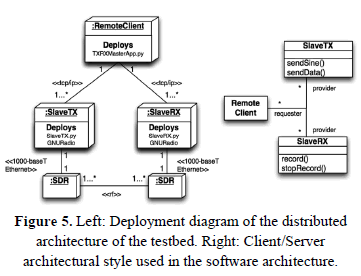
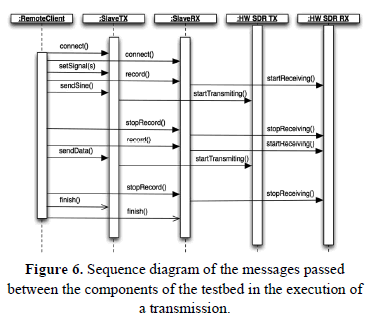
<body><![CDATA[<p><font size="2" face="Verdana, Arial, Helvetica, sans-serif">A distributed Software Architecture is in charge of defining the control flow of the transmission and reception operations performed by the testbed. The latter is composed of three types of components named Remote Client (RC); Slave Tx (STX) and Slave Rx (SRX); and the SDR hardware as in <a href="#fig05">Fig. 5</a>, where each component is deployed over different and distributed hardware nodes. The use of the client/server architectural style, as the basis for the software architecture, reduces the coupling (a measure of the number of dependencies between two subsystems of a software system) between the baseband digital signal processing and the hardware of SDR to be used in the testbed. </font></p>     <p align="center"><font size="2" face="Verdana, Arial, Helvetica, sans-serif"><a name="fig05"></a></font><img src="/img/revistas/dyna/v80n180/v80n180a09fig05.gif"></p>     <p><font size="2" face="Verdana, Arial, Helvetica, sans-serif">Conversely, the architecture increases the cohesion (a measure of the number of dependencies within a subsystem) within each component, in terms of the definition of a well defined set of boundaries and responsibilities of the algorithms (services) that each component has to provide. Thus, while the RC node performs the baseband digital signal processing, the SRX and STX nodes perform the control of the SDR hardware.</font></p>     <p><font size="2" face="Verdana, Arial, Helvetica, sans-serif">First, given (1) the testbed implements the signal processing and communication algorithms that generate the digital representation of the signal <img src="/img/revistas/dyna/v80n180/v80n180a09eq82913.gif" />, as software to be executed offline in a personal computer (PC). These algorithms are part of the services available on the RC node, and could be implemented using MATLAB, or python with the GNU Radio library. Currently, software for single-input single-output (SISO) BPSK and PAM modulation and demodulation has been developed for this system. Therefore, the transmission of a sequence of symbols involves the following operations:</font></p> <ul>   <li class="DYNA-normal ParaOverride-15">         <p><font size="2" face="Verdana, Arial, Helvetica, sans-serif">At RC the system performs in software the source coding, channel coding, and modulation processes.</font></p>   </li>   <li class="DYNA-normal ParaOverride-15">         <p><font size="2" face="Verdana, Arial, Helvetica, sans-serif">The modulated discrete time samples in the output, a discrete time version of the signal <img src="/img/revistas/dyna/v80n180/v80n180a09eq82923.gif" /> described in (1), are written to a file. In addition, the file is shared, using a file synchronization software such as the standard NFS, to all the STX nodes so that each transmitter has a copy of the discrete equivalent lowpass representation of the target transmitted signal <img src="/img/revistas/dyna/v80n180/v80n180a09eq82936.gif" />.</font></p>   </li>   <li class="DYNA-normal ParaOverride-15">         <p><font size="2" face="Verdana, Arial, Helvetica, sans-serif">The testbed uses a sequence of messages (protocol) between the components, RC and STX/SRX nodes, in order to perform a transmission/reception with the system, <a href="#fig06">Fig. 6</a>. Also, the former process stored the received discrete equivalent lowpass version of <img src="/img/revistas/dyna/v80n180/v80n180a09eq82946.gif" /> in a file.</font></p>   </li>   <li class="DYNA-normal ParaOverride-16">         <p><font size="2" face="Verdana, Arial, Helvetica, sans-serif">At RC the system performs the demodulation, channel decoding, and source decoding processes in software. In addition, RC uses the algorithms presented in section 3 in order to solve the five basic problems of synchronization. </font></p>   </li>     </ul>     <p align="center"><font size="2" face="Verdana, Arial, Helvetica, sans-serif"><a name="fig06"></a></font><img src="/img/revistas/dyna/v80n180/v80n180a09fig06.gif"></p>     ]]></body>
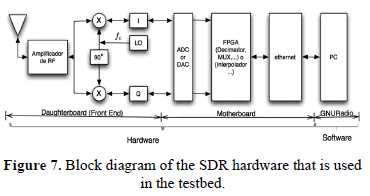
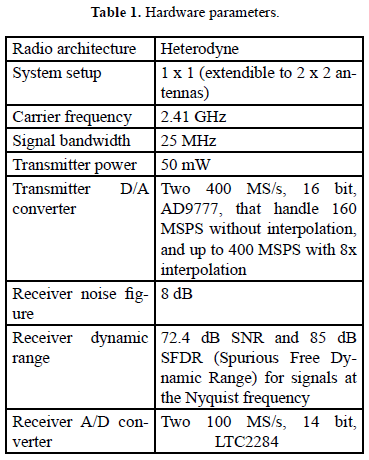
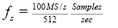
<body><![CDATA[<p><font size="2" face="Verdana, Arial, Helvetica, sans-serif">In the protocol operation, the control flow is dictated by the RC component that begins the transmission process. Thus, in a normal scenario of operation the protocol behaves as follows:</font></p> <ul>   <li class="DYNA-normal ParaOverride-15">         <p><font size="2" face="Verdana, Arial, Helvetica, sans-serif">The RC creates a tcp socket connection with both STX and SRX nodes. The system uses the input/output streams of the connection to send and received the protocol messages from the RC to the STX/SRX. Also, these connections are kept alive for the duration of the transmission.</font></p>   </li>   <li class="DYNA-normal ParaOverride-15">         <p><font size="2" face="Verdana, Arial, Helvetica, sans-serif">The RC assigns the desired signal to transmit <img src="/img/revistas/dyna/v80n180/v80n180a09eq82954.gif" /> to the STX node by passing the path of the file that contains the signal in the &quot;setSignal&quot; message.</font></p>   </li>   <li class="DYNA-normal ParaOverride-16">         <p><font size="2" face="Verdana, Arial, Helvetica, sans-serif">The testbed performs the transmission and recording procedures which have the following message order: RC sends the &quot;record&quot; message to the SRX node and SRX responds with an acknowledge message. RC sends the sendSine or sendData message to STX and STX responds with an acknowledge message after the transmission of the signal is performed. Then, the RC sends a stopRecord message to SRX in order to finish the recording of the sampled signal at RX.</font></p>   </li>     </ul>     <p><font size="2" face="Verdana, Arial, Helvetica, sans-serif">The Universal Software Radio Peripheral 2 (USRP 2) hardware platform for SDR is the target platform in this work. Thus, when STX either received a sendSignal or sendSine message it transfers the content of the related file to the motherboard of the USRP 2 via the Gigabit Ethernet interface. Then, the field programmable gate array (FPGA) in the USRP 2 performs the interpolation process and then the discrete time signal is converted to a continuous time signal using a digital to analog converter (DAC). Finally, the USRP sends the continuous time signal to the daughterboard which perform the up conversion or frequency shift, in (1) this process is the product of the signal <img src="/img/revistas/dyna/v80n180/v80n180a09eq82973.gif" /> by <img src="/img/revistas/dyna/v80n180/v80n180a09eq82982.gif" />, as depicted in <a href="#fig07">Fig. 7</a>.</font></p>     <p align="center"><font size="2" face="Verdana, Arial, Helvetica, sans-serif"><a name="fig07"></a></font><img src="/img/revistas/dyna/v80n180/v80n180a09fig07.gif"></p>     <p><font size="2" face="Verdana, Arial, Helvetica, sans-serif">The USRP 2 hardware, <a href="#tab01">table 1</a>, has a motherboard that uses a Xilinx Spartan-3 2000 FPGA for performing the digital signal processing, and a gigabit Ethernet interface for communication with the PC. Moreover, the daughterboard is a RFX2400 high performance, full duplex transceiver designed specifically for operation in the 2.4 GHz band &#91;23&#93;.</font></p>     <p align="center"><font size="2" face="Verdana, Arial, Helvetica, sans-serif"><a name="tab01"></a></font><img src="/img/revistas/dyna/v80n180/v80n180a09tab01.gif"></p>     <p>&nbsp;</p>     ]]></body>
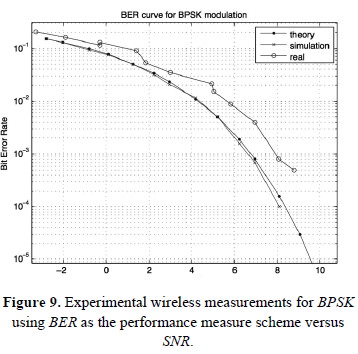
<body><![CDATA[<p><font size="3" face="Verdana, Arial, Helvetica, sans-serif"><b>5.EXPERIMENTAL WIRELESS MEASUREMENTS</b></font></p>     <p><font size="2" face="Verdana, Arial, Helvetica, sans-serif">Wireless measurements were conducted in an office setting. The purpose of these measurements is to validate the testbed performance versus the expected theoretical performance computed by the channel model. Thus, the transmission of a sequence of symbols involves the creation of frames to wrap the target message. All frames have a predefined structure that is composed of a sequence of <img src="/img/revistas/dyna/v80n180/v80n180a09eq83197.gif" /> zero amplitude samples used for the noise estimation, <img src="/img/revistas/dyna/v80n180/v80n180a09eq83205.gif" /> known BSPK modulated pilot symbols used for frame synchronization, and <img src="/img/revistas/dyna/v80n180/v80n180a09eq83213.gif" /> encoded symbols or payload.</font></p>     <p align="center"><font size="2" face="Verdana, Arial, Helvetica, sans-serif"><a name="fig08"></a></font><img src="/img/revistas/dyna/v80n180/v80n180a09fig08.gif"></p>     <p><font size="2" face="Verdana, Arial, Helvetica, sans-serif">The transmission settings include the baseband sampling frequency set to <img src="/img/revistas/dyna/v80n180/v80n180a09eq84051.gif" />; the pulse shaping and matched filtering operations use a squared root raised cosine filter with a roll off factor of 20%; the symbol period is set to <img src="/img/revistas/dyna/v80n180/v80n180a09eq84057.gif" />. The transmitter and receiver antennas were at a distance of approximately 2 m. For the evaluation, a binary signal <img src="/img/revistas/dyna/v80n180/v80n180a09eq83264.gif" /> following a Bernoulli distribution with parameter <img src="/img/revistas/dyna/v80n180/v80n180a09eq83273.gif" /> is modulated using BPSK. In order to get the performance curve the system performs several transmissions using different transmit power values to get different CSNR values. For each transmission, the receiver uses the algorithms presented in section 3, to attempt to reduce the effects on the transmitted signal due to synchronization problems. Also, to control the transmit power a new parameter <img src="/img/revistas/dyna/v80n180/v80n180a09eq83282.gif" /> is introduced in (2),</font></p>     <p><font size="2" face="Verdana, Arial, Helvetica, sans-serif"><img src="/img/revistas/dyna/v80n180/v80n180a09eq17.gif"></font></p>     <p><font size="2" face="Verdana, Arial, Helvetica, sans-serif">so that the value of <img src="/img/revistas/dyna/v80n180/v80n180a09eq83300.gif" /> attenuates, in a controlled fashion, the transmitted signal <img src="/img/revistas/dyna/v80n180/v80n180a09eq83308.gif" /> and as a result it is possible to get different values for CSNR. Thus, in general the estimated CSNR in dB given by (15) is,</font></p>     <p><font size="2" face="Verdana, Arial, Helvetica, sans-serif"><img src="/img/revistas/dyna/v80n180/v80n180a09eq18.gif"></font></p>     <p><font size="2" face="Verdana, Arial, Helvetica, sans-serif">Then, for calibration, the system has to perform an initial transmission of the signal <img src="/img/revistas/dyna/v80n180/v80n180a09eq83326.gif" /> using a fixed value <img src="/img/revistas/dyna/v80n180/v80n180a09eq83339.gif" /> in which performance is denoted as <img src="/img/revistas/dyna/v80n180/v80n180a09eq83349.gif" />. Next, solving (18) for <img src="/img/revistas/dyna/v80n180/v80n180a09eq83357.gif" />,</font></p>     <p><font size="2" face="Verdana, Arial, Helvetica, sans-serif"><img src="/img/revistas/dyna/v80n180/v80n180a09eq19.gif"></font></p>     <p><font size="2" face="Verdana, Arial, Helvetica, sans-serif">where the parameter <img src="/img/revistas/dyna/v80n180/v80n180a09eq83375.gif" />, expressed in dB, is the target performance of the system. The results presented in <a href="#fig09">Fig. 9</a> display the theoretical AWGN curve, the simulated AWGN curve and the measured curve for BPSK. These results show that the testbed is capable of recording the gains in performance within <img src="/img/revistas/dyna/v80n180/v80n180a09eq83384.gif" />-2dB from the theoretical curve. However, when the CSNR is greater than 10dB, the BER curve presents saturation effects, possibly due to the limitation in bit resolution of the ADC/DAC and the nonlinearities of the components of the SDR hardware.</font></p>     ]]></body>
<body><![CDATA[<p align="center"><font size="2" face="Verdana, Arial, Helvetica, sans-serif"><a name="fig09"></a></font><img src="/img/revistas/dyna/v80n180/v80n180a09fig09.gif"></p>     <p>&nbsp;</p>     <p><font size="3" face="Verdana, Arial, Helvetica, sans-serif"><b>CONCLUSIONS</b></font></p>     <p><font size="2" face="Verdana, Arial, Helvetica, sans-serif">We have developed a flexible testbed system that takes advantage of concepts presented in communications theory as the underlying basis for its design and implementation. To this end, a distributed software architecture to support user access to an SDR testbed is presented. The architecture encapsulates the details and complexities presented in a testbed implementation, so that the researchers could concentrate on the validation of the theory without directly addressing the challenges of a real communications system. Also, the researchers can individually explore new algorithms for source/channel encoding,  modulation/demodulation, synchronization or error correction without the need to develop a completely new testbed.</font></p>     <p><font size="2" face="Verdana, Arial, Helvetica, sans-serif">Also, some of the main issues that decrease the performance of the system have been described along with algorithms to mitigate these impairments. Although, the former algorithms solve to some degree the impairments, it is possible to introduce more sophisticated, robust, faster state of the art algorithms using the aforementioned architecture.</font></p>     <p><font size="2" face="Verdana, Arial, Helvetica, sans-serif">The results obtained from indoor wireless measurements showed that the resulting system can perform within 1-2dB from the theoretical results for CSNR values below 10dB, thus clearly demonstrating the effectiveness of the proposed system. For CSNR values above 10dB there is a performance degradation, possibly due to the nonlinearities of the hardware components and the limitation in bit resolution of the DAC/ADC.</font></p>     <p>&nbsp;</p>     <p><font size="3" face="Verdana, Arial, Helvetica, sans-serif"><b>ACKNOWLEDGMENTS</b></font></p>     <p><font size="2" face="Verdana, Arial, Helvetica, sans-serif">The authors gratefully acknowledge the contribution of the Universidad Industrial de Santander and the University of Delaware.</font></p>     <p>&nbsp;</p>     ]]></body>
<body><![CDATA[<p><font size="3" face="Verdana, Arial, Helvetica, sans-serif"><b>REFERENCES</b></font></p>     <!-- ref --><p><font size="2" face="Verdana, Arial, Helvetica, sans-serif"><b>&#91;1&#93;</b> Lingaiah, D. Software Radio: RF Engineering's New Era, IEEE Software, vol. 20, No. 4, pp. 84-86, 95, 2003.    &nbsp;&nbsp;&nbsp;&nbsp;&nbsp;&nbsp;&nbsp;&nbsp;[&#160;<a href="javascript:void(0);" onclick="javascript: window.open('/scielo.php?script=sci_nlinks&ref=000134&pid=S0012-7353201300040000900001&lng=','','width=640,height=500,resizable=yes,scrollbars=1,menubar=yes,');">Links</a>&#160;]<!-- end-ref --><!-- ref --><br>   <b>&#91;2&#93;</b> Blahut, R. Computation of Channel Capacity and RateDistortion Functions, IEEE Transactions on Information Theory, vol. 18, No. 4, pp. 460 - 473, 1972.    &nbsp;&nbsp;&nbsp;&nbsp;&nbsp;&nbsp;&nbsp;&nbsp;[&#160;<a href="javascript:void(0);" onclick="javascript: window.open('/scielo.php?script=sci_nlinks&ref=000135&pid=S0012-7353201300040000900002&lng=','','width=640,height=500,resizable=yes,scrollbars=1,menubar=yes,');">Links</a>&#160;]<!-- end-ref --><!-- ref --><br>   <b>&#91;3&#93;</b> Mitola, J. The Software Radio Architecture, IEEE Communications Magazine, vol. 33, No. 5, pp. 26 -38, 1995.    &nbsp;&nbsp;&nbsp;&nbsp;&nbsp;&nbsp;&nbsp;&nbsp;[&#160;<a href="javascript:void(0);" onclick="javascript: window.open('/scielo.php?script=sci_nlinks&ref=000136&pid=S0012-7353201300040000900003&lng=','','width=640,height=500,resizable=yes,scrollbars=1,menubar=yes,');">Links</a>&#160;]<!-- end-ref --><!-- ref --><br>   <b>&#91;4&#93;</b> Zheng, K., Huang, L., Li, G., Cao, H., Wang, W., and Dohler, M. Beyond 3G Evolution, IEEE Vehicular Technology Magazine, vol. 3, No. 2, pp. 30 -36, 2008.    &nbsp;&nbsp;&nbsp;&nbsp;&nbsp;&nbsp;&nbsp;&nbsp;[&#160;<a href="javascript:void(0);" onclick="javascript: window.open('/scielo.php?script=sci_nlinks&ref=000137&pid=S0012-7353201300040000900004&lng=','','width=640,height=500,resizable=yes,scrollbars=1,menubar=yes,');">Links</a>&#160;]<!-- end-ref --><!-- ref --><br>   <b>&#91;5&#93;</b> Cassaro, T., and Georghiades, C. N. Frame Synchronization for Coded Systems Over AWGN Channels, IEEE Transactions on Communications, vol. 52, No. 1, pp. 166, 2004.    &nbsp;&nbsp;&nbsp;&nbsp;&nbsp;&nbsp;&nbsp;&nbsp;[&#160;<a href="javascript:void(0);" onclick="javascript: window.open('/scielo.php?script=sci_nlinks&ref=000138&pid=S0012-7353201300040000900005&lng=','','width=640,height=500,resizable=yes,scrollbars=1,menubar=yes,');">Links</a>&#160;]<!-- end-ref --><!-- ref --><br>   <b>&#91;6&#93;</b> Fitz, M. P. Further results in the fast estimation of a single frequency, IEEE Transactions on Communications, vol. 42, No. 234, pp. 862-864, 1994.    &nbsp;&nbsp;&nbsp;&nbsp;&nbsp;&nbsp;&nbsp;&nbsp;[&#160;<a href="javascript:void(0);" onclick="javascript: window.open('/scielo.php?script=sci_nlinks&ref=000139&pid=S0012-7353201300040000900006&lng=','','width=640,height=500,resizable=yes,scrollbars=1,menubar=yes,');">Links</a>&#160;]<!-- end-ref --><!-- ref --><br>   <b>&#91;7&#93;</b> Gansman, J. A., Fitz, M. P., and Krogmeier, J. V. Optimum and suboptimum frame synchronization for pilot-symbol-assisted modulation, IEEE Transactions on Communications, vol. 45, No. 10, pp. 1327-1337, 1997.    &nbsp;&nbsp;&nbsp;&nbsp;&nbsp;&nbsp;&nbsp;&nbsp;[&#160;<a href="javascript:void(0);" onclick="javascript: window.open('/scielo.php?script=sci_nlinks&ref=000140&pid=S0012-7353201300040000900007&lng=','','width=640,height=500,resizable=yes,scrollbars=1,menubar=yes,');">Links</a>&#160;]<!-- end-ref --><!-- ref --><br>   <b>&#91;8&#93;</b> Garcia-Naya, J. A., Fresnedo, O., Vazquez-Araujo, F. J., Gonzalez-Lopez, M., Castedo, L., and Garcia-Frias, J. Experimental Evaluation of Analog Joint Source-Channel Coding in Indoor Environments. In 2011 IEEE International Conference on Communications (ICC). Kyoto, Japan, pp. 1-5, June 2011.    &nbsp;&nbsp;&nbsp;&nbsp;&nbsp;&nbsp;&nbsp;&nbsp;[&#160;<a href="javascript:void(0);" onclick="javascript: window.open('/scielo.php?script=sci_nlinks&ref=000141&pid=S0012-7353201300040000900008&lng=','','width=640,height=500,resizable=yes,scrollbars=1,menubar=yes,');">Links</a>&#160;]<!-- end-ref --><!-- ref --><br>   <b>&#91;9&#93;</b> Garcia-Naya, J. A., Perez-Iglesias, H. J., Fernandez-Carames, T. M., Gonzalez-Lopez, M., and Castedo, L. A distributed multilayer architecture enabling end-user access to mimo testbeds. IEEE 19th International Symposium on Personal, Indoor and Mobile Radio Communications (PIMRC). Cannes, France, pp. 1-5, September 2008.    &nbsp;&nbsp;&nbsp;&nbsp;&nbsp;&nbsp;&nbsp;&nbsp;[&#160;<a href="javascript:void(0);" onclick="javascript: window.open('/scielo.php?script=sci_nlinks&ref=000142&pid=S0012-7353201300040000900009&lng=','','width=640,height=500,resizable=yes,scrollbars=1,menubar=yes,');">Links</a>&#160;]<!-- end-ref --><!-- ref --><br>   <b>&#91;10&#93;</b> Hekland, F. On the design and analysis of Shannon-Kotel'nikov mappings for joint source-channel coding &#91;PhD Thesis&#93;. Norwegian University of Science and Technology, 2007.    &nbsp;&nbsp;&nbsp;&nbsp;&nbsp;&nbsp;&nbsp;&nbsp;[&#160;<a href="javascript:void(0);" onclick="javascript: window.open('/scielo.php?script=sci_nlinks&ref=000143&pid=S0012-7353201300040000900010&lng=','','width=640,height=500,resizable=yes,scrollbars=1,menubar=yes,');">Links</a>&#160;]<!-- end-ref --><!-- ref --><br>   <b>&#91;11&#93;</b> Kay, S. A fast and accurate single frequency estimator, IEEE Transactions on Acoustics, Speech and Signal Processing, vol. 37, No. 12, pp. 1987-1990, 1989.    &nbsp;&nbsp;&nbsp;&nbsp;&nbsp;&nbsp;&nbsp;&nbsp;[&#160;<a href="javascript:void(0);" onclick="javascript: window.open('/scielo.php?script=sci_nlinks&ref=000144&pid=S0012-7353201300040000900011&lng=','','width=640,height=500,resizable=yes,scrollbars=1,menubar=yes,');">Links</a>&#160;]<!-- end-ref --><!-- ref --><br>   <b>&#91;12&#93;</b> Lang, S., Rao, M. R., and Daneshrad, B. Design and development of a 5.25 GHz software defined wireless OFDM communication platform, IEEE Communications Magazine, vol. 42, No. 6, pp. S6-12, 2004.    &nbsp;&nbsp;&nbsp;&nbsp;&nbsp;&nbsp;&nbsp;&nbsp;[&#160;<a href="javascript:void(0);" onclick="javascript: window.open('/scielo.php?script=sci_nlinks&ref=000145&pid=S0012-7353201300040000900012&lng=','','width=640,height=500,resizable=yes,scrollbars=1,menubar=yes,');">Links</a>&#160;]<!-- end-ref --><!-- ref --><br>   <b>&#91;13&#93;</b> Luise, M., and Reggiannini, R. Carrier frequency recovery in all-digital modems for burst-mode transmissions, IEEE Transactions on Communications, vol. 43, No. 234, pp. 1169-1178, 1995.    &nbsp;&nbsp;&nbsp;&nbsp;&nbsp;&nbsp;&nbsp;&nbsp;[&#160;<a href="javascript:void(0);" onclick="javascript: window.open('/scielo.php?script=sci_nlinks&ref=000146&pid=S0012-7353201300040000900013&lng=','','width=640,height=500,resizable=yes,scrollbars=1,menubar=yes,');">Links</a>&#160;]<!-- end-ref --><!-- ref --><br>   <b>&#91;14&#93;</b> Massey, J. Optimum Frame Synchronization, IEEE Transactions on Communications, vol. 20, No. 2, pp. 115-119, 1972.    &nbsp;&nbsp;&nbsp;&nbsp;&nbsp;&nbsp;&nbsp;&nbsp;[&#160;<a href="javascript:void(0);" onclick="javascript: window.open('/scielo.php?script=sci_nlinks&ref=000147&pid=S0012-7353201300040000900014&lng=','','width=640,height=500,resizable=yes,scrollbars=1,menubar=yes,');">Links</a>&#160;]<!-- end-ref --><!-- ref --><br>   <b>&#91;15&#93;</b> Ramstad, T. A. Shannon mappings for robust communication, Telektronikk, vol. 98, No. 1, pp. 114-128, 2002.    &nbsp;&nbsp;&nbsp;&nbsp;&nbsp;&nbsp;&nbsp;&nbsp;[&#160;<a href="javascript:void(0);" onclick="javascript: window.open('/scielo.php?script=sci_nlinks&ref=000148&pid=S0012-7353201300040000900015&lng=','','width=640,height=500,resizable=yes,scrollbars=1,menubar=yes,');">Links</a>&#160;]<!-- end-ref --><!-- ref --><br>   <b>&#91;16&#93;</b> Rao, R. M., Wiejun, Z., Lang, S., Oberli, C., Browne, D., Bhatia, J., Frigon, J. F., Wang, J., Gupta, P., Heechoon, L., Liu, D. N., Wong, S. G., Fitz, M., Daneshrad, B., and Takeshita, O. Multi-antenna testbeds for research and education in wireless communications, IEEE Communications Magazine, vol. 42, No. 12, pp. 72-81, 2004.    &nbsp;&nbsp;&nbsp;&nbsp;&nbsp;&nbsp;&nbsp;&nbsp;[&#160;<a href="javascript:void(0);" onclick="javascript: window.open('/scielo.php?script=sci_nlinks&ref=000149&pid=S0012-7353201300040000900016&lng=','','width=640,height=500,resizable=yes,scrollbars=1,menubar=yes,');">Links</a>&#160;]<!-- end-ref --><!-- ref --><br>   <b>&#91;17&#93;</b> Reed, J., Software radio: a modern approach to radio engineering, Prentice Hall Press, Upper Saddle River, 2002.    &nbsp;&nbsp;&nbsp;&nbsp;&nbsp;&nbsp;&nbsp;&nbsp;[&#160;<a href="javascript:void(0);" onclick="javascript: window.open('/scielo.php?script=sci_nlinks&ref=000150&pid=S0012-7353201300040000900017&lng=','','width=640,height=500,resizable=yes,scrollbars=1,menubar=yes,');">Links</a>&#160;]<!-- end-ref --><!-- ref --><br>   <b>&#91;18&#93;</b> Schmid, T., Sekkat, O., and Srivastava, M. B. An experimental study of network performance impact of increased latency in software defined radios&quot;. In Proceedings of the second ACM international workshop on Wireless network testbeds, experimental evaluation and characterization (WinTECH). Montr&eacute;al, Canada, pp. 59, September 2007.    &nbsp;&nbsp;&nbsp;&nbsp;&nbsp;&nbsp;&nbsp;&nbsp;[&#160;<a href="javascript:void(0);" onclick="javascript: window.open('/scielo.php?script=sci_nlinks&ref=000151&pid=S0012-7353201300040000900018&lng=','','width=640,height=500,resizable=yes,scrollbars=1,menubar=yes,');">Links</a>&#160;]<!-- end-ref --><!-- ref --><br>   <b>&#91;19&#93;</b> Johnson, C. R., and Sethares, W.A., &quot;Telecommunication breakdown: concepts of communication transmitted via software-defined radio&quot;, Prentice Hall, Upper Saddle River, 2004.    &nbsp;&nbsp;&nbsp;&nbsp;&nbsp;&nbsp;&nbsp;&nbsp;[&#160;<a href="javascript:void(0);" onclick="javascript: window.open('/scielo.php?script=sci_nlinks&ref=000152&pid=S0012-7353201300040000900019&lng=','','width=640,height=500,resizable=yes,scrollbars=1,menubar=yes,');">Links</a>&#160;]<!-- end-ref --><!-- ref --><br>   <b>&#91;20&#93;</b> Linn, Y. Synchronization, phase detection, lock detection, and SNR estimation in coherent M-PSK receivers &#91;Ph.D Thesis&#93;. Canada: University of British Columbia, 2007.    &nbsp;&nbsp;&nbsp;&nbsp;&nbsp;&nbsp;&nbsp;&nbsp;[&#160;<a href="javascript:void(0);" onclick="javascript: window.open('/scielo.php?script=sci_nlinks&ref=000153&pid=S0012-7353201300040000900020&lng=','','width=640,height=500,resizable=yes,scrollbars=1,menubar=yes,');">Links</a>&#160;]<!-- end-ref --><!-- ref --><br>   <b>&#91;21&#93;</b> Proakis, J. G., Digital Communications, McGraw-Hill, New York, 2000.    &nbsp;&nbsp;&nbsp;&nbsp;&nbsp;&nbsp;&nbsp;&nbsp;[&#160;<a href="javascript:void(0);" onclick="javascript: window.open('/scielo.php?script=sci_nlinks&ref=000154&pid=S0012-7353201300040000900021&lng=','','width=640,height=500,resizable=yes,scrollbars=1,menubar=yes,');">Links</a>&#160;]<!-- end-ref --><!-- ref --><br>   <b>&#91;22&#93;</b> Rueda H. F., Correa C. V., and Arguello H., &quot;Design and development of a speech synthesis software for colombian spanish applied to communication through mobile devices&quot;. Journal Dyna, No. 173-II, pp. 71-80, 2012.    &nbsp;&nbsp;&nbsp;&nbsp;&nbsp;&nbsp;&nbsp;&nbsp;[&#160;<a href="javascript:void(0);" onclick="javascript: window.open('/scielo.php?script=sci_nlinks&ref=000155&pid=S0012-7353201300040000900022&lng=','','width=640,height=500,resizable=yes,scrollbars=1,menubar=yes,');">Links</a>&#160;]<!-- end-ref --><!-- ref --><br>   <b>&#91;23&#93;</b> GNU RADIO. Open-source software development toolkit that provides signal processing blocks to implement software radios. Available: <a href="http://gnuradio.org" target="referencia">http://gnuradio.org</a>, &#91;cited June 2012&#93;    &nbsp;&nbsp;&nbsp;&nbsp;&nbsp;&nbsp;&nbsp;&nbsp;[&#160;<a href="javascript:void(0);" onclick="javascript: window.open('/scielo.php?script=sci_nlinks&ref=000156&pid=S0012-7353201300040000900023&lng=','','width=640,height=500,resizable=yes,scrollbars=1,menubar=yes,');">Links</a>&#160;]<!-- end-ref -->.</font></p>      ]]></body><back>
<ref-list>
<ref id="B1">
<label>1</label><nlm-citation citation-type="journal">
<person-group person-group-type="author">
<name>
<surname><![CDATA[Lingaiah]]></surname>
<given-names><![CDATA[D.]]></given-names>
</name>
</person-group>
<article-title xml:lang="en"><![CDATA[Software Radio: RF Engineering's New Era]]></article-title>
<source><![CDATA[IEEE Software]]></source>
<year>2003</year>
<volume>20</volume>
<numero>4</numero>
<issue>4</issue>
<page-range>84-86</page-range></nlm-citation>
</ref>
<ref id="B2">
<label>2</label><nlm-citation citation-type="journal">
<person-group person-group-type="author">
<name>
<surname><![CDATA[Blahut]]></surname>
<given-names><![CDATA[R.]]></given-names>
</name>
</person-group>
<article-title xml:lang="en"><![CDATA[Computation of Channel Capacity and RateDistortion Functions]]></article-title>
<source><![CDATA[IEEE Transactions on Information Theory]]></source>
<year>1972</year>
<volume>18</volume>
<numero>4</numero>
<issue>4</issue>
<page-range>460 - 473</page-range></nlm-citation>
</ref>
<ref id="B3">
<label>3</label><nlm-citation citation-type="journal">
<person-group person-group-type="author">
<name>
<surname><![CDATA[Mitola]]></surname>
<given-names><![CDATA[J.]]></given-names>
</name>
</person-group>
<article-title xml:lang="en"><![CDATA[The Software Radio Architecture]]></article-title>
<source><![CDATA[IEEE Communications Magazine]]></source>
<year>1995</year>
<volume>33</volume>
<numero>5</numero>
<issue>5</issue>
<page-range>26 -38</page-range></nlm-citation>
</ref>
<ref id="B4">
<label>4</label><nlm-citation citation-type="journal">
<person-group person-group-type="author">
<name>
<surname><![CDATA[Zheng]]></surname>
<given-names><![CDATA[K.]]></given-names>
</name>
<name>
<surname><![CDATA[Huang]]></surname>
<given-names><![CDATA[L.]]></given-names>
</name>
<name>
<surname><![CDATA[Li]]></surname>
<given-names><![CDATA[G.]]></given-names>
</name>
<name>
<surname><![CDATA[Cao]]></surname>
<given-names><![CDATA[H.]]></given-names>
</name>
<name>
<surname><![CDATA[Wang]]></surname>
<given-names><![CDATA[W.]]></given-names>
</name>
<name>
<surname><![CDATA[Dohler]]></surname>
<given-names><![CDATA[M.]]></given-names>
</name>
</person-group>
<article-title xml:lang="en"><![CDATA[Beyond 3G Evolution]]></article-title>
<source><![CDATA[IEEE Vehicular Technology Magazine]]></source>
<year>2008</year>
<volume>3</volume>
<numero>2</numero>
<issue>2</issue>
<page-range>30 -36</page-range></nlm-citation>
</ref>
<ref id="B5">
<label>5</label><nlm-citation citation-type="journal">
<person-group person-group-type="author">
<name>
<surname><![CDATA[Cassaro]]></surname>
<given-names><![CDATA[T.]]></given-names>
</name>
<name>
<surname><![CDATA[Georghiades]]></surname>
<given-names><![CDATA[C. N.]]></given-names>
</name>
</person-group>
<article-title xml:lang="en"><![CDATA[Frame Synchronization for Coded Systems Over AWGN Channels]]></article-title>
<source><![CDATA[IEEE Transactions on Communications]]></source>
<year>2004</year>
<volume>52</volume>
<numero>1</numero>
<issue>1</issue>
<page-range>166</page-range></nlm-citation>
</ref>
<ref id="B6">
<label>6</label><nlm-citation citation-type="journal">
<person-group person-group-type="author">
<name>
<surname><![CDATA[Fitz]]></surname>
<given-names><![CDATA[M. P.]]></given-names>
</name>
</person-group>
<article-title xml:lang="en"><![CDATA[Further results in the fast estimation of a single frequency]]></article-title>
<source><![CDATA[IEEE Transactions on Communications]]></source>
<year>1994</year>
<volume>42</volume>
<numero>234</numero>
<issue>234</issue>
<page-range>862-864</page-range></nlm-citation>
</ref>
<ref id="B7">
<label>7</label><nlm-citation citation-type="journal">
<person-group person-group-type="author">
<name>
<surname><![CDATA[Gansman]]></surname>
<given-names><![CDATA[J. A.]]></given-names>
</name>
<name>
<surname><![CDATA[Fitz]]></surname>
<given-names><![CDATA[M. P.]]></given-names>
</name>
<name>
<surname><![CDATA[Krogmeier]]></surname>
<given-names><![CDATA[J. V.]]></given-names>
</name>
</person-group>
<article-title xml:lang="en"><![CDATA[Optimum and suboptimum frame synchronization for pilot-symbol-assisted modulation]]></article-title>
<source><![CDATA[IEEE Transactions on Communications]]></source>
<year>1997</year>
<volume>45</volume>
<numero>10</numero>
<issue>10</issue>
<page-range>1327-1337</page-range></nlm-citation>
</ref>
<ref id="B8">
<label>8</label><nlm-citation citation-type="confpro">
<person-group person-group-type="author">
<name>
<surname><![CDATA[Garcia-Naya]]></surname>
<given-names><![CDATA[J. A.]]></given-names>
</name>
<name>
<surname><![CDATA[Fresnedo]]></surname>
<given-names><![CDATA[O.]]></given-names>
</name>
<name>
<surname><![CDATA[Vazquez-Araujo]]></surname>
<given-names><![CDATA[F. J.]]></given-names>
</name>
<name>
<surname><![CDATA[Gonzalez-Lopez]]></surname>
<given-names><![CDATA[M.]]></given-names>
</name>
<name>
<surname><![CDATA[Castedo]]></surname>
<given-names><![CDATA[L.]]></given-names>
</name>
<name>
<surname><![CDATA[Garcia-Frias]]></surname>
<given-names><![CDATA[J.]]></given-names>
</name>
</person-group>
<article-title xml:lang="en"><![CDATA[Experimental Evaluation of Analog Joint Source-Channel Coding in Indoor Environments]]></article-title>
<source><![CDATA[]]></source>
<year>June</year>
<month> 2</month>
<day>01</day>
<conf-name><![CDATA[ IEEE International Conference on Communications (ICC)]]></conf-name>
<conf-date>2011</conf-date>
<conf-loc>Kyoto </conf-loc>
<page-range>1-5</page-range></nlm-citation>
</ref>
<ref id="B9">
<label>9</label><nlm-citation citation-type="confpro">
<person-group person-group-type="author">
<name>
<surname><![CDATA[Garcia-Naya]]></surname>
<given-names><![CDATA[J. A.]]></given-names>
</name>
<name>
<surname><![CDATA[Perez-Iglesias]]></surname>
<given-names><![CDATA[H. J.]]></given-names>
</name>
<name>
<surname><![CDATA[Fernandez-Carames]]></surname>
<given-names><![CDATA[T. M.]]></given-names>
</name>
<name>
<surname><![CDATA[Gonzalez-Lopez]]></surname>
<given-names><![CDATA[M.]]></given-names>
</name>
<name>
<surname><![CDATA[Castedo]]></surname>
<given-names><![CDATA[L.]]></given-names>
</name>
</person-group>
<article-title xml:lang="en"><![CDATA[A distributed multilayer architecture enabling end-user access to mimo testbeds]]></article-title>
<source><![CDATA[]]></source>
<year>Sept</year>
<month>em</month>
<day>be</day>
<conf-name><![CDATA[19th International Symposium on Personal, Indoor and Mobile Radio Communications (PIMRC)]]></conf-name>
<conf-loc>Cannes </conf-loc>
<page-range>1-5</page-range></nlm-citation>
</ref>
<ref id="B10">
<label>10</label><nlm-citation citation-type="">
<person-group person-group-type="author">
<name>
<surname><![CDATA[Hekland]]></surname>
<given-names><![CDATA[F.]]></given-names>
</name>
</person-group>
<source><![CDATA[On the design and analysis of Shannon-Kotel'nikov mappings for joint source-channel coding]]></source>
<year></year>
</nlm-citation>
</ref>
<ref id="B11">
<label>11</label><nlm-citation citation-type="journal">
<person-group person-group-type="author">
<name>
<surname><![CDATA[Kay]]></surname>
<given-names><![CDATA[S.]]></given-names>
</name>
</person-group>
<article-title xml:lang="en"><![CDATA[A fast and accurate single frequency estimator]]></article-title>
<source><![CDATA[IEEE Transactions on Acoustics, Speech and Signal Processing]]></source>
<year>1989</year>
<volume>37</volume>
<numero>12</numero>
<issue>12</issue>
<page-range>1987-1990</page-range></nlm-citation>
</ref>
<ref id="B12">
<label>12</label><nlm-citation citation-type="journal">
<person-group person-group-type="author">
<name>
<surname><![CDATA[Lang]]></surname>
<given-names><![CDATA[S.]]></given-names>
</name>
<name>
<surname><![CDATA[Rao]]></surname>
<given-names><![CDATA[M. R.]]></given-names>
</name>
<name>
<surname><![CDATA[Daneshrad]]></surname>
<given-names><![CDATA[B.]]></given-names>
</name>
</person-group>
<article-title xml:lang="en"><![CDATA[Design and development of a 5.25 GHz software defined wireless OFDM communication platform]]></article-title>
<source><![CDATA[IEEE Communications Magazine]]></source>
<year>2004</year>
<volume>42</volume>
<numero>6</numero>
<issue>6</issue>
<page-range>S6-12</page-range></nlm-citation>
</ref>
<ref id="B13">
<label>13</label><nlm-citation citation-type="journal">
<person-group person-group-type="author">
<name>
<surname><![CDATA[Luise]]></surname>
<given-names><![CDATA[M.]]></given-names>
</name>
<name>
<surname><![CDATA[Reggiannini]]></surname>
<given-names><![CDATA[R.]]></given-names>
</name>
</person-group>
<article-title xml:lang="en"><![CDATA[Carrier frequency recovery in all-digital modems for burst-mode transmissions]]></article-title>
<source><![CDATA[IEEE Transactions on Communications]]></source>
<year>1995</year>
<volume>43</volume>
<numero>234</numero>
<issue>234</issue>
<page-range>1169-1178</page-range></nlm-citation>
</ref>
<ref id="B14">
<label>14</label><nlm-citation citation-type="journal">
<person-group person-group-type="author">
<name>
<surname><![CDATA[Massey]]></surname>
<given-names><![CDATA[J.]]></given-names>
</name>
</person-group>
<article-title xml:lang="en"><![CDATA[Optimum Frame Synchronization]]></article-title>
<source><![CDATA[IEEE Transactions on Communications]]></source>
<year>1972</year>
<volume>20</volume>
<numero>2</numero>
<issue>2</issue>
<page-range>115-119</page-range></nlm-citation>
</ref>
<ref id="B15">
<label>15</label><nlm-citation citation-type="journal">
<person-group person-group-type="author">
<name>
<surname><![CDATA[Ramstad]]></surname>
<given-names><![CDATA[T. A.]]></given-names>
</name>
</person-group>
<article-title xml:lang="en"><![CDATA[Shannon mappings for robust communication]]></article-title>
<source><![CDATA[Telektronikk]]></source>
<year>2002</year>
<volume>98</volume>
<numero>1</numero>
<issue>1</issue>
<page-range>114-128</page-range></nlm-citation>
</ref>
<ref id="B16">
<label>16</label><nlm-citation citation-type="journal">
<person-group person-group-type="author">
<name>
<surname><![CDATA[Rao]]></surname>
<given-names><![CDATA[R. M.]]></given-names>
</name>
<name>
<surname><![CDATA[Wiejun]]></surname>
<given-names><![CDATA[Z.]]></given-names>
</name>
<name>
<surname><![CDATA[Lang]]></surname>
<given-names><![CDATA[S.]]></given-names>
</name>
<name>
<surname><![CDATA[Oberli]]></surname>
<given-names><![CDATA[C.]]></given-names>
</name>
<name>
<surname><![CDATA[Browne]]></surname>
<given-names><![CDATA[D.]]></given-names>
</name>
<name>
<surname><![CDATA[Bhatia]]></surname>
<given-names><![CDATA[J.]]></given-names>
</name>
<name>
<surname><![CDATA[Frigon]]></surname>
<given-names><![CDATA[J. F.]]></given-names>
</name>
<name>
<surname><![CDATA[Wang]]></surname>
<given-names><![CDATA[J.]]></given-names>
</name>
<name>
<surname><![CDATA[Gupta]]></surname>
<given-names><![CDATA[P.]]></given-names>
</name>
<name>
<surname><![CDATA[Heechoon]]></surname>
<given-names><![CDATA[L.]]></given-names>
</name>
<name>
<surname><![CDATA[Liu]]></surname>
<given-names><![CDATA[D. N.]]></given-names>
</name>
<name>
<surname><![CDATA[Wong]]></surname>
<given-names><![CDATA[S. G.]]></given-names>
</name>
<name>
<surname><![CDATA[Fitz]]></surname>
<given-names><![CDATA[M.]]></given-names>
</name>
<name>
<surname><![CDATA[Daneshrad]]></surname>
<given-names><![CDATA[B.]]></given-names>
</name>
<name>
<surname><![CDATA[Takeshita]]></surname>
<given-names><![CDATA[O.]]></given-names>
</name>
</person-group>
<article-title xml:lang="en"><![CDATA[Multi-antenna testbeds for research and education in wireless communications]]></article-title>
<source><![CDATA[IEEE Communications Magazine]]></source>
<year>2004</year>
<volume>42</volume>
<numero>12</numero>
<issue>12</issue>
<page-range>72-81</page-range></nlm-citation>
</ref>
<ref id="B17">
<label>17</label><nlm-citation citation-type="book">
<person-group person-group-type="author">
<name>
<surname><![CDATA[Reed]]></surname>
<given-names><![CDATA[J.]]></given-names>
</name>
</person-group>
<source><![CDATA[Software radio: a modern approach to radio engineering]]></source>
<year>2002</year>
<publisher-loc><![CDATA[Upper Saddle River ]]></publisher-loc>
<publisher-name><![CDATA[Prentice Hall Press]]></publisher-name>
</nlm-citation>
</ref>
<ref id="B18">
<label>18</label><nlm-citation citation-type="confpro">
<person-group person-group-type="author">
<name>
<surname><![CDATA[Schmid]]></surname>
<given-names><![CDATA[T.]]></given-names>
</name>
<name>
<surname><![CDATA[Sekkat]]></surname>
<given-names><![CDATA[O.]]></given-names>
</name>
<name>
<surname><![CDATA[Srivastava]]></surname>
<given-names><![CDATA[M. B.]]></given-names>
</name>
</person-group>
<article-title xml:lang="en"><![CDATA[An experimental study of network performance impact of increased latency in software defined radios]]></article-title>
<source><![CDATA[]]></source>
<year>Sept</year>
<month>em</month>
<day>be</day>
<conf-name><![CDATA[second ACM international workshop on Wireless network testbeds, experimental evaluation and characterization (WinTECH)]]></conf-name>
<conf-loc>Montréal </conf-loc>
<page-range>59</page-range></nlm-citation>
</ref>
<ref id="B19">
<label>19</label><nlm-citation citation-type="book">
<person-group person-group-type="author">
<name>
<surname><![CDATA[Johnson]]></surname>
<given-names><![CDATA[C. R.]]></given-names>
</name>
<name>
<surname><![CDATA[Sethares]]></surname>
<given-names><![CDATA[W.A.]]></given-names>
</name>
</person-group>
<source><![CDATA[Telecommunication breakdown: concepts of communication transmitted via software-defined radio]]></source>
<year>2004</year>
<publisher-loc><![CDATA[Upper Saddle River ]]></publisher-loc>
<publisher-name><![CDATA[Prentice Hall]]></publisher-name>
</nlm-citation>
</ref>
<ref id="B20">
<label>20</label><nlm-citation citation-type="">
<person-group person-group-type="author">
<name>
<surname><![CDATA[Linn]]></surname>
<given-names><![CDATA[Y.]]></given-names>
</name>
</person-group>
<source><![CDATA[Synchronization, phase detection, lock detection, and SNR estimation in coherent M-PSK receivers]]></source>
<year></year>
</nlm-citation>
</ref>
<ref id="B21">
<label>21</label><nlm-citation citation-type="book">
<person-group person-group-type="author">
<name>
<surname><![CDATA[Proakis]]></surname>
<given-names><![CDATA[J. G.]]></given-names>
</name>
</person-group>
<source><![CDATA[Digital Communications]]></source>
<year>2000</year>
<publisher-loc><![CDATA[New York ]]></publisher-loc>
<publisher-name><![CDATA[McGraw-Hill]]></publisher-name>
</nlm-citation>
</ref>
<ref id="B22">
<label>22</label><nlm-citation citation-type="journal">
<person-group person-group-type="author">
<name>
<surname><![CDATA[Rueda]]></surname>
<given-names><![CDATA[H. F.]]></given-names>
</name>
<name>
<surname><![CDATA[Correa]]></surname>
<given-names><![CDATA[C. V.]]></given-names>
</name>
<name>
<surname><![CDATA[Arguello]]></surname>
<given-names><![CDATA[H.]]></given-names>
</name>
</person-group>
<article-title xml:lang="en"><![CDATA[Design and development of a speech synthesis software for colombian spanish applied to communication through mobile devices]]></article-title>
<source><![CDATA[Dyna]]></source>
<year>2012</year>
<numero>173-II</numero>
<issue>173-II</issue>
<page-range>71-80</page-range></nlm-citation>
</ref>
<ref id="B23">
<label>23</label><nlm-citation citation-type="">
<collab>GNU RADIO</collab>
<source><![CDATA[Open-source software development toolkit that provides signal processing blocks to implement software radios]]></source>
<year></year>
</nlm-citation>
</ref>
</ref-list>
</back>
</article>