<?xml version="1.0" encoding="ISO-8859-1"?><article xmlns:mml="http://www.w3.org/1998/Math/MathML" xmlns:xlink="http://www.w3.org/1999/xlink" xmlns:xsi="http://www.w3.org/2001/XMLSchema-instance">
<front>
<journal-meta>
<journal-id>0012-7353</journal-id>
<journal-title><![CDATA[DYNA]]></journal-title>
<abbrev-journal-title><![CDATA[Dyna rev.fac.nac.minas]]></abbrev-journal-title>
<issn>0012-7353</issn>
<publisher>
<publisher-name><![CDATA[Universidad Nacional de Colombia]]></publisher-name>
</publisher>
</journal-meta>
<article-meta>
<article-id>S0012-73532013000400010</article-id>
<title-group>
<article-title xml:lang="en"><![CDATA[INFORMATION SYSTEMS APPLIED TO TRANSPORT IMPROVEMENT]]></article-title>
<article-title xml:lang="es"><![CDATA[SISTEMAS DE INFORMACIÓN APLICADOS AL MEJORAMIENTO DEL TRANSPORTE]]></article-title>
</title-group>
<contrib-group>
<contrib contrib-type="author">
<name>
<surname><![CDATA[ZAPATA CORTES]]></surname>
<given-names><![CDATA[JULIAN ANDRES]]></given-names>
</name>
<xref ref-type="aff" rid="A01"/>
</contrib>
<contrib contrib-type="author">
<name>
<surname><![CDATA[ARANGO SERNA]]></surname>
<given-names><![CDATA[MARTIN DARÍO]]></given-names>
</name>
<xref ref-type="aff" rid="A02"/>
</contrib>
<contrib contrib-type="author">
<name>
<surname><![CDATA[ANDRÉS GOMEZ]]></surname>
<given-names><![CDATA[RODRIGO]]></given-names>
</name>
<xref ref-type="aff" rid="A03"/>
</contrib>
</contrib-group>
<aff id="A01">
<institution><![CDATA[,Institución Universitaria ESUMER  ]]></institution>
<addr-line><![CDATA[ ]]></addr-line>
<country>Colombia</country>
</aff>
<aff id="A02">
<institution><![CDATA[,Universidad Nacional de Colombia - Medellín  ]]></institution>
<addr-line><![CDATA[ ]]></addr-line>
</aff>
<aff id="A03">
<institution><![CDATA[,Politecnico Jaime Isaza Cadavid  ]]></institution>
<addr-line><![CDATA[ ]]></addr-line>
<country>Colombia</country>
</aff>
<pub-date pub-type="pub">
<day>00</day>
<month>08</month>
<year>2013</year>
</pub-date>
<pub-date pub-type="epub">
<day>00</day>
<month>08</month>
<year>2013</year>
</pub-date>
<volume>80</volume>
<numero>180</numero>
<fpage>77</fpage>
<lpage>86</lpage>
<copyright-statement/>
<copyright-year/>
<self-uri xlink:href="http://www.scielo.org.co/scielo.php?script=sci_arttext&amp;pid=S0012-73532013000400010&amp;lng=en&amp;nrm=iso"></self-uri><self-uri xlink:href="http://www.scielo.org.co/scielo.php?script=sci_abstract&amp;pid=S0012-73532013000400010&amp;lng=en&amp;nrm=iso"></self-uri><self-uri xlink:href="http://www.scielo.org.co/scielo.php?script=sci_pdf&amp;pid=S0012-73532013000400010&amp;lng=en&amp;nrm=iso"></self-uri><abstract abstract-type="short" xml:lang="en"><p><![CDATA[Transport is one of the most relevant elements for the competitiveness of companies and cities. An inadequate transportation system generates high costs and low customer service levels, which ultimately produces a negative economic impact for both. This article presents an overview of the technology tools that are part of the Intelligent Transportation Systems (ITS) used to improve the performance and safety of transport, not only of cargo but also of passengers, in different modes such as air, maritime, rail and road. This article begins with a description of ITS, followed by the presentations of their benefits and, finally, it presents a review of the different tools for ITS.]]></p></abstract>
<abstract abstract-type="short" xml:lang="es"><p><![CDATA[El transporte es uno de los elementos más relevantes para la competitividad de las empresas y las ciudades, pues un sistema de transporte inadecuado genera altos costos y bajos niveles de servicio al cliente, lo que finalmente produce un impacto económico para ambas partes. Este artículo presenta una revisión de herramientas tecnológicas que hacen parte de los sistemas de transporte inteligentes (ITS), sistemas utilizados para el mejoramiento del desempeño y seguridad del transporte, no solo de carga sino también de pasajeros y en diferentes modos. El artículo comienza con una descripción sobre los sistemas de transporte ITS, seguido por la presentación de los beneficios de estos sistemas y finalmente se realiza una revisión de las diferentes herramientas que enmarcan los ITS.]]></p></abstract>
<kwd-group>
<kwd lng="en"><![CDATA[Transport systems]]></kwd>
<kwd lng="en"><![CDATA[ITS]]></kwd>
<kwd lng="en"><![CDATA[ICT]]></kwd>
<kwd lng="en"><![CDATA[City logistics]]></kwd>
<kwd lng="en"><![CDATA[Communication systems]]></kwd>
<kwd lng="es"><![CDATA[Sistemas de Transporte]]></kwd>
<kwd lng="es"><![CDATA[ITS]]></kwd>
<kwd lng="es"><![CDATA[TIC]]></kwd>
<kwd lng="es"><![CDATA[Logística de ciudad]]></kwd>
<kwd lng="es"><![CDATA[sistemas de comunicación]]></kwd>
</kwd-group>
</article-meta>
</front><body><![CDATA[ <p align="center"><font size="4" face="Verdana, Arial, Helvetica, sans-serif"><b>INFORMATION SYSTEMS APPLIED TO TRANSPORT IMPROVEMENT</b></font></p>     <p align="center"><i><font size="3"><b><font face="Verdana, Arial, Helvetica, sans-serif">SISTEMAS DE INFORMACI&Oacute;N APLICADOS AL MEJORAMIENTO DEL TRANSPORTE</font></b></font></i></p>     <p align="center">&nbsp;</p>     <p align="center"><font size="2" face="Verdana, Arial, Helvetica, sans-serif"><b>JULIAN ANDRES ZAPATA CORTES</b>    <br>   <i>M.Sc., Professor, Instituci&oacute;n Universitaria ESUMER, Colombia, <a href="mailto:jzapatac@esumer.edu.co">jzapatac@esumer.edu.co</a></i></font></p>     <p align="center"><font size="2" face="Verdana, Arial, Helvetica, sans-serif"><b>MARTIN DAR&Iacute;O ARANGO SERNA</b>    <br>   <i>Ph.D. Professor, Universidad Nacional de Colombia - Medell&iacute;n, <a href="mailto:mdarango@unal.edu.co">mdarango@unal.edu.co</a></i></font></p>     <p align="center"><font size="2" face="Verdana, Arial, Helvetica, sans-serif"><b>RODRIGO ANDR&Eacute;S GOMEZ</b>    <br>   <i>M.Sc., Professor Politecnico Jaime Isaza Cadavid, Colombia, <a href="mailto:rodrigomezm1986@gmail.com">rodrigomezm1986@gmail.com</a> </i></font></p>     <p align="center">&nbsp;</p>     ]]></body>
<body><![CDATA[<p align="center"><font size="2" face="Verdana, Arial, Helvetica, sans-serif"><b>Received for review January 15<sup>th</sup>, 2013, Accepted March 26<sup>th</sup>, 2013, final version June, 15<sup>th</sup>, 2013</b></font></p>     <p>&nbsp;</p> <hr>     <p><font size="2" face="Verdana, Arial, Helvetica, sans-serif"><b>ABSTRACT: </b>Transport is one of the most relevant elements for the competitiveness of companies and cities. An inadequate transportation system generates high costs and low customer service levels, which ultimately produces a negative economic impact for both. This article presents an overview of the technology tools that are part of the Intelligent Transportation Systems (ITS) used to improve the performance and safety of transport, not only of cargo but also of passengers, in different modes such as air, maritime, rail and road. This article begins with a description of ITS, followed by the presentations of their benefits and, finally, it presents a review of the different tools for ITS.</font></p>     <p><font size="2" face="Verdana, Arial, Helvetica, sans-serif"><b>KEY WORDS:</b> Transport systems, ITS, ICT, City logistics, Communication systems.</font></p>     <p><font size="2" face="Verdana, Arial, Helvetica, sans-serif"><b>RESUMEN:</b> El transporte es uno de los elementos m&aacute;s relevantes para la competitividad de las empresas y las ciudades, pues un sistema de transporte inadecuado genera altos costos y bajos niveles de servicio al cliente, lo que finalmente produce un impacto econ&oacute;mico para ambas partes. Este art&iacute;culo presenta una revisi&oacute;n de herramientas tecnol&oacute;gicas que hacen parte de los sistemas de transporte inteligentes (ITS), sistemas utilizados para el mejoramiento del desempe&ntilde;o y seguridad del transporte, no solo de carga sino tambi&eacute;n de pasajeros y en diferentes modos. El art&iacute;culo comienza con una descripci&oacute;n sobre los sistemas de transporte ITS, seguido por la presentaci&oacute;n de los beneficios de estos sistemas y finalmente se realiza una revisi&oacute;n de las diferentes herramientas que enmarcan los ITS.</font></p>     <p><font size="2" face="Verdana, Arial, Helvetica, sans-serif"><b>PALABRAS CLAVE: </b>Sistemas de Transporte, ITS, TIC, Log&iacute;stica de ciudad, sistemas de comunicaci&oacute;n.</font></p> <hr>     <p>&nbsp;</p>     <p><font size="3" face="Verdana, Arial, Helvetica, sans-serif"><b>1.  INTRODUCTION</b></font></p>     <p><font size="2" face="Verdana, Arial, Helvetica, sans-serif">City growth generates an increase of traffic due to a higher movement of vehicles for the transport of people and the distribution of goods. This makes mobility problems more evident and more complex every day.</font></p>     <p><font size="2" face="Verdana, Arial, Helvetica, sans-serif">The problem of increased transport not only creates congestion problems, but also affects the economy, environment, health and competitiveness of cities and businesses. A collapsed transport system in a city means an economic problem since vehicles lose their ability to move easily; then their purpose, which is to move goods or people, is not developed properly, leading to higher transport costs, and affecting businesses and cities' economy. The environmental impact is evident, since vehicles will have longer waiting times in heavy traffic locations or their trips will be made at a lower speed, creating higher fuel consumption, which produces more CO<sub>2</sub> and pollution. Besides, traffic jams make people impatient, and this is reflected in the use of horns, creating noise pollution. As for health, CO<sub>2</sub> emissions and pollution from fuel burning generate respiratory problems</font></p>     ]]></body>
<body><![CDATA[<p><font size="2" face="Verdana, Arial, Helvetica, sans-serif">In terms of competitiveness, companies and cities perform logistics operations less efficiently due to traffic, which involves higher costs and lower service levels, resulting in the mentioned competitiveness loss. </font></p>     <p><font size="2" face="Verdana, Arial, Helvetica, sans-serif">Internationally, there are strategies aimed at mitigating the negative impact of freight transport in cities &#91;1,2&#93;, which are known as City Logistics Initiatives. City logistics are based on reducing the number of trucks circulating within the cities, supported by a good integration strategy, allowing consolidation movements and thereby reducing the number of trips &#91;2 - 5&#93;.</font></p>     <p><font size="2" face="Verdana, Arial, Helvetica, sans-serif">Taniguchi et al. &#91;6&#93; define city logistics as the process aimed to optimize the transport activities, with the support of advanced information technologies in urban areas, taking into account a set of initiatives that allow mitigating the negative effects produced by the vehicles used for goods transportation &#91;6 - 8&#93;.</font></p>     <p><font size="2" face="Verdana, Arial, Helvetica, sans-serif">According to Crainic &#91;4&#93; and Arango et al. &#91;2&#93;, city logistics strategies must be linked to an information system that allows an efficient administration process, aiming at the capture, processing, transmission, and management of that information. This has led to the development of specialized computer tools for transport management, such as the Intelligent Transportation Systems (ITS) and to the integration of administrative tools for operation management and decision making &#91;2, 3&#93;.</font></p>     <p><font size="2" face="Verdana, Arial, Helvetica, sans-serif">However, the need to control transport operations outside cities is a key element to ensure quality and customer service. That is why ITS systems have also expanded to maritime, river and air transport, each with specific conditions, but with the aim of increasing productivity, customer service and therefore companies, cities and countries' competitiveness.</font></p>     <p>&nbsp;</p>     <p><font size="3" face="Verdana, Arial, Helvetica, sans-serif"><b>2.  INTELLIGENT TRANSPORT  SYSTEMS </b></font></p>     <p><font size="2" face="Verdana, Arial, Helvetica, sans-serif">According to Pillac et al. &#91;3&#93;, during the last decade, a significant development of &ldquo;smart&rdquo; information technologies for vehicle routing management has emerged, based on technological advances in more accurate geographic information systems, new-generation of computers with increased processing capabilities, and developments of better planning systems and techniques.</font></p>     <p><font size="2" face="Verdana, Arial, Helvetica, sans-serif">The Ministerio de Fomento en Espa&ntilde;a &#91;9&#93;, defines intelligent transport systems as &ldquo;... a set of advanced applications inside information technology, electronics and communications that, from a social economic and environmental standpoint, are designed to improve transport mobility, safety and productivity, by optimizing the use of existing infrastructure, increasing energy efficiency and improving the capacity of the transport system. Intelligent Transport Systems aim to respond, from a multimodal perspective, to the transportation needs, applying ICT (Information and communication technologies)&rdquo;. Intelligent Transportation Systems are part of ICT, however Perego et al. &#91;10&#93; argue that some authors use the term ITS and ICT for transport without distinction &#91;10, 11&#93;. Therefore, the reader interested in exploring this subject should take note of this clarification and perform their analysis using the two possible names.</font></p>     <p><font size="2" face="Verdana, Arial, Helvetica, sans-serif">With the use of ITS, transport operations are performed optimally in terms of traffic flow (speed and time routes). Jara&scaron;unien&eacute; &#91;12&#93; states that the integration of ITS allows the exchange and coordination of information, information acquisition and integration between vehicles and the road infrastructure, the exchange of information with private sectors (logistics service providers), and the exchange with non-transport-related organizations, such as electronic payment institutions.</font></p>     ]]></body>
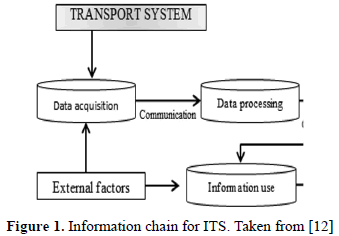
<body><![CDATA[<p><font size="2" face="Verdana, Arial, Helvetica, sans-serif">Then, Intelligent Transportation Systems are the interconnection of different information systems aimed to capture, communicate, compute and assist decision-making, allowing to properly manage the flow of vehicles and transportation means &#91;1&#93;. For the proper management of a transport system, the integration of technologies such as the Internet, electronic data exchange, wireless communications, computer technology, programming, and technologies designed to capture and analyze the required information.&#91;13&#93;.</font></p>     <p><font size="2" face="Verdana, Arial, Helvetica, sans-serif"><b>2.1. Classification of ITS</b>    <br>   When referring to ITS, it should be noted that they are grouped in two broad categories, ITS located in vehicles (such as communication systems and technologies inside them, and the so called &ldquo;intelligent vehicles&rdquo;); and the ITS located in the infrastructure or in the transportation mode, (such as dynamic signals, infraction control systems, etc.). In both categories great efforts and work to improve efficiency, based on the development of hardware, software and programming models to optimize routes and traffic flow, have been made &#91;12&#93;.</font></p>     <p><font size="2" face="Verdana, Arial, Helvetica, sans-serif">Perego et al. &#91;10&#93; classify the main technologies for information and communication for logistics and freight transport, using four families, as follows:</font></p> <ul>   <li class="DYNA-normal ParaOverride-5"><font size="2" face="Verdana, Arial, Helvetica, sans-serif">Applications for transportation management - TM</font></li>   <li class="DYNA-normal ParaOverride-6"><font size="2" face="Verdana, Arial, Helvetica, sans-serif">Applications for supply chain execution - SCE </font></li>   <li class="DYNA-normal ParaOverride-5"><font size="2" face="Verdana, Arial, Helvetica, sans-serif">Application for Field Force Automation - FFA </font></li>   <li class="DYNA-normal ParaOverride-7"><font size="2" face="Verdana, Arial, Helvetica, sans-serif">Fleet and Freight Management Applications - FFM</font></li>     </ul>     <p><font size="2" face="Verdana, Arial, Helvetica, sans-serif">TM applications are tools that allow the planning, optimization and execution of transport activities. They usually include cargo offer, routing, scheduling, tracking, freight payment and auditing systems. &#91;14,15, cited by  &#91;10&#93;&#93;. SCE applications manage and automate the exchange of information, and manage the execution of the distribution schedule in real time &#91;16 taken from &#91;10&#93;&#93;. FFA applications are supported on mobile technologies and enable the integration between remote elements and business processes &#91;17, taken from &#91;10&#93;&#93;. FFM applications are used to report vehicles and freight information as well as to obtain real-time information to manage distribution operations in a more dynamic and efficient way &#91;10&#93;.</font></p>     <p><font size="2" face="Verdana, Arial, Helvetica, sans-serif">Agre and Harbs &#91;18&#93; classify information systems applied to intelligent transportation on highways (IVHS - Intelligent Vehicle-Highways Systems) in six categories:</font></p> <ul>   <li class="DYNA-normal ParaOverride-5"><font size="2" face="Verdana, Arial, Helvetica, sans-serif">Traffic and Travel Management Systems</font></li>   <li class="DYNA-normal ParaOverride-5"><font size="2" face="Verdana, Arial, Helvetica, sans-serif">Public Transport Management Systems</font></li>   <li class="DYNA-normal ParaOverride-5"><font size="2" face="Verdana, Arial, Helvetica, sans-serif">Electronic Payment Systems</font></li>   <li class="DYNA-normal ParaOverride-5"><font size="2" face="Verdana, Arial, Helvetica, sans-serif">Commercial Vehicles Operation Systems</font></li>   <li class="DYNA-normal ParaOverride-5"><font size="2" face="Verdana, Arial, Helvetica, sans-serif">Emergency Management Systems</font></li>   <li class="DYNA-normal ParaOverride-8"><font size="2" face="Verdana, Arial, Helvetica, sans-serif">Advanced Systems for Vehicles</font></li>     </ul>     <p><font size="2" face="Verdana, Arial, Helvetica, sans-serif">According to Jara&scaron;unien&eacute; &#91;12&#93;, these systems are integrated through an information chain that includes the capture, communication, processing, distribution and use of information by users (for management and decision-making). These users may be the regulators entities (as route managers) or may be drivers carrying passengers or goods. <a href="#fig01">Figure 1</a> outlines the information chain described by Jara&scaron;unien&eacute; &#91;12&#93;.</font></p>     <p align="center"><font size="2" face="Verdana, Arial, Helvetica, sans-serif"><a name="fig01"></a></font><img src="/img/revistas/dyna/v80n180/v80n180a10fig01.gif"></p>     ]]></body>
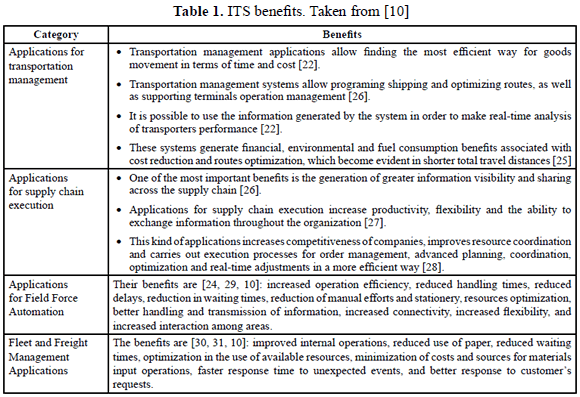
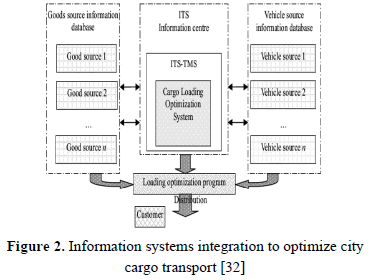
<body><![CDATA[<p>&nbsp;</p>     <p><font size="3" face="Verdana, Arial, Helvetica, sans-serif"><b>3.  BENEFITS OF ITS</b></font></p>     <p><font size="2" face="Verdana, Arial, Helvetica, sans-serif">According to Perego et al. &#91;10&#93; the impacts and benefits of ITS adoption have been studied by many authors &#91;19- 23&#93;, from the point of view of increasing the efficiency and effectiveness of operations and including the improvement of corporate image. <a href="#tab01">Table 1</a> summarizes the benefits found for each of the ITS categories presented by Perego et al. &#91;10&#93;.</font></p>     <p align="center"><font size="2" face="Verdana, Arial, Helvetica, sans-serif"><a name="tab01"></a></font><img src="/img/revistas/dyna/v80n180/v80n180a10tab01.gif"></p>     <p><font size="2" face="Verdana, Arial, Helvetica, sans-serif">These systems, besides helping transport management to produce economically efficient and safe routes, also allow relevant information to users to be delivered, controlling congestion and traffic, managing cargo fleets and vehicles,  optimizing infrastructure and managing communication between these elements. </font></p>     <p><font size="2" face="Verdana, Arial, Helvetica, sans-serif">ITS also allow to improve customer service as well as to obtain a cost reduction &#91;32&#93;. Zhibin et al. &#91;32&#93; state that through intelligent transport systems and their interaction with transportation management systems (TMS), it is possible to optimize freight processes inside cities, through the appropriate exchange of information between vehicle management systems and cargo management systems. This allows to merge these two information sources and then to develop distribution plans  for optimizing the number of trips and the amount of cargo for each trip, producing a minimum total cost of the distribution system. <a href="#fig02">Figure 2</a> shows the integration of these systems to produce the optimization of transport processes in city logistics approaches &#91;32&#93;.</font></p>     <p align="center"><font size="2" face="Verdana, Arial, Helvetica, sans-serif"><a name="fig02"></a></font><img src="/img/revistas/dyna/v80n180/v80n180a10fig02.gif"></p>     <p><font size="2" face="Verdana, Arial, Helvetica, sans-serif">Based on the above, it can be argued that intelligent information systems are the set of multiple applications aimed to improve transport systems, for both passengers and cargo. These applications produce improvements and benefits reflected in more efficient traffic control systems, better identification of goods and people, improved multimodal management, increased security and comfort in transport, real-|time information, reduced costs, among others.</font></p>     <p>&nbsp;</p>     <p><font size="3" face="Verdana, Arial, Helvetica, sans-serif"><b>4. TECHNOLOGY REVIEW</b></font></p>     ]]></body>
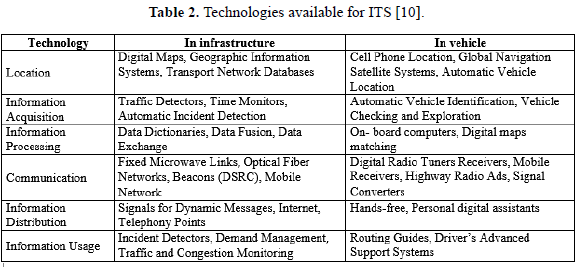
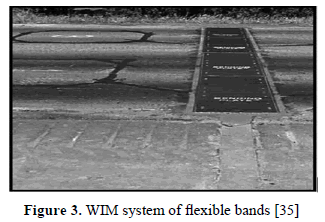
<body><![CDATA[<p><font size="2" face="Verdana, Arial, Helvetica, sans-serif"><a href="#tab02">Table 2</a> summarizes the technologies available for ITS systems, which are divided into two main areas: In vehicles and In infrastructure technologies &#91;10&#93;. </font></p>     <p align="center"><font size="2" face="Verdana, Arial, Helvetica, sans-serif"><a name="tab02"></a></font><img src="/img/revistas/dyna/v80n180/v80n180a10tab02.gif"></p>     <p><font size="2" face="Verdana, Arial, Helvetica, sans-serif">A key element for transport management with ITS is vehicle information acquisition, which, according to Jara&scaron;unien&eacute; &#91;12&#93; can be obtained in three ways:</font></p> <ul>   <li class="DYNA-normal ParaOverride-6"><font size="2" face="Verdana, Arial, Helvetica, sans-serif">Inductive Detectors. These detectors are devices installed in the pavement, which allow taking a census of vehicles. These sensors can determine the number of vehicles, their speed and the traffic on a road.</font></li>   <li class="DYNA-normal ParaOverride-6"><font size="2" face="Verdana, Arial, Helvetica, sans-serif">Ultrasonic, infrared and radar sensors: These sensors are placed on towers. They can detect vehicles using waves and determine the number of vehicles and their speed. The advantage of this system over the inductive sensors is the easy installation and maintenance, but in adverse weather conditions, their performance is less efficient than the others.</font></li>   <li class="DYNA-normal ParaOverride-15"><font size="2" face="Verdana, Arial, Helvetica, sans-serif">Video imaging detectors: These detectors can recognize the presence of a vehicle and its speed, track occupancy, traffic flow, detect license plate, etc., through image processing, based on optical character recognition (OCR) &#91;33&#93;.</font></li>     </ul>     <p><font size="2" face="Verdana, Arial, Helvetica, sans-serif">In addition to these elements, it is essential to establish a control center in order to monitor and make decisions to improve traffic conditions in the city. It is thus necessary to have a Close-circuit Television (CCTV) system as a complement to the vehicle detection devices. Another important element when getting the traffic information is to keep suitable communication with the institutions related with the transportation system, such as traffic agents, helicopters, road maintenance system, taxi companies, weather system and even navigation applications used in mobile phones &#91;12&#93;.</font></p>     <p><font size="2" face="Verdana, Arial, Helvetica, sans-serif">To understand traffic system behavior, it is important to determine how it works. For doing so, there are simulation tools, which have become very practical and easy to use.  They can emulate the behavior of the traffic system characteristics and make decisions based on it &#91;34&#93;.</font></p>     <p><font size="2" face="Verdana, Arial, Helvetica, sans-serif">Also, there are several applications that process the information which are aimed at generating traffic system reports for managers and users. According to Jara&scaron;unien&eacute; &#91;12&#93;, in order to obtain this information, it is necessary to &ldquo;merge&rdquo; the information from both public and private sources. This information can be delivered to both actors through dynamic signals (Dynamic Message Signs - DMS), to broadcasters and television|, in-vehicle devices (In-Vehicle Units - IVU) or handheld devices.</font></p>     <p><font size="2" face="Verdana, Arial, Helvetica, sans-serif">Others systems available for ITS are:</font></p> <ul>   <li class="DYNA-normal ParaOverride-6"><font size="2" face="Verdana, Arial, Helvetica, sans-serif">Automatic Incident Detection - AID: These systems reduce incident detection time and response time to them. They also allow determining the possibility that an accident may have occurred or may occur, by tracking traffic patterns. These systems are not designed to replace the monitoring centers, but to help their management &#91;12&#93;.</font></li>   <li class="DYNA-normal ParaOverride-7"><font size="2" face="Verdana, Arial, Helvetica, sans-serif">Weigh in Motion - WIM: These systems are designed to determine the weight of vehicles in motion. They can help control the care of roads, since an overweight vehicle is a factor for their premature deterioration. These systems work thanks to the location of load cells, piezoelectric systems or flexible bands. <a href="#fig03">Figure 3</a> shows a photograph of a flexible band WIM system &#91;35&#93;.</font></li>   <li class="DYNA-normal ParaOverride-7"><font size="2" face="Verdana, Arial, Helvetica, sans-serif">Advanced Traffic Management Systems - ATMS: These systems are in charge of acquiring real-time information about traffic conditions, data analysis, travel time predictions, emergency response management and providing this information to users through information systems of the city traffic control or other means such as Advanced Traveller information Systems - ATIS. Those are responsible for providing traffic information, which can be used by users to improve their transportation mode selection, routes and decision-making in general. These systems allow the reduction of distances, fuel consumption and pollution.</font></li>   <li class="DYNA-normal ParaOverride-7"><font size="2" face="Verdana, Arial, Helvetica, sans-serif">Electronic payment and Automated Vehicle Identification - AVI: These systems allow the real demand and the current amount of trucks circulating in real time to be known, making it possible to control the flow of transport within the city.</font></li>   <li class="DYNA-normal ParaOverride-7"><font size="2" face="Verdana, Arial, Helvetica, sans-serif">Advanced Fleet Management Systems -AFMS: These systems allow the positioning and use of freight to be planned, resulting in the system's optimization and its control in real-time. According to Benjelloun et al. &#91;1&#93; &ldquo;Advanced Fleet Management Systems can contribute significantly to the efficiency and ultimate success of cities' logistics systems&rdquo;.</font></li>     </ul>     <p align="center"><font size="2" face="Verdana, Arial, Helvetica, sans-serif"><a name="fig03"></a></font><img src="/img/revistas/dyna/v80n180/v80n180a10fig03.gif"></p>     ]]></body>
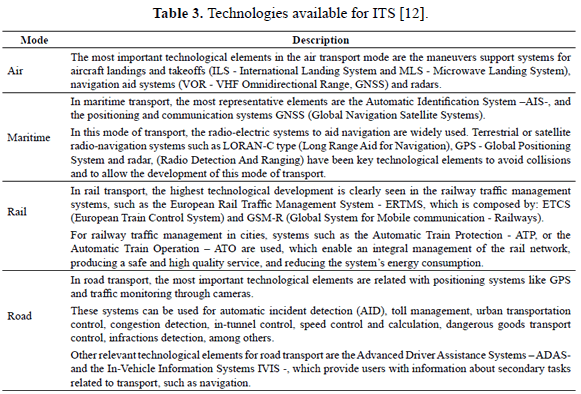
<body><![CDATA[<p><font size="2" face="Verdana, Arial, Helvetica, sans-serif"><b>4.1. ITS in different transport modes.</b>    <br>   ITS have been developed more in some transport modes than others, according to the needs and development of the modes. Thus, information systems for airplanes have been far more advanced than for any other mode, due to the need for security and monitoring of aircraft. </font></p>     <p><font size="2" face="Verdana, Arial, Helvetica, sans-serif">The most important element in the advance of communications for transport lies in the ability to communicate vehicles with a control center that allows its management. For example, vehicles can inform their position to their fleet manager through a mobile communication link. Long-range radio communications allow ships to communicate over long distances with other vessels; Global System for Mobile Communications - Railway (GSM-R) enables efficient wireless connectivity for trains; and transponders (devices used to identify aircraft automatically) &#91;9&#93;.</font></p>     <p><font size="2" face="Verdana, Arial, Helvetica, sans-serif"><a href="#tab03">Table 3</a> presents a review of the most relevant technological elements used in different modes for their intelligent management processes.</font></p>     <p align="center"><font size="2" face="Verdana, Arial, Helvetica, sans-serif"><a name="tab03"></a></font><img src="/img/revistas/dyna/v80n180/v80n180a10tab03.gif"></p>     <p><font size="2" face="Verdana, Arial, Helvetica, sans-serif"><b>4.2. Communication between vehicles and infrastructure    <br>   </b>Vehicle and infrastructure communications are a key element in intelligent transportation systems, since they allow two-way communication, which is used by city managers to obtain information for transport management and transmit it to users. The Vehicle-to-vehicle communication - V2V-and the Infrastructure-to vehicle-communication - I2V &#91;33&#93; are included in those communication systems.</font></p>     <p><font size="2" face="Verdana, Arial, Helvetica, sans-serif">According to Borrero et al. &#91;33&#93;, there are a large number of devices that allow communication via internet at any place and at any time. So that a vehicle equipped with its own IP and an Internet connection can be connected to a control center (I2V) and/or to other vehicles (V2V). Other ways of connections are via Bluetooth &#91;33&#93; and through telephone lines located among vehicles. Communication among vehicles, as well as in aviation and maritime transport, can reduce collision probability and improve traffic through the exchange of information about traffic jams and accidents.</font></p>     <p><font size="2" face="Verdana, Arial, Helvetica, sans-serif">This communication has generated the development of cooperative systems between vehicles and infrastructure CVIS (Cooperative Vehicle-Infrastructure Systems), which allow interaction among nearby vehicles and infrastructure located on the roads, offering better traffic and transport management. CVIS systems are based on a multichannel terminal capable of connecting a wide range of devices trough WLAN / Wi-Fi, cellular networks (GPRS / UMTS) short frequency microwave and infrared and satellite communications &#91;36&#93;.</font></p>     <p><font size="2" face="Verdana, Arial, Helvetica, sans-serif">This communications leads to a new concept called Connected Transportation System, which is an attempt to connect vehicles through some communication technology, what allows improve safety and emergency management, as well as the transport management and environmental impacts.  According to Dimitrakopoulos &#91;37&#93; the most feasible communication technology is the IP based infrastructure.</font></p>     ]]></body>
<body><![CDATA[<p><font size="2" face="Verdana, Arial, Helvetica, sans-serif">The development of these systems allows transmission of relevant information for travelers such as:</font></p> <ul>   <li class="DYNA-normal ParaOverride-6"><font size="2" face="Verdana, Arial, Helvetica, sans-serif">Routing</font></li>   <li class="DYNA-normal ParaOverride-6"><font size="2" face="Verdana, Arial, Helvetica, sans-serif">Traffic management and congestion avoidance</font></li>   <li class="DYNA-normal ParaOverride-6"><font size="2" face="Verdana, Arial, Helvetica, sans-serif">Traffic signal coordination</font></li>   <li class="DYNA-normal ParaOverride-6"><font size="2" face="Verdana, Arial, Helvetica, sans-serif">Truck monitoring</font></li>   <li class="DYNA-normal ParaOverride-6"><font size="2" face="Verdana, Arial, Helvetica, sans-serif">Parking space management</font></li>   <li class="DYNA-normal ParaOverride-6"><font size="2" face="Verdana, Arial, Helvetica, sans-serif">Safety information and warning announcements </font></li>   <li class="DYNA-normal ParaOverride-15"><font size="2" face="Verdana, Arial, Helvetica, sans-serif">Weather information</font></li>     </ul>     <p><font size="2" face="Verdana, Arial, Helvetica, sans-serif"><b>4.3. Traffic Management Technologies</b>    <br>   The technologies for traffic management are a set of tools that aim to reduce congestion in cities, while improving traffic security. These technologies distribute traffic and alert drivers about the various problems they may encounter on the roads &#91;38&#93;. According to WSDOT &#91;38&#93; the main element of these technologies is the ability to constantly adapt to traffic conditions, and respond to these changes efficiently.</font></p>     <p><font size="2" face="Verdana, Arial, Helvetica, sans-serif">Goverment Procurement Service &#91;39&#93; mentions that the traffic management technologies are part of a framework that enables access to a wide range of technologies such as: solutions for traffic management, traffic signs and parking systems, electronic and interactive message systems, traffic monitoring services, vehicle access and parking services, among others.</font></p>     <p><font size="2" face="Verdana, Arial, Helvetica, sans-serif"><b>4.4. Weather Responsive Traffic Management</b>    <br>   Weather Responsive Traffic Management - WRTM are a set of technologies that predict, determine and anticipate weather conditions, so it is possible to execute care and control actions before weather conditions affect the roads &#91;40&#93;. These systems allow suggestions to be made and strategies to be developed to mitigate climate impacts, and the information is transmitted to the managers and users through communication systems with vehicles and control facilities. Thus, Traffic Management Technologies are a combination of techniques, tools, and systems that authorities use to mitigate weather impacts on transport processes &#91;40, 41&#93;.</font></p>     <p><font size="2" face="Verdana, Arial, Helvetica, sans-serif">According to the USDOT &#91;40&#93; actions to be undertaken to develop traffic management systems in response to climate are:</font></p> <ul>   <li class="DYNA-normal ParaOverride-6"><font size="2" face="Verdana, Arial, Helvetica, sans-serif">Motorist Advisory, Alert and Warning Systems</font></li>   <li class="DYNA-normal ParaOverride-6"><font size="2" face="Verdana, Arial, Helvetica, sans-serif">Speed Management Strategies</font></li>   <li class="DYNA-normal ParaOverride-6"><font size="2" face="Verdana, Arial, Helvetica, sans-serif">Vehicle Restrictions Strategies</font></li>   <li class="DYNA-normal ParaOverride-6"><font size="2" face="Verdana, Arial, Helvetica, sans-serif">Route restrictions Strategies</font></li>   <li class="DYNA-normal ParaOverride-6"><font size="2" face="Verdana, Arial, Helvetica, sans-serif">Traffic Signal Control Strategies</font></li>   <li class="DYNA-normal ParaOverride-6"><font size="2" face="Verdana, Arial, Helvetica, sans-serif">Traffic Incident Management</font></li>   <li class="DYNA-normal ParaOverride-6"><font size="2" face="Verdana, Arial, Helvetica, sans-serif">Personnel/Asset Management</font></li>   <li class="DYNA-normal ParaOverride-15"><font size="2" face="Verdana, Arial, Helvetica, sans-serif">Agency Coordination</font></li>     </ul>     <p><font size="2" face="Verdana, Arial, Helvetica, sans-serif">WRTM are based on several technologies such as:</font></p> <ul>   <li class="DYNA-normal ParaOverride-6"><font size="2" face="Verdana, Arial, Helvetica, sans-serif">Passive warning systems</font></li>   <li class="DYNA-normal ParaOverride-6"><font size="2" face="Verdana, Arial, Helvetica, sans-serif">Active warning systems</font></li>   <li class="DYNA-normal ParaOverride-6"><font size="2" face="Verdana, Arial, Helvetica, sans-serif">Pre-Trip Road condition information and forecast systems</font></li>   <li class="DYNA-normal ParaOverride-7"><font size="2" face="Verdana, Arial, Helvetica, sans-serif">En-Route weather alerts and pavement condition information</font></li>     ]]></body>
<body><![CDATA[</ul>     <p><font size="2" face="Verdana, Arial, Helvetica, sans-serif">The joint use of these technologies seeks to improve transport systems, specifically the safety and mobility of passengers and cargo. This has led to the development of more complex strategies, such as the Smart Roadside Initiative, which seeks to improve safety, reduce the number of accidents and increase efficiency in the movement of goods through the collection and sharing of information between commercial vehicles, carriers, highway facilities, intermodal platforms, tolls and other elements of the transport system &#91;42, 43&#93;.</font></p>     <p><font size="2" face="Verdana, Arial, Helvetica, sans-serif">This integration is achieved through the joint operation of technologies and information exchange between three elements: vehicle communication systems, technologies in roads and the systems used in the cargo transportation processes &#91;42&#93;.</font></p>     <p>&nbsp;</p>     <p><font size="3" face="Verdana, Arial, Helvetica, sans-serif"><b>5. CONCLUSIONS</b></font></p>     <p><font size="2" face="Verdana, Arial, Helvetica, sans-serif">Transportation determines companies' competitiveness and has several negative effects on cities, creating a necessity to make great efforts in management processes. The later explains the need for advanced information systems that lead to transport optimization at all levels, both for commercial and passenger transport.</font></p>     <p><font size="2" face="Verdana, Arial, Helvetica, sans-serif">Intelligent transport systems are tools to allow transport mobility, safety and productivity to be improved, and involve many aspects for this purpose. That is the case of the information coming from vehicles, public and private entities, and the information obtained from systems and information technologies such as cameras, radars and speed detectors. All this allows intelligent transportation management to be achieved, which is the primary objective of ITS.</font></p>     <p><font size="2" face="Verdana, Arial, Helvetica, sans-serif">This paper has presented a review of technologies for ITS. However, it did not address the computational tools that would optimize these systems. This is why, as a conclusion, the importance of developing programming tools and models that will help to improve transport operation and management through ITS is outlined. It is also recommended to carry out studies that allow the most successful experiences worldwide to be analyzed and try to apply these tools in the Colombian environment.</font></p>     <p>&nbsp;</p>     <p><font size="3" face="Verdana, Arial, Helvetica, sans-serif"><b>REFERENCES</b></font></p>     ]]></body>
<body><![CDATA[<!-- ref --><p><font size="2" face="Verdana, Arial, Helvetica, sans-serif"><b>&#91;1&#93;</b> Benjelloun, A., Crainic, T. G., and Bigras, Y. (2010). Towards a Taxonomy of City Logistics Projects Procedia Social and Behavioral Sciences 2 pp. 6217-6228, 2010     &nbsp;&nbsp;&nbsp;&nbsp;&nbsp;&nbsp;&nbsp;&nbsp;[&#160;<a href="javascript:void(0);" onclick="javascript: window.open('/scielo.php?script=sci_nlinks&ref=000093&pid=S0012-7353201300040001000001&lng=','','width=640,height=500,resizable=yes,scrollbars=1,menubar=yes,');">Links</a>&#160;]<!-- end-ref --><!-- ref --><br>   <b>&#91;2&#93;</b> Arango, M.D., Adarme, W y Zapata, J.A., La movilidad de carga en ciudades metr&oacute;polis - log&iacute;stica de ciudades. Apotema S.A.S. ISBN: 978-958-44-9517-4, 2011     &nbsp;&nbsp;&nbsp;&nbsp;&nbsp;&nbsp;&nbsp;&nbsp;[&#160;<a href="javascript:void(0);" onclick="javascript: window.open('/scielo.php?script=sci_nlinks&ref=000094&pid=S0012-7353201300040001000002&lng=','','width=640,height=500,resizable=yes,scrollbars=1,menubar=yes,');">Links</a>&#160;]<!-- end-ref --><!-- ref --><br>   <b>&#91;3&#93;</b> Pillac, V., Gendreau, M., Gu&eacute;ret., C. and Medaglia, A. A Review of Dynamic Vehicle Routing Problems. Cirrelt, 2011.    &nbsp;&nbsp;&nbsp;&nbsp;&nbsp;&nbsp;&nbsp;&nbsp;[&#160;<a href="javascript:void(0);" onclick="javascript: window.open('/scielo.php?script=sci_nlinks&ref=000095&pid=S0012-7353201300040001000003&lng=','','width=640,height=500,resizable=yes,scrollbars=1,menubar=yes,');">Links</a>&#160;]<!-- end-ref --><!-- ref --><br>   <b>&#91;4&#93;</b> Crainic, T. City Logistics. Cirrelt, 2008     &nbsp;&nbsp;&nbsp;&nbsp;&nbsp;&nbsp;&nbsp;&nbsp;[&#160;<a href="javascript:void(0);" onclick="javascript: window.open('/scielo.php?script=sci_nlinks&ref=000096&pid=S0012-7353201300040001000004&lng=','','width=640,height=500,resizable=yes,scrollbars=1,menubar=yes,');">Links</a>&#160;]<!-- end-ref --><!-- ref --><br>   <b>&#91;5&#93;</b> Arango, M. D; Adarme, W; & Zapata, J. A. (2010). Distribuci&oacute;n de commodities, usando medios alternativos de transporte. Caso Colombia Pymes panificadoras, DYNA, vol. 77, pp. 222-233.    &nbsp;&nbsp;&nbsp;&nbsp;&nbsp;&nbsp;&nbsp;&nbsp;[&#160;<a href="javascript:void(0);" onclick="javascript: window.open('/scielo.php?script=sci_nlinks&ref=000097&pid=S0012-7353201300040001000005&lng=','','width=640,height=500,resizable=yes,scrollbars=1,menubar=yes,');">Links</a>&#160;]<!-- end-ref --><!-- ref --><br>   <b>&#91;6&#93;</b> Taniguchi, E., Thompson, R.G., Yamada, T., Recent Advances in Modelling City Logistics, In: City Logistics II, Institute of Systems Science Research, Kyoto, pp. 3-34, 2001     &nbsp;&nbsp;&nbsp;&nbsp;&nbsp;&nbsp;&nbsp;&nbsp;[&#160;<a href="javascript:void(0);" onclick="javascript: window.open('/scielo.php?script=sci_nlinks&ref=000098&pid=S0012-7353201300040001000006&lng=','','width=640,height=500,resizable=yes,scrollbars=1,menubar=yes,');">Links</a>&#160;]<!-- end-ref --><!-- ref --><br>   <b>&#91;7&#93;</b> Taniguchi, E., Thomson, R., Yamada, T. Visions for City Logistics. From: logistics systems for sustainable cities, Elsevier, pp. 1-16, 2004.    &nbsp;&nbsp;&nbsp;&nbsp;&nbsp;&nbsp;&nbsp;&nbsp;[&#160;<a href="javascript:void(0);" onclick="javascript: window.open('/scielo.php?script=sci_nlinks&ref=000099&pid=S0012-7353201300040001000007&lng=','','width=640,height=500,resizable=yes,scrollbars=1,menubar=yes,');">Links</a>&#160;]<!-- end-ref --><!-- ref --><br>   <b>&#91;8&#93;</b> Tamagawa, D.& Taniguchi, E. & Yamad, T. Evaluating City Logistics Measures using a Multi-agent Model. Procedia Social and Behavioral Sciences 2 (2010) 6002-6012.    &nbsp;&nbsp;&nbsp;&nbsp;&nbsp;&nbsp;&nbsp;&nbsp;[&#160;<a href="javascript:void(0);" onclick="javascript: window.open('/scielo.php?script=sci_nlinks&ref=000100&pid=S0012-7353201300040001000008&lng=','','width=640,height=500,resizable=yes,scrollbars=1,menubar=yes,');">Links</a>&#160;]<!-- end-ref --><!-- ref --><br>   <b>&#91;9&#93;</b> Ministerio de Fomento. Los sistemas inteligentes de transporte: su aplicaci&oacute;n a los modos terrestre, mar&iacute;timo y a&eacute;reo. Centro de Publicaciones, Secretar&iacute;a General T&eacute;cnica, Ministerio de Fomento ©. available in: <a href="http://195.76.37.58/NR/rdonlyres/7595AD41-7687-4850-A568-D0EC56379CF9/72310/SIT_opt.pdf" target="referencia">http://195.76.37.58/NR/rdonlyres/7595AD41-7687-4850-A568-D0EC56379CF9/72310/SIT_opt.pdf</a>. Last visit: June 2013.    &nbsp;&nbsp;&nbsp;&nbsp;&nbsp;&nbsp;&nbsp;&nbsp;[&#160;<a href="javascript:void(0);" onclick="javascript: window.open('/scielo.php?script=sci_nlinks&ref=000101&pid=S0012-7353201300040001000009&lng=','','width=640,height=500,resizable=yes,scrollbars=1,menubar=yes,');">Links</a>&#160;]<!-- end-ref --><!-- ref --><br>   <b>&#91;10&#93;</b> Perego, A., Perotti, S., and Mangiaracina, R. ICT for Llogistics and freight transportation: a literature review and research agenda. International Journal of Physical Distribution & Logistics Management Vol. 41 No. 5, 2011 pp. 457-483     &nbsp;&nbsp;&nbsp;&nbsp;&nbsp;&nbsp;&nbsp;&nbsp;[&#160;<a href="javascript:void(0);" onclick="javascript: window.open('/scielo.php?script=sci_nlinks&ref=000102&pid=S0012-7353201300040001000010&lng=','','width=640,height=500,resizable=yes,scrollbars=1,menubar=yes,');">Links</a>&#160;]<!-- end-ref --><!-- ref --><br>   <b>&#91;11&#93;</b> Panou, M. and Bekiaris, E., ITS clustering and terminology: one concept with many meanings, Economic Impacts of Intelligent Transportation Systems: Innovations and Case Studies Research in Transportation Economics, Vol. 8, pp. 49-67, 2004.    &nbsp;&nbsp;&nbsp;&nbsp;&nbsp;&nbsp;&nbsp;&nbsp;[&#160;<a href="javascript:void(0);" onclick="javascript: window.open('/scielo.php?script=sci_nlinks&ref=000103&pid=S0012-7353201300040001000011&lng=','','width=640,height=500,resizable=yes,scrollbars=1,menubar=yes,');">Links</a>&#160;]<!-- end-ref --><!-- ref --><br>   <b>&#91;12&#93;</b> Jarasuniene, A. Research Into Intelligent Transport Systems (Its) Technologies and Efficiency. TRANSPORT - 2007, Vol. XXII, No 2, pp. 61-67, 2007.    &nbsp;&nbsp;&nbsp;&nbsp;&nbsp;&nbsp;&nbsp;&nbsp;[&#160;<a href="javascript:void(0);" onclick="javascript: window.open('/scielo.php?script=sci_nlinks&ref=000104&pid=S0012-7353201300040001000012&lng=','','width=640,height=500,resizable=yes,scrollbars=1,menubar=yes,');">Links</a>&#160;]<!-- end-ref --><!-- ref --><br>   <b>&#91;13&#93;</b> Zapata, J.A. y Arango, M.D. & Adarme, W. Herramientas tecnol&oacute;gicas al servicio de la gesti&oacute;n empresarial. Avances en Sistemas e Inform&aacute;tica. Vol. 7, No 3. Diciembre de 2010. pp. 87-101, 2007.    &nbsp;&nbsp;&nbsp;&nbsp;&nbsp;&nbsp;&nbsp;&nbsp;[&#160;<a href="javascript:void(0);" onclick="javascript: window.open('/scielo.php?script=sci_nlinks&ref=000105&pid=S0012-7353201300040001000013&lng=','','width=640,height=500,resizable=yes,scrollbars=1,menubar=yes,');">Links</a>&#160;]<!-- end-ref --><!-- ref --><br>   <b>&#91;14&#93;</b> Gilmore, D. and Tompkins, J., Transport Plays Key Role in Supply Strategy, ID Systems, Vol. 20, pp. 16-17, 2000.    &nbsp;&nbsp;&nbsp;&nbsp;&nbsp;&nbsp;&nbsp;&nbsp;[&#160;<a href="javascript:void(0);" onclick="javascript: window.open('/scielo.php?script=sci_nlinks&ref=000106&pid=S0012-7353201300040001000014&lng=','','width=640,height=500,resizable=yes,scrollbars=1,menubar=yes,');">Links</a>&#160;]<!-- end-ref --><!-- ref --><br>   <b>&#91;15&#93;</b> Tyan, J.C., Wang, F.K. and Du, T., Applying Collaborative Transportation Management Models in Global Third-Party Logistics, International Journal of Computer Integrated Manufacturing, Vol. 16 No. 4, pp. 283-91, 2003.    &nbsp;&nbsp;&nbsp;&nbsp;&nbsp;&nbsp;&nbsp;&nbsp;[&#160;<a href="javascript:void(0);" onclick="javascript: window.open('/scielo.php?script=sci_nlinks&ref=000107&pid=S0012-7353201300040001000015&lng=','','width=640,height=500,resizable=yes,scrollbars=1,menubar=yes,');">Links</a>&#160;]<!-- end-ref --><!-- ref --><br>   <b>&#91;16&#93;</b> Giaglis, G.M., Minis, I., Tatarakis, A. and Zeimpekis, V., Minimizing Logistics Risk through Real-Time Vehicle Routing and Mobile Technologies, International Journal of Physical Distribution & Logistics Management, Vol. 34 No. 9, pp. 749-64, 2004.    &nbsp;&nbsp;&nbsp;&nbsp;&nbsp;&nbsp;&nbsp;&nbsp;[&#160;<a href="javascript:void(0);" onclick="javascript: window.open('/scielo.php?script=sci_nlinks&ref=000108&pid=S0012-7353201300040001000016&lng=','','width=640,height=500,resizable=yes,scrollbars=1,menubar=yes,');">Links</a>&#160;]<!-- end-ref --><!-- ref --><br>   <b>&#91;17&#93;</b> Rodina, E., Zeimpekis, V. and Fouskas, K., Remote Workforce Business Processes Integration through Real-Time Mobile Communications, Proceedings of 2nd International Conference on Mobile Businesses, Vienna, 2003.    &nbsp;&nbsp;&nbsp;&nbsp;&nbsp;&nbsp;&nbsp;&nbsp;[&#160;<a href="javascript:void(0);" onclick="javascript: window.open('/scielo.php?script=sci_nlinks&ref=000109&pid=S0012-7353201300040001000017&lng=','','width=640,height=500,resizable=yes,scrollbars=1,menubar=yes,');">Links</a>&#160;]<!-- end-ref --><!-- ref --><br>   <b>&#91;18&#93;</b> Agre y Harbs., Social Choice about Privacy: Intelligent Vehicle-highway Systems in the United States. Information Technology & People, Vol. 7 No. 4, 1994, pp. 63-90, 1994.    &nbsp;&nbsp;&nbsp;&nbsp;&nbsp;&nbsp;&nbsp;&nbsp;[&#160;<a href="javascript:void(0);" onclick="javascript: window.open('/scielo.php?script=sci_nlinks&ref=000110&pid=S0012-7353201300040001000018&lng=','','width=640,height=500,resizable=yes,scrollbars=1,menubar=yes,');">Links</a>&#160;]<!-- end-ref --><!-- ref --><br>   <b>&#91;19&#93;</b> Bharadwaj, A., A Resource-based Perspective on Information Technology Capability and Firm Performance: An Empirical Investigation, MIS Quarterly, Vol. 24 No. 1, pp. 169-96, 2000.    &nbsp;&nbsp;&nbsp;&nbsp;&nbsp;&nbsp;&nbsp;&nbsp;[&#160;<a href="javascript:void(0);" onclick="javascript: window.open('/scielo.php?script=sci_nlinks&ref=000111&pid=S0012-7353201300040001000019&lng=','','width=640,height=500,resizable=yes,scrollbars=1,menubar=yes,');">Links</a>&#160;]<!-- end-ref --><!-- ref --><br>   <b>&#91;20&#93;</b> Jakobs, K., Pils, C. and Wallbaum, M., Using the Internet in Transport Logistics - the Example of a Track and Trace System, Lecture Notes in Computer Science, No. 2093, pp. 194-203, 2001.    &nbsp;&nbsp;&nbsp;&nbsp;&nbsp;&nbsp;&nbsp;&nbsp;[&#160;<a href="javascript:void(0);" onclick="javascript: window.open('/scielo.php?script=sci_nlinks&ref=000112&pid=S0012-7353201300040001000020&lng=','','width=640,height=500,resizable=yes,scrollbars=1,menubar=yes,');">Links</a>&#160;]<!-- end-ref --><!-- ref --><br>   <b>&#91;21&#93;</b> Chapman, R.L. and Soosay, C., Innovation in Logistic Services and the New Business Model -A Conceptual Framework, International Journal of Physical Distribution & Logistics Management, Vol. 33 No. 7, pp. 630-50, 2003.    &nbsp;&nbsp;&nbsp;&nbsp;&nbsp;&nbsp;&nbsp;&nbsp;[&#160;<a href="javascript:void(0);" onclick="javascript: window.open('/scielo.php?script=sci_nlinks&ref=000113&pid=S0012-7353201300040001000021&lng=','','width=640,height=500,resizable=yes,scrollbars=1,menubar=yes,');">Links</a>&#160;]<!-- end-ref --><!-- ref --><br>   <b>&#91;22&#93;</b> Mason, S.J., Ribera, P.M., Farris, J.A. and Kirk, R.G., Integrating the Warehousing and Transportation Functions of the Supply Chain, Transportation Research Part E, Vol. 39, pp. 141-59, 2003.    &nbsp;&nbsp;&nbsp;&nbsp;&nbsp;&nbsp;&nbsp;&nbsp;[&#160;<a href="javascript:void(0);" onclick="javascript: window.open('/scielo.php?script=sci_nlinks&ref=000114&pid=S0012-7353201300040001000022&lng=','','width=640,height=500,resizable=yes,scrollbars=1,menubar=yes,');">Links</a>&#160;]<!-- end-ref --><!-- ref --><br>   <b>&#91;23&#93;</b> Pokharel, S., Perception on Information and Communication Technology: Perspective in Logistics, The Journal of Enterprise Information Management, Vol. 18 No. 2, pp. 136-49, 2005.    &nbsp;&nbsp;&nbsp;&nbsp;&nbsp;&nbsp;&nbsp;&nbsp;[&#160;<a href="javascript:void(0);" onclick="javascript: window.open('/scielo.php?script=sci_nlinks&ref=000115&pid=S0012-7353201300040001000023&lng=','','width=640,height=500,resizable=yes,scrollbars=1,menubar=yes,');">Links</a>&#160;]<!-- end-ref --><!-- ref --><br>   <b>&#91;24&#93;</b> Kia, M., Shayan, E. and Ghotb, F., The Importance of Information Technology in Port Terminal Operations, International Journal of Physical Distribution & Logistics Management, Vol. 30 Nos 3/4, pp. 331-44, 2000.    &nbsp;&nbsp;&nbsp;&nbsp;&nbsp;&nbsp;&nbsp;&nbsp;[&#160;<a href="javascript:void(0);" onclick="javascript: window.open('/scielo.php?script=sci_nlinks&ref=000116&pid=S0012-7353201300040001000024&lng=','','width=640,height=500,resizable=yes,scrollbars=1,menubar=yes,');">Links</a>&#160;]<!-- end-ref --><!-- ref --><br>   <b>&#91;25&#93;</b> Button, K., Doyle, E. and Stough, R., Intelligent Transport Systems in Commercial Fleet Management: A Study of Short Term Economic Benefits, Transportation Planning and Technology, Vol. 24, pp. 155-70, 2001.    &nbsp;&nbsp;&nbsp;&nbsp;&nbsp;&nbsp;&nbsp;&nbsp;[&#160;<a href="javascript:void(0);" onclick="javascript: window.open('/scielo.php?script=sci_nlinks&ref=000117&pid=S0012-7353201300040001000025&lng=','','width=640,height=500,resizable=yes,scrollbars=1,menubar=yes,');">Links</a>&#160;]<!-- end-ref --><!-- ref --><br>   <b>&#91;26&#93;</b> Rudberg, M., Klingenberg, N., and Kronhamn, K., Collaborative Supply Chain using Electronic Market-Places. Integrated Manufacturing Systems, Vol. 13, Iss. 8, pp. 596-611, 2002.    &nbsp;&nbsp;&nbsp;&nbsp;&nbsp;&nbsp;&nbsp;&nbsp;[&#160;<a href="javascript:void(0);" onclick="javascript: window.open('/scielo.php?script=sci_nlinks&ref=000118&pid=S0012-7353201300040001000026&lng=','','width=640,height=500,resizable=yes,scrollbars=1,menubar=yes,');">Links</a>&#160;]<!-- end-ref --><!-- ref --><br>   <b>&#91;27&#93;</b> Patterson, K.A., Grimm, C.M. and Corsi, T.M., Adopting New Technologies for Supply Chain Management, Transportation Research Part E, Vol. 39, pp. 95-121, 2003.    &nbsp;&nbsp;&nbsp;&nbsp;&nbsp;&nbsp;&nbsp;&nbsp;[&#160;<a href="javascript:void(0);" onclick="javascript: window.open('/scielo.php?script=sci_nlinks&ref=000119&pid=S0012-7353201300040001000027&lng=','','width=640,height=500,resizable=yes,scrollbars=1,menubar=yes,');">Links</a>&#160;]<!-- end-ref --><!-- ref --><br>   <b>&#91;28&#93;</b> Auramo, J., Kauremaa, J. and Tanskanen, K., Benefits of it in Supply Chain Management: An Explorative Study of Progressive Companies, International Journal of Physical Distribution & Logistics Management, Vol. 35 No. 2, pp. 82-100, 2005.    &nbsp;&nbsp;&nbsp;&nbsp;&nbsp;&nbsp;&nbsp;&nbsp;[&#160;<a href="javascript:void(0);" onclick="javascript: window.open('/scielo.php?script=sci_nlinks&ref=000120&pid=S0012-7353201300040001000028&lng=','','width=640,height=500,resizable=yes,scrollbars=1,menubar=yes,');">Links</a>&#160;]<!-- end-ref --><!-- ref --><br>   <b>&#91;29&#93;</b> Barnes, S.J., Scornavacca, E. and Innes, D., Understanding Wireless Field Force Automation in Trade Services, Industrial Management & Data Systems, Vol. 106 No. 2, pp. 172-81, 2006.    &nbsp;&nbsp;&nbsp;&nbsp;&nbsp;&nbsp;&nbsp;&nbsp;[&#160;<a href="javascript:void(0);" onclick="javascript: window.open('/scielo.php?script=sci_nlinks&ref=000121&pid=S0012-7353201300040001000029&lng=','','width=640,height=500,resizable=yes,scrollbars=1,menubar=yes,');">Links</a>&#160;]<!-- end-ref --><!-- ref --><br>   <b>&#91;30&#93;</b> Loebbecke, C. and Powell, P., Competitive Advantage from IT in Logistics: The Integrated Transport Tracking System, International Journal of Information Management, Vol. 18 No. 1, pp. 17-27, 1998.    &nbsp;&nbsp;&nbsp;&nbsp;&nbsp;&nbsp;&nbsp;&nbsp;[&#160;<a href="javascript:void(0);" onclick="javascript: window.open('/scielo.php?script=sci_nlinks&ref=000122&pid=S0012-7353201300040001000030&lng=','','width=640,height=500,resizable=yes,scrollbars=1,menubar=yes,');">Links</a>&#160;]<!-- end-ref --><!-- ref --><br>   <b>&#91;31&#93;</b> Kärkkäinen, M., Ala-Risku, T. and Främling, K., Efficient Tracking for Short-Term Multi-company Networks, International Journal of Physical Distribution & Logistics Management, Vol. 34 No. 7, pp. 545-64, 2004.    &nbsp;&nbsp;&nbsp;&nbsp;&nbsp;&nbsp;&nbsp;&nbsp;[&#160;<a href="javascript:void(0);" onclick="javascript: window.open('/scielo.php?script=sci_nlinks&ref=000123&pid=S0012-7353201300040001000031&lng=','','width=640,height=500,resizable=yes,scrollbars=1,menubar=yes,');">Links</a>&#160;]<!-- end-ref --><!-- ref --><br>   <b>&#91;32&#93;</b> Zhibin Yin, Z. and Guo, Q and Xiao, Q., City Logistics Transportation Invisible Cost Control Based on ITS. The Sixth Advanced Forum on Transportation of China. IET collection inspiration, 2010.    &nbsp;&nbsp;&nbsp;&nbsp;&nbsp;&nbsp;&nbsp;&nbsp;[&#160;<a href="javascript:void(0);" onclick="javascript: window.open('/scielo.php?script=sci_nlinks&ref=000124&pid=S0012-7353201300040001000032&lng=','','width=640,height=500,resizable=yes,scrollbars=1,menubar=yes,');">Links</a>&#160;]<!-- end-ref --><!-- ref --><br>   <b>&#91;33&#93;</b> Barrero, F. and Toral, S. and Vargas, M. and Cort&eacute;s, F. and Milla, J. M., Internet in the Development of Future Road-traffic Control Systems. Internet Research, Vol. 20 No. 2. pp. 154-168, 2010.    &nbsp;&nbsp;&nbsp;&nbsp;&nbsp;&nbsp;&nbsp;&nbsp;[&#160;<a href="javascript:void(0);" onclick="javascript: window.open('/scielo.php?script=sci_nlinks&ref=000125&pid=S0012-7353201300040001000033&lng=','','width=640,height=500,resizable=yes,scrollbars=1,menubar=yes,');">Links</a>&#160;]<!-- end-ref --><!-- ref --><br>   <b>&#91;34&#93;</b> Lee, J. K.. and Ye-Hwan Lim and Sung-Do Chi., Hierarchical Modeling and Simulation Environment for Intelligent Transportation Systems. SIMULATION Volume 80, Number 2. Pp. 61-76, 2004.    &nbsp;&nbsp;&nbsp;&nbsp;&nbsp;&nbsp;&nbsp;&nbsp;[&#160;<a href="javascript:void(0);" onclick="javascript: window.open('/scielo.php?script=sci_nlinks&ref=000126&pid=S0012-7353201300040001000034&lng=','','width=640,height=500,resizable=yes,scrollbars=1,menubar=yes,');">Links</a>&#160;]<!-- end-ref --><!-- ref --><br>   <b>&#91;35&#93;</b> FHWA. Traffic Monitoring Guide Truck Weight Monitoring (Section 5). Available in: <a href="http://www.fhwa.dot.gov/policy/ohpi/hss/presentations/truckweight.htm" target="referencia">http://www.fhwa.dot.gov/policy/ohpi/hss/presentations/truckweight.htm</a> Last visit: julio de 2012     &nbsp;&nbsp;&nbsp;&nbsp;&nbsp;&nbsp;&nbsp;&nbsp;[&#160;<a href="javascript:void(0);" onclick="javascript: window.open('/scielo.php?script=sci_nlinks&ref=000127&pid=S0012-7353201300040001000035&lng=','','width=640,height=500,resizable=yes,scrollbars=1,menubar=yes,');">Links</a>&#160;]<!-- end-ref --><!-- ref --><br>   <b>&#91;36&#93;</b> Q-free. CVIS.- Cooperative vehicle-infraestructure systems. European commission Information society and media. Available in: <a href="http://www.cvisproject.org/download/qfree_cvis_brosjyre.pdf" target="referencia">http://www.cvisproject.org/download/qfree_cvis_brosjyre.pdf</a>. Last visit: Julio de 2012.    &nbsp;&nbsp;&nbsp;&nbsp;&nbsp;&nbsp;&nbsp;&nbsp;[&#160;<a href="javascript:void(0);" onclick="javascript: window.open('/scielo.php?script=sci_nlinks&ref=000128&pid=S0012-7353201300040001000036&lng=','','width=640,height=500,resizable=yes,scrollbars=1,menubar=yes,');">Links</a>&#160;]<!-- end-ref --><!-- ref --><br>   <b>&#91;37&#93;</b> Dimitrakopoulos, G. Intelligent Transportation Systems based on Internet-Connected Vehicles: Fundamental Research Areas and Challenges. 11th International Conference on ITS Telecommunications (ITST). IEEE, 2011.    &nbsp;&nbsp;&nbsp;&nbsp;&nbsp;&nbsp;&nbsp;&nbsp;[&#160;<a href="javascript:void(0);" onclick="javascript: window.open('/scielo.php?script=sci_nlinks&ref=000129&pid=S0012-7353201300040001000037&lng=','','width=640,height=500,resizable=yes,scrollbars=1,menubar=yes,');">Links</a>&#160;]<!-- end-ref --><!-- ref --><br>   <b>&#91;38&#93;</b> SWDOT - Washington State Department of transportation. New Technologies for Fighting Congestion. Available in: <a href="http://www.wsdot.wa.gov/Congestion/technology.htm" target="referencia">http://www.wsdot.wa.gov/Congestion/technology.htm</a> Laast visit: April de 2013.    &nbsp;&nbsp;&nbsp;&nbsp;&nbsp;&nbsp;&nbsp;&nbsp;[&#160;<a href="javascript:void(0);" onclick="javascript: window.open('/scielo.php?script=sci_nlinks&ref=000130&pid=S0012-7353201300040001000038&lng=','','width=640,height=500,resizable=yes,scrollbars=1,menubar=yes,');">Links</a>&#160;]<!-- end-ref --><!-- ref --><br>   <b>&#91;39&#93;</b> GPS - Goverment procurement Service. Traffic Management Technology. Available in: <a href="http://gps.cabinetoffice.gov.uk/contracts/rm869" target="referencia">http://gps.cabinetoffice.gov.uk/contracts/rm869</a> Last visit: April de 2013.    &nbsp;&nbsp;&nbsp;&nbsp;&nbsp;&nbsp;&nbsp;&nbsp;[&#160;<a href="javascript:void(0);" onclick="javascript: window.open('/scielo.php?script=sci_nlinks&ref=000131&pid=S0012-7353201300040001000039&lng=','','width=640,height=500,resizable=yes,scrollbars=1,menubar=yes,');">Links</a>&#160;]<!-- end-ref --><!-- ref --><br>   <b>&#91;40&#93;</b> USDOT - U.S. Department of Transportation, Research and Innovative Technology Administration. Developments in Weather Responsive Traffic Management Strategies. Disponible en: <a href="http://ntl.bts.gov/lib/42000/42900/42965/wrtm_final_report_06302011.pdf" target="referencia">http://ntl.bts.gov/lib/42000/42900/42965/wrtm_final_report_06302011.pdf</a>. Last visit: April de 2013.    &nbsp;&nbsp;&nbsp;&nbsp;&nbsp;&nbsp;&nbsp;&nbsp;[&#160;<a href="javascript:void(0);" onclick="javascript: window.open('/scielo.php?script=sci_nlinks&ref=000132&pid=S0012-7353201300040001000040&lng=','','width=640,height=500,resizable=yes,scrollbars=1,menubar=yes,');">Links</a>&#160;]<!-- end-ref --><!-- ref --><br>   <b>&#91;41&#93;</b> Pisano, P. & Goodwin, L., Research Needs for Weather-Responsive Traffic Management. Transportation Research Record: Journal of the Transportation Research Board, Volume 1867 pp. 127-131, 2004.    &nbsp;&nbsp;&nbsp;&nbsp;&nbsp;&nbsp;&nbsp;&nbsp;[&#160;<a href="javascript:void(0);" onclick="javascript: window.open('/scielo.php?script=sci_nlinks&ref=000133&pid=S0012-7353201300040001000041&lng=','','width=640,height=500,resizable=yes,scrollbars=1,menubar=yes,');">Links</a>&#160;]<!-- end-ref --><!-- ref --><br>   <b>&#91;42&#93;</b> Mueller, J. Smart Roadside Initiative (SRI) Overview. U.S. Department of Transportation. Available in: <a href="http://www.its.dot.gov/presentations/pdf/E_SRI_OverviewAug2011.pdf" target="referencia">http://www.its.dot.gov/presentations/pdf/E_SRI_OverviewAug2011.pdf</a> Last visit: April de 2013.    &nbsp;&nbsp;&nbsp;&nbsp;&nbsp;&nbsp;&nbsp;&nbsp;[&#160;<a href="javascript:void(0);" onclick="javascript: window.open('/scielo.php?script=sci_nlinks&ref=000134&pid=S0012-7353201300040001000042&lng=','','width=640,height=500,resizable=yes,scrollbars=1,menubar=yes,');">Links</a>&#160;]<!-- end-ref --><!-- ref --><br>   <b>&#91;43&#93;</b> USDOT - U.S. Department of Transportation. White Paper: Scope of the Smart Roadside Initiative. Available in: <a href="http://www.its.dot.gov/research_docs/pdf/26Smart%20Roadside%20White%20Paper.pdf" target="referencia">http://www.its.dot.gov/research_docs/pdf/26Smart%20Roadside%20White%20Paper.pdf</a> Last visit: April de 2013.    &nbsp;&nbsp;&nbsp;&nbsp;&nbsp;&nbsp;&nbsp;&nbsp;[&#160;<a href="javascript:void(0);" onclick="javascript: window.open('/scielo.php?script=sci_nlinks&ref=000135&pid=S0012-7353201300040001000043&lng=','','width=640,height=500,resizable=yes,scrollbars=1,menubar=yes,');">Links</a>&#160;]<!-- end-ref --> </font></p>      ]]></body><back>
<ref-list>
<ref id="B1">
<label>1</label><nlm-citation citation-type="journal">
<person-group person-group-type="author">
<name>
<surname><![CDATA[Benjelloun]]></surname>
<given-names><![CDATA[A.]]></given-names>
</name>
<name>
<surname><![CDATA[Crainic]]></surname>
<given-names><![CDATA[T. G.]]></given-names>
</name>
<name>
<surname><![CDATA[Bigras]]></surname>
<given-names><![CDATA[Y.]]></given-names>
</name>
</person-group>
<article-title xml:lang="en"><![CDATA[Towards a Taxonomy of City Logistics Projects]]></article-title>
<source><![CDATA[Procedia Social and Behavioral Sciences]]></source>
<year>2010</year>
<month>20</month>
<day>10</day>
<numero>2</numero>
<issue>2</issue>
<page-range>6217-6228</page-range></nlm-citation>
</ref>
<ref id="B2">
<label>2</label><nlm-citation citation-type="book">
<person-group person-group-type="author">
<name>
<surname><![CDATA[Arango]]></surname>
<given-names><![CDATA[M.D.]]></given-names>
</name>
<name>
<surname><![CDATA[Adarme]]></surname>
<given-names><![CDATA[W]]></given-names>
</name>
<name>
<surname><![CDATA[Zapata]]></surname>
<given-names><![CDATA[J.A.]]></given-names>
</name>
</person-group>
<source><![CDATA[La movilidad de carga en ciudades metrópolis - logística de ciudades]]></source>
<year>2011</year>
<publisher-name><![CDATA[Apotema S.A.S.]]></publisher-name>
</nlm-citation>
</ref>
<ref id="B3">
<label>3</label><nlm-citation citation-type="book">
<person-group person-group-type="author">
<name>
<surname><![CDATA[Pillac]]></surname>
<given-names><![CDATA[V.]]></given-names>
</name>
<name>
<surname><![CDATA[Gendreau]]></surname>
<given-names><![CDATA[M.]]></given-names>
</name>
<name>
<surname><![CDATA[Guéret]]></surname>
<given-names><![CDATA[C.]]></given-names>
</name>
<name>
<surname><![CDATA[Medaglia]]></surname>
<given-names><![CDATA[A.]]></given-names>
</name>
</person-group>
<source><![CDATA[A Review of Dynamic Vehicle Routing Problems]]></source>
<year>2011</year>
<publisher-name><![CDATA[Cirrelt]]></publisher-name>
</nlm-citation>
</ref>
<ref id="B4">
<label>4</label><nlm-citation citation-type="book">
<person-group person-group-type="author">
<name>
<surname><![CDATA[Crainic]]></surname>
<given-names><![CDATA[T.]]></given-names>
</name>
</person-group>
<source><![CDATA[City Logistics]]></source>
<year>2008</year>
<publisher-name><![CDATA[Cirrelt]]></publisher-name>
</nlm-citation>
</ref>
<ref id="B5">
<label>5</label><nlm-citation citation-type="journal">
<person-group person-group-type="author">
<name>
<surname><![CDATA[Arango]]></surname>
<given-names><![CDATA[M. D]]></given-names>
</name>
<name>
<surname><![CDATA[Adarme]]></surname>
<given-names><![CDATA[W]]></given-names>
</name>
<name>
<surname><![CDATA[Zapata]]></surname>
<given-names><![CDATA[J. A.]]></given-names>
</name>
</person-group>
<article-title xml:lang="es"><![CDATA[Distribución de commodities, usando medios alternativos de transporte: Caso Colombia Pymes panificadoras]]></article-title>
<source><![CDATA[DYNA]]></source>
<year>2010</year>
<volume>77</volume>
<page-range>222-233</page-range></nlm-citation>
</ref>
<ref id="B6">
<label>6</label><nlm-citation citation-type="book">
<person-group person-group-type="author">
<name>
<surname><![CDATA[Taniguchi]]></surname>
<given-names><![CDATA[E.]]></given-names>
</name>
<name>
<surname><![CDATA[Thompson]]></surname>
<given-names><![CDATA[R.G.]]></given-names>
</name>
<name>
<surname><![CDATA[Yamada]]></surname>
<given-names><![CDATA[T.]]></given-names>
</name>
</person-group>
<article-title xml:lang="en"><![CDATA[Recent Advances in Modelling City Logistics]]></article-title>
<source><![CDATA[City Logistics II]]></source>
<year>2001</year>
<page-range>3-34</page-range><publisher-loc><![CDATA[Kyoto ]]></publisher-loc>
<publisher-name><![CDATA[Institute of Systems Science Research]]></publisher-name>
</nlm-citation>
</ref>
<ref id="B7">
<label>7</label><nlm-citation citation-type="book">
<person-group person-group-type="author">
<name>
<surname><![CDATA[Taniguchi]]></surname>
<given-names><![CDATA[E.]]></given-names>
</name>
<name>
<surname><![CDATA[Thomson]]></surname>
<given-names><![CDATA[R.]]></given-names>
</name>
<name>
<surname><![CDATA[Yamada]]></surname>
<given-names><![CDATA[T.]]></given-names>
</name>
</person-group>
<article-title xml:lang="en"><![CDATA[Visions for City Logistics]]></article-title>
<source><![CDATA[logistics systems for sustainable cities]]></source>
<year>2004</year>
<page-range>1-16</page-range><publisher-name><![CDATA[Elsevier]]></publisher-name>
</nlm-citation>
</ref>
<ref id="B8">
<label>8</label><nlm-citation citation-type="journal">
<person-group person-group-type="author">
<name>
<surname><![CDATA[Tamagawa]]></surname>
<given-names><![CDATA[D.]]></given-names>
</name>
<name>
<surname><![CDATA[Taniguchi]]></surname>
<given-names><![CDATA[E.]]></given-names>
</name>
<name>
<surname><![CDATA[Yamad]]></surname>
<given-names><![CDATA[T.]]></given-names>
</name>
</person-group>
<article-title xml:lang="en"><![CDATA[Evaluating City Logistics Measures using a Multi-agent Model]]></article-title>
<source><![CDATA[Procedia Social and Behavioral Sciences]]></source>
<year>2010</year>
<numero>2</numero>
<issue>2</issue>
<page-range>6002-6012</page-range></nlm-citation>
</ref>
<ref id="B9">
<label>9</label><nlm-citation citation-type="book">
<collab>Ministerio de Fomento</collab>
<source><![CDATA[Los sistemas inteligentes de transporte: su aplicación a los modos terrestre, marítimo y aéreo]]></source>
<year></year>
<publisher-name><![CDATA[Centro de Publicaciones]]></publisher-name>
</nlm-citation>
</ref>
<ref id="B10">
<label>10</label><nlm-citation citation-type="journal">
<person-group person-group-type="author">
<name>
<surname><![CDATA[Perego]]></surname>
<given-names><![CDATA[A.]]></given-names>
</name>
<name>
<surname><![CDATA[Perotti]]></surname>
<given-names><![CDATA[S.]]></given-names>
</name>
<name>
<surname><![CDATA[Mangiaracina]]></surname>
<given-names><![CDATA[R.]]></given-names>
</name>
</person-group>
<article-title xml:lang="en"><![CDATA[ICT for Llogistics and freight transportation: a literature review and research agenda]]></article-title>
<source><![CDATA[International Journal of Physical Distribution & Logistics Management]]></source>
<year>2011</year>
<volume>41</volume>
<numero>5</numero>
<issue>5</issue>
<page-range>457-483</page-range></nlm-citation>
</ref>
<ref id="B11">
<label>11</label><nlm-citation citation-type="journal">
<person-group person-group-type="author">
<name>
<surname><![CDATA[Panou]]></surname>
<given-names><![CDATA[M.]]></given-names>
</name>
<name>
<surname><![CDATA[Bekiaris]]></surname>
<given-names><![CDATA[E.]]></given-names>
</name>
</person-group>
<article-title xml:lang="en"><![CDATA[ITS clustering and terminology: one concept with many meanings]]></article-title>
<source><![CDATA[Economic Impacts of Intelligent Transportation Systems: Innovations and Case Studies Research in Transportation Economics]]></source>
<year>2004</year>
<volume>8</volume>
<page-range>49-67</page-range></nlm-citation>
</ref>
<ref id="B12">
<label>12</label><nlm-citation citation-type="journal">
<person-group person-group-type="author">
<name>
<surname><![CDATA[Jarasuniene]]></surname>
<given-names><![CDATA[A.]]></given-names>
</name>
</person-group>
<article-title xml:lang="en"><![CDATA[Research Into Intelligent Transport Systems (Its) Technologies and Efficiency]]></article-title>
<source><![CDATA[TRANSPORT]]></source>
<year>2007</year>
<volume>XXII</volume>
<numero>2</numero>
<issue>2</issue>
<page-range>61-67</page-range></nlm-citation>
</ref>
<ref id="B13">
<label>13</label><nlm-citation citation-type="journal">
<person-group person-group-type="author">
<name>
<surname><![CDATA[Zapata]]></surname>
<given-names><![CDATA[J.A.]]></given-names>
</name>
<name>
<surname><![CDATA[Arango]]></surname>
<given-names><![CDATA[M.D.]]></given-names>
</name>
<name>
<surname><![CDATA[Adarme]]></surname>
<given-names><![CDATA[W.]]></given-names>
</name>
</person-group>
<article-title xml:lang="es"><![CDATA[Herramientas tecnológicas al servicio de la gestión empresarial]]></article-title>
<source><![CDATA[Avances en Sistemas e Informática.]]></source>
<year>Dici</year>
<month>em</month>
<day>br</day>
<volume>7</volume>
<numero>3</numero>
<issue>3</issue>
<page-range>87-101</page-range></nlm-citation>
</ref>
<ref id="B14">
<label>14</label><nlm-citation citation-type="journal">
<person-group person-group-type="author">
<name>
<surname><![CDATA[Gilmore]]></surname>
<given-names><![CDATA[D.]]></given-names>
</name>
<name>
<surname><![CDATA[Tompkins]]></surname>
<given-names><![CDATA[J.]]></given-names>
</name>
</person-group>
<article-title xml:lang="en"><![CDATA[Transport Plays Key Role in Supply Strategy]]></article-title>
<source><![CDATA[ID Systems]]></source>
<year>2000</year>
<volume>20</volume>
<page-range>16-17</page-range></nlm-citation>
</ref>
<ref id="B15">
<label>15</label><nlm-citation citation-type="journal">
<person-group person-group-type="author">
<name>
<surname><![CDATA[Tyan]]></surname>
<given-names><![CDATA[J.C.]]></given-names>
</name>
<name>
<surname><![CDATA[Wang]]></surname>
<given-names><![CDATA[F.K.]]></given-names>
</name>
<name>
<surname><![CDATA[Du]]></surname>
<given-names><![CDATA[T.]]></given-names>
</name>
</person-group>
<article-title xml:lang="en"><![CDATA[Applying Collaborative Transportation Management Models in Global Third-Party Logistics]]></article-title>
<source><![CDATA[International Journal of Computer Integrated Manufacturing]]></source>
<year>2003</year>
<volume>16</volume>
<numero>4</numero>
<issue>4</issue>
<page-range>283-91</page-range></nlm-citation>
</ref>
<ref id="B16">
<label>16</label><nlm-citation citation-type="journal">
<person-group person-group-type="author">
<name>
<surname><![CDATA[Giaglis]]></surname>
<given-names><![CDATA[G.M.]]></given-names>
</name>
<name>
<surname><![CDATA[Minis]]></surname>
<given-names><![CDATA[I.]]></given-names>
</name>
<name>
<surname><![CDATA[Tatarakis]]></surname>
<given-names><![CDATA[A.]]></given-names>
</name>
<name>
<surname><![CDATA[Zeimpekis]]></surname>
<given-names><![CDATA[V.]]></given-names>
</name>
</person-group>
<article-title xml:lang="en"><![CDATA[Minimizing Logistics Risk through Real-Time Vehicle Routing and Mobile Technologies]]></article-title>
<source><![CDATA[International Journal of Physical Distribution & Logistics Management]]></source>
<year>2004</year>
<volume>34</volume>
<numero>9</numero>
<issue>9</issue>
<page-range>749-64</page-range></nlm-citation>
</ref>
<ref id="B17">
<label>17</label><nlm-citation citation-type="confpro">
<person-group person-group-type="author">
<name>
<surname><![CDATA[Rodina]]></surname>
<given-names><![CDATA[E.]]></given-names>
</name>
<name>
<surname><![CDATA[Zeimpekis]]></surname>
<given-names><![CDATA[V.]]></given-names>
</name>
<name>
<surname><![CDATA[Fouskas]]></surname>
<given-names><![CDATA[K.]]></given-names>
</name>
</person-group>
<article-title xml:lang="en"><![CDATA[Remote Workforce Business Processes Integration through Real-Time Mobile Communications]]></article-title>
<source><![CDATA[]]></source>
<year></year>
<conf-name><![CDATA[2nd International Conference on Mobile Businesses]]></conf-name>
<conf-date>2003</conf-date>
<conf-loc>Vienna </conf-loc>
</nlm-citation>
</ref>
<ref id="B18">
<label>18</label><nlm-citation citation-type="journal">
<person-group person-group-type="author">
<name>
<surname><![CDATA[Agre]]></surname>
</name>
<name>
<surname><![CDATA[Harbs]]></surname>
</name>
</person-group>
<article-title xml:lang="en"><![CDATA[Social Choice about Privacy: Intelligent Vehicle-highway Systems in the United States]]></article-title>
<source><![CDATA[Information Technology & People]]></source>
<year>1994</year>
<volume>7</volume>
<numero>4</numero>
<issue>4</issue>
<page-range>63-90</page-range></nlm-citation>
</ref>
<ref id="B19">
<label>19</label><nlm-citation citation-type="journal">
<person-group person-group-type="author">
<name>
<surname><![CDATA[Bharadwaj]]></surname>
<given-names><![CDATA[A.]]></given-names>
</name>
</person-group>
<article-title xml:lang="en"><![CDATA[A Resource-based Perspective on Information Technology Capability and Firm Performance: An Empirical Investigation]]></article-title>
<source><![CDATA[MIS Quarterly]]></source>
<year>2000</year>
<volume>24</volume>
<numero>1</numero>
<issue>1</issue>
<page-range>169-96</page-range></nlm-citation>
</ref>
<ref id="B20">
<label>20</label><nlm-citation citation-type="journal">
<person-group person-group-type="author">
<name>
<surname><![CDATA[Jakobs]]></surname>
<given-names><![CDATA[K.]]></given-names>
</name>
<name>
<surname><![CDATA[Pils]]></surname>
<given-names><![CDATA[C.]]></given-names>
</name>
<name>
<surname><![CDATA[Wallbaum]]></surname>
<given-names><![CDATA[M.]]></given-names>
</name>
</person-group>
<article-title xml:lang="en"><![CDATA[Using the Internet in Transport Logistics: the Example of a Track and Trace System]]></article-title>
<source><![CDATA[Lecture Notes in Computer Science]]></source>
<year>2001</year>
<numero>2093</numero>
<issue>2093</issue>
<page-range>194-203</page-range></nlm-citation>
</ref>
<ref id="B21">
<label>21</label><nlm-citation citation-type="journal">
<person-group person-group-type="author">
<name>
<surname><![CDATA[Chapman]]></surname>
<given-names><![CDATA[R.L.]]></given-names>
</name>
<name>
<surname><![CDATA[Soosay]]></surname>
<given-names><![CDATA[C.]]></given-names>
</name>
</person-group>
<article-title xml:lang="en"><![CDATA[Innovation in Logistic Services and the New Business Model: A Conceptual Framework]]></article-title>
<source><![CDATA[International Journal of Physical Distribution & Logistics Management]]></source>
<year>2003</year>
<volume>33</volume>
<numero>7</numero>
<issue>7</issue>
<page-range>630-50</page-range></nlm-citation>
</ref>
<ref id="B22">
<label>22</label><nlm-citation citation-type="journal">
<person-group person-group-type="author">
<name>
<surname><![CDATA[Mason]]></surname>
<given-names><![CDATA[S.J.]]></given-names>
</name>
<name>
<surname><![CDATA[Ribera]]></surname>
<given-names><![CDATA[P.M.]]></given-names>
</name>
<name>
<surname><![CDATA[Farris]]></surname>
<given-names><![CDATA[J.A.]]></given-names>
</name>
<name>
<surname><![CDATA[Kirk]]></surname>
<given-names><![CDATA[R.G.]]></given-names>
</name>
</person-group>
<article-title xml:lang="en"><![CDATA[Integrating the Warehousing and Transportation Functions of the Supply Chain]]></article-title>
<source><![CDATA[Transportation Research Part E]]></source>
<year>2003</year>
<volume>39</volume>
<page-range>141-59</page-range></nlm-citation>
</ref>
<ref id="B23">
<label>23</label><nlm-citation citation-type="journal">
<person-group person-group-type="author">
<name>
<surname><![CDATA[Pokharel]]></surname>
<given-names><![CDATA[S.]]></given-names>
</name>
</person-group>
<article-title xml:lang="en"><![CDATA[Perception on Information and Communication Technology: Perspective in Logistics]]></article-title>
<source><![CDATA[The Journal of Enterprise Information Management]]></source>
<year>2005</year>
<volume>18</volume>
<numero>2</numero>
<issue>2</issue>
<page-range>136-49</page-range></nlm-citation>
</ref>
<ref id="B24">
<label>24</label><nlm-citation citation-type="journal">
<person-group person-group-type="author">
<name>
<surname><![CDATA[Kia]]></surname>
<given-names><![CDATA[M.]]></given-names>
</name>
<name>
<surname><![CDATA[Shayan]]></surname>
<given-names><![CDATA[E.]]></given-names>
</name>
<name>
<surname><![CDATA[Ghotb]]></surname>
<given-names><![CDATA[F.]]></given-names>
</name>
</person-group>
<article-title xml:lang="en"><![CDATA[The Importance of Information Technology in Port Terminal Operations]]></article-title>
<source><![CDATA[International Journal of Physical Distribution & Logistics Management]]></source>
<year>2000</year>
<volume>30</volume>
<numero>3/4</numero>
<issue>3/4</issue>
<page-range>331-44</page-range></nlm-citation>
</ref>
<ref id="B25">
<label>25</label><nlm-citation citation-type="journal">
<person-group person-group-type="author">
<name>
<surname><![CDATA[Button]]></surname>
<given-names><![CDATA[K.]]></given-names>
</name>
<name>
<surname><![CDATA[Doyle]]></surname>
<given-names><![CDATA[E.]]></given-names>
</name>
<name>
<surname><![CDATA[Stough]]></surname>
<given-names><![CDATA[R.]]></given-names>
</name>
</person-group>
<article-title xml:lang="en"><![CDATA[Intelligent Transport Systems in Commercial Fleet Management: A Study of Short Term Economic Benefits]]></article-title>
<source><![CDATA[Transportation Planning and Technology]]></source>
<year>2001</year>
<volume>24</volume>
<page-range>155-70</page-range></nlm-citation>
</ref>
<ref id="B26">
<label>26</label><nlm-citation citation-type="journal">
<person-group person-group-type="author">
<name>
<surname><![CDATA[Rudberg]]></surname>
<given-names><![CDATA[M.]]></given-names>
</name>
<name>
<surname><![CDATA[Klingenberg]]></surname>
<given-names><![CDATA[N.]]></given-names>
</name>
<name>
<surname><![CDATA[Kronhamn]]></surname>
<given-names><![CDATA[K.]]></given-names>
</name>
</person-group>
<article-title xml:lang="en"><![CDATA[Collaborative Supply Chain using Electronic Market-Places]]></article-title>
<source><![CDATA[Integrated Manufacturing Systems]]></source>
<year>2002</year>
<volume>13</volume>
<numero>8</numero>
<issue>8</issue>
<page-range>596-611</page-range></nlm-citation>
</ref>
<ref id="B27">
<label>27</label><nlm-citation citation-type="">
<person-group person-group-type="author">
<name>
<surname><![CDATA[Patterson]]></surname>
<given-names><![CDATA[K.A.]]></given-names>
</name>
<name>
<surname><![CDATA[Grimm]]></surname>
<given-names><![CDATA[C.M.]]></given-names>
</name>
<name>
<surname><![CDATA[Corsi]]></surname>
<given-names><![CDATA[T.M.]]></given-names>
</name>
</person-group>
<article-title xml:lang="en"><![CDATA[Adopting New Technologies for Supply Chain Management]]></article-title>
<source><![CDATA[]]></source>
<year>2003</year>
<volume>39</volume>
<page-range>95-121</page-range></nlm-citation>
</ref>
<ref id="B28">
<label>28</label><nlm-citation citation-type="journal">
<person-group person-group-type="author">
<name>
<surname><![CDATA[Auramo]]></surname>
<given-names><![CDATA[J.]]></given-names>
</name>
<name>
<surname><![CDATA[Kauremaa]]></surname>
<given-names><![CDATA[J.]]></given-names>
</name>
<name>
<surname><![CDATA[Tanskanen]]></surname>
<given-names><![CDATA[K.]]></given-names>
</name>
</person-group>
<article-title xml:lang="en"><![CDATA[Benefits of it in Supply Chain Management: An Explorative Study of Progressive Companies]]></article-title>
<source><![CDATA[International Journal of Physical Distribution & Logistics Management]]></source>
<year>2005</year>
<volume>35</volume>
<numero>2</numero>
<issue>2</issue>
<page-range>82-100</page-range></nlm-citation>
</ref>
<ref id="B29">
<label>29</label><nlm-citation citation-type="journal">
<person-group person-group-type="author">
<name>
<surname><![CDATA[Barnes]]></surname>
<given-names><![CDATA[S.J.]]></given-names>
</name>
<name>
<surname><![CDATA[Scornavacca]]></surname>
<given-names><![CDATA[E.]]></given-names>
</name>
<name>
<surname><![CDATA[Innes]]></surname>
<given-names><![CDATA[D.]]></given-names>
</name>
</person-group>
<article-title xml:lang="en"><![CDATA[Understanding Wireless Field Force Automation in Trade Services]]></article-title>
<source><![CDATA[Industrial Management & Data Systems]]></source>
<year>2006</year>
<volume>106</volume>
<numero>2</numero>
<issue>2</issue>
<page-range>172-81</page-range></nlm-citation>
</ref>
<ref id="B30">
<label>30</label><nlm-citation citation-type="journal">
<person-group person-group-type="author">
<name>
<surname><![CDATA[Loebbecke]]></surname>
<given-names><![CDATA[C.]]></given-names>
</name>
<name>
<surname><![CDATA[Powell]]></surname>
<given-names><![CDATA[P.]]></given-names>
</name>
</person-group>
<article-title xml:lang="en"><![CDATA[Competitive Advantage from IT in Logistics: The Integrated Transport Tracking System]]></article-title>
<source><![CDATA[International Journal of Information Management]]></source>
<year>1998</year>
<volume>18</volume>
<numero>1</numero>
<issue>1</issue>
<page-range>17-27</page-range></nlm-citation>
</ref>
<ref id="B31">
<label>31</label><nlm-citation citation-type="journal">
<person-group person-group-type="author">
<name>
<surname><![CDATA[Kärkkäinen]]></surname>
<given-names><![CDATA[M.]]></given-names>
</name>
<name>
<surname><![CDATA[Ala-Risku]]></surname>
<given-names><![CDATA[T.]]></given-names>
</name>
<name>
<surname><![CDATA[Främling]]></surname>
<given-names><![CDATA[K.]]></given-names>
</name>
</person-group>
<article-title xml:lang="en"><![CDATA[Efficient Tracking for Short-Term Multi-company Networks]]></article-title>
<source><![CDATA[International Journal of Physical Distribution & Logistics Management]]></source>
<year>2004</year>
<volume>34</volume>
<numero>7</numero>
<issue>7</issue>
<page-range>545-64</page-range></nlm-citation>
</ref>
<ref id="B32">
<label>32</label><nlm-citation citation-type="confpro">
<person-group person-group-type="author">
<name>
<surname><![CDATA[Zhibin Yin]]></surname>
<given-names><![CDATA[Z.]]></given-names>
</name>
<name>
<surname><![CDATA[Guo]]></surname>
<given-names><![CDATA[Q]]></given-names>
</name>
<name>
<surname><![CDATA[Xiao]]></surname>
<given-names><![CDATA[Q.]]></given-names>
</name>
</person-group>
<article-title xml:lang="en"><![CDATA[City Logistics Transportation Invisible Cost Control Based on ITS]]></article-title>
<source><![CDATA[]]></source>
<year></year>
<conf-name><![CDATA[Sixth Advanced Forum on Transportation of China]]></conf-name>
<conf-date>2010</conf-date>
<conf-loc> </conf-loc>
</nlm-citation>
</ref>
<ref id="B33">
<label>33</label><nlm-citation citation-type="journal">
<person-group person-group-type="author">
<name>
<surname><![CDATA[Barrero]]></surname>
<given-names><![CDATA[F.]]></given-names>
</name>
<name>
<surname><![CDATA[Toral]]></surname>
<given-names><![CDATA[S.]]></given-names>
</name>
<name>
<surname><![CDATA[Vargas]]></surname>
<given-names><![CDATA[M.]]></given-names>
</name>
<name>
<surname><![CDATA[Cortés]]></surname>
<given-names><![CDATA[F.]]></given-names>
</name>
<name>
<surname><![CDATA[Milla]]></surname>
<given-names><![CDATA[J. M.]]></given-names>
</name>
</person-group>
<article-title xml:lang="en"><![CDATA[Internet in the Development of Future Road-traffic Control Systems]]></article-title>
<source><![CDATA[Internet Research]]></source>
<year>2010</year>
<volume>20</volume>
<numero>2</numero>
<issue>2</issue>
<page-range>154-168</page-range></nlm-citation>
</ref>
<ref id="B34">
<label>34</label><nlm-citation citation-type="journal">
<person-group person-group-type="author">
<name>
<surname><![CDATA[Lee]]></surname>
<given-names><![CDATA[J. K.]]></given-names>
</name>
<name>
<surname><![CDATA[Ye-Hwan]]></surname>
<given-names><![CDATA[Lim]]></given-names>
</name>
<name>
<surname><![CDATA[Sung-Do]]></surname>
<given-names><![CDATA[Chi]]></given-names>
</name>
</person-group>
<article-title xml:lang="en"><![CDATA[Hierarchical Modeling and Simulation Environment for Intelligent Transportation Systems]]></article-title>
<source><![CDATA[SIMULATION]]></source>
<year>2004</year>
<volume>80</volume>
<numero>2</numero>
<issue>2</issue>
<page-range>61-76</page-range></nlm-citation>
</ref>
<ref id="B35">
<label>35</label><nlm-citation citation-type="">
<collab>FHWA</collab>
<source><![CDATA[Traffic Monitoring Guide Truck Weight Monitoring: Section 5]]></source>
<year></year>
</nlm-citation>
</ref>
<ref id="B36">
<label>36</label><nlm-citation citation-type="book">
<collab>Q-free</collab>
<source><![CDATA[CVIS.- Cooperative vehicle-infraestructure systems]]></source>
<year>Juli</year>
<month>o </month>
<day>de</day>
<publisher-name><![CDATA[European commission Information society and media]]></publisher-name>
</nlm-citation>
</ref>
<ref id="B37">
<label>37</label><nlm-citation citation-type="confpro">
<person-group person-group-type="author">
<name>
<surname><![CDATA[Dimitrakopoulos]]></surname>
<given-names><![CDATA[G.]]></given-names>
</name>
</person-group>
<article-title xml:lang="en"><![CDATA[Intelligent Transportation Systems based on Internet-Connected Vehicles: Fundamental Research Areas and Challenges]]></article-title>
<source><![CDATA[]]></source>
<year></year>
<conf-name><![CDATA[11th International Conference on ITS Telecommunications (ITST)]]></conf-name>
<conf-date>2011</conf-date>
<conf-loc> </conf-loc>
</nlm-citation>
</ref>
<ref id="B38">
<label>38</label><nlm-citation citation-type="">
<collab>SWDOT</collab>
<collab>Washington State Department of transportation</collab>
<source><![CDATA[New Technologies for Fighting Congestion]]></source>
<year></year>
</nlm-citation>
</ref>
<ref id="B39">
<label>39</label><nlm-citation citation-type="">
<collab>Goverment procurement Service</collab>
<source><![CDATA[Traffic Management Technology]]></source>
<year></year>
</nlm-citation>
</ref>
<ref id="B40">
<label>40</label><nlm-citation citation-type="">
<collab>U.S. Department of Transportation, Research and Innovative Technology Administration</collab>
<source><![CDATA[Developments in Weather Responsive Traffic Management Strategies]]></source>
<year>Apri</year>
<month>l </month>
<day>de</day>
</nlm-citation>
</ref>
<ref id="B41">
<label>41</label><nlm-citation citation-type="journal">
<person-group person-group-type="author">
<name>
<surname><![CDATA[Pisano]]></surname>
<given-names><![CDATA[P.]]></given-names>
</name>
<name>
<surname><![CDATA[Goodwin]]></surname>
<given-names><![CDATA[L.]]></given-names>
</name>
</person-group>
<article-title xml:lang="en"><![CDATA[Research Needs for Weather-Responsive Traffic Management]]></article-title>
<source><![CDATA[Transportation Research Record: Journal of the Transportation Research Board]]></source>
<year>2004</year>
<volume>1867</volume>
<page-range>127-131</page-range></nlm-citation>
</ref>
<ref id="B42">
<label>42</label><nlm-citation citation-type="book">
<person-group person-group-type="author">
<name>
<surname><![CDATA[Mueller]]></surname>
<given-names><![CDATA[J.]]></given-names>
</name>
</person-group>
<source><![CDATA[Smart Roadside Initiative (SRI) Overview]]></source>
<year></year>
<publisher-name><![CDATA[U.S. Department of Transportation]]></publisher-name>
</nlm-citation>
</ref>
<ref id="B43">
<label>43</label><nlm-citation citation-type="">
<collab>U.S. Department of Transportation</collab>
<source><![CDATA[White Paper: Scope of the Smart Roadside Initiative]]></source>
<year></year>
</nlm-citation>
</ref>
</ref-list>
</back>
</article>