<?xml version="1.0" encoding="ISO-8859-1"?><article xmlns:mml="http://www.w3.org/1998/Math/MathML" xmlns:xlink="http://www.w3.org/1999/xlink" xmlns:xsi="http://www.w3.org/2001/XMLSchema-instance">
<front>
<journal-meta>
<journal-id>0012-7353</journal-id>
<journal-title><![CDATA[DYNA]]></journal-title>
<abbrev-journal-title><![CDATA[Dyna rev.fac.nac.minas]]></abbrev-journal-title>
<issn>0012-7353</issn>
<publisher>
<publisher-name><![CDATA[Universidad Nacional de Colombia]]></publisher-name>
</publisher>
</journal-meta>
<article-meta>
<article-id>S0012-73532013000400011</article-id>
<title-group>
<article-title xml:lang="en"><![CDATA[FORMING ADAPTED TEAMS ORIENTED TO COLLABORATION: DETAILED DESIGN AND CASE STUDY]]></article-title>
<article-title xml:lang="es"><![CDATA[CONFORMANDO EQUIPOS ADAPTADOS ORIENTADOS A COLABORACIÓN: DISEÑO DETALLADO Y CASO DE ESTUDIO]]></article-title>
</title-group>
<contrib-group>
<contrib contrib-type="author">
<name>
<surname><![CDATA[ARIAS-BÁEZ]]></surname>
<given-names><![CDATA[MARÍA PAULA]]></given-names>
</name>
<xref ref-type="aff" rid="A01"/>
</contrib>
<contrib contrib-type="author">
<name>
<surname><![CDATA[PAVLICH-MARISCAL]]></surname>
<given-names><![CDATA[JAIME A.]]></given-names>
</name>
<xref ref-type="aff" rid="A02"/>
</contrib>
<contrib contrib-type="author">
<name>
<surname><![CDATA[CARRILLO-RAMOS]]></surname>
<given-names><![CDATA[ANGELA]]></given-names>
</name>
<xref ref-type="aff" rid="A03"/>
</contrib>
</contrib-group>
<aff id="A01">
<institution><![CDATA[,Pontificia Universidad Javeriana Depto. de Ing. de Sistemas ]]></institution>
<addr-line><![CDATA[ ]]></addr-line>
</aff>
<aff id="A02">
<institution><![CDATA[,Pontificia Universidad Javeriana Depto. de Ing. de Sistemas ]]></institution>
<addr-line><![CDATA[ ]]></addr-line>
</aff>
<aff id="A03">
<institution><![CDATA[,Pontificia Universidad Javeriana Depto. de Ing. de Sistemas ]]></institution>
<addr-line><![CDATA[ ]]></addr-line>
</aff>
<pub-date pub-type="pub">
<day>00</day>
<month>08</month>
<year>2013</year>
</pub-date>
<pub-date pub-type="epub">
<day>00</day>
<month>08</month>
<year>2013</year>
</pub-date>
<volume>80</volume>
<numero>180</numero>
<fpage>87</fpage>
<lpage>95</lpage>
<copyright-statement/>
<copyright-year/>
<self-uri xlink:href="http://www.scielo.org.co/scielo.php?script=sci_arttext&amp;pid=S0012-73532013000400011&amp;lng=en&amp;nrm=iso"></self-uri><self-uri xlink:href="http://www.scielo.org.co/scielo.php?script=sci_abstract&amp;pid=S0012-73532013000400011&amp;lng=en&amp;nrm=iso"></self-uri><self-uri xlink:href="http://www.scielo.org.co/scielo.php?script=sci_pdf&amp;pid=S0012-73532013000400011&amp;lng=en&amp;nrm=iso"></self-uri><abstract abstract-type="short" xml:lang="en"><p><![CDATA[Collaborative work is becoming more important, because of the increasing size and complexity of problems. There are various tools to do collaborative work that facilitate information sharing, activity collaboration among team members, and progress tracking during the execution of the collaborative work. A previous step to the collaboration process is to select the members of the team that will cooperate to reach the established goals. Previous works presented MATEO (Making Adapted TEams Oriented to collaboration), a generic system to adapt team forming taking into account team candidates' characteristics, context (both individual and collective), and team-forming criteria. An adapted team is a team whose members have been selected according their personal characteristics and collaboration capabilities. This paper complements the previous work, explaining the detailed design of MATEO and its validation in a case study in which MATEO is integrated into a collaborative work platform named AYLLU.]]></p></abstract>
<abstract abstract-type="short" xml:lang="es"><p><![CDATA[El trabajo colaborativo es cada vez más importante debido al creciente tamaño y complejidad de los problemas. Para realizar trabajo colaborativo existen en el mercado diversas herramientas que potencian la compartición de información, la colaboración en las actividades de los compañeros de equipo y el seguimiento del progreso durante el desarrollo y el cierre del trabajo colaborativo. Una etapa previa al proceso colaborativo consiste en elegir los miembros del equipo que cooperarán con el objetivo de alcanzar las metas establecidas. Trabajos previos presentaron MATEO (acrónimo de Making Adapted TEams Oriented to collaboration), sistema genérico cuyo principal objetivo consiste en adaptar la conformación de equipos de trabajo, teniendo en cuenta características de los candidatos, del contexto (tanto individual como del trabajo colaborativo) y otros criterios. El presente trabajo complementa el trabajo anterior, detallando el diseño de MATEO y su validación a través de un caso de estudio en el que se integra a una plataforma de trabajo colaborativo llamada AYLLU.]]></p></abstract>
<kwd-group>
<kwd lng="en"><![CDATA[Team formation]]></kwd>
<kwd lng="en"><![CDATA[collaborative work]]></kwd>
<kwd lng="en"><![CDATA[adaptation]]></kwd>
<kwd lng="en"><![CDATA[profiles]]></kwd>
<kwd lng="es"><![CDATA[conformación de equipos]]></kwd>
<kwd lng="es"><![CDATA[trabajo colaborativo]]></kwd>
<kwd lng="es"><![CDATA[adaptación]]></kwd>
<kwd lng="es"><![CDATA[perfiles]]></kwd>
</kwd-group>
</article-meta>
</front><body><![CDATA[ <p align="center"><font size="4" face="Verdana, Arial, Helvetica, sans-serif"><b>FORMING ADAPTED TEAMS ORIENTED TO COLLABORATION: DETAILED DESIGN AND CASE STUDY </b></font></p>     <p align="center"><i><font size="3"><b><font face="Verdana, Arial, Helvetica, sans-serif">CONFORMANDO EQUIPOS ADAPTADOS ORIENTADOS A COLABORACI&Oacute;N: DISE&Ntilde;O DETALLADO Y CASO DE ESTUDIO</font></b></font></i></p>     <p align="center">&nbsp;</p>     <p align="center"><font size="2" face="Verdana, Arial, Helvetica, sans-serif"><b>MAR&Iacute;A PAULA ARIAS-B&Aacute;EZ</b>    <br>   <i>MSc., Depto. de Ing. de Sistemas, Pontificia Universidad Javeriana, Bogot&aacute;, Colombia, <a href="mailto:arias.m@javeriana.edu.co">arias.m@javeriana.edu.co</a></i></font></p>     <p align="center"><font size="2" face="Verdana, Arial, Helvetica, sans-serif"><b>JAIME A. PAVLICH-MARISCAL</b>    <br>   <i>Ph.D.Depto. de Ingenier&iacute;a de Sistemas, Pontificia Universidad Javeriana, Bogot&aacute;, Colombia, <a href="mailto:jpavlich@ucn.cl">jpavlich@ucn.cl</a></i></font></p>     <p align="center"><font size="2" face="Verdana, Arial, Helvetica, sans-serif"><b>ANGELA CARRILLO-RAMOS</b>    <br>   <i>Ph.D. Depto. de Ing. de Sistemas, Pontificia Universidad Javeriana, Bogot&aacute;, Colombia, <a href="mailto:angela.carrillo@javeriana.edu.co">angela.carrillo@javeriana.edu.co</a></i></font></p>     <p align="center">&nbsp;</p>     ]]></body>
<body><![CDATA[<p align="center"><font size="2" face="Verdana, Arial, Helvetica, sans-serif"><b>Received for review February 19<sup>th</sup> , 2013, accepted April 26<sup>th</sup> 2013, final version June 15<sup>th</sup> 2013</b></font></p>     <p align="center">&nbsp;</p> <hr>     <p><font size="2" face="Verdana, Arial, Helvetica, sans-serif"><b>ABSTRACT: </b>Collaborative work is becoming more important, because of the increasing size and complexity of problems. There are various tools to do collaborative work that facilitate information sharing, activity collaboration among team members, and progress tracking during the execution of the collaborative work. A previous step to the collaboration process is to select the members of the team that will cooperate to reach the established goals. Previous works presented <i>MATEO</i> (Making Adapted TEams Oriented to collaboration), a generic system to adapt team forming taking into account team candidates' characteristics, context (both individual and collective), and team-forming criteria. An adapted team is a team whose members have been selected according their personal characteristics and collaboration capabilities. This paper complements the previous work, explaining the detailed design of <i>MATEO</i> and its validation in a case study in which <i>MATEO</i> is integrated into a collaborative work platform named <i>AYLLU</i>.</font></p>     <p><font size="2" face="Verdana, Arial, Helvetica, sans-serif"><b>KEYWORDS:</b> Team formation, collaborative work, adaptation, profiles.</font></p>     <p><font size="2" face="Verdana, Arial, Helvetica, sans-serif"><b>RESUMEN:</b> El trabajo colaborativo es cada vez m&aacute;s importante debido al creciente tama&ntilde;o y complejidad de los problemas. Para realizar trabajo colaborativo existen en el mercado diversas herramientas que potencian la compartici&oacute;n de informaci&oacute;n, la colaboraci&oacute;n en las actividades de los compa&ntilde;eros de equipo y el seguimiento del progreso durante el desarrollo y el cierre del trabajo colaborativo. Una etapa previa al proceso colaborativo consiste en elegir los miembros del equipo que cooperar&aacute;n con el objetivo de alcanzar las metas establecidas. Trabajos previos presentaron <i>MATEO</i> (acr&oacute;nimo de Making Adapted TEams Oriented to collaboration), sistema gen&eacute;rico cuyo principal objetivo consiste en adaptar la conformaci&oacute;n de equipos de trabajo, teniendo en cuenta caracter&iacute;sticas de los candidatos, del contexto (tanto individual como del trabajo colaborativo) y otros criterios. El presente trabajo complementa el trabajo anterior, detallando el dise&ntilde;o de <i>MATEO</i> y su validaci&oacute;n a trav&eacute;s de un caso de estudio en el que se integra a una plataforma de trabajo colaborativo llamada <i>AYLLU</i>.</font></p>     <p><font size="2" face="Verdana, Arial, Helvetica, sans-serif"><b>PALABRAS CLAVE:</b> conformaci&oacute;n de equipos, trabajo colaborativo, adaptaci&oacute;n, perfiles.</font></p> <hr>     <p>&nbsp;</p>     <p><font size="3" face="Verdana, Arial, Helvetica, sans-serif"><b>1. INTRODUCTION</b></font></p>     <p><font size="2" face="Verdana, Arial, Helvetica, sans-serif">In today's world, problems have become increasingly complex and larger. People have become more specialized and solutions demand more diverse aptitudes &#91;1&#93;, which requires collaborative work. Collaborative work is <i>&quot;the general and neutral designation of multiple people working together to produce a product or service&quot;</i> &#91;2&#93;. Participants of a collaborative work share goals and accomplish them through the realization of their own, and shared tasks. People communicate through direct and indirect interactions, either centralized or distributed &#91;1&#93;. Collaboration encourages people to work together, to cooperate, and interchange information more frequently.</font></p>     <p><font size="2" face="Verdana, Arial, Helvetica, sans-serif">Collaborative work can be enhanced through electronic communications and computer-supported cooperative work (CSCW) &#91;3&#93;. These tools provide mechanisms to share information, to collaborate with other people's activities, and track progress of the collaborative work.</font></p>     ]]></body>
<body><![CDATA[<p><font size="2" face="Verdana, Arial, Helvetica, sans-serif">However, there are several aspects that can hinder collaborative work &#91;4&#93;: a) Lack of coordination, which slows down process completion and increases the require time to accomplish goals (e.g., repeating ideas that were already proposed); b) Inadequate influences in team dynamics (e.g., time control, non-balanced participation, rigidity); c) Tendency to &quot;rely on others&quot; to do all the work; d) Responsibilities may not have been adequately defined); e) Loss of productive time (e.g., waiting and social interaction); f) high cost of meetings; g) Incomplete or inadequate use of available information.</font></p>     <p><font size="2" face="Verdana, Arial, Helvetica, sans-serif">These aspects are strongly associated to the actions of participants of the collaborative work. If people were adequately chosen, based on the required competencies and behavior to accomplish the goal, the above issues could be minimized. Therefore, it is necessary to analyze the team-forming process, which unlike the execution and closing phases of a collaborative work, does not have adequate tools to support it.</font></p>     <p><font size="2" face="Verdana, Arial, Helvetica, sans-serif">Some of the main benefits of an adequate team-formation are &#91;4&#93;: a) A team that better understands the problem than an individual alone; b) Shared responsibilities; c) Facilitates error detection; d) A team has more information (knowledge) than a member alone, thus a team has more alternatives to solve problems; e) Synergy, production effectiveness and quality of the team is greater than the sum of the outputs of each individual member; f) Team members commit themselves to their decisions.</font></p>     <p><font size="2" face="Verdana, Arial, Helvetica, sans-serif">To address all of the above issues, previous work of the authors proposed <i>MATEO</i> &#91;5&#93; such as CSCW (acronym of Computer-Supported Cooperative Work (Making Adapted TEams Oriented to collaboration), a generic system to adapt team-formation, taking into account relevant characteristics of team member candidates, context and team requirements. In this context, the term adapt is the enrichment to the team-formation process through the definition, use, and interrelation of profiles, i.e., collection of relevant characteristics of people, their context, access devices, etc. </font></p>     <p><font size="2" face="Verdana, Arial, Helvetica, sans-serif">This previous work focused on abstract elements of <i>MATEO</i> and its relations with the MADA adaptation model and the JOIN team-forming process &#91;5&#93; such as CSCW (acronym of Computer-Supported Cooperative Work. </font></p>     <p><font size="2" face="Verdana, Arial, Helvetica, sans-serif">This paper complements the previous work, providing a detailed description of <i>MATEO</i>'s design, its integration into the <i>AYLLU</i> architecture &#91;1&#93;, and the results of its application in a case study.</font></p>     <p><font size="2" face="Verdana, Arial, Helvetica, sans-serif">The remainder of this paper details the proposed system. Section 2 discusses and compares related works on team formation. Section 3 describes the underlying model and technologies of <i>MATEO</i>, the way it works to form teams, and its integration into the <i>AYLLU</i> architecture. Section 4 details a case study to validate the way team formation is improved through the use of <i>MATEO</i>. Section 5 concludes and discusses future work. </font></p>     <p>&nbsp;</p>     <p><font size="3" face="Verdana, Arial, Helvetica, sans-serif"><b>2. RELATED WORK</b></font></p>     <p><font size="2" face="Verdana, Arial, Helvetica, sans-serif">Christodoulopoulos et al. &#91;6&#93; analyzed algorithms to form homogeneous and heterogeneous groups. They focused on Fuzzy C-mean (FCM) and Hard C-mean (HCM), which use clustering to discover groups of similar data. Tests performed with 36 students showed that FCM yielded more coherent, homogeneous clusters than HCM. FCM also performed better with small datasets. To form heterogeneous groups, the authors evaluated random algorithms to define a heterogeneity measure. However, this analysis does not take into account mixed team formation. Moreover, although they consider several selection criteria, such as learning characteristics and location, it is not known which specific learning characteristics are taken into consideration, such as learning style, knowledge level, etc. It is not clear whether they consider the dynamic location of the student and associated aspects, such as connection type and access device.</font></p>     ]]></body>
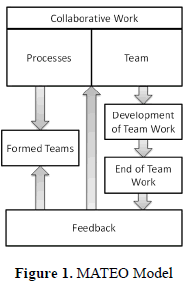
<body><![CDATA[<p><font size="2" face="Verdana, Arial, Helvetica, sans-serif">Craig et al. &#91;7&#93; defined a mathematical model for groups in education, called FROG (Forming Reasonably Optimal Groups). They used an evolutionary algorithm to optimize group creation, according to teachers' criteria. Group quality with respect to the criteria and the overall partition are evaluated through fitness measures. Even though FROG addresses both homogeneous and heterogeneous groups, it is not known which attributes (associated to user or context) are taken into account during the group formation.</font></p>     <p><font size="2" face="Verdana, Arial, Helvetica, sans-serif">Gogoulou et al. &#91;8&#93; propose OmadoGenesis, a system to form homogeneous and heterogeneous, and mixed groups, based on student characteristics. They implement three types of algorithms: a) Homo-A, an algorithm based on k-means to form homogeneous groups; b) Hete-A, an algorithm based on matrix-Hete to form heterogeneous groups; and, c) Genetic algorithms for mixed groups. Unlike the above works, OmadoGenesis can also form groups randomly or let the teacher create the groups. The authors conclude that, to form homogeneous groups, the genetic algorithm and Homo-A have similar performance. For heterogeneous groups, Hete-A yields better solutions than the genetic algorithm. For mixed groups, the genetic algorithm is the best option. OmadoGenesis does not address context and collaboration characteristics in group formation.</font></p>     <p><font size="2" face="Verdana, Arial, Helvetica, sans-serif">Cavanaugh et al. &#91;9&#93; developed Team-Maker, a tool that uses a hill-climbing algorithm to create groups based on student answers (similar or different) and the teacher's criteria. The authors found that the use of Team-maker reduced the time a teacher required to form groups. The drawback of this system is that it is not easy for a normal user to add new criteria to the grouping algorithm.</font></p>     <p><font size="2" face="Verdana, Arial, Helvetica, sans-serif">Wesner et al. &#91;10&#93; focused on distributed learning groups, in which the system automatically finds the most adequate people to form a team, based on their characteristics, tendencies, and collaborative competencies. This approach yields only homogeneous groups, containing students with similar competencies, as specified by the teacher. Heterogeneous and mixed groups are not addressed.</font></p>     <p>&nbsp;</p>     <p><font size="3" face="Verdana, Arial, Helvetica, sans-serif"><b>3. <i>MATEO</i>: MAKING ADAPTED TEAMS ORIENTED TO COLLABORATION</b></font></p>     <p><font size="2" face="Verdana, Arial, Helvetica, sans-serif"><i>MATEO</i> is a system to support adapted team formation process. The term &quot;adapted&quot; means that the system uses information adaptation, in order to enrich the team formation service. The adaptation process addresses specific user and team characteristics in a specific context &#91;11&#93;. The enrichment is the addition of relevant characteristics that may influence the interaction between the user and the system, i.e., people's profiles, context and team. Consequently, the application that uses the team formation service requires additional information to refine such service. Moreover, it needs to analyze the answer of the team member candidates and obtain recommendations based on the context.</font></p>     <p><font size="2" face="Verdana, Arial, Helvetica, sans-serif">The main contributions of <i>MATEO</i> are: a) team formation process, a sequence of steps to group team members, based on the criteria of the external system; and, b) the team profile, which enriches the team forming process, using the knowledge about relevant collaboration characteristics, context, and candidates. </font></p>     <p><font size="2" face="Verdana, Arial, Helvetica, sans-serif"><i>MATEO</i> can yield three types of output: empty teams (no team could be formed to satisfy the required criteria); unique team (only one team could be formed to satisfy the required criteria); or, multiple teams (several teams could be formed to satisfy the required criteria). After teams are formed, their members work together during the execution and ending of the collaborative work. At the end, users give feedback about the usability of the system, e.g., show if they found problems such as those described by &#91;4&#93;: coordination, goal accomplishment, negative influences in the team, productive time, information management, etc. In addition, it is possible to evaluate goal accomplishment and quality of their team work. After that, the user may store the team information for future use (See <a href="#fig01">Figure 1</a>).</font></p>     <p align="center"><font size="2" face="Verdana, Arial, Helvetica, sans-serif"><a name="fig01"></a></font><img src="/img/revistas/dyna/v80n180/v80n180a11fig01.gif"></p>     ]]></body>
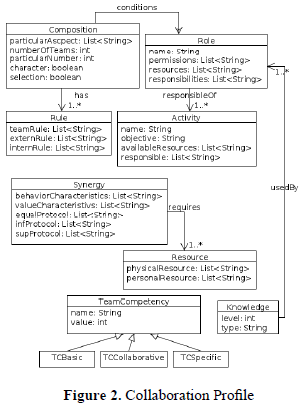
<body><![CDATA[<p><font size="2" face="Verdana, Arial, Helvetica, sans-serif"><i>MATEO</i> can manage the three types of teams: homogeneous, heterogeneous, and mixed. One of the contributions of <i>MATEO</i> is to add the following constraints to teams: inclusive (all team member candidates must be part of a team), exclusive (only those candidates satisfying most criteria will be part of a team). The following combinations are supported:</font></p> <ol>   <li class="DYNA-normal ParaOverride-7">         <p><font size="2" face="Verdana, Arial, Helvetica, sans-serif">Inclusive-Homogeneous: groups of people with similar characteristics. People who do not satisfy the selection criteria must be added to existing teams (no candidate is excluded). For instance, classify students in a class according to roles.</font></p>   </li>   <li class="DYNA-normal ParaOverride-7">         <p><font size="2" face="Verdana, Arial, Helvetica, sans-serif">Inclusive-Heterogeneous: groups of people with different characteristics. People who do not satisfy the selection criteria must be added to existing teams. For instance, in a Software Engineering class with a semester project every student must belong to a team, while each team member must have different competencies and knowledge.</font></p>   </li>   <li class="DYNA-normal ParaOverride-7">         <p><font size="2" face="Verdana, Arial, Helvetica, sans-serif">Exclusive-Homogeneous: groups of people with similar characteristics. Those who do not satisfy the selection criteria are not included in a team. For instance, a marathon team includes only the best sportspersons, who have similar abilities to participate in the competition.</font></p>   </li>   <li class="DYNA-normal ParaOverride-7">         <p><font size="2" face="Verdana, Arial, Helvetica, sans-serif">Exclusive-Heterogeneous: groups of people with different characteristics. People who do not satisfy the selection criteria are not included in a team. For instance: a multi-disciplinary research team includes only the best researchers, with different knowledge and abilities.</font></p>   </li>   <li class="DYNA-normal ParaOverride-8">         <p><font size="2" face="Verdana, Arial, Helvetica, sans-serif">Mixed: Combines homogeneous and heterogeneous criteria. For instance: a multi-disciplinary research team with people from all over the world. All of the team members must know English, while each team member must be expert in a different discipline. </font></p>   </li>     </ol>     <p><font size="2" face="Verdana, Arial, Helvetica, sans-serif"><b>3.1. <i>MATEO</i> Model</b>    <br>   This section details the adaptation model used by <i>MATEO</i> to enrich the team-forming process and the collaboration aspects that it addresses. The general team profile comprises a collaboration profile, a personal profile and a context profile.</font></p>     <p><font size="2" face="Verdana, Arial, Helvetica, sans-serif">The Collaboration Profile (see <a href="#fig02">Figure 2</a>) includes the required characteristics of people who will work in the team. This profile includes the following elements: </font></p> <ol>   <li class="DYNA-normal ParaOverride-7">         ]]></body>
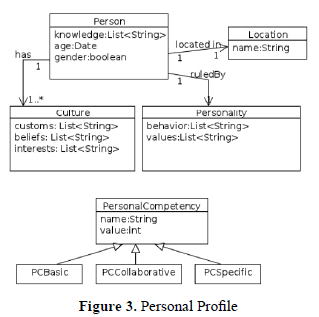
<body><![CDATA[<p><font size="2" face="Verdana, Arial, Helvetica, sans-serif">Structure: basic organization of the team to create, includes type of team (homogeneous, heterogeneous, mixed), activities to perform in the team work, and synergy (collaborative characteristics, values and behaviors that team members must have).</font></p>   </li>   <li class="DYNA-normal ParaOverride-7">         <p><font size="2" face="Verdana, Arial, Helvetica, sans-serif">Team competencies: behaviors that a person can have, which can transform him/her, and make him/her fit to address particular situation. Competencies can be: basic (any team member should have it), collaboration encouragement competencies, and competencies specific to the work context</font></p>   </li>   <li class="DYNA-normal ParaOverride-7">         <p><font size="2" face="Verdana, Arial, Helvetica, sans-serif">Role structure: roles required within the team, which includes role permissions and responsibilities. Tasks are assigned according to role.</font></p>   </li>   <li class="DYNA-normal ParaOverride-7">         <p><font size="2" face="Verdana, Arial, Helvetica, sans-serif">Rules of conduct: behavior rules that all team members must follow.</font></p>   </li>   <li class="DYNA-normal ParaOverride-8">         <p><font size="2" face="Verdana, Arial, Helvetica, sans-serif">Resources: people, materials, and technical resources team members have available for their work.</font></p>   </li>     </ol>     <p align="center"><font size="2" face="Verdana, Arial, Helvetica, sans-serif"><a name="fig02"></a></font><img src="/img/revistas/dyna/v80n180/v80n180a11fig02.gif"></p>     <p><font size="2" face="Verdana, Arial, Helvetica, sans-serif">The Personal Profile includes the specific characteristics of each individual that could be used to form teams (see <a href="#fig03">Figure 3</a>). These characteristics are: a) Gender; b) Age; c) Culture, implicit or explicit patterns through which society regulates people's behavior; d) Knowledge, information developed in the context of an experience, which is transformed into another experience for action. Knowledge allows to perceive new scenarios, change, and make decisions; e) Competencies, level of basic, collaborative and specific competencies required by the team; f) Location of each participant; g) Personality, sum of all the ways an individual react and relate to other people (including values and behaviors).</font></p>     <p align="center"><font size="2" face="Verdana, Arial, Helvetica, sans-serif"><a name="fig03"></a></font><img src="/img/revistas/dyna/v80n180/v80n180a11fig03.gif"></p>     <p><font size="2" face="Verdana, Arial, Helvetica, sans-serif">Each personal profile is associated to a team member candidate. Personal profiles that match with required values in the collaboration profile are candidates to be assigned to the corresponding team. The remaining personal profiles are processed in various ways, depending on the chosen selection type. If an inclusive team is required, the remaining profiles will be evaluated again to include them into a team. If an exclusive team is required, they will be discarded.</font></p>     ]]></body>
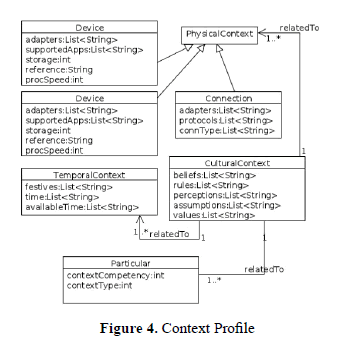
<body><![CDATA[<p><font size="2" face="Verdana, Arial, Helvetica, sans-serif">The Context Profile specifies the characteristics of the environment in which the team is created (see <a href="#fig04">Figure 4</a>). The Context Profile includes: a) Space-time: place and infrastructure of the team and time available to interact; b) Particular Context associated to the team, depending on this context, competence levels of team members may be different; c) Culture, socialization process in an organization, based on values, beliefs, basic premises, and principles.</font></p>     <p align="center"><font size="2" face="Verdana, Arial, Helvetica, sans-serif"><a name="fig04"></a></font><img src="/img/revistas/dyna/v80n180/v80n180a11fig04.gif"></p>     <p><font size="2" face="Verdana, Arial, Helvetica, sans-serif"><b>3.2.  Relations between Profiles</b>    <br>   This section describes the relationships between the three profiles and explains the collaboration characteristics that are compared between them, to form teams.</font></p>     <p><font size="2" face="Verdana, Arial, Helvetica, sans-serif"><i>MATEO</i> chooses the team members that satisfy the team formation requirements. The team creator may use all of the possible candidates or just those that best satisfy the team requirements. To achieve this, <i>MATEO</i> links the three profiles.</font></p>     <p><font size="2" face="Verdana, Arial, Helvetica, sans-serif">Both the collaboration and personal profiles have a component called &quot;Competencies&quot;. In the context of this research, a competency is the set of behaviors of a person that makes his/her adequate for a particular situation. Those behaviors are reflected in people's aptitudes, personality traits, and knowledge. Competencies associated to collaboration are compared with those associated to persons to find possible matches. Similarly, the system looks for matches in the Synergy and Personality variables. This potentiates collaboration, since it establishes a minimum pattern for collaborative behavior between team members.</font></p>     <p><font size="2" face="Verdana, Arial, Helvetica, sans-serif">Personal competencies are strongly related to the particular context, since the latter constrains competency. For instance, to a teacher it may be easier to make decisions in an educative context than in an organizational context. This guarantees that a competency does not stigmatize the behavior of a participant, thus he/she could be assigned to a role according to his/her competencies in the given context.</font></p>     <p><font size="2" face="Verdana, Arial, Helvetica, sans-serif">The role assigned to a person has a set of available resources, according to the associated characteristics.</font></p>     <p><font size="2" face="Verdana, Arial, Helvetica, sans-serif">The context profile is associated to the personal profile through the infrastructure component of the context profile and localization of the personal profile. From the location of a person, the system can determine: whether he/she is in the same place where the team will be formed or not; the resources associated to that place (in situ or distributed); and, define the work area. This assists in the acquisition of computing, physical or personal resources required for the team work.</font></p>     <p><font size="2" face="Verdana, Arial, Helvetica, sans-serif"><b>3.3.  Process</b>    ]]></body>
<body><![CDATA[<br>   <i>MATEO</i> performs a series of steps to form teams, described as follows &#91;12&#93;:</font></p>     <p><font size="2" face="Verdana, Arial, Helvetica, sans-serif">Pre-condition: List of persons (candidates)</font></p>     <p><font size="2" face="Verdana, Arial, Helvetica, sans-serif">Post-condition: List of formed teams with their members. This list can be: empty, if no team could be formed satisfying the requirements; unitary if only one team could be formed satisfying the requirements; or, multiple, if several teams could be formed satisfying the requirements.</font></p>     <p><font size="2" face="Verdana, Arial, Helvetica, sans-serif">Process steps:</font></p> <ol>   <li class="DYNA-normal ParaOverride-7">         <p><font size="2" face="Verdana, Arial, Helvetica, sans-serif">Define contextual information: the social, physical, temporal, and particular context.</font></p>   </li>   <li class="DYNA-normal ParaOverride-7">         <p><font size="2" face="Verdana, Arial, Helvetica, sans-serif">Specify team requirements: characteristics of the team, required roles, number of persons per role, required competencies per role, activities to perform, required resources, synergy, and rules.</font></p>   </li>   <li class="DYNA-normal ParaOverride-7">         <p><font size="2" face="Verdana, Arial, Helvetica, sans-serif">Specify the type of team to form: it can be either Inclusive-homogeneous, Inclusive-heterogeneous, exclusive-homogeneous, or exclusive-heterogeneous.</font></p>   </li>   <li class="DYNA-normal ParaOverride-7">         <p><font size="2" face="Verdana, Arial, Helvetica, sans-serif">Specify personal information: candidates information, which can be obtained through: a) Personality test; b) Competency test; c) Hermann color test &#91;13&#93;; and, d) Forms to capture any remaining information of the personal profile.</font></p>   </li>   <li class="DYNA-normal ParaOverride-7">         <p><font size="2" face="Verdana, Arial, Helvetica, sans-serif">Prepare the information: match between characteristics of candidates and required characteristics of the team.</font></p>   </li>   <li class="DYNA-normal ParaOverride-7">         <p><font size="2" face="Verdana, Arial, Helvetica, sans-serif">Run grouping algorithm: a different algorithm will be used depending on the team type.</font></p>   </li>   <li class="DYNA-normal ParaOverride-7">         ]]></body>
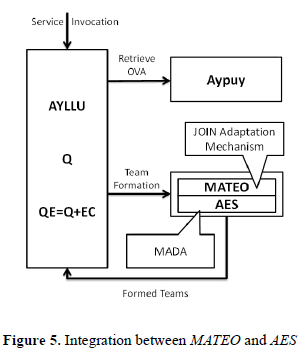
<body><![CDATA[<p><font size="2" face="Verdana, Arial, Helvetica, sans-serif">Enforce rules: people are added to teams, based on rules that constrain the selection.</font></p>   </li>   <li class="DYNA-normal ParaOverride-7">         <p><font size="2" face="Verdana, Arial, Helvetica, sans-serif">Response: teams are formed</font></p>   </li>   <li class="DYNA-normal ParaOverride-8">         <p><font size="2" face="Verdana, Arial, Helvetica, sans-serif">Recommendation: for each team, the system provides different recommendations regarding resource utilization, role substitution, meeting location, role interrelations, among others.</font></p>   </li>     </ol>     <p><font size="2" face="Verdana, Arial, Helvetica, sans-serif"><b>3.4.  Case Study</b>    <br>   To validate <i>MATEO</i>, a functional prototype was developed &#91;14&#93;. The prototype was utilized in an educational scenario, within the <i>AYLLU</i> project &#91;1&#93;. <i>AYLLU</i> is an agent-based collaboration framework, which proposes a communication paradigm based on message interaction protocols. <i>AYLLU</i> can implement cooperative services in which people are assigned roles in a determined context and goals. A case study with <i>MATEO</i> prototype and <i>AYLLU</i> was developed with students of the Artificial Intelligence Course of two universities.</font></p>     <p><font size="2" face="Verdana, Arial, Helvetica, sans-serif">One relevant module of <i>AYLLU</i> is Agents for Enriching Services (AES) &#91;15&#93;, which is a framework to adapt information in different contexts, based on the characteristics of the people (user, access device, location, etc.), which can be used by any application that needs to enrich services. </font></p>     <p><font size="2" face="Verdana, Arial, Helvetica, sans-serif">Some cooperative services of <i>AYLLU</i> require team formation services, which are provided by <i>MATEO</i>. Profiles defined by the <i>MATEO</i> adaptation model (MADA &#91;5&#93;) correspond to profiles used by AES to enrich services. The grouping functionality of <i>MATEO</i> (JOIN model) is utilized by AES through its Adaptation Mechanism (see <a href="#fig05">Figure 5</a>).</font></p>     <p align="center"><font size="2" face="Verdana, Arial, Helvetica, sans-serif"><a name="fig05"></a></font><img src="/img/revistas/dyna/v80n180/v80n180a11fig05.gif"></p>     <p><font size="2" face="Verdana, Arial, Helvetica, sans-serif">To better understand the information flow in AES to form teams using <i>MATEO</i>, assume that a teacher wants to create two teams in his/her class, having the following roles: Secretary (1 person), Presenter (1 person), and Designer (1 person). The information sources are the profiles provided by <i>MATEO</i>: Team and personal profiles &#91;16&#93;. Using the above information, the system tries to assign people to roles (Adaptation Mechanism). The results are two teams, each with people assigned to the roles, and other participants who can maximize the collaboration characteristics. A class usually requires that all of its students become part of a team. Therefore, an additional role, participant, is filled by students who were not assigned the main roles. The response from <i>MATEO</i> is used to form teams in AES, enriching the Team Formation service.</font></p>     ]]></body>
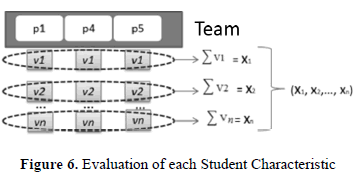
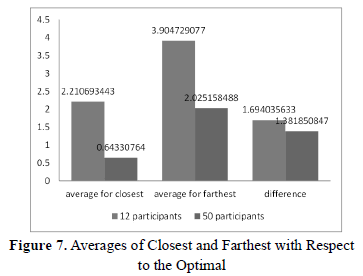
<body><![CDATA[<p>&nbsp;</p>     <p><font size="3" face="Verdana, Arial, Helvetica, sans-serif"><b>4. TESTS AND RESULT ANALYSIS</b></font></p>     <p><font size="2" face="Verdana, Arial, Helvetica, sans-serif"><i>MATEO</i> was compared with another team-formation system (from now on, the generator system) to determine the similarity of the teams formed by each system. </font></p>     <p><font size="2" face="Verdana, Arial, Helvetica, sans-serif">The generator system forms teams randomly, obtaining a sample of the possible teams. For each of the selected teams, student characteristics are evaluated and quantified into a score (see <a href="#fig06">Figure 6</a>). Each team score is evaluated through a goal function to find the most balanced group. A balanced or optimal team has the minimum difference between the expected characteristic score and the score of team members.</font></p>     <p align="center"><font size="2" face="Verdana, Arial, Helvetica, sans-serif"><a name="fig06"></a></font><img src="/img/revistas/dyna/v80n180/v80n180a11fig06.gif"></p>     <p><font size="2" face="Verdana, Arial, Helvetica, sans-serif">Simultaneously, <i>MATEO</i> forms teams and teams are evaluated for each characteristic. These scores are compared with the best score given by the generator system.</font></p>     <p><font size="2" face="Verdana, Arial, Helvetica, sans-serif">To compare the results of <i>MATEO</i> and the generator system, Euclidian distance between each score is calculated. The results are shown in <a href="#fig07">Figure 7</a>. The average of the closest points is between 0.64 and 2.21 points to the optimal point, while the average of the farthest points is between 2.02 and 3.9 points. From the difference between P12 and P50 it can be inferred that, the more participants, the more balanced are the teams formed by <i>MATEO</i>. Moreover, the distance between closest and farthest points is less for P50 than for p12, which  confirms  that <i>MATEO</i> forms more balanced teams than the other system. </font></p>     <p align="center"><font size="2" face="Verdana, Arial, Helvetica, sans-serif"><a name="fig07"></a></font><img src="/img/revistas/dyna/v80n180/v80n180a11fig07.gif"></p>     <p><font size="2" face="Verdana, Arial, Helvetica, sans-serif">In addition to form similar teams near-optimally, <i>MATEO</i> considers additional characteristics to assign roles based on competencies and behaviors of participants. From role assignment, one can infer the importance of adaptation, because of the process enrichment performed by both systems. <i>MATEO</i> assigns roles based on the profiles of the candidates, while the generator system only assigns roles randomly, without knowing whether people can perform those roles adequately.</font></p>     <p><font size="2" face="Verdana, Arial, Helvetica, sans-serif">In addition, an initial experiment was performed. The students who participated in the <i>AYLLU</i> pilot were surveyed. The same survey was applied to the teacher of the course. All of the responses were processed to have two perspectives of the same team-formation process.</font></p>     ]]></body>
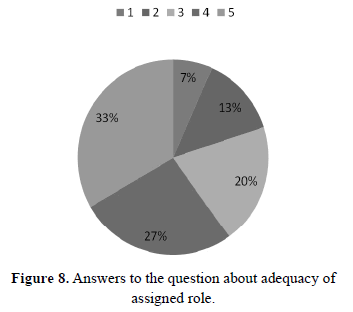
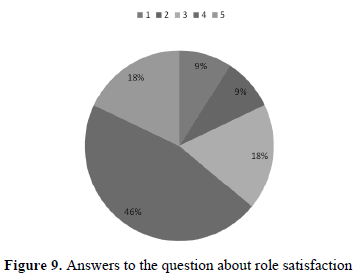
<body><![CDATA[<p><font size="2" face="Verdana, Arial, Helvetica, sans-serif">In that test, teams were formed using the &quot;Jigsaw&quot; strategy in two opportunities: a) In a first meeting with the students, three base teams were formed, four students each. One student was assigned the coordinator role (based on <i>MATEO</i>'s response); b) Four teams were formed, three persons each, grouped by topics. A student in those teams was assigned the secretary role, based on <i>MATEO</i>'s response. </font></p>     <p><font size="2" face="Verdana, Arial, Helvetica, sans-serif">One of the questions asked to students was how adequate was the role assigned to the student. The students answered between 1 and 5, where 1 means that the assigned role was barely adequate, while 5 means that the role was very adequate. <a href="#fig08">Figure 8</a> shows that an important portion of the students (33%) considers that their assigned role was very adequate to their profile. The teacher also considered that the roles were adequately assigned.</font></p>     <p align="center"><font size="2" face="Verdana, Arial, Helvetica, sans-serif"><a name="fig08"></a></font><img src="/img/revistas/dyna/v80n180/v80n180a11fig08.gif"></p>     <p><font size="2" face="Verdana, Arial, Helvetica, sans-serif">Another question was how much the students liked the assigned role. The students answered between 1 and 5, where 1 means that they liked the role very little, while 5 means that they liked the role very much.  An important amount of students (46 + 18 = 64%) liked their role. The teacher was satisfied with the assignment of the roles &quot;secretary&quot; and &quot;coordinator&quot; in most of the teams.</font></p>     <p align="center"><font size="2" face="Verdana, Arial, Helvetica, sans-serif"><a name="fig09"></a></font><img src="/img/revistas/dyna/v80n180/v80n180a11fig09.gif"></p>     <p><font size="2" face="Verdana, Arial, Helvetica, sans-serif">For both scenarios (courses in both universities), <i>MATEO</i> took into consideration the behaviors and competencies of students. Team work was strengthened, since the students considered that the decisions were made as a team, all of the team members participated, and their work was balanced and fairly distributed within each team; responsibilities were clearly defined, and learning was addressed both individually and as a team.</font></p>     <p>&nbsp;</p>     <p><font size="3" face="Verdana, Arial, Helvetica, sans-serif"><b>5.  CONTRIBUTIONS</b></font></p>     <p><font size="2" face="Verdana, Arial, Helvetica, sans-serif"><i>MATEO</i> addresses most of the elements of the 5C paradigm (based on the 3C paradigm of Ferber) &#91;17&#93;: Collaboration, Coordination, Conflict Resolution, Communication, and Control. The latter is not addressed by <i>MATEO</i>, since collaboration in <i>AYLLU</i> occurs only between agents. <i>MATEO</i> uses the following variables to address 5C: a) Collaborative competencies: the system chooses people with high communication, problem solving, negotiation, and decision-making skills; b) Synergy: when considering the individual characteristics, the system groups them in such a way that their collaborative value is higher than the sum of each individual alone; c) Resources: material and technical elements available to the team; d) Role structure: communication between participants and task execution is facilitated by an adequate role structure, responsibilities and permission definition.</font></p>     <p><font size="2" face="Verdana, Arial, Helvetica, sans-serif"><i>MATEO</i> also addresses the collaboration steps defined by Denise et al. &#91;18&#93;. To define collaborators, <i>MATEO</i> chooses people who directly address the team goals and also people who facilitate collaboration (synergy). To define the space, <i>MATEO</i> considers physical context information (location, infrastructure, team member location, etc.) and the available resources (people, material and technical resources, etc.), among others &#91;19&#93;.</font></p>     ]]></body>
<body><![CDATA[<p>&nbsp;</p>     <p><font size="3" face="Verdana, Arial, Helvetica, sans-serif"><b>6.  CONCLUSIONS AND FUTURE WORK</b></font></p>     <p><font size="2" face="Verdana, Arial, Helvetica, sans-serif"><i>MATEO</i> is an original solution to: a) The need of adaptation mechanisms to form teams; b) The limited amount of team types that can be formed automatically by existing systems; and, c) Articulation with adaptation of information, collaborative work, and optimization and clustering techniques. <i>MATEO</i> can adequately assign team members, based on their competencies and behaviors. Moreover, <i>MATEO</i> assists the person in charge of forming teams, by automating part of the team-formation process.</font></p>     <p><font size="2" face="Verdana, Arial, Helvetica, sans-serif">Future work includes: improving the prototype to include contextual characteristics associated to the team-formation process; addition of Awareness mechanisms that facilitate detection and update of information in a work environment; addition of learning mechanisms to provide feedback for team formation from observations of the team work; definition of quality-measurement mechanisms for teams; addition of preferences and likings of team participants.</font></p>     <p><font size="2" face="Verdana, Arial, Helvetica, sans-serif">An additional work on validation is to perform an experiment using final users, considering an initial and final state, to observe changes derived from the use of <i>MATEO</i> in the classroom. Also, additional work is planned to use <i>MATEO</i> in other environments, such as companies, health care, etc.</font></p>     <p>&nbsp;</p>     <p><font size="3" face="Verdana, Arial, Helvetica, sans-serif"><b>ACKNOWLEDGMENTS</b></font></p>     <p><font size="2" face="Verdana, Arial, Helvetica, sans-serif">This paper is developed within the project<i> &quot;AYLLU: Plataforma de Cooperaci&oacute;n mediada por Agentes aplicada en un Contexto de E-learning Colaborativo&quot;</i> (COLCIENCIAS register No: 1203-489-25592 and contract CT 599- 2009). This project is supported by the Pontificia Universidad Javeriana (Bogot&aacute;, Colombia). </font></p>     <p>&nbsp;</p>     <p><font size="3" face="Verdana, Arial, Helvetica, sans-serif"><b>REFERENCES</b></font></p>     ]]></body>
<body><![CDATA[<!-- ref --><p><font size="2" face="Verdana, Arial, Helvetica, sans-serif"><b>&#91;1&#93;</b> Carrillo, A., Arias, M., Torres, L., Pomares, A., and Gonzalez, E., <i>AYLLU</i>: Architecture for Collaboration in a Distributed Environment, IADIS Conference on Collaborative Technologies, Lisboa, Portugal, 2012.    &nbsp;&nbsp;&nbsp;&nbsp;&nbsp;&nbsp;&nbsp;&nbsp;[&#160;<a href="javascript:void(0);" onclick="javascript: window.open('/scielo.php?script=sci_nlinks&ref=000123&pid=S0012-7353201300040001100001&lng=','','width=640,height=500,resizable=yes,scrollbars=1,menubar=yes,');">Links</a>&#160;]<!-- end-ref --><!-- ref --><br>   <b>&#91;2&#93;</b> Bannon, L. J., & Schmidt, K., CSCW-Four Characters in Search of a Context. DAIMI Report Series, 18(289), 1989.    &nbsp;&nbsp;&nbsp;&nbsp;&nbsp;&nbsp;&nbsp;&nbsp;[&#160;<a href="javascript:void(0);" onclick="javascript: window.open('/scielo.php?script=sci_nlinks&ref=000124&pid=S0012-7353201300040001100002&lng=','','width=640,height=500,resizable=yes,scrollbars=1,menubar=yes,');">Links</a>&#160;]<!-- end-ref --> .     <!-- ref --><br>   <b>&#91;3&#93;</b> Rama, J. and Bishop, J., A Survey and Comparison of CSCW Groupware Applications, in Proceedings of the 2006 Annual Research Conference of the South African Institute of Computer Scientists and Information Technologists on IT Research in Developing Countries, pp. 198-205, 2006.    &nbsp;&nbsp;&nbsp;&nbsp;&nbsp;&nbsp;&nbsp;&nbsp;[&#160;<a href="javascript:void(0);" onclick="javascript: window.open('/scielo.php?script=sci_nlinks&ref=000126&pid=S0012-7353201300040001100003&lng=','','width=640,height=500,resizable=yes,scrollbars=1,menubar=yes,');">Links</a>&#160;]<!-- end-ref --><!-- ref --><br>   <b>&#91;4&#93;</b> Turban, E., Decision Support and Expert Systems: Management Support Systems. Prentice Hall PTR, 1990.    &nbsp;&nbsp;&nbsp;&nbsp;&nbsp;&nbsp;&nbsp;&nbsp;[&#160;<a href="javascript:void(0);" onclick="javascript: window.open('/scielo.php?script=sci_nlinks&ref=000127&pid=S0012-7353201300040001100004&lng=','','width=640,height=500,resizable=yes,scrollbars=1,menubar=yes,');">Links</a>&#160;]<!-- end-ref --><!-- ref --><br>   <b>&#91;5&#93;</b> Arias, M. and Carrillo, A., Adaptive Forming Collaborative Teamworks in Collaborative Environments, in Computing Congress (CCC), 2012 7th Colombian, pp. 1-6, 2012.    &nbsp;&nbsp;&nbsp;&nbsp;&nbsp;&nbsp;&nbsp;&nbsp;[&#160;<a href="javascript:void(0);" onclick="javascript: window.open('/scielo.php?script=sci_nlinks&ref=000128&pid=S0012-7353201300040001100005&lng=','','width=640,height=500,resizable=yes,scrollbars=1,menubar=yes,');">Links</a>&#160;]<!-- end-ref --><!-- ref --><br>   <b>&#91;6&#93;</b> Christodoulopoulos, C. and Papanikolaou, K. Investigation of Group Formation using Low Complexity Algorithms, in Proc. of PING Workshop, pp. 57-60, 2007.    &nbsp;&nbsp;&nbsp;&nbsp;&nbsp;&nbsp;&nbsp;&nbsp;[&#160;<a href="javascript:void(0);" onclick="javascript: window.open('/scielo.php?script=sci_nlinks&ref=000129&pid=S0012-7353201300040001100006&lng=','','width=640,height=500,resizable=yes,scrollbars=1,menubar=yes,');">Links</a>&#160;]<!-- end-ref --><!-- ref --><br>   <b>&#91;7&#93;</b> Craig, M., Horton, D. and Pitt, F., Forming Reasonably Optimal Groups:(frog), in Proceedings of the 16th ACM International Conference on Supporting Group Work, pp. 141-150, 2010.    &nbsp;&nbsp;&nbsp;&nbsp;&nbsp;&nbsp;&nbsp;&nbsp;[&#160;<a href="javascript:void(0);" onclick="javascript: window.open('/scielo.php?script=sci_nlinks&ref=000130&pid=S0012-7353201300040001100007&lng=','','width=640,height=500,resizable=yes,scrollbars=1,menubar=yes,');">Links</a>&#160;]<!-- end-ref --><!-- ref --><br>   <b>&#91;8&#93;</b> Gogoulou, A., Gouli, E., Boas, G., Liakou, E. and Grigoriadou, M., Forming Homogeneous, Heterogeneous and Mixed Groups of Learners, Proc. ICUM, pp. 33-40, 2007.    &nbsp;&nbsp;&nbsp;&nbsp;&nbsp;&nbsp;&nbsp;&nbsp;[&#160;<a href="javascript:void(0);" onclick="javascript: window.open('/scielo.php?script=sci_nlinks&ref=000131&pid=S0012-7353201300040001100008&lng=','','width=640,height=500,resizable=yes,scrollbars=1,menubar=yes,');">Links</a>&#160;]<!-- end-ref --><!-- ref --><br>   <b>&#91;9&#93;</b> Cavanaugh, R., Ellis, M., Layton, R. and Ardis, M., Automating the Process of Assigning Students to Cooperative-Learning Teams, in Proceedings of the 2004 ASEE Annual Conference, 2004.    &nbsp;&nbsp;&nbsp;&nbsp;&nbsp;&nbsp;&nbsp;&nbsp;[&#160;<a href="javascript:void(0);" onclick="javascript: window.open('/scielo.php?script=sci_nlinks&ref=000132&pid=S0012-7353201300040001100009&lng=','','width=640,height=500,resizable=yes,scrollbars=1,menubar=yes,');">Links</a>&#160;]<!-- end-ref --><!-- ref --><br>   <b>&#91;10&#93;</b> Wessner, M. and Pfister, H. Group Formation in Computer-Supported Collaborative Learning, in Proceedings of the 2001 International ACM SIGGROUP Conference on Supporting Group Work, pp. 24-31, 2001.    &nbsp;&nbsp;&nbsp;&nbsp;&nbsp;&nbsp;&nbsp;&nbsp;[&#160;<a href="javascript:void(0);" onclick="javascript: window.open('/scielo.php?script=sci_nlinks&ref=000133&pid=S0012-7353201300040001100010&lng=','','width=640,height=500,resizable=yes,scrollbars=1,menubar=yes,');">Links</a>&#160;]<!-- end-ref --><!-- ref --><br>   <b>&#91;11&#93;</b> Abowd, G., Dey, A., Brown, P., Davies, N., Smith, M. and Steggles, P., Towards a Better Understanding of Context and Context-Awareness, in Handheld and Ubiquitous Computing, pp. 304-307, 1999.    &nbsp;&nbsp;&nbsp;&nbsp;&nbsp;&nbsp;&nbsp;&nbsp;[&#160;<a href="javascript:void(0);" onclick="javascript: window.open('/scielo.php?script=sci_nlinks&ref=000134&pid=S0012-7353201300040001100011&lng=','','width=640,height=500,resizable=yes,scrollbars=1,menubar=yes,');">Links</a>&#160;]<!-- end-ref --><!-- ref --><br>   <b>&#91;12&#93;</b> Arias, M. and Carrillo, A., Conformaci&oacute;n de Equipos Enriquecida con Caracter&iacute;sticas Contextuales, in CLEI, Colombia, 2012.    &nbsp;&nbsp;&nbsp;&nbsp;&nbsp;&nbsp;&nbsp;&nbsp;[&#160;<a href="javascript:void(0);" onclick="javascript: window.open('/scielo.php?script=sci_nlinks&ref=000135&pid=S0012-7353201300040001100012&lng=','','width=640,height=500,resizable=yes,scrollbars=1,menubar=yes,');">Links</a>&#160;]<!-- end-ref --><!-- ref --><br>   <b>&#91;13&#93;</b> Herrmann, A., The Best of Both Worlds - Making Blended Learning Really Work By Engaging the Whole Brain. Herrmann International.    &nbsp;&nbsp;&nbsp;&nbsp;&nbsp;&nbsp;&nbsp;&nbsp;[&#160;<a href="javascript:void(0);" onclick="javascript: window.open('/scielo.php?script=sci_nlinks&ref=000136&pid=S0012-7353201300040001100013&lng=','','width=640,height=500,resizable=yes,scrollbars=1,menubar=yes,');">Links</a>&#160;]<!-- end-ref --><!-- ref --><br>   <b>&#91;14&#93;</b> Arias, M. and Carrillo, A., Conformaci&oacute;n Adaptada de Equipos: Una Experiencia en Entornos Educativos, in CAVA 2012, Cartagena, Colombia, 2012.    &nbsp;&nbsp;&nbsp;&nbsp;&nbsp;&nbsp;&nbsp;&nbsp;[&#160;<a href="javascript:void(0);" onclick="javascript: window.open('/scielo.php?script=sci_nlinks&ref=000137&pid=S0012-7353201300040001100014&lng=','','width=640,height=500,resizable=yes,scrollbars=1,menubar=yes,');">Links</a>&#160;]<!-- end-ref --><!-- ref --><br>   <b>&#91;15&#93;</b> Arias, M., Torres, L., Carrillo, A., -Pomares, A., Garzon, J. and Gonzalez, E., AES: A Generic Framework forAdapting Information in Multidimensional Contexts, in CLEI, 2011.    &nbsp;&nbsp;&nbsp;&nbsp;&nbsp;&nbsp;&nbsp;&nbsp;[&#160;<a href="javascript:void(0);" onclick="javascript: window.open('/scielo.php?script=sci_nlinks&ref=000138&pid=S0012-7353201300040001100015&lng=','','width=640,height=500,resizable=yes,scrollbars=1,menubar=yes,');">Links</a>&#160;]<!-- end-ref --><!-- ref --><br>   <b>&#91;16&#93;</b> Arias, M., Sistema de Apoyo al Proceso de Conformaci&oacute;n Adaptada de Equipos de Trabajo en un Ambiente Colaborativo, Pontificia Universidad Javeriana, 2012.    &nbsp;&nbsp;&nbsp;&nbsp;&nbsp;&nbsp;&nbsp;&nbsp;[&#160;<a href="javascript:void(0);" onclick="javascript: window.open('/scielo.php?script=sci_nlinks&ref=000139&pid=S0012-7353201300040001100016&lng=','','width=640,height=500,resizable=yes,scrollbars=1,menubar=yes,');">Links</a>&#160;]<!-- end-ref --><!-- ref --><br>   <b>&#91;17&#93;</b> Ferber, J., Multi-Agent Systems: An Introduction to Distributed Artificial Intelligence. Addison-Wesley Longman Publishing Co., Inc., 1999.    &nbsp;&nbsp;&nbsp;&nbsp;&nbsp;&nbsp;&nbsp;&nbsp;[&#160;<a href="javascript:void(0);" onclick="javascript: window.open('/scielo.php?script=sci_nlinks&ref=000140&pid=S0012-7353201300040001100017&lng=','','width=640,height=500,resizable=yes,scrollbars=1,menubar=yes,');">Links</a>&#160;]<!-- end-ref --><!-- ref --><br>   <b>&#91;18&#93;</b> Denise, L. Collaboration vs. C-three (Cooperation, Coordination, and Communication), Innovating, vol. 7, no. 3, 1999.    &nbsp;&nbsp;&nbsp;&nbsp;&nbsp;&nbsp;&nbsp;&nbsp;[&#160;<a href="javascript:void(0);" onclick="javascript: window.open('/scielo.php?script=sci_nlinks&ref=000141&pid=S0012-7353201300040001100018&lng=','','width=640,height=500,resizable=yes,scrollbars=1,menubar=yes,');">Links</a>&#160;]<!-- end-ref --><!-- ref --><br>   <b>&#91;19&#93;</b> Lancheros, D., Carrillo, A. and Pavlich, J., Adaptation and Disability Aspects in a Virtual Learning Environment, in: DYNA, Vol. 79 No 173, pp. 6-14, 2012.    &nbsp;&nbsp;&nbsp;&nbsp;&nbsp;&nbsp;&nbsp;&nbsp;[&#160;<a href="javascript:void(0);" onclick="javascript: window.open('/scielo.php?script=sci_nlinks&ref=000142&pid=S0012-7353201300040001100019&lng=','','width=640,height=500,resizable=yes,scrollbars=1,menubar=yes,');">Links</a>&#160;]<!-- end-ref --> </font></p>      ]]></body><back>
<ref-list>
<ref id="B1">
<label>1</label><nlm-citation citation-type="confpro">
<person-group person-group-type="author">
<name>
<surname><![CDATA[Carrillo]]></surname>
<given-names><![CDATA[A.]]></given-names>
</name>
<name>
<surname><![CDATA[Arias]]></surname>
<given-names><![CDATA[M.]]></given-names>
</name>
<name>
<surname><![CDATA[Torres]]></surname>
<given-names><![CDATA[L.]]></given-names>
</name>
<name>
<surname><![CDATA[Pomares]]></surname>
<given-names><![CDATA[A.]]></given-names>
</name>
<name>
<surname><![CDATA[Gonzalez]]></surname>
<given-names><![CDATA[E.]]></given-names>
</name>
</person-group>
<article-title xml:lang="en"><![CDATA[AYLLU: Architecture for Collaboration in a Distributed Environment]]></article-title>
<source><![CDATA[]]></source>
<year></year>
<conf-name><![CDATA[ IADIS Conference on Collaborative Technologies]]></conf-name>
<conf-date>2012</conf-date>
<conf-loc>Lisboa </conf-loc>
</nlm-citation>
</ref>
<ref id="B2">
<label>2</label><nlm-citation citation-type="journal">
<person-group person-group-type="author">
<name>
<surname><![CDATA[Bannon]]></surname>
<given-names><![CDATA[L. J.]]></given-names>
</name>
<name>
<surname><![CDATA[Schmidt]]></surname>
<given-names><![CDATA[K.]]></given-names>
</name>
</person-group>
<article-title xml:lang="en"><![CDATA[CSCW-Four Characters in Search of a Context]]></article-title>
<source><![CDATA[DAIMI Report Series]]></source>
<year>1989</year>
<volume>18</volume>
<numero>289</numero>
<issue>289</issue>
</nlm-citation>
</ref>
<ref id="B3">
<label>3</label><nlm-citation citation-type="confpro">
<person-group person-group-type="author">
<name>
<surname><![CDATA[Rama]]></surname>
<given-names><![CDATA[J.]]></given-names>
</name>
<name>
<surname><![CDATA[Bishop]]></surname>
<given-names><![CDATA[J.]]></given-names>
</name>
</person-group>
<article-title xml:lang="en"><![CDATA[A Survey and Comparison of CSCW Groupware Applications]]></article-title>
<source><![CDATA[]]></source>
<year>2006</year>
<conf-name><![CDATA[ Annual Research Conference of the South African Institute of Computer Scientists and Information Technologists on IT Research in Developing Countries]]></conf-name>
<conf-date>2006</conf-date>
<conf-loc> </conf-loc>
<page-range>198-205</page-range></nlm-citation>
</ref>
<ref id="B4">
<label>4</label><nlm-citation citation-type="book">
<person-group person-group-type="author">
<name>
<surname><![CDATA[Turban]]></surname>
<given-names><![CDATA[E.]]></given-names>
</name>
</person-group>
<source><![CDATA[Decision Support and Expert Systems: Management Support Systems]]></source>
<year>1990</year>
<publisher-name><![CDATA[Prentice Hall PTR]]></publisher-name>
</nlm-citation>
</ref>
<ref id="B5">
<label>5</label><nlm-citation citation-type="confpro">
<person-group person-group-type="author">
<name>
<surname><![CDATA[Arias]]></surname>
<given-names><![CDATA[M.]]></given-names>
</name>
<name>
<surname><![CDATA[Carrillo]]></surname>
<given-names><![CDATA[A.]]></given-names>
</name>
</person-group>
<article-title xml:lang="en"><![CDATA[Adaptive Forming Collaborative Teamworks in Collaborative Environments]]></article-title>
<source><![CDATA[]]></source>
<year>2012</year>
<conf-name><![CDATA[ Computing Congress (CCC), 2012 7th Colombian]]></conf-name>
<conf-loc> </conf-loc>
<page-range>1-6</page-range></nlm-citation>
</ref>
<ref id="B6">
<label>6</label><nlm-citation citation-type="confpro">
<person-group person-group-type="author">
<name>
<surname><![CDATA[Christodoulopoulos]]></surname>
<given-names><![CDATA[C.]]></given-names>
</name>
<name>
<surname><![CDATA[Papanikolaou]]></surname>
<given-names><![CDATA[K.]]></given-names>
</name>
</person-group>
<article-title xml:lang="en"><![CDATA[Investigation of Group Formation using Low Complexity Algorithms]]></article-title>
<source><![CDATA[]]></source>
<year>2007</year>
<conf-name><![CDATA[ PING Workshop]]></conf-name>
<conf-loc> </conf-loc>
<page-range>57-60</page-range></nlm-citation>
</ref>
<ref id="B7">
<label>7</label><nlm-citation citation-type="confpro">
<person-group person-group-type="author">
<name>
<surname><![CDATA[Craig]]></surname>
<given-names><![CDATA[M.]]></given-names>
</name>
<name>
<surname><![CDATA[Horton]]></surname>
<given-names><![CDATA[D.]]></given-names>
</name>
<name>
<surname><![CDATA[Pitt]]></surname>
<given-names><![CDATA[F.]]></given-names>
</name>
</person-group>
<article-title xml:lang="en"><![CDATA[Forming Reasonably Optimal Groups:(frog)]]></article-title>
<source><![CDATA[]]></source>
<year>2010</year>
<conf-name><![CDATA[16th ACM International Conference on Supporting Group Work]]></conf-name>
<conf-loc> </conf-loc>
<page-range>141-150</page-range></nlm-citation>
</ref>
<ref id="B8">
<label>8</label><nlm-citation citation-type="confpro">
<person-group person-group-type="author">
<name>
<surname><![CDATA[Gogoulou]]></surname>
<given-names><![CDATA[A.]]></given-names>
</name>
<name>
<surname><![CDATA[Gouli]]></surname>
<given-names><![CDATA[E.]]></given-names>
</name>
<name>
<surname><![CDATA[Boas]]></surname>
<given-names><![CDATA[G.]]></given-names>
</name>
<name>
<surname><![CDATA[Liakou]]></surname>
<given-names><![CDATA[E.]]></given-names>
</name>
<name>
<surname><![CDATA[Grigoriadou]]></surname>
<given-names><![CDATA[M.]]></given-names>
</name>
</person-group>
<article-title xml:lang="en"><![CDATA[Forming Homogeneous, Heterogeneous and Mixed Groups of Learners]]></article-title>
<source><![CDATA[]]></source>
<year>2007</year>
<conf-name><![CDATA[ ICUM]]></conf-name>
<conf-loc> </conf-loc>
<page-range>33-40</page-range></nlm-citation>
</ref>
<ref id="B9">
<label>9</label><nlm-citation citation-type="confpro">
<person-group person-group-type="author">
<name>
<surname><![CDATA[Cavanaugh]]></surname>
<given-names><![CDATA[R.]]></given-names>
</name>
<name>
<surname><![CDATA[Ellis]]></surname>
<given-names><![CDATA[M.]]></given-names>
</name>
<name>
<surname><![CDATA[Layton]]></surname>
<given-names><![CDATA[R.]]></given-names>
</name>
<name>
<surname><![CDATA[Ardis]]></surname>
<given-names><![CDATA[M.]]></given-names>
</name>
</person-group>
<article-title xml:lang="en"><![CDATA[Automating the Process of Assigning Students to Cooperative-Learning Teams]]></article-title>
<source><![CDATA[]]></source>
<year></year>
<conf-name><![CDATA[ 2004 ASEE Annual Conference]]></conf-name>
<conf-date>2004</conf-date>
<conf-loc> </conf-loc>
</nlm-citation>
</ref>
<ref id="B10">
<label>10</label><nlm-citation citation-type="confpro">
<person-group person-group-type="author">
<name>
<surname><![CDATA[Wessner]]></surname>
<given-names><![CDATA[M.]]></given-names>
</name>
<name>
<surname><![CDATA[Pfister]]></surname>
<given-names><![CDATA[H.]]></given-names>
</name>
</person-group>
<article-title xml:lang="en"><![CDATA[Group Formation in Computer-Supported Collaborative Learning]]></article-title>
<source><![CDATA[]]></source>
<year>2001</year>
<conf-name><![CDATA[ 2001 International ACM SIGGROUP Conference on Supporting Group Work]]></conf-name>
<conf-loc> </conf-loc>
<page-range>24-31</page-range></nlm-citation>
</ref>
<ref id="B11">
<label>11</label><nlm-citation citation-type="">
<person-group person-group-type="author">
<name>
<surname><![CDATA[Abowd]]></surname>
<given-names><![CDATA[G.]]></given-names>
</name>
<name>
<surname><![CDATA[Dey]]></surname>
<given-names><![CDATA[A.]]></given-names>
</name>
<name>
<surname><![CDATA[Brown]]></surname>
<given-names><![CDATA[P.]]></given-names>
</name>
<name>
<surname><![CDATA[Davies]]></surname>
<given-names><![CDATA[N.]]></given-names>
</name>
<name>
<surname><![CDATA[Smith]]></surname>
<given-names><![CDATA[M.]]></given-names>
</name>
<name>
<surname><![CDATA[Steggles]]></surname>
<given-names><![CDATA[P.]]></given-names>
</name>
</person-group>
<article-title xml:lang="en"><![CDATA[Towards a Better Understanding of Context and Context-Awareness]]></article-title>
<source><![CDATA[Handheld and Ubiquitous Computing]]></source>
<year>1999</year>
<page-range>304-307</page-range></nlm-citation>
</ref>
<ref id="B12">
<label>12</label><nlm-citation citation-type="confpro">
<person-group person-group-type="author">
<name>
<surname><![CDATA[Arias]]></surname>
<given-names><![CDATA[M.]]></given-names>
</name>
<name>
<surname><![CDATA[Carrillo]]></surname>
<given-names><![CDATA[A.]]></given-names>
</name>
</person-group>
<article-title xml:lang="es"><![CDATA[Conformación de Equipos Enriquecida con Características Contextuales]]></article-title>
<source><![CDATA[]]></source>
<year></year>
<conf-name><![CDATA[ CLEI]]></conf-name>
<conf-date>2012</conf-date>
<conf-loc> </conf-loc>
</nlm-citation>
</ref>
<ref id="B13">
<label>13</label><nlm-citation citation-type="book">
<person-group person-group-type="author">
<name>
<surname><![CDATA[Herrmann]]></surname>
<given-names><![CDATA[A.]]></given-names>
</name>
</person-group>
<source><![CDATA[The Best of Both Worlds: Making Blended Learning Really Work By Engaging the Whole Brain]]></source>
<year></year>
<publisher-name><![CDATA[Herrmann International]]></publisher-name>
</nlm-citation>
</ref>
<ref id="B14">
<label>14</label><nlm-citation citation-type="confpro">
<person-group person-group-type="author">
<name>
<surname><![CDATA[Arias]]></surname>
<given-names><![CDATA[M.]]></given-names>
</name>
<name>
<surname><![CDATA[Carrillo]]></surname>
<given-names><![CDATA[A.]]></given-names>
</name>
</person-group>
<article-title xml:lang="es"><![CDATA[Conformación Adaptada de Equipos: Una Experiencia en Entornos Educativos]]></article-title>
<source><![CDATA[]]></source>
<year></year>
<conf-name><![CDATA[ CAVA 2012]]></conf-name>
<conf-date>2012</conf-date>
<conf-loc>Cartagena </conf-loc>
</nlm-citation>
</ref>
<ref id="B15">
<label>15</label><nlm-citation citation-type="confpro">
<person-group person-group-type="author">
<name>
<surname><![CDATA[Arias]]></surname>
<given-names><![CDATA[M.]]></given-names>
</name>
<name>
<surname><![CDATA[Torres]]></surname>
<given-names><![CDATA[L.]]></given-names>
</name>
<name>
<surname><![CDATA[Carrillo]]></surname>
<given-names><![CDATA[A.]]></given-names>
</name>
<name>
<surname><![CDATA[Pomares]]></surname>
<given-names><![CDATA[A.]]></given-names>
</name>
<name>
<surname><![CDATA[Garzon]]></surname>
<given-names><![CDATA[J.]]></given-names>
</name>
<name>
<surname><![CDATA[Gonzalez]]></surname>
<given-names><![CDATA[E.]]></given-names>
</name>
</person-group>
<article-title xml:lang="en"><![CDATA[AES: A Generic Framework forAdapting Information in Multidimensional Contexts]]></article-title>
<source><![CDATA[]]></source>
<year></year>
<conf-name><![CDATA[ CLEI]]></conf-name>
<conf-date>2011</conf-date>
<conf-loc> </conf-loc>
</nlm-citation>
</ref>
<ref id="B16">
<label>16</label><nlm-citation citation-type="book">
<person-group person-group-type="author">
<name>
<surname><![CDATA[Arias]]></surname>
<given-names><![CDATA[M.]]></given-names>
</name>
</person-group>
<source><![CDATA[Sistema de Apoyo al Proceso de Conformación Adaptada de Equipos de Trabajo en un Ambiente Colaborativo]]></source>
<year>2012</year>
<publisher-name><![CDATA[Pontificia Universidad Javeriana]]></publisher-name>
</nlm-citation>
</ref>
<ref id="B17">
<label>17</label><nlm-citation citation-type="book">
<person-group person-group-type="author">
<name>
<surname><![CDATA[Ferber]]></surname>
<given-names><![CDATA[J.]]></given-names>
</name>
</person-group>
<source><![CDATA[Multi-Agent Systems: An Introduction to Distributed Artificial Intelligence]]></source>
<year>1999</year>
<publisher-name><![CDATA[Addison-Wesley Longman Publishing Co., Inc.]]></publisher-name>
</nlm-citation>
</ref>
<ref id="B18">
<label>18</label><nlm-citation citation-type="journal">
<person-group person-group-type="author">
<name>
<surname><![CDATA[Denise]]></surname>
<given-names><![CDATA[L.]]></given-names>
</name>
</person-group>
<article-title xml:lang="en"><![CDATA[Collaboration vs. C-three (Cooperation, Coordination, and Communication)]]></article-title>
<source><![CDATA[Innovating]]></source>
<year>1999</year>
<volume>7</volume>
<numero>3</numero>
<issue>3</issue>
</nlm-citation>
</ref>
<ref id="B19">
<label>19</label><nlm-citation citation-type="journal">
<person-group person-group-type="author">
<name>
<surname><![CDATA[Lancheros]]></surname>
<given-names><![CDATA[D.]]></given-names>
</name>
<name>
<surname><![CDATA[Carrillo]]></surname>
<given-names><![CDATA[A.]]></given-names>
</name>
<name>
<surname><![CDATA[Pavlich]]></surname>
<given-names><![CDATA[J.]]></given-names>
</name>
</person-group>
<article-title xml:lang="en"><![CDATA[Adaptation and Disability Aspects in a Virtual Learning Environment]]></article-title>
<source><![CDATA[DYNA]]></source>
<year>2012</year>
<volume>79</volume>
<numero>173</numero>
<issue>173</issue>
<page-range>6-14</page-range></nlm-citation>
</ref>
</ref-list>
</back>
</article>