<?xml version="1.0" encoding="ISO-8859-1"?><article xmlns:mml="http://www.w3.org/1998/Math/MathML" xmlns:xlink="http://www.w3.org/1999/xlink" xmlns:xsi="http://www.w3.org/2001/XMLSchema-instance">
<front>
<journal-meta>
<journal-id>0012-7353</journal-id>
<journal-title><![CDATA[DYNA]]></journal-title>
<abbrev-journal-title><![CDATA[Dyna rev.fac.nac.minas]]></abbrev-journal-title>
<issn>0012-7353</issn>
<publisher>
<publisher-name><![CDATA[Universidad Nacional de Colombia]]></publisher-name>
</publisher>
</journal-meta>
<article-meta>
<article-id>S0012-73532013000600018</article-id>
<title-group>
<article-title xml:lang="en"><![CDATA[INFLUENCE OF THICKNESS ON THE DRYING OF PAPAYA PUREE (Carica papaya L.) THROUGH REFRACTANCE WINDOWTM TECHNOLOGY]]></article-title>
<article-title xml:lang="es"><![CDATA[INFLUENCIA DEL ESPESOR EN SECADO DE PURÉ DE PAPAYA (Carica Papaya L.) POR TECNOLOGÍA DE VENTANA DE REFRACTANCIA®]]></article-title>
</title-group>
<contrib-group>
<contrib contrib-type="author">
<name>
<surname><![CDATA[OCORÓ-ZAMORA]]></surname>
<given-names><![CDATA[MARÍA U.]]></given-names>
</name>
<xref ref-type="aff" rid="A01"/>
</contrib>
<contrib contrib-type="author">
<name>
<surname><![CDATA[AYALA-APONTE]]></surname>
<given-names><![CDATA[ALFREDO A.]]></given-names>
</name>
<xref ref-type="aff" rid="A02"/>
</contrib>
</contrib-group>
<aff id="A01">
<institution><![CDATA[,Universidad del Valle School of Food Engineering ]]></institution>
<addr-line><![CDATA[Cali ]]></addr-line>
<country>Colombia</country>
</aff>
<aff id="A02">
<institution><![CDATA[,Universidad del Valle School of Food Engineering ]]></institution>
<addr-line><![CDATA[Cali ]]></addr-line>
<country>Colombia</country>
</aff>
<pub-date pub-type="pub">
<day>00</day>
<month>12</month>
<year>2013</year>
</pub-date>
<pub-date pub-type="epub">
<day>00</day>
<month>12</month>
<year>2013</year>
</pub-date>
<volume>80</volume>
<numero>182</numero>
<fpage>147</fpage>
<lpage>154</lpage>
<copyright-statement/>
<copyright-year/>
<self-uri xlink:href="http://www.scielo.org.co/scielo.php?script=sci_arttext&amp;pid=S0012-73532013000600018&amp;lng=en&amp;nrm=iso"></self-uri><self-uri xlink:href="http://www.scielo.org.co/scielo.php?script=sci_abstract&amp;pid=S0012-73532013000600018&amp;lng=en&amp;nrm=iso"></self-uri><self-uri xlink:href="http://www.scielo.org.co/scielo.php?script=sci_pdf&amp;pid=S0012-73532013000600018&amp;lng=en&amp;nrm=iso"></self-uri><abstract abstract-type="short" xml:lang="en"><p><![CDATA[The aim of this study was to evaluate the influence of sample thickness (2, 3 and 4 mm) on the drying kinetics, water activity (a w) and color (deltaE) of papaya puree slices processed through Refractance WindowTM technology (RW™). Additionally, the water diffusion coefficient (Deff) was evaluated taking into account the shrinkage effect. The experimental values of moisture were fitted using Newton's and Midilli's models. The results showed that the lower the thickness, the faster the drying, the lower the values of a w and the higher the deltaE. The samples reached 0.0652, 0.1132 and 0.2624 g water/ g dry solid in 60 min for 2, 3 and 4 mm slices, respectively. Midilli's model was the most appropriate to predict the experimental curves of papaya drying through RW™. Deff decreased at a lower thickness and its order of magnitude was of 10-10 m²/s.]]></p></abstract>
<abstract abstract-type="short" xml:lang="es"><p><![CDATA[El objetivo de este trabajo fue evaluar la influencia del espesor de las muestras (2, 3 y 4 mm) sobre las cinéticas de secado, actividad de agua (a w) y color (deltaE) de rodajas de puré de papaya procesadas por tecnología de ventana de refractanciaTM (RW™). Adicionalmente se evaluó la difusividad del agua (Deff) teniendo en cuenta el encogimiento. Los datos de humedad se ajustaron mediante los modelos de Newton y Midilli. Los resultados mostraron que a menor espesor el secado fue más rápido, los valores de a w fueron menores y los deltaE superiores. Las muestras alcanzaron 0.0652, 0.1132 y 0.2624 g agua/ g sólido seco en 60 min para rodajas de 2, 3 y 4 mm, respectivamente. El Modelo de Midilli fue el más apropiado para predecir las curvas de secado de papaya por RW™. Deff disminuyó a menor espesor y su orden de magnitud fue de 10-10 m²/s.]]></p></abstract>
<kwd-group>
<kwd lng="en"><![CDATA[drying]]></kwd>
<kwd lng="en"><![CDATA[papaya]]></kwd>
<kwd lng="en"><![CDATA[refractance window]]></kwd>
<kwd lng="en"><![CDATA[diffusion coefficient]]></kwd>
<kwd lng="en"><![CDATA[mathematical modeling]]></kwd>
<kwd lng="es"><![CDATA[secado]]></kwd>
<kwd lng="es"><![CDATA[papaya]]></kwd>
<kwd lng="es"><![CDATA[ventana de refractancia]]></kwd>
<kwd lng="es"><![CDATA[coeficiente de difusión]]></kwd>
<kwd lng="es"><![CDATA[modelamiento matemático]]></kwd>
</kwd-group>
</article-meta>
</front><body><![CDATA[ <p align="center"><font size="4" face="Verdana, Arial, Helvetica, sans-serif"><b>INFLUENCE OF THICKNESS ON THE DRYING OF PAPAYA PUREE (<i>Carica papaya</i> L.) THROUGH REFRACTANCE WINDOWTM TECHNOLOGY</b></font></p>     <p align="center"><i><font size="3"><b><font face="Verdana, Arial, Helvetica, sans-serif">INFLUENCIA DEL ESPESOR EN SECADO DE PUR&Eacute; DE PAPAYA (Carica Papaya L.) POR TECNOLOG&Iacute;A DE VENTANA DE REFRACTANCIA&reg;</font></b></font></i></p>     <p align="center">&nbsp;</p>     <p align="center"><font size="2" face="Verdana, Arial, Helvetica, sans-serif"><b>MAR&Iacute;A U. OCOR&Oacute;-ZAMORA</b>    <br>   <i>MSc. Young Researcher, School of Food Engineering, Universidad del Valle, Cali-Colombia, <a href="mailto:mariaurany@gmail.com">mariaurany@gmail.com</a></i> </font></p>     <p align="center"><font size="2" face="Verdana, Arial, Helvetica, sans-serif"><b>ALFREDO A. AYALA-APONTE</b>    <br>   <i>PhD. Professor, School of Food Engineering, Universidad del Valle, Cali-Colombia, <a href="mailto:alfredo.ayala@correounivalle.edu.co">alfredo.ayala@correounivalle.edu.co</a></i></font></p>     <p align="center">&nbsp;</p>     <p align="center"><font size="2" face="Verdana, Arial, Helvetica, sans-serif"><b>Received for review August 15<sup>th</sup>, 2012, accepted April 26<sup>th</sup>, 2013, final version May, 20<sup>th</sup>, 2013</b></font></p>     <p>&nbsp;</p> <hr>     ]]></body>
<body><![CDATA[<p><font size="2" face="Verdana, Arial, Helvetica, sans-serif"><b>ABSTRACT:</b> The aim of this study was to evaluate the influence of sample thickness (2, 3 and 4 mm) on the drying kinetics, water activity (<i>a<sub>w</sub></i>) and color (<font face="Symbol">D</font>E) of papaya puree slices processed through Refractance WindowTM technology (RW&trade;). Additionally, the water diffusion coefficient (D<sub>eff</sub>) was evaluated taking into account the shrinkage effect. The experimental values of moisture were fitted using Newton's and Midilli's models. The results showed that the lower the thickness, the faster the drying, the lower the values of <i>a<sub>w</sub></i> and the higher the <font face="Symbol">D</font>E. The samples reached 0.0652, 0.1132 and 0.2624 g water/ g dry solid in 60 min for 2, 3 and 4 mm slices, respectively. Midilli's model was the most appropriate to predict the experimental curves of papaya drying through RW&trade;. D<sub>eff</sub> decreased at a lower thickness and its order of magnitude was of 10-10 m<sup>2</sup>/s.</font></p>     <p><font size="2" face="Verdana, Arial, Helvetica, sans-serif"><b>KEYWORDS:</b> drying, papaya, refractance window, diffusion coefficient, mathematical modeling. </font></p>     <p><font size="2" face="Verdana, Arial, Helvetica, sans-serif"><b>RESUMEN:</b> El objetivo de este trabajo fue evaluar la influencia del espesor de las muestras (2, 3 y 4 mm) sobre las cin&eacute;ticas de secado, actividad  de agua (<i>a<sub>w</sub></i>) y color (<font face="Symbol">D</font>E) de rodajas de pur&eacute; de papaya procesadas por tecnolog&iacute;a de ventana de refractanciaTM (RW&trade;). Adicionalmente se evalu&oacute; la difusividad del agua (D<sub>eff</sub>)  teniendo en cuenta el encogimiento. Los datos de humedad se ajustaron mediante los modelos de Newton y Midilli. Los resultados mostraron que a menor espesor el secado fue m&aacute;s r&aacute;pido, los valores de <i>a<sub>w</sub></i> fueron menores y los <font face="Symbol">D</font>E superiores. Las muestras alcanzaron 0.0652, 0.1132 y 0.2624 g agua/ g s&oacute;lido seco en 60 min para rodajas de 2, 3 y 4 mm, respectivamente. El Modelo de Midilli fue el m&aacute;s apropiado para predecir las curvas de secado de papaya por RW&trade;. D<sub>eff</sub> disminuy&oacute; a menor espesor y su orden de magnitud fue de 10-10 m<sup>2</sup>/s.</font></p>     <p><font size="2" face="Verdana, Arial, Helvetica, sans-serif"><b>PALABRAS CLAVE: </b>secado, papaya, ventana de refractancia, coeficiente de difusi&oacute;n, modelamiento matem&aacute;tico.</font></p> <hr>     <p>&nbsp;</p>     <p><font size="3" face="Verdana, Arial, Helvetica, sans-serif"><b>1.  INTRODUCTION</b></font></p>     <p><font size="2" face="Verdana, Arial, Helvetica, sans-serif">Papaya is a tropical fruit which originated from Mexico and Central America, and it is a good source of vitamins (C, A, B1, B2 and carotenoids) &#91;1, 2&#93;. Papaya is highly perishable, mainly due to its high moisture content (between 80 and 85% wb), so it is important to find alternatives for its preservation and/ or processing &#91;3-5&#93;.</font></p>     <p><font size="2" face="Verdana, Arial, Helvetica, sans-serif">Drying is one of the most commonly-used processes for food preservation due to the significant reduction of water activity and consequently, the reduction of microbiological activity and physical and chemical changes during storage of the product &#91;6&#93;. During drying, foods undergo changes in volume, shape, porosity and density that can cause shrinkage or structural collapse, thus affecting the quality of the final product &#91;7&#93;. Therefore, changes in volume should be considered for the modeling of mass transfer during a drying process &#91;7-8&#93;. </font></p>     <p><font size="2" face="Verdana, Arial, Helvetica, sans-serif">Several methods of food drying have been developed (spray drying, tray drying, freeze drying, among others) but none provide economical and high quality products &#91;9&#93;. Freeze drying is considered one of the best food processing methods to produce high-quality dehydrated food, but it is a costly and time-consuming process.</font></p>     <p><font size="2" face="Verdana, Arial, Helvetica, sans-serif">Refractance WindowTM (RW&trade;) is an innovative drying technology developed by MCD Technologies Inc. (Tacoma, Washington, USA), featuring short drying times, low energy consumption, and high-quality of products &#91;10&#93;. This technology is used for drying of fruit puree, where the puree is spread on a plastic belt that moves over a reservoir of hot water (temperature below the boiling point), with infrared radiation from the water passing through the belt and causing the drying of the material &#91;11&#93;.</font></p>     ]]></body>
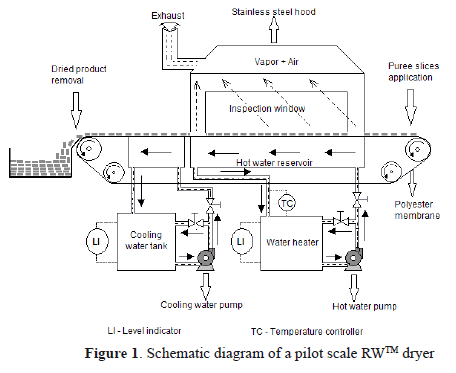
<body><![CDATA[<p><font size="2" face="Verdana, Arial, Helvetica, sans-serif">As RW&trade; is a relatively novel technology, there are not many scientific publications related to the influence of puree thickness, and water temperature, on product characteristics &#91;9-16&#93;. </font></p>     <p><font size="2" face="Verdana, Arial, Helvetica, sans-serif">The aim of this study was to evaluate the influence of samples thickness (2, 3 and 4 mm) on the drying kinetics, water activity (<i>a<sub>w</sub></i>) and color (<font face="Symbol">D</font>E) of papaya puree slices dried through the RW&trade; technique. Additionally, the water diffusion coefficient was evaluated, taking into account the shrinkage effect.</font></p>     <p>&nbsp;</p>     <p><font size="3" face="Verdana, Arial, Helvetica, sans-serif"><b>2.  MATHERIALS AND METHODS</b></font></p>     <p><font size="2" face="Verdana, Arial, Helvetica, sans-serif"><b>2.1.  Raw material and experimental design</b>    <br>   Papaya fruits were obtained at a local market (Cali-Colombia) and were selected with uniform soluble solids content (10 - 12&ordm; Brix). These were prime-quality samples, according to the Colombian Technical Standard NTC 1270 &#91;17&#93;. The fruits were washed, peeled (using a stainless steel knife) and cut into two pieces to remove the seeds. The fruit puree was obtained with a food processor (Oster, 3167, USA). Preformed plastic molds were used to obtain puree slices of 2, 3 or 4 mm of thickness and 30 mm in diameter. </font></p>     <p><font size="2" face="Verdana, Arial, Helvetica, sans-serif">The slices were dried in a prototype designed to reproduce the RW&trade; principle (<a href="#fig01">Figure 1</a>). This consists in a tank filled with water (length: 0.6 m, width: 0.4 m, depth: 0.1 m), where a polyester membrane (MylarTM type - transparent to infrared radiation) slides over the water surface at a speed of 0.001 m/min. The water was recirculated at a rate of 2.74 L/min in order to recover the unused heat. The water temperature was set up at 70&deg;C. </font></p>     <p align="center"><font size="2" face="Verdana, Arial, Helvetica, sans-serif"><a name="fig01"></a></font><img src="/img/revistas/dyna/v80n182/v80n182a18fig01.gif"></p>     <p><font size="2" face="Verdana, Arial, Helvetica, sans-serif">A completely randomized design was carried out considering the thickness of the puree slices (2, 3 and 4 mm) and the drying time (0, 10, 20, 30, 60, 90, 120 and 180 min) as the experimental factors. The response variables were moisture content (MC), water activity (<i>a<sub>w</sub></i>), total color difference (<font face="Symbol">D</font>E), apparent density (<font face="Symbol">r</font><sub>at</sub>), and volume (<i>V</i>). Experiments were conducted in triplicate. </font></p>     <p><font size="2" face="Verdana, Arial, Helvetica, sans-serif"><b>2.2.  Physicochemical analysis</b>    ]]></body>
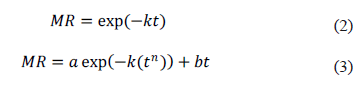
<body><![CDATA[<br>   The MC was determined by drying the samples in a vacuum oven until constant weight at 60&deg;C (AOAC, 1980) &#91;18&#93;. The <i>a<sub>w</sub></i> was measured with a dew-point hygrometer (Decagon, AquaLab CX-1, USA) with a sensitivity of 0.0001. </font></p>     <p><font size="2" face="Verdana, Arial, Helvetica, sans-serif">The color was measured between 400-780 nm, employing a spectrocolorimeter (Hunter-Lab, ColorFlex, USA) and using as standard the illuminant D65 and the 10&ordm; observer in order to obtain the color coordinates CIE-L*a*b*. <font face="Symbol">D</font>E was determined through (1):</font></p>     <p><font size="2" face="Verdana, Arial, Helvetica, sans-serif"><img src="/img/revistas/dyna/v80n182/v80n182a18eq01.gif"></font></p>     <p><font size="2" face="Verdana, Arial, Helvetica, sans-serif">The <font face="Symbol">r</font><sub>at</sub> of the samples was determined by means of the volume displacement method, using a pycnometer and distilled water at 20&plusmn;0.3&deg;C as the displacement medium. The <i>V </i> of the slices was calculated from <font face="Symbol">r</font><sub>at</sub> data.</font></p>     <p><font size="2" face="Verdana, Arial, Helvetica, sans-serif"><b>2.3.  Mathematical modeling    <br>   </b>The drying kinetics were fitted using Newton's (2) and Midilli's (3) models, widely used for modeling moisture ratio (MR) in biological materials &#91;19-21&#93;. </font></p>     <p><font size="2" face="Verdana, Arial, Helvetica, sans-serif"><img src="/img/revistas/dyna/v80n182/v80n182a18eq0203.gif"></font></p>     <p><font size="2" face="Verdana, Arial, Helvetica, sans-serif">where <i>k</i>, <i>a</i>, <i>n</i> and <i>b</i> are parameters of the models and t is the drying time.</font></p>     <p><font size="2" face="Verdana, Arial, Helvetica, sans-serif">MR is defined in accordance with (4).</font></p>     <p><font size="2" face="Verdana, Arial, Helvetica, sans-serif"><img src="/img/revistas/dyna/v80n182/v80n182a18eq04.gif"></font></p>     ]]></body>
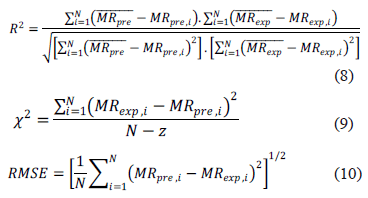
<body><![CDATA[<p><font size="2" face="Verdana, Arial, Helvetica, sans-serif">where <i>X<sub>t</sub></i> is the moisture content at a given time, <i>X<sub>e</sub></i> is the equilibrium moisture content and <i>X<sub>0</sub></i> is the initial moisture content (g water/g dry solid). However, MR was simplified to (5), taking into account that the RW&trade; equipment used for the experiments does not control the relative humidity of air in contact with the material &#91;21-23&#93;.</font></p>     <p><font size="2" face="Verdana, Arial, Helvetica, sans-serif"><img src="/img/revistas/dyna/v80n182/v80n182a18eq05.gif"></font></p>     <p><font size="2" face="Verdana, Arial, Helvetica, sans-serif">The analytical solution of Fick's second law was used in order to determine the effective diffusion coefficient (D<sub>eff</sub>), considering the geometry of a semi-infinite sheet with thickness l and assuming that the drying process is controlled by internal moisture diffusion in an axial direction. The analytical solution is given by (6) &#91;24&#93;, which is valid only for the falling rate drying period.</font></p>     <p><font size="2" face="Verdana, Arial, Helvetica, sans-serif"><img src="/img/revistas/dyna/v80n182/v80n182a18eq06.gif"></font></p>     <p><font size="2" face="Verdana, Arial, Helvetica, sans-serif">To take shrinkage into account, the sample thickness must be considered as a function of time <i>l(t)</i>(7)&#91;25&#93;:</font></p>     <p><font size="2" face="Verdana, Arial, Helvetica, sans-serif"><img src="/img/revistas/dyna/v80n182/v80n182a18eq07.gif"></font></p>     <p><font size="2" face="Verdana, Arial, Helvetica, sans-serif">where mt is the mass at a given time (g), <font face="Symbol">r</font><sub>at</sub> is the apparent density at a given time (g/cm3) and R is the ratio of the papaya slices, equivalent to 0.015 m. D<sub>eff</sub> values were calculated with and without considering shrinkage.</font></p>     <p><font size="2" face="Verdana, Arial, Helvetica, sans-serif"><b>2.4.  Statistical Analysis</b>    <br>   The order of the experiments and the effect of thickness on the response variables were determined by means of the Minitab statistical program (version 15.1.20.0, 2007), for a significance of 0.05 and a confidence interval of 95% (p&lt;0.05). Regressions to estimate the parameters of Newton's and Midilli's models were performed, using the Polymath 5.0 (version 5.1, 2000) statistical software. The fitting quality of the experimental data to the models was assessed using the correlation coefficient (R<sup>2</sup>), reduced Chi-square (<font face="Symbol">c</font>2), and the Root Mean Square Error (RMSE). These statistical parameters were calculated using equations (8), (9) and (10) &#91;26&#93;, respectively. The highest values of R<sup>2</sup> and the lowest values of <font face="Symbol">c</font>2 and RMSE were taken as the optimum criteria.</font></p>     <p><font size="2" face="Verdana, Arial, Helvetica, sans-serif"><img src="/img/revistas/dyna/v80n182/v80n182a18eq0810.gif"></font></p>     ]]></body>
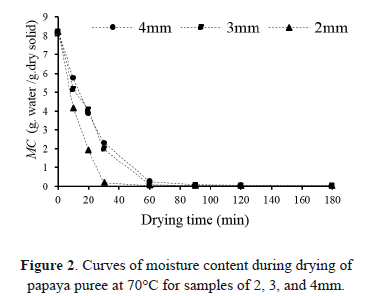
<body><![CDATA[<p><font size="2" face="Verdana, Arial, Helvetica, sans-serif">where N is the number of observations, z is the number of model parameters, MR<sub>exp</sub> is the experimental moisture ratio, and MR<sub>pre</sub> is the predicted moisture ratio.</font></p>     <p>&nbsp;</p>     <p><font size="3" face="Verdana, Arial, Helvetica, sans-serif"><b>3.  RESULTS AND DISCUSSION</b></font></p>     <p><font size="2" face="Verdana, Arial, Helvetica, sans-serif"><b>3.1.  Moisture content (MC)</b>    <br>   The initial MC of papaya puree was 8.2262 &plusmn; 0.4519 g water/g dry solid. The MC decreased faster at a lower thickness; the samples of 2 mm reached 0.0652 g water/g dry solid in 60 min, while those of 3 and 4 mm reached 0.1132 and 0.2624 g water/g dry solid, respectively. <a href="#fig02">Figure 2</a> shows MC variation of papaya samples during the drying time. </font></p>     <p align="center"><font size="2" face="Verdana, Arial, Helvetica, sans-serif"><a name="fig02"></a></font><img src="/img/revistas/dyna/v80n182/v80n182a18fig02.gif"></p>     <p><font size="2" face="Verdana, Arial, Helvetica, sans-serif">Thinly sliced samples dried faster due to the reduced distance the water travels in order to be extracted &#91;27&#93;. Similar results were observed during drying of mango &#91;16&#93; and orange &#91;28&#93; by RW&trade;, and during convective drying of eggplant &#91;29&#93;, papaya and garlic &#91;30&#93;. According to Geankoplis (1993) &#91;31&#93;, the drying time is directly proportional to the weight of dry solid, which increases with the increasing of thickness. The ANOVA (Analysis of Variance) showed a significant effect (p&lt;0.05) of thickness and drying time on MC of papaya samples.</font></p>     <p><font size="2" face="Verdana, Arial, Helvetica, sans-serif"><b>3.2.  Water activity (<i>a<sub>w</sub></i>)</b>    <br>   Thickness affected the <i>a<sub>w</sub></i> of the samples significantly (<a href="#fig03">Figure 3</a>). Findings showed that the lower the thickness, the lower the value of <i>a<sub>w</sub></i>, at a specific time. Similar results were obtained during drying of mango using the RW&trade; technique &#91;16&#93;. </font></p>     <p align="center"><font size="2" face="Verdana, Arial, Helvetica, sans-serif"><a name="fig03"></a></font><img src="/img/revistas/dyna/v80n182/v80n182a18fig03.gif"></p>     ]]></body>
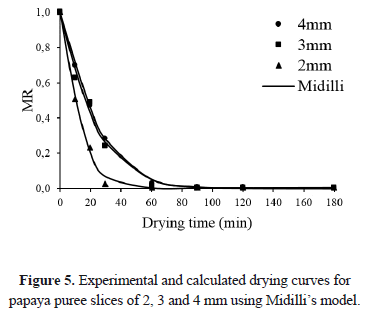
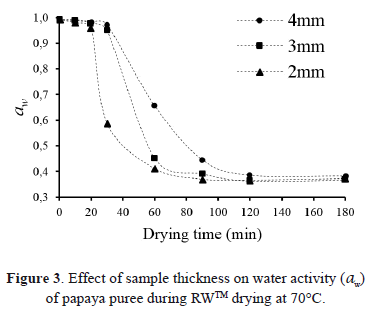
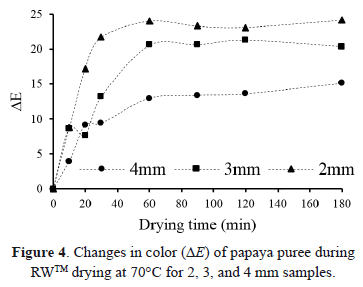
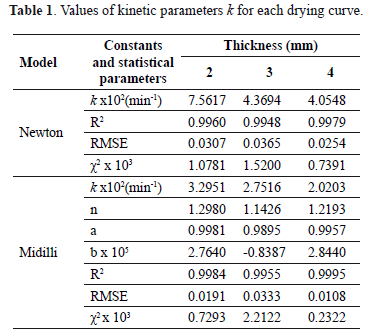
<body><![CDATA[<p><font size="2" face="Verdana, Arial, Helvetica, sans-serif">After 60 min of drying, samples of 2 and 3 mm reached values of <i>a<sub>w</sub></i> below 0.6, but 2 mm samples reached the lowest value (0.41); these results indicate the growth restriction of pathogenic microorganisms such as fungi, yeasts, and bacteria &#91;32&#93;. After 90 min of drying, these samples present values of <i>a<sub>w</sub></i> below 0.4, which are characteristic of highly stable food during storage &#91;33&#93;. This result is relevant for the preservation of papaya because of its high susceptibility to mold growth &#91;34&#93;. The ANOVA evidenced a significant effect (p&lt;0.05) of thickness and drying time on the <i>a<sub>w</sub></i> of papaya samples.</font></p>     <p><font size="2" face="Verdana, Arial, Helvetica, sans-serif"><b>3.3.  Color    <br>   </b><a href="#fig04">Figure 4</a> presents the values of <font face="Symbol">D</font>E of papaya samples during the drying process. For the three sample thicknesses investigated, it can be observed that <font face="Symbol">D</font>E increases until about 60 min of drying and subsequently stabilizes. This behavior shows the ability of RW&trade; technique to self-regulate and protect the characteristics of the puree at low moisture content &#91;35&#93;. The influence of thickness on <font face="Symbol">D</font>E is also observed, obtaining a higher value for the samples of lower thickness. This result is due to the fact that thinner samples reach higher internal temperatures which causes further degradation of the papaya carotenoids (licopene, &szlig;-criptoxanthin, &szlig;-carotene). Ahmed et al. (2002) &#91;36&#93; report that the change in color of papaya puree is a direct consequence of the change in the carotenoids; the authors also point out that the color change reaction has first order kinetics, where the rate constant depends on the temperature and follows the Arrhenius relationship. </font></p>     <p align="center"><font size="2" face="Verdana, Arial, Helvetica, sans-serif"><a name="fig04"></a></font><img src="/img/revistas/dyna/v80n182/v80n182a18fig04.gif"></p>     <p><font size="2" face="Verdana, Arial, Helvetica, sans-serif">The ANOVA showed that thickness and drying time had a significant influence (p&lt;0.05) on the <font face="Symbol">D</font>E of papaya puree slices.</font></p>     <p><font size="2" face="Verdana, Arial, Helvetica, sans-serif"><b>3.4.  Mathematical modeling of drying kinetics</b>    <br>   <a href="#tab01">Table 1</a> shows the estimated kinetic parameters of Newton and Midilli's models, including criteria to evaluate the fitting quality.</font></p>     <p align="center"><font size="2" face="Verdana, Arial, Helvetica, sans-serif"><a name="tab01"></a></font><img src="/img/revistas/dyna/v80n182/v80n182a18tab01.gif"></p>     <p><font size="2" face="Verdana, Arial, Helvetica, sans-serif">It is observed that the parameter <i>k </i> increases at a lower thickness of the samples, having a higher value for the samples of 2 mm with 7.5617x10<sup>-2</sup> (min<sup>-1</sup>). The variable <i>k </i> is often temperature dependent, consequently, an increase in <i>k </i> is related to an increase in drying temperature &#91;37&#93;.  Generally, higher drying temperatures resulted in steeper curves and shorter drying times &#91;38&#93;. In this study, the temperature was constant (70&ordm;C), therefore, this behavior is probably due to the fact that thinner samples reached higher temperature at their geometrical center as a result of the smaller mass per unit of surface area. </font></p>     <p><font size="2" face="Verdana, Arial, Helvetica, sans-serif">Both proposed models showed a good fit of the experimental values, nevertheless, Midilli's model was the one with the best fit (<a href="#fig05">Figure 5</a>) corresponding to the highest values of correlation coefficient and the lowest values of <font face="Symbol">c</font>2 and RMSE. </font></p>     ]]></body>
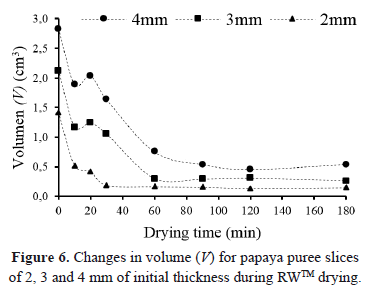
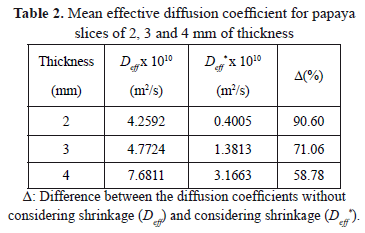
<body><![CDATA[<p align="center"><font size="2" face="Verdana, Arial, Helvetica, sans-serif"><a name="fig05"></a></font><img src="/img/revistas/dyna/v80n182/v80n182a18fig05.gif"></p>     <p><font size="2" face="Verdana, Arial, Helvetica, sans-serif">Some researchers have found that Midilli's model accurately characterized the drying behavior of different foods, as in apple drying with infrared rays &#91;19&#93; and red pepper drying by combining hot air and ultrasound &#91;21&#93;.</font></p>     <p><font size="2" face="Verdana, Arial, Helvetica, sans-serif"><b>3.5.  Effective diffusion coefficient (D<sub>eff</sub>)</b>    <br>   D<sub>eff</sub> was calculated for the first falling rate drying period using the first term of the analytical solution of Fick's second law, which was the most significant. For this calculation, shrinkage or volume change (see <a href="#fig06">Figure 6</a>), of the slices as a function of drying time was considered, which was calculated from rat (values not shown). According to the results, thickness influenced volume change during drying; specifically, the thicker the sample, the smaller the changes (4 mm samples showed the highest values of <i>V</i>).</font></p>     <p align="center"><font size="2" face="Verdana, Arial, Helvetica, sans-serif"><a name="fig06"></a></font><img src="/img/revistas/dyna/v80n182/v80n182a18fig06.gif"></p>     <p><font size="2" face="Verdana, Arial, Helvetica, sans-serif"><a href="#tab02">Table 2</a> shows the influence of thickness and volume change on D<sub>eff</sub> of papaya puree slices during drying, which have a similar magnitude order to those reported in drying of papaya by convection &#91;39&#93; and treatment by osmotic dehydration &#91;5&#93;.</font></p>     <p align="center"><font size="2" face="Verdana, Arial, Helvetica, sans-serif"><a name="tab02"></a></font><img src="/img/revistas/dyna/v80n182/v80n182a18tab02.gif"></p>     <p><font size="2" face="Verdana, Arial, Helvetica, sans-serif">It can be seen that D<sub>eff</sub> and D<sub>eff</sub>* are higher when puree thickness increases, because the thicker samples exhibit less shrinkage for a fixed time (<a href="#fig06">Figure 6</a>), thus, significantly facilitating diffusion. Similar results were obtained in convective drying of papaya slices &#91;30&#93;, mango drying by RW&trade; &#91;16&#93;, and sun and convective drying of grape products &#91;27&#93;.</font></p>     <p><font size="2" face="Verdana, Arial, Helvetica, sans-serif"><a href="#tab02">Table 2</a> also shows that the diffusion coefficient values corrected by volume (D<sub>eff</sub>*) were lower than the uncorrected values (D<sub>eff</sub>), since food shrinkage modifies the distance required for the movement of water molecules &#91;40&#93;. The diffusion coefficient is overestimated between 58.78 and 90.60%, when volume correction is not taken into account. </font></p>     <p>&nbsp;</p>     ]]></body>
<body><![CDATA[<p><font size="3" face="Verdana, Arial, Helvetica, sans-serif"><b>4.  CONCLUSION</b></font></p>     <p><font size="2" face="Verdana, Arial, Helvetica, sans-serif">Thickness of papaya puree significantly influenced drying kinetics, water activity and the color of the product; the lower the thickness, the faster the drying, the lower the <i>a<sub>w</sub></i> and the higher the <font face="Symbol">D</font>E. Midilli's model was the most appropriate to predict the experimental drying curves of papaya puree processed by RW&trade;. The diffusion coefficient was higher when not considering shrinkage. These findings show that the RW&trade; technique is highly suitable for papaya drying; it makes it possible to dry the product reaching a low moisture content in shorter times, reducing the <i>a<sub>w</sub></i> to values below 0.4 and preserving a similar color.</font></p>     <p>&nbsp;</p>     <p><font size="3" face="Verdana, Arial, Helvetica, sans-serif"><b>REFERENCES</b></font></p>     <!-- ref --><p><font size="2" face="Verdana, Arial, Helvetica, sans-serif"><b>&#91;1&#93;</b> De Oliveira, J.G. and Vit&oacute;ria, A.P., Papaya: Nutritional and pharmacological characterization, and quality loss due to physiological disorders. An overview, Food Res Int., 44 (5), pp. 1306-1313, 2011.    &nbsp;&nbsp;&nbsp;&nbsp;&nbsp;&nbsp;&nbsp;&nbsp;[&#160;<a href="javascript:void(0);" onclick="javascript: window.open('/scielo.php?script=sci_nlinks&ref=000087&pid=S0012-7353201300060001800001&lng=','','width=640,height=500,resizable=yes,scrollbars=1,menubar=yes,');">Links</a>&#160;]<!-- end-ref --><!-- ref --><br>   <b>&#91;2&#93;</b> Gayosso, L.E., Yahia, E.M. and Gonz&aacute;lez, G.A., Identification and quantification of phenols, carotenoids and vitamin C from papaya (<i>Carica papaya</i> L., cv. Maradol) fruit determined by HPLC-DAD-MS/MS-ESI, Food Res Int, 44 (5), pp. 1284-1291, 2011.    &nbsp;&nbsp;&nbsp;&nbsp;&nbsp;&nbsp;&nbsp;&nbsp;[&#160;<a href="javascript:void(0);" onclick="javascript: window.open('/scielo.php?script=sci_nlinks&ref=000088&pid=S0012-7353201300060001800002&lng=','','width=640,height=500,resizable=yes,scrollbars=1,menubar=yes,');">Links</a>&#160;]<!-- end-ref --><!-- ref --><br>   <b>&#91;3&#93;</b> Fernandes, F.A.N., Rodrigues, S., Gaspareto, O.C.P. and Oliveira, E.L., Optimization of osmotic dehydration of papaya followed by air drying, Food Res Int, 39 (4), pp. 492-498, 2006.    &nbsp;&nbsp;&nbsp;&nbsp;&nbsp;&nbsp;&nbsp;&nbsp;[&#160;<a href="javascript:void(0);" onclick="javascript: window.open('/scielo.php?script=sci_nlinks&ref=000089&pid=S0012-7353201300060001800003&lng=','','width=640,height=500,resizable=yes,scrollbars=1,menubar=yes,');">Links</a>&#160;]<!-- end-ref --><!-- ref --><br>   <b>&#91;4&#93;</b> El-Aouar, Â.A., Moreira Azoubel, P. and Xidieh Murr, F.E., Drying kinetics of fresh and osmotically pre-treated papaya (<i>Carica papaya</i> L.), J Food Eng, 59 (1), pp. 85-91, 2003.    &nbsp;&nbsp;&nbsp;&nbsp;&nbsp;&nbsp;&nbsp;&nbsp;[&#160;<a href="javascript:void(0);" onclick="javascript: window.open('/scielo.php?script=sci_nlinks&ref=000090&pid=S0012-7353201300060001800004&lng=','','width=640,height=500,resizable=yes,scrollbars=1,menubar=yes,');">Links</a>&#160;]<!-- end-ref --><!-- ref --><br>   <b>&#91;5&#93;</b> Rodrigues, A.C.C., Cunha, R.L. and Hubinger, M.D., Rheological properties and color evaluation of papaya during osmotic dehydration processing. J Food Eng, 59 (2-3), pp. 129-135, 2003.    &nbsp;&nbsp;&nbsp;&nbsp;&nbsp;&nbsp;&nbsp;&nbsp;[&#160;<a href="javascript:void(0);" onclick="javascript: window.open('/scielo.php?script=sci_nlinks&ref=000091&pid=S0012-7353201300060001800005&lng=','','width=640,height=500,resizable=yes,scrollbars=1,menubar=yes,');">Links</a>&#160;]<!-- end-ref --><!-- ref --><br>   <b>&#91;6&#93;</b> Mayor, L. and Sereno, A.M., Modelling Shrinkage during convective drying of food materials: a review. J Food Eng, 61 (3), pp. 373-386, 2004.    &nbsp;&nbsp;&nbsp;&nbsp;&nbsp;&nbsp;&nbsp;&nbsp;[&#160;<a href="javascript:void(0);" onclick="javascript: window.open('/scielo.php?script=sci_nlinks&ref=000092&pid=S0012-7353201300060001800006&lng=','','width=640,height=500,resizable=yes,scrollbars=1,menubar=yes,');">Links</a>&#160;]<!-- end-ref --><!-- ref --><br>   <b>&#91;7&#93;</b> Khalloufi, S., Almeida-Rivera, C. and Bongers, P.A., Theoretical model and its experimental validation to predict the porosity as a function of shrinkage and collapse phenomena during drying. Food Res Int, 42 (8), pp. 1122-1130, 2009.    &nbsp;&nbsp;&nbsp;&nbsp;&nbsp;&nbsp;&nbsp;&nbsp;[&#160;<a href="javascript:void(0);" onclick="javascript: window.open('/scielo.php?script=sci_nlinks&ref=000093&pid=S0012-7353201300060001800007&lng=','','width=640,height=500,resizable=yes,scrollbars=1,menubar=yes,');">Links</a>&#160;]<!-- end-ref --><!-- ref --><br>   <b>&#91;8&#93;</b> Mayor, L., Moreira, R. and Sereno, A.M., Shrinkage, density, porosity and shape changes during dehydration of pumpkin (<i>Curcubita pepo</i> L.) fruits, J Food Eng, 103 (1), pp. 29-37, 2011.    &nbsp;&nbsp;&nbsp;&nbsp;&nbsp;&nbsp;&nbsp;&nbsp;[&#160;<a href="javascript:void(0);" onclick="javascript: window.open('/scielo.php?script=sci_nlinks&ref=000094&pid=S0012-7353201300060001800008&lng=','','width=640,height=500,resizable=yes,scrollbars=1,menubar=yes,');">Links</a>&#160;]<!-- end-ref --><!-- ref --><br>   <b>&#91;9&#93;</b> Abonyi, B.I., Tang, J. and Edwards, C.G., Evaluation of energy efficiency and quality retention for the refractance windowTM drying system. &#91;Research Report&#93;. Pullman, Washington D.C: U S. Washington State University, 1999.    &nbsp;&nbsp;&nbsp;&nbsp;&nbsp;&nbsp;&nbsp;&nbsp;[&#160;<a href="javascript:void(0);" onclick="javascript: window.open('/scielo.php?script=sci_nlinks&ref=000095&pid=S0012-7353201300060001800009&lng=','','width=640,height=500,resizable=yes,scrollbars=1,menubar=yes,');">Links</a>&#160;]<!-- end-ref --><!-- ref --><br>   <b>&#91;10&#93;</b> Topuz, A., Feng, H. and Kushad, M., The effect of drying method and storage on color characteristics of paprika. Food Sci Tech, 42 (10), pp. 1667-1673, 2009.    &nbsp;&nbsp;&nbsp;&nbsp;&nbsp;&nbsp;&nbsp;&nbsp;[&#160;<a href="javascript:void(0);" onclick="javascript: window.open('/scielo.php?script=sci_nlinks&ref=000096&pid=S0012-7353201300060001800010&lng=','','width=640,height=500,resizable=yes,scrollbars=1,menubar=yes,');">Links</a>&#160;]<!-- end-ref --><!-- ref --><br>   <b>&#91;11&#93;</b> Abonyi, B.I., Feng, H., Tang, J., Edwards, C.G. and Chew, B.P, et al. Quality retention in strawberry and carrots purees dried with refractance windowTM system. J Food Sci, 67 (3), pp. 1051-1056, 2002.    &nbsp;&nbsp;&nbsp;&nbsp;&nbsp;&nbsp;&nbsp;&nbsp;[&#160;<a href="javascript:void(0);" onclick="javascript: window.open('/scielo.php?script=sci_nlinks&ref=000097&pid=S0012-7353201300060001800011&lng=','','width=640,height=500,resizable=yes,scrollbars=1,menubar=yes,');">Links</a>&#160;]<!-- end-ref --><!-- ref --><br>   <b>&#91;12&#93;</b> Topuz, A., Dincer, C., Özdemir, K.S., Feng, H. and Kushad, M., Influence of different drying methods on carotenoids and capsaicinoids of paprika (Cv., Jalapeno). Food Chem, 129 (3), pp. 860-865, 2011.    &nbsp;&nbsp;&nbsp;&nbsp;&nbsp;&nbsp;&nbsp;&nbsp;[&#160;<a href="javascript:void(0);" onclick="javascript: window.open('/scielo.php?script=sci_nlinks&ref=000098&pid=S0012-7353201300060001800012&lng=','','width=640,height=500,resizable=yes,scrollbars=1,menubar=yes,');">Links</a>&#160;]<!-- end-ref --><!-- ref --><br>   <b>&#91;13&#93;</b> Nindo, C.I., Feng, H., Shen, G.Q., Tang, J. and Kang, D.H., Energy utilization and microbial reduction in a new film drying system. J Food Process Pres, 27 (2), pp. 117-136, 2003.    &nbsp;&nbsp;&nbsp;&nbsp;&nbsp;&nbsp;&nbsp;&nbsp;[&#160;<a href="javascript:void(0);" onclick="javascript: window.open('/scielo.php?script=sci_nlinks&ref=000099&pid=S0012-7353201300060001800013&lng=','','width=640,height=500,resizable=yes,scrollbars=1,menubar=yes,');">Links</a>&#160;]<!-- end-ref --><!-- ref --><br>   <b>&#91;14&#93;</b> Nindo, C.I., Wang, S.W., Tang, J. and Powers, J.R., Evaluation of drying technologies for retention of physical quality and antioxidants in asparagus (Asparagus officinalis, L).Food SciTech, 36 (5), pp. 507-516, 2003.    &nbsp;&nbsp;&nbsp;&nbsp;&nbsp;&nbsp;&nbsp;&nbsp;[&#160;<a href="javascript:void(0);" onclick="javascript: window.open('/scielo.php?script=sci_nlinks&ref=000100&pid=S0012-7353201300060001800014&lng=','','width=640,height=500,resizable=yes,scrollbars=1,menubar=yes,');">Links</a>&#160;]<!-- end-ref --><!-- ref --><br>   <b>&#91;15&#93;</b> Nindo, C.I., Powers, J.R. and Tang, J., Influence of refractance window evaporation on quality of juices from small fruits. Food Sci Tech, 40 (6), pp. 1000-1007, 2007.    &nbsp;&nbsp;&nbsp;&nbsp;&nbsp;&nbsp;&nbsp;&nbsp;[&#160;<a href="javascript:void(0);" onclick="javascript: window.open('/scielo.php?script=sci_nlinks&ref=000101&pid=S0012-7353201300060001800015&lng=','','width=640,height=500,resizable=yes,scrollbars=1,menubar=yes,');">Links</a>&#160;]<!-- end-ref --><!-- ref --><br>   <b>&#91;16&#93;</b> Ochoa-Mart&iacute;nez, C.I., Quintero, P.T., Ayala, A.A. and Ortiz, M.J., Drying characteristics of mango slices using the Refractance WindowTM technique. J Food Eng, 109 (1), pp. 69-75, 2012.    &nbsp;&nbsp;&nbsp;&nbsp;&nbsp;&nbsp;&nbsp;&nbsp;[&#160;<a href="javascript:void(0);" onclick="javascript: window.open('/scielo.php?script=sci_nlinks&ref=000102&pid=S0012-7353201300060001800016&lng=','','width=640,height=500,resizable=yes,scrollbars=1,menubar=yes,');">Links</a>&#160;]<!-- end-ref --><!-- ref --><br>   <b>&#91;17&#93;</b> INSTITUTO COLOMBIANO DE NORMAS T&Eacute;CNICAS Y CERTIFICACI&Oacute;N (ICONTEC)., Norma T&eacute;cnica Colombiana NTC 1270: Industria Alimentaria. Papaya, ICONTEC, Bogot&aacute;, 1993.    &nbsp;&nbsp;&nbsp;&nbsp;&nbsp;&nbsp;&nbsp;&nbsp;[&#160;<a href="javascript:void(0);" onclick="javascript: window.open('/scielo.php?script=sci_nlinks&ref=000103&pid=S0012-7353201300060001800017&lng=','','width=640,height=500,resizable=yes,scrollbars=1,menubar=yes,');">Links</a>&#160;]<!-- end-ref --><!-- ref --><br>   <b>&#91;18&#93;</b> AOAC., Official methods of analysis, 13th edition, Association of the Official Agricultural Chemists, Washington D.C, 1980.    &nbsp;&nbsp;&nbsp;&nbsp;&nbsp;&nbsp;&nbsp;&nbsp;[&#160;<a href="javascript:void(0);" onclick="javascript: window.open('/scielo.php?script=sci_nlinks&ref=000104&pid=S0012-7353201300060001800018&lng=','','width=640,height=500,resizable=yes,scrollbars=1,menubar=yes,');">Links</a>&#160;]<!-- end-ref --><!-- ref --><br>   <b>&#91;19&#93;</b> Togrul, H., Simple modeling of infrared drying of fresh apple slices. J Food Eng, 71 (3), pp. 311-323, 2005.    &nbsp;&nbsp;&nbsp;&nbsp;&nbsp;&nbsp;&nbsp;&nbsp;[&#160;<a href="javascript:void(0);" onclick="javascript: window.open('/scielo.php?script=sci_nlinks&ref=000105&pid=S0012-7353201300060001800019&lng=','','width=640,height=500,resizable=yes,scrollbars=1,menubar=yes,');">Links</a>&#160;]<!-- end-ref --><!-- ref --><br>   <b>&#91;20&#93;</b> Vega-G&aacute;lvez, A., Ayala-Aponte, A., Notte, E., De La Fuente, L. and Lemus-Moncada, R., Mathematical Modeling of mass transfer during convective dehydration of brown algae Macrocystis Pyrifera. Dry Technol, 26 (12), pp. 1610-1616, 2008.    &nbsp;&nbsp;&nbsp;&nbsp;&nbsp;&nbsp;&nbsp;&nbsp;[&#160;<a href="javascript:void(0);" onclick="javascript: window.open('/scielo.php?script=sci_nlinks&ref=000106&pid=S0012-7353201300060001800020&lng=','','width=640,height=500,resizable=yes,scrollbars=1,menubar=yes,');">Links</a>&#160;]<!-- end-ref --><!-- ref --><br>   <b>&#91;21&#93;</b> Schössler, K., Jäger, H. and Knorr, D., Effect of continuous and intermittent ultrasound on drying time and effective diffusivity during convective drying of apple and red bell pepper. J Food Eng, 108 (1), pp. 103-110, 2012.    &nbsp;&nbsp;&nbsp;&nbsp;&nbsp;&nbsp;&nbsp;&nbsp;[&#160;<a href="javascript:void(0);" onclick="javascript: window.open('/scielo.php?script=sci_nlinks&ref=000107&pid=S0012-7353201300060001800021&lng=','','width=640,height=500,resizable=yes,scrollbars=1,menubar=yes,');">Links</a>&#160;]<!-- end-ref --><!-- ref --><br>   <b>&#91;22&#93;</b> Togrul, I.T. and Pehlivan, D., Mathematical Modelling of solar drying of apricots in thin layers. J Food Eng, 55 (3), pp. 209-216, 2002.    &nbsp;&nbsp;&nbsp;&nbsp;&nbsp;&nbsp;&nbsp;&nbsp;[&#160;<a href="javascript:void(0);" onclick="javascript: window.open('/scielo.php?script=sci_nlinks&ref=000108&pid=S0012-7353201300060001800022&lng=','','width=640,height=500,resizable=yes,scrollbars=1,menubar=yes,');">Links</a>&#160;]<!-- end-ref --><!-- ref --><br>   <b>&#91;23&#93;</b> Togrul, I.T. and Pehlivan, D., Modelling of thin layer drying kinetics of some fruits under open-air sun drying process. J Food Eng, 65 (3), pp. 413-425, 2004.    &nbsp;&nbsp;&nbsp;&nbsp;&nbsp;&nbsp;&nbsp;&nbsp;[&#160;<a href="javascript:void(0);" onclick="javascript: window.open('/scielo.php?script=sci_nlinks&ref=000109&pid=S0012-7353201300060001800023&lng=','','width=640,height=500,resizable=yes,scrollbars=1,menubar=yes,');">Links</a>&#160;]<!-- end-ref --><!-- ref --><br>   <b>&#91;24&#93;</b> Crank, J., The mathematics of diffusion, Second edition, Clarendon Press, Oxford, 1975.    &nbsp;&nbsp;&nbsp;&nbsp;&nbsp;&nbsp;&nbsp;&nbsp;[&#160;<a href="javascript:void(0);" onclick="javascript: window.open('/scielo.php?script=sci_nlinks&ref=000110&pid=S0012-7353201300060001800024&lng=','','width=640,height=500,resizable=yes,scrollbars=1,menubar=yes,');">Links</a>&#160;]<!-- end-ref --><!-- ref --><br>   <b>&#91;25&#93;</b> Dissa, A.O., Desmorieux, H., Bathiebo, J. and Koulidiati, J., Convective drying characteristics of Amelie mango (Mangifera Indica L. cv. 'Amelie') with correction for shrinkage. J Food Eng, 88 (4), pp. 429-437, 2008.    &nbsp;&nbsp;&nbsp;&nbsp;&nbsp;&nbsp;&nbsp;&nbsp;[&#160;<a href="javascript:void(0);" onclick="javascript: window.open('/scielo.php?script=sci_nlinks&ref=000111&pid=S0012-7353201300060001800025&lng=','','width=640,height=500,resizable=yes,scrollbars=1,menubar=yes,');">Links</a>&#160;]<!-- end-ref --><!-- ref --><br>   <b>&#91;26&#93;</b> Kavak-Akpinar, E., Bicer, Y. and Cetinkaya, F., Modelling of thin layer drying of parsley leaves in a convective dryer and under open sun. J Food Eng, 75 (3), pp. 308-315, 2006&#93;    &nbsp;&nbsp;&nbsp;&nbsp;&nbsp;&nbsp;&nbsp;&nbsp;[&#160;<a href="javascript:void(0);" onclick="javascript: window.open('/scielo.php?script=sci_nlinks&ref=000112&pid=S0012-7353201300060001800026&lng=','','width=640,height=500,resizable=yes,scrollbars=1,menubar=yes,');">Links</a>&#160;]<!-- end-ref --></b>     <!-- ref --><br>   <b>&#91;27&#93;</b> Maskan, A., Kaya, S. and Maskan, M., Hot air and sun drying of grape leather (pestil). J Food Eng, 54 (1), pp. 81-88, 2002&#93;    &nbsp;&nbsp;&nbsp;&nbsp;&nbsp;&nbsp;&nbsp;&nbsp;[&#160;<a href="javascript:void(0);" onclick="javascript: window.open('/scielo.php?script=sci_nlinks&ref=000114&pid=S0012-7353201300060001800027&lng=','','width=640,height=500,resizable=yes,scrollbars=1,menubar=yes,');">Links</a>&#160;]<!-- end-ref --></b>     <!-- ref --><br>   <b>&#91;28&#93;</b> Viveros, J.G., Cano, C.A., Ayala, A.A. y Ochoa, C.I., Implementaci&oacute;n de un m&eacute;todo novedoso (Ventana de Refractancia) para reducir el tiempo de secado en alimentos s&oacute;lidos. Aplicaci&oacute;n en rodajas de naranja. Memorias VII Congreso Iberoamericano de Ingenier&iacute;a de Alimentos (CIBIA VII). Bogot&aacute;, Colombia, Septiembre 2009.    &nbsp;&nbsp;&nbsp;&nbsp;&nbsp;&nbsp;&nbsp;&nbsp;[&#160;<a href="javascript:void(0);" onclick="javascript: window.open('/scielo.php?script=sci_nlinks&ref=000116&pid=S0012-7353201300060001800028&lng=','','width=640,height=500,resizable=yes,scrollbars=1,menubar=yes,');">Links</a>&#160;]<!-- end-ref --><!-- ref --><br>   <b>&#91;29&#93;</b> Ertekin, C. and Yaldiz, O., Drying of eggplant and selection of a suitable thin layer drying model. J Food Eng, 63 (3), pp. 349-359, 2004.    &nbsp;&nbsp;&nbsp;&nbsp;&nbsp;&nbsp;&nbsp;&nbsp;[&#160;<a href="javascript:void(0);" onclick="javascript: window.open('/scielo.php?script=sci_nlinks&ref=000117&pid=S0012-7353201300060001800029&lng=','','width=640,height=500,resizable=yes,scrollbars=1,menubar=yes,');">Links</a>&#160;]<!-- end-ref --><!-- ref --><br>   <b>&#91;30&#93;</b> Fernando, W.J.N., Ahmad, A.L., Shukor S.R, ABD and Lok, Y.H., A model for constant temperature drying rates of case hardened slices of papaya and garlic. J Food Eng, 88 (2), pp. 229-238, 2008.    &nbsp;&nbsp;&nbsp;&nbsp;&nbsp;&nbsp;&nbsp;&nbsp;[&#160;<a href="javascript:void(0);" onclick="javascript: window.open('/scielo.php?script=sci_nlinks&ref=000118&pid=S0012-7353201300060001800030&lng=','','width=640,height=500,resizable=yes,scrollbars=1,menubar=yes,');">Links</a>&#160;]<!-- end-ref --><!-- ref --><br>   <b>&#91;31&#93;</b> Geankoplis, C.J., Transport processes and unit operations. Third edition, Prentice-Hall International Inc, USA, 1993.    &nbsp;&nbsp;&nbsp;&nbsp;&nbsp;&nbsp;&nbsp;&nbsp;[&#160;<a href="javascript:void(0);" onclick="javascript: window.open('/scielo.php?script=sci_nlinks&ref=000119&pid=S0012-7353201300060001800031&lng=','','width=640,height=500,resizable=yes,scrollbars=1,menubar=yes,');">Links</a>&#160;]<!-- end-ref --><!-- ref --><br>   <b>&#91;32&#93;</b> Labuza, T.P. and Hyman, C.R., Moisture migration and control in multi-domain foods: Review. Trends Food Sci Tech, 9 (2), pp. 47-55, 1998.    &nbsp;&nbsp;&nbsp;&nbsp;&nbsp;&nbsp;&nbsp;&nbsp;[&#160;<a href="javascript:void(0);" onclick="javascript: window.open('/scielo.php?script=sci_nlinks&ref=000120&pid=S0012-7353201300060001800032&lng=','','width=640,height=500,resizable=yes,scrollbars=1,menubar=yes,');">Links</a>&#160;]<!-- end-ref --><!-- ref --><br>   <b>&#91;33&#93;</b> Singh, R.P. and Heldman, D.R., Introduction to food engineering, Second edition, Academic Press, Inc, USA, 1993.    &nbsp;&nbsp;&nbsp;&nbsp;&nbsp;&nbsp;&nbsp;&nbsp;[&#160;<a href="javascript:void(0);" onclick="javascript: window.open('/scielo.php?script=sci_nlinks&ref=000121&pid=S0012-7353201300060001800033&lng=','','width=640,height=500,resizable=yes,scrollbars=1,menubar=yes,');">Links</a>&#160;]<!-- end-ref --><!-- ref --><br>   <b>&#91;34&#93;</b> Beserra-Nogueira, S., Labate, C.A., Gozzo, F.C., Pilau, E.J., Lajolo, F.M., et al. Proteomic analysis of papaya fruit ripening using 2DE-DIGE. J Proteomics, 75 (4), pp. 1428-1439, 2012.    &nbsp;&nbsp;&nbsp;&nbsp;&nbsp;&nbsp;&nbsp;&nbsp;[&#160;<a href="javascript:void(0);" onclick="javascript: window.open('/scielo.php?script=sci_nlinks&ref=000122&pid=S0012-7353201300060001800034&lng=','','width=640,height=500,resizable=yes,scrollbars=1,menubar=yes,');">Links</a>&#160;]<!-- end-ref --><!-- ref --><br>   <b>&#91;35&#93;</b> Clarke, P.T., Refractance WindowTM-&quot;Down Under&quot;. Proceedings of the 14th International Drying Symposium. Brazil, Vol B, pp. 813-820, Aug 2004.    &nbsp;&nbsp;&nbsp;&nbsp;&nbsp;&nbsp;&nbsp;&nbsp;[&#160;<a href="javascript:void(0);" onclick="javascript: window.open('/scielo.php?script=sci_nlinks&ref=000123&pid=S0012-7353201300060001800035&lng=','','width=640,height=500,resizable=yes,scrollbars=1,menubar=yes,');">Links</a>&#160;]<!-- end-ref --><!-- ref --><br>   <b>&#91;36&#93;</b> Ahmed, J., Shivhare, U.S. and Sandhu, K.S., Thermal degradation kinetics of carotenoids and visual color of papaya puree. J Food Sci, 67 (7), pp. 2692-2695, 2002.    &nbsp;&nbsp;&nbsp;&nbsp;&nbsp;&nbsp;&nbsp;&nbsp;[&#160;<a href="javascript:void(0);" onclick="javascript: window.open('/scielo.php?script=sci_nlinks&ref=000124&pid=S0012-7353201300060001800036&lng=','','width=640,height=500,resizable=yes,scrollbars=1,menubar=yes,');">Links</a>&#160;]<!-- end-ref --><!-- ref --><br>   <b>&#91;37&#93;</b> Vega-G&aacute;lvez, A., Miranda, M., Claver&iacute;a, R., Quispe, I., Vergara, J. et al. Effect of air temperature on drying kinetics and quality characteristics of osmo-treated jumbo squid (Dosidicus gigas). J Food Sci Tech, 44 (1), pp. 16-23, 2011.    &nbsp;&nbsp;&nbsp;&nbsp;&nbsp;&nbsp;&nbsp;&nbsp;[&#160;<a href="javascript:void(0);" onclick="javascript: window.open('/scielo.php?script=sci_nlinks&ref=000125&pid=S0012-7353201300060001800037&lng=','','width=640,height=500,resizable=yes,scrollbars=1,menubar=yes,');">Links</a>&#160;]<!-- end-ref --><!-- ref --><br>   <b>&#91;38&#93;</b> Torres, R., Montes, E.J., Andrade, R.D., Perez, O.A. and Toscano, H., Drying kinetics of two yam (Dioscorea alata) varieties. Dyna. 79 (171), pp. 175-182, 2012.    &nbsp;&nbsp;&nbsp;&nbsp;&nbsp;&nbsp;&nbsp;&nbsp;[&#160;<a href="javascript:void(0);" onclick="javascript: window.open('/scielo.php?script=sci_nlinks&ref=000126&pid=S0012-7353201300060001800038&lng=','','width=640,height=500,resizable=yes,scrollbars=1,menubar=yes,');">Links</a>&#160;]<!-- end-ref --><!-- ref --><br>   <b>&#91;39&#93;</b> Kurozawa, L.E., Hubinger, M.D. and Park, K.J., Glass transition phenomenon on shrinkage of papaya during convective drying. J food Eng, 108 (1), pp. 43-50, 2012.    &nbsp;&nbsp;&nbsp;&nbsp;&nbsp;&nbsp;&nbsp;&nbsp;[&#160;<a href="javascript:void(0);" onclick="javascript: window.open('/scielo.php?script=sci_nlinks&ref=000127&pid=S0012-7353201300060001800039&lng=','','width=640,height=500,resizable=yes,scrollbars=1,menubar=yes,');">Links</a>&#160;]<!-- end-ref --><!-- ref --><br>   <b>&#91;40&#93;</b> Hern&aacute;ndez, J.A., Pav&oacute;n, G. and Garc&iacute;a, M.A., Analytical solution of mass transfer equation considering shrinkage for modeling food-drying kinetics. J Food Eng, 45 (1), pp. 1-10, 2000.    &nbsp;&nbsp;&nbsp;&nbsp;&nbsp;&nbsp;&nbsp;&nbsp;[&#160;<a href="javascript:void(0);" onclick="javascript: window.open('/scielo.php?script=sci_nlinks&ref=000128&pid=S0012-7353201300060001800040&lng=','','width=640,height=500,resizable=yes,scrollbars=1,menubar=yes,');">Links</a>&#160;]<!-- end-ref --> </font></p>      ]]></body><back>
<ref-list>
<ref id="B1">
<label>1</label><nlm-citation citation-type="journal">
<person-group person-group-type="author">
<name>
<surname><![CDATA[De Oliveira]]></surname>
<given-names><![CDATA[J.G.]]></given-names>
</name>
<name>
<surname><![CDATA[Vitória]]></surname>
<given-names><![CDATA[A.P.]]></given-names>
</name>
</person-group>
<article-title xml:lang="en"><![CDATA[Papaya: Nutritional and pharmacological characterization, and quality loss due to physiological disorders: An overview]]></article-title>
<source><![CDATA[Food Res Int.]]></source>
<year>2011</year>
<volume>44</volume>
<page-range>1306-1313</page-range></nlm-citation>
</ref>
<ref id="B2">
<label>2</label><nlm-citation citation-type="journal">
<person-group person-group-type="author">
<name>
<surname><![CDATA[Gayosso]]></surname>
<given-names><![CDATA[L.E.]]></given-names>
</name>
<name>
<surname><![CDATA[Yahia]]></surname>
<given-names><![CDATA[E.M.]]></given-names>
</name>
<name>
<surname><![CDATA[González]]></surname>
<given-names><![CDATA[G.A.]]></given-names>
</name>
</person-group>
<article-title xml:lang="en"><![CDATA[Identification and quantification of phenols, carotenoids and vitamin C from papaya (Carica papaya L., cv. Maradol) fruit determined by HPLC-DAD-MS/MS-ESI]]></article-title>
<source><![CDATA[Food Res Int]]></source>
<year>2011</year>
<volume>44</volume>
<numero>5</numero>
<issue>5</issue>
<page-range>1284-1291</page-range></nlm-citation>
</ref>
<ref id="B3">
<label>3</label><nlm-citation citation-type="journal">
<person-group person-group-type="author">
<name>
<surname><![CDATA[Fernandes]]></surname>
<given-names><![CDATA[F.A.N.]]></given-names>
</name>
<name>
<surname><![CDATA[Rodrigues]]></surname>
<given-names><![CDATA[S.]]></given-names>
</name>
<name>
<surname><![CDATA[Gaspareto]]></surname>
<given-names><![CDATA[O.C.P.]]></given-names>
</name>
<name>
<surname><![CDATA[Oliveira]]></surname>
<given-names><![CDATA[E.L.]]></given-names>
</name>
</person-group>
<article-title xml:lang="en"><![CDATA[Optimization of osmotic dehydration of papaya followed by air drying]]></article-title>
<source><![CDATA[Food Res Int]]></source>
<year>2006</year>
<volume>39</volume>
<numero>4</numero>
<issue>4</issue>
<page-range>492-498</page-range></nlm-citation>
</ref>
<ref id="B4">
<label>4</label><nlm-citation citation-type="journal">
<person-group person-group-type="author">
<name>
<surname><![CDATA[El-Aouar]]></surname>
<given-names><![CDATA[Â.A.]]></given-names>
</name>
<name>
<surname><![CDATA[Moreira Azoubel]]></surname>
<given-names><![CDATA[P.]]></given-names>
</name>
<name>
<surname><![CDATA[Xidieh Murr]]></surname>
<given-names><![CDATA[F.E.]]></given-names>
</name>
</person-group>
<article-title xml:lang="en"><![CDATA[Drying kinetics of fresh and osmotically pre-treated papaya (Carica papaya L.)]]></article-title>
<source><![CDATA[J Food Eng]]></source>
<year>2003</year>
<volume>59</volume>
<numero>1</numero>
<issue>1</issue>
<page-range>85-91</page-range></nlm-citation>
</ref>
<ref id="B5">
<label>5</label><nlm-citation citation-type="journal">
<person-group person-group-type="author">
<name>
<surname><![CDATA[Rodrigues]]></surname>
<given-names><![CDATA[A.C.C.]]></given-names>
</name>
<name>
<surname><![CDATA[Cunha]]></surname>
<given-names><![CDATA[R.L.]]></given-names>
</name>
<name>
<surname><![CDATA[Hubinger]]></surname>
<given-names><![CDATA[M.D.]]></given-names>
</name>
</person-group>
<article-title xml:lang="en"><![CDATA[Rheological properties and color evaluation of papaya during osmotic dehydration processing]]></article-title>
<source><![CDATA[J Food Eng]]></source>
<year>2003</year>
<volume>59</volume>
<numero>2-3</numero>
<issue>2-3</issue>
<page-range>129-135</page-range></nlm-citation>
</ref>
<ref id="B6">
<label>6</label><nlm-citation citation-type="journal">
<person-group person-group-type="author">
<name>
<surname><![CDATA[Mayor]]></surname>
<given-names><![CDATA[L.]]></given-names>
</name>
<name>
<surname><![CDATA[Sereno]]></surname>
<given-names><![CDATA[A.M.]]></given-names>
</name>
</person-group>
<article-title xml:lang="en"><![CDATA[Modelling Shrinkage during convective drying of food materials: a review]]></article-title>
<source><![CDATA[J Food Eng]]></source>
<year>2004</year>
<volume>61</volume>
<numero>3</numero>
<issue>3</issue>
<page-range>373-386</page-range></nlm-citation>
</ref>
<ref id="B7">
<label>7</label><nlm-citation citation-type="journal">
<person-group person-group-type="author">
<name>
<surname><![CDATA[Khalloufi]]></surname>
<given-names><![CDATA[S.]]></given-names>
</name>
<name>
<surname><![CDATA[Almeida-Rivera]]></surname>
<given-names><![CDATA[C.]]></given-names>
</name>
<name>
<surname><![CDATA[Bongers]]></surname>
<given-names><![CDATA[P.A.]]></given-names>
</name>
</person-group>
<article-title xml:lang="en"><![CDATA[Theoretical model and its experimental validation to predict the porosity as a function of shrinkage and collapse phenomena during drying]]></article-title>
<source><![CDATA[Food Res Int]]></source>
<year>2009</year>
<volume>42</volume>
<numero>8</numero>
<issue>8</issue>
<page-range>1122-1130</page-range></nlm-citation>
</ref>
<ref id="B8">
<label>8</label><nlm-citation citation-type="journal">
<person-group person-group-type="author">
<name>
<surname><![CDATA[Mayor]]></surname>
<given-names><![CDATA[L.]]></given-names>
</name>
<name>
<surname><![CDATA[Moreira]]></surname>
<given-names><![CDATA[R.]]></given-names>
</name>
<name>
<surname><![CDATA[Sereno]]></surname>
<given-names><![CDATA[A.M.]]></given-names>
</name>
</person-group>
<article-title xml:lang="en"><![CDATA[Shrinkage, density, porosity and shape changes during dehydration of pumpkin (Curcubita pepo L.) fruits]]></article-title>
<source><![CDATA[J Food Eng]]></source>
<year></year>
<volume>103</volume>
<numero>1</numero>
<issue>1</issue>
<page-range>29-37</page-range></nlm-citation>
</ref>
<ref id="B9">
<label>9</label><nlm-citation citation-type="book">
<person-group person-group-type="author">
<name>
<surname><![CDATA[Abonyi]]></surname>
<given-names><![CDATA[B.I.]]></given-names>
</name>
<name>
<surname><![CDATA[Tang]]></surname>
<given-names><![CDATA[J.]]></given-names>
</name>
<name>
<surname><![CDATA[Edwards]]></surname>
<given-names><![CDATA[C.G.]]></given-names>
</name>
</person-group>
<source><![CDATA[Evaluation of energy efficiency and quality retention for the refractance windowTM drying system]]></source>
<year>1999</year>
<publisher-loc><![CDATA[Washington ]]></publisher-loc>
<publisher-name><![CDATA[Washington State University]]></publisher-name>
</nlm-citation>
</ref>
<ref id="B10">
<label>10</label><nlm-citation citation-type="journal">
<person-group person-group-type="author">
<name>
<surname><![CDATA[Topuz]]></surname>
<given-names><![CDATA[A.]]></given-names>
</name>
<name>
<surname><![CDATA[Feng]]></surname>
<given-names><![CDATA[H.]]></given-names>
</name>
<name>
<surname><![CDATA[Kushad]]></surname>
<given-names><![CDATA[M.]]></given-names>
</name>
</person-group>
<article-title xml:lang="en"><![CDATA[The effect of drying method and storage on color characteristics of paprika]]></article-title>
<source><![CDATA[Food Sci Tech]]></source>
<year>2009</year>
<volume>42</volume>
<numero>10</numero>
<issue>10</issue>
<page-range>1667-1673</page-range></nlm-citation>
</ref>
<ref id="B11">
<label>11</label><nlm-citation citation-type="journal">
<person-group person-group-type="author">
<name>
<surname><![CDATA[Abonyi]]></surname>
<given-names><![CDATA[B.I.]]></given-names>
</name>
<name>
<surname><![CDATA[Feng]]></surname>
<given-names><![CDATA[H.]]></given-names>
</name>
<name>
<surname><![CDATA[Tang]]></surname>
<given-names><![CDATA[J.]]></given-names>
</name>
<name>
<surname><![CDATA[Edwards]]></surname>
<given-names><![CDATA[C.G.]]></given-names>
</name>
<name>
<surname><![CDATA[Chew]]></surname>
<given-names><![CDATA[B.P]]></given-names>
</name>
</person-group>
<article-title xml:lang="en"><![CDATA[Quality retention in strawberry and carrots purees dried with refractance windowTM system]]></article-title>
<source><![CDATA[J Food Sci]]></source>
<year>2002</year>
<volume>67</volume>
<numero>3</numero>
<issue>3</issue>
<page-range>1051-1056</page-range></nlm-citation>
</ref>
<ref id="B12">
<label>12</label><nlm-citation citation-type="journal">
<person-group person-group-type="author">
<name>
<surname><![CDATA[Topuz]]></surname>
<given-names><![CDATA[A.]]></given-names>
</name>
<name>
<surname><![CDATA[Dincer]]></surname>
<given-names><![CDATA[C.]]></given-names>
</name>
<name>
<surname><![CDATA[Özdemir]]></surname>
<given-names><![CDATA[K.S.]]></given-names>
</name>
<name>
<surname><![CDATA[Feng]]></surname>
<given-names><![CDATA[H.]]></given-names>
</name>
<name>
<surname><![CDATA[Kushad]]></surname>
<given-names><![CDATA[M.]]></given-names>
</name>
</person-group>
<article-title xml:lang="en"><![CDATA[Influence of different drying methods on carotenoids and capsaicinoids of paprika (Cv., Jalapeno)]]></article-title>
<source><![CDATA[Food Chem]]></source>
<year>2011</year>
<volume>129</volume>
<numero>3</numero>
<issue>3</issue>
<page-range>860-865</page-range></nlm-citation>
</ref>
<ref id="B13">
<label>13</label><nlm-citation citation-type="journal">
<person-group person-group-type="author">
<name>
<surname><![CDATA[Nindo]]></surname>
<given-names><![CDATA[C.I.]]></given-names>
</name>
<name>
<surname><![CDATA[Feng]]></surname>
<given-names><![CDATA[H.]]></given-names>
</name>
<name>
<surname><![CDATA[Shen]]></surname>
<given-names><![CDATA[G.Q.]]></given-names>
</name>
<name>
<surname><![CDATA[Tang]]></surname>
<given-names><![CDATA[J.]]></given-names>
</name>
<name>
<surname><![CDATA[Kang]]></surname>
<given-names><![CDATA[D.H.]]></given-names>
</name>
</person-group>
<article-title xml:lang="en"><![CDATA[Energy utilization and microbial reduction in a new film drying system]]></article-title>
<source><![CDATA[J Food Process Pres]]></source>
<year>2003</year>
<volume>27</volume>
<numero>2</numero>
<issue>2</issue>
<page-range>117-136</page-range></nlm-citation>
</ref>
<ref id="B14">
<label>14</label><nlm-citation citation-type="journal">
<person-group person-group-type="author">
<name>
<surname><![CDATA[Nindo]]></surname>
<given-names><![CDATA[C.I.]]></given-names>
</name>
<name>
<surname><![CDATA[Wang]]></surname>
<given-names><![CDATA[S.W.]]></given-names>
</name>
<name>
<surname><![CDATA[Tang]]></surname>
<given-names><![CDATA[J.]]></given-names>
</name>
<name>
<surname><![CDATA[Powers]]></surname>
<given-names><![CDATA[J.R.]]></given-names>
</name>
</person-group>
<article-title xml:lang="en"><![CDATA[Evaluation of drying technologies for retention of physical quality and antioxidants in asparagus (Asparagus officinalis, L)]]></article-title>
<source><![CDATA[Food SciTech]]></source>
<year>2003</year>
<volume>36</volume>
<numero>5</numero>
<issue>5</issue>
<page-range>507-516</page-range></nlm-citation>
</ref>
<ref id="B15">
<label>15</label><nlm-citation citation-type="journal">
<person-group person-group-type="author">
<name>
<surname><![CDATA[Nindo]]></surname>
<given-names><![CDATA[C.I.]]></given-names>
</name>
<name>
<surname><![CDATA[Powers]]></surname>
<given-names><![CDATA[J.R.]]></given-names>
</name>
<name>
<surname><![CDATA[Tang]]></surname>
<given-names><![CDATA[J.]]></given-names>
</name>
</person-group>
<article-title xml:lang="en"><![CDATA[Influence of refractance window evaporation on quality of juices from small fruits]]></article-title>
<source><![CDATA[Food Sci Tech]]></source>
<year>2007</year>
<volume>40</volume>
<numero>6</numero>
<issue>6</issue>
<page-range>1000-1007</page-range></nlm-citation>
</ref>
<ref id="B16">
<label>16</label><nlm-citation citation-type="journal">
<person-group person-group-type="author">
<name>
<surname><![CDATA[Ochoa-Martínez]]></surname>
<given-names><![CDATA[C.I.]]></given-names>
</name>
<name>
<surname><![CDATA[Quintero]]></surname>
<given-names><![CDATA[P.T.]]></given-names>
</name>
<name>
<surname><![CDATA[Ayala]]></surname>
<given-names><![CDATA[A.A.]]></given-names>
</name>
<name>
<surname><![CDATA[Ortiz]]></surname>
<given-names><![CDATA[M.J.]]></given-names>
</name>
</person-group>
<article-title xml:lang="en"><![CDATA[Drying characteristics of mango slices using the Refractance WindowTM technique.]]></article-title>
<source><![CDATA[J Food Eng]]></source>
<year>2012</year>
<volume>109</volume>
<numero>1</numero>
<issue>1</issue>
<page-range>69-75</page-range></nlm-citation>
</ref>
<ref id="B17">
<label>17</label><nlm-citation citation-type="book">
<collab>INSTITUTO COLOMBIANO DE NORMAS TÉCNICAS Y CERTIFICACIÓN</collab>
<source><![CDATA[Norma Técnica Colombiana NTC 1270: Industria Alimentaria. Papaya]]></source>
<year>1993</year>
<publisher-loc><![CDATA[Bogotá ]]></publisher-loc>
<publisher-name><![CDATA[ICONTEC]]></publisher-name>
</nlm-citation>
</ref>
<ref id="B18">
<label>18</label><nlm-citation citation-type="book">
<collab>AOAC</collab>
<source><![CDATA[Official methods of analysis]]></source>
<year>1980</year>
<edition>13t</edition>
<publisher-loc><![CDATA[Washington ]]></publisher-loc>
<publisher-name><![CDATA[Association of the Official Agricultural Chemists]]></publisher-name>
</nlm-citation>
</ref>
<ref id="B19">
<label>19</label><nlm-citation citation-type="journal">
<person-group person-group-type="author">
<name>
<surname><![CDATA[Togrul]]></surname>
<given-names><![CDATA[H.]]></given-names>
</name>
</person-group>
<article-title xml:lang="en"><![CDATA[Simple modeling of infrared drying of fresh apple slices]]></article-title>
<source><![CDATA[J Food Eng]]></source>
<year>2005</year>
<volume>71</volume>
<numero>3</numero>
<issue>3</issue>
<page-range>311-323</page-range></nlm-citation>
</ref>
<ref id="B20">
<label>20</label><nlm-citation citation-type="journal">
<person-group person-group-type="author">
<name>
<surname><![CDATA[Vega-Gálvez]]></surname>
<given-names><![CDATA[A.]]></given-names>
</name>
<name>
<surname><![CDATA[Ayala-Aponte]]></surname>
<given-names><![CDATA[A.]]></given-names>
</name>
<name>
<surname><![CDATA[Notte]]></surname>
<given-names><![CDATA[E.]]></given-names>
</name>
<name>
<surname><![CDATA[De La Fuente]]></surname>
<given-names><![CDATA[L.]]></given-names>
</name>
<name>
<surname><![CDATA[Lemus-Moncada]]></surname>
<given-names><![CDATA[R.]]></given-names>
</name>
</person-group>
<article-title xml:lang="en"><![CDATA[Mathematical Modeling of mass transfer during convective dehydration of brown algae Macrocystis Pyrifera]]></article-title>
<source><![CDATA[Dry Technol]]></source>
<year>2008</year>
<volume>26</volume>
<numero>12</numero>
<issue>12</issue>
<page-range>1610-1616</page-range></nlm-citation>
</ref>
<ref id="B21">
<label>21</label><nlm-citation citation-type="journal">
<person-group person-group-type="author">
<name>
<surname><![CDATA[Schössler]]></surname>
<given-names><![CDATA[K.]]></given-names>
</name>
<name>
<surname><![CDATA[Jäger]]></surname>
<given-names><![CDATA[H.]]></given-names>
</name>
<name>
<surname><![CDATA[Knorr]]></surname>
<given-names><![CDATA[D.]]></given-names>
</name>
</person-group>
<article-title xml:lang="en"><![CDATA[Effect of continuous and intermittent ultrasound on drying time and effective diffusivity during convective drying of apple and red bell pepper]]></article-title>
<source><![CDATA[J Food Eng]]></source>
<year>2012</year>
<volume>108</volume>
<numero>1</numero>
<issue>1</issue>
<page-range>103-110</page-range></nlm-citation>
</ref>
<ref id="B22">
<label>22</label><nlm-citation citation-type="journal">
<person-group person-group-type="author">
<name>
<surname><![CDATA[Togrul]]></surname>
<given-names><![CDATA[I.T.]]></given-names>
</name>
<name>
<surname><![CDATA[Pehlivan]]></surname>
<given-names><![CDATA[D.]]></given-names>
</name>
</person-group>
<article-title xml:lang="en"><![CDATA[Mathematical Modelling of solar drying of apricots in thin layers]]></article-title>
<source><![CDATA[J Food Eng]]></source>
<year>2002</year>
<volume>55</volume>
<numero>3</numero>
<issue>3</issue>
<page-range>209-216</page-range></nlm-citation>
</ref>
<ref id="B23">
<label>23</label><nlm-citation citation-type="journal">
<person-group person-group-type="author">
<name>
<surname><![CDATA[Togrul]]></surname>
<given-names><![CDATA[I.T.]]></given-names>
</name>
<name>
<surname><![CDATA[Pehlivan]]></surname>
<given-names><![CDATA[D.]]></given-names>
</name>
</person-group>
<article-title xml:lang="en"><![CDATA[Modelling of thin layer drying kinetics of some fruits under open-air sun drying process]]></article-title>
<source><![CDATA[J Food Eng]]></source>
<year>2004</year>
<volume>65</volume>
<numero>3</numero>
<issue>3</issue>
<page-range>413-425</page-range></nlm-citation>
</ref>
<ref id="B24">
<label>24</label><nlm-citation citation-type="book">
<person-group person-group-type="author">
<name>
<surname><![CDATA[Crank]]></surname>
<given-names><![CDATA[J.]]></given-names>
</name>
</person-group>
<source><![CDATA[The mathematics of diffusion]]></source>
<year>1975</year>
<edition>Second</edition>
<publisher-loc><![CDATA[Oxford ]]></publisher-loc>
<publisher-name><![CDATA[Clarendon Press]]></publisher-name>
</nlm-citation>
</ref>
<ref id="B25">
<label>25</label><nlm-citation citation-type="journal">
<person-group person-group-type="author">
<name>
<surname><![CDATA[Dissa]]></surname>
<given-names><![CDATA[A.O.]]></given-names>
</name>
<name>
<surname><![CDATA[Desmorieux]]></surname>
<given-names><![CDATA[H.]]></given-names>
</name>
<name>
<surname><![CDATA[Bathiebo]]></surname>
<given-names><![CDATA[J.]]></given-names>
</name>
<name>
<surname><![CDATA[Koulidiati]]></surname>
<given-names><![CDATA[J.]]></given-names>
</name>
</person-group>
<article-title xml:lang="en"><![CDATA[Convective drying characteristics of Amelie mango (Mangifera Indica L. cv. 'Amelie') with correction for shrinkage]]></article-title>
<source><![CDATA[J Food Eng]]></source>
<year>2008</year>
<volume>88</volume>
<numero>4</numero>
<issue>4</issue>
<page-range>429-437</page-range></nlm-citation>
</ref>
<ref id="B26">
<label>26</label><nlm-citation citation-type="journal">
<person-group person-group-type="author">
<name>
<surname><![CDATA[Kavak-Akpinar]]></surname>
<given-names><![CDATA[E.]]></given-names>
</name>
<name>
<surname><![CDATA[Bicer]]></surname>
<given-names><![CDATA[Y.]]></given-names>
</name>
<name>
<surname><![CDATA[Cetinkaya]]></surname>
<given-names><![CDATA[F.]]></given-names>
</name>
</person-group>
<article-title xml:lang="en"><![CDATA[Modelling of thin layer drying of parsley leaves in a convective dryer and under open sun]]></article-title>
<source><![CDATA[J Food Eng]]></source>
<year>2006</year>
<volume>75</volume>
<numero>3</numero>
<issue>3</issue>
<page-range>308-315</page-range></nlm-citation>
</ref>
<ref id="B27">
<label>27</label><nlm-citation citation-type="journal">
<person-group person-group-type="author">
<name>
<surname><![CDATA[Maskan]]></surname>
<given-names><![CDATA[A.]]></given-names>
</name>
<name>
<surname><![CDATA[Kaya]]></surname>
<given-names><![CDATA[S.]]></given-names>
</name>
<name>
<surname><![CDATA[Maskan]]></surname>
<given-names><![CDATA[M.]]></given-names>
</name>
</person-group>
<article-title xml:lang="en"><![CDATA[Hot air and sun drying of grape leather (pestil)]]></article-title>
<source><![CDATA[J Food Eng]]></source>
<year>2002</year>
<volume>54</volume>
<numero>1</numero>
<issue>1</issue>
<page-range>81-88</page-range></nlm-citation>
</ref>
<ref id="B28">
<label>28</label><nlm-citation citation-type="confpro">
<person-group person-group-type="author">
<name>
<surname><![CDATA[Viveros]]></surname>
<given-names><![CDATA[J.G.]]></given-names>
</name>
<name>
<surname><![CDATA[Cano]]></surname>
<given-names><![CDATA[C.A.]]></given-names>
</name>
<name>
<surname><![CDATA[Ayala]]></surname>
<given-names><![CDATA[A.A.]]></given-names>
</name>
<name>
<surname><![CDATA[Ochoa]]></surname>
<given-names><![CDATA[C.I.]]></given-names>
</name>
</person-group>
<article-title xml:lang="es"><![CDATA[Implementación de un método novedoso (Ventana de Refractancia) para reducir el tiempo de secado en alimentos sólidos. Aplicación en rodajas de naranja]]></article-title>
<source><![CDATA[]]></source>
<year></year>
<conf-name><![CDATA[VII Congreso Iberoamericano de Ingeniería de Alimentos (CIBIA VII)]]></conf-name>
<conf-date>Septiembre 2009</conf-date>
<conf-loc>Bogotá </conf-loc>
</nlm-citation>
</ref>
<ref id="B29">
<label>29</label><nlm-citation citation-type="journal">
<person-group person-group-type="author">
<name>
<surname><![CDATA[Ertekin]]></surname>
<given-names><![CDATA[C.]]></given-names>
</name>
<name>
<surname><![CDATA[Yaldiz]]></surname>
<given-names><![CDATA[O.]]></given-names>
</name>
</person-group>
<article-title xml:lang="en"><![CDATA[Drying of eggplant and selection of a suitable thin layer drying model]]></article-title>
<source><![CDATA[J Food Eng]]></source>
<year>2004</year>
<volume>63</volume>
<numero>3</numero>
<issue>3</issue>
<page-range>349-359</page-range></nlm-citation>
</ref>
<ref id="B30">
<label>30</label><nlm-citation citation-type="journal">
<person-group person-group-type="author">
<name>
<surname><![CDATA[Fernando]]></surname>
<given-names><![CDATA[W.J.N]]></given-names>
</name>
<name>
<surname><![CDATA[Ahmad]]></surname>
<given-names><![CDATA[A.L.]]></given-names>
</name>
<name>
<surname><![CDATA[Shukor]]></surname>
<given-names><![CDATA[S.R]]></given-names>
</name>
<name>
<surname><![CDATA[Lok]]></surname>
<given-names><![CDATA[Y.H.]]></given-names>
</name>
</person-group>
<article-title xml:lang="en"><![CDATA[A model for constant temperature drying rates of case hardened slices of papaya and garlic]]></article-title>
<source><![CDATA[J Food Eng]]></source>
<year>2008</year>
<volume>88</volume>
<numero>2</numero>
<issue>2</issue>
<page-range>229-238</page-range></nlm-citation>
</ref>
<ref id="B31">
<label>31</label><nlm-citation citation-type="book">
<person-group person-group-type="author">
<name>
<surname><![CDATA[Geankoplis]]></surname>
<given-names><![CDATA[C.J.]]></given-names>
</name>
</person-group>
<source><![CDATA[Transport processes and unit operations]]></source>
<year>1993</year>
<edition>Third</edition>
<publisher-name><![CDATA[Prentice-Hall International Inc]]></publisher-name>
</nlm-citation>
</ref>
<ref id="B32">
<label>32</label><nlm-citation citation-type="journal">
<person-group person-group-type="author">
<name>
<surname><![CDATA[Labuza]]></surname>
<given-names><![CDATA[T.P.]]></given-names>
</name>
<name>
<surname><![CDATA[Hyman]]></surname>
<given-names><![CDATA[C.R.]]></given-names>
</name>
</person-group>
<article-title xml:lang="en"><![CDATA[Moisture migration and control in multi-domain foods: Review]]></article-title>
<source><![CDATA[Trends Food Sci Tech]]></source>
<year>1998</year>
<volume>9</volume>
<numero>2</numero>
<issue>2</issue>
<page-range>47-55</page-range></nlm-citation>
</ref>
<ref id="B33">
<label>33</label><nlm-citation citation-type="book">
<person-group person-group-type="author">
<name>
<surname><![CDATA[Singh]]></surname>
<given-names><![CDATA[R.P.]]></given-names>
</name>
<name>
<surname><![CDATA[Heldman]]></surname>
<given-names><![CDATA[D.R.]]></given-names>
</name>
</person-group>
<source><![CDATA[Introduction to food engineering]]></source>
<year>1993</year>
<edition>Second</edition>
<publisher-name><![CDATA[Academic Press, Inc]]></publisher-name>
</nlm-citation>
</ref>
<ref id="B34">
<label>34</label><nlm-citation citation-type="journal">
<person-group person-group-type="author">
<name>
<surname><![CDATA[Beserra-Nogueira]]></surname>
<given-names><![CDATA[S.]]></given-names>
</name>
<name>
<surname><![CDATA[Labate]]></surname>
<given-names><![CDATA[C.A.]]></given-names>
</name>
<name>
<surname><![CDATA[Gozzo]]></surname>
<given-names><![CDATA[F.C.]]></given-names>
</name>
<name>
<surname><![CDATA[Pilau]]></surname>
<given-names><![CDATA[E.J.]]></given-names>
</name>
<name>
<surname><![CDATA[Lajolo]]></surname>
<given-names><![CDATA[F.M.]]></given-names>
</name>
</person-group>
<article-title xml:lang="en"><![CDATA[Proteomic analysis of papaya fruit ripening using 2DE-DIGE]]></article-title>
<source><![CDATA[J Proteomics]]></source>
<year>2012</year>
<volume>75</volume>
<numero>4</numero>
<issue>4</issue>
<page-range>1428-1439</page-range></nlm-citation>
</ref>
<ref id="B35">
<label>35</label><nlm-citation citation-type="confpro">
<person-group person-group-type="author">
<name>
<surname><![CDATA[Clarke]]></surname>
<given-names><![CDATA[P.T.]]></given-names>
</name>
</person-group>
<article-title xml:lang="en"><![CDATA[Refractance WindowTM-"Down Under"]]></article-title>
<source><![CDATA[]]></source>
<year>Aug </year>
<month>20</month>
<day>04</day>
<volume>B</volume>
<conf-name><![CDATA[14th International Drying Symposium]]></conf-name>
<conf-loc> </conf-loc>
<page-range>813-820</page-range></nlm-citation>
</ref>
<ref id="B36">
<label>36</label><nlm-citation citation-type="journal">
<person-group person-group-type="author">
<name>
<surname><![CDATA[Ahmed]]></surname>
<given-names><![CDATA[J.]]></given-names>
</name>
<name>
<surname><![CDATA[Shivhare]]></surname>
<given-names><![CDATA[U.S.]]></given-names>
</name>
<name>
<surname><![CDATA[Sandhu]]></surname>
<given-names><![CDATA[K.S.]]></given-names>
</name>
</person-group>
<article-title xml:lang="en"><![CDATA[Thermal degradation kinetics of carotenoids and visual color of papaya puree]]></article-title>
<source><![CDATA[J Food Sci]]></source>
<year>2002</year>
<volume>67</volume>
<numero>7</numero>
<issue>7</issue>
<page-range>2692-2695</page-range></nlm-citation>
</ref>
<ref id="B37">
<label>37</label><nlm-citation citation-type="journal">
<person-group person-group-type="author">
<name>
<surname><![CDATA[Vega-Gálvez]]></surname>
<given-names><![CDATA[A.]]></given-names>
</name>
<name>
<surname><![CDATA[Miranda]]></surname>
<given-names><![CDATA[M.]]></given-names>
</name>
<name>
<surname><![CDATA[Clavería]]></surname>
<given-names><![CDATA[R.]]></given-names>
</name>
<name>
<surname><![CDATA[Quispe]]></surname>
<given-names><![CDATA[I.]]></given-names>
</name>
<name>
<surname><![CDATA[Vergara]]></surname>
<given-names><![CDATA[J.]]></given-names>
</name>
</person-group>
<article-title xml:lang="en"><![CDATA[Effect of air temperature on drying kinetics and quality characteristics of osmo-treated jumbo squid (Dosidicus gigas)]]></article-title>
<source><![CDATA[J Food Sci Tech]]></source>
<year>2011</year>
<volume>44</volume>
<numero>1</numero>
<issue>1</issue>
<page-range>16-23</page-range></nlm-citation>
</ref>
<ref id="B38">
<label>38</label><nlm-citation citation-type="journal">
<person-group person-group-type="author">
<name>
<surname><![CDATA[Torres]]></surname>
<given-names><![CDATA[R.]]></given-names>
</name>
<name>
<surname><![CDATA[Montes]]></surname>
<given-names><![CDATA[E.J.]]></given-names>
</name>
<name>
<surname><![CDATA[Andrade]]></surname>
<given-names><![CDATA[R.D.]]></given-names>
</name>
<name>
<surname><![CDATA[Perez]]></surname>
<given-names><![CDATA[O.A.]]></given-names>
</name>
<name>
<surname><![CDATA[Toscano]]></surname>
<given-names><![CDATA[H.]]></given-names>
</name>
</person-group>
<article-title xml:lang="en"><![CDATA[Drying kinetics of two yam (Dioscorea alata) varieties]]></article-title>
<source><![CDATA[Dyna]]></source>
<year>2012</year>
<volume>79</volume>
<numero>171</numero>
<issue>171</issue>
<page-range>175-182</page-range></nlm-citation>
</ref>
<ref id="B39">
<label>39</label><nlm-citation citation-type="journal">
<person-group person-group-type="author">
<name>
<surname><![CDATA[Kurozawa]]></surname>
<given-names><![CDATA[L.E.]]></given-names>
</name>
<name>
<surname><![CDATA[Hubinger]]></surname>
<given-names><![CDATA[M.D.]]></given-names>
</name>
<name>
<surname><![CDATA[Park]]></surname>
<given-names><![CDATA[K.J.]]></given-names>
</name>
</person-group>
<article-title xml:lang="en"><![CDATA[Glass transition phenomenon on shrinkage of papaya during convective drying]]></article-title>
<source><![CDATA[J food Eng]]></source>
<year>2012</year>
<volume>108</volume>
<numero>1</numero>
<issue>1</issue>
<page-range>43-50</page-range></nlm-citation>
</ref>
<ref id="B40">
<label>40</label><nlm-citation citation-type="journal">
<person-group person-group-type="author">
<name>
<surname><![CDATA[Hernández]]></surname>
<given-names><![CDATA[J.A.]]></given-names>
</name>
<name>
<surname><![CDATA[Pavón]]></surname>
<given-names><![CDATA[G.]]></given-names>
</name>
<name>
<surname><![CDATA[García]]></surname>
<given-names><![CDATA[M.A.]]></given-names>
</name>
</person-group>
<article-title xml:lang="en"><![CDATA[Analytical solution of mass transfer equation considering shrinkage for modeling food-drying kinetics]]></article-title>
<source><![CDATA[J Food Eng]]></source>
<year>2000</year>
<volume>45</volume>
<numero>1</numero>
<issue>1</issue>
<page-range>1-10</page-range></nlm-citation>
</ref>
</ref-list>
</back>
</article>