<?xml version="1.0" encoding="ISO-8859-1"?><article xmlns:mml="http://www.w3.org/1998/Math/MathML" xmlns:xlink="http://www.w3.org/1999/xlink" xmlns:xsi="http://www.w3.org/2001/XMLSchema-instance">
<front>
<journal-meta>
<journal-id>0012-7353</journal-id>
<journal-title><![CDATA[DYNA]]></journal-title>
<abbrev-journal-title><![CDATA[Dyna rev.fac.nac.minas]]></abbrev-journal-title>
<issn>0012-7353</issn>
<publisher>
<publisher-name><![CDATA[Universidad Nacional de Colombia]]></publisher-name>
</publisher>
</journal-meta>
<article-meta>
<article-id>S0012-73532014000100012</article-id>
<article-id pub-id-type="doi">10.15446/dyna.v81n183.32929</article-id>
<title-group>
<article-title xml:lang="en"><![CDATA[EFFECT OF THE ADDITION OF PHOSPHOTUNGSTIC ACID ON THE THERMAL STABILITY OF ZIRCONIUM OXIDE]]></article-title>
<article-title xml:lang="es"><![CDATA[EFECTO DE LA ADICIÓN DE ÁCIDO FOSFOTÚNGSTICO EN LA ESTABILIDAD TÉRMICA DEL ÓXIDO DE CIRCONIO]]></article-title>
</title-group>
<contrib-group>
<contrib contrib-type="author">
<name>
<surname><![CDATA[HERNÁNDEZ-ENRÍQUEZ]]></surname>
<given-names><![CDATA[JUAN MANUEL]]></given-names>
</name>
<xref ref-type="aff" rid="A01"/>
</contrib>
<contrib contrib-type="author">
<name>
<surname><![CDATA[GARCÍA-ALAMILLA]]></surname>
<given-names><![CDATA[RICARDO]]></given-names>
</name>
<xref ref-type="aff" rid="A02"/>
</contrib>
<contrib contrib-type="author">
<name>
<surname><![CDATA[SANDOVAL-ROBLES]]></surname>
<given-names><![CDATA[GUILLERMO]]></given-names>
</name>
<xref ref-type="aff" rid="A03"/>
</contrib>
<contrib contrib-type="author">
<name>
<surname><![CDATA[MELO-BANDA]]></surname>
<given-names><![CDATA[JOSÉ AARÓN]]></given-names>
</name>
<xref ref-type="aff" rid="A04"/>
</contrib>
<contrib contrib-type="author">
<name>
<surname><![CDATA[GARCÍA-SERRANO]]></surname>
<given-names><![CDATA[LUZ ARCELIA]]></given-names>
</name>
<xref ref-type="aff" rid="A05"/>
</contrib>
</contrib-group>
<aff id="A01">
<institution><![CDATA[,Instituto Tecnológico de Ciudad Madero  ]]></institution>
<addr-line><![CDATA[Ciudad Madero Tamaulipas]]></addr-line>
<country>México</country>
</aff>
<aff id="A02">
<institution><![CDATA[,Instituto Tecnológico de Ciudad Madero  ]]></institution>
<addr-line><![CDATA[Ciudad Madero Tamaulipas]]></addr-line>
<country>México</country>
</aff>
<aff id="A03">
<institution><![CDATA[,Instituto Tecnológico de Ciudad Madero  ]]></institution>
<addr-line><![CDATA[Ciudad Madero Tamaulipas]]></addr-line>
<country>México</country>
</aff>
<aff id="A04">
<institution><![CDATA[,Instituto Tecnológico de Ciudad Madero  ]]></institution>
<addr-line><![CDATA[Ciudad Madero Tamaulipas]]></addr-line>
<country>México</country>
</aff>
<aff id="A05">
<institution><![CDATA[,Instituto Politécnico Nacional  ]]></institution>
<addr-line><![CDATA[México D.F. ]]></addr-line>
<country>México</country>
</aff>
<pub-date pub-type="pub">
<day>00</day>
<month>02</month>
<year>2014</year>
</pub-date>
<pub-date pub-type="epub">
<day>00</day>
<month>02</month>
<year>2014</year>
</pub-date>
<volume>81</volume>
<numero>183</numero>
<fpage>107</fpage>
<lpage>114</lpage>
<copyright-statement/>
<copyright-year/>
<self-uri xlink:href="http://www.scielo.org.co/scielo.php?script=sci_arttext&amp;pid=S0012-73532014000100012&amp;lng=en&amp;nrm=iso"></self-uri><self-uri xlink:href="http://www.scielo.org.co/scielo.php?script=sci_abstract&amp;pid=S0012-73532014000100012&amp;lng=en&amp;nrm=iso"></self-uri><self-uri xlink:href="http://www.scielo.org.co/scielo.php?script=sci_pdf&amp;pid=S0012-73532014000100012&amp;lng=en&amp;nrm=iso"></self-uri><abstract abstract-type="short" xml:lang="en"><p><![CDATA[Zirconium hydroxide &#91;Zr(OH)4&#93; was synthesized by the sol-gel method using zirconium n-butoxide and 1-butanol as synthesis precursors. A part of the synthesized material was impregnated with phosphotungstic acid (H3PW12O40) in order to evaluate the effect of this dopant agent on the thermal, textural and structural properties of zirconium oxide (ZrO2). Pure and modified hydroxides were calcined in an air flow at 400, 500 and 600°C for 3 h and afterwards were characterized by thermal analysis, infrared spectroscopy, X-ray diffraction and nitrogen physisorption. Results showed that the interaction between the heteropolyanion and zirconium oxide surface produces a stabilizing effect of the crystalline structure and delays the drastic sintering of the material caused by the thermal treatment, obtaining high specific surface areas and small crystallite size for the modified zirconium oxides.]]></p></abstract>
<abstract abstract-type="short" xml:lang="es"><p><![CDATA[Se sintetizó por el método sol-gel hidróxido de circonio &#91;Zr(OH)4&#93;, utilizando como precursores de síntesis n-butóxido de circonio y 1-butanol. Una parte del material sintetizado se impregnó con ácido fosfotúngstico (H3PW12O40) para evaluar el efecto de este agente dopante sobre las propiedades térmicas, texturales y estructurales del óxido de circonio (ZrO2). Los hidróxidos puro y modificado se calcinaron en atmósfera dinámica de aire a 400, 500 y 600°C durante 3 h y posteriormente fueron caracterizados mediante análisis térmicos, espectroscopía de infrarrojo, difracción de rayos X y fisisorción de nitrógeno. Los resultados mostraron que la interacción del heteropolianión con la superficie del óxido de circonio produce un efecto estabilizador de estructura cristalina y disminuye la drástica sinterización del material causada por efecto del tratamiento térmico, obteniéndose altas áreas específicas y tamaños de cristal pequeño en los óxidos de circonio modificados.]]></p></abstract>
<kwd-group>
<kwd lng="en"><![CDATA[Zirconium oxide]]></kwd>
<kwd lng="en"><![CDATA[Phosphotungstic acid]]></kwd>
<kwd lng="en"><![CDATA[Thermal stability]]></kwd>
<kwd lng="en"><![CDATA[Specific surface area]]></kwd>
<kwd lng="en"><![CDATA[Crystallite size]]></kwd>
<kwd lng="es"><![CDATA[Óxido de circonio]]></kwd>
<kwd lng="es"><![CDATA[Ácido fosfotúngstico]]></kwd>
<kwd lng="es"><![CDATA[Estabilidad térmica]]></kwd>
<kwd lng="es"><![CDATA[Área específica]]></kwd>
<kwd lng="es"><![CDATA[Tamaño de cristal]]></kwd>
</kwd-group>
</article-meta>
</front><body><![CDATA[ 		     <p><a href="http://dx.doi.org/10.15446/dyna.v81n183.32929" target="_blank">http://dx.doi.org/10.15446/dyna.v81n183.32929</a></p>     <p align="center"><font size="4" face="Verdana, Arial, Helvetica, sans-serif"><b>EFFECT OF THE ADDITION OF PHOSPHOTUNGSTIC ACID ON THE  THERMAL STABILITY OF ZIRCONIUM OXIDE</b></font></p>     <p align="center"><i><font size="3"><b><font face="Verdana, Arial, Helvetica, sans-serif">EFECTO DE  LA ADICI&Oacute;N DE &Aacute;CIDO FOSFOT&Uacute;NGSTICO EN LA ESTABILIDAD T&Eacute;RMICA DEL &Oacute;XIDO DE  CIRCONIO</font></b></font></i></p>     <p align="center">&nbsp;</p>     <p align="center"><font size="2" face="Verdana, Arial, Helvetica, sans-serif"><b>JUAN MANUEL HERN&Aacute;NDEZ-ENR&Iacute;QUEZ</b>    <br>             <i>Ph.D., Instituto Tecnol&oacute;gico de Ciudad Madero, Ciudad Madero Tamaulipas,  M&eacute;xico, <a href="mailto:jmanuelher@hotmail.com">jmanuelher@hotmail.com</a></i></font></p> 		    <p align="center"><font size="2" face="Verdana, Arial, Helvetica, sans-serif"><b>RICARDO GARC&Iacute;A-ALAMILLA</b>    <br>             <i>Ph.D., Instituto Tecnol&oacute;gico de Ciudad Madero, Ciudad Madero Tamaulipas,  M&eacute;xico, <a href="mailto:rgalamilla@yahoo.com.mx">rgalamilla@yahoo.com.mx</a></i></font></p> 		    <p align="center"><font size="2" face="Verdana, Arial, Helvetica, sans-serif"><b>GUILLERMO SANDOVAL-ROBLES</b>    ]]></body>
<body><![CDATA[<br>             <i>Ph.D., Instituto Tecnol&oacute;gico de Ciudad Madero, Ciudad Madero Tamaulipas,  M&eacute;xico, <a href="mailto:guillermosandov@gmail.com">guillermosandov@gmail.com</a></i></font></p> 		    <p align="center"><font size="2" face="Verdana, Arial, Helvetica, sans-serif"><b>JOS&Eacute; AAR&Oacute;N MELO-BANDA</b>    <br>             <i>Ph.D., Instituto Tecnol&oacute;gico de Ciudad Madero, Ciudad Madero Tamaulipas,  M&eacute;xico, <a href="mailto:melobanda@yahoo.com.mx">melobanda@yahoo.com.mx</a></i><a href="mailto:melobanda@yahoo.com.mx"></a></font></p> 		    <p align="center"><font size="2" face="Verdana, Arial, Helvetica, sans-serif"><b>LUZ ARCELIA GARC&Iacute;A-SERRANO</b>    <br>             <i>Ph.D., Instituto Polit&eacute;cnico Nacional (CIIEMAD), M&eacute;xico D.F., M&eacute;xico, <a href="mailto:draluzg@gmail.com">draluzg@gmail.com</a></i></font></p> 		    <p align="center">&nbsp;</p> 	    <p align="center"><font size="2" face="Verdana, Arial, Helvetica, sans-serif"><b>Received for review September 6<sup>th</sup>, 2012, accepted November 1<sup>th</sup>, 2013, final version November, 25<sup>th</sup>, 2013</b></font></p>     <p align="center">&nbsp;</p>     	<hr>     <p><font size="2" face="Verdana, Arial, Helvetica, sans-serif"><b>ABSTRACT: </b>Zirconium hydroxide &#91;Zr(OH)<sub>4</sub>&#93; was synthesized by the sol-gel method using zirconium n-butoxide and 1-butanol as synthesis precursors. A part of the synthesized material was impregnated with phosphotungstic acid (H<sub>3</sub>PW<sub>12</sub>O<sub>40</sub>) in order to evaluate the effect of this dopant agent on the thermal, textural and structural properties of zirconium oxide (ZrO<sub>2</sub>). Pure and modified hydroxides were calcined in an air flow at 400, 500 and 600&deg;C for 3 h and afterwards were characterized by thermal analysis, infrared spectroscopy, X-ray diffraction and nitrogen physisorption. Results showed that the interaction between the heteropolyanion and zirconium oxide surface produces a stabilizing effect of the crystalline structure and delays the drastic sintering of the material caused by the thermal treatment, obtaining high specific surface areas and small crystallite size for the modified zirconium oxides.</p> </font>     <p><font size="2" face="Verdana, Arial, Helvetica, sans-serif"><b>Key words</b>: Zirconium oxide; Phosphotungstic acid; Thermal stability; Specific surface area; Crystallite size</font></p>     ]]></body>
<body><![CDATA[<p><font size="2" face="Verdana, Arial, Helvetica, sans-serif"><b>RESUMEN: </b>Se sintetiz&oacute; por el m&eacute;todo sol-gel hidr&oacute;xido de circonio &#91;Zr(OH)<sub>4</sub>&#93;, utilizando como precursores de s&iacute;ntesis n-but&oacute;xido de circonio y 1-butanol. Una parte del material sintetizado se impregn&oacute; con &aacute;cido fosfot&uacute;ngstico (H<sub>3</sub>PW<sub>12</sub>O<sub>40</sub>) para evaluar el efecto de este agente dopante sobre las propiedades t&eacute;rmicas, texturales y estructurales del &oacute;xido de circonio (ZrO<sub>2</sub>). Los hidr&oacute;xidos puro y modificado se calcinaron en atm&oacute;sfera din&aacute;mica de aire a 400, 500 y 600&deg;C durante 3 h y posteriormente fueron caracterizados mediante an&aacute;lisis t&eacute;rmicos, espectroscop&iacute;a de infrarrojo, difracci&oacute;n de rayos X y fisisorci&oacute;n de nitr&oacute;geno. Los resultados mostraron que la interacci&oacute;n del heteropoliani&oacute;n con la superficie del &oacute;xido de circonio produce un efecto estabilizador de estructura cristalina y disminuye la dr&aacute;stica sinterizaci&oacute;n del material causada por efecto del tratamiento t&eacute;rmico, obteni&eacute;ndose altas &aacute;reas espec&iacute;ficas y tama&ntilde;os de cristal peque&ntilde;o en los &oacute;xidos de circonio modificados.</font></p>     <p><font size="2" face="Verdana, Arial, Helvetica, sans-serif"><b>Palabras clave:</b> &Oacute;xido de circonio; &Aacute;cido fosfot&uacute;ngstico; Estabilidad t&eacute;rmica; &Aacute;rea espec&iacute;fica; Tama&ntilde;o de cristal</p> </font> <hr>     <p>&nbsp;</p>     <p><font size="3" face="Verdana, Arial, Helvetica, sans-serif"><b>1.  INTRODUCTION </b></font></p>     <p><font size="2" face="Verdana, Arial, Helvetica, sans-serif">Metal oxides are one of the most common and outstanding categories of solid catalysts. Most heterogeneous catalysts are composed of a support and an active phase &#91;1&#93;. Many industrial applications require supports or catalysts that combine high specific surface areas, a suitable porous structure that allows good reactant diffusion throughout the inner particles of the catalyst, as well as high thermal stability &#91;2&#93;.</font></p> 		    <p><font size="2" face="Verdana, Arial, Helvetica, sans-serif">One metal oxide with applications in diverse science and engineering fields is zirconium oxide (ZrO<sub>2</sub>), one of the most important heterogeneous catalysts &#91;3&#93;. The great diversity of applications for ZrO<sub>2</sub> is related to its acid-base and oxido-reductive properties &#91;4&#93;, which allow it to behave as a catalyst in alkilation, isomerization, esterification, alcohol dehydration, combustion, hydrogenation reactions, among others &#91;5-9&#93;. One of ZrO<sub>2</sub>'s disadvantages is the sudden decrease of specific surface area during calcination due to a sintering process which occurs slowly when increasing the thermal treatment temperature, and results in the decrease in pore volume and increase of average diameter &#91;10&#93;. During thermal treatment, ZrO<sub>2</sub> is also subject to complete transformation from a tetragonal to a monoclinic structure when the calcination temperature reaches 600&deg;C &#91;11&#93;. For zirconium oxide based materials it is important stabilize high specific surface areas and tetragonal structure, since these parameters are considered as promoters of the catalytic activity &#91;12&#93;.</font></p> 		    <p><font size="2" face="Verdana, Arial, Helvetica, sans-serif">Since the early developments in the decade of 1970, chemical methods using the sol-gel route under different experimental synthesis conditions allowed suitable control of textural and structural properties in zirconium oxide &#91;13&#93;. During the last few years the application of new preparation methods as well as the combination of extreme critical drying techniques has resulted in high thermal stability, tetragonal structure and high specific surface area for this kind of materials &#91;14-16&#93;. In the same way it has been possible to stabilize the tetragonal structure of ZrO<sub>2</sub> with high specific surface areas by means of adding dopant agents like sulfate (SO<sub>4</sub><sup>2-</sup>), phosphate (PO<sub>4</sub><sup>3-</sup>) and borate (BO<sub>3</sub><sup>3-</sup>) ions &#91;17-19&#93;, as well as by the addition of metal cations especially: Mg<sup>2+</sup>, Ca<sup>2+</sup>, Sc<sup>3+</sup>, Y<sup>3+</sup>, La<sup>3+</sup> and Ce<sup>4+</sup> &#91;2&#93;. The amount of dopant agent required to stabilize the textural and structural parameters previously mentioned depends on the nature of the dopant agent and mainly on the preparation method.</p> </font> 		    <p><font size="2" face="Verdana, Arial, Helvetica, sans-serif">In previous works we have reported successful preparation of ZrO<sub>2</sub> with high thermal stability, a defined tetragonal structure and high specific surface areas in the calcination temperature interval between 400 and 600&deg;C, using the sol-gel method and 15% weight of PO<sub>4</sub><sup>3-</sup> and BO<sub>3</sub><sup>3-</sup> ions as structure-stabilizing agents. The synthesized materials were active in alcohol dehydration and light paraffin isomerization due to their excellent acid properties &#91;20, 21&#93;.</p> </font> 		    <p><font size="2" face="Verdana, Arial, Helvetica, sans-serif">The aim of this work is to study the thermal stability that can be induced in zirconium oxide by impregnation of precursor hydroxide with a heteropolyacid, phosphotungstic acid (H<sub>3</sub>PW<sub>12</sub>O<sub>40</sub>), as well as its effect on specific surface area and crystalline structure.</font></p> 		    <p>&nbsp;</p> 		    ]]></body>
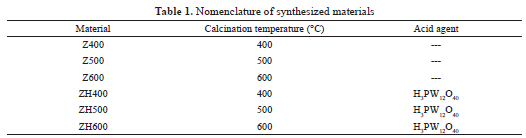
<body><![CDATA[<p><font size="3" face="Verdana, Arial, Helvetica, sans-serif"><b>2.  EXPERIMENTAL METHOD</b></font></p> 		    <p><b><font size="2" face="Verdana, Arial, Helvetica, sans-serif">2.1.  Material synthesis    <br> 		</font></b><font size="2" face="Verdana, Arial, Helvetica, sans-serif">The synthesis of zirconium hydroxide &#91;Zr(OH)<sub>4</sub>&#93; was made by the sol-gel method as previously indicated &#91;20&#93;. The impregnation of Zr(OH)<sub>4</sub> with the acid agent was performed by the incipient wetness method using a H<sub>3</sub>PW<sub>12</sub>O<sub>40</sub>/ethanol solution, adding the required volume of this solution to obtain a catalytic support with 15% by weight of the dopant agent. Pure and modified hydroxides were dried at 100&deg;C for 24 h and afterwards they were calcined under dynamic air atmosphere during 3 h at 400, 500 and 600&deg;C. Taking calcination temperature and acid agent as reference, <a href="#tab01">Table 1</a> lists the nomenclature used throughout this work.</font></p> 	    <p align="center"><font size="2" face="Verdana, Arial, Helvetica, sans-serif"><a name="tab01"></a></font><img src="/img/revistas/dyna/v81n183/v81n183a12tab01.gif" width="526" height="138"></p> 		    <p><font size="2" face="Verdana, Arial, Helvetica, sans-serif"><b>2.2.  Characterization techniques    <br> 		</b></font><font size="2" face="Verdana, Arial, Helvetica, sans-serif">The characterization of synthesized materials was carried out by thermogravimetry, infrared spectroscopy, X-ray diffraction and nitrogen physisorption.</font></p> 		    <p><font size="2" face="Verdana, Arial, Helvetica, sans-serif">Thermal analyses were performed in the thermogravimetric instrument TA Instruments STD 2960 Simultaneous DSC-TGA. The samples were analyzed under dry air flow (10 mL/min) at a heating rate of 10&ordm;C/min in the temperature interval from ambient up to 900&ordm;C.</font></p> 	    <p><font size="2" face="Verdana, Arial, Helvetica, sans-serif">Infrared spectroscopy was carried out in a Fourier Transform Spectrometer (Perkin-Elmer Spectrum One) with transparent wafers containing the sample to be analyzed and KBr as a binder. Spectra were recorded at a resolution of 4 cm-1 and by co-adding 16 scans.</font></p> 		    <p><font size="2" face="Verdana, Arial, Helvetica, sans-serif">The crystalline structure of zirconium oxides was determined in a Bruker Advance D800 diffractometer which used Cu K&alpha; radiation (&lambda; = 1.5406 &#506;) and graphite monochromator in the secondary beam; the intensities of the diffraction lines were obtained in the range of 0-70&deg; in the 2&theta; scale, with 0.02&deg; steps and 2.4 s per point.</p> </font> 		    <p><font size="2" face="Verdana, Arial, Helvetica, sans-serif">Nitrogen physisorption was used to determine the specific surface areas of the materials at the temperature of liquid nitrogen (-196&deg;C) in a Quantachrome Autosorb-1 instrument. Prior to the measurements, samples were outgassed at 350&deg;C for 2 h. The specific surface area was calculated using the BET equation and the BJH method was used to calculate the average pore diameter and the pore volume of the samples.</p> </font> 		    ]]></body>
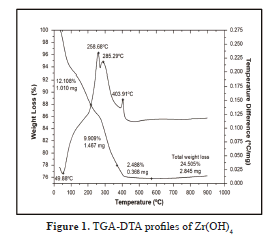
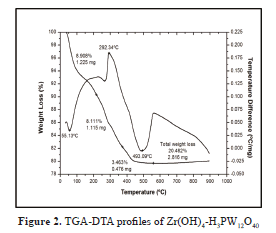
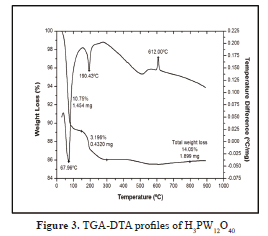
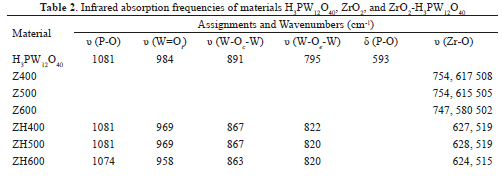
<body><![CDATA[<p>&nbsp;</p> 		    <p><font size="3" face="Verdana, Arial, Helvetica, sans-serif"><b>3.  RESULTS AND DISSCUSION </b></font></p> 		    <p><font size="2" face="Verdana, Arial, Helvetica, sans-serif"><b>3.1.  Thermal analysis    <br> 		</b></font><font size="2" face="Verdana, Arial, Helvetica, sans-serif">By means of thermogravimetry, the physical and chemical processes developed in the synthesized zirconium hydroxides (Zr(OH)<sub>4</sub> and Zr(OH)<sub>4</sub>-H<sub>3</sub>PW<sub>12</sub>O<sub>40</sub>) versus thermal treatment temperature were studied.</p> </font> 	        <p><font size="2" face="Verdana, Arial, Helvetica, sans-serif">In the thermogravimetric profile of <a href="#fig01">Figure 1</a> that corresponds to Zr(OH)<sub>4</sub>, multiple-stage decomposition of material can be seen, with three important weight losses. The first one is recorded in the interval of temperature from ambient to 200&deg;C, and is related with the evaporation of water and alcohol that remain from synthesis, occluded up to that moment in the material's porous structure, in the curve of thermodifferential analysis such material releases are shown as endothermal signals near 50&deg;C and 200&deg;C &#91;10&#93;. The second weight loss is detected in the temperature range from 200&deg;C to 370&deg;C and is attributable to the combustion process of residual organic matter, related with the exothermal signals located at 258&deg;C and 285&deg;C in the thermodifferential profile. The last stage of weight loss recorded above 370&deg;C could be related to de-hydroxylation of the material and the possible change of zirconium oxide from the amorphous to crystalline phase &#91;10,22&#93;; the thermodifferential analysis showed an exothermal change at 404&deg;C during this weight loss. The transformation to zirconium hydroxide led to a total weight loss of 24%, which stabilized after 500&deg;C.</p> </font> 	    <p align="center"><font size="2" face="Verdana, Arial, Helvetica, sans-serif"><a name="fig01"></a></font><img src="/img/revistas/dyna/v81n183/v81n183a12fig01.gif" width="273" height="239"></p> 	    <p><font size="2" face="Verdana, Arial, Helvetica, sans-serif">The thermograms of <a href="#fig02">Figure 2</a> corresponding to sample Zr(OH)<sub>4</sub>-H<sub>3</sub>PW<sub>12</sub>O<sub>40</sub>, show a behavior similar to the thermograms of Zr(OH)<sub>4</sub>, with a slight shift in temperatures at which the physical and chemical processes previously described occur, which indicates the presence of a different specie in the Zr(OH)<sub>4</sub>. The broad endothermal change centered at 493&deg;C is attributable to a slow transition from the amorphous state of the material to a crystalline state, probably caused by the interaction between the heteropolyanion (&#91;PW<sub>12</sub>O<sub>40</sub>&#93;<sup>3-</sup>) and zirconium atoms.</font></p> 		    <p align="center"><font size="2" face="Verdana, Arial, Helvetica, sans-serif"><a name="fig02"></a></font><img src="/img/revistas/dyna/v81n183/v81n183a12fig02.gif" width="276" height="233"></p> 		    <p><font size="2" face="Verdana, Arial, Helvetica, sans-serif"><a href="#fig03">Figure 3</a> shows the thermogravimetric and thermodifferential analysis for phosphotungstic acid (H<sub>3</sub>PW<sub>12</sub>O<sub>40</sub>). The curve of the thermogravimetric analysis shows that the most important transitions of weight loss for this material are located in the range from ambient temperature to 300&deg;C. The thermodifferential analysis profile shows endothermal signals near 68&deg;C and 190&deg;C that are result of the elimination of physisorbed and structural water contained in the heteropolyacid. The exothermal peak located at 612&deg;C is characteristic of this material and is related with the decomposition of its Keggin structure in oxides of tungsten and tungsten-phosphorus &#91;23&#93;, this change takes place without weight loss.</font></p> 	    <p align="center"><font size="2" face="Verdana, Arial, Helvetica, sans-serif"><a name="fig03"></a></font><img src="/img/revistas/dyna/v81n183/v81n183a12fig03.gif" width="268" height="236"></p> 		    ]]></body>
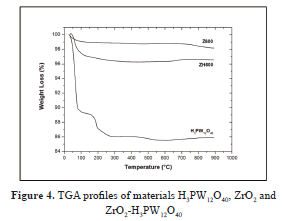
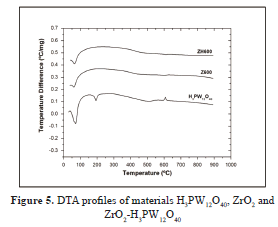
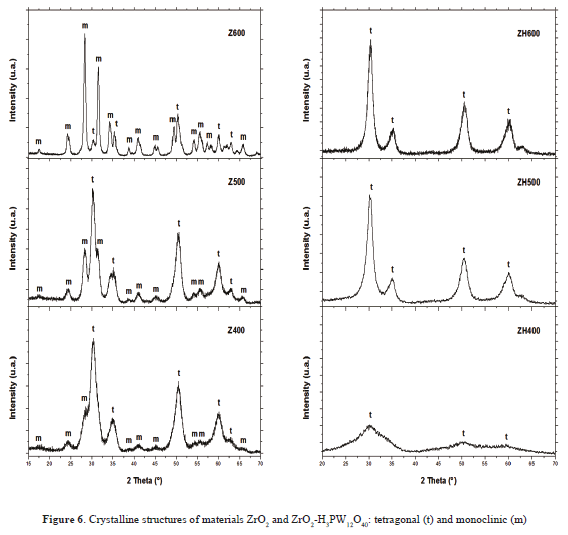
<body><![CDATA[<p><font size="2" face="Verdana, Arial, Helvetica, sans-serif">Thermal analyses of samples Z600 and ZH600 showed a very similar behavior between them. In the thermogravimetric analyses it can be noted that calcined materials have a fast initial weight loss characteristic of a desorption or drying process, this weight loss is not very significant and it was approximately 4% (<a href="#fig04">Figure 4</a>). The endothermal signal for these catalytic solids observed in the thermodifferencial analysis curve near the temperature of 60&deg;C is associated with the evacuation of physisorbed water in the solid surface, after this change, the materials appeared to be thermally stable up to 900&deg;C (<a href="#fig05">Figure 5</a>). Some studies reported that degradation or transformation of heteropolyacid (H<sub>3</sub>PW<sub>12</sub>O<sub>40</sub>) supported in ZrO<sub>2 </sub>occurs at temperatures greater than 500&deg;C &#91;24&#93;, nevertheless, in this work there were no evidence of changes related to this transformation, this fact could be related to the interaction  between the heteropolyanion and the ZrO<sub>2</sub> surface. Thermal analyses performed by Ivanov et al. &#91;23&#93; to H<sub>3</sub>PW<sub>12</sub>O<sub>40</sub> and the H<sub>3</sub>PW<sub>12</sub>O<sub>40</sub>/ZrO<sub>2 </sub>system showed that the decomposition temperature of heteropolyacid is located around 612&deg;C, however, for the H<sub>3</sub>PW<sub>12</sub>O<sub>40</sub>/ZrO<sub>2</sub> system there were no changes attributable to heteropolyacid and with this can be corroborated the high stability of the material, which coincides with results obtained in the present work.</font></p> 	    <p align="center"><font size="2" face="Verdana, Arial, Helvetica, sans-serif"><a name="fig04"></a></font><img src="/img/revistas/dyna/v81n183/v81n183a12fig04.gif" width="282" height="221"></p> 		    <p align="center"><font size="2" face="Verdana, Arial, Helvetica, sans-serif"><a name="fig05"></a></font><img src="/img/revistas/dyna/v81n183/v81n183a12fig05.gif" width="278" height="227"></p> 		    <p><font size="2" face="Verdana, Arial, Helvetica, sans-serif"><b>3.2.  Infrared spectroscopy    <br> 		</b></font><font size="2" face="Verdana, Arial, Helvetica, sans-serif"><a href="#tab02">Table 2</a> summarizes the most important data of infrared spectroscopy analyses carried out to heteropolyacid and to synthesized zirconium oxides. The infrared spectroscopy study of phosphotungstic acid with a Keggin structure (H<sub>3</sub>PW<sub>12</sub>O<sub>40</sub>) consists of five characteristic bands in the zone 1100-400 cm<sup>-1</sup>: 1081, 984, 891, 795, and 593 cm<sup>-1</sup>. The position of these bands can be assigned, in turn, to the stretching vibrations associated to P-O, W=O, W-O-W bonds and to the bending vibration movement of in and out of the plane caused by P-O bonds, respectively &#91;25&#93;. These signals show a slight shift when heteropolyacid is introduced in the matrix of zirconium oxide, suggesting a strong interaction between the heteropolyanion coming from H<sub>3</sub>PW<sub>12</sub>O<sub>40</sub> and the oxide surface. Although the bands slightly change in position, they do not disappear from this spectrum, only those that coincide with the absorption bandwidths shown by pure zirconium oxide in the region 750-500 cm<sup>-1</sup> overlap. These signals associated to Zr-O stretching also slightly modify their position; this is possibly caused by material re-crystallization &#91;26&#93;. In the synthesized oxides also there are signals located at 3500 and 1620 cm<sup>-1</sup>, related with some hydroxyl groups that exist after the calcination process &#91;27&#93;. The hydroxyl groups  contained in Zr(OH)<sub>4</sub> at the moment of impregnation are responsible for the fixation and stabilization of the heteropolyanion in zirconium oxide.</font></p> 		    <p align="center"><font size="2" face="Verdana, Arial, Helvetica, sans-serif"><a name="tab02"></a></font><img src="/img/revistas/dyna/v81n183/v81n183a12tab02.gif" width="502" height="177"></p> 		    <p><font size="2" face="Verdana, Arial, Helvetica, sans-serif"><b>3.3.  X-ray diffraction</b>    <br> 		</font><font size="2" face="Verdana, Arial, Helvetica, sans-serif">By means of X-ray diffraction the crystallization process of materials thermally treated in the temperature interval between 400&deg;C and 600&deg;C was studied. <a href="#fig06">Figure 6</a> shows the development of crystalline structures as a function of thermal treatment temperature. In the diffraction patterns of pure zirconium oxide it can be noted that the material Z400 is mainly composed of tetragonal crystalline structure according to pattern card number JCPDS #80-2155. Also low intensity signals are seen at 2&theta; = 17.55, 24.52, 28.24, 31.53, 38.61, 41.22, 45.59, 54.10, 55.54 and 65.75&deg; that characterize the existence of zirconium oxide with a monoclinic structure if compared to card number JCPDS #7-3430. These signals intensify as the calcination temperature increases, showing an almost completely monoclinic structure in the material Z600, and the full transformation of this structure at temperatures higher than 600&deg;C can be predicted. With these results it can be concluded that the concentration of the crystalline phases in pure zirconium oxide depends mainly on the thermal treatment temperature.</p> </font> 	        <p align="center"><font size="2" face="Verdana, Arial, Helvetica, sans-serif"><a name="fig06"></a></font><img src="/img/revistas/dyna/v81n183/v81n183a12fig06.gif" width="568" height="535"></p>         <p><font size="2" face="Verdana, Arial, Helvetica, sans-serif">The X-ray diffraction patterns of zirconium oxide modified with phosphotungstic acid are different to those of pure zirconium oxide. In these materials there could be seen only reflections at 30.25, 35.10, 50.41, and 60.02&deg; in the 2&theta; scale that are characteristic of the formation of zirconium oxide with a tetragonal structure. The material ZH400 shows an X-ray diffraction pattern with incipient signals of very wide bases that are characteristic of materials with poor crystallinity. The increase in calcination temperature generates an intensification of signals shown in diffractograms of materials ZH500 and ZH600, which is related to an increase in crystallite size. The absence of diffraction lines associated to phosphotungstic acid in materials ZH400, ZH500 and ZH600 could be related to the good dispersion ability of the acid agent in zirconium oxide as well as with its low concentration.</font></p> 	    ]]></body>
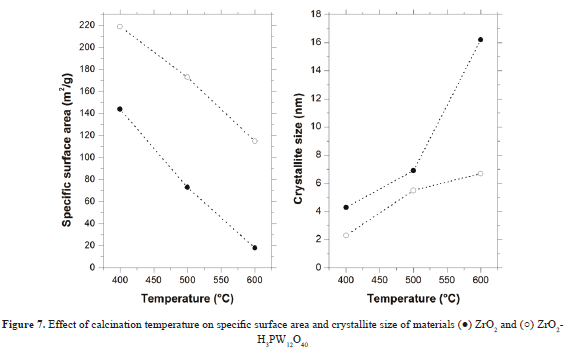
<body><![CDATA[<p><font size="2" face="Verdana, Arial, Helvetica, sans-serif">The relationship between crystallite size and diffraction line width is given by the Scherrer formula. By means of equation (1) it was possible to estimate the crystallite sizes for the synthesized materials, knowing that &lambda; is the wavelength radiation used (&lambda; = 1.5406 &#506;), &theta; is the Bragg angle and &beta; is the line width at half maximum height.</font></p> 		    <p><img src="/img/revistas/dyna/v81n183/v81n183a12eq01.gif" width="275" height="41"></p> 		    <p><font size="2" face="Verdana, Arial, Helvetica, sans-serif">In <a href="#fig06">Figure 6</a> the crystallite sizes obtained with ZrO<sub>2</sub> and ZrO<sub>2</sub>-H<sub>3</sub>PW<sub>12</sub>O<sub>40</sub> calcined at different temperatures are shown. It was found that before the complete transformation from the tetragonal to the monoclinic structure take place, the crystallite size of pure zirconium oxide was between 4 and 16 nm. The Figure shows a sudden increase in the crystallite size for this material, which depends on the thermal treatment temperature. The crystallite size difference between pure oxide and the modified material with phosphotungstic acid is remarkable. The interaction between heteropolyanion and zirconium atoms limits solid state diffusion and delays crystal growth &#91;28&#93;, obtaining values between 2 and 7 nm, making the influence of calcination temperature on this parameter less significant.</font></p> 	        <p><font size="2" face="Verdana, Arial, Helvetica, sans-serif"><b>3.4.  Nitrogen physisorption</b>    <br> 	    <a href="#fig07">Figure 7</a> shows specific surface areas of synthesized materials and their evolution according to thermal treatment temperature. Zirconium hydroxide &#91;Zr(OH)<sub>4</sub>&#93; showed a specific surface area of 595 m<sup>2</sup>/g, which decreases to 144 m<sup>2</sup>/g when the calcination temperature of the material reaches 400&deg;C. It is worth mentioning that major physical and chemical changes of the samples take place during thermal treatment, in the range between 100 and 400&deg;C, which lead to a sudden decrease in the specific surface area.</p> </font>         <p align="center"><font size="2" face="Verdana, Arial, Helvetica, sans-serif"><a name="fig07"></a></font><img src="/img/revistas/dyna/v81n183/v81n183a12fig07.gif" width="569" height="355"></p>     <p><font size="2" face="Verdana, Arial, Helvetica, sans-serif">The material's sintering process that occurs after 400&deg;C causes a decrease of 88% in the specific surface area. Impregnation of Zr(OH)<sub>4</sub> with phosphotungstic acid showed a beneficial effect on specific surface areas obtained in the materials after the calcination process. The presence of a dopant agent reduces the loss of the material's specific surface area in the studied temperature range. Therefore, material modified with phosphotungstic acid and calcined at 600&deg;C (ZH600) surpasses by up to six times the specific surface area value obtained with pure zirconium oxide calcined at the same temperature (Z600).</font></p>     <p>&nbsp;</p> 		    <p><font size="3" face="Verdana, Arial, Helvetica, sans-serif"><b>4.  CONCLUSIONS</b></font></p>     <p><font size="2" face="Verdana, Arial, Helvetica, sans-serif">With the addition of phosphotungstic acid in the phase of hydroxide precursor, the crystallization behavior of zirconium oxide was modified. The presence of heteropolyanion in zirconium oxide inhibited monoclinic structure formation, limited diffusion in the solid state, favored stability of the tetragonal structure in the interval of temperatures studied, delayed crystal growth and also encouraged development of nanocrystalline materials with high specific surface area values. The heteropolyanion coming from phosphotungstic acid caused a thermal stability effect similar to the one obtained with SO<sub>4</sub><sup>2-</sup>, PO<sub>4</sub><sup>2-</sup> and BO<sub>3</sub><sup>3-</sup> ions and some metal cations like Y<sup>3+</sup>, La<sup>3+</sup> and Ce<sup>4+</sup>.</font></p>     ]]></body>

<body><![CDATA[<p>&nbsp;</p> 		    <p><font size="3" face="Verdana, Arial, Helvetica, sans-serif"><b>ACKNOWLEDGEMENTS</b></font></p>     <p><font size="2" face="Verdana, Arial, Helvetica, sans-serif">The authors are grateful to Divisi&oacute;n de Estudios de Posgrado e Investigaci&oacute;n at the Instituto Tecnol&oacute;gico de Ciudad Madero for the support given during the stage of post-doctoral studies, from which this research work was taken.</font></p>     <p>&nbsp;</p> 		    <p><font size="3" face="Verdana, Arial, Helvetica, sans-serif"><b>REFERENCES</b></font></p>     <p><font size="2" face="Verdana, Arial, Helvetica, sans-serif">    <!-- ref --><p><b>&#91;1&#93;</b>  Ready, B. M. and Khan, A., Recent advances on TiO<sub>2</sub>-ZrO<sub>2</sub> mixed oxides as catalysts and catalyst supports, Catal. Rev., 47, pp. 257-296, 2005.    &nbsp;&nbsp;&nbsp;&nbsp;&nbsp;&nbsp;&nbsp;&nbsp;[&#160;<a href="javascript:void(0);" onclick="javascript: window.open('/scielo.php?script=sci_nlinks&ref=000079&pid=S0012-7353201400010001200001&lng=','','width=640,height=500,resizable=yes,scrollbars=1,menubar=yes,');">Links</a>&#160;]<!-- end-ref --></p>       <!-- ref --><p><b>&#91;2&#93;</b>  Mercera, P. D. L., Van Ommen, J. G., Doesburg, E. B. M., Burggraaf, A. J. and Ross, J. R. H., Stabilized tetragonal zirconium oxide as a support for catalysts. Evolution of the texture and structure on calcination in static air, Appl. Catal., 78, pp. 79-96, 1991.    &nbsp;&nbsp;&nbsp;&nbsp;&nbsp;&nbsp;&nbsp;&nbsp;[&#160;<a href="javascript:void(0);" onclick="javascript: window.open('/scielo.php?script=sci_nlinks&ref=000081&pid=S0012-7353201400010001200002&lng=','','width=640,height=500,resizable=yes,scrollbars=1,menubar=yes,');">Links</a>&#160;]<!-- end-ref --></p>       ]]></body>
<body><![CDATA[<!-- ref --><p><b>&#91;3&#93;</b> Restrepo, G., Marín, J. M., Ríos, L., Macías, M. y Navío, J. A., Síntesis, caracterización y evaluación fotocatalítica de sistemas ZrO<sub>2</sub>-SiO<sub>2</sub>, Dyna, 73 (150), pp. 67-74, 2006.    &nbsp;&nbsp;&nbsp;&nbsp;&nbsp;&nbsp;&nbsp;&nbsp;[&#160;<a href="javascript:void(0);" onclick="javascript: window.open('/scielo.php?script=sci_nlinks&ref=000083&pid=S0012-7353201400010001200003&lng=','','width=640,height=500,resizable=yes,scrollbars=1,menubar=yes,');">Links</a>&#160;]<!-- end-ref --></p>       <!-- ref --><p><b>&#91;4&#93;</b>  Chary, K. V. R., Seela, K. K., Naresh, D. and Ramakanth, P., Characterization and reductive amination of cyclohexanol and cyclohexanone over Cu/ZrO<sub>2</sub> catalysts, Catal. Commun., 9, pp. 75-81, 2008.    &nbsp;&nbsp;&nbsp;&nbsp;&nbsp;&nbsp;&nbsp;&nbsp;[&#160;<a href="javascript:void(0);" onclick="javascript: window.open('/scielo.php?script=sci_nlinks&ref=000085&pid=S0012-7353201400010001200004&lng=','','width=640,height=500,resizable=yes,scrollbars=1,menubar=yes,');">Links</a>&#160;]<!-- end-ref --></p>       <!-- ref --><p><b>&#91;5&#93;</b>  Senso, N., Jongsomjit, B. and Praserthdam, P., Effect of calcination treatment of zirconia on W/ZrO<sub>2</sub> catalysts for transesterification, Fuel Process. Technol., 92, pp. 1537-1542, 2011.    &nbsp;&nbsp;&nbsp;&nbsp;&nbsp;&nbsp;&nbsp;&nbsp;[&#160;<a href="javascript:void(0);" onclick="javascript: window.open('/scielo.php?script=sci_nlinks&ref=000087&pid=S0012-7353201400010001200005&lng=','','width=640,height=500,resizable=yes,scrollbars=1,menubar=yes,');">Links</a>&#160;]<!-- end-ref --></p>       <!-- ref --><p><b>&#91;6&#93;</b>  Lavrenov, A. V., Bogdanets, E. N. and Duplyakin, V. K., Solid acid alkylation of isobutane by butenes: the path from the ascertainment of the reasons for fast deactivation to the technological execution of the process, Catalysis in Industry, 1 (1), pp. 50-60, 2009.    &nbsp;&nbsp;&nbsp;&nbsp;&nbsp;&nbsp;&nbsp;&nbsp;[&#160;<a href="javascript:void(0);" onclick="javascript: window.open('/scielo.php?script=sci_nlinks&ref=000089&pid=S0012-7353201400010001200006&lng=','','width=640,height=500,resizable=yes,scrollbars=1,menubar=yes,');">Links</a>&#160;]<!-- end-ref --></p>       <!-- ref --><p><b>&#91;7&#93;</b>  Sato, S., Takahashi, R., Yamamoto, N., Kaneko, E. and Inoue, H., Vapor-phase dehydration of 1,5-pentanediol into 4-penten-1-ol, Appl. Catal. A, 334, pp. 84-91, 2008.    &nbsp;&nbsp;&nbsp;&nbsp;&nbsp;&nbsp;&nbsp;&nbsp;[&#160;<a href="javascript:void(0);" onclick="javascript: window.open('/scielo.php?script=sci_nlinks&ref=000091&pid=S0012-7353201400010001200007&lng=','','width=640,height=500,resizable=yes,scrollbars=1,menubar=yes,');">Links</a>&#160;]<!-- end-ref --></p>       ]]></body>
<body><![CDATA[<!-- ref --><p><b>&#91;8&#93;</b>  Brown, A. S. C. and Hargreaves, J. S. J., Methane combustion in the presence of zirconia-based catalysts, Top. Catal., 52, pp. 458-463, 2009.    &nbsp;&nbsp;&nbsp;&nbsp;&nbsp;&nbsp;&nbsp;&nbsp;[&#160;<a href="javascript:void(0);" onclick="javascript: window.open('/scielo.php?script=sci_nlinks&ref=000093&pid=S0012-7353201400010001200008&lng=','','width=640,height=500,resizable=yes,scrollbars=1,menubar=yes,');">Links</a>&#160;]<!-- end-ref --></p>       <!-- ref --><p><b>&#91;9&#93;</b>  Yung, M. M., Zhao, Z., Woods, M. P. and Ozkan, U. S., Preferential oxidation of carbon monoxide on CoOx/ZrO<sub>2</sub>, J. Mol. Catal. A, 279, pp. 1-9, 2008.    &nbsp;&nbsp;&nbsp;&nbsp;&nbsp;&nbsp;&nbsp;&nbsp;[&#160;<a href="javascript:void(0);" onclick="javascript: window.open('/scielo.php?script=sci_nlinks&ref=000095&pid=S0012-7353201400010001200009&lng=','','width=640,height=500,resizable=yes,scrollbars=1,menubar=yes,');">Links</a>&#160;]<!-- end-ref --></p>       <!-- ref --><p><b>&#91;10&#93;</b> Hernández, J. M., García, L. A., García, R., Cortez, L. A. y Cueto, A., Síntesis, caracterización y evaluación catalítica de un ZrO<sub>2</sub> con fase monoclínica, Superficies y Vacío, 22 (2), pp. 1-9, 2009.    &nbsp;&nbsp;&nbsp;&nbsp;&nbsp;&nbsp;&nbsp;&nbsp;[&#160;<a href="javascript:void(0);" onclick="javascript: window.open('/scielo.php?script=sci_nlinks&ref=000097&pid=S0012-7353201400010001200010&lng=','','width=640,height=500,resizable=yes,scrollbars=1,menubar=yes,');">Links</a>&#160;]<!-- end-ref --></p>       <!-- ref --><p><b>&#91;11&#93;</b> Quiñones, J. y Lee, Y., Zirconia en polvo de alta área superficial: influencia de los parámetros de síntesis, Rev. LatinAm. Metal. Mater., 21 (1), pp. 12-17, 2001.    &nbsp;&nbsp;&nbsp;&nbsp;&nbsp;&nbsp;&nbsp;&nbsp;[&#160;<a href="javascript:void(0);" onclick="javascript: window.open('/scielo.php?script=sci_nlinks&ref=000099&pid=S0012-7353201400010001200011&lng=','','width=640,height=500,resizable=yes,scrollbars=1,menubar=yes,');">Links</a>&#160;]<!-- end-ref --></p>       <!-- ref --><p><b>&#91;12&#93;</b>  Heshmatpour, F. and Aghakhanpour, R. B., Synthesis and characterization of superfine pure tetragonal nanocrystalline sulfated zirconia powder by a non-alcoxide sol-gel route, Adv. Powder Technol., 23, pp. 80-87, 2012.    &nbsp;&nbsp;&nbsp;&nbsp;&nbsp;&nbsp;&nbsp;&nbsp;[&#160;<a href="javascript:void(0);" onclick="javascript: window.open('/scielo.php?script=sci_nlinks&ref=000101&pid=S0012-7353201400010001200012&lng=','','width=640,height=500,resizable=yes,scrollbars=1,menubar=yes,');">Links</a>&#160;]<!-- end-ref --></p>       ]]></body>
<body><![CDATA[<!-- ref --><p><b>&#91;13&#93;</b> Colón, G., Navío, J. A., Macías, M., Hidalgo, M. C. y Sánchez, P. J., Procedimiento para la obtención de polvos nanométricos de óxido de circonio con modificación de su superficie específica y estructura tetragonal estable, Patente Española ES 2 190 300 B1, 2004.    &nbsp;&nbsp;&nbsp;&nbsp;&nbsp;&nbsp;&nbsp;&nbsp;[&#160;<a href="javascript:void(0);" onclick="javascript: window.open('/scielo.php?script=sci_nlinks&ref=000103&pid=S0012-7353201400010001200013&lng=','','width=640,height=500,resizable=yes,scrollbars=1,menubar=yes,');">Links</a>&#160;]<!-- end-ref --></p>       <!-- ref --><p><b>&#91;14&#93;</b> Kazemi, F., Saberi, A., Malek Ahmadi, S., Sohrabi, S., Rezaie, H. R. et al, A novel method for synthesis of metastable tetragonal zirconia nanopowders at low temperatures, Ceramics-Silikáty, 55 (1), pp. 26-30, 2011.    &nbsp;&nbsp;&nbsp;&nbsp;&nbsp;&nbsp;&nbsp;&nbsp;[&#160;<a href="javascript:void(0);" onclick="javascript: window.open('/scielo.php?script=sci_nlinks&ref=000105&pid=S0012-7353201400010001200014&lng=','','width=640,height=500,resizable=yes,scrollbars=1,menubar=yes,');">Links</a>&#160;]<!-- end-ref --></p>       <!-- ref --><p><b>&#91;15&#93;</b>  Suh, Y. W., Lee, J. W. and Rhee, H. K., Synthesis of thermally stable tetragonal zirconia with large surface area and its catalytic activity in the skeletal isomerization of 1-butene, Catal. Lett., 90 (1-2), pp. 103-109, 2003.    &nbsp;&nbsp;&nbsp;&nbsp;&nbsp;&nbsp;&nbsp;&nbsp;[&#160;<a href="javascript:void(0);" onclick="javascript: window.open('/scielo.php?script=sci_nlinks&ref=000107&pid=S0012-7353201400010001200015&lng=','','width=640,height=500,resizable=yes,scrollbars=1,menubar=yes,');">Links</a>&#160;]<!-- end-ref --></p>       <!-- ref --><p><b>&#91;16&#93;</b>  Cao, Y., Hu, J. Ch., Hong, Z. S., Deng, J. F. and Fan, K. N., Characterization of high-surface-area zirconia aerogel synthesized from combined alcohothermal and supercritical fluid drying techniques, Catal. Lett., 81 (1-2), pp. 107-112, 2002.    &nbsp;&nbsp;&nbsp;&nbsp;&nbsp;&nbsp;&nbsp;&nbsp;[&#160;<a href="javascript:void(0);" onclick="javascript: window.open('/scielo.php?script=sci_nlinks&ref=000109&pid=S0012-7353201400010001200016&lng=','','width=640,height=500,resizable=yes,scrollbars=1,menubar=yes,');">Links</a>&#160;]<!-- end-ref --></p>       <!-- ref --><p><b>&#91;17&#93;</b>  Chen, F., Zhu, K., Huang, L., Chen, Y. and Kooli, F., Preparation of rodlike t-ZrO<sub>2</sub> nanoparticles by two-step calcination of 1,12-diaminododecane-zirconia mesostructured composites, Mater. Res. Bull., 41, pp. 10-18, 2006.    &nbsp;&nbsp;&nbsp;&nbsp;&nbsp;&nbsp;&nbsp;&nbsp;[&#160;<a href="javascript:void(0);" onclick="javascript: window.open('/scielo.php?script=sci_nlinks&ref=000111&pid=S0012-7353201400010001200017&lng=','','width=640,height=500,resizable=yes,scrollbars=1,menubar=yes,');">Links</a>&#160;]<!-- end-ref --></p>       ]]></body>
<body><![CDATA[<!-- ref --><p><b>&#91;18&#93;</b>  Yadav, G. D. and Nair, J. J., Sulfated zirconia and its modified version as promising catalysts for industrial processes, Micropor. Mesopor. Mater., 33, pp. 1-48, 1999.    &nbsp;&nbsp;&nbsp;&nbsp;&nbsp;&nbsp;&nbsp;&nbsp;[&#160;<a href="javascript:void(0);" onclick="javascript: window.open('/scielo.php?script=sci_nlinks&ref=000113&pid=S0012-7353201400010001200018&lng=','','width=640,height=500,resizable=yes,scrollbars=1,menubar=yes,');">Links</a>&#160;]<!-- end-ref --></p>       <!-- ref --><p><b>&#91;19&#93;</b>  Mekhemer, G. A. H., Characterization of phosphate zirconia by XRD, Raman and IR spectroscopy, Colloids Surf. A, 141, pp. 227-235, 1998.    &nbsp;&nbsp;&nbsp;&nbsp;&nbsp;&nbsp;&nbsp;&nbsp;[&#160;<a href="javascript:void(0);" onclick="javascript: window.open('/scielo.php?script=sci_nlinks&ref=000115&pid=S0012-7353201400010001200019&lng=','','width=640,height=500,resizable=yes,scrollbars=1,menubar=yes,');">Links</a>&#160;]<!-- end-ref --></p>       <!-- ref --><p><b>&#91;20&#93;</b> Hernández, J. M., Cortez, L. A., García, R., Castillo, A., Sandoval, G. et al, Synthesis and characterization of mesoporous and nano-crystalline phosphate zirconium oxide, J. Alloys Compd., 483, pp. 425-428, 2009.    &nbsp;&nbsp;&nbsp;&nbsp;&nbsp;&nbsp;&nbsp;&nbsp;[&#160;<a href="javascript:void(0);" onclick="javascript: window.open('/scielo.php?script=sci_nlinks&ref=000117&pid=S0012-7353201400010001200020&lng=','','width=640,height=500,resizable=yes,scrollbars=1,menubar=yes,');">Links</a>&#160;]<!-- end-ref --></p>       <!-- ref --><p><b>&#91;21&#93;</b> Cortez, L. A., Hernández, J. M., Castillo, A., Rivera, J. L., Sandoval, G. et al., Isomerización de n-pentano mediante óxidos de circonio dopados con ion borato, Rev. Mex. Ing. Quim., 5 (3), pp. 321-327, 2006.    &nbsp;&nbsp;&nbsp;&nbsp;&nbsp;&nbsp;&nbsp;&nbsp;[&#160;<a href="javascript:void(0);" onclick="javascript: window.open('/scielo.php?script=sci_nlinks&ref=000119&pid=S0012-7353201400010001200021&lng=','','width=640,height=500,resizable=yes,scrollbars=1,menubar=yes,');">Links</a>&#160;]<!-- end-ref --></p>       <!-- ref --><p><b>&#91;22&#93;</b>  Shibata, K. and Kiyoura, T., Acid property of titania-zirconia, J. Res. Inst. Catalysis, 19 (1), pp. 35-41, 1971.    &nbsp;&nbsp;&nbsp;&nbsp;&nbsp;&nbsp;&nbsp;&nbsp;[&#160;<a href="javascript:void(0);" onclick="javascript: window.open('/scielo.php?script=sci_nlinks&ref=000121&pid=S0012-7353201400010001200022&lng=','','width=640,height=500,resizable=yes,scrollbars=1,menubar=yes,');">Links</a>&#160;]<!-- end-ref --></p>       ]]></body>
<body><![CDATA[<!-- ref --><p><b>&#91;23&#93;</b>  Ivanov, A. V., Vasina, T. V., Nissenbaum, V. D., Kustov, L. M., Timofeeva, M. N. et al, Isomerization of n-hexane on the Pt-promoted Kegging and Dawson tungstophosphoric heteropoly acids supported on zirconia, Appl. Catal. A, 259, pp. 65-72, 2004.    &nbsp;&nbsp;&nbsp;&nbsp;&nbsp;&nbsp;&nbsp;&nbsp;[&#160;<a href="javascript:void(0);" onclick="javascript: window.open('/scielo.php?script=sci_nlinks&ref=000123&pid=S0012-7353201400010001200023&lng=','','width=640,height=500,resizable=yes,scrollbars=1,menubar=yes,');">Links</a>&#160;]<!-- end-ref --></p>       <!-- ref --><p><b>&#91;24&#93;</b> López, E., Hernández, J. G., Schifter, I., Torres, E., Navarrete, J. et al, Thermal stability of 12-tungstophosporic acid supported on zirconia, Appl. Catal. A, 193, pp. 215-225, 2000.    &nbsp;&nbsp;&nbsp;&nbsp;&nbsp;&nbsp;&nbsp;&nbsp;[&#160;<a href="javascript:void(0);" onclick="javascript: window.open('/scielo.php?script=sci_nlinks&ref=000125&pid=S0012-7353201400010001200024&lng=','','width=640,height=500,resizable=yes,scrollbars=1,menubar=yes,');">Links</a>&#160;]<!-- end-ref --></p>       <!-- ref --><p><b>&#91;25&#93;</b>  Haber, J., Pamin, K., Matachowski, L. and Mucha, D., Catalytic performance of the dodecatungstophosphoric acid on different supports, Appl. Catal. A, 256, pp. 141-152, 2003.    &nbsp;&nbsp;&nbsp;&nbsp;&nbsp;&nbsp;&nbsp;&nbsp;[&#160;<a href="javascript:void(0);" onclick="javascript: window.open('/scielo.php?script=sci_nlinks&ref=000127&pid=S0012-7353201400010001200025&lng=','','width=640,height=500,resizable=yes,scrollbars=1,menubar=yes,');">Links</a>&#160;]<!-- end-ref --></p>       <!-- ref --><p><b>&#91;26&#93;</b> López, T., Tzompantzi, F., Hernández, J., Gómez, R., Bokhimi, X. et al., Effect of zirconia precursor on the properties of ZrO<sub>2</sub>-SiO<sub>2</sub> Sol-Gel oxides, J. Sol-Gel. Sci. Technol., 24, pp. 207-219, 2002.    &nbsp;&nbsp;&nbsp;&nbsp;&nbsp;&nbsp;&nbsp;&nbsp;[&#160;<a href="javascript:void(0);" onclick="javascript: window.open('/scielo.php?script=sci_nlinks&ref=000129&pid=S0012-7353201400010001200026&lng=','','width=640,height=500,resizable=yes,scrollbars=1,menubar=yes,');">Links</a>&#160;]<!-- end-ref --></p>       <!-- ref --><p><b>&#91;27&#93;</b> Skoog, D. A. y Leary, J. J., Análisis Instrumental, Mc-Graw Hill, México, pp. 325-328, 2003.    &nbsp;&nbsp;&nbsp;&nbsp;&nbsp;&nbsp;&nbsp;&nbsp;[&#160;<a href="javascript:void(0);" onclick="javascript: window.open('/scielo.php?script=sci_nlinks&ref=000131&pid=S0012-7353201400010001200027&lng=','','width=640,height=500,resizable=yes,scrollbars=1,menubar=yes,');">Links</a>&#160;]<!-- end-ref --></p>       ]]></body>
<body><![CDATA[<!-- ref --><p><b>&#91;28&#93;</b>  Sunita, G., Devassy, B. M., Vinu, A., Sawant, D. P., Balasubramanian, V. V. et al., Synthesis of biodiesel over zirconia-supported isopoly tungstate and heteropoly catalysts, Catal. Commun, 9, pp. 696-702, 2008.    &nbsp;&nbsp;&nbsp;&nbsp;&nbsp;&nbsp;&nbsp;&nbsp;[&#160;<a href="javascript:void(0);" onclick="javascript: window.open('/scielo.php?script=sci_nlinks&ref=000133&pid=S0012-7353201400010001200028&lng=','','width=640,height=500,resizable=yes,scrollbars=1,menubar=yes,');">Links</a>&#160;]<!-- end-ref --></p> </font>      ]]></body><back>
<ref-list>
<ref id="B1">
<label>1</label><nlm-citation citation-type="journal">
<person-group person-group-type="author">
<name>
<surname><![CDATA[Ready]]></surname>
<given-names><![CDATA[B. M.]]></given-names>
</name>
<name>
<surname><![CDATA[Khan]]></surname>
<given-names><![CDATA[A.]]></given-names>
</name>
</person-group>
<article-title xml:lang="en"><![CDATA[Recent advances on TiO2-ZrO2 mixed oxides as catalysts and catalyst supports]]></article-title>
<source><![CDATA[Catal. Rev.]]></source>
<year>2005</year>
<numero>47</numero>
<issue>47</issue>
<page-range>257-296</page-range></nlm-citation>
</ref>
<ref id="B2">
<label>2</label><nlm-citation citation-type="journal">
<person-group person-group-type="author">
<name>
<surname><![CDATA[Mercera]]></surname>
<given-names><![CDATA[P. D. L.]]></given-names>
</name>
<name>
<surname><![CDATA[Van Ommen]]></surname>
<given-names><![CDATA[J. G.]]></given-names>
</name>
<name>
<surname><![CDATA[Doesburg]]></surname>
<given-names><![CDATA[E. B. M.]]></given-names>
</name>
<name>
<surname><![CDATA[Burggraaf]]></surname>
<given-names><![CDATA[A. J.]]></given-names>
</name>
<name>
<surname><![CDATA[Ross]]></surname>
<given-names><![CDATA[J. R. H.]]></given-names>
</name>
</person-group>
<article-title xml:lang="en"><![CDATA[Stabilized tetragonal zirconium oxide as a support for catalysts: Evolution of the texture and structure on calcination in static air]]></article-title>
<source><![CDATA[Appl. Catal.]]></source>
<year>1991</year>
<numero>78</numero>
<issue>78</issue>
<page-range>79-96</page-range></nlm-citation>
</ref>
<ref id="B3">
<label>3</label><nlm-citation citation-type="journal">
<person-group person-group-type="author">
<name>
<surname><![CDATA[Restrepo]]></surname>
<given-names><![CDATA[G.]]></given-names>
</name>
<name>
<surname><![CDATA[Marín]]></surname>
<given-names><![CDATA[J. M.]]></given-names>
</name>
<name>
<surname><![CDATA[Ríos]]></surname>
<given-names><![CDATA[L.]]></given-names>
</name>
<name>
<surname><![CDATA[Macías]]></surname>
<given-names><![CDATA[M.]]></given-names>
</name>
<name>
<surname><![CDATA[Navío]]></surname>
<given-names><![CDATA[J. A.]]></given-names>
</name>
</person-group>
<article-title xml:lang="es"><![CDATA[Síntesis, caracterización y evaluación fotocatalítica de sistemas ZrO2-SiO2,]]></article-title>
<source><![CDATA[Dyna]]></source>
<year>2006</year>
<volume>73</volume>
<numero>150</numero>
<issue>150</issue>
<page-range>67-74</page-range></nlm-citation>
</ref>
<ref id="B4">
<label>4</label><nlm-citation citation-type="journal">
<person-group person-group-type="author">
<name>
<surname><![CDATA[Chary]]></surname>
<given-names><![CDATA[K. V. R.]]></given-names>
</name>
<name>
<surname><![CDATA[Seela]]></surname>
<given-names><![CDATA[K. K.]]></given-names>
</name>
<name>
<surname><![CDATA[Naresh]]></surname>
<given-names><![CDATA[D.]]></given-names>
</name>
<name>
<surname><![CDATA[Ramakanth]]></surname>
<given-names><![CDATA[P.]]></given-names>
</name>
</person-group>
<article-title xml:lang="en"><![CDATA[Characterization and reductive amination of cyclohexanol and cyclohexanone over Cu/ZrO2 catalysts]]></article-title>
<source><![CDATA[Catal. Commun.]]></source>
<year>2008</year>
<numero>9</numero>
<issue>9</issue>
<page-range>75-81</page-range></nlm-citation>
</ref>
<ref id="B5">
<label>5</label><nlm-citation citation-type="journal">
<person-group person-group-type="author">
<name>
<surname><![CDATA[Senso]]></surname>
<given-names><![CDATA[N.]]></given-names>
</name>
<name>
<surname><![CDATA[Jongsomjit]]></surname>
<given-names><![CDATA[B.]]></given-names>
</name>
<name>
<surname><![CDATA[Praserthdam]]></surname>
<given-names><![CDATA[P.]]></given-names>
</name>
</person-group>
<article-title xml:lang="en"><![CDATA[Effect of calcination treatment of zirconia on W/ZrO2 catalysts for transesterification]]></article-title>
<source><![CDATA[Fuel Process. Technol.]]></source>
<year>2011</year>
<numero>92</numero>
<issue>92</issue>
<page-range>1537-1542</page-range></nlm-citation>
</ref>
<ref id="B6">
<label>6</label><nlm-citation citation-type="journal">
<person-group person-group-type="author">
<name>
<surname><![CDATA[Lavrenov]]></surname>
<given-names><![CDATA[A. V.]]></given-names>
</name>
<name>
<surname><![CDATA[Bogdanets]]></surname>
<given-names><![CDATA[E. N.]]></given-names>
</name>
<name>
<surname><![CDATA[Duplyakin]]></surname>
<given-names><![CDATA[V. K.]]></given-names>
</name>
</person-group>
<article-title xml:lang="en"><![CDATA[Solid acid alkylation of isobutane by butenes: the path from the ascertainment of the reasons for fast deactivation to the technological execution of the process]]></article-title>
<source><![CDATA[Catalysis in Industry]]></source>
<year>2009</year>
<volume>1</volume>
<numero>1</numero>
<issue>1</issue>
<page-range>50-60</page-range></nlm-citation>
</ref>
<ref id="B7">
<label>7</label><nlm-citation citation-type="journal">
<person-group person-group-type="author">
<name>
<surname><![CDATA[Sato]]></surname>
<given-names><![CDATA[S.]]></given-names>
</name>
<name>
<surname><![CDATA[Takahashi]]></surname>
<given-names><![CDATA[R.]]></given-names>
</name>
<name>
<surname><![CDATA[Yamamoto]]></surname>
<given-names><![CDATA[N.]]></given-names>
</name>
<name>
<surname><![CDATA[Kaneko]]></surname>
<given-names><![CDATA[E.]]></given-names>
</name>
<name>
<surname><![CDATA[Inoue]]></surname>
<given-names><![CDATA[H.]]></given-names>
</name>
</person-group>
<article-title xml:lang="en"><![CDATA[Vapor-phase dehydration of 1,5-pentanediol into 4-penten-1-ol]]></article-title>
<source><![CDATA[Appl. Catal. A]]></source>
<year>2008</year>
<numero>334</numero>
<issue>334</issue>
<page-range>84-91</page-range></nlm-citation>
</ref>
<ref id="B8">
<label>8</label><nlm-citation citation-type="journal">
<person-group person-group-type="author">
<name>
<surname><![CDATA[Brown]]></surname>
<given-names><![CDATA[A. S. C.]]></given-names>
</name>
<name>
<surname><![CDATA[Hargreaves]]></surname>
<given-names><![CDATA[J. S. J.]]></given-names>
</name>
</person-group>
<article-title xml:lang="en"><![CDATA[Methane combustion in the presence of zirconia-based catalysts]]></article-title>
<source><![CDATA[Top. Catal.]]></source>
<year>2009</year>
<numero>52</numero>
<issue>52</issue>
<page-range>458-463</page-range></nlm-citation>
</ref>
<ref id="B9">
<label>9</label><nlm-citation citation-type="journal">
<person-group person-group-type="author">
<name>
<surname><![CDATA[Yung]]></surname>
<given-names><![CDATA[M. M.]]></given-names>
</name>
<name>
<surname><![CDATA[Zhao]]></surname>
<given-names><![CDATA[Z.]]></given-names>
</name>
<name>
<surname><![CDATA[Woods]]></surname>
<given-names><![CDATA[M. P.]]></given-names>
</name>
<name>
<surname><![CDATA[Ozkan]]></surname>
<given-names><![CDATA[U. S.]]></given-names>
</name>
</person-group>
<article-title xml:lang="en"><![CDATA[Preferential oxidation of carbon monoxide on CoOx/ZrO2]]></article-title>
<source><![CDATA[J. Mol. Catal. A]]></source>
<year>2008</year>
<numero>279</numero>
<issue>279</issue>
<page-range>1-9</page-range></nlm-citation>
</ref>
<ref id="B10">
<label>10</label><nlm-citation citation-type="journal">
<person-group person-group-type="author">
<name>
<surname><![CDATA[Hernández]]></surname>
<given-names><![CDATA[J. M.]]></given-names>
</name>
<name>
<surname><![CDATA[García]]></surname>
<given-names><![CDATA[L. A.]]></given-names>
</name>
<name>
<surname><![CDATA[García]]></surname>
<given-names><![CDATA[R.]]></given-names>
</name>
<name>
<surname><![CDATA[Cortez]]></surname>
<given-names><![CDATA[L. A.]]></given-names>
</name>
<name>
<surname><![CDATA[Cueto]]></surname>
<given-names><![CDATA[A.]]></given-names>
</name>
</person-group>
<article-title xml:lang="es"><![CDATA[Síntesis, caracterización y evaluación catalítica de un ZrO2 con fase monoclínica]]></article-title>
<source><![CDATA[Superficies y Vacío]]></source>
<year>2009</year>
<volume>22</volume>
<numero>2</numero>
<issue>2</issue>
<page-range>1-9</page-range></nlm-citation>
</ref>
<ref id="B11">
<label>11</label><nlm-citation citation-type="journal">
<person-group person-group-type="author">
<name>
<surname><![CDATA[Quiñones]]></surname>
<given-names><![CDATA[J.]]></given-names>
</name>
<name>
<surname><![CDATA[Lee]]></surname>
<given-names><![CDATA[Y.]]></given-names>
</name>
</person-group>
<article-title xml:lang="es"><![CDATA[Zirconia en polvo de alta área superficial: influencia de los parámetros de síntesis]]></article-title>
<source><![CDATA[Rev. LatinAm. Metal. Mater.]]></source>
<year>2001</year>
<volume>21</volume>
<numero>1</numero>
<issue>1</issue>
<page-range>12-17</page-range></nlm-citation>
</ref>
<ref id="B12">
<label>12</label><nlm-citation citation-type="journal">
<person-group person-group-type="author">
<name>
<surname><![CDATA[Heshmatpour]]></surname>
<given-names><![CDATA[F.]]></given-names>
</name>
<name>
<surname><![CDATA[Aghakhanpour]]></surname>
<given-names><![CDATA[R. B.]]></given-names>
</name>
</person-group>
<article-title xml:lang="en"><![CDATA[Synthesis and characterization of superfine pure tetragonal nanocrystalline sulfated zirconia powder by a non-alcoxide sol-gel route]]></article-title>
<source><![CDATA[Adv. Powder Technol.]]></source>
<year>2012</year>
<numero>23</numero>
<issue>23</issue>
<page-range>80-87</page-range></nlm-citation>
</ref>
<ref id="B13">
<label>13</label><nlm-citation citation-type="">
<person-group person-group-type="author">
<name>
<surname><![CDATA[Colón]]></surname>
<given-names><![CDATA[G.]]></given-names>
</name>
<name>
<surname><![CDATA[Navío]]></surname>
<given-names><![CDATA[J. A.]]></given-names>
</name>
<name>
<surname><![CDATA[Macías]]></surname>
<given-names><![CDATA[M.]]></given-names>
</name>
<name>
<surname><![CDATA[Hidalgo]]></surname>
<given-names><![CDATA[M. C.]]></given-names>
</name>
<name>
<surname><![CDATA[Sánchez]]></surname>
<given-names><![CDATA[P. J.]]></given-names>
</name>
</person-group>
<source><![CDATA[Procedimiento para la obtención de polvos nanométricos de óxido de circonio con modificación de su superficie específica y estructura tetragonal estable,: Patente Española ES 2 190 300 B1]]></source>
<year>2004</year>
</nlm-citation>
</ref>
<ref id="B14">
<label>14</label><nlm-citation citation-type="journal">
<person-group person-group-type="author">
<name>
<surname><![CDATA[Kazemi]]></surname>
<given-names><![CDATA[F.]]></given-names>
</name>
<name>
<surname><![CDATA[Saberi]]></surname>
<given-names><![CDATA[A.]]></given-names>
</name>
<name>
<surname><![CDATA[Malek Ahmadi]]></surname>
<given-names><![CDATA[S.]]></given-names>
</name>
<name>
<surname><![CDATA[Sohrabi]]></surname>
<given-names><![CDATA[S.]]></given-names>
</name>
<name>
<surname><![CDATA[Rezaie]]></surname>
<given-names><![CDATA[H. R.]]></given-names>
</name>
</person-group>
<article-title xml:lang="en"><![CDATA[A novel method for synthesis of metastable tetragonal zirconia nanopowders at low temperatures]]></article-title>
<source><![CDATA[Ceramics-Silikáty]]></source>
<year>2011</year>
<volume>55</volume>
<numero>1</numero>
<issue>1</issue>
<page-range>26-30,</page-range></nlm-citation>
</ref>
<ref id="B15">
<label>15</label><nlm-citation citation-type="journal">
<person-group person-group-type="author">
<name>
<surname><![CDATA[Suh]]></surname>
<given-names><![CDATA[Y. W.]]></given-names>
</name>
<name>
<surname><![CDATA[Lee]]></surname>
<given-names><![CDATA[J. W.]]></given-names>
</name>
<name>
<surname><![CDATA[Rhee]]></surname>
<given-names><![CDATA[H. K.]]></given-names>
</name>
</person-group>
<article-title xml:lang="en"><![CDATA[Synthesis of thermally stable tetragonal zirconia with large surface area and its catalytic activity in the skeletal isomerization of 1-butene]]></article-title>
<source><![CDATA[Catal. Lett.]]></source>
<year>2003</year>
<volume>90</volume>
<numero>1-2</numero>
<issue>1-2</issue>
<page-range>103-109</page-range></nlm-citation>
</ref>
<ref id="B16">
<label>16</label><nlm-citation citation-type="journal">
<person-group person-group-type="author">
<name>
<surname><![CDATA[Cao]]></surname>
<given-names><![CDATA[Y.]]></given-names>
</name>
<name>
<surname><![CDATA[Hu]]></surname>
<given-names><![CDATA[J. Ch.]]></given-names>
</name>
<name>
<surname><![CDATA[Hong]]></surname>
<given-names><![CDATA[Z. S.]]></given-names>
</name>
<name>
<surname><![CDATA[Deng]]></surname>
<given-names><![CDATA[J. F.]]></given-names>
</name>
<name>
<surname><![CDATA[Fan]]></surname>
<given-names><![CDATA[K. N.]]></given-names>
</name>
</person-group>
<article-title xml:lang="en"><![CDATA[Characterization of high-surface-area zirconia aerogel synthesized from combined alcohothermal and supercritical fluid drying techniques]]></article-title>
<source><![CDATA[Catal. Lett.]]></source>
<year>2002</year>
<volume>81</volume>
<numero>1-2</numero>
<issue>1-2</issue>
<page-range>107-112</page-range></nlm-citation>
</ref>
<ref id="B17">
<label>17</label><nlm-citation citation-type="journal">
<person-group person-group-type="author">
<name>
<surname><![CDATA[Chen]]></surname>
<given-names><![CDATA[F.]]></given-names>
</name>
<name>
<surname><![CDATA[Zhu]]></surname>
<given-names><![CDATA[K.]]></given-names>
</name>
<name>
<surname><![CDATA[Huang]]></surname>
<given-names><![CDATA[L.]]></given-names>
</name>
<name>
<surname><![CDATA[Chen]]></surname>
<given-names><![CDATA[Y.]]></given-names>
</name>
<name>
<surname><![CDATA[Kooli]]></surname>
<given-names><![CDATA[F.]]></given-names>
</name>
</person-group>
<article-title xml:lang="en"><![CDATA[Preparation of rodlike t-ZrO2 nanoparticles by two-step calcination of 1,12-diaminododecane-zirconia mesostructured composites]]></article-title>
<source><![CDATA[Mater. Res. Bull.]]></source>
<year>2006</year>
<volume>41</volume>
<page-range>10-18</page-range></nlm-citation>
</ref>
<ref id="B18">
<label>18</label><nlm-citation citation-type="journal">
<person-group person-group-type="author">
<name>
<surname><![CDATA[Yadav]]></surname>
<given-names><![CDATA[G. D.]]></given-names>
</name>
<name>
<surname><![CDATA[Nair]]></surname>
<given-names><![CDATA[J. J.]]></given-names>
</name>
</person-group>
<article-title xml:lang="en"><![CDATA[Sulfated zirconia and its modified version as promising catalysts for industrial processes]]></article-title>
<source><![CDATA[Micropor. Mesopor. Mater.]]></source>
<year>1999</year>
<numero>33</numero>
<issue>33</issue>
<page-range>1-48</page-range></nlm-citation>
</ref>
<ref id="B19">
<label>19</label><nlm-citation citation-type="journal">
<person-group person-group-type="author">
<name>
<surname><![CDATA[Mekhemer]]></surname>
<given-names><![CDATA[G. A. H.]]></given-names>
</name>
</person-group>
<article-title xml:lang="en"><![CDATA[Characterization of phosphate zirconia by XRD, Raman and IR spectroscopy]]></article-title>
<source><![CDATA[Colloids Surf. A]]></source>
<year>1998</year>
<numero>141</numero>
<issue>141</issue>
<page-range>227-235</page-range></nlm-citation>
</ref>
<ref id="B20">
<label>20</label><nlm-citation citation-type="journal">
<person-group person-group-type="author">
<name>
<surname><![CDATA[Hernández]]></surname>
<given-names><![CDATA[J. M.]]></given-names>
</name>
<name>
<surname><![CDATA[Cortez]]></surname>
<given-names><![CDATA[L. A.]]></given-names>
</name>
<name>
<surname><![CDATA[García]]></surname>
<given-names><![CDATA[R.]]></given-names>
</name>
<name>
<surname><![CDATA[Castillo]]></surname>
<given-names><![CDATA[A.]]></given-names>
</name>
<name>
<surname><![CDATA[Sandoval]]></surname>
<given-names><![CDATA[G.]]></given-names>
</name>
</person-group>
<article-title xml:lang="en"><![CDATA[Synthesis and characterization of mesoporous and nano-crystalline phosphate zirconium oxide]]></article-title>
<source><![CDATA[J. Alloys Compd.]]></source>
<year>2009</year>
<numero>483</numero>
<issue>483</issue>
<page-range>425-428</page-range></nlm-citation>
</ref>
<ref id="B21">
<label>21</label><nlm-citation citation-type="journal">
<person-group person-group-type="author">
<name>
<surname><![CDATA[Cortez]]></surname>
<given-names><![CDATA[L. A.]]></given-names>
</name>
<name>
<surname><![CDATA[Hernández]]></surname>
<given-names><![CDATA[J. M.]]></given-names>
</name>
<name>
<surname><![CDATA[Castillo]]></surname>
<given-names><![CDATA[A.]]></given-names>
</name>
<name>
<surname><![CDATA[Rivera]]></surname>
<given-names><![CDATA[J. L.]]></given-names>
</name>
<name>
<surname><![CDATA[Sandoval]]></surname>
<given-names><![CDATA[G.]]></given-names>
</name>
</person-group>
<article-title xml:lang="es"><![CDATA[Isomerización de n-pentano mediante óxidos de circonio dopados con ion borato]]></article-title>
<source><![CDATA[Rev. Mex. Ing. Quim.]]></source>
<year>2006</year>
<volume>5</volume>
<numero>3</numero>
<issue>3</issue>
<page-range>321-327</page-range></nlm-citation>
</ref>
<ref id="B22">
<label>22</label><nlm-citation citation-type="journal">
<person-group person-group-type="author">
<name>
<surname><![CDATA[Shibata]]></surname>
<given-names><![CDATA[K.]]></given-names>
</name>
<name>
<surname><![CDATA[Kiyoura]]></surname>
<given-names><![CDATA[T.]]></given-names>
</name>
</person-group>
<article-title xml:lang="en"><![CDATA[Acid property of titania-zirconia]]></article-title>
<source><![CDATA[J. Res. Inst. Catalysis]]></source>
<year>1971</year>
<volume>19</volume>
<numero>1</numero>
<issue>1</issue>
<page-range>35-41</page-range></nlm-citation>
</ref>
<ref id="B23">
<label>23</label><nlm-citation citation-type="journal">
<person-group person-group-type="author">
<name>
<surname><![CDATA[Ivanov]]></surname>
<given-names><![CDATA[A. V.]]></given-names>
</name>
<name>
<surname><![CDATA[Vasina]]></surname>
<given-names><![CDATA[T. V.]]></given-names>
</name>
<name>
<surname><![CDATA[Nissenbaum]]></surname>
<given-names><![CDATA[V. D.]]></given-names>
</name>
<name>
<surname><![CDATA[Kustov]]></surname>
<given-names><![CDATA[L. M.]]></given-names>
</name>
<name>
<surname><![CDATA[Timofeeva]]></surname>
<given-names><![CDATA[M. N.]]></given-names>
</name>
</person-group>
<article-title xml:lang="en"><![CDATA[Isomerization of n-hexane on the Pt-promoted Kegging and Dawson tungstophosphoric heteropoly acids supported on zirconia]]></article-title>
<source><![CDATA[Appl. Catal. A]]></source>
<year>2004</year>
<numero>259</numero>
<issue>259</issue>
<page-range>65-72</page-range></nlm-citation>
</ref>
<ref id="B24">
<label>24</label><nlm-citation citation-type="journal">
<person-group person-group-type="author">
<name>
<surname><![CDATA[López]]></surname>
<given-names><![CDATA[E.]]></given-names>
</name>
<name>
<surname><![CDATA[Hernández]]></surname>
<given-names><![CDATA[J. G.]]></given-names>
</name>
<name>
<surname><![CDATA[Schifter]]></surname>
<given-names><![CDATA[I.]]></given-names>
</name>
<name>
<surname><![CDATA[Torres]]></surname>
<given-names><![CDATA[E.]]></given-names>
</name>
<name>
<surname><![CDATA[Navarrete]]></surname>
<given-names><![CDATA[J.]]></given-names>
</name>
</person-group>
<article-title xml:lang="en"><![CDATA[Thermal stability of 12-tungstophosporic acid supported on zirconia]]></article-title>
<source><![CDATA[Appl. Catal. A]]></source>
<year>2000</year>
<numero>193</numero>
<issue>193</issue>
<page-range>215-225</page-range></nlm-citation>
</ref>
<ref id="B25">
<label>25</label><nlm-citation citation-type="journal">
<person-group person-group-type="author">
<name>
<surname><![CDATA[Haber]]></surname>
<given-names><![CDATA[J.]]></given-names>
</name>
<name>
<surname><![CDATA[Pamin]]></surname>
<given-names><![CDATA[K.]]></given-names>
</name>
<name>
<surname><![CDATA[Matachowski]]></surname>
<given-names><![CDATA[L.]]></given-names>
</name>
<name>
<surname><![CDATA[Mucha]]></surname>
<given-names><![CDATA[D.]]></given-names>
</name>
</person-group>
<article-title xml:lang="en"><![CDATA[Catalytic performance of the dodecatungstophosphoric acid on different supports]]></article-title>
<source><![CDATA[Appl. Catal. A]]></source>
<year>2003</year>
<numero>256</numero>
<issue>256</issue>
<page-range>141-152</page-range></nlm-citation>
</ref>
<ref id="B26">
<label>26</label><nlm-citation citation-type="journal">
<person-group person-group-type="author">
<name>
<surname><![CDATA[López]]></surname>
<given-names><![CDATA[T.]]></given-names>
</name>
<name>
<surname><![CDATA[Tzompantzi]]></surname>
<given-names><![CDATA[F.]]></given-names>
</name>
<name>
<surname><![CDATA[Hernández]]></surname>
<given-names><![CDATA[J.]]></given-names>
</name>
<name>
<surname><![CDATA[Gómez]]></surname>
<given-names><![CDATA[R.]]></given-names>
</name>
<name>
<surname><![CDATA[Bokhimi]]></surname>
<given-names><![CDATA[X.]]></given-names>
</name>
</person-group>
<article-title xml:lang="en"><![CDATA[Effect of zirconia precursor on the properties of ZrO2-SiO2 Sol-Gel oxides]]></article-title>
<source><![CDATA[J. Sol-Gel. Sci. Technol.]]></source>
<year>2002</year>
<numero>24</numero>
<issue>24</issue>
<page-range>207-219</page-range></nlm-citation>
</ref>
<ref id="B27">
<label>27</label><nlm-citation citation-type="book">
<person-group person-group-type="author">
<name>
<surname><![CDATA[Skoog]]></surname>
<given-names><![CDATA[D. A.]]></given-names>
</name>
<name>
<surname><![CDATA[Leary]]></surname>
<given-names><![CDATA[J. J.]]></given-names>
</name>
</person-group>
<source><![CDATA[Análisis Instrumental]]></source>
<year>2003</year>
<page-range>325-328</page-range><publisher-loc><![CDATA[México ]]></publisher-loc>
<publisher-name><![CDATA[Mc-Graw Hill]]></publisher-name>
</nlm-citation>
</ref>
<ref id="B28">
<label>28</label><nlm-citation citation-type="journal">
<person-group person-group-type="author">
<name>
<surname><![CDATA[Sunita]]></surname>
<given-names><![CDATA[G.]]></given-names>
</name>
<name>
<surname><![CDATA[Devassy]]></surname>
<given-names><![CDATA[B. M.]]></given-names>
</name>
<name>
<surname><![CDATA[Vinu]]></surname>
<given-names><![CDATA[A.]]></given-names>
</name>
<name>
<surname><![CDATA[Sawant]]></surname>
<given-names><![CDATA[D. P.]]></given-names>
</name>
<name>
<surname><![CDATA[Balasubramanian]]></surname>
<given-names><![CDATA[V. V.]]></given-names>
</name>
</person-group>
<article-title xml:lang="en"><![CDATA[Synthesis of biodiesel over zirconia-supported isopoly tungstate and heteropoly catalysts]]></article-title>
<source><![CDATA[Catal. Commun]]></source>
<year>2008</year>
<numero>9</numero>
<issue>9</issue>
<page-range>696-702</page-range></nlm-citation>
</ref>
</ref-list>
</back>
</article>