<?xml version="1.0" encoding="ISO-8859-1"?><article xmlns:mml="http://www.w3.org/1998/Math/MathML" xmlns:xlink="http://www.w3.org/1999/xlink" xmlns:xsi="http://www.w3.org/2001/XMLSchema-instance">
<front>
<journal-meta>
<journal-id>0012-7353</journal-id>
<journal-title><![CDATA[DYNA]]></journal-title>
<abbrev-journal-title><![CDATA[Dyna rev.fac.nac.minas]]></abbrev-journal-title>
<issn>0012-7353</issn>
<publisher>
<publisher-name><![CDATA[Universidad Nacional de Colombia]]></publisher-name>
</publisher>
</journal-meta>
<article-meta>
<article-id>S0012-73532014000100014</article-id>
<article-id pub-id-type="doi">10.15446/dyna.v81n183.34859</article-id>
<title-group>
<article-title xml:lang="en"><![CDATA[ELECTRONIC, STRUCTURAL AND FERROELECTRIC PROPERTIES OF THE Ba2ZrTiO6 DOUBLE PEROVSKITE]]></article-title>
<article-title xml:lang="es"><![CDATA[PROPIEDADES ELECTRÓNICAS, ESTRUCTURALES Y FERROELÉCTRICAS DE LA DOBLE PEROVSKITA Ba2ZrTiO6]]></article-title>
</title-group>
<contrib-group>
<contrib contrib-type="author">
<name>
<surname><![CDATA[LANDÍNEZ-TÉLLEZ]]></surname>
<given-names><![CDATA[DAVID A.]]></given-names>
</name>
<xref ref-type="aff" rid="A01"/>
</contrib>
<contrib contrib-type="author">
<name>
<surname><![CDATA[DELUQUE TORO]]></surname>
<given-names><![CDATA[CRÍSPULO ENRIQUE]]></given-names>
</name>
<xref ref-type="aff" rid="A02"/>
</contrib>
<contrib contrib-type="author">
<name>
<surname><![CDATA[ROA-ROJAS]]></surname>
<given-names><![CDATA[JAIRO]]></given-names>
</name>
<xref ref-type="aff" rid="A03"/>
</contrib>
</contrib-group>
<aff id="A01">
<institution><![CDATA[,Universidad Nacional de Colombia Dep de Física Grupo de Física de Nuevos Materiales]]></institution>
<addr-line><![CDATA[ ]]></addr-line>
<country>Colombia</country>
</aff>
<aff id="A02">
<institution><![CDATA[,Universidad Popular del Cesar Grupo de Nuevos Materiales ]]></institution>
<addr-line><![CDATA[Valledupar ]]></addr-line>
</aff>
<aff id="A03">
<institution><![CDATA[,Universidad Nacional de Colombia Dep de Física Grupo de Física de Nuevos Materiales]]></institution>
<addr-line><![CDATA[Bogotá ]]></addr-line>
</aff>
<pub-date pub-type="pub">
<day>00</day>
<month>02</month>
<year>2014</year>
</pub-date>
<pub-date pub-type="epub">
<day>00</day>
<month>02</month>
<year>2014</year>
</pub-date>
<volume>81</volume>
<numero>183</numero>
<fpage>126</fpage>
<lpage>131</lpage>
<copyright-statement/>
<copyright-year/>
<self-uri xlink:href="http://www.scielo.org.co/scielo.php?script=sci_arttext&amp;pid=S0012-73532014000100014&amp;lng=en&amp;nrm=iso"></self-uri><self-uri xlink:href="http://www.scielo.org.co/scielo.php?script=sci_abstract&amp;pid=S0012-73532014000100014&amp;lng=en&amp;nrm=iso"></self-uri><self-uri xlink:href="http://www.scielo.org.co/scielo.php?script=sci_pdf&amp;pid=S0012-73532014000100014&amp;lng=en&amp;nrm=iso"></self-uri><abstract abstract-type="short" xml:lang="en"><p><![CDATA[We report the synthesis, the structural characterization, the ferroelectric behavior and the electronic properties of complex perovskite Ba2ZrTiO6. Samples of Ba2ZrTiO6 were synthesized through the standard solid state reaction method. The crystalline structure was studied by means of X-ray diffraction experiments and Rietveld-like analysis. Results reveal that the material crystallizes in a rhomboidal structure, space group R-3 (#148), with cell parameter a=5.8038(7) Å. The ferroelectric response of material was established from curves of polarization as a function of applied electric field. Our results reveal that the double perovskite Ba2ZrTiO6 has a ferroelectric hysteretic behavior at room temperature. The studies of the electronic structure show that Ba2ZrTiO6 behaves as a nonmetallic material with gap energy 2.32 eV. The structural parameters obtained from energy minimization, through the Murnaghan equation state are 99.5% in agreement with the experimental data.]]></p></abstract>
<abstract abstract-type="short" xml:lang="es"><p><![CDATA[En este trabajo reportamos la síntesis, la caracterización estructural, el comportamiento ferroeléctrico y las propiedades electrónicas de la perovskita compleja Ba2ZrTiO6. Las muestras fueron sintetizadas mediante el método estándar de reacción de estado sólido. La estructura cristalina se estudió a través de experimentos de difracción de rayos X y análisis de tipo Rietveld. Los resultados revelan que el material cristaliza en una estructura romboédrica, perteneciente al grupo espacial R-3 (#148), con un parámetro de red a= 5,8038(7) Å. La respuesta ferroeléctrica del material se estableció a partir de curvas de polarización en función del campo eléctrico aplicado. Nuestros resultados muestran que la perovskita Ba2ZrTiO6 evidencia un comportamiento histerético ferroeléctrico a temperatura ambiente. Los estudios de la estructura electrónica muestran que esta cerámica se comporta como un material no metálico con brecha de energía 2,32 eV. Los parámetros estructurales obtenidos a partir de la minimización de energía, a través de la ecuación de estado Murnaghan, son 99.5% acordes con los datos experimentales.]]></p></abstract>
<kwd-group>
<kwd lng="en"><![CDATA[Double perovskite]]></kwd>
<kwd lng="en"><![CDATA[ferroelectric properties]]></kwd>
<kwd lng="en"><![CDATA[electronic structure]]></kwd>
<kwd lng="es"><![CDATA[Perovskita compleja]]></kwd>
<kwd lng="es"><![CDATA[propiedades ferroeléctricas]]></kwd>
<kwd lng="es"><![CDATA[estructura electrónica]]></kwd>
</kwd-group>
</article-meta>
</front><body><![CDATA[ 	     <p><a href="http://dx.doi.org/10.15446/dyna.v81n183.34859" target="_blank">http://dx.doi.org/10.15446/dyna.v81n183.34859</a></p> 	    <p align="center"><font size="4" face="Verdana, Arial, Helvetica, sans-serif"><b>ELECTRONIC, STRUCTURAL AND FERROELECTRIC PROPERTIES OF THE Ba<sub>2</sub>ZrTiO<sub>6</sub> DOUBLE PEROVSKITE </b></font></p> 		    <p align="center"><i><font size="3"><b><font face="Verdana, Arial, Helvetica, sans-serif">PROPIEDADES ELECTR&Oacute;NICAS, ESTRUCTURALES Y FERROEL&Eacute;CTRICAS DE LA DOBLE PEROVSKITA Ba<sub>2</sub>ZrTiO<sub>6</sub> </font></b></font></i></p> 		    <p align="center">&nbsp;</p> 		    <p align="center"><font size="2" face="Verdana, Arial, Helvetica, sans-serif"><b>DAVID A. LAND&Iacute;NEZ-T&Eacute;LLEZ</b>    <br>             <i>PhD., Grupo de F&iacute;sica de Nuevos Materiales, Dep de F&iacute;sica, Universidad Nacional de Colombia, <a href="mailto:dalandinezt@unal.edu.co">dalandinezt@unal.edu.co</a></i></font></p> 		    <p align="center"><font size="2" face="Verdana, Arial, Helvetica, sans-serif"> <b>CR&Iacute;SPULO ENRIQUE DELUQUE TORO</b>    <br> 	        <i>Ms.C., Grupo de Nuevos Materiales, Universidad Popular del Cesar, Valledupar, <a href="mailto:deluquetoro@gmail.com">deluquetoro@gmail.com</a></i></font></p> 		    <p align="center"><font size="2" face="Verdana, Arial, Helvetica, sans-serif"><b>JAIRO ROA-ROJAS</b>    ]]></body>
<body><![CDATA[<br>             <i>PhD., Grupo de F&iacute;sica de Nuevos Materiales, Dep de F&iacute;sica, Universidad Nacional de Colombia, Bogot&aacute;, <a href="mailto:jroar@unal.edu.co">jroar@unal.edu.co</a></i></font></p> 		    <p align="center">&nbsp;</p> 		    <p align="center"><font size="2" face="Verdana, Arial, Helvetica, sans-serif"><b>Received for review November 08<sup>th</sup>, 2012, accepted October 18<sup>th</sup>, 2013, final version December, 08<sup>th</sup>, 2013</b></font></p>     <p align="center">&nbsp;</p> 	    <hr>         <p><font size="2" face="Verdana, Arial, Helvetica, sans-serif"><b>ABSTRACT: </b>We report the synthesis, the structural characterization, the ferroelectric behavior and the electronic properties of complex perovskite Ba<sub>2</sub>ZrTiO<sub>6</sub>. Samples of Ba<sub>2</sub>ZrTiO<sub>6</sub> were synthesized through the standard solid state reaction method. The crystalline structure was studied by means of X-ray diffraction experiments and Rietveld-like analysis. Results reveal that the material crystallizes in a rhomboidal structure, space group <i>R-3</i> (#148), with cell parameter <i>a</i>=5.8038(7) &Aring;.  The ferroelectric response of material was established from curves of polarization as a function of applied electric field. Our results reveal that the double perovskite Ba<sub>2</sub>ZrTiO<sub>6</sub> has a ferroelectric hysteretic behavior at room temperature. The studies of the electronic structure show that Ba<sub>2</sub>ZrTiO<sub>6 </sub>behaves as a nonmetallic material with gap energy <i>2.32 eV</i>. The structural parameters obtained from energy minimization, through the Murnaghan equation state are 99.5% in agreement with the experimental data.</font></p> 	    <p><font size="2" face="Verdana, Arial, Helvetica, sans-serif"><b>Key words:</b> Double perovskite, ferroelectric properties, electronic structure</font></p> 		    <p><font size="2" face="Verdana, Arial, Helvetica, sans-serif"><b>RESUMEN:</b> En este trabajo reportamos la s&iacute;ntesis, la caracterizaci&oacute;n estructural, el comportamiento ferroel&eacute;ctrico y las propiedades electr&oacute;nicas de la perovskita compleja Ba2ZrTiO6. Las muestras fueron sintetizadas mediante el m&eacute;todo est&aacute;ndar de reacci&oacute;n de estado s&oacute;lido. La estructura cristalina se estudi&oacute; a trav&eacute;s de experimentos de difracci&oacute;n de rayos X y an&aacute;lisis de tipo Rietveld. Los resultados revelan que el material cristaliza en una estructura rombo&eacute;drica, perteneciente al grupo espacial R-3 (#148), con un par&aacute;metro de red a= 5,8038(7) &Aring;. La respuesta ferroel&eacute;ctrica del material se estableci&oacute; a partir de curvas de polarizaci&oacute;n en funci&oacute;n del campo el&eacute;ctrico aplicado. Nuestros resultados muestran que la perovskita Ba2ZrTiO6 evidencia un comportamiento hister&eacute;tico ferroel&eacute;ctrico a temperatura ambiente. Los estudios de la estructura electr&oacute;nica muestran que esta cer&aacute;mica se comporta como un material no met&aacute;lico con brecha de energ&iacute;a 2,32 eV. Los par&aacute;metros estructurales obtenidos a partir de la minimizaci&oacute;n de energ&iacute;a, a trav&eacute;s de la ecuaci&oacute;n de estado Murnaghan, son 99.5% acordes con los datos experimentales.</font></p> 		    <p><font size="2" face="Verdana, Arial, Helvetica, sans-serif"><b>Palabras clave: </b>Perovskita compleja, propiedades ferroel&eacute;ctricas, estructura electr&oacute;nica</font></p> 		<hr> 		    <p>&nbsp;</p> 		    <p><font size="3" face="Verdana, Arial, Helvetica, sans-serif"><b>1. INTRODUCTION </b></font></p>     ]]></body>
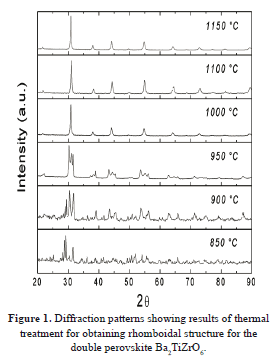
<body><![CDATA[<p><font size="2" face="Verdana, Arial, Helvetica, sans-serif">Complex perovskites with formula A<sub>2</sub>BB'X<sub>6</sub>, where A represents an alkaline earth, B and B' are metal transition and X is the oxygen, have been studied because of their physical properties &#91;1&#93;, which depend on structural distortions and the characteristic properties of B and B' cations. This chemical configuration results in multiple opportunities to combine different elements of the periodic table, generating the possibility of synthesizing new materials that involve a larger gamma of physical properties. One well-known simple perovskite, which is well known because it exhibits a ferroelectric character, is BaTiO<sub>3</sub> &#91;2&#93;. Partial substitutions of Ti by the Zr cation have been done by other authors, showing the evolution of the electric behavior from a ferroelectric response, for low concentration of Zr, to a ferroelectric relaxor &#91;3&#93; and a dielectric behavior for high concentrations of Zr &#91;4&#93;. However, the position of the substitutive cations in the crystallographic cell of the material is not usually reported. Location of all ions in the lattice is important for inferring the possibility of obtaining spontaneous polarization, in order to give rise to ferroelectric behavior. In the case of polycrystalline samples, the ferroelectric behavior depends greatly on the grain size, because the effects of imperfection frequently dominate the ferroelectric response of small grains, where a significant fraction of the material volume may be influenced by grain boundaries. It is known that cationic disorder produces substantial changes of the ferroelectricity of complex perovskites &#91;5&#93;. The aim of this paper is to show the synthesis process for producing the double perovskite Ba<sub>2</sub>ZrTiO<sub>6</sub>; to analyze the crystallographic single phase; to study the electronic structure; and, the most important objective of the study being to investigate the ferroelectric response of the material at room temperature. Our results reveal that Ba<sub>2</sub>ZrTiO<sub>6</sub> crystallizes in a rhomboidal double perovskite structure, which is a convenient lattice for determining the occurrence the ferroelectric character, observed by the occurrence of hysteretic curves of electric polarization as a function of variable applied fields.</font></p> 		    <p>&nbsp;</p> 		    <p><font size="3" face="Verdana, Arial, Helvetica, sans-serif"><b>2.  EXPERIMENTAL PROCESS</b></font></p> 	    <p><font size="2" face="Verdana, Arial, Helvetica, sans-serif">Samples were synthesized by means of the solid state reaction recipe. The precursor powders BaCO<sub>3</sub> (Aldrich 99.9%), TiO<sub>2</sub> (Aldrich 99.99%) and ZrO<sub>2</sub> (Aldrich 99.99%) were stoichiometrically mixed according to the chemical formula Ba<sub>2</sub>ZrTiO<sub>6</sub>. The mixture was ground to form pellets of 9.55 mm diameter and 1.85 mm thickness. Then the material was annealed in a sequential thermal procedure at 850, 900, 950, 1000, 1100 and 1150 &ordm;C for 144 hours, including five regrinding and pelletizing procedures to make six thermal steps of 24 hours each. An X-Ray diffraction (XRD) experiment was performed by means of a PW1710 diffractometer with &lambda;<sub>CuK</sub><sub lang="ar-SA">a</sub>=1.54064 &Aring;. Rietveld refinement of the diffraction pattern was made by the GSAS code &#91;6&#93;. Electric polarization curves were obtained by means of a Radiant Ferroelectric Tester, which included a &plusmn;10 kV source for measurements in bulk-samples.</font></p> 		    <p>&nbsp;</p> 		    <p><font size="3" face="Verdana, Arial, Helvetica, sans-serif"><b>3. CALCULATION METHOD</b></font></p>     <p><font size="2" face="Verdana, Arial, Helvetica, sans-serif">We applied the Full-Potential Linear Augmented Plane Wave method (FP-LAPW) within the framework of the Kohn-Sham Density Functional Theory (DFT) &#91;1&#93;, and adopted the Generalized Gradient (GGA) approximation for the exchange-correlation energy due to Perdew, Burke and Ernzerhof &#91;7&#93;. The self-consistent process was developed using the numeric package Wien2k &#91;8&#93;. Taking the experimental unit cell data as input, the structures studied in this work were fully relaxed with respect to their lattice parameters and the internal degrees of freedom compatible with the space group symmetry of the crystal structure. The resulting energies versus volume functions have been fitted to the equation of state due to Murnaghan &#91;9&#93; in order to obtain the minimum energy value, the bulk modulus, its pressure derivative and the equilibrium lattice parameters and associated volume. The muffin-tin radiuses used were 2.40, 1.74, 2.14 and 1.53 for Ba, Ti, Zr and O respectively, angular momentum up to l = 10 inside the muffin-tin sphere, a maximum vector in the reciprocal space of Gmax =12.0, RMT*K<sub>max</sub> = 7.0, and a mesh of 800 points in the first Brillouin zone (equivalent to a maximum of 85 k points in the irreducible Brillouin zone). Finally, the convergence criteria for the self-consistent calculation was 0.0001 Ry for the total energies, 0.0005 u.a. in the charge and 1.0 mRy/u.a. in the internal forces.</font></p> 		    <p>&nbsp;</p> 		    <p><font size="3" face="Verdana, Arial, Helvetica, sans-serif"><b>4.  RESULTS AND DISCUSSION</b></font></p> 	        <p><font size="2" face="Verdana, Arial, Helvetica, sans-serif">The sequence of crystallization obtained by the thermal process, described in the experimental setup, for Ba<sub>2</sub>TiZrO<sub>6</sub> samples is shown in the diffraction patterns of <a href="#fig01">Figure 1</a>.  As shown in <a href="#fig01">Figure 1</a>, the fourth thermal step, at 1000 &ordm;C, evidences the perovskite phase of Ba<sub>2</sub>TiZrO<sub>6</sub>. However, some incipient peaks corresponding to impurities are observed close to 24o. These impurities vanish after the last thermal treatment at 1150&ordm;<i>C</i>. A rigorous Rietveld refinement from experimental data of the diffraction pattern reveals that crystallization of material occurs in a rhombohedral double perovskite, which belongs to the space group <i>R-3</i> (#148).</p> </font> 		    ]]></body>
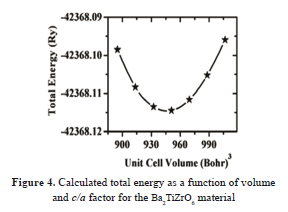
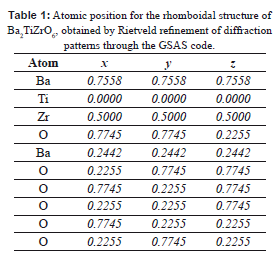
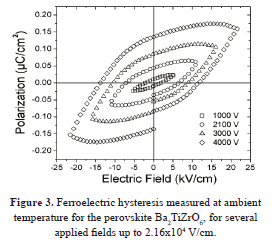
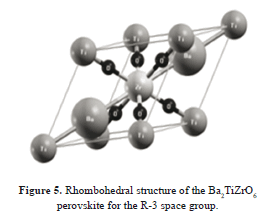
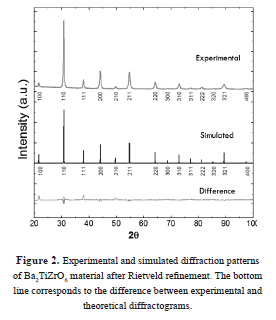
<body><![CDATA[<p align="center"><font size="2" face="Verdana, Arial, Helvetica, sans-serif"><a name="fig01"></a></font><img src="/img/revistas/dyna/v81n183/v81n183a14fig01.gif" width="278" height="360"></p>     <p><font size="2" face="Verdana, Arial, Helvetica, sans-serif">The difference between simulated and experimental patterns is shown in <a href="#fig02">Figure 2</a>. The lattice parameters obtained from the refinement process were <i>a</i>=5.803(8) &Aring;; primitive vectors angle &alpha;=59.9675o.  This result is &sim; 98.5% in agreement with the value supplied by the Structure Prediction Diagnostic Software &#91;10&#93;, which gives <i>a</i>=5.7177 &Aring;.</font></p> 		    <p align="center"><font size="2" face="Verdana, Arial, Helvetica, sans-serif"><a name="fig02"></a></font><img src="/img/revistas/dyna/v81n183/v81n183a14fig02.gif" width="276" height="320"></p>     <p><font size="2" face="Verdana, Arial, Helvetica, sans-serif">In <a href="#fig02">Figure 2</a>, the top plot represents experimental data, the middle plot is the simulated refined diffractogram, and the line at the bottom corresponds to the difference between experimental and simulated patterns. Indexes of crystallographic planes are indicated in <a href="#fig02">figure 2</a>. The parameters of refinement are: <i>R</i>F2=4.69 % and <i>x</i>2=2.26.</font></p>     <p><font size="2" face="Verdana, Arial, Helvetica, sans-serif">Atomic positions and occupancies of ions in the structure are shown in <a href="#tab01">table 1</a>.</font></p> 		    <p align="center"><font size="2" face="Verdana, Arial, Helvetica, sans-serif"><a name="tab01"></a></font><img src="/img/revistas/dyna/v81n183/v81n183a14tab01.gif" width="280" height="261"></p>     <p><font size="2" face="Verdana, Arial, Helvetica, sans-serif">One important parameter in perovskite materials is the tolerance factor, which is related to the probability of the formation of octahedral coordination of B and B' cations with the oxygen anion. The tolerance factor calculated for Ba<sub>2</sub>TiZrO<sub>6</sub> material was 1.0312. This value, above 1.0, suggests the possibility of obtaining spontaneous polarizations from structural distortions that give rise to the ferroelectric character in the simple perovskite BaTiO<sub>3</sub> &#91;11&#93;, for example.</font></p> 		    <p><font size="2" face="Verdana, Arial, Helvetica, sans-serif">Another important characteristic for the possible application of the material in ferroelectric devices is the response to high applied fields.  In <a href="#fig03">Figure 3</a> sequence of polarization for applied electric fields up to 22.5 kV/cm is shown.  As observed in <a href="#fig03">Figure 3</a>, for the higher applied field we determine a saturation polarization of 0.175 &micro;C/cm<sup>2</sup>, in a curve with a remnant polarization of 0.3125 &micro;C/cm<sup>2</sup> and a coercive field of 12.0 kV/cm.  These values are in agreement with strong ferroelectric materials of the BaTiO<sub>3</sub> family &#91;12,13&#93; that evidence polarization saturation, remnant polarization and coercive fields, which are appropriate for technological applications in ferroelectric memories.</font></p> 		    <p align="center"><font size="2" face="Verdana, Arial, Helvetica, sans-serif"><a name="fig03"></a></font><img src="/img/revistas/dyna/v81n183/v81n183a14fig03.gif" width="280" height="247"></p>     <p><font size="2" face="Verdana, Arial, Helvetica, sans-serif"><a href="#fig04">Figure 4</a> shows the optimization of energy as a function of volume. The minimum energy value is obtained for <i>-42368.114575 Ry</i>. The equilibrium volume is <i>945.7608 Bohr</i>3, which corresponds with a lattice constant <i>a=11.0206 Bohr &#91;a=5.831(8)&#93;</i> with a volume modulus <i>Bo=155.9553 GPa</i>. The lattice parameter obtained from the GGA approximation is <i>99.5%</i> in agreement with our experimental results.</font></p> 		    ]]></body>
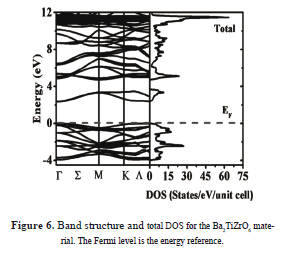
<body><![CDATA[<p align="center"><font size="2" face="Verdana, Arial, Helvetica, sans-serif"><a name="fig04"></a></font><img src="/img/revistas/dyna/v81n183/v81n183a14fig04.gif" width="288" height="212"></p>     <p><font size="2" face="Verdana, Arial, Helvetica, sans-serif">The difference between the two minimums is less than the convergence parameter. The minimums for the energy as a function of volume were obtained by adjusting Murnaghan's state equation to the square points &#91;9&#93;. The rhombohedral structure obtained by both procedures, Rietveld refinement of diffraction patterns and theoretical minimization of energy by the DFT method, is shown in <a href="#fig05">figure 5</a>.</font></p>             <p align="center"><font size="2" face="Verdana, Arial, Helvetica, sans-serif"><a name="fig05"></a></font><img src="/img/revistas/dyna/v81n183/v81n183a14fig05.gif" width="273" height="222"></p>     <p><font size="2" face="Verdana, Arial, Helvetica, sans-serif"><a href="#fig06">Figure 6</a> corresponds to electronic properties of the perovskite Ba<sub>2</sub>TiZrO<sub>6</sub>. The Density of States (DOS) along the high symmetry directions in the first Brillouin zone and the band structure are shown. The energy of the electrons as a function of the wave vector <i>k</i> is also observed, which was taken along the &Gamma;-&Sigma;-M-K-&Lambda;-&Gamma; directions.</p> </font> 		    <p align="center"> <font size="2" face="Verdana, Arial, Helvetica, sans-serif"><a name="fig06"></a></font><img src="/img/revistas/dyna/v81n183/v81n183a14fig06.gif" width="289" height="254"></p>     <p><font size="2" face="Verdana, Arial, Helvetica, sans-serif">The DOS and band structure are calculated for the equilibrium configuration by using the lattice constant corresponding to the volume which minimizes the energy of the system.</p> </font> 		    <p><font size="2" face="Verdana, Arial, Helvetica, sans-serif">The energy reference is selected to be the Fermi level in E=0. It is observed that the Ba<sub>2</sub>TiZrO<sub>6</sub> material presents a nonmetallic behavior with a direct energy gap of 2,32 eV at the Fermi level. Furthermore, a valence sub-band sited in the regime between -4 eV and the Fermi level is observed in <a href="#fig06">Figure 6</a>, due to principal contributions of the <i>2s</i>-O, <i>3d</i>-Ti and <i>4d</i>-Zr orbital, as corroborated in <a href="#fig07">Figure 7</a>. A minority contribution of the <i>4s</i>-Ti and <i>5s</i>-Zr electrons is also observed. In the intermediate region of the conduction band, between 2,32 eV and 3,7 eV, the majority contribution is due to the <i>3d</i>-Ti orbital.</font></p> 		    <p align="center"><font size="2" face="Verdana, Arial, Helvetica, sans-serif"><a name="fig07"></a></font><img src="/img/revistas/dyna/v81n183/v81n183a14fig07.gif" width="280" height="329"></p>     <p><font size="2" face="Verdana, Arial, Helvetica, sans-serif">On the other hand, from 3,7 eV up to 4,71 eV a gap of forbidden energies, internal to the conduction band, is determined. Likewise, the <i>6s</i>-Ba, <i>4d</i>-Zr, <i>3d</i>-Ti and <i>2p</i>-O electron contributions give rise to the regime between 4,74 eV and 12,0 eV, with a small share of <i>4s</i>-Ti, <i>5s</i>-Zr and <i>2s</i>-O orbitals.</font></p> 		    <p>&nbsp;</p> 		    ]]></body>
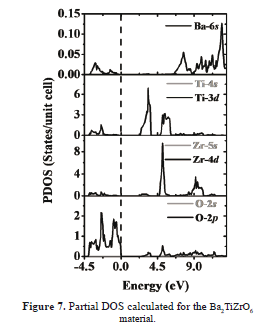
<body><![CDATA[<p><font size="3" face="Verdana, Arial, Helvetica, sans-serif"><b>5.  CONCLUSIONS</b></font></p> 	    <p><font size="2" face="Verdana, Arial, Helvetica, sans-serif">In summary, we report the synthesis of polycrystalline Ba<sub>2</sub>TiZrO<sub>6</sub> double perovskite.  The complete thermal process is seen through a sequence of diffraction patterns. Rietveld refinement reveals that a single crystallographic phase of rhombohedral perovskite was obtained, space group <i>R-3</i> (#148), with lattice parameters <i>a=5.803(8) </i>Å.  The tolerance factor was calculated to be 1.03.  Measurements of polarization as a function of applied electric fields show a hysteretic behavior, which is characteristic of ferroelectric materials.  Values of saturation and remnant polarization suggest that this material may be used for technological applications in devices for information storage. Lastly, calculations of band and electronic structure reveal the nonmetallic behavior of Ba<sub>2</sub>TiZrO<sub>6</sub>, with an energy gap of 2.32 eV and <i>Bo=155.9553 GPa</i> volume modulus.</font></p> 		    <p>&nbsp;</p> 		    <p><font size="3" face="Verdana, Arial, Helvetica, sans-serif"><b>6.  ACKNOWLEDGMENTS</b></font></p>     <p><font size="2" face="Verdana, Arial, Helvetica, sans-serif">This work was partially supported by the <i>Divisi&oacute;n de Investigaciones Sede Bogot&aacute;</i> (DIB) of the <i>Universidad Nacional de Colombia</i>.</font></p> 		    <p>&nbsp;</p> 		    <p><font size="3" face="Verdana, Arial, Helvetica, sans-serif"><b>REFERENCES</b></font></p>     <p><font size="2" face="Verdana, Arial, Helvetica, sans-serif">    <!-- ref --><p><b>&#91;1&#93;</b>  Palkar, V.R., Malik, S.K., Observation of magnetoelectric behavior at room temperature in Pb(Fe<sub>x</sub>Ti<sub>1-x</sub>)O<sub>3</sub>, Solid State Communications 134, pp.783-786, 2005.    &nbsp;&nbsp;&nbsp;&nbsp;&nbsp;&nbsp;&nbsp;&nbsp;[&#160;<a href="javascript:void(0);" onclick="javascript: window.open('/scielo.php?script=sci_nlinks&ref=000061&pid=S0012-7353201400010001400001&lng=','','width=640,height=500,resizable=yes,scrollbars=1,menubar=yes,');">Links</a>&#160;]<!-- end-ref --></p>       ]]></body>
<body><![CDATA[<!-- ref --><p><b>&#91;2&#93;</b> Landínez Téllez, D.A., Peña Rodríguez, G., Arbey Rodríguez, J., Fajardo, F., Roa Rojas, J., Structural, magnetic, multiferroic, and electronic properties of Sr2TiMnO6 double perovskite, Dyna 79, pp.111-115, 2012.    &nbsp;&nbsp;&nbsp;&nbsp;&nbsp;&nbsp;&nbsp;&nbsp;[&#160;<a href="javascript:void(0);" onclick="javascript: window.open('/scielo.php?script=sci_nlinks&ref=000063&pid=S0012-7353201400010001400002&lng=','','width=640,height=500,resizable=yes,scrollbars=1,menubar=yes,');">Links</a>&#160;]<!-- end-ref --></p>       <!-- ref --><p><b>&#91;3&#93;</b>  Isupov, V.A., Nature of physical phenomena in ferroelectric relaxors, Physics of the Solid State 45, pp. 1107-1111 (2003).    &nbsp;&nbsp;&nbsp;&nbsp;&nbsp;&nbsp;&nbsp;&nbsp;[&#160;<a href="javascript:void(0);" onclick="javascript: window.open('/scielo.php?script=sci_nlinks&ref=000065&pid=S0012-7353201400010001400003&lng=','','width=640,height=500,resizable=yes,scrollbars=1,menubar=yes,');">Links</a>&#160;]<!-- end-ref --></p>       <!-- ref --><p><b>&#91;4&#93;</b>  Baettig, P., Spaldin, N.A., Ab initio prediction of a multiferroic with large polarization, Applied Physics Letters 86, pp. 12505-12507, 2005.    &nbsp;&nbsp;&nbsp;&nbsp;&nbsp;&nbsp;&nbsp;&nbsp;[&#160;<a href="javascript:void(0);" onclick="javascript: window.open('/scielo.php?script=sci_nlinks&ref=000067&pid=S0012-7353201400010001400004&lng=','','width=640,height=500,resizable=yes,scrollbars=1,menubar=yes,');">Links</a>&#160;]<!-- end-ref --></p>       <!-- ref --><p><b>&#91;5&#93;</b>  Ang, C., Guo, R., Bhalla, A.S., Cross, L.E., Dielectric dispersion at microwave frequencies, Journal of Applied Physics 87, pp. 3937-3940, 2000.    &nbsp;&nbsp;&nbsp;&nbsp;&nbsp;&nbsp;&nbsp;&nbsp;[&#160;<a href="javascript:void(0);" onclick="javascript: window.open('/scielo.php?script=sci_nlinks&ref=000069&pid=S0012-7353201400010001400005&lng=','','width=640,height=500,resizable=yes,scrollbars=1,menubar=yes,');">Links</a>&#160;]<!-- end-ref --></p>       <!-- ref --><p><b>&#91;6&#93;</b>  Larson, A. C., Von, R. B., Dreele, <i>General Structure Analysis System (GSAS)</i>, Los Alamos National Laboratory Report LAUR, pp. 86-748, 2000    &nbsp;&nbsp;&nbsp;&nbsp;&nbsp;&nbsp;&nbsp;&nbsp;[&#160;<a href="javascript:void(0);" onclick="javascript: window.open('/scielo.php?script=sci_nlinks&ref=000071&pid=S0012-7353201400010001400006&lng=','','width=640,height=500,resizable=yes,scrollbars=1,menubar=yes,');">Links</a>&#160;]<!-- end-ref --><br>       ]]></body>
<body><![CDATA[<!-- ref --><p><b>&#91;7&#93;</b>  Perdew, J.P., Burke, S., Ernzerhof, M., Generalized Gradient Approximation Made Simple, Physical Review Letters 77, pp. 3865, 1996.    &nbsp;&nbsp;&nbsp;&nbsp;&nbsp;&nbsp;&nbsp;&nbsp;[&#160;<a href="javascript:void(0);" onclick="javascript: window.open('/scielo.php?script=sci_nlinks&ref=000073&pid=S0012-7353201400010001400007&lng=','','width=640,height=500,resizable=yes,scrollbars=1,menubar=yes,');">Links</a>&#160;]<!-- end-ref --></p>       <!-- ref --><p><b>&#91;8&#93;</b>  Blaha, P., Schwarz, K., Madsen, G. K. H., Kvasnicka, D. and Luitz J., WIEN2k, <i>An Aug-mented Plane Wave + Local Orbitals Program for Calculating Crystal Properties</i>, Karlheinz Schwarz, Techn. Universitat Wien, Austria 2001, ISBN 3-9501031-1-2.    &nbsp;&nbsp;&nbsp;&nbsp;&nbsp;&nbsp;&nbsp;&nbsp;[&#160;<a href="javascript:void(0);" onclick="javascript: window.open('/scielo.php?script=sci_nlinks&ref=000075&pid=S0012-7353201400010001400008&lng=','','width=640,height=500,resizable=yes,scrollbars=1,menubar=yes,');">Links</a>&#160;]<!-- end-ref --></p>       <!-- ref --><p><b>&#91;9&#93;</b>  Murnaghan, F.D., The Compressibility of Media under Extreme Pressures, Proceedings of National Academy of Sciences, USA. 30, pp. 244-247, 1944.    &nbsp;&nbsp;&nbsp;&nbsp;&nbsp;&nbsp;&nbsp;&nbsp;[&#160;<a href="javascript:void(0);" onclick="javascript: window.open('/scielo.php?script=sci_nlinks&ref=000077&pid=S0012-7353201400010001400009&lng=','','width=640,height=500,resizable=yes,scrollbars=1,menubar=yes,');">Links</a>&#160;]<!-- end-ref --></p>       <!-- ref --><p><b>&#91;10&#93;</b>  Lufaso, M.W., Woodward, P.M., The Prediction of the Crystal Structures of. Perovskites Using the Software Program SPuDS, Acta Crystallographic B 57, pp. 725-738, 2001.    &nbsp;&nbsp;&nbsp;&nbsp;&nbsp;&nbsp;&nbsp;&nbsp;[&#160;<a href="javascript:void(0);" onclick="javascript: window.open('/scielo.php?script=sci_nlinks&ref=000079&pid=S0012-7353201400010001400010&lng=','','width=640,height=500,resizable=yes,scrollbars=1,menubar=yes,');">Links</a>&#160;]<!-- end-ref --></p>       <!-- ref --><p><b>&#91;11&#93;</b>  Choi, K.J., Biegalski, M., Li, Y.L., Sharan, A., Schubert, J., Uecker, R., Reiche, P., Chen, Y.B., Pan, X.Q., Gopalan, V., Chen, Q., Schlom, D.G., Eom, C.B., Enhancement of ferroelectricity in strained BaTiO<sub>3</sub> thin films, Science 306, pp. 1005-1009, 2004.    &nbsp;&nbsp;&nbsp;&nbsp;&nbsp;&nbsp;&nbsp;&nbsp;[&#160;<a href="javascript:void(0);" onclick="javascript: window.open('/scielo.php?script=sci_nlinks&ref=000081&pid=S0012-7353201400010001400011&lng=','','width=640,height=500,resizable=yes,scrollbars=1,menubar=yes,');">Links</a>&#160;]<!-- end-ref --></p>       ]]></body>
<body><![CDATA[<!-- ref --><p><b>&#91;10&#93;</b>  Hohenberg, P., Khon, W., Density Functional Theory, Physical Review 136, B864-B871, 1964.    &nbsp;&nbsp;&nbsp;&nbsp;&nbsp;&nbsp;&nbsp;&nbsp;[&#160;<a href="javascript:void(0);" onclick="javascript: window.open('/scielo.php?script=sci_nlinks&ref=000083&pid=S0012-7353201400010001400012&lng=','','width=640,height=500,resizable=yes,scrollbars=1,menubar=yes,');">Links</a>&#160;]<!-- end-ref --></p>       <!-- ref --><p><b>&#91;12&#93;</b>  D. Fu, M. Itoh, S. Koshihara, Lattice strain and polarization of the BaTiO<sub>3</sub>-CaTiO<sub>3</sub> solid solution, Journal of Physics: Condensed Matter 22, 052204-052207, 2010.    &nbsp;&nbsp;&nbsp;&nbsp;&nbsp;&nbsp;&nbsp;&nbsp;[&#160;<a href="javascript:void(0);" onclick="javascript: window.open('/scielo.php?script=sci_nlinks&ref=000085&pid=S0012-7353201400010001400013&lng=','','width=640,height=500,resizable=yes,scrollbars=1,menubar=yes,');">Links</a>&#160;]<!-- end-ref --></p>       <!-- ref --><p><b>&#91;13&#93;</b>  Iijima, Y., Remanent polarization of vacuum-deposited BaTiO<sub>3</sub> films, Electronics and Communications in Japan 68, pp. 27-35, 2007.    &nbsp;&nbsp;&nbsp;&nbsp;&nbsp;&nbsp;&nbsp;&nbsp;[&#160;<a href="javascript:void(0);" onclick="javascript: window.open('/scielo.php?script=sci_nlinks&ref=000087&pid=S0012-7353201400010001400014&lng=','','width=640,height=500,resizable=yes,scrollbars=1,menubar=yes,');">Links</a>&#160;]<!-- end-ref --> ;</font></p>      ]]></body><back>
<ref-list>
<ref id="B1">
<label>1</label><nlm-citation citation-type="journal">
<person-group person-group-type="author">
<name>
<surname><![CDATA[Palkar]]></surname>
<given-names><![CDATA[V.R.]]></given-names>
</name>
<name>
<surname><![CDATA[Malik]]></surname>
<given-names><![CDATA[S.K.]]></given-names>
</name>
</person-group>
<article-title xml:lang="en"><![CDATA[Observation of magnetoelectric behavior at room temperature in Pb(Fe xTi1-x)O3]]></article-title>
<source><![CDATA[Solid State Communications]]></source>
<year>2005</year>
<numero>134</numero>
<issue>134</issue>
<page-range>783-786</page-range></nlm-citation>
</ref>
<ref id="B2">
<label>2</label><nlm-citation citation-type="journal">
<person-group person-group-type="author">
<name>
<surname><![CDATA[Landínez Téllez]]></surname>
<given-names><![CDATA[D.A.]]></given-names>
</name>
<name>
<surname><![CDATA[Peña Rodríguez]]></surname>
<given-names><![CDATA[G.]]></given-names>
</name>
<name>
<surname><![CDATA[Arbey Rodríguez]]></surname>
<given-names><![CDATA[J.]]></given-names>
</name>
<name>
<surname><![CDATA[Fajardo]]></surname>
<given-names><![CDATA[F.]]></given-names>
</name>
<name>
<surname><![CDATA[Roa Rojas]]></surname>
<given-names><![CDATA[J.]]></given-names>
</name>
</person-group>
<article-title xml:lang="en"><![CDATA[Structural, magnetic, multiferroic, and electronic properties of Sr2TiMnO6 double perovskite]]></article-title>
<source><![CDATA[Dyna]]></source>
<year>2012</year>
<volume>79</volume>
<page-range>111-115</page-range></nlm-citation>
</ref>
<ref id="B3">
<label>3</label><nlm-citation citation-type="journal">
<person-group person-group-type="author">
<name>
<surname><![CDATA[Isupov]]></surname>
<given-names><![CDATA[V.A.]]></given-names>
</name>
</person-group>
<article-title xml:lang="en"><![CDATA[Nature of physical phenomena in ferroelectric relaxors]]></article-title>
<source><![CDATA[Physics of the Solid State]]></source>
<year>2003</year>
<numero>45</numero>
<issue>45</issue>
<page-range>1107-1111</page-range></nlm-citation>
</ref>
<ref id="B4">
<label>4</label><nlm-citation citation-type="journal">
<person-group person-group-type="author">
<name>
<surname><![CDATA[Baettig]]></surname>
<given-names><![CDATA[P.]]></given-names>
</name>
<name>
<surname><![CDATA[Spaldin]]></surname>
<given-names><![CDATA[N.A.]]></given-names>
</name>
</person-group>
<article-title xml:lang="en"><![CDATA[Ab initio prediction of a multiferroic with large polarization]]></article-title>
<source><![CDATA[Applied Physics Letters]]></source>
<year>2005</year>
<volume>86</volume>
<page-range>12505-12507</page-range></nlm-citation>
</ref>
<ref id="B5">
<label>5</label><nlm-citation citation-type="journal">
<person-group person-group-type="author">
<name>
<surname><![CDATA[Ang]]></surname>
<given-names><![CDATA[C.]]></given-names>
</name>
<name>
<surname><![CDATA[Guo]]></surname>
<given-names><![CDATA[R.]]></given-names>
</name>
<name>
<surname><![CDATA[Bhalla]]></surname>
<given-names><![CDATA[A.S.]]></given-names>
</name>
<name>
<surname><![CDATA[Cross]]></surname>
<given-names><![CDATA[L.E.]]></given-names>
</name>
</person-group>
<article-title xml:lang="en"><![CDATA[Dielectric dispersion at microwave frequencies]]></article-title>
<source><![CDATA[Journal of Applied Physics]]></source>
<year>2000</year>
<numero>87</numero>
<issue>87</issue>
<page-range>3937-3940</page-range></nlm-citation>
</ref>
<ref id="B6">
<label>6</label><nlm-citation citation-type="book">
<person-group person-group-type="author">
<name>
<surname><![CDATA[Larson]]></surname>
<given-names><![CDATA[A. C.]]></given-names>
</name>
<name>
<surname><![CDATA[Von]]></surname>
<given-names><![CDATA[R. B.]]></given-names>
</name>
</person-group>
<source><![CDATA[Dreele, General Structure Analysis System (GSAS)]]></source>
<year>2000</year>
<page-range>86-748</page-range><publisher-name><![CDATA[Los Alamos National Laboratory Report LAUR]]></publisher-name>
</nlm-citation>
</ref>
<ref id="B7">
<label>7</label><nlm-citation citation-type="journal">
<person-group person-group-type="author">
<name>
<surname><![CDATA[Perdew]]></surname>
<given-names><![CDATA[J.P.]]></given-names>
</name>
<name>
<surname><![CDATA[Burke]]></surname>
<given-names><![CDATA[S.]]></given-names>
</name>
<name>
<surname><![CDATA[Ernzerhof]]></surname>
<given-names><![CDATA[M.]]></given-names>
</name>
</person-group>
<article-title xml:lang="en"><![CDATA[Generalized Gradient Approximation Made Simple]]></article-title>
<source><![CDATA[Physical Review Letters]]></source>
<year>1996</year>
<numero>77</numero>
<issue>77</issue>
<page-range>3865</page-range></nlm-citation>
</ref>
<ref id="B8">
<label>8</label><nlm-citation citation-type="">
<person-group person-group-type="author">
<name>
<surname><![CDATA[Blaha]]></surname>
<given-names><![CDATA[P.]]></given-names>
</name>
<name>
<surname><![CDATA[Schwarz]]></surname>
<given-names><![CDATA[K.]]></given-names>
</name>
<name>
<surname><![CDATA[Madsen]]></surname>
<given-names><![CDATA[G. K. H.]]></given-names>
</name>
<name>
<surname><![CDATA[Kvasnicka]]></surname>
<given-names><![CDATA[D.]]></given-names>
</name>
<name>
<surname><![CDATA[Luitz]]></surname>
<given-names><![CDATA[J.]]></given-names>
</name>
</person-group>
<collab>Universitat Wien^dKarlheinz Schwarz, Techn</collab>
<source><![CDATA[WIEN2k, An Aug-mented Plane Wave + Local Orbitals Program for Calculating Crystal Properties]]></source>
<year>2001</year>
</nlm-citation>
</ref>
<ref id="B9">
<label>9</label><nlm-citation citation-type="journal">
<person-group person-group-type="author">
<name>
<surname><![CDATA[Murnaghan]]></surname>
<given-names><![CDATA[F.D.]]></given-names>
</name>
</person-group>
<article-title xml:lang="en"><![CDATA[The Compressibility of Media under Extreme Pressures]]></article-title>
<source><![CDATA[Proceedings of National Academy of Sciences]]></source>
<year>1944</year>
<numero>30</numero>
<issue>30</issue>
<page-range>244-247</page-range></nlm-citation>
</ref>
<ref id="B10">
<label>10</label><nlm-citation citation-type="journal">
<person-group person-group-type="author">
<name>
<surname><![CDATA[Lufaso]]></surname>
<given-names><![CDATA[M.W.]]></given-names>
</name>
<name>
<surname><![CDATA[Woodward]]></surname>
<given-names><![CDATA[P.M.]]></given-names>
</name>
</person-group>
<article-title xml:lang="en"><![CDATA[The Prediction of the Crystal Structures of. Perovskites Using the Software Program SPuDS]]></article-title>
<source><![CDATA[Acta Crystallographic B]]></source>
<year>2001</year>
<numero>57</numero>
<issue>57</issue>
<page-range>725-738</page-range></nlm-citation>
</ref>
<ref id="B11">
<label>11</label><nlm-citation citation-type="journal">
<person-group person-group-type="author">
<name>
<surname><![CDATA[Choi]]></surname>
<given-names><![CDATA[K.J.]]></given-names>
</name>
<name>
<surname><![CDATA[Biegalski]]></surname>
<given-names><![CDATA[M.]]></given-names>
</name>
<name>
<surname><![CDATA[Li]]></surname>
<given-names><![CDATA[Y.L.]]></given-names>
</name>
<name>
<surname><![CDATA[Sharan]]></surname>
<given-names><![CDATA[A.]]></given-names>
</name>
<name>
<surname><![CDATA[Schubert]]></surname>
<given-names><![CDATA[J.]]></given-names>
</name>
<name>
<surname><![CDATA[Uecker]]></surname>
<given-names><![CDATA[R.]]></given-names>
</name>
<name>
<surname><![CDATA[Reiche]]></surname>
<given-names><![CDATA[P.]]></given-names>
</name>
<name>
<surname><![CDATA[Chen]]></surname>
<given-names><![CDATA[Y.B.]]></given-names>
</name>
<name>
<surname><![CDATA[Pan]]></surname>
<given-names><![CDATA[X.Q.]]></given-names>
</name>
<name>
<surname><![CDATA[Gopalan]]></surname>
<given-names><![CDATA[V.]]></given-names>
</name>
<name>
<surname><![CDATA[Chen]]></surname>
<given-names><![CDATA[Q.]]></given-names>
</name>
<name>
<surname><![CDATA[Schlom]]></surname>
<given-names><![CDATA[D.G.]]></given-names>
</name>
<name>
<surname><![CDATA[Eom]]></surname>
<given-names><![CDATA[C.B.]]></given-names>
</name>
</person-group>
<article-title xml:lang="en"><![CDATA[Enhancement of ferroelectricity in strained BaTiO3 thin films]]></article-title>
<source><![CDATA[Science]]></source>
<year>2004</year>
<numero>306</numero>
<issue>306</issue>
<page-range>1005-1009</page-range></nlm-citation>
</ref>
<ref id="B12">
<label>10</label><nlm-citation citation-type="journal">
<person-group person-group-type="author">
<name>
<surname><![CDATA[Hohenberg]]></surname>
<given-names><![CDATA[P.]]></given-names>
</name>
<name>
<surname><![CDATA[Khon]]></surname>
<given-names><![CDATA[W.]]></given-names>
</name>
</person-group>
<article-title xml:lang="en"><![CDATA[Density Functional Theory]]></article-title>
<source><![CDATA[Physical Review]]></source>
<year>1964</year>
<numero>136</numero>
<issue>136</issue>
<page-range>B864-B871</page-range></nlm-citation>
</ref>
<ref id="B13">
<label>12</label><nlm-citation citation-type="journal">
<person-group person-group-type="author">
<name>
<surname><![CDATA[Fu]]></surname>
<given-names><![CDATA[D.]]></given-names>
</name>
<name>
<surname><![CDATA[Itoh]]></surname>
<given-names><![CDATA[M.]]></given-names>
</name>
<name>
<surname><![CDATA[Koshihara]]></surname>
<given-names><![CDATA[S.]]></given-names>
</name>
</person-group>
<article-title xml:lang="en"><![CDATA[Lattice strain and polarization of the BaTiO3-CaTiO3 solid solution]]></article-title>
<source><![CDATA[Journal of Physics: Condensed Matter]]></source>
<year>2010</year>
<numero>22</numero>
<issue>22</issue>
<page-range>052204-052207</page-range></nlm-citation>
</ref>
<ref id="B14">
<label>13</label><nlm-citation citation-type="journal">
<person-group person-group-type="author">
<name>
<surname><![CDATA[Iijima]]></surname>
<given-names><![CDATA[Y.]]></given-names>
</name>
</person-group>
<article-title xml:lang="en"><![CDATA[Remanent polarization of vacuum-deposited BaTiO3 films]]></article-title>
<source><![CDATA[Electronics and Communications in Japan]]></source>
<year>2007</year>
<numero>68</numero>
<issue>68</issue>
<page-range>27-35</page-range></nlm-citation>
</ref>
</ref-list>
</back>
</article>