<?xml version="1.0" encoding="ISO-8859-1"?><article xmlns:mml="http://www.w3.org/1998/Math/MathML" xmlns:xlink="http://www.w3.org/1999/xlink" xmlns:xsi="http://www.w3.org/2001/XMLSchema-instance">
<front>
<journal-meta>
<journal-id>0012-7353</journal-id>
<journal-title><![CDATA[DYNA]]></journal-title>
<abbrev-journal-title><![CDATA[Dyna rev.fac.nac.minas]]></abbrev-journal-title>
<issn>0012-7353</issn>
<publisher>
<publisher-name><![CDATA[Universidad Nacional de Colombia]]></publisher-name>
</publisher>
</journal-meta>
<article-meta>
<article-id>S0012-73532014000400001</article-id>
<article-id pub-id-type="doi">10.15446/dyna.v81n186.32852</article-id>
<title-group>
<article-title xml:lang="en"><![CDATA[Chemical-mineralogical characterization of copper smelting flue dust]]></article-title>
<article-title xml:lang="es"><![CDATA[Caracterización químico-mineralógica de polvos de fundición de cobre]]></article-title>
</title-group>
<contrib-group>
<contrib contrib-type="author">
<name>
<surname><![CDATA[Balladares]]></surname>
<given-names><![CDATA[Eduardo]]></given-names>
</name>
<xref ref-type="aff" rid="A01"/>
</contrib>
<contrib contrib-type="author">
<name>
<surname><![CDATA[Kelm]]></surname>
<given-names><![CDATA[Ursula]]></given-names>
</name>
<xref ref-type="aff" rid="A02"/>
</contrib>
<contrib contrib-type="author">
<name>
<surname><![CDATA[Helle]]></surname>
<given-names><![CDATA[Sonia]]></given-names>
</name>
<xref ref-type="aff" rid="A03"/>
</contrib>
<contrib contrib-type="author">
<name>
<surname><![CDATA[Parra]]></surname>
<given-names><![CDATA[Roberto]]></given-names>
</name>
<xref ref-type="aff" rid="A04"/>
</contrib>
<contrib contrib-type="author">
<name>
<surname><![CDATA[Araneda]]></surname>
<given-names><![CDATA[Eugenia]]></given-names>
</name>
<xref ref-type="aff" rid="A05"/>
</contrib>
</contrib-group>
<aff id="A01">
<institution><![CDATA[,Universidad de Concepción Departamento de Ingeniería Metalúrgica ]]></institution>
<addr-line><![CDATA[ ]]></addr-line>
<country>Chile</country>
</aff>
<aff id="A02">
<institution><![CDATA[,Universidad de Concepción Unidad de Geología Económica Aplicada ]]></institution>
<addr-line><![CDATA[ ]]></addr-line>
<country>Chile</country>
</aff>
<aff id="A03">
<institution><![CDATA[,Universidad de Concepción Unidad de Geología Económica Aplicada ]]></institution>
<addr-line><![CDATA[ ]]></addr-line>
<country>Chile</country>
</aff>
<aff id="A04">
<institution><![CDATA[,Universidad de Concepción Departamento de Ingeniería Metalúrgica ]]></institution>
<addr-line><![CDATA[ ]]></addr-line>
<country>Chile</country>
</aff>
<aff id="A05">
<institution><![CDATA[,Universidad de Concepción Departamento de Ingeniería Metalúrgica ]]></institution>
<addr-line><![CDATA[ ]]></addr-line>
<country>Chile</country>
</aff>
<pub-date pub-type="pub">
<day>00</day>
<month>08</month>
<year>2014</year>
</pub-date>
<pub-date pub-type="epub">
<day>00</day>
<month>08</month>
<year>2014</year>
</pub-date>
<volume>81</volume>
<numero>186</numero>
<fpage>11</fpage>
<lpage>18</lpage>
<copyright-statement/>
<copyright-year/>
<self-uri xlink:href="http://www.scielo.org.co/scielo.php?script=sci_arttext&amp;pid=S0012-73532014000400001&amp;lng=en&amp;nrm=iso"></self-uri><self-uri xlink:href="http://www.scielo.org.co/scielo.php?script=sci_abstract&amp;pid=S0012-73532014000400001&amp;lng=en&amp;nrm=iso"></self-uri><self-uri xlink:href="http://www.scielo.org.co/scielo.php?script=sci_pdf&amp;pid=S0012-73532014000400001&amp;lng=en&amp;nrm=iso"></self-uri><abstract abstract-type="short" xml:lang="en"><p><![CDATA[In pyrometallurgical processing of copper, 5-10 wt-% of concentrates fed to smelting furnaces are released in the form of flue dust, which contains most of the impurities that pollute products and effluents as well as very significant amounts of copper. Consequently, these dusts cannot be disposed of as an industrial waste and must be treated to recover the copper in order to assure efficient processing. Better process designs needs precise dust characterization. The present study is aimed at generating useful physical, chemical and morphological information of copper smelting flue dust for samples from the gas handling system of a flash smelting furnace. The analyses showed that copper and iron are mainly found in water-soluble phases like chalcantite and chalcocyanite; the water-insoluble fraction contains largely hematite and magnetite; the presence of delafossite is likely. Part of the copper detected in the insoluble fraction is also associated to iron in form of spinel.]]></p></abstract>
<abstract abstract-type="short" xml:lang="es"><p><![CDATA[En el procesamiento pirometalúrgico del cobre, hasta 10% de la carga alimentada a los hornos sale de estos en forma de polvo arrastrado por los gases conteniendo la mayor parte de las impurezas presentes en el mineral, así como cantidades significativas de cobre por lo que no pueden ser descartados como residuos industriales y debe tratarse para recuperar el cobre. La conceptualización de nuevos y mejores procesos requiere caracterizaciones de estos materiales más precisas. Se analizaron polvos provenientes de una caldera recuperadora de calor y de un precipitador electrostático, ambos de un horno de fusión instantánea. Las diferentes herramientas analíticas empleadas muestran que el cobre y el hierro se encuentran principalmente en fases solubles en agua tales como chalcantita. La fracción insoluble está formada mayoritariamente por hematita y magnetita, con probable presencia de delafosita. Parte del cobre detectada en la fracción insoluble se asocia al hierro en forma de espinela.]]></p></abstract>
<kwd-group>
<kwd lng="en"><![CDATA[flue dust]]></kwd>
<kwd lng="en"><![CDATA[characterization]]></kwd>
<kwd lng="en"><![CDATA[copper smelting dust]]></kwd>
<kwd lng="es"><![CDATA[polvos de fundición]]></kwd>
<kwd lng="es"><![CDATA[caracterización]]></kwd>
<kwd lng="es"><![CDATA[fundición de cobre]]></kwd>
</kwd-group>
</article-meta>
</front><body><![CDATA[ <p><font size="2" face="Verdana, Arial, Helvetica, sans-serif"><a href="http://dx.doi.org/10.15446/dyna.v81n186.32852" target="_blank">http://dx.doi.org/10.15446/dyna.v81n186.32852</a></font></p>     <p align="center"><font size="4" face="Verdana, Arial, Helvetica, sans-serif"><b>Chemical-mineralogical   characterization of copper smelting flue dust</b></font></p>     <p align="center"><i><font size="3"><b><font face="Verdana, Arial, Helvetica, sans-serif">Caracterizaci&oacute;n   qu&iacute;mico-mineral&oacute;gica de polvos de fundici&oacute;n de cobre </font></b></font></i></p>     <p align="center">&nbsp;</p>     <p align="center"><b><font size="2" face="Verdana, Arial, Helvetica, sans-serif">Eduardo Balladares <sup>a</sup>, Ursula Kelm <sup>b</sup>, Sonia Helle <sup>c</sup>,   Roberto Parra <sup>d</sup> &amp; Eugenia Araneda <sup>e</sup></font></b><font size="2" face="Verdana, Arial, Helvetica, sans-serif"></font></p>     <p align="center">&nbsp;</p>     <p align="center"><font size="2" face="Verdana, Arial, Helvetica, sans-serif"><sup><i>a</i></sup><i> Departamento de Ingenier&iacute;a   Metal&uacute;rgica, Universidad de Concepci&oacute;n, Chile. <a href="mailto:eballada@udec.cl">eballada@udec.cl</a>    <br>   <sup>b</sup> Unidad   de Geolog&iacute;a Econ&oacute;mica Aplicada (GEA), Universidad de Concepci&oacute;n, Chile. <a href="mailto:ukelm@udec.cl">ukelm@udec.cl</a>    <br>   <sup>c</sup> Unidad de Geolog&iacute;a Econ&oacute;mica Aplicada (GEA), Universidad de   Concepci&oacute;n, Chile. <a href="mailto:shelle@udec.cl">shelle@udec.cl</a>    <br>   <sup>d</sup> Departamento de Ingenier&iacute;a Metal&uacute;rgica, Universidad de Concepci&oacute;n, Chile.    ]]></body>
<body><![CDATA[<br>   <sup>e</sup> Departamento de Ingenier&iacute;a Metal&uacute;rgica, Universidad de Concepci&oacute;n, Chile. <a href="mailto:euaraned@udec.cl">euaraned@udec.cl</a></i></font></p>     <p align="center">&nbsp;</p>     <p align="center"><font size="2" face="Verdana, Arial, Helvetica, sans-serif"><b>Received:   September 19<sup>th</sup>, de 2012. Received in revised form: June 14<sup>th</sup>, 2013. Accepted:   March 5<sup>th</sup>, 2014</b></font></p>     <p align="center">&nbsp;</p> <hr>     <p><font size="2" face="Verdana, Arial, Helvetica, sans-serif"><b>Abstract    <br>   </b></font><font size="2" face="Verdana, Arial, Helvetica, sans-serif">In pyrometallurgical processing   of copper, 5-10 wt-% of concentrates fed to smelting   furnaces are released in the form of flue dust, which contains most of the   impurities that pollute products and effluents as well as very significant   amounts of copper. Consequently, these dusts cannot be disposed of as an   industrial waste and must be treated to recover the copper in order to assure   efficient processing. Better process designs needs precise dust   characterization. The present study is aimed at generating useful physical,   chemical and morphological information of copper smelting flue dust for samples   from the gas handling system of a flash smelting furnace. The analyses showed   that copper and iron are mainly found in water-soluble phases like chalcantite and chalcocyanite;   the water-insoluble fraction contains largely hematite and magnetite; the   presence of delafossite is likely. Part of the copper   detected in the insoluble fraction is also associated to iron in form of   spinel.</font></p>     <p><font size="2" face="Verdana, Arial, Helvetica, sans-serif"><i>Keywords:</i> flue   dust, characterization, copper smelting dust.</font></p>     <p><font size="2" face="Verdana, Arial, Helvetica, sans-serif"><b>Resumen    <br>   </b></font><font size="2" face="Verdana, Arial, Helvetica, sans-serif">En el   procesamiento pirometal&uacute;rgico del cobre, hasta 10% de   la carga alimentada a los hornos sale de estos en forma de polvo arrastrado por   los gases conteniendo la mayor parte de las impurezas presentes en el mineral,   as&iacute; como cantidades significativas de cobre por lo que no pueden ser   descartados como residuos industriales y debe tratarse para recuperar el cobre.   La conceptualizaci&oacute;n de nuevos y mejores procesos requiere caracterizaciones de   estos materiales m&aacute;s precisas. Se analizaron polvos provenientes de una caldera   recuperadora de calor y de un precipitador electrost&aacute;tico, ambos de un horno de fusi&oacute;n instant&aacute;nea. Las diferentes   herramientas anal&iacute;ticas empleadas muestran que el cobre y el hierro se   encuentran principalmente en fases solubles en agua tales como chalcantita. La fracci&oacute;n insoluble est&aacute; formada   mayoritariamente por hematita y magnetita, con   probable presencia de delafosita. Parte del cobre   detectada en la fracci&oacute;n insoluble se asocia al hierro en forma de espinela.</font></p>     <p><font size="2" face="Verdana, Arial, Helvetica, sans-serif"><i>Palabras clave:</i> polvos de fundici&oacute;n, caracterizaci&oacute;n,   fundici&oacute;n de cobre.</font></p> <hr>     ]]></body>
<body><![CDATA[<p>&nbsp;</p>     <p><font size="3" face="Verdana, Arial, Helvetica, sans-serif"><b>1.  Introduction </b></font></p>     <p><font size="2" face="Verdana, Arial, Helvetica, sans-serif">In the pyrometallurgical processing of copper concentrates, the most commonly employed technology is the   flash smelting furnace. This type of reactor produces a high strength SO<sub>2</sub>-bearing   gaseous stream that carries an important amount of solid particles outside the   furnace. This solid-gas suspension leaves the furnace at high temperature   (about 1400 °C), and is treated in a gas-handling system that uses waste boiler   heat to separate coarse solids from gas as well as heat recovery to be used in   concentrate drying equipment. The gas leaving the waste-heat boiler (WHB) at   350 ºC enters the electrostatic precipitator (ESP) for removal of fine   particles leaving a solid-free gas stream suitable for sulfuric acid production   in an acid plant.</font></p>     <p><font size="2" face="Verdana, Arial, Helvetica, sans-serif">This solid separated from the gaseous stream constitutes the   so-called copper smelting flue dust and comprises a coarse fraction named WHBD   (waste heat boiler dust, Dust I) and a fine fraction named ESPD (electrostatic   precipitator dust, Dust II).</font></p>     <p><font size="2" face="Verdana, Arial, Helvetica, sans-serif">The composition of   these dusts is variable for different operations. The composition depends on   the mineralogy of the concentrates, fluxes and circulating material (slag,   dust, etc.), and their respective proportions. Thus flue dust is composed of   fine particles, fragmented particles and condensed compounds that have been   carried out by the gaseous stream.</font></p>     <p><font size="2" face="Verdana, Arial, Helvetica, sans-serif">Recent worldwide primary copper production by pyrometallurgical processes was around 12 million tons a   year &#91;1&#93;. The volume of fine solids in the typical smelting-converting   operations (only taking into consideration conventional technologies like Outokumpu flash smelting and Peirce-Smith converting)   amounts to about 350,000 tons of flue dust each year &#91;2&#93;. These materials are   important sources of copper; however, the significant amount of minor elements   prevents easy and complete reprocessing in smelting or converting furnaces.   Instead, different processes have been developed in each smelter. All these   processes take place in aqueous media by either dust leaching or copper and   arsenic precipitation followed by a final effluent neutralization step and   other unit operations.</font></p>     <p><font size="2" face="Verdana, Arial, Helvetica, sans-serif">Since the mineralogy varies from one concentrate to the   next, customized processes should be developed, even when this leads to a   complex, high cost, and hard-to-control dust treatment plant that operates as   an auxiliary unit to the smelter. Increasingly restrictive environmental   regulations complicate design, economics and operation of these treatment   units.</font></p>     <p><font size="2" face="Verdana, Arial, Helvetica, sans-serif">Copper smelting flue   dusts are defined as &quot;hazardous materials&quot; according to current Chilean   environmental regulations, such as DS 148/2003 &#91;3&#93; and DS 185/1991 &#91;4&#93;.   This classification of the dusts is mainly due to the high solubility of   arsenic compounds in the TCLP (Toxicity Characteristic Leaching Procedure) test   and the presence of bismuth and lead. Due to the progressive increase in   arsenic content in concentrates and a simultaneous decrease of their copper   content, this issue results in a very complex scenario for future smelting   operations with respect to environmental issues as well as product quality and   overall process cost &#91;5,6&#93;.</font></p>     <p><font size="2" face="Verdana, Arial, Helvetica, sans-serif">In order to improve the process, a comprehensive   physical-chemical-mineralogical characterization of the flue dusts is needed.   Since most characterization requirements are mainly based on current operating   practices, the present study uses different analytical techniques to   characterize properly copper smelting flue dust in order to have more robust   information for decision makers.</font></p>     <p>&nbsp;</p>     ]]></body>
<body><![CDATA[<p><font size="3" face="Verdana, Arial, Helvetica, sans-serif"><b>2.  Background</b></font></p>     <p><font size="2" face="Verdana, Arial, Helvetica, sans-serif">Flue dust   characterization is not a widely studied subject in the literature. The few   studies published at present mainly focus on formation of accretions in heat   recovery and gas cleaning systems at smelters. Kurosawa et al. &#91;7&#93; reported   presence of Fe<sub>3</sub>O<sub>4</sub>, PbSO<sub>4</sub>, Cu<sub>2</sub>S, Cu<sub>2</sub>O,   As<sub>2</sub>O<sub>5</sub> and PbS in dust collected from the WHB of the Ashio flash   smelter as well as vaporization and further condensation of volatile elements   downstream. The presence of As(V) is probably due to   highly oxidative conditions inside the smelting furnace and ducts for off-gases   (between up-take and WHB). Evans et al. &#91;8&#93; investigated the mineralogical   composition of the WHB dust and gas stream in the Kidd Creek Mitsubishi   smelting furnace, where most of the copper deposits on WHB walls. These authors   show the transformation of the dust from oxides to sulfates when passed through   the WHB, while other elements, such as zinc and lead, are carried down to the   ESP. Kim et al. &#91;9&#93; detected the presence of a wide variety of compounds in the Noranda reactor's ESP dust, which contains mainly PbSO4,   other metal sulfates, oxides and zinc ferrites, sulfides and basic copper   sulfate (oxysulfates), iron oxides and silicates.   Copper bearing phases were associated with iron oxides covered by a lead   sulfate layer on the surface.</font></p>     <p><font size="2" face="Verdana, Arial, Helvetica, sans-serif">In the case of a smelting electric furnace, Samuelsson   &#91;10&#93; determined that the majority of species correspond to copper, lead and   zinc sulfates, cuprous oxide, magnetite and copper-zinc ferrites. In the   settling furnace, compounds identified by the same author included iron and   zinc oxides, iron and copper sulfides and lead sulfate.</font></p>     <p><font size="2" face="Verdana, Arial, Helvetica, sans-serif">It is important to emphasize that the qualitative and   quantitative phase determination of dust depends not only on the compositional   characteristics of the concentrate fed into smelting furnaces but also on   temperature and oxidative conditions inside the furnace and equipment, which   are greatly determined by the reactor type employed.</font></p>     <p>&nbsp;</p>     <p><font size="3" face="Verdana, Arial, Helvetica, sans-serif"><b>3.  Experimental</b></font></p>     <p><font size="2" face="Verdana, Arial, Helvetica, sans-serif">The samples (Dust I,   Dust II) were obtained from a smelter that operates with a flash smelting furnace   followed by Peirce-Smith converters. Two different types of samples were   analyzed: the first type comes from the waste heat boiler (WHB) and the second   comes from the electrostatic precipitator (ESP). The samples were collected   from two parts of the smelter: the WHB and the electrostatic precipitator. In   both cases, samples of dust were taken from the discharge screw and from the   storage area, using a spatula to collect 1 kg in each case. The spatulas were   cleaned using alcohol wipes after each sampling to avoid contamination. The   collected material was placed in petri dishes, properly labeled, sealed, and   taken to the laboratory. The samples were reduced in the laboratory to 10 g.   Since both units (WHB and ESP) operate under different conditions of temperature   and oxygen potential, synthetic compounds are not necessarily the same and are   present in different proportions.</font></p>     <p><font size="2" face="Verdana, Arial, Helvetica, sans-serif"><b>3.1.  Granulometric analysis    <br>   </b>Granulometric analyses were   performed by laser ray diffraction in a Helos-Succel® equipment that operates with the following settings: Sheat diameter: 20.2 mm; wave length: 0.6328 <font face="Symbol">m</font>m; power: 5mW; deflection: 180º;   measuring time: 10 s.</font></p>     <p><font size="2" face="Verdana, Arial, Helvetica, sans-serif">The samples were prepared in a solid-water suspension to   avoid particle agglomeration.</font></p>     ]]></body>
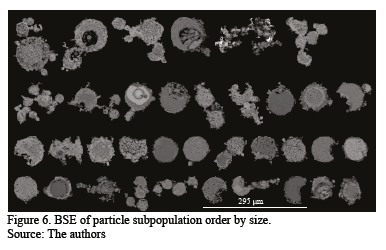
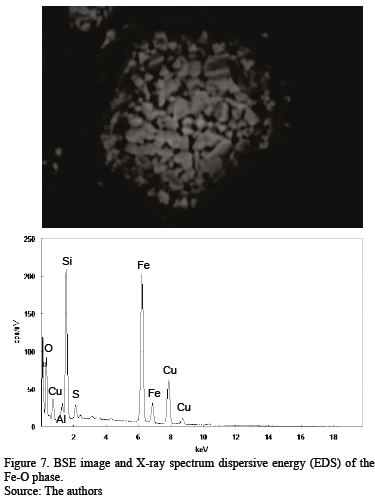
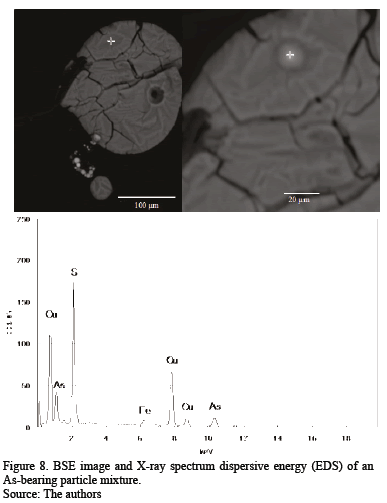
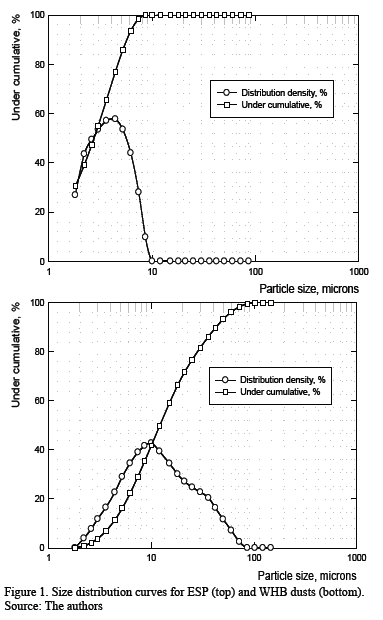
<body><![CDATA[<p><font size="2" face="Verdana, Arial, Helvetica, sans-serif">Scanning electron microscope (SEM) imaging was carried out   on a JEOL JSM 6380 LV.</font></p>     <p><font size="2" face="Verdana, Arial, Helvetica, sans-serif"><b>3.2.  Chemical analysis</b>    <br>   </font><font size="2" face="Verdana, Arial, Helvetica, sans-serif">The chemical analysis was performed by atomic absorption   spectrometry in a Hitachi® Z-8100 equipment. Depending on the particular   element to be analyzed, a different kind of chemical dissolution technique was   used. For Si, Al, Fe, Ca, Pb, Zn, Ni and Co   determination the samples were dissolved with an HCl attack, followed by fusion of the insoluble residue with lithium tetraborate. In the case of arsenic and bismuth, these were   extracted by using HNO<sub>3</sub> at a controlled temperature; for Mo, an   oxidative mixture HClO<sub>4</sub>-H<sub>2</sub>SO<sub>4</sub> was used. Prior   to sample dissolution, the presence of minor and mg/kg level trace elements was   verified by an X-ray fluorescence spectroscopy scan (Rigaku 3070E WDS, Rh radiation).</font></p>     <p><font size="2" face="Verdana, Arial, Helvetica, sans-serif"><b><i>3.3  X-ray diffraction   analysis    <br>   </i></b></font><font size="2" face="Verdana, Arial, Helvetica, sans-serif">Qualitative XRD was   carried out on a Rigaku Dmax C Diffractometer equipped with a horizontal   goniometer and operated with Mn-K<font face="Symbol">b</font> filtered Fe   radiation. Samples were scanned (continuous scan) as received and then   thoroughly rinsed with distilled water to remove the interference of chalcanthite peaks. Exploratory quantitative XRD analyses   were carried out using a URD-6 diffractometer (Seifert-FPM) operated with Co radiation, and a secondary graphite monochromator at 40KV, 30 mA. For Rietveld modeling, step scans were recorded between 5 and 80º 2<font face="Symbol">q</font>, at 0.05º steps   and 5 s counting time per step. Rietveld spectral   modeling was carried out using BGMN Autoquan software   &#91;11&#93;.</font></p>     <p><font size="2" face="Verdana, Arial, Helvetica, sans-serif"><b>3.4.  Qemscan analysis    <br>   </b></font><font size="2" face="Verdana, Arial, Helvetica, sans-serif">Semi-automatic quantitative energy-dispersive scanning electron   microscopy (SEM-EDS) analysis were carried out on a QEMSCAN system   equipped with four XFlash 275 SDD Bruker detectors at   25 kV and 5 nA. Particle Mineral Analysis mode (PMA)   was used at 2.5 <font face="Symbol">m</font>m point spacing resolution to obtain mineral maps and to   characterize the As- and Cu-bearing phases using the 4.2 iDiscover-M   series software. Due to the material's complexity, a population of 30,000   particles was obtained using Particle Mineralogical Analysis at a resolution of   2.5 pixels. QEMSCAN is capable of categorizing the measured particles based on   different mineralogical and metallurgical parameters, including density,   locking characteristics, grain and particle sizes.</font></p>     <p>&nbsp;</p>     <p><font size="3" face="Verdana, Arial, Helvetica, sans-serif"><b>4.  Results and   discussion</b></font></p>     <p><b><font size="2" face="Verdana, Arial, Helvetica, sans-serif">4.1.  Grulometric analysis (grain size and   SEM features)    ]]></body>
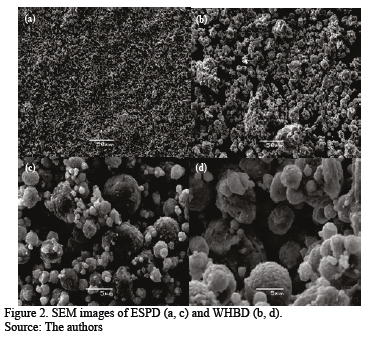
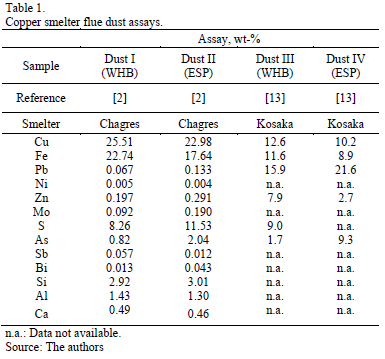
<body><![CDATA[<br>   </font></b><font size="2" face="Verdana, Arial, Helvetica, sans-serif">Granulometric analysis was   performed on both WHB and ESP dust. The results are shown in <a href="#fig01">Fig. 1</a> and reveal   several interesting features. First, for ESPD, the particle size range is   narrow and 100 % of the particles are smaller than 9.3 mm. Second, for WHBD, the   particle size range is wider, and the maximum size was 79 mm.   These results agree with the operational practice because when the gases   (carrying dusts) leave the furnace they first enter the WHB where the gas-solid   stream cools down from 1300-1400 ºC to 850 ºC due to air infiltration (at   atmospheric temperature). Also, the </font><font size="2" face="Verdana, Arial, Helvetica, sans-serif">stream velocity decreases because   of the flow&rsquo;s cross section increases within the WHB, resulting in the   collection of coarser particles in the equipment&rsquo;s lower gas-solid stream cools   down to 300 &ordm;C and the finest particles are separated from gaseous stream and   retained due to electrostatic and gravitational effects &#91;12&#93;.</font></p>     <p align="center"><font size="2" face="Verdana, Arial, Helvetica, sans-serif"><a name="fig01"></a></font><img src="/img/revistas/dyna/v81n186/v81n186a01fig01.gif"></p>     <p><font size="2" face="Verdana, Arial, Helvetica, sans-serif">SEM images allow visual   verification of the differences in particles size mentioned earlier. <a href="#fig01">Fig. 1</a> is   clearly related to the measured grain size distribution for WHBD and ESPD,   respectively. In particular, ESPD is finer than WHBD due to the loss of coarser   dust in the WHB (comparison of <a href="#fig02">Fig. 2</a> (a) and (c) with (b) and (d)). Another   relevant aspect is that the particles from both WHBD and ESPD dust show a   spherical or rounded shape rather than edgy or shard-like shapes. This   appearance is typical of semi-molten or molten material solidified by cooling   in the gas transport system, rather than particulate material reacted in solid   state, which has a more angular appearance.</font></p>     <p align="center"><font size="2" face="Verdana, Arial, Helvetica, sans-serif"><a name="fig02"></a></font><img src="/img/revistas/dyna/v81n186/v81n186a01fig02.gif"></p>     <p><font size="2" face="Verdana, Arial, Helvetica, sans-serif"><b>4.2.  Chemical analysis    <br>   </b></font><font size="2" face="Verdana, Arial, Helvetica, sans-serif">Chemical analyses were performed considering the most   important elements present in this kind of materials, namely metallic cations (base metals), sulfur, volatile elements and   slagging agents (fluxes). The importance of the first is related to their   potential recovery, in particular Cu. On the other hand As, Sb, Bi analyses are   needed since the current metal recovery processes involve a great amount of   liquid effluents that contain some of these toxic elements and/or produce a   solid waste with high mg/kg or % level content of these elements. Furthermore,   the content of these elements in the final effluent depends on the dust's   initial composition and their form in the feed.</font></p>     <p><font size="2" face="Verdana, Arial, Helvetica, sans-serif">The results of chemical analysis (<a href="#tab01">Table 1</a>, Dusts I and II)   account for the most important elements for the smelters in the form of metal   for potential recovery of environmentally hazardous elements in effluent   treatment and disposal.</font></p>     <p align="center"><font size="2" face="Verdana, Arial, Helvetica, sans-serif"><a name="tab01"></a></font><img src="/img/revistas/dyna/v81n186/v81n186a01tab01.gif"></p>     <p><font size="2" face="Verdana, Arial, Helvetica, sans-serif">Since almost all of the arsenic is present as volatile   compounds that condensate at lower temperatures, most of </font><font size="2" face="Verdana, Arial, Helvetica, sans-serif">the arsenic appear in the system's cooler (ESP) rather than hotter section. The   same situation applies for Dusts III and IV, where the solids' coarse fraction   is recovered in the evaporative chamber (1350-850 ºC) and the fine fraction is   collected in ESP (near 300 ºC). Since the gases pass through the ESP, vapors   containing volatile species begin to condense around solid particles and   solidified matte drops, and thus the fine material presents higher content in   arsenic (bismuth, antimony, lead and others). Moreover, data in <a href="#tab01">Table 1</a> illustrate that the chemical compositions of the dust depends on many   variables, including the kind of reactor where the smelting and converting   processes take place, the specific place of the gas handling system from where   dusts are collected, and the chemical-mineralogical characteristics of the   concentrate feed. The effect of these variables on the amount and mineralogical   features of the dust generated cannot be quantitatively determined, although a   qualitative discussion is possible. On the other hand, the results confirm that   the dusts contain a significant amount of copper molten and important levels of   volatile elements such as As. This is important   because the most commonly used hydrometallurgical treatment of the dusts is   very sensitive to changes in minor and trace element levels.</font></p>     <p><font size="2" face="Verdana, Arial, Helvetica, sans-serif">Finally, <a href="#tab01">Table 1</a> shows   that both dusts (WHBD and ESPD) contain mainly copper, iron and sulfur. Due to   air infiltration in the gas handling system, almost all of the sulfur is   associated to copper and iron as sulfates (see XRD results below), resulting   from the oxygen and sulfur's partial pressure.</font></p>     ]]></body>
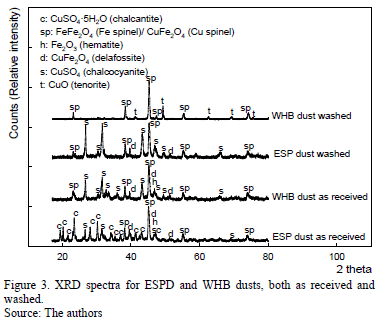
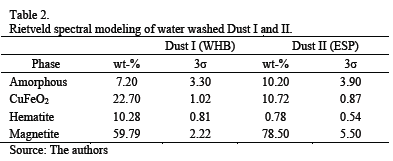
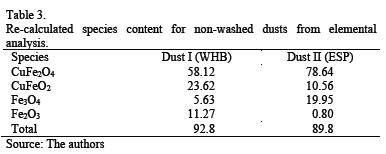
<body><![CDATA[<p><font size="2" face="Verdana, Arial, Helvetica, sans-serif"><b>4.3.  XRD analysis    <br>   </b></font><font size="2" face="Verdana, Arial, Helvetica, sans-serif">Qualitative X-ray   diffraction was performed on samples as received, water rinsed, heated to 150   ºC, 350 ºC and 800 ºC respectively. XRD charts &quot;as received&quot; of Dust I and II   are dominated by CuSO<sub>4</sub>·5H<sub>2</sub>O (chalcanthite),   a spinel phase, e.g., FeFe<sub>2</sub>O<sub>4</sub> (magnetite), minor Fe<sub>2</sub>O<sub>3</sub> and possibly delafossite CuFeO<sub>2</sub>. Due to   the masking effect of chalcanthite on the XRD peaks,   we worked with water-rinsed samples as a base for quantitative XRD since the   formation of chalcanthite is due to dust storage in   environmental humidity and not due to conditions in the WHB and ESP. Heating   samples to 150 ºC </font></p>     <p align="center"><font size="2" face="Verdana, Arial, Helvetica, sans-serif"><a name="fig03"></a></font><img src="/img/revistas/dyna/v81n186/v81n186a01fig03.gif"></p>     <p><font size="2" face="Verdana, Arial, Helvetica, sans-serif">helps clear the charts, leaving CuSO<sub>4</sub>, the spinel phase, Fe<sub>2</sub>O<sub>3</sub> and possibly delafossite. At 350 ºC, the spinel phase   dominates, probably magnetite. Due to delafossite, a   peak at 28.6 nm is missing, thus not permitting the definite identification of   this copper phase. An alternative copper phase would be copper spinel CuFe<sub>2</sub>O<sub>4</sub>,   although with strong superposition with magnetite. Samples heated to 800 ºC   show only the presence of a spinel phase and CuO,   where the latter is a product of calcinations in an oxidizing atmosphere.</font></p>     <p><font size="2" face="Verdana, Arial, Helvetica, sans-serif">Rietveld spectral modeling (with ZnO as internal standard) was only conducted on water   washed samples. Results (see <a href="#tab02">Table 2</a>) corroborate the qualitative observations;   however, it is important to note that 7-10 % of the amorphous material probably   contain Si and Al as oxides as well as minor elements. The amorphous phase will   require further scrutiny in the future.</font></p>     <p align="center"><font size="2" face="Verdana, Arial, Helvetica, sans-serif"><a name="tab02"></a></font><img src="/img/revistas/dyna/v81n186/v81n186a01tab02.gif"></p>     <p><font size="2" face="Verdana, Arial, Helvetica, sans-serif">When comparing the elemental chemical composition of both   dusts (WHB and ESP) using AAS (<a href="#tab01">Table 1</a>) with the calculation derived from XRD   (<a href="#tab02">Table 2</a>), some discrepancies can be observed regarding major species (Cu, Fe   and S). However, these are due to the fact that the elemental analyses shown in <a href="#tab01">Table 1</a> refer to non-washed dust, whereas for XRD spectral modeling dust has   been washed to eliminate chalcanthite spectral   overlap (<a href="#tab02">Table 2</a>).</font></p>     <p><font size="2" face="Verdana, Arial, Helvetica, sans-serif">Assuming as a first approximation that during washing only   copper sulfate is dissolved (a valid assumption because other soluble species   are present in minor proportion), the content of delafossite,   hematite and magnetite can be re-calculated using elemental analysis and   bringing the species identified by XRD (i.e., 92.8 % for Dust I and 89.8 % for   Dust II) to a 100 % basis. The re-calculated content of the mentioned species   are shown in <a href="#tab03">Table 3</a>.</font></p>     <p align="center"><font size="2" face="Verdana, Arial, Helvetica, sans-serif"><a name="tab03"></a></font><img src="/img/revistas/dyna/v81n186/v81n186a01tab03.gif"></p>     <p><font size="2" face="Verdana, Arial, Helvetica, sans-serif">These values are obtained by adjusting the CuFeO<sub>2</sub>/CuFe<sub>2</sub>O<sub>4</sub> and Fe<sub>3</sub>O<sub>4</sub>/Fe<sub>2</sub>O<sub>3</sub> ratios (used as   parameters), resulting in 0.45 and 0.5 for WHBD and 0.18 and 25 for ESPD,   respectively. The comparison of (CuFe<sub>2</sub>O<sub>4</sub>+Fe<sub>3</sub>O<sub>4</sub>)   content (from <a href="#tab03">Table 3</a>) is close to the Fe<sub>3</sub>O<sub>4</sub> content   (from <a href="#tab02">Table 2</a>), thus demonstrating the compatible results of chemical and XRD   analysis.</font></p>     ]]></body>
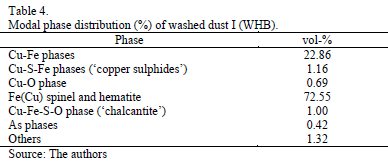
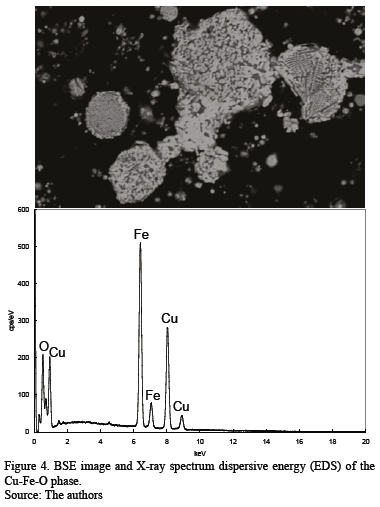
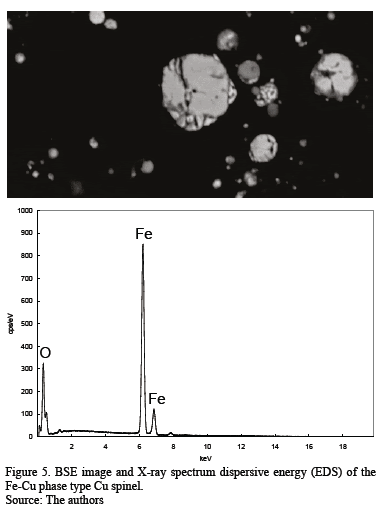
<body><![CDATA[<p><font size="2" face="Verdana, Arial, Helvetica, sans-serif"><b>4.4.  QEMSCAN analysis    <br>   </b></font><font size="2" face="Verdana, Arial, Helvetica, sans-serif">Due to the presence of amorphous phases and the need to   &quot;clear&quot; the XRD spectrum by water rinsing, QEMSCAN was tested on the coarser   dust (Dust I) as an alternative for the quantitative phase characterization of   the dusts since this technology of spatial resolved mineralogical   semi-automated scanning electron microscopy is now more widely available.</font></p>     <p><font size="2" face="Verdana, Arial, Helvetica, sans-serif">Particles with irregular and   mainly rounded shapes were observed. Coarse round particles are surrounded by   fine material forming aggregates bonded by a phase likely to be hydrated copper   sulfate and other mixed phases. Since the presence of sulfate hydrates implied   difficult sample preparation and carbon coating instability, washed samples are   preferred for good quality imaging and microchemical data collection. The backscatted electron image (BSE)   in <a href="#fig04">Fig. 4</a> is a size-ranked subpopulation showing the described particle   characteristics. Modal phase distribution (<a href="#tab03">Table 3</a>) shows that the main species   are copper- and iron-bearing phases making up over 95% of the total population.   Only 0.42 % of As phases were identified. Two main   groups can be differentiated (<a href="#tab03">Table 3</a>) depending on the Cu and Fe content.</font></p>     <p align="center"><font size="2" face="Verdana, Arial, Helvetica, sans-serif"><a name="fig04"></a></font><img src="/img/revistas/dyna/v81n186/v81n186a01fig04.gif"></p>     <p><font size="2" face="Verdana, Arial, Helvetica, sans-serif">The first Cu-rich group consists of different Cu-bearing   phases in even proportions: a Cu-Fe-bearing phase and a Cu-Fe-O phase   suggesting a delafossite type, a copper sulfide with   low Fe content, and a Cu-O compound, possibly cuprite. The Fe-rich group   includes mainly Fe-Cu phases resembling iron-copper spinel and Fe-O phases   similar to a hematite/magnetite composition. Some chalcanthite remains from the washing of flue dust or exposure of the sample to ambient   humidity; it is associated with the Cu-Fe-S-O phases. Energy dispersive spectra   were acquired for some phases in order to corroborate the modal analysis and   identification (<a href="#fig04">Fig. 4</a> - <a href="#fig07">7</a>). The As-bearing</font> <font size="2" face="Verdana, Arial, Helvetica, sans-serif">phase (<a href="#fig08">Fig. 8</a>) is unstable under the vacuum conditions used and the incidence of the   electron beam causes partial sample volatilization evidenced by clear sample   damage.</font></p>     <p align="center"><font size="2" face="Verdana, Arial, Helvetica, sans-serif"><a name="fig05"></a></font><img src="/img/revistas/dyna/v81n186/v81n186a01fig05.gif"></p>     <p align="center"><font size="2" face="Verdana, Arial, Helvetica, sans-serif"><a name="fig06"></a></font><img src="/img/revistas/dyna/v81n186/v81n186a01fig06.gif"></p>     <p align="center"><font size="2" face="Verdana, Arial, Helvetica, sans-serif"><a name="fig07"></a></font><img src="/img/revistas/dyna/v81n186/v81n186a01fig07.gif"></p>     <p align="center"><font size="2" face="Verdana, Arial, Helvetica, sans-serif"><a name="fig08"></a></font><img src="/img/revistas/dyna/v81n186/v81n186a01fig08.gif"></p>     <p><font size="2" face="Verdana, Arial, Helvetica, sans-serif">The results obtained by QEMSCAN performed on a rigorously   water washed sample to eliminate most of the chalcanthite,   down to 1.00 % (<a href="#tab03">Table 3</a>), are comparable to the calculations of the XRD spectral modeling for Dust I (<a href="#tab02">Table 2</a>) and its   recalculated chemical analysis (<a href="#tab04">Table 4</a>).</font></p>     ]]></body>
<body><![CDATA[<p align="center"><font size="2" face="Verdana, Arial, Helvetica, sans-serif"><a name="tab04"></a></font><img src="/img/revistas/dyna/v81n186/v81n186a01tab04.gif"></p>     <p><font size="2" face="Verdana, Arial, Helvetica, sans-serif">Since both XRD and QEMSCAN allow semiquantitative-quantitative   phase analysis, their application to industrial dusts, characterized by small   grain size and even smaller phase size as well as short cooling times   (crystallization times of the samples under industrial conditions), will be briefly   discussed based on the material analyzed. Desirable aspects for successful Rietveld modeling of XRD spectra are: good crystalline   phases with available crystallographic models and an XRD spectrum without the   abundant overlap caused by the presence of chalcanthite in this study. Samples need to be analyzed &quot;as received&quot; (bulk), requiring only   milling prior to analysis. QEMSCAN record resolution depends on the pixel   spacing on the microscope's electron beam source, resolution may be limited to   2 <font face="Symbol">m</font>m. In the case of flue dusts, phases are small (&lt;5 <font face="Symbol">m</font>m), thus limiting the   possibility to register single phases without spectral interference from   adjacent phases. Reference spectra by quantitative electron microprobe analysis   are required for optimum calibration of the phase database. These can at best   be obtained from other (coarser) synthetic phases of the same process. However,   from the operating conditions, it can only be inferred that similar phases   should form in the corresponding dusts. It should also be pointed out that   different iron oxides cannot be distinguished. For the material analyzed, a   copper sulfate hydrate (chalcanthite) acted as a   &quot;glue&quot; between fine particles, complicating phase identification and possibly   underestimating the presence of this mineral.</font></p>     <p>&nbsp;</p>     <p><font size="3" face="Verdana, Arial, Helvetica, sans-serif"><b>5.  Conclusions</b></font></p>     <p><font size="2" face="Verdana, Arial, Helvetica, sans-serif">Granulometric characterization   was successfullly determined for both, WHB and ESP   dust samples. The coarser granulometric distribution   for the WHB dust respect to the ESP one agrees with that expected from current   practice.</font></p>     <p><font size="2" face="Verdana, Arial, Helvetica, sans-serif">The WHB and ESP dusts have similar copper content,   specifically 22.98 and 25.51 wt-%, respectively.   However, WHB shows higher content of arsenic than ESP, 2.04 compared with   0.82%.</font></p>     <p><font size="2" face="Verdana, Arial, Helvetica, sans-serif">Copper and iron are present mainly in the form of sulfates   (water soluble species), and hematite and magnetite (insoluble species).   Quantitative XRD for insoluble fraction detected 10.28 and 59.79 wt-% of hematite and magnetite, respectively, in the WHB   dust. In the ESP dust, the results are 0.78 and 78.50 wt-%,   for the same compounds.</font></p>     <p><font size="2" face="Verdana, Arial, Helvetica, sans-serif">In the case of insoluble copper compounds, results show   that delafossite was only tentatively identified due   to the absence of one peak. This compound was preliminarily quantified as 22.7   and 10.72 wt-%, for WHB and ESP dust, respectively.</font></p>     <p><font size="2" face="Verdana, Arial, Helvetica, sans-serif">Copper smelting flue dust characterization is a very   complex task, requiring systematic efforts combining different techniques to   obtain more comprehensive information that can be used to analyze and design   dust treatment processes to recover valuable metals and remove toxic elements.</font></p>     <p>&nbsp;</p>     ]]></body>
<body><![CDATA[<p><font size="3" face="Verdana, Arial, Helvetica, sans-serif"><b>Acknowledgments</b></font></p>     <p><font size="2" face="Verdana, Arial, Helvetica, sans-serif">The authors thank financial support from DAAD-Conicyt Grant No. 218-13-2007, PBC project PSD-25 and   INNOVA Chile project 07CN13PMT-206.</font></p>     <p><font size="2" face="Verdana, Arial, Helvetica, sans-serif">The authors would also like to thank Chagres Smelter and Caletones (El Teniente) Smelter   for providing samples and data for the study.</font></p>     <p>&nbsp;</p>     <p><font size="3" face="Verdana, Arial, Helvetica, sans-serif"><b>Bibliography</b></font></p>     <!-- ref --><p><font size="2" face="Verdana, Arial, Helvetica, sans-serif"><b>&#91;1&#93;</b> Copper Bulletin and Statistical Yearbook, ICSG, 2009.    &nbsp;&nbsp;&nbsp;&nbsp;&nbsp;&nbsp;&nbsp;&nbsp;[&#160;<a href="javascript:void(0);" onclick="javascript: window.open('/scielo.php?script=sci_nlinks&ref=000098&pid=S0012-7353201400040000100001&lng=','','width=640,height=500,resizable=yes,scrollbars=1,menubar=yes,');">Links</a>&#160;]<!-- end-ref --></font></p>     <!-- ref --><p> <font size="2" face="Verdana, Arial, Helvetica, sans-serif"><b>&#91;2&#93;</b> Parada, R., Technical manager of chagres smelter, Anglo American Chile. Personal communication.    &nbsp;&nbsp;&nbsp;&nbsp;&nbsp;&nbsp;&nbsp;&nbsp;[&#160;<a href="javascript:void(0);" onclick="javascript: window.open('/scielo.php?script=sci_nlinks&ref=000100&pid=S0012-7353201400040000100002&lng=','','width=640,height=500,resizable=yes,scrollbars=1,menubar=yes,');">Links</a>&#160;]<!-- end-ref --></font></p>     <!-- ref --><p> <font size="2" face="Verdana, Arial, Helvetica, sans-serif"><b>&#91;3&#93;</b> Biblioteca del Congreso Nacional de Chile, Decreto Supremo DS Nº 148/2003, January 24th, 2004.    &nbsp;&nbsp;&nbsp;&nbsp;&nbsp;&nbsp;&nbsp;&nbsp;[&#160;<a href="javascript:void(0);" onclick="javascript: window.open('/scielo.php?script=sci_nlinks&ref=000102&pid=S0012-7353201400040000100003&lng=','','width=640,height=500,resizable=yes,scrollbars=1,menubar=yes,');">Links</a>&#160;]<!-- end-ref --></font></p>     <!-- ref --><p> <font size="2" face="Verdana, Arial, Helvetica, sans-serif"><b>&#91;4&#93;</b> Biblioteca del Congreso Nacional de Chile, Decreto Supremo DS Nº 185/1991, April 26th, 1993.    &nbsp;&nbsp;&nbsp;&nbsp;&nbsp;&nbsp;&nbsp;&nbsp;[&#160;<a href="javascript:void(0);" onclick="javascript: window.open('/scielo.php?script=sci_nlinks&ref=000104&pid=S0012-7353201400040000100004&lng=','','width=640,height=500,resizable=yes,scrollbars=1,menubar=yes,');">Links</a>&#160;]<!-- end-ref --></font></p>     <!-- ref --><p> <font size="2" face="Verdana, Arial, Helvetica, sans-serif"><b>&#91;5&#93;</b> Valenzuela, A., Arsenic management in the metallurgical industry. MSc Thesis, Mines and Metallurgy Department, Laval University, Quebec, Canada, 2000.    &nbsp;&nbsp;&nbsp;&nbsp;&nbsp;&nbsp;&nbsp;&nbsp;[&#160;<a href="javascript:void(0);" onclick="javascript: window.open('/scielo.php?script=sci_nlinks&ref=000106&pid=S0012-7353201400040000100005&lng=','','width=640,height=500,resizable=yes,scrollbars=1,menubar=yes,');">Links</a>&#160;]<!-- end-ref --></font></p>     <!-- ref --><p> <font size="2" face="Verdana, Arial, Helvetica, sans-serif"><b>&#91;6&#93;</b> Informe Pa&iacute;s. Estado del Medio Ambiente en Chile 2008, Universidad de Chile, Instituto de Asuntos P&uacute;blicos, Ed. Centro de An&aacute;lisis de Pol&iacute;ticasP&uacute;blicas, 2010.    &nbsp;&nbsp;&nbsp;&nbsp;&nbsp;&nbsp;&nbsp;&nbsp;[&#160;<a href="javascript:void(0);" onclick="javascript: window.open('/scielo.php?script=sci_nlinks&ref=000108&pid=S0012-7353201400040000100006&lng=','','width=640,height=500,resizable=yes,scrollbars=1,menubar=yes,');">Links</a>&#160;]<!-- end-ref --></font></p>     <!-- ref --><p> <font size="2" face="Verdana, Arial, Helvetica, sans-serif"><b>&#91;7&#93;</b> Kurosawa, T., Yagishi, T., Togo, K. and Kato ,T., On the several problems of dust in the copper smelting; Transactions of National Research Institute for Metals, 15 (3), 1973.    &nbsp;&nbsp;&nbsp;&nbsp;&nbsp;&nbsp;&nbsp;&nbsp;[&#160;<a href="javascript:void(0);" onclick="javascript: window.open('/scielo.php?script=sci_nlinks&ref=000110&pid=S0012-7353201400040000100007&lng=','','width=640,height=500,resizable=yes,scrollbars=1,menubar=yes,');">Links</a>&#160;]<!-- end-ref --></font></p>     <!-- ref --><p> <font size="2" face="Verdana, Arial, Helvetica, sans-serif"><b>&#91;8&#93;</b> Evans, J.P., Mackey, P.J. and Scott, J.D., Impact of cooling techniques on smelter dust segregation. In: Smith T.J.A., Newman C.J. ed. Smelter process gas handling and treatment. Warrendale, PA. TMS, 1991, pp. 189-214.    &nbsp;&nbsp;&nbsp;&nbsp;&nbsp;&nbsp;&nbsp;&nbsp;[&#160;<a href="javascript:void(0);" onclick="javascript: window.open('/scielo.php?script=sci_nlinks&ref=000112&pid=S0012-7353201400040000100008&lng=','','width=640,height=500,resizable=yes,scrollbars=1,menubar=yes,');">Links</a>&#160;]<!-- end-ref --></font></p>     <!-- ref --><p> <font size="2" face="Verdana, Arial, Helvetica, sans-serif"><b>&#91;9&#93;</b> Kim, J.Y., Lajoie, S. and Godbehere, P., Characterization of copper smelter dusts and its effect on metal recovery. In Rao et al. eds. Waste processing and recycling in mineral and metallurgical industries, British Columbia, Canada: CIM, 1995, pp. 221-234.    &nbsp;&nbsp;&nbsp;&nbsp;&nbsp;&nbsp;&nbsp;&nbsp;[&#160;<a href="javascript:void(0);" onclick="javascript: window.open('/scielo.php?script=sci_nlinks&ref=000114&pid=S0012-7353201400040000100009&lng=','','width=640,height=500,resizable=yes,scrollbars=1,menubar=yes,');">Links</a>&#160;]<!-- end-ref --></font></p>     <!-- ref --><p> <font size="2" face="Verdana, Arial, Helvetica, sans-serif"><b>&#91;10&#93;</b> Samuelsson, C., Controlled dust separation, theoretical and experimental study of the possibilities of controlled dust separation in copper producing processes. Doctoral Thesis Lulea University of Technology, Lulea, 1999. ISSN: 1402-1544.    &nbsp;&nbsp;&nbsp;&nbsp;&nbsp;&nbsp;&nbsp;&nbsp;[&#160;<a href="javascript:void(0);" onclick="javascript: window.open('/scielo.php?script=sci_nlinks&ref=000116&pid=S0012-7353201400040000100010&lng=','','width=640,height=500,resizable=yes,scrollbars=1,menubar=yes,');">Links</a>&#160;]<!-- end-ref --></font></p>     <!-- ref --><p> <font size="2" face="Verdana, Arial, Helvetica, sans-serif"><b>&#91;11&#93;</b> Bergmann, J., Friedel, P. and Kleeberg, R., BGMN - a new fundamental parameters based Rietveld program for laboratory X-ray sources, it's use in quantitative analysis and structure investigations. Commission of Powder Diffraction, International Union of Crystallography CPD Newslett. 20, pp.5-8, 1998.    &nbsp;&nbsp;&nbsp;&nbsp;&nbsp;&nbsp;&nbsp;&nbsp;[&#160;<a href="javascript:void(0);" onclick="javascript: window.open('/scielo.php?script=sci_nlinks&ref=000118&pid=S0012-7353201400040000100011&lng=','','width=640,height=500,resizable=yes,scrollbars=1,menubar=yes,');">Links</a>&#160;]<!-- end-ref --></font></p>     <!-- ref --><p> <font size="2" face="Verdana, Arial, Helvetica, sans-serif"><b>&#91;12&#93;</b> Vaz&aacute;n, V., Sarquis, P. y Brandaleze, E., Caracterizaci&oacute;n de un mineral de cobre en Argentina para la producci&oacute;n de mate, Revista Dyna, 78 (167), pp. 220-228, 2011.    &nbsp;&nbsp;&nbsp;&nbsp;&nbsp;&nbsp;&nbsp;&nbsp;[&#160;<a href="javascript:void(0);" onclick="javascript: window.open('/scielo.php?script=sci_nlinks&ref=000120&pid=S0012-7353201400040000100012&lng=','','width=640,height=500,resizable=yes,scrollbars=1,menubar=yes,');">Links</a>&#160;]<!-- end-ref --></font></p>     <!-- ref --><p> <font size="2" face="Verdana, Arial, Helvetica, sans-serif"><b>&#91;13&#93;</b> Swinbourne, D.R., Simak, E. and Yazawa, A., Accretion and dust formation in copper smelting-thermodynamic considerations. In: Sulfide Smelting 2002. TMS (The Minerals, Metals and Materials Society), Seattle, Washington, USA, 2002, pp. 247-259. ISBN: 0-87339-525-5.    &nbsp;&nbsp;&nbsp;&nbsp;&nbsp;&nbsp;&nbsp;&nbsp;[&#160;<a href="javascript:void(0);" onclick="javascript: window.open('/scielo.php?script=sci_nlinks&ref=000122&pid=S0012-7353201400040000100013&lng=','','width=640,height=500,resizable=yes,scrollbars=1,menubar=yes,');">Links</a>&#160;]<!-- end-ref --> </font></p>     <p>&nbsp;</p>     <p><font size="2" face="Verdana, Arial, Helvetica, sans-serif"><b>Eduardo Balladares</b>, received the Bs. Eng in Metallurgical Engineering in 1994, the MSc degree in   Metallurgical Engineering in 2004, and the PhD degree in Metallurgical   Engineering in 2008, all of them from the Universidad de Concepci&oacute;n, Chile.   From 1995 to 1996, he worked as project engineer and from 1997 to 2001, he work   at SQM Salar as Plant Chief. From 2002 to 2008, he   worked as project engineer. He is currently Assistant professor in the   Universidad de Concepci&oacute;n.</font></p>     <p><font size="2" face="Verdana, Arial, Helvetica, sans-serif"><b>Ursula Kelm</b> received her undergraduate degree (Diplom)   in geology from Tübingen University, Germany in 1984,   followed by a PhD from Bristol University, Great Britain in 1988.  Since 1990, she is geologist at the Institute   of Applied Economic Geology (GEA), University of Concepci&oacute;n, Chile.  Her main areas of interest are gangue   mineralogy, in particular clays, as well as the characterization of ultrafine   mineral processing materials.</font></p>     <p><font size="2" face="Verdana, Arial, Helvetica, sans-serif"><b>Sonia Helle</b>, received the degree of Bach. in Chemistry in 1975,  from the University of Concepci&oacute;n, Chile. From 1973 to now, she works at   the    University of Concepci&oacute;n. She is full Associate Professor and Director of the Instituto de Geolog&iacute;aEcon&oacute;micaAplicada. The fiel of specialization include Geometallurgy,   Geochemistry and Atomic Spectrometry Analysis.  </font></p>     <p><font size="2" face="Verdana, Arial, Helvetica, sans-serif"><b>Roberto Parra</b>, Graduated from Universidad de Concepci&oacute;n as   Metallurgical Engineering in 1991, he obtained a D.E.A. (1992) and a Ph.D.   (1998) in Engineering and Material Science, both from Institut National Polytechnique de Grenoble (France). Full   professor at the Metallurgical Department of the University of Concepci&oacute;n. The   main interests in R&amp;D are Physical Chemistry of High Temperature Processes with   special emphasis in copper pyrometallurgy. He is   adjunct professor at the Mining School of Oviedo in Spain developing academic   activities in the research group of Steelmaking, Metallurgy and Materials and   is associated researcher in the group Sustainability on Metallurgical and   Steelmaking Processes at CENIM in Madrid (Spain).</font></p>     <p><font size="2" face="Verdana, Arial, Helvetica, sans-serif"><b>Eugenia Araneda,</b> received his degree in Metallurgical   Engineering in 1998 and is candidate for the Ph.D. in Metallurgical Engineering   at the University of Concepci&oacute;n, Chile. Since 2001 she works as Senior   Researcher in the Department of Metallurgical Engineering, University of   Concepci&oacute;n, participating in R+D projects in mining with emphasis in   electrochemistry and advanced characterization of materials.</font></p>      ]]></body><back>
<ref-list>
<ref id="B1">
<label>1</label><nlm-citation citation-type="book">
<source><![CDATA[Copper Bulletin and Statistical Yearbook]]></source>
<year>2009</year>
<publisher-name><![CDATA[ICSG]]></publisher-name>
</nlm-citation>
</ref>
<ref id="B2">
<label>2</label><nlm-citation citation-type="book">
<person-group person-group-type="author">
<name>
<surname><![CDATA[Parada]]></surname>
<given-names><![CDATA[R.]]></given-names>
</name>
</person-group>
<source><![CDATA[Technical manager of chagres smelter]]></source>
<year></year>
<publisher-name><![CDATA[Anglo American Chile]]></publisher-name>
</nlm-citation>
</ref>
<ref id="B3">
<label>3</label><nlm-citation citation-type="">
<collab>Biblioteca del Congreso Nacional de Chile</collab>
<source><![CDATA[Decreto Supremo DS Nº 148/2003]]></source>
<year>Janu</year>
<month>ar</month>
<day>y </day>
</nlm-citation>
</ref>
<ref id="B4">
<label>4</label><nlm-citation citation-type="">
<collab>Biblioteca del Congreso Nacional de Chile</collab>
<source><![CDATA[Decreto Supremo DS Nº 185/1991]]></source>
<year>Apri</year>
<month>l </month>
<day>26</day>
</nlm-citation>
</ref>
<ref id="B5">
<label>5</label><nlm-citation citation-type="">
<person-group person-group-type="author">
<name>
<surname><![CDATA[Valenzuela]]></surname>
<given-names><![CDATA[A.]]></given-names>
</name>
</person-group>
<source><![CDATA[Arsenic management in the metallurgical industry]]></source>
<year></year>
</nlm-citation>
</ref>
<ref id="B6">
<label>6</label><nlm-citation citation-type="book">
<collab>Universidad de Chile^dInstituto de Asuntos Públicos</collab>
<source><![CDATA[Estado del Medio Ambiente en Chile 2008]]></source>
<year>2010</year>
<publisher-name><![CDATA[Centro de Análisis de PolíticasPúblicas]]></publisher-name>
</nlm-citation>
</ref>
<ref id="B7">
<label>7</label><nlm-citation citation-type="journal">
<person-group person-group-type="author">
<name>
<surname><![CDATA[Kurosawa]]></surname>
<given-names><![CDATA[T.]]></given-names>
</name>
<name>
<surname><![CDATA[Yagishi]]></surname>
<given-names><![CDATA[T.]]></given-names>
</name>
<name>
<surname><![CDATA[Togo]]></surname>
<given-names><![CDATA[K.]]></given-names>
</name>
<name>
<surname><![CDATA[Kato]]></surname>
<given-names><![CDATA[T.]]></given-names>
</name>
</person-group>
<article-title xml:lang="en"><![CDATA[On the several problems of dust in the copper smelting]]></article-title>
<source><![CDATA[Transactions of National Research Institute for Metals]]></source>
<year>1973</year>
<volume>15</volume>
<numero>3</numero>
<issue>3</issue>
</nlm-citation>
</ref>
<ref id="B8">
<label>8</label><nlm-citation citation-type="book">
<person-group person-group-type="author">
<name>
<surname><![CDATA[Evans]]></surname>
<given-names><![CDATA[J.P.]]></given-names>
</name>
<name>
<surname><![CDATA[Mackey]]></surname>
<given-names><![CDATA[P.J.]]></given-names>
</name>
<name>
<surname><![CDATA[Scott]]></surname>
<given-names><![CDATA[J.D.]]></given-names>
</name>
</person-group>
<article-title xml:lang="en"><![CDATA[Impact of cooling techniques on smelter dust segregation]]></article-title>
<person-group person-group-type="editor">
<name>
<surname><![CDATA[Smith]]></surname>
<given-names><![CDATA[T.J.A.]]></given-names>
</name>
<name>
<surname><![CDATA[Newman]]></surname>
<given-names><![CDATA[C.J.]]></given-names>
</name>
</person-group>
<source><![CDATA[Smelter process gas handling and treatment]]></source>
<year>1991</year>
<page-range>189-214</page-range><publisher-loc><![CDATA[Warrendale^ePA PA]]></publisher-loc>
<publisher-name><![CDATA[TMS]]></publisher-name>
</nlm-citation>
</ref>
<ref id="B9">
<label>9</label><nlm-citation citation-type="">
<person-group person-group-type="author">
<name>
<surname><![CDATA[Kim]]></surname>
<given-names><![CDATA[J.Y.]]></given-names>
</name>
<name>
<surname><![CDATA[Lajoie]]></surname>
<given-names><![CDATA[S.]]></given-names>
</name>
<name>
<surname><![CDATA[Godbehere]]></surname>
<given-names><![CDATA[P.]]></given-names>
</name>
</person-group>
<article-title xml:lang="en"><![CDATA[Characterization of copper smelter dusts and its effect on metal recovery]]></article-title>
<person-group person-group-type="editor">
<name>
<surname><![CDATA[Rao]]></surname>
</name>
</person-group>
<source><![CDATA[Waste processing and recycling in mineral and metallurgical industries]]></source>
<year>1995</year>
<page-range>221-234</page-range><publisher-loc><![CDATA[British Columbia ]]></publisher-loc>
</nlm-citation>
</ref>
<ref id="B10">
<label>10</label><nlm-citation citation-type="">
<person-group person-group-type="author">
<name>
<surname><![CDATA[Samuelsson]]></surname>
<given-names><![CDATA[C.]]></given-names>
</name>
</person-group>
<source><![CDATA[Controlled dust separation, theoretical and experimental study of the possibilities of controlled dust separation in copper producing processes]]></source>
<year></year>
</nlm-citation>
</ref>
<ref id="B11">
<label>11</label><nlm-citation citation-type="journal">
<person-group person-group-type="author">
<name>
<surname><![CDATA[Bergmann]]></surname>
<given-names><![CDATA[J.]]></given-names>
</name>
<name>
<surname><![CDATA[Friedel]]></surname>
<given-names><![CDATA[P.]]></given-names>
</name>
<name>
<surname><![CDATA[Kleeberg]]></surname>
<given-names><![CDATA[R.]]></given-names>
</name>
</person-group>
<article-title xml:lang="en"><![CDATA[BGMN: a new fundamental parameters based Rietveld program for laboratory X-ray sources, it's use in quantitative analysis and structure investigations]]></article-title>
<source><![CDATA[Commission of Powder Diffraction, International Union of Crystallography CPD Newslett]]></source>
<year>1998</year>
<numero>20</numero>
<issue>20</issue>
<page-range>5-8</page-range></nlm-citation>
</ref>
<ref id="B12">
<label>12</label><nlm-citation citation-type="journal">
<person-group person-group-type="author">
<name>
<surname><![CDATA[Vazán]]></surname>
<given-names><![CDATA[V.]]></given-names>
</name>
<name>
<surname><![CDATA[Sarquis]]></surname>
<given-names><![CDATA[P.]]></given-names>
</name>
<name>
<surname><![CDATA[Brandaleze]]></surname>
<given-names><![CDATA[E.]]></given-names>
</name>
</person-group>
<article-title xml:lang="es"><![CDATA[Caracterización de un mineral de cobre en Argentina para la producción de mate]]></article-title>
<source><![CDATA[Revista Dyna]]></source>
<year>2011</year>
<volume>78</volume>
<numero>167</numero>
<issue>167</issue>
<page-range>220-228</page-range></nlm-citation>
</ref>
<ref id="B13">
<label>13</label><nlm-citation citation-type="book">
<person-group person-group-type="author">
<name>
<surname><![CDATA[Swinbourne]]></surname>
<given-names><![CDATA[D.R.]]></given-names>
</name>
<name>
<surname><![CDATA[Simak]]></surname>
<given-names><![CDATA[E.]]></given-names>
</name>
<name>
<surname><![CDATA[Yazawa]]></surname>
<given-names><![CDATA[A.]]></given-names>
</name>
</person-group>
<article-title xml:lang="en"><![CDATA[Accretion and dust formation in copper smelting-thermodynamic considerations]]></article-title>
<source><![CDATA[Sulfide Smelting 2002]]></source>
<year>2002</year>
<page-range>247-259</page-range><publisher-loc><![CDATA[Seattle^eWashington Washington]]></publisher-loc>
<publisher-name><![CDATA[The Minerals, Metals and Materials Society]]></publisher-name>
</nlm-citation>
</ref>
</ref-list>
</back>
</article>