<?xml version="1.0" encoding="ISO-8859-1"?><article xmlns:mml="http://www.w3.org/1998/Math/MathML" xmlns:xlink="http://www.w3.org/1999/xlink" xmlns:xsi="http://www.w3.org/2001/XMLSchema-instance">
<front>
<journal-meta>
<journal-id>0012-7353</journal-id>
<journal-title><![CDATA[DYNA]]></journal-title>
<abbrev-journal-title><![CDATA[Dyna rev.fac.nac.minas]]></abbrev-journal-title>
<issn>0012-7353</issn>
<publisher>
<publisher-name><![CDATA[Universidad Nacional de Colombia]]></publisher-name>
</publisher>
</journal-meta>
<article-meta>
<article-id>S0012-73532014000400004</article-id>
<article-id pub-id-type="doi">10.15446/dyna.v81n186.37797</article-id>
<title-group>
<article-title xml:lang="en"><![CDATA[A robust neuro-fuzzy classifier for the detection of cardiomegaly in digital chest radiographies]]></article-title>
<article-title xml:lang="es"><![CDATA[Clasificador robusto neuro-difuso para la detección de cardiomegalia en radiografías digitales del tórax]]></article-title>
</title-group>
<contrib-group>
<contrib contrib-type="author">
<name>
<surname><![CDATA[Torres-Robles]]></surname>
<given-names><![CDATA[Fabián]]></given-names>
</name>
<xref ref-type="aff" rid="A01"/>
</contrib>
<contrib contrib-type="author">
<name>
<surname><![CDATA[Rosales-Silva]]></surname>
<given-names><![CDATA[Alberto Jorge]]></given-names>
</name>
<xref ref-type="aff" rid="A02"/>
</contrib>
<contrib contrib-type="author">
<name>
<surname><![CDATA[Gallegos-Funes]]></surname>
<given-names><![CDATA[Francisco Javier]]></given-names>
</name>
<xref ref-type="aff" rid="A03"/>
</contrib>
<contrib contrib-type="author">
<name>
<surname><![CDATA[Bazán-Trujillo]]></surname>
<given-names><![CDATA[Ivonne]]></given-names>
</name>
<xref ref-type="aff" rid="A04"/>
</contrib>
</contrib-group>
<aff id="A01">
<institution><![CDATA[,Instituto Politécnico Nacional de México Escuela Superior de Ingeniería Mecánica y Eléctrica ]]></institution>
<addr-line><![CDATA[ ]]></addr-line>
<country>México</country>
</aff>
<aff id="A02">
<institution><![CDATA[,Instituto Politécnico Nacional de México Escuela Superior de Ingeniería Mecánica y Eléctrica ]]></institution>
<addr-line><![CDATA[ ]]></addr-line>
<country>México</country>
</aff>
<aff id="A03">
<institution><![CDATA[,Instituto Politécnico Nacional de México Escuela Superior de Ingeniería Mecánica y Eléctrica ]]></institution>
<addr-line><![CDATA[ ]]></addr-line>
<country>México</country>
</aff>
<aff id="A04">
<institution><![CDATA[,Instituto Politécnico Nacional de México Escuela Superior de Ingeniería Mecánica y Eléctrica ]]></institution>
<addr-line><![CDATA[ ]]></addr-line>
<country>México</country>
</aff>
<pub-date pub-type="pub">
<day>00</day>
<month>08</month>
<year>2014</year>
</pub-date>
<pub-date pub-type="epub">
<day>00</day>
<month>08</month>
<year>2014</year>
</pub-date>
<volume>81</volume>
<numero>186</numero>
<fpage>35</fpage>
<lpage>41</lpage>
<copyright-statement/>
<copyright-year/>
<self-uri xlink:href="http://www.scielo.org.co/scielo.php?script=sci_arttext&amp;pid=S0012-73532014000400004&amp;lng=en&amp;nrm=iso"></self-uri><self-uri xlink:href="http://www.scielo.org.co/scielo.php?script=sci_abstract&amp;pid=S0012-73532014000400004&amp;lng=en&amp;nrm=iso"></self-uri><self-uri xlink:href="http://www.scielo.org.co/scielo.php?script=sci_pdf&amp;pid=S0012-73532014000400004&amp;lng=en&amp;nrm=iso"></self-uri><abstract abstract-type="short" xml:lang="en"><p><![CDATA[We present a novel procedure that automatically and reliably determines the presence of cardiomegaly in chest image radiographies. The cardiothoracic ratio (CTR) shows the relationship between the size of the heart and the size of the chest. The proposed scheme uses a robust fuzzy classifier to find the correct feature values of chest size, and the right and left heart boundaries to measure the heart enlargement to detect cardiomegaly. The proposed approach uses classical morphology operations to segment the lungs providing low computational complexity and the proposed fuzzy method is robust to find the correct measures of CTR providing a fast computation because the fuzzy rules use elementary arithmetic operations to perform a good detection of cardiomegaly. Finally, we improve the classification results of the proposed fuzzy method using a Radial Basis Function (RBF) neural network in terms of accuracy, sensitivity, and specificity.]]></p></abstract>
<abstract abstract-type="short" xml:lang="es"><p><![CDATA[Presentamos un nuevo procedimiento que determina de forma automática y fiable la presencia de cardiomegalia en radiografías torácicas. El CTR muestra la relación entre el tamaño del corazón y el tamaño del tórax. El esquema propuesto utiliza un clasificador robusto difuso para encontrar los valores correctos del tamaño del tórax y los límites del corazón derecho e izquierdo para medir el agrandamiento del corazón para detectar cardiomegalia. El método propuesto utiliza operaciones clásicas de morfología para segmentar los pulmones proporcionando baja complejidad computacional y el método difuso propuesto es robusto para encontrar las medidas correctas del CTR proporcionando un cálculo rápido porque las reglas difusas usan operaciones aritméticas elementales para desempeñar una buena detección de cardiomegalia. Finalmente, se mejoran los resultados de clasificación del método difuso propuesto utilizando una red neuronal función de base radial (RBF) en términos de precisión, sensibilidad y especificidad.]]></p></abstract>
<kwd-group>
<kwd lng="en"><![CDATA[Cardiomegaly]]></kwd>
<kwd lng="en"><![CDATA[fuzzy classifier]]></kwd>
<kwd lng="en"><![CDATA[Radial Basis Function neural network]]></kwd>
<kwd lng="en"><![CDATA[chest image radiographies]]></kwd>
<kwd lng="es"><![CDATA[Cardiomegalia]]></kwd>
<kwd lng="es"><![CDATA[clasificador difuso]]></kwd>
<kwd lng="es"><![CDATA[red neuronal Función de Base Radial]]></kwd>
<kwd lng="es"><![CDATA[radiografías de tórax]]></kwd>
</kwd-group>
</article-meta>
</front><body><![CDATA[ <p><font size="2" face="Verdana, Arial, Helvetica, sans-serif"><a href="http://dx.doi.org/10.15446/dyna.v81n186.37797" target="_blank">http://dx.doi.org/10.15446/dyna.v81n186.37797</a></font></p>     <p align="center"><font size="4" face="Verdana, Arial, Helvetica, sans-serif"><b>A robust neuro-fuzzy classifier for the detection   of cardiomegaly in digital chest radiographies</b></font></p>     <p align="center"><b><font size="3" face="Verdana, Arial, Helvetica, sans-serif"><i>Clasificador   robusto neuro-difuso para la detecci&oacute;n de cardiomegalia en radiograf&iacute;as   digitales del t&oacute;rax</i></font></b></p>     <p align="center">&nbsp;</p>     <p align="center"><b><font size="2" face="Verdana, Arial, Helvetica, sans-serif">Fabi&aacute;n Torres-Robles <sup>a</sup>, Alberto Jorge Rosales-Silva <sup>b</sup>, Francisco Javier Gallegos-Funes <sup>c</sup> &amp; Ivonne Baz&aacute;n-Trujillo <sup>d</sup></font></b></p>     <p align="center">&nbsp;</p>     <p align="center"><font size="2" face="Verdana, Arial, Helvetica, sans-serif"><sup><i>a</i></sup><i> Escuela Superior de   Ingenier&iacute;a Mec&aacute;nica y El&eacute;ctrica, Instituto Polit&eacute;cnico Nacional de M&eacute;xico, M&eacute;xico. <a href="mailto:fabian.trobles@gmail.com">fabian.trobles@gmail.com</a>    <br>   <sup>b</sup> Escuela Superior de   Ingenier&iacute;a Mec&aacute;nica y El&eacute;ctrica, Instituto Polit&eacute;cnico Nacional de M&eacute;xico, M&eacute;xico. <a href="mailto:arosaless@ipn.mx">arosaless@ipn.mx</a>    <br>   <sup>c</sup> Escuela Superior de   Ingenier&iacute;a Mec&aacute;nica y El&eacute;ctrica, Instituto Polit&eacute;cnico Nacional de M&eacute;xico, M&eacute;xico. <a href="mailto:fgallegosf@ipn.mx">fgallegosf@ipn.mx</a>    <br>   <sup>d</sup> Escuela Superior de   Ingenier&iacute;a Mec&aacute;nica y El&eacute;ctrica, Instituto Polit&eacute;cnico Nacional de M&eacute;xico, M&eacute;xico. <a href="mailto:ibazan@ipn.mx">ibazan@ipn.mx</a></i></font></p>     ]]></body>
<body><![CDATA[<p align="center">&nbsp;</p>     <p align="center"><font size="2" face="Verdana, Arial, Helvetica, sans-serif"><b>Received: April 15<sup>th</sup>, 2013. Received in revised form: May   16<sup>th</sup>, 2014. Accepted: August 8<sup>th</sup>, 2014.</b></font></p>     <p>&nbsp;</p> <hr>     <p><font size="2" face="Verdana, Arial, Helvetica, sans-serif"><b>Abstract    <br>   </b></font><font size="2" face="Verdana, Arial, Helvetica, sans-serif">We present a novel procedure that automatically and reliably   determines the presence of cardiomegaly in chest image radiographies. The   cardiothoracic ratio (<i>CTR</i>) shows the relationship between the   size of the heart and the size of the chest. The proposed scheme uses a robust fuzzy   classifier to find the correct feature values of chest size, and the right and   left heart boundaries to measure the heart enlargement to detect cardiomegaly. The   proposed approach uses classical morphology operations to segment the lungs   providing low computational complexity and the proposed fuzzy method is robust   to find the correct measures of <i>CTR</i> providing a fast computation because the fuzzy rules use elementary arithmetic   operations to perform a good detection of cardiomegaly. Finally, we improve the   classification results of the proposed fuzzy method using a Radial Basis   Function (RBF) neural network in terms of accuracy, sensitivity, and specificity.</font></p>     <p><font size="2" face="Verdana, Arial, Helvetica, sans-serif"><i>Keywords</i>: Cardiomegaly; fuzzy classifier; Radial Basis Function   neural network; chest image radiographies.</font></p>     <p><font size="2" face="Verdana, Arial, Helvetica, sans-serif"><b>Resumen    <br>   </b></font><font size="2" face="Verdana, Arial, Helvetica, sans-serif">Presentamos   un nuevo procedimiento que determina de forma autom&aacute;tica y fiable la presencia de cardiomegalia en radiograf&iacute;as tor&aacute;cicas. El <i>CTR</i> muestra la relaci&oacute;n entre el tama&ntilde;o del coraz&oacute;n y el tama&ntilde;o del t&oacute;rax. El   esquema propuesto utiliza un clasificador robusto difuso para encontrar los   valores correctos del tama&ntilde;o del t&oacute;rax y los l&iacute;mites del coraz&oacute;n derecho e   izquierdo para medir el agrandamiento del coraz&oacute;n para detectar cardiomegalia. El m&eacute;todo propuesto   utiliza operaciones cl&aacute;sicas de morfolog&iacute;a para segmentar los pulmones   proporcionando baja complejidad computacional y el m&eacute;todo difuso propuesto es   robusto para encontrar las medidas correctas del <i>CTR</i> proporcionando un c&aacute;lculo r&aacute;pido porque las reglas difusas usan   operaciones aritm&eacute;ticas elementales para desempe&ntilde;ar una buena detecci&oacute;n de   cardiomegalia. Finalmente, se mejoran los resultados de clasificaci&oacute;n del   m&eacute;todo difuso propuesto utilizando una red neuronal funci&oacute;n de base radial   (RBF) en t&eacute;rminos de precisi&oacute;n, sensibilidad y especificidad. </font></p>     <p><font size="2" face="Verdana, Arial, Helvetica, sans-serif"><i>Palabras clave</i>: Cardiomegalia; clasificador difuso; red neuronal Funci&oacute;n de Base Radial; radiograf&iacute;as de t&oacute;rax.</font></p> <hr>     <p>&nbsp;</p>     ]]></body>
<body><![CDATA[<p><font size="3" face="Verdana, Arial, Helvetica, sans-serif"><b>1.  Introduction</b></font></p>     <p><font size="2" face="Verdana, Arial, Helvetica, sans-serif">Radiography helps   medical staff to provide the most accurate diagnosis possible, which enables   insight into the human body. In radiology, radiographies of the chest   are the most common and they are used to diagnose conditions affecting the   chest cavity, contents and nearby structures. &#91;1,2&#93;.</font></p>     <p><font size="2" face="Verdana, Arial, Helvetica, sans-serif">The interpretation   of chest radiographs is notoriously difficult, due to the intensity, the brightness, or the contrast which   is not appropriate to provide a good delineation of anatomical structures and   other regions of interest. For   these reasons computer-aided diagnosis for chest radiography is becoming increasingly important to assist   and automate specific radiological tasks &#91;1-5&#93;.</font></p>     <p><font size="2" face="Verdana, Arial, Helvetica, sans-serif">Some applications   of computer analysis of the chest radiographies are reported in the literature:   estimation the total volume of the lung and pulmonary nodule detection,   estimation of the cardiothoracic ratio <i>CTR</i> detection of   cardiomegaly, pneumothorax detection, estimation of pneumoconiosis severity,   interstitial disease detection, and detection of abnormalities found in mass   screening for tuberculosis &#91;1&#93;. </font></p>     <p><font size="2" face="Verdana, Arial, Helvetica, sans-serif">Cardiomegaly is a symptom of cardiac insufficiency. The   number of people suffering cardiac insufficiency increases every year. In the USA there are about 260,000 deaths   caused by cardiac insufficiency every year &#91;6&#93;. In Mexico, there are   about 750,000 patients affected by cardiac insufficiency and the number of   cases increases 10% per year &#91;7&#93;. More newer alternative methods of diagnosis are   been developed &#91;4,5,8-11&#93;, so that non experts in cardiology can make a   reliable diagnosis and start a preventive treatment for patients who suffer   cardiac insufficiency, until they are able to treat this condition with a   cardiologist. </font></p>     <p><font size="2" face="Verdana, Arial, Helvetica, sans-serif">Segmentation of the heart from chest radiographic images   has been studied by several researchers, usually with the aim of detecting   cardiomegaly (enlargement of the heart) &#91;6,9-11&#93;. Methods exist that employ   local thresholding, region growing, edge detection, ridge detection,   morphological operations, fitting of geometrical models or functions about the   heart shape, dynamic programming, and the use of rule-based schemes   &#91;1,4,5,8-11&#93;. On the other hand, several   attempts have been made to classify each pixel in the image into an anatomical   class, such as heart, mediastinum, diaphragm, lung or background. Neural   networks or Markov random field modeling are used as classifiers of a variety   of local features including intensity, location, and texture measures &#91;1&#93;. </font></p>     <p><font size="2" face="Verdana, Arial, Helvetica, sans-serif">In   this paper we present a robust fuzzy classifier to decide if a chest radiographic   image has cardiomegaly or not. The proposed fuzzy algorithm is the focus of the   paper and it is very robust in finding the correct feature values that   are important to measure the heart enlargement in chest images to detect   cardiomegaly. This   algorithm corrects the false characteristic values obtained during the basic   segmentation stage where Sobel edge detection and mathematical   morphology algorithms are used. Recently,   we demonstrated the robust properties of a similar fuzzy feature extraction   algorithm used to detect Acute Lymphoblastic Leukemia &#91;12&#93;. For this reason, we   decide to use in this paper the results of a basic segmentation stage to   demonstrate that the proposed fuzzy   classifier could potentially provide a robust solution and reliable   diagnosis of cardiomegaly. Finally, we improve the classification results of   the proposed fuzzy classifier method using the criteria of the New York Heart Association (NYHA) and the   American College of Cardiology - American Heart Association (ACC-AHA) &#91;13&#93; on a   Radial Basis Function (RBF) neural network &#91;14&#93;.</font></p>     <p>&nbsp;</p>     <p><font size="3" face="Verdana, Arial, Helvetica, sans-serif"><b>2.  Methodology</b></font></p>     <p><font size="2" face="Verdana, Arial, Helvetica, sans-serif"><b>2.1.  Cardiac   insufficiency    ]]></body>
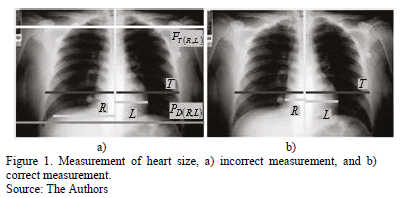
<body><![CDATA[<br>   </b></font><font size="2" face="Verdana, Arial, Helvetica, sans-serif">A cardiac insufficiency is defined as a clinical syndrome,   in which anomalies in the heart structure (i.e. abnormal growth of the heart)   cause the malfunction and incapacity of this organ to expel or refill blood at   the rate needed by other organs to work &#91;4-6&#93;. Cardiac insufficiency can be   defined in terms of its symptoms which   are: dysponea, weakness, cyanosis, swelling, palpitation etc. These symptoms   are the result of the pumping function of the heart &#91;6&#93;.</font></p>     <p><font size="2" face="Verdana, Arial, Helvetica, sans-serif">Cardiomegaly is a symptom of cardiac insufficiency and it   refers to the abnormal growth of the heart. This condition is caused by the   excessive work of the heart that has to perform a properly function, just like   a muscle; the heart increases its size and strength when it is forced   continuously. Cardiomegaly can be identified by measuring of the cardiothoracic   ratio <i>CTR</i> &#91;4-6&#93;,</font></p>     <p><img src="/img/revistas/dyna/v81n186/v81n186a04eq01.gif"></p>     <p><font size="2" face="Verdana, Arial, Helvetica, sans-serif">where <i>R</i> and <i>L</i> are the longest distances from the   central vertical line (middle line of the chest) to the right and left heart   boundaries, respectively, and <i>T</i> is   the longest horizontal distance from the left to the right boundary of lung   (see <a href="#fig01">Fig. 1</a>). The cardiothoracic ratio shows the relationship between the size   of the heart and the size of the chest, if <i>CTR</i> is greater than 0.5, it indicates cardiomegaly in most of cases &#91;4,6&#93;.</font></p>     <p align="center"><font size="2" face="Verdana, Arial, Helvetica, sans-serif"><a name="fig01"></a></font><img src="/img/revistas/dyna/v81n186/v81n186a04fig01.gif"></p>     <p><font size="2" face="Verdana, Arial, Helvetica, sans-serif">In order to assess the level of cardiac insufficiency or   heart failure (HF), two classifications are commonly employed. One is based on   symptoms and exercise capacity according to the New York Heart Association   (NYHA) functional classification and American College of Cardiology - American   Heart Association (ACC-AHA) classification describes the HF in stages based on   structural changes and symptoms &#91;13&#93;.</font></p>     <p><font size="2" face="Verdana, Arial, Helvetica, sans-serif">We can distinguish four classes of the NYHA classification   (the severity is based on the symptoms and the physical activity), which are as   follows:</font></p>     <p><font size="2" face="Verdana, Arial, Helvetica, sans-serif">Class I. No limitation of physical activity. Ordinary   physical activity does not cause undue fatigue, palpitation, or dyspnoea.    <br>   </font><font size="2" face="Verdana, Arial, Helvetica, sans-serif">Class II. Slight limitation of physical activity.   Comfortable at rest, but ordinary physical activity results in fatigue,   palpitation, or dyspnoea.    <br>   </font><font size="2" face="Verdana, Arial, Helvetica, sans-serif">Class III. Marked limitation of physical activity.   Comfortable at rest, but less than ordinary activity results in fatigue,   palpitation, or dyspnoea.    ]]></body>
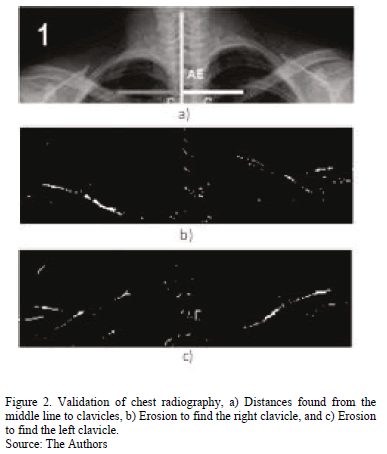
<body><![CDATA[<br>   </font><font size="2" face="Verdana, Arial, Helvetica, sans-serif">Class IV. Unable to carry on any physical activity without   discomfort. Symptoms at rest. If any physical activity is undertaken,   discomfort is increased.</font></p>     <p><font size="2" face="Verdana, Arial, Helvetica, sans-serif">The ACC-AHA working group introduced four stages of HF   (the stages of heart failure are based on structure and damage to heart   muscle):</font></p>     <p><font size="2" face="Verdana, Arial, Helvetica, sans-serif">Stage A. At high risk for developing heart failure. No   identified structural or functional abnormality; no signs or symptoms.    <br>   </font><font size="2" face="Verdana, Arial, Helvetica, sans-serif">Stage B. Developed structural heart disease that is   strongly associated with the development of heart failure, but without signs or   symptoms.    <br>   </font><font size="2" face="Verdana, Arial, Helvetica, sans-serif">Stage C. Symptomatic heart failure associated with   underlying structural heart disease.    <br>   </font><font size="2" face="Verdana, Arial, Helvetica, sans-serif">Stage D. Advanced structural heart disease and marked   symptoms of heart failure at rest despite maximal medical therapy.</font></p>     <p><font size="2" face="Verdana, Arial, Helvetica, sans-serif"><b>2.2.  Proposed   method</b>    <br>   </font><font size="2" face="Verdana, Arial, Helvetica, sans-serif">Lung boundaries identification in a chest radiograph is a   necessary step to detect abnormalities such as interstitial disease,   pneumothorax, cardiomegaly, and pulmonary nodules &#91;5-8&#93;. The features that are   important in the chest images to detect cardiomegaly in terms of <i>CTR</i> are: the chest size by finding the   parameter <i>T</i>, the middle line   localization of chest (vertebral column) to compute the distances <i>L</i> and <i>R</i>, and the heart size is obtained from the sum of <i>L </i>and<i> R</i> (see Eq. (1) and <a href="#fig01">Fig. 1(b)</a>). </font></p>     <p><font size="2" face="Verdana, Arial, Helvetica, sans-serif">We also compute the distance between the middle line and   the clavicles, this is used to validate if a chest radiograph is well taken, or   on the contrary another radiograph should be taken (i.e., if the relative   orientation of body changes with respect to the direction of the x-ray beams this   can cause that a normal heart can have an apparently abnormal cardiac shadow in   the resulting image making the calculated <i>CTR</i> measure incorrect). <a href="#fig02">Fig. 2</a> presents the distances found between the middle line   and the clavicles where to validate the radiography, the difference between the   measurements of the right and left side of the middle line should be of <u>+</u>8%. This value is obtained to analyzing different radiography   images from our database according to the medical staff.</font></p>     <p align="center"><font size="2" face="Verdana, Arial, Helvetica, sans-serif"><a name="fig02"></a></font><img src="/img/revistas/dyna/v81n186/v81n186a04fig02.gif"></p>     ]]></body>
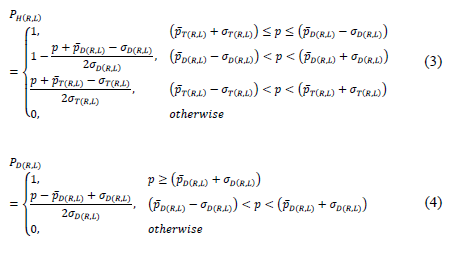
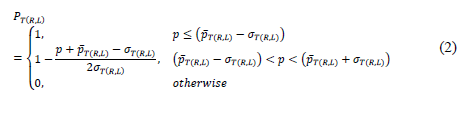
<body><![CDATA[<p><font size="2" face="Verdana, Arial, Helvetica, sans-serif">Some problems are found in obtaining the maximum size of   the heart because there is some ambiguity with respect to the measurement if   this is part of the heart, the trachea or the diaphragm (see <a href="#fig01">Fig. 1a</a> to see an   incorrect measurement). To solve this problem the implementation of a fuzzy   system is proposed &#91;15-18&#93;.</font></p>     <p><font size="2" face="Verdana, Arial, Helvetica, sans-serif">The fuzzy membership functions used to compute the fuzzy   membership values are used for each side (right <i>R</i> and left <i>L</i> boundaries)   of the heart about the middle line to describe if a pixel in the radiography is   part of the chest using a data base of 11   images as follows, </font></p>     <p><img src="/img/revistas/dyna/v81n186/v81n186a04eq02.gif"></p>     <p><font size="2" face="Verdana, Arial, Helvetica, sans-serif">where <i>s<sub>D(R,L)</sub></i> is the   standard deviation of a starting pixel of the diaphragm, <i>s<sub>T(R,L)</sub></i> is the   standard deviation of an ending pixel of the trachea,<i>P<sub>D(R,L)</sub></i> is the average of a starting </font></p>     <p><img src="/img/revistas/dyna/v81n186/v81n186a04eq0304.gif"></p>     <p><font size="2" face="Verdana, Arial, Helvetica, sans-serif">pixel of   the diaphragm, <i>P<sub>T(R,L)</sub></i> is the average of an ending   pixel of the trachea, <i>P<sub>T(R,L)</sub></i>, <i>P<sub>H(R,L)</sub></i>, and <i>P<sub>D(R,L)</sub></i> are the membership   values of trachea, heart, and diaphragm, respectively. These parameters are   computed for each side (right <i>R</i> and   left <i>L</i> boundaries) of the heart about   the middle line, and<i> p</i> is the   horizontal measure from the boundaries of the <i>R</i> and <i>L</i> distances about   the middle line.</font></p>     <p><font size="2" face="Verdana, Arial, Helvetica, sans-serif">To provide more   robustness to the proposed method, the membership function <i>Similar</i> (Eq. (5)) is used to evaluate if the longest distance <i>R</i> and <i>L</i> found are correct measurements or not (i.e., if the measurement   is part of the heart or part of another area such as the diaphragm or trachea).   The </font></p>     <p><font size="2" face="Verdana, Arial, Helvetica, sans-serif">membership   fuzzy value <i>Similar</i> indicates if this   is strongly related or not to the heart area. Moreover, this fuzzy value will   help to discover if there is an abrupt growth of the measurements, meaning that   the measurements go through the heart area to the diaphragm area.</font></p>     <p><img src="/img/revistas/dyna/v81n186/v81n186a04eq05.gif"></p>     <p><font size="2" face="Verdana, Arial, Helvetica, sans-serif">where <i>a</i> is the   pixel difference between the longest found distance measurement and the longest   distance in the heart area where the membership value is equal to 1 computed   for each side (right <i>R</i> and left <i>L</i> boundaries) of the heart about the   middle line. </font></p>     ]]></body>
<body><![CDATA[<p><font size="2" face="Verdana, Arial, Helvetica, sans-serif">Using the <i>Similar</i> and <i>P<sub>H(R,L)</sub></i> membership   functions values, the algorithm is able to decide if the longest distance is a   measure of the heart or not. The designed fuzzy rule makes the decision as   follows:</font></p>     <p><img src="/img/revistas/dyna/v81n186/v81n186a04eq06.gif"></p>     <p><font size="2" face="Verdana, Arial, Helvetica, sans-serif">where OR connective is the fuzzy union representation (y = a +b - a&bull;b) and <i>b</i> is a membership value of the <i>correct</i> fuzzy set computed as,</font></p>     <p><img src="/img/revistas/dyna/v81n186/v81n186a04eq07.gif"></p>     <p><font size="2" face="Verdana, Arial, Helvetica, sans-serif">where <i>b &ge; 0.8</i> was experimentally   chosen to provide the robustness needed to improve the accuracy of the heart   size measurement.</font></p>     <p><font size="2" face="Verdana, Arial, Helvetica, sans-serif">Algebraic form of fuzzy rule (6) is as follows:</font></p>     <p><img src="/img/revistas/dyna/v81n186/v81n186a04eq08.gif"></p>     <p><font size="2" face="Verdana, Arial, Helvetica, sans-serif">where the <i>heart</i> membership   value <i>P<sub>H(R,L)</sub></i> is   multiplied by 0.2 to decrease the effect it has on the decision, 0.2 value is   found to empirically agree to the best detection results.</font></p>     <p><font size="2" face="Verdana, Arial, Helvetica, sans-serif">The membership function (7) of the <i>correct</i> fuzzy set indicates the membership level of the measurement   obtained from the fuzzy rule to determine the heart size in an accurate form,   if the membership value obtained is 0, it indicates that a new measurement   should be taken, and the algorithm has to evaluate if the new measurement taken   has a membership value of 1 to determine if the measure belongs to the heart.   Problems encountered in the feature extraction of the heart size are solved   using (7) and the results are shown in <a href="#fig01">Fig. 1</a>, where the measurement obtained   without implementing a fuzzy method (see <a href="#fig01">Fig. 1(a)</a>) for measuring of the right   side of the heart is incorrect because it does not belong to the heart. After   applying the fuzzy method (see <a href="#fig01">Fig. 1(b)</a>) the system found the correct   measurement of the right heart size. </font></p>     <p>&nbsp;</p>     ]]></body>

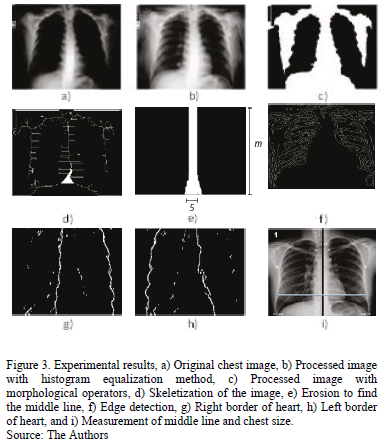
<body><![CDATA[<p><font size="3" face="Verdana, Arial, Helvetica, sans-serif"><b>3.  Results</b></font></p>     <p><b><font size="2" face="Verdana, Arial, Helvetica, sans-serif">3.1.  Segmentation   results    <br>   </font></b><font size="2" face="Verdana, Arial, Helvetica, sans-serif">Several chest image radiographies are obtained from a   Mexican medical data base (200 images) to train and test the proposed   algorithm. The stages of proposed method are given as follows:</font></p>     <p><font size="2" face="Verdana, Arial, Helvetica, sans-serif"><i>a)&nbsp; Preprocessing</i>. Chest radiographies display a wide dynamic   range of X-ray intensities. In unprocessed images it is often hard to obtain   data from the mediastinum because the contrast in the lung fields is limited. A   solution to this kind of problem in image processing is the use of local   histogram equalization methods &#91;1&#93;. Histogram equalization adjustment is used   to enhance contrast of the processed radiographic image &#91;19,20&#93;; which achieved   similar contrast in all images and agreed to the best result obtained with the   segmentation algorithm. <a href="#fig03">Fig. 3(a)</a>-<a href="#fig03">3(b)</a> presents an original chest image and the   processed image using the histogram equalization method where one can see that   this image is enhanced.</font></p>     <p align="center"><font size="2" face="Verdana, Arial, Helvetica, sans-serif"><a name="fig03"></a></font><img src="/img/revistas/dyna/v81n186/v81n186a04fig03.gif"></p>     <p><font size="2" face="Verdana, Arial, Helvetica, sans-serif"><i>b)&nbsp; </i>Segmentation. Mathematical morphology algorithms   are used to skeletize the pre-processed images &#91;19&#93;. <a href="#fig03">Fig. 3(c)</a>-<a href="#fig03">(d)</a> illustrates   these processes in order to find the middle line of the chest, erosion is made   with a rectangular structural element of 5xm pixel size, where m is the   vertical size of the image. The resulting image is shown in <a href="#fig03">Fig. 3(e)</a>. A   similar process is used to compute the distance between the middle line and the   clavicles to validate if a chest radiograph is well taken before finding the   middle line of the chest. In this case, erosion is performed with a rectangular   structural element of 2x3 pixel size, <a href="#fig02">Fig. 2(b)</a>-<a href="#fig02">(c)</a> shows the results of this   erosion in both clavicles. Also, in the pre-processed image, thresholding is   needed before Sobel edge detection (<a href="#fig03">Fig. 3(f)</a>) to highlight the heart in the   pre-processed image and to eliminate the ribs to obtain the heart boundaries   (parameters R and L defined previously) of <a href="#fig03">Fig. 3(g)</a>-<a href="#fig06">(h)</a>.</font></p>     <p><font size="2" face="Verdana, Arial, Helvetica, sans-serif"><i>c)&nbsp; </i>Feature extraction. From the segmentation results   we are able to find the middle line of the chest, the heart size (R and L   distances), and the chest size (T distance). The middle line of the chest is   computed by finding the middle line of the white block of <a href="#fig03">Fig. 3(e)</a> to obtain   the black line of the image of <a href="#fig03">Fig. 3(i)</a>. When this line is found we can obtain   the longest R and L distances (using an array containing different measures of   R and L distances) by counting the distance that exists between the middle line   and the right and left boundaries of heart using <a href="#fig03">Fig. 3(g)</a>-<a href="#fig03">(h)</a>. We also compute   the distance between the middle line and clavicles applying a similar procedure   using the images of <a href="#fig02">Fig. 2(b)</a>-<a href="#fig02">(c)</a>. The chest size is now found as the longest   distance between the right and left chest boundaries. Measurements of the   middle line and the chest size are achieved successfully. <a href="#fig03">Fig. 3(i)</a> shows these   measurements.</font></p>     <p><font size="2" face="Verdana, Arial, Helvetica, sans-serif"><i>d)&nbsp; </i>Fuzzy rules. We need to validate the longest R and   L distances by using the fuzzy membership functions shown in equations (2) to   (4) to evaluate whether these distances are significant measurements or not. <a href="#fig01">Fig. 1(a)</a> depicts a non significant measurement where this distance includes a   part of the diaphragm, to avoid this problem we apply the following steps:</font></p>     <p><font size="2" face="Verdana, Arial, Helvetica, sans-serif">1)&nbsp; Find   the longest value of <i>R</i> and <i>L</i> distances and the pixel pertinence   (whether it is or not a part of the heart) of the distance values from the array that contains the measures of <i>R</i> and <i>L</i> distances.</font></p>     <p><font size="2" face="Verdana, Arial, Helvetica, sans-serif">2)&nbsp; Evaluate   the <i>R</i> and <i>L</i> distances using the <i>correct</i> fuzzy set. If <i>correct</i>=0, the   measurement is incorrect and the algorithm evaluates the following distance   taken from the distance array up to find a distance and a pixel that   corresponds to a result of <i>correct</i>=1.   It indicates that the measurement represents the longest distance between the   middle line and the heart boundaries (<i>R</i> and <i>L</i> distances).</font></p>     ]]></body>
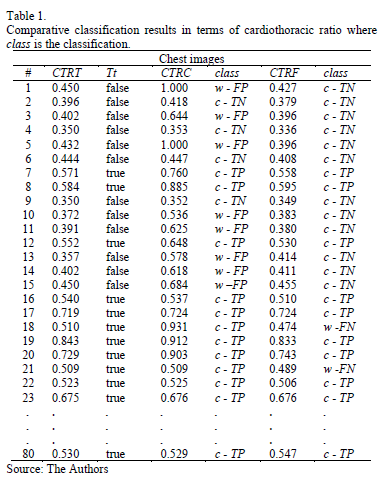
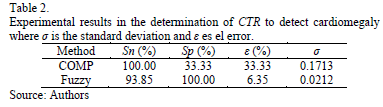
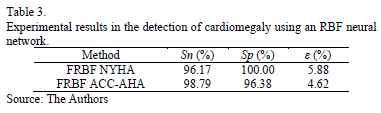
<body><![CDATA[<p><font size="2" face="Verdana, Arial, Helvetica, sans-serif">a.&nbsp; <i>Classification.</i> The <i>CTR</i> is computed using the <i>T</i> and the   correct (<i>R</i>, <i>L</i>) measurements found by the proposed fuzzy method, with these   results we obtain the performance of proposed method using the condition <i>CTR</i> &gt; 0.5, this indicates that the   chest radiograph image has cardiomegaly,   otherwise, it does not.</font></p> <font size="2" face="Verdana, Arial, Helvetica, sans-serif"><b>3.2.  Fuzzy classifier results</b>    <br> The performance of the proposed fuzzy method is evaluated in terms of   medical purposes, we compute the sensitivity and specificity &#91;4,8,9,11,12&#93;. <i>Sensitivity</i> is the probability that a   medical test delivers a positive result when a group of patients with certain   illness is under study, and <i>specificity</i> is the probability that a medical test delivers a negative result when a group of patients under study do not have certain illness, both sensitivity <i>Sn</i> and specificity <i>Sp</i> are represented as:</font>     <p><img src="/img/revistas/dyna/v81n186/v81n186a04eq0910.gif"></p>     <p><font size="2" face="Verdana, Arial, Helvetica, sans-serif">where <i>TP</i> is the number of true positive that   are correct, <i>FN</i> is the number of   false negatives, that is, the negative </font><font size="2" face="Verdana, Arial, Helvetica, sans-serif">results that are not correct, <i>TN</i> is the number of negative results that are correct and <i>FP</i> is the number of false positives, that is, the positive results   that are not correct.</font></p>     <p><font size="2" face="Verdana, Arial, Helvetica, sans-serif"><a href="#tab01">Table 1</a> shows some   numerical values results obtained from the measure of cardiothoracic ratio   using a simple comparative method without fuzzy logic and the proposed fuzzy   method. The variable <i>CTRT</i> shows the   true (manual) measure obtained from the chest radiography, <i>Tt</i> indicates the true classification value, <i>CTRC</i> and <i>CTRF</i> indicates   the measure values obtained with the comparative and proposed fuzzy method,   respectively, in terms of correct (<i>c</i>)   and wrong (<i>w</i>) classifications, and in terms of medical   purposes. The procedure of   comparative method is performed using a   fixed region in the image and assuming that it is a heart region, and obtaining   the maximum distance as if this was the correct measurement of the heart size.   The fuzzy method is implemented using the whole image and it is evaluated   whether the longest distance found is the correct measurement of the heart.   Analyzing the results of <a href="#tab01">Table 1</a>, the proposed fuzzy method is able to provide   a good <i>CTR</i> classification and to fix   the measured errors produced during the segmentation stage outperforming the   results of comparative method. </font></p>     <p align="center"><font size="2" face="Verdana, Arial, Helvetica, sans-serif"><a name="tab01"></a></font><img src="/img/revistas/dyna/v81n186/v81n186a04tab01.gif"></p>     <p><font size="2" face="Verdana, Arial, Helvetica, sans-serif"><a href="#tab02">Table 2</a> shows the sensitivity and   specificity values obtained from the proposed fuzzy method and the comparative   method without fuzzy logic (COMP) in the determination of   cardiomegaly. We can observe that the specificity of   the proposed method outperforms the comparative method. In the case of sensitivity, the comparative method has   better performance in comparison with the proposed fuzzy method.</font></p>     <p align="center"><font size="2" face="Verdana, Arial, Helvetica, sans-serif"><a name="tab02"></a></font><img src="/img/revistas/dyna/v81n186/v81n186a04tab02.gif"></p>     <p><font size="2" face="Verdana, Arial, Helvetica, sans-serif"><b>3.3.  Neuro-fuzzy   classifier results</b></font></p>     <p><font size="2" face="Verdana, Arial, Helvetica, sans-serif">To improve the results of the proposed fuzzy method (see <a href="#tab02">Table 2</a>), we use two different Radial Basis Function (RBF) neural networks &#91;12&#93;   where the inputs of the first network are given by the clinical data of   patients given under the New York Heart Association (NYHA) classification based   on the functional incapacity degree of patient (i.e. physical activity) and the   second classification with the American College of Cardiology-American Heart   Association (ACC-AHA) based on a pre-diagnostic of patient (i.e. structural   abnormality) &#91;6,13&#93;. Additionally, the parameters found in the fuzzy logic   algorithm are added as inputs in the RBF networks. </font></p>     ]]></body>
<body><![CDATA[<p><font size="2" face="Verdana, Arial, Helvetica, sans-serif"><a href="#tab03">Table 3</a> shows that the   proposed fuzzy logic-neural networks (Fuzzy-RBF NYHA and Fuzzy-RBF ACC-AHA)   improve the results of accuracy, sensitivity, and specificity values of the proposed   fuzzy logic based method (see <a href="#tab03">Table 2</a>). </font></p>     <p align="center"><font size="2" face="Verdana, Arial, Helvetica, sans-serif"><a name="tab03"></a></font><img src="/img/revistas/dyna/v81n186/v81n186a04tab03.gif"></p>     <p>&nbsp;</p>     <p><font size="3" face="Verdana, Arial, Helvetica, sans-serif"><b>4.  Discussions</b></font></p>     <p><font size="2" face="Verdana, Arial, Helvetica, sans-serif">There are several   similar researches on cardiomegaly detection in the literature &#91;4,8,9,11&#93;, we compared   our approach with some of them. It has   been proved that a correct segmentation of the lung fields is enough to   compute the <i>CTR</i> indicative of   cardiomegaly, since parts of the boundaries of the lung fields coincide with   the heart contour &#91;1&#93;. For this reason we take the lung segmentation results of   two methods to compare our proposal in terms of accuracy, sensitivity, and   specificity. In paper &#91;8&#93; the authors present a knowledge-based approach to segmentation and analysis of the lung   boundaries in chest X-rays. The image edges are matched to an anatomical model   of the lung boundary using parametric features to find the <i>CTR</i>, this system shows a sensitivity of 88% and a specificity of   95% &#91;8&#93;. Another technique presents a   novel segmentation method that extracts cardiac and thoracic boundaries with   respect to the regions of interest from radiography images providing robustness   in noisy environments like chest radiographies. In this technique, the accuracy   of segmentation is 98.53% with standard deviation of 0.52, and the sensitivity   and specificity are measured as 93.37% and 98.21%, respectively &#91;4&#93;.</font></p>     <p><font size="2" face="Verdana, Arial, Helvetica, sans-serif">Other methods   after finding the lung segmentation compute the <i>CTR</i>. An accuracy of 94.9% is obtained in a method based on   gray-level histogram analysis and an edge detection technique with feature   analysis &#91;9&#93;. A method based on image filtering with convolution masks, segmentation   with thresholding and edge detection achieves an accuracy of 90.5% with a sensitivity of 83.3% and a specificity of 93.3% &#91;11&#93;. </font></p>     <p><font size="2" face="Verdana, Arial, Helvetica, sans-serif">Our proposed fuzzy approach provides an accuracy of 93.65%   of correct detection (see the error of <a href="#tab02">Table 2</a>) and 93.85% and 100.00% of   sensitivity and specificity, respectively. From this comparative we can see   that the performance of the proposed fuzzy method provides the best results in   terms of accuracy, sensitivity, and specificity in comparison with other   methods in most of cases. An advantage of the proposed approach is that it uses   classical morphology operations to segment the lungs providing low   computational complexity and the proposed fuzzy method is robust to find the   correct measures of <i>CTR</i> providing   fast computation because the fuzzy rules use elementary arithmetic operations   and have a good performance in the detection of cardiomegaly. </font></p>     <p><font size="2" face="Verdana, Arial, Helvetica, sans-serif">Finally, the proposed fuzzy logic-neural networks (FRBF   NYHA and FRBF ACC-AHA) improve the results of the proposed fuzzy logic based method (see <a href="#tab02">Table 2</a>) and outperform other   ones published in recently literature &#91;4,8,9,11&#93; by balancing the tradeoff between accuracy, sensitivity, and specificity.</font></p>     <p>&nbsp;</p>     <p><font size="3" face="Verdana, Arial, Helvetica, sans-serif"><b>5.  Conclusions</b></font></p>     ]]></body>
<body><![CDATA[<p><font size="2" face="Verdana, Arial, Helvetica, sans-serif">The proposed fuzzy and fuzzy - RBF neural networks are   able to detect cardiac insufficiency in terms of cardiomegaly. The proposed   methods have demonstrated better classification of chest parameters and   detection of cardiomegaly in comparison with the traditional method and others   published in literature in terms of accuracy, sensitivity, and specificity.   Analyzing chest radiographies by means of use of fuzzy logic and RBF neural   networks are possible and can be used as an alternative diagnosis test using   the proposed algorithms.</font></p>     <p>&nbsp;</p>     <p><font size="3" face="Verdana, Arial, Helvetica, sans-serif"><b>Acknowledgments</b></font></p>     <p><font size="2" face="Verdana, Arial, Helvetica, sans-serif">The work is supported by Instituto Polit&eacute;cnico   Nacional de M&eacute;xico (National Polytechnic Institute of Mexico) and CONACYT   (National Council on Science and Technology of Mexico).</font></p>     <p>&nbsp;</p>     <p><font size="3" face="Verdana, Arial, Helvetica, sans-serif"><b>References</b></font></p>     <!-- ref --><p> <font size="2" face="Verdana, Arial, Helvetica, sans-serif"><b>&#91;1&#93;</b> van Ginneken, B., ter Haar Romeny, B.M. and Viergever, M.A., Computer-Aided Diagnosis in chest radiography: A Survey. IEEE Transactions on Medical Imaging, 20 (12), pp. 1228-1241, 2001.    &nbsp;&nbsp;&nbsp;&nbsp;&nbsp;&nbsp;&nbsp;&nbsp;[&#160;<a href="javascript:void(0);" onclick="javascript: window.open('/scielo.php?script=sci_nlinks&ref=000109&pid=S0012-7353201400040000400001&lng=','','width=640,height=500,resizable=yes,scrollbars=1,menubar=yes,');">Links</a>&#160;]<!-- end-ref -->'</font></p>     <!-- ref --><p> <font size="2" face="Verdana, Arial, Helvetica, sans-serif"><b>&#91;2&#93;</b> van Ginneken, B., Hogeweg, L. and Prokop, M., Computer-aided diagnosis in chest radiography: Beyond nodules, European Journal of Radiology, 72, pp. 226-230, 2009.    &nbsp;&nbsp;&nbsp;&nbsp;&nbsp;&nbsp;&nbsp;&nbsp;[&#160;<a href="javascript:void(0);" onclick="javascript: window.open('/scielo.php?script=sci_nlinks&ref=000111&pid=S0012-7353201400040000400002&lng=','','width=640,height=500,resizable=yes,scrollbars=1,menubar=yes,');">Links</a>&#160;]<!-- end-ref --></font></p>     ]]></body>
<body><![CDATA[<!-- ref --><p> <font size="2" face="Verdana, Arial, Helvetica, sans-serif"><b>&#91;3&#93;</b> Jannin, P., Fitzpatrick, J.M., Hawkes, D.J., Pennec, X., Shahidi, R. and Vannier, M.W., Validation of medical image processing in image-guided therapy. IEEE Transactions on Medical Imaging, 21 (12), pp. 1455-1449, 2002.    &nbsp;&nbsp;&nbsp;&nbsp;&nbsp;&nbsp;&nbsp;&nbsp;[&#160;<a href="javascript:void(0);" onclick="javascript: window.open('/scielo.php?script=sci_nlinks&ref=000113&pid=S0012-7353201400040000400003&lng=','','width=640,height=500,resizable=yes,scrollbars=1,menubar=yes,');">Links</a>&#160;]<!-- end-ref --></font></p>     <!-- ref --><p> <font size="2" face="Verdana, Arial, Helvetica, sans-serif"><b>&#91;4&#93;</b> Hasan, M.A., Lee, S.L., Kim, D.H. and Lim, M.K., Automatic evaluation of cardiac hypertrophy using cardiothoracic area ratio in chest radiograph images, Computer Methods and Programs in Biomedicine, 105 (2), pp. 95-108, 2012.    &nbsp;&nbsp;&nbsp;&nbsp;&nbsp;&nbsp;&nbsp;&nbsp;[&#160;<a href="javascript:void(0);" onclick="javascript: window.open('/scielo.php?script=sci_nlinks&ref=000115&pid=S0012-7353201400040000400004&lng=','','width=640,height=500,resizable=yes,scrollbars=1,menubar=yes,');">Links</a>&#160;]<!-- end-ref --></font></p>     <!-- ref --><p> <font size="2" face="Verdana, Arial, Helvetica, sans-serif"><b>&#91;5&#93;</b> van Ginneken, B., Stegmann, M.B. and Loog, M., Segmentation of anatomical structures in chest radiographs using supervised methods: A comparative study on a public database, Medical Image Analysis, 10, pp. 19-40, 2006.    &nbsp;&nbsp;&nbsp;&nbsp;&nbsp;&nbsp;&nbsp;&nbsp;[&#160;<a href="javascript:void(0);" onclick="javascript: window.open('/scielo.php?script=sci_nlinks&ref=000117&pid=S0012-7353201400040000400005&lng=','','width=640,height=500,resizable=yes,scrollbars=1,menubar=yes,');">Links</a>&#160;]<!-- end-ref --></font></p>     <!-- ref --><p> <font size="2" face="Verdana, Arial, Helvetica, sans-serif"><b>&#91;6&#93;</b> Jamrozy, M., Leyko, T. and Lewenstein, K., Early detection of the cardiac insufficiency, in Recent advances in mechatronics, Berlin, Springer, 2010, pp. 407-411.    &nbsp;&nbsp;&nbsp;&nbsp;&nbsp;&nbsp;&nbsp;&nbsp;[&#160;<a href="javascript:void(0);" onclick="javascript: window.open('/scielo.php?script=sci_nlinks&ref=000119&pid=S0012-7353201400040000400006&lng=','','width=640,height=500,resizable=yes,scrollbars=1,menubar=yes,');">Links</a>&#160;]<!-- end-ref --></font></p>     <!-- ref --><p> <font size="2" face="Verdana, Arial, Helvetica, sans-serif"><b>&#91;7&#93;</b> Cordova, J., Lee, G., Hernandez, M., Aguilar, C., Barriguete, J. and Kuri, P., Clinical prevention of chronic diseases: Overweight, diabetes mellitus and cardiovascular risk, Mexican Journal of Cardiology, 20 (1), pp. 42-45, 2009.    &nbsp;&nbsp;&nbsp;&nbsp;&nbsp;&nbsp;&nbsp;&nbsp;[&#160;<a href="javascript:void(0);" onclick="javascript: window.open('/scielo.php?script=sci_nlinks&ref=000121&pid=S0012-7353201400040000400007&lng=','','width=640,height=500,resizable=yes,scrollbars=1,menubar=yes,');">Links</a>&#160;]<!-- end-ref --></font></p>     ]]></body>
<body><![CDATA[<!-- ref --><p> <font size="2" face="Verdana, Arial, Helvetica, sans-serif"><b>&#91;8&#93;</b> Brown, M.S., Wilson, L.S., Doust, B.D., Gill, R.W. and Sun, C., Knowledge-based method for segmentation and analysis of lung boundaries in chest X-ray images, Computerized Medical Imaging and Graphics, 22, pp. 463-477, 1998.    &nbsp;&nbsp;&nbsp;&nbsp;&nbsp;&nbsp;&nbsp;&nbsp;[&#160;<a href="javascript:void(0);" onclick="javascript: window.open('/scielo.php?script=sci_nlinks&ref=000123&pid=S0012-7353201400040000400008&lng=','','width=640,height=500,resizable=yes,scrollbars=1,menubar=yes,');">Links</a>&#160;]<!-- end-ref --></font></p>     <!-- ref --><p> <font size="2" face="Verdana, Arial, Helvetica, sans-serif"><b>&#91;9&#93;</b> Ishida, T., Katsuragawa, S., Chida, K., MacMahon, H. and Doi, K., Computer-aided diagnosis for detection of cardiomegaly in digital chest radiographs, Proceedings of SPIE 5747 Medical Imaging 2005: Image Processing, pp. 914-920, 2005.    &nbsp;&nbsp;&nbsp;&nbsp;&nbsp;&nbsp;&nbsp;&nbsp;[&#160;<a href="javascript:void(0);" onclick="javascript: window.open('/scielo.php?script=sci_nlinks&ref=000125&pid=S0012-7353201400040000400009&lng=','','width=640,height=500,resizable=yes,scrollbars=1,menubar=yes,');">Links</a>&#160;]<!-- end-ref --></font></p>     <!-- ref --><p> <font size="2" face="Verdana, Arial, Helvetica, sans-serif"><b>&#91;10&#93;</b> Kulkarni, D.A. and Dere, P.U., Characterization of cardiomegaly disease from X-ray images using mean shift based image segmentation, International Conference on Contours of Computing Technology, ThinkQuest 2010, pp. 133-137, 2010.    &nbsp;&nbsp;&nbsp;&nbsp;&nbsp;&nbsp;&nbsp;&nbsp;[&#160;<a href="javascript:void(0);" onclick="javascript: window.open('/scielo.php?script=sci_nlinks&ref=000127&pid=S0012-7353201400040000400010&lng=','','width=640,height=500,resizable=yes,scrollbars=1,menubar=yes,');">Links</a>&#160;]<!-- end-ref --></font></p>     <!-- ref --><p> <font size="2" face="Verdana, Arial, Helvetica, sans-serif"><b>&#91;11&#93;</b> Ilovar, M. and Sajn, L., Analysis of radiograph and detection of cardiomegaly, IEEE Proceedings of the 34th International Convention MIPRO 2011, pp. 859 - 863, 2011.    &nbsp;&nbsp;&nbsp;&nbsp;&nbsp;&nbsp;&nbsp;&nbsp;[&#160;<a href="javascript:void(0);" onclick="javascript: window.open('/scielo.php?script=sci_nlinks&ref=000129&pid=S0012-7353201400040000400011&lng=','','width=640,height=500,resizable=yes,scrollbars=1,menubar=yes,');">Links</a>&#160;]<!-- end-ref --></font></p>     <!-- ref --><p> <font size="2" face="Verdana, Arial, Helvetica, sans-serif"><b>&#91;12&#93;</b> Ordaz-Gutierrez, S., Gallegos-Funes, F.J., Rosales-Silva,A.J., Carvajal-Gamez, B.E. and Mujica-Vargas,D., Diagnosis of acute lymphoblastic leukemia using fuzzy logicand neural networks,Imaging Science Journal, 61 (1), pp. 57-64, 2013.    &nbsp;&nbsp;&nbsp;&nbsp;&nbsp;&nbsp;&nbsp;&nbsp;[&#160;<a href="javascript:void(0);" onclick="javascript: window.open('/scielo.php?script=sci_nlinks&ref=000131&pid=S0012-7353201400040000400012&lng=','','width=640,height=500,resizable=yes,scrollbars=1,menubar=yes,');">Links</a>&#160;]<!-- end-ref --></font></p>     ]]></body>
<body><![CDATA[<!-- ref --><p> <font size="2" face="Verdana, Arial, Helvetica, sans-serif"><b>&#91;13&#93;</b> Dickstein, K., Cohen-Solal, A., Filippatos, G., McMurray, J.J.V., Ponikowski, P., Poole-Wilson, P.A., Strömberg, A., van Veldhuisen, D.J., Atar, D., Hoes, A. W., Keren, A., Mebazaa, A., Nieminen, M., Priori, S. G. and Swedberg, K., ESC Guidelines for the diagnosis and treatment of acute and chronic heart failure 2008. European Heart Journal, 29, pp. 2388-2442, 2008.    &nbsp;&nbsp;&nbsp;&nbsp;&nbsp;&nbsp;&nbsp;&nbsp;[&#160;<a href="javascript:void(0);" onclick="javascript: window.open('/scielo.php?script=sci_nlinks&ref=000133&pid=S0012-7353201400040000400013&lng=','','width=640,height=500,resizable=yes,scrollbars=1,menubar=yes,');">Links</a>&#160;]<!-- end-ref --></font></p>     <!-- ref --><p> <font size="2" face="Verdana, Arial, Helvetica, sans-serif"><b>&#91;14&#93;</b> Moreno-Escobar, J.A., Gallegos-Funes, F.J., Ponomaryov, V. and de-la-Rosa-Vazquez, J.M., Radial basis function neural network based on order statistics. Lecture Notes in Computer Science, 4827, pp. 150-160, 2007.    &nbsp;&nbsp;&nbsp;&nbsp;&nbsp;&nbsp;&nbsp;&nbsp;[&#160;<a href="javascript:void(0);" onclick="javascript: window.open('/scielo.php?script=sci_nlinks&ref=000135&pid=S0012-7353201400040000400014&lng=','','width=640,height=500,resizable=yes,scrollbars=1,menubar=yes,');">Links</a>&#160;]<!-- end-ref --></font></p>     <!-- ref --><p> <font size="2" face="Verdana, Arial, Helvetica, sans-serif"><b>&#91;15&#93;</b> Torres-Robles, F., Gallegos-Funes, F.J. and Rosales-Silva, A.J., Fuzzy feature extraction in image radiographies to detect cardiac insufficiency, IEEE 2nd Workshop Circuits and Systems for Medical and Environmental Applications, CASME, Merida, Mexico, pp. 1-4, 2010.    &nbsp;&nbsp;&nbsp;&nbsp;&nbsp;&nbsp;&nbsp;&nbsp;[&#160;<a href="javascript:void(0);" onclick="javascript: window.open('/scielo.php?script=sci_nlinks&ref=000137&pid=S0012-7353201400040000400015&lng=','','width=640,height=500,resizable=yes,scrollbars=1,menubar=yes,');">Links</a>&#160;]<!-- end-ref --></font></p>     <!-- ref --><p> <font size="2" face="Verdana, Arial, Helvetica, sans-serif"><b>&#91;16&#93;</b> Bankman, I., Handbook of medical image processing and analysis Volume 1. Boston: Academic Press, 2008.    &nbsp;&nbsp;&nbsp;&nbsp;&nbsp;&nbsp;&nbsp;&nbsp;[&#160;<a href="javascript:void(0);" onclick="javascript: window.open('/scielo.php?script=sci_nlinks&ref=000139&pid=S0012-7353201400040000400016&lng=','','width=640,height=500,resizable=yes,scrollbars=1,menubar=yes,');">Links</a>&#160;]<!-- end-ref --></font></p>     <!-- ref --><p> <font size="2" face="Verdana, Arial, Helvetica, sans-serif"><b>&#91;17&#93;</b> Kerre, E.E., Fuzzy techniques in image processing. Berlin: Springer, 2000.    &nbsp;&nbsp;&nbsp;&nbsp;&nbsp;&nbsp;&nbsp;&nbsp;[&#160;<a href="javascript:void(0);" onclick="javascript: window.open('/scielo.php?script=sci_nlinks&ref=000141&pid=S0012-7353201400040000400017&lng=','','width=640,height=500,resizable=yes,scrollbars=1,menubar=yes,');">Links</a>&#160;]<!-- end-ref --></font></p>     ]]></body>
<body><![CDATA[<!-- ref --><p> <font size="2" face="Verdana, Arial, Helvetica, sans-serif"><b>&#91;18&#93;</b> Goncalves, M., Rodr&iacute;guez, R. and Tineo, L. Formal method to implement fuzzy requirements. DYNA, 79 (173), pp. 15-24, 2012.    &nbsp;&nbsp;&nbsp;&nbsp;&nbsp;&nbsp;&nbsp;&nbsp;[&#160;<a href="javascript:void(0);" onclick="javascript: window.open('/scielo.php?script=sci_nlinks&ref=000143&pid=S0012-7353201400040000400018&lng=','','width=640,height=500,resizable=yes,scrollbars=1,menubar=yes,');">Links</a>&#160;]<!-- end-ref --></font></p>     <!-- ref --><p> <font size="2" face="Verdana, Arial, Helvetica, sans-serif"><b>&#91;19&#93;</b> Gonzalez, R.C., Digital image processing using Matlab. New York: Prentice Hall, 2003.    &nbsp;&nbsp;&nbsp;&nbsp;&nbsp;&nbsp;&nbsp;&nbsp;[&#160;<a href="javascript:void(0);" onclick="javascript: window.open('/scielo.php?script=sci_nlinks&ref=000145&pid=S0012-7353201400040000400019&lng=','','width=640,height=500,resizable=yes,scrollbars=1,menubar=yes,');">Links</a>&#160;]<!-- end-ref --></font></p>     <!-- ref --><p> <font size="2" face="Verdana, Arial, Helvetica, sans-serif"><b>&#91;20&#93;</b> Kinani, J.M.V., Gallegos-Funes, F.J., Rosales-Silva, A.J. and Arellano, A., Computer-aided diagnosis of brain tumors using image enhancement and fuzzy logic. DYNA. 81 (183), pp. 148-157, 2014.    &nbsp;&nbsp;&nbsp;&nbsp;&nbsp;&nbsp;&nbsp;&nbsp;[&#160;<a href="javascript:void(0);" onclick="javascript: window.open('/scielo.php?script=sci_nlinks&ref=000147&pid=S0012-7353201400040000400020&lng=','','width=640,height=500,resizable=yes,scrollbars=1,menubar=yes,');">Links</a>&#160;]<!-- end-ref --> </font></p>     <p>&nbsp;</p>     <p><font size="2" face="Verdana, Arial, Helvetica, sans-serif"><b>F. Torres-Robles</b>, received the MSc. degree in   electronic engineering from National Polytechnic Institute of Mexico in 2011.   His areas of scientific interest are image processing and fuzzy logic. </font></p>     <p><font size="2" face="Verdana, Arial, Helvetica, sans-serif"><b>A.J. Rosales-Silva</b>, received the PhD. degree in communications and electronics from   National Polytechnic Institute of Mexico in 2008. He is currently an Associate   Professor in the Mechanical and Electrical Engineering Higher School from the   same institute. His areas of scientific interest are image processing,   filtering, pattern recognition, and real-time applications.</font></p>     <p><font size="2" face="Verdana, Arial, Helvetica, sans-serif"><b>F.J. Gallegos-Funes</b>, received the PhD. degree in   communications and electronics from National Polytechnic Institute of Mexico in   2003. He is currently an Associate Professor in the Mechanical and Electrical   Engineering Higher School from the same institute. His areas of scientific   interest are signal and image processing, filtering, steganography, pattern   recognition, and real-time applications. </font></p>     ]]></body>
<body><![CDATA[<p><font size="2" face="Verdana, Arial, Helvetica, sans-serif"><b>I. Baz&aacute;n-Trujillo, </b>received the PhD. degree in   electrical engineering from Center for Research and   Advanced Studies of Mexico in 2009. She is currently an Associate   Professor in the Mechanical and Electrical Engineering Higher School. Her areas   of scientific interest are biological signal and image processing, sensors and   actuators.</font></p>      ]]></body><back>
<ref-list>
<ref id="B1">
<label>1</label><nlm-citation citation-type="journal">
<person-group person-group-type="author">
<name>
<surname><![CDATA[van Ginneken]]></surname>
<given-names><![CDATA[B.]]></given-names>
</name>
<name>
<surname><![CDATA[ter Haar Romeny]]></surname>
<given-names><![CDATA[B.M.]]></given-names>
</name>
<name>
<surname><![CDATA[Viergever]]></surname>
<given-names><![CDATA[M.A.]]></given-names>
</name>
</person-group>
<article-title xml:lang="en"><![CDATA[Computer-Aided Diagnosis in chest radiography: A Survey]]></article-title>
<source><![CDATA[IEEE Transactions on Medical Imaging]]></source>
<year>2001</year>
<volume>20</volume>
<numero>12</numero>
<issue>12</issue>
<page-range>1228-1241</page-range></nlm-citation>
</ref>
<ref id="B2">
<label>2</label><nlm-citation citation-type="journal">
<person-group person-group-type="author">
<name>
<surname><![CDATA[van Ginneken]]></surname>
<given-names><![CDATA[B.]]></given-names>
</name>
<name>
<surname><![CDATA[Hogeweg]]></surname>
<given-names><![CDATA[L.]]></given-names>
</name>
<name>
<surname><![CDATA[Prokop]]></surname>
<given-names><![CDATA[M.]]></given-names>
</name>
</person-group>
<article-title xml:lang="en"><![CDATA[Computer-aided diagnosis in chest radiography: Beyond nodules]]></article-title>
<source><![CDATA[European Journal of Radiology]]></source>
<year>2009</year>
<numero>72</numero>
<issue>72</issue>
<page-range>226-230</page-range></nlm-citation>
</ref>
<ref id="B3">
<label>3</label><nlm-citation citation-type="journal">
<person-group person-group-type="author">
<name>
<surname><![CDATA[Jannin]]></surname>
<given-names><![CDATA[P.]]></given-names>
</name>
<name>
<surname><![CDATA[Fitzpatrick]]></surname>
<given-names><![CDATA[J.M.]]></given-names>
</name>
<name>
<surname><![CDATA[Hawkes]]></surname>
<given-names><![CDATA[D.J.]]></given-names>
</name>
<name>
<surname><![CDATA[Pennec]]></surname>
<given-names><![CDATA[X.]]></given-names>
</name>
<name>
<surname><![CDATA[Shahidi]]></surname>
<given-names><![CDATA[R.]]></given-names>
</name>
<name>
<surname><![CDATA[Vannier]]></surname>
<given-names><![CDATA[M.W.]]></given-names>
</name>
</person-group>
<article-title xml:lang="en"><![CDATA[Validation of medical image processing in image-guided therapy]]></article-title>
<source><![CDATA[IEEE Transactions on Medical Imaging]]></source>
<year>2002</year>
<volume>21</volume>
<numero>12</numero>
<issue>12</issue>
<page-range>1455-1449</page-range></nlm-citation>
</ref>
<ref id="B4">
<label>4</label><nlm-citation citation-type="journal">
<person-group person-group-type="author">
<name>
<surname><![CDATA[Hasan]]></surname>
<given-names><![CDATA[M.A.]]></given-names>
</name>
<name>
<surname><![CDATA[Lee]]></surname>
<given-names><![CDATA[S.L.]]></given-names>
</name>
<name>
<surname><![CDATA[Kim]]></surname>
<given-names><![CDATA[D.H.]]></given-names>
</name>
<name>
<surname><![CDATA[Lim]]></surname>
<given-names><![CDATA[M.K.]]></given-names>
</name>
</person-group>
<article-title xml:lang="en"><![CDATA[Automatic evaluation of cardiac hypertrophy using cardiothoracic area ratio in chest radiograph images]]></article-title>
<source><![CDATA[Computer Methods and Programs in Biomedicine]]></source>
<year>2012</year>
<volume>105</volume>
<numero>2</numero>
<issue>2</issue>
<page-range>95-108</page-range></nlm-citation>
</ref>
<ref id="B5">
<label>5</label><nlm-citation citation-type="journal">
<person-group person-group-type="author">
<name>
<surname><![CDATA[van Ginneken]]></surname>
<given-names><![CDATA[B.]]></given-names>
</name>
<name>
<surname><![CDATA[Stegmann]]></surname>
<given-names><![CDATA[M.B.]]></given-names>
</name>
<name>
<surname><![CDATA[Loog]]></surname>
<given-names><![CDATA[M.]]></given-names>
</name>
</person-group>
<article-title xml:lang="en"><![CDATA[Segmentation of anatomical structures in chest radiographs using supervised methods: A comparative study on a public database]]></article-title>
<source><![CDATA[Medical Image Analysis]]></source>
<year>2006</year>
<numero>10</numero>
<issue>10</issue>
<page-range>19-40</page-range></nlm-citation>
</ref>
<ref id="B6">
<label>6</label><nlm-citation citation-type="book">
<person-group person-group-type="author">
<name>
<surname><![CDATA[Jamrozy]]></surname>
<given-names><![CDATA[M.]]></given-names>
</name>
<name>
<surname><![CDATA[Leyko]]></surname>
<given-names><![CDATA[T.]]></given-names>
</name>
<name>
<surname><![CDATA[Lewenstein]]></surname>
<given-names><![CDATA[K.]]></given-names>
</name>
</person-group>
<article-title xml:lang="en"><![CDATA[Early detection of the cardiac insufficiency]]></article-title>
<source><![CDATA[Recent advances in mechatronics]]></source>
<year>2010</year>
<page-range>407-411</page-range><publisher-loc><![CDATA[Berlin ]]></publisher-loc>
<publisher-name><![CDATA[Springer]]></publisher-name>
</nlm-citation>
</ref>
<ref id="B7">
<label>7</label><nlm-citation citation-type="journal">
<person-group person-group-type="author">
<name>
<surname><![CDATA[Cordova]]></surname>
<given-names><![CDATA[J.]]></given-names>
</name>
<name>
<surname><![CDATA[Lee]]></surname>
<given-names><![CDATA[G.]]></given-names>
</name>
<name>
<surname><![CDATA[Hernandez]]></surname>
<given-names><![CDATA[M.]]></given-names>
</name>
<name>
<surname><![CDATA[Aguilar]]></surname>
<given-names><![CDATA[C.]]></given-names>
</name>
<name>
<surname><![CDATA[Barriguete]]></surname>
<given-names><![CDATA[J.]]></given-names>
</name>
<name>
<surname><![CDATA[Kuri]]></surname>
<given-names><![CDATA[P.]]></given-names>
</name>
</person-group>
<article-title xml:lang="en"><![CDATA[Clinical prevention of chronic diseases: Overweight, diabetes mellitus and cardiovascular risk]]></article-title>
<source><![CDATA[Mexican Journal of Cardiology]]></source>
<year>2009</year>
<volume>20</volume>
<numero>1</numero>
<issue>1</issue>
<page-range>42-45</page-range></nlm-citation>
</ref>
<ref id="B8">
<label>8</label><nlm-citation citation-type="journal">
<person-group person-group-type="author">
<name>
<surname><![CDATA[Brown]]></surname>
<given-names><![CDATA[M.S.]]></given-names>
</name>
<name>
<surname><![CDATA[Wilson]]></surname>
<given-names><![CDATA[L.S.]]></given-names>
</name>
<name>
<surname><![CDATA[Doust]]></surname>
<given-names><![CDATA[B.D.]]></given-names>
</name>
<name>
<surname><![CDATA[Gill]]></surname>
<given-names><![CDATA[R.W.]]></given-names>
</name>
<name>
<surname><![CDATA[Sun]]></surname>
<given-names><![CDATA[C.]]></given-names>
</name>
</person-group>
<article-title xml:lang="en"><![CDATA[Knowledge-based method for segmentation and analysis of lung boundaries in chest X-ray images]]></article-title>
<source><![CDATA[Computerized Medical Imaging and Graphics]]></source>
<year>1998</year>
<numero>22</numero>
<issue>22</issue>
<page-range>463-477</page-range></nlm-citation>
</ref>
<ref id="B9">
<label>9</label><nlm-citation citation-type="confpro">
<person-group person-group-type="author">
<name>
<surname><![CDATA[Ishida]]></surname>
<given-names><![CDATA[T.]]></given-names>
</name>
<name>
<surname><![CDATA[Katsuragawa]]></surname>
<given-names><![CDATA[S.]]></given-names>
</name>
<name>
<surname><![CDATA[Chida]]></surname>
<given-names><![CDATA[K.]]></given-names>
</name>
<name>
<surname><![CDATA[MacMahon]]></surname>
<given-names><![CDATA[H.]]></given-names>
</name>
<name>
<surname><![CDATA[Doi]]></surname>
<given-names><![CDATA[K.]]></given-names>
</name>
</person-group>
<article-title xml:lang="en"><![CDATA[Computer-aided diagnosis for detection of cardiomegaly in digital chest radiographs]]></article-title>
<source><![CDATA[]]></source>
<year></year>
<conf-name><![CDATA[ Proceedings of SPIE 5747 Medical Imaging 2005: Image Processing]]></conf-name>
<conf-date>2005</conf-date>
<conf-loc> </conf-loc>
</nlm-citation>
</ref>
<ref id="B10">
<label>10</label><nlm-citation citation-type="confpro">
<person-group person-group-type="author">
<name>
<surname><![CDATA[Kulkarni]]></surname>
<given-names><![CDATA[D.A.]]></given-names>
</name>
<name>
<surname><![CDATA[Dere]]></surname>
<given-names><![CDATA[P.U.]]></given-names>
</name>
</person-group>
<article-title xml:lang="en"><![CDATA[Characterization of cardiomegaly disease from X-ray images using mean shift based image segmentation]]></article-title>
<source><![CDATA[]]></source>
<year>2010</year>
<conf-name><![CDATA[ International Conference on Contours of Computing Technology]]></conf-name>
<conf-date>2010</conf-date>
<conf-loc> </conf-loc>
<page-range>133-137</page-range></nlm-citation>
</ref>
<ref id="B11">
<label>11</label><nlm-citation citation-type="confpro">
<person-group person-group-type="author">
<name>
<surname><![CDATA[Ilovar]]></surname>
<given-names><![CDATA[M.]]></given-names>
</name>
<name>
<surname><![CDATA[Sajn]]></surname>
<given-names><![CDATA[L.]]></given-names>
</name>
</person-group>
<article-title xml:lang="en"><![CDATA[Analysis of radiograph and detection of cardiomegaly]]></article-title>
<source><![CDATA[]]></source>
<year>2011</year>
<conf-name><![CDATA[ IEEE Proceedings of the 34th International Convention MIPRO]]></conf-name>
<conf-date>2011</conf-date>
<conf-loc> </conf-loc>
<page-range>859 - 863</page-range></nlm-citation>
</ref>
<ref id="B12">
<label>12</label><nlm-citation citation-type="journal">
<person-group person-group-type="author">
<name>
<surname><![CDATA[Ordaz-Gutierrez]]></surname>
<given-names><![CDATA[S.]]></given-names>
</name>
<name>
<surname><![CDATA[Gallegos-Funes]]></surname>
<given-names><![CDATA[F.J.]]></given-names>
</name>
<name>
<surname><![CDATA[Rosales-Silva]]></surname>
<given-names><![CDATA[A.J.]]></given-names>
</name>
<name>
<surname><![CDATA[Carvajal-Gamez]]></surname>
<given-names><![CDATA[B.E.]]></given-names>
</name>
<name>
<surname><![CDATA[Mujica-Vargas]]></surname>
<given-names><![CDATA[D.]]></given-names>
</name>
</person-group>
<article-title xml:lang="en"><![CDATA[Diagnosis of acute lymphoblastic leukemia using fuzzy logicand neural networks]]></article-title>
<source><![CDATA[Imaging Science Journal]]></source>
<year>2013</year>
<volume>61</volume>
<numero>1</numero>
<issue>1</issue>
<page-range>57-64</page-range></nlm-citation>
</ref>
<ref id="B13">
<label>13</label><nlm-citation citation-type="journal">
<person-group person-group-type="author">
<name>
<surname><![CDATA[Dickstein]]></surname>
<given-names><![CDATA[K.]]></given-names>
</name>
<name>
<surname><![CDATA[Cohen-Solal]]></surname>
<given-names><![CDATA[A.]]></given-names>
</name>
<name>
<surname><![CDATA[Filippatos]]></surname>
<given-names><![CDATA[G.]]></given-names>
</name>
<name>
<surname><![CDATA[McMurray]]></surname>
<given-names><![CDATA[J.J.V.]]></given-names>
</name>
<name>
<surname><![CDATA[Ponikowski]]></surname>
<given-names><![CDATA[P.]]></given-names>
</name>
<name>
<surname><![CDATA[Poole-Wilson]]></surname>
<given-names><![CDATA[P.A.]]></given-names>
</name>
<name>
<surname><![CDATA[Strömberg]]></surname>
<given-names><![CDATA[A.]]></given-names>
</name>
<name>
<surname><![CDATA[van Veldhuisen]]></surname>
<given-names><![CDATA[D.J.]]></given-names>
</name>
<name>
<surname><![CDATA[Atar]]></surname>
<given-names><![CDATA[D.]]></given-names>
</name>
<name>
<surname><![CDATA[Hoes]]></surname>
<given-names><![CDATA[A. W.]]></given-names>
</name>
<name>
<surname><![CDATA[Keren]]></surname>
<given-names><![CDATA[A.]]></given-names>
</name>
<name>
<surname><![CDATA[Mebazaa]]></surname>
<given-names><![CDATA[A.]]></given-names>
</name>
<name>
<surname><![CDATA[Nieminen]]></surname>
<given-names><![CDATA[M.]]></given-names>
</name>
<name>
<surname><![CDATA[Priori]]></surname>
<given-names><![CDATA[S. G.]]></given-names>
</name>
<name>
<surname><![CDATA[Swedberg]]></surname>
<given-names><![CDATA[K.]]></given-names>
</name>
</person-group>
<article-title xml:lang="en"><![CDATA[ESC Guidelines for the diagnosis and treatment of acute and chronic heart failure 2008]]></article-title>
<source><![CDATA[European Heart Journal]]></source>
<year>2008</year>
<numero>29</numero>
<issue>29</issue>
<page-range>2388-2442</page-range></nlm-citation>
</ref>
<ref id="B14">
<label>14</label><nlm-citation citation-type="journal">
<person-group person-group-type="author">
<name>
<surname><![CDATA[Moreno-Escobar]]></surname>
<given-names><![CDATA[J.A.]]></given-names>
</name>
<name>
<surname><![CDATA[Gallegos-Funes]]></surname>
<given-names><![CDATA[F.J.]]></given-names>
</name>
<name>
<surname><![CDATA[Ponomaryov]]></surname>
<given-names><![CDATA[V.]]></given-names>
</name>
<name>
<surname><![CDATA[de-la-Rosa-Vazquez]]></surname>
<given-names><![CDATA[J.M.]]></given-names>
</name>
</person-group>
<article-title xml:lang="en"><![CDATA[Radial basis function neural network based on order statistics]]></article-title>
<source><![CDATA[Lecture Notes in Computer Science]]></source>
<year>2007</year>
<numero>4827</numero>
<issue>4827</issue>
<page-range>150-160</page-range></nlm-citation>
</ref>
<ref id="B15">
<label>15</label><nlm-citation citation-type="confpro">
<person-group person-group-type="author">
<name>
<surname><![CDATA[Torres-Robles]]></surname>
<given-names><![CDATA[F.]]></given-names>
</name>
<name>
<surname><![CDATA[Gallegos-Funes]]></surname>
<given-names><![CDATA[F.J.]]></given-names>
</name>
<name>
<surname><![CDATA[Rosales-Silva]]></surname>
<given-names><![CDATA[A.J.]]></given-names>
</name>
</person-group>
<article-title xml:lang="en"><![CDATA[Fuzzy feature extraction in image radiographies to detect cardiac insufficiency]]></article-title>
<source><![CDATA[]]></source>
<year>2010</year>
<conf-name><![CDATA[2nd Workshop Circuits and Systems for Medical and Environmental Applications]]></conf-name>
<conf-loc>Merida </conf-loc>
<page-range>1-4</page-range></nlm-citation>
</ref>
<ref id="B16">
<label>16</label><nlm-citation citation-type="book">
<person-group person-group-type="author">
<name>
<surname><![CDATA[Bankman]]></surname>
<given-names><![CDATA[I.]]></given-names>
</name>
</person-group>
<source><![CDATA[Handbook of medical image processing and analysis]]></source>
<year>2008</year>
<volume>1</volume>
<publisher-loc><![CDATA[Boston ]]></publisher-loc>
<publisher-name><![CDATA[Academic Press]]></publisher-name>
</nlm-citation>
</ref>
<ref id="B17">
<label>17</label><nlm-citation citation-type="book">
<person-group person-group-type="author">
<name>
<surname><![CDATA[Kerre]]></surname>
<given-names><![CDATA[E.E.]]></given-names>
</name>
</person-group>
<source><![CDATA[Fuzzy techniques in image processing]]></source>
<year>2000</year>
<publisher-loc><![CDATA[Berlin ]]></publisher-loc>
<publisher-name><![CDATA[Springer]]></publisher-name>
</nlm-citation>
</ref>
<ref id="B18">
<label>18</label><nlm-citation citation-type="journal">
<person-group person-group-type="author">
<name>
<surname><![CDATA[Goncalves]]></surname>
<given-names><![CDATA[M.]]></given-names>
</name>
<name>
<surname><![CDATA[Rodríguez]]></surname>
<given-names><![CDATA[R.]]></given-names>
</name>
<name>
<surname><![CDATA[Tineo]]></surname>
<given-names><![CDATA[L.]]></given-names>
</name>
</person-group>
<article-title xml:lang="en"><![CDATA[Formal method to implement fuzzy requirements]]></article-title>
<source><![CDATA[DYNA]]></source>
<year>2012</year>
<volume>79</volume>
<numero>173</numero>
<issue>173</issue>
<page-range>15-24</page-range></nlm-citation>
</ref>
<ref id="B19">
<label>19</label><nlm-citation citation-type="book">
<person-group person-group-type="author">
<name>
<surname><![CDATA[Gonzalez]]></surname>
<given-names><![CDATA[R.C.]]></given-names>
</name>
</person-group>
<source><![CDATA[Digital image processing using Matlab]]></source>
<year>2003</year>
<publisher-loc><![CDATA[New York ]]></publisher-loc>
<publisher-name><![CDATA[Prentice Hall]]></publisher-name>
</nlm-citation>
</ref>
<ref id="B20">
<label>20</label><nlm-citation citation-type="journal">
<person-group person-group-type="author">
<name>
<surname><![CDATA[Kinani]]></surname>
<given-names><![CDATA[J.M.V.]]></given-names>
</name>
<name>
<surname><![CDATA[Gallegos-Funes]]></surname>
<given-names><![CDATA[F.J.]]></given-names>
</name>
<name>
<surname><![CDATA[Rosales-Silva]]></surname>
<given-names><![CDATA[A.J.]]></given-names>
</name>
<name>
<surname><![CDATA[Arellano]]></surname>
<given-names><![CDATA[A.]]></given-names>
</name>
</person-group>
<article-title xml:lang="en"><![CDATA[Computer-aided diagnosis of brain tumors using image enhancement and fuzzy logic]]></article-title>
<source><![CDATA[DYNA]]></source>
<year>2014</year>
<volume>81</volume>
<numero>183</numero>
<issue>183</issue>
<page-range>148-157</page-range></nlm-citation>
</ref>
</ref-list>
</back>
</article>